All Categories

Subcategories

  • Peru: Fujimori makes an unsteady start

    Abbi Dicker 22 October 2026 Hits: 29

    There are many different ways of characterising modern Peru, but one evidence-based approach might be to classify it as an “unstable and imperfect democracy”. A dramatic illustration of that is that over the last 10 years the country has had no fewer than nine presidents. For most of the last decade there have been repeated clashes between the executive and legislative powers, with the latter often impeaching sitting presidents. None of the last nine Peruvian presidents have to date been able to complete their full five-year presidential terms in office.

    Country

    Peru

    President

    Keiko Fujimori

    Main 2026 electoral promises

    • Re-establishment of security under slogan “Perú con Orden”
    • “Frontal” campaign against organised crime, including 60-day state emergency and increased government powers
    • Greater reliance on armed forces, possibility of placing the military in charge of prisons
    • Unified anti-crime command
    • Enhanced use of intelligence and technology
    • More visible policing
    • Reform of the judiciary, possible withdrawal from Inter-American Court of Human Rights
    • Crackdown on extortion
    • Stronger border controls
    • Youth crime prevention programme

    Round one election results

    Highlighting the extreme fragmentation of Peruvian politics, no fewer than 35 presidential hopefuls stood in the first round on 12-13 April. This poll was won by Keiko Fujimoi of the right-wing populist Fuerza Popular (FP) party. Leftist Roberto Sánchez of the Juntos por el Perú coalition came second.

    Round two election results

    The second-round run-off was held on 7 June and won by Fujimori by the narrowest of margins, 50.13% against 49.87% for Sánchez.

    Date sworn in

    28 July 2026

    First 100 days in office reached on

    5 November 2026

    Situation in congress

    No party has a majority in congress. FP, Fujimori’s party, has 41 of the 130 seats in the lower house (66 are needed for a majority). The party also has 22 of the 60-seat senate (where 31 are needed for a majority)


    An example of the country’s endemic political chaos came during the 2021 elections which were narrowly won by Pedro Castillo, a previously little-known left-wing schoolteacher. He promised to reduce inequality, increase state sector involvement in mining, and to re-write the constitution. But his government was weakened by multiple internal divisions and confrontation with the conservative-dominated congress. In December 2022 Castillo announced he was closing congress and would rule by decree, a move described as an ‘autogolpe’ (self-coup). Congress responded by impeaching and imprisoning Castillo and appointing Vice President Dina Boluarte to replace him. That in turn led to widespread popular protests in impoverished rural areas of the country where support for Castillo remained strong. More than 50 people died amid the protests, including in violent clashes with the security forces.

    Boluarte survived as interim president until October 2025 when she too was impeached by congress, which accused her of “moral incapacity”, corruption, and of failing to deal effectively with a rise in extortion, killings, and organised crime. Her replacement, José Jerí (formerly president of congress) was himself removed from office in February 2026 amid allegations of illicit enrichment and improper links with a Chinese businessman. It was then left to veteran left-wing legislator José María Balcázar to serve as interim president during the 2026 elections.  

    The key issues in the 2026 elections were widely seen as being a conflict over institutional stability, security, and corruption. In some senses it was a replay of the long-running left-right split in the country, with the victorious Keiko Fujimori representing the populist right and the narrowly defeated Roberto Sánchez appealing to those on the left, particularly in southern rural areas, who supported Castillo. Crime and security led the agenda, with candidates highlighting extortion, murder, contract killings, illegal mining, drug trafficking, and attacks on transport workers and small businesses. According to an Ipsos survey in May 2026, 63% of respondents identified delinquency as one of the country’s top three problems, followed by corruption and the economy. On corruption, pollster Arellano Consultoría found in March that 70% of respondents say that having no record of corruption is the most important characteristic in a presidential candidate.

    During the election campaign Fujimori promised a 60-day emergency anti-crime programme, the use of AI and crime mapping, stronger police and intelligence, new prisons including one modelled on El Salvador’s Cecot, prison labour, and the deportation of illegal immigrants. Roberto Sánchez also promised a tough line on crime but combined it with reforms such as a new unit on financial and cybercrime.   

  • CARIBBEAN POINTERS

    LatinNews 15 January 2014 Hits: 2159

    *** TRINIDAD PROJECTIONS SEEN TO BE REALISTIC. The Central Bank of Trinidad & Tobago is forecasting economic growth of 2.5% for 2014. Local economists believe this to be realistic, although some have said that the estimate of 1.5% growth for 2013 may have been affected by flooding in Eastern Caribbean countries in late December and a spate of Petrotrin oil spills which began on 17 December and which may have been the result of sabotage.

    Agreeing with the 2.5% projection for 2014, Dr Roger Hosein from the Trade and Economic Unit at the University of the West Indies (UWI) notes: “The natural gas maintenance by the major companies has been completed. Our trading partners have been returning to something close to a more stable level of growth, even if at a new lower level. The price of oil is expected to average around US$95.”

    During 2012 (when growth was 1.2%) and 2013, growth was affected by large-scale maintenance programmes in the energy sector. Output in both upstream and downstream industries is expected to return to normal levels in 2014.

    *** ST KITTS & NEVIS OPPOSITION TAKES TO THE STREETS. Prime Minister Denzil Douglas, head of the St Kitts & Nevis Labour Party (SKLP) is still hanging on to power and refusing to grant parliamentary time for a no-confidence motion that the opposition has been trying to table since December 2012. There are 11 elected seats in the National Assembly, and the opposition now controls six of these. However, there are also three appointed Senators and the Attorney-General who take the total number of members to 15 in all. It is the unelected element that has enabled Douglas to cling to power, but it is a controversial manoeuvre as only elected members are entitled to vote in a no-confidence motion.

    Back in July, Douglas said he would hold on to power until constituency boundary changes had been implemented. Then he would call an election. However, at the end of November the High Court upheld an injunction preventing the implementation of the boundary changes and called for a judicial review.

    The three-party opposition grouping known as Team Unity has taken to the streets to try to force Douglas’s hand. Following a street demonstration on 10 January Sam Condor, Douglas’s former deputy and now Team Unity member, warned: “We will not come off the streets until he [Douglas] does what is right – either bring the motion of no confidence or call the election, that is what the country demands.” Condor added: “We want our democracy back.”

    People’s Action Movement (PAM) leader Shawn Richards agreed, saying: “We are going to continue to agitate from now until the general election is called in this country.”

    *** GOOD NEWS ON ST LUCIA TOURISM. Last year was a record for tourism in St Lucia, with stay-over arrivals hitting a record 315,000 visitors. Overall arrivals in 2013 were up 3.4% on 2012, with the largest increase (11%) coming from the US. Minister of Tourism Lorne Theophilus said: “Several factors played an integral part in the success…from increased airlift accessibility and strategic marketing initiatives to the enhancements made by our hotel partners.” According to the St Lucia Tourist Board, a further US$230m is due to be spent by the industry on upgrades and refurbishment during 2014.

  • ARGENTINA: Where’s the beef?

    LatinNews 18 June 2021 Hits: 4339

    The Argentine government led by President Alberto Fernández announced a one-month ban on beef exports in mid-May, and cattle ranchers hit back with a nine-day strike during which they refused to send live animals to market for slaughter. A preliminary conclusion is that neither side has won.   

    The government says the month-long ban on beef exports was necessary to halt a relentless rise in meat prices on the domestic market. Argentina is the world’s fifth largest beef exporter. The government claimed that increased export demand, mainly from China, has restricted deliveries to the domestic market and raised prices. In effect, in the year to April domestic beef prices rose by 66.1%, well above the general inflation rate of 46.3%. Argentina is also one of the world’s highest per capita beef consumers, so higher prices are making the government unpopular ahead of congressional elections due in November.

    The cattle ranchers responded angrily, saying experience shows export bans do not work on the long term, and rejecting what they considered to be heavy-handed government intervention in their business. At the end of their nine-day stoppage, four livestock associations repeated their opposition to the export ban and to what they described as a general lack of consultation on agriculture and livestock policies.

    One lobby group, the Consejo Agro-industrial Argentino (CAA), said on 2 June that it aimed to intensify talks with the government and did not exclude calling a new strike that might involve both beef and grains producers. According to a statement, CAA leader Dardo Chiesa met President Fernández to explore “consensual polices to correct the situation by promoting the supply of food to meet both domestic and export demand”. The president is said to have called for a “quick solution…for domestic supply, in order to lift the export suspension”.

  • TRACKING TRENDS

    Patrick de Courcy 02 December 2021 Hits: 3159

    BRAZIL | Unemployment rate falling. The unemployment rate totalled 12.6% in the third quarter of the year, Brazil’s national statistics institute (Ibge) reported this week. This is down from 14.2% in the second quarter, and 14.9% from July-September 2020.

    The Ibge’s coordinator on work and income, Adriana Beringuy, noted that in the third quarter the employment rate increased, while both the unemployment rate and the number of working-age people outside of the workforce declined.    

    These encouraging figures are tempered, however, by the fact that employed Brazilians’ average income is falling: the average income in the third quarter was 4% lower than in the second quarter, and 11.1% below what it was in the third quarter of 2020. Beringuy said this reflects the fact that the increase in employment is being driven by lower-paid jobs, and that inflation is eroding purchasing power.

  • RASTREANDO TENDENCIAS

    LatinNews 12 September 2011 Hits: 191

    BRASIL | Belo Monte. El instituto del medioambiente y de recursos naturales renovables (Ibama) ha otorgado una licencia para la controversial represa de Belo Monte que será construida sobre el Río Xingu en el estado de Pará [IL-11-20]. De acuerdo con las declaraciones oficiales de Ibama, “el proceso de licencia fue marcado por un robusto análisis técnico que resultó en la incorporación de inquietudes socio-ambientales”.
    La construcción de la represa es fuertemente criticada por grupos ambientalistas e indígenas, que afirman que eso causaría un daño irreparable al ecosistema  y al tradicional estilo de vida de las comunidades indígenas en el área. La cuestión fue llevada ante la Corte Interamericana de Derechos Humanos (CIADH), que urgió a Brasil que cesen las obras en la represa hasta que pueda proveer seguridades que los derechos de los pueblos indígenas no estarán siendo violados.

    CHILE | Protestas agrícolas. La principal federación sindical de granjeros, Fedefruta, realizó una gran protesta el 6 de junio contra la sostenida caída del dólar. Unos 4.000 productores agrícolas tomaron parte en una marcha de protesta en Requinoa, a 90km al sur de Santiago, acusando al gobierno de renegar de un acuerdo para estabilizar el dólar. “Estamos viviendo en la incertidumbre total con la amenaza diaria de la caída del valor del dólar y de los crecientes costos de producción,” se quejó Antonio Walker, el presidente de Fedefruta. El pidió al banco central que incremente “sustancialmente” la compra de dólares en un intento de frenar la caída del dólar contra el peso.
    El ministro de finanzas, Felipe Larraín, dijo que él estaba bien conciente de las dificultades enfrentadas por los productores agrícolas, pero insistió que las medidas estaban siendo tomadas, como la provisión de unos US$700m en créditos para el sector agrícola. El sector agrícola conforma el 60% del PIB de Chile. El banco central anunció en enero que compraría US$12bn en el mercado de divisas, uniéndose a otras naciones latinoamericanas en un esfuerzo por contrarrestar la declinación del dólar.

    URUGUAY | Las importaciones superan a las exportaciones. Las importaciones crecieron en un masivo 40% año en año en mayo, a US$739m, sobrepasando a las exportaciones que se incrementaron en 9,4% a US$864m. La balanza comercial permanece positiva, en US$125m, pero a esta tasa, ese no será el caso para finales de año. Las exportaciones para los primeros cinco meses del año sumaron US$3,33bn subiendo 23% sobre igual periodo de 2010, comparado con importaciones de US$282m un año antes.
    La soja fue la principal exportación de Uruguay, subiendo 52% en los primeros cinco meses del año sobre igual periodo de 2010. La soja suma 16% de las exportaciones totales durante el periodo de cinco meses, o US$523m. La soja desplazó a la carne como la principal exportación de Uruguay. Las exportaciones de carne se elevaron en 6% en los primeros cinco meses del año y totalizó US$418m, un 13% de las exportaciones totales.

  • Mexico: AMLO’s signals

    LatinNews 03 August 2018 Hits: 657

    Elected on 1 July, future president Andrés Manuel López Obrador (AMLO) has another four months to go (to 1 December) before he is sworn into office. Putting the Nafta issue to one side (see our separate article), here we look at the economic policy signals he has been sending to Mexican and international markets.

    Broadly speaking, during the campaign and in his first month as President-elect AMLO has moved in a carefully calibrated way from radical leftist to responsible centrist. Of course the details of how far he is moving between those two positions and where he currently stands are themselves fluid. Here we seek to present a snapshot of the various areas where the president-elect has made specific recent comments or commitments.

    Fiscal balance: On the fiscal front AMLO is presenting himself as a conservative, but his spending plans have been outlined in greater detail than the proposed funding mechanisms. López Obrador has spoken of spending more on pensions, of boosting youth programmes (not least to create alternatives to crime and drug trafficking), of developing infrastructure, and of investing in the poorer, southern areas of the country. In general terms he has ruled out increased taxes and said that extra spending will be funded through ‘Republican austerity’ – eliminating wasteful public spending – and by cracking down on corruption. Post-election speeches have stressed the austerity message. On 14 July the president-elect said he aimed to make savings totalling MXN500bn (US$26.8bn) to reinvest in social programmes. This would help double pensions for the elderly and guarantee the right to study or to work for 2.6m young people.

    The planned austerity programme includes cutting the federal government wage bill as well as reducing spending on consultants, political advisors, cars, and official advertising. The president-elect has said that his own salary will be MXN108,000 (US$5,800) a month, about 40% of the salary of outgoing President Enrique Peña Nieto. In a separate move AMLO also said he would cancel plans to buy eight military helicopters from the US at an estimated cost of US$1.36bn. Finance-minister designate Carlos Urzúa has been working with his outgoing counterpart to submit the 2019 budget to congress by 15 September.

    Oil sector: Critical of the current government’s liberalisation of the energy sector, during the campaign AMLO said he would request a pause in oil and gas exploration and production contract auctions, to check there had been no corruption in existing contracts. The oil regulator has subsequently postponed the remaining auctions due in September and October this year to February 2019. This has been criticised by businessman Gustavo de Hoyos, president of employers’ federation Coparmex, who said “We think it is unfortunate that political criteria imply an interruption in the rhythm of decisions in the energy sector.” Separately, the president-elect says he wants to build a new 160,000 barrel per day (bpd) refinery in Dos Bocas Paraíso, Tabasco (his home state) starting in 2019 at an estimated cost of MXN160bn (US$8.6bn). He has also spoken of further investment to build or upgrade existing refineries and of spending MXN75bn (US$4bn) on upstream exploration in the first year of his government with the aim of boosting output from 1.9m bpd to 2.5m bpd.

    The Airport: During the campaign AMLO was highly critical of the US$13bn plan to build a new international airport in Mexico City. He said it was too expensive and potentially corrupt. After the elections he said he would hold a public consultation on whether to scrap the project entirely, operate it as a concession, or continue as at present. The state-controlled body in charge of the project, Grupo Aeroportuario de la Ciudad de Mexico (GACM), said on 25 July that it was cancelling four tender auctions until a decision was taken on how to proceed. Existing tenders would be honoured and construction work would proceed.

    Regional Development: AMLO wants to stimulate various regions. Along a 30km deep strip running parallel to the frontier with the United States he wants to cut value added tax (VAT, down to 8% from 16%), and boost the minimum wage so as to encourage employment, investment, and technology. In the south he wants to create a bi-oceanic transport corridor across the Tehuantepec isthmus. He also wants to boost tourism in the Mexican Caribbean by building a high speed rail link between Cancún, Tulum, Bacalar, Balakmul, and Palenque.

    4% Growth Target: López Obrador has said his aim is to double the rate of Mexican economic growth from roughly 2% per annum now to 4% on average during his six-year term in office. This has set off a debate among economists over whether the target is realistic or not. According to Alfredo Coutiño of Moody’s Analytics, existing capacity allows the economy to grow at a maximum rate of 2.5%. He believes it would be wrong to use fiscal and monetary policy to “force” a higher rate, as that would create distortions (such as higher inflation). A better course would be to invest in expanding capacity – something that would necessarily take time – to raise the trend growth rate over time. Another sceptic is Tyler Cowen of George Mason University in the US, who argues that the only way to raise the Mexican economy’s trend growth is by investing more in education and productivity – actions which will yield results only in the long term.

  • PARAGUAY: Lindstron murder raises serious security concerns

    LatinNews 20 June 2013 Hits: 2916

    The 31 May murder of wealthy cattle rancher, Luis Alberto Lindstron Picco, shocked all of Paraguay. Lindstron gained national notoriety for being the first kidnap victim of the insurgent Ejército del Pueblo Paraguayo (EPP) back in July 2008. Following his release after 43 days, upon payment of a substantial ransom by his family, Lindstron refused to collaborate with the authorities’ efforts to capture his abductors, maintaining that he would prefer not antagonise the EPP and instead try to return to his previous low-profile lifestyle. In spite of this, Lindstron was brutally murdered in an armed attack that had all the hallmarks of the EPP, raising serious concerns about the continued inability of the country’s authorities to come to grips with the security threat posed by the group.

    The only sign of the EPP in the first three months of 2013 was when the authorities arrested a number of people suspected of links to the group in the northern Concepción department, the EPP’s main area of activity. The first attack attributed to the EPP came on Election Day (21April), when two gunmen targeted a police station in Concepción. Two police officers and one gunman died, with other officers wounded [RBS-13-04]. Such attacks on security forces stationed in Concepción (and across its southern border in areas of San Pedro department, where the EPP is also active) perhaps were to be expected. However, that the EPP would once again begin targeting civilians was not.

    After the EPP’s last kidnapping (that of Fidel Zavala Serrati, another wealthy cattle rancher, abducted in October 2009 and released 94 days later upon payment of another ransom), the government launched a mass security clampdown in Concepción that appeared to produce results. Several known EPP members have been arrested and/or killed by the security forces since then and the group appeared to have been severely weakened. EPP activities had been reduced to ‘revenge attacks’ on the security forces and on individuals previously linked with the group that it suspected of helping the authorities to track down its members. The authorities maintained that the EPP was on the retreat and a reduced threat. This came into question after Lindstron’s murder.

    Lindstron, who continued to live and work near the town of Tacuatí in northern San Pedro, from where he was abducted in 2008, was ambushed as he was driving back to his ranch. According to press reports, his vehicle was shot at by gunmen hidden in wooded areas on the side of the road, causing him to crash into a tree. The attackers then “executed” Lindstron, shooting him 15 times according to police reports. Despite the lack of clues, the EPP immediately became the main suspect given Lindstron’s previous connections with the group. It has emerged since that some of Lindstron’s employees clearing forested areas on his ranch had received threats from the EPP ordering them to stop on pain of death. A contractor, Santiago Morel Leiva, was murdered in the area in obscure circumstances just weeks before Lindstron’s death.  Lindstron’s lands lie in a densely wooded area near the San Pedro-Concepción border, an area known to be used by the EPP as a hideout. Lindstron’s brother, Aníbal, has revealed that Luis had continued to pay protection money to the EPP to “buy his safety” (see sidebar).

    President Federico Franco condemned the murder. He pinned it on the EPP, making the point that the incident occurred just days after the arrest of a known EPP member, Alcides Godoy. On 1 June, Franco travelled to Tacuatí to oversee personally a military-police operation in the area to find those responsible (so far two people have been arrested in connection with the case). He promised that his administration would continue fighting the EPP. Similarly, President-Elect Horacio Cartes, who is due to take office on 15 August, also lamented the murder and said his incoming government would continue to “hunt down these criminals”.

    • Aníbal Lindstron’s revelations

    In addition to revealing that the EPP had never stopped harassing his brother and that he continued to pay protection money, Aníbal Lindstron alleged that corrupt and disinterested local police had failed to do anything about the EPP. “Officers don’t obey orders from their commanders, the interior minister, or even the president. They all know they might not be around come 15 August”, he remarked, expressing hope that “after August there will be more positive results”. Aníbal also said that his brother had told him that the EPP enjoyed the support of “well-known politicians”. He refused to names names but vowed to “tell [president-elect] Cartes all, after he assumes office”.

  • HAITI: Key accord struck

    LatinNews 09 April 2014 Hits: 3273

    Last month, Haiti’s executive and legislative branches of government and the political parties signed a deal which sets the date for long overdue elections to replace 10 of the 30 senators whose terms expired in May 2012 as well as municipal officials. The accord, which signals a breakthrough in the impasse between the two branches of power (stemming from President Michel Martelly’s lack of presence in the legislature, where his Repons Peyizan has just three seats), has been hailed as a historic step by members of the international community such as Sandra Honoré, the head of the United Nations Stabilisation Mission in Haiti (Minustah).

    Focussing on three key areas – governance, elections and the constitution – the deal is the fruit of a process which began on 24 January 2014 and was brokered by Bishop Chibly Langlois. It not only sets the date for the elections “preferably by 26 October”, but also states that elections must take place for another third of the senate and the entire 99-member lower chamber, whose seats were up for re-election this year. A United Nations press release notes that other provisions include: the “amendment of the Electoral Law to confer the appropriate mandate upon the electoral council; replacement of up to one member of the electoral council by each of the three powers of the State; and a cabinet reshuffle to include individuals drawn from interested political parties”.

    As well as establishing a commission to comprise representatives of the executive and legislative branches, leaders of political parties and other observer groups, to look at introducing further (unspecified) changes to the 1987 constitution, the accord also addresses what was the previous bone of contention between the legislature and Martelly. Namely, the latter’s refusal to publish the names of 10 new members of the superior court of auditors, Court Supérieure des Comptes et du Contentieux Administratif (CSC/CA), which is tasked with auditing government accounts. The agreement calls for a “resolution without delay” regarding the publication of the list.

    Cabinet reshuffle

    President Michel Martelly has already complied with one of the provisions of the deal – a cabinet reshuffle to “open up the government”- a gesture towards the opposition. On 2 April Prime Minister Laurent Lamothe announced that nearly half of the 23-member cabinet had been changed - the third major government shake-up since Martelly took office in May 2011. Key changes include: Finance (where Marie Carmelle Jean-Marie replaces Wilson Laleau); Interior (Secretary of State for Public Security Réginald Delva replaces David Basile; Foreign Affairs (Duly Brutus, Haiti’s long-time ambassador to the Organization of American States, replaces Pierre-Richard Casimir); Education (economist Nesmy Manigat replaces Vanneur Pierre); Defence (Ret. armed forces major, Lener Renaud, replaces Rodolphe Joazile); Youth & Sports (Ret. armed forces colonel, Himler Rébu, replaces Magalie Adolphe Racine); Culture (Monique Rocourt, director general of the national heritage preservation institute, replaces Josette Darguste); Communications (Rudy Hérivaux replaces Josette Darguste, who was in charge of the portfolio on an interim basis); and the Ministry in charge of Haitians living abroad (Miami consul general, Francois Guillaume, fills a vacancy left by Bernice Fidelia, who quit ten months ago after a senate investigation into her nationality).

    The local media is hailing the appointments of Rébu and Hérivaux in particular as evidence of Martelly’s efforts to be more inclusive. A former senator for Fanmi Lavalas -the party of former president, Jean-Bertrand Aristide (1991; 1994-1996; 2001-2004)- Hérivaux is a leader of the centre-left Konfyans party, which lacks a legislative presence. Meanwhile Rébu is a retired colonel who founded the Grand Rassemblement pour l'évolution d'Haïti (Greh) political party, which also has no presence in the legislature. While previously Rébu has been a vocal critic of Martelly, sceptics suggest this may have been rhetoric to press for position.

    • Carmelle Jean-Marie
      The appointment of Marie Carmelle Jean-Marie as finance minister also attracted attention. Jean-Marie previously held the post in 2012-2013 and was well respected at home and abroad, however, she quit in April 2013, citing a lack of support for her commitment to reform and good governance.
  • ECONOMIC HIGHLIGHTS

    Patrick de Courcy 13 July 2022 Hits: 1563

    HONDURAS | FDI up. On 1 July Honduras’s central bank (BCH) published a report which showed that foreign direct investment (FDI) to Honduras registered a net positive flow of US$330.5m in the first quarter of 2022, up 15% on the same period in 2021. According to the BCH, reinvestment of earnings accounted for the main source of FDI (US$291.6m), up US$8.2m on the same period in 2021). The BCH said that the sector which captured the most was manufacturing (US$142.9m), followed by financial activities and insurance (US$92.3m). As regards sources of FDI, Europe accounted for the most (US$92.6m) while FDI from North America (US, Canada, and Mexico) totalled US$87.3m.

    PANAMA | Tourism promotion law. On 20 June, Panama’s President Laurentino Cortizo sanctioned a legislative bill (789) which offers new tax incentives aimed at promoting tourism. In line with a sustainable tourism master plan approved by the government in 2021, the initiative stipulates that capital invested in bonds, shares, and other financial instruments issued by tourism companies will be considered a 60% tax credit for income tax purposes (excluding the value of the property and infrastructure), down from 100% under a 2020 law (122) which the new law repeals. It also modifies law 80 of 2012 which also relates to tax incentives linked to the tourism sector. Cortizo said that law 789 is “self-financing” as it will kick-start tourism-related construction which will generate revenue for the state, which in turn will compensate for the tax credits. He said that the objective is to consolidate Panama as a world-class tourism destination and aims to construct at least 5,000 new hotel rooms in the interior of the country (the new law does not apply to projects in Panamá district where the capital is located). He said that this could generate some 3,000 jobs in the construction sector over the next two years and over 2,000 permanent jobs in the hotel industry. 

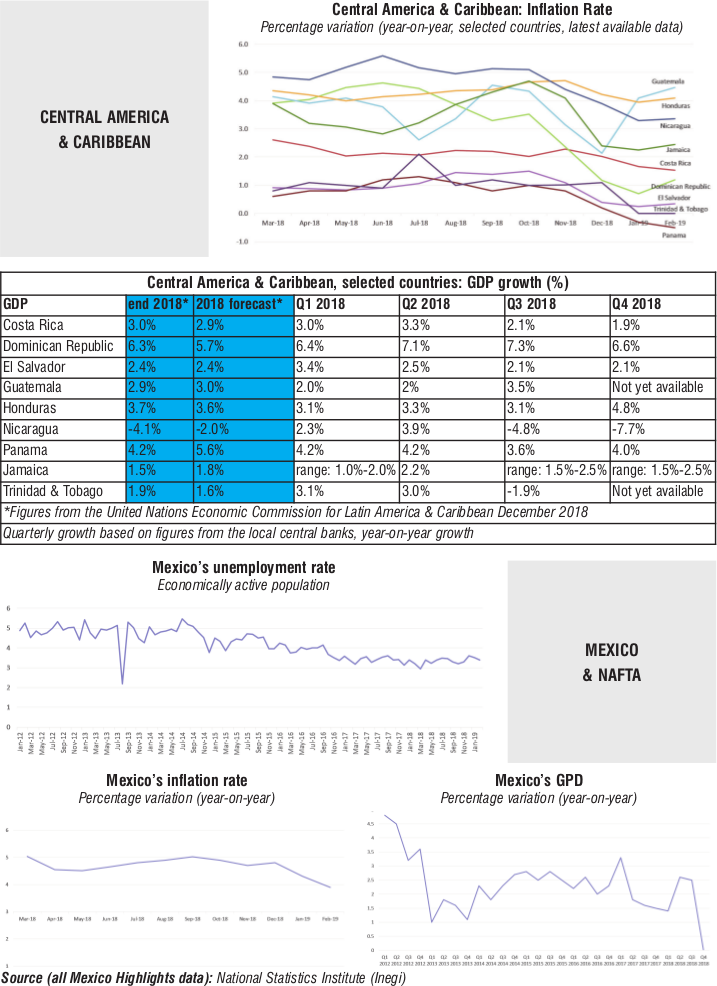
    Central America & Caribbean: inflation rate
    Percentage variation (year-on-year)

    Central America & Caribbean: GDP growth (%)
    Quarterly figures are year-on-year growth

  • PANAMA: Canal reports strong results and makes positive forecasts for 2023

    Sarah Sheldon 15 November 2022 Hits: 465

    Despite slowing global trade due to the war in Ukraine, shipping activity in the Panama Canal increased 8.2% from January-June compared to the same period last year.

    During the period 7,263 ships used the Panama Canal, of which 792 small vessels and 6,471 were large vessels. There were 5,533 Panamax vessels and 1,730 Neopanamax, the largest that the Canal can handle. The Canal brought in US$1.49bn in tolls, up from US$1.46bn during the same period last year.

    Commenting on the data, Enrique Clément, president of the maritime chamber of Panama, was cited by the media as saying that cargo shipments are increasing and will grow 4-5% this fiscal year compared to last. The fiscal year runs from September-October. Canal administrator Ricaurte Vásquez said that the Canal is on course to hit its goals for the year despite reduced trade in liquid natural gas, manufactured goods and vehicles. Edgar Urrutia, president of the Panama logistics industry association (COEL) added that, combined with “excellent numbers” for cargo flights at Panama’s Tocumen airport, performance in the first half of the year has been good. “We are recovering and, despite the overall situation of the shipping industry, the Canal is very active when it comes to regional trade as well as shipments to the east coast of the US,” said Urrutia.

    At the end of September, Panama’s national assembly approved the Canal’s budget for FY2023, which forecasts a record-breaking US$2.544bn in contributions to state coffers. This is up from the US$2.497bn forecast for FY2022. Contributions to the public purse are made up of a percentage of income from tolls (US$3.384bn forecast for FY2023), other maritime services (US$1.175bn), and sales of electricity (US$39.8m) and drinking water (US$35.1m), as the Canal is also an important utility provider.

    In recent years the Canal has made significant efforts to maintain its position as a global logistics hub. Six years ago it opened a set of larger locks that can handle Neopanamax ships, originally thought to be those with a capacity of up to 12,600 TEU (twenty-foot equivalent unit). However in July a ship named Zephyr with a capacity of 16,285 TEU transited through the Canal, the largest to do so. This shows the growth potential of the Canal, said administrator Vásquez at the time. The Canal has also implemented a raft of measures designed to save water at a time of increasing water stress in Panama, as falling water levels can affect the ability of the largest ships to safely pass through the locks.

    The outlook for the Panama Canal seems positive as it remains the fastest route between the Pacific and Atlantic Oceans. However, while plans for a Chinese-funded rival in Nicaragua have gone nowhere, the Canal could face increasing competition if Mexico can successfully execute its planned trans-oceanic corridor, which would link the Pacific and the Caribbean via a 300 km railway across the Tehuantepec isthmus. The start of operations has been delayed but the scale of the project means it could eventually rival the Panama Canal, and it is significantly closer to US seaports.

    That said, the Panama Canal has demonstrated an appetite for innovation that bodes well for its future. Under President Laurentino Cortizo, Panama has also embarked on wider infrastructure spending that should allow it to continue to grow as a logistics hub while Mexico attempts to develop its railway.

  • The performance debate about Panama

    LatinNews 28 August 2018 Hits: 407

    There is a tendency among Latin American journalists and economists to compare their own countries with their nearest neighbours, sometimes leading to hyper-critical views of the ‘home team’. It can however offer interesting insights into the perceived strengths and weaknesses of different economies. In this context the views of Costa Rican journalist Daniel Salazar Murillo, writing in newspaper El Financiero, and comparing his country’s performance to that of Panama, are of interest.

    In his view both Panama and Costa Rica are Central America’s success stories. Murillo says Panama’s great asset is the Canal but it faces important social and political challenges. Costa Rica in turn is seen as having a bigger state and stronger social inclusion, but is losing speed with “a less competitive and productive economic engine”. Murillo notes that from 2010-2015 Panama grew at an average annual rate of 7.5%, while Costa Rica did so at a slower 4.3%. Costa Rica’s unemployment rate was double Panama’s; Panama performed better in logistics, infrastructure and financial market development.

    Panama was seen as having a clear strategy based on becoming an international logistics hub. It was also seen as having a smaller but more flexible state. Costa Rica’s development path, focused on exports of technology and services, was seen as requiring more highly qualified staff. This was described as one of the reasons for having a more equal distribution of income and a greater emphasis on equality of opportunity. Panama’s less inclusive path meant greater inequality and poverty. It also performed less well in education. However, its faster economic growth and revenues meant it had a “golden opportunity” to invest in improving its social indicators.

    Another comparison, highlighted by Ricardo Eskildsen in La Prensa, is with the United Arab Emirates. Eskildsen says both Panama and the UAE have achieved sustained periods of high economic growth with significant private sector involvement. Both are trading hubs; both are cosmopolitan and have invested heavily in infrastructure; and both have achieved significant political stability. Eskildsen goes on to argue that both have successfully built a diversified economy based on revenues from a single plentiful natural resource: oil and gas in the case of the UAE, and water in the case of Panama.

  • HAITI: Instability concerns build

    LatinNews 16 December 2013 Hits: 1349

    Last month the United Nations stabilisation mission in Haiti (Minustah) issued no less than two separate statements expressing concerns about political instability and violence in Haiti. With the opposition staging its biggest protests since President Michel Martelly took office in May 2011, these concerns have been linked to the government’s continued failure to hold long awaited senate and local elections – a delay which the opposition has suggested might be deliberate.

    On 7 November Minustah issued a statement on behalf of “the special representatives and ambassadors of Brazil, Canada, the European Union, France, the Organization of American States, Spain, and [the] United States of America”, calling for continued dialogue between the executive and legislative branches “in order to reach a consensus solution concerning priority political issues”. These “priority issues” include the need to hold long overdue elections to renew a third of Haiti’s 30-member senate and fill dozens of local government posts.

    Since May 2012 the senate, in which Martelly’s Repons Peyizan party has no representatives, has had only 20 active members, making it difficult to meet the 16-member quorum necessary to conduct business. However, the mandates of a further third of the senators (10) will expire next year. Back in August Sandra Honoré, the head of UN Peacekeeping Mission and the Special Representative for the Secretary-General in Haiti, warned: “By early 2014, more senators’ terms will expire, rendering the country’s Senate and the Parliament ineffective” marking a “real decline in the democratic process [that] Haiti does not have the luxury to afford”.

    The Minustah statement follows other signs of international pressure on Martelly. At the end of October, Uruguay’s President José Mujica warned that Uruguay’s 940 peace-keepers will be withdrawn if there is no visible sign of improvement within 90 days. Opposition legislators like Steven Benoit of Alternative have suggested that President Martelly might be deliberately stalling these efforts. At a meeting of the US Congressional Black Caucus in Washington, in September, Benoit accused Martelly of playing “two years of hide-and-seek, first to publish the amendments of the constitution, then to form an electoral council, then to send the electoral law to congress [he kept the document for two months at the palace]; President Martelly waited for the lower chamber to almost end its regular session before depositing the electoral law”.

    With this pressure eventually appearing to have had an impact (see sidebar), Martelly is also feeling the heat domestically. On 18 November the biggest anti-government protests since Martelly assumed power took place in key towns, including the capital Port-au-Prince, as well as Cap-Haïtien and Les Cayes on the anniversary of the 1803 Battle of Vertières that marked the final defeat of French troops in Haiti's struggle for independence and the abolition of slavery. This in turn followed anti-government protests on 7 November in Pétionville, the high-class residential district in the east of the capital, and on 30 September – the anniversary of the 1991 ouster of former president, Jean-Bertrand Aristide (1991; 1994-1996; 2001-2004)-which drew thousands of people. While Aristide has largely kept a low profile since his return to Haiti in January 2011, his Fanmi Lavalas party is showing new signs of life. Against this backdrop of renewed social unrest, on 16 November, Minustah issued a second statement of concern – on this occasion in relation to “recent incidents of violence in several cities and municipalities” and, specifically, “the resurgence of violence and killings perpetrated in Cité Soleil [a slum in the capital] and in certain other areas of the country”. This followed clashes between gangs in Cité Soleil which left eight people dead and nine injured, as well as violence reported in Cap-Haïtien.

    • Electoral law approved

    In a special session called by President Michel Martelly on 28 November, the lower chamber approved a new electoral law paving the way for senatorial elections. This follows the senate’s approval on 3 October of the bill – the full details of which have yet to be made publicly available. Sandra Honoré, the head of UN Peacekeeping Mission and the Special Representative for the Secretary-General in Haiti, welcomed the vote by the Haitian legislature describing it as “a significant milestone for the organization of inclusive, transparent and democratic elections”. However, Haiti’s transitional college of the permanent electoral council [Ctcep in its French acronym] – the body tasked with organising the vote- has yet to set a date for the long overdue elections and experts say that a minimum of six months is needed to organise them.

  • ECONOMIC HIGHLIGHTS

    LatinNews 12 August 2020 Hits: 961

    PARAGUAY| Financial aid to prioritise border region. Paraguay’s finance ministry confirmed on 4 August the implementation of a second version of the ‘Pytyvõ’ social aid programme, launched earlier this year to help the most economically vulnerable weather the effects of the coronavirus (Covid-19) pandemic. Where the Pytyvõ (meaning ‘to help’ in Guaraní) programme provided a basic emergency income to the country’s informal workers, Pytyvõ 2.0 will provide financial aid aimed specifically for the purchase of foodstuffs from the basic basket of goods, as well hygiene and cleaning products. With US$125m earmarked for Pytyvõ 2.0, it will be available to informal workers, the self-employed, and employees of micro-, small, and medium-sized companies which have seen their income affected by the pandemic. The finance ministry’s director of economic studies, Carmen Marín, explained that the programme aims to reach 700,000 people, but that priority will be given to 120,000 people from cities in the Alto Paraná department which borders Brazil. Restrictions on movement and closed borders have taken a particularly heavy toll on Paraguay’s border region (one of the worst-hit by the pandemic in the country), where economic activity relies on cross-border trade with Brazil. The situation has prompted protests in July in Ciudad del Este, the capital of Alto Paraná, where locals demanded that the national government relax restrictions.            

    BRAZIL| Selic slashed again. On 5 August, the monetary policy committee (Copom) of Brazil’s central bank (BCB) cut the benchmark interest rate, the Selic, by 25 basis points to 2%. This ninth consecutive cut to the Selic was expected, and brings Brazil’s benchmark interest rate to a new record low amid high economic uncertainty as the country, and the world, face a deep economic recession as a result of the coronavirus (Covid-19) pandemic. The Copom indicated that there is little space for further rate cuts this year due to financial stability concerns, although it did not completely discard future gradual easing if the situation demands it.

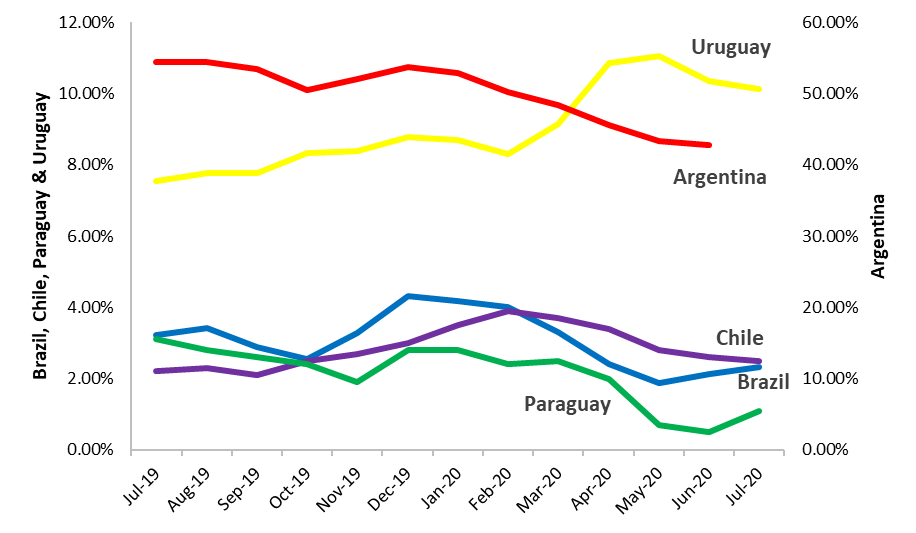
    Brazil & Southern Cone: Inflation
    Monthly year-on-year figures

    Brazil & Southern Cone: GDP growth (%)
    Quarterly figures are year-on-year growth
    Country End 2019  2020 forecast * Q2 2019 Q3 2019 Q4 2019 Q1 2020
    Argentina -2.2 -10.5 0.0 -1.7 -1.1 -5.4
    Brazil 1.1 -9.2 1.1 1.2 1.7 0.9
    Chile 1.1 -7.9 1.9 3.3 -2.1 0.4
    Paraguay 0.0 -2.3 -3.0 2.8 3.5 3.5
    Uruguay 0.2 -5.0 0.1 0.9 0.2 -1.4
    *Figures from the United Nations Economic Commission for Latin America & Caribbean Jul 2020
    End 2019 and quarterly growth based on figures from the local central banks


  • REGION: Coffee industry issues fuelling migration

    Sarah Sheldon 25 January 2022 Hits: 1413

    Despite surging coffee prices on international markets, farmers in the region are increasingly migrating northwards due to falling profits and longstanding structural issues in the sector.

    After facing losses for years, coffee farmers suffered one of the worst years in recent memory in 2021 despite prices reaching 10-year highs of US$1.95 per pound in November, according to the London-based International Coffee Organisation (ICO). Production costs went up due to increased prices of fertilisers and transport, as did labour costs as potential workers emigrated. Plus uncertainty caused by unpredictable weather and supply chain issues due to measures taken in response to the coronavirus (Covid-19) pandemic meant that maintaining supply was difficult, according to an ICO report published in October 2021.

    Other issues include higher levels of coffee leaf rust (CLR), a disease caused by the Hemileia Vastatrix fungus which decimates coffee plantations, due to increased humidity following hurricanes Eta and Iota in November 2020. The fungus is a longstanding problem, but it was revived after the hurricanes flooded the region. According to a Reuters report published on 8 December, prevalence of the disease increased from low single digit percentages in 2019-20 to 15%-25% in 2020-21. Reuters spoke to around a dozen coffee farmers and found that migration to the US is surging in coffee growing communities. “When coffee is not doing well, that's when you see big migrations from Honduras, El Salvador, Guatemala, Nicaragua,” said René León-Gómez, executive secretary of PROMECAFE, a regional research network formed by the national coffee institutes of Central America, told Reuters.

    Although prices are forecast to continue increasing until 2023, the negative factors affecting the sector are also set to last, according to the Honduran coffee exporters’ association (Adecafeh). Honduran coffee shipments have been delayed due to a lack of available containers, and transport prices have increased, said Adecafeh on 15 December, which predicts the situation will remain the same until late 2022 or 2023. Farmers are also struggling with losses accumulated in recent years, which have left many with no safety net.

    In recent years international institutions have demonstrated a growing awareness of the importance of the coffee sector in the region by implementing a number of projects. One programme that worked to support farmers is the Central American Programme for Integrated Management of Coffee Leaf Rust (Procagica), which is jointly funded by the European Union (EU) and the Inter-American Institute for Cooperation on Agriculture (IICA). On 2 December the Costa Rica-based IICA published a report on the results of the five-year initiative, trumpeting the fact that direct support was given to 7,334 farmers; production income was increased by at least 24% and 10,402 hectares of coffee were turned over to sustainable production models. 

    While this particular project will not be renewed, farmers in the region can expect support as part of US Vice President Kamala Harris’s call to action for private sector investment, which is “part of her role addressing the root causes of migration from Central America,” according to a statement from the White House published 13 December (see sidebar). But these investments will not fix the structural problems in the coffee sector: low profits for producers, problems with CLR, changing weather patterns due to climate change, and increasing labour shortages due to emigration, among others, which will likely see farmers continue to leave their plots behind in search of a better life in the US. Any assistance programmed which don’t address these issues are consequently likely to fail.

    • Private sector investment

    Among the investments announced in the White House statement for Central America are US$10m from Guatemalan food and beverage company Grupo Mariposa to create 500 new jobs and support more than 400 coffee producers “to increase productivity and earnings potential”. Other commitments include a 40% increase in financial support for smallholder farmers from Netherlands-headquartered coffee and tea company JDE Peet’s, to a total US$2.7m over the next four years, as well as a minimum US$150m investment from Switzerland’s Nespresso on coffee purchases, price premiums, and technical assistance by 2025.

  • Drug cartels cast a shadow over Mexican crypto

    Patrick de Courcy 11 May 2022 Hits: 1574

    At least four trends are at work in the Mexican crypto and fintech environment. These are, first, a strongly conservative approach by the monetary authorities to adopting a crypto-currency as legal tender; second, and despite this, a lively a political debate on adoption; third, a willingness to experiment with various fintech and crypto-linked payment schemes; and finally, in fourth place, concern over the use of crypto by the country's powerful drug smuggling cartels.

    Mexican officials closely followed the adoption of Bitcoin as legal tender in El Salvador. In June 2021, after the Salvadoran government had announced its decision to go ahead with adoption, the Mexican Central Bank (Banxico), the finance ministry (SHCP), and the bank superintendency (CNBV) issued a joint statement stating that crypto assets are not legal tender in Mexico and are unlikely to become so. “The financial authorities reiterate their warnings...on the risks inherent in the use of so called ‘virtual assets’ as a means of exchange, as a store of value, or as another form of investment” the statement said, adding that financial institutions “are not authorised to offer to the public, operations with virtual assets, such as Bitcoin, Ether, XRP, and others”. Finance minister Arturo Herrera said under current rules cryptocurrencies could not be used in the Mexican financial system.

    Banxico governor Alejandro Díaz de León subsequently reinforced the message saying Bitcoin was more like a means of barter than what he called “evolved” fiat currencies. He said, “Whoever received bitcoin in exchange for a good or a service, we believe that transaction is more akin to barter because that person is exchanging a good for a good, but not really money for a good”. He added: “Bitcoin is more like a dimension of precious metals than daily legal tender”. He also highlighted bitcoin's volatility, adding “people will not want their purchasing power, their salary, to go up or down by 10% from one day to another”. The Mexican government has taken steps to regulate crypto. A 2018 law, primarily focused on fintech regulations, requires all crypto currency trading platforms registered in the country to report any trades exceeding MXN56,000 (US$2,759). The law also set up a cyber investigations unit (UICOT) with the federal attorney general’s office (FGR), to track and, if necessary, investigate any large-value crypto transfers.

    While the monetary authorities are strongly opposed to any use of cryptocurrency as legal tender, the political debate about that possibility remains very much alive. Ricardo Salinas Pliego, Mexico's third-largest billionaire, and a close ally of President Andrés Manuel López Obrador (AMLO), has emerged as a strong pro-crypto lobbyist. In June last year he said Banco Azteca, part of his financial conglomerate, was considering whether to accept crypto currencies. In December of that year Elektra, a supermarket chain that also forms part of his Grupo Salinas, said it would accept Bitcoin as payment for purchases. At a Bitcoin conference in Miami in April 2022 Salinas issued a dramatic warning, claiming that a new wave of global inflation was imminent, accusing the US Federal Reserve of “making fake currency out of thin air” and recommending that his listeners should “buy Bitcoin and sell those coins...say no to fiat fraud”. Senator Indira Kempis, a member of the centre-left Movimiento Ciudadano, has meanwhile claimed she is preparing a bill to make Bitcoin legal tender, similar to the approach taken by El Salvador.

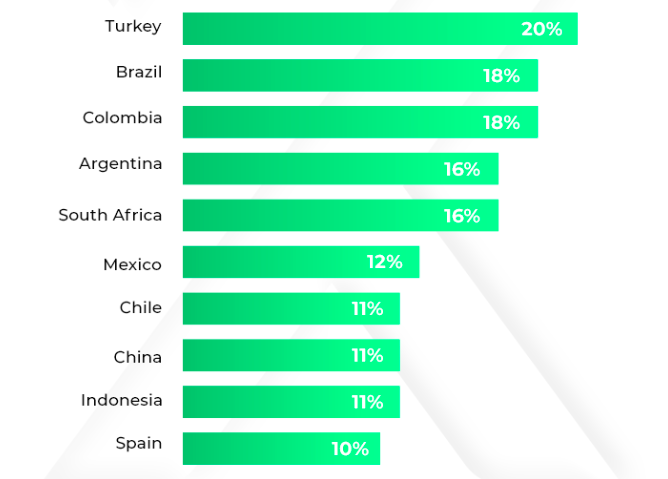
    Top ten countries with the most cryptocurrency users

    Source: Statista data

    Despite official opposition to formal crypto adoption, trade in crypto currencies has grown strongly. Mexican airline Volaris has said it will accept payment in Bitcoin from its El Salvador-based customers. Rappi, the Colombia-based delivery app, has said it is launching a pilot project under which its customers in Mexico will be able to pay for services in cryptocurrency. E-commerce giant Amazon says it will launch a digital currency pilot in Mexico. Although details have not been formally announced, the company is recruiting developers and other staff for what it states will be a new product to “enable customers to convert their cash into digital currency which [they] can enjoy using for online services including shopping for goods and services like Prime Video”.   

    A major concern in Mexico is the connection between crypto adoption and crime. A report by the UN International Narcotics Control Board (INCB) in March 2022 said that cyberspace and cryptocurrencies have become the “new frontier” for drug trafficking organisations (DTOs) and other criminal groups in the country. It estimated that DTOs in Mexico launder around US$25bn a year, and increasingly see crypto currencies as a useful way of diversifying and concealing these illicit money flows.

    While, as we have seen, the government does not encourage crypto, it has tolerated the spread of crypto currency exchanges, such as Bitso (a home-grown financial start-up), as well as allowing operations by US-based exchanges such as Coinbase Global. In February 2022 Coinbase Global ran a free pilot programme allowing cryptocurrency recipients to convert their funds directly into Mexican pesos. The pilot ran until end-March, continuing thereafter as a paid-for service for a nominal fee. Functionality is set up in such a way that individuals resident in the US can send remittances to Mexico in Mexican-peso convertible cryptocurrency, without the bureaucracy normally associated with traditional cross-border payments.

    According to the INCB, drug cartels have evaded scrutiny of high value transactions set out in the fintech law by a technique known as ‘smurfing’ - sending multiple lower value crypto transfers. In 2020 Santiago Nieto, the then-head of the federal Financial Intelligence Unit (UIF), said the Covid-19 pandemic had helped accelerate a shift towards cyber-crime. Separately blockchain data platform Chainalysis said in its 2022 Global Cryptocrime report that 2.4% (US$57m) of the US$2.4bn worth of cryptocurrency received by Mexico in the year to June 2020 was illicit. Likewise, it calculated that US$39m or 1.6% of crypto flows out of the country was illegal. Rather than being reassuring, these relatively small percentages suggest there is a significant potential for growth in crypto-based money laundering.

  • PANAMA: Iran conflict drives windfall as Canal transit price spikes

    Sarah Sheldon 26 May 2026 Hits: 167

    Continued conflict in the Middle East, which has severely restricted shipping traffic in the Strait of Hormuz, has increased the prices shipping firms pay to transit the Panama Canal, creating a significant windfall for the public purse.

    According to a 23 April statement by the Panama Canal Authority (ACP), the average auction price before the Middle East conflict began on 28 February was US$135,000-US$140,000 but following the outbreak of the conflict, that average climbed to approximately US$385,000 between March and April. Some vessels have paid even higher prices to reduce waiting times at the Canal, which reached as long as five days for those without an advanced booking, with one liquid natural gas (LNG) vessel paying US$4m at auction for a slot that allowed it to skip the queue, the ACP told French news agency Agence France Presse (AFP) in a report published on 21 April.

    This is a significant boost to Panama’s public finances, which have become increasingly strained in recent years, with the Canal a significant economic driver. In addition, there were 6,288 deep draught transits in the first half of fiscal year 2026, which runs from October to September, a 3.7% increase compared to the same period last year. ACP finance director Victor Vial was cited by the media as saying that increased demand for transits is expected to continue until the conflict in the Middle East can be resolved. Scheduled maintenance will reduce the number of available slots in the coming months, potentially pushing prices even higher if the conflict persists.

    The longer it does, the more important the Panama Canal becomes for global shipping, potentially creating the conditions for further escalation in the ongoing struggle for influence at the Canal between the US and China, as Washington continues its efforts to pressure Panama to reduce Beijing’s influence at the canal. This will place additional pressure on President José Raúl Mulino, who faces a challenging task in balancing relations with the two superpowers, meaning that increased demand for Canal transits is not entirely without its downsides.

    El Niño

    Another consideration regarding the Panama Canal is the forecast arrival of the El Niño weather phenomenon, which in Panama is associated with lower rainfall. The last El Niño caused water levels at Lake Gatún, which feeds the locks, to plunge, and a similar pattern is likely to emerge this time around as plans to build a new reservoir haven’t advanced.

  • Uruguay: The bastion of stability in a volatile region

    LatinNews 21 March 2016 Hits: 2134

    Uruguay’s economy has been fairly shockproof to date and looks to remain relatively insulated from the problems in neighbouring Brazil.

    In its latest Article IV Consultation on Uruguay, the IMF described the country as being a “bastion of stability in a volatile region”.  The country has enjoyed over a decade of steady growth. Per capita GDP (of around US$16,600 in 2016) is one of the highest in Latin America, while the incidence of inequality and poverty are among the lowest. Growth has fallen over recent years, but has remained resilient in spite of the economic problems in neighbouring Argentina and Brazil. The problems in Argentina have been more challenging, because Argentina accounts for more than half of Uruguay’s tourism receipts and imports specialised manufactures that do not have obvious alternative markets. About one fifth of Uruguay’s merchandise exports go to Brazil: although these exports exceed the merchandise exports to Argentina by four times, they are dominated by commodities, for which alternative markets are easier to find.


    Uruguay's economy - as the IMF sees it

    2013

    2014

    2015

    2016

    2017

    Real GDP Growth %

    5.1

    3.5

    1.5

    1.4

    2.6

    Unemployment %

    6.0

    6.5

    7.9

    7.6

    7.5

    CPI Inflation %

    8.6

    8.9

    8.7

    8.2

    7.7

    Central government revenue % GDP

    29.5

    29.0

    28.9

    28.9

    29.0

    Non-interest spending % GDP

    29.1

    29.3

    28.7

    29.0

    28.8

    Primary balance % GDP

    0.4

    -0.6

    0.0

    -0.4

    -0.1

    Overall balance % GDP

    -2.3

    -3.5

    -3.6

    -3.4

    -3.0

    Gross public sector debt % GDP

    60.2

    61.3

    61.9

    63.1

    64.0

    Net public sector debt % GDP

    35.9

    34.9

    36.6

    38.6

    39.9

    Current account % GDP

    -4.9

    -4.3

    -3.8

    -4.0

    -3.8

    FDI % GDP

    5.3

    4.8

    4.5

    4.4

    4.4

    Reserves (months of imports)

    13.2

    14.6

    14.6

    15.2

    14.7

    Source: IMF Article IV Consultation, February 2016


    Both government revenues and spending have remained slightly under 30% of GDP (which is expected to amount to about US$57bn in 2016) in recent years and, in the view of the IMF, will continue to do so. Revenues and spending have generally been balanced. The overall fiscal deficit has increased, but is expected to stabilise at a little over 3% of GDP. The current account deficit has been running at around 4% of GDP, but has been covered by inwards Foreign Direct Investment (FDI). Although the Banco Central del Uruguay (BCU, central bank) has allowed foreign currency reserves to fall in absolute terms by US$2.6bn since June last year, reserves continue to equate to around 14 months of imports.

    Arguably the main challenge is inflation. The rise in CPI inflation to above 10% has had political implications for the ruling left-wing Frente Amplio (FA) coalition. Inflation has consistently been above the BCU’s 3%-7% target range over recent years. This is in spite of the fall in global prices of food and energy through 2014 and 2015 and in spite of the central bank’s fairly tight monetary stance.

    Various factors have contributed to the stubbornly high level of inflation over the last two years. One is the depreciation of the peso, which fell by 22% against the US dollar in 2015, having slipped by 16% in 2014. (Since the beginning of 2016, the peso has dropped by a further 10% or so). Another has been the lack of the pass-through to consumers of lower fuel prices by Administración Nacional de Combustibles, Alcoholes y Portland (ANCAP), the state-owned fuel company. The government has been working to improve ANCAP’s financial situation

    Domestic demand has remained strong. Because of the indexation of wages, prices of non-tradable goods and services have risen. The government considers that its fairly tight monetary and fiscal policies, together with the new guidelines for wages and prices should contribute to a moderation in inflationary pressures. The IMF, for its part, argues that the government can and should do more.

    Overall, though, Uruguay should remain unaffected by the general volatility in global financial markets, the imbalances in the global economy and the economic slowdown (or worse) in much of Latin America. The floating exchange rate should, on its own, provide some protection against external shocks. As an importer of fuel and an exporter of food, the overall impact on Uruguay of the price fall in both has been limited.

    The IMF assesses the banking system to have adequate capitalisation: in addition, the banks (and the BCU) collectively have foreign currency assets that exceed foreign currency deposits (which account for about 80% of total deposits). Nor have the banks been aggressive in their lending practices. At a little under 30% of GDP, credit to the private sector is, by that measure, less than half what it is in Chile and Brazil. Credit growth to firms (in US$) and to households (in real Uruguayan pesos) has been running in single digits.

    The government itself is in good financial shape, too. Liquid assets amount to around 6% of GDP and are sufficient to cover debt service to the end of this year. At 15.5 years, average maturity of public sector debt is high – meaning that refinancings of maturing securities in the short- to medium-term are correspondingly low. The government also has access to contingent credit lines (including those made available by the Inter-American Development Bank and the World Bank) that equate to about 4% of GDP.

    Dealing with the problems of ANCAP

    The state-owned monopoly oil refiner ANCAP had total assets of US$2.3bn in 2014, and was the largest corporation in Uruguay. In spite of the fall in global oil prices, the company has been incurring losses since 2011. Losses of US$323m in 2014 reduced ANCAP’s net worth to US$424m.

    Asof the end of October 2015, ANCAP had debt of just over US$1.4bn. Most of this amount was denominated in US dollars and half was owed to banks. Slightly under half of the debt is at variable rates and most is short-term.

    The government will use a loan from Corporación Andina de Fomento (CAF – the Latin American Development Bank) to restructure the finances of ANCAP. Debt owed to the government (which mainly arose from the opportunity for ANCAP to repay what it owed to Venezuela’s state oil company Petróleos de Venezuela [Pdvsa]) on terms that greatly favoured ANCAP) will be forgiven. The government will seek to reduce ANCAP’s borrowings in US dollars and to extend the maturity of its debt.

  • ECONOMIC OVERVIEW: PANAMA

    LatinNews 03 December 2014 Hits: 673

    Budget approved: At the end of November Panama’s national assembly approved the US$19.5bn budget for 2015. The budget for 2015 is around 7% higher than the budget for 2014. Around 46% of the budget, some US$9bn, is earmarked for public works projects. President Juan Carlos Varela said the approval of the budget would allow the government to fulfill its election campaign promises.

    Among those works expected to begin in 2015 are the extension to the Panama City metro and the expansion of the Puente de las Américas-Arraiján highway. A further US$200m will go towards expanding drinking water facilities and improving the country’s basic healthcare.

    The Varela government expects growth this year to come in at 6.5%, a disappointment given that over the past five years growth has averaged over 8%, the highest level in the region. Inflation is expected to be around 4.3% for 2015.

    Some analysts expressed concern that the government did not seem to be doing enough to manage the public debt. Juan Jované, an economist and former presidential candidate, said that the budget forecast taking on an additional US$4bn in public debt. Jované argued that if the government’s growth forecast was not realized the public sector debt could rise significantly as a proportion of GDP with serious consequences for Panama’s future growth potential.

    FTA with Mexico: Also at the end of November the free trade agreement between Panama and Mexico finally took effect. The deal included clauses on trade, investment, services, financial services, telecommunications, intellectual property, dispute settlement, and others. Bilateral trade between the two countries increased from US$339m in 2002 to US$1bn in 2013.

  • ECONOMIC OVERVIEW: COSTA RICA

    LatinNews 06 November 2013 Hits: 1857

    Still discussing fiscal reform: On 17 October Costa Rica’s finance minister, Édgar Ayales, presented a government paper entitled Towards Fiscal Consolidation: Agenda for a National Dialogue which calls for a national and cross-party dialogue to reach a consensus on the long-term macroeconomic policies necessary to bring the economy back under control. Its objectives cover boosting economic growth and domestic production and cutting the deficit through increasing tax revenue.

    The document calls for five rounds of discussions to take place between now and 21 November on: improving the administrative and legal structures of the tax and customs systems; fiscal governance; public spending; public debt and investment and fiscal policy & environmental sustainability. The first round of discussions – on tax and customs structures – took place on 24 October. “This isn’t a case of a proposal, but rather an analysis and a list of options, not necessarily agreed, but which we are aiming to enhance through the visions and ideas that all those taking part in this process of dialogue bring to the table”, Ayales said presenting the paper. “We shouldn’t allow the fiscal problem to turn into a long-term one. For this reason, discussions and agreement on a solution to the fiscal imbalance must not be put off any longer”, he added. An increasing cause for concern [RC-13-10] Costa Rica’s fiscal deficit has been constantly rising in recent years and is forecast to reach 5% of GDP this year, its highest level since the 1980s when the country was suffering the effects of Latin America’s debt crisis. The government’s aim is to bring the deficit down to around 3.5% of GDP over the next five years, in other words over the remainder of President Laura Chinchilla’s current four-year term that ends in May 2014 and a year into the new administration. However, this goal could be difficult to achieve if the problems currently affecting Costa Rica’s economy persist. Former foreign trade minister, Alberto Trejos (2002-2004), recently pointed out that Costa Rica is suffering as a result of a sluggish international economy as its main trading partners – the US, the European Union (EU), and other Central American countries – continue to suffer slow rates of economic growth. This economic slowdown has resulted in a rise in unemployment in Costa Rica, which now stands at close to 10%, leading to lower domestic demand and falling tax revenues. All of which makes tackling the deficit more difficult. A leading researcher at the University of Costa Rica’s economics science research institute (IICE), Rudolf Lücke also highlighted the need to tackle the fiscal deficit, pointing out that “it prevents the government from carrying out the spending and investment that would invigorate the economy”.