HONDURAS: Problems ahead
|

|
BRAZIL | Cotton subsidies trade war ends. A 12-year dispute between the US and Brazil over cotton subsidies finally came to an end on 1 October. Under the terms of the agreement signed between the two countries, Brazil has promised to no longer pursue its complaints about US support for the sector at the World Trade Organization (WTO). In return, the US will pay the Brazilian Cotton Institute a lump sum of around US$300m. More significantly, from Brazil’s perspective, the US has also committed itself not to extend credit guarantees for export for a period of more than 18 months. In the past its credit guarantees ran for up to three years.
The case was first filed at the WTO back in 2002. After many twists and turns, in 2009 Brazil was granted the right to retaliate with sanctions against US goods, to the tune of US$829m. Then in 2010, the US agreed to pay US$147m annually into a fund to support Brazilian producers. That deal, however, turned sour when for budgetary reasons, the US was unable to contribute to the fund.
For the agricultural ministry, the deal will help make Brazilian cotton more competitive: the South American country is the world’s third-largest exporter, after the US and India. In 2013 cotton exports netted Brazil US$1.2bn. The agreement could help to clear the way for better relations between Brazil and the US after the elections. Since the National Security Agency (NSA) revelations made public by the whistleblower Edward Snowden, relations between the two countries have been at a low ebb.
Luis Alberto Figueiredo, Brazil’s foreign minister, and Neri Geller, the agriculture minister, were in Washington to sign the deal. Speaking to the press afterwards Figueiredo said the agreement was “a step forward in the commercial relationship” between the two countries, but he also reiterated that the spying scandal was “of the utmost seriousness”.
PARAGUAY | GDP expanding at steady rate. Paraguay’s GDP grew by 3% in the second quarter of the year, according to a report released by the central bank (BCP). The BCP said that economic activity between April and June had “developed favourably, although at a more moderate rhythm than initially predicted”.
The economy grew by 4.1% in the first quarter of the year. The government is predicting 4.8% growth this year, while the ratings agency Standard & Poor's recently forecast growth of between 4.5% and 4.8% a year over the next three years.
A steady and consistent rate of growth would make it easier to carry out budgetary planning than the previous two years: the economy grew by 13.6% in 2013 following a contraction of 1.2% in 2012, which equates to a 2.9% drop in GDP per capita.
The main driver of growth in the second quarter was the livestock, forestry and fishing sector, which grew by 11.1% year-on-year. The BCP attributed the significant growth to the World Organization for Animal Health’s decision last November to restore Paraguay’s status of free of foot and mouth disease (FMD), with vaccination, which the country had lost after an outbreak of FMD back in September 2011. The BCP said the recovered status had led to the re-opening of the Chilean and Russian markets and would hopefully lead to a return to European markets before the end of the year.
Uruguayan opposition presidential candidate Pedro Bordaberry has called for the creation of a science, technology and innovation ministry by whoever triumphs in elections later this month. “This sector produces US$1bn and exports US$400m. Currently Uruguay exports meat products for US$2bn and tourism brings in revenues of US$2bn. Is this not an area to have a ministry and develop science, technology and innovation?” Bordaberry asked rhetorically. The four candidates running for election have signed a joint agreement setting out the science and technology priorities their policies will seek to achieve irrespective of who wins. These include boosting funding programmes for research and training; establishing initiatives to retain researchers in Uruguay; and the provision of grants to ensure scientists are able to do full-time research for up to five years.
CHILE | Good FDI results give hope. On 10 August InvestChile, the government agency responsible for promoting Chile on the global market, reported that foreign direct investment (FDI) flows to the country were up by 53% in the first half of 2020, compared with the same period last year. Citing preliminary figures from Chile’s central bank (BCCh), InvestChile noted that FDI inflows totalled US$9.8bn in January-June 2020, the second highest figure for this period since current records began and 64% higher than the average of FDI inflows for this period over the past five years. In June alone, FDI totalled US$2.1bn.
The acting director of InvestChile, Juan Araya, noted the importance of these positive FDI figures considering the coronavirus (Covid-19) pandemic and its negative impact on the global economy. “It is good news that…foreign investment in our country is not only proving resilient but also continuing to grow,” he said, adding that the ongoing dynamism of equity and reinvested profits (the two most important components of FDI) are a sign of investor confidence in Chile, and that the country is both attracting new foreign companies and retaining investors.
In many ways the election of Jair Bolsonaro, a climate-change sceptic and far right-wing nationalist, as president of Brazil for the 2019-2023 term in office was a fundamental challenge to most Brazilian NGOs, and specifically to those campaigning for increased environmental protections. Bolsonaro sought to roll back the clock to the nationalism of the 1970s, where developing the Amazon was seen as essential to strengthen national security. His government sought not only to marginalise the role of NGOs, but also to limit and reduce the work of government-funded quangos created to protect indigenous groups and to control illegal activities such as deforestation and unauthorised mining. A sign of his relative success in achieving these aims was the rapid increase in forest fires and deforestation.
The spread of Amazon fires in 2019 had a major diplomatic impact. French President Emmanuel Macron said his country would not ratify the European Union-Mercosur free trade agreement if Brazil abandoned its Paris Agreement environmental protection objectives. In a notorious incident in that same year, the president claimed that NGOs were themselves setting fire to Amazon rainforests to discredit his government. Bolsonaro said “everything indicates” the NGOs were seeking to “set fire” to the rainforest in retaliation for reductions in government funding, adding “these people are missing the money”. Marcio Astrini, a senior member of Greenpeace, retorted that “this is a sick statement, a pitiful statement…increased deforestation and burning are the result of his anti-environmental policy”.
Bolsonaro’s environment minister, Ricardo Salles, consistently argued for unrestricted Amazon development, but he had to resign in June 2021 after being investigated by Federal Police on charges of illegal logging. According to a report by the Federal University of Rio de Janeiro, Salles initiated 57 legislative measures to weaken conservation efforts and favour agricultural interests. During his time in office, he cut staffing and budgets at key environmental bodies, including the environmental protection agency (Ibama), the national institute of space research, and the Chico Mendes Institute for Biodiversity Conservation (ICMBio). Notoriously Salles also blocked the activities of the Amazon Fund, a green investment agency part-funded by Germany and Norway.
Bolsonaro did not attend the COP26 climate summit in Glasgow in November 2021, but at least partly due to the actions of NGOs, the Brazilian delegation appeared to be willing to make some concessions. The country said it would raise its target for greenhouse gas emissions reduction to 50% by 2030, up from 43% previously. It would also bring forward the deadline for achieving a net zero carbon economy to 2050 and eliminate illegal deforestation by 2028. During the conference Brazil also pledged to help cut global methane emissions by 30% by 2030. However, there was scepticism over the government’s commitment since there was little explanation of how these goals would be achieved. These suspicions were boosted when, just after the conference, INPE, Brazil’s space research agency, reported that annual deforestation of the Amazon rose by 22% to reach 13,235 sq kms in the year to July 2021. Local media reported that the government had deliberately delayed the data release until after COP26. Environment Minister Joaquim Leite said the data showed the challenge ahead and that the government needed to take “more forceful” action against deforestation. But these statements appeared to do no more than reflect the government’s strategy of promising to improve its management of the Amazon while taking little actual action.
A report released in July by the United Nations Development Programme (UNDP) says that if Jamaica adopts a “green economic model” it could create up to 8,000 new jobs and add 1% to its GDP.
The report compares a “business as usual” with a “green model” future for the country. In the green scenario it says thousands of new jobs will be created mainly in services, sales, and clerical support. There will be a J$11.7bn (US$73.8m) increase in investment linked to the country’s nationally determined contributions (NDCs – decarbonisation targets agreed with the UN). The country will also be able to reap major savings if it electrifies road transport, thereby decreasing demand for more expensive liquid transport fuels.
Commenting on the report, UNDP representative Kishan Khoday said “Pursuing a green economic model is not just a strategic choice for Jamaica as a Small Islands Developing State (SIDS) – it is an imperative for survival, resilience, and inclusive prosperity.”
BRAZIL | Retail sales show slight increase. The national statistics institute (Ibge) released new figures on 15 October showing Brazil’s retail sales in August rose by 0.1% in monthly terms. In year-on-year terms, the national sales volume was up 0.4% compared to August 2025, and the accumulated sales volume in the 12 months through August 2026 was up 1.6% on the preceding 12-month period. The slight monthly rise registered for August this year follows a 0.8% monthly decline in July and a 0.3% rise in June. Of the eight product categories measured by the Ibge, six posted monthly sales increases in August. The greatest increases were registered in office supplies and information and communications equipment (+6.3%), other items for personal and domestic use (+1.4%), and fuels and lubricants (+1.1%). The two categories that posted monthly decreases in sales were supermarkets, food products, drinks, and smoking products (-0.3%) and furniture and home appliances (-4.2%).
BRAZIL | Grain harvest projected to rise. The Companhia Nacional de Abastecimento (Conab), the national supply company which is linked to government’s agrarian development ministry, released a new forecast on 15 October for the country’s grain harvest, projecting a harvest of 367.1m tonnes (t) in the 2026/2027 cycle. This would mark a 1.4% increase compared to the 2025/2026 harvest and would be the third consecutive harvest cycle to register an annual increase. Regarding Brazil’s major crops, the soybean harvest is expected to rise by 0.7%, with a projected total of 181.6m t in 2026/2027, while maize production is expected to reach 148.0m t, which would be up 2.4% compared to 2025/2026. In terms of regional comparisons, Brazil’s centre-west is still expected to post the highest production figures, with a forecast of 181.7m t in the next cycle, which would be up 0.3% compared to 2025/2026. Meanwhile, the grain harvest in the south of the country is expected to produce 93.5m t, which would be up 2.3%. As for other regions, the harvest is projected to reach 34.5m t (+1.8%) in the northeast, 32.1m t (+2.2%) in the southeast, and 25.3m t (+3.9%) in the north.
According to a new report from the World Bank, while Latin America has made fairly robust progress in poverty reduction, its record on reducing income inequality in recent years is at best patchy and stop-go in nature. Progress came to a halt in 2005, edged forward again in the following four years, and then stopped again in 2010.
According to the February 2014 report (Social Gains In the Balance – A Fiscal Policy Challenge for Latin America and the Caribbean), the region made some impressive gains in the first decade or so of the 21st century. The proportion of the region’s total population of 600m people living in extreme poverty (defined within the region as living on less than US$2.50 a day) was halved between 2003 and 2012 to 12.3%. This period also saw the (broadly-defined) middle class emerge as the largest single income group in the region. When compared with global trends, extreme poverty in Latin America has fallen almost as fast as in East Asia.
But there are worries about the sustainability of these gains. First of all, the process is geographically-lopsided. According to the report, the Southern Cone region, including Brazil, has led the way, but it has proved much harder to achieve effective poverty reduction in Central America and Mexico. Secondly, the factors contributing to poverty reduction - general economic growth on the one hand and moves towards a more equitable distribution of income on the other - are also lop-sided in their contributions. In fact, over two thirds of poverty reduction (68%) can be attributed to Latin America’s general GDP growth rate, while just under one-third (32%) has come from income redistribution. The problem now is that regional growth is slowing down. In Latin America and the Caribbean, overall real annual GDP growth was 4.3% in 2010. This had fallen to 1.3% by 2013, and growth is predicted at a below-trend 1.7% in 2014. Less growth will mean less poverty alleviation.
The World Bank therefore asks the obvious question: could more be done on the redistribution side to offset the lower contribution from growth? The report looks at two main areas: the potential contribution from redistributive fiscal policy on the one hand, and action to promote more equal access to basic goods and services for all children in Latin America on the other. It says the contribution of fiscal policy to poverty alleviation has been modest. Countries that have been most successful on this front are Brazil, Mexico, and Uruguay, but all they achieved was a 0.03 reduction in the Gini coefficient (a measure of income inequality in which 1.00 represents theoretical maximum inequality and 0.00 represents theoretical perfect equality). Latin America’s overall Gini coefficient averaged 0.54 in 2000, making it the most unequal region in the world. By comparison, the European Union’s average Gini coefficient was 0.30 in the same year, and in East Asia it was 0.46. A problem for Latin American countries seeking to use fiscal policy to reduce the Gini rate is their relative overreliance on indirect taxes (such as value added tax [VAT]), which are easier to collect, but are regressive in nature.
The World Bank report does praise ‘conditional cash transfer programmes’ (CCTs), whereby social payments to low-income families are linked to requirements such as ensuring that children attend school and have regular health check-ups. These CCT programs aim to give children a more equal set of ‘life chances’. But overall the World Bank report warns, “Because recent trends suggest that the decline in inequality may have halted, promoting more inclusive growth will be central”. It goes on to note that: “Recalibrating fiscal policy and providing better basic goods and services are two important instruments for inclusive growth. The findings of this brief… underscore that Latin America and the Caribbean are not fully achieving their potential in reducing inequality.”
Some analysts highlight different approaches. George Gray Molina of the United Nations Office for Latin America notes that Mexico and Brazil are following different tacks. “The fiscal reforms in Mexico are creating a favourable atmosphere for entrepreneurs and are focused on reducing inequality through economic growth. Brazil, on the other hand, has opted for social protection programmes, focusing on reducing inequality through public investment.”
| Gini coefficients: selected countries and years | ||||||
| 2007 | 2008 | 2009 | 2010 | 2011 | 2012 | |
| Argentina | 0.474 | 0.463 | 0.452 | 0.445 | 0.436 | 0.425 |
| Bolivia | 0.554 | 0.514 | 0.497 | 0.463 | 0.466 | |
| Brazil | 0.559 | 0.55 | 0.545 | 0.536 | 0.531 | |
| Chile | 0.52 | 0.508 | ||||
| Colombia | 0.558 | 0.555 | 0.551 | 0.537 | 0.535 | |
| Costa Rica | 0.481 | 0.486 | 0.486 | |||
| Ecuador | 0.543 | 0.506 | 0.493 | 0.493 | 0.462 | 0.466 |
| Guatemala | 0.538 | |||||
| Mexico | 0.506 | 0.478 | 0.494 | |||
| Paraguay | 0.521 | 0.51 | 0.497 | 0.518 | 0.526 | |
| Peru | 0.497 | 0.471 | 0.463 | 0.451 | 0.457 | 0.453 |
| Uruguay | 0.479 | 0.465 | 0.465 | 0.455 | 0.437 | 0.415 |
| Source: World Bank, Social Gains In the Balance – A Fiscal Policy Challenge for Latin America and the Caribbean, February 2014. | ||||||
COSTA RICA | Tax amnesty success. The government revealed this week that it had raised ₡232bn (US$380.6m) under a three-month tax amnesty running from 4 December last year until 4 March.
The amnesty formed part of the recent fiscal reform approved by the legislative assembly, offering the cancellation of interest incurred on the debt; some 14,000 contributors availed of the amnesty.
The finance ministry said that the money raised, the equivalent of 0.5% of GDP, had exceeded expectations. Costa Rica closed 2018 with a fiscal deficit of 6% of GDP, down slightly from the 6.17% of GDP posted in 2017.
HONDURAS | Trade deficit balloons. The trade deficit increased by 18.9% in 2018 year-on-year, reaching US$6.12bn, primarily because of an increase in imports, the central bank reported on 27 February. Exports declined by 3.6% on 2017 to total US$4.37bn, while imports surged by 8.3% to US$10.49bn. The decline in exports was due principally to a reduction in sales of coffee, palm oil, sugar, gold, and shrimps.
The US was the country’s main trade partner, taking US$1.54bn of its exports, followed by Europe with US$1.29bn, and Latin America as a whole, US$1.25bn. The main Honduran export was coffee, sales of which increased by 14.5% year-on-year to US$1.32bn.
REGION | TPS rolled over. The US government last week extended Temporary Protected Status (TPS) enjoyed by expatriates from El Salvador, Haiti, and Nicaragua, until 2 January 2020. The Department of Homeland Security had announced in 2017 that it would end TPS in the three countries by the end of last year on the grounds that conditions had improved there, but the extension was granted in response to an injunction by a US district court in a lawsuit challenging the termination of TPS.
As a small economy with limited natural resources and generally high levels of educational qualifications, Uruguay is showing interest in developing the ‘knowledge economy’.
Uruguay’s Academia Nacional de Economía recently organised a seminar on the knowledge economy, seen as a potentially important area for the country’s future development. One of the speakers, former central bank president Ricardo Pascale, said that in their struggle to reach macro-economic equilibrium, developing countries tend to fall into a kind of “tyranny of the short term” which makes them react passively to technological change that originates in the developed world. In his view it was necessary to become more strategic and pro-active in the pursuit of knowledge economy opportunities.
Carlos Batthyány, director of the Institut Pasteur in Montevideo, said the competitive economies of the future would be those that prove able to turn knowledge into “tangible products” that meet society’s real needs and offer increased value added. Young Uruguayan entrepreneurs, he argued, had shown their ability to be resourceful and creative during the coronavirus (Covid-19) pandemic. To further stimulate innovation in Uruguay, he said his institute was preparing a US$35m capital investment round, known as Lab+ Venture Builder, where small companies will be able to pitch high-return projects for funding.
Pablo da Silveira, the minister of education and culture, said that as a symbolic but, he hoped, significant move his department was changing its name to become the ministry of education, science and culture. Enrique Iglesias, a former foreign minister and also former president of the Inter-American Development Bank, said that in his opinion Uruguay had shown valuable “innovation impulses”, but that it needed to turn them into something more consistent and process focused.
An affirmation of the importance of the knowledge economy had earlier come from Andrés Burecovics, an Argentine technology consultant who argued sarcastically that Argentina was doing all the right things – to enrich Uruguay. Burecovics said small digitally based enterprises consume limited energy, do not pollute, create employment, and earn foreign currency to the benefit of the local economy. In Argentina, however, they meet multiple obstacles. They must convert their hard currency earnings into pesos at an unfavourable exchange rate (in Uruguay the foreign currency market is unrestricted, and they can open and maintain US dollar accounts in local banks). In Argentina they pay taxes on their global earnings and assets, while Uruguay only taxes local revenues. The Argentine profits tax is 35% while in Uruguay it is under 12.5%. Burecovics concluded that the absence of fiscal support and incentives was basically driving Argentine entrepreneurs to take their companies across the River Plate to Uruguay.
CHILE | Dragged down by copper, dollar. On 8 July Chile’s copper commission (Cochilco) announced that it was revising down its forecast for the average price of copper for the year to US$3.27 per pound (lbs), 8% less than the US$3.57/lbs forecast in its previous April report. Copper is Chile’s main export and much of its economic performance depends on what happens in international copper markets.
In presenting Cochilco’s new forecast Chile’s mining minister, Hernán de Solminihac, said that the revision primarily answered to the fact that Cochilco believes that there will be a surplus of global copper supplies in the 2013-2017 period. Cochilco calculates that global copper demand this year will be around 20.7m tonnes (t), while total global production will be approximately 17.6m. As a result Cochilco estimates that this amounts to a surplus supply of some 209,000t, slightly higher than it had previously forecast. According to de Solminihac, this is the result of the economic slowdown in China, the world’s largest copper consumer, which has halved its domestic demand forecasts from 5% to 2.5%.
The consensus forecast is that the slowdown in China will continue next year and, consequently, Cochilco has also revised down its forecasts for 2014. It now predicts that the total global copper demand will only rise by 3% to 21.3m next year; and that total copper production will rise by an even higher 3.9%. This will result in the supply surplus increasing to 310,000 t deriving in an estimated average copper price of US$3.15/lbs in 2014, lower than the US$3.32/lbs previously projected.
Unsurprisingly, Cochilco’s report was greeted with concern by local economists in Chile who pointed out that for every cent fall in the average copper price Chile loses some US$40m in tax revenues and its balance of payments figure falls by US$90m.
The government led by President Sebastián Piñera sought to ease some of the concerns. Finance Minister Felipe Larraín said that “Chile is dependent on the price of copper, but fortunately it is not solely dependent on this”. According to Larraín, Chile has been effectively diversifying its fiscal revenue sources for a number of decades now to the point that tax revenues derived from copper production peaked in 2006 and since then its levels as a proportion of other sources of tax revenue have started to fall.
Despite Larraín’s best efforts it appears that pessimism about Chile’s short-term economic outlook has spread. After the release of Cochilco’s report, the International Monetary Fund (IMF) announced that it was revising down its growth forecast for the year for the country to 4.6% from 4.9%. The IMF said that the revision answered to the fall in international copper prices as well as signs that Chile’s domestic demand was slowing down.
Back on 1 July Chile’s central bank slashed its own year-end growth forecast by half a percentage point to 4%-5%. The bank explained that following its April forecasts, in which it increased its growth prediction by a quarter of a percentage point to 4.5%-5.5%, domestic demand and economic activity had declined “somewhat faster than expected”.
According to the bank the fall in domestic demand can be partly explained by the appreciation of the US dollar in international currency markets following the recent announcement made by the US Federal Reserve that it will be discontinuing its ‘quantitative easing’ monetary policies, which have resulted in a relative depreciation of emerging market currencies including the Chilean peso (which has depreciated by 6.3% since March).
A relatively weaker peso negatively affects consumption levels as consumers’ purchasing power weakens. Taking this into consideration the bank revised down its year-end domestic demand growth figure from 6.1% in April to 4.9% in July.
URUGUAY | Wheat woes. On 10 July the Uruguayan government revised down its export growth figures for 2013 by 3.2 percentage points from 8% to 4.85% on the back of a poor wheat harvest. Ironically, even though the annual export forecast was reduced, overall exports in the first half of the year were US$4.63bn, 6.4% higher in the first half of 2013 than the same period of 2012. This as Uruguayan exporters managed to find new markets in places such as Egypt, Tunisia and Greece for some other profitable agricultural exports such as soya beans, exports of which increased by 16% year-on-year in the first half of the year.
On 10 July during the social summit of the Southern Common Market (Mercosur), ahead of the Mercosur heads of State summit scheduled to take place in Montevideo on 12 July, various representatives expressed doubts as to whether the bloc should seek to establish closer ties with the region’s latest trade bloc, the Pacific Alliance. In particular many criticised the fact that the Pacific Alliance was a purely economic integration project which did not incorporate “any social aspect”, apparently oblivious to the fact that Mercosur also started off as an exclusively economic endeavour. “Many of our social movements believe… that free trade is not the solution… but rather to think about establishing integrated production chains to help develop the region,” Graciela Rodríguez, a member of Brazil’s people’s integration network, said.
PANAMA | Gov’t raises 2023 GDP forecast. On 20 September Panama’s economy & finance (MEF) minister, Héctor Alexander, raised Panama’s GDP growth forecast for 2023 to “at least” 6% this year, up from 5% as forecast previously. Panama’s economy grew 10.8% in 2022 and 15.8% in 2021, amid a bounce back following the impact of the coronavirus (Covid-19) pandemic which struck in 2020 and led the economy to contract 17.9% in 2020, on International Monetary Fund (IMF) data. Alexander said that the growth forecast for 2023 was the highest prior to the pandemic since 2014. According to an MEF press release, Alexander said that Panama’s monthly indicator of economic activity (IMAE) posted accumulated growth of 7.8% in the first half of 2023, driven by trade, construction, tourism, and banking, among other sectors. Alexander also said that economic growth is driving job creation and formal employment. He said that from September 2020 to April 2022 employment was up 13%, of which 92% was formal employment.
EL SALVADOR | Central bank hails Q2 growth. On 27 September, El Salvador’s central bank (BCR) released new figures indicating that the country’s economic growth was 3.0% in the second quarter of 2023 year-on-year, up from 0.8% in the first quarter. The BCR said that growth was driven by construction (22.8%), electricity (16.8%), professional, technical & scientific services (11.4%), and mining & quarrying (9.4%). In its report the BCR is forecasting that El Salvador’s GDP will grow 2.6% this year. This is less than the latest estimates from the United Nations Economic Commission for Latin America and the Caribbean (Eclac), released on 5 September, which forecast El Salvador will post 2.1% GDP growth this year – the lowest in Central America, with Panama forecast to post the highest (5.1%).
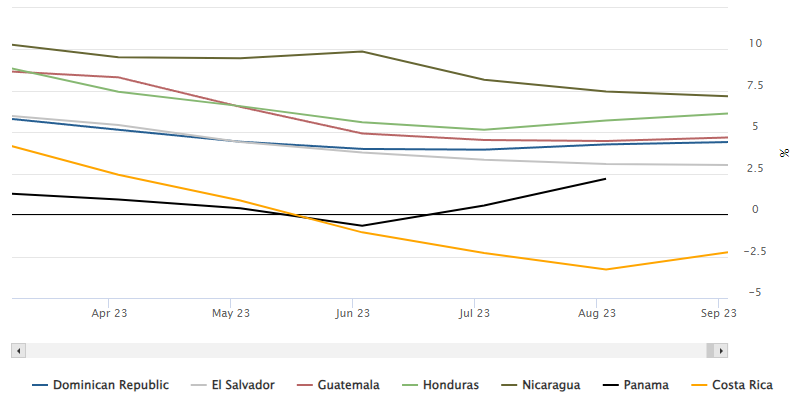
Central America & Caribbean: inflation rate
Percentage variation (year-on-year)
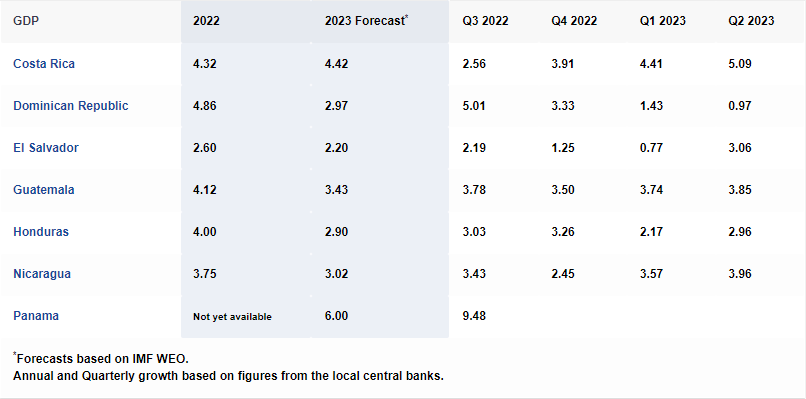
Central America & Caribbean: GDP growth (%)
Quarterly figures are year-on-year growth
The central bank has begun to devalue the lempira, which is now trading at about HNL19.03/US$, two months after the bank reinstated the exchange rate band system, spun at the time as a “revaluation”.
Under the reinstated system, the lempira is effectively allowed to fluctuate 7% above or below HNL18.89/US$. From mid-September the central bank has incrementally lowered the base rate set for its daily dollar auctions to HNL19.0885/US$1 from HNL19.0271/US$1.
Net international reserves fell by US$298.2m from the date of the first daily auction on 25 July to reach US$2.71bn on 25 August. They were down to US$2.59bn on 23 September, which is barely enough to pay for three months of imports. There has been a sustained high demand for dollars, which the authorities have partially attributed to speculation. Business confidence is also very fragile in this US-dependent economy.
The bank initially spun the move as a ‘revaluation’, but there was always a suspicion that it was really a devaluation in disguise. Honduras reported a fiscal deficit of 4.8% of GDP for 2010, failing to meet the IMF-targeted 3.5%. The deficit will be 3.9% in 2011, according to the government
Total public debt was US$5.7bn as of 30 June 2011, of which 57% was external. Internal debt has risen since 2009, after the de facto government that took power in June 2009 rapidly contracted debt with local banks.
Inflation: Inflation in the 12 months to August 2011 was 7.7%.
“Education, education, education.” This was the cry of President José Mujica during his inaugural speech in March 2010 and exactly two years into his term in office it could be argued that his government has delivered on the first of those three promises by means of an accord to reform the education system with all of the country’s political parties. Only when congress approves the accord, and it is actually implemented, could it be maintained that he has delivered on all three promises.
Uruguay is in a very small minority of countries in Latin America where the government and the opposition are capable of sitting down together and formulating a state policy to address a specific issue. It is far more common for governments across the region to stigmatise the opposition as a destabilising, unpatriotic force than to consider that it might have anything to add to the democratic debate; to subordinate the interests of the country to party or even personal interests; in short, to polarise politics rather than to pursue consensual politics.
Mujica made it very clear from the moment he took power that he valued the contribution of the opposition to the country’s development, and that the doors of the presidential palace would always be open to politicians from opposing parties to express their views on any issues in the national interest. His inclusiveness is one of the character traits most esteemed by Uruguayan voters, even if it has at times caused him difficulties with his own coalition, the left-wing Frente Amplio (FA); the more left-wing constituent parties have frequently urged him to push through more radical policies and to use the FA’s congressional majority to sideline the opposition Partido Nacional (PN, Blancos), the Partido Colorado (PC, Colorados) and the small Partido Independiente (PI).
Mujica has steadfastly resisted this pressure and he reaped his reward in late February when all of these opposition parties agreed to share the political cost of reforming the country’s education system. Whether he can persuade them to join the FA in undertaking what he has described as “the mother of all reforms”, revamping and modernising the State by reducing bureaucracy and shaking up the public administration to allow the state machine to function more efficiently, is a moot point. It would almost certainly need to be this year, before jostling ahead of the 2014 presidential and congressional elections begins in earnest. But, the education accord was a good start.
The education accord was made slightly easier by the broad political consensus that Uruguay’s once enviable education system now looks slightly beleaguered. Standards have been falling, truancy rising, and working conditions for teachers have deteriorated. Uruguay finished in 63rd position out of 142 countries in the latest World Economic Forum (WEF) Global Competitiveness report, but it came beneath this in all of the important education indicators. It finished in 71st place for the quality of primary education; 83rd for the overall quality of the education system; and a worrying 104th for the quality of maths and science education. Furthermore, while primary and tertiary education enrolment figures were very good, secondary education enrolment – perhaps the most significant level – was only 87.9%, putting Uruguay in 70th place.
For an upwardly mobile country like Uruguay, these figures are simply unacceptable. The accord envisages a number of reforms to try and improve the education system. These range from a new institute to evaluate education standards and the transformation of the Universidad del Trabajo del Uruguay (UTU) into a Universidad Tecnológica, which will have a number of campuses across the country, to greater decentralisation of education services, including granting more decision-making power to the Codicen, the maximum education authority, which is composed of five members elected by the political parties and teachers’ unions. These unions raised some objections to the reform proposals but Mujica appears to have managed to assuage their concerns with a promise of higher salaries and improved resources.
Senator Jorge Larrañaga, a leader of the Blancos, hailed the accord as democratic coexistence par excellence. The leader of the Colorados, Pedro Bordaberry, was less effusive. He expressed his contentment with the accord but argued that the FA administration had a poor track record in actually efficiently implementing policies and reforms. The public-private partnership (PPP) deal for infrastructure work is a prime example, he argued, having been approved three months ago but as yet no PPP projects have been rolled out. The cross-party consensus should ensure that the aspects of the reform that need to be approved by congress sail through, although the Mujica administration’s reform of the penal code has been mired in congress for months.
Military-civilian interaction
One interesting aspect of the proposed reforms is increased cooperation between the military and civil society in an effort to provide training for unemployed young Uruguayans and to enable them to pick up qualifications to launch their careers without years and years of studies. Unemployment in Uruguay is low, at just 5.7%, but much of this is youth unemployment.
Some 120 youths will shortly begin three-year courses in air force centres, receiving training in aircraft maintenance, applied electronics and aeronautical engineering, and other related areas, as part of the education reform. Others will learn trades such as bricklaying and carpentry, in three to six-month courses supplied by the army, alongside military trainees. Civil students will be exempt from military instruction, and only those coming from far away will live on site. The collateral benefit is the forging of closer links between civil society and the military.
“No changes are harder than cultural changes, but this country needs a strong, vigorous and modern State,” President Mujica said during a short 10-minute television and radio broadcast to open congress on 1 March, his second anniversary in power. The opposition, while it has expressed its readiness to work with the Mujica administration in certain areas, such as education, argues that the reform Mujica wants to carry out of the State should be mirrored within the FA administration itself. Ana Lía Piñeyrúa, a potential presidential candidate for the Blancos in 2014, said the government’s good intentions always collided with “incompetent execution and opposition from the more radical elements of the FA”.
As the Costa Rican legislative assembly (AL) and the supreme court of justice clashed in a public institutional crisis (see below), Johnny Araya, the incumbent mayor of San José and leading hopeful for the ruling Partido Liberación Nacional (PLN) 2014 presidential nomination, interjected in the dispute. He said that while he agreed that the court needs to renew some of its members, the AL’s actions constituted “an attack against the independence of judges”. The comment was undoubtedly calculated: with the first half he played to the party in congress – lack of renewal was the reason the PLN bloc cited for voting against the re-election of a judge – and with the second he played to the electoral gallery.
The contest for the PLN nomination is now a four-horse race, after businessman Antonio Alvarez Desanti withdrew from the competition in late September as he doesn’t want to run against former president José María Figueres Olsen (1994-1998) in the party primary. Instead, he joined the mayor’s efforts as campaign manager, pledging to bring about renewal in the party leadership. However, renewal at the top of the PLN appears as unlikely as in the constitutional court’s composition. The other presidential hopefuls include: Rodrigo Arias, the former minister of the presidency under his brother Oscar’s two terms in office (1986-1990; 2006-2010), who wants to bring the election forward to January 2013; former president Figueres Olsen; and Fernando Berrocal Soto, the former minister of the presidency during the Luis Alberto Monge presidency (1982-1986) and former minister of security under Arias’s second term (2006-2008).
Rodrigo Arias is advocating for the PLN to bring forward its presidential primary contest, from April 2013 to January 2013, so that it can be held in conjunction with Costa Rica’s district-level elections. His brother has said holding two electoral processes would be a “waste of money”. Araya responded that “Arias has no moral authority to ask us to save on the convention”, in reference to the high fiscal deficit left by his administration, adding that bringing the convention forward “appears to be intended to affect the time this government [led by President Laura Chinchilla] has left...I see an excessive anxiety for power”.
Party members, and Costa Ricans in general, as the latest (October) Unimer poll showed, are highly critical of President Chinchilla’s apparent inability to rein in the ongoing power struggle within the PLN. Rodrigo Arias has done nothing but try to undermine the president’s authority since she took office in May 2010, but his strategy appears to have backfired since, after being neck and neck for several months, Araya has emerged as the favourite pre-candidate. When all (1,200) respondents were asked who they would vote for if the primary were held “today” (between 3 and 11 October), 16% chose Araya, compared with 6% for Arias and 6% for Figueres. The overall poll has a 2.8% margin of error (MOE). When the same question is put to self-proclaimed PLN sympathisers, which brings the MOE to 5.5%, Araya’s support soars to 32%, while Arias and Figures are left behind on 16% each. In both scenarios, Berrocal barely scores 2%.
Clash of the Titans: Legislative Vs Judiciary
In mid November the AL triggered an institutional crisis when 38 of its members voted against the re-election of Judge Fernando Cruz to another eight-year term in the constitutional court. Cruz has a history of voting against political actors in some of the most highly controversial cases of recent times – even when doing so in minority. For example, he opposed the Dominican Republic-Central America-US free trade agreement (Cafta-DR), a proposal to allow presidential re-elections and the Las Crucitas open pit gold mine.
The vote in itself may not have been as controversial if the chief of the PLN bloc in the AL, Fabio Molina, had not said after it that “this is the moment to change the course in search of some governability” and “should serve as a warning for the Court that it must renew [its members]”. Thus, it came as no surprise when Cruz, some of his bench colleagues and the supreme court itself said the vote had been politically motivated and constituted a violation of the separation of powers, with the AL meddling in judicial affairs.
The president of the supreme court, Luis Paulino Mora, said the vote against Cruz had been “a clear censure of his opinions as judge” and constituted “a threat to judicial independence and the very foundations of democracy itself...This is a crass excuse to search for one way of thinking and a complacent behaviour, [a message] that this majority can do anything, especially silence the dissident; in other words, silence the rich diversity of democracy”.
When tensions between the AL and the Court reached their climax – the latter called the vote “a technical coup d’état” – the opposition legislator Luis Fishman, of the Partido Unidad Social Cristiana (PUSC), filed an injunction before the constitutional court itself, arguing that legal procedures had been violated in the congressional confirmation process. The court accepted the injunction, which will now have to be considered by the substitute members of the IV chamber, after the head of the AL, Víctor Emilio Granados of Partido Accesibilidad sin Exclusión (Pase), declared “null” – for being “extemporaneous” - the session in which the initial vote against Cruz’s re-election took place. However, 26 of the 57 AL members objected to Granados’s decision, forcing Fishman to file the injunction.
Thus the controversy is to be resolved by Cruz’s own colleagues and, while the Court considers the matter, the AL’s vote remains inapplicable. Cruz’s future is still uncertain, but while it is being resolved, he is able to return to his duties in the IV chamber.
As Colombia and Costa Rica move forward in bilateral discussions for the signing of a Free Trade Agreement (FTA), official investment figures calculated by the Costa Rican central bank reveal that Colombia was the fourth largest investor in Costa Rica in 2011 – after the US, Spain and Mexico. Colombian investment in Costa Rica also registered the highest rate of growth since 2000. At the turn of the century, Colombian investment in the country amounted to just US$1m; eleven years later it totalled US$147m. Most of the investment is concentrated in just three sectors: agriculture (mainly in the banana and pineapple industries); industry (mainly in the construction materials’ sector); and financial services (banking and insurance). According to the minister of foreign trade, Anabel González, accumulated Colombian investment in Costa Rica between 2000 and 2011 “is above US$3bn”.
According to the ministry of technology, in 2011 the services industry accounted for 68% of GDP, compared with 58.5% in 2000. In total exports by the sector, however, its importance has almost doubled, with software exports and IT-related industries acting as the main driver. Exports from these sub-sectors have jumped from US$695m in 2006 to US$2.1bn in 2011.
While the influence of teachers’ unions in disrupting education reform may suggest that the union movement is powerful in Latin America, that’s not entirely true. Traditional public sector unions, characterised by links to political movements such as the Peronists in Argentina and the Partido Revolucionario Industrial (PRI) and the National Action Party (PAN) in Mexico, are capable of causing significant disruption, but for the most part the trade union movement is relatively weak in terms of its capability to affect individual employment rights.
During the period of dictatorships in Latin America (1970s-late 1980s), trade unions were disbanded and persecuted. Since the return of democracy, their influence has remained generally low in the private sector despite a number of union-friendly reforms in the 1980s and 1990s. As Mark Anner of Pennsylvania State University, US, wrote, union membership fell despite the loosening of legislation. For example, union facilitation reforms in El Salvador saw the number of manufacturing unions increase by 12.5%, but the unionization rate in the sector fell by 14%, according to government data from 2001. A larger number of smaller, fragmented unions has in fact led to a decrease in collective bargaining power, argues Anner, and a general trend towards increased flexibility in individual employment law may have undermined reforms that ostensibly favour labour as a collective.
According to 2018 report by the Universidad Nacional de San Martin, Argentina, Uruguay (30%), Argentina (28%), and Chile (23%) have the highest unionisation rates in Latin America. Brazil, Costa Rica, and El Salvador are tied on 19%, followed by Mexico (13%), Panama (12%), and Colombia (10%). At the bottom of the ranking are Guatemala (3%), Nicaragua (5%), Peru (6%), and Paraguay (7%).
Experts such as Graciela Bensusán of the Universidad Autónoma Metropolitana (UAM), Mexico, argue that Latin American unions have been weakened as governments adopt economic reforms in response to globalisation. In Chile, unionisation rates have declined and unions have weakened, even as the country underwent significant economic growth in the 1990s and 2000s which saw it become a high-income nation with high levels of economic formality.
In Mexico, union influence has been severely degraded due to the existence of so-called ‘ghost unions’. Employees are forced to join as a condition of employment, and the ‘protection contracts’ that they sign allegedly protect the interests of the employer, not the worker. Data may show high unionisation rates on paper, but in practice it is low. This is because an estimated 90% of collective bargaining agreements are protection contracts with these ghost unions.
However, the situation may be changing in Mexico, as in September 2018 the Senate approved the International Labour Organization convention 98 on the right to organise and collective bargaining. Federal labour law is also set to change to allow freedom of association, and the union movement is hopeful that President Andrés Manuel López Obrador could end protection contracts and create a new forum for dialogue between businesses and workers. Unionisation rates are also falling as workers sign individual contracts, weakening the traditional unions.
While reforms could favour labour in Mexico, workers’ movements in South America are concerned as the continent’s pink tide of left-leaning governments rolls back and the region takes a rightward turn politically. Chile’s President Sebastián Piñera provoked nationwide strikes after proposing to “reform the reform” introduced by his left-wing predecessor Michelle Bachelet. In other countries such as Colombia, trades unionists suffer violent repression for their work. Labour market conditions such as the killing of trades unionists were a major reason for the delay in Colombia being admitted to the OECD, a decision which was finally approved in May 2018. Violence against union leaders is also a problem in Central America, where it has been suggested that street gangs known as ‘maras’ have been encouraged to engage in union-busting by employers in the textile industry.
In those countries where the state cannot guarantee the physical safety of union leaders, it is impossible to envisage how these leaders could come to change policy. It also suggests a wider problem with enforcement. Even in those countries where union leaders are not physically attacked, the state’s capacity for enforcing labour legislation is generally low. Another brake on the effectiveness of unions is the high rate of informality in the labour market. According to the ILO, 53% of workers are part of the informal economy, rising to around 80% in lower-middle-income countries like Guatemala, Bolivia, and Nicaragua, which makes organising labour more difficult.
Migration and the labour market: Call centres in Central America
Since the turn of the century, Central America has become an increasingly popular site for ‘nearshore’ industries serving the US market, including business process outsourcing (BPO) call centres offering customer services to both English- and Spanish-speakers.
The region is close to the US both geographically and in time zones, and offers low operating costs. Attracted by tax incentives dangled by governments competing for a good source of youth employment opportunities, myriad companies have driven recent expansion in the industry. There are around 70 call centres in El Salvador alone, providing 25,000 jobs, according to Salvadoran investment agency Proesa. Sykes, Hotels.com, and Kodak are just a few firms that have outsourced customer services to El Salvador, and the proliferation of call centres has driven a boom in private English schools.
One chain of schools, English4CallCenters, now boasts ten locations in El Salvador and two in neighbouring Guatemala. Founded in 2014, it has 1,000 students each term. This is a good example of the private sector meeting the demands of a local labour market that is not satisfied by the state education system. However, call centre companies have their own preferred source of labour: deportees from the US. Salvadorans that have spent considerable amounts of time stateside boast high levels of fluency, a better accent, and the personal experiences to be able to relate to callers on a cultural level.
It has even been reported that recruiters wait at airports for deportation flights to arrive, offering deportees jobs before they disperse. While many are glad to have money coming in, others complain about long shifts, quotas, and little opportunity for advancement. Employee turnover is high, and call centre companies themselves appear to acknowledge that these are not long-term positions, with adverts talking up flexibility and temporary work. Call centre workers generally benefit from the labour protections offered by formal, salaried work – a rarity in Central America, where the majority of jobs are informal – and governments are happy to generate jobs for young people that keep them off the streets and out of trouble.
For that reason, there is still a lot of interest in the BPO sector in Central America. In September 2018, Panama granted tax breaks to call centres in a bid to attract more investment, and in February that year Costa Rica celebrated the opening of a new Amazon facility providing 350 new jobs. The US giant made its first investment in Costa Rica in 2009 with 30 employees, and the latest opening means that it had 900 total employees in the country as of February 2018. There was also more call centre investment in Honduras in January 2019, but the picture is slightly different in Guatemala.
In 2018, the BPO sector contracted by 12%, with the value of exports dropping to US$600m, down from US$720m in 2017. A 2013 study suggested that the BPO sector would provide 100,000 jobs by 2020, but so far 45,000 have been created, according to Ninoshka Linde, call centre expert at the Guatemalan Exporters Association (Agexport). Manuel Gordo, CEO of BPO provider Allied Global, said that companies had been put off by broken promises over tax incentives. A lack of success in training workers to a high level of English fluency was also cited as a reason for the contraction, and highlights once again the issue of human capital in remaining competitive in regional and global markets.
VENEZUELA | Recuperación. El Presidente Chávez, quien el 13 de noviembre habló ante su mayor acto político desde que estuvo seriamente enfermo en junio, dijo que la economía crecería en 4% este año, casi dos veces la tasa presupuestada de 2% para 2011. La economía creció en más de 3,5% año en año en el tercer trimestre, dijo. Mientras anunciaba la repatriación de las reservas de oro de Venezuela comenzaría antes de fin de mes, el presidente del banco central, Nelson Merentes, afirmó que lo peor había terminado para la economía. El sector de la construcción creció 6% durante este periodo, pero el más importante sector petrolero creció en solamente 0,2%.
La vaca lechera productora de dinero de la petrolera estatal Pdvsa seguirá siendo ordeñada, sin embargo. Ha emitido bonos por US$2,39bn esta semana en una colocación privada en el banco central para financiar las inversiones y los planes sociales del gobierno. La deuda de Pdvsa llegó a US$29,52bn en julio. El gobierno y Pdvsa han emitido bonos por un valor de US$17,5bn hasta ahora en este año.
Four mining projects that have attracted opposition straddle international borders. Two of them, Pascua Lama and Pachón, are in South America, involve the same countries — Argentina and Chile — and have provoked the same kind of objections. The other two, Cerro Blanco and Crucitas, are in Central America and have also provoked similar objections, but they involve different pairs of countries: Guatemala and El Salvador in one; Costa Rica and Nicaragua in the other. The potential for interstate confrontation came to the surface in one case.
Pascua Lama
The Pascua Lama gold, silver and copper deposits straddle the Andes at an altitude of 4,500m between the Chilean province of Huasco, Atacama, and the Argentine one of San Juan. Nevada, an affiliate of the Canadian firm Barrick Gold, first obtained approval for an environmental impact assessment (EIA) of an open-cast mine in 2001 (at a time when nobody appeared to be aware of the presence of glaciers in the area to be mined). The governments of Argentina and Chile, which had signed a treaty of mining integration and complementation in 1997, signed in 2004 a protocol applicable to the case of Pascua Lama. A second set of EIAs was approved by the two governments in 2006, with the proviso that the glaciers, by then a known factor, were not to be affected (three of them lay in the path of the open pit). Barrick Gold announced the beginning of works in 2009. The Diaguita-Calchaquí people have taken to the Inter-American Court of Human Rights a claim that the company has usurped their ancestral rights and that they have been deliberately ignored by the company and the governments of both countries. Farmers in Chile’s Huasco valley have voiced fears that harm to the glaciers will have a knock-on effect on the rivers they rely upon for irrigation. Environmentalists have raised concerns about possible pollution from mercury. It has been noted that this project would fall afoul of Argentina’s glacier protection law if it were to be applied throughout the country, but the government of San Juan province has managed to avoid implementing it.
El Pachón
Like Pascua Lama, this copper and molybdenum mining project run by the Swiss-based firm Xstrata is being developed under the Argentine-Chilean mining integration treaty of 1997. Unlike Pascua Lama, in this case the mine is entirely in Argentina, in Calingasta in the province of San Juan, across the border from the Los Pelambres copper mine in the Choapa province of Coquimbo. Chile’s involvement is twofold: the filtration of the ore extracted in Argentina and its transport to the port of Coquimbo on the Pacific for export. The main objection to this project is its foreseen impact on glaciers. The company has located 205 glaciers in the area of the project and the Centro de Derechos Humanos y Ambiente (Cedha) has located another 60. Many of these are rock glaciers, which are harder to detect than conventional ones and can be found at altitudes as low as 3,300m (the mine will be 300m higher). Cedha has said that damage to these glaciers and their flora could affect the flow and quality of the water in rivers running through Calingasta (Santa Cruz, Blanco and de los Patos) and therefore the region’s network of irrigation canals. As in the case of Pascua Lama it has been pointed out that this project would be in breach of the national glacier protection law. Xstrata has announced that it will submit its EIA to both governments in the second quarter of this year.
|
Controversial transborder projects |
||
|
|
||
|
Countries involved |
Project |
Motive |
|
Argentina-Chile |
Pascua Lama |
Threat to glaciers |
|
Argentina-Chile |
El Pachón |
Threat to glaciers |
|
Guatemala-El Salvador |
Cerro Blanco |
Threat of river pollution. |
|
Costa Rica-Nicaragua |
Crucitas |
Threat to San Juan river |
|
|
||
|
Source: Sistema de Información para la gestión comunitaria de conflictos socio-ambientales mineros en Latinoamérica (Ocmal). |
||
Cerro Blanco
The development of the Cerro Blanco gold mine in Asunción Mita, in Guatemala’s Jutiapa department, is an undertaking of Entre Mares, an affiliate of the Canadian firm Gold Corp. The project was approved by the Guatemalan government in 2007 — according to the Colectivo Madre Selva, without consulting the population of the area around the projected mine. Though the mine will be entirely inside Guatemala, there are fears that its environmental impact could affect neighbouring El Salvador. This is based on the assumption that the cyanide used by the mine could contaminate the river Ostúa (or Grande), which flows into nearby Lake Güija (on the border with El Salvador), and through it into the Lempa River inside El Salvador. There are also fears that the project’s need for huge quantities of water could divert it from the irrigation of small farms in the area. In the areas where the impact of the mine is feared, around Asunción Mita in Guatemala and in Metapán in El Salvador, there are about 40 peasant and indigenous communities.
The emplacement of the mine is within the Trifinio Fraternidad area, 7,541km2 around the point where Guatemala, El Salvador and Honduras meet and where joint management of natural resources is entrusted by treaty to a trilateral commission. At the request of the three governments, in June 2011 the United Nations Educational, Scientific and Cultural Organization (Unesco) declared the Trifinio Fraternidad a Biosphere Reserve. the government of Guatemala has been sidestepping the demands of local communities and environmentalists on the grounds that the project has yet to reach extraction stage (though it did agree to set up a bilateral commission with El Salvador to assess its possible impact).
Crucitas
The Crucitas gold mining project, conducted by Industrias Infinito, a local affiliate of the Canadian firm Infinito Gold, aims to develop a deposit in the San Carlos district of Costa Rica’s northern province of Alajuela. It has been strongly opposed by environmentalists in Costa Rica and in neighbouring Nicaragua. The main objections are the possible loss of about 264 hectares of primary and secondary forest and contamination due to the use of cyanide — the latter being of particular concern to Nicaragua, since the location of the mine is only 3km from the San Juan River, which belongs to Nicaragua (its southern bank marking the border with Costa Rica). The Nicaraguan government, already embroiled in a territorial dispute with Costa Rica over Portillo Island at the eastern end of the San Juan River, has opposed the project from the start. In November 2011 the administrative panel of the Costa Rican supreme court annulled the concession granted to Industrias Infinito on the grounds that it was vitiated by illegalities. However, a final decision is up to the supreme court’s constitutional panel.

Successive Uruguayan heads of state are developing a habit of being caught out making inappropriate and tactless remarks about Argentina, which, while delighting the national media, could have an adverse effect on diplomatic relations and bilateral cooperation. President José Mujica continued a trend begun by Jorge Batlle (2000-2005) and continued by his predecessor, Tabaré Vázquez (2005-2010), after he was caught referring pejoratively to Argentina’s President Cristina Fernández and her predecessor and late husband, Néstor Kirchner (2003-2007).
Former president Batlle had to travel to Buenos Aires in tearful contrition after Argentina had decided to default on its sovereign debt in 2001 and he branded Argentines “a bunch of thieves from the first to the very last one of them”, adjuring a journalist from the news agency, Bloomberg, in what he thought was an ‘off the record’ conversation, “don’t you dare compare Uruguay with Argentina”.
Vázquez picked up the baton in October 2011 (admittedly after he had left office) when he candidly told former pupils of a school in Montevideo that he had considered war scenarios with Argentina when the dispute over the construction of a pulp mill on the Uruguayan side of the shared River Uruguay reached fever-pitch in 2007.
Mujica had already ruffled feathers in Argentina while campaigning for president in 2009, when a book entitled Pepe.Coloquios (Pepe.Colloquies) was published by a journalist to whom Mujica believed himself to be speaking ‘off the record’. This included some very forthright criticism of Argentina and its government. He described Argentina as a country of “totally irrational, hysteric, mad, paranoiac reactions [which] has not reached a level of representative democracy, and whose institutions are not worth a damn”. He also pilloried the presidential couple as “lefties, but what a Left, mamma mia, what a gang!”
At least here, however, Mujica would have been able to assure Fernández privately that he had been misquoted. The same could not be said for his latest ill-judged remarks which caused the website of Uruguayan national daily, El Observador, to crash such was the traffic once word of Mujica’s latest gaffe got out.
Mujica has been extended a fair bit of latitude in the past because of his straight-talking style but even he was left fumbling when, unaware the microphone was switched on, he commented to the governor of Florida department, Carlos Enciso, just before a news conference on 4 April, that “this old hag is worse than the one-eyed guy”. He compounded the gaffe by subsequently blustering that he had been talking about Brazil’s former president, Lula da Silva (2003-2010), and his successor, President Dilma Rousseff, if this would somehow make the insult more acceptable.
The Argentine foreign ministry issued a formal complaint later in the day about the remarks referring to Kirchner, who had a lazy eye. In an open letter to the Uruguayan embassy in Buenos Aires, Argentina’s foreign minister, Héctor Timerman, described Mujica’s comments as “denigrating and unacceptable”, adding that they “offend the memory…of a deceased person by someone that Dr. Kirchner considered to be a friend”.
Mujica initially said he had no need to apologise, but with diplomatic channels becoming distinctly frosty he thought better of this. First he made a public apology on the radio, explaining that his comments were the product of his “coarse jail slang”, after spending years as a political prisoner, which he used with friends. He said that he had found it necessary back then to speak adopting nicknames in order to survive.
Mujica went on to express support for Argentina which he said had for years faced “an almost permanent campaign” stating that the country was going to collapse. He said that despite this Argentina had continued to grow and had never had a government that had done so much for the poor. “It has problems, but who doesn’t?” he asked rhetorically. He also said that relations with Argentina were of paramount importance for Uruguay: “When things go well for Argentina, they go well for us and when they go badly for them we suffer”.
Mujica has done far more than either Batlle or Vázquez to preserve strong relations with Argentina in the face of provocative economic policymaking emanating from Buenos Aires. He has faced strong pressure from Uruguay’s domestic political opposition, for instance, to take a much tougher stance in the face of protectionist measures from Argentina, which contravenes the central tenets of the Southern Common Market (Mercosur) treaty. Determined to capitalise on Mujica’s travails (and perhaps concerned that his comments would make it even harder for Mujica to get tough with Argentina over protectionism and other divisive bilateral issues such as deepening the Martín García canal), the opposition suddenly became sententious. Senator Sergio Abreu of the Partido Nacional (PN, Blancos) warned Mujica that his comments could “have consequences” if he did not make amends, and Senator Jorge Amorín, of the Partido Colorado (PC, Colorados) urged him to follow Batlle’s example and “assume responsibility for his serious mistake”.
Mujica’s first apology failed to cut the mustard so he then told the national daily, La República, that he would send a letter to Fernández. Fernández reacted with froideur. The Uruguayan foreign ministry said that she had neither replied nor sent any acknowledgement of receipt of the letter and that she had not been available to take any of Mujica’s calls. Uruguay’s deputy foreign minister, Roberto Conde, travelled to Buenos Aires for a meeting at the foreign ministry: he was not received by Timerman but the deputy for Latin American affairs, Diego Tetamanti, and other junior officials.
Fernández appears to have been intent on letting Mujica squirm for a couple of weeks because on 18 April Mujica was invited to travel aboard Tango 01 presidential plane to attend an extraordinary meeting of the Union of South American nations (Unasur) in Lima, Peru, to discuss post-electoral developments in Venezuela before flying on to Caracas for the inauguration of Nicolás Maduro on 19 April. Mujica’s presumably contrite letter won him an opening and he must have worked his magic in person because Fernández tweeted from the plane: “Yes, I’m a little stubborn and I’m an old hag” adding that “I’m fortunate to get this old. Everything is alright”. The Kirchners have not shown themselves to be the most thick-skinned of politicians in the past, however, so there will be more than a lingering concern in Montevideo that Fernández continues to harbour a grudge.
Uruguay approves same sex marriage
Uruguay has become only the second country in Latin America to legalise same sex marriage after Argentina. Following the approval last year of a bill legalising abortion in the first 12 weeks of pregnancy, congress voted to approve same sex marriage: the lower chamber voted by 71 votes out of 92 in a four-hour session to approve the bill, with the ruling Frente Amplio (FA) legislators (50) joined by a reasonable number of opposition legislators. The bill was approved by 23-8 by the senate a week earlier.
Deputy Sebastián Sabini (FA) argued that if marriage were only for procreation “we would have to ban marriage for certain couples”, a sad lament for Uruguay’s fading demographic. Fernando Amado was one of several deputies from the Partido Colorado (PC) to argue, along with the Roman Catholic Church, that “the foundation of society is the family but not a prefabricated family”.
The new law empowers same-sex parents to choose the order of the surnames of the children they adopt. It also increases the age of consent for sexual relations to 16, from the current threshold of just 12 for women and 14 for men.
Poverty fell to 12.4% in 2012 from 13.7% the previous year, while indigence remained at 0.5%, according to figures released by the national statistics institute (INE). In Montevideo poverty was higher than the national average, at 16.7%. In the interior of the country poverty fell, mainly in localities with more than 5,000 inhabitants, from 12.1% to 10.1%.
President José Mujica has also succeeded in putting a few noses out of joint in Venezuela with some of his comments about the Bolivarian Revolution over the years. His reaction to the narrow electoral victory of Nicolás Maduro on 14 April was one of the most nuanced in Latin America. Mujica recognised Maduro’s victory but tempered this recognition with a call for “stability and compromise” in Venezuela, adding that Maduro now had the opportunity to show “his true stature as a leader”. Maduro’s stature currently looks literal rather than figurative: he has yet to show any inclination to reach out to his defeated rival, Henrique Capriles Radonski, who he called a “fascist coup monger”.
Speculation about whether the Venezuelan government will continue to make scheduled repayments on its external debt has been ongoing all year, but tensions are rising as several large repayments fall due in late October and early November. In total, over US$3.5bn falls due in October and November – which may be more than the central bank (BCV) holds in liquid reserves. The government has continued to repeat that it intends to make the repayments, indicating an ongoing desire to avoid default, but with the economy in such bad shape, it is unclear whether it actually has the funds.
The repayments are spread over the course of the next two months, with just over US$320m falling due on 12-13 October (relating to the PDVSA 2027 and 2037 bonds, as well as two sovereign instruments, maturing in 2019 and 2024). This is followed by US$237m on 21 October for two sovereign issues, before large repayments of just under US1.1bn on 27-28 October, relating to the PDVSA 2020 and 2022 bonds.
The 2020 repayment is particularly high because it includes US$842m in capital repayments. Another large repayment, again incorporating both capital and interest, falls due on 2 November, totalling just under US$1.2bn. The repayment schedule for the rest of November is lighter and involves six interest payments of around US$100m spread over a ten-day period starting on 7 November.
Gold versus cash
According to the latest BCV data, international reserves stood at just US$9.8bn at the end of September. The authorities have long kept most of this in gold, rather than in cash dollar holdings, with the ratio of gold to cash a long-running uncertainty.
The central bank publishes monthly balance sheets with this breakdown, but publishes with a significant time-lag (the latest relates to August) and also provides the breakdown in local currency, but the exchange rate used as the basis for these calculations is also unclear.
According to these balance sheets, international reserves more than doubled between the start of the year (BsF113trn) and August (BsF260trn), even though its headline US-dollar figure for reserves fell slightly over this period and the official exchange rate remained unchanged.
In that respect, the headline figures provided in the BCV balance sheets cannot be used as an accurate indication of US dollar versus cash holdings. However, the balance is interesting and provides insight about repayment capacity: in January, gold accounted for more than four times the value of cash holdings, but in August this had reversed, with cash accounting for over twice the value of gold. This potentially indicates that the monetary authorities have been selling gold, to free up liquid reserves to help make the repayments.
Indeed, the minister for ecological mining development, Víctor Cano, stated in early October that 4,007 kilos of gold from the Amazon mining zone (Arco Minero) had been added to BCV reserves since April. The Arco Minero is expansive, covering 12% of Venezuelan territory across the states of Amazonas, Delta Amacuro and Bolívar. The area is rich in gold, diamonds, coltan and other rare earth minerals. Output in the Arco Minero, long since stagnant amid nationalisation, international contractual disputes and disinvestment, has latterly been ramping up, after the Maduro government did a deal with Chinese companies to develop the area.
Undoubtedly, the Caracas authorities will be looking to monetise this freshly-mined ore as fast as possible in order to turn it into much-needed cash. The question is whether they will be able to cash in these shiny new gold bars. Amid US sanctions, international financial institutions increasingly are reluctant to deal with Venezuela. Citibank, involved in a gold swap in 2015, is among those that no longer deals with the Maduro administration, for example, having latterly withdrawn its correspondent banking services from the government (and Pdvsa).
There may also be other legal and reputational risks involved for mainstream financial institutions. There has been a lot of negative coverage of the Arco Minero in recent months; and the recent detention by the Venezuela security forces of a Dutch journalist has place a critical international spotlight on Venezuela’s revived mining activity. The Arco Minero covers several protected areas, including indigenous reserves, as well as the Canaima UNSECO World Heritage site, which boasts a unique topography and is hugely biodiverse, with many native species. The area also contains 70% of Venezuela’s freshwater supply. Environmental and rights activists have been making noise about deforestation and potential humans rights abuses in the area, including against indigenous communities. For its part, while the Venezuelan government insists that is complying with best practice and international treaty obligations, it has nonetheless been less than transparent about current activity in the Arco Minero. And, as with all government activity these days, there is a complete dearth of official data. Any indication that the Maduro administration is trying to cash in on gold mined in ‘irregular circumstances’ to service external debt almost certainly would deter some international institutions.
Seeking Russian support
Meanwhile, President Nicolás Maduro was due in Russia in early October to attend an international energy conference (Russia Energy Week, 3-7 October), where he was expected to meet his Russian counterpart, Vladimir Putin.
Maduro stated that his meeting with Putin would focus on financial, technological and military co-operation. However, the bilateral encounter almost certainly will serve as an opportunity for Maduro to seek further assistance from Moscow ahead of the looming repayments.
This may not take the form of direct foreign currency loans, but it may well involve a restructuring of Venezuelan obligations to Russia, which would indirectly help ease immediate liquidity constraints for the Venezuela government. (In fact, Venezuelan media have been reporting about ongoing debt restructuring talks between Venezuela and Russia since August.) This, in turn, would increase the likelihood that Venezuela will make the large October-November repayments.
Aside from the debate about the government’s capacity to pay, there are ongoing worries about an ‘accidental default’, triggered by bureaucratic delays in making payments. The Venezuelan authorities have been late in making payments before, but have subsequently made the payments within a 30-day grace period.
However, the large October-November repayments have no such leniency built into the clauses. Moreover, the large payment on the PDVSA 2020 bond on 27 October is backed by the US oil refining arm of PDVSA, Citgo, as collateral. This raises the stakes if Venezuela defaulted, as bondholders could look to seize Citgo’s assets – in effect, compromising Venezuela’s ability to trade oil. These concerns will add to the uncertainty as October progresses, making the economic situation even tenser.
Colombia’s senate voted on 16 December on the much-maligned political reform bill which will now be carried forward to a further four debates after the Christmas break. If it had not been voted through before midnight, that would have been the end of the bill; the proposals to change to a closed list electoral system, seen as the backbone of the government’s reforms, had already been voted down, and so the survival of this weakened bill was crucial for President Iván Duque.
Although the political reform bill was eventually passed with 59 votes in favour (out of 108 senators), this seemed increasingly unlikely as at one point in the evening opposition senators, including members of Cambio Radical (CR), walked out, leaving the senate without a quorum and thus unable to pass anything.
While the left-wing opposition was simply signalling its disapproval of the reform proposals, senators from the right-of-centre opposition Cambio Radical (CR) were protesting the decision to relegate their proposal to introduce a second round into the mayoral elections for Bogotá to a later slot in the timetable. In the end, some members of the Partido de la Unidad (PU) returned to the meeting, thus ensuring the quorum was reached, the bill was passed, and it returns for a second reading in March.
Among the proposals that remain after the failure of the closed list system are a requirement that political campaigns be largely state-financed from 2019, as well as allowing the possibility that members of congress could resign their seats in order to take up ministerial positions immediately. In addition, it is proposed that congress be allowed to determine how 20% of the budget for regional investment is spent. This is significant given the commitment (albeit lukewarm under the Duque administration) to implement the peace accord with the Fuerzas Armadas Revolucionarias de Colombia (Farc).
Following the debate over the reform proposals, the senate unanimously approved a proposal to create a ministry of science, technology, and innovation. This is crucial to Duque’s determination to stimulate the ‘orange economy’, which comprises the creative and cultural economic sector such as the arts, media and other creative industries.
President Duque co-authored a book about the orange economy during his time at the Inter-American Development Bank (IDB) and promoting the sector in Colombia is one of his main economic objectives.
ELN announces Christmas ceasefire
In a statement released via its Twitter account, the Ejército de Liberación Nacional (ELN) announced on 18 December that it would be implementing a unilateral ceasefire over the festive period, from 23 December to 3 January. The ELN confirmed, however, that this ceasefire would not include a release of prisoners, which is among the conditions imposed by President Iván Duque for the resumption of peace talks.
The ELN statement placed the blame for its continued activity squarely on the shoulders of the government, which it accuses of being responsible for breaking off the dialogue after Duque came to power in August 2018.