All Categories

Subcategories

  • Trinidad & Tobago: IMF confident that Trinidad & Tobago is turning a corner

    LatinNews 06 September 2017 Hits: 474

    The days of posting Chinese-style rates of GDP growth – which it did for much of the 1996-2006 period, when annual growth averaged well over 8% – are long gone for Trinidad & Tobago.

    GDP growth has slowed sharply, with the drop in energy prices since 2014 driving the economy into recession – real GDP has contracted in each of the past three years. Yet the IMF was somewhat more positive about the country’s prospects after its annual Article IV consultation, which took place on 20 July-2 August. It identified a nascent economic improvement and praised the government’s fiscal policy adjustments, although cautioned that further work is necessary to arrest rising debt levels and address imbalances in the foreign exchange market.

    At the heart of Trinidad & Tobago’s problems is a heavy dependence on the energy sector (the sector accounts for 35% of GDP), with the country hit both by lower world prices, but also by a fall in domestic production volumes. According to data from BP’s Statistical Review of World Energy, in 2016, natural gas production fell by 13.2%, to 3.3m cubic feet per day (cf/d), down from a peak of 4.3m cf/d in 2010, while oil production fell by 11.2% to 96,500 barrels per day (bpd), compared with a peak of 177,500 bpd in 2006. Local data from the central bank indicate that both natural gas and oil production remained relatively stable during the first half of 2017.

    Still in recession, but bottoming out

    There is no official data on real GDP from 2017, but the IMF noted that preliminary data showed that the economy continued to contract during the first half of the year, as these recent developments have continued to have a negative spill-over effect on the non-energy sector. However, the Fund stated that it believed the economic downturn has finally bottomed out, identifying a projected upturn in natural gas production as the main factor that will drive a recovery in economic performance later in 2017.

    Meanwhile, recent exploration efforts on the part of the state oil company, Petrotrin, as well as a refinery upgrade, are expected to help reverse the slide in oil production. On the basis that energy sector production volumes begin to pick up, higher fiscal revenues would then help support public sector investment projects, which in turn would feed through to bolstering non-energy GDP growth.

    The two main areas of concern flagged by the IMF, echoing previous policy assessments, are public debt levels and imbalances in the foreign exchange market. With relation to the first issue, concerns relate more to the pace of accumulation of public debt, rather than the level themselves.

    As a share of GDP, the IMF estimated that public debt stood at just under 30% in its last full country report in mid-2016. But this has risen sharply in recent years (public debt averaged 17% of GDP in 2005-13) and, according to the IMF’s baseline scenario, is expected to jump to 38.6% by the end of 2017 and to 78.7% of GDP in 2021. Although the IMF welcomed government efforts to boost revenue, it cautioned that the impact of things like asset sales will fade over time and that more extensive efforts to contain current spending were needed in order to reduce the fiscal deficit – which is already in double-digits as a share of GDP.

    In late April both Moody’s and Standard & Poor’s ratings agencies downgraded Trinidad’s credit rating. On 26 April, Moody’s marked it down to Ba1 from Baa3, following S&P’s 21 April markdown from A- to BBB+. The S&P rating is still considered to be investment grade; the Moody’s rating is classified as junk-bond status. For Moody’s, debt was the key issue.

    Currency overvaluation

    With relation to the second area of concern, the Fund highlighted the “paramount importance” of reducing imbalances in the foreign exchange market, that have been generated as a result of the sharp fall in energy receipts. The Trinidadian dollar had long been heavily managed around the TT$6.3:US$1 mark, but has been allowed to depreciate since late 2015 to address local currency overvaluation.

    However, the authorities have continued to intervene heavily and the pace of depreciation has been mild (the Trinidadian dollar is currently trading at around TT$6.7:US$1). Assuming that the authorities do not sanction a more significant depreciation, the IMF recommended that the government look at ways to lift foreign currency earnings, through tabling structural reforms that would bolster investment in the non-energy sector. This would also help diversify the economy, supporting longer term growth in the event that energy prices remain relatively suppressed. The recommended reforms include changes to public procurement processes, reducing the costs associated with doing business and modernising financial supervision.

    Material improvements unlikely in the short term

    However, the government is likely to encounter difficulties in enacting some of the prescribed spending cuts and reform recommendations. The public is already frustrated by years of sub-par economic performance and opposition to some legislative proposals has already resulted in reforms being either delayed or suspended.

    Assuming that the economy returns to growth later in 2017 or in early 2018, as expected by the IMF, this may boost public confidence in economic policy reforms, but rapid progress on the reform front is unlikely. The Fund expects real annual GDP growth of just 0.3% in 2017, rising to 3.4% in 2018, with inflation of 3.7% in 2017 and 4.7% in 2018.

    Moreover, efforts to diversify the economy – even if successful – will take several years to have a significant impact on the economy, given the feed-through times from higher investor interest to actual investment inflows and, finally, rising production. In the meantime, the underlying economic situation is likely to remain relatively weak, characterised by fairly low GDP growth, still-high fiscal deficits and rising public debt levels.

    New offshore prospects offer hope

    In June, BP Trinidad and Tobago (BBTT), 70% owned by BP, with Spain’s Repsol holding the other 30%, announced two significant discoveries of approximately 2trn cubic feet (tcf) of gas. The discoveries were made in the Savannah and Macadamia exploration wells, some 80km off Trinidad, for which BBTT has a 100% working interest.

    According to a report from the specialist website offshoretechnology.com, the Savannah exploration well was drilled “at water depths of over 500 feet into an untested fault block east of the Juniper field, a US$2bn BBTT project sanctioned in 2014”. According to the report, based on the success of the Savannah well, “the company expects to develop the reservoirs via a future tieback to the Juniper platform, which is due to come online in mid-2017”, while the Macadamia discovery “is expected to support a new platform post-2020”.

    BBTT president Norman Christie was reported as saying that the find represented “the start of a rejuvenated exploration program on the Trinidad shelf”. “Even after 55 years of operations the Columbus Basin still has more to give with the right technology being applied”, he added.

    BP

    BPTT operates 904,000 acres off Trinidad’s east coast and has 14 offshore platforms and two onshore processing facilities. In May, it pledged to invest an additional US$56bn in Trinidad over five years, which comes on top of an approved investment pipeline of US$10bn for the 2012-2022 period.

    Offshoretechnology.com also noted that the company had secured approval for the development of its Angelin offshore gas project, noting that this will involve the construction of a new platform 60km off the south-east coast of Trinidad, in water depths of approximately 65m. ”The development will include four wells and will have a production capacity of some 600 million standard cubic feet of gas a day (mmscfd). Drilling is due to commence in 2018, with first gas from the facility expected in 2019”, it noted.

    Elsewhere, in January BHP Billiton reported that its LeClerc discovery, also located in deep water off Trinidad’s south east coast, contained a potentially large resource of natural gas and oil.

    In August, BPTT announced the first gas from its Juniper development, the fifth of BP’s seven Upstream major project start-ups planned for 2017. Juniper began production on schedule and under budget, a company announcement boasted.

    According to the company, the project is expected to boost BPTT’s gas production capacity by an estimated 590 million standard cubic feet a day (mmscfd). With a US$2bn investment, Juniper is BP’s first subsea field development in Trinidad. It produces gas from the Corallita and Lantana fields via the new Juniper platform, 50 miles off the south-east coast of Trinidad in water approximately 110 metres deep. The gas then flows to the Mahogany B hub via a new 10-km flowline installed in 2016.

    Bernard Looney, chief executive of BPTT Upstream, noted that, “Juniper is a major milestone in BP’s more than 50 years of investment in Trinidad and Tobago. It is the largest new project brought into production in Trinidad for several years and the second major project we have started here this year”. (The Trinidad Onshore Compression project, another large gas scheme, began operations in April).

    Separately, Royal Dutch Shell will acquire the Trinidad and Tobago assets of the US oil company Chevron. The US$250m deal will allow Shell to “optimise its developments across the East Coast Marine Area, a core component of Shell’s interests in Trinidad and Tobago, through which it is supplying gas to both the domestic market and Atlantic LNG”, the company said in a statement in June. 

  • Chile: Recovery will be slow, say business lobbies

    LatinNews 10 November 2017 Hits: 248

    With elections due this month, commodity prices on the mend, and a new government set to take office in March 2018, Chile is heading for recovery. But the consensus among business groups seems to be that the economy will take time to get moving.

    Unusually for Chile, investment will have contracted for the fourth year in a row in 2017. This is attributed to weak commodity prices, a lull in big mining investments, and a lack of investor enthusiasm for the reforms of the outgoing centre-left President Michelle Bachelet. Most of this is set to change, however. Commodity prices, and in particular the price of copper, are improving (in late October, copper stood at US$3.10/lb, up by 42.6% year-on-year). The markets are reasonably confident that former president Sebastián Piñera (2010-2014) a conservative and market friendly businessman, will win the November elections.

    But the business community expects improvements to be slow. Economist Javier Hurtado of the construction sector’s chamber of commerce (Cámara Chilena de la Construcción, CChC), says it will take time to reactivate big investment projects, particularly those where environmental impact studies and other approvals have lapsed and need to be reinitiated. The CChC sees only modest growth in the construction sector moving forward, coming in at somewhere between zero and 3% in 2018. According to Rafael Palacios, head of research at the manufacturing association Sociedad de Fomento Fabril (Sofofa), it would be premature to say that a new expansion cycle is about to begin. Palacios wants to see a reduction in red tape and regulations to help kick start manufacturing industry. Sofofa is predicting only 1% growth in manufacturing in 2018.

    There is somewhat more optimism in mining, where the industry association is predicting that copper output will rise by 7.2% to 5.9m tonnes in 2018, up from an estimated 5.5m tonnes in 2017. According to the retail association Cámara de Comercio de Santiago (CCS), sales will grow by around 4% in 2018, with consumer credit expanding by around 3%. Elsewhere, agri-sector sources project agricultural growth of about 2.7%.

    According to José Ignacio Zamorano of bank BTG Pactual Chile, the general consensus is that the economy will improve after the elections. This has been reflected by a stock market rally, with the IPSA index, which represents 40 key local companies, gaining 23% in the first ten months of the year.

    Piñera presents spending plan

    Sebastián Piñera, the front runner in the election race, has presented a US$14bn spending plan for his expected four-year presidential term in 2018-2022. The top spending initiatives are provisions for pensions and ageing (US$3bn), measures to promote growth in quality employment (US$2.8bn), infrastructure and connectivity (US$2bn), and health and education (each receiving around an additional US$1.5bn). Lower sums are earmarked for agriculture, sport, science, innovation and entrepreneurship.

    Half of the total money needed for this plan is to be raised by reassigning funds from existing and poorly-performing budget lines, and by various austerity measures, including reductions in public sector recruitment, travel and expenses. The other US$7bn is to come from higher tax revenues triggered by faster economic growth: Piñera is claiming that real annual GDP growth will rise from the 2.6% predicted in the 2018 budget to close to 3.5% by the end of his term in 2022.

  • Barbados enters selective default

    LatinNews 06 July 2018 Hits: 663

    It has been a baptism of fire for the government led by Mia Motley, elected on 24 May. Although the incoming administration knew it faced economic challenges, a reassessment of the public debt burden – which put liabilities at 175% of GDP, higher than the previously estimated 135% of GDP – prompted the government to suspend external debt payments from early-June.

    The government faced little choice in announcing a selective default, after discovering the additional liabilities, as well as large amounts of money that was either overdue or falling due in June. This includes a US$100m repayment on a Credit Suisse loan taken out in 2013, as well as a number of unpaid bills and transfers (to the University of West Indies, state owned companies and other wire transfers), totalling B$1.3bn (around US$660m). In a press briefing a week after taking office, Prime Minister Motley detailed a number of other financial pressures, including B$345m owed by the Revenue Authority to taxpayers, as well as a number of loss-making state companies.

    The prime minister announced that external debt repayments would be suspended with immediate effect. The government would endeavour to make interest payments to domestic creditors, but she requested that creditors agree to roll over principal maturities while the authorities negotiate a debt restructuring. For this, Barbados has turned to the International Monetary Fund (IMF), with Prime Minister Motley speaking with the Fund’s Managing Director, Christine Lagarde, at the beginning of June to seek balance-of-payments assistance.

    The IMF sends an emergency mission

    An IMF mission arrived in the capital, Bridgetown, on 5 June, and held discussions with the prime minister, as well as the central bank governor, other ministers, and representatives from the private sector. At the end of the emergency visit, on 7 June, the IMF released a statement that echoed the government’s alarm, stating that central government debt was “unsustainable” and that the overall economic position was “precarious”. A second mission was scheduled for early July, with the government stating that it hoped to reach a formal lending agreement upon the completion of the visit on 12 July. Meanwhile, on 7 June, the credit ratings agency Standard & Poor’s downgraded Barbados’ long-term foreign currency rating to selective default (SD), from CCC+ previously, as well as the long-term local currency rating to CCC, from CC.

    IMF requirements under a new lending package are likely to include a reduction of the fiscal deficit (which stood at 4% of GDP in the 2017/2018 financial year), mainly through efforts to reduce expenditure since the IMF has already noted that tax revenues are already high. Keeping the public sector wage bill and reforming pensions are likely to be priorities, alongside efforts to improve the financial position of state-owned companies (and potentially divesture of some government stakes). Given that international reserves have fallen to just US$220m (representing less than two months of import cover), efforts will be designed to bolster the external accounts and prevent a further run-down of reserves.

  • No shortcuts on transport infrastructure?

    LatinNews 30 April 2018 Hits: 753

    It may be imagined that the coming transport revolution will allow the LAC region to take a ‘short-cut’, overcoming the obstacles currently posed by an inadequate transport infrastructure. Technology may indeed ease some problems. Drones may make deliveries to isolated rural areas reducing the need to build access roads. The combination of city-based robotaxis, high quality broadband connections, and remote working may ease traffic and transport bottlenecks. But despite these possible advantages it seems realistic to assume that the existing physical transport infrastructure deficit – the lack of sufficient roads, railway lines, ports, and airports – is going to remain a major challenge for the region over at least the next 10-20 years. The transport revolution may deliver increased efficiency, but to capture those gains countries need to have a minimum level of physical infrastructure in place.

    One way of assessing transport sector competitiveness is to look at the Logistics Performance Index (LPI) compiled by the World Bank. The LPI has been calculated every two years for most of the last decade (at the time of writing the latest available ranking was for 2016). The index is compiled by using surveys of over 1,000 logistics industry professionals. It is made up of six major components. These are first, the efficiency of customs and border management clearance; second, the quality of trade and transport infrastructure; third, the ease of arranging competitively priced shipments: fourth, the competence and quality of logistics services; fifth, the ability to track and trace consignments; and sixth, the frequency with which shipments reach the consignees. The results are converted into a single numerical score on a range of 1 to 5.

    LAC logistics lag behind the world leaders
    LPI Index by country (scale 1-5)

    LAC logistics

    Source: World Bank 2016

    It is clear that LAC is a global underperformer as far as logistics is concerned. The 2016 edition of the index ranked a total of 160 countries. Of those, only nine LAC countries were ranked in the top half of the table (falling among the top 80). These were Panama (ranked 40th globally), Chile (46th), Mexico (54th), Brazil (55th), Uruguay (65th), Argentina (66th), Peru (69th), Ecuador (74th), and The Bahamas (78th). A larger group of 15 were located in the bottom half of the table. LAC countries have struggled with their geography, resources, and policies, with different outcomes. Clearly its location on the Central American isthmus and its history of investing in the Panama Canal has helped Panama get to the top of the regional LPI. By contrast, landlocked Bolivia and some of the Caribbean islands bypassed by many shipping lines (such as Cuba, Trinidad and Tobago, and Haiti) score very poorly. The region’s two largest economies – Brazil and Mexico (which are also by far the countries with the largest populations) are in the world’s top 80, but could clearly do much better. Mexico, despite its densely traded border with the United States scores only 65.5% of Germany’s LPI, while Brazil achieves 64.7%.

    Why is underperforming in logistics important? Perhaps the most direct answer is that logistics is a key part of any given country’s competitiveness. A country that can produce world class, competitively priced goods, but which cannot ship them quickly and efficiently to their export destinations worldwide is a country which will lag behind. To make the point the World Bank cites a French government statement dating back to March 2016. It said, “France is among the highest performing economies in terms of logistics. This is a determining factor of our competitiveness. It represents 10% of national GDP, 200bn euro turnover, and 1.8m jobs. Our country is particularly known for the quality of its workforce, its infrastructure network, its equipment, and the availability of land. But this position cannot be taken for granted, and France needs to further progress to become a world leader. Ranked only 13th in global logistics (LPI World Bank) behind its closest neighbours, logistics underperformance is costing our economy between 20bn and 60bn euro.” While there does not seem to be any recent comparable research it must follow that gaps in logistics must have a similar or higher opportunity cost in economies like those of Mexico and Brazil.

  • NICARAGUA: Booming livestock industry leads to fears over crime

    LatinNews 08 July 2015 Hits: 2436

    For the past five years, Nicaragua’s livestock industry has registered impressive growth. Meat is now one of the country’s most significant commodities, comprising 27% of its total exports. However, in the first five months of 2015 there was a 10% drop in meat exports, as the country’s four main slaughterhouses reported a shortage of cattle. Canicarne, Nicaragua’s chamber of beef exporters, blames the shortages on an increase in cattle rustling.

    Cattle rustling costs Nicaragua around US$276m in lost tax revenue, according to Canicarne. Around 300,000 heads of cattle have been illegally removed from Nicaragua between 2013 and 2014, according to the organization. In mid-June, a number of Nicaraguan businesses signed a document requesting the government do more to investigate blind spots along the country’s borders with Honduras and Costa Rica.

    But not all farmers are convinced that cattle rustling is to blame for the shortages at slaughterhouses. Some argue that it is the result of increasing competition between abattoirs, with a new slaughterhouse owned by the Mexican company Sukarne having recently opened. Others blamed the severity of El Niño weather phenomenon last year, which led to farmers slaughtering more of their herd.


    • Cattle rustling

    Cattle rustling in Central America has traditionally gone hand in hand with other criminal activity, including drug trafficking. The cattle trade has been used to launder money, and the routes taken by cattle rustlers have sometimes been adapted to traffic drugs. Some Central American drug transport groups, such as the Leones in Guatemala and the Cachiros in Honduras, started out as small-time cattle rustlers.

  • GUATEMALA: Moves against Pérez Molina

    LatinNews 08 July 2015 Hits: 3386

    Last month Guatemala’s 13-member supreme court (CSJ) unanimously voted to allow the national 158-member unicameral congress to decide whether to strip President Otto Pérez Molina of his immunity from prosecution to be investigated in relation to the two massive corruption scandals that have shaken his Partido Patriota (PP) government [RC-15-06] – one involving the tax authority (SAT) and the other, the social security institute (IGSS). If approved by congress, the move would be unprecedented since Guatemala’s return to democracy in 1986, serving as a further source of uncertainty ahead of 6 September general elections.

    The CSJ issued its ruling on 10 June after admitting a legal complaint filed on 22 May by Amílcar de Jesús Pop, a national deputy for the small leftist opposition Winaq party. As per the country’s 1985 constitution, a two-thirds majority (105 votes) would be necessary to strip Pérez Molina of his immunity. The ruling PP has just 34 seats on the latest figures from congress (following various defections since the scandals broke) while the main opposition Libertad Democrática Renovada (Líder), the party of the current presidential frontrunner (see sidebar), populist businessman Manuel Baldizón, has 56. Following the CSJ’s ruling, a five-member congressional investigative committee was set up (comprising three deputies from Líder, one from Compromiso, Renovación y Orden (Creo) and one from the PP), tasked with drafting a report on whether to strip President Pérez Molina of his immunity. After some stops and starts due to controversial decisions by the constitutional court (CC) (see box) on 3 July the commission voted by four to one to recommend that Pérez Molina be stripped of his immunity – a recommendation which now goes to congress’s full plenary for voting.

    CC back under scrutiny

    The process of seeking to determine whether to launch an investigation into President Pérez Molina has reignited concerns regarding the CC, which already came under fire last year for dubious decisions such as its endorsement of elections to pick top justices in a process that was routinely slammed by local and international human rights groups alike [RC-14-11].

    In a decision lambasted by prominent civil society leaders like Helen Mack of the NGO Fundación Myrna Mack, on 18 June the CC voted by three to two to provisionally admit an appeal by local lawyer Karen Fischer, a friend of Pérez Molina, against the CSJ’s ruling, citing procedural errors. However on 30 June, the CC voted, again by three to two, to reject another appeal presented by the President himself on 26 June and the following day the CC rejected Fischer’s appeal. The CC’s change of heart was attributed to the change in composition of the court after Justice María de los Angeles Araujo excused herself for “an emergency” and was replaced by Justice Juan Carlos Medina Salas, who voted against the appeals favouring President Pérez Molina. In a rare 25 June statement to reporters, CC President Gloria Porras – who voted against Pérez Molina – hinted at the political pressures at play, criticising the CC’s initial decision and accusing the court of “deciding politically an issue which should be resolved legally”.

    • More corruption

    In the latest sign of the seemingly endemic corruption afflicting Guatemala’s institutions, on 17 June the United Nations (UN)-backed International Commission against Impunity in Guatemala (Cicig) and the local attorney general (AG)’s office – which had uncovered the IGSS and SAT scandals – announced an investigation into Baudillo Hichos López, the (now former) president of the congressional investigative commission, for alleged fraud, illicit association and influence trafficking related to a contract for the leasing of an IGSS building in Chiquimula department.

    Eight days later, Cicig and the AG called for legal action against Pedro Muadi, a national deputy and former congress president (2013-2014), for alleged embezzlement and illicit association. According to Cicig and the AG as a result of the difference in salaries claimed by and paid out to 15 security guards, Muadi – who was elected for the PP but recently switched to Creo (which has now expelled him) – pocketed some Q$630,000 (US$82,000) worth of congressional funds via his security company, Productos Servicios y Equipos, S.A.

    • Latest poll

    The latest Borge y Asociados pre-electoral poll, published in local media on 5 June, put Manuel Baldizón (Libertad Democrática Renovada) on 34% of voting intentions, down from 41% in February; while former First Lady Sandra Torres (Unidad Nacional de la Esperanza) was second with 12.9%, slightly up from 12.2% in February. The big surprise was the surge into third place, with 10.4%, of Jimmy Morales, the candidate and secretary general of the small conservative Frente de Convergencia Nacional (FCN-Nación) party. Morales had previously failed to register in the pre-electoral polls. A well-known local TV actor and comedian, Morales entered politics in 2011, running for mayor of the municipality of Mixco, Guatemala department, for the (now defunct) right-wing Acción de Desarrollo Nacional (ADN); he came third.

  • Filling the investment gap

    LatinNews 30 April 2018 Hits: 583

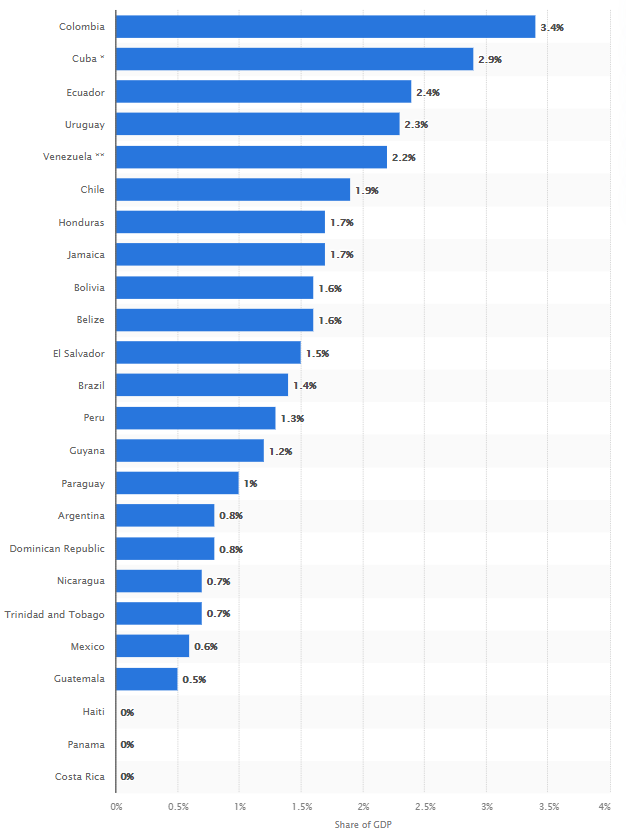
    A key problem is that LAC counties have not been investing enough in transport and related infrastructure. The transport revolution is not going to make this problem go away, although it may ease some of the obstacles and be a catalyst for some solutions. The UN’s Economic Commission for Latin America and the Caribbean (ECLAC), using the INFRALATAM database on existing infrastructure development, calculated in May 2017 that LAC countries should be investing 6.2% of GDP every year (over US$300bn) to meet their infrastructure needs. However, up to 2015 the total amount actually invested had been on average only 2.3%. Of that, 1.5 percentage points represented public sector investment, while private sector infrastructure investment was only 0.8%. The infrastructure investment share of GDP in the region did not increase between 2008 and 2015. According to the database, over half of total infrastructure investment is in the transport sector, followed by the energy sector with around 25% of the total. Other sectors include water and sanitation, flood defences, irrigation, and telecommunications.

    The current condition of transport infrastructure is poor. According to the Global Competitiveness Index compiled by the World Economic Forum (WEF), transport infrastructure is clearly deficient in economies like Argentina, Brazil, Colombia, and Peru. Road quality is particularly problematic. More than 60% of the region’s roads are unpaved, compared with 46% in the emerging economies of Asia and 17% in Europe. Ports in Brazil are substandard. It is sometimes cheaper to ship a product abroad, than to move it to another state or province in the same country. The bar chart shows that only Chile is close to the upper end of the international ranking for the quality of its roads, ports and air links. Outside of Mexico, railway infrastructure across the region tends to lag behind international standards.

    Quality of transport infrastructure

    Source: http://www.coface.com

    With the surge in export incomes experienced during the decade-long commodities boom in the early part of this century unlikely to return, continued Latin American growth is going to depend on improved competitiveness, which in turn will require major investment in transport infrastructure. Analyst Remi Piet of AMI (Americas Market Intelligence) says, “If Latin America is to raise per capita incomes, it must be done through productivity gains built on the shoulders of infrastructure improvements.” Data from the Inter-American Development Bank (IDB) for 2015 show that few counties in the region are investing enough in infrastructure. Mexico invested less than 2% of its GDP in infrastructure, while for Brazil the figure was roughly 3%. On the other hand, the economic benefits to be gained from investing more are compelling. According to a 2010 study by economists Calderón and Servén[1], for every 1% of GDP spent on infrastructure the economy would grow by 2.5% in Brazil, 1.8% in Argentina, and 1.3% in Mexico within three years of the initial outlay. Consultancy McKinsey reached a similar conclusion, calculating that if LAC middle-income countries had infrastructure as good as that of Turkey and Bulgaria, their growth rates would be two percentage points higher than they are now.

    Annual average total infrastructure spend

    Source: IDB/AMI

    Piet makes the interesting point that the LAC region can be globally competitive in three main areas, each with specific transport needs. These include primary goods, whose extraction, transformation, and export relies on world-class transportation and energy infrastructure, often in remote areas. A second category includes the manufacture of low- to mid-tech products, which require free trade agreements, fluid customs processes, and highly competitive transport infrastructure. In third place comes tourism, which requires good levels of public safety (the absence of high crime) and modern airport infrastructure. Piet says “Latin America does not compete effectively in high-value outsourced service sectors where Internet connectivity alone will suffice. Latin American competitiveness requires old-fashioned asphalt and power infrastructure to move people and products.” During the commodities super-cycle, LAC countries benefited more from higher prices than from higher volumes of primary exports, due in part to transport bottlenecks. In fact, a little known aspect of the boom is that in volume terms LAC actually lost market share to exporters with better transport infrastructure such as Canada, Australia, Russia, and the Middle East. There are many examples of the region’s transport deficiencies. To ship sugar 1,600km by rail from Jujuy in northern Argentina down to the main port at Buenos Aires takes 22 days, as long as it takes to ship in onwards from Buenos Aires to Hamburg on the other side of the world.


    [1] Cited by Remi Piet https://www.linkedin.com/pulse/future-infrastructure-investment-latin-america-remi-piet/

  • HONDURAS: Hernández gov’t pushes congress over PMOP

    LatinNews 10 February 2015 Hits: 1255

    Congress resumes sessions on 9 February with the ruling Partido Nacional (PN) bench primed to examine President Juan Orlando Hernández’s request to constitutionally institutionalise the new military police force.

    President Hernández suffered its first major defeat in congress just days before he celebrated his first year in office, when the opposition banded together to defeat the executive’s request to give constitutional rank to the new military police force, Policia Militar de Orden Público (PMOP). The unicameral 128-member legislature (in which the PN has just 48 seats) rejected the move by 67 votes to 61 in a second round of voting, having approved it in a first reading. Voting firmly against were the two main leftist opposition parties, Partido Anti-Corrupción (PAC, with 13 seats) and Libertad y Refundación (Libre, 37 seats), the new political vehicle of the ejected former president Manuel Zelaya (2006-2009); while Zelaya’s former party, the traditional Partido Liberal (PL), split over the issue, with 17 deputies voting against and 10 in favour.

    Currently, the PMOP is operating under the law that established it (Decree 168 of 2013) with funding coming from an unpopular ‘special security tax’ levied on the local private sector. As congress president at the time, Hernández pushed the controversial security tax through. The PMOP is vulnerable however, as congress could decide to withdraw its funding through that tax. Hence Hernández’s bid to give it permanent constitutional rank.

    The 22 January vote was a significant political defeat for the president, who reacted just days later in his first state of the nation address by declaring that he would put the matter to a public referendum instead, to be held alongside the next general election, due in late November 2017. Hernández said the referendum would ask voters: “Are you in favour of giving the Militarized Police of Public Order a permanent place in the constitution of the Republic?". However, critics were quick to pounce on the draft referendum bill later submitted by the executive to congress, which also suggests that the proposed constitutional changes allow municipalities, as well as the new special economic development zones (ZEDEs) to request that the PMOP, or other parts of the armed forces, provide them with a public security service. The proposed changes would grant the executive branch the ability to declare ZEDEs and regions of the country ‘special security zones’, with security to be provided by the PMOP. This, the critics, contend, oversteps the mark by allowing the executive a lot of discretional power over the use of the military police force.

    Moreover, the opposition also argues that as the congress has now rejected the constitutional amendment, the matter is thus closed and it cannot, therefore, be put to a referendum. Ahead of the resumption of sessions on 9 February however, the president of the security commission, PN deputy (and lawyer) Tomás Zambrano, was keen to stress that congress could examine the petition, as it has not issued a specific law on the matter. The PN has now tacitly signalled that it may be willing to ‘negotiate’ upcoming vacancies on the national electoral court (TSE), the national registry of persons (RNP) and the supreme court (where magistrates' positions come up for renewal in 2016) with Libre and the PAC in return for its support of the referendum petition. And to make sure, the executive has asked the PN to launch a major signature drive with the aim of submitting two petitions to congress; one executive-initiated and one citizen-initiated. A petition requires valid signatures equivalent to 2% of the electoral roll, or 110,000. It intends to collect over 300,000 in support of the two.

    • Homicides down

    In his one-year balance sheet, President Juan Orlando Hernández said that the country’s homicide rate had dropped by “more than 23%” to 66 per 100,000 inhabitants down from 86 per 100,000 registered two years ago under Hernández’s predecessor, Porfirio Lobo (2010-2014). Hernández was clear that the PMOP, which was built upon an initial contingent of 1,000 army reservists trained in policing skills and is a military force under the authority of the defence ministry, played a key role in this reduction.

  • Colombia: Austerity on the cards, Cárdenas warns

    LatinNews 30 July 2015 Hits: 1598

    After a decade of strong government spending, Colombia faces several years of tight budgets.

    On 14 July the National Council for Economic and Social Policy (Conpes) approved the finance ministry’s budget proposal for 2016. Although total expenditure is set to increase by 2.3% to US$60.5bn, there will be major cuts to investment projects, especially in the areas of mining, agriculture and housing. At a press conference, Finance Minister Mauricio Cárdenas announced that the budget represented a "policy of austerity."

    With global oil prices remaining depressed, the government forecasts just US$1.2bn in oil revenues in 2016, down from US$8.5bn in 2013. The imminent entry of 1.0m barrels of Iranian oil onto the global market, following the end of international sanctions, has dampened optimism for a bounce in crude prices. Cárdenas and his team have been forced to make tough decisions.

    Given the ongoing peace process (and continued military confrontations) with the Fuerzas Armadas Revolucionarias de Colombia (Farc), it is no surprise that the defence and justice ministries have escaped the cuts. However, overall government investment is set to fall by 11% to US$15bn. The agriculture ministry will see its budget slashed from US$1.2bn to just US$508m. Other ministries amongst the hardest hit are mining and energy (a 30% reduction), housing (20%), transport (21%) and environment (18%).

    None of these cuts can be easily absorbed. Agrarian reform is a key component of the peace process and will require significant investment in a post-conflict Colombia. The upgrading of the country's road infrastructure is crucial to boosting the competitiveness of the country's agricultural and industrial sectors, and financing for major projects is already in jeopardy as legal challenges have stalled the sale of the state energy firm Isagen, the profits from which were earmarked for so-called fourth generation projects, including road infrastructure (see below). Likewise, the natural resources sector requires major investment to resolve the institutional and operational bottlenecks that likewise have frozen the development of new projects.

    Cárdenas has pinned his hopes on an improving trade balance, with the weaker peso discouraging imports and increasing demand for local products (albeit this has yet to happen – see below). Importantly, the tax agency (DIAN) has seen its budget increased by US$1.5bn to ease the implementation of new tax reforms and crack down on evasion. The conservative opposition Partido Centro Democrático (PDC), the party of former president Alvaro Uribe (2002-2010), was quick to attack the cuts, accusing the government of relying too heavily on commodity prices and failing to put aside sufficient funds during the boom period to cope with the inevitable “rainy day”.

    While this may be true, Colombia's fiscal laws have prevented major overspending based on inflated price expectations. The same cannot be said of the rest of the continent. While the IMF forecasts real annual GDP growth of 3% for Colombia in 2016, the rest of the region is set to grow at an average rate of just 0.9%. Austerity may prove painful for Colombians, who have grown used to bullish growth, but the finance ministry argues that early implementation of conservative fiscal measures will allow the economy to set the bases for more sustainable medium term growth.

    A fall in government revenues has given momentum to a future tax code reform

    Twelve months ago, while other emerging markets succumbed to negative economic headwinds, Colombia appeared to be a dazzling exception to the rule. First quarter real GDP growth was 6.5% year on year, second only to China in the world's major economies. However, growth slowed to just 2.8% for the corresponding period of 2015 (see box). The fall in oil revenues and the failure of export industries to take advantage of the weaker Peso have underlined once more just how dependent the country is on commodities. Cardenas has a number of options open to balance the books, but none are appealing.

    The principle cause of the treasury's current woes is price of oil, which dropped from over US$100 a barrel (/b) in mid 2014 to under US$50/b for much of the first quarter of 2015. According to central bank data, petroleum exports brought in just US$3.9bn between January and March this year, compared to US$7.9bn in the corresponding period last year, an annualised drop of 50.6%. Coffee and coal exports both increased during the period, but industrial exports shrunk by 8% to US$2.3bn. This last figure is particularly worrying given that the weakening Peso, which has fallen from COP1,900/US$ COP to roughly COP2,855/US$ in late July, was expected to make Colombian exports more competitive.

    With first quarter imports remaining steady at around US$14bn, Colombia's terms of trade are worsening and Fedesarrollo, one of the country’s leading think tanks, forecasts a trade deficit of US$13bn for the year, around 4.1% of GDP. The bearish performance of the oil and mining sector over the last two years also has slowed investment in these key sectors. Between 2013 and 2014, foreign direct investment (FDI) in Colombia, most of which is destined for the natural resource sector, fell by 41%. Meanwhile, this year’s current account deficit is expected to expand to 6.5% of GDP.

    The timing of the slowdown could scarcely be worse as the government struggles to find funding for the post-conflict era, including infrastructure development an social policies aimed at easing the transition to peace in the countryside. The Organisation for Economic Cooperation and Development (OECD) forecasts that post-conflict social policies will cost 1% of GDP between 2015 and 2018. Meanwhile, as mentioned above, the government had planned to raise the US$2.2bn required for its participation in the private public partnership for road construction through the sale of Isagen. However, three separate lawsuits blocking the sale have led to uncertainty about the future of the deal.

    Minister Cardenas has tried to soothe doubts over the economy by comparing Colombia's situation with the rest of the continent, where the fall in commodity prices has had a similar effect. Compared with many of its neighbours, Colombia has low debt, a strong fiscal position (thanks to a law that prohibits fiscal deficits of over 2.2%) and a competitive exchange rate. Since the end of March, the oil price has recovered to around US$60/b and there is reason to believe that a lag-time in orders and payments was responsible for poor industrial exports in the first quarter; and that they will benefit from the weaker Peso moving forward.

    Nevertheless, the gaping hole left by the sharp and sudden drop in oil income has spurred the government into preparing what looks to be the largest root-and-branch tax reform in decades. The tax code has been changed twelve times since 1990, most recently in December 2014, when Law 1607 created a wealth tax and upped corporate tax. That reform is forecast to bring in an additional US$20bn in fiscal revenue in the coming four years, but it is not enough.

    In February, the government recruited a team of nine professionals, from diverse backgrounds, who will be responsible for drafting a new tax code. Conveniently, the team has ten months to prepare, meaning that its final proposal will be unveiled after local elections in late 2015. The IMF and the OECD have both dipped their oar in with suggestions. In a June report, the IMF said a reform should have the objectives of "simplifying the tax structure, increasing progressivity, broadening the tax base and improving tax administration”. The OECD, of which Colombia is a candidate country, suggests increasing the rate of Value Added Tax. At present, Colombia charges VAT at 16%, compared to an OECD average of 19.1%. An increase of 1% could bring in an additional US$2bn per year, according to the OECD.

    An increase in VAT appears to be the most viable and probable reform option on the table. The OECD's other suggestions: clamping down on evasion (estimated at US$20bn annually) and closing loopholes for so called non-profit organisations will be much tougher to implement and will require an overhaul of Colombia's tax agency, the DIAN. A simplified tax code and more use of technology would be a good start.

    First quarter growth

    The first quarter GDP result of 2.8% was a 3.7-percentage-point decrease over the 6.5% growth registered in the first quarter of 2014. According to Dane, seven economic sectors registered growth in the first quarter, of which five posted growth above the headline figure of 2.8%. Among these were construction (4.9%) and financial & real estate (4.4%). But manufacturing fell by 2.1% and mining by 0.1%. Despite the weak result, Cárdenas revised up his forecast for the year to 3.6%, arguing that activity will pick up in the second half. Cárdenas pointed out that Colombia’s 2015 first quarter result was still higher than that of the region’s largest economies, with Brazil posting growth of 1.6%, Peru 1.7% and Chile 2.5%. He suggested that Colombia could close 2015 with the second fastest growth of the region’s largest economies, behind Peru (4.3%) and followed after by Chile (2.9%) and Mexico (2.8%), with contractions expected in Argentina (0.6%) and Brazil (-1.1%).

    Not everyone is optimistic about Colombia’s economic prospects this year. In its latest economic outlook, released on 3 June, the OECD cut its GDP growth forecast for Colombia from 4.4% to 3.3%. The OECD said it expected Colombia’s growth to diminish this year as a result of “the gradual readjustment of investment and exports, due to weaker commodity prices in 2015”. End box

    Colombia-Japan EPA

    On 14 July Colombian and Japanese representatives met in Bogotá to initiate the XII round of negotiations for the Japan-Colombia Economic Partnership Agreement (EPA). Colombia’s trade minister, Cecilia Álvarez-Correa, highlighted the importance of negotiating a trade agreement with the world’s third largest economy and biggest food importer. According to trade ministry data, bilateral trade in goods between Colombia and Japan amounted to US$1.86bn last year. According to Álvarez-Correa, once a bilateral EPA deal is reached, exports of agricultural and industrial goods, as well as services, will be diversified. In last year’s round of negotiations, which took place in Tokyo in May, progress was made in areas such as trade in goods, government procurement and rules of origin.

    FDI plummets

    On 14 July the central bank (Banrep) released figures showing that FDI in Colombia was US$166m in June, compared to US$$2.98bn in June 2014. This fall is primarily explained by a decrease in investment in the oil & mining sector. While there was a 13.4% increase in foreign investment in other sectors to reach US$261.6m, investment in the oil & mining sector fell by 40.1% year-on-year to US$746m.

  • Brazil’s false claims of electoral fraud

    Patrick de Courcy 16 November 2023 Hits: 619

    In some ways Brazil’s recent history of social media disinformation has been closely tracking the pathway laid out in the US, only with a two-year time delay. Jair Bolsonaro’s 2018 victory can similarly be attributed to a slick media campaign, whilst maintaining an image of himself as a far-right anti-establishment figure. Then, in 2022 he claimed to have been the victim of electoral fraud after his defeat by Lula, and even incited his supporters to violence, resulting in thousands of people breaking into the presidential palace (Planalto), congress, and the supreme court on 8 January 2023, exactly mirroring the storming of the Capitol in the US two years and two days before.  In the Brazilian case it has been shown that far-right protesters believed their action would trigger an army putsch which would bring Bolsonaro back into office.  

    In both cases extremists had been fired up for months beforehand with an incendiary mix of online propaganda, conspiracy theories, and calculated disinformation. More generally the Bolsonaro presidency was marked by widespread disinformation and constant attacks on traditional media. The president and his supporters relied on intense use of social media to deliver a heavily partisan message to the country. There are fears that this wave of false news may have lasting and deeply harmful effects on the country.

    A critical part of Bolsonaro’s attempt to remain in power beyond the end of his first official term in office was to claim that Brazil’s electronic voting system, despite more than two decades of successful and reliable operation, was deeply flawed and open to manipulation. In classic Trumpian-style, the government insisted on repeating the electoral-fraud narrative despite the complete absence of any significant evidence to support it. During the course of 2022 – election year – Bolsonaro tried to pass legislation replacing the electronic system with an allegedly more secure paper-based one, but he failed to convince congress, including some of his less extreme conservative supporters, that any change was needed.

    A joint investigation by 22 Latin American media groups, found that one of the president’s sons, Eduardo Bolsonaro, had since 2018 taken part in 125 meetings with far-right leaders across the US and Latin America, building a network to support a potential coup d’etat in Brazil, designed to keep his father in office.

    Days after Bolsonaro pére was defeated in the elections by a narrow margin – a defeat which he still refuses to concede – a member of that network, Argentine political consultant Francisco Cerimodo, claimed on YouTube that he had a dossier allegedly revealing anomalies in the Brazilian voting process which had caused a “change of results”. To date, however, the alleged dossier has never been published. Cerimodo falsely claimed that both older model electronic voting machines had not been tested, and that some voting machines had not recorded a single vote for Bolsonaro.

    Despite these false allegations, his YouTube livestream presentation attracted 400,000 viewers and was widely shared by Bolsonaro supporters across Brazil on other platforms including WhatsApp and Telegram. Subsequently, Cerimodo claimed voter secrecy could be breached by accessing the voting machines’ operating logs, a claim which was debunked by Brazilian fact-checking agency Aos Fatos. This particular claim was also used in a petition to the electoral court by Bolsonaro’s Partido Liberal (PL) which sought the annulment of the second-round ballot, but which was unsuccessful; instead the court dismissed the petition and fined the PL for acting in bad faith.

    There were other indications that a far-right international network was supporting the pro-Bolsonaro campaign. US-based Epoch Media Group, identified by Facebook owner Meta as operating a network of accounts in the US and Vietnam to spread misinformation on US politics, gave prominent coverage to the Brazilian electoral-fraud narrative. Steve Bannon, a former Trump consultant and Eduardo Bolsonaro ally, is linked to Epoch and used that and his War Room podcast to spread pro-Bolsonaro propaganda. Bannon made unsubstantiated claims that Jair Bolsonaro’s initial lead in the election results made it “mathematically impossible” for him to have fallen behind in the race.

  • The other story – pleasing the markets

    Patrick de Courcy 27 March 2024 Hits: 1668

    In Milei’s first 100 days in office the media headlines have largely and understandably focused on his running battles with congress, the provincial governors, and both hard and soft forms of political opposition. But there has been another parallel story: some key economic indicators have begun to move in what could be called the right direction causing financial markets to show a degree of optimism about the new president’s ability to turn round the economy. These remain early days and it is not clear whether the improvements are sustainable, but they deserve some detailed analysis.

    Perhaps the single most dramatic change is that in January and February 2024 – Milei’s first two full months in power – the government recorded a fiscal surplus, the first in no less than 12 years. According to a report by the Instituto Argentino de Análisis Fiscal (IARAF) the surplus was achieved through the largest year-on-year spending cuts of the last three decades. For the first two months of the year government primary spending was down by 33.6% in real terms (adjusted for inflation). The biggest falls were registered in transfers to the provinces (down by 65%), goods and services (down 46%), and state pensions (down 39.5%). Because of their large share of the overall state budget, the cut in the real value of pensions was the single most significant saving made at the start of the new government, accounting for 43% of the total reduction in spending. By contrast the reduction in real terms spending on the public sector salaries bill contributed only 5% of total savings.

    The government was relying on what could be called a ‘do nothing’ strategy, simply allowing surging inflation to erode its real spending levels. Following the mega-devaluation of the peso in December, annual inflation had picked up pace to reach 276.2% by end-February. IARAF concluded that pensioners were being forced to make a disproportionate contribution to fiscal austerity, and that congress should legislate to achieve a more equitable contribution to fiscal equilibrium, including a review of tax levels and loopholes.

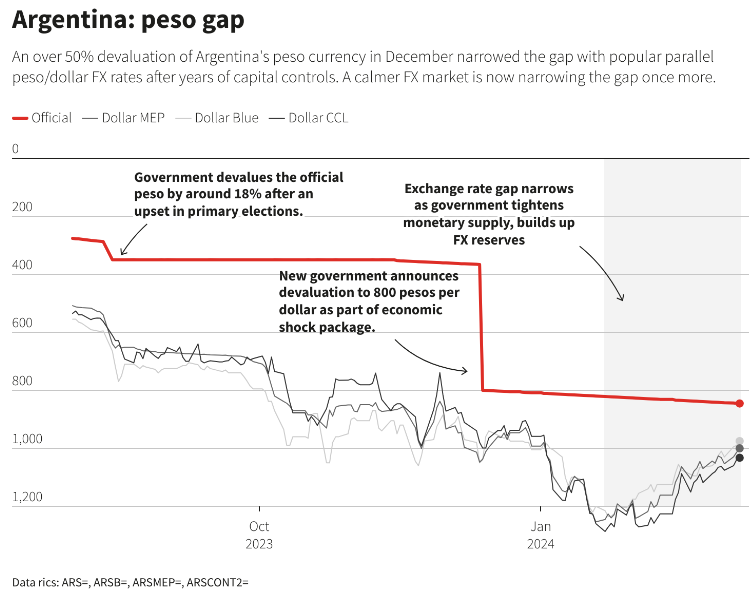
    The financial press highlighted a number of other positive developments. In 2023 as the result of an unprecedented drought and election-related political uncertainty, net foreign currency reserves had fallen into negative territory. On 11 March, however, the central Bank (BCRA) reported that since the new government took office on 10 December 2023 it had been able to buy US$9.6bn worth of hard currencies, bringing net reserves up to US$8.4bn, ahead of the US$6bn first-quarter target agreed with the IMF. The new government has said that rebuilding hard currency reserves is a key step before eventually re-introducing a freely floating exchange rate. Larger hard currency reserves are also necessary for any future dollarisation plan. In the meantime, the gap between the official exchange rate and the ‘blue’ (free market) dollar, often seen as a confidence indicator, has begun to narrow.

    Blue and official dollar rates converge

    Source: Reuters

    In general, international financial markets have welcomed the first measures taken by Milei, alongside his proposed ambitious and market-friendly reforms. In late February financial analyst Mariano Sardans of FDI Argentina told Reuters news agency that “it seems the market is starting to believe”. Sardans highlighted the short-term elimination of the fiscal deficit, the accumulation of foreign currency reserves, and a move to roll over import debts through the issuance of Bopreal bonds. Another local analyst, Javier Casabal of Adcap Grupo Financiero, said “the market is becoming very optimistic about Javier Milei’s conviction”, adding it was a shift worth celebrating “given that most investors did not have confidence in his ability to reduce the deficit just a few weeks ago”.

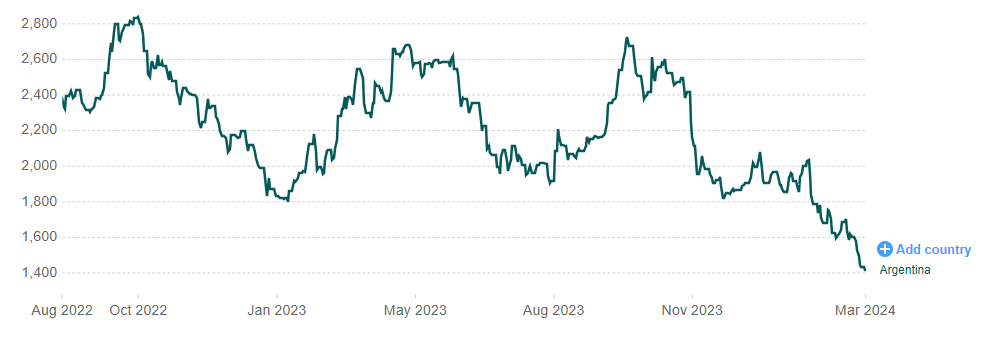
    The change in market sentiment (which is of course far from infallible) was evident on international bond markets. Argentina’s sovereign bond prices rose to two-to-four-year highs although they were still trading at only 35-45 cents on the dollar of face value. Argentine risk premiums have fallen during Milei’s first 100 days.

    Risk Premium: EMBI + Argentina
    In basis points

    Source: Alphacast

    The improvement in Argentina’s financial position was underlined by the mid-March announcement of a successful US$50bn peso-denominated bond swap. Economy minister Luis Caputo said the swap totalled ARS42.6tn (US$50.3bn) and represented 77% of treasury securities maturing this year. Analysts said the swap would give the new government some additional breathing space as it sought to control the deficit, reduce inflation, and stabilise the currency. These positives came despite some ongoing concerns over Argentina’s ability to service its debt without recurring to unilateral distressed debt exchanges. Responding to the bond swap US-based agency S&P lowered Argentina’s local currency rating from CCC-/C to SD-SD (selective default) noting “the sovereign’s acute macroeconomic vulnerabilities and limited ability to extend maturities and place paper in the local market without relying on exchanges”.

    While making some changes in the context and framework of inflation analysis, Milei has prepared the ground for a possible good news story on this front too. Under the previous government, and despite a plethora of price controls, inflation pushed up relentlessly to double digit monthly (and triple digit yearly) percentage numbers, destroying the administration’s credibility in the process. Milei appears to have successfully shifted the terms of the debate. From his point of view, when he took office, Argentina was heading for hyperinflation (often defined as inflation of 50% a month or higher). Short term success was therefore redefined as avoiding hyperinflation and achieving a sustainable month-on-month reduction in the rate of price increases, targeting falls of around five percentage points each time.

    In fact, monthly retail inflation peaked at 25.5% in December 2023, the month Milei took office and devalued the official peso rate. It then fell to 20.6% in January and contracted more sharply to 13.2% in February, well ahead of expectations. The official view is that inflation is falling because of the elimination of the fiscal deficit and a credible government commitment not to print money. There are still risks ahead – for example the promised removal of energy subsidies which is expected to lead to major tariff increases in April. But if the government can keep bringing inflation down to single digits it is likely to benefit from improving expectations.

  • RASTREANDO TENDENCIAS

    LatinNews 11 September 2015 Hits: 366

    CHILE | El banco central reduce su estimación del crecimiento

    La actividad económica de Chile creció 2,5% en julio, comparado con igual periodo del 2014, en general, en línea con las expectativas del mercado, que predijo 2,4%. Mientras julio vio un fuerte crecimiento en los servicios de valor agregado y en las manufacturas, esto fue contrarrestado por una declinación en la industria extractiva de  minerales. Las cifras provienen del índice mensual de la actividad económica (Imacec), que recoge alrededor del 91% de los bienes y servicios incluidos en las estadísticas del PIB del país.

    La economía chilena está experimentando una recuperación más lenta de lo esperado, que sigue a su peor desempeño por cinco años en el 2014, cuando creció en sólo 1,9%, agobiada por los bajos niveles de la inversión y del consumo interno. El 1 de septiembre el banco central redujo su pronóstico del PIB para 2015, a 2,0% – 2,5% y elevó su expectativa para la inflación, que ahora se predice en 4,6% para finales de año. Algunos analistas ahora esperan que el banco central eleve las tasas de interés para contener la inflación.

    PARAGUAY | Decepcionante segundo trimestre

    La economía paraguaya se contrajo en -1,2% en el segundo trimestre de este año en comparación con el mismo trimestre del 2014, debido al más lento crecimiento en sus exportaciones clave de electricidad, soja, y carne. De todos modos, el banco central aún espera que la economía crezca en 4% este año. “Pensamos que veremos una recuperación en la segunda mitad de este año, que compensará la caída,” dijo Miguel Mora, el director de estudios económicos del banco central.

    La declinación en la producción de electricidad se debe a las condiciones climáticas; las exportaciones de soja han caído debido a la menor producción, y las exportaciones de carne han sido golpeadas por los problemas económicos que enfrenta Rusia. Las exportaciones totales cayeron en 8% en el segundo trimestre, mientras que las importaciones también cayeron en 7%, debido a la menor compra de maquinarias y otros equipamientos del sector agrícola. De fuerte desempeño en el segundo trimestre fueron las manufacturas, subiendo 8,7%; la construcción, subiendo 4,8%; y los servicios, que subieron en 3,6%

    • Las críticas de la oposición

    El presidente del partido opositor de centreo-derecha, Renovación Nacional (RN), el diputado Cristián Monckeberg, pidió a la Presidenta Bachelet que “ponga su mano sobre su corazón y cambie de rumbo en el interés de Chile y no de su coalición”. Monckeberg agregó: “No sé lo que se necesita para que ella reaccione. Le hemos pedido que cambie de dirección, le hemos pedido liderazgo, pero nada ha ocurrido. El destino del país y el curso de los próximos dos años están en juego acá.” El senador de la conservadora Unión Demócrata Independiente (UDI), Hernán Larraín dijo que Chile estaba en “una encrucijada” y que las cifras negativas deberían enviarle “un claro mensaje a la Presidenta”. Larraín planteó “un gran acuerdo nacional” para confrontar los problemas de Chile.


  • EL SALVADOR: Criminal network exposed in judiciary

    LatinNews 02 December 2015 Hits: 330

    El Salvador’s national police (PNC) have arrested eight members of an alleged judicial corruption ring. The criminal network, which is thought to include rogue members of the police as well as corrupt members of the judiciary, is accused of accepting bribes in return for absolving senior figures in mara street gangs as well as drug-traffickers charged with serious crimes. A further five arrest warrants have been issued.

    El Salvador’s attorney general’s office (FGR) began the investigation into the criminal network in 2014 after various telephone intercepts of mara gangs detected communications established with lawyers and judges. The majority of the 13 people charged by the FGR were accused of manipulating legal rulings in specific cases in return for ‘private economic benefits’, including former judges in the department of San Miguel, Enrique Beltrán Beltrán and Jorge González Guzmán; a former prosecutor for the financial investigation unit (UIF), Arturo Magaña Figueroa; and members of defence counsels. They stand accused of perversion of the course of justice, bribery and falsifying documents.

    Cleaning up the judiciary is a fundamental component of the overarching security initiative ‘Plan El Salvador Seguro’, launched by the government led by President Salvador Sánchez Cerén, to try to address the country’s deteriorating public security situation. Sánchez Cerén received fulsome support for his government’s unprecedented efforts to improve public security through ‘Plan El Salvador Seguro’ from the executive director of the United Nations Office on Drugs and Crime (UNODC), Yury Fedotov, after he visited the country on 16 November.

    “Over the last 20 years, successive Salvadoran governments have worked tirelessly to combat organized crime. I note that El Salvador has called for the UN’s support in these efforts. As the head of the Office on Drugs and Crime, I want President Cerén to know that I have heard that call, and we stand ready to provide every possible assistance,” Fedotov said. The Sánchez Cerén administration announced that it would sign a cooperation accord with the UNODC imminently.

    • Guatemala ties

    President Salvador Sánchez Cerén hosted a meeting with Guatemala’s president-elect Jimmy Morales on 23 November, ahead of the latter’s inauguration on 14 January. The two men discussed “security [including the creation of a high-level bilateral security group], a customs unio, and facilitating trade, free movement of goods and people,” according to El Salvador’s foreign minister, Hugo Martínez, who also attended the meeting.

  • Argentina: Economic outlook still cloudy

    LatinNews 21 March 2019 Hits: 2258

    The peso is still under pressure, interest rates are sky-high, and inflation is heading in the wrong direction. Worries about the Argentine economy continue, despite an upbeat message from the IMF and a good harvest on the way.

    Financial and currency markets remain nervous in Argentina. Once again, the peso has come under pressure. After losing 50.6% of its value against the US dollar last year, a crisis which pushed Argentina into a US$56.3bn stand-by agreement with the IMF, the peso was stable in January and February, but began to slide again in March. In the first week of March the currency lost nearly 8% of its value in dollar terms, although by the end of the second week it had come back up, reducing the loss since the start of the month to 2.4%.

    Inflation

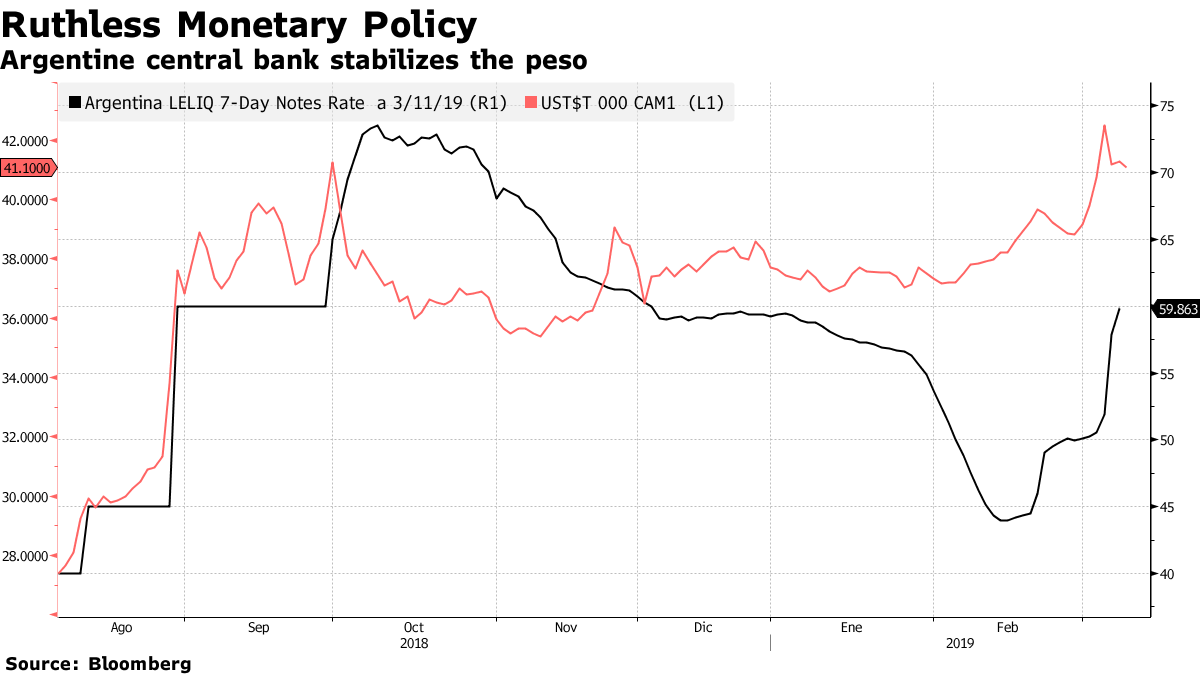
    To hold the line the Central Bank (BCRA) sharply tightened interest rates – its auctions of liquidity notes known as Leliqs took implied interest rates up to around 62.1% in mid-March. By one calculation the BCRA sold ARS190bn (US$4.6bn) of short-term debt in the first weeks of March, taking 13.5% of the monetary base out of circulation. The severe monetary squeeze is prolonging the recession. Meanwhile, and for the moment, inflation shows no sign of converging downwards as the government has promised it will. Higher utility tariffs have played a part. According to the national statistics institute, Indec, prices rose by 3.8% in February, lifting the 12-month inflation rate to 51.3%, comparted with 47.6% last year, which was already the highest rate in nearly three decades.

    It seems that the Argentine peso has been singled out by global markets for special attention as a speculative target. “Every day is a new test for the peso,” says Alejandro Cuadrado, currency strategist at BBVA New York. Jeffrey Sachs of Columbia University says, “Things other countries could get away with for ten years, Argentina can’t get away with for one month.” Writing for Bloomberg news agency, Ignacio Olivera Doll made the point that the currency finds itself in the uncomfortable position of being “the first domino to fall in any revival of risk-off sentiment”.

    There is an argument that Argentina’s fundamentals are in reality more solid than all this implies, although this may not be enough to convince those who want to bet against the currency. The BCRA has made some technical tweaks to further defend the currency. It has extended its commitment to maintaining zero growth in the monetary base to November of this year, and announced it will slow the growth of the currency band (which sets a floor and ceiling within which the value of the US dollar is allowed to fluctuate without intervention) from 2.0% a month to 1.75% a month. The government is also planning new legislation to prevent the BCRA from printing money to fund the treasury.

    An IMF staff report issued on 18 March was relatively upbeat, recommending disbursement of another US$10.87bn tranche of the stand-by agreement. The report welcomed the BCRA monetary tightening, which it said would bring down inflation and re-anchor inflationary expectations. On the fundamentals it commented, “The high fiscal and external deficits, the two imbalances at the heart of the 2018 financial crisis, are in the midst of a significant correction. Economic activity has been weak but there are good prospects for a gradual recovery.” Nevertheless, it also noted that if the government is to meet its target of achieving a zero primary fiscal deficit more spending cuts will be necessary – an awkward message for the government in an electoral year.

    Meanwhile, the prospect of a bumper soya harvest this year suggests strong dollar earnings could relieve some of the pressure on the peso. A 53m-tonne soya harvest is predicted, which government officials say could bring in US$17.2bn worth of export revenues – although some analysts caution that farmers may delay shipments, in the expectation that the peso may fall further. Marcos Buscaglia of investment company Alberdi Partners says, “The fundamentals of Argentina are good. The country is on the verge of a great soya bean harvest that begins in April and, if the threat of dollarisation doesn’t return, we will see a fall in inflation and a strengthening of the peso.” The reality, however, is that currency nervousness is likely to continue for some time.

    Looking for oil and gas investment

    To fully exploit the giant Vaca Muerta shale oil and gas deposits in Patagonia, Argentina needs to boost development investment from the current US$4.3bn a year to somewhere between US$5bn and US$10bn a year, energy secretary Gustavo Lopetegui said in March. Speaking at an investment forum in Houston Lopetegui said the country’s current oil production of around 80,000 barrels per day (bpd) could rise to 100,000 in the second half of this year. In April the government would press ahead with plans to tender a major 22m cubic metres/day gas pipeline linking Vaca Muerta to the Atlantic coast, with the winning contractor likely to be announced in August or September. Other investment will also be necessary the energy secretary said, including in further oil and gas pipelines, terminals, and rail freight. Ramping up shale gas production would allow Argentine to re-start exports to Chile and Brazil. Meanwhile, the hydrocarbons industry reacted positively to the 10 March re-election of Omar Gutierrez as governor of Neuquén province. Neuquén is home to the Vaca Muerta deposits and Gutierrez belongs to the Movimiento Popular Neuquino (MPN), a long-dominant provincial party. His re-election to another term was taken as a sign of continuity of investor-friendly provincial oil and gas policies.

  • URUGUAY: Mujica up in arms over Mercosur

    LatinNews 29 September 2011 Hits: 740

    President José Mujica pulled no punches in a statement published on the official presidential website on 23 September, accusing Brazil and Argentina of protectionism and of completely undermining the concept of the Southern Cone trading bloc, Mercosur, as an integrated customs union. Mujica even publicly alluded to the possibility (albeit still remote) of Uruguay leaving Mercosur. This, however, smacked more of his desire to convey the extent of his disenchantment with one particular decision - by Brazil – to effectively lift tariffs on imported cars by 30%, which has already had repercussions.

    On 15 September Brazil’s finance minister Mantega announced a 30% increase in the local tax on industrialised products (IPI) for vehicles (buses, cars, tractors, light trucks and trucks) that have less than 65% local content and are made outside the South American Common Market (Mercosur) or Mexico. Though the measure is ex-Mercosur, in order to be eligible all Mercosur-based manufacturers must comply with the tougher regional content rules. The measure is effective until December 2012. Mercosur manufacturers that invest in technology and meet higher environmental standards will be exempt.

    Mujica said that the decision might very well be a response to the “instability” in Europe and the US but it conspicuously failed to take into account the “disparities in development” within Mercosur as well as trade asymmetries - a constant gripe for the Mercosur minnows Paraguay and Uruguay. Mujica expressed his bewilderment that the measure could have been applied with no exceptions. He also said that it was “a political mistake” and conspired against integration by “strengthening the arguments of those who argue against (it)”.

    Mujica emphasised his “integrationist spirit” and commitment to resolving any dispute diplomatically but he was prepared to raise the issue of leaving Mercosur, even if he stressed this could not be a unilateral decision by the government, and would have to go to congress. The threat to leave Mercosur was more a reflection of Mujica’s annoyance than his harbouring any real intent to leave the trading bloc.

    Strong pressure is clearly being exerted on him, however, by Uruguay’s industrial sector to make a stand. The Unión de Exportadores del Uruguay called for the adoption of “defensive measures”. A car parts firm, Effa Motors, in the southern department of San José, laid off 400 workers after temporarily suspending its business as “unviable” in the wake of the Brazilian announcement. The Unión de Exportadores claimed that protectionist measures in Mercosur would soon affect the textiles, wood and biotechnology sectors.

    Uruguay’s deputy economy minister, Luis Porto, led a team to meet Brazilian officials on 27 September to try and negotiate an exemption for the country from the car tariff. Brazil’s secretary for production development of MDIC (Ministry for Development, Industry and Foreign Trade), Heloísa Menezes, said the petition would be considered “with much love”. Menezes conceded that the tariff would have a huge impact on Uruguay, while the impact on Brazil if Uruguay were granted an exemption would be negligible. Uruguay imports 15,000 cars a year to Brazil for some US$150m.

    In a political compromise, the Brazilians agreed that automotive imports from Uruguay would not have to meet the 65% local content requirement. Instead, Uruguay and Brazil will continue to adhere to a previous bilateral automotive accord, which contemplates lower local content rules. The Brazilian government agreed that the prior accord took precedence

    • Wind power

    Uruguay will launch a third wind farm tender in November. The energy ministry and the state power company (UTE) have set a maximum price of US$65/MWh. Uruguay has announced a very ambitious target of installing 500 MW of renewable energy capacity by 2015, of which 60% will be wind energy. Wind energy currently supplies just 1% of Uruguay’s total energy needs, but by 2015 the government wants to increase this to 25%.

  • COSTA RICA: An unwelcome first: transnational criminal leadership

    LatinNews 05 July 2012 Hits: 2758

    The crime that shocked the Latin American folklore music scene in July 2011 (see page 14) has, for the first time ever, put Costa Rica at the centre of a transnational criminal organisation. While local residents have long described increasing insecurity as their main concern, many in the region continue to downplay the country’s increasing security problems as its traditional image of a safe and flourishing nation dominates the popular psyche. However, the case of El Palidejo could soon change that.

    Alejandro Jiménez González (‘El Palidejo’) was arrested on 12 March in Colombia, triggering a series of arrests and surrenders in Colombia, Nicaragua, Costa Rica and Aruba (for prosecution in the US) that have shocked Costa Rican and international law enforcement agencies alike.  “If the accusations made against El Palidejo [in Nicaragua] are proved, the fact that he was born in Costa Rica, educated in public schools and that from one moment to another he is recruited [by a transnational criminal group] opens a new scenario, to which we have to pay a lot of attention”, Minister of Public Security Mario Zamora told the local Costa Rican media.

    In fact, Zamora said that the participation of a Costa Rican in a transnational criminal group is by itself “unprecedented; it marks a change in pattern. It was characteristic in all these groups that the central brain was a foreigner and that national participation was residual”. However, he says this has changed as El Palidejo wasn’t “a nobody; he was inside a hierarchical organisational structure. He could make decisions on his own; he didn’t have to consult [anyone]. We are talking about a boss within a transnational structure with different types of movements under his command”, Zamora said.

    The domino effect

    El Palidejo is believed to have acted as the organisation’s link in Central America, joining those producing cocaine in Colombia to those transporting it through Nicaragua and Guatemala into Mexico for its onward shipment to the US. Following El Palidejo’s arrest, Henry Fariñas, the Nicaraguan businessman accused of being his partner in crime, was arrested in Managua – although Fariñas was wounded in the attack and is expected to testify against El Palidejo, Nicaraguan authorities believe he used to be part of the Costa Rican’s network but was attacked as a result of a fallout between the two.

    Fariñas’s arrest was followed by the surrender of Javier Calle Serna [RA-12-04], one of the infamous Comba brothers who led the Los Rastrojos criminal group in Colombia, to the US Drug Enforcement Administration (DEA) in Aruba. According to the Colombian police, Los Rastrojos were the ones who helped El Palidejo leave Costa Rica after the attack on Fariñas and seek refuge in the Colombian department of Chocó, one of the group’s strongholds.

    Other members of the network had already fallen in the hands of authorities, but it wasn’t until El Palidejo was captured that Nicaraguan officials established the connections. In the formal accusation against Fariñas, El Palidejo is accused of handing over the cocaine transported from the port of Limón by a Colombian, Francisco García (‘El Fresa’), to a criminal gang known as Los Charros – believed to be the Guatemalan arm of the Mexican drug trafficking organisation (DTO) La Familia Michoacana. A former Mexican federal police officer, Gabriel Maldonado Siler, has already been sentenced in Nicaragua to 27 years in prison for his role in transporting the drugs through Nicaragua and Guatemala to Mexico as a member of Los Charros. The network’s movements, authorities claim, was possible thanks to the support of Julio César Ozuna, a former Nicaraguan electoral magistrate (CSE), who allegedly provided fake IDs for the members of the group. He was arrested in late May (see previous page).

    • Marijuana consumption shoots up

    The annual household survey on the consumption of drugs 2010, conducted by the institute on alcoholism and pharmacodependency (Iafa), reveals that the number of Costa Ricans who consume marijuana has more than tripled in four years. The investigation, in which 3,000 people between the ages of 12 and 70 were interviewed, found that while in 2006 only 0.6% of the population had consumed marijuana, this figure increased to 2% four years later. The survey shows that men consume marijuana much more frequently (3%) than women (0.9%). On average, consumers first try the drug at 16.5 years of age.

  • Brazil and creeping militarism

    Patrick de Courcy 10 November 2021 Hits: 1258

    Brazil was ruled by a succession of military governments between 1964 and 1985. After mass campaigns for democracy and direct elections the country was able to restore full constitutional rule in 1985. For the following 34 years, a period of well over three decades, the armed forces remained in barracks, clearly subordinate to the authority of elected civilians. This period also saw a significant role for the Brazilian military in international peace-keeping efforts organised by the United Nations. Brazil was for example a key player in MINUSTAH, the UN stabilisation force for Haiti which was deployed in 2004-2017. Around 2,200 Brazilian military were deployed in the country. However, Brazilian civil-military relations began to change significantly after Jair Bolsonaro, himself a former army captain, took office in January 2019 at the head of a radical right-wing government highly critical of what it described as the civilian and ‘liberal-left’ political establishment.

    In an article in the Journal of Politics in Latin America, Karabekir Akkoyunlu and José Antonio Lima contend that between 2016 and 2020 (a period which covers Bolsonaro’s election campaign and his first two years in office), “a group of activist generals successfully plotted the Brazilian military’s gradual return to the political centre stage with powers unseen since the dictatorship”. In their view this was achieved without breaking the law or obviously suspending the democratic process. They describe it as a “stealth intervention”, a process that fits neither into the traditional model of a coup d’état, nor a scenario where a professional army operates under undisputed democratic civilian guidance. They suggest that Latin America has seen other stealth interventions: among them the move to authoritarian rule during the presidency of Alberto Fujimori in Peru in the 1990s and the take-over of Venezuela by the Hugo Chávez /Nicolás Maduro regime in the years after 1999.   

    The authors say that by the time the Covid-19 pandemic hit Brazil, the military was more engaged in national politics than at any time since the restoration of democracy. The stealth intervention was incremental and achieved without any obvious rupture with the constitution. The authors say this encroachment contrasts with the current view that the military only intervenes defensively in civilian politics when its interests are threatened. They also suggest that the changing role of the military can be part of a wider process, known as “democratic backsliding”.

    Various factors are in play. One is a push factor – the existence of military officers with a praetorian world view. There are also pull factors such as a socio-political crisis that erodes confidence in democracy, and the presence of civilian politicians who seek a pact with the soldiers. In the Brazilian case, the military retained important prerogatives from 1985 onwards. Among other things the armed forces were protected by an amnesty law; the military high command retained control of education training, promotions, and budgets; and military courts had wide jurisdiction. The new system did not bar active-service officers from occupying civilian positions, in effect opening the door to political involvement. Despite reforms in the 1990s that sought to strengthen civilian authority, the role of the military expanded. The left-wing governments of presidents Luiz Inacio Lula da Silva (2003-2010) and Dilma Rousseff (2011-2016) avoided antagonising the armed forces. Despite this conciliatory position most top commanders retained much of the authoritarian ideology of the dictatorship, underpinned by deep-rooted anti-Communism and hostility to the governments of Lula and Rousseff.

    Military expenditure as a % of GDP in selected countries of Latin America and the Caribbean, 2020

    Source: Statista

    Political events created fertile ground for military expansion. The lava-jato corruption scandal and the impeachment of Rousseff in 2016 sharply increased the perception that Brazil’s civilian political establishment was rotten to the core. Rising crime galvanised public opinion and steered it towards hard-line responses. Bolsonaro, a previously fringe far-right politician, was able to gain traction with his claims that life had been safer and better during the dictatorship. A 2017 Pew Global Attitudes survey revealed that 38% of Brazilian respondents were in favour of military rule. A separate poll in January 2019, the month in which Bolsonaro took office, gave 62% support for military involvement. The generals responded to this situation by consistently denying any putschist intent, while at the same time expressing sympathy for those critical of the failings of civilian rule.

    In May 2018 General Sérgio Etchegoyen said there was “not the slightest possibility of a military coup” adding that he saw “no officers of the armed forces considering this scenario”. Many similar statements were to be repeated. There was also what could be called a second stream of public utterances by senior generals which, while still denying any putschist intent, showed them to be deeply partisan. In 2017 General Edson Leal Pujol said: “There is a general dissatisfaction in the nation, and I am not satisfied either. If our representatives are not meeting our expectations, let’s change them.” In 2018 General Ajax Porto Pinheiro, who had led the Haiti peace-keeping force, published a video warning against “the communist threat” and claiming that if the Partido dos Trabalhadores (PT - the party of Lula and Rousseff) returned to power “they will do what their ideology did to countries like Venezuela”. The general directly urged voters to campaign for Bolsonaro. Another important feature of “stealth intervention” was the willingness of President Bolsonaro to co-opt both retired and active service generals into his government as ministers and as heads of state companies and public bodies. Many of these officers had attended the same military academy (the Rio-based Agulhas Negras) with Bolsonaro in the 1970s and shared a similar world view. Lacking his own political party, Bolsonaro used the military appointees as a more reliable support network.

    According to data cited by Akkoyunlu and Lima the number of active-duty officers working in the executive branch rose by 40% to 2,558 in July 2020, up from 1,834 in February 2016.  Also in July 2020, ten of the 23 ministries in the Bolsonaro government were headed by active-service or retired officers, the second highest ratio since 1946, second only to 1975-1977, during the dictatorship. Military officers controlled key state institutions including state oil company Petrobras, the postal service, and the National Department of Transport Infrastructure (DNIT).

    The process of military co-option has not always been smooth. The combination of active service and retired officers has created potential disputes and conflicts of interest. In March 2021, in an unprecedented development, the commanders of the army, navy and air force all resigned simultaneously after Bolsonaro had sacked defence minister General Azevedo e Silva, who had resisted the president’s demands for expressions of personal loyalty from the military.

    The report concludes that in the 2016-2020 period Brazil’s experience shows that “a stealth intervention by the military and executive aggrandisement by elected politicians can go hand in hand, especially as both happen incrementally”. It suggests however that while the end of the Bolsonaro government is likely to reduce military presence and influence, “as long as the military’s tutelary prerogatives remain in place, this presence can regrow, and activist officers can intervene in politics again”. 

  • PANAMA: Varela seeking to recover credibility

    LatinNews 15 June 2016 Hits: 954

    President Juan Carlos Varela is continuing in his efforts to restore credibility to Panama’s image which was recently damaged by two major scandals. These were the US government’s decision last month to blacklist the Waked family, one of Panama’s most important business groupings [RC-16-05] – along with the ‘Panama Papers’ [RC-16-04], the biggest leak of secret information in history which exposed the internal operations of a locally-headquartered law firm dedicated to the incorporation of offshore entities.

    On 17 May, an official delegation headed up by Panama’s deputy foreign minister, Luis Miguel Hincapié, travelled to Paris to meet representatives from the Organisation for Economic Co-operation and Development (OECD) and discuss financial transparency-related issues. Following the meeting, the foreign ministry announced that starting in 2018, the Panamanian government will begin implementing the Common Reporting Standard (CRS) of the OECD Global Forum through bilateral agreements. According to a Panamanian foreign ministry press release, the OECD agreed to offer “all the necessary technical assistance for the implementation of new laws and technological systems required by the automatic exchange of information”.

    Also indicative of these efforts, on 20 May an official delegation from Japan arrived in Panama to begin negotiations on a new bilateral Tax Information Exchange Agreement (TIEA), which will be based on the CRS. These talks, which followed a visit by President Varela to Japan in April, follow announcements of other tax information-sharing deals in the pipeline. These include plans to ink a deal with Colombia, which was announced on 28 April, while the previous day Panama signed an agreement with the US to implement the Foreign Account Tax Compliance Act (Fatca) – a legal instrument for the automatic exchange of financial information between both countries.

    WTO rules against Colombia

    The Varela government received a recent boost after the World Trade Organization (WTO) issued a ruling on 7 June in favour of Panama in its complaint against Colombia's use of high import tariffs on textiles, clothes, and shoes to tackle alleged money laundering.

    Panama filed the complaint in June 2014 in response to a compound tariff imposed by Colombia in January 2013, consisting of a 10% ad valorem component and a specific component, which varies according to the import value and customs classification of the merchandise.

    The WTO press release notes that Panama challenged the compound tariff in certain situations where, “in its view, the measure necessarily results in duties in excess of those set forth in Colombia's Schedule of Concessions (35% or 40% ad valorem, depending on the product)”. Colombia had argued that the imported goods constituted “illicit trade” because they were imported at artificially low prices in order to launder money and that that should vindicate its use of a higher tariff than permitted under its WTO agreement.

    In November 2015, the panel established by the WTO Dispute Settlement Body (DSB) to review the case issued its report which upheld Panama’s argument. In January 2016, Colombia appealed the report, prompting the WTO panel to issue its final ruling this month.

    • Bilateral agreements

    In a foreign ministry press release, Panama’s deputy foreign minister, Luis Miguel Hincapié, said: “We will continue to negotiate additional bilateral agreements in accordance with the OECD's Common Reporting Standard, including with countries such as Singapore and Germany, which expand on existing commitments of a similar nature with other relevant partners.”

  • Region: Women’s labour participation in Latin America

    LatinNews 07 April 2017 Hits: 707

    Marking International Women’s Day on 8 March, the UN’s Economic Commission for Latin America and the Caribbean (ECLAC) noted a plateau in the participation of women in the labour market in Latin America, with a lot of women stuck in low productivity sectors. ECLAC called for the creation of quality jobs that recognise women’s abilities, levels of instruction and productivity.

    According to a report by ECLAC’s Gender Equality Observatory[1], while regional labour market indicators have demonstrated a positive trend over the past decade, the labour participation rate for women has stagnated at around 53%, while over three quarters of women who are employed (78.1%) work in what ECLAC defines as ‘low productivity sectors’, where the pay is worse, social security coverage is low, and there is less exposure to technology and innovation. Likewise, women’s unemployment rates are systematically higher than those of men. According to the Gender Equality Observatory, these employment inequalities “are based on a social system that reproduces stereotypes and maintains a sexual division of labour which limits the participation of women into the labour force”.

    Between 2002 and 2013 for example, the unemployment rate in Latin America cumulatively fell by 2.8 percentage points, but beginning in 2015, that trend began to reverse. Regional unemployment in 2015 was put at 7.4%. For women however, the unemployment rate was a higher than average 8.6%, whilst for men it was lower at 6.6%. Based on preliminary data for 2016, average regional unemployment rose again to 9.0%, an increase of 4.1m people. Again, women were more affected, with the female unemployment rate increasing by an estimated 0.7 percentage points last year, whereas for men the increase was a lower 0.3 points.

    In a press release to mark Women’ Day, ECLAC’s executive secretary, Alicia Bárcena, noted that labour indicators for the region “continue to show large gender gaps between men and women with regard to access to opportunities and rights”, which she also related to the aforementioned systemic social inequalities. These structural factors, she continued, “pose an obstacle to overcoming poverty and inequality in the region, as well as to women’s attainment of economic autonomy – even more so if one considers the current context of economic contraction”.

    ECLAC also notes that while the unemployment rates for women and men do vary depending on the country, the gender gap is always favourable to men, with the exception of Mexico, where male unemployment slightly exceeds that of women (by 0.1 percentage points). However, in other countries in the region like Belize and Jamaica, the gender gap is in excess of seven percentage points, it stressed.

    As in most economic and social indicator studies, poor women suffer the most. According to ELAC, in the first quintile in 2013, 14.9% of women were unemployed (compared with 10.5% of men). In the third quintile, female unemployment was at 7% with male unemployment at 4.9%, while in the highest-income quintile these percentages fall to 3% and 2.5%, respectively.

    For ECLAC, employment policies “should be capable of modifying the current structure of inequality, confronting the existing gender bias in the labour market”. It also calls for “the recognition and redistribution of time spent on unpaid labour”, so that the responsibility of caring for children, dependent persons and older adults does not fall exclusively on women.


    [1] Notes for Equality N°22: Women: the most harmed by unemployment, 3 March 2017, UN Gender Equality Observatory for Latin America and the Caribbean. http://oig.cepal.org/en

  • Quantifying the gains

    Abbi Dicker 16 May 2025 Hits: 2482

    Rodrigo Durán, a manager at Chile’s CENIA, highlights a study which seeks to quantify AI gains. This shows that the incorporation of AI tools into the work done by people in Chile’s 100 most important job categories, a total of 5.69m workers, could lift the country’s GDP growth by 1.21 percentage points, an amount equivalent to US$3.381bn. For Latin America and the Caribbean as a whole, there are estimates that AI could boost GDP by 5.4% of US$0.5trn by 2030.

    Latin America artificial intelligence market, 2018-2030 (US$M)

    Source: Grand View Research. Artificial Intelligence Market Outlook: Latin America.

    But the potential prize could be bigger. An IMF Working Paper published in October 2024 points out that Latin America has been suffering from poor productivity growth for decades. It links this to the large informal labour market consisting of small and unproductive companies. This in turn may reflect the limited diffusion of new technologies. The report argues, however, that AI could trigger productivity growth by “enabling countries to leapfrog technologies and reach a technological frontier”. As an example, it cites the case of Pix, a digital payments system introduced in Brazil, which has by-passed costly credit card technologies and widened financial inclusion in the country.

    The Working Paper makes a distinction between degrees of exposure to AI, on the one hand, and degrees of complementarity on the other. By employment categories, the jobs most likely to prosper are those with high exposure to AI and low complementarity. An example might be doctors, who will benefit from AI-led cuts in administrative costs releasing more time to spend on their core skill set - attending to patients - which is less vulnerable to automation.

    The IMF says many AI benefits may remain out of reach in Latin America and the Caribbean because of factors driving low diffusion (market competition, regulations, industrial structure, and deficits in physical and human capital). High levels of labour market informality will also act as a drag on uptake. On the other hand, it suggests a policy approach that could accelerate adoption and productivity-enhancing operation. These include lowering barriers to entry for new firms; strengthening competition and anti-trust regulations; and promoting cooperation across academia, industry, and government. Among other steps it suggests upgrading supervision, particularly relating to cyber-security and data protection. It also calls for appropriate unemployment insurance schemes to mitigate the negative impact of AI on workers, helping them where necessary to redeploy to jobs which better match their skillsets.