All Categories

Subcategories

  • URUGUAY-ARGENTINA: Canal dredges up discord

    LatinNews 18 May 2012 Hits: 1144

    Trade restrictions; contentious tax accords; and now corruption allegations surrounding the dredging of a bi-national canal. Managing diplomatic relations with Argentina is turning into a full time job for Foreign Minister Luis Almagro. It is also taking up an increasing amount of time for President José Mujica and his vice-president, Danilo Astori.

    “Mercosur is going through its worst moment in history. This must be analysed. In practical terms there is a denial of the most basic principles of the Mercosur treaty,” Astori said this month in a direct reference to Argentine trade barriers, which are blocking Uruguayan exports in contravention of the free movement of goods enshrined in the Mercosur founding treaty. Astori is merely venting the frustration felt by businesses in Uruguay. This has found a loud echo in the opposition which, in turn, is pressuring the government to turn the heat up on Argentina.

    With frustrated resignation, Astori said all that Uruguay could do was to “negotiate with professionalism” and to build “reserves of patience”. President Mujica embodies this pragmatism. Beyond the occasional verbal expression of displeasure, there is not really much Uruguay can do, as Mujica has publicly acknowledged, as Argentina would scarcely notice any tit-for-tat retaliatory measures.

    Astori did not stop at differences over trade restrictions though. He said that there was clear friction with Argentina over several other issues, such as the dredging of shared waters, ports, energy, gas and electric power. Foremost amongst these is the dredging of the bi-national Martín García canal. Mujica claims to have extracted assurances from his Argentine peer President Cristina Fernández to proceed with a project to deepen the Martín García canal from 32 to 34 feet.

    Uruguayan opposition congressmen are deeply suspicious of the commitment in Buenos Aires to the project, however, as Uruguay has struggled for years to win Argentina’s backing. There are ulterior motives at play here. The Martín García canal is one of two in the River Plate; it runs to Nueva Palmira, the large free trade zone administered by the Uruguayan State. The other canal, Emilio Mitre, leads directly to Buenos Aires; it was dredged to 36 feet in 2006 by Argentina. As such, ships carrying more than 45,000 tonnes have to transit the Mitre canal rather than Martín García. The Uruguayan opposition, and the press, are convinced that Argentina is trying to prevent Nueva Palmira thriving at the expense of Buenos Aires and Rosario.

    Foreign Minister Almagro announced last October that bidding for dredging the Martín García canal was poised to begin. Nothing happened. Then Argentina’s foreign minister, Héctor Timerman, visited Montevideo at the end of April this year to announce that the dredging would be put out to tender on 3 May. This was seen as a concession by the Argentine government to Mujica for Argentina’s tough new import restrictions. Again, however, nothing happened. The Argentine delegation at the bi-national administrative commission of the River Plate (Carp) had other ideas. It raised a number of objections on 9 May, to the public disenchantment of Astori, which could take months to resolve.

    The delay has spawned speculation and indeed allegations directed at Argentine officialdom. Juan Manuel Garino, a deputy for the more right-wing opposition party, the Partido Colorado (PC, Colorados), denounced that he had been offered a bribe of US$1m by Argentine officials from the Carp to support a bid by the Dutch company Riovia to carry out the work to deepen the Martín García canal.

    The Colorados and the more moderate opposition Partido Nacional (PN, Blancos) have summoned Almagro to testify before the senate about the alleged irregularities surrounding the bidding process to dredge the canal. President Mujica gave a sharp riposte: “Whoever is saying this should immediately go to the judiciary or shut up,” he said. Uruguayan government sources informed the national daily El Observador, however, that allegations of an “arrangement” between Riovia, which has maintained the canal since 1991, and Argentine officials had caused friction in the bilateral negotiations.

    When Riovia’s contract for dredging maintenance on the canal expired in January this year it sought to raise its fee from US$12m a year to US$20m. The Uruguayan government managed to beat the company down to US$15m but Uruguayan opposition deputies are questioning why this deal was signed at all when another Dutch company, Van Oord, was offering to do exactly the same maintenance job for a fraction of the cost (US$9m).

    Opposition legislators are so incensed with what they perceive to be the government’s meek subservience to Argentina that they are refusing to vote in favour of a new tax information sharing and double-taxation accord struck between Uruguay and Argentina on 24 April. After (the now former) French President Nicolas Sarkozy branded Uruguay one of a dozen countries that the international community should shun as “tax havens” during the G20 summit in Cannes last November, the government sought to escape the Organization for Cooperation and Economic Development (OECD)’s “grey list” of jurisdictions which have committed to but not yet “substantially implemented” an “internationally agreed tax standard”.

    The Uruguayan opposition argues that Argentina (which complains that many Argentines use Uruguayan banks to avoid domestic taxes) was behind Sarkozy’s comments. They also insist that if Uruguay is going to have to give ground on a bilateral tax information exchange agreement (TIEA) with Argentina then Argentine trade protectionism should be discussed too.

    • Tax accord

    Uruguay’s economy minister, Fernando Lorenzo, signed the tax accord with the head of Argentina’s tax authority (Afip), Ricardo Echegaray. It must be ratified in the respective parliaments of both countries before coming into effect. Lorenzo said the agreement would not be applied retroactively and he rejected that either government would now seek to carry out joint audit actions in each other’s territories. Lorenzo said the agreement formed part of his government’s efforts to fulfil the second stage of the OECD’s transparency agreement, to help Uruguay improve its international status and become more attractive to investors, an objective which will have been enhanced by the decision by Standard & Poor’s to restore the country’s investment grade rating [RBS-12-04].

    • Military tension

    Uruguay’s First Lady Senator Lucía Topolansky caused a real stir in April by calling for the armed forces to be “loyal” to the political project of the ruling left-wing coalition Frente Amplio (FA). She also maintained that the FA was transforming the armed forces internally with this end in sight. The military top brass expressed profound concern at her remarks and the defence minister, Eleuterio Fernández Huidobro, himself a former Tupamaro guerrilla like Topolansky, was forced to reject them publicly (see our sister Weekly Report [WR-12-18] for more details on this story).
  • Peña Nieto boosts ties with Canada’s new leader

    LatinNews 26 November 2015 Hits: 15

    Mexico’s President Enrique Peña Nieto took advantage of his trip to attend the ‘G-20’ summit this month to hold a meeting with Canada’s newly-elected prime minister, Justin Trudeau. With Trudeau confirming that his government will eliminate current visa requirements for Mexican nationals visiting Canada, this ensured that relations between the two leaders got off to a positive start.

    The lifting of visa requirements for Mexican nationals in order to shore up bilateral relations, was one of the campaign promises that Trudeau made in the run-up to the 20 October general elections in which his Liberal party defeated the Conservative Party of Canada (CPC), ending almost ten years of CPC rule under former prime minister, Stephen Harper (2006-2015). Soon after assuming office on 4 November, Trudeau delivered on this promise, when on 13 November he released a series of ministerial mandate letters addressed to his cabinet ministers, in which he instructed Minister of Foreign Affairs Stépahne Dion and Minister of Immigration, Refugees and Citizenship John McCallum to lift the visa requirement for Mexicans.

    The visa requirement has been a sore point between the two North American Free Trade Agreement (Nafta) member countries ever since it was implemented by the Harper government in July 2009 in response to the increase in the number of Mexican refugee claimants seeking to enter Canada. Mexico retaliated by imposing its own visa restrictions on Canadian nationals, hampering bilateral tourism. According to Canadian official figures, over 2m Canadian tourists travel to Mexico every year, while 172,000 Mexicans visited Canada in 2014.

    Following Trudeau’s announcement, Peña Nieto agreed to hold a meeting on the sidelines of the 15-16 November G-20 summit held in Antayla, Turkey. Afterwards, Peña Nieto said that the two had agreed to strengthen the bilateral relationship and “establish a work agenda equal in scope to what we already have”, a reference to the 2014-2016 Canada-Mexico Joint Action Plan agreed with the Harper government last year, which sets four priorities for the bilateral relationship: fostering competitive and sustainable economies; protecting citizens of both countries; enhancing people-to-people contacts; and projecting the partnership regionally and globally.

    Promoting bilateral trade, in particular, is in the interest of both countries. Despite the recent political tensions, Canada and Mexico are still each other’s third largest trading partner. Last year, bilateral trade reached US$25.8bn, a 650% increase since Nafta came into effect in 1994. In addition, eliminating the visa requirement could help Trudeau secure Mexico’s cooperation in some of his other objectives. The ministerial mandate letters state that developing a North American clean energy and environmental agreement is among Trudeau’s top priorities. Mexico has shown a willingness to engage its Nafta partners in this, with Peña Nieto and US President Barack Obama launching a new high-level bilateral clean energy and climate policy task force in March.

    • A new ‘amigo’

    Commenting on the positive start to relations between President Enrique Peña Nieto and Prime Minister Justin Trudeau, Mexico’s ambassador to Canada, Francisco Suárez, said that Trudeau could act as a real “amigo” alongside Peña Nieto and US President Barack Obama in terms of regional climate change efforts. Trudeau, Peña Nieto and Obama are due to meet other world leaders at the United Nations Climate Change Conference (COP21) to be held in Paris from 30 November, when the new ‘three amigos’ can try to join forces to exert greater influence.

  • Brazil leads the charge

    Abbi Dicker 14 May 2026 Hits: 1154

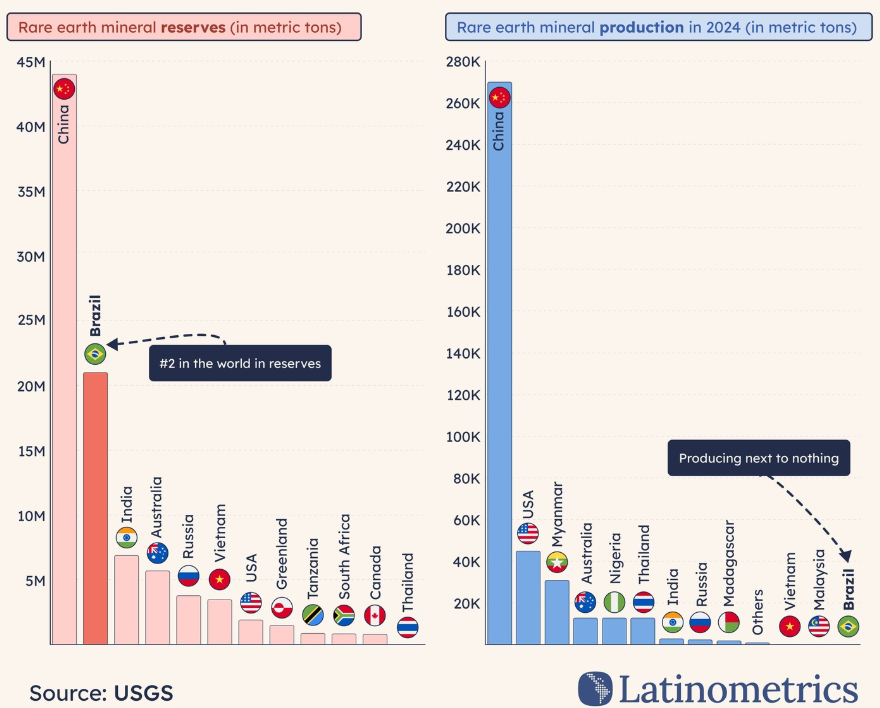
    There is a broad consensus that Brazil is emerging as the Western Hemisphere powerhouse for rare earths, based partly on the fact that the country holds one-fifth of known global REE reserves (and that only about a third of Brazilian territory has been mapped geologically, meaning reserves may be greater). The state of Minas Gerais has attracted around US$2bn in REE investment and has been dubbed a “rare earth valley” capable of rivalling some of China’s key sites. As already mentioned above, Brazil plans to raise its share of global rare earth output from virtually nothing to 5%-8% by 2030. To help this happen the government has committed itself to carrying out US$500m worth of infrastructure improvements including rail connections and ports.

    Brazilian-owned mining giant Vale has announced a US$5.4bn-US$5.7bn investment plan for critical minerals, focusing on nickel, copper, and rare earths, the largest investment yet seen in the sector.

    In early 2026 media reports suggested that the centre-left government of President Luiz Inácio Lula da Silva was considering whether to set up a state-owned rare earth company. The news came amid worries that without intervention, Brazil might face a critical gap in its rare earth midstream processing capacity. Successive Brazilian governments have favoured moderately nationalist positions on mining while at the same time seeking to offer the predictability and stability that foreign investors welcome.

    Monica de Bolle, a Brazilian specialist at the Petersen Institute for International Economics (PIIE), says there has been a disproportionate focus on upstream mining in the race for rare earths: “The real chokepoint in global supply chains lies not in what exits underground” she says, “but in the capacity to transform these resources into usable materials across the supply chains of multiple products and sectors. In other words, the chokepoint is not concentrated upstream, but in the midstream and downstream of supply chains. These are the stages that China dominates globally.”

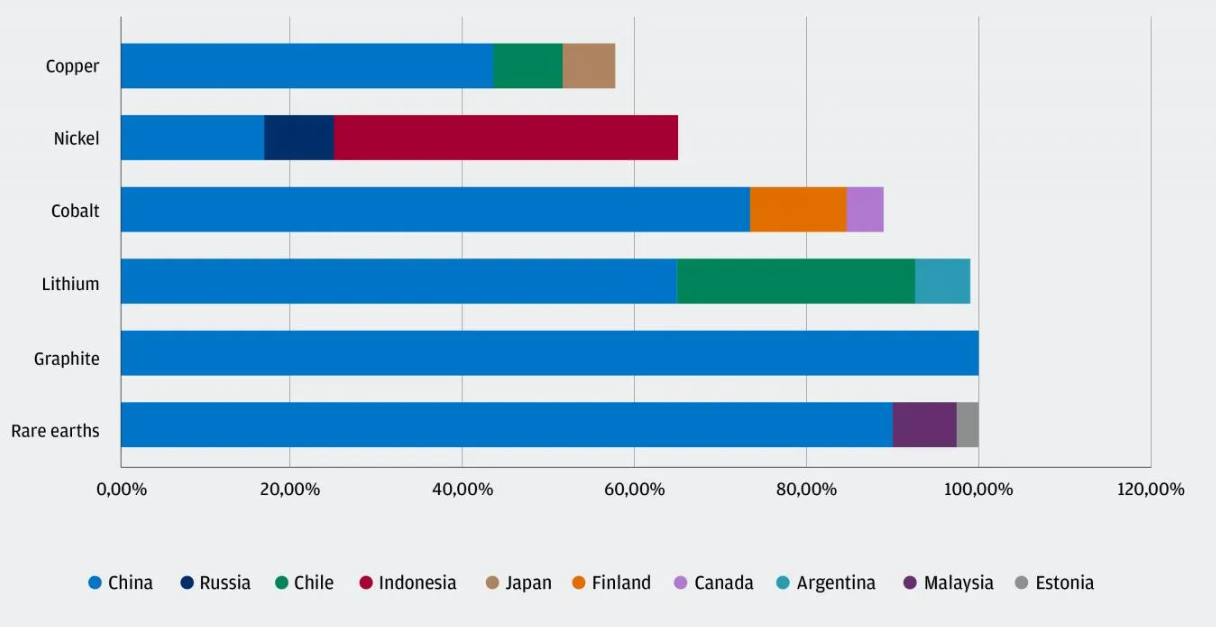
    Percentages of the top three producing countries in processing of copper, nickel, cobalt, lithium, graphite and rare earths.

    Source: IEA

    Brazilian officials are eager to see the country building capacity in higher value midstream separation, refining, battery and magnet production, rather than being restricted to exporting lower-value ores for processing elsewhere. Sources said the Lula administration was split on the issue, with the Office of the Presidential Chief of Staff favouring the idea of a state company, while the ministry of mines and energy preferred a more market-led response.

    André Pereira César, a political analyst at Hold Consultoria, commented: “The decision to create or not a state-owned company to operate in rare earths is not such a simple decision and is part of a political calculation. In general, the population tends to criticise the creation of yet another state-owned company, but rare earths is a very particular segment, since we are seeing governments of all countries talking about how important these elements are for sovereignty, so we have to consider that this has become a very relevant geopolitical issue.”

    Brazil is the sleeping giant of minerals

    With presidential elections due this October in Brazil rare earths are on the political agenda. The main electoral battle is likely between Luiz Inácio Lula da Silva, the centre-left incumbent, and senator Flavio Bolsonaro (son of far-right former-president Jair Bolsonaro 2019-2023). Among the other presidential candidates is Ronaldo Caiado, former governor of Goiás state who has promised close collaboration with the US on REE research and development.

    Given public anger over punitive tariffs on Brazilian products imposed by Trump last year, candidates may be wary. César of Hold Consultoria says national sovereignty over rare earths will be discussed on the campaign trail, noting that “Candidates who appear too close to the United States may have difficulty attracting votes from undecided voters, who will be the ones to really decide the election.” For his part President Lula da Silva has insisted that “We are not going to be exporters of critical minerals. Anyone who wants them will have to industrialise in our country, so that our country can earn that money.”

    Looking at the longer term, Brazil has the ability to position itself as a strategic rare earths partner for both the US and the European Union (EU). This is because it not only has the necessary REE reserves but also a power grid that is almost 90% renewable, meaning that it can process and refine rare earths with a relatively small carbon footprint. However, according to PIIE, to fully seize the REE opportunity Brazil will have to eliminate institutional, infrastructural, and financial bottlenecks. For mining to leap forward there needs to be “a supporting industrial eco-system with skilled labour, logistics, technology transfer, and stable regulatory frame works”.

  • ECONOMIC HIGHLIGHTS

    Abbi Dicker 13 November 2025 Hits: 595

    PANAMA | Arbitration victory. On 31 October the United Nations Commission on International Trade Law (Uncitral) delivered a victory for Panama in an arbitration initiated by Spanish construction company Sacyr in 2018, related to the expansion of the Panama Canal. Sacre had a 41.6% share in Grupo Unidos por el Canal (GUPC), the consortium in charge of the design and construction of the third set of locks within the Panama Canal expansion project. It alleged that Panama had violated the Panama-Spain Bilateral Investment Treaty during the bidding process and subsequent execution of the project. Uncitral rejected all of Sacyr’s claims and ordered the Spanish firm to pay Panama the costs of the proceedings totaling nearly US$6.4m. Panama’s President José Raúl Mulino described the result as a “big achievement”.

    DOMINICAN REPUBLIC | Government issues bonds. On 22 October the Dominican government issued US$1.6bn in sovereign bonds on international markets, the finance and economy ministry announced. Demand for the bonds, which will have an interest rate of 5.875% and a 10-year maturity, exceeded US$5bn, the ministry said. It added that this was a tribute to the government’s stewardship of the economy and the Dominican Republic’s reputation for reliability in bond issuance given “the high level of financial volatility and persistent pressure on global [interest] rates”. The ministry said that the funds would be used on infrastructure projects and investment in works in the transport, energy, water, health, and education sectors in keeping with the government’s commitment to “a prudent, transparent, and sustainable fiscal policy”.

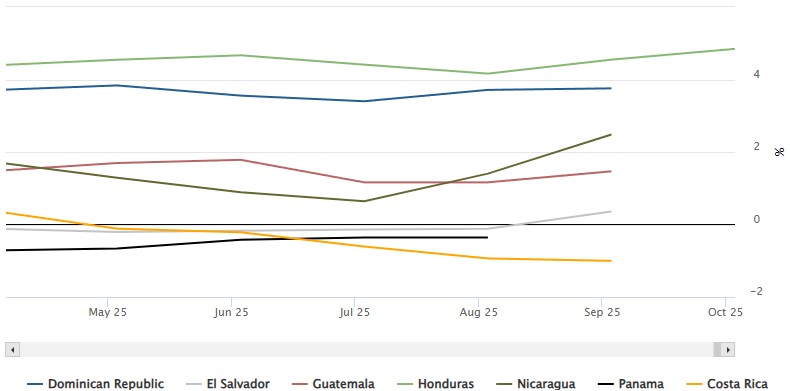
    Central America & Caribbean: inflation rate
    Percentage variation (year-on-year)

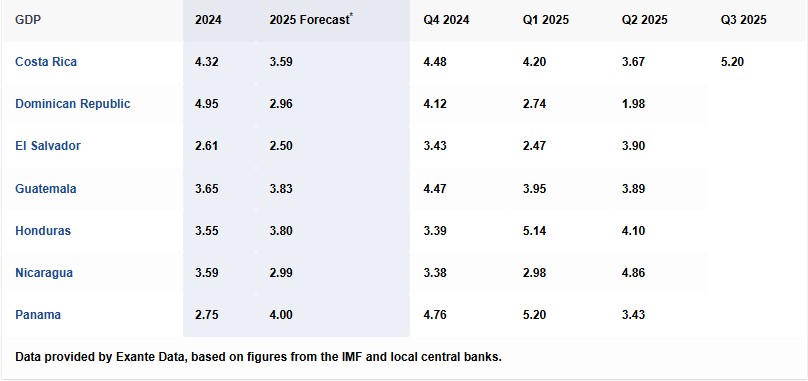
    Central America & Caribbean: GDP growth (%)
    Quarterly figures are year-on-year growth

  • Bolivia: A controversial re-election

    LatinNews 07 January 2019 Hits: 2456

    Date: October 2019

    Type: Presidential, legislative (all 130 seats in the chamber of deputies and all 36 seats in the senate).

    Main presidential contenders: Evo Morales (Movimiento al Socialismo); Carlos Mesa (Comunidad Ciudadana); Oscar Ortiz (Bolivia Dice No); Virginio Lema (Movimiento Nacionalista Revolucionario); Jaime Paz (Partido Demócrata Cristiano); Víctor Hugo Cárdenas (Unidad Cívica Solidaridad); Ruth Nina (Partido Acción Nacional Boliviano); and Félix Patzi (Movimiento Tercer Sistema).

    First elected in 2005 and then re-elected in 2009 and 2014, President Evo Morales is seeking a further term in office. His candidacy however remains controversial. Under the 2009 constitution (passed under his Movimiento al Socialismo [MAS] government) two consecutive re-elections are possible – meaning that technically another term should not be possible. In February 2016 the government staged a popular referendum on whether to change the constitution to allow President Morales to run again which rejected the amendment (by 51.30%-48.70%). Despite this in December 2018 the electoral court (TSE) upheld a ruling by the constitutional court (TCP), issued the previous year, which accepted an appeal by the MAS and allows Morales to seek a further term in office on the grounds that the constitutional ban on re-election violated his political rights.

    The referendum result had marked a watershed moment for President Morales who had hitherto enjoyed high levels of popularity based on his anti-poverty efforts, made possible through revenue from the nationalised hydrocarbons sector which returned to state control after he took office in 2006. Yet amid growing voter disillusionment stemming from various official corruption scandals, his defeat in 2016 owed in large part to an influence-trafficking scandal which implicated him directly, involving his former girlfriend, Gabriela Zapata, and a Chinese company, CAMC (although he has since been vindicated). 

    Although the MAS has yet to publish its official 2019 manifesto, Morales announced at the beginning of 2013 his government’s objectives for the next ten years which included commitments to reduce poverty and inequality; and under the ongoing economic and social development plan for 2016-2020 the intention is to invest US$48.5bn with the aim of reducing inequality and cutting extreme poverty from 17.3% of the population (total 11.2m) in 2014 to 9.5% in 2020 and general poverty from 39.3% to 24% over the same time frame.

    Opposition divided

    While the opposition remains fractured, a key point in common is their opposition to what they see as the growing authoritarianism of the Morales administration, stemming from his insistence on running again, and wider doubts about the independence of the country’s institutions (see below).

    Yet as in recent elections, there is little sign of any unity. One main contender is Comunidad Ciudadana which was forged in October 2018 and comprises the Frente Revolucionario de Izquierda (FRI) and La Paz Mayor Luis Revilla’s Soberanía y Libertad (Sol.bo). Comunidad Ciudadana is fielding former president Carlos Mesa (2003-2005) as its presidential candidate.

    The other main opposition alliance is Bolivia Dice No – an explicit nod to the referendum result – whose presidential candidate is Senator Oscar Ortiz. Launched in November 2018, Bolivia Dice No is a reincarnation of the alliance between Samuel Doria Medina, the leader of the main opposition Unidad Nacional (UN), and Santa Cruz regional governor Ruben Costas, forged in the previous 2014 general election which saw Morales take 61.4% of the vote overall, followed by Doria Medina with 24.23%. Yet, in a sign of continued divisions, two weeks after the Bolivia Dice No alliance was announced, Doria Medina quit, citing “differences of strategy”. He has since said he will back the candidate most likely to defeat Morales.

    The latest electoral surveys offer contradictory messages. A survey published by opposition daily Página Siete on 2 December, which interviewed 800 people and had a 3.5% error margin, showed Mesa on 34% of voting intentions to 29% for Morales. Another pre-electoral poll by Ipsos, published at the end of October, showed Morales ahead on 39% of voting intentions, followed by Mesa on 25%. The survey interviewed 1,000 people and had a 3.1% margin of error.

    Concerns about the TSE

    The TSE has long been subject to concerns about its independence from the MAS, which also controls the legislature with 25 seats in the 36-seat senate and 89 in the 120-seat lower chamber. Furthering these concerns, on 22 October TSE president Katia Uriona resigned, citing doubts about the court’s institutionality. She said it had “reached a stalemate” for decision-making on fundamental issues. Uriona’s resignation followed that of TSE vice president José Luis Exeni, who cited health concerns, at the start of October.  Mesa and other opposition leaders seized on the resignations as evidence of an institutional crisis and indicative of pressure from the MAS. Another former president, Jorge Quiroga (2001-2002), warned that Morales’ “desire” to perpetuate power is “destroying” the TSE.

    Concerns regarding the independence of institutions like the TSE would seem to be backed up by the 2017-2018 Rule of Law Index in January 2018 by the World Justice Project (WJP), an international civil society organisation, which measures rule of law adherence in 113 countries worldwide. The January 2018 report showed that Bolivia dropped two positions for overall rule of law performance (from 104th in the 2016 WJP Rule of Law Index) to 106th out of 113 countries in the 2017-2018 edition. Its score places it in 29th place out of 30 countries in the Latin America and Caribbean region – ahead only of Venezuela.

    • Primaries

    A novelty introduced by a new law on political parties passed at the end of July by the MAS-controlled bicameral national legislature, primaries are due to take place on 27 January to formerly elect presidential slates at a cost of some B$27m (US$3.9m). At the time of the law’s approval, opposition figures like Carlos Mesa complained that the mechanism of holding primaries was designed to provide legitimacy to Morales’ candidacy after the 2016 referendum. Mesa and other opposition candidates have since called for the primaries to be cancelled, arguing that they are a waste of public money and redundant given that the presidential running slates for the political parties registered to vote have already been declared.

  • NICARAGUA: More mining clashes

    LatinNews 21 May 2015 Hits: 2743

    Earlier this month clashes took place at the Bonanza gold and silver mine located in the eponymous municipality of Nicaragua’s north Atlantic autonomous region (Raan), after police fired at small-scale miners (known locally as ‘güriseros’) protesting against low prices offered by mining company, Hemco, which is owned by Colombia-based Minero S.A. The clashes, which took place on 4-7 May, left one protester dead, six police officers wounded and resulted in 33 arrests. The unrest comes as the Frente Sandinista de Liberación Nacional (FSLN)  government led by President Daniel Ortega continues to seek to attract foreign investment to Nicaragua’s mining sector.

    While calm has been restored to the area after the authorities agreed to set up a dialogue table with the miners, mining in the Raan had already made international headlines last year following the collapse of another gold and silver mine, El Comal, also owned by Hemco, which took place on 28 August as a result of a mud-slide. According to government reports a total of 29 güriseros were trapped by the accident, 22 of whom were successfully rescued. Described by the Nicaraguan chamber of mining (Caminic) as “a disaster waiting to happen”, the tragedy was one of the worst in the country in recent years.

    Meanwhile the latest unrest comes as the government – which last August held its first ever international mining congress – continues to try to attract investment. Last month a delegation of representatives from ten Mexican mining companies paid a visit to Nicaragua as part of a two-day tour organised by Caminic; Nicaragua’s official export and investment agency, ProNicaragua; its Mexican counterpart, ProMéxico; and the Mexican mining cluster of Zacatecas (Clusmin). According to a ProNicaragua press release the “export offer of the Mexican delegation includes equipment for subterranean mining, concrete additives, industrial machinery, consultancy services, tailings dam engineering, mining anchors, cement cartridges, mining engineering, operation and maintenance of rig equipment, among others”.

    Last year, gold was Nicaragua’s third biggest export, worth some US$386m and representing 15% of the country’s exports. Total gold production during 2014 amounted to 437 troy ounces, representing an increase of 176% since 2007. Gold mining activity is currently concentrated in three areas– besides the Raan, the other two mining centres are the El Limón and La Libertad mines in the department of León (both owned by Canada’s B2Gold).  However, in April 2014 ProNicaragua announced the opening “over the next three years”, of La India, Nicaragua’s fourth industrial gold mine. Owned by the United Kingdom’s Condor Gold, the mine will be located close to the town of Santa Rosa del Peñón, León department.

    • Tourism

    According to Nicaragua’s tourism institute (Intur), foreign tourism generated some US$445.4m in revenue for Nicaragua last year, 6.8% more than in 2013. Nicaragua expects to raise about US$450m in revenue from an estimated 1.35m foreign visitors this year.

  • ECONOMIC OVERVIEW: PANAMA

    LatinNews 02 September 2011 Hits: 1507

    According to an August report by Panama’s economy and finance ministry (MEF), GDP grew 9.9% in the first four months of 2011, driven by transport and related sectors and construction. This compares to 6.7% over the same period of 2010; 4.6%, 2009; 10.5%, 2008; and 12.2%, 2007.

    Exports: The same MEF report showed exports reached US$245.9m in the first four months of 2011, down from US266.2m in the same period of 2010. Gold has now become Panama’s leading export in value terms, representing US$28.3m over the period. This is followed by bananas (which represent US$27.4m): the sector is showing signs of recovery (up from US$22.8m in the same period of 2010) following the hurricane winds that had affected the Bocas del Toro banana growing region.

  • ECONOMIC OVERVIEW: EL SALVADOR

    LatinNews 08 August 2012 Hits: 1613

    Exports down: In the first six months of 2012, El Salvador’s exports reached US$2.67bn, a 3.6% drop on the same period the previous year, according to a report released on 27 July by El Salvador’s Banco Central de Reserva (BCR). The BCR attributes the change to a drop in sales of coffee and maquila products. According to the BCR report, coffee exports declined 34.3% in the first six months of 2012 when compared with the same period in 2011 due to a reduction in volume exported (-42.8%). Maquila exports, which reached US$556m, dropped 7.6% in the first six months of the year when compared with the same period the previous year. Non-traditional products (which accounted for US$1.77bn) increased 3.3% while traditional exports dropped 24.5%.

    AAP with Cuba takes effect: On 1 August the partial scope agreement regarding preferential tariffs between El Salvador and Cuba (AAP) took effect.  The agreement, which also includes provisions on issues such as sanitary and phytosanitary measures and the resolution of trade disputes, was first proposed during President Mauricio Funes’s historic visit to Cuba in October 2010 – the first ever by a Salvadorean leader - following his restoration of diplomatic ties upon taking office in June 2009. According to a statement by the Salvadoran economy ministry, the tariff reduction applies to 618 Cuban products and 433 Salvadorean ones, with 71% of Salvadorean products able to enter Cuba duty free as of 1 August. According to the statement by the economy ministry, El Salvador exported goods worth US$7.1m to Cuba in 2011 while Cuban imports reached US$3.4m.

  • ECONOMIC HIGHLIGHTS

    LatinNews 19 February 2021 Hits: 1780

    URUGUAY | Catching up on number portability. A decree was published on 19 January regulating number portability in Uruguay, which means that from October this year mobile phone users in the country will be allowed to keep their phone number when changing operator. Uruguay is the penultimate country in South America to implement mobile number portability (only Venezuela has not). “It is a direct benefit for all users, as they will have the possibility to choose with greater freedom, without any barriers when changing [operator], and it is good for companies and competition, as it is one less barrier to the dynamisation of the market”, Mercedes Aramendía, the head of Uruguay’s regulatory unit of communications services (Ursec), said on 10 February. According to Ursec, as of June 2020 mobile phone services were concentrated in the hands of three operators in Uruguay: the state-owned telecoms company, Antel, has 51.5% of the market share; Movistar, 30.5%; and Claro, 18%.    

    BRAZIL | Vale’s multi-billion settlement. On 4 February, Brazilian mining giant, Vale, reached an agreement with public authorities in the state of Minas Gerais to pay R$37.69bn (US$7bn) in compensation for the damage caused by the collapse of a tailings dam in the municipality of Brumadinho, Minas Gerais, on 25 January 2019 – an accident in which over 270 people lost their life. The outcome of four months’ negotiations between Vale and the Minas Gerais authorities, the settlement is reportedly lower than the sum initially requested but is still the largest reparation of its kind in Latin America. Around a third of the sum will be destined to projects for those directly affected in Brumadinho, through income transfers and other projects in the community, while the remainder of the settlement will go towards more general programmes such as environmental reparations and public works. Romeu Zema, the Minas Gerais state governor, has assured that funds from the settlement will be transparently used in “reparation, for the ‘mineiro’ people” and not to bankroll general state expenditures.

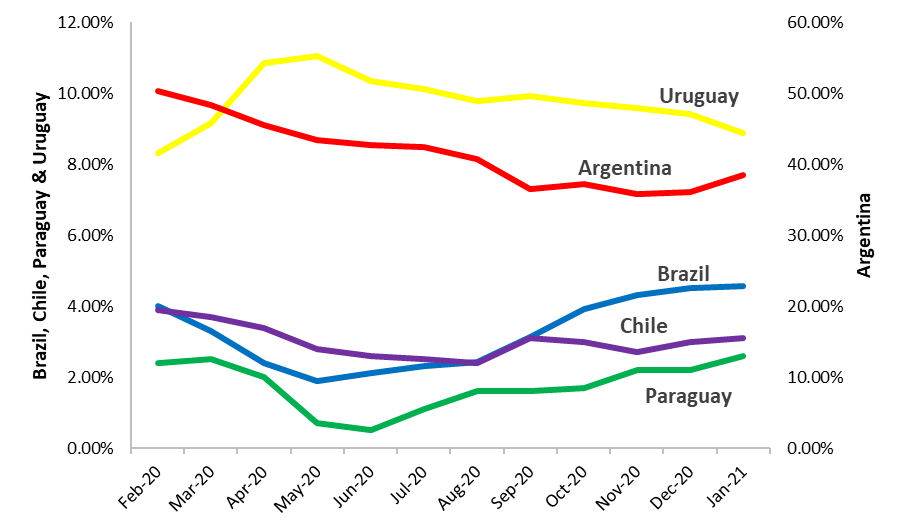
    Brazil & Southern Cone: Inflation
    Monthly year-on-year figures

    Brazil & Southern Cone: GDP growth (%)
    Quarterly figures are year-on-year growth
    Country 2020 forecast * 2021 forecast *  Q1 2020 Q2 2020 Q3 2020
    Argentina -10.5 4.9 -5.4 -19.1 -10.2
    Brazil -5.3 3.2 0.9 -11.4 -3.9
    Chile -6.0 5.0 0.4 -14.1 -9.1
    Paraguay -1.6 3.5 3.5 -6.5 -1.2
    Uruguay -4.5 4.0 -1.4 -10.6 -5.9
    *Figures from the United Nations Economic Commission for Latin America & Caribbean Dec 2020
    Quarterly growth based on figures from the local central banks


  • CHILE: The Left hopes for a comeback

    LatinNews 22 January 2013 Hits: 1016

    Date: 17 November 2013. If none of the presidential candidates secure an absolute majority of the valid votes, a runoff election would be held on 15 December 2013.

    Type: Presidential and legislative (48 seats in the senate and 120 in the chamber of deputies).

    Main contenders: The ruling Coalición por el Cambio led by President Sebastián Piñera, comprising his right-of-centre Renovación Nacional [RN] and the traditional rightwing Unión Demócrata Independiente [UDI]); the quadripartite leftwing opposition Concertación, comprising Partido Demócrata Cristiano [PDC]; Partido por la Democracia [PPD]; Partido Socialista [PS] and Partido Radical Social Demócrata [PRSC]. Neither coalition has decided on their presidential candidates yet. Marco Enríquez-Ominami (Partido Progresista de Chile, PRO). Franco Parisi (independent).

    Considerable uncertainty lies ahead of the 2013 election, with the Coalición por el Cambio (which has 17 seats in the senate and 56 in the lower chamber) yet to name a date for primaries and the Concertación (which has 19 in the senate and 53 in the lower chamber) yet to confirm a date for primaries. Another big unknown is whether the former president Michelle Bachelet (2006-2010) will return for a second bid.

    On 17 November the UDI officially proclaimed Laurence Golborne, the Right’s most popular political figure and until recently Piñera’s star public works minister, as it’s pre-candidate. According to an October 2012 national survey by pollsters Centro de Estudios de la Realidad Contemporanea (Cerc), Golborne had an approval rating of 76% shortly before he stepped down. (Cerc surveyed 1,200 people across the country and with a poll error margin of 3%). Golborne’s popularity stems from his handling of the rescue of 33 trapped miners in 2010.

    He will face another star former minister (defence), Andrés Allamand, who was declared pre-candidate for the RN on 6 November. With an approval rating of 73% at the time of his departure, Allamand became a high-profile minister following a plane crash near the Juan Fernández archipelago in September 2011. As defence minister, Allamand was responsible for managing the rescue operation for the 21 victims, including his brother-in-law, Felipe Cubillos.

    The prospect of primaries is already proving divisive within the ruling coalition. Following the declaration of pre-candidacies, Piñera (who is constitutionally barred from seeking consecutive re-election) was compelled to call on the two parties to refrain from attacking each other, after Golborne had described his own candidacy as “competitive” and that of Allamand as “testimonial”; Allamand described his rivals remarks as “very unfriendly”. However, he said that he let it go and would never stoop to “pejorative declarations”.

    Yet the battle was already heated by year end. Attacking Golborne’s lack of political experience (he was a civil engineer before being appointed mining minister in 2010), Allamand, a senator and one of the founders of the RN, also made a very clear allusion to the former defence minister when he criticised the participation of ministers in electoral processes. He said it was “a question of coherence” as “we always condemned this when we were in opposition”. Golborne campaigned on behalf of several candidates in the municipal elections on 28 October.

    And the Concertación?

    The Concertación only held primaries for the first time in 2009, but they were closed and effectively a stitch up. The exclusionary process resulted in a dissident socialist, Marco Enríquez Ominami, breaking with the coalition and running as an independent. In the end the coalition, which fielded the former president Eduardo Frei (1994-2000) as its candidate, lost its grip on power for the first time since Chile’s return to democracy in 1990.

    The big question this year is whether the primaries this time round should include other parties such as the Partido Comunista (PC). The PDC is opposed to this (its leader, Senator Ignacio Walker, has his own presidential ambitions and also has a bit of history with Enríquez Ominami’s stepfather, Senator Carlos Ominami), while the PS,  which is anxious to patch things up with the PC, is in favour of it.

    Bachelet (of the PS), is currently Executive Director of the new UN body for the Gender Equality and the Empowerment of Women (UN-Women), tops the pre-presidential polls nationally, another reason for the PS to prefer an open primary. In the October 2012 Cerc poll, 43% of respondents they would vote for her, compared with 13% for Golborne, 7% for Enríquez-Ominami; 6% for Farisi and 6% for Allamand.  A poll from the Center for Public Studies (CEP) released on 3 January put Bachelet on 49% of voting intentions. Speculation mounted when Bachelet spent an extended time in Chile over Christmas and toured the country in what look like a pre-campaign sounding board. Asked by journalists as to her intentions, Bachelet was cryptic. “We’ll talk in March”, she quipped.

    Municipal polls – a litmus test?

    The first electoral test for Piñera since taking office in March 2010 came on 28 October 2012 in the form of municipal elections which delivered an overall defeat for the ruling coalition. The Coalición por el Cambio lost in key emblematic battlegrounds – above all in the capital Santiago. It took 121 municipalities of the total 346 (down from 144 in 2008), while the Concertación finished with 168 mayoral seats, a gain of 21 on 2008.

    The Coalición por el Cambio’s defeats included some bitter losses, foremost among which was Santiago Centro, where the incumbent mayor, Pablo Zalaquett (UDI), was defeated by Carolina Tohá, a member of the PPD and Bachelet’s governmental spokeswoman during her four year term. Santiago Centro is the most important elected office after the presidency and defeat for Zalaquett by seven percentage points (43% to 50%) was the most painful blow for the ruling coalition to absorb.

    The Concertación also won a greater percentage of the vote in the elections for council seats – traditionally deemed a more accurate gauge of party political support ahead of presidential elections. In 2008 the Concertación won only a tiny fraction more of the vote for council seats; this time it won by a much more comfortable margin. In total, the Concertaciόn won 49.5% of the vote in the councillor elections, while the Coaliciόn took just 32.9%.

    The government’s mishandling of various social conflicts and its perceived failure to address the country’s inequality despite consistent real GDP growth (6.1% in 2010, 6.0% in 2011 and an estimated 5.5% in 2012 [see sidebar]), contributed to the defeat and could well play a part in the 2013 race.

    The continuing student protests also contributed to the Coaliciόn defeat in the municipals, most notably in the Santiago Metropolitan area, which is home to the majority of Chileans and also to most of the country’s education institutions. It has suffered the brunt of two years of disruptive student protests (2011-2012) against Chile’s for-profit higher education system. According to a September 2012 survey by pollsters Adimark, 70% of respondents backed the students’ demands, a figure unchanged since December 2011. (The national survey of 1,121 people had a 3% margin of error). The students have vowed to continue with their actions in 2013.  The former high profile student leader, Camila Vallejo, is expected to run for congress for the PC.

    The impact of new electoral reforms

    The 2013 election will be first general election (and the second election process) since the approval in December 2011 of a political reform that made the entitlement to vote automatic, and voting itself voluntary, in national elections

    The automatic voter registration introduced by the reform added 4.7m voters to Chile’s 8.12m electorate, and significantly increased the number of young voters: nearly 75% of new registered voters are under the age of 30, meaning that young people now represent over a quarter of the total electorate.

    This change likely damaged the ruling coalition in the municipals, given the student protests. Another talking point around the municipals was the low turnout. According to the official results, only 5.5m of the 2012 registered electorate of 13.4m cast their ballots. While this received considerable attention by the national media, it would be disingenuous to argue that abstention was 59% because 7.9m people on the electoral roll failed to vote. Hundreds of thousands of Chileans live abroad, for instance, and were unable to vote, while some 1,000 of those who “disappeared” in the 1970s are still on the electoral register. Actual voter participation was probably closer to 45%, which by global standards for municipal elections is not unusual.

    • Inequality

    According to the Centro de Estudios de la Realidad Contemporanea (Cerc) survey, 81% of Chileans feel the country’s economic growth has only benefited the rich, while only 19% feel that all Chileans have benefited. The most recent Social Panorama of Latin America report by the UN’s Economic Commission for Latin America and the Caribbean (Eclac), released on 27 November, singled out Chile along with Brazil and Colombia among others as a country where “relatively high levels of income concentration are seen…where the share approaches 40% for the wealthiest and ranges between 11% and 15% for the poorest”. According to Eclac, in 2011 11.0% of Chile’s population was poor and 3.1%, indigent, a minimal improvement on 11.5% and 3.6% in 2010.

    • Support for the moderate centre

    It is simplistic to see the 28 October municipal election result as an outright drop in support for the ruling Coalición por el Cambio and rising support for the opposition Concertación. The electorate overall appeared to lean towards the moderate centre. For example the more moderate members of the Concertación – Partido Demócrata Cristiano and Partido Socialista, won far more mayoralties (106) than their more radical partners, Partido Radical Social Demócrata and Partido por la Democracia.

  • Ecuador: Government efforts to drum up private investment

    LatinNews 07 September 2018 Hits: 523

    As President Lenin Moreno has increasingly distanced himself from his predecessor, Rafael Correa, the current government's economic policy stance has become steadily more pro-market. A raft of announcements over the course of recent weeks underline the extent to which Moreno is seeking to engage private investors in an effort to bolster the local economy.

    The centre-piece of the government’s policy towards private investment is the ‘Ley de fomento productivo’, which was tabled earlier this year and finally approved by the National Assembly on 21 August. It includes tax breaks for investors in some priority industries, which include export-oriented manufacturing, as well as construction and tourism. New investors will not have to pay corporation tax in these areas for up to 20 years. Other benefits include lifting a tax on capital outflows, which would incentivise businesses seeking to transfer profits abroad. The legislation also includes important provisions related to international arbitration that are designed to alleviate concerns about investment protection. In May 2015, the Correa administration removed a paragraph from article 42 of the existing legislation on investment protection that stated that Ecuador would abide by the rulings of international arbitration courts. The same paragraph has been reintroduced to the recently-approved ‘Ley de foment productivo’.

    Fitch downgrade, despite government efforts to trim spending

    Meanwhile, the government is undertaking other business-friendly measures. In late August, the authorities announced the start of a process of gradually lifting retail petrol prices (which are heavily subsidised) towards market prices. This is designed to cut earmarked fiscal spending, which in theory should free up greater funding for capital infrastructure projects. Other efforts to streamline the public sector include a reduction in the number of ministries, with the government also announcing in mid-August the elimination of five ministries and the merger of several others. Privileges reserved for senior civil servants will also be reined in, including cutting spending on mobile phone tariffs, security for personnel (except for those deemed ‘high risk’), and private vehicle transport.

    Despite these efforts, concerns remain about the underlying health of the Ecuadorian economy, particularly with relation to the ability to plug the persistent fiscal deficit. In recent weeks, the government has secured US$1.1bn in funding, comprised of US$500m raised through a repo agreement with US bank Goldman Sachs, as well as US$638m in multilateral loans from the IDB and CAF. However, this has been insufficient to alleviate some concerns about financing. On 17 August, the sovereign credit ratings agency Fitch downgraded Ecuador from a ‘B’ to a ‘B-’, citing greater financing restrictions facing the government, as well as a continued deterioration in some key macroeconomic indicators, including public debt and GDP growth. Even in the light of recent government efforts to cut current expenditure, Fitch still estimates that the financing requirement will rise from US$5.8bn in 2018 to US$8.5bn in 2019, with debt interest payments accounting for a heavier burden than in recent years.

  • PANAMA: Martinelli bats away new privatisation fears

    LatinNews 09 October 2013 Hits: 1685

    Less than a month after President Ricardo Martinelli was forced to repeal an October 2012 decree which teachers complained would pave the way for the privatisation of the sector [RC-13-09], he is now facing similar concerns from doctors and other health workers regarding a recently approved law.

    On 2 October President Martinelli promulgated law 661 which eases the restrictions on allowing the government to contract foreign medical specialists. In an address to the nation delivered the same day he justified the move in the face of the current deficit of medical specialists in some parts of the country. He gave as examples the fact that the Darién jungle province (pop.48.378), has just four medical specialists; the Ngöbe-Buglé comarca (indigenous administrative region) has just two specialists for a population of 156,747 while the Guna Yala comarca, (pop. 33,109) has no specialists at all. Martinelli was also clear to underline other government efforts to address this deficit. He said that there are 439 people currently being trained as specialists compared with the 65 who trained in 2009 under the previous Partido Revolucionario Democrático (PRD) government of former president, Martín Torrijos (2004-2009).

    This argument has yet to convince unions like the Comisión Médica Negociadora Nacional (Comenenal) which launched an indefinite strike on 27 September. Comenenal argues that the law would allow for the privatisation of the health care sector and threatens the job stability of its workers. Comenenal is also suspicious of the government’s intentions vis-à-vis Ciudad Hospitalaria, a new metropolitan medical facility currently being built in Panama City, concerns that Martinelli addressed in his televised speech. He said that to eliminate any “suspicion”, he had recommended the director of the social security fund (CSS) – the largest provider of public health services to suspend any administrative processes aimed at contracting out services for Ciudad Hospitalaria.

    With some 25,000 public health officials having joined the strike, including those affiliated to the Coordinadora Nacional de Gremios, Profesionales y Técnicos de la Salud, comprising some 33 separate groups, it remains to be seen whether Martinelli will be forced to back down. As well as his repeal of the October 2012 presidential decree following pressure from the teachers, Martinelli has back-tracked on previous efforts to privatise other sectors. These include his failed October 2012 attempts to sell off State lands in the Colón Free Trade Zone (FTZ) [RC-12-11].

    • Gaining ground in the polls

    Martinelli’s latest stand-off with the unions comes as the presidential candidate for his Cambio Democrático (CD) party, former housing minister José Domingo Arias (2011-2013), is gaining ground in the polls ahead of the May 2014 general elections. The latest Dichter & Neira poll, released on 16 September, gave Arias 37% of voting intentions, up from 33% in August. In second place is Juan Carlos Navarro of the Partido Revolucionario Democrático (PRD) who is on 24%, down from 27% the previous month. Meanwhile Juan Carlos Varela of the Partido Panameñista (PPA) is on 22%, down from 24%. The pollster, which interviewed 1,200 people nationwide on 13-15 September bar the Darién jungle area and the Comarcas, attributed Arias's strong performance to the high approval ratings of the Martinelli government, which reached 69% in September- up from 65% in August and 63% in July. Dichter & Neira attributed the government’s continued popularity to its social programmes like ‘100 a los 70’, which provides a monthly US$100 stipend for people aged 70 years or older without a pension and as well as Martinelli’s flagship infrastructure project: the US$1.8bn Panama City metro which is due to begin operating in January 2014 and will address a key voter concern – public transport chaos in the capital (see sidebar).

    • Panama City metro

    The Panama City metro, which will have the capacity to transport 15,000 people an hour, is due to begin operating in January 2014. Last month President Ricardo Martinelli announced that it will be free for the duration of the test period. In the latest Dichter & Neira poll, the majority of respondents (71%) expected the metro would help resolve the capital’s notorious traffic problems, up from 62% of respondents the previous month.

    • PRD scandal

    The presidential candidate for the opposition Partido Revolucionario Democrático (PRD), Juan Carlos Navarro, could well see his position slide in the polls following a scandal which broke in late September involving his party. A national deputy, Raúl Pineda, was expelled from the PRD after he was accused of the murder of a local PRD activist, Juan Ramón Messina, a case which has been linked to organised crime.

  • Mexico: Mexican economy bounces back firmly in Q4

    LatinNews 13 February 2018 Hits: 867

    Despite significant uncertainty about the future of Nafta, data released from Mexico’s statistical institute, Inegi, revealed that the economy performed strongly in the fourth quarter of 2017. Real GDP growth rose by 1% compared with the third quarter, its strongest result of the year, which helped lift full-year growth to 2.3%.

    The firm fourth-quarter result partly reflected a cyclical bounce-back after a particularly weak third quarter, which was blighted by the impact of two earthquakes. Nevertheless, the fact that economic activity did indeed stage a solid recovery in the fourth quarter is positive, as many forecasters had expected the economy to continue to struggle for the remainder of the year and had downgraded their projections for both the third and the fourth quarters. At the time of writing, Inegi has only released the headline GDP growth figure, with a full sectoral breakdown of the results as yet unavailable, so it is difficult to pin down the precise industries that contributed to the recovery, but it is likely that construction played a major role in the bounce-back, reflecting considerable reconstruction efforts.

    The outlook for 2018 is highly uncertain and will depend to a large extent on the results of the Nafta renegotiation talks that are currently underway, as well as on the outcome of the July presidential election. However, the solid 2017 result has engendered a larger dose of optimism about prospects for the current year, with the government announcing that it expects GDP growth of between 2% and 3%. In late January, the IMF revealed that it had raised its growth projection from 1.9% to 2.3%. If the US economy remains solid, there is even potential for growth to accelerate in 2018, with strong consumer demand in the US feeding through to firmer manufacturing exports from Mexico.

    Inflation still high, the peso still weak

    With the Mexican authorities facing a relatively benign growth outlook, their main concern will be inflation. Full-year data show that inflation averaged just over 6% year-on-year in 2017, up from 2.8% in 2016. Price growth was particularly marked in the second half of the year, with inflation ending 2017 at 6.8% – a near-17 year high. This places the central bank in a quandary, since policy-makers had hoped to put interest rates on hold after a prolonged period of monetary tightening, which has seen the policy rate rise to 7.25%. Yet another rate hike is more likely than not when the central bank’s monetary policy committee meets on 8 February.

    The problem is that rate hikes have clearly not had a significant impact on reining in inflation, which has been fuelled in large part by the depreciation of the peso, which has fed through to inflation via higher import costs, which have been passed onto the consumer. The peso has undergone moderate appreciation since late December, strengthening from just under Ps20:$ to around Ps18.7:$ at the end of January, but the local currency remains extremely weak by historical comparison. The peso has been volatile, swinging rapidly in response to developments in Nafta talks. The danger is that investor caution during the remainder of the negotiation process – which is now expected to drag well past the end-March anticipated conclusion – will keep the peso weak for much of 2018. This will keep inflation high, posing ongoing difficulties to policy-makers.

  • Latin America swings to the right

    Patrick de Courcy 18 February 2026 Hits: 655

    This year, several important Latin American countries are changing political direction. Analysts have in the past argued that Latin America experienced a pink tide – a swing to the left -- in the first decade of the 21st century. By the 2020s a more conservative approach had already begun to spread through the region, favouring not only traditional, establishment parties, but also more far-right, outsider or anti-system politicians.

    Ideology is not the only explanation for the swings. In the early part of this century the commodities boom gave governments of the day, which happened to be left-wing, extra income to redistribute for social programmes and poverty reduction. This helped boost the appeal and extend the incumbency of those governments and political movements, but it eventually dried up, introducing a period of economic austerity. More recently, worries over corruption, crime, and security have tended to favour right-leaning political parties who have begun to notch up significant electoral victories. Some analysts say that a core of angry citizens now vote against incumbent administrations, whether they are of the left or the right. But the fact remains that between mid-2025 and the end of 2026, a period of 18 months, there will have been eight presidential or prime ministerial elections across Latin America. At the time of writing no less than five of those elections have been held, resulting in a swing to the right. Three will be held during the rest of this year (Peru, Colombia, and Brazil). The right appears poised to mount a strong challenge in each of those three countries.

    Ready to move to the right?

    Country

    Date

    Election/commentary

    Bolivia

    17 August 2025

    After two decades of leftist rule by the Movimiento al Socialismo (MAS), Rodrigo Paz, a political centrist, wins the presidential race on the second ballot held on 19 October

    Guyana

    1 September 2025

    Irfan Ali is re-elected at the head of the Peoples’ Progressive Party (PPP) – ready to work more closely with Washington on security and oil issues

    Argentina

    26 October 2025

    The party of far-right President Javier Milei wins decisive victory in mid-term elections. The US provides critical financial assistance.

    Ecuador

    16 November 2025

    Incumbent right-wing President Daniel Noboa suffers a setback when his plans for constitutional reform and authorisation of foreign military bases are rejected by over 60% of voters in a referendum.

    Honduras

    30 November 2025

    Incumbent LIBRE left wing coalition is heavily defeated in general elections. Amid recounts and claims of fraud presidential victory is contested between Salvador Nasralla (centre) and Nasry Asfura (right).

    Chile

    14 December 2025

    The far-right candidate, José Antonio Kast, wins the second-round ballot defeating Jeannette Jara, who represents the incumbent leftwing coalition

    Costa Rica

    1 February 2026

    Laura Fernández, the centre-right “continuity candidate” wins a landslide victory.

    Peru

    12 April 2026

    General elections in Peru. Presidential race still in early stages but opinion polls show former far-right mayor of Lima Rafael López Aliaga, centre-right Mario Vizcarra, and populist right Keiko Fujimori leading a wide field

    Colombia

    31 May 2026

    The ‘total peace’ strategy of the incumbent left-wing coalition led by President Gustavo Petro has failed, with increasing levels of violence paving the way for a possible swing to the right in the May general elections. Left winger Iván Cepeda was leading the race in late 2025 but strong challenges are being mounted by Abelardo de la Espriella from the hard right and Sergio Fajardo in the centre.

    Brazil

    4 October 2026

    Brazil has the largest population and economy in Latin America and its political choices are influential. Now centre-left incumbent Luiz Inácio Lula da Silva is leading in the opinion polls to win what would be a fourth presidential term. Despite in-fighting. Strong far-right and centrist challenges are expected.


    Evan Ellis, a defence specialist at the US based Centre for Strategic & International Studies (CSIS) argues that the likely emergence of a group of governments aligned with, and interested in strengthening, relations with the United States presents Washington with “enormous strategic opportunities”. He argues that the shift to US-friendly governments is not directly a response to US foreign policy but is being driven by domestic factors including “bad experience with past left-leaning regimes and apprehension about new ones”.

    Ellis plays down the impact of Trump’s strong-arm tactics. He says “receptivity to the United States has benefited greatly from the massive political shift in the region, a phenomenon largely unrelated to the new US policies and tone, and arguably despite them…There is no guarantee that this fortuitous coincidence of political conditions will persist, and reasons to worry that it might not.” In fact Ellis believes that the aggressive Trump style is likely to be counter-productive in the long term, and, as an unintended consequence, potentially opens the door to greater Chinese influence in the region. He calls on the US and receptive Latin American countries to build a partnership based on the idea that “investing in a secure prosperous region with strong and democratic institutions is fundamental to inoculating the region against criminals, terrorists, populist authoritarians and extra-regional adversaries”.  

  • URUGUAY: Growth is not enough

    LatinNews 21 July 2011 Hits: 570

    On the face of it, everything is ticking along rather well in Uruguay. The economy grew by 6.8% in the first half of 2011, forcing the government to raise its GDP growth forecast for this year to 6% from 4.5%. Inflation, at 4.71% for the first six months of the year, is higher than the government would like, but it is slowing. Most presidents would be popping the champagne corks on this sort of performance – but not President José Mujica. In fact, Mujica faces the biggest political challenge since the ruling left-wing coalition Frente Amplio (FA) first got a taste of power in 2005.

    The economy minister, Fernando Lorenzo, preferred to highlight the fact that inflation remains Uruguay’s biggest macroeconomic challenge, rather than the hugely impressive performance of the economy. Such modesty and reticence in an economy minister is positively suspicious. The reason for it can be traced to the fact that the serious internal tensions within the ruling FA are directly related to the government’s management of Uruguay’s economic wealth.

    The radicals within the coalition, led by the Partido Comunista Uruguayo (PCU), want far more in the way of redistributive policies to push Uruguay towards developed country status. The moderates, led by Vice-president Danilo Astori and Lorenzo, his chosen successor, and backed by the Partido Socialista (PS) of former president Tabaré Vázquez (2005-2010), are more concerned about preserving economic stability and not rocking the boat.

    Somewhere in the middle sits Mujica and his Movimiento Participación Popular (MPP). Mujica and the MPP favour redistribution: Mujica has clashed publicly over an extra land tax on Uruguay’s largest landowners which he favours and Astori criticises as changing the rules of the game [RBS-11-06]. But Mujica and the MPP are also alert to the need to preserve stability and attract foreign investment to achieve development: in mid July Mujica pushed through congress a public-private participation (PPP) bill to help overhaul the country’s creaking infrastructure.

    Vázquez was successful at bridging the gap between the moderates and radicals in the FA through the strength of his leadership; Mujica has at times appeared slightly weak and vacillating, especially over the failed attempt to strike down the amnesty law [RBS-11-06]. In fairness to Mujica, however, the task was far easier for Vázquez. He was the first FA candidate ever to be elected to the presidency, and as such the disparate coalition was prepared to set aside its differences over policy to unite behind him. Now that they are enjoying the fruits of power for a second term in office, however, the FA’s constituent parties are becoming more demanding, especially the PCU.

    The PCU dominates the country’s main trade union, Plenario Intersindical de Trabajadores-Convención Nacional de Trabajadores (PIT-CNT), which is threatening to stage a national strike on 28 July over the government’s approval of the PPP bill. The umbrella trade union argues that the bill “resembles the neo-liberal policies heroically resisted by the PIT-CNT in the 1990s”. The PCU clearly agrees – and it was at pains to demonstrate its disagreement. Congress unanimously approved the bill, which was strongly supported by the opposition Partido Nacional (Blancos) and Partido Colorado (Colorados), but a PCU deputy walked out in defiance of the FA leadership, leaving his alternate, a member of the MPP, to cast his vote instead.

    Mujica and Astori were singing from the same hymn sheet over the PPP bill. They said it was essential to attract private capital for infrastructure projects, such as building roads, bridges, prison facilities and schools. The PCU argues that the bill will lead to privatisation of public sector companies by the backdoor and that it betrays the FA’s principles, as it had always maintained that the state would retain full control of “strategic sectors”. Mujica has long contended that one of the biggest obstacles to sustained development in Uruguay is deficient infrastructure. He wanted his additional tax on land to fund infrastructure improvements - a proposal enthusiastically backed by the PCU. It could be that Mujica first proposed this tax in June precisely to placate the PCU over the PPP bill, but all he appears to have achieved by it is to cause further divisions.

    Mujica met Astori on 8 July, ostensibly to try to iron out their public differences over the extra land tax, but these differences were overshadowed by the divisions within the FA. Astori emerged from the meeting describing the situation facing the FA as “critical”. He said that both he and Mujica agreed that “a profound ideological discussion” was needed. Ideology is just part of it, however, what really counts is power. There is a power struggle between the PCU and the MPP, which have been holding crisis meetings to come up with ways to buttress the Mujica administration.

    The PCU is convinced that Mujica is trying to keep it at arm’s length while siding with the MPP. Mujica fired his social development minister, Ana Vignoli, the PCU’s sole representative in the cabinet, in mid July. He replaced Vignoli with Daniel Olesker, the health minister and a member of the PS. Mujica was at pains to preserve the delicate balance of party representation in his cabinet: Olesker’s deputy Jorge Venegas (PCU), for instance, picked up the vacant health portfolio. But, the PCU complained that it was being targeted as Vignoli’s dismissal was the first cabinet change since Mujica took power in March 2010 (see sidebar).

    Mujica strenuously denied this was the case but he strongly implied that Vignoli was not up to the job, or at least that she elevated political considerations over economic ones. He said that he did not expect his cabinet ministers to be perfect but he did expect them to “throw their soul into the job”. He also said that Olesker, an economist, was better cut out to assign finances to myriad social projects.

    • Cold snap
      The opposition Blancos and Colorados were fiercely critical of Ana Vignoli and the social development ministry (Mides) for their handling of the severe cold snap in Uruguay in June, which claimed the lives of six homeless people. Parts of the Frente Amplio (FA) were equally critical. Daisy Tourné, a former interior minister and member of the Partido Socialista (PS), slammed Vignoli and the Mides for the mishandling of its response to plummeting temperatures in Uruguay.


    • Presidential sale
      President Mujica announced the sale for US$2.5m of an exclusive presidential beachside house in Uruguay’s top coastal resort, Punta del Este. Mujica said the house had been sold to the state Banco de la República, which will use it for conferences. It will also function as a cultural centre. The proceeds will go towards a housing project, “Plan Juntos”, to put a roof over the heads of some of the country’s poorest members of society.
  • ECONOMIC OVERVIEW: URUGUAY

    LatinNews 15 February 2012 Hits: 647

    Inflation, one of President José Mujica’s main bugbears, is showing signs of slowing down. The consumer price index (CPI) increased 0.74% in January as 12-month inflation reached 8.05%, according to the national statistics institute (Ine). Inflation reached 8.6% in 2011. January’s CPI was driven by clothing and shoes (1.27%) and transport (1.01%).

    President Mujica gave a characteristically candid interview with the weekly magazine Búsqueda this month, during which he claimed that “From a real point of view it (Mercosur) might exist, but from a juridical point of view, it is meaningless.” Mujica added: “If nobody respects the commitments, we don’t have to respect them either. It’s ridiculous to make a complaint if nobody pays any attention.” He added that if Uruguay chose to renege on aspects of the agreement in future, such as bilateral trade deals with third countries, it would simply ignore complaints from other members. Days earlier, Argentina (the main target of his criticism) introduced a new licensing system to restrict imports, another part of its rehabilitation of Raúl Prebisch and import substitution industrialisation.

  • US Defence Secretary's annual report on China's military power - 29 May 2007

    LatinNews 08 September 2011 Hits: 4

    SPECIAL BULLETIN

    TO: All Strategic Intelligence Forum members

    FROM: JKC de Courcy, Chairman, Strategic Intelligence Forum

    DATE: 30 May 2007

    SUBJECT: US Defence Secretary's annual report on China's military power

    The US Secretary of Defence has delivered his annual report to Congress on the “Military power of the People’s Republic of China”. The 2007 report underlines the two most important elements of the early 21st century global geopolitical scene.

    China's rise

    The first is that China is continuing to match its military power to its growing economic power. Analysis of China’s military budget data and GDP data from the International Monetary Fund (IMF) for the period 1996-2006 shows average annual inflation-adjusted GDP growth of 9.2% and annual inflation-adjusted defence budget growth of 11.8%.  In March, China said that it was increasing the military budget by 17.8% in 2007 to $45bn.  And its real level of military spending could be over twice the official level, according to the Pentagon which calculates it at somewhere between $85bn and $125bn.  

    The report notes: “China’s near-term focus on preparing for military contingencies in the Taiwan Strait, including the possibility of US intervention, appears to be an important driver of modernization plans. However, analysis of China’s military acquisitions and strategic thinking suggests Beijing is also generating capabilities for other regional contingencies, such as conflict over resources or territory.”

    It adds that China’s expanding military capabilities “will increase Beijing’s options for military coercion to press diplomatic advantage, advance interests, or resolve disputes”.

    A commentary from the official Liberation Army Daily in April 2006 provides confirmation of China’s strategic thinking. It states: “As China’s comprehensive strength is incrementally mounting and her status keeps on going up in international affairs, it is a matter of great importance to strive to construct a military force that is commensurate with China’s status and up to the job of defending the interests of China’s development, so as to entrench China’s international status.”

    US resistance

    The second key geopolitical factor that the report reinforces is that the US does not consider it to be legitimate for China to develop military capabilities commensurate with its economic power, almost regardless of the nature of the regime or what its ultimate intentions might be.  Without recognizing it as such, the report does in fact point to a seemingly legitimate reason for China's developing military strength (it says that as China’s economy grows, dependence on secure access to markets and natural resources, particularly metals and fossil fuels, is an urgent strategic consideration, and “at present China can neither protect its foreign energy supplies not the routes on which they travel…”), which underlines the point that the US’s main problem is with the fact of China’s rise per se.

    A passage in the report on the European Union arms embargo provides further confirmation that the US considers increasing Chinese capabilities to be self-evidently an undesirable outcome, regardless of the purposes to which they might or might not be put. It states:

    “Lifting the EU embargo would likely contribute significantly to the PLA’s modernization goals. An end to the embargo would raise the possibility of competitive pricing for arms sales to China…Increased military-to-military exchanges consequent to arms sales resulting from lifting the embargo could also give the PLA access to critical military management practices, operational doctrine, and training. Finally, the transfer of sophisticated and dual-use technologies that China most likely desires from the EU…would advance PLA operational capabilities.”

    Subsidiary to these two main points, the report contains a number of additional insights.

    Concerns about the nature of the regime

    Although our contention is that the US would find China’s rapid rise to power almost as hard to swallow even if its regime were more acceptable to Western eyes, the report does highlight genuine concerns about the nature and stability of the present regime.

    The report states: “At the core of China’s overall strategy rests the desire to maintain the continuous rule of the Chinese Communist Party (CCP)”. It then notes that as a substitute for the failure of communist ideology, “the CCP has based its legitimacy on the twin pillars of economic performance and nationalism”, and it worries that domestic economic and social difficulties “may lead China to attempt to bolster support by stimulating nationalist sentiment which could result in more aggressive behaviour in foreign and security affairs…”

    In another section, the report again worries that “underlying structural weaknesses threaten economic growth”, and it states: “Demographic shifts and social dislocations are stressing an already weak social welfare system. Economic setbacks or downturns could lead to internal unrest, potentially giving rise to greater reliance on nationalism to maintain popular support.” Non-traditional security challenges such as HIV, bird flu, corruption, crime, and environmental problems could also “exacerbate Chinese domestic unrest and serve as sources of regional tension and instability”.

    On the military side, there are concerns that China is developing “a greater capacity for military pre-emption”, and there are continuing worries that the “no-first-use” pledge on nuclear weapons is ambiguous and subject to internal debate and evolution.

    The danger of miscalculation is also a worry. As the PLA continues its modernization, the US sees the possibility that “twin misperceptions could lead to miscalculation or crisis”. These are that other countries could underestimate the extent to which the PLA has increased its capabilities and that, in the opposite direction, China’s leaders “may overestimate the proficiency of their forces by assuming new systems are fully operational, adeptly operated, adequately maintained, and well integrated with existing or new capabilities”.

    One specific concern is that China is attempting to shift international opinion “in favour of a distorted interpretation of the UN Convention on the Law of the Sea” by moving scholarly opinion and national perspectives away from “long-accepted norms of freedom of navigation and toward interpretations of increased sovereign authority over the 200 nautical mile Exclusive Economic Zone, the airspace above it, and possibly outer space”.

    The deterrent factor and Taiwan

    On Taiwan, however, the report seems to be relatively sanguine. It worries that Taiwan has allowed its defence spending to decline in real terms, and it notes the growing and sustained Chinese military threat. On the other hand, the report is robust in restating the US’s commitment and ability “to resist any effort by Beijing to resort to force or coercion to dictate the terms of Taiwan’s future status”. And, on the Taiwan issue, it concludes:

    “China is deterred on multiple levels from taking military action against Taiwan. First, China does not yet possess the military capability to accomplish with confidence its political objectives on the island, particularly when confronted with the prospect of US intervention. Moreover, an insurgency directed against the PRC presence could tie up PLA forces for years…Beijing’s calculus would also have to factor in the potential political and economic repercussions of military conflict with Taiwan…Finally, China’s leaders recognize that a conflict over Taiwan involving the United States would give rise to a long-term hostile relationship between the two nations – a result that would not be in China’s interests.”

    END

    The full Annual Report to Congress on the "Military Power of the People's Republic of China 2007" may be downloaded from the following link:

    http://www.defenselink.mil/pubs/pdfs/070523-China-Military-Power-final.pdf

  • PANAMA: Martinelli defiant as corruption charges pile up

    LatinNews 30 September 2015 Hits: 3723

    Two new corruption investigations into former Panamanian president Ricardo Martinelli (2009-2014) were approved by the supreme court on 23 September. One relates to an investigation launched by the Panamanian stock market regulator into whether Martinelli engaged in insider trading; the other relates to a pre-existing case, which alleges that a company contracted by Martinelli’s government was accepting bribes. In response to the latest allegations Martinelli tweeted that the supreme court had been pressured into “falsely accusing me”.

    Three other corruption investigations have already been approved. One centers on allegations that Martinelli approved multi-million dollar purchases of dried food at inflated prices as part of a government welfare programme. Another focuses on Martinelli’s decision to order illegal wiretaps on 150 people, including politicians and businessmen. The third alleges that he used the presidential office to issue more 350 illegal pardons to friends and allies towards the end of his tenure.

    Other potential legal headaches loom elsewhere. In Italy, Martinelli has been cited as a participant in a corruption scheme involving Panamanian contracts when a judge sentenced a man for attempting to blackmail Italy's former prime minister, Silvio Berlusconi (1994-1995, 2001-2006, 2008-2011). Investigators in Brazil examining the foreign projects of Odebrecht, the construction company, are also looking into its dealings with Martinelli over the Panama City subway.

    In an interview with Bloomberg published on 17 September, the billionaire supermarket tycoon argued that all the cases against him were purely political, given that his immense wealth predated his political career and therefore he had no need to pilfer from the state. The former president has a net worth of US$1.1bn, with his top assets being a chain of supermarkets.

    • Vendetta?

    In the interview with Bloomberg, Martinelli, who has been in the US since January, said that his former Vice President and current President Juan Carlos Varela is engaging in a “political vendetta”, motivated by anger that the former president raised taxes on the rich – a “cardinal sin” in Panamanian politics, according to Martinelli.

  • The mystery of Chinese car prices

    Abbi Dicker 11 July 2025 Hits: 1838

    Many industries experience periods of domestic over-production which leads them to dump excess production in export markets, a process widely condemned as a form of unfair competition. There is certainly evidence of excess production in China’s automobile sector, and many complaints of artificially low or subsidised prices. But it Is also true that Chinese companies are pricing their exports much higher than their domestic sales.

    According to a car price survey conducted last year, BYD was charging double, or even triple, for key export models compared to their prices on the domestic market. The mid-range BYD Atto 23, a compact electric crossover, was selling for the equivalent of US$42,789 in Germany, and for only US$19,283 in mainland China. In March last year BYD chairman Wang Chuangfu told an investor’s meeting that the reason for the differential was to shore up profitability on the company’s export markets. Normally in the international auto industry, differential pricing for similar models on sale in different countries is relatively small, but BYD and other Chinese players have decided to break with that practice. Sam Fiorani of industry research company AutoForecast Solutions says, “globally marketed vehicles are usually priced in a narrow range”. But cut-throat competition in China has slashed domestic prices, leaving companies to try and recover some revenue from much higher prices in overseas markets. Crucially, because the Chinese companies have already ruthlessly compressed operating costs, it is possible to double or triple their domestic price levels and remain competitive in overseas markets. China’s EV makers have taken costs out of raw materials, batteries, land, and labour, as well as receiving significant subsidies from regional governments in China, who wish to boost production and attract investment and jobs.

    For now, Ben Townsend of Thatcham Research says the Chinese are “not looking to undercut the European market; they are looking to make margin”. In other words, the companies are content to keep prices high in export markets in pursuit of profitability. However, international analysts say they also have sufficient margin to cut overseas prices in future should they become involved in a battle for market share. Higher prices also make sense in branding terms as the companies try to present themselves as a more up-scale proposition.

    Analysis of marketing strategies followed by Chinese EV makers in various parts of the world show there is a tendency to price cars marginally below the prices of established rivals, and to pack them with interior and technology features as standard, which competitors only offer on payment of additional fees. The Chinese are able to compete on these items, largely because they have been able to reduce the costs of batteries, one of the most valuable EV components. Research suggests average Chinese battery costs last year were 18% below those of their European rivals. Part of this in turn has been due to Chinese efforts to build over time a robust minerals and metals supply chain. Keith Norman of Lyten, a Silicon Valley battery start-up, says Chinese automakers and suppliers have spent the last two decades securing access to mines across the world to lock up critical battery minerals such as lithium and cobalt. “They own the critical-minerals part” he says.

  • ECONOMIC OVERVIEW: PANAMA

    LatinNews 26 October 2011 Hits: 480

    Following the dismissal of Vice-President Juan Carlos Varela and the subsequent unravelling of the Panamanian ruling alliance, Deputy Economy Minister Frank de Lima officially took over the economy portfolio on 30 September. De Lima thus took office exactly one month after his boss, Alberto Vallarino, a member of the opposition Partido Panameñista (PP), had quit his post in solidarity with Varela [RC-11-10]. The appointment of De Lima, a cardholder of President Ricardo Martinelli’s Cambio Democrático (CD), was in line with Vallarino’s recommendations and has assuaged fears that the political strife at the top would translate into economic instability.

    Less than a week later (on 3 October) congress approved, with 49 votes in favour and nine against, the new 2012 state budget of a record-breaking US$14.45bn. This figure represents an increase of 7.5% (US$13bn) on the 2011 budget, which itself had been increased by 23% when compared with the 2010 budget (US$10.57bn). The final budget, which was US$17m less than the initial proposal, is based on a 7.5% GDP growth forecast for 2012 and expects the fiscal deficit to remain at 2% of GDP, in line with the law of fiscal responsibility.

    FTA with US: On 21 October US President Barack Obama promulgated the long-pending Free Trade Agreement (FTA - officially known as Trade Promotion Agreement [TPA]) with Panama. It came nine days after the deal, - first inked in June 2007 and approved the following month by Panama’s congress - was ratified by the House of Representatives (by 300 votes in favour to 129 against) and the Senate (77 votes in favour, to 22 against). The US first gave the green light to the FTA, which had stalled in part over tax transparency concerns and diplomatic issues in April last following the entry into effect (on 18 April) of a bilateral Tax Exchange Information Agreement (TIEA) [RC-11-05].