All Categories

Subcategories

  • ECONOMIC HIGHLIGHTS

    Abbi Dicker 23 May 2025 Hits: 2473

    HONDURAS | New staff-level agreement reached with IMF. On 11 April Honduran authorities reached a staff-level agreement with the International Monetary Fund (IMF) on policies and reforms to complete the third review of Honduras’ Extended Fund Facility (EFF) and Extended Credit Facility (ECF) arrangements with the Fund. The agreement, pending approval by the IMF’s executive board in June, would unlock a disbursement of approximately US$155m. IMF mission leader, Ricardo Llaudes, stated that, despite global economic uncertainty, the Honduran economy has demonstrated resilience. Llaudes highlighted that growth remained solid at 3.6% in 2024, while inflation, which stood at approximately 4.5% in March in annual terms, stayed within the target range set by the central bank (BCH) of 3%-5%. Llaudes also highlighted a significant increase in international reserves, attributed to successful external sovereign bond issuance, inflows from multilateral development banks, and monetary and exchange rate policy adjustment – factors which he said had contributed to the moderation of credit growth and a rebalancing of the Honduran economy.

    DOMINICAN REPUBLIC | Record tourists. On 15 April the Dominican Republic’s tourism minister, David Collado, announced that the country received a record 3.35m tourists in the first quarter of 2025 – up by 4% on the same period in 2024. Of those, 2.32m arrived by air, down by 0.6% year-on-year, while 1.03m arrived by cruise ship, up 15% on the same period of the previous year.

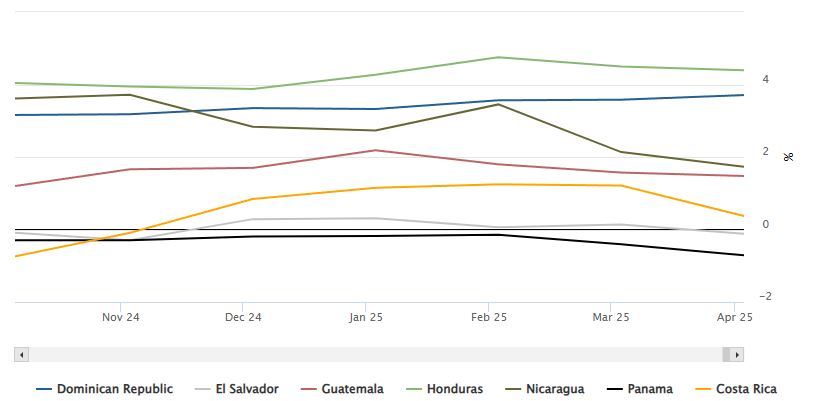
    Central America & Caribbean: inflation rate
    Percentage variation (year-on-year)

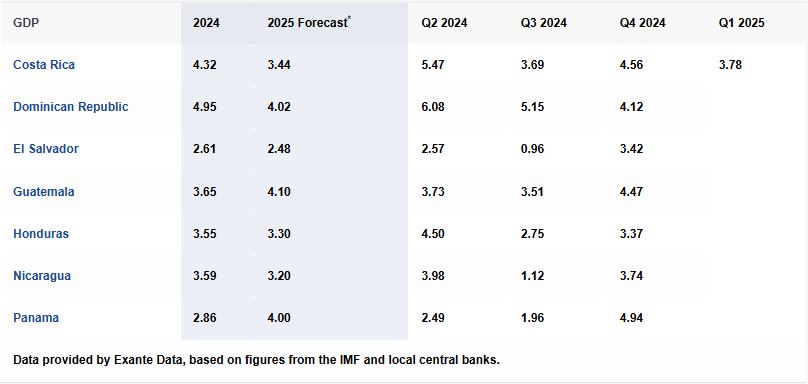
    Central America & Caribbean: GDP growth (%)
    Quarterly figures are year-on-year growth

  • Case Study: Cornershop

    LatinNews 21 November 2019 Hits: 392

    Ecommerce app Cornershop was founded in Chile in 2015, growing rapidly and expanding its operations before takeover bids from industry giants Walmart and Uber.

    Founded by two Chileans and a Swede in Santiago de Chile, Cornershop saves its users time by letting them order via the app and having items delivered to them by a personal shopper. Whether you need something from the supermarket, the pharmacy, or other kinds of retailers, a Cornershop shopper will dash around on your behalf and deliver your shopping in under an hour. “We deliver bags of free time to the door of your home,” reads a company tagline.

    Operations started in the app’s home market, Chile, before expanding to Mexico. It is now also present in Peru and Canada, with the latter serving as a test market for a planned expansion to the US. The company raised US$31.7m from investors over four rounds of funding, fuelling expansion plans. It has also diversified from offering food deliveries to many other product categories including clothes, toys, and electronic goods, making its money by charging commission to retailers and customers. 

    US giant Walmart launched a US$225m takeover bid for the company in September 2018, but it was eventually rejected by Mexican regulators in June 2019. However, Walmart’s loss may be Uber’s gain, as the ride-sharing app looks to expand its delivery services with its own takeover. Uber announced plans to buy Cornershop on October 11 and the deal is expected to be complete by early 2020. No valuation has been announced, and it remains subject to regulatory approval.

    If the deal is approved, it could mark a huge step for Cornershop. CEO Oskar Hjertonsson  said it would allow the app to operate “in many more countries around the world”. According to a statement from Uber, the current leadership team will remain in place.

    While there are many other apps that offer similar services to Cornershop – such as Doordash – the Chilean app is one of the biggest players in the Latin American market. The acquisition is just one of a number of strategic moves from Uber as the company tries to diversify its business model, but the bid for Cornershop shows that global companies are sitting up and taking notice of the Latin American ecommerce landscape.

  • The Cuban embargo

    Patrick de Courcy 12 August 2024 Hits: 1412

    The US embargo on Cuba is one of the world’s broadest and longest lasting trade disputes. It was triggered by a deep ideological fault line that emerged after the Cuban revolution, dividing US capitalism on the one hand, from Cuban communism on the other. Technically the embargo’s background stretches back to 1917, when, during the First World War, the Washington government adopted the Trading With the Enemy Act (TWEA), which was used to restrict trade between the US and hostile powers. Decades later TWEA was applied against Cuba. The Foreign Assistance Act of 1961 barred the Washington government from providing foreign aid to Cuba, authorising the president to maintain a total trade embargo. The US also piloted an early version of secondary sanctions through the Cuban Democracy Act (CDA) of 1992 which restricted US foreign aid to other governments if they, in turn, were aiding Cuba. There have been other laws tightening the trade ban, many of which are codified under the title Cuban Assets Control Regulations (CACR). The Cuban Liberty and Democratic Solidarity Act (LIBERTAD) of 1996 introduced further measures, for example authorising private legal action against persons who are deemed to traffic in property confiscated by the Cuban government on or after 1 January 1959 (the day Fidel Castro’s revolutionary government seized power). Broadly speaking, for political reasons bilateral relations have ebbed and flowed: following those pendular movements, so too has the embargo been tightened and relaxed.

  • NICARAGUA: A second Piñata?

    Sarah Sheldon 16 December 2024 Hits: 437

    In mid-October Gonzalo Carrió, a member of Nicaraguan human rights NGO Colectivo de Derechos Humanos Nicaragua Nunca Más (CDHNN+), warned of a new phase of illegal property seizures by the government led by authoritarian President Daniel Ortega. The Frente Sandinista de Liberación Nacional (FSLN) administration had already begun seizing property in line with its crackdown on dissent which started in 2018.

    Carrió made his remarks in a broadcast posted on social media on 16 October, the same day that the country’s attorney general, Wendy Morales, revealed that the FSLN government had declared 35 properties for public use. Morales, who in March this year was sanctioned by the US Department of the Treasury’s Office of Foreign Assets Control (Ofac) for being “complicit” in the government’s “oppression”, justified the confiscation of properties (whose previous owners were not identified), claiming that they were in a “state of abandonment and could be used to disturb the peace, social wellbeing, and citizen security.”

    According to a report published in May this year by Observatorio Pro Transparencia y Anticorrupción (Opta), which is run by local rights NGO Hagamos Democracia, at least 135 properties have been seized by the FSLN administration since it launched its crackdown on dissent in 2018. Describing the report as the first attempt to begin documenting illegal seizures by the Ortega government since 2018, Opta puts the value of these properties at more than US$250m in total. However, it said that this is just the “tip of the iceberg” given the paucity of information available and the reluctance of victims to come forward, faced with the threat of repression.

    Underlining that property seizures have intensified since February 2023, when over 220 political prisoners were released, sent to the US, and subsequently stripped of their citizenship and assets [SSR-23-04], Opta draws parallels between the current wave of confiscations and “La Piñata”, a massive transfer of titling of confiscated and expropriated property to the FSLN leadership which occurred at the end of Ortega’s first mandate (1979-1990). The US State Department has estimated that some 28,000 foreign-owned and Nicaraguan-owned properties were expropriated under La Piñata.

    Targeting the church

    According to the CDHNN+ statement released on 14 November, over 1,262 religious organisations have been closed down since 2018. It adds that between 2018 and 2024, over 870 attacks have been carried out by the authorities against the Catholic Church while at least 22 religious media have been shuttered.

    President of episcopal conference expelled

    With the Catholic Church and other religious organisations among those targeted with property seizures, the recent expulsion to Guatemala of the Bishop of Jinotega, Carlos Enrique Herrera Gutiérrez, who is the president of Nicaragua’s episcopal conference (CEN), is a further sign of the government’s continued crackdown on the Church which has escalated this year [SSR-24-09].

    Herrera’s expulsion on 13 November follows those of Bishops Rolando Álvarez and Isidoro Mora, who were exiled this year to Rome, having been detained (and in Álvarez’s case, sentenced to prison) on charges widely considered trumped up. Another bishop, the auxiliary bishop of Managua, Silvio José Báez, was forced into exile in 2019 after receiving death threats.

    According to a statement released on 14 November by rights NGO, Colectivo de Derechos Humanos Nicaragua Nunca Más (CDHNN+), Herrera was expelled after reportedly criticising noisy events on 10 November organised by Leónidas Centeno Rivera, the FSLN mayor of Jinotega, which disrupted religious services.

    Meanwhile, the latest tally posted on social media on 14 November by Martha Patricia Molina, a Nicaraguan researcher in exile who documents church repression by the authorities, estimates that 261 religious figures have been exiled since April 2018, of whom 55 were exiled this year. These include 141 priests and 99 nuns.

  • PANAMA: US$3bn bond sale in first under Mulino

    Sarah Sheldon 24 March 2026 Hits: 212

    In mid-February, Panama sold global bonds worth US$3bn in the first such deal since President José Raúl Mulino came to power in July 2024.

    The sale involved US$2.970bn in new bonds, some maturing in 2034 and others in 2038, which will be used to help repurchase outstanding bonds. The two notes carry rates of 5.2% and 5.6% respectively, said the economy and finance ministry (MEF) in a statement published 19 February. The operation will reduce public debt by around US$204m and cut annual interest payments by an estimated US$30m, added the ministry. There was strong demand from investors, according to the statement, with interest worth more than US$13bn. This “reflects the solid confidence that international investors have in the macroeconomic stability of Panama and its fiscal consolidation strategy,” said the ministry. Economy and Finance Minister Felipe Chapman highlighted the fact that the sale is “a concrete step towards our goal of strengthening public finances by reducing the debt pile, cutting financing costs and generating permanent savings for the state.” 

    Panama last issued bonds in February 2024, instead negotiating multiple bank loans from lenders such as US multinational finance companies JPMorgan Chase and Citigroup, and Spain’s Banco Santander. International credit ratings agency Fitch stripped Panama of its investment grade in March 2024 in response to the fallout of the shuttering of the country’s biggest mine, Cobre Panamá, in 2023, dealing a major blow to Panama’s hitherto investor-friendly image. However cost-cutting measures and better revenue have improved the country’s fiscal situation, and the bonds have moved to within 0.2% of comparable instruments sold by the US Treasury, which is the closest spread since 2020, said JPMorgan Chase, which worked on the new issuance along with BofA Securities, the brokerage arm of US banking institution Bank of America, according to Bloomberg.

    Investors are optimistic that Mulino will reopen Cobre Panamá, which accounted for around 5% of the country’s GDP before it was shuttered in 2023 by the previous government following mass protests. “We expect the authorities to form a deal to reopen the Cobre Panama mine by decree,” read a note from Morgan Stanley analysts seen by Bloomberg. “A deal could drag into later in the year and a potential reopening may stretch to early 2027.” Mulino has said that he will make a decision on the copper mine before June. 

    Cobre Panamá

    A reopening of the Cobre Panamá mine with royalties bringing in even more revenue for the public purse than before would aid in further improving the country’s fiscal situation, while making it easier to address demands for greater social spending that have driven waves of protests in recent years. Although there is a risk of unrest in the short-term if President Mulino does announce a decree to reopen the mine, investors may be betting that the government will be able to limit their scope and impact by successfully linking mining operations to promises of improved living standards. 

  • Integration with the US: from Nafta to USMCA

    Patrick de Courcy 04 November 2024 Hits: 715

    AMLO insists there was and is a sharp distinction between Morena governments and what went before them. As mentioned Morena’s governments offered a “4th transformation” of the country. In contrast the conservative, neo liberal predecessors (at least in his rhetoric), offered no more than corruption and austerity. The reality however is that there has been a significant element of continuity between pre- and post- AMLO rule, at least as far as integration with the US economy is concerned.

    In 1994 Mexico, Canada, and the United States signed the North American Free Trade Agreement (Nafta). Nafta eliminated most tariffs on goods traded between the three countries, with a focus on agriculture, textiles, and automobile manufacturing. The agreement also regulated intellectual property (IP), created a mechanism for handling investment disputes and, through side-agreements, established some protections for labour and the environment. Nafta was widely seen as successfully boosting trade and integration between its three member countries, at a time when globalisation seemed to be a dominant trend affecting the international economy. Trilateral trade more than tripled in Nafta’s first two decades, from US$290bn to over US$1.1trn.

    It also attracted political criticism. In the US Donald Trump described Nafta as “the worst trade deal ever made” arguing it was leading to job losses in the US. Given that Mexico’s per capita income is 30% of the level in the US, presidential candidate Ross Perot claimed in 1992 that trade liberalisation would lead to a “giant sucking sound” as US jobs flowed down south of the border. In contrast Nafta had the bipartisan support of US presidents George HW Bush (1989-1993) and Bill Clinton (1993-2001). Mexico’s President Calos Salinas de Gortari (1988-1994) said Nafta would help modernise the Mexican economy and allow it to “export goods, not people”. Economists continue to debate the exact impact Nafta has had on jobs and on the wider economies of its members.

    The political reality however was that Trump, elected in 2016 on an America-first policy, was committed to preventing further job losses in the US automobile industry and in ‘rust belt’ states. By applying new tariffs on steel and aluminium imports from Mexico in 2018, Trump in effect forced a renegotiation of Nafta, which was re-named USMCA.

    At the heart of the new deal were additional protections for the US auto industry. Rules of origin were tightened, requiring 75% of local content for vehicles to gain tariff free access to the US market, up from 62.5% previously. In addition, 40% of each vehicle’s components needed to come from factories paying a minimum of US$16 an hour. This provision was acceptable to Mexico because AMLO stood to gain politically from higher wages. Labour and environmental protections were further enhanced, leading US union body AFL-CIO to support the pact, as did congressional Democrats. A lighter-touch disputes procedure was put in place. USMCA formally came into force in July 2020. The trade pact comes up for renewal in 2026, with negotiations to extend or modify it expected to start in 2025.

  • Swings and roundabouts: Mexico and Brazil

    Patrick de Courcy 03 August 2021 Hits: 1792

    April-September, which was subsequently halved until the end of the year. After a gap, the payments were temporarily resumed in early 2021. The programme had a short-term and favourable political effect for the government, boosting Bolsonaro’s approval ratings, particularly in poorer areas of the country, which traditionally voted for centre-left politicians. At the economic level they were highly successful since they are estimated to have reached an estimated 67m people, or 32% of the population, giving them meaningful financial support, and offsetting some of the contraction in aggregate demand caused by the pandemic.   

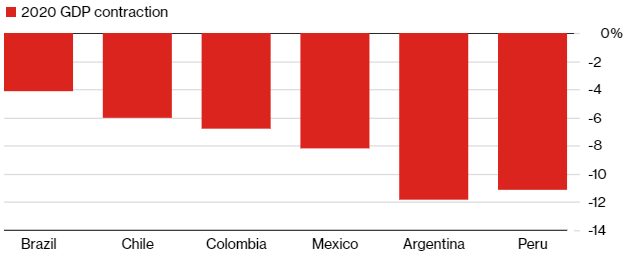
    Best in Class - Brazil’s economy shrank less than latin peers in the pandemic

    Source: International Monetary Fund

    There is an interesting debate to be had over which government had the better approach. It can be argued that Brazil’s decision to boost emergency spending despite its stretched finances was one of the main reasons its economy contracted by a relatively mild 4.1% in 2020, less than half Mexico’s much sharper fall of 8.2%. Mexican economist Héctor Villareal from Monterrey Tec says his country’s public spending was “extremely low – that was a mistake”. He acknowledges that the Amlo government did launch some emergency spending programmes, but it did so by cutting back on other spending budgets, which was unnecessarily restrictive. “In theory we have a government of the centre left, but as far as public debt is concerned, we have a conservative administration”, Villareal says.

    Another Mexican economist, José Luis de la Cruz, from Instituto para el Desarrollo Industrial y el Crecimiento Económico (IDIC), says “there was no countercyclical fiscal policy” and believes the government took a conscious decision to protect public sector finances from the pandemic hit. “Most of the social and economic cost was born by society” he says, estimating that over a million companies closed down and at least 2m workers lost their jobs, and by early 2021 had still not been re-employed. Other analysts focusing on the Mexican case have suggested that if it had approved a large fiscal stimulus package, to demonstrate financial sustainability the government would have also had to address major, and politically controversial, tax and spending reforms. Amlo, who frequently reiterates a promise not to increase taxes, may have simply chosen not to innovate. As we have seen, the subsequent upheavals in Colombia were a reminder of how politically sensitive tax and spending changes can be.

    Economists have, on the other hand, also had criticism for Brazil’s high-spending approach. Many say the massive Brazilian deficit which increased the country’s high public-debt-to-GDP ratio, while initially good for the domestic economy, was by 2021 beginning to cause heightened nervousness in the financial markets and driving down the value of the national currency, which in turn was triggering higher inflation and pushing the central bank to tighten interest rates.

    Neil Shearing of consultancy Capital Economics commented “Brazil’s problem is not that they didn’t have sufficient fiscal response, it is the fact that it wasn’t combined with efforts to actually get on top of the virus”. In fact, the chaotic management of the pandemic and the slow progress of the vaccination programme in 2021 implies that the virus’s negative impact on the economy, and the need for emergency spending, will last for longer than hoped, meaning Brazil will again be running big fiscal deficits which erode investor confidence, and which threaten to create a vicious circle of currency depreciation and domestic monetary tightening.

    In some scenarios Mexico may now outperform Brazil, as it has entered 2021 with a lower debt servicing burden and, with close economic links, particularly in manufacturing, is poised to benefit from the strong recovery in the US. The difficulty for all governments is that the exact intensity and duration of external shocks is difficult to predict. If the Covid pandemic proves to be essentially a one-year dislocation of the global economy and society, Brazil’s massive counter-cyclical stimulus package in 2020 may prove to have been the better approach. If, on the other hand, the pandemic lasts for longer – say two or three years – Mexico’s initial decision to maintain austerity may have given it more room for manoeuvre in the subsequent years. What is clear, however, is that preserving fiscal space while never actually using it is self-defeating. Governments need clear criteria over how best to manage fiscal space throughout economic cycles, unpredictable external shocks, and an often complex political and electoral calendar.

  • NICARAGUA: Iran pardons debt

    LatinNews 12 July 2012 Hits: 1704

    Iran has pardoned Nicaragua’s debt, totaling some US$164m, in exchange for fresh credits.


    Ali Saeedlu, Iran’s vice-president and deputy minister for international affairs, paid a visit to Managua at the end of May where he met President Daniel Ortega and announced that Iran would write off Nicaragua’s US$164m Cold War debt and offer Nicaragua a new US$250m loan in exchange. Saeedlu also said that Iran was ready to move forward with plans to build a dairy plant in Nicaragua.


    The latest announcement is one of the few promises to have materialised following the re-establishment of diplomatic ties in 2007, a relationship that continues to cause some unease in Washington.


    Bar an Iranian investment in a Managua health clinic, the new ties between the two have yet to result in any other concrete cooperation.  For example, Iran in 2007 promised to fund the construction of a new US$230m hydroelectric plant and a new US$350m deep-water port in Nicaragua (at Monkey Point on the Atlantic). Both schemes have yet to leave the drawing board.


    Poverty: In June, a local think tank, Fundación Internacional para el Desafío Económico Global (Fideg), published its third annual survey on poverty in Nicaragua. According to Fideg, which surveyed 1,730 homes across the country, 44.1% of the Nicaraguan population (of 5.89m) lived in general conditions of poverty in 2011 – defined as living on US$2 a day, or US$728 a year.

    This was a slight reduction on the 44.5% registered in 2010 and 44.7% in 2009, although it was within the survey’s 2.4% error margin.


    According to the think tank, 8.2% of the population was living in extreme poverty (defined as living on US$1/day, or US$361 a year). This was down from 9.0% in 2010 and 9.7% in 2009. As with earlier surveys, Fideg found that the most significant improvement took place in extreme rural poverty, which fell to 11.6% in 2011, down from 18.2% in 2009.

    • Nicaragua’s exports

    According to a recent report by Nicaragua’s central bank, exports in the first four months of 2012 reached US$932.3m, up 12% increase on the previous year. Imports reached US$1.86bn in the same period, up 14.7%, leaving Nicaragua with a trade deficit of US$777m. The US remains Nicaragua’s biggest partner, taking 30.6% of exports, followed by Venezuela (12.8%); Canada (11.5%); El Salvador (11.5%); Costa Rica (4.1%) and Mexico (3.2%).

  • Uruguay: Lower growth predicted

    LatinNews 30 November 2018 Hits: 518

    The economic crisis in Argentina has caused Spanish bank BBVA to trim back its forecasts for GDP growth in Uruguay in 2018 and 2019, although it argues that the smaller country is less exposed to the ups and downs in Argentina than it used to be.

    BBVA says that unlike its situation during the Argentine crisis of 2002, the Uruguayan economy is now more diversified and resilient. But growth will still be slower than previously expected due to cooler domestic consumption, sluggish private investment, and lower exports because of the impact of drought in agricultural and livestock areas.

    The report looks at five main transmission channels for the Argentine crisis to impact Uruguay and concludes that only one remains material: tourism revenues will be down this summer because fewer Argentines will visit. The depreciation of the Argentine peso has made holidaying in Uruguay 35% more expensive for would-be Argentine tourists. The trade channel is less of a threat, because Uruguay has diversified its exports and moved up the value chain. The financial channel is also less threatening because non-residents hold a lower share of total deposits and the Uruguayan banks are well capitalised. Debt leverage is not a major problem since the Uruguay has agreed a rescheduling with its creditors. And finally, the energy channel is also less of a problem: Uruguay depends less on fuel imports from Argentina as it has invested heavily in renewable energy sources.

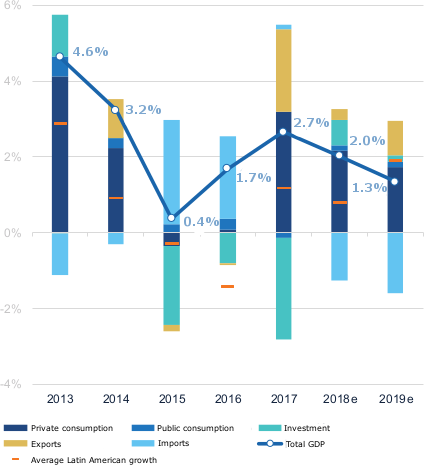
    Contribution to economic growth

    Uruguay situation

    Source: BBVA Research and BCU

    Taking into account domestic factors as well, BBVA now expects GDP growth to fall from 2.7% in 2017 to 2.0% in 2018 and to 1.3% in 2019.Weaker consumption and investment will play a part next year, and exports will be lower because of the drought (which hit soya exports in particular). BBVA expects the current-account deficit to widen from 0.4% of GDP this year to 2.4% in 2019. Meanwhile both fiscal and monetary policy is expected to remain restrictive. The government has struggled to reduce the public-sector deficit that in the first nine months of this year stood at 3.9% of GDP. Reducing it further will require politically difficult structural reforms on the spending side.

  • The Peruvian experience

    LatinNews 21 December 2018 Hits: 72

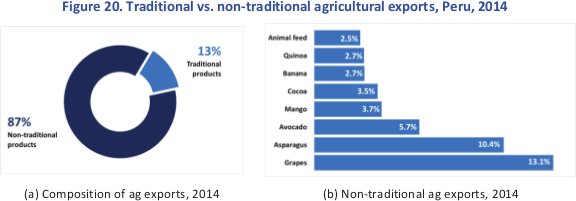
    Peru is often cited as an agribusiness success: the country has experienced strong growth in non-traditional exports, many from the agribusiness sector. Much of this growth has come from new crops, including grapes, asparagus, avocados, mango, cocoa, bananas, and quinoa. From 2006-2014 traditional agricultural exports (such as coffee, sugar, and wool) grew to US$840m from US$574m. But the non-traditional agricultural exports grew even faster. A detailed World Bank study published in 2017, ‘Gaining Momentum in Peruvian Agriculture: Opportunities to Increase Productivity and Enhance Competitiveness’, gives some insight into this success. It notes that as in many Latin America countries, agriculture’s share of GDP and employment has fallen in recent decades, part of an ongoing structural change as other sectors of the economy expand. However, this should not distract attention from the fact that the sector is still growing at quite healthy rates. From 2000-2015 Peruvian agricultural GDP grew by an average of 3.3% per annum. Agriculture also has important backward and forward links to other parts of the economy: if these are taken into account, agriculture’s share of total GDP is 11.3%, four points higher than the 7.3% reported in the national accounts.

    TraditionalvsNontraditional

    Source: World Bank

    The World Bank found that productivity growth in Peruvian agriculture had been “robust”, averaging 2%-3% per annum. This was the case even though agriculture fared differently in different parts of the country. The report talks of two different realities. In the coastal (Costa) region and some pockets of the highlands (Sierra) there are “dynamic, highly productive, commercially successful agricultural systems that are well integrated into local and/or international value chains and that provide acceptable livelihoods for participants”. The other reality, more evident in the Sierra and jungle (Selva) regions is marked by “static, unproductive, subsistence-oriented agricultural systems that are poorly integrated into the market and afford unacceptable livelihoods for participants”. In these regions many farmers own very small plots of land which trap them in low-input/low-output activities. A look at regional trends shows that productivity has been growing most in the Costa and in areas where the higher-value and export crops are cultivated.

    Referring to agribusiness in particular, the report stresses the important role both of the private sector and of governments to create a favourable environment. It comments, “Not always appreciated is the fact that the emergence in Peru of a thriving agro-export sector was made possible by policies that created a favourable business environment to stimulate private investment while at the same time exposing agribusiness firms to the winds of competition.” Governments had introduced supportive policies affecting labour and land markets, taxation, trade, and sanitary and phytosanitary compliance. Despite these positive efforts, there was still scope to do more, particularly to improve inadequate logistics.

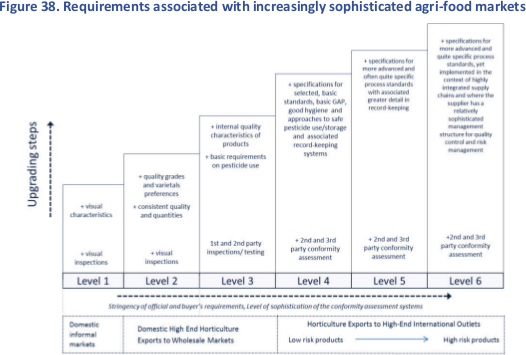
    The improved performance of Peruvian agribusiness rested in part on sustained policies over the last 25 years that had provided both ‘hard’ and ‘soft’ investments. The hard investments include irrigation infrastructure, processing and storage facilities, and logistics. The soft investments include better market coordination, value chain integration, better compliance with quality and safety standards, and greater focus on buyer and consumer preferences. An interesting point made in the report is that the government hopes to incorporate small-scale producers into supplying specialised niche markets, characterised as ‘Level 5’ and ‘Level 6’ markets. These are essentially the more sophisticated markets. The report uses a Level 1 through-to Level 6 classification system based on the stringency and complexity of buyer requirements (see table below).

    Sophistication

    Source: World Bank

    Crops sold on Level 5 and Level 6 markets tend to have high value and offer opportunities for the farmers to capture a greater share of that value. Yet the report notes than in Peru and other countries there are relatively few documented cases where large numbers of small producers have successfully integrated into Level 5 and Level 6 markets. This may be because barriers to entry are high in terms of investment costs and knowledge and skills. There is however more evidence of success in large volume products that have been ‘de-commodified’ and differentiated into distinct speciality segments, described as Level 3 and Level 4 markets.

    One example of relatively successful ‘de-commodification’ is the Peruvian coffee sector, which the World Bank says has experienced “astounding” development, doubling in size over the last 25 years. Many coffee institutors and associations had collapsed in the 1980s during the prolonged Sendero Luminoso insurgency. It was only in the 1990s that surviving coffee cooperatives created the Junta Nacional del Café, recovering a share of total exports. In the 1990s NGOs and other organisations began to promote the idea of achieving organic and other certifications for Peruvian coffee (among them the Fair Trade and Rainforest Alliance schemes). This was coupled with a focus on supporting small farmers in the early stages of processing (harvesting, milling, drying, sorting) and encouraging collective action. Marketing campaigns also played a key role generating international awareness of the new quality of speciality Peruvian coffee. The net effect according to the World Bank was “better export prices, community empowerment, and other benefits to small scale producers”. However, the report notes that the coffee industry is still exposed to significant risks including price volatility and damage caused by the coffee rust disease.

    A similar process of de-commodification occurred in cocoa production. In the 1990s cocoa was promoted as part of a crop substitution programme designed to stop small farmers growing coca, the main ingredient for the drug cocaine. However, the cocoa seed hybrid used, CCN51, produces only average quality beans which therefore forced Peru to compete in the conventional cocoa market, dominated by West African producers, which is highly competitive and price sensitive, and has low profit margins. In this case too, using different indigenous seeds and pursuing organic certification offered a more profitable way forward. Peru is now the world’s second-largest producer of organic cocoa. Compliance with certification and traceability requirements is costly but essential, given that most large international chocolate producers are committed to achieving 100% certification of their sources of supply.

  • CHILE: After a wobble, growth will pick up, says Larraín

    LatinNews 06 June 2013 Hits: 2975

    Finance Minister Felipe Larraín reacted to a lower-than-expected economic activity reading for March by seeking to reassure the markets that the normally healthy Chilean economy would get back into its stride over the next few months.

    The surprise reading for the Imacec (the economic activity index, which acts as a proxy for GDP) showed year-on-year growth of 3.1% in March, well below consensus expectations of around 4.5%. According to the central bank, the lower March number came despite strong growth in the mining and retail sectors. However, this was offset by lower industrial output and base effects (March 2013 had two fewer working days than March 2012). Larraín added that strikes by workers at various Chilean ports had reduced fresh fruit and copper exports.  The industrial action was expected to spill over into the next month and also affect the April Imacec reading.  Q113 GDP growth was 4.1% year-on-year, the lowest quarterly rate since 2011.

    Larraín has sought to reassure the markets that growth will pick up moving forward. However many economists are wondering whether the central bank will need to cut its benchmark interest rate — which has stood unchanged at 5% since the beginning of 2012 — in order to ensure that happens. Speculation was boosted by the minutes of the May monetary policy committee meeting, where for the first time in months a cut was discussed. Some observers argue, however, that the weakness of the Chilean peso, which fell to a 10-month low against the US dollar in May, has in fact acted as a deterrent to an interest rate cut.

    Speculation is likely to continue: Goldman Sachs insists that the bank directors “are in no hurry to change the monetary stance… we think the possibility of a cut in June is virtually nil.”  But others are less convinced and say a cut could come sooner than later.

  • ECONOMIC HIGHLIGHTS

    Abbi Dicker 23 January 2026 Hits: 1483

    COSTA RICA | Rise in FDI. On 5 January Costa Rica’s central bank (BCCR) released new figures showing that Costa Rica registered US$3.53bn in foreign direct investment (FDI) for the first three quarters of 2025, up 4.5% on the same period in 2024, according to a statement by the foreign trade ministry (Comex). According to the Comex statement, reinvested profits accounted for US$3.12bn, which Comex highlights is the highest level ever recorded for that period. According to the statement, over 80% (US$2.86bn) of FDI inflows went to manufacturing, while US$40m went to agriculture. The US was the main source of FDI, accounting for 54% of the total.

    PANAMA | Canal contributions. On 17 December the Panama Canal Authority announced that it had handed over US$2.97bn to state coffers which it said represents “surpluses gained from operations, transit tonnage fees, and payments for public services provided by the state”. An ACP statement notes the contributions reflect the “interoceanic waterway’s outstanding performance during FY2025, marked by a return to normal lake levels, which allowed for a draft of 50 feet to be maintained even during the dry season”. It states that during FY2025, daily transits averaged 33 compared to 27 registered during FY2024 which was impacted by the El Niño weather phenomenon. In October the ACP reported total revenues of US$5.71bn for fiscal year (FY) 2025, up 14.4% on the US$4.99bn recorded in FY 2024. The October ACP report highlights that for FY2025, the Panama Canal achieved a net profit of US$4.13bn, up US$372m on budget projections, and up US$695m on the net profit registered in FY2024.

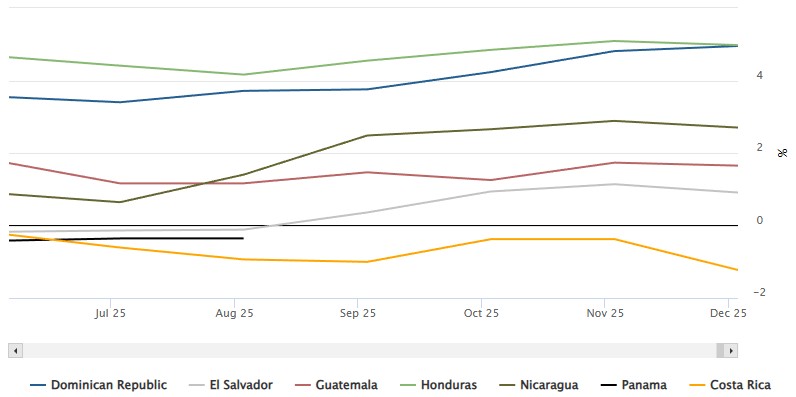
    Central America & Caribbean: inflation rate
    Percentage variation (year-on-year)

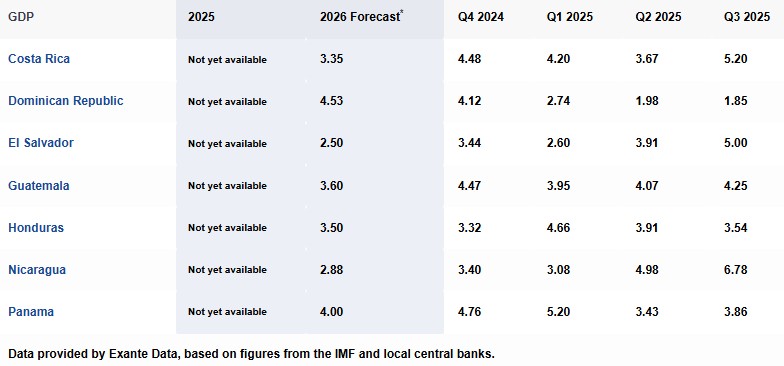
    Central America & Caribbean: GDP growth (%)
    Quarterly figures are year-on-year growth

  • NICARAGUA: Ortega redraws electoral map

    LatinNews 01 September 2011 Hits: 2342

    A local watchdog, Instituto Para el Desarrollo y la Democracia (Ipade), has issued its first report ahead of the 6 November general elections. Aside from predictable concerns regarding the politicization of the electoral authorities (CSE), the Ipade flagged up a recent decree by President Daniel Ortega which incorporates three municipalities, all formerly part of the South Atlantic Autonomous Region (RAAS), into the Chontales department. Designed to benefit Ortega’s Frente Sandinista de Liberación Nacional (FSLN) in the legislative vote, the decree also violates the autonomy framework governing the impoverished indigenous Atlantic Coast, serving as the latest blow to the autonomy process under the Ortega government.

    Ortega insisted that the April decree, incorporating El Rama, Muelle de los Bueyes and Nueva Guinea, was necessary to better “attend” the needs of the municipalities. Critics, however, including the mayors of the three municipalities, all of which are opposition-aligned - El Rama and Nueva Guinea are run by the Partido Liberal Constitucionalista (PLC) and Muelle de los Bueyes by the PLC dissident party, Alianza Liberal Nicaragüense (ALN) - complain that it is intended to assist Ortega in achieving his main electoral objective: securing a legislative majority. He currently has just 38 out of 92 seats in the unicameral legislature. Representing some 40% of the total votes cast in the RAAS, according to the Ipade report for the 2006 elections, the three departments together contributed 10,000 votes to the FSLN compared to 43,000 for the PLC and ALN combined. This resulted in an overall defeat for the FSLN, which failed to win either of the legislative seats assigned to the RAAS. While Chontales is not completely in the hands of the ruling party (which controls three of the eleven municipalities, including the capital, Juigalpa) and has one of the region’s three legislative seats), critics point out that as the home turf of both Ortega and his running mate, the popular former army chief Omar Halleslevens, the region is likely to be more favourable to Ortega in November, serving to dilute the impact of the opposition in the three municipalities.

    Aside from reviving constitutional concerns (the mayors protest that the decree is illegal, based on constitutional article 138 which authorises the legislature alone to determine the “political and administrative divisions of national territory”), the decree has also exposed Ortega’s lack of regard for the autonomy process, which began in 1987 and was intended to grant indigenous groups local governance and control over natural resources. The three municipalities have since announced plans to revive a project, first floated under the previous government of Enrique Bolaños (2002-2007), to establish a separate autonomous region to be named “Zelaya Central”. This also follows signs of frustration from the North Atlantic Autonomous Region (Raan) under the Ortega government: in April 2009, the indigenous Miskito Council of Elders in Bilwi, the Raan’s provisional capital, announced it was seceding to form an independent Nación Miskito. The issue attracted international headlines after clashes between indigenous protesters and security force turned deadly [RC-09-05]; since then, however, the threat to secede has yet to be borne out.

    • Other concerns

    The Ipade also raised concerns about access to cédulas (national identity cards), which are necessary to vote. Voting itself is not mandatory. The Ipade said that of the 80 municipalities to which it had sent observers, only 18 (22.5%) had delegations set up to issue the cédulas. This adds to controversy over the CSE’s decision in August last to raise the price of cédulas by 600% to C$300 (US$13). This is in a country where in 2009, 44.7% and 9.7% of the population were described as living in poverty and extreme poverty respectively. Denouncing the move as an attempt by the FSLN to manipulate voter lists, civil society groups and opposition politicians complained to the press that government and political party resources were being used to buy cédulas for party members.

  • TRACKING TRENDS

    Patrick de Courcy 12 February 2026 Hits: 1192

    ARGENTINA | Inflation accelerates. Consumer prices rose by 2.9% month-on-month in January, the fifth consecutive month of acceleration, according to the national statistics institute (Indec). As a result, the annual rate picked up to 32.4%.

    While both monthly and annual numbers remain well below the peaks of 2024, (in April of that year, for example, 12-month inflation reached a peak of 289.4%) there is concern that inflationary pressures are on the rise again.

    Last week, Indec head Marco Lavagna resigned abruptly, reportedly because he disagreed with a decision to delay the introduction of an updated basket of goods and services for measuring consumer prices (the current basket is more than two decades old). Amid speculation that the new methodology might trigger a higher monthly inflation number, the economy minister, Luis Caputo, said it will be introduced only “once the disinflation process is totally consolidated” [WR-26-05].

    BRAZIL | Coffee exports fall in January. The national council of coffee exporters (Cecafé) reported on 10 February that exports in January totalled 2.78m sacks (one sack = 60kg). This marks a decrease from the 3.15m sacks of coffee exported in December and from 4.02m sacks in January 2025.

    Robusta coffee posted a 45.6% year-on-year decrease, with exports totalling 181,559 sacks in January 2026. Meanwhile, the arabica variety registered 2.35m sacks, down 29.1% compared with January last year.

  • PARAGUAY: Municipal election setback force Cartes to react

    LatinNews 10 December 2015 Hits: 15

    The municipal elections held in Paraguay on 15 November produced a major setback for the nationally ruling Asociación Nacional Republicana- Partido Colorado (ANR-PC) and President Horacio Cartes. In the face of the persistent ANR-PC party divisions, Cartes was counting on a solid performance from the ruling party in the municipal elections to shore up in-party support for his administration [RBS-15-11]. However, the ANR-PC suffered some painful loses including in the capital, Asunción. With the poor electoral results giving rise to renewed signs of in-party dissent within the ANR-PC, Cartes has been forced to adopt a more conciliatory stance amid concerns that his imperious leadership may lead the ANR-PC to an even more painful defeat in the 2018 general elections.

    Cartes promised a resounding ANR-PC victory not just in Asunción but all over the country as part of a bid to restore ANR-PC unity in the wake of the July internal party elections which exposed serious divisions between Cartista and anti-Cartista factions. These divisions have produced difficulties for the Cartes administration this year, the second of Cartes’ five-year term, with dissident anti-Cartista legislators openly defying the executive in the national congress.

    Determined to show his commitment to restoring ANR-PC unity, Cartes not only bankrolled many ANR-PC candidates but also became so involved in many of the campaigns that he was seen as the ANR-PC’s ‘campaign manager’. But Cartes’ involvement earned him accusations from the political opposition that he was seeking to use his office to influence the elections, in violation of electoral law. The opposition then sought to exploit fully the growing social discontent with the Cartes administration (as well as the divisions among the ANR-PC) by equating the elections to a sort of referendum on the Cartes administration, calling on the electorate (disillusioned ANR-PC supporters in particular) to “punish” Cartes by voting against the ANR-PC.

    A referendum on the Cartes administration?

    This tactic appears to have worked, as the ANR-PC, which has the largest number of registered affiliates, suffered a series of painful and even unprecedented defeats across the country. So much so that Cartes and the ANR-PC were seen as the clear losers of the elections, even though, in reality, these were not an unmitigated disaster for the ANR-PC. The ruling party actually won in more of the country’s 250 municipalities than in the previous municipal elections in 2010. In fact, the ANR-PC will now control nearly 60% of all municipalities (145) until 2020.

    However, the ruling party lost in many of the more densely populated municipalities, including five departmental capitals and some traditional strongholds where it had never previously lost. This was the case in Caacupé, the capital of Cordillera department. The so-called spiritual capital of Paraguay has never been governed by any other party, yet the ANR-PC candidate was defeated by his rival from the PLRA for the first time. The surprise victory of the small centre-right Partido Patria Querida party in the traditional ANR-PC stronghold of Encarnación, the capital of Itapúa department and a national tourism centre, was another heavy blow for the ruling party.

    In contrast, the opposition in general had a more positive performance. The main opposition Partido Liberal Radical Auténtico (PLRA) won in 80 municipalities, eight fewer than before the elections. Yet the PLRA won a higher proportion of votes (18.4%) at the national level than in 2010 after taking six departmental capitals and practically sweeping the board in Central department, the country’s most populous region, containing six of Paraguay’s 10 largest cities that make up the Greater Asunción metropolitan area - home to the largest single mass of voters (1.07m). The PLRA took 13 of Central’s 19 municipalities with the ANR-PC retaining the remaining six.

    Similarly, smaller opposition parties also made some gains at the expense of both the ANR-PC and the PLRA. The main leftist coalition, Frente Guasú, won two more municipalities than the single one it won in 2010, while the right-wing Unión Nacional de Ciudadanos Eticos (Unace) added one more municipality to the two it won in 2010. Indeed, 25 municipalities were won by smaller parties, higher than the record 17 they held in 2010. Among these must be included Asunción, where Mario Ferreiro, the defeated 2013 presidential candidate of the leftist Avanza País coalition who was backed by the PLRA (but not Frente Guasú), defeated the incumbent ANR-PC mayor, Arnaldo Samaniego, who was seeking re-election.

    In fact, the opposition received more votes (1.097m) than the ANR-PC (1.021m). All of this suggests that the ANR-PC and, in particular, Cartista candidates were subjected to a ‘punishment vote’ by many of their own supporters. This certainly appears to be the case in Asunción, where Samaniego, a close Cartes ally, was soundly defeated (51%-40.6%). This is not the first time that the ANR-PC has been defeated in the capital, but the ANR-PC has held sway in Paraguay’s second most important elected post since 2001, managing to retain control of the capital even after it was historically defeated by the coalition formed by the PLRA and the Left in the 2008 presidential elections.

    Or a rejection of re-election?

    Asunción was also the one contest in which Cartes became most involved, supporting Samaniego’s re-election bid even though municipal re-election had become a hotly debated issue. Paraguay’s 1992 constitution explicitly forbids presidential and vice-presidential re-election, but it allows mayors to seek re-election for one consecutive term only. However, last year a group of ANR-PC national legislators tabled a new law (ley 5376/14) modifying the electoral code allowing mayors to seek one consecutive or non-consecutive re-election. The law was approved, but it has proved to be controversial not least because many incumbent two-term mayors sought to take advantage of it to seek a third term (re-re-election or ‘re-rekutú’), arguing that the law could not be retrospectively applied. The validity of the re-rekutú was seriously questioned by constitutionalists. However, this did not stop some prominent ANR-PC incumbent mayors from seeking a re-rekutú. Many of them were, however, defeated on the day (see sidebar).

    The ley 5376/14 was seen as a litmus test for support for the Cartista plans to amend the constitution to introduce presidential re-election in order to allow Cartes to run again in 2018. But following the municipal elections, the prevailing view now is that the issue of presidential re-election can be put to bed. Tellingly, the dissident anti-Cartista ANR-PC party leaders have called for a serious post-mortem. Senator Mario Abdo Benítez, the leader of the anti-Cartistas, said that the results had been “painful” for the party. Taking an indirect swipe at Cartes and the Cartista party leadership, Benítez added that “the ANR-PC needs to have proposals attractive to all. We were opposed to the re-rekutú of mayors because it is unconstitutional… people are stricter now and the ANR-PC must improve the electoral process by presenting candidates that inspire trust in people”.

    Meanwhile, the 1 December leak of an audio recording in which Vice-President Juan Afara also criticizes Cartes’ electoral strategy exposed divisions even among Cartistas. Cartes responded to this by announcing on 2 December that he was openly analyzing the results with party leaders “I sincerely say it here in front of the vice-president that we can hold the meeting…wherever you want…[with] all mayoral candidates so that we can talk about every case”, an uncharacteristically conciliatory Cartes said, adding “Wherever we must assume any responsibility we will… We can face this with humility and not seeking culprits. I think the party has a good chance to correct its mistakes”.

    • Re-rekutú seekers defeated

    A number of ANR-PC candidates seeking a re-rekutú were soundly defeated, producing some painful losses for the ruling party. This included incumbent two-term mayors in some large cities such as Lambaré (Greater Asunción), Fernando de la Mora (Grater Asunción) and Mariano Roque Alonso (Greater Asunción). This trend was bucked by Albino Ferrer’s win in San Lorenzo (Greater Asunción). The local ANR-PC local caudillo secured a re-rekutú. However, the opposition hopes that due to the controversy surrounding this, Ferrer will ultimately be stripped of the mayoralty.

    • The big ten

    The Asociación Nacional Republicana- Partido Colorado (ANR-PC) lost in five of Paraguay’s ten largest cities – Asunción (largest), Lambaré (6th largest), Fernando de la Mora (7th largest), Ñemby (10th largest) and Encarnación (9th largest). It took just three of the seven municipalities that make up the Greater Asunción area – Luque (3rd largest), San Lorenzo (4th largest) and Capiatá (5th largest). The ANR-PC managed to retain Ciudad del Este, capital of Alto Paraná department and the country’s second largest city, where the incumbent anti-Cartista mayor, Sandra McLeod, won re-election. It also defeated its traditional rival, the Partido Liberal Radical Auténtico (PLRA), in its erstwhile stronghold of Limpio (8th largest). However, this failed to make up for its defeat in its stronghold of Encarnación.

  • ECONOMIC OVERVIEW: HONDURAS

    LatinNews 05 October 2011 Hits: 2443

    The International Monetary Fund (IMF) has reduced its 2011 GDP forecast for Honduras to 3.6% year-on-year, citing the deteriorating global outlook. Following its latest (September) visit, the fund expressed support for the 50 basis point increase in the monetary policy rate which, it said, should help keep end-year inflation within the target range.  Consumer prices averaged 7.1% annually to August, up from 4.7% in calendar 2010. With the fiscal deficit forecast above target at 3.1% of GDP, the authorities appear to be targeting a gradual devaluation, with the lempira at NHL18.9/US$ on 4 October.  Net international reserves were down at US$2.5bn at end September as a result, barely over three months of imports.

  • Infrastructure investment outlook

    Patrick de Courcy 02 November 2022 Hits: 613

    Infrastructure projects tend to require large capital investments which can be difficult for developing countries to make, particularly in tough economic times. 

    Public investment in infrastructure has fallen since the 1980s, which is often referred to as LAC’s “lost decade” due to a foreign debt crisis and a shocking decline in regional GDP growth from 6.7% in 1980 to -1.9% in 1983. The knock-on effects mean that public investment in infrastructure, which was around 3.1% of GDP in the early 1980s in the region’s six largest economies, plummeted to 0.8% of GDP from 1996-2001 due to structural reforms imposed by the IMF, as well as austerity programmes. This led to the deterioration of infrastructure throughout the region.

    More recently, public investment as a share of total spending on infrastructure has been falling as private involvement increases, and total spending “is not sufficient to maintain growth rates, handle increasing populations or improve sustainability”, according to the IADB. Public investment in infrastructure has been around 2% of GDP for the last five years, falling from 2.07% GDP in 2017 to 1.97% in 2018 and 1.93% in 2019, and transport accounts for around 60% of this spending. Of the remainder, spending on water infrastructure accounts for 0.3% of GDP, energy 0.4%, and telecommunications 0.2%. From 2015-2019 the countries that made the largest public investment in infrastructure as a percentage of GDP were Bolivia (6.9%), Nicaragua (3.7%), and Panama (2.6%), while the lowest were Brazil (0.5%), Guatemala (0.6%), and Mexico (1.1%).

    Public investment falls when the economy suffers, and the tight budget constraints and high debts that characterise the regional economy have been worsened by both the Covid-19 pandemic and the fallout from Russia’s invasion of Ukraine, limiting governments’ ability to act. And fiscal positions are worsening, with an average fiscal balance of -0.4% of GDP in 2008 forecast to become more than -3% in 2025, according to the IMF, which added that gross public debt is also set to increase from 40% of GDP in 2008 to 68% in 2019 and 74% by the end of 2025.

    A lack of investment disproportionately affects societies’ poorest members, who rely more often on public infrastructure. Another issue is that public spending has recently been focused on short-term measures such as cash transfers to vulnerable populations, rather than long-term projects like infrastructure. At the same time, the majority of infrastructure spending is still funded by the public sector, and only around 20% of spending, approximately 0.5% of GDP, is funded by the private sector. By way of comparison, this proportion is higher than in China, India, or Russia, and there are also wide variations by country: private sector investments are almost zero in Argentina, but are equivalent to more than 1% of GDP in Chile and Brazil. 

    The benefits of spending on infrastructure are clear. Every dollar spent has a multiplier effect of 1.5x in terms of GDP over five years, according to the IDB, which adds that each US$1m invested also creates 36,000 new jobs. Targeting infrastructure spending to reduce commercial costs would also boost trade, according to the IDB, which says that reducing logistical costs by 1% would increase exports from the Pacific Alliance countries (Mexico, Chile, Colombia, and Peru) by as much as 4.5%. The problem is that regional governments do not have the fiscal space to make huge investments at a time of increasing economic strife, and private capital tends to gravitate towards certain kinds of infrastructure that are more profitable, such as telecommunications towers in densely populated urban areas.

    Prospects for ‘green infrastructure’ spending

    Green infrastructure refers to projects related to renewable energy, low-carbon transport, sustainable water management, and other technologies linked to the energy transition. According to the IDB, investing in green infrastructure will help to drive economic growth while also improving LAC’s ability to deal with climate change in the long term.

    According to Climatescope, a market assessment by BloombergNEF that ranks 136 countries in terms of attractiveness for energy transition investment, Chile is the highest scorer in LAC. The country ranks 26th in the world in the index, which gives each country a score based on fundamentals such as key policies and market structure; opportunities and growth potential; and experience in relevant fields to date. Brazil is the second-highest scorer in the region, followed by Colombia, Argentina, Dominican Republic, Panama, Peru, and Guatemala.

    Climatescope also found that while global investment in the energy transition increased despite the economic impacts of the Covid-19 pandemic, investors turned away from emerging markets, which saw a 9% fall in investment, to focus instead on safer, developed markets, which saw a 24% increase. This means that the investment gap is growing despite pledges made at the COP26 climate change conference.

    Unfortunately the outlook remains complicated as economic headwinds mean emerging markets are generally performing poorly. The US Federal Reserve has increased interest rates as a response to rising inflation, stoking the value of the dollar and making it more expensive for emerging economies to borrow. This makes it even more difficult to make large investments in infrastructure projects. According to World Bank analysts, LAC is not at risk of suffering another “lost decade” because regional economies are better prepared to react to macroeconomic shocks, such as the fallout from Russia’s invasion of Ukraine, than they were forty years ago.  However they say that there is a risk that growth remains “tepid” after average per capita GDP growth close to zero in the last 10 years. LAC needs to find a new engine of growth in order to head off social unrest at a time when rising debt levels mean fiscal adjustment is necessary, they write.

    Some assistance comes in the form of funding from development banks such as the IDB, Development Bank of Latin America (CAF), Caribbean Development Bank (CDB), and the Central American Bank for Economic Integration (CABEI), which signed a joint agreement to finance climate action to the tune of US$50bn through 2026. In addition the IDB and the United Nations' Green Climate Fund (GCF) announced the creation of the first regional fund to promote electric mobility and green hydrogen at the end of July. This is expected to see US$450m in concessional loans and grants paid to nine nations. For its part, CAF renewed an infrastructure partnership with the US Trade and Development Agency (USTDA) in July. 

    While these schemes are important, the sums involved are a drop in the ocean compared to how much needs to be invested in green infrastructure to properly advance the energy transition in LAC.  Much more ambitious action will be necessary in order to do so, with less reliance on private capital. This is demonstrated by the difference between China’s state-backed BRI initiative and the G7’s B3W initiative, which is reliant on private capital.

  • NICARAGUA: Benefiting from the commodity price boom

    LatinNews 01 September 2011 Hits: 1245

    In the first five months of 2011 Nicaragua’s exports were up by a third (year-on-year) at US$1.07bn. The main reason for this was higher prices: export volumes were up by only 1.2%.

    Coffee is the country’s biggest single export, bringing in US$173m in the first quarter of 2011. In the whole of calendar 2010, coffee exports came to US$342m. The country’s coffee crop is a bit bigger than last year’s. In the first seven months of the coffee year, which began on 1 October 2010, exports were up 7.5% at1.28m quintales (100lb bags). Export revenues in this period are up by 59% at US$274m from US$172m.  The average export price for a bag of coffee in the current coffee year is US$213 up from US$140 a year ago.

    The US is by far the biggest buyer of Nicaraguan coffee: in the first seven months it paid US$120m for 562.7m bags. The country’s next biggest markets for its coffee are Germany and Venezuela which bought US$23m and US$22m respectively.

    In the past coffee year (October 2009 to September 2010) the country exported 2.1m quintales, worth US$321m, up from US$242m in the previous coffee year.

    Ariel Bucardo, the agriculture and forestry minister, expects agricultural exports this year to come to about US$1.5bn and to account for about 75% of the country’s total export revenues. The country’s agricultural year runs from June to May. The government expects agricultural production this year to be 9.8% up on the 2009/10 agricultural year. The country has 951,438 hectares under cultivation, of which 219,681 are given over to the principal crops of coffee, sesame, sugar, peanuts, soya, tobacco and bananas.

    The government is playing up its effort to increase production of cotton which used to be a major cash crop between 1950 and 1980. The country now has a textile industry, based in freezones, which imports the fibre it uses. Nicaragua is drawing on Brazilian technical advisers for its pilot cotton project, covering about 2,000 hectares. Under the Cafta-DR treaty, (which establishes free trade between Central America, the Dominican Republic and the US) from 2015 Nicaragua’s textile industry will lose preferential access to the US market for clothes that do not use cotton sourced from either the US, Central America or the Dominican Republic. Under the preferential access (known as the Trade Preference Level), Nicaraguan-made clothes currently pay zero tariffs to get into the US.

    Employment: The Instituto Nicaragüense de Seguridad Social reported that there were 572,500 people paying into the social security fund at the end of April 2011, up from 530,700 at the end of April 2010. The government and its supporters argue that this increase proves that the growth in the economy is generating proper jobs.  The government’s critics retort that this is wrong and cite figures from Paul Oquist, the presidential adviser on public policy, who claimed that the country has created 325,000 new jobs between 1 January 2010 and the end of March 2011. Oquist says that the economy has 2.7m economically active people out of a population of 5.7m. The government’s critics say that 51% of the people working are self employed and only 28% are wages earners (as opposed to subsistence farmers). Around 30% of all people of working age work in agriculture, mostly as subsistence farmers who also double as day labourers when commercial farmers need extra labour.

    • Food security

    The UN Food and Agriculture Organization (FAO), which has earmarked US$28m for food security projects in Nicaragua for 2011, recently hailed Ortega’s efforts to make the country self-sufficient. It noted that Nicaragua was now capable of supplying domestic demand for corn and beans and had cut the gap between demand and production for rice – the other key staple. According to the national union of farmers and cattle ranchers (Unag), production was 1m quintales short of the 6m needed to satisfy domestic demand.

  • Mexico: Mercurial AMLO

    LatinNews 11 May 2018 Hits: 640

    With the elections less than two months away, the economic policies of Andrés Manuel López Obrador (AMLO), the left wing nationalist leader of the Juntos Haremos Historia coalition, continue under scrutiny. While mistrusted by many in the business community, AMLO has continued to moderate his economic policy positions.

    One thing is clear: AMLO has conserved his lead in the opinion polls, and is the candidate to beat – some would go as far as saying, barring any unforeseen and exceptional developments, that his victory is a fait accompli. One of the latest polls conducted in early May by BGC showed his support rising by two points on the previous month to 42%, nine points ahead of Ricardo Anaya (on 33%) at the head of the right-left coalition formed by the Partido de Accion Nacional (PAN) and the Partido de la Revolución Democrática (PRD). Former finance minister José Antonio Meade trailed in third place with 19% support.

    An interesting reading of the electoral climate in Mexico came from a former opponent, Spanish political consultant Antonio Solá, a man many believe was behind a political ‘dirty tricks’ campaign against AMLO in the 2006 elections, which were won by Solá’s then employer, Felipe Calderón (2006-2012). This time Solá says he expects AMLO to deliver a “historic” win with over 45% of the votes. In his opinion the politician has managed to continue presenting himself as the “anti-system” candidate, while at the same time reaching out beyond his core voters. In Solá’s opinion he is being helped by the fact that his opponents are not strong candidates: Anaya has not yet fully developed his message and Meade struggles with the current government’s poor record and “has nothing interesting to say to Mexicans”. Solá said the PAN campaign slogan of 2006 – that AMLO was ‘a danger to Mexico’ – no longer applied. The candidate was however successfully channelling the “contained anger” felt by the Mexican electorate over the last “complicated” six years of the incumbent government.

    The Mexican business community is not convinced. Many have been mistrustful of AMLO for many years. Old resentments surfaced again in early May when, during a campaign speech, AMLO named members of the business elite who he accused of conspiring against him in previous elections. He singled out Alberto Bailleres (of conglomerate Grupo Bal), Germán Larrea (of mining giant Grupo México), and Alejandro Ramírez (of cinema chain Cinépolis), and said “they are influence traffickers, not businessmen, who benefit from the current economic policy, from corruption”. While these are among the richest men in Mexico there was no mention of the most powerful of all, Carlos Slim, of telecommunications giant América Móvil. The attack came against a backdrop of business concern over the candidate’s commitment to reviewing the liberalisation of energy policies under the existing government and potentially to cancelling the US$13bn new Mexico City airport project. In April Slim had described the threat to cancel the airport project as being anti-business.

    AMLO’s statements drew return fire from the Consejo Coordinador Empresarial (CCE), one of the private sector’s top lobby bodies, which published full-page advertisements in the national press under the headline “Así no” (“Not this way”). Bailleres, who is also a senior CCE official, said the candidate was “undermining confidence with these accusations and with this very aggressive discourse against the private sector”. The paid advertisements insisted that Mexican entrepreneurs were “part of the solution, not part of the problem”.

    AMLO is clearly alternating a tough line with a more conciliatory position – a technique he seems to be using across various issues. In later statements on the airport, for example, he clarified that his main concern was that, as the project is currently structured, it will absorb too much public money – around half of all federal public sector investment. “Why don’t we do a concession? I wouldn’t have a problem,” he said in a subsequent speech (the idea of a concession had earlier been floated by Slim). AMLO later said he wanted “peace and love” with business, and had issues only with a small group that had benefited from close ties with the government.

    Where there does seem to have been some peace and love was in Mexico City on 7 May during a meeting between López Obrador and Larry Fink, chief executive of BlackRock, one of the world’s largest asset managers. AMLO’s team has been meeting international fund managers for some months now. Carlos Urzua, AMLO’s adviser and potential finance minister, said the two men had an “affable” meeting during which they had “clicked”. The candidate told Fink that under his leadership a future Mexican government would uphold the rule of law, fight corruption, and not expropriate private property. Fink was also due to meet the other main candidates.

    Not all foreign observers are optimistic. Citibanamex, the local unit of US-based financial giant Citigroup, issued a report in May projecting that a “probable” AMLO victory in the elections would bring lower growth, higher inflation, and a weaker peso. The report said that by 2022 there would have been 0.7 percentage points less GDP growth, the peso would be 19% weaker against the US dollar, and inflation would be 23% higher (the numbers are calculated over the three years 2019-2022). Chief Economist Sergio Luna, the report’s author, said the main problem would be the combination of electoral promises (such as holding back energy and basic food prices) and the threat to reverse pro-market structural reforms. These would eventually generate “macroeconomic inconsistencies”. Luna emphasises that the other two candidates support the continuation of the structural reforms initiated by the present government. Goldman Sachs in contrast has been more optimistic, valuing AMLO’s move closer to the economic mainstream on various issues. London-based Capital Economics is also seeing Mexico in a broadly positive light, commenting in April that “despite the growing prospect of an AMLO presidency financial markets appear relatively unfazed”. It noted that in a letter to El Financiero, the candidate had promised to respect the independence of the central bank, the existing fiscal rule, and that he would review, rather than repeal, enabling legislation for big energy and construction contracts. Capital Economics does however think that the candidate’s fiscal proposals are “unambiguously expansive”, boosting growth in the short term but possibly storing up sustainability problems for the medium and long term.

    Nafta renegotiation prospects slightly improved.

    Although it remains difficult to assess the real state of the Canada-Mexico-US renegotiation of the North American Free Trade Agreement (Nafta) the signs in April and early May were broadly positive, if increasingly overshadowed by the Mexican election campaign. The difficulty is that both Donald Trump and AMLO have used populist and anti-trade rhetoric to appeal to domestic political constituencies. If AMLO is in fact elected as the next president of Mexico, there are many unanswered questions about how the negotiating dynamic between them will work.

    What is known is that there has been movement on the automobile local content regulations, but no breakthrough. Canadian foreign minister Chrystia Freeland has spoken of “progress” at the talks. The US side is reported to want a deal done before the end of May. At the beginning of this month AMLO said (through economic adviser Graciela Márquez) that he might be ready to abide by any Nafta agreement if reached before 1 July, election day. Earlier suggestions by Trump via Twitter that a new Nafta deal might be conditional on immigration agreements to “stop people going through Mexico and into the US” were rebuffed by Mexican foreign minister Luis Videgaray.

  • PANAMA: Varela picks a fight with his predecessor

    LatinNews 28 October 2014 Hits: 1207

    The recent decision by Panama’s 71-member unicameral legislature to suspend supreme court (CSJ) magistrate, Alejandro Moncada Luna, an ally of former president Ricardo Martinelli (2009-2014), so that he can be investigated for alleged corruption, is one of various moves setting President Juan Carlos Varela at odds with his predecessor. The new Partido Panameñista (PPA)-led government, which took office on 1 July, is trumpeting it as the latest in a string of efforts to crack down on official corruption [RC-14-10].

    The 20 October vote by the legislature came after it admitted a complaint filed jointly by the national bar association, Colegio Nacional de Abogados, and the civil society group, Alianza Ciudadana Pro Justicia, against Moncada, a former CSJ president (2012-2013). This followed the publication of a report by local daily, La Prensa, on 29 September, which raised serious questions over Moncada’s rapid accumulation of personal wealth. In particular the report questioned how Moncada went from renting an apartment five years ago to acquiring two luxury flats, one of which he reportedly paid some US$400,000 in cash for.

    Under mounting pressure to explain himself, both from President Varela as well as various civil society groups, Moncada said on 1 October that he had bought one of the apartments before assuming his ten-year post in January 2010 – an appointment that was itself controversial [RC-10-01] - but that the sale was only finalised two years later. He also said that he had borrowed US$700,000 – interest free – from a member of Martinelli's ‘inner circle’, the businessman Felipe ‘Pipo’ Virzi. But Moncada maintained that there was nothing odd about this loan, as Virzi had lent money to “many people”, as well as to local firms including Martinelli’s Super 99 supermarket chain and Varela’s liquor company, Varela Hermanos.

    With the investigation expected to last two months, both Moncada - who is currently barred from leaving his residence or the country without a court order - and Martinelli are decrying the move as political persecution. On 18 October Martinelli took to his Twitter account to accuse Varela of being an “autocrat” and a “dictator”.

    Another source of tension

    Martinelli meanwhile has other bones to pick with the new PPA government. On 2 October he presented a complaint before the Inter-American Commission on Human Rights (IACHR) against the Panamanian State and the country’s electoral court (TE) – with which Martinelly already clashed during his presidency (see sidebar).

    Martinelli’s complaint came in response to the TE's decision to admit challenges to 14 of the legislative results from the May general elections, ten of which are against his (now opposition) Cambio Democrático (CD) party. The TE has so far voided two of the elections for two legislative seats won by CD – both over alleged corruption - and ordered fresh elections for both. The most high profile case was that of Carlos Afú, who ran for a district in the central Veraguas province and is being investigated for the alleged misuse of over US$4.2m of State funds in his campaign. This includes US$1.4m from the government fund, Programa de Ayuda Nacional (PAN), which is already being audited [RC-14-10], and US$2.7m in funds ear-marked for the Río de Jesús mayoralty in Veraguas. With the TE still in the process of resolving the appeals, the national assembly currently comprises just 60 deputies -12 from the PPA; 20 from the CD; 25 from the opposition centre-left Partido Revolucionario Democrático (PRD); one from the PPA’s ally, Partido Popular; an independent and one from the CD’s former ally, Molirena.

    • Martinelli-TE tensions

    The tensions between former president, Ricardo Martinelli (2009-2014), and the electoral court (TE) are nothing new and stem from the court’s politicisation. Of the three TE justices, who serve ten-year terms, one is appointed by the executive, one by the legislature and one by the supreme court (CSJ). Two of the three sitting justices, including the TE president Erasmo Pinilla, were aligned with the opposition Partido Revolucionario Dominicano (PRD).