All Categories

Subcategories

  • JAMAICA: Some dissenting voices raised ahead of Obama visit

    LatinNews 15 April 2015 Hits: 2373

    As has been well noted over the past year, Jamaica has become something of a ‘poster boy’ for the International Monetary Fund through its implementation of IMF-invigilated reforms. This has been achieved, in part, as a result of what IMF chief Christine Lagarde has referred to as “a great innovation in ownership”. The decision by US President Barack Obama to visit Jamaica on 9 April, ahead of the Summit of the Americas (SOA) in Panama, was widely taken to be a reward for Jamaica’s rigorous adherence to the IMF’s programme (it was only the second ever visit to Jamaica by an incumbent US president). However, some dissenting voices are being raised about the efficacy of the IMF-imposed remedy.

    At the end of March, less than 10 days before Obama’s visit to Jamaica, the IMF completed its 7th review under the four-year US$932m Extended Fund Facility (EFF) arrangement for Jamaica, and it approved a disbursement of US$39m. Announcing the latest disbursement, IMF Deputy Managing Director Mitsuhiro Furasawa said approvingly: “The authorities’ commitment to the programme under the Extended Fund Facility remains strong. Programme performance is on track and all quantitative performance targets for end-December were met. Structural reforms have progressed largely on target.”

    Mitsuhiro added that “macroeconomic performance continues to be good and economic confidence has reached a two-year peak”. He said that the decline in oil prices should help on the inflation front and boost demand. However, he said, “stepping up the pace of reforms is essential to boost growth and employment”.

    The message from the IMF is that continued fiscal discipline, as demonstrated in the budget for 2015/16, will help keep public debt on a sustainable path, but that is not enough on its own and “bold efforts are needed to reform the energy sector, improve the business climate, and advance investment in critical infrastructure”.

    This all seems relatively positive, and to-date there has been absolutely no sign of backsliding from Jamaica. However, we did report back in October that there were signs that politics were edging to the fore. At the ruling People’s National Party (PNP) annual conference on 21 September, Prime Minister Portia Simpson reaffirmed the strong commitment of the government, and her party, to the reform process. She said: “Our generation has a sacred duty and a moral obligation to secure tour nation’s future by bequeathing to our children and their offspring a better, stronger, more viable Jamaica”. But with the next general election due by March 2017, now less than two years away, it would seem inevitable that politics will begin to weigh more heavily in the balance and test Lagarde’s “great innovation in ownership”. For instance, at the time of the PNP annual conference, the opposition Jamaica Labour Party (JLP) accused the government of keeping the IMF happy while failing the “people’s test”.

    In briefings ahead of Obama’s visit, the White House made it clear that the first US presidential visit to Jamaica since 1982 was intended to bolster the government’s determination to stick with the programme. Ricardo Zuniga, Senior Director for Western Hemisphere Affairs at the National Security Council, said: “In Jamaica…we’ll have an opportunity to speak with Prime Minister Portia Simpson-Miller about our strong support for Jamaica’s work to deal with a debt crisis, with a physical crisis, and its strong performance over the last two years in working with the IMF, the World Bank, and others to address that, in support of the prosperity and security of her citizens.”

    The Gleaner understood the message being sent by Obama, saying in an editorial that the visit is “signalling to the Caribbean and other indebted countries that the way Jamaica is pursuing an extremely difficult IMF programme is the way to go and is a prerequisite for future financial assistance. It is also an international endorsement of Jamaica, which is being held up as a model to the rest of the Caribbean.”

    But the consensus is not entirely complete. On 7 April, just ahead of Obama’s visit to Jamaica, the think tank Center for Economic and Policy Research (CEPR) issued a paper warning that Jamaica was suffering from the “most austere budget in the world” and that “austerity and debt interest payments have brought public investment to a low”.

    The paper starts by pointing out that over the past 20 years, average annual GDP growth in Jamaica has been just 0.4%, with average per capita growth even lower at a negative 0.3%. This is comfortably the worst economic performance in the Western hemisphere. The economy is still 3.5% smaller than it was eight years ago at the start of the global economic crisis, and on IMF projections it will not return to its 2007 level until 2016.

    The central argument of the paper is that this dismal performance is not being helped by the IMF requirement that Jamaica run a primary surplus of 7.5% of GDP, which the CEPR points out is more stringent even than Greece’s intended (but politically undeliverable) primary surplus of 3.0% this year and 4.5% thereafter.

    As a consequence of this austerity, capital expenditure has plummeted. After averaging 4% for the five years prior to the IMF agreement, it was just 1.6% of GDP in FY 2014/15. Unemployment is currently running at over 14%, which the paper points out is “higher than it was during the world recession”. Youth unemployment is even higher.

    Nor, says the CEPR, has the IMF programme and linked debt exchanges significantly reduced the overall debt burden. This was still over 140% of GDP at the end of FY 2014/15 and is not expected to reduce to 100% of GDP until 2020. Interest payments last year amounted to 8.2% of GDP.

    For the CEPR, the solution must be significant debt relief, and it says that it is only subsidies from Venezuela and investment from China that is preventing a collapse in public support for the IMF-imposed austerity programme. Despite Obama’s praise for Jamaica’s fortitude, these are arguments that are likely to become more persuasive as the early 2017 election comes closer.

    Nor is it just electoral politics that will test the government’s resolve. It was interesting to see, for instance, the Ministry of Industry, Investment and Commerce warning publicly about the effects of a lack of investment on Jamaica’s hopes of becoming a logistics hub. On 31 March, the ministry tabled a report in front of the Public Accounts Committee of Parliament (PAC) in which it said that the logistics hub initiative was threatened by insufficient funding and a lack of fiscal space.

    The initiative is intended to attract major investment into Jamaica to capitalize on the increased trade flows projected as a result of the Panama Canal expansion, which is due for completion in 2016. Edmund Bartlett, a member of the PAC, responded to the ministry’s warning by saying: “We are looking at a period of time down the road for which there is great uncertainty and that your own expression of high risk in relation to implementation gives no comfort to us.”

    The security dimension

    In addition to praising Jamaica’s adherence to the tough IMF conditions, Obama used his visit to the country to address Caribbean Community (Caricom) leaders and to talk up the US’s Caribbean Energy Security Initiative and its Caribbean Basin Security Initiative. Of course, the president emphasized the US’s strong commitment to both these initiatives, and it does seem as if there is a renewed push to help the Caribbean reduce it energy costs and “to help move the region toward cleaner more affordable energy”.

    On the security front, however, the message given only a few weeks earlier by the head of US Southern Command, General John Kelly, was ambivalent. Giving evidence to the Senate Armed Services Committee in mid-March, General Kelly said: “I don’t have the assets [in the Caribbean]. I have two navy ships, that will go to zero by the summer and that’s not even with sequestration.” He added that Southcom lacks airborne intelligence, surveillance and reconnaissance (ISR) assets in the region.

    Kelly noted that the US Coast Guard has said that it intends to double its number of cutters patrolling in the Caribbean, but this is just from three to six and, as Kelly said: “The Coast Guard also has an awful lot of other missions to accomplish – migration up in the Florida Straits and a lot of other things.”

  • CHILE: Primer político sentenciado sobre el ‘Pentagate’

    LatinNews 18 December 2015 Hits: 311

    El ex senador y miembro fundador del conservador partido de la oposición, la Unión Demócrata Independiente (UDI), Jovino Novoa, se ha convertido en el primer político en recibir una sentencia de prisión con relación al escándalo de financiación ilegal de campañas electorales, que involucra a Penta, uno de los grupos financieros más grandes de Chile, que sacudió al país hace poco más de un año. Las investigaciones en curso sobre el caso ‘Pentagate’, así como también el caso que involucra a la empresa minera, Sociedad Química y Minera S.A. (SQM), que también han implicado a miembros de la coalición gobernante, Nueva Mayoría, como el senador Fulvio Rossi, del Partido Socialista (PS) de la Presidenta Michelle Bachelet, están sometiendo a las instituciones de Chile a un serio escrutinio. Teniendo esto en mente, la reciente designación de Jorge Abbott Charme, un pariente del actual gerente de Penta, como el nuevo fiscal general de Chile ha causado una extendida sorpresa.

    Después de su condena el 27 de noviembre, cinco días más tarde Novoa recibió una sentencia de prisión de tres años, que será cumplida bajo un régimen de prisión abierta. También le fue ordenado que pague poco más de Ch$7,6m (unos US$11.000), el equivalente aproximadamente al 50% de los daños fiscales causados, que él podrá pagar en 10 cuotas. Al dejar la corte, el fiscal Carlos Gajardo remarcó que “esto establece claramente un precedente: es la primera condena, pero dudo que sea la última.”

    Así como Novoa, otros políticos que han sido acusados en relación al caso –que en marzo forzó las renuncias del presidente y el vicepresidente de la UDI, el Diputado Ernesto Silva y el Senador Iván Moreira [IL-15-11]– incluye: al Diputado Felipe de Mussy; al ex alcalde de Santiago (2008-2012) Pablo Zalaquett (ambos de la UDI); y a Alberto Cardemil, un ex diputado (1994-2014) por la opositora de centro-derecha, Renovación Nacional (RN). Están  también bajo investigación la senadora por la UDI, Ena von Baer; la opción inicial de la UDI para candidato presidencial en el 2013, Laurence Golborne; y el ex ministro de economía, Pablo Longueira (2011-2013), otro miembro de la UDI quien brevemente fue candidato presidencial en el 2013.

    Con los diputados de la UDI como José Antonio Kast y Gustavo Hasbún acusando a las autoridades fiscales (SII) de servir a los intereses del gobierno y de no accionar contra miembros de Nueva Mayoría implicados en los casos, la designación de la Presidenta Bachelet de Abbott fue curiosa. Abbott, es el primo de Alfredo Moreno, un ex ministro de relaciones exteriores (2010-2014), quien es el actual gerente de Penta.

    Un ex director ejecutivo de la oficina del fiscal del estado y un ex fiscal regional para Valparaíso, Abbott asumió el cargo por un periodo de ocho años el 1 de diciembre, reemplazando a Sabas Chahuán. La designación de Abbott fue cuestionada no solamente por la oposición, sino también por miembros de la coalición gobernante, Nueva Mayoría, como el Partido por la Democracia (PPD). Abbott ya ha dicho que él no encabezará la investigación sobre Penta, y que ha reasignado el caso SQM a otro fiscal.

    Dictamen del TC es un revés para Bachelet

    La Presidenta Michelle Bachelet recibió la semana pasada un revés provocado por el dictamen del Tribunal Constitucional (TC) contra las provisiones de su insignia reforma de la educación –específicamente el mecanismo para determinar cuales establecimientos de educación superior tendrían derecho a los fondos del Estado a fin de proveer educación universitaria gratuita para ciertos estudiantes en el 2016.

    El dictamen plantea dudas sobre la promesa de Bachelet de introducir la educación universal gratuita que, junto con la reforma constitucional y fiscal, fue una de sus tres principales promesas electorales en el 2013. El TC discrepó con la propuesta de que los fondos que provendrían del presupuesto del Estado fueran accesibles a limitadas instituciones, aquellas representadas en el Consejo de Rectores Universitarios de Chile (Cruch) y varios otros establecimientos privados.

    La Presidenta Bachelet, desde entonces ha dicho que el gobierno investigará opciones alternativas para financiar la educación universitaria gratuita, tales como becas.

    • Los peso-pesados de Penta

    Los fundadores de Penta, Carlos Eugenio Lavín y Carlos Alberto Délano (también presidente) y Pablo Wagner, el viceministro de minas bajo el gobierno del ex presidente Sebastián Piñera (2010-2014), fueron sentenciados a arresto domiciliario en relación con el caso ‘Pentagate’, pero, el 7 de diciembre, un juez de garantías cambió sus sentencias, ordenando en cambio su libertad condicional (pero aún bajo prohibición de salir del país).

  • PARAGUAY: Fatal fire puts focus on prison overcrowding

    LatinNews 16 June 2016 Hits: 2131

    The death of five inmates and a security officer in a fire at Paraguay’s largest prison, Tacumbú, has re-ignited longstanding concerns about the state of the country’s dilapidated prisons. The incident once again puts the spotlight on the issue of severe overcrowding in Paraguay’s prisons and the need for investment in the country’s creaking prison infrastructure. It has also sparked a controversy between government officials.

    How the fire started on 10 June is still not clear. The authorities suspect that it was an electrical fire caused by faulty electricity transmission cables but have said that forensic investigators would not be able to determine this for up to 15 days. What is known is that the fire broke out in one of the prison’s workshops, spread rapidly, and began filling cells with smoke. Head prison guard Blas Gaona Acosta began opening cells and evacuating the 130 inmates being held in that wing of the prison. Gaona and five inmates then attempted to put out the fire but they were overcome by the smoke and soon perished.

    The fire was brought under control by firefighters a few hours later. The post-incident controversy swiftly ensued. Judge Ana María Llanes was the first to blame the government for the fatalities. Llanes said that the deaths were the result of the “indolence, negligence, and unwillingness” by the authorities, in particular the justice ministry, to tackle the overcrowding and infrastructure deficiencies that have long affected Tacumbú. “They are responsible for maintaining the penitentiary in the condition it is in…the prison system, and prison’s policy is the responsibility of the justice ministry. [And] they are responsible for not providing even the minimum conditions,” Llanes said, noting that the judiciary has long pointed out that the conditions in which inmates are kept not just in Tacumbú, which houses 46% of the prison population, but across the country, is deplorable and an affront to their rights.

    Llanes did not stop there. She complained that the justice ministry has a monthly G$4bn (US$706,000) budget to spend on maintaining the country’s prisons but that it was “not clear where all this money is going”. She also directly accused Justice Minister Carla Bacigalupo of “not doing anything” to improve the state of the country’s prisons since her appointment in January [WR-16-02]. “To close down a prison is not the solution…someone needs to assume responsibility, have the will to change things…they say they have no resources but they have always said that. No action is ever taken, no restructuring,” Llanes said, further criticising Bacigalupo’s suggestion that Tacumbú would have to be temporarily closed to in order to undergo a major overhaul.

    While Bacigalupo conceded that there was “a terrible degree of overcrowding in Paraguay’s prisons” she did not directly respond to Llanes herself. Instead her deputy minister, Raúl Caballero, defended the government’s efforts to help improve the national prison system. Caballero said that since assuming office in 2013 the government led by President Horacio Cartes has invested G$25bn (US$4.4m) in developing prison infrastructure so as to create 2,000 new prison cells in prisons around the country to reduce overcrowding at Tacumbú and in other prisons.

    The problem for the government is that it said much the same back in 2014 when the issue of overcrowding at Tacumbú last came into the spotlight following a strike by prison guards that led to a violent riot by inmates. Back then the local press noted that while Tacumbú was originally built to house 1,500 inmates, it currently holds 4,000; and the government promised to adopt immediate measures to alleviate the situation. But it appears that these measures, such as expediting the prosecution of those held in remand awaiting trial, have so far made little difference. In another sign of the mounting political pressure, national legislators have floated the idea of summoning Bacigalupo to provide explanations.

    • A global problem

    The refocusing on the issue of prison overcrowding in Paraguay comes just as the International Committee of the Red Cross (ICRC) has warned that this is a global problem not just one confined to Latin America. At a workshop held in Panama between 31 May and 2 June, the ICRC said that a chronic lack of investment in prison infrastructure and rising crime levels meant that prison overcrowding had worsened in the region in the last few years. But the ICRC said that unlike other regions Latin America has “an enormous potential” to address this problem given that the situation in the region can be drastically improved by investing a modest amount more in improving prison infrastructure and improving the allocation of existing resources.

  • COLOMBIA: Government and Farc launch joint coca programme

    LatinNews 14 July 2016 Hits: 705

    In a clear sign that the ongoing peace negotiations between the government and the Fuerzas Armadas Revolucionarias de Colombia (Farc) are close to being concluded, this week the two sides launched a new pilot programme designed to eradicate coca plantations in Colombia. But as positive as this development is, it was somewhat overshadowed by an armed clash between the military and Farc units in the southern department of Meta, which has sparked concerns of a breakdown of the unilateral ceasefire that the Farc has been largely observing since December 2014 in support of the peace process.

    The eradication of illegal crops in order to combat drug trafficking is one of the points included in the official government-Farc negotiation agenda on which the two sides have reached a preliminary agreement. As such, following the signing of the preliminary agreement over the establishment of a definitive bilateral ceasefire to take effect as soon as a full peace deal is finalised [WR-16-25], the government and the Farc decided to begin implementing the agreement on working together to eradicate coca plantations. This involved the official launch of a pilot programme under which the Colombian military and Farc guerrillas will work together to go into remote rural areas to eradicate plantations and help convince local communities to substitute coca with other crops.

    The pilot programme was launched during an event in the rural municipality of Briceño, in the north-western department of Antioquia, on 10 July. It was attended by government and Farc representatives, including Farc commander and a member of the guerrilla group’s peace negotiating team, ‘Pastor Alape’ (Félix Antonio Muñoz Lascarro), who along with other Farc members was allowed to travel from Cuba, where the peace negotiations are being held, back to Colombia to present the latest developments in the peace talks to Farc units on the ground. Alape told the 400 or so local peasant farmers who attended the event that the pilot programme represents “an opportunity for you to help forge peace”.

    Alape explained that under the pilot programme, the government had agreed to provide direct assistance to local farmers to abandon coca production and start planting legal crops instead. Meanwhile the Farc has agreed to help locate and eradicate any coca plantations of which it is aware and help promote the programme in the local communities. Rafael Pardo, the post-conflict, human rights and security minister, said that as part of the pilot programme, the government would also set up round tables with local communities to hear what sort of assistance they would require in order to abandon coca production. “What we are doing today is building trust to boost the development of the communities by eliminating illegal crops,” Pardo said.

    Timely launch

    The timing of the launch of the pilot programme was critical. It came just a few days after the United Nations Office on Drugs and Crime (UNODC) released its latest annual report on coca and cocaine production in Colombia on 8 July. As widely anticipated, the UNODC report confirmed that there was a significant increase in coca plantation areas and potential cocaine production in the country in 2015. Security analysts have been warning that by focusing on a peace deal with the Farc, the government led by President Juan Manuel Santos has neglected its anti-drug-trafficking efforts, with the security forces more concerned with keeping insurgent guerrilla groups in check than on coca eradication efforts in recent years.

    In addition, analysts also warned that the government’s decision to suspend the aerial spraying of glyphosate-based herbicides to eradicate coca on public health grounds would also be detrimental to the efforts to reduce coca cultivation in the country. All of this has earned the Santos government pointed criticism from detractors of the peace process led by former president and incumbent senator Alvaro Uribe (2002-2010). Uribe has repeatedly said that in its haste to seal a peace deal with the Farc, the government has ‘dropped the ball’ when it comes to combating drug trafficking and that as a result Colombia is now less safe than during his administration. Uribe also argues that this will ultimately lead to the failure of the peace process by allowing drug trafficking and its associated violence to continue to spread across the country.

    So the finding by UNODC that coca cultivation in Colombia increased by 39% to 96,000 hectares (ha) from 2014 to 2015 is damaging for the Santos government. This is the highest total area of coca under cultivation observed in Colombia since 2007, confirming that the size of coca plantations have been consistently increasing in the country since then. It also means that last year Colombia was once again the world’s largest coca and potential cocaine producer (with potential cocaine production capacity of 615 tonnes per year).

    The government attempted to minimise the negative findings of the UNODC report. Defence Minister Juan Carlos Villegas blamed the increase on the ban on aerial spraying and on the failure by many rural communities to move away from growing coca. Villegas said that this was partly due to the “false expectation created by the Farc” at the negotiating table that coca growers in areas under its control would willingly switch to other crops as the peace process progressed. However, this only appears to provide more ammunition for Uribe and fellow detractors of the peace process.

    Meta incident

    Meanwhile an armed clash between the army and the Farc in Meta department on 8 July slightly tarnished the launch of the coca eradication pilot programme. The incident took place in the ‘El Tigre’ area of the rural La Uribe municipality, where the defence ministry said that an army patrol encountered a Farc column and the two became engaged in a gunfight. The ministry said that the Farc had actually notified it that a number of its members had been wounded in the shootout and requested humanitarian assistance. According to the ministry, the army offered to act as liaison with the International Committee of the Red Cross to provide the necessary assistance.

    But the official version of events was rejected by the Farc. Via Twitter a Farc commander and another member of the peace negotiating team, ‘Carlos Antonio Lozada’ (Luis Antonio Losada), said that “What happened in Meta was not an encounter, it was an attack on Farc delegates travelling [back] to Havana”. Lozada also denied that the army offered any assistance for the wounded and accused it of “violating international humanitarian law and undermining confidence in the [peace negotiating] table”.

    Even though the Farc’s maximum leader, ‘Timochenko’ (Rodrigo Londoño Echeverri), has said that the incident was the result of “mistakes” committed by both sides, it has raised concerns that the Farc could launch a retaliatory attack, breaking its unilateral ceasefire, which would undoubtedly complicate the peace negotiations.

    • Tumaco the coca production epicentre

    The annual report by the UNODC on coca and cocaine production in Colombia once again found that the municipality of Tumaco in the south-western department of Nariño, which borders Ecuador, had the highest concentration of coca plantations. Indeed the UNODC report found that there are 16,990 hectares of coca plantations surrounding the municipality, which contains the eponymous Pacific port city. This figure represents 17% of the total coca planation area in Colombia, suggesting that coca production continues to expand in remote border areas, which in the past were heavily subjected to aerial glyphosate spraying but where now only manual eradication and spraying is permitted.

    • New attorney general

    On 11 July Colombia’s supreme court (CSJ) announced that it had elected Néstor Humberto Martínez as the new attorney general to replace Eduardo Montealegre, whose four-year term formally ended in March. The appointment of a new attorney general has been delayed as none of the names included in the short list submitted to the CSJ by President Santos appeared able to muster the requisite two-thirds support in the 23-seat court. But after three failed votes Martínez – a former justice minister (1994-1996), interior minister (1998-2000) and minister for the presidency (2014-2015) – received 17 votes and was duly elected over the former peace commissioner adviser, Mónica Cifuentes, and the former justice minister, Yesid Reyes (2014-April 2016), believed to be Santos’s preferred choice.

  • CHILE: Museums at centre of political struggle

    LatinNews 23 August 2018 Hits: 855

    Chile’s President Sebastián Piñera announced his government’s intention this week to create a ‘museum of democracy’. The gestation of the idea dates back to July 2017 but the timing of the announcement was eye-catching. Less than a week earlier, Piñera’s culture minister, Mauricio Rojas, resigned after just four days in the job after facing scathing criticism for past remarks about the museum of memory and human rights in Santiago [WR-18-32].

    President Piñera argued that a museum of democracy would serve an important purpose in Chile to provide “lessons in the country’s democratic history because we have lost our democracy on several occasions”. Piñera said the creation of the museum would mark the 30th anniversary of “the wise decision” by the Chilean people to vote “no” in the 1988 plebiscite on whether to retain the dictatorship of General Augusto Pinochet (1973-1990). Piñera went on to present an argument in relation to the museum of memory and human rights which Rojas had made and which cost him his job. Piñera said that the museum “helps us not to forget a troubled period in terms of human rights”, but added that “this has nothing to do with what one thinks led Chile to destroy democracy”.

    Piñera also courted controversy by saying that “In our country we have evolved in the right way. I think the Left, from President [Salvador] Allende [1970-1973] who validated violence and undemocratic mechanisms, has evolved and learnt to recognise and respect democracy. And I think the Right has also evolved and has become a fierce defender of human rights.” His comments incensed the opposition Partido Socialista (PS), Allende’s party, which accused Piñera of having “renounced his role of contributing to reengagement and peace, as becomes a head of state, preferring to assume the role of a leader of a sector that he himself has described as ‘passive accomplices’ of the atrocities of the dictatorship”.

    Despite the timing of the announcement, the museum of democracy did not split opinion quite as might have been expected. It was not entirely well-received by the right-wing Unión Demócrata Independiente (UDI), part of Piñera’s ruling Chile Vamos coalition, while the centre-left opposition Democracia Cristiana (DC) applauded the idea. For his part, the director of the museum of memory and human rights, Francisco Estévez, said he saw “absolutely no need for a museum of democracy decoupled from what was the fight to recover democracy in Chile”.

    In an opinion piece on 21 July 2017 in the national daily El Mercurio, David Gallagher, part of the team which began working on the idea for a museum of democracy a year ago (and since appointed as Chile’s ambassador to the UK this July), argued that it should not be seen as a counterweight to the museum of memory and human rights, or a memorial to the transition. Rather, Gallagher argued, it should focus on Chile’s long democratic tradition, and the challenges facing representative democracy now.

    But Piñera’s proposal prompted supporters of Pinochet to call for the establishment of yet another museum: ‘a museum of truth’. On 22 August members of Corporación 11 de Septiembre presented a letter to the president of the supreme court, Haroldo Brito, urging magistrates not to be intimidated by protesters denouncing the recent release of seven prisoners sentenced for crimes against humanity committed under Pinochet. Loreto Iturriaga, the daughter of an imprisoned general, said “the history of human rights [in Chile] is being written exclusively by the clenched fist of the Left”, and that the proposed ‘museum of truth’ would reveal “the crimes of the Left”. Lorena Pizarro, president of the association of relatives of the detained and disappeared (AFDD), said the proposed museum would constitute “an apology for genocide”.

    • Unity

    Against the backdrop of the dispute over democracy and truth in Chile, President Piñera marked the 240th anniversary of the birth of Bernardo O’Higgins, Chile’s independence hero and liberator, in Chillán Viejo in Biobío region, on 20 August. Accompanied by his defence minister Alberto Espina and the commander-in-chief of the army, General Ricardo Martínez, Piñera urged Chileans to recollect that “whenever we’ve been divided, we’ve suffered our most bitter and painful defeats, and whenever we’ve been united we’ve achieved our most beautiful and noble victories”.

  • TRACKING TRENDS

    LatinNews 22 November 2018 Hits: 686

    CHILE | Growth slows in third quarter. On 19 November, Chile’s central bank (BCCH) released its third-quarter economic growth figures, revealing signs of a slowdown. The domestic economy grew by 2.8% year-on-year in the third quarter compared with 5.4% in the second quarter, resulting in 4.2% accumulated growth for the year so far.

    The third-quarter result is lower than market predictions, which averaged 2.9%. However, government officials point out that there were three fewer working days in this year’s third quarter compared with the same period last year, which had a negative impact of 0.4% of GDP.

    Despite slower growth, Finance Minister Felipe Larraín emphasised the positives of 4.2% accumulated growth for the year to date and a boost to spending on investment, which was up by 7.1% in the third quarter. “I want to emphasise that the economy is getting back on its feet and leaving behind four years of negative growth, or falling investment in other words,” Larraín said at a press conference.

    In the third quarter, mining sector activity contracted by 2.7% but other sectors, including personal services (4%), trade (3.2%), and business services (3%), boosted the overall results. Imports increased by 10% year-on-year, led by metal products, machinery, and fuel, while exports were up 7.5%, driven by copper and industrial products.

    Statistics show that growth in internal demand, which slowed to a 4.6% increase in the third quarter, compared with a 6.1% increase in the second quarter and a 4.1% increase in the first quarter.

    • Chilean GDP growth

    Finance Minister Larraín is predicting stronger growth in the fourth quarter, which he says will be driven by a recovery in the mining sector and greater dynamism in non-mining sectors, such as construction and services. Regarding the labour market, Larraín promised greater efforts to cut unemployment and claimed that a total of 150,000 jobs would be created this year. He also predicted that fuel prices would start to fall in the coming weeks.

  • Mexico responds to poor second-quarter growth with new stimulus plan

    LatinNews 09 August 2019 Hits: 901

    A preliminary report posted by the Mexican National Statistics agency on 30 July 2019 ahead of the official release of data on the second quarter of 2019 on 23 August showed that the Mexican economy expanded by 0.1% over April-June, when adjusted for seasonal swings. This means that the Mexican economy technically avoids being described as in recession, as this is normally used for a period of two consecutive quarters of negative GDP. However, analysts were quick to point out that this fragile growth still leaves Mexico in a precarious position, particularly given that it was driven almost entirely by the tertiary sector, which saw a growth of 0.2%. The primary sector, including agriculture, saw a decline of 3.4% from the previous quarter, whilst the secondary sector remained flat.

    On the same day, Mexican Finance Minister Arturo Herrera announced a M$500bn (US$25.5bn) economic stimulus package, which he declared would have an immediate positive effect on the economy. The focus is to be on encouraging investment in new infrastructure and increasing private consumption and spending. Herrera outlined measures including public-private partnerships over infrastructure projects such as building roads and developing urban areas, as well as setting up a development bank to offer loans to small and medium-sized businesses.

    Although much has been made of this package, at no point did Herrera declare that any additional funding would be supplied to bolster the economy. In fact, he stated in a press conference that the targeted primary budget surplus of 1% would remain in place. Given that this was combined with a refusal to be drawn on any particular forecasts for the impact of the stimulus package upon economic growth, there will no doubt be those who dismiss the plan as lacking in substance, and simply designed to save face given the frequent denials made by President Andrés Manuel López Obrador that the country is facing grave financial difficulties.

    Despite the fact that the president has previously stated that he expected growth of 2% in the Mexican economy for 2019, those figures seem increasingly unlikely in the face of the latest economic data and lukewarm government response. Many analysts now expect to see almost no growth this year, particularly given the ongoing problems facing state-owned petroleum company Pemex and the potential for severe disruption to trade relations with the US – the destination for 80% of Mexican exports – over US President Donald Trump’s immigration policy.

    There have been some positive responses to the package within Mexico, however, with the Confederation of National Associations for Business, Services, and Tourism welcoming the proposals. José Manuel López, the head of the group, expressed his belief in the importance of the government leading the way in spending and investment, given the fact that many private investors may have been deterred by the uncertainty surrounding the economic policies of President López Obrador. Particularly singled out for praise was the promise to bring forward spending by the Housing, Communications and Transport Ministries originally designated for 2020 in order to try to kickstart those areas of the economy.

    Mexico is, and has always been, vulnerable to the impact of global economic trends, and yet the country has never succeeded in implementing any kind of medium-to-long-term counter-cyclical economic policy. Alongside the opinions expressed by many that the stimulus package is a window-dressing response to the latest poor economic figures is a real concern that the elation felt by many Mexicans upon the election of President López Obrador will quickly ebb away if he is not able to improve the economic fortunes of the country. Forecasts from the central bank (Banxico) in July 2019 have predicted a contraction of the economy of 0.8% to 1.8% in 2019.

    The announcement was the first major policy package to be proposed under new Finance Minister Herrera, who took over from Carlos Urzua, who resigned in July 2019, expressing concerns about the financial understanding and capabilities of others in the administration. Herrera, who served as deputy to Urzua, announced that Gabriel Yorio would be succeeding him in that role.

  • BRAZIL: Armed forces deployed to protect the Amazon

    LatinNews 14 May 2020 Hits: 6251

    The Brazilian government has deployed troops to the Amazon, part of efforts to fight environmental crimes as deforestation is expected to surge with the start of the dry season (and increased wildfires). Although ostensibly a sign that the government led by President Jair Bolsonaro is taking deforestation seriously, the fact that it puts environmental-monitoring efforts under military command raises some concern.

    In a press conference on 11 May, Vice-President Hamilton Mourão, who heads the federal government’s national council of the Amazon [WR-20-06], announced the launch of ‘Operação Verde 2’. The R$60m (US$10.1m) military operation, authorised by a presidential Garantia da Lei e da Ordem (GLO) decree, initially valid from 11 May to 10 June, deploys 3,800 troops to the Amazon region. They will assist the government’s environmental agencies such as Ibama and ICMBio in their work, fighting illegal activities which drive deforestation. 

    “We don’t want Brazil to be seen as the environmental villain,” Mourão said. President Bolsonaro’s response to particularly destructive wildfires in the Amazon last August sparked criticism worldwide and delivered a blow to Brazil’s international reputation. After a spike in 2019, deforestation has continued to rise in 2020 [WR-20-15]. The latest figures from the government’s early-warning system (Deter), released on 8 May, point to year-on-year deforestation having increased 63.7% in April.

    The GLO bringing in the military reinforcements is expected to be extended beyond its initial 30-day period, perhaps all the way to 2022. Mourão stressed that the armed forces will not be substituting Ibama, ICMBio, or Funai (the indigenous rights agency) but will be present in a “coordination and management” capacity.

    The risk that these independent agencies become directly subordinate to the military, which ultimately answers to the president, is a concern, however, not least because of the Bolsonaro administration’s poor environmental record and tendency to be sympathetic with the very people who are behind illegal deforestation.

    MP 910/19

    In December 2019, President Bolsonaro passed a decree on land regularisation (MP910/19) which critics say encourages illegal land grabbing and increases the risk of violence against indigenous peoples. Vice President Mourão and Environment Minister Ricardo Salles defended this decree, which is about to expire if not ratified by congress, in the press conference on 11 May. But the next day the president of the chamber of deputies, Rodrigo Maia, announced that the MP910 would not be voted on as planned, and might instead be debated as a bill next week. The MP910 has prompted vocal criticism from environmentalists, public figures, and opposition lawmakers in Brazil, but is defended by the government and by the agribusiness caucus in congress.

    Military reinforcements

    Federal deputy Tabata Amaral, of the Partido Democrático Trabalhista (PDT), said on 11 May that she had presented a bill to congress to suspend the presidential Garantia da Lei e da Ordem (GLO) decree, arguing that although military reinforcements are not a problem per se, the decree risks jeopardising environmental operations and the autonomy of those who lead them.

  • PERU: Central bank criticises finance ministry

    Abbi Dicker 18 July 2025 Hits: 3239

    Julio Velarde, president of Peru’s central bank (BCRP), issued a rare public criticism of his country’s finance ministry on 20 June. Velarde asserted that the finance ministry’s opinion was formerly respected and worked closely with the central bank, but that since 2016 there has been a tendency to ignore the opinions of experts and technocrats. Velarde has been openly critical of a bill that would make changes to sales tax (IGV) collection, benefitting local governments over the central treasury – a move that Velarde warns will have fiscal consequences for the national government.

    Joining Velarde in his criticisms, former finance minister Luis Miguel Castilla (2011-2014), who served in the administration of Ollanta Humala (2011-2016), has claimed that the proposal to change the sales tax regime, which has received tacit support from President Dina Boluarte’s administration, is part of an attempt by the government to buy support in congress.

    The key concern is that channelling money away from central government to the regions will increase the fiscal deficit, while risking wastage and corruption by overfunding local governments. According to the central bank, in 2024, treasury income was around 14% of GDP, one of the lowest rates in Latin America, whilst the fiscal deficit stood at 3.5% of GDP.

    Velarde also criticised the tax breaks that are offered to agro-exporters as “anti-technical”, in particular because the benefits are targeted at a very small number of beneficiaries. These criticisms from the central bank have so far not been met with a strong reaction by the Boluarte administration, but if they persist could lead to mounting institutional tensions of the sort seen in countries such as Brazil and Colombia in recent years, with impacts on investor confidence.

  • BRAZIL: Tribal protests in Brasília

    LatinNews 18 April 2013 Hits: 1326

    From the row over oil royalties to a major show of force by hardnosed conservative Evangelicals determined to keep their man at the helm of the human rights committee, Brazil’s congress has had an unusually lively couple of months under its new 2013-2014 president Henrique Eduardo Alves, who campaigned hard last year for the coveted post and is now having to prove his mettle. In its ordinary sessions, the federal chamber of deputies is a sleepy (and under-attended) place; it tends only to rouse itself from its slumbering pace in the face of some major drama. This week deputies looked by turns bemused and delighted at the eruption into the chamber of some 700 colourfully dressed and feathered indigenous Indians who, singing and dancing, were protesting against proposed changes over how their territorial ancestral lands are demarcated.

    The indigenous arrived on 16 April, when they immediately occupied the offices of the congressional committee on the constitution and justice. There they said they would stay until Alves agreed to suspend the creation of  a proposed new working group to examine the merits of constitutional amendment (PEC) no. 215, which among other things would transfer from the national executive and the Fundação Nacional do Índio (Funai) to the congress itself the final competency to demarcate indigenous territories. The PEC 215 was first put forward in the lower chamber back in 2000, but having been archived for 12 years it was resurrected last year - with the support of the powerful agricultural bench - and swiftly approved by various commissions.

    Around 300 tribesmen later broke into the full plenary, forcing it to suspend its work, as some of them danced around the chamber and others gazed up in amazement at the giant electronic screens. One indigenous chieftain, Neguinho Truká of the Truká tribe from Brazil’s north-eastern Pernambuco state, told journalists that his fellow men were prepared to remain in the chamber “for as long as necessary” so as to ensure that the amendment was put back in its box and re-archived. Sonia Guajajara, another well-known indigenous leader (she sits on the national directorate of the Articulação dos Povos Indígenas do Brasil [APIB]), said the occupation was in the name of those ancestral Indians that continue to guide “the fight for reparations and [for] the rights of the indigenous peoples”. The Funai itself, which has previously complained that it is being undermined and denied sufficient resources by the current government, said in a statement that the proposed amendment, “instead of contributing to reducing the conflicts caused by the demarcation of indigenous lands, will cause bigger tensions in the relations between individuals and indigenous peoples, owing to the judicial insecurity and territorial indefinition that it will give rise to”.

    The Indigenous Missionary Council (CIMI), linked to the Roman Catholic Church, went further, saying it repudiated the amendment and warning that it “attacks in a vile and cowardly form the rights that the indigenous people won at the cost of much blood”. The proposal “attends to the private interests of a historically privileged landowning minority”, it added.

    Alves conceded, agreeing to suspend the working group and instead set up a dialogue group comprised in equal number of indigenous representatives, deputies acting on their behalf and deputies in favour of the PEC 215. Deputy Padre Tom of the ruling Partido dos Trabalhadores (PT), who liaised with Alves and the indigenous leaders, said that the group would discuss “all issues” of relevance to the indigenous tribes.

    The tensions between the indigenous and Brazil’s big agricultural sector do not always make the headlines in such colourful fashion but they continue to simmer away in the background. As we reported in early April [WR-13-13], the trial now under way of three men accused of murdering two rural activists in Pará highlights the fact that violence in rural areas has been increasing, and that the reaction of the government and the judiciary has been both painfully slow and, according to human rights campaigners, inadequate, bordering on indifference.

    In early April state authorities in Goiania (in the agricultural state of Goias, some 200km south of Brasília) admitted that they were investigating the possibility of an “extermination group” following the murders of 27 homeless indigenous people, including young children, in the state in the previous eight months.  Brazilians were appalled at graphic TV images of some of the incidents, as captured by security cameras. In one, two indigenous people, including an 11-year old boy, were beaten to death in Goiania; in another an indigenous person sleeping on the street was killed with two shots in a drive-by shooting by a motorcyclist. The federal human rights minister, Maria do Rosário Nunes, said that the crimes would not go unpunished. She appointed Biel Rocha, the national secretary for the promotion and defence of human rights, to lead up efforts to catch the assassins. “There is an extermination movement against people on the street,” Rocha stated.

    Deforestation speeds up

    The latest deforestation figures, released over Easter, slipped by unnoticed. However, according to the monthly data taken from the DETER rapid response satellite system, the rate of deforestation increased 26.8% in the period between August 2012 and February 2013. Greenpeace International noted that an area of the Amazon larger than the size of the city of London disappeared, or 237,000 football pitches. In absolute numbers, the area equated to 1,695km². The biggest increase was in the state of Maranhão (up 121%), followed by Tocantins (110%), however Mato Grosso remained the worst overall offender, losing 734 km² in the period.

    An official Greenpeace statement said that “President Dilma Rousseff’s approval of a new Forest Code [in 2012], a law that provides amnesty for crimes committed after 2008 in the Amazon and reduces large areas of protected land, paved the way for the increase in deforestation. The president also structurally weakened government agencies like IBAMA, the federal environmental enforcement agency”. Greenpeace is calling on Rousseff to support a law for Zero Deforestation in Brazil. A citizens’ initiative for such a law has already been signed by 800,000 Brazilians, according to Greenpeace.

    BCB bows to the inevitable and lifts the Selic


    On 18 April Brazil’s central bank (BCB)’s monetary policy committee (Copom) voted 6-2 to increase the benchmark Selic interest rate by 25 basis points to 7.5%, without bias, citing the need to address the “high level of inflation” and the “resilience” of inflation. However, the bank tempered this by saying that internal and “principally external uncertainties” required that “monetary policy be managed with caution”.

    Given the still-fragile internal and external scenarios, most analysts expect the Copom to lift the Selic by 150 basis points at most in incremental stages over the next few months. In the latest (15 April) BCB poll of private economists, the consensus on the year-end Selic rate was steady at 8.5% for both this year and next, with real GDP growth of 3.0% and inflation of 5.7% in 2013, and growth of 3.5% and the same inflation in 2014.

    Politically, the government led by President Dilma Rousseff may prefer to see the Selic increase now rather than closer to the 2014 general election, allowing inflation to stabilise and consumer sentiment to remain steady. The government seems committed to running a looser fiscal policy in support of growth (and Rousseff’s re-election), which in the long-term is supportive of inflation.  Alexandre Tombini, the BCB president, was among the six committee members that voted for the increase.

    • Flood of immigrants


    The state government of Acre, which borders Peru and Bolivia in Brazil’s remote Northern Amazon region, declared a state of social emergency on 9 April in two towns on the border with Bolivia – Brasiléia and Epitaciolândia - over the wave of illegal immigrants crossing the frontier into Brazil and requested federal assistance to cope with the influx as well as a “clear immigration policy”. According to the state secretary for human rights, Nilson Mourão, some 1,600 immigrants have arrived in the area already this year. The majority are Haitians, but there are also Dominicans, Senegalese, Nigerians and Bangladeshis. Mourão said the influx had caused “a serious humanitarian and sanitary situation” in the two small towns. An estimated 5,000 Haitians have arrived in Acre since 2010, many trafficked by ‘coyotes’ through Ecuador, Peru and Bolivia.


    • Security Council reform


    On 17 April in New York Brazil’s foreign minister Antonio Patriota insisted before Susan Rice, the permanent US representative to the UN, that reform of the UN Security Council (UNSC) was “urgent” and could not wait. “We believe the discussion…should be treated with urgency”, he insisted, adding that it was “not an academic question” but “a vital matter for international governance”. Rice, in turn, said the US government agreed that the UNSC should be adapted to “the reality of the 21st Century” and that the government would support “a modest expansion” of the number of permanent and non-permanent members. However, she said that any new members should not be given veto power. Brazil’s top foreign policy priority is a permanent seat on a reformed UNSC, which currently has five permanent and 10 rotating members.

  • VENEZUELA: Nothing changes

    LatinNews 04 November 2013 Hits: 567

    Another large devaluation of the Bolívar Fuerte in early 2014 is the most likely scenario, but not the only one.

    In June this year, two developments prompted us to examine the policy options facing the new government in Venezuela. Armando León, a director of the Banco Central de Venezuela (BCV- the central bank) had hinted at the resurrection of the new complementary exchange rate platform, the Sistema Complementario de Administración de Divisas (Sicad), through which scarce US dollars are auctioned to Venezuelan importers.

    The implication was that the government considered that deficiencies with the official Comisión de Administración de Divisas (Cadivi) were a key reason for the shortage of foreign currency. This had exacerbated goods shortages in a country in which almost all basic goods (other than oil and refined products) are imported. The second development was the suggestion by Alberto Ramos, an analyst with the US investment bank Goldman Sachs had suggested that the country faced a significant risk of hyperinflation - which Goldman Sachs defines as seasonally adjusted monthly annualised rates of 40% or more.

    This threshold was passed in September 2013. The INPC, the central bank's national consumer price index, rose 4.4% month-on-month. This is less than the monthly increases reported in May (6.1%) and June (4.7%). But year-on-year consumer prices were up 49.5%. Of the 13 groups of products and services which the BCV provides details of consumer prices, year-on-year inflation was greatest for the first and most basic: food and non-alcoholic beverages, with prices 67.3% higher than they were in September 2012 (see chart).

    Other economic statistics remain disturbing. Thanks to the continued monetisation of the budget deficit (which the International Monetary Fund expects to be around 15% of GDP in 2013), M2 continues to surge. In April 2013, the BCV's figures showed that M2 had grown by 61% year-on-year. In September, the rate of increase had risen a little, to 65%. In September, the BCV's Scarcity Index, which provides an indication of the extent to which basic goods are unattainable from supermarkets by consumers, was 21.2%. This was marginally lower than in April (21.3%). However, the Index was running at around 14% for 2011 and 2012. Foreign reserves have fallen from US$26.2bn at the end of April to US$21.8bn in late October.

    In short, nothing much has changed, but there is a continued steady deterioration. The BCV finally reintroduced the Sicad in mid-July, and has since auctioned around US$1.0bn, at rates of exchange that have not been disclosed. The Cadivi is selling US$920m a day, according to the vice president for economic affairs and energy minister Rafael Ramírez. This is in the context of a country where monthly imports averaged US$5.0bn in the first half. In late October, the BCV increased the reserve requirement ratio for to commercial banks. For loans and investments up to 18 October, the ratio was lifted by two percentage points to 19%; for loans and investments made later, by five percentage points to 22%. Given the source of the inflationary problem (i.e. monetisation of the budget deficit, rather than irresponsible lending by banks); we would see this as a measure to increase the authorities' control over the economy.

    The authorities devalued the Bolívar Fuerte by 32% to the current official level of BF6.30/US$ in February this year. A further devaluation early next year, once the municipal elections due on 8 December are past, would reduce the overall burden of the local currency debt of the government and state-owned oil company Petróleos de Venezuela (Pdvsa). It would also reduce Pdvsa's operating costs within Venezuela relative to its revenues: this would boost the cash flow at the disposal of the government to boost foreign exchange for importers.

    As we noted in June, the cash outgoings from Pdvsa amounted to around US$72bn in 2012. This included contributions to the (off budget) national development fund (Fonden) and other social programs, royalties to the government and Pdvsa's own investment program. Assuming that payments from the oil company are running at about the same level this year, the government would only have to arrange with Pdvsa to defer cash payments by a month or so in order to generate at least US$6bn in additional foreign exchange.

    In short, our base case remains that the government can 'muddle through' the elections, Christmas and into the New Year, at which point it can consider a further devaluation of the Bolívar Fuerte. This would enable a further deferral of hard decisions in relation to public finances, the liberalisation of price controls and other reforms which would run counter to the theory and practice of the Bolivarian Revolution.

    Of course, this assumes that Pdvsa has the capacity to generate cash at a rate of about US$6bn per month. A problem creating  a short-term impact on cash flow - such as payment to Schlumberger or other multinational oil service companies that absolutely cannot be delayed, or non-receipt of revenues from a large client - could severely compromise the government's ability to 'muddle through.'  The complexity and opacity of the oil giant's accounts means that financial difficulties can often be obscured. However, this would not necessarily be the case if one of the multinational oil companies was forced by corporate law or the listing requirements of a major global stock exchange to disclose problems with its dealings with Pdvsa. Moreover, the same is true of many of Pdvsa's customers in the US and elsewhere.

    As Goldman Sachs suggested, the imbalances could be resolved in a massive crisis of which the central feature is hyperinflation (with near certain political turmoil). However, we note that the rate of inflation in Venezuela is nowhere near the rates recorded officially in Zimbabwe in early 2008 (165,000% and the unofficial rate was even higher), or other famous episodes such as Germany in the early 1920s. Venezuelans have long lived with inflation of 25%-45%.

    The money M2supply, as reported by the BCV, hit BF1.0bn in late October. Asdrúbal Oliveros, a local economist, noted: "There is too much cash circulating due to increased public spending, expenditures for the December 8th elections, and Christmas bonuses being paid to government employees in November". That could suggest a pick-up in the velocity of money in coming weeks, as households desperately seek to spend Bolivares before they lose value.

    As we observed in June, food riots are a risk scenario, and one that would pose certain political turmoil and grave risks to the government. We still think that this outcome is highly unlikely, with the government making a concerted effort to ensure imported supplies, especially in its discount state run food chains.

    According to the United Nations' Economic Commission for Latin America and the Caribbean (Eclac), about 30% of the Venezuelan population lived in poverty in 2011. This included 12% living in extreme poverty. However, the government’s own figures are some way lower. The national statistics institute (INE) reports that 18.1% of the population lived in poverty, with 7.1% in extreme poverty, as of end-2012. Although the official unemployment rate is around 6.0% (September 2013), about half of the urban population of Venezuela ekes out an existence in what Eclac describes as 'low productivity sectors.' These sectors are highly dependent on the continued subsidy provided by the Bolivarian Revolution.

    IPCA index, % ch year-on-year , September 2013

    Source: BCV.

    2014 budget dismissed as 'baseless' by the opposition

    On 22 October the Caracas government led by President Nicolás Maduro presented its 2014 draft budget to the national assembly, which was immediately described as “unreal” and “baseless” by the political opposition. The BF551bn (US$87bn) plan is 39.4% higher in nominal local currency terms than the 2013 budget, but private sector economists calculate that is around US$5.0bn less in real (inflation-adjusted) terms.

    The budget assumes real annual GDP growth of between 4% and 6% in 2014, and an annual inflation rate of between 26% and 28%, around half the current rate of 50%. As ever, it is based on a deliberately low oil price forecast of US$60 per barrel, just US$5 higher than last year’s forecast, despite the fact that Venezuelan crude oil prices have averaged US$102.5 a barrel to date in 2013, on energy ministry figures. This oil price underestimation allows the government to spend the ‘windfall’ oil revenues at its discretion and without any transparency. Notably, the budget also keeps the official government-set exchange rate at BF6.3/US$1. Finance Minister Nelson Merentes said the budget was the result of “careful consideration”. “We have to be very prudent when estimating [the price] of this resource [oil], because if there is an important external shock the prices may tumble… then there is no way of balancing the budget”, he argued.

    Merentes admitted that the soaring inflation was a “terrible concern” but promised that the government would adopt additional measures to tackle it, and he promised to alleviate the chronic shortage of basic goods, particularly foodstuffs. In response, the main opposition coalition Mesa de la Unidad Democrática (MUD) issued a statement complaining that the annual budget "has become baseless and no longer represents a valid point of reference for the development and implementation of public policies”. It said the growth forecast of 4%-6% “not only looks unreal but also irresponsible”.

    The 2013 budget forecasted a similar GDP growth rate but real growth in the first half was a weak 1.6% year-on-year. The MUD questioned why the country was enduring “ a deep economic crisis characterised by high inflation, scarcity and a significant fall in the central bank’s international reserves” when Venezuelan crude has remained at around the US$100 mark in 2013. The Maduro government would answer that it is all down to the opposition-promoted campaign of ‘economic sabotage’.

    More operational autonomy for private partners in the Faja

    On 16 October energy minister and Pdvsa president Rafael Ramírez announced that the Caracas government would offer mixed companies operating in the Orinoco belt (the Faja) more autonomy so as to reach production targets.

    Pdsva is the majority partner (with a 60% share) in these mixed companies; in practice the cash-strapped Venezuelan company regularly negotiates financing deals with its minority partners that sees the junior partner stumping up cash in advance to cover Pdvsa’s obligations. Ramírez now seems to be giving the junior partners more leeway over the actual running of the operations, in a pragmatic move to get Pdvsa's production levels up from a stagnant 3.0m barrels/day (b/d). Many of these junior partners are experienced oil multinationals and/or state oil majors from other countries, all of which have complained that excessive bureaucracy and government interference in the sector has hindered their operations in the Faja. Ramírez also announced a US$1.2bn financing deal with Spain’s Repsol for the mixed company Petroquiriquire.

    After a meeting with Repsol’s president Antonio Brufau, Ramírez said the financing deal would boost Petroquiriquire production levels to 75,000 b/d, up from 40,000 b/d currently. He added that the energy ministry is also in talks with Italy’s ENI about a similar deal, ahead of a scheduled visit by ENI executives in November.

    Separately, Colombia’s foreign minister María Angela Holguín announced that Colombia and Venezuela had inked a memorandum of understanding to link the Cano Limón-Covenas pipeline, owned by Colombia’s state-controlled Ecopetrol, with Pdvsa’s Guafita pipeline. The accord will give Colombia more ways to export crude produced in its eastern plains, Holguín said in an official foreign ministry statement.  End box

    • Bolívar débil

    On 30 October, the Bolívar Fuerte was trading at BF54/US$1 on the (illegal) black market, according to websites that publish the rate, 8.5 times the official rate of BF6.3/US$1.

    • Taxes

    The 2014 budget expects taxes from the non-oil sector collected by the national tax and customs administration service (SENIAT) to provide 57.4% (of BF317m) of total revenues, with the rest (45.3%) from the oil sector.

    • Pdvsa bonds

    On 14 October the newswire Bloomberg reported that Pdvsa could issue up to US$3bn in dollar bonds by the end of the year. A company source suggested the notes would be sold in a private placement to the BCV for currency auctions, as well as to oil service providers to pay off debt.

  • CARIBBEAN POINTERS

    Sarah Sheldon 21 June 2022 Hits: 907

    *** ANTI-COLONIALISM PLAYS INTO BVI CRISIS. Recent visits by British royal family members to the Caribbean have been marked by a sudden drive towards republican status for territories that still have Queen Elizabeth II as head of state. Barbados made the move in November 2021, and others are indicating their intention to follow suit. Those that may do so include Belize, The Bahamas, Jamaica, Grenada, Antigua & Barbuda, and St Kitts & Nevis. In addition, the royal visits, by the Duke and Duchess of Cambridge and by the Earl and Countess of Wessex, also promoted renewed calls for reparations from the UK for its part in the slave trade. All of this has served to complicate the UK’s response to the arrest on 28 April in the US of Andrew Fahie, the premier of the British Virgin Islands (BVI), on drug-trafficking charges. Fahie’s arrest was followed a day later by the publication of a report from a Commission of Inquiry (COI) into corruption and the abuse of authority in the BVI.

    The COI found “appalling” failures in the BVI’s governance and a “high likelihood” that serious corruption had occurred. It made a series of recommendations, including the suspension of the current system of governance in the BVI for at least two years. This prompted the Organisation of Eastern Caribbean States (OECS), a seven-nation sub-regional grouping, to issue a statement describing the recommendation as “a retrograde step in the evolution of the democratic process that is inconsistent with the United Nations Proclamation of Human Rights to be free of colonial rule”. “It is clear to us that, in principle, it is ill-advised to impose direct colonial rule and the history of such imposition in the Caribbean has never delivered the desired result,” the OECS said in the statement. The 15-nation Caribbean Community (Caricom) echoed these sentiments in a statement of its own, stressing that the “imposition of direct rule, and the history of such imposition in the Caribbean, was never intended to deliver democratic governance or to be an instrument of economic and social development of our countries and peoples”.

    *** ST KITTS & NEVIS HEADING FOR GENERAL ELECTION. On 10 May, facing an imminent vote of no confidence that he was set to lose due to the defection of six members of the Team Unity coalition government, Prime Minister Timothy Harris asked SKN’s governor general to dissolve parliament, thus paving the way for a general election. The coalition government, which won re-election in 2020, is made up of the prime minister’s People’s Labour Party (PLP); the People’s Action Movement (PAM) led by ousted deputy prime minister of St Kitts Shawn Richards; and the Concerned Citizens Movement (CCM) led by the also estranged Nevis premier (and ousted foreign affairs minister) Mark Brantley. Before its dissolution, the coalition held nine of the 11 seats in parliament, with the opposition St Kitts-Nevis Labour Party (SKNLP) holding the other two.

    SKNLP leader Terrance Drew responded to the dissolution of parliament by saying: “God has set out the nation on the rightful path to liberation after seven long years of oppressive government, seven long years of scandal after scandal, seven long years of tarnishing our country’s reputation.”

    *** GANGS PROLIFERATING IN TRINIDAD & TOBAGO AS MURDER RATE SOARS. According to Trinidad’s acting police commissioner, McDonald Jacob, there are now 134 criminal gangs active in the country. Speaking on 10 May, Jacob said: “Our analysis has shown that 60% of the murders in Trinidad and Tobago is, in fact, gang-related and about 80% of our shootings and woundings are also gang-related. These gangs are now involved in illegal quarrying, drugs, robbery, extortion, and land grabbing, human trafficking and most recently, they are involved in the sale of illegal guns.” According to research by the Criminology Unit at the University of the West Indies, after suffering more than 200 murders in the first five months of the year, T&T is on course to surpass its highest number of annual murders, 547 recorded in 2008.

  • CHILE: Constitutional fatigue setting in?

    Patrick de Courcy 09 March 2023 Hits: 5625

    The second attempt in just over two years to launch major constitutional reform kicked off on 6 March, with the inauguration of a 24-strong committee of experts. This time, the process looks like being significantly more consensual and moderate, and possibly duller. Success is still far from guaranteed.

    Chilean news portal Ex-Ante sought to highlight the contrast between two dates: 4 July 2021 and 6 March 2023. The former saw the nearly riotous inauguration of the elected, 155-strong constitutional convention. There were demonstrations and arguments inside and outside. Radical members of the convention refused to sing the national anthem.

    This week, in contrast, there were only a few demonstrators outside. Inside the tone was much more austere, sober, and focused. The national anthem was played. Earlier the justice minister, Luis Cordero, commented “we are probably going to have a boring constitutional reform process, and if it does turn out that way, that could be a good thing”.

    What is certainly clear is that this time the process, negotiated by the political parties, is heavily engineered to prevent any surprises. In the first attempt in 2021-2022 the constitutional convention was dominated by left-wingers and independents with radical ideas and limited constitutional experience. As a result, a lot of the work was broad-brushed, hurried, and short on details, with big gaps left to be filled in by future law-making. The convention’s radical ideas on indigenous rights, justice, the environment, and decentralisation appeared to be increasingly out of step with public opinion. Last September the draft constitution was rejected by a clear 62.5% majority in a nationwide referendum.

    This time around the process has been turned upside down. The 24 members sitting on the committee of experts have been selected by the two chambers of congress and represent a balance principally between centre-right and centre-left. Their main job is intended to be technocratic: to agree an entire constitutional draft within the next three months, and well in advance of any more political discussions to be held by a 50-strong constitutional council which is set to be elected on 14 May.

    There are two other safety mechanisms in place. The committee of experts will be bound by a declaration of 12 guiding principles, negotiated by the political parties last January [WR-23-02], which commits them to define Chile as a “rights based social and democratic state”. It recognises indigenous rights but only within the framework of a “single Chilean nation” (thereby rejecting the plurinationality favoured in the first reform).

    These principles also uphold a bicameral legislature, limiting earlier attempts to eliminate the senate. The second safety mechanism is a 14-member committee of jurists which will have task of ensuring consistency between different constitutional rules.

    A total of 21 out of the 24 experts are lawyers; among the remaining three are a journalist, an economist, and a sociologist. According to Domingo Lovera, a constitutional lawyer chosen by Revolución Democrática (RD), a member of the ruling coalition, “Our job is to supply the constitutional council, which is the main protagonist in this process, with a complete constitutional draft. The council will decide which clauses it believes are good and to be adopted, which it will reject, and which it will amend. It has those three possibilities.”      

    The final draft will be submitted to a referendum on 17 December. Success is far from a given, judging by recent opinion polls. Marco Moreno, a political scientist at Universidad Central said “citizens are suffering a kind of constitutional fatigue, they are tired of the whole process, and specially the excesses during the first attempt”. He went on to say that citizens are currently more preoccupied with issues such as security, public order, migration, and the economy.

    Disillusionment

    According to polling company Pulso Ciudadano, in February 57% of respondents said they had no or little confidence in the constitutional reform process, up by 2.3 percentage points on the previous month. Of the other respondents, 16.7% said they had a lot of confidence in the process, while 26.2% said they had ‘medium confidence’.

  • ECONOMIC HIGHLIGHTS

    Abbi Dicker 11 December 2025 Hits: 419

    MEXICO | Gov’t raises minimum wage. On 3 December Mexico’s government led by President Claudia Sheinbaum announced that the minimum wage will rise by 13% in 2026, bringing the general minimum daily wage from M$278.80 (US$15.25) to M$315.04. Meanwhile the daily wage in the country’s northern border free zone (ZLFN) will rise 5% from M$419.88 to M$440.87. The government said that this measure was the fruit of an agreement with unions and the business sector and is in line with its objective of raising the minimum wage to cover the cost of 2.5 so-called basic food baskets by 2030 – when Sheinbaum’s term is due to end.

    MEXICO | Remittances continue to fall year-on-year. On 1 December Mexico’s central bank (Banxico) announced that remittances sent to the country in October totalled US$5.64bn, representing a year-on-year decrease of 1.7%. This marks the seventh consecutive month of year-on-year declines, following annual drops of 2.7% in September, 8.3% in August, 4.7% in July, 16.2% in June, 4.6% in May, and 12.1% in April. Accumulated remittances received between January and October 2025 totalled US$51.34bn, down 5.1% on the US$54.09bn received in the same period of 2024.

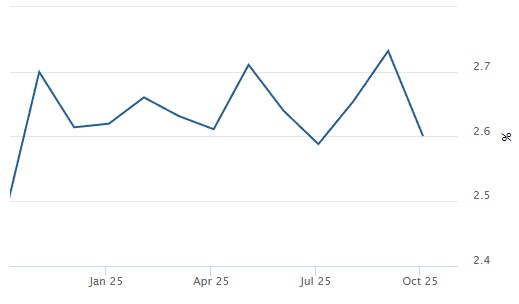
    MEXICO | Unemployment down in monthly terms, up year-on-year. On 28 November Mexico’s national statistics institute (Inegi) reported that the unemployment rate of the economically active population stood at 2.6% in October, compared to 2.5% in the same month of the previous year and 3.0% in September. This equates to 1.6m people, up by 96,000 people year-on-year. In October the economically active population – meaning people aged 15 and over who are employed or actively seeking work – stood at 62.5m, up by 1.1m people as compared to October 2024. The informality rate in October was 55.7%, up from 54.1% in October 2024.

    Mexico: GDP growth
    Percentage variation (year-on-year)

    Mexico: unemployment rate
    Economically active population

    Mexico: inflation rate
    Percentage variation (year-on-year)

    Source (all graphs): National Statistics Institute (Inegi)

  • BRAZIL: Flávio makes false claims about voting machines

    Patrick de Courcy 23 July 2026 Hits: 548

    Despite early indications that Senator Flávio Bolsonaro might adopt a more moderate stance, he is pursuing the same tactic as his father, far-right former president Jair Bolsonaro (2019-2023), in trying to cast doubt on the integrity of Brazil’s electoral process, by making unfounded claims regarding the country’s electronic voting machines.

    On 21 July communications agency Novo Selo Comunicação and news outlet The Brazilian Report organised an event in Brasília which was attended by diplomatic representatives and international organisations, as well as contenders planning to run in Brazil’s presidential election in October, such as Flávio Bolsonaro, who is expected to be the main right-wing presidential candidate.

    At the event, Flávio gave a speech in which he said that the US government had expressed concern over the risks of electoral fraud, especially in Venezuela, and went on to say that “many of the machines used in Brazilian elections are from the same company” that supplied voting machines in Venezuela.

    He was referring to findings from documents recently released by the US Central Intelligence Agency (CIA) which President Donald Trump discussed in a speech on 16 July. The declassified CIA report contained an assessment of intelligence gathered from 2004-2020 regarding the capability of the Venezuelan government under former presidents Hugo Chávez (1999-2013) and Nicolás Maduro (2013-2026) to rig elections.

    The report recognised that Venezuelan authorities could have had the technical capacity to manipulate vote counts but did not definitively state that previous Venezuelan governments, or the company that produced voting machines for Venezuelan elections, Smartmatic, had committed large-scale electoral fraud. However, these nuances did not stop Trump from claiming on 16 July that there was a “specific plot to greatly favour the corrupt regime of Venezuela”.  

    While Flávio did not echo exactly what Trump said, the Brazilian senator claimed that Smartmatic’s machines have been used in Brazil. This comes despite multiple declarations in recent years from Brazil’s superior electoral court (TSE) denying that Smartmatic had ever been a supplier for Brazil’s elections.

    In an apparent attempt to protect himself from legal repercussions, Flávio qualified his remarks by stating that “I am not questioning the Brazilian voting system, but [I ask] that all countries send as many observers as possible to our elections”. In July 2022, Jair Bolsonaro was punished for seeking to discredit the electoral process during an event attended by foreign diplomats, when he made unfounded claims about the voting system and electoral authorities – claims which resulted in the TSE deciding in 2023 to impose an eight-year electoral ban on him.

    Flávio explicitly mentioned his father’s electoral ban, seeking to defend his comments at the time. “Former President Jair Bolsonaro has been made ineligible following a meeting with ambassadors,” Flávio said in his speech at the 21 July event, but he went on to describe his father as “someone who was concerned about the transparency and security of our electoral system and merely voiced those concerns so that the ambassadors could convey that situation to their respective countries.”

    Attempts at moderation

    In late 2025 and early 2026, Flávio Bolsonaro sought to portray himself as a more moderate right-wing figure compared with his father, with various videos posted by his campaign team in which he describes himself as “the Bolsonaro who got vaccinated”, an apparent attempt to distance himself from his father’s vaccine-sceptic stance during the coronavirus (Covid-19) pandemic. Flávio has also sought to highlight his commitment to defending women’s rights, likely an attempt to win more votes from women, given that the far-right Bolsonarismo movement has traditionally received more support from men than women.

    Legal action

    The ruling left-wing Partido dos Trabalhadores (PT) has taken legal action against Flávio Bolsonaro for the comments he made about Brazil’s electronic ballots. The legal counsel of the PT petitioned the superior electoral court (TSE) on 22 July to impose a fine on the right-wing senator for spreading false information. The PT’s national party president, Edinho Silva, also released a statement arguing that Flávio was repeating “the same coup-mongering culture of his father” and adopting the “same tactics used in the 2022 elections” by questioning the integrity of voting machines and raising unfounded concerns about the risk of electoral fraud.

  • ARGENTINA: Old problem; piecemeal solutions

    LatinNews 31 August 2011 Hits: 3595

    While the government of Argentina’s northern province of Jujuy, led by the Kirchnerista Walter Barrionuevo, hailed the launch of the “one plot for every family that needs it” programme as a step forward towards the resolution of land-related tensions in the province, squatters are still in control of 70 large tracts of land seized shortly after the conflict began 26 days ago. Just like in previous land-related conflicts in the city of Buenos Aires and in the province of Formosa late last year, confrontations in Jujuy have cost several lives; the government, despite its claims to the contrary, has always reacted to land conflicts rather than addressing the issue before it explodes into social protest. It is estimated that of Argentina’s 40m inhabitants, a quarter live in makeshift homes.

    Milagro Salas, the highly questioned social leader that heads Jujuy’s Movimiento Tupac Amarú, this week celebrated President Cristina Fernández’s victory in the 14 August primaries saying it signals more changes for Argentina’s landless/homeless poor. However, the history of Peronist governments points otherwise and it is highly unlikely that, once the violence dies down, a comprehensive programme is implemented, either by the provincial or the national government. In 1946, the so-called ‘Malón de la Paz’ marched from Abra Pampa, near Jujuy’s border with Bolivia, to Buenos Aires demanding that native indigenous communities be granted legal title to their ancestral lands. Juan Domingo Perón ironically lodged the marchers at the Immigrants’ Hotel and then, once the cameras had left, he sent Prefectura forces to escort the marchers to a train that took them back to Jujuy. The same communities are still calling for the regularisation of the titles to their lands.

    Last year, whilst visiting the famous ‘Villa 31’ slum in Buenos Aires, which sits directly across the road from the southern limits of La Recoleta, the city’s second most expensive neighbourhood, President Fernández worryingly declared that the slum’s expansionary change of direction - from a horizontal growth to a vertical one that has resulted in five-storey makeshift homes - was a sign of “progress”. High land concentration has never been comprehensively addressed by Argentina’s rulers, many of whom were members of the landed aristocracy. Making matters worse, there is very limited access to credit to purchase land and the average income needed to secure a mortgage means that the upper middle-class and the wealthy are more likely to access credit than the poor who truly need it.

    Jujuy’s first response to the land conflict was to get Salas involved. However, the leader, whom in 2007 was reported to have 500 handguns registered to her name and has the reputation of a thug in Jujuy, gave the government an ultimatum, demanding that a process to allocate land to the protestors is completed by today (25 August). Thus, Barrionuevo launched the “one plot for every family that needs it” initiative, which will allocate land –first state-owned lands and then it will expropriate some idle plots from large agricultural enterprises- to Argentine families that meet the requirements.

    The problem, however, is that a large segment of Argentina’s homeless are poor immigrants from neighbouring countries. This was clearly demonstrated in Buenos Aires’s conflict last December: two of the people killed were Bolivian; the third was Paraguayan [WR-10-50]. Furthermore, if the 23,000 families that have already registered to receive land in Jujuy’s interior –another several thousand are expected to file in the capital, San Salvador de Jujuy- get a plot, the government’s response, instead of stimulating savings and accessibility to credit, will encourage more illegal squats to demand free land in other provinces.

    • Barrionuevo surprised?

    Governor Barrionuevo described Jujuy’s ongoing conflict as “an unusual situation”, adding that as a result of the tensions “Jujuy’s structural problems” finally “jumped into reality”. More worryingly, the governor stated that the land allocation programme “will be perfected and consolidated as we execute it”, meaning that there is no real planning in place.

  • RASTREANDO TENDENCIAS

    LatinNews 15 October 2012 Hits: 530

    ECUADOR | Disputas en el sector petrolero. El 5 de octubre, el Centro Internacional para la Solución de Disputas de Inversiones (Icsid, siglas en inglés) del Banco Mundial, dictaminó que Ecuador debe pagar US$1,77mm más intereses en compensación a la firma petrolera de EU, Occidental Petroleum Corporation (Oxy), por la cancelación de un contrato en el 2006 que le confería derechos de explotación en los yacimientos petrolíferos en la Amazonía.

    Ecuador se rehusó a pagar a Oxy cualquier compensación alegando que el hecho que Oxy haya vendido el 40% de sus derechos de explotación a una firma canadiense, AEC, sin notificar a las autoridades ecuatorianas, violó la ley ecuatoriana e invalidó el contrato. Sin embargo, el tribunal del Icsid, en una decisión dividida, dictaminó que la cancelación del contrato había sido “equivalente a una expropiación” y estaba en clara violación del tratado bilateral de protección de la inversión (TBI) firmado por Ecuador y EU.

    El gobierno ecuatoriano rechazó el dictamen del Icsid, con el Presidente Rafael Correa describiéndolo como “otro golpe” a su país, agregando que su gobierno estaba preparado un desafío. El 8 de octubre, el fiscal general de Ecuador, Diego García, dijo que Ecuador buscará anular el dictamen sobre la base que el tribunal del Icsid carece de la “competencia jurisdiccional” para dictaminar sobre la validez del contrato firmado entre las dos partes.

    El dictamen negativo del Icsid fue atemperado por la decisión del 9 de octubre de la corte suprema de EU de no intervenir en un litigio presentado contra otra firma petrolera, Chevron Corporation, en las cortes ecuatorianas. Después de casi dos décadas de disputa, el año pasado una corte en Ecuador dictaminó que Chevron debe pagar US$18mm en compensación por el daño ambiental cometido en la región Amazónica donde operaba la compañía durante los ’90.

    Chevron sostiene que el proceso judicial en Ecuador había sido defectuoso y pidió al sistema judicial de EU que intervenga en su nombre. Sin embargo, la corte suprema dijo que no consideraría el pedido de Chevron.

    • Cae el sector petrolero

    El 7 de octubre, el banco central de Ecuador difundió sus datos económicos del segundo trimestre que muestran que el PIB se había incrementado un 5,2% año en año, impulsado por un mejor de lo esperado desempeño en los sectores de la construcción y la acuicultura. Sin embargo, de acuerdo con el banco, la fuerza conductora de la economía, el sector petrolero, registró una caída del 1,3% en el trimestre, que lleva la caída año en año al 0,9%. El año pasado, la economía de Ecuador creció un 7,9% apoyada por el fuerte desempeño del sector petrolero, pero este año, la producción de petróleo se ha visto afectada por las tareas de mantenimiento programadas en la principal refinería de petróleo del país en Esmeraldas, y se espera que el desempeño general de la economía será considerablemente menor. Esto ha forzado al banco central a reducir su pronóstico inicial de crecimiento del 5,4% para todo el año a 4,8%.

  • RASTREANDO TENDENCIAS

    LatinNews 24 November 2013 Hits: 230

    REGION | Crecimiento. El informe más reciente del Banco Centroamericano para la Integración Económica (BCIE) sobre las perspectivas económicas de la región espera que Panamá lidere el crecimiento económico en la sub-región, con un 7,6% de crecimiento del PIB pronosticado para el 2013. Es seguido por Nicaragua (4,2%); Costa Rica y Guatemala (3,5% cada uno); Honduras (2,8%); Belice (2,5%); la República Dominicana (2%); y El Salvador (1,6%). Con relación a la inflación el BCIE espera que Nicaragua encabece a la región con el 7,7% de inflación proyectada para 2013, seguida de Honduras (5,4%); Costa Rica (4,7%); Guatemala y la República Dominicana (4,5% cada uno); Panamá (4,2%); El Salvador (1,9%) y Belice (1,3%).

  • CHILE: Ascendiendo escalafones en el tráfico de drogas

    LatinNews 04 April 2014 Hits: 577

    Chile es un miembro relativamente nuevo en el mundo del narcotráfico. Éste ha crecido en dos direcciones: el consumo interno se ha incrementado en términos relativos hasta ser el más alto en Suramérica,  y el papel de Chile como país de tránsito para las drogas, principalmente cocaína destinada al mercado europeo, ha crecido considerablemente. Desde el 2013 Chile parece estar avanzando en los escalafones como productor de cocaína refinada.

    El 11 de marzo la brigada antinarcóticos de la policía chilena reportó el decomiso en la capital, Santiago, de 500 litros de cocaína líquida, una de las más grandes capturas de su tipo de la última década. Se sospecha que la droga iba en camino a un laboratorio para ser procesada y obtener, usando una fórmula general que citó una fuente policial, más de 200 kilos de cocaína en polvo. Esto lleva el total decomisado en marzo a aproximadamente 380 kilos –no una gran cantidad si se le compara con la carga de 1,4 toneladas (t) que partió de un barco del puerto de Valparaíso y que fuera interceptado en Le Havre, pero sí a los ojos de la policía un indicador de una nueva tendencia detectada por primera vez en agosto del año pasado: la evolución progresiva de Chile de un país de tránsito a uno de producción.

    La policía cree que la cocaína líquida tenía como destino un laboratorio en Santiago. Las otras incautaciones, realizadas en dos operaciones separadas, fueron de pasta base de cocaína, lo cual sugiere que se procesa para su conversión a clorhidrato de cocaína (HCL) para su embarque al exterior, principalmente Europa. Todas las operaciones involucraron la importación de cocaína de Bolivia. En agosto del 2013 en Hijuelas, Valparaíso, la policía ubicó el laboratorio de cocaína más grande que se haya descubierto en Chile y que recibía cocaína líquida. El total de la droga encontrada ya sea en forma líquida, solida o en forma de suspensión, fue calculado en 529kg.

    El reporte sobre la estrategia internacional de control de narcóticos del 2014 del Departamento de Estado de EU (INCSR por sus siglas en inglés) pone el total de los decomisos en Chile durante los primeros ocho meses del 2013 en 10,6t, de las cuales 2,17t fue HCL de cocaína. En ese período el 68,3% de todos los decomisos de cocaína tuvieron lugar en la regiones más nórdicas del país: Arica y Parinacola (que hacen frontera con Perú y Bolivia), Tarapacá (fronteriza con Bolivia) y Antofagasta (fronteriza con Bolivia y Argentina). La policía ha puesto el total de los decomisos de HCL de cocaína en todo el año en 3t.

    En el 2013 el gobierno chileno asignó US$2,1m al ‘Plan Frontera Norte’, que fue lanzado en el 2011 con el fin de fortalecer los esfuerzos para contener el tráfico de drogas a través de las fronteras con Perú y Bolivia. Los fondos fueron destinados principalmente a la adquisición de equipos de vigilancia incluyendo aeronaves no tripuladas y para capacitar a miembros de la división antinarcóticos de la policía y de los Carabineros. El número de organizaciones narcotraficantes que fueron afectadas en 2013 se incrementó en un 43% a 127, de las cuales 57 estuvieron envueltas en operaciones transfronterizas.

    • En Bolivia

    Al otro lado de la frontera en Bolivia, las unidades especiales antinarcóticos y anticrimen organizado de la policía (Felcn y Felcc) estuvieron activas en operaciones en el fronterizo departamento de Potosí, lo cual condujo a la desmantelación de dos grupos involucrados en el tráfico de drogas y otras actividades criminales a través de la frontera; uno en el área de Laguna Colorada y el otro en el destino turístico de Uyuni. Este último estaba conformado por chilenos y bolivianos. Felipe Cáceres, el vice ministro para la defensa social & las substancias controladas (a cargo de los esfuerzos antidrogas) declaró a principios de marzo que traficantes de drogas anteriormente activos en el norte del departamento de La Paz en la frontera con Perú ahora han trasladado sus operaciones hacia el sur del país.

  • NICARAGUA: Cerrando un capítulo con EU

    LatinNews 21 August 2015 Hits: 325

    A inicios de este mes, el gobierno de EU anunció que había levantado las restricciones vigentes desde los ’90 requiriendo que el gobierno nicaragüense busque una exoneración anual para acceder al crédito internacional y la asistencia bilateral. Esta exoneración a su vez dependía de que Nicaragua resolviese un número de reclamos de propiedad de ciudadanos de EU relacionados con propiedades incautadas por el gobierno del Frente Sandinista de Liberación Nacional (FSLN) en los años ’80. El gobierno Sandinista liderado por el Presidente Daniel Ortega ha saludado la medida como un paso importante en los esfuerzos para mejorar la imagen del país en el exterior.

    De acuerdo con un comunicado del 6 de agosto de la embajada de EU, entre julio del 2014 y julio del 2015, un total de 30 reclamos de propiedades fueron resueltos, mientras que un total de 3.166 han sido registrados en total en la embajada. La decisión del gobierno de  EU de levantar las restricciones (que establecen que EU se opondrá a la provisión de asistencia de instituciones financieras internacionales a gobiernos que confiscan la propiedad de ciudadanos de EU) fue saludada por varias figuras de Nicaragua. Además del asesor económico del Presidente Ortega, Bayardo Arce (ver abajo), el fiscal general, Hernán Estrada, el presidente del banco central de Nicaragua, Ovidio Reyes; así como también José Adán Aguerri, el titular del influyente lobby del sector privado, Consejo Superior de la Empresa Privada (Cosep), todos subrayaron el impacto positivo que esto tendría sobre la imagen externa del gobierno.

    Al mismo tiempo, Aguerri le dijo a los periodistas que el próximo desafío es la “exoneración de la transparencia fiscal” que, con un valor de US$3m por año, el gobierno de EU canceló en julio del 2012, siguiendo a las controversiales elecciones generales de noviembre del 2011 [IL-12-21]. Sin embargo, de las dos, la exoneración relacionada a las propiedades era, por lejos, la más significativa en términos de  montos de fondos en juego.

    • Impacto sobre la inversión extranjera

    El asesor económico del Presidente Daniel Ortega, Bayardo Arce, le dijo a los periodistas que mientras que el año pasado Nicaragua recibió US$1,3mm en inversión extranjera, este año, con la suspensión de las ‘exoneraciones’ de EU, él estaba esperando US$1,5mm en inversiones, como resultado de la incrementada confianza de parte de los inversionistas.