All Categories

Subcategories

  • PANAMA: Varela back on the defensive as another scandal breaks

    LatinNews 19 May 2016 Hits: 1607

    The US designation this month of a group of Panama-based companies as a money laundering operation (Waked Money Laundering Organization, Waked MLO) and their heads, Nidal Ahmed Waked Hatum (Waked Hatum) and Abdul Mohamed Waked Fares (Waked Fares), as Specially Designated Narcotics Traffickers pursuant to the Foreign Narcotics Kingpin Designation Act (Kingpin Act) has dealt a further blow to President Juan Carlos Varela in his efforts to restore credibility in local institutions following the so-called ‘Panama Papers’ scandal [RC-16-04].

    The designation by the US Department of the Treasury’s Office of Foreign Assets Control (Ofac) was announced on 5 May against the Waked family - one of Panama’s most important business groupings with interests in real estate, banks, media, retail and a re-export operation in the Colón free zone (ZLC). It came the day after Waked Hatum – described by the US Drug Enforcement Administration (DEA) as “one of the world’s biggest drug money launderers” - was arrested in Colombia on 4 May by local police, after being charged in the US’s Southern District of Florida with money laundering and bank fraud.

    With the fall-out yet to become clear, the designation came at the end of a three- day visit to the US by President Varela aimed at providing fiscal transparency reassurances. Addressing the 46th Annual Washington Conference on the Americas, co-hosted by the US State Department and Council of the Americas, Varela said “Panama´s success does not depend on irregular flows of money into our financial system [but] is based on the hard work of the Panamanian people”. He pointed to recent moves like the establishment of a local panel of experts to look at working practices, and new tax information sharing deals such as an Intergovernmental Agreement (IGA) inked with the US last month to implement the Foreign Account Tax Compliance Act (Fatca) – the legal instrument for the automatic exchange of financial information between both countries.

    • Waked

    Led by Panamanian-Colombian-Spanish national Waked Hatum and Panamanian-Lebanese-Colombian national Waked Fares, the operation reportedly used 68 companies including: Grupo Wisa, a holding company for businesses involved in real estate, construction, retail, hospitality, and media (including two Panamanian national dailies, La Estrella and El Siglo); Vida Panama (an import/export company in the Colón free zone [ZLC]); and Balboa Bank & Trust.

  • POINTERS

    LatinNews 30 January 2018 Hits: 598

    TRINIDAD & TOBAGO | New top policeman. In a surprise move, Trinidad & Tobago’s Deputy Police Commissioner Deodath Dulalchan has been selected as the new permanent police commissioner, albeit dependent on parliamentary approval. On 25 January, the Police Service Commission (PSC) submitted its recommendations for two deputy police commissioners and the new commissioner to the president.

    A former chairman of the PSC, Professor Ramesh Deosaran, commented: “Dulalchan has established himself to be fair to his juniors, very responsive to citizen’s concerns, with tight management skills, and or suitable professional integrity.”

    Among those who were overlooked in favour of Dulachan are former national security minister Gary Griffith, acting police commissioner Stephen Williams, and the president of the police Social and Welfare Association Inspector Michael Seales.

    The appointment has come as something of a surprise for the police service as he was not considered a frontrunner. Since 2012, when Williams was first appointed acting commissioner, there has been no full-time appointment, although Williams received 11 six-month extensions to his ‘acting-commissioner’ status.

    The delay in appointing a new police commissioner was something that former prime minister Basdeo Panday raised as symptomatic of a systemic crisis during testimony to the Joint Select Committee on National Security on 24 January in which he also said that the main problems for the Trinidad and Tobago Police Service (TTPS) were “corruption, waste, and mismanagement”.

    Panday said: “The whole system is corrupt. I don’t blame the people. I blame the system. And the present political system does not allow for control. You need fundamental change. We have a political system in the last six years [in which] we can’t even appoint a police commissioner.”

    JAMAICA | Border security investment. On 10 January, Jamaica’s National Security Ministry said that the government is investing nearly US$90m in border security. Amongst other things, six helicopters are being acquired for US$47.4m and four aircraft for US$1.58m. A surveillance plane is also being purchased for US$16.9m and will be commissioned into service this year.

    Two ships were bought for US$26.4m last year for the coastguard, and the next step, according to National Security Minister Robert Montague, is to acquire a coastal radar system.

    GUYANA | Waiting for border dispute referral. The UN’s good offices process for resolving the longstanding Guyana-Venezuela border dispute came to an end on 31 December, however the issue hasn’t yet been referred to the International Court of Justice (ICJ) in The Hague.

    In remarks published on 2 January, Audrey Jardine-Waddell, the director-general of Guyana’s Foreign Affairs Ministry, said: “December 31 wasn’t the date of the decision. December 31 was when the process ended…. Having received the report from his personal representative, the secretary-general [of the UN] will now make his decision and inform us of the decision.” The Ministry of Foreign Affairs added that referral to the ICJ is not dependent upon any Venezuelan approval beyond that already given in the Geneva Agreement of 1966. The recent significant discoveries of oil in waters controlled by Guyana but claimed by Venezuela have added urgency to the need for a resolution.

  • Belize: Next stop the ICJ

    LatinNews 15 May 2019 Hits: 959

    On 8 May, Belizeans voted 55.4% in favour of referring the country’s territorial dispute with Guatemala to the International Court of Justice (ICJ). This will now happen as Guatemalans endorsed the same move in their own referendum in April 2018. The dispute covers around half of Belize’s territory, over which Guatemala claims sovereignty.

    A treaty in 1859 signed by Guatemala and Britain agreed that Britain had exclusive rights to what was then designated as British Honduras, and in return Britain would build a road from Guatemala to a port on the Atlantic, but this was never done. In 1931, Britain and Guatemala agreed the boundary between the two territories, and this was taken by Britain as a formal recognition of its sovereignty – until Guatemala revived its claim in 1946. Belize’s independence in 1981, recognised by most nations and including membership of the United Nations, further strengthened Belize’s position but without gaining the full acquiescence of its neighbour.

    In one recent incident, on 15 April members of the Belize Coast Guard were intercepted on the Sarstoon river by gunboats of the Guatemalan navy which prevented them going further up the river. Guatemala claims the whole river and does not recognise the centre of the deepest channel as the border.

  • CHILE: Logging industry agrees to talks

    Anna Grace 16 February 2023 Hits: 4539

    After initially rejecting the idea, Chile’s business community is expected to heed President Gabriel Boric’s call for talks on the current forest wildfires and the role of the logging industry’s ‘business model’.

    The wave of forest fires continued affecting southern regions of the country over the course of this week. According to the national prevention and disaster response agency (Senapred), by the evening of 15 February there were 244 active fires, covering 432,000 hectares. Over 1,500 homes had been destroyed and 25 people died.

    What appears to be alarming the private sector is that government supporters and officials are increasingly talking of various interventionist strategies to protect the country against future wildfires. Leonardo Cubillos, the president of the Partido Radical (PR), a member of Boric’s ruling coalition, suggested a new approach to municipal land planning. Agriculture Minister Esteban Valenzuela proposed the introduction of new tax regimes for regional governments that would allow them to fund preventive measures.

    Some municipal leaders want a ‘logging royalty’ to be introduced, while other officials have suggested companies should pay a fee per tree felled. These suggestions have emerged at a time when environmental experts are blaming mono-culture - the mass planting of single tree species such as pines or eucalyptus - as a factor contributing to the spread of the fires.

    On 10 February President Boric called for “a more long-term discussion of the forestry industry” including a “different regulation” to consider the new situation and to “clarify prevention measures”. The private sector lobby Sociedad de Fomento Fabril (Sofofa) responded rapidly with a sternly worded communiqué saying that Boric’s words were “improper and totally out of context” and bore “no relation with the events that occurred”. However, the following day, the loggers’ association Corporación Chilena de Madera (Corma) said it was prepared to talk about possible changes to the logging ‘business model’, but only “once the current emergency is over”.

    Corma has a fundamental difference of opinion with the government. It argues that the forest fires are mainly the result of human intervention through arson or negligence, and the business model is itself not a significant causal factor. The association’s statement said “the urgent issue is to identify those responsible for these intentional fires”, adding “local mayors, volunteers, and neighbours are saying this”. Corma also maintained that there were discernible patterns with fires “breaking out in certain sectors, at certain times, many with multiple points of ignition”.

    Although as yet unproven, the possibility of arson cannot be excluded. Many of the southern areas now up in flames have also been centres of activity for Mapuche separatist groups who have attacked logging companies and sawmills in the past.

    A report by the think tank Athena Lab published late last year said the country had long grappled with illegal logging in the south, and was experiencing rising clashes between timber mafias, loggers, and indigenous communities. The report also blamed the tax authority (Servicio de Impuestos Internos – SII) and the national forestry corporation (Conaf) for completely failing to control illegal timber sales.

    Wildfires

    While climate change and a multi-year drought are seen as the overall cause of the wildfires that have been raging in Chile, that does not exclude the possibility that some may also have been caused by more direct human intervention.

  • SURINAME: IMF calls for greater protection for the poor

    Patrick de Courcy 08 December 2023 Hits: 897

    In a somewhat unusual role, the International Monetary Fund (IMF) has been demanding that the government of Suriname should do more to protect the poor from high energy costs.

    At a press conference on 9 November, IMF representative Anastasia Guscina said the government should implement a more effective social protection programme. Under an IMF-funded economic adjustment programme that has been running since December 2021 the government has begun to phase out fuel and electricity price subsidies. But Guscina said that in doing so, it was neglecting to protect the poor from adverse impacts. “I don’t know if people realise, but this is the area where the fund asked the government to spend more. It is a different [budget] line item compared to all the others. In others we say, ‘let’s consolidate’. This one we say, ‘let’s spend more.’”

    In some respects, Guscina’s comments were unusually outspoken. She said that government “inaction” on social protection was contributing to “social instability”. Existing social protection measures were “disappointing and inferior” and should be more transparent. She called for major efforts to improve performance, along with faster and more efficient streamlining of the civil service. However, the Fund did acknowledge that the government had achieved a degree of stability in its management of the economy, with the exchange rate and domestic inflation on their way down.

    Bauxite plan

    Major mining companies from India, China, and the Middle East were said to be among those expressing interest in a major new bauxite mining project in western Suriname. Government officials said that they hope to award a bauxite mining concession there by late 2024. In an interview with Reuters published on 7 November, Daniel Lachman, the chair of the presidential commission created to evaluate bids for the Bakhuis region, said that between US$10bn and US$12bn would be needed in investment to develop the concession over the next ten years. He said that there’s 324m tonnes of bauxite reserves in the Bakhuis region. Since the 1970s, various attempts to develop these deposits have failed, but the officials say the situation is now more favourable, with the global energy transition boosting demand for aluminium, the metal derived from refining bauxite ore.

    Bauxite mining

    Bauxite mining came to an end in Suriname in 2015 when Alcoa, the US multinational, shut down its operation citing rising costs and falling reserve levels. President Chandrikapersad Santokhi said the concession would open up a new era in the country. He committed the government to help build transport infrastructure to make the area more attractive to mining companies. The development also envisages close cross-border cooperation with Guyana, which also has significant bauxite reserves. Development costs would be shared across the two countries.

  • An ESG geography

    Patrick de Courcy 05 June 2024 Hits: 1373

    In much of the discussion it has been assumed that companies consider and adopt ESG policies in response to triggers like general consumer concerns for the environment, trade agreements, or new legislation. But geography is also important. In 2022 ratings agency S&P sought to track “exclusionary policies” – situations where investment funds or other stakeholders decide to drop certain new projects or activities on ESG grounds. It found there were four types of exclusion: activity-based, product based, standards-based, and behavioural based.

    Activity-based exclusions apply in environmentally and culturally sensitive areas and conflict zones, and are particularly marked in the mining, agriculture, forestry, and energy sectors. Many of these exclusions affect activity in the Amazon. Product-based exclusions are largely about fossil fuels and affect companies that, for example, are failing to engage with the transition to renewables. Standards-based exclusions occur when there is a failure to meet international standards and regulations. These can involve requirements for independent auditing, anti-corruption, consultation with local communities, and complying with trade sanctions. Behavioural-based exclusions are largely about labour standards, such as banning child or forced labour, and upholding free collective bargaining, minimum hours, and health and safety standards.

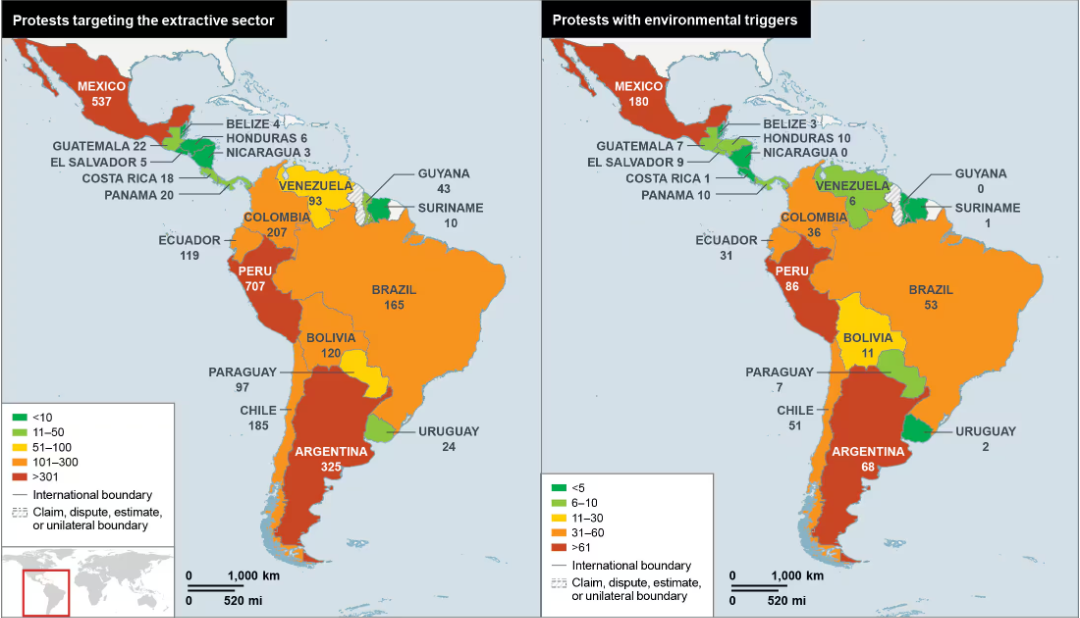
    S&P also identifies what it describes as three main ESG drivers. These are: first, violence against activists (including those defending human rights and land rights); second, community disputes (including those about contamination, water use, employment, and indigenous community participation); and third, deforestation (with links to land rights, indigenous protection, and climate change issues). Local communities often campaign against big new projects in mining and hydrocarbons with hot spots in Argentina, Colombia, Ecuador, Mexico ,and Peru.

    According to a map of Latin America prepared by S&P, in the first nine months of 2022 there were 2,710 protests targeting extractive industries, of which 58% were concentrated in Peru, Argentina, and Mexico. A separate map lists 559 “protests with environmental triggers”. The same three countries – Peru, Argentina, and Mexico – accounted for 60% of the total. 

    Intelligence events showing protests targeting the extractive sector and protests with environmental triggers January 2020-September 2022

    Source: IHS Markit

  • BARBADOS: Third IMF review goes well

    Patrick de Courcy 23 August 2024 Hits: 656

    Following its third review of the Barbadian economy at the end of June, the International Monetary Fund (IMF) gave the green light for further disbursements.

    The IMF is assisting Barbados with two major loans, the Extended Fund Facility (EFF) and the Resilience and Sustainability Facility (RSF). It said that all performance criteria and indicative targets for the third review had been met, allowing the immediate disbursement of US$19m under the EFF and US$37m under the RSF. Total cumulative disbursements under the two facilities are currently around US$187m.

    In its review the IMF said the economy has recovered to levels registered prior to the coronavirus (Covid-19) pandemic and will remain strong this year due to a good performance by tourism and related sectors. GDP rose by 4.4% last year while inflation moderated despite bad weather, which put some pressure on food prices. By the end of this year annual inflation is being predicted at 3.1%.

    The Bajan economy’s large current account deficit has begun to narrow, from 9% of GDP last year to a projected 7.4% this year. The IMF is not too concerned however, since the country is deemed to have ample foreign currency reserves, equivalent to over seven months’ worth of imports.

    On the budget front the government exceeded the agreed primary surplus target for the 2023/2024 fiscal year (FY) and is now seeking a surplus equivalent to 4% of GDP in 2024/2025. Total public debt as a proportion of GDP has fallen back to pre-pandemic levels and the Bridgetown government has ratified its promise to reduce it further to no more than 60% of GDP by 2035.

    The IMF notes a number of reforms and new initiatives are ongoing and designed to improve climate change resilience. They include a new Stormwater Management Act and an efficiency framework for government agencies and public lighting.

  • TRACKING TRENDS

    Abbi Dicker 03 April 2025 Hits: 2381

    BRAZIL | Unemployment continues ticking up. The national statistics institute (Ibge) released new figures on 28 March which showed that the country’s unemployment rate in the rolling quarter of December 2024-February 2025 stood at 6.8%, corresponding to 7.5m unemployed people. This marks an increase from the jobless rate of 6.5% registered for November-January; from the 6.2% for October-December; and 6.1% for September-November.

    Despite the quarterly rise, the Ibge highlighted that the latest result is the lowest unemployment registered for the December-February rolling quarter since the quarter ending in February 2014. The latest quarterly figure is also lower than the 7.8% unemployment rate registered for December 2023-February 2024. Compared with the September-November rolling quarter, no economic sector registered a rise in employment in December-February. The sectors which had the greatest quarterly drops in employment were construction, which saw a decrease of 310,000 employed people (-4.0%), and domestic services, down 290,000 people (-4.8%).

  • PARAGUAY: Peña eyes cabinet reshuffle

    Abbi Dicker 09 April 2026 Hits: 1135

    As Paraguay’s President Santiago Peña embarks on the second half of his presidential term, he has indicated that a “new stage” is on the way. This looks set to include a shake-up of his team. In the past week, Peña has announced the departure of his economy and finance minister, Carlos Fernández Valdovinos, and replaced the head of the national police (PN), as well as reshuffling other high-level security positions. This comes as Peña and others in his government have hinted that more cabinet changes could be on the way, as the president looks to maintain momentum in the second half of his term and faces an ever-more challenging international environment.

    The changes to the security top brass were announced by Interior Minister Enrique Riera on 7 April. Riera stated that César Roberto Silguero Lobos would be the new commander of the PN. He emphasised that Silguero, who had been serving as deputy commander, had a background in criminal investigation. Silguero replaces Carlos Benítez, who will take over as deputy minister for internal security. Other changes included the director general of prevention and security, head of intelligence, and head of internal affairs.

    Riera said the changes were aimed at modernising the PN and fulfilling the government’s strategic security plan. Benítez has indicated that, in his new role, he will focus on ensuring security in the Paraguayan section of the Bioceanic Corridor, which will connect Brazilian ports on the Atlantic to Chilean ports on the Pacific, passing through Paraguay and Argentina, to avoid it becoming a hotspot for organised crime. The restructuring of the security team also comes as Peña has ramped up military deployment in the eastern region of the country in recent months in a bid to combat organised crime.

    The changes at the PN and security ministry followed that at the economy and finance ministry (MEF). The government announced Fernández Valdovinos’ resignation on 31 March, saying he would be replaced on an interim basis by Juan José Galeano Paredes, a presidential adviser on social and economic issues. On 8 April the government announced that Oscar Lovera, the current deputy minister for financial administration, would take over as head of the MEF with the stated aim of “improving the efficiency of public spending and supporting growth”.

    A former president of the central bank (2013-2018), Fernández Valdovinos had served as economy and finance ministry since the start of the Peña administration in August 2023. His departure comes despite Paraguay having recorded GDP growth of 6.6% in 2025, up from 4.7% in 2024 and the country being upgraded to an investment-grade rating by international credit ratings agency S&P Global in December.

    However, Fernández Valdovinos also leaves shortly after having declared “a war-time economy” in the public administration following a sharp decline in the tax take last year and amid high-levels of debt with government suppliers. His replacement also follows an unpopular reform to the public sector pension system which was spearheaded by the MEF and was ultimately significantly watered down by congress.

    Speaking to reporters on 6 April, Peña said that he would “probably” make more changes to his government, stating that “every member of the cabinet is a piece that can be changed”. This has been echoed by others, with Vice President Pedro Alliana telling a local radio station that he had recommended Peña make four cabinet changes six months ago, and that just two of these had been carried out. Additionally, Silvio Ovelar, a senator for the ruling Asociación Nacional Republicana-Partido Colorado (ANR-PC), has indicated that Peña should make at least two or three more changes.

    Leite

    Paraguay’s ambassador to the US, Gustavo Leite, has been fiercely critical of Carlos Fernández Valdovinos in the wake of his departure, questioning his management of the MEF and alluding to potential irregular practices. Asked about his comments, President Peña made it clear that he did not share Leite’s opinion and recognised that he and Leite had had their differences in the past. Peña added that such comments were not “typical” from a diplomatic representative.   

  • BRAZIL: Rousseff appoints fourth supreme court judge

    LatinNews 30 May 2013 Hits: 3278

    President Dilma Rousseff has appointed a 55-year old constitutional law professor, Luís Roberto Barroso, to Brazil’s 11-member Federal Supreme Court (STF), filling a vacancy left by the retirement of Carlos Ayres Britto in November 2012. The new appointment, while broadly welcomed by local legal experts, must be ratified by the senate, prompting concerns that Barrroso’s involvement in Rio de Janeiro state’s direct action of constitutionality (Adin) against the congressionally approved legislation to amend the country’s oil royalties’ framework may work against him.

    The STF, led by its combative new president, Joaquim Barbosa, has had several run-ins with congress, most recently over the Adin and a (failed) constitutional amendment proposal (PEC) to grant congress the power to review certain STF decisions [WR-13-16], but before that also over the mensalão congressional corruption case, which went to trial in September 2012 and was overseen by Barbosa.

    Barroso’s appointment came a day after Barbosa confirmed that he would not decide on the sentences for the 25 people convicted in the mensalão case until the second half of the year, pending a string of appeals by the convicted.

    • ‘The Uerj bench’

    The new Federal Supreme Court (STF) magistrate Luís Roberto Barroso, who has a Masters from Yale University, teaches at the Universidade Estadual do Rio de Janeiro (Uerj). The STF president Joaquim Barbosa and another STF magistrate, Luiz Fux, also hail from the Uerj; together the trio are dubbed ‘the Uerj bench’ by the local press. Since taking office in January 2010, President Rousseff has also appointed Fux, Rosa Webber and Teori Zavascki to the supreme court bench, while Barbosa became the STF president on her watch (in November 2012).

  • VENEZUELA: Recurriendo una vez más al banco de China

    LatinNews 29 July 2013 Hits: 752

    El gobierno del Presidente Nicolás Maduro tiene la esperanza de asegurar un préstamo de hasta US$5mm de China dentro de las próximas dos semanas, dijo el presidente del banco de desarrollo social y económico (Bandes), Temir Porras. El préstamo que será negociado en Caracas con el Banco de Desarrollo de China (BDC), financiaría al Fondo Conjunto China-Venezuela que invierte en viviendas, infraestructura, y proyectos productivos, y paga los préstamos con embarques de petróleo.

    El Vicepresidente Jorge Arreaza visitó China la semana pasada, y estaba claramente en una misión para persuadir a los chinos a que desembolsen más recursos para el Fondo. China ha planteado dudas acerca de cuán eficientemente han sido usados los recursos financieros en el pasado, y no estará demasiado impresionada por el hecho de que significativas sumas de dinero supuestamente fueron malversadas del Fondo: ocho empleados fueron arrestados la semana pasada en Venezuela, acusados de canalizar US$84m desde el Fondo, que es administrado por Bandes.

    Bandes se ha convertido en sinónimo de corrupción. La comisión de valores y cambios de EU (SEC, siglas en inglés) recientemente acusó a cuatro personas vinculadas con la firma DAP de corretaje con base en Nueva York, en un masivo esquema de soborno de US$66m para asegurar el negocio de operaciones de bonos de Bandes. Una porción de esto fue pagado ilícitamente al vicepresidente de finanzas en Bandes [IL-13-24].

    La oposición afirma que la vasta suma de dinero que Venezuela está prestando de China, está hipotecando el futuro  de la generación joven del país. Una nueva base de datos interactivo lanzado por el think-tank, Inter-American Dialogue, de EU, esta semana (ver abajo) ubica el total de préstamos hechos a Venezuela por China, durante los cinco años hasta agosto del 2012 en US$44,5mm, más que los préstamos combinados de China a todo el resto de la región durante este periodo. El ministro del petróleo, Rafael Ramírez, afirmó el pasado agosto, que Venezuela ya había devuelto US$17,9mm de estos préstamos.

    • Base de datos

    La China-Latin America Finance Database, lanzada por el Inter-American Dialogue apunta, en sus propias palabras, a proveer “información actualizada sobre los préstamos chinos en América Latina, por país, entidad crediticia prestadora, sector, y año”. Y afirma que desde el 2005, China ha proveído más de US$87mm en compromisos de préstamos a países de América Latina, y que los compromisos de préstamos de US$37mm en el 2010, dejan atrás a los préstamos del Banco Mundial (BM), Bando Interamericano de Desarrollo (BID), y el Export-Import Bank (ExIm Bank) de EU combinados.

  • Paraguay: Not just soya

    LatinNews 29 October 2015 Hits: 266

    Along with Bolivia, Paraguay is also set to be one of South America’s more dynamic economies in 2015 and 2016, with predicted growth rates of 3.3% and 3.6%, according to Eclac. In part this is because, as a largely agricultural economy at a fairly early stage of development, high growth rates are relatively normal. In the 10 years to 2013 Paraguayan GDP growth averaged 4.9%. As an oil importer, Paraguay is also benefiting from an improvement in its terms of trade.

    According to the Paraguayan Central Bank’s monthly economic activity indicator (known as Imaep) output in the first eight months of this year rose by 3.4%. Officials say this comparatively strong growth rate reflects recently increased agricultural production estimates, and a strong showing by sectors such as household services, financial services, public sector enterprises and hotels and restaurants. Paraguay is the world’s fourth largest soya exporter and also ships other agricultural commodities such as cotton and tobacco. The government says the 2015/16 soya harvest could reach 10m tonnes, up from 8m in the 2014/15 season. But here too the authorities seeking to promote economic diversification. Jorge Moreno of construction industry association Cámara Paraguaya de la Construcción (Capaco) notes that at the midway point of 2015 various road building projects in the country had begun to gather pace. Jorge Pappalardo, vice president of the industrialists’ association (Unión Industrial Paraguaya – UIP) described the local economy as showing “good dynamism”.

    Brazil’s recession is widely seen as having a negative impact on Paraguay, its comparatively tiny neighbour (in terms of both population and market size). While the Brazilian shock waves are clearly a problem, there is also a sense in which the crisis next door creates some significant opportunities for Paraguay. Under the existing Ley de Maquila introduced in the 1990s, Paraguay offers attractive tax breaks to companies that import machinery and raw materials for processing by local labour, on condition that 90% of their output is directly re-exported. The law, modelled on Mexico’s long-standing special regime for maquiladoras – assembly plants dotted along its northern frontier with the US – exempts companies from all major local taxes, apart from a 1% levy on exports.

    Operating in Paraguay has therefore become increasingly attractive for Brazilian companies that are seeking to escape from their high domestic production costs and taxation liabilities. Apart from the tax breaks, they benefit from lower wage and energy costs. For industrial customers, electricity tariffs in Paraguay are roughly half their level in Brazil. The Itaipú hydroelectric complex, built decades ago in partnership with Brazil, remains the second largest of its kind in the world (after the Three Gorges complex on the Yangtze River in China), and the cheap energy it produces is a major asset for Paraguay. Over 40 Brazilian companies are reported to be carrying out assembly operations in Paraguay in industries such as textiles, auto parts, toys and plastics. Sarah Saldaña of Brazil’s lobby group Confederação Nacional da Industria (CNI), which recently organised a mission to Paraguay for a total of 79 Brazilian companies, says the intention is not to have them close down their operations in Brazil but to “make them stronger and more competitive and to get them more involved in international production chains”. She says Paraguayan maquiladora exports, most of which are produced by Brazilian companies, rose by 52% last year to reach US$260mn.

    Gustavo Leite, Paraguay’s economy minister, points out that despite Brazil’s economic slowdown, last year Paraguay’s exports to Brazil actually rose by 18%. In more general terms, asked to explain Paraguay’s comparatively strong growth rate in the face of its neighbours’ difficulties, he said “it is a prize we have won for having a healthy economy based on renewable and non-extractive resources”. Leite stresses the attractions of cheap hydroelectric energy, a labour force that is “eager to learn” and has high productivity and low absenteeism, and a geographic location alongside “a neighbouring giant with competitiveness problems”. Finance minister Santiago Peña has also commented “we are pushing to diversify beyond agriculture”.

    In terms of macroeconomic policy the government of President Horacio Cartes is market-friendly and pro-business: there is for example a flat 10% tax rate. In June US ratings agency Standard & Poor’s put Paraguay’s BB rating on a positive outlook, saying that the country was displaying “increasing resilience” to the difficulties of its neighbours. Recognising the increased global headwinds – lower global commodity prices and the poor showing of trade partners Brazil and Argentina – earlier this year the Paraguayan Central Bank cut its key interest rate by one percentage point to 5.75%. Central Bank president Carlos Fernández Valdovinos has commented that this countercyclical measure is intended to keep the economy moving without risking a rise in inflation (the current inflation target rate is 4.5%). In October Fernández said “With the 100 basis points that we have already cut, we have given enough stimulus to demand and, for the moment, bigger cuts are not needed anymore”. He added, “We can’t pretend to grow at the same speed having Brazil contracting”.

  • ARGENTINA: Large cash seizures puzzle authorities

    LatinNews 28 August 2020 Hits: 1610

    In recent months Argentine police have seized millions of Argentine pesos and thousands of US dollars in cash, concealed inside trucks transporting goods through provinces bordering Paraguay. This is a new development in Argentina’s security landscape, raising questions about the origin and destination of the money, as well as the activity of criminal organisations. 

    A pattern of unusually large illegal cash seizures was first noticed in Santiago del Estero province, on the Ruta Nacional 34 highway linking northern Argentina to the capital, Buenos Aires. This led the police, usually on the lookout for shipments of drugs or contraband, to pay closer attention to cash smuggling. From May to July, authorities reportedly seized a total equivalent of Ar$60m (US$816,000) in different currencies, hidden inside lorries intercepted in a number of northern provinces. A single haul will sometimes involve millions of pesos, and gold bars have also been seized on a number of occasions. As well as this circulation of cash, authorities say they have noticed an increase in the transport of contraband such as mobile phones and cigarettes, and a decrease in the seizure of drugs, during the coronavirus (Covid-19) pandemic.

    There are different theories to explain this movement of large sums of cash. Specialist website InsightCrime notes that contraband is increasing in northern Argentina, as border closures due to the pandemic have shifted criminal dynamics and opened up new opportunities. Guillermo Molinari, a federal judge in Santiago del Estero, told national daily La Nación in mid-June that the money, which at the time totalled around Ar$33m, was assumed to belong to the same organisation, and destined to purchase drugs or to be laundered.

    Public Security Minister Sabina Frederic told cable news channel A24 in July, however, that the hypothesis that the money was linked to drug trafficking or to a money laundering scheme had been discarded in favour of another line of investigation: that the cash is intended for the wholesale purchase of counterfeit clothing from clandestine workshops, which is then re-sold in informal markets in the north of the country known as ‘saladitas’. Buyers would normally make the trip to Buenos Aires themselves, but have been prevented from doing so due to the Covid-19 restrictions, and have therefore been making the payments in cash to avoid fees and taxes. This theory is shared by Pedro Simón, a federal prosecutor in Santiago del Estero. 

  • THE BAHAMAS: Reeling from the climate change punches

    Sarah Sheldon 22 April 2024 Hits: 1196

    A new United Nations (UN) report focuses on The Bahamas as an example of the growing financial cost of climate change and health pandemics. Natural disasters are becoming more frequent, are leading to increased foreign debt, and are restricting both the value and impact of social programmes.

    In per capita terms The Bahamas is one of the wealthiest nations in the Caribbean, but it has not been able to escape a series of economic body-blows. Since 2012 the country, with a 400,000 population, has been hit by no less than five major hurricanes. They include Hurricane Joaquin (2015), Matthew (2016), Irma (2017), and Dorian (2019). Of those, Dorian was by far and away the most destructive with over 70 people killed, and damages estimated at US$3.4bn, equivalent to roughly one-fourth of GDP. As if that were not enough, the highly tourism-dependent Bahamas was also hit by the coronavirus (Covid-19) pandemic in 2020 which triggered a 24% fall in GDP that year.

    Attiya Waris, the report’s author, who is also a UN independent expert on foreign debt, says the growing cost of climate change is forcing Caribbean governments to spend less on support programmes such as food assistance, business loans, and unemployment benefits. In the case of The Bahamas after Dorian, the government was forced to raise US$500m in additional debt, almost doubling its debt servicing costs. Waris calls for a series of measures from the international community, including more concessional lending, write-downs for climate disaster-related debts, and contributions to the proposed Loss and Damages Fund (agreed last November at the UN climate change conference [COP28] in the United Arab Emirates). She also recommends strengthening taxes and reducing finance-related corruption such as money-laundering. The report notes that while Caribbean countries such as The Bahamas are suffering the sharp end of climate change losses, they have contributed least to global warming. In fact, The Bahamas contributes less than 0.01% to global greenhouse gas emissions.

  • TRACKING TRENDS

    Abbi Dicker 26 June 2025 Hits: 1609

    BRAZIL | Nigeria and Brazil aim to boost agricultural cooperation. On 24 June Vice President Geraldo Alckmin attended the Nigeria-Brazil Strategic Dialogue Mechanism, an event in the Nigerian capital of Abuja, where officials announced a US$1bn initiative known as the Green Imperative Programme. Under the bilateral initiative, Brazil will provide agricultural machinery and technology for Nigeria’s farming sector.

    In addition to this agricultural programme, the Brazilian delegation signed deals in other areas, such as defence cooperation, coordination between police forces to combat organised crime, and renewable energy production.

    BRAZIL | Monthly rise in household consumer confidence. The business lobby group Confederação Nacional do Comércio de Bens, Serviços, e Turismo (CNC) released new figures on 23 June for its household consumption intention index (ICF), which showed a monthly rise of 0.5% in June but a 1.3% decline in consumption intention compared with June 2024.

    In a press release, the CNC highlighted that households have perceived a boost in access to credit, with 32.6% of survey respondents in June saying that they felt it was easier to borrow money.

    However, the CNC also noted that consumers are aware of economic signals, such as the persistence of high interest rates, which has affected purchases of items such as durable goods, a product category which posted a 7.0% year-on-year decline in sales in June.

    URUGUAY | Orsi rules out wealth tax. Uruguay’s President Yamandú Orsi announced on 24 June that his government had no intention of creating more taxes.

    Orsi’s statement followed a request from the umbrella trade union Plenario Intersindical de Trabajadores-Convención Nacional de Trabajadores (PIT-CNT), which is traditionally allied with the ruling left-wing Frente Amplio (FA), to introduce a 1% tax on the wealthiest Uruguayan citizens to contribute to the fight against child poverty.

    Senior representatives of the PIT-CNT met Orsi on 23 June to discuss the proposal. The president of the PIT-CNT, Marcelo Abdala, maintained that the tax would not negatively affect investment and could raise the equivalent of 1% of GDP. Orsi demurred. However, he did say that he would keep a close eye on discussions surrounding the global minimum tax, that would be paid by large corporations, which he said could have a big impact.

  • BARBADOS: Growth set to ease in 2025

    Abbi Dicker 18 July 2025 Hits: 3115

    Economic growth in Barbados will trend down from 4% in 2024 to 2.7% this year, according to a broadly upbeat economic report from the International Monetary Fund (IMF).

    Released on 27 June, the report says economic growth last year was “robust” and driven by tourism, construction, and business services. This year, growth is being led by tourism-related construction projects and government investment. Inflation moderated to 1.4% but will pick up due to the rising cost of non-fuel imports and that of some domestic agricultural products. The external position has continued to improve, with the current account deficit narrowing to 4.5% of GDP and gross international reserves reaching US$1.6bn, representing over seven months of import cover, and supporting the exchange rate peg. The government has met fiscal targets agreed with the IMF and is aiming for a primary fiscal surplus equivalent to 4.4% of GDP in the 2025/26 financial year. It is also on track to reduce the public debt-to-GDP ratio from 105% of GDP last year to 60% by 2035/36.

    The report was the fifth and final review of an Extended Fund Facility (EFF) and the Resilience and Sustainability Facility (RSF), between them totalling around US$309m. Under the terms of this financial support, Barbados has initiated a series of reforms, including preparing a public-private partnership (PPP) framework. Despite the IMF’s positive assessment, it said risks to the outlook remain tilted to the downside “given the highly uncertain economic environment and Barbados’ vulnerability to shocks and natural disasters.”

  • HONDURAS: The IMF dispatches a ‘medical’ team

    LatinNews 05 September 2012 Hits: 1480

    As part of its declared ‘fiscal emergency, the government led by President Porfirio Lobo announced ‘Operation Scissors I’ to cut and/or freeze senior public sector salaries, including those of the president and the executive, ahead of the arrival in Tegucigalpa of the International Monetary Fund (IMF) at the start of September.

    The IMF said it was on a “medical mission” to merely “take the pulse” of the country and President Lobo himself played down the chance of a new stand-by agreement (SBA) immediately. The last US$207m SBA expired in March and talks on a new deal foundered before they ever got underway amid disagreements over the macroeconomic targets. Honduras missed its fiscal targets last year. Lobo’s first finance minister William Chong Wong quit in February saying he could not reconcile the Fund’s demands with the social reality in Honduras. However Honduras needs the deal – upon which depends US$130m in subsidiary credits from the World Bank and the Inter American Development Bank.

    Having long since diagnosed the problem as the bloated size of the state, the Fund has recommended its usual strict fiscal regime and strenuous exercise of spending restraint. The patient, predictably, is very loathe to follow through on the recommendations and regularly falls off the wagon, putting its medium and long term health at risk. It doesn’t help that its dependents – in this case the national electricity company (ENEE) – are broke.

    Honduras’ projected fiscal deficit in 2012 is now about 5.0% of GDP. Forecast real annual GDP growth this year is about 3.0%. High global food and oil prices have added to import costs and caused domestic price pressures. The first half trade deficit was US$358m, on exports of US$2.13bn and imports of US$2.66bn. Net international reserves were US$2.05bn as of 31 August, on central bank figures, down US$260m since 1 January, hardly a good starting point for the talks with the Fund.

    Honduras “stained with blood”

    Five decapitated bodies, limbs bound, were found dumped in rubbish bags in the port town of La Ceiba, one of the country’s most violent, on 1 September. Four of the young corpses were female, aged just 16-22, with one male put at about 24 years old. Just a day earlier in the capital Tegucigalpa, police found three corpses cut up into bits, apparently by a chainsaw. Again, the dismembered bodies were simply dumped on local streets in rubbish bags, evidence of the impunity with which criminals operate in Honduras, where there were 20 homicides a day on average last year.

      On 1 September, the country’s national flag day, the Catholic auxiliary bishop for the archdiocese of Tegucigalpa, Juan José Pineda, lamented in a sermon, “Honduras is stained with blood...The words of our national anthem, our illustrious heroes, you and I, we are stained with blood…In our country there is violence, not peace. There is hate, not fraternity…and the men of today don’t want to talk about the law or about the objective norm of our work”.

      The bishop called on the faithful to live and work “in coherence” with their religion and not to “dirty their hands”. “For a Christian it’s not just about going to mass on Sunday….they must also live a coherent life”, he stated. About 97% of Hondurans are Roman Catholic.

    • Model cities

    Juan Orlando Hernández, the head of congress and 2013 presidential hopeful for the ruling Partido Nacional (PN), on 4 September announced that the Comisión para la Promoción de Alianzas Público-Privadas (Coalianza), which is attached to the finance ministry, had signed an agreement with private investors for the first ‘special development zones’ or ‘model cities’. He identified three potential sites: the Valle de Sula region in the department of Cortés; the Sico-Paulaya and Agalta valleys, adjacent to Puerto Castilla, and the so-called ‘southern region’. He said investors had selected the sites for their proximity to sea and airports. Hernández did not identify the investors but after a recent trip to South Korea he strongly hinted at interest from the South Asian country. He claimed that the initial construction works would create 5,000 new jobs from October, and a total of 40,000 by 2015.  


  • PARAGUAY: Se inicia la batalla de las encuestas

    LatinNews 02 April 2013 Hits: 1183

    Horacio Cartes, el candidato presidencial por la Asociación Nacional Republicana- Partido Colorado (ANR-PC), está teniendo una ventaja ante las elecciones generales del 21 de abril, aunque las encuestas de opinión difieren dramáticamente sobre el margen de esa ventaja. Su principal rival, Efraín Alegre, que compite por el Partido Liberal Radical Auténtico  (PLRA), intensificó sus ataques contra Cartes durante el último debate televisado, que cubrió temas que van desde la salud y educación hasta el combate a la pobreza y la protección del medioambiente.

    Una encuesta hecha por el Gabinete de Estudios de Opinión (GEO), publicada en el diario nacional Última Hora, daba a Cartes una estrecha ventaja sobre alegre (36,8% - 35,6%), mientras que otra encuesta de Grau y Asociados, publicada en el mismo diario, otorgaba a Cartes una ventaja dominante de 42,7% frente a 29,2%. El sondeo de GEO fue conducido una semana antes (6-15 de marzo y la encuesta de Grau entre el 13-21 de marzo), pero parece improbable que Cartes haya surgido adelante en tal extensión de tiempo. Ambas encuestas están de acuerdo en que Mario Ferreiro, un presentador de televisión que compite por la coalición de izquierda Avanza País, está en un distante tercer lugar con menos del 10% del apoyo de los votantes.

    Pese a la falta de fiabilidad de las encuestas, la tendencia desde comienzos de año sugieren que Cartes está delante de Alegre, provocando que el último  se vuelva más agresivo retóricamente. Después de la promesa de Cartes durante el debate de incrementar el presupuesto de salud de US$800m a US$3mm para el 2018, a fin de asegurar que "la salud llegue a cada rincón del Paraguay", por medio de clínicas móviles, Alegre respondió preguntando ¿De qué clase salud está usted hablando si su negocio es matar personas [...] su negocio es la enfermedad? Esta fue una alusión a las compañías de tabaco y alcohol de propiedad de Cartes. Sorprendentemente, Alegre fue menos beligerante cuando preguntó a Cartes cómo iba a financiar su propuesta para un enorme incremento en el presupuesto de salud.

    • Combatiendo la pobreza

    Horacio Cartes presentó más propuestas que su rival Efraín Alegre durante el debate televisado, aunque él no fue siempre enteramente claro sobre cómo las mismas serían financiadas. Él dijo que el presupuesto para combatir la pobreza se había incrementado en 377% entre el 2008 y el 2012, pero que la pobreza no se había reducido en "un sólo dígito". Él criticó los actuales programas anti-pobreza, y alegó que era necesario "enseñar al pueblo a pescar en vez de darle un pescado". También prometió invertir US$1,3mm durante los cinco años de su mandato para garantizar agua potable para el 75% de hogares y cloacas para el 55%.


  • ECUADOR: Correa shows pragmatic side

    LatinNews 24 July 2014 Hits: 1525

    Ecuador’s President Rafael Correa reached two significant agreements last week with a politician he accused back in February of representing right-wingers intent on destabilising his government. Correa’s two-hour meeting with the new opposition mayor of Quito, Mauricio Rodas, who defeated the ruling Alianza País (AP) incumbent mayor Augusto Barrera in last February’s elections, resulted in transport accords related to the metro and trolleybus systems.

    Correa and Rodas promised to keep channels of communication open, and the constructive dialogue suggests that, beyond the rhetoric, Correa is able to work with political adversaries. This has proved beyond some of the region’s radical Left. Venezuela’s late president Hugo Chávez (1999-2013), for instance, denuded the elected (opposition) mayor of Greater Caracas, Antonio Ledezma, of power in April 2009 by appointing a head of the Capital District, Jacqueline Farías, assigning her 90% of the resources Ledezma had received.

    President Correa confirmed to Rodas that his government would provide US$750m for the metro. The meeting took place after four consortiums presented bids for phase two of the project to construct 13 of the 15 stations and complete tunnelling works to lay the track, and Correa and Rodas promised to evaluate and discuss them.

    Four multilaterals – the World Bank (WB), the European Investment Bank (EIB), the Development Bank of Latin America (CAF) and the Inter-American Development Bank (IDB) – have signed agreements to provide funding to the tune of US$900m for the project, but this could still leave a shortfall of up to US$700m based on the bids presented for phase two.

    The 23km metro system is scheduled for completion in 2016. It will carry 400,000 people a day, reducing notorious traffic jams in the capital, improving air quality, and saving an estimated 120m hours of productivity a year by allowing commuters to criss-cross Quito in just 34 minutes as opposed to the current average of some two hours.

    Correa also told Rodas that US$15m would be made available from Ecuador’s State bank (Bede) to revamp Quito’s electric bus system. Rodas had savaged his predecessor for the poor upkeep of the system and for failing to attract bidders in a public tender for 40 new trolleybuses meaning the funds had to be returned to the Bede. Rodas declared the capital’s public transport system to be in a state of emergency on 30 June. He claimed that 58% of the 235 electric buses in Quito were in a poor state of repair and 25% out of order.

    Rodas said that under his planned improvements, bus stops would be totally overhauled, with the provision of a free Internet service and digital information screens updating the arrival times of buses. He also said that (unspecified) rigorous measures would be taken to stop private companies from using the exclusive rapid transit lines used by the electric buses, and that 100 metropolitan police would be assigned to designated ‘high-risk’ areas to improve safety to cut down on theft.

    • Ecuador gets EU trade deal

    On 17 July negotiators from Ecuador and the European Union (EU) finalised a deal for Ecuador to adhere to the existing EU Association Agreement with Colombia and Peru. The EU is Ecuador’s biggest market for non-oil exports. EU-Ecuador trade was worth €4.9bn (US$6.6bn) in 2013, on official EU figures, with Ecuador’s exports totalling €2.5bn (US$3.4bn), giving the Andean country a small surplus. Ecuador’s export sector estimates that existing exports to the EU could rise by US$500m under the new agreement. However, the deal still requires ratification by the parliaments of each of the EU member states, so it is expected that it will only come into full effect in the second half of 2016.

  • CHILE: Bachelet en África

    LatinNews 15 August 2014 Hits: 670

    En su más extensa gira por el exterior desde que asumió el poder por segunda vez en marzo pasado, la Presidenta Michelle Bachelet ha conducido una visita de seis días en África, con escalas en Sudáfrica, Mozambique, y Angola. Mientras que su agenda incluyó cuestiones como los derechos de género (Bachelet es una ex titular de UN Women), su gira apuntaba a reforzar los lazos en las áreas clave de comercio, energía y minería.

    Acompañada de sus ministros de energía, minería, y relaciones exteriores, Máximo Pacheco, Aurora Williams, y Heraldo Muñoz respectivamente, la Presidenta Bachelet comenzó su visita el 8 de agosto con una escala de tres días en Sudáfrica, donde ella se reunió con el Presidente Jacob Zuma. De acuerdo con un comunicado de prensa del ministerio de relaciones internacionales y cooperación de Sudáfrica, los dos líderes discutieron una serie de tópicos, incluidas la igualdad de género y la defensa (ambos reconocieron el “significativo –ámbito para la cooperación en intercambios de oportunidades de entrenamiento”).

    Sin embargo, las áreas clave de las discusiones, teniendo en cuenta las continuadas preocupaciones relacionadas con el lento crecimiento en Chile, fueron el comercio (Sudáfrica es el más grande socio comercial de Chile en África), minería, y energía. Según cifras del banco central de Chile, Sudáfrica suma sólo US$225,7m del total del comercio de Chile por un valor de US$155,86mm en el 2013, mientras que África suma US$437,3m. Se firmó un memorándum de entendimiento para establecer una comisión bilateral de comercio e inversiones en julio del 2012 y de acuerdo c una declaración conjunta de Bachelet y Zuma, la primera reunión de la comisión tendrá lugar en Santiago “antes de finalizar el 2014 con el objetivo de finalizar un plan de acción de corto, mediano, y largo plazo”.

    En cuanto a la energía, la declaración señala que Chile (que está buscando abordar la perspectiva de un déficit de energía [IL-14-20]) “ha expresado un interés en el Plan Maestro de Energía de Sudáfrica”, y que el diálogo entre los ministerios relevantes “se crearía para investigar las maneras de mejorar la cooperación en ese sentido”. En el área de la minería los dos pidieron a las autoridades relevantes que finalicen  una propuesta de “acuerdo bilateral sobre la cooperación en el campo de los Recursos Minerales.

    Mientras que la visita de Bachelet no logró producir acuerdos concretos, su escala en Angola produjo la promesa de importaciones de petróleo. Pacheco dijo a los periodistas que bajo el protocolo existente, Chile planea importar US$300m de crudo de Angola este año, en tres embarques, dos de los cuales ya habían llegado, y con el tercero que debe llegar a fin de septiembre. Él dijo que en el 2015, las importaciones de petróleo crudo podrían incrementarse a US$900m, haciendo de Angola el más grande proveedor de crudo del país fuera del continente latinoamericano.

    Nuevo Jefe Ejecutivo (CEO) de Codelco

    El directorio de la compañía minera de cobre de propiedad del estado chileno, Codelco, ha designado a Nelson Pizarro Contador como su nuevo CEO, reemplazando a Thomas Keller, quien fue designado en el 2012 por el predecesor de la Presidenta Bachelet, Sebastián Piñera (2010-2014) pero a quien se le pidió la renuncia el 5 de junio. Keller dijo a los periodistas que su visión no estaba en línea con el resto del directorio, particularmente en relación a las “inversiones que no resultaron rentables para el público chileno”.

    La designación de Pizarro, quien muy recientemente tenía el puesto de presidente ejecutivo de la compañía Minera Lumina Copper Chile, una subsidiaria de Pan Pacific Copper, de Japón, siguió a la del economista Oscar Landerretche, a quien la Presidenta Bachelet nombró como presidente de la junta de directores de Codelco en mayo pasado. Eso ocurrió en un punto clave en medio de esfuerzos para una revisión de la compañía minera del estado, que ha registrado una continuada declinación en su producción. Según cifras de la comisión chilena del cobre, Cochilco, Codelco produjo 1.621m de toneladas (t) de un total de 5.776m t de cobre en el 2013, cayendo de 1.646m t en el 2012, y 1.735m t en el 2011.

    El 23 de julio, Landerretche dijo al comité minero del congreso que Codelco buscaría emitir una deuda de alrededor de US$1,7mm para ayudar a financiar un ambicioso plan de inversión para 2014-2018. Codelco estima que necesita invertir un promedio de US$4,5mm anualmente durante los próximos 5 años, para modernizar sus ya anticuados depósitos y contrarrestar la caída en los grados del mineral.

    • Evitan una disputa con Venezuela

    Felipe Cuevas, el joven líder de la Unión Demócrata Independiente (UDI), el socio principal en la opositora Alianza por Chile, fue arrestado en Caracas el 7 de agosto, amenazando provocar una riña entre Venezuela y Chile. El presidente de la UDI, Ernesto Silva, dijo a los periodistas que Cuevas había sido invitado a Venezuela por la oposición. Él se reunió con la líder de la oposición, María Corina Machado, y asistió al juicio de otra figura de la oposición  venezolana, Leopoldo López. El embajador de Chile en Venezuela, Pedro Ramírez, dijo a los periodistas que Cuevas fue arrestado por tomar fotos en un lugar no autorizado y por no tener documentos de identificación. Siguiendo a las protestas de funcionarios chilenos y amenazas de medidas diplomáticas de parte de Jorge Tarud, el presidente del comité de relaciones exteriores de la cámara baja, y miembro de la gobernante Nueva Mayoría por el Partido por la Democracia (PPD), Cuevas fue dejado en libertad al día siguiente.