All Categories

Subcategories

  • Shield of the Americas: a new opportunity?

    Abbi Dicker 22 October 2026 Hits: 33

    The fact that most Latin American governments have now swung to the right of the political spectrum, including the four we have highlighted here, could open doors to a more coordinated and cooperative response to the activities of criminal cartels, which have themselves been operating in cross-border fashion for decades. A potential vehicle for doing so is the Shield of the Americas, a crime and security coalition set up by the US in March of this year, and more formally known as the Americas Counter Cartel Coalition (A3C).

    As of August 2026, A3C has 19 members, including Colombia, Argentina, Ecuador, El Salvador, Costa Rica, Chile, and Peru. However, the two largest and most populous countries in the region, Brazil and Mexico, have not joined. At the time of writing both were ruled by centre-left governments but following Brazilian elections in October, that may well change. Nevertheless, under their current political alignments, Brazil and Mexico are both highly sensitive to any US intervention in their internal crime and security issues. The absence of the two countries is seen as limiting A3C’s effectiveness, particularly given the importance of the cross-border flow of illicit drugs from Mexico to the US.

    When initially set up, A3C was seen as a US-led military cooperation framework focused on sharing intelligence, strengthening border and marine security, disrupting drug trafficking and organised crime, coordinating the battle against the cartels, carrying out joint military and security exercises, and possibly using US military capabilities against cartel networks. US officials talk of A3C as providing “hard security” such as the US military attacks on presumed drug trafficking boats in the Caribbean and Pacific which since last year have killed over 200 alleged “narco-terrorists”. The operation, named as “Southern Spear” has been condemned by the United Nations (UN) as a form of extrajudicial execution.

    A3C continues to develop, and its leaders say they will finalise an operational plan by November. There are various possibilities, but analysts cite two in particular. One would be to step up cooperation with the “northern triangle” drug transit countries in Central America, formed by El Salvador, Honduras, and Guatemala. The other would be to develop and strengthen Colombia’s regional role. There is a long history of US-Colombia counter insurgency cooperation going back to the Plan Colombia unveiled in 1999. US Secretary of State Marco Rubio is on record promising a new joint security plan with Colombia, which would involve funding support of around US$1bn. In Washington Colombia is seen as an important partner, not least because its new president shares US President Donald Trump’s draconian approach to crime. De la Espriella may go as far as authorising US military strikes on guerilla camps.

  • Guatemala: Out of the car and onto the train

    LatinNews 03 August 2018 Hits: 609

    The urbanised area including Guatemala City and its immediate neighbourhoods is the most populated in Central America, with around 2.9m inhabitants. It is also heavily congested and polluted. The government has a plan to try to make things better: a north-south light railway called Metro Riel.

    Light passenger rail services are becoming popular in Central America. Panama has led the way, with the first, 15.8km line of the Panama Metro system coming into operation in 2014. The second line is under construction – eventually up to eight lines are envisaged, building a network that will include Tocumen International Airport. Guatemala City commissioned a feasibility study by Idom of Spain that proposed a 21km north-south track, part of which would use an abandoned railway running through the city. Using 35 electric trains it would be able to carry up to 250,000 passengers a day and make a significant contribution to reducing the city’s reliance on carbon-emitting passenger cars. According to the Idom study, once it is up and running Metro Riel will take around 10,500 cars a day off the city’s roads.

    However, at this stage it is not entirely clear whether it will be built or not. The initial signs look good. The city authorities have signed a letter of intent to build the railway with the government agency for public-private partnerships (Agencia Nacional de Alianzas para el Desarrollo de Infraestructura Económica – Anadie) and two state-owned rail companies (Ferrocarriles de Guatemala, Fegua, and Ferriovías). An initial timeline suggests contractors could be pre-qualified in September, expressions of interest could be finalised by January, and a tendering process might open in March 2019. A winning consortium could be chosen by the second half of next year, perhaps with work starting in 2020. A group of international companies, including France Alstom, Siemens of Germany, Samsung, Hyundai and LG of South Korea, and Spanish and Chinese groups, is said to be interested. The cost of the project has been valued at nearly US$800m.

    But there are at least three serious problems that will need to be resolved. The first is that a number of families are living in informal dwellings along the proposed route. According to newspaper Prensa Libre, at Atanasio Tzul, between city zones 12 and 21, around 80 families live in dwellings built along the disused rail track. They – and any other families – would need to be resettled for construction of the new railway to go ahead. Local residents said there was an attempt to move them out eight years ago that came to nothing. Officials at Fegua say they are analysing social housing resettlement options.

    The second problem is corruption. Guatemala continues to be considered as one of the most corrupt countries in Latin America and there is a history of kickbacks associated with major civil engineering projects. Popular anger over corruption led to the forced resignation and subsequent imprisonment of President Otto Pérez Molina in September 2015. Brazilian civil engineering company Odebrecht has admitted to paying large bribes in Guatemala associated with a highway project. Alvaro Arzú, the late mayor of Guatemala City (and also a former president) was being investigated for city-level corruption at the time of his death in April this year. Although the incumbent president, Jimmy Morales, got himself elected on the slogan that he was “neither corrupt nor a thief” he has been investigated over various allegations of impropriety, and is currently politically unpopular. This project would also be one of the first to be conducted as a public-private partnership (PPP) project in the country. There are doubts whether everything is in place to run a high-quality public procurement process. Amid a politically charged atmosphere many officials are nervous about exposing themselves to potential charges of corruption.

    Finally, there is a change of government on the way. Elections are due in June next year, with a new government due to take office in January 2020. The new administration would need to inherit the Metro Riel and manage it as an ongoing project. In fact, in Guatemala and elsewhere there is a long tradition of new governments turning against the big projects they have inherited from their predecessors. In Mexico President-elect Andrés Manuel López Obrador has already criticised the multi-billion dollar plan to build a new airport inherited from the outgoing government, and promises to reassess it. So whether Guatemalan commuters can look forward to leaving their cars at home and letting the train take the strain may well depend on who wins next year’s presidential race.

  • Uruguay background

    LatinNews 28 August 2018 Hits: 407

    Compared with the rest of the region, Uruguay stands out as an egalitarian society, with low levels of poverty and low inequality. Relative to the overall size of its population Uruguay has the largest middle class in Latin America. Confidence in the government is comparatively high, a reflection of low levels of perceived corruption. The World Bank says the country has attained a high level of equality of opportunity in terms of access to basic services such as education, running water, electricity and sanitation. Moderate poverty dropped from 32.5% of the population in 2006 to 9.4% by 2016, while in the same period extreme poverty was almost eradicated – down from 2.5% to 0.2% of the population. Income levels of the poorest 40% of the population have increased more rapidly than the average for the population as a whole. The proportion of the population over the age of 65 that receives a pension has grown to 87%, one of the highest coverage rates in the region. The World Bank attributes the reduction in poverty to two main factors, “a solid social contract and economic openness”.

    Unemployment has traditionally been low: 6.6% in 2014, although it has edged up (to 7.8% in mid-2017) after a period of lower economic growth. Export markets have been significantly diversified, reducing dependence on traditional trade partners such as Argentina and Brazil. At present 77% of exports go to 15 different destination markets.

    The IMF concluded an Article IV consultation with Uruguay in January 2018. It noted that 2017 had been a good year for the country’s economy, with growth of over 3%, unemployment stabilising, and inflation coming down to around 6.5%. Fiscal policy was described as being on track, following a counter-cyclical pattern as higher-income tax receipts were partly offset by rising pension and healthcare costs. The overall fiscal deficit was estimated at around 3.3% of GDP. The current account balance had been improving, reaching a surplus equivalent to nearly 2% of GDP. The exchange rate had become more competitive in relation to neighbouring Argentina (attracting a big increase in tourism inflows) but the peso had appreciated against other currencies, weakening export competitiveness for agricultural and manufactured goods.

    The IMF mission identified an important upside risk for the economy – a potential investment in the country’s third pulp-processing plant, which would be the largest FDI project ever materialised in Uruguay, and would boost confidence and growth. Downside risks related to a slowdown in the world economy, a general loss of investor confidence in emerging markets, or a reversal of economic recovery in neighbouring Brazil or Argentina. That said, attention was also drawn to the country’s “large buffers” (high foreign currency reserves and liquid financial assets), which would allow it “to weather potential short-term shocks relatively unscathed”. Broadly speaking, the Fund said the major challenges facing the country lay in the medium term. Despite widespread recognition of the country’s strong institutions and hard-won economic stability, the Fund said “there is scope to address weakness in transport infrastructure, education and skills formation, labour market flexibility, and access to foreign markets”. It also called for action to improve the business climate.

    Uruguay Key Indicators (IMF Article IV, January 2018)
    Annual % change, unless otherwise indicated
      2014 2015 2016 2017 2018f 2019f
    Real GDP growth 3.2 0.4 1.5 3.1 3.4 3.1
    Consumer prices eop 8.3 9.4 8.1 6.4 6.7 6.5
    Unemployment (%, eop) 6.6 7.5 7.9 7.4 7.1 7.1
    Current account balance (% of GDP) -2.8 -0.7 1.7 1.9 1.3 0.6
    Foreign Direct Invesmtent (% of GDP) 4.1 1.6 -1.5 1.4 1.3 1.2
    Overall balance of payments (US$bn) 1.357 -1.867 -2.190 2.000 0.340 0.340
    Public Sector fiscal balance (% of GDP) -3.5 -3.6 -4.0 -3.3 -2.7 -2.5
    Total external debt (% of GDP) 74.9 89.5 74.8 68.5 70.1 70.4
      of which External public debt 33.7 37.1 31.8 30.6 32.3 32.6
    Memo Item: GDP (US$bn) 57.2 53.3 52.4 58.6 63.6 67.2
    Source: IMF
  • CASE STUDY: Chile’s national data centre plan risks inflaming tensions over water supplies

    Patrick de Courcy 14 January 2025 Hits: 2316

    President Gabriel Boric has published a plan that aims to attract US$2.5bn in investment to build 28 new data centres, despite mounting concerns over the environmental impact of existing facilities.

    The national data centre plan was announced at the end of May and released for public consultation at the end of October. It contains seven key measures: a digital tool to enable sustainable planning of data centres; a public-private monitoring committee to evaluate investment opportunities and potential social and environmental impacts; standardised environmental impact guidelines to promote transparency; a guide to necessary permits to streamline investments; agreements between investors and government to ensure efficient use of water and energy resources; regional AI clusters in areas with good access to renewable energy supplies; and efforts to secure advanced computational equipment for these clusters.

    Targeting more data centres is part of Chile’s plan to become a digital hub in South America and diversify its economy. It has already had some success in this regard. There are already more than 20 data centres operating in the country, mostly in the Santiago metropolitan area, which has become one of the largest data centre hubs in Latin America.

    In 2015 Google inaugurated its first data centre in the country and named it as its regional hub in 2018. The company has highlighted Chile’s “ideal combination” of strong telecommunications infrastructure, skilled workforce, and good regulatory environment. Chile also benefits from a strategic geographic location, which grants access to South America, Antarctica, and the Asia-Pacific region. 

    And there are projects in the pipeline to take advantage. A consortium of companies, including Google, is working on a new subsea connection linking the country with Australia, called the Humboldt cable, and EdgeUno, a connectivity provider headquartered in Miami, is building a new fibre optic route between Santiago and the Argentine capital Buenos Aires. Telecoms regulator Subtel has also reportedly received four offers to start a feasibility study for the first subsea cable between Chile and Antarctica. Another plus point is that Chile is a renewable energy powerhouse, which will help tech companies meet their commitments to reduce carbon emissions. 

    Proponents say that the data centre plan will create thousands of direct and indirect jobs, as well as spurring the growth of businesses supplying goods and services to the new facilities. However there is a growing awareness of the environmental impact of data centres, particularly their water use. This is a huge concern in Chile, which suffers the highest level of water stress of any country in Latin America and is living through an ongoing megadrought that has lasted more than a decade.

    These issues have affected Google’s plans for a US$200m data centre in Cerrillos, Santiago. The facility would reportedly have required 7.6m litres of water per day, roughly equivalent to the daily water usage of 44,000 typical city residents. Following opposition from local communities, an environmental court ordered a halt to the project and Google later said it would redesign the facility using air conditioning rather than water-cooling systems.

    While the minister of economy, development and tourism, Nicolás Grau, said the announcement showed that the country’s policies were succeeding in attracting investment while protecting the environment, these tensions could complicate other planned projects and put off potential investors.

    Water is likely to remain front of mind for many Chileans as climate change is forecast to bring less rainfall to large parts of the country in the coming years, with the average annual flow in certain rivers set to fall by as much as 50%. Higher temperatures will also mean that the Andean glaciers that provide fresh water will continue to shrink, encouraging the further overexploitation of subterranean aquifers. 

    Coupled with the creeping desertification of arid areas of the centre and north of the country, the effects of climate change are set to become increasingly visible to a growing number of Chileans, spurring opposition to water-hungry projects. 

    Regulations that mandate the use of air conditioning systems would be one potential solution to concerns over water usage, but they would present their own issues. Heavy use of air conditioning would increase carbon emissions and could jeopardise Chile’s commitments under the Paris climate agreement. 

    Initiatives such as the European Union’s Climate Neutral Data Centre Pact lay out measures such as regulations forcing companies to delete waste data from servers, thereby freeing up space and reducing pressure to build new data centres, but an expansion of the industry on the scale laid out in the national plan would likely face opposition due to the large amount of land taken up by each data centre, particularly as the industry tends to develop in clusters. 

    While Chile’s national data centre plan does contain some good ideas on paper, it is hard to see how officials will manage to make data centres both profitable and environmentally friendly, as President Boric has said.

  • Future plans - how is rightward political shift changing energy policies?

    Abbi Dicker 09 July 2026 Hits: 372

    A string of electoral victories for right-wing politicians has given Latin America its most pronounced rightward tilt since the 1990s, with conservative leaders coming to power in a slew of countries including Argentina, Bolivia, Chile, Colombia, Honduras, and Peru, in addition to right-leaning parties retaining power in Ecuador and Costa Rica.

    In general terms, these leaders are enacting or aiming to enact pro-business reforms to improve investor confidence and attract private sector support for all kinds of projects, rather than using state resources. For example, in Argentina, President Javier Milei’s Rigi investment framework covers both sectors, but it can only approve projects proposed by companies, not deploy capital of its own. 

    Keiko Fujimori is set to become Peru’s next president at the fourth attempt after winning an incredibly tight election in June. She has outlined plans to promote hydrocarbons exploration, with new blocks proposed in the Amazon and on the country’s northern coast, as well as implementing stable rules to encourage investment. As things stand the sector is in decline, with only five active exploration contracts and 146 areas uncontracted, according to Patricia Figueroa, head of local hydrocarbons association SPH. Industry leaders are hoping that Fujimori’s pro-business policies will spur a recovery, as are those in the renewables sector, who have called for Fujimori to develop the vague plans to boost clean energy adoption included in her manifesto into a national strategy for the energy transition.

    Chile’s President José Antonio Kast has also demonstrated a willingness to follow the logic of the market rather than ideology. On the one hand, he continues to pursue the energy transition, approving  new renewables projects and unveiling plans to boost battery storage and green hydrogen, showing that the economic impact of renewables has trumped any ideological resistance to projects linked to climate targets. On the other hand, he has weakened environmental protections and shelved the planned nationalisation of the country’s lithium reserves, which can be interpreted as pro-business moves designed to attract more private investment. Kast is therefore effectively removing political impediments to energy investments, leaving the future evolution of Chile’s energy matrix to be decided by the private sector. 

    Colombia’s president-elect Abelardo de la Espriella has vowed to reverse his predecessor Gustavo Petro’s moratorium on new oil and gas contracts after winning the election in June. He has promised to restart exploration and development, and to open up the country to fracking. Backing from US President Donald Trump could potentially open the door to more energy cooperation with neighbouring Venezuela, another member of a growing Washington-aligned group of Latin American nations. 

    The next significant election in the region is in Brazil on 4 October, with leftist President Lula da Silva currently leading right-wing rival Flávio Bolsonaro in the polls. However the energy transition is not contested by either candidate, with both likely to continue pursuing both more oil and gas exploration and further investment in renewables and clean energy. Although Bolsonaro would be expected to roll back environmental protections, much like Kast he would be unlikely to try and kill projects linked to the energy transition, which attracted investment worth an estimated US$38bn in 2025. The main difference between a future da Silva or Bolsonaro government would more likely concern the amount of state control over resources, not whether to exploit them or not.

    In conclusion, the region’s rightward political shift is generally favouring investment in both fossil fuels and renewables, harnessing the economic benefits of resources while still encouraging the energy transition, albeit on the grounds of energy security and market realities rather than an explicit desire to pursue climate targets. There is also evidence that this political pragmatism cuts the other way: Mexico’s leftist President Claudia Sheinbaum has moved to relax restrictions on fracking, citing energy security concerns, reversing a previous ban.

  • Dictators don’t like NGOs

    Patrick de Courcy 09 March 2022 Hits: 1773

    As has been seen, there are reasons to believe that a strong and vibrant civil society is positive for democracies in Latin America. That point, however, does not stand uncontested. NGOs, as has also been seen, like other parts of society, are prone to inefficiency, institutional weakness, over-politicisation, divisiveness, and even corruption and unfairness. While on balance positive, the presence of thousands of NGOs in most Latin American countries does not automatically preserve democracy or guarantee development and social inclusion. However, it is also interesting to turn that question around. There is strong evidence that Latin American dictators and authoritarian leaders invariably, or almost invariably, come into conflict with NGOs and end up persecuting them as perceived threats to their desired monopoly of political power. There is a large playbook on how dictators do this.

    In El Salvador, for example, after winning a landslide election victory in 2019, President Nayib Bukele has shown increasingly authoritarian tendencies. Bukele has in fact adopted the approach taken by Vladimir Putin in Russia. Putin approved a ‘foreign agents’ law, turning employees of internationally funded NGOs into ‘suspect persons’. In 2021 Bukele used his majority in the legislature to pass similar legislation forcing NGO employees to register with the government and to become liable for a 40% tax on any funds received from outside the country.

    In November of that year the national police (PNC) and the attorney general’s office (FGR), both controlled by Bukele loyalists, raided seven NGOs: the association of community projects (Procomes); women’s rights groups Mélida Anaya Montes and Asociación de Mujeres Tecleñas; democracy & social development NGO Fundaspad; Una Mano Amiga, an organisation which helps victims and those affected by gangs; humanitarian group Asociación Salvadoreña de Ayuda Humanitaria PRO-VIDA; and environmental group Fundación Ambientalista de Santa Ana. The FGR claimed it was pursuing “anomalies” in 32 agreements reached by the NGOs and government departments. The NGOs countered that they were the victims of political persecution. Separately, two US Representatives called for the repeal of the foreign agent’s law, arguing that it gives “limitless discretion to the executive branch to shut down independent organisations under a guise of protecting public order”, and adding it would also “impact independent journalism, while imposing crushing tax penalties on charity groups and faith-based organisations working to help the most vulnerable Salvadoreans”.

    The left-wing authoritarian regime of Daniel Ortega in Nicaragua, under popular pressure since 2018, has also persecuted NGOs. In December 2021, for example the pro-government National Assembly withdrew legal recognition from a further nine locally based NGOs, bringing the total that had been banned to 61. On this occasion a diverse group was shut down, including tourism associations Cantur and Futurismo, federation of private universities Cosup, the association of Nicaraguan economists, and Fundación Veritas Humanas. The decision to withdraw legal recognition was supported by 84 of the 91 members of the legislature. The decision was justified by government officials who said the NGOs had not filed all the necessary paperwork including detailed accounts and financial agreements, as well as anti-money laundering and counter the funding of terrorism (AML/CFT) procedures and protocols. The government said it would seize all the assets of the affected NGOs. Earlier closures had included the local offices of foreign NGOs such as Oxfam Ibis (Netherlands) and the US National Democratic Institute for International Affairs.

  • Interviews

    LatinNews 21 November 2019 Hits: 317

    LatinNews spoke to Marcos Pueyrredon [MP], president of the Latin American Institute of Electronic Commerce; María Lorena Flórez Rojas [MLFR], director of the Grupo de Estudios en Comercio Electrónico, Telecomunicaciones e Informática (Gecti) at Universidad de Los Andes, Colombia; and Eric Pérez-Grovas [EPG], president of the Mexican Association of Online Sales (Asociación Mexicana de Ventas Online [AMVO]). The interviews have been translated from the original Spanish and edited for length and clarity.

    Is it possible to group different Latin American countries together in terms of the growth of ecommerce?

    MP: We have two ‘rankings’ in Latin America: one is the maturity of the market and the other is the gross merchandise volume (GMV – a total sales dollar value for merchandise sold through a particular marketplace over a certain time frame).

    In the first, Brazil comes top of the rankings, but competition is strong in certain categories, such as fashion in Colombia and Argentina, which are fighting for top spot. Tourism in Mexico and Argentina is a similar battle. However, if we have to calculate an average across all categories in terms of the maturity of the market it would look like this: 1) Brazil 2) Argentina 3) Colombia/Mexico 4) Chile and 5) Peru.

    If we look at the ranking for volume in terms of GMV B2C retail, it would be: 1) Brazil 2) Mexico 3) Argentina/Colombia 4) Chile and 5) Peru.

    What are your predictions for ecommerce in the region in the next five years?

    MP: I think we are only just seeing the tip of the iceberg and the next five years will be a lot more disruptive than the last 20. With increasingly empowered consumers various mature markets in Latin America are already dealing with the ‘double digit challenge’, that is pushing ecommerce sales above 10% of total sales while maintaining profitability and sustainability. This means retailers and brands will make more aggressive moves towards multichannel operations and vertical integration.

    Which are the most interesting Latin American countries in terms of ecommerce at the moment and why?

    MP: Definitely countries like Mexico and Colombia. The former because it’s a sleeping giant with lots of potential on every front, and the latter because it has an interesting market and an ecosystem that has shown it can develop in order to compete on a global level.

    B2C retail digital commerce in Latin America has already broken the US$100bn barrier and, as is the case in many countries in the region, it is not influenced only by prices, variety, convenience and valuations, but also the things consumers look for in offline purchases: the right product and an unbeatable buying experience. This is the main challenge that Latin American retailers are facing, and in countries like Colombia and Mexico it is being successfully met by many industry players.

    On the other hand, a low rate of credit card penetration in both countries means it’s necessary to offer alternative payment options, and high rates of mobile device penetration and use means another challenge is to provide a satisfactory mobile shopping experience. The costs and complexities of logistics mean that those who have physical stores make use of them through collection services, drive-thru delivery or last mile, and those that don’t try to boost their logistical capacity using trust delivery point models, like lockers. There are lots of strategies in use in both Mexico and Colombia.

    How important is cross-border digital commerce?

    EPG: For Mexico in particular, cross-border trade is going to be especially important. One part of the new free trade agreement (USMCA), which is waiting to be ratified, covers digital commerce, unlike the previous one. We are certain to see important changes in bilateral digital commerce, including more Mexican entrepreneurs selling in the US. This is an interesting trend. We are going to see increasing exchanges from both sides.

    Another important point is that we are going to start seeing Chinese companies entering the market. Didi has made a very aggressive start in Mexico and there will definitely be more companies. Chinese companies have very sophisticated models that in some cases are better suited to the reality of Mexico than that of developed countries. US companies know the Mexican market well but in the digital world China has developed very particular systems which could definitely be successful in a market like Mexico City.

    How do legal considerations affect ecommerce?

    MLFR: Ecommerce presents huge regulatory and cultural challenges at a national and international level. Ecommerce is one of the most visible consequences of the technological revolution on a global scale, which means it’s difficult to separate internal and international factors. For example, online purchases of video game software or other intangible goods are made in one jurisdiction and used in another. In this case the challenges in terms of jurisdiction start with problems such as guarantees, complaint resolution, and language. Given that the internet has been a globally connected system since the beginning, it’s natural that it generates cross-border commercial links as well as national ones.

    The regulatory challenges mentioned previously include vital updates to many legal agreements covering commercial transactions. Each country has the freedom to implement its legislative agenda, however it should be remembered that every country in Latin America shares things in common that could be reflected in cross-border commercial transactions. 

    Which sectors present the biggest opportunities?

    EPG: Direct to consumer is one opportunity, which means you create your own brand and sell direct to customers via digital platforms. In Mexico, Luna mattresses and Gaia furniture have been successful. Opticians Ben and Frank have also done well thanks to a strong brand identity. The business is growing super-fast and it would have been really hard for them to grow as fast as they are if they weren’t able to attract clients digitally. They also have physical shops, and multichannel is becoming a very important part of digital commerce strategy. However, it’s only successful in those cases where they are able to sell with an attractive margin. Direct to consumer could also be a good opportunity in Brazil.

    There is also a gap for a model that helps companies hire talent or train people in digital platforms. That would be very popular in the ecommerce world because unfortunately we (Mexico) produce less talent than we should do and there isn’t enough expertise in the country at the moment.

    MP: Latin American ecommerce is growing fast due to strong demand and new suppliers that are improving the purchasing experience. This is helping to generate trust in the channel and leading to a virtuous cycle that is increasing in strength.

    In this context of strong growth there are lots of opportunities that follow models which have already been successful in other countries. I think sectors like fashion, accessories, services, homeware, parts and accessories, or specific verticals aimed at clusters like pets, babies, and organic products all have opportunities for significant growth in the next few years, but only if people remember that the secret of success in ecommerce is ensuring a positive purchasing experience.

    What needs to change in order for ecommerce to realise its potential in Latin America?

    MLFR: The first change consists of reducing disinformation and insecurity faced by consumers when they buy online. To do so the sector has developed a number of strategies, such as online shopping events, training and documents that allow users to understand digital commerce and have the necessary skills to make secure digital purchases.

    The second one involves the understanding and centralisation of statistics that describe and determine the behaviour of digital commerce in the country and the region. Despite the fact that various initiatives involving studies and reports on the sector exist, they are fragmented and do not consider important actors or variables.

    The third challenge lies in the development and creation of public policies that treat digital commerce as part of the economic development of the country and work to create an environment that encourages its growth.

    MP: We have seen ten years of major changes in the digital commerce industry and the digital economy in Latin America. Today we can see great technological advances as well as changes in the online habits of consumers. This year marketplaces, B2B2C models or collaborative economy, hyper-personalisation, predictive marketing, and the ubiquity of consumers using mobile devices and the internet of things are the big challenges.

    It’s important to emphasise the impact of marketplaces and their multichannel capabilities focused on the final consumer in the future profitability of ecommerce retail.

    Those who are involved in ecommerce in Latin America, and those who want to enter the space, will need to pay attention to the following trends and requirements of the market:

    • Professionalisation of the online channel: professionalising the links in the chain of online sales significantly reduces failures and bad buying experiences for clients, increasing profitability.
    • Multi-channel sales, a positive buying experience: offer a multi-channel experience in which the consumer can choose where to finalise their purchase.
    • Multi-channel online sales capabilities: development of other sales channels focused on cost/pay per acquisition (CPA) which in summary means applying marketplace strategies or getting involved in various marketplaces as a seller.
    • Consumer ubiquity: develop the necessary infrastructure to enable purchases via mobile. They are no longer an option, but a reality!
    • Social ecommerce: start using social networks as new sales channels and traffic magnets for ecommerce sites.
    • Video ecommerce: develop a promotional strategy for products and services using online video and social networks.
    • Generate trust: increase security online so more users feel safe when making a purchase.

    The focus should be on streamlining every contact point and sales point that demand (the consumer) has with the supply. It is the start of a major challenge: ensuring a positive buying experience every step of the ‘End-to-End’ commercial process. These points could be my online shop or my mobile shop, but they could also be a call centre, a physical shop, a self-service machine, or instore kiosk. The consumer expects responsiveness, as well as factors such as comfort, convenience, prices, information, personal service and trust, which make this experience the same or better as buying through traditional channels.

    Lastly the professionalisation of Latin American businesses and entrepreneurs is the big challenge for those that want to find success surfing the waves of the revolution in digital commerce. Above all, implement the key pillars of multichannel sales that are shown in the following chart:

  • Secondary sanctions and the sovereignty debate

    Patrick de Courcy 12 August 2024 Hits: 1163

    Comprehensive, country-based sanctions can be seen as a two-party affair, involving Country A, which originates the sanctions, and Country B, which is the target of those restrictions. However in recent years the process has widened substantially with the imposition of extraterritorial or secondary sanctions which affect third parties (countries C, D, E, F, G…and so on). Some analysts argue that secondary sanctions imposed by the US are an unacceptable restriction of the national sovereignty of third-party states. The US counter argument is that it has a right to apply sanctions on transactions outside US territory when the third parties involved are in some manner relying on US services, such as transacting their business through the bank accounts or payment systems of US financial institutions.

  • Nearshoring: a long term positive?

    Patrick de Courcy 04 November 2024 Hits: 647

    There is a strong argument to be made that in the last five years or so a global economic trend has emerged called nearshoring and that Mexico is one of its main beneficiaries. Broadly speaking the hypothesis is that globalisation – a world-wide movement to open up economies by reducing tariff and non-tariff barriers to trade - has run its course. At its peak globalisation brought millions out of poverty, expanded the global middle classes, and lifted living standards for large numbers of people.

    But some of the drawbacks also came into sharp focus. Politicians in rich Western countries feared that manufacturing jobs were moving to the developing world while migration surged – this prompted the rise of a new brand of populist nativism, with leaders like Donald Trump reaching the presidency of the US (2017-2021) on the slogan America First. The Covid -19 pandemic highlighted globalism’s vulnerabilities and the need to re-impose some restrictions on free movement. Above all the rise if super-power rivalry between the US and China caused governments to favour a more cautious stance on their choices of assembly plant location.

    US-owned and other international companies that had moved major assembly plants and investments to China to benefit from globalisation now feared heightened political risks and began to reconsider. Some brought operations back to their home markets – a process known as reshoring. Nearshoring on the other hand refers to bringing production back somewhere closer to home, reducing transport costs, benefiting from stabler government policies, the rule of law, and competitive labour costs.

    Mexico, with its 3,000kms long border with the United States and multiple freight links seemed the ideal location for nearshoring investment. Under the terms of the USMCA agreement companies operating in Mexico can export goods tariff-free to the US market. According to a 2022 study by the InterAmerican Development Bank (IDB) nearshoring could boost Latin America’s exports of goods and services by US$78bn each year, of which the lion’s share (US$35.2bn) would come from Mexico.

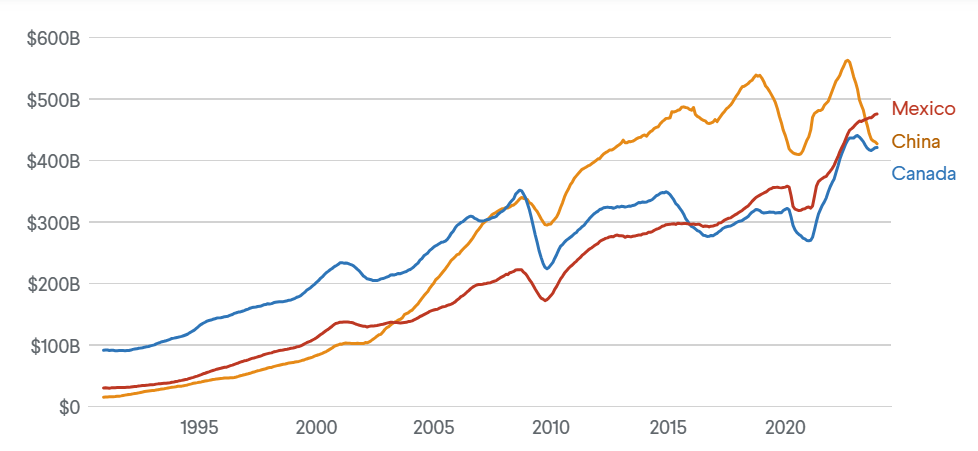
    Mexico passes China as lead source of U.S. Imports
    U.S. imports for the twelve-month period ending each month

    Source: Council on Foreign Relations using data from U.S. Census Bureau

    By late 2023 Mexico surpassed China to become the largest source of imports into the United States. Many factors contributed to this. With the Covid-19 slump in the automobile sector now finally over, there has been a surge in exports of vehicles from Mexico to the US. Meanwhile the average US tariff on products imported from China has risen to 18%, a significant disincentive, although Chinese companies are partly evading those tariffs by having products part-assembled and shipped to the US via third countries such as Vietnam, Malaysia, and Thailand. Despite US-China friction, China’s global exports are still rising.

    The outlook for Mexican trade with the US remains strongly positive. Traditional automobile exports will be enhanced by the switch to electric vehicles (EVs). Under USMCA rules Mexican-made EVs and batteries qualify for US subsidies under the Joe Biden administration’s Inflation Reduction Act (IRA). Mexico’s role as an oil and gas exporter to the US is waning and it is now buying in more energy from the US. However, this is being offset by growing Mexican sales of automobiles, autoparts, and other manufactures.

    It is clear that nearshoring is going to play a very consequential role in the next six years of the Sheinbaum presidency. That said, there are questions about its relative weight. In one narrative the Mexican government’s failure to control criminal violence, its vulnerability to corruption, and its backsliding on democratic checks and balances will be sufficient to cancel out the benefits of nearshoring. In short, Morena’s left wing and nationalist hostility to business will kill off the Golden Goose of nearshoring.

    But there is a strongly opposing view which states that the nearshoring wave, like shifting tectonic plates, is a more powerful force than Mexico’s less-than-perfect operating environment for business. In this view, companies will continue investing in Mexico because of the unique gateway it offers into the US market, seeking to manage and mitigate the associated political risks. Whichever of these two narratives proves to be correct, Sheinbaum’s ability to attract new investment and balance her government’s relationship with business and the wider electorate will be critical to the success or failure of her presidency.

  • Mexico: Trade issues still cloudy as USMCA launches

    LatinNews 30 November 2018 Hits: 441

    As this issue went to press the leaders of the United States, Mexico, and Canada were due to sign the new USMCA treaty, replacing the North American Free Trade Agreement, on 30 November at the G20 summit in Buenos Aires. This might point to a new era of predictable trade rules across the North American region. Then again, it might not.

    The argument in favour of the USMCA is that, although compromises had to be made to reach agreement, the new set of rules it embodies gives trade between the three countries (which totals more than US$1.112tn) a predictable and reliable framework. So, the planned signing by US President Donald Trump, outgoing Mexican President Enrique Peña Nieto (on what will be his last day in office), and Prime Minister Justin Trudeau should be a good thing, allowing a big collective sigh of relief. That said, there is a counter view: that trade disputes are set to continue and maybe even worsen.

    One big fly in the ointment is the imposition of 10%-25% tariffs on imports of aluminium and steel from Mexico and Canada into the US last June. The tariffs were imposed by the Trump administration on “national security” grounds and led both countries to respond with their own countervailing tariffs on goods imported from the US. Mexico and Canada are hoping that the US tariffs will be lifted as the USMCA is signed, allowing this particular dispute to be unravelled, but Washington has not yet moved to do so, and some analysts believe the US may be looking to extract further concessions. The politically sensitive US auto industry, which Trump sought to protect, continues to struggle, with GM announcing multiple plant closures (and criticising the impact of the metal tariffs).

    It is also possible that some of the USMCA provisions could be re-opened. The treaty needs to be approved by legislatures in the three countries. In the US, the Democrats now control the lower house and could seek to question labour and environmental provisions. In Mexico left wing President-elect Andrés Manuel López Obrador has a new majority in congress. Although he has not targeted the USMCA, he could change his stance because of other bilateral issues such as migration. In Canada new federal elections are due by October 2019, narrowing the window for treaty approval.

  • Can there be an agro-industrial revolution?

    LatinNews 21 December 2018 Hits: 56

    The IDB argues that an agro-industrial revolution could help the Latin American economies advance towards more sustainable growth. In a briefing for heads of state attending the Summit of the Americas in Lima in mid-2018, the IDB said that LAC is a major net exporter of food, accounting for 16% of world food and agricultural exports and 4% of imports. The world is beginning to run out of cultivated land, but of the 446m hectares of land still potentially suitable for sustainable expansion, over a quarter (28%) is located in Latin America. LAC was also the only region in the world to achieve the Millennium Development Goal of halving malnutrition between 1990 and 2015.

    The global population will grow by another 2.3bn people from 2018-2030, and those people will need to be fed. LAC can play a key role in meeting that demand. It has almost one-fourth of the world’s forests, 40% of the renewable water resources, and 12% of agricultural production. The region’s agricultural production has surged since 1990. It has the largest fertile land reserves in the world, and since 2000 has achieved the biggest expansion of agricultural output. Although LAC’s agricultural productivity (measured by Total Factor Productivity, TFP) grew by 45% from 1980-2012, it still lags behind the more developed OECD countries, meaning that there is room for further gains.

    The IDB says “Over the last decade, not only agriculture but agribusiness has seen substantial growth in the region, creating a significant number of jobs and adding key elements to the food basket. It also represents an alternative to urban migration, supports local culture and adds value to female labour. The contribution of agri-business in countries such as Brazil and Argentina ranges from 25%-30% of GDP. In Mexico, agribusiness contributed 12% of GDP.”

    The value of LAC agricultural exports doubled from US$105bn to US$213bn over the last decade. While agriculture’s share of GDP may have fallen, it still accounts for 24% of LAC exports. LAC accounts for over half the world’s exports of banana, sugar, and soya, and over one-quarter of its exports of coffee, beef, chicken, meat, and maize. Against this background, there has also been major qualitative change. Rapid urbanisation, changing diets, and new technology have all had an impact.

    The IDB report makes it clear that agro-industry and agri-business can make a major contribution to future LAC growth and development. But it also notes that this will require overcoming a number of obstacles. These will include combating protectionism in international trade; increasing output in an environmentally sustainable fashion (and in particular reducing or reversing deforestation); increasing the quality and nutritional value of produced food; and ensuring resilience in the face of climate change.

    The private sector active in agribusiness will also face some specific challenges. Along with governments it will need to develop better infrastructure to reduce costs and enable better access to markets. Wider use of information and communications technology (ICT) and data delivered to cell phones can improve the efficiency of rural markets, particularly by sharing up-to-date price information. Better access to agricultural credit and research and development also has a role to play, along with the adoption of AgTech innovations. There is also scope to reduce food wastage. The IDB calculates that food losses in Latin America amount to 220kg per capita every year; most of this occurs post-harvest, between production and sales. Losses are highest in the cereals, fruits, and vegetables markets. The food that is wasted could feed as many as 300m people every year.

  • CENTRAL AMERICA: Coffee Rust – How Bad Will It Be?

    LatinNews 06 June 2013 Hits: 8148

    The International Coffee Organisation (ICO) has drawn attention to the spread of a coffee fungus – known as coffee leaf rust – through Central America, with potentially devastating consequences.

    These are comparatively early days in the spread of the disease but both the ICO and independent analysts are outlining a worrisome impact. The ICO estimates that up to half a million agricultural workers have lost seasonal jobs as a result of the disease, and experts are predicting an increase in crime, deforestation and environmental imbalance, and even a new surge in illegal migration out of Central America northwards to Mexico and the US.

    The disease is detected when an orange, dust-like fungus appears on the back of the coffee bush leaves. It sucks the sap from the bushes, which eventually wither and die.

    In previous outbreaks, the rust has only been found in coffee bushes planted at 3,000 feet above sea level or lower – but now it seems to have spread much higher up the hills to 5,000 feet. Previously, it has been controlled through fungicides, but coffee growers say the current outbreak is much more aggressive and resistant to treatment. Bringing it under control could take longer than in the past.

    It is now said to have affected 70% of Guatemala’s coffee bushes, 64% in Costa Rica, and lower proportions in Nicaragua and Honduras. According to the ICO, Central American coffee production fell by 17.1% in the October 2012 – March 2013 growing season, and is predicted to drop a further 30-40% in the next season, which will run from October 2013 to March 2014.

    Despite this Central American crisis, international coffee production and prices have not yet been affected. This is because Central America accounts for only 12% of world coffee production. Central America Arabica beans are frequently used to blend flavours into coffee mixes that rely on Brazilian and African volume supplies of Robusta beans. “What are Folgers, Maxwell House, Kraft, General Foods, Starbucks, and Dunkin’ Donuts going to do? They’ll start mixing more Robusta in bags of Arabica”, said Gerardo Alberto De Leon, a marketing manager for a Guatemalan coffee growers cooperative known as Fedecocagua.

    The ICO’s forecasts as far as the effects on agricultural employment are concerned are deeply worrying. The organisation suggests that out of a total Central American population of 41m people, up to 1m seasonal and permanent coffee workers are expected to lose their jobs in the next October-March season. Independent analysts suggests that each person employed in the coffee sector supports an average of up to five other people.

    Extent of the outbreak for 2012-13 crop year
    Country Farmland affected (ha) Job losses Value lost (US$m) 60kg bags lost  this season bags exported last season
    Costa Rica 60,000 14,000     
    $14m 73,600 1.38m
    El Salvador 112,293 13,444 $74.2m 322,102 1.06m
    Guatemala 193,200 75,000 $101m 554,394 3.72m
    Honduras 70,000 100,000 $230m 1.3m 5.47m
    Nicaragua 46,853 32,000 $60m 306,667 1.68m
    Source: International Coffee Organization
  • BRAZIL: The fallout from the Mariana disaster

    LatinNews 10 December 2015 Hits: 14

    In the wake of the Mariana disaster, Izabella Teixeira, Brazil’s environment minister, has promised tougher regulation on mining safety. However, for President Dilma Rousseff, a former minister of mines and energy, environmental concerns have never been a priority. Given that much of Brazil’s federal congress benefits from money from mining companies, environmentalists question whether even this disaster will result in meaningful change.

    Visiting the site of the two dams from an open-pit mine that burst above the district of Bento Rodrigues (near the colonial-era town of Mariana, in the state Minas Gerais) President Rousseff on 12 November compared the scale of the tragedy to BP’s Deepwater Horizon disaster in the Gulf of Mexico. Some 50m cubic metres of toxic sludge broke through the dam on 5 November, killing at least 13 people (about 11 others remain missing). With the residue from the iron-ore mine connected to the dams oozing down the Rio Doce, hundreds of thousands of Brazilians lost their main water supply. The mudslide continued down the Rio Piracicaba and entered the Rio Doce in Ipatinga. This mudslide affected the water supply systems of numerous cities along the way, including Governador Valadares in Minas Gerais and Colatina and Linhares in Espírito Santo, before reaching the Atlantic Ocean. Virtually all aquatic life was wiped out along a 500km stretch of the river.

    On 16 November, the dam owner, Samarco, a joint venture between the Anglo-Australian mining giant BHP Billiton, and Vale, the Brazilian mining firm, agreed with federal and state prosecutors to pay out R$1bn in emergency mitigation actions, clean-up costs, and compensation. Brazil’s public ministry, however, was adamant that this represented only a preliminary payment, and was entirely separate from the R$250m fine already levied on the company by Ibama, the federal environmental agency. Technical specialists sent to the area estimate the total cost of the disaster may run to R$14bn (US$3.6bn). Shortly afterwards, the deputy attorney general, Sandra Cureau, said the firm must face “exemplary punishment”, citing “negligence” over the disaster.

    No siren alarm system existed and the only warnings came by cell phones to residents. The principal of the small public school was warned by her husband when the dam broke and she and her colleagues were able to get all 57 students to leave the school building and run to high ground just in time. Prosecutors are trying to ascertain what caused the two dams to break.

    The seismological laboratory at the Universidade de Brasília has stated that there were some small-scale earthquakes recorded prior to the dams bursting. But there are doubts whether this was the real cause. Rumours persist that Vale may have diverted dangerously excessive amounts of water into the tailings pond, used for the collection of iron-ore residue and kept in check by the dams.

    There are also now serious concerns over the other dams in Brazil. On 16 November, Samarco’s head of structural projects, Germano Lopes, said there was a risk of other dams in the complex breaking. “We are taking the necessary emergency action,” he said. A report in the daily O Globo found that there are 389 dams that block reservoirs filled with mining run-off, with 19 of them considered “high risk” (see box below). The dam that burst in Minas Gerais was considered “medium-risk” and Brazil has a further 168 barriers in this category. Another daily, O Folha de São Paulo, revealed that the national mineral production department had only spent 13.2% of its funds in the 2015 budget for “inspections” of mining activities, including disaster prevention.

    Questions are now being raised about a new mining bill currently making its way through congress. The bill’s main sponsor, Leonardo Quintão, a deputy from the Partido do Movimento Democrático Brasileiro (PMDB), told local media that he would monitor Samarco closely to ensure the company paid its fine in a timely fashion. Quintão also insisted that there would now be changes to the bill, which has been awaiting congressional approval since 2013, to deal specifically with safety measures and what to do with iron ore residue.

    However, environmental activists in Brazil say that the close relationship between mining companies and political parties means any reform is likely to be cosmetic. Quintão received over R$1.8m in campaign donations from mining companies in his 2014 election campaign. Vale was also one of the biggest campaign donors to both President Rousseff and her main rival, Aécio Neves, in last year’s presidential elections. Meanwhile, the mayor of Mariana says the town relies on mining revenue for 80% of its tax take.

    Further dams at risk

    An analysis of documents from Brazil’s national department of mineral production (DNPM) published by the daily O Globo on 22 November showed that a further 16 barriers were at “high risk” of collapse.

    Increasingly, the focus of public anger following the collapse of the Fundão dam is the lax inspection regime. In mid-November, the head of the DNPM stood down, ostensibly for medical reasons, but in the wake of severe criticism of the organisation’s capacity for oversight. Currently, the DNPM only has 800 employees, with just 200 of them qualified to carry out inspections, and only four in Minas Gerais.

    According to the DNPM documents,16 dams in four states are at “high risk”, meaning that their structure does not offer a high degree of security and is at risk of collapse. Potentially, 540,000 people are at risk should these dams fail. Three of the country’s main water basins are also jeopardised by these dams, including the River Paraguay, in the heart of the Pantanal wetlands; the Amazon; and the São Francisco River, which supplies water to the north-east of Brazil.

    Mud from the Mariana dam has now reached the sea off the coast of Espírito Santo state. The damage, both environmental and economic, is likely to be considerable. Tests have not so far shown significant levels of heavy metals in the mud slide, but the turbidity of the water is killing aquatic life along a 500km stretch of the Doce River. Drinking water to the city of Governador Valadares has now been restored, but the city of Colatina, home to over 150,000, is still relying on water deliveries from Samarco, the joint venture between Vale and BHP Billiton which owns the Fundão dam. Eleven people are confirmed dead and a further 12 are still missing.

    Samarco, in mid-November, admitted that the other two dams that form part of its mining complex near Mariana are in urgent need of repair. Emergency work has begun and will continue for the next 90 days.

    Government sues

    The Brazilian government now has filed a lawsuit against Samarco, as well as its parent companies Vale and BHP Billiton. Lawyers for the government are seeking R$20.2bn (US$5.2bn) in damages over a period of 10 years, including an immediate deposit of R$2bn (US$520m). This comes on top of the R$250m (US$66m) fine by the federal environmental agency, Ibama, as well as the R$1bn emergency fund Samarco offered. Lawyers also asked a federal judge to set aside 50% of the net profit or 20% of the annual revenue of Samarco – whichever is the greatest – for a special fund. Samarco reported gross revenue of R$7.6bn (US$1.9bn) in 2014. Prosecutors are now openly assessing the possibility of Samarco’s bankruptcy. If it is unable to foot the bill, Vale and BHP Billiton may be required to pay.

    • On 2 December, the Brazilian press revealed that Samarco had registered at least three other accidents at the same dam complex prior to November’s accident. All were related to breakages in the pipe that transports the iron ore from the mine to Espírito Santo, the coastal state from which the product is exported. Residents of several cities along the length of the Rio Doce are still without drinking water.
    • The Brazilian government had initially backed Vale, with its tests of the Rio Doce showing that there was no increase in the presence of heavy metals in the water and sediments. But tests by a municipal water agency, sent to the United Nations special rapporteur on hazardous substance and waste, showed high levels of toxic substances, including arsenic, lead, aluminium, chromium, nickel and cadmium had been found at various points along the river. Vania Somavilla, a director at Vale, said the mudslide may have disturbed toxic elements on the river bed.
  • Colombia: Solid report card from the IMF

    LatinNews 11 May 2018 Hits: 675

    The IMF concluded its annual Article IV consultation visit to Colombia on 27 April and was overall very positive about prospects for 2018, echoing earlier prospects that it had made earlier in the month about the economy being at a “turning point”. Yet notwithstanding the fact that GDP growth seems to be staging a firm recovery, the Banco de la República (Banrep, the Central Bank) still opted to cut interest rates in the monetary policy committee’s 27 April meeting.

    The Fund was sanguine about Colombia’s economic performance last year, pointing to an only slight moderation in GDP growth (from 2% to 1.8%), while highlighting that at the same time the authorities made progress on efforts at fiscal consolidation (with the public sector deficit falling from 2.9% to 2.5% of GDP) and inflation fell sharply compared with 2016, with an end-2017 rate of 4.1% only narrowly missing the Central Bank’s 2%-4% target range. Meanwhile, higher average global commodity prices helped boost export earnings and reduce the current-account deficit to 3.4% of GDP, which remained mostly financed by inward flows of foreign direct investment (FDI).

    Improving fundamentals

    The IMF was clear that it believed that the outlook for 2018 was even more encouraging, with GDP growth forecast to rebound to 2.7% on the back of investment and export growth. The Fund does not expect stronger economic growth to spur inflationary pressures; on the contrary, at 3.5% its end-2018 inflation forecast implies a further decline in price pressures. The fiscal deficit is also projected to continue to edge downwards (to 2.5% of GDP), as is the current-account deficit (to 2.6% of GDP).

    In line with the nature of Article IV consultation reports, Colombia’s report card was not entirely rosy, with the Fund highlighting several weak areas, as well as flagging downside risks to its central forecast. The main area in which the IMF urged the Colombian government to focus its efforts is on developing the country’s infrastructure, which for decades has been a comparative weak point of the business environment, in part a consequence of the long civil conflict between the state and various insurgent groups. Even though the left-wing Ejército de Liberación Nacional (ELN) remains active, a peace agreement with the larger left-wing Fuerzas Armadas Revolucionarias de Colombia (Farc) is in place, which should help foster conditions for greater investment in physical infrastructure projects. Other areas highlighted by the IMF include tackling labour market informality, improving education standards and cutting trade barriers.

    Central Bank opts for further interest rate cut…

    Despite the firm outlook for GDP and low inflation projections, the Central Bank nevertheless opted to cut its benchmark interest rate on exactly the same day that the Fund completed its Article IV consultation visit. This continued an official policy of monetary easing, which saw the Central Bank cut rates sharply over the course of last year, from 7.75% to 4.5%. The latest interest rate cut takes the policy rate to 4.25%. Prior to the monetary policy committee’s meeting, Finance Minister Mauricio Cardenas stated that the central question was not whether to cut rates or not, but by how much, with the Bank considering both a 25 basis points reduction, as well as a bigger potential cut.

    …but then may keep rates on hold

    In the press release accompanying the Bank’s final decision (a 25 basis points cut), officials justified their decision to continue easing monetary policy by stating that inflation was falling more rapidly than expected and also that economic activity had not been picking up as strongly as they hoped. In their view, this provided scope for cutting interest rates further in order to bolster domestic demand without jeopardising the official 2%-4% inflation target.

    The main question is now whether the Bank will continue to cut interest rates. The next monetary policy committee meeting is scheduled for June. However, the subsequent publication of inflation data for April suggests that monetary policy makers may prefer to keep rates on hold for the time being. The Bank cited March’s low monthly inflation figure as a key reason for the interest rate cut (0.24%), but April’s result was much higher (0.46%). Although in year-on-year terms inflation was little changed in April (3.13%), if monthly inflation continues to rise in the coming months, the year-on-year figure will start to rise.

  • Between the waves (4): a weakened political system

    Patrick de Courcy 29 June 2022 Hits: 1404

    A further difference between the first and second waves of left-wing administrations in Latin America is that, in general terms, during the gap between the two, political systems and institutions have been weakened, and as a result are now more fragile than they were two decades ago. Up to a point this is a subjective opinion, but it is also supported by various studies and survey-based data.

    The context is that many governments, including the left-wing administrations of the first wave, failed to provide lasting solutions for the problems experienced by the voters. Issues of poverty and inequality persisted, despite some gains in the early years of the first wave. Crime rates seemed to be moving relentlessly upwards. Corruption also appeared to be getting out of control. Even the new middle class, a group that owed its emergence at least in part to the redistributive efforts of progressive administrations, became deeply disaffected. One of the slogans used by the protest movements that swept through Brazil in 2015-2016 encapsulates the mood. The Brazilian government it said, was levying first-world taxes on the population but providing it with third-world services.

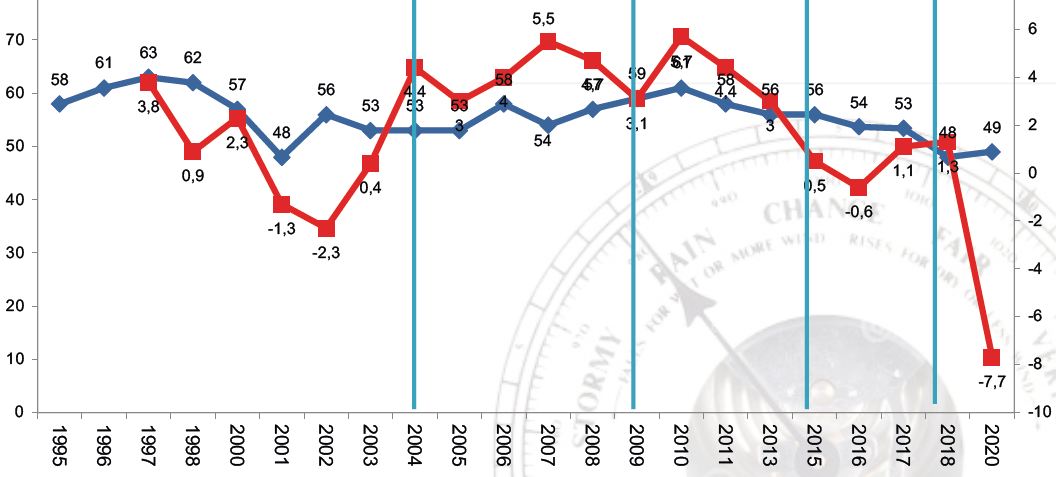
    The regular two-yearly Latinobarómetro polls, covering 18 countries in the region, have given a telling account of what could be called a period of sustained institutional decay. Support for democracy was at 61% of respondents in 2010, but it ebbed consistently during the following decade, dipping to 49% by 2020. Interestingly, overall levels of support for democracy broadly seem to have followed changes in GDP per capita. GDP per capita has been on a downward trend since 2010. The proportion of respondents who were indifferent to the system of government also rose from 16% to 27% in the decade to 2020, and those favouring authoritarian governments stayed broadly constant, dropping from 14% to 13%.

    Support for democracy eroded by falling GDP per capita

    Blue: % of those surveyed who support democracy; Red: GDP growth

    In some of the largest and most influential countries, such as Brazil and Mexico, support for democracy plunged further, down to 40% (Brazil) and 43% (Mexico). Other signs of democratic decay include falling levels of trust in key institutions. By 2020, 44% of respondents trusted the armed forces, 32% trusted the president, 27% trusted the government, 25% trusted the judiciary, 20% trusted the legislature, and only 13% trusted politicians. The fact that in many countries nearly nine out of ten voters do not trust the politicians they elect points to a major crisis of representation.

    A wide range of factors is behind this political malaise. The pandemic clearly had a big impact, placing an unforgiving focus on multiple cases of mismanagement and corruption during the health crisis. A sign of the pandemic's intensity is given by the fact that Latin America and the Caribbean account for 8.4% of the global population but suffered 32.1% of global Covid-19 deaths. Up to 20m jobs were destroyed by the pandemic

    The rise of a new re-invigorated form of populism in the ‘in-between years’ also played a part. Many Latin American countries had already seen the development of powerful populist movements during the earlier part of the 20th century, but a new, rejuvenated, and somewhat unexpected form was brought back to the fore by the presidency of Donald Trump in the US (2017-2021). Put bluntly, Trump-style populism offered a whole new toolbox of rhetorical tricks and techniques to governments that were essentially failing to deliver real and measurable change. The list included an appeal to a supposed former period of national greatness or exceptionalism; distrust of foreigners; a complete rejection of expert opinion; the use of fake news techniques; and an underlying authoritarianism resulting in frequent threats to democracy. Many Latin American politicians have recently tried to adopt what can be called the Trump playbook.

    Recent years have shown that politicians of both the right and the left can adopt populist tactics. Indeed, left wing AMLO and right-wing Bolsonaro, respectively in Mexico and Brazil, have many points in common. The key point however is that whatever its ideological colour, a government that constantly uses populist tactics has a toxic effect on politics and on its successors, often increasing levels of polarisation and narrowing the scope for cross-party collaboration to resolve complex and deeply embedded problems.

    According to a regional review of political risk prepared by Chile's Centro de Estudios Internacionales de la Universidad Católica (CEIUC), volatility and political uncertainty will remain high in the region thanks to the continuing presence of populism, anti-elite sentiment, and xenophobic nationalism. Another think tank, Instituto Internacional para la Democracia y la Asistencia Electoral (IDEA), says that at least half the countries in the region are suffering democratic erosion.

    José Miguel Vivanco, a Chilean lawyer and former head of the US-based Human Rights Watch (HRW) says the region is suffering from three main destabilising trends. These are, first, the idea that once democratically elected governments are then perfectly free to exercise power and govern in an extremely authoritarian manner. A second destabilising trend is what he calls “electoral regression”, including attacks on electoral courts and unsubstantiated claims of fraud. A typical example of that damaging approach is Trump's continuing refusal to accept he was democratically defeated in the November 2020 elections in the US. Vivanco cites a third worrying trend - the continuing and expanding military presence in activities that have been traditionally controlled by civilian authorities.

  • Ecuador: Oil production struggles

    LatinNews 25 January 2019 Hits: 2034

    Central Bank data confirms that oil production remained lacklustre in late-2018. With the Organisation of Petroleum-Exporting Countries (OPEC) introducing new, reduced quotas for the first half of 2019, Ecuador will come under pressure to reduce oil output further. Coupled with several other gloomy data releases, the near-term economic outlook remains weak.

    Full-year oil production figures are not yet available, but data through to November paint a disappointing picture of the state of play in the key energy sector. Oil production stood at 515,000 barrels per day (bpd) in November, broadly similar to levels recorded in recent months and below the 521,000bpd in November 2017. Although production at the state-owned Petroecuador has slipped slightly (from 402,000bpd in November 2017 to 401,000bpd a year later), output in privately-operated fields as fallen more noticeably, dropping from 119,000 bpd to 114,000 bpd over the same period. This is likely to reflect that the privately-operated concessions tend to be located more mature oil fields, where a lack of investment in recent years (as a result of both depressed international oil prices and the unfriendly operating environment under the previous Rafael Correa government) has hampered production capacity. 

    OPEC cuts will constrain performance

    The government hopes to lift GDP growth in 2019, which according to data released in early January, remained weak at 1.4% year on year in the third quarter of 2018. Given that the oil sector is key to economic performance, the authorities have long been hoping for an upturn in oil production. However, the decision by OPEC in December to cut production quotas for the first half of 2019 will throw a spanner into the works for the Ecuadorian government. OPEC published a country-by-country breakdown of its revised production quotas in mid-January; according to this, Ecuador will be required to keep oil output below a maximum threshold of 508,000 bpd until at least the end of June. With domestic consumption of oil derivatives continuing to rise firmly and refinery throughput failing to increase significantly, the import bill is rising (oil imports rose from 3.9m barrels in November 2017 to 4.4m barrels in November 2018) and the volume of oil exports is falling. 

    Part of the problem remains limited domestic refining capacity. According to the Energy Intelligence Agency (EIA), refinery capacity stands at 175,000bpd, making Ecuador reliant on imports despite its energy reserves. The authorities have long been seeking to lift refining capacity, but the results of a recent audit into public spending on oil-related infrastructure under the previous Correa government have shown that funds were mis-allocated. The Moreno administration requested that the UN oversee an independent audit, with the results made public in early January. In some cases, billions of US dollars were spent on refineries (including a half-built refinery that has since stalled, owing to insufficient funding) with no significant increase in throughput capacity. Reflecting the severity of the reported mis-spend, the authorities are currently considering whether to launch legal proceedings against some individuals involved in the projects.

    Weak oil outlook will hamper broader economy

    Aside from the impact that reduced oil production volumes will have on real GDP growth, with Brent oil prices now trading lower, at around US$60/barrel in mid-January (the lowest level in nearly a year), the implications for Ecuador’s fiscal and external accounts are also negative. In early 2019, the finance ministry confirmed that the budget deficit came in at US$3.3bn in 2018 (equivalent to 3% of GDP) but with both average oil production and prices likely to be lower in 2019, further fiscal consolidation will be difficult. The same is true for export earnings, which rose by double-digit levels on an annual basis throughout most of 2018. Lower exports are likely to push the merchandise trade account into deficit, which in turn will raise the current-account deficit. With the latest data showing that inward foreign direct investment (FDI) is still low, overall prospects for 2019 remain weak. As the economy is dollarised, there is no risk of a balance-of-payments induced crisis, but the economy is far from firing on all cylinders.

  • Does pink-green work elsewhere in Latin America?

    Patrick de Courcy 06 July 2023 Hits: 1847

    In the last 2-3 years Latin American countries have had mixed political results in their attempts to balance economic recovery and environmental protection. Chile is not an Amazon region country, but President Gabriel Boric, who took office in March 2022, leads a left-wing coalition which includes a small green party, the Federación Regionalista Verde Social (FREVS), which is committed to decarbonisation.

    However, in political terms Chile’s ‘green tide’ may have peaked. During the course of 2022, an elected Constitutional Council prepared a new draft constitution which recognised nature as an entity in its own right requiring special protection. The draft also expanded indigenous rights to ancestral lands, protected glaciers, reformed water rights, and limited extractive mining. The text if approved would have been considered one of the greenest constitutions in the world, but its supporters over-reached and fell out of step with public opinion. The draft was convincingly rejected in a referendum in September 2022. A new constitutional reform process is underway this year: the text however is likely to be significantly less green and less radical. More generally, the political pendulum has swung back towards the right in Chile. While green issues remain important, public opinion is now more focused on the Mapuche indigenous conflict in the south of the country, on immigration in the north, and on rising crime rates.

    Peru’s green agenda on the other hand, has been basically put on hold by a grinding political crisis that has undermined policymaking since 2016. The country has had five presidents in the last six years as the legislature and executive power struggle through a deep political deadlock. The last stage of that ongoing crisis came in December 2022 when left-wing President Pedro Castillo, who was facing multiple accusations of corruption, tried to close down the legislature but was instead impeached, imprisoned, and replaced by his vice president, Dina Boluarte, who formed a de fact alliance with conservative parties.

    The absence of clear policies to protect the Peruvian Amazon and to pursue a rapid energy transition from fossil fuels to renewable energy sources is particularly damaging since Peru is the second largest Amazon country after Brazil. The Peruvian Amazon, stretching from the Andes mountain range to tropical forested plains in the east, is about the size of Ukraine. Despite over-ambitious government promises to stop deforestation by 2021, research by Monitoreo de la Amazonía Andina (MAAP) published in 2023 showed that deforestation records had been broken in six of the last ten years.

    At least three major protagonists are driving the process in Peru. They are, first, big commercial companies involved in agriculture including palm oil; second, criminal cartels involved in logging and drug cultivation and trafficking; and, third, impoverished settlers who try to earn a living cutting down trees and tending coca plantations. Unlike Brazil, Peru also has significant oil and gas production in parts of the Amazon; oil spills have also had negative impacts on indigenous communities. According to a MAAP report: “The Peruvian government continues prioritising economic development as more important than protecting the rainforest.”

    A key issue in Venezuela is that an authoritarian and nominally left-wing government which pays occasional lip service to environmental issues is in reality seeking to maximise revenues from illegal, forest-destroying, mining activities. Around 60% of Venezuelan territory lies within the Amazon biome. The country also includes around one fifth of a unique and ancient geological formation known as the Guiana Shield which is heavily forested and intensely biodiverse.  Although less covered by the international media, Venezuela has at times experienced the fastest rates of deforestation in the tropical regions of the Western Hemisphere. According to lobby group Global Forest Watch (GFW), between 2002 and 2022 the country lost 576,000 ha of humid primary forest, or 26% of its total tree cover.

    The economic environment makes Venezuela a unique case. The country has traditionally been almost totally dependent on oil and gas exports, accounting for over 90% of total revenues. Under the leftist Partido Unido Socialista de Venezuela (PSUV) since 1999, a combination of catastrophic economic mismanagement, oil price volatility, and (from 2019) tightened US sanctions has destroyed large parts of the oil industry and pulled the economy into deep recession. From 2014-2022 the economy shrank by over 75%, a period which also saw some 7m Venezuelans emigrate. As a survival strategy the government has turned to illicit activities such as drug trafficking and gold, diamond, coltan, and rare-earth mining. In 2016, without the required legislative approval, the government of President Nicolás Maduro introduced a decree creating the Orinoco Mining Arc (AMO), an area equivalent to 12% of national territory where mining is given free reign and regulation is minimal. According to Vollmer Burelli of lobby group SOSOrinoco, in this area “illegal armed groups allied with the government continue to run especially destructive mining operations, kicking back much of the wealth they extract to senior leaders in the military and government.”

    By way of conclusion, it is worth highlighting four main points. The first is that, despite some continuing climate-change denialism and developmentalist thinking, there are reasons to suggest there is a real political appetite among Brazilian and other Latin American voters for green policies and for effective action to reverse the destructive process of deforestation. The recent Ipec survey in Brazil shows that a significant majority of respondents believe the environment should be protected even if that might mean lower growth and employment. In second place, it looks unlikely that voters will look exclusively to green parties to solve the problem of deforestation in the Amazon. Realism and fragmented political systems mean the way forward will require multi-party coalitions. At the moment the focus is on what could be called pink-green coalitions such as those currently in office in countries like Brazil, Colombia, and Chile. But it is not inconceivable that in future there may also be conservative-green alliances in office.

    In third place, coalitions may be necessary to make but they are complex to manage. Governments seeking to pursue a green agenda have found themselves frustrated by congressional opposition. There is a need for dialogue and deal-making with lobby groups that currently benefit from Amazon deforestation including farmers, ranchers, loggers, and extractive miners. Finally, in fourth place, political instability is the enemy of effective climate-change mitigation, and time is running out. Between now and 2030 – the date fixed by the Brazilian government to reach zero deforestation in the Amazon - there are only seven years and one general election.

  • Uruguay tests the limits of ‘responsible freedom’

    LatinNews 31 March 2021 Hits: 1614

    Uruguay stands out as one of the countries in the region where the virus arrived late and had a comparatively smaller impact. This has been attributed to a number of factors including the government’s quick action to close frontiers and set up tracking, tracing, and isolation procedures. Uruguay may also have benefited because only a small proportion of the labour force is informal, and because it has a comparatively small and geographically spread-out population (the population is 3.5m and average population density is under 20 per square km).

    According to the economy minister, Azucena Arbeleche, GDP contracted by around 4.5% in 2020 (a final figure was expected before the end of March). Under centre-right President Luis Lacalle Pou, who took office on 1 March 2020, just as the pandemic began, a policy called ‘responsible freedom’ was introduced using tight border controls along with tracking and tracing protocols. It relied on the population to follow voluntary social isolation rules. Aided by a good public health system, the infection and mortality rates have been very low (respectively, 64,000 and 658 as of 10 March). However, the number of cases rose sharply in January and March 2021, suggesting that further measures could be required, potentially delaying economic recovery. The government has begun a vaccination programme and has secured contracts for 3.8m doses from US company Pfizer and from China’s Sinovac, with a further 1.5m due from UK-based AstraZeneca through the Covax platform.

    How the virus plays out will be very important for the economy this year. Health minister Daniel Salinas hopes that by southern hemisphere spring (September) a combination of immunisation and herd immunity will have allowed a degree of normality. Controlling the pandemic would also allow the government to promote Uruguay internationally as a safe tourist destination, just ahead of the summer holiday season (starting in December).

    Uruguay Cumulative Cases Cumulative Deaths Deaths per million
    15 March 2021 0.07mn 712 200

  • HONDURAS: Congress approves model cities’ charter

    LatinNews 02 September 2011 Hits: 1704

    President Porfirio Lobo’s flagship plan for Honduras – a model cities project – has been approved by congress. The government is reportedly in talks with investors from Canada, South Korea and the UK about various projects, all of which on paper look more like large commercial enterprises rather than the charter cities along the lines of Hong Kong envisaged by Paul Romer, the ex-Stanford economist who first convinced Lobo that Honduras could benefit from such self administered enclaves. Lobo hopes to get the ball rolling on the first charter city before his term ends in 2013.

    On 29 July the national assembly approved by qualified majority the founding charter for the proposed special development regions, aka self governing and largely autonomous private ‘model cities’. The final statutes, containing 72 articles, were substantially modified to better define the legal framework, which is largely concerned with fiscal autonomy, but the entire project is still rather vague, and thus very controversial.

    The model cities seem are spun by President Lobo as more advanced, sophisticated versions of the so-called ‘free (trade) zones’ or ‘special administrative regions’ that are already in place to facilitate industrial zones/clusters (like the maquila sector) in many countries in Latin America and elsewhere. Similar ventures have worked successfully in places like South Korea, where they are sited around major air/sea ports and communications hubs, chiefly to boost trade and industrial development, but it’s questionable whether Honduras has any of the same conditions in place (including an educated workforce) to emulate this success.

    The full draft text of the new statutes was not yet available online as we went to press, but according to what we could gather from various local press reports, the new Regiones Especiales de Desarrollo (RED) are carefully defined as “an inalienable” part of Honduras. They will be subject to the Honduran constitution on issues of: sovereignty, national defence, external relations, electoral issues and the issuance of passports and national ID documents. The REDS will be subject to the national penal code, but will likely also have local laws in place. They will have an independent police force and judiciary, with primary responsibility for enforcing the national penal code.

    The new cities will elect their own ‘executive governor’, for a seven year term. The governor will be answerable to an elected governing council, or ‘Transparency Commission’. Some blogs have reported that this council, controversially, may comprise exclusively of foreigners residing in the REDS, though LatinNews could not verify that. The governing authority will be permitted to establish its own currency and levy its own taxes, though certain taxes will also be imposed by the Honduran government.

    The RED authorities will be able to draft their own labour laws, with the stipulation that 90% of jobs in a RED must be filled by Honduran citizens. Honduran citizens will be entitled to travel freely into a RED, but foreigners will be subject to immigration regulations specific to each RED. The local authorities will also freely control maritime navigation, ports and airports, as well as things like automotive imports. Finally, the REDS can also create their own health and education systems.

    The Honduran Left in particular is deeply suspicious, accusing President Lobo of effectively selling off tracts of the country (potentially without consultation with local residents) to potentially shady foreign investors. Sceptics argue that handing over control of parts of a country to private investors will merely create independently wealthy ‘enclaves’ subject to very little control and with dubious benefit to the country’s socio-economic development. Critics point out, for instance, that it’s not at all clear whether Honduran workers and their families will have access to the health and education systems in the REDS, while they also question the apparent lack of any labour law provisions or other social protections in the approved statutes.

    Even more notably, the main local business council, Consejo Hondureño de la Empresa Privado (Cohep), which might be expected to welcome the foreign investment, has also raised several concerns, citing a lack of transparency over things like guarantees for investors (foreign and local) and no clear definition of land/property titles. Honduras bans foreign land ownership. In a statement dated 28 July, Armando Urtecho, the Cohep president complained that the statutes are full of “incongruities, inconsistencies, ambiguities and vaguenesses”, arguing that the whole thing is “unconstitutional and an attack on Honduran sovereignty”.

    Trujillo first up?
    Trujillo, on the northern Caribbean coast of Honduras, has been provisionally mooted as the site of the first model city. Left-wing blogs are full of conspiracy theories about several rounds of talks over the past eight months between President Lobo and Canadian investors, reportedly including, Canadian Shield Asset Management (CSAM), Barrick Golf, Toronto Dominion Bank and Randy Jorgensen, the rather controversial CEO of Life Vision Development, for the construction of a large scale tourist project/private model city-port in Trujillo. In partnership with the Lobo government, the Canadians are reportedly proposing to build an international airport, a power plant, hospitals, schools, toll roads and even a prison, in addition to tourist centres and resorts. The exact location of the site is unknown. South Korea's Agency for International Cooperation (KOICA) is also said to be developing a plan for construction of a model city in or around Trujillo. The Garifunas in Trujillo have already begun a campaign against the reported proposal, citing fears that they will be nothing more than domestic staff for rich foreigners (potentially including tax exiles or even criminal elements).

    • The 2013 elections swim into view

    While Lobo is busy with his lofty ideas for model cities, his rivals in the ruling Partido Nacional (PN) have already begun jockeying for position for the November 2013 presidential race, in which (barring a constitutional reform) Lobo cannot stand. Among the PN forerunners are the mayor of Tegucigalpa, Ricardo Alvarez, and the president of the national congress, Juan Orlando Hernández. Ambitious cabinet members include the public works, transport and housing minister, Miguel Pastór and the security minister Oscar Alvarez. Primaries are due in November-December 2012 but the electoral law requires parties and individual candidates to register with the national electoral court by end-2011.

    • “A knife in the heart”

    That was the reaction of the Israeli ambassador to Honduras, Elihau López, to President Porfirio Lobo’s declaration on 28 July that Honduras would support Palestine's efforts to achieve recognition as a member of the United Nations at the organization's next General Assembly meeting in New York, scheduled for September. The announcement came as a surprise not only to Israel but also the Honduran foreign ministry, which tried to soften Lobo’s statement by suggesting it was merely a plea for mutual dialogue between Israel and Palestine. A clearly rankled López noted that Israel was one of the only countries to support Honduras during the coup crisis in 2009, and said that “these things are not done between friendly governments”. Israel has long supported Honduras with aid and military support.

  • Watch the pharmacists

    Patrick de Courcy 08 September 2023 Hits: 2015

    The idea that fentanyl addiction is unlikely to take root in South America may be over-optimistic. A special investigation by the Los Angeles Times published in February this year had disturbing implications. It found that pharmacies in a group of north-western Mexican cities near the US border were selling counterfeit prescription pills laced with stronger drugs such as fentanyl and passing them off as legitimate medicines. The newspaper found that pills sold as oxycodone and Adderall in Tijuana and Cabo San Lucas contained fentanyl and methamphetamines. In total the newspaper found that 71% of a total of 17 pills tested came up positive for more powerful drugs. That meant that both US tourists and Mexican residents may be unknowingly purchasing what they think are legitimate low-potency over-the-counter pain killers, which are in fact laced with fentanyl and therefore expose them to risks of addiction and even death by overdose.

    The true extent of the “fentanyl-sold-via-pharmacies” problem is difficult to measure, not least because Mexico’s mortality data is believed to under-report all types of overdose deaths. While the US is reporting over 100,000 overdose deaths a year, limited Mexican data puts fatalities from all drugs, including alcohol, at under 2,000. Recorded fentanyl overdose deaths are no more than a few dozen. Chelsea Shover, a UCLA researcher conducting a study cited by the newspaper, said: “We don’t know exactly when this started, and we don’t know how widespread it is. We don’t know who is buying these pills. We don’t know who’s taking them, and we don’t know what’s happening to the people that are taking them. The most important unknown is probably how many people have died or had serious health consequences from it, and we don’t have any idea.”

    The manner in which fentanyl is consumed is important. It first appeared on the streets in powder form consumed either by shooting up (injecting intravenously) or by snorting. That meant that consumers had to become involved in, or risk becoming victims of, criminal activity on the streets to get their fix. By comparison, acquiring the drug in the form of over-the-counter, legitimate-looking, pharmacy pills appears to be a much safer experience. In effect, it allows the cartels to target a wider, more middle-class market for its products. That could also mean selling more drugs inside Mexico or other Latin American countries. A UCLA assistant professor told the newspaper: “Selling fentanyl in the form of pills is really marketing to a group of the population that may not be willing to try ‘hard drugs’.”

    Los Angeles Times reporters found a very high number of pharmacies selling fake painkillers. Tablets were on sale for between US$15-$35 each, depending on potency. A separate study conducted by UCLA focused on 40 pharmacies and found that a majority of them were selling high-powered prescription drugs over the counter. Given the prices, it is thought the pharmacies were mainly targeting US tourists, but they could also be selling to local residents.