All Categories

Subcategories

  • EASTERN CARIBBEAN: Preparing for the worst

    Patrick de Courcy 29 October 2021 Hits: 3304

    The United Nations (UN) International Organisation for Migration (IOM) convened a conference in Dominica from 4-6 October at which its report on Migration, Environment, Disasters and Climate Change Data in the Eastern Caribbean was presented and debated. The purpose of the conference was to discuss improvements in the way data is gathered in order to help decision-making and planning for climate resilience in the six independent member states of the Organisation of Eastern Caribbean States (OECS) – Antigua & Barbuda, Dominica, Grenada, St Kitts & Nevis, St Lucia, and St Vincent & the Grenadines. The conference also heard why this is of such pressing importance; how current arrangements for free movement can be improved; and why the international community needs to be more flexible in the way it allocates assistance to the vulnerable small island states (SIDS) of the Caribbean.

    The central message of the IOM’s report is that the Eastern Caribbean has been facing a changing climatic regime for two to three decades and now faces “an increased frequency and intensity of extreme climate events and related disasters”. As an example of the dire consequences of these trends, the report points out that during the 2017 hurricane season, when the region was affected by hurricanes Irma, Harvey, and Maria, approximately 3m people across 16 countries in the Caribbean and US were displaced. Similar effects were produced by Hurricane Dorian in August and September 2019, with the displacement of 464,000 people. Hurricane Dorian in 2020 led to the displacement of nearly 10,000 people in The Bahamas.

    Dominica is cited as one of the countries that took the brunt of Hurricane Maria in September 2017. As a result, about 80% of the population was displaced, with the loss of 30 lives and damage amounting to 176% of GDP.

    The paper notes that while the nature of the relationship between climate and environmental change, disasters, and human mobility “remains a highly debated topic among academics and policy circles”, it is undeniable that climate change impacts on SIDS across the Caribbean “could potentially accentuate the displacement and forced movement of people in the region”. There are also significant natural hazards in the region that exist regardless of climate change, as exemplified by the recent eruption of La Soufrière volcano.

    It is the movement of people as a result of such disasters that was the main focus of the conference, and the IOM paper acknowledges that OECS member states recognise that effective migration governance “can contribute to sustainable socioeconomic development and climate change adaptation”. Five out of six of the OECS’s independent state members (the odd one out being Antigua & Barbuda) voted, for instance, for the 2018 UN Global Compact for Safe, Orderly, and Regular Migration.

    In her address to the conference, the Regional Director of IOM, Michele Klein Solomon, said that it was important to remember how advanced the Eastern Caribbean region already was in terms of free movement of people. She said: “The Eastern Caribbean Economic Union provides OECS citizens the right to move and settle in any other participating islands. This protocol offers a much-needed solution for persons who must leave their countries due to the impacts of hurricanes or other hazards.” Without this free movement, she argued, the cross-border evacuations that happened during the 2017 hurricane season, or during the eruption of La Soufrière volcano, would have been much more difficult.

    The position, however, is not quite so encouraging when looking at the wider Caribbean. The Caribbean Community (Caricom), through the Caricom Single Market and Economy (CSME), allows for the free movement of skilled and professional persons but not for general free movement. Nor does the CSME include specific provisions for disaster displacement. In effect, the IOM report notes, “the free-movement regime developed under the CSME is focused on addressing skilled labour migration and economic integration, with limited consideration or reference to environmental migration or disaster displacement”. However, in the wake of Hurricane Maria, certain requirements were waived for displaced Dominicans.

    Table 1 below shows the difference in free-movement requirements between the OECS and Caricom.

    Table 1: Free Movement within Eastern Caribbean States
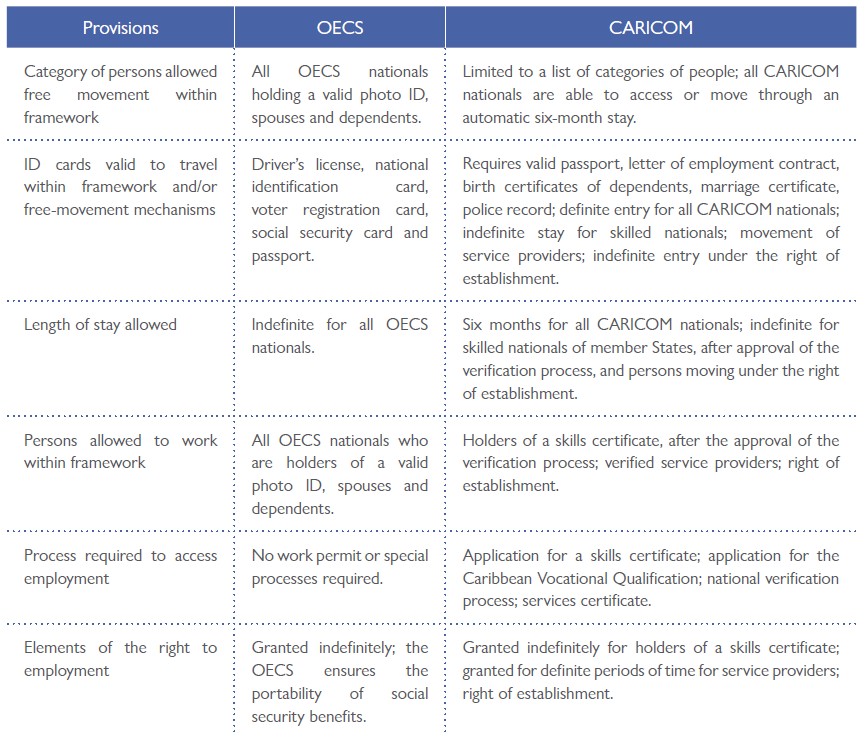
    Source: International Organization for Migration

    Keith Mitchell, the prime minister of Grenada and OECS chairman, used his address to the conference to reiterate the need to base assistance to vulnerable states on something other than GDP per capita income. He said: “For all our countries, the experiences of environmental hazards are the same. Significant loss in GDP, decimation of our agriculture and tourism sectors, loss of precious lives, significant displacement of people, and decades of economic development gains lost in just one major disaster.”  For this reason, he added, “we continue to advocate for the incorporation of a multi-dimensional Vulnerability Index”. In order to enable countries in the region to “build back better” following environmental shocks such as major hurricanes, financial institutions will need to give consideration to the extreme vulnerability of SIDS to these types of shock.
  • JAMAICA: Debt burden slashed

    Abbi Dicker 19 January 2024 Hits: 2722

    Prime Minister Andrew Holness ended the year by hailing Jamaica’s good economic performance, highlighting strong growth, low unemployment, and healthy public works programmes including road improvements and residential home building. Investors are particularly impressed by reductions in the debt burden.

    Earlier, the Planning Institute of Jamaica (PIOJ), a government office, had reported third quarter year-on-year GDP growth of 1.9%, reflecting higher employment, increased capacity utilisation in mining and quarrying, and continuing strong recovery in tourism. Manufacturing also did well. Agriculture contracted however, reflecting the impact of drought on traditional export crops such as banana, coffee, and sugar.

    In October international credit ratings agency Moody’s Investors Service upgraded Jamaica from B2 to B1, while revising the outlook to ‘Positive’ from ‘Stable’. Moody’s said the change reflected the country’s resilient response to external shocks such as the coronavirus (Covid-19) pandemic, and the government’s strong focus on fiscal control. It pointed out that Jamaica’s total public debt as a proportion of GDP which stood at 110% in 2020 is expected to end 2023 at a more manageable 78%, and to fall further in subsequent years.

    Moody’s said it believes Jamaica is on a “sustained positive fiscal trajectory” as a result of reforms which have improved the effectiveness of fiscal, monetary, and economic policies. Under its existing agreement with the International Monetary Fund (IMF), Jamaica is committed to reducing its public debt-to-GDP ratio to 60% or less by 2027/28, to be achieved by maintaining an annual primary surplus of 7% of GDP.

  • BOLIVIA: Roadblocks cleared but challenges remain

    Abbi Dicker 08 February 2024 Hits: 3044

    President Luis Arce promulgated a law on 6 February establishing a timeframe for the holding of overdue judicial elections, drawing a close to 16 days of protests. Whilst the law may focus minds in congress as the electoral deadline draws nearer, legislators currently look no closer to resolving their differences which have for over a year prevented an agreement on a shortlist of candidates.

    The bill, which was approved in quick succession by the chamber of deputies and the senate on 6 February, sets out a timeframe for the holding of the elections, as well as the processes and criteria which will govern the selection of judicial candidates. A spokesperson for Bolivia’s top electoral court (TSE), Francisco Vargas, said that with the passage of the law the elections should be staged in either August or September this year. The senate president, Andrónico Rodríguez, said that legislators should have decided on a list of candidates by July.

    President Arce did not mince his words after promulgating the bill, saying that the “unjustifiable economic damage” caused by the roadblocks had been motivated by “personal and political ambitions”. Arce added that the issue of the judicial elections had been cynically exploited as an excuse to “come after the president”.

    Arce’s remarks were clearly aimed at former president Evo Morales (2006-2019). Morales led the calls for protests after Bolivia’s constitutional court (TCP) ruled in December that presidents can serve a maximum of two terms – effectively ruling him out of the 2025 presidential election, for which he declared his candidacy in September last year [WR-24-01].

    Whilst it did persuade Morales’ supporters to dismantle their barricades, the new law is unlikely to resolve any of the political tensions which have precluded an agreement on the judicial candidates. Arce’s wing of the ruling left-wing Movimiento al Socialismo (MAS) will continue to do its utmost to prevent the nomination of TCP candidates who might threaten Arce’s re-election chances by overturning the court’s December ruling. Morales’ allies in the party, meanwhile, have already burned their bridges with Arce and have little reason to soften their stance.

    Meanwhile, the right-of-centre opposition will be wary of nominations put forward by either faction of the MAS. It bemoans the steady politicisation of the judiciary since the party first came to power in 2006.

    Political challenge

    The reigning political tensions in Bolivia will hamper the reaching of the necessary two-thirds majority in the national legislature which is required to approve the list of judicial candidates that will be put to voters.

    Fitch downgrade

    The international credit ratings agency Fitch Ratings downgraded Bolivia’s long-term foreign currency default rating from ‘B-’ to ‘CCC’ on 7 February. A CCC rating indicates that “default is a real possibility”. Fitch said that the downgrade “reflects a significant decline in usable international reserves to very low levels, heightening risks to macroeconomic stability and debt service capacity”. It warned that “wide fiscal deficits, largely financed by borrowing from the central bank, and the absence of a concrete consolidation plan are likely to continue to put pressure on reserves”. 

    Bolivia’s foreign exchange reserves now stand at just US$166m, according to Fitch. Meanwhile, gold reserves have fallen to US$1.57bn after the central bank sold off large quantities of its gold stock as part of emergency measures introduced last year in response to mounting dollar shortages [WR-23-16].

  • CHILE: Piñera se reúne con los estudiantes

    LatinNews 23 September 2011 Hits: 561

    Los tres meses de protestas contra los planes de reforma de la educación del gobierno, han provocado protestas que las imitan en Brasil y Colombia. Las protestas chilenas han mostrado pocas señales de decrecer. El 3 de setiembre, el Presidente Sebastián Piñera se reunió con los líderes estudiantiles por cuatro horas, pero no logró alcanzar un acuerdo.

    En verdad, respecto a algunos temas, el gobierno está volviendo de nuevo a la mesa de elaboración, prometiendo preparar otra nueva propuesta de reforma (su tercera hasta ahora en este año) para que los estudiantes la examinen. La última propuesta fue enviada a los estudiantes por el ministro de educación, Felipe Bulnes, el 5 de setiembre, pero los estudiantes aún deben responderla.

    El gobierno también ha sido distraído por un accidente, en el cual murieron 21 personas cuando un avión militar se estrelló cerca del archipiélago de San Juan Fernández el 4 de setiembre. Como una expresión de respeto por las víctimas del accidente, el gobierno pidió a los estudiantes que cancelen la huelga de un día programada para el 6 de setiembre: los estudiantes rehusaron el pedido y la huelga siguió adelante.

    Los estudiantes, extraídos de escuelas y universidades, y apoyados por sus maestros, desean que el gobierno asuma la provisión de educación primaria y secundaria de las municipales locales y que ponga fin a las organizaciones para obtener ganancias ofreciendo servicios educativos. Chile tiene 1m de personas en la educación superior (de una población de 17m). Los estudiantes se quejan que la educación superior en universidades y colegios vocacionales es cara y deja a los estudiantes con grandes deudas.

    En la última propuesta, el gobierno había deseado establecer un nuevo calendario para las conversaciones acerca de la reforma de la educación. Camila Vallejo, la presidenta de la Federación Chilena de Estudiantes (Confech) y la más prominente de los líderes estudiantiles, insistió en que la última ronda de conversaciones “no significa que nosotros abandonamos el movimiento [las demostraciones] [el presidente Piñera] nunca nos pidió que lo abandonemos”.

    Rodrigo Rivera, presidente de la coordinadora nacional de estudiantes secundarios (Cones), coincidió con Vallejo y dijo que los estudiantes de escuelas superiores continuarían con sus protestas “hasta que recibamos respuestas concretas y soluciones a nuestra demandas”.

    Carabineros: El 2 de setiembre, el director nacional de la fuerza nacional de policía (carabineros), General Eduardo Gordon, sometió su renuncia al Presidente Piñera. Los carabineros han quedado bajo crecientes críticas en los últimos días, provocadas por sus respuestas a las continuadas protestas estudiantiles, que terminaron con la muerte de Manuel Gutiérrez, de 16 años, el 26 de agosto. La difusión de un artículo acusando al General Gordon de manipular la documentación policial para proteger a su hijo durante una investigación sobre un accidente de tráfico resultó ser la última gota de agua. Luego de su renuncia, el General Gordon dijo que él esperaba que su remoción “sirva como un catalizador” para restaurar la paz en la sociedad chilena.

    Crecimiento: El 7 de setiembre, el banco central recortó su pronóstico de crecimiento del PIB para 2011 en un cuarto de punto porcentual. El banco ahora pronostica un crecimiento anual de entre 6,25% y 6,75%, cayendo de un rango previo de entre 6% y 7%, establecido en junio. El presidente del banco central, José de Gregorio, dijo que el banco había reaccionado ante el agitado panorama económico internacional. En la primera mitad de 2011, la economía creció 8,4% año en año. El crecimiento año en año de julio de 4% estaba bastante por debajo de los pronósticos independientes.

    • Inflación

    En agosto, la inflación mensual fue de 0,2%, llevando la tasa para los 12 meses pasados a 3,2%. La tasa mensual fue el doble de la esperada por los economistas independientes y podría hacer que el banco central reasuma los incrementos en la tasa de interés. Sin embargo, el banco central ha recortado su pronóstico para la inflación anual en 2011 a 3,3%, de 4% previamente.

  • CUBA: End of an era

    LatinNews 06 October 2011 Hits: 3932

    President Raúl Castro has called time on the ministry of sugar. In its place he has created a state holding company which faces the challenge of jumpstarting the former motor of the Cuban economy. This is really an exercise in cost-saving and efficiency, which Castro is endeavouring to carry out wholesale across the Cuban economy. Still, the announcement in the Communist party mouthpiece Granma that the once pre-eminent sugar ministry no longer carried out “any functions of state” was a savage epitaph.

    The downward spiral of the sugar industry has been much-chronicled. Fidel Castro began the streamlining of the sugar industry back in 2002, when the number of plants was cut dramatically from 156 to 61 to improve efficiency, and the land given over to sugar plantation was gradually reduced from 2m hectares to 750,000 hectares. The decision that the sugar ministry should be closed was taken during a council of ministers last week. Sugar cane cutters will now be reorganised into 13 provincial companies, under the aegis of an umbrella holding company known as Grupo Empresarial de la Agroindustria Azucarera: the number of sugar mills will be cut once again from 61 to 56, with just 46 operating during the next harvest.

    The harvest in 2010 was the worst in 105 years, with production reaching just 1.1m tonnes, a far cry from the 8.2m tonnes produced at the end of the 1980s. Given that Cuba itself consumes a minimum of 600,000 tonnes of sugar annually, and the country is tied into an agreement to supply China with 400,000 tonnes a year, increasing production is essential. The target is 2.5m tonnes by 2015.

    It is not entirely clear how this ambitious target will be reached. Castro, who said the new holding company would need to “generate exports to finance its own costs”, is promising to modernise the sugar sector with more efficient management and by means of new technology. He also raised the possibility of foreign investment through mixed companies, but supplied no further details. Neither did he reveal who would run the new holding company, although past form would suggest that he is likely to place his faith in members of the military or históricos of the Revolution.

    Reform comes with repression?

    More political dissidents were arrested in September than any single month in the last 30 years, according to the Cuban commission for human rights and national reconciliation (CCDHRN). The number of arrests (563, compared with a monthly average of 278 in the first eight months of the year) shows “the absolute lack of political will on the part of the government of President Raúl Castro to improve the situation of civil, political, economic and cultural rights of the immense majority of the population,” the CCDHRN claimed in a report released on 3 October. It added that the Castro administration’s promised changes were “false signals”.
    US President Barack Obama said much the same five days earlier during an online roundtable discussion aimed at re-engaging with the Hispanic community ahead of presidential elections next year. Obama said that the US was prepared to change its policy on Cuba but that he had not seen any evidence to suggest that Cuba’s reforms would lead to greater political freedom or justified lifting the trade embargo. His words sparked a fierce response from Fidel Castro. Writing one of his Reflexiones, Castro said “Many things will change in Cuba, but they will change because of our efforts and in spite of the United States. Perhaps even before that empire collapses.”

    • Targets missed

    The official press continued with a recent tradition of lacerating criticism of inefficiency this week. Granma released a damning report arguing that milk production in the eastern province of Camagüey, Cuba’s agricultural heartland, was insufficient. “Justifications, absurd explanations and promises are forming part of the arsenal used by some businesses and administrative cadres... to evade responsibility when failing to meet production targets,” it said. It also accused some producers of selling milk illegally rather than adhering to their contracts to supply the state. President Raúl Castro has made increasing milk production a major objective of his government to try and reduce imports.

  • RASTREANDO TENDENCIAS

    LatinNews 12 December 2011 Hits: 87

    MEXICO | Inmunidad. El 1 de diciembre el senado aprobó una reforma constitucional que pondría fin a la inmunidad ejecutiva, judicial y legislativa. La votación es otro paso en el proceso para poner fin a la inmunidad de todos los presidentes, ministros, gobernadores de estado, jueces, funcionarios electorales y miembros de ambas cámaras del congreso. Bajo la constitución, ninguno de ellos puede ser investigado y procesado mientras cumplen su mandato en el cargo. (Humberto Moreira, el controversial gobernador de Coahuila, aprovechó ese privilegio al peticionar a la asamblea del estado que le otorgue una licencia para ocupar otro puesto, en vez de renunciar formalmente como gobernador). Algunos políticos se sienten avergonzados por esa clase de privilegios: el senador Pedro Joaquín Coldwell, un ex gobernador del estado de Quintana Roo, perteneciente al Partido Revolucionario Institucional (PRI), dijo que “la inmunidad que más está haciendo daño a los mexicanos, es la inmunidad ante proceso [disfrutado] por los políticos”.

    Como los cambios propuestos cambian la constitución, estos deben ser aprobados por la cámara baja y una mayoría de las asambleas de los 32 estados.

    La corte suprema también debe dar una opinión sobre la propuesta, que modifica los artículos 61, 111, y 112 de la constitución. La decisión del senado se construye sobre el histórico voto del 14 de diciembre de 2010 en la cámara baja, que puso fin a la inmunidad legislativa del diputado del Partido de la Revolución Democrática (PRD), Julio César Godoy Toscano. Godoy Toscano había siso acusado de trabajar para una organización de tráfico de drogas, pero aún falta que él sea arrestado.

    Bajo la propuesta del senado, cuando un juez emite un veredicto inicial y una sentencia contra cualquier juez, funcionario electo o legislador, el juez también deberá pedir a la cámara baja del congreso nacional para que vote sobre si se despoja al individuo condenado de su inmunidad ante proceso. La votación de la cámara baja deberá tener lugar dentro de los 10 días del requerimiento del juez y es decidido por mayoría simple de los diputados presentes, sin necesidad de recomendaciones de ningún comité de la cámara. Sin embargo, el funcionario condenado tiene el derecho de dirigirse a la cámara. Si la cámara baja no aprueba despojarlo de su inmunidad, el funcionario condenado servirá su sentencia después de finalizar su periodo en el cargo (no se permitirá la reelección).

    Este engorroso proceso recibió las críticas de algunos legisladores en el sentido que cualquier cambio alteraría el equilibrio de poderes previsto en la constitución, que somete a la legislatura y el ejecutivo a la justicia. Los diputados también estaban preocupados que la legislación no debe ser usada para procesar a los legisladores por lo que4 dicen en el congreso durante el ejercicio de sus deberes.

    Para enjuiciar a un presidente, la cámara baja será la corte primaria y el senado la secundaria. El senado ratificará la decisión de la cámara baja (alcanzada de la misma manera que para otros funcionarios) de enjuiciar al presidente, solamente si están presentes 85 senadores y hay una mayoría a favor.

  • ENERGY: Is Ecuador sticking to the spirit of Yasuní?

    LatinNews 26 January 2012 Hits: 706

    On 11 January the Ecuadorean government announced that it would develop an oilfield which lies inside the 982,000 hectare Yasuní National Park which covers four big oilfields (Yasuní, Ishpingo, Tambococha and Tiputini, ITT) which hold 80% of Ecuador’s proven reserves  of crude oil. This is despite the government raising over US$100m from international donors to compensate it for not developing the oil under the Yasuní National Park.

    The Yasuní oilfield the government intends to develop is known as Bloc 31 and probably holds between 40m and 45m barrels of oil. Around 80 % of the 200,000 hectare of the oil field lie inside the Yasuní national park, which is notable for its biodiversity. Among the most unusual animals are pink freshwater dolphins.

    Oswaldo Madrid, the manager of the state oil company, Petroamazonas, said that he expects the first oil from Bloc 31 to flow in 2013.

    Even though it is developing Bloc 31, the government is still pushing on with its plan to raise another US$3.6bn from international donors to compensate it for not producing more oil from Yasuní. Madrid argues that the Bloc 31 field lies under much less environmentally vulnerable parts of Yasuní-ITT.

    Humberto Cholango, president of the Confederación de Nacionalidades Indígenas de Ecuador (Conaie), the country’s main indigenous lobby, said that the government’s decision sent “contradictory message out internationally and showed that the government was not serious” about preserving the environment. He said that the Bloc 31 project would open the door to exploiting the whole of Yasuní-ITT.

    Bloc 31 was discovered by the state-controlled Brazilian oil company, Petrobras, but it handed the field over to the Ecuadorean government in 2008 after it had built a  road up the borders of  the park. Petroamazonas expects to build two production rigs and 80km of pipelines to handle the 18,000bd of oil it expects to produce from Bloc 31 in the first year.

    Cholango argues that the exploitation of Bloc 31 violates (President Rafael Correa’s) 2008 constitution which bans oil production in protected areas like Yasuní, unless the projects are individually approved first by the national assembly and then by a referendum.

    Madrid argues that because Petrobras’s licence was issued before the 2008 constitution, it is not affected by its stipulations. He claimed that Petroamazonas produces most crude oil in Ecuador yet has the best environmental record.  It said that it will airlift (by helicopter) most of the equipment it will need for Bloc 31 into the area rather than cut new roads through the park.

    One oil company Repsol-YPF is already producing in Yasuní-ITT and has been since 1986. It produces about 45,000bpd from its Bloc 16.

    Besides holding a vast and diverse array of flora and fauna, Yasuní-ITT is also home to the Tagaeri and Taromenane tribes who have yet to have regular contact with the rest of the world. Cholango said that opening up Bloc 31 and allowing the further development of the Armadillo, which is near the park, and which the government wants to do, will threaten the park’s delicate environment.

    Ivonne Baki, the head of the Yasuní project, said that the government had raised US$117m in cash and debt forgiveness promises by the end of 2011. The next target is to raise US$ 3.6bn by 2024. Baki said the project could be abandoned if donors failed to stump up an additional US$580m by the end of 2013.

  • Ecuador’s Correa attacks Venezuela's opposition leader

    LatinNews 30 April 2013 Hits: 2018

    Development: In a 28 April interview with CNN En Español, President Rafael Correa of Ecuador was vocal in his criticism of the Venezuelan opposition leader, Henrique Capriles Radonski, who he accused of being involved in the failed 2002 coup attempt against Venezuela’s recently elected President Nicolás Maduro.

    Significance: Correa is fiercely critical of any real or perceived interference by other countries in Ecuador’s internal affairs. However, his criticism of Capriles highlights that he is prepared to do the same under his highly ideological foreign policy.  His propensity to launch verbal attacks on politicians or policies that are contrary to his  leftist, nationalist stance will continue to be a potential source of tensions with neighbouring countries, particularly those governed by more conservative, business-friendly governments such as those in Peru and Colombia. While such statements will not necessarily lead to a break in relations, they will test regional ties.

    Key points:

    • This is not the first time Correa has issued controversial statements about internal political affairs in other countries. In 2011, he criticised Paraguay’s legislative decision to oust the former president, Fernando Lugo (2008-2012), who was close to Correa. In 2009 he was openly supportive of the also-ousted former Honduran president, Manuel Zelaya (2006-2009), and is only now beginning to acknowledge the Porfirio Lobo administration.

    • With his new cabinet expected to be disclosed today, it remains unlikely that Correa’s new government will amend its policy stance. Continuity is expected in both domestic and foreign policy matters.

    • Separately yesterday, the Peruvian media broadcast an incident involving the head of Ecuador’s diplomatic mission in Peru, which could create frictions between Ecuador and Peru. Although Ambassador Rodrigo Riofrío issued a public apology over a scuffle with two local women that took place in a supermarket in Lima on 21 April, some officials in Peru are calling for Riofrío to be expelled from the country. So far both governments have issued statements deploring the incident, but have taken no further measures.
  • BRASIL: Rousseff contradice a Mantega sobre la suba de impuestos

    LatinNews 09 May 2014 Hits: 778

    En una cena con 10 prominentes mujeres periodistas el 6 de mayo, la Presidenta de Brasil, Dilma Rousseff, contradijo los comentarios hechos sólo unos pocos días antes por su ministro de finanzas, Guido Mantega. Hablando para O Globo, Mantega dijo que el gobierno podría elevar los impuestos sobre los bienes de consumo para financiar el recientemente anunciado incremento en los pagos de Bolsa Família. “Acá no habrá un aumento de impuestos”, dijo Rousseff. “No sé en qué contexto él estaba hablando, pero las personas se equivocan de vez en cuando”. Rousseff también rechazó la especulación de que habría incrementos en los precios de la energía y los combustibles después de las elecciones de octubre.

    Inflación

    La Presidenta Rousseff fue franca en su evaluación de la inflación. “Está bajo control”, ella dijo, “pero eso no significa que todo esté bien”. Rousseff siguió para aseverar que aunque la inflación era tóxica, la deflación es incluso peor. Ella también fue altamente crítica de las sugerencias de que la economía brasilera se está dirigiendo hacia una “tormenta perfecta” y que “explotará” en el 2015. “Una cosa explica el pesimismo, lo cual es el crecimiento en el costo de los bienes y servicios”. Pero agregó que ella atribuía la mayor parte del aparente mal humor del electorado a la proximidad de las elecciones de octubre. “Yo nunca he visto una campaña electoral sin una mala atmósfera”, ella dijo.

    Campos y Neves

    Rousseff también aprovechó la oportunidad para ridiculizar a sus dos principales rivales para la presidencia- Aécio Neves, del Partido da Social Democracia Brasileira (PSDB), y Eduardo Campos, del Partido Socialista Brasileiro (PSB). Sin mencionar a ninguno por su nombre, Rousseff implícitamente criticó a Neves por su nebulosa demanda por mayor rigor fiscal, y la sugerencia de Campos de que la meta de la inflación debería estar limitada al 4,5% (en vez de su actual 6,5%). “Alguien dice que la meta de la inflación debería ser del 3%. ¿Ustedes saben lo que significaría eso? Un desempleo de 8,2%” Rousseff dijo.

    Apuesto a que tu piensas que esta CPI es acerca de ti

    El gobernante Partido dos Trabalhadores (PT) de Rousseff actualmente está tratando de hacer todo lo posible para frenar una extensa investigación legislativa sobre los alegatos de mala administración y corrupción en la compañía petrolera estatal, Petrobrás. “Yo no temo a la CPI [la investigación del congreso]” dijo Rousseff. “Todo el interés de la investigación es acerca de mi”. En este momento, la investigación está en manos de Renan Calheiros, el presidente del senado, del Movimiento Democrático Brasileiro (PMDB) y aliado de Rousseff. Mientras el gobierno y sus aliados están tratando de asegurarse de que la CPI esté limitada a la investigación dirigida por el senado, donde predominan los simpatizantes, la oposición está buscando una combinación de una investigación del senado y de la cámara baja, que es probable que sea más dura con el gobierno.

    Los aliados del gobierno también están tentados a retrasar el inicio de la investigación. Dado que quedan pocos días parlamentarios antes de la elección, los aliados del gobierno esperan poder posponer hasta después de octubre cualquier revelación devastadora. En una entrevista, el 7 de mayo, Neves dijo que la oposición se estaba preparando para una “guerra” con el gobierno por la CPI.

    Campos se echa atrás ante el abrazo de Neves

    A pesar de la reciente caída en los ratings de aprobación de la Presidenta Rousseff, una cosa parece cierta: ella, al menos, estará en la segunda ronda de la elección presidencial. Como tal Aécio Neves, actualmente el candidato ubicado en segundo lugar en las intenciones de  voto, ha estado tratando de persuadir a los partidarios de Eduardo Campos de que ambos comparten muchos puntos de vista. La estrategia parece estar diseñada para persuadir a los votantes de Campos de que ellos tienen una mejor posibilidad de un cambio en el gobierno si ellos votan por él

    Campos ha señalado sagazmente que esto sería un error. “Tenemos nuestras diferencias”, él dijo. “Tanto es así que estamos en diferentes partidos”. Campos Siguió para destacar su compromiso con los derechos de los trabajadores, lo que parece ser menos que una prioridad para Neves, que está más a la derecha del centro –para los estándares brasileros.

    Campos también señaló su oposición a la reducción en la edad de responsabilidad penal, algo que Neves apoya.

    • La escuadra brasilera para la Copa Mundial

    El 7 de mayo fue revelada la escuadra brasilera para la Copa Mundial de la Fifa ante una muda expectativa. El consenso de los comentaristas locales es que el equipo es muy viejo (la edad promedio es de más de 28 años), pero al mismo tiempo sin suficiente experiencia. La Presidenta Dilma Rousseff ha expresado confianza en que el resultado en el campo de juego no afectará las elecciones de octubre, aunque algunos han sopesado que un mal desempeño del equipo podría ser el catalizador  para más protestas callejeras.

  • TRINIDAD & TOBAGO: Main parties neck-and-neck heading into election year

    LatinNews 07 October 2014 Hits: 1057

    Trinidad & Tobago’s main opposition party, the People’s National Movement (PNM), now led by Keith Rowley, has an impressive history of bouncing back from electoral disaster. The general election of May 2010 was one of those disasters, but the latest opinion polls suggest that the PNM is running neck-and-neck with the ruling People’s Partnership (PP) alliance, headed by Prime Minister Kamla Persad-Bissessar of the PP’s dominant constituent, the United National Congress (UNC).

    To a large degree, the PNM’s May 2010 electoral disaster was self-inflicted. Then leader, Prime Minister Patrick Manning, completely misjudged the mood of the electorate by calling a general election half way through his term. The idea appeared to be to head off a no confidence motion alleging wrongdoing in the operation of the Urban Development Corporation of Trinidad & Tobago (Undecott), but the manoeuvre simply served to turn Undecott into an electoral issue rather than just a parliamentary one. The 2010 election also came on the heels of the sharp recession of 2009.

    As a consequence, the PNM saw its representation in the lower house collapse from 26 seats to 12. The PP won 29, with the UNC taking 26, the Congress of People (COP) winning six, and the Tobago Organization of the People (TOP) winning two.

    But the PNM has overcome worse electoral setbacks than this. In 1986, having dominated politics for 30 years, it was left with just three seats against the 33 won by the National Alliance for Reconstruction (NAR). However, it returned to power in 1991 and retained a share of power with the NAR in 1995. It lost power again in 2000, to the United National Congress (by 19 seats to 16), but only for a year. It took power after the tied election of 2001 and went on to win the two subsequent elections.

    The latest opinion polls suggest that another political resurrection is possible this time around. A poll commissioned by Trinidad Express Newspapers in September puts the PP on 34% and the PNM on 32%, with 4% going for former-PP cabinet minister Jack Warner’s Independent Liberal Party (ILP), 4% for ‘others’, and 26% undecided.

    This is a statistical dead heat, but the PNM is recording stronger support in the key marginal constituencies. The PNM has a 17-point advantage over the PP in its own safe seats, while the PP has a 23-point advantage over the PNM in its safe seats. In the marginals, however, the PNM appears to be ahead of the PP by eight percentage points. These are the 11 seats that changed hands between the 2007 and 2010 general elections.

    Another bonus for the PNM in the marginals is the fact that Rowley is showing a plus 10% favourability rating in these seats while the prime minister has a minus 2% rating. This is notably different from the prime minister’s overall standing of 46% favourable to 38% unfavourable. Overall, Rowley has 42% giving him a favourable rating against 40% viewing him unfavourably.

    However, this does not necessarily make the PNM favourite to win the 2015 contest. If the constitutional changes currently being pushed by the PP are implemented, then the calculations may change. The important new component would be the requirement for run-off elections in constituencies where the winner has not secured 50% of the vote.

    No one quite knows how this will play out, and there are reasons for believing that supporters of minority parties may be more likely to switch allegiance to the PNM. However, more significant than that is the finding of the latest opinion polls that PNM voters are considerably less likely than PP voters to turn out in the second-round vote.

    The Trinidad Express poll found that about one-in-three third party supporters would return to vote for the PNM in the second ballot, while only about one-in-six would do so for the PP, with the rest not voting a second time. But much more importantly, only 71%of PNM supporters currently say that they would return to vote in the second ballot against 84% of PP supporters who say they would return to the polls.

    This effect is just as pronounced in the marginal constituencies as elsewhere, nullifying the PNM’s current lead in these contests. And, it should be remembered, the PP only has to retain three of the 11 marginal constituencies to secure its majority.

    One person who is getting excited by the potential closeness of the 2015 election is Warner, who is currently the MP for Chaguanas West (having resigned from the seat when he left the PP over corruption allegations and then won it back as an independent in the subsequent July 2013 by-election). As noted above, the ILP is showing 4% support, prompting Warner to declare after the publication of the Trinidad Express poll: “One thing for certain. Based on polls, what we know is that no government can be formed without the support of the ILP, and the ILP cannot form the government without the support of other parties.”

    Warner was important to the PP alliance as he was an Afro-Trinidadian in a party which found most of its support among the 40% of the country’s population that is of Indian origin. According to the 2000 census, people of African origin make up a further 37.5% of the population, with 20.5% of mixed race, 1.2% ‘other’, and 0.8% unspecified.

    But for the moment, Warner appears to be leaning towards the PNM. With considerable chutzpah, Warner has asked Trinidadians to forgive him for helping to bring what he terms “the most corrupt government” to power. When asked if the ILP could support the PP after the next elections, he says: “If they can sanitize themselves it will be up to the membership to decide.” By contrast, he is saying of the PNM: “If the PNM looks more and more attractive, we have no problem talking to the PNM.”

    Persad-Bissessar and the PP will be hoping that the strengthening economy can help them shift more of the 26% undecideds into the PP’s camp in time for the election, and certainly the economic cycle should prove more forgiving to her than it did to her predecessor, Manning when he made his ill-fated decision to call an early election in May 2010. As should have been obvious to Manning at the time, it is the PP that has benefitted from the bounceback from the 4.4% economic contraction in 2009.

    While the economy managed only 0.2% growth in 2010 and declined again in 2011, by 2.6%, it has been on an upward trajectory since then. It recorded growth of 1.2%, in 2012 and an estimated 1.6% in 2013. This year growth is likely to be 2.3%, with 2.1% inked in by the International Monetary Fund (IMF) for 2015.

    In its June assessment of the Trinidad & Tobago economy, the IMF noted that the economy “is embarking on sustainable growth”, that inflation had fallen to 5.6% (in 2013), and that unemployment dropped to a record low of 3.7% during 2013. Furthermore, in 2013 the current account surplus was 11.8%, while fiscal policy remains “relatively expansionary” without causing debt problems (central government external debt was only 6.2% of GDP at end-FY 2013).

    There are problems ahead, as both the IMF and the Central Bank have indicated, but they are unlikely to have much on an impact ahead of election day. The IMF’s concerns are medium term, warning that “absent a wide-ranging program of reforms, structural impediments will continue to hamper non-energy investment”.

    The Central Bank’s concern is shorter term, but still relatively non-threatening to the PP’s electoral prospects. The bank announced a modest 25 basis points tightening on 26 September (the first such tightening in four years) and cited rising inflation and higher public spending as the reasons for the tightening. The Central Bank issued a statement saying that a “sharp unptick in food prices pushed headline inflation up to 7.5% in August 2014 from 3% in June 2014. The statement added: “Looking ahead, higher public spending through the expansionary 2014/2015 budget is likely to add to already elevated liquidity levels…and potentially push up inflation in the coming year.” But the bank’s move only raises the repo rate to three percent and this should not cause much distress in the short term.

    In conclusion, Persad-Bissessar and the PP should have a fairly clear run through to election day, and that coupled with the likely pro-PP effects of the constitutional changes (if implemented) should favour the PP. But the PNM is by no means out of it, and the maverick Warner, who appears to be leaning towards the PNM, remains impossible to kill off politically.

    • “To a large degree, the PNM’s May 2010 electoral disaster was self-inflicted. Then leader, Prime Minister Patrick Manning, completely misjudged the mood of the electorate by calling a general election half way through his term. The idea appeared to be to head off a no confidence motion alleging wrongdoing in the operation of the Urban Development Corporation of Trinidad & Tobago (Undecott), but the manoeuvre simply served to turn Undecott into an electoral issue rather than just a parliamentary one. The 2010 election also came on the heels of the sharp recession of 2009.”
    • “While the economy managed only 0.2% growth in 2010 and declined again in 2011, by 2.6%, it has been on an upward trajectory since then. It recorded growth of 1.2%, in 2012 and an estimated 1.6% in 2013. This year growth is likely to be 2.3%, with 2.1% inked in by the International Monetary Fund (IMF) for 2015.”
  • RASTREANDO TENDENCIAS

    LatinNews 25 September 2015 Hits: 244

    MÉXICO | Banxico extiende la intervención en el mercado de divisas. El 22 de septiembre el gobernador del banco central de México (Banxico), Agustín Carstens, anunció que el banco continuará vendiendo dólares de EU en el mercado local de divisas a fin de administrar la tasa de cambio peso-dólar después de que lleguen a su fin los mecanismos de subasta del dólar que Banxico ha estado implementando.

    Banxico empezó a subastar dólares en el mercado de divisas local diariamente desde diciembre, cuando el dólar comenzó su rápida apreciación en base a signos de una fuerte recuperación económica de EU, y en medio de las expectativas de que la Reserva Federal de EU (Fed) se movería para incrementar sus tasas de interés este año. Esta intervención de Banxico ayudó a administrar pero no detener la depreciación del peso (con la moneda mexicana perdiendo el 14% de su valor contra el dólar hasta ahora en este año y la tasa de cambio alcanzando un récord a la baja después de caer por debajo de la marca de M$16/US$1). Pero esto ha repercutido en las reservas internacionales de México, que han caído significativamente este año, produciendo preocupaciones de que la estrategia de Banxico es insostenible.

    Banxico ha vendido más de US$14,2mm en el mercado de divisas local desde el lanzamiento de sus dos programas de subasta diaria de dólares (uno que establece un precio mínimo de subasta, y otro que no). Estos han sido financiados principalmente por sus reservas internacionales, que han caído por siete meses consecutivos ahora a US$182,9mm o US$10,2mm menos que en el periodo comparable del año pasado. Además, algunos analistas locales también han advertido que las intervenciones de Banxico en el mercado de la moneda han comenzado a avivar la inflación y ellos le han pedido al banco que se concentre en prevenir esto moviéndose para incrementar las tasas de intereses antes que lo haga el Fed.

    La incrementada provisión de dólares ha sido identificada por el mismo Banxico como una de las principales razones por las que la base monetaria de México se incrementó un 21,4% año en año en septiembre –y que esto había comenzado a producir presiones inflacionarias.

    Los programas de subasta de dólares estaban programados a ser terminados el 30 de septiembre. Pero Carstens, quien fue ratificado como gobernador de Banxico por otro periodo de seis años por el senado federal el 17 de septiembre, fue claro en que Banxico continuaría interviniendo en el mercado de divisas para administrar la tasa de cambio (ver abajo).

    • Carstens

    Los comentarios del gobernador de Banxico, Agustín Carstens, vinieron después de una reunión del comité de tasa de cambio Banxico. Carstens explicó que en medio de la prevaleciente incertidumbre financiera internacional, el comité había decidido que Banxico debería continuar proveyendo liquidez al mercado de divisas y moderar la depreciación del peso. Un día antes, el 21 de septiembre, el comité de política monetaria de Banxico votó a favor de mantener su tasa de interés de referencia constante en un 3% por otro mes dado que la históricamente baja inflación acumulada del 2,59% hasta ahora en el año aún estaba dentro de su meta de inflación del 3%.

  • Argentina: Macri announces key cabinet appointment

    LatinNews 25 November 2015 Hits: 1

    Development: On 24 November Argentina’s president-elect, Mauricio Macri, announced that once he assumes office on 10 December Susana Malcorra will become his government’s foreign minister .

    Significance: Macri is expected to reveal his full proposed cabinet by the end of the week and while he has unveiled some names, Malcorra is the first to be named to one of the key posts. As a well-respected international diplomat with a distinguished career in the United Nations (UN), Malcorra’s designation has been widely welcomed amid optimism that this will mark a major shift in Argentina’s foreign policy, which had become increasingly ideologically-driven and confrontational under the incumbent Frente para la Victoria (FPV,Kirchneristas) government led by President Cristina Fernández. That Macri’s announcement came after he held his first meeting with President Fernández to discuss the transition of power has also helped to reinforce the idea that Macri is seeking to make a clean break with the policies pursued by the successive Kirchnerista governments of the last 12 years.

    • Malcorra’s appointment was announced via Macri’s official Facebook page. “Argentina needs to link up with the rest of the countries in the world to pursue all growth opportunities and prosperity for all Argentines”, Macri said in the statement revealing that he had asked Malcorra, the current UN’s Chef de Cabinet to the Executive Office, to become his foreign minister. Macri said that Malcorra’s experience at the UN, where she began in 2004 and served in a number of posts before being promoted to Chef de Cabinet by UN Secretary General Ban-Ki Moon in 2012, gives her “deep knowledge” of the current global political agenda and that she would bring a “foreign policy vision to this new era of change that we will soon embark on”.
    • Secretary Ban congratulated Malcorra for her appointment in a press release. Noting that Malcorra is “well-respected across the world”, Ban said that he is confident that she will “capably guide Argentina’s responses to global challenges and deepen…ties between Argentina and the United Nations”. Meanwhile Brazil’s foreign minister, Mauro Viera, said he phoned Malcorra to congratulate her and to express his hopes that the two could work together to deepen bilateral relations between two leading members of Southern Common Market (Mercosur) regional trade bloc – relations that have become strained under the Fernández government.
    • The announcement came after Macri held a private meeting with President Fernández. There was some speculation that Macri would discuss the possibility of expediting the transition by agreeing on some broad policy guidelines to be followed until he takes office. But afterwards, Macri said that the two decided that it was “not worth” discussing any policies – remarks that have been taken as evidence that Macri and Fernández simply lack any political common ground.

    Looking Ahead: Malcorra will have to hit the ground running. After Macri reiterated that he will ask Mercosur to suspend Venezuela, for failing to observe the bloc’s democratic charter, yesterday Venezuela’s ombudsman accused Macri of “brandishing a war-axe against Venezuela” and seeking to “expel” it from Mercosur. The Fernández government has been a stout ally of the Venezuelan government led by President Nicolás Maduro, with which it shares an ideological affinity.

  • BRAZIL: Uber claims temporary political victory

    LatinNews 02 November 2017 Hits: 397

    Brazil’s federal senate has approved a watered-down version of a bill to regulate app-based transport services like Uber. After being lobbied by Uber, senators approved a heavily amended bill by 46 votes to 10 in the 81-seat chamber, which worked out significantly better for the company than the original version would have done. It now goes back to the federal chamber of deputies for analysis.

    The senate stripped the original bill of measures which Uber representatives argued were unnecessarily bureaucratic. These included making it compulsory for Uber drivers to purchase a red registration plate that distinguishes vehicles that provide paid transportation services and which taxis have to obtain; register for a licence with the authorities; and be restricted to operating in only one municipality. In a statement, Uber celebrated the result. This will help “the construction of the future mobility of Brazilian cities”, read the statement. The firm argued this would benefit its 500,000 drivers and the 17m passengers who use the service.

    The vote, held on 31 October, was pushed forward on the request of taxi driver unions. “We wanted the matter to be closed now because next year is an electoral year so it is difficult to advance this matter,” said the head of taxi drivers’ union in São Paulo Wagner Caetano. However, taxi drivers’ unions were disappointed with the outcome and accused Uber of running an unfair lobbying campaign. Sued Sílvio from a taxi union in Brasília (Sinpetaxi-DF) said he was “sad” and lamented that “taxi drivers are not being heard”.

    The original version of the bill, seen as more favourable to taxi drivers, was sent to the senate by the chamber of deputies in April. Some key elements of the legislation remain unchanged, including provisions to tighten security for both Uber drivers and passengers following concerns about the safety of Uber’s services. This means that Uber drivers will have to register with the local authorities, take out insurance against accidents involving passengers, service their cars regularly, give information such as user name, photo and number plates to passengers, and cooperate with the police if any crimes are reported.

    • Alternatives to Uber

    Apps-based transport services that seek to improve safety for women have been gaining momentum in Brazil following reports of assault. FemiTaxi is already operating in six major cities and plans to expand further both in Brazil and the rest of Latin America in 2018, said a representative from the company in an interview with Brazilian business daily Exame, published on 13 October. Another similar app, LadyDriver, was launched in the city of São Paulo in March and plans to expand to the city of Rio de Janeiro by October.

    The new bill now goes back to the chamber of deputies for approval, where it may meet further resistance, particularly from the leftist opposition Partido dos Trabalhadores (PT) party. “There are ways for this house to put the omissions back in. We are going to debate here…and take into account the interests of Brazilian people and transport workers, from taxi or app-based services. The interests of multinationals will not prevail,” argued the author of the original bill, PT Deputy Carlos Zarattini.

    The PT unsuccessfully tried to debate the new bill in the chamber of deputies while the president of the chamber, Rodrigo Maia, of the government-aligned centre-right Democratas (DEM) party, who was seen as being more sympathetic to Uber, was away.

    Popular demand

    Meanwhile, Uber and similar services such as 99 and Cabify hailed what they called a “victory for society”. Uber arrived in Brazil three years ago (just in time for the 2014 Fifa World Cup) but has established itself as an extremely popular service, operating in over 100 cities in the country. Similar companies have grown along with it.

    In the run-up to the senate vote, app-based transport services gathered a petition with 825,000 signatures calling for the scrapping of the original bill, which they claimed could make it impossible for them to operate in Brazil. They also convinced users of the service to send a barrage of messages to senators via social media channels or email.

    In another lobbying exercise, Uber aired adverts on Brazil’s largest broadcaster, TV Globo. In them, individuals appear with a tape over their mouth as a voiceover announces that a new law, which is described as regressive, could get rid of Uber. At the end, the actors rip off the tape over their mouths and call on their fellow citizens to speak out in defence of the service.

    Uber’s detractors argue that the service undercuts taxis and is a form of unfair competition. However, before the vote in the senate, Brazil’s competition agency, Conselho Administrativo de Defesa Econômica (Cade), rose to Uber’s defence. The Cade concluded that app-based services like Uber are mostly beneficial to consumers, giving them a greater choice of services and correcting distortions in the public transport market. So, Cade argued that very restrictive regulations could have a negative impact on the transport sector.

    Another argument made by Uber is that that it provides work in a country where 13m people are unemployed. Consequently, Uber has become an important economic force in a country where the government led by President Michel Temer of the Partido do Movimento Democrático Brasileiro (PMDB) has pledged to bring back jobs.

    • Unemployment

    The national statistics agency (Ibge) has reported that unemployment in Brazil fell to 12.4% in the third quarter, down 0.6 percentage points on the previous quarter. This shows that Brazil’s labour market is improving as the economy begins to recover. However, there are still 13m economically active Brazilians out of work.

    Following a meeting with Finance Minister Henrique Meirelles on 31 October, Uber’s CEO, Dara Khosorwoshahi, made it clear to journalists that the company’s future in Brazil “depends on the decisions of the government”. With Temer’s popularity already at an all-time low (around 3%), toying with the future of Uber and its drivers could be a risky strategy. This means the president is unlikely to veto the watered-down bill should it be approved by the chamber of deputies.

    On its website, Uber states that the company is a “platform” not an “employer.” The distinction is relevant, as it means that its drivers are not entitled to employee social security benefits. Uber argues that the distinction allows its drivers to be more flexible and take on other jobs to supplement their income. But it also makes Uber drivers dispensable and gives them little control over their salaries. In the past, this grey area has led to labour lawsuits being filed against Uber in Brazil, as well as elsewhere, but the bill currently in congress does not address this.

    Rival drivers

    Tensions ran high on the day the vote in the senate. In the morning, thousands of taxi drivers and ‘uberistas’, plus representatives from Cabify and 99 flocked outside the senate in Brasília to watch the vote. They were flanked by security forces led by the military police. Later on, at one point, police detained rogue protestors, who tried to break into the building. At another, they used pepper spray to break up the crowds.

    Inside the congress building, Uber’s head of communications in Brazil, Fábio Sabba, was caught off guard. While he was giving an interview to a journalist from Spanish daily El País, a man came up to him and punched him in the face. “That is because Uber is destroying the life of taxi drivers,” the assailant said. The authorities have not yet identified Sabba’s attacker. In a statement, an Uber representative said that “everyone has the freedom and autonomy to protest. But violence is unacceptable.”

  • TRACKING TRENDS

    LatinNews 18 February 2021 Hits: 4137

    MEXICO | Interest rate cut. Mexico’s central bank (Banxico) reduced its benchmark interest rate by 25 basis points, from 4.25% to 4%, on 11 February. The onset of the coronavirus (Covid-19) pandemic last year saw Banxico cut interest rates for six consecutive months in 2020, falling from 7% in March to 4.25% in September, to try and stimulate the domestic economy and ensure market liquidity amid a general fall in economic activity due to the pandemic.  

    After holding steady for several months, Banxico has now cut the interest rate further, to the lowest level since June 2016, citing risks posed to the country’s economy by “increasing [Covid-19] infections and delays in the production and distribution of vaccines”. The bank also noted that year-end inflation in 2020 was 3.15%, slightly above its target of 3%, peaking in October on 4.09% before falling back. The January 2021 inflation rate was 3.54% but Banxico attributed this increase to seasonal factors.

  • COSTA RICA: Falling deficit earns praise from IMF

    Patrick de Courcy 18 November 2021 Hits: 876

    Costa Rica’s fiscal deficit has fallen over the course of the year, earning praise from the International Monetary Fund (IMF), but some worry progress may not last.

    On 18 October the finance ministry released figures showing a fiscal deficit of 3.89% of GDP from January to September 2021. This represents a substantial decrease from the 6.43% deficit recorded for the same period in 2020 and is also slightly lower than the 4.53% deficit to September 2019. The figures also show a primary surplus of 0.26%, compared to -2.57% in 2020 and -1.39% in 2019. “Achieving a primary surplus in September 2021 demonstrates that fiscal adjustment is on the right path and clearly shows the commitment of the executive branch to fiscal sustainability,” said finance minister Elian Villegas. “This commitment must be complemented by the approval of measures that are currently being discussed in the legislative assembly.”

    These encouraging signs follow praise from the IMF in its first review of the US$1.76bn three-year arrangement under the Extended Fund Facility (EFF), which was approved by Costa Rica’s 57-member unicameral legislature in July. The deal “focuses on implementing equitable fiscal reforms to ensure debt sustainability,” according to the IMF, which hailed the country’s progress following a virtual mission to Costa Rica on the first review of the programme from 22 September- 6 October.

    In a statement published on 7 October, the IMF hailed the authorities’ proactive response to the coronavirus (Covid-19) pandemic, underlining that “positive external developments are supporting a robust economic recovery”. It adds that with strong export growth and a vigorous vaccination campaign the outlook has improved, and real GDP is now projected to grow by 4.7% in 2021, compared with 2.6% at the time of the EFF request.

    According to the IMF “all of the end-July programme targets were comfortably met in part due to a strong revenue performance, prudent spending, and improving market conditions” and “authorities are on track to meet their fiscal goals under the programme”. The IMF joins Villegas in underlining the importance of implementing the additional revenue measures under discussion in the legislature, which it says are “essential to keeping the authorities’ programme on track to achieve a primary surplus target of 1% of GDP by 2023 and ensure public debt-GDP is firmly put on a downward path”. Among those measures is a public employment bill which would introduce a single pay scale and eliminate other salary components.

    However, it is far from certain that these measures will come into force. In a 9 September statement, international credit ratings agency Fitch also praises Costa Rica’s efforts while noting that further action is “imperilled by political gridlock”. While the bill did return to the legislative assembly on 3 October following an analysis by the constitutional court, which concluded that it was constitutional, Fitch notes that Costa Rica has a long record of “not passing or delaying approval of fiscal measures”.

    On 3 October local news outlet El Financiero said that sending the bill back to the legislature is a “fundamental step” in the process, but the prospects of it becoming law are uncertain because it is not clear if enough legislators will vote in favour of it. El Financiero also warns that “political tensions are likely to increase when election campaigning begins in October”, ahead of a presidential election scheduled for 6 February 2022. There are currently 27 candidates for the presidency, although President Carlos Alvarado is banned from running for re-election due to constitutional rules.

    Before he leaves office Alvarado has to get a new budget approved by the legislature, and his government has implored lawmakers not to propose more spending or tax exemptions which would take the proposed budget beyond the limits of the fiscal rule and undo progress towards reducing the deficit.

    First presented on 1 September, the bill received only minor alterations from the congressional finance committee and was due to be sent to the legislature on 1 November. It must be approved by the end of that month at the latest, and it will cover the first four months of the new administration. However, jockeying for position in preparation for the election could lead to tensions over the budget, spelling trouble for Costa Rica’s efforts to maintain public services during a period of austerity.

  • MEXICO: Water shortage underlines need for better resource management

    Patrick de Courcy 10 August 2022 Hits: 1877

    Mexico’s federal water commission (Conagua) declared a national water emergency due to severe drought on 12 July. This means that several water basins in the country are facing an abnormal situation due to low resource levels. As a result, authorities may restrict access to water in order to ensure domestic usage. It also means that Conagua could take over supplying water in those regions where the population is having trouble accessing the resource.

    According to the North American Drought Monitor (NADM), a cooperative effort between drought experts in Canada, Mexico, and the US to track drought across the continent, the most affected Mexican states are Aguascalientes, Baja California, and Sonora, as all municipalities in these states have some degree of drought. Meanwhile Coahuila, Chihuahua, and Querétaro have more than 94% of their municipalities in a similar situation. In total, 571 municipalities nationwide are affected by a lack of water, equivalent to 23.2% of the total in the country.

    Mexico’s dry season, known locally as ‘canícula’, is a regular climatic phenomenon that is characterised by low precipitation and higher air temperatures during July and August. It typically affects the south, centre, and west of the country. However, according to Conagua, this year the canícula could extend into northeast states and southern Pacific coast states, while it is likely to be experienced less strongly in central states and in the southeast region.

    According to a Conagua report issued on 3 June, as of the end of May, 56.17% of the country’s territory suffered drought levels ranging from moderate to extreme. Including the category of exceptionally dry (the mildest form of dry weather, which is not considered abnormal), 77.68% of the country is suffering from some degree of drought.

    So far this year, the state of Nuevo León, on Mexico’s northern border with the US, has been particularly affected by water scarcity. The state capital Monterrey – which has the second most populous metropolitan area in Mexico - has suffered most acutely from lack of water. Around half of the city’s supply relies on three dams, El Cuchillo, Cerro Prieto, and La Boca. However, the latter two currently have historically low resource levels. While El Cuchillo’s water levels are not quite so low, its water is also shared with inhabitants of Tamaulipas state.

    On 18 July, López Obrador called on local companies with a heavy water usage, such as soft drinks and beer manufacturers, to suspend production in exchange for support from the federal government. Two days later local press reported that Dutch-owned brewery Heineken had agreed to donate 20% of its water consumption to affected communities in Nuevo León. It also offered to deliver water via pipe trucks to affected areas. In June, Conagua said that 64 companies in Nuevo León had water concessions, including Heineken. However, not all such companies answered the government’s call. The locally based Cuauhtémoc Moctezuma Brewery, a subsidiary of Heineken International, said that its plant consumes less than 1% of total water demand in Monterrey.

    According to José Luis Luege Tamargo of local NGO Ciudad Possible, and a former head of Conagua and environment minister, Mexico City (CDMX) could experience similar water scarcity. In contrast to Monterrey’s 6m inhabitants, CDMX and its surrounding areas house 22m people who depend on aquifers in the Valle de México area (comprising CDMX and surrounding areas in the Estado de México) that are overexploited. Indeed, in April, Conagua said that 200 out of the country’s more than 600 aquifers were exhausted. As Luege Tamargo points out, while drought and related water shortages may be partly consequences of climate change, lack of planning is also a key factor. There has been no investment in irrigation programmes. As a result, around 70% of water used in agriculture is wasted. According to the World Health Organisation (WHO), while 100 litres of water per day are enough to satisfy the needs of one person, in Mexico the average use per inhabitant is 380 litres per day.

    At a time when the government is seeking to boost agricultural production in order to curb food inflation that reached 11.95% during the first half of July (the main component behind annual inflation reaching 8.16% in the same period, the highest level in 21 years), the drought emergency is particularly serious. It represents an additional challenge when trying to increase production of staple grains - beans and corn - by two million tonnes, part of a strategy to ease pressure over prices by expanding supply. 

  • VENEZUELA: Opposition prepares for primaries

    Patrick de Courcy 24 November 2022 Hits: 2442

    Venezuela’s opposition coalition Plataforma Unitaria Democrática (PUD) has moved closer to naming its candidate for the 2024 presidential election, with the installation on 15 November of a commission tasked with overseeing the PUD primaries. It is by no means certain that the PUD’s current leader, Juan Guaidó, will lead the opposition in its uphill battle to unseat President Nicolás Maduro.

    The PUD’s primary commission, comprising five principal members and five stand-in members, is headed by Jesús María Casal, dean of the law faculty at the Universidad Católica Andrés Bello. The process and timeframe in which a single presidential candidate will be chosen remains unclear; speaking at the commission’s installation ceremony, Casal said that it would begin consulting with political parties and civil society organisations, and suggested that international organisations could be called upon to provide technical assistance. Casal also said that he would work to ensure that the primary vote is open to Venezuelans living abroad.

    Casal acknowledged the risk that Venezuela’s perennially divided opposition could tear itself apart in the primary process. “The truth is that the primaries face the greatest of challenges,” he said. “If electors acknowledge that beyond personal ambitions there is a basic common project of democratisation and a brotherly effort to overcome the current situation, we will have come a long way.”

    This appeal for unity was also echoed by Guaidó. He tweeted that “this committee has our total confidence”, adding that the goal of the primary process is to “consolidate unity in the streets” between supporters of rival opposition factions.

    Guaidó is far from guaranteed to win the primary contest. Whilst he remains the most well-known face in the opposition, his standing has slid considerably since his recognition as Venezuela’s legitimate president by over 50 countries in 2019. Having failed to muster large anti-government protests since early 2020, Guaidó has been further sidelined over the past year as the US and Colombian governments abandoned three years of precedent and engaged with the Maduro administration, rather than with him.

    There is also uncertainty surrounding the Maduro government’s intentions. Maduro has been dropping hints that his government might decide to bring the presidential election forward to 2023, before the opposition has the opportunity to organise itself. Last month Maduro said that he would win the elections “whenever or wherever they may be,” which prompted questions that the presidential press office deliberately only partially answered by releasing a statement saying that “bringing forward Venezuelan elections should not be ruled out” [WR-22-43].

    Challengers

    Juan Guaidó already faces at least seven challengers for the PUD nomination, with Henri Falcón, Nicmer Evans, Carlos Prosperi, Delsa Solórzano, Biagio Pilieri, Andrés Velásquez, and César Pérez Vivas all having declared their intention to run. If the opposition is to have any hope of unseating Maduro, it will need to swiftly rally around the successful candidate.

    Negotiations to resume

    Colombia’s President Gustavo Petro tweeted on 23 November that “Dialogue between the Maduro government and the Venezuelan opposition will resume this 25 and 26 November.” Neither the Maduro administration nor the opposition had confirmed this at the time but as we went to press on 24 November the former announced that the dialogue process, suspended in October last year, would indeed resume. Norway’s foreign ministry, which had been mediating the talks in Mexico, tweeted that the dialogue process would recommence on 26 November and that the two sides would sign a “partial agreement on social matters”.

  • PERU: Protecting small-scale fishing

    Patrick de Courcy 16 June 2023 Hits: 3354

    Peru’s congress voted on 12 May to approve six modifications to the General Fishing Law, which are aimed at supporting traditional methods of fishing and conserving the marine environment closest to the Peruvian coast. The production ministry, which is responsible for fishing, has until August to update its fishing regulations in line with the new legislation.

    Amongst the modifications is the creation of a registry of artisanal fishers and measures to prioritise the rights of artisanal fishing boats in the five miles closest to shore by prohibiting practices associated with industrial fishing, such as bottom trawling. It also requires that science-based fishing quotas be established and orders new measures to be put in place to recover overfished species. Campaigners argue that these changes will have little serious impact on the industrial fishing sector, which tends to operate further out to sea in search of anchovies, which are largely processed into fishmeal. Peru is the world’s largest exporter of fishmeal, with exports of the product bringing in approximately US$2bn in 2022.

    The change in the law was welcomed by the international marine conservation NGO Oceana, which stated that “the first five miles offshore, which play a fundamental role in the life cycle of the marine species in the area, have just received updated protections that will greatly help support ocean abundance, biodiversity, and livelihoods in Peru.” A 30-year-old piece of legislation, DS 017-92-PE, was supposed to ban harmful fishing practices within five miles of the shore. However, according to Percy Grández, legal consultant for the Peruvian environmental NGO Sociedad Peruana de Derecho Ambiental, the old legislation contained loopholes that were exploited to the detriment of smaller fishing boats.

    Representatives from the artisanal fishing sector have welcomed the decision to ban industrial fishing from areas close to shore, suggesting it will not only help those fishermen working on small boats, but will also support sustainable fishing and the recovery of species that have previously been overfished in these waters. Juan Cervantes, president of the federation of artisanal fishing (Fepar) in the Arequipa region, said that the law would protect both the livelihoods of his organisation’s members, and the food supply for millions of Peruvians.

    The introduction of this legislation met with some controversy after local media reports revealed links between Isaura Delgado, the wife of Production Minister Raúl Pérez-Reyes, and Cayetana Aljovín, president of fishing lobby Sociedad Nacional de Pesequería (SNP). Delgado and Aljovín both work at the BASC Perú business lobby (Alvojín as a board member and Delgado as chief operating officer), and at the American Chamber of Commerce in Peru (Amcham), where Alvojín serves as vice president of the arbitration tribunal and Delgado works as a general manager.

    At the time the story was broken, Pérez-Reyes was calling for modifications to the legislation prepared by congress before he would agree to sign it into law. The SNP has denied any attempts to influence the minister through his wife, noting that Aljovín had held her post – along with representatives of other trade and business organisations – at BASC Perú since 2021, a year before Delgado took up her role in the organisation. Furthermore, the SNP notes that the arbitration tribunal at Amcham is distinct from the administrative side of the organisation, where Delgado works, asserting that Aljovín had not at any time approached Delgado to discuss the topic of the fishing legislation.

  • ECONOMIC HIGHLIGHTS

    Patrick de Courcy 09 November 2023 Hits: 1899

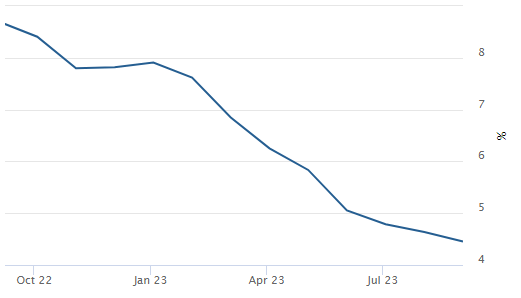
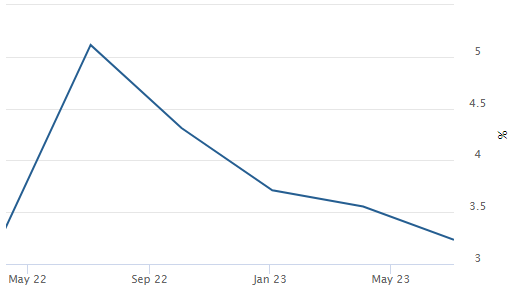
    MEXICO | On track for record remittances. On 1 November, Mexico’s central bank (Banxico) released new figures which show the country received a record US$47.07bn in remittances during the first three quarters of 2023, a 9.5% increase on the US$42.98bn received in the same period of 2022. Banxico’s data also shows that remittances in September totalled US$5.61bn, a year-on-year increase of 11.4%. President Andrés Manuel López Obrador noted that remittances this year are estimated to exceed US$63bn. This would surpass last year’s total of US$58.5bn – the current record – by some US$4.5bn, or 7.7%.

    MEXICO | GDP growth up. On 31 October, Mexico’s national statistics institute (Inegi) released the latest figures for its estimation of quarterly GDP growth, showing an increase of 0.9% in real terms in the third quarter of 2023 as compared to the previous quarter. GDP over the first nine months of 2023 was up by 3.5% compared with the same period last year.

    MEXICO | Trade deficit up in September. On 27 October, Mexico’s national statistics institute (Inegi) released new figures which show that in September the country registered a trade deficit of US$1.48bn, an increase on the deficit of US$910m recorded in the same month in 2022. This is also up from a deficit of US$1.38bn in August and US$881m in July. In the first nine months of 2023, the trade deficit was US$10bn, down from US$25.65bn in the same period in 2022.

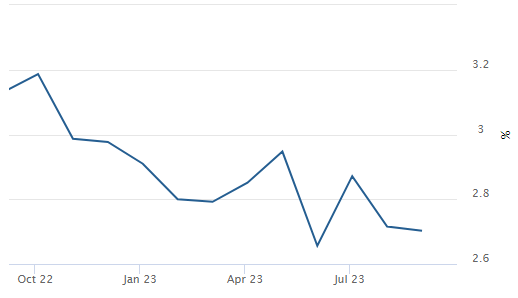
    MEXICO | Unemployment drops in yearly terms. On 26 October, Mexico’s national statistics institute (Inegi) published new figures which show that the unemployment rate stood at 2.9% of the economically active population in September, equating to 1.8m people. According to Inegi, this is down 0.5 percentage points, or 234,000 fewer people, than in September 2022. In monthly terms, the unemployment rate experienced no changes.

    Mexico: GDP growth
    Percentage variation (year-on-year)

    Mexico: unemployment rate
    Economically active population

    Mexico: inflation rate
    Percentage variation (year-on-year)

  • PERU: Boluarte insists with statute of limitations

    Anna Grace 15 August 2024 Hits: 1906

    President Dina Boluarte has signed into law a controversial bill imposing a statute of limitations on crimes against humanity, despite legal advice that it violates principles of international law.

    The new law has been championed in congress by Fuerza Popular (FP), the right-wing populist party led by Keiko Fujimori. By preventing the prosecution of crimes against humanity committed before July 2002, it clearly benefits the Fujimori clan and its supporters in the armed forces who were closely linked to human rights violations during the authoritarian presidency of her father Alberto Fujimori (1990-2000).

    Indeed, Fujimori père was himself sentenced to 25 years’ imprisonment in 2009 for crimes against humanity and released by pardon after 16 years, but still faces further investigations that could undermine his somewhat unlikely bid to run for the presidency again in 2026 (when he will be 88 years old). In one still active case Alberto Fujimori is accused of the murder of six peasants in 1992. Given that his daughter Keiko faces a complex corruption trial, the new law seems designed to protect at least one Fujimorista pathway to the presidency in just under two years’ time.

    Apart from FP leaders, those likely to benefit from a statute of limitations are hundreds of now retired military officers who were involved in the long ‘dirty war’ against the Maoist Sendero Luminoso guerrillas as well as the repression of peaceful protests in the 1980-2000 period when tens of thousands were killed in waves of political violence.

    The bill was voted through Peru’s conservative congress in June by 60 to 36 votes with 11 abstentions. It was again approved in July by a permanent commission of congress, with 15 in favour, and 12 against. President Boluarte had the option of a full or partial veto which would have sent the text back for further debate, but she chose not to exercise it.  

    International comment on the law has been forthright. In July the Inter-American Court of Human Rights (Corte IDH) issued a ruling, calling on Boluarte, congress, and the judiciary to drop the bill immediately because it contravened international law. The request was ignored by Boluarte.

    Volker Türk, the United Nations High Commissioner for Human Rights, described the bill as “a troubling development, amid a broader backlash against human rights and the rule of law in Peru.” Türk went on to say that crimes against humanity and war crimes “are among the most serious violations of international law and neither amnesties nor statutes of limitations should extend to them; those responsible for atrocity crimes must be held accountable”.

    Boluarte and her officials have attempted to shrug off the issue. Prime Minister Gustavo Adrianzén said that if there was concern over the legality of the statute, it could always be challenged in the constitutional tribunal (TC), although he failed to point out that this would be a decidedly complex and time-consuming procedure.

    Adrianzén alternated between offering a dialogue with officials at the Corte IDH and expressing “deep anger” over what he said was its desire “to issue orders to the Peruvian government”. He maintained that this constituted an unacceptable attempt to “cross red lines”.

    Statute of limitations

    The Peruvian prosecutor’s office, which opposes the statute of limitations, says it will impact at least 550 victims and 600 cases that will potentially be closed without further action.