All Categories

Subcategories

  • RASTREANDO TENDENCIAS

    LatinNews 08 June 2012 Hits: 391

    HAITI | Combate a la pobreza. El gobierno ha lanzado  un programa de transferencia de dinero para combatir la extrema pobreza. Asignará US$15m para un nuevo fondo en el curso del año próximo para garantizar la educación para hijos de familias pobres y, para aliviar el peso financiero sobre esas familias, alentándolas a mantener a sus hijos en las escuelas.

    El nuevo primer ministro, Laurent Lamothe, y la Primera Dama, Sophia Martelly, quien como varias otras pares de América Latina está íntimamente involucrada en proyectos sociales en su país, lanzó el programa –“Ti manman cheri” (Querida Mamá en creole)– el 27 de mayo en Cité Soleil, el barrio pobre  de la ciudad satélite de Puerto Príncipe. Será desplegado en 200 escuelas en los cuatro distritos más pobres en la capital, Bel-Air, Fort National, Cité Soleil, y Carrefour Feuilles, para comenzar, y luego será extendido a todo el país.

    El programa, que será financiado con fondos de la iniciativa venezolana, Petrocaribe, que apuntará a niños de entre 6 a 11 años de edad. “Esta es una revolución en nuestro país,” dijo Lamothe, agregando que los principales objetivos del esquema eran incrementar la autonomía de las mujeres (las madres podrían recibir hasta US$20 por mes); la inyección de liquidez en la economía local; y el mejoramiento de los niveles de alfabetización y los estándares de la educación.

  • RASTREANDO TENDENCIAS

    LatinNews 27 August 2012 Hits: 484

    PERU | Elevan grado de bonos a largo plazo. El 16 de agosto, la agencia de rating Moody’s elevó de grado su rating de los bonos peruanos a largo plazo en moneda extranjera y local de Baa3 a Baa2, con una perspectiva positiva. Moody’s explicó que la elevación de grado refleja un número de factores relevantes como: una reducción en el riesgo político; un continuado y robusto crecimiento económico; un sólido desempeño fiscal; mejoras en los indicadores de deuda del gobierno; y una reducción en la exposición del país a la deuda externa. La agencia destacó el crecimiento del PIB del Perú del 6,9% en el 2011, su superávit fiscal del 1,8% del PIB y una caída en la relación PIB/deuda al 21,2% como mejoras substanciales en relación al 2009, la última vez que el rating de Perú fue incrementado, cuando el crecimiento fue del 1%, el déficit fiscal fue del 1,5% del PIB y la relación PIB/deuda fue del 26%.

    Moody’s dijo que la perspectiva es positiva pues “se ha recuperado la confianza del inversionista después de haber caído después de las elecciones presidenciales y el país ha logrado presentar una sólida tasa anualizada de crecimiento del 6% en la primera mitad del año a pesar del deteriorado ambiente económico global”. Y agrega que “aunque el Presidente Ollanta Humala ha tratado de aumentar el enfoque del gobierno en la inclusión social, desde que asumió el poder él ha demostrado un compromiso por mantener políticas fiscales y macroeconómicas prudentes [...] contrario al temor de que sus políticas conducirían a un deterioro fiscal”.

    Moody’s dijo que el rating podría ser incrementado incluso más este año si, entre otras cosas, Perú es capaz de superar importantes deficiencias estructurales vinculadas a sus débiles instituciones y fortalece su capacidad de resolver constructivamente los conflictos sociales. Estos son los dos desafíos principales en los cuales la administración Humala debe concentrarse.

    BOLIVIA | Venezuela se convierte en el mayor acreedor. Según un informe difundido el 21 de agosto por el think-tank económico, Fundación Milenio, en los últimos cinco años la deuda de Bolivia con Venezuela se ha incrementado casi un 800%, haciendo de Venezuela el mayor acreedor de Bolivia. La Fundación Milenio analizó datos del banco central de Bolivia y halló que en junio del 2007, la deuda de Bolivia con Venezuela estaba en US$46,8m y que para junio de este año se había elevado a US$420,9m.

    Fundación Milenio dijo que el “sorprendente” incremento de la deuda de Bolivia con Venezuela fue un resultado del crecimiento exponencial en las importaciones de diesel de Venezuela. El gobierno del Presidente Evo Morales hace tiempo ha reconocido que Bolivia depende de las exportaciones de diesel de Venezuela para proveer cerca de la mitad de la demanda local total. Aún así, la Fundación Milenio señala que esta creciente deuda resultante  del acuerdo de cooperación energética firmado por Bolivia y Venezuela en el 2006, se está convirtiendo en la principal carga financiera del país.

    En el 2007, Bolivia no tenía ninguna deuda externa a corto plazo después que el Fondo Monetario Internacional (FMI) decidiera cancelar la deuda de Bolivia. Sin embargo, ahora la deuda externa a corto plazo de Bolivia está en US$83,4m en su totalidad adeudada a la compañía petrolera estatal de Venezuela, Pdvsa. La creciente deuda con Venezuela ha sido identificada como una de las principales causas del incremento de la deuda externa general de Bolivia, que se elevó de US$2mm en el 2007, a US$3,6mm en el 2012, un incremento del 75,3%.

    COLOMBIA | Embarque de petróleo crudo a India. El 15 de agosto, la petrolera estatal de Colombia, Ecopetrol, reveló que firmó un contrato de US$1,2mm para proveer 12m de barriles de crudo a una firma privada de refinación India. La compañía dijo que bajo los términos del contrato a 12 meses, Ecopetrol proveerá un total de 2m de barriles de crudo por mes a un puerto en la India. La compañía dijo que el primer embarque ya ha salido del puerto de Coveñas y se espera que llegue a destino en 35 días.

    Según Ecopetrol, el acuerdo es ventajoso pues asegura la “venta sistemática de crudo a un precio pre-acordado”; forma parte de su estrategia comercial de “proveer crudo a consumidores finales” y ayudará a diversificar su base de clientes. Esta es la primera vez que Ecopetrol exporta directamente crudo a la India, y la compañía cree que ayudará a consolidar su capacidad de operar rutas de transporte de petróleo a larga distancia en un esfuerzo por abrir nuevos mercados.

    Las exportaciones de crudo de Ecopetrol en la primera mitad del año llegaron a US$9,77mm, subiendo un 23,3% sobre el mismo periodo del año pasado.

    • Chávez busca construir un nuevo puerto en el Atlántico

    El 20 de agosto, el Presidente de Venezuela, Hugo Chávez, pidió a sus ministros que lleven adelante los estudios necesarios para la construcción de un nuevo puerto en la costa Atlántica de Venezuela, a fin de facilitar el comercio con el Mercado Común del Sur (Mercosur). Venezuela fue admitida en el Mercosur el 31 de julio, y Chávez ahora está interesado en aprovechar todas las ventajas de ser miembro del bloque. En una aparición en la TV, Chávez dijo que un nuevo puerto en el Atlántico debajo del Río Orinoco le daría a Venezuela más acceso a puertos en el Atlántico Sur, incluyendo aquellos de Brasil, Argentina y Uruguay

  • ARGENTINA: Las negociaciones salariales revelan la extensión de la inflación

    LatinNews 21 January 2013 Hits: 1346

    Oficialmente, la tasa de inflación en Argentina en el 2012 fue del 10,8%. Sin embargo, nadie, incluido el propio gobierno, está basando sus cálculos en esta cifra. Las negociaciones sobre salarios entre el gobierno, el sector privado, y los sindicatos, han comenzado con el ministerio del trabajo declarando su intención de limitar el incremento en los salarios al 20%. El elevado costo de vida provocó un inusitado reconocimiento del problema en un discurso de la Presidenta Cristina Fernández de Kirchner, en el cual ella pidió a los líderes municipales y gobernadores que escalonen las subidas de precios para limitar la inflación.

    El instituto nacional de estadísticas de Argentina, Indec, publicó sus cifras para diciembre, el 15 de enero. Calculó que la inflación en el último mes del año fue del 1%, llevando el total para el 2012, a 10,8%. La junta ejecutiva del Fondo Monetario Internacional (FMI) tiene fijado emitir en enero una resolución acerca de la respuesta de Argentina a las preocupaciones del FMI sobre la calidad de los datos oficiales. Por ahora, parece que el llamado ‘índice Congreso’, proveniente de una encuesta de nueve analistas privados y publicado por legisladores de la oposición, es la medida más confiable. Según esta medición, la inflación está en un 25,6%.

    Antes de sus reuniones con el gobierno esta semana, tanto los sindicatos pro-gobierno como los anti-gobierno establecieron sus demandas por un incremente salarial mínimo del 25%. La facción alineada con el gobierno de la Confederación General del Trabajo (CGT) indicó su disposición a negociar sobre esta cifra si el gobierno eleva el umbral del impuesto a las ganancias. El 16 de enero el diario, Ámbito Financiero, citando fuentes oficiales, dijo que el gobierno se estaba preparado para ofrecer un plan 20/20 que elevaría los salarios y el umbral del impuesto a las ganancias un 20%. Esto llevaría a que un hombre soltero que gane menos de Arg$8.000 (US$1.600), y parejas que ganen menos de AR$11.500 (US$2.300), queden fuera del impuesto a las ganancias por completo.

    El costo de esta oferta se estima que sería de AR$6,5mm (US$1,3mm). El gobierno ahora tendrá que resolver cómo pagar esto. Previamente, la facción leal de la CGT había sugerido aplicar un impuesto a las transacciones financieras, doblando los royalties mineros y reevaluando el impuesto sobre áreas rurales. El gobierno está en una difícil posición pues necesita mantener esta facción, liderada por Antonio Calo, de su lado. Los miembros insatisfechos con la oferta podrían fácilmente ser atraídos a los brazos de la CGT disidente, liderada por Hugo Moyano, quien organizó grandes protestas el año pasado.

    Fernández aplaudió el retorno de la fragata Libertad

    En una extravagante ceremonia que combinaba música, fuegos artificiales, y aviones en vuelo, observada por unos estimados 200.000 partidarios, la Presidenta Fernández dio la bienvenida al buque de entrenamiento que había estado 78 días incautado en un puerto de Ghana. Un juez en el país de África Occidental había ordenado su detención hasta que Argentina cumpla con una resolución previa de una corte que otorgó US$1,6mm a NML Capital de Elliott Management Corporation, el líder de un grupo de tenedores de bonos que se rehusaron a aceptar los términos de la rebaja de la deuda de Argentina en el 2002. NML dijo que si Argentina depositaba US$20m con la corte, la fragata sería liberada, pero funcionarios argentinos alegaron exitosamente ante el Tribunal Internacional para la Ley del Mar que los buques militares no pueden ser confiscados como fianza.

    Elliott Capital había hecho previos esfuerzos, pero sin éxito, para incautar otros activos argentino, como el avión presidencial, Tango 1. En un intento por evitar un potencial inconveniente, Fernández rentó un jet privado para su actual gira por el Oriente Medio y Asia, pero la compañía por la que ella optó le creo otro. Chapman Freeborne es una firma británica que también renta aviones al ministerio de defensa del Reino Unido para sus vuelos a las Falklands Islands, y a compañías petroleras que operan en el área. La elección significa que la presidenta podría estar incumpliendo su propia ley, aprobada el año pasado, prohibiendo que el sector público de Argentina participe directa o indirectamente en la industria petrolera de las Falklands.

    • Sube el dólar ‘blue’

    La tasa de cambio en el mercado negro para los dólares de EU continúa subiendo, alcanzando un récord de AR$7,36/US$1, comparado con la tasa oficial de AR$4,91/US$1, una diferencia de aproximadamente el 48%. La demanda de dólares en el mercado negro es particularmente elevada durante la temporada de vacaciones, pues los argentinos buscan financiar sus viajes al exterior. Bajo los últimos controles de monedas extranjeras, los argentinos pueden comprar no más de US$100 por persona por día para gastar afuera del país.

  • BRASIL: ¿Podría el escándalo del trensalão descarillar al PSDB?

    LatinNews 23 December 2013 Hits: 326

    Finalmente, esta semana, el principal partido opositor, el Partido da Social Democracia Brasileira (PSDB), pudo poner fin a una riña interna de larga data. El dos veces derrotado candidato presidencial, José Serra, abandonó su crecientemente desesperada esperanza de asegurar la nominación del partido para competir en el 2014, dejando despejado el camino para que Aécio Neves comience a hacer campaña en serio. Aunque la presidenta Dilma Rousseff ha afirmado con cierta altivez de estar más concentrada en la tarea que tiene entre manos que en la elección, los colegas de su Partido dos Trabalhadores (PT) estarán ansios por llamar la atención sobre un escándalo que involucra al metro de São Paulo, que ellos esperan que causará tanto daño al PSDB como el escándalo de votos por dinero del mensalão le ha cuasado al PT.

    En mayo de este año, la firma de ingeniería de Alemania, Siemens, admitió estar involucrada en un cártel para fijar precios, y confesó haber pagado sobornos para obtener contratos para construir el metro de São Paulo. A principios de diciembre el ex jefe de Siemens en Brasil, Adilson Primo, le fue ordenado que totalmente revele las transacciones financieras de una cuenta de negocios que las autoridades sospechan que fue utilizada para el pago de los sobornos. Informes de los medios locales afirman que la policía en São Paulo, un estado gobernado por el PSDB, ahora tiene evidencia documentada que incrimina a altos líderes del partido.

    El 12 de diciembre, el caso llegó a la corte suprema. Es probable que el juicio tenga lugar el próximo año, posiblemente durante la campaña electoral. A medida de que el PSDB está probando estar muy bien dispuesto a recordar a los votantes del ‘mensalão’ en cualquier oportunidad que se le presenta, el PT se deleitará arrojando de vuelta transcripciones de la corte sobre el ‘trensalão’.

    Un resultado tal podría terminar ayudando al campo de Eduardo Campos/Marina Silva. Campos, del Partido Socialista Brasileiro (PSB), dio un discurso en Recife esta sema reafirmando su argumento de la necesidad de una “tercer vía” (es decir, no PT y no PSDB) en la política brasilera para atraer votantes cansados del duopolio PT/PSDB. Aunque el mismo Campos no crea problemas para Rousseff en las encuestas proyectando los patrones de votantes, si él se retira a favor de Silva, el mensaje y la candidata podrían al menos forzar una segunda vuelta con la candidata del PT.

    Brasil recurre a Suecia para adquirir jets de combate

    La sorpresiva decisión, del 8 de diciembre, para otorgar un contrato de US$4,5mm a la firma sueca Saab AB para proveer jets de combate, demuestra las consecuencias financieras del programa de espionaje de EU. Hasta las recientes revelaciones relacionadas con la extensión de las actividades de la National Security Agency (NSA, siglas en inglés) en Brasil, Boeing era la favorito para proveer la nueva flota de aviones para la fuerza aérea brasilera. Reuters citó a una fuente anónima del gobierno diciendo que “el problema de la NSA arruinó a los americanos”.

    Oficialmente, Brasil explicó la decisión diciendo que Saab había proveído la opción más asequible para los nuevos jets, así como también las mejores condiciones para la transferencia de tecnología a los socios locales que sería necesaria para mantener dar servicio a los jets. El ministro de defensa, Celso Amorim, dijo que la elección “tomó en cuenta el desempeño, la efectiva transferencia de tecnología, y los costos; no solamente de adquisición, sino de mantenimiento. La elección fue hecha sobre el mejor equilibrio de estos tres factores”.

    El contrato, negociado en el curso de 18 años y tres presidencias brasileras consecutivas, proveerá a la fuerza aérea de Brasil con 36 nuevos jets de combate Gripen NG durante un periodo hasta el 2023. Dejando de lado los costos de los mismos jets, se espera que el acuerdo genere  miles de millones de dólares adicionales en futuros contratos de provisión de servicios.

    A mediados de los ’80, Brasil tenía la mayor industria de defensa en el mundo en desarrollo. Se convirtió en el octavo mayor exportador de armas del mundo, en medio de fuertes demandas por sus transportes de personal blindados, vehículos de reconocimiento y anti-aéreos, transportes de tropas y lanzadores de cohetes.

    Sin embargo, la industria comenzó a declinar con el fin de la Guerra Fría y la demanda por armas disminuyó. En 1990, los dos grandes fabricantes de armas de Brasil, Engesa y Avibras, buscaron protección de sus acreedores por deudas de alrededor de US$200m.

    • Intento de asilo de Snowden

    En una “Carta Abierta al Pueblo Brasilero” publicada en el diario Folha de São Paulo el 17 de diciembre, el informante de las actividades de la NSA, Edward J. Snowden, ofreció ayudar a Brasil para investigar las revelaciones de espionaje a cambio de asilo. Un vocero de la cancillería brasilera dijo que Brasil no ha recibido ninguna una solicitud formal de asilo de Snowden y, por lo tanto, no hay nada que considerar.

  • BOLIVIA: Justice remains trying for Morales

    LatinNews 06 March 2014 Hits: 2345

    The enormity of the challenge facing Bolivia’s new justice minister Elizabeth Gutiérrez, who was appointed at the end of January to tackle the crisis in the judiciary, is becoming increasingly apparent. The resignations of the presidents of both the constitutional court (TC) and supreme court of justice (CSJ), in less than a month has left the Movimiento al Socialismo (MAS) government of President Evo Morales forced to acknowledge that the unprecedented popular elections held in 2011 to pick 56 top judicial officials, have largely failed to bring about much change. Allegations by judicial officials of “interference” by the executive which have subsequently emerged – long an opposition complaint – could pose further uncomfortable questions for Morales ahead of the October 2014 general elections.

    Less than two weeks after Gutiérrez took up her post – the sole cabinet change made by President Morales in his annual reshuffle, along with the creation of a sports ministry [WR-14-04] – the president of the CSJ, Gonzalo Hurtado, announced his resignation on 4 February, citing “personal reasons”, which the local media attributed to stress. His departure was followed 15 days later by an announcement from the president of the TC, Ruddy Flores, that he too intended to step down. Flores initially claimed to have been the target of phone tapping by “state intelligence” only to retract these allegations days later, insisting they had been taken out of context.

    Both Hurtado and Flores – who have since been replaced - were elected in the October 2011 contest to pick nine CSJ judges, seven TC judges, seven justices for the newly created agro-environmental court (TA); and five for the council of magistrates – the judicial oversight committee. At the time Morales had hailed the election as a ground-breaking attempt to overhaul the justice system and make it more representative [WR-11-20], given that previously the appointments were made by the legislature, allowing various political groups to appoint magistrates sympathetic to their causes. However, the MAS government has since been forced to admit that ultimately little has changed.

    With four of the TA magistrates also clamouring for the resignation of its president, Bernardo Huarachi, for alleged inefficiency, the crisis in the judiciary could prove a rallying point for the opposition ahead of October’s election (which Morales is firm favourite to win – see sidebar). Flores’ claims regarding pressure from the executive have already been seized on both by other TC colleagues like Gualberto Cusi, as well as MAS dissidents like Deputy Rebeca Delgado, who is calling for an investigation. A former lower chamber president (2012-2013), Delgado broke with the MAS last year, after several run-ins with prominent MAS figures like Vice-President Alvaro García Linera, who she accused of authoritarianism. Meanwhile opposition leaders like Samuel Doria Medina, of the Unidad Nacional (UN) and Juan del Granado, of the Movimiento Sin Miedo (MSM) have been calling for the resignation of all the elected judicial officials.

    The MAS government has yet to provide a response to the crisis. Following Flores’ resignation, Gutiérrez told the local press that the judiciary must show “signs of change by the end of the year, or the government will take tough measures”, although these remarks were again seized on by the political opposition as evidence of “interference” by the executive. Otherwise, on 21 February, Héctor Arce, the president of the chamber of deputies’ commission on the constitution, legislation and the electoral system, announced that the legislature will promote a reform for the complete overhaul of the judicial system although it is unlikely that this will have an impact ahead of the next election.

    • Popularity

    President Morales has 45.7% of voting intentions ahead of the October 2014 presidential election, according to the latest poll by Tal Cual Comunicación Estratégica published in the local media on 23 February. Second, with 13.4%, was Samuel Doria Medina (Unidad Nacional) followed by Rubén Costas, of the Movimiento Demócrata Social (MDS), on 9.1% and Juan Del Granado, of the Movimiento Sin Miedo (MSM), on 4.4%. The survey, which interviewed 2,250 people in Bolivia’s main cities and had a 2.04% margin of error, is likely to understate support for Morales given his support traditionally remains strongest in rural areas.

  • HONDURAS: Homicides fall again

    LatinNews 03 September 2015 Hits: 2639

    In the first seven months of this year there were 3,000 homicides recorded in Honduras, marking a trend which, if maintained, could lead to a 20% fall since 2014. San Pedro Sula registered the greatest decline.

    In the past five years the number of homicides rose steadily from 5,280 to a peak of 7,172 in 2013. They then fell by 10.3% in 2014, with a bigger decline expected this year. In January-July, there were 489 cases in San Pedro Sula, an unexpected 29.2% lower than in the same period of 2014. In the central district (which comprises Tegucigalpa and Comayagüela) it fell to 510 cases, 8.4% lower than a year earlier.

    Leonel Sauceda, spokesman for the national police (PNH), attributes the improvement in San Pedro Sula to two factors: rapid response to crimes and greater coordination between all institutions involved in public security. Both of these are priorities in the government’s ‘citizen security and coexistence plan’ devised in late 2014 and launched this year. Sauceda dismisses the differences shown up in the statistics between San Pedro Sula and the central district, saying that these are slight and that what is important is that the situation in both has improved.

  • Venezuela: Migrant crisis is growing exponentially

    LatinNews 22 October 2018 Hits: 389

    Over two million Venezuelans have now abandoned their country, on latest estimates by the UN Refugee Agency (UNHCR). This is one of the largest mass migrations in the Western Hemisphere, with the only comparable migrant flows dating to war-torn Central American nations in the 1980s.

    Speaking in Lima on 11 October, UNHCR’s High Commissioner, Filippo Grandi, called on the international community to provide assistance to countries like Colombia and Peru, which are absorbing the brunt of the arrivals. “Clearly, I think governments in the region and we, the humanitarian community, must step up our preparations for more [migrants]. Unfortunately, it’s not going to stop.”

    Days later in Bogotá (on 16 October), the UN’s newly-appointed special representative for Venezuelan refugees and migrants, Eduardo Stein, likewise called for a more concerted regional and international response to the exodus of people fleeing the economic crisis in Venezuela. Stein, a former vice president of Guatemala, represents a joint platform between the UN Refugee Agency (UNHCR) and the International Organization for Migration (IOM). He describes his role as “fundamentally humanitarian”. 

    Stein praised Colombia for its welcoming attitude. The country is now host to one million Venezuelans, on official estimates, with the government issuing special temporary stay permits (PEPs) allowing migrants to work legally and access social services (including free schooling and healthcare). Well over 400,000 Venezuelans have been provide with these permits to date.

    Contrasting Colombia’s reaction with that of European countries to the Syrian crisis, Colombia’s President Ivan Duque praised his country as “fraternal and ready to look for solutions”. Duque in late October was headed on an official trip to Europe, during which he was scheduled to meet his French peer, Emmanuel Macron, Pope Francis, and European Union (EU) officials to call for more assistance to address the Venezuelan migrant situation.

    Speaking at the Colombian embassy on 18 October, Duque’s new presidential counsellor on human rights, Professor Francisco Barbosa (a respected academic), emphasised the increasing difficulties being faced by Colombia in trying to absorb the Venezuelan inflow and said the Duque government viewed the Venezuelan situation as one of its biggest challenges for its single four-year term, which began in August.

    The UNHCR calculates that 4,000 Venezuelans are crossing the border into Colombia every day – some stay, many others are en route to Ecuador, Peru, and other countries. There are also thousands of crossings by Venezuelans who come across for food and basic supplies and then return home, often daily.

    Barbosa suggested that on current inflows – which are not expected to ease given the critical situation in Venezuela – there would be 2 million (very vulnerable) Venezuelan migrants in Colombia by 2021.

    Pointing out that this is more than the 1m Syrian refugees accepted in 2015-2017 by Germany – one of the wealthiest, best resourced and well organised countries in the world – Barbosa put the current estimated cost of the Venezuelan migrant crisis to Colombia at US$10bn, a very considerable sum that the country can ill afford at a time when it is already struggling to finance (and organise) implementation of its peace accords.

    Furthermore, Barbosa emphasised, it is an unfortunate reality that while Colombia is trying its best to absorb the inflow, and has no intention of closing its border, the Venezuelan migration wave is imperilling not only social stability in parts of the country, but also the peace accords, with many desperate migrants being recruited (including forcibly) by left-wing guerrillas and criminal gangs – including drug gangs – who are now also using the vacuum inside Venezuela to recruit, train and, increasingly, to operate.

    There are strong signs, for instance, that left-wing Colombian guerrilla group Ejército de Liberacion Nacional (ELN), which has long based training camps in remote areas in Venezuelan border areas, has extended criminal activities across Venezuela, most notably including involvement in the proliferating – and very violent – illegal gold mining business in Bolívar state.

    Barbosa also noted that despite the best efforts of Colombian authorities and the UN, it is a sad fact that thousands of vulnerable Venezuelan children in border areas lack proper care – including schooling – and are living on the streets, where they too are at high risk of recruitment by unscrupulous criminal actors, including sex traffickers.

    UNHCR data confirm this, reporting in July that a mass registration of Venezuelans irregularly present in Colombia had concluded, with 442,462 individuals registered. Key results included the fact that 98.8% lacked access to healthcare and only 48.7% of children were enrolled in schools.

    In its latest situation update, the UNHCR reported that there were 2.65m Venezuelans living outside their country as of September 2018, of which over 1.9m have left since 2015. Some 70% of these (1.85m) are in South American countries.
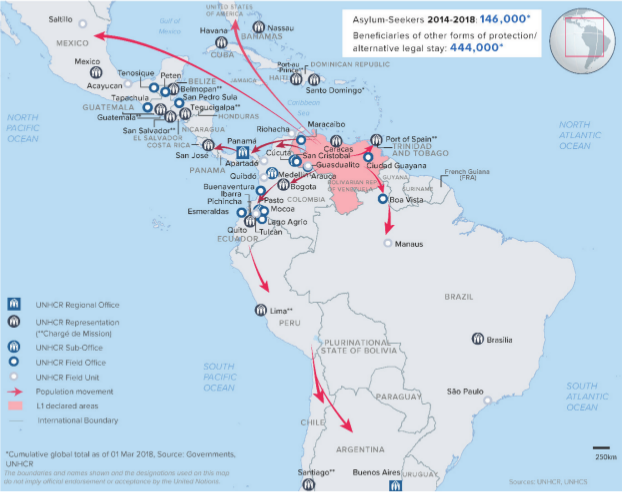
    UNHCR Venezuela

    Source: UNHCR

    However, the true figure is likely to be higher, as most data sources do not account for Venezuelans with irregular status. Venezuelans without a regular status in their host countries are particularly exposed to violence, discrimination, trafficking, and other forms of exploitation and abuse, the agency noted, emphasising that latest profiling and tracking activities had shown “a worrying increase” in the vulnerability of Venezuelan refugees and migrants, “affecting in particular children and women on the move”.

    In line with this migration wave, over 966,000 applications for temporary or permanent visas or other regularisation mechanisms have been filed by Venezuelan nationals between 2015 and September 2018 (in countries including Colombia, Peru and Ecuador). Furthermore, some 346,500 asylum claims were lodged by Venezuelan nationals between 2014 and 2018, with Peru leading as the main country of asylum, with 133,400 claims.

    Venezuela’s response – denial, paranoia

    The government led by President Nicolás Maduro refuses to recognise that there might be a humanitarian crisis in Venezuela, and refuses to permit any international assistance into the country, seeing in it an external plot to intervene. Maduro recently said of Duque that while “he looks like a cherub…he is a devil who hates Venezuela and is conspiring on a daily basis against our country”.

    On 18 October – after several weeks of escalating rhetoric – Ecuador expelled Venezuela’s ambassador, calling the Maduro administration “corrupt, murderous and lying”. The ambassador, Carol Josefina Delgado, was given 72 hours to leave the country. This is a very marked shift between the two counties, formerly close allies under presidents Hugo Chávez (1999-2013) and Rafael Correa (2007-2017).

    The spat began when Ecuador’s President Lenín Moreno in his UN General Assembly speech on 25 September said that Ecuador was receiving over 6,000 Venezuelan migrants a day, and that “children are arriving with measles, diphtheria and polio.”

    Venezuela’s communications minister, Jorge Rodríguez, on 17 October accused Moreno of “lying”, saying it would take “140 busloads a day for seven years” for Ecuador to accumulate the number of Venezuelan migrants it claims to have received. Rodríguez said he “couldn’t believe that someone could be such a liar, even at the podium of the United Nations.”

    Ecuador’s foreign ministry replied that it “would not tolerate the disrespect of our authorities” but added that, “even so, Ecuador, faithful to its democratic and humanitarian principles, will keep offering assistance to Venezuelans citizens who enter the country”.

    The communications secretariat, led by Andrés Michelena, was far less diplomatic, retorting that Rodriguez’s statements were proof that the “corrupt, murderous and lying socialism of the 21st century is still alive in Venezuela and producing the most massive migration in [Venezuela’s] history”.

    The statement added that over 1 million Venezuelans have now passed through Ecuador, with 300,000 currently living there, including 60,000 in Quito.

  • PERU: Corruption claims another ministerial scalp

    Patrick de Courcy 03 November 2022 Hits: 2602

    With the threat of a constitutional complaint by the attorney general’s office hanging over President Pedro Castillo, he could ill-afford another scandal at the heart of his administration. It did not take long for allegations of malpractice to topple another cabinet minister, however. Health Minister Jorge López Peña was replaced on 28 October, two days after the attorney general’s office announced that he was under investigation for suspected illicit enrichment. The danger for Castillo is that, if the constitutional complaint advances to a congressional vote, the relentless flow of corruption allegations surrounding his government will persuade his more lukewarm backers in congress to turn on him.

    Since its presentation to congress by Attorney General Patricia Benavides on 11 October, the constitutional complaint has dominated Peruvian politics, prompting Castillo to appeal to the Organization of American States (OAS) and triggering a stream of verbal attacks on prosecutors by the government. Its period under analysis by the congressional subcommittee for constitutional accusations has been extended, with a decision due to be made by 16 November on whether to advance the complaint towards a plenary vote. That could prove terminal for Castillo’s presidency, enabling the attorney general’s office to press criminal charges against Castillo for corruption – provided that the complaint survives the government’s legal appeals [WR-22-42].  

    • OAS

    An OAS delegation is due to arrive in Peru in mid-October, where it will meet with the government, congressional representatives, and civil society before producing a report on Peru’s political crisis. The visit follows a request from President Castillo for the regional body to condemn the constitutional complaint against him. The OAS mission will be comprised of the foreign ministers of Argentina (Santiago Cafiero), Ecuador (Juan Carlos Holguín), Guatemala (Mario Adolfo Búcaro), Paraguay (Julio César Arriola), and Belize (Eamon Courtenay). 

    Castillo is appearing increasingly rattled, declaring on 29 October that “stupid judges and prosecutors” are being unwittingly exploited by “coup-mongers”. He also claimed that “in order to make the population believe that this is a corrupt government, they’ve taken people…who have worked with us, locked them up for 10 days, and threatened them so that out of fear they become collaborators”. He added that, for the congressional leadership, “only one word is on their agenda – impeachment”.

    On that final point, at least, Castillo may be right. It was therefore an unfortunate moment for allegations of corruption to again embroil his cabinet, with López Peña accused by the television programme Punto Final of giving envelopes stuffed with cash to employees and instructing them to deliver the money to his ex-partner, Dervy Apaza.

    Whilst the investigation into López Peña is not directly related to the constitutional complaint, it seems that it is weighing on the minds of some centre-left deputies whose unenthusiastic backing for Castillo has been crucial to his survival of two impeachment votes. On 26 October, three deputies for Juntos por el Perú (JPP) – Ruth Luque, Edgard Reymundo, and Sigrid Bazán – wrote to Castillo to decry the multiple corruption allegations swirling around government ministers and Castillo’s own family. According to national daily La República, they told Castillo that whilst the current political turmoil has several causes, “this crisis is also your responsibility and that of the government that you lead”.

    The concerns of deputies such as these, whose support will be vital to the survival of the government, will not have been soothed by the fact that Castillo took five days to name a new health minister after the allegations against López Peña first surfaced. The delay may have reflected growing difficulties in finding suitable candidates willing to serve in the Castillo administration, which has got through over 70 ministers in the past 15 months. He eventually appointed Kelly Portalatino, a deputy for the far-left Perú Libre (PL), in a move unlikely to calm tensions in the conservative-dominated congress.

  • BRAZIL: The trudge towards justice for Marielle Franco

    Abbi Dicker 07 November 2024 Hits: 904

    In March 2018, former police officers Ronnie Lessa and Élcio Vieira de Queiroz carried out one of Brazil’s most notorious political assassinations of recent years, killing a rising star in Rio de Janeiro’s political scene, city councillor Marielle Franco. The pair were arrested the following year, but it has taken over six years for the culprits to face trial and be sentenced for the murder. On 31 October Franco’s friends and family welcomed the convictions of the killers but also highlighted that the path to justice must continue with the convictions of the alleged masterminds behind her assassination and their suspected accomplices.

    The Fourth Jury Court of Rio de Janeiro concluded a two-day trial on 31 October and found Lessa and De Queiroz guilty of double homicide with aggravating factors, among other charges. Lessa fired the shots which killed Franco and her driver Anderson Gomes, and De Queiroz drove the car used during the ambush. Lessa was sentenced to 78 years, nine months, and 30 days in prison, while De Queiroz will be imprisoned for 59 years, eight months, and 10 days.

    Watching the trial were Franco’s friends and family, including her sister Anielle Franco, the federal minister for racial equality. She said that her family has waited years for this day, to see Marielle’s killers convicted, but she also highlighted that there were others involved in the assassination who must also stand trial. Authorities suspect that political opponents of Marielle Franco on Rio’s city council, such as former city councillor (2005-2019) and current federal deputy João ‘Chiquinho’ Brazão, were responsible for hiring Lessa and De Queiroz to murder her. The Brazão family is an influential political family in Rio which has been suspected of having ties to organised crime.

    The murder trial also gained the attention of United Nations (UN) human rights experts and rapporteurs, who signed a statement on 5 November in which they insisted that justice for Marielle has not yet been served, echoing the calls in Brazil for more investigations and legal proceedings into the other participants in the assassination plot. The UN statement also described the Franco murder case as an emblematic example of impunity for racial violence and violence against human rights defenders in Brazil.

    Franco rose to fame for her local political work and activism, supporting residents of favelas, Afro-Brazilians, and LGBTQIA+ communities, among other sections of society which have traditionally been marginalised. The statement suggested that “to honour [her legacy], Brazil must confront systemic racism and discrimination in the justice system” and address many similar murders of Afro-Brazilian activists which have gone unpunished.

    Police death

    The death of a four-year-old child during a police operation in the state of São Paulo has stoked public indignation about the use of force by the police. Ryan da Silva Andrade Santos was playing outside his house in a poor neighbourhood, Morro do São Bento, in the port city of Santos when he was hit in the stomach by a bullet on 6 November. A spokesperson for the state police, Emerson Massera, said the bullet was “probably” fired by an officer engaged in a gunfight with a group of alleged criminals. 

    Journalist and activist murder case

    The federal police (PF) announced on 4 November that it had concluded its investigations into another high-profile double homicide case, the assassination of Brazilian indigenous expert Bruno Pereira and British journalist Dom Phillips in June 2022.

    The PF have recommended charges against members of a suspected criminal gang based in the remote regions of the Amazon rainforest allegedly involved in illegal fishing and poaching. Pereira and Phillips were working on a book project, interviewing indigenous people and other residents in the remote reaches of the Amazon, when they were shot dead. Police believe that the criminal group targeted Pereira due to his previous work in monitoring environmental crimes in the region.

  • BRAZIL: Congress deals blow to government’s fiscal plans

    Patrick de Courcy 19 June 2025 Hits: 3296

    The government issued decrees on 11 June to enact measures aimed at boosting tax revenue, but congress signalled strong opposition to the plans. A few days later, the lower chamber of congress passed a motion to fast-track a bill to suspend the government’s measures. The fast-track motion was approved by a vote count of 346-97, a strong majority which indicates the extent to which the relationship between the executive and legislature has soured.   

    The tensions over taxes had been rising since 22 May, when Finance Minister Fernando Haddad announced plans to increase the financial operations tax (IOF), levies imposed on some financial transactions such as loans, insurance, and foreign currency exchange. The rise in IOF tax rates sparked backlash from the financial sector, forcing Haddad to negotiate with legislators in late May and early June in order to come up with new revenue-boosting measures to enable them to be repealed.

    On 8 June Haddad met with the president of the lower house, Hugo Motta, and the senate president, Davi Alcolumbre, to present the new measures, which included tax rises on online gambling platforms and on fixed-income securities for investments in the agriculture and real estate sectors, as well as a partial rollback of the IOF rate hikes.

    The government believed it had Motta’s support on 8 June, but over the following week the lower house president expressed scepticism towards the tax rises which would be implemented through decrees on 11 June. Even though Motta took in part in discussions with Haddad to plan these fiscal measures, he appears to have made a U-turn and signalled alignment with right-wing opposition parties which have long argued that the government should be seeking to meet its fiscal targets by cutting social spending instead of raising taxes.

    The overwhelming majority of federal deputies that voted on 16 June in favour of fast-tracking the review of an opposition-authored bill to suspend the government’s tax increases has been interpreted in the media as an attempt by congress to assert its control over public finances, which legislators believe has been threatened by the supreme court (STF).

    On 10 June STF justice Flávio Dino ordered members of congress to explain the alleged lack of transparency and traceability in some ‘emendas parlamentares’ – earmarked grants from the federal budget allocated for projects chosen by legislators. Lawmakers are reportedly concerned that Dino’s crusade against opaque public funding mechanisms could lead to the suspension of emendas grants – just as in August 2024, when he ordered untraceable grants to be frozen [WR-24-32].  

    Members of congress eager to maintain their hold over part of the federal budget are also dissatisfied with the executive government for its slow disbursement of the so-called ‘emendas impositivas’, grants included in the government’s obligatory expenditure. On 16 June news website G1 reported that the Lula administration is planning to speed up the payment of emendas to legislators as a step towards assuaging tensions between the executive and legislature, with R$2bn (US$364m) worth of grants expected to be disbursed by the end of June. But it is unclear if paying grants to legislators will be enough to restore the Lula government’s alliances with centre-right lawmakers, such as Motta, who are proving to be unreliable partners.

    Corruption inquiry

    The president of the senate, Davi Alcolumbre, accepted a request by opposition lawmakers on 17 June to launch a joint congressional inquiry (CPMI) into the alleged corruption in the national social security agency (INSS). Emerging in April, the alleged corruption scheme involved irregular deductions from retirement and pensions payments from 2019-2024. A CPMI could be a chance for the government to take control of the narrative and pass the blame on to the previous Bolsonaro administration. But if the CPMI committee is packed with right-wing opposition figures, then it could become a platform to further criticise the government for its alleged delay in stopping the irregular deductions.

  • ECUADOR: Noboa grapples with security crisis

    Patrick de Courcy 17 September 2026 Hits: 90

    Ecuador’s President Daniel Noboa decreed a new state of emergency on 15 September. It will be in place for 60 days in eight provinces and three cantons (municipalities) in the country, with a curfew imposed in four coastal provinces until the end of September. The Noboa administration’s latest state of exception elicited fierce criticism from the political opposition, not least because it will push close to local elections slated to take place on 29 November. The opposition contends that the restrictions will disrupt and constrain campaigning.

    The state of emergency takes effect in eight provinces: El Oro, Esmeraldas, Guayas, Los Ríos, Manabí, Pichincha, Santa Elena, and Santo Domingo de los Tsáchilas. The three affected cantons are Camilo Ponce Enríquez, in the province of Azuay; Las Naves, in Bolívar; and La Maná, in Cotopaxi. The curfew, meanwhile, was imposed in the provinces of Guayas, Manabí, Los Ríos, and El Oro.

    President Noboa once again cited “grave internal commotion” to justify the state of emergency and the third curfew of this year; the previous curfew, in May, resulted in more than 3,400 arrests in its two-week duration. The decree, which the interior minister, John Reimberg, branded “a concrete security imperative”,  based the decision on reports by the national intelligence agency, national police, and armed forces. The reports concluded that criminal groups based in these areas were “diversifying their sources of financing”, which was allowing them to “maintain a high capacity for adaptation” to police action targeting them.

    The curbs on freedom of movement and assembly will restrict campaign rallies and voter outreach in the run-up to November’s elections for the positions of mayor and prefect (governor). The opposition argues that this is part of an overarching plan to stifle dissent. Gabriela Rivadeneira, the president of the main left-wing opposition Revolución Ciudadana (RC), which was suspended earlier this year pending a money-laundering probe, urged the Organization of American States (OAS) to send election observer teams earlier than usual in order to monitor what she claimed would be the misuse of security laws.

    It was eye-catching that Noboa’s decree was issued on the very same day that the inter-governmental organisation International Institute for Democracy and Electoral Assistance (International IDEA) released its annual Global State of Democracy Report, entitled ‘Democracy in an Age of Conflict’ (see sidebar). This cautioned that militarised public security and perpetual reliance on states of emergency were eroding the rule of law and infringing upon human rights, all while failing to produce a concomitant improvement in security.

    Ecuador’s interior ministry, for instance, released figures at the end of August showing that the number of intentional homicides in June (693) and July (704) surpassed the same months in 2025 by some 200. Meanwhile, nine provinces registered an increase in homicides during the first seven months of the year compared with the same period in 2025. The most notable spike was in El Oro, where homicides jumped by 77% year-on-year to 634.

    In 79 cantons the number of homicides increased over the first seven months of the year, led by Machala, the capital of El Oro, where intentional homicides climbed by 76% to 280. Conversely, homicides fell in 85 cantons, notably the country’s most populous city of Guayaquil, where they fell by 23% to 1,274. However, the surge elsewhere means overall progress remains highly uneven nationwide. Meanwhile, there were no intentional homicides at all in either year in 50 cantons.

    Slipping down the table

    Ecuador did not fare well in the International IDEA report. It slid 14 places in the global table on ‘representation’, the steepest decline in the region. It also fell 21 places in the ‘rule of law’ table to finish in 124th place, above only Haiti (151), El Salvador (154), Cuba (157), Nicaragua (165), and Venezuela (173), which propped up the whole table.

  • RASTREANDO TENDENCIAS

    LatinNews 09 January 2012 Hits: 852

    HAITÍ | Ejército y elecciones. No puede haberse escuchado discursos presidenciales más controversiales para marcar el aniversario de la independencia de Haití el 1 de enero. El Presidente Michel Martelly eligió el 208vo aniversario para anunciar que una recientemente creada comisión especial había recomendado que el ejército haitiano, desbandado en 1994, sea reestablecido. Martelly dijo que el ejército iba a salvaguardar la integridad territorial, responder a los desastres naturales y luchar contra el tráfico de drogas y el terrorismo. La comunidad internacional, y el grueso de la oposición política, se oponen a la restauración del ejército, que tiene un pésimo record en derechos humanos, afirmando que es un innecesario peso financiero. El debate ahora subirá de tono en el parlamento.

    Martelly también señaló que dos de sus principales prioridades en 2012 serán celebrar elecciones municipales, como también elecciones para renovar un tercio del senado. Su decisión de purgar el consejo electoral provisional (CEP) el 29 de diciembre, destituyendo a sus nueve miembros por corrupción y malversación dándole a Martelly la oportunidad de crear una autoridad electoral genuinamente independiente. El CEP fue ampliamente desacreditado y politizado y su manejo de las elecciones en noviembre de 2010 fue caótico, pero su debilidad es un resultado directo del fracaso de sucesivos jefes de estado para implementar la constitución de 1987. Este marzo, habrá pasado un cuarto de siglo desde entonces y aún el consejo electoral permanente que prevé la constitución nunca ha sido establecido debido a que los jefes de estado han preferido preservar un consejo provisional al cual pueden manipular.

    Martelly alega que la restauración del ejército traerá la estabilidad que era esencial para el futuro desarrollo de Haití, pero la formación de un consejo electoral permanente, independiente del gobierno proveería mayor estabilidad para el desarrollo de Haití. Si Martelly defendiera la instalación de tal consejo, él respondería a los reclamos de la oposición y eludiría sus críticas sobre sus tendencias autoritarias: la constitución estipula que las tres ramas del gobierno deberá elegir cada una a tres miembros del consejo electoral permanente, y n o por el presidente como actualmente lo hace con el consejo electoral provisional. Sin embargo, dada la débil presencia de su Repons Peyizan en el parlamento, él estará fuertemente tentado a perpetuar el status quo.

  • RASTREANDO TENDENCIAS

    LatinNews 30 April 2012 Hits: 676

    CHILE | Gestos financieros hacia los estudiantes. El gobierno anunció esta semana una serie de propuestas que apuntan a reformar el sistema de financiamiento de la educación superior del país. El anuncio llega dos días antes de una marcha nacional, organizada por la confederación de estudiantes de Chile (Confech) en protesta contra la ausencia de progreso que el gobierno ha hecho en abordar las demandas planteadas durante los meses de protestas montadas a través del país el año pasado, que fue programada realizar. El ministro de educación de Chile, Harald Beyer, explicó que las propuestas incluyen el desmantelamiento del actual sistema de crédito estudiantil respaldado por el estado (CAE) a través del cual los estudiantes obtienen préstamos de bancos privados. Será reemplazado con un nuevo sistema que busca eliminar la participación de bancos privados a favor de un financiamiento exclusivo del estado.

         Los estudiantes se habían quejado que bajo el sistema CAE los bancos tenían permitido cargas intereses extorsivos de hasta 6,4% sobre los préstamos a estudiantes, cargando a los estudiantes con deudas masivas. Beyer explicó que bajo el nuevo sistema una nueva agencia pública estará a cargo de proveer préstamos a todos los estudiantes con una tasa fija de interés de 2% para todos. Además será establecido un cargo máximo de repago de 10% de las ganancias del deudor extendido en 180 cuotas. Cualquier deuda pendiente después de esto será anulada.

        Beyer también reveló que como parte de las propuestas, el gobierno, y no las instituciones académicas, estarían a cargo de la supervisión académica de las becas, para asegurar que 60% de esas becas sean otorgadas a los estudiantes más pobres. Aunque los estudiantes valoran los “gestos” del gobierno en abordar algunas de sus preocupaciones, después de un cuidadoso análisis ellos decidieron que la medida no llega a cumplir sus pedidos para establecer un sistema de educación superior dirigido por el estado. El presidente de la federación de estudiantes de la Universidad de Chile (Fech) y vocero de la Confech, Gabriel Boric, explicó que “no deseamos [simplemente] cambiar deuda por deuda sino más bien cambiar la lógica bajo el cual opera el sistema de educación en Chile”. Como resultado, Boric anunció que la Confech no suspendería la marcha.


    URUGUAY-ARGENTINA | Acuerdo fiscal. El ministro de economía de Uruguay, Fernando Lorenzo, anunció el 24 de abril que Uruguay había suscrito un sistema de doble-tributación y de intercambio de información con Argentina. El establecimiento de esa clase de acuerdo era un prerrequisito para que la Organización  para la Cooperación y el Desarrollo Económico (OCDE) remueva a Uruguay de su ‘lista gris’. Lorenzo dijo que él firmó el acuerdo el 23 de abril con el titular de la autoridad fiscal de Argentina (Afip), Ricardo Echegaray. El acuerdo deberá ser ratificado por los respectivos parlamentos de ambos países para que tenga efecto. Lorenzo dijo que el acuerdo no será aplicado retroactivamente y rechazó que cualquiera de los gobiernos ahora buscaría llevar adelante acciones de auditoría conjunta en los territorios de cada uno. Lorenzo dijo que el acuerdo formaba parte de los esfuerzos del gobierno para cumplir la segunda etapa del acuerdo de transparencia de la OCDE, para ayudar a Uruguay a mejorar su estatus internacional y volverse más atractivo para los inversionistas, un objetivo que deberá ser mejorado por la decisión de Standard & Poor’s de restaurar el rating de grado de inversión del país.

        La OCDE también ha requerido a Uruguay que firme un acuerdo similar con Brasil. Lorenzo dijo que el gobierno estaba preparado para trabajar con tal fin. Y espera solicitar otra revisión de la OCDE para mostrar que está cumpliendo todos los requisitos relacionados a la transparencia de impuestos a mediados del año.

    PARAGUAY | El gobierno aprueba inversiones privadas. El ministerio de finanzas de Paraguay ha aprobado unos US$120m en inversiones privadas bajo la ley 60/90, que apunta a promover el crecimiento y el desarrollo del sector agrícola e industrial a través de la inversión privada, en lo que va del año. En el 2011, el ministerio de finanzas aprobó US$574m en proyectos bajo la ley 60/90 que provee incentivos fiscales para inversionistas, toda vez que usen materia prima y fuentes de energía locales; creen empleos locales; incrementen la producción de bienes y servicios; sustituyan importaciones; o incorporen tecnología moderna para incrementar la productividad y la eficiencia. De acuerdo con un informe del ministerio de finanzas, solamente en abril, el ministerio ha aprobado nueve proyectos de inversión con un valor de US$4,5m, que incluyen planes para expandir la capacidad de producción de arroz; la construcción de nuevos depósitos de granos de soja; y la expansión de mataderos de pollos. El incremento en las aprobaciones parece ser parte de planes más amplios del gobierno para estimular el crecimiento económico después de un desastroso inicio del año: una severa sequía y un brote de aftosa llevó a la actividad económica en el sector agrícola y ganadero a una interrupción casi completa.

    • Inversión en el cemento

    El 19 de abril la firma brasileña Loma Negra, parte del grupo Camargo Correa, anunció la construcción de una nueva planta productora de cemento con una inversión de US$250m, en la provincia de San Juan, Argentina. El director de Loma Negra, Osvaldo Schütz, hizo el anuncio en una teleconferencia que realizó con la Presidenta de Argentina, Cristina Fernández, quien viajó a San Juan para la apertura de una nueva granja eólica. Schütz explicó que la nueva planta tendría la capacidad de producir 1m de toneladas de cemento por año; y que durante su fase de construcción, proveería 1.200 empleos directos y 2.400 indirectos. Loma Negra ya tiene nueve plantas productoras de cemento en Argentina, en la provincia de Buenos Aires, Neuquén, San Juan y Catamarca. A través de su subsidiaria InterCement, el grupo Camargo Correa provee cemento a Argentina, Brasil y Paraguay.

  • TRACKING TRENDS

    LatinNews 04 October 2012 Hits: 792

    COLOMBIA/VENEZUELA| Work begun on major international highway. On 27 September Colombia’s national infrastructure agency (ANI) announced that construction of the 1,425km ‘Transversal de las Américas’ highway across northern Colombia was under way. The new road will improve transport links with neighbouring Venezuela. ANI said that the US$889m seven-year project involves the construction of new road tracts. It also involves widening and renovating existing roads across seven Colombian departments which will connect the northwest department of Chocó, on the border with Panama, with the north-eastern department of César, on the border with Venezuela. The new highway is to be built and later operated by the Vías de las Américas, a consortium of the local construction and engineering firms. Colombia’s national roads institute (Invías), a dependency of the national executive, highlights that the Transversal de las Américas project will not only benefit local communities in the southern Bolívar and middle Magdalena regions by connecting them to the rest of the country but the country as a whole. Invías claims it will boost competitivity and tourism as well as economic and social development in the Atlantic Coast.

    BOLIVIA| Becoming potato self-sufficient. Bolivia’s deputy minister for agriculture, Víctor Hugo Vásquez, has announced that the government of President Evo Morales has signed an agreement with local potato producers, traders and fast food restaurants aimed at ensuring the latter will increase the amount of Bolivian potatoes used in their restaurants and eventually stop the import of foreign potatoes. According to Bolivia’s national agricultural and forestry innovation institute (Iniaf), some 1,555 varieties of potato are grown in the country, which produces some 970,000 tonnes of potato a year and exports some 44,000 tonnes a year to neighbouring countries. Yet at the same time Bolivia imports some 24,308 tonnes of potatoes a year, a large proportion of which are of the Désirée variety that is mostly widely used in fast food restaurants in order to meet the high level of demand. Iniaf puts national consumption (Bolivia’s population is some 10m) at 90kg of potatoes per head per year.  Vásquez estimates annual demand for Désirée potatoes to be 4,000 tonnes. Domestic producers provide 266 tonnes, or 6.3% of the total demand, with the rest imported from neighbouring Peru. Vásquez said that the government is looking for a way to guarantee “better prices for local producers, traders and businessmen so that our national product can compete”.

    VENEZUELA| Gov’t rejects TNK-BP increased participation proposal. On 27 September Venezuela’s oil and mining minister, Rafael Ramírez, rejected a proposal tabled by the Anglo-Russian oil firm, TNK-BP, which is owned by Russian consortium AAR and the United Kingdom’s BP, to up their stake in PetroMonagas, a joint venture with Venezuela’s state-owned oil firm, Pdvsa.  TNK-BP owns a 16.6% stake in PetroMonagas, which operates the world’s largest crude heavy crude deposit: the Orinoco Belt, while Pdvsa owns the rest. At the end of last year, TNK-BP signalled its interest in increasing its stake in PetroMonagas (reportedly to as much as 40%) and was said to be in talks with Pdvsa. However, Ramírez rejected this possibility, underlining that the Venezuelan government had no intention of giving up any of its stake in PetroMonagas. He said that instead, Pdvsa has proposed that TNK-BP help it expand PetroMonagas’s production capacity. Ramírez said that it is well known that there are a lot of oil reserves in the PetroMonagas project and the basic infrastructure to expand its capacity is already in place. At the beginning of the year, Pdvsa estimated that PetroMonagas would reach a production capacity of 120,000 barrels per day (bpd) by year-end up from the 120,000bpd it now produces.

    • Peru signs agreement with GCC

    On 2 October Peru’s foreign minister, Rafael Roncagliolo, and his Saudi counterpart, Nizar bin Obaid, signed an economic, trade and investment cooperation framework agreement between Peru and the Gulf Cooperation Council (GCC). Thus Peru becomes the first South American country to sign such an agreement with the GCC, which comprises Saudi Arabia, Bahrain, Kuwait, Qatar, Oman and the United Arab Emirates. In a joint statement the ministers said that Peru is now set to become a “strategic partner” for the GCC. Roncagliolo added that the new accord “confirms Peru’s commitment to promoting international trade”.  The signing of the accord took place on the margins of the III South American Arab countries (Aspa) summit held in Lima, Peru on 1-2 October.

  • RASTREANDO TENDENCIAS

    LatinNews 20 May 2013 Hits: 631

    MÉXICO | Cambiantes patrones entre hispanos de origen mexicano. En el 2012, había 33,7m de hispanos de origen mexicano en EU, de acuerdo con un nuevo análisis de la oficina de censos del centro de investigaciones Pew (Pew Research Center). Aparte de ser un nuevo récord, un rasgo notable de las estadísticas es que actualmente el 35% de los hispanos de origen mexicano han nacido en México; los restantes dos tercios (65%) nacieron en EU (el 52% de ellos tienen al menos un padre inmigrante).

    El estudio del centro Pew señala que la magnitud de la población de origen mexicano en EU ha crecido dramáticamente durante las últimas cuatro décadas, como un resultado de una de las más grandes masas migratorias en la historia moderna. En 1970, menos de 1m de inmigrantes mexicanos vivían en EU. Para el 2007, llegó a un pico de 12,5m. Desde entonces, ha declinado pues la llegada de nuevos inmigrantes mexicanos se redujo significativamente.

    Desde 1980 hasta el 2000, la mayor parte del crecimiento en la población de origen mexicano en EU podría atribuirse a la llegada de inmigrantes mexicanos. Este patrón se revertió desde el 2000 hasta el 2010, pues los nacimientos sobrepasaron a la inmigración como el principal conductor del crecimiento de la población de origen mexicano.

    Los 11,4m de inmigrantes mexicanos que viven en EU componen el más numeroso grupo de país de origen único entre los 40m de inmigrantes de la nación. El siguiente mayor grupo de población nacido en el extranjero, es el de China continental, con 2m, y es menos de un quinto (20%) de la población nacida en México y que vive en EU.

    Los inmigrantes mexicanos forman por lejos la porción más grande de la población de inmigrantes no autorizados que viven en EU. Más de la mitad (el 55%) de los 11,1m de inmigrantes que viven ilegalmente en EU son de México.


    MÉXICO | Decae el crecimiento industrial, el empleo se mantiene ‘estable’. La actividad industrial en el primer trimestre de este año fue un 1,5% menor que en el comparable periodo del 2012, de acuerdo con el Inegi, el instituto de estadísticas. De los cuatro sectores en la categoría industrial, tres mostraron declinaciones construcción (-2,3%); manufacturas (-1,6%); y electricidad, gas y agua (-1,3%). El cuarto, la minería, creció por sólo un 0,2%.

    Vale señalar que la tendencia general es más agudamente hacia la baja, con todos los sectores registrando mayores descensos en marzo. En general, la producción industrial en marzo fue un 4,9% menor que en el mismo mes del 2012 (aunque esto es en parte el resultado de menos días laborales, debido al feriado de la Semana Santa).

    El desempleo en el primer trimestre, que fue del 4,9% de la población económicamente activa, no tuvo cambio comparado con el mismo periodo del año pasado. Inegi considera que cualquier persona mayor de 14 años que trabaje al menos seis horas a la semana es un empleado. El subempleo (aquellos que declaran una necesidad y la voluntad de trabajar más horas) representan el 8,2% de los empleados.

    Inegi también informa que la proporción de personas empleadas que trabajan en el sector informal se ha elevado del 58,8% en el primer trimestre del 2012, al 59% en el primer trimestre de este año, y que ahora la proporción de empleados que cobran salarios es de un 67,2%.

    La población económicamente activa de México es de 50,2m, o poco menos del 45% de la población total. El número de personas que viven por debajo de la línea de la pobreza es de 52m, o poco más del 46% del total.

    El Banco de México ha pronosticado un crecimiento del PIB de entre el 3% al 4% este año, elevándose al 3,2% - 4,2% en el 2014 –con la advertencia de que esto depende en gran medida del desempeño de la economía de EU. El año pasado, el PIB creció un 3,9%. El banco espera que la inflación permanezca relativamente elevada en mayo y junio, pero que reanudará su tendencia a la baja en la segunda mitad de este año.

  • In Brief - Colombia

    LatinNews 18 July 2013 Hits: 1713

    POLITICS | Miners defy Santos. On 17 July Colombian miners, as planned, staged the first day of an indefinite national strike in which they erected various road blockades around the country. The miners’ decision to go ahead with the strike and to cut off main roads came despite a firm warning from Colombia’s President Juan Manuel Santos against their use of road blockades and violence. According to the authorities there were demonstrations in the departments of Chocó, Valle del Cauca, Atioquia, Caldas, Quindio, Risaralda, Huila and Boyacá. The largest demonstrations took place in Quinchía, Risaralda, where hundreds of miners marched down the road linking Antioquia’s capital, Medellín, and the city of Manizales in Caldas department effectively blocking all access; and in Buenaventura, Valle del Cauca, where thousands of protestors set up a road block closing off access to the port of Buenaventura, Colombia’s main port.

  • RASTREANDO TENDENCIAS

    LatinNews 20 June 2014 Hits: 604

    COLOMBIA | Emitiendo más deuda. El 16 de junio el ministerio de finanzas de Colombia (Minhacienda) anunció que incrementaría la emisión de bonos del tesoro (TES) en el mercado interno a través del 2014 y el 2015. A pesar de esto, Minhacienda espera que el déficit fiscal consolidado continúe encogiéndose gracias a los pronósticos de un mejorado crecimiento económico y una mayor toma fiscal.

    Un informe del Minhacienda expresa que el ministerio ha decidido elevar su límite de emisión TES este año a Col$33,19bn de Col$30, 31bn (US$15,93mm). El director de crédito público del Minhacienda, Michel Janna, dijo en una conferencia de prensa que los fondos adicionales de los TES recolectados este año serían usados a prefinanciar los gastos públicos planeados para el primer trimestre del 2015. Sin embargo, Janna dijo que la relación deuda-PIB permanecería en alrededor del 35,7%, debido al hecho de que el ciclo económico interno es más sólido de lo que se esperaba inicialmente y debido a las expectativas de ingresos fiscales mayores a los esperados este año.

    De acuerdo con el plan fiscal de mitad de periodo de Minhacienda, obtenido por la agencia Reuters, la proyección de la relación déficit fiscal-PIB para el sector público en el 2014 es del 1,6% y del 1,2% en el 2015. La proyección de la relación déficit fiscal-PIB para el gobierno central, para el 2014 y para el 2015, es del 2,4%.

    El gobierno colombiano está planeando emitir bonos TES por un total de Col$34,4bn (US$17,9mm) en el 2015; de los cuales US$14,3mm serán subastados. De acuerdo con el plan fiscal, Colombia buscará recolectar US$5,1mm a través de deuda externa en el 2015; US$3mm a través de la emisión de bonos de deuda externa y el resto vía créditos de instituciones bancarias internacionales. La expectativa relacionada con la toma fiscal es de Col$112,9bn (US$59,45mm) para el 2014, y de Col$125,1bn (US$65,9mm) para el 2015.

    COLOMBIA | La inflación sobrepasa los niveles del 2013. La inflación acumulada en los 12 meses a mayo del 2014 alcanzó el 2,48%, más que el 2% registrado en el mismo periodo del año pasado, informó la agencia nacional de estadísticas de Colombia (Dane). Un informe de Dane muestra que el incremento mensual de la inflación en mayo del 2014 fue del 0,48%, subiendo 0,2 de punto porcentual sobre el mismo periodo en el 2013, y mucho más elevado que el 0,30 esperado por los analistas locales. A este ritmo la tasa de inflación de Colombia se dirige a sobrepasar el 1,94% registrado en el 2013.

    El inesperado incremento en los precios al consumidor ha sido atribuido a una subida repentina en el costo de los alimentos, que se incrementaron un 1,18% año en año, en mayo, como resultado de las expectativas de que el fenómeno climático El Niño afectará negativamente los rendimientos de cultivos este año (ver más abajo).

    Luego de la difusión del informe, Munir Jalil, el director de investigación del Citibank Colombia, dijo que él ahora esperaba una inflación del 3,5% para todo el año, subiendo del 3,2% pronosticado previamente. Según Jalil, esto podría llevar al banco central de Colombia a gradualmente elevar sus tasas de interés de referencia a un monto más alto que el proyectado 4,25%, en un esfuerzo por contener la inflación. En su reunión de política monetaria del mes pasado, el banco central incrementó su tasa de interés de referencia del 3,5% al 3,75%, el segundo incremento en otros tantos meses.

    ECUADOR | Correa defiende las regulaciones de importación. El gobierno ecuatoriano está preparando la respuesta a una resolución del Secretariado General de la Comunidad Andina de Naciones (CAN), que considera que las recientes regulaciones de importación de Ecuador son excesivamente restrictivas.

    El Presidente de Ecuador, Rafael Correa, dijo a los periodistas de su país retendría el derecho a aplicar “regulaciones técnicas” para defender el bienestar económico de sus ciudadanos. La ‘Resolución 116’ entró en efecto el 3 de diciembre del 2013, requiriendo que unos 293 productos de los sectores agroindustrial y de higiene (cosméticos, juguetes, materiales plásticos) obtengan un “certificado de reconocimiento” para poder ser importados a Ecuador.

    La CAN, que actualmente está compuesta por Bolivia, Colombia, Perú, y Ecuador, declaró el 6 de junio que la resolución ecuatoriana va contra sus principios de “restricción al comercio”, y le dio al país 15 días laborales para proveer un informe sobre las razones detrás de la adopción de estas medidas.

    El Comité para la Empresa de Ecuador (CEE) había expresado sus dudas acerca de la resolución 116, con el director del CEE, Roberto Aspiazu, declarando en febrero que los pedidos de certificación podrían conducir al estancamiento y retrasos en las importaciones.

    El Presidente Correa respondió a la resolución de la CAN apoyando la resolución 116 como una medida para proteger a los productores ecuatorianos de la competencia de los productores de otros países andinos que recientemente han visto sus monedas perder valor en los mercados internacionales. Correa declaró que “Colombia y Perú han devaluado [sus monedas], pero [en la CAN] nada ocurre, pues los acuerdos comerciales y de integración no toman esto en cuenta”.

    Ecuador dolarizó su economía en el 2000, cediendo el control sobre la política monetaria y la tasa de cambio.

    • El Niño

    Comentando sobre el inesperado incremento en la inflación en Colombia, el analista del Banco de Bogotá, Héctor Suescún, dijo que esto podría haber sido producido por las expectativas negativas de que El Niño de este año, el cual tiende a traer un clima extremadamente lluvioso a América del Sur desde abril a octubre, será importante. Según Suescún, los precios de algunos productos de primera necesidad en la dieta colombiana, tales como papas y tomates, han estado incrementando constantemente en los últimos tres meses debido a tales expectativas. Los precios de estos dos productos vieron un agudo incremento el mes pasado, con las papas subiendo un 27,3%, y los tomates un 16,34%. Sin embargo, los efectos de El Niño normalmente se sienten con más fuerzas hacia finales de año en septiembre y octubre.

  • POINTERS

    LatinNews 03 February 2015 Hits: 2403

    VENEZUELA | Gearing up for confrontation. On 27 January, President Nicolás Maduro announced the establishment of the first ‘people’s civil-military commands’ which will be charged with fighting what he describes as a ‘war’ instigated by the ‘parasitic bourgeoisie’, ‘criminal gangs’ and ‘saboteurs’ and waged through large-scale hoarding of essential imports, along with price speculation and usury, with the aim of undermining the government and destabilising the country. This step is also a response to opposition leader Henrique Capriles’s call for the people to ‘mobilise’, even though Capriles has emphasised that he intends this to be peaceful, unlike the more confrontational approach pursued by the more radical wing in early 2014.

    Ernesto Villegas, head of the Caracas capital district, was appointed civilian command leader in the capital, paired with General Enrique Zabarse Pabón, who commands the national guard (GNB) in that area. Maduro announced that he would tour every state to install similar commands. He called on government supporters to assist this effort by cooperating with the installation of fingerprinting machines (to prevent multiple shopping trips in search of scarce goods) and the distribution of consumer ration cards in every neighbourhood.

    Also on 27 January the defence ministry published a new protocol for military action to maintain public order, which includes ‘the use of potentially lethal force, with either firearms or other potentially lethal weapons’. Opposition media and politicians have said this breaches Article 68 of the constitution, which explicitly bans ‘the use of firearms or toxic substances for the control of peaceful demonstrations.’ They have also noted that the new protocol is intended for use by all armed forces, when the constitution allows only the use of one service, the GNB, for the maintenance of public order, and that only when the capabilities of the police are overwhelmed.

    BOLIVIA | Crackdown on corruption in the judiciary. On 9 January the minister of transparency and fight against corruption, Nardi Suxo, announced that the sworn statements of assets of 50 members of the judiciary and law enforcement have been forwarded to the public prosecution service to determine whether these assets were licitly obtained.

    This came after a random check on the assets of 105 persons turned up a series of irregularities. Suxo cited the case of a judge in Santa Cruz who upon appointment had declared assets worth US$9,000 and now had about US$142,000 without counting his house and five vehicles, and another who in 2008 declared no assets and last year had US$112,000. Under investigation are 18 judges, 20 prosecutors and 12 police officers.

    That same week President Evo Morales announced that he would be calling a referendum to determine whether the public agrees to amend the system to appoint judges by popular election which was established in the 2009 constitution. Morales says that this system had not served the purpose of improving the administration of justice, which is still afflicted by political interference, widespread corruption, limited access and slow procedures.

    ECUADOR | Military force evicts indigenous Huaorani. Six soldiers were injured by shotgun fire when a 120-strong force was deployed in the Amazonian province of Pastaza to evict a group of Huaorani people who had seized a camp of the oil firm Petrobell in Arajuno, and had engaged, according to the official acount, in looting and vandalism, halting production. Seven of the Huaorani were arrested.

    The authorities did not say what had motivated the action of the Huaorani. The defence ministry said that it had acted in furtherance of the armed forces’ statutory obligation to safeguard the country’s ‘strategic assets’.

  • EL SALVADOR: Surge in violence detracts from Romero’s day

    LatinNews 10 June 2015 Hits: 2699

    President Salvador Sánchez Cerén delivered his state-of-the-nation address to the legislative assembly on 1 June to mark the completion of his first year in power. He expressed his hope that El Salvador would be “guided to a brighter path”, infused with the spirit of Archbishop Óscar Arnulfo Romero, who was beatified on 23 May, just over 35 years after he was infamously assassinated while celebrating mass. Rarely has El Salvador needed Romero’s intercession more than now as the number of homicides in the country spirals to levels unprecedented in recent history.

    While President Sánchez Cerén frontloaded his speech with references to achievements from the government’s social programmes and a steady fall in poverty, all the headlines are being grabbed by the surge in violence in El Salvador beyond anything seen since the civil war. Sánchez Cerén did broach the issue of public security in the second half of his speech but he did not mention the alarming increase in homicides.

    Sánchez Cerén said the economy had grown by 2% in 2014, surpassing the levels of recent years. This is not really much to crow about, saying far more about how poorly the economy performed in previous years than how well it did last year. Sánchez Cerén said that the economy should grow by 2.5% this year, generating more jobs, but he did not mention a specific target number.

    Sánchez Cerén said that the main objective of his government’s five-year development plan was a more educated country with more inclusive, universal and quality education. He focused on “un unprecedented programme” ‘Una Niña, Un Niño, Una Computadora’ providing one computer for every child, modelled on the successful programme ‘Plan Ceibal’ carried out by the ruling left-wing Frente Amplio (FA) administrations in Uruguay in recent years. Sánchez Cerén said 50,000 computers would be handed out this year.

    Poverty, Sánchez Cerén maintained, had fallen from 24.9% in 2009 to 20% in 2014 and extreme poverty from 10.5% to 6.2% over the same period. He also went on to discuss his administration’s investments in health, agriculture, and promoting small businesses.

    Public security challenge
    Only after listing these achievements did Sánchez Cerén finally come around to the issue of public security. He appealed to the legislative assembly to provide support by “approving laws that strengthen the fight against organised crime”. He listed a series of legislative initiatives, such as an anti-extortion law, and laws stiffening penalties for those who conspire against the lives of public servants. He enumerated the multiple causes for the violence in his government’s view, focusing on the lack of opportunities for young people, to address which he said the government had produced a survey for the creation of a national policy for youth employment.

    Sánchez Cerén said the powerful private business association (Anep) had turned to the former mayor of New York, Rudolf Giuliani, to table proposals for addressing the violence [RC-15-05]. He added that he had appointed Hato Hasbún as the presidential commissioner for security, to hold talks with all sectors affected by violence as the government implements ‘Plan El Salvador Seguro’, targeting resources to ten of the country’s 50 most violent municipalities. Sánchez Cerén also said the government had undertaken a profound restructuring of the prison system, moving 2,000 inmates to different prisons and transferring the most dangerous leaders of mara gangs back to the high-security prison of Zacatecoluca. Finally he maintained that his government’s rehabilitation and reinsertion plan had added 8,600 inmates to the programme ‘Yo Cambio’ (I change’).

    Murder rate soars
    None of this received much media attention. That was because outside on the streets of El Salvador there were 35 murders on the day of Sánchez Cerén’s address. And then the figure for homicides in May was released. According to the supreme court’s institute of legal medicine (IML) there were a record 641 murders in May, a daily average of 20.7. To put that figure into some kind of perspective, there have not been more murders for any single month since the end of El Salvador’s 12-year civil war in 1992. Indeed, during the civil war the average monthly number of murders was 521. The number of homicides so far this year is up to 2,180. March this year was previously the most violent month this century with 482 homicides.

    The director of the national police (PNC), Mauricio Landaverde, told the media that the increase in the number of violent murders was “a deliberate ploy” by the country’s mara gangs to put pressure on the Sánchez Cerén administration to heed their demands. Landaverde said the gangs had decided to “purge their own ranks…of any young men who have failed them…in collecting money for illicit products…selling drugs or gathering extortion payments”.

    Romero finally gains Vatican’s approval
    Archbishop Romero, who was murdered in 1980 for daring to condemn state-sponsored violence, and order soldiers not to kill innocent civilians, was beatified on 23 May in a three-hour ceremony in San Salvador cathedral. Some 300,000 people gathered in the square outside the cathedral for the ceremony which was conducted by Cardinal Angelo Amato and attended by four heads of state: President Sánchez Cerén; Ecuador’s Rafael Correa; Honduras’s Juan Orlando Hernández; and Panama’s Juan Carlos Varela. Delegations from across the region also attended, and over 1,000 priests.

    Pope Francis expedited the beatification of Romero, who had been denied the first step towards sainthood by the conservative hierarchy that controlled the Holy See for many years because he was a proponent of liberation theology which argues that the Church should act to bring about social change by allying itself with the poor and downtrodden.
    Romero was declared a martyr to the faith, obviating the need for a miracle to be attributed to him as the Vatican attempts to place a far greater emphasis on its mission of social justice than heretofore. The martyr’s remains were wrapped in the blood-stained shirt in which he was killed.

    The presidential spokesman, Eugenio Chicas, described the beatification of El Salvador’s most famous son as “the event of the century”. But the Roman Catholic Church was really late to the party. The Anglican Church had long before proclaimed Romero one of te Christian martyrs of the 20th century commemorated with statues at London’s Westminster Abbey.

    The present Archbishop of San Salvador, José Luis Escobar Alas, invoked Romero “to intercede with God to grant hope to build a new society, with justice for all”, and read out a letter from the Pope, who said Romero could “see and hear the suffering of a people”. Some, however, still seem deaf to that suffering. Roberto d’Aubuisson, the intellectual author of Romero’s assassination and founder of the right-wing Alianza Republicana Nacionalista (Arena), recently had a street renamed after him in San Salvador by the outgoing mayor, Norman Quijano.

    On 30 April El Salvador’s human rights ombudsman, David Morales, denounced this as “a provocation and a message of disrespect to victims of the armed conflict”, and a violation of the State’s commitment under the peace accords not to allow “the homage of those found responsible for the murder”. Morales also called for the mayoralty of Antiguo Cuscatlán to revoke a decision to rename a square after D’Aubuisson.

    • Social outreach

    President Sánchez Cerén also said that 1.3m students were benefiting from the government’s food and health programme guaranteeing healthy refreshment, and the ‘Glass of Milk’ programme. He also celebrated the fact that six new municipalities have been declared free of illiteracy and more than 21,000 adults have learnt to read and write over the last year.

    • Cuba

    President Sánchez Cerén carried out his first official visit to Cuba in late May. He said he had held “fruitful” talks with his Cuban peer Raúl Castro. Sánchez Cerén said that he had signed “strategic accords” in the areas of health, education, sport, the environment, agriculture and the economy. He also said that both countries had agreed to share knowledge for scientific, technical and cultural development, and that Cuba had undertaken to establish ‘Misión Milagro’, to provide free treatment for Salvadoreans suffering from eye diseases, permanently in El Salvador.

  • BRAZIL: Coping with a rising inflow of refugees

    LatinNews 01 July 2015 Hits: 766

    The inflow of refugees to Brazil has been growing at the highest rate in the world, according to the office of the United Nations High Commissioner for Refugees (UNHCR), but the structure of CONARE, the agency created to deal with it, has not grown apace ― and legislation designed to facilitate the integration of refugees is often thwarted by prejudices and bureaucracy.

    The annual number of applications for refugee status over the last four years increased by more than 2,000% over the past four years, from 560 in 2010 to 12,000 in the first 10 months of 2014. The UNHCR estimates that the figure for this year could rise to about 17,000. Approvals to refugee status by the Comitê Nacional para os Refugiados (CONARE) increased sharply in the last two years, by 174% in 2013 and 185% in January-October last year. As a result the total of registered refugees stood at 7,289 last October, 67% more than at the end of 2010.

    These facts were brought to light in mid-June at a seminar organised by the labour ministry of Rio de Janeiro state and the Catholic relief agency Cáritas. The attendants heard evidence about the difficulties facing the registered refugees seeking employment, despite the fact that a 1997 law guarantees them a work permit. One is prejudice, in several manifestations, from racial and xenophobic, through sexual (women find it harder to get jobs) to fears that those fleeing from conflict or political persecution might be a security risk. Another is the difficulty to get professional qualifications recognised, which translate into a majority finding employment only in unqualified occupations.

    The composition of the refugee inflow has been changing. Since 2012 arrivals from Angola and Liberia have been able to apply directly for permanent residence. Similarly, after Colombia signed up to the Mercosur Residency Agreement, its nationals may be granted initially a two-year residency, followed by permanent residence thereafter ― an option chosen by a majority of Colombian arrivals since 2013. Moreover, applications from Colombians have fallen as the peace negotiations progressed in their country.

    The number of applicants from conflict-ridden Syria has risen rapidly since Brazil decided to expedite their entry by granting them a 90-day tourist visa while their applications are processed. Colombians and Syrians are still the largest contingents of refugees, followed by Angolans and nationals of the Democratic Republic of the Congo. There are smaller numbers of applicants from Senegal, Ghana and Nigeria (though a large number of the latter are considered economic migrants rather than refugees).


    Inflow of refugees

    2010-2014

    Year

    Status approved

    Cumulative total

    2010

    150

    4,357

    2011

    128

    4,477

    2014

    260

    4,689

    2013

    712

    5,256

    2014*

    2,032

    7,289

    *January-October


    Source: UNHCR, based on CONARE.