All Categories

Subcategories

  • RASTREANDO TENDENCIAS

    LatinNews 06 February 2012 Hits: 1021

    NICARAGUA | Ley sobre el femicidio. El congreso aprobó una ley sobre violencia de género la semana pasada, que incluye sanciones de hasta 30 años de cárcel y, por primera vez, incluye como un delito al “femicidio” –el asesinato intencional de mujeres por ser mujeres. Hasta ahora, Costa Rica, Guatemala y El Salvador, han aprobado legislaciones que convierten en delito el femicidio. De acuerdo con ONG locales, 76 mujeres fueron asesinadas el año pasado en Nicaragua, 13 menos que en el 2010, aunque la cifra real probablemente será más mayor. Mientras la nueva ley fue aclamada por las organizaciones de derechos de las mujeres, aún está muy lejos de la demanda principal de estos grupos –repeler la prohibición general  del aborto, implementada en el 2006, incluso cuando la continuación del embarazo amenaza con poner en riesgo la vida o la salud de la madre, o cuando el embarazo es consecuencia de una violación. La aprobación de la ley –que fue usada por el Frente Sandinista de Liberación Nacional (FSLN) del Presidente Ortega, para obtener el apoyo de la Iglesia Católica en la etapa previa a las elecciones del 2006, permanece como una causa celebre de las ONGs por derechos locales e internacionales como Amnistía Internacional (AI).

  • RASTREANDO TENDENCIAS

    LatinNews 12 March 2012 Hits: 696

    ARGENTINA-URUGUAY | Problemas ‘maritales’. El Presidente de Uruguay, José Mujica, se está volviendo más y más desilusionado públicamente con el bloque comercial Mercosur. Las exportaciones a Argentina cayeron casi a la mitad en febrero, año en año, como resultado de las restricciones impuestas por Argentina a las importaciones a través del esquema de licencias, informó la unión de exportadores del Uruguay. Las exportaciones cayeron un 47%, de US$46,54m a US$24,85m. Principalmente fueron afectados los sectores de alimentos y textiles.

    Mujica, quien consistentemente ha enfatizado que las exportaciones no son la cosa más importante en la agenda bilateral –siendo el turismo y la propiedad las dos principales prioridades– recalcó que, de todas maneras, esto era “muy preocupante”. Mujica está crecientemente dando la impresión de estar en un matrimonio sin amor, condenado a continuar mientras él se dedica a algunas infidelidades extramaritales en la forma de acuerdos comerciales con terceros países. Recientemente, él alegó  que si sus socios más grandes flagrantemente no respetaran las reglas de una bastante imperfecta unión aduanera, Uruguay no sentiría ningún remordimiento al concretar acuerdos comerciales bilaterales con terceros países en vez de hacerlo a través del Mercosur. El Vicepresidente Danilo Astori, desde hace tiempo  ha abogado justamente por esto y seria apoyado totalmente por los partidos de oposición del país.

    El gobierno uruguayo elogió la decisión tomada por las autoridades brasileras de levantar las barreras a los productos textiles y a las partes de automotores. Las exportaciones a Brasil volvieron a caer en febrero a US$117,81m de US$133,53m el año anterior, pero Brasil permanece por lejos como el mayor grande mercado exportador para Uruguay.

  • Cuban dissidents reject “excessive” treatment

    LatinNews 17 August 2012 Hits: 2045

    Development: On 16 August Cuban dissidents, led by Elizardo Sánchez of the Cuban Commission for Human Rights and National Reconciliation, rejected as excessive a request by Cuban prosecutors to seek a seven-year jail sentence for the Spanish political activist Angel Carromero, on charges of involuntary manslaughter in relation to the deaths of two Cuban dissidents, Oswaldo Paya and Harold Cepero.

    Significance: Cuban dissidents fear that the Havana government will deliberately politicise the case, provoking yet another diplomatic ‘incident’ with a conservative Partido Popular (PP) government in Spain. The Cuban authorities have already complained that Carromero entered the country (on 19 July) with a tourist visa under false pretences, only to go on to meet dissidents. Spain’s foreign minister, José Manuel García-Margallo, met his Cuban counterpart, Bruno Rodríguez, to discuss the case on the margins of yesterday's investiture ceremony for the Dominican Republic’s new president, Danilo Medina.

    Key points:

    • Cuban statutory law provides a maximum of 10 years per count; in this case prosecutors will ask for three and a half years per count. Sánchez said that in his opinion, Carromero was “a victim of the poor state of the roads in our country”.

    • Carromero, a member of Nuevas Generaciones, the youth wing of Spain’s PP, was at the wheel of a rental car on 22 July in the province of Granma and apparently missed traffic signs warning about roadworks and an unpaved surface. The car skidded and hit a tree. He was carrying three other passengers, including a Swedish political activist, Jens Aron Modig, who escaped with minor injuries. The Cuban authorities allege that Carromero was speeding. The 24-year old appears to have a history of unsafe driving – on 10 August he lost his Spanish driving licence due to accumulated penalty points for previous offences.

    • Jens Aron Modig left Cuba soon after the accident, saying he could not remember much. The Paya family has voiced suspicions about the rumoured presence of another vehicle at the scene.

  • TRACKING TRENDS

    LatinNews 31 January 2013 Hits: 1093

    BOLIVIA | YPFB announces large joint investment plans. Bolivia’s state-owned hydrocarbons firm, Yacimientos Petrolíferos Fiscales Bolivianos (YPFB) revealed this week that along with its international partners it plans to enact a US$2.24bn investment plan this year, a 40% increase on the US$1.6bn invested in the sector in 2012. The announcement was made by YPFB president, Carlos Villegas in a press conference where he said that the investment will mostly be used to carry out natural gas exploration and exploitation efforts.

    YPFB makes much of the fact that despite the recent bout of nationalisations in Bolivia that have affected foreign firms operating in the country’s electricity sector, the level of foreign investment in the country’s hydrocarbons sector appears not to have been affected.  However, closer scrutiny of the figures paints a different picture. As Villegas explained, the majority of the investment, US$1.4bn or 63.5%, will come from YPFB, with the remaining US$818.2m (or 36.5%) divided amongst Spain’s Repsol, Brazil’s Petrobras, France’s Total, Argentina’s Pluspetrol and US-based Vintage Petroleum. Moreover, Villegas also revealed that the majority of the private investment (US$720m) would be used to increase gas and oil production at existing installations, while most of the exploration efforts will be carried out by YPFB itself. This suggests that while foreign firms continue to invest in Bolivia this investment seems mostly aimed at maintaining existing infrastructure rather than venture investment aimed at expanding their effective operations in the country.

    Tellingly, despite the large size of the headline investment figures, Villegas said that a grand total of only 26 new exploratory wells would be drilled in the country this year. Of these seven will be drilled by Repsol, two by Total and two by Vintage. The rest will all be drilled by YPFB itself. Villegas said that YPFB expects that the investments will allow the firm to produce an average of 57.83m cubic metres of gas per day this year, although this could rise to 62.9m cubic metres per day if needed in order to cover domestic demand and that of Brazil and Argentina to which Bolivia exports its gas.

    Sidebar: Pdvsa leans on Russia

    On 29 January Venezuela’s state-owned oil firm, Pdvsa, announced that it has signed a number of deals with Russia’s state controlled Rosneft to develop offshore natural gas deposits. Pdvsa president and oil & mining minister, Rafael Ramírez, said after signing the deals with his Rosneft counterpart, Igor Sechin, that the new agreements will allow the two firms to exploit the Río Caribe and Mejillones natural gas projects in eastern Venezuela jointly. According to Ramírez, joint ventures between Pdvsa and Russian oil firms such as Rosneft, Gazprom, Surguntneftegaz and Lukoil already produce 230,000 barrels of oil a day in Venezuela making Russia one of the country’s most important oil partners.

  • BRASIL: Rousseff designa al cuarto juez de la corte suprema

    LatinNews 02 June 2013 Hits: 694

    La Presidenta Dilma Rousseff ha designado a un profesor de ley constitucional de 55 años, Luis Roberto Barroso, para el supremo tribunal federal (STF) de 11 miembros, llenando una vacante dejada por el retiro de Carlos Ayres Britto en noviembre del 2012. La nueva designación, mientras que fue bien recibida por los expertos legales locales, debe ser ratificada por el senado, provocando preocupaciones de que la participación de Barroso en la acción directa de inconstitucionalidad (Adin) del estado de Rio de Janeiro contra la legislación aprobada por el congreso para enmendar el marco de los royalties petroleros del país, podría trabajar en su contra.

    El STF, encabezado por su combativo nuevo presidente, Joaquim Barbosa, ya ha tenido varios roces con el congreso, más recientemente sobre la Adin y una (fallida) propuesta de enmienda constitucional (PEC) para otorgar al congreso el poder de revisión de ciertas decisiones del STF [IL-13-16], pero antes de esto también sobre el caso de corrupción del mensalão en el congreso, que fue a juicio en septiembre del 2012 y fue supervisado por Barbosa.

    El nombramiento de Barroso se produjo un día después de que Barbosa confirmó que él no decidiría las sentencias para las 25 personas condenadas en el caso del mensalão hasta la segunda mitad del año, al estar pendientes una serie de apelaciones presentadas por los condenados en el caso.

    • 'La bancada del Uerj'

    El nuevo magistrado del Supremo Tribunal Federal (STF), Luís Roberto Barroso, quien posee un Master de la Yale University, enseña en la Universidade Estadual do Río de Janeiro (Uerj). El presidente del STF, Joaquim Barbosa, y otro magistrado del STF, Luis Fux, también vienen de la Uerj; juntos el trío es llamado 'la bancada del Uerj' por la prensa local. Desde que asumió el poder en enero del 2010, la Presidenta Rousseff también designó a Fux, Rosa Webber, y a Teori Zavascki a la bancada de la corte suprema, mientras Barbosa se convirtió en presidente del STF bajo el gobierno de Rousseff (en noviembre del 2012).

  • CHILE: Mining sector complaints

    LatinNews 20 June 2013 Hits: 5940

    Peter Beaven, the president of mining company BHP Billiton Cobre, has raised concerns about high production costs and the fall in productivity in Chile, the world’s biggest copper producer. Accounting for 13% of GDP and 60% of total exports in 2012, mining remains by far the biggest destination of foreign direct investment (FDI) in Chile, attracting US$15bn in 2012 (49% of the total).

    Beaven made his remarks on 11 June, when presenting the 2012 sustainability report for BHP Billiton Cobre, which operates the Cerro Colorado copper mine in the Tarapacá region and the Spence and Escondida copper mines, both in Antofagasta, which in total produced 1.31m tonnes of fine copper in 2012 (out of the country’s total of 5.4mt).

    The Billiton executive told reporters that in the period 2007-2012 average production costs in Chile rose 45%, compared with 25% in other mining countries. He claimed that since 2004 productivity had dropped 30%. He highlighted the lack of water and insufficient energy supplies among the causes.

    These concerns were also highlighted at the April 2013 copper conference jointly organised for high level mining executives in Santiago by Chile’s Center for Copper and Mining Studies (CESCO), an independent non-profit organisation, and the London-based consulting company CRU. The likes of Diego Hernández of Antofagasta Plc highlighted that electricity costs in Chile had risen 11% a year since 2000, making it one of the most expensive places in the world to secure energy for mining projects.

    The government led by President Sebastián Piñera has recognised these problems. After the conference, Mining Minister Hernán de Solminihac admitted to reporters that on government estimates the mining industry will need 68% more energy by 2020 to satisfy demand. Energy Minister Jorge Bunster also noted that hydroelectric energy accounted for 34% of the energy matrix, down from 65% in 1996. The issue has accrued electoral importance ahead of the November 2013 general elections, with all of the main presidential candidates urging the need to change the energy matrix by 2030.

    A survey published on 23 February by Canada’s public policy think tank, the Fraser Institute, threw up other investor concerns. Chile fell to 23rd (out of 96) among the world’s most attractive jurisdictions for mining exploration in 2012/2013, down from 18th (of 93) in 2011/2012. While Chile remains at the forefront among Latin American jurisdictions, with a mining project portfolio for 2012-2016 exceeding US$104.3bn - US$58.2bn of which corresponds to foreign companies - the Fraser Institute attributes this slide in Chile’s rankings to “worsening perceptions amongst survey respondents for its legal system (-15%); regulatory duplication and inconsistencies (-14%); and uncertainty regarding the administration, interpretation or enforcement of existing regulations (-14%)”. De Solminihac has since said that the government is preparing new legislation that aims to remove some of the obstacles to investment, such as the duplication of approvals in the public sector, although the November election could delay this.

    Against this backdrop of concerns about the operating environment, the Piñera government continues to take a firm stance against those foreign companies who fail to adhere to local regulations. This was most recently evidenced in the case of the Canadian mining giant, Barrick Gold, which is developing the Pascua-Lama gold mining project straddling the Chile-Argentina border.

    Approved in 2006 by the Ricardo Lagos administration (2000-2006), as of December 2012 the construction work was approximately 40% complete, at a cost of US$4.2bn, with the first gold production targeted for the second half of 2014. However, on 9 April, a local appeals court ordered a halt to the project on the Chilean side. This was in line with a request filed in October 2012 by representatives of a local indigenous community (Diaguita), which claims that the project threatens their local water supply and endangers three glaciers, Toro 1, Toro 2 and Esperanza.

    On 24 May by Chile's environmental agency, Superintendencia del Medio Ambiente (SMA), followed up the court ruling with an administrative fine of some US$16m, for “deviations from certain requirements of the project's Chilean environmental approval”. On 30 May, during a visit to Canada, President Piñera reiterated that Barrick must comply with all the necessary environmental regulations prior to resumption of the project.

    On 7 June, Barrick presented the SMA with a plan to complete the water management infrastructure – in line with the agency’s demands — and said it would be ready by December 2014. The SMA responded that Barrick had yet to provide all the information needed before the plan can be authorised.

    • Another environmental time-bomb

    Another major mining project under scrutiny by environmentalists is the proposal by Chile’s state copper company Codelco to expand the Andina copper mine in Valparaíso. The US$6.8bn project, which Codelco describes as its “most important structural project”, would triple output of concentrate at the mine to 350,000 tonnes of fine copper a year, equivalent to US$10bn in revenues for the state in its first 15 years of operation. However in April, Codelco’s executive director, Thomas Keller, was forced to come out and publicly defend the project in the face of public criticism and environmentalists’ claims that it would affect 26 glaciers and put at risk water supplies in the Valparaíso and metropolitan Santiago regions.

    • Pascua Lama

    As of 31 December 2012, the Pascua-Lama mine had proven and probable reserves of 17.9m ounces of gold, 676m ounces of silver contained within the gold reserves, and a mining lifespan of 25 years.

    • FDI

    According to the latest report on foreign direct investment (FDI) by the UN’s Economic Commission on Latin America & Caribbean, released in May, FDI in Chile rose 32.2% year-on-year to a new record high of US$30.3bn in 2012, making Chile the second largest recipient (after Brazil) of FDI in Latin America and the Caribbean for the second year running.

    After mining, the financial sector was the second largest recipient of FDI inflows in 2012, accounting for 18% of the total. In 2012, foreign banks accounted for 40% of the local financial system’s assets, led by Spain’s Santander (with 18.6% of the market) and BBVA (7%), Canada’s Scotiabank (4.9%) and Brazil’s Itaú (4.2%). The US was the biggest origin of investments in Chile in 2012, accounting for 19% of total inflows, followed by Spain (18%) and Canada (12%).

  • Chile: Scissorhands takes over at Codelco

    LatinNews 30 September 2014 Hits: 571

    Nelson Pizarro, nicknamed ‘scissorhands’ for his cost-conscious management of mining projects, took over as the new CEO of Codelco, Chile’s state-owned copper company, on 1 September. Appointed by the board, Pizarro did not conceal that staff and cost reductions may be on the way, although he said he would take two to three months to audit the company’s various mining projects.

    Pizarro is an industry veteran, with a track record in both Codelco and in the private sector mining, where he has worked for Antofagasta Minerals. He replaces Thomas Keller, who was dismissed by the Codelco board in June. Oscar Landerretche, the new chair of the board, himself appointed earlier this year by President Michelle Bachelet (after she took office in March), said that Pizarro’s role will be “to create new leadership in Codelco to move forward and push through the biggest investment programme in the history of the company”. He will have to do this at a time of falling ore grades and weaker international copper prices, while attempting to maintain good relations with Codelco’s powerful trade unions. “In these difficult conditions, Nelson Pizarro is probably the right man for the job” said Juan Carlos Guajardo, head of the copper studies institute, Centro de Estudios del Cobre y la Minería (CESCO).

    At least there has been some progress on the thorny issue of Codelco’s relationship with government. The company’s curse has been its ability to generate large revenues, which has persuaded a succession of governments to treat it as a cash cow. Copper accounts for 60% of Chile’s exports and 15% of its GDP. Under existing regulations, Codelco must hand over all its profits every year to the ministry of finance, and submit a request to get some of them back for its investment programme. Since this system was put in place on Codelco’s creation in 1971, governments have been very eager to take and much less eager to give back. It has been calculated that Codelco has handed over around US$100bn in profits since 1970, and got US$4bn of that amount back. In an attempt to give Codelco a better deal and a longer planning horizon, the Bachelet government in August said that it would commit to giving the company US$4bn between now and 2018, of which US$1bn would be in the form of returned profits, and the remaining US$3bn in treasury-issued debt. This will at least give Pizarro a predictable core funding base: Codelco will also borrow on international capital markets to boost its investment programme. The company says it needs to spend over US$20bn to revamp its older mines and develop new ones.

    Former president Ricardo Lagos (2000-2006), while admitting that his own administration took its pound of flesh, has said that Codelco should be given greater autonomy, perhaps with a charter similar to that enjoyed by the central bank. “If you compare Codelco’s current corporate structure to that of the central bank, the degrees of autonomy are clearly different, which is based on the importance the company plays in the country’s public finances”, he recently said.

    Pizarro will no doubt be going through Codelco’s first half results with a fine toothcomb. Output was up by 4% to 788,000 tonnes of copper, but pre-tax profits were down 27% to US$1.3bn, largely because of weak international prices, which dropped 8% to US$3.14/lb. The Chief Financial Officer, Ivan Arriagada, said he was not too worried about prices in the long run. "We don’t see fundamental changes in copper market fundamentals and we expect it to remain relatively favourable”, he noted. But despite an 8% reduction in cash costs, management is expected to keep up the pressure for efficiency to counteract the effect of falling ore grades. For example, Pizarro has said he favours a plan to convert the gigantic Chuquicamata mine from open cast to underground, so as to get better yields, a project that is opposed by the mining unions because it will lead to job losses.

  • TRACKING TRENDS

    LatinNews 17 January 2019 Hits: 2518

    BRAZIL | Bolsonaro approves budget. President Jair Bolsonaro signed off on Brazil’s 2019 budget on 16 January. The R$3.38tn (US$900bn) budget was put together by the administration of former president Michel Temer (2016-2019) and approved by the outgoing senate and chamber of deputies in a joint session on 19 December. The budget maintains a target of R$139bn (US$37bn) for the fiscal deficit and allocates R$1.42tn (US$378bn) to refinancing public debt and paying off interest and other obligations.

    Bolsonaro vetoed two clauses in the budget before approving it, at the request of the economy ministry, on the basis that they did not respect a spending cap implemented by the previous government. Despite the budget being approved, more amendments are expected to be made through presidential decrees in light of the new government’s different structure. A presidential decree has already modified the increase to the minimum wage. One of Bolsonaro’s first moves as president was to raise the minimum wage by 4.61% to R$998 (US$265) rather than the 5.45% increase planned for in the Temer budget.

  • PARAGUAY: Abdo Benítez bows to internal pressure

    LatinNews 15 October 2020 Hits: 3848

    For months, Paraguayan civil society groups and the political opposition have been calling for President Mario Abdo Benítez to make changes to his cabinet and replace questioned or ineffective ministers. Abdo Benítez has consistently ignored these calls and avoided the customary reshuffle after completing another year in office in August. But following criticisms from leading figures in the ruling Asociación Nacional Republicana-Partido Colorado (ANR-PC), he has finally decided to start swinging the axe. The extent of the ministerial changes remains unclear, as is whether they can help to restore confidence in the Abdo Benítez administration.

    President Abdo Benítez announced on 12 October the appointment of his international affairs adviser, Federico González, as foreign minister to replace Antonio Rivas. The announcement was unexpected. Rivas assumed the post in July 2019 following the resignation of Luis Alberto Castiglioni over the scandal surrounding the signing (and subsequent scrapping) of a highly controversial bilateral agreement with Brazil pertaining to the distribution of electricity produced at the Itaipú binational hydroelectric dam [WR-19-30], and he had not been in the sights of government opponents. However, Rivas had been repeatedly criticised by ANR-PC Senator Lilian Samaniego, the president of the congressional foreign relations commission.

    Samaniego complained that, although the government has adopted austerity policies in an effort to maintain fiscal discipline and to redirect public funds to address the coronavirus (Covid-19) pandemic and its fallout, the foreign ministry (MRE) had failed to cut its spending. A one-time ANR-PC party president, Samaniego is an influential member of the Honor Colorado party faction led by former president Horacio Cartes (2013-2018), Abdo Benítez’s main in-party rival. Rivas’s removal has thus been interpreted as a gesture towards Honor Colorado and Cartes, part of the so-called ‘Operación Cicatriz’ (‘Operation Scar’), the recent decision by Abdo Benítez and Cartes to set aside their differences and work together to try to heal the rift inside the ANR-PC. 

    González formally assumed his new post on 13 October and outlined what would be his immediate priorities. However, there is intense speculation that this will not be the only change in the cabinet. According to the local press, Abdo Benítez is considering replacing Finance Minister Benigno López and Industry & Trade Minister Liz Cramer. Abdo Benítez’s half-brother López is unpopular and faces numerous calls to resign, including from within some ANR-PC quarters. Cramer is a well-regarded public official, but it is rumoured that she would be moved to allow for a return to the cabinet of Castiglioni, a close Abdo Benítez ally. While López’s departure might be well-received by government detractors, a return of Castiglioni has the potential to incense them.

    • González’s priorities  

    After being sworn-in as foreign minister, Federico González, a career diplomat, said that his immediate priority was to continue the discussions with the Brazilian government to open more bilateral border crossings, which have been closed as part of the measures to try to contain the spread of Covid-19. This has had a devastating effect on Paraguayan border cities that depend on cross-border trade, including Ciudad del Este (CDE), Paraguay’s second city. This week the Abdo Benítez government announced that it had reached an agreement with Brazil to reopen the Puente de la Amistad bridge, the main bilateral border crossing that links CDE to Brazil. However, González said the objective now is to open other crossings along the border.

    The political opposition has already been angered by the temporary suspension of a Partido Liberal Radical Auténtico (PLRA) deputy, approved this week by the ANR-PC-controlled national chamber of deputies, for allegedly breaking the congressional code of conduct. The lower chamber voted to suspend Celeste Amarilla for 60 days on 13 October after she said during a congressional session that the majority of her fellow deputies had financed their electoral campaigns with “dirty money”. Amarilla was deemed to have slandered her colleagues in breach of the code of conduct. But the PLRA and other opposition parties argue that the sanction violates Article 191 of the constitution which states that legislators cannot be punished for expressing their opinion in congress. They warned that this represents “a rupture of the constitutional order” and accused the ANR-PC of becoming increasingly authoritarian since the pact struck between Abdo Benítez and Cartes. 

  • GUATEMALA: Food security progress claims ring hollow

    Sarah Sheldon 15 November 2022 Hits: 440

    In early October the United Nations (UN) Committee on Economic, Social and Cultural Rights (CESCR), a panel of experts, concluded its consideration of the fourth periodic report of Guatemala. Among other things, experts questioned claims of progress by the government led by President Alejandro Giammattei to address malnutrition - a declared priority by the Giammattei administration which took office in January 2020 given Guatemala has one of the worst malnutrition rates in the region. The issue has long been attributed to structural inequalities and since made worse by the impacts of Hurricanes Eta and Iota in late 2020, the coronavirus (Covid-19) pandemic, and more recently increasing prices of energy, fertiliser, and agricultural inports stemming from the Ukraine war.

    According to a UN press release dated 4 October outlining the CESCR’s questions and responses by the Guatemalan delegation, which was headed up by Ramiro Contreras, the executive director of the presidential commission for peace and human rights (Copadeh), 45% of children under the age of five suffered from malnutrition in Guatemala, as did 61% of indigenous children. When asked what policies were in place to support the right to food for the most vulnerable groups, Contreras cited among other things, the government’s implementation of Gran Cruzada por la Nutrición (GCNN) - a platform which seeks to unite all of the country’s sectors with the aims of improving access to health service networks and promoting good nutrition, access to food, safe water, and sanitation.

    In response to questions from committee experts, the Guatemalan delegation said that to combat malnutrition, the government was strengthening prenatal care for mothers and care for new-borns. It claimed that over 200,000 children had benefited from nutritional support programmes in 2021, with 35 pilot “health brigades” established in areas where chronic malnutrition was highest. The delegation claimed the State had reduced child mortality through those actions from 21% in 2000 to 14% in 2020, a figure expected to fall to 11.6% in 2022.

    However, these claims of progress were repeatedly called into question by the experts who said strategies for addressing food security had seemingly not done enough to support the most vulnerable groups. This was also suggested the previous month by Guillermo Castillo, the director of local business conglomerate Castillo Hermanos, who announced a US$15m investment in a five-year social initiative, ‘Guatemaltecos por la Nutrición’, to address malnutrition in the country. He cited concerns that, despite investment, indicators in Guatemala have not changed. The initiative’s executive director, José Silva, told reporters that the new initiative, which was unveiled on 6 September, would include mobile clinics supplied by Spanish company ARPA, and is based on five components: attention to primary health, nutritional support, water and environmental sanitation, strengthening the family economy, and access to food. He said that the initiative would be rolled out in Quiché and Huehuetenango, two departments where food scarcity is particularly rife.

    • Sofi report

    The latest State of Food Security and Nutrition in the World (SOFI) report, which was published in early July by various UN agencies, revealed that Guatemala topped the list of Central American countries in terms of the highest prevalence of moderate or severe food insecurity (55.9% of the population in 2019-2021, up from 42.7% in 2014-2016), although figures were not available for Nicaragua or Panama. In second place was Honduras (49.9%, up from 41.6%) followed by El Salvador (46.5%, up from 42.2%).

    • Cases of acute malnutrition

    According to health ministry (MSPAS) figures, released during epidemiological week 39 (25 September-1 October), the government reported a cumulative total of 16,611 cases of acute malnutrition in children aged under five years and 46 deaths so far this year. Malnutrition sharply increased in 2020 owing to the economic shock of the Covid-19 pandemic and the hurricanes Eta and Lota. In 2021, Guatemala reported a total of 61 deaths in children under five from acute malnutrition, up from 50 in 2020.

  • POINTERS

    LatinNews 06 September 2012 Hits: 1936

    COLOMBIA | Santos & Nasas: apologies but no retreat. On 14 August President Juan Manuel Santos issued a formal apology to the Nasa people of Cauca for their suffering as a result of the internal conflict and for the suggestions made by some officials that they were in collusion with the Fuerzas Armadas Revolucionarias de Colombia (Farc) guerrillas. However, he did not retreat from his position that he would not withdraw the army and police from the indigenous territories and leave law-enforcement to the Nasa’s Guardia Indígena, as the Nasa had been demanding for more than a month. Two days later the commander of military forces, General Alejandro Navas, apologised to the indigenous people of Cauca for the violations of human rights that had taken place in their territories.

    On 9 August, the UN-sponsored International Day of the World’s Indigenous Peoples, the Organización Nacional Indígena de Colombia (Onic; the country’s umbrella indigenous association), had published  a report on the number of indigenous people murdered in the first seven months of this year and of the number displaced in that period as a result of the armed conflict.

    Countrywide it tallied 54 murders, of which 26.5% took place in Cauca, home to most of the Nasa or Páez people, the second-largest indigenous community in the country (who suffered 17 deaths). Two other departments, Nariño and Risaralda, accounted jointly for another 30% of the deaths. After the Nasa, the most affected peoples were the Emberá (15 fatalities) and the Awa (5).

    In January-July, Onic reports, there were 24 episodes of mass enforced displacement, involving 1,890 families with 8,845 members. Onic has called upon the International Court of Justice, and the UN’s special adviser on genocide to visit Colombia to verify ‘the real impact of the recommendations made to the Colombian government’ regarding the situation of the country’s indigenous population.

    In July the Nasa communities of Cauca had demanded the withdrawal from their resguardos (protected areas) of both the Farc guerrillas and the security forces. They forced the Farc to remove checkpoints on roads and briefly forced the military to abandon one of their hilltop bases. The government, which had announced a special plan to support the people of Cauca affected by the fighting, sent in the riot police to remove the indigenous people that had occupied the military post, and proclaimed that there would be no withdrawal of security forces from any part of the country. Conversations that have taken place so far between the indigenous leaders and the government have not changed minds on either side.

    VENEZUELA | New operation on Colombian border. On 23 August defence minister Henry Rangel announced that  about 3,500 soldiers would be deployed along stretches of the 2,200-kilometre border with Colombia in a second version of Operación Centinela, a drive launched earlier in the year to ‘counter the influence of violent groups that intend to make the frontier a separate territory.’

    General Rangel described their targets as ‘anarchic groups that for years have aspired to living beyond the reach of the law’ and to establish themselves permanently in the area. The groups in question are drug traffickers, guerrillas, paramilitary and gangs of kidnappers.

    In March Centinela I deployed 15,000 soldiers along segments of more than 4,500 kilometres of borders with three neighbouring countries: Colombia, Brazil and Guyana. About 2,000 of the soldiers were sent to the state of Táchira on the border with Colombia. It was further east, across the border from the Venezuelan state of Apure, that on 17 August Colombian police captured two Farc guerrillas, one of who is considered to be in charge of acquiring weapons and ammunition on the Venezuelan side.

  • Britain dancing to US tune on Overseas Territories

    LatinNews 12 December 2012 Hits: 738

    On 11 December of Mckeeva Bush, the premier of the Cayman Islands, a British Overseas territory, was arrested on suspicion of theft, breach of trust, abuse of office, and conflict of interest.  He has been under investigation since at least June 2011 over a 2004 land deal.  The strong suspicion must be that Britain is running fast to clean up its Overseas Territories under US pressure.

    That Britain has had the government of the Cayman Islands in its sights was clear from the row over bringing into law last month of the Framework for Fiscal Responsibility (FFR).

    Bush had sought to introduce a watered-down version, but the UK insisted on the original version agreed by Bush in November 2011, suggesting that direct rule could be imposed if he didn’t comply.  A letter from the UK government to Bush dated 1 October was released in which the British Overseas Territories Minister Mark Simmonds warned that if there was a “continued breach” of commitments to good governance, the UK would be left with “no alternative but to give detailed consideration to alternatives” – in other words to impose direct rule.

    The neighbouring Turks and Caicos Islands (TCI) have just returned to home rule, following a period of direct rule from the UK imposed as a consequence of corruption and misgovernment.  A number of former TCI ministers have been charged with bribery, fraud, and money-laundering.  Former premier Michael Misick was arrested on 7 December in Brazil after months on the run.

    After the spectacularly undiplomatic public spat between Simmonds and Bush, which left no doubt about the UK’s determination, the Cayman premier backed down.  One casualty of the new provisions relating to the conduct of public tenders was a bid by the China Harbour Engineering Company (CHEC) to develop a new cruise-ship terminal in Grand Cayman.

    According to Transparency International (TI), the Cayman Islands host 18,000 ’business companies’ many of them Foreign Sales Corporations – a category that TI describes as “a major corporate tax dodging vehicle for US companies”.

    Ministers from British Overseas Territories came to London last week for a Joint Ministerial Council from 4-5 December.  A White Paper on the Overseas Territories was published in June and stressed the importance of good stewardship.

    The imposition in the US this week of a US$1.9bn fine for money-laundering offences on HSBC, Britain’s largest bank, may have had an additional salutary effect on Britain’s view of its responsibilities.

    Nine of the world’s 50 identifiable tax havens come under British jurisdiction, and the Bank of International Settlements reported in 2009 that total funds in all the UK connected jurisdictions accounted for 55% of the global total – at that time estimated by the Bank at $6.5 trillion.

  • POINTERS

    LatinNews 13 March 2013 Hits: 2152

    *** NEW LEADER FOR BARBADOS OPPOSITION AFTER DEFEAT. The ruling Democratic Labour Party (DLP), led by Prime Minister Freundel Stuart, squeezed home in a tight election in Barbados on 21 February to secure a second term. The DLP beat the Barbados Labour Party (BLP) by 16 seats to 14.

    Stuart’s successful campaign was based on the premise that his administration (which initially came to power under the now deceased David Thompson) had had to cope with “the worst economic and financial crisis the world has seen in about 100 years” – and that it had done as well as it could have done in the circumstances. He could point to a “stable economy”, which moved from a 4.0% contraction in 2008 to 0.8% growth in 2011, while the fiscal deficit came down from 9.1% of GDP to 4.7%. BLP leader Owen Arthur, on the other hand, railed against the IMF and called for “a fundamental change” in economic policy.

    The BLP’s defeat led to a quick change of leaders, with Mia Motley picking up the mantle from Arthur. This is the second time Motley has been asked to lead the party after it has been led to defeat by Arthur. It happened in 2008, but the party later recanted and turned back to Arthur in 2010. Motley was deputy prime minister for the last five years of the 1994-2008 administration.

    *** CARICOM CASTIGATES US OVER ANTIGUA. At its 18-19 February summit in Haiti, the Caribbean Community (Caricom) called on Washington to comply with the World Trade Organization’s latest ruling against its banning of US citizens from participating in internet gaming based in Antigua. The conference called on the US to “honour its obligations” and to “respect international rules”. It said: “Those rules apply to all countries whether small, large, rich or poor. All countries must abide by their obligations within the Community of Nations…”

  • BRASIL: Protestas tribales en Brasilia

    LatinNews 22 April 2013 Hits: 801

    Desde las discusiones sobre regalías petroleras hasta una importante demostración de fuerza de los obstinados evangélicos conservadores decididos a mantener a su pastor al frente de la comisión de derechos humanos, el congreso de Brasil ha tenido un inusualmente vívido par de meses bajo su nuevo presidente  para el periodo 2013-2014, Enrique Eduardo Alves, quien hizo una ardua campaña el año pasado para ocupar el codiciado cargo, y que ahora tiene que probar su temple. En sus sesiones ordinarias, la cámara federal de diputados es un lugar somnoliento (y con escasa asistencia); sólo tiende a sacudir su ritmo adormilado frente a algún hecho dramático. Esta semana, los diputados lucían por turnos perplejos y encantados ante la irrupción en la cámara de unos 700 indígenas adornados con ropas coloridas y plumas quienes, danzando y cantando, protestaban contra los cambios propuestos sobre cómo están demarcadas sus ancestrales tierras territoriales.

    Lo indígenas llegaron el 16 de abril, cuando inmediatamente ocuparon las oficinas de la comisión legislativa sobre constitución y justicia. Ahí ellos dijeron que se quedarían hasta que Alves acepte suspender la propuesta creación de un grupo de trabajo para examinar los méritos de la enmienda constitucional (PEC) nº 215, que entre otras cosas transferiría del ejecutivo nacional y de la Fundação Nacional do Índio (Funai) al propio congreso la competencia final para demarcar los territorios indígenas. La PEC 215 fue primero puesta ante la cámara baja en el 2000, pero habiendo sido archivada por 12 años, fue resucitada el año pasado –con el apoyo de la poderosa bancada agrícola– y aprobada rápidamente por varias comisiones.

    Alrededor de 300 miembros de tribus irrumpieron más tarde en el plenario de la cámara, forzando la suspensión de sus tareas, mientras algunos de ellos danzaban alrededor de la cámara y otros miraban hacia arriba asombrados ante las gigantescas pantallas electrónicas. Un jefe tribal indígena, Neguinho Truká de la tribu Truká proveniente del estado de Pernambuco en el nordeste de Brasil, dijo a los periodistas que sus compañeros estaban preparados para permanecer en la cámara “por el tiempo que fuera necesario” para asegurar que la enmienda sea devuelta a su caja y archivada de nuevo. Sonia Guajajara, otra bien conocida líder indígena (ella ocupa un sitio en el directorio nacional de la Articulação dos Povos Indígenas do Brasil, Apib), dijo que la ocupación era en nombre de aquellos Indios ancestrales que continúan guiando “la lucha por reparaciones y [por] los derechos de los pueblos indígenas”. El mismo Funai, que previamente se ha quejado de que estaba siendo socavado y negado de los recursos suficientes por el gobierno actual, dijo en una declaración que la propuesta enmineda, “en vez de contribuir a reducir los conflictos causados por la demarcación de las tierras indígenas, causará mayores tensiones en las relaciones entre individuos y los pueblos indígenas, a causa de la inseguridad judicial y la indefinición territorial a la que también dará lugar”.

    El Conselho Indígenista Misionario (CIMI), vinculado con la Iglesia Católica Romana, fue más allá, diciendo que repudiaba la enmienda y advirtiendo que la misma “ataca de una forma vil y cobarde los derechos que los pueblos indígenas ganaron al costo de mucha sangre”. La propuesta “sirve a los intereses privados de una minoría históricamente privilegiada de terratenientes”, agrega.

    Alves cedió, y acordó suspender el grupo de trabajo y en cambio establecer un grupo de diálogo, compuesto de igual número de representantes indígenas, diputados actuando en su nombre, y de diputados que están a favor de la PEC 215. El diputado Padre Tom del gobernante Partido dos Trabalhadores (PT), quien fue el enlace entre Alves y los líderes indígenas, dijo que el grupo discutiría “todas las cuestiones” de relevancia para las tribus indígenas.

    Las tensiones entre los indígenas y el gran sector agrícola de Brasil no siempre producen titulares en tal colorido estilo, pero en el fondo, ellas continúan bullendo. Tal como informamos a inicios de abril [IL-13-13], el juicio ahora en marcha de tres hombres acusados del asesinato de dos activistas rurales en Pará destaca el hecho de que la violencia en áreas rurales se ha estado incrementando, y que la reacción del gobierno y la justicia, han sido ambas dolorosamente lentas y, de acuerdo con activistas de derechos humanos, inadecuada, orillando en la indiferencia.

    A principios de abril las autoridades del estado en Goiania (en el estado agrícola de Goias, a unos 200kms al sur de Brasília) admitieron que ellos estaban investigando la posibilidad de la existencia de un “grupo de exterminación” después del asesinato de 27 indígenas sin techo, incluyendo un niño, en el estado, en los ocho meses previos. Los brasileros quedaron consternados con las imágenes en la TV de algunos de estos incidentes, tal como fueron grabados por cámaras de seguridad. En uno de ellos, dos indígenas, incluyendo un niño de 11 años, fueron golpeados hasta la muerte en Goiania; en otro, un indígena que dormía en la calle fue muerto de dos disparos al pasar realizados por un motociclista. La ministra federal de derechos humanos, María do Rosário Nunes, dijo que los crímenes no terminarán impunes. Ella designó a Biel Rocha, el secretario nacional para la promoción y defensa de los derechos humanos, para que encabece los esfuerzos para atrapar a los asesinos. “Hay un movimiento de exterminación contra la gente en las calles”, declaró Rocha.

    Se acelera la deforestación

    Las últimas cifras de la deforestación, difundidas durante la Semana Santa, pasaron sin ser notadas. Sin embargo, de acuerdo con los datos mensuales tomados del sistema satelital de respuesta rápida (Deter), la tasa de deforestación se incrementó un 26,8% en el periodo entre agosto del 2012 y febrero del 2013. Greenpeace Internacional señaló que desapareció un área de la Amazonía más grande que la superficie de la ciudad de Londres, o el equivalente a 237.000 canchas de fútbol. En números absolutos el área es de 1.695km2. Los mayores  incrementos fueron en el estado  de Maranhão (subiendo un 121%), seguido de Tocantins (110%), sin embargo, Mato Grosso permanece en general como el peor infractor, perdiendo 734km2 en el periodo.

    Una declaración oficial de Greenpeace expresa que “La aprobación por la Presidenta Dilma Rousseff de un nuevo Código Forestal [en el 2012], una ley que provee la amnistía por delitos cometidos después del 2008 en la Amazonía y reduce grandes áreas de tierras protegidas, allanó el camino para el incremento de la deforestación. La presidenta también debilitó estructuralmente las agencias del gobierno como Ibama, la agencia medioambiental federal”. Greenpeace está pidiendo a Rousseff que apoye una ley de Deforestación Cero en Brasil. Una iniciativa ciudadana para tal ley ya ha sido firmada por 800.000 brasileros, de acuerdo con Greenpeace.

    El BCB cede ante lo inevitable y eleva el Selic

    El 18 de abril, el comité de política monetaria (Copom) del banco central de Brasil (BCB) votó 6 a 2 para incrementar la tasa de interés de referencia Selic unos 25 puntos básicos, a 7,5%, citando la necesidad de abordar el “alto nivel de la inflación” y la “resistencia” de la inflación. Sin embargo, el banco moderó esto diciendo que las internas y “principalmente las incertidumbres externas” requerían que la “política monetaria sean administradas con cautela”.

    Considerando los aún frágiles escenarios interno y externo, la mayor parte de los analistas esperaban que el Copom levante el Selic unos 150 puntos básicos a lo sumo, en etapas incrementales durante los próximos meses. En la última (15 de abril) encuesta de economistas privados del BCB, el consenso para la tasa Selic de fin de año se mantuvo constante en 8,5% para este año y el siguiente, con un crecimiento real del PIB del 3,0% y una inflación del 5,7% en el 2013, y un crecimiento del 3,5%, y la misma inflación en el 2014.

    Políticamente, el gobierno de la Presidenta Dilma Rousseff preferiría ver crecer el Selic ahora, más que cuando se acerque la elección general del 2014, permitiendo que la inflación se estabilice y el sentimiento del consumidor permanezca constante. El gobierno parece comprometido a conducir una política fiscal floja, en apoyo del crecimiento (y la reelección de Rousseff), que en el largo plazo mantiene arriba la inflación. Alexandre Tombini, el presidente del BCB, estaba entre los seis miembros del comité que votaron por el incremento.

    • Inundación de inmigrantes

    El gobierno del estado de Acre con fronteras con Perú y Bolivia en la remota región norte de la Amazonía, declaró el estado de emergencia social el 9 de abril, en dos pueblos en la frontera con Bolivia –Brasiléia y Epitaciolândia– debido a la ola de inmigrantes ilegales que cruzan la frontera hacia Brasil, y pidió asistencia federal para hacer frente al flujo, así como también una “clara política de inmigración”. Según el secretario de estado para derechos humanos, Nilson Mourão, unos 1.600 inmigrantes ya han llegado al área este año. La mayoría son haitianos, pero también hay dominicanos, senegaleses, nigerianos, y de Bangladesh. Mourão dijo que el flujo había causado “una seria situación humanitaria y sanitaria” en los dos pequeños pueblos. Se estima que unos 5.000 haitianos han llegado a Acre desde el 2010, muchos de ellos traficados por ‘coyotes’ a través de Ecuador, Perú, y Bolivia.

    • Reforma del Consejo de Seguridad

    El canciller de Brasil, Antonio Patriota, insistió el 17 de abril en Nueva York ante Susan Rice, la representante permanente de EU ante la ONU, que la reforma del Consejo de Seguridad de la ONU (UNSC) era “urgente” y no podría esperar. “Nosotros creemos que la discusión […] debería ser tratada con urgencia”, insistió Patriota, agregando que la misma “no era una cuestión académica” sino “una materia vital para la gobernanza internacional”. Rice, a su vez, dijo que el gobierno de EU está de acuerdo en que el UNSC debía adaptarse a “la realidad del Siglo 21” y de que el gobierno apoyaría “una modesta expansión” del número de miembros permanentes y no permanentes. Sin embargo, ella dijo que a cualquier nuevo miembro no se le concedería el poder de veto. La alta prioridad en política exterior de Brasil es por un sitio permanente en un reformado UNSC, que actualmente está compuesto de cinco miembros permanentes y 10 miembros rotativos.

  • RASTREANDO TENDENCIAS

    LatinNews 19 August 2013 Hits: 655

    BRASIL | Déficit comercial récord. Brasil reportó de un déficit comercial de US$1,89mm en julio, dijo el ministerio de comercio el 1 de agosto. El resultado estaba muy por debajo de las expectativas de un superávit de US$480m. Las exportaciones mensuales cayeron un 5,2% comparadas con julio del 2012, a US$20,8mm, pero las importaciones de julio se elevaron un 4,8% comparadas con el mismo mes hace un año, a US$22,7mm. Para el periodo de enero hasta julio, Brasil presenta un déficit comercial de US$5mm. El país había reportado un superávit comercial de US$9,9mm para el mismo periodo del 2012.

  • GUATEMALA: Portillo finally admits guilt

    LatinNews 09 April 2014 Hits: 3480

    Last month former president Alfonso Portillo (2000-2004) admitted having received US$2.5m in bribes from Taiwan while in office. Portillo made the admission as part of a guilty plea in the US, where he was extradited in May 2013 to face money laundering charges – becoming the first former Guatemalan president to be tried in another country. Portillo’s guilty plea again raises questions about his acquittal in 2011 by a Guatemalan court for other corruption charges – one of the biggest setbacks to the United Nations-backed International Commission against Impunity in Guatemala [RC-11-06] since it began its mandate in 2007.

    According to an 18 March press release by the US Justice Department, Portillo, who “pled guilty to one count of conspiracy to commit money laundering” and awaits sentencing on 23 June, admitted receiving the payments in exchange for using his “influence to have Guatemala continue to recognise Taiwan diplomatically”.

    As well as raising questions over his earlier acquittal, Portillo’s plea has prompted the current government, led by President Otto Pérez Molina, to demand clarification from Taiwan which, having already come under the spotlight in relation to similar allegations surrounding El Salvador’s former president Francisco Flores (1999-2004) [RC-14-01], denies having bribed Portillo. Yet Taiwan has an interest in keeping a lid on the diplomatic tensions, given Central America’s growing trade and investment links with mainland China. Costa Rica currently is the only Central American country with which China has official diplomatic relations. While Pérez Molina has since ruled out switching allegiances, Guatemala has, along with its neighbours, mooted strengthening ties with Beijing in recent years. In October 2012, a Guatemala-China chamber of trade opened in Shanghai and the latest figures from the Central American economic integration system (Sieca) put Guatemala-Taiwan trade in the first ten months of 2013 at US$125.6m, while trade with mainland China in the same period was US$1.06bn.

  • Panama background

    LatinNews 28 August 2018 Hits: 345

    For over a decade Panama has been one of the world’s fastest growing economies. GDP growth averaged 7.2% from 2001-2013. Growth has recently decelerated a little, coming down to 5.1% in 2014, 5.6% in 2015, 5.0% in 2016, and 5.4% in 2017. The medium-term outlook is for growth to remain strong, supported by a large public investment programme (for example the construction of the Panama City Metro lines) and big revenue flows from ships using the Panama Canal (which was enlarged in 2016). Key sectors such as transport and logistics, mining, financial services, and tourism are all posed for growth.

    There has been significant though in some ways patchy poverty reduction in the country. Using the international poverty line of US$4 a day, Panamanians experiencing poverty fell from 21% to 17% of the population between 2011 and 2015. Pockets of poverty remain, however, particularly in rural indigenous areas known as comarcas. In some of these as much as 70% of the community is poor. There is also a deficit in services such as drinking water, sanitation, and health.

    The World Bank argues that the government has been paying renewed attention to the need for inclusive economic policies. However, to maintain strong growth further structural reforms will be necessary, particularly in areas such as infrastructure, education and skills, and public sector institutions and governance. The government’s current five-year strategic development plan (2015-2019) seeks to boost both inclusion and competitiveness.

    The last Article IV consultation between Panama and the IMF was concluded in May 2017. The IMF report said that the country was expected to continue as one of the most dynamic in the region, with strong growth, low and stable inflation, sustainable debt, and a declining current account deficit. The outlook was described as favourable despite heightened external uncertainty, with growth supported by shipping revenues generated by the expanded Panama Canal and a wide range of public and private investment programmes. The non-financial public sector (NFPS) deficit was expected to gradually decline to around 1% of GDP over the medium term. Diversification of exports and the opening of a major new copper mine were expected to help further narrow the current account deficit. Downside risks included delays in the process of improving tax transparency and AML/CFT (anti-money laundering and countering the funding of terrorism) regulations. Panama might also be affected by weaker-than-expected global growth. Other risks were faster-than-expected US monetary tightening, and continued appreciation of the US dollar (the Panamanian currency is pegged to the US dollar, so a stronger dollar makes the country’s exports less competitive and discourages inward tourism).

    One of the IMF’s main recommendations for the Panamanian authorities was that they should do more to enhance financial integrity and the AML/CFT framework. It also called for more action to strengthen fiscal discipline. It noted that despite recent improvements Panama’s tax revenues remain among the lowest in the region.

    Panama Key Indicators (IMF Article IV, May 2017)
    Annual % change, unless otherwise indicated
      2012 2013 2014 2015 2016 2017f
    Real GDP growth 9.2 6.6 6.1 5.8 4.9 5.1
    Consumer prices eop 4.6 3.7 1.0 0.3 1.5 2.5
    Gross domestic investment (% of GDP) 44.4 45.8 47.0 46.6 46.3 45.2
    Gross domestic savings (% of GDP) 34 36.0 33.4 39.3 41.0 40.5
    Current account balance (% of GDP) -10.5 -9.8 -13.7 -7.3 -5.6 -6.2
    Foreign Direct Invesmtent (% of GDP) 8.7 8.1 8.4 7.6 9.2 8.9
    Public Sector fiscal balance (% of GDP) -3 -4.0 -4.7 -4.3 -3.0 -2.0
    Public Sector fiscal balance excluding Canal Zone -1.4 -2.3 -3.3 -2.3 -2.2 -1.7
    Non financial public sector debt (% of GDP) 27 27.3 29.2 30.0 30.7 29.0
    Memo Item: GDP (US$bn) 39.95 44.9 49.2 52.1 55.2 59.1
    Source: IMF
  • Panama: The geopolitics and economics of LNG

    LatinNews 02 November 2018 Hits: 529

    The enlargement of the Panama Canal, completed in 2016, has made it possible for liquid natural gas (LNG) tankers to use the bi-oceanic crossing. This has increased revenues, but also helped place the country at the centre of US-China rivalry.

    Business is brisk at the Panama Canal. In fiscal year 2018 (the 12 months to end-September) cargo shipped through the Canal locks rose by 9.5% to a record 442.1m tonnes. According to the Canal Authority the biggest contribution to the increase came from liquid petroleum gas (LPG) and liquid natural gas (LNG) carriers, followed by containerships, chemical tankers, and vehicle carriers. Since the enlargement in 2016, tanker traffic has zoomed up to take second place with a 29% share of all tonnage, behind containerships with 36%. Canal enlargement made tanker traffic possible. As the US continues to boost its domestic shale oil and gas production, there is a growing trade in US LNG departing the East Coast and being shipped through the Canal to buyers in Asia.

    Panama is not just a convenient transit point for LNG. In August the country became an LNG importer in its own right, when it opened a US$1.15bn LNG import terminal and associated 381 MW gas-fired power plant at Colón near the Atlantic entrance to the Canal. The facility has been built by the US company AES Corp. The idea is to use the hub to supply both LNG and the electric energy it produces not just to Panama, but also to other markets including Guatemala, Honduras, Nicaragua, and potentially some of the Caribbean island-states. Analysts say that the Colón facility will begin importing US$140m worth of LNG from the US every year, but that it could eventually re-export three times that much making a significant net positive contribution to the country’s balance of payments.

    Overall, increased LNG usage and the creation of a hub-and-spoke regional distribution model based on Panama can be seen as falling in step with long-standing US influence in the area. According to Diana Carranza of ICIS, a gas markets intelligence company, “The hub-and-spoke business model proposed by AES could open doors to smaller markets to access a cleaner and cost efficient alternative to diesel and fuel oil for power generation.” While this is a commercial and private sector project, the US administration of President Donald Trump supports it. The spread of cleaner gas-fired power generation in the region will at least in part reduce the regional influence of the left-wing government in Venezuela, which has for years been supplying dirtier fuel and diesel oil at heavily discounted prices under its Petrocaribe programme.

    There is however a new kid on the block: China. Panama established diplomatic relations with the Peoples’ Republic of China in June 2017, and has since signed a plethora of commercial cooperation agreements (and continues to negotiate a free trade agreement). The vision shared by both sides in this partnership is that Panama could be a logistics hub for China’s trade with Latin America, a key link in Beijing’s super-ambitious One Belt, One Road (OBOR) global logistics investment programme.

    A significant number of Chinese companies have launched big investment projects in Panama. China Railway Group is conducting feasibility studies for a US$5.5bn railway project linking Panama City to David near the border with Costa Rica. China Harbor Co is building a cruise ships terminal on the Amador peninsula on the Pacific side of the Canal. China Harbor has also won the contract to build a fourth bridge over the Canal. On the Atlantic side of the Canal Shanghai Gorgeous is investing US$900m to build a 441MW natural gas fired electricity generation plant. Chinese mobile phone company Huawei is using the Colón Free Trade Zone as its distribution centre for Latin America. Chinese companies are also well represented in the ports sector, with speculation that COSCO could be planning to expand there.

    From the Panamanian point of view it makes sense to maximise investment and business opportunities with both the US and with China. To some extent, that is exactly what the government has been doing. The two superpowers are now Panama’s top trading partners. The US is Panama’s top export market, and China is its top source of imports. The US is the number one user of the Panama Canal, while China is number two. However, it may well be that amid growing US-China trade tensions, Panama will no longer be able to have “the best of both worlds”.

    A sign of this was a visit to Panama by US Secretary of State Mike Pompeo in October. He said the US welcomed competition for business deals, but would not accept “predatory” Chinese companies acting in a way that was not transparent or market-driven, and which did not serve the interests of the Panamanian people. The US is claiming that Chinese investment in the country is politically and strategically motivated rather than commercially led. Pompeo’s comments were described as “ignorant and malicious” in Chinese media. It remains to be seen whether Panama will modify its approach. Vice President Isabel de Saint Malo’s initial response was to say that Panama welcomed investment from the US and other countries including China, but that it would be “careful” when admitting new companies and awarding government contracts.

  • Alleged EPP attack raises security questions in Paraguay

    LatinNews 06 September 2019 Hits: 632

    The murder of a farm manager at the hands of an armed group in the Paraguayan department of Amambay, which borders Brazil, has raised questions around the involvement of indigenous peoples in the Ejército del Pueblo Paraguayo (EPP) insurgent guerrilla group. The EPP’s continued presence has also led President Mario Abdo Benítez’s government to face renewed scrutiny over its security policies.

    On the evening of 8 July, a group of about 20 people attacked the Ñandu’í farm, some 70km away from the border city of Pedro Juan Caballero, setting fire to buildings and vehicles and holding 17 farmhands hostage until the arrival of the farm manager Avelino Camargo, a Brazilian national. Camargo was shot dead.

    Eyewitnesses said that the group primarily consisted of indigenous people wearing camouflage, although a known EPP commander, Osvaldo Daniel Villalba Ayala, was recognised and believed to be leading the group. A pamphlet reportedly left by the attackers identified them as the ‘indigenous brigade against corrupt farmers’. Interior Minister Ernesto Villamayor’s first response was to acknowledge that Amambay is the scene of conflict between indigenous peoples and farmers, but that the existence of such an indigenous armed group, if confirmed, would be a new development.

    Paraguayan authorities have since ruled that the attack was carried out by the EPP. The confirmed involvement of at least five indigenous people is being investigated, as authorities try to establish whether the indigenous were recruited into the EPP, or just happened to take part in this attack circumstantially. The case’s prosecutor, Federico Delfino, noted that indigenous people have been known to give logistical support to the EPP, but that their participation in EPP-led attacks is a rarer occurrence. However, some security experts are dubious about the government’s assurances of the EPP being behind the attack, noting that the criminals and their methods do not bear the usual characteristics of the guerrilla’s splinter groups. A different theory is that it is an independent indigenous group, trained by the EPP but with its own set of demands.

    Despite successive governments’ attempts to neutralise the EPP, the group remains an active threat to national security in Paraguay. The creation of a military-police taskforce (FTC) in 2013 marked renewed efforts to take down the guerrilla, but the FTC has been riddled with problems and scandal since its inception. After coming to power in August 2018, Abdo Benítez announced earlier this year a restructuring of government efforts to fight the EPP [WR-19-03].

    These have seen mixed success – the 8 July incident was the fifth attack and third murder committed by the EPP (assuming the group was indeed responsible) under the Abdo Benítez administration. In June, NGO Servicio Paz y Justicia Paraguay (Serpaj-Py) backed a motion put forward by opposition senator Pedro Santacruz to disband the FTC. Santacruz believes the FTC has failed in its mission of fighting the EPP in the country’s northern departments. Serpaj-Py similarly argues that the US$1m the FTC costs the government per month would be better spent elsewhere, and also points to the numerous reports of abuses committed by FTC officials.

    • FTC violations

    ‘The FTC costs us a lot of money, but its higher cost could be in human rights’ is the title of a statement by the Serpaj-Py NGO, dated 27 June. The Serpaj-Py says that preliminary monitoring has revealed 37 denunciations for human rights violations implicating FTC members since the task force was created. These violations range from illegal and arbitrary detention and theft to sexual harassment and controversial executions, affecting the rural population of the Concepción and San Pedro departments.

    On 29 July, the government’s top security officials, including Villamayor, were called before the senate to give explanations on the country’s “security crisis”, with specific reference to the 8 July attack in Amambay, as well as deadly prison riots earlier in June [SSR-19-07]. Increased financial resources and stronger state institutions were put forward as necessary to the fight against crime.

  • ECONOMIC HIGHLIGHTS

    Patrick de Courcy 20 April 2022 Hits: 2484

    PANAMA | New toll structure proposal for Canal. On 1 April the Panama Canal Authority (ACP) unveiled a new simplified toll structure that will cut the number of tariffs from 430 to less than 60. According to ACP, this simplified system will “minimise unnecessary complexity and facilitate transactions by eliminating toll bands and introducing tariffs based on the locks used and vessel size”. The proposed toll structure recommends, inter alia, key adjustments such as the replacement of toll bands with fixed and capacity tariffs. These changes would increase rates charged on cargo such as vehicles and fuel while passenger vessels and container ships are among the most affected segments. News agency Bloomberg calculates that a liquid petroleum gas carrier transporting 46,000 tonnes of propane through the Canal’s expanded locks, for example, would pay US$5.20 more per tonne by 2025, representing roughly 0.9% of each unit’s final market price. Along with the proposed changes to its toll structure, the ACP is planning to invest an estimated US$2bn in water projects. The ACP is due to hold a public hearing on the changes. Once approved, the new toll structure would be gradually implemented from January 2023 to 2025.

    CUBA | New measures to address drought. On 29 March Cuba’s deputy prime minister Inés María Chapman announced that 206 hydraulic works are earmarked for this year, including investments and maintenance actions, to improve the supply of water to 635,986 inhabitants in the country’s 15 provinces. She said that the measures were necessary to address a drought which is affecting nearly a million people and saw rainfall fall to just 88% of its yearly average over the last 12 months. She also called for the strengthening of initiatives to save water, including the application of alternative technologies.

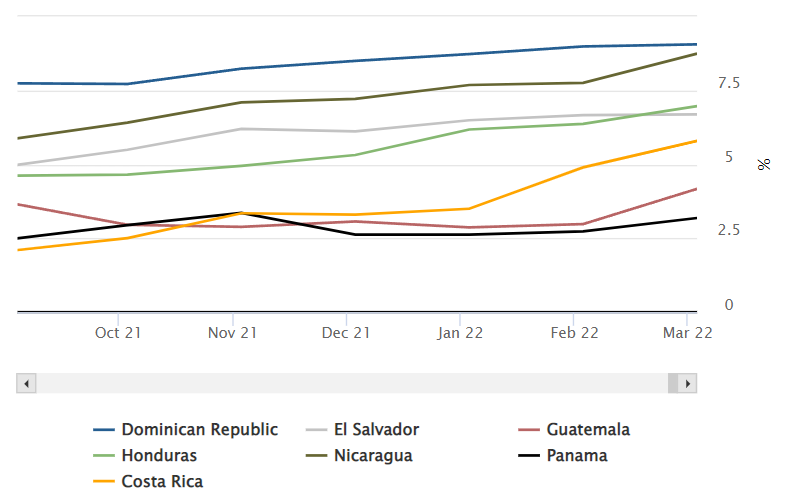
    Central America & Caribbean: inflation rate
    Percentage variation (year-on-year)

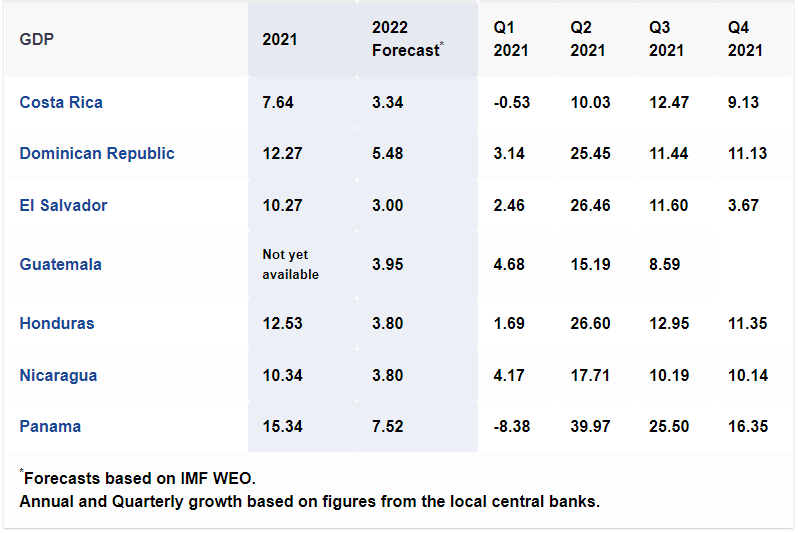
    Central America & Caribbean: GDP growth (%)
    Quarterly figures are year-on-year growth