All Categories

Subcategories

  • BRAZIL: Government to mediate conflicts on indigenous land

    Abbi Dicker 25 July 2024 Hits: 2055

    In response to violent incidents against indigenous communities in recent weeks, the federal government has sent officials to mediate land conflicts in the states of Mato Grosso do Sul and Paraná. Representatives from the federal ministry for indigenous peoples (MPI) and from human rights groups have denounced the juridical uncertainty regarding the demarcation process for indigenous territories as a factor that could have contributed to the rise in anti-indigenous violence.

    A government task force comprising officials from the MPI, the human rights ministry (MDHC), and the national indigenous affairs agency (Funai), was sent to Mato Grosso do Sul on 16 July. The team visited the Amambaipeguá indigenous territory, where the previous weekend assailants had opened fire on members of the Guaraní-Kaiowá community. At least one indigenous person is confirmed to have been wounded. On 20 July trucks believed to be driven by local farmers entered the territory again, but this incursion did not result in shots being fired. The Amambaipeguá territory has been delimited but has not completed the full demarcation process.

    Violence has flared up in another delimited indigenous land, the Tekoha Guasu Guavira territory in Paraná state. The territory, which has also not gained full demarcated status, made headlines in January after cattle ranchers shot a spiritual leader and members of the Avá Guaraní community. Tensions escalated again in early July when Avá Guaraní people moved to other towns within the borders of Tekoha Guasu Guavira. Local farming groups have challenged the migration with force. Since 8 July farmers have been threatening the Avá Guaraní who have settled on the contested lands, with several violent incidents in the past few weeks. So far one indigenous person has been wounded from the ranchers’ gunshots.

    Representatives from the MPI-led team held an initial discussion with the Avá Guaraní on 16 July and met the local agricultural association the following day. A working group in Paraná was also set up on 22 July, which will include representatives from federal authorities such as the MPI, Funai, and federal police (PF), as well as state and local officials. According to a statement released by the MPI, a potential temporary solution to the land dispute could involve purchasing land to which the Avá Guaraní could relocate.

    Human rights group Conselho Indigenista Missionário (Cimi) released a statement on 20 July in which the NGO condemned the recent attacks on indigenous people and highlighted that the provocations and threats on 20 July against the Guaraní-Kaiowá continued just a few hours after the MPI team visited the indigenous community. Cimi expressed regret at the absence of “a more solid state presence” to find a lasting resolution to the farmers’ incursions.  

    Rise in indigenous murders

    The Brazilian human rights group Conselho Indigenista Missionário, an organisation tied to the Catholic Church, has released figures for violence against indigenous people in Brazil in 2023. Homicides saw an annual increase, with 208 recorded murders against indigenous people, up from 180 in 2022. The states where the most indigenous people were killed last year were Roraima (47), Mato Grosso do Sul (43), and Amazonas (36).  

  • PARAGUAY: FMD outbreak threatens cattle sector

    LatinNews 23 September 2011 Hits: 2903

    It took Paraguay many years to obtain, in 2005, “Foot and Mouth (FMD) free with a vaccination regime” status from the World Organisation for Animal Health (Office International des Epizooties, OIE). The benefits of the certification where immense, enabling the country to become the world’s fourth largest beef exporter. Last year, Paraguay exported a record 170,000 tonnes (t) valued at US$970m and it looked set to break that record this year. According to local, unofficial sources, (to August 2011) the country has exported some US$635m. However, the certification and the sector’s prospects were undone in a single day.

    Early on 19 September, Paraguay’s national animal health and quality service (Senacsa) officially announced that it had detected an outbreak of FMD in San Pedro department. Unlike the last two FMD outbreaks - in Pozo Hondo, Boquerón, in the northern Chaco region which borders Bolivia in 2003 and in Corpus Christi, Canindeyú, in the eastern border with Brazil in 2002 - the latest outbreak took place in the middle of the country. Paraguay’s border areas are classified as high surveillance zones (ZAV) for the disease and were declared FMD free later than the inland areas, where the disease was largely considered to have been eradicated. The inland area traditionally accounts for over 40% of Paraguayan beef exports.

    Nevertheless, according to a Senacsa statement issued by its interim director, Carlos Simón Van Humbeeck, thirteen cows were found to be infected with the virus in the Santa Helena ranch, located in the Sargento Loma district of San Pedro. Van Humbeeck explained that Senacsa is obliged to notify the OIE of the event and, given that it took place in a non-ZAV area, the country is set to lose its disease-free status. Moreover, Van Humbeeck informed that in compliance with OIE procedures, Senacsa would quarantine the area and suspend all beef exports for a two-month period while the causes and extent of the outbreak where determined. Subsequently, the national animal sanitary health system (Sinaesa) and Paraguay’s Rural Association (ARP), called on the government to declare a sanitary emergency in San Pedro; President Fernando Lugo issued the decree on the same day.

    Santa Helena is owned by a cattle ranching firm, Ganadera La Blanca S.A., and embarrassingly, the ranch’s administrator, Silfrido Baumgarten, happens to be the president of the ARP’s San Pedro chapter. Baumgarten holds that despite the establishment’s full compliance with annual vaccination requirements, they discovered livestock with suspicious symptoms and alerted Senacsa on 17 September. Our local sources contradicted Baumgarten, who is a veterinary doctor, and said that some cows were showing symptoms in the week starting 12 September (and one local told LatinNews that attempts were made to sell the suspicious livestock to other establishments). Baumgarten, however, has stated he was ready to comply with Senacsa’s procedural guidelines, which include the slaughter of the 819 head of cattle (worth US$ 380,000), which were in contact with the infected animals, but also demanded that the source of the infection be investigated, raising concerns that vaccines (controlled and sometimes provided by Senacsa) could have been adulterated, or more worryingly, that the virus had developed a resistance to it. 

    The ARP estimates the outbreak will result in losses of between US$300m and US$400m. The central bank announced it will allow financial institutions to switch part of their legal reserve requirements into either “ new loans, or roll-overs, refinancings or restructurings of existing ones” for the sector. However, compensation is staunchly opposed by San Pedro Governor José ‘Pakova’ Ledesma, who accuses ranchers of acting “irresponsibly”. Ledesma, a close ally of President Fernando Lugo, is closely linked to Paraguay’s landless farmers’ movement and constantly clashes with the ARP, which represents landowners’ interests.

    • Regional Reaction

    Regional neighbours were swift to react: on Monday the other South American Common Market (Mercosur) members (Argentina, Brazil and Uruguay) increased animal controls in border areas and stopped the import of all animal and animal derived products coming from Paraguay. In addition, Chile and Peru adopted similar measures and cancelled all beef import orders. Encouragingly though, Mercosur partners have expressed their solidarity with Paraguayan authorities and their willingness to coordinate regional efforts to stop the spread of FMD. Uruguay’s director of animal health, Federico Fernández, said this was a small “setback” and that Mercosur has the means to eradicate the disease given that “we have been coordinating regional efforts for years”.

  • Albania's premier calls for unification of ethnic Albanians

    LatinNews 14 November 2012 Hits: 786

    In a speech to a meeting in Kamez, reported on 9 November, Albania’s Prime Minister Sali Berisha talked about the “ideal of national unification” being “the most precious ideal of the Albanians”.  There are some 6m Albanians in the Balkans, but only 3m live in the territory of Albania.  A further 2.2m Albanians live in the former Yugoslavia, of which 2m are in Kosovo.

    Berisha said: “I would like to recall that 100 years ago those who strove for ethnic Albania, for Albania with territories in which the Albanians were an ethnic majority and which represented a geographical continuity, those who laid down their lives for the ideal of this Albania, had no state of their own, no institutions of their own...It is decisive that the energies of the nation should go into building its future in freedom.  Therefore, on this 100th anniversary, the greatest tribute we can pay to hundreds and thousands of people who laid down their lives from the outset of the last century to 1999 and 2001, in Kosova [Kosovo] and Macedonia, is to do everything to unite with one another, to do everything to unite with Europe.”

    The reference to “Europe”, by which Berisha meant the European Union, was presumably intended to take the irredentist sting out of his comments without diminishing his appeal to nationalist sentiments ahead of next year’s general election.

    But the ideal of a Greater Albania does not appeal to all Albanians.  The country is split between Ghegs, in the north and Kosovo, and Tosks.  Tosks would not necessarily welcome an increase in Gheg influence in Albania.  The following Internet discussion post is not untypical: “All proud Tosks hate Sali Berisha who has kicked many Tosks from key state positions...This filthy Gheg changed the entire state machine in favour of the Ghegs, even the Kosovar Ghegs.”

  • ECONOMIC OVERVIEW: COSTA RICA

    LatinNews 09 October 2013 Hits: 1942

    Another voter complaint is Costa Rica’s widening fiscal deficit. In recent weeks, organisations ranging from the international credit ratings agency, Moody’s, the World Trade Organisation (WTO) and the Central American Institute of Fiscal Studies (Icefi) have raised concerns about the deficit. On 23 September Moody’s announced it was lowering its outlook on Costa Rica’s Baa3 bond rating from stable to negative, citing “a continued increase in the main debt metrics since 2009”, as well as “the country’s difficulty in passing legislation to reduce high fiscal deficits and limit the increase in the debt burden”. Moody’s highlighted a “jump in the fiscal deficit” from an average of 1% of GDP between 2004 and 2008, to 4.4% of GDP for the 2009-2013 period. This followed an Icefi report which noted that Costa Rica’s public debt jumped from 30.7% to 35.3% of GDP between 2011 and 2012 – the fastest rate among Central American economies. An August report by the WTO noted that Costa Rican authorities “recognise that the current fiscal imbalance is unsustainable in the long term unless appropriate steps are taken”.

  • Argentina: Social risks threaten moving into 2015

    LatinNews 30 October 2014 Hits: 3351

    Argentina's economy has been in recession for much of 2014 and will likely remain so for some time. The country's financial situation, although challenging, is such that the various actors can continue to 'muddle through', avoiding a major crisis. However, the potential deterioration of the labour market could produce some social tensions in the run up to the general election in October next year.

    Although the identities of the senior officials have changed over time, the administration led by President Cristina Fernández has followed a consistent and unorthodox economic policy. Domestic demand (and the needs of political stakeholders) have been supported by easy fiscal policy. According to the latest IMF’s latest (October) World Economic Outlook (WEO), the overall budget deficit has risen from around 2.8% of GDP in 2013 to 4.5% in 2014. To a significant extent, government spending (which by developed country standards is quite low at about 36% of GDP) has been monetised. This has been the root cause of high inflation (of 18% year-on-year in August, on official data). The competitiveness of Argentina's exporters has been protected by a controlled slide in the value of the local currency peso relative to the US dollar.

    This policy has been maintained in face of periodic volatility in global financial markets, occasional episodes of panic about falls in foreign reserves at the central bank and bad publicity surrounding litigation with 'hold out' sovereign bond creditors in New York.

    The authorities now face a new challenge: a fairly brutal recession. IMF forecasts indicate that Argentina's economy is likely to shrink by 1.7% this year and by 1.5% in 2015. According to Cabinet Chief Jorge Capitanich, the government itself is looking for real annual GDP growth of 0.5% this year and 2.8% in 2015.

    The figures in the chart, most of which come from official Argentine sources suggest that the IMF forecasts (and those of many private sector economists) are closer to the mark. Thanks to the softness of the global economy and, in particular, the recession in neighbouring Brazil, cumulative exports over the six months to the end of September were 10% lower than in the previous corresponding period. Construction activity and overall industrial production in the first eight months of the year were both down 2.3% over the corresponding period of 2013: this highlights the softness of domestic demand, which has contributed to a sharp fall in imports.

    Argentina - Selected economic and financial metrics
    Official exchange rate USD/ARS, 16 October 2014 8.54
    Dólar Blue exchange rate, 16 October 2014 14.73
    Industrial Monthly Estimate, YTD vs pcp, August 2014 -2.30%
    Cumulative exports, Q214 & Q314 vs pcp -10%
    Cumulative imports, Q214 & Q314 vs pcp -10%
    Average monthly trade surplus, Jun-Aug 2014 US$1,027mn
    Construction Activity [1], YTD vs pcp, August 2014 -2.30%
    Public Services [2] YTD vs pcp, August 2014 4.60%
    Unemployment rate, 2Q14 7.50%
    Underemployment rate, 2Q14 9.40%
    Year-on-Year M3 growth, September 2014 21%
    Year-on-Year growth in private sector credit, September 2014 21%
    1-month wholesale deposit rate (BADLAR), September 2014 [3] 20.3%
    1-month retail deposit rate, September 2014 18.4%
    Foreign reserves at BCRA, end September 2014 US$27,866mn
    Notes
    1. Synthetic Indicator of Construction Activity
    2. Synthetic Indicator of Public Services
    3. BADLAR has fallen by 660bp over the last five months
    Sources: INDEC, BCRA, Dolarblue.net

    In financial markets, the most worrying development has been the weakening of the dólar blue (i.e. black market) peso rate to over ARS15/US$. At a time that the official rate has been at ARS8.5/US$ or so, this represents a record premium. However, the premium needs to be considered in the context of the technical default by the Argentine government at the end of July and the renewed aversion on the part of investors towards emerging markets risk in general, and towards Brazil in particular.

    Further, we would attribute the record premium to the rigour with which the government controls the movement of US dollars into and out of Argentina. In essence, the main factor determining the dólar blue rate is the scarcity of US dollars within Argentina, rather than a sharp deterioration in financial conditions. Both M3 and credit to the private sector grew by 21% in the year to September, or (very) broadly in line with inflation. Over the five months to September, the one-month BADLAR rate for wholesale deposits has fallen by 660 basis points to 20.3%. The one-month retail deposit rate has also dropped over that period, and stood at 18.4%. Foreign currency reserves at the central bank amounted to a little under US$28bn at the end of September, or about the same as they had been at the end of March.

    Shortly after his appointment as central bank president in early October, Alejandro Vanoli told local banks to lift the interest rates that they pay depositors to 87% of the yield on LEBAC Treasury Notes - meaning that the banks will have to pay annual interest rates of at least 26-27%. He also said that there would be no devaluation: nor would there be any changes to the ways in which Argentines can legally acquire US dollars. These measures should underpin financial stability. They also recognise that, at ARS8.50/US$, the peso is not clearly overvalued. Argentina has been running a trade surplus of around US$1bn per month in the recent past. Even the IMF, whose forecasts are significantly more pessimistic than those of the government, is looking for a current account deficit of less than 1% of GDP in 2014 as a whole. Following Vanoli's announcement, the dólar blue rate rallied to ARS14.7/US$ or so.

    One of the main risks facing the government is rising unemployment. According to official data, the unemployment and the underemployment rates in Q314 were, respectively, 7.5% and 9.4%. Various surveys have shown that a majority of large private sector employers have been laying off staff or, leaving vacancies unfilled. The situation would be worse but for the expansion of activity in the public sector. In the first eight months of this year, the main indicator of public sector activity reported by the national statistics institute (INDEC) was up 4.6% year-on-year over the corresponding year-earlier period.

    The various actors in Argentina's economy and financial system probably can continue to muddle through for another year without a financial crisis. But with the approach of the general (and presidential) elections in October 2015, rising unemployment could result in demonstrations and general unrest. Much also hinges on expectations for the direction of economic policy in Brazil in President Dilma Rousseff’s second term which, in turn, will have an impact on the labour market in Argentina.

  • RASTREANDO TENDENCIAS

    LatinNews 04 September 2015 Hits: 326

    ARGENTINA | Se reactiva el sector de la construcción. El 31 de agosto el instituto nacional de estadísticas (Indec) de Argentina difundió su último Indicador Sintético de la Actividad del sector de la Construcción (Isac), que muestra que la actividad en el sector se incrementó un 13,3% en julio. Las cifras del Isac representan el incremento más alto en cuatro años; y sugiere que el sector podría finalmente estar saliendo de la declinación en la que había caído en años recientes, a medida que el gasto en el sector se ha incrementado significativamente en este año electoral. De acuerdo con el informe de Indec, el Isac alcanzó los 206,4 puntos en julio, su más alta medida mensual desde mayo del 2011, respaldado por un incrementado gasto en proyectos de infraestructura pública tales como carreteras y viviendas.

    De hecho, el Indec ha señalado que la cifra del Isac ajustada estacionalmente fue un 12,7% más alta. Todo esto ha contribuido a que el sector presente un incremento acumulativo del 8,5% año en año en la primera mitad del año, un nuevo récord. Alentadoramente, esto está produciendo optimismo en el sector, con el sector empresarial encuestado por el Indec expresando confianza en que este mayor dinamismo continuara en el corto plazo. De acuerdo con el Indec, el 27,1% de los empresarios  de la construcción encuestados dice que espera que este incremento en la actividad continúe en un futuro previsible, comparado con un 16,7% que dice que espera que la actividad decline un futuro cercano. Sin embargo, este optimismo aún no se ha traducido en un mayor optimismo en el mercado laboral del sector. De acuerdo con el sondeo del Indec, solamente el 3,8% de los entrevistados  dijo que ellos esperaban incrementar el tamaño de sus nóminas salariales en los próximos meses, comparado con el 15,4% que dice esperar que esta se reduzca. Por otro lado, entre aquellos empresarios que trabajan con el sector público, el 20,8% dijo que ellos esperaban un incremento en el tamaño de sus nóminas de pago, y el 18,8% dijo que esperan reducirlas. Estas respuestas contrastantes muestran que el desempeño del sector de la construcción parece todavía estar dictado por el fluido ambiente político de Argentina; y que sus perspectivas a corto plazo dependerán en gran medida del resultado de las próximas elecciones generales del 25 de octubre. Mientras tanto, el gobierno ha tomado medidas para asegurarse de que tendrá suficientes recursos disponibles en  la etapa previa de las elecciones, aprobando el 1 de septiembre un incremento de Ar$1,1mm (US$118m) en el presupuesto nacional para cubrir todos sus gastos en este año.

    • Déficit

    El gobierno federal de Brasil presentó un déficit fiscal de R$7,22mm (US$2mm) en julio, el peor resultado mensual desde que se iniciaron los registros en 1997. La cifra lleva el déficit acumulado en el periodo de 12 meses hasta julio al 0,77% del PIB, muy por debajo de la revisada meta del gobierno de un superávit de 0,15% (previamente la meta era del 1,1% del PIB).

  • TRACKING TRENDS

    LatinNews 27 October 2016 Hits: 648

    PERU | Accelerating economic recovery. Peru’s economy & finance minister, Alfredo Thorne, said last week that the country’s domestic economy was now in full recovery, with GDP growth “accelerating”. According to Thorne, the economy is currently growing at a rate of around 4.3% driven by increased activity in the mining sector and government spending.

    Peru’s economy began experiencing a slowdown in mid-2014 on the back of the fall in international commodity prices, which negatively impacted on activity in the key mining sector. Since then the previous government led by former president Ollanta Humala (2001-2016) and the new administration led by President Pedro Pablo Kuczynski have been trying to boost economic growth by implementing a series of stimulus measures designed to promote public and private investment in the country. These measures, which include providing tax incentives as well as increasing public sector investment, have helped to produce a tentative recovery, with the national statistics institute (Inei) reporting on 14 October that economic output increased by 5.5% year-on-year in August, bringing the cumulative growth rate for the year to 4.23%.

    The August GDP result was the strongest monthly result in six months and the first time the figure surpassed the 5% mark – considered to be Peru’s long-term economic growth potential – in as many months. According to Inei this result was driven by a solid increase in activity in the metallic mining sector (19.76%), the fisheries sector (65.60%), and the basic manufacturing sector (17.66%). Based on these figures, Thorne said during his participation at the XI international trade summit organised by the Lima chamber of commerce, that domestic mining-sector activity increased by 26.9% in the first half of the year despite the “adverse international economic scenario, marked by lower commodity prices and [economic] recession in Latin America”.

    Thorne added that in order to consolidate this recovery, the Kuczynski government would continue to promote private-sector investment, economic productivity, and advance public infrastructure projects over the next five years.

    • Peru identified as an “exciting” economy

    On 18 October the CEO of the London Stock Exchange (LSE), Nikhil Rathi, said that Peru is currently one of the most “exciting economies in the region” and is attracting growing investor interest. In an interview with Peruvian media as part of the inPerú official investment promotion roadshow, which visited London between 17 and 18 October, Rathi said that Peru has registered the fastest GDP growth rate per capita in Latin America in the last 10 years and that the country has developed trade relations with partners around the world. Rathi added that this makes investing in Peru and particularly in the Lima stock exchange (BVL), an LSE partner, an attractive proposition for global investors.

  • Honduras: The economy under Hernández (again)

    LatinNews 13 February 2018 Hits: 712

    On 27 January President Juan Orlando Hernández was sworn in for a second four-year term in office, promising to deliver further economic improvements. But the fact that he continues to be dogged by claims of electoral fraud reduces his political legitimacy and may have negative implications for the country’s social and economic outlook.

    Supporters say the first Hernández presidency delivered some real improvements. A three-year stand-by agreement with the IMF encouraged investors and helped stabilise inflation and growth. While Honduras continues to suffer one of the world’s crime rates, homicides have been falling. Last year the public sector deficit was cut to 1.2% of GDP (below the 1.5% target), while foreign currency reserves rose, also above target, to US$3.36bn. The economy grew by an estimated 4.0% while inflation was 4.5% and unemployment stood at 5.9%. Admittedly, these numbers are not that sharply different from what Hernández inherited four years earlier. During his time in office GDP grew by an annual average of 3.57%, marginally below the 3.62% average achieved during the preceding four years. And total government debt has actually edged up to 44% of GDP, compared with 40.1% at the start of his term.

    The president was nevertheless enthusiastic about what he can offer in the next four years. In his inauguration speech he promised more economic development. Earlier, during a telephone call in January, Alejandro Werner, the IMF’s director for the Western Hemisphere, congratulated Hernández on his second term. The president responded that his aim would be to maintain growth, create jobs, and reduce economic inequality. There may well be a second stand-by agreement. In the first appointments, Wilfredo Cerrato has been moved from the finance ministry to take over as the new president of the Central Bank. Cerrato’s former deputy, Rocio Tábora, succeeds him as the new finance minister.

    Rather than ‘more of the same’, an alternate and more pessimistic scenario for Honduras is also a possibility. Since the November elections over 30 people were killed in clashes with police during anti-government protests. At one point the economic cost of the protests and associated disruption was put at over US$100m a week. The government had been expecting 2017 GDP growth of up to 4.8%, but this was cut back to 4% because of the end-of-year disruption. The protests have begun to wane. However, in the absence of meaningful dialogue with the opposition parties, they could conceivably flare up again, frightening investors and leading to lower growth this year. There is also a real danger that an increasingly authoritarian Honduran government will be seen as slipping back on earlier commitments made to fight crime and corruption and to enhance the rule of law.

    There are already claims that the newly appointed head of police has links with drug traffickers. In January the new congress passed a law, which in effect prevents public servants accused of corruption from being brought to trial for three years after the event (it does this by establishing there can be no criminal prosecutions until after a full audit of the last three years of public accounts). Much may depend on talks between the government and the Organisation of American States (OAS). The OAS continues to say that the elections were flawed. As the sponsor of the locally-based Mission for Support Against Corruption and Impunity in Honduras (Maccih) the OAS also has an interest in ensuring higher standards of transparency. Although the re-elected Hernández has the support of the United States, the IMF, and other pillars of the international community, its underlying lack of legitimacy may yet prove to be a significant negative for the economy.

  • ECONOMIC HIGHLIGHTS

    Patrick de Courcy 16 June 2023 Hits: 2760

    MEXICO | Tax breaks for firms investing in southeast. On 6 June, Mexico’s finance ministry (SHCP) announced a series of tax benefits for companies that invest in the Tehuantepec Isthmus in the southeast of Mexico. The benefits include total exemption from income tax (ISR) during the first three years of operation in the region, and exemption from value-added tax (VAT) for operations carried out in the corridor.

    MEXICO | Increase in gross fixed investment. On 5 June, Mexico’s national statistics institute (Inegi) released new figures which showed that gross fixed capital formation (GFCF) in March increased by 0.5% in real terms as compared to the previous month, with investment in construction up 0.5% and machinery & equipment increasing by 0.3%. In yearly terms, GFCF increased by 8.8% in real terms.

    MEXICO | Remittances continue to rise. On 1 June, Mexico’s central bank (Banxico) announced that remittances to Mexico totalled US$5bn in April 2023, a 6.3% increase year-on-year. In the first four months of 2023, remittances totalled US$18.97bn, a 10.1% increase on the US$17.23bn received in the same period of the previous year. Remittances are currently on track to surpass the record US$58.49bn received last year.

    MEXICO | Femsa sells €3.3bn stake in Heineken. On 30 May, the Mexican beverage and retail company Fomento Económico Mexicano SAB (Femsa) sold €3.3bn (US$3.51bn) worth of its shares in the Dutch brewing company Heineken. Femsa, which is the largest convenience retailer in Latin America, had previously said that it intends to offload its Heineken shares, which no longer form part of its growth strategy. Heineken has said that it intends to purchase 10% of the shares being sold by Femsa.

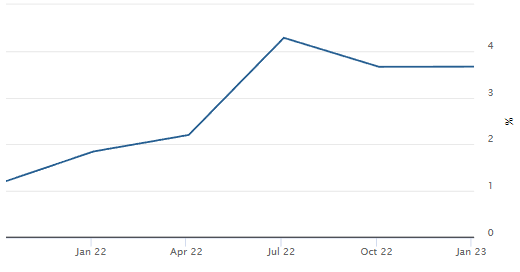
    Mexico: GDP growth
    Percentage variation (year-on-year)

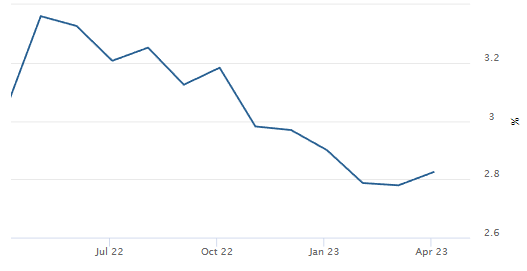
    Mexico: unemployment rate
    Economically active population

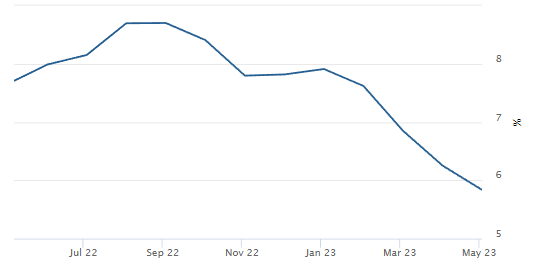
    Mexico: inflation rate
    Percentage variation (year-on-year)

  • CHILE: Will there be more green protests?

    Abbi Dicker 27 August 2026 Hits: 312

    Hundreds of environmental activists protested in Chile’s capital, Santiago, and other cities on 22 August, to oppose “environmental regression” and support animal welfare. Some believe green issues could play a growing role in the political tussle between government and opposition.

    At the start of his presidency last March, José Antonio Kast withdrew a total of 43 environmental decrees submitted by the previous administration from the comptroller’s approval process for review. The list included regulations for national parks, protection of salt flats, air pollution controls, and the defence of rhinoderma (a rare species otherwise known as ‘Darwin’s frog’). Although some of the decrees have now been reviewed and resubmitted for approval, environmental groups say there is still a significant risk of government “rollback”.

    A lawyer for international environmental NGO Greenpeace, Roxana Núñez, told Spanish newswire EFE in a report published on 23 August that the green movement will “not step back” in its campaign. She notes there are also potential points of conflict in the government’s “mega-reform” package of economic measures, such as procedures for mining project approval known as permisología (permitting), which Kast wants to make faster and less bureaucratic. Among other things environmental campaigners are challenging regulation rollbacks in the courts. There are also some new issues such as a move in congress to ban greyhound racing.

    A political battle between Kast and the green movement is not inevitable. Kast is a right-wing populist but unlike some of his international colleagues he is not a climate-change denier. He wants faster environmental permitting but he also champions renewable energy including green hydrogen and is keeping some of the previous government’s commitments, such as reaching carbon neutrality by 2050. However, there is also real scope for conflict, especially as Kast wants to rapidly attract big mining investments, particularly in copper and lithium.

    The government suffered a setback last week when the environmental evaluation commission (Coeva) turned down a plan to build an electricity transmission line in the southern region of Maule, connecting the Argentine and Chilean power grids. US actor Leonardo DiCaprio had publicly opposed the plan which he said would endanger another threatened species, the Pehuenche spiny chest frog. Energy Minister Ximena Rincón complained that there had been no mention of the Pehuenche frog in earlier Coeva reports.

    One reason to believe green issues will move up the political agenda is that the new government is pushing hard to increase the number of investment projects: on 14 July the environment ministry announced that between 11 March and 30 June, the environmental assessment service (SEA), a decentralised government agency responsible for administering the country’s environmental impact assessment processes, had approved 97 projects worth an estimated US$17bn. The increasing number of projects may create bottlenecks and flash points related to mining, salmon farming, energy, and water. It is also the case that left wing parties, still adjusting to last year’s electoral defeat, may see the green agenda as a way of keeping their supporters mobilised.

    Lula backs defence sector

    On 19 August, President Luiz Inácio Lula da Silva visited the Aramar nuclear industrial centre in São Paulo state and expressed support for the development of a nuclear submarine, pledging to invest in the project. A few days later, on 24 August, Lula had a phone call with Turkey’s President Recep Tayyip Erdoğan in which he affirmed Brazil’s commitment to boosting investments and supporting partnerships of Brazilian and Turkish companies in the defence sector.

  • RASTREANDO TENDENCIAS

    LatinNews 17 April 2014 Hits: 876

    CHILE | La actividad económica comienza a reanimarse. El banco central de Chile informó la semana pasada que la actividad económica en el país, medida por su Índice Mensual de Actividad Económica (Imacec), que incluye el 91% de todos los bienes y servicios incluidos en la medición del PIB, se incrementó un 2,9% año en año en febrero.

    La cifra del Imacec para febrero fue mucho más alta que la del 1,4% observada en enero e incluso sobrepasó las expectativas del mercado local. Los analistas locales habían proyectado que la cifra del Imacec de febrero sería del 2,4%, a medida que la economía continúa tomando ritmo después  de un débil final del año pasado, cuando la economía chilena creció solamente un 4,1% después de años de exhibir tasas de crecimiento promedio de alrededor del 5%. De hecho, el resultado del Imacec de febrero es el resultado mensual más fuerte desde septiembre del 2013. El informe del banco central que acompaña al Imacec incluso señaló que ajustándola estacionalmente, la cifra de febrero del Imacec fue un 0,2% más alta que en el mes anterior, y un 2,5% más alta que en febrero del 2013.

    De acuerdo con el banco central, el resultado positivo de febrero fue conducido primariamente por un incrementado dinamismo en los sectores de la minería y comercial minorista. Si el Imacec continúa exhibiendo resultados positivos similares, esto podría llevar a que el banco central revise su decisión, anunciada el mes pasado durante su primer informe de política monetaria del año, de recortar su pronóstico oficial de crecimiento para el 2014 del 3,75% - 4,75% al 3% - 4%.

    En lo que debería ser un estímulo más para la economía local, la compañía minera estatal de cobre (Codelco) reveló, también el 7 de abril, que gracias a sus esfuerzos de exploración en los últimos cuatro años, la firma ha identificado nuevos depósitos de cobre que se cree que contienen más de 1,8mm de toneladas del metal.

    URUGUAY | Temprano éxito del ministerio de economía. El ministro de economía y finanzas, Mario Bergara, sostiene que las medidas urgentes que él adoptó el mes pasado para contener la inflación han sido “exitosas” después de dar a conocer alentadoras cifras para marzo. La inflación llegó al 0,58% en marzo, una significativa caída del 1,66% registrado en febrero y el 2,44% en enero. Esto lleva la inflación a 12 meses al 9,73%, cayendo del 9,82% y del borde del 10%; un umbral psicológico que, si es sobrepasado, podría obligar al gobierno del Presidente José Mujica a renegociar con los sindicatos los acuerdos salariales de mediano y largo plazo.

    Bergara anunció reducciones en el Impuesto al Valor Agregado (IVA) para las frutas y vegetales; forzó a los servicios públicos de comunicaciones y de energía, a reducir sus tarifas telefónicas y de electricidad; congeló los precios de los combustibles; y los grandes almacenes también acordaron congelar, e incluso reducir, el precio de los productos de la canasta básica de bienes.

    Hubo más buenas noticias. La tasa de empleo en marzo llegó a su nivel más alto desde que se iniciaron los registros hace casi 30 años, de acuerdo con el Instituto Nacional de Estadísticas (INE), trepando del 60,5% de la población económicamente activa, al 61,1%, o unas 1,66m de personas. El desempleo nacional también se elevó ligeramente, del 6,7% al 7%, pero la preocupación más grande del gobierno no es el número de uruguayos con empleo, sino el número de uruguayos en sí mismo.

    Raúl Sendic, ampliamente considerado como la probable elección del ex presidente, Tabaré Vázquez (2005-2010), para que sea su compañero de fórmula después de las elecciones primarias de la gobernante coalición izquierdista Frente Amplio (FA) programadas para junio, ha pedido la creación de políticas para crear “mayor procreación entre la clase media”. Sendic, el hijo de Raúl Sendic Antonaccio, uno de los miembros fundadores del grupo guerrillero, Movimiento de Liberación Nacional-Tupamaros (MLN-T), dijo que la baja tasa de nacimiento era uno de los desafíos más serios que enfrenta Uruguay. Sendic fue presidente de la compañía petrolera estatal, la Administración Nacional de Combustibles, Alcoholes, y Portland (Ancap), por cinco años hasta el pasado octubre, cuando renunció para competir como candidato para el senado por su facción del FA, Compromiso Frenteamplista

  • TRACKING TRENDS

    LatinNews 14 March 2019 Hits: 3733

    PARAGUAY | IMF revision. The International Monetary Fund (IMF) has released its concluding statement from the Article IV mission visit to Paraguay, in which it has revised its 2019 GDP growth forecast for the country down to 3.5%, from the 4.2% predicted in October 2018. The IMF cites a reduced soybean harvest due to a drought in the early planting season as negatively affecting domestic economic growth. The statement adds that a pickup in activity in tourism and cross-border trade, which slowed after the guaraní appreciated against the Argentine peso and the Brazilian real last year, should help to largely offset this, although Paraguay’s economy will remain vulnerable to any developments in neighbouring countries.

    The IMF hailed the government’s current fiscal and monetary policy and its commitment to fiscal responsibility and maintaining macroeconomic stability. It notes that the monetary policy adopted by the central bank (BCP) is adequate and it expects year-on-year inflation to return to 4%, the middle of the BCP’s target range, by the end of 2019. 

    Focusing on the long-term challenges faced by Paraguay, the statement notes that the domestic economy is still heavily dependent on the agricultural sector, even though global agricultural commodity prices are no longer booming, and the country needs to diversify its economy and promote the development of the non-agricultural and non-electricity sectors, which will require higher levels of private sector investment. In order to attract these investments, the statement recommends that the Paraguayan government adopts “policies that focus on improving transport infrastructure, the rule of law, and the quality of education”.

  • ARGENTINA: Economy the focus as elections approach

    LatinNews 01 August 2019 Hits: 3763

    With just two weeks left before the open, mandatory, and simultaneous primaries (Paso) ahead of the October general election, electoral campaigning has intensified in Argentina. The presidential slate of the main opposition Frente de Todos alliance has attacked the economic record of the incumbent government led by President Mauricio Macri and focused the public’s attention on the precarious domestic economic situation in a bid to attract more support in the 11 August Paso that would allow it to build electoral momentum. But this strategy appears to have backfired following some exaggerated criticisms and the mooting of economic policy proposals aimed at alleviating public woes that have raised alarm among economists.

    The renewed attack on the Macri administration’s economic record began on 27 July when the Frente de Todos vice-presidential candidate, former president Cristina Fernández (2007-2015), delivered an acerbic speech in which she said that the economic situation faced by Argentines today is much worse than during her administration with the Macri government leading the country down the path of economic recession, indebtedness, and high inflation, all of which has eroded purchasing power and quality of life. At one point Fernández said that despite the claims made by Macri that the tough economic adjustment measures his government has adopted were designed to prevent Argentina from turning into Venezuela, “We are now just like in Venezuela… when it comes to food we are just like Venezuela”.

    Fernández claimed that the high inflation rate, cost of living, and low wages had left many Argentines unable to buy a basic basket of goods and going “hungry”. She went on to say that this amounted to a travesty in a country that is a net food exporter and that the Argentine people should not put up with it any longer. But Fernández’s claims were immediately rebutted by analysts, journalists, and Venezuelans living in Argentina. Using the social media handle #SraCristinaLeCuentoQue they variously cited statistics that show that while the situation in Argentina might be difficult it cannot be compared to the economic debacle in Venezuela and the humanitarian crisis it has caused.

    • Rebuttals

    Some of the most forceful rebuttals of the comparison drawn between Argentina and Venezuela came from Andrei Serbin Pont, an analyst at the Coordinadora Regional de Investigaciones Económicas y Sociales (Crieslac) economic think-tank, who, citing official data, noted that “In Venezuela the minimum salary buys you four litres of milk; in Argentina the minimum salary buys you 297 litres of milk. Let’s not trivialise Venezuela’s humanitarian emergency”. Yang Álvarez, a member of the association of Venezuelan doctors in Argentina, said that “64% of all Venezuelans lost 11kgs for not eating enough as a result of the humanitarian crisis. Don’t speak lightly of the hunger and malnourishment in Venezuela”. Venezuelan journalist Gabriel Bastidas said that “In 2017 between five and six children died every week in Venezuela due to a lack of food… shame on you for mocking Venezuelans by using [the crisis] for your campaign”.

    The criticisms were such that Alberto Fernández, the Frente de Todos presidential candidate, tried to minimise his running mate’s comments. In a 29 July TV interview Alberto Fernández said that his running mate’s comments were based on a report recently released by the United Nations Food and Agriculture Organization (FAO) that names Argentina and Venezuela as countries in which the population faces increased food insecurity. But he added that “It is clear that the situation in Venezuela is much more serious than in Argentina. It is clear that they are not comparable”. However, Alberto Fernández has also come under fire himself over his proposals for increasing social spending while avoiding a fiscal deficit. In his interview, Fernández vowed to increase state pension pay-outs by 20% to help struggling pensioners and proposed that this could be paid for by “not paying the interests due on the [Letras de Líquidez] Leliqs”.

    Leliqs are the short-term bonds used by the central bank (BCRA) to control the amount of pesos in the market as a monetary policy tool to help contain inflation and stabilise the exchange rate. While their use, and the high interest rates they offer (around 60%), have been criticised in some quarters, Fernández’s proposal sparked concerns that he was planning to default on these should he be elected.

    Various economists warned that defaulting on the Leliqs would be disastrous for Argentina’s financial market and that it would severely undermine the BCRA’s credibility and ability to control inflation. In fact, they predicted that it would ultimately lead to uncontrollable inflation and extreme exchange rate volatility that would produce a major financial crisis. “Alberto Fernández is confused if he thinks that this helps his candidacy, because if he wins, he will need the support of the [financial] markets and I don’t think it is a good idea to scare them,” one economist concluded.

  • TRACKING TRENDS

    Patrick de Courcy 13 January 2022 Hits: 3484

    ARGENTINA | China nuclear deal. Argentina and China announced a new memorandum of understanding (MoU) on nuclear collaboration, at the Expo International trade fair in Dubai on 12 January after a meeting between Argentina’s ambassador to China, Sabino Vaca Narvaja, and the general manager of China’s State Power Investment Corporation (SPIC). President Alberto Fernández wants to further develop the relationship with China particularly in the nuclear and health sectors.

    Argentina will supply technology for nuclear medicine to China, Vaca Narvaja said, as well as components made by Nuclearis, a manufacturer based in Argentina.

    Chinese companies are constructing Argentina’s fourth nuclear power plant, a US$8bn, 1,200 MW plant, in Zárate, Buenos Aires province. The Argentine government is looking to boost nuclear’s share of the energy mix from its current 7.5%.

    Government data suggests nuclear power costs US$47.3 per megawatt-hour (MWh), more than fossil fuel-based thermal power plants (US$35.30) but less than wind and solar renewables (US$73).

    The new MoU will come under the umbrella of the “comprehensive strategic alliance” between the two countries. Officials say developing nuclear power will help Argentina meet its Paris Agreement objective of reducing greenhouse gas emissions by 19%.

  • BOLIVIA: Áñez launches appeal

    Patrick de Courcy 21 July 2022 Hits: 3692

    Bolivia’s former president Jeanine Áñez (2019-2020) who was sentenced to 10 years in prison last month for illegally assuming the presidency, launched an appeal against her conviction on 18 July. The following day, Interior Minister Eduardo del Castillo announced that the government had also lodged an appeal against her sentence, calling for it to be increased to 15 years.

    Áñez’s appeal is based on the claim that her previous trial flouted due process and was subject to intense political interference. Her defence lawyer, Luis Guillén, highlighted concerns about impartiality already raised by the UN, human rights organisations, and many in the international community [WR-22-25]. He argued that her appointment as interim president despite the lack of a quorum in the senate was legitimate given the “power vacuum” generated by the resignation of her predecessor, Evo Morales (2006-2019), Vice President Álvaro García Linera, and senate president Adriana Salvatierra.

    Meanwhile, the government is seeking to get Áñez’s sentence extended. On 19 July, Del Castillo announced that the interior ministry has appealed for it to be increased to 15 years to deliver “justice for the people so that those actions can’t be repeated in the future”. He said that a 15-year sentence “would be in line with the [penalties for] behaviour that is contrary to the constitution”. In addition to a potential extension to her sentence, Áñez faces a second trial on charges of sedition and terrorism. She has said that she will also appeal to the Inter-American Court of Human Rights to overturn her conviction.

    US drugs report

    Bolivia’s interior minister Eduardo del Castillo has dismissed a report by the US White House Office of National Drug Control Policy (ONDCP), published on 14 July, which highlighted increasing coca and cocaine production in Bolivia. According to the ONDCP, Bolivian coca production increased by 0.8% in 2021 to cover 39,700 hectares (ha), while cocaine production increased by 1.6% to 317 tonnes (t). Del Castillo said on 15 July that “it’s a political, unilateral report with a weak methodology”.

    Bolivia was the outlier among the world’s three major coca producers as Colombia and Peru both registered declines in coca cultivation and cocaine production albeit from much higher base levels. In Colombia, the ONDCP reported declines of 4.5% in coca cultivation (234,000 ha) and 2.2% in cocaine production (972 t). In Peru, coca cultivation decreased by 4.3% to 84,000 ha, and cocaine production fell by 3.6% to 785t.

    The ONDCP said that both coca cultivation and cocaine production “remained high” in Colombia but it congratulated the government led by President Iván Duque for having eradicated 103,000 ha of coca, confiscated 757t of cocaine and cocaine base, and destroyed more than 5,700 drug laboratories. This same rhythm is unlikely to be maintained under Duque’s successor Gustavo Petro, who takes office on 7 August, which could place a strain on bilateral relations. Petro opposes forced eradication of coca crops and favours sowing alternative crops under an integral agrarian reform contained within the peace accord signed with the Fuerzas Armadas Revolucionarias de Colombia (Farc) in 2016.

    The government led by President Joe Biden has expressed its support for the peace accord, however, and it is noteworthy that the ONDCP report highlighted the importance of establishing “safe and productive livelihoods” for Colombians “by increasing state presence and investing in rural security, justice, and development”, which is something that Petro is intent on delivering.

    Census suspended

    On 14 July President Luis Arce signed a decree officially postponing the national census until 2024. The government raised various objections to the census being held as scheduled for this November including the coronavirus (Covid-19) pandemic and the need to have all the questions translated into indigenous languages. Luis Fernando Camacho, the right-wing governor of the eastern region of Santa Cruz, was especially critical of the suspension of the census, accusing the Arce administration of ignoring the regions. Former president Carlos Mesa (2003-2005), the leader of the main opposition Comunidad Ciudadana, claimed the decision was “an irresponsible political calculation” because the government wanted to “prevent the redistribution of seats” and “keep concealing the true extent of poverty in the country”.

  • URUGUAY: Orsi confirms cabinet

    Abbi Dicker 19 December 2024 Hits: 10112

    Uruguay’s president-elect Yamandú Orsi has named his cabinet ahead of taking office on 1 March 2025. Orsi performed a delicate balancing act to keep the many parties within the left-wing coalition Frente Amplio (FA) happy, while also making several technocratic appointments and ensuring a strong, if not equal, female presence.

    Orsi unveiled his full cabinet at a press conference on 16 December. Foremost among the independent technocrats is Gabriel Oddone, the incoming economy and finance minister and the sole appointment announced by Orsi in advance of the elections. Mario Lubetkin, an experienced former journalist and deputy director of the United Nations (UN) Food and Agriculture Organization (FAO), will be the minister of foreign affairs.

    Unlike in Chile, where President Gabriel Boric ensured that half of his cabinet ministries went to females, there will not be gender parity within Orsi’s 14-strong cabinet, although the five female appointments match the first FA administration of Tabaré Vázquez (2005-2010; 2015-2020). Of the 14 future deputy ministers, six will be females.

    The big challenge for Orsi is that the FA is a coalition comprised of 19 different movements, many of them coalitions in their own right composed of several parties, themselves often made up of different factions. Striking a balance to ensure that different movements within the FA receive posts commensurate with their size and influence is no easy task. It was made slightly easier, however, by the fact that Orsi’s own Movimiento de Participación Popular (MPP), which includes the Movimiento de Liberación Nacional-Tupamaros (MLN-T), emerged from the congressional elections as by far the strongest movement within the FA: the MPP won nine of the FA’s 16 seats in the senate and 36 of its 48 seats in the lower chamber of congress in October’s elections.

    The MPP will pick up five of the 14 ministries. Four will go to females: Cecilia Cairo (housing); Lucía Etcheverry, a former social worker and elected senator (transport and public works); Sandra Lazo, (defence); and Fernanda Cardona (industry). The industry ministry will be entirely run by women, with the deputy ministry going to 26-year-old Eugenia Villar, an ally of Carolina Cosse, the vice-president-elect who was Orsi’s main rival in the FA’s primary elections.

    The fifth female appointment was Cristina Lustemberg, who will take over as health minister. A doctor who served as deputy health minister in the last FA administration, Lustemberg is a member of the El Abrazo movement, a fusion of three parties formed in 2019. The fifth and final MPP appointment, meanwhile, went to Alfredo Fratti, an MPP legislator who served as president of the Instituto Nacional de Carnes (Inac), the national meat institute, during the presidency of José Mujica (2010-2015). Fratti, Mujica’s principal recommendation to his protégé, picks up the plum position of minister of agriculture, livestock, and fishing.

    Orsi named Carlos Negro, of Vertiente Artiguista (VA), as his future interior minister. Negro worked in the interior ministry under Eduardo Bonomi during the second Vázquez administration. A former prosecutor specialising in homicide and organised crime cases, Negro will be tasked with bringing down homicides and improving the public perception of security in Uruguay, the main voter concern. Edgardo Ortuño, president of the VA, who became Uruguay’s first black member of congress in 2005 and a cabinet minister under Mujica, will take over as environment minister.

    Juan Castillo will be the labour and social security minister. Castillo is the secretary general of the Partido Comunista (PCU), traditionally the most closely aligned to the country’s main trade union, Plenario Intersindical de Trabajadores-Convención Nacional de Trabajadores (PIT-CNT).

    José Carlos Mahía, a teacher who has represented the FA in congress since 1995, will become the education and culture minister. He is a member of Asamblea Uruguay, part of the social-democratic Convocatoria Seregnista Progresistas (CSP), the most moderate wing of the FA. The youngest incoming minister, Gonzalo Civila, the secretary general of the Partido Socialista (PS), will pick up the social development portfolio. Finally, Pablo Menoni, another ally of Cosse from her days as mayor (intendant) of Montevideo, belonging to La Amplia, will become the tourism minister.

    Cabinet

    Eight of the 14 ministers named by President-elect Orsi were elected to congressional positions in October, meaning their alternates will need to assume their positions in the incoming legislature.

  • PERU: Ties with Mexico deteriorate

    Abbi Dicker 11 September 2025 Hits: 2119

    The foreign affairs committee of Peru’s congress voted by 12-6 on 8 September to declare Mexico’s President Claudia Sheinbaum persona non grata. The full congress will debate the issue in the next few weeks, but it is thought likely to endorse the committee’s recommendation. Committee members said Sheinbaum had shown a “hostile” attitude towards Peru, refusing to recognise the legitimacy of Peru’s incumbent president, Dina Boluarte, and making “high-flown and offensive” statements about the country.

    The dispute goes back to Peru’s political crisis in December 2022 when the incumbent left-wing president, Pedro Castillo (2021-2022), attempted to dissolve congress in a coup d’état but was instead impeached and imprisoned on multiple charges. For Peru’s conservative-dominated congress, his replacement by Dina Boluarte, who was vice president at the time, was entirely in keeping with the constitutional succession; it was agreed she would serve out the rest of his term. But Mexico’s then-president Andrés Manuel López Obrador (2018-2024) considered what happened to Castillo to constitute a coup d’état: Mexico therefore refused to recognise Boluarte.

    For her part President Sheinbaum, a close political ally of López Obrador’s, who succeeded him in October 2024, has indicated that she is in no rush to change her predecessor’s diplomatic stance. In August she met the lawyer for the still-imprisoned Castillo, posting on social media that “the freedom of Pedro Castillo is also the defence of democracy and the dignity of our peoples”. Responding to the persona non grata resolution this week, Sheinbaum said “it doesn’t matter…we’re going to maintain our position.”

    At one level the resolution will indeed have little impact: Boluarte will step down in July 2026 and it makes sense for Sheinbaum to talk not to her, but to her elected successor. Yet at another level the deadlock is costly to the two countries. Mexico is the second most-populous country in Latin America and Peru is the fifth. To have such important countries on extended non-speaking terms weakens the region’s influence.

    In addition to this, however, both countries are also founder members of the Pacific Alliance trade block, along with Chile and Colombia, which has a potentially key role to play in negotiations over US President Donald Trump’s punitive tariffs. International affairs specialist Francisco Belaunde says that since 2023 diplomatic relations have been reduced to chargé d’affaires level and can be described as “stagnant and notoriously weakened”.

    Santiváñez trip

    Justice Minister Juan José Santiváñez is currently banned from leaving Peru as he is under investigation in an influence-trafficking case. However, a court granted him permission for a five-day absence to defend the government’s amnesty law before the United Nations Human Rights Council.

    Santiváñez makes amnesty case in Geneva

    Peru’s recently appointed justice minister Juan José Santiváñez travelled to the United Nations Human Rights Council in Geneva, Switzerland, from 6-11 September to defend the government’s controversial amnesty law, which covers crimes committed by members of the security services between 1980 and 2020.    

    The Inter-American Court of Human Rights (IACtHR) has declared the law to be “inapplicable” since it clashes with international treaties signed by Peru. Santiváñez counter-argued that the law was justified by the “terrible terrorist attacks” that the country had suffered and was in any case an expression of national sovereignty. Peru, he said, would “continue evaluating” whether to remain within the Inter-American Human Rights System.

  • ECONOMIC HIGHLIGHTS

    Abbi Dicker 16 July 2026 Hits: 863

    PARAGUAY | Itaipú transfers funds to Paraguay under Annex C. Itaipú Binacional, the company that operates the binational Itaipú hydroelectric dam, announced on 6 July that it has paid Paraguay US$239m in the first half of the year. The payment was made via Annex C of the Itaipú Treaty, which dictates how Brazil and Paraguay sell surplus electricity generated by the dam to each other. The amount was paid in the form of royalties, energy transfers, and payments to Paraguay’s state energy company (Ande). “These disbursements, provided for in Annex C of the Treaty, are essential for provincial governments, municipalities, and the state-owned enterprise to carry out their respective projects for the benefit of the population,” said Itaipú Binacional in a statement. With regard solely to payments made in June, royalties totalled US$22m, and compensation for power transfers reached US$10m, while Ande received US$1.7m in compensation. Annex C has been a sticking point in negotiations over the binational dam, with Paraguay pushing for better terms under which to sell the surplus electricity generated by the dam in the country to Brazil, which has significantly higher electricity needs.

    BRAZIL | Vehicle sales rise in first half of 2026. The national federation of automobile dealers (Fenabrave) released sales figures on 2 July which showed that a total of 2.72m units were sold in the first half of this year. This marks a 16.01% increase compared to the 2.34m vehicles sold in the first half of 2025. The passenger cars category was the one that posted the highest year-on-year increase, registering 1.09m units sold, up 23.67% compared to the 878,517 cars sold in January-June last year. Motorcycles also registered a significant increase, with 1.17m units sold in the first half of this year, up 14.10%, and sales for light commercial vehicle totalled 272,663 units, up 7.75%. However, truck sales were down 9.39% year-on-year, registering 48,030 units sold, while bus sales totalled 12,990 units, down 7.97% compared to January-June 2025.

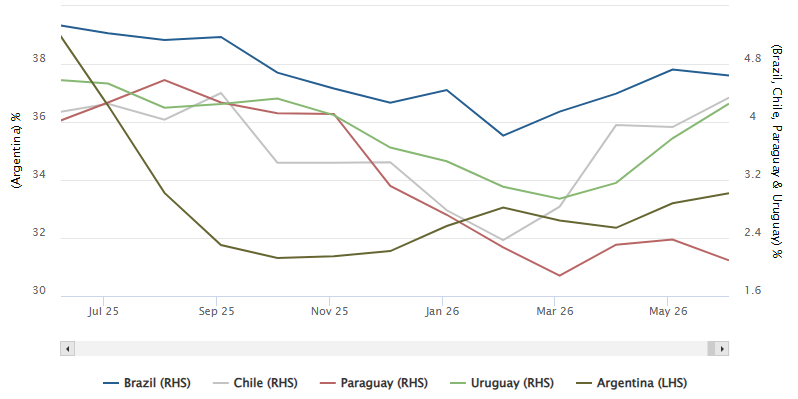
    Brazil & Southern Cone: inflation rate
    Percentage variation (year-on-year)

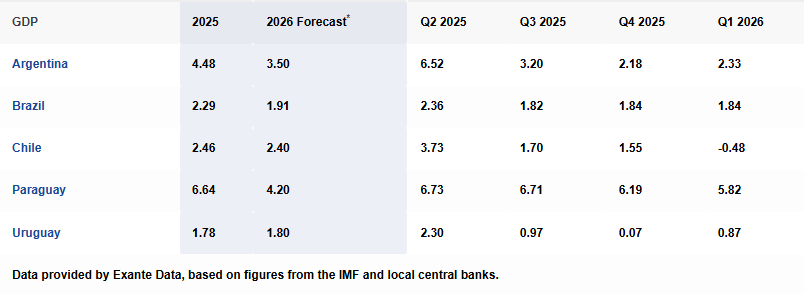
    Brazil & Southern Cone: GDP growth (%)
    Quarterly figures are year-on-year growth

  • ECONOMY: Still booming

    LatinNews 21 July 2011 Hits: 531

    Economic statistics are still not flashing amber, despite international investors fretting about the overvaluation of the Real against the US dollar. In the first week of July, the Real/US$ rate touched R$1.558, the highest for 12 years. Any sign that such a rate would cramp the domestic economy was belied by employment data, published on 19 July which showed that the unemployment rate in June, according to the official statistics agency, Ibge, was only 6.2%. This was the lowest rate for any June since 2001.

    In June 2010 the unemployment rate was 7% and in June 2002, the final year of the administration of President Fernando Henrique Cardoso, it was 11%. More importantly, the latest result was down on May’s 6.4%. All this suggests that by the end of the year, unemployment will be back at the 5.3% level it reached in December 2010.

    The Ibge’s gloss on the figures is that over the past 12 months 172,000 people seeking work have found jobs. More important, given the number of new entrants into the job market, the economy has created 512,000 new jobs since June 2010. This is a stark comparison to the disappointing figure for non-farm employment in the US, which show that since March 2011 unemployment has risen by 545,000, according to the US Bureau of Labor Statistics.

    Wages are still rising in Brazil: they reached R$1,578 (US$1,000) a month in June. Given that the economy is slowing down from its 7.5% GDP growth rate of 2010, its capacity to continue to generate jobs is impressive.

    The buoyancy of the Brazilian economy was noted by Apple and by IBM, which both reported strong second quarter 2011 figures. Apple’s performance in Brazil, however, paled besides a trebling of its sales in the Asia-Pacific region. Strong sales of imported consumer goods are an inevitable consequence of a strong currency.

    What is less predictable is that exports appear to be holding up as well. In the first five months of 2011, exports were 31% year-on-year at US$94.6bn. Imports were up 29% at US$86.1bn. What is staggering, however, is the central bank’s figures for the current account: in the first five months of 2011 financial account investments in the country came to US$62.7bn, up from US$36.9bn in the same period of 2010. Little foreign money is going into Brazilian financial assets: the stockmarket has been a dismal performer this year. Oddly, Brazilian companies, which spent US$26bn on foreign acquisitions in the first five months of 2010, have cut back this year, spending only US$6.6bn on foreign investments.

    So far this year the Real has appreciated by 6.2% against the dollar. It is worth noting that since 1999, the Real has risen by 40% against the dollar. The strength of the currency is now helping policymakers keep on top of inflation, but the prospect of more Quantative Easing in the US, as indicated by Ben Bernanke, the chairman of the US Federal Reserve Board, will complicate life further for Brazilian policymakers.

    The central bank president, Alexandre Tombini, has started to warn Brazilian companies to be prepared for a change in government policy. His comments are cryptic, but seem to point towards efforts to deter foreign companies pushing the exchange rate up further. Tombini recalled that in 2009, when the global financial crisis caused the Real to temporarily depreciate, many Brazilian firms experienced cash flow problems as they had previously taken advantage of the strong Real to borrow heavily in dollars.

    The central bank is now long on dollars as it has spent over US$330bn in spot and futures market purchases to try to put a floor under the dollar against the Real. This policy clearly has had little effect. In July the central bank again raised selected reserve requirements (on banks’ short dollar positions). The bank is intervening heavily, buying up dollars in an effort to weaken the Real, and the finance ministry has hinted at an extension of the tax on financial transactions to foreigners’ purchases of local currency futures contracts. However, much of the problem is beyond its powers to correct because the dollar is weak everywhere and real (inflation adjusted) interest rates are low outside Brazil.

    Inflation: After producer prices fell 0.55% in May, the national index of consumer price inflation rose 0.15% month-on-month in June, down from a rise of 0.47% in May. The figures come from the Ibge. The June result was better than most independent forecasters had expected. Falling food prices helped the result, with a food price sub-index of minus 0.26% in June, down from a rise of 0.63% in May. Accumulated inflation in the first half of 2011 was 3.87%. The annualised result in June was 6.71%, above the target ceiling of 6.5%. 

    In the latest (1 July) ‘Focus’ consensus report compiled by the central bank, local economists lowered their annual inflation forecast for year-end 2011 to 6.15%, down from 6.22% a month ago.

    The consensus forecast for 2012 was down a bit at 5.1%.  The real annual GDP forecast fell to 3.94% in 2011 and to 4.5% in 2012. The Real is projected at R$1.60/US$ in 2011 and R$1.69/US$ in 2012.

    Embraer: Embraer, the country’s main aircraft maker, shipped 48 aircraft in the second quarter of 2011, bringing the total for the first six months to 76. The company said that at the end of June 2011 it had firm orders worth US$15.8bn. The company shipped 45 airliners in the first half of 2011 and 31 executive jets.  The company said that it agreed the ale of 62 new aircraft in the fist half: in addition it subsequently took an order for 10 aircraft from Hebei Airlines in China, while Srikwijaya Air from Indonesia has agreed to buy 20 Embraer-190s

    Bullet train: The government’s tender of a concession for a private company to build a bullet train from Rio de Janeiro to São Paulo drew no bidders on 11 July, forcing the government to revise the terms. The project had been budgeted to cost R$33.1bn (US$21bn). The government’s plan had been to choose the technology and operating system first and then select a bidder to deliver the project.

    The government wanted the first stage to be completed this year; the second stage to be finalised e next year and the building work to start in 2013, for completion by the start of the Olympic Games in 2016. Rio is 513km from São Paulo. Congress has already approved of R$20bn in support from state banks for the project. Projections claimed that the bullet train would handle 22m passengers in its first year, rising to100m a year by 2033, when the concession would end.

    Anti-trust: On 11 July Brazil’s anti-trust agency, Cade, agreed to allow the merger between the big meat companies, Perdigão and Sadia, to form Brasil Foods. As part of the terms for approving the deal, Cade ordered Perdigão to stop selling various products in the local market for between three and five years. The agreement covers 80% of Perdigão’s output.