All Categories

Subcategories

  • ECONOMIC HIGHLIGHTS

    Patrick de Courcy 18 February 2022 Hits: 2942

    MEXICO | Mexico sees record remittances in 2021. On 1 February, Mexico’s central bank (Banxico) released new figures which showed remittances to Mexico totalled US$51.59bn in 2021, up 27.1% compared to the previous year and a record high for the country. In December 2021, remittances totalled US$4.65bn, an increase on the US$3.54bn received in the same month of 2020. 

    MEXICO | Mexico legalises imported used cars in ten states. On 19 January, Mexico’s government regularised used cars that have been imported illegally in the states of Baja California, Baja California Sur, Chihuahua, Coahuila, Durango, Michoacán, Nayarit, Nuevo León, Sonora, and Tamaulipas. In these states - where most of these vehicles, known locally as ‘autos chocolate’, are located – private owners can now legalise their vehicles by paying a fee of M$2,500 (US$122) per car, without needing a certificate of origin, prior permission from the economy ministry, or registration on the importation register. The decree, published in the official gazette, was signed by President Andrés Manuel López Obrador, Security Minister Rosa Icela Rodríguez, Finance Minister Rogelio Ramírez de la O, and Economy Minister Tatiana Clouthier. 

    MEXICO | Unemployment falls again in Mexico. On 20 January, Mexico’s national statistics institute (Inegi) released new figures from its national employment survey (Enoe) which showed that the unemployment rate in December stood at 3.5%, down from 3.9% in November, representing the lowest rate since the onset of the coronavirus (Covid-19) pandemic. The figure corresponded to 2.1m people being unemployed. In year-on-year terms, unemployment fell by 0.3 percentage points. The same figures showed that the number of people employed in the informal sector totalled 32.2m, equivalent to 56.5% of the employed population and up 0.8 percentage points on the same month in 2020. 

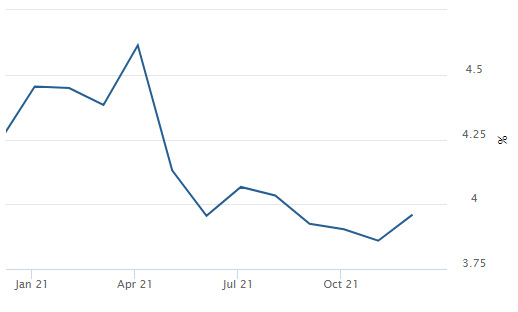
    Mexico: GDP growth
    Percentage variation (year-on-year)

    Mexico: unemployment rate
    Economically active population

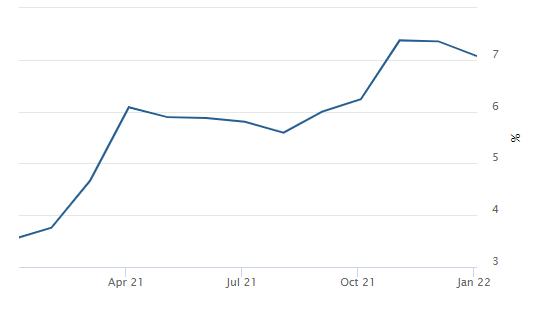
    Mexico: inflation rate
    Percentage variation (year-on-year)

  • RASTREANDO TENDENCIAS

    LatinNews 07 August 2015 Hits: 812

    ARGENTINA | El gobierno ataca a “especuladores”

    El ministro de economía, Axel Kicillof, ha atacado a los “especuladores” en el mercado de cambio de moneda, de quienes él dice que están hundiendo el valor del peso argentino. Oficialmente, el pero argentino se cotiza en Arg$0,19/US$1, mientras que la tasa del mercado negro, el llamado ‘dólar blue’ se cotiza en Arg$14,94, una brecha de 60%. El gobierno insiste en que la tasa del mercado negro es insignificante y que un comercio similar existe en todos los países.

    CHILE | El pronóstico de crecimiento se revisará hacia abajo

    El banco central de Chile reducirá su pronóstico de crecimiento para el país este año, de acuerdo con su presidente, Rodrigo Vergara. En una entrevista con el diario nacional La Tercera, Vergara dijo que la persistentemente débil inversión interna era la causa principal de la revisión hacia abajo.

    La actividad mensual en abril y mayo fue menor de lo anticipado. En su informe más reciente, en junio, el banco recortó su pronóstico  de 2,5% - 3,5%, cayendo a 2,25% - 3,25%. Aunque Vergara no daría ninguna cifra en su última entrevista, él no descartó la posibilidad de que el tope del nuevo rango sería de menos de 3%.

    • La visita del Papa inspira al diálogo sobre la pobreza

    El Presidente de Paraguay, Horacio Cartes, se ha reunido con líderes de la Iglesia Católica en el país, para discutir la lucha contra la pobreza, en la estela dejada por la visita del Papa Francisco. Alrededor de 1,5m de paraguayos viven en la pobreza, lo que es equivalente al 22,6% de la población total, de acuerdo con los últimos datos oficiales.

  • Caribbean: US reveals new engagement strategy for the Caribbean

    LatinNews 23 June 2017 Hits: 635

    The US State Department’s multi-year strategy report for engagement with the region, entitled: Caribbean 2020: A Multi-Year Strategy to Increase the Security, Prosperity, and Well-Being of the People of the United States and the Caribbean, has now been released. The December 2016 US-Caribbean Strategic Engagement Act required the report to be drawn up, and its release is well timed given the differences that the US (and much of Latin America) has with many Caribbean states over policy towards Venezuela. At its 19-21 June General Assembly in Mexico, the Organization of American States (OAS) failed once again to agree a resolution on Venezuela largely as a result of the refusal of Caribbean members who are dependent on Venezuelan oil to agree to any resolution critical of the Venezuelan government. The new strategy is likely to have significant and long-lasting effects on Caribbean nations, some positive but some more challenging.

    The document has six sections covering security, diplomacy, prosperity, energy, education, and health. Among a number of points which stand out in the new document is how much diplomacy is now being shaped by the mercantilism of the Trump administration. Where trade is mentioned it is couched almost exclusively in terms of benefit to the United States. There is a distinct ‘America First’ tinge to the strategy, at least to the trade elements of the report, that contrasts with the ‘win-win’ emphasis of – for instance – Chinese diplomacy in the region.

    In its preamble, the Strategy talks about “a vibrant economic partnership that in 2016 saw a $4.6 billion trade surplus for the United States”. The Prosperity chapter begins with the statement: “We will support US export and job creation.” A section on Small Business Development says the aim is “to increase private sector job growth and create new markets for US businesses”.

    Security, naturally, is another key focus of the strategy. There is a promise to “strengthen our mutual security and advance the safety of our citizens by pursuing programs to dismantle transnational criminal and terrorist organizations, curb trafficking and smuggling of illicit goods and people, strengthen the rule of law, improve citizen security and counter vulnerability to terrorist threats”. However, another stand-out point of the document is the acknowledgement that a tougher border regime with Mexico may have knock-on effects in the Caribbean. The document’s preamble warns: “As the United States works to secure its southern border, we should prepare for transitional criminal organizations to shift more of their operations to the Caribbean as a transit point for drugs, migrants, weapons, and other illicit activity.”

    A third stand-out point is the proposal to use energy policy to counter regional dependence on Venezuela. The preamble states: “On energy, exports of US natural gas and the use of US renewable energy technologies will provide cleaner, cheaper alternatives to heavy fuel oil and lessen reliance on Venezuela.

    The Venezuela question was also clearly at the forefront of the State Department’s mind when it came to formulating the Diplomacy section. Amongst other things, it states as a key objective the need to “forge greater multilateral cooperation at the Organization of American States and United Nations”. With this objective in mind, one of the proposals of the report is to increase the US’s diplomatic and consular presence in Eastern Caribbean countries where there is not currently a permanent US mission. However, as the report notes, this would be dependent on funding becoming available in the future.

  • Agribusiness and the productivity debate

    LatinNews 21 December 2018 Hits: 72

    A report published in 2017 by the McKinsey Global Institute, ‘Where will Latin America’s growth come from’, sets out the productivity challenge facing the Latin American economies. It notes that in the last 15 years the region has achieved growth of around 3% per annum, while China, South Asia, and sub-Saharan Africa have been growing at around 5% per annum. There has also been a problem with the type of growth achieved in the LAC region. About 80% of it is explained by “strong labour inputs reflecting growing populations rather than rising productivity”. Output per worker has grown at only 0.6% per annum, one of the weakest productivity performances of any region in the world. Worse, there are other factors likely to make future LAC growth even more sluggish, such as falling fertility rates leading to slower expansion of the labour force, the end of the commodity price boom we have already mentioned, and the growing risks of protectionism. McKinsey concludes that if productivity remains constant, growth in the next 15 years will be 40% lower than it was in the last 15 years.

    The report says Latin American governments should consider four priorities to counteract the prospect of a low-growth future. One of them is to “expand high value-added activities across key value chains by removing obstacles to competitiveness”. The others include promoting the adoption of efficient digital and automation technologies; improving work force skills by strengthening the link between education and employment and closing gender gaps; and finally investing in long-term drivers of productivity growth.

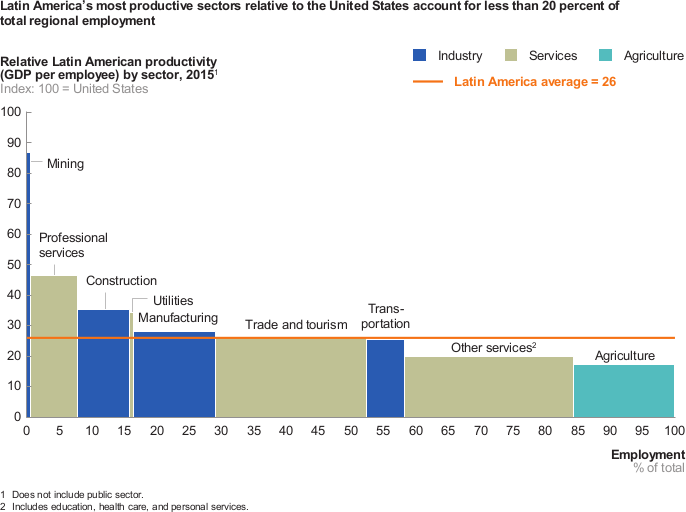
    The report examines the difference in productivity between the US and Latin America. Average US productivity, measured in GDP per employee, is given an index value of 100. By comparison, average productivity in Latin America (the horizontal red line in the chart below) comes out at only 26. In other words, a Latin American worker produces only about one quarter of what a US worker does. The gap varies by sector. Latin American workers in mining, professional services, construction, utilities, and manufacturing have above-average productivity, but it still falls far short of the US benchmark. Latin American workers in agriculture have the lowest level of productivity, only about 20% of the US benchmark.

    Productivity

    Source: McKinsey & Company

    There are at least two different conclusions that can be drawn from this graphic. One might be to argue that Latin America should concentrate on improving the productivity of those sectors that are already closer to the US benchmark – such as mining, professional services, and construction. The other might be to instead focus on the laggards, because making an improvement there could make much more of a difference to the economy as a whole. Clearly, some policies – such as improving the ease of doing business – will have an across-the-board positive effect on productivity in all sectors. Increasing investment can have both an across the board and more sector-specific effect.

    There is a substantial argument to be made in favour of agribusiness as a key sector where productivity can and should be raised to wider beneficial effect. The McKinsey report notes that mining, the highest-productivity sector in LAC, employs very few people, and actually made a negative contribution to the region’s productivity growth (of -4%) from 2000-2015. Agriculture, in contrast, accounts for 15% of total employment and made a positive contribution to the region’s productivity growth in the same period (of +2.5%). Agribusiness also offers potentially more of a multiplier effect, given its linkages connecting urban and rural areas, as well as to the manufacturing and service sectors of the economy.

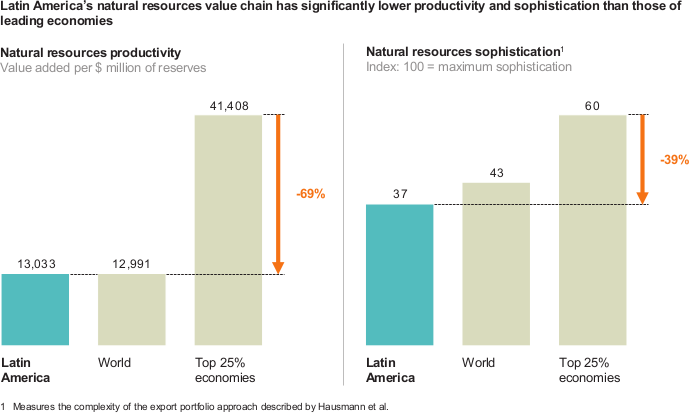
    There is also plentiful evidence to suggest that Latin America has a significant comparative advantage in the natural resource sector, including agriculture, which it is not properly exploiting. The region has 50% of the world’s forested areas which make up the largest carbon sinks in the world, 12% of the world’s remaining arable lands, four times the internal renewable water resources per capita as other regions, and 27% of global bio fuels production. It also has large oil and gas and mineral deposits. McKinsey uses two measures to capture the way Latin America is failing to make the most of these resources. One is a measure of natural resource productivity, defined as value added per US$1m of reserves. Another is an index-based measure of “natural resource sophistication” which is a rough guide to the complexity of the goods produced. The conclusion is that LAC’s natural resource productivity is 70% below that of the top 25% of the most productive economies in the world, while its natural resource sophistication is 40% lower than that of the same group of countries.

    Natural resources

    Source: McKinsey & Company

  • GUYANA & TRINIDAD: Race politics to the fore

    LatinNews 01 September 2011 Hits: 2539

    The coming election in Guyana and the recent change of government in Trinidad & Tobago have both had the effect of once again bringing racial politics to the fore.

    Guyana and Trinidad & Tobago are the two countries in the Caribbean where the Indian-origin population more or less matches that of African origin.  In Guyana, according to the 2002 census the proportions are: Indian 43.5%, African 30.2%, mixed 16.7%, Amerindian 9.1%, other 0.5%.  In Trinidad & Tobago, according to the 2000 census, the proportions are: Indian 40%, African 37.5%, mixed 20.5%, other 1.2%, unspecified 0.8%.

    The political manifestation of this racial divide began in 1955 when Forbes Burnham split from the People’s Progressive Party (PPP) led by Cheddi Jagan.  After the split, the Afro-Guyanese supported Burnham’s People’s National Congress (PNC), while the Indo-Guyanese overwhelmingly stayed with Jagan and the PPP.

    In Trinidad, the People’s National Movement (PNM) founded by independence leader Eric Williams has traditionally captured the bulk of the Afro-Trinidadian vote, while the United National Congress (UNC) founded by Basdeo Panday has been the traditional repository for Indo-Trinidadian votes.

    The electoral cycle in Guyana, where elections are due by the end of the year, has seen a resurgence in racial politicking, with President Bharrat Jagdeo starting the downward spiral in remarks made to PPP-Civic(PPPC) supporters on 13 March.  Following the choice by PNC-Reform (PNCR) of David Granger as its new leader, Jagdeo warned that Granger had “blood on his hands”.

    According to Jagdeo, Granger had been active in what he termed “the era of oppression”.  He said: “The people in Berbice, just here, the people who were killed protecting the ballot boxes, protecting democracy, were killed in full knowledge of people like Granger and others who controlled the political directions of the country at the time”.

    This tirade caught the attention of Guyana’s Ethic Relations Commission (ERC), which has described his remarks as dangerous and setting an unnecessary precedent.  But the precedent had been set, and the PPPC’s presidential candidate, Donald Ramotar, followed up Jagdeo’s remarks by accusing the PNCR of having “a very close link [with] the criminal gangs”.
    Ramotar said that the PNCR is trying to ramp up the crime wave in an attempt to derail the PPPC. He also criticised a call from Tacuma Oganseye, a leading member of the African Cultural and Development Association (ACDA), for Afro-Guyanese to take to the streets to force the PPPC to share power should it win the elections.

    ACDA subsequently distanced itself from Oganseye’s remarks, but a 4 May commentary by the Guyanese academic David Hinds showed how deep the divisions are.  Hinds wrote: “Oganseye’s critics conveniently ignore the gist of his message: Guyana cannot be a civil society if half its population is treated as political aliens.”

    Warming to his theme, and illustrating beyond doubt the depth of the malaise, Hinds wrote: “Three things have become clearer in the last few months.  First, the East Indian cabal that controls the PPP is committed to the notion that never again will the representatives of African Guyanese get their hands on political power.  Second, the African Guyanese people are being punished by this cabal for the excesses of the PNC when it governed.  The message is clear: if African Guyanese want to survive in Guyana they must cooperate with and vote for the PPP.  Third, the PPP cabal is confident that they have bought over enough African Guyanese from villages, towns, media, and unions who are willing to engage in race-trading their fellow Africans.”

    Race in Trinidad
    In Trinidad & Tobago it is not a forthcoming election that has stirred up racial politics but the general election in May 2010 that brought the Indian-aligned UNC to power under Prime Minister Kamla Persad-Bissessar at the expense of the African-oriented PNM.

    The latest row was kicked off in late March when the chairman of the Police Service Commission (PSC), Nizam Mohammed complained: “Out of the 10 Assistant Commissioners of Police, you don’t have a single one of Indian origin.  Out of three Deputy Commissioners, none of Indian origin.  Well we have one Commissioner of Police.  Senior Superintendant: you have 15 all of African origin, none of Indian origin.”  Mohammed then said: “I intend to address this with the help of the Parliament of Trinidad & Tobago.  We need protection.”

    Mohammed was quickly slapped down (and subsequently dismissed) by the government, which “categorically condemned” his statement.  The government, although dominated by the UNC, comprises a five-party People’ Party (PP) coalition and does not want to be seen siding with Indian chauvinism.

    The five leaders of the coalition met on 20 April to discuss the issue.  The meeting included Prime Minister Persad-Bissessar; Makandal Daaga, leader of the National Joint Action Committee (NJAC); Congress of the People leader Winston Dookeran; Movement for Social Justice chairman David Abdullah; and Tobago Opposition for the People leader Ashworth Jack. After the meeting, Daaga, who had been a leader of the Black Power movement in 1970, warned:  “The society has become concerned about race and race divisions and not about racial unity.  We are playing with trouble if this continues.”

    Nevertheless, when the issue was raised in parliament – in a debate on the same day – the UNC appeared to have no compunction in using its chairman Jack Warner, who is of African origins – to attack the anti-Indian bias of the PNM.  Warner accused the PNM of having no Indian MPs and of favouring Africans in appointments to government boards and corporations when it was in power.

    Warner argued that under the PNM there were 508 (79%) non-Indian board appointments and 138 (21%) Indian appointments.  In contrast, under the PP government the split was 47% non-Indian and 53% Indian.  Nor did Warner confine himself to criticism of the present PNM.  He highlighted that between 1956 and 1986 the PNM did not have a single Hindu in its cabinet.  Between 1956-57, of the 13 people in the Cabinet, two were of Indian origin (16%).  From 1957-58 the proportion was 14%.  It was 15% between 1958-59 and 20% from 1959-61, but it then dropped down to just 11% from 1961-66.

    Warner contrasted this record with the UNC government from 1997-2000 in which Indians made up 58%, although it was 63% in the 1995-97 government.  Under the present PP government, of 26 cabinet ministers, 14 are Indians (53%) and 12 African (47%).

    Warner also offered some support to Nizam Mohammed, pointing out that opposition leader Keith Rowley, as Minister of Planning in 2003, had approved a programme that targeted Afro-Trinidadians.  Warner asked: “If it was good for him then, how is it bad for Nizam now?”

  • ECONOMIC HIGHLIGHTS

    LatinNews 11 November 2020 Hits: 879

    PARAGUAY | Advancing key infrastructure project. On 4 November, Paraguay’s state-owned electricity firm (Ande) announced that it had signed the contract for the construction of a new electricity substation in Alto Paraná department, that would allow Paraguay to make use of its full share of the electricity produced at the Itaipú binational hydroelectric dam shared with Brazil. Paraguay currently uses less than 30% of the 50% share of the electricity produced at Itaipú due to a lack of adequate infrastructure (and is forced to cede the rest of its share to Brazil at below market prizes). The construction of the new ‘Yguazú’ substation and that of a new 500Kv transmission line linking it to Itaipú would allow for more of the electricity produced at the dam to be transported to Paraguay. The two projects involve a US$65m contract for the construction of the substation (awarded to the Siemens-Rieder consortium following a tender process) and a US$34m contract to build the transmission line, awarded to a local firm, CIE SA. Construction of both projects is expected to be completed in 2022, with President Mario Abdo Benítez declaring that they will give Paraguay “energy sovereignty”.

    BRAZIL | Foreign investors fleeing. On 27 October, the United Nations Conference on Trade and Development (Unctad) published a report according to which foreign direct investment (FDI) to Brazil collapsed in the first six months of 2020. Brazil attracted a total of US$18bn in FDI between January and June, a 48% decline on the same period in 2019 – compared to a 25% drop in FDI across Latin America and the Caribbean as a whole. The Unctad attributes this to the stalling of the Brazilian government’s privatisation programme with the onset of the coronavirus (Covid-19) pandemic. FDI to Brazil, which had increased 26% in 2019 compared with 2018, has been particularly badly hit by the economic effects of the pandemic, with monthly figures posted by the central bank showing consistently falling FDI flows. FDI in September totalled US$1.6bn, the lowest figure for that month since 2005.

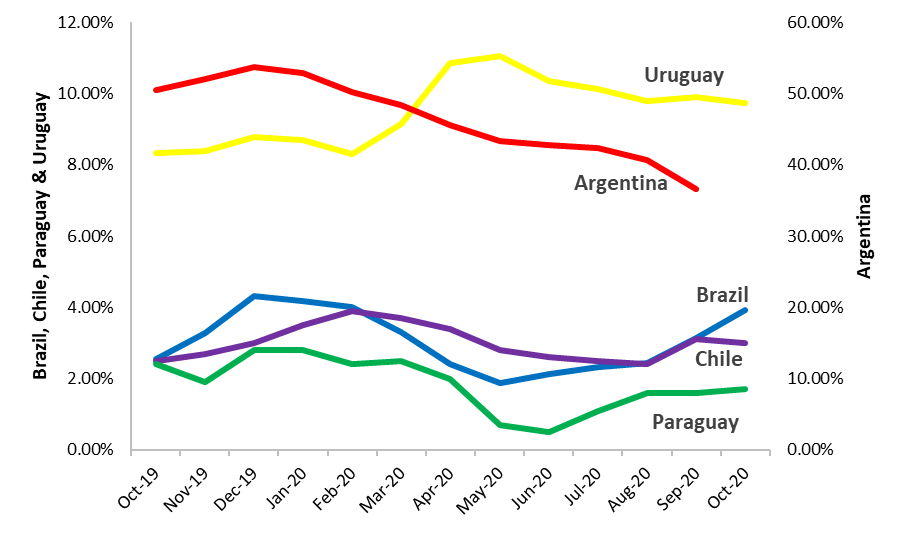
    Brazil & Southern Cone: Inflation
    Monthly year-on-year figures

    Brazil & Southern Cone: GDP growth (%)
    Quarterly figures are year-on-year growth
    Country End 2019  2020 forecast * Q4 2019 Q1 2020 Q2 2020
    Argentina -2.2 -10.5 -1.1 -5.4 -19.1
    Brazil 1.1 -9.2 1.7 0.9 -11.4
    Chile 1.1 -7.9 -2.1 0.4 -14.1
    Paraguay 0.0 -2.3 3.5 3.5 -6.5
    Uruguay 0.2 -5.0 0.2 -1.4 -10.6
    *Figures from the United Nations Economic Commission for Latin America & Caribbean Jul 2020
    End 2019 and quarterly growth based on figures from the local central banks


  • BRAZIL: Votorantim plans big IPO

    LatinNews 06 June 2013 Hits: 2376

    The trend for big Brazilian companies to launch hefty initial public offering (IPOs), capturing positive investor sentiment towards the country, is continuing.

    At the end of May, Brazil’s cement giant Votorantim Cimentos said it was planning to raise as much as US$4.8bn via an IPO later this year. A preliminary prospectus said Votorantim would offer 540m shares priced at between R$16 and R$19 each. If all were sold at the higher price, the IPO would bring in R$L10.26bn or US$4.8bn.  The offer will be conducted through the Bovespa in São Paulo and the NYSE. The company said that it intended to use 45% of the capital to finance growth and potential acquisitions at home and overseas.

    Although it operates in 19 other countries, Votorantim has mainly benefited from a construction boom on its home turf in Brazil, which has held up so far, despite a deceleration in GDP expansion and a recent tightening in interest rates. At present, Votorantim Cimentos is the only cement producer listed on the Bovespa, meaning that it is particularly attractive to investors who want a share of construction industry returns. The company is part of the family-controlled Votorantim Industrial conglomerate led by Antonio Ermirio de Moraes, ranked by Forbes as the 74th richest person in the world, with assets estimated at US$12.7bn.

    Some analysts think the flow of investment money into Brazil is not deterred by slower growth and higher interest rates because investors are still long-term optimistic about the country’s prospects. An additional fact is that Brazil remains underweight in a number of investor portfolios.

    Gary Dugan, CIO for Asia and the Middle East at Coutts, the London-based bank, recently argued that institutional investors' portfolios have typically placed their bets on countries such as India or China. But concerns about the banking system in China and high valuations in many markets may contribute to the channelling of assets into Brazil. “Over the past two years, whenever there is a whiff of good news for an economy, a lot of capital jumps in very quickly, and the market could turn round very quickly,’” he said.

  • ARGENTINA: Blackouts add to climate of unrest

    LatinNews 19 December 2013 Hits: 561

    Just days after a serious outbreak of looting in cities across the country, Argentina experienced a heat wave that led to the collapse of its power grid, leaving thousands with no energy or water. Furious protesters took to the streets in Buenos Aires, with many businesses demanding compensation for spoiled goods. The government response has failed to inspire much confidence, even among its supporters. “When the temperature hits 32 degrees Celsius, we can expect to begin suffering blackouts,” Jorge Capitanich, the cabinet chief, told the press. As well as the soaring temperatures, the administration has attributed the blackouts to a higher level of industrial activity, and an increased use of air conditioning units and other cooling appliances.

    Capitanich was forced to clarify comments that appeared to demand that energy companies consider “scheduled blackouts”, something last tried during the Raúl Alfonsín administration in the 1980s. The cabinet chief said that what he really meant to say was that they should consider “preventative blackouts”, whereby short-term cuts in service at times of low demand could prevent more significant problems at times of peak demand. But he also sought to place the blame on the energy companies themselves, saying he was “not a spokesman” for Edenor and Edesur, the suppliers to the capital. Embarrassingly, he also admitted to being unaware that Uruguay, despite strained commercial relations, was supplying all of its surplus energy to Argentina.

    The opposition mayor of Buenos Aires, Mauricio Macri, argued the government’s misguided energy policies were the reason for power cuts. Macri called for investment in the national power grid, and announced that he would send to the city legislature a proposal that every building over six storeys tall should have an electricity generator, in order to keep elevators and water pumps functioning.

    Wage pressures

    In an attempt to keep a lid on the unrest that has been simmering since a police strike in demand of higher pay led to widespread outbreaks of public disorder, Capitanich also announced this week a price-freeze on 187 staple products. It is unlikely that will take the wind from the sails of union leaders who are seeking massive wage increases commensurate with those granted to provincial police forces over the last few weeks.

    In order to get police back to work and halt the looting, provincial governments agreed to considerable wage increases, of up to 33%. The government has also now drafted a bill making police who abandon their jobs liable for criminal penalties of up to eight years in prison. But other public sector employees have taken note of the police’s success. On 15 December Julio Fuentes, the head of the Asociación de Trabajadores del Estado (ATE), Argentina’s umbrella state workers’ union, said he would take that settlement as a starting point for wage negotiations. “Education and health are just as important as security”, he said.

    • Milani gets Senate approval

    On 18 December, César Milani was approved as the new head of the Argentine army by a 39-30 vote in the Senate. The promotion comes despite the opposition of some human rights organisations concerned about his record during the military dictatorship. Earlier this year, it emerged that in 1976 Milani signed a document claiming an army conscript had deserted, when in fact he had been forcibly disappeared.

    The senate also approved Gastón Erice as the new head of the navy; Mario Callejo as head of the air force; and Luis María Carena as chairman of the joint chiefs of staff. Following the promotion of the military chiefs, the senate also voted in four new directors of the central bank and approved the former economy minister, Hernán Lorenzino, as Argentina’s new ambassador to the European Union.

    • With God on their side

    Following an exciting climax to the Argentine football season, in which four clubs had hopes of taking the title going into the last weekend, the Pope’s team, San Lorenzo, triumphed. A small group of team managers and players travelled to the Vatican earlier this week to present Pope Francis with a replica trophy and a shirt with “Francisco Campeón” written on the back. Francis confirmed to the group that he would make his first trip as pontiff to Argentina in 2016.

  • ARGENTINA: Renuncia el presidente del banco central

    LatinNews 03 October 2014 Hits: 526

    El 1 de octubre el presidente del banco central de la Argentina (BCRA), Juan Carlos Fábrega, renunció. Un día antes, la Presidenta Cristina Fernández, había acusado a los empleados del BCRA de ayudar a especuladores para socavar el peso argentino. Alejandro Vanoli, el titular de la Comisión Nacional de Valores (CNV), asumirá como nuevo presidente del BCRA. Entre los principales desafíos que enfrenta el nuevo presidente está la política de la tasa de cambio de la moneda, los bajos niveles de las reservas internacionales, y la espiral inflacionaria.

    En un largo y farragoso discurso, el 30 de septiembre, la Presidenta Fernández lanzó golpes contra una serie de enemigos, tanto internos como internacionales. En un momento dado, advirtió a sus seguidores que si algo le sucedía a ella, ellos deberían “mirar hacia el Norte”, en otras palabras, hacia EU. Fernández también acusó al BCRA de no controlar las maniobras de los bancos y operadores del mercado para debilitar el peso, y sugirió que se había filtrado información privilegiada.

    Kicillof victorioso

    Fábrega y el ministro de economía, Axel Kicillof, desde hace tiempo estaban trabados en una batalla por la influencia. Los comentarios de Fernández indicaban que era a su ministro de economía a quien ella favorece, y Fábrega se sintió compelido a renunciar. El control del gobierno sobre el BCRA es probable que se incremente en la estela de la partida de Fábrega.

    En el corto plazo, el índice del  mercado de valores de Buenos Aires (Merval) cayó un 8,2% (aunque vale señalar que se había elevado un 132% durante el año pasado). El ‘dólar blue’, la tasa de cambio extraoficial, del mercado negro, cayó levemente, a Ar$15,60/US$1, aún una larga distancia de la tasa oficial de Ar$8,47/US$1.

    Además de la masiva discrepancia en la tasa de cambio, que muchos analistas creen que significa que otra devaluación del peso es inevitable en el corto plazo, la inflación está en alrededor del 40%. Las reservas de Argentina han caído a alrededor de los US$27,1mm, lo que provoca preocupaciones de que el país podría quedarse sin dólares para pagar sus importaciones. Aunque él no estaba en condiciones para rehusarse ante las necesidades financieras del gobierno, Fábrega fue acreditado con la restauración de alguna credibilidad en los mercados de divisas, después de que manejara devaluación del peso a comienzos de año y la subida de las tasas de interés.

    Nuevo código civil

    Diputados de la oposición montaron una salida de la cámara baja del congreso el 1 de octubre, en momentos que las bancadas oficialistas se preparaban para aprobar un nuevo código civil y comercial. El proyecto de ley contiene 2.671 artículos, y abolirá el código anterior elaborado en 1869.

    El nuevo código no entrará en vigencia hasta dentro de 15 meses, pero cuando lo haga tendrá un impacto significativo sobre el matrimonio, derechos de adopción y divorcio. Pero uno de sus artículos podría eventualmente cambiar la naturaleza de la disputa de Argentina con sus tenedores de bonos ‘holdout’: la nueva ley permitiría a los deudores pagar a sus acreedores en pesos argentinos en vez de en dólares de EU.

    Cuestiones civiles

    En cuanto al matrimonio, el nuevo código apunta a ponerse al día con el Acta de Matrimonio Igualitario de Argentina, que permite el casamiento entre personas del mismo género. En cuanto al divorcio, la nueva ley simplificará el procedimiento actual, aboliendo los tiempos límites y permitiendo el divorcio en casos donde una sola persona de la pareja presente la petición. Sobre la adopción, el nuevo código reducirá el tiempo para el procesamiento y la emisión de las decisiones. Otro artículo, el de la “unión de convivencia” otorga ciertos derechos a las parejas que viven juntos, sin considerar el género.

    Código comercial

    Los acreedores de Argentina, sin embargo, estaban mucho más interesados en el código comercial. Entre las secuelas del default de Argentina en el 2001, el gobierno convirtió depósitos en dólares y préstamos en pesos, en una movida conocida como “pesificación”. En el 2012, la provincia norteña de Chaco pagó sus bonos denominados en dólares, con pesos, debido a que el BCRA le negó su pedido para comprar moneda extranjera.

    “El sentimiento general es que el gobierno se lanza hacia la opción de la pesificación en el nuevo código civil”, le dijo a Bloomberg, Alejo Costa, un estratega de Puente Hermanos Sociedad en Buenos Aires.

    • En rebeldía

    El juez de EU, Thomas Griesa, dictaminó el 29 de septiembre que Argentina estaba en rebeldía ante su corte debido a sus intentos por eludir su orden de pagar sus deudas con sus acreedores ‘holdouts’ antes de poder pagarle a los tenedores de bonos restructurados. Hasta ahora Griesa no ha anunciado cual sería la pena de Argentina, pero NML Capital, ha sugerido una multa de US$50.000 por día. La Presidente Cristina Fernández acusó al gobierno de EU de estar detrás de la decisión del juez Griesa.

  • POINTERS

    LatinNews 20 December 2016 Hits: 433

    GUATEMALA-BELIZE | Gold panning. Relations between Belize and Guatemala have been poor for most of this year. There was an incident in which troops from each country confronted each other on the Sarstoon River in March, and then there was an exchange of fire in Belize’s Chiquibul National Park on 20 April in which a Guatemalan teenager was killed.

    Since then there was an attack on a Belize Defence Force (BDF) patrol on 31 August, again in Chiquibul National Park and the categorical rejection by Guatemala of the findings of an OAS-sponsored report on the 20 April incident. The report made two key findings. The first was that the BDF patrol involved in the incident in which the Guatemalan minor died had indeed come under fire. And, secondly, the shots that killed the Guatemalan boy were in fact fired by a ranger working for the Belizean conservation group Friends for Conservation and Development (FCD), not by the BDF.

    In yet another sign of tensions in the Chiquibul National Park, two Guatemalans were detained on 25 November while panning for gold in the Ceibo Grande Creek area, about 9km from the border with Guatemala. The FCD says that there are about 100 Guatemalans currently panning for gold in the area.

    The FCD has also reported on possible illegal logging in the area. If confirmed, this would be the first evidence of such activity since the killing of a special constable by Guatemalan loggers in September 2014.

    TRINIDAD & TOBAGO | US$2m seizure linked to politicians. Customs officers and police in Trinidad are continuing to investigate the discovery of US$2m cash found in a container at Point Lisas port. Local media reports say that on 22 November a computer hard drive was seized in an office in Santa Cruz as part of the investigation. It is being reported that the money was for a local businessman in payment for a shipment of illegal drugs to the British Virgin Islands. Local media outlet Newsday has reported that, according to well-placed sources, “the man’s operation is so large that he enjoys the support of customs officials and members of the protective services and other persons, including politicians”.

    CURACAO | Corruption. A leaked report from the Court of Audit for 2014 and 2015 suggests that ministers gave approval to projects worth millions of dollars without the authority to do so.

    It is thought that some 700 work orders were authorised by ministers rather than civil servants (as should be the case), and that the value of these orders was 8m guilders (US$4m). The most culpable minister seems to have been Ruthmilda Larmonie-Cecilia, the minister for social development, labour, and wellbeing. On one occasion she is said to have boosted a grant for a company owned by a party member by nearly tenfold, from 40,000 guilders to more than 300,000 guilders.

    CARIBBEAN | Obama’s final act to strengthen strategic cooperation. The United States-Caribbean Strategic Engagement Act has passed both US houses of congress and will now go to President Obama to sign into law. The legislation requires the Secretary of State and the Administrator of the US Agency for International Development (USAID) to submit to Congress a multiyear strategy for the region, with particular emphasis on energy security, countering violence, and expanding diplomacy. One of the sponsors of the new law, Republican Representative Ileana Ros-Lehtinen, said a key motive was to counter the “negative influence of [Venezuela president] Maduro’s corrupt regime in the region”.

  • REGION: Summit of the Americas fails to live up to promises

    Sarah Sheldon 19 July 2022 Hits: 926

    From 6-10 June leaders from a selection of Latin American countries travelled to Los Angeles to take part in the Summit of the Americas (SoA) to hear about US President Joe Biden’s vision for relations with the region, but for Central America the results left much to be desired.

    Things got off to a poor start as the event, which was ostensibly a chance for the US to reassert its influence in a region which has seen increasing Chinese involvement, was boycotted by the presidents of El Salvador, Guatemala and Honduras, Nayib Bukele, Alejandro Giammattei, and Xiomara Castro, respectively. In addition, Nicaragua’s President Daniel Ortega wasn’t invited, and Mexico’s President Andrés Manuel López Obrador also declined to attend the Summit in solidarity. This further undermined the legitimacy of the SoA in discussing policy towards Central America given Mexico’s role in implementing US policy towards the region.

    Prior to the event, some had been expecting an announcement on substantial funding for infrastructure and economic development in Latin America, but they were left disappointed. Instead, on 7 June, US Vice President Kamala Harris announced US$1.9bn in private investment from 10 companies for El Salvador, Guatemala, and Honduras. These commitments include US$700m destined to develop mobile networks in Guatemala, Honduras, and El Salvador by telecommunications firm Millicom; a US$270m pledge from financial services company Visa to develop digital payments; and plans by apparel firm Gap to increase its sourcing in Central America by approximately US$50m per year for a total growth commitment of US$150m by 2025 which could create up to 5,000 jobs. This was as part of the ‘Call to Action’ first made by Harris in May 2021 in order to garner financial support for the Biden administration’s overarching strategy for addressing the roots and causes of migration in Central America. Harris previously announced pledges for private sector investment with a value of US$1.2bn, involving companies such as PepsiCo, Microsoft, Nespresso, and MasterCard. This means aggregate commitments now amount to a total of more than US$3.2bn.

    On the same day, Harris also announced the launch of the Central American Service Corps (CASC), a US$50m initiative which will provide paid opportunities for young adults to help tackle issues such as food insecurity, violence, and the impact of climate change. By investing in the region’s young people in this manner, the initiative hopes to reduce their need to migrate in the short-term, while also tackling deep rooted issues in the longer term. Both the Call to Action and the CASC will work in close coordination with the US Agency for International Development (USAID).

    The agency also announced a commitment of up to US$4.1m to support social and economic integration of migrants in countries including Costa Rica and Panama; up to US$95m in funding for smallholder farmers in countries including Guatemala and Honduras; and up to US$6.5m for violence-prevention interventions and justice, legal, and recovery services to benefit women, youth, Indigenous, and LGBT people in Guatemala.

    A further commitment of up to US$2.7m has been earmarked for projects aimed at survivors of gender-based violence in Honduras, while US$42m will be given to the Voices Initiative, which aims to “protect, defend, and promote civic space in Central America”.

    A mixture of private investment and piecemeal funding for small social projects falls far short of what some in the region were hoping for. Loftier initiatives have been floated, but details are thin on the ground. One example is the “Americas Partnership for Economic Prosperity,” which pledges to deepen economic cooperation with the entire Western Hemisphere and reinvigorate regional economic institutions such as the Inter-American Development Bank, according to a White House statement. Negotiations are predicted to start in early autumn.

    While US politicians pay lip service to the idea that Central America is a priority region for Washington, their actions tell a different story. Policymakers’ attention has been diverted by Russia’s invasion of Ukraine, but that cannot be used as an excuse for years of US neglect of the isthmus. With that in mind it should come as no surprise that leaders in the region are increasingly turning to China, and the SoA did little to show that this trend will be reversed

  • TRACKING TRENDS

    Patrick de Courcy 14 August 2025 Hits: 964

    BRAZIL | Monthly inflation rises after period of deceleration. The national statistics institute (Ibge) released its latest inflation figures on 12 August, putting monthly inflation at 0.26% in July, up from 0.24% in June. The annual inflation rate in July 2025 stood at 5.23%, down from 5.35% the previous month. The monthly inflation rate was 0.26% in May, 0.43% in April, and 0.56% in March.

    Of the nine categories of products and services measured, the greatest monthly inflation in July was registered in the housing category (+0.91%), mainly driven by a rise in household electricity bills (+3.04%).

    According to an Ibge press release, one of the main factors contributing to the acceleration in monthly inflation in July was the power consumption tariffs set by the federal electricity regulator (Aneel). In March and April Aneel’s electricity tariff was set at the lowest band (‘green flag’), which does not entail any additional charges for power consumption. In May the tariff was moved up one level to ‘yellow flag’ and in June it was brought up to ‘red flag level 1’, remaining at this level in July. The increase to red flag level 1 meant that households were charged an additional R$4.46 (US$0.83) per 100 kilowatt-hours of electricity consumed in June and July. The Ibge estimates that if the increase in household energy bills had not been factored in, monthly inflation in July would have stood at 0.15%.

    BRAZIL | Market experts lower inflation and growth forecasts. The central bank (BCB) released the latest edition of its Focus bulletin on 11 August, a weekly survey containing the economic forecasts of private sector economists and analysts, which showed an annual inflation forecast of 5.05% and a projected GDP growth rate of 2.21% for 2025. This marks the 11th consecutive week in which the experts consulted for the Focus bulletin lowered their inflation projections. One week earlier the forecast stood at 5.07% and one month earlier it was 5.17%. This latest bulletin marks the first week to show a lower growth forecast. The edition from one week earlier and one month earlier both showed growth projections of 2.23%.

  • RASTREANDO TENDENCIAS

    LatinNews 22 September 2011 Hits: 577

    COLOMBIA | Crecen las inversiones. La inversión extranjera directa (IED) llegó a US$8,56bn en los primeros siete meses del año, subiendo 61% sobre igual periodo de 2010, informó el gobierno. La mayoría de las IED (56%) fue al sector petrolero. Una inversión de US$1,3bn para impulsar la producción de carbón en El Cerrejón fue anunciada el 18 de agosto en Londres por las gigantes mineras BHP Billiton, Anglo American y Xstra, a los accionistas en la mina a cielo abierto.

    ECUADOR | Emergencia bananera. Ecuador ha declarado el estado de emergencia en el sector de las bananas debido a un incremento en la producción y una caída en la demanda. El ministro de agricultura, Stanley Vera, explicó que el alerta de emergencia duraría hasta finales de setiembre para permitir al gobierno “tomar medidas inmediatas dirigidas a mitigar las distorsiones en los precios”. Las exportaciones de banana totalizaron US$1,23bn en la primera mitad de 2011, subiendo 11% sobre igual periodo de 2010. De acuerdo con Vera, la producción se mantuvo en 152m de c ajas de cartón en la primera mitad de 2011, pero la incrementada producción en Ecuador y otras partes estaba excediendo la demanda. Dijo que hasta 1,5m de cajas por semana quedaban en el país debido a que nadie las deseaba. El gobierno ha creado un fondo de US$15m, formado con un impuesto a las exportaciones de banana, para comprar el excedente de bananas de los productores que no pueden vender su producción a los exportadores. El dijo que parte del superávit se daría a los granjeros como alimento para ganado. Abandonar el sector, dijo, sería “catastrófico”, pues un total de 1,4m de ecuatorianos, 10% de la población, trabaja en el sector.

    VENEZUELA | Creciendo, pero lentamente. La economía se expandió en 2,5% en el segundo trimestre de 2011, comparado con  el mismo periodo del año pasado, reveló el banco central, y en 3,6% en la primera mitad. El PIB de Venezuela se frenó luego de haber crecido en 4,5% en el primer trimestre sobre igual periodo de 2010., luego de 18 meses de recesión. Extrañamente, el sector de la construcción declinó en 2,3% año en año en el segundo trimestre pese a que el Presidente Hugo Chávez fijó ambiciosas metas para la construcción de viviendas este año y el próximo. La cifra más significativa  fue para la industria petrolera, que creció en 0,8% durante el segundo trimestre, habiéndose contraído en 0,5% en el primer trimestre. El banco central dijo que la recuperación del sector petrolero fue debido a un incremento de 4,4% en la producción de petróleo y también a los precios más altos del petróleo. El segundo trimestre vio un incremento de 56,3% año en año en las exportaciones de US$16,06bn a US$25,12bn, en gran medida debido al incremento en los precios del crudo. Las importaciones crecieron 25,3% durante este periodo, de US$10,01bn a US$12,53bn.

  • ECONOMIC HIGHLIGHTS

    Abbi Dicker 17 January 2025 Hits: 4614

    ARGENTINA | Boosting reserves with a repo. Argentina’s central bank (BCRA) on 3 January announced a repurchase agreement (repo) of BOPREAL Series 1-D bonds worth US$1bn with five international banks. The repo, aimed at shoring up international reserves, will be in place for two years and four months. The BCRA said it received offers for US$2.85bn at the 27 December auction but opted to secure just US$1bn. It will pay the secured overnight financing rate plus a spread of 4.75% on the repo line, equivalent to an annual fixed rate of 8.8%. Although the BCRA did not name the banks in question, sources consulted by the international press said that US financial institutions Citigroup Inc and JPMorgan Chase & Co, Spanish banks Banco Bilbao Vizcaya Argentaria SA and Banco Santander SA, and Chinese state-owned bank Industrial and Commercial Bank of China Ltd participated in the deal.

    CHILE | Dominga mining project blocked again after back and forth. On 8 January the Chilean government led by President Gabriel Boric again denied an environmental permit for the Dominga iron and copper mine proposed by mining firm Andes Iron in the central Coquimbo region. The US$2.5bn project has been in discussion for a decade. Andes Iron says it has met with environmental regulations and requirements, while campaigners and the Boric government worry about the mine’s possible impact on local biodiversity, including the Humboldt penguin, an endangered parrot, and dolphins. In December an environmental court annulled a January 2023 denial of the permit, paving the way for a review by the government’s committee of ministers. The committee again blocked the permit over the project’s failure to consider the impact on certain species and its “insufficient emergency and contingency plan” in the event of an accident like a hydrocarbons spill. Mining sector representatives have deplored the government’s decision, saying it could discourage investment.

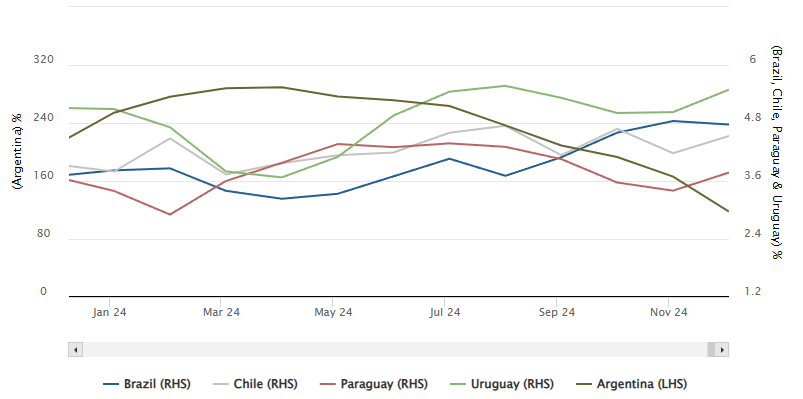
    Brazil & Southern Cone: inflation rate
    Percentage variation (year-on-year)

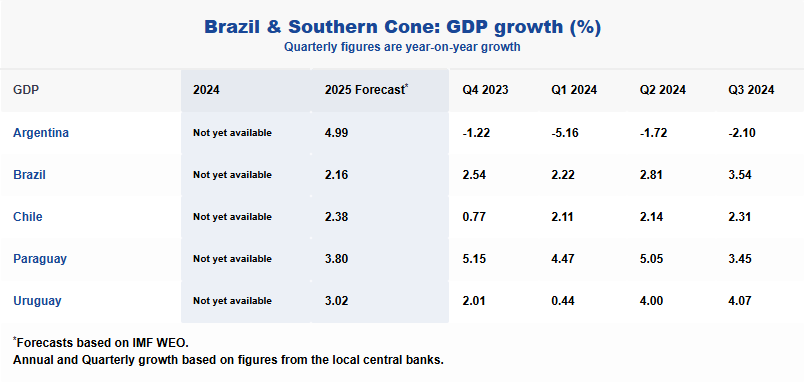
    Brazil & Southern Cone: GDP growth (%)
    Quarterly figures are year-on-year growth

  • RASTREANDO TENDENCIAS

    LatinNews 30 January 2015 Hits: 857

    BOLIVIA | Interés de ThyssenKrupp. El 27 de enero el ministro de minería de Bolivia, César Navarro, reveló que el conglomerado multinacional de Alemania, ThyssenKrupp AG, había expresado su interés en asegurar un contrato de provisión de largo plazo con la firma minera estatal y fundidora de estaño de Bolivia, Vinto. De acuerdo con Navarro, representantes de ThyssenKrupp se reunieron con él en su oficina ese mismo día para discutir sus planes para “desarrollar proyectos de negocios e invertir en Bolivia”, analizando la posibilidad de abrir una sucursal ahí. Navarro dijo que “uno de sus objetivos es apoyar a Vinto para firmar un contrato de provisión de cinco a 10 años”.

    Vinto, que fue nacionalizada por el gobierno boliviano en el 2007 y previamente era propiedad del gigante minero Glencore, es la sexta mayor productora de estaño del mundo con una capacidad de producción instalada de 20.000 toneladas (t) por año. Pero según Navarro, está capacidad ahora amentará luego de la construcción de un nuevo horno de fundición, que fue completado la semana pasada.

    ThyssenKrupp es el mayor productor mundial de acero y uno de los líderes en la provisión de componentes para el sector industrial global.

    COLOMBIA | Continuada reducción de la pobreza. El 26 de enero la Comisión Económica para América Latina y El Caribe de la ONU (Cepal) difundió su informe sobre el ‘Panorama Social para América Latina 2014’, que halló que mientras que la reducción de la pobreza en la región estuvo en gran medida estancada en 2012-2014, Colombia fue uno del puñado de países que tuvo éxito en significativamente reducir las tasas de pobreza.

    El informe de la Cepal expresa que la tasa de la pobreza de la región permaneció virtualmente sin cambios en un 28%, comparada con el 28,1% en el 2012 y el 2013 (lo que toma en consideración el crecimiento demográfico significa que en la región ahora hay 167m más de personas consideradas pobres en América Latina). Pero el informe halló que Paraguay (8,9 puntos porcentuales), El Salvador (4,4), Chile (3,2) y Colombia (2,2) lograron reducciones en la incidencia de la pobreza (y similares reducciones en las tasas de pobreza extrema).

    Mientras que Colombia puede no liderar el camino, el hecho de que es el cuarto país más populoso en la región, significa que un número mayor de individuos salieron de la pobreza en Colombia que virtualmente en cualquier otro país.

    PERÚ | El pronóstico del BCRP difiere con el del FMI. El 25 de enero el banco central de Perú (BCRP) difundió el último fascículo de su informe de proyecciones de la inflación y macroeconómicos, en el cual pronostica un crecimiento del PIB del 4,8% en el 2015. El pronóstico del BCRP es más bajo que su proyección de diciembre del 2014 del 5%, pero levemente más alto que la proyección del 4% hecha recientemente por el Fondo Monetario Internacional (FMI), el cual redujo su proyección previa del 5,1%.

    El informe fue presentado por el presidente del BCRP, Julio Velarde.  Él dijo que se espera que después de dos años de bajo crecimiento, debido a la caída en los precios internacionales de las materias primas, la economía de Perú resurgirá este año con un fuerte crecimiento en un número de sectores, un 6,3% en el sector minero; un 5,7% en el sector de la construcción; y un 5,4% en el sector de las manufacturas. Velarde agregó que se espera que las exportaciones lleguen a US$36,1mm.

    Comentando sobre la diferencia con el pronóstico del FMI, Velarde insinuó que la proyección del FMI estaba fuera de lugar, puesto que no se basa en los últimos datos disponibles. Velarde dijo que era “la primera vez” que el FMI no había consultado con el BCRP antes de lanzar cualquier pronóstico sobre la economía peruana. “Dudo mucho que [el FMI] se haya reunido con pescadores, mineros, y productores de café, como nosotros hemos hecho”, remarcó Velarde.

    En cualquier caso, las últimas proyecciones del BCRP no serán de gran beneplácito para el gobierno encabezado por el Presidente Ollanta Humala, pues sugieren que mientras que Perú se recuperará de la desaceleración económica que ha experimentado desde 2013, esta recuperación será menor de lo esperado originalmente. Lo más preocupante es que el informe del BCRP también pronostica que el crecimiento para fin del año 2014 sería del 2,4%, menor que su última proyección del 2,6% -3%.

    El 22 de enero, pocos días antes de la difusión del informe del BCRP, el ministro de economía & finanzas de Perú, Alonso Segura, dijo que el gobierno estaba prediciendo un crecimiento del 2,7% en el 2014 y de alrededor del 5% en el 2015, con Perú convirtiéndose de nuevo en una de las economías de más rápido crecimiento en América latina. Tal resultado luce crecientemente difícil de lograr.

    • Avianca

    El 22 de enero la revista especializada, Business Traveller, anunció que Avianca S.A., la aerolínea nacional de Colombia, había sido escogida por sus lectores como la mejor aerolínea de América Latina en el 2014. En una declaración, la revista dijo que “Basados en una combinación de criterios, tales como servicio, ofertas de rutas, confort, proximidad y cultura de servicio, los viajeros mundiales han elegido a Avianca como la mejor”. Fabio Villegas Ramírez, el presidente de Avianca, dijo que “nos llena de orgullo y satisfacción recibir este premio […] Avianca ha logrado obtener un lugar de honor gracias a sus innovaciones a través de sus servicios”. Actualmente, Avianca vuela a 98 destinos en 26 países de América Latina y Europa con una flota de 165 aviones de corta, media, y larga distancia.

  • HONDURAS: Institutional wrangling, or smoke and mirrors?

    LatinNews 18 April 2018 Hits: 603

    The relationship between the Honduran executive and congress in the complex fight against corruption in the country remains under scrutiny.

    As expected, President Juan Orlando Hernández on 3 April vetoed a bill proposing reforms to the May 2010 law on the seizure of assets of illicit origin (Ley de Privación Definitiva de Dominio de Bienes de Origen Ilícito). The law was first approved when Hernández was himself president of the national congress, controlled by the ruling Partido Nacional (PN).

    In late March, the current congress, elected late last year and still largely PN-controlled, proposed amending the law such that, save in the case of drug traffickers, the assets of individuals suspected of organised crime or corruption could not be seized until after a judge had issued a definitive sentence in the case. The proposed reform – basically watering down the law so as to protect current and former public officials implicated in corruption – was put forward by the right-wing Partido Alianza Patriótica Hondureña, led by the former head of the armed forces and failed 2013 presidential candidate, Romeo Vásquez Velázquez. The party has just four deputies, and while independent, is a natural bedfellow of the conservative PN. President Hernández, moreover, has close military ties.

    • Congress

    The current congress, which took up its seats in late January, comprises 61 PN deputies, with 30 for the opposition Libre, 26 for the traditional Partido Liberal, four for the Alianza Patriótica, four for the Partido Innovación y Unidad-Social Demócrata (PINU-SD), one for the Partido Anticorrupción (PAC), one for Unificación Democrática (UD), and one for the Partido Demócrata Cristiano (DC).

    The controversial amendments, affecting 12 articles of the law, was approved by 67/128 votes in late March. The proposed changes immediately were condemned by the Organization of American States (OAS)-sponsored Mission for Support against Corruption and Impunity in Honduras (Maccih), and the Asociación para una Sociedad más Justa (ASJ), the local chapter of international anti-corruption NGO Transparency International (TI). In a statement on 21 March, the US embassy said the US government was “concerned with recent actions counter to the anti-corruption work in Honduras, which is a fundamental element of US support in the region. We remain dedicated to assisting the MACCIH, CAN [national anti-corruption council], Ministerio Publico [attorney general’s office, AG], and other organizations fighting corruption and impunity,” it stressed. From the outset, President Hernández warned that he would veto it.

    The minister of the presidency, Ebal Díaz, who appeared before congress to explain the presidential veto, accepted the argument that in some cases the law appeared to have been too harshly applied, lacking either rationality or proportionality, and thus had generated ill feeling in some sectors. This notably includes Hernández’s immediate predecessor, former president Porfirio Lobo (PN, 2009-2014), whose wife, Rosa Elena, has been detained since 28 February on charges of embezzlement to the tune of US$675,000 during her time as First Lady. Her assets too have been seized. Having handed over his wife’s house to the authorities in early April (which he, apparently, had transferred to her years previously), Lobo raged that he considered his wife “a political prisoner”.

    However, Díaz insisted to congress that the problem was less with the law itself than with its irregular application. He said that having consulted widely, President Hernández had decided to go ahead with the veto. Díaz noted that the complainants should have recurred in the first instance to the supreme court’s constitutional justice commission for an opinion on the law. That court, he noted, was tasked with examining legislation to consider whether it might require any “corrections”. Congress signalled that it would accept the presidential veto (and in any case, would not have been able to muster the 86 votes required to overturn it).

    The CNA welcomed the presidential decision, which it said was “congruent with the fight against corruption” and “supportive of the institutional strengthening so needed in our country”.

    The case illustrates perfectly the institutional to-ing and fro-ing in Honduras over anti-corruption legislation, with a recalcitrant congress constantly pushing back against even the most minimal efforts by the AG and the Maccih to improve the rule of law. While Hernández’s own commitment to anti-corruption efforts appears lukewarm at best, he has no choice but to show willing, under intense international pressure. Nonetheless, the president’s strongest critics say his behaviour amounts to mere lip-service at best, and utter cynicism at worst.

    Certainly, a pattern has emerged whereby the Maccih and the AG carefully prepare legislation, the executive sends it down, and the PN-controlled congress duly approves it – albeit in diluted form (and, almost inevitably, later waters it down further). Maccih complains, but the government claims it is not responsible for the actions of congress. Given Hernández’s ironclad grip on power, it is a rather disingenuous position, and critics accuse him of duplicity.

    Another looming battle with congress is the election of a new AG for the country. In March, a nominating board was set up to pre-select candidates for the post, with the shortlist to be voted on by congress in the final quarter. The United Nations Special Rapporteur on the Independence of Judges and Lawyers, Diego García-Sayán, an independent expert appointed by United Nations Human Rights Council (UNHCR), on 3 April issued a statement calling on the governments of Honduras, El Salvador and Guatemala (both also due to appoint new AGs this year) to underline their commitment to fighting “vice and corruption by ensuring the selection process…is transparent and fair”.

    • García-Sayán’s statement

    In his statement Diego García-Sayán, an independent expert appointed by United Nations Human Rights Council (UNHCR), notes that attorney generals in the Northern Triangle must face major challenges including transnational criminal organisations, corruption and impunity. He underlines that selection processes should be “inclusive, transparent and follow strict, clear and objective criteria to evaluate the integrity, suitability and competences of the candidates”. “It is critical that these processes are administered with transparency,” he emphasised.

  • RASTREANDO TENDENCIAS

    LatinNews 01 December 2013 Hits: 184

    PERÚ | Se desacelera la economía de Perú. El 26 de noviembre el presidente saliente del banco central de Perú (BCRP), Julio Velarde Flores (ver abajo), describió la estrategia que el BCRP seguirá en los próximos meses como entre neutral y agresiva. El comentario de Velarde se produjo en medio de una continuada desaceleración económica de Perú, con un crecimiento del PIB del 5,5% pronosticado para fin de año, cayendo del 6,3% registrado en el 2012. La desaceleración económica de Perú ha sido atribuida principalmente a factores externos, tales como la caída en los precios de los metales en los mercados internacionales y una contracción en la demanda de materia prima para el consumo en EU y China. Las exportaciones mineras, que representan el 60% de las exportaciones de Perú, se contrajeron un 2,08% este año según datos oficiales, mientras que el sector de la construcción también ha experimentado una declinación este año, por primera vez en dos años. Esto sugiere no solamente que se está bombeando menos dinero en la economía peruana sino que también la confianza de los inversionistas está menguando. En el lado positivo, la desaceleración está ayudando a mantener controlados los niveles de inflación. Velarde señaló que la tasa de inflación de noviembre será del -0,2% y pronosticó que la tasa para final de año será del 3% –dentro del rango meta del BCRP del 1% - 3%.

    VENEZUELA | Inversión de Rosneft. El 21 de noviembre empresa estatal venezolana, Petróleos de Venezuela (Pdvsa), anunció que la empresa estatal de petróleo de Rusia, Rosneft, había acordado una inversión de US$65mm en la faja petrolera del Orinoco durante los próximos 10 años. De acuerdo con una declaración de Pdvsa, el acuerdo fue concretado durante el congreso inaugural de petróleo Rusia-Venezuela que tuvo lugar en la Isla Margarita de Venezuela el 21-24 de noviembre. Un comunicado de prensa del presidente de Rosneft, Igor Sechin, que asistió al congreso, subrayó que la inversión es el proyecto más importante de la compañía para el futuro cercano. Por su lado, el ministro del petróleo de Venezuela y presidente de Pdvsa, Rafael Ramírez, dijo que el plan es que ambas firmas trabajen juntas en una empresa conjunta multipropósito que incluirá un rango de actividades relacionadas como la perforación en aguas profundas, mejoramiento del crudo, ingeniería y construcción, y otros servicios petroleros. Con reservas estimadas de 297mm de barriles, la faja del Orinoco es el mayor depósito de petróleo crudo del mundo. Venezuela actualmente produce alrededor de 3m de barriles de petróleo por día, 2,5m de los cuales son primariamente exportados a EU y China.

    • Nuevo presidente del BCRP

    El congreso de Perú ha revelado la lista de candidatos para reemplazar a Julio Velarde Flores al frente del BCRP. El término de cuatro años de Velarde termina el próximo año. Durante una conferencia de prensa el 26 de noviembre, el diputado nacional Ferdy Otárola, quien encabeza el comité del congreso a cargo de seleccionar al presidente del BCRP, dijo que la lista había sido reducida a tres candidatos: Drago Kisic, Gustavo Yamada, y Francisco Gonzáles García. De los tres, la nominación de Gonzáles ha probado ser la más controversial, con el bloque del congreso de Acción Popular Frente Amplio advirtiendo que su designación iría contra el antiguo compromiso de tener un presidente del BCRP no partidario. Gonzáles sirvió como ministro de agricultura en la segunda administración de Alejandro Toledo (2001-2006). Se espera que comité anuncié su elección antes de la pausa del congreso por la temporada festiva el 15 de diciembre.

  • Peru: Future proofing

    LatinNews 12 May 2017 Hits: 2935

    The government led by President Pedro Pablo Kuczynski has unveiled a US$9bn plan to rebuild and replenish infrastructure and resurrect the economy after the recent flooding emergency, which caused devastation across half the country.

    On 25 April, the national congress – which is controlled by the right-wing Fujimorista opposition, Fuerza Popular (FP), approved the government’s ‘Reconstruction with Change’ programme (Reconstrucción con Cambio, RCC), by 90 votes to 18, after some changes.

    Congress approved the plan having added several clauses to prevent against the risk of corruption, including an insistence on tighter anti-corruption and resolution clauses in reconstruction works contracts. It also opted to increase oversight, both by itself and the comptroller general’s office. The head of the RCC must publish a progress report every quarter, and also present an annual report to congress once a year over the planned three-year life span of the scheme. While congressional approval of the RCC and its legal framework is a positive, the actual financial details, including budgeting details, have yet to be finalised, meaning another tough round of executive-legislative negotiations ahead before anything can get underway.

    The RCC plan, which has an estimated price tag of US$9bn (or 4.5% of GDP), will be administered by a new National Reconstruction Authority, to be led by a cabinet-level official (yet to be named). Of this US$9bn, approximately one-third will be destined for immediate repair needs (corresponding to the government’s US$3bn estimate of the immediate flood damage), with two-thirds to be put towards strengthening (and even relocating) infrastructure, so as to better ‘future proof’ Peru against the increasing ravages of climate change in the country. In many ways, the RCC dovetails with Kuczynski’s pledge in his 2016 election campaign to overhaul Peru’s national infrastructure, a pledge thrown off balance by the explosion of the Odebrecht scandal in the country late last year, when it emerged that the Brazilian construction giant had made some US$29bn in illicit payments to officials in three different governments in Peru in the period 2001-2015 to secure major works contracts.

    The reconstruction task is immense. According to the national institute for civil defence, over 2,000 schools need to be repaired or rebuilt, while almost 40,000 homes have been designated unfit for habitation and/or unsafe. Elsewhere, over 225 bridges also collapsed, wreaking havoc to national transport. The government has made clear that re-building will not be permitted in zones deemed unsafe, or where risk cannot be mitigated; this condition will apply equally to private and public construction work.

    Rebuilding with jobs

    On 10 April, President Kuczynski and Labour Minister Alfonso Grados unveiled ‘Trabaja Perú’, a separate US$19.9m plan to create temporary jobs assisting with the reconstruction efforts in the 11 regions affected by the floods crisis. Grados said the scheme should create 20,650 temporary posts

    Rebound from 2018

    Inevitably, Peru’s economic growth will take a hit this year because of the floods crisis. Economy Minister Alfredo Thorne now admits that real GDP growth in 2017 will be 3% (at most), but he and the rest of the government remain confident that the economy will bounce back, better than before, from 2018 onwards. Thorne is looking for a rebound of over 4% next year. The IMF is now expecting growth of 3.5% this year, from 4.3% previously, but expects growth of 3.7% in 2018, while the World Bank has cut its 2017 forecast to 3.5%, from 4.2% previously.

    Thorne has been at pains to emphasise that public investment will rise by up to 15% this year and next year, driven by the reconstruction work, as well as other planned works including for the 2019 Pan American Games (in Lima), Line 2 of the Lima metro, stage 2 of the Majes Siguas irrigation project and stage 3 of the Chavimochic irrigation scheme.

    Kuczynski confident on Chinchero

    Kuczynski reiterated on 3 May that the new Chinchero airport, to serve the southern city of Cusco, is going to go ahead, albeit in the same breath he admitted that “we have to see in what form”. “We have to see what the comptroller’s report says,” Kuczynski acknowledged, in reference to a pending report about the contract.

    Kuczynski had been due to turn the first stone on the US$500m project back in January, but it was all put on hold after a congressional investigative commission said that a financing addendum to the contract by the new government was prejudicial to the state, and requested that the works be suspended indefinitely. “I want Chinchero, don’t doubt it. But we have to wait…if everything goes well we can start moving earth in a few weeks,” Kuczynski reassured a Cusco audience.

    By contrast, even the MEF admits that private investment will remain crippled for a second year running, with forecast growth of just 0.5% in 2017. In 2018, the government is crossing its fingers that private investment will finally crank back into action, with forecast growth of 5%. This is still very far below what it needs to be, however, to propel the Peruvian economy forward sustainably – the public sector cannot prop up growth indefinitely.

    Fiscal impact to be limited

    Luckily for Kuczynski and Thorne, successive governments have been good at fiscal management in Peru, meaning that there are funds to call upon for its public spending plans. Thorne has submitted to congress a modified fiscal deficit schedule whereby the deficit is now programmed to be 3% in 2017 (from 2.5% previously), 3.5% in 2018 (from 2.3%), 2.9% in 2019 (from 2%) and finally 2.1% in 2020 (from 1.5%). Some of Peru’s regional neighbours would be more than happy would this moderate deficit programme, which should not affect Peru’s international credit ratings.

    Thorne revealed that the government is currently preparing a tax reform (with a view to implementation by year end, for a revenue effect as of 2018-2019). The main focus is to expand the currently-narrow base of contributors. The Kuczynski government’s plans for formalisation of the labour force go hand-in-hand with this. Of the 16m jobs in the country, 11m are informal. Labour Minister Alfonso Grados is also working on a labour reform, as part of which he is seeking to streamline the number of labour regimes in the country in support of this formalisation effort. In conjunction with this, the government is also considering reforms to the civil service law (known as the Ley Servir). And marking International Labour Day on 1 May, President Kuczynski also proposed changes to the country’s pension and health systems to incorporate more of the informal sector. According to the national statistics institute (Inei), 65% of workers have no access to any kind of welfare provision, with only 35% affiliated to some kind of provider (whether private or public).

    Confidence is returning

    According to the latest omnibus Peru Pulse (Pulso Perú) survey by Datum, released in early May, confidence is finally returning to consumers, after a long period of very weak confidence. Sentiment is still subdued in the North of the country, the worst affected by the floods, but is strengthening in Lima and Callao. Consumers are more confident that the economy is no longer stagnant, and they are supportive of the government’s public investment plans, aimed at stimulating activity. They also sense that private investment is slowly picking up, while they themselves are more willing to spend, albeit not on big-ticket items (cars, holidays, houses) as yet. The Datum survey coincided with a rise in the latest national consumer confidence index (prepared by GFK) and a recovery in business expectations in the recent central bank surveys.

    Copper lifeline

    For this year, the expansive mining sector will provide a crucial stay to the Peruvian economy. Peru is currently benefitting from a new copper boom, with prices up in line with revived Chinese demand. Peru’s copper output was up by 5.9% year on year in February on latest data from the national statistics institute (Inei). By region, Apurímac, home to the massive Las Bambas mine, registered the strongest output growth, at 225.2%, Las Bambas, operated by the Chinese-Australian MMG consortium, produced 73,644 fine metric tonnes (FMT) of copper in February. According to Energy and Mines Minister Gonzalo Tamayo, copper exports now make up just over half (51.3%) of total mining exports.

    Largely thanks to the copper sector, as well as rising prices for other commodities, the economy and finance ministry has lifted its trade surplus forecast for the year to US$3.7bn (from the US$776m projected in August 2016), an increase of 375%. It has also increased its forecast for 2018 to US$3.43bn.

  • ECONOMIC HIGHLIGHTS

    Patrick de Courcy 16 March 2023 Hits: 4598

    PANAMA | New free zones. On 7 February Panama’s government led by President Laurentino Cortizo announced it had authorised the installation of two new free zones with an initial investment of US$78.5m, aimed at creating new jobs, boosting production, and increasing exports. These zones provide special tax and other incentives for manufacturers who locate within them. The two new zones are the Tech Valley Free Zone, which seeks to include 120 companies and will generate 1,140 direct jobs and 3,570 indirect jobs, and the Panamá Digital Gateway which will include 620 companies aimed at maintaining the country’s strategy of being the region’s digital hub. According to the Cortizo government, Panama has doubled the number of free zones that had been installed under the previous two administrations while export sales via these free zones has doubled since 2018 from US$78m to US$143m. The latest (2022) US State Department investment climate statement on Panama notes that the country is home to the Colón Free Trade Zone (CFZ), the largest free-trade zone in the Western Hemisphere, the Panamá Pacífico Special Economic Zone, and 18 other free zones (12 active and six in development). The CFZ has more than 2,500 businesses, while the Panamá Pacífico Special Economic Zone has more than 345 businesses, and the remaining free zones host 126 companies in total.

    NICARAGUA | Remittances up year-on-year. On 24 February Nicaragua’s central bank (BCN) released new figures which show that remittances to the country totalled US$317m in January 2023. This is down from US$337m in December 2022 but up 62.8% on January 2022. According to the same figures, 80.1% of total remittances sent to Nicaragua in January 2023 came from the US (US$254m) while 8.1% of the total were from Costa Rica (US$25.7m) and 7% from Spain (US$22.2m).

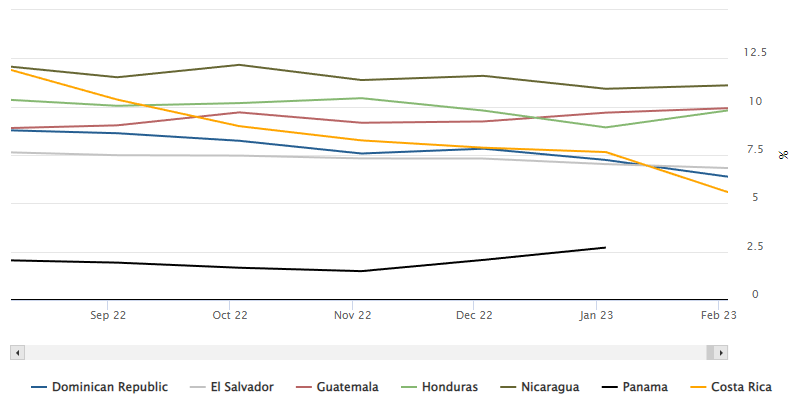
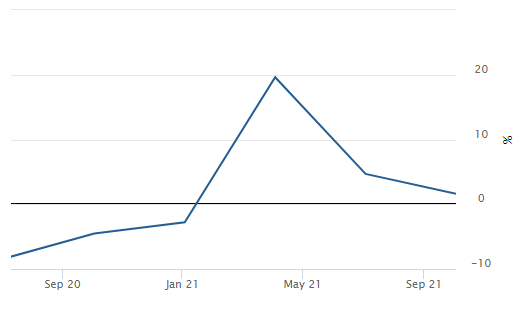
    Central America & Caribbean: inflation rate
    Percentage variation (year-on-year)

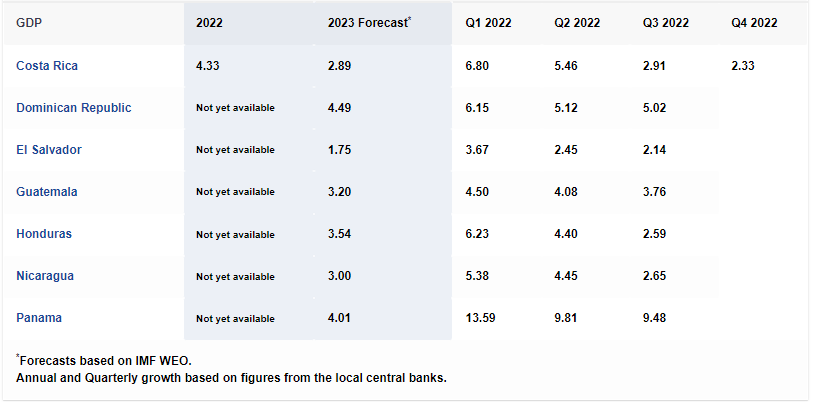
    Central America & Caribbean: GDP growth (%)
    Quarterly figures are year-on-year growth

  • HAITI: Economic recovery on the agenda

    Abbi Dicker 23 January 2026 Hits: 1347

    Still one of the largest economies in the Caribbean, Haiti’s economic performance in 2025 was poor, not to say terrible. But the International Monetary Fund (IMF) believes an economic recovery could be in the making according to a 26 November 2025 report.

    The fragile security situation, with violent gangs flouting government authority, continued to be the main negative factor in the country in 2025. A report from Haiti’s central bank (BCH) covering the July-September quarter said socio-political instability hampered economic activity, increasing price pressures and food insecurity.

    ICAE-Haiti, the index of economic activity, dropped by 2.4% in the first nine months of fiscal year 2024-2025 (the nine months to end-June). Haitian GDP has fallen in each of the last seven years. There are some 1.4m internally displaced persons and 5.7m facing food insecurity (out of a total population of 11.9m). Annual inflation remained high at 32% in FY2025 according to the IMF report.

    The expiry of the US Temporary Protected Status (TPS) visa programme this year could force over 300,000 Haitians currently in the US to leave, which would on the medium term reduce remittances sent back home to Haiti. The destructive impact of Hurricane Melissa (which hit northern Haiti last October) is also among other negatives for growth.

    But there are some positives in play. Last November the IMF said Haiti’s Staff-Monitored Programme (SMP) was being extended by a further nine months to September 2026, giving more time for economic stabilisation, and related measures such as improved governance, anti-corruption measures, and steps to strengthen the social safety net. There have been strong albeit short-term remittance inflows, boosting international reserves to almost US$1.5bn by July 2025. The government has met its agreed fiscal and monetary targets. Initiatives to reduce criminal violence (such as the Gang Suppression Force, which was approved by the United Nations Security Council in October 2025) may also begin to have an effect this year.

    The IMF is also supporting tax and budget reform designed to improve policy credibility. Despite the Donald Trump’s administration’s reduction of US economic aid, the IMF is calling for increased international financial support, and the World Bank and the European Union (EU) have made additional contributions. Yet even those who are optimistic about a potential recovery admit that the improvements to date are fragile and uneven.