All Categories

Subcategories

  • COSTA RICA: Chinchilla’s Rubik’s Cube

    LatinNews 05 October 2011 Hits: 3303

    In her description of current negotiations aimed at securing the approval of her proposed fiscal reform, President Laura Chinchilla likened the Costa Rican economy to a Rubik’s Cube. The analogy - where aligning one colour leaves the rest in disarray – corresponds to the short-termist solutions the government has been forced to adopt while the fiscal reform is under discussion. Yet, at one fell swoop, Chinchilla appeared to turn the tables to her advantage in September, obtaining support for her (third) proposed fiscal reform from the opposition Partido Acción Ciudadana (PAC) and in so doing, triggering the split of the legislative opposition coalition that seized control of the legislative assembly (AL) from her ruling Partido Liberación Nacional (PLN) in May [RC-11-05]. The opposition hopes of striking a broad electoral agreement ahead of the 2014 general election is now all but certain to remain just that.

    The alliance comprises the PAC, Partido Unidad Social Cristiana (PSUC), Frente Amplio (FA), Movimiento Libertario (ML) and Partido Accesibilidad sin Exclusión (Pase). The main problem for some members of the alliance was that the PAC announced it would back the expedited discussion of the new proposal after negotiating amendments with the PLN, but prior to discussing the document with them. For the FA and PSUC, the move showed that the PAC would go it alone whenever possible, which they considered a bad omen for any future electoral arrangement.

    For Chinchilla, however, the timing could not have been better. The deal was closed on 13 September, which meant she could announce it during her 15 September speech in commemoration of the country’s independence from Spain. Last year, the president’s address was riddled with warnings about the escalating levels of narco-trafficking and violence; this time around, she had some good news to deliver and her speech was remarkable for the absence of harsh words for the legislative opposition which had already blocked her fiscal reform twice. “Today, I recognize the profound maturity of the representatives…the baton has been passed from one administration to the next way too often. We can’t go on with partial solutions, with irrational cuts and with under-spending to our heart’s content, undressing some saints to dress up others. We can no longer patch up our development”, said Chinchilla.

    • The proposal

    Although the full details of the plan have yet to be disclosed, the local press revealed that the PLN and PAC agreed on 17 of the 18 points it contains and the government hopes to raise an additional US$900m (or 2% of GDP) in tax revenue per year. One of these agreements was reached with regards to the VAT levied on of private education and healthcare services. While the original plan proposed a taxation of 14% (and the second of 10%), the third proposal reduced it to 2%. The agreement also stipulates the creation of two taxes that did not feature in the previous proposals: a ‘world income tax’ (‘renta mundial’) of 15% for all profits generated outside Costa Rica and which were repatriated – this does not include profits generated from inheritance, a bequest or donations; and a ‘global tax’ (‘renta global’, the proposed percentage is unknown) which is to be applied to profits generated both from income and capital gains.

    • Tax revenue surges

    In August sales tax receipts were 15% higher in real terms than for August 2010. This helped the fiscal deficit which was held at 2.9% of GDP for the first eight months of the year. The double-digit jump in sales tax revenues in August was the biggest month-on-month rise since June 2008.  Sales tax receipts for the month came to C$48bn (US$94.3m). In the first eight months of 2011, the government ran a fiscal deficit of C$584bn (US$1.13bn). This is equivalent to 2.9% of GDP and was better than expected. The government is expecting a deficit of 4.8% for 2011.

    • Timing tobacco-related deaths

    To highlight the fact that a Costa Rican dies of tobacco-related causes every 160 minutes, in mid September the national anti-tobacco network (Renata) installed a giant alarm clock that rings at 160-minute intervals in front of the national assembly in central San José. The clock will remain there for one month and is intended to convince legislators that proposed anti-tobacco legislation stuck in congress since 2008 should be approved. The most recent objections to the bills, which were last debated in August, came from Luis Antonio Aiza, a PLN deputy who, ironically, is also a doctor and a member of the Caja Costarricense de Seguridad Social (CCSS).

  • Timely pre-election bonus for Chávez

    LatinNews 23 August 2012 Hits: 656

    On 17 August the central bank reported that real GDP rose 5.6% year-on-year in the first half of 2012.

    There is no mystery to the results. Thanks to sky-high oil prices, the government is spending hand over foot to ensure the October re-election (for a third consecutive six-year term) of President Hugo Chávez. Imports soared 27% year-on-year in the first half, to just over US$27m, and supplied fully a third (33%) of the total domestic offer, the highest such proportion in 16 years. Oil accounted for 96% of total exports, generating a whopping US$47bn in revenues. Yet flush export earnings (plus decent tax revenues) were not enough - the government also issued debt to the tune of US$16bn between January and June. Local economists project the 2012 fiscal deficit at a record 15% of GDP. What goes up must come down - and the consensus is for a hard landing next year. Devaluation is expected come early 2013, as per the typical Chavista post electoral strategy.

    More notably, the oil sector itself posted annualised growth of just 1.0% in the first half. Between 1998 and 2011, real growth in the oil sector averaged just 1.2% a year. If the Bolivarian Revolution is to survive and prosper, the government urgently needs to ramp-up production.

    Total external debt is still eminently manageable at US$91.7bn, or 29% of GDP, but domestic debt has soared to US$57bn on some estimates, propelling total public debt to a projected 47% of GDP by end-2012.  Again, that’s nothing in comparison to the US or the bankrupt peripheral Eurozone countries. But there is no question now that Venezuela needs not just sustained high oil prices, but also high-volume sales. Worryingly, despite tens of billions of dollars in Chinese investment in the oil sector in lucrative cash-for-oil deals, there is no sign of significant additional production coming on stream any time soon. Output was 3.0m barrels per day (bpd) in the first half of 2012, according to the energy minister and president of Venezuela’s state oil company, Petróleos de Venezuela (Pdvsa), Alí Rodríguez. Brazil is now producing more oil than Venezuela.  The government’s target is to reach some 5.1m bpd by 2019-2020.

    Guayana industrial axis

    President Chávez on 18 August said that Pdvsa would transfer shares from Petropiar, a joint venture with the US-based Chevron, to the troubled state miner Corporación Venezolana de Guayana (CVG) so as to form a new oil company to be known as Petro San Félix. Speaking in Guayana (Bolívar state), he pledged an industrial development axis in the state, centred on the giant Orinoco oil belt (home to the largest land-based oil reserves in the world), focusing on mining, agriculture, industry and petrochemicals, under his next government (2013-2019). The mining sector has stagnated under Chávez (it fell 4.8% in the first half of 2012) and CVG has also been plagued by labour unrest, with Chavista and non-Chavista unions coming together against the central Caracas government.  In late July workers re-elected an opposition trade unionist, Rubén González, to the helm of the Sindicato de Ferrominera del Orinoco (SintraFerrominera).  Three unions in Guayana are opposition controlled, SintraFerrominera, CVG Carbonorco and CVH Alcasa.

    Chávez also announced a new tie up between Pdvsa and Siderurgica del Orinoco ‘Alfredo Maneiro’ (Sidor), to be known as Faja-Acero, the aim of which is to produce up to 1.0m tonnes of steel a year, generating US$3.5bn a year for Sidor, according to the president. Chávez also promised a US$300m electricity transmission line, along with three new substations, between El Guri and Ciudad Bolívar.

    Upstream industrialisation towards petrochemicals and other value-added sectors is all well and good; it is also the strategy in Brazil. The problem in Venezuela’s case is one of implementation. Having gutted Pdvsa of its professional workers and managers following a crippling oil strike in late 2003, the Chávez government has struggled to replace them with similarly qualified ‘Bolivarian’ staff. Despite record oil prices, Pdvsa has also been starved of cash, with a massive chunk of its earnings siphoned off for social spending, and it has been asked to deliver for the government on a string on non-oil fronts, from agriculture to housing. 

    Ramírez denies oil giveaways under Chávez

    Oil Minister Rafael Ramírez boasted in an interview published on 12 August that Venezuela’s state oil company, Petróleos de Venezuela (Pdvsa), had nearly doubled its oil exports to China, spinning it as evidence of the triumphant success of Venezuela’s multi-polar oil policy.  “Before we never sold a barrel of oil to China and now we are selling 640,000 barrels a day (b/d) …and at a better price than in the US market”, Ramírez told the left-wing daily, Correo del Orinoco.

    The minister failed to mention that probably a good 50% of this is in payment-in-kind for Chinese loans to Venezuela worth up to US$40bn, according to the various statements made in recent years by Venezuela’s President Hugo Chávez. Ramírez said that Venezuela now produces around 3.0m b/d, of which 2.5m b/d is exported to the US and China, now the country’s second biggest customer. The US has long been Venezuela’s main export customer and it remains the only one that pays in full, at market price, and on time. On some estimates, Pdvsa sells just 38% of its daily production at full price. Professor Douglas Ungredda of the Central University of Venezuela suggests total daily production is more like 2.425m b/d, meaning that full-price exports would amount to some 922,000bpd. That seems to tally with figures from the US Energy Information Administration, which reported that the US imported 835,000b/d of crude oil from Venezuela in January–April 2012.

    Ramírez, who doubles as president of Pdvsa, denied that the company is “gifting” discount oil to Caribbean countries under Chávez’s pioneering oil scheme Petrocaribe, insisting that “all Venezuelan oil” is sold at “international prices”. Launched in 2005, Petrocaribe is essentially a preferential scheme whereby members purchase oil from Pdvsa at market value but only pay about 60% upfront, with the rest spread over 25 years at 1% interest. The concessionary terms become more generous if oil prices rise over US$100/b, with only a 50% payment then required upfront.

    Noting that the 11 Western Caribbean countries consume no more than 10,000 barrels of oil a day between them, compared to US daily consumption of 20,000 b/d, Ramírez pointed out that the “very asymmetric [oil] market” previously allowed traders to buy Venezuelan oil and re-sell it to the Caribbean islands at elevated prices. “What have we done? We have set up 11 mixed companies in the Caribbean, we have a Pdvsa company in each country; now we have our own terminals and ships and we sell directly”, he explained, adding that the Caribbean customers now also have better market information and price transparency, since the Venezuelan oil ministry now sets the oil prices (whereas before it was done by Pdvsa). “There is a clear formula [for setting prices] published in the daily gazette. Everyone that wants to buy Venezuelan oil can see the price. There is no way for anyone to sell with a discount”, he asserted.

    “What we do in the context of solidarity and a distinctive ethic...is that we establish [Pdvsa] in smaller countries and, whenever the price goes above a certain level, financing schemes, plus we accept payment in products”, Ramírez went on.

    The payment in kind provision has prompted the most criticism of Petrocaribe. Presenting his oil plan on 1 August, the 2012 opposition presidential candidate, Henrique Capriles Radonski, claimed that Venezuela lost out on some US$7.0bn in export revenues in 2011 in oil giveaways.  “On the extreme right it doesn’t square with their mentality and their commercial vision that Uruguay pays us, for example, with a herd of cattle”, Ramírez intoned.  He insisted that the argument that Venezuela is giving away oil for free falls down on independent audits. Pdsva’s annual accounts are audited by the international accountancy firm KPMG. “Here, down to the last cow arriving in the country is accounted for, because of course we have to verify that this has a value equivalent to the oil that we sell”, he stated.

    • Giordani

    The construction sector, now accounting for 7.2% of GDP, rose 7.5% year-on-year in the first half. Within manufacturing, non-metallic minerals output contracted 11.2%, while food, drink and tobacco fell 9.4%. The Marxist finance minister, Jorge Giordani, insisted on 18 August that the current pace of growth is sustainable and projected average growth of 6.0% in 2013-2019. He celebrated the fall in annual inflation to below 20% (19.4% in July).

    • Cuba

    Venezuelan oil subsidies for its main political ally Cuba are worth an estimated US$3.5bn a year. Pdvsa sends Cuba around 115,000 b/d (around two-thirds of its consumption). Cuba pays in kind, largely with medical staff for Venezuela’s public health clinics and other social ‘missions’.

  • RASTREANDO TENDENCIAS

    LatinNews 16 October 2015 Hits: 267

    ARGENTINA | Tratando con los ‘holdouts’. El debate sobre la actitud de Argentina hacia los llamados ‘holdouts’, aquellos inversionistas, quienes se rehusaron a aceptar un recorte a sus bonos argentinos después de la reestructuración de la deuda, ha resurgido en días recientes. Mauricio Macri, el candidato presidencial de la coalición de centro-derecha, Cambiemos, dijo que la administración de la Presidenta Cristina Fernández estaba dejando una “bomba para que explote” en el próximo gobierno al haber fracasado en arreglar la cuestión. Tanto Daniel Scioli, el elegido como potencial sucesor de Fernández, y Macri, han indicado que ellos celebrarían conversaciones para poner fin a la disputa que ha mantenido a Argentina fuera de los mercados de capital internacionales.

    PARAGUAY | Escasez de cemento. El presidente de la Industria Nacional del Cemento (INC), la firma cementera estatal de Paraguay, Jorge Méndez, admitió esta semana que existe una severa escasez en la provisión de cemento en el mercado local y que esto está produciendo una “crisis” en el sector de la construcción del país.

    Desde las semanas finales de septiembre, la Cámara Paraguaya de la Construcción (Capaco) se ha quejado de que varios de sus miembros han encontrado problemas en conseguir cemento después de que la INC anunció que se había visto forzada a reducir su producción debido a algunos problemas con su principal horno de cemento. La INC fue forzada a reducir sus embarques de cemento de 55.000 bolsas por día a 35.000 bolsas por día. Esto ha conducido a que los precios del cemento se incrementen en el mercado interno hasta en un 70%, con las firmas de construcción quejándose de que los distribuidores de cemento están aprovechándose de los problemas de producción de la INC y del hecho que un dólar de EU más fuerte significa que las importaciones de cemento son actualmente relativamente más costosas.

    Todo esto llamó la atención del Presidente Horacio Cartes, quien está interesado en asegurar que el actual boom del sector de la construcción alimentado por el número de proyectos públicos de infraestructura promovidos por su gobierno continúe y no sea socavado por la escasez de cemento. El Presidente Cartes convocó a Méndez a una reunión en la residencia presidencial, Mburubichá Roga, para analizar la situación.

    Después de la reunión, Méndez dijo que aunque la INC ahora ha resuelto sus problemas de producción y una vez más está proveyendo 55.000 bolsas por día al mercado interno, esto es insuficiente para satisfacer la alta demanda que actualmente es de 110.000 – 120.000 bolsas por día. Méndez agregó que “el Presidente nos ha pedido proveer cemento al país y para que analicemos alternativas para complementar la máxima producción de la INC”. Preguntado por los periodistas acerca de qué implicaba esto, Méndez respondió “eso es lo que evaluaremos”. Pero Méndez dijo que el plan de la INC de adquirir un nuevo secador de puzolana y un nuevo molino de cemento le permitiría producir unas 55.000 bolsas adicionales por día para el 2018, proveyendo una solución previsible para el mediano plazo.

    • Economía

    La Presidenta de Chile, Michelle Bachelet, fue franca acerca de los desafíos económicos que afronta su gobierno. “Debemos confrontar un complejo escenario económico internacional. Estamos plenamente conscientes de eso y estamos actuando de acuerdo, presentando un prudente y responsable presupuesto que nos permitirá progresar y garantizar los derechos y los gastos sociales”. Bachelet también dijo que “en poco tiempo comenzaremos el proceso de reelaborar la constitución”.

  • Peru: Stable growth with low inflation to continue

    LatinNews 27 July 2016 Hits: 2558

    Peru’s economy has managed a relatively successful adjustment to the fall in commodity prices and the general deterioration in its terms of trade. Growth in mining production, led by copper, and progress with large infrastructure projects should underpin growth in the near term.

    On 15 July 2016, the International Monetary Fund (IMF) concluded its annual Article IV consultation with Peru’s government. The IMF’s assessment was favourable.

    Peru has had to contend with a fall in exports of around one fifth through the two years to the end of 2015. [1] The country’s terms of trade dropped by around one eighth over the same period. In spite of this, the current account deficit has remained broadly unchanged at about 4% of GDP. Both real GDP and real domestic demand have also held up – thanks to higher production volumes in the mining and fisheries sectors, as well as a recovery in Peru’s services sector.

    Chart 1: Peru's economy - as the IMF sees it
      2014 2015 2016 2017
    % Change        
    Real GDP 2.4 3.3 3.7 4.1
    Real domestic demand 2.4 2.9 2.4 3.3
    Consumer prices (end of period) 3.2 4.4 3.2 2.5
             
    Exports -7.8 -13.4 -1.0 7.1
    Imports -3.1 -8.9 -4.5 3.9
    Terms of trade -5.4 -6.3 -1.7 -0.1
             
    Broad money 9.5 11.6 13.7 14.0
    Net credit to the private sector 13.2 14.0 13.7 14.0
             
    % GDP        
    Non-Fin. Public Sector primary balance 0.8 -1.1 -0.9 -0.2
    Non-Fin. Public Sector overall balance -0.3 -2.1 -2.1 -1.6
             
    External current account balance -4.0 -4.4 -3.9 -3.5
             
    Total external debt 29.7 33.7 37.7 36.5
    Of which, Non-Fin. Public Sector debt 20.7 24 25.9 25.8
             
    Gross reserves (US$m) 62,353 61,537 62,230 63,930
    % of short-term external debt 508 554 559 601
    % of foreign currency bank deposits 258 224 222 209
    Source: IMF

    There was also a pick up in inflation, by around 1 percentage point, to 4.4% in calendar 2015. This was due partly to higher food prices, as well as policy-driven increases in energy tariffs and the effect on import prices of the depreciation of the sol, which slipped from PEN2.80/US$ in early 2014 to around PEN3.5/US$ at the end of 2015. The response of the central bank (BCRP) has been to increase its key policy rate by 100 basis points since September 2015, to 4.25% currently.

    Most other metrics are favourable. Foreign reserves of about US$62bn are more than twice the level of foreign currency deposits within the banking system and well over five times the level of short-term external debt. The primary (i.e. before interest payments) and overall budget balances of the non-financial public sector have been around 1% and 2% of GDP respectively. Total foreign debt is only a little over one third of GDP. Through 2013 and 2014, broad money has been rising by around 10%-11% annually. The banking system has been recycling deposits as loans to Peru’s private sector, which have been expanding by about 13%-14% each year. In part because of the rise in interest rates, in part because of the relatively steady growth of the economy and in part because of stronger appetite for emerging markets risk on the part of investors, the Sol has appreciated since the beginning of 2015, moving from PEN3.50/US$ to a current level of about PEN3.35/US$.

    The IMF takes a bullish view of Peru’s economic prospects over the remainder of the year and through 2017. Real GDP growth is expected to accelerate to 4.1% next year, and inflation is projected to fall to 2.5%. The IMF notes that the main downside risk comes from a possible further deterioration in the global economy. Upside risks include higher-than-expected confidence and investment following the April general election. A new centrist and business-friendly administration, led by President-elect Pedro Pablo Kuczynski, who has appointed a cabinet of skilled technocrats, takes office on July 28. Kuczynski will oversee a minority government however, which looks set to complicate governance.

    Aside from political and governance issues in the immediate term, the main constraints on Peru’s longer-term growth prospects arise from the continued weakness of its institutions and the poor quality of its education system. According to the World Economic Forum’s Global Competitiveness Report for 2015-16, Peru ranked in 69th place overall for the level of its competitiveness, of 140 countries assessed. For its institutions and its health and primary education systems, it ranked at a low 116 and 100 respectively. Companies asked by the World Economic Forum to identify the most problematic factors for doing business in Peru highlighted inefficient government bureaucracy, restrictive labour regulations and corruption as the top three. Inadequate infrastructure was also cited, in distant fourth place. [2]

    Chart 2: The most problematic factors for doing business in Peru*

    *Weighted scores, as identified by companies surveyed
    Source: World Economic Forum, Global Competitiveness Report 2015-16

  • Megaprojects in Latin America

    Patrick de Courcy 02 November 2022 Hits: 727

    The term megaprojects refers to large scale, complex programmes with a cost in excess of US$1bn. They have a long history in Latin America, with iconic examples including the construction of Brasilia, an entirely new capital city for Brazil, in the late 1950s.

    However megaprojects are associated with controversy and social conflicts due to their impact on the environment and local communities. The majority run over budget, and construction delays are also commonplace. One example is the metro system for Salvador, Brazil, which started to be built in 2000 but didn’t carry its first passengers until 12 years later. There are also tensions between recovering money spent on a project and the amount of social impact it delivers, with a lack of financing holding many necessary developments back.

    Dams are a common source of power generation in Latin America given the region’s rich hydrological resources, and many of them qualify as megaprojects. For example, the Itaipú dam between Paraguay and Brazil is one of the largest hydroelectric plants in the world. Construction started in 1971 and it started generating electricity in 1984, but the dam didn’t operate at full capacity until 2005. For a time Itaipú provided almost 90% of Paraguay’s energy needs, but in 2021 the dam recorded its lowest output in 16 years due to record low levels of rainfall linked to climate change. Water shortages due to melting glaciers, increasingly unpredictable weather conditions, and other climate change-related factors are posing problems for hydroelectric projects throughout the continent, increasing energy prices and encouraging the development of renewable energy projects such as wind and solar.

    Assessing other kinds of projects as hits or misses depends largely on perspective. For example, the US$2.7bn Camisea pipeline transports natural gas from the Peruvian Amazon to the Pacific Coast, and the project is a huge contributor to the country’s energy matrix. It has also allowed Peru to become an increasingly important exporter of the fuel. For many this constitutes a huge success, and it has encouraged further gas exploration. However the project has also caused increased pollution, declining fish stocks, and encouraged migration and settlement along new roads built to service the project, all of which have had negative effects on the environment and local indigenous populations. These kinds of issues are commonly raised by projects in the Amazon and other previously undeveloped areas of the region.

    Increasing urbanisation in recent decades means that many cities need better transport infrastructure, and the poor state of public transport has encouraged private car journeys, increasing congestion. To combat this, a growing number of cities have built or expanded metro systems. The Quito metro is scheduled to open this year, while construction on Line 1 of Bogotá’s system has begun and financing has been agreed for Line 2. Contracts have been signed for a US$2.5bn fully automated line on the Santiago metro, and a third line of the Panama City metro is scheduled to start operations in 2026. Metro systems face the same issues as other megaprojects, but they can be truly transformative in terms of productivity and quality of life for city residents.

    In summary, executing megaprojects successfully is difficult, and institutional weaknesses in the region make it even harder to do so. Projects are often cancelled when political periods change, as was the case with Costa Rica’s proposed train project, or rushed through to reduce the chances of this happening, as is the case with Mexican President Andrés Manuel López Obrador’s signature projects.

    Mexico’s megaprojects causing concern

    In Mexico, each president tends to promote a particular infrastructure project during their six-year term. The incumbent Andrés Manuel López Obrador (AMLO), who came to power in December 2018, has pushed ahead with three signature projects – the Maya Train, the Dos Bocas/Olmeca oil refinery, the Felipe Ángeles International Airport (AIFA) – each of which have proven more expensive than planned and sparked controversy in some way. 

    The AIFA airport, located 50km north of Mexico City at the existing site of the Santa Lucía military airbase in Estado de México (Edomex), was inaugurated in March. The first issue is that only 14 of a planned 28 gates were built, and when the airport opened there was a lack of transport links to the centre of the city. Second, official costs increased from M$75bn (US$3.74bn) to M$80bn, and a media investigation found that the real cost had in fact reached M$104.5bn. So far, the airport has struggled to attract airlines, and López Obrador has given responsibility for the airport to the armed forces, an area in which they have little experience, raising doubts about its future viability.

    In July, López Obrador also inaugurated the Dos Bocas/Olmeca oil refinery in the state of Tabasco, although the facility remains incomplete and operations are not expected to start until 2023 at the earliest. While the original budget was set at US$8.9bn, state oil company Pemex requested nearly US$5.6bn in additional funding in August, which would increase the price tag to US$14.6bn. In addition, serious flooding was reported at the site in October, which some blamed on poor planning and the fact that the refinery is being built on top of a mangrove forest. The refinery is the first to be built in Mexico in over four decades and is part of López Obrador’s goal for Mexico to become self-sufficient in terms of energy supplies. However its construction comes at a time when the vast majority of countries are moving away from fossil fuels, and the refinery has been criticised by environmental groups. Even US President Joe Biden has tried to encourage López Obrador to commit to the energy transition, but Dos Bocas/Olmeca demonstrates the Mexican president’s commitment to swimming against the tide.

    López Obrador’s other main project, the Tren Maya, is a 1,500km railway designed to connect tourist hotspots in the Yucatán Peninsula. The president says that the train is part of a plan to bring economic development to the southeast of the country, but local residents along the line have complained about a lack of consultation, and there have been a string of environmentally-motivated challenges in the courts that have slowed construction. Costs have spiralled, with López Obrador admitting that the train could cost up to US$20bn, nearly three times the original budget of US$6.8bn. And while he has remained bullish on the progress of the project, in October he admitted for the first time that part of the line near Chetumal, Quintana Roo state, may not be built due to local opposition.

    The Mexican president has also promoted the Interoceanic Corridor (CIIT), a major logistical and industrial investment project that will link the Pacific seaport of Salina Cruz (Oaxaca state) with the port of Coatzacoalcos (Veracruz state) on Mexico’s Caribbean coast. Plans also include connections to the Tren Maya and a line to Guatemala via Tapachula, Chiapas state. However construction of container terminals at the two ports has been delayed.

    Mega projects are known for running over budget and affecting the environment and local communities, and López Obrador has taken a huge risk in attempting to transform the southeast of the country with two massive infrastructure projects, as well as betting against the prevailing winds on fossil fuels and handing the armed forces a huge role in Mexico City’s airport infrastructure.

  • TRACKING TRENDS

    LatinNews 22 August 2011 Hits: 3248

    BRAZIL | Slowing down? The central bank’s index of economic activity, the IBC-Br, fell in June for the first time since December 2008. It was down 0.26% month-on-month in June over May. Local economists have recently lowered their annual real GDP growth forecasts for this year and next to 3.93% and 4.00% respectively. Inflation also shows signs of slowing, which could allow the central bank to leave the benchmark Selic interest rate untouched at its next meeting on 31 August. Some industrialists are already calling for a cut in the Selic from its current rate of 12.5%.

  • PANAMA: Ruling alliance cracks

    LatinNews 01 September 2011 Hits: 1297

    It was arguably only a matter of time. The alliance between President Ricardo Martinelli’s Cambio Democrático (CD) party and its main coalition partner, the Partido Panameñista (PP), is now in tatters. This month, CD members confirmed that a process was underway to pick a candidate ahead of the 2014 presidential vote. This reneges on the deal struck ahead of the 2009 May election whereby Vice-President Juan Carlos Varela, the PP party president, ditched his bid to join Martinelli on the understanding that the PP would head up the coalition ticket in 2014. It suggests that just as Martinelli now effectively controls the judiciary, he is no longer dependent on PP support to push through his legislative agenda.

    CD has nearly doubled its presence in the 71-member unicameral congress since the last election, from 15 seats to 29. The PP has 20, down from 21 in 2009. A handful of seats from the minor members of the ruling Alianza por el Cambio, leaves Martinelli now within easy reach of a majority. As the CD has gradually picked up opportunistic defectors from other parties and increased its strength, tensions with the PP have become more apparent, most notably over Martinelli’s now-abandoned proposal to change the constitution to allow for consecutive presidential re-election [RC-11-01]. The final nail in the coffin of the CD-PP alliance was another proposed change to the electoral rules vehemently opposed by the PP – this time a legislative proposal by the CD to change the presidential voting method to a two-round election if one of the candidates fails to secure a majority (50%+) in the first round. Martinelli’s convincing 60% victory in 2009 was just one of three presidential races to have been won by an absolute majority (along with Arnulfo Arias [1969] and Guillermo Endara [1989]).

    Aside from signalling an end to the alliance with the PP, the second-round proposal, which comes as other constitutional changes are being discussed by a newly established government committee (see sidebar), has attracted controversy. The head of the electoral tribunal, Gerardo Solís, and other legal experts argue that the change is a constitutional matter rather than a legislative one given that article 177 of the constitution states that a President is elected with an absolute majority. Congress president and CD member José Muñoz Molina told reporters that those who oppose the motion could always challenge it in the supreme court once it has been approved, although this failed to provide much reassurance given Martinelli’s control over the judiciary [RC-10-01].

    • Constitutional reform

    At the end of April, Martinelli established a nine-member special committee of legal experts tasked with drafting proposals for reforming the 1972 constitution, a process expected to take several months which will, according to the government, involve “citizen consultation”. Martinelli has failed to specify which articles are up for revision. However, many speculate that the proposals, which will be presented to the president and his cabinet for approval before going to congress, will include his previously floated suggestion of reducing the length of time a former president must wait before becoming eligible for re-election from ten to five years. Changes to the constitution must be approved in three congressional debates by an absolute majority.

  • TRACKING TRENDS

    LatinNews 24 October 2013 Hits: 2504

    VENEZUELA | Government presents “unreal” budget. On 22 October the Caracas government led by President Nicolás Maduro presented its 2014 draft budget to the national assembly, which was immediately described as “unreal” and “baseless” by the political opposition. The BF551bn (US$87bn) plan is 39.4% higher in nominal local currency terms than the 2013 budget, but private sector economists calculate that is around US$5.0bn less in real (inflation-adjusted) terms.

    The budget assumes real annual GDP growth of between 4% and 6% in 2014, and an annual inflation rate of between 26% and 28%, around half the current rate of 50%. As ever, it is based on a a deliberately low oil price forecast of US$60 per barrel, just US$5 higher than last year’s forecast, despite the fact that Venezuelan crude oil prices have averaged US$102.5 a barrel to date in 2013, on energy ministry figures. This oil price underestimation allows the government to spend the ‘windfall’ oil revenues at its discretion and without any transparency. Notably, the budget also keeps the official government-set exchange rate at BF6.3/US$1, despite the fact that the parallel black market exchange rate has now reached BF49.26/US$1. Finance Minister Nelson Merentes said the budget was the result of “careful consideration”. “We have to be very prudent when estimating [the price] of this resource [oil], because if there is an important external shock the prices may tumble… then there is no way of balancing the budget”, he argued.

    Merentes admitted that the soaring inflation was a “terrible concern” but promised that the government would adopt additional measures to tackle it, and he promised to alleviate the chronic shortage of basic goods, particularly foodstuffs. In response, the main opposition coalition Mesa de la Unidad Democrática (MUD) issued a statement complaining that the annual budget "has become baseless and no longer represents a valid point of reference for the development and implementation of public policies”. It said the growth forecast of 4%-6% “not only looks unreal but also irresponsible”. The 2013 budget forecasted a similar growth rate but real GDP growth in the first half was a weak 1.6% year-on-year. The MUD questioned why the country was enduring “ a deep economic crisis characterised by high inflation, scarcity and a significant fall in the central bank’s international reserves” when Venezuelan crude has remained at around the US$100 mark in 2013. The Maduro government would answer that it is all down to the opposition-promoted campaign of ‘economic sabotage’.

    BOLIVIA | New settlement dispute organisation. On 21 October Bolivia’s chamber of hydrocarbons and energy (CBHE), which groups together private energy sector firms operating in the country, announced the creation of a new dispute settlement body for the country’s nationalised hydrocarbons sector. Bolivia’s 2009 constitution does not recognise the jurisdiction of any international tribunal or dispute resolution body. The CBHE has been working with Bolivia’s state oil firm, Yacimientos Petrolíferos Fiscales Bolivianos (YPFB), to set up the new body (as yet unnamed). Iver von Borries of the CBHE’s executive committee has been named president of the new institution. He said its creation owed not only to the fact that energy firms operating in Bolivia have no recourse to external dispute settlement mechanisms, but also to the fact that “there is no such specialised dispute settlement body at the regional level”. According to van Borries, the goal is that the new centre eventually could offer its services to other countries and companies in the region.

    • EU visas

    On 21 October the European Parliament (EP)’s civil liberties committee green-lighted a proposal to eliminate the short-stay visa requirement for Colombian and Peruvian nationals entering the European Union (EU). On 3 October Spain proposed the inclusion of the two Andean countries, which signed a Free Trade Agreement (FTA) with the EU last year, on a list of countries that the EU should consider suppressing visas for. The announcement was by celebrated by Colombia’s President Juan Manuel Santos, who said it was “very important and positive news” denoting recognition of the “advancements in security, economic development and political stability in our countries”. The list could receive full approval by 2014.

  • Nicaragua: Booming economy, protests on the streets

    LatinNews 11 May 2018 Hits: 597

    As a general rule of thumb, strong economic growth tends to create greater political stability and support for the government in power. But this is not always the case, and Nicaragua, with widespread street protests in April against the regime of Daniel Ortega, is showing itself to be a significant exception to the rule.

    According to the IMF, Nicaraguan GDP is set to grow by 4.7% this year and by 4.5% in 2019. If achieved, this rate of expansion will make it the second-fastest growing economy in Central America (after Panama in first place). But it is clear that Nicaragua has much weaker institutions than Panama. In Nicaragua, “The multiple citizen demonstrations sparked by a government attempt to make regressive changes to the pension system, and the unfortunate violent response by the Nicaraguan state, show there is an unstable political balance in the country,” says Jonathan Menkos, director of Instituto Centroamericano de Estudios Fiscales (Icefi), a think-tank. Menkos says that Nicaragua’s growth has been based on a tacit understanding between the party in power – Frente Sandinista de Liberación Nacional (FSLN) – and the local business community. By playing down the negatives (authoritarianism, corruption, weak institutions) this alliance has attracted significant inward investment flows, particularly into agriculture and services. Despite his criticism, Menkos also acknowledges that there has been investment in social infrastructure to reduce poverty.

    The protests and violence by the police were sparked by a decree introducing a 5% increase in pension contributions charged to workers and employers, along with reduced benefits, part of a package of measures designed to reduce losses at social security body INSS (Instituto Nicaraguense de Seguridad Social). By some calculations, pensions would be cut by as much as 12%. What gave the issue a particular political sting was that there have been claims of misallocation of funds and dubious investment projects within INSS. Faced by the sheer size of the demonstrations, and a death toll that could be as high as 63, President Ortega rescinded the decree, but this does not seem to have been enough to diffuse the country’s major internal confrontation.

    Juan Felipe Celia, a deputy director at the US-based Atlantic Council, says that the protests were initially over the government’s plan to increase workers’ social security contributions, but explains that they widened out from there to include other issues such as censorship and the lack of political freedoms in the country. Asked whether the IMF – which had recommended social security reforms – was indirectly to blame for the uprising, he said the real responsibility lay with the government for trying to impose drastic changes without even consulting congress or the business community. As a result Cosep (Consejo Superior de la Empresa Privada en Nicaragua – the top business community organisation and a traditional ally of the government, ended up opposing the measures. Celia says the economic crisis in Venezuela may also have been a factor – Venezuela’s subsidised oil exports to Nicaragua have been sharply reduced

    The Banco Central de Nicaragua says that GDP grew by an average of 5.2% in 2010-2017. Last year growth was 4.9%, led by livestock, agriculture, fishing and aquiculture, hotels and restaurants, the financial sector, and manufacturing. Inflation closed the year at 5.7% and public sector debt stood at 47% of GDP. The labour market is highly informal, with as much as 70% of those of working age paying no taxes and receiving no benefits.

  • HONDURAS: Killing of indigenous activist underlines priority for new government

    Sarah Sheldon 21 February 2022 Hits: 1375

    The United Nations (UN) Office of the High Commissioner for Human Rights (OHCHR) in Honduras and Inter-American Commission on Human Rights (IACHR) have both condemned the recent killing of Pablo Isabel Hernández, a local indigenous Lenca leader, activist and human rights defender (HRD). His murder has underlined a key priority for the new Honduran government – addressing violence targeting HRDs.

    According to an OHCHR statement dated 10 January, Hernández was killed the previous day in San Marcos de Caiquín municipality, Lempira department, when unknown men shot him in the back while he was going to church. The director of a local radio station Radio Comunitaria Tenán, Hernández was president of the network of agroecologists of the Cacique Lempira Biosphere and a sponsor of a local indigenous university, Universidad Indígena Lenca y de los Pueblos, among other things.

    The OHCHR statement highlighted that he had served as director of the radio station for five years which he had used as a platform to question the local San Marcos de Caiquín government. He also retransmitted the programme “Voces contra el olvido” (Voices against forgetting) made by local human rights group Comité de Detenidos Desaparecidos en Honduras (Cofadeh). Hernández had publicly reiterated concerns regarding the risks he faced along with threats to close the community media outlet.

    In its statement, OHCHR highlighted that Hernández is the first HRD to be murdered in Honduras this year. It registered violent incidents against at least 208 HRDs and 93 journalists in 2021, of which ten were murders. Meanwhile the latest (September 2021) annual report from international NGO Global Witness registered 17 environmental HRDs killed in Honduras in 2020, up from 14 in 2019 and four in 2018.

    •  Guapinol defenders

    On 14 January the high-profile trial began of eight environmental defenders, Porfirio Sorto Cedillo, José Avelino Cedillo, Orbin Naún Hernández, Kevin Alejandro Romero, Arnold Javier Alemán, Ever Alexander Cedillo, Daniel Marquez, and Jeremías Martínez Díaz. On 9 February all bar Alemán and Díaz were convicted with the other two acquitted. However in a supreme court ruling on 10 February, the convictions against the six were thrown out.

       Since 1 September 2019, the eight HRDs had been in pre-trial detention for charges related due to their work in defence of the San Pedro and Guapinol rivers. They were placed in pre-trial detention for opposing an iron oxide mine inside a protected national park in Tocoa, a municipality in the northern Colón department. The HRDs come from the community of Guapinol on the Guapinol River, which is polluted by the mine, and belong to the Comité Municipal de Defensa de los Bienes Comunes y Públicos (CMDBCP), a network of local groups dedicated to land and environmental defence.

     The case had long attracted international attention and the CSJ’s decision to overturn the convictions was well received by human rights institutions. In November 2021, UN human rights experts including Mary Lawlor, UN Special Rapporteur on the situation of human rights defenders, urged Honduras, elected to the UN Human Rights Council the previous month, to release the eight defendants in line with recommendations made by another UN body, the UN Working Group on Arbitrary Detention (WGAD) in February 2021.

       In April 2020 members of the European Parliament sent a letter to then President Juan Orlando Hernández (2014-2022) which said that this pre-trial detention has “no sound legal justification” and constitutes “judicial harassment of the defenders in the absence of clear incriminating evidence against them”. END BOX

    • Global witness

    A 10 December 2021 blog post by Global Witness underlines that Honduras remains one of the most dangerous countries for environmental defenders, with nearly 140 murdered since 2012 – and many more being criminalised simply for standing up for their rights to their land and a healthy environment.

  • ARGENTINA: Government coalition still in disarray

    Patrick de Courcy 23 February 2023 Hits: 4687

    Argentina’s President Alberto Fernández has embarked on an electorally inspired trip to Antarctica; Vice President Cristina Fernández claims that she is the victim of conspiracy; and Economy Minister Sergio Massa says that he may give up his presidential ambitions entirely. Overall, the election plans of Argentina’s ruling centre-left Frente de Todos (FdT) coalition appear to be in some disarray.  

    Despite various internal meetings, the FdT coalition seems no closer to agreeing upon an approach to the presidential and congressional elections due in October. From the ruling coalition’s point of view the ideal outcome would be to agree a ‘unity list’ of preferred candidates ahead of the obligatory primaries (Paso) due in August.

    After some manoeuvring, such agreements have in the past eventually materialised, allowing the FdT to use the Paso as a kind of referendum on its popularity. But this year the divisions are running deep; the different factions may have to fight it out in the primaries, reinforcing a message of division, rather than one of unity.

    The key figure remains Vice President Fernández. Her intentions are unclear. While polls show her to be the most popular candidate within the ruling coalition, she is also a divisive figure both within the coalition and in the eyes of the wider electorate.

    Vice President Fernández was sentenced to six years’ imprisonment and banned from elected office by a court in a corruption case last December. Yet she benefits from immunity from prosecution, which she could prolong if she were to run successfully for the presidency or for a senate seat. While saying late last year that she would not run for any elected office at all, she has now changed stance saying she is a victim of politically motivated “proscription”.

    Vice President Fernández’s options include taking on a ‘kingmaker’ role, supporting a protégé or another candidate in return for assurances about policies and her personal future. That would be, after all, not dissimilar to the deal she struck with Alberto Fernández in 2019. That did not turn out well, however, and her supporters are now furious with the president, who appears to rate his chances of re-election despite adverse polling.

    President Fernández has departed on what looks like an electorally inspired trip to the southernmost province of Tierra del Fuego and to the Argentine military base in Antarctica where he plans to deliver a nationally televised speech. He also has plans to visit a number of other provinces, seen as another electorally focused tour.

    Meanwhile, Massa has cooled speculation that he will be a presidential candidate, saying he will not run as long as he remains economy minister. This may or may not be a recognition that continued high inflation and low growth will hamper his chances. The next stage in the Alberto-Cristina struggle will come on 1 March when both must be present at the opening of the next congressional session, and President Fernández must deliver a state-of-the-nation address.

    Recent polls are suggesting that the Argentine electorate will split three ways in October which, if accurate, would represent a major swing to the right and will pose challenges in the presidential race. According to pollster Opinaia, the right-of-centre opposition Juntos por el Cambio (JxC) has 31% support in the presidential race, with the FdT trailing in joint third place on 24%, a position shared with the libertarian right-wing movement La Libertad Avanza, led by economist Javier Milei.

    These levels of support will change as the nomination process advances but the danger for the FdT is that it might get ‘squeezed out’ of the presidential race. Should the vote go to a second-round run-off between FdT and JxC candidates, Milei voters may end up holding the balance and tipping it in favour of the right-of-centre. A seismic shift in Argentine politics – an ‘outsider’ Milei victory - cannot be entirely ruled out.

    Opposition JxC

    Horacio Rodríguez Larreta, the mayor of Buenos Aires and a leading figure in the opposition JxC coalition, was expected to formally declare his intention to run for the presidency as this issue went to press. Although he remains a frontrunner, the nomination race within JxC is also complicated. Former hard line security minister Patricia Bullrich is one of many rivals inside the coalition. Both have sought, but not obtained, the endorsement of former president Mauricio Macri (2015-2019), who has himself not ruled out throwing his hat into the ring.

  • CARIBBEAN POINTERS

    Sarah Sheldon 22 May 2023 Hits: 868

    *** PLEDGES ON CRIME. A two-day Caricom (Caribbean Community) symposium on crime, held in Port of Spain, the capital of Trinidad & Tobago, on 17-18 April, ended with, inter alia, an agreement to introduce bans on assault weapons, many of which are imported from the US. The symposium was told that in Jamaica, which has a murder rate of 52.9 per 100,000 in habitants compared with a global average of 7.5, some 67% of illegal firearms come from the US.

    Jamaica’s Prime Minister Andrew Holness said that pressure needed to be put on the US to stop the flow of illegal weapons. He said: “We must also consolidate our efforts to lobby, particularly the US, to assist us as we have assisted them in the war on drugs. They must assist us in the war on guns. There seems to be no interest in stopping the other part of the trade, which are the guns. The guns fuel crime, they are an accelerant, they are needed to protect drugs that are trans-shipped to our borders. They are then turned to deal with other forms of criminal activity. So, collectively as the leaders of Caricom, we must raise our voice on this. We must appeal to our friends in the North to increase their efforts to prevent the flow of guns into the region.”

    Barbados Prime Minister Mia Mottley called for much greater regional collaboration on crime. She said: “We need the Caricom arrest warrant, we need to have the exchange and rotation of judges…we need to have an enlargement of the jurisdiction of magistrates, we need cooperation on forensics and we need to…deconstruct all the rules in our police service and reconstruct them,”

    Mottley also called for an end to the granting of bail to accused murderers, a call that was echoed by a number of other leaders. One of the reasons for murderers being granted bail is the long time it takes to bring a case to court. As Mottley put it: “If we can get people to court within nine to 12 months, you have a good chance of a person not being given bail. Beyond 12 months, any number [of things] can start to play.”


    *** IMPROVING MARITIME CARGO SERVICES. The Caribbean Development Bank (CDB) has announced that it is to finance a study into the options for establishing a Maritime Cargo Service connecting Barbados, Grenada, Guyana, and Trinidad and Tobago. The service will be geared towards the transport of agricultural products and to supporting the goal of reducing the region’s food import bill by 25% by 2025 (the ‘25 by 25’ goal).

    The CDB’s Director of Projects, Daniel Best, was quoted on 5 April as saying “Policymakers in Caricom [the Caribbean Community] have established that intra-regional agricultural trade can balance food deficits and surpluses, contribute to price stability, and increase the diversity of food supply, all of which can achieve greater food and nutrition security for the Caribbean, CDB is aware that improving intra-regional trade in agriculture will require interventions across the ecosystem, however the provision of efficient and sustainable transportation to move agricultural goods will go a far way in achieving 25 by 25.”


    *** BOOST FOR GUYANA IN TERRITORIAL DISPUTE WITH VENEZUELA. On 6 April, the International Court of Justice (ICJ) rejected Venezuela’s argument that in its dispute with Guyana over the sovereignty of the Essequibo Region, the United Kingdom, as the colonial power, should be a party to the proceedings. The ruling means that the court can now move to address the substantive issues, with a final ruling expected in 2024 or 2025. There is no expectation that the court will rule against Guyana and the status quo, but there is a fear in Guyana and elsewhere that Venezuela will not accept an adverse ruling. With that in mind, Guyana’s diplomatic efforts are likely to be focused on bolstering Latin American, and especially Brazilian, support for its position.

  • ANTIGUA & BARBUDA: Election time

    LatinNews 12 February 2014 Hits: 3878

    Constitutionally Antigua & Barbuda should hold an election by 12 March, although in exceptional circumstances there may be a delay of up to 90 days, which the opposition Antigua Labour Party (ALP) says is what Prime Minister Spencer Baldwin is planning. Whatever the truth of this allegation, the ruling United Progressive Party (UPP) cannot be feeling overly confident about its chances of winning a third term in power, although it is putting up a good case.

    The January budget statement was as much an election manifesto as a budget, and it began with a defence of the UPP’s record since being elected in 2004 and re-elected in 2009, particularly over what it called the rebuilding of trust with creditors. The statement noted that “whereas our arrears constituted approximately 50% of our total debt prior to 2004, through constructive engagement with our creditors they now represent less than 6%”.

    The government has set out six targets for end-2020:

    - Annual economic growth of 5%-6%

    - a debt-to-GDP ratio of “or close to” 60%

    - full employment

    - capital investments averaging 10% to 12% of GDP

    - an increase in per capita income to US$20,000

    - greater benefits from membership of the Organization of Eastern Caribbean States (OECS).

    This is a highly ambitious programme, particularly on growth given that Antigua grew by just 1.2% in 2013 and is expecting growth of 1.9% in 2014, but the government’s argument is that the country is now set to reap the rewards of its prudent policies. Rather lyrically, the budget statement argued: “The policies of this government over the past few years could be likened to a farmer preparing his land: tilling the soil, removing any weeds and rocks that would impede growth of his crop, introducing fertilizer and irrigation systems, and planting seeds. The seeds that we have planted have begun to develop and Antigua and Barbuda is set to yield the fruits of this administration’s efforts.”

    By contrast, lack of prudence is the point on which the government is seeking to attack the ALP in the run-up to the election, particularly on its proposal to abolish personal income tax. How, asks the government, is this proposed measure to be paid for? By, says the government, introducing new taxes or increasing other existing taxes. Alternatively, argues the government, they may have to cancel social programmes such as the utility subsidy for pensioners, free school uniforms, or school meals.

    This line of attack may not be enough, however. The ALP is saying that the UPP is going to lose 15 out of 17 constituencies. A more independent assessment, from Caribbean Development Research Services (Cadres), suggests a slimmer 11-6 win for the ALP, but this poll was taken before the campaigning began in earnest and before the government presented its budget.

    Before losing power in 2004, the ALP had dominated Antiguan politics for 30 years under the Bird family. However, if the ALP does win the upcoming election under its leader Gaston Browne, it will be its first success without one of the Bird family at the helm – except that Browne is married to Maria Bird, niece of former prime minister Lester Bird.

  • TRACKING TRENDS

    LatinNews 01 March 2018 Hits: 1423

    ARGENTINA | Construction drives growth. Argentina’s economic activity expanded by 2.8% in 2017, according to a report released by the national statistics institute (Indec). This is a provisional figure before the release of the full GDP growth breakdown. The government led by President Mauricio Macri had hoped GDP growth would reach 3% last year.

    Economic activity was propelled by the construction sector which expanded by 12.7% in 2017, Indec reported. Construction activity remains encouraging. It expanded by 19% year-on-year in January, according to Indec. Employment in the construction sector also increased by 11.4% year-on-year in December 2017.

    The positive figures buttress the claims by the Macri administration that the economy has turned a corner, and that construction could help to drive GDP growth in 2018. Indec reported that GDP growth in the third quarter of 2017 stood at 4.2% year-on-year, and was also up by 0.9% on the second quarter.

    BRAZIL | JBS shares fall. Shares in meatpacking company JBS fell this week after Brazil’s attorney general’s office (PGR) rescinded a plea bargaining agreement with the company’s former CEO Wesley Batista. He is accused of intentionally omitting important information from his testimonies. The case now passes to the supreme court (STF). Prosecutors could level more penalties against Wesley or JBS. Last week, Wesley was released from jail and placed under house arrest. He is still under investigation for insider trading, stock exchange fraud, and corruption.

    BRAZIL | Environmental damage. On 28 February, Brazil’s environmental regulator Ibama fined Norwegian aluminum manufacturer Norsk Hydro R$20m (US$6.2m) for operating without a dredging licence and for a possible waste spill at the company’s Hydro Alunorte refinery in the industrial park Barcarena in the northern Amazonian state of Pará. After a period of heavy rain, the water by the Hydro Alunorte residue dam turned red and is believed to be contaminated with bauxite.

    Brazil’s environment minister, José Sarney Filho, had called on Ibama to investigate the company, which denies knowledge of the pollution and says it is not responsible for any spill.

    The environmental spat has heightened diplomatic tensions between Brazil and Norway. Norsk Hydro is 41% owned by the Norwegian state. Last year, Norway sharply criticised Brazil’s environmental policies and reduced its funding to protect the Amazon rainforest after the country failed to meet its deforestation targets. Now, Sarney Filho has turned the tables and questioned Norway’s commitment to environmental conservation in Brazil.

    “We are not close to a new Mariana [referring to the November 2015 environmental disaster at the Samarco mine, when a tailings dam burst killing 19 people], but this spill is serious and comes from a company that belongs to the Norwegian government, a company that should have responsibilities, especially in the Amazon,” Sarney Filho said.

    Separately, executives at the Brazilian mining company Vale said on 28 February that the Samarco mine, a joint venture with Australia’s BHP Billiton, could resume operations by the end of this year or early in 2019.

  • ECONOMIC HIGHLIGHTS

    Patrick de Courcy 13 October 2022 Hits: 902

    NICARAGUA | Legislature moves on trade deal with China. On 8 September Nicaragua’s 92-member unicameral legislature approved an early harvest deal with mainland China, part of a free trade agreement (FTA) which the two countries are currently negotiating. According to official state-owned media in Nicaragua, the agreement will permit the country to sell leading exports like beef, shellfish, and coffee. Back in June, when first announcing that the two countries had outlined a trade deal, Nicaragua’s minister for development, business and industry (Mific), Jesús Bermúdez, said that the framework for negotiations had already been established and he hoped that the FTA would be finalised within a year and a half. The FTA will cover key areas of trade policy such as intellectual property rights, environmental standards, and phytosanitary measures. This is the latest sign of cooperation between the two countries which formally established ties at the end of last year after Nicaragua severed relations with Taiwan.

    PANAMA | Panama Canal budget approved. On 27 September Panama’s 71-member unicameral assembly has approved the budget for the Panama Canal for fiscal year (FY) 2023 (from 1 October 2022 to 30 September 2023) which forecasts revenue of US$4.65bn and direct contributions to state coffers of a record US$2.5bn. The Panama Canal Authority (ACP) administrator Ricaurte Vásquez Morales said that the ACP forecasts that income from tolls for FY 2023 will total US$3.38bn while other income from maritime services will total US$1.17bn. He said that over the past 21 years, the ACP had provided US$20.72bn to state coffers, and for the FY2022 budget the ACP was forecast to provide US$2.5bn to the state.

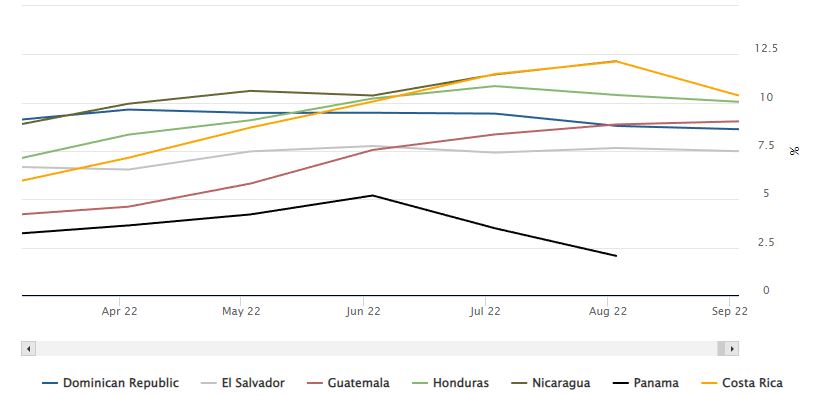
    Central America & Caribbean: inflation rate
    Percentage variation (year-on-year)

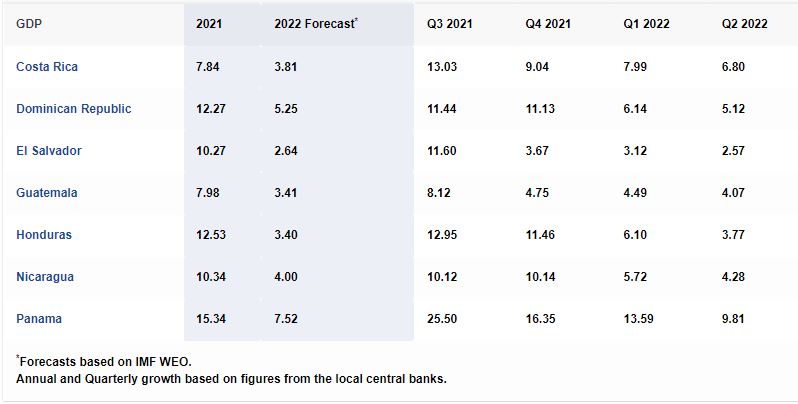
    Central America & Caribbean: GDP growth (%)
    Quarterly figures are year-on-year growth


  • POLITICS: Campos and Neves make strategic alliances

    LatinNews 23 January 2014 Hits: 1443

    On 2 January the governor of Pernambuco and 2014 presidential hopeful Eduardo Campos welcomed members of the national opposition Partido da Social Democracia Brasileira (PSDB) into his state cabinet.

    Campos, of the Partido Socialista Brasileiro (PSB), before Christmas sealed a deal with the PSDB’s 2014 presidential nominee, Senator Aécio Neves, to ally in key states ahead of the 2014 general election including in Brazil’s main electoral district of São Paulo, Neves’ home state of Minas Gerais, Paraíba and the wealthy Rio Grande do Sul. The aim is to take the fight to President Dilma Rousseff of the ruling Partido dos Trabalhadores (PT), who will be bidding for a second term in October. The PSDB officials are slotting into positions vacated by members of the Partido Trabalhista Brasileiro (PTB), which has opted to contest the state in 2014 in alliance with the PT (see sidebar).

    One unhappy camper in all of this is the former environment minister and Rousseff's main poll rival, Marina Silva, who has allied her Rede Sustentabilidade (Rede) civic movement with Campos and the PSB for 2014 and is none too pleased at Campos’s heavy flirtation with the PSDB. This is especially the case in São Paulo, where Rede hopes to field its own candidate but where the PSB is committed to a strategic alliance with the PSDB, which runs the state with Governor Geraldo Alckmin, who will be seeking a second term next year.

    There is some anticipation that Campos will step aside to make way for Silva at the top of the PSB/Rede slate, although it is also the case that Campos lately has strengthened his position by forging strategic local level alliances with the PSDB and national alliances with others like the Partido Popular Socialista (PPS), itself a former Neves backer. This puts him in a better position vis a vis Silva, who failed to get Rede registered as a political party and who thus is dependent on the PSB alliance as a 2014 electoral-political vehicle.

    • The PSDB’ s Murilo Guerra, a lawyer and former superintendent in Pernambuco of the Brazilian institute for small and micro enterprises (Sebrae), is the new Pernambuco state labour secretary, while Caio Mello is the new state transit secretary (Detran).
  • ARGENTINA: Supreme court criticises government over pensions

    LatinNews 08 May 2014 Hits: 1558

    Angered by the number of lawsuits over pension payments clogging up the federal judiciary, the supreme court ordered the government to pay the money it owes to successful claimants on 6 May. It also overturned the 1995 pension reform law, which required all appeals over pension rulings to be referred to the federal social security appeals court in Buenos Aires. That court was created during the presidency of Carlos Menem (1989-1999): its critics argued that its main aim was to hold up the legal proceedings started by pensioners.

    According to the supreme court’s resolution, the pension reform law had led to the “collapse” of the courts, directly impacting pensioners, “one of the vulnerable groups defined in the constitution”. Data from the federal social security appeals court showed that by June 2013 there were 279,856 cases being analysed by first instance courts and 187,076 cases being examined by second instance courts. With all the lawsuits being heard in a Buenos Aires courtroom, many plaintiffs from further afield had complained of a lack of access to justice.

    From now on, appeals will be dealt with by a federal court in the province in which the first instance ruling was made. The supreme court also urged congress to create new tribunals with jurisdiction in social security matters, and the government to take the necessary measures to ensure its agencies comply with court rulings.

    Diego Bossio, the head of the Administración Nacional de la Seguridad Social (Anses), said after the ruling that over the past few months the agency had paid out Ar$1.71bn (US$213m, at the official exchange rate). “Only five percent of pensioners sue because they are not happy with their pensions,” Bossio said. “By 2016, there won’t be any lawsuits filed against the State.”

    President Cristina Fernández nationalised Argentina’s private pensions in 2008; since then Anses has been used to fund popular projects such as low-income housing, infrastructure and benefits for poor families. Returns on the Anses investment portfolio have been consistently lower than Argentina’s estimated rate of inflation. There is widespread suspicion that the delay in resolving the lawsuits regarding back payment of pensions is a deliberate tactic, designed to reduce the State’s liability by increasing the possibility that claimants will die before pay-day.

    Culture secretary elevated to ministerial rank

    A new decree came into effect on 7 May a elevating the position of culture secretary to ministerial rank. The new minister will be Teresa Parodi, a singer and composer, who was head of the Espacio Cultural Nuestros Hijos, part of the Madres de Plaza de Mayo foundation. The official bulletin in which the decree was declared noted that the change was necessary, “given the importance that culture represents as a means of development and social cohesion, [and] its role strengthening cultural diversity and the integration of minorities”.

    A survey analysing Argentines’ cultural consumption was released to coincide with the decree. According to the nation’s first national survey of cultural consumption and digital environment, 98% of Argentines watch television, for an average of 2.5 hours per day. Radio remains popular: 86% are regular listeners, for an average of 3.5 hours per day. Argentines read more than any other Latin Americans. Sixty percent read a newspaper at least once a week; the average Argentine reads just under three books per year.

    Sixty-five percent use the internet on a daily basis; 60% have an internet connection at home. Facebook is the most visited website; 55% of Argentine internet users have a profile on the social media site. Facebook inaugurated an office in Buenos Aires this week, prompting an awkward encounter between President Cristina Fernández and the city’s opposition mayor, Mauricio Macri, both of whom are keen users of social media. In a speech to mark its opening, Fernández confessed she writes her postings by hand, then someone else posts them on the website.

    • Repsol exits

    Repsol sold its remaining shares in the state-run oil company, YPF, on 5 May. The Spanish oil company owned approximately 12% of YPF. With shares trading at around US$28, Repsol should collect around US$1.3bn. The sale comes after Repsol agreed earlier this year to end a legal conflict with Argentina that started in 2012 after the government expropriated its majority stake in YPF.

  • PANAMA: Toll increases approved

    LatinNews 23 August 2012 Hits: 514

    Newly approved toll increases for the Panama Canal will be phased in over the course of 12 months beginning in October.

    On 7 August the executive cabinet council approved a proposal to restructure the Panama Canal's pricing system in line with the recommendation of the Board of Directors of the Panama Canal Authority (ACP). The Panama Canal Authority CEO and administrator, Alberto Alemán Zubieta, said that after considering comments from the industry, the effective start date of the toll increases would be postponed three months to October 2012, with a phase-in period continuing  another 17 months to October 2013. The new structure increases the number of segments from eight to ten. It also breaks down the tanker segment into three distinct segments and incorporates the roll-on/roll-off vessels into the vehicle carrier segment.

    The ACP will increase the tolls for the following segments: general cargo; dry bulk; tanker; chemical tanker; LPG; vehicle carrier and ro-ro others. The remaining segments will not be adjusted at this time, nor will the price per TEU (twenty-foot equivalent unit) for containers carried onboard a vessel. Additionally, there will be changes to tolls applicable to small vessels based on vessel length, to incorporate adjustments not previously considered.

    2013 Budget proposal: On 2 August Economy and Finance Minister Frank De Lima presented the 2013 state budget proposal to the congressional budget committee. The plan is costed at US$16.26bn, a 12.6% increase on the current budget, and projects real annual GDP growth of 8.0% in 2012 (down from 10.6% 2011). It assigns US$7.57bn for operating costs, US$6.94bn for investment and US$1.74bn for debt servicing. Breaking that down, De Lima said that US$7.91bn would be put towards social services (education, health, labour and housing); with US$1.16bn for infrastructure and US$3.35bn on production.  Key infrastructure projects including the US$1.6bn Panama City metro –President Ricardo Martinelli’s flagship project — are due for completion in 2013.

    Inflation: Accumulated was inflation was 4.9% in the first six half of the year, according to the economy & finance minister (MEF), up from 4.7% in the same period of 2011. According to the MEF, food price inflation was the only category to exceed the average, reaching 6.8%, due to higher costs for imports of corn and wheat. Inflation was 11.9% in 2011.

    • Panama Canal budget approved

    On 13 August Panama’s unicameral legislature approved the proposed budget for the Panama Canal for fiscal year 2013 (1 October 2012-30 September 2013). The budget, which is for a total of US$2.38bn, a 0.38% increase on last year, envisages a direct contribution to the state coffers of US$960.5m, up US$9.8m on the previous year, and an indirect contribution of US$177.9m.

  • ECUADOR: Lasso’s planned tax reform likely to be diluted

    LatinNews 16 July 2021 Hits: 2182

    After only recently passing a tax reform in December 2019, Ecuador is once again bracing itself for a new tax changes, which analysts argue is necessary to ensure long term fiscal sustainability as oil revenues progressively decline. During his election campaign, President Guillermo Lasso promised that his government’s tax reform would raise revenue by broadening the tax base and cracking down on evasion. The need to gain the support of a left-leaning congress, however, has led to the government indicating that the reform will also increase the tax burden on the wealthy. Nonetheless, an ambitious tax changes are not to be expected due to political factors and an improved outlook for public finances, which will reduce the urgency of comprehensive reform.

    During his election campaign earlier this year, Lasso made the case for a market-friendly tax policy, rejecting the International Monetary Fund’s (IMF) suggestion to increase the rate of value-added tax (VAT) from 12% to 15% while promising to progressively eliminate the capital outflow tax and the 2% tax on small business revenue. To increase tax revenue, Lasso pledged to crack down on evasion, which, according to a 2020 report by the United Nations Economic Commission for Latin America (Eclac), amounts to US$7.6bn a year, or almost half of total tax revenue and 7% of Ecuador’s GDP.

    Secondly, Lasso proposed that the tax base should be increased beyond the 750,000 out of 17m Ecuadoreans who are estimated to pay income tax. Finance Minister Simón Cueva said on 24 June that this would be achieved by eliminating certain exemptions which amount to a loss of around US$5bn per year for the treasury. This proposal, however, has proved controversial, due to the political difficulties of increasing the tax burden on the middle class. Indeed, Cueva elicited a backlash when he was perceived to have suggested that those earning above US$550 a month should pay a small rate of income tax, a comment he has since rowed back on, recognising that such a measure would not be politically viable.

    This is particularly the case given the composition of the national assembly, where Lasso depends on a fragile coalition with the social democratic Izquierda Democrática and left-wing indigenous Pachakutik parties, who are unlikely to support an unpopular reform. Furthermore, the protests against tax reform in neighbouring Colombia could easily be repeated in Ecuador, where public frustration remains high after years of economic stagnation and now a recession due to the coronavirus (Covid-19) pandemic. In recent weeks, the government has therefore sought to ease public concerns, with Cueva alluding to a more progressive bill which “requests an additional effort from those at the top”.

    It is debateable just how ambitious the Lasso government’s tax reform will be, however, most obviously due to political considerations, as was the case with the 2019 tax reform. Whilst higher taxes on the wealthy are more palatable in the left-leaning legislature, they will go against Lasso’s own pro-business outlook, heightening the probability of a compromise which draws in less revenue.

    The improving state of public finances could also reduce the appetite for comprehensive tax reform. The recovery in international oil prices will boost a sector which accounts for a third of total government income. There are also expectations that an accelerated Covid-19 vaccination rollout will boost economic growth and thus, tax revenue – thereby reducing pressure on the government and pushing the possibility of a far-reaching tax reform further down the road.

  • Mexico joins the tide

    Patrick de Courcy 29 June 2022 Hits: 1507

    There was one notable absence from the first wave of the pink tide: Mexico. The second largest Latin American country (by size of population and value of the economy) was at the time following a different political pathway. For decades national politics had been dominated by a virtual one-party state: the Partido Revolucionario Institutional (PRI), which combined authoritarian top-down political control, rigged elections, social and economic conservatism, and, in foreign relations, left-wing anti-US nationalist rhetoric. 2000, the start of the new millennium, was a major turning point in Mexican history since for the first time in decades the PRI was defeated in free elections. Instead, voters turned to Vicente Fox, of the right wing Partido de Acción Nacional (PAN), who was in office between 2000 and 2006. Felipe Calderón, another PAN leader, won the following presidency in 2006-2012. It can therefore be held that while the rest of the continent was swinging left, Mexico under the PAN’s leadership was in fact moving in an entirely opposite direction.

    Calderón was followed in 2012-2018 by Enrique Peña Nieto at the head of a somewhat reformed and centrist PRI. During this entire cycle the left, led by defectors from the old PRI, struggled unsuccessfully to gain political power. One of its top leaders, Andrés Manuel López Obrador (AMLO), claimed he too was the victim of electoral rigging, particularly in 2006, when for months he refused to accept his defeat in the presidential contest. Presenting himself as an outsider, AMLO at last achieved victory in the 2018 elections, winning by a comfortable margin and securing a majority in congress for his party, the newly created Movimiento de Renovación Nacional (Morena).

    Mexico's role in the pink tide narrative is very important. It seems reasonable to contend that the larger and more populous countries can achieve greater momentum by putting their critical mass behind any given swing of the regional political pendulum. The first wave of the pink tide was spearheaded by big-population countries such as Brazil, Argentina, and Venezuela. The second wave going into the 2020s could end up with much greater force, as it may gather not only Brazil, Argentina, and Venezuela, but also Mexico and Colombia. This is not only a question of relative influence and soft diplomacy. Acting together, left-wing governments can alter or at least influence the direction of a wide range of multilateral organisations including the Organisation of American States (OAS), the IMF, and the InterAmerican Development Bank (IDB). A second wave of the pink-tide, actively supported by the two Latin American giants, Brazil and Mexico, could have unprecedented force.

    And yet there are reasons to query whether that type of coordination will be possible or even likely. The central issue is that progressives in the different countries face different political contexts, and they are likely to come up with different policies and styles. Centre-left coalitions do not now, and will not necessarily in future, see eye-to-eye. AMLO in Mexico is a case in point. In many senses he has departed from the traditional left-wing blueprint. For a start, while constantly criticising the neoliberal, market-oriented economic policies of his predecessors, he has himself followed a drastic domestic policy of fiscal conservatism. Despite its claims to the contrary, the government has invested relatively little in social programmes, and the publicly promised battle against poverty has been limited by disappointing economic growth.

    A further difference is that AMLO has largely remained faithful to the resource-based economic nationalism of the 1970s, prioritising the exploitation of fossil fuels (oil and gas) in the Mexican energy sector, at the expense of renewable energy (mainly wind and solar). He has sought to roll back the market share of green energy, and to revise the pro-market liberalising energy sector reforms of his predecessor. This has placed him sharply out of step with left wing leaders in other parts of the region, many of whom have forged a new commitment to fight climate change.

    On a wide range of social policies AMLO is more of a conservative than a progressive. While refusing to reveal his personal position on abortion, AMLO supports ‘family values’ and has repeatedly clashed with the country's feminist movement. Another important difference involves the role assigned to the security services to maintain public order and combat the country's violent drug cartels. Before taking office, and on a par with other leftists, AMLO was deeply critical of Mexico's military, accusing it of over-reacting to public protests and regularly violating the human rights of suspects. He insisted that excessive militarisation of the war on drugs was ill-advised and counterproductive.

    However, while still seeking to use social programmes as a way of tackling the underlying causes of violence in the country, AMLO has presided over the creation of a new, largely militarised force, the Guardia Nacional (GN), which he wants to be placed under the military hierarchy at the ministry of defence, rather than under civilian control. For many critics of AMLO there has therefore been no change in what is a fundamentally flawed security policy.