
All Categories

Subcategories

  • CHILE: Another corruption scandal threatens to rock Chilean politics

    LatinNews 14 June 2012 Hits: 751

    “History repeats itself”, goes the saying. Corruption and power struggles have been a constant throughout political history and neither Latin America, nor Chile, have been has immune to either. An internal investigation carried out in March by Chile’s health ministry into Santiago’s metropolitan west healthcare service (SSMO) led Health Minister Jaime Mañalich to publicly denounce the existence of fraud against the state. To make matters worse, Mañalich has since hinted that the motives behind the case, which is now being investigated by the local prosecutor’s office, may have been political. The case raises the spectre of the so-called Mop-Gate scandal, which Chile only finally managed to close just two years ago.

    On 3 May Mañalich announced that the March internal investigation had discovered significant irregularities dating back five or six years, related to payments made by the SSMO to ‘ghost’ service companies.

    Mañalich described the situation as extremely worrying, noting, “we have yet to find proof that [any] services were provided”. He said that so far irregular payments to the tune of Ch$270m (US$560,000) had been discovered but admitted that this could be just the tip of the iceberg, given that the payments were made systematically over many years. They were hidden in small amounts paid by over a hundred cheques, endorsed by the SSMO, to be paid in cash to numerous ‘service companies’ representatives’.

    Mañalich also said that they had found evidence that at least one ghost company, ‘Santa Elbita’, which had received some Ch$160m from SSMO, had also appeared on the books of other health provision centres in different regions of the country, including Tarapacá, Antofagasta, O’Higgins and Magallanes, all of which are now also under investigation. Given that, the health ministry promptly asked prosecutors to launch a criminal investigation into the case.

    The authorities now estimate that the total amount of funds diverted through the scam could be as high as Ch$5.0bn (US$9.92m).

    There are three primary suspects in relation to the deviation of funds at SSMO, the entity’s finance chief, Rigoberto García-Huidobro Contreras, its treasurer, Sergio Flores Fuentes, and the deputy director, Cecilia Mena Noriega. All three have been summarily sacked as part of the investigation. On 28 May the prosecutor in charge of the case, José Morales, formally requested Chile’s prosecutor general, Sabas Chahuán, to charge García-Huidobro and Flores Fuentes on eight counts of malfeasance of public funds. Mena Noriega has not yet been charged, but it is expected that she will be, possibly along with some other high ranking current and former directors, as the investigation continues. (see sidebar).

    Opposition rejects Mañalich’s insinuations

    Mañalich moved swiftly to publicly denounce he fraud as soon as his ministry had sufficient evidence of the wrongdoing. However he erred in getting ahead of himself by suggesting that the funds may have been diverted for political means.

    The minister erred even further by insinuating that the case involved members of the opposition Partido Demócrata Cristiano (PDC). Revealing the results of the internal investigation to reporters for the first time, Mañalich said that the case “resembles others that the country has seen in the past, I am referring to the Mop-Gate”. The inference was clear; Mop-Gate was one of the biggest political corruption scandals in Chile’s recent history and seriously damaged the reputation of the previous governments led by the now-opposition Concertación coalition.

    Mop-Gate involved a scheme at the ministry of public works (Mop) whereby officials deliberately overpaid for a number of contracts awarded to local firms, with some of the surplus money deviated to 129 public sector workers via a consulting firm, Gestión Administrativa y Territorial (Gate), which from 1997 was in charge of administering public funds to contracted private companies.

    The irregularities were first discovered in 2000, and a seven year investigation determined that the state had been defrauded of some Ch$1.25bn as a result of the overvaluation of contracts (some of which were never executed), the concealment of costs and the overpayment of employees salaries. Damagingly for the Concertación government of the time, led by former president Ricardo Lagos (2000-2006), when Judge Gloria Ana Chevesich, who was put in charge of the case by supreme court in 2003, presented her final report in 2010 she sentenced 14 people, including top government officials such as the former Mop minister, Carlos Cruz, the former waterworks director, Eduardo Balbontín and even Lagos’s former cabinet chief, Matías de la Fuente, to suspended prison sentences for defrauding the state. These have been appealed and are still under consideration by the courts. While many applauded Judge Chevesich’s findings as a valiant attempt to root out corruption, some Concertación politicians described it as “a political witch hunt” as they believed that Judge Chevesich was too eager to go after high ranking government officials.

    Although the Mop-Gate case has been largely resolved, it has never determined what the proceeds of the fraud were actually used for. There was speculation that the scheme was a way for Concertación politicians to finance their political campaigns, but this has never been proved.

    Mañalich, clearly well aware of this, told reporters that he did not “discard the possibility that the ill-gotten funds had been used for past political campaigns”.

    More controversially, the minister added, “It is highly probable that this case becomes political...the people involved in the operations are well-known militant Christian Democrats”. Mañalich’s remarks were highly incendiary and provoked a storm of criticism, led by the PDC and the rest of the Concertación, who said that Mañalich was too quick to make political accusations. Prosecutor Morales subsequently rejected outright the suggestion, noting that to date there were no indications of political motives behind the case.

    Mañalich was forced to offer a public apology early on 8 May (see sidebar) before he was due to appear before the chamber of deputies’ health commission to present the details of the fraud at the SSMO. Concertación deputies on the committee had threatened to boycott the session in protest. The apology was not enough; the Concertación deputies complained that the apology was “convoluted”. A PDC deputy, Gabriel Silber, declared that the Concertación would not “listen to the minister until he apologises to all Chileans for the lies we have heard in these recent days” and all seven Concertación deputies walked out of the room. Relations between the Concertación and the government are already fraught and this incident will only increase tensions. A frustrated Mañalich said afterwards that the Concertación deputies had not given him the opportunity to explain himself; and that in the circumstances a new apology would not be forthcoming.

    For Chile this is second major official corruption scandal in little over a decade. After the Mop-Gate scandal, the government introduced new norms aimed at ensuring transparency and probity in the administration of public funds, as well as new campaign financing rules; but the emergence of this new case suggests that these efforts were not entirely successful. While Mañalich behaved clumsily in making baseless accusations against some members of the opposition, the case does leaves some nagging questions about the record of the previous Concertación governments in addressing corruption.

    • SSMO ex-director denies corruption

    On 4 May the former director of Santiago’s metropolitan west health service (SSMO), Enrique Ayarza, denied that fraud had taken place on his watch and argued that it could only have begun from September or October 2010 and thus “entirely under Minster Mañalich and the authorities appointed by this government”. Ayarza added that SSMO has a tightly structured budget completely open to scrutiny and that irregularities would not have been missed. He added that he was in favour of a full investigation, stressing that he had “no evidence or precedent” for the malfeasance.

    • Mañalich’s apology goes down like a lead balloon

    Health Minister Mañalich told reporters that he had been “misinterpreted” and that his statements had been taken out of context, making it seem as though he had jumped to conclusions. Mañalich stressed that his ministry had “no evidence of any relation between the people involved in the case, who may have acted individually or collectively”. He added that if any political party had been offended by his remarks “this was not my intention and I offer my public apologies”.
  • NICARAGUA: Banking on mining

    LatinNews 21 September 2012 Hits: 428

    On 4 September the government led by President Daniel Ortega highlighted the growing importance of the mining sector in attracting foreign direct investment (FDI), with some US$227.6m in inflows to the sector registered between 2007 and 2011. Of this, US$100.7m corresponded to 2011.

    Of the total US$227.6m, 88% went into metallic mining. Mining activity in the country is concentrated in three main areas — Mina El Limón and La Libertad, in León (both operated by Canada’s B2Gold), as well as the Nicaraguan-owned Hemco mine, Bonanza, in the north Caribbean. The government singled out in particular the contribution of B2Gold, which invested US$94.5m between 2007-2011, of which US$66.6m corresponded to the La Libertad mine and US$27.9m to the Limón mine.

    According to the Ortega government, of the 130,373km2 of national territory, 9.26% is under concession to mining companies, with requests currently being processed for a further 8.21% of national territory. The government claims that there are 139 concessions in the metallic sector. Of these, seven are currently being explored and exploited, 17 are being explored, 38 have been explored, with those companies responsible evaluating whether to press ahead with the projects or not. Seven concessions have been revoked due to the lack of activity. A local environmental organization, Humboldt, claims that there are 272 metallic mining concessions in total in Nicaragua, covering 10,990.42km² and including protected areas: Reserva de Biósfera BOSAWAS, Reserva de Biósfera del Sureste de Nicaragua (Refugio de Vida Silvestre del Río San Juan y la Reserva Biológica del Río Indio Maíz). Humboldt also claims that between 2009 and 2011 the proportion of national territory subject to mining concessions increased to 10.03%, up from 5.39% under the previous Ortega government (2007-2012).

    The government also highlighted the significance of metallic mining – and gold in particular — as an export sector. Metallic mining exports increased 70% between 2010 and 2011 to reach US$361.7m. Of this, US$297.0m corresponded to gold and the rest to silver. The government also highlighted the fact that this represented an overall increase of 539.0%, up from the US$56.6m registered in 2006, while gold has gone from being the country’s fifth main export in 2006 – when it accounted for 5.3% of total exports – to the third in 2011, after coffee and meat , and accounting for 15.6% of total exports.

    Minimum wage deal: On 23 August the Ortega government, private sector representatives and unions agreed a 6% minimum wage increase to take effect as of 1 September. Exempt from the deal are the small handicraft & tourism and free zone sectors – the former will receive a 4% increase while the latter has a separate deal with the government. Under the deal, the monthly minimum wage ranges from N$2,273 (US$96) for agriculture to N$5161 for construction, finance and insurance services, N$5161 (US$217). According to the most recent report by Nicaragua’s central bank, monthly inflation in July was 0.27%, bringing the accumulated year-to-date rate to 2.46%. This compares with 3.99% in the same period of 2011. Year-on-year inflation was 6.37% in July, 2.09 percentage points lower than the July 2011 annual figure. Nicaragua closed 2011 with inflation of 8.0%.

  • Corporate Radar

    LatinNews 01 May 2015 Hits: 983

    Ecopetrol to divest ISA stake

    Colombia’s state-owned oil company, Ecopetrol, has been authorised by the government to sell its 5.32% stake in the also majority state-owned electricity transmission company, ISA. The decision came in early April; shortly after former finance minister Juan Carlos Echeverry as Ecopetrol’s new chief executive, replacing Juan Gutiérrez Pemberthy. The oil company said that the proceeds of the share sale would be used to help finance Ecopetrol’s investment programme. Separately, Ecopetrol also said it had received finance ministry approval to issue bonds on international capital markets worth up to US$3.2bn. In 2014, Ecopetrol posted net profits of COP7.8bn (US$3.0bn), down by 41% on the year earlier, a fall that the company attributed to the slump in international oil prices. Earlier, there were reports that Ecopetrol was considering taking over direct operation of the Rubiales oil field, currently operated by the Canada-listed oil company Pacific Rubiales. Under the existing licence, which expires in mid-2016, Ecopetrol has the rights to 60% of the field’s output, with Pacific Rubiales holding 40%. While the two companies were reported to be in talks over post-2016 arrangements, Colombian press reports said Ecopetrol was considering taking 100% control of the field, which produces around 160,000 bpd, or one sixth of the country’s total production.


    Carlos Slim spins off Telesites

    Shareholders in América Movil (AMX), the Mexico-based telecoms giant controlled by Carlos Slim, voted in April to spin off a new company called Telesites, which will manage a total of 10,800 mobile telephony transmission towers around the country. Telesites will be listed on the Mexican stock exchange. According to the newspaper El Financiero, the new company will have 43.2% of the radio transmitter tower market in the country, followed by American Tower with 34.2% and Mexico Tower Partners with 4.8%, with the remainder divided up among smaller players. AMX highlighted forecasts according to which Mexico needs to multiply the number of transmission towers in operation four-fold, suggesting the new company will be well positioned for strong growth. Mexican analysts say that although AMX has been ruled to be “predominant” in the local telecoms market by the regulator, Instituto Federal de Telecomunicaciones (IFT), and therefore must divest part of its operation; the spin-off of Telesites is a separate matter. Jesús Romo, of analysts Telconomía, said that Telesites was being spun off to allow AMX to focus on other parts of its business, more than for regulatory reasons. Nonetheless he expected the IFT to consider Telesites to be “predominant” in the transmission towers market, just as its parent AMX had been deemed to be before. The new company would be subject to the same ‘asymmetric measures’ – basically the obligation to grant access to its transmission network to other players at rates fixed by the regulator. AMX still needs to carry out other divestments to reduce its market dominance; in July 2014, the company said that it would present a plan to do this by 30 June 2015 at the latest.


    Shell’s BG takeover has implications for Brazil

    The 7 April announcement that Royal Dutch Shell was in advanced talks to takeover BG Group is believed to have implications for oil and gas operations in Brazil. Globally, Shell (which has a market valuation of US$202bn), by acquiring BG (with a market cap of US$46bn) is seeking to extend its lead in gas production and get closer in revenue terms to the world’s biggest private sector oil company, the US-based Exxon-Mobil. The takeover, if approved, will be the first since the collapse in oil prices last year, and, in the eyes of some analysts, a sign of a new wave of market consolidation. Shell chief executive Ben van Beurden made it clear that one of the attractions of the deal was BG’s Brazilian assets. He described Brazil as “probably the most exciting area in the world for the oil industry”, adding, “We are already in Brazil and we are happy there, but we want more. A significant part of this deal was gaining a stronger presence in Brazil’s deep water”. BG has drilling rights to the Iara, Saphinoá, Lapa and Lula (formerly Tupi) oil blocks. The Shell CEO recognised that to develop Brazil’s pre-salt offshore deposits the company needs to work in partnership with the state-owned Petrobras, currently mired in corruption allegations and enquiries. “The headlines about Petrobras are not pretty, but we are talking about something long term here” he commented.


    Brazil’s OAS seeks bankruptcy protection

    One of Brazil’s major construction companies caught up in the Petrobras corruption scandal, Grupo OAS, filed for bankruptcy protection for nine of its subsidiaries on 31 March. The company has debts of BRL8bn (US$2.48bn) and has not been able to borrow or raise capital because of the impact of its involvement in the Petrobras scandal. It has also been hit by the flatlining Brazilian economy, public sector austerity and a weak domestic currency. The OAS move to seek bankruptcy protection followed similar action by two of its competitors, Alumini Engenharia and Galvão Enghenheria. The three companies are alleged to have been part of a cartel of over 20 large groups that paid bribes to Petrobras executives in exchange for contracts. Several top OAS managers were arrested last year as part of the investigation into the cartel. The decision to file for bankruptcy was taken after negotiations with the company’s main creditors. Sources said the outlines of a rescue plan had been agreed, involving a debtor-in-possession (DIP) loan to tide the company over, followed by the sale of shareholding stakes in subsidiaries including infrastructure operator Invepar, a shipbuilder, two football stadiums, a waste management company, an oil and gas sector supplier, and a defence contractor.


    General Electric upbeat over the region

    Despite “turbulence” and a poor performance this year in two of its key markets, Brazil and Venezuela, US company General Electric said it expected to achieve a 1% growth rate for its Latin American division in 2015. Speaking at the summit of CEOs held in Panama in April just before the Summit of the Americas organised by Organisation of American States (OAS), Reinaldo García, head of GE’s Latin American division, told the Reuters news agency that the company had boosted its profits in Latin America by 7% in 2014, and over the last four years had almost doubled the size of its regional business. This year it was expecting 1% growth in Brazil, which would be a good result in a “difficult year” for the economy. In Venezuela, where GE is involved in power generation and the oil and gas sector, it was expecting revenue to remain flat or fall a little. But García remained upbeat about prospects for the business. “The continent has 600m people with a growing middle class, and with big infrastructure challenges” he said, adding, “We love this continent”.


    Ford announces US$2.5bn Mexico investment

    Ford Motor said in April that it would invest a total of US$2.5bn to build a new engine factory in Chihuahua and a transmission plant in Guanajuato, creating an estimated 3,800 new jobs. This was the latest in string of new investments announced for the country’s booming automotive sector. It followed an earlier announcement of a US$1bn plant investment by Toyota, designed to build 200,000 Corolla compact cars for North American markets.

    In March, Volkswagen said it would invest US$1bn to expand its production plant in Puebla state. Welcoming Ford’s new investment at a ceremony in Mexico City, President Enrique Peña Nieto noted that Mexico has moved up from eighth to seventh largest car producer in the world, and is the fourth-largest car exporter.

    The Mexican authorities say cumulative foreign investment in the sector has now reached over US$22.6bn. Ford’s new investment will be to build 1.5 litre and 1.6 litre four-cylinder engines, mainly assembled up to now in the UK and China, and used to power Ford Fusion and Escape models. It confirms the strong growth of the automotive sector in the country, with a range of companies attracted by Mexico’s multiple free trade agreements, competitive wage levels and proximity to US consumers.

    The announcement was not well received by the main US industry labour union, the United Auto Workers (UAW). In a statement it said “The announcement by Ford to invest US$2.5bn in Mexico is disappointing, but not any more disappointing than GM’s decision to invest US$5bn in Mexico or similar investments like FCA Chrysler, Nissan, Mazda, Honda, and now both Toyota and Kia, which have announced investments in Mexico.” Industry analysts, however, note that not all the traffic has been one-way. GM recently said it was spending US$185m to move Cadillac SRX production out of Arizpe in Mexico and back into the US.


    Grupo Radio Centro gets cold feet

    The Mexican media conglomerate Grupo Radio Centro will not, after all, operate a national digital free-to-air TV service. Mexico’s telecoms and broadcasting regulator, Instituto Federal de Telecomunicaciones (IFT), had selected Grupo Radio Centro as one of two successful bidders for national licences, offered in a bid to help break up the existing duopoly of Televisa, the dominant network and TV Azteca, the number two. Having paid an initial MXN415mn (US$26.9m) deposit, Grupo Radio Centro has been due to pay the remaining balance of its bid, which including the deposit came to MXN3.06bn (US$200m) on 10 April. But as the deadline approached it became evident that the conglomerate was scrambling to seek out partners to help it raise the money. On the day itself, no payment was made, meaning Grupo Radio Centro was deemed to have forfeited the licence – and lost its deposit. The other successful bidder, Cadena 3, which offered a lower MXN1.8bn, is still on track to launch next year. IFT said it would consider what to do next in a forthcoming meeting. Referring to the now unallocated licence, the IFT president Gabriel Contreras said, “There is interest from regional operators and we will analyse every possibility”.


    Southern Copper expects big growth

    Peru-based mining group Southern Copper said in a report filed with the Lima stock exchange that it expects to almost double its annual copper production to 1.15m tonnes by 2017, as projects in Peru and Mexico come to fruition. The company said that its expected growth would make it the world’s third largest copper producer by 2017. Grupo México controls Southern Copper. In 2014 it produced 676,600 tonnes of copper. In early April this year, it successfully issued US$2bn worth of 30-year bonds, designed to help fund its expansion plans and possible “strategic acquisitions”.

    Its current projects include expanding the Buenavista mine in Mexico, where US$3.4bn in investment is earmarked to boost production from 180,000 tonnes per year (tpy) now to 512,000 tpy. It also highlighted its US$1.4bn Tía María project in Peru, which is scheduled to produce 120,000 tpy by 2017. The Tía María mine is facing opposition from local communities, who fear that farms will suffer contamination. On 22 April, one person died as a result of clashes between police and protestors demanding that the project be cancelled. Southern Copper is still awaiting a mining permit from the government, which delayed the project after a first wave of protests in 2011. President Ollanta Humala has defended the project, saying that Southern Copper should be “given a chance”. The mining company is also focusing on expanding its existing mine at Toquepala, where it plans to invest US$1.2bn to double the capacity of its concentrator.

  • ECONOMY: Finance Minister Joaquim Levy is under political pressure to deliver a recovery

    LatinNews 17 June 2015 Hits: 619

    When Finance Minister Levy stayed away from a press conference to announce BRL69.9bn (US$22.1bn) worth of government spending on Friday 22 May there were ripples of concern running throughout Brazilian and international financial markets. According to press reports Levy, who was said to be seeking deeper cuts of BRL80bn, had stayed away to signal his disagreement. Planning Minister Nelson Barbosa made the announcement on his own. This led to rumours of a split within the government and the possible resignation of the finance minister, regarded by financial markets and the business community as a key figure in the attempt to get Brazil back on track. Levy denied these rumours. “I didn’t think of quitting at all”, he said.

    Levy nonetheless told reporters, “There are people who think everything is solved. It isn’t. We still have work to do”. In other comments, he acknowledged that the federal government has an ongoing problem of “systematically insufficient revenues”. But Levy stresses that it is not just a question of raising taxes; Brazil needs deeper structural reforms. Speaking to businessmen in Rio, Levy sought to reassure them that he was looking beyond austerity and working on pro-growth measures, including an agricultural stimulus plan and a package of measures to promote infrastructure investment. According to Juan Jensen, of the consultancy Tendências, “Levy first acted as a fireman to put out the fiscal fire. Although the job is not done on the fiscal side, he is signalling that there are other things he can do to get the economy going”.

    Getting the federal congress to approve adequate spending reductions is a complex and on-going battle. In late May, Levy got approval for a new set of measures. They included regulation MP665, limiting access to unemployment benefits (increasing the prior qualifying period in employment from 6 to 12 months); and MP664, restricting access to otherwise generous sickness and pension benefits. But some of these gains were offset by a congressional decision to change the way pension payments are calculated, which ultimately will increase costs. It is difficult to calculate the full impact of these measures. One assessment by economists at Itaú Unibanco is that they will save BRL2bn this year, but could add expenditure equivalent to 0.5% of GDP by 2040. Levy also faces a major longstanding structural problem, in that the vast majority of public spending in Brazil is ring-fenced by constitutional mandates. In 2014, for example, only 6% of total budget spending was discretionary.

    So far, Levy has no data to show that things are getting better. The overall fiscal deficit (which includes debt interest payments) rose to an unsustainably high 7.8% of GDP in the 12 months to March 2015 (compared to 6.2% last year and to 2.2% in 2010). Levy is aiming for a primary fiscal surplus equivalent to 1.2% of GDP this year, after a 0.63% deficit in 2014. He also intends to boost the primary balance to 2% of GDP in 2016. On current trends, many economists believe this won’t be achieved. A recent research note by Capital Economics suggested that part of the current deficit reflects the government’s expensive and ineffective foreign currency (FX) swaps programme, which is now being wound down. Putting this to one side, the primary balance has deteriorated this year because of a worsening local and regional government budget performance, and a deteriorating balance in the INSS social security fund. Capital Economics forecasts that the best that Levy can hope for to deliver is a primary surplus of 0.2% of GDP this year, rising to 1% in 2016.

    According to Brazil’s national statistics institute (IBGE), first quarter GDP fell by 1.6% year-on-year (and 0.2% quarter on quarter). The unemployment rate rose to 6.4% in April, up from 6.2% in March. Inflation, pushed up by a depreciating Real, has risen to 8.2%; almost double the central bank (BCB)’s target of 4.5%. Economists believe the inflation rate has peaked and will now trend down, but are expecting the BCB to have to tighten interest rates again in June, following a 50bps hike in the benchmark Selic rate to 13.25% in early May. In other words, all the data in Brazil is currently pointing towards continuing stagflation.

    • ‘On a recent visit to London, Levy’s message to investors was that “Brazil is going through a period of economic adjustment. Our priority has been to ensure the sustainability of public finances as the basis for a new growth cycle. We expect the current slowdown of our economy to be temporary”.’
  • TRACKING TRENDS

    LatinNews 30 July 2015 Hits: 1789

    MEXICO | Oil exports tumble

    Mexico’s oil exports fell by 44.2% to US$12.83bn in the first half of 2015 compared to the same period last year, according to the national statistics institute (Inegi), as a result of the precipitate fall in the price of oil. Non-oil exports compensated for some of the loss by increasing over the same period by 3.6% to US$175.71bn, meaning total exports amounted to US$188.54bn. Imports fell by 0.2% year-on-year to total US$192.59bn. This all left Mexico posting a trade deficit of US$4.05bn in the first half. Mexico registered a trade deficit of US$2.44bn in 2014 as a whole, up 106% on 2013.

    MEXICO | Poverty increasing. Poverty increased by 2m to 55.3m, the equivalent of 46.2% of Mexico’s population, in the two years to 2014, according to a survey carried out by the national council for the evaluation of social development policy (Coneval).

    President Enrique Peña Nieto responded by saying that the government would have to “redouble its efforts”. Peña Nieto argued that his government’s social policy had succeeded in containing poverty but had failed to reduce poverty levels.

    One small crumb of comfort seized upon by the social development minister, Rosario Robles, was that extreme poverty, or indigence, fell from 9.8% to 9.5% between 2012 and 2014.

    • Uber protests

    Licensed taxi drivers demonstrated in Mexico City on 29 July, attacking Uber drivers, and demanding “a total halt” to app-based rideshare services in the capital. “What happened is a very grave attack on everyone’s freedom and right to make a living in a dignified manner,” Uber said in response to the attacks. “Incidents like this are unacceptable and we trust that authorities will act so that justice is done.”

  • POINTERS

    LatinNews 13 November 2015 Hits: 2194

    MEXICO | Drubbings on the human rights front. The Mexican government has come in for strong criticism for its shortcomings in the area of human rights from two international bodies, as well as what amounted to a sanction from the US. On 2 October the president of the Inter-American Commission on Human Rights (CIDH in the Spanish acronym), Rose-Marie Belle Antoine, presented the initial findings of the 20-strong delegation that had spent five days meeting representatives of government, civil society and academia, as well as journalists and victims of human rights violations and their families, notably the relatives of the 43 students from the Ayotzinapa teacher training college who disappeared in Iguala, Guerrero state, in September last year.

    She said that ‘the magnitude of the problem of disappeared persons’ in the country was ‘alarming’ and that the ‘tragedy’ of the 43 Ayotzinapa students was not ‘an isolated tragedy, but rather part of a pattern of human rights violations that have occurred for decades.’

    The visit, she said, had confirmed ‘a situation of extreme insecurity and violence; serious human rights violations, especially enforced disappearances, extrajudicial executions, and torture; critical levels of impunity; and inadequate and insufficient attention to victims and their families.’ It drew attention to ‘an alarming number of criminal proceedings that have remained stagnant for years’ and ‘the infiltration by groups of organised crime in many police bodies, especially at the municipal level, as well as in agencies of the judicial system.’

    Less than a week later the UN High Commissioner for Human Rights, Zeid Ra’ad Zeid al-Hussein, concluded his own visit urging the government to set a firm deadline for removing the military from the streets and replacing them with well-trained police. This, he said: ‘must be driven by a sense of real urgency. It’s not something that can wait for months on end.’ He said the Iguala case was ‘a microcosm of the chronic problems underlying the relentless wave of human rights violations taking place across Mexico. In particular, it highlights the prevalence of impunity and the disregard for victims that affect the entire country.’ He also chided the government for its ‘intolerance of public criticism [which had] become manifest in reactions to most other recent international human rights reports on Mexico.’

    On 19 October the US State Department announced that it was withholding US$5m of this year’s US$148m allocation of security assistance funds for Mexico under the Mérida Initiative, because it had been ‘unable to certify that Mexico fully meets the criteria’ of advances in the area of human rights upon which 15% of the Mérida allocation is contingent. The funds withdrawn from Mexico’s allocation, said State, had been ‘reprogrammed’ to back Peru’s coca eradication effort.


    MEXICO | A majority feel unsafe. According to the national survey of urban public security conducted by the national institute of statistics and geography (INEGI) 68% of the population aged 18 or more who live in cities of more than 100,000 inhabitants consider that they feel unsafe in their cities. This is one percentage point lower than last June but higher than all the other readings since September last year. As many as 65.8% said that over the previous three months they had had to change their habits for fear of being victims of some crime; 50.2% said they no longer went out for walks after dark.

    Expectations of improvement are low: 34.9% of the respondents said they believed the situation would remain just as bad over the coming 12 months, and 29.8% said they thought it would worsen. However, those rating the performance of federal forces as very effective or somewhat effective reached 62.8% regarding the Gendarmería and 55.2% regarding the federal police.

  • VENEZUELA: Assembly releases its new inflation index

    LatinNews 09 March 2017 Hits: 762

    Venezuela’s opposition-controlled national assembly (AN) has reported that accumulated year-to-date inflation was 42.5%, based on a new index created by the finance commission. The AN’s figures, if correct, would be the among the highest ever registered for January and February since Venezuela began recording inflation in 1945.

    The new index, called the Índice Nacional de Precios al Consumidor (INPC), has been drawn up under the supervision of the opposition deputy José Guerra, a respected economist and currently head of the AN’s finance and economic development commission. Guerra, a professor at the Universidad Central de Venezuela (UCV), previously worked at the central bank of Venezuela (BCV), as the head of economic research. His credentials, by general consensus, are impeccable. A deputy of the moderate opposition party, Primero Justicia (PJ), he has been the top economic policy adviser to the PJ’s leader and twice former presidential candidate, Henrique Capriles Radonski.

    On 8 March, Guerra reported that the INPC was 16.7% in January and 20.1% in February. His forecast for full year accumulated inflation is 741%. That roughly suggests average monthly inflation of 62%. Hyperinflation is typically defined as two months or more of monthly price increases in excess of 50%. As such, fears that Venezuela is suffering hyperinflation (first estimated by the US-based Troubled Currencies Project in November 2016), appear valid. Guerra’s full year forecast is markedly off the dramatic – and much cited – 2017 inflation forecast of 1,660% by the International Monetary Fund (IMF).

    Guerra was clear that triple-digit increases in money supply are a key causal factor, as the central bank prints money hand over foot to fund the Socialist government. “An inflation rate of this magnitude is principally explained by an increase of 275% in the nominal money supply emitted by the BCV to date in 2017,” Guerra stated. It is worth noting that monetary aggregates were already rising at a rate of nearly 160% year-on-year as of end-December 2016.

    “Equally, the accumulated depreciation of the Bolívar in the parallel market, and the expectations of further Bolívar depreciation, also influenced the price increases,” Guerra added. In other words, prices are highly volatile, and tending to rise almost constantly, in line with the collapse of the currency.

    According to websites that calculate the (nominally illegal but widely used) parallel rate, it was trading at B$3,690/US$1 on 9 March. According to the BCV, the ‘floating’ official exchange rate was trading at B$701/US$1 on 8 March, meaning the parallel rate is running at over five times the official rate.

    The AN’s inflation index will “show Venezuelans how much their salary is worth”, Guerra said when announcing the new index in February. Its initial figures for January and February, he reiterated on 8 March, suggest “the destruction of the acquisitive power of Venezuelan salaries, pensions and retirement benefits”.

    The current ‘integral’ minimum wage (including food vouchers), which was increased by 50% in January, is now B$104,358/month. At the floating exchange rate, that amounts to US$149, but at the parallel rate, it amounts to just US$28.3/month. President Nicolás Maduro increased the minimum wage and linked benefits (food vouchers and pensions) five times between January 2015 and January 2016.

    • Containing inflation

    José Guerra has strenuously argued that salaries should be linked to “an economic policy that seeks to contain inflation”, noting that, “it’s of no use increasing salaries when consumer purchasing power is eaten away by inflation”. He has also repeatedly called for a policy to restrict money supply. “What generates high inflation the world over is when central banks inundate the market with money to finance the fiscal deficit. It’s a universal lesson,” he noted in February.

  • Brazil: Rising death toll

    LatinNews 20 November 2017 Hits: 188

    The Forum Brasileiro de Segurança Pública, a think tank, has published its annual compendium of crime statistics, pulled together from a variety of official sources. The top headline is that the number of homicides in Brazil rose again last year, to reach a total of 61,619, an increase of 3.8% on 2015.

    Seeking to convey the extent of this high violent death rate, Forum director Renato Sergio de Lima pointed out that it represents an annual homicide rate of almost 30 (the precise number is 29.9) per 100,000 inhabitants. It means that on average Brazil is experiencing seven homicides every hour. Noting that the 1945 nuclear attack on Nagasaki in Japan killed around 60,000 people, De Lima said “It is as if Brazil is now suffering one nuclear attack every year”.

    Compared to last year the homicide rate grew most sharply in Pará (+103%), Amapá (+52%), Rio de Janeiro (+24%) and Rio Grande do Norte (+18%). Measured in murders by 100,000 inhabitants, the most violent states are concentrated in the impoverished north east of the country such as Sergipe (64 per 100,000), Rio Grande do Norte (56.9 per 100,000) and Alagoas (55.9 per 100,000). Across the country, the number of police office and military personnel murdered last year was 437, up by 17.5% on the preceding year. There was also a suggestion that elements of the police may be using excessive force: the number of civilian deaths in encounters with the police rose by 25.8% to 4,224. By race, the Afro-Brazilian population continues to suffer proportionately greater violence. Fifty-three per cent of the victims were described as black, 43% were white, and 1% were described as “other”.

    President Michel Temer has highlighted the problem of rising violence, sending an open letter to the country’s governors on 31 October which spoke of insecurity as a “national emergency” and called for a “convergence of forces” to deal with the issue. The President suggested the way forward was to attack arms trafficking, inner city crime, and drug trafficking. Military and federal police actions would need to be coordinated into an overall security approach that would not “neglect aspects of social development”. However, critical analysts maintain that the government really lacks an integrated plan. Much of the focus of debate appears to have been on attacking the external symptoms of violence, and deploying security forces to hotspots; there has been less of a long-term attempt to get to grips with the underlying causes of crime.

  • URUGUAY: Autoconvocados flex their muscles

    LatinNews 25 January 2018 Hits: 1434

    Independent agricultural producers, describing themselves as ‘autoconvocados’, have staged a mass demonstration calling for the government led by President Tabaré Vázquez to provide economic assistance for the agricultural sector. This was the first such demonstration by Uruguayan agricultural producers in over a decade, increasing the political pressure on the Vázquez government to address the longstanding demands of the sector, which has been mobilising in support of these since the start of the year [WR-18-01]. The ruling left-wing Frente Amplio (FA) government may try to dismiss the efforts by agricultural lobbies to press these demands as coming from ‘big agri-business’ but it is much harder to label the autoconvocados in the same way, making their protest more difficult to ignore.

    The autoconvocados movement emerged after President Vázquez agreed to hold a meeting with representatives from the country’s three main agricultural organisations to discuss the sector’s demands, but that meeting produced no concrete results. Believing that this showed that Vázquez did not consider the sector’s demands to be urgent, the autoconvocados decided to stage public demonstrations and ‘tractorcades’ around the country to ratchet up the pressure. This irritated Vázquez, who said he was prepared to meet and discuss demands with agricultural leaders but could not meet all agricultural producers.

    Vázquez’s remarks incensed the autoconvocados, who called for a national protest march and congress in the central department of Durazno on 23 January. The plan was to make a show a strength to the government and use the opportunity to come up with a specific set of demands. The group said that they expected as many as 50,000 people to take part in the mobilisation and that this should send a clear message to the government. The turnout expectations were not met but nonetheless thousands of people (8,000-10,000 according to police estimates) took part in the event, making it the largest demonstration staged by the agricultural sector since the FA came to power in 2005.

    The demonstration was also a success in that the attendees succeeded in drafting a specific set of demands. These include a reduction in electricity tariffs, a cap on fuel price increases (both set by the government), new tax breaks for the sector, and a more freely floating peso/US dollar exchange rate (managed by the central bank) so that they can benefit from the relative strength of the dollar. The autoconvocados complained that all of these factors have eroded the sector’s competitiveness, making agricultural production economically unviable. They also approved a statement criticising the government’s economic policy for increasing the tax burden on productive sectors to finance ever-growing spending.

    Prior to the Durazno protest, some FA members accused the autoconvocados of being mobilised by the political opposition as part of a plan to undermine the FA’s image ahead of next year’s general elections. Following the criticism of FA economic policies, there were more such accusations. But while the centre-right opposition has backed the autoconvocados (and some prominent opposition leaders attended the Durazno protest), this appears to be a genuine grassroots protest movement, posing a threat to the FA government. The last time Uruguay’s agricultural sector held mass protests was at the height of the 2002 economic crisis. Back then the FA backed the protests, and this helped it win its first general election in 2004.

    • Accusations

    Following the Durazno protest, FA leaders such as Senator Constanza Moreira said that it had been marked by “extreme ideologisation” and “hate” against the government and the Left. “Sowing hate against the FA and the state is like going back to the cold war,” Moreira said. She also questioned whether the autoconvocados represented subsistence farmers and agricultural workers. “How many of them were there?” Moreira asked rhetorically. This was echoed by Vice President Lucía Topolansky, who said that she found it “odd” that the issue of the high cost of renting agricultural lands was not raised by the autoconvocados - insinuating that they represent only landowners. However, Topolansky recognised  that “some sectors have problems and we need to address them”.

  • Going after coca in Peru

    LatinNews 26 September 2019 Hits: 625

    The valley of the Apurímac, Ene, and Mantaro rivers (Vraem) in south-eastern Peru is the country’s largest illegal coca growing area. The heavy presence of drug trafficking organisations (DTOs) and remnants of the Sendero Luminoso (SL) insurgent guerrillas in the Vraem has prevented the Peruvian authorities from rolling out their coca eradication programme in the area. However, this is now set to change with the Peruvian government announcing plans to extend its coca eradication programme to the Vraem for the first time, starting from November. This could mark turning point in the fight against illegal coca production and drug trafficking in Peru, the world’s second-largest coca producer.

    The announcement of the start of coca eradication efforts in the Vraem was made by Interior Minister Carlos Morán during a 12 September press conference. Morán said that 37 years after its launch, the manual coca eradication programme run by the army (Corah) would for the first time enter the Vraem. “The main coca producing area in the country will be reached for the first time,” Morán said, revealing that Corah units have already begun preliminary operations in the area and that eradication efforts were due to begin on 1 November for an initial period of 45 days. According to Morán, the operations will initially focus on the areas of Satipo, Río Tambo, and Alto Anapati all located in Junín region. The minister went on to say that the aim was to eradicate 750 hectares (ha) of coca plantations in the area during this period and to replicate this in 2020 with a view “to maintain[ing] continuity”.

    • Corah

    The Proyecto Especial de Control y Reducción del Cultivo de la Coca en el Alto Huallaga (Corah) coca eradication programme was created in 1982 after a cooperation agreement was inked with the US, which agreed to help finance the initiative as part of its efforts to combat drug trafficking. As its name implies, the programme was originally intended to eradicate coca in the Alto Huallaga valley, San Martín region, which at the time was the main SL stronghold and coca production area in Peru. But by 1994 the programme was given national jurisdiction. Since then it has succeeded in significantly reducing coca plantations in the Alto Huallaga following the defeat of the SL in the area in 2012.

    Morán stated that extending the Corah programme to the Vraem is a political decision by the government led by President Martín Vizcarra to advance coca eradication efforts in the country. During his state-of-the-nation address in July, President Vizcarra said that eliminating the sources of financing for drug trafficking groups would be one of his government’s priorities. In line with this, Vizcarra said that cutting the supply of coca leaf for the production of cocaine would be a focus for his administration. Morán explained that the deployment of Corah units to the Vraem was made possible thanks to the security forces’ success in significantly reducing the operational capacity of the SL remnant group that is present in the area, which calls itself the Militarizado Partido Comunista del Perú (MPCP) [the militarised communist party of Peru].

    However, SL fighters led by brothers Víctor and Jorge Quispe Palomino (‘Camarada José’ and ‘Camarada Raúl’ respectively) are still active in the Vraem and continue to be involved with drug trafficking and in carrying out deadly attacks on the security forces. The latest of these took place on 25 June when an army patrol was ambushed by suspected SL fighters in Satipo. Three soldiers were shot dead in the attack. Morán said the government’s strategy is to only deploy Corah units to parts of the Vraem that “are not such hotspots” and where intelligence suggests that this can be carried out safely, taking into consideration that they have to enter coca fields and manually destroy them.

    Eradicating coca in the Vraem represents a major challenge for Peru’s security forces and the Vizcarra administration. It is likely that the Corah units will be targeted by the SL and the DTOs, and the large army and national police (PNP) contingents present in the area to combat them will come under pressure to provide protection. All of this could drive up violence in an area where local communities are often the victims of aggression and harassment by criminal organisations. Following the 25 June attacks there have been various armed clashes between SL and the security forces in Satipo that have forced some 25 resident families to leave the area in fear of their lives.

  • MEXICO: Fintech law key to expand financial inclusion further

    LatinNews 11 December 2020 Hits: 926

    Two years after the financial technologies law (also known as the ‘Fintech law’) came into force in September 2018, Mexico has become the second main country in Latin American in terms of the size of the fintech sector. Investments in its fintech companies in Mexico add up to almost US$1.3bn, which is equivalent to 16% of the US$8bn in investments existing in the industry across the region, according to strategy consultancy KoreFusion’s report on Latin America’s fintech sector. The Mexican press reported on 27 September that according to the ‘Fintech Thermometer’ carried out by Santander Bank, Finnovista, and Google, the annual value of fintech operations in the country is currently M$68.4bn (almost US$3bn dollars), with 4.7m users and a maturity of the ecosystem of 48%.

    Sector leaders have highlighted that the regulation has provided Mexico with an important competitive advantage in relation to other Latin American countries, as it establishes clear rules for participating in electronic payment funds, virtual assets, and collective financing. Mexico’s national banking and securities commission (CNBV) has 200 fintech companies registered that comply with the regulation. However, the latest ‘Mexico Fintech Radar’ report by Finnovista and the Inter-American Development Bank (IDB), published in March, states that the number of firms is 441, following an increase of 14% during the previous year. Mexico also has the highest presence of foreign fintechs in the region, which is a direct result of its progressive regulation that has made it one of the most developed in Latin America. 

    According to the Finnovista report, start-ups in the sector have grown an average of 23% per year since 2016. Importantly, the report states that the mortality rate of start-ups has fallen since 2018 and is currently at only 4.5%, which is seven percentage points lower that the failure rate recorded in the 2019 report. This is proof that the industry is consolidating. Given that financial inclusion is still limited in Mexico, with only 47% of the population owning a bank account, around a third of the country’s fintechs are in crowdfunding, digital banking, and lending, as reported by the Financial Times (FT) on 12 May. However, the Finnovista report also points out that the insurance segment has grown significantly, with 38 start-ups representing a 46% increase compared with in the previous edition, thus highlighting that the sector is attractive to investors.

    Around 70% of the firms are based in Mexico City, making it the hub of the industry, though the cities of Monterrey, Nuevo León state, and Guadalajara, Jalisco state, are also growing centres of interest for fintech companies. Most companies are relatively small, employing around 35 people. But the most successful start-ups employ over 1,000 people. In total, the industry is estimated to account for 60,000 jobs in the country, according to the Finnovista report. Crucially, the impact of the coronavirus (Covid-19) pandemic has allowed fintech companies to thrive and provide a lifeline to small and medium sized enterprises (SMEs) that have been particularly hard hit due to the very limited support from the government. SMEs account for 52% of GDP and for 75% of jobs in Mexico.

    Moreover, Sergio Dueñas, the head of MercadoPago, Latin America’s largest fintech, has said that the Covid-19 public health emergency has played a critical role in modifying people’s habits and making them more interested in digital options because of the restrictions on movement imposed by the authorities to contain the spread of the virus. An example of a Mexican fintech firm that has thrived during the pandemic is is Konfio, a lender that started operating in 2013 and is now among the top fastest growing companies in Latin America. 

    Having secured US$100m in funding from Japan’s SoftBank in December 2019, Konfio was well placed to support Mexican SMEs during the pandemic, as it provides relatively small loans in minutes with no collateral. According to the FT, Konfio’s website recorded a surge of 20% in visits since the pandemic arrived in Mexico in March. On 25 September, the local press reported that Konfio secured a M$1.3bn credit line from IDB Invest, the IDB’s investment arm.

    Promoting gender financial inclusion

    According to Konfio’s Finance and Strategy vice president, Gregorio Tomassi, in addition to serving SMEs, the company also seeks to reduce the financial inclusion gender gap in the country as 30% of SMEs are headed by women even though they account for around 50% of the population. Notably, according to a United Nations Development Programme (UNDP) report published in June 2020, entitled ‘Financial Services in Mexico with a Gender Perspective: Improvements and Opportunity Areas’, not only does Mexico’s high rate of cash usage reflects a low level of financial inclusion, but the gender gap in the use of financial services in the country is larger than the global average. Whereas globally 65% of women (compared to 72% of men) in 2017 had a bank account, in Mexico this figure was only 33% (compared to 41% of men).  Similarly, in the same year, only 29% of women borrowed money, compared to 45% globally.  

    Despite the growth of Mexico’s fintech sector, demand for its services is still low, which is partly a product of the technological gap. As pointed out in the UNDP report, demand is determined by access to the internet and by a lack of financial education, as well as by difficulty to access traditional financial services. In Mexico, 64% of the population older than six years of age uses internet, while 51% of households have an internet connection, similar to both Brazil and Colombia. However, only 32% of the population reported having done or received digital payments in 2017, while the average in Latin America was 46%. This proportion was 58% in Brazil, while Colombia reported 37%.

    On the positive side, however, the UNDP report points out that mobile phone use is high in Mexico with 93% of internet users connecting to the internet via a mobile phone, while only 32% do it through computers. Importantly, 51.5% of internet users in Mexico are women. As a result, the UNDP report highlights that the fintech industry is particularly well placed to address the gap in financial inclusion of women in Mexico.    

    First tech 'unicorn'

    On 30 September, Carlos Garcia Ottati, founder and CEO of start-up Kavak.com, revealed that the firm had reached a valuation of over US$1.15bn, becoming Mexico’s first ‘unicorn’ – a tech start-up valued at more than US$1bn. The Mexico City-based company, the leading online platform to buy and sell used cars in the country, reached this category in less than four years. It started in 2016 with only three cars, but a year later it opened the largest vehicle reconditioning centre in the country in the Estado de México, and currently has a second centre in Jalisco state. Kavak has raised over US$400m in total funding since it was set up, backed by Japan’s SoftBank, Hong Kong’s DST global, and the US-based Greenoaks Capital. While the coronavirus (Covid-19) pandemic initially affected Kavak’s busines, traffic has recovered as people seek alternatives to public transport. Kavak’s sales fell 28% year-on-year in April but recovered in June and returned to growth in August. As has happened globally, used car sales have increased as buyers become more budget-conscious due to the economic fallout of the pandemic. Kavak expanded its operations into Argentina in August through a merger with local latform, Checkars. The company intends to expand to Brazil in 2021.

  • MEXICO: Venezuelan migrant programme sparks criticism

    Patrick de Courcy 20 October 2022 Hits: 2846

    The US and Mexican governments have launched a new migration programme aimed at reducing the rising number of Venezuelan migrants arriving at their shared border. The programme provides a new legal pathway for 24,000 Venezuelan migrants to seek asylum in the US. However, all Venezuelans attempting to enter the US irregularly will be immediately expelled to Mexico, and unable to apply for refuge. Rights groups have criticised the programme, which they say fails to address the scale of the problem and is likely to place further strain on already overcrowded Mexican border towns.

    The number of Venezuelan migrants arriving at the US-Mexico border has spiked this year due to the worsening economic crisis and human rights situation in the country. US border authorities encountered 153,905 Venezuelans during the first 11 months of the 2022 fiscal year, beginning 1 October 2021, with 33,000 more Venezuelans arriving at the border in September according to the US Department of Homeland Security (DHS). This made Venezuelans the second most-encountered nationality at the border in September after Mexicans.

    In a bid to drive these numbers down, the US and Mexico announced a new asylum application system for Venezuelan migrants on 12 October. Migrants may apply online and, if approved, receive up to two years’ humanitarian parole in the US, with eligibility to apply for work authorisation and asylum. The migrants must have a US sponsor who can support them financially, pass through security checks, and arrange their own commercial air travel to the US. Those who have attempted to enter the US irregularly, or illegally crossed the Mexican or Panamanian borders since the programme’s launch, will be ineligible for the scheme.

    However, there is a flip side. As of the programme’s launch, all Venezuelans who cross illegally into the US will be immediately expelled to Mexico under Title 42, the US federal order initially introduced to contain the spread of the coronavirus (Covid-19) which allows the rapid expulsion of migrants before they can apply for asylum. This has sparked much alarm among rights groups, who have long campaigned against the use of Title 42, stating that it denies the right to seek asylum and puts migrants at risk in violent Mexican border towns.

    Organisations to have raised concerns include the United Nations Refugee Agency (UNHCR) and the UN’s International Organization for Migration (IOM), and international NGOs Amnesty International, Médecins Sans Frontières (MSF), and Refugees International. The UN agencies stated that many who have been expelled under Title 42 since its implementation in March 2020 have been sent to border communities “with significant security challenges, limited support networks and inadequate shelter capacities”, making their return to Mexico “dangerous and unsustainable”.

    Other groups have pointed out that the programme is extremely limited in scope, given that 33,000 Venezuelan migrants were encountered at the US border in September alone - 9,000 more than the new programme provides for. It is also unlikely to benefit the most vulnerable Venezuelans as applicants must have a US sponsor, possess a valid unexpired passport, and provide for their own commercial travel to a US airport and final US destination.

    Despite these criticisms, Mexico’s government led by President Andrés Manuel López Obrador and the US administration of Joe Biden state the programme forms part of their strategy to promote ordered, safe, regular, and humane migration. In a phone call on 18 October, López Obrador and Biden discussed joint efforts to manage migration and the expansion of legal migration pathways. A statement from the US White House said Biden and López Obrador had also spoken about efforts to combat fentanyl trafficking and new tools to prosecute arms traffickers, key security priorities for both countries.

    US-Mexico hold high-level security dialogue

    Fentanyl and arms trafficking formed the focus of the US-Mexico High-Level Security Dialogue (HSLD), which took place in Washington on 13 October. Following the meeting, Mexico’s Foreign Minister Marcelo Ebrard stressed that he had presented “the need to drastically reduce arms trafficking from the US”, saying that 32,000 weapons had been seized in the past year, which had directly contributed to a 9.2% decline in Mexico’s murder rate this year.

    Ebrard has spearheaded attempts to hold the US arms industry responsible for gun violence in Mexico, most recently filing a lawsuit against five weapons retailers in the US state of Arizona. Ebrard has also announced plans to appeal the dismissal of a previous lawsuit, which targeted US gun manufacturers. A US judge dismissed the case on 30 September, stating that the defendants were protected by the US Protection of Lawful Commerce in Arms Act (PLCAA), which prevents lawsuits from holding arms manufacturers responsible for the acts of individuals using their guns.

    Meanwhile, US Secretary of State Antony Blinken highlighted the damage that fentanyl was causing in the US, saying that 108,000 people in the US died of overdoses last year “mostly from synthetic opioids like fentanyl”. According to US-based human rights lobby group Washington Office on Latin America (Wola), most of the illegal fentanyl on the US market is produced in Mexico. The US Drug Enforcement Administration (DEA) seized more than 20.4m counterfeit pills and 15,000 tonnes (t) of fentanyl powder last year.         

    Kerry to visit Sonora

    President López Obrador plans to showcase Mexico’s renewable energy projects to US Special Presidential Envoy for Climate John Kerry when he visits Mexico at the end of the month. Although the agenda for the meeting is not yet set, López Obrador said he planned to show Kerry the new solar power plant that is currently under construction in the city of Peñasco, Sonora state, as well as presenting him with plans for other green-energy projects in the state including four or five additional solar energy plants and the development of lithium and electric vehicle (EV) production.

  • ECONOMIC HIGHLIGHTS

    Abbi Dicker 19 April 2024 Hits: 2698

    PERU | Approving new mining exploration projects. On 26 March Jorge Soto, the director general of the mining directorate at Peru’s mining & energy ministry (Minem), announced that the government is aiming to approve three exploration projects every month as it bids to boost investment in the industry. In an interview with Peru’s institute of mining engineers (IIMP), Soto revealed that 28 exploration projects were approved in 2023 which he said translated to US$350m in investment. He said that there are currently 70 exploration projects valued at a total of US$560m, with nine projects already approved in the first months of 2024, cumulatively exceeding US$50m. Soto highlighted delays in companies’ executions of projects after being greenlit, stressing the importance of “good communication” in expediting authorisation for exploration (both past and present).

    BOLIVIA | Trade deficit shrinks. Bolivia’s national statistics institute (INE) released new figures on 4 April showing that the country’s trade deficit fell to US$170.9m in January, down from US$213.6m the previous month. Exports in January totalled US$612.8m, down from US$747.9m in December, while imports also fell to US$783.6m, down from US$961.5m in December.

    ECUADOR | VAT increase. Ecuador’s President Daniel Noboa has signed a decree ordering a rise in the value-added tax (VAT) rate to 15% from 1 April, up from the previous rate of 13%. A statement from Ecuador’s tax authority (SRI) said that the VAT hike was necessary to fund emergency security measures being carried out by the government and to ensure fiscal stability. Noboa has pushed ahead with the VAT increase despite opposition in the national assembly, which in February rejected a previous attempt to raise the rate to 15%.

    COLOMBIA | Slight rise in unemployment. Colombia’s national statistics department (Dane) announced on 27 March that the unemployment rate in February was 11.7% – up slightly on the 11.4% that was recorded in the same month last year. There was a 5.3 percentage point gender gap, with the unemployment rate for women standing at 14.7%, against 9.4% for men.

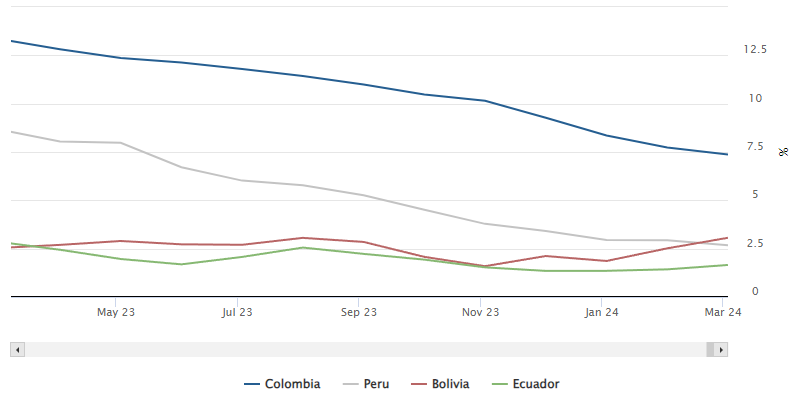
    Andean countries: inflation rate
    Percentage variation (year-on-year)

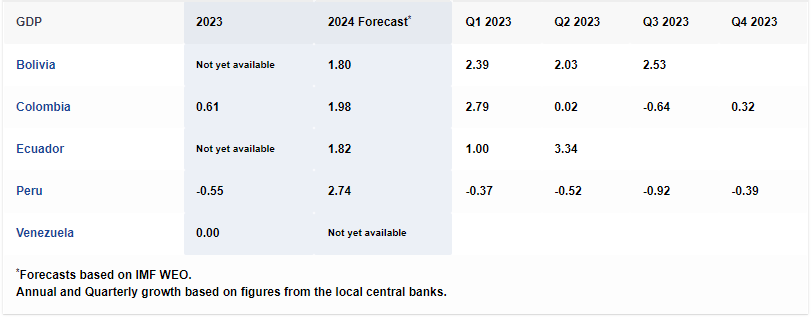
    Andean countries: GDP growth (%)
    Quarterly figures are year-on-year growth

  • TRACKING TRENDS

    Patrick de Courcy 30 May 2024 Hits: 1762

    DOMINICAN REPUBLIC | Buoyant growth. The Dominican economy expanded by 7.8% in April, the fastest monthly growth of the year so far, the central bank (BCRD) revealed on 23 May. The economy grew by an average of 5.1% in the first four months of the year. In its most recent report, the International Monetary Fund (IMF) predicted that the economy would grow by 5.4% in 2024, higher than Eclac which forecast annual growth of 4.5%. The big drivers of year-on-year growth in the first four months of 2024 were the hotels, bars, and restaurants sector, which expanded by 9.5%, financial services (7.1%), construction (6.4%), real estate activities (6.1%), and free zones (6%).

    Monthly inflation in April was -0.10%, the BCRD reported, bringing the annual rate of inflation down to 3.03%, the lowest figure in nearly four years and comfortably below the bank’s target range of 4% plus or minus 1%. Core inflation for the previous 12 months was 3.99%.

  • BRAZIL: Gangs supplied by licenced gun owners

    Abbi Dicker 04 October 2024 Hits: 1047

    Brazilian authorities as well as public security experts have expressed concern over the connections between organised crime and gun owners with CAC licences (a certification for hunters, sport shooters, and gun collectors). Police in São Paulo state highlighted these suspected links during an investigation in September into armed robberies carried out by criminal gangs. The guns for these attacks were mainly supplied by CAC licence holders, while footage has also emerged which suggests that licenced gun owners have been giving shooting lessons to gang members.

    On 10 September the São Paulo state prosecutors’ office (MPSP) announced that it had launched a new phase of Operation ‘Baal’, a joint investigation between the MPSP’s special unit against organised crime (Gaeco) and the federal police (PF) which was first launched in May this year. Gaeco and PF personnel are seeking to uncover the perpetrators of a coordinated series of attacks last year in which suspected gang members attempted to rob vehicles transporting large sums of money. The attacks took place in Mato Grosso state, but the suspected masterminds, suppliers, and financiers of the plan are believed to be in other states such as São Paulo.

    In May, Gaeco and the PF noted that the weapons used in the failed robbery were mainly supplied by CAC licence holders and arrested some CACs, including a man named Otávio de Magalhães. In September, police arrested more suspects, some of whom are believed to be members of the powerful Brazilian drug trafficking group Primeiro Comando da Capital (PCC). During this police raid, investigators even found video footage appearing to show De Magalhães giving shooting lessons to PCC members.

    The case arising from the attempted robbery in Mato Grosso last year has reinforced the PF’s previous suspicions about the links between CACs, drug trafficking organisations (DTOs), and armed robberies. In addition to Operation Baal, the PF in Bahia state launched another investigation into CACs, dubbed Operation ‘Fogo Amigo’ (‘friendly fire’), which also began in May this year. Fogo Amigo is an investigation into CACs and owners of gun shops in Bahia, Alagoas, and Pernambuco states, who are believed to be arms suppliers for criminal gangs in north-eastern Brazil.

    Brazilian public security NGO and think tank Instituto Sou da Paz (ISP) has also warned of the blurred boundaries between the legal and illegal firearms markets and called for better regulations on gun ownership. Data collected by ISP showed that an increasing number of organised crime cases involved crimes committed using weapons supplied by CACs. The rise in cases occurred during the presidency of far-right former president Jair Bolsonaro (2019-2023), and ISP has explicitly blamed Bolsonaro for passing legislation which made it easier for civilians to access high-calibre weapons. In 2018, before Bolsonaro took office, the country only registered three criminal cases which involved gang members using CAC-licenced weapons, but in 2022, the number of cases rose to 11, and in 2023 a record 12 cases were registered, according to ISP.

    ISP noted that it is not only major transnational DTOs such as the PCC which benefited from Bolsonaro’s loosening of gun control regulations, but also gangs that run regional drug trafficking routes and other local criminal enterprises, such as the Primeiro Grupo Catarinense in the southern state of Santa Catarina, Okaida in the north-eastern state of Paraíba, and Amigos do Estado in the central state of Goiás.

    Shooting range rules

    In July last year, President Luiz Inácio Lula da Silva issued a decree which redressed Bolsonaro’s pro-gun legacy and tightened restrictions on gun ownership, setting new regulations for CACs, among other measures. The decree also imposed restrictions on shooting ranges, such as a rule which prohibits them from operating within 1km of a school. In early September this year, right-wing lawmakers advanced legislation proposing changes to Lula’s decree, but the legislation was withdrawn after government-aligned legislators reportedly promised that Lula would issue a new gun control decree with more lenient rules for shooting ranges. At the time of writing, Lula had not yet signed this new decree.

  • BRAZIL: São Paulo police under pressure over alleged brutality

    Patrick de Courcy 05 December 2024 Hits: 2344

    The governor of São Paulo state, Tarcísio de Freitas, of the conservative Republicanos party, has long defended the actions of the state military police force (PM) amid criticisms from human rights groups and allegations of excessive force. But flagrant acts of police brutality have recently been widely shared online and discussed in the national media, making it harder for De Freitas to maintain his tough-on-crime rhetoric and efforts to downplay the alleged abuses committed by his state’s law enforcement personnel.

    Several recent incidents involving PM officers have re-ignited debates about police violence. The first occurred in a supermarket on 3 November, in Jardim Prudência, a neighbourhood in the southern zone of the city of São Paulo. Security camera footage from the supermarket showed an off-duty policeman killing a man who tried to steal cleaning products.

    The policeman was later summoned to a deposition, in which he reportedly testified that he shot the man dead as an act of self-defence, even though the footage did not show any signs of a struggle or clash, or any suggestion that the shoplifter was armed. Instead, it showed the man slipping and dropping the stolen items as he tried to run away, before being shot at close range by the policeman. Investigations into the incident revealed that there were 11 bullet holes in the man’s body. The officer in question was dismissed from the force on 2 December.

    Another incident of concern also occurred in the south of São Paulo, in a hotel in Vila Mariana. PM officers reported that a young man struck their police car on 20 November and tried to escape. The two policemen chased him into a hotel and cornered him. Security camera footage in the hotel showed the young man trying to wriggle free from the policemen who grabbed hold of him and then tried to push the officers away, before one of them fired his weapon. The man, whom the press later confirmed was a medical student, was taken to a nearby hospital where he died from his wounds. Both officers were dismissed, and De Freitas described the death of the student as a tragedy and said that acts of abuse “will be severely punished”.

    The most recent of such acts took place on 2 December, in another neighbourhood in the south of the city known as Cidade Ademar. Footage recorded on the cameras of witnesses at the scene showed police officers pushing a man off a bridge into a river, after breaking up a ‘baile funk’ street party. The man reportedly survived the fall, but on 3 December Guilherme Derrite, the São Paulo state public security secretary, announced that the 13 PM officers involved in the incident had been dismissed.

    Left-wing opposition lawmakers in São Paulo’s state assembly have called for Derrite to be sacked. On 3 December De Freitas said that throwing someone off a bridge and shooting an unarmed shoplifter in the back at close range were acts not befitting of a police officer, but he rejected suggestions that he would dismiss his public security secretary.

    Derrite also received support from another prominent conservative politician – the national party president of the Progressistas party (PP), Ciro Nogueira. On 4 December he described the incidents in São Paulo as “isolated incidents” of police wrongdoing. Nogueira went on to praise Derrite’s record on tackling crime and suggested that the PP would back Derrite’s political ambitions in the 2026 general elections, if he decides to run for a seat in the senate; or, if De Freitas challenges for the presidency in 2026, Derrite could be an option to succeed him and run for the governorship of São Paulo state.

    Accusations of mass deportation 

    UK newspaper The Observer accessed data which revealed that over 600 Brazilians had been secretly removed from the UK in August and September this year, in what is reportedly the UK’s largest ever deportation of people of a single nationality. The findings from the data were reported in the press on 1 December, and Brazil’s foreign ministry (commonly known as ‘Itamaraty’) responded the following day, with a statement cited in the press insisting that this should not be described as a ‘deportation’. Instead, Itamaraty stated that the Brazilians removed from the UK did so as part of a “voluntary return process”.

  • MEXICO: Grupo Carso deepens involvement in oil sector

    Patrick de Courcy 20 February 2026 Hits: 1472

    Mexican magnate Carlos Slim’s Grupo Carso conglomerate has continued a recent run of investments in the country’s energy sector. In February the conglomerate signed another contract with state-run oil company Petróleos Mexicanos (Pemex), while in January it agreed to acquire Fieldwood Mexico, the local subsidiary of Russian oil firm Lukoil. This all comes as Slim looks to take advantage of a new appetite for private investment in strategic projects.

    Slim, who made his fortune in telecoms before diversifying into a wide range of different industries, confirmed the new Pemex contract on 10 February. The joint venture is for the development of the onshore Macavil field in southern Mexico, which has proven reserves of 33.7m barrels of condensate and 409.1bn cubic feet of natural gas, according to Grupo Carso’s quarterly results report. The contract, signed by the conglomerate’s Zamajal subsidiary, guarantees Pemex at least a 40% stake in the field, which was discovered in 2024.

    This came after the purchase of Fieldwood Mexico in January. Also made through Zamajal, the purchase was agreed at a total cost of US$600m, comprising US$270m to purchase Fieldwood and US$330m in debts that the company held with its parent. The deal means that Slim’s firm acquires Fieldwood Mexico’s 50% stake in the Ichalkil and Pokoch oil fields, which are located near the coast of Campeche state in the Gulf of Mexico. Grupo Carso previously acquired a 50% stake in the two fields, meaning that the company will now become the sole operator, which are strategically located in a historically productive area where shallow waters mean that oil is easier and cheaper to extract compared to deep water oil fields. Altogether, the two fields produce an estimated 11,451 barrels of oil per day.

    These acquisitions follow other agreements between Grupo Carso and state-owned oil firm Pemex, including a US$2bn deal to finance the drilling of 32 onshore natural gas wells at the Ixachi field in Veracruz state, which was announced in September 2025. The Ixachi field is one of the most important natural gas finds in Mexico in recent decades. In July 2024, Grupo Carso and Pemex also formed a partnership to develop the deepwater Lakach gas field in the Gulf of Mexico, around 98km southeast of the city of Veracruz. The US$1.2bn contract was signed following the collapse of a previous deal between Pemex and US energy firm New Fortress Energy due to disagreements over terms. And in May 2023, Grupo Carso acquired a 49.9% stake in the Mexican subsidiary of US oil and gas firm Talos Energy, before acquiring a further 30.1% stake in the company in December 2024. These acquisitions give Slim’s firm access to the strategic Zama oilfield, a shallow water project off the coast of Tabasco, which was discovered by Talos Energy but is operated by Pemex following years of legal wrangling.

    Slim’s growing interest in the energy sector has come after a period of mounting problems at Pemex, which has long been heavily indebted and struggled to maintain production levels despite Mexico’s vast reserves of oil and gas. In 2013, energy reforms passed by former president Enrique Peña Nieto (2012-2018) ended Pemex’s monopoly and allowed private-public partnerships in the energy sector for the first time in decades. The idea was to boost production by allowing foreign capital and technology into the sector, and a swathe of deals worth billions of dollars were signed in the following years, including agreements between Grupo Carso and Pemex. However, these changes were effectively reversed when former president Andrés Manuel López Obrador (2018-2024), a vehement opponent of the energy reform, came to power and pivoted back to resource nationalism. This discouraged private investors from growing their presence in the energy sector, including international oil majors, making Slim a notable outlier as his firm continued to make deals with Pemex. 

    In November 2024, President Claudia Sheinbaum enacted a constitutional reform which reinforces public control of the energy sector [EB-24-11]. She has also revealed plans to develop new oil fields producing as many as 450,000 barrels per day by 2030 as part of a drive to become energy self-sufficient, while recognising that Pemex’s high level of debt means that the company will need private partners in order to do so. Sheinbaum has also worked to cultivate a relationship with Slim who, between 2013 and September 2025, has signed 17 contracts with Pemex via his companies worth a total M$118.9bn (US$6.9bn), according to data compiled by Bloomberg. His firms have also been involved in significant government projects such as the Tren Maya tourist railway.

    This willingness to work with the leftist Movimiento Regeneración Nacional (Morena) party since it was elected to the presidency in 2018 marks Slim out from other Mexican magnates such as Germán Larrea and Ricardo Salinas Pliego, who have had more difficult relations with both López Obrador and Sheinbaum. Although some critics have questioned whether Slim and his firms have benefitted disproportionately from this proximity to government power, Grupo Carso’s finance chief Arturo Spinola revealed in July that Pemex, the most heavily indebted oil company in the world, owes the conglomerate over US$700m.

    Looking ahead, the fact that Fieldwood Mexico was owned by Russian firm Lukoil means that the acquisition must be supervised by the US Department of the Treasury’s Office of Foreign Assets Control (Ofac) because of sanctions imposed on Russia due to President Vladimir Putin’s invasion of Ukraine. Ofac recently extended a deadline for Lukoil to sell its interests in international oil fields to 28 February. It must also be approved by Mexican regulators.

    More widely, Slim may be betting that his firms can benefit from Sheinbaum’s goal of boosting oil production by using mixed public-private contracts to develop new oil fields as neither Pemex nor the government has the necessary funds to do so. He could also benefit from a drive to reduce Mexico’s reliance on imports of natural gas from the US amid ongoing tensions with US President Donald Trump, and there are high hopes for the Lakach gas field.

    Slim remains one of the richest people in Latin America, so Grupo Carso has the financial muscle to deal with the risks involved in the energy sector. His recent investments align with growing investor interest in energy, mining, and infrastructure at a time of geopolitical instability that threatens existing supply chains, a situation which appears likely to persist due to the ongoing trade war between the US and China. The firm has also developed experience and technical expertise through existing operations and recent acquisitions, making it an attractive partner for a government that cannot afford to waste time or money.

    However, a number of factors will influence the performance of Grupo Carso’s energy investments, and whether Pemex succeeds in turning its fortunes around. The first is the detail of the aforementioned mixed contracts, and then there is also the potential for further changes to Mexican government policy governing the energy sector, which Slim may believe that he can influence by leveraging his relationship with the ruling party. Other factors, he cannot hope to steer in his favour, including international oil and gas prices, as well as Trump’s trade and investment policy. Therefore, while Slim appears well placed to leverage his enormous wealth and political influence to make his energy investments a success, Grupo Carso, Pemex, and the Mexican energy sector are also exposed to considerable risks.

    Slim

    “Carlos Slim doesn’t make moves until he sees a business or project is profitable,” energy consultant Ramses Pech told British newspaper the Financial Times in an article published in September 2025. “He started with equipment, services…his company has been growing little by little.”

  • TRACKING TRENDS

    LatinNews 24 May 2012 Hits: 2717

    GUATEMALA | Ríos Montt faces another charge. On 21 May Judge Patricia Flores ruled that there was enough evidence to try the former dictator Efraín Ríos Montt (1982-1983) for genocide in relation to the  Las Dos Erres massacre, one of the most brutal atrocities in the country’s 36-year civil war (1960-1996), in which more than 200 civilians were killed. The charge against Ríos Montt is the second filed since Flores announced in January that he would face trial for at least 72 incidents involving an estimated 1,771 deaths and the displacement of nearly 30,000 Guatemalans during his 17-month period in power. The January decision was hailed by human rights activists as a major step forward for the country in its efforts to redress past impunity [WR-12-05].

    REGION | Trade deficit widens. According to a recent report released by the Secretariat of Economic Integration for Central America (Sieca) (which does not include Panama), the region’s trade deficit in January 2011 reached US$2.15bn, up from the US$1.82bn registered in January 2011. According to the report, imports reached US$4.45bn and exports, US$2.30bn. Guatemala and Costa Rica registered the highest deficits – of US$625.6m and US$596.4m respectively, followed by El Salvador (US$391.7m), Honduras (US$387.4m) and Nicaragua (US$149.9m). According to Sieca, exports in January grew year-on-year at 10.6%, less than the 16.4% registered in 2011. The main destinations for Sieca exports were the US (US$743.1m); the European Union (US360m); and Mexico (US$95m.).

    PANAMA | Eying up wind power. Luis González, the project manager of the renewable energy company FERSA Panama SA, part of Spain’s FERSA, told reporters earlier this month that wind farms currently being developed by the company could begin operating as of 2013 – the first such wind plants to operate in the country. According to the UN Economic Commission on Latin America (Eclac), hydroelectricity accounted for 4,220.9MW of net electricity generated in Panama while the rest, 3027.5MW came from geothermal sources. In April 2011 the government approved a law establishing incentives to promote clean energy. Panama’s public services regulator, Asep, has approved five wind farm projects, all of which are in the central Coclé province, which would generate a total of 564.8MW; Fersa is developing two wind farms, Toabré which is expected to generate 225MW and Antón (105MW). The other three projects -  Nuevo Chagres (168.8MW), Marañón (18MW) and Portobelo, (48MW) - are being developed by Unión Eólica Panameña (UEP), part of Spain’s Unión Eólica Española (UEE).  Asep is currently reviewing proposals for 17 new projects - seven for the Coclé, five in Veraguas, two in Panama, two in Chiriquí, and one in Los Santos – which would generate a total 1528.3MW upon completion.

    CARIBBEAN-MEXICO | Mexico-Caricom shore up ties. President Felipe Calderón of Mexico recently travelled to Barbados to attend the second Mexico-Caribbean Community (Caricom) summit, which took place on 21-22 May. Various pledges were made to boost trade and integration. Underlining that organised crime represented the main threat to the region’s development Calderón highlighted his proposal to create a new regional anti-crime body, the new Inter-American System against Organised Crime as a means of addressing the problem [WR-12-15]. While two memoranda of understanding were inked during the summit – one on Haiti (see sidebar) and the other on higher education - the agreement which attracted most attention was Calderón’s promise that Mexico would lobby on behalf of the 15-member Caricom at the G20 summit, which Mexico will host this June. Mexico-Caricom relations, formally date back to 1974 when Mexico was the first country to set up a joint commission with the group.

    • Mexico-Haiti relations

    In his opening address to the recent Mexico-Caricom summit, Caricom Secretary General Irwin LaRocque singled out among the various recent key developments in Mexico-Caricom relations, Mexico’s support assistance to Haiti, following the January 2010 earthquake which devastated the country. Calderón visited Haiti on 12 April, the first visit by a Mexican president since the two countries established diplomatic relations in 1934. According to the latest figures from the office of the special envoy for Haiti, Mexico has so far pledged US$8m in reconstruction funds.

  • In Brief – Colombia

    LatinNews 05 July 2012 Hits: 1593

    POLITICS | Uribe, a top source of negative media coverage on Colombia. On 4 July the ministry of foreign relations released the results of a study conducted by Global News Intelligence (GNI) Latinoamérica for the Juan Manuel Santos administration, according to which between 29 December 2011 and 31 May 2012 statements and actions by the Fuerzas Armadas Revolucionarias de Colombia (Farc) and former President Alvaro Uribe (2002-2010) accounted for the top two sources of negative international press coverage of Colombia. GNI studied 12,000 articles and 65,000 statements, of which the foreign press published 394 relating to the Farc and 263 relating to Uribe. However, when April and May are taken on their own, Uribe becomes the top source of negative coverage with 40.2% of the total negative mentions of Colombia in the foreign press. “I think it is very sad that it is ourselves who generate the negative [image] overseas”, Foreign Minister María Angela Holguín said yesterday after releasing the full report.

  • Risk pointers

    LatinNews 11 December 2013 Hits: 411

    *** China frets over North Korea.  The country most concerned by the downfall of North Korea’s No 2 figure, Kim Jong-un’s uncle Jang Song-thaek, is China.  One well-placed source in Beijing noted this week: “Jang was an iconic figure in North Korea, particularly with economic reform and innovation.  He is the man China counted on to move the economy in North Korea.  This is a very ominous signal.”

    The 67-year-old Jang was well known in China, which he visited on a number of occasions, and he was seen in Beijing as a reliable advocate for Chinese-style economic reform, which Beijing is pushing hard as a necessary panacea for North Korea.  As the South China Morning Post noted earlier this week: “Jang was one of China’s few high-level North Korean interlocutors.”

    The way in which Jang was dismissed was very public and humiliating, in contrast to Pyongyang’s usual secretive manoeuvrings, and the reason seems fairly clear.  It is the 30-year-old Kim Jong-un telling the world that he is the undisputed leader of North Korea.

    *** China tells Japan it is watching.  Japan’s Prime Minister Shinzo Abe has received drafts of the new defence guideline and the mid-term defence programme.  The guideline prescribes Japan’s defence policy for the next 10 years while the mid-term defence programme looks at procurement for the next five years.  Final version of the plans will be presented next week.

    Included in the build-up plan is a new amphibious unit designed to be able to recapture remote islands seized by an enemy power, and plans to double the number of 20-strong fighter jet squadrons stationed at Naha base in Okinawa.  Japan also plans to deploy surveillance drones at Naha along with E-2C early warning aircraft which are at the moment confined to Japan’s Misawa base in the north.

    The strategy paper will review the ban on the export of weapons in a move designed to increase the capacity of Japan’s defence industry.

    China responded to the drafts by warning: “China is closely watching Japan’s security and policy direction.  Japan’s unreasonable criticism of China’s normal maritime activities and its hyping up of the China threat has hidden political motives.”