All Categories

Subcategories

  • TRACKING TRENDS

    LatinNews 19 October 2017 Hits: 821

    MEXICO | Record formal job creation. On 16 October Mexico’s social security institute (IMSS) reported that 136,000 new formal jobs were created in the country in September. This is 28.3% higher than the average formal job creation rate observed in the country for the past decade (106,009 jobs), and it brings the accumulated number of formal jobs created this year to 812,292. It is the highest ever job creation figure reported for the first nine months of a year.

    The IMSS also noted that the September formal job figure brings the total number of formal jobs created during the administration led by President Enrique Peña Nieto, who took office in December 2012, to 3.13m. This is 2.3 times more than the total number of formal jobs created under the previous administration led by Felipe Calderón (2006-2012), and the highest number of jobs created under any other previous government.

    • Job creation

    President Peña Nieto celebrated the new record job creation figure. “We have reached an historic job creation figure: we have created over 3m jobs,” he said. Peña Nieto also noted that on figures from the social security institute (IMSS) there are now 19.43m employed individuals enrolled with the IMSS and that Mexico’s unemployment rate (3.3% in August) was at its lowest level since 2005, with the youth unemployment rate falling to 6%.

  • Latin America ready to go electric?

    LatinNews 30 April 2018 Hits: 630

    Without a doubt, this wave of change will reach Latin America and the Caribbean. An interesting question is whether LAC consumers are innovative and open to accepting new types of vehicles, or whether they are conservative and in some way deeply wedded to the traditional, family-owned, petrol consuming motorcar. A survey commissioned by Japanese auto manufacturer Nissan, with results published in March 2018, suggests that the innovators may predominate. The headline result was that eight out of ten Latin Americans are willing to buy an electric vehicle. The survey was conducted by C230, a consultancy affiliated with the Fundacíon IDEA think tank.

    The survey, carried out in Argentina, Brazil, Chile, Colombia and Peru, showed that 80% of respondents had heard about electric vehicles (EVs), but only one in ten had actually travelled in one. Nevertheless, 80% of all respondents said they would be willing to buy an EV, as they consider it a solution that could help reduce air pollution. Another big majority – 73% of respondents – said they believed charging an EV would be less expensive than driving a car using fossil fuels. There were also some concerns. Three-quarters (75%) thought that finding a charging point might be complicated. Nearly two-thirds (60%) were worried that the EV range on one charge would not be enough to cover their daily travel mileage. Sixty-three percent of respondents said they were worried that the time needed to charge up a vehicle might be too long.

    As might be expected, the survey showed lower levels of awareness of AVs. Only 35% of respondents had heard about autonomous vehicles. However, when the concept was explained, 69% said they would be willing to use one. Just over half – 54% – had a positive view of AVs, attributed to their perceived capacity to improve mobility and safety on the streets of Latin American cities. 58% said AVs would improve mobility, and 60% believed trips in AVs would be more comfortable. Seventy percent believed that there would be fewer accidents, and 72% said they believed accidents would be less severe in nature. A total of 64% of respondents said they would be willing to purchase an AV if the cost was similar to that of a traditional vehicle. Nissan used the survey to announce the introduction of its Nissan LEAF model in the region. The model is a 100% electric motor car with zero carbon emission; the company said it would go on sale during the course of 2018 in Argentina, Brazil, Chile, Colombia, Costa Rica, Ecuador, Uruguay, and Puerto Rico.

    On the supply and operational side of the equation, Latin America clearly has some way to go before it can easily adopt electric and autonomous vehicles. Consultancy KPMG has prepared an Autonomous Vehicle Readiness Index (AVRI) assessing the ease of adoption of the new generation of vehicles. The AVRI is compiled looking at first, the current state of government policies and legislation; second, the current development of technology and innovation; third, infrastructure; and fourth, consumer acceptance. As we have seen, the indications are that consumer acceptance is the region is high, but there are shortcomings in the other three areas. Countries with the highest AVRI scores include the Netherlands, Singapore, US, Sweden, UK, and Germany. The Netherlands, for example, already has a well-developed electric vehicle battery charging network in place, while the US and Sweden lead in technology and innovation. However, in the top 20 AVRI table there are only two Latin American countries present: Brazil (ranked 17th) and Mexico (ranked 19th).

  • COLOMBIA: Indigenous groups challenge Duque

    LatinNews 21 March 2019 Hits: 5516

    The disruptive and violent protests being staged by indigenous groups in Colombia’s south-western departments of Cauca and Huila are emerging as a significant political test for the government led by President Iván Duque. The protesters’ demands that the unfulfilled promises made by the previous government led by Juan Manuel Santos (2010-2018) be honoured pose a conundrum for the Duque administration’s efforts to rationalise government spending, impose the rule of law and not be held to ransom by interest groups. However, the economic damage that the protests are producing, and the potential for them to spark wider discontent, represent risks for the Duque administration.

    Indigenous communities in Cauca grouped in the Consejo Regional Indígena del Cauca (Cric) launched their protest on 12 March, when they staged demonstrations and erected blockades on the Pan-American highway that links Colombia to Ecuador. The protesters complain that promises made by the previous administration, including the restitution of their lands, the provision of state economic assistance to boost economic development, and respect for their right to prior consultation when it comes to extractive industry projects, remain unfulfilled. They are demanding a commitment from the government to honour these, and called on President Duque to travel to Cauca to meet them and provide personal assurances.

    Duque has said that the demands made by the indigenous protesters amount to some Col$4.6trn (US$1.16bn) in additional spending and that his government simply cannot provide such funds. Moreover, Duque accused the previous government of making promises that it knew would be “impossible to keep” in order to appease protesters in the past. Duque offered to establish a new negotiation with the Cric but only once all roadblocks are lifted. Duque deployed his interior minister, Nancy Patricia Gutiérrez, to the area to establish a dialogue table with the Cric. However, with the protesters refusing to remove the roadblocks (which spread beyond Cauca into neighbouring Huila) until Duque meets them, and the security forces ordered to clear the roads, the protests began turning violent this week.

    Violent clashes between the protesters and the security forces have left dozens injured and resulted in various arrests. The violence reached a high-point on 19 March when one police officer was shot dead during clashes near the town of Santander de Quilichao. This came after the police and the army reported that their units deployed to maintain order in Cauca have faced armed and explosive attacks by protesters that have left some wounded. The security forces said that they believed that the protesters may have been infiltrated by armed criminal groups potentially including guerrillas from the Ejército de Liberación Nacional (ELN) and dissident groups from the now demobilised Fuerzas Armadas Revolucionarias de Colombia (Farc) that are active in the area.

    Duque insisted on the lifting of all roadblocks as a precondition for the establishment of a dialogue. With neither Duque nor the Cric show any sign of softening their stance, the economic losses resulting from the roadblocks continue to mount, reaching Col$10bn, according to the latest estimates by local business. Most of these losses have been incurred by the freight transport sector, which has been prevented from using the Pan-American highway (protesters have punctured the tyres of some lorries and even set one alight) and cannot use alternative routes. But the situation is also producing shortages of basic goods in the departments of Cauca, Huila, and Valle del Cauca, while it has also left the department of Nariño, on the border with Ecuador, virtually isolated. Against this backdrop, Duque is facing calls from the governors of these departments to resolve the conflict as quickly as possible.

    • Nariño

    The blockade of the Pan-American highway has effectively cut off Nariño’s road transport links to the rest of Colombia. This has produced shortages of hydrocarbon fuels, which has prompted the departmental and national governments to adopt emergency measures. The departmental government was first forced to issue a decree rationing the sale of fuel to the general public to avoid running out. Then the national government intervened and, on 19 March, announced that in order to ensure fuel supplies in Nariño, it has asked Ecuador to supply 150,000 gallons of diesel; 235,000 gallons of petrol; and 140,000 gallons of liquefied petroleum gas (LPG) per day to Nariño for the next 10 days.

    JEP demonstration

    In addition to dealing with the indigenous protests in the south-west, this week President Duque has also had to face a national protest march called by the political opposition in support of the transitional justice system (JEP) and the national peace process. The establishment of the JEP is part of the peace accord that the Colombian government signed with the Farc in 2016. The JEP was approved by Colombia’s congress but Duque has recently partially vetoed the statutory law that regulates it [WR-19-10], generating doubts over the future of the JEP and by extension the stability of the peace accord.

    The political opposition, which now includes former Farc members, argues that the objections to the JEP statutory law and the changes to it that Duque has proposed will undermine the body and potentially betray the peace accord. This is why the opposition has launched a public campaign to try to pressure congress into overturning Duque’s veto. As part of this campaign, a protest march in cities across the country was staged on 18 March.

    Thousands of people took part in the demonstrations, placing considerable public pressure on congress. However, Vice President Marta Lucía Ramírez reacted by criticising the opposition for seeking to politicise the issue of the JEP and insisting that the objections and changes proposed by Duque aim to “perfect” the JEP and ensure that victims of the internal armed conflict receive “truth, justice, and reparation”.

    • Deadly attack

    The deadly attack in Santander de Quilichao was condemned by President Duque, who claimed that armed criminal groups could have infiltrated the indigenous protests in a bid to try to destabilise his administration. Duque said that the crime would not go unpunished and called for leaders of the Consejo Regional Indígena del Cauca (Cric) to help the authorities identify those responsible.

  • Trinidad rejects IMF as Jamaica graduates with flying colours

    LatinNews 03 December 2019 Hits: 219

    Jamaica’s Stand-By Arrangement (SBA) with the International Monetary Fund (IMF) terminated on 10 November with the IMF praising Jamaica for its “exemplary commitment” to the IMF programme for over six years and across two governments. By contrast, on 25 November, Trinidad & Tobago’s finance minister Colm Imbert explained why the country had rejected the possibility of entering into a structural adjustment programme with the IMF, the likely terms of which he castigated as “stale old measures”.

    Jamaica entered into the IMF arrangement in 2013 under the People’s National Movement (PNM) government led by Portia Simpson-Miller. It continued with the programme under the Jamaica Labour Party (JLP) led by Andrew Holness after it won power in 2016 to a large degree on the back of popular discontent with the austerity measures. At the successful end of the programme, the IMF recognised this by praising the commitment of both parties and the “considerable sacrifices” of the Jamaican people.

    The IMF’s Deputy Managing Director Tao Zhang said on 4 November: “[The Jamaican government] have institutionalised fiscal discipline and led to substantial reduction in public debt, which is now on track to meet the legislated target of 60% of gross domestic product by March 2026. The unemployment rate is at an all time low, inflation is subdued, the financial system is less vulnerable, and international reserves are comfortable.”

    A few days later, on 11 November, the outgoing IMF mission chief on Jamaica, Dr Uma Ramakrishnan, gave her overview of why the IMF programme had been such a success in Jamaica. She gave three reasons.

    First, she emphasised the importance of retaining fiscal and wider policy discipline. Secondly, she pointed to importance of building and maintaining social consensus, particularly through the Economic Programme Oversight Committee (Epoc). She said: “bringing the entire country behind these reforms in a way that we have not seen elsewhere is also a huge takeaway”.

    Thirdly, she said, a key lesson was the importance of phasing difficult reforms such as the government pension reform and the move from direct to indirect taxation. She contrasted this approach with “shock therapy” and said that it was better to “lighten the load”.

    Imbert however gave his very different views on IMF programmes at a Development Bank of Latin America (CAF) seminar in Port of Spain. The seminar was on ‘Restructuring a Commodity Dependent Economy for Growth Without External Intervention’.

    Imbert talked about the country’s 1990 agreement with the IMF, which he said resulted in 10 years of slow growth and “focused on contraction without due consideration of the short and long-term adverse effects on our citizens”.

    Imbert added that the tripling of GDP between 2001 and 2008 was a result of the rise in commodity prices rather than the benefits of IMF supervision, and so Trinidad rejected calls to turn back to the IMF when, in 2015, oil prices were again “dropping like a stone” and the country was “advised to embrace the same old sterile measures from 1990”.

    Imbert went on to relate that the advice the new Keith Rowley government was receiving “had a common theme” including “implementing a property tax system; expanding the tax base; increasing tax collection as well as increasing personal income tax and corporate tax”. He said, “We had had enough of that.”

    However, Imbert did also admit that Trinidad had to make some tough adjustments, albeit adjustments of its own devising. He explained: “We immediately embarked on reducing government expenditure to what we felt were manageable levels, from TT$63bn (US$9.3bn) to TT$52bn in the first year, and eventually down to TT$50bn by 2018.” This was achieved through “cutting out waste, mismanagement and inflated costs, also known as corruption”. Other issues that needed addressing included the loss-making national oil company and airline.

    The problem for the Trinidad government, however, is that the economic outlook remains supressed. It may have recovered from the 6.5% contraction in 2016, but only to the extent that the economy will be flat in 2019, after a further contraction of 1.9% in 2017 and a very marginal return to growth in 2018 of 0.7%. The outlook for 2020 is for growth of 1.5%.

    It is true that Jamaica’s growth outlook may not be greatly more encouraging than Trinidad’s, but it is the contrast with what went before that is impressive. The IMF’s summary of the achievements under its tutelage include:

    • Unemployment down from 16% at the start of the programme in 2013 to 7.8% in July 2019.
    • GDO growth for FY18/19 forecast to be 2%, which, according to the IMF, is “three times the average of the last 20 years”.
    • Public debt down from 147% of GDP to 94%, the first time it has been below 100% since 2001.
    • A primary surplus of 7%-7.5% for the last six years.
    • Net international reserves up from US$1.1bn at end-2016 to US$2.77bn in November 2019.
  • NICARAGUA: Electoral reform proposal fails to quell concerns

    LatinNews 24 May 2021 Hits: 1277

    The ruling Frente Sandinista de Liberación Nacional (FSLN) has unveiled an electoral reform initiative ahead of the 7 November general election in which President Daniel Ortega is running again. The political opposition and foreign community have long called for electoral reform but the FSLN’s proposal (since approved as we went to press), has failed to meet these demands. It comes as the opposition has warned of growing repression by the government ahead of the vote [SSR-21-02] and as the international community continues to signal alarm regarding the situation of human rights and democracy in Nicaragua.

    The FSLN presented its electoral reform proposal on 12 April before the national assembly, which it controls. It trumpeted efforts to promote gender equality, highlighting changes designed to strengthen gender representation in electoral institutions and candidates’ lists. However, the initiative has met with widespread rejection from the two main opposition groupings, Alianza Ciudadana (AC) and Coalición Nacional (CN), and civil society, which point to the yawning gap between the FSLN’s proposal and demands for comprehensive electoral reform as outlined by the Organization of American States (OAS) in an October 2020 resolution (see sidebar). A 28 April letter penned by over 90 political and social organisations to OAS Secretary General Luis Almagro urged the OAS to demand electoral reforms from the government which would ensure “fair and free” elections.

    The opposition maintains the current initiative seeks to further restrict its participation in the election, coming on the heels of new laws which have set off alarm bells [SSR-21-02]. In particular it warns the reform would limit foreign financing for candidates and parties, and fails to guarantee electoral observation by credible international observers. Also stoking concerns is a provision assigning responsibility for the authorisation of permits for campaign marches to the national police (PNN) rather than the supreme electoral court (CSE) as is currently the case. The PNN has been sanctioned by the US Treasury Department over its alleged role in “serious human rights abuses” [SSR-20-09] – a reference to the government crackdown on its opponents which began in April 2018.

    • International concerns

    The widespread rejection of the reform and fears on the part of the opposition that it is merely designed to further limit its participation in the vote come as the Ortega government continues to face pressure from the international community over human rights and democracy. On 23 March the United Nations Human Rights Council (UNHRC) approved another resolution which “expresses grave concern at the continuing reports of human rights violations and abuses and the lack of accountability since April 2018”. It has previously approved resolutions on Nicaragua in March 2019 and June 2020.

       In the US, the previous Donald Trump administration (2017-2021) had sanctioned multiple Nicaraguan officials over the alleged human rights abuses. While yet to follow suit, President Joe Biden is also expected to exert pressure with regard to democracy concerns. That developments in Nicaragua are being closely followed in Washington was suggested by new bipartisan legislation introduced on 25 March by Senator Bob Menendez (D-NJ), known as the RENACER ACT, which would “strategically align” the US’s “diplomatic tools, including targeted sanctions, to advance democratic elections in Nicaragua”. A 16 April statement by a bipartisan group of US representatives complained that the latest electoral reform proposal showed “contempt for the modest requests made by the international community”, while on 20 April the US State Department issued a level 4 travel advisory (Do Not Travel) for Nicaragua. Among other things it cited “arbitrary enforcement of laws”, noting that the Ortega government and its affiliated groups have been reported to “systematically target opposition figures (regardless of nationality)”. 

    • OAS resolution

    The OAS October 2020 resolution was in line with a commitment to electoral reform made by the FSLN in 2017 as part of a Memorandum of Understanding (MoU) signed with the OAS. The October 2020 resolution was clear that “concrete electoral reform commitments, in particular modernisation and restructuring of the [CSE], be in place before the state convokes general elections, or no later than May 2021”.

  • 5G rollout – fast, but not fast enough?

    Patrick de Courcy 17 December 2021 Hits: 395

    Brazil’s long delayed 5G mobile spectrum auction took place on 4 and 5 November, and 5G mobile services could be available in some cities by July next year. However, most of the population will have to wait a lot longer to gain access to the faster network.

    The auction was a success, with 44 5G operating licences acquired by 11 mobile phone companies who together committed around US$8.46bn in fees and investments. Most licences went to the country’s big three operators, Claro, Vivo, and TIM, but some smaller companies also won. The successful companies must meet pledges to bring 4G to 10m people in northern Brazil, and extend 5G coverage along Brazil’s highways, as well as connecting public schools to high-speed internet. There are plans to roll out 5G in phases in the period running up to 2027, with the country’s state capitals the first to receive the network coverage, by the middle of next year.

    The argument for 5G has been that it will speed up connectivity and efficiency across the entire economy. Welcoming the auction, President Jair Bolsonaro said it was a “revolutionary technology” that would help Brazil integrate with the rest of the world. Benefits include much more rapid mobile speeds, the ability to use multiple devices on one connection, and wider coverage. The latest data suggests internet connectivity rose during the coronavirus (Covid-19) pandemic, and Brazil now has 152m internet users (81% of the population aged 10 years or over).

    The problem, however, is that at least 20m mobile users are still on the relatively slow 3G, and awaiting 4G, meaning it will be a long time before they see 5G. ‘Digital exclusion’ remains a big issue with public schools, the elderly, and those living in rural areas all receiving a much more limited service. According to GSMA, which represents mobile operators, 5G take-up in Brazil will be faster than in the rest of Latin America, but still slow when compared to other parts of the world. GSMA projects that in four years Brazil’s 5G take-up will be 20% – one in five – compared to an average of 12% in Latin America as a whole.

  • TRACKING TRENDS

    Patrick de Courcy 20 January 2022 Hits: 3654

    MEXICO | Agricultural exports soar. Mexico’s agri-food exports totalled US$40.29bn in the first 11 months of 2021, the highest figure recorded in the past 29 years, the agriculture and rural development ministry (Sader) reported on 16 January.

    According to the same report, agri-food imports totalled US$33.96bn. This means that in the first 11 months of 2021, Mexico’s agri-food trade balance reached a surplus of US$6.33bn, which is the third largest positive balance in 27 years, according to data from the agri-food and fisheries information service (SIAP).

    Mexico’s most significant agri-food exports were beer (sales of which totalled US$5.81bn in the first 11 months of 2021), followed by tequila and mezcal (US$2.98bn), and avocados (US$2.79bn).

    The record-high agri-food exports come as little surprise given higher food prices reflected in mounting inflation around the world. Annual inflation in Mexico came in at a 20-year high in 2021.

    Figures released by Mexico’s national statistics institute (Inegi) on the national consumer price index (INPC) on 7 January showed annual inflation for 2021 at 7.36%, the highest recorded since 2001, and more than double the 3% inflation target figure set by Mexico’s central bank (Banxico).

  • HAITI: Debate continues over international military deployment

    Patrick de Courcy 20 October 2022 Hits: 2915

    Support is growing for the request for foreign military deployment [WR-22-41] by Haiti’s Prime Minister Ariel Henry to address the security, economic, and health crisis in the country amid a new cholera outbreak and prolonged gang-imposed fuel blockade. Following last week’s call by United Nations Secretary-General António Guterres for the UN Security Council (UNSC) to consider the proposal, the US representative to the UN, Linda Thomas-Greenfield, said that the US and Mexico have worked together on drafting two UNSC resolutions, one of which authorises an international security mission to restore order in Haiti. Such a move, however, is contentious and Thomas-Greenfield herself underlined “we are keenly aware of the history of international intervention in Haiti” and that the UNSC and international community “must look at its role differently than it has in the past”.

    In her comments made on 17 October outlining the resolutions before the UNSC, Thomas-Greenfield did not specify who would lead the mission which she described as a “limited, carefully scoped, non-UN mission…led by a partner country” - an evident bid to differentiate it from earlier UN peacekeeping missions in Haiti which have proven controversial and unpopular due in part to various scandals. Thomas-Greenfield said that while it would not be a UN peacekeeping operation, it would operate under Chapter VII of the UN’s Charter, which gives the UNSC the power to maintain peace.

    The proposal to send an international military deployment remains contentious, even among UNSC members. China’s deputy permanent representative to the UN, Geng Shuang, and deputy Russian permanent representative, Dmitriy Polyanskiy, both reportedly questioned whether a foreign force would be welcomed by the Haitians or encounter resistance. The specific question of US involvement in the military deployment has also drawn speculation, particularly given Washington’s evident reluctance to send US troops to Haiti. Speaking at a briefing on 12 October, one senior un-named US administration official said “the question of a security presence is obviously an area where we are treading very carefully to make sure that we are doing the right things and not doing the things in the past that have not worked”.

    Instead the US has unveiled other measures, such as visa restrictions targeting gangs [WR-22-41], and promised more humanitarian relief as well as security assistance. For instance, on 15 October US and Canadian military aircraft arrived in Haiti to transfer Haitian government-purchased security equipment, including tactical and armoured vehicles, and supplies to Haiti’s national police (PNd’H).

    Another proposal

    The other proposal drafted by the US and Mexico, which the US representative to the UN Linda Thomas-Greenfield outlined, would impose financial sanctions on Haitian gangs and those who provide them with money and weapons and specifically lists gang leader Jimmy Chérizier as the subject of such sanctions.

    UN Secretary-General report

    A 13 October report by the UN secretary-general paints an alarming picture of gang control. It notes that the PNd’H had no control of police stations in the Port-au-Prince neighbourhood of Cité Soleil, a major site of gang violence, and could not remove gang roadblocks along key arterial routes. It adds that the PNd’H has been unable to access other gang-controlled neighbourhoods such as lower Delmas, Martissant, and Village de Dieu in metropolitan Port-au-Prince.

    As well as the gangs’ blockading of the Varreux fuel terminal, Haiti’s main fuel port in the capital, the report highlights a 10 June raid on the Port-au-Prince Court of First Instance by heavily armed gangs who have continued to occupy it. On 16 June and 9 July, Haiti’s national port authority was attacked while threats were made against other institutions located in the capital, such as the national prison, the superior court of audits and administrative disputes (CSCCA), and the central bank. It notes that gang violence also spread to the regions, such as Artibonite department where “gangs impeded freedom of movement along the national arterial route, destroying property, and kidnapping travellers”.

  • ECONOMIC HIGHLIGHTS

    Patrick de Courcy 14 February 2023 Hits: 3439

    BRAZIL | Record oil and gas production last year. On 8 February, Brazil’s Agência Nacional do Petróleo, Gás Natural, e Biocombustíveis (ANP), the federal oil and gas agency, announced that production of both oil and natural gas reached record levels last year, despite production levels falling in December compared with November. Overall oil production in 2022 averaged 3.02m barrels per day (bpd), a 2.47% increase on the previous record registered in 2020. Natural gas production, meanwhile, averaged 138m cubic metres per day, 2.98% more than the previous record registered a year earlier, in 2021. On the same day that ANP released these figures, state-controlled Petrobras also published its Production and Sales report for 4Q22, which shows that the oil and gas giant’s overall production fell from 2021 to 2022. The hydrocarbons company with by far the largest operations in Brazil, Petrobras posted average oil and gas production of 2.68m barrels of oil equivalent per day (boepd), a 3.2% decrease on 2021 levels. The company stressed, however, that it had met and even exceeded its targets.

    URUGUAY | Government takes action against drought. On 3 February, Uruguay’s minister for livestock, agriculture and fisheries, Fernando Mattos, presented to congress the list of measures taken by his ministry in response to an extended drought, which has been affecting Uruguay since 2020 and has so far had an estimated impact of 1.9% of GDP, or US$1.18bn, on the economy. As well as announcing a series of measures costing US$9m – which include subsidised loans; establishing rural development roundtables to respond to the needs of local producers; allocating funds to municipalities; creating specific credit lines; extending deadlines on the repayment of loans and other payments; subsidising electricity costs; and providing drinking water to rural areas – the agriculture ministry has discussed providing support to affected farmers with the defence ministry, and it extended a state of agricultural emergency by 90 days until 24 April.

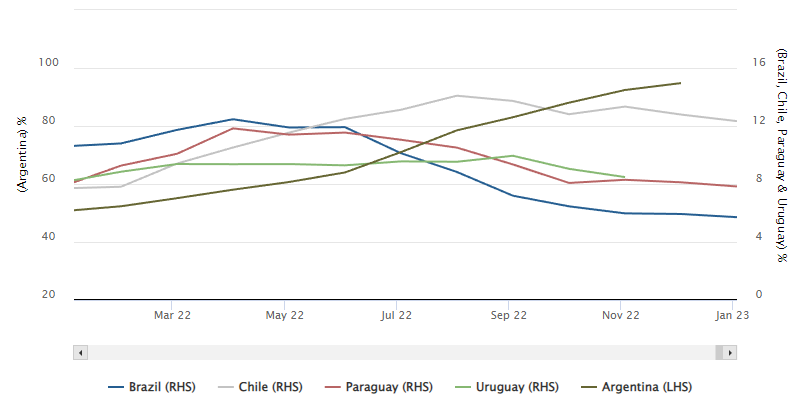
    Brazil & Southern Cone: inflation rate
    Percentage variation (year-on-year)

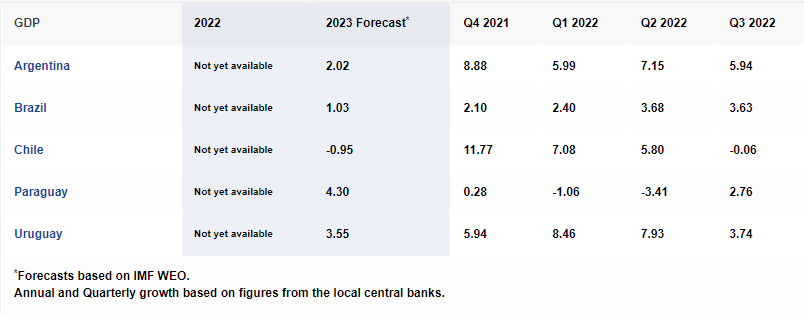
    Brazil & Southern Cone: GDP growth (%)
    Quarterly figures are year-on-year growth

  • VENEZUELA: Uncertainty reigns over opposition primary

    Patrick de Courcy 05 October 2023 Hits: 2511

    There are just two weeks to go before the 22 October primary election that will decide the presidential candidate for Venezuela’s opposition coalition Plataforma Unitaria Democrática (PUD).

    Three separate problems are hanging over the primary election and causing deep uncertainty for the PUD. Firstly, it is unclear whether the PUD’s national primary commission (CNP) has surpassed the logistical obstacles to holding the vote, including securing access to enough voting centres around the country. Venezuela’s national electoral council (CNE) has offered to lend its assistance, but this has created a second dilemma for the opposition given that the CNE is stacked with government loyalists who many suspect are seeking to undermine the primary. Finally, there is the issue of what will happen if one of the primary’s three frontrunners – María Corina Machado, Henrique Capriles Radonski, and Freddy Superlano – wins the vote, given that all of them are subject to bans on holding public office.

    The first two problems are connected. Accepting the CNE’s support would give the PUD access to official voting centres, although suspicion is rife that the electoral authority is seeking to subvert the primary process. These suspicions have been heightened by the CNE’s repeated calls for the primary election to be postponed to 19 November – a proposal which has been rejected by all of the PUD’s 13 pre-candidates. Meanwhile, the CNE has not responded to the opposition’s request for technical support, which includes securing access to 400 additional voting centres and coordinating with the interior and defence ministries to ensure security on voting day. On 2 October the CNE again stated its willingness to support the primaries, while making no mention of these requests from the PUD.

    The CNE is also arguing that voting in the primary should be done electronically, rather than manually, arguing that this would increase transparency. This has further fanned suspicions that the electoral authority is planning to meddle in the voting process – doubts which will not have been assuaged by the CNE’s dubious claim on 3 October that Venezuela has “the best automated system in the world”.

    Allowing the CNE to participate in the primary process would also put the candidacies of the three frontrunners in jeopardy. Elvis Amoroso, the CNE’s president, signed off on the disqualification of Machado during his previous role as comptroller general, igniting fury among the opposition [WR-23-27]. The CNE would also be expected to insist on the exclusion from the primary of Superlano, who in 2021 was barred by the supreme court from holding public office, and Capriles, who was barred from public office in 2017.

    Of course, these candidates’ insistence that they will compete in the primary regardless of the controversial bans on their participation could also backfire. It is unclear what the PUD’s response will be if one of the disqualified candidates wins the primary only to be declared ineligible for the election, which is due to be held at an unspecified date next year. Discussions are underway within the PUD on whether a line of succession should be established if this comes to pass. Lawrence Castro, a member of Superlano’s Voluntad Popular (VP), said on 20 September that “there must be a broad mechanism that allows us to agree on a succession,” adding that “we can’t risk leaving the Venezuelan people without an option, and that merits a strategy, and also generosity [between candidates], in order to achieve victory”.

    Fall in protests

    The Venezuelan NGO Observatorio Venezolano de Conflictividad Social (OVCS) registered 389 protests in the country in August – down by 43% on August 2022, when it counted 667 protests. According to the OVCS, leading issues driving the protests this August were low wages, the controversial sentencing of six trade union leaders to 16 years in prison, and concerns over the state of Venezuela’s democratic institutions.

  • ARGENTINA: Milei’s balancing act between austerity and popularity

    Abbi Dicker 19 April 2024 Hits: 2847

    President Javier Milei’s bid to fix Latin America’s third-largest economy is a race to see if his shock therapy can produce results before Argentinians run out of patience.

    So far, he has made some progress in stemming the economic bleeding and, surprisingly, has lost relatively little support since he took office just over four months ago. But the 53-year-old libertarian economist still faces a laundry list of challenges before he can claim a reasonable chance of success. At the top of that list is slashing runaway inflation and establishing a working majority in congress so he can actually govern and rebuild the state and its economy, rather than just shrinking it to save money.

    So far, Milei’s biggest success is having prevented the disintegration of the Argentinian economy and a default of the state. When he took over, the central bank had negative net reserves of more than US$11bn despite currency exchange controls; inflation was running at 160% despite price controls; and the government had to borrow a whopping 10% of GDP to finance its bloated budget.

    Having slashed expenditures across the board since taking office late last year, the government began spending less money than it has – the first time that happened since 2012 – and is on target to reach a balanced budget this year. At the same time the central bank has boosted foreign reserves by more than US$12bn through early April. Argentina’s perceived country risk, as measured by the price charged to insure against default on its debt, has fallen to its lowest level in five years.

    The problem with Milei’s economic remedies is that for average Argentinians things are getting worse. The peso devaluation, the lifting of price caps, and the elimination of many subsidies have all caused inflation of more than 280% from a year ago. Meanwhile salaries have fallen far behind, meaning consumers are struggling to make ends meet. Public works are largely halted and unemployment is rising. As a result, the economy has accelerated its nosedive and is expected to contract 2.8% this year, according to the International Monetary Fund (IMF).

    Domestic consumption fell but not by as much as one would expect. The consumer index during the first two months of the year was down 2.7% from the same period in 2023, and in February even bounced back 1.5% from January. Discretionary spending, of course, fell sharply, with outlays for culture and entertainment plummeting 13.2% in February.

    There have been renewed strikes and protests, such as the one by the public sector employees’ union Asociación Trabajadores del Estado (ATE) in late March against the administration’s dismissal of the first 15,000 of 70,000 planned redundancies. But by and large the mood in the street hasn’t reached fever pitch as it did in the runup to the Argentinazo, the violent revolt of December of 2001. 

    In fact, Milei’s support remains surprisingly strong at just under 50%, as many of his supporters still trust he will be able to put the economy back on track. Nearly half of Argentinians say they have trouble making it to the end of the month, but more than one-third of them support Milei.

    There are a number of explanations for this. One is that Milei portrayed himself as an outsider and doesn’t face the level of distrust that traditional politicians face as a result of years of mismanagement and corruption. Milei has exposed irregularities and cut out union leaders as intermediaries managing welfare programmes, which has shaken the labour movement in the first months of his administration. A divided Peronist opposition licking its wounds after a resounding electoral defeat also plays into Milei’s hands. Finally, Milei made it clear that there would be austerity measures, which doesn’t make them easier to bear, but the country was psychologically prepared for them.

    The next big measures of forces will be the May Day protests, an important date in Argentine politics. Unlike the general strike in January, neither workers nor students will be on holidays, meaning protests may garner a potentially bigger turnout. 

    Slowing inflation

    The government has celebrated slowing inflation as a clear sign of light at the end of the tunnel. Inflation has eased from over 25% in December to 20.6%, 13.2% and around 10% in the following three months. “Inflation is collapsing,” Economy Minister Luis Caputo told local television channel TN News. “In the case of food and drinks, if you look at the supermarket data of the first week of April, it’s negative, there’s deflation.”

    One of the reasons for the falling prices, Caputo said, is that retailers had forecast an exchange rate of Ar$2,000 to the US dollar. Instead, the peso gained from 1,255 in January to around 985 against the dollar in early April.

    But slowing inflation doesn’t replace lost purchasing power. Also, there are still subsidy cuts and increases of administered prices in the pipeline. The idea, though, is that with a balanced budget, a stable currency and all price caps and subsidies removed, the driving forces of inflation will have been tamed. According to the latest central bank survey published on 8 April, the consensus forecast for 2024 inflation fell to 189.4% from a December forecast of 218%.  

    As part of the high wire act between economic shock therapy and popular support, the otherwise hardcore liberal Milei postponed some utility price increases and increased pension payments for retirees, who had borne the brunt of the belt-tightening measures.

    Omnibus goes round again

    On the political front, Milei also seems to have learned something in recent months. After seeing his all-encompassing omnibus bill defeated by congress in a head-on confrontation with legislators and provincial governors, Milei has now taken a more conciliatory approach.

    Rather than ignoring its potential allies, this time around the administration negotiated a more modest bill that would still give Milei powers to overhaul swathes of the country’s economy. The proposal was sent to congressional leaders and the governors on 9 April for final observations ahead of a new round of legislative debates and voting.

    Under the new proposal, the government would still obtain “special powers” in administrative, economic, financial and energy matters, but these would be limited to one year without the possibility of renewal. In addition, the government must report every month and in detail to congress “about the exercise of the delegated powers and the results obtained”.

    Like its predecessor, the current bill would grant the government the right to privatise many of the state-owned companies, including postal services, railways, and media outlets, as well as the airline Aerolíneas Argentinas, water company AySA and energy company Enarsa. Other public assets in banking, insurance, and hydrocarbons could be partially sold off.

  • More signs of tension in South China Sea

    LatinNews 06 September 2011 Hits: 352

    We continue to monitor closely China’s relations with its neighbours.  Two developments in the past week are worth noting.

    First, on 24 August, two Chinese fishery patrol boats entered Japanese waters around the Senkaku Islands (controlled by Japan but claimed by China as the Diaoyu Islands).  When the Chinese vessels were challenged by a Japanese patrol boat, the Chinese crew responded by radioing back: “Diaoyu and its neighbouring islands are Chinese indigenous territories.  We are discharging our legitimate duties in Chinese waters.”  The Chinese boats spent about 40 minutes in Japanese waters.  According to Japanese officials this was the first time that Chinese fishery patrol boats had entered Japanese territorial waters near the Senkaku Islands.  Since last September when a Chinese fishing boat collided with Japanese patrol vessels near the islands Chinese vessels have approached the islands 11 times without crossing into Japanese waters.

    Secondly, on 23 August, Philippines President Benigno Aquino inspected the country’s newly acquired warship BRP Gregorio del Pilar, a refurbished US Coast Guard cutter.  On 1 August China’s People’s Daily, the official newspaper of the Chinese Communist Party, had attacked the Philippines following a report that Philippine navy engineers were building a structure on the Feixin Islet in the disputed Spratly archipelago.  The paper said:  “Parties concerned must soberly realize that [China’s policy of ‘shelving disputes and developing together’] does not mean that China will casually let certain countries take advantage of this opportunity to ‘nibble away’ Chinese territories.  Any serious misjudgement will inevitably pay a necessary price.”

    Aquino has clearly not taken the warning in the way China intended.  On the contrary, during his inspection of the newly acquired warship, Aquino promised increased modernization of the armed forces and pledged: “This ship symbolizes our newly acquired ability to guard, protect, and if necessary fight for the interests of our country.  This is just the beginning.  Expect more good news because we will not stop at one ship.”  In particular, the president said, “this will upgrade our capability to guard our exclusive economic zone...”

  • RASTREANDO TENDENCIAS

    LatinNews 19 September 2011 Hits: 497

    VENEZUELA | Inflación implacable. La inflación llegó al 13% en la primera mitad de 2011, informó el banco central. Eso significa que Venezuela está en curso de llegar a una inflación similar al 27,2% registrado en todo el 2010, por lejos el más alto de la región. La inflación en junio llegó a 2,5%, más alta de lo esperado, después que el gobierno elevó el tope de los precios de los alimentos básicos, como pan, leche y azúcar para evitar escasez después de la devaluación de 40% que produjo que las importaciones resultarán mucho más caras. El gobierno también duplicó la tarifa del metro, la primera vez que ocurre un incremento de ese tipo desde2006.

  • TRACKING TRENDS

    LatinNews 01 December 2011 Hits: 1982

    MEXICO | Economic growth. In the five years of President Felipe Calderón Hinojosa’s administration the economy has grown by an average of less than 1.5% a year, which is less than the rate of population growth. His administration, however, can boast the lowest inflation rate for any recent Mexican government: 4.2% a year.

    Calderón’s immediate predecessor, Vicente Fox (2000 to 2006) had a pretty similar record: 4.4% inflation and 1.5% GDP annual growth. The last two Partido Revolucionario Institucional (PRI) presidents, Ernesto Zedillo (1994 to 2000) and Carlos Salinas de Gortari (1988 to 1994) also had pretty similar GDP growth records of 3.6% and 3.7% a year respectively. Their inflation records were much worse: 22% a year and 16% a year respectively.

    On the peso, all four governments have presided over a weak currency. Under Zedillo the peso lost 79% of its value in the first years of his administration; under the first five years of Salinas the devaluation was 36%; Fox had a 12.5% devaluation in his first five years while Calderón has seen the peso slide by 25% over his first years.

    Strangely, if off-balance sheet debt is ignored, Calderón’s is the only administration to have increased the public sector foreign debt in its first five years.

    MEXICO | Nafta. On 23 November the US truckers’ union, the Teamsters, went to a federal court in the US to seek a legal injunction to stop the pilot scheme which allows some Mexican trucks complete access to destinations in the US (see sidebar). The Teamsters claim that the Mexican trucks damage the environment. The Teamsters’ president, Jim Hoffa, said that Mexican trucks were dirty and dangerous and threatened US truckers, wholesalers and the environment.

  • BOLIVIA: Dos acuerdos clave, pero una nueva amenaza para Morales

    LatinNews 25 April 2014 Hits: 1249

    El Presidente de Bolivia, Evo Morales, bien podría proclamar los dos recientes acuerdos logrados antes de su intento de reelección en octubre: uno con las cooperativas mineras (cooperativistas), que ha seguido a los recientes choques letales por la propuesta de un proyecto de ley minera [IL-14-14]; y el otro con la principal organización sindical, la Central Obrera Boliviana (COB), sobre aumentos en el salario mínimo. Estas dos fuerzas han proporcionado fuentes de malestar para el gobierno de su Movimiento al Socialismo (MAS) en años recientes. Sin embargo, mientras Morales permanece como el claro favorito antes de las elecciones, una huelga sin precedentes convocada por miembros de menor rango en las fuerzas armadas, está provocando un inesperado motivo de preocupación para su gobierno.

    El 21 de abril, el gobierno del MAS y la COB acordaron un aumento general de salarios del 10%, y un incremento del 20% en el salario mínimo nacional, elevando éste último a B$1.400 (US$203) por mes, subiendo de B$1.200 (US$174) en el 2013. El gobierno, por su lado, había ofrecido inicialmente incrementos del 7% y el 10%, pero el acuerdo final estuvo mucho más en línea con el 12% y el 20% exigido por la COB, que ahora parece haber abandonado su fantástico pedido tradicional de B$8.300 (US$1.199), basado en sus estimaciones sobre el costo de la canasta básica de bienes.

    Flanqueado por sus ministros de economía y de trabajo, Luis Arce y Daniel Santalla respectivamente, el Presidente Morales destacó  que el salario mínimo nacional se había incrementado un 173% desde el 2005, el año antes de que él asumiera el poder. También fue rápido en destacar que el incremento fue significativamente más que la tasa de inflación del 6,48% registrada en el 2013 (subiendo del 4,5% en el 2012).

    Morales dijo que el aumento salarial estaba en línea con los esfuerzos de su gobierno por redistribuir la riqueza –teniendo en cuenta que el crecimiento económico alcanzó el 6,4% en el 2013 según el último informe (de enero del 2014) de la Comisión Económica para América Latina y el Caribe (Cepal) de la ONU. La cifra del 2013 fue la tercera más alta en la región después de Paraguay (13%), y Panamá (7,5%). El mismo informe proyecta un crecimiento del 5,5% para Bolivia en el 2014, segunda sólo detrás de Panamá (7,0%). Por su lado, el banco central de Bolivia anunció el 20 de abril que las reservas internacionales llegaron a US$14,4mm hasta el 31 de diciembre del 2013, subiendo US$503m sobre el 2012

    Tal como fue el caso con el decreto de Morales en noviembre del 2013, estableciendo un segundo bono de pago anual cuando el crecimiento anual real del PIB exceda el 4,5% [IL-13-48], los grupos de presión del sector privado, como la Confederación de Empresarios Privados de Bolivia (CEPB), se apresuraron a calificar el último incremento salarial como motivado por razones electorales. Ellos se han quejado por el hecho de que el sector privado ha sido excluido de las conversaciones.

    Estos reclamos no son totalmente injustificados, dado que el propio Morales ha admitido que la COB permanece de gran importancia para su intento por la reelección. A fines del mes pasado, él dijo a los periodistas que la COB podría agregar un 10% adicional a sus votos; aunque incluso sin el apoyo de la COB, él espera superar el 64% de los votos con lo que obtuvo la reelección en el 2009.

    Aunque la COB ha sido un aliado tradicional del MAS, sus diferencias con el gobierno se han vuelto más pronunciadas durante el segundo mandato de Morales (que se inició en el 2010) sobre cuestiones como el fallido intento del gobierno de eliminar los subsidios del Estado a los combustibles en diciembre del 2010 (el gasolinazo) y los incrementos en el salario mínimo. Este descontento culminó con la COB lanzando un nuevo partido, el Partido de los Trabajadores (PT), en enero del 2013. Mientras que el decreto de noviembre del 2013 parece haber logrado su objetivo de poner a la COB de vuelta a su lado –el día siguiente la COB anunció la disolución del PT– la central obrera ha sido bien clara en que su apoyo no es incondicional (ver más abajo).

    Otro acuerdo

    El mismo día en que Morales anunció el incremento de salarios, el ministro del interior, Carlos Romero, develó un acuerdo entre el gobierno y los cooperativistas, agrupados en la Federación de Cooperativas Mineras (Fencomin) con relación al nuevo proyecto de ley minera. Esto siguió al punto muerto después de que la cámara baja de la legislatura plurinacional aprobara, el 29 de marzo, los cambios al proyecto de ley minera, elaborado para reemplazar el código minero de 1997, aprobado bajo la administración liderada por Gonzalo Sánchez de Lozada (1993-1997; 2002-2003), que había provocado las protestas de Fencomin.

    Los cooperativistas habían objetado específicamente una enmienda al artículo 151 del proyecto de ley, que había autorizado a las cooperativas a firmar contratos con compañías privadas. La enmienda eliminó este artículo sobre la base de que era inconstitucional, estipulando que solamente el Estado boliviano está de hecho autorizado a firmar contratos con inversionistas privados para explotar los recursos naturales. Esto provocó protestas de los cooperativistas que se convirtieron en letales.

    Bajo el acuerdo logrado el 21 de abril con los cooperativistas (cuyo número llega a entre 80.000 y 120.000 de acuerdo con estimaciones del 2012), las cooperativas pueden formar compañías mixtas con la compañía minera del Estado, la Corporación Minera de Bolivia (Comibol), pero no con compañías privadas, ya sean extranjeras o locales. Aunque aún falta que el gobierno clarifique si cumplirá su promesa de reelaborar el proyecto de ley minera (que ya lleva tres años tramitándose), el acuerdo es una solución a la disputa, bienvenida por el gobierno, particularmente teniendo en cuenta las amenazas hechas por el líder de Fencomin, Alejandro Santos, de que “así como hemos llevado a Evo al poder, así también lo podemos remover”.

    Otra complicación

    Mientras que ambos acuerdos serán cruciales en términos de asegurar el respaldo de la base de apoyo tradicional del MAS antes de las elecciones de octubre, la amenaza del malestar de los militares podría convertirse en otra prueba más para Morales. La “huelga por tiempo indefinido” fue anunciada el 21 de abril por el presidente de la Asociación Nacional de Suboficiales y Sargentos de las Fuerzas Armadas (ASCINALSS), Suboficial Johnny Gil Leniz. La huelga fue provocada por la decisión, anunciada el día anterior, por el ministro de defensa, Rubén Saavedra, de destituir a cuatro suboficiales que habían pedido una reforma interna de las fuerzas armadas –la primera de exigencia de tal clase bajo el mandato del Presidente Morales.

    Los suboficiales destituidos (dos de la fuerza aérea, uno del ejército, y uno de la armada), habían presentado una propuesta el 3 de abril, citando la necesidad de abordar el tema de la “discriminación dentro de las fuerzas armadas”. Entre otras cosas, la propuesta pide que se permita que los suboficiales tengan las mismas oportunidades educacionales que sus superiores y que los rangos de suboficiales y sargentos sean reemplazados con la denominación de “oficiales técnicos”. Además de los cuatro oficiales destituidos, más de 50 estudiantes de la escuela de ingeniería militar y la escuela de aviación técnica fueron expulsados por asistir a una reunión relacionada con la iniciativa.

    Mientras Saavedra minimizaba la amenaza del malestar, destacando que solamente 500 de los 10.000 suboficiales tomaron parte en las protestas del 22 de abril, el gobierno ha dicho que está abierto a la negociación. Sin embargo, está aún no ha producido resultados concretos.

    Claramente, Morales no está dejando ninguna chance de que el malestar se extendiendo a la policía, que en el 2012 montó revueltas para exigir mejores salarios y condiciones de trabajo [IL-12-25]. El 22 de abril, el gobierno anunció un acuerdo con la Asociación Nacional de Policías (ANSSCLAPOL) para elevar los gastos del alimento diario para oficiales de la policía a B$7 (US$1), subiendo de B$4,50 (US$0,65).

    • Ganancias

    El viceministro de Bolivia para el presupuesto y la responsabilidad fiscal, Jaime Durán Chuquimia, dijo recientemente a los periodistas que las ganancias de las compañías del Estado alcanzaron B$6,62mm (US$959m) en el 2013, subiendo de B$6,4mm (US$932m) en el 2012 y B$69m (US$9,9m) en el 2005. Chuquimia dijo que ahora existen 23 compañías del Estado, subiendo de seis compañías públicas en el 2005. Y agregó que la compañía petrolera estatal, Yacimientos Petrolíferos Fiscales Bolivianos (YPFB), representa un abrumador 96,7% de las ganancias, contribuyendo B$6,4mm al total. YPFB es seguida por la compañía minera del Estado, la Corporación Minera de Bolivia (Comibol), con B$297m; la Empresa Nacional de Electricidad (Ende), con B$187m; y la compañía minera, Metalúrgica Vinto, con B$34m.

    • Exigencias de la COB

    En una entrevista con el diario nacional, La Razón, el 16 de febrero, el secretario general de la COB, Helmo Pérez, dijo que el incremento salarial era una de las cuatro demandas de la COB de cara a las elecciones. Las otras incluyen mayor participación política (la COB está exigiendo que candidatos sindicalistas sean incluidos en la lista del MAS); compromisos incluidos en la esfera productiva (la COB está pidiendo la reactivación de proyectos mineros estancados, así como también plantas de industrialización en ciertas áreas); y que el gobierno aborde la escasez de viviendas para trabajadores miembros de la COB.

  • URUGUAY: Mujica drops regal pretensions

    LatinNews 16 October 2014 Hits: 2629

    “You know I don’t duck decisions that have to be made but a president is not a king,” President José Mujica said this week while announcing that he would take no decision on whether to accept six detainees from the US detention camp at Guantánamo, Cuba, until he had consulted with the victor in the upcoming elections. How far this complete change of tack owed to the party hierarchy of the ruling left-wing Frente Amplio (FA) pressuring him to back down on an issue which does not have public support, and could sway an election which is balanced on a knife-edge away from the FA, is a moot point.

    “We’ll have to see the opinion of the next government,” President Mujica said in reference to Guantánamo. Mujica, who had previously asserted his right to make a unilateral decision on the matter, and savaged the main opposition Partido Nacional (PN) and its presidential candidate Luis Alberto Lacalle Pou for jeopardising trade with the US by criticising his gesture [WR-14-40], sounded a much more emollient tone on 9 October.

    Mujica followed up on this dramatic U-turn by announcing that he will run for a seat in the senate in order to assist with obtaining consensus in a “difficult” post-electoral scenario. Mujica was responding to recent opinion polls which have suggested that not only will the FA have to fight a closely contested second round run-off to retain the presidency for a third straight term but it will also lose its tiny majority in both the lower chamber of congress and the senate, leaving a hung congress to complicate governance for the next head of state. Mujica will lead the senate list of the Movimiento de Participación Popular (MPP), the largest faction in the FA. He is barred from campaigning but his election is assured along with that of his wife, Senator Lucía Topolansky.

    Mujica’s sudden focus on the need for level heads to seek consensus comes after days of verbal asperity over Guantánamo. Lacalle Pou’s running mate, Jorge Larrañaga, was unconvinced. He expressed his “perplexity” that Mujica was suddenly intent on dialogue to construct consensual majorities in the senate. “He will have to talk to rotten souls, with the nabos (pricks) and with all of those who think differently to him,” Larrañaga said, pointedly selecting the insults flung at the PN party leadership by Mujica just days earlier.

    Meanwhile, the FA presidential candidate, former president Tabaré Vázquez (2005-2010), was none too pleased with Mujica’s bleak predictions of complex post-election scenarios. Vázquez was in Buenos Aires at the weekend urging Uruguayans living on the other side of the River Plate to assist him to get over the line in the first round on 26 October. More than 100,000 Uruguayans live in the Argentine capital, making it one of the most important and influential electoral districts.

    • Mujica waxes lyrical on free trade

    “It is our fate to live in a world with 350 free trade treaties. In reality what there is least of in the world is free trade. This is paradoxical. The more treaties there are the more difficult it is to sell for those who are outside of these treaties, but when you are inside you don’t have guarantees of free access to the markets with which you signed the treaty,” President Mujica said during his weekly radio broadcast on 7 October.

    “Brazil might be able to afford the luxury of being a fairly closed economy,” Mujica went on “but Uruguay can in no way allow itself to become isolated.” Mujica reiterated his commitment to the Southern Common Market (Mercosur) but also suggested that Uruguay could well seek greater flexibility to negotiate bilateral trade deals in the future rather than as a bloc.

    • Electoral forecast

    It is many months now since any opinion pollster in Uruguay has predicted that the FA could win in the first round and all of them now point towards a technical tie between the FA presidential candidate Tabaré Vázquez and his PN rival Luis Alberto Lacalle Pou in a run-off at the end of November.

  • ECONOMIC OVERVIEW: EL SALVADOR

    LatinNews 08 July 2015 Hits: 2483

    El Salvador’s economy grew by 2.3% in the first quarter of 2015, which is higher than the historical average over the last decade, according to the central bank (BCR). The main factors behind the economic growth were an increase in exports, higher household consumption and more jobs in the manufacturing sector.

    Despite this slight upturn, the president of the BCR, Óscar Cabrera Melgar, cut the growth forecast for this year from a range of 2.2%-3.5% to 2%-2.6% due to slightly weaker than expected US growth. This has contributed to slower growth in remittances which totalled US$1.73bn in the first five months of this year, up just 1.1% on the same period in 2014.

  • PARAGUAY: Students force Cartes’s hand

    LatinNews 12 May 2016 Hits: 2167

    Secondary students have forced the departure of the head of Paraguay’s education & culture ministry (MEC) appointed by President Horacio Cartes as part of his ‘national team’ cabinet when he assumed office in 2013. The fifth change to Cartes’s cabinet came after days of protests and the taking over of more than 100 secondary schools across the country by students demanding major changes at the MEC and increased spending to drive up the quality of education in Paraguay.

    The protests began on 3 May when a group of students took over the Colegio Nacional República Argentina (CNRA) public school in Asunción, demanding the resignation or dismissal of MEC head, Marta Lafuente, to face investigations for her alleged involvement in a corruption case around dubious contracts for the provision of school meals signed by the MEC. This after the local press revealed that the MEC was sourcing meals at inflated prices, in what looked like a major influence trafficking and graft case.

    Lafuente, who denies any wrongdoing, was summoned to appear before congress to face questioning amid threats of her censure, but she never did. With the protest action by the CNRA being supported by secondary school student organisations and more schools being occupied, Lafuente was forced to address the matter. But her attempts to negotiate personally with students failed, as they insisted on her resignation. After secondary school organisations took over public and private schools across Paraguay, and parents, university students and teachers’ unions backed calls for her to go, Lafuente’s position became untenable.

    After holding a closed-door meeting with Cartes to discuss the crisis, Lafuente tendered her resignation during a 5 May press conference. Cartes immediately accepted it but publicly praised Lafuente for leaving “clear and healthy accounts at the MEC”. These remarks upset the students, who in their own press conference announced that despite Lafuente’s departure, they would continue with their protest until Cartes met them so that they could put their grievances to him, including the demand to increase education spending from the current 3.5% of GDP to the 7% recommended by the United Nations Educational, Scientific and Cultural Organisation (Unesco), and of a major overhaul at the MEC.

    Cartes, who has been reluctant to make administrative changes even in the face of considerable political and public pressure, decided to go ahead with a scheduled two-day trip to Argentina (see sidebar) rather than meet the students, appointing the controversial figure of Enrique Riera as Lafuente’s replacement before leaving. Riera, a former mayor of Asunción (2001-2006) from the ruling Asociación Nacional Republicana-Partido Colorado (ANR-PC), has long been accused by the relatives of victims of the 2004 fire at the Ycuá Bolaños supermarket of being politically responsible for the failings in the building’s construction and fire escape plan, which had been approved by his administration. A total of 396 people lost their lives in the tragedy.

    Meanwhile, the students announced that they would step up their protests if Cartes continued to ignore them. Perhaps mindful of the mass demonstrations in demand of quality education last year in the wake of the major corruption scandal uncovered at the state-run Universidad Nacional de Asunción (UNA), Cartes met the students upon his return on 11 May and signed a document pledging his commitment to meet their demands. The students duly called off their protest but Cartes is now under pressure to deliver.

    • Argentina visit

    Presidents Horacio Cartes and Mauricio Macri agreed in Buenos Aires to set up a permanent negotiating table to settle Paraguay’s historic debt with Argentina over the construction of the Yacyretá binational hydroelectric dam. The settlement of the debt is a long-term demand by Paraguay, which disputes the US$12bn valuation set by Argentina on the grounds that the unused share of its electricity allocation produced at Yacyretá has been ‘ceded’ to Argentina at concessionary prices since the dam’s completion in 1994 under the bilateral agreement and should be considered as going towards the payment of the loans taken on by Argentina to build the dam. Successive Paraguayan governments have tried unsuccessfully to reach a settlement with Argentina. But given Cartes’s affinity with Macri there is optimism in Paraguay that the two governments will now be able to reach a settlement.

  • Mexico: Lozoya avoids arrest

    LatinNews 20 November 2017 Hits: 192

    Emilio Lozoya, the former head of state oil company Pemex and a onetime close confidant of President Enrique Peña Nieto, is one of the biggest names to face accusations of corruption in Mexico. In August Brazilian newspaper O Globo said he had accepted US$10m in bribes from civil engineering company Odebrecht, in exchange for a contract to build a refinery; it is claimed the money was in part used to fund Peña Nieto’s election campaign. Yet some quick moves from Lozoya’s lawyers suggest he will avoid arrest for some time yet.

    In early August a Mexican federal judge accepted a request from Lozoya’s lawyers and issued a suspension order which in effect blocks the attorney-general’s office (Procuradoría General de la República – PGR) from prosecuting or ordering Lozoya’s arrest, until the point at which he is given full access to the files it holds on him and he is guaranteed the right to defence. Lozoya already has a reputation for aggressively defending himself. In October Santiago Nieto, the specialised prosecutor for electoral crimes, said he had come under undue pressure from Lozoya, who had written a letter demanding that Nieto publicly declare his innocence and apologise for the allegations against him.

    Nieto was subsequently dismissed for speaking to the press. Lozoya’s lawyers dispute Nieto’s claims; they say their client did not write such a letter and does not know formally know what the charges against him are. The net effect is that the PGR, which initiated an investigation into Lozoya’s dealings with Odebrecht in August, cannot for the moment lay formal charges against him or issue an arrest order. Both the PGR itself and its Fepade, its electoral crimes unit, are under interim leadership, which will also slow things down. Little further action appears likely on the short term: that said, the allegations against Lozoya, and the PGR’s lack of progress could become a major issue in the Presidential election campaign (the polls will be held on 1 July 2018).

  • DOMINICAN REPUBLIC: Will Medina seek re-election?

    LatinNews 09 May 2019 Hits: 936

    Uncertainty surrounds whether Dominican President Danilo Medina will seek to amend, or circumvent, the constitution to stand for a third term in presidential elections this time next year. The majority of legislators representing the ruling Partido de la Liberación Dominicana (PLD), which has held uninterrupted power since 2004, favour a reform to permit Medina to stand again. Former president Leonel Fernández, who has himself served for three terms but wants to stand for a fourth for the PLD in 2020, carried out a rally at the weekend opposing a constitutional change. An opinion survey published by Gallup suggests the majority of respondents share Fernández’s view, but a majority of PLD supporters would prefer to vote for Medina.

    President Medina said last August that he would take a firm decision on re-election by March this year, but he is yet to do so. His supporters staged rallies across the country on 5 May. Meanwhile, the main opposition Partido Revolucionario Moderno (PRM) staged demonstrations against a constitutional reform, and Fernández held a rally in the capital Santo Domingo opposing it. A total of 68.3% of respondents to a survey by Gallup published on 6 May rejected a constitutional amendment, which only 29.4% supported. Within the PLD, 55% supported it and 42% opposed it. When asked for whom they would vote in a PLD primary, 49.5% opted for Medina and just 27.9% Fernández.

    The Gallup survey, in which Medina obtained an approval rating of 52.9%, found that the main public concern was corruption, with 69% of respondents complaining that the government has not combated it successfully. The social organisation Marcha Verde has shot to prominence with large-scale protests against the Medina administration’s handling of the corruption case involving Dominican government officials and the Brazilian construction firm Odebrecht, which saw bribes totalling US$92m handed out to secure public works contracts between 2001 and 2014. On 7 May the public prosecutor’s office called for seven people to be charged with embezzlement and illicit enrichment in relation to the case, including a PLD senator, Tommy Galán Grullón, and three former PRM senators, Jesús Vásquez, Andrés Bautista, and Roberto Rodríguez.