
All Categories

Subcategories

  • Brazil

    LatinNews 09 October 2020 Hits: 899

    Brazil’s current government, led by right-winger Jair Bolsonaro, identifies closely with the Trump administration’s ‘Make America Great Again’ (MAGA) agenda. Bolsonaro has described himself as a “tropical Trump”. Although an international alliance between nationalist and populist governments may seem a contradiction in terms, the Bolsonaro administration has clearly sought the role of being Trump’s closest ally in the Western Hemisphere.

    On a whole range of issues, the two political leaders see eye-to-eye. Both have portrayed themselves as heroic outsiders seeking to drain a “swamp” of corrupt lobbyists and establishment politicians. Both have attacked traditional communications media with claims that it disseminates “fake news”. Both have displayed disdain for the traditional checks and balances of liberal democracy and are subject to various investigations alleging impropriety. Both have mis-managed the Covid-19 pandemic and shown themselves ill-at-ease with a complex and rapidly developing health crisis which requires scientific engagement and does not lend itself to simple explanations.

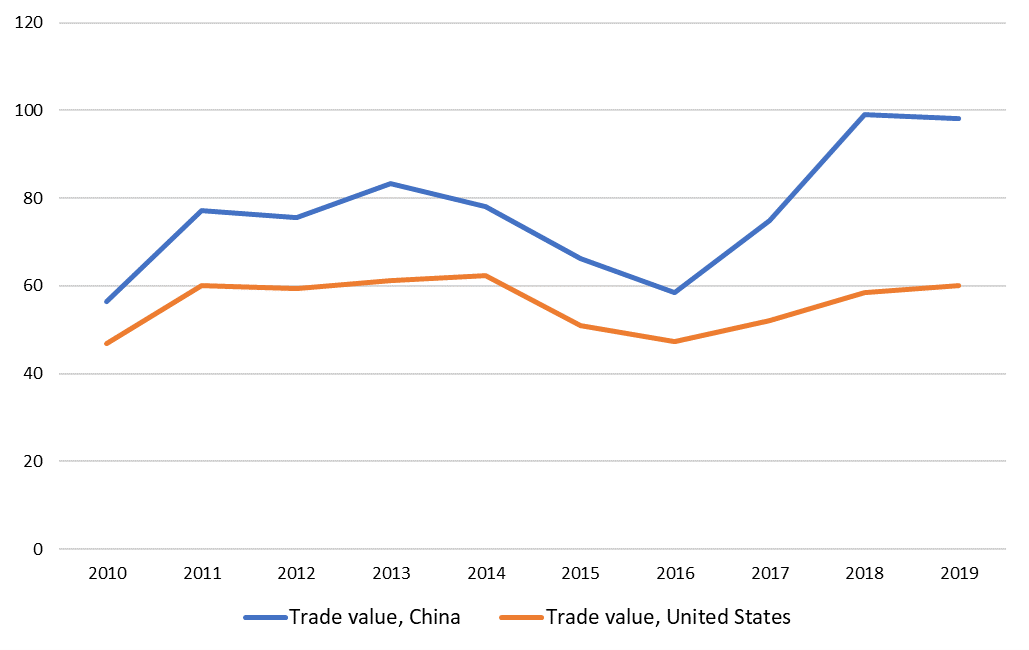
    Brazil: annual trade with US and China US$bn
    Source: International Trade Commission (ITC)

    However, real progress towards building a special relationship between Washington and Brasilia has been lacking. There are various explanations for this. One is that Latin America as a whole has remained a low priority area for US diplomacy under this administration. The Trump administration has engaged with only a few key issues such as migration and drug trafficking which has led it prioritise only a handful of countries in the hemisphere. Bolsonaro was elected in October 2018 and took office in January 2019, at the mid-way point in the Trump presidency. Despite a chaotic start to his presidency, followed by mismanagement of the coronavirus pandemic, by the third quarter of 2020 Bolsonaro was able to reverse falling approval ratings, building popularity on the back of generous emergency pay outs to the poor and those employed informally (a programme known as the “corona voucher”). Despite ongoing political volatility in Brazil, at the time of writing Bolsonaro was rated a serious contender for re-election in October 2022.

    Even if Bolsonaro retains his current political ascendancy, and President Trump gets re-elected, there will be obstacles to closer bilateral relations with Washington. Brazil trades more with China than it does with the United States and despite anti-communist, anti-China campaign rhetoric, in office Bolsonaro has had to be more pragmatic about maintaining the important trade link with Beijing. His administration may authorise Chinese telecoms manufacturer Huawei to provide components for 5G roll-out, breaking ranks with Trump’s boycott of the company on national security grounds.

    Both Trump and Bolsonaro have talked about the desirability of a bilateral free trade agreement (FTA) but little concrete planning or negotiation to make one happen appears to have taken place. Such a deal would require Brazil to either bring in its existing Mercosur partners (Argentina, Paraguay, and Uruguay), or to exit Mercosur entirely – a diplomatically complex choice. The Trump administration has also imposed tariffs on Brazilian products such as steel and aluminium, falling short of the special treatment the Brazilian authorities believe they deserve.

    Brazil-US relations under a Biden presidency could also turn out to have significant friction points. As we have already suggested, a Biden government will not immediately resume the cause of globalisation. Indeed, one of the effects of the Covid-19 pandemic has been a widespread reconsideration of the benefits of neoliberalism, free trade, and globalisation, with a greater premium now being placed on self-reliance and the protection of certain industries. Biden’s foreign policy advisers have spoken of a “new nationalism” and a “pro-American workers tax and trade strategy”. They have also talked of devising a foreign policy that serves the US middle classes, rather than the interests of top corporations.

    One area of difficulty is likely to be climate change and the protection of the environment. Brazil has come under increasing pressure from the European Union and major international corporations to take more robust measures to improve environmental protection in the Amazon and reverse a rising rate of deforestation. These have included a clear message from France that it will not ratify the EU-Mercosur free trade agreement, negotiated over two decades, if Brazil does not agree to further safeguards. Bolsonaro has reacted angrily, rejecting what he described as meddling in Brazil’s internal affairs. In his first televised debate with Trump on 29 September Biden suggested the US should invest in Amazon protection in return for concessions from Brazil. This led Bolsonaro to say his country would not be bribed. Next year, Brazil could find itself at odds with both the EU and the US on climate change issues.

  • EL SALVADOR: Bukele terminates Cicies agreement

    LatinNews 02 July 2021 Hits: 2681

    With accountability concerns already rife following the new legislature’s dismissal in May of the supreme court’s constitutional chamber (SC) and head of the attorney general’s office Raúl Melara [SSR-21-06], President Nayib Bukele has further set off alarm bells regarding transparency. In early June he ended the September 2019 agreement between the government and Organization of American States (OAS) establishing the International Commission against Impunity in El Salvador (Cicies), the creation of which had been a 2019 campaign pledge.

    Cicies already had few of the features enjoyed by its (now defunct) precursor in Guatemala – the United Nations (UN)-backed International Commission against Impunity (Cicig) – lacking for instance its ability to help prosecute cases. Until the dismissal of Melara, who, like the SC had been a prominent critic of Bukele, Cicies had, however, been investigating the health ministry’s alleged misuse of funds and irregularities surrounding public procurement contracts to combat the coronavirus (Covid-19) pandemic, among other cases.

    Bukele justified the decision to end the agreement, announced on 4 June, claiming that Ernesto Muyshondt, a former San Salvador mayor (2018-2021) for the right-wing opposition Alianza Republicana Nacionalista (Arena), had been hired as an adviser to OAS Secretary General Luis Almagro. Muyshondt is under investigation for alleged links to gangs and misappropriation of tax revenue, which he denies; a government statement accused the OAS of “promoting impunity” as a result. This has however provoked a stinging rebuke from the OAS which, in a 7 June statement not only rejected these claims regarding Muyshondt but went on to make public its differences with the Salvadorean government regarding Cicies, casting further doubt on the government’s commitment to fighting corruption.

    • Muyshondt

    In its statement, the OAS was clear that Muyshondt was “not hired as stated in the press release but was only made an offer at the time for an honorary contract, although this contract was never signed”; that prior to making the offer public the foreign ministry was notified and “at no time did it disclose any discrepancy regarding the possibility of making it”; and that “not even the hiring” would have given Muyshondt “immunity” before Salvadorean courts, much less “impunity”. The OAS statement said that “such errors in logic are inadmissible from every point of view” and the General Secretariat “does not want this to be used as an excuse for the Cicies to leave the country”.

    Among other things, these include a law promulgated on 5 May for the use of products for medical treatments in exceptional public health situations caused by the pandemic, which the OAS warns will ultimately benefit people who could have participated in acts of corruption due to the immunity established in Art. 4 of said law. The OAS also cites the government decision not to publish a descriptive report on the use of public funds in response to the pandemic, which it said contained “a series of irregularities with a criminal appearance”. It also accuses the new AG’s office of “smothering” Cicies in recent weeks, completely curtailing its investigative possibilities – government actions aimed at “preventing progress in the investigations into allegations of corruption by the current administration” and the government’s “recurrent attitude of trying to induce the Cicies to investigate actions of opposition politicians exclusively.”

    Harris’s first trip

    Bukele’s announcement regarding Cicies came three days after US Vice President Kamala Harris, who US President Joe Biden named to lead efforts with El Salvador, Guatemala and Honduras to tackle illegal migration, paid her first visit to the sub-region, travelling to Guatemala where she met President Alejandro Giammattei. Key to Biden’s US$4bn plan for Central America to address the root causes of illegal migration is the need to tackle corruption in the sub-region. Following her meeting with Giammattei, Harris announced various anti-corruption initiatives. These include the creation of an anti-corruption task force by the US Justice Department, with support from the US State Department, to include US prosecutors and law enforcement experts to investigate and prosecute corruption cases with a nexus in the US, Guatemala, and the region.

  • CUBA: Government hails May Day march

    Patrick de Courcy 05 May 2022 Hits: 3632

    Thousands took to the streets of Cuba’s main cities to mark 1 May – the first such rallies since the coronavirus (Covid-19) pandemic struck in March 2020. Heading up the celebrations were President Miguel Díaz-Canel, 90-year-old former president Raúl Castro (2008-2018), who remains the ultimate authority in Cuba, and other well-known figures such as Ulises Guilarte de Nacimiento, the general secretary of trade union federation, Central de Trabajadores de Cuba. The show of support for the Partido Comunista de Cuba (PCC) government was significant given the unprecedented protests which erupted last July over health, economic, and political grievances [WR-21-28]. However, human rights groups reported that, as in November 2021, when further planned protests were immediately quashed [WR-21-46], the government was not taking any chances.

    As in the years prior to the pandemic, the May Day marches were held to shore up support for the Cuban Revolution, which arguably faced one of its greatest challenges last year, and serve as a rallying point against the decades-old US embargo on the island. However, US-based human rights NGO Cubalex and civil-society group Justicia 11J, which has been following the trials of the anti-government protesters detained in relation to the July 2021 unrest, warned of an increase in repressive acts against activists, opposition figures, journalists, and relatives. According to a 2 May statement by Cubalex and Justicia 11J, the two organisations documented a total of 80 incidents between 26 April and 1 May, including 12 interrogations, 28 incidents of police surveillance, 13 arrests, and five cases of forced disappearance.

    These reports come amid more general concerns about the convictions and trials of the July 2021 anti-government protesters, which has drawn criticism from the US and European Union (EU) [WR-22-14] among others. Most recently, a statement by Spain-based NGO Prisoners Defenders (PD), presented before the United Nations (UN) Committee against Torture (CAT) which reviewed Cuba on 21 and 22 April, reported over 5,000 arbitrary detentions and over 1,200 political prisoners prosecuted. This followed official information released by Cuba’s attorney general’s office (FGR) in January which acknowledged that as many as 790 people had been indicted.

    Migration talks

    As well as familiar anti-US rhetoric in response to the embargo, the Cuban government is also objecting to Washington’s exclusion of Cuba from the Summit of the Americas heads of state meeting to be hosted by the US next month. Yet despite these complaints, recent migration talks between both sides have been hailed as a small step forward with regard to bilateral relations which remain strained under US President Joe Biden despite the latter’s 2020 campaign pledge to try to reverse the hardline policies on Cuba of his predecessor Donald Trump (2017-2021).

    In what was the first significant bilateral diplomatic dialogue since Biden took office in 2021, on 21 April US and Cuban officials met in Washington DC to discuss the implementation of the US-Cuba Migration Accords - the first migration talks since 2018. Headed up on the Cuban side by Deputy Foreign Minister Carlos Fernández de Cossío and on the US side by US Deputy Assistant Secretary for Western Hemisphere Affairs Emily Mendrala, the meeting took place as the UN Office for the Coordination of Humanitarian Affairs (OCHA) and other agencies report that 32,141 Cuban migrants were processed at the Mexico-US border in March, double February’s count and trailing only Mexico’s 87,388 migrants.

    Alarcón

    On 30 April, Cuban veteran foreign diplomat Ricardo Alarcón died at the age of 84. A trusted adviser to the late president Fidel Castro (1959-2008) and Raúl Castro, and a former president of the national assembly (1993-2013), Alarcón was one of the visible external representatives of the Cuban government and, for many years, the main point man in Cuba’s delicate relations with the US on issues including immigration.

  • COLOMBIA: Petro shakes up cabinet

    Abbi Dicker 07 March 2024 Hits: 3649

    Colombia’s President Gustavo Petro conducted a mini reshuffle this week which saw the most independent-minded technocrat left in the cabinet sidelined and close allies promoted. Alejandro López, a former senator for the left-wing Polo Democrático Alternativo (PDA), takes over as the new director of planning (DNP). He replaces Jorge Iván González, who had survived previous shake-ups despite signing a letter criticising Petro’s health reform. Former senator Gustavo Bolívar takes over at the social prosperity department (DPS), which has ministerial status, replacing Laura Sarabia, Petro’s former chief of staff and closest adviser, who has been appointed as head of the influential administrative department of the presidency (Dapre).

    The appointment of López, the first non-economist to head the DNP, and who confessed to finding maths difficult, distances President Petro further from the technocrats who supported his presidency and strengthens the presence in his cabinet of political and ideological allies less likely to stand up to him. López lost his seat in the senate after a council of state ruling in November last year found him guilty of dual party membership for having supported the congressional candidacy of Jorge Édgar Flórez, of the Alianza Verde, in the 2022 elections, even though it was not part of his coalition, which presented a separate list.

    González, a veteran academic, economist, and philosopher, argued in a column in the national daily La República on 16 February, upon confirmation of his replacement, that Petro’s reform proposals were “absolutely valid” but foundered on practical reality. “Instead of accepting actual facts as a reality to which it is necessary to respond, the president has fallen into the temptation of denying them,” he said. “Intrinsic limitations feed disillusionment and generate frustration. Voters feel that promises are not being fulfilled and accomplishments fall short of expectations,” he added.

    The new DPS head, Bolívar, is, like López, a stalwart Petrista. He replaces Sarabia, who is back in a position of maximum influence at the Dapre, working in an office next door to Petro. Sarabia replaces Carlos Ramón González, who takes over as head of the national intelligence agency (DNI). She has been fully rehabilitated after the briefest of stints on the sidelines after being embroiled in a major scandal last year involving alleged illegal wiretapping and a polygraph case for which she is still being investigated by the attorney general’s office [WR-23-23].

    Petro’s decision to bring more acolytes into his cabinet and re-empower Sarabia shows he is intent on doubling down on his reform agenda. His pension reform is mired in the senate. The right-wing opposition Centro Democrático (CD) and Cambio Radical (CR) have been repeatedly denying quorum in the senate, leading Petro’s Pacto Histórico to accuse them of “sabotage”. If the government could muster more support, it could break the CD and CR’s tactics. Petro might have had this in mind when appointing Luz Cristina López of the right-of-centre Partido Conservador (PC) as the new sports minister to replace Astrid Bibiana Rodríguez (who resigned after Colombia was stripped of the Pan American Games, which was going to be hosted by the coastal city of Barranquilla in 2027) on 21 February.

    López’s appointment prompted Senator Efraín Cepeda to tender his resignation as president of the PC, saying he could not in good conscience stay in the position without “clarity and conviction…in this moment of national crisis”. He said the party had made its opposition to Petro’s totemic health and pension reforms clear and if it wanted to modify this it would not be under his presidency. He said he had not promoted López’s appointment but a faction of the party had pushed it, dangling the prospect of votes for Petro. If this was indeed the hope of a dissident internal faction it appeared to be quashed on 27 February when the PC ratified its decision from last November to vote against the government’s pension reform.

    ELN hostages

    On 1 March the central command (Coce) of the Ejército de Liberación Nacional (ELN) guerrilla group said that it had released all of its hostages, or rather “all of the people deprived of their liberty for economic reasons”. Vera Grabe, the head of the government negotiating team, said the government had presented a list of 26 people to the ELN to be freed, which had released them in compliance with an agreement reached in last December’s round of peace talks.

  • MEXICO: Lime workers strike amid extortion concerns

    Abbi Dicker 04 October 2024 Hits: 1174

    Lime producers and packers went on strike in Buenavista municipality, in Mexico’s main lime-producing state of Michoacán, on 12 September following the killing of a local industry figure, José Luis Aguiñaga. It is believed that Aguiñaga was killed after refusing to pay extortion fees demanded by a local criminal group. Although the lime workers resumed activities five days later, the strike action was indicative of the growing problem of extortion facing Mexico’s legal economies, following previous strikes in Michoacán’s lime sector in August and similar issues denounced by those in the retail, fishing, and avocado sectors in recent months.

    The initial strike action began on 12 August. In a statement on 13 August, the state interior minister, Carlos Torres Piña, confirmed that 80% of workers in Apatzingán municipality and 70% in Buenavista municipality had stopped operations, while work carried on as normal in the rest of the region. Torres claimed the strikes were due to a drop in the price workers receive for their fruit.

    However, although the drop in price is a key issue for lime producers, local press reported that extortion by organised criminal groups and threats to security were the leading cause of the strikes. This was reflected in a meeting between lime packers and the state’s security minister, Juan Carlos Oseguera, on 14 August, after which Oseguera announced that security measures would be taken to protect the workers, and that there would be a permanent police presence in the region to “prevent any criminal activity”. Torres also announced that Michoacán state authorities would take control of the lime market in Apatzingán following concerns that a halt in production would generate a shortage of the fruit, destabilising lime prices and causing the cost to significantly rise.

    In a press conference on 16 August, Mexico’s then-president, Andrés Manuel López Obrador (2018-2024), also acknowledged that extortion was a main concern for those in the lime industry and that this had motivated workers to strike, indicating that both the federal and state government have recognised the threats to the industry. López Obrador stated that the army, national guard (GN), and state police were intervening to provide protection to workers.

    On 21 August, lime producers and packers announced they would resume activities after ten days of strike action, due to the increased presence of security forces. However, they stated they were prepared to strike again if the situation did not improve. Indeed, less than a month later more strikes were announced in response to the killing of Aguiñaga, an influential local lime packer. Although this strike action was not as widespread or long-lived as that in August, it reflected the willingness of the sector to halt activities and the severity of the risks posed to lime producers and packers.

    Criminal groups

    There are various criminal groups thought to be responsible for the wave of extortion in the lime sector. The local press has named Cárteles Unidos, a grouping of local drug trafficking organisations (DTOs), as one of the main culprits in Buenavista municipality, although press reports also mention other local groups such as the Cártel de Tepalcatepec and Los Viagras, as well as the formerly dominant Knights Templar (Los Caballeros Templarios – LCT) DTO. The local press has widely reported that groups mainly work by charging lime packers and producers a ‘quota’ of M$2 to M$3 per kilo, threatening them with violence if they refuse. This so-called ‘criminal tax’ means lime producers receive less for the product while the groups also limit picking and production, causing the market price of limes to rise.

    This is not the first time that Mexico’s lime industry has suffered at the hands of organised criminal groups. In August 2023 workers in Michoacán made similar complaints of extortion and threats, and Torres made a comparable promise to combat crime in the sector and prevent impunity. It was also a former lime farmer, Hipólito Mora, who was among those to lead the so-called ‘self-defence’ movement that saw citizens take up arms against the LCT in the Tierra Caliente region of Michoacán in 2013, tired of being extorted and abused by the DTO. Although initially successful in pushing the LCT out of Michoacán, the self-defence movement largely disintegrated in 2014 and the Tierra Caliente – where Apatzingán, Buenavista, and much of Michoacán’s other lime-producing municipalities are located – is still beset by DTO violence.

    Workers in Mexico’s avocado industry – also centred in Michoacán’s Tierra Caliente – have also been subject to extortion by organised crime [SSR-24-01]. However, extortion is not only a problem in the Tierra Caliente. Two business leaders in the north of Mexico – Minerva Pérez Castro, the head of Mexico’s national chamber of fishing and aquiculture industries (Canainpesca) in Baja California state and Julio Almanza Armas, the head of business organisation Federación de Cámaras de Comercio (Fecanaco) in Tamaulipas state, were killed in July after denouncing extortion by organised criminal groups [SSR-24-09].

    Indeed, extortion in general appears to have increased over the course of López Obrador’s presidency, with the national public security executive secretariat (SESNSP) reporting 10,337 cases in 2023, up from 8,734 in 2019, López Obrador’s first full year in office, and 6,721 in 2018. In the first half of this year, the SESNSP recorded 5,962 cases, suggesting there may be another increase this year. Prior to taking office on 1 October, President Claudia Sheinbaum spoke of taking measures to tackle extortion, pledging to improve intelligence and investigative capacity to find those responsible for extortion and introducing tougher penalties for the crime. Mexico’s business community will be watching the early days of her government carefully to ensure this remains a priority.

    Arrests

    On 27 August Michoacán’s state security ministry (SSP) announced the arrest of an individual in Apatzingán for alleged extortion, with the local press reporting this was one of those responsible for the extortion of lime workers. The SSP said the individual had been found with some M$68,000 (US$3,430) in cash and communications devices.

  • CARIBBEAN: Counting the cost of climate resilience

    Patrick de Courcy 05 December 2024 Hits: 1725

    Kristalina Georgieva, the managing director of the International Monetary Fund (IMF), gave opening remarks at a three-day High Level Caribbean Forum on energy transition, hosted by Barbados this week. Underlining that the green energy transition is one of the most “pressing issues for the world and Caribbean”, Georgieva put the estimated costs for the Caribbean region of resilience-building in the face of climate challenges at a staggering US$100bn over the next two decades.

    Georgieva said that, currently, “many Caribbean economies are highly dependent on costly and volatile oil imports, which widen economic imbalances, expose them to the fluctuations of global commodity markets, and amplify inequality”. She went on to say that “transitioning to renewables - the cost of which has steadily declined - would reduce these vulnerabilities and enhance energy security”.

    As regards the financial resources required for this transition, Georgieva maintained that the majority of this would have to come from the private sector, both regional and international, singling out “innovative financial instruments, such as green bonds, blended finance, and guarantees and insurance mechanisms”. She also argued that “enhancing regional coordination can help achieve economies of scale in renewable projects”. She singled out the Eastern Caribbean Central Bank’s Renewable Energy Infrastructure Investment Facility, which she said “illustrates the potential scope for pooling resources and aggregating projects across countries, allowing to create the scale needed to attract major private investors”.

    Georgieva said that the IMF is providing “affordable long-term catalytic financing”. She highlighted its ‘Resilience and Sustainability Facility’, which is designed to support countries vulnerable to climate change. Georgieva said that, so far, the Fund has approved 20 of these arrangements with total commitments of nearly US$10bn, roughly 10% of which was provided to Jamaica and Barbados.

    Energy transition

    The forum is a joint initiative of the Barbados government and the IMF, including presentations and panel discussions covering a range of issues such as Taking Stock of the Macroeconomic Implications of the Green Energy Transition, and Achieving a Sustainable and Equitable Green Energy Transition.

  • COLOMBIA: Conflicting reports about US investigation into Petro

    Abbi Dicker 02 April 2026 Hits: 954

    The New York Times (NYT) reported on 31 March that US officials have informed the Colombian government that President Gustavo Petro is not facing criminal charges in relation to drug trafficking investigations being carried out by prosecutors in New York. This follows a previous report published by the NYT on 20 March which stated that preliminary investigations were underway into Petro’s alleged connections with drug traffickers. The reports, coming just weeks ahead of Colombia’s presidential election on 31 May, have been an unwelcome distraction for Petro’s continuity candidate Iván Cepeda.

    Citing three anonymous sources, the initial NYT article had stated that New York prosecutors were investigating President Petro’s “possible meetings with drug traffickers and whether his [2022] presidential campaign solicited donations from traffickers”. This seemed to be a reference to allegations that the Petro campaign received funds from Samuel Santander Lopesierra, a former senator (1991-1996) and convicted drug trafficker [WR-23-31].

    Given the volatile relationship between Petro and US President Donald Trump, who has repeatedly accused his Colombian counterpart of involvement in drug trafficking but seemed to establish a decent rapport with him during a meeting in the White House in February [WR-26-05], the report fuelled speculation over whether US officials might be considering replicating the move against Venezuela’s former president Nicolás Maduro (2013-2026), who was seized in a military operation at the start of the year and whisked away to a New York courtroom to face drug charges.

    The report was instantly slammed by Colombia’s foreign ministry, which issued a statement saying that it was “based on anonymous sources and a lack of evidence”. Over a week later, the NYT published another article which cited officials in Washington and Bogotá as saying that the US had reached out to Petro to assure him that he does not currently face any charges.

    This does not, however, mean that the case has been closed, raising the possibility that the investigation could continue to dog Petro after he leaves office. It also only provides limited relief for Cepeda, the presidential candidate for Petro’s left-wing Pacto Histórico coalition who is facing a mounting threat from a resurgent conservative movement.

    With Paloma Valencia, of the right-wing Gran Consulta por Colombia coalition, drawing closer in the polls, Cepeda cannot afford to be tainted by the allegations of criminality which have previously rocked the ruling coalition. Valencia and the third-placed candidate, Abelardo de la Espriella of the far-right Defensores de la Patria, have endeavoured to pile pressure on Cepeda over the US investigation.

    Following the initial report, Valencia urged US prosecutors “to tell the world whether the alleged links between drug traffickers and President Gustavo Petro are real”. De la Espriella, meanwhile, went a step further, declaring that “everyone who aspires to the presidency of Colombia must commit in front of the country to bringing Petro and all of his accomplices to justice for their crimes”.

    De la Espriella had led early polls with Cepeda for months, but he has been knocked into third place by Valencia. The conservative vote is expected to swing behind whichever candidate Cepeda faces in a likely second round on 19 June, meaning that he will need to make inroads with centrists if he is to win the presidency.

    Government response

    The Colombian government insisted after the first NYT report that President Petro had not received any notification of an investigation. It said that he has put his own safety at risk by seeking to expose the links between former governments and drug-trafficking paramilitary groups.

  • PERU: Police chief under fire after violent kidnapping

    Abbi Dicker 03 September 2026 Hits: 262

    Peruvian legislators urged President Keiko Fujimori to dismiss the head of the national police, Óscar Arriola, on 31 August after a quadruple homicide surrounding the kidnapping of a mining businessman in Trujillo in the north-western region of La Libertad. Fujimori used public outcry over the incident to increase pressure on congress to grant her government emergency legislative powers to issue executive decrees on national security matters.

    Jenss Marty Lara Tantaquilla, a businessman who apparently buys and sells gold in the beleaguered province of Pataz, was kidnapped on 30 August after armed criminals set up a fake police checkpoint. His four companions travelling in the vehicle were killed. Within two days the defence minister, Rafael Belaúnde, announced in a press conference that he had been released after paying a ransom, which investigators tracked to apprehend the kidnappers linked to the criminal group Los Pulpos.

    However, this swift action failed to satisfy opposition legislators who demanded a shake-up at the top of the police force. Harvey Colchado, a former police colonel turned deputy for the centre-left Ahora Nación, was particularly vocal in his criticism of Arriola’s leadership. Colchado also slammed the Fujimori administration’s push for congress to grant it legislative powers to confront insecurity after the kidnapping. Fujimori had urged congress to expedite approval of her request for legislative powers for 120 days. Deputy Rossana Alayza of the centrist Partido del Buen Gobierno (PBG) also called for Arriola to resign, saying he should have been pushed out “a long time ago” because he had “lost control of the situation”, with a surge in violent extortion on his watch. Catherin Palomino, of the left-wing opposition coalition Juntos por el Perú (JPP), contended that “[Fujimori’s] rudderless government only offers disorder and chaos to the country”.

    El Niño

    Ecuador’s President Daniel Noboa said on 31 August that strengthening prevention and preparedness for the possible effects of the El Niño weather phenomenon was his main priority after the government declared a red alert two days earlier due to the evolution of ocean-atmospheric conditions. The head of the national risk management secretariat (SNGR), Carolina Lozano, has estimated that around 1.3m people could be exposed to the effects of El Niño in 17 provinces in Ecuador.

  • TRACKING TRENDS

    Abbi Dicker 24 September 2026 Hits: 473

    COLOMBIA | Budget slashing with a political edge. On 20 September Colombia’s President Abelardo de la Espriella defended proposed budgetary cuts to the transitional justice system (JEP) in 2027 on the grounds that the ordinary justice system should be prioritised to clear case backlogs.

    Alejandro Ramelli, the president of the JEP, had strongly objected to the Col$100bn (US$31m) reduction proposed in the budget. De la Espriella contended, however, that the JEP had received more than Col$3tn since 2018 and while the government had not met its request for Col$948bn, it had been granted a substantial Col$822bn. De la Espriella denied being prejudiced against the tribunal. “This is not asphyxiation or vengeance: it is fiscal responsibility,” he said.

    De la Espriella, who has torn up the ‘total peace’ initiative of his predecessor Gustavo Petro (2022-2026) and ordered the security forces to redouble their efforts against the country’s armed groups, called for the JEP’s elimination during his campaign. However, the JEP holds constitutional rank, meaning he cannot take the decision to dismantle it alone; it is scheduled to run until 2032 but could be extended until 2037.

    PERU | Cuba urges reform. Peru is working on structural reforms aimed at slashing the size of the informal sector, increasing the tax take, and improving coordination of public investment with regional and local governments, according to the economy and finance minister, Elmer Cuba.

    Cuba argues that while the regional average for people working in the informal sector is high at 50%, it is dwarfed by Peru’s rate, which stands at 70% of the economically active population. He also notes that Peru’s public investment is three times the regional average but “many public works are not completed”, which is a longstanding complaint that successive governments have promised to address.

    President Keiko Fujimori announced the creation of a team of high-level commissioners to improve productivity and promote social inclusion. Working alongside Cuba, they will take responsibility for four key areas: labour formalisation and productivity; inclusion and access to financing; the improvement of public investment management; and the promotion of tax compliance. These experts will have nine months to submit their recommendations for policy reform.

  • RASTREANDO TENDENCIAS

    LatinNews 11 September 2011 Hits: 204

    Los dos principales candidatos presidenciales de la Izquierda para 2012, Marcelo Ebrard, el alcalde de Ciudad México, y Andrés Manuel López Obrador, que perdió la elección presidencial en 2006, están más cercanos de realizar al menos dos debates y una primaria.

    La gran pregunta es si el perdedor aceptará el resultado de la primaria. Si ello ocurre –en especial si Ebrard, el menos radical de los dos, gana– el candidato del Partido Revolucionario Institucional (PRI) para la pre4sidencia, Enrique Peña Nieto, podría encontrarse él mismo en una carrera electoral por la presidencia.

    Los dos candidatos por sí mismos aún deben firmar lo que los tres principales partidos de la Izquierda –el Partido de la revolución Democrática, el Partido del Trabajo, y Convergencia –acordaron. Los candidatos es probable que se pongan de acuerdo, puesto que ambos han sido personalmente cercanos: Ebrard apoyó a López Obrador en sus protestas contra los resultados de la elección de 2006.

    • Debates y primaria

    Presumiblemente, los debates de la Izquierda y la primaria tengan lugar este año. Las elecciones se celebrarán el 1 de julio de 2012.

  • Torres wastes no time

    LatinNews 27 October 2011 Hits: 1179

    Development: On 26 October Roberto Díaz-Durán, the joint secretary general of the ruling centre-left Unidad Nacional de la Esperanza (UNE), announced the resignation of 13 members of the UNE’s 24-member executive leadership committee.

    Significance: The UNE is the main partner in the multi-party alliance backing the populist businessman Manuel Baldizón against the right-wing former general Otto Pérez Molina in the 6 November presidential run-off. Pérez Molina won the first round and is the poll front runner to clinch the presidency in the second. Baldizón is a former UNE dissident, running for the presidency on his own Libertad Democrática Renovada (Líder). The splits in the UNE are probably due to internal disagreement over the party’s decision to back Baldizón. The move augurs badly for Baldizón’s prospects on Sunday.

    Key points:

    • Díaz-Durán denied that the mass walk out was linked to to the UNE’s decision to back Baldizón. He said it was aimed at strengthening the party ahead of an extraordinary party convention, provisionally slated December or January.

    • The 13 UNE leaders that resigned are aligned with the former first lady and failed 2011 presidential aspirant Sandra Torres. Torres was a firm rival of Baldizón in the UNE. Baldizón’s 2008 decision to split from the UNE in order to set up his own political vehicle (Líder) created bad-blood.

    • Two UNE deputies, Mario Taracena and César Fajardo, said that preparations were underway to put Torres forward as the new UNE secretary general, with a view to her possible presidential candidacy in the 2015 elections. Her supporters hope that enough time will have passed by then for the constitutional ban on the presidential candidacy of any close relatives of the incumbent to no longer apply. Despite a hasty divorce from her husband, President Alvaro Colom, that ban prevented her running this year.

    • Together with its former ally, the right-leaning Gran Alianza Nacional (Gana), the UNE won 48 seats in the 158-seat congress in the 11 September legislative vote. The national daily El Periódico suggests that 13 new dissidents (some of whom sit in congress) may create a new UNE bloc, presumably externally directed by Torres.

    • The splits in the UNE follow the end (in September) of a previous electoral alliance between the UNE and Gana. The new government that takes office in January 2012 may face a fragmented and unstable legislature (which will comprise at least 11 political groupings).

  • TRACKING TRENDS

    LatinNews 14 June 2012 Hits: 2108

    NICARAGUA| Poverty. The local think tank Fundación Internacional para el Desafío Económico Global (Fideg) recently published its third annual survey on poverty in Nicaragua, the second poorest country in the Western Hemisphere after Haiti. According to Fideg, which surveyed 1,730 homes across the country, 44.1% of the Nicaraguan population (of 5.89m) lived in general conditions of poverty in 2011 – defined as living on US$2 a day, or US$728 a year. This was down only slightly from 44.5% in 2010 and 44.7% in 2009 and was within the survey’s 2.4% error margin. The Fideg found that 8.2% of the population was living in extreme poverty (defined as US$1/day, or US$361 a year). This was down from 9.0% in 2010 and 9.7% in 2009. As with earlier surveys, Fideg found that the biggest improvement took place in extreme rural poverty, which fell to 11.6% in 2011, down from 18.2% in 2009.

    PANAMA | Sovereign fund. At the end of May, Panama’s 71-member unicameral assembly ratified the government’s proposal to create a sovereign fund with future revenues to come in via the expansion of the Panama Canal. According to the government of President Ricardo Martinelli, the fund will be created with an initial US$300m upon the completion of the US$5.2bn Canal expansion project (expected in 2014); according to official estimates, the fund would increase by US$1.5bn per year and would only be tapped during a recession or in response to the effects of natural disasters. In 2011, the Canal’s revenue reached US$3bn, a figure expected to double by 2025.

  • In Brief - Trinidad & Tobago; Turks & Caicos

    LatinNews 20 November 2012 Hits: 1011

    ECONOMY | New gas discovery for Trinidad & Tobago.  On 19 November, BP Trinidad & Tobago (bpTT) announced in London the discovery of a new one trillion cubic feet (tcf) find in the Savonette gas field, doubling the estimated capacity of the field.  The discovery is 80km off the south-east coast of Trinidad.  BP said: “This represents the largest discovery for bpTT since 2005”.  Energy Minister Kevin Ramnarine added: “[This] demonstrates that we are arresting the decline and bringing reserves into production...It demonstrates that the Columbus Channel continues to be a world class gas province.”

    POLITICS | More challenges in TCI election.  A second legal challenge to the outcome of the Turks and Caicos Islands (TCI) 9 November general election has been mounted, with suggestions that a third challenge may be on its way.  If confirmed, that would mean a legal challenge for 20% of the 15 seats contested at the election, five of which were decided by the nationwide ballot rather than at constituency level.  This is an inauspicious start for the return to democracy after three years of direct rule from the United Kingdom.  The second legal challenge has been filed by the Peoples Democratic Movement (PDM) candidate for Electoral District Number 4, Ashwood Leon Forbes.  He alleges that the Supervisor of Elections, Dudley Lewis, failed to remove or transfer disqualified voters from the constituency voters list and to register qualified voters.  He has also made allegations of harassment and bribery of voters by “a known agent” of the successful Progressive National Party (PNP) candidate Don-Hue Gardiner.  As things currently stand, the PNP won the election by 8-7.


  • In Brief – Bolivia & Venezuela

    LatinNews 08 May 2013 Hits: 1556

    POLITICS | Protests escalate in Bolivia. On 7 May Bolivia’s main umbrella union Central Obrera Boliviana (COB) set up blockades in seven of Bolivia’s nine regions as part of continuing strike action in demand of better pensions. With the country’s other two regions (Pando and Chuquisaca) due to follow suit today (8 May), pressure is growing on the government led by President Evo Morales to reach a deal with the COB. The COB insists it will only negotiate directly with the president, who is currently out of the country attending the G-77 summit of developing countries in Fiji. Of big concern for the government is the decision by 5,000 employees at Bolivia’s main Huanuni tin mine (in Oruro) to join the strike yesterday.  Mining Minister Mario Virreira said that cost US$500,000 in losses. Roads leading to Argentina (both via Tarija and Potosí) and Chile (via Oruro) were also blocked

    FOREIGN POLICY | Maduro ratifies oil deal with Uruguay. In Montevideo on 7 May as part of his tour of the Southern Cone, Venezuela’s President Nicolás Maduro ratified and extended an oil supply deal with his peer José Mujica that provides Uruguay with up to 60% of its oil needs at preferable financing rates.  Maduro promised that Venezuela would bring “dynamism” to Mercosur, which, he said, needed to consolidate and change to become the ‘iman’ of regional integration in South America. Venezuela takes over the rotating Mercosur presidency from Uruguay in June. Maduro said that Mercosur’s political suspension of Paraguay would end in August once the new president-elect Horacio Cartes takes office.

    POLITICS | Morales loses supreme court leadership in Venezuela.  Venezuela’s supreme court president, Luisa Estella Morales, failed to get the support of a majority (i.e. 17) of her 32 supreme court colleagues for her bid to continue in the post, which she has held since 2007. She is expected to be replaced instead by Gladys Gutiérrez, a constitutional chamber magistrate and a former national prosecutor general. Separately, Venezuela’s opposition Mesa de la Unidad Democrática (MUD) yesterday introduced a second appeal to the supreme court over the results of the 14 April snap presidential election, in which it asked for the results of 5,729 voting tables to be overturned, affecting 2.32m votes.  The national electoral court, which is conducting a limited audit of the results, yesterday stated that it had found “zero errors” on the second day of its audit, covering the capital district and the states of Anzoátegui, Apure and Aragua.

  • REGION: Birth of an oil and gas multilatina?

    LatinNews 28 November 2014 Hits: 589

    In October, Alfa SAB, Mexico’s diversified industrial and energy conglomerate, said it might seek to gain control of the Canada and Colombia-listed oil company Pacific Rubiales, in which it has already increased its stake to 19%. If the takeover materialises, it could herald the emergence of an important new regional private sector energy company.

    Grupo Alfa sees the opening up of the Mexican oil and gas sector as a major opportunity. The company, based in the northern city of Monterrey, manufactures car parts, refrigerated foods and petrochemicals. In October, it sought – and by early November had secured – shareholder approval to issue around US$1.2bn worth of new shares (although some reports indicated that the company was seeking to raise up to US$3bn) to fund new energy sector investments. Its executives say that in 2015 Alfa will seek joint ventures with Mexico’s state oil company Pemex, particularly in three mature onshore fields. It will also seek to boost its involvement in electricity generation. And in late October the company said that a bid to seek outright control of Pacific Rubiales was under consideration.

    According to Fernando Bolaños, an analyst at Monex in Mexico City, if Alfa’s petrochemicals subsidiary Alpek SA is included in the equation, the takeover could create “the biggest vertically integrated energy company in Latin America”. He notes that Pacific Rubiales is known for its expertise in heavy oil drilling, one of the types of deposits on offer in Mexico’s upcoming licensing round. On his calculations, Grupo Alfa would need around US$4.3bn to take its shareholding of Rubiales to 100% - something that it might seek to achieve in partnership with investment funds or other parties.

    Alfa’s interest led to a spike in Pacific Rubiales shares, but both parties say they are keeping their options open and that they are for the moment just exploring possibilities. Alfa CFO Ramón Leal was quoted saying: “We want to become an E&P player. Whether this option is the right option, we need to assess it. It could be something else, or some other company, so we want to keep flexibility”. Rubiales CEO Ronald Pantin said his company would consider takeover bids that offered value to shareholders. Stressing that much would depend on the price, he said, “If there is the right offer, that makes sense to our shareholders, why not?” Under Canadian law, when a shareholder acquires a stake of 20% or higher in a company, it must make an offer for acquiring the full 100%. There has also been media speculation that instead of a takeover the two companies might opt for some kind of strategic alliance.

    Pacific Rubiales says it too has earmarked around US$1bn to fund new investment in Mexico with the aim of doubling its output by 2020. It too has a collaboration agreement in place with Pemex. The company’s share price has dropped around 30% over the last year, on the back of worries that it is over-reliant on its licence to operate the Rubiales-Piriri field in Colombia, where output levels will begin to decline.

    Royal Bank of Canada (RBC) analyst Nathan Piper has warned that if the Alfa bid does not go through Rubiales could be in some difficulty, particularly given the current weak outlook for crude oil prices. “We now see asymmetric risk in the event an Alfa bid does not materialise or participation in the Mexican upstream takes longer or is more modest than expected”, he wrote in a note to investors. In his view, this puts Alfa in the driving seat in negotiating the terms of a takeover. “Given falling oil prices and limited investor interest in international exploration and production, a significant premium may not be necessary to complete the acquisition” he suggested. Pacific Rubiales shares have been trading at roughly eight times earnings, making them competitively priced relative to other oil companies.

    AT&T completes acquisition of Iusacell

    AT&T, the US telecoms company, confirmed in November that it was paying US$2.5bn to acquire Mexican mobile phone operator Iusacell. Mexican media entrepreneur Ricardo Salinas Pliego is selling Iusacell; media giant Televisa had earlier sold its 50% stake in the company. The acquisition by AT&T has been described as one of the first moves likely to bring more competition to the Mexican telecoms sector, as intended by the country’s new telecoms reforms.

    However, it may take some time before any results begin to be seen. América Móvil, the telecoms giant owned by Carlos Slim, continues to dominate the industry, with a 70% market share. While Slim has acknowledged that in future he may have to divest part of América Móvil to meet Mexico’s new regulatory requirements (which seek to prevent any company from having more than a 50% market share), no specific plans to do so have yet been filed. Hopes of greater competition hinge on AT&T’s business plans, along with those of Telefónica of Spain, which is also present as a mobile operator in Mexico.

    Iusacell has a relatively small number of subscribers, 8.6m – which gives it an 8% market share - and covers only 70% of Mexico’s territory, but its new owner may invest to boost all three of those numbers. AT&T CEO Randall Stephenson has suggested that his company now has a unique opportunity “to create the first-ever North American mobile service area covering over 400 million consumers and businesses in Mexico and the United States. It won’t matter which country you’re in or which country you are calling – it will all be one network”. AT&T had for many years been a close partner of, and shareholder in, América Móvil, but the two companies began to go their own ways in May this year after AT&T announced a US$48.5bn takeover bid for DirecTV, a competitor of América Móvil.

  • TRACKING TRENDS

    LatinNews 09 February 2017 Hits: 2613

    URUGUAY | Highest fiscal deficit in 27 years. Uruguay’s fiscal deficit reached 4% of GDP in 2016, according to the economy & finance ministry (MEF). This is an increase of 3.6% on the fiscal deficit recorded in 2015 and the highest deficit posted by Uruguay in 27 years. The government led by President Tabaré Vázquez had predicted a difficult year for public finances and forecast a deficit of 4.3% of GDP. But the growing fiscal deficit fans opposition concerns that the leftist ruling Frente Amplio (FA) coalition government is unable to contain public spending and shore up Uruguay’s finances.

    The MEF report notes that the high deficit stems from increased public expenditure, including transactions related to the liquidation process of the national airline Pluna, worth US$71m; greater transfers of funds to departmental governments; and larger expenditures by the national health fund (Fonasa). At the same time, public-sector income (excluding financial institutions) experienced a minimal increase of 0.1% in 2016, compared to 2015, equalling 29.1% of GDP. Although foreign trade recovered by the end of the 2016, income from exports fell 7.3% compared to 2015 (see sidebar).

    State-owned enterprises finished the year worse than expected even if their overall income increased by 1.5 % of GDP. The state-owned oil company Administración Nacional de Combustibles, Alcohol y Portland (Ancap) posted a 0.2 % fall in income, while the state-owned Administración Nacional de Telecomunicaciones (Antel) posted a 0.1% fall in income.

    That Uruguay’s fiscal deficit continues to increase despite the efforts by the current FA administration to stem this via a series of actions approved last year, such as a tax reform designed to boost the tax take, which is due to come into effect this year, has sparked fears that the country’s credit rating may be downgraded by international ratings agencies, which would potentially limit its access to international financing. Danilo Astori, the economy & finance minister, recently stressed that reducing the fiscal deficit is one of the government’s main objectives this year, with plans to reduce the deficit to 2.5% of GDP by 2019. Astori has provided few details of how this is to be achieved.

    • Exports

    Uruguay’s total exports in 2016 were valued at US$8.3bn, according to a report by the country’s national export and investment promotion agency (Uruguay XXI). However, Uruguay XXI noted that orders for Uruguayan exports began to pick up in the final two months of 2016 and that by December these had reached a value of US$707m, a 5% increase compared to the same period in 2015. Based on this trend, Uruguay XXI has projected that the value of the country’s exports will increase by 6% in 2017.

  • ARGENTINA: CGT tries to ride a tiger

    LatinNews 09 March 2017 Hits: 645

    A major anti-government demonstration called by the re-unified umbrella trade union movement Confederación General del Trabajo (CGT) on 7 March, by gathering tens of thousands on the streets of Buenos Aires, showed the strength of opposition to the economic policies of President Mauricio Macri. But tensions and scuffles at the tail end of the march highlighted some of the divisions in the opposition camp, as well as the uncertainty over the real balance of political forces in Argentina ahead of the October mid-term congressional elections.

    A triumvirate of leaders, collectively known as “los gordos”, currently runs the CGT. The name is not a reference to the physical size of Juan Carlos Schmid, Carlos Acuña and Héctor Daer, but to some of the main trade unions they represent, wealthy and powerful organisations that on the whole have benefited from negotiations with the centre-right government led by President Macri, not least by receiving federal funding for various union-administered social programmes. These leaders disagree with Macri’s economic policies. They believe inflation and unemployment are too high. They would like to lead and manage popular discontent, deciding jointly, and in their own time, how best to use the threat of a general strike to extract maximum concessions from the government.

    Up until this week the unions could not reach agreement among themselves on whether or when to actually call such a strike. This did not stop them, however, from calling a mass demonstration against the government’s policies. The protest, held on 7 March, brought Buenos Aires to a halt. The numbers were swelled by the CGT’s appeal for all anti-government groups to take part, including the rival labour confederation (Central de Trabajadores de la Argentina, CTA), various left-wing parties, and elements of the Partido Justicialista (PJ, Peronists) that are critical of the CGT. Former President Cristina Fernández (2007-2015), a long-standing opponent of the CGT leadership, issued a specific call for her followers to take part in the march.

    But los gordos almost lost control of the entire event. Right from the beginning radical groups demanded that they immediately name a date for a general strike. The day before, Acuña had indeed promised teachers – themselves on a 48-hour stoppage to back wage claims – that the strike would be fixed for before 31 March. But on the day itself Daer initially spoke of a general strike “before the end of the year”.

    As tensions rose, the CGT triumvirate, facing a hostile crowd, struggled to unify their messages. Amid the confusion the formula they came up with – a strike “toward the end of the month or early in April” – failed to calm the protesters. Various radical groups invaded the stand where speakers addressed the rally. Amid scuffles and the throwing of chairs and stones, los gordos had to flee the scene in an undignified manner, to seek protection.

    Many saw the untidy end of the rally as a re-run of the Peronist street politics of the 1970s and 1980s (see sidebar). Others saw the factional infighting and squabbling as a kind of microcosm and melting pot of Peronist, left-wing, and nationalist politics in the run up to the mid-term congressional elections this October.

    The presence at the rally of people working in small and medium-sized enterprises (SMEs), who say they have been hard hit by government policies favouring imports, was noteworthy. In contrast to Macri’s free trade policies, his opponents believe that a more protectionist stance could win votes among that particular constituency.

    While the rally was a case study in political effervescence, it may be too early to reach any clear conclusions about its impact on the congressional elections. Some argue that the scuffles at the end may help Macri by reminding Argentine voters of ‘the bad old days’ of Peronist faction fighting. But the sheer size of the rally could also be interpreted by the ruling Cambiemos coalition as a worrying sign that its promise of economic recovery has yet to convince large sections of the electorate.

    The CGT says that last year it accepted wage restraint, with salary increases in the 25-30% range, but inflation ended up at 40%, eroding real purchasing power. The government insists that inflation will come down this year, but the CGT is demanding there be no central government cap on wage settlements.

    After the rally, the government has renewed its invitation to union leaders to take part in negotiations. Under pressure from the rank-and-file, los gordos are likely to try and drive a harder bargain, and may in the end even feel forced to call a general strike just to re-assert their authority.

    • Trade union tension

    Journalist Joaquín Morales Solá, writing in the national daily La Nación, described the trade union rally as a battle between “classical Peronism and the orthodox union leaders” on the one hand, and “the political and trade union left and the Kirchneristas” on the other. He noted one of the radical chants heard during the rally, se va acabar, se va acabar, la burocracia sindical (“it will end, it will end, the trade union bureaucracy will end”) had not been heard on the streets of Argentina for 40 years.

    • Massa

    It was noteworthy that federal deputy Sergio Massa, leader of the Peronist Frente Renovador (FR), said to be close to Héctor Daer, one of the CGT’s ruling triumvirate, was present at the rally. There is speculation that Massa may be seeking to manoeuvre to get the endorsement of the CGT leadership for October’s mid-term legislative elections.

  • TRACKING TRENDS

    LatinNews 28 September 2017 Hits: 1630

    DOMINICAN REPUBLIC | Big budget boost. The Dominican government presented the 2018 national budget on 25 September. At RD$814.8bn (US$17.15bn), it envisages an increase of 10.3% on this year’s budget. The spending element of the budget amounted to RD$687bn, with education receiving RD$152bn, and health RD$88bn.

    The budget should sail through congress where the ruling Partido de la Liberación Dominicana (PLD) has a decisive majority. The finance minister, Donald Guerrero, said the budget was focused on two fundamental pillars: continuing social programmes, and “dynamising” the economy, with an emphasis on micro, small and medium-sized companies. He said that RD$2.5bn had been set aside for “the most ambitious reforestation plan in our history”; RD$1bn for programmes to reduce extreme poverty; and RD$1.14bn for the launch of the ‘Ciudad Mujer’ initiative to provide specialised services in sexual and reproductive health for women, combating gender violence, economic empowerment, and the promotion of women’s rights.

    Guerrero celebrated the fact the budget amounted to a deficit of ‘only’ 2.3% of GDP, but detractors argued that budget deficits were consistently the same every year and that this was steadily increasing public indebtedness. Public debt in 2016 amounted to US$34.10bn, 47.6% of GDP.

    NICARAGUA | Trade. On 22 September Nicaragua’s central bank (BCN) released its latest report on foreign trade which showed that for the first seven months of 2017, the country’s trade deficit was US$1.49bn, down 15% on the same period the previous year. Exports were up by 21.8%, reaching US$1.66bn, mainly driven by an increase in agricultural products (up 26.8%), which totalled US$646.9m, and manufacturing, which totalled US$757.3m (up 24.1%). Meanwhile, imports were up just 1.0% to reach US$3.4bn. As regards the main markets for Nicaragua’s exports, the US accounted for 39.5% of exports followed by El Salvador (8.2%), Venezuela (5.7%), Costa Rica (5.3%), Taiwan (3.6%), and Mexico (3.0%).

    PANAMA | China opens embassy in Panama. Last week Panama’s President Juan Carlos Varela, along with China’s foreign minister Wang Yi, attended the opening of China’s first embassy in Panama. This follows the establishment of bilateral diplomatic ties in June following President Varela’s decision to break off relations with Taiwan [WR-17-23].

    A press release by the Chinese foreign ministry notes that both sides “have simultaneously launched and discussed a dozen cooperation agreements, covering economy, trade, investment, quality inspection, maritime transportation, civil aviation, finance, tourism, culture and justice”. As well as the visit by Wang – which a Panamanian presidential press release described as “historic” – a Chinese delegation also paid a visit to Panama this month, signing export contracts worth some US$38.7m on 16 September.

  • COLOMBIA: Petro locks horns with attorney general

    Patrick de Courcy 11 May 2023 Hits: 4065

    President Gustavo Petro’s troubled relationship with Colombia’s attorney general’s office has plumbed new depths after he attempted to pull rank on Attorney General Francisco Barbosa on 5 May. In response to Petro’s assertion that, in effect, he should be doing the bidding of the president, Barbosa called Petro a “dictator” and accused him of failing to respect the institutional independence of the judiciary. Petro also received stern criticism from the supreme court, which issued a statement expressing its “grave concern” at Petro’s remarks.

    President Petro’s fraught relationship with Barbosa stems from the attorney general’s refusal to lift arrest warrants and extradition orders for members of armed groups with which the government is attempting to negotiate. Barbosa has also argued that there is no legal framework for the negotiated demobilisation of drug trafficking organisations (DTOs), raising the question over how much could be achieved in prospective talks with the Clan del Golfo – which, in any case, have been abandoned following the collapse of a ceasefire in March [WR-23-12].

    Tensions between the government and the attorney general’s office again rose to the fore on 5 May, when Petro accused Barbosa of “insulting” him by failing to provide information on alleged links between prosecutors and the Clan del Golfo (see below). Petro claimed that Barbosa had a duty to comply with his request, saying that “I’m the head of state, so I’m his boss”. In reality, Colombia’s attorney general is elected by the supreme court and is not under the control of the president.

    In response, Barbosa said that Petro is “neither my boss nor that of the attorney general’s office, he has some competencies and I have others”. Describing the criticism as “an alarming step and a blow to the judiciary”, Barbosa said that Petro’s attitude “isn’t [that of] a president, but a dictator”. Barbosa also said that his family is now planning to leave Colombia “out of fear of being murdered” following Petro’s remarks.

    Petro’s comments also elicited a reprimand from the supreme court, which released a statement saying that his “misunderstanding of judicial autonomy and independence” was cause for “grave concern”. The supreme court warned that “misinterpreting the foundation of the rule of law creates uncertainty, fragmentation, and institutional instability”. Petro subsequently tweeted that he “accepts” the supreme court’s comments but insisted that he would “not remain silent in the face of these grave allegations” of alleged corruption at the attorney general’s office.

    Petro was referring to allegations made on 3 May by the news outlet La Nueva Prensa, which claimed that the prosecutor Daniel Hernández knew of planned murders by the Clan del Golfo but did not act to prevent them, and obstructed judicial efforts against the criminal group. In his tirade against Barbosa later that day, Petro claimed that the attorney general’s office had received intelligence about “200 people [who] it knew would be murdered, and were murdered, by the Clan del Golfo”, and questioned why they were not warned of the threat they faced.

    In response, Hernández lodged a complaint against Petro with the congressional accusations commission, accusing the president of spreading falsehoods and of endangering his family by including a photograph of Hernández’s son in a tweet alleging his ties with the Clan del Golfo. Hernández is also planning to take legal action against Gonzalo Guillén, the journalist who made the claims.

    National development plan approved

    The Petro administration’s Col$1.15trn (US$248bn) national development plan [WR-23-06] cleared congress on 4 May after being approved by the lower chamber with 120 votes in favour and 12 against. This followed its approval in the senate the previous day with 72 votes in favour, 24 against, and four abstentions.

    The decisive congressional approval came despite the decision by the centre-right Partido Conservador (PC) to leave Petro’s legislative coalition following Petro’s decision to strip the PC and the centrist Partido de la U (PU) of their ministerial representation on 26 April [WR-23-17].

    There is little room for government complacency, however, as the development plan had broad cross-party support, unlike some of the more controversial reform initiatives, on health and pensions, in no small part because there was widespread public participation in its formulation by means of a regional dialogue process.

    National development plan

    Under the national development plan a fund to provide assistance to help overcome historic injustice and exclusion will be created. This will be administered by the equality minister, Vice-President Francia Márquez, who thanked the opposition for enriching the debate over the plan. The national planning director, Jorge Iván González, said that “this plan will make structural changes for the country”. 

  • DOMINICAN REPUBLIC-HAITI: Diplomatic tensions rise

    Patrick de Courcy 14 September 2023 Hits: 1807

    The Dominican government led by President Luis Abinader has sent a formal request to Haitian authorities demanding a halt to the construction of a canal taking place on a shared river. With Abinader threatening to close the border completely if action is not taken, the incident is the latest sign of tensions and frustration on the part of the Dominican government, which has been steadily bolstering security on its border in response to the escalating security crisis unfolding in Haiti.

    On 11 September the Abinader government announced a handful of measures in response to the construction of a canal in the northern Dajabón province, which is diverting water from the shared Dajabón river (also known as Rio Masacre). The Dominican authorities claim this is being unilaterally carried out by Haitian individuals without the agreement of Haitian authorities “with the aim of harming their own government and generating a conflict with our country”. The Abinader administration also highlights that the construction of the canal is intended in order to sell water privately to Haitian farmers and violates three bilateral treaties dating back to 1929, 1935, and 1936.

    The measures announced on 11 September by the Abinader government include the suspension of new visas to Haitians, as well as the threat to completely seal the border to land, maritime, and air commerce if the dispute is not resolved imminently, which would have a major impact on trade. Other measures include plans to begin work on a new canal, La Vigía, to ensure water supply to Dominican producers; and, as a long-term solution, for work to build on a dam, Don Miguel, which is expected to take 30 months to construct and cost RD$2.7bn (US$47.6m). The Dominican presidency added that it had requested a bilateral meeting to “reach a definitive solution”.

    The tensions over the canal come as the Abinader government, which has repeatedly criticised the international community for failing to act in response to the crisis in Haiti, has continued to beef up border security and other measures. Following the unveiling of controversial steps aimed at stemming migration at the end of 2021, which drew criticism from United Nations (UN) High Commissioner for Human Rights (OHCHR) Volker Türk, in February 2023, the government announced that it had carried out 171,000 deportations in 2022, up 102% on 2021. Work began on the construction of a 54km fence on the border in February 2022, while in October last year Abinader announced the country’s biggest purchase of military equipment for more than six decades to guarantee security on the border, including six helicopters, 10 aircraft, 21 armoured vehicles, and four anti-riot trucks, among other things.

    US advises citizens to leave Haiti

    On 30 August the US embassy in Haiti’s capital Port-au-Prince issued a security alert advising all US citizens to leave the country “as soon as possible”. The alert cites “infrastructure challenges” and “the current security situation”. In its security alert, the US embassy recommends that US citizens should travel either commercially or privately from Haiti via Haiti’s international airports (Port-au-Prince and Cap-Haïtien [Nord department]). In July the US embassy ordered the departure of non-emergency personnel and their relatives.

    Another guilty plea in relation to Moïse murder

    A retired Colombian soldier, Germán Rivera, pleaded guilty on 7 September in a US court for his role in the July 2021 assassination of Haiti’s former president Jovenel Moïse (2017-2021). One of 11 defendants in the case in the US in connection with Moïse’s killing, Rivera pleaded guilty on three counts for materially supporting the murder plot and conspiracy. A fourth charge of conspiring against the US was reportedly dropped as part of the cooperation agreement.

    Rivera’s guilty plea follows that of Rodolphe Jaar, a Haitian-Chilean  businessman and the first defendant to be convicted, who was sentenced to life imprisonment in June [WR-23-23]. The US Department of Justice has previously shed light on the motives for the plot, suggesting these relate to money and power: through ousting Moïse, his replacement “would serve the co-conspirators’ political goals and financial interests”.