All Categories

Subcategories

  • ECONOMIC OVERVIEW: COSTA RICA

    LatinNews 15 February 2017 Hits: 948

    Costa Rica’s President Luis Guillermo Solís admitted defeat in early February. Solís said that, just like his predecessor Laura Chinchilla (2010-2014) before him, he would fail to push through the fiscal reform proposed by his government in August 2015 to shore up the country’s finances. The fiscal deficit amounted to 5.2% of GDP in 2016, but despite the repeated warnings of successive heads of state, legislators in the politically fragmented congress have refused to approve a meaningful tax reform, calling for greater government austerity instead when it comes to public spending.

    The markets reacted negatively to the news. On 9 February, Moody’s Investors Service downgraded Costa Rica’s government bond rating to Ba2 from Ba1, and maintained its negative outlook. Moody’s cited the high fiscal deficit and the government’s rising debt, which it predicted would reach “almost 50% of GDP this year”, nearly twice the level of 2008.

  • Region: Container port activity dips

    LatinNews 07 July 2017 Hits: 691

    The throughput of containerised cargo in the ports of Latin America and the Caribbean (LAC) fell by 0.9% in 2016, according to a report released on 6 June by the United Nations’ Economic Commission for Latin America and the Caribbean (ECLAC). ECLAC said that this regional average continued a “negative trend of deceleration” observed in the previous few years and, problematically, was the biggest loss since the 2009 crisis.

    In its latest ‘Maritime and Logistics Profile’, ECLAC said it had re-confirmed two trends recorded in the region in recent years: an overall steepening of the deceleration of foreign trade in container terminals, but yet a high degree of heterogeneity in this activity’s growth rates within the region.

    The deceleration in the regional average of port throughput began several years ago, ECLAC noted, with regional growth averages going from 6.0% in 2012, to 1.3% in 2013, 2.4% in 2014 and 2.5% in 2015. It observed that the latest deterioration (in 2016) was determined mainly by a decline in activity in five countries: Brazil (-4.4%), Panama (-9.1%), Colombia (-3.6%), Argentina (-6.1%) and The Bahamas (-14.3%). These drops, however, were mitigated by increases in the likes of Mexico (with a 3.2% rise in throughput), Chile (+4.8%), Peru (+8.4%), Ecuador (+4.5%), the Dominican Republic (+8.3%), Guatemala (+8.8%), Costa Rica (+7.3%) and Uruguay (+9.5%).

    The total volume of activity in 2016 was approximately 47.5m TEU*. The first 40 ports in the ranking represented almost 90% of operations with this type of cargo in the region. The following 100 ports moved the remaining 10% (4.4m TEU).

    * TEU (Twenty-foot Equivalent Unit) is the standard unit of measurement, equivalent to a container of a length of 20 feet, or 6.25 meters, meaning it is a standard-sized metallic box that can be easily transferred between different modes of transportation, such as ships, trains and trucks.

    ECLAC noted that container port traffic on a global level also showed little dynamism in 2016. According to estimates by Alphaliner, volumes in the world’s top 100 container ports rose by just 1.8% last year, to 555.6m TEU.

    ECLAC also noted that its data threw up strong heterogeneity in the performance of port throughput, both at a sub-regional level and by country. By way of example, in 2016 the East coast of South America experienced a decline in activity (-3.7%) more pronounced than in 2015 (-0.7%), due to the steeper drops recorded in the ports of Brazil and Argentina. By contrast, the West coast registered a rebound in container activity (+4.5% annually) over 2015 (+0.4%), due to the positive evolution of port terminals in Chile (+4.8%), Peru (+8.4%) and Ecuador (+4.5%). At the same time, Central America went from a positive growth rate in 2015 (3.4%) to a 3.5% decline in total volumes in 2016, mainly due to reduced throughput in Panama (-9.1%).

    As in the past, the drivers of growth, deceleration or decline in activity in individual ports varied, the ECLAC report noted. For example, the ports of Callao in Peru (8.1%), Guayaquil in Ecuador (6.9%), Caucedo in the Dominican Republic (11.1%), and San Antonio (10.0%) and Lirquén (60.1%) in Chile, showed the highest rises in volume, which ECLAC said owed to “the success of their projects and their commercial management”.

    By contrast, the sharpest declines port activity volumes were recorded by the terminals of Buenos Aires in Argentina (-5.7%), Kingston in Jamaica (-5.2%), Freeport in The Bahamas (-14.3%), Santos in Brazil (-6.9%), Cartagena in Colombia (-4.0%), and Colón (-8.9%) and Balboa (-9.2%) in Panama.

  • REGION: Four Central American nations buck negative regional trade trend

    LatinNews 23 September 2020 Hits: 832

    A new report by the United Nations Economic Commission for Latin America and the Caribbean (Eclac) shows that the value of goods exports declined year-on-year in the period January-May 2020 for every country in Latin America apart from four Central American nations - Costa Rica, Guatemala, Honduras, and Nicaragua.

    According to the Eclac report, which was released on 6 August, Costa Rica’s goods exports rose in value by 2.2% in the first five months of 2020 compared with the same period in 2019, while Guatemala, Honduras, and Nicaragua also recorded increases for the period - of 3.2%, 2.3%, and 14.1% respectively. Of the remaining Central American nations both El Salvador and Panama registered significant declines in the value of goods exports (-23.6%) and (-11.5%) respectively. This results in 0.4% overall growth for the Central American Common Market (CACM) and compares with a 16.6% decline for Latin America and the Caribbean (LAC) as a whole. 

    Latin America and the Caribbean: year-on-year change in the value of goods exports, January–May 2018–2020, and April and May (%)

    Sub-region/country

    January-May 2018

    January- May 2019

    January- May 2020

    April 2020

    May 2020

    Costa Rica

    7

    1.3

    2.2

    -11.6

    -3.6

    El Salvador

    5.2

    -1

    -23.6

    -51

    -31.3

    Guatemala

    -1.3

    -1.9

    3.2

    -8.1

    -1.6

    Honduras

    -1.2

    -8.5

    2.3

    -3.5

    -5.7

    Nicaragua

    0

    -4.1

    14.1

    14.7

    14.6

    Panama

    11.7

    0.7

    -11.5

    -30.8

    -52.3

    Central American Common Market (MCCA)

    2.5

    -1.8

    0.4

    -13.9

    -8

    Southern Common Market (Mercosur)

    5.8

    -4.1

    -12.4

    -11.7

    -16.2

    Andean Community

    16.6

    -2.8

    -23.1

    -52.8

    -41.4

    Pacific Alliance (Mexico, Peru, Colombia, Chile)

    13.9

    1.7

    -19.8

    -37.6

    -49.4

    Caribbean Community (Caricom)

    17.5

    4

    -9.7

    -34.2

    -35.2

    Latin America and the Caribbean

    10.7

    -0.3

    -16.6

    -29.5

    -37.1

    SOURCE: ECLAC

    Costa Rica received a boost in the value of exports due to increased demand for medical devices produced in the country, according to Eclac; while Guatemala and Honduras both saw increased exports of personal protection equipment (PPE), particularly face masks, and agricultural products. Nicaragua performed well due to an increase in the price of gold, as well as increased volume of exports of agricultural and livestock products such as coffee, beans, sugar cane, and tobacco.

    Another factor in this resilience is the importance of intraregional trade in Central America, which helped to mitigate the impact of reduced demand from trade partners outside the sub-region. Intraregional trade decreased between January and May in all of the main LAC trade blocs, such as the Southern Common Market (Mercosur) and the Pacific Alliance, all of which recorded year-on-year declines of 20%-31% in the value of trade. However, the CACM was more resilient, recording a contraction in intraregional trade of just 5.6% for the period, according to Eclac, although the huge decline in tourism did drag down the value of exports of services.

    When it comes to the value of goods imports for the period January-May the CACM also recorded a smaller decline (-14%) than LAC as a whole (-17.1%), the Pacific Alliance (-19.3%) or the Andean Community (-20.5). Of the major regional groupings only Mercosur (-8.9%) saw a smaller decline. Guatemala (-7.5%) and Costa Rica (-9.1%) saw the smallest decline of the CACM nations, while Nicaragua (-28.2%) and Panama (-25.7%) saw the value of goods imports plummet. As the value of goods imports fell more sharply than exports, LAC as a whole is expected to record a trade surplus in 2020, according to Eclac. For the CACM nations, Eclac forecasts that the US$32bn trade deficit recorded in 2019 will fall to US$19bn this year.

    The report also cites the CACM as an example of integration smoothing logistical challenges after member states successfully agreed on a biosafety protocol for truckers in order to keep trade flowing. Member nations acted quickly after Costa Rica shut its border with Nicaragua as part of measures to stop the spread of coronavirus (Covid-19), and the agreement saw cross-border shipments start up again. While Central American nations have proven more resilient in terms of the value of exports than other LAC countries so far during the pandemic, there are tough times ahead for the region as a whole. Eclac forecasts that LAC’s foreign trade will drop by 23% this year, a sharper decrease than the 21% recorded in the aftermath of the 2008-2009 financial crisis. Perhaps inspired by the recent performance of the CACM, Eclac recommends more integration for LAC as a whole in response to the crisis.

    Since the signing of the agreement to establish the CACM in December 1960, the sub-region has had some successes, signing free trade agreement (FTAs) with both the US and the European Union (EU). The Dominican Republic-Central America-US Free Trade Agreement (Cafta-DR) -which does not include Panama- was signed in 2004 and took effect in El Salvador, Guatemala, Honduras, and Nicaragua in 2006; the Dominican Republic in 2007; and Costa Rica in 2009. Meanwhile the deal with the EU was signed in June 2012 and came into force in 2013. This makes it easier to attract foreign direct investment (FDI), and intraregional trade has seen significant and sustained growth from US$2.95bn in 2000 to US$8.20bn in 2011 and US$9.73bn in 2018, according to statistics from the secretariat for Central American economic integration (Sieca).

    Intraregional trade contains higher value agroindustrial and manufactured products than extra-regional trade, and Central American companies are starting to think more regionally. For example, firms are making investments in neighbouring Central American nations (see sidebar). This real integration is developing alongside official integration agreed by governments. Infrastructure has also been developing, thanks in part to the sub-region’s involvement in Project Mesoamerica, which launched in 2008 with the aim of boosting connectivity between Mexico, Central America, and Colombia. It continues to work on transport, energy, telecommunications and competitiveness, as well as social issues such as health, environmental issues, and food security. Improving connectivity with South America, through Colombia, and North America, via Mexico, is key to helping Central America take advantage of its geographical position.

    However, there are limits to its success as growth in intraregional trade has slowed in recent years, and national governments have blown hot and cold on regional integration. Intraregional trade may be stronger than in other LAC trade blocs, but extra-regional trade still dominates. On 1 September Sieca hosted a conference discussing regional integration post-Covid-19, emphasising the importance of intraregional trade in driving economic recovery. As things stand 31% of the sub-region’s exports are made to other Central American countries, and 14% of imports also come from the sub-region, according to a statement from Sieca. There is plenty more work for the CACM nations to do, but it will require deep political commitment at a time when there are many other issues to deal with as the pandemic rumbles on.

    • Exports

    The Eclac report did not provide absolute figures but in 2019, Costa Rica’s exports totalled US$11.86bn; Guatemala, US$11.18bn, Honduras (goods only), US$4.5bn and Nicaragua, US$5.27bn. Meanwhile for El Salvador and Panama (goods only), these figures were: US$5.94bn and US$713m respectively.

    • Firms expanding throughout the sub-region

    This includes Curacao, a chain of home appliances stores owned by Salvadoran retail group Unicomer, which announced its continued expansion throughout the sub-region in September 2019, with the opening of 40 additional stores planned to take the total to 359. Guatemalan hardware chain, Novex, also announced a regional expansion in August 2020, with a new store opening in Costa Rica.

  • ECONOMIC HIGHLIGHTS

    Abbi Dicker 19 March 2026 Hits: 1153

    BRAZIL | Petrobras posts rise in annual profit. The state-controlled oil company Petrobras released its 2025 financial results on 5 March, showing that its annual net profit for the year totalled R$110.1bn (US$19.6bn). This marks a 200.8% increase compared to the net profit of R$36.6bn registered for 2024. In a press release, the oil giant pointed to an 11% annual rise in oil and gas production as a factor that drove the significant profits for 2025, as well as highlighting that it has boosted investment particularly in exploration and production. The company’s total investments for 2025 stood at US$20.3bn, up by 22.2% compared to the previous year. Investment in projects to develop production units rose by 19.1%, from US$10.9bn in 2024 to US$13.0bn in 2025, while investment in exploration saw an even greater annual rise of 93.9%, from US$1bn in 2024 to US$2bn last year. Petrobras also attributed the higher net profit for 2025 to factors such as exchange rates, with the Brazilian real increasing in value relative to the US dollar.

    CHILE | Codelco signs AI agreement with Microsoft. The state-owned mining company Codelco, the world’s largest copper producer, and US multinational technology company Microsoft announced on 5 March that they signed a memorandum of understanding (MoU) to evaluate joint initiatives in artificial intelligence (AI), advanced analytics, automation, and digital security. According to a Codelco press release, the agreement, which was signed by Codelco’s CEO Rubén Alvarado and Tito Arciniega, president of Microsoft Latin America, builds upon a working relationship of over 27 years between the two companies. The agreement will have an initial term of 18 months and will include “a joint governance structure to permit strategic and operational oversight for all initiatives”.

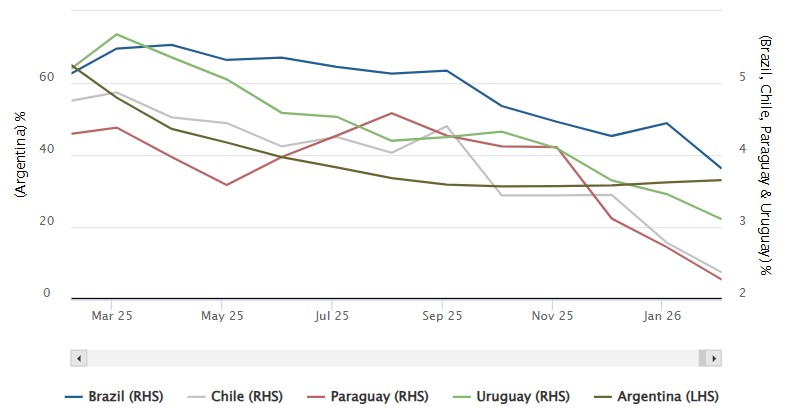
    Brazil & Southern Cone: inflation rate
    Percentage variation (year-on-year)

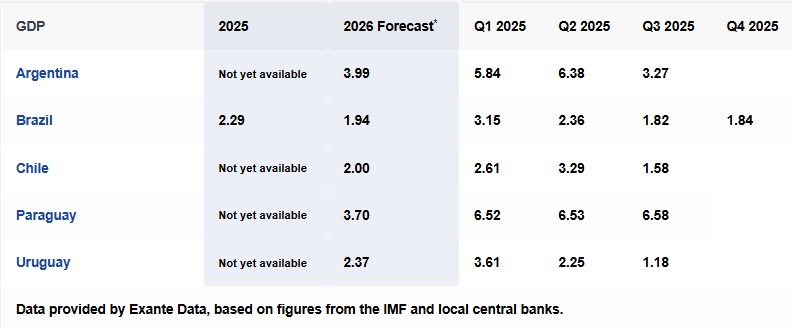
    Brazil & Southern Cone: GDP growth (%)
    Quarterly figures are year-on-year growth

  • RASTREANDO TENDENCIAS

    LatinNews 31 October 2011 Hits: 315

    VENEZUELA | Presupuesto audaz. El ministro de planeamiento y finanzas, Jorge Giordani, ha anunciado una oleada más en el gasto público ante las elecciones presidenciales en octubre del año próximo. Giordani presentó a la asamblea nacional un presupuesto para 2012 de Bs297,8bn (US$69,3bn), un masivo incremento de 46% sobre el presupuesto de este año. Los detalles emergerán cuando los diputados comiencen a debatir el presupuesto el 27 de octubre.

    Giordani justificó la decisión del enorme incremento en el presupuesto en el hecho que está fundamentado en un precio promedio del petróleo de US$50 por barril, subiendo de US$40 por barril en años recientes. Ese es aún sólo alrededor de la mitad del precio promedio del petróleo para 2011 de US$100 por barril, el exceso será trasvasado a varios opacos fondos de desarrollo para que el gobierno del Presidente Hugo Chávez lo administre como considere conveniente.

    Chávez afirmó esta semana que él está totalmente recuperado del cáncer, luego de un chequeo en Cuba, y estaría luchando en condiciones para las elecciones de octubre de 2012. Sería un logro notable si él en verdad ha derrotado a la enfermedad en cinco meses, especialmente dado su rechazo a divulgar contra qué tipo de cáncer estaba luchando, lo que ha alimentado una comprensible especulación en el sentido de que fue algo muy serio.

  • TRACKING TRENDS

    LatinNews 10 January 2013 Hits: 1090

    MEXICO | Prioritising tax reform. Mexico needs integral fiscal reform in 2013, the finance minister, Luis Videgaray, announced at the tail end of last year. Videgaray said a consensual reform was essential because the budget for 2013 approved by congress left Mexico short of the tax take of other members of the Organisation for Economic Co-operation and Development (OECD). He said that Mexico’s “needs” could not be met without a fiscal reform this year. He added that the tax system needed to be simpler and generate more jobs.
    Videgaray thanked legislators for approving a “prudent, responsible and balanced” budget, but he said that as things stand Mexico could not totally cover education costs (especially further and higher education), nor health or infrastructure costs. The chamber of deputies approved public spending of M$3.95bn (US$312m) for 2013, 6.7% up on the 2012 budget. The budget predicts a fiscal deficit of 2% if investment of the state energy company Pemex is included; otherwise the deficit would be zero.

    MEXICO | The cost of fuel subsidies. Petrol and diesel costs increased by 11 centavos (just under one US cent) a litre on 5 January. The increase is designed to reduce slightly the massive burden of fuel subsidies on the government. These totalled M$206bn (US$16.2bn) to November 2012. A UN human development report in 2011 maintained that fuel subsidies amounted to four times the total of government social programmes to combat poverty. The finance ministry argued that 43% of the subsidy benefits the 10% of richest Mexicans while the poorest 10% receive just 0.6% of it.
    Miguel Messmacher Linartas, the deputy finance minister, maintained that the extra fuel costs would only produce a 0.01% increase in inflation. He also argued that even after these increases the cost of petrol and diesel would be between 10% and 17% higher in the US. He said that increases were essential to avoid a permanent deterioration of the country’s public finances.
    President Enrique Peña Nieto’s predecessor Felipe Calderón lacked the political will to reduce fuel subsidies, despite his much-touted green credentials, but Peña Nieto cannot afford to subsidise fuel to this extent if he is going to implement the ambitious raft of proposals contained within his ‘Pact for Mexico’.

    PAN challenge

    The right-wing PAN faces big challenges in 2013, the party leader, Gustavo Madero, said this week. Chief among these will be hanging on to the governorship of Baja California in state elections in July. As Madero made his comments, the national daily Excélsior revealed that of the 1.87m members of the PAN last month only 266,000 had renewed their membership, meaning the party membership had fallen by 86%. The most prominent member not to renew was former president Vicente Fox (2000-2006). Fox was critical of the anti-drug strategy of his successor Felipe Calderόn and caused ructions in the PAN by calling for Mexicans to unite behind (PRI) President Enrique Peña Nieto.

    Free trade

    A free trade agreement between Mexico and Honduras entered into force on 1 January. Guatemala and Costa Rica hope to approve the accord in the first half of this year. The FTA entered into force with El Salvador and Nicaragua on 1 September last year. Two-way trade between Mexico and Honduras totalled US$844m in 2011, with Mexico enjoying a trade surplus of US$156m. Trade between Mexico and the five Central American nations jumped by nearly 200% between 2000 and 2010, when it reached US$6.55bn.

  • RASTREANDO TENDENCIAS

    LatinNews 29 September 2013 Hits: 364

    PERÚ-COLOMBIA | Liderando las perspectivas de crecimiento de inversión de capital de riesgo. La Asociación Latinoamericana de capital privado y capital de riesgo (Lavca) difundió esta semana un estudio que muestra que se espera que México, Perú, y Colombia, exhiban el más favorable ambiente para las inversiones de capital de riesgo en el próximo par de años.

    El director de investigaciones de Lavca, Juan Savino, dijo que después de conducir un sondeo de 105 inversionistas con intereses en América Latina, el 56% de ellos dijo que eran optimistas acerca del nivel de retorno que ellos esperan obtener de sus inversiones. De acuerdo con Savino, “inversionistas nacionales y extranjeros esperan obtener un retorno promedio anual de 16% o más” de sus inversiones en la región. Savino dijo que este panorama positivo era en gran medida el resultado de que casi tres cuartos de los inversionistas sondeados esperan retornos de más de 16% de sus activos en México, Perú, y Colombia.

    Por otra parte, la mitad de los sondeados dijo que ellos esperan niveles de retornos similares por sus activos en Brasil y Chile. El estudio destaca que los resultados sugieren que el sostenido crecimiento económico de América Latina comparado con otras regiones, continúa presentando atractivas condiciones para la inversión; y que los inversionistas ahora creen que la relación riesgo/retorno para las inversiones privadas en América Latina está mejorando a pesar de las difíciles condiciones económicas globales.

    PERÚ-BOLIVIA | Amaszonas realiza vuelo inicial. El 23 de septiembre aerolínea boliviana, Amaszonas, realizó su vuelo inaugural entre La Paz y la ciudad de Arequipa en el sur de Perú. El gerente de marketing de Amaszonas, Luis Vera, dijo que Arequipa ahora se ha convertido en el segundo destino servido por la aerolínea en Perú, después de Cuzco, al cual la aerolínea actualmente vuela seis veces por semana. De acuerdo con vera, Amaszonas volará a Arequipa tres veces por semana para comenzar, proveyendo un destino alternativo al los destinos turísticos chilenos de Arica e Iquique, donde los turistas bolivianos van tradicionalmente de vacaciones. La embajadora de Perú en Bolivia, Silvia Alfaro, ha dicho que la nueva ruta también podría ayudar a promover el comercio entre los dos vecinos andinos.

  • GUYANA: United Guyana shunned by WI cricket establishment

    LatinNews 11 June 2014 Hits: 3378

    Guyana has amongst the most tempestuous politics in the Caribbean, with animosity between the political parties fuelled by the split of the population between those of East Indian origin (43%), who mostly vote for the ruling People’s Progressive Party/Civic (PPP/C), and those of African origin (30%), who mostly vote for A Partnership for National Unity (APNU). However in the row between Guyana and the West Indies Cricket Board (WICB), which has seen Guyana stripped of the third test match between the West Indies and New Zealand, unusually APNU has supported the PPP/C government.

    The row with the WICB, over Guyana’s Cricket Administration Bill, has been brewing since at least 2011 when the bill was first mooted. The WICB says it cannot support the dissolution of the existing Guyana Cricket Board (GCB) or the involvement of the Guyanese government in the administration of the game. The government, on the other hand, says it is seeking to regularize the constitutions of Guyana’s various national and county cricket bodies, end illegal elections and financial improprieties, and “engender order, transparency, and accountability”.

    No one can say that the bill has been hastily pushed through parliament. It was first tabled in December 2011 and then deferred for consideration by the National Assembly three times. Over this time, several amendments have been made to the original bill, partly in response to criticisms from the WICB. One of these includes the appointment of an independent cricket ombudsman, which the government says should satisfy the WICB’s objection to direct government involvement in the administration of the sport.

    But neither Guyana’s unusual political unity nor the lengthy period for consultation has persuaded the WICB to support the bill. On 2 June, the WICB issued a press statement saying that it had not been able to find “a mutually agreeable resolution” to the dispute. It added: “The WICB sought an undertaking from His Excellency President [Donald] Ramotar that the bill not be signed into law until these matters are resolved…Regrettably the WICB has not received such an undertaking…[and] as a consequence the WICB is left with no option but to relocate the Third Test between the West Indies and New Zealand from Guyana.”

    The government has been unmoved by this removal of the test match, sticking to its line that the bill is necessary to bring order and transparency to the administration of cricket in Guyana, and reiterating through Minister of Sport Dr Frank Anthony that “the bill does not, in any way whatsoever, allow or permit, directly or indirectly, government’s involvement in the administration of cricket in Guyana” except for a single instance “where the minister is ascribed a function when the act comes into operation”.

    Underlining the wide support within Guyana for the bill, the (Afro-Caribbean) Guyanese cricket legend Clive Lloyd added his assenting voice on 6 June, saying: “I welcome the Cricket Administration Bill which was recently passed by the National Assembly. I took note that it passed with the support of both the government and the main opposition party.”

    The wider implications of the row were highlighted by President Ramotar, who said that Caribbean integration was threatened by the move. He said that cricket has historically played a key role in uniting the people of the Caribbean and that “what is happening here is a slap against the whole integration movement”.

  • URUGUAY: Gesto de Vázquez a los sindicatos

    LatinNews 19 June 2015 Hits: 492

    El Presidente Tabaré Vázquez está tomando un enfoque totalmente diferente al que adoptó su predecesor, José Mujica (2010-2015), para lidiar con el más poderoso lobby de Uruguay. Mientras que Mujica no ha dudado en cruzar espadas con la principal organización sindical del país, el Plenario Intersindical de Trabajadores-Convención Nacional de Trabajadores (Pit-Cnt), un intimidante aliado de la gobernante coalición de izquierda Frente Amplio (FA), Vázquez, como con la política exterior de su gobierno ha optado por un curso más diplomático. El 15 de junio, Vázquez se convirtió en el primer jefe de estado en la historia de Uruguay en asistir al congreso anual del Pit-Cnt, cuatro días después de que la organización sindical montase una huelga general de cuatro horas para marcar el fin de los primeros 100 días del Presidente Vázquez en el poder.

    Unos 40.000 trabajadores participaron en la huelga general el 11 de junio para protestar contra los recortes en el gasto público sugerido por el ministro de economía & finanzas, Danilo Astori, que tiene la intención de introducir austeridad en los gastos. La huelga se produjo días antes de una nueva ronda de negociaciones colectivas sobre salarios, y antes de que Astori deba presentar el presupuesto de cinco años del gobierno al Congreso antes del 31 de agosto. Los participantes marcharon hasta el Congreso en Montevideo para insistir en que este presupuesto consolide las ganancias de los últimos años, pero que también mejore las áreas desatendidas como la educación (los sueldos de los docentes en particular) algo que fue prometido pero nunca producido por la administración de Mujica y la inversión en salud, vivienda, y en la infraestructura productiva.

    La aparición de Vázquez en la cumbre del Pit-Cnt cuatro días más tarde estaba claramente diseñada como un gesto simbólico hacia los sindicatos, pero hubo poca sustancia en su discurso. El aplauso más ruidoso fue reservado para su afirmación de que “No he olvidado de donde yo vengo”, recordando a la audiencia su humilde origen como un vendedor de diarios en los autobuses antes de convertirse eventualmente en médico e ingresar a la política. Vázquez eludió discutir el presupuesto de cinco años de su gobierno, diciendo que eso era tarea para su ministro de trabajo, Ernesto Murro.

    Fernando Pereira, el coordinador del Pit-Cnt, subió al estrado luego. Él elogió al FA por sus logros durante los últimos 10 años en el gobierno, aunque preocupado por las iniciativas de recortes en el gasto público, insistió en que los salarios debían crecer por encima de la inflación, tal como el PIB está proyectado hacer durante los próximos cinco años. Pereira dijo que era inaceptable que 600.000 uruguayos aún ganen menos que Ur$15.000 (US$560) mensuales y que el salario mínimo debería subir de Ur$10.000 a Ur$15.000, financiado a través de la redistribución de los ingresos, o como él lo expresó “las excesivas ganancias de los ricos”.

  • CARIBBEAN POINTERS

    LatinNews 14 September 2016 Hits: 433

    *** GUYANA OIL TO FLOW FROM 2020. ExxonMobil, which has made two large oil discoveries in Guyana’s territorial waters, has said that it hopes to be producing 100,000 barrels of oil per day from 2020. According to the US oil company, the oil is of good quality, “not sour”. In preparation, the government of Guyana has said that it is drawing up plans to develop an onshore facility to maximise the benefits from the windfall. The location for the onshore facility has not yet been identified, but it is thought that the development will include a shipyard, port facilities, and support services for the operator. The government has also announced its intention to establish a Sovereign Wealth Fund to manage the revenue.

    *** IMF SAYS BARBADOS ECONOMY HAS “TURNED THE CORNER”. The International Monetary Fund (IMF) concluded its latest Article IV consultation with Barbados on 22 August. It reported that “the economy appears to have turned the corner with activity picking up”. GDP growth in 2015 was a just-positive 0.8%, but this included a 14% surge in all-important tourism arrivals. Unemployment fell to 11.3%.

    However, the IMF noted that the fiscal situation “remains challenging despite ongoing government adjustment efforts”, with the Fiscal Year 2015/16 budget deficit coming in at 7% of GDP, which was “broadly unchanged” on the previous year. With this in mind, the report stressed that “continued fiscal adjustment and public sector reforms are necessary to bring public debt on a downward path”. Finally, the IMF called for “a comprehensive growth strategy…to lift the country’s long-term competitiveness in the key tourism sectors”.

    *** BELIZE ECONOMY STILL CONTRACTING. The latest official data shows that the Belize economy contracted by 1.5% in the second quarter of 2016 compared with the same period in 2015. For the first six months of 2016 there was a record 26% decline in the primary sector, including in sugar, crude oil, bananas, and marine products. The main bright spot in the second quarter was the services sector, which grew by 3.8%, boosted by a 13% growth in tourism.

    *** ANTIGUA SET TO REJECT CCJ. The government of Antigua & Barbuda may move the proposed referendum on whether to end appeals to the UK’s Privy Council and to accede to the Caribbean Court of Justice (CCJ) to a date in early 2017. A recent opinion poll conducted by the Free and Fair Election League indicated that 62.9% of respondents were in favour of maintaining the current arrangements with the Privy Council, with only 37% opting for a change to the CCJ.

    *** CONSTITUTIONAL REFERENDUM IN GRENADA. Grenada is to hold a referendum on constitutional change on 27 October. The electorate will be asked to approve seven bills to change the constitution covering: adherence to the Caribbean Court of Justice (CCJ) as the country’s final court of appeal and a change in the oath of allegiance for officials from the Queen to the state of Grenada; the setting up of an Elections and Boundaries Commission; a requirement to ensure there is always an official Leader of the Opposition in parliament even if the ruling party wins all seats in an election; fixed term parliaments; changing the name of the state from ‘Grenada’ to ‘Grenada, Carriacou and Petite Martinique’; a bill of Rights and Freedoms; and the institution of a three-term limit for prime ministers.

    Both houses of parliament have approved the bills, which now require a two- thirds majority to be endorsed by the electorate on 27 October.

  • TRACKING TRENDS

    LatinNews 02 August 2018 Hits: 448

    BOLIVIA | GDP up in first quarter, but drought causes concern. Economic growth in the first quarter of the year reached 4.44% year-on-year, Bolivia’s economy minister, Mario Guillén, revealed. This compares to 3.3% growth in the same period in 2017. The first quarter growth was driven by increases in activity in the four main sectors of the economy: agriculture (up 6.6%); financial services (6.4%); petrol, crude & natural gas (6%); and construction (5.7%).

    Guillén said that the second annual pay bonus (‘aguinaldo’) would be paid this year if GDP growth exceeded 4.2% in the second quarter of the year. Since 2013 the government has decreed that workers would receive a second aguinaldo if annual GDP growth exceeds 4.5%. But business leaders have criticised Guillén’s announcement, noting that certain industries are in crisis despite good national economic growth figures.

    One example is the agricultural sector, which is being badly affected by drought in Santa Cruz department. According to a 31 July report from the Asociación de Productores de Oleaginosas y Trigo (Anapo), production of wheat, sunflowers, corn, sorghum, and chia is down by 33%. Anapo estimates that the industry will suffer losses amounting to US$110m following 60 days without rain in one of the most important agricultural areas in Bolivia.

    Guillén admits that the drought could start to affect GDP figures in the third quarter but believes that accumulated growth will still top the 4.5% necessary to pay the second bonus regardless.

    PERU | Mining and energy investments. In his state-of-the-nation address on 28 July to mark Peru’s Independence Day, President Martín Vizcarra announced a US$15bn package of private investment in eight large mining projects. Vizcarra also vowed to support small-scale miners and formalise their operations, with a focus on security and the environment. Vizcarra backed the increased private investment to stimulate Peru’s national economy and vowed to encourage new projects on the condition that they are socially and environmentally responsible. He also revealed plans for continued investment in natural gas supply networks to diversify the country’s energy matrix.

  • ECONOMIC HIGHLIGHTS

    Patrick de Courcy 13 July 2022 Hits: 1628

    COLOMBIA | Petro names finance minister. Colombia’s left-wing president-elect Gustavo Petro named José Antonio Ocampo as his choice of finance minister on 30 June. A former co-director of Colombia’s central bank (2017-2019), finance minister (1996-1997), and agriculture minister (1993-1994), Ocampo is one of Colombia’s most well-known economists and his appointment should provide reassurances to markets concerned that Petro is planning a radical change of direction. Indicative of the challenges facing the incoming government, which takes office on 7 August, yesterday Banrep raised interest rates by 150 basis points to 7.5%, in its largest increase since 1999. Banrep cited high year-on-year inflation, which reached 9.07% in May. While down from 9.23% in April, this is still significantly above the bank’s target of 3% for 2022.

    PERU | Las Bambas dialogue working group established. On 20 June, Peru’s government announced the installation of a temporary working group with representatives from the government and the six towns that led protests against the Las Bambas open-pit copper mine in Peru’s southern region of Apurímac: Fuerabamba, Huancuire, Pumamarca, Chila, Choaquere, and Chuicuni. The working group is in line with a 30-day truce called on 9 June which stopped the protests that had paralysed the mine, which contributes 1% of Peru’s GDP. Those present at the first session agreed to hold bilateral meetings on the first three days of each week in each community, with the participation of representatives from the government and ombudsman’s office.

    VENEZUELA | Oil production down. The Organization of the Petroleum Exporting Countries (OPEC) published its monthly oil market report on 14 June, in which Venezuela claimed to have produced 735,000 barrels of crude per day (bpd) in May, down from 775,000 bpd in April. The OPEC report’s other assessment of Venezuelan oil production, compiled using secondary sources, put oil production in May at 717,000 bpd, down slightly on the 719,000 bpd estimate for April.

    Andean countries: inflation rate
    Percentage variation (year-on-year)

    Andean countries: GDP growth (%)
    Quarterly figures are year-on-year growth

  • DOMINICAN REPUBLIC: Abinader poised for re-election

    Patrick de Courcy 29 January 2024 Hits: 2693

    Date: 19 May 2024. If a presidential candidate fails to win 50% +1 of the votes, a second-round run-off will take place on 30 June. (Municipal elections are also due on 18 February).

    Type: President and legislative (for the 32-seat senate and 190-seat lower chamber).

    Main contenders: Luis Abinader (Partido Revolucionario Moderno, PRM), Abel Martínez (Partido de la Liberación Dominicana, PLD), Leonel Fernández (Fuerza del Pueblo, FP), Miguel Vargas (Partido Revolucionario Dominicano, PRD).

    President Luis Abinader’s 2020 election victory for the centre-right Partido Revolucionario Moderno (PRM) ended the centre-left Partido de la Liberación Dominicana (PLD)’s 16-year stranglehold on power. Abinader’s 2020 victory owed to public anger with corruption as well as a divided opposition: in 2019 the PLD split between a faction loyal to former president Leonel Fernández (1996-2000; 2004-2012), who has since established his own political party, Fuerza del Pueblo (FP), and that loyal to Fernández’s successor, Danilo Medina (2012-2020). The opposition has launched an electoral alliance ahead of the May 2024 election (for some legislative seats and municipal posts for the February contest but not the presidency). However, divisions persist and it is unlikely to pose much of a threat to President Abinader, who is seeking re-election and remains very popular due to his solid management of the economy and perceived progress on combating corruption.

    A survey released at the end of October 2023 by Gallup showed 55.2% of the 1,200 respondents would vote for Abinader, whose PRM broke off from the traditional Partido Revolucionario Dominicano (PRD) in 2014. Second, with 27.4% of voting intentions, was Fernández (FP), followed by the PLD’s candidate, Abel Martínez, the mayor of Santiago de los Caballeros (Santiago province), on 13.5%. Vargas, the PRD candidate, did not feature.

    The same Gallup poll showed that 64% of respondents approved of the presidency of Abinader, whose PRM has 17 seats in the 32-member senate, giving it 18 with ally, Dominicanos por el Cambio (DXC), and 88 seats in the 190-member lower chamber, along with a further 13 from its allies. The Gallup survey suggests various factors contributing to Abinader’s high approval rating, not least the country’s economic stability, cited by 11.5% of respondents as his chief achievement. The country continues to post one of the strongest GDP growth rates in the sub-region. The latest (December 2023) update by the United Nations Economic Commission for Latin America & the Caribbean (Eclac) forecasts that the Dominican Republic’s GDP growth will come in at 4.1% in 2024, second only to Panama (4.2%). Inflation closed 2023 at 3.57% within the central bank’s target range of 4.0% +/-1. Meanwhile the latest official poverty figures show progress in poverty reduction, with the poverty rate falling to 24.4% in the third quarter of 2023, down four percentage points year-on-year – the lowest level for this quarter since 2016.

    Also key to Abinader’s popularity is perceived progress in the fight against corruption (cited by 7.6% of Gallup poll respondents), with major operations launched into past impunity. Among others, these include Operation Calamar, announced in March 2023, and Operation Anti-Pulpo in November 2020, in relation to which former PLD heavyweights have been arrested. While the opposition has decried selective justice, efforts to tackle past corruption have been welcomed by the public: the Gallup poll showed 46.2% of respondents consider there to be less corruption in the current government than the previous PLD administrations of Medina and Fernández, 26.7% thought there was the same, and 25.3%, more.

    The Abinader government has also won international plaudits for its fight against corruption. The latest (January 2023) Corruption Perceptions Index (CPI) by Transparency International (TI) notes that the Dominican Republic has gained four points in the CPI in the last two years by strengthening the independence of its justice and oversight bodies, enhancing transparency in public procurement, and enacting an asset forfeiture law. Attorney General Miriam Germán Brito is well regarded: her appointment in 2020 was welcomed by civil-society groups, and in July 2022, she received the European Union’s European Human Rights Award for her “professional career dedicated to guaranteeing justice and democracy in the Dominican Republic and her tireless fight against corruption”. In contrast on 11 December 2023 the US State Department designated her predecessor Jean Alain Rodríguez (2016-2020) for his “involvement in significant corruption by misappropriating public funds intended for state-financed infrastructure projects and government institutions”, making him ineligible for entry to the US.

    Opposition alliance

    On 10 October 2023, the opposition PLD, FP, and PRD announced an electoral alliance, ‘Alianza Opositora Rescate’, ending months of speculation. Vargas, the PRD’s presidential candidate, explained it would cover 145 of the country’s 158 mayoralties, spanning “voters in 91% of the country, equivalent to 88% of the electorate”. The new opposition alliance will compete in key municipalities such as the provincial capitals, San Juan de la Maguana (San Juan), San Francisco de Macorís (Duarte), Higüey (La Altagracia), Moca (Espaillat), San Pedro de Macorís (San Pedro de Macorís), Santo Domingo Norte and Santo Domingo Oeste (Santo Domingo), Santiago de los Caballeros (Santiago), and Distrito Nacional (DN) which encompasses Santo Domingo. The parties will also field candidacies in 16 provinces (out of 31 and DN) for the May legislative elections.

    Haiti

    President Abinader’s solid popularity is also attributed to his strong stand on Haiti. Bilateral relations have significantly worsened as Haiti has descended into further crisis since the July 2021 murder of former president Jovenel Moïse (2017-2021). In September 2023, President Abinader announced the closure of the joint border in response to the construction of a canal in Dajabón province, which was diverting water from the shared Dajabón river (also known as Rio Masacre), and which the Dominican government complained violates three international treaties. In October he announced it had been reopened to allow some trade but not the movement of people. The Gallup poll cited 82.6% of respondents as saying Abinader had been consistent in denouncing the Haiti issue before the United Nations and international fora; 67.9% of respondents said national sovereignty was more important than bilateral trade.

  • TRACKING TRENDS

    Abbi Dicker 28 March 2024 Hits: 2815

    MEXICO | Interest rates cut. The central bank Banco de México (Banxico) cut the benchmark interest rate by a quarter of a percentage point to 11% on 21 March. This marks the first time that Banxico has cut rates since March last year. It attributed the reduction to “a disinflationary process” while warning that “risks and challenges persist”. Indeed, the next day the national statistics institute (Inegi) reported that there was actually a slight uptick in annualised inflation to 4.48% in the first half of March, from 4.4% in February, which was down on January but followed three consecutive months of small increases.

    President Andrés Manuel López Obrador celebrated the decision, which he said was “daring” given that the US Federal Reserve opted to keep interest rates unchanged at between 5.25% and 5.5%. He said it would encourage investment needed to spur economic growth in Mexico.

    Economic activity in January expanded by 2% year-on-year, Inegi reported on 22 March. Growth was driven by manufacturing, which expanded by 2.9%, and the service sector, which was up by 2.2% year-on-year. The agricultural sector, meanwhile, contracted by 9.1%.


    MEXICO | Trade deficit. Mexico registered a trade deficit of US$585m in February, down from as much as US$4.90bn in January, the national statistics institute (Inegi) reported on 27 March.

    Total exports increased by 13% in February to US$50.72bn, Inegi said, driven by a 15.7% year-on-year increase in oil sales to US$2.62bn. Non-oil exports, meanwhile, increased by 12.9% year-on year to US$48.10bn. This was primarily due to a 13.7% increase in these exports to the US.

    Imports expanded by 9.7% to US$51.31bn in February. Oil imports fell by 33.1% year-on-year to US$3.27bn, but non-oil imports jumped by 14.7% to US$48.04bn.

    Mexico’s trade deficit fell by 80% in 2023 to US$5.46bn from US$26.24bn in 2022.

  • TRACKING TRENDS

    Abbi Dicker 07 August 2025 Hits: 1487

    URUGUAY | Union pressures government over key issues. Uruguay’s umbrella trade union Plenario Intersindical de Trabajadores-Convención Nacional de Trabajadores (PIT-CNT), is staging a partial general strike on 12 August over employment and salaries, working hours, and education, among other issues included in its national development plan, which it has been presenting to political parties in recent days.

    One of the proposals included in the plan is the introduction of a 1% tax on the 1% wealthiest Uruguayans. The PIT-CNT states the tax would enable the country to tackle child poverty.

    While President Yamandú Orsi has discounted introducing any new taxes, other members of the ruling left-wing Frente Amplio (FA), traditionally an ally of the union, have reportedly backed the proposal, leading to internal divisions.

    On 30 July the PIT-CNT approached the right-of-centre opposition Partido Nacional (PN, Blancos) with the proposal. While the PN similarly rejected the wealth tax, it welcomed the gesture from the PIT-CNT to include the party in discussions.

    Another issue is the working week, which the PIT-CNT proposes reducing to 40 hours without cutting the salaries received for the existing 48-hour working week.

  • RASTREANDO TENDENCIAS

    LatinNews 12 September 2011 Hits: 183

    BRASIL-URUGUAY | Integración regional. La Presidenta de Brasil, Dilma Rousseff se embarcó en su visita oficial a Uruguay el 30 de marzo. Rousseff se reunió con su contraparte de Uruguay, José Mujica y firmaron acuerdos para construir varios proyectos bilaterales de infraestructura. Estos incluyen la construcción de un segundo puente sobre el Río Yaguarón, que separa a Río Grande do Sul (RS) de Uruguay; la extensión del sistema ferroviario del sur de Brasil hasta Santana do Livramento (RS) sobre la frontera con Uruguay; y lo más importante, la construcción de una línea de transmisión de energía de 500MW de Brasil a Uruguay.
    Rousseff que uno de los principales objetivos de su administración es promover una mayor integración dentro del Mercosur, explicó que las relaciones de Brasil con Uruguay eran “estratégicas” y que los dos países debían buscar el establecimiento de una “sinergia” en sus relaciones comerciales. Sin embargo, Rousseff prometió continuar promocionando la integración “física” con sus socios del Mercosur no llegó a responder los pedidos de Mujica para establecer un sistema completamente integrado de energía en la región.

  • TRACKING TRENDS

    LatinNews 19 April 2012 Hits: 3120

    ARGENTINA-URUGUAY | Green energy investments. On 12 April, Argentina’s Corporación América announced that it is to invest US$100m in the construction of two wind energy farms in Uruguay. According to a company statement, Uruguay’s national energy transmission administrator (UTE) awarded two consortiums (Fingano and Vengano), both led by Corporación América, contracts to build and operate two wind farms in the Uruguayan department of Maldonado. The farms, which will take up 2,000 hectares of land, are slated to produce 40 to 50 megawatts.

    The Uruguayan government is currently trying to diversify its energy production matrix in order to reduce its reliance on its unreliable hydroelectric energy production which it supplements every year by purchasing energy from its neighbours Argentina and Brazil in a spot swap market. While the Argentine government has been reluctant to allow Uruguay to purchase Paraguay’s excess energy, which must pass through Argentina’s grid, it seems that Argentine companies are ready to take advantage of the opportunities provided by Uruguay’s energy market.

    CHILE | Supreme court gives HidroAysén green light. On 4 April, in a split vote (3-2), Chile’s supreme court decided to lift various injunctions - the majority imposed on environmental grounds by congressmen and local civil society and environmental groups - on the highly controversial HidroAysén hydroelectric project, due to be built in Chile’s Patagonian region of Aysén. Problematically for the government, the cancellation of the HidroAysén project is a key demand of the Movimiento Social por Aysén (MSA), which has been protesting in the region since mid February. The government has just reached a preliminary agreement with the MSA to address their demands. The protests in Aysén have been a major problem for the government, which has been criticised for its handling of the conflict.

    On the same day the opposition in congress presented a formal complaint against the interior minister, Rodrigo Hinzpeter, holding him responsible for various acts of police abuse denounced by Aysén residents. Nevertheless, HidroAysén’s executive Vice-president, Daniel Fernández, has said that he is confident that following the supreme court’s decision the project will go ahead in the near future. According to Fernández if the company made up its mind, it could start building the proposed dams “immediately” given that the firm has shown that it has followed all the recommendations made in the project’s Environmental Impact Assessment (EIA) reports over the last three years. However, Fernández also pointed out that the idea to build the hydroelectric complex was to provide energy to the country, requiring the construction of transmission lines; and so until these have their EIA approved, “we will not begin construction”.

    CHILE | Central bank holds its nerve. Chile’s central bank decided to keep its monetary policy interest rate unchanged at 5% on 17 April. There was speculation in the markets that the bank might have increased the rate as Chile’s economy continues to experience stronger than expected domestic demand, which is slowly pushing up inflation. However, in its statement the central bank explained that its decision followed from the fact that it still sees volatility and risk aversion in global markets which threaten global economic stability. “The risk in the Eurozone is still high and … financial tensions in those markets have re-emerged… Meanwhile the dynamism of China and other emerging economies has been more moderate in recent months,” the bank said.

    Turning its attention to the domestic economy, the bank pointed out that economic activity and demand in the country are evolving as projected; but it warned that the labour market “remains tight”. As for inflation, the bank recognised that nominal inflation at 4.3% was close to the upper end of its target range, but said that underlying inflation is at around 3%, well within the range. The bank concluded that its decision reaffirms its commitment to conduct a “flexible” monetary policy so that inflation returns to its projected long-term target of 3%. In its first monetary policy of 2012 the bank unexpectedly cut the interest rate by 0.25 points amid concerns that Chile’s economy was slowing down.

    • Tapping international markets again

    On 17 April Brazil’s treasury announced that it had raised R$3bn (US$1.615bn) in international markets through the issue of public debt bonds expiring in 2024. The treasury pointed out that the BRL2024 bonds have been sold in the US and European markets and it expects to raise an additional R$300m (US$161m) after the bonds are offered to Asian investors. According to the treasury, the bonds have an 8.5% annual yield that will be paid every six months. The last time that Brazil issued bonds in international markets was in January when it issued the BRL 2021, which raised US$825m and offered a 3.449% yield.

  • TRACKING TRENDS

    LatinNews 16 August 2012 Hits: 688

    ECUADOR| Government seeks to promote flight connectivity. The government of President Rafael Correa has announced that it is analysing the possibility of adding new flight routes in order to increase the country’s transport connectivity to the rest of the world in order to boost tourism. In a conference in Guayaquil, Correa said that his government was analysing how to incorporate flights from Ecuador to new destinations to cities in countries like the US, Argentina and Germany. Correa said the proposal stemmed from a process of looking into the possibility adopting an “open skies” policies, remarking that a team of government officials rejected the adoption of an open skies policies considering that it could allow firms to employ “anti-competitive strategies”. Instead the team is exploring alternatives such as providing specific incentives to companies willing to establish new routes. Correa explained that the strategy aimed to provide “concrete incentives” to foreign and national airlines that are looking to establish new routes.  He mentioned as one option, the possibility of offering a 40% discount in the cost of fuel required to operate the new routes. Correa said that the development of new routes such Guayaquil- Los Angeles, US or Guayaquil-Berlin, Germany or Guayaquil-Buenos Aires, Argentina implies certain cost-levels that the government was currently evaluating before deciding what specific incentives to offer.

    COLOMBIA| FDI growth continues in 2012. Colombia’s trade minister, Sergio Díaz-Granados, announced on 6 August that foreign direct investment (FDI) in Colombia in the first six months of 2012 was US$9.33bn, 26.2% more than in the same period last year. FDI into Colombia has experienced a impressive surge since last year when it posted a record growth of 92%; if the current trend continues, Colombia could not only break that record this year but it could see FDI reach US$15bn. Díaz-Granados has said that the current levels of FDI “ratify” the good performance of the country’s economy and the government’s intention is to continue promoting investor confidence in the country by seeking new strategic alliances. Colombia currently has in place investment agreements with Spain, Switzerland, Peru, China and India; it has signed agreements with Japan and the United Kingdom and it is currently negotiating more with Turkey, Kuwait and Singapore.

    PERU | Exports to Malaysia on the rise.  On 12 August Peru’s foreign trade society (CómexPerú) revealed that Peruvian exports to Malaysia in the first half of 2012 were approximately US$8m, a significant increase of 196% compared with the same period last year. Cómex Perú points out that 59% of Peruvian exports to Malaysia, or roughly US$3m, are non-traditional exports. Exports have increased in the areas of chemicals (26%), non-metallic minerals (16%) and agriculture (14%). Leading chemical export products were boric acid with exports worth US$921,000 and borax with exports worth US$218,000. The two main agricultural export products were cochineal carmine with US$698,000 in exports and fresh grapes with US$585,000 in exports. According to Cómex Perú, the figures are encouraging as they show that Malaysia could become an increasingly important destination for non-traditional Peruvian exports, helping the country diversify its exports markets and maybe even attract investments. Cómex Perú added that Peru must take full advantage of the possibility to improve its trade relations with a country member of both the Asia-Pacific Economic Cooperation (Apec) forum and the Trans-Pacific Strategic Economic Partnership (TTP) trade promotion groups. Not only is Peru currently negotiating its entry into the TPP, but back in June along with Mexico, Chile and Colombia, Peru created the Pacific Alliance, Latin America’s latest economic integration and trade promotion bloc, which was created with the aim of boosting trade between Pacific coast countries with a particular orientation towards promoting trade with Asia-Pacific.

    • Chávez announces joint tourism investment with Cuba

    On 9 August President Hugo Chávez of Venezuela announced that, with the help of Cuba, Venezuela’s state-owned tourism operator, Venetur, will build a new hotel complex in Vargas state that aims to restore some of the hotels that were abandoned after the 1999 floods there. “A few months ago I approved the release of a large number of funds to create this complex, and a specialist Cuban tourism firm has already began work to rescue what used to be the Macuto Sheraton and Sol Meliá hotels”, Chávez said without providing further details. He added that “the private sector would never recover the hotels...they don’t think they’ll make a profit”; but that the investment would not only boost tourism in Vargas but in all of Venezuela.

  • Risk pointers

    LatinNews 26 September 2012 Hits: 475

    *** South Korea on heightened alert.  Last Friday (21 September), South Korea increased its state of alert along its western sea border in response to cross-border infiltrations by North Korean fishing boats.  Sources in Seoul say that seven North Korean fishing vessels crossed the demarcation line on 12 September but retreated following warnings from South Korean patrol boats.  Further testing of the line by groups of two or three North Korean boats occurred on 14, 15, and 20 September, leading to the raised alert status.

    A South Korean official said: “Our military is closely monitoring to figure out the intention of the North Korean boats’ border crossings.  If North Korean boats repeatedly cross [the boundary] for fishing the military will promptly and sternly respond, without hesitation.”

    In November 2010, North Korea fired artillery shells at the front-line island of Yeonpyeong killing four North Koreans.

    *** Rise in militant activity in Russia’s Dagestan.  Russia’s Interior Ministry said on 24 September that there had been “a significant upswing” in military activity in the North Caucasus republic of Dagestan.  There were nine terrorist attacks during the previous weeks targeting police officers, servicemen, and businesses.  In response, the police killed 23 militants and arrested eight insurgents.

    The unrest in Dagestan is an extension of the Islamic insurgency that began in Chechnya but in recent years has spread to neighbouring republics.

    *** Turkey rejects Israeli overtures.  Faced with the prospect of war with Iran, deteriorating relations with Egypt, and uncertainty over Syria, Lebanon, and even Jordan, Israel has been putting out feelers to Turkey.  Relations have been very strained since the May 2010 Israeli attack on the Mavi Marmara, a Turkish aid ship for the Gaza Strip.

    Israel’s Foreign Minister Avigdor Lieberman was quoted recently by Reuters as saying that he was open to the idea of Israel making an “expression of regret” over the Mavi Marmara incident.  And Prime Minister Binyamin Netanyahu has said of Israel-Turkey relations: “I think it is in our common interest to find a way to be able to stop, to arrest, the slide in our relationship and resume a fruitful dialogue.

    Turkish Prime Minister Recep Tayyip Erdogan’s response has been cold, to say the least.  Speaking to reporters during a visit to Ukraine last week, he said: “Our response to those who have called on us to talk about Israel has been clear.  As long as Israel fails to meet any of these conditions normalization is impossible.”  The conditions Erdogan was referring to are to apologize unconditionally for the Mavi Marmara incident, to pay compensation for the Turks who were killed in the incident, and to lift the blockade of Gaza.

  • TRACKING TRENDS

    LatinNews 18 February 2016 Hits: 2649

    ARGENTINA | New trade and investment agency launches. The government unveiled its new investment promotion and foreign trade agency on 11 February. The agency will be run jointly by the production and foreign affairs ministries and will be responsible for “inserting Argentina into the centre of Latin American investments, and to develop new markets for Argentine products”. Juan Procaccini, who will run the agency, said it would help to reduce the risk perception and transaction costs for investors, increasing Argentina’s competitiveness. A government statement bemoaned the fact that Latin America receives 13% of global investment, approximately US$159bn, but Argentina only received 4% of this figure last year. The Macri administration is intent on completely changing Argentina’s image when it comes to trade and investment.

    BRAZIL | S&P downgrades again. Brazil’s debt rating was cut further into junk territory by the rating agency Standard & Poor’s on 17 February. The new level, two steps below investment grade, puts Brazil on a par with Bolivia, Paraguay and Guatemala. The state energy company Petrobras had its rating cut two notches to B+, four levels below investment grade.

    CHILE | Exporting electricity. Chile exported electricity to Argentina on 12 February for the first time since 2009, from the Los Andes substation in Chile’s northern region of Antofagasta to Argentina’s north-western province of Salta. Chile’s energy minister, Máximo Pacheco, said that the electricity exports, of around 200MW a day, from solar energy produced by Gas Atacama, owned by the Chilean power company Endesa, were “excellent news for our country’s economy”. The power line, which extends for 600km, has been disused since 2009 when energy exchanges with Argentina were suspended.

    Chile will also start exporting 5.5m cubic metres of natural gas every day to Argentina, from May to September this year.

    • Petrobras

    The Berlin-based NGO Transparency International (TI) has voted the Petrobras scandal as the second-worst corruption case in the world, behind only the widescale theft carried out by the former Ukrainian president Viktor Yanukovych. The state oil company won 11,900 votes, in comparison with the Ukrainian’s 13,210. Recently, TI ranked Brazil 76th out of 168 countries in its annual corruption perception index, a fall of seven places on its previous survey.