All Categories

Subcategories

  • ECONOMIC HIGHLIGHTS

    Abbi Dicker 16 April 2026 Hits: 1057

    NICARAGUA | Net FDI up. On 18 March Nicaragua’s central bank (BCN) released new figures showing that net foreign direct investment (FDI) to the country totalled US$1.50bn in 2025, up 7.6% on 2024. Meanwhile gross FDI came to US$3.06bn, down 4.0% on the same period in 2024. According to the BCN report, net FDI flows represented 6.8% of GDP (down from 7.1% in 2024). As regards a breakdown by sector, manufacturing received US$472.0m (31.4% of the total), up 11.0% on 2024; energy and mining received US$466.5m (31.1% of the total), up 77.1%; and financial intermediation totalled US$375.6m (25.0% of the total), up 32.9% on 2024. As regards sources of net FDI, Panama accounted for 25.5% of the total followed by Barbados (17.5%) and the US (13.1%).

    DOMINICAN REPUBLIC | Remittances down. On 15 March the Dominican Republic’s central bank (BCRD) released new figures showing that remittances to the country totalled US$887.6m in February, down from US$917.0m in February 2025 and US$982.8m in January 2026. Remittances in the first two months of 2026 reached US$1.87bn, up 1.0% on the same period in 2025. The BCRD attributes the slowdown in February to the “complex international environment”, highlighting that “conflict in the Middle East has driven up prices of oil and its derivatives, resulting in greater inflationary pressures and reducing household disposable income”. According to the BCRD, 83.4% of remittances to the Dominican Republic in February were from the US, 5.9% from Spain, 0.9% from Haiti, 1.2% from Italy, and 1.0% from Switzerland, among other countries.

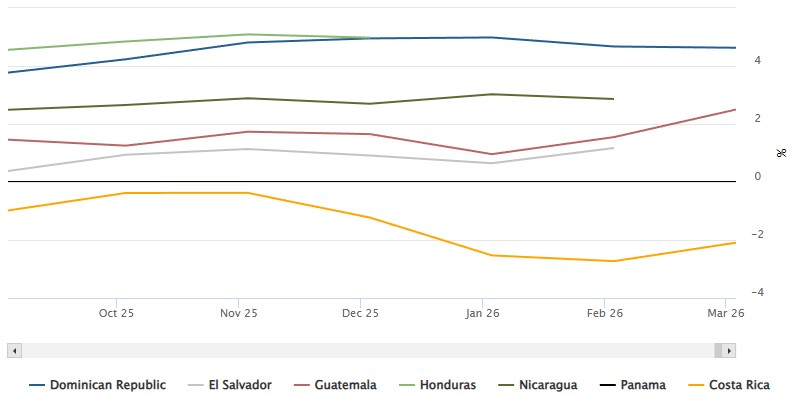
    Central America & Caribbean: inflation rate
    Percentage variation (year-on-year)

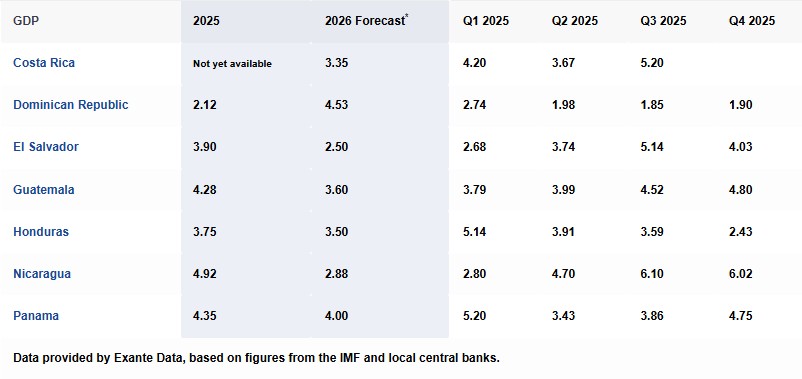
    Central America & Caribbean: GDP growth (%)
    Quarterly figures are year-on-year growth

  • RASTREANDO TENDENCIAS

    LatinNews 06 August 2012 Hits: 507

    ECUADOR | Fortalecimiento de los lazos con Chile en los sectores de energía y minería. El 25 de julio una delegación de funcionarios ecuatorianos encabezada por el canciller Ricardo Patiño; el ministro de recursos naturales no-renovables, Wilson Pástor; y el secretario de planeamiento nacional, Pavel Muñoz, llegó a Santiago para celebrar una reunión binacional interministerial, que apunta a incrementar la cooperación entre los dos países en áreas como energía, minería y seguridad.

    Las cuestiones discutidas durante la reunión de dos días incluyen la venta de energía entre los dos países y la posibilidad de incrementar la colaboración en proyectos de inversión en los sectores petroleros y mineros en Ecuador de parte de compañías estatales de Chile. Esto podría resultar beneficioso para Ecuador dado que Chile, que tiene una alta demanda de energía, podría convertirse en un importante mercado para la energía de Ecuador; y que la compañía petrolera estatal de Chile, Enap, que depende principalmente de sus operaciones internacionales para su provisión del petróleo crudo, podría ser un crecientemente importante inversionista en el sector petrolero de Ecuador.

    De la misma manera Codelco, la compañía minera de cobre del estado chileno, la mayor compañía de Chile y el mayor productor de cobre del mundo, ha lanzado un plan de inversiones de US$4,3mm que apunta a expandir sus operaciones nacionales e internacionales.

    ECUADOR | Caen las exportaciones de bananas. De acuerdo con la asociación de exportadores de banano del Ecuador (Aebe) las exportaciones de banana fueron de US$1,05mm en los primeros seis meses del año, un 10% menos que en el mismo periodo del 2011. De acuerdo con el presidente de Aebe, Eduardo Ledesma, la disminución en las exportaciones fue el resultado de la menor demanda en los dos principales mercados de la banana ecuatoriana, EU y Europa, que él señaló que aún están sufriendo los efectos de la crisis económica global.

    Sin embargo, Ledesma también reconoció que la disminución en las exportaciones podría atribuirse al menor rendimiento experimentado por los productores durante el actual periodo invernal. Ledesma explicó que las lluvias habían reducido la producción de Ecuador pues ha esparcido el hongo sigatoka negro, que afecta a las plantas de banana. Como resultado Ledesma dijo que actualmente la provisión de bananas ecuatorianas es menor de lo normal, pues “se han perdido 5.000 hectáreas de plantaciones de banana”.

    En la primera mitad del 2012, las exportaciones de banana de Ecuador fueron de 145,3m de cajas comparadas con las 161,8m de cajas exportadas en el mismo periodo del año pasado.

    VENEZUELA | Firman acuerdo Pdvsa-YPF. El 31 de julio, el Presidente de Venezuela, Hugo Chávez y su par de Argentina, Cristina Fernández, firmaron un acuerdo de “alianza estratégica” entre la compañía estatal de Venezuela, Pdvsa, y la compañía petrolera YPF controlada por el estado Argentino.

    El acuerdo, que fue firmado al margen de la cumbre presidencial del Mercado Común del Sur (Mercosur) en Brasília, establece que las dos compañías buscarán “identificar esquemas estratégicos de participación para el desarrollo conjunto completo de la cadena de valor de los hidrocarburos en Venezuela y Argentina”. Y agrega que YPF se incorporará en la producción de petróleo en la Faja del Orinoco, mientras que Pdvsa se incorporará a proyectos de exploración y explotación de petróleo y gas, en Argentina.

    Además, ambas compañías buscarán asegurar el financiamiento para estos proyectos. Chávez dijo que el acuerdo fue hecho posible “gracias al hecho de que Argentina ha recuperado su soberanía petrolera” aludiendo a la reciente re-nacionalización de YPF. Chávez agregó con franqueza que “cuando supimos acerca de la recuperación [de YPF] lo aplaudimos en Caracas”. Chávez también reveló que en el pasado él había sugerido al ex presidente de Argentina, Néstor Kirchner (2003-2007) “recobrar la industria petrolera” a lo cual Kirchner respondió que él lo haría “a su debido tiempo”.

    PERU | Emerge nuevo banco regional. El holding financiero de Perú, Creditcorp, anunció el 31 de julio que había completado la compra de 60,6% de participación en la firma chilena de inversión, IM Trust, completando así la primera fase de su proyecto para establecer un nuevo banco regional que operará en Perú, Chile y Colombia. El acuerdo de US$185m se produjo después de que Creditcorp adquirió una participación del 51% en la firm operadora de bolsa líder de Colombia, Correval, en diciembre pasado. El representante de Creditcorp, Christian Laub, dijo que el exitoso acuerdo con IM Trust fue “el paso final en un proceso que hizo dara vida a un banco regional de inversiones” que tendrá operaciones en los tres países. Laub señaló que puesto que las tres compañías son operadores líderes de inversiones en sus respectivos mercados, el nuevo banco ofrecerá “un rango completo de productos de calidad para sus clientes privados e institucionales” y creará una importante plataforma para las oportunidades de negocios.

    • Gas boliviano

    El 30 de junio, la compañía petrolera de propiedad del estado brasilero, Petrobrás, anunció que su producción promedio de gas natural en yacimientos nacionales y extranjeros cayó a 16,3m de metros cúbicos por día en junio, una declinación del 4,9% comparado con mayo. La compañía explicó que el declive fue debido a “la reducida demanda de gas de Petrobrás producido en Bolivia”. Brasil es el principal mercado para el gas boliviano, el cual alguna vez consumió más de la mitad de la producción de gas boliviana. Sin embargo, en años recientes, Brasil ha incrementado sus niveles de producción nacionales y ha desarrollado infraestructura que le permite importar gas natural licuado del exterior a menor costo. Esto ha provocado preocupación en Bolivia de que Brasil podría no renovar el contrato de provisión bilateral de gas que expira en el 2019, pese a las seguridades dadas por el gobierno brasileño.

  • TRACKING TRENDS

    LatinNews 10 July 2014 Hits: 1003

    HONDURAS | Strength of public finances questioned. On 8 July the Central American institute of fiscal studies (Icefi) released a study that cast doubts over the future financial stability of Honduras. The study, entitled ‘Honduras, the dangerous route towards indebtedness. Diagnosis of public finances 2010-2013 and prospects for 2014’, singles out a soaring fiscal deficit and a fast-growing public debt as the two key financial issues faced by the country.

    According to the study, if the high fiscal deficit is maintained in the next few years it will be impossible to reduce public debt in the medium term, and Honduras might face a vicious circle of unsustainable debt servicing. In 2013 Honduras’s fiscal deficit and public debt respectively reached 7.9% and 42.5% of GDP; and according to the study, estimates for both figures in 2014 are set to remain high, with the fiscal deficit projected at 4.7% of GDP and public debt expanding to 52% of the GDP. The study underlines that debt weighs so heavily on Honduran public finances that by the end of 2014 it will be necessary to direct more than 40% of fiscal revenues to fund its repayment. Public debt in Honduras has almost doubled over the last four years, going from US$4.8bn in 2009 to US$8bn in 2013. Last year the country raised around US$1bn through its first issue of foreign debt bonds in international markets.

    The study also criticises the fiscal reform promoted by the government led by President Juan Orlando Hernández, commenting that even if it turns out to be “one of the most productive” of its kind, it will not significantly improve economic performance due to its focus on taxing basic consumption. Hugo Noé Pino, the study’s coordinator, said that Honduras needs to steadily diminish its fiscal deficit. Pino suggested that a possible solution would be to “substantially reduce the deficit in the framework of a fiscal pact allowing for the establishment of spending priorities, revenue uniformity and transparency in the use of resources”. Ricardo Barrientos, an economist who contributed to the study, echoed Pino’s words, calling for “a fiscal pact to trace a path to stabilisation and the improvement of public finances”.

  • PERÚ: El congreso asestó una humillante derrota a Humala

    LatinNews 30 January 2015 Hits: 889

    El Presidente de Perú, Ollanta Humala, probó el amargo sabor de la derrota esta semana, cuando el congreso derogó la ley del empleo joven de su gobierno. En una sesión extraordinaria, el congreso votó de manera abrumadora a favor de la anulación de una ley que había aprobado hace escasamente seis semanas atrás. Cuatro grandes marchas de protesta fueron suficientes para persuadir a gran parte de la oposición política, con el ojo puesto en las elecciones generales del año próximo, a deshacerse de la ley por motivos populistas y no por convicción. La votación también expuso la ruptura en la dispar coalición gobernante, Gana Perú, lo que augura nada bueno para Humala en los restantes 17 meses de su mandato.

    La ley del empleo joven (conocida como ‘Ley Pulpín’) apuntaba a crear más empleos mediante una reducción de los costos para los empleadores que contrataran a jóvenes de entre 18 y 24 años, y para así reducir la dimensión del sector laboral informal. La ley aseguraba el salario mínimo y algunos beneficios de seguridad social, pero el derecho a las vacaciones fue reducido a la mitad, de 30 a 15 días, y a los empleadores no se les requería pagar los dos bonos anuales (en junio y diciembre) o indemnizaciones por despido.

    La administración Humala insistió en que la ley fue diseñada para mejorar el entrenamiento y las oportunidades de empleo para los jóvenes, pero el principal objetivo era reactivar la economía, y reducir los costos para las empresas, corroborado por el hecho de que la principal federación empresarial, Confiep, fuertemente apoyó la ley. Estudiantes y otras personas jóvenes, impulsados por los sindicalistas, reaccionaron furiosamente ante la ley, que entró en vigencia el 11 de diciembre del 2014, alegando que era explotadora. Y elevaron la presión sobre el gobierno con cuatro marchas de protesta en igual número de semanas, en Lima, y otras ciudades en Perú.

    La administración Humala no sólo ha tenido éxito en despertar a la juventud del país, que ahora está exigiendo una reforma del código laboral en general, sino que también ha despertado a lo que quedaba de la crecientemente enajenada Izquierda en la gobernante coalición gobernante, Gana Perú. Ya desilusionada con la cálida relación del gobierno con Confiep; los nuevos alegatos de que el gobierno ha estado espiando a diputados de Gana Perú sospechados ser disidentes;  y las recientes decisiones tales como dejar de lado salvaguardas ambientales para atraer más inversiones, la ley del empleo juvenil, percibida como erosionando los derechos básicos del trabajador, y las protestas que está engendró, fue la última gota. Un influyente diputado, Sergio Tejada, miembro del izquierdista Partido Nacionalista peruano (PNP), el principal sostén de Gana Perú, abandonó la coalición durante el fin de semana. Y luego votó por la anulación de la ley junto con otros seis diputados de Gana Perú, incluyendo, notablemente, la Vicepresidenta Marisol Espinoza, la más prominente víctima del alegado escándalo de espionaje ilegal [IL-15-03].

    La división interna en Gana Perú ha agravado el aislamiento político de Humala. Su ‘aliado’ Perú Posible (PP), el partido del ex presidente Alejandro Toledo (2001-2006), también votó por la anulación de la ley. “Vamos a continuar apoyando la gobernabilidad, pero el país está muy polarizado, muy dividido, dejemos que la temperatura se reduzca para que así los inversionistas vengan al país a invertir y generar empleo, para distribuir los beneficios del crecimiento”, dijo Toledo. A pesar del abandono de PP del gobierno, Toledo urgió a la oposición a que no lo “socave” aún más.

    En total, 91 diputados votaron a favor de anular la ley y sólo 18 para mantenerla; el 11 de diciembre del 2014, había sido aprobada por 68 votos a favor y 12 votos en contra. Que el giro fue puro populismo se ejemplifica con el fujimorista Fuerza Popular (FP), que previamente había apoyado el proyecto de ley. Sintiendo el humor popular, la oposición política usó la ley para comenzar a ejercitar sus músculos antes de las elecciones del próximo año. Aún faltan 17 meses para las elecciones presidenciales y legislativas en Perú, pero la última votación en el congreso sugiere que Humala bien podría convertirse en un presidente sin fuerza real para el tiempo restante de su mandato, pues los partidos políticos buscarán el apoyo del público haciendo difícil la vida pata un presidente impopular.

    • Tiempos difíciles por delante

    Hace un año, la victoria de Perú en su disputa sobre los límites marítimos con Chile, representó lo más alto en el mandato del Presidente Ollanta Humala, la fuerte derrota en el congreso, posiblemente sea el punto más bajo. Humala, quien admitió su derrota pero acusó al congreso de no proponer una alternativa viable, insistió en que el “ruido político” existente no “distraerá al gobierno”. Palabras valientes, pero sus acciones sugieren algo diferente. Tal fue la naturaleza acalorada del debate en el congreso sobre la ley del empleo juvenil, que Humala retiró su pedido de permiso hecho al congreso para viajar a la Cumbre de la Comunidad de Estados Latinoamericanos y del Caribe (Celac) el 28 y el 29 de enero en Costa Rica, ostensiblemente para concentrarse en cuestiones internas, pero realmente debido a que él sabe que podría afrontar la ignominia de un rechazo.

  • ECUADOR: Oil industry ignites Moreno-Correa tension

    LatinNews 24 August 2017 Hits: 1442

    A crisis at the Esmeraldas oil refinery has become the latest source of conflict between President Lenín Moreno and his predecessor Rafael Correa (2007-2017). Moreno revealed a series of major problems facing Ecuador’s oil industry during a visit to the Esmeraldas refinery, in the north-western province of the same name, on 15 August, denouncing “huge irresponsibility” in the management of the complex. Correa lashed back on Twitter, reminding Moreno that he served as his vice-president for the first six years of his decade in power.

    President Moreno was accompanied on his visit by Carlos Pérez, the hydrocarbons minister, who described the Esmeraldas plant as being in “a critical situation” despite substantial investment in recent years, as its renovation became a flagship project of the Correa administration. Francisco Moreno, the current superintendent of the facility, concurred. Pérez requested that the comptroller general’s office investigate the work at the plant in order to determine responsibility for the present failings.

    Pérez insisted that output at the Esmeraldas refinery had not yet been affected, but noted that further failure to address the current problems could start to cost the state as much as US$1.25m per day. He appealed to be granted the power to revise and repeal the contracts made under the Correa administration, in order to prevent these huge potential losses. “Although only a short amount of time has elapsed [since the modernisation of the refinery, which concluded at the end of 2015], we already have problems in the operation of certain areas,” Pérez said (see sidebar).

    There was further bad news elsewhere in the sector. Moreno reported difficulties finding investors for the long-awaited Pacific refinery, located in Manta in the northern coastal province of Manabí, and noted that if no solution was found, the project would have to be discarded; some US$1.5bn has already been invested in the Pacific refinery. Moreno did detail plans to remedy this situation, announcing the implementation of a new contractual model for investments that he said would be “more attractive and appropriate in current market conditions”.

    Ecuador’s economy remains highly dependent on profits from oil exports, and has been hit hard by the falling price of the commodity in recent years. At present, the country produces 541,000 barrels of oil per day (bpd): the 110,000 bpd of a fully-functioning Esmeraldas refinery, and the projected 300,000 bpd of a completed Pacific refinery, would bring treatment capacity to 410,000 bpd. However, given the substantial investments already made in both projects, further failures on the scale of those reported at Esmeraldas would have serious consequences.

    Patiño sent as peace envoy
    The latest spat between President Moreno and Rafael Correa prompted the ruling left-wing Alianza País (AP) to dispatch a peace mission to Belgium to try and reconcile the two men and soothe tensions within the party. Moreno’s recently appointed presidential adviser, Ricardo Patiño, who served as a senior cabinet minister throughout the Correa administration, along with the AP executive secretary Gabriela Rivadeneira, visited Belgium on 20 August in an attempt to heal the rift in the AP. Patiño acknowledged before leaving that their task would be “difficult”. The presidential press secretary, Paola Pabón, swiftly issued a statement saying Moreno had not called for any “mediation or intervention”; that it was strictly a party matter, which was not being financed by the government; and that Patiño would have to explain how the trip was being financed upon his return.

    • Esmeraldas refinery

    Carlos Pérez, the hydrocarbons minister, said that 10 contracts with foreign and domestic companies involved in the Esmeraldas refinery renovation project would be subject to a review. South Korea’s SK Engineering and Construction won a US$230m contract to revamp the refinery in 2013.

  • PANAMA: Anger over gentrification in Colón

    LatinNews 18 April 2018 Hits: 641

    On 13 and 14 March Panama’s second-largest city, Colón, saw a combination of widespread peaceful protests coupled with violent clashes. Four police officers were wounded, 45 people were arrested, and Casa Wilcox, a dilapidated historic building in the city centre, was set alight. The paradox is that the renovation of Colón’s old city centre was a key election pledge back in 2014 when President Juan Carlos Varela took office; the government says it is spending nearly US$1.2bn on various projects to revive the city. Here we look at why local residents are still angry.

    For many years Colón has witnessed urban decline, with the persistence of pockets of unusually high poverty and unemployment in an otherwise prosperous Panama. The city sits on the Atlantic side of the Panama Canal, its decayed buildings and poor drainage in sharp contrast with the steel and glass skyscrapers of Panama City only 80km distant on the Pacific side. Some have described the capital as a modern ‘mini-Dubai’. Colón’s heyday, manifest by the crumbling art deco splendour of many of its buildings, was in the early 20th century when the Canal was built and began to operate. But in the rush for development it fell behind Panama City. When Panama took control of the canal in 1999 Colón was hit by the associated closure of nearby US military bases. More recently it has been hit again by falling turnover at the Colón free trade zone (known by its Spanish acronym ZLC).

    Businessman René Quevedo has pointed out that over half a million new jobs were created in Panama in 2004-2017, but only 5% (one out of every 20) were located in Colón. There were no new jobs at all in the city in that period for the young – people aged under 30. The city has a very high concentration of ninis (the description of people who are neither in work nor studying). In fact, one in every three city residents of working age are ninis. Not surprisingly, perhaps, the city has a big problem with youth crime, gangs, and drug trafficking.

    In theory, all this is being addressed by the government, which is spending US$1.2bn to turn the city around. The budget includes a US$537m project to renew the city centre, awarded in 2015 to a consortium including Odebrecht, the Brazilian civil engineering company that subsequently became notorious for its practice of paying bribes. In reality, however, the way the project is being implemented has attracted multiple criticisms. Leaders of the protests, such as Edgardo Voitier of the Comité de Lucha por la Salvación de la Costa Atlántica, have said that an undeclared aim is to move poor residents out the city centre to make way for gentrification and urban development exclusively for the rich. Voitier estimates that up to 80% of current residents of the old city might be moved out to the periphery as part of an undeclared “gentrification” project. “We suspect public money is being used to create a pretty new city, but it will be pretty just for the rich,” he says. Voitier argues that urban renewal “should benefit everyone: the rich, the middle classes, and the poor.”

    Odebrecht’s involvement is seen as a sign of deeply embedded corruption. Some have pointed out that Colón is vulnerable to rising sea levels and this does not seem to have been born in mind in project planning. English-language website The Panama News has commented, “What we are seeing is a US$1.2bn investment premised on climate change denial,” suggesting that the city can only be protected from flooding by further multi-million-dollar investments in Dutch-style dikes and pumping stations. Critics have also pointed out there has been little effective communication with residents and that the short-term impact of the renovation project has been to worsen, not to improve, the state of city streets, sewers, water mains and storm drains. Work has been progressing slowly. To make matters worse a series of administrative and legal problems mean that many people who have bought affordable homes on the outskirts of the city and paid off their mortgages, still do not have proper legal title to them.

    The government’s short-term handling of the issue has been less than optimal. On 10 March, days before the planned demonstrations, over 1,000 police launched early morning raids on suspected gang members in the city. In retrospect some believe this was an unnecessary provocation that may have motivated the gangs to hit back, using the protests as cover to go on a looting and arson spree. President Varela and some of his ministers hinted heavily that opposition parties may have been involved in the violence, earning him the counter-accusation of politicising the issue. Minister for the Presidency Álvaro Alemán spoke of “delinquent groups backed by people driven by political interests”. The protests came to an end after the government agreed to start negotiations with local residents and stakeholders (including business and labour groups). With the involvement of the relevant ministers, a total of four main negotiating committees have been set up covering education, health, transport and housing. Keeping the peace in Colón may be dependent on signs of early progress in these negotiations.

  • POINTERS

    LatinNews 25 September 2018 Hits: 358

    BELIZE | State of emergency for Belize City. On 4 September, Belize’s National Security Minister John Saldivar announced a 30-day state of emergency in the south side of Belize City in response to an escalation in gun violence. The decision had been coming since at least March, when the level of criminal activity escalated and the Belize Defence Force (BDF) was sent in to help the police.

    A spokesman for the Ministry of National Security said: “At the time [in March]…we had contemplated to have some areas declared as emergency areas, special areas, but we had taken a conscious decision to put that state of emergency in abeyance until we had seen it necessary for us to invoke that condition.”

    Acting Police Commissioner Chester Williams explained further, saying that the police had been in “active dialogue” with different gangs across the south side of Belize City. He said that some had been responsive, but others were not and “we cannot continue dialogue with people who do not want to listen”. He added: “Some people seemingly learn different from others and so it is now necessary for us to be able to move to another level where we can let those who are adamant about creating havoc in our society understand that the police is here to do a job and that job will be done at any cost to ensure the safety and security of law abiding citizens.”

    Under the state of emergency, the police can detain gang members for up to 30 days without charging them.

    BAHAMAS | Murders down more than 30%. The number of murders this year in the Bahamas as of the first week of September was 66, down from 97 at the same point in 2017, a 32% fall. According to Commissioner of Police Anthony Ferguson, the improvement has come from targeting prolific offenders and gangs, better intelligence, an increased police presence, and the targeting of night clubs.

    GUYANA | New police chief. On 30 August, Guyana’s President David Granger swore in a new Commissioner of Police, Leslie James. The president also appointed four deputy commissioners, one each for administration, operations, law enforcement, and intelligence. The president said: “These are the four most critical areas of police operations in this country.”

    Granger highlighted a number of priorities. He said: “Countrywide this country faces challenges. On our western border with Venezuela, we have [migrants] coming in by the day. On the southern border, we still have aircraft landing, bringing strange substances. Along our coast, we still have traces of smuggling and piracy, contraband, gun-running, narcotics trafficking. Along the coastal areas, women are still being attacked and abused, robberies take place, and unfortunately too many rogue police officers have been found involved in these crimes.”

    The president added: “The Police Force has to be reformed, and you cannot build a new house with old wood. You have to select new materials, people with a new vision, people with a new commitment to break from the old habits and to return to the principles of good policing. To be capable it must command the confidence of the citizens.”

    Finally, the president said, “the government will resist any attempt from any quarter to reverse, to retard, or to thwart the reforms on which we are about to embark, and I look forward to this new team to promote those reforms vigorously”.

  • TRACKING TRENDS

    LatinNews 31 October 2019 Hits: 3613

    PARAGUAY | Paraguay registers greatest fall in exports. Paraguay will register the biggest fall in exports in Latin America and the Caribbean in 2019, with the exception of Venezuela, according to an annual report published on 29 October by the Economic Commission for Latin America and the Caribbean (Eclac), which reveals that adverse global economic conditions are negatively impacting trade flows from the region.

    • Export decline

    The Eclac International Trade Outlook report calculates that exports from Latin America and the Caribbean will decline by 2% to US$1.07trn this year compared with 2018 as the level of exports from virtually all countries in the region has fallen in 2019. 

    The International Trade Outlook for Latin America and the Caribbean 2019 report highlights that export flows from South America as a whole will fall by 6.7%. Paraguay’s exports in the first half of 2019 fell by 15.4% year-on-year, with the value of exports decreasing from US$13.8bn to US$12.59bn. This fall is only surpassed by the 40% fall in exports from Venezuela over this period. But the decline in Paraguayan exports is more striking given that Venezuela has been suffering an acute economic crisis for many years, while Paraguay has maintained solid economic growth in recent years. Notably Paraguay’s exports increased by 13.3% last year.

    Although Eclac forecasts that Paraguayan exports will recover in the second half of this year, it still estimates that the country’s exports will close 2019 with an 8.8% year-on-year decrease, the most significant fall in the region bar Venezuela (-49.9%).

  • CHILE: Security law divides ruling coalition

    Patrick de Courcy 06 April 2023 Hits: 4271

    Chile’s lower chamber of congress approved the controversial Nain-Retamal security bill on 5 April, just as news came in that another member of the Carabineros militarised police had been shot dead by criminals in Santiago.

    The latest votes on the bill, which is part of an agreement between the government and the right-wing opposition to fast-track security legislation, show that some members of the ruling coalition are becoming increasingly uneasy. On 4 April in a first reading, the senate voted 40-5 in favour of the bill, which is designed to strengthen the ability of police and law enforcement to deal with crime.

    A day later the lower chamber of congress, in its third reading, approved the latest version of the text by 137-2, with two abstentions. These votes look like near unanimity. Yet a separate lower chamber vote on the principle of “legitimate privileged defence”, which lies at the heart of the bill, was supported by 84 deputies and opposed by 51 with three abstentions.

    President Gabriel Boric’s government is supported by two coalitions, his own ‘new left’ Apruebo Dignidad and the ‘old left’ Socialismo Democrático. The new left has most reservations over legitimate privileged defence, which gives police and law enforcement a presumption of innocence in any violent encounter, replacing the previous principle which required them to demonstrate proportionality in their response to threats of violence. Most of the ‘no’ votes came from Apruebo Dignidad deputies.

    Independent senator Fabiola Campillai, who lost her sight in a tear gas attack by police in 2019, described the bill as “aberrant” and characterised it as a “badly written express law” which would undermine human rights and give the police unwarranted impunity. Senator Iván Moreira of the right-wing Unión Demócrata Independiente (UDI) retorted by dismissing what he called left-wing “resentful hate speech” dating back 50 years (a reference to the 1973 military coup). 

    In the lower chamber, Deputy Carmen Hertz of the Partido Comunista de Chile (PCCh) said she disagreed with the privileged legitimate defence concept, even if it were limited, and lamented that the law was being rushed through without consideration of recommendations by the United Nations (UN) and other bodies.  Rodrigo Bustos, the director of NGO Amnesty International in Chile had earlier said the bill failed to consider the need to reform the police and constituted an “opportunist response that would signal a huge setback in terms of human rights”.

    News that another Carabineros officer had been killed, the third since the beginning of March, is likely to intensify an already emotional debate. Carabineros corporal Daniel Palma was shot twice in the head by criminals when he approached a vehicle in Santiago on 5 April. He died hours later in hospital.

    • Carabineros killing

    The interior minister, Carolina Tohá, seen as the architect of the government’s agreement with the right-wing opposition to fast-track the package of anti-crime laws, described the death of Carabineros corporal Daniel Palma as “devastating” and said she would be holding an emergency meeting with President Boric to discuss the government response.

    The split within the ruling coalition could worsen. Deputies opposed to the Nain-Retamal bill have already signalled their intention to challenge its constitutionality, by filing a case with the constitutional tribunal (TC). President Boric will be concerned that signs of division within the pro-government coalitions might impact the election of 50 members of the new constitutional council due in a month’s time on 7 May. Electing the constitutional council is part of the government’s second attempt to reform the constitution.     

  • TRACKING TRENDS

    LatinNews 03 October 2013 Hits: 818

    CHILE | Piñera presents his final budget. On 29 September Chile’s President Sebastián Piñera presented his government’s 2014 draft budget, which was sent down to congress the following day. This is the last budget of Piñera’s current four-year term which ends in March 2014.

        The relatively austere budget calls for a 3.9% real increase in central government spending relative to the estimated total spending this year, or a 2.1% increase on the current US$65bn budget. This is the second lowest budget increase since 2003, comparable to the 4.8% budgetary increase observed in 2013, which came after the Chilean economy posted growth of 5.6% in 2012. The draft budget forecasts GDP growth of between 4% and 4.5% for year-end 2013.

        In his presentation of the draft budget, Piñera said that the proposed modest budget increase “will enable us to fulfil our promise to reduce the structural fiscal deficit that we inherited, from 3.1% to 1% of Gross National Product, and increase our external savings from US$14.5bn in 2010 to over US$22bn in 2013. This means that Chile will be better prepared to face any difficulties that may arise in the future”.

        The president also revealed that some US$600m would be made available as “unallocated funds” for the next government, which will have to wait until 2015 to present its first budget, to direct at whatever it considers to be its top priorities. These funds are 33% higher than those inherited by the Piñera government when it came to office in 2010.

        The full details of the budget have not been released thus far, but the content of Piñera’s speech suggests that it is a budget designed to appeal to the country’s growing middle and consumer classes, as well as the most vulnerable sectors of society. There are significant increases in allocations for health (up 7% on the 2013 budget, and up 50% since 2009, according to Piñera’s speech), as well as for education (up 20% since 2012).

        The speech also provided Piñera with the opportunity to criticise the previous administration of former president Michele Bachelet (2006-2010), the favourite to win the upcoming 17 November presidential elections. Piñera claimed that his government “inherited an economy that was growing little and creating few jobs, along with a high fiscal deficit”, adding that now “our economy has recovered its leadership and dynamism, and we have doubled our capacity to grow and create jobs”.

        Piñera also emphasised his government’s role in leading the reconstruction of several parts of the country following the devastating February 2010 earthquake and tsunami, just two weeks before Piñera’s inauguration, asserting that more than 98% of the 222,000 homes destroyed or damaged during the disaster have now been rebuilt or are under construction.

        Finally, in another nod to the current election campaign, the president called on all Chileans to “maintain the course and the rhythm that are bringing us closer to development and away from poverty”, while also warning against “the siren songs of conformity, apathy, populism or demagogy, which we all know lead nowhere”.

    PARAGUAY | GDP growth exceeds expectations. New figures released on 27 September show that Paraguay’s economy expanded by 13.3% during the second quarter of 2013, surpassing the central bank (BCP)’s earlier forecast of 13% growth for the whole of 2013.

        The figures reflect a sharp bounce-back propelled by a booming agricultural sector, mainly thanks to the production of soy, the country’s principal export, following the prolonged drought which severely affected production in 2011 and led a 0.9% GDP contraction in 2012.

       Beef exports, along with private and public construction works, played a role in the impressive growth figures, according to the BCP, which also highlighted the 11% growth in the services sector and 8.2% growth in the mining & industry sector.

    • Cartes makes crucial Brazil visit

    On 30 September Paraguay’s President Horacio Cartes staged his first State visit to Brazil. The trip was the most important by Cartes since he assumed office on 15 August. Paraguay was temporarily politically suspended from the Southern Common Market (Mercosur) following the impeachment of former president Fernando Lugo (2008-2012), in June last year. Cartes’s assumption resulted in the suspension being formally lifted. However, Cartes has said that Paraguay will only re-join the bloc if it can obtain assurance that necessary changes will be made to Mercosur. In a joint press conference Brazil’s President Dilma Rousseff said that her government was “fully interested” in Paraguay’s return to Mercosur, while Cartes said he was “predisposed” to the full restoration of relations with Mercosur.

  • ECUADOR: Gearing up for more elections

    LatinNews 24 October 2013 Hits: 2473

    The national electoral council (CNE) has formally called local elections for 23 February 2014. The elections will see more than 5,500 public positions filled, including 23 provincial prefects, 221 mayors, 1,305 councillors, and 4,079 members of parish assemblies. This will provide President Rafael Correa with the opportunity to cement his control over all levels of politics in Ecuador. The election Correa would most like to win at the local level is the mayoralty of the coastal city of Guayaquil, a bastion of opposition in the hands of Jaime Nebot.

    Political parties and movements have until 21 November to register candidates with the CNE before pre-election campaigning officially begins on 7 January and ends on 20 February. In the last local elections in 2009, President Correa’s Alianza País (AP) party only managed to win control of 63 out of 221 mayoralties, and a further 11 through political alliances, but since then it has all but tripled its presence at this level. This came about through the AP’s courtship of local officials elected in 2009, many of whom have abandoned their original groups and movements, although some of these formally approached the AP. In the February 2013 presidential elections, 170 of the 221 mayoralties expressed their support for Correa’s re-election, while 181 supported his controversial decision to cancel the Yasuní-ITT Initiative and move to exploit oil in the Yasuní national park.

    Given the AP’s large majority in the national assembly, Correa completely dominates every level of politics in Ecuador, but he will be looking to entrench this next February by winning the majority of the country’s mayoralties for the AP.

    Correa’s main target is Guayaquil, where Nebot has been mayor since 2000 and has a firm grip on the tiller. During Guayaquil’s independence celebrations on 9 October Nebot confirmed that he would seek re-election with his movement Madera de Guerrero which is allied to the traditional Partido Social Cristiano (PSC). Correa responded by announcing that AP would choose a “young and attractive” candidate to challenge him. According to public works minister and AP provincial director, María de los Ángeles Duarte, this will be Viviana Bonilla, 29, the incumbent governor of Guayas, a position she only assumed in April 2012.

    Correa threatens to resign in dispute with AP

    Relations between President Correa and his party are far from harmonious right now generating a degree of uncertainty over the elections. Correa threatened to resign earlier this month if the national assembly voted to legalise abortion in all cases of rape as part of a reform of the penal code. Correa slammed the “betrayal and disloyalty” of some members of the AP who brought the initiative: at present it is only legal to obtain an abortion in Ecuador if the mother’s life is at risk or after the rape of a mentally handicapped woman.

    AP Deputy Paola Pabón promptly withdrew the initiative after Correa’s threat. But Correa did not leave it there. He called for penalties for those who “stabbed [him] in the back” - Pabón will be hauled before the AP’s ethical commission to explain her actions on 25 October along with a further three AP deputies out of 20 who supported her motion.

    Correa also threatened to leave the AP in a robust tweet in which he said he would “not tolerate more of the same”. Correa has threatened to resign half a dozen times whenever he has been crossed over something he deems to be particularly significant; he has also criticised AP deputies for ‘disloyalty’ on several occasions in the past; but this is the first time he has threatened to leave the party which brought him to power and which he co-founded in 2006.

    • Candidates

    According to Ecuadorean daily, El Telégrafo, the CNE is expecting more than 50,000 candidates from some 124 political parties and groupings to put themselves forward for election. Voting in the local elections is compulsory for those over the age of 18, but optional for those over the age of 65; those between the ages of 16 and 18; active members of the police and armed forces; and for handicapped people.

  • PERÚ: ¿Grupos indígenas en riesgo por el proyecto Camisea?

    LatinNews 01 December 2013 Hits: 196

    Un nuevo debate acerca del impacto que podría tener un importante proyecto sobre las comunidades indígenas ha sido desatado por una campaña emprendida por un número de ONGs peruanas, apoyadas por Survival International, para poner freno a la expansión del proyecto de gas natural de Camisea. Lo que está en juego, dicen los activistas, es el riesgo planteado por el proyecto a comunidades que viven “aisladas” y sin contacto con otros grupos sociales, dentro de la reserva territorial Kugapakori-Nahua-Nanti, que está “dentro del área de influencia de Camisea”.

    El riesgo principal es el contagio de enfermedades contra las cuales estas comunidades no tienen inmunidad, debido al contacto con trabajadores en el proyecto de gas. Un comunicado de Survival International afirma que la Comisión Inter-Americana de Derechos Humanos (CIADH) ha expresado su grave preocupación acerca de estos riesgos. De hecho, la CIADH ha dicho en un comunicado de prensa difundido el 8 de noviembre que había “continuado recibiendo preocupante información sobre la situación de de derechos humanos de pueblos indígenas en diferentes países de la región”, entre las cuales menciona “la falta de implementación de medidas efectivas para la protección de poblaciones indígenas en aislamiento voluntario en Perú”. Y reitera a Perú el pedido emitido a todos los estados miembros para que garanticen los derechos de estos pueblos. No menciona explícitamente a Camisea.

    Lo que está cuestionado es si en verdad hay comunidades “aisladas” en la reserva. Las ONGs peruanas que han llevado la cuestión ante la CIADH el 1 de noviembre, dicen que tienen evidencia que las mismas existen. La consultora y columnista, Irma Montes, ha alegado rotundamente que los habitantes de la reserva, lejos de estar fuera de contacto, tienen documentos de identidad peruanos y que incluso han viajado hasta Washington para presentarse ante la CIADH.

  • RASTREANDO TENDENCIAS

    LatinNews 12 September 2014 Hits: 652

    CHILE | Recortan el pronóstico de crecimiento económico. El 3 de septiembre el Banco Central de Chile (BCCH) recortó su pronóstico de crecimiento económico para el 2014, a 1,75% - 2,25%, cayendo de su previo pronóstico de junio de 2,5% - 3,5%. La última proyección sugiere que la economía chilena se orienta a exhibir un crecimiento mucho menor  este año que el 4,1% registrado en el 2013, proveyendo más evidencia de la marcada desaceleración de la economía. El BCCH atribuye la caída en la actividad económica este año al fin del ciclo internacional de altos precios de las materias primas en general y de las materias primas minerales –la principal fuente de ingresos de Chile. El precio del cobre, la principal exportación de Chile, ha caído a US$3,15 por libra (/lb) y se predice que continuará cayendo hasta US$3,05/lb para el 2015. El enfriamiento en el consumo interno (proyectado a incrementarse sólo un 2,5% este año) ha sido exacerbado  por una caída del 4,2% en los niveles de inversión interna luego de a un salto en los costos de producción, que ha frenado el boom de inversión en el sector minero de años reciente. Ahora se pronostica que la inflación anual este año será del 4,1%, un 0,1% más elevada que las estimaciones previas y aún por encima de la tasa meta del BCCH del 3%.

    Sin embargo, a pesar de las crecientes preocupaciones de que esto puede marcar el comienzo de un periodo de estancamiento económico, el presidente del BCCH, Rodrigo Vergara, le dijo al senado que “la desaceleración económica era un fenómeno esperado” y apuntó a las predicciones de que el crecimiento económico crecerá un 3% - 4% en el 2015. El ministro de economía, Luis Felipe Céspedes, ha dicho que “el país tiene todas las herramientas para recuperarse a través de una expansiva política monetaria y fiscal, junto con una mayor inversión pública”. En línea con esto, el 1 de septiembre la Presidenta Michelle Bachelet develó un paquete de estímulo económico de US$500m. Además, anticipándose a la desaceleración, el BCCH comenzó a relajar la política monetaria en octubre del 2013, cortando la tasa de interés de referencia seis veces desde entonces hasta su actual cifra de 3,5% y anunciando su intención de llevarla al 3,0% para fines de año.

    ARGENTINA | Inversión china. El 3 de septiembre Argentina llegó a un acuerdo que verá a China invertir US$2mm en la construcción de la cuarta planta nuclear en el país sudamericano, Atucha III. Bajo el acuerdo, la China Nuclear National Corporation (CNNC) proveerá apoyo técnico, mano de obra, equipamiento y materiales a la compañía estatal argentina, Nucleoeléctrica Argentina, que supervisará la construcción y operación de planta. La planta, que generará 800 megawatts (MW), será construida durante ocho años 115kms al nordeste de la capital, en la municipalidad de Lima, provincia de Buenos Aires. El acuerdo fue firmado en Beijing por José Luis Antúnez, el presidente de Nucleoeléctrica Argentina, y el presidente de CNNC, Qian Zhimin. Esto se produjo después de la visita del Presidente de China, Xi Jinping, a la Argentina el pasado julio, durante la cual él anunció un número de proyectos de cooperación bilateral incluyendo uno para la construcción conjunta de un reactor  para agua pesada presurizada. Sin embargo, un nuevo proyecto de inversión china en Argentina, la construcción de una estación de exploración espacial en la provincia de Neuquén, recientemente ha quedado bajo escrutinio en medio de preocupaciones de que podría tener capacidades militares. El primero en plantear estas preocupaciones fue Miguel Ángel Toma, un ex diputado nacional y secretario de inteligencia nacional bajo la administración de Eduardo Duhalde (2002-2003), quien recientemente dijo que el acuerdo de construcción y concesión por 50 años de la estación, firmado en abril, contiene cláusulas secretas que permiten el “posible uso militar de la estación”. Esto llevó a Toma a recriminar al gobierno liderado por la Presidenta Cristina Fernández, acusándolo de “ceder soberanía” al permitir que un país extranjero establezca una base militar en territorio nacional argentino. Las preocupaciones de Toma provocaron que el senador opositor, Fernando ‘Pino’ Solanas, un miembro del comité de relaciones internacionales del senado, afirme a su conocimiento la tecnología a ser empleada en la estación “es sensible y de uso dual civil y militar […] es usada para rastrear la actividad aeroespacial y militar”. Solanas pidió al gobierno que revele totalmente los términos del acuerdo. Pero el presidente del comité, el Senador Ruperto Godoy del Frente para la  Victoria, la facción gobernante del Partido Justicialista (PJ, Peronistas), dijo que el proyecto “es muy beneficioso para Argentina debido a la inversión y el trabajo” que atraerá; Godoy agregó que “es absolutamente falso decir que tiene propósitos militares”.

    • Diversificando las exportaciones

    El 4 de septiembre el ministro de agricultura de Chile, Carlos Furche, se reunió con su contraparte de China, en Beijing, para firmar varios acuerdos comerciales que apuntan a expandir el comercio agrícola bilateral. Enfrentado con una declinación económica, el gobierno chileno ahora está redoblando sus esfuerzos para diversificar las exportaciones del país, a fin de reducir la dependencia del sector minero. Las exportaciones de alimentos chilenas a China, que incluyen productos como nueces y frutas frescas, se han incrementado un 50% durante los últimos tres años. Esto hizo que Furche dijese que “en menos de una década, China será el destino principal de las exportaciones de alimentos chilenos”. Furche también aprovechó la visita para alentar la inversión china en las firmas chilenas de biocombustibles.

  • Colombia: Turning a corner

    LatinNews 12 May 2017 Hits: 3106

    It has been bad, but it is getting better, is the message coming from Colombian policy makers. Officials hope that cuts in the benchmark interest rate will keep the economy on target for GDP growth of 2.5% this year.

    On 10 April, Economy Minister Mauricio Cárdenas acknowledged that the first quarter “had not been easy” for the local economy, as it continued to suffer from problems carried over from last year including higher inflation, tighter monetary policy and the resultant negative knock-on effects on consumption levels and demand. Inflation in calendar 2016 was 5.75%, significantly above the central bank’s 2-4% target range. Cárdenas argued that the worst was now over. He noted that inflation had peaked (in the 12 months to March it eased to 4.69%, with a further fall to 4.66% in April). Since December furthermore, the central bank has been able to switch to an easing stance in monetary policy. The fourth generation (4G) road-building programme will also inject some stimulus into the domestic economy.

    External factors were beginning to look up also, Cárdenas added. The gradual recovery in international oil prices is looking auspicious for a hydrocarbons exporter like Colombia. After a period of weakness, the Colombian peso has become relatively stable against the US dollar. Finally, the peace process is helping to revive interest in Colombia and international tourism to the country is growing.

    President Juan Manuel Santos took up the theme in early May. As he put it, Colombia is finally emerging from the difficulties posed by the slump in international oil prices, global turbulence, and the recent disruptions caused by the El Niño weather pattern. The president added a new cause for optimism – the discovery of significant deep water gas reserves in the Gorgon field, operated jointly by Ecopetrol and Anadarko. This, Santos emphasised, is the most significant hydrocarbons discovery in Colombia in almost three decades, amounting to an entirely new gas province. The president noted that along with foreign investment of over US$39bn in the last seven years, Colombia is therefore well-positioned to resume a strong growth path.

    It is clear, however, that the economy was weak in the first quarter. Real GDP grew by only 0.8% in quarter on quarter terms, a sharp slowdown compared to the 1.6% q-on-q rate registered in the fourth quarter of 2016. This sharper-than-expected slowdown may reflect the impact of a three-percentage point rise in the VAT rate (to 19%) from 1 January – part of the Santos government’s fiscal reform package (designed to prevent the fiscal deficit from widening too much in the post-conflict era). As a result, retail sales and consumer confidence took a hit. And while the oil sector is beginning to recover from its long downturn, manufacturing remained slow.

    Cárdenas still argues that GDP will grow by 2.5% overall this year, with the economy strengthening in the second half. Making that happen may require some further aggressive interest rate cuts. On 28 April, the central bank announced a 50bps cut in the benchmark rate to 6.50%. Market analysts, who had been predicting a 25bps cut, were taken by surprise. In a statement, the bank said it had observed “increasing weakness in economic activity, and the risk of an excessive slowdown”. While the bank gave no clue as to the direction of further moves, analysts now believe that some more 50bps cuts are in prospect.

  • ECONOMIC HIGHLIGHTS

    LatinNews 21 April 2021 Hits: 1592

    COSTA RICA | Exports on the road to recovery. On 22 March Costa Rica’s official export promotion agency, Procomer, released new figures which show that in the first two months of 2021, the country’s exports totalled US$2bn, up 10% on the same period in 2020. Procomer highlights that growth was driven by increases in exports of medical and precision equipment (which accounted for 36% of total exports and was up 23%); food (which accounted for 14% of exports and was up 20%); and metalworking (which accounted for 4% of exports and was up 28%). However, Procomer notes that other exports from other sectors fell, including agriculture (which accounted for 21% of exports and was down 9%) and fisheries (which accounted for 3% of exports and was down 9%). The results led foreign trade minister, Andrés Valenciano, to declare that Costa Rica’s export sector is on the road to recovery.

    NICARAGUA | Trade deficit widens. On 17 March Nicaragua’s central bank (BCN) published new figures which show the country’s exports totalled US$253.3m in January, up 3.5% on the same month in 2020. Meanwhile imports totalled US$393.6m, up 12.8% on the same month in 2020. This leaves a trade deficit of US$140.3m, up 34.9% on January 2020. As regards the main export sectors, manufacturing accounted for 46.2% of exports (with total manufacturing exports up 3.9% on January 2020), while mining accounted for 26.6% of the total (up 29.5%) and agriculture exports, 24.1% (down 12.1%).

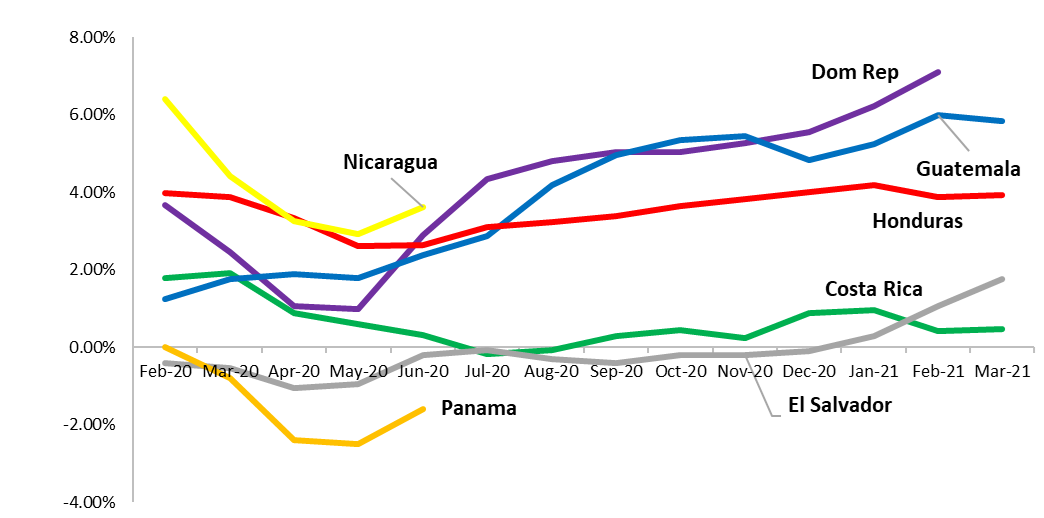
    Central America & Caribbean:​ Inflation
    Monthly year-on-year figures

    Central America & Caribbean, selected countries: GDP growth (%)
    Quarterly figures are year-on-year growth
    GDP  2020 forecast* 2021 forecast* Q1 2020 Q2 2020 Q3 2020 Q4 2020
    Costa Rica -4.8 3.0 0.1 -7.4 -6.4 -5
    Dominican Republic -5.5 5.0 0.0 -16.9 -7.2 -2.9
    El Salvador -8.6 3.5 0.8 -19.2 -10.2 -2.3
    Guatemala -2.5 3.5 1.2 -8.9 -1.4 3.0
    Honduras -8.0 4.5 -1.5 -18.5 -7.9 -7.6
    Nicaragua -4 1.3 1.8 -7.9 -2.5 -1.9
    Panama -11 5.5 0.4 -38.4 -23.6 -10.9
    *Forecasts from the United Nations Economic Commission for Latin America & Caribbean December 2020
    Quarterly growth based on figures from the local central banks


  • JAMAICA: Is this a Caribbean success story?

    Patrick de Courcy 16 March 2023 Hits: 5651

    Jamaica has reaped praise for its macro-economic management in the latest Article IV consultation report written by the International Monetary Fund (IMF) and published on 8 February.

    Article IV reports are written by teams of IMF economists after visiting a country and meeting the top economic officials; they are considered a bill of health on economic management. The latest of these reports referring to Jamaica is full of measured praise. The IMF says the country has been “nimble” in its response to major challenges: the coronavirus (Covid-19) pandemic, the war in Ukraine, and tighter global financial conditions. Despite these setbacks it said the government had got Jamaica back on a strong recovery path. Tourist flight arrivals had rebounded to pre-pandemic levels, and 2022 economic growth was expected at 4% (subsequent government data put this higher at 5.9%).

    Inflation had ticked upwards in 2022 but was expected to ease back this year. High commodity prices had widened the current account deficit, but foreign currency reserves remained “healthy”, and the financial system was deemed to be “well capitalised and liquid”. The response to the upward surge in international food and fuel prices had been to allow for full “pass though” to the domestic economy while providing support for the poor within the existing fiscal position. Overall, the mix of fiscal and monetary policies had “struck the right balance in responding to shocks, protecting the vulnerable, countering inflationary pressures, and further securing debt sustainability”.  

    The IMF Executive Board assessment praised the policy of post-pandemic gradual fiscal tightening, coupled with “data-dependent monetary tightening”. However, it did argue that within existing financial parameters Jamaica should be identifying resources for extra investment in climate-resilient infrastructure, health, security, and education. There was also a call for strengthened tax and customs administration, as well as for an improved AML/CFT (Anti-Money Laundering/Combating the Financing of Terrorism) framework.

    Commenting on the report, the Financial Times Alphaville column said, “this is as close as the IMF comes to standing ovation”. The government is likely to be particularly pleased by the reduction in the debt-to-GDP ratio which a decade ago was at a highly dangerous 147%. According to the latest data from the finance ministry the ratio will have fallen to 79.7% by the end of this fiscal year (end-March 2023) and to 74.2% by the 2023-24 fiscal year. The Bank of Jamaica (BOJ) has said it expects growth to continue, propelled by tourism, agriculture, and the resumption of production at the Jamalco alumina plant. BOJ governor Richard Byles said on 21 February that the pace of growth would nevertheless ease as activity levels among Jamaica’s main trading partners “normalised” after the pandemic. Annual inflation fell from 9.4% in December to 8.1% in January and was now being estimated to fall to a 4.0%-6.0% target range by the end of this year. 

  • VENEZUELA: Maduro delivers annual address to congress

    Patrick de Courcy 18 January 2024 Hits: 4006

    Venezuela’s President Nicolás Maduro delivered his annual state-of-the-nation address to the national assembly on 15 January. At five hours in length, the speech covered, among other things, the state of the economy, the thwarting of four conspiracies to assassinate him (he provided no details), foreign affairs, and future plans, while conspicuously failing to reveal a date for this year’s presidential elections.

    Maduro said GDP growth in 2023 surpassed 5%, “the fastest growth in Latin America and the Caribbean”, although he did not specify the precise percentage. He projected 8% GDP growth in 2024, rapid for a country facing “economic genocide” as he described the international sanctions applied on Venezuela for nine years by the US government. The mismanagement of the Venezuelan economy long predates sanctions, but Maduro insisted that the country had turned a corner. He celebrated his government’s success at reducing inflation, which stood at ‘just’ 189.8% in 2023, no longer the highest in the region being narrowly topped by Argentina.

    The projected 8% growth is predicated on an increase in oil output, boosted by the easing of US sanctions allowing the US oil giant Chevron to renew operations in Venezuela in November 2022. Venezuelan oil production stood at 783,000 barrels per day (bpd) in 2023, an increase of 9.3% on the previous year, according to figures released by the Organization of the Petroleum Exporting Countries (Opec) on 17 January and the government is hoping to exceed 1m bpd in 2024. Crude exports totalled US$6.23bn in 2023.

    Maduro did not use his address to confirm the date for presidential elections this year. On 16 January the opposition coalition Plataforma Unitaria Democrática (PUD) once again pressured for him to name a date and a timetable for the elections.

    Foreign affairs

    Nicolás Maduro also dispensed some of his wisdom in foreign affairs during his annual address. He offered to assist his Ecuadorean peer Daniel Noboa in prison reform and advised him against seeking US support in its struggle against drug trafficking organisations as the installation of US military bases would violate regional sovereignty (the US air base at Manta, which conducted drug-trafficking surveillance, was closed during the presidency of Maduro ally Rafael Correa [2007-2017]). Maduro also described the election of Javier Milei in Argentina, and his plans to reduce the size of the state and weaken the defence of social justice, as “a fatal error” for the country and the region. Milei responded on social media by saying that he had “not expected such praise”, which showed that he was “on the right track”.

  • CUBA: New devaluation fails to convince the markets

    Abbi Dicker 23 January 2026 Hits: 1371

    On 18 December the Cuban government devalued the peso by creating a third exchange rate, which, along with the increasing dollarisation of the economy, it described as a temporary stabilising measure. Yet many economists remain unconvinced.

    Cuba’s central bank (BCC) said the third official exchange rate would be initially set at 410 Cuban pesos (CUP) to a dollar, close to current black-market valuations. Analysts said this represented a devaluation of 30% or more. The new peso/dollar rate will sit alongside the two existing official rates of 24 and 120CUP to the dollar. The existing official rates apply to state-run companies and transactions deemed to be “essential and strategic”. Ian Pedro Carbonell, a BCC official, said the new rate would stimulate exports and offer citizens “an attractive exchange rate that will allow them to obtain more national currency without the risks of going to the black market”. The new rate will be adjusted “periodically”. The government says it remains committed to eventually unifying the three rates. It has also announced a liberalisation of foreign-currency bank accounts.

    The track record for the use of multiple exchange rate regimes in Latin America to help economic stabilisation is not good. In places like Argentina and Venezuela they have been associated with market manipulation and corruption achieved by obtaining dollars at low “official” prices and reselling them at much higher market or informal rates. Cuban economist Mauricio de Miranda says the current policy mix of fixed and fluctuating exchange rates is long term “unsustainable”, as it favours certain state and military owned companies while distorting the rest of the economy. Another economist, Pedro Monreal, says that currency unification will only be possible if there is much further and deeper devaluation of the official peso rates. He describes future devaluation of the CUP24 rate as “100% likely” and the chances of devaluation of the CUP120 rate as “very high”.

    It doesn’t help that the wider Cuban economy is being hit by multiple levels of bad news. Concerns over corruption were reinforced by the announcement in December 2025 that former economy minister Alejandro Gil (2018-2024), dismissed in 2024, has been sentenced to life imprisonment on espionage and corruption charges. The ruling Partido Comunista de Cuba (PCC) has postponed its ninth congress, initially scheduled for April 2026, to an unspecified future date because of the economic crisis. Over Christmas and the New Year, the island economy limped on with power cuts running at 40%-50% of capacity. US military action in Venezuela and the associated tanker ship seizures were expected to further reduce the island’s oil supplies and ramp up uncertainty.

    Tourism

    Tourism, a key source of foreign currency in Cuba, remains weak. Cuba’s national statistics office (Onei) reports that tourist arrivals fell by 19% in the first 11 months of 2025, indicating that the sector remains well below levels registered prior to the coronavirus (Covid-19) pandemic which struck in 2020.

  • COSTA RICA: Moving on hardline promises

    Abbi Dicker 31 July 2026 Hits: 412

    Since taking office in May, Costa Rica’s new government led by President Laura Fernández, the protégée of her predecessor, conservative populist Rodrigo Chaves (2022-2026), has announced various security measures as well as progress regarding the construction of a new maximum-security prison, Centro de Alta Contención de la Criminalidad Organizada (Cacco). Inspired by the notorious Centro de Confinamiento del Terrorismo (Cecot) in El Salvador constructed under Fernández’s ally, authoritarian President Nayib Bukele, the new jail forms the centrepiece of her hardline stance. The government’s new measures and its commitment to forging ahead with Cacco are in line with Fernández’s election-winning campaign pledge to tackle insecurity, with Costa Rica having faced soaring homicides in recent years, attributed to the presence of drug trafficking organisations [SSR-26-02]. It is the latest sign of the pivot from security policies pursued under Chaves’ predecessors, which had focused on social prevention and increasing the police presence.

    In a 1 July update, Justice Minister Gabriel Aguilar said that construction of Cacco was 64% complete. Located in Alajuela province, the new high-security prison, construction on which began under Chaves (now serving as Fernández’s minister of the presidency and finance minister), will house 5,100 inmates when complete. Aguilar also revealed that prisoners would be required to wear orange uniforms, reviving a practice that Costa Rica has not used in its prison system since the 1970s. He was cited by the media as saying that the uniforms, which would enable prisoners to be more easily identified, would be produced by inmates at the women’s facility Vilma Curling Rivera, also known as El Buen Pastor, which is in the capital San José, with materials donated by private companies, meaning these would be produced at no extra cost to the State.

    The progress update on the Cacco, which followed an earlier announcement regarding plans to more generally toughen conditions in prisons, came two weeks after President Fernández unveiled a legislative package aimed at tackling insecurity. Announced on 15 May, these reforms include the so-called ‘Gerson Rosales law’ (named after a member of the national police force, Fuerza Pública [PF], killed in the line of duty on 13 May), which seeks to strengthen legal protection for the PF. These include the presumption that officers’ use of force is justified when performing official duties. Under a further reform, participation in criminal organisations would become a criminal offence punishable with a prison sentence of 1-6 years, rising to 6-20 years depending on the role played in the organisation and the crimes in question. Fernández is also proposing stiffer penalties for repeat offenders and an expansion of prisoners’ participation in paid productive activities, citing a monthly cost to the prison system of US$1,000 per prisoner.

    • Tougher prison conditions

    On 25 May President Fernández revealed plans to further toughen prison conditions with a legislative initiative which proposes making audio and video recordings of visits received by inmates in prisons. She also said that the authorities had identified 260 criminal structures comprising 4,300 gang members in the country, and that police chiefs would be subject to polygraph tests – a policy which led her on 22 June to announce the dismissal of seven top officials (whose identities were not revealed) after they failed the tests.

    Insecurity remains the chief public concern

    In a poll published on 6 May by the Centro de Investigación y Estudios Políticos (Ciep) of the Universidad de Costa Rica (UCR), 49.5% of respondents listed insecurity and crime as their main concern, up from 45% in the previous Ciep poll in September 2025, and the highest level in any Ciep poll on record.

    Far behind in second place was corruption (10.5%), poor governance (6.2%), and drugs and narcotrafficking (5.3%). The same survey showed that 59.2% of respondents thought that the new government led by Fernández, who served as Chaves’ minister of the presidency (2024-2025, 2026) and planning (2022-2025), would be an improvement on that of her predecessor. 

  • PANAMA: Green light for FTA with US

    LatinNews 01 September 2011 Hits: 2636

    Panama’s pro-business President Ricardo Martinelli looks set to achieve what he previously described as his “foreign policy priority”. On 19 April, nearly four years after Panama and the US first inked a bilateral Free Trade Agreement (FTA), US Trade Representative Ron Kirk confirmed that Panama had overcome the last “hurdle” and the deal would be sent to the US Congress for its ratification. The announcement provided the backdrop to Martinelli’s first ever official meeting with US President Barack Obama. It comes at a critical point for Martinelli given growing US concern, expressed in US embassy cables released by WikiLeaks, regarding his perceived autocratic tendencies and the suspicion of corruption in his government [RC-11-04].

    Security was also discussed during the brief (35 minute) Martinelli-Obama meeting in Washington on 28 April, largely within the context of the US’s interest in assisting Central America on a regional basis to combat crime. However, the main topic was trade. Accompanied by praise for Martinelli’s “leadership” and an allusion to the importance of “showcase[ing]… commitments to democracy”, Obama’s pledge of support for the FTA echoed Kirk’s announcement which had followed the entry into effect (on 18 April) of a bilateral Tax Exchange Information Agreement (TIEA). The TIEA, which allows both countries to request information on all types of national taxes in civil criminal matters, was part of more general efforts by Martinelli to address tax transparency, which had hitherto proved a major stumbling block. Other examples of these efforts include the negotiation of 10 double taxation accords with other countries in order to get Panama off the Organization for Economic Co-operation and Development’s ‘grey list’ (for which 12 such deals are necessary).

    In addition to US concerns about labour rights (which Martinelli addressed with recent legislation), the FTA had stalled under the previous Partido Revolucionario Democrático (PRD) government (2004-2009) over US objections to the PRD congress leader, Pedro Miguel González, who the US want prosecuted for the murder of a US sergeant (although this was resolved in 2008 when González declined to stand for a further term). Having also encountered a set-back with the expansion of the Democrat presence in the US House of Representatives following the 2008 election, the trade deal received fresh impetus in January 2011 after the Republicans assumed control of the lower house, following the 2010 mid-term elections.

    Beneficiaries
    The promise of the FTA is a boost for Martinelli’s efforts to dismantle Panama’s traditional tax haven image. With US foreign direct investment (FDI) in Panama totalling US$7.8bn in 2009, up 26% on 2008 and almost equivalent to the entire US$8bn for the other five Central American countries put together, the prospect of further investment is also particularly welcomed by the President given his huge US$13.5bn five-year infrastructure plan for 2010-2015. The plan, following the completion of the US$5.2bn Canal expansion project, seeks to turn Panama into the “Hub of the Americas”. Local organizations such as the influential trade union group, Frenadeso, complain that in trade terms the US is the main beneficiary, as many of Panama's exports have long entered the US duty-free under trade preference programs. Examples include the Caribbean Basin Initiative, under which more than 99% of Panama’s agricultural exports enter the US market duty-free. US industrial goods, however, face an average tariff of 7% with some as high as 81%, while US agricultural goods face an average tariff of 15%, with some as high as 260%. The FTA allows over 87% of US exports of consumer and industrial products to immediately enter Panama duty-free, with the remaining tariffs to be phased out over 10 years. Nearly 56% of agricultural exports will receive immediate duty-free treatment, with most of the remaining tariffs to be scrapped within 15 years. In 2010, the US ran a US$5.7bn trade surplus with Panama, exporting almost US$6.1bn in goods and importing US$379m.

    • Deteriorating business climate

    As well as challenging Obama’s praise of Martinelli’s commitment to ‘democracy’, US embassy cables released by WikiLeaks reveal US reservations about the business climate in Panama. One, dated 10 February 2010, said that the “Investment Climate for American firms has deteriorated since the Martinelli Administration took office”. “Events” cited include “GOP” procurement of “approximately $100 million through sole-source contracts between July 1 and September 25, 2009 under emergency licitation procedures” and the passage of a “law that eliminates contract concession changes by reverting contracts back to the original non-amended concession if the company harmed the people of Panama; thereby eliminating years of business predictability to contract holders”.