All Categories

Subcategories

  • ECONOMIC HIGHLIGHTS

    Patrick de Courcy 18 January 2023 Hits: 3622

    PARAGUAY | Country records first trade deficit in nearly three decades. Paraguay’s central bank (BCP) on 12 January released its foreign trade report for December 2022, which shows that the country recorded a trade deficit of US$1.29bn last year. This is the first time that Paraguay has posted a negative balance of trade in 28 years. According to the BCP, exports totalled US$13.88bn in 2022, 1.5% less than the US$14.09bn recorded in 2021, while imports totalled US$15.19bn, an increase of 16.1% compared with the previous year. The BCP stated that the drop in exports was mainly due to fewer shipments of soybeans, oils, and flours – soybean exports in 2022 totalled US$1.23bn, down 58.8% on the previous year. This reflects the effects of a drought which severely affected the output of Paraguay’s soybean harvest. Meanwhile, fuel and machine and motor parts pushed up the overall value of imports last year.    

    CHILE | Minimum wage increases amid high inflation. Chile’s monthly minimum wage was raised to Cl$410,000 (US$482) as of January, an increase of Cl$10,000. This followed an agreement reached last April between President Gabriel Boric’s government and the country’s largest trade union, Central Unitaria de Trabajadores (CUT), which was passed by decree the following month. The decree stipulated that the minimum wage would rise from Cl$350,000 to Cl$380,000 in May 2022 and to Cl$400,000 in August. The decree also stated that the minimum wage would then rise to Cl$410,000 in January 2023 if annual inflation closed the year above 7%. At the turn of the year, the latest figures from Chile’s national statistics institute (INE) showed annual inflation standing at 13.3% in November. Data then released in the first week of the year put the 2022 annual inflation rate at 12.8% – well above the central bank’s target of 3%. Prices in the food and drink sector, and recreation and culture sector, pushed up December inflation, while transport prices recorded a 0.5% reduction in December, despite accumulating overall inflation of 18.3% in 2022 as a whole.

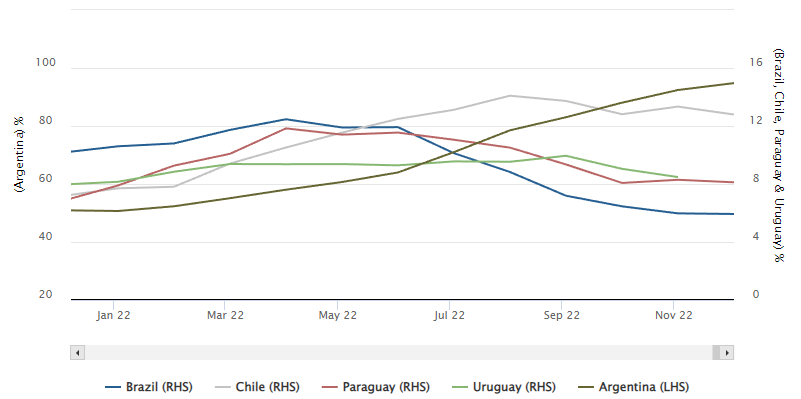
    Brazil & Southern Cone: inflation rate
    Percentage variation (year-on-year)

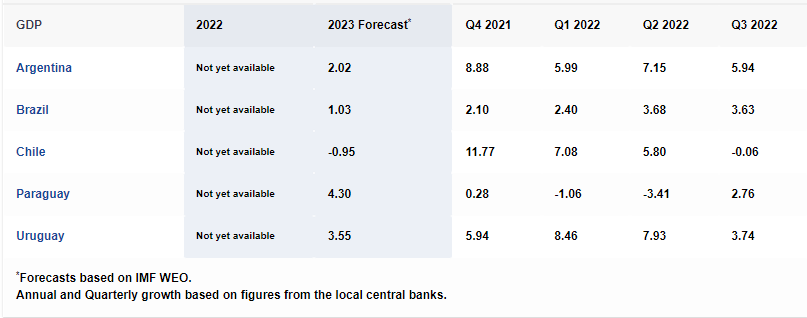
    Brazil & Southern Cone: GDP growth (%)
    Quarterly figures are year-on-year growth

  • TRINIDAD & TOBAGO: Making the case for constitutional reform

    Sarah Sheldon 18 October 2024 Hits: 631

    At the beginning of August, Trinidad & Tobago’s Prime Minister Keith Rowley, leader of the People’s National Movement (PNM) government, received the report of the National Advisory Committee on Constitutional Reform, and a couple of weeks later the report was released to the public. It was immediately dismissed by Kamla Persad-Bissessar, leader of the opposition United National Congress (UNC), as “a con job to be used as a PNM manifesto for the upcoming general election”, and there are elements of the report that would not find favour even with the prime minister. It would seem, therefore, that the effort to reform Trinidad & Tobago’s 1976 constitution still has a long way to go. Nevertheless, the process to date has thrown some interesting light onto contemporary Trinidad and the challenges it faces.

    The National Advisory Committee on Constitutional Reform was appointed by the prime minister in late January 2024 with the aim of producing a Working Document for a Constitution Conference to be convened in June 2024. This proved to be too ambitious a timescale, and an extension was granted.

    The background to the committee’s task, as articulated in its report, was “a clear appreciation that the existing 1976 Republican Constitution, now in place for 48 years, remained essentially a colonial construct since the basic structure of the 1962 Independence Constitution was still embedded therein with all its assumptions about people, power, and the exercise of authority”. Also, the report added, the constitution was “lacking the ‘software’ of the unwritten conventions which suffused the British unwritten constitution”.

    The report notes that the country’s traditional media, while giving greater voice to ordinary people, does not have an especially strong influence on policy or the conduct of politics while the perception is that the business and political elite are “deferential to political power”. Academic criticism has also weakened, and “even the political and social commentary of the traditional calypso art form has lost much of its sting in recent decades, yielding to soca music and its mainly apolitical lyrics”.

    Section II of the report provides an interesting analysis of the social and political developments since 1976 that must inform any constitutional reform. It highlights two standout changes. First, the decline in oil and gas production. The report notes that “oil production is now at the lowest level since before independence in 1962 and production of natural gas is at the lowest level since 2003”. The second major development has been the escalation of crime since independence, particularly since the attempted coup of 1990 since when escalating gang violence and murders have pushed Trinidad “into the top echelons of countries with very high murder rates”.

    In the 1976-1980 period, serious crimes averaged 10,600 per year. The rate doubled to 20,415 per year in the 2006-2010 period. The rate did then decline substantially to 12,350 per year in the 2016-2020 period – but, the report says, “the decline may reflect lower levels of reporting since other data appear to conflict with the official police data”. The detection rate for serious crimes is only 33%, meaning that two out of three serious crimes remain unsolved.

    The real problem, however, is the murder rate. In the ten years from 1991-2000, there was an average of 110 murders per year. The average from 2001-2010 was 349, with a peak of 547 in 2008. The average for the next decade, 2011-2020, was up again at 437, and the murder rate escalated further still in 2022 and 2023 with more than 600 murders in each of these two years. The report says: “The consensus of expert opinion is that these murders are mostly gang-related, perpetrated by young males mostly of African descent, residing in urban areas and are driven by turf wars fuelled by the drug trade and reprisal killings”.

    The report also looks at emerging challenges, including climate change and the testing geopolitical environment with wars in Europe, Asia, Africa, and the Middle East and the threat to “the coherence of the United Nations system”. The Global South, of which Trinidad & Tobago is a part, “is asserting itself in attempting to reform and reshape the international political order and the international financial system established after the Second World War”. Regional challenges include the Venezuela-Guyana dispute and the “intractable violence in Haiti”. The report also says that intra-regional migration “is likely to increase”. With all this challenging governments, the report says “our institutions must be modernised and be made fit for purpose to cope with and overcome these challenges and the economic and social disruption that is likely to result”.

    In a searing conclusion, the report warns: “Trinidad & Tobago is a society of profound contradictions. There is a veneer: the appearance of prosperity and even sophistication…Yet we are simultaneously a society marred by violence (domestic and criminal), disrespect, official indifference and inaction, institutional inertia, conflict and litigation, lack of trust, individualism and intolerance.”

    Finally, the report says: “Since 1976, the economic and social progress we have managed to achieve has not been sufficient to ameliorate social conditions for the many who have been drawn into a life of crime and criminality and to overcome the deficiencies of colonial institutions we adopted at Independence, which have fettered the appropriate response to these problems. In fact, conflicts between and among holders of high office have compounded the problems and inhibited resolution or reform. This is the context in which we engage in constitutional reform in 2024 in Trinidad & Tobago.”

    Section IV of the report provides a detailed analysis of the current constitutional arrangements and how they should be reformed. It starts with the preamble, which currently “is written in the third person, creating the impression that it was given to us instead of being created by us. This reflects the monarchical system in which we were subjects lacking agency and voice.” The new constitution, the report states, should be written in the first person, and “it must also clearly declare our intent and willingness to assume responsibility for ourselves”.

    Following the preamble, the new constitution, it is argued, should have five sections dealing with sovereignty, individual rights and freedoms, the separation of powers, democracy, and the rule of law.

    The first key recommendation for the sovereignty section is that colonial era laws should no longer be protected under an Existing Law clause. They should be subject to challenge “for infringing fundamental rights and freedoms and declared unconstitutional”.

    The second recommendation for the sovereignty section relates to the much-debated right of appeal to the British Privy Council. This, the report quotes a constitutional expert as saying, “constitutes a negation of our sovereignty”. The report agrees, saying it would be “wholly inconsistent with reform to retain the Privy Council as the final court of appeal”. It adds that, with the Caribbean Court of Justice (CCJ), “we now have… a Caribbean court which, with courage and competence and without any hint of political interference, has been adjudicating appeals for the last 19 years from Barbados and Guyana, and more recently from Belize, Dominica, and St Lucia, and in the process, improving access to justice and developing our jurisprudence”.

    There are no surprising or overly controversial recommendations in the section on individual rights and freedom. However, the report does recommend that the constitution should emphasise that with rights come duties, including defending the state, contributing “in proportion to each person’s needs” to the revenues required for providing public services, to respect the rights and freedoms of others, and for parents “to undertake their obligation of care, maintenance and upbringing of their children in a safe and wholesome environment”. It also lists as a fundamental duty the need for each person “to work according to their capacity in useful employment, creating for himself/herself opportunities for such labour where none may seem immediately available”.

    The two most interesting sections are to do with the separation of powers and democracy. At the heart of the separation of powers section is the observation that parliament is not doing its job properly. The report notes that there is “a near universal complaint that members of the House of Representatives do not serve their constituents very well, nor are parliamentary committees effective in their oversight of the Executive and the independent institutions”.

    On parliament, the report notes in particular that when members of parliament (MPs) become ministers, it is their parliamentary duties that suffer. For this reason, it says, the view that MPs should not serve as ministers “has considerable merit”. It adds: “There would seem to be a very good reason for effecting greater separation between the Executive and the Legislature.” However, the report does not favour adopting the US system, saying that this “would actually result in an even greater concentration of power, which is clearly not what the public wants”.

    The proposed solution is to expand parliament, limit the number of government ministers who may be drawn from parliament, and to limit the number of ministries. The report suggests a limit of 18 ministries and limiting the number of ministers who can be drawn from parliament to eight, inclusive of the prime minister. This way “there will be a sufficiently large backbench for attending to parliamentary matters as well as scrutiny of the Executive, the Judiciary, and the ‘fourth branch’ independent institutions”.

    The independent or ‘fourth branch’ offices over which the president would continue to have the power of appointment are the auditor general; ombudsman; the chairperson and members of the Legal Services Commission, Public Service Commission, Teaching Service Commission, Integrity Commission, Salary Review Commission, Public Service Appeal Board, Advisory Committee on the Power of Pardon, and Election and Boundaries Commission; and the chairperson and deputy chairperson of the Tax Appeal Board. To this list, the report recommends adding the Equal Opportunity Commission and the Procurement Regulator.

    With regard to presidential powers, it is noted that these are not just ceremonial and include powers of appointment over independent offices “which are essential for checking the power of the Executive”. With this in mind, the report suggests a method short of direct election that ensures the president is not just a governing party cipher. It recommends that candidates for the presidency should be nominated by the public, vetted by the President Election Committee, and elected by an expanded electoral college comprising all elected members of the house of representatives, the senate, and the Tobago house of assembly as well as local government municipalities and regional corporations.

    Moving on from the separation of powers to the core issues of democracy, the report begins with the premise that “a representative, responsive and responsible Parliament is the beating heart of a democratic society”. But it then goes on to list the shortcomings of the present first-past-the-post (FPTP) electoral system. Its main attraction is the direct linking of members to constituencies, yet, the report notes, “the perennial complaint is that once elected, representatives are rarely seen in their constituencies and do not take back to their constituents the legislation that is before Parliament for debate and direction”.

    Furthermore, the reality is that the electorate doesn’t vote for a constituency representative but for a party and its leader. Also, the FPTP system can produce governments that do not have majority support at the national level. “In effect”, the report says, “the FPTP system in Trinidad & Tobago does not pass the test of effective representation of constituents and may produce minority governments, wasted votes, and hence the perception and reality of disenfranchisement and inequity”. On the other hand, the report admits, FPTP does on the whole produce stable governments, with no lengthy negotiations between parties for the formation of a government after a general election.

    Having looked at all the pros and cons, the report says that “the Committee is persuaded that in response to the robust concerns expressed by most of the public, the time is opportune to consider the shift to a form of proportional representation”. It lists the “multiple benefits” of such a shift as including a reduction in the number of “wasted votes”, thereby encouraging voter turnout; less feeling of alienation by sections of the population when their party is not in power; and the inclusion of a broader spectrum of ideas in the formulation of policy.

    However, despite making such a strong case against FPTP, the report ends up by recommending only a partial change to the current system. “To maintain and indeed strengthen constituency representation and citizen participation” the Committee recommends retaining FPTP for elections to the house of representatives. However, when voting for a constituency member in a general election, the voter will also be asked to vote for a political party and the result of this latter vote will determine the composition of the senate, meaning that smaller parties that are unlikely to win a seat in the house of representatives could still gain seats in the senate. The senate “would remain a deliberative body that scrutinises legislation and gives voice to interests other than local or constituency interests”.

    The report suggests increasing the number of senate seats to 55, with the president appointing 10 independent senators and five Tobago senators. The remaining 40 seats would be allocated proportionately on the basis of the list votes in the general election.

    One other major change recommended in the report is to fix the date of elections, thus taking away the prime minister’s discretion to call elections early. The report calls this “an arbitrary power which can be abused” and it says that a fixed date for elections would be “consistent with fairness, allowing all political parties, as well as the private sector, to plan their affairs knowing precisely when an election is due”.

    Additionally, the report recommends that a prime minister should be limited to two consecutive terms with a gap of at least five years before a former prime minister could again be considered for the post. During the term of a parliament, a vote of no confidence in the prime minister would lead to the president appointing a new prime minister or dissolving parliament.

    The next stage in the reform process is due to be the calling of a National Constitutional Conference made up of delegates from political parties and the general public. Perhaps optimistically, the report concludes with the words: “The Committee anticipates that the primary outcome of the Conference will be consensus on the legislative proposals for comprehensive constitutional reform. The People’s wishes are expected to be carefully considered and respected.”

  • COLOMBIA: Petro summons spirt of Bolívar in congress clash

    Abbi Dicker 08 May 2025 Hits: 3782

    Hoisting aloft the sword of Simón Bolívar and the flag associated with his War to the Death decree against the Spanish, Colombia’s President Gustavo Petro addressed a large crowd gathered in the Plaza de Bolívar outside congress on International Workers’ Day on 1 May. The symbolism was clear. Petro assumed the role of a modern-day Bolívar struggling for “the rights and freedom of the people”, with the senators within as enemies of the people. He then presented the senate with his proposal for a referendum with 12 questions encapsulating the keys points of his government’s labour reform bill rejected by senators in March [WR-25-16].

    “This is not about power for me but power for the people,” President Petro said during his address to thousands of supporters in the Plaza de Bolívar. For Colombia’s opposition parties, however, this was Petro in full populist authoritarian mode, channelling not El Libertador but rather El Comandante, the late Venezuelan leader Hugo Chávez (1999-2013) who saw himself as the reincarnation of Bolívar. They contest Petro’s claim, like Chávez, to represent ‘the people’, arguing that they were also democratically elected.

    The president of the senate, Efraín Cepeda, wrote an open letter on 5 May, accusing Petro of “intimidation, with bellicose symbols and threats”. Exhorting fellow senators to resist the “unprecedented assault on the pillars of our state”, Cepeda said that their “mission transcends the present”, adding that they are “fighting for a country where democracy is stronger than threats, liberty more powerful than the sword”.

    Senators will have 30 days (until 30 May) to vote on Petro’s referendum initiative. Senators will be able to approve or reject it with a simple majority of 53. Failure to vote within the allotted time will allow Petro to issue a decree calling the referendum. The vote is likely to be tight, with a handful of legislators from the centrist Partido Liberal (PL), Partido de la U (PU), and Alianza Verde (AV) deciding it one way or another.

    Referendum

    Senator Carlos Jiménez of the right-of-centre Cambio Radical (CR) accused President Petro of having become “a miserable leader of a party that seeks to cling to power, after his failure to govern, and does nothing but issue threats”. There is some concern among the opposition, however, that the referendum initiative might pass in the senate and then provide Petro with a campaign platform ahead of congressional elections next March and the presidential contest next May. A new public opinion survey by the local pollster Cifras y Conceptos this week shows a majority of respondents (57%) are now in favour of the referendum, making it difficult for congress to reject it out of hand.

  • TRINIDAD & TOBAGO: New government’s first budget

    Abbi Dicker 13 November 2025 Hits: 689

    Trinidad & Tobago’s finance minister, Davendranath Tancoo, part of the new United National Congress (UNC) government that took office in May, unveiled the fiscal 2026 budget in October, amid some criticism that revenue targets are over-optimistic.

    Total government spending in 2026 is set to be TT$59.23bn (US$8.74bn). With revenues projected at TT$55.37bn, there will be a deficit of TT$3.86bn, equivalent to around 2% of GDP, within what Tancoo described as “the international benchmark of three percent”.

    An initial criticism from opposition and independent economists is that the new budget has been built on the optimistic assumption that international oil and gas prices will average US$73.25 per barrel and US$4.35 per million British thermal units (mmBTU) during 2026. Since both are currently priced respectively at US$63.50 and US$3.09, the suggestion is that the new government may experience a revenue squeeze.

    The administration has highlighted various budget measures intended to strengthen household incomes. There has been an immediate TT$1 per litre reduction in the price of super gasoline, along with the removal of VAT on various basic food items. From January private pensions will be tax-exempt. Import restrictions on used cars and vans are being eased.

    The previous Peoples’ National Movement (PNM) administration (2015-2025) had offered public sector workers a 4% wage improvement. The new UNC administration of Kamla Persad-Bissessar has gone one step further, announcing a 10% increase, including back pay. Tancoo echoed the party’s electoral rhetoric saying, “Promise made, promise kept because when UNC wins, public servants win.” There is also help for farmers with VAT removed on agricultural machinery and other items. A further feature of the 2026 budget is that the smaller island of Tobago will benefit from a larger-than usual share of national spending.

    Tancoo announced several tax increases to part-fund his government’s largesse. Employers’ National Insurance System (NIS) contributions will rise 3% in January, with a further 3% due in January 2027. A landlord business surcharge of 2.5%-3.5% of rental income will come into force in January. There will also be an electricity surcharge on commercial and industrial customers, an asset levy on commercial banks and insurance companies, and higher duties on alcohol and cigarettes. Among other measures the government is also introducing a 5% import duty on single use plastics, and a TT$5m Women’s Health Fund to address period poverty and offer free menstrual kits in schools.

    True to Trinidad and Tobago’s tradition of adversarial politics, the PNM was cited by daily newspaper Trinidad and Tobago Newsday as describing the government’s budget as “fake and fraudulent”.

    The same report, published on 14 October, cites former finance minister Colm Imbert (2015-2025) as saying that the government was aiming to use a loophole to access money from the Heritage and Stabilisation Fund (SSF). He noted that if actual international oil and gas prices fall below budgeted levels, governments can withdraw 60% of the difference from the HSF. Prime Minister Persad-Bissessar denied trying to exploit the loophole, saying her government will not use the “PNM tricks” of the past.

    Jobs

    A potentially far-reaching change announced by Tancoo is the elimination of the Cepep-URP job programmes, which are to be replaced with “full time better jobs” through a TT$475m employment fund. Cepep (community based environmental protection and enhancement programme) and URP (unemployment relief programme) have been in existence for decades and are widely seen as low productivity “make work” programmes subject to political manipulation and featherbedding. The government will likely be scrutinised on its ability to use the new funding to create more sustainable and productive employment.

  • Risk pointers

    LatinNews 18 July 2012 Hits: 493

    *** Russian opposition still struggling to make ground.  In our 4 July issue we looked at how the Russian anti-corruption campaigner and opposition activist Aleksey Navalnyy has been moving decisively ahead of his rivals in terms of his popularity amongst protesters.  His wider popularity, however, is less certain, reinforcing our view that the opposition movement is making little progress, although there remains the danger that President Vladimir Putin’s hard-line approach to the opposition could backfire and lead to a radicalization of the protest movement.

    Navalnyy’s positive rating among protesters has grown threefold in the last four months and now stands at 46%, considerably ahead of Left Front coordinator Sergey Udaltsov on 26%.  With the next-placed person on just 10%, these figures support the view that Navalnyy has become the indisputable leader of the protest movement.  But Navalnyy’s position with the wider general public is nothing like so positive.  It is true that he has come a long way, but he is failing to consolidate general support.

    Research carried out in April 2011 showed that as little as 6% of the general public had even heard of him.  His profile was then transformed by the mass protests that followed Russia’s disputed parliamentary elections last December.  As a consequence of this, a Levada Centre poll carried out in March 2012 showed that 25% of respondents knew who Navalnyy was, a rise of 19 percentage points from the April 2011 poll.

    However, the state-controlled TV coverage that has been instrumental in this rise in recognition has been almost totally negative.  The three main state-controlled TV channels - Rossiya 1, Channel One, and NTV - enjoy a combined audience share of around 50%, and Navalnyy appeared in 162 state TV news reports between 6 March and 15 July.  Recently the state TV reports have focused on allegations of financial impropriety following the publication of hacked emails between Navalnyy and the governor of Kirov Region, Nikita Belykh.  As a consequence, although Navalnyy’s recognition by the general public is significantly up, only 19% of the 25% who say they recognize him say they would support him in a presidential election.

    *** Turkey rules out talks with PKK.  On 13 July, Turkey’s Prime Minister Recep Tayyip Erdogan ruled out any hope of talks with the Kurdistan Workers’ Party (PKK) guerrilla group.  He said: “Government negotiation with the separatist terror organization is out of the question.  Only fighting against the separatist terror organization is in question.  This fighting will continue until the moment the [PKK] lays down its arms.”

    There were talks between the PKK and the National Intelligence Organization between 2009-2011, but the talks broke down after a PKK attack in July 2011 killed 13 soldiers in the south-eastern province of Diyarbakir.

  • TRACKING TRENDS

    LatinNews 14 November 2013 Hits: 767

    COLOMBIA | Avianca makes it to NYSE. On 5 November Avianca, Colombia’s main airline, began trading in the New York Stock Exchange (NYSE) for the first time. The event marked a new high on Avianca’s remarkable rise from a modest and heavily indebted enterprise into Latin America’s second largest airline. Significantly, as an article published by the Wall Street Journal to mark Avianca’s debut at the NYSE showed, the company’s rise appears to track Colombia’s own economic development in recent decades.

    Founded in 1920, Avianca is the world’s second oldest airline still in operation. But while the company grew steadily, in 1989 it was affected by Colombia’s drug-related violence when one of its flights was bombed by drug lord Pablo Escobar in a failed assassination attempt on former president César Gaviria Trujillo (1990-1994). The 1990s saw the airline’s (and Colombia’s) fortunes take a turn for the worse to the point that by 2004 it found itself US$220m in debt and it had to declare bankruptcy. That year the firm was bought by local businessman, Germán Efromovich for US$64m.

    Under Efromovich’s leadership the company embarked on a sustained period of impressive growth underpinned by a significant improvement in its home operating country coupled by the rise of Colombia’s middle class, which led Avianca to renew and expand its fleet and conduct a merger with Central America’s Taca in 2010 making one of the few Latin American airlines with a truly regional presence.

    Despite this, Avianca’s NYSE debut proved to be somewhat disappointing. The airline had projected its shares to be priced between US$17 and US$20, but the market valued it at an unexpected low of US$14. This took Avianca by surprise. However, Avianca President Fabio Villegas told Colombian daily Portafolio that the firm was not discouraged by its NYSE Initial Public Offering (IPO). Villegas explained that during IPOs investor demand normally tends to drive down share prices – a process commonly referred to as ‘book building’. Villegas said that he expected Avianca shares to increase in value gradually. In addition he also pointed out that a low initial share value was not necessarily bad, since it would allow for a more diversified equity composition.  “We could have raised the price a little more, but this would have led to less large-fund presence,” Villegas told Portafolio.

    Villegas added that trading on the stock market will place the company at the same level as the world’s best airlines and also under the scrutiny of world renowned industry experts. NYSE vice-president for Latin America, Alex Ibrahim, expressed similar enthusiasm over Avianca’s launch in the international markets. In his view, Avianca will benefit from the interest of many American investors to diversify their portfolio through the purchase of Latin American companies’ shares.

    BOLIVIA | Trade. According to the most recent report by the Santa Cruz-based private sector institute of foreign trade, Instituto Boliviano de Comercio Exterior (IBCE), released on 30 October and based on figures from the national statistics institute (INE), Bolivia’s exports reached US$9.0bn in the first nine months of the year, up 6% on the same period in 2012. Hydrocarbons exports reached US$4.9bn, up 18% on the same period the previous year while food exports grew 40% to reach US$518m. Those sectors to register a decline include minerals (which dropped 4% to reach US$1.4bn) and industrial mining which dropped 12% to total US$2bn. According to the IBCE report, imports over the same period reached US$6.59bn, of which food accounted for US$460m, up 14% on the amount imported in the comparable period in 2012. Imports of industrial supplies reached US$1.9bn, up 9%, while capital goods rose 21%, to reach US$1.5bn. Imports of transport equipment totalled US$1bn, up 22% on the same period the previous year while fuel imports reached US$882m – in line with 2012. The government of President Evo Morales is forecasting exports will exceed US$12bn in 2012, up from US$11.6bn registered in 2012. According to the report, imports are forecast to reach US$9bn in 2013, up from US$6.59bn in 2012.

    • Worst business climate

    On 13 November Brazil’s Fundação Getúlio Vargas (FGV) economic studies centre released the latest instalment of its Latin American business climate index, which once again found Venezuela at the bottom of its rankings. The index developed in conjunction with the Leibniz Institute for Economic Research at the University of Munich (IFO) gave Venezuela an overall score of just 1.0, much lower than the score given to the country immediately above it the rankings, Argentina (4.0). In fact Venezuela’s score is significantly lower than the regional average of 4.4, which has remained unchanged since the last (July) instalment but which continues to represent the lowest score for the region in the past two years. The FGV said this could be dragging down the regional score.

  • TRACKING TRENDS

    LatinNews 02 July 2015 Hits: 515

    BRAZIL | Public debt set to reach record highs

    Brazil’s public debt is set to reach a new record this year, even if the government does succeed in reaching its primary budget surplus target of R$66.3bn (US$21.1bn), or 1.1% of GDP. According to projections published on 30 June by the central bank, public debt is set to reach 62.7% of GDP by the end of 2015, up from 58.9% at the end of last year. If, as expected, the government fails to reach its target the scenario will be even worse. Most analysts expect a 0.7% primary budget surplus, meaning public debt will be 63.1% of GDP.

    Mansueto Almeida, a public accounts specialist, told the financial newspaper Valor that within a few years Brazil is likely to overtake India as the most indebted of the major emerging economies. “In such adverse circumstances, if the government manages to hit a surplus of 0.6% to 0.8% it would not be the end of the world,” he said. “But without a massive increase in tax revenue, I can’t see how that is possible.” While most financial analysts have praised the austerity package being implemented by the government, the rise in the country’s debt could lead to a credit rating downgrade in the near future.

    Separately, the state oil company, Petrobras announced plans on 29 June to cut investment by 37% over the next five years, in an effort to reduce debt and recover investor confidence amid the on-going corruption scandal. The company says it expects capital spending over the 2015-2019 period to reach US$130.3bn; its previous five-year plan, up to 2018, envisaged spending of US$206.8bn. The reduction in investment will have a significant impact on Brazil’s economy as a whole: Petrobras is the nation’s biggest single source of investment, supporting a huge network of suppliers and constructors.

    BRAZIL | Inflation target change

    On 25 June the national monetary council (CNM) of Brazil’s central bank announced that the ‘band of tolerance’ on the national inflation rate target would be 1.5% from 2017. Since 2004 the central bank’s inflation target has been 4.5% plus or minus 2%. At present inflation is running at close to 9%.

    Interest rates are likely to continue to rise in order to rein in inflation. Most analysts expect a rise of another 50 basis points in July. The central bank’s benchmark interest rate, the Selic, currently stands at 13.75%.

    • Opposition reacts to Chinese space station

    On his Twitter feed Senator Fernando ‘Pino’ Solanas, of Argentina’s left-wing opposition Partido Proyecto Sur, said that “the agreement with China [over a space station in Patagonia] can expose Argentina to geo-strategic risks in the unstable international environment”.

  • BOLIVIA: Morales moots another referendum

    LatinNews 02 June 2016 Hits: 3748

    President Evo Morales has enraged critics by hinting at the possibility of holding another referendum on whether to reform the 2009 constitution to allow him to run for a third consecutive term in 2019 (under this constitution). A referendum on the issue took place in February delivering a defeat for Morales and his government (by 51.30%-48.70%). The ruling Movimiento al Socialismo (MAS) attributed the result to a corruption scandal implicating Morales [WR-16-08]. The MAS is using a recent report by a congressional committee tasked with investigating the allegations, which cleared Morales of any wrongdoing, to justify restaging the vote.

    The scandal broke in early February when a local journalist, Carlos Valverde, revealed on a TV channel, Activa TV, that Gabriela Zapata Montaño, a manager at the local branch of Chinese firm CAMC, had had a relationship with President Morales which began in 2005 but ended two years later after the two had a child that subsequently died [WR-16-07]. Valverde’s claims led the political opposition to accuse Morales of using his influence to get Zapata the job. It also led to more general allegations of influence-trafficking regarding the award of state contracts to CAMC, prompting Morales to ask a special commission in the MAS-controlled bicameral legislature to investigate.

    After 80 days of investigations, the commission presented its report vindicating Morales on 6 May. The 71-page document found that, bar the contract awarded to CAMC for the construction of a stretch of the Montero-Bulo Bulo railroad track, which was subsequently cancelled, all of the bidding processes were in line with legislation pertaining to the award of public contracts. The commission found that there was no evidence linking Zapata, who has since been arrested and charged with illegal enrichment, money laundering and influence-trafficking, with the inking of contracts between the state and CAMC.

    Weeks after the commission presented its findings, the local press reported that the MAS had announced plans to begin collecting signatures in order to hold another referendum. In an interview with national daily El Deber, published on 24 May, Concepción Ortiz, the MAS vice-president, said the initiative came from the suggestion of social organisations who argue that, ahead of the previous referendum, Morales’ image had been “damaged…with a lie”. The same day, the local media reported that organisations such as the Federación de Mujeres Campesinas Bartolina Sisa de Cochabamba were collecting signatures. Leonardo Loza, the leader of the Cochabamba-based coca producers’ organisation, Seis Federaciones del Trópico de Cochabamba, also revealed that at the organisation’s next congress, scheduled for 18-20 July, one of the topics up for discussion would be a possible course of action to adopt vis-à-vis requesting a new referendum.

    • Unions have other priority

    The possibility of staging a new referendum on whether to allow President Morales to run again has not received wholehearted backing from the main workers’ union, Central Obrera Boliviana (COB). The COB is upset with the MAS government over its decision, announced on 16 May, to close state-owned textiles company Empresa Pública Nacional Estratégica de Textiles (Enatex). The productive development minister, Verónica Ramos, told reporters that a new company, Servicio Nacional Textil, would be set up to replace Enatex, which was formed in 2012 but was running at a loss. However, she said that the new company, which would focus on areas such as promoting the adoption of information technology and innovation to boost the sector (rather than manufacturing), would only absorb 20% of Enatex’s 1,000 employees.

    • Textiles slowdown

    The government’s decision to close Enatex reflects a continued slowdown in the textiles sector. Figures from the local private-sector lobby IBCE show that over the 2005-2015 period, Bolivian textile exports fell 60% in value terms and 76.5% in volume terms, to US$20m in 2015 (1,005 tonnes [t] in volume terms). This mainly stems from the loss of traditional markets such as the US, following the latter’s decision in July 2009 not to renew trade privileges for Bolivia under the Andean Trade Promotion and Drug Eradication Act (Atpdea). This in turn was an effect of the diplomatic spat between the two countries in 2008 which was triggered by spying allegations against the then-US envoy to La Paz Philip Goldberg, which resulted in the expulsion of the US Drug Enforcement Administration (DEA) and the withdrawal of the respective ambassadors.

  • TRACKING TRENDS

    LatinNews 24 November 2016 Hits: 1418

    BOLIVIA | Renewable energy generation projects. On 22 November Bolivia’s hydrocarbons & energy minister, Luis Sánchez, announced that three new wind farms will be constructed in the municipalities of El Dorado, Warnes, and San Julián, in the country’s eastern department of Santa Cruz. The three sites will have a production capacity of 93MW.

    The overall cost of the projects will be US$192.8m, and will be partly financed by contributions and investment from Denmark. The Danish government will donate US$15.8m to the projects, whilst its Danida Business Finance (DBF), a branch of its international development agency, will provide US$113.3m in financing. The remaining US$63.6m, will be covered by Bolivia’s national energy company, Empresa Nacional de Electricidad Bolivia (Ende), according to Sánchez. The Danish international engineering consultants PEM Consult will oversee the projects.

    The site at Warnes will have a generation capacity of 21MW, whilst the other two sites will each have 36MW in generation capacity. The total amount of energy that they will generate for the country is equivalent to 5% of that generated by the energy production infrastructure constructed in 2015, and would cover 4% of Bolivia’s energy output for the same year.

    According to Sánchez, the project will reduce the amount of carbon dioxide released into the atmosphere by 142,500 tonnes (t). Sánchez added that this was part of the government’s plans to incorporate renewable sources to its energy matrix, which is considered to be crucial to meet Bolivia’s future energy needs, as well as combat climate change. Since 2005 Bolivia’s renewable energy output has gone from zero to 545MW.

  • Panama: All change again?

    LatinNews 07 January 2019 Hits: 2466

    Date: May 2019

    Type: Presidential, 71 seats in the unicameral legislature, 77 mayors and other local government officials.

    Main presidential contenders: Laurentino Cortizo (Partido Revolucionario Democrático, PRD); Rómulo Roux (Cambio Democrático, CD); José Isabel Blandón Figueroa (Partido Panameñista, PPA); Saúl Méndez (Frente Amplio por la Democracia, FAD); Ana Matilde Gómez (independent).

    With pre-electoral surveys few and far between, on 2 October the local media released a survey on voting intentions by pollster CID-Gallup which showed Laurentino Cortizo, a former agriculture minister (2004-2006) of the opposition PRD as the current favourite, with between 39%-42% support. The PRD, which is running with the smaller Movimiento Liberal Revolucionario Nacionalista (Molirena) as the ‘Uniendo Fuerzas’ alliance ahead of the 2019 vote, last held office in 2004-2009 under former president Martín Torrijos. Second, with 17%-19% backing, was Rómulo Roux, a former foreign minister (2012-2014) under the previous CD government led by former President Ricardo Martinelli (2009-2014) (who was extradited from the US in June 2018 to face charges related to his activities whilst in office). The CD is running in an alliance known as ‘Un Cambio para Despertar’ in conjunction with the CD dissident group Alianza. Third, on between 11%-13%, was Ana Matilde Gómez (an independent) while the PPA’s José Blandón, who is Panama City mayor, was fourth with 6%. The PPA has sealed an electoral alliance, ‘Panamá Podemos’, with the small Partido Popular. The survey, which had a 2.81% error margin, also showed that 34% of the 1,210 respondents said they would vote for the PRD, followed by the CD (21%) and PPA (8%).

    While it is worth pointing out that no government in more than five decades has won immediate re-election in Panama (and the constitution stipulates that a president may not be elected for the same office in the two presidential terms immediately following), the PPA administration led by President Juan Carlos Varela has been unpopular. Indicative of this, Blandón, who has had a good approval rating among Panama City residents, has sought to distance himself from President Varela, saying he neither seeks nor needs the president’s endorsement. As well as Varela’s weakness in the 71-member unicameral legislature which has left him struggling to push through key initiatives (the PPA has just 12 seats to 26 for the PRD and 25 for CD), this lack of popularity stems in large part from his failure to address concerns about public corruption, the leading electoral issue according to the CID-Gallup survey (cited by 30% of respondents). A long-running public complaint, these concerns have intensified under Varela due to the April 2016 ‘Panama Papers’ scandal (when over 11m confidential documents were leaked from the offices of Panama-based offshore law firm Mossack Fonseca) and the scandal involving Brazilian engineering firm Odebrecht which broke in December 2016. This involved reports that, as part of a region-wide scheme, over US$59m was paid in bribes to Panamanian government officials between 2010 and 2014 to secure public works and infrastructure contracts.

    While President Varela himself has faced some uncomfortable questions over the Odebrecht scandal (and calls from the opposition to be investigated), officials from the previous two administrations (CD and PRD) have also been implicated. These include Martinelli’s sons, Ricardo and Luis Enrique Martinelli, arrested in November 2018 in the US on corruption charges. With the political class badly damaged as a result, doubts persist more generally as to how far the other parties are able to convince regarding their pledges to address corruption. Aside from the Odebrecht case, the previous CD government led by President Martinelli – who now faces eight cases before the supreme court (CSJ) on charges related to his time in office – has since faced corruption allegations. In a press release issued following his extradition in June 2018, international NGO Transparency International (TI) estimated that as much as 1% of Panama’s GDP, (some US$600m), may have been lost to various corruption schemes during his presidency. A 2017 TI press release described the “Martinelli proceedings” as one of the world’s emblematic cases of grand corruption. Yet despite all of this, the CD has ratified Martinelli as its candidate for the Panama City mayoralty.

    As regards the two main contenders, while yet to finalise his manifesto, the frontrunner Cortizo has cited the main pillars of his future government as: state of law – to strengthen the justice system and institutions; combatting poverty and inequality; and a creating competitive economy to generate jobs. His strong showing in the polls could stem in part from the fact that it has been a decade since the PRD – Panama’s biggest party with 560,505 members as of April 2018 – were last in office. The focus on public corruption has centred more on the PPA and Martinelli’s administration, although it is worth pointing out that PRD members have also been implicated in the various scandals. Meanwhile Roux has cited as his key priorities: better economic growth and more jobs; citizen security; and better transparency with regard to state administration & integral reforms to the constitution, among other things.

    Economic slowdown

    In the CID-Gallup poll, unemployment and the high cost of living were cited by 18% and 12% of respondents respectively as their biggest concerns. While Panama is one of the fastest growing economies, both in Central America and Latin America as a whole, it has suffered due to a strike in the construction sector at the start of the year. This led the International Monetary Fund (IMF) to announce on 1 June that it was revising Panama’s growth for 2018 down from 5.6% to 4.6%. Yet the IMF press release did note that “the coming on stream of a large copper mine will lead to an upward revision of our growth projection of 5.8 percent in 2019 (by about 1 percentage point)”.

    • Weak legislative presence

    The public is not alone in its perception that corruption would seem to be on the rise in Panama. TI’s most recent (February 2018) Corruption Perceptions Index showed Panama sliding to 96th place out of 180 countries in 2017, down from 87th in 2016. Yet, while below Costa Rica (ranked 38%, up from 41st in 2016) it is worth pointing out that Panama was still above its other Central American neighbours: El Salvador, Guatemala, Honduras, and Nicaragua.

  • DOMINICAN REPUBLIC: Abinader faces economic storm after winning election

    LatinNews 19 August 2020 Hits: 777

    Luis Abinader and the Partido Revolucionario Moderno (PRM) broke the 16-year stranglehold on power that the Partido de la Liberación Dominicana (PLD) held in the Dominican Republic (DR) in the 5 July general election. Now the victor has to face up to a plethora of problems, including how to revive an economy reliant on tourism during the coronavirus (Covid-19) pandemic.

    Abinader will take the reins on 16 August after benefiting from a rejection of corruption and impunity and a fragmented PLD to win the election in the first round. However, President-elect Abinader inherits the problem of the pandemic response, which looks set to put a previously stellar economy, which averaged 6.1% year-on-year growth in the preceding five years, into reverse. The latest forecast by the United Nations Economic Commission for Latin America & the Caribbean (Eclac) expects the DR’s economy to contract by 5.3% in 2020.

    A trained economist, Abinader has the qualifications to oversee an economic recovery, but several factors count against him. The DR is heavily reliant on international tourism to drive the economy: tourism generates around 8% of GDP and provides 300,000 direct jobs and twice as many indirect jobs. The tourism sector reopened for business in mid-May with protocols in place. Hotel occupancy rates were restricted to 30% in July, rising to 50% in August, with the aim of reaching 75% in December. However, travellers are unlikely to come if the virus continues to rage around the world, or if the DR can’t control the number of local infections. National governments can do little to control the global situation, but Abinader could implement testing programmes and track and trace systems to monitor outbreaks and boost confidence in the DR’s response.

    During the electoral campaign Abinader spoke of economic measures such as economic incentives for the tourism sector, which could include tax breaks or fiscal stimulus. Eduardo Sanz Lovatón, Abinader’s campaign director, also recognised the need for strict sanitation protocols at the country’s airports to prevent the spread of the virus. David Collado, a former mayor of the Distrito Nacional (2016-2020), which encompasses the capital city, Santo Domingo, will serve as tourism minister when the new government takes over, and he has already spoken about collaboration with the private sector. Other possible measures raised by Abinader’s campaign team include incentives for small- and medium-sized enterprises (SMEs), and public-private partnerships for advancing infrastructure projects. However, these programmes will likely run up against fiscal restraints (see sidebar). All of this adds to the economic headache for Abinader, who may turn to the International Monetary Fund (IMF) for access to a credit line to address the Covid-19 emergency. A tax reform could also be in the offing; indeed, it could be a precondition of an IMF deal given that tax revenue, as a percentage of GDP, stands at just 13%.

    Key to attracting foreign investment is the need to take action on corruption which emerged as a major electoral issue. Abinader has already promised to present various measures in his first 100 days in office. The task will be complicated by the demands of supporters who may expect to enjoy the fruits of power in the same way as the PLD bestowed favour on wide-ranging patronage networks. Anti-corruption measures will be part of a wider drive to provide some fresh ideas and respond to the demands of the DR’s growing middle class. All in all, these are challenging circumstances for a new president who will have to shape the country’s institutions in his own image after 16 years of opposition rule. Many voters have high hopes for the new government; it could be tricky for Abinader to satisfy them while dealing with the continued fallout from the pandemic.

    • Rising deficit

    In a statement released in May on the DR, international ratings agency Fitch Ratings said it expects the general government deficit (NFPS) to rise to 7.1% of GDP in 2020 due to the drop in tax revenues and the adoption of measures to combat the pandemic and support economic recovery. The government projected a central government deficit of 2.5% of GDP for 2020. Fitch also projects a 2% of GDP tax revenue decline - domestic tax revenues fell 12.7% year-on-year in March, exacerbating the constraint of low overall government revenues; they were 14.4% of GDP in 2019.

  • CUBA: What chances of debt renegotiation?

    Sarah Sheldon 21 March 2023 Hits: 1067

    The High Court in London has heard a case involving a foreign debt dispute between CRF 1, a Cayman Island registered investment fund, and the government of Cuba. The outcome is not yet clear, but the signs suggest Havana is considering some kind of wider agreement with its creditors.

    CRF 1 (formerly known as the Cuba Recovery Fund) says it has accumulated US$78m of historic Cuban commercial debt originally issued by Cuba’s Banco Nacional de Cuba (BNC) and has for several years been trying to reach an agreement with the government to secure phased repayment. The Cuban authorities counter that CRF 1 is a “vulture fund” which is not a legitimate creditor of either BNC or the Cuban state. They also argue that corruption was a factor in securing the original loan. Although the trial ended on 2 February, a verdict is expected to take weeks, and is itself likely to be appealed. The eventual outcome may not be publicly announced.

    The implications of the case could nevertheless be far-reaching. Cuba defaulted on its foreign debt in 1986 and since then, already affected by long standing US economic sanctions, it has had very restricted access to western capital markets. There is some very limited secondary market trading in defaulted Cuban bonds, with prices often down to around 10% of face value.

    The Havana government does not regularly publish foreign debt data. In 2019 the authorities said total debt was just under US$20bn, but more recent independent estimates put it at more than US$30bn. Private sector investors are believed to hold some US$7bn worth of Cuban bonds, by face value. According to Spanish news agency EFE, CRF 1 “is the largest holder of Cuba’s sovereign bonds” totalling US$1.3bn. Whether or not CRF 1 wins the High Court case, Cuba remains under pressure to reschedule its debts. A CRF 1 victory would however sharply increase the cost of doing so.

    A sign that some sort of creditor agreement is being considered to ease the crippling shortage of foreign currency came from justice minister Oscar Manuel Silvera, who told the Financial Times in early February: “The position of our country is that we recognise our legitimate debts and our legitimate creditors. Our position is firstly to recognise them, be transparent, to always talk with our creditors and to seek terms which are mutually favourable to honour these obligations.”

    What is clear is that Cuba’s dilapidated economy continues to struggle with an acute shortage of foreign currency. Power cuts are again causing disruption. In a two-week period in late February the country experienced four outages, attributed to a lack of maintenance and fires at transmission lines. Analysts note than in the recent past (July and September 2022) power cuts have been a factor triggering anti-government protests. Despite short-term fixes, Cuban economists say at least US$250m a year in hard currency will be needed to keep the power grid working. Some suggest the entire power grid needs to be rebuilt at a cost of US$10bn – well beyond the island’s current financial capacity.

    Regaining access to international financial markets will remain a major challenge. In 2015 the country struck an agreement with the Paris Club of official creditors, writing off two thirds of existing debt. In theory, Cuba could seek to raise commercial funds by issuing new bonds, but in practice that will require, as a precondition, a restructuring agreement with the existing private sector bondholders.

    Change at the Central Bank

    As the court hearing in London drew to a close the government announced it was dismissing the head of the central bank (Banco Central de Cuba – BCC, which took over many of the functions of BNC), Martha Sabina Wilson González, who would be replaced by Joaquín Alonso Vásquez. No reason was given for the change. Wilson González had been in her post for four years. An official statement thanked her for her service and said she would take up “other duties”. The new BCC president (a post that has ministerial status) has held several positions in the Cuban banking system.

  • PANAMA: First climate change migrants

    Abbi Dicker 05 July 2024 Hits: 2020

    At the end of May, Panama’s President Laurentino Cortizo handed the keys to 300 new homes to over 1,300 indigenous Guna people who are being resettled from Gardí Sugdub, an island in the San Blas Archipelago off the country’s northern coast, to the newly built settlement of Nuevo Cartí in the Guna Yala comarca (indigenous administrative region), on the mainland. The families, who have been resettled due to rising sea levels, are considered Panama’s first group of climate change migrants.

    At an event on 29 May, President Cortizo said that the new homes, which had been built on 14 hectares of land with an investment of US$12.2m, would accommodate 1,351 people from the island which has been home to Guna indigenous people for over 100 years. He said that the project had been tendered in 2018 but was abandoned under the previous government led by former president Juan Carlos Varela (2014-2019), before being reprised in September 2020 under his government, and finalised this year.

    The move comes almost a year after concern was raised by indigenous leaders and human rights groups over the Panamanian government’s ability to protect the island community from climate change. In July 2023, the US-based NGO Human Rights Watch (HRW) published a report identifying “ongoing government delays” as posing a serious threat to the rights of Panama’s Guna people and urged the government to provide immediate support to the residents of Gardí Sugdub to aid them in their relocation to the mainland.

    The HRW report cites a January 2023 environment ministry (Miambiente) report which states that the sea level of Panama’s Caribbean coast is predicted to rise by 0.27m by 2050, even under an optimistic emissions scenario of the United Nations Intergovernmental Panel on Climate Change (IPCC)’s latest Assessment Report. HRW adds that islands in Panama’s Guna Yala archipelago “are among the areas where the report projects the most severe impacts”.

    Approximately 300 metres long and 125 metres wide, the island of Gardí Sugdub has been particularly vulnerable to the effects of rising sea levels as its highest point stands at only one metre above sea level. HRW notes that the idea of relocating residents of Gardí Sugdub date back to the 1990s, when community leaders first saw reports of a projected sea level rise. It adds that in 2010, the island community came to a “reluctant acceptance” of the need to relocate to a safer site on Panama’s mainland as a last resort while seven years later, Panama’s housing ministry agreed to construct 300 new homes on a plot of land already owned by the Guna people, with technical support from the Inter-American Development Bank.

    A global issue

    A 29 May update by NGO Human Rights Watch notes that around the world, an estimated 400 communities have already completed or are undertaking planned relocation due to natural hazards, many of which are intensified by climate change.

    Other communities to follow

    Gardí Sugdub is not the only community requiring relocation due to the adverse effects of climate change. Estimates cited by HRW suggest that at least 38 other islands in Guna Yala will require relocation to the mainland in upcoming decades due to rising sea levels and extreme weather events.

    A 26 June report by the Associated Press (AP) cites Steven Paton, a researcher for the Smithsonian Tropical Research Institute in Panama, as saying that with the rise in sea levels “sooner or later the Gunas are going to have to abandon all of the islands, almost surely by the end of the century or earlier”.

    AP referenced a recent study by Miambiente’s climate change directorate which estimates that by 2050, Panama will lose about 2.01% of its coastal territory to rising sea levels. It cited Ligia Castro, Miambiente’s climate change director, as estimating that it will cost about US$1.2bn to “relocate the 38,000 or so inhabitants who will face rising sea levels in the short- and medium-term”.

  • BOLIVIA: IMF raises concern over perilous state of economy

    Patrick de Courcy 19 June 2025 Hits: 3528

    The International Monetary Fund (IMF) published the findings of its latest Article IV consultation with Bolivia on 30 May, expressing deep concern about the trajectory of the economy. Real GDP growth stood at 2.1% in the first three quarters of 2024, down from 3.1% in 2023. This is partly due to an ongoing decline in hydrocarbons production – an issue that has been impacting the country for several years – as well as a drop in the production of soy crops and related manufacturing due to the effects of the El Niño climate phenomenon. The economy has also been negatively impacted by road blockades which partially sprung up in protest at fuel shortages, which in turn were worsened by critically low international reserves that have impeded fuel imports.

    The combination of high import costs, weak agricultural production, and road blockades pushed the annual inflation rate to 18.46% in May, the highest level since current records began in 2008. Alongside this rising inflation, which is contributing to disruptive protests that are worsening the problem by impeding the transport of goods, the fiscal deficit has been increasing. The government is receiving ever-declining revenues from hydrocarbon exports but is continuing to pay out large sums in subsidies and social spending – largesse upon which the ruling left-wing Movimiento al Socialismo (MAS) has depended to remain in power for most of the past two decades. Due to external financing constraints, the deficit has largely been financed by the central bank. Public debt now stands at 95% of GDP, according to the IMF.

    The IMF’s warnings over the state of the economy grew notably more shrill in its most recent report. Calling for “urgent actions to address the overvalued exchange rate, bolster foreign reserves, and implement sustained fiscal consolidation”, the IMF cautioned that “inaction could lead to a painful disorderly adjustment”. The sustainability of the fixed exchange rate, pegged at B$6.9/US$1, has been uncertain since early 2023, when panic first set in about the central bank’s low dollar reserves [EB-23-04].

    Shortages of basic goods such as fuel and some food types have already caused inflation to spike, meaning that the dollar peg is failing to achieve its core objective of price stability. Meanwhile, the threat of a currency crisis hangs over the market as investors ponder how the central bank will maintain the peg. One thing seems certain, however – President Luis Arce’s administration will do everything it can to avoid abandoning the dollar peg in the run-up to the August general elections, to avoid extreme price volatility that would likely sink the prospects of its continuity candidate, former interior minister Eduardo del Castillo (2020-2025). 

  • TRACKING TRENDS

    LatinNews 14 November 2013 Hits: 727

    BRAZIL | No growth. On 14 November Brazil’s Central Bank released data showing that the country’s economic activity failed to grow in September and declined in the third quarter.

    The IBC-Br economic activity index, a gauge of activity in the farming, industry and services sectors, stood largely unchanged in September from August. It fell 0.12 percent in the third quarter, compared with an increase of 0.84 percent between April and June. The IBC-Br is seen as a proxy of gross domestic product data.

    CHILE | Surplus shrinks. Chile posted a trade surplus of US$1.08bn in the first 10 months of the year, barely half the surplus of US$2.02bn registered in the same period in 2012, according to figures released by the central bank.

    Exports totalled US$64.65bn, 0.3% more than the same period a year earlier, while imports were US$63.57bn, up 1.9%. Copper exports totalled US$33.38bn, down 2.2% on the first 10 months of 2012.

    However, in October the trade surplus was US$241m compared with a deficit of US$452m in the same month in 2012. Exports in October amounted to US$7.04bn, down 5.4% year-on-year; imports, meanwhile, were US$6.80bn, down 13.9% year-on-year.

    Copper exports amounted to more than half of total exports, amounting to US$3.89bn, but this was down from US$4.52bn in October 2012, despite a recovery in the sector, the central bank reported. Total mineral exports were US$4.22bn, down 14% on the US$4.90bn of exports a year earlier.

    URUGUAY | Granted access to US lamb market. On 13 November US Department of Agriculture (USDA) Under Secretary for Marketing and Regulatory Programs Edward Avalos announced the opening up of the US market for Uruguayan boneless lamb imports.

    The announcement was made during Avalos’s visit to Uruguay’s ministry of livestock, agriculture and fisheries (MGAP) headquarters, where he said that starting on 29 November Uruguayan boneless lamb will no longer be subject to US import quotas or tariffs.

    Uruguay, the world’s third largest lamb meat producer, becomes only one of a handful of countries to enjoy free access to the US’s lucrative US$600m a year lamb market.

    An MGAP statement explained that the preferential measure only applies to boneless lamb meat - which only represents 17% of the US lamb import market - and not to boned meat cuts which still face some restrictions.

    Nevertheless, the announcement was hailed by MGAP which pointed out that it had been the result of eight long years of negotiations with the USDA. Indeed Uruguay’s attempts to secure free access to the US market formally began in 2005 under the government led by former president Tabaré Vázquez (2005-2010).

    The announcement was also met with enthusiasm by local producers. José Costa, the head of the Uruguayan frozen foods industry association, said that the lifting of US trade barriers to boneless lamb was “great news” and that it represented a boon for an industry that employs 15,000 people.

    Uruguay exported 25,000 tonnes (t) of lamb meat last year and it is estimated that full access to the US market could result in additional exports to the tune of US$20m a year. In addition, as Costa explained, the opening up of the US market should also ease “access to other high-potential international markets”.

    Meanwhile, immediately after the announcement, the head of MGAP Tabaré Aguerre handed Avalos an official request to begin the process to remove all restrictions on boned lamb.

    The success could soon be replicated by Uruguay’s poultry sector. A few days ago, Uruguayan poultry producers concluded the audit of their production process with a view to meet US import standards.

    MGAP has said that it has already began negotiations aimed at securing free access to the US market for Uruguayan poultry products, with the ministry said to be working on a food safety risk analysis that will help it identify what measures need to be adopted in order to comply with US laws and regulations.

    • BQB expands

    On 13 November Uruguayan/Argentine transport firm Buquebus announced that its regional airline, BQB, will soon start operating new flights linking Chile’s capital, Santiago, with destinations in Uruguay, Brazil and Paraguay. Buquebus President, Juan Carlos López Mena, explained that the BQB was hoping to launch a new Santiago-Montevideo flight in early 2014; and this would allow passengers to take advantage of the firm’s other routes linking the Uruguayan capital to cities in Brazil and Paraguay. López Mena said that BQB’s goal was to have the new services up and running before the 2014 Fifa World Cup, which will be hosted by Brazil.

  • HONDURAS: JOH looks for the silver lining

    LatinNews 10 June 2015 Hits: 2737

    Undeterred by a recent corruption scandal, President Juan Orlando Hernández has his eyes on the prize.

    On 9 June President Hernández was front and centre at a signature ceremony for a new contract with the global consulting firm McKinsey & Company, whereby McKinsey will design strategies to help promote and develop investment in Honduras. Hernández didn’t reveal the cost (or duration) of the contract but said that it was funded jointly by the government and private sector companies grouped in the Consejo Nacional de Inversiones (CNI). Also signing the contract were the president of the Comisión para la Promoción de las Alianzas Público Privadas (Coalianza), Erasmo Padilla, the vice president of Fundación Hondureña de Estudios para el Desarrollo (FHED), Victoria Asfura, the head of the Consejo Hondureño de la Empresa Privada (Cohep), Jorge Díaz, and finally Hugo Baquerizo, a principal partner at McKinsey.

    According to Hernández, McKinsey will finalise strategies over the next five months (apparently, it has been working for a year already) to promote the country’s economic development, with the aim of generating US$5bn in national and international investment, leading to the creation of 130,000 new jobs and sustainable annual real GDP growth of 5%. He noted that McKinsey has been doing similar work in Colombia for the past two decades.

    The ceremony followed a weekend of fresh protests across the country against public corruption, in the wake of the estimated US$300m corruption scandal at the Honduran social security institute (IHSS), which has reached all the way up to the president himself. On 3 June, Hernández was forced to admit that his 2013 election campaign had received funds siphoned off from the IHSS by its unscrupulous former president, Mario Zelaya and various cronies, including former government ministers (all now in jail awaiting trial). Hernández, who denied all knowledge of the funds (“Me, myself, Juan Orlando, I had nothing to do with it”), has spun the scandal as an important opportunity to instigate root and branch reform, declaring his administration “morally placed” to lead a new “crusade” against corruption in the country.

    Hernández says the government has taken steps to promote greater transparency and accountability in Honduras, working with the NGO Transparency International (TI). Honduras actually fell three places to 126 (of 175 countries surveyed) in TI’s latest (2014) Global Corruption Perceptions Index, while its also-deteriorating ranking on the World Economic Forum (WEF)’s Ease of Doing Business Index (DB) underlines how much needs to be done. In the latest (2015) DB index, Honduras fell four places to 104 (of 189 countries), on the back of worsening or stagnant scores across most of the sub-indices (which include things like the time it takes to start a new business, access to credit, contract enforcement and ease of cross border trade). And at the end of the day, no amount of expensive consultancy reports will deliver investment without the types of business environment reforms that bring Honduras up to international operating standards.

    Economy on the up

    On the positive side, the economy is rebounding, with first quarter growth of 3.7% year on year, according to the index of economic activity (IMAE) compiled by the central bank (BCH). Strong growth in domestic consumption and a good export performance (especially by coffee), has been steadily driving up overall growth. Exports rose 12% to US$1.15bn in the first quarter, according to the BCH.

    • Improved fiscal position

    The collapse in world oil prices has also helped the government’s fiscal position – the first quarter fiscal deficit was 0.5% of GDP, from 0.9% in the equivalent year-earlier period – while inflation was 3.6% in April, compared to 5.9% 12 months previously.

  • DOMINICAN REPUBLIC: Medina fires police chief; advances PRD alliance

    LatinNews 13 August 2015 Hits: 2136

    President Danilo Medina has made two significant changes as he positions himself for re-election in May 2016. Medina dismissed the head of the police force, Major General Manuel Castro Castillo, in the midst of rising crime and appointed Major General Nelson Peguero Paredes in his place. Then he appointed two members of the Partido Revolucionario Dominicano (PRD), previously the main opposition, to official positions. The first change was designed to demonstrate Medina’s commitment to Dominicans to address insecurity; the second changes were eye-catching as they suggested Medina is serious about forging a government of national unity.

    Castro Castillo was replaced after two bank robberies in as many weeks amid a public perception of a deteriorating security situation, the overriding voter concern. President Medina instructed Peguero Paredes to increase joint patrols to combat crime. Following the trend for greater involvement of the armed forces in public security in Central America, Medina ordered more military on to the streets. He said that an additional 1,800 police officers and 2,350 military personnel would join joint patrols to crack down on violent crime.

    Medina also appointed Aníbal García Duvergé, a member of the PRD, as the new head of the institute of development and cooperative credit (Idecoop), and the PRD’s Dr César Mella Mejías, a respected psychiatrist, as the government’s health adviser. The PRD is a long-standing adversary of the ruling Partido de la Liberación Dominicana (PLD). But having accepted that he will not be able to beat the popular Medina when he runs for re-election, the PRD president, Miguel Vargas Maldonado, recently announced he would join him. The PRD was not expected to reap any benefits until after the elections though so this was an early reward.

    • Judicial clash

    Major General Manuel Castro Castillo had also made controversial comments shortly before his dismissal that the judiciary was undermining police work by releasing criminals handed over for prosecution. His successor Major General Nelson Peguero Paredes is believed to have reiterated these concerns when meeting the president of the supreme court of justice, Mariano Germán Mejía, on 10 August.

  • TRACKING TRENDS

    LatinNews 18 June 2020 Hits: 5190

    BRAZIL | Pandemic reshapes labour market. On 16 June, Brazil’s national statistics institute (Ibge) published the first coronavirus (Covid-19) edition of its monthly survey of Brazilian households (PNAD Contínua). The PNAD Covid-19, based on phone interviews and undertaken with the support of the federal health ministry, seeks to identify the pandemic’s impact on the labour market as well as quantify the number of people in Brazil who have suffered from flu-like symptoms over the month of May – during which a number of states began to ease isolation measures, despite surging infections.

    The Ibge found that, in the last week of May, 10.9m people were unemployed – up from 9.8m in the first week of May, or a 10.8% increase in the number of unemployed. This change is likely due to an expansion of the available workforce rather than a lower number of available jobs, as the employed population remained largely stable throughout the month of May, totalling 84.4m in the final week.

    As of the end of May, 13.2% of the employed population (8.8m people) was working remotely, a figure largely unchanged from the beginning of the month. The number of furloughed workers had fallen from 16.6m in the first week of May (19.8% of the employed population) to 14.6m (17.2%). Meanwhile, 17.7m people, categorised as outside of the workforce, said they were not looking for employment because of the pandemic and lack of available opportunities. 

    Also on 16 June, the federal senate approved a presidential decree which establishes measures to guarantee employment, notably by allowing employers to suspend contracts or reduce working hours (and salaries accordingly), with the government topping up lost income. The version of the decree approved by congress allows for these measures to be extended until the end of the year.

    On 17 June, the federal chamber of deputies voted on a separate presidential decree aimed at easing pressure on employers and employees, by relaxing rules around remote working and taking holiday, amongst other measures. Presidential decrees come into effect from the moment they are issued, but must be approved by congress to maintain their validity. 

    BRAZIL | Mansueto out. Mansueto Almeida, a key member of Economy Minister Paulo Guedes’ team, announced on 14 June that he would soon be leaving his post as national treasury secretary. Almeida said he was too tired to work beyond the end of this year on the post-pandemic agenda, but there has been speculation that he was dissatisfied with the fiscal measures taken to tackle the pandemic.

    Almeida is a strong defender of the spending cap, which prevents the government from increasing expenses from one year to the next, but which new legislation now essentially allows it to bypass where spending on the coronavirus emergency is concerned. Bruno Funchal, an economist currently working in the finance secretariat, will replace Almeida on 31 July.

  • BRAZIL: Government seeks support of agribusiness sector

    Abbi Dicker 02 May 2024 Hits: 2504

    Agrishow, one of the largest trade fairs for the agribusiness sector in Brazil, began on 28 April. The opening ceremony of the fair was attended by several members of the left-of-centre government led by President Luiz Inácio Lula da Silva, including the agriculture minister, Carlos Fávaro, and Vice President Geraldo Alckmin. Last year the fair’s organisers did not invite officials from the Lula administration, instead inviting far-right former president Jair Bolsonaro (2019-2023) to give a speech on the opening day. This year, however, relations between the government and agribusiness seem to have improved, amid Lula’s efforts to shore up ties with sectors that have traditionally been more aligned with the right.

    “Brazilian agriculture is growing strongly and will grow more,” Alckmin said at the opening event in Ribeirão Preto, the city in São Paulo state which hosts Agrishow every year. “We are going to work with the ministers Fávaro, [the minister for agrarian development] Paulo Teixeira, and [the minister for science and technology] Luciana Santos so that we can have a better ‘Plano Safra’ and can stimulate the sector even more,” Alckmin said, standing alongside the cabinet ministers. Plano Safra is the government programme to subsidise agricultural production, the 2023-2024 iteration of which provided R$364.2bn (US$70bn) in funding, up 18% from 2022-2023.

    Even though the agribusiness sector has traditionally been known to lobby against legislation for environmental protection initiatives, Teixeira used his speech to highlight that farming can contribute to the government’s green goals, calling for “restorative agriculture”. In her speech, Santos pointed out that 12.6% of her ministry’s scientific and technological development fund (FNDCT) is currently going towards research for agriculture. The president of the Agrishow committee, João Carlos Marchesan, who is also a vice president of the Brazilian association of industrial machinery manufacturers (Abimaq), praised the government’s objective of boosting support for the industrial sector, especially for the manufacturing of farming equipment.

    At the opening ceremony, the government announced that the state-owned development bank (Bndes) has opened a new credit line for agricultural producers which will offer up to R$10bn in credit this year. Meanwhile, the right-wing governor of São Paulo state, Tarcísio de Freitas, attended Agrishow on 29 April and announced that his state government would provide a further R$1.4bn in investment for agribusiness in 2024. On the first day of Agrishow the São Paulo governor was also in Ribeirão Preto. However, he turned down the invitation to attend the fair’s opening ceremony, instead attending a far-right rally in the city in which Bolsonaro gave a speech praising his allies, such as De Freitas and the governor of Goiás, Ronaldo Caiado, who also came to the rally. De Freitas and Caiado have both been floated in the media as potential successors to Bolsonaro to run as right-wing candidates in future presidential elections.

    The presence at Agrishow of senior government officials and prominent figures allied with the right-wing opposition reflects the significant influence that the agribusiness sector wields in Brazilian politics. The congressional caucus that supports agribusiness interests, officially known as the Frente Parlamentar da Agropecuária (FPA), has traditionally been dominated by conservative parties, but the pro-farming rhetoric of government ministers at Agrishow, as well as the boost in financing, will contribute towards easing any tensions between the Lula administration and agribusiness.

    MST invades government building

    The Movimento dos Trabalhadores Rurais Sem Terra (MST) occupied the regional headquarters of the government’s agrarian reform institute (Incra) in Alagoas state on 29 April. The activists were reportedly protesting the appointment of Junior Rodrigues do Nascimento as Incra’s next superintendent in Alagoas. The government has been trying to ease tensions with Arthur Lira, the conservative president of the lower chamber of congress, and Nascimento was reportedly Lira’s favoured choice. The MST has argued that having any ally of Lira in charge of Incra in Alagoas would represent an obstacle to a truly egalitarian agrarian reform process.

    Mid-month inflation slows

    On 26 April the national statistics institute (Ibge) released its mid-month price index (IPCA-15) for April, showing an inflation rate of 0.21%. This marks a deceleration from the 0.36% mid-month inflation in March and from the 0.57% registered in mid-April 2023. Of the nine categories of products and services measured, eight registered rises in prices in mid-April this year. The category with the highest inflation was health and personal care (0.78%). The only category to register deflation in mid-April was transport (-0.49%). 

  • BRAZIL: Partnering with China on its own terms

    Ira Lee 19 December 2024 Hits: 1143

    China’s President Xi Jinping was hoping to crown his visit to Latin America in November by signing up the region’s largest economy to one of Beijing’s flagship foreign policy and economic development strategies – the Belt and Road Initiative. But consistent with Brazil’s tradition of non-alignment, President Luiz Inácio Lula da Silva politely declined and instead offered to discuss how China and Brazil could cooperate on mutually agreeable terms.

    Part of the rationale in Brasília was that signing up to the initiative would make Brazil look like another second-tier developing nation and not like the equal partner of China that it considers itself to be. Brazil also shares some of the environmental and labour concerns associated with Belt and Road projects that have been carried out in Africa and Latin America. Then there is concern that cosying up too much to Beijing could harm relations with Washington.

    But Brazil is of course all too interested in continuing a relationship that has produced astounding results in recent years. Bilateral trade with China reached a record US$157.5bn in 2023, up from US$6.6bn two decades earlier. But Brazil has also been eager to improve the terms of this trade. While it mainly exports raw materials such as soybeans, iron ore, oil, and meat, it imports goods with much more value-added such as semiconductors, electric vehicles, and car parts.

    Eager to attract fresh investments, diversify its exports, and explore more even-footed business ventures, Lula signed no less than 37 accords with his Chinese counterpart, including one on how to explore synergies with the Belt and Road Initiative, during a state visit by Xi after the G20 summit in Rio de Janeiro. These pave the way for very real business and trade opportunities, from Brazilian grape exports to cooperation on green energy.

    Some experts see opportunities for Brazil to fill the void left by US or European companies that have fallen victim to trade spats with China. That is the case of European exporters of pork, which are being investigated by Beijing for alleged dumping, in an apparent reprisal for Brussels targeting Chinese electric vehicles (EVs).

    Brazil may also stand to gain from the US-Chinese rivalry in the space industry. In the wake of a spat with Elon Musk over his social media platform X, Brasília is in talks with China’s satellite manufacturer SpaceSail to compete with his Starlink internet service. One of the proposals on the table is for SpaceSail to use the Alcântara rocket launch site in the northeastern state of Maranhão, which lies strategically close to the equator. 

    While there is plenty of room for cooperation and growth in established areas such as agriculture and mining or new areas such as the space industry, there is also the potential for increased friction in bilateral ties. Unlike many other Latin American countries, Brazil has a much more diversified economy, part of which is threatened by cheaper Chinese imports, from steel to pharmaceuticals and consumer goods.

    The Brazilian government imposed import tariffs on various Chinese steel products twice this year and constantly faces pressure from a strong domestic industrial lobby to step up protectionist measures. With an administration bent on reindustrialising the nation and growing its own exports, renewed tensions with China over trade barriers are only a question of time. Still, in line with its multilateral trade and foreign policy Brazil will do whatever it can to keep trade channels open to both Washington and Beijing.

    Diplomatic gifts

    Diplomatic gifts exchanged at state visits are intended to showcase a bit of the cultural or economic prowess of a country, and also sometimes signal hopes of where a relationship could be heading. Among the gifts the Chinese delegation presented Brazil were lunar samples collected during the Chang e-5 mission in 2020, some of it for scientific experiments, and some to be displayed along with a miniature model of the spacecraft. Brazil gifted China with a bottle of Amazon Air Water, which is captured from humidity in the atmosphere above the rainforest. It sells for between US$100 and US$200 per bottle and helps finance socio-economic programmes and help prevent deforestation in the region.