HAITI: 100 days of inaction
|

|
BRASIL | Se espera recuperación de la producción agrícola. El 5 de junio, el instituto nacional de estadísticas de Brasil, Ibge, reveló que espera que la cosecha total de granos, legumbres y semillas oleaginosas del 2012 será de 160,3m de toneladas, un incremento del 0,1% sobre la cosecha récord del año pasado de 160,1m de toneladas. Al comienzo del año, algunas de las más productivas regiones agrícolas en el sur del país sufrieron los efectos de una severa sequía, que se tradujo en sustanciales pérdidas de cultivos; y creó preocupación de que esto podría golpear severamente el desempeño económico de Brasil. De hecho, de acuerdo con el Ibge, la modesta tasa de crecimiento del 0,2% registrado en el primer trimestre del 2012 puede ser atribuida al mal desempeño en el sector agrícola.
En el primer trimestre, la producción agrícola fue un 7,3% menor que en el último trimestre del 2011 y un 8,5% menor que en el primer trimestre del 2011. Sin embargo, después de reunir datos de campo durante el mes de mayo, el Ibge ahora pronostica que habrá un incremento general en la producción a pesar del hecho que la producción de soja será 12,4% menor que el año pasado y la producción de arroz también será 13,5% menor con respecto al año pasado. La soja y el arroz, en ese orden, son los más importantes cultivos comerciales producidos en el país. Aún así, esto será compensado por un incremento en unos 13 otros cultivos, como el algodón, avena, café, y caña de azúcar.
Lo más importante es que Ibge también halló que la producción del maíz, el tercer más importante cultivo comercial del país, impulsará el incremento en el rendimiento de las cosechas este año con un crecimiento del 21,7% en la producción, comparado con el año anterior. Esto debido a que los productores de maíz esperan una cosecha de 68,5m de toneladas después de haber incrementado exitosamente su área plantada un 12,4% el año pasado. También alentador para el gobierno es el hecho que el área total plantada se incrementó por 49,9m de hectáreas, un 2,5% más que en el 2011.
ARGENTINA | YPF presenta su plan de inversión. La compañía petrolera de Argentina, recientemente re-nacionalizada, YPF; presentó sus planes de inversiones para el periodo 2013-2017, el 5 de junio. El plan, presentado por el recientemente designado director general de YPF, Miguel Galuccio, contempla una inversión anual de US$7mm durante el periodo a fin de incrementar los niveles de reservas probadas y la producción de combustible de la compañía.
Galuccio, quien describió el plan de inversiones como “agresivo pero realista”, dijo que había sido diseñado para revertir la actual tendencia de un 6% de declinación anual en hidrocarburos y convertirla en un 6% de incremento anual. Además, dijo que la compañía ahora operará bajo un “nuevo paradigma”, basado en el rejuvenecimiento de sus pozos maduros, la explotación intensiva de hidrocarburos no-convencionales y la expansión de las actividades de refinación y comercialización.
Galuccio dijo que la estrategia es incrementar dramáticamente la inversión en la exploración y explotación de fuentes de hidrocarburos no-convencionales dado que, en su opinión, Argentina tiene la capacidad de pasar de ser un importador neto de combustibles a ser un neto exportador –y que YPF se convertirá en un importante productor de hidrocarburos no-convencionales de América Latina. A fin de lograr esto, la compañía espera perforar unos 1.345 nuevos pozos para el 2017, lo que le permitirá producir 55m de barriles equivalentes de petróleo no-convencional. Galuccio dijo que esta estrategia crearía unos 10.000 empleos en los próximos cinco años. Señalando que la inversión para este año estará en el orden de los US$3,5mm ya que la compañía espera perforar 746 pozos, Galuccio dijo que la compañía pretende financiar sus futuras inversiones con su propio dinero, buscando asociaciones con compañías locales y extranjeras y recurriendo a mercados financieros locales y extranjeros. La capacidad de YPF de reunir fondos en los mercados internacionales, sin embargo, es algo discutible.
CHILE | Aún no es necesario activar plan anti-crisis. El 31 de mayo, el ministro de finanzas de Chile, Felipe Larraín, dijo que a pesar del hecho que hay mucha incertidumbre acerca del estado de la economía internacional “aún no ha llegado el momento de activar el plan anticrisis”. De acuerdo con Larraín aunque la situación económica global es “compleja” pues la situación en Europa se sigue deteriorando, la economía de Chile ha continuado creciendo a un ritmo confortable. Además, él señaló que como la economía de Chile permanece sólida, continúa atrayendo inversión extranjera, incluso en este tiempo de crisis. Como un resultado, Larraín dijo que el comité anticrisis del gobierno que fue creado el año pasado y tiene la tarea de tomar decisiones para evitar los posibles efectos negativos de la crisis europea sobre Chile, continuará monitoreando la situación pero no adoptará aún ninguna medida.
El 6 de junio, el canciller de Paraguay anunció que Argentina había acordado levantar parte de las restricciones comerciales temporales que había impuesto, eliminando 131 licencias no-automáticas, impuestas actualmente sobre textiles paraguayos y exportaciones de plásticos. El gobierno paraguayo, actualmente comprometido en difíciles negociaciones con Argentina sobre la cuestión, está bajo fuerte presión de la Unión Industrial del Paraguay (UIP) para exigir la normalización del comercio bilateral o de lo contrario, adoptar iguales medidas de retaliación contra Argentina. La UIP afirma que las actuales restricciones ya han costado a sus miembros US$15m, hasta ahora en este año. Luego del anuncio, la UIP expresó que eso era “insuficiente” y que el gobierno debería aplicar más presión sobre Argentina o buscar mercados alternativos para los productos paraguayos.
Most comment on Mexico’s primary energy reform legislation, approved by Congress last month, has focused on the proposed opening up of the oil and gas sector. But the same legislation includes important changes to the business of electricity generation and distribution.
Mexico’s power sector was nationalised in 1960, and since then the Comisión Federal de Electricidad (CFE) has had monopoly powers. Since 1992 however, private companies have been allowed to generate their own power (for self use) or to sell it to the CFE, and now account for one-third of installed capacity, with CFE holding the other two-thirds. Iberdrola of Spain is the largest independent power producer, with 5,300MW capacity. Other companies active in the generation sector include Unión Fenosa, also from Spain, and Mitsubishi of Japan.
The primary energy reform legislation approved in December formally ends CFE’s monopoly status (as it does with Pemex, the state oil and gas company). Under the new regulations, the government will retain control of the transmission and distribution system, which is to be run by a new grid operator separate from the CFE. This new entity will determine which generators sell their power to the grid and when and where to build new transmission lines to connect them up.
Miguel Toro, an energy analyst at the think tank Centro de Investigación para el Desarrollo (Cidac), said the key innovations in the new approach are the creation of a wholesale market for power, and the separation of generation from transmission, distribution, and marketing. He believes that the success of the new approach will depend on the degree to which the new grid operator is separated from the CFE.
Energy Minister Pedro Joaquín Coldwell has suggested that together the opening up of the oil and gas and power sector industries could attract an extra US$10bn a year in new foreign investment. CFE director Francisco Rojas says that around US$50bn of additional foreign direct investment (FDI) could come into Mexico in the next five years. By his calculation, some US$23bn of that would go into the construction of gas pipelines; US$13bn into the construction of 27 thermo-electric power plants around the country, and US$14bn into public-funded investment in generating capacity by the CFE.
Ultimately, the real challenge for the new approach is whether it helps reduce the country’s cripplingly high tariffs. Mexico is trying to position itself as a competitive location for manufacturing, particularly for companies accessing the US market. And while its labour costs are definitely competitive relative to the US, its electricity costs are definitely uncompetitive. According to analyst Marco Oviedo from Barclays, in 2013 Mexican industry was paying 45% more for its electricity than factories in the United States.
The justice and public security minister, Ricardo Perdomo, has sent out a series of mixed signals to El Salvador’s mara gangs in recent weeks. In late April Perdomo announced that mara gang members who attacked the police, military or public officials would face trial under the 2006 anti-terrorism law, which includes prison sentences of up to 60 years. Days later he called on mara leaders to join a “pacification process” he had set up with representatives of the Roman Catholic Church and evangelical church and at least 15 NGOs working to prevent violence. Then, in early May, Perdomo denounced “a strategy of institutional penetration” by mara gangs to infiltrate the armed forces (FAES) and the national police force (PNC) in order to frustrate security plans, obtain training and steal weapons.
Perdomo’s decision to threaten the maras with the anti-terrorism law came after the PNC reported that up until 22 April this year there had been 65 attacks on police officers, up by more than one-third on the same period last year, with three policemen killed and 11 injured. Perdomo claimed that an ‘ambush’ of a police car and an attack on a police station on 5 April in the ‘peace zone’ of Quezaltepeque, a municipality in the department of La Libertad, in which a police officer was killed, was ordered by imprisoned mara leaders. On 30 April his ministry and the attorney general’s office coordinated eight simultaneous operations by the PNC in different parts of the country, which led to the capture of 90 maras accused of various crimes. In Quezaltepeque alone, 14 mara members were captured, 12 of whom were identified as responsible for the 5 April attack.
At the same time, however, Perdomo tabled a peace proposal with the maras which he said was eight months in the making and would supersede the 2012 gang truce. Perdomo said the objective was a national accord with the gangs with government supervision but not direct involvement: gang members wanting to take part would have to talk to representatives of the churches and NGOs participating in the process. Perdomo said the “transparent” plan provided a stark contrast to the truce talks carried out by “just two people” - former deputy for the ruling Frente Farabundo Martí para la Liberación Nacional (FMLN) Raúl Mijango and Roman Catholic Bishop Fabio Colindres.
And then, in the latest instance of his flip-flopping approach to the maras, Perdomo revealed in early May that the government was investigating infiltration of the FAES and the PNC by mara gang members. His announcement followed the arrest of an army cadet identified as an active member of a mara gang investigated by the attorney general’s office for murdering another gang member late last year. Perdomo’s claim that mara gangs were pursuing a “strategy of institutional penetration” naturally grabbed media headlines but he has not supplied evidence for this (see sidebar).
Mijango, while he accepted that mara members probably had tried to enrol in the security forces, cast doubt on a definite strategy to penetrate them. Mijango suggests that Perdomo’s repressive mano dura policies, punctuated by peaceful overtures, has left the maras uncertain and lacking confidence in the authorities.
It was noteworthy that spokesmen for the mara gangs rejected Perdomo’s proposed ‘pacification process’ in a statement released in early May but welcomed a new proposal for peace talks, dubbed Iniciativa Pastoral por la Vida y por la Paz, presented to the incoming FMLN government of Vice President Salvador Sánchez Cerén on 22 April by Mijango and the leaders of nine ecclesiastical denominations, including Colindres and Lutheran and Anglican bishops Medardo Gómez and Martín Barahona respectively. The proposal advocates three levels of dialogue: inter-gang talks; talks between gangs and civil society; and talks between civil society and the State.
The national public security academy (ANSP) revealed to the local press that 120 mara gang members had been identified having enrolled in military college or the national police force (PNC) over the course of the Frente Farabundo Martí para la Liberación Nacional (FMLN) government of President Mauricio Funes (2009-2014).
To mark President Luis Guillermo Solís’ first year in office, the University of Costa Rica (UCR) carried out a survey on his approval ratings in late April. After his first 100 days in office, the President enjoyed the approval of 68% of Costa Ricans; that figure has now fallen to 42%. Asked whether the government was well-run, only 20% responded in the affirmative while 60% of respondents thought that the economy was “bad” or “very bad”.
It may not have helped the President the fact that the survey was carried out while he was reshuffling his cabinet, in the midst of accusations of ministerial incompetence. On 16 April, Melvin Jiménez, President Solís’s chief of staff, was finally forced out following a long-running opposition campaign against him. As a Lutheran bishop, opponents had questioned whether his appointment violated the constitution’s requirement to keep Church and State separate. Interestingly, the UCR’s survey showed that the dismissal of Jiménez ranked among Solís’s best decisions. Jiménez has been replaced by Sergio Iván Alfaro, a longtime member of Solís’s centre-left Partido Acción Ciudadana (PAC).
A string of other departures preceded and followed that of Jiménez. The deputy chief of staff had resigned in January while ministers of health (María Elena López) and security (Celso Gamboa) both stepped down in February. On 10 April the science, telecommunications and technology minister, Gisela Kopper, also quit over a bungled attempt to reform Costa Rica’s media law. Wilhem von Breymann, the tourism minister, quit on 21 April, ostensibly for “personal reasons”. Local press reports were quick to point out the criticism he had received from tourism lobbies like the Costa Rican Tourism Institute and the national chamber of tourism (Canatur) which accused him of failing to act in their interests.
In the wake of these resignations, Solís opted appoint a communications’ minister, a position which he had previously thought he could do without. Mauricio Herrara Ulloa, a well-regarded commentator, academic and investigative journalist, took up the post on 21 April. At the end of the month, Solís announced the ministerial replacements.
Marcelo Jenkins, an academic from UCR and winner of the national science and technology prize in 1997, takes over at the science and technology portfolio. Mauricio Ventura Aragón, a former president of Canatur, takes over from Von Breymann, in a clear attempt to mollify the important tourism lobby. Fernando Llorca is the new health minister.
However while designed to send a message of stability to the electorate and investors, these appointments were undermined by yet another ministerial resignation on 12 May. Elizabeth Fonseca, the culture minister, was forced out over the debacle that marked Costa Rica’s annual international arts festival (FIA). According to local press reports, the ministry’s Centro de Producción Artística y Cultural (CPAC), which was charged with organising the festival blew almost the entire budget for the year, which was meant to include three arts’ festivals, on the event at the end of April/beginning of May that saw most of its attractions cancelled. Sylvie Durán Salvatierra, a new deputy minister, will also take over Fonseca’s responsibilities for the time being.
Congressional headache
While the president’s authority has been undermined this year by the string of cabinet resignations, Solís’ position in congress has also been weakened as his opponents start to organize. Already in a precarious position in the 57-member unicameral legislature, given that his party, the PAC, has just 13 seats, Solís must now contend with an alliance struck between six of the eight opposition parties to control the legislative leadership. Historic rivals, the Partido Unidad Social Cristiana (PUSC) and the Partido Liberación Nacional (PLN), with a combined total of 26 seats, have put aside their differences to this end, joining forces with a number of small parties to ensure a comfortable majority.
Rafael Ortiz, a PUSC congressman, has now been elected as the new president of the assembly and the rest of the leadership committee is made up of representatives of the other parties, leaving the PAC all but isolated. The new opposition alliance also controls the most important legislative commissions: finance and public spending, and juridical issues. This all ensures that the opposition will call the tune with the government struggling even to get its priority initiatives introduced to the legislature.
State of the union
In his state of the union address on 1 May, Solís was defiant, setting out job creation and infrastructure upgrades as his second-year goals, along with a number of more controversial measures opposed by the opposition alliance. The President wants to introduce equal rights for same-sex couples, permit in vitro fertilization and introduce new taxes to tackle Costa Rica’s fiscal deficit. But the opposition alliance is highly conservative on social issues and therefore likely to block Solís’s progressive plans. It is also demanding a reduction in public spending before any discussion of tax reforms.
One of Solís’s key campaign pledges in the run-up to the 2014 election was the promise of tax reform and a commitment to reducing the fiscal deficit. Long-term, he wants to introduce a capital gains tax; in the short-term, he wants to replace the current 13% sales tax with a value added tax (VAT) of 13% in 2016 and 15% in 2017, netting, along with other changes to income tax, an expected ₡600bn (US$1.12bn), or 2% of GDP. The fiscal deficit reached 5.7% of GDP in 2014. Solís said that servicing Costa Rica’s debt currently costs US$1.6bn a year, twice that of 10 years ago, and that unless this is addressed swiftly, it will become unsustainable.
Solís also defended his record on public spending. He boasted that he had reduced non-essential spending by ₡700bn (US$1.3bn) in the ₡8.4trn budget. He said that spending was only up by 9.3% in the budget, its slowest annual increase for six years and that he would move to revise pensions and promote bills to limit State indebtedness, while improving transparency and efficiency in the use of public funds. Noting that the country’s growth of 3.5% in 2014 was “insufficient…but satisfactory considering…the international environment,” Solís also warned that “a difficult year awaits us”.
Those difficulties will not be purely economic. The president’s failure to push forward with his plans on the fiscal deficit during the honeymoon period following his election looks like a serious mistake. Solís and the PAC, a restive party even at the best of times, look likely to have their plans stymied by an increasingly assertive opposition.
Solís in the US
In mid-May, Solís embarked on a 13-day visit to the US to promote trade and investment. Accompanied by his foreign trade minister, Alexander Mora, and Jorge Sequeira, the president of CINDE, the country’s investment promotion agency, Solís started his trip in Charlotte, North Carolina, where he signed various cooperation agreements to allow Costa Rican scientists to study at the North Carolina Research Campus, which specializes in agriculture, human health and nutrition.
Over the next few days, the Costa Rican delegation will continue its tour through the US, visiting the cities of Austin, Texas; Atlanta, Georgia and Chicago, Illinois, where they will meet with representatives from other universities in order to ink further cooperation agreements (see sidebar).
On 12 May the videogame “Color Guardians” went on sale for the Sony Playstation. It is the first videogame developed in Costa Rica to come out for a console and only the second Playstation game developed in Latin America. The game took two years to develop and involved more than 50 programmers. “We are very proud that Sony has given us the opportunity to lead a new wave of super innovative games made in development studios in Latin America,” said Claudio Pinto, the general manager of Fair Play Labs, Color Guardian’s developer.
President Solís received the first fruits of his diplomatic mission to the US on 15 May when Precision Concepts, a medical device assembly company, and Dole, the fruit and vegetable company, announced they would expand operations in Costa Rica. Earlier this week, UST Global, a California-based IT service company, said that it intends to hire 100 professionals in information technology and telecommunications by the end of the year. Bridgestone, the tyre-makers, have also signed an agreement to expand operations. Altogether, at least 450 new jobs will come to Costa Rica.
La filtración de una notable carta del Vicepresidente de Brasil, Michel Temer, a la Presidenta Dilma Rousseff, detallando una larga lista de quejas relacionadas con su relación de trabajo, ha aplicado nueva presión sobre la coalición entre el Partido dos Trabalhadores (PT) y el Partido do Movimento Democrático Brasileiro (PMDB). Si Rousseff sobrevive al proceso de juicio político, ella necesitará del apoyo de al menos algunos legisladores del PMDB. Temer era considerado como perteneciente a la facción leal al gobierno del díscolo partido, pero la carta pone en duda cuántos de los diputados federales del PMDB apoyarán a Rousseff.
La tensión entre Temer y Rousseff ha estado creciendo continuadamente. El fin de semana (4-5 de diciembre), Rousseff le pidió a Temer que respaldara su mandato públicamente, a raíz de la dimisión de Eliseu Padilha, el ministro de la aviación civil y un cercano aliado de Temer. No hubo repuesta. Luego, el 7 de diciembre, la carta de Temer se filtró a la prensa. No está claro cómo se hizo pública. Según informes, Temer expresó “sorpresa” e “irritación”, pero su vocero confirmó rápidamente su autenticidad.
En la carta de tres páginas, Temer detalla 11 quejas diferentes de su periodo de cinco años como segundo de Rousseff. En particular, él lamentó el hecho que él es considerado como un vicepresidente “decorativo”, excluido de varias reuniones de toma de decisiones clave, y acusado de traición cuando él trató de utilizar su influencia para llegar a todo el espectro político a fin de asegurar la aprobación de la legislación del gobierno. “Siempre he trabajado para mantener la unidad del PMDB apoyando a su gobierno, utilizando el prestigio político que tengo dentro del partido”, escribió. “Esto no fue suficiente para ganar su confianza”.
Rousseff aún debe responder a la carta de Temer, pero sus asesores hicieron saber que consideraban la carta un acto de traición. En el transcurso del 8 de diciembre, varios partidos políticos intentaron interpretar la carta de diferentes maneras, con Aécio Neves, del opositor Partido da Social Democracia Brasileira (PSDB), alegando que representaba la total falta de confianza que Temer tenía en la competencia de Rousseff; mientras que Renan Calheiros, el presidente del senado federal, también del PMDB, afirmó que no era más que una carta privada, nacida de la frustración personal, sin ningún significado más amplio.
Finalmente, el día siguiente, Temer habló directamente con la prensa. Él insistió en que la carta no significaba que el PMDB estaba por retirarse del gobierno. En sus primeros comentarios públicos desde que se iniciaron los procedimientos del juicio político, Temer dijo que el país estaba pasando a través de “una extraordinaria normalidad democrática”. Notablemente, sin embargo, él no condenó la sesión de votación en la cámara baja federal del congreso para decidir la composición de la comisión especial del juicio político.
La comisión de Cunha
Mientras tanto, Eduardo Cunha (PMDB), el presidente de la cámara baja del congreso federal y el hombre que inició los procedimientos del el juicio político contra la Presidente Rousseff logró retrasar, por quinta vez, el inicio, el 7 de diciembre, de la investigación del comité de ética sobre los alegatos de que él le había mentido al congreso.
Sin embargo, en algún punto, el comité deberá arribar a una conclusión acerca de si prosigue con los cargos contra Cunha. Aunque él aún retiene a poderosos aliados, la mayoría de los analistas piensa que los cargos en su contra son muy serios, y la evidencia tan convincente, que en algún punto él se verá forzado a hacerse a un lado como presidente de la cámara, posiblemente a fin de evitar ser expulsado por completo del congreso (ver abajo).
Siendo un político extremadamente astuto, es improbable que el presidente de la cámara baja federal, Eduardo Cunha, se haga a un lado antes de asegurarse que su sucesor sea un aliado: una opción probable es Jarbas Vasconcelos, un diputado federal por el estado de Pernambuco. Una reciente encuesta de Datafolha halló que el 81% de los entrevistados piensan que Cunha debería ser expulsado del congreso.
ECUADOR | Dollarisation. On 9 January, Ecuador marked 20 years since dollarisation. Vice-President Otto Sonnenholzner said it was essential to maintain dollarisation, which provided “certainty” and, he argued, had on balance been “totally favourable”. He said that dollarisation had helped increase the average wage of Ecuadoreans tenfold from “US$80 a month to almost US$739 [while] quadrupling or quintupling our non-oil exports”. He said Ecuador had become the number one shrimp exporter, remained the top banana exporter, and was at the forefront of tuna, cacao, and flower exports, while paying good wages. “There are difficulties, but we have to do everything we can to preserve it,” he concluded.
According to the executive president of the Federación Ecuatoriana de Exportaciones (Fedexport), Daniel Legarda, non-oil Ecuadorean exports ended 2019 increasing by more than 4% year-on-year. The trade surplus in the first 10 months of the year stood at US$132m compared with a US$264m deficit in the same period of 2018. But the non-oil export deficit was US$3.57bn, with exports of US$11.1bn outstripped by imports of US$14.67bn. Legarda said governments had exercised insufficient fiscal discipline but that, without dollarisation, “Ecuador would be facing the problems afflicting Argentina or even Venezuela now”.
One effect of the crisis has been to suspend or delay work on the existing pipeline of renewable energy projects. In Brazil on 18 March Energy Minister Bento Albuquerque, who had himself tested positive for Covid-19, said the upcoming A-4 and A-6 renewable energy auctions were being “indefinitely postponed”. The A-4 auctions are for four-year renewables-only power purchase agreements (PPAs), while the A-6 auctions are for six-year PPAs open to non-renewable sources. The move came after a total of nearly 800 solar projects, 660 wind projects, and 60 biomass and small hydro projects had registered for the A-4 auctions, representing around 50 GW of total capacity. The plan had been to hold an A-4 auction at the end of May, followed by an A-6 round in the second half of the year, a pattern that would repeat in 2021. When auctions will restart is now uncertain.
It does look as if Brazil’s renewables story is moving from boom in 2019 to standstill in 2020. During last year’s A-4 auction average solar bids came in at BRL67.48 per MWh, which at the exchange rate then prevalent set a world record of US$17.5/MWh. The record did not stand for long since it was quickly eclipsed by a Portuguese auction average of US$16.44/MWh. But it did indicate that solar power, along with wind in certain jurisdictions, no longer requires heavy state subsidies to compete with fossil fuels. It was precisely because of that growing competitive ability that the authorities had introduced the idea of the A-6 auctions where renewable and non-renewable energy sources can complete directly. Although the Brazilian government has been seen as environmentally unfriendly, that reputation is largely reflective of its support for logging and mining in the Amazon. President Bolsonaro is not particularly hostile to renewables and has in some cases supported the sector, for example by resisting calls for a solar energy tax.
The Amlo government in Mexico is very fossil-fuel centric in its energy vision. In April the government was working on new energy plan, but it was expected to be largely built around the president’s promise to reverse the fall in hydrocarbons production and restore what he describes as the country’s “energy sovereignty”. There is indeed a perception that Amlo is focused on achieving a largely state-led oil and gas production recovery (through Pemex, the national oil company or NOC) while at the same time being deeply suspicious of the mainly privately owned renewable energy companies. Adrián Fernández, executive director of lobby group Iniciativa Climática de México (ICM) says the president’s approach is based on ideology rather than technical considerations. He says, “as those that invest and have the necessary wind and solar technology are privately owned, and the government doesn’t want the private sector to lead, therefore it attacks what they produce: renewable energy”.
A left-wing populist, on energy matters the Mexican president is in some ways not dissimilar to Donald Trump, a right-wing populist. Both have tried to minimise the danger posed by Covid-19. Both are sceptics about climate change, and both are prone to denounce perceived political conspiracies. At the end of March Amlo launched an unexpected attack on wind farms, describing them as corrupt, unproductive and representing a visual “contamination”. Fernández says the government has been blocking further renewable energy development, a policy which is short-sighted because the industry can compete on a subsidy-free basis. Greenpeace Mexico director Aleira Lara agrees, arguing that the president needs to focus on real, non-fossil fuel solutions to the country’s energy dilemma. He describes investing in fossil-fuel power plants as a part of a “vicious circle”.
In Argentina, initial calculations are that due to lockdown restrictions at least 10 renewable energy projects, developed by both Argentine (Genneia, Petroquímica Comodoro Rivadavia - PCR) and Chinese (Goldwind, Power China) companies have been put on hold. The Cauchari solar park under construction in Jujuy, billed as the largest in Latin America with 1.2m solar panels, has been paused. The park has an investment value of US$458m and an initial planned capacity of 300MW. It is a joint venture between provincial energy company JEMSE and Shanghai Electric Power Construction (a Power China subsidiary, with funding from China Export-Import Bank (Exim). A JEMSE executive said: “The plant is finished but we cannot do the necessary tests to start operating. We had to delay all our deadlines and now we estimate to be operational in the second half of the year.”
Argentina’s renewables sector has increased its share of electricity generation from 1% to 8% since 2016. Under the RenovAR programme started in that year, which introduced competitive auctions to award government-backed renewable energy contracts, a total of 131 renewable energy parks were commissioned (mostly wind power projects) with a further 70 under construction and seven due to commence. However, there were some signs that the switch from a centre-right to a centre-left government in December 2019 was signalling a reduction in public support for renewables. Under the new Alberto Fernández administrastion the office in charge of renewables in the ministry of energy was demoted from secretary to undersecretary status, amid indications that the president was more focused on the traditional oil and gas sector.
The technology dimension
A key element in the global energy transmission has been technological change. In the five years before 2020, in what we might now call the ‘old normal’ or pre-pandemic times, global growth hovered around 3.0% per annum, while oil prices averaged US$57.20 per barrel. In that environment, also marked by government policies seeking to encourage cleaner energy development, significant innovation and research took place.
Wind farms and solar parks have become more powerful, reducing the unit costs of the energy they generate. Innovation was initially supported by government subsidies, in the shape of advantageous feed in tariffs (FiTs). These helped developers become more competitive and in Europe and parts of the US are now beginning to be phased out. In wind generation, there have been advances in the use of light composite materials for turbine blades. Bigger, more efficient turbines have been brought into play delivering significant economies of scale. Wind turbines, initially located on land, have expanded to coastal waters where they have been built with fixed bottoms. A new generation of floating offshore wind turbines, which are moored rather than permanently fixed into the seabed are being developed. These have much lower installation and capital costs and can be located in more remote and windier deep-sea areas. In solar energy, bi-facial photo-voltaic (PV) panels have been introduced and can boost power generation by 20-30%. Floating solar panels have also been developed for inland lakes, rivers, and reservoirs.
One key area of research has been in energy storage. While the use of wind farms and solar energy has expanded significantly in recent years, the energy they generate is intermittent – in other words, it is only available when the wind is actually blowing or the sun is shining. This poses a problem for the management of national electricity grids, with daily peaks and troughs of commercial and residential electricity demand. To operate efficiently these grids need to able to balance energy supply and demand. Clean energy sources do not yet have the ability of natural gas, or of diesel-powered generators, to fire up or down to manage rapid load changing for these ‘grid balancing’ purposes. One solution is the development of lithium-ion batteries or other means of energy storage to industrial scale. It has been suggested decentralised energy networks, such as those formed by residential rooftop solar panels and owners of battery powered electric vehicles (EVs), could provide a distributed solution, using weather forecasting, machine learning and artificial intelligence (AI) to calculate, anticipate and meet energy storage and use needs.
Some governments and private companies are working on the idea of a hydrogen economy. Most current hydrogen (H2) production is so-called ‘grey hydrogen’ derived from steam reforming of coal or natural gas, a process which pollutes the atmosphere. However, it has been shown that through hydrolysis – the splitting of water molecules into hydrogen and oxygen - it is possible to use renewably-generated electricity and sea-water to create ‘green’ or renewable hydrogen, which has zero carbon emissions and which can be used both as a store of energy, as a fuel, and even to drive vehicles powered by hydrogen fuel cells. A report by consultancy McKinsey and the Hydrogen Council has suggested that green hydrogen could become cost competitive with grey hydrogen by 2030. It says the cost of production could be brought down to about US$1.0-1.5 per kg, from US$2-3. Currently grey hydrogen which results in 9-12 tonnes of CO2 being emitted for every tonne of H2 produced, costs an average of US$1.5 per kg, well below the existing green hydrogen cost of around US$6.00. Reducing the cost of green hydrogen to make it competitive, a process which will require over US$20bn in investment and major expansion of electrolyser capacity (70 GW or more world-wide) has clear benefits.
The report notes that “Regions such as Chile, Australia, and Saudi Arabia have access to renewables from both wind and solar at low LCOE (levelized cost of energy) which enables high load factors for hydrogen production through electrolysis. They thus offer optimum potential for producing renewable hydrogen at minimum cost.” European countries like Germany and the Netherlands are seeking to develop the beginnings of a hydrogen economy.
Last year Germany announced it was spending US$331m on researching green hydrogen as part of its Energiewenden – the transition to sustainable energy from non-nuclear sources. Economy minister Peter Altmaier said Germany should become number one in the world in hydrogen technologies, with the government intending to publish a specific hydrogen strategy. South Korea was also pressing on with its bid to be among the first countries to develop a hydrogen-powered society, accelerating the production of fuel cell vehicles (FCVs) and associated infrastructure via public-private partnerships. South Korea says it has plans to use hydrogen alongside oil and natural gas as a domestic and commercial energy source.
Across a number of countries, research and development of cleaner energy sources has been continuing apace. Important areas for Latin America include the development of new carbon capture, user and storage technologies, the development of biofuels and biorefineries, and new technologies for reducing single use plastics – including various types of recycling.
It has now been two years since peace talks were formally launched in November 2022 between President Gustavo Petro’s government and the Ejército de Liberación Nacional (ELN) guerrilla group. In that time, negotiations have veered from crisis to crisis, and it is doubtful that the remaining 20 months of Petro’s term will provide enough time to forge an agreement on the ELN’s demobilisation.
The talks have at least improved from the nadir they reached in September, when an ELN mortar attack on a military base in Arauca department prompted the government to suspend the peace process [SSR-24-10]. That attack had appeared to dash hopes for a negotiated end to the ELN’s 60-year insurgency, and it has been followed by frequent clashes with the security forces. The violence has continued despite both sides announcing on 7 November that they would return to the negotiating table from 19-25 November. With the ELN having refused to extend a bilateral ceasefire which expired in August, negotiations are highly strained and are taking place against a backdrop of violence.
That violence escalated significantly on 15 November, four days before the latest round of peace talks was scheduled to begin. In San Pablo municipality, in the northern department of Bolívar, seven ELN fighters and one police officer were killed during a police raid, with a further seven ELN members captured. On the same day, six ELN fighters were killed in clashes with the military in Arauquita municipality, in the eastern department of Arauca. An ELN explosive attack then killed five soldiers on 21 November in Anorí municipality, Antioquia department, leading Interior Minister Juan Fernando Cristo to say that the ELN is “obsessed with sitting down to talk about peace while waging war”.
Even if the negotiators can agree to get the peace talks back on track, time is running out for a comprehensive agreement to be reached. President Petro is constitutionally barred from seeking a second term in 2026, and amid signs that public support is slipping for negotiations with armed groups, it is possible that his successor will call time on the peace talks. An August survey by local pollster Invamer found that 73% of respondents thought that guerrilla violence was getting worse, up from 45% when Petro took office in August 2022. Only 23% of respondents thought that the government’s flagship ‘total peace’ initiative, which aims for the negotiated demobilisation of all armed groups, was on the right track.
The slow progress of the ELN talks helps explain why the public is becoming disillusioned with Petro’s peace plans. In two years, the negotiating delegations have so far reached an agreement on just one of the six broad issues that form the agenda for talks, and this was on the least divisive of those issues – the role of civil society in peacebuilding. Barring a sudden burst of energy and compromise from the negotiators, it is extremely difficult to envisage a comprehensive agreement on all six issues being reached during the 20 months that remain of Petro’s government.
With varying degrees of engagement, the ELN has over the past three decades participated in talks with governments led by Petro, Juan Manuel Santos (2010-2018), Álvaro Uribe (2002-2010), Andrés Pastrana (1998-2002), Ernesto Samper (1994-1998), and César Gaviria (1990-1994). Under each of those governments the ELN has refused to be steered towards a peace settlement, either through dialogue or military force, and it is looking increasingly unlikely that the group will suddenly devote itself to peacebuilding during the remainder of Petro’s term.
Landmines
The International Campaign to Ban Landmines (ICBL), a coalition of NGOs, released its annual report on 20 November in which it stated that landmine usage doubled in Colombia between 2022 and 2023. ICBL cited government data stating that 895 incidents of landmine use were recorded in 2023. The vast majority (645) were attributed to dissident groups from the Fuerzas Armadas Revolucionarias de Colombia (Farc) guerrilla group, while 108 were attributed to the ELN, with the rest attributed to other armed and drug trafficking groups or unknown actors. In the first seven months of 2024, ICBL registered 537 landmine incidents, of which 393 were attributed to Farc dissidents, and 55 to the ELN.
Still one of the largest economies in the Caribbean, Haiti’s economic performance in 2025 was poor, not to say terrible. But the International Monetary Fund (IMF) believes an economic recovery could be in the making according to a 26 November 2025 report.
The fragile security situation, with violent gangs flouting government authority, continued to be the main negative factor in the country in 2025. A report from Haiti’s central bank (BCH) covering the July-September quarter said socio-political instability hampered economic activity, increasing price pressures and food insecurity.
ICAE-Haiti, the index of economic activity, dropped by 2.4% in the first nine months of fiscal year 2024-2025 (the nine months to end-June). Haitian GDP has fallen in each of the last seven years. There are some 1.4m internally displaced persons and 5.7m facing food insecurity (out of a total population of 11.9m). Annual inflation remained high at 32% in FY2025 according to the IMF report.
The expiry of the US Temporary Protected Status (TPS) visa programme this year could force over 300,000 Haitians currently in the US to leave, which would on the medium term reduce remittances sent back home to Haiti. The destructive impact of Hurricane Melissa (which hit northern Haiti last October) is also among other negatives for growth.
But there are some positives in play. Last November the IMF said Haiti’s Staff-Monitored Programme (SMP) was being extended by a further nine months to September 2026, giving more time for economic stabilisation, and related measures such as improved governance, anti-corruption measures, and steps to strengthen the social safety net. There have been strong albeit short-term remittance inflows, boosting international reserves to almost US$1.5bn by July 2025. The government has met its agreed fiscal and monetary targets. Initiatives to reduce criminal violence (such as the Gang Suppression Force, which was approved by the United Nations Security Council in October 2025) may also begin to have an effect this year.
The IMF is also supporting tax and budget reform designed to improve policy credibility. Despite the Donald Trump’s administration’s reduction of US economic aid, the IMF is calling for increased international financial support, and the World Bank and the European Union (EU) have made additional contributions. Yet even those who are optimistic about a potential recovery admit that the improvements to date are fragile and uneven.
Development: On 6 October the government of President Evo Morales suspended the national deputy police commander, General Óscar Muñoz, in order that he be investigated for the police repression which took place last month against indigenous protesters.
Significance: Muñoz’s dismissal shows that the government has not put a lid on the crisis caused by the recent heavy police crackdown on indigenous protests against the construction of a new national highway. The road runs through a reservation (Tioc) and a national park, Isiboro Sécure (Tipnis). Other casualties from the crisis include the interior and deputy interior ministers Sacha Llorenti and Marcos Farfán.
Key points:
• The episode, which has dented the credibility of Morales’s government and undermined its claims to protect indigenous and environmental rights, has caused major discontent in the police. This is because Morales refuses to accept responsibility for the violence and insists that he did not order the police intervention. Muñoz and his boss General Jorge Santiesteban reportedly came to actual blows yesterday over the latter’s refusal to stand-up for lower-ranking officers.
• The disgruntlement is unlikely to do much good to the police which has yet to recover from the credibility crisis caused by the drug-smuggling scandal involving René Sanabria, a top security advisor and former head of Bolivia's counter-narcotics force, Felcn back in February.
• Meanwhile, the indigenous protesters, who are demanding the complete cancellation of the road project, have resumed the 400km march from Beni to La Paz, which began on 15 August. This is in spite of the government’s suspension of the project and its offer to hold referendums on the two regions affected – Beni and Cocabamba – and other peace offerings such as the (forced) resignation of Llorenti and Farfán and creation of a committee to investigate the events.
• Yet, there are signs that cracks are once again appearing within the radical Left, which wants the Morales government to change things more quickly. A national strike called yesterday (6 October) by Bolivia’s main union confederation, Central Obrera de Bolivia (COB) to demand an increase in the minimum wage, was feebly supported and nothing like the turn-out for the first anti-Morales demonstration, called by the COB, in support of the indigenous protesters following the police repression.
When the government of President Fernando Lugo promised to provide land for the landless farmers known as carperos in the east of Paraguay who had occupied a rural estate [WR-12-08], few expected that land to be within the confines of a national park. And yet, that is precisely what happened on 26 February when several thousand carperos consented to being moved by the national police to Ñacunday national park. The cabinet chief, Miguel López Perito, insisted that the move was only temporary and that the park would suffer no damage, but environmentalists were up in arms. The whole episode exposes the inability of the Lugo administration, faced with a hostile and conservative congress, to enact the land reform it has promised.
WWF Paraguay, Guyra Paraguay, Fundación Moisés Bertoni and the Instituto de Derecho y Economía Ambiental filed a suit on 27 February protesting against the use of the Ñacunday national park in the department of Alto Paraná as a violation of a national law and international agreements, setting a dreadful precedent. López Perito said there was “no alternative” but to transfer the carperos to Ñacunday. He said some of the national park had already been damaged by soya growers, and that environmentalists had not complained about that. For the government to compare itself to profit-driven soya growers in its commitment to upholding the law is not exactly the strongest line of defence. The fact that the government was compelled to use a national park in this manner indirectly strengthens the case being made by a leader of the carperos, Victoriano Lόpez, that the state has very little land to give away. Lόpez maintains that this is because much of it has been acquired illegally by large landowners (see sidebar).
Victoriano Lόpez claims that in Alto Paraná alone, more than 543,000 hectares of land that the state never sold have been acquired illegally by large landowners. The state institute of rural and land development (Indert) is investigating this, and other claims like it, and is seeking to verify the title deeds to the land, but this is a very complex task rendered more difficult by the fact that the credibility of Indert itself is questionable. A report carried out by a truth and justice commission (CVJ) created by law in 2003 to look into the human rights abuses committed since the start of the Stroessner dictatorship (1954-1989) in 1954, maintains that 64% of the 8m hectares distributed between 1954 and 2003 was illegally acquired.
ARGENTINA | Seeking energy investors. In a major policy shift, on 15 July Argentina announced a number of incentives to encourage foreign energy companies to invest in the country. Companies willing to invest US$1bn over a five-year period will be able to sell 20% of production in international markets without paying export taxes and be able to keep export revenue from 20% of output outside of Argentina.
Oil companies that benefit from the new regulations will be allowed to renew their concessions for a 25-year period. Argentina has been struggling to attract energy investments since nationalising a 51% stake in YPF from Spain’s Repsol SA - without compensation - in April 2012.
ARGENTINA-BRAZIL | Assurances over auto pact renewal. On 16 July Marco Aurélio Garcia, Brazil’s special presidential adviser on foreign affairs, told the Argentine media that the recently expired [WR-13-26] bilateral pact covering automotive sector trade between South America’s two largest economies would be extended, given that it is “key for both countries”. According to Garcia, who has been a top foreign affairs adviser to the Brazilian government since the ruling leftist Partido dos Trabalhadores (PT) first came to power in 2003 under former president Lula da Silva (2003-2011), the two parties were unable to come to an agreement over the pact before it expired at the end of last month but the Brazilian government led by President Dilma Rousseff was prepared to continue negotiating the issue.
Garcia’s remarks contradicted what has been reported in the media in both countries - that the negotiations between the Southern Common Market (Mercosur) partners had failed due to Brazilian negotiators losing patience with the increasing demands made by their Argentine counterparts, which led them to decide to let the pact expire thus effectively liberalising trade in the sector.
Commenting on the negotiations, Garcia recognised that there was one issue that had to be resolved and that this pertained not to the trade in vehicles themselves but in auto-parts. Overall Brazil has a positive trade balance on auto sector trade with Argentina and while Argentina recognises that it may no longer be able to compete when it comes to vehicle production with its more industrialised partner, it wants to make this up by increasing the level of auto parts it exports to Brazil. According to Garcia the problem in the auto-parts sub-sector is the fact that the majority of the market is “in the hands of multinationals” and that this needed to be addressed in order to stimulate production in the sub-sector either in Argentina or in Brazil.
Garcia went on to say that the two countries needed to continue to work together in order to develop greater integration in the sector to make it more competitive. However, journalists were quick to ask Garcia whether greater economic integration could be achieved with a country like Argentina which arbitrarily imposes barriers to trade to protect its trade balance. Garcia answered: “If the economy slows down, you can understand Argentina’s reaction… what has happened is that both countries are producing less. Both countries are growing little. The solution is to resume [economic] growth”.
URUGUAY | Tourism ministry on big marketing drive. The tourism minister, Liliam Kechichián, is taking advantage of the restoration of direct flights between Montevideo and Paris by Air France last April, after an absence of 12 years, to launch a big marketing campaign in the company’s inflight magazine throughout July and August. The front page of the magazine depicts a beach in the luxury resort town of Punta del Este, with a long article inside featuring other major national tourist attractions.
Kechichián said some half a million copies of the magazine would be placed onboard Air France’s 1,600 daily flights with one of the main objectives of the marketing campaign being to reach out to China: the airline has numerous flights to Shanghai and Beijing to supply “the connectivity” Uruguay lacks, Kechichián said, especially after the recent bankruptcy of the national airline, Pluna.
Air France will also have copies of a newly published guidebook to Uruguay’s national festivals and traditional celebrations designed to highlight the diversity of the country (see sidebar). The guidebook, produced by the tourism, education and culture ministries, will be available in national tourist offices and soon in bookshops.
Tourism in Uruguay generates some US$2bn a year, or 7% of GDP.
The newly published guide to Uruguay’s national festivals includes traditions of Swiss origin held in the south-eastern area of Nueva Helvecia; Italian origin, a pilgrimage and celebrations in Florida, north of the capital, in honour of the Italian Saint Conus every 3 June; and Spanish, Saint John’s dance in Montevideo. The most popular festival, however, is comparatively modern: the Noche de la Nostalgia, on 24 August, when hundreds of thousands of Uruguayans celebrate music from the 60s, 70s and 80s in bars and discos. The guidebook contains 104 festivals and traditions from the country’s 19 departments.
“Choosing money over power is a mistake almost everyone makes,” read a Netflix billboard spotted in Brasília airport earlier this week. The quote comes from US political drama House of Cards, but aptly describes the predicament of President Michel Temer and his predecessor Dilma Rousseff (2011-2016), who are currently on trial for receiving illicit donations. The twists and turns of Brazilian politics make it difficult for script writers to keep up, joked Netflix on their Brazilian Twitter account. But in the absence of an official timetable for when a ruling will come, no one knows how Brazil’s latest political drama will play out.
Divided they stand
On 6 June, Brazil’s top electoral court (TSE) resumed a long-awaited trial into irregularities in Rousseff and Temer’s joint 2014 electoral campaign. The prospect of both leaders working together now seems like a distant memory after Rousseff accused Temer of being a coup monger for engineering her impeachment last year. Ironically, Temer could potentially meet the same fate if the TSE finds him guilty. Given their differences, Temer’s defence team asked if the President could be tried separately from Rousseff, a request the court denied. “That which the constitution united cannot be broken on the vice president’s whim,” quipped Flávio Caetano, Rousseff’s lawyer.
Rousseff and Temer stand accused of committing economic and political abuses during their successful 2014 electoral campaign. The duo allegedly received under-the-table donations from leading Brazilian businesses, pressured public institutions, and spread false propaganda to win votes. For example, the much-cited figure that Rousseff’s party, the left-wing Partido dos Trabalhadores (PT), helped lift 40m Brazilians out of poverty has since been discredited. “The campaign was built on lies,” said prosecuting lawyer Flávio Henrique Costa Perreira.
The strength of the prosecution’s case largely rests on whether or not the justices can use plea bargaining testimonies as evidence. Since the case was first brought to the TSE’s attention in 2014, numerous plea bargaining testimonies from officials at the construction firm Odebrecht, and former PT campaign manager João Sanatana and his wife Mônica Moura, have added weight to illicit-financing allegations.
Rousseff and Temer’s joint political legacy was once again called into question following the demise of their former tourism minister Henrique Alves (2015-2016) earlier this week. He was detained for overcharging the government to build a football stadium in Natal, the capital of the north-eastern state of Rio Grande do Norte, for the 2014 World Cup.
While recent events have once again tarnished the ruling Partido do Movimento Democrático Brasileiro (PMDB) and the PT, other political parties have not escaped the fray. The inquiry into the winning Rousseff-Temer ticket was originally launched by centre-right party Partido da Social Democracia Brasileira (PSDB) after presidential candidate Aécio Neves narrowly lost out in the 2014 election. Embarrassingly, Neves is now under investigation for receiving illegal campaign donations, among other charges.
Justices take centre stage
What happens next depends on the seven justices at Brazil’s electoral court. The TSE could rule on the case as early as 9 June – but this is far from certain. Any justice could interrupt proceedings to ask for more time and postpone proceedings, meaning there is no clear endpoint in sight. Even if they do reach a verdict, Temer could appeal the verdict before Brazil’s supreme court (STF).
So far, Hernan Benjamin and Gilmar Mendes have been the most outspoken TSE justices and could influence the way their peers vote. Benjamin, who is leading the charge against Rousseff and Temer, said the TSE had a duty to challenge impunity and keep Brazil’s political class in check. “We should understand that without an all-encompassing and courageous electoral reform…the errors and problematic temptations of electoral disputes will play in future elections. At its core, the accusations we are judging are the fruit of a failed political-electoral system,” he declared.
Mendes, seen as a stooge of Temer, urged justices to be more cautious before deciding on a final ruling. If Temer’s mandate is invalidated and his economic reforms are crushed, this would bring about even greater uncertainty and instability to Brazil. News that Brazil’s economy grew by 1% following two years of contractions could support his theory that Temer’s reforms have been working.
Ousting a second president after Rousseff was impeached last year could set a dangerous precedent, Mendes went on to argue. He compared Brazil’s high-impeachment rate to coups enacted during Brazil’s military dictatorship. Benjamin hit back that the role of Brazil’s judiciary had changed since the military dictatorship. “Dictators ousted people who defend democracy. But this court impeaches those who are against democracy,” he said.
Spotlight still on Temer
The TSE court case is just one of many battles Temer has been fighting this week. Previously, the STF ordered Temer to answer more than 80 questions from federal police within 24 hours. Temer missed the deadline and was granted an extension after his defence team argued that it would be “absolutely impossible” to turn around the document in so little time (see sidebar).
The police questionnaire could shed further light on the hidden relationship between Temer and former deputy Rodrigo Rocha Loures, who was arrested on 3 June as part of a probe into the giant meatpacker JBS. Loures was filmed taking a bag containing R$500,000 (US$154,000) in cash from a JBS executive. He allegedly used that money to silence one of Temer’s political enemies, the jailed former speaker of the federal lower chamber of congress Eduardo Cunha.
If Loures signs a plea bargaining testimony this could trigger further judicial action against Temer. Given that Loures recently lost his job and his wife is eight months pregnant, he seems likely to cooperate with prosecutors in exchange for a more lenient sentence. However, Temer has denied Loures would denounce him, has defended his reputation, and argued he may have been framed.
No signs of a speedy exit
Over the last few weeks, Temer’s approval levels have sunk to around 5% according to a poll conducted by the daily Folha de São Paulo. But the president, who was never popular, insists he will not bow to public pressure to step down.
Fortunately for Temer, he can still bank on some support in congress, boosting his chances of remaining in office. For now at least, members of the government’s largest allied parties, Democratas (DEM) and the PSDB, have remained loyal to Temer, although this may change if the TSE rules against him. Only smaller parties, such as the leftist Partido Socialista Brasileiro (PSB) and the Partido Trabalhista Nacional (PTN), have abandoned the government coalition.
On 2 June, Brazil’s economy grew by 1%, the first positive figure in the past two years. President Temer was quick to claim this was proof that his fiscal reforms were working. However, analysts warn that record harvests from Brazil’s agricultural sector have temporarily boosted Brazil’s GDP, and that the country’s long-term economic prospects remain uncertain.
On 5 June, President Temer asked for an extension after he failed to complete a series of questions from federal police concerning a corruption investigation within 24 hours. This sparked a fierce backlash on social media from students who claimed the time pressures they faced for public exams, Enem, were far greater. “Lucky him. Anyone who completes Enem must answer 95 questions in just four hours,” tweeted an indignant Ingrid Souza.
Germán Vargas Lleras, Colombia’s former vice-president (2014-2017) and the main leader of the Cambio Radical (CR) political party, has announced that rather than seek the presidency in next year’s general election on a CR ticket, he will try and register as an independent candidate. Vargas Lleras is one of the leading presidential hopefuls and his unexpected announcement has sparked speculation that it answers to an attempt to break all ties with the Unidad Nacional centre-right ruling coalition and the incumbent government led by President Juan Manuel Santos to run on a more right-wing electoral platform. The big question is whether Vargas Lleras’ gambit will pay off and lead him to the Casa de Nariño or whether it will end up costing him the presidency.
Vargas Lleras, who stepped down from the vice-presidency in March in order to bid for the presidency in May 2018, was widely expected to stand for the CR and try to win the support of other parties that make up Unidad Nacional. However, on 28 August Vargas Lleras informed the CR party leadership that he would not seek the party’s presidential nomination, having decided to collect signatures to stand as an independent candidate instead. Hours after Vargas Lleras’ decision became public, a group of local business leaders and artists led by Eduardo Pacheco, the CEO of the Grupo Colpatria conglomerate, announced plans to register a new political organisation called ‘Mejor Vargas Lleras’ (‘Better Vargas Lleras’) with the electoral authorities (Registraduría) to promote and collect signatures in favour of Vargas Lleras’ candidacy.
The following day, on 29 August, Pacheco filed an application to register Mejor Vargas Lleras at the Registraduría offices in Bogotá as announced. Speaking to journalists afterwards, Pacheco said that in his view and that of many of his fellow business leaders, Vargas Lleras represents the best option to stop Colombia from turning into Venezuela. “Vargas Lleras is the best antidote we have against those lefties in this country that want to implant in Colombia Venezuela’s regime”, Pacheco said without referring to any specific political party or presidential candidate. In the wake of the ongoing peace process with the country’s guerrillas left-wing parties have become more optimistic about their political prospects next year.
Pointedly, Pacheco also alluded to Vargas Lleras’ criticisms of the peace deal that the Santos government signed with the Fuerzas Armadas Revolucionarias de Colombia (Farc) guerrillas last year, which many in Colombia feel offers far too many concessions to the Farc. “We have to forgive the Farc but not forget. We can’t forget what they have done and what they want to do,” Pacheco said in reference to the Farc’s bid to from a new political party to contest the general election.
Moments after Pacheco spoke outside the Registraduría’s offices, Vargas Lleras, who has been touring the country since March as part of his pre-electoral campaign, released a video message on social media in which he publicly explained his decision to seek an independent candidacy. Vargas Lleras said that he decided to run as an independent so as to be able to reach out to sectors of the electorate beyond those affiliated to political parties. He added that he had also been swayed into his decision after being “asked by a large number of Colombians across the country, in their majority young entrepreneurs” so that he could attract support from those that may sympathise with him but are not closely identified with CR or Unidad Nacional. Indeed, Vargas Lleras thanked the leaders of the Mejor Vargas Lleras movement and said that he would now work together with them to secure the necessary 386,000 signatures (or 3% of the valid total number of votes cast in the previous general election) to register his candidacy.
Vargas Lleras said that this would involve “campaigning on the streets” to secure the support of the Colombian people rather than just politicians. Yet the issue for Vargas Lleras is that he is not the only established presidential hopeful that has opted to run as an independent as part of a bid to distance themselves from the country’s discredited traditional parties (see sidebar). Vargas Lleras clearly feels that he can count on the support of the CR and perhaps even many political leaders within the Unidad Nacional coalition but does not want to be tainted by the ruling coalition’s political legacy dating back to 2010, when Santos first came to power, including the various corruption scandals that are now affecting it.
Vargas Lleras may also be keen to avoid being constrained by the demands that political parties often impose on presidential candidates in exchange for their support. This has led local analysts to speculate that Vargas Lleras, who as vice-president fully backed the peace process pursued by the Santos administration despite voicing disagreement with some of its aspects, will now harden his stance against this.
In particular, it is expected that, as Pacheco hinted, Vargas Lleras may reject some aspects of the peace deal signed with the Farc. Such a move could earn Vargas Lleras more support on the Right among those who have abandoned Unidad Nacional and increasingly turned to the right-wing opposition Centro Democrático (CD) party led by Santos’ predecessor, Alvaro Uribe (2002-2010). However, this may alienate those voters that continue to support the peace process and the accord signed with the Farc, whose support could migrate to one of the other presidential hopefuls that have pledged to uphold the peace deal if elected – such as the government’s former chief peace negotiator with the Farc and fellow former vice-president Humberto de la Calle (1994-1997), who may now seek to secure Unidad Nacional’s presidential nomination. In order to remain as a presidential contender, Vargas Lleras is going to have to run a well-balanced campaign that does not alienate more support than it attracts.
Following Germán Vargas Lleras’ announcement that he will seek to register as an independent presidential candidate, there are now 26 politicians that have declared that they will try to register as independents. Among these are the former defence minster, Juan Carlos Pinzón (2011-2015); the former prosecutor general, Alejandro Ordóñez (2009-2016); the former senator, Piedad Córdoba (2006-2010); the former mayor of Bogotá, Gustavo Petro (2014-2015); the former labour minister, Clara López Obregón (2016-May 2017); the former governor of Antioquia department, Sergio Fajardo (2012-2016); and Senator Claudia López Hernández. While Pinzón and Ordóñez are closely identified with the Right; Córdoba, Petro, and López Obregón are closely identified with the Left. Meanwhile Fajardo and López Hernández are considered to represent the political centre.
ARGENTINA & BRAZIL | Aluminium and steel boost. On 22 March, the US government said it would exempt Argentina and Brazil from its new aluminium and steel tariffs. The decision comes after representatives from both countries once again appealed for exemptions at the G-20 meeting held in Buenos Aires this month.
BRAZIL | Spending freeze. Brazil’s federal government has frozen R$2bn (US$606m) of spending from the 2018 budget, according to Planning Minister George Soares. However, this will not affect the public security budget, including the R$1bn (US$303m) set aside for the federal intervention in Rio de Janeiro state, amid concerns about its efficacy. The government has been forced to rework its budget after President Michel Temer’s pensions reform was shelved.
BRAZIL | Interest rate cut. Brazil’s central bank (BCB) has lowered its benchmark interest rate by 25 basis points from 6.75% to a record low of 6.50%. This is the 12th consecutive cut and was broadly in line with market expectations. The next BCB monetary policy committee meeting will take place in May, when further cuts have not been ruled out.
BRAZIL | Employment. Brazil’s employment register (Caged) said the country created 61,188 new jobs in February. This marks the second consecutive month of positive employment figures, and the best February result since 2014. Of all sectors analysed, the services and manufacturing industries are hiring most, whereas the commerce and agriculture sectors are in decline.
URUGUAY | GDP growth. Uruguay’s GDP increased by 2.7% year-on-year in 2017, according to a report by the central bank (BCU). The transport, communications, and storage sector registered the highest growth, increasing by 8.5% year-on-year, followed by commerce, restaurants, and hotels, which rose by 7.5%. The BCU report also showed that the construction and manufacturing sectors registered the most serious contractions in 2017, down by 6% and 3.5% respectively.
ARGENTINA | China opens its doors to pork. On 29 April, Argentina’s President Mauricio Macri announced that his government had reached an agreement which will allow the country to export pork to China. Macri highlighted the positive impact this will have on Argentina’s pig farmers, shipping industry, and meatpackers.
According to figures from the US Department of Agriculture cited by the Argentine government, pork consumption in China reached 55m tonnes (t) in 2018, of which 1m t were imported. Chinese imports of pork are expected to double in 2019 as an outbreak of African swine flu has hit internal production. Argentine pork production totalled 148,390 t in the first three months of the year, the government says.
According to the agreement reached by Argentina’s agriculture minister, Luis Miguel Etchevehere, while in China last week, three Argentine meatpackers are now authorised to export pork to China (La Pompeya, Campo Austral, and Paladini). The government additionally noted that Chinese customs have authorised 22 Argentine establishments for the export of beef and poultry, contributing to a further general increase in meat exports.
BRAZIL | Ford reaches agreement with union. US automobile manufacturer Ford announced on 30 April that it had come to an agreement with workers at its São Bernardo do Campo factory in Brazil’s São Paulo state, slated to close by the end of the year. The local trade union, Sindicato dos Metalúrgicos do ABC, and the state government had protested the planned closure, which threatens thousands of jobs and was announced by Ford on 19 February as part of a redesign of its global business, which includes exiting the heavy truck industry in South America.
As a result of negotiations with the union, Ford has agreed to implement a voluntary redundancy programme, provide psychological support, and propose professional retraining courses to factory workers. The union has accepted that the plant’s closure might be brought forward depending on negotiations with potential buyers. Both Lyle Watters, president of Ford South America, and Wagner Santana, president of the Sindicato dos Metalúrgicos do ABC, highlighted the importance of the long dialogue process. “It was more than 40 days of fighting,” Santana said.
Faced with renewed public protests over the response to the socioeconomic fallout from the coronavirus (Covid-19) pandemic, Chile’s President Sebastián Piñera has announced another economic relief package. This time the relief measures provide assistance to Chile’s middle class, which is now starting to suffer the economic effects of the quarantine measures that have been implemented to try to control the Covid-19 outbreak. Prior to the onset of the pandemic, Chile saw widespread protests against social inequality, which ultimately led the Piñera administration to concede that fundamental changes to Chile’s economic and political model are needed. The public health emergency has further exposed these inequalities, increasing the pressure on the government to address the issue to prevent renewed social unrest.
The Piñera administration has rolled out various initiatives designed to mitigate the economic and social impact of the quarantine measures that it introduced in various parts of the country to tackle Covid-19. As part of a US$12bn (7% of GDP) economic rescue package, the government has provided credit lines to business, launched a job furlough scheme, and even distributed an ‘emergency family income’ (IFE) monthly stipend to low-income households (34% of the population). But with the authorities failing to bring the virus under control and forced to re-impose stricter quarantine measures in major urban areas, including the whole of Santiago Metropolitan Region (RM) since June, middle-income households have also started to feel the pinch.
With many skilled and professional workers losing their jobs or unable to work, the income levels of the middle class have also taken a hit. For decades, Chile’s market-based economy has relied on the availability of credit for households to drive domestic consumption. But with the sudden fall in income, the debts accrued by the country’s middle class have caught up with it and this section of the population is starting to realise that its economic position is not as secure as once thought. Against this backdrop, protests in demand of increased economic assistance to those impacted by the quarantine measures resurfaced in different parts of the country but particularly in the RM.
Calls were originally made on social media for demonstrations to be staged on 2-3 July to mark the anniversary of the ‘Caso Quemados’- an emblematic human rights violations case dating back to the military dictatorship (1973-1990) - and in repudiation of the economic and social crisis stemming from the government’s response to the pandemic. Many demonstrators banged pots and pans from their homes. But there were also demonstrations in the streets in RM neighbourhoods of different social classes. With the RM still under strict quarantine, the police were deployed to disperse these demonstrations, leading to some violent clashes. The worst of these occurred on 3 July in the RM commune of Melipilla, where one protester was shot dead in unclear circumstances. But there were clashes in various areas throughout the 3-5 July weekend.
Likely concerned that the demonstrations could spread, President Piñera moved quickly to try to appease protesters. Speaking in a 5 July address, Piñera said that the government would offer US$1.5bn in financial assistance to over 1m middle class households whose incomes have fallen due to the pandemic but who have not yet benefitted from previous relief measures. According to Piñera, this assistance would consist of soft state-backed loans for up to Cl$2.6m (US$3,000), rent subsidies, and the suspension for up to six months of mortgage payments. “Chile is a mostly middle class country…the middle class deserves and needs assurances and opportunities for the future,” Piñera said when announcing the measures.
Piñera’s hope is that the latest relief measures will help to ease the concerns of the middle class and reduce the level of social discontent. But it is clear that it only represents a stop-gap measure that does not address the underlying problems that have produced inequality in Chile. This was highlighted by the political opposition, which was quick to criticise the new relief package.
Opposition leaders argued that offering more loans would only further exacerbate economic inequality. “The solution cannot be further indebting a middle class that is already over-indebted,” Heraldo Muñoz, the president of the Partido por la Democracia (PPD), said, calling instead for the government to make “direct transfers” to households. More ominous were the remarks by Deputy Diego Ibáñez of Convergencia Social (CS, part of the Frente Amplio leftist opposition coalition), who stated that “this is the same formula that led us to the social outburst of October [2019]”.
Not under control
Chile’s health authorities reported on 3 July that 3,548 new Covid-19 cases had been registered in the country in the previous 24 hours. This took the total number of confirmed cases to 288,089, with Chile overtaking the United Kingdom as the sixth country with the highest number of reported infections behind the US, Brazil, India, Russia, and Peru. Since then, the total number of confirmed cases has exceeded 300,000. The number of confirmed Covid-19 deaths remains relatively low in absolute terms, at just over 7,000, and the authorities say the infection rate is falling. But, with 34.55 deaths per 100,000 inhabitants, Chile has the highest Covid-19 death rate in Latin America, raising serious questions about the Chilean authorities’ success in containing the outbreak.
Political changes
Not only has President Piñera announced more economic initiatives to try to reduce the social discontent but he has also enabled changes to Chile’s political system aimed at addressing some of the political demands made by protesters. On 3 July Piñera sanctioned into law a bill that limits the re-election of national senators, deputies, regional councillors, mayors, and municipal councillors. The bill limits senators to just one re-election and all others to two consecutive re-elections.
Proponents of the bill have long argued that the lack of term limits for these posts had prevented the continuous renovation of Chile’s political class. The matter had been under discussion in congress for 14 years but gained added relevance following the protests that erupted last year and legislators finally approved a version of the bill last week. In promulgating the law, Piñera said that it should help to “perfect” Chile’s democracy by “giving citizens greater opportunities to stand for popularly elected posts…responding to the broad public demand for increased renovation, participation, and transparency”.
DOMINICAN REPUBLIC | Record net international reserves. On 3 January the Dominican Republic’s central bank (BCRD) released new figures which show that the country’s net international reserves totalled US$14.4bn at the end of 2022, the highest level in the country’s history. This is up from US$13.0bn in 2021. BCRD said that this reflects “notable dynamism” in “sectors generating foreign exchange, the robust macroeconomic climate and the important role of monetary…policies implemented by the BCRD”, among other things. It highlights the performance of sectors such as tourism, which generated US$8.67bn in 2022, exports which reached a record US$14.2bn, and remittances which amounted to US$10bn.
HONDURAS | Remittances surge. Last month Honduras’s central bank (BCH) released new figures which show that remittances to Honduras totalled US$7.9bn in the first 11 months of 2022, up from US$6.67bn registered over the same period in 2021. Remittances to Honduras totalled US$7.2bn in 2021 according to a November 2022 World Bank (WB) report, ‘Migration and Development Brief 37’, which forecasts that this will rise to US$8.3bn in 2022, representing 27.1% of Honduras’s GDP.
NICARAGUA | Exports up. On 10 January Nicaragua’s association of producers and exporters (Apen), a local export promotion lobby, released new figures which showed Nicaragua’s exports (not including free zone exports) totalled US$3.94bn in 2022, up 9.77% on the US$3.59bn exported in 2021. According to Apen’s figures, Nicaragua’s main export is gold which totalled US$935.86m, up from US$880.5m in 2021, followed by coffee (US$711.0m, up from US$513.8m), and beef (US$685.0m down from US$735.1m).
Central America & Caribbean: inflation rate
Percentage variation (year-on-year)
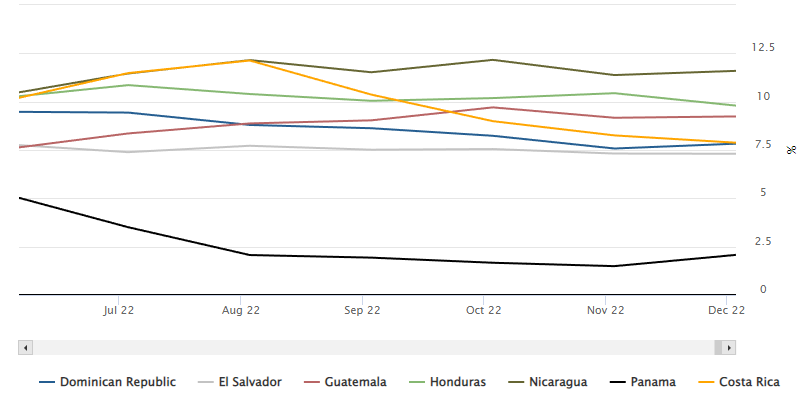
Central America & Caribbean: GDP growth (%)
Quarterly figures are year-on-year growth
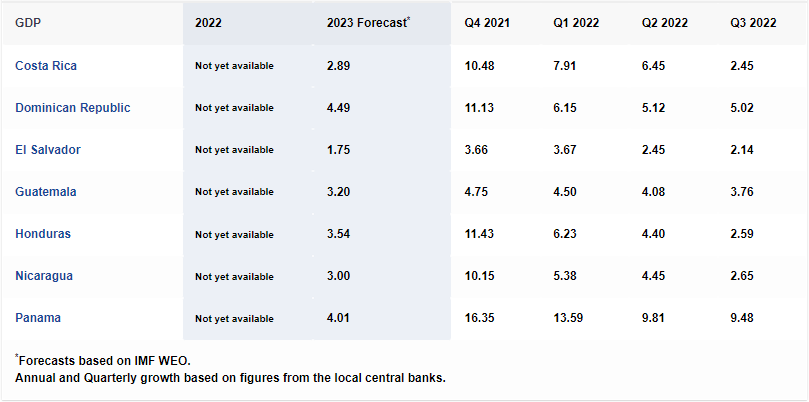
Antigua & Barbuda’s Prime Minister Baldwin Spencer is taking the maximum possible time available to him under the constitution before calling a general election, which does not suggest much confidence in the electoral prospects of his United Progressive Party (UPP).
It was generally expected that an election would have been called by the fifth anniversary of the 2009 general election on 12 March, but Spencer invoked election-related legal processes, started by the opposition Antigua Labour Party (ALP), as a reason for the delay. In the end parliament was dissolved automatically on 26 April, the fifth anniversary of its first sitting after the 2009 election, and an election has to be held within 90 days, that is no later than 25 July. Even so, at the time of writing, Spencer has still not named the day as he says he is not yet satisfied that Electoral Commission is ready to hold the election.
In remarks published on 9 May, Spencer said that he had to be satisfied that the Electoral Commission “is in a position to conduct the elections in a manner that is satisfactory in order to ensure that we have free and fair elections and to avoid some of the debacle we would have had in 2009”. He added: “That is a reasonable and understandable position.”
The UPP was voted into power in 2004 after the electorate tired of 28 years of uninterrupted ALP rule, or rather 28 years of uninterrupted rule by the Bird family. The electorate was fed up with the corruption associated with the ALP, and the introduction of an Electoral Commission after the disputed 1999 election ensured that the anti-ALP sentiment prevailed. The UPP won 12 seats to the ALP’s four, with the UPP-aligned Barbuda People’s Movement picking up the final seat in the 17-seat House of Representatives.
In the 2009 election, the UPP lost ground, taking nine seats to the ALP’s seven (with the BPM retaining its one seat), but the UPP’s victory was assured after the scandal broke surrounding the financier, Alan Stanford, just weeks before voting. Accused (and later convicted) of massive fraud by the US Securities and Exchange Commission (SEC), Stanford was seen as being close to the Bird family. He had previously lent the Bird government US$65m. Spencer, on the other hand, had refused to attend Stanford’s investiture as a knight in 2006 on the grounds that the financier had “a lien on our whole country”.
It was a good call, but memories are fading - and there is no longer someone carrying the Bird name at the head of the ALP, although its leader Gaston Browne is married to Maria Bird, niece of former prime minister, Lester Bird (1994-2004).
The UPP is also having to answer for its stewardship of an economy that has suffered badly in recent years, although it is now recovering slightly. The economy contracted by 10.7% in 2009 and by a further 8.6% in 2010. In 2011 the contraction was a less severe 2.1%, and this was followed by growth of 2.8% in 2012. However, 2013 was again slow, with just 0.5% growth. For 2014, the International Monetary Fund (IMF) is expecting growth of 1.6%, but on 3 May, the IMF reported that “risks to this outlook are high” due to the country’s “unsustainable fiscal situation” and the large amounts of nonperforming loans in the banking sector.
The IMF warned that despite “progress made in bank resolution” delays in reforms “are exacerbating fiscal risks and undermining the stability of the banking system”. The IMF report “encouraged the authorities to articulate a comprehensive medium-term fiscal consolidation program to put the public debt on a sustainable path”. The IMF called for “a redoubling of efforts to implement tax administration reforms”.
A key battle area for the election will be unemployment, which the latest figures suggest is standing at just over 10% on the basis of the 2011 census data released in early May. The government is saying that it can reduce the unemployment rate to zero by 2016 if it is given a third term in office. Speaking on 8 May, Minister of Labour Errol Coort said: “It is our goal within the next 24 months to eliminate all unemployment in this fair land of ours.” He said this would be achieved by revamping the government’s work experience programme to include up to 500 young people and by working with the World Bank to create over 1,500 new jobs.
Not surprisingly, the ALP professes to be unimpressed with these pledges, and it is arguing that unemployment (and under-employment) is much worse than the government is admitting. The latest figure of 10.2% is three years old, and ALP leader Gaston Browne is saying that research conducted by the ALP suggests that unemployment and under-employment combined amounts to 25%.