All Categories

Subcategories

  • GUYANA: Budget problem: too much money

    Patrick de Courcy 22 March 2024 Hits: 3098

    Supported by surging oil revenues, Guyana is the world’s fastest-growing economy. That poses some unique challenges for management of the 2024 budget, which was approved by the national assembly on 2 February.

    Offshore oil was first discovered in 2015 and production has gone from zero to 645,000 barrels per day (bpd) in less than a decade. Output is now expected to double to 1.2m bpd per day by 2028. Last year government revenue from oil was US$1.6bn; this year that number will go up to around US$2.4bn. With a population of just over 800,000, Guyana is on its way to overtake Kuwait as the world’s highest per capita crude oil producer. GDP expanded by an estimated 38.4% in 2023, with the government predicting a further 34.3% for 2024. The United Nations Economic Commission for Latin America and the Caribbean (Eclac) predicts growth in 2024 at a slightly lower 28.9%.  

    At first sight the budget problem might be seen as simple – finding a way to spend this bonanza and to spread the benefits. This year’s spending budget is indeed set at GY$1,146tn (US$5.496bn), a massive increase of 46% on 2023. These plans imply a proposed public sector budget deficit equivalent to 8.5% of GDP. A Chinese company is building a new bridge across the Demerara River. A four-lane highway is being built from the airport into Georgetown. A new oil and gas training institute is being developed for around 4,500 students. Seven hotels are under construction, alongside a new hospitality institute. There are plans for a water-treatment plant, a major gas-to-energy project, a refinery and a university, more housing, and a golf course.

    Finance minister Ashni Singh said that the aim of the budget was to benefit all Guyanese. It includes plans to boost health, pension, and housing provision, as well as investing in clean energy projects. Apart from the big increase in spending, Singh outlined an increase in the income tax threshold, tax breaks for life and medical insurance, and VAT exemptions for sports and mobile equipment. There were also measures to support small businesses, reduce freight charges, and promote employment.

    If the question is “what could possibly go wrong”, Guyanese and outside experts have a number of answers. One is simply that without careful planning, the surge in spending will rapidly create supply-side bottlenecks and lift inflation. Back in 2016 retail inflation was 0.8%; last year it was an estimated 6.6%. Over-reliance on oil could lead to corruption, wasteful spending, stagnation in the non-oil economy and an over-valued currency. There is concern that the country’s ethnic composition, with an Indo-Guyanese elite and lower-earning Afro and mixed-race groups, could come under strain.

    There is also a focus on the operation of country’s natural resources fund (NRF). This sovereign wealth fund was set up to create a buffer against oil price fluctuations and to invest in diversification. Last year the fund received US$1.6bn of oil revenues and spent around US$1bn, ending the year with a balance of US$1.97bn. Much of the money went to fund infrastructure projects. Opposition legislator Khemraj Ramjattan said “these monies should have been spread across rather than being given largely to what I regard as 1,000 contractor crony capitalists”. Government plans to change NRF disbursement rules, allowing a greater annual spend, are viewed with suspicion by the opposition.

  • TRACKING TRENDS

    Abbi Dicker 02 May 2024 Hits: 2767

    BOLIVIA | Gas fuels latest bout of infighting. Bolivia’s President Luis Arce launched his fiercest attack yet on former president Evo Morales (2006-2019) during a speech on International Labour Day on 1 May. Arce said he faced a “hybrid war” from the “traditional right [opposition] and the new right [answering to Morales], bent on destabilisation…to fulfil the ambitions of one person”.

    Tensions within the ruling left-wing Movimiento al Socialismo (MAS) have been mounting for some time with Morales, who is determined to run for president in 2025, repeatedly criticising the government, but until now Arce has tended to allow his cabinet ministers to respond. Earlier in the week, Arce said that natural gas supplies had been “exhausted” and his government was engaging in exploration to try and unearth new reserves. He said that the lack of export earnings from natural gas had forced his government to seek loans from abroad, criticising the MAS faction loyal to Morales for refusing to approve these in the legislature, saying they were determined to thwart his government and then blame it for the poor state of the economy.

    The economy minister, Marcelo Montenegro, accused the former Morales administration of generating “false expectations” by claiming that the country had “a sea of gas”. Former president Jorge Quiroga (2001-2002), meanwhile, accused the MAS of “blowing” Bolivia’s gas bonanza, and of having “squandered US$60bn in nearly two decades and plundered the country without mercy”. Morales signed a decree nationalising all gas reserves on 1 May 2006.

  • EL SALVADOR: Bukele moves to restart mining

    Sarah Sheldon 21 January 2025 Hits: 2194

    On 23 December El Salvador’s legislature, which is controlled by President Nayib Bukele’s Nuevas Ideas (NI) party, voted to lift a ban on metals mining imposed in 2017 amid concerns over impacts on the environment and public health.

    President Bukele said on 5 December that he would ask lawmakers to lift the ban, after also attacking it on social media platform X on 27 November. “We are the ONLY country in the world with a total ban on metal mining, something that no other country applies. Absurd!” he wrote, arguing that exploiting an estimated US$3trn in gold reserves would “transform” the country through the creation of thousands of jobs and the financing of infrastructure projects. Of the 60 members of El Salvador’s national assembly, 57 voted to overturn the ban. 

    A key reason for the ban is the impact of gold mining on water supplies. Extraction is highly water intensive, and toxic chemicals used in the process contaminate remaining water sources, restricting access to clean water for local communities and causing health problems as they enter the food chain. Despite these well-documented issues, President Bukele claims that future mining projects can be managed sustainably, with revenue from them used to repair the damage from past projects and boost economic and social development.

    Environmental groups have reacted strongly to Bukele’s claims about the industry, warning that mining is unviable in El Salvador for myriad reasons. In a joint statement published on 2 December, various campaign groups, including Mesa Nacional Frente a la Minería Metálica, underlined issues around water availability and contamination, particularly as mining areas are the source of rivers that flow into the Rio Lempa river, which supplies the San Salvador metropolitan area. 

    The statement also underlined the fact that El Salvador is a small, densely populated country, and open pit gold mining requires extensive amounts of territory. Other issues highlighted by the groups include the fact that El Salvador already suffers the second-highest environmental degradation of any country in Latin America, and that mines would be susceptible to dangerous landslides given the country’s high seismic activity. “Mining companies take away the gold and the people have to deal with the damage caused by the pollution of the water, air, soil, biodiversity and health,” it said, calling on Bukele to uphold the ban.

    Amalia López of local campaign group Alianza Nacional Contra la Privatización del Agua told news agency Associated Press that “it is not true that there is green mining – it is paid for with lives, kidneys, respiratory problems and leukaemia”.

    Church leaders, who were a key part of the coalition which pushed for the ban, have also called on Bukele to uphold it. For example, the archbishop of San Salvador, José Luis Escobar, urged authorities not to roll back the ban because it would damage the environment and would also be detrimental for “the health and well-being of the people”. And on 29 November, regional Catholic organisation the Episcopal Secretariat of Central America and Panama (Sedac) published a statement asking for mining bans to be upheld. 

    Following the 23 December vote by the NI-controlled legislature to lift the ban, the situation could evolve quickly as Bukele has been preparing the ground for a while. In October 2021 lawmakers approved a law to create the General Directorate of Energy, Hydrocarbons and Mines; joined the Intergovernmental Forum on Mining, Minerals, Metals and Sustainable Development (IGF), a voluntary partnership which supports the development of good mining governance, in May 2021; and allocated funds to “review and update” the mining law in the 2023 budget.

    Bukele maintains strong support in the country due to the popularity of his efforts to crack down on gangs, and this could enable him to face down protests from environmental groups. In addition, the state of exception introduced in 2022 provides him with the legal means to target protesters as it suspends normal civil liberties. And there are already signs that Bukele is moving to tamp down opposition, such as reopening a murder case, widely considered trumped up, which involves environmental campaigners known as the Santa Marta Five [SSR-24-05]. Although these groups remain well-organised and are likely to protest the change to the mining law, Bukele has the tools to dissuade them and has proven his willingness to engage in authoritarian behaviour in pursuit of his goals.

    And he is not the only regional leader keen to develop mining. His desire is part of a regional trend spurred by soaring global gold prices. Nicaragua has significantly expanded mining in recent years, granting massive concessions to Chinese firms following the normalisation of diplomatic relations with Beijing in 2021, and on 25 November Costa Rica’s President Rodrigo Chaves presented a legislative bill to restart operations at the Crucitas open-pit gold mine in San Carlos canton, Alajuela province, near the border with Nicaragua. 

    In fact, China could be a potential source of investment for El Salvador which established relations with Beijing in 2018. Its firms are rapidly building experience operating in Nicaragua, and they are known for upholding looser environmental standards than Western counterparts, which could be put off by protests and scrutiny of future operations. If Bukele does succeed in attracting miners to the country, it would take some time for their operations to get up and running and start contributing to the public purse. His hunger for new sources of revenue means that he is unlikely to impose strict regulations in order to expedite the process, increasing the risk of environmental damage. 

    Mining extraction potential?

    According to a 23 December legislative assembly statement, which cites studies by foreign companies, in just 4% of the area with mining extraction potential, 50m ounces of gold have been identified, valued at US$131.57bn, equivalent to 380% of El Salvador’s GDP.

    Public opinion

    A survey by Universidad Centroamericana’s Instituto Universitario de Opinión Pública (Iudop) published in December showed 59.2% of respondents thought that El Salvador was not suitable for metallic mining.

    IMF announces staff-level agreement worth US$1.4bn 

    On 18 December the International Monetary Fund (IMF) announced it had reached a staff-level agreement on a new arrangement with El Salvador worth around US$1.4bn. The deal was reached after Bukele agreed to concessions on the use of cryptocurrency bitcoin, which he made legal tender in September 2021. This had proven a major drag on negotiations with the IMF, which cited concerns around volatility as one reason for the failure to agree a deal with El Salvador during four years of negotiations. Bukele has now agreed to make bitcoin acceptance by the private sector voluntary, while “the public sector’s participation in bitcoin-related activities will be confined,” said the IMF in a statement. Other efforts to mitigate bitcoin risks include the fact that “taxes would only be paid in US dollars and the government’s participation in the crypto e-wallet (Chivo) will be gradually unwound”, among other things.

    The IMF highlights as other key elements of the programme, efforts to improve the primary balance by around 3.5% of GDP over three years to “put the ratio of public debt to GDP on a firm downward path after peaking at 85% of GDP in 2024”.  It notes that measures, worth 1.5% of GDP in 2025, already included in the approved budget, will “reduce the wage bill, spending on goods and services, and transfers to municipalities”. The deal also includes provisions on fiscal transparency and calls for the establishment of “a strong anti-corruption framework” and the improvements of anti-money laundering and counter-financial terrorism (AML/CFT) arrangements.

    While the agreement awaits approval by the IMF board, it would be a major boost for Bukele, whose promises to kickstart the Salvadorean economy have been hamstrung by the dire state of public finances and a lack of access to external sources of funding.

  • The US-China stand off

    Abbi Dicker 14 May 2026 Hits: 1286

    It is widely believed that China has dominated the growing REE industry, and that it was much quicker than the United States to understand its strategic value. By 2019 China was supplying around 90% of global demand for the 17 REE powders. It also currently controls 70% of global rare earth processing capacity.

    Since as early as 2010, the Beijing government has placed restrictions on its REE exports. By 2025, when the US began a trade and tariff war with China, the US and Australia had become the world’s second and third largest REE producers. While lower down the production ranking, Brazil is also seen as an REE powerhouse, since it has the world’s second largest REE reserves.

    The US was hard hit in 2025 when China imposed export restrictions on metals, machine parts, engineers, and rare earths. A one-year truce was agreed in November but by then many US and European factories had been forced to limit production levels.  

  • In Brief - Central America

    LatinNews 15 February 2012 Hits: 2730

    Honduras | New finance minister.  On 14 February Héctor ‘Tito’ Guillén was named the new finance minister, replacing William Chong Wong, who resigned a day earlier. Guillén had been serving as president of the congressional budget commission.  A member of the ruling Partido Nacional (PN), Guillén is linked to the wing of the party run by the head of congress, Juan Orlando Hernández, who has presidential ambitions for 2014. Guillén said he supported the work done by his predecessor and acknowledged that his main challenge would on the fiscal side. Chong Wong hinted that he quit because of conflicting pressures coming from civil sectors for more spending and the International Monetary Fund (IMF) for fiscal restraint.

    Honduras | Prison fire kills nearly 300. A fire in a prison in Comayagua, a city approx. 80 km northwest of the capital Tegucigalpa, has caused 272 deaths, with dozens injured, according to local radio reports in Honduras early this morning (15 February). According to Danilo Orellana, head of the prisons service, the fire may have been caused by a rebellion, as some inmates tried to break out. Other reports suggested an electric short circuit. “The situation is serious, most suffocated”, Orellana was quoted as telling local reporters. There were an estimated 806 inmates in the facility.

  • In Brief - Argentina; Uruguay

    LatinNews 10 April 2012 Hits: 1206

    Argentina-Uruguay | Mujica drops by Fernández’s. On 9 April President José Mujica of Uruguay went on an unscheduled visit to Buenos Aires to meet his Argentine counterpart, President Cristina Fernández, amid a regional verbal escalation over Argentina’s increased trade restrictions. Mujica’s visit was intended to bring down the tone of the exchanges after his foreign minister, Luis Almagro, defined Argentina’s trade policy as “schizophrenic”. Mujica was successful by assuring Fernández that Uruguay would not join the 40 countries who took their complaints to the World Trade Organization (WTO) - The two parties agreed that differences should be settled within the Southern Common Market (Mercosur) and the Uruguayan deputy economy minister, Luis Porto, later said the two presidents authorised: a technical study relating to commercial exchanges in the local currencies; and the establishment of mechanisms that resolve trade disputes through “a positive discrimination” towards Uruguayan exports.

  • ARGENTINA: A privatisation, by any other name

    LatinNews 13 February 2014 Hits: 1538

    “There is no re-privatisation of the railway network,” Florencio Randazzo, the interior & transport minister, said on 12 February. Most commentators, however, begged to differ. An announcement by the government earlier in the day handed the management of two of the commuter lines in Greater Buenos Aires, Mitre and San Martín, to Roggio, one of Argentina’s largest infrastructure groups and the majority shareholder in Metrovias, which manages the Buenos Aires metro. The Belgrano Sur and Roca lines will be operated by the Emepa group. Both local companies have a long history of receiving government contracts for trains and other public works. This development is one of the latest government moves to steer the economy in a more orthodox direction to prevent a collapse in the value of the peso and keep a lid on inflation.

    Years of frozen ticket prices on the trains have limited the investment needed to modernise Argentina’s aging railway network and contributed to a series of deadly accidents. In February 2012, 51 people were killed and 700 were injured when a train on the busy Sarmiento line failed to stop at the Once station in downtown Buenos Aires and ploughed into a platform. In June 2013, two passenger trains collided on the same line, killing three and injuring more than 100. Then, in October, more than 80 people were injured on the Sarmiento line when a train again failed to stop at the Once station.

    Following the accident in October, Randazzo announced that the Sarmiento line would be operated by the state-run Sociedad Operadora Ferroviaria Sociedad del Estado (SOFSE). Though the government’s latest decision does not affect the running of the Sarmiento line, it will help the government to avoid the monumental task of paying for upgrades on the lines operated by Roggio and Emepa. Given the other pressures on government coffers, not least that expected from public sector wage negotiation rounds, Randazzo’s decision buys some respite.

    Randazzo, however, insisted the only thought in the government’s mind was the best interests of passengers. “We’ve put in place a new operating regime that requires companies to present annual plans with respect to train frequency and maintenance, station cleaning and service quality,” he said. “We’ve established a strict penalty regime that sanctions them in the event they do not meet these guidelines.” The minister also promised further investment on state-run lines.

    • New inflation index

    At the time of going to press on 13 February the Argentine government was about to unveil its new national consumer price index (IPCNU). Argentina has been under severe pressure from the International Monetary Fund (IMF) to improve the methodology by which it calculates inflation. While the official rate put inflation in 2013 at 10.9%, private sector economists put the figure at around 28.3%. On 12 February, opposition leaders in congress released the monthly index that takes an average of private estimates, claiming prices rose by 4.61% in January, the highest monthly rise since 1991.

    Instead of only measuring data of the metropolitan area, the new price index will take into account price variations of all the provinces except the city of Buenos Aires, which chose not to be part of it. The index will be published monthly and will use a fixed basket of goods and services. No details have been released yet over the methodology but in previous statements government representatives have said 200,000 prices will be measured by 500 pollsters in 100 locations nationwide.

    The government is yet to publish the January figure. Given the steep fall in the value of the peso, and the consequent sharp rise in the cost of transport, fuel, food, electronics and domestic appliances, the figure is expected to be high. Many private sector economists, however, stung by years of official manipulation of inflation statistics, doubt the government will be honest.

    • Wage demands

    On 12 February, President Cristina Fernández met the leaders of the government-aligned faction of the Confederación General del Trabajo (CGT) umbrella trade union to discuss the upcoming March collective salary negotiations. While Fernández did not demand the leaders limit themselves to a particular percentage increase, she did insist that the wage negotiations be held on a yearly, and not six-monthly basis. A recent meeting of provincial governments concluded that union leaders’ demands for salary increases should be capped at 25%.

  • CUBA: Positive signals ahead of fourth round

    LatinNews 20 May 2015 Hits: 2692

    The next round of US-Cuba talks takes place at the State Department on 21 May. Both sides are signalling that this may be the final round in the effort to restore full bilateral diplomatic relations and re-open embassies.

    This is the fourth round of talks between senior US and Cuban representatives - led on the US side by the Assistant Secretary of State for Western Hemisphere Affairs, Roberta Jacobson, and on the Cuban side by Josefina Vidal, the director for US affairs at the Cuban foreign ministry - since ‘17-D’, when President Barack Obama announced that the US would begin a historic re-engagement with Havana. There have been two prior rounds in Havana and one in the US capital (with separate, lower level talks on other issues also ongoing).

    These efforts are being driven by a strong and pragmatic political will on both sides. Obstacles are being dealt with slowly but surely, and where the two sides fail to agree, those disagreements are put to one side, so as to move forward. Both parties know that the window of opportunity is preciously short ahead of the 2016 US presidential election. The continued support and encouragement of the Vatican is also vital. President Raúl Castro met Pope Francis in Rome in mid-May. The Vatican has announced that the Pope will visit Cuba and the US in September, marking the culmination of his historic diplomacy between the two neighbours.

    President Obama sees in Cuba a key legacy and is determined to make as much progress from the US executive side as possible, with a view to leaving office having solidified public support for the eventual removal of the US embargo on Cuba, which can only be lifted by an act of congress and then, under the terms of the 1996 Helms Burton Act codifying the embargo, only upon the departure from office of the Castros. Raúl Castro, who formally succeeded his brother Fidel in 2008, has pledged to step down in 2018.

    Box In another important development ahead of the fourth round, Cuba has finally managed to re-establish a banking relationship with a US financial institution (reportedly Florida-based). For the past year, the interests section in Washington and Cuba’s United Nations delegation in New York have had no access to US banking services (after the US bank with which it formerly dealt, M&T, withdrew services from foreign interests), forcing diplomatic staff to rely on cash sent from Havana to run the two offices, complicating operations. End box

    "I don’t want to sound too Pollyannaish . . . but I do think we’re closer than we have been,” a US official said on 19 May, speaking on condition of anonymity as per State Department rules. “I think my [Cuban] counterparts are coming up here with a desire to get this done…. I wouldn’t be even remotely optimistic if I did not feel that we were making progress”. Gustavo Machín, Josefina Vidal’s deputy, was similarly optimistic at a Havana news conference the previous day. “We don’t see obstacles, just questions to resolve and discuss together,” he stated. He noted that Cuba’s removal from the State Department’s list of State Sponsors of Terrorism, which officially takes effect on 29 May, had created “the right bilateral context to move forward.”

    Echoing President Castro, Machín complained about what Castro has termed “illegal” activities at the US interests’ section in Havana (namely US democracy promotion programmes, including journalism training for Cubans). While the Cubans complain about US interference, a key issue for the US is the efforts by Cuba to limit the freedom of movement for diplomatic staff. Yet it seems fairly apparent that these operational complaints are not going to prevent the restoration of the two interests’ sections to full embassy status. "We should reach a common interpretation on what the rules of the Vienna convention establish," Machín said.

    • US embassy

    US President Barack Obama is obliged to inform the US congress at least 15 days prior to opening an embassy in Cuba. Both governments would also have to notify the Swiss government - which serves as the ‘protecting power’ for the interests’ sections in Havana and Washington in the absence of formal diplomatic ties - that its services are no longer required. US congressional Republicans opposed to the re-engagement with Cuba have vowed to reject whomever Obama nominates for the Cuban ambassadorial position on point of principle, raising the prospect of an embassy without an ambassador.

  • TRACKING TRENDS

    LatinNews 30 March 2017 Hits: 620

    ARGENTINA | Poverty data. On 28 March Argentina’s national statistics institute (Indec) reported that the national urban poverty rate fell marginally in the second half of 2016, from 32.2% to 30.3%. The extreme poverty rate fell by 0.2 percentage points to 6.1% in the second half of 2016, or 2.6m people. Having argued that the methodology used to obtain the poverty figures had to be overhauled, this is only the second set of poverty figures released by Indec since the previous leftist Frente para la Victoria (FPV, Kirchneristas) administration led by former president Cristina Fernández (2007-2015) stopped releasing official poverty figures in 2013 (along with other key economic metrics). This was largely seen as a move designed to hide the fact that despite its rhetoric, the unorthodox economic policies implemented by the Fernández administration had driven many Argentines into poverty rather than help lift them out of it.

    The lack of availability of official economic data became a major political issue in Argentina, to the point that after winning the 2015 presidential election for the centre-right Cambiemos coalition, President Mauricio Macri ordered a full overhaul of the Indec and promised that it would once again regularly publish economic data, with the first new Indec figures released in September 2016. Since then Macri has underlined that the more orthodox economic policies adopted by his administration would produce positive results that would be reflected in credible data.

    While Indec’s latest poverty figures are encouraging for the Macri administration, the new data contrasts with that released earlier this month by the Universidad Católica de Argentina (UCA), which in the absence of reliable Indec statistics has been consistently measuring poverty for years. UCA found that the national urban poverty rate had increased from 29% to 32.9% in Macri’s first year in office (December 2015-December 2016), while the extreme poverty rate rose from 5.4% to 6.9%. The discrepancy in UCA and Indec figures (and critically the poverty rate trend direction) has led some to question Indec’s new methodology. While these doubts might persist, what is undeniable is that Argentina is currently very far from Macri’s objective of “zero poverty”.

  • REGION: Unprecedented pressure on Caribbean economies

    LatinNews 27 May 2020 Hits: 540

    In its latest Quarterly Bulletin, published in late April, the Inter-American Development Bank (IDB) looks in detail at what the coronavirus (Covid-19) pandemic could mean for six Caribbean economies: The Bahamas, Barbados, Guyana, Jamaica, Suriname, and Trinidad & Tobago.

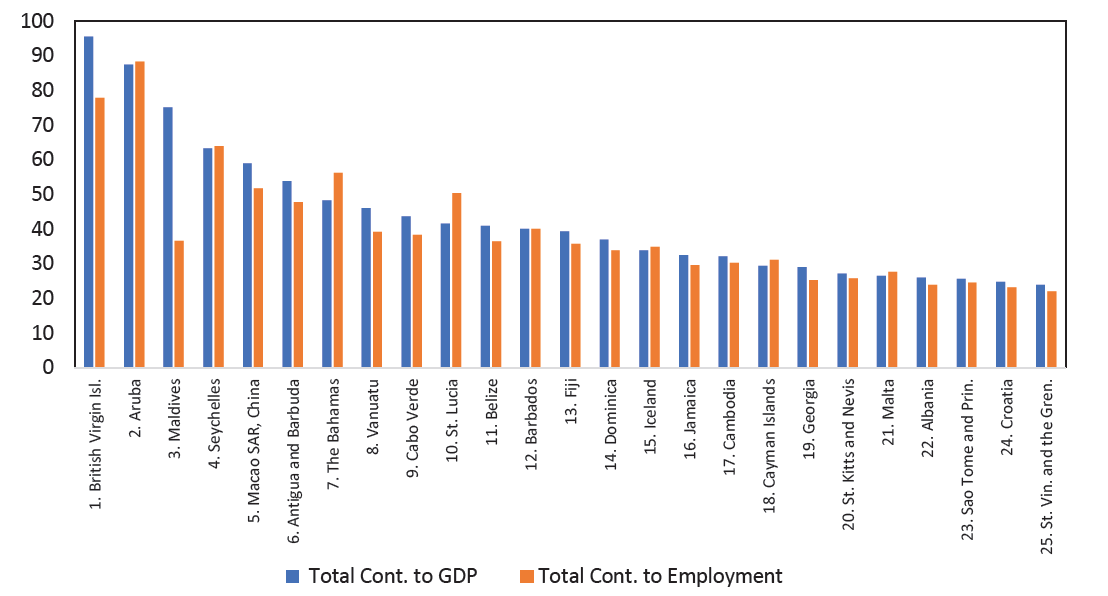
    For three of these economies (Bahamas, Barbados, and Jamaica) tourism is a vital industry; for the other three oil & gas and commodity prices are the key issues. Both groups will suffer as a result of the coronavirus pandemic, but the tourism-dependent economies will suffer the most severe economic downturns. And what the IDB has to say about the three tourism-dependent countries on which the report focuses applies equally if not more to many other countries and territories across the Caribbean. As Table 1 below shows, of the 25 top tourism-dependent countries/territories worldwide, no less than 12 are in the Caribbean.

    Table 1: Percentage contribution of tourism to GDP and employment of 25 most tourism-dependent countries (average from 2015-2019)

    Source: IDB calculations based on data from World Bank/World Travel and Tourism Council

    How deep the damage will be, however, is still a wide-open question. Without doubt it will be bad; the question is how bad. The IDB report looks back over six other disruptive episodes, namely the 11 September 2001 terrorist attacks; the severe acute respiratory syndrome outbreak (Sars) of 2002-2003, the global financial crisis of 2008-2009, the 2009-2010 swine flu (H1N1) pandemic; the Ebola outbreak of 2013-2016, and the Zika outbreak of 2015-2016. Of these it finds that only the global financial crisis led to an appreciable decline in tourism in the Caribbean countries under review. However, the IDB notes that the largest single year reduction in year-on-year arrivals in any of the countries was 6%, and it adds: “The near-complete shutdown of both passenger air travel and cruise ship activity beginning in March 2020 would imply a much larger shock to tourism arrivals and related receipts for 2020”. It concludes that the Covid-19 pandemic is without precedent when it comes to the shock to tourism in the Caribbean.

    The only slightly redeeming feature about the present crisis is that it has occurred in March when the high season for Caribbean tourism is generally October to April, and to estimate the possible impact of the crisis, therefore, the IDB has three time horizons for the shutdown, that is through end-June 2020, end-September 2020, and end-December 2020. It also looks at the effect of three levels of shock over these time horizons, namely a 25%, 50%, or 75% loss of tourism activity.

    In the worst-case scenario, a 75% loss of tourism activity lasting through to end-December, the IDB estimates that The Bahamas would lose 10.5 percentage points of GDP relative to the pre-crisis baseline estimates for 2020. For Barbados, the estimated loss would be 6.5 percentage points, and for Jamaica 5.4, reflecting the relative importance of tourism to each country.

    The implications of all this for individual livelihoods and wellbeing will be immense, but the extent to which governments in the sub-region will be able to alleviate and mitigate individual suffering will be limited. As the IDB points out, while some countries like The Bahamas have experienced a rise in the public-debt-to-GDP ratio in recent years, even those like Barbados and Jamaica that have reduced their debt-GDP ratios still have debt burdens that “remain extremely high by regional and international standards”.

    Jamaica has reason to feel particularly aggrieved with fate. On 10 November 2019, the country graduated with success from an arduous six-and-a-half-year International Monetary Fund (IMF)-supervised economic reform programme. In its final review of Jamaica’s performance, the IMF Executive Board lavished praise on the Jamaican authorities for having demonstrated “an exemplary commitment to reforms under two consecutive IMF-supported programs…with considerable sacrifices by the Jamaican people”.

    When the People’s National Party (PNP) government led by then-prime minister Portia Simpson-Miller (2006-2007; 2012-2016) turned to the IMF in 2013, Jamaica’s public debt had soared to 147% of GDP, unemployment was over 15%, inflation stood at 9.4%, and foreign exchange reserves, as a consequence of the collapse in the bauxite market after the global financial crash, had shrunk to under US$1.5bn. By the time of its graduation from IMF tutelage, now under a Jamaica Labour Party (JLP) government led by Prime Minister Andrew Holness, Jamaica’s public debt was under 100% of GDP and (according to the IMF) “on track to meet the legislated target of 60% of GDP by March 2026”, unemployment was at a record low of under 8%, foreign exchange reserves were up to US$3.5bn, and inflation was under 4%. Now the benefits of all that hard work are in jeopardy.

    “Borrowing not the answer”

    Perhaps the only positive for the sub-region is that the international community is fully aware of the immense stresses being imposed on the finances of Caribbean nations, and many will agree with the United Nations Economic Commission for Latin America and the Caribbean (Eclac), which has warned that borrowing is not an option. Alicia Bárcena, Eclac’s executive secretary, had an online discussion with Caribbean heads of government and finance ministers on 29 April to discuss the options.

    Bárcena’s response to what she heard was to say: “We are putting the Caribbean first in everything we do...”. She added: “Caribbean economies have the highest debt ratios in the world [averaging 68.5% of GDP in 2019]. Reductions in production and income along with increases in borrowing will further rise debt burdens. Debt is rooted in external shocks, compounded by the impact of natural disasters and inherent social and economic structural weaknesses…Borrowing is not the answer to confront this crisis. Caribbean countries need grant support fast. There is need for urgent intervention to ensure liquidity. Let me say that we are very much on board. We are part of this. A game plan for the short term is needed and we have to work on this, together with Caricom [Caribbean Community], ACS [Association of Caribbean States], and OECS [Organisation of Eastern Caribbean States]”. Bárcena concluded: “We will continue to advocate for this debt relief, for grants, for concessional funding for the Caribbean countries”.

  • PERU: Ex-president Toledo battles extradition from US

    Patrick de Courcy 13 April 2023 Hits: 4261

    Peru’s former president Alejandro Toledo (2001-2006) has been granted a last-minute stay of extradition from the US to Peru, where he is wanted on bribery charges. On 6 April an appeals court in the US state of California issued a 14-day reprieve to Toledo, who had previously been ordered to surrender to the authorities so that he could be extradited. Toledo is accused of receiving approximately US$35m in bribes from the Brazilian construction firm Odebrecht, which in 2014 was found to have been operating a massive corruption network in at least ten Latin American and Caribbean countries.

    The late-night reprieve for Toledo came just hours before a deadline imposed on 5 April by another California judge, who had ordered the former president to hand himself in to the authorities by 9am on 7 April. Peru’s justice minister, José Tello, had said following that initial ruling that the extradition would have been carried out rapidly, predicting that Toledo would be in Peru in a matter of days. Proceedings are now on hold, with Toledo given an additional two weeks to fight his extradition. If it goes ahead, prosecutors in Peru have said they will seek a 20-year sentence for Toledo, who they claim received the alleged bribes from Odebrecht in return for public works contracts for the Interoceanic Highway linking Peru and Brazil.

    The Odebrecht scandal has now resulted in charges being announced against four consecutive Peruvian presidents. If the experiences of the other former presidents are anything to go by, it may be a long time before a verdict is issued on Toledo’s alleged crimes. The trial of Ollanta Humala (2011-2016) for allegedly receiving illegal campaign donations from Odebrecht got underway in February 2022 and continues to proceed at a glacial pace [WR-22-08]. Pedro Pablo Kuczynski (2016-2018), accused of receiving over US$4m from Odebrecht, is still awaiting trial four years after he was temporarily placed under house arrest in 2019. The other former president accused of taking bribes from Odebrecht, Alan García (1985-1990; 2006-2011), committed suicide in 2019 when faced with imminent arrest.

    Also awaiting trial in relation to the Odebrecht scandal is Keiko Fujimori, the leader of the right-wing Fuerza Popular (FP), the largest party in congress. Fujimori is accused by prosecutors of receiving over US$1m from the construction company during her unsuccessful 2011 election campaign and spent over a year in pretrial detention before being released in 2019. Her eventual trial could prove to be the most politically consequential, given her leadership of the Peruvian right and widespread speculation, which Fujimori herself denies, that she intends to run again in the next presidential election.

    Peru’s ‘presidential prison’

    Justice Minister José Tello said that if Toledo is extradited, he would be jailed at Lima’s Barbadillo prison while he awaits trial. Two other former presidents are currently being held at the prison – Pedro Castillo (2021-2022), who faces charges of corruption and rebellion, and Alberto Fujimori (1990-2000), who in 2007 was handed a 25-year prison sentence for human rights abuses and corruption.

    Former prime minister Chávez facing further charges

    Peru’s attorney general’s office (AG) tweeted on 11 April that it is seeking 18 months’ preventive detention for former prime minister Betssy Chávez and two other former cabinet ministers who served during the final turbulent months of the Pedro Castillo administration (2021-2022). The AG tweeted that Chávez, former interior minister Willy Huerta, and former foreign trade & tourism minister Roberto Sánchez Palomino are suspected to be “co-conspirators in the crime of rebellion, or alternatively, conspiracy”.

    Chávez is also facing separate allegations of influence peddling, and using public office for personal gain, in relation to her alleged role in awarding government jobs to family members of her romantic partner, Abel Sotelo. Congress voted on 22 March to suspend Chávez from the legislature while a constitutional complaint is presented against her.

  • TRACKING TRENDS

    Patrick de Courcy 04 May 2023 Hits: 3081

    BRAZIL | Lula’s nod to workers. Brazil’s President Luiz Inácio Lula da Silva used the 1 May ‘Dia do Trabalhador’ (May Day or Labour Day) public holiday as a chance to announce a series of measures aimed at improving workers’ rights and conditions, including a higher minimum wage and an increase in the minimum threshold to pay income tax.

    Addressing a crowd of trade union members and other supporters during a 1 May event in Vale do Anhangabaú, in the centre of São Paulo city, Lula spoke of increasing the minimum wage above inflation, raising it to R$1,320 (US$264) per month, a slight increase from the R$1,302 set at the end of last year.

    Another May Day gesture was to expand the exemption on income tax. Lula announced that those who earn less than R$2,640 per month would be exempt from the tax, an increase from the threshold of R$1,903. Lula also promised that the threshold would be raised to R$5,000 by the end of his term in 2026.

    It was also announced that inter-ministerial working groups would be set up to address issues including the gender wage gap and the enforcement of the rights and benefits of gig economy workers, such as employees of delivery services and other apps.

  • GUATEMALA: Mixed messages over mining

    LatinNews 07 August 2013 Hits: 1614

    Last month President Otto Pérez Molina triggered alarm bells in the mining sector, when he demanded that the national legislature approve a two-year moratorium on new metal mining licenses as part of efforts to address what has been a significant source of social tensions in the country. Pérez Molina’s call, which have yet to be heeded, nonetheless comes amid other signs that his government is intent on pressing ahead with unpopular natural resource extraction projects.

    Pérez Molina called for a moratorium on 10 July, to allow for “national dialogue” over the development of the mining sector. It comes as his government is promoting a bill introducing 36 changes to the 1997 mining law, aimed at updating it in order to attract more foreign investment. The call also came the day after the murder of an anti-mining activist, Santos Ajau, who opposed the exploitation of the El Tambor gold mine, which is owned by a subsidiary of Canada’s Radius Gold Inc and is at the heart of one of five major conflicts related to metallic mining in the country. Ajau’s murder follows a string of similar killings earlier in the year, which attracted attention from institutions like the United Nations (UN) Office of the High Commissioner for Human Rights (OHCHR). Meanwhile a flare-up of social unrest back in May over the proposed Escobal silver mining project - another major source of conflict - which is owned by Canada’s Tahoe Resources, led the Pérez Molina government to declare a state of emergency in four municipalities.

    Pérez Molina’s proposed moratorium prompted complaints from business lobbies like the Gremial de Industrias Extractivas which warned that it could deter investment. As the UN Economic Commission for Latin America and the Caribbean (Eclac) pointed out in its recent 14 May report on Foreign Direct Investment (FDI), Guatemala’s most important project announced in 2012 was Tahoe Resources’ US$500m investment in the Escobal project, although a subsequent court ruling has raised doubts over the project’s future (see box). As well the private sector, environmentalist groups also criticised the moratorium, complaining that it does not go far enough given that as of 2 July 2013, 107 metal mining licenses have been authorised in Guatemala, and a further 359 are pending according to the energy & mining ministry (MEM).

    • Uncertainty over Escobal project

    On 24 July a Guatemalan appeals court challenged an exploitation licence awarded by the MEM to Tahoe Resources for the Escobal mining project, work on which was due to begin this month. The ruling was in response to a joint appeal presented by indigenous leader, Kelvin Jiménez, and a local NGO, Centro de Acción Legal y Ambiental (Calas), which argued that the MEM had failed to take into account some 250 appeals against the project before awarding the licence.

      The ruling - the full details of which are not publicly available - has generated considerable uncertainty. Calas maintains that it calls for the project to be suspended, while Tahoe denies this accusing the NGO of “misrepresenting the court’s limited ruling”. In a 24 July press release, the mining company claimed that the court ruling stated that the MEM “should have conducted a hearing of a written opposition to the Escobal exploitation license during the permitting period”, but it “did not rule on the substance or validity of the opposition”, merely stating that “MEM is obligated to hold an administrative hearing.…The legality of the license is not in question and it remains fully effective”. The statement added that “MEM and the Company are appealing the lower court’s ruling to the constitutional court, which is expected to issue a decision in the next several months”.

    • Moving ahead with other projects

    While Perez Molina’s proposed moratorium on metal mining might suggest some effort to assuage what has been a significant source of social protest, there are other signs that his government is intending to continue with unpopular extractive projects. On 19 July work finally began on the San Gabriel cement plant in the municipality of San Juan Sacatepéquez. Located some 30km north of Guatemala City, the US$720m project by local firm, Cementos Progreso, is one of the most contentious construction projects in the country. According to the local media, some 20,000 people led by the indigenous and peasant organisation, Comité de Unidad Campesina (CUC), staged protests outside the site of the proposed plant, construction of which is expected to take three years. Cementos Progreso boasts that, once built, it will be the largest cement plant in Central America, capable of producing 2.2m tonnes per year.

    Since it was first proposed seven years ago, the project has aroused considerable concerns regarding its impact on the environment and local farmers. In an unofficial popular consultation, held on 13 May 2007, the project was overwhelmingly rejected by the local community (by 8994-4 votes). This opposition has not only caused problems for President Pérez Molina – who deployed a team of riot police to prevent protesters from interrupting the project’s inauguration ceremony – but also his predecessor, Alvaro Colom (2008-2012), who at one point decreed a temporary “state of prevention” (restricting the right of citizens to take part in public protests and to carry arms) in response to protests.

    The inauguration of the San Gabriel cement plant also came two weeks after Mining & Energy Minister Erick Archila announced that 25-year concessions, extendable for a further 15 years, had been awarded to six foreign oil companies: France’s Perenco Guatemala Limited; Panama’s Galax Garden Corporation; Island Oil Exploration Services and Greenfields Petroleum Guatemala (both of the US); Colombia’s Trayectoria Oil & Gas; and Zacapa Energy Ltd. of Russia. This is in line with Pérez Molina’s declared efforts to boost oil production, announced in August 2012. Guatemala (along with Belize) is one of just two oil-producing countries in Central America, but production has been on the wane due to a lack of exploration and the poor condition of existing wells. Archila’s announcement of new concessions attracted concern from environmental groups including Calas, which has previously opposed other oil exploration projects - in particular the controversial extension in 2010 under the Colom administration of Perenco’s 15-year exploration license covering the Laguna del Tigre, a Maya Biosphere Reserve in the northern province of Petén.

    • Landmark ruling

    In a decision hailed by local and international human rights groups alike, on 22 July a Canadian judge ruled that a case against Canadian mining company, Hudbay Minerals, regarding alleged human rights abuses which took place at its formerly-owned Fénix Mining Project in El Estor, in the eastern Guatemalan department of Izabal, can proceed to trial in Canada. This signifies the first time that a Canadian court will hear a lawsuit against a Canadian mining company over alleged human rights abuses that have taken place abroad.

    Hudbay bought Guatemalan mining company, Compañía Guatemalteca de Níquel S.A. (CGN), and its Fénix ferronickel mine in August 2008. It then sold it to a Russian company, Solway Group, in August 2011. According to Solway Group the mine, a fully operational nickel laterite mining and smelting operation in the 1970s until it was closed for maintenance in 1980, is due to begin operating again in 2014.

    The case against Hudbay involves three lawsuits which centre on: the murder of an indigenous community leader, Adolfo Ich Chamán, who was allegedly hacked and shot to death in 2009 by private security forces employed by the Fénix; 11 gang rapes allegedly carried out by uniformed mining company security personnel, police and military during the forceful ejection of Mayan Q’eqchi’ families from their remote community of Lote Ocho in 2007; and the 2009 shooting of another member of the local community, German Chub Choc, who was left paralysed.

    • Cerro Blanco

    Along with the Escobal and El Tambor projects, there are three other major conflicts related to metal mining in Guatemala: the Marlin gold & silver mine, owned by Canada’s Goldcorp; the El Estor nickel mine, owned by Russia’s Solway Group; and the Cerro Blanco gold & silver mine, which belongs to Entre Mares de Guatemala (a subsidiary of Canada’s Goldcorp). On 25 July Goldcorp announced that it was suspending the Cerro Blanco project, due to “recent declines in…metals prices”. The mine had been a major bone of contention not only in Guatemala but also in neighbouring El Salvador, where anti-mining activists warned that El Salvador’s largest river, the Lempa, which flows across the border from Guatemala into Lake Güija, could be contaminated by the mine.

    • Petrol concessions

    Mining & Energy Minister Erick Archila recently told the media that between 2000 and 2011 just five bidding processes took place for eight oil concessions, producing a total of 13 offers, of which only five were awarded. According to Archila, with the latest bidding process, in which nine companies submitted 15 offers, the government of President Otto Pérez Molina (which assumed power in January 2012) has generated more interest in the sector than the past three administrations combined. Archila also said that each company had pledged US$40m in the first three years of each contract.

  • RASTREANDO TENDENCIAS

    LatinNews 27 October 2013 Hits: 299

    ARGENTINA | Continúan cayendo las reservas del BCRA. Las reservas internacionales han llegado a un nuevo punto bajo en seis años de US$34,27mm, reveló el 18 de octubre el banco central (BCRA), cayendo por debajo del nivel observado en el 2007 antes de asumir por primera vez el poder la Presidenta Cristina Fernández. El BCRA parece ser incapaz de detener la hemorragia de fondos que ha estado experimentando en los últimos años como resultado de las enrevesadas políticas de cambio de divisas extranjeras adoptadas por la administración de Fernández.

    Los analistas locales han atribuido la masiva caída de US$9,02mm en las reservas internacionales solamente en lo que va del año (una tasa promedio de US$47,5m por día) a el mantenimiento de la artificialmente alta tasa de cambio oficial y a los ajustados controles de la moneda extranjera introducidos en el 2011 en su apoyo. La situación ha resultado en una gran discrepancia entre la tasa oficial de Ar$5,82/US$1 y la tasa de cambio del dólar en el mercado negro ‘blue’, pues a pesar de las crecientes restricciones, los argentinos continúan tratando de poner las manos  dólares creyendo que son una apuesta mucho más segura que los pesos. Esto ha creado un círculo vicioso en el cual la incrementada demanda local por dólares ha forzado al BCRA a intervenir más activamente en los mercados de la moneda local para mantener la tasa de cambio estable.

    Complicando al gobierno, los actores económicos locales parecen estar dándose cuenta de que el BCRA está en dificultades para sostener la tasa de cambio oficial y que una devaluación podría estar en ciernes. De hecho la difusión de las últimas cifras del BCRA fue seguida por una oleada en la demanda de dólares en el mercado negro, que llevó la tasa de cambio del dólar ‘blue’ a romper la barrera de Ar$10/US$1 por segunda vez en este año, el 22 de octubre.

    PARAGUAY | Cambios en la política fiscal. El 17 de octubre el presidente de Paraguay, Horacio Cartes, formalmente vetó un proyecto de ley aprobado por el congreso la semana anterior, que pedía la introducción de un nuevo impuesto de 10% sobre las exportaciones de granos del país. Al vetar el impuesto a las exportaciones, Cartes mantuvo la promesa hecha a los productores agrícolas de Paraguay de que él se opondría a la iniciativa incluso aunque esta había sido promovida por su Asociación Nacional Republicana-Partido Colorado (ANR-PC) si ellos en cambio apoyaban una propuesta alternativa de un impuesto a las ganancias agrícolas y la extensión del Impuesto al Valor Agregado (IVA) al sector. El sector agrícola estuvo de acuerdo y una nueva propuesta estableciendo un impuesto de 10% a las ganancias agrícolas (Iragro) fue aprobado rápidamente por el congreso el 10 de septiembre [IL-13-36].

    Sin embargo, el proyecto de ley del impuesto a las exportaciones fue mantenido vivo por la oposición política y legisladores disidentes de la ANR-PC, todos los cuales creen que el impuesto Iragro es insuficiente y que el sector agrícola –la principal fuerza de la economía, representando el 30% del PIB– debería soportar una mayor carga fiscal. Esto provocó preocupación entre los intereses agrícolas locales de que dadas las actuales dificultades financieras que enfrenta la joven administración Cartes, este podría verse tentado a dar marcha atrás y re-adoptar el impuesto a las exportaciones. Sin embargo, Cartes se mantuvo en su palabra emitiendo un veto presidencial una semana después de que el proyecto de ley fue aprobado por el senado, el 9 de octubre. El decreto establece que aplicar impuestos a la exportación sin tener en consideración los niveles de ganancias/pérdidas hechos por el sector, representarían un “castigo injusto” cuando los niveles de producción resulten ser bajos. Y agrega que “la implementación de tal impuesto tendría un efecto regresivo pues los exportadores de granos pasarían los costos a los productores, socavando la competitividad y distorsionando los precios”.

    Poco después, el 23 de octubre, el congreso aprobó una nueva ley de responsabilidad fiscal  promovida por Cartes, después de prolongadas negociaciones con el ejecutivo. La iniciativa, que impone estrictos límites sobre los gastos del gobierno, fue resistida por el congreso incluyendo los representantes de la ANR-PC en base a que representaba un intento por restringir la constitucionalmente sancionada prerrogativa del congreso de poder enmendar el presupuesto a su discreción. Sin embargo, después de semanas de difíciles negociaciones con las bancadas de la ANR-PC en ambas cámaras del congreso, en las cuales tiene mayoría, el ejecutivo pudo llegar a un acuerdo con los legisladores allanando el camino para la aprobación del proyecto de ley.

    La ley fija un techo del 1,5% del PIB para el déficit fiscal, y un límite sobre el incremento en los gastos de cuenta corriente de no más del 4% por encima de la tasa anual de inflación. También establece un límite del 60% sobre el gasto presupuestado en la primera mitad de un año electoral. A cambio de todo esto, las únicas aparente concesiones hechas al congreso son que este último retiene el derecho de introducir enmiendas discrecionales al presupuesto, toda vez que estas no excedan los límites establecidos; y que el congreso tiene el poder para suspender la aplicación de estos límites en cualquier año ante circunstancias atenuantes tales como una emergencia nacional, una crisis económica internacional, o una aguda caída en la actividad económica interna.

    • Inversión agrícola de Chile

    El Presidente de Chile, Sebastián Piñera, reveló esta semana que en el 2012 su gobierno gastó más de C$58mm (US$118m) en la adquisición de tecnología agrícola y maquinaria. Según Piñera, esta cifra es el doble del monto gastado en el 2009, el año antes de que el asumiera el poder. Piñera agregó que esta inversión había sido instrumental en ayudar a incrementar las exportaciones forestales de Chile por más del 10% anual en los últimos tres años, creando el “segundo más importante sector exportador de Chile después de la minería”. También destacó que el gobierno había elevado al doble el monto de la financiación ofrecida a los productores agrícolas a través del Instituto de Desarrollo Agropecuario (Indap) que ayudó a incrementar el número de productores agrícolas de pequeña escala, de 133.000 en el 2009, a 293.000 actualmente.

  • Region: Corporate Radar

    LatinNews 01 July 2016 Hits: 21521

    Oi files for bankruptcy: Oi, the only locally controlled mobile phone operator in Brazil, filed for bankruptcy protection with debts of BRL65bn (US$19bn) on 20 June, after rescheduling talks ahead of a EUR231m bond repayment failed to produce agreement. The company has been badly affected by the Brazilian recession, but analysts say it also suffered from serious problems caused by an attempt by the previous Partido dos Trabalhadores (PT) government to turn it into a ‘national champion’. Despite big ambitions and government help, the company was mismanaged (it had six chief executives in five years) and became heavily leveraged. State development banks BNDES and Caixa Económica Federal are reported to have lent BRL13bn (US$3.8bn) to the company.

    Although it is a big fixed-line player, Oi is the smallest of Brazil’s four main mobile operators, with an 18.6% market share, compared to Vivo (controlled by Telefónica of Spain) with 28.6%, Tim (controlled by Telecom Italia) with 25.9% and Claro (owned by Mexico-based América Móvil with 25.3%). Oi’s future is now uncertain, with options including a takeover by another player (although a previously planned merger with Tim now looks off the table), restructuring, or break-up. Some analysts argue that this might be a good moment for the market to consolidate, reducing to three rather than four main players. The administration led by the interim president, Michel Temer, which is seeking to control fiscal spending and follow more business-friendly policies, has said it will not bail the company out with new loans.

    Banco Galicia bets on Argentine recovery: Although there are doubts among some analysts over the speed at which the Argentina government led by President Mauricio Macri will tame inflation and build an economic recovery, Banco Galicia is confident of a positive outcome. The bank announced in June that it would double its investments in infrastructure to US$182m, in expectation of lower inflation and economic growth in 2017. General Manager Fabián Kon said 2016 would be a year of “transition” for the Argentine economy but that the outlook for 2017 was “auspicious”. Kon said the bank would invest ARS2.5bn (US$182m) to open new branches, modernise its headquarters and incorporate new IT systems. As a result of the government’s more market-friendly policies, the bank was expecting a “natural” expansion of credit to individuals and corporates and the emergence of new investment options. Galicia also expected inflation to begin easing down from June, which would play a key role in allowing the banks to move from very short to more longer-term lending. Bank credit is still low as a proportion of GDP, indicating that there is plenty of room for growth. Banco Galicia has round 3.3m customers, ARS107.8bn (US$7.2bn) worth of deposits, 261 branches, 5,700 employees, and net assets of ARS15bn (US$1bn).

    Avianca not for sale: Colombia-based airline Avianca is talking with others about potential strategic partnerships, but is not itself up for sale, chairman Germán Efromovich told the Caracol radio station in mid-June. His comments followed reports that HNA Group of China had expressed an interest in acquiring Avianca Holdings and the Avianca Brasil subsidiary, both controlled by Efromovich’s Synergy Group. US-based United Continental Holdings and Delta Air were also reportedly interested. But Efromovich told Caracol, “Avianca is not up for sale. Talks about strategic alliances go on all the time.” He added that the point of them was to seek a faster rate of growth for the business. He added that the talks might lead nowhere, or might on the other hand end up “with an alliance that is very important for the future of the company”. The Avianca group also includes Colombia-based freight service Tampa Cargo SA, Ecuador-based Aerolíneas Galapagos (known as Aerogal) and Grupo TACA of Central America. Avianca Holdings companies carried 28.3m passengers in 2015, and operate a network with 105 destinations in 28 countries using a fleet of 177 aircraft.

    New Mexican petrol stations: For the first time in eight decades, there are now petrol stations in Mexico that are not trading under the Petróleos Mexicanos or Pemex brand, owned by the state oil company of the same name. The change is small – only three new stations in early June – but symbolically important, as it marks the introduction of competition into the downstream end of the oil and gas business, as contemplated in the 2014 energy reform. One station is now operating in Mexico City under the Hidrosina brand, while a further two in Campeche and Mérida are selling fuel under the La Gas brand. Grupo Hidrosina, set up in the early 1990s, has operated around 30 Pemex-branded stations as a concessionaire for a number of years. “With the collaboration of Pemex we signed an agreement to use a different brand and test the success that may, or not, work for the clientele”, said Víctor Ruiz Iriarte, director of operations at Hidrosina. Around 20 Hidrosina-branded stations will be piloted this year, he added. More new petrol station brands are due to make their appearance: Gulf Oil of the US has said it will be opening four petrol stations in Mexico in June and July.

    Legal wrangles over the Chapo name: A series of potentially costly legal disputes are looming over the media treatment of the life and times of Joaquín ‘El Chapo’ Loera Guzmán, the reputed leader of the Sinaloa drug-trafficking and criminal cartel, currently in a Mexican prison awaiting the outcome of extradition proceedings to the US. The disputes have been triggered by an announcement in May that the US-based Spanish television network Univisión and the global streaming film and TV service Netflix plan to co-produce a “boundary-breaking drama” series called ‘El Chapo’, based on his life and due to be broadcast in 2017. No so fast, said Andrés Granados, a lawyer for the real-life Chapo. According to him, Univisión and Netflix must seek his client’s authorisation, something that could be available “at the right price”, adding that El Chapo was also ready to provide more information to improve the proposed series. Granados has pointed out that El Chapo’s family has already registered his name as a brand with the Instituto Mexicano de la Propriedad Industrial (IMPI). Potentially a further complication is that Granados is the same lawyer who negotiated on his client’s behalf with the Mexican-American actress Kate del Castillo last year, giving her the rights to film a documentary on the drug lord. Mexican security forces tailed Del Castillo and the US actor Sean Penn on their way to a meeting last year with El Chapo in Mexico, who was then at large, and used some of that the information to capture him in January. Presumably Univisión, Netflix and Kate del Castillo would have to come to some kind of an agreement on film and documentary rights. According to Charles J. Glasser, Adjunct Professor of Media Ethics at New York University, under the First Amendment journalistic accounts of newsmakers are protected from such rights claims because “otherwise bad guys could quash coverage”. But those who are the subjects of fictionalised accounts, even if they happen to be criminals, do have a right to negotiate over the intellectual property rights in, for example, the use of their name. As Glasser put it, however, “Netflix and Univisión have a PR problem… how will people feel about them ‘getting permission from’ – and probably paying – a notorious bad guy?”

  • BOLIVIA: Electoral exclusion back on the agenda

    LatinNews 09 July 2020 Hits: 3916

    At a press conference on 1 July, the presidential candidate of the left-wing opposition Movimiento al Socialismo (MAS), Luis Arce, accused the interim government of seeking to exclude him from the upcoming election, after the justice minister, Álvaro Coimbra, called for a corruption investigation involving Arce to be reopened. Before the coronavirus (Covid-19) pandemic interrupted the electoral process, the MAS had repeatedly accused the interim government of using judicial persecution as a weapon against its electoral opponents [WR-20-06]; with interim president Jeanine Áñez’s efforts to further delay the vote having proven unsuccessful [WR-20-25], a return to such a strategy could be on the cards.

    Arce once again claimed that the investigation, initially announced just hours after his candidacy was confirmed in January, had been entirely fabricated. The investigation addresses alleged irregularities in his work with the country’s indigenous development fund while serving as economy minister (2006-2019). Arce also responded to a new complaint filed by Coimbra regarding the purchase of a US$10m computer program for the country’s pensions system. He confirmed that the system in question had not been delivered, but he said this was because of a breach of contract by the suppliers, and that efforts to retrieve the money had been underway when the MAS was removed from power in November 2019.

    If Áñez is indeed hoping to see Arce excluded from the presidential contest, the results of the first major poll conducted since March are only likely to accentuate her concerns. The survey, released on 7 July by the Centro Estratégico Latinoamericano de Geopolítica (Celag), predicted Arce to lead the way with 41.9% of the vote, followed by Carlos Mesa of Comunidad Ciudanana (CC) on 26.8%, and Áñez in a distant third, on just 13.3%. While further polls will provide a clearer picture, these results suggest that the pandemic has hit Áñez’s popularity hard – 59.8% of respondents voiced disapproval of her handling of the pandemic, and 65.2% of her management of the economy more broadly.

    • Cabinet coronavirus

    As Covid-19 cases and deaths continue to surge throughout Bolivia, its effects are also being felt within Jeanine Áñez’s ministerial cabinet, with at least three senior officials having tested positive for the virus. The health minister, Eidy Roca, announced on 5 July that she would temporarily suspend her duties after testing positive, joining the mining minister, Jorge Fernando Oropeza, and the minister of the presidency, Yerko Núñez, who has been hospitalised after showing more serious symptoms.

    While these results would grant Arce a clear first-round victory (with more than 40% of the vote and a 10-percentage point lead), there is still scope for someone else to claim victory if the various candidates opposed to the MAS can forge an alliance. Talks to this effect before the pandemic proved fruitless [WR-20-05], and it is now too late for any candidate to be removed from the ballot paper, but some form of agreement could be essential to force a second-round run-off that would likely push Arce very close. The interior minister, Arturo Murillo, prompted speculation last week that such a deal may be in the pipeline, claiming “there will be surprises in the coming days” – but representatives of both Mesa and Áñez’s campaigns denied that any such talks were underway.

    Before the pandemic, the divisions between candidates opposed to the MAS often overshadowed criticisms of their supposed common enemy. There are signs this trend may also be set to continue, with Mesa last week filing a complaint with the electoral tribunal (TSE) against Áñez’s Juntos alliance, highlighting that campaign materials made use of her image, a practice which the interim government itself banned earlier in the year. If the Celag poll is to be believed, Arce is only likely to be denied victory by a united front opposed to the MAS, or by his exclusion from the contest. Both possibilities are still on the table, but the former seemingly remains some way off, and the latter would elicit a furious reaction from MAS supporters, who Arce called upon “to remain vigilant in the face of these attempts to suppress our rights”.

  • COLOMBIA: Army bombing scandal

    LatinNews 11 March 2021 Hits: 4831

    President Iván Duque and his new defence minister Diego Molano, who was appointed a month ago, are facing a new scandal over army bombing operations.

    At issue is a bombing raid carried out on 2 March against a military base of dissident Fuerzas Armadas Revolucionarias de Colombia (Farc) guerrillas in an isolated part of the Amazon jungle department of Guaviare. According to local residents, who in subsequent days travelled to the regional capital San José del Guaviare and were interviewed by journalist Hollman Morris, up to 14 children were killed in the attack. Morris, who is close to former left-wing presidential candidate Gustavo Petro, published a “preliminary list” of child victims, some aged only nine years old.

    Molano responded by insisting that the operation followed guidelines set out in international humanitarian law. Those at the base, loyal to Farc leader ‘Gentil Duarte’ (Miguel Botache Santillana), were in Molano’s words, a “legitimate target” in the government’s fight against a “criminal narcoterrorist”. ‘Gentil Duarte’, who refused to accept the 2016 peace agreement, leads the Farc’s former Frente Primero, the largest group of Farc dissidents with a presence recorded in a dozen departments: Arauca, Vichada, Guainía, Meta, Guaviare, Vaupés, Amazonas, Caquetá, Putumayo, Nariño, Cauca, and Antioquia.

    There was initial confusion and contradictory reports about the number and ages of child victims, with Molano referring reporters to the prosecutor’s office and the Instituto Nacional de Medicina Legal y Ciencias Forenses. Molano left himself vulnerable to criticism that he showed scant concern for the “collateral damage” caused by army operations. He initially spoke of 13 Farc dissidents being “neutralised”, a description which appears to include the child victims. He added that the question at issue was not whether the use of force by the army was legitimate, but the way Farc dissidents continue recruiting children and “turning them into machines of war”.

    This is not the first time that children have died as a result of army counter-insurgency operations. In 2019 the then defence-minister, Guillermo Botero, resigned after claims he had covered up an army bombing operation in the southern department of Caquetá that had killed eight children.

    Opposition senator Roy Barreras has pointed out that current operating procedure requires the army to prepare prior intelligence reports to establish whether civilians or vulnerable children are present in rebel camps, before any bombing missions can be authorised. In the Guaviare case, he says the defence minister has recognised that children were present, but it is not yet clear whether prior intelligence reports had established that fact or not. Molano’s comment that the rebels turn children into “machines of war” was, Barreras said, an “absolutely unacceptable” response to legitimate questions about the role of the army.  

    Response to army bombing

    Olga Silva, a children’s rights specialist at NGO Humanidad Vigente says that the legal presumption is that forcibly recruited child soldiers are victims, and that the Colombian state therefore has an obligation to protect them. Legal expert Alirio Uribe added that, under international humanitarian law, once the presence of children is established in a war zone, under the principle of precaution, the Colombian government had an obligation to halt any bombing operations.

  • EL SALVADOR: El Salvador’s bitcoin adventure raises concerns

    LatinNews 19 July 2021 Hits: 1549

    President Nayib Bukele is moving ahead with plans to make the cryptocurrency, bitcoin, legal tender in El Salvador despite concerns at home and abroad.

    At the beginning of June, El Salvador passed legislation adopting bitcoin as legal tender alongside the US dollar, the country’s official currency. President Bukele said using bitcoin would give the country access to a secure, efficient, and globally integrated electronic payments system, which would also allow the roughly 2m expatriate Salvadorean workers to send home remittances without paying bank charges. Bukele also said the move would improve financial inclusion in a country where around 70% of the population doesn’t have a bank account and works in the informal economy.

    However, the expedited approval of the bitcoin legislation sparked concerns over the lack of debate in the national assembly of its consequences; the volatility of bitcoin; its possible use for criminal activity; and the practicalities of using the cryptocurrency in everyday life (see sidebar).

    The move has also thrown into doubt a US$1.3bn financial assistance programme that El Salvador is negotiating with the International Monetary Fund (IMF). Government officials had previously spoken of securing new IMF financing as an essential part of the government’s response to the coronavirus (Covid-19) pandemic, that would help to put the country’s high foreign debt onto a more sustainable path.

    In terms of the nuts and bolts of the new bitcoin legislation, Bukele said that the bitcoin-US dollar exchange rate will be freely set by the market; that Salvadorans will be able to pay taxes in bitcoin; and that his government will make sure that systems are in place for when the law takes effect on 7 September, including setting up a US$150m trust fund at the Salvadorean development bank (Bandesal) to support automatic and instantaneous conversions of bitcoin into dollars.

    Bukele also said that businesses in El Salvador will have to accept bitcoin, with exceptions for those that do not have access to the right technology. But he later contradicted himself by saying that the use of bitcoin “will be optional”. In addition, any debt, including bank loans, can be converted into bitcoin, and employers will also be able to pay their workers in bitcoin.

    A group of Salvadorean economists spoke out against the new legislation in a joint statement published 9 June on Twitter, bemoaning the fact that it was approved without thinking through all its consequences. “It is equally irresponsible for deputies and government officials, in the full exercise of their functions and in the face of the lack of information on the measure, to declare themselves unconditionally in favour, without analysis nor signs of opening the debate to different sectors of the country”, the statement reads.

    The Central American institute of fiscal studies (Icefi), a regional think-tank, weighed in on the plans in a statement published 11 June. Although Icefi recognises the potential benefits of adopting bitcoin, it believes they are outweighed by risks including the danger of a financial bubble driven by the volatility in the value of the cryptocurrency.

    Icefi also points out that the US$150m Bandesal trust will be financed by public debt, which means that the risk and the cost of bitcoin volatility will in fact fall on taxpayers. Icefi was also careful to underline that failed negotiations with the IMF “could generate a crisis of confidence with respect to El Salvador’s sovereign debt”; and recommends delaying the implementation of the bitcoin law to allow more time for technical analysis. IMF spokesperson Gerry Rice highlighted issues with El Salvador’s adoption of bitcoin as legal tender on 10 June, warning that it “raises a number of macroeconomic, financial, and legal issues that require very careful analysis”. On 24 June Rice announced that discussions with El Salvador over a financial assistance programme “are continuing,” but reiterated concerns over the adoption of bitcoin.

    This scepticism was echoed by the World Bank, when on 16 June it declined to provide technical assistance to help El Salvador with the move citing “environmental and transparency drawbacks”, news agency, Reuters, reported. Salvadorean debt premiums also started to rise, and analysts warned the damage may be long-term. “The recognition of a 'Bukele' risk premium has probably done some permanent damage to investor sentiment”, Siobhan Morden, head of Latin America fixed-income strategy at Amherst Pierpont Securities in New York commented. International credit ratings agency, Fitch Ratings, added its voice to the chorus of concerns on 25 June, writing that the bitcoin law “would increase financial institutions’ regulatory, financial and operational risks, including the potential of violating international anti-money laundering (AML) and terrorist financing standards”. Fitch also cited worries over the “rushed implementation” as well as a lack of clarity over the extent of the government’s involvement and how the system will work in practice.

    Despite the misgivings Bukele remains convinced by the plan. On 26 June he defended the initiative in an official statement in which he railed against “businesses and public figures who have devoted themselves to misinforming the population”. Bukele said that adopting bitcoin will benefit people and will “open us up to the world and put us in the spotlight for something good and innovative”. Two days later in another statement Bukele said that each person that downloads the government’s electronic wallet dubbed ‘Chivo’ would be given US$30 worth of bitcoin. The idea is not to give money away but to promote the use of bitcoin and Chivo. There will also be 200 Chivo terminals around the country where users can convert bitcoin into dollars, Bukele added, while the government is planning a series of training days to teach people to use Chivo.

    Many questions remain about the practicalities of making bitcoin legal tender. Some say Bukele is improvising and is more concerned with projecting a modern image than with any potential negative effects. However, El Salvador’s embrace of bitcoin has sparked debates in other Latin American countries such as Paraguay and Panama on regulating the use of cryptocurrencies if not following El Salvador’s lead in adopting them as legal tender. Notably, in a 11 June client note investment bank JP Morgan raised the possibility that this could be “the beginning of a broader trend among similarly situated, smaller nations”.

    •  Warnings and resistance

    International financial analysts have criticised the plans warning that bitcoin has been used for highly speculative purposes and suffered bouts of volatility that could derive in big losses to its users. Unlike a central bank digital currency (CBDC), bitcoin is a decentralised and anonymous system that can used to conceal tax avoidance, money laundering and corrupt payments. Meanwhile a survey by El Salvador’s chamber of commerce & industry found that 45.3% of those that own business are worried about being made to accept bitcoin payments, while 51.6% said they would immediately convert bitcoin into dollars. Among consumers, 93.2% of respondents said they didn’t want get paid their salaries in bitcoin, while 82.5% said they wouldn’t want to receive bitcoin remittances.

  • TRACKING TRENDS

    Patrick de Courcy 13 January 2022 Hits: 3547

    COLOMBIA | Inflation picks up steam. Inflation reached 5.62% in Colombia in 2021, according to the national statistics institute (Dane). This is the highest level since the 5.75% recorded in 2016 and almost twice the target rate of Colombia’s central bank, Banco de la República. Inflation was driven by a surge in food prices. The cost of potatoes increased by as much as 111%, for instance, and beef by 33%.

    Higher inflation appears to be here to stay. The director of Dane, Juan Daniel Oviedo, said that inflation in December was 0.73% “almost double the December 2020 rate of 0.38%”. Policymakers are banking on inflation slowing down in the second half of 2022 without the need to take remedial action.


    ECUADOR | Tax take up. Ecuador’s tax take increased by 13% year-on-year in 2021, reaching a total of US$13.98bn, the director of the internal revenue service (RSI), Marisol Andrade, reported on 10 January. The increase owes in large part to the economic reactivation in Ecuador last year after the ravages of the coronavirus (Covid-19) pandemic in 2020. But the tax take was also up by 1% on 2019, the most recent pre-pandemic year, lending credence to Andrade’s claim that the SRI has improved tax collection procedures as promised by President Guillermo Lasso.


    BOLIVIA | Quinoa plant opened. President Luis Arce has inaugurated a plant to industrialise the production of quinoa, the Andean superfood for which there is growing international demand. “We have to produce products with greater value added because look at what has happened; from Bolivia we have promoted the consumption of quinoa to the whole world and our country has benefitted the least,” Arce said, while inaugurating the US$7.9bn plant, located in the municipality of Soracachi, in the western region of Oruro, on 12 January.

    Arce said the plant was the first step in a plan to achieve “the full industrialisation of quinoa”, not just for consumption but also to produce detergents.

    Bolivia produces more than 61,000 tonnes of quinoa a year, of which some 34,000 tonnes are exported, according to the managing director of the state-run Empresa Boliviana de Alimentos y Derivados (EBA), Javier Freire.


    PERU | Backlash over new Perupetro chief. The government has once again been bogged down in controversy over President Pedro Castillo’s political appointments, this time over Daniel Salaverry – the 2021 presidential candidate for the opposition Somos Perú (SP) who was named director of state hydrocarbon company Perupetro on 9 January. With Salaverry tasked with overseeing the hydrocarbon sector, securing investments, and negotiating contracts, opposition parties and the extractive sector have voiced serious concern at his lack of experience.

    Peru’s main extractive industry lobby, Sociedad Nacional de Minería, Petróleo y Energía (SNMPE), warned on 11 January that “it is imperative to count on qualified professional leadership that understands the technicalities, law, and economics of such a specialised industry”. A petition is currently circulating in congress gathering signatures to summon Mining and Energy Minister Eduardo González Toro to explain Salaverry’s appointment.

  • ARGENTINA: Green light for Néstor Kirchner pipeline

    Patrick de Courcy 20 May 2022 Hits: 2305

    In April, the Argentine government announced plans to build a major pipeline, named after former president Néstor Kirchner (2003-2007), to link the Vaca Muerta shale oil and gas deposits in Patagonia to the capital Buenos Aires and other consumption centres and export terminals.

    Divided up into phases, the overall plan involves building a pipeline of over 1,000 km in length linking the Vaca Muerta shale deposits in Neuquén province – one of the largest in the world – to the north of Buenos Aires. This will be the largest pipeline to be built in the country over the last 40 years.

    A very tight schedule has been announced for the US$1.5bn initial phase, which is being put out to tender this month, with a decision expected in July, construction work to start in August, and completion due in 2023. It involves laying a 558 km pipe between Tratayén (Neuquén) and Salliqueló (Buenos Aires province). A second stage with connections will add a link to Santa Fé province (in the centre of the country) and facilitate exports to neighbouring Brazil and Chile. The combined cost of the two stages is of the order of US$3.4bn. 

    Given the reduction of Russian gas supplies to Europe, the fall in gas production in neighbouring Bolivia, and the size and longevity of the Vaca Muerta deposits, the project is seen as highly strategic. Argentine officials expect natural gas to be used as a global transition fuel during the move to renewable energy. In short, they see a major opportunity from strong global demand and plentiful, competitively priced local supply. To date, only about 7% of Vaca Muerta’s potential has been exploited.