All Categories

Subcategories

  • CHILE: El congreso se adapta a una nueva era política

    LatinNews 31 July 2015 Hits: 963

    Como un signo de lo mucho que el escándalo de amplio alcance sobre el financiamiento de las campañas electorales ha sacudido los fundamentos de la estructura política institucional de Chile, los presidentes de la cámara baja del congreso y el senado han producido un informe de trabajo la semana pasada, por primera vez desde que el congreso fue creado en julio de 1811. Ambos prometieron un cambio radical y profundo sobre cómo se conduce la política en Chile, con mayor probidad y transparencia y con el financiamiento privado erradicado. Con su popularidad en caída libre, la Presidenta Michelle Bachelet anunció una nueva legislación para tratar de restaurar la confianza pública no solamente en su gobierno, sino también en la clase política en general.

    El tono del discurso del presidente de la cámara baja, Marco Antonio Núñez, del Partido por la Democracia (PPD), y del presidente del senado, Patricio Walker, de la Democracia Cristiana (DC) , ambos en la gobernante coalición Nueva Mayoría, fueron de contrición. Los dos hombres dieron bastante extensas mea culpas y prometieron recobrar la quebrantada confianza pública. “En muchas ocasiones no hemos cumplido con los estándares exigidos por el público,” confesó Walker. “Debemos aprovechar la ventaja de esta crisis de confianza, como una oportunidad para hacer importantes cambios,” agregó Walker.

    Walker continuó explicando que se necesitaba ejercer un mayor control sobre la ética parlamentaria, aunque dijo que las expensas, que llegan a US$20.000 por mes por cada miembro del congreso, debían congelarse pero no eliminarse. Dijo también que los miembros del congreso debían dedicar todo su tiempo al trabajo, descartando la provisión de servicios de asesoramiento a las empresas, sobre todo debido al potencial conflicto de intereses.

    Núñez pidió que las campañas electorales sean financiadas exclusivamente por dinero público. Dijo que el grave mal uso de los recursos públicos debía dar por resultado “la pérdida de la banca o de su posición de representación popular”. Expresó que la confianza del público había sido seriamente dañada por el escándalo de la financiación de campañas electorales que involucraron a la firma financiera Penta y la firma minera Soquimich, pero enfatizó que “Nuca es muy tarde cuando están en juego la probidad, la justicia, el bienestar y la igualdad de oportunidades.”

    Walker y Núñez dijeron que ambas cámaras del congreso formarían una comisión bicameral de académicos y juristas para dedicar tres meses a la elaboración de una serie de propuestas para modernizar el proceso para general legislación en Chile. La aportación independiente está claramente calculada para reasegurar al público que el congreso tiene una genuina intención de reforma.

    El ministro del interior y jefe del gabinete, Jorge Burgos, elogió a las autoridades del congreso por “abordar el desencanto del público” a través de estas iniciativas. Y agregó que, si es necesario, debería “construirse una Gran Muralla China” para separar el dinero privado de la política.

    Los discursos de Núñez y Walker siguieron a la aprobación por el congreso, el 13 de julio, de una nueva ley que requiere que las presidencias de ambas cámaras del congreso presenten un informe anual en interés de la responsabilidad pública. Los presidentes del congreso también prometieron que agilizar el tratamiento de los proyectos de ley enviado por la Presidenta Bachelet con relación a su ‘agenda para la transparencia y la probidad en la política y los negocios’ lanzados el pasado mes de mayo. Desde entonces, Bachelet ha enviado al congreso una serie de proyectos de ley anticorrupción orientados, entre otras cosas, a regular mejor los conflictos de intereses y establecer penas estrictas por casos de corrupción que involucran a legisladores.

    • Codelco

    Un trabajador minero contratado resultó muerto luego de recibir un disparo el 24 de julio, el cuarto día de una huelga contra la gigante minera estatal de Chile, Codelco, para exigir aumentos salariales. Nelson Quichilao recibió un disparo en la pierna, hecho por la policía antidisturbios durante una protesta cerca de la mina Salvador de Codelco (que produce sólo el 1% de la producción total de la empresa) en la región norteña de Atacama. Más tarde murió de un ataque al corazón. La confederación sindical de trabajadores del cobre culpó a la mano dura de la policía que fue enviada a despejar los bloqueos de ruta erigidos por los huelguistas. El informe de la policía afirma que los disparos fueron hechos solamente después que los manifestantes intentaron conducir equipamiento pesado hacia un oficial que se encontraba tendido sobre la carretera.
  • Politics: Mérida Initiative cut meant to send a message

    LatinNews 29 October 2015 Hits: 4

    Since 2008, under the terms of the Mérida Initiative, the US Congress has channelled around US$2.3bn into Mexico to fund efforts to crack down on the drug running business – money that goes towards buying helicopter gunships, funding tighter border controls, and training members of the security services. This year US$148m is being sent – down by a symbolic US$5m on the amount that would otherwise be due, as a sign of Washington’s concern over the poor observation of human rights in the country.

    Under current US rules, Congress should release the full amount of Mérida Initiative funds every year, providing it receives a report from the State Department confirming that Mexico has met human rights goals. Up to 15% of total funding is subject to this confirmation. This year the report was not submitted.

    The State Department had already expressed concern over the abduction and presumed murder of 43 student teachers in Iguala, Guerrero in September last year; over the apparent extra-judicial execution of 22 people by the army in Tlatlaya, Estado de México, in June 2014, and over various other incidents. The State Department has also spoken of Mexican security force involvement in torture and disappearances.

    US$5m question

    Now a decision has been taken to hold back US$5m. Off the record, US analysts and officials have described it as “an attempt to send a subtle message to the Mexican government without making a big deal about it through public pronouncements”. Another source said it was a signal of displeasure but “without any public criticism”, and as such, was designed to maintain Mexico and the US as “willing partners in the war on drugs”.

    It is hard to say whether this US$5m hint will work. In an attempt to give a balanced response, the Mexican foreign ministry issued a statement saying it “observed with respect” the way the US State Department managed its relationship with the US Congress, but that it could not accept “unilateral practices to judge the human rights situation in any country”. However, it too tried to downplay the matter, adding that the two countries have a “mature and deep” bilateral relationship and a “solid dialogue” over how best to take forward the campaign against organised crime.

    Weak position

    Mexico’s position is clearly weak. While the government says it is committed to the observation of human rights in principle, there is a big gap between this and everyday realities. Iguala, Tlatlaya, and many other incidents show that the security forces have been infiltrated by criminal organisations and weakened by corruption. Reforms of the police and criminal justice system – some also partly funded by the US – have been dragging on for years with at best mixed results. Some other reform initiatives – such as the creation of unified state police forces – remain stuck in congress.

    While the government’s reluctance to be judged unilaterally on human rights matters by its powerful northern neighbour is understandable, the fact is that multilateral organisations have also had serious criticism to make (see sidebar). Ultimately, tackling some of the worst cases will involve the federal government admitting that some of its own institutions are complicit or even directly responsible for major human rights violations. That implies a root-and-branch shake-up that, to date, the authorities seem to lack the political will to set in motion.

    • International criticism

    The Inter-American Commission on Human Rights (IACHR) and the United Nations Human Rights Council (UNHRC) have both recently criticised Mexico’s record on human rights. An international committee of experts appointed by the IACHR to look into the handling of the Iguala case has been devastatingly critical of the poor quality of the official investigation. And during a visit to Mexico this month Zeid Ra’ad Zeid al-Hussein, the UN high commissioner for human rights, described the death toll from violence in the country between 2006 and 2015 as “simply staggering” (on the UN’s count a total of 151,233 people were killed in that period).

  • CUBA: Fidel evidences Trump as the failure of US democracy

    LatinNews 12 October 2016 Hits: 663

    Come January, Cuba’s former leader Fidel Castro, now 90, will have seen 11 US presidents come and go since he first came to power in 1959. For the Cuban government, now led by Fidel’s younger brother Raúl, the prospect of a Republican Party victory in the upcoming US election on 8 November is a negative; the currently dominant conservative wing of the party (which hopes to retain control of Capitol Hill) vehemently opposes the US-Cuba rapprochement begun by President Barack Obama two years ago. And while the elder Castro has given only a tepid welcome himself to the rapprochement, he too has signalled disdain for the Republican presidential candidate, Donald Trump.

    Castro routinely puts paid to rumours about his imminent demise by way of photographed appearances with visiting dignitaries (the latest being the president of Guinea-Bissau, José Mário Vaz, on 1 October) and well-timed ‘reflections’ on world affairs. The latest such opinion piece, dated 9 October, once again addressed one of Castro’s major preoccupations in his vintage years, the state of the planet and the future of humanity.

    In a short piece entitled, ‘The Uncertain Destiny of the Human Race’, published by the state website Cubadebate hours before the second US presidential debate that same day, Castro considers “the infinite forms of human experiences” and suggests that the US, “the most powerful imperialist country that has ever existed”, is “deceiving itself” in “assuming as doctrine” the first article of the Universal Declaration of Human Rights (which states that all human beings are born free and equal in dignity and rights). Castro later follows this apparent stab at US democracy/foreign policy by concluding, “Let's not forget that this Sunday there will be a debate…Two weeks ago, the first debate was a shock. Mr. Trump, allegedly a competent expert, was as discredited as much as Barack in his policies. They both now will have to be given a medal of clay”. While not arguing against his brother’s diplomacy with the Obama administration, Fidel has remained clear that Cuba does not need lessons on human rights or governance from the US and is carving out its own sovereign path.

    Meanwhile, the window for US senate approval of President Obama’s nominee as US ambassador to Cuba, Jeffery DeLaurentis, the existing senior official at the re-accredited US embassy in Havana, falls in the ‘lame duck’ period between the election and the swearing-in of the new congress and executive in January. The Republican senator Bob Corker, who chairs the Senate Foreign Relations Committee (which oversees the confirmation of foreign service nominees), has admitted that confirmation of DeLaurentis is “highly unlikely”. Leading Cuban-American senators, including Republicans Marco Rubio and Ted Cruz and Democrat Robert Menéndez, have warned that they will block the nomination. Rubio and Menéndez are both members of the foreign relations panel.

    Trump riles Cuban-Americans

    Hard-line Cuban-Americans are a little wary of Trump, who says that if elected he would not necessarily end the US rapprochement with Cuba, but would place much tighter conditions on it while simultaneously invoking his vision for a ‘Trump Tower’ in Havana one day. Suspicions among Cuban-Americans as to his intentions intensified when the US outlet Newsweek reported that one of Trump’s businesses, Trump Hotels & Casino Resorts, had paid consultants some US$70,000 in 1999 to covertly look into doing business in Cuba, in breach of the US economic embargo on the island. According to The Hill, the main Capitol Hill news-sheet, Rubio, who represents the critical swing state of Florida, described the allegations that Trump had explored business in Cuba without official pre-clearance as “very serious and troubling”. The New York Times also noted that the story “has started to percolate among the state’s large Cuban-American population and could have the potential to undo some of the progress that Mr. Trump – a pariah to many Hispanics – had been making there”.

    • Clinton’s response

    In response to the allegations that US Republican presidential candidate Donald Trump broke the US embargo, his Democrat rival Hillary Clinton ran radio ads in Florida declaring: “While our parents and grandparents were fighting the Castro regime both on and off the island, Donald Trump was looking to line his pocket, and even worse, those of the Castro brothers. This is a serious insult to our community”. Florida has 29 electoral college votes and is home to an estimated 1.4m Cuban-Americans, on latest US census data.

  • TRACKING TRENDS

    LatinNews 25 May 2017 Hits: 1274

    COLOMBIA | FDI inflows. Colombia received US$2.4bn in foreign direct investment (FDI) inflows, only 21.5% of its FDI inflow target for the year, by the end of April, the finance ministry (Minhacienda) reported. The FDI inflows to April are 16.7% less than in the same period of 2016.

    Based on these results, Minhacienda foresees an 18.2% reduction in FDI inflows in 2017, which reflects a reduction from the US$13.6bn received in 2016 to US$11.1bn. However, Minhacienda also points out that if the US$1bn paid by Canadian investment fund Brookfield Asset Management for the purchase of the government’s 57% share in energy company, Isagén, in April last year is discounted, then the amount of FDI inflows in the first quarter of the year represent a 27.4% increase.

    Noting that the one-off sale of Isagén, for which Brookfield paid a total of US$3.36bn last year to become its sole owner, was the biggest FDI inflow last year, accounting for 24.7% of the total, Minhacienda argues that FDI inflows this year continue to exhibit a positive performance. According to Minhacienda, if the Isagén sale is excluded, FDI inflows last year totalled US$8.03bn and the current year-end FDI inflow forecast stands at US$8.9bn.

    Minhacienda’s reports come just as a delegation of Colombian businessmen led by the head of Colombia’s investment promotion agency ProColombia, Felipe Jaramillo, began a tour of the US aimed at attracting investment to Colombia.

    Jaramillo said in a statement that Colombia is currently experiencing one of its best moments in its history due to the peace agreement that the government has signed with the Fuerzas Armadas Revolucionarias de Colombia (Farc) guerrilla group, as this contributes further possibilities for investment.

    Jaramillo’s tour marks the fifth anniversary of the Colombian-US free trade agreement. Since it came into effect, US investment in Colombia has increased by 41%.

  • ECONOMIC HIGHLIGHTS

    Abbi Dicker 21 February 2025 Hits: 4161

    DOMINICAN REPUBLIC | Record tourists. On 15 January the Dominican Republic’s tourism minister, David Collado, announced the country received a record 11.19m tourists in 2024 – an increase of 9% on 2023. Of those, 8.54m arrived by air, up 6% year-on-year, while 2.66m arrived by cruise ship, up 18% on 2023. The US accounted for the largest share of tourists (46%), followed by Canada (17%), Colombia (5%), Argentina (4%), and Puerto Rico (3%).

    PANAMA | Exports up. On 4 February Panama’s ministry of trade and industry announced that exports in 2024 totalled US$964.3m, representing an increase of 7.4% compared with 2023. Trade and Industry Minister Julio Moltó said that this was the highest annual export figure since 2010. Bananas were Panama’s main export last year, accounting for 16.3% of the total, followed by frozen shrimp (10.4%), raw cane sugar (4.9%), unrefined palm oil (4.8%), and fish oils (4.5%). The US was Panama’s main export destination, receiving 19.1% of exports, followed by the Netherlands (14.5%) and Taiwan (11.5%).

    NICARAGUA | Remittances surge. On 29 January Nicaragua’s central bank (BCN) released new figures indicating that remittances sent to Nicaragua in the fourth quarter of 2024 totalled US$1.41bn, up 12.5% compared with the same quarter in 2023. This brings total remittances sent last year to the country to US$5.24bn, up 12.5% on those received in 2023. The main source countries are the US, which accounts for 82.8% of remittances sent, Costa Rica (7.5%), Spain (5.8%), and Panama (1.1%).

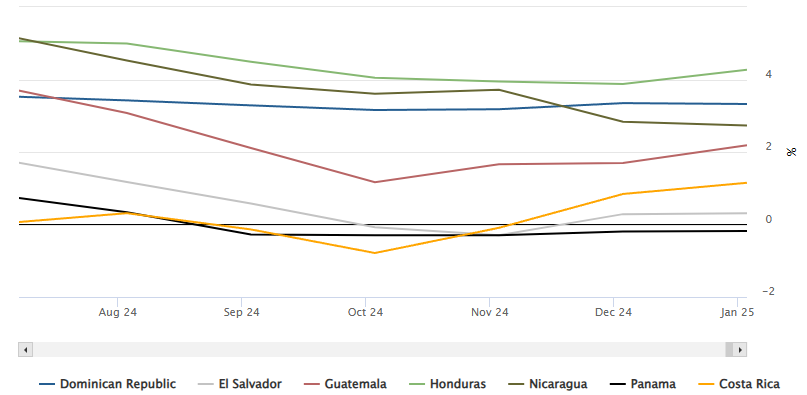
    Central America & Caribbean: inflation rate
    Percentage variation (year-on-year)

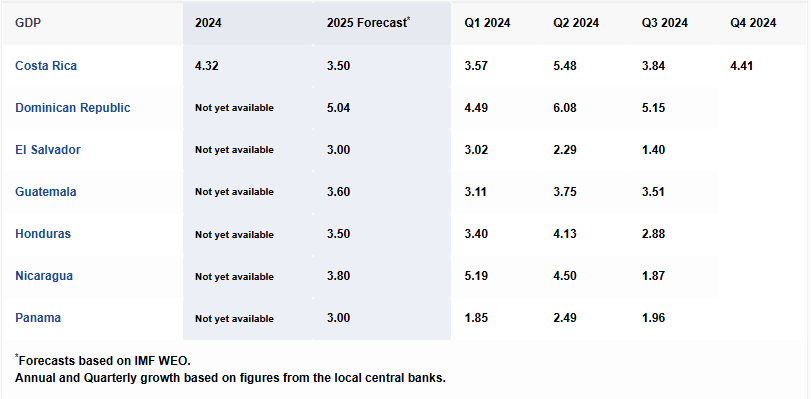
    Central America & Caribbean: GDP growth (%)
    Quarterly figures are year-on-year growth

  • CUBA: Tourism in a tailspin

    Abbi Dicker 19 September 2025 Hits: 1471

    The latest numbers from Cuba’s national statistics institute (Onei) show that Cuban hotel occupancy dropped by nearly seven percentage points in the first half of this year to 21.5%, while tourist arrivals slumped by 25% to 981,856.

    Cuba’s tourism sector is in a jam. The country appears to be caught in a vicious circle, where power cuts, water shortages, and garbage on the streets discourage visitors; but fewer visitors, in turn, bring in less of the foreign currency that the government desperately needs in order to fix the collapse in essential services.

    In effect, the tourist business is trying to survive with only one out of every five beds occupied. US tourists are dwindling as the US administration led by President Donald Trump tightens sanctions further. Officially US citizens are banned from visiting the island for tourism, but 12 categories of visits are still allowed (including sports and educational visits) These have become more restrictive. US citizens are also banned from using hotels linked to a prohibited list of companies: Torre K-23, a hotel which is the tallest building in the country, has just been declared off-bounds to US visitors.

    Cuba inflation

    On 11 August, Cuba’s national statistics office (Onei) released new figures showing monthly inflation in July was 0.49%, bringing the annual rate to 14.37%. This compares with monthly inflation of 0.75% in June when the annual rate was 14.75%. The country closed 2024 with an inflation rate of 24.88%.

  • TRACKING TRENDS

    Abbi Dicker 09 October 2025 Hits: 992

    BRAZIL | Trade surplus down in September. The ministry of development, industry, trade, and services (MDIC) released new figures on 6 October showing that the country’s trade surplus in the month of September came to US$2.99bn, down 41.1% compared with September 2024. This latest result also marks a decrease from the surplus of US$5.86bn registered for August this year.

    Exports in September 2025 totalled US$30.5bn, up by 7.2% year-on-year, while imports totalled US$27.4bn, a 17.7% increase year-on-year.  

    Brazil’s agricultural exports increased by 18.0% in yearly terms, registering an export value of US$6.7bn in September, while exports from extractive industries totalled US$6.6bn, up 9.2% on the same month in 2024. Brazil’s imports of agricultural products totalled US$480m, up 3.5% year-on-year, while extractive industries registered a monthly import value of US$1.14bn, down 26.1%. Imports for the manufacturing sector totalled US$25.78bn, up 21.5% year-on-year.

    BRAZIL | Vehicle production down in monthly terms. The national association of vehicle manufacturers (Anfavea) released the production and sales figures for the month of September on 8 October, showing a total of 234,400 units produced and 243,200 vehicles sold. This production figure is up 5.8% in yearly terms but down 1.5% on the previous month.

    Monthly sales in September were up by 7.9% compared with the previous month and up 2.9% compared with September 2024. Anfavea also released monthly export figures, showing a total of 52,500 vehicles exported in September 2025. This marks a 26.2% year-on-year increase but an 8% monthly decrease.

  • TRACKING TRENDS

    LatinNews 06 September 2011 Hits: 3493

    COLOMBIA | Investment soars. Foreign direct investment reached US$8.56bn in the first seven months of the year, up 61% on the same period in 2010, the government reported. The majority of this FDI (56%) went to the oil sector. A US$1.3bn investment to boost coal production in El Cerrejón was announced on 18 August in London by the mining giants BHP Billiton, Anglo American and Xstra, to shareholders in the open pit mine.

    ECUADOR | Banana emergency. Ecuador has declared a state of emergency in the banana sector due to an increase in production and a fall in demand. The agriculture minister, Stanley Vera, explained that the emergency alert would last until late September to allow the government “to take immediate measures aimed at mitigating the price distortions”. Banana exports totalled US$1.23bn in the first half of 2011, up 11% on the same period in 2010. According to Vera, production stood at 152m cartons in the first half of 2011, but increased production in Ecuador and elsewhere was exceeding demand. He said up to 1.5m cartons a week are left in the country because nobody wants them. The government has created a fund of US$15m, created from a tax on banana exports, to buy back surplus bananas from producers who are unable to sell their stocks to exporters. He said that part of the surplus would be given to farmers as food for livestock. To abandon the sector, he said, would be “catastrophic,” as a total of 1.4m Ecuadoreans, 10% of the population, work in it.

    VENEZUELA | Growing but slowing. The economy expanded by 2.5% in the second quarter of 2011 compared with the same period last year, the central bank revealed, and by 3.6% in the first half. Venezuela’s GDP slowed after having grown by 4.5% in the first quarter on the same period in 2010, off the back of an 18-month recession. Oddly, the construction sector declined by 2.3% year-on-year in the second quarter despite President Hugo Chávez setting ambitious targets for housing construction this year and next. The most significant figure was for the oil industry, which grew by 0.8% during the second quarter, having contracted by 0.5% in the first quarter. The central bank said the oil sector’s recovery was due to a 4.4% increase in oil production and also higher oil prices. The second quarter saw a 56.3% increase year-on-year in exports from US$16.06bn to US$25.12bn, largely because of the increase in crude prices. Imports grew 25.3% over this period, from US$10.01bn to US$12.53bn.

  • URUGUAY: Mujica pampers goose but spreads wings to Pacific

    LatinNews 19 January 2012 Hits: 1224

    “They want a war with Argentina, but we are not going to risk killing the goose that lays the golden egg, which is tourism.” Uruguay’s President José Mujica has a well-founded reputation for straight-talking as this response to charges of Argentine protectionism brought to him by the Unión de Exportadores del Uruguay (UEU) amply demonstrates. This does not mean he is turning a blind eye to the problem of Argentine protectionism, however; he is simply alert to the acute political sensitivity in the Casa Rosada to direct criticism. He is also intent on expanding trade to the Pacific, an issue he raised with his peer Sebastián Piñera during a visit to Chile this month.

    Argentine protectionism is growing day by day. The latest measure to antagonise Uruguayan exporters, which will take effect on 1 February, is the requirement for Argentine importers to provide advance notification to the Administración Federal de Ingresos Públicos (Afip), Argentina’s national tax agency, of the products they wish to import in advance and wait approval before proceeding. This could take 30 days and potentially could be denied.

    The Uruguayan chamber of industry (CIU) complained that the upshot of this “superlicence”, as it has been dubbed, would be a loss of trade because Argentine producers would try and procure what they need domestically to avoid the hassle of leaping the new bureaucratic hurdles. The result will be an even bigger bilateral trade deficit: Uruguay exported goods to the value of US$558m to Argentina in 2011 and imported products amounting to US$1.82bn.

    The CIU pointed out that Mujica had “negotiated and negotiated” but had to get tougher through recourse to the founding treaty of Mercosur (Mercado Común del Sur, the Southern Common Market, comprising Argentina, Brazil, Paraguay and Uruguay). The trouble, as Mujica will be well aware, is that the Mercosur treaty will not provide Uruguay with much succour. What is the point of Mujica making a formal complaint when Mercosur lacks the supranational dispute resolution mechanisms to enforce the spirit of free trade enshrined in the founding statutes of the (perennially imperfect) customs union?

    Mujica does not want to risk a sharp deterioration of relations with a hyper-sensitive Argentine government, like under his predecessor Tabaré Vázquez, over the construction of a pulp mill on the banks of the River Uruguay. “Punta del Este (Uruguay’s beach resort town) would not exist if it were not for Argentines,” he said in an interview with the national daily El País. Tourism took a big hit as a result of the blockade of bridges between Argentina and Uruguay in the long-running protests over the pulp mill, but it is booming again now. The number of Argentine tourists visiting Uruguay in the first half of 2011 increased by 45% to 943,841, on the same period the previous year.

    The problem for Uruguay is that Argentina, and for that matter Brazil, both appear to be harking back to the import substitution industrialisation (ISI) of the 1950s and 1960s as a means of confronting the threat of cheap imports from Asia, especially China. This is completely contrary to Uruguay’s foreign trade policy: Vice-President Danilo Astori said last month that “the worst thing a country like Uruguay can do in times of crisis, like this one, is to close in on itself.

    The constraints of Mercosur prohibit Uruguay from seeking bilateral free trade deals so Mujica is trying to mitigate what he accepted was an inevitable loss of trade with Argentina by looking to the Pacific. He discussed this matter with President Piñera during a visit to Chile earlier this month, during which the two men also visited the Antarctic. Mujica spoke of his desire to seek alternative markets in Chile and Peru, but he also has his eyes set on Asia, and China: Chile, Colombia, Peru and Mexico are currently trying to deepen trade with China and Japan through the Arco Pacífico, an economic integration pact to complement bilateral free trade deals. Mujica is keen to explore complementary accords with Chile and Peru to tap into Pacific markets.

    • Off the grey list

    The government of President José Mujica received a boost in December when the Organisation for Economic Co-operation and Development (OECD) removed Uruguay from its “grey list” of nations deemed to be taking insufficient action to combat tax evasion. The OECD released a statement saying that Uruguay had shown its commitment to meeting international standards by signing seven new bilateral tax accords, most recently with Ecuador, Liechtenstein and Switzerland, although it has yet to sign accords with Brazil or Argentina.

  • GUYANA: PPP playing on long memories

    LatinNews 15 April 2015 Hits: 2357

    It is now nearly 23 years since the Afro-Guyanese dominated People’s National Congress (PNC) lost power (after a long run of its own dominance, extending to 28 years). Since then, the Indo-Guyanese oriented People’s Progressive Party/Civic (PPP/C) has monopolized power. The PPP/C is relying on three factors to secure re-election: the demographic supremacy of the Indo-Guyanese; a relatively good economic track record for the outgoing government; and the alleged unsuitability of the PNC for government.

    The demographics are solidly against the PNC. Indo-Guyanese make up 43.4% of the population against the Afro-Guyanese’s 30.2% share, with mixed-race Guyanese making up a further 16.7% and the indigenous population 9.1%. On the economic front, International Monetary Fund (IMF) figures point to Guyana growing by 5.44% in 2011 (a year in which the Caribbean as a whole suffered a recession of -3.6%), 4.82% in 2012, 5.22% in 2013, and 3.32% in 2014.

    The PPP/C’s argument that the PNC is unsuited for government is based on two pillars. The first is the way it has behaved in the last parliament, when it had a slim one-seat majority that prevented the PPP/C government of President Donald Ramotar from governing effectively. At the start of the election campaign, Ramotar categorized the PNC as “narrow-minded people who seem to believe that they can make things bad in our country and drive us back to the time when we had to line up for a quarter pint of oil…in the hope that it will change their political fortune”.

    Then there is the PNC’s record in government, which still resonates even if many in the electorate cannot remember that far back. In a television interview in mid-March, Attorney-General Anil Nandlall reminded the viewers: “You had the PNC in government and you have a track record of 28 years to judge them by. It’s as simple as that. You had economic stagnation. You had bankruptcy. You had a national debt that was uncontrollable. You had the banning of basic food items. You had taking away of democracy from the country. You had the deprivation of freedoms and civil liberties.” He added: “Fast forward to 22 years of the PPP in government and look around at the progress…I can go on to give a litany of data that will make the choice of who to vote for so pellucid and so clear that it boggles the rational mind as to why the voters should be confused.”

  • RASTREANDO TENDENCIAS

    LatinNews 18 December 2015 Hits: 313

    BRASIL | Inflación. La inflación acumulada de 12 meses de Brasil se elevó al 10,4% en noviembre, el nivel mensual más alto en los últimos 12 años, desde noviembre del 2003, cuando alcanzó el 11,02%, durante el primer año en el poder del ex presidente, Lula da Silva (2003-2010). El índice de precios al consumidor se elevó un 1,01% en noviembre, de acuerdo con el instituto nacional de estadísticas (Ibge). Esta más alta de lo esperado cifra para los precios al consumidor fue conducida por un incremento en los precios de los alimentos y combustibles. La alta tasa de la inflación presionará al comité de política monetaria (Copom) del banco central para que incremente la tasa de interés de referencia (Selic) en su primera reunión el 19-20 de enero del 2016.

  • ARGENTINA: Macri starting to struggle after six months

    LatinNews 16 June 2016 Hits: 2062

    The traditional honeymoon period is over for President Mauricio Macri. An opinion poll released on 12 June to mark Macri’s first six months in office found that public support for the president and his centre-right Cambiemos coalition government is declining. The effects of the tough economic adjustment plan that the Macri government has implemented in order to tackle the macroeconomic imbalances inherited from the administration of his predecessor, Cristina Fernández (2007-2015), has taken a toll. This should provide encouragement to the main opposition Partido Justicialista (PJ, Peronists) as it tries to rebuild itself after losing the presidency last year.

    The national poll carried out by private consultancy firm Ibarómetro between 5 and 8 June, found that while President Macri’s approval rating remains high, it has fallen over the last six months. Macri’s approval rating in June stands at 51.4%, 14 percentage points lower than his approval rating when he first assumed office (and incidentally almost identical to the 51.34% with which he won election in last November’s presidential run-off). Meanwhile, Macri’s disapproval rating over this period has increased by 19.8 percentage points to 42.1%. While the proportion of people that approve of Macri still constitutes a majority, there has been a marked downward trend and this trend looks set to continue in the short term.

    According to Ibarómetro, the fall in Macri’s approval rating is primarily explained by the negative perceptions about the domestic economy, which continues to exhibit flat growth and high inflation as a result of the economic adjustment. Indeed 72.1% of respondents said that the country’s economic situation was ‘bad’ or ‘very bad’; while only 22.9% felt that the economic situation was ‘good’ or ‘very good’. And while one in two respondents believe that the situation will improve in the future, the majority (53.8%) have a negative view about their short-term economic prospects.

    This is an issue for the Macri administration because it has insisted that while the adjustment may be painful, its effects will only be temporary, with benefits starting to be felt “in the second half” of 2016. Macri has said that the economic policy measures would not only lead to inflation coming down to more acceptable levels but also to the creation of jobs as investors flock back to Argentina. But at the midway point of the year, there is still little sign of this. Pointedly, while 50% of Ibarómetro respondents recognised that the current adverse domestic scenario had been inherited from the Fernández administration, 45% said that they believed that such a deep adjustment, including highly unpopular increases in utility tariffs and mass lay-offs of government workers, could have been avoided and a more gradual approach adopted instead.

    This sentiment is what the opposition, and in particular the hard-line Frente para la Victoria (FPV, Kirchneristas) faction of the PJ, is keen to seize upon (see sidebar). To mark the six months since it lost the presidency, the FPV issued a statement criticising Macri for “hiding undeniable truths and promising imminent improvements, when the crude consequences of an adjustment, which particularly affects poorer sectors, are becoming more visible”. The FPV and the wider PJ are clearly hoping that dissatisfaction with the Macri administration will continue to increase over the next few months so that it can profit from it in next year’s mid-term federal legislative elections, in which the PJ will be looking to consolidate its dominant presence in the national legislature.

    • Argentina becomes Pacific Alliance observer

    On 8 June the Pacific Alliance trade bloc comprising Chile, Colombia, Mexico, and Peru accepted Argentina as an observer nation following a request submitted by the government led by President Mauricio Macri. According to Chile’s foreign ministry, Macri will attend the next Pacific Alliance leaders’ summit, to be held in Chile on 1 July, as a guest to celebrate Argentina’s adhesion to the group. The Macri administration’s decision to reach out to the Pacific Alliance represents a clear break with the policies pursued by his predecessor Cristina Fernández (2007-2015), which sought to strengthen intraregional trade within the Southern Common Market (Mercosur) and saw the Pacific Alliance as a threat.

    • Peronists claim electoral victory

    Highlighting the change in mood towards the ruling Cambiemos coalition, just two days after President Macri completed six months in office, on 12 June, the PJ obtained a symbolic victory in the municipal by-election in the city of Río Cuarto, Córdoba province. The consensus PJ candidate handily defeated his rival from the centre-left Unión Cívica Radical (UCR), the main partner in Cambiemos, in what has traditionally been a UCR bastion. This is the first electoral victory claimed by the PJ since it lost the presidency last year. And it is even more significant when considered that Macri campaigned for the UCR candidate. The result was celebrated by the PJ as a “harbinger of what will surely be a great Peronist victory in next year’s mid-term elections”.

  • ECUADOR: Correa continues to play coy

    LatinNews 14 July 2016 Hits: 754

    President Rafael Correa has repeated that he does not intend to seek re-election in February 2017, but neither does he discount it completely, warning political opposition parties “not to rest on their laurels”.

    President Correa is trying to keep the opposition second-guessing. While public opinion is no longer so favorable towards Correa and the ruling left-wing Alianza País (AP), the dearth of opposition candidates with charisma or national reach means that Correa expects the AP to secure re-election in 2017 with or without him, notwithstanding the biting economic recession in the oil export-dependent country.

    Until recently, the former vice-president, Lenín Moreno (2007-2003), one of Correa’s preferred successors, was well ahead in pre-presidential polls. In June, for instance, Moreno’s putative support was twice that of Jaime Nebot, the long-serving conservative mayor of Guayaquil (who has since declared that he does not intend to run), and four times that of Guillermo Lasso, of the centre-right Creando Oportunidades (Creo), the (distant) runner-up to Correa in the 2011 presidential contest.

    However, Moreno recently suffered a minor scandal after it emerged that he was in receipt of public funds to finance his expenses in Geneva, Switzerland, where since 2013 the former minister (who is paraplegic) has served as the United Nations Secretary General’s Special Envoy on Disability and Accessibility. It is unclear whether Moreno, who in 2012 was nominated for the Nobel Peace Prize for his work in support of disability rights, will suffer in the polls from the revelation, which was confirmed (and defended) by the foreign minister, Guillaume Long. Given Moreno’s high standing in Ecuador, it seems unlikely.

    There is some speculation that Correa is continuing to float the possibility of his candidacy as a means of maintaining cohesion in the AP, which has shown signs of fragmenting without him at the helm. The AP will hold its party convention in early October and has yet to decide on a method for candidate selection. By deliberately keeping himself front and centre and dominant in the national news, runs the argument, Correa creates space for the AP to get its act together behind the scenes, while sowing uncertainty in the opposition as to his intentions.

    • Re-election

    Still pending is a ruling by the constitutional court that would allow President Correa to run next year. Last year, at Correa’s request, the ruling Alianza País (AP) inserted a delaying clause into a newly approved constitutional reform permitting indefinite re-election so that the reform would only take effect after the February 2017 polls. But earlier this year, a group of AP supporters petitioned the constitutional court for the removal of that clause, on the grounds that it infringes the constitutional right of citizens to seek election. The court has yet to declare.

  • TRACKING TRENDS

    LatinNews 14 May 2020 Hits: 4999

    ARGENTINA | Taking debt renegotiations into extra time. On 10 May the Argentine government extended the deadline of the expiry of the formal debt restructuring offer it has made to holders of US$66bn worth of sovereign bonds issued under international law until 22 May.

    The move by the government led by President Alberto Fernández came after insufficient bondholders accepted its offer by the 8 May deadline it had set; 75% must agree for there to be a binding global agreement. Groups of bondholders had already rejected the offer, arguing that the debt write offs proposed by the government were unjustified, and called for the terms of the offer to be improved [WR-20-18].

    The Fernández administration has ruled this out in an apparent bid to pressure bondholders into accepting the offer or face the prospect of trying to collect on the debts following a default.

    President Fernández had said that he would not extend the 8 May deadline, raising concerns about an imminent default. But, after only a minority of bondholders (fewer than 20%, according to press reports) signed up to the offer before the deadline, the government issued a decree extending the deadline for accepting the offer on the grounds that it still believes that an agreement can be reached.

    Since then, Fernández has urged bondholders either to accept the offer or present a counteroffer before the new deadline. However, Fernández was clear that any counteroffer must meet the debt sustainability criteria outlined by his government, warning that otherwise his administration would not accept it.

    The 22 May deadline coincides with the end of the grace period that Argentina has in order to meet US$500m in foreign debt repayments. The Fernández administration has said that it is not willing make any debt repayments until a debt restructuring agreement is reached. If no deal is reached, and the overdue payment is not made by then, Argentina will be in technical default.  


    CHILE | Economy struggling. Chile’s central bank requested a US$23.8bn flexible credit line from the International Monetary Fund (IMF) on 12 May “to protect the economy from eventual external shocks” in the face of the coronavirus (Covid-19) pandemic. The IMF said that its managing director, Kristalina Georgieva, would recommend that the request be approved by the board of governors.

    A week earlier the central bank reported that the economy contracted by 3.5% year-on-year in March. This equalled the worst decline in the monthly economic activity indicator (Imacec) since July 2009. The Imacec had just started to stage a recovery, expanding by 2.7% in February, after the economy contracted in the wake of last October’s social unrest.

    The Imacec record will be smashed in April and May, and there is no sign of the economy picking up soon. President Sebastián Piñera announced his determination to open up the economy and avert “a social crisis from unemployment and bankruptcy” at the start of May but his government has been forced to shelve its ‘Plan Retorno Seguro’ amid a surge in Covid-19 cases. On 13 May Piñera announced a full lockdown in the capital and surrounding areas to take effect from 15 May as the government is losing the “Battle of Santiago” as it was dubbed last week by the health minister, Jaime Mañalich [WR-20-18]. There were 2,660 confirmed new cases of Covid-19 on 13 May, an increase of 60% on the previous day, and 12 fatalities, the majority in the capital.

  • ECONOMIC HIGHLIGHTS

    Abbi Dicker 18 July 2025 Hits: 3228

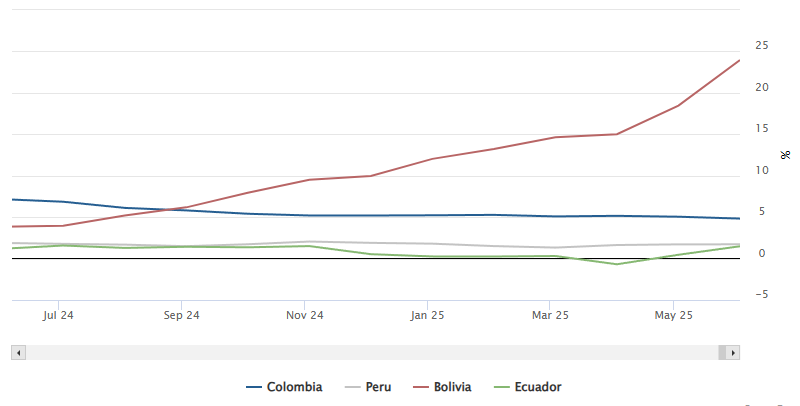
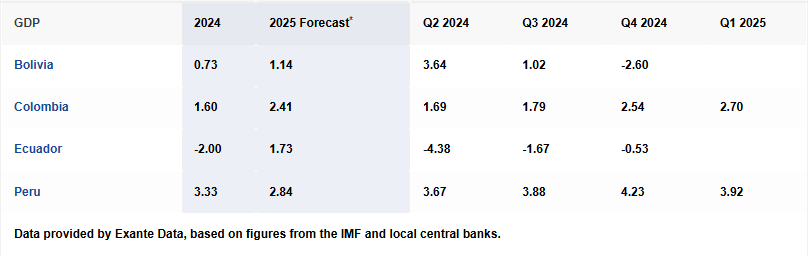
    PERU | Interest rates held. On 10 July Peru’s central bank (BCRP) announced it was holding its benchmark interest rate at 4.50%. This was the second consecutive pause to its rate-cutting cycle after a 25 basis-point cut in May. In a statement, the BCRP noted that the annual inflation rate in June was 1.7%, where it had hovered since April. The BCRP’s 12-month inflation forecast is also unchanged at 2.3%, within the 1-3% target range. However, the bank did note that “most indicators of the current situation and expectations about economic activity deteriorated compared with the previous month,” despite economic activity remaining on a “positive trajectory”. It highlighted increased global uncertainty due to restrictive trade policies that have contributed to volatility in financial markets.

    COLOMBIA | Inflation cools. On 7 July Colombia’s national statistics department (Dane) published the latest consumer price index, putting monthly inflation in June at 0.10% – down from 0.32% in May. This brought the annual inflation rate in June to 4.82%, down from 5.05% the previous month. The categories which saw the steepest monthly price rises were restaurants and hotels (+0.42%), healthcare (+0.36%), and alcoholic drinks and tobacco (+0.27%).

    BOLIVIA | International reserves up. On 1 July Bolivia’s central bank (BCB) announced that its international reserves increased by US$830m over the first six months of the year and stood at US$2.81bn at the end of June. Low reserves have been a source of major concern over the past two years, contributing to credit rating downgrades. BCB president Edwin Rojas said that the rise “is an important signal for the financial system and the whole economy”. In a statement, the BCB noted that Bolivia had met all its foreign debt obligations during the first six months of 2025 “despite the adverse context affecting the national economy”. Fuel imports, necessitated by widespread shortages, continue to be a major drain on international reserves, with the BCB stating that fuel import costs during the first half of 2025 totalled US$1.02bn.

    Andean countries: inflation rate
    Percentage variation (year-on-year)

    Andean countries: GDP growth (%)
    Quarterly figures are year-on-year growth

  • TRACKING TRENDS

    LatinNews 18 April 2013 Hits: 1110

    BRAZIL | Slashing forecasts for another year. On 15 April Brazil’s planning ministry announced that the government was reducing its official GDP growth forecast this year from 4.5% to 3.5%. This is the second consecutive year in which Brazil’s official growth forecast has been cut, suggesting that Brazil’s economic recovery following the 2008-2010 global economic crisis remains fragile.

    Last year the government led by President Dilma Rousseff not only rolled out a series of economic stimulus packages such as increasing tax incentives to local producers but also convinced the central bank to cut the structurally high interest rates in a bid to reduce domestic costs so as to stimulate more economic activity. Indeed last year the central bank cut the interest rates on no less than 10 occasions in a bid to help re-energise the economy. However, this failed to produce the expected results as Brazil’s economic growth rate of just 1% was underwhelming. In fact evidence is now starting to mount that the deep interest rate cuts may have produced more harm than good to the Brazilian economy.

    According to local economists, the low interest rates have helped to keep domestic consumption levels high, which in turn have pushed up prices of food, goods and services resulting in the economy now suffering from inflationary pressures. Indeed, the March measure of the national consumer prices index (IPCA) of 6.6% year-on-year already breached the upper range of the central bank’s official target of 4.5% plus a 2.0% tolerance limit, causing serious concern among economists who pointed out that runaway inflation could end up suffocating domestic consumption, the one area of the economy that continues to have relatively high activity.

    To make matters worse for the government there are also signs that Brazil’s entrepreneurs are losing confidence in the economy. On 16 April Brazil’s national industry confederation (CNI) released its latest entrepreneurial confidence index, which fell from 57.1 points in February to 55.4 points in April, the lowest level since August last year. The index ranges from 0 to 100 and any measures above 50 points are considered to be a sign of confidence in the economy. Consequently a CNI statement said that the index’s fall towards the 50-point mark shows that entrepreneurs believe that the economic environment in the last couple of months has worsened and expectations are less optimistic. As a result the CNI added that these could translate into lower levels of investment all of this year.

    PARAGUAY | Beef exports surge. On 16 April Paraguay’s national animal health service (Senacsa) revealed that the value of Paraguayan beef exports in the first quarter of the year had reached US$233.9m, a 51.05% increase on last year. Paraguay’s beef exports suffered last year following the January 2012 outbreak of foot and mouth disease (FMD) which resulted in many of Paraguay’s main export markets, such as Chile, Brazil and Russia, temporarily suspending imports until Paraguay could recover its FMD-free status. However, thanks to the efforts of the Paraguayan authorities back in November 2012 Russia and Chile agreed to resume imports partially from certified establishments. This has allowed Paraguay’s key beef sector, the second most important source of revenues for the country, to rebound this year: Russia has now displaced Chile as the main export market for Paraguayan beef, with US$158.4m in exports, followed by Brazil, with US$23.7m. Chile is now the fifth export market, with US$8.9m in exports.

    Taking into consideration that the price of beef in Chile, which according to Paraguay’s beef chamber (CPC) currently stands at US$6,300 per tonne (t), is much higher than the price paid in Russia, US$4,300 per t, it is easy to see why the Paraguayan authorities are still trying to convince their Chilean counterparts to re-open the beef market fully. Indeed, Senacsa has pointed out that it has invited its Chilean counterpart, Senasa, to come to the country this month to conduct a second audit of the local beef industry in a bid to secure the full opening of the market in order to further stimulate economic growth in the sector.

    According to the latest forecasts by Paraguay’s central bank, the economy is expected to achieve GDP growth of 13% this year as the key agricultural sector rebounds from its dismal performance last year which led to a 1.2% GDP contraction.

    • Argentina signs new agreement with Nigeria

    On 15 April Argentina’s tax authority, Afip, announced that it had undersigned a new information exchange agreement with its Nigerian counterpart which would help it prevent, investigate and combat illicit customs activity. An Afip statement said that the agreement was signed by Afip head, Ricardo Echegaray, and his Nigerian counterpart, Abdullahi Dikko, during the latter’s visit to Buenos Aires. The statement cited Echegaray as stating that “we have strong hopes that this agreement with Nigeria will be very productive”. According to Afip data last year Argentina exported US$151m worth of goods to Nigeria.

  • HONDURAS: Not crystal clear - the economic policies of the presidential hopefuls

    LatinNews 04 November 2013 Hits: 556

    Barring any unforeseen upsets, a new government will take office in Honduras in late January after presidential elections due on 24 November, which are being contested by nine rival candidates. What kind of economic policy will it pursue?

    Amid the cut and thrust of election politics, the candidates’ position on economic policy matters has been rather vague. Roughly a month before election day, the final opinion polls identified the two frontrunners as Juan Orlando Hernández, of the ruling Partido Nacional (PN), and Xiomara Castro de Zelaya of the newly created Libertad y Refundación (Libre) coalition. Hernández, from one of the country’s two traditional conservative parties, represents a degree of continuity on the centre-right. Castro, the wife of former president Manuel Zelaya (elected in late 2005 and ousted in a coup in June 2009) represents change on the centre-left. Their campaigning so far has not really clarified how much continuity and how much change each is offering the voters. The final surveys gave polls gave Hernández a slight edge for the first time over Castro, although the difference was within the error margin – neither breached 30%. With almost a third of voters still undecided, last minute electoral swings in one direction will win it.

    Hernández has the benefits – and disadvantages – of representing continuity. He supports agricultural development and attracting more foreign investment. Voters and the private sector see him as offering market-friendly policies. It has to be said, however, that those policies have shown their share of problems. The incumbent government led by President Porfirio Lobos Sosa has been spending ahead of revenue, with this year’s fiscal deficit estimated at 6% of GDP. Last month in Latin American Economy and Business we examined the weak state of Honduran public finances, concluding that the Honduran government’s financial position remains very fragile indeed. In fact, many analysts believe that whatever the political colour of the new government, it may have to start its term in office by announcing emergency fiscal austerity measures. Substantive fiscal reform remains essential but politically very difficult to achieve, however. In the meantime, the country has no agreement in place with the International Monetary Fund (IMF), for instance.

    The Honduran economy depends on remittances from overseas workers (mainly migrants in the US), coffee exports (hit by the coffee rust plague), local assembly plants (maquilas) and tourism (surprisingly resilient to the country’s growing reputation for gang violence).  According to the central bank, economic growth is slowing to a projected 3.1% in 2013, down from 3.3% last year (some forecasters are predicting a sharper deceleration).

    Faced by a continuing surge in drug trafficking and criminality, Honduras now has one of the world’s highest homicide rates (est. 85 per 100,000 in 2012). Hernández supports a hardline crack down, via the use of a brand new military police force, which has recently joined the military and the national police on the streets. However, this involves increased security spending at a time when public sector nurses and doctors have been complaining of salary arrears of up to 11 months. It also raised the nightmarish spectre of the Mexican experience under President Felipe Calderón (2006-2012), when militarisation of the anti-drugs campaign led to an increase in violence and economic costs, but failed to defeat the drug cartels.

    Castro, who is not a career politician, would focus instead on the creation of community police forces to tackle the high crime rate. She has tried to woo the private sector by offering to overhaul the tax system and to provide fiscal incentives for small- and medium-sized enterprises, as well as for foreign investors. Although she is offering a somewhat less radical version of her husband’s policies, business remains cautious, noting for example that Libre calls for greater state involvement in the economy.

    There are two additional policies that might again spark political turbulence and resistance from the traditional Honduran establishment. First, she retains a general if vague commitment to constitutional reform, and second, she is also supports land reform. Her husband’s purported attempt to change the 1982 constitution to allow his own re-election, and moves to redistribute land held by some of the country’s wealthiest families, were key factors in his overthrow.

    Arguably, the situation has changed on the first point, as any potential re-election bid is no longer a priority, only potentially becoming so some years down the track. On the second, with two thirds (66%) of Hondurans living in poverty (some calculations put that rate at a higher 80%) it can be reasonably argued that any government keen to achieve sustainable growth needs to tackle some kind of land reform; much will depend on the political skill with which this objective is pursued.

    With the electoral race so-evenly balanced, economic policy may be deeply affected by outcomes other than a straight win by one or other candidate.

    These could take place within the current constitutional framework or outside it. With neither party set to win a congressional majority, on current trends, it is clear that some form of coalition-making will be required. Which way the Partido Anti-Corrupción (PAC), the new party of the currently third-placed presidential runner, Salvador Nasralla, chooses to direct its support could be crucial. In this scenario, the economic policies of the next government will probably be shaped in post-election party negotiations. The much more negative scenario, of course, is one in which deadlock and conflict over the election results leads to renewed civil unrest and even another coup.

    • Economic overview

    Even as the main presidential candidates for the 24 November election make populist spending promises they realistically cannot fulfil, key public sector workers including teachers and doctors were - yet again - out on the streets of the capital Tegucigalpa in demand of the back-payment of their salaries.  Like its main trading partner the US, Honduras is facing a steep fiscal cliff of its own, with the fiscal deficit of at least 6.0% of GDP and total public debt now hitting 50% of GDP – or an estimated US$9.1bn - on the back of a rapid surge in internal debt since the June 2009 coup. That’s more than the executive’s proposed 2014 budget of US$7.9bn

    Growth has slowed down this year, with the economy hit by a triple whammy of still-volatile external growth in its main export markets, led by the US; the devastation by rust disease of much of its coffee export crop which, in turn, has worsened the current account deficit (running at about 10% of GDP). Higher fuel import prices don’t help. Honduras spent just over US$2.0bn a year on fuel imports in 2011-2012. All this has reduced the government’s ability to spend, especially on sectors like construction, which has dragged down the domestic economy. On some measures, the government is effectively broke.

    According to the central bank’s latest (July) indicator of economic activity (Imae), a GDP proxy, overall growth in the first seven months of the year was just 1.6%, compared to an annualised 4.4% in the equivalent 2012/2011 period. While the agriculture sector managed growth of 3.8% despite the coffee rust plague, thanks to increased output of other products like bananas and palm oil; other sectors like manufacturing, construction, retail and electricity and water all registered marginal growth or a contraction, underlining weak domestic demand. The central bank latterly reduced its growth forecast for the year to 3.0%, down on 2012’s 3.3%. Following a routine staff mission visit in late August, the IMF concurred.

    • Petrocaribe  - a non-starter?

    Honduras recently re-joined Petrocaribe, Venezuela’s  discount oil scheme for Central America and the Caribbean. It was suspended by Venezuela’s left-wing president Hugo Chávez [1999-2013] after the 2009 coup. Yet amid apparent ‘technical’ problems in Venezuela, Honduras has yet to receive its first oil shipment under Petrocaribe – it was due in July. According to the Honduran trade and ministry minister Adonis Lavaire, fuel import costs are running at US$2.3bn a year, with illegal imports (fuel smuggled in mainly from Venezuela) costing some US$230m in lost fiscal revenues.

    • Budget

    On 12 September the council of ministers approved a 2014 draft budget of US$7.9bn, down US$50.5m on the 2013 plan. According to Deputy Finance Minister Carlos Borjas, 54.8% (US$4.34bn) is destined for the central government and 45.2% (US$3.6bn) for the ‘decentralised sector’ (the 18 departments). The budget must be approved by December. On 11 September President Lobo had said that the executive would not present a budget, arguing that there was no point when a new administration would take office in January. Apparently, the finance ministry didn’t agree.

  • TRACKING TRENDS

    Patrick de Courcy 09 March 2023 Hits: 3596

    BRAZIL | GDP figures highlight challenges. The Brazilian economy grew 2.9% in 2022, GDP figures released on 2 March by the national statistics institute (Ibge) show. Growth in the services (4.2%) and industrial (1.6%) sectors underpinned this expansion, while the agricultural sector contracted 1.7%, reflecting a smaller soya output due to adverse climatic conditions. On the demand side, family consumption buoyed growth, expanding 4.3% in the year – compared with 1.5% growth in government consumption.

    GDP contracted 0.2% in the fourth quarter of 2022, the first negative quarterly result in over a year. This confirms an impending economic downturn this year and fans concerns that Brazil could even be headed for a recession, amid persistent inflation and high interest rates. The World Bank forecasts 0.8% growth for the Brazilian economy in 2023 in its latest Global Economic Prospects report.

  • TRACKING TRENDS

    Patrick de Courcy 23 July 2026 Hits: 441

    BRAZIL | Slight monthly increase in economic activity. The central bank (BCB) released new figures on 17 July for its economic activity index (IBC-Br), a proxy to anticipate GDP figures, showing a 0.1% monthly rise in activity in May this year. Economic activity in May was mainly driven by the industrial sector, which posted a monthly rise of 0.4%, while activity in the services sector rose by 0.1%. However, activity in the agricultural sector declined by 0.1% in monthly terms. In year-on-year terms, Brazil’s economic activity was up 0.8% in May this year, and the accumulated annual activity in the 12 months through May 2026 was up 1.4% compared with the preceding 12-month period.

    Aside from the official figures from the BCB, the economic research institute (Ibre) of the university and think tank Fundação Getulio Vargas (FGV) released figures on 20 July showing a 0.7% monthly increase in economic activity in May. According to the Ibre data, activity increased by 1.2% compared with May 2025 and annual activity was up 1.7% for the 12 months through May this year.


    PARAGUAY | Soybean exports rise in the first half of year. Paraguay’s chamber of cereals and oilseeds exporters (Capeco) reported on 21 July that total revenue from national soybean exports in the first half of 2026 rose to US$2.27bn, up from US$1.51bn in the first six months of 2025. Exports totalled 5.89m tonnes (t) in the first half of this year, up from 4.11m t in the same period last year. Increases were also registered for exports of soy-derived products. Soybean oil exports totalled 319,020 t, up from 305,556 t in the first half of 2025. Meanwhile, exports of soybean pellets rose from 1.0m t in January-June 2025 to 1.15m t in the first six months of 2026. According to Capeco’s figures, the soya industry generated US$2.98bn in foreign currency inflows in the first half of 2026, up from US$2.09bn in the first half of last year.

    Regarding trade destinations, the vast majority of Paraguay’s soybean exports went to two countries: Argentina, accounting for around 85%, and Brazil, receiving around 9%. The remaining 5% of exports went to countries such as Saudi Arabia, the US, Vietnam, Uruguay, Chile, and South Korea.

  • URUGUAY: Mujica seeks to regain authority with land tax

    LatinNews 31 August 2011 Hits: 3606

    President José Mujica scored a notable triumph this week. The government sent a bill to congress on 22 August to create a tax on owners of more than 2,000 hectares of land. The whole cabinet signed up to the bill, which had been the cause of a public disagreement between Mujica and his Vice-President Danilo Astori, who argued, along with three key ministers, that it changed the rules of the game and risked deterring investment. The biggest test for Mujica, however, is yet to come. Having rallied his government behind the bill, Mujica now needs to secure the unity of his party, the left-wing Frente Amplio (FA) coalition, in congress. There are still bitter recriminations within the coalition over the failure to stand united to strike down the country’s amnesty law last May [WR-11-21].

    The land tax would result in an additional US$8 tax per hectare on landowners with between 2,000 hectares to 5,000 hectares of land; US$12 per hectare on those with between 5,000ha and 10,000ha; and US$16 per hectare on those with more than 10,000ha. The government claims it will affect fewer than 1,500 of the 50,000 producers in the country who possess one-third of the 17m hectares of productive land in Uruguay. The government says it will net US$60m for state coffers, which will be used to overhaul the country’s creaking transport infrastructure, and improve access in the provinces. It also aims to raise a further US$20m through the modification of an existing tax on buying and selling of rural estates.

    Mujica first proposed the land tax in May in the wake of the government’s humiliating defeat over a bill to strike down the Ley de Caducidad amnesty law for former members of the military accused of human rights abuses during the dictatorship. The agriculture and livestock minister, Tabaré Aguerre and the economy minister, Fernando Lorenzo, had accused Mujica of failing to consult them. Astori, who argued strongly that it was not worth rocking the boat for the sake of a paltry US$60m, and the transport minister, Enrique Pintado, also openly opposed the bill. But Mujica got his way. From the beginning he had insisted that he would not back down so his authority and credibility were on the line. He met Astori on numerous occasions but in the end Astori accepted his offer that legislators could debate the bill freely in congress rather than being forced to toe the party line, which had backfired over the amnesty law.

    Lorenzo signed the bill and promised to defend it in congress if necessary; Aguerre was the hardest to reconcile, saying he would have preferred “a different path” but would “not hide behind the signature of his deputy minister”. In congress Mujica’s Movimiento de Participación Popular (MPP) and the Partido Comunista Uruguayo (PCU), which has been at the centre of the FA’s most serious internal disputes this year, fully back the bill and want to expedite its passage through congress, but the Frente Líber Seregni (a bloc which includes Astori’s moderate Asamblea Uruguay, as well as Nuevo Espacio and Alianza Progresista) wants to discuss it in detail and make revisions. The coalition will need to stay completely united for the tax bill to pass through both chambers of congress as the opposition Partido Colorado (Colorados) and Partido Nacional (Blancos) reject it.

    The president of the Federación Rural, Miguel Sanguinetti, predictably, denounced the tax as “the worst mistake by the Mujica administration to date”. He argued that taxes should be on production and profit, with no fixed taxes on land. He said that those who invested in agriculture might now think twice. The so-called “tax on the concentration of rural land” (ICIR, in the Spanish acronym) won support, however, from some Uruguayan farmers, who want a law, as in neighbouring Argentina and Brazil, restricting the amount of land that foreigners can acquire.

    • Legal trouble?

    The weekly current affairs magazine Búsqueda argued last week that the proposed tax could result in multi-million-dollar legal cases being brought against the state by the consortium Montes del Plata, comprising the Finnish company Stora-Enso and Chile’s Arauco, for breach of contract. Montes del Plata holds more than 230,000 hectares of land in Punta Pereyra, Colonia, which would be subject to the tax. It is building a pulp mill in Uruguay near the mouth of the River Plate estuary, 200km downstream from the Fray Bentos mill built by the Finnish company Botnia in 2007. When it comes on stream in 2013, it will make Uruguay one of the world’s leading cellulose producers.