
All Categories

Subcategories

  • TRACKING TRENDS

    LatinNews 26 September 2013 Hits: 787

    ARGENTINA | Foreign firms eye up Vaca Muerta. On 23 September two foreign hydrocarbons firms signed contracts with Argentine state-controlled firms to develop the vast shale oil and gas deposit Vaca Muerta.

        The provincial government of Neuquén announced that it had agreed the terms of a contract with Germany’s largest oil and gas producer, Wintershall, which will see it cooperate with Gas y Petróleo del Neuquén (G&P), the provincial oil company, in the exploration and development of the 97km2 Aguada Federal field, with investment in the project totalling US$3.35bn. The deal gives Wintershall, which already has operations in Neuquén, access to the Vaca Muerta concessions held by G&P before the province launches an international tender next year.

        On the same day Yacimientos Petrolíferos Fiscales (YPF), the federal state-owned oil firm, revealed it had signed a deal with Dow Argentina, a subsidiary of the US-based Dow Chemical Company, to develop the 45km² El Orejano gas field in a joint venture worth US$188m. In both of the deals the parties agreed to have equal participation.

        Vaca Muerta is one of the largest shale fields in the world, with total proven reserves of close to 927m barrels equivalent. These two deals follow an earlier agreement between YPF and the US oil major, Chevron, announced in July, which will see the latter invest more than US$1.2bn in the development of Vaca Muerta.

    URUGUAY | Soros throws support behind Cannabis law. On 23 September Uruguay’s President José Mujica met US billionaire businessman and philanthropist, George Soros, in New York City to discuss Uruguay’s plans to legalise the use of cannabis, with its sale being exclusively and strictly controlled by the State.

        Soros is a renowned advocate of socially liberal causes and a more ‘open’ society, with the decriminalisation and legalisation of certain drugs being one particular cause which he champions. He agrees with the Mujica government’s rationale that the current global ‘war on drugs’ has not worked, and that a new approach of legalising drugs such as cannabis, in order to be able to regulate the market carefully and take control of it out of the hands of criminals, is necessary.

        Yet the Mujica government’s plans, which are currently being analysed by Uruguay’s congress, have proved to be highly controversial and have sparked widespread concern in the international arena. To this end, during the meeting Soros said that for a paradigm shift on the ‘war on drugs’ to take place on a global scale, much will depend on the success of the Uruguayan “experiment”, and he offered financial support for education programmes to teach Uruguayans about the hazards of drug consumption and addiction.

        The meeting came in for some harsh criticism, particularly from Uruguay’s opposition, which said that Soros’s description of Uruguay as a “laboratory” for the world was “offensive”. Verónica Alonso, a national deputy for the centre-right opposition Partido Nacional (PN, Blancos), warned that this was a case of a financial speculator such as Soros “entertaining himself” with an experiment, and raised the possibility that Soros, a shareholder in the agricultural biotechnology firm, Monsanto, was supporting the legalisation bill so that he could produce and profit from transgenic marijuana in Uruguay.

    CHILE | Foreign trade on the up. Foreign trade climbed 8% year-on-year in August, reaching a total of US$13.3bn, according to the latest figures from Chile’s national customs service, released on 16 September. The monthly report on foreign trade reported a 16% increase in exports compared to the same period last year, worth an extra US$900m, but only a 1% increase in imports.

        Trade between Chile and Asia enjoyed an annualised increase of 10%, driven by an increase in trade with Japan and India, two of Chile’s five most important trading partners in the region.

        The figures for trade with China, Chile’s top trading partner thanks to its role in importing Chilean copper, were less impressive, with barely a 0.2% increase in comparison with the same period in 2012. Trade with the rest of the Americas rose by 3%, with the Southern Common Market (Mercosur) bloc accounting for much of this increase. In particular Chile’s trade with Argentina expanded by some 23%. Meanwhile, trade with the US increased by 9%, contributing to a 2% increase in trade with the whole of the North American Free Trade Agreement (Nafta). Finally, the corresponding figure for Europe was 5% higher, with the UK, Bulgaria, the Netherlands and Germany among the main contributors to this increase.

    • Car manufacturers expand investments

    On 17 September German car manufacturer Audi announced plans to invest US$500m over two years in Brazil to build a new assembly plant, part of its plans to tap into the country’s growing internal market. Audi CEO Rupert Stadler was received by President Dilma Rousseff in Brasília, where he announced the investment. Stadler said that the firm had carried out studies that showed that the luxury car market in Brazil was likely to grow by 170% by 2020. The next day Japanese car manufacturer, Toyota, announced that it would pour US$800m into its factory in the Argentine city of Zárate, with the aim of increasing production by more than 50% from the current 92,000 vehicles per year. The expansion plans will generate 1,000 jobs and boost annual exports by US$1.2bn, according to the Argentine government.
  • VENEZUELA: La MUD de nuevo cambia de dirección

    LatinNews 26 September 2014 Hits: 529

    Jesús ‘Chuo’ Torrealba, un periodista de 56 años, maestro y activista político vecinal, es el nuevo secretario ejecutivo de la principal coalición de oposición en Venezuela, la Mesa de la Unidad Democrática (MUD).

    Claramente, la MUD está contando con que las raíces de Izquierda de Torrealba y su reputación como un activista social proporcionen el máximo atractivo para los votantes Chavistas desencantados. En su primera declaración después de su elección, el 24 de septiembre, Torrealba dijo que organizaría una marcha el 4 de octubre para comenzar a movilizar al público. “Vamos a construir un mundo mejor. Estamos construyendo un nuevo pacto entre el liderazgo político y los pobres”, declaró.

    El otro desafío inmediato de Torrealba es forjar la unidad dentro de la MUD, que está desgarrada entre un ala moderada concentrada en gradualmente desarrollar su peso electoral y un ala radical que empuja por acciones más directas contra el gobierno liderado por el Presidente Nicolás Maduro. Los medios locales sugirieron que el ala radical, liderada por el encarcelado Leopoldo López, había proveído el único voto en contra de Torrealba.

    El ala de López, que a comienzos de este año lideró el movimiento ‘La Salida’ que buscaba forzar una renuncia anticipada de Maduro a través de protestas pacíficas en las calles (con 43 eventuales víctimas fatales después de una fuerte represión por parte de las fuerzas de seguridad), maquinaron la remoción del ex secretario ejecutivo moderado de la MUD, Ramón Guillermo Aveledo, quien renunció a fines de julio citando conspiraciones contra él. Aveledo había llevado a la MUD al diálogo con el gobierno, en un esfuerzo por resolver la crisis política del país, pero eventualmente se retiró (bajo presión de los radicales), después de que el gobierno se rehusó a aceptar sus condiciones para el diálogo, principalmente la liberación de todos los prisioneros políticos, incluido López.

    Siguiendo a la renuncia de Aveledo, López y su principal aliada política, la ex diputada independiente María Corina Machado, pidieron un cambio de dirección en la MUD. La esposa de López, Lilian Tintori, quien viajó a EU para hacer campaña por la libertad de su esposo, fue abiertamente crítica. “Necesitamos una oposición más activa, incluyendo [ser] más reactivos a los abusos de poder en esta dictadura”, declaró ella el 7 de agosto. Aún así, el péndulo parece haber oscilado de vuelta en el otro sentido.

    El dos veces candidato presidencial de la MUD, Henrique Capriles Radonski, ha permanecido al margen todo el año, discrepando con las protestas callejeras por ser contraproducentes, pero sin proveer tampoco un explícito respaldo al diálogo con el gobierno liderado por Aveledo. La meticulosa tarea de Capriles de construir un apoyo electoral entre los partidarios del gobierno descontentos y los independientes, corre el riesgo de ser deshecha si la MUD se radicaliza. Juzgando por sus comentarios iniciales, Torrealba parece estar consciente de esto.

    Capriles y los moderados de la MUD dicen que el foco debería estar en tener el mejor resultado posible en las elecciones legislativas de fines del próximo año. El objetivo es debilitar el control del gobernante Partido Socialista Unido de Venezuela (PSUV) sobre la Asamblea Nacional, con la visión de desalojarlo del poder en la elección presidencial del 2018. Dónde deja esto a López no está claro. Su visión es que las principales instituciones del Estado, incluido el poder judicial y las autoridades electorales, están tan sometidas al gobierno del PSUV que éste simplemente no puede ser removido a través de elecciones.

    Capriles tuiteó su apoyo para “la nueva misión [de Torrealba], para sumar y sumar, especialmente a nuestros más pobres; para lograr la unidad de todos”. Capriles, el gobernador del populoso estado de Miranda, permanece en una clase de campaña permanente, manteniendo una feroz crítica hacia el gobierno por sus fracasos económicos y sociales. López y otros, por contraste, están concentrados en asegurar un referéndum revocatorio presidencial en el 2016, que será seguido de ahí en adelante por una asamblea constituyente. Capriles (y potencialmente Torrealba) es tácitamente crítico de esta estrategia como siendo demasiado remota políticamente de los severos problemas de todos los días de los venezolanos.

    Torrealba –una historia compleja

    Jesús Torrealba es nativo de Caracas. Hijo de un líder sindical, y sindicalista él mismo, se unió al Partido Comunista de Venezuela a los 13 años, abandonándolo en 1974. Más tarde se unió al Movimiento al Socialismo, con el cual tiene lazos familiares (hasta 1984). Se preparó como maestro en el Instituto Pedagógico de Caracas, y más tarde estudió periodismo en la Universidad Central de Venezuela (UCV). En 1996, él fundó la asociación civil El Radar de los Barrios, que él describe como una “red humana integrada por activistas comunitarios de diferentes tendencias ideológicas e inclinaciones políticas, unidos por la lucha para mejorar las condiciones de vida en los vecindarios locales”. Un programa de TV y radio del mismo nombre buscó destacar los problemas en todo el país.

    A pesar de sus credenciales de Izquierda, Torrealba nunca se alió con la Revolución Bolivariana y desde el inicio fue crítico de su intervencionismo. Él condenó el golpe de corta vida del 2002, pero después  fue vocero de la coalición opositora, Coordinadora Democrática, antes del fallido intento de un referéndum revocatorio presidencial en el 2004. La periodista pro-Chavista de EU, Eva Golinger, acusó a Torrealba en el 2010 de recibir dinero de la conservadora National Endowment Fund for Democacy de EU.

    • Los objetivos de Torrealba

    “Vamos a construir más democracia, vamos a confrontar a este régimen totalitario”, dijo Jesús Torrealba después de asumir la posición de secretario ejecutivo de la Mesa de la Unidad Democrática (MUD). Prometiendo lanzar un plan nacional de movilizaciones, Torrealba continuó diciendo que “el objetivo de la MUD es cambiar el gobierno por medios constitucionales. La estrategia es construir una gran mayoría para el cambio político con gobernabilidad”.

    • Maduro en la ONU

    En su discurso ante la Asamblea General de las Naciones Unidas, el 24 de septiembre, el Presidente de Venezuela, Nicolás Maduro, pidió a la ONU que dedique sus esfuerzos a proveer mayor asistencia en la lucha contra el brote del Ébola en África Occidental en vez de apoyar los ataques contra ciudadanos del Oriente Medio. Maduro, quien prometió US$5m para la lucha dirigida a contener la propagación del Ébola, elogió al Presidente de Siria, Bashar al-Assad, por sus esfuerzos en combatir a los militantes del Estado Islámico.

  • CARIBBEAN POINTERS

    LatinNews 14 March 2018 Hits: 550

    *** RETURN TO GROWTH. The Caribbean Development Bank (CDB) is projecting regional growth of 2% for 2018 after an advance of just 0.6% in 2017. Separately, the Eastern Caribbean Central Bank (ECCB) is projecting growth of 2.2% for the sub-regional Eastern Caribbean Currency Union (ECCU) economies as they continue their recovery from hurricanes Irma and Maria in September 2017.

    The adverse effects of the 2017 hurricane season were felt most obviously by Dominica, whose economy shrank by 6.4%. In 2018, however, the island’s economy is expected to grow by 6.9% due to reconstruction activity. Antigua and Barbuda, where the smaller of the two islands suffered damage to 95% of its building stock, is projected by the CDB to grow by 5.3% in 2018. There will also be strong reconstruction-driven recoveries in Anguilla and the Turks and Caicos Islands.

    Growth in the wider Caribbean region in 2018 will be driven by a return to growth for Trinidad and Tobago, and by Jamaica’s projected growth of 2.3% (see below). Despite the uptick in growth, however, the CDB also emphasised the poor relative performance of the Caribbean compared with other small developing states. According to the CDB, since 2009 regional growth has averaged only 0.8%. The average for other small developing states is 4.8%. the CDB attributes the blame for this poor performance to fiscal profligacy and low productivity and competitiveness.

    *** MINING AND TOURISM DRIVING JAMAICAN GROWTH. Jamaica’s Finance Minister Audley Shaw presented his 2018/19 Fiscal Policy Paper to parliament on 15 February. He projected growth for FY2018/19 of 2.5%, to be boosted by a projected 25% growth in mining and quarrying on the back of increased global demand for aluminium, and thus for alumina. The agriculture, fishing, and forestry sector is expected to grow by 7%, with the hotels and restaurant sector advancing by 4%. The electricity and water sector is projected to grow by 2.5% as a result of increased business activity and a growth in housing stock.

    *** RECORD YEAR FOR TOURISM DESPITE HURRICANES. During 2017, a record 30m tourists visited the Caribbean, they in turn spent a record US$37bn, up nearly 3% on 2016 according to figures from the Caribbean Tourism Organisation (CTO). And, in another record, cruise ship passengers reached the 27m mark, with another 3% growth predicted for 2018.

    This was the eighth consecutive year of growth for Caribbean tourism. The CTO says that tourism employs 14% of the region’s population, and in some islands, it represents up to 80% of the economy.

    *** HEALTHCARE FOCUS FOR GRENADA ELECTION. Grenada goes to the polls on 13 March, and Prime Minister Keith Mitchell of the dominant New National Party (NNP), which currently holds all 15 seats in parliament, has made healthcare a centrepiece of his re-election campaign.

    In a campaign speech at the end of February, Mitchell said: “We have watched our healthcare system in this country over the years – governments go, governments come. We have seen the fundamental problems…I want to tell you, in the next term of our government, starting March 14, we are going to move speedily to implement a National Health Insurance.”

    This commitment follows the launch in November of the Grenadian National Health Insurance Secretariat. However, Mitchell gave no final implementation date for the new scheme.

  • CUBA: More sanctions

    Abbi Dicker 21 May 2026 Hits: 1598

    US President Donald Trump signed an executive order (EO) on 1 May extending economic sanctions against Cuba. It covers activity in energy, defence, mining, financial services, and security. This was followed on 7 May by a first list of individuals and companies in those sectors that are being specifically targeted.

    A significant departure in the new regulations is that foreign companies and individuals who trade with Cuba in these are now themselves at risk of attracting US sanctions. Among the domestic entities initially singled out under the US regulations are Grupo de Administración Empresarial SA (Gaesa), the state-owned military conglomerate, which controls much of Cuba’s economy, which reportedly represents 40% of GDP, and Ania Guillermina Lastres Morera, one of its directors. Announcing the measures US Secretary of State Marco Rubio said the company represented “the heart of Cuba’s kleptocratic communist system”. Another group on the US sanctions list is Moa Nickel (MNSA), a mining joint venture between Cuba and Canadian company Sherritt International.

    Lee Schlenker, a research associate at the US think tank Quincy Institute for Responsible Statecraft, was cited by the Associated Press in an 8 May report as saying that foreign companies operating in the island now face the risk that their US assets may be frozen, as well as those of their shareholders, investors, or employees. “This is bound to have an extremely significant impact on the presence of foreign companies in Cuba,” he says.  

    On 7 May, Sherritt, which has headquarters in Toronto, said it had taken the decision to halt participation in joint venture activities in Cuba because of the US sanctions announcement. It has operated in Cuba since 1991 and is regarded as one of the main foreign investors in the country with interests in nickel and cobalt mining, and in power generation.

    Cuba’s response

    The Havana administration reacted angrily to the latest round of sanctions applied by the US, with Cuba’s foreign minister, Bruno Rodríguez, decrying them as “unilateral”, “coercive”, and “collective punishment”.

  • MEXICO: A Slim chance for Carlos

    LatinNews 09 May 2013 Hits: 2238

    On 7 May Mexico’s senate overwhelmingly approved the new government’s telecommunications bill (with a vote of 108 to 3, with 2 abstentions), touted by the administration as a major step to break down oligopolistic control of television, mobile phones, landlines, and other media markets.

    Already approved by the lower house, the legislation now needs to pass the country’s 31 state legislatures and the federal district chamber (Mexico City). As it has the backing of the country’s three main parties, it could become law at some point in 2014.

    The key provisions of the bill are as follows:

    • A new telecoms regulator with enhanced powers, Ifetel, will be created
    • There will also be changes to the federal competition commission, which will cover all non-telecoms areas;
    • Companies with more than a 50% market share which are declared ‘dominant’ may be forced to share or sell assets;
    • Such sharing or divestment arrangements will not be imposed automatically, and may be appealed against;
    • Foreign companies will for the first time be allowed to hold a majority of shares in landline telephone and cable networks
    • Two new television broadcasting licenses will be offered through a government auction

    On the face of it, the new regulations are a significant challenge for the ‘big three’ of the Mexican media and telecoms market: Carlos Slim who controls telephone group América Móvil; Emilio Azcárraga of TV conglomerate Grupo Televisa, and Ricardo Salinas Pliego, his long-standing rival at TV Azteca. América Móvil has an estimated 70% share of the mobile telephone market and an 80% share of landlines. Slim is regularly listed as one of the richest men in the world. Televisa is said to have more than a 60% share of the country’s TV audience. “We are touching on something which for a long time was thought to be untouchable – the monopolies”, leftist Senator Alejandra Barrales said. And in a US regulatory filing América Móvil admitted the legislation could materially affect its business.

    That said, it would be very premature to talk of the end of ‘big media’ in Mexico. The media and telecom groups already have a long track record of appealing against adverse federal decisions. They will certainly need to adapt and realign, and one intriguing suggestion is that Slim could do so quite successfully. América Móvil has traditionally been excluded from holding TV assets, but the small type of the new regulations suggest that Slim will be able to bid for the new TV licenses while Televisa and TV Azteca will not.  There could be a silver lining for him.

  • TRACKING TRENDS

    LatinNews 04 September 2014 Hits: 1341

    EL SALVADOR | Controversial new tax enters into force. A new financial transactions tax took effect in El Salvador on 1 September. The 0.25% tax will be applied to financial transactions over US$1,000 made by cheque, credit card or electronic transfer, with the exception of salaries, remittances, public services, pension funds or ATM withdrawals.

    Together with a minimum corporate income tax equivalent to 1% of the net assets of companies making more than US$150,000 a year, which took effect last month, the government led by President Salvador Sánchez Cerén calculates that the financial transactions tax will net an additional US$160m each year to fund social programmes to reduce poverty.

    The private sector is up in arms. The president of the powerful umbrella business association (Anep), Jorge Daboub, said the new tax provided an “obstacle” to growth and a “risk” to El Salvador’s competitiveness; discouraging investment and pushing businesses into the informal sector.

    Sánchez Cerén insisted the taxes would not affect the poorest sectors of society, but the head of the chamber of commerce, Luis Cardenal, contended that they would lead to higher prices for goods and services, as the business sector would simply pass the cost on to consumers. Daboub and Cardenal had lobbied the finance minister, Carlos Cáceres, to postpone the entry into force of the new tax - to no avail.

    HONDURAS | Financing for ‘dry canal’ approved. President Juan Orlando Hernández this week celebrated the signing of a contract to build a highway linking the Pacific and Atlantic oceans in Honduras. Hernández boasted that the L2.5bn (US$120m) project, which will be financed by Banco Ficohsa (Financiera Comercial Hondureña Sociedad Anónima), Metrobank de Panamá (Davivienda Honduras) and the Concesionaria Vial de Honduras (Covi), would provide “an important alternative to the Panama Canal”.

    The 391km highway will run from the municipality of Goascorán in the Honduran department of Valle by the Gulf of Fonseca to the Caribbean port of Puerto Cortés, with the initial stage of construction generating 1,200 jobs, according to Hernández. The new ‘dry canal’ will turn Puerto Cortés into “the most important port in Central America and a benchmark for Latin America”, Hernández added.

  • Health

    LatinNews 03 December 2019 Hits: 444

    Alongside security, health is the other area where López Obrador acknowledged his administration has not made significant progress in delivering the improvements promised during his campaign: universal coverage, improvement of infrastructure and services, more staff, and free medicines.

    His assessment of the problems that most affect the health sector has been accurate, as it suffers from fragmentation, underfunding, and limited coverage. Inequality in accessing health care across the country, as well as quality of services, is also significant. Figures from the National Council for the Evaluation of Social Development Policy (Coneval) show that some 9m people in rural areas have very limited or no access at all to health services. In contrast, around 86 million people in urban areas can easily access health care.

    In order to achieve its goals regarding health, soon after López Obrador took office in December 2018, the government launched its ‘federalisation of public health services’ which brought together the main health providers – the Ministry of Health (SS), the Mexican Social Security Institute (IMSS), and the Institute for Social Security and Services for State Workers (ISSSTE) – into a single system. Thus, this process in practice entailed a centralisation of responsibilities away from state governments towards the national government. This process was launched in eight states within the south-eastern region of the country, where limited access to health is more severe, and the rest will follow gradually.

    The reform to the sector under the current government also includes the centralisation of medicine supplies at the national level and the regularisation of more than 80,000 temporary employees. It also sees the federal government taking over responsibilities that were previously the remit of state-level authorities, in particular the so-called ‘popular insurance’ (SP), which was introduced in 2003 to cover non-salaried workers – self-employed, under-employed, or jobless – who are uninsured and comprise the poorest sections of the population. On 12 July, López Obrador announced that the SP would be eliminated and instead an institute of health for wellbeing would be set up to cover the uninsured population. This sparked some controversy as despite its shortcomings – beneficiaries often missed their necessary treatments due to lack of personnel, equipment, or medicines – the SP was considered a success as it reduced the size of the uninsured population from around half to15%, as of November 2018. At the same time, specialists have welcomed the opportunity to reform the health sector given the increased pressures it faces due to Mexico’s aging population with chronic conditions such as heart disease and diabetes – though critics have voiced concerns about the lack of strategies for prevention, particularly regarding obesity.

    However, as ever, the success of López Obrador’s plans will depend on implementation. Crucially, the 2020 budget sees resources for the sector increase by only 2.1% relative to 2019, with the IMSS and the ISSSTE receiving 3.6% and 3.4% more resources, respectively. According to the Centre of Economic and Budgetary Research (CIEP), a local think tank, providing health coverage to all the population that is non-salaried would require an increase of 66% in resources for this sector, so no significant improvement in this area is likely in the short-term.

  • REGION: El Niño highlights electricity supply issues

    Sarah Sheldon 25 June 2024 Hits: 918

    Officials in both Costa Rica and Honduras recognised electricity problems in May as high temperatures and lower rainfall caused by the El Niño weather phenomenon affected supplies.

    On 9 May Honduras’ national dispatch centre (CND), which operates the electricity system and market, announced a 48-hour state of emergency in the national grid (SIN), citing high demand for electricity as a result of a “brutal” heat wave and prolonged drought. A CND statement said that overheating and overloading of circuits and transformers and dense smoke from forest fires in various departments had led to reduced solar energy generation. 

    Also on 9 May Costa Rica’s state-run electricity and telecommunications provider Grupo Instituto Costarricense de Electricidad (ICE) announced power cuts due in part to low water levels in reservoirs affecting electricity generation at hydroelectric plants. However, a period of rainfall meant that ICE plans for power cuts were repeatedly suspended and then shelved on 17 May. The start of the rainy season will relieve some pressure in the short-term, but unless structural issues are addressed similar problems are likely to arise in the future as the effects of climate change intensify. 

    In Costa Rica, ICE has recognised the need to add more generating capacity to address rising demand for electricity, as well as diversifying away from a reliance on hydroelectric dams. On 16 May, ICE announced that it had confirmed deals for five solar plants with a combined 86MW capacity which will start operating in 2026, and said it was moving ahead with plans to add four wind power plants with a combined capacity of 80MW.

    In Honduras, Energy Minister Erick Tejada has blamed the poor state of the electricity network on a lack of investment during the 12-year rule of the previous Partido Nacional (PN) governments, which held office before the leftist Partido Libertad y Refundación (Libre) administration led by President Xiomara Castro took over in January 2022. Tejada complained there had been “practically no investment in generating capacity, transformers, transmission lines and distribution circuits”. He said that the ministry would start a tender process for 1,500MW of generating capacity, however the sector is currently undergoing significant upheaval as part of the Castro government’s energy reforms. The process, particularly the renegotiation of contracts with private generators, has been criticised for adding to uncertainty and discouraging investment.

    More widely, issues with the electricity network affect the region as a whole because Costa Rica and Honduras share an interconnected electricity network with Guatemala, El Salvador, Nicaragua, and Panama. These countries also form a regional energy market which normally means that member states can make up for energy shortfalls by buying supplies from other members. However in recent months Costa Rica’s President Rodrigo Chaves said that he had been negotiating with other countries in the region to secure energy but these efforts have been stymied by the fact that other Central American nations have restricted exports in order to prioritise national demand, pushing up prices. 

    This will add to existing frustrations with regional integration which saw Guatemala trigger a ten-year secession protocol from the shared market in 2021. There are also issues with the interconnected network, which needs major investment. However, this will be difficult for the various countries as public budgets are already stretched, opening the door to more problems with the power network and increasing frustration with the regional market.

    Top electricity official replaced in Costa Rica

    On 29 May Costa Rica’s state-run electricity and telecommunications provider Grupo Instituto Costarricense de Electricidad (ICE) announced that the head of electricity, Roberto Quirós Balma, would be replaced. In a statement ICE attributes the decision to the need to “better anticipate potential rationing”.

  • GUATEMALA: New constitutional court

    LatinNews 19 April 2016 Hits: 1163

    Following the controversy over the election of Guatemala’s 13-member supreme justice court (CSJ) in late 2014 [RC-14-11], the appointments for the five-member constitutional court (CC), which were finalised last month, attracted scrutiny. The new CC will also subject to final review, ground-breaking cases exposed by the United Nations (UN)-backed International Commission Against Impunity in Guatemala (Cicig), along with the Attorney General’s office, such as the La Línea corruption case which forced the resignations last year of former President Otto Pérez Molina (2012-2015) and his vice president Roxana Baldetti.

    The new magistrates – who serve five-year terms – comprise one representative each from the CSJ, the executive, congress, the bar association (Cang), and San Carlos University (Usac). President Jimmy Morales’ choice of Justice Dina Josefina Ochoa Escribá raised eyebrows given she had featured in a 2012 Cicig report entitled Judges of Impunity. Acknowledging these doubts, President Morales issued a press release, claiming that Cicig’s chief, Iván Velásquez, had signed two statements, in June 2014 and September 2015, in which he ruled out any “issue of impunity” with regard to Ochoa.

    The other choices were Gloria Porras (current CC president), selected by the legislature; Bonerge Mejía, a former Usac dean picked by Cang; José Francisco de Mata Vela (Usac); and Neftaly Aldana (CSJ). Overall, the process of electing the CC justices, who take up their posts on 14 April, attracted less criticism than that of the CSJ. Yet international human rights groups (see sidebar) and UN Special Rapporteur on the Independence of Judges and Lawyers, Mónica Pinto, had doubts. In a 14 March statement, Pinto warned that the process had failed to fulfil “basic principles of transparency and objectivity”, although she did not provide further details.

    • Transparency concerns

    In a 9 March press release, a coalition of international NGOs including the Washington Office on Latin America (Wola) said that “President Jimmy Morales has failed to commit to the spirit of transparency, providing scant information regarding how he is fulfilling his mandate to select a Constitutional Court justice”. The statement notes that Morales failed to divulge “the process or the criteria by which he will make a final selection” or provide an opportunity for the public “to present complaints (tachas) or voice their concerns regarding candidates”. The statement notes that while “President Morales is not legally obliged to follow the Selection Commission law, it is deeply troubling that, in an era where the importance of transparency in a democratic society is well understood, the leader of the country would resist his constituents’ legitimate demands for information regarding his decision”.

  • PARAGUAY: Negligence accusations mount for Abdo Benítez

    LatinNews 17 June 2021 Hits: 4434

    The collapse of a road bridge that led to the death of three people and injured another three is the latest case of suspected gross negligence that the Paraguayan government led by President Mario Abdo Benítez must now face. The launch of a full investigation into the incident could unearth more corruption at the public works & communications ministry (MOPC) and further erode public support in the Abdo Benítez administration.

    The bridge located in the municipality of Tacuatí, in the north-central department of San Pedro, collapsed on 9 June. The concrete structure that spanned over a local river was only 20 years old but local residents had long denounced that it was exhibiting some serious signs of decay and called for the authorities to carry out repairs. The MOPC did send out engineers to evaluate the structure a week before the collapse. But residents said that they only carried out superficial repair works. This raised questions about the actions of the MOPC and its commitment to upholding safety standards.

    In particular, it was noted that while the bridge was built in 2000 the MOPC resurfaced its asphalt in 2019, when no serious faults or damage were reported. Rodolfo Segovia, the MOPC roads director, said that the bridge’s foundations were under constant monitoring and repair due to the large variation in the amount of water that flows under it (there have been periods when the river has been close to bursting its banks and others when it has practically dried out).

    Segovia did admit that inspection of the bridge shows that it did not conform to the MOPC’s own bridge construction manual. But Segovia said that there were no technical reports that indicated a possible collapse. However, given the seriousness of the incident, MOPC head, Arnoldo Wiens, ordered the launch of an internal investigation.

    The three fatalities also prompted the public ministry to intervene. It announced the opening of its own criminal investigation to determine if the authorities should bear any responsibility for this. Alberto Torres, the prosecutor assigned to the case, said he would look into why the bridge was not closed off even though it was supposed to be under repair and how it was that a structure that did not conform to building regulations was still being used.

    Suspicions about the incident being the result of corruption at the MOPC emerged after Vidal Godoy, the secretary general of one of the MOPC unions, revealed that many ministry inspectors accept kickbacks from construction companies in return for approving their projects. Speaking in a radio interview, Godoy said that inspectors earn such a low salary that they are forced to solicit bribes.

    Following Godoy’s allegations, the local press said that it had identified 895km of new road projects adjudicated by the MOPC to over 40 construction firms between 2018 and 2019 that may not comply with its building safety regulations. The press attributes this to Abdo Benítez giving Wiens strict instructions to accelerate the building of roads at all costs since assuming office in 2018, believing that delivering on this would help to shore up support for his administration. According to press reports, some of these projects involve the repaving and improvement of existing bridges, which has raised concerns that another of these bridges could be at risk of collapse.

    For his part, Abdo Benítez has said that his government will seek to get to the bottom of the Tacuatí incident but he has denied that his administration has any responsibility for it. “That bridge was built in 2000… not under our administration,” Abdo Benítez told reporters on 11 June. He went on to add that “what we did was to pave new access roads into Tacuatí… one of them is route 3, where the bridge was… but I repeat the bridge is 20 years old and it was not build by my administration”.

    Abdo Benítez did say that the government would wait for the parallel investigations to conclude before assigning any responsibilities, and promised to rebuild the bridge. But as the investigations advance, Abdo Benítez could come under pressure to dismiss Wiens and conduct a purge of the MOPC or face public remonstrations. 

    Wiens under fire

    Minister Wiens has been implicated in other corruption scandals uncovered at the MOPC in the recent past, including the awarding of dubious contracts. His appointment is also resisted by the MOPC unions, who argue that, not being an engineer, he is not qualified for the job. However, President Abdo Benítez has always stood by his minister. Asked if following the Tacuatí incident it was time to sack Wiens, Abdo Benítez responded that “I don’t want to be unfair to anyone. We know we need to assign responsibilities…. But it is very hard for a minister to know what happens at sites all over the country; that is why there are directors in charge of carrying out evaluation and maintenance works”.

  • CHILE: El congreso se adapta a una nueva era política

    LatinNews 31 July 2015 Hits: 962

    Como un signo de lo mucho que el escándalo de amplio alcance sobre el financiamiento de las campañas electorales ha sacudido los fundamentos de la estructura política institucional de Chile, los presidentes de la cámara baja del congreso y el senado han producido un informe de trabajo la semana pasada, por primera vez desde que el congreso fue creado en julio de 1811. Ambos prometieron un cambio radical y profundo sobre cómo se conduce la política en Chile, con mayor probidad y transparencia y con el financiamiento privado erradicado. Con su popularidad en caída libre, la Presidenta Michelle Bachelet anunció una nueva legislación para tratar de restaurar la confianza pública no solamente en su gobierno, sino también en la clase política en general.

    El tono del discurso del presidente de la cámara baja, Marco Antonio Núñez, del Partido por la Democracia (PPD), y del presidente del senado, Patricio Walker, de la Democracia Cristiana (DC) , ambos en la gobernante coalición Nueva Mayoría, fueron de contrición. Los dos hombres dieron bastante extensas mea culpas y prometieron recobrar la quebrantada confianza pública. “En muchas ocasiones no hemos cumplido con los estándares exigidos por el público,” confesó Walker. “Debemos aprovechar la ventaja de esta crisis de confianza, como una oportunidad para hacer importantes cambios,” agregó Walker.

    Walker continuó explicando que se necesitaba ejercer un mayor control sobre la ética parlamentaria, aunque dijo que las expensas, que llegan a US$20.000 por mes por cada miembro del congreso, debían congelarse pero no eliminarse. Dijo también que los miembros del congreso debían dedicar todo su tiempo al trabajo, descartando la provisión de servicios de asesoramiento a las empresas, sobre todo debido al potencial conflicto de intereses.

    Núñez pidió que las campañas electorales sean financiadas exclusivamente por dinero público. Dijo que el grave mal uso de los recursos públicos debía dar por resultado “la pérdida de la banca o de su posición de representación popular”. Expresó que la confianza del público había sido seriamente dañada por el escándalo de la financiación de campañas electorales que involucraron a la firma financiera Penta y la firma minera Soquimich, pero enfatizó que “Nuca es muy tarde cuando están en juego la probidad, la justicia, el bienestar y la igualdad de oportunidades.”

    Walker y Núñez dijeron que ambas cámaras del congreso formarían una comisión bicameral de académicos y juristas para dedicar tres meses a la elaboración de una serie de propuestas para modernizar el proceso para general legislación en Chile. La aportación independiente está claramente calculada para reasegurar al público que el congreso tiene una genuina intención de reforma.

    El ministro del interior y jefe del gabinete, Jorge Burgos, elogió a las autoridades del congreso por “abordar el desencanto del público” a través de estas iniciativas. Y agregó que, si es necesario, debería “construirse una Gran Muralla China” para separar el dinero privado de la política.

    Los discursos de Núñez y Walker siguieron a la aprobación por el congreso, el 13 de julio, de una nueva ley que requiere que las presidencias de ambas cámaras del congreso presenten un informe anual en interés de la responsabilidad pública. Los presidentes del congreso también prometieron que agilizar el tratamiento de los proyectos de ley enviado por la Presidenta Bachelet con relación a su ‘agenda para la transparencia y la probidad en la política y los negocios’ lanzados el pasado mes de mayo. Desde entonces, Bachelet ha enviado al congreso una serie de proyectos de ley anticorrupción orientados, entre otras cosas, a regular mejor los conflictos de intereses y establecer penas estrictas por casos de corrupción que involucran a legisladores.

    • Codelco

    Un trabajador minero contratado resultó muerto luego de recibir un disparo el 24 de julio, el cuarto día de una huelga contra la gigante minera estatal de Chile, Codelco, para exigir aumentos salariales. Nelson Quichilao recibió un disparo en la pierna, hecho por la policía antidisturbios durante una protesta cerca de la mina Salvador de Codelco (que produce sólo el 1% de la producción total de la empresa) en la región norteña de Atacama. Más tarde murió de un ataque al corazón. La confederación sindical de trabajadores del cobre culpó a la mano dura de la policía que fue enviada a despejar los bloqueos de ruta erigidos por los huelguistas. El informe de la policía afirma que los disparos fueron hechos solamente después que los manifestantes intentaron conducir equipamiento pesado hacia un oficial que se encontraba tendido sobre la carretera.

  • Politics: Mérida Initiative cut meant to send a message

    LatinNews 29 October 2015 Hits: 4

    Since 2008, under the terms of the Mérida Initiative, the US Congress has channelled around US$2.3bn into Mexico to fund efforts to crack down on the drug running business – money that goes towards buying helicopter gunships, funding tighter border controls, and training members of the security services. This year US$148m is being sent – down by a symbolic US$5m on the amount that would otherwise be due, as a sign of Washington’s concern over the poor observation of human rights in the country.

    Under current US rules, Congress should release the full amount of Mérida Initiative funds every year, providing it receives a report from the State Department confirming that Mexico has met human rights goals. Up to 15% of total funding is subject to this confirmation. This year the report was not submitted.

    The State Department had already expressed concern over the abduction and presumed murder of 43 student teachers in Iguala, Guerrero in September last year; over the apparent extra-judicial execution of 22 people by the army in Tlatlaya, Estado de México, in June 2014, and over various other incidents. The State Department has also spoken of Mexican security force involvement in torture and disappearances.

    US$5m question

    Now a decision has been taken to hold back US$5m. Off the record, US analysts and officials have described it as “an attempt to send a subtle message to the Mexican government without making a big deal about it through public pronouncements”. Another source said it was a signal of displeasure but “without any public criticism”, and as such, was designed to maintain Mexico and the US as “willing partners in the war on drugs”.

    It is hard to say whether this US$5m hint will work. In an attempt to give a balanced response, the Mexican foreign ministry issued a statement saying it “observed with respect” the way the US State Department managed its relationship with the US Congress, but that it could not accept “unilateral practices to judge the human rights situation in any country”. However, it too tried to downplay the matter, adding that the two countries have a “mature and deep” bilateral relationship and a “solid dialogue” over how best to take forward the campaign against organised crime.

    Weak position

    Mexico’s position is clearly weak. While the government says it is committed to the observation of human rights in principle, there is a big gap between this and everyday realities. Iguala, Tlatlaya, and many other incidents show that the security forces have been infiltrated by criminal organisations and weakened by corruption. Reforms of the police and criminal justice system – some also partly funded by the US – have been dragging on for years with at best mixed results. Some other reform initiatives – such as the creation of unified state police forces – remain stuck in congress.

    While the government’s reluctance to be judged unilaterally on human rights matters by its powerful northern neighbour is understandable, the fact is that multilateral organisations have also had serious criticism to make (see sidebar). Ultimately, tackling some of the worst cases will involve the federal government admitting that some of its own institutions are complicit or even directly responsible for major human rights violations. That implies a root-and-branch shake-up that, to date, the authorities seem to lack the political will to set in motion.

    • International criticism

    The Inter-American Commission on Human Rights (IACHR) and the United Nations Human Rights Council (UNHRC) have both recently criticised Mexico’s record on human rights. An international committee of experts appointed by the IACHR to look into the handling of the Iguala case has been devastatingly critical of the poor quality of the official investigation. And during a visit to Mexico this month Zeid Ra’ad Zeid al-Hussein, the UN high commissioner for human rights, described the death toll from violence in the country between 2006 and 2015 as “simply staggering” (on the UN’s count a total of 151,233 people were killed in that period).

  • CUBA: Fidel evidences Trump as the failure of US democracy

    LatinNews 12 October 2016 Hits: 662

    Come January, Cuba’s former leader Fidel Castro, now 90, will have seen 11 US presidents come and go since he first came to power in 1959. For the Cuban government, now led by Fidel’s younger brother Raúl, the prospect of a Republican Party victory in the upcoming US election on 8 November is a negative; the currently dominant conservative wing of the party (which hopes to retain control of Capitol Hill) vehemently opposes the US-Cuba rapprochement begun by President Barack Obama two years ago. And while the elder Castro has given only a tepid welcome himself to the rapprochement, he too has signalled disdain for the Republican presidential candidate, Donald Trump.

    Castro routinely puts paid to rumours about his imminent demise by way of photographed appearances with visiting dignitaries (the latest being the president of Guinea-Bissau, José Mário Vaz, on 1 October) and well-timed ‘reflections’ on world affairs. The latest such opinion piece, dated 9 October, once again addressed one of Castro’s major preoccupations in his vintage years, the state of the planet and the future of humanity.

    In a short piece entitled, ‘The Uncertain Destiny of the Human Race’, published by the state website Cubadebate hours before the second US presidential debate that same day, Castro considers “the infinite forms of human experiences” and suggests that the US, “the most powerful imperialist country that has ever existed”, is “deceiving itself” in “assuming as doctrine” the first article of the Universal Declaration of Human Rights (which states that all human beings are born free and equal in dignity and rights). Castro later follows this apparent stab at US democracy/foreign policy by concluding, “Let's not forget that this Sunday there will be a debate…Two weeks ago, the first debate was a shock. Mr. Trump, allegedly a competent expert, was as discredited as much as Barack in his policies. They both now will have to be given a medal of clay”. While not arguing against his brother’s diplomacy with the Obama administration, Fidel has remained clear that Cuba does not need lessons on human rights or governance from the US and is carving out its own sovereign path.

    Meanwhile, the window for US senate approval of President Obama’s nominee as US ambassador to Cuba, Jeffery DeLaurentis, the existing senior official at the re-accredited US embassy in Havana, falls in the ‘lame duck’ period between the election and the swearing-in of the new congress and executive in January. The Republican senator Bob Corker, who chairs the Senate Foreign Relations Committee (which oversees the confirmation of foreign service nominees), has admitted that confirmation of DeLaurentis is “highly unlikely”. Leading Cuban-American senators, including Republicans Marco Rubio and Ted Cruz and Democrat Robert Menéndez, have warned that they will block the nomination. Rubio and Menéndez are both members of the foreign relations panel.

    Trump riles Cuban-Americans

    Hard-line Cuban-Americans are a little wary of Trump, who says that if elected he would not necessarily end the US rapprochement with Cuba, but would place much tighter conditions on it while simultaneously invoking his vision for a ‘Trump Tower’ in Havana one day. Suspicions among Cuban-Americans as to his intentions intensified when the US outlet Newsweek reported that one of Trump’s businesses, Trump Hotels & Casino Resorts, had paid consultants some US$70,000 in 1999 to covertly look into doing business in Cuba, in breach of the US economic embargo on the island. According to The Hill, the main Capitol Hill news-sheet, Rubio, who represents the critical swing state of Florida, described the allegations that Trump had explored business in Cuba without official pre-clearance as “very serious and troubling”. The New York Times also noted that the story “has started to percolate among the state’s large Cuban-American population and could have the potential to undo some of the progress that Mr. Trump – a pariah to many Hispanics – had been making there”.

    • Clinton’s response

    In response to the allegations that US Republican presidential candidate Donald Trump broke the US embargo, his Democrat rival Hillary Clinton ran radio ads in Florida declaring: “While our parents and grandparents were fighting the Castro regime both on and off the island, Donald Trump was looking to line his pocket, and even worse, those of the Castro brothers. This is a serious insult to our community”. Florida has 29 electoral college votes and is home to an estimated 1.4m Cuban-Americans, on latest US census data.

  • TRACKING TRENDS

    LatinNews 25 May 2017 Hits: 1272

    COLOMBIA | FDI inflows. Colombia received US$2.4bn in foreign direct investment (FDI) inflows, only 21.5% of its FDI inflow target for the year, by the end of April, the finance ministry (Minhacienda) reported. The FDI inflows to April are 16.7% less than in the same period of 2016.

    Based on these results, Minhacienda foresees an 18.2% reduction in FDI inflows in 2017, which reflects a reduction from the US$13.6bn received in 2016 to US$11.1bn. However, Minhacienda also points out that if the US$1bn paid by Canadian investment fund Brookfield Asset Management for the purchase of the government’s 57% share in energy company, Isagén, in April last year is discounted, then the amount of FDI inflows in the first quarter of the year represent a 27.4% increase.

    Noting that the one-off sale of Isagén, for which Brookfield paid a total of US$3.36bn last year to become its sole owner, was the biggest FDI inflow last year, accounting for 24.7% of the total, Minhacienda argues that FDI inflows this year continue to exhibit a positive performance. According to Minhacienda, if the Isagén sale is excluded, FDI inflows last year totalled US$8.03bn and the current year-end FDI inflow forecast stands at US$8.9bn.

    Minhacienda’s reports come just as a delegation of Colombian businessmen led by the head of Colombia’s investment promotion agency ProColombia, Felipe Jaramillo, began a tour of the US aimed at attracting investment to Colombia.

    Jaramillo said in a statement that Colombia is currently experiencing one of its best moments in its history due to the peace agreement that the government has signed with the Fuerzas Armadas Revolucionarias de Colombia (Farc) guerrilla group, as this contributes further possibilities for investment.

    Jaramillo’s tour marks the fifth anniversary of the Colombian-US free trade agreement. Since it came into effect, US investment in Colombia has increased by 41%.

  • ECONOMIC HIGHLIGHTS

    Abbi Dicker 21 February 2025 Hits: 4160

    DOMINICAN REPUBLIC | Record tourists. On 15 January the Dominican Republic’s tourism minister, David Collado, announced the country received a record 11.19m tourists in 2024 – an increase of 9% on 2023. Of those, 8.54m arrived by air, up 6% year-on-year, while 2.66m arrived by cruise ship, up 18% on 2023. The US accounted for the largest share of tourists (46%), followed by Canada (17%), Colombia (5%), Argentina (4%), and Puerto Rico (3%).

    PANAMA | Exports up. On 4 February Panama’s ministry of trade and industry announced that exports in 2024 totalled US$964.3m, representing an increase of 7.4% compared with 2023. Trade and Industry Minister Julio Moltó said that this was the highest annual export figure since 2010. Bananas were Panama’s main export last year, accounting for 16.3% of the total, followed by frozen shrimp (10.4%), raw cane sugar (4.9%), unrefined palm oil (4.8%), and fish oils (4.5%). The US was Panama’s main export destination, receiving 19.1% of exports, followed by the Netherlands (14.5%) and Taiwan (11.5%).

    NICARAGUA | Remittances surge. On 29 January Nicaragua’s central bank (BCN) released new figures indicating that remittances sent to Nicaragua in the fourth quarter of 2024 totalled US$1.41bn, up 12.5% compared with the same quarter in 2023. This brings total remittances sent last year to the country to US$5.24bn, up 12.5% on those received in 2023. The main source countries are the US, which accounts for 82.8% of remittances sent, Costa Rica (7.5%), Spain (5.8%), and Panama (1.1%).

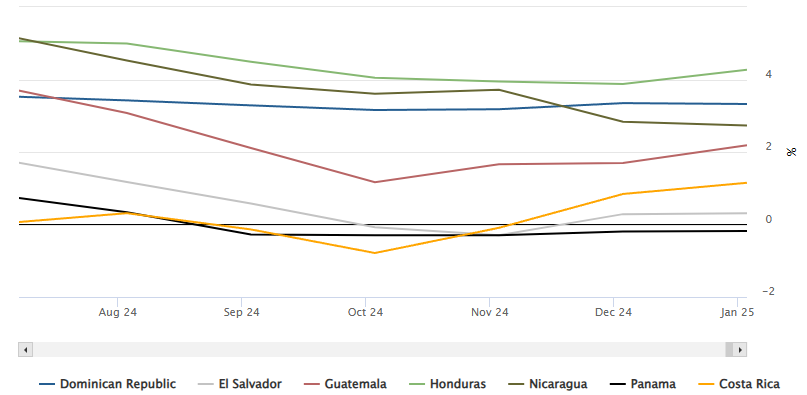
    Central America & Caribbean: inflation rate
    Percentage variation (year-on-year)

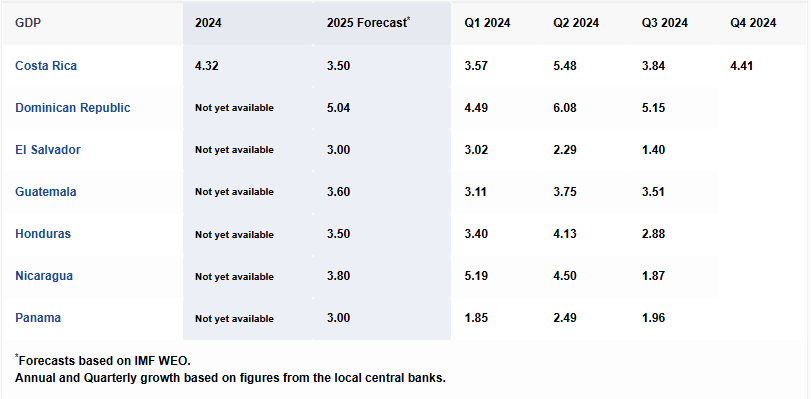
    Central America & Caribbean: GDP growth (%)
    Quarterly figures are year-on-year growth

  • CUBA: Tourism in a tailspin

    Abbi Dicker 19 September 2025 Hits: 1469

    The latest numbers from Cuba’s national statistics institute (Onei) show that Cuban hotel occupancy dropped by nearly seven percentage points in the first half of this year to 21.5%, while tourist arrivals slumped by 25% to 981,856.

    Cuba’s tourism sector is in a jam. The country appears to be caught in a vicious circle, where power cuts, water shortages, and garbage on the streets discourage visitors; but fewer visitors, in turn, bring in less of the foreign currency that the government desperately needs in order to fix the collapse in essential services.

    In effect, the tourist business is trying to survive with only one out of every five beds occupied. US tourists are dwindling as the US administration led by President Donald Trump tightens sanctions further. Officially US citizens are banned from visiting the island for tourism, but 12 categories of visits are still allowed (including sports and educational visits) These have become more restrictive. US citizens are also banned from using hotels linked to a prohibited list of companies: Torre K-23, a hotel which is the tallest building in the country, has just been declared off-bounds to US visitors.

    Cuba inflation

    On 11 August, Cuba’s national statistics office (Onei) released new figures showing monthly inflation in July was 0.49%, bringing the annual rate to 14.37%. This compares with monthly inflation of 0.75% in June when the annual rate was 14.75%. The country closed 2024 with an inflation rate of 24.88%.

  • TRACKING TRENDS

    Abbi Dicker 09 October 2025 Hits: 991

    BRAZIL | Trade surplus down in September. The ministry of development, industry, trade, and services (MDIC) released new figures on 6 October showing that the country’s trade surplus in the month of September came to US$2.99bn, down 41.1% compared with September 2024. This latest result also marks a decrease from the surplus of US$5.86bn registered for August this year.

    Exports in September 2025 totalled US$30.5bn, up by 7.2% year-on-year, while imports totalled US$27.4bn, a 17.7% increase year-on-year.  

    Brazil’s agricultural exports increased by 18.0% in yearly terms, registering an export value of US$6.7bn in September, while exports from extractive industries totalled US$6.6bn, up 9.2% on the same month in 2024. Brazil’s imports of agricultural products totalled US$480m, up 3.5% year-on-year, while extractive industries registered a monthly import value of US$1.14bn, down 26.1%. Imports for the manufacturing sector totalled US$25.78bn, up 21.5% year-on-year.

    BRAZIL | Vehicle production down in monthly terms. The national association of vehicle manufacturers (Anfavea) released the production and sales figures for the month of September on 8 October, showing a total of 234,400 units produced and 243,200 vehicles sold. This production figure is up 5.8% in yearly terms but down 1.5% on the previous month.

    Monthly sales in September were up by 7.9% compared with the previous month and up 2.9% compared with September 2024. Anfavea also released monthly export figures, showing a total of 52,500 vehicles exported in September 2025. This marks a 26.2% year-on-year increase but an 8% monthly decrease.

  • TRACKING TRENDS

    LatinNews 06 September 2011 Hits: 3490

    COLOMBIA | Investment soars. Foreign direct investment reached US$8.56bn in the first seven months of the year, up 61% on the same period in 2010, the government reported. The majority of this FDI (56%) went to the oil sector. A US$1.3bn investment to boost coal production in El Cerrejón was announced on 18 August in London by the mining giants BHP Billiton, Anglo American and Xstra, to shareholders in the open pit mine.

    ECUADOR | Banana emergency. Ecuador has declared a state of emergency in the banana sector due to an increase in production and a fall in demand. The agriculture minister, Stanley Vera, explained that the emergency alert would last until late September to allow the government “to take immediate measures aimed at mitigating the price distortions”. Banana exports totalled US$1.23bn in the first half of 2011, up 11% on the same period in 2010. According to Vera, production stood at 152m cartons in the first half of 2011, but increased production in Ecuador and elsewhere was exceeding demand. He said up to 1.5m cartons a week are left in the country because nobody wants them. The government has created a fund of US$15m, created from a tax on banana exports, to buy back surplus bananas from producers who are unable to sell their stocks to exporters. He said that part of the surplus would be given to farmers as food for livestock. To abandon the sector, he said, would be “catastrophic,” as a total of 1.4m Ecuadoreans, 10% of the population, work in it.

    VENEZUELA | Growing but slowing. The economy expanded by 2.5% in the second quarter of 2011 compared with the same period last year, the central bank revealed, and by 3.6% in the first half. Venezuela’s GDP slowed after having grown by 4.5% in the first quarter on the same period in 2010, off the back of an 18-month recession. Oddly, the construction sector declined by 2.3% year-on-year in the second quarter despite President Hugo Chávez setting ambitious targets for housing construction this year and next. The most significant figure was for the oil industry, which grew by 0.8% during the second quarter, having contracted by 0.5% in the first quarter. The central bank said the oil sector’s recovery was due to a 4.4% increase in oil production and also higher oil prices. The second quarter saw a 56.3% increase year-on-year in exports from US$16.06bn to US$25.12bn, largely because of the increase in crude prices. Imports grew 25.3% over this period, from US$10.01bn to US$12.53bn.

  • URUGUAY: Mujica pampers goose but spreads wings to Pacific

    LatinNews 19 January 2012 Hits: 1221

    “They want a war with Argentina, but we are not going to risk killing the goose that lays the golden egg, which is tourism.” Uruguay’s President José Mujica has a well-founded reputation for straight-talking as this response to charges of Argentine protectionism brought to him by the Unión de Exportadores del Uruguay (UEU) amply demonstrates. This does not mean he is turning a blind eye to the problem of Argentine protectionism, however; he is simply alert to the acute political sensitivity in the Casa Rosada to direct criticism. He is also intent on expanding trade to the Pacific, an issue he raised with his peer Sebastián Piñera during a visit to Chile this month.

    Argentine protectionism is growing day by day. The latest measure to antagonise Uruguayan exporters, which will take effect on 1 February, is the requirement for Argentine importers to provide advance notification to the Administración Federal de Ingresos Públicos (Afip), Argentina’s national tax agency, of the products they wish to import in advance and wait approval before proceeding. This could take 30 days and potentially could be denied.

    The Uruguayan chamber of industry (CIU) complained that the upshot of this “superlicence”, as it has been dubbed, would be a loss of trade because Argentine producers would try and procure what they need domestically to avoid the hassle of leaping the new bureaucratic hurdles. The result will be an even bigger bilateral trade deficit: Uruguay exported goods to the value of US$558m to Argentina in 2011 and imported products amounting to US$1.82bn.

    The CIU pointed out that Mujica had “negotiated and negotiated” but had to get tougher through recourse to the founding treaty of Mercosur (Mercado Común del Sur, the Southern Common Market, comprising Argentina, Brazil, Paraguay and Uruguay). The trouble, as Mujica will be well aware, is that the Mercosur treaty will not provide Uruguay with much succour. What is the point of Mujica making a formal complaint when Mercosur lacks the supranational dispute resolution mechanisms to enforce the spirit of free trade enshrined in the founding statutes of the (perennially imperfect) customs union?

    Mujica does not want to risk a sharp deterioration of relations with a hyper-sensitive Argentine government, like under his predecessor Tabaré Vázquez, over the construction of a pulp mill on the banks of the River Uruguay. “Punta del Este (Uruguay’s beach resort town) would not exist if it were not for Argentines,” he said in an interview with the national daily El País. Tourism took a big hit as a result of the blockade of bridges between Argentina and Uruguay in the long-running protests over the pulp mill, but it is booming again now. The number of Argentine tourists visiting Uruguay in the first half of 2011 increased by 45% to 943,841, on the same period the previous year.

    The problem for Uruguay is that Argentina, and for that matter Brazil, both appear to be harking back to the import substitution industrialisation (ISI) of the 1950s and 1960s as a means of confronting the threat of cheap imports from Asia, especially China. This is completely contrary to Uruguay’s foreign trade policy: Vice-President Danilo Astori said last month that “the worst thing a country like Uruguay can do in times of crisis, like this one, is to close in on itself.

    The constraints of Mercosur prohibit Uruguay from seeking bilateral free trade deals so Mujica is trying to mitigate what he accepted was an inevitable loss of trade with Argentina by looking to the Pacific. He discussed this matter with President Piñera during a visit to Chile earlier this month, during which the two men also visited the Antarctic. Mujica spoke of his desire to seek alternative markets in Chile and Peru, but he also has his eyes set on Asia, and China: Chile, Colombia, Peru and Mexico are currently trying to deepen trade with China and Japan through the Arco Pacífico, an economic integration pact to complement bilateral free trade deals. Mujica is keen to explore complementary accords with Chile and Peru to tap into Pacific markets.

    • Off the grey list

    The government of President José Mujica received a boost in December when the Organisation for Economic Co-operation and Development (OECD) removed Uruguay from its “grey list” of nations deemed to be taking insufficient action to combat tax evasion. The OECD released a statement saying that Uruguay had shown its commitment to meeting international standards by signing seven new bilateral tax accords, most recently with Ecuador, Liechtenstein and Switzerland, although it has yet to sign accords with Brazil or Argentina.

  • GUYANA: PPP playing on long memories

    LatinNews 15 April 2015 Hits: 2356

    It is now nearly 23 years since the Afro-Guyanese dominated People’s National Congress (PNC) lost power (after a long run of its own dominance, extending to 28 years). Since then, the Indo-Guyanese oriented People’s Progressive Party/Civic (PPP/C) has monopolized power. The PPP/C is relying on three factors to secure re-election: the demographic supremacy of the Indo-Guyanese; a relatively good economic track record for the outgoing government; and the alleged unsuitability of the PNC for government.

    The demographics are solidly against the PNC. Indo-Guyanese make up 43.4% of the population against the Afro-Guyanese’s 30.2% share, with mixed-race Guyanese making up a further 16.7% and the indigenous population 9.1%. On the economic front, International Monetary Fund (IMF) figures point to Guyana growing by 5.44% in 2011 (a year in which the Caribbean as a whole suffered a recession of -3.6%), 4.82% in 2012, 5.22% in 2013, and 3.32% in 2014.

    The PPP/C’s argument that the PNC is unsuited for government is based on two pillars. The first is the way it has behaved in the last parliament, when it had a slim one-seat majority that prevented the PPP/C government of President Donald Ramotar from governing effectively. At the start of the election campaign, Ramotar categorized the PNC as “narrow-minded people who seem to believe that they can make things bad in our country and drive us back to the time when we had to line up for a quarter pint of oil…in the hope that it will change their political fortune”.

    Then there is the PNC’s record in government, which still resonates even if many in the electorate cannot remember that far back. In a television interview in mid-March, Attorney-General Anil Nandlall reminded the viewers: “You had the PNC in government and you have a track record of 28 years to judge them by. It’s as simple as that. You had economic stagnation. You had bankruptcy. You had a national debt that was uncontrollable. You had the banning of basic food items. You had taking away of democracy from the country. You had the deprivation of freedoms and civil liberties.” He added: “Fast forward to 22 years of the PPP in government and look around at the progress…I can go on to give a litany of data that will make the choice of who to vote for so pellucid and so clear that it boggles the rational mind as to why the voters should be confused.”