All Categories

Subcategories

  • ECONOMIC HIGHLIGHTS

    Patrick de Courcy 20 April 2022 Hits: 2463

    PARAGUAY | Fuel prices rise after subsidies overturned. On 12 April, Paraguay’s state oil company Petróleos Paraguayos (Petropar) announced that it would be increasing its petrol and diesel prices, after congress repealed a bill authorising fuel subsidies. The bill had been introduced, and initially approved, in March following widespread protests against rising fuel prices, during which truckers, taxi drivers, and motorcycle delivery drivers erected roadblocks across the country. After the government led by President Mario Abdo Benítez mooted taking out a US$100m loan to extend the subsidies, congress voted to repeal the law on 11-12 April, amid arguments that the subsidies were not sustainable in the long run and distorted the market. “The elimination of the law which allowed us to sell below cost price has forced us to make this decision,” Denis Lichi, Petropar’s president, said of the fuel price increase, which affected two types of diesel and three types of petrol. Petropar has said that its prices remain low compared with the last price hike on the local market.   

    CHILE | Boric unveils economic recovery plan. On 7 Abril, Chile’s new left-wing president, Gabriel Boric, announced a new economic recovery plan – ‘Chile Apoya’ – to support those suffering from the ongoing fallout of the economic crisis caused by the coronavirus (Covid-19) pandemic, which has been exacerbated by the impact of Russia’s war with Ukraine. Comprising 21 measures, the plan includes over US$1.3bn in direct support to families, around US$1.4bn for measures aimed at promoting job creation, and US$1bn in support for small and medium-size enterprises (SMEs). It has three specific objectives: to address rising living costs (the 12-month inflation rate reached 9.4% in March, the highest level since 2008); support those who have left the labour market to carry out care duties; and promote job creation. He said that key goals include raising the current monthly minimum wage of Cl$350,000 (US$434) to Cl$400,000 by the end of the year and creating 500,000 new jobs. Among other things the programme also includes plans to freeze public transport fares for the rest of the year.

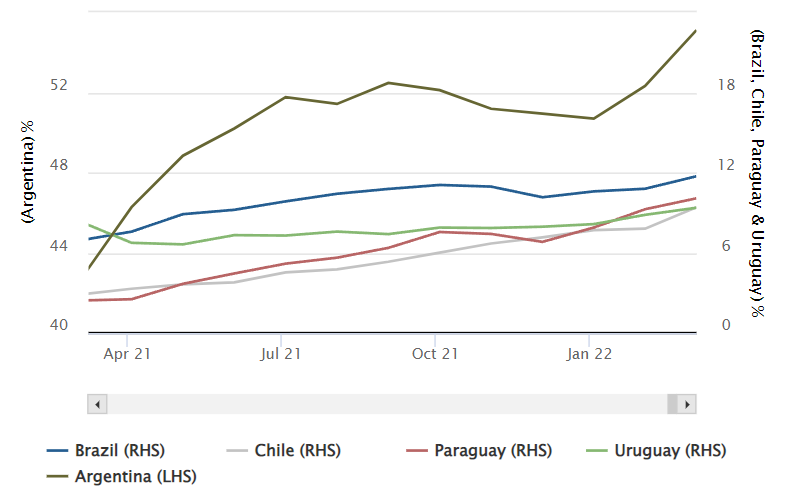
    Brazil & Southern Cone: inflation rate
    Percentage variation (year-on-year)

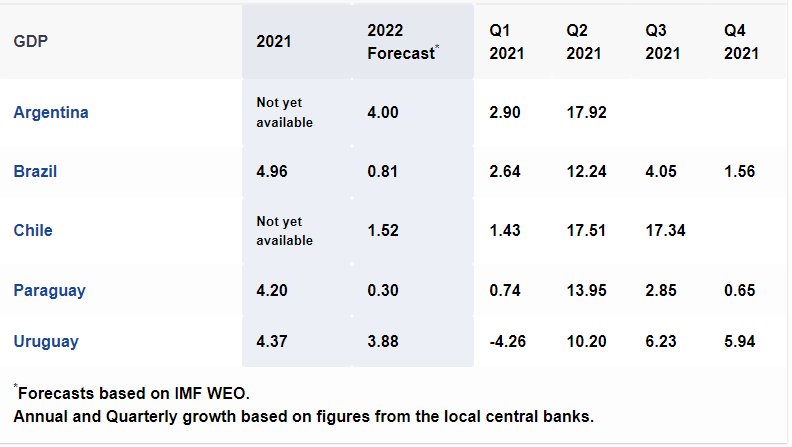
    Brazil & Southern Cone: GDP growth (%)
    Quarterly figures are year-on-year growth

  • ECONOMIC HIGHLIGHTS

    Abbi Dicker 19 March 2026 Hits: 1019

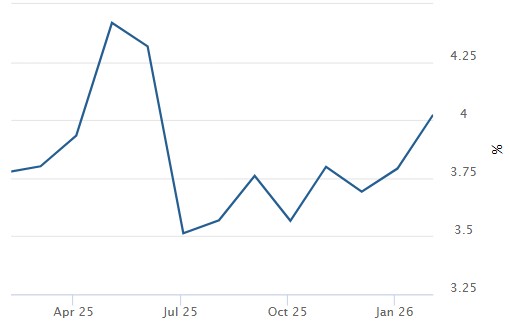
    MEXICO | Inflation edges up in February. On 9 March Mexico’s national statistics institute (Inegi) released the latest figures for its consumer price index (INPC), which put monthly inflation in February at 0.50% and annual inflation at 4.02%. Both rates saw slight increases from the previous month - monthly inflation rose from 0.38% in January, and the annual rate rose from 3.79%. Core inflation, which excludes volatile items such as food and fuel, increased 0.46% in monthly terms and 4.50% year-on-year in February, compared with a 0.60% monthly rise in January, when the annual core inflation rate stood at 4.52%.

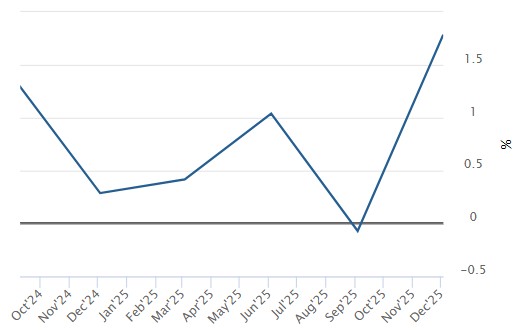
    MEXICO | GFCF down year-on-year. On 5 March Mexico’s national statistics institute (Inegi) announced that gross fixed capital formation (GFCF) in December 2025 was up by 0.5% in monthly terms and down by 1.6% year-on-year, according to seasonally adjusted figures. This follows a monthly increase of 0.5% in November, and 1.0% in October on the latest figures. The annual decline in December was the result of a 7.9% drop in investment in machinery and equipment while investment in construction was up 4.1%. The monthly result was driven by a 0.3% decline in investment in machinery and equipment while investment in construction was up 0.9%.

    MEXICO | Remittances continue to fall in January. On 2 March Mexico’s central bank (Banxico) released remittance figures for the first month of 2026, announcing that remittances to Mexico totalled US$4.59bn. This represents a 1.4% drop year-on-year and is down from remittances of US$5.32bn received in December 2025. December marked the first annual increase in remittance inflows following eight consecutive months of yearly drops between April and November 2025. Remittance inflows in 2025 totalled US$61.79bn, down from the US$64.75bn received in 2024 and US$63.31bn in 2023. This represented the first annual decline since 2013.

    Mexico: GDP growth
    Percentage variation (year-on-year)

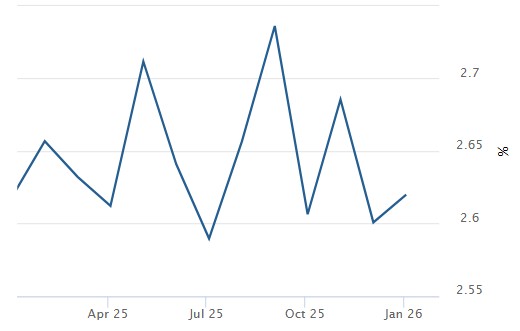
    Mexico: unemployment rate
    Economically active population

    Mexico: inflation rate
    Percentage variation (year-on-year)

    Source (all graphs): National Statistics Institute (Inegi)

  • REGION: Foreign direct investment falls slightly

    Sarah Sheldon 17 August 2026 Hits: 131

    Central America's foreign direct investment (FDI) held broadly steady in 2025, according to a new report by the United Nations Economic Commission for Latin America and the Caribbean (Eclac). However, the region is becoming increasingly reliant on companies expanding existing operations rather than attracting new investment.

    Central American nations received a total US$12.1bn in FDI in 2025, a decrease of 0.6% compared to the previous year, according to the latest edition of Eclac’s annual report on FDI, released at the end of June. This decrease comes as Latin America and the Caribbean (LAC) as a whole received US$194.2bn in FDI in 2025, up 1.7% year-on-year. Costa Rica received the highest amount of FDI of any Central American nation, and the seventh highest of any LAC nation, with US$5.6bn, up 3.4% compared to 2024. However, 77% of this total was made up of reinvested earnings, which grew 26% year-on-year, while new project announcements fell 30% year-on-year. By sector, manufacturing attracted 76% of the total, followed by services with 23%.

    Guatemala received the second highest amount of FDI, with US$1.9bn, up 8.8% year-on-year and the second highest amount of any year since records began in 2001. Reinvested earnings made up 87% of the total, up 4.6% year-on-year, with significant concentration in the services sector (86% of total FDI), followed by manufacturing with 11%. Services was the only sector to record year-on-year growth, with 18.1%, whereas manufacturing and natural resources saw significant decreases of 40.7% and 69.8%, respectively. New project announcements were worth just US$189m, 75% less than in 2024, with not a single renewable energy or gas project announced last year.

    Nicaragua attracted US$1.5bn in FDI in 2025, up 7.6% year-on-year, with services contributing 68% of the total and manufacturing a further 31%. Both sectors grew, by 18.9% and 11.9% year-on-year respectively, while natural resources attracted 96.2% less investment than in 2024. New project announcements decreased for the third year in a row, down 45% year-on-year to just US$16m, the lowest total since 2005. This continues a marked deceleration in new project announcements compared to 2010-2019, when Nicaragua attracted an average of US$490m per year for new projects, according to Eclac.

    As for Honduras, Eclac figures show a spike in FDI to US$1.4bn, up 192.2% year-on-year and a significant increase compared to the last six years, when FDI has failed to surpass US$1bn per year. Inter-company loans made up 38% of total FDI after recording year-on-year growth of 253%, while reinvested earnings contributed 63%. New project announcements were worth US$50m, up 61% compared to 2024, but this total consists of just three projects. 

    In Panama, FDI fell 55% year-on-year to just US$938m. This is due to the fact that reinvested earnings fell 80.1% and inter-company loans fell 47.8%, although new project announcements increased 57%. El Salvador saw total FDI decrease 27.3% year-on-year to US$764m, with services making up 68% of the total despite falling 43% for the period. Manufacturing was the second most valuable sector, representing 32% of the total, despite recording a 19% decrease. New project announcements were worth a total US$146m, down 93%.

    Overall, FDI in Central America is increasingly reliant on reinvested earnings and inter-company loans than a raft of new investment projects. This is true even in Costa Rica, the largest recipient of FDI in the region, according to Eclac figures. Costa Rica’s investment promotion agency, Agencia Costarricense de Promoción de Inversiones (Cinde), reported that the country attracted 19 new projects in 2025, compared to 48 reinvestments. It highlighted that “new investments incorporated higher levels of technical sophistication, ranging from digital centres of excellence to advanced manufacturing and automated medical operations, underscoring the country’s transition toward high-value, knowledge-intensive activities”.

    However, while it is desirable to attract new investment, the fact that firms with existing operations are deciding to stay and expand is no bad thing, said Sandro Zolezzi, a Costa Rican economist and research fellow at LEAD University, a private university in San José, in an article published on 7 April in local digital media outlet CRHoy.com. At the same time, Zolezzi highlighted that this source of investment will tend to dry up as firms find that they have expanded operations as far as they can, meaning that attracting new projects is key to maintaining an FDI pipeline. “A model based on reinvestment can sustain itself for a time, but, if it is not renewed, it will run out of steam,” said Zolezzi. 

    In a press release marking the publication of the report, José Manuel Salazar-Xirinachs, Eclac’s executive secretary, said that understanding the relationship between trade and FDI is “is key to designing policies that would allow us to move towards more productive, inclusive and sustainable development”. In general terms, exports and FDI have expanded together in recent decades, and this pattern can be observed in those Central American nations that have attracted FDI as export platforms serving the US market, according to Eclac, particularly in manufacturing sectors that are highly integrated with the US. Looking ahead, Salazar-Xirinachs argues that navigating the “current global context of weaponized interdependence” requires action on a number of policy recommendations. These include diversifying export markets and sources of FDI away from the US; combining “trade, investment and productive development within a policy framework aimed at maximizing the impact of existing investment”; strengthening trade promotion agencies; and strengthening regional coordination arrangements. 

    However, these recommendations are not new, and implementing them will not be easy. One of Central America’s main advantages is still to serve as an export platform to the US, and even those countries that have worked to cultivate relations with China have not managed to reduce the outsized reliance on the US as an export market. Developing policy frameworks is constrained by a lack of institutional capacity and strained public budgets, which also hamstrings efforts to build out trade promotion agencies and boost regional coordination. 

    Social and political developments also affect the business climate and investment decisions, with many countries in the region raising red flags in terms of protest risks, instability, and legal certainty. For example, deepening authoritarianism in Nicaragua and El Salvador may be dampening FDI, while Panama’s closure of the Cobre Panamá mine has raised considerable concerns. Even in Costa Rica, which has a strong track record in attracting investment to move up value chains, a worsening security situation and concerns over the trajectory of the education system are calling into question the long-term sustainability of its existing development model.

    Nearshoring

    The nearshoring trend will also continue to be affected by uncertainty around US trade policy, particularly tariffs, making it harder for firms to make long-term decisions.

  • Chile security snapshot

    Abbi Dicker 22 October 2026 Hits: 52

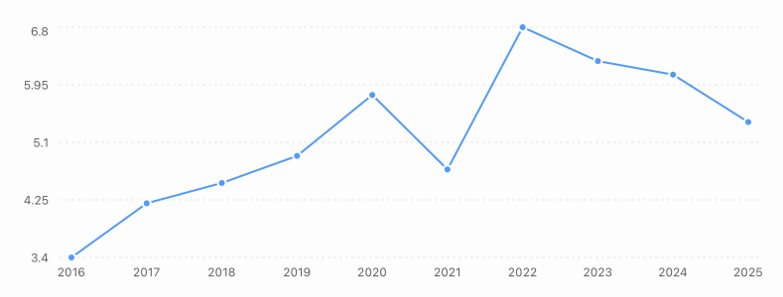
    Chile is widely recognised as one of the safest countries in Latin America, but domestic public opinion is focused on what it perceives to be sharply rising insecurity. The homicide rate in the chart below shows a multi-year upward trend, peaking at 5.8 per 100,000 inhabitants in 2020, and then dropping back sharply in 2021 (a fall widely attributed to the impact of the Covid-19 pandemic). The rate then rose again to reach a new record of 6.8 homicides per 100,000 in 2022. In the following three years (2023-2025) the murder rate fell year-by-year down to 5.4 in 2025. This presents something of a paradox. Compared to other Latin American countries with murder rates at 20-30 per 100,000 inhabitants, Chile is an outlier. The numbers also show that in a period of rapidly rising public concern over crime, including the years running up the 2025 elections, where security was arguably the single most important issue, the homicide rate was falling, not rising.

    Successive Chilean governments have had two major security concerns, one in the north and one in the south. In the north the big issue has been the large-scale arrival of undocumented immigrants, including victims of people trafficking who are manipulated by organised crime. The authorities have focused on transnational criminal organisations like the Tren de Aragua, originally from Venezuela, which is seen as infiltrating into northern Chile and developing business lines including drug and people trafficking and extortion. The second major concern is an armed insurgency in the south of the country led by radicalised members of the Mapuche indigenous community who demand the return of their ancestral lands. Successive governments have imposed states of emergency to try and control the violence; to date, attempts to start a dialogue have been unsuccessful.  

    Chile: annual homicide rate, 2016–2025

    Homicide victims per 100,000 inhabitants. The official Chilean consolidated series begins in 2018; 2016–2017 use the earlier intentional-homicide series.

    Source: Chilean Subsecretaría de Prevención del Delito / Centro para la Prevención de Homicidios.

    Experts are divided over whether Kast’s policies will improve the security situation. After the initial confusion, the government has put in place a plan which lists 65 measures aimed at recovering control of streets, neighbourhoods, borders, ports, and prisons, focusing initially on 50 high-risk areas. Seven task forces are being created to target contract killings, money laundering, cybercrime, and other illicit businesses, among others. There is to be increased reliance on the security forces under the umbrella of an agenda against organised crime and terrorism (Acot). Officials claim some signs of progress: homicides were down in the first half of 2026 (although drug and weapons offences were up).

    Among experts Catalina Droppelmann, a criminologist at the private Pontificia Universidad Católica de Chile, says Acot represents an expansion of police and military powers, not a technical advance in crime prevention policy. She argues that tougher enforcement does not address the way organised crime attracts recruits and gains control of territory. A similar point is made by Daniel Johnson, executive director of local think tank Fundación Paz Ciudadana, who says early prevention and reintegration policies are necessary for a sustainable reduction in crime. Richard Kouyoumdjian, director of public security think tank AthenaLab, says Acot is essentially a list of legislative measures, not a publicly articulated security strategy. Evan Ellis of US-based think tank Center for Strategic and International Studies (CSIS) highlights that Kast’s approach is to focus on the border dimension, linking insecurity to drugs, contraband, and irregular migration coming into the north of the country.

  • JAMAICA: Edging forward, but still high risk

    LatinNews 15 January 2014 Hits: 2162

    Back in September 2013, Jamaica was given a boost when Standard & Poor’s raised its assessment of the country’s local currency debt to B- from CCC+. S&P said it expected the government to meet its fiscal targets this year, push ahead with its tax reforms, and avoid a further deterioration in its foreign-currency reserves. The IMF added its own cautious assessment in December following the second review of Jamaica’s performance under the terms of the May 2013 program.

    The IMF reported on “signs of a gradual recovery” which should see GDP growth of “just under 1%” for 2013/14 as a consequence of improved activity in the tourism, mining, and agricultural sectors. It also confirmed S&P’s optimism about the external position, saying that “international reserves are in line with program requirements” even though they remain low.

    Nevertheless, although Jamaica is pressing ahead with the next round of reforms, including “strengthening the fiscal policy framework”, the IMF warns that risk to the program “remains high”. It warns of “possible external shocks, weak confidence, and anaemic external demand that could hamper the growth recovery”. It is also concerned about possible shortfalls in revenue collection and “policy slippages”.

  • REGION: Brazil, Argentina, and Chile are leading the wind power race

    LatinNews 18 June 2021 Hits: 4382

    Last year, 4.673 gigawatts (GW) of new wind power capacity were installed in Latin America, led by Brazil with nearly half of this capacity (49.5%), and followed in second place by Argentina (21.7%), and in third place by Chile (14.6%).

    Mexico, which for the preceding six years had been responsible for building at least one quarter of new capacity every year, slipped down to fourth place with only 12.3% of the total, down from second in 2019. The data was provided by the Global Wind Energy Council (GWEC), an industry grouping. Ramón Fiestas, GWEC president for Latin America, said Mexico’s fall in the ranking reflected changed policies under President Andrés Manuel López Obrador, who has sought to prioritise supply to the electricity grid by the state-owned fossil-fuel based state-run company, the Comisión Federal de Eletricidad (CFE). Fiestas said there had been a sharp change in political will which at government level was now opposed to wind power and the energy transition.

    Brazil maintains its position as the largest wind generator in the region. By adding 2.29GW last year, despite the disruption caused by the coronavirus (Covid-19) pandemic, it took total capacity to over 16GW, about double Mexican capacity and one-fifth of US wind capacity. Like Mexico, Brazil’s populist government is also sceptical about climate change and unwilling to restrict fossil fuels. Unlike Mexico, however, it is willing to allow renewable companies unrestricted market access and does not limit their market share. Brazil’s mines & energy minister, Bento Albuquerque, has said the country will develop fossil and non-fossil fuels in parallel and become a net zero carbon economy by 2050.  

    Argentina also had to deal with pandemic disruption but managed to build a record of just over 1GW in new capacity, taking the total to 2.7GW. Chile added 680MW, taking its total up to over 2.5GW. Globally, over 7GW of new wind power capacity was auctioned in the first quarter, up by 160% year-on-year, which was welcomed by the industry as evidence of a gathering post-pandemic recovery. Despite this, a report by the International Energy Agency (IEA) said that wind and other renewable energies are not being developed fast enough to meet the terms outlined in the 2015 Paris Agreement on climate change to restrict temperature increases to no more than 1.5 degrees Celsius by the end of the century.

  • ARGENTINA: IMF deal in the offing?

    Patrick de Courcy 02 December 2021 Hits: 3316

    The economy minister, Martín Guzmán, will travel to Washington at the end of this week for another round of talks with the International Monetary Fund (IMF), increasing speculation that a deal could be imminent. The news triggered a 7.4% gain on the Buenos Aires stock exchange, as well as a jump in bond prices.

    The president of Argentina’s central bank (BCRA), Miguel Ángel Pesce, said on 1 December that a significant devaluation of the Argentine peso is not part of the economic policy agreement under negotiation with the IMF, which also prompted speculation that this attempt to reassure the public could be attributed to the advanced stage of talks with the IMF.

    In an open letter on 27 November, Vice-President Cristina Fernández also commented on the IMF negotiations, stressing that responsibility for striking a deal lies entirely with President Alberto Fernández and congress. President Fernández, pointedly, re-tweeted the 1,500-word letter, as evidence that there are no internal tensions within the ruling centre-left Frente de Todos (FdT) coalition.

    The letter was not a decisive show of support for President Fernández, however, as Vice-President Fernández reminded the head of state of his assertion during a speech on Independence Day in the north-western province of Tucumán on 9 July that Argentina would never “kneel” before its creditors, a sentiment she said she wholeheartedly endorsed.

    There was little in the letter by way of acknowledging the centre-right Juntos por el Cambio (JxC) opposition coalition victory in the polls. Instead, Vice-President Fernández reiterated her criticism of the former government for rapidly increasing the foreign debt.

    The letter was issued the day after she received news that one of various major corruption cases against her was being dropped. In a two-to-one majority ruling a federal court decided to shelve the Hotesur/Los Sauces case without further action.

    Fernández case

    The prosecution had alleged that, through family-owned tourism and real estate companies, Vice-President Fernández and her two children (Máximo and Florencia) had been involved in laundering illicitly obtained public funds. Anti-corruption campaigner and opposition-aligned politician Elisa Carrió claimed the court ruling was itself fraudulent.

  • TRACKING TRENDS

    Abbi Dicker 22 February 2024 Hits: 2391

    NICARAGUA | Record remittances offset trade deficit. Nicaragua’s exports totalled US$7.54bn in 2023, down 2.2% on the previous year, the central bank revealed on 21 February. The decline owed to an 8.9% fall in exports from the free trade zone (palm oil and fish products, in particular, were down by 38.5% and 30.2% respectively) eclipsing the 4% increase in other exports. Mining exports, principally gold and silver, were up by 22.4%, and manufacturing exports by 0.9%.

    Imports also declined, by 1.3% to US$9.99bn, leaving Nicaragua with a trade deficit of US$2.45bn, up 2.5% on 2022, which itself was up, by a massive 59.5%, on 2021.

    The trade deficit was offset by a new record of US$4.66bn in remittances in 2023, up 44.5% on the US$3.22bn recorded in 2022, according to figures released by the central bank on 6 February. The main source countries were the US, which accounted for 82.4% of the total (US$3.84bn, up 55.5% on 2022), followed by Costa Rica (7.1%, US$331.9m, up 20.3%), and Spain (5.9%, US$276.6m, up 2.4%). As regards destinations, Managua department received most (25.7%) of the total.

    A report released by the International Monetary Fund (IMF) on 19 January estimated that remittances would contribute around 28% of GDP in 2023, double the contribution that they made in 2021. The surge has been driven by the rapid increase in Nicaraguan emigrants who have left the country as a result of the crackdown on dissent by the government led by President Daniel Ortega.

    The central bank forecast GDP growth of between 4% and 5% in 2024, with inflation of between 4.5% and 5.5%.


  • ST VINCENT & THE GRENADINES: Gonsalves teases electorate

    LatinNews 08 April 2014 Hits: 2564

    Prime Minister Ralph Gonsalves has hinted that he may call an early election, ahead of the December 2015 deadline.

    Gonsalves heads the ruling United Labour Party (ULP), which won the December 2010 election with eight seats to the seven seats taken by Arnhim Eustace’s New Democratic Party (NDP). This marked the third consecutive victory for the Gonsalves-led ULP, but it was a drop of four seats from the 12 that the ULP held going into the last election and the bare minimum required to keep control of the House of Assembly.

    Gonsalves is a divisive figure, portrayed by the opposition as a Marxist with unsavoury international associations such as Cuba and Venezuela. He is accused of electoral malpractice and of favouring cronies and supporters. But he can also pull off startling popular coups, such as this month’s agreement, brokered by international publisher Felix Dennis and funded in part by Venezuela, to supply a laptop computer to every secondary-school pupil.

    Less convincing have been the continuing delays to the completion of Argyle airport, which was originally scheduled for 2010 but is now unlikely to be ready until 2016. Economic performance has also been poor since the 2008 global financial crash. In 2006 growth was 7.6%, and this was topped by an even better 8% advance in 2007. From 2008-2011, however, the economy contracted for four straight years (-0.6%, -2.3%, -1.8%, and -0.4%). In 2012 it returned to growth with a 2% advance. The economy is thought to have expanded by 1.2% in 2013 and is expected to grow by 2% in 2014.

    With this poor run of economic luck, government finances have also deteriorated. General government gross debt was 57% in 2008 but over 70% in 2012.

    On 29 March, at a supporters’ rally marking his 13th anniversary in office, Gonsalves said: “Comrades, when I told you to go on your marks [for an election campaign], I wasn’t making sport you know…We’re going to give NDP a short rope as we do between now and the next general elections.” There have been suggestions that Gonsalves could call an election as early as July.

  • Region: Corporate Radar

    LatinNews 07 December 2017 Hits: 248

    Colombia’s ISA invests in Peru

    Colombia’s ISA is investing US$450m to build Latin America’s most elevated high-power transmission line, a 500kw capacity line running for 918kms across 16 Peruvian provinces and 52 municipalities. Parts of the line will be around 4,000 metres above sea level. The line will connect the Mantaro, Marcona, Socabaya and Montalvo power stations, along with associated sub-stations. Through its subsidiary Consorcio Tranmantaro, ISA won the 30-year concession to build and operate the transmission line. Building the line will involve the erection of 1,934 pylons, before connecting them with 12,000 kms of cable.

    Avianca strike ends

    On 10 November, pilots from Colombia’s national airline Avianca, affiliated to the Asociación Colombiana de Aviadores Civiles (Acdac) civil aviation pilots’ union, announced the end of the indefinite strike they launched on 20 September. Over 700 pilots (half of all Avianca’s pilots) took part in the strike in demand of improved salaries and working conditions. This forced Avianca to cancel over 13,000 domestic flights, affecting 400,000 passengers, and resulting in US$2.5m of losses for the firm. The strike was ended after being declared illegal by the courts, which found that only a minority of Acdac members had voted in favour of it; and after government-mediated negotiations between Avianca and the union broke down, and Avianca threatened to layoff all striking pilots.

    VW modernising Argentina plants

    Volkswagen said that it would invest US$650m to modernise its assembly plants in Argentina. The German company’s plant in Pacheco, Buenos Aires province, will be upgraded, creating 2,500 additional jobs. The plant is being prepped to build VW’s new SUV (sports utility vehicle) for sale across Latin America. Globally, VW is planning to launch 20 new vehicles by 2020. VW Argentina president, Hernán Vázquez, said the country was playing a prominent part in the company’s map of global investments.

    Concern over murder of Televisa executive

    In a statement issued on 20 November, Coparmex, Mexico’s largest business association, called on the government to review its security strategy after the murder of Adolfo Lagos, the corporate vice-president of telecommunications at the Televisa media group. Lagos was killed the previous day, as he was cycling on the outskirts of Mexico City. Thieves stole his bicycle and shot him dead.

    Coparmex said, “It is urgent to halt the incidence of crime, as this can affect growth and investments”. It added that the country was experiencing a “security crisis” that required new approaches and “immediate actions” from the authorities. Government data shows that 31.1m crimes were committed last year, with an estimated cost of 1.1% of GDP. The homicide rate has been increasing this year. Citing data from 2015, Coparmex said over one-third (35.5%) of companies report suffering some type of crime. “We need to tackle and stop this growing problem” Coparmex stressed.

    Petrobras profits

    Brazil’s state-owned oil firm Petrobras has released its financial results for the third quarter of the year, which show that the firm posted a profit during the period.

    A Petrobras statement said that the firm’s net income in the third quarter reached R$266m (US$80.6m), below the R$316m it reported in the previous quarter but a significant improvement on the R$16.4bn in losses it reported in the third quarter of 2016. With the new financial results, the heavily indebted firm has now registered profits in four consecutive quarters, with Petrobras noting that its accumulated net income for the year now stands at R$5bn.

    The Petrobras statement described its third quarter financial results as “very positive” and driven by an increase in oil exports, improvements in the international price of oil, revenue raised via the sale of some of its assets, and a reduction in personnel costs, among other factors.

    However, the level of third quarter profits reported by Petrobras was substantially lower than the R$3.21bn consensus forecast made by sector analysts, leading to some concern that the financial and administrative restructuring plan that the firm embarked upon in 2015, in the wake of the major internal corruption scandal uncovered in 2014, is not progressing as well as hoped.

    The third quarter financial report shows that the firm’s liquid debt fell by 11% year-on-year in the third quarter from the US$100.3bn reported in 2016 to US$88.1bn as of September this year.

    Brazil registers record trade surplus

    Brazil posted a trade surplus of US$2.93bn in November, according to preliminary data released by the industry and trade ministry (MDIC). This brings Brazil’s accumulated trade surplus for the first 11 months of the year to a record US$61.4bn. That is already bigger than the entire trade surplus for last year (US$47.7bn), itself the largest in the current series dating to 1989.

    For calendar year 2017 overall, the MDIC now expects Brazil to post a trade surplus of between US$65bn and US$70bn. The Focus Report, a consensus survey of local economists by the central bank (BCB), in late November projected a full-year surplus of US$65.5bn.

    Groupon announces merger with Peixe Urbano 

    On 27 November, the discount vouchers site Groupon LATAM, owned by investment fund Mountain Nazca, announced acquisition of its competitor Peixe Urbano, which operates in Brazil and is owned by Chinese online search giant Baidu. The value of the acquisition is not yet known and the deal is still pending approval from Brazil’s competition authority, Cade.

    In a statement, representatives from Groupon and Peixe Urbano said that their operations would not be affected by the merger and that consumers would eventually benefit from greater consumer choice. “It’s the sum of two giants. We have joined the leadership from Groupon Brazil in the beauty and local travel market with the expertise of Peixe Urbano in gastronomy and entertainment. At the end of the day, it is the consumer who benefits from getting the best of both worlds,” the president of Groupon Brazil, Félix Lulion, said.

    For its part, Peixe Urbano can offer the addition of a ‘buy now’ button, which works better for spontaneous Brazilian consumers than the traditional discount voucher model, where users may have to wait six months before the offer is valid. “The use of immediate vouchers corresponds to 90% of restaurant booking requests using the Peixe Urbano platform,” Alex Tabor, co-founder and chief executive of Peixe Urbano, said.

  • ECONOMIC HIGHLIGHTS

    Patrick de Courcy 12 November 2021 Hits: 2063

    GUATEMALA | Signing an FCPF. On 12 October Guatemala signed an agreement with the World Bank’s Forest Carbon Partnership Facility (FCPF) that will unlock up to US$52.5m for reducing emissions from deforestation and forest degradation and increasing carbon sequestration – commonly known as REDD+. This Emission Reductions Payment Agreement (ERPA) will reward efforts to reduce 10.5m tonnes (t) of carbon emissions through 2025 under Guatemala’s emissions reduction programme. According to the WB, about 35% of Guatemala’s total surface area is covered in forests, down from 50% in 1950, with forests cleared primarily for agricultural use, livestock production, and urban settlements. According to the WB, the land use, land use change, and forestry sector accounts for 27% of Guatemala's total annual emissions. Covering over 31% of the national territory and 92% of forest lands, Guatemala’s emissions reduction programme aims to tackle the main drivers of deforestation and forest degradation, seeking to strengthen the management of national protected areas and reinforce forest policy instruments, expand existing incentives to increase carbon stocks, and promote sustainable forest management. Guatemala is the fourth country in Latin America (after Chile, Costa Rica, and the Dominican Republic) to sign an ERPA with the FCPF. 

    CUBA | Slashing GDP forecasts. On 14 October Cuba’s economy & planning minister Alejandro Gil said the government expects Cuba’s GDP to grow 2.2% this year, down from 6% initially forecast. He said Cuba was “entering a gradual phase of economic recovery”. Highlighting the 11% fall in GDP in 2020 due to the coronavirus (Covid-19) and US economic sanctions, Gil said that recovery was not likely “in the short term, not in a month or two” but “conditions were being created to bring about a gradual process of economic recovery”.

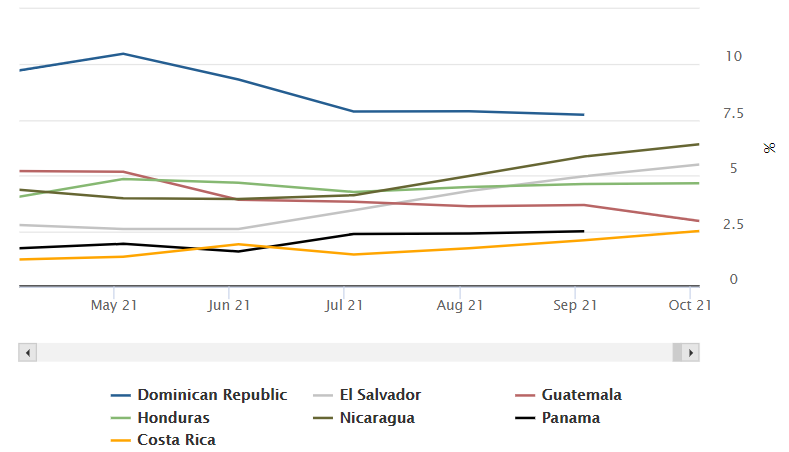
    Central America & Caribbean: Inflation Rate
    Percentage variation (year-on-year)

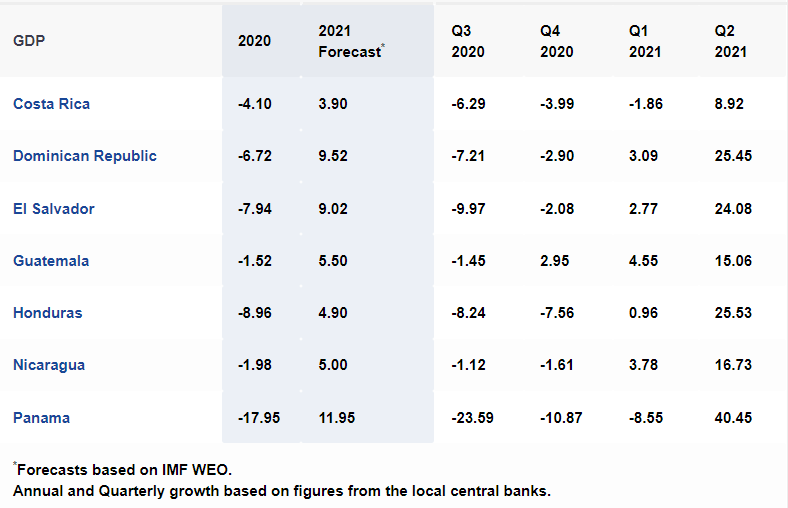
    Central America & Caribbean: GDP Growth (%)
    Quarterly figures are year-on-year growth

  • Region: The recovery is getting tougher for some

    LatinNews 03 August 2018 Hits: 2779

    Latin America is still on a recovery path: after a surge in consumption in 2017, investment is finally beginning to pick up. But while growth is accelerating in some countries, conditions have become tougher in others, including some of the larger economies. That is the view of Alejandro Werner, Western Hemisphere director at the International Monetary Fund (IMF).

    In a blog published on 23 July and titled ‘A tougher recovery’, Werner said the IMF was reigning back some of its growth forecasts made last April. It now expects the region to grow by 1.6% this year, rising to 2.6% in 2019. This is lower than the April forecast which had been for 2.0% growth in 2018 and 2.8% in 2019. The reason for the tougher outlook was that market pressures at a global level had been amplified by what Werner called “country specific vulnerabilities”. Despite strong growth in the US and a recovery in commodity prices, there were concerns over global demand and financial conditions, he said. The growth in demand had been less than expected, and monetary conditions were gradually tightening. Escalating trade tensions and conflicts were increasing downside risks. This came at time when there was a degree of domestic uncertainly associated with country-specific electoral cycles.

    In Argentina the IMF is now forecasting that growth will turn negative in the second and third quarters of this year, due to a drought in agricultural areas and the currency crisis of May-June which took a toll on investor confidence and forced the country to sharply raise interest rates. This year’s growth forecast has been cut back sharply to 0.4% (down from 2.0% in April) with a gradual recovery predicted for 2019 and 2020 based in part on an IMF-supported stabilisation programme.

    In Brazil on the other hand, moderate growth will be led by private consumption and investment. The forecast has nevertheless been reduced because of tighter global conditions and the recent truckers strike. Uncertainty over the outcome of the October elections could weigh down further on growth, Werner said. Also on the downside was the fact that much-needed pension reform has been postponed until after the elections. In Chile in contrast, forecasts have been raised due to a strong rebound in business and consumer confidence. Colombia has benefited from rising consumption and exports and a recovery in oil prices. Growth in Peru is also coming in stronger than expected due to higher commodity prices and fiscal and monetary stimulus.

    Venezuela remains a case apart – a country in deep and severe crisis. The IMF is now predicting a massive 18% fall in GDP this year with an incredible inflation rate: close to 1 million per cent by the end of 2018. Werner notes that this is comparable to Germany in 1923, and that “The collapse in economic activity, hyperinflation, and increasing deterioration in the provision of public goods (health care, electricity, water, transportation, and security) as well as shortages of food at subsidised prices have resulted in large migration flows, which will lead to intensified spillover effects on neighbouring countries.”

    For the second year running Werner says Mexico’s outlook is clouded by uncertainty over its trading relationship with the US and uncertainty over the renegotiation of Nafta (which is one of the big issues facing President-elect Andrés Manuel López Obrador). However, growth is still expected to accelerate in 2018 relative to 2017 because of a stronger US economy. The forecast for 2019 growth has on the other hand been cut back to 2.7% because of the impact of the prolonged trade-related uncertainty on investment. In Central America and the Dominican Republic growth remains robust because of strong US growth and higher remittances (linked to uncertainty over US immigration policies). The crisis in Nicaragua is nevertheless negative; Panama’s predicted growth rate has also been trimmed back because of a long construction strike. The Caribbean also benefits from strong US growth and tourist inflows.

  • GUATEMALA: Seeking to boost exports and FDI

    LatinNews 22 March 2021 Hits: 1158

    On 16 February, the Guatemalan government announced a deal with private sector representatives which aims to increase the value of exports and attract new foreign direct investment (FDI). The agreement, known as ‘Guatemala doesn’t stop’, comes at a time when FDI inflows are predicted to plummet as a result of the global economic recession caused by the coronavirus (Covid-19) pandemic.

    Signed by representatives from the ministries of finance, economy, and foreign relations in partnership with private sector lobby Asociación Guatemalteca de Exportadores (Agexport) and think-tank Fundación para el Desarrollo de Guatemala (Fundesa), the agreement aims to boost exports from sectors such as textiles, agriculture, food, drink, and chemical products by US$5bn according to a statement from the economy ministry (Mineco).

    The second pillar of the initiative aims to attract new investments in pharmaceuticals, medical devices, electrical device manufacturing, and Business Processing Outsourcing (BPOs), such as customer service call centres. Mineco estimates US$300m in potential investment in these sectors, citing Guatemala’s strategic location for US firms interested in nearshoring. In the statement Mineco head, Antonio Malouf, underlined the importance of developing human capital, particularly English language skills, as well as improving the business environment through digitalisation and the speeding up of bureaucratic processes.

    Earlier Malouf had underlined that attracting new investment is a “priority” and the government aims to attract US$1.2bn in FDI in 2021. This would represent a significant increase on 2020, according to forecasts from the United Nations Economic Commission for Latin America and the Caribbean (Eclac), which in December 2020 estimated Guatemala would receive US$898m in FDI that year. This figure represents a 10% decrease compared to 2019, when Guatemala received US$998m in FDI, which is roughly similar to inflows in 2018. On 1 February, the national competitivity programme (Pronacom), a national government office, announced nine new investment and reinvestment projects worth US$141m, creating an estimated 1,100 direct jobs. The five new projects involve logistics, textiles, light manufacturing, and call centres. While these early developments may be encouraging, the overall panorama remains challenging.

    In May 2020 Juan Pablo Carrasco, the president of the association of binational chambers of commerce (Ascabi), told local media Prensa Libre that he predicted low FDI inflows in 2021, blaming the pandemic and fierce competition to attract investment among Central American nations. Carrasco emphasised that Guatemala needs to work on becoming more attractive to investors. “For that reason it’s important to cut bureaucracy, provide greater fiscal incentives to investors and legal certainty for investments”, he said. Moving government processes online would also help to improve speed and efficiency, added Carrasco, who wants to see long-term tax breaks offered to businesses in a wide range of sectors. The process of attracting FDI normally takes five years, according to Carrasco, so any new investments in 2021 will be the result of efforts in previous years.

    Exports increased 3.5% in 2020 compared to the previous year, according to a statement from Mineco published 18 February, while imports fell 8.4% year-on-year. Boosting exports will involve better integrating small and medium-sized enterprises (SMEs) in regional and international trade, according to the national export council (Conapex), which also aims to increase digital commerce.

    • Exports

    The US, Central America, and Europe are Guatemala’s biggest commercial partners, receiving 30.51%, 29.81%, and 9.55% of exports respectively, according to Guatemala’s economy ministry. On 14 February. Paola Álvarez, director of Agexport, said that Guatemala is aiming to boost exports by US$1bn in 2021 by diversifying both products and markets. In 2020 exports were worth US$12bn, according to Álvarez, who identified exports to neighbouring Central American countries as a priority. She highlighted the food sector, particularly avocados given strong global demand for the fruit, as well as the need to embrace technological change and the digital economy.

  • BARBADOS: Georgieva plays good cop in Barbados

    Patrick de Courcy 13 July 2022 Hits: 2073

    Visiting Barbados in June, International Monetary Fund (IMF) Managing Director Kristalina Georgieva met Prime Minister Mia Mottley and played the role of financial ‘good cop’ saying the Fund is now much more sensitive to the social costs of fiscal austerity, and more prepared to protect the vulnerable at times of financial difficulty.

    The meeting came after a visiting IMF technical team and Barbadian officials had, in late May, agreed the seventh and final review of the IMF’s four-year-long US$435m extended fund facility (EFF) programme. An IMF report noted that the country’s economic performance had been strong, despite external shocks such as the coronavirus (Covid-19) pandemic, natural disasters, and the global impact of the war in Ukraine. At the start of the pandemic, tourism had virtually stopped dead, leading to a 14% drop in GDP in 2020. Foreign currency reserves dwindled to only US$220m (five weeks of import coverage) but have since recovered to a “comfortable” US$1.2bn.

    In parallel with the EFF programme the government developed a plan known as BERT (Barbadian Economic Recovery and Transformation). The economy began a slow recovery in 2021 but is now gaining momentum. Tourism activity has come back up to 60% of pre-pandemic levels. The Fund is calling for medium term reforms to improve the business climate, diversify the economy, and enable environmental and digital transformation. However, it notes there are significant ongoing external risks including an intensification of the Ukraine crisis and extreme weather events. The IMF is predicting 11% GDP growth this year. The Fund acknowledged the need for countercyclical fiscal deficits during the pandemic and including a more recent decision to reduce pressure on the cost of living by capping VAT on fuels (costing 0.3% of GDP). However, the government is still committed to achieving a primary fiscal surplus of 5%-6% of GDP within three years which, if achieved, will help reduce the debt-to-GDP ratio to a sustainable 60% by 2036.

    More IMF funds?

    Avinash Persaud, the government's special envoy to the prime minister on investment and financial services, has suggested that Barbados should seek further precautionary funding from the IMF to create “life-saving safety nets”. BERT expires in September, and Mottley said that her administration was discussing whether there should be a successor programme. 

  • RASTREANDO TENDENCIAS

    LatinNews 02 June 2013 Hits: 680

    BRASIL | Declarado con mínimo riesgo de BSE. El 28 de mayo la cancillería de Brasil emitió una declaración afirmando que había sido notificada por la Oficina Internacional de Epizootia (OIE) que esta ha decidido mantener el estatus de Brasil como un país con un "insignificante riesgo" de Bovine Spongiform Encephalopathy (BSE), o 'enfermedad de la Vaca Loca'.

    Brasil es el mayor grande productor y exportador de carne bovina del mundo, y mantener su estatus de bajo riesgo de BSE es la única manera de que los mercados de exportación internacionales permanezcan abiertos para la carne brasilera. La decisión de la OIE llega casi tres años después de que el gobierno brasilero informó de un caso de "BSE no-clásico" en el sureño estado de Paraná en el 2010. Esto provocó que la OIE lance una investigación oficial sobre el incidente para así determinar si realidad era un caso de BSE y la posibilidad de que pudiera conducir a un brote de la enfermedad en Brasil. Después de que las investigaciones de la OIE determinaran que de hecho era un caso de BSE en diciembre del año pasado, 17 países, incluidos Japón, China, Sudáfrica, y Egipto, decidieron temporalmente suspender las importaciones de carne brasilera como medida preventiva. Esto a pesar del hecho de que Brasil lanzó una campaña diplomática global presentando toda la información relevante relacionada con el caso en todas las 139 de sus misiones diplomáticas, en un esfuerzo por evitar un masivo cierre de sus mercados de exportación.

    De acuerdo con una declaración del gobierno brasilero, la OIE ha determinado ahora que aunque se halló que la vaca muerta tenía un agente BSE, el animal en realidad no contrajo la enfermedad y murió de causas naturales. Consecuentemente, la OIE ha hallado que el caso "no podía resultar en un riesgo de salud pública o animal para Brasil o cualquiera de sus socios comerciales". Por lo tanto, la cancillería ha señalado que "El gobierno brasilero ahora espera que después de todos sus esfuerzos para aclarar la situación y después del pronunciamiento de la Asamblea Mundial de la OIE, el comercio de carne con todos sus socios comerciales que impusieron restricciones puedan ser plenamente normalizado". Si esto ocurre, la industria de la carne de Brasil tendría una buena chance de emular su desempeño del año pasado cuando exportó 1,24m de toneladas valuadas en US$5,76mm, representando un incremento del 13% en términos de volumen y un incremento del 7% en términos de monetarios comparado con el 2011. Además esto podría ayudar al sector a cumplir con el pronóstico del gobierno de que para el 2020, Brasil podría proveer el 44,5% del consumo global de carne.

    ARGENTINA | Se desploma el superávit fiscal primario. El 29 de mayo el ministerio de economía de Argentina reveló que el superávit fiscal primario del país para marzo fue de Arg$438,3m (US$83m a la tasa de cambio oficial), una caída del 48,3% comparado con el mismo mes del año pasado. El resultado lleva el superávit fiscal primario para el primer trimestre del año a sólo Arg$1,46mm, lo que sugiere que alcanzar los Arg$65,9mm (equivalente al 1,7% del PIB)  de superávit fiscal primario, la meta establecida en el presupuesto oficial del 2013 será difícil. Dado que la Presidenta Cristina Fernández y su gobernante Frente para la Victoria (FPV), una facción del Partido Justicialista (PJ, Peronistas) enfrentan unas elecciones legislativas de mitad de periodo en octubre, es difícil creer que la administración Fernández eleve los impuestos a fin de equilibrar las finanzas. De hecho, Fernández ya ha mostrado que en vez de hacer esto, su gobierno parecería dispuesto a proveer subsidios y beneficios aún más generosos a la población en lo que parece un intento de apuntalar el apoyo electoral antes de la votación.

    El 22 de mayo, Fernández anunció que desde el 1 de junio el gobierno incrementaría los subsidios y beneficios otorgados a los sectores de la población de bajos ingresos, que incluyen la entrega de subsidios a familias con hijos jóvenes e hijos aún no nacidos, y subsidios para personas discapacitadas, por hasta un 35%. Según Fernández todo esto costaría al gobierno unos Arg$41,07mm adicionales incluso aunque el gobierno "no ha aumentado ni una tasa fiscal".

    URUGUAY | Fortaleciendo los vínculos con China. El 27 de mayo el Presidente de Uruguay, José Mujica, firmó siete acuerdos de cooperación diferentes con su contraparte de China, Xi Jinping. La firma de los acuerdos, que cubren un rango de áreas que incluyen la educación, la banca, y la minería, se hizo el último día de la visita oficial de Mujica en China, parte de una gira internacional más amplia, que incluye paradas en España e Italia. Antes de embarcarse en la gira, Mujica dijo que ésta bien podría ser "la más importante gira de [su] periodo" pues le proveería oportunidades para promover la inversión extranjera en Uruguay. Mujica dijo que él estaba interesado en asegurar la inversión china para el desarrollo de importantes proyectos en Uruguay, tales como la construcción de un puerto de aguas profundas en el departamento de Rocha, y una extensión de la red de ferrocarriles de Uruguay. Mientras tales anuncios aún no han sido hechos, la firma de los acuerdos pueden verse como un primer paso hacia esto.

    • Promoción del empleo juvenil

    El 23 de mayo la cámara de diputados de Paraguay aprobó el proyecto de ley para la 'inserción del empleo juvenil', que ya obtuvo la aprobación en el senado días antes. El proyecto de ley, que ahora está listo para ser promulgado, establece que todas las firmas que operan en el país deben asegurarse de que al menos el 5% de las personas que ellos contratan cada año son jóvenes (entre 18 y 29 años). La ley agrega que en casos en que sea contratada más de una persona joven, el 50% de estas deben ser mujeres. Además, estipula que las personas jóvenes contratadas a través de las modalidades de trabajo temporal, becas de trabajo, o contratos temporales de entrenamiento no serán tenidos en cuenta para la determinación del número de personas jóvenes que están siendo "empleadas" por las firmas.

  • CHILE: Bachelet pockets a red card

    LatinNews 20 June 2013 Hits: 4161

    In late May, the president of Chile’s Partido Comunista (PC), Guillermo Teillier, formally declared his party’s backing for former president, Michelle Bachelet (2006-2010), the favourite for the November presidential contest.

    This is the first time the PC has backed a candidate from the main centre-left Concertación alliance (comprising four parties) in the first round. President Sebastián Piñera and his ruling Coalición por el Cambio (CC) were quick to indulge in some scare-mongering, warning that the PC’s support would pull the Concertación to the radical left. There has also been some unease from within the Concertación itself – in particular from its most centrist member, Partido Democráta Cristiano (PDC).

    Teillier cited various reasons behind his party’s decision to back Bachelet ahead of the 30 June national primary contest. Bachelet, who is backed by two of the Concertación members, her own Partido Socialista (PS) and the Partido Por la Democracia (PPD), is facing in the primaries: Claudio Orrego of the PDC; José Antonio Gómez of Partido Radical Socialdemócrata (PRSD); and her former finance minister, Andrés Velasco, formerly of the PS but now running as an independent.

    Teillier noted Bachelet’s declared interest, first mentioned back in April, in reforming the 1980 constitution dating from the military dictatorship. Bachelet has convened a group of experts to draft some proposals but has failed to provide details as to what will be changed, merely citing a need to revise “all the elements of the development model, which has prevented Chile from growing harmoniously from the point of individuals, the economy and the environment”.

    Teillier also cited Bachelet’s interest in changing the binominal electoral system, which smaller parties complain works to the advantage of the dominant coalitions, and her call for free education for all, which forms part of her pledge to address inequality and underpins her electoral platform.

    While Bachelet was quick to dismiss the possibility that any political “transaction” had ensued in exchange for the PC’s declaration of support, local media suggested it corresponded to a deal to allow the charismatic former student leader and up and coming PC member, Camila Vallejo, to run uncontested for a seat in the 128-seat lower chamber of congress, without facing a Concertación challenger.

    The PC backing for Bachelet prompted President Piñera to declare that the Concertación had “veered sharply to the Left”. There was a similar response from the two primary presidential candidates for the ruling Coalición por el Cambio, former economy minister Pablo Longueira of the dominant right-wing Unión Demócrata Independiente (UDI) and the former defence minister Andrés Allamand of Piñera’s right-of-centre Renovación Nacional (RN). Longueira slammed the PC as “Chavistas”, identifying the party with the radical leftism of the late Venezuelan president Hugo Chávez (1999-2013). He said it constituted “a change we’ve not seen since the return to democracy” in 1990 – sentiments echoed by Allamand.

    The most unease, however, has come from within the Concertación itself, prompting fresh questions as to future of the coalition if (or when), as expected, Bachelet wins the presidency. Orrego and Velasco have both said in no uncertain terms that they would not be prepared to work with the PC in government.

    Orrego spoke of the “profound differences” between the PC and the PDC, echoing Piñera’s remarks that the coalition risked losing its status as a centre-left alliance. The PDC since has sought to downplay these differences ahead of the campaign.  On 18 June the PDC’s vice president, Fuad Chahín, told reporters that the debate about any future collaboration with the PC would resume only after the presidential election, in order avoid “contaminating the campaign”.

    First debates

    The first televised debates have taken place ahead of the 30 June primaries. The competing members of the Concertación faced off on 10 June, with the two pre-candidates for the ruling coalition debating three days later. Both Longueira and Allamand did a good job of burying their past differences [RBS-13-05], appearing united in their opposition to things like gay marriage and universal free education at all levels.

    However clear divisions within the Concertación emerged in relation to education and changes to the constitution. Both Bachelet, who already has unveiled her education proposal (see sidebar) and Gómez called for universal free education at all levels. Orrego and Velasco took the government line – that it would only serve to benefit the privileged, who can and should pay, they argued.

    As regards constitutional reform, Gómez explicitly called for a constituent assembly, while both Velasco and Orrego came out against it, albeit tempering this by underlining their openness to constitutional reform. Bachelet highlighted the need for a brand new constitution and she didn’t rule out the possibility of convening a constituent assembly.

    • Bachelet’s education proposal

    Michelle Bachelet’s education proposal is based on four planks: an end to for-profit education; improving the quality of education; an end to segregation and substantial advances towards universal free education at all levels. The plans would establish two new universities – one in the central Libertador Bernardo O´Higgins region and the other in the southern region of Aysén. The reform would cost 1.5%-2.0% of GDP, financed via a tax reform that would raise the corporate tax rate from 20%-25% over a four year period.  Bachelet’s tax proposal, which also would lower the top rate of personal income tax to 35% from 40%, would raise US$8.2bn (equivalent to 3% of GDP).

  • EL SALVADOR: Prison system under scrutiny

    Sarah Sheldon 15 November 2022 Hits: 434

    The state of exception ordered by the government led by President Nayib Bukele back in March to address gang violence [SSR-22-05] has passed the six-month mark. The impact of this on the country’s prison system is attracting growing concern from rights groups and think tanks.

    On 14 October El Salvador’s 84-member unicameral legislature, which is controlled by the ruling Nuevas Ideas (NI), approved an extension of the state of exception for a seventh consecutive time and for a further 30 days. According to a press release by the legislature, under the state of exception, 54,518 gang members have been arrested while 214 homicide-free days have been registered since Bukele took office in June 2019, most of them under the state of exception.

    A report released on 4 October by Brussels-based think-tank International Crisis Group (ICG) on El Salvador’s prison system noted that the country now has the highest incarceration rate in the world, at around 2% of the adult population. According to the latest figures from World Prison Brief (WPB), published by the UK-based Institute for Criminal Policy Research, El Salvador’s prison population rate is 605 per 100,000 of national population.

    The ICG report also highlights that the state of exception marks a U-turn by the Bukele government in its prison policy; having endeavoured to reduce the total number of prisoners from almost 40,000 to less than 37,000 between 2018 and early 2021, the government has now reportedly more than doubled the size of the prison population within a few months, with the number of inmates continuing to rise. This apparent U-turn was also highlighted in the latest (April 2022) US State Department report on human rights in El Salvador which cites El Salvador’s director of prisons, Osiris Luna, as saying that one of the objectives of the government’s main security strategy, Plan Control Territorial (TCP), was to reduce the number of prisons from 23 to 10. That the government has turned its back on its original plan was suggested in a bill approved in late April by the legislature to build new jails and, which ICG noted, curtailed oversight of public procurement. This was followed by President Bukele’s announcement in mid-June that construction would begin on a huge prison facility able to house around 40,000 inmates, in Tecoluca municipality, some 70km east of San Salvador.

    El Salvador’s prison system also came under scrutiny in relation to the state of exception in a 12 September hearing convened by the Tom Lantos Human Rights Commission of the US House of Representatives. Those giving testimony included Noah Bullock, executive director of local human rights NGO Cristosal, who cited accounts from former prisoners that “the tens of thousands of people detained during the state of emergency find themselves in overcrowded and unsanitary conditions, suffering deprivation or restriction of food, water and medicines or other necessities. Specific complaints have been received about collective torture against persons held in the Izalco and La Esperanza (Mariona) prisons through constant beatings, threats, the application of pepper spray and standing positions for hours.”

    •  Gang leadership affected?

    Also testifying at the 12 September hearing, Héctor Silva Ávalos, a Salvadorean journalist, said that the leadership of gangs has not been affected by the state of exception. He cites as the best example of this, the refusal of the Salvadorean government, including the attorney general’s office (FGR) and supreme court, to endorse the extradition of gang leaders wanted by the US. “In other words, while imprisoning thousands of youths, mostly from the country’s poorest neighbourhoods, and in most cases without solid evidence, the Bukele government keeps the gangs command structures intact, so their operational capacity is not really affected,” he said.

    • Hardening punishments

    As well as the state of exception, rights groups point out that El Salvador’s legislature has amended the penal code, hardening jail sentences for gang-related crimes. The changes, which were introduced soon after the state of exception was invoked for the first time, increase prison sentences for gang members from a maximum of five years to a maximum of 45 years and lower the age of criminal responsibility to 12 years of age. The legislative changes also establish penalties of 10 to 15 years in prison for those who “reproduce and transmit messages or communications” attributed to criminal groups, or gangs. This has prompted fears that reporters or outlets covering gang issues could face prosecution or possibly also political harassment.

  • Risk pointers

    LatinNews 12 December 2012 Hits: 484

    *** Indian missile development.  While all the world was concentrated on North Korea’s latest rocket launch on 12 December, on the same day India successfully test-fired its nuclear capable Agni-1 ballistic missile from a test range on Wheeler Island.  The missile has a range of 700km.

    *** Yemen’s rebellions.  As mentioned in this week’s main briefing, the head of Yemen’s National Security, Major-General Ali al-Ahmadi, has accused Iran of funding the Shia Houthist rebellion in the northwest of the country.  Al-Ahmadi said: “We call on Iran to desist from training and funding Shia rebels in Yemen.”  He said that Iran had “seized the opportunity to broaden the conflict”.

    Yemen is also facing insurgencies from al-Qaeda backed Islamists and southern separatists.  According to al-Ahmadi, al-Qaeda elements “do not exceed 700 or 800 in Yemen”.  Of these “a few hundred” are from Saudi Arabia.

    *** New Chinese media venture in Africa.  The English-language China Daily, which largely reflects official thinking, is to launch a weekly African edition in Nairobi.  China Daily’s editor-in-chief Zhu Ling said that the paper intended “to demystify the Sino-African relations”.  He said: "The link between China and the African continent is one of the most significant relationships in the world today. It is growing and complex and not always understood - not just by those in other parts of the world but by Africans and Chinese, too.”

    *** Russian warning about ‘Orange Revolutions’.  In reference to the 2004 unrest in Ukraine, on 9 December Russian Security Council Secretary Nikolay Patrushev said that there is a danger of an Orange Revolution “in Russia and other CIS countries”.  He mentioned Ukraine, Kyrgyzstan, and Tajikistan.  He said: “We see how events are developing there.  They pose danger for us.”

    *** China toughening inspections of North Korean cargo.  On 10 December, an official at the South Korean presidential office was quoted by the Yonhap news agency as saying: “I understand that Chinese authorities are conducting total inspections at a couple of ports where a lot of North Korean cargoes are entering.  It has been several months since this measure was taken.”  China is obliged to inspect for items banned under UN sanctions.

    However, South Korean officials say it is too early to say that Beijing has definitively toughened its approach towards North Korea.  As a senior government official put it: “We will be able to determine whether the Chinese position is different from before when we look at the Chinese attitude in discussions on sanctions on North Korea.”

  • RASTREANDO TENDENCIAS

    LatinNews 22 April 2013 Hits: 672

    BRASIL | Recortando el pronóstico por otro año. El 15 de Abril el ministerio de planeamiento de Brasil anunció que el gobierno estaba reduciendo su pronóstico oficial de crecimiento del PIB para este año, del 4,5% al 3,5%. Este es el segundo año consecutivo en el cual el pronóstico oficial de Brasil ha sido recortado, sugiriendo que la recuperación económica de Brasil después de la crisis económica global del 2008-2010 aún permanece frágil.

    El año pasado, el gobierno liderado por la Presidenta Dilma Rousseff no solamente extendió una serie de paquetes de estímulos tales como incrementar los incentivos fiscales a los productores locales, sino que también convenció al banco central para recortar las estructuralmente altas tasas de interés, en un esfuerzo por reducir los costos internos para así estimular más la actividad económica. De hecho, el año pasado el banco central recortó las tasas de interés en no menos de 10 ocasiones en un intento para ayudar a re-energizar la economía. Sin embargo, esto fracasó en producir los resultados esperados pues la tasa de crecimiento económico de Brasil de sólo el 1% fue decepcionante. De hecho ahora comienzan a surgir evidencias que indican que los profundos recortes en la tasa de interés pudieron haber producido más daño que bien a la economía brasilera.

    De acuerdo con economistas locales, las bajas tasas de interés han ayudado a mantener altos los niveles del consumo interno, que a su vez han empujado hacia arriba los precios de los alimentos, bienes y servicios, lo que resulta en que la economía ahora sufre presiones inflacionarias. De hecho, la medida del índice nacional de precios al consumidor (IPCA) de marzo del 6,6% año en año, ya ha sobrepasado el rango superior de la meta oficial del banco central del 4,5% más un 2,0% de límite de tolerancia, causando serias preocupaciones entre los economistas quienes señalaron que una desbocada inflación podría terminar sofocando el consumo interno, la única área de la economía que continúa teniendo relativamente una alta actividad.

    Para empeorar las cosas para el gobierno, también hay signos de que los empresarios brasileros están perdiendo confianza en la economía. El 16 de abril, la confederación nacional de la industria (CNI) difundió su último índice de confianza empresarial, el cual cayó de 57,1 puntos en febrero, a 55,4 puntos en abril, el nivel más bajo desde agosto del año pasado. El índice tiene un rango de 0 a 100 y cualquier medida por encima de los 50 puntos es considerada como un signo de confianza en la economía. Consecuentemente, una declaración de la CNI expresa que la caída del índice hacia la marca de 50 puntos muestra que los empresarios creen que el ambiente económico en el par de meses pasados ha empeorado y que las expectativas son menos optimistas. Como un resultado, agrega la CNI, esto podría traducirse en menores niveles de inversión todo este año.

    PARAGUAY | Se elevan las exportaciones de carne. El 16 de Abril el Servicio Nacional de Salud Animal (Senacsa) de Paraguay reveló que el valor de las exportaciones de carne paraguaya en el primer trimestre del año había alcanzado los US$233,9m, un incremento del 51,05% sobre el año pasado. Las exportaciones de carne de Paraguay sufrieron el año pasado, debito al brote de fiebre aftosa en enero del 2012, que produjo que muchos mercados principales de exportación de Paraguay, tales como Chile, Brasil, y Rusia, suspendieran temporalmente las importaciones, hasta que Paraguay pueda recuperar su estatus libre de aftosa. Sin embargo, gracias a los esfuerzos de las autoridades paraguayas, en noviembre del 2012 Rusia y Chile acordaron reanudar parcialmente las exportaciones de establecimientos certificados. Esto ha permitido al clave sector de la carne de Paraguay, la segunda más importante fuente de ingresos para el país, recuperarse este año: Rusia ahora ha desplazado a Chile como el principal mercado de exportaciones de carne paraguaya, con US$158,4m en exportaciones, seguido de Brasil con US$23,7m. Chile ahora es el quinto mercado para las exportaciones, con US$8,9m en exportaciones.

    Tomando en consideración que el precio de la carne en Chile, que de acuerdo con la Cámara Paraguaya de la Carne (CPC) que actualmente es de US$6.300 por tonelada (t), es mucho más alto que el precio que paga Rusia, US$4.300 por tonelada, es fácil ver porqué las autoridades paraguayas aún están tratando de convencer a sus contrapartes chilena, para que reabran totalmente el mercado de la carne. De hecho, Senacsa ha señalado que ha invitado a su contraparte de Chile, Senasa, para que venga al país este mes para realizar una auditoria de la industria local de la carne, en un esfuerzo por asegurar la apertura total del mercado, a fin de estimular aún más el crecimiento económico en el sector.

    De acuerdo con los últimos pronósticos del banco central de Paraguay, se espera que la economía logre un crecimiento del 13% del PIB este año, a medida que el clave sector agrícola se recupere del deprimente desempeño que tuvo el año pasado que condujó a una contracción del PIB del 1,2%.

    • Argentina firma un nuevo acuerdo con Nigeria

    La autoridad fiscal de Argentina, Afip, anunció el 15 de abril que había firmado un nuevo acuerdo de intercambio de información con su contraparte nigeriana, que ayudará a prevenir, investigar y combatir las actividades ilícitas de aduanas. Una declaración de la Afip expresa que el acuerdo fue firmado por el director de la Afip, Ricardo Echegaray, y su par nigeriano, Abdullah Dikko, durante la visita del último a Buenos Aires. La declaración cita a Echegaray diciendo que, “tenemos fuertes esperanzas de que esta acuerdo con Nigeria será muy productivo”. De acuerdo con datos de la Afip el año pasado, Argentina exportó  un valor de US$151m en productos a Nigeria.

  • Panama’s political context

    LatinNews 28 August 2018 Hits: 397

    Panama became independent from Spain in 1821 (as part of Greater Colombia) and seceded from Colombia in 1903, a rebellion supported at the time by the United States. Washington had been keen to secure the rights to build and operate the Panama Canal. In fact, Panama’s history as in independent republic is closely linked to the Canal. Until 1999 the Panama Canal was operated as a US enclave on Panamanian soil; the Carter-Torrijos pact of 1977 had set the stage for full Panamanian control of the canal to be re-established starting from 2000. However, decades of close association with the US have left their mark. The economy remains dollarised and in both the widespread use of the English language and in middle-class life styles and aspirations US influence is very present.

    Democracy is still relatively new in the country. From 1968-1989 there was a period of continuous military rule, first under General Omar Torrijos, a nationalist who enjoyed relatively high levels of popularity, and then, after 1983, by General Manuel Noriega, more of a traditional military strongman. After indicting Noriega on drug smuggling, racketeering, and money laundering charges, the US invaded Panama to oust him from power. Democratic governments have ruled the country since then – for almost three decades. The current government of President Juan Carlos Varela, of the Partido Panameñista (PPa), can be characterised as centrist and populist. The next elections are due in May 2019.

    According to the 2017 Democracy Index published by the Economist Intelligence Unit (EIU), Panama is ranked 45th in the world out of a total of 167 countries assessed, and was described as a “flawed democracy”. The ranking tracks 60 indicators designed to measure pluralism, civil liberties, and political culture. The EIU describes flawed democracies as nations where elections are free and fair and basic freedoms are honoured, but where there are shortcomings of different types, such as restrictions on media freedoms, an under-developed political culture, low levels of political participation, or problems with the quality of governance. Panama scored highest for its electoral processes and pluralism and for civil liberties. Its lowest scores were for political culture and political participation.