All Categories

Subcategories

  • ECONOMIC HIGHLIGHTS

    Abbi Dicker 19 July 2024 Hits: 2557

    BRAZIL | Record for beef exports. Brazil exported a record amount of beef in the first half of this year according to figures from the ministry for development, trade and commerce, compiled and released by the Brazilian association of meat exporters (Abiec) on 5 July. In total, the South American country exported 1.29m tonnes (t) between January and June 2024, a 27.3% increase compared with the same period in 2023. The total export value reached a record US$5.69bn, up 17% year-on-year. Over 50% of Brazilian beef exports are destined to the Asian market, with China the top buyer. According to Abiec, exports to China grew 10% in volume to 565,654 t in the first six months of the year, for a value of US$2.5bn. The next largest importers are the United Arab Emirates (95,000 t, up 238% year-on-year) and the US (85,395 t, up 19.7% on 2023). The Abiec president, Antonio Jorge Camadelli, highlighted Brazil’s efforts to enter new markets. “Brazilian beef is currently present in 158 markets, but we still have space to penetrate countries like Japan, South Korea, Vietnam, and Turkey, which represent about 25% of global demand for beef,” he said.

    URUGUAY | IMF praises economic resilience. The International Monetary Fund (IMF) said that that Uruguay’s economy had “remained resilient”, having faced the impact of “a once-in-a-century severe drought and external headwinds” last year, in a statement released on 11 July following the Executive Board’s conclusion of an Article IV Consultation. This resilience is attributed to “the authorities’ sound macroeconomic policies, the country’s political stability, and strong institutions”. As a result, GDP growth slowed to 0.4% in 2023 while unemployment “continued to hover at around 8%”. Despite this, the IMF noted that inflation fell within the target range in mid-2023, reaching its lowest level in the last 18 years, while “the financial sector remained resilient, and the banking system is well capitalised, highly liquid, and profitable”.  The IMF now expects Uruguay’s economy to strongly rebound in 2024, with a forecast of 3.4% growth this year and 3% in 2025.

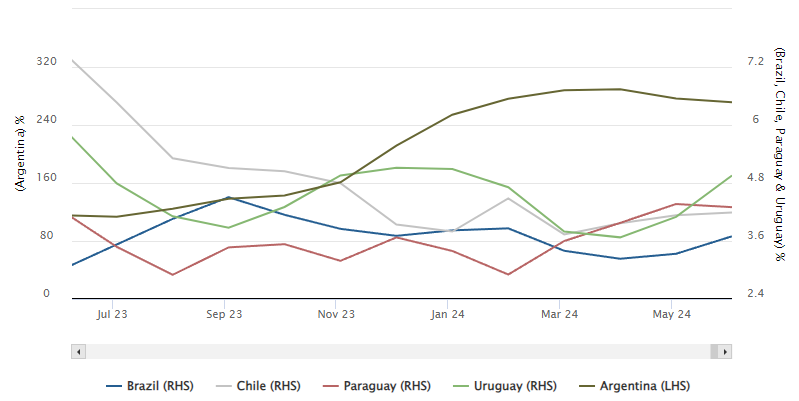
    Brazil & Southern Cone: inflation rate
    Percentage variation (year-on-year)

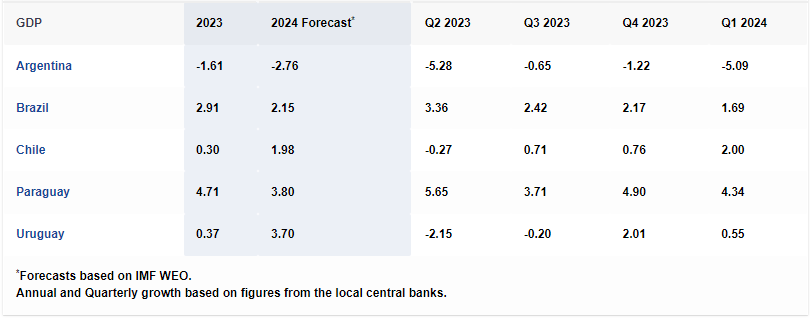
    Brazil & Southern Cone: GDP growth (%)
    Quarterly figures are year-on-year growth

  • GUATEMALA: Cautious

    LatinNews 30 March 2012 Hits: 1895

    The Banco de Guatemala’s February 2012 survey of economic expectations shows that economists expect the economy to slow but businesses are becoming more confident.

    In 2011 GDP grew by 3.8% in real terms but this year independent economists are forecasting that growth will be 3.1%. Their forecast for 2013 is for a slight pick-up to 3.3%. Their consensus is also for a pick up in inflation to around 6% in 2012 and that the rate will remain around this level for the next couple of years.

    What is odd is this caution does not chime with the central bank’s monthly survey of business confidence which shows a marked improvement in February 2012 compared with January 2012. In February 92% of the businesses polled expected the economy to improve in the next 12 months while only 8% expected a deterioration. The month before, the optimists were at 77% and the pessimists at 23%.

    The overall business confidence index stood at 78.2% in February, up from 73.1% in January. The February reading was the highest for five years.

    Tourism: In the first two months of 2012 there was a 4% (13,257) year-on-year increase in tourist arrivals and a 7% (y-o-y) increase in revenues to US$249m, the Instituto Guatemalteco de Turismo (Inguat) reported.

    Mobiles: The market for mobiles grew 14% in 2011, according to figures from the Superintendencia de Telecomunicaciones (SIT). There are now 20.7m subscribers. In 2004 there were only 3.1m subscribers. The overwhelming bulk (19.5m) of the mobile users have prepaid contracts. What is interesting is that the country’s population is only 14.4m. The market leader is Tigo, which is part of Millicom International Cellular, which has a 49% market share. Claro, owned by América Móvil, has 32%, and Spain’s Telefónica has 19%.

    Inflation: In February the inflation rate was 0.5%, which brought the 12 month rate to 5.17%.

  • Former subscriber: Update Contact Preferences

    LatinNews 01 April 2018 Hits: 14

    Thank you for taking the time to update your contact preferences.

    Changes to data protection regulations mean that you need to tell us that you are happy to continue receiving our communications.

    In the past you were a LatinNews subscriber.

    The General Data Protection Regulation (GDPR) will come into effect on 25 May 2018, and will bring with it changes to the way in which personal data is processed and used. As a result, we need you to confirm that you want to continue receiving communications from us and opt-in.

    From time to time, we would like to send you communications to help you keep up-to-date on news about our latest publications, complimentary content, information on relevant services, and special offers which could benefit you. We may contact you via email, post or phone. We will never share your data with a third party.

    To continue receiving communications from us, all you need to do is confirm your email address, opt-in to the different types of communication by ticking the boxes, and click the Confirm Contact Preferences button.

    Please confirm your email address:
     
    We would like to contact you from time to time so that we may send you complimentary content, and keep you updated with news about our services. To opt-in to this communication, please tick the LatinNews Updates box.
    LatinNews Updates:
     
    Occasionally we work with partners who provide content and provide services that complement our own. To opt-in to this communication, please tick the Trusted Partners' Updates box.
    Trusted Partners' Updates:


  • El Salvador: Stuck in a vicious cycle

    LatinNews 20 May 2016 Hits: 624

    El Salvador will not easily or quickly emerge from a vicious cycle of low growth, widespread crime and high levels of emigration.

    Of the 140 countries surveyed by the World Economic Forum (WEF) for its Global Competitiveness Report 2015-2016, El Salvador was ranked 140th – or last – for organised crime. Its relative positions were only marginally better for business costs of crime and violence (137th) and business costs of terrorism (127th). As observed last month in our sister publication, Latin American Security & Strategic Review, the murder rate in El Salvador rose to 103 per 100,000 people in 2015. This is ten times the murder level considered ‘epidemic’ by the World Health Organisation and is the highest level in the Western Hemisphere.

    These grim statistics are reflected in what companies operating in El Salvador perceive to be the most problematic factors for doing business in the country. The WEF asked survey respondents to select the five most problematic factors and then to rank them from 1 (most problematic) to 5. Collectively, the respondents identified crime and theft as by far the most problematic factor, with a weighted score of 24.3 [Chart 1]. Inefficient government bureaucracy (a challenge in many countries in Central America) and policy instability were ranked, distantly, in second and third places. Access to finance, corruption and the inadequate training of the workforce were seen as relatively minor problems.

    Chart 1: The most problematic factors for doing business in El Salvador

    The most problematic factors for doing business in El Salvador

    Source: World Economic Forum, Global Competitiveness Report, 2015-2016

    The WEF ranked El Salvador as the 101st most competitive country overall. A statement by IMF staff on 6 May, at the conclusion of its annual Article IV Mission to the country, highlighted how the various structural problems identified by the WEF contribute to persistently low growth. The IMF noted that, even though El Salvador shares a number of characteristics and problems with other nearby countries, it is unusual for its combination of high emigration and violent crime. The IMF projects only slow population growth in the coming years. [Chart 2]

    Chart 2: El Salvador, main macroeconomic indicators

    2014a 2015e 2016e 2017e 2018e


    Real GDP (US$bn) 25.2 25.8 27.3 28.5 29.8
    Real GDP growth (%) 2.0 2.4 2.5 2.6 2.3


    Total investment (% GDP) 13.6 13.9 14.2 14.4 14.5
    Total savings (% GDP) 8.8 10.6 11.2 10.3 9.9
    Current account deficit (% GDP) 4.7 3.2 3.0 4.1 4.6


    Government primary deficit (% GDP) -1.0 -0.8 -1.1 -1.2 -1.3
    Government overall deficit (% GDP) -3.4 -3.2 -3.8 -4.5 -4.7
    Government - gross debt (% GDP) 56.8 58.9 59.5 61.8 64.2


    Population (mn) 6.35 6.38 6.40 6.43 6.46
    Unemployment rate (%) 5.54 5.34 5.29 5.24 5.39


    Source: IMF World Economic Outlook forecasts, April 2016

    The Fund notes that the local economy managed real annual GDP growth of about 2% in the five years to the end of 2014, less than half the regional average. Looking forward, it expects the economy to expand in real terms by about 2.5% annually over the coming three years or so.

    The major problems for doing business in El Salvador identified by the WEF survey have had the impact of discouraging investment. Investment has been persistently low, and is expected by the IMF to remain below 15% of GDP in the coming years. This lack of investment has exacerbated structural challenges such as high logistics costs and deficiencies in infrastructure, in a country vulnerable to natural disasters.

    Unfortunately, the lack of inclusive growth has resulted in low incomes, with the consequence that savings has been (and should remain) about 10% of GDP, resulting in a current account deficit of 4-5% of GDP. This is in a context of a country where many of the fiscal trends are unfavourable. As the IMF notes, “wage pressures, higher interest rates, additional security costs, and public investment projects are all expected to add to demands on fiscal resources”. The primary (before interest payments) and overall deficits are growing faster than nominal GDP. Overall government debt is currently equivalent to less than 60% of GDP, but is expected by the IMF to be above 70% by 2021.

    Fiscal problems are compounded by political problems. The IMF observes, “the parliamentary impasse that is blocking access to external financing has caused domestic financing to rise sharply in 2015 and early 2016, pushing up yields on short-term government securities. The Constitutional Court has required that the government increase interest rates on bonds that are placed with pension funds. Yield spreads on Salvadoran bonds have risen relative to those of other emerging markets”.

    Increasing exposure to public sector credits is seen by the IMF as a constraint on the profitability of an otherwise strong banking sector (which has capital equivalent to nearly 17% of risk weighted assets). Looking forward, the small size of the banking sector and difficult business environment means that the Salvadoran banks are exposed to the erosion of correspondent banking relationships: as discussed in our April edition, this has been a growing problem across the region.

    From the point of view of El Salvador, developments in the global economy over recent months have been mixed. Inwards remittances from expatriate workers were 6.3% higher in Q116 than in the previous corresponding quarter, thanks to generally robust employment conditions in the US. The country has also been a net beneficiary of the slide in energy prices over the last two years. However, as a fully dollarised economy, El Salvador’s external competitiveness has suffered as a result of the appreciation of the US dollar against most other currencies.

    The country’s pension system represents a negative wildcard. Even though the coverage of the system (i.e. the number of people entitled to benefits) is low and the replacement rate (i.e. the percentage of pre-retirement income that is paid out as a pension) is declining, the system is grossly under-funded. Low investment returns have compelled the government to pay more money into the system and to guarantee pension benefits: this has effectively prevented the transition to a fully-funded defined contribution (DC) system. The government has proposed reforms that include a flat pension for lower income contributors and the transfer of assets and liabilities from private pensions to the public sector. However, it is not clear that these changes would reduce the long-term unfunded liability of the pension system, now estimated at around 100% of GDP.

    The IMF sees a draft Fiscal Responsibility Law and the Medium-term Fiscal Framework as “steps in the right direction”. The legislation includes many elements favoured by the Fund, such as a combination of deficit-based and expenditure-based rules. In the meantime, though, the IMF notes that real wages in the public sector have been rising – and argues for a freeze on hiring of public servants, with the exception of law enforcement and security personnel. “There is a need to strengthen the efficiency of expenditure in other areas such as health and education services, as well as rationalising LPG, electricity and transport subsidies”, it notes. This would free up more resources for the fight against crime, improvements to the social security safety net and other essential investment.

    Aside from a reduction in crime and corruption, the IMF advocates a number of supply side reforms. These include greater wage flexibility (given the dollarisation of the economy), a more effective Competition Superintendency (and other changes to boost competition in key sectors such as transport and electricity) and improvements to the education system.

    Greater financial inclusion is also seen as a priority. Currently, only 37% of the adult population (and lower numbers of women, the young, the poor and residents of rural areas) have bank accounts, according to World Bank data. And less than half of those with bank accounts have actually used their account to receive wages or a debit card to make payments.

    For many Salvadorans, financial institutions are an element of the system through which they receive remittances from family members or friends living and working outside the country. According to the World Bank, 17% of Salvadorans received remittances in 2014-15. Of these, a little over one quarter received remittances through financial institutions, while one fifth and one eighth of people, respectively, used money transfer firms or their mobile phone to receive the money.

    For its part, the IMF generally approves of the new Financial Inclusion Law. “However, recent legal changes limiting the acquisition, transfer and storage of debtor information in credit bureaus increase credit risks and intermediation costs, and should be reconsidered”, it advised. The Fund also advocates legal changes that would promote the development of domestic capital markets.

    The security situation in El Salvador, and the government’s attempts to deal with it, remain critical. A significant reduction in gang-related crime is a necessary, but not sufficient, condition for a meaningful improvement in economic performance.

  • TRACKING TRENDS

    LatinNews 05 December 2019 Hits: 521

    PARAGUAY | Budget contested in congress. Paraguay’s budget for 2020 has produced disagreement in the legislature, as its two chambers struggle to finalise the details in the face of popular demand for increased spending.

    After the chamber of deputies approved a budget of G$86.17tn (US$13.34bn) on 13 November [WR-19-46], the senate voted on 27 November to ratify an amended version, worth G$86.2tn (US$13.35bn).

    Upon the bill’s return to the chamber of deputies, however, a further increase to G$86.32tn (US$13.36bn) was approved, meaning the budget must return once again to the senate, until both chambers have ratified the same version.

    The popular protests calling for increased spending are contributing to this indecision, as the senate spent over 10 hours debating how to meet demands for better public sector salaries and improved pensions.

    This challenge is further complicated by Paraguay’s slowing economic growth, due to finish 2019 at 0.2%, well below the 1.5% predicted in July. Congress even voted to lift the fiscal deficit cap to 3% of GDP in November, to allow public investment levels to be maintained.

    The primary beneficiaries of the budget amendments are the public sector workers campaigning for better salaries – teachers will receive a 16% pay rise in April, while the state-owned electricity firm (Ande) will receive an extra G$30bn (US$4.6m) to improve workers’ salaries and pensions.

  • RASTREANDO TENDENCIAS

    LatinNews 14 January 2013 Hits: 1149

    CHILE | En buena condición. Por segundo año consecutivo, la economía ha crecido con mayor rapidez que el gasto público, anunció el ministro de finanzas, Felipe Larraín, la semana pasada. El gasto público se incrementó un 5%, mientras el PIB se expandió un 5,5%, de acuerdo con Larraín. Él dijo que las cifras fueron difundidas simultáneamente para informar al mercado con más precisión acerca del estado real de las cosas en Chile, y por adelantado debido a que los analistas han estado sosteniendo que el gasto público creció un 7%.

    Chile terminó el 2012 con un superávit comercial de US$4,21mm, cayendo un 61% con relación al año anterior, de acuerdo con el banco central. Las exportaciones totales sumaron US$78,81mm, cayendo un 3,2% con relación al 2011, mientras las importaciones crecieron un 5,6% a US$74,60mm para llegar a su nivel más alto en 10 años. La razón principal de la caída en las exportaciones fue la leve declinación en la principal exportación de Chile, el cobre. Las exportaciones totales de cobre totalizaron US$42,72mm en el 2012, cayendo un 3,85% en relación al 2011.

    Hay signos de que el superávit comercial de Chile podría recobrarse a los niveles del 2011 este año. En diciembre, Chile informó de su segundo superávit mensual consecutivo después de cuatro déficits consecutivos. El superávit comercial de diciembre fue de US$1,51mm, el mayor superávit comercial mensual por más de un año, comparado con US$1,12mm en el mismo mes del 2011. Las exportaciones de cobre se recuperaron a US$4,70mm en diciembre, el nivel más alto en dos años.

    A pesar de las estadísticas económicas ampliamente positivas, especialmente ante una turbulenta economía global, el público chileno, ante la esporádicamente visible frustración del Presidente Sebastián Piñera, no está impresionado en exceso con la administración de la economía de parte del gobierno.

    El más prestigioso sondeo de la opinión pública por CEP, que fue difundido al cambiar el año, muestra que mientras la popularidad de Piñera ha trepado cuatro puntos porcentuales desde el sondeo previo en agosto, aún está en sólo 31%.

    La predecesora de Piñera, Michelle Bachelet (2006-2010) es la más destacada favorita para retornar al poder en las elecciones del próximo noviembre con la opositora Concertación, de acuerdo con el sondeo: el 54% de los entrevistados dijo que ellos votarían por ella pese al hecho de que ella no ha confirmado formalmente que competirá.

    Los potenciales oponentes de Bachelet de la gobernante Coalición por el Cambio, Laurence Golborne y Andrés Allamand, que competirán uno contra otro en elecciones primarias sólo logran el 22% entre ambos. Marco Enríquez-Ominami, quien terminó en un creíble tercer lugar en las últimas elecciones luego de abandonar la Concertación y competir como independiente, estaba con un 8%.

    PARAGUAY | Las exportaciones se mantienen fuertes. Las exportaciones de Paraguay al Mercado Común del Sur (Mercosur) entre julio y noviembre del año pasado se elevaron un 30%, comparado con el mismo periodo el año anterior, a US$626m. Este periodo siguió directamente a la suspensión de Paraguay del Mercosur debido al juicio político al Presidente Fernando Lugo por el congreso. Funcionarios brasileros citados por Folha de São Paulo dijeron que las cifras comerciales confirmaban que la suspensión de Paraguay fue enteramente una cuestión política y que no ha tenido ninguna clase de impacto sobre el comercio. Las exportaciones de Paraguay a Venezuela, que fue admitida al Mercosur luego de suspensión de Paraguay, durante el mismo periodo cayeron de US$60m a solamente US$3m.

    URUGUAY | Éxito en la inflación. Es demasiado temprano para sugerir que el gobierno ha logrado aplicar un firme control sobre lo que el Presidente José Mujica describió como una anguila resbaladiza, pero no se ha permitido que la inflación llegue a los dos dígitos como se temía.

    El índice del precio al consumidor (IPC) cayó un 0,73% en diciembre, llevando la inflación acumulada al 7,48% en el 2012, de acuerdo con el Instituto Nacional de Estadísticas (INE). Aunque la inflación no alcanzó los dos dígitos, ni de hecho tampoco su nivel del 2011 del 8,60%, se mantuvo bastante por encima de la ambiciosa meta del 4%-6% para todo el año.

    ARGENTINA | Toma fiscal récord. La toma fiscal en el 2012 alcanzó un récord de Arg$679,8mm (US$138mm), subiendo u n 25,9% sobre el año anterior, de acuerdo con el director de la agencia fiscal (Afip), Ricardo Echegaray.

    Echegaray sostiene que la razón primaria para el impulso fue el incremento en los salarios (el impuesto a las ganancias personales creció un 35,1% a Arg$69,5mm [US$14mm]) y el fuerte crecimiento.

    Echegaray, cuyo puesto al frente de la Afip fue renovado por el gobierno a fines de diciembre por cuatro años más, dijo que esperaba que la toma fiscal alcance los Arg$850mm en el 2013.

    • Impuesto al fútbol

    El director de la agencia fiscal de Argentina (Afip), Ricardo Echegaray, introdujo nuevas medidas a finales de año para actuar contra la evasión fiscal en el fútbol. A partir de ahora, todos los clubes de fútbol de Argentina tendrán que depositar las ganancias por transferencias de jugadores en una cuenta bancaria especial. Los contratos con los jugadores también deberán ser informados además de estas ganancias, y los inversionistas y agentes involucrados deberán estar registrados como representantes del jugador. La Afip bloqueará del sistema financiero del país a los responsables si los números no coinciden.

  • Peru: What could go wrong?

    LatinNews 27 November 2013 Hits: 2704

    Policy-makers in Peru have - rightly - received plaudits in recent weeks from Fitch Ratings and the International Monetary Fund (IMF) for their stewardship of the economy.

    On 20 November, the International Monetary Fund (IMF) published a concluding statement following its 2013 Article IV consultation with the government of Peru. The IMF's assessment is very positive: the overall state of the economy remains strong despite lower metal prices and recent market turbulence. In the short term, activity should be boosted by the softness of the Sol through much of 2013 (in response to the general weakness in the price of copper and other metals that are produced in Peru), and by the decision of Banco Central de la República del Perú (BCRP - the central bank) to lower its key policy rate from 4.25% to 4.00% in early November. Over the medium term, the IMF envisages that the economy will rebound in 2014, as exports and business confidence (strengthen) and large infrastructure and mining projects come on stream.

    The IMF expects that, after running at around 5% for much of 2013, real GDP growth will accelerate to 5.5% in 2014. Inflation is expected to moderate from the current rate of around 3% to 2% (the mid-point of the BCRP's target band).  The IMF's assessment follows Fitch Ratings' upgrading of its already investment-grade sovereign rating for Peru from BBB to BBB+ on October 23.  The agency noted the government's strong fiscal position (with a debt/GDP ratio that is 18.9% and falling) and balanced budget. “Growth prospects appear favourable in coming years due to strong mining investment flows and the expected doubling of copper production by 2016”, it noted. The biggest risk moving forward, therefore, might be current account and potentially even inflation pressures, on the back of a simultaneous surge in both consumption and investment.

    The main downside risk - alluded to explicitly by the IMF and implicitly by Fitch - appears to be an unexpectedly large slowdown (or worse) in China. As we noted in our sister Andean Group Report for November, exports from Peru to China have risen from around US$3.5bn in 2007 to US$7.9bn in 2012, with the result that China has displaced the US as Peru's main trade partner. Currently, around 17% of Peru's exports go to China.

    However, Peru is favourably placed to cope with even a sharp downturn in commodity prices, whether the result of developments in China or some other factor. The currency regime has become more flexible. Inwards Foreign Direct Investment (FDI) is sufficient to fund the current account deficit of around 5% of GDP. Crucially, foreign reserves amounted to US$66.5bn at the end of October, which is equivalent to around 33% of GDP.

    For its part, the IMF also considered domestic upside risks. “The pace of the recovery could be stronger than envisaged due to a variety of factors including: (i) the greater speed of operating at full capacity large mining projects coming on stream; (ii) the ability to implement rapidly large infrastructure projects in the pipeline; (iii) the effectiveness of the investor facilitator office in handling a larger volume of cases and (iv) the faster adoption of the authorities' reform agenda”.

    Reform has focused on boosting labour productivity and improving the flexibility of the labour market, social programs for promoting inclusive growth (such as Juntos, Cuna Mas and Qali Warma), improved fiscal discipline through the Fiscal Responsibility Law and streamlining bureaucracy. Progress in any of these areas is likely to boost investment further. The World Economic Forum (WEF)'s Global Competitiveness Report for 2013-14 ranked Peru very favourably relative to similar economies in terms of its overall macroeconomic environment. However, the WEF found that the most problematic factors for doing business in Peru were inefficient government bureaucracy, corruption and restrictive labour regulations. These problems were considered as being far more serious than deficient infrastructure, tax regulations or crime/theft.

    As the Chart indicates, Peru's economy is well balanced between exports and domestic demand. Most metrics - and, in particular, the 18% year-on-year growth in credit to the private sector - suggest that the momentum of consumption, in particular, is strong. It is easy to envisage a situation whereby stronger-than-anticipated consumption coincides with the impact of the recent easing in fiscal and monetary policies and with a surge in investment boosted by success with the various reform programs. In the event that an improvement in Peru's terms of trade caused the Sol to appreciate strongly in 2014-15, the current account deficit could surge. Inflation could also then become a challenge for the BCRP. For now, though, the central bank retains strong control of the economy.

    Peru's economy: selected metrics
    Composition of GDP, 3Q13
    Domestic Demand 101.3%
    Private Consumption 62.6%
    Public Consumption 10.2%
    Private Investment 21.9%
    Public Investment 5.7%
    Inventories 0.9%
    Exports 25.4%
    Imports 26.7%
    GDP 100.0%
    Robust demand for labour
    Urban employment index*, August 2013 109.5
    Year-on-year change 2.40%
    Employment index for Metro. Lima 113.4
    Year-on-year change 4.30%
    *October 2010 = 100
    Other
    Broad money (PENmn) - end Sep. 2013 210,228
    Year-on-Year growth 19.20%
    Credit to private sector (PENmn) 164,793
    Year-on-Year growth 17.60%
    Source: BCRP
    • PetroChina

    The state-controlled PetroChina has purchased the three Peruvian oil and gas blocks held by the local subsidiary of Brazil’s Petrobras for US$2.6bn. China National Petroleum Corporation (CNPC), PetroChina’s parent, has been in Peru since 1993 and already has assets including three oil and gas fields. This latest purchase, which needs the approval of the authorities in Bejing and Lima, would be the second largest acquisition in Peru since Royal Dutch Shell bought Repsol’s liquefied natural gas assets in February for US$4.4bn.

    • Peru-Brazil

    On 11 November President Humala hosted his Brazilian peer, Dilma Rousseff, in Lima to further the 10-year old strategic alliance on physical and economic integration, trade and investment. Brazil is Peru’s third largest trading partner. Two-way trade was US$650m in 2002, US$3.5bn in 2012 and is on course to break US$4.0bn this year. Peru’s exports to Brazil in 2012 rose 58% on 2011, and should increase a similar amount this year. They reached US$1.2bn in the first eight months of 2013, leaving Peru with a bilateral deficit of some US$300m. President Rousseff said there were over 70 Brazilian companies in Peru with investments totalling US$6bn. Humala and Rousseff signed three accords on the environment, labour and telecommunications. Humala urged Brazilian investment in Peru’s energy, IT infrastructure (fibre optics), petrochemical, ports and public transport sectors.

  • TRACKING TRENDS

    LatinNews 16 January 2014 Hits: 1890

    ARGENTINA | Plummeting economic freedom. On 13 January the Heritage Foundation and the Wall Street Journal released the latest version of their annual Index of Economic Freedom, which placed Argentina 166th out of 178 countries, putting it in the lowest tier of the ranking for the first time. The Index report was scathing of Argentina’s performance in its rankings, pointing out that its overall score dropped by 2.1 points to 44.6, meaning that it has now joined the 15 other nations, such as Cuba and North Korea, which are considered to be economically ‘repressed’.

    Yet as the Index points out, not so long ago Argentina used to be amongst the countries ranked as ‘mostly free’. “Over the 20-year history of the Index Argentina’s economic freedom has plunged to ‘repressed’ status. With its overall score dropping by 23.4 points, the once ‘mostly free’ economy has registered the second most severe score decline since the Index began measuring economic freedom”. Alluding to the fact that the decline appears to have steadily taken place under the successive Kirchnerista governments of the late Néstor Kirchner (2003-2007) and his widow and successor, President Cristina Fernández, the report notes that there has been a substantial increase in the State’s interference in the economy since 2003 to the point that “Eight of the 10 economic freedoms have deteriorated because of policies that include harsh capital controls, price fixing, restrictions on imports, and a series of nationalizations”.

    The criticism of the Kirchnerista economic legacy comes as the government’s economic record is once again under severe scrutiny both at home and abroad as concern over Argentina’s domestic economy mounts following the recent social unrest sparked as a result of the rising real rate of inflation in the country despite the government’s stubborn insistence that the official inflation rate stands at around 10%. In these circumstances, it is unsurprising that a staunch Kirchnerista, such as defence minister Agustín Rossi, would feel compelled to come out in defence of Kirchnerista economic policy. In an interview with the state news agency, Télam, Rossi lambasted the Index, which he accused of being biased and intended to force Argentina to adopt neoliberal economic policies. Rossi said that he was “stunned by the virulence of the criticism that various messengers of the international financial order [sic] are making... with the clear intention by some economic sectors... to reinstate Washington Consensus economic models in Argentina”.

    Rossi noted  that in 2002, when Argentina was ranked 38th by the Index, its unemployment rate stood at 24% and its poverty rate at 57% and that it made “no sense” for the drop in its ranking when unemployment now stands at 7% and the poverty rate is “in single digits”. However, recently the local media has questioned the government’s poverty figures, asking whether it is possible to have such a low poverty rate (6.5%), when the real double-digit inflation rate is undermining the population’s purchasing power.

    PARAGUAY-BRAZIL | Bilateral scientific cooperation agreement. On 13 January the governments of Paraguay and Brazil signed a new bilateral science & technology cooperation agreement, which they hope will help promote bilateral investment. The agreement was signed in Asunción by Paraguay’s industry & trade minister, Gustavo Leite, and his Brazilian counterpart, Fernando Pimentel. Leite explained that the idea is for the agreement to help promote the existing production chains in Paraguay set up by Brazilian entrepreneurs in diverse sectors such as shoes, clothing and car parts, which according to Leite export over US$200m a year back to Brazil. In addition, Leite said that the two ministries had also agreed to work together to secure special credit lines from Brazil’s national development bank (Bndes) exclusively for Brazilian firms interested in investing in Paraguay. Meanwhile, Pimentel said that the agreement would also help to boost the exchange of technology in areas such as fuels, foods and health.

    Pointedly, representatives from Brazil’s agricultural ministry that accompanied Pimentel to Asunción said that they also held a meeting with Paraguay’s agriculture minister, Jorge Gattini, to discuss the possibility of establishing public-private alliances to jointly promote the adoption of the latest seed production technology in Paraguay. According to Helcio Campos Botelho, the director of intellectual property & agricultural technology at Brazil’s agriculture ministry, the goal is to “strengthen the relations of the agriculture ministries in our countries in order to promote rural development and the rational use of soil”, pointing out that Paraguay has large areas of high-quality agricultural soil. Incidentally, on the same day Paraguay’s trade & industry ministry revealed that the country’s agricultural exports in 2013 were 10.83m tonnes, 34% more than in 2012, driven by increases in exports of processed vegetable products, seeds and fruits.

    • Chile’s fruit exports continue to rise

    On 14 January Chile’s agriculture ministry revealed that the country’s fruit exports had experienced significant increases in both value and volume terms in 2013. According to the ministry, the result is somewhat surprising given that producers faced adverse climatic conditions at the start of last year when Chile was affected by a prolonged drought. However, according to official figures, fruit exports last year totalled 2.7m tonnes, 5.4% more than in the previous year. These exports were in turn valued at US$4.41bn, 5.4% higher than in 2012. Commenting on the positive result, Agriculture Minister Luis Mayol highlighted that it was achieved despite the fact that the producers also faced other adverse factors such as “a low exchange rate level and high energy costs”.


  • REGION: Mixed reaction to Icon of the Seas

    Abbi Dicker 23 February 2024 Hits: 3329

    The world’s largest – and brand new – passenger cruise ship, the ‘Icon of the Seas’ set out from Miami on 27 January for a seven-night maiden tour of the eastern Caribbean taking in St Thomas and St Kitts & Nevis. The launch celebrations included the presence of the now Miami-based Argentine footballer Lionel Messi. Despite the razzamatazz, opinions are divided over whether the ‘Icon’ and other big ships are a good or a bad thing for Caribbean tourism.

    Everything about the ‘Icon’ is big. It is 1,200 feet (366 metres) long and displaces over 250,000 tonnes. It is five times the size of the Titanic. There are 20 decks. Passenger capacity is nearly 8,000 (with crew and entertainment staff that goes up to nearly 10,000). It has eight onboard “neighbourhoods” a waterfall, six water slides, and over 40 restaurants. Nick Rose, a vice-president at operating company Royal Caribbean Group has explained the company’s concept saying, “We live by one single philosophy, which is to deliver the best vacations responsibly”. The ship cost about US$2bn to build.

    The trend to mega-ships will concern Caribbean tourism operators since per capita spending by cruise ship passengers tends to be significantly lower than spending by tourists who arrive by air and stay on land over various nights in local hotels. A 2005 study by the United Nations (UN) Economic Commission for Latin America and the Caribbean (Eclac) found that what it calls land-based tourism accounts for 90% of Caribbean countries’ tourism earnings (which are equivalent to 14.8% of regional GDP). Tourists on cruise ships spend significantly less than those who stay overnight in hotels. The fear therefore is that an expanding market share for lower-spending cruise visitors will have an overall adverse effect on profitability.

    There is also an intense debate over environmental impacts. The Icon of the Seas is powered by liquid natural gas (LNG) and according to the operating company this makes it 24% more efficient than the latest International Maritime Organisation (IMO) standard. Royal Caribbean says it continues to aim for net-zero emission ships by 2035. But Marcie Keever of lobby group Friends of the Earth says “the ships are getting bigger and bigger and that is the wrong direction for the cruise industry to be going”.

    Carbon emissions

    A 2022 study by the US-based multinational public policy think tank, International Council on Clean Transportation (ICCT), found that a passenger travelling on a 1,200 mile cruise ship tour would generate around 500kg of carbon emissions, comparted to only 235kg if he or she did the same trip by air. Another lobby group, Climate TRACE, has found that cruise ship emissions are already 6% higher than

  • RASTREANDO TENDENCIAS

    LatinNews 12 September 2011 Hits: 226

    COSTA RICA | Investigación sobre Arias. La corte suprema ha decidido no sancionar al fiscal general, Jorge Chavarría, investigado por supuesto tráfico de influencia en conexión con el ex ministro de la presidencia, Rodrigo Arias [IL-11-06]. La corte resolvió que no había pruebas que Chavarría hubiese ordenado la suspensión de una investigación sobre Arias en nombre del gobierno. Arias está siendo investigado por supuesta malversación de US$2m del Banco Centroamericano de Integración Económica (Cabei).

    Chavarría dijo que estaba “muy feliz de ver que la justicia está siendo servida”. Manrique Oviedo, el presidente del opositor Partido Acción Ciudadana (PAC) en un comité legislativo que también investigaba el caso, dijo que la corte había “tomado la opción confortable” y “dejado a la sociedad costarricense poco cambiada”.

    REPUBLICA DOMINICANA | De vuelta a la senda. La agencia de rating Standard & Poor’s elevó el rating de grado de crédito del país esta semana de B a B+, cuatro escalas por debajo del grado de inversión. Su decisión se produce días después que una misión del FMI concluyó una visita de dos semanas el 7 de junio. El FMI se había declarado satisfecho con la salud económica del país, pero criticó el hecho que algunas medidas en el programa económico del gobierno, que debían haber sido realizadas para fines de 2010, sobre todo las mejoras en el perennemente debilitado sector eléctrico, no habían sido completadas. El Fondo predijo un crecimiento del PIB de al menos 5% este año, con una inflación de 6% a 7% (la inflación acumulada para los primeros cinco meses del año es de 4,8%, de acuerdo con el banco central y el déficit fiscal de 3% del PIB. S&P dijo que la República Dominicana tenía mejores perspectivas de crecimiento. Sin embargo, advirtió que las elecciones presidenciales en 2012 podrían exacerbar los actuales problemas fiscales. El Presidente Leonel Fernández ha enviado al congreso un proyecto de ley de reforma fiscal, con la cual él espera reunir RD$9,5bn (US$250m), pero al mismo tiempo está preparando el lanzamiento de una emisión de bonos de US$500m en los mercados internacionales.

  • RASTREANDO TENDENCIAS

    LatinNews 20 September 2011 Hits: 562

    BRASIL | Preocupación acerca de una tribu amazónica. El ministerio de justicia ha despachado 16 oficiales de la fuerza nacional de seguridad a Acre para proveer seguridad a los empleados de la Fundación Nacional Indígena (Funai) en la base Xinane, a 20km de la frontera con Perú. Funai ha levantado la alarma acerca del destino de una tribu amazónica no contactada, y teme que haya sido perturbada o incluso eliminada por traficantes peruanos de drogas. La semana pasada, la policía brasileña arrestó por segunda vez a un ciudadano portugués, Joaquim Antônio Custódio Fadista, acusado previamente de tráfico de drogas en Brasil y Luxemburgo. El fue arrestado en la misma área en marzo y extraditado a Perú. Los trabajadores de Funai encontraron una flecha tribal en un campamento usado por los traficantes. Las tribus remotas de Brasil, (estimadas en 77, con 30 identificadas) están crecientemente amenazadas por los traficantes, y por compañías madereras y petroleras.

  • TRACKING TRENDS

    LatinNews 20 March 2014 Hits: 1231

    CHILE | BCCH still cutting rates. On 13 March Chile’s central bank (BCCH) announced that following its latest monetary policy meeting, it has decided to cut its benchmark interest rate (TPM) by 25 basis points to 4%. This is the fourth time that the bank has cut interest rates since January 2012 in a bid to stimulate the slowing domestic economy. In a statement, the BCCH said that the decision answered to the fact that “the world’s main economies continue to show signs of a weak [economic] recovery, while growth forecasts for emerging economies, especially those in Latin America, have receded”; and that the domestic economy “has continued to lose dynamism... with domestic demand and economic activity growing by less than previously forecast”.

    Chile’s economy has been experiencing a gradual slowdown since the second quarter of 2013. As a result of this, according to the latest BCCH figures, last year the Chilean economy grew by 4%, the lowest rate since 2009 when the country was severely affected by the global economic crisis and much lower than the 5.6% posted in 2012. Problematically, a day before the BCCH’s TPM announcement the local branch of Banco Santander published a report which pointed out that despite the BCCH’s expansionary monetary policy it expected that economic activity would continue to slow down in the first two quarters of 2014. Consequently, Banco Santander is forecasting that Chile’s economic growth this year will be between 3.3% and 3.7%, below the average of 4.5% observed in the last decade, a cause for concern for the new government of President Michelle Bachelet.

    • Electrofácil arrives on LSE

    On 18 March the CEO of Paraguayan electronic retailer Electrofácil, Luis Saguier Blanco, announced that on 4 March the firm began floating on the London Stock Exchange (LSE) as part of Latin South Holdings PLC. Electrofácil becomes the first Paraguayan-owned firm to be listed on the LSE. According to Saguier, shares in the firm, which has been valued at US$35m, began trading at £0.32. Saguier said that trading on the LSE is “a significant achievement not just for Electrofácil, but for Paraguayan business as it opens the way for other local firms that also want to have an international presence”.

  • ARGENTINA: Tucumán trouble gives opposition opportunity

    LatinNews 27 August 2015 Hits: 474

    In a joint press conference on 26 August, the leading opposition candidates for the presidency demanded “transparency” for the general elections on 25 October. Over the weekend, elections in the northern province of Tucumán were marred by accusations of fraud and violently repressed demonstrations. To emphasise their point, the opposition candidates were joined on stage by José Cano, the gubernatorial candidate from the Unión Cívica Radical (UCR) who lost Sunday’s vote to Juan Manzur, from the ruling Frente para la Victoria (FPV) faction of the Partido Justicialista (PJ, Peronists).

    Tucumán is the sixth-largest electoral district in Argentina; since 1999 it has been ruled by the PJ. Preliminary results from the contest on 23 August suggested that Manzur beat Cano by at least 14 percentage points, a victory narrower than anticipated. However, the results were marred by widespread allegations of fraud.

    At least 42 ballot boxes are known to have been burnt, out of a total of 3,000 province-wide. The provisional count also excluded a substantial number of voter returns from the provincial capital, San Miguel de Tucumán, an opposition stronghold. Curiously, the opposition lost despite sweeping the board in Tucumán’s four main cities. The local electoral authorities ruled out holding the elections again.

    Images of burnt ballot boxes soon turned viral, prompting demonstrations. Around 10,000 took to the streets of the provincial capital on 24 August leading to a severe crackdown by the local police. Television footage of the police using tear gas, pepper spray and rubber bullets to contain the protest angered many Argentines across the country. Twenty-two people were hospitalised. An estimated 30,000 marched the following night, though on the second night the police adopted a more tolerant approach.

    The police officer in command on the evening of 24 August has been charged by a public prosecutor for injuries, abuse of authority and a failure to comply with his duties. José Alperovich, the hardline Kirchnerista governor held responsible for the police’s approach, condemned the “excesses” of the security forces.

    Daniel Scioli, the presidential candidate from the ruling FPV, travelled to Tucumán to congratulate Manzur. He lamented the police’s actions but laid the blame squarely on the opposition. “I understand that Mauricio Macri [the presidential candidate from the right-of-centre opposition Propuesta Republicana (PRO)] is campaigning, but he should not be motivating Tucumán residents to take to the streets because we end up having situations like the ones seen yesterday,” he said.

    In the immediate aftermath of the unrest, other government figures accused the opposition of seeking to use Sunday’s incidents to undermine the credibility of October’s elections. Aníbal Fernández, the cabinet chief, claimed that the opposition was attempting to mount “a plan orchestrated outside our country with paid saboteurs in our country”. He dismissed the issue of the burnt ballot boxes, arguing that those responsible had been arrested.

    Speaking on 26 August, Cano spelt out the various irregularities observed during Sunday’s elections. “Two of our candidates were attacked, bags of food were handed over [to Manzur-supporting voters] and there was a mobilisation of voters, which is expressly forbidden by law, and the provincial government did nothing to stop it,” Cano said.

    Macri took to the microphone shortly afterwards, declaring that the event was being held “in solidarity with the people of Tucumán”. Calling for electronic votes in October, Macri said, “we have to guarantee transparency, not just over what happened in Tucumán, but in the elections we have to come in a few weeks”.

    • Scioli

    Short of serious unrest or a significant deterioration in Argentina’s economic prospects, the opposition may struggle to defeat the government presidential candidate, Daniel Scioli. With an 8.3-percentage-point lead over Mauricio Macri in the recent primaries, he just needs that margin to edge up over 10 points to win outright in the first round. But if he fails to do so, the second round could be very tight.

  • PERU: Agricultural sector shakes Vizcarra

    LatinNews 16 May 2019 Hits: 1663

    Small-scale agricultural producers staged a 24-hour national strike in Peru this week demanding more government assistance for the sector. The strike served as a reminder for the government led by President Martín Vizcarra that while it remains determined to solve the political and judicial crisis linked to corruption that has been affecting the country since last year, this should not be its only focus as there are other pressing matters to address. The Vizcarra administration is now under pressure to appease the agricultural sector or risk the discontent spreading to other quarters that have also become frustrated with its focus on corruption to the detriment of other issues.

    After succeeding Pedro Pablo Kuczynski (2016-2018) as president in March last year, Vizcarra pledged that his administration would get to the bottom of the corruption scandals implicating the political class and the judiciary that led to Kuczynski’s resignation. But Vizcarra also pledged to deliver on Kuczynski’s promises of economic development and poverty reduction in particular for the country’s often neglected interior. While the Vizcarra administration has decisively sought to address the political and judicial crisis by supporting the ongoing investigations into various corruption scandals (see below) and pushing for major judicial and political reforms in congress, efforts to promote economic development appear to have fallen by the wayside.

    Against this backdrop, the Convención Nacional del Agro Peruano (Conveagro) and the Junta Nacional de Usuarios de Distritos de Riego del Perú small-scale farmers’ associations decided to call a national strike for 13 May to pressure the government to address the problems faced by the sector. In particular, the producers complain that they can no longer make a living due to the competition they face from foreign agricultural imports which have been increasing thanks to the numerous free trade agreements (FTAs) signed by Peru in recent years. Conveagro and the Junta have been demanding more attention from the government: financial assistance for producers; the restoration of import tariffs and price controls on certain agricultural products (such as rice, maize, potatoes, sugar cane, and cotton); and for government supply contracts to be awarded to local small-scale producers, among other measures.

    The producers are also demanding increased government spending. This as they complain that despite the promises of investment by the government to benefit the sector, some regions continue to suffer from poor transport and irrigation infrastructure, including those that were seriously affected by flooding last year and for which the Vizcarra administration launched a reconstruction programme. The strike was observed in 15 of Peru’s 24 regions with a reported 1m people taking part around the country. It was accompanied by protest marches and major highways were temporarily blocked by protesters in six regions resulting in some minor clashes with the police.

    All of this prompted an immediate reaction from the government. Agriculture Minister Fabiola Muñoz called for the establishment of a technical dialogue table with representatives from Conveagro and the Junta, her ministry, and the economy & finance ministry (MEF) to be set up to address the producers’ demands. Muñoz admitted that the agricultural sector has been neglected by successive governments and that the Vizcarra administration was open to discussing all of the sector’s demands. Conveagro and the Junta have given the government 60 days to establish an effective dialogue table or else they will call an indefinite strike.

    Villarán arrested

    The latest high-profile Peruvian politician to be placed under preventive arrest pending prosecution for corruption in public office is the former Lima mayor, Susana Villarán (2011-2014). Villarán stands accused of illicit association, money laundering, and of receiving bribes after evidence emerged that her campaign against a 2013 recall referendum received US$6m in irregular contributions from Brazilian engineering firms Odebrecht and OAS, which at the time happened to have public contracts with the municipal government.

    During a 14 May hearing before a judge, Villarán admitted she had accepted contributions from the two firms for her recall referendum campaign and said that she was not sorry for having done so, arguing that she was facing an unscrupulous attempt by her political opponents to oust her from office. But Villarán denied that the contributions amounted to bribes or that her administration had given special treatment to Odebrecht or OAS. Villarán also swore that she would stand trial and would not seek to flee like other politicians have done recently. Nonetheless, after listening to Villarán, the judge placed her under preventive detention for 18 months pending trial for considering that she had previously failed to cooperate with investigators and that she could still seek to obstruct the investigation.

    • Falling support

    President Vizcarra’s approval ratings continue to fall while his disapproval ratings continue to rise, according to the latest public opinion poll by local pollster, Datum. The poll, released on 13 May, showed Vizcarra’s approval rating currently stands at 45%, four percentage points lower than in April and the lowest it has been since June 2018 (45%). Meanwhile, his disapproval rating stands at 48%, four points higher than in April and the second highest since he assumed office (Vizcarra’s highest disapproval rating was 52% in July 2018). More tellingly, the poll also found that 66% of respondents consider that the Vizcarra administration is currently ‘weak’ or ‘very weak’ compared with 31% that consider it to be ‘strong’ or ‘very strong’.

  • Mexico

    LatinNews 23 July 2019 Hits: 399

    Home to one of the most emblematic indigenous political movements in Latin America, Mexico has nonetheless struggled to make much headway in improving conditions for its indigenous population.

    That population is the largest in the region at around 11m people, but this figure represents just 10% of the total population. Indigenous groups are incredibly diverse, with 68 languages and 364 registered dialects spoken. They are also concentrated in a handful of Mexico’s 32 states, with six states (Oaxaca, Chiapas, Veracruz, Estado de México, Puebla, and Yucatán) home to 64.8% of the indigenous population, according to 2015 figures from Mexico’s national social policy evaluation council (Coneval). These states are largely found in the south and south-east of the country.

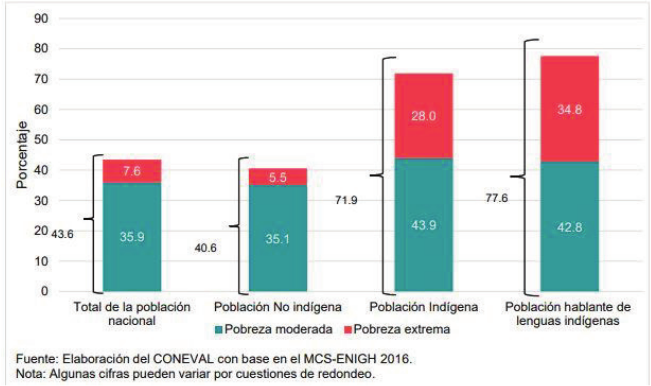
    One of the enduring problems facing indigenous groups in Mexico is inequality, according to the ‘Desigualdades en México 2018’ report from Colegio de México (Colmex), a public university based in Mexico City. Around 75% of the country’s indigenous population was considered poor in 2012, a figure almost double that for non-indigenous Mexicans. By 2016 that figure was 71.9%, according to Mexico’s National Council for the Evaluation of Social Development Policy (Coneval), which also said that opportunities for indigenous people to develop were limited due to inequality. Data show that 28% of indigenous Mexicans were living in extreme poverty in 2016, which means they couldn’t afford a basket of basic goods known as the ‘canasta básica’.

    Percentage of the population in moderate and extreme poverty according to ethnicity, Mexico, 2016

    Chart3

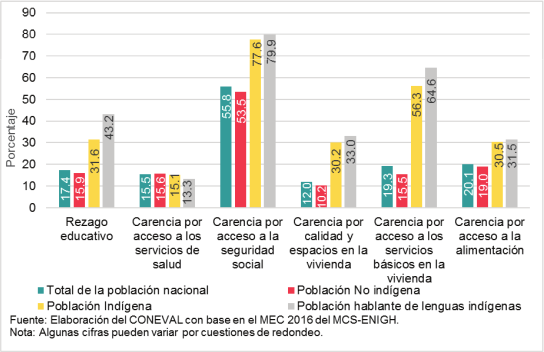
    Percentage of the population by social deprivation according to ethnicity, Mexico, 2016

    Chart4

    Source: Coneval

    As in many other countries in the region, indigenous politics is tied up with questions over land. Despite attempting to declare the end of land reform upon taking power in 1970, President Luis Echeverria (1970-1976) was forced to back down by a wave of indigenous and peasant protests, and authorised a huge land reform programme. Poor implementation has led to unintended consequences, including disputes over land ownership that continue to drive violent conflict to this day, such as the Chalchihuitán-Chenalhó issue in Chiapas state. Members of the two indigenous groups have been displaced by violence because the Secretariat of Agrarian Reform drew new boundaries that did not take into consideration traditional boundaries set by a river.

    Mexico signed ILO Convention 169 in 1990 under President Carlos Salinas (1988-1994), who also amended the constitution in 1992 to recognise Mexico as a pluricultural nation. A wave of legislation followed at a federal and state level. Today, 25 of 32 states grant indigenous peoples the right to prior consultation, and there are autonomous indigenous governments in Chiapas, Michoacán, and Oaxaca states. However, there is a significant implementation gap, with many indigenous people claiming that advances in formal legislation have not affected everyday life for their communities. While the benefits may not have been felt yet, indigenous groups are still better off with the law on their side, according to Rice. “Legislation is like a tool that they have. If they didn’t have that they’d be much worse off in the long term,” she said. “At least they have something on paper that they can use to try and get it enforced.”

    Advances in land reform in the 1970s were brought about by a burst of indigenous organisation, according to Gutierrez Chong, with groups articulating a huge range of political and economic demands. However, it wasn’t until 1994 that Mexico’s indigenous struggle came to prominence as the Ejército Zapatista de Liberación Nacional (EZLN) declared war on the federal army in protest at the signing of the North American Free Trade Agreement (Nafta), besieging towns in Chiapas state. The movement eventually led to the signing of the San Andrés Peace Accords in 1996, which included the first legal commitment to recognise the rights of indigenous peoples in Mexico. Little progress was made in implementing the demands, leading to another wave of mobilisation in 2001 aimed at institutionalising indigenous autonomy. While legislation was approved by congress, it was watered down and eventually rejected by the EZLN, whose members are known as Zapatistas.

    These frustrating interactions with the state led to a change in strategy among indigenous groups, who turned their backs on electoral politics, according to Rice. For example, the EZLN turned inward and looked to build “de facto self-governing communities”. However, Gutierrez Chong emphasises that while the EZLN is one of the most famous indigenous organisations in the world, there are lots of others in Mexico. “It’s easy to generalise that all indigenous people follow the EZLN but there is a huge mosaic of indigenous organisations,” she said. In Guerrero state, Mixtec and Tlapeneco communities have taken matters into their own hands, organising volunteer police forces, known as the Comunitaria. The initiative has reduced crime and insecurity and shows the possibilities of informal institutions. While the state says that the Comunitaria is illegal, it does give some de facto recognition.

    Under President Enrique Peña Nieto (2006-2012), Mexico saw a massive uptick in conflicts between state or corporate interests and indigenous groups, according to Sicetno, an online research project that covers indigenous political culture in Latin America. Communities organised to defend their territory against planned extractive projects, with mining projects attracting particularly large protests. This may be one reason for the EZLN’s return to electoral politics with the 2017 candidacy of María de Jesús Patricio Martínez, an indigenous Nahua also known as ‘Marichuy’, in conjunction with the National Indigenous Congress (CNI).

    Rice believes that her candidacy may also be a response to previous difficulties in ensuring the government would act on the San Andrés Peace Accords. “It’s almost as if those adversities are starting to shift their strategies again, more towards elections, which I think is huge,” she said. “I think the Zapatistas may be learning from Ecuador and Bolivia and deciding now is the time to actually participate.” While Marichuy was ultimately unable to run for president after failing to collect the necessary number of signatures from supporters, her campaign did serve to draw attention to indigenous politics. She gained the public support of left-wing intellectuals, and ran an efficient campaign, according to local online publication Animal Politico, which revealed that Marichuy’s 3,500 volunteers gathered endorsements at a higher rate than any of her independent rivals.

    Gutierrez Chong, who is currently investigating why indigenous voters did not come out in support of Marichuy, believes that her collapse may be due to a lack of strategy. Indigenous politicians cannot assume that they will collect indigenous votes, she said, and must develop a strategy just like any other candidate. However, Gutierrez Chong also believes that Mexicans like to see a certain glamour among their political class, almost as if they are a monarchy. “An indigenous president would be ridiculed,” she said, adding that racism against indigenous people is a “huge problem”. And Gutierrez Chong observed a lack of interest in Marichuy during the campaign. “Nobody paid attention to her,” she said. “That silence is also interesting.”

    For Rice, an indigenous candidate would have to look beyond indigenous voters to make an impact. “They would have to almost become the alternative party,” she said. “Not just for indigenous people but for environmentalists and women’s rights, expanding their mandate to bring in non-indigenous supporters.” However, Rice points out that in other countries, such as Ecuador, indigenous parties have been damaged after making deals. “There is always a risk in electoral politics as to who you make alliances with,” she said. “I’m sure the Zapatistas are worried about that and I’m sure there is a lot of debate within the movement on whether to really participate in elections or not.”

    The winner of the 2018 election, Andrés Manuel López Obrador, has faced opposition from indigenous groups despite making some positive moves to further their rights. After winning the election, López Obrador was rejected by the EZLN as a member of the “false left”, continuing a long-running feud. Since then, the EZLN has spoken out against López Obrador’s planned Tren Maya, a 900-mile railway in the Yucatan peninsula, as well as another railway project in the Isthmus de Tehuantepec and a thermoelectric plant in Huexca, Morelos state. The group accuses López Obrador of abusing a series of public consultations in order to legitimise the projects, which have sparked considerable opposition. In the case of the Tehuantepec project, the CNI and the EZLN have called on indigenous communities to boycott the consultation and said they would not support the project even if it passes the consultation.

    For his part, López Obrador has moved to restructure the federal body for indigenous policy, replacing the National Commission for the Development of Indigenous Peoples with the National Institute of Indigenous Peoples (INPI). His government has also promised to work on compliance with the San Andrés Accords, indigenous autonomy, and indigenous decision-making on the use of natural resources. This may sound good on paper, but an implementation gap could turn out to be a problem once more.

    That said, Gutierrez Chong is largely optimistic about the future of indigenous politics in Mexico. She believes that while indigenous movements have lost some of their capacity to organise since 1994, indigenous people want to be part of the electoral system and integrate into existing parties. “Basically, they want to form part of a political system where there has been no room for them to participate,” she said. As for indigenous candidates for the presidency, Gutierrez Chong is less certain. “I think that maybe there will be another Marichuy,” she said. “Maybe.”

  • CHILE: Doorstep delivery, please

    LatinNews 16 October 2020 Hits: 956

    The coronavirus (Covid-19) pandemic has led to a big boost in online sales, taking e-commerce penetration in Chile’s retail sector up to near-European levels.

    Data for the second quarter of 2020 – when the Covid-19 pandemic and Chile’s associated national lockdown was in its most acute phase – shows that there has been a big increase in online retail sales. According to the Cámara Nacional del Comercio (CNC), Chile’s main retail association, online retail sales (excluding tourism and entertainment) surged by 75.6% to US$1.048bn in the second quarter, measured on a quarter-on-quarter basis.

    Presenting its second-quarter results, retail conglomerate Cencosud, which controls the Jumbo and Santa Isabel supermarket chains, said that its online penetration ratio (online sales as a proportion of total sales) had grown to a record 13.6%, ahead of levels achieved by some supermarkets in France and the United Kingdom, considered to be at the forefront of the e-commerce wave. In August, the company formed an alliance with US-based Cornershop (owned by Uber) designed to increase the efficiency of home delivery logistics. Competitor SMU, which owns the Unimarc chain, said its e-grocery sales had surged by 105.6% in the second quarter.

    Bernardita Silva, research manager at CNC, has suggested online sales are following a kind of ratchet effect. Before the pandemic, online sales represented around 6% of total sales. During the peak of the lockdown, the ratio surged up to around 20%. However, as the economy reopens, Silva expects online sales to stabilise at around 10%-12% of the total. Chilean retailers are having to rethink their operations. One example is Falabella, which is cutting back its physical operations in Argentina but at the same time investing to improve its e-commerce offer in its home market in Chile.

    Falabella said one of the lessons it learned from the second quarter was that click-and-collect did poorly, with home delivery in contrast achieving exponential growth, up by a factor of six compared to year-earlier levels. The company has just announced that it plans to pull together all its different brands (Falabella Retail, Sodimac, Tottus, and Linio) into a single e-commerce platform which will also sell products from third parties (similar in some ways to the Amazon model in the US). Falabella says the platform will eventually feature 7m products and 10,000 sellers, many of which will be small and medium-sized enterprises and will promote its Fpay payments system and CMR debit card.

    One issue of concern for CNC members is that “informal” online sales – conducted by companies that are not registered for tax or other regulatory requirements – have also been growing. Informal sales in the second quarter totalled an estimated US$198.8m, divided between Chilean and international websites.

    Informal sellers took six of every 100 pesos spent online during the third quarter of last year when CNC began tracking them through a regular online survey, but that proportion then rose up to 20 out of every 100 pesos in the second quarter of this year. Informal sellers are most likely to be offering prepared meals, food, home decorations, and footwear. They are also most likely to use social media to market their goods. CNC says rising unemployment and the wider economic crisis is pushing many people to try and sell goods through informal online channels.

  • COSTA RICA: Study highlights risks to investment climate

    Sarah Sheldon 21 July 2025 Hits: 1495

    A new academic paper raises the prospect that the deterioration of social and environmental factors, such as education, health, and security, could endanger Costa Rica’s strong record of attracting foreign direct investment (FDI).

    The study published 13 June by the Universidad de Costa Rica (UCR), a public university that is one of the country’s leading higher education institutions, claims that international investors are increasingly giving the same consideration to social and environmental factors as they do to economic incentives, such as tax breaks, when deciding where to invest. 

    Author Jhon Fonseca Ordóñez, a researcher and professor at UCR, believes that firms that have recently invested in the country would have based their decisions on data published several years ago, but worsening social indicators will discourage companies from making new investments in Costa Rica in the coming years. He bases this judgment on an assessment of what he calls the “productive ecosystem” of the country, which is a combination of variables that feed into the likelihood that a given investment project will prosper. 

    While Costa Rica’s economic incentives, such as tax breaks and well-developed industrial parks, remain attractive, the country’s reputation as a safe and prosperous nation which cares for its people and the environment has taken a hit in recent years.

    Fonseca Ordóñez highlights the deterioration of the country’s education system, with the country’s scores in the Programme for International Student Assessment (PISA), an Organisation for Economic Co-operation and Development (OECD) survey that evaluates education systems worldwide, falling in recent years, as well as the country’s homicide rate, which has spiked to record levels as organised crime groups have become increasingly influential. There are also growing concerns among environmentalists and local communities about the impact of the heavy use of chemicals such as pesticides and insecticides in the country’s agricultural sector.

    Fonseca Ordóñez’s concerns are echoed in the study by the Coalición Costarricense de Iniciativas de Desarrollo (Cinde), a private sector organisation that works to attract investment in Costa Rica. The image of a sustainable country “carries enormous weight,” according to Andrea Centeno, head of communications at Cinde, but Costa Rica must make sure it is actually doing these things, rather than just talking about them, she said. Investors compare countries to each other and then choose to invest in the one that offers the best conditions, she said. “Costa Rica used to perform much better,” she said, underlining that the country is also facing increasing competition from other countries keen to attract investment.

    Centeno said that Costa Rica needs to streamline bureaucratic processes around foreign investment, maintain the system of benefits provided by free trade zones, increase workers’ level of proficiency in English, and bring more women into the labour market.

    While some are concerned about the direction of the country, the International Monetary Fund (IMF) recently praised Costa Rica for its “remarkable economic progress,” which it attributes to its “very strong fundamentals, policies, and policy frameworks”. According to an IMF report published in May, following the conclusion of an Article IV mission to Costa Rica, Costa Rica’s GDP growth has averaged over 5% per year since 2021, while inflation is rising toward the central bank (BCR)’s 3% target, which the IMF expects to be reached in 2026, public debt has dropped steadily to less than 60% of GDP, international reserves are “at comfortable levels”, and “systemic financial stability risks are contained”. The IMF expects Costa Rica’s growth to moderate to around 3.5% this year while the current account deficit is expected to increase slightly to 1.8% of GDP and the primary surplus is expected to rise to 1.25% of GDP. 

    President Rodrigo Chaves has also talked up the achievements of his time in office, most recently in his annual report for 2024-2025, published in May. Although the report does cover areas such as citizen security, education, and healthcare, analysis by local media outlet La Nación published on 5 May highlights five main areas that it says were “omitted” from Chaves’ report, some of which echo the concerns raised by Fonseca Ordóñez and Centeno.

    These include the deteriorating security situation and lack of detail on falling quality in the education system. Other issues include recent budget cuts to education, with spending equivalent to less than 5% of GDP in 2025, the lowest proportion in 10 years according to La Nación. Less spending is linked to a lower quality education, producing young people that are less able to respond to the needs of the kind of high value-added manufacturing sectors that Costa Rica is working to attract, such as semiconductors.

    If these issues are allowed to deteriorate they will make for a country that is less educated, less healthy, and less safe, with important knock on effects for the local population and the decision making processes of potential investors. This could stymy the country’s attempts to move up value chains and stall recent progress in diversifying its economy away from a historic reliance on agricultural exports. The prospect of arresting this recent decline appears slim, with Chaves focused on advancing a populist authoritarian security policy based on Salvadorean President Nayib Bukele’s approach rather than working on social issues.

    And while Chaves has entered his last year in office, it is hard to foresee who will emerge as the winner in elections scheduled for 2026, with a survey published in April by the UCR’s Centro de Investigación y Estudios Políticos (Ciep), reporting that 71% of respondents said they were as yet undecided on who to vote for. While this makes it difficult to map out the possible future policy direction of the country, whoever takes office will face competing demands for increased spending on security policies designed to combat organised crime groups, and boosting investment in education and healthcare.

    Waiting lists

    In its 5 May report, La Nación also flags growing concerns around waiting lists in the country’s social security institute (CCSS), with patients failing to receive treatment for longer and longer periods.

    Education

    In its 5 May report, La Nación cites Universidad de Costa Rica as reporting that just 6.7% of first year students passed its maths test in 2024.

  • RASTREANDO TENDENCIAS

    LatinNews 06 March 2015 Hits: 679

    URUGUAY | Caen las exportaciones. Las exportaciones de Uruguay cayeron un 3,3% año en año en febrero a US$564m, reveló el 2 de marzo el instituto de promoción de las inversiones y las exportaciones, Uruguay XXI. Esta es la primera caída en los niveles generales en valores de exportación en Uruguay desde el 2013 y llega detrás de una idéntica caída del 3,3% anual registrado en enero, sugiriendo que esto puede ser el comienzo de una nueva tendencia hacia la baja. De hecho, los resultados de febrero llevaron las cifras de exportaciones acumuladas hasta ahora en este año a US$1,1mm, un 09% menos que en el mismo periodo del año pasado.

    De acuerdo con el informe de Uruguay XXI, la caída en las exportaciones se explica primariamente por el largo Carnaval de este año, que se extendió desde finales de enero y durante la mayor parte de febrero. Sin embargo, un informe difundido por el departamento de negocios internacionales e integración de la Universidad Católica del Uruguay el 19 de febrero, calcula que las exportaciones uruguayas a China cayeron un 15% (a US$533m) en la segunda mitad del 2014 comparado con el año anterior. Es probable que esta tendencia de menores exportaciones a China continúe este año, dado que se espera que la economía china continúe desacelerándose.

    En este escenario, es improbable que Uruguay pueda informar de una balanza comercial positiva este año y revertir la tendencia negativa que ha informado durante los últimos nueve años consecutivos. Este hecho fue subrayado en un informe del 20 de febrero de la Cámara Nacional de Comercio de Uruguay, la cual le pidió al nuevo gobierno encabezado por el Presidente Tabaré Vázquez que se oriente a trabajar para mejorar la competitividad del país.

    El informe de la cámara expresa que, “el objetivo de la política comercial de Uruguay debe ser de tener un enfoque global […] Los productos uruguayos deben ser competitivos a nivel global […] para recobrar e incorporar nuevos mercados que tengan mayor dinamismo y más estabilidad que nuestros actuales socios regionales”. El informe aludía así a los dos más principales socios de comerciales de Uruguay en la región –Argentina y Brasil– los que también han tenido un bajo desempeño económico recientemente.

    • El proteccionismo en el Mercosur

    El 2 de marzo el nuevo canciller de Uruguay, Rodolfo Nin Novoa, públicamente le pidió a todos los miembros del Mercado Común del Sur (Mercosur) que “sinceramente” busquen la integración regional y abandonen toda medida proteccionista. Hablando ante los periodistas después de prestar juramento, Nin Novoa dijo que ya era tiempo de que los socios del Mercosur (Argentina, Brasil, Paraguay, Uruguay, y Venezuela) “abandonen la retórica hueca y tomen pasos concretos” para promover una mayor integración. Nin Novoa rechazó la creciente adopción de medidas proteccionistas dentro del bloque afirmando que “Si las hemos rechazado cuando fueron implementadas por países poderosos, estas medidas son incluso más inadmisibles cuando emergen entre naciones hermanas”.

  • HONDURAS: Staying home, for now

    LatinNews 13 September 2017 Hits: 274

    Hondurans are not migrating north in the same numbers as previously, as evidenced by a sharp reported fall in deportations of illegal migrants from Mexico and the US in the first eight months of 2017. The government led by President Juan Orlando Hernández insists that the fall in returnees (or ‘retornados’) partly reflects stronger economic growth and improved internal security in Honduras, meaning that fewer people are leaving the country to seek opportunities elsewhere. 

    The Honduran Consular and Migratory Observatory (Conmigho), a dependency of the foreign ministry, reported a 32% fall in deportations of undocumented Hondurans in the first eight months of the year. In January-August 2017, 31,705 were returned home, down sharply from 46,461 in the year-earlier period. Based on those figures, the annual figure for deportations could be in the region of 48,000.

    That is still very high – but considerably lower than the almost 70,000 (69,370) deported in 2016. There was a fresh surge in migration from Central America’s ‘Northern Triangle’ (Honduras, El Salvador, and Guatemala) in 2016, as people sought to get into the US ahead of the November election (won by Donald Trump on a forcefully anti-immigration platform).

    Of the total recorded returnees to date this year, 18,251 were sent back from Mexico and 13,337 from the US, with 108 from elsewhere in Central America (mostly Guatemala and Belize) plus a handful from South America (five) and Europe (four), according to the Conmigho data.

    The Honduran government claims stronger economic growth is deterring migration. Presenting an expansive 2018 budget in early September, the finance minister Wilfredo Cerrato said the country was on course for real annual GDP growth of 4% this year, up from 3.7% in 2016. While things are better, the government admits that real annual growth needs to be higher, at around 7%-8%, so as to eliminate the entrenched poverty in the country. According to the World Bank, poverty still affected over 66% of the population (of 8m) in 2016, with unemployment of well over 8%.

    María Andrea Matamoros Castillo, the deputy foreign minister, is keen to emphasise that the government is now more successfully reintegrating returnees, helping them to re-settle and remain, while simultaneously working on education programs to discourage others from making the same perilous journey.

    Since the child-migrant crisis on the US-Mexico border in 2014, the Honduran government, with US support, has invested in new centres for returned migrants, known as Centros de Atención al Migrante Retornado. Along with family reunification, these centres also offer medical assistance, counselling, education, and employment advice, and other essential reintegration services. According to Matamoros Castillo, the government hopes to have 15 centres in all operating in the country by year-end.

    Child migrants

    The registered deportations from Mexico to August included 2,916 minors (children and adolescents aged under 17). Another 149 minors were sent back from the US, with 41 from Guatemala, El Salvador, and Belize, four from Europe and two from South America.

    At the peak of the child migrant crisis in 2014, immigration authorities in the US and Mexico deported some 9,000 Honduran minors between them. In 2015, the figure was 7,000. On official Honduran figures, the Mexican authorities deported 8,968 Honduran minors in 2016, with 235 returned by the US, for a total of 9,151, a renewed increase, and in line with the general increase in migration last year.

    That the majority of these youngsters were processed in Mexico underlines the fact that the US has succeeded since 2014 in pressuring the Mexican authorities to deal with the issue before it crosses the border.

    If accurate, the latest figures for this year from Conmigho suggest a sharp drop in overall deportations of Hondurans – including minors - in 2017. Amid some economic and security improvements at home (albeit these improvements are marginal at best for many), and a hardening policy stance by US and Mexican authorities, there may be less of an incentive to migrate currently. Nonetheless, for many desperate youngsters subsisting in conditions of extreme poverty and violence, the pull factor will remain strong. Inevitably, Conmigho does not capture data on all illegal migrants; only those detained and processed. Some make it to the US; many more die or go missing en route.

    An uncertain situation in the US

    The Tegucigalpa government estimates that there are 1m Hondurans living in the US overall (both legally and illegally). Many of those affected by the Trump administration’s newly announced decision to end the 2012 Deferred Action for Childhood Arrivals program (DACA, or DREAM Act) are young Hondurans who entered the US illegally at a very young age and who are, effectively, US citizens (see sidebar).

    Honduran and other Central American migrants will also be disproportionately affected if the Trump administration decides to eliminate the so-called Temporary Protected Status (TPS) for hundreds of thousands of migrants. TPS is an immigration law provision that allows the US government to grant temporary work permits and protection from deportation to migrants (including otherwise undocumented migrants), from countries in which living conditions are considered ‘dangerous’. This includes countries caught up in armed conflict or civil war, suffering natural disasters or epidemics, or other ‘extraordinary’ conditions. While meant to be a temporary designation, the provision has been rolled over for nigh on 20 years. Honduran migrants in the US were among the first to be awarded TPS status, back in 1998 (just after Sudanese migrants in 1997).

    The Trump administration is now considering putting an end to TPS – potentially affecting some 444,000 people in the US, including over 86,000 Hondurans and an estimated 236,000 Salvadoreans, many of whom fled the country’s civil war and economic chaos. Again, most of these migrants – who have been legally resident and legally working in the US for years now (including paying social security and medicare) – have raised and educated families and are fully integrated into the US, with their US-born children not knowing any other life.

    An official US decision on the position of Honduran TPS beneficiaries is due in January. At a meeting in July with the Congressional Hispanic Caucus, the then-Homeland Security Secretary, John Kelly (formerly head of US Southern Command and thus well versed in Central American issues), was distinctly non-committal. Kelly, now President Trump’s chief of staff, is known to be keen to limit immigration, albeit his position on the regularisation of the 11m migrants already in the US is less concrete. President Hernández, along with his Central American counterparts, has been lobbying intensively in Washington for continuation of the TPS or, alternatively, for a pragmatic (and preferably permanent) solution for these vulnerable Hondurans in the US.

    GDP

    With a GDP of US$22bn, Honduras is the second poorest country in Central America. Honduran migrants remit some US$3.6bn a year to family members, mostly from the US – the equivalent of almost 17% of GDP.

    Alex Ortiz

    Among the largely critical US media response to the Trump decision, The New Yorker magazine in mid-September ran a profile of Alex Ortiz, a young Honduran brought to Memphis aged 10. Thanks to DACA, Ortiz noted, he was able to go to university and has since interned in the office of Representative Bennie Thompson (D-MS) in the US Congress – which, ironically, may now decide his whole future (Trump has ordered congress to resolve the matter).

  • The Gran Acuerdo Nacional

    Patrick de Courcy 24 August 2022 Hits: 1346

    One assessment is that Petro pulled off a remarkable feat during the 2022 elections. Coming from the left, he was able to present himself as a pragmatist and consensus builder, someone who could deliver centrist policies better than the centrist parties themselves. The process of building a new consensus began during the campaign itself, was developed during the political transition as a Great National Agreement (Gran Acuerdo Nacional – GAN), and took more concrete shape with the appointment of the first ministerial cabinet.

    Central to the GAN is a major congressional realignment. According to the conventional wisdom, immediately after the second-round run-off, Petro had a convincing presidential mandate but his proposed reforms were likely to be impeded or otherwise held back because he lacked a working majority in congress. Technically this remains correct. Petro’s Pacto Histórico group controls only 28 out of 188 seats in the Chamber of Deputies, and only 20 out of 63 seats in the Senate. It is in a clear minority – a position of weakness.

    But the incoming president has been extraordinarily successful in bringing other parties on board, with the promise of a say in government and often a seat in cabinet. As of early August, through a network of alliances, the government could count on outright majorities of 114 seats out of the 188 in the lower chamber, and of 63 out of 108 in the upper chamber. Under congressional rules which govern the composition of standing committees, parties must define themselves in one of three ways: as members of the governing coalition, as independents, or as members of the opposition. The stampede to align with Petro has been so great that parties representing only 19 seats in the Chamber of Deputies and 14 in the Senate have auto-identified as forming part of the opposition. In both chambers Centro Democrático (CD) could be described as the small core of opposition to the Petro government. 

    The turn-around in the president’s position in congress can also, in part, be attributed to the negotiating skills of three veteran politicians and close associates: Roy Barrera, Armando Benedetti, and Alfonso Prada. Barrera is president of the Senate and played a key role in building wider legislative support for the incoming president. Prada played an important role in the election campaign and becomes the new minister of the interior. Benedetti has been chosen as the new Colombian ambassador to Venezuela with a brief to normalise relations.  

    Petro also benefits from the media-friendly charisma of his vice president, Francia Márquez, the first ever Colombian black woman to reach such a high office. Márquez has a powerful life story. Brought up in poverty she worked as a domestic servant before becoming a lawyer, social leader, environmental activist, human rights defender, and feminist. She has received the US-based Goldman Prize for environmental activism and has opposed large-scale mining projects. It is clear that she will go beyond the largely ceremonial and traditional functions of a vice president. Petro has indicated he will seek congressional approval for the creation of a ‘ministry of equality’ a position that would be held by Márquez

    Further details of the GAN began to emerge as Petro shaped his team. His first two key appointments were José Antonio Ocampo for the finance ministry, an economist who served as agriculture minister during the Liberal Party government of César Gaviria (1990-1994), and Álvaro Leyva for foreign minister, a Conservative Party politician with a long history of involvement in peace negotiations going back to the 1980s. Ocampo’s appointment appears to have been designed (mainly successfully) to reassure the financial markets. Petro made it clear that Leyva would be playing a prominent role in peace negotiations.

    In an unprecedented step, breaking the adversarial traditions of Colombian politics, Petro met former President Uribe on 29 June, describing their talks as part of the desired cross-party understanding. The meeting lasted two hours. At the end Uribe said he hoped it would serve to open “a canal of dialogue” between the two men. Referring to his CD party he said it would happily collaborate with the new government where it could. Where there were disagreements, he said the new president would be able to count on CD to render “reasonable opposition”. Uribe added that areas for collaboration might include pension provision and solutions to poverty to be achieved “without impacting the private sector”. Petro later commented by Twitter that he and Uribe had covered issues of both agreement and of disagreement, adding “there will always be a dialogue between the government and the opposition”.  

    Following a subsequent meeting with Rodolfo Hernández, his defeated right-wing populist presidential adversary, Petro said “we are heading for a national agreement” and promised to consider the views of regional politicians and lobby groups. Hernández said he would support a “national agreement leading to a real change in Colombia”.  An early win for the incoming president came in mid-July when the Liberal Party announced it would become part of the government block in congress. The Conservative Party also announced it would support Petro’s legislative agenda. The centrist Alianza Verde – Coalición Esperanza, along with the Partido de La U - also followed suit.

    The president-elect also seemed well-placed to defy the expectations of those who have seen him as a divisive figure, unable to reach out beyond his base of loyal left-wing supporters. An Invamer poll conducted in July showed his approval rate soaring by 22 percentage points on the previous month to reach 64%, well ahead of a 22% disapproval rate. To some extent this was a natural post-election ‘bump’, with all major politicians (including the unpopular outgoing president Duque and regional mayors) seeing an increase in their favourability ratings. This has been attributed to a generalised post-election feel-good factor.

    But the incoming president’s popularity was also significant in at least two other respects. This was a personal record for Petro, who for much of his career has experienced net disapproval (rejection rates higher than approval rates). Petro’s July approval rate was the highest ever achieved in his career. It was also the highest post-election approval rate for any incoming Colombian president. For comparison, after winning the elections in 2018, Duque had achieved a less impressive 40% approval rate.

    The big Petro bounce
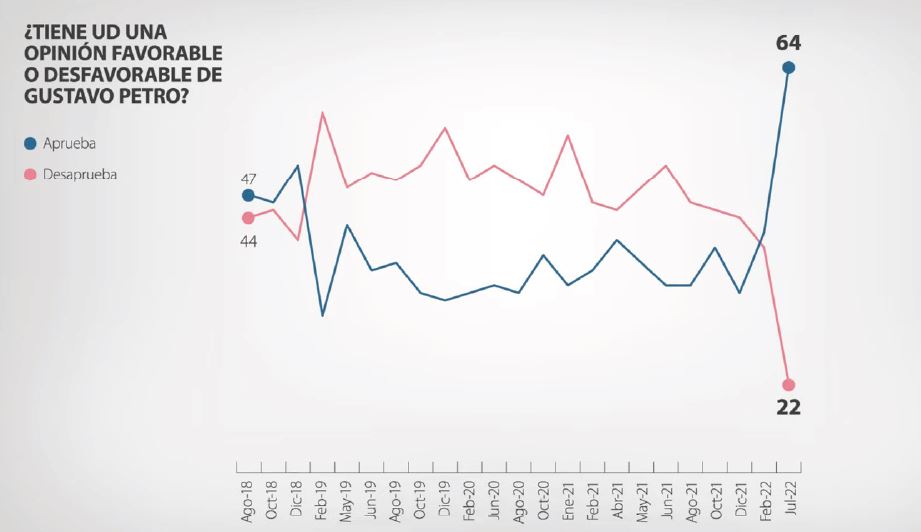
    Note: Blue: approve of Petro; Red: disapprove of Petro
    Source: Invamer

    Left-wing president, establishment cabinet

    The full 18-strong ministerial team selected by Petro brings together a lot of establishment politicians, combined with some left wingers and some more independently minded figures. It is a gender-parity team: nine of the ministers are women and nine are men. The average age is 60, with the oldest in their late 70s, and the youngest (health minister Corcho) aged 39.

    Alfonso Prada, interior minister. Prada is a lawyer, university professor, and career politician with a long history in the Liberal Party. He was appointed secretary general to the presidency in 2017 (a ministerial-level position) during the government of Juan Manuel Santos (2010-2018).

    Álvaro Leyva Durán, foreign minister. Since the 1980s, and for successive governments, Durán has been involved in peace negotiations with various armed groups. He was private secretary to President Misael Pastrana (1970-1974) and held multiple subsequent government positions, including serving as mining minister in the 1980s. He is seen as a key figure in Petro’s ‘total peace’ strategy and is expected to negotiate both with armed groups and with the Venezuelan government (which has allowed some Colombian guerrillas to maintain bases on the Venezuelan side of the common border.

    José Antonio Ocampo, finance minister. A graduate of Yale, Ocampo was a founding member of Fedesarrollo, an influential Colombian economic think tank. He served as minister of agriculture during the presidency of César Gaviria (1990-1994) and as finance minister under Ernesto Samper (1994-1998). He also was executive secretary of the UN’s Economic Commission for Latin America and the Caribbean (Eclac). Ocampo is seen as a market-friendly economist who will reassure the business lobby and pursue Petro’s goals of tax reform and poverty alleviation in a responsible and balanced manner.

    Néstor Osuna Patiño, justice minister. Patiño comes from a Liberal Party background and is a lawyer and academic who is viewed as a constitutional expert. He has served as a judge on a committee of the Consejo Supremo de la Judicatura, responsible for disciplinary matters affecting lawyers and judges.

    Iván Velásquez Gómez, defence minister. The appointment of Velásquez can be seen as one of the more audacious first moves by the new president. The new minister has no military or defence experience but has a very strong record on the defence of human rights and combatting corruption. As a Supreme Court magistrate, he coordinated the ‘parapolitics’ investigation in the 1990s which investigated illicit links between legislators and paramilitaries, and eventually led to the sentencing of over 50 members congress, many from former-president Álvaro Uribe’s Centro Democrático (CD) party. In 2012-2019 he served as the UN’s head of the International Commission Against Impunity in Guatemala (known by its Spanish acronym CICG) which brought many high-profile corruption cases to court before it was eventually closed by the Guatemalan government.

    Cecilia López Montaño, agriculture minister. López Montaño is an economist with social-democratic credentials and Liberal Party connections. She has served as agriculture minister before, and in various other roles including director of planning. Her top priority is expected to be land reform, which is a key part of the wider peace discussions.

    Carolina Corcho, health minister. At 39 Corcho is one of the younger members of the ministerial team. A medical doctor, psychiatrist, and political analyst, she favours reducing the private sector presence in the health system, currently delivered through medical insurance programmes run by Entidades Promotoras de Salud – EPSs - in favour of a greater public health role.

    Gloria Inés Ramírez, minister of labour. A politician and trade unionist, unlike many of the other ministerial picks, Ramírez is a long-term left winger, a former congresswoman, defender of LBGTI rights and a member of the Colombian Communist Party.  

    Irene Vélez, minister of mines and energy. This is also seen as an audacious appointment since Vélez, a geography graduate from Copenhagen University, has no direct experience of the mining and energy sectors but is known as an activist on issues such as food security, agrochemicals, and mercury pollution, and will lead the administration’s plans to boost the green economy and reduce reliance on key fossil fuel exports such as oil and coal.

    Germán Umaña Mendoza, minister for trade, industry, and tourism. Mendoza is an academic and an engineer from Universidad Nacional and is currently executive president of the Colombia-Venezuela Chamber of Trade. He is expected to support efforts to re-establish trade with Venezuela. On other trade issues he may follow a more protective line: he was a critic of Colombia’s free trade policies in the 1990s and has also criticised the free trade agreement with the United States.

    Alejandro Gaviria, minister of education. Gaviria, an economist, academic, and politician, was one of the various competing centrist pre-candidates who failed to prosper in this year’s presidential race. He has held many official positions, including national director of planning during the Álvaro Uribe government, and minister of health during the Juan Manuel Santos administration. During his time as health minister he defended private sector participation, attracting the criticism of the left, including from Carolina Corcho who is now a fellow member of the ministerial team.

    Susana Muhamad, minister of the environment. Muhamad has a master’s degree in sustainable development and has worked closely with Petro for more than a decade. She advised him during his three presidential campaigns (2010, 2018, and 2022); she served as general secretary of the environment in Bogotá when Petro was mayor. She has also served as president of his party, Colombia Humana. She will be charged with implementing the government’s plans to move forward towards a green economy.

    Catalina Velasco Capuzano, minister of housing. An economist and policy expert who has worked with left-leaning authorities in Bogotá, Capuzano was involved in Ciudad Usme, a left-wing experiment in affordable housing and urban reform for low-income sectors in a neighbourhood in southern Bogotá. She also served on Empresa de Energía de Bogotá, a city-owned energy provider.

    Mery Gutiérrez Cabezas, minister for ICT. The proposed new minister for information and communications technology (ICT in English, TIC in Spanish) has held a variety of positions in public enterprises. Along with some other women in the party she supported Hollman Morris, the controversial Colombia Humana 2019 candidate for the mayoralty of Bogotá, who was accused of threatening and violent behaviour against his wife, and of refusing to pay alimony. Her appointment has however been put on pause since she is the partner of a company involved in a legal dispute with the government, and there are potential conflict of interest issues to be resolved.  

    Guilermo Reyes, minister of transport. Possibly the most controversial cabinet appointment, Reyes come from a Conservative Party background and served as deputy minister of justice in 2006-2010, during the government of President Álvaro Uribe, an outspoken ideological opponent of the new administration. He has also been resisted by some members of Petro’s inner circle, who note he has been investigated for plagiarising the work of Juan Fernando Jaramillo, a specialist in electoral law. Reyes admits an “editorial error” but says the issue is now closed; his critics say the issue is ongoing.

    Patricia Ariza, minister for culture. An artist, poet, and theatre director, Ariza is seen as a long-standing cultural activist. This is her first public appointment. She says she wants to use the position to challenge preconceptions about Colombia’s long war.

    María Isabel Urrutia, minister for sport. Urrutia, an Afro-Colombian, won a weightlifting gold medal at the 2000 Olympic Games, the first Colombian in any sport to win Olympic Gold. She has also twice run as candidate for mayor in Cali.

    Arturo Luna, minister for science. Luna, a biologist with a research background in biotechnology, micro-biology, immunology and bio-chemistry, will be asked to help develop plans for a transition to a low-carbon economy.