All Categories

Subcategories

  • ECONOMIC OVERVIEW: PANAMA

    LatinNews 06 November 2013 Hits: 1809

    2014 budget approved: Panama’s national assembly approved the 2014 draft budget for US$17.76bn on 16 October, with President Ricardo Martinelli signing it into law on 21 October. Finance Minister Frank de Lima said the budget was based on a conservative estimate of GDP growth of 7.0% for 2014, with the latest July forecast from the United Nations Economic Commission for Latin America & the Caribbean (Eclac) predicting year-end growth of 7.5% in 2013. The economy grew at an annualised rate of 7.6% in the second quarter of this year, up from 7.3% during the first three months, although some way below the overall 2012 rate of 10.7%. De Lima also highlighted that the budget took into account the limit of 2.7% of GDP for the fiscal deficit, in accordance with the country’s social and fiscal responsibility law. Of the US$17.76bn, US$9.56bn will go to central government and US$4.5bn to decentralised government institutions, which includes the Panama Canal authority. The budget stipulates that US$8.84bn is to be spent on social services, US$1.69bn on infrastructure and US$1.99bn on financial services. Meanwhile US$1.43bn has been designated to non-specific areas of the budget, which includes the total amount of financial resources required for the servicing of public debt. The government was also quick to highlight that social spending accounts for 49.8% of the entire budget of which US$3.5bn will go towards the health sector, US$1.87bn towards education and culture, and US$1.77 towards social security.

    • Public debt on the rise in Panama

    Panama’s public debt reached US$15.88bn by the end of September 2013, according to economy & finance ministry (MEF) figures, up US$1.45bn, or 10% over the same period last year. External public debt stood at US$12.14bn, with domestic debt totalling US$3.74bn. Total public debt has risen by a little more than US$5bn, around 47%, during the past four years and three months, under the President Ricardo Martinelli administration. The MEF attributes the rise in public debt to investment spending carried out under the government’s ‘strategic plan’. The non-financial public sector has carried out investments to the tune of US$11.26bn during this time, of which 25.1% has been financed by procuring debt, according to an MEF communiqué.

  • URUGUAY: Mujica’s liberal successes mask one big failure

    LatinNews 19 March 2014 Hits: 1262

    President José Mujica entered his last year in power on 1 March, having completed 80% of his mandate. He has introduced ground-breaking liberal legislation on abortion, same-sex marriage and marijuana which has grabbed headlines worldwide and even saw Uruguay named ‘country of the year’ for 2013 by The Economist, for implementing policies which were “obviously sensible” and “increased the global sum of happiness at no financial cost”. But one indictment of his term in office is that when he came in he promised “the mother of all reforms” to revamp and modernise the State and, barring a miracle over the next 12 months, he will leave office having made very limited headway despite his ruling left-wing coalition Frente Amplio (FA) enjoying a majority in both chambers of congress.

    At the turn of the year, Pedro Bordaberry, the presidential candidate for the right-wing opposition Partido Colorado (PC) in this October’s general elections, blasted the Mujica administration for neglecting issues of national importance, principally public security. Bordaberry accused the government of preferring to focus its attention on dangerous experiments, such as legalising marijuana, and issues of narrow party interest, such as repealing the Ley de Caducidad amnesty law (twice upheld in popular referendums).

    Bordaberry concentrated his attack on the government’s failure to arrest a surge in homicides in recent years – security is the main thrust of his campaign, which includes collecting signatures to hold a plebiscite together with the elections on whether to lower the age of sentencing to 16 from 18 for crimes such as rape and homicide [RBS-14-01]. However, it was more intriguing that Bordaberry’s criticism of the FA’s failure to deliver on key national issues should have coincided with Mujica’s call for public sector employees to be rotated in their jobs every 10 to 15 years.

    Mujica has been promising a profound state reform since he took office in March 2010, but he has made scant progress. According to figures included in his government’s annual report presented to congress on 1 March to open the new session, Mujica has not only been unable to streamline the bloated state sector, but it has actually grown even bigger on his watch. There were a total of 268,443 public sector jobs at the end of 2012, up from 248,157 when Mujica took office.

    Argentina and Aratirí

    Unsurprisingly these statistics were not included in Mujica’s introductory message to the annual report, presented to congress exactly one year before he hands over power to his successor (most likely to be his predecessor, former president Tabaré Vázquez [2005-2010]), when he expatiated on a range of issues. Indeed, the message, and the report, was remarkable not so much for what it said as for what it did not say. There was no mention at all, for instance, of Argentina or the controversial Aratirí mining project to exploit 250m tonnes of iron ore deposits within some 14,000 hectares overlapping the boundaries of the three central departments of Durazno, Florida and Treinta y Tres.


    Uruguay’s tempestuous relations with Argentina have been well-documented, but the report’s identification of Brazil, Venezuela and even Mexico as the country’s strategic partners looked like a deliberate slight even if it were not intended as one.

    The omission of Aratirí from the report was also somewhat perplexing given that the government pushed through congress historic legislation last August allowing open-pit mining in the country, and that elsewhere the report emphasised that the planned deep-water port on Uruguay’s Atlantic coast, which is intimately linked to the mining project, would “re-found the country and the region”. The industry minister, Roberto Kreimerman, said on 20 February that Aratirí, which has been fiercely opposed by the agricultural sector but does not seem to have stirred the imagination of the general public yet (see sidebar), would shortly be agreed with the Indian mining firm Zamin Ferrous, and could net the country US$400m annually over the next 20 years.

    Drugs
    On the issue of drugs, the national drug council (JND) revealed in the annual report that a total of 2.1 tonnes of marijuana was confiscated in 2013, along with 81.7kg of cocaine and 74.5kg of cocaine paste. The JND said that it had trained 170 border control officials to prevent marijuana from being smuggled out of Uruguay once it begins to be sold by the State in pharmacies later this year, when the law legalising the cultivation and sale of the drug takes effect.

    The government expects to have the regulation of the law on marijuana in place by this April. The secretary general of the JND, Julio Calzada, has estimated production of 20-22 tonnes a year to supply the domestic market; the JND is working on measures to prevent its resale. The JND elaborated in the annual report on numerous forums and seminars held in 2013 in one of which, for instance, experts from the Colombian national police helped train Uruguayan personnel in port and airport drug control. But, as things stand, the JND has not furnished the public with any real details on how it will prevent illegal trafficking of marijuana or how it will provide security of marijuana crop plantations.

    The JND’s overview in the annual report preceded by three days the presentation of the annual report of the International Narcotics Control Board (INCB), on 4 March, by Raymond Yans, the president of the UN body. Yans has been an outspoken critic of the Mujica administration’s law legalising marijuana, and he reiterated his comments that it contravenes the 1961 single convention on narcotic drugs, while reminding Uruguay of the need to respect treaties.

    The INCB report itself merely “notes with concern that in July 2013, the lower house of Uruguay approved new legislation that would allow the State to assume control over and regulate activities related to the importation, production or acquisition of any title, storage, sale or distribution of cannabis or its derivatives, under terms and conditions to be determined by a regulation, for the purpose of non- medical use.” Yans, however, explained, that the absence of more pertinent criticism was due to the fact that Uruguay’s senate only approved the law in December - after the INCB’s annual report was finished. Yans described the law as “a misguided initiative”, adding that “drug-traffickers will choose the path of least resistance, so it is essential that global efforts to tackle the drug problem are unified”.

    Marijuana smuggling

    Just as congress was reading in the government’s annual report about the national drug council (JND)’s efforts to train border control officials to prevent marijuana from being smuggled out of Uruguay after the marijuana law takes effect, news emerged of a significant amount of marijuana being smuggled in. A total of 190 kilos of marijuana was discovered in a ranch on the outskirts of Bella Unión, a city in the northernmost corner of Uruguay, after an investigation into the death of a Bella Unión native in a suspected settling of scores in Montevideo on 4 February.

    The find confirmed Bella Unión as a strategic location exploited by Brazilian criminal gangs, which traffic marijuana from Paraguay, cocaine from Bolivia, crack cocaine from Brazil, and cocaine paste from Argentina. Bella Unión is located in the northern department of Artigas, 6kms from the Brazilian border town of Barra de Quaraí, linked by an international bridge across the River Cuareim. This is a tributary of the River Uruguay, which separates Bella Unión from the Argentine town of Monte Caseros, half an hour away by boat.

    • Aratirí - According to the most recent poll conducted by Equipos Mori in early March, 26% of the population agree with the Aratirí mining project. This has been presented by some opponents of the project as a sign that the public is not in favour of the project. However, the poll also shows that 26% of respondents had never even heard of Aratirí, 15% were unsure, and 10% did not reply. This leaves just 23% who were actually against it. President Mujica stressed the importance of not creating an “apocalyptic” vision of the project.
    • Mujica - President José Mujica gave a characteristically straight-talking interview to the Brazilian paper O Globo this month defending his government’s decision to legalise the production and sale of marijuana. “It is not legalisation as people imagine abroad […] foreigners cannot come to Uruguay to buy marijuana. There will be no marijuana tourism. It is a tool to combat a serious crime: drug-trafficking, and to protect society.” Mujica also defended the legalisation of same-sex marriage: “We applied a very simple principle: recognise facts […] gay marriage, for instance, is older than the hills. We had Julius Caesar, Alexander the Great. People say it is modern but it is older than all of us. It is an objective reality. It exists. Not to legalise it would be to torture people uselessly.”
  • TRACKING TRENDS

    LatinNews 15 September 2016 Hits: 404

    ARGENTINA | ‘Mini Davos’ forum. As part of its efforts to restore Argentina’s international standing and attract foreign investment following its return to international financial markets on the back of the resolution of the country’s long-running debt dispute, the government led by President Mauricio Macri began hosting its ‘Argentina Business & Investment Forum’ in the city of Buenos Aires on 12 September. The event, which concludes on 15 September, has been billed by the Macri government as a ‘mini Davos’ for Argentina, modelled on the annual World Economic Forum in the Swiss ski resort attended by global business and political leaders.

    Macri said that he hopes the inaugural ‘Argentina Business & Investment Forum’, to which 1,900 leading businessmen from 67 different countries have been invited, will lead to “significant pledges” of investments in Argentina. In formally opening the forum, Macri said that government officials (including the governors of Argentina’s 24 provinces) would present US$200bn worth of investment opportunities in the country that his government wants to promote in a number of areas, including non-conventional oil and gas production projects, mining, renewable energy, and road and railway infrastructure.

  • REGION: Costa Rica border restrictions throw regional trade into doubt

    LatinNews 21 July 2020 Hits: 753

    Costa Rica and its neighbours faced the same dilemma as countries around the world in the face of the coronavirus (Covid-19) pandemic: how best to protect their populations while mitigating the economic effects of lockdown.

    As the virus spread, the members of the Central American integration system (Sica) regional organisation - Costa Rica, El Salvador, Guatemala, Honduras, Nicaragua, Panama, Belize, and the Dominican Republic - worked together on a contingency plan to deal with the virus. The plan was published on 15 March and covered five main areas, including trade. Its stated aim is to support measures enacted by Sica member states and “develop, in as short a time as possible, measures to deal with the imminent negative economic effects of the pandemic”.

    Intra-regional trade was worth US$19.8bn in 2018, according to the secretariat for Central American economic integration (Sieca) and protecting supply chains was a top priority to prevent shortages of goods. Sica recognised the importance of securing free movement of goods during the pandemic and vowed to prioritise the movement of critical products across borders. The plan also addressed the importance of coordination and collaboration between the various institutions that impose controls at national borders, such as health, sanitation and migration.

    However, Costa Rica threw a spanner in the works on 15 May by imposing unilateral sanitary measures. The country issued two decrees designed to minimise the number of foreign lorry drivers in the country at any one time. The measures were implemented after around 50 foreign drivers tested positive for Covid-19 at the border. Those that tested positive allowed to stay in Costa Rica for only 72 hours and ordered to hand over their cargo to local drivers at the border for distribution. While the government did not explicitly close the border, the drivers could not accept the changes for contractual reasons, such as not giving up their containers to Costa Rican drivers, and the border was effectively closed to freight traffic.

    While Dyalá Jiménez, Costa Rica’s minister for foreign trade, said that the borders were open and truckers could enter the country, traffic essentially stopped. While the aim was to slow the spread of coronavirus, it led to a build-up of as many as 1,500 trucks at the border, according to Sica, which reported queues of 25km on both sides of the border. Adán Aquino, president of Transportes Los Andes, a Guatemalan logistics firm, admitted that truckers blocked the border crossings in order to pressure the Costa Rican government into rolling back its measures. Nicaragua closed its border in protest, and Honduras later imposed reciprocal restrictions on freight from Costa Rica, as did Panama. Officials across the region complained about the chaotic situation and its huge costs to business, as did the private sector.

    Guillermo Jacoby, the president of the Nicaraguan association of producers and exporters (Apen), said Nicaragua exports US$2.5m worth of goods to Costa Rica each week, and imports US$9m per week. Jacoby also raised concerns about the development of a coronavirus hotspot at the border given the unsanitary conditions faced by the drivers. “There are worries over health as well as economic matters”, said Jacoby, who is also president of the Central American and Caribbean federation of export chambers and associations (Fecaexca).

    Nicaragua’s Vice President Rosario Murillo said that freight traffic is fundamental to the region and emphasised the destabilising effects of Costa Rica’s actions. “There are agreements between the Central American nations that can’t, and shouldn’t, be cancelled without consulting each of the countries”, said Murillo. Honduras’s economic development minister, María Antonia Rivera, said the measures had caused “chaos” in terrestrial freight transport in the region, with businesses transporting perishable goods among the worst affected. Fecaexca complained about the limits on intra-regional trade, which makes a significant contribution to regional economies. Costa Rica itself exported US$2.3bn worth of goods to neighbouring countries in 2018, according to figures from Sieca.

    However, Fanny Estrada, Fecaexca secretary, said Costa Rica was causing more damage to its own economy given the fact that it imports many raw materials that are used by industry then exported elsewhere. Laura Bonilla, president of Costa Rica’s export chamber (Cadexco) concurred that the measures had seriously hurt the Costa Rican economy, which relies on many products manufactured elsewhere in the region.

    The situation persisted for two weeks before the Sica members managed to negotiate a deal to get trade moving again on the condition that drivers complete a biosecurity protocol, including temperature checks, and stay in Costa Rica for a maximum of five days. Vinicio Cerezo, Sica general secretary and former president of Guatemala (1996-2001), hailed the deal for finding a balance between health and the economy, holding it up as evidence of the benefits of regional economic integration.

    From 1-8 June some 2,398 trucks crossed Costa Rica’s borders, according to Costa Rican government data. Guatemalan, Nicaraguan, and Salvadoran truckers have made the most crossings, in that order. Costa Rican authorities have also been tracking trucks using GPS to ensure they don’t circulate within the country and have also been organising caravans of foreign trucks that travel together.

    While the flow of cargo looks to be recovering, there is little doubt that the issue could prove to be a flashpoint again in the near future given differing approaches to combating the coronavirus among Sica nations. Costa Rica is prioritising its hugely important tourism industry and wants to reopen to foreign visitors as soon as possible, which means keeping case numbers low in order to convince people it is safe to return. But neighbouring Nicaragua continues to deny that Covid-19 is a problem and could prove to be a significant source of cases.

    Truckers from Guatemala and Honduras, which have also imposed limited lockdown measures, could also represent a transmission risk when they reach Costa Rica. Sica is doing its best to maintain regional unity, but the coronavirus will test member states’ commitment to integration and Costa Rica could be forced to make difficult decisions.

    At the same time there is no doubt that intra-regional trade is important, and Cerezo has emphasised that the regional market is the second most important for Central American economies after the US, and integration is key to driving growth in the region. Before the coronavirus struck, regional leaders had agreed that one of the main aims was to boost trade, and given that average tariffs have traditionally been low (around 2% according to the United Nations Economic Commission for Latin America and the Caribbean), reducing non-tariff barriers, such as administrative issues and a lack of infrastructure, is the focus.

    However, with coronavirus set to decimate regional economies it appears that belt tightening could threaten infrastructure spending. This would add to existing problems for Sica, which continues to battle for relevance as member states deal with more pressing issues. While Costa Rica may argue that the two decrees did not explicitly close its borders, its detractors complained that the measures showed a lack of consideration for its neighbours and trade partners and a willingness to put its own interests first over regional economic integration.

  • VENEZUELA: Dutch disease rife

    LatinNews 30 March 2012 Hits: 3002

    The strength of oil prices and the overvaluation of the Bolívar are hollowing out the economy. An opposition analysis of central bank data claims that output from manufacturing industry is back at 2006 levels.

    According to this analysis, published in El Universal, an opposition-supporting newspaper, the BCV’s production volume indices for the private sector show that in  September 2011, at least six industrial sub-sectors were producing less than they did in 1997, the year before Hugo Chávez was first elected president. Textiles, metals and vehicles are three such industries.

    Carlos Larrazabal, the president of the industrialists association, Conindustria, claims that the overvaluation of the Bolívar, which makes imports more attractive than domestic production, coupled with delayed licensing, a heavier tax burden, electricity rationing and price regulation, have hobbled local industry.

    Chávez is not the only president to have tried (and failed) to diversify the economy away from dependence on oil exports. In 2011, 95% of the county’s export revenues came from oil. The actual export figure in value terms was US$92.6bn, of which US$88.1bn came from oil. The other big contributor was bauxite and aluminium, which is internationally competitive because of the country’s cheap electricity.

    By contrast in 2000, the furthest back the BCV data goes on its website, total exports totalled US$33.5bn, of which US$27.8bn (83%) were oil exports. And in 2000 the private sector accounted for US$1.2bn of oil exports, which it no longer does.

    Even in those industries prioritised by the Chávez administration, such as food, industrialists are grumbling. Pablo Baraybar, the president of the Venezuelan Chamber of the Food Industry (Cavidea), said that many companies cannot expand their production capacity because of price controls. Baraybar told El Universal that the prices of regulated foodstuffs cause huge losses in companies every month.

    Oil revenues: In the first two months of 2012 the government announced that it had windfall oil export receipts of US$7.5bn. The government said that it was exporting an average of 2.2m barrels per day (bpd) of crude oil, at an average price of US$109.2 a barrel. The government drew up its 2012 budget on an average oil price of US$50 a barrel. The official figure for oil exports is 2.9m bpd, but this includes oil sold at concessionary rates to PetroCaribe beneficiaries, as well as oil shipped to China in payment for previous cash loans. The oil and mining minister, Rafael Ramírez, said that each US$1 change in the international price of oil adds (or costs) the country US$972m a year.

    The government is spending this windfall. Figures from the planning ministry show that government spending at BF$57.4bn was 76% higher than for the first two months of 2011. In real terms (i.e. discounting annual inflation of around 26%) the increase in spending is about 50%. A fifth (21%) of total public spending goes on wages. The next biggest item in public spending is transfers to state and regional governments.

    Venezuelan inflation: Nelson Merentes, the president of the BCV, forecast that inflation would be at single digit levels in 2014. He expects inflation in 2012 of between 22% and 24%, down from the current annual level (February 2012) of around 25.6%. Annual inflation was 27.6% in 2011.

    • Labour Law

    President Hugo Chávez is pushing to end the debate on the new labour law which he wants to introduce on 1 May. He accused the private sector (Fedecamaras) and the bourgeoisie of refusing to engage in the debate on the reforms. The Fedecamaras president, Jorge Botti, claims that the business sector has not been formally consulted.

  • ARGENTINA: Default –¿una mala noticia para Scioli?

    LatinNews 25 July 2014 Hits: 507

    Aunque un acuerdo de último minuto todavía es una posibilidad remota, el balance de las probabilidades esta semana ha sido que como resultado de su disputa con sus acreedores ‘holdout’, en gran medida basados en EU, Argentina entraría en su segundo default de su deuda externa en 12 años el 30 de julio. Esto podría alterar los cálculos políticos en torno a las elecciones presidenciales del 2015.

    En cierto nivel, el default podría no tener muchas repercusiones. Ya que Argentina ha sido en gran medida excluida de los mercados internacionales de capital por años, no se producirá un cambio súbito. Los analistas ampliamente coinciden en que los efectos de ‘contagio’ serán limitados, y que el principal riesgo para Argentina será una profundización de su actual recesión y –quizá algunos meses por delante– un incrementado peligro de renovada escasez de moneda extranjera y el debilitamiento del peso. Lo que sí cambiará son los cálculos políticos hechos en torno a las elecciones presidenciales del 2015.

    Entre los actuales favoritos (aún es una lista preliminar), Daniel Scioli (el gobernador pro-gobierno de la provincia de Buenos Aires) y dos líderes de la oposición, Sergio Massa ( el diputado de la facción Peronista disidente, Frente Renovador) y Mauricio Macri (el alcalde de centro-derecha de la capital federal), todos tenían en general el mismo plan de juego. Poniéndolo crudamente, todos ellos estaban esperando que la Presidenta Cristina Fernández ordene todas las cuestiones de la deuda externa, lo que les permitiría planear un futuro gobierno desde cero, uno que tal vez atraiga  nuevas inversiones extranjeras y financiamientos para esperanzadoramente comenzar el 2016 acomodándose en un nuevo ciclo de crecimiento económico.

    Peor ahora mucho depende de cuán largo será el tiempo que durará el default, y sobre cómo será administrado. Un default corto con una solución a comienzos del 2015 no alteraría fundamentalmente el plan de juego. Pero un default largo –y uno en el cual incluso la reestructuración de la deuda con el Club de París o los canjes de deuda del 2005 y el 2010 comiencen a desmadejarse– tendría tres grandes consecuencias políticas. La primera es que Argentina podría hundirse de una recesión y problemas financieros más profundos, incluyendo la militancia de los trabajadores y las protestas sociales que desestabilizarían el proceso de transición democrática. La segunda es que los candidatos cercanos al gobierno, como Scioli, quedarían salpicados por asociación. La tercera es que  en el caso del peor escenario los aspirantes a presidente podrían heredar una disputa por la deuda externa activa, en vez de una que ha sido convenientemente resuelta, para peor o mejor, por la administración saliente. Esto, en sí mismo, podría ser visto como un cambio en la descripción del trabajo para el próximo presidente de Argentina.

    • El default acecha

    El 22 de julio el juez del Distrito de Nueva York, Thomas Griesa, rechazó el pedido formal de Argentina por una extensión a la fecha límite del 30 de julio para llegar a un acuerdo con sus tenedores de bonos ‘holdouts’. Habiendo si ordenados reunirse con el negociador designado por la corte, Daniel Pollack, el 23 de julio, los abogados de Argentina no acudieron a la reunión. Los holdouts, los abogados de Argentina, y Pollack, debían tratar reunirse de nuevo el 24 de julio.

  • COSTA RICA: Losing friends and alienating people

    LatinNews 09 September 2014 Hits: 928

    Given that President Luis Guillermo Solís heads a small, bitterly-divided party, the logic of using a set-piece speech on 28 August to lambast the sins of the country’s main political parties is not entirely clear. To mark 100 days in office, Solís chose to focus on the dire situation Costa Rica finds itself in and the extent of the culpability of the country’s two main parties, Partido Liberación Nacional (PLN) and the Partido Unidad Social Cristiana (PUSC). While quite possibly true, the speech will not help the president’s Partido Acción Ciudadana (PAC) to build the alliances necessary to pass legislation.

    100 days

    Without mentioning either of the two parties by name, Solís bemoaned the “unimaginable” disorder he had discovered on entering office, claiming that corruption had cost the country C$60.1bn (US$111m) over the past 15 years. His subsequent plea for a dialogue with all of Costa Rica’s political parties to improve the administration of the state met with a frosty response. The head of the PLN, Juan Luis Jiménez, described the president as petty and hypocritical for failing to recognise the “legacy” of previous administrations. Rafael Ortiz, leader of the PUSC, listed the anti-corruption achievements of former presidents Abel Pacheco (2002-2006) and Miguel Angel Rodríguez (1998-2002). Other party leaders criticised the president’s lack of concrete proposals on the issue.

    Though corruption dominated his speech, Solís also addressed the country’s fiscal deficit, currently running at just over 6% of GDP. The solution, according to the president is to increase production. Tax revenues in 2012 reached 13.8% of GDP; Solís said that he wants to increase this, gradually, to 14%. In an effort to reach out to the business community, the president announced a series of consultations with the country’s leading industrialists prior to relaunching a “competitiveness council”.

    Solís has his work cut out to get Costa Rica’s private sector on-side. In an attempt to honour his pre-election pleges to reduce inequality, the president also reiterated his commitment to create 217,000 jobs over the next four years, particularly for those in high unemployment categories, such as working mothers and those with disabilities. One of the leading private sector lobbying groups argues the plan has only taken into account social factors and not economic competitiveness. Given the president’s earlier flirtation with the idea of joining Petrocaribe, the Venezuelan preferential oil agreement, trust between the government and the business community is eroding quickly.

    A house divided

    One of Solís principle challenges is that he heads a party with just 13 seats in the 57-seat unicameral national legislature. The PAC is also internally divided, following a decision by its ethics committee to suspend deputy Victor Morales Zapata, a close ally of Solís, over corruption allegations dating back to 1994. On 3 September, the party’s president, Rodrigo Alberto Carazo, quit just two months into the job. “I did not fully realize the extent of the involvement required,” he said. “It has been so intense that it has significantly affected my health.” Carazo was engaged in the thankless task of trying to reconcile the party’s increasingly fractious members.

    Meanwhile Solís’ namesake, the party’s founder, Otton Solís, continues to air in public his grievances with the PAC’s direction. Ottón has criticised the performance of the cabinet chief, Melvin Jiménez, a Lutheran bishop acting as the go-between the executive and the legislature; and has demanded the resignation of the deputy minister for the presidency, for using his position to benefit his family business. The situation deteriorated further on 7 September when Mariano Sales, an adviser to Jiménez, used a debate over party financing to demand that Ottón repay the C$438,000 (US$800) debt he owed the party’s executive committee.

    • Conflict of interest

    The split in the Partido Acción Ciudadana (PAC) widened during the course of its party conference over the weekend of 6-7 September. A number of party delegates who work for the presidency attended the meeting, prompting complaints of abuse of power by those party members who have no role in government.

  • Region: Policy moves from the other central banks

    LatinNews 22 February 2016 Hits: 2498

    Venezuela and Mexico are not the only countries in the region where the authorities have taken important policy decisions in recent weeks.

    On 19 February 2016, the board of Banco de la República (BanRep – Colombia’s central bank) increased its key policy rate by 25 basis points to 6.25%. This is mainly because of high inflation and inflation expectations. Thanks in part to the impact on food prices of El Niño and in part to the passing on to consumers of increased costs associated with the past depreciation of the peso, headline annual inflation in January was 7.45%, while core inflation was 5.73%. Bond markets indicate that investors are looking for inflation of 4.5%-5.0% annually over the next two-to-five years. BanRep’s inflation target is a 2.00%-4.00% band. BanRep began increasing the key rate in September last year, prior to which it had stood at 4.50%.

    In the meantime, declines in the price of oil have boosted risk premiums for financial assets in Colombia and other Latin American countries at a time when economic recovery in Colombia’s main trading partners through 2016 is likely to be weaker than had previously been expected.

    As is the case in Mexico, tighter monetary policy is supporting fiscal policies. In Colombia’s case the deterioration in the terms of trade (ie from lower energy prices) is seen as being likely to be long lasting. As BanRep has said, “The announced cuts in public expenditure and the firm commitment of the government to submit a structural tax reform in 2016 are necessary measures for the economy to adjust to the new income levels.”

    Banco Central de Reserva del Perú (BCRP – Peru’s central bank) raised its key policy rate by another 25 basis points to 4.25% on 11 February 2016. BCRP had increased its rate in January and December as well. Like BanRep, BCRP has been concerned by the impact on inflation and expectations of the past weakness of the currency and higher food prices, as well as the volatility in global financial markets. The BCRP noted that there had been “mixed signals of recovery in terms of production and employment in the larger economies”. BCRP noted that the output from Peru’s economy had been below potential for much of 2015 but that it should return to potential over the course of 2016.

    Also on 11 February 2016, the Banco Central de Chile (BCCh) kept its key policy rate unchanged at 3.50%, having increased it by 25 basis points in each of October and December last year. The accompanying commentary was hawkish. BCCh noted that headline and core annual inflation in January had been over 4% and nearly 5% respectively – or well above the medium-term target of 3.00%. Meanwhile, according to BCCh, “available data…continues to show limited growth in domestic output and demand”.

    After a long series of increases to the key Selic rate, the monetary policy committee (Copom) of Banco Central do Brasil (BCB) voted 6-2 on 20 January 2016 to keep the rate unchanged at 14.25%. The minority had advocated a 50 basis point rise in the rate to 14.75%. The latest indicators point to annual inflation in Brazil of 10.5%-11.0%. The Copom considers that high inflation is partly the result of liberalisation of previously regulated prices (which are rising as a result) and the convergence of domestic prices with international prices (again through movement in an upwards direction). The Copom is looking to reduce inflation to 4.5% in 2017.

    Unlike their counterparts in Colombia, the majority of the Copom’s members see the difficult conditions in global economies and markets as a reason to not tighten monetary policy. A minority in the Copom argued that it would be appropriate to adjust, immediately, the monetary conditions, in order to reduce the risks of non-compliance of the inflation targeting regime objectives, and to reinforce the process of anchoring inflation expectations. However most of the Copom members considered that the elevation of the domestic and, mainly, the external uncertainties justified waiting until the next meeting (on 1 March 2016) before deciding on its next move.

  • ECONOMIC HIGHLIGHTS

    Patrick de Courcy 20 September 2024 Hits: 945

    BRAZIL | Investment in oil exploration expected to rise. On 2 September, Brazil’s federal oil and gas regulator (ANP) published its 2023 annual report on exploration, which includes projections for investments in the sector between 2024 and 2027. ANP expects overall investments in the oil and gas exploration phase to total R$18.31bn (US$3.29bn) over this period. Investments in this phase, during which studies are carried out in exploratory blocks to determine the presence and viability of oil or gas, are predicted to be highest this year at R$9.97bn (of which R$9.5bn for offshore exploration). Expected investment will fall to R$7.64bn in 2025 and then just R$701m in 2026-2027. According to the ANP report, 2024 is expected to be a record year for oil and gas exploration, with 39 wells due to be drilled by the end of the year, surpassing the previous record in 2019, when 27 wells were drilled. From 2024-2027, seven new wells are expected to be drilled in the Santos basin along Brazil’s south-eastern coast, while eight wells are projected for the Foz do Amazonas area, in the ecologically sensitive waters near the mouth of the Amazon River.

    BRAZIL | New central bank president chosen. On 28 August, the Brazilian government confirmed that President Luiz Inácio Lula da Silva’s nominee for the presidency of the central bank (BCB) is Gabriel Galípolo, currently on the bank’s board as monetary policy director. The term of the current BCB president, Roberto Campos Neto, ends on 31 December. Galípolo’s nomination, which was announced by Finance Minister Fernando Haddad, must be confirmed by the senate. He has close ties to the Lula administration, having served in the finance ministry under Haddad and as advisor during the transition in 2022, however he may turn out more hawkish than hoped for by Lula. The central bank, and Campos Neto in particular, have been the target of Lula’s ire over high interest rates. Lula complains that these raise borrowing costs and stifle growth, while the central banker says they are necessary to keep inflation in check. Brazil has among the highest interest rates in the world, with analysts expecting the Selic benchmark rate to stand at 11.25% by the end of the year according to predictions in early September, when the rate stood at 10.5%.

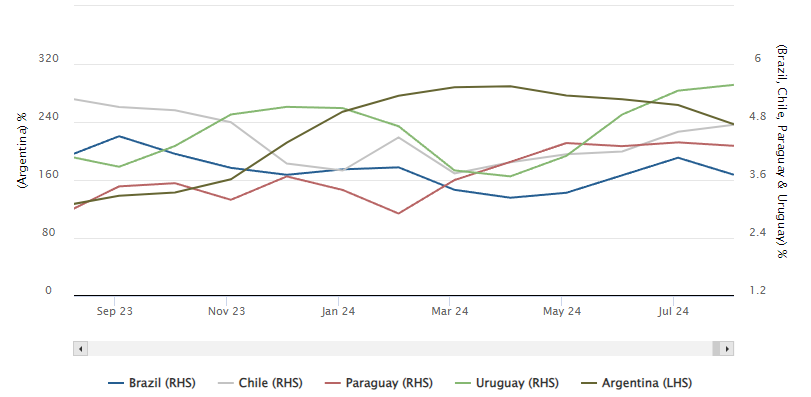
    Brazil & Southern Cone: inflation rate
    Percentage variation (year-on-year)

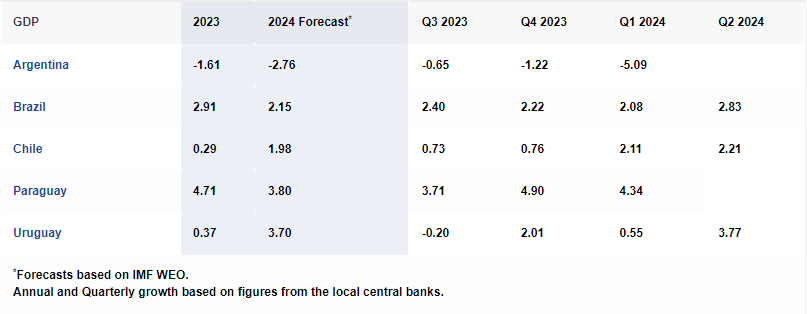
    Brazil & Southern Cone: GDP growth (%)
    Quarterly figures are year-on-year growth


  • CUBA: Tourism in a tailspin

    Sarah Sheldon 22 September 2025 Hits: 653

    The latest numbers from Cuba’s national statistics institute (Onei) show that Cuban hotel occupancy dropped by nearly seven percentage points in the first half of this year to 21.5%, while tourist arrivals slumped by 25% to 981,856.

    Cuba’s tourism sector is in a jam. The country appears to be caught in a vicious circle, where power cuts, water shortages, and garbage on the streets discourage visitors; but fewer visitors, in turn, bring in less of the foreign currency that the government desperately needs in order to fix the collapse in essential services.

    In effect, the tourist business is trying to survive with only one out of every five beds occupied. US tourists are dwindling as the US administration led by President Donald Trump tightens sanctions further. Officially US citizens are banned from visiting the island for tourism, but 12 categories of visits are still allowed (including sports and educational visits) These have become more restrictive. US citizens are also banned from using hotels linked to a prohibited list of companies: Torre K-23, a hotel which is the tallest building in the country, has just been declared off-bounds to US visitors.

    Cuba inflation

    On 11 August, Cuba’s national statistics office (Onei) released new figures showing monthly inflation in July was 0.49%, bringing the annual rate to 14.37%. This compares with monthly inflation of 0.75% in June when the annual rate was 14.75%. The country closed 2024 with an inflation rate of 24.88%.

  • DOMINICAN REPUBLIC: Abinader puts gold on hold

    Sarah Sheldon 26 May 2026 Hits: 180

    It could be described as a quick turnaround. On 3 May thousands of protestors registered their opposition to the Romero gold, copper and silver mine; the next day President Luis Abinader ordered a halt to all development at the project, which is owned by GoldQuest of Canada.

    The mine is in San Juan province. It has the capacity to produce round 117,000 gold ounces a year as well as significant volumes of copper and silver. Demonstrators who oppose the mine walked around 20km to the Sabaneta dam, a water source that they say will be threatened by the development. Explaining his freeze on development work at the project, President Abinader said “when citizens express worries and concerns, our duty is to act with caution and transparency.” The project has not yet received a full environmental impact approval. GoldQuest  has acknowledged public concern and says it is committed to “transparent development”.

    Public opinion has begun to turn against big mining projects in the country. These are now seen as a potential threat to water and agricultural use. Mining currently represents around 2% of GDP on data from the World Bank. A water protection movement is now backed by teachers, doctors, and farmers who fear water contamination. In the light of the protests, how the Romero project will progress is not entirely clear. However, former president Hipólito Mejía (2000-2004) has called for technical reports to underpin the debate.

  • GUATEMALA: Govt threatens to slash spending in order to pressure congress

    LatinNews 31 August 2011 Hits: 716

    The government is preparing to cut public expenditure by US$272m, because it has given up hope that the recalcitrant congress will approve either further foreign borrowing or a law against tax evasion.

    President Álvaro Colom has already announced cuts of Q$2.125bn (US$265m) across the board, leading to lower spending on security, justice, education, health and support for farmers. The country is scheduled to go to the polls on 11 September to elect a new president and congress.

    The opposition has persistently resisted government attempts to get a reform through congress. It argues that the government cannot keep on borrowing.

    Hugo Mául, director of the Centro de Investigaciones Económicas Nacionales (CIEN), argues that the decision to cut spending underlined the weakness of the current government and perhaps also the country’s institutional machinery. He argued that the next government would need to introduce a wide-ranging fiscal reform simply to maintain spending at its current level.

    Remittances: Inflows increased 9.5% in the first half of 2011 on the same period last year to US$2.18bn, according to the central bank (Banguat). The president of Banguat, Edgar Barquín, predicted that remittances would break all previous records to reach US$4.5bn in 2011, surpassing the US$4.32bn recorded in 2008 before the onset of the global economic slowdown.

    Inflation: In June, monthly consumer price inflation was 0.52%, bringing the rate over the past 12 months to 6.4%.

  • URUGUAY: Pulp, sulphur and politics

    LatinNews 10 September 2013 Hits: 2646

    On 14 September Finland’s UPM-Kymmene Oyj will close down its large-scale pulp processing plant in Uruguay’s Fray Bentos for annual maintenance. It says that if the government authorises it to increase annual output to 1.3m tonnes, it will re-start production on 25 September; but if it has to keep to the current 1.1m tonne capacity limit, it won’t be able to re-start operations until November. The choice between the two options is highly political, and sources suggest that despite the enthusiasm of local business, the Montevideo government is unwilling to authorise greater production.

    The big political issue hanging like a dark and stubborn cloud over UPM’s modern pulp plant in Fray Bentos is Argentine opposition, much of it coming from the city of Gualeguaychú, across the shared River Uruguay. When Uruguay authorised the original project Argentina protested about its alleged environmental impact on the river and Argentine territory. This triggered five years of unprecedented diplomatic dispute between the two countries, with Argentine activists blocking the international bridge across the river, resulting in a serious fall in Uruguay’s tourism revenues. Many Uruguayans argued that Argentine opposition was less of an environmental issue and more of an economic one, since the plant produced lower cost newsprint than Argentina’s Papel Prensa company.

    The dispute was eventually taken to the International Court of Justice (ICJ) at The Hague, which in April 2010 ruled that although Uruguay had not followed due consultation process under a bilateral treaty on the management of the River Uruguay, the plant could continue to operate. Technical reports upheld the Uruguayan position that the river was not being polluted.  Later that year, Presidents Cristina Fernández of Argentina and José Mujica of Uruguay effectively ended the dispute, creating a new bilateral body, the Comisión Administradora del Río Uruguay (CARU).

    More than three years after the end of the dispute, sources say President Mujica simply does not want to open it up again. In late August he played host to Fernández at the inauguration of a US$360m desulphurisation plant near Montevideo, and signed a memorandum of understanding allowing Argentina to buy surplus liquid natural gas (LNG) from a US$1.25bn offshore LNG regasification plant to be built in Uruguay by GDF Suez. The plant will be operational by 2015. An anonymous official source quoted by the Uruguayan newspaper El País said “the Uruguayan government does not want to generate a tense situation which can complicate relations with Argentina, much less following the good reception Cristina Fernández received when she visited Uruguay on 27 August. Thus the idea is no decision on UPM in the short term”. Other sources suggest the Buenos Aires government has in any case asked for various bilateral issues to be put on hold until after the mid-term congressional elections in Argentina at the end of October.

    All of which is seen as a disappointment for UPM but also for its many Uruguayan suppliers. The plant processes eucalyptus timber into bleached hardwood kraft pulp (BHKP). As a by-product it also generates CO2-neutral biomass-based electricity for the local market.

    According to Atilio Ligrone of Uruguay’s Sociedad de Productores Forestales, increasing the plant’s annual output to 1.3m tonnes could boost Uruguayan exports by US$100m and create 2,000 new jobs. He noted that up to 600 local companies were supplying UPM with timber, and that the plant consumes 40% of the country’s total timber production.  Javier Carrau, president of the Cámara de Industrias del Uruguay said, “we were hoping for a positive decision, this is not the time to be closing anything down”. He added, “if Argentina has not made a formal complaint, the decision is hard to understand. This affects five or six thousand workers, we’re surprised and we hope any decision can be reconsidered. These are important shift payments and transport fees that are being lost. And this can scare investors.”

  • ECONOMIC HIGHLIGHTS

    Patrick de Courcy 15 September 2022 Hits: 1706

    MEXICO | Job creation remains strong. On 5 September, Mexico’s national social security institute (IMSS) released figures showing that, as of 31 August, it had registered 21.2m jobs. According to IMSS, in August 157,432 jobs were created in the formal sector, representing a monthly increase of 0.7%.

    MEXICO | US energy dispute softens. On 2 September, Mexico’s President Andrés Manuel López Obrador said he was “satisfied” with a letter he received from US President Joe Biden concerning Mexico’s energy policies. In July, the US and Canada requested consultations under the US-Mexico-Canada Agreement (USMCA) in relation to concerns surrounding Mexico’s energy policy. On 2 August, López Obrador sent a letter to Biden in which he stressed Mexico’s energy sovereignty. In Biden’s reply, he expressed his “deepest respect for…the independence and sovereignty of Mexico”.

    MEXICO | Interest rates hiked again. On 11 August, Mexico’s central bank (Banxico) raised its benchmark interest rate by 75 basis points to 8.5% - its tenth consecutive rate hike. Banxico also revised up its inflation forecast for the end of 2022 to 8.1%, up from 7.5% in its previous (June) forecast. Annual inflation in Mexico stood at 8.15% in the first two weeks of August.

    MEXICO | US decision on EV tax credits celebrated. On 8 August, Mexico’s ambassador to the US, Esteban Moctezuma, thanked US Assistant Secretary of State for Western Hemisphere Affairs Brian Nichols for his support in ensuring tax credits for electric vehicles (EVs) are applied to vehicles made in the whole of North America. This comes after the US Senate approved the new Inflation Reduction Act of 2022, which includes tax incentives for purchases of EVs made in the US, Mexico, and Canada. Originally, the tax credits were only to be applied to US vehicles.

    Mexico: GDP growth
    Percentage variation (year-on-year)

    Mexico: unemployment rate
    Economically active population


    Mexico: inflation rate
    Percentage variation (year-on-year)

  • GUATEMALA: Tax reform launched

    LatinNews 23 February 2012 Hits: 2774

    On 3 February President Otto Pérez Molina launched a tax reform proposal in congress. He wants to increase tax revenues by US$640m by 2015 and so check the rise in the public debt.

    Pérez Molina’s proposal calls for an increase in the vehicle licence tax (and levying higher rates on 4X4s), and introducing new taxes on aeroplanes and boats; changing VAT; subjecting companies to a dividend distribution tax; and cutting income tax from 31% to 25%.

    The initial target for the reform is to boost revenues by Q$1.2bn (US$154m) in 2012. Next year the take should be Q$4.3bn followed by Q$4.5bn in 2014, to hit Q$5bn in 2015. Pérez Molina said that the changes should raise the government’s overall tax take from 11.2% of GDP in 2011 and stop the public debt rising much above its current level of US$10bn.

    In 2011 the government’s tax take came to Q$40.3bn (US$5.2bn). The 2011 figure was 16% up on the 2010 figure. The target for 2012 is to raise tax revenues by at least 2011’s 16% rate.

    Inflation: In January, monthly inflation was 0.09%, well below the January 2011 rate of 0.8%. The government’s target for 2012 is for a rate of between 3.5% and 5.5%. One slight worry is that the prices of basic foodstuffs are rising faster than the overall inflation rate: in January basic food products in the canasta básica were up 0.39% in the month.

    The 12 month rate is currently 5.44% according to the official statistics agency, the INE. In 2011 the country’s inflation rate was 6.2%.

    Remittances: In January remittances were up by 7.7%, year-on-year, at US$305m, the central bank reported. The bank expects remittances to be up 5% on 2011’s US$4.378bn in calendar 2012.

    Oil bill: In 2011 the country’s bill for oil imports came to US$3bn, 36% up on the 2010 bill. The government said that the higher bill was almost entirely due to higher international fuel prices, not higher volumes of import. In 2009 the country’s oil bill came to US$2bn.

  • TRACKING TRENDS

    LatinNews 19 January 2017 Hits: 725

    COLOMBIA | Positive outlook. Colombia’s finance minister, Mauricio Cárdenas, predicted on 17 January that the domestic economy would post GDP growth of 2.5% this year, half a percentage point more than in 2016. Colombia’s moderate growth last year came amid a more adverse global economic environment marked by low international prices of oil and mineral commodities – two of Colombia’s leading exports. This scenario looks set to remain this year, exacerbated by the uncertainty produced by the prospect of increased economic protectionism in the US following the inauguration of Donald Trump as president.

    However, in presenting the final fiscal figures for 2016, Cárdenas said that in his view Colombia’s economic growth would accelerate this year after the end of an “adjustment cycle” marked by lower demand for Colombian exports and falling foreign investment levels. Indeed, Cárdenas said that he expected that demand for Colombian goods and foreign investment in Colombia would pick up in 2017 thanks to the positive developments that took place in the country last year.

    “We have a new tax reform that gives more clarity,” Cárdenas said. “The year 2016 ended with ratification of the peace deal [with the Farc] by congress…[and] in general we have a favourable outlook for market confidence and of course foreign investment,” Cárdenas went on. Cárdenas added that, if achieved, the prediction of 2.5% GDP expansion would place Colombia among the fastest growing of Latin America’s largest economies, only potentially surpassed by Peru (see sidebar).

    Cárdenas also said that he expected Colombia’s inflation rate to fall back to the central bank’s target range of 2%-4% by the end of the year after closing 2016 at a high of 5.75%. Cárdenas noted that the observed monthly inflation rate in December 2016 of 0.42% was lower than the 0.62% registered in the same month of 2015, suggesting an easing of inflationary pressures.

    As for the fiscal outlook, Cárdenas said that in the wake of the tax reform, he expected that Colombia would end 2017 with a budget deficit of 3.3% of GDP, lower than the 3.6% of GDP deficit posted last year.

    • Peru overperforms

    The remarks by Colombia’s finance minister, Mauricio Cárdenas, about the expectation of a strong economic performance by Peru this year comes after Peru’s national statistics institute (Inei) revealed on 16 January that the domestic economy grew by 3.61% year-on-year in November 2016. The November GDP growth result was higher than predicted by analysts and brought the cumulative rate since January 2016 to 3.94%, which suggests that Peru’s economy will fulfil (and possibly even exceed) the growth forecast of 4% for the whole of 2016 made by the government led by President Pedro Pablo Kuczynski. Peru’s strong 2016 year-end economic performance also suggests that the economy will continue to grow apace in 2017 and could reach the Kuczynski government’s growth forecast for the year of 4.8%.

  • TRACKING TRENDS

    Patrick de Courcy 31 August 2023 Hits: 2388

    BRAZIL | Current account deficit registered for July. Brazil’s central bank (BCB) released the country’s balance of payments for July, showing a current account deficit of US$3.6bn, a smaller deficit compared with the US$5.3bn deficit registered in July 2022 but greater than the US$843m deficit in June 2023.

    This latest figure has brought the accumulated current account deficit in the 12 months until July 2023 to US$51.1bn (2.52% of GDP).

    The BCB also registered a year-on-year decrease in foreign direct investment (FDI) for July, which came to US$4.2bn, down from the US$7.2bn registered in July last year. However, this July did see a monthly rise in FDI compared with the US$1.9bn for June 2023.


    BRAZIL | Rise in mid-month inflation. Brazil’s national statistics institute (Ibge) has released the mid-month consumer price index (IPCA-15) for August, which showed an inflation rate at 0.28%. This comes after the IPCA-15 for mid-July showed deflation of 0.07%.

    Of the nine categories of products and services measured for the index, the categories which saw the highest mid-month inflation were housing (1.08%) and health & personal care (0.81%). Within the housing category, household electricity saw the highest inflation (4.59%).

    Deflation

    Brazil’s Ibge attributed the mid-month deflation in July to the federal electricity regulator (Aneel)’s discount for consumers known as the ‘Bônus de Itaipu’, which no longer applied in August.

  • ECONOMIC OVERVIEW: PANAMA

    LatinNews 10 July 2013 Hits: 1898

    FDI: According to the most recent report by the United Nations Economic Commission for Latin America and the Caribbean (Eclac), released on 14 May, Panama remains the leading recipient of foreign direct investment (FDI) in the sub-region, accounting for US$3.0bn (34% of the total) in 2012. The report notes that while there is no official data on FDI-receiving sectors, data on mergers, acquisitions and investment projects announced in 2012 indicate that a large share of FDI went to services, especially logistics, energy and the construction industry. The report singles out as noteworthy announcements made in 2012: the investment by Brazil’s GMR Energia in the energy sector, and the investment by Denmark’s AP Moller-Maersk in maritime transport logistics. The report also highlights that the Swiss mining company, Glencore International, increased its equity interest in the Samref Overseas- the US$480m investment was the largest that Panama received in 2012. Substantial investments also went to the buoyant food industry (particularly the dairy sector): Colombia’s Grupo Nutresa acquired the Central American ice cream company, Panama’s American Franchising Corp. (AFC), for US$110m.

    FTA with Colombia: Last month the government of President Ricardo Martinelli inked a Free Trade Agreement (FTA) with Colombia which immediately removal tariffs levied on 72% of Colombian exports to Panama. This followed the resumption of talks over the FTA in March [RC-13-04]. According to Colombia’s trade ministry, exports to Panama were valued at US$2.86bn in 2012, while imports from Panama came to US$71.6m. The FTA, which was signed on 1 June, is essential for the Martinelli government, which is seeking to join the Pacific Alliance trade bloc, which includes Colombia, Mexico, Peru and Chile. Having FTAs in place with all bloc members is a necessary membership requirement. Panama already has deals in place with Peru and Chile while in late May the Martinelli government formally announced the launch of FTA talks with Mexico, with the first round due to take place on 28 May. The new deal with Colombia nonetheless comes amid bilateral trade tensions after the Martinelli government notified the World Trade Organisation (WTO) on 18 June of a request for consultations with Colombia over tariffs on Panamanian apparel and footwear exports. The move represents the first formal step in resolving trade disputes at the WTO. If after 60 days the consultations fail, the complainant may request adjudication by a WTO panel. The dispute is over a decree signed by Colombia’s President Juan Manuel Santos, which took effect on 1 March and establishes a 12-month ad valorem tariff of 10% and a specific duty of US$5 per gross kilogramme on all imports of apparel and footwear from countries with which Colombia does not have an FTA. The move provoked strong complaints from companies operating in Panama’s Colón free trade zone (ZLC), which warned that it could jeopardise over 5,000 jobs. Martinelli had come under pressure from the ZLC business lobby not to sign the FTA - which awaits ratification by the legislatures of both countries – before securing the immediate removal of all tariffs affecting them. According to figures from Panama’s ministry of economy and finance (MEF), Colombia accounted for US$124m of the US$1.06bn in revenue generated by re-exports through the ZLC in 2012, third only to Venezuela (US$138m) and Puerto Rico (US$133m).

    Growth: According to the latest report by Panama’s comptroller general’s office, released on 18 June, Panama’s GDP grew 7% in the first quarter of 2013 compared with the same period in 2012, with growth driven by exploitation of mining and quarries (27.8%); construction (26.6%) and banking (9.3%). The report, however, noted that trade dropped 2.2% due to a 14.1% drop in ZLC activity as a result of “the decline in re-exports to Panama’s main South American clients – Colombia and Venezuela”. Panama’s GDP increased by 10.7% in 2012, the highest growth rate in Latin America and the Caribbean on figures from the United Nations Economic Commission for Latin America and the Caribbean (Eclac). The Martinelli government is forecasting 8.5% growth for 2013.

    • Sieca

    On 29 June Panama formally signed up to the Central American economic integration system (Sieca) which already comprises Costa Rica, El Salvador, Honduras, Guatemala and Nicaragua. This was in line with the terms of the new 2012 association agreement between the European Union (EU) and Central America. Following El Salvador’s approval of the EU-Central America association agreement on 5 July, the deal has been now been ratified by all signatories and will take effect on 1 August.

  • POINTERS

    LatinNews 06 November 2013 Hits: 2118

    *** JAMAICAN BUSINESS CONFIDENCE AT LOW POINT. In recent months we have been relatively upbeat about Jamaica, at least to the extent of opposing the view that Jamaica is on its way to becoming a failed state. The good news last month was that the International Monetary Fund (IMF) had successfully completed its first quarterly review of Jamaica’s performance under its 4-year US$944m Extended Fund Facility (EFF) arrangement. The good news from the IMF came on 30 September, and in anticipation of this, on 26 September Standard & Poor’s had raised Jamaica’s long-term foreign and local currency credit ratings to ‘B-‘ and marked the outlook as stable. The news this month, however, is that none of this has much impressed Jamaica’s business sector. On 15 October, the Jamaica Chamber of Commerce Conference Board released its 3rd Quarter 2013 Business & Consumer Confidence Indices, and this showed business confidence to be at its lowest ebb since 2009. Only twice has business confidence been lower since 2001. Headline expectations included 62% of firms saying that the economy will worsen during the year ahead, which is up from 44% in the 2nd quarter survey and more negative than at any time since the 3rd quarter of 2005. Consumer confidence was also down, with the expectations index at a decade low of 87.9.

    *** IMF HAPPY WITH SURINAME. Following the conclusion of its Article IV consultation with Suriname, the IMF “welcomed Suriname’s strong growth supported by sound policies and buoyant commodity prices”. 2012 GDP growth of 4.75% was among the highest in the region. However, the lender warned that “the country’s heavy reliance on commodity exports has exposed fiscal and external vulnerabilities”. The IMF warned about the need to “build up buffers, promote fiscal sustainability, strengthen the financial sector, and enhance competitiveness”. The overall fiscal balance fell by five percentage points to a deficit of 4% of GDP in 2012, largely due to an increase in subsidies. The overall deficit for 2013 is expected to be around 3% of GDP. Public debt, however, remains low at 22% of GDP. The current account surplus declined by 1.5 percentage points in 2012 to around 4.25% of GDP in 2012 and in the first quarter of 2013 there was a deficit on the current account.

    ***MISICK TO BE EXTRADITED. On 29 October Turks & Caicos (TCI) Attorney General Huw Shepheard announced that Brazil’s supreme court had authorised the extradition of TCI former premier, Michael Misick (2006-2009), to face charges of corruption and mismanagement in the British Overseas Territory. Misick, who has an outstanding Interpol arrest warrant issued to his name, was arrested in Brazil in December last but was released on bail in February pending the outcome of an appeal against a refusal of his application for political asylum. When that appeal was denied in April, he was re-arrested pending extradition proceedings. In a statement Shepheard described the Brazilian court’s decision as “welcome as it is in the best interests of the TCI that allegations of wrongdoing are thoroughly investigated”. The TCI was put under direct rule from London for three years because of misgovernment and corruption with home rule restored with the November 2012 general election The day after his announcement however, Shepheard resigned, just a couple of months after the governor had extended his term to September 2016. Shepheard had been involved in an acrimonious dispute with Prime Minister Rufus Ewing of the Progressive National Party (PNP). Shepheard says that he intends to bring legal action against Ewing for damage to his reputation and other charges. Many will agree with Sharlene Cartwright-Robinson, leader of the opposition People’s Democratic Movement, who commented: “This is not a positive step for the country at this time. The Turks and Caicos is going through a very difficult time already. To add this to it…it costs us not just our reputation, it costs us financially”.

    • OECS economies in need of restructuring

    For some time the Inter-American Development Bank (IDB) has been flagging up the need to reduce the informal economy throughout Latin America and the Caribbean. The governor of the Eastern Caribbean Central Bank (ECCB), Sir Dwight Venner, has been adding his weight to the problem with regard to the Organization of Eastern Caribbean States (OECS). On 23 October, he was reported as saying that as much as two-thirds of the private sector in the OECS is informal and only one-third formal. He said the private sector in the OECS needs to be reconstituted so that it is “two-thirds formal”. Venner also recently criticized the OECS economies as having “overstretched governments, an underperforming private sector, and a dependent civil society”.

  • ECONOMIC OVERVIEW: PANAMA

    LatinNews 09 April 2014 Hits: 3473

    Energy crisis: The recent dispute over the Panama Canal expansion project [RC-14-03] might ultimately have failed to impact on the ruling Cambio Democratico ahead of the 4 May general elections (see sidebar). However, President Ricardo Martinelli has come under fire over another issue with economic implications: his failure to address the country’s energy crisis. On 17 March Martinelli announced energy rationing measures for both the private and public sector (hospitals, schools and other health services have been exempted). This came four days after a fire at the thermoelectric power plant in the La Chorrera municipality, in central Panama, reduced Panama’s domestic energy production capacity by 96 megawatts (MW). Figures cited in the local press put national demand at 1,460MW and capacity at 1,650MW. The rationing measures, which Martinelli said would likely remain in place until the start of the rainy season in late April or early May, are not as drastic as last year. In May 2013 schools and universities were forced to shut for four days and President Martinelli declared a state of emergency in the western provinces of Coclé, Veraguas, Los Santos and Herrera, due to the lack of rain (around 60% of the country’s energy is generated by hydroelectric sources [RC-13-05]). However, the latest measures have reignited calls from the private sector for the government to tackle what it warns is a “time-bomb”. As well as problems caused by the lack of rain, the crisis is attributed to delays in constructing a third transmission line linking Chiriqui province, where most of the hydroelectric plants are located, with Panama province, the main centre of consumption. While planned in 2009 the project was only put to tender and awarded in October 2013 to Brazilian construction company, Odebrecht, for US$233m. Meanwhile on 25 March national daily, La Prensa, cited Fernando Vargas, the head of the environmental management department of Panama’s public services regulator Autoridad Nacional de los Servicios Públicos (Asep), as saying that over the next two years, 13 new hydroelectric projects as well as Panama’s first ever wind farm were projected to come on stream, adding an additional 585MW of energy.

    • Polls

    The most recent poll by Dichter & Neira, published on 31 March, gave José Domingo Arias, the presidential candidate for the ruling Cambio Democrático (CD) 37% of voting intentions, down two percentage points on the previous (17 March) poll. Second was Juan Carlos Navarro of the Partido Revolucionario Democrático (PRD), unchanged on 32%, while Juan Carlos Varela of the Partido Panameñista (PPA) was third on 26%, up two percentage points on the previous poll. The remaining four candidates (Genaro López of the Frente Amplio por la Democracia and independents, Juan Jované, Esteban Rodríguez and Gerardo Barroso) together accounted for just 3% of voting intentions.