At the same time as water availability is decreasing due to climate change, demand is increasing due to population growth in urban areas and the expansion of economic sectors such as agriculture and manufacturing.
This means more competition for resources between households and industrial users, increasing social conflicts. As shown in Figure 6, the amount of water resources per capita has declined significantly in the region since 1961, at a faster rate than the global average, and countries such as Peru, Colombia, and Chile have seen particularly steep declines.
Agriculture is a massive economic engine for the region and the industry has expanded hugely in recent decades with the proliferation of large scale intensive farming. Water use has increased dramatically as a result, with consumption for agricultural irrigation representing between 35% and 86% of total available water in the region, according to a 2022 study.
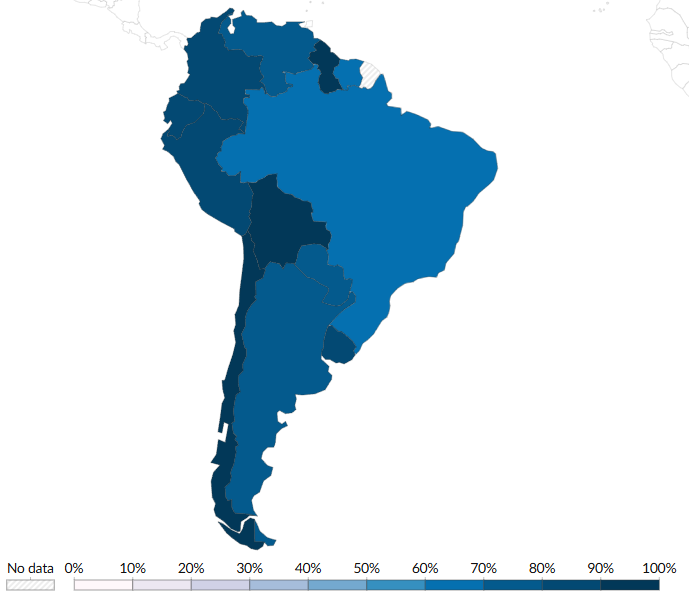
In Mexico, for example, the agricultural sector uses 76% of available water, compared to 15% for households. As shown in figure 7, in some countries in South America that proportion is even higher. Bolivian agriculture represents 92% of total water withdrawals, and that figure is only slightly less in Chile (90.9%). Agriculture uses 86.6% of water withdrawals in Uruguay, 86% in Colombia, and 85.1% in Peru.
Figure 7. Agricultural water as a share of total water withdrawals, 2020
Agricultural water withdrawals as a percentage of total water withdrawals (which is the sum of water used for agriculture, industry and domestic purposes). Agricultural water is defined as the annual quantity of self-supplied water withdrawn for irrigation, livestock and aquaculture purposes.
Source: Our World in Data using data from the World Bank
Some increasingly popular crops such as avocados, which are grown in large and growing quantities in Mexico, Colombia, and Peru, are particularly thirsty. Avocado harvests have increased massively in recent years to keep up with a spike in global demand for the fruit, and Latin America accounts for 75% of global production. Flower agribusiness is also a growing source of tension, with the successful expansion of rose farming in Ecuador and Colombia also creating issues with local communities.
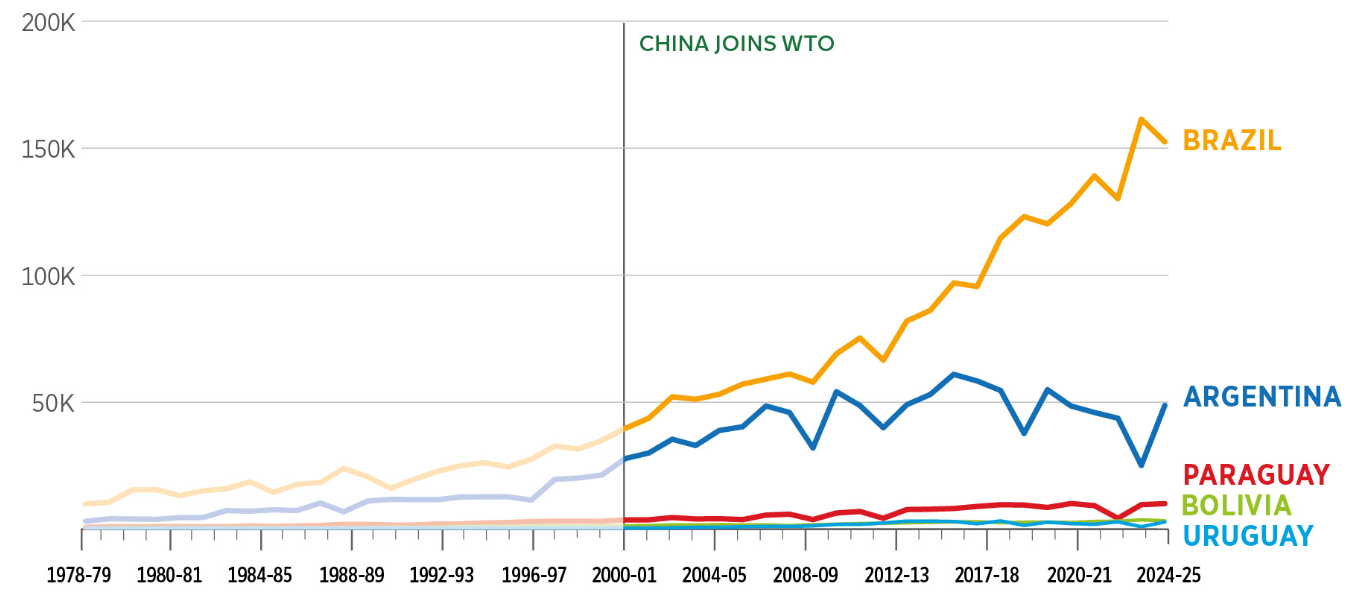
And the massive expansion of soybean farming in South America, which now produces around half of the global supply of soy, commonly used as livestock feed, has transformed the landscape in large parts of the continent in recent decades. Figure 8 shows how production has skyrocketed, particularly in Brazil.
Figure 8. Soybean production by harvest, thousands of metric tons
Source: Americas Quarterly using data from USDA
While the development of agriculture increases water demand, producers are also being affected by drought. In Uruguay, the 2023 drought led to a 60% reduction in agricultural yields, and in Argentina production of soybean, corn, and wheat was 45% lower in 2023 compared to the previous year. In the western Chaco region of Paraguay, drought has forced ranchers to move nearly 1.5m head of cattle further east in hopes of better conditions there.
As well as affecting the power supply in countries reliant on hydropower, water shortages also affect many industrial facilities that require significant amounts of water as part of processes such as washing, diluting, fabricating, cooling, or transporting products, and these demands add to pressure on supplies.
This can lead to social conflicts, particularly in areas suffering from drought, as local communities struggle to secure water for household use. Significant examples include drinks manufacturers in northern Mexico, where companies such as Coca Cola and Heineken are facing growing criticism from locals who say that industry is being prioritised over their needs. In August 2022, then President Andrés Manuel López Obrador floated the possibility of halting beer production in the north of the country due to water shortages, instead proposing that companies set up operations in the southern states where there is more water available.
Tensions between household and industrial use has also been a flashpoint in Uruguay, where protests erupted after authorities asked households to reduce their water consumption during the drought in 2023, while allowing industry to continue as normal. In recent decades Uruguayan authorities have worked hard to encourage the expansion of agriculture and industries such as paper manufacturing. This involves the development of vast plantations of thirsty eucalyptus trees that are grown to provide raw materials to pulp mills, which themselves use significant amounts of water.
Mining, another key industry for mineral-rich Latin America, can also be extremely water intensive. Copper production, which uses significant amounts of water to process ore, is threatened by concerns over water supplies, particularly as large deposits are found in some of the driest places on earth.
In 2021, UK miner Antofagasta revised its production targets down citing drought, and authorities have taken action to limit water use by miners. For example in 2021 a court ordered BHP Group to suspend groundwater pumping at the Cerro Colorado copper mine due to worries over the effects on a subterranean aquifer. The miner ultimately decided to scale down operations at the facility due to the ruling.
Miners in Chile have also been forced to look for new sources of water due to stringent new regulations designed to limit consumption, with some choosing to invest in desalination plants that make seawater usable for industrial processes. While industry heavyweights such as Antofagasta Minerals and Anglo American are committed to reducing freshwater use as part of efforts to improve sustainability, these efforts add to operating costs.
Increasing water scarcity also increases the risk of more stringent rules in a growing number of jurisdictions in a bid to head off social unrest. In Peru, among the most mineral-rich nations globally and the second-largest producer of silver, copper, and zinc in the world, mining operations have been severely disrupted by protests linked to water.
Waste produced by agriculture and industry also affects remaining water supplies. Mining operations are also associated with water pollution as chemicals enter the water table, and poorly protected tailings leak. Intensive farming methods common in large monoculture plantations of crops such as soya use significant amounts of herbicides and pesticides, which run off into rivers and streams leaving toxic contamination. Industrial processes also produce waste products, and in many countries lax or unenforced regulations mean that they find their way into remaining water sources. This impacts water quality, meaning that it has to be treated more intensively in order to be fit for human consumption, adding to the costs of providing potable water.