All Categories

Subcategories

  • MEXICO: Toyota invests in Mexico despite US tariff concerns

    Abbi Dicker 14 November 2024 Hits: 1693

    Japanese car manufacturer Toyota has announced it is investing US$1.45bn this year in its two manufacturing plants in Baja California and Guanajuato states. The news comes amid uncertainty surrounding Mexico’s automotive industry following the re-election of former president (2017-2021) Donald Trump in the US.

    Economy Minister Marcelo Ebrard announced the investment alongside Luis Lozano, the head of Toyota México. Lozano stated that the investment would create 1,600 jobs and was a “commitment to Mexico and a commitment to the competitiveness of the North American region”. The investment aims to re-equip Toyota’s manufacturing plants in Tecate, Baja California, and Apaseo el Grande, Guanajuato, with a focus on the production of its fourth-generation Tacoma pickup trucks.

    The Toyota announcement comes as several car companies, including US electric vehicle (EV) manufacturer Tesla and Chinese EV maker BYD, paused plans for investment in Mexico earlier this year, citing uncertainty due to the US elections. This uncertainty has only increased with the election of Trump on 5 November. Throughout his campaign, Trump repeatedly pledged to impose tariffs of 200% or more on vehicles manufactured in Mexico. This would represent a huge blow to Mexico’s automotive industry. Of the 2.3m vehicles produced in Mexico in the first seven months of 2024, 1.99m were exported, with 1.6m of these going to the US, according to Mexico’s main automobile industry association (Amia). The second biggest export market, Canada, only received 168,317 vehicles.

    Toyota alone exported some 113,611 vehicles to the US from Mexico in this period, accounting for over 92% of its exports. Only 317 of its vehicles remained in Mexico. Other carmakers to export the majority of their Mexico-manufactured vehicles to the US include US companies General Motors and Ford, US-Italian-French car maker Stellantis, and Japan’s Honda.

    Sources from Honda and Toyota consulted by newswire Reuters suggested that the companies would need to consider moving Mexican production to the US, if such tariffs were implemented. The loss of these companies would represent a huge loss for Mexico in terms of economic growth and investment. According to Amia, the automotive industry accounts for nearly 4% of Mexico’s GDP and brings in a significant chunk of foreign direct investment (FDI).

    One of the main motivations behind the tariffs appears to be to prevent the triangulation of Chinese vehicles to the US via Mexico. If Mexico’s government were to clamp down on such triangulation, as it has done with Chinese steel and aluminium, it may be able to avoid the punitive tariffs and keep key car manufacturers in the country. Speaking to local radio station Radio Fórmula on 11 November, Ebrard also suggested that Mexico could retaliate with its own tariffs on US imports if Trump follows through on his tariff threats.

    Tourism

    Mexico’s tourism ministry (Sectur) has reported that the number of international tourists entering the country increased by 6.3% in the first three quarters of 2024 compared with the same period in 2023. On 11 November Tourism Minister Josefina Rodríguez Zamora said that between January and September of this year, 32.6m international tourists entered Mexico, generating US$22.32bn, a 5.1% rise year-on-year. According to Mexico’s national statistics institute (Inegi), in September alone 3.3m international tourists arrived in Mexico, compared to 2.9m in September 2023.

  • PANAMA/REGION: Seeking to address deforestation

    Sarah Sheldon 17 November 2025 Hits: 212

    On 10 September Panama assumed the pro tempore presidency of the council of ministers of the Central American environmental and development commission (CCAD), which is part of the Central American integration system (Sica). At the session those present approved five regional priorities to shape the sub-region’s environmental agenda ahead of the latest United Nations (UN) climate change summit (COP30), which will take place in Brazil in November. Addressing deforestation featured highly on the agenda.

    A 10 September statement by Panama’s environment ministry details how ministers from CCAD member states (Belize, Guatemala, El Salvador, Honduras, Nicaragua, Costa Rica, Panama, and the Dominican Republic), agreed on a “joint position” heading into COP30. The statement outlines five priorities: “consolidating the region’s national parks and protected areas through investment in new park rangers, improving and renovating facilities, implementing action plans and strategic alliances with NGOs and communities, strengthening protection and surveillance programmes, and promoting the recognition of new conservation areas and facilitating access to and maintenance of these spaces.”

    Addressing deforestation is central to the plan; the statement notes the launch of a “Regional Restoration Agenda” which aims to promote cooperation in reforestation projects and ecosystem regeneration. It cites Panama’s environment minister, Juan Carlos Navarro, as underlining the importance of transnational cooperation to fighting deforestation, saying “neither deforestation, nor pollution, nor the climate crisis recognise borders... only through cooperation between our countries can we advance toward sustainable solutions.”

    Panama’s government led by President José Raúl Mulino, which took office in July 2024, launched its own national reforestation campaign on 20 July in the framework of its national forest restoration programme (PNRF). As part of the campaign, the environment ministry is reforesting 1,500 hectares (ha), planting 930,000 seedlings nationwide, activities which began with rains in May. According to a 20 July environment ministry press release, as of that date, 37,477 seedlings of native species had been planted in 38 sites nationwide.

    In line with reforestation efforts, the Mulino government has also sought to regain control over the Darién, the lawless jungle border with Colombia, which was previously a major migration route north but is now largely empty following the immigration crackdown launched by US President Donald Trump this year.

    In September 2024, Navarro announced reforestation programmes among other new measures to protect the Darién national park, which, located in the eponymous province, extends across some 575,000 ha and is among the largest and most valuable protected areas in Central America. A protected national park since 1980, in 1983 it was recognised as a UN Educational, Scientific and Cultural Organization (Unesco) biosphere reserve. A 24 June report by environmental news site Mongabay notes that since taking office, the Mulino government has been “pouring new resources” into protecting the Darién where the impenetrable jungle provides cover for “migrants, drug traffickers, illegal loggers, miners, and cattle ranchers”.

    Meanwhile in November 2024, the government signed a five-year agreement with US-based international nature group, Global Conservation (GC), to strengthen conservation and stop illegal activities such as logging and mining within the Darién biosphere reserve and two other Unesco World Heritage national parks in Panama. These are La Amistad Biosphere Reserve, which is located in the foothills and mountains of the Cordillera de Talamanca, between the mountain ranges of Panama and Costa Rica; and Coiba National Marine Park, a marine reserve located off the southwest coast of Panama. It also covers the largest indigenous territory in Panama: Naso Comarca.

    A GC statement announcing the partnership, which covers over 1.2m ha in total, highlighted that for the first time in 20 years, Panama is “securing new funding, rangers, equipment, and training to protect its most important and endangered ecosystem”. It points out Panama has lost nearly 10% of its tropical forests in the past 20 years due to limited resources for the national parks and “up to now, rampant corruption in the forestry sector”.

    WRI report highlights Nicaraguan forest loss

    Amid the renewed regional push to tackle deforestation, a report last updated on 21 May by the World Resources Institute (WRI), a US non-profit organisation, warned that Nicaragua lost its primary forest on the largest scale of any country in Latin America in 2024, at 4.7%, with WRI data pointing at agriculture expansion and fires. According to WRI, nearly 78% of the loss occurred in the Bosawás biosphere reserve, in Nicaragua’s impoverished Caribbean region, which lost 74,000 ha of primary forest, 40% of which was due to fires. According to the same report, indigenous territories in Nicaragua have been threatened by deforestation from “encroaching cattle ranches, mining and logging, often accompanied by violence”.

    The WRI report also singles out Guatemala in Central America as having lost 2.7% of its primary forest in 2024, with widespread fires leading President Bernardo Arévalo to issue a natural disaster declaration in April 2024 [SSR-24-04]. In particular, it warns that in the north of Guatemala, illegal cattle ranching and the expansion of informal settlements – sometimes with ties to organised crime – fuelled forest loss, including in the Sierra del Lacandón national park, located in the northern department of Petén, which, spanning 202,865 ha, is the country’s second largest national park.

    Nature pledge

    In his address before the UN General Assembly in New York on 24 September President José Raúl Mulino highlighted Panama’s ‘Nature Pledge’, a policy framework for climate, biodiversity and land obligations. A UN summary notes that while already a carbon-negative country, Panama is committed to reducing emissions by 2035 and will restore 100,000 hectares of ecosystems, citing Mulino as saying “because nature […] is our front line of defence against climate change”.

    More projects in the Darién

    On 21 August the Mulino government announced a new six-year conservation and community development for the Darién with US$9.6m in funding from Global Environment Facility (GEF), a multilateral environmental fund, and US$15.1m from the Panamanian private sector. According to an environment ministry statement, the project, which includes forest conservation activities, certified community forest management, reforestation, agroforestry, and organic agriculture, among other things, will focus on priority areas such as the Darién national park and Filo del Tallo Canglón hydrological reserve and comprises four main components, one of which is accelerated forest conservation and restoration.

    Oil field closed in Petén

    On 28 August Guatemala’s defence minister, Brigadier General Henry David Saenz, confirmed that a centre of military and law enforcement operations had been established at the recently closed oil exploration field Xan, in Petén, after the government announced earlier that month that it had opted not to renew the Xan concession which had been operated by Ango-French company Perenco since 2001.

    Discovered in the early 1980s, Xan is the country’s biggest oil field. It was controversial as it was located in the Laguna del Tigre national park, Guatemala’s biggest national park, spanning 337,899 ha. Like Sierra del Lacandón, this is located in the Maya Biosphere Reserve which together with the Maya Forest of Belize and Mexico represents one of the largest areas of tropical forest north of the Amazon and the northernmost tropical forest in the Western Hemisphere.

    According to the Arévalo government, during the oil field’s 40 years of operation, 6,000 ha of forest were lost due to oil extraction.

    Saenz said that the new centre of military and law enforcement operations would act as a “strategic point to guarantee security, safeguard infrastructure and protect the natural heritage of the Laguna del Tigre”.

    This renewed emphasis on efforts to curb deforestation in Petén comes as a February 2024 report by the US National Aeronautics and Space Administration (Nasa)’s Earth Observatory cites data from the University of Maryland which indicates that Petén lost 33% of its forest cover between 2001 and 2023, compared to 23% nationally. The report suggests that infrastructure designed to aid gas and oil extraction, as well as cattle ranching and drug trafficking are key drivers of deforestation in Laguna del Tigre.

  • PERU: Court ruling could damage Fujimori’s candidacy

    Abbi Dicker 12 March 2026 Hits: 931

    The Inter-American Court of Human Rights (IACtHR) condemned Peru on 5 March for the forced sterilisation and subsequent death of Celia Ramos Durand in 1997 during the so-called national reproductive health and family planning programme of the authoritarian government of Alberto Fujimori (1990-2000), which primarily targeted poor, indigenous women. The timing of the ruling comes at a critical time with presidential and congressional elections due on 12 April and the most recent poll suggesting that the late Fujimori’s daughter Keiko, who is running for the right-wing Fuerza Popular (FP), has edged ahead of Rafael López Aliaga of the far-right Renovación Popular (RP) in the presidential race.

    The IACtHR established that the Peruvian state “violated the rights to life, personal integrity, personal liberty, privacy [and] access to information” of Ramos and her family, and it found the state responsible for “the lack of due diligence and the unjustified delay in the investigation of the facts”. It ordered the state to pay her family US$340,000. After distancing herself from her father in her last three failed presidential bids, Keiko has switched tack and said last month that she would repeat her father’s model. While she was referring primarily to economic stability, growth, and national public works, the IACtHR ruling serves as a reminder, for the younger generation, of the widespread human rights abuses committed during his tenure.

    This could potentially have a detrimental impact on Keiko’s support, which increased from 8% in January to 10.7%, according to a survey conducted in late February and early March by the national pollster Datum and published on 8 March. López Aliaga fell back from 12% to 10%. Behind them there was a three-way tie between Alfonso López Chau of the centre-left Ahora Nación on 5.5%, César Acuña of the populist right-wing Alianza para el Progreso (APP) on 5.2 %, and the comedian Carlos Álvarez of the populist anti-system País para Todos (PPT) on 5%.

    • López Chau

    Alfonso López Chau was previously the rector of the Universidad Nacional de Ingeniería (UNI) in Lima. He permitted demonstrators protesting against the government of Dina Boluarte to seek refuge on the university campus in January 2023.

    In the first sign of a possible outsider breaking away from the main pack, retired Major General Wolfgang Grozo, a former director of intelligence for the air force, of Integridad Democrática, polled 4.2%, vowing to improve security and combat corruption. His support of the security forces in the repression of the protests against the government of then-president Dina Boluarte in December 2022-January 2023, however, suggests his candidacy will struggle to gain traction in southern regions especially.

  • In Brief – Nicaragua

    LatinNews 06 March 2012 Hits: 1568

    Nicaragua | Agreement ends indigenous tensions. On 4 March mestizo hostages held by an indigenous community in the North Atlantic Autonomous Region (Raan) on the Caribbean coast were released after Miskito leaders signed an agreement with the government to review the alleged land invasions in the region. Under the agreement, which ends weeks of tension, the National Demarcation and Titling Commission (Conadeti) will examine the land situation in order to uphold the 1987 law on indigenous autonomy, respecting indigenous rights to communal land.

  • RASTREANDO TENDENCIAS

    LatinNews 03 July 2012 Hits: 619

    REGION | Wen busca consolidar a largo plazo la relación económica. El 26 de junio, el Primer Ministro de China, Wen Jiabao, propuso ante la Comisión Económica para América Latina y el Caribe (Cepal) de la ONU, la creación de un foro de cooperación China-América Latina y El Caribe a fin de fortalecer  los lazos económicos y políticos y un fondo de  cooperación a fin de ser usado para promoverlo.

    La visita del Primer Ministro Wen en las oficinas centrales de la Cepal en Santiago, Chile, marcó el final de una visita de una semana a América del Sur, en la cual él visitó virtualmente todos los países que conforman el Cono Sur (excepto Paraguay) y lanzó algunas propuestas muy interesantes destinadas a profundizar la relación entre el gigante asiático y sus socios de América del Sur, que en años recientes han proveído a China con alimento fundamental y materias primas que necesita para continuar con su expansión económica.

    Hablando en la Cepal, Wen dijo que China y América Latina deben continuar trabajando juntos para “combatir el proteccionismo” y para abrir nuevos mercados a fin de lograr el objetivo del comercio bilateral de “más de US$400mil millones” en los próximos cinco años. Con el objetivo de lograr esto, Wen propuso la creación de un “mecanismo de diálogo periódico” entre las varias cancillerías latinoamericanas, China y la Cepal, que en su opinión podría celebrar su primera reunión antes de fin de año.

    Concentrándose en la provisión de alimento, uno de los pilares del comercio bilateral China-América Latina y una cuestión de importancia para el gobierno de China, Wen propuso la creación de un foro similar donde los ministros de agricultura de China y América Latina podrían reunirse a fin de promover la cooperación en esta área con el objetivo  de lograr un comercio anual en ese sector de US$40mm en los próximos cinco años. Wen dijo que la primera reunión de ese foro podría tener lugar en China en el 2013.

    El líder chino también planteó la idea de establecer un “mecanismo de reserva de alimentos” consistente de 500.000 toneladas de alimentos para ser usados en casos de desastres naturales o crisis humanitarias. Wen también hizo propuestas más concretas, que incluyen la promesa de asistencia financiera de China a la región con el fin de ayudar con su desarrollo. “El gobierno chino continuará ofreciendo asistencia económica a los países de la región que están interesados,” dijo Wen. Luego propuso la creación de un nuevo fondo de cooperación accesible a las compañías de latinoamericana y El Caribe, que les ayudaría a financiar proyectos en las áreas de manufacturas y desarrollo tecnológico, señalando que China estaba lista para prometer unos US$5mm para que entre en funcionamiento. Además, Wen también anunció que el banco de desarrollo de China (CBD) podría abrir una nueva “línea de crédito especial” para proyectos conjuntos de infraestructura en la región.

    Antes de expresar ante la Cepal estas propuestas, Wen se reunió con los presidentes de cada uno de los países que visitó y firmó un número de acuerdos de cooperación, todos apuntando a incrementar el comercio. Más ambiciosamente, después de completar su gira a tres de los cuatro países miembros del Mercado Común del Sur (Mercosur), Brasil, Uruguay y Argentina, Wen también propuso la idea de establecer una alianza estratégica entre China y el Mercosur, que contempla la creación  de una zona de libre comercio entre China y Mercosur. De hecho, mientras visitaba a la Presidenta Cristina Fernández el 25 de junio, celebraron una teleconferencia  con la Presidenta Dilma Rousseff de Brasil y José Mujica de Uruguay en la cual Wen dijo que el objetivo de China era “profundizar la cooperación” a todos los niveles con el Mercosur, pero particularmente en el comercio, a fin de llevar al doble el comercio China-Mercosur para el 2016. El año pasado el comercio bilateral fue de US$99.48mm con lo que China se ha consolidado como el principal socio comercial del Mercosur.

    La propuesta de Wen fue bien recibida por los tres líderes sudamericanos con el Presidente Mujica señalando que era una propuesta atractiva dado que China “es el gran comprador y vendedor de nuestro tiempo”. Igualmente, la Presidenta Rousseff dijo que en tiempos de crisis económica global era importante “unir fuerzas”, mientras la Presidenta Fernández dijo que la propuesta representaba una “oportunidad histórica”.

    Sin embargo, el problema para Mercosur es que las negociaciones de acuerdos comerciales deben ser hechas como un bloque y los cuatro miembros, incluido el temporalmente suspendido Paraguay, debe acordar con ello. Paraguay es el único país del Mercosur que para desagrado de China reconoce a Taiwán, y se espera que necesite un poco más persuasión que sus pares del Mercosur para abrazar plenamente la idea.

    • Paraguay reflexiona sobre la vida fuera del Mercosur

    El 27 de junio, el presidente de la Unión Industrial del Paraguay (UIP), Eduardo Felippo, dijo que la UIP estaba analizando el escenario de Paraguay siendo expulsado del Mercosur después de su suspensión inicial. Llamativamente, Felippo afirma que de hecho dejar el bloque “beneficiaría” más a Paraguay y “perjudicaría” a los otros miembros. De acuerdo con Felippo, al dejar el bloque, Paraguay tendrá acceso a más oportunidades para exportar a otros mercados y así, en el futuro, “nuestros socios comerciales serán otros y no estos países que, le guste o no, fueron todos parte de la Triple Alianza”, una referencia a la alianza política formada por Brasil, Argentina y Uruguay para luchar contra Paraguay en la Guerra de la Triple Alianza (1864-1870).

  • Risk pointers

    LatinNews 30 October 2013 Hits: 392

    *** India reinforcing border infrastructure against China.  The Indian news agency PTI reported on 27 October than India is planning to build 14 strategic railway lines close to its borders with China and Pakistan.  In addition, it is constructing 73 new roads, with a total length of 3,812km, along the Line of Actual Control (LAC) with China.  This news follows on from the admission to parliament last month by Defence Minister AK Antony that China has a “superior” infrastructure along its side of the border.  Antony described this state of affairs as a “collective failure”.  He said: “I have no hesitation to say that China is in a better position than India in terms of border infrastructure.  It is a mistake; it is all of us who are to be held collectively responsible for it.  It is a historical legacy.”

    *** Japan courting Russia as tension with China rises.  As the name calling between China and Japan over the disputed Senkaku/Diaoyu Islands continues to escalate and get more dangerous, Japan is boosting defence ties with Russia.  The defence ministers of Russia and Japan are to meet in Tokyo on 1 November and they are expected to confirm increased exchanges between their defence forces.  The envisioned exchanges will include mutual visits to air bases by air force personnel and new joint exercises between ground forces.  Until now, only their respective navies have had exchanges. 

    The new exchanges may not be dramatic, but they are in stark contrast to the state of relations between Japan and China.  On 29 October, the Chinese foreign ministry told Japan to “stop hyping” the military threat from China and to explain the true intent of its own military build-up.  

    On 27 October, Japan’s Prime Minister Shinzo Abe warned China about continuing incursions into Japanese waters around the Senkaku Islands, and rather ominously said: “We will demonstrate our intention not to allow a change in the status quo.”  In an address to Ground Self-Defence Force troops, Abe also said: “I would like you all to discard the notion that the existence of defence forces itself can act as a deterrent.”

    *** Lebanon experiencing “civil war”.  Israel’s Defence Minister Moshe Yaalon said on 24 October that there is now a civil war in Lebanon between Hezbollah and Sunni jihadists from Syria.  He said: “To those who are not yet aware, there is already a civil war in Lebanon.  Global jihad, which has infiltrated Lebanon and is attacking Hezbollah, is blowing up car bombs in Dahia and is firing rockets at Dahia and the Bekaa Valley.

  • PERU: Drug strategy takes murky turn

    LatinNews 05 June 2014 Hits: 1230

    No sooner had the prime minister, René Cornejo, revealed the new hardware that the armed forces would be using to crack down on drug-trafficking in the Apurímac, Ene and Mantaro river valleys (Vraem) [WR-14-21] than the government’s whole anti-drug strategy came under fire with the sudden departure of the drug czar, Carmen Masías Claux.

    Masías made way for Alberto Otárola as head of the anti-drug agency Devida on 27 May. Otárola, brother of the president of congress, Fredy Otárola, is part of President Ollanta Humala’s inner circle and a presidential adviser. He served as defence minister before he was forced to resign in May 2012 in the face of imminent congressional censure for a mishandled operation to free hostages held by the faction of Sendero Luminoso (SL) operating in the Vraem.

    Initial media reports suggested that Masías, who had been head of Devida since January 2012, had decided to resign because she was uncomfortable about the government’s decision to move the emphasis of drug policy away from “compulsory eradication”, where she had met with considerable success [WR-14-21], and towards “productive reconversion”, a concept that appears to embrace the provision of education, advice and perhaps even subsidies for coca growers who agree to plant alternative crops.

    The agriculture minister, Juan Manuel Benites, appeared to commit to this change in tack during a meeting with coca growers in the Vraem last week, when he signed an accord making a priority the replanting of 5,000 hectares of coca in the Vraem with alternative crops like coffee, cacao or stevia, a sweetener and sugar substitute. Counter-insurgency advisers within the government have expressed concern that forceful eradication would alienate the local population in the Vraem, solidifying rather than weakening ties to the SL.

    Masías insisted that initial media reports about her being uncomfortable in her position were wide of the mark, and that she had been forced out to make way for a new phase at Devida. Cornejo denied that Masías had been edged out, but the opposition has pounced on the conflicting accounts to accuse the government of giving precedence to political appointments over professional ones.

    Pasco president arrested for corruption

    The regional president of Pasco, Klever Meléndez Gamarra, and his legal adviser, Juan Boza Pulido, were arrested in Lima on 3 June at the request of the supraprovincial anti-corruption prosecutor, Hamilton Castro, for allegedly receiving a US$100,000 bribe from representatives of a business consortium in exchange for public works contracts. Meléndez is also being investigated for allowing a construction company with little experience to carry out work to improve a regional hospital for NS$170m (US$62m).

    A video showing the two men receiving the bribe in cash evoked memories of the infamous ‘vladivideos’ - compromising videos stored by Vladimiro Montesinos, the intelligence chief of former president Alberto Fujimori (1990-2000), which invariably featured officials accepting bribes.

    It is not clear why the video has taken the best part of four years to come to light but it comes at a time when public confidence in Peru’s regional governments, already low due to an acute suspicion of the authorities since Fujimori, is being eroded by mounting corruption investigations and formal charges affecting 19 of the country’s 25 regional presidents just before regional elections in October.


    A detailed report in La República on 28 May showed that the regional president of Ancash, César Alvarez Aguilar, is the subject of the most corruption probes (26) including four legal charges, followed by the president of Tumbes, Gerardo Viñas Dioses (25), including five legal charges. Meléndez Gamarra, who is yet to be formally charged with anything, faces 20 separate investigations.

    • Regional corruption

    In total the 19 regional presidents face 158 investigations while regional officials nationwide face 1,505 investigations into embezzlement, collusion and misappropriation of funds, with many cases involving the award of public works contracts.

  • BRASIL: Otra reducción de grado, otro salto en la inflación

    LatinNews 23 October 2015 Hits: 427

    El 15 de octubre la agencia internacional de ratings, Fitch, redujo de grado el rating de crédito soberano de Brasil de ‘BBB’ a ‘BBB-‘ con un panorama negativo, un punto por encima de la calificación de ‘chatarra’ (‘junk’). Con la decisión ya valorada por muchos analistas, el mercado de valores y el Real apenas registraron el cambio. Standard & Poor’s ya ha despojado a Brasil de su duramente ganado grado de inversión: si cualquier otra de las agencias de rating internacionales, Moody’s o Fitch, siguen su ejemplo, el país se enfrenta a un severo riesgo de fuga de capitales, ya que muchos fondos internacionales estarán bajo la obligación legal de deshacerse de sus inversiones brasileras. A inicios de octubre, Moody’s indicó que no planeaba una inminente reducción de grado de Brasil. Pero el gobierno está preocupado por el hecho de que todos los indicadores económicos de Brasil están en el mismo nivel que el de otros países calificados como chatarra por Moody’s.

    En la nota que acompaña su decisión, Fitch citó los crecientes niveles de deuda pública de Brasil, crecientes desafíos para la consolidación fiscal, y el impacto de la recesión sobre las finanzas del gobierno (ver abajo). El día después de la decisión de Fitch, Standard & Poor’s publicó un informe diciendo que Brasil tiene más compañías con riesgo de reducción de su grado de crédito que cualquier otro país emergente. De las 134 reducciones potenciales a firmas de mercados emergentes, 28 son brasileras.

    A comienzos de octubre, el Fondo Monetario Internacional (FMI) predijo que la economía de Brasil se contraería un 3% este año. El déficit del presupuesto alcanzó el 9,2% del PIB en agosto, subiendo del 8,8% en julio. Shelly Shetty, la directora de ratings soberanos para América Latina en Fitch, dijo en una entrevista que ella esperaba que la deuda pública de Brasil se eleve al 70% del PIB, bastante por encima del promedio de otros países con ratings ‘BBB’. La inflación, de un 9,77% durante los 12 meses pasados, es tres veces más que el promedio de otros países con rating ‘BBB’.

    La economía de Brasil se contrajo incluso más de lo anticipado en agosto: el índice de actividad económica del banco central (IBC-BR), que anticipa el PIB, cayó un 0,76% en comparación con julio, cuando la mayoría de los economistas esperaban una caída de sólo un 0,6%. De acuerdo con este índice, la contracción económica de Brasil en los últimos 12 meses está ahora es del -4,74%, lo que puede significar que la caída de -3% del PIB pronosticado este año por el FMI y el Banco Mundial podría resultar ser optimista. El ritmo de la contracción se está acelerando: en el periodo de enero a agosto del 2015, el IBC-BR cayó en -2,99%.

    El punto de vista del ‘vaso medio lleno’

    Algunos alegan que el sombrío panorama que rodea a la economía de Brasil es exagerado. Jerome Booth, el presidente de New Sparta Asset Management, quien hizo una fortuna apostando en Brasil en el 2002, cuando muchos inversionistas se asustaron por el hecho de que el izquierdista Partido dos Trabalhadores (PT) llegara al poder, alega que los problemas de Brasil son exagerados. En una entrevista con Bloomberg, Booth alegó, “Usted tiene la clásica situación de ‘todo es tan malo como puede ser posible’,” dijo él. “Pero todo ya ha sido asimilado ahora”

    Booth alega que no hay ninguna chance de que el gobierno se declare en default y que sus políticos eventualmente hallarán la voluntad de impulsar medidas diseñadas para apuntalar el presupuesto y restaurar el crecimiento. Dijo que el pánico entre los inversionistas era excesivo y le recordaban el colapso de los precios de los bonos de hace 13 años, cuando muchos temían que el nuevo gobierno del PT repudiaría la deuda de Brasil. De hecho, los inversionistas fueron premiados. Desde la asunción de Lula da Silva a comienzos del 2003 hasta que dejó el poder a fines del 2010, los bonos de Brasil denominados en dólares tuvieron un retorno del 256%, más del doble que el promedio del mercado emergente. Las notas denominadas en Reales ofrecieron un retorno del 520% en términos de dólares de EU, casi tres veces más que el promedio de sus pares. La  moneda brasilera se elevó en valor a más doble contra el dólar, y las acciones se elevaron un 500%.

    • Fitch

    El panorama negativo “reflejado la visión de Fitch de que el bajo desempeño económico y fiscal es probable que persista mientras que la incertidumbre política podría continuar pesando sobre la amplia confianza, retrasando el despegue en la inversión y el crecimiento, e incrementando los riesgos a mediano plazo para la consolidación fiscal necesaria para la estabilización de la deuda”.

  • In brief: Mexico

    LatinNews 12 June 2017 Hits: 807

    *President Enrique Peña Nieto has highlighted the “common vision” on democracy, free trade, protection of the environment and promotion of human rights held by him and his German counterpart, Angela Merkel, during the joint press conference marking the end of Merkel’s official visit to Mexico. Peña Nieto added that this common vision should lead to an increase in bilateral investment and trade in the future as Mexico continues to try to update its existing free trade agreement with the European Union.

  • BOLIVIA: Government announces discovery of major new gas well

    LatinNews 16 March 2021 Hits: 1933

    In late December 2020, Bolivia’s state-owned energy company Yacimientos Petrolíferos Fiscales Bolivianos (YPFB), announced that exploratory drilling at the Yarará-X1 well had been successful, with drill stem tests (DST) yielding very positive results pointing to the future commercial viability of the site. Work on the exploratory well had begun in September 2019, with reports from YPFB stating that a final depth of 2,850m had been reached using its drilling equipment. The DST tests reveal an estimated potential of 13.7m barrels of oil and 76.8 trillion cubic feet of natural gas.

    Yarará X1 is located in Yapacaní in the eastern department of Santa Cruz, within a geographical area known as the Boomerang Hills, a seismic faultline located at the base of the Andes which has long been considered one of the most fruitful areas for hydrocarbon exploration in Bolivia. YPFB has been pursuing an approach of continued exploration of the Boomerang Hills for new hydrocarbon deposits, even as some had suggested that all major reserves had already been located.

    The success of the exploratory drilling at Yarará-X1 will be an encouraging sign for a country highly dependent on the export of natural gas. In 2019, gas represented 29.5% of Bolivia’s total exports, with a value of US$2.37bn. As Bolivian hydrocarbon production has been state-owned since May 2006, these exports – primarily to neighbouring Brazil and Argentina – represent a large proportion of state income.

    Bolivia’s hydrocarbons minister Franklin Molina also asserted that his department would be working on a strategy to allow for newly discovered reserves like this one to support domestic demand for hydrocarbon fuels.

    Traditionally Bolivia has lacked the capacity to process the hydrocarbons it produces, and thus the country also imports refined petroleum, primarily from Peru and Chile. The decision by former president Gonzalo Sánchez de Lozada (2002-2003) to prioritise gas production for export after the discovery of major new deposits has been cited as one of the major contributing factors to large-scale unrest in September 2003 that ultimately led to Sánchez de Lozada’s resignation. Understandably, Bolivian politicians are still wary of appearing to prioritise filling coffers – of the state or private businesses – at the expense of domestic consumers.

    President Luis Arce greeted the news of the successful exploration with an emphasis on the national character of the project, underlining that it was completed by YPFB using its own equipment. Developing the domestic capacity to carry out this kind of technical work was a longstanding part of the rhetoric of former President Evo Morales (2006-2019), who had advocated working towards energy independence and sovereignty. For President Arce, it will be taken as an encouraging sign that Bolivian hydrocarbons production is moving in the right direction. A stress on production for domestic demand may also be attributed in part to the decline in exports in 2019-2020, driven by both the coronavirus (Covid-19) pandemic and political instability in Bolivia in that period.

    At Yarará, a further two exploratory wells – X2 and X3 – are now expected to be drilled, with a seismic study also planned to provide further information about the size of the reserves. Production from the X1 well is initially expected to be around 300 to 400 barrels per day. Petroleum extracted from Yarará will initially be processed at the closest existing plant, the YPFB Sirarí plant in Ichilo.

  • The contrarian view

    LatinNews 11 June 2021 Hits: 1623

    Despite this, some analysts question whether the energy transition will really be as important as expected. Those in this camp hold a range of different views. At one extreme are those who still deny the reality of climate change, and therefore minimise the need for a transition to cleaner fuels. They see no reason to believe that the age of fossil fuels, the internal combustion engine, mass motor car ownership, and widespread plastic products usage is coming to an end. Others, however, fully accept that climate change is real and will require a response, but, rather like BP’s ‘business as usual’ scenario, are sceptical about society’s ability and political will to rapidly change its patterns of energy use. There is clearly a long way to go: in 2018, 81% of the world’s energy still came from fossil fuels.

    Business-focused analysts, some of whom take “contrarian” positions on energy issues, are particularly interesting because they provide additional perspectives of some of the forces that may be at work. One example is a US$100bn-plus investment fund, BlackRock Energy and Resources Income (BERI), which has switched from a 50-50 split between its energy and mining investments to a 40-30-30 split between mining, traditional energy, and ‘transition’ energy stocks. Fund managers Mark Hume and Tom Holt say they invested heavily in the early stages of rising global interest in renewable energy, but as asset prices eventually heated up and became more volatile, they called a pause, reinvesting their profits back into the more traditional energy companies which rallied as the launch of coronavirus vaccines in late 2020 raised expectations for economic recovery. Their view, in short, is that there is still money to be made in fossil fuels.

    Hume says there had been an “evaporation of capital” going into the traditional IOCs, which created investment opportunities that were too compelling to ignore. As he put it, “there’s still life in the old dog yet”. In BERI’s analysis, new and renewable does not always trump traditional and fossil. A lot depends on individual investment projects. The investment managers gave as an example a highly competitive Spanish solar power auction in early 2021 which implied returns on capital of around 3% per annum. But at early 2021 price levels, they believed some traditional and somewhat overlooked energy sector projects could be found offering much higher returns of up to 30%.

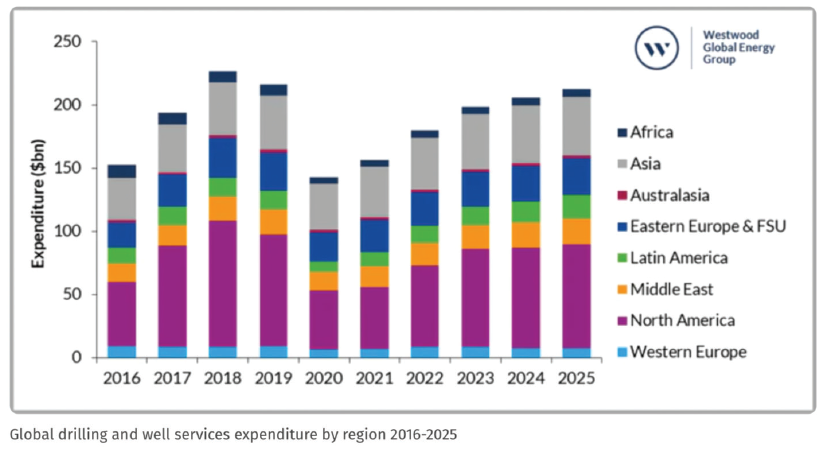
    A rapid energy transition might imply falling interest in traditional oil and gas exploration, for fear that hydrocarbons might become a “stranded asset” – one that no longer offers long term profitability. But consultancy Westwood Global Energy Group said in May that exploration drilling over the next five years is likely to remain broadly in line with levels over the preceding five years. Westwood’s Dr Keith Myers argues that drilling is likely to remain closely linked to oil price movements, as it has in the past. “The higher the price, the more cashflow that is available, along with perceived higher returns on exploration”, he says. The time scale between exploration and production can be around 10 years. Of the total oil discoveries made in 2010 around 81% are now in production, led by Johan Sverdup in the North Sea and Búzios in the Santos offshore basin in Brazil. Dr Myers expects that relationship to broadly continue, arguing that even if global warming is kept to under 1.5 degrees celsius, there will be “plenty of take-up for oil discoveries made in 2026”.

    Not stopping yet

    Source: Westwood Global Energy Group

    Westwood does acknowledge that the energy transition will have various significant effects on traditional oil and gas exploration. One effect may be to convince oil companies that they need to prioritise the deposits which can be profitable at international oil prices of around US$40 a barrel as well as identifying those that are more “resilient”, have a shorter life cycle, and which can be exploited with lower or even with net zero carbon emissions. Dr Myers says, “There is no point discovering something that could take 20 years to produce, so [explorers] will be targeting five years to production and 10 years to break-even.” As it happens a significant number of these deposits are likely to be in the LAC region. According to Westwood’s calculations Latin and Central America has accounted for around half the 170 high-impact exploration wells drilled or planned between 2021 and 2023, with most in the Suriname-Guyana basin, Gulf of Mexico, and Brazil. Brazil’s state-owned Petrobras is expected to drill more than 160 subsea wells in 2021-2025. Guyana will see a high number of wells drilled by ExxonMobil, concession holder in the Stabroek offshore block.

    James F Park, chief executive of GeoPark, Colombia’s second largest oil producer (after majority state-owned Ecopetrol), is another industry participant who sees a long-term future for oil. The first thing to understand, he told publication LatAm INVESTOR, is that against a background of long term economic and population growth, oil is not going to disappear. He cites an IDB prediction that, by 2040, Latin America’s total energy demand will have grown by 80%, and he adds: “It is fantastic that tech advances and policy decisions have helped renewables become more affordable and reliable to provide a greater share of our energy needs, but even the most optimistic scenario still shows oil and gas providing 40% to 45% of the energy mix in 2050. That’s about 120m barrels per day (mbpd) of oil equivalent that needs to be produced.”

    A similar position is taken by Carlos Fernando Emanuele, CEO of Ecuadorean oil company Orion Energy. Given Ecuador’s dollarized economy and high debt levels, he says the country can only grow by “importing dollars” achieved mainly by exporting oil. “In that context it is hard to see how a president could ban the oil industry and in one sweep remove 7% of the country’s GDP. It would also lead to a loss of US$2.5bn in fiscal revenue, which is about 10% of the government’s budget,” he says.

  • CARIBBEAN POINTERS

    Sarah Sheldon 16 August 2022 Hits: 716

    *** SURINAME TO OFFER MORE OIL BLOCKS. Suriname, which is hoping to emulate Guyana’s success in new oil discoveries, has said it is planning to put up some 60% of its offshore oil bocks for tender over the next 12 months. The first tender will be in the final quarter of 2022. TotalEnergies, which has made five discoveries in Suriname’s waters, has still to make its final investment decision. However hopes remain high and the US Geological Survey has said that it believes the Guyana-Suriname Basin could contain over 32bn barrels of undiscovered oil resources. As at the end of 2021, it was estimated that around 2bn barrels of oil resources had been discovered in Suriname’s offshore waters.

    Trinidad & Tobago’s Prime Minister Keith Rowley, speaking on 4 July, at the end of the latest Caricom (Caribbean Community) Heads of Government summit, said that Guyana, Suriname, and Trinidad & Tobago would resist any pressures to stop the exploitation of the region’s hydrocarbon resources. He said: “We – Trinidad & Tobago, Guyana, and Suriname – we have agreed that our position is that as long as those resources are within our territory, whether on land or in our maritime jurisdiction, we will exploit them.”

    *** BAHAMAS TO FACE US$850M ANNUAL LOSSES FROM STORMS. A new Climate Spending Report from the World Bank and The Bahamas’ finance ministry has concluded that “the country faces an average annual loss (AAL) from windstorms of US$850m and a probable maximum loss (PML) for a 250-year event of US$20.5bn – nearly 45% of the country’s capital stock.” Hurricane Dorian in 2019 produced economic losses in excess of US$3.4bn. The report says the government plans to spend US$72m on climate change in 2021/22, some 2.3% of the budget. It will also spend US$54m in disaster risk management.

  • COSTA RICA/REGION: Costa Rica registers largest fall in transparency rankings

    Patrick de Courcy 03 March 2023 Hits: 5039

    The latest Global Corruption Perceptions Index (CPI), by Berlin-based anti-corruption NGO Transparency International (TI), released on 31 January, revealed that Costa Rica had dropped four points since 2021, receiving its second-lowest rating ever - the most significant drop of any country in the region. While Costa Rica remains among the least corrupt countries in Latin America, the fall in rankings, which TI’s regional advisor for the Americas, Luciana Torchiaro described as a “warning”, highlights a key priority for the administration led by President Rodrigo Chaves which took office in May 2022.

    The latest CPI showed that Costa Rica scored 54 out of 100 (where 0 means ‘highly corrupt’ and 100 ‘very clean’), down from 58 in 2021. While Costa Rica surpassed the average CPI score for the Americas (42) – the only country in Central America to do so - this is the country’s second worse score after registering 53 in 2013. The same index showed Costa Rica ranking 48 out of 180 countries, a drop of nine places on the previous 2021 rankings.

    According to TI’s report on the CPI, recent corruption scandals in Costa Rica point to transparency deficits, overpricing and a lack of competition in the infrastructure sector, which it describes as a trend that can be seen across the region. Torchiaro told specialist website InSight Crime in a report published on 2 February that this was an allusion to the so-called ‘Cochinilla’ scandal, which broke in June 2021 (under the previous government led by Carlos Alvarado, 2018-2022). This was a corruption scheme involving construction companies and public works officials which cost the government some ₡78bn (US$126m) in public funds. CPI and Torchiaro also attributed the recent results to the allegations of illegal campaign financing during Chaves’ electoral campaign [SSR-22-06]. Speaking to Insight Crime, Torchiaro was clear that Costa Rica “needs to redouble its anti-corruption efforts, especially to prevent the possible penetration of drug trafficking in politics” – comments which come as Costa Rica registered record homicides last year which has been linked to the same issue [SSR-23-02].

    Blacklisted by EU

    Costa Rica also received a setback with the European Council’s 14 February announcement that it had added Costa Rica to its list of non-cooperative jurisdictions for tax purposes – a list of jurisdictions which are “non-cooperative on tax matters”. According to an EC statement, for the first time since the list was established, in 2017, Costa Rica is included because it has not fulfilled its commitment to “abolish or amend the harmful aspects of its foreign source income exemption regime (criterion 2.1)”. Latin America & Caribbean territories which remain on the list include Anguilla, Bahamas, British Virgin Islands, Panama, Trinidad & Tobago, Turks & Caicos Islands and US Virgin Islands.

    Elsewhere

    Predictably, given the democratic backsliding in other countries in the sub-region, Costa Rica’s Central American neighbours fared badly in TI’s latest CPI. The worst performer was Nicaragua where President Daniel Ortega has continued to dismantle democratic institutions and crackdown on dissent, scoring 19 out of 100, (-1 on 2021) and ranking 167 out of 180 countries (down from 164). This was followed by Honduras (23 and 157, unchanging in both cases) and Guatemala (24, down 1 on 2021 and ranking 150, unchanging) where TI cites “evidence suggesting organised criminals wield a strong influence over candidates and politicians, financing electoral campaigns or even running for public office themselves”. In the case of Honduras, TI says extortion of small businesses and ordinary citizens by criminal gangs is a significant problem that goes unpunished, citing estimates that Hondurans pay US$737m per year on extortion, representing 16% of Honduras’s annual GDP. TI also criticises the response by the leftist Partido Libertad y Refundación (Libre) government led by President Xiomara Castro aimed at tackling the issue – the suspension of constitutional guarantees through a state of emergency [SSR-23-01] - which it warns concentrates power in the executive, reducing transparency and accountability.

    In the case of Guatemala, TI highlights the co-opting of justice institutions and the criminalisation of actors who report corruption – reiterating familiar complaints about attacks on independent judicial officials and journalists [SSR-23-01]. El Salvador, which under President Nayib Bukele has seen a crackdown on gangs which has suspended constitutional guarantees and, as TI describes “triggered unjustified arrests and abuses of power”, scored 33 out of 100 (down one place on 2021, ranking 116 (down one place on the previous year) while Panama remained “stagnant”, scoring 36 (unchanging) and ranked 101 (up four places on 2021).

    Panama

    TI notes that Panama’s 2022 score is a drop of two points on the CPI since 2012 and highlights that its inability to improve its score from 2021 reflects “poor institutional conditions to fight corruption and end impunity, particularly in cases of grand corruption”. It highlights the wave of protests which rocked the country between July and August 2022 [EB-22-08] sparked by the rise in living costs which TI describes as “an organic response to public institutional corruption and unjustified growth of the government payroll”.

  • PANAMA: Breakthrough in stand-off over major mine

    Patrick de Courcy 23 March 2023 Hits: 4325

    The government led by President Laurentino Cortizo and Canadian mining company First Quantum Minerals (FQM), which owns the major copper mine Cobre Panamá via its subsidiary Minera Panamá S.A. (MPSA), have announced a deal regarding a new concession contract. This follows major uncertainty regarding the future of Panama’s biggest single private foreign investment following the collapse of talks between the two sides at the end of last year [WR-23-01]. The latest agreement will come as a relief to the government given the significance of the project to Panama’s economy, representing some 4% of the country’s GDP, most of its export revenue, and providing some 40,000 direct and indirect jobs.

    Since the December 2022 announcement that talks had unravelled over the final terms of the new contract [WR-23-01], the dispute had appeared to escalate even against the backdrop of ongoing negotiations. This culminated in FQM’s 23 February announcement that MPSA had suspended ore-processing operations at the mine, which is located in Colón province, and would begin a partial demobilisation of its workforce of over 8,000 employees and contractors. This followed a resolution by Panama’s maritime authority (AMP), also issued last month, ordering MPSA to suspend loading operations at the mine’s port, Punta Rincón, claiming that its scales were improperly calibrated.

    It was amid this tense stand-off that the two sides announced a breakthrough on 8 March. According to FQM, the proposed concession contract, which is subject to a 30-day public consultation process and approvals by the Panamanian cabinet, comptroller general, and legislature, meets the objectives outlined by the government in January 2022 related to “government revenues, environmental protections and labour standards”.

    According to both sides, provision of the proposed contract, which will have an initial 20-year term with a 20-year extension option, will include, among other things: payment by MPSA of US$375m plus an additional US$20m to cover taxes and royalties up to the end of 2022; and payment by MPSA starting in 2023 of an annual minimum contribution of US$375m in government income, comprised of corporate taxes, withholding taxes, and a profit-based mineral royalty of 12% to 16%. It also includes downside protections to the annual minimum contribution.

    Pressure from unions

    Ahead of the deal being reached the Cortizo government had faced the prospect of unrest from trade unions. For example, on 23 February a group of MPSA workers staged a protest in Panama City over the halt to operations, while the country’s main mining union, Unión de Trabajadores de Minera Panamá (Utramipa), called a protest to take place in Coclé’s capital, Penonomé, calling for an agreement to be reached.

    Boost for government as fiscal deficit target met

    A 2 March statement by international credit ratings agency Fitch, ahead of the deal between the government and FQM being struck, highlights the significance of the mine’s contribution to revenue, noting that US$375m is 0.5% of Panama’s GDP, which would make MPSA Panama’s second-largest tax contributor after the Panama Canal.

    The same statement highlights that while Panama met its 2022 fiscal deficit target, this was helped by “circumstantial factors”. It warns that meeting “increasingly restrictive targets will be challenging in the absence of a clear consolidation strategy”. Fitch notes that preliminary data released on 15 February showed that Panama complied with the 4% of GDP deficit target set under its fiscal responsibility law (LRSF).

    However, it is clear that this would have been missed without “one-off accounting factors”. These include the fact that the national statistics office completed its scheduled rebasing of GDP readings from 2007-2018, which led to a 3.5% increase in nominal GDP. Based on the government’s preliminary 2022 fiscal data, this cut the deficit by 0.23 percentage points of GDP.

    Fitch also notes that a larger contribution came from a so-called “cashflow swap” executed with a commercial bank, which cut officially reported government interest payments by US$363.9m, without which higher interest expenditure would have kept the deficit above target, at around 4.5% of GDP.

  • In brief: Peru's congress approves stimulus package as gov't admits recession

    Patrick de Courcy 23 October 2023 Hits: 2793

    * Peru’s congress has approved an economic stimulus package requested by the government totalling PEN1.58bn (US$408.1m). The funds will be used for economic reactivation and to respond to the El Niño climate phenomenon. The bill seeking the stimulus was approved with 88 votes in favour, four against, and four abstentions. Speaking after its approval, Economy & Finance Minister Alex Contreras acknowledged that the country has “without doubt” entered a recession, saying that the country is in a “challenging situation” after economic output fell in July, August, and September.

  • TRACKING TRENDS

    Abbi Dicker 23 April 2026 Hits: 1534

    MEXICO | USTR visits ahead of USMCA review. The US Trade Representative (USTR) Jamieson Greer met Mexico’s President Claudia Sheinbaum on 20 April to discuss US-Mexico trade and economic relations ahead of the joint review of the United States-Mexico-Canada Agreement (USMCA), which is due by 1 July. Greer thanked Sheinbaum for her “strong leadership in expanding US-Mexico bilateral cooperation”, while the Mexican president said that talks had progressed “positively”. Speaking the day after the meeting, Sheinbaum highlighted that she and Greer had “coincided on the importance of keeping the deal in place”. This is significant given US President Donald Trump has repeatedly said he is prepared to walk away from the USMCA.

    Greer also met Mexico’s economy minister, Marcelo Ebrard, thanking him for leading the economy ministry’s “active and constructive engagement with USTR”. Greer and Ebrard confirmed that the first official round of bilateral negotiations for the review would take place in Mexico City the week of 25 May. According to a USTR statement, they both instructed their teams to advance discussions this week on technical issues such as economic security and complementary trade actions, strengthening rules of origin for key industrial goods, collaboration on critical minerals, and resolving outstanding bilateral trade irritants.

    Greer’s visit to Mexico comes as both countries are ramping up preparations for the USMCA review. Before meeting with Greer, Sheinbaum said that Mexico was also seeking to reach agreements prior to completing the USMCA review regarding trade of steel, aluminium, ​and vehicles, which are all currently subject to sector-specific US tariffs. However, auto and steel industry sources familiar with the discussions told newswire Reuters on 21 April that Greer had said they should not expect the USMCA review to remove tariffs on their sectors.

  • What is the US doing in Mexico?

    LatinNews 19 September 2011 Hits: 1247

    On 17 August two Mexican cabinet ministers confirmed to congress’s joint standing security committee that US agents were active in Mexico. Francisco Blake, the interior minister, said that all the US agencies were operating under the Mexican constitution and international treaty agreements, and added that no US contractors were, or would be, deployed in Mexico. Blake was backed up by the foreign minister, Patricia Espinosa.

    Both were testifying to the bicameral national security committee. The ministers were accompanied by Guillermo Valdés, the head of the intelligence agency, Cisen, and Alejandro Poiré, the spokesman for the national security council. Blake said that the Mexican government was aware that US personnel from the Drug Enforcement Administration (DEA), the Federal Bureau of Investigation (FBI), the Central Intelligence Agency (CIA), the Bureau for Alcohol, Tobacco, Firearms and Explosives (ATF), and officials from the US State Department were operating in Mexico. He also indicated that other (unnamed) countries’ intelligence agencies also had agents deployed in Mexico.

    Blake said that none of the foreign agents in Mexico were employed by the private sector and none of them were involved in intelligence-gathering or in operations which were the responsibility of the Mexican authorities.

    All the ministers and officials told the joint committee that the Mexican government had no intention of allowing the US to develop a project similar to Plan Colombia in Mexico; Blake and Espinosa firmly denied that there was an annexe to the Iniciativa Mérida (under which the US is committed to increasing its military aid to Mexico) which envisaged such a development.

    The officials’ testimony was given in camera, though members of the committee revealed some of what they had been told after the session. The chairman of the committee is René Arce, a senator who was elected on the slate of the left-wing Partido de la Revolución Democrática (PRD), but has since defected to the Partido Revolucionario Institucional (PRI) and is a supporter of the PRI’s front running candidate for the presidency in 2012, Enrique Peña Nieto, the outgoing governor of the Estado de México. Arce said that some of the information given in the article published by the New York Times on 7 August (notably the number of US agents working in Mexico, “not more than 24”) was not accurate. The Mexican officials said that the number was confidential, but Espinosa implied that the Mexican government knew exactly how many US agents were operating in Mexico because it had to give each of them diplomatic status.

    The deployment of the US agents is hugely controversial. Politicians on the Left and human rights’ activists such as a Roman Catholic poet, Javier Sicilia, are critical (and suspicious) of US involvement. It is not clear, for example, where the US agents are operating. The implication of the NYT article was that they were operating mostly in the north of the country, where the drug traffickers have been most overt in confronting each other and the government.

    Our guess is that the bulk of the US deployment is in Nuevo León, where gangsters are challenging the state government. It seems clear that the NYT story was the product of an official leak: the NYT stated that the location of the base in northern Mexico from which the US personnel were operating was not published for “security reasons”. If Monterrey is the focus of the US deployment, the US personnel are likely to be based at the headquarters of Mexico’s Seventh Military Zone in Escobedo, just outside Monterrey. So far this year (to 19 August), 1,184 people have been killed in the state by gangsters. In the whole of 2010, 610 people were.

    The NYT stressed the caution with which the US was approaching its Mexican deployment. According to the report, the US wants to prevent its advanced surveillance technology from being acquired by Mexican security agencies, which the NYT says have “long histories of corruption”. This concern is reflected in the different phrases used by Mexican and US officials: the US does not deny that its officials control the technology though they are not deployed on operations inside Mexico.

    Before the deployment, the US had trained nearly 4,500 Mexican federal police officers and assisted in wiretaps, running informants and interrogating suspects. The Pentagon has also used unarmed surveillance drones across northern Mexico to locate and track major gangsters.

    According to the NYT, US officials were heavily involved in managing the five-hour manhunt that culminated in the arrest of José Antonio Hernández Acosta, a gang leader (of ‘La Línea’), in Ciudad Juárez on 29 July. Hernández claims to have ordered the murder of 1,500 people, including three members of staff working at the US consulate in Ciudad Juárez who were killed in March 2010.

    Policymakers
    The US is also sending some of its top foreign policymakers to Mexico to assess what is happening there. Bill Burns, the US Deputy Secretary of State, was in Mexico from 15 to 17 August. It was not clear why Burns, a professional diplomat who is a former ambassador to Russia and Jordan and also the former head of the Near East Department, made the trip, especially since the Eighth Annual Conference on Border Security was taking place simultaneously in El Paso, Texas. As well as meeting Espinosa, Burns also met a range of Mexicans outside government. The wide scope of the visit suggests that the US wants to get a better handle on what might happen in Mexico in the run up to the presidential election, due on 1 July 2012.

    In the only public statement during his visit, Burns stressed that the US would only provide the military and security aid that Mexico requests. He added that US support would be confined to logistics and information: he stressed that no US personnel were deployed on operations in Mexico. This phrasing is slightly different from what the ministers and senior Mexican officials reportedly told the joint congressional committee. The ministers apparently left the issue (of how close the support from US advisers is) open.

    Fast & Furious
    The US Department of Justice has admitted that guns, which were supposed to have been tracked by the Bureau of Alcohol, Tobacco Firearms and Explosives (ATF) in the Fast & Furious sting operation, have been recovered from at least 11 crime scenes in the US. The aim behind of Fast & Furious was to allow Mexican gangs to buy high-powered weapons from dealers in the US and then roll up the gangs supply and smuggling lines. Unfortunately, the agents involved lost track of most of the weapons they were supposed to be monitoring. At least one of the guns bought under Fast & Furious was used to kill a US Border Patrol officer in Arizona in 2010.
    According to the Los Angeles Times, at least 42 guns bought under Fast & Furious have been found at crime scenes in El Paso. The LA Times quoted an ATF official as saying that almost as soon as Fast & Furious started, guns that had been bought under it started being recovered from crime scenes in Phoenix, Nogales, Douglas and Glendale, Arizona, and El Paso, Texas.
    The Department of Justice claims that the acting head of the ATF, Ken Melson, “was aware “ of Fast & Furious a month after it started in December 2009; Melson said that he did not know about Fast & Furious until January 2011, a month before the operation was shut down.

  • PERU: Gearing up for the global slowdown

    LatinNews 10 November 2011 Hits: 1974

    Peru is preparing to protect itself from the looming international downturn.  The economy is one of the fastest growing in the region, with 7.5% year-on-year growth in August, according to the national statistics agency (Inei). This growth is export-led and heavily dependent on mining exports, which in turn are heavily reliant on international demand. Thanks to the recent mining windfall, the new government led by President Ollanta Humala inherited a comfortable fiscal surplus and a strong balance of payments position, which the new administration can now use to help cushion the economy. Luis Miguel Castilla, the new economy and finance minister, insists that Peru “will not be passive in confronting the economic crisis”.

    Exports in the eight months to August were valued at US$30.4bn, up 37.7% on the same period of 2010. José Luis Silva, the minister for trade and tourism, has forecast full year export revenues of over US$40bn, up20% on 2010, in large part due to record international mining, metals and agri-commodity prices.

    Like several of its fellow commodity-export dependent countries in South America, the big risk to Peru comes from China. China was Peru’s top trading partner in 2011. With China’s main export markets in Europe and the US still struggling, China’s demand for raw materials from its South American suppliers may taper off.  China is also trying to engineer a soft landing for its domestic economy, which is suffering from high inflation and an overheated property market. That means that China may not be able to throw a lifeline to the rest of the world by cooking up its domestic demand in 2012. In terms of the European crisis, the risk to Peru is also in reduced financing, as risk averse investors seek their traditional safe havens (in the US dollar, for instance) and the big mining companies and other multinationals pull back funds from their emerging market subsidiaries to European and US headquarters – as happened in 2008.

    In order to reduce its external vulnerability, Peru ultimately needs to expand its domestic market. The government plans to pump-prime through the local economy through a series of social policies, including direct cash-transfer programmes designed to put a floor under extreme poverty, in keeping with the now ‘Go-To’ Brazilian model. And Brazil-style, Peru needs to create a bigger middle class that might help it move away from the traditional boom and bust cycle tied to the international price of minerals and metals.

    The new government also acknowledges the need for regional capacity building so as to help administrations spend (efficiently) the money the central government sends their way. On 5 November Minister Castilla announced new technical assistance and training schemes for regional governments to this end.

    Study flags up ‘distorting’ mining revenues

    The Revenue Watch Institute (RWI), a US-based non-profit policy institute, recently publishing preliminary findings of a study into the impact of mining revenues on a small coastal district, Ite, in the Tacna region of southern Peru.  Since 2003, Ite has been flooded with revenues from a local mining project operated by Southern Peru Copper Corporation. This influx inflated the municipal government’s annual budget from less than US$500,000 to over US$13m a year. Since Peruvian law requires these sub-national funds to be used in investment projects, the municipality went on a massive infrastructure construction spree. That led to huge labour shortages on local farms and an agriculture crisis in the area. RWI notes that although there are similarities between Dutch disease and distortions at the sub-national level caused by a sudden influx of oil and mining revenues, the case of Ite “seems a different kind of disease. There is indeed decreased competitiveness across other sectors [in Ite], but this decline follows a surge of local currency into the district, and the resulting municipal wage increase in the wake of sub-national expenditure rules.”

    • Ite

    In Peru, 50% percent of the income tax revenues from mining and hydrocarbon drilling activities is distributed among the regional and local governments in the areas where extraction takes place.

  • PERU: Humala confronta el desafío de los mineros ilegales

    LatinNews 26 March 2012 Hits: 689

    Los mineros ilegales están dañando el medioambiente y alentando la presencia de mafias y barones del oro involucrados en el crimen organizado en la región meridional de Perú, Madre de Dios. Esa fue la respuesta del ministro del interior, Daniel Lozada, cuando fue convocado ante el congreso la semana pasada, luego de que tres personas murieran, más de 40 fueran heridas, y 60 arrestadas cuando los mineros de Madre de Dios chocaron con la policía. Retrocediendo dos años atrás, una protesta muy similar obtuvo una respuesta casi idéntica del entonces presidente Alan García (2006-2011). La administración del Presidente Ollanta Humala, concretó esta semana un acuerdo con el grupo más grande de mineros informales en el área, Fedemin, pero las preguntas han comenzado a plantearse sobre realmente que tan diferente es el estilo o la substancia de Humala a la del ex presidente Alan García.

    Unos 5.000 mineros informales e ilegales chocaron con la policía en la capital regional, Puerto Maldonado el 14 de marzo por varias horas, dañando oficinas del gobierno y comercios. Ellos protestaban por el temor de que una nueva ley que los obligará a formalizar su situación, observar las nuevas regulaciones medioambientales y a pagar impuestos, podría conducir a la pérdida de sus empleos. El gobierno desplegó 1.000 soldados al área para asistir a la policía a hacer frente a los manifestantes, acompañados de una fuerte retórica.

    El primer ministro, Oscar Valdés Dancuart, dijo que el “crimen organizado”, incluyendo el lavado de dinero, tráfico de personas, y tráfico de drogas, estaban detrás de las protestas en Madre de Dios, alegando que estos intereses estaban presentes entre las autoridades del distrito e incluso en el congreso. Gran parte de esto recordaba los comentarios de García después del decreto que prohibía la búsqueda de oro con bateas en el río o el dragado de los ríos, que provocó protestas que resultaron en seis muertes en abril del 2010. Aquel decreto era ostensiblemente dirigido a reducir la contaminación y, quizá más pertinentemente, a aplicar impuestos a la minería informal del oro que el gobierno calcula que genera PEN$1,6mm (US$560m) por año. García dijo que el decreto era necesario para regular una “forma salvaje de minería”, que seguía sin pagar impuestos y era “un tipo de esclavitud que genera otras formas de servidumbre como la prostitución, tráfico de personas y explotación del trabajo infantil”.

    El ministro del medioambiente de Humala, Manuel Pulgar Vidal, dijo que el gobierno había llegado a un acuerdo con Luis Otsuka, el presidente de Fedemin, el 19 de marzo, bajo el cual miles de mineros “informales” serán “formalizados” durante el curso del año próximo: esto significa que ellos serán regulados y pagarán impuestos, pero mantendrán su forma de ganarse la vida. Fedemin es la federación de mineros informales más grande en Madre de Dios, pero hay otras que no firmaron este acuerdo y, más significativamente, miles de mineros “ilegales” están trabajando en la reserva natural de Tambopata-Candamo en Madre de Dios y otras áreas protegidas. Pulgar Vidal dice que el gobierno será  más duro con los mineros “ilegales”.

    García dijo en el 2010 que la contaminación con mercurio asociada con la minería de oro a pequeña escala y su procesamiento representaban una gran preocupación medioambiental, estropeando a Madre de Dios, una de las reservas de biodiversidad más importantes del mundo, pero también la principal área minera informal en Perú, produciendo unas estimadas 16 toneladas de oro al año. Los mineros informales no se oponen a la formalización de su actividad en sí, pero sospechan que Humala, como García antes de él, pretendería hacerse pasar por un ambientalista consciente, y lo que en realmente quiere es formalizar el sector para poder hacerlos a un lado favoreciendo a las grandes compañías mineras privadas (ver más abajo). La principal diferencia es que García nunca fue popular en las regiones del sur, mientras que estas fueron baluartes de Humala. Sin embargo, algunos de estos partidarios se han vuelto impacientes y desilusionados con Humala, lo que sugiere que las protestas y conflictos podrían intensificarse en los próximos meses.

    • Conga

    Los mineros informales están preocupados porque temen que el gobierno favorezca a las grandes compañías mineras privadas. Ellos citan el aparente apoyo del gobierno del controversial proyecto minero de Conga en la región norteña de Cajamarca, a pesar de las críticas al gigante minero con base en EU, Newmont Mining Corporation, que operará Conga y que conduce la cercana Yanacocha (la segunda mina de oro más grande del mundo). Marco Arana, un ex sacerdote y candidato presidencial, se queja que ahí hay altos niveles de contaminación de mercurio y que la asunción que las grandes compañías mineras privadas son más limpias que la minería del oro a pequeña escala, es un error.

  • RASTREANDO TENDENCIAS

    LatinNews 23 July 2012 Hits: 563

    COLOMBIA | Desaceleración económica. Esta semana, el presidente de asociación  nacional de empresarios de Colombia (Andi), Luis Carlos Villegas, dijo que la encuesta de junio de la organización indicaba que tanto la producción industrial como las ventas registraron un significativo descenso en mayo. La producción industrial creció en 2,2% en mayo, comparado con 6,3% durante el mismo mes en el 2011. Igualmente, las ventas aumentaron en ese periodo solamente 3,8%. Según Villegas, uno de los aspectos preocupantes es la caída de 8% en las obras públicas. Esto ha incrementado las preocupaciones de la Andi que los bajos niveles en infraestructura podrían empeorar aún más ambos indicadores antes de fin de año. De todos modos, Colombia ha registrado la segunda más alta tasa de crecimiento de la producción industrial para la región en mayo, después de Chile, que informó de una expansión de 3,4%.

    El presidente del banco central de Colombia, (BCR), José Darío Uribe, dijo esta semana que es probable que el BCR reduzca el pronóstico de crecimiento del país durante su próxima reunión monetaria el 27 de julio. En el 2011, Colombia informó de un crecimiento del PIB de 5,9% y el BCR tenía una alta cifra de pronóstico de crecimiento de 6% para el 2012. Uribe dijo que ese alto pronóstico sería revisado hacia abajo la semana próxima, pero no mencionó en cuanto. La revisión se debe en parte a las cifras de la producción industrial más bajas de lo esperado.

    Por separado, el Presidente Juan Manuel Santos anunció que el gobierno invertirá Col$40,7 trillones (US$22,5mm) durante el 2013. El 70% de eso irá a programas de inversión sociales. El plan de inversión del gobierno se elevó en 11% cuando se compara con el 2012, gracias en parte a la expansión de 23% en la toma fiscal desde el 2010.