All Categories

Subcategories

  • ECONOMIC HIGHLIGHTS

    Abbi Dicker 13 December 2024 Hits: 1034

    MEXICO | Sheinbaum raises minimum wage. On 4 December Mexico’s government led by President Claudia Sheinbaum announced that the minimum wage will rise 12% in 2025, bringing the general minimum daily wage to M$278.80 (US$13.75) and the daily wage in the country’s northern border free zone (ZLFN) to M$419.88.

    MEXICO | GFCF down in September. On 3 December Mexico’s national statistics institute (Inegi) reported that gross fixed capital formation (GFCF) dropped by 2.3% in annual terms and by 0.8% in monthly terms in September. The monthly drop in September was driven by a 1.1% drop in investment in machinery and equipment and a 0.4% decrease in investment in construction. In yearly terms, investment in construction decreased by 5.2%, while investment in machinery and equipment was up by 0.8%.

    MEXICO | Trade surplus registered in October. On 27 November Mexico’s national statistics institute (Inegi) reported its latest figures on the country’s trade balance which show a trade surplus of US$371m in October, up from a surplus of US$369m in October 2023 and a deficit of US$579m in September 2024. In October, exports totalled US$57.67bn, up 11.2% year-on-year, while imports were valued at US$57.30bn, up 9.7% on October 2023. In monthly terms, with figures adjusted for seasonality, exports were up 3.55%. Imports were also up in monthly terms by 2.56%.

    MEXICO | Economic activity edges up in September. On 22 November Mexico’s national statistics institute (Inegi) released its latest global indicator of economic activity (IGAE), revealing a slight uptick in Mexico’s economic activity. In September, economic activity increased by 0.2% in monthly terms. In annual terms, the IGAE recorded an increase of 0.8% in real terms.

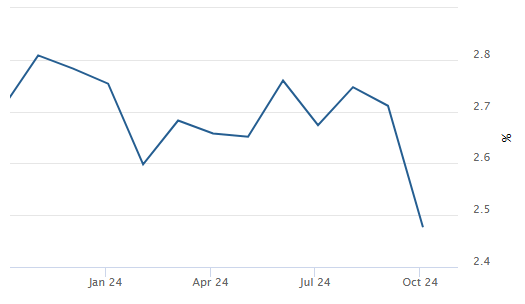
    Mexico: GDP growth
    Percentage variation (year-on-year)

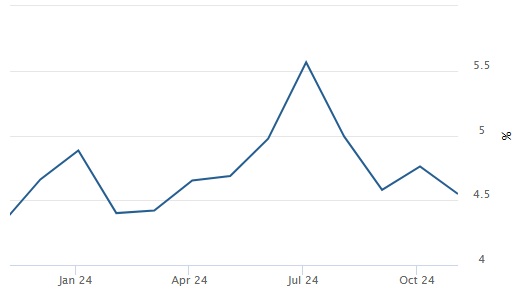
    Mexico: unemployment rate
    Economically active population

    Mexico: inflation rate
    Percentage variation (year-on-year)

    Source (all graphs): National Statistics Institute (Inegi)

  • Republicans equate Mexico with Guatemala

    LatinNews 04 August 2011 Hits: 533

    Richard Lugar (R, Indiana), the ranking Republican on the US Senate Foreign Relations Committee, recently underlined how close some key players in Washington are to equating Mexico with Guatemala. In his opening statement on 20 July to the committee to review the nomination of Earl Anthony Wayne as the next US ambassador to Mexico, Lugar drew several parallels between Mexico and Guatemala. Furthermore, the committee itself held Wayne’s hearing simultaneously with that for Arnold Chacon, the nominee as US ambassador to Guatemala.

    The US followed up the nomination hearings with the announcement on 25 July   by William J. Burns, the State Department’s Under Secretary for Political Affairs, of a Strategy to Combat Organized Transnational Crime. Significantly, Burns argued that US aid to Colombia over the past 10 years had freed “large parts of Colombia [which] were controlled by terrorist and criminal organizations. But through collective action by the US and Colombia, the Colombian people reclaimed their territory, their security and their future. Today, Colombia’s police train other forces across the region and around the world. And through the Mérida Initiative, the US is partnering with Mexico to strengthen its law enforcement, judiciary and correctional institutions and bring security to communities south of our own border.”

    Burns’s linking of Plan Colombia to the Mérida Initiative is the clearest evidence yet that the US sees the problems in Mexico as similar (or even identical) to those in Colombia a decade ago. Several long standing Colombia watchers, including one former British ambassador, disagree with elements of the US analysis, arguing that the US has misunderstood what happened in Colombia. Their argument is that political terrorists such as the Fuerzas Armadas Revolucionarias de Colombia (Farc) would have been completely defeated by now but for the revenues they derive from the international drug trade. So these Colombia watchers argue that if drugs such as cocaine were legalised, these terrorist groups would lose their revenues and wither away as other insurrectionist groups in Central America did, after agreeing peace deals.

    The problem in Mexico is the reverse. There are growing signs that the purely criminal drug gangs are developing political interests and ambitions as well as moving into other criminal activities such as people trafficking, arms trafficking, money laundering and kidnapping.

    It is curious that the US did not immediately comment on the strange fact that a federal Mexican police operation against a people smuggling group in Tamaulipas on 23 July picked up an Iranian, along with four Hondurans, three Brazilians, three Salvadoreans and a Nicaraguan. The 12 people, apparently being trafficked into the US, had been kidnapped two months earlier in Chiapas. They were found and freed by federal Mexican policemen in Reynosa, Tamaulipas. Five of the six kidnappers were Guatemalan; the other was a Honduran. In the Strategy to Combat Organized Transnational Crime, the US specifically warned that people trafficking networks could be used by terrorists to get agents into the US.

    The Strategy to Combat Organized Transnational Crime only briefly commented on what was going on in Mexco and indeed the Western Hemisphere. The starting point of the strategy was that transnational crime threatened US borders. The main elements of the strategy are executive orders that President Obama can use to go after the assets of criminal gangs and drug traffickers, offering federal rewards for information leading to arrests and measures to seize property belonging to gangs.

    On 25 July the US Treasury moved to prevent a Mexican gang, Los Zetas, from using the US financial system, by banning US financial companies from having any dealings with them. Any US citizen that has any dealing with a Los Zetas gang member is now committing a criminal offence. Lawyers, presumably, are exempt because of the constitutional right of accused persons to legal advice.

    The threat of US federal sanctions is likely to drive money launderers further away from the US and into less supervised jurisdictions.  The big question is whether the gangs have hidden their assets in the US well enough to avoid detection. The Strategy is designed to attack this by proposing legislation to congress that would make it a criminal offence for a new company to conceal its real owners.

    In the senate
    Senator Lugar did sugar his linking of Mexico to Guatemala by pointing out that the US was more fortunate than most “Great Powers” to have Mexico and Canada as neighbours, which both historically have provided regional stability. Lugar indicated, however, there were now questions about Mexico’s stability. The three senators who asked most of the questions during Wayne’s two-hour session were: Lugar; Marco Rubio (R, Florida); and Robert Menéndez (D, New Jersey). It seems almost certain that the Senate will approve of Wayne’s nomination before the summer recess, which is likely to be delayed until 6 August because of current difficulties in extending the US debt ceiling.

    Wayne is a career member of the state department. He has served as ambassador to Argentina (2006-2009) and his last job was as deputy head of mission in Afghanistan.

    Wayne promised, as Lugar advocated, to support the Mérida Initiative, which has channelled US money into combating the drug trade in Mexico and Central America. Wayne said that despite criticisms of the Mérida Initiative, he expected it to continue beyond the 2012 elections. In 2012, both the US and Mexico will hold presidential and congressional elections. Wayne also firmly backed President Felipe Calderón’s ‘war’ on organised crime, which has led to over 34,000 violent deaths in Mexico since Calderón declared it on 1 December 2006. In response to a question from Menéndez, Wayne admitted that there had been criticism of the violence in Mexico, but said that he did not see any alternative to Calderón’s use of the military against the drug trafficking gangs and claimed that there was a “strong consensus” among political leaders in Mexico that the war had to continue.

    Wayne stressed his intention to work with both US and Mexican officials for faster disbursement of the funds from the Mérida Initiative. To date (as of end June 2011), only US$465m has been disbursed of the US$1.3bn authorised since the programme was launched in 2008, but the administration hopes that US$900m will have been disbursed by “the end of the year”. It is not clear whether by end year the US is referring to the current fiscal year (30 September 2011) or the calendar year.

    Wayne implied that thanks to the Mérida Initiative, Mexico had taken out of circulation (i.e. killed or arrested) around 30 leading gang members. He noted that many of the operations against these gangsters were the result of information sharing between Mexico and the US. He also noted that the US has supplied Mexico with 11 helicopters and has provided training for over 13,000 Mexican law enforcement personnel under the Initiative.

    While Wayne was speaking, elsewhere on Capitol Hill the House of Representatives’ foreign relations committee, which is controlled by the Republicans, was in fact trimming US aid delivered under the Mérida Initiative. A proposal from Michael McCaul (R, TX) to halve the cost of training aid provided under the Mérida Initiative in the 2012 financial year (which starts on 1 October), was passed and will now go to the full House and then the Senate.

    Fast & Furious
    More controversially, Wayne said that if confirmed as ambassador he would do all he could to ensure that covert operations such as ‘Fast & Furious’ – in which the US Bureau of Alcohol, Tobacco, Firearms & Explosives (ATF) encouraged Mexican gangs in a sting operation to buy high powered weapons in the US, in an effort to uncover the networks which armed the gangs – “never took place” again. In fact, what happened was that the ATF tracking scheme failed and over 1,200 of the 1,800 guns that had been sold to known associates of gangsters were lost. At least one was later used to kill a US Border Patrol officer.

    The Republicans in both the House of Representatives and the Senate are alleging that the government of President Barack Obama is covering up a major scandal by concealing information on ‘Fast & Furious’. Senator Charles Grassley (R, IA), the senior Republican on the Judicial committee, and Representative Darrell Issa, (R, CA), who is also chairman of the House  Oversight & Government Reform Committee, are heading the Republican investigation into ‘Fast & Furious’, holding a series of hearings. Both politicians have sent letters to Robert Mueller, the head of the Federal Bureau of Investigation (FBI), and Michelle Leonhart, the head of the Drug Enforcement Administration (DEA), to ask them what they knew about the operation.

    In early July, the legislators wrote to Eric Holder, the attorney general, after the acting head of the ATF, Kenneth Melson, told them in a closed session that the Department of Justice had instructed him not to give testimony in public. The letter published tracts of Melson’s testimony in which he described attempts by the Department of Justice to conceal evidence.

    On 25 July it emerged that ATF agents had lobbied the District Attorney in Arizona to close the programme down in March 2010, when information emerged that the weapons in the programme had got though to Mexican gangs. This evidence came from Democrat congressmen, who are trying to minimise the political damage a cover-up could cause to the Obama administration.

    The Democrats point out that in confidential testimony, the interim deputy director of the ATF, William Hoover, ordered the agents running the ‘Fast & Furious’ operation to close it after 90 days, so that charges could be brought against the traffickers. According to Hoover and other ATF agents, this order was overruled by Dennis Burke, the federal attorney for the district of Arizona. Federal attorneys routinely monitor and supervise federal criminal investigations. Burke, apparently, ordered ‘Fast & Furious’ to continue to until January 2011.

    Hoover said he flew to Phoenix, Arizona in July 2010 to discuss ‘Fast & Furious’ with officials in Burke’s office. The outcome of this meeting was a decision that it should continue. (It had started in 2009). Hoover and other agents involved testified that they knew of no orders from either senior management at the ATF or the Department of Justice authorising ‘Fast & Furious’.

    The scandal of ‘Fast & Furious’ was revealed by a CBS documentary broadcast in March 2011. The congressional investigation continues on 26 July with another hearing by Issa’s Oversight & Government Reform committee. This hearing is entitled The Other Side of the Border and will take evidence from ATF officials who were deployed in Mexico. These officials are likely to say that they were kept out of the loop over ‘Fast & Furious’.

    On 26 July the New York Times (NYT) reported that a preliminary report for Issa’s and Grassley’s committees had identified that 122 weapons trafficked under ‘Fast & Furious’ have been recovered at crime scenes in Mexico. The report is likely to be published on 26 July. According to the NYT, the report lists 48 occasions between November 2009 and February 2011 in which Mexican authorities found one or more such weapons. The information in the report is based on internal ATF e-mails, whose Phoenix office set up the operation.

    Operation ‘Fast & Furious’ was an investigation by the ATF’s Phoenix office into a suspected network of “straw” gun buyers, who were acquiring weapons, including a variant of the AK-47 assault rifle, from weapons dealers in the US, for use by drug cartels based in Mexico, where it is illegal to sell such guns. It ran from around late 2009 to early 2011 and to date 20 people have been charged in connection with it.

    The Justice Department has told Congress that the ATF “was not aware of the majority of these purchases at the time they actually occurred.” It also said that about 600 of the 2,000 guns were purchased before the agency identified the buyer as a suspected straw purchaser. It is not clear how many guns bought by the straw buyers got through to the Mexican gangs. One ATF report in December 2010 talks of 241 weapons as having been recovered from Mexico; the 26 July report for the congressional committees puts the figure at 122.  A now-retired ATF attaché to Mexico, Darren Gil, is on record as saying that by October 2010 700 of the nearly 2,000 weapons sold under ‘Fast & Furious’ got through to the Mexican gangs.

    The Issa and Grassley report describes, according to the NYT, how ATF officials in Mexico noticed, starting in late 2009, that a disproportionate number of the guns being recovered at Mexican crime scenes were linked to Phoenix stores. It portrays them as raising questions, and later alarms, about what was happening, only to be told that it was “under control.”

  • Risk pointers

    LatinNews 06 September 2011 Hits: 364

    *** Palestinian views on Dennis Ross.  President Obama’s chief Mideast adviser Dennis Ross is in Jerusalem, trying to find a formula for restarting Israeli-Palestinian peace talks.  Ross’s message to Israel is that in order to prevent its deligimization it must return to the negotiating table on the basis of the proposals put forward by President Obama, namely peace talks based on the 1967 borders with mutually agreed land swaps that take into account the demographic changes that have occurred in the last 44 years.

    That Ross is not seen as a neutral party by many Palestinians was made clear in a ‘go home’ message from the pro-Hamas Palestine Information Centre.  A commentary by Khalid Amayirah described Ross as a “venemous Zionist reptile who obviously has no iota of honesty and rectitude”.  Amayirah went on to say that Ross’s mission was “to succeed in convincing the weak Palestinian leadership to succumb to the whims and vagaries of Jewish fascism, especially those voiced ad nauseam by clearly psychotic Jewish supremacists and megalomaniacs such as Binyamin Netanyahu and his cohorts in Washington and Occupied Jerusalem”.

    *** Turks and Kurds.  A report on ‘Perceptions and Expectations on the Kurdish Issue’ from Turkey’s Konda research group provides a sombre snapshot of Turkish attitudes to the Kurds.  According to the survey, 47.4% of Turks do not want a Kurdish neighbour and 57.6% do not want a Kurdish daughter-in-law.  Interestingly, supporters of the ruling Justice and Development Party (AKP) have stronger opinions than supporters of the main opposition Republican People’s Party (CHP).  Of the former, 42.9% don’t want a Kurdish neighbour, 48.8% don’t want a Kurdish business partner, and 51.7% don’t want a Kurdish daughter-in-law.  The respectice figures for CHP supporters are 38.7%, 43.4%, and 47.2%.

    Kurdish candidates nominated by the Peace and Democracy Party (BDP), but standing as independents, won 36 out of 550 seats in the 12 June election.

    *** Russian pessimism on Mideast.  Since the beginning of the Arab Spring, some of the most pessimistic assessments have been coming out of Russia, with constant warnings about the duration of the crisis.  So far the Russian assessment has proven closer to the mark than original Western hopes of rapid and successful transitions.  It is hard to find a Russian Mideast expert who is not pessimistic and who does not believe the crisis will persist for many years.  Sergey Demidenko from the Institute for Strategic Studies and Analysis added to the weight of pessimistic Russian assessments last week, warning of a “second wave of explosions” as a result of unfulfilled expectations.  He said: “Arab societies are developing, and there are many of them; they are very young and demand change while authorities do not supply the change...This is why, one way or another, we shall inevitably witness a second wave of explosions in five or six years.”

  • TRACKING TRENDS

    LatinNews 04 April 2013 Hits: 2513

    COLOMBIA | Ecopetrol starts 2013 on the right foot. On 2 April Colombia’s state-owned oil firm, Ecopetrol, announced that it had made the discovery of a hydrocarbon deposit in Meta department in the country’s eastern Llanos Orientales area, the second such discovery this year. The announcement is good news for Colombia given that as recently as February Colombia’s finance minister, Mauricio Cárdenas, highlighted the need for Ecopetrol to ramp up its exploration efforts in order to maintain the government’s ambitious production target of 3m barrels of oil per day (bpd).
        Since then, on 19 March, Ecopetrol announced its first hydrocarbon discovery of the year at the Pastinaca-1 well, also in Meta department. Ecopetrol said that preliminary drilling at Pastinaca-1 produced 202bpd; and that this served as further confirmation of the still untapped oil-producing potential of the Llanos Orientales, from which 55% of Colombia’s oil is currently being extracted. Importantly Ecopetrol also pointed out that the Pastinaca-1 well was part of a concession contract (CPO) which was exclusively awarded to Ecopetrol by Colombia’s national hydrocarbon agency (ANH) in 2008. This means that the state-owned company is the sole operator and thus set to reap its full benefits.
        The encouraging Pastinaca-1 discovery has been quickly followed by another in the adjacent CPO area at the Venus-2 well. According to Ecopetrol preliminary drilling at Venus-2 has produced 630bpd, suggesting that this well could be even more productive than Pastinaca-1.
        In order to continue with its exploration efforts and to successfully exploit its newfound wells in the Llanos Orientales, it is clear that Ecopetrol will have to raise funds to invest. Luckily for the firm there are signs that it will not encounter many difficulties in achieving this. On 26 March Ecopetrol announced that it had successfully concluded the negotiation of a US$847m credit line form the US’s Export-Import Bank and four other international banks: JP Morgan Chase, Citibank, the Bank of Tokyo-Mitsubishi UFJ and Mizuho Corporate Bank; which will be “exclusively used to pay for goods and services contracted from suppliers from the US”.      

    PERU | Domestic tourism on the rise. Domestic tourism in Peru during the Holy Week period generated US$260m, 15% more than last year, according to official figures released by Peru’s national tourism chamber (Canatur) on 1 April.
         Peru’s tourism sector is becoming an increasingly important economic activity and according to Canatur president, Carlos Canales, domestic tourism is one of the driving forces in the sector. In fact according to Peru’s foreign trade & tourism ministry, Mincetur, domestic tourism last year increased by 5%; this as trips made by Peruvians to other parts of the country increased by 13% with 34m Peruvians effectively becoming domestic tourists.
        Pointing out that the average amount of money spent by domestic tourists has increased by 42% since 2009 to US$191.66 per head, Mincetur said that domestic tourism is a good way to promote the economic development of the country’s interior as it tends to benefit smaller communities directly when the tourists’ money is being spent. This led Mincetur to launch an “aggressive” domestic tourism promotion campaign this year. According to Canales, the latest figures show that Mincetur’s efforts have already produced some results. However, Canales pointed out that these should now be matched by the private sector as well as other government agencies so as to improve Peru’s transport and tourism infrastructures.
        As positive as Mincetur figures are, Peru’s tourism observatory (OTP), a local NGO, has taken a less optimistic view, pointing out that the methodology used is inaccurate as Mincetur considers all Peruvians that travelled inside the country to be tourists whereas in reality some of these might just be people returning to their home towns.
        OTP’s chief researcher, José Manuel Marsano, explained that “tourists spend money on hotels, food, tours, souvenirs, etc., while those returning to their home towns do not tend to have these expenses”. In this sense, Marsano said that the figures are not only misleading as regards the number of tourists, which OTP puts at just a fraction of Mincetur’s figure (4.1m), but also on the amount of income generated. Nevertheless, Marsano said that the OTP believes that domestic tourism in increasing and forecasts a 4% increase this year if the current positive domestic economic climate continues.

    Palestine

    On 2 April a delegation of the Palestine monetary authority (PMA) led by its president, Jihad Khalil Al Wazir, visited Bolivia’s central bank (BCB) where they sought to exchange “technical experience” on monetary policy and a number of other issues. The delegation was hosted by Bolivia’s development planning minister, Viviana Caro, who said that the visitors were also looking to find out more about investment opportunities in the Andean country. Indeed, according to Caro, the objective of the visit was to be able to “establish more formal and firm relationships with the Palestine State”. Caro added that “Bolivia is a country with a lot of potential and we are in the process of carrying out investment and development projects,” though she failed to name these.        

  • BOLIVIA: Another drugs embarrassment for Morales

    LatinNews 28 January 2016 Hits: 832

    The general director of Bolivia’s coca control and industrialisation agency (Digcoin), Ricardo Paniagua, was forced to step down this week in order to be investigated for the unauthorised transportation of coca leaves. The resignation of Paniagua – the latest senior anti-drugs official to go over alleged corruption – is an embarrassment for the Movimiento al Socialismo (MAS) government led by President Evo Morales whose drugs policy distinguishes between the raw coca leaf (an important symbol of Bolivian indigenous culture) and cocaine, the illegal narcotic.

    Interior Minister Carlos Romero announced Paniagua’s resignation on 25 January, three days after the state news agency Abi reported that Paniagua, along with two other individuals, had been arrested en route to Cochabamba department, for transporting ten ‘taques’ (one taque = 50 pounds) worth of coca leaves in an official government vehicle without authorisation.

    Paniagua had been in the post since July 2014, despite having faced previous corruption charges; according to Cochabamba-based daily Los Tiempos, in 2004 Paniagua had received a 10-year prison sentence for drug trafficking although it was unclear whether he served any of it or received a pardon. His departure also follows that of one of his predecessors, Luis Cutipa (2006-2013), who was forced to step down in 2013 after facing accusations of diverting between 35,000 tonnes (t) and 45,000t of coca to the illegal market over a period of several years [WR-13-40].

    The scandals involving Paniagua and Cutipa follow those surrounding other high level anti-drugs officials like the former director of Bolivia’s anti-drugs unit, Fuerza Especial de Lucha Contra el Narcotráfico (Felcn); René Sanabria, convicted of drug smuggling in the US in 2011; and Mario Fabricio Ormachea Aliaga, who was arrested in the US in September 2013. A former head of the special police operations force, Fuerza de Operaciones Especiales (FOE), in Santa Cruz between 2009 and 2010, Ormachea Aliaga was picked up for allegedly seeking to extort US$30,000 from Humberto Roca, the former president of the national flag carrier Aerosur, which collapsed in 2012.

    A controversial appointment

    As well as the corruption concerns surrounding Paniagua, President Morales’ choice of General Juan Gonzalo Durán Flores as the new commander-in-chief of the armed forces, appointed at the end of last year as part of a procedural change, has also proven controversial.

    The general (who was promoted from the post of head of the air force [TAB]) stands accused of alleged corruption which took place in 2007 while he was serving as director of Transporte Aéreo Militar (TAM), an airline owned by the Bolivian air force. He is accused of signing a cheque for B$522,920 (US$75,698) for the purchase of aircraft parts which were supposedly never acquired.

    While Durán had previously been called to testify as a witness back in October 2015 in relation to the case, local prosecutor Ángelo Saravia announced on 8 January that he would be called to testify as a defendant.

    Also under investigation are Julio César Villarroel (current TAM director); Jaime Flores (TAM’s financial and administrative director in 2007); and José Ramiro Callapa (TAM’s treasurer in 2007), amongst others.

    These are not the only accusations against Durán. This month the state prosecutor’s office revealed that a further three complaints had been presented –including for the alleged mistreatment of female cadets and irregular purchase of a building for the TAB.

    • Illegal market

    The latest (September 2015) report by the United Nations Office on Drugs and Crime (UNODC) estimated that in 2014 the total volume of coca leaves traded in Bolivia’s two authorised coca markets – Villa Fátima and Sabaca – weighed 19,797 tonnes (t), equivalent to 60% of total coca leaf production. The remaining 40% – or 13,240t – is believed to be destined for narco-trafficking. This is still less than the previous year (2013), when the UNODC estimated that almost half (47%) of Bolivia’s total coca production was destined for narco-trafficking.

  • Region: Corporate Radar

    LatinNews 22 April 2016 Hits: 9624

    Corpbanca and Itaú Fuse: On 1 April, the Chile-based Corpbanca and the local subsidiary of Brazil’s Itaú Unibanco formalised their long-drawn-out merger process. The merged entity, the fourth largest bank in the Chilean market, will be known formally as Itaú Corpbanca. It will trade under the Itaú brand, and will have US$41bn in assets and a US$31bn loan book. The Brazilian parent, Itaú UInibanco will control the bank, with a 33.58% shareholding. CorpGroup, former owner of Corpbanca, will have 33.13% of the shares, with the remaining 33.29% in the hands of a range of minority shareholders. The merged Chilean bank will have a 66.28% controlling interest in Corpbanca Colombia and 100% of the shares of Itaú Colombia.

    Flying Latin Americans: Despite the current slowdown in economic growth, Latin American aviation markets will see “robust expansion”, various industry executives said at FIDAE, the Santiago-based international aviation fair. Germán Efromovich, president of Avianca Holdings, said that “future opportunities are immense”, citing low market penetration. Latin America has 0.4 available aeroplane seats per capita, only one-sixth of the level in the US. At FIDAE, Boeing said that between now and 2035 the region will need to spend US$330bn to purchase 2,040 new commercial aircraft. Demand for air travel in Latin America has grown at an annual average of 7% over the last five years, above the global average of 5%, according to Brazilian plane manufacturer Embraer. According to the regional president of Airbus, Rafael Alonso, by 2034 nine of the world’s 91 mega-cities will be Latin American, boosting the region’s significance in terms of the global aviation market.

  • BARBADOS: Disillusion with austerity hits DLP re-election prospects

    LatinNews 12 July 2017 Hits: 839

    In last month’s issue we looked at the latest budget presented on 30 May by Finance Minister Christopher Sinckler in which he called for “steely resolve” and talked about a “national call to arms” [RC-17-06]. We said that this was not the ideal message to be sending to the electorate with less than a year until the ruling Democratic Labour Party (DLP) has to go to the polls. Not surprisingly, the latest opinion polls reinforce this point.

    An opinion poll published in late June by the Nation newspaper and conducted by local polling firm the Caribbean Development Research Services (Cadres) makes grim reading for Prime Minister Freundel Stuart. According to the poll, only 11% of respondents would support the DLP in a general election, with 51% saying they would support the Barbados Labour Party (BLP) led by Mia Mottley.

    A massive 71% of Barbadians say they would like to see a change of government. To put this into perspective, in 2008 when there was last a change of government the percentage saying they wanted a change ahead of that election was 48%. The support for the prime minister is just 8%, compared with 52% for Mottley. Former BLP prime minister Owen Arthur (1994-2008) has 18% support.

    Perhaps even starker is the almost non-existent level of support for the finance minister. Only 0.6% of respondents saw Sinckler as a desirable prime minister. However, Cadres did point out that the proximity of the poll to the budget was “clearly a factor that impacted on public opinion”.

    There was no comfort for the government from the latest International Monetary Fund (IMF) assessment. In its most recent statement, released on 29 June, the IMF notes that the 400% increase in the National Social Responsibility Levy (NSRL), the introduction of a 2% levy on foreign exchange transactions, and the hike in excise tax on petrol and diesel would push inflation from 3.2% to 6.7% by the end of 2017.

    On GDP growth, the IMF said: “Growth in 2017 is projected to slow to less than 1 per cent, reflecting the fiscal consolidation efforts introduced in the FY2017/18 Budget.”

    Adding to the gloom, the IMF had a warning on the effects of Britain’s exit from the European Union. It said: “There are important downside risks related to the increase in domestic and global uncertainty, including the impact of the Brexit on the British pound.”

    The IMF team were in Barbados from 20 June until 1 July. However, the government remains adamant that the country is not about to enter into an IMF programme.

    The Barbadian electorate has a habit of awarding alternating periods of ten years in power to the country’s two main parties (although the BLP had a 14-year stretch from 1994-2008). Given that the current DLP government is reaching the end of its second consecutive term in office, and given the current state of opinion polls, it seems all but inconceivable that it will retain power when it does go to the electorate in 2018. The only interesting question seems to be by what margin it will lose power. It came to power in 2008 with a 20-10 majority, but this dropped to 16-14 in the 2013 contest.

  • Region: DR continues to boost Central America human rights understanding

    LatinNews 29 September 2017 Hits: 530

    The Dominican Republic (DR) is continuing its programme of boosting human rights understanding among security forces and civilian populations across Central America. In November, 415 specialists will graduate from the Dominican Ministry of Defense’s Graduate School of Human Rights and International Humanitarian Law (EGDH-DIH in the Spanish acronym), having read for a Diploma in Human Rights and International Humanitarian Law – the sixth time the course has been run.

    “A large number of military officers are expanding their knowledge and sharing their experiences on human rights and international humanitarian law,” Dominican Air Force Brigadier General Rafael Antonio Alegría Arias, the school’s director, told specialist military news site Diálogo. “We’re seeking an optimum level of comprehensive development, better relations among communities, and improved performance by the military institutions in their respective countries.”

    The new challenge for EGDH-DIH personnel is to take their knowledge beyond the boundaries of security-force hierarchy and boost understanding among non-military populations.

    “We are training students in their final years of high school to raise the awareness of young people regarding human rights and international humanitarian law,” Brig. Gen. Alegría said. “We’re doing the same thing at universities.”

    This public awareness campaign is being taught by highly trained teachers. The team of instructors at the military academy is also bolstering its capacities through the exchange of information, knowledge, and training with an array of international organisations and institutions, such as US Southern Command’s Human Rights Office and the International Red Cross.

    In 2008, the Conference of Central American Armed Forces (CFAC), comprising Dominican Republic, El Salvador, Honduras, Guatemala, and Nicaragua, designated EGDH-DIH a regional human rights and international humanitarian law training centre. This educational institute is the first military academy specialising in the teaching, study, and dissemination of the norms and principles of both fields in Latin America, through which the DR sends military instructors to Central American countries to instruct members of their armed forces in these disciplines.

    According to a 2015 report by the UN, ‘Transnational Organized Crime in Central America and the Caribbean: A Threat Assessment’, the residents of Central America consider violent crime to be one of the most important problems their nations face. This violence is attributed largely to the increase in cocaine trafficking through the region since 2006.

    “With the constant changes within society itself and in the world at large, the armed forces have a need to train, equip, and update themselves incessantly,” Brig. Gen. Alegría said. “If the armed forces respect the citizens’ acquired civil rights and their human rights, we contribute to society, in general, being held to the same levels of respect for human rights.”

  • HAITI: Moïse’s concessions fall on deaf ears

    LatinNews 03 October 2019 Hits: 5546

    President Jovenel Moïse is facing the biggest mass protests since taking office in February 2017. With long-running public anger over government corruption, not least stemming from his alleged embezzlement of funds from Venezuela’s discounted oil initiative Petrocaribe, and fuel shortages, the latest crisis was prompted by Moïse’s efforts to get the senate to ratify his unpopular choice of Fritz William Michel as prime minister [WR-19-38]. Concessions since offered by Moïse in recent days have yet to have an impact while the pressure continues to mount on the beleaguered president, who has not been seen since 25 September, to step down.

    In a pre-recorded national address on 25 September, President Moïse hinted that he could dispense with Michel, who had faced recent allegations of bribery and corruption, appearing to leave the door open to a “national unity government”. As well as carrying out a mini cabinet reshuffle, the following day he also announced the resignations of Joseph Pierre Richard Duplan, his representative for Ouest department, and Fednel Monchéry, the director-general of the interior ministry, in what was widely considered a bid to appease the opposition. The two were implicated in a November 2018 massacre and their continuance in their posts had been a source of local and international discontent [WR-19-34]. The same day Moïse also revealed that he had requested an inter-religious group of the country’s main religions, Religions pour la Paix, to act as mediator between himself and the opposition.

    • Cabinet changes

    On 24 September President Moïse fired interior minister Jean Marie Reynaldo Brunet, replacing him with education minister Josué Agénor Cadet in an interim capacity, as well as naming Lyonel Valbrun, a former agriculture minister, to replace Hilbert Lebrun as secretary general of the presidency. Five days later he announced other cabinet changes. These include the appointment of former environment minister Joseph Jouthe to replace Ronald Décembre as finance minister; former defence minister Enold Joseph to take over from Ronell Gilles as trade & industry minister; and former women’s minister Evelyn Sainvil to replace Mamatha Irène Ternier as minister of Haitians living abroad.

    However, these gestures have been rejected by opposition leaders such as Senator Youri Latortue (Ayiti An Aksyon) and André Michel of the radical opposition Secteur démocratique et populaire who, despite calls from the international community to accept Moïse’s offer to talk, maintain that only his departure would end the crisis.

    Indeed, thousands of people have taken to the streets in recent days echoing this call. As well as the capital, Port-au-Prince, there were protests in key cities such as Cap-Haïtien (Nord department), Gonaïves and San Marcos (Artibonite), Petit-Goâve (Ouest), Jacmel (Sud-Est), Jeremie (Grand’Anse), Mirebalais (Centre), Les Cayes (Sud), and Ouanaminthe (Nord-est). The local press reported that businesses were ransacked and set alight, and a special unit of the national police (PNd’H) in Cité Soleil, a Port-au-Prince slum, was looted as well as other local police stations.

    With the authorities yet to provide any figures as to the impact of the latest protests, which prompted a statement of concern on 30 September from United Nations (UN) Spokesperson Stéphane Dujarric, on 26 September PNd’H spokesman Gary Desrosiers said that at least four people were shot dead in protests which took place between 17 and 25 September.

    Aside from mounting speculation as to whether Moïse, who last month survived an impeachment motion tabled by opposition legislators, will see out the end of his mandate, the ongoing crisis raises major questions about stability in the country as the UN Mission for Justice Support in Haiti (Minujusth), which took over from the UN Stabilisation Mission in Haiti (Minustah) two years ago, prepares to leave next month.

    In June the UN Security Council (UNSC) voted to create the UN Integrated Office in Haiti (BINUH) as of 16 October, which is tasked with “strengthening political stability and good governance”, effectively ending the UN’s peacekeeping role in the country after 15 years.

  • URUGUAY: Fate deals Lacalle Pou tough hand

    LatinNews 02 April 2020 Hits: 3845

    Spare a thought for President Luis Alberto Lacalle Pou. No sooner had he taken office on 1 March than he was confronted with the most significant test of a Uruguayan head of state since the return to democracy in 1985. The economic and financial meltdown in 2002 was unprecedented in scale in Uruguay’s history but Lacalle Pou, fresh from donning the presidential sash, is having to wrestle not only with the most serious public health crisis of the last century but also one which will have a far-reaching economic impact both on Uruguay and all of its trade partners.

    President Lacalle Pou’s plan of governance has been shelved if not torn up, while many of his campaign promises, not least to reduce the fiscal deficit, are now a forlorn hope or at best mothballed. Steering the ship of state through stormy seas over the coming months and most likely beyond would be a daunting task for a seasoned veteran but Lacalle Pou has only just been handed the tiller. Lacalle Pou declared a health emergency in Uruguay on 13 March, 12 days after coming to power, when the first four cases of coronavirus (Covid-19) were confirmed.

    So far Lacalle Pou has shown the strength of his convictions. Several countries in the region have imposed total lockdowns. The left-wing opposition Frente Amplio (FA) advocates the same in Uruguay to arrest the spread of the virus; indeed, his experienced predecessor, twice former president Tabaré Vázquez (2005-2010; 2015-2020), a doctor, has called for complete quarantine “if we want to break this vicious circle”. Lacalle Pou has opted instead for firm and decisive action but not too drastic.

    The Lacalle Pou administration has closed the country’s schools and borders, with some exceptions; outlawed public events; discouraged large gatherings; urged Uruguayans over 65 to self-isolate; and instructed the police to encourage people to stay at home. The public response has been positive, for now. An opinion survey published by the local pollster Equipos this week gave him an approval rating of 65% and disapproval of just 20%.

    Several gestures since the poll was carried out could give his popularity a further boost. The basic basket of goods will be extended to low-income households and family allowances increased. Lacalle Pou said that the salaries and pensions of public sector officials earning in excess of Ur$80,000 (US$1,800) per month would be reduced by between 5% and 20%, while the salaries of cabinet ministers, legislators, and directors of state institutions would be cut by 20%, for at least two months. Lacalle Pou said he would take a 20% pay cut himself.

    Augmented with profits from public entities this will go into a fund, ‘Fondo Coronavirus’, created to cover some of the costs associated with combating the virus. Lacalle Pou said it was essential to support all the Uruguayans who are without jobs and struggling to put food on the table.

  • MEXICO: Doubts rise over Pemex’s environmental pledges

    Patrick de Courcy 09 December 2022 Hits: 496

    Mexico’s state-owned oil company Pemex announced on 12 November that it would work with the US Environmental Protection Agency (EPA) to reduce its emissions of greenhouse gases, especially methane, in order to comply with Mexico’s international environmental commitments. In its statement, the company claimed that, with the support of the EPA, it would develop a plan to mitigate emissions during the first half of 2023.

    Pemex has come under scrutiny this year as it emerged that the company had been flaring record amounts of natural gas, even in fields where it produces gas rather than oil - gas flaring is the burning of natural gas typically associated with oil extraction.

    A report by newswire Reuters, published on 17 November, claims that Pemex has been willing to pay fines rather than interrupt production in order to fix the underlying issues. According to the report, Mexico’s energy sector regulator Comisión Nacional de Hidrocarburos (CNH) has fined Pemex four times over the past year for failing to comply with its own development plans for two fields that led to vast amounts of natural gas being burnt off. Moreover, Pemex is reportedly appealing the fines, even though they are relatively small for a company of its size.

    The Reuters report also points out that decisions taken by company officials who have been willing to incur the cost of paying fines to avoid going against President Andrés Manuel López Obrador’s production goals, underscore the structural problems around regulating the company. The CNH can only fine Pemex for breaching development plans rather than for causing environmental damage. It is the remit of the energy & environment agency (Asea) to monitor damage to the environment. However, the agency has historically not sanctioned Pemex for flaring.

    In addition, according to local press reports, Pemex is flaring gas in fields such as Ixachi in Veracruz (which led to a fine of more than M$40m [US$2.06m] in May) because it has failed to build the infrastructure that would allow it to use the resource. Indeed, since the end of 2016, Pemex developed a plan with the CNH to invest more than M$3bn to reduce flaring, but this was abandoned by the current administration before being finalised both because the low prices of gas made it less attractive and because of the political imperative to boost oil production.

    As a result, Mexico is the eighth largest flaring country in the world. Not only is this highly damaging to the environment, but it is also wasteful. Although Pemex does not publish figures related to flaring in its fields, according to Reuters, more than 37% of gas from its Ku field (part of Ku-Maloob-Zaap (KMZ) oil complex located off the coast of Campeche state), was wasted through flaring or other means. Legally, the limit is 2%. Indeed, in 2020 Pemex reportedly requested permission from the CNH to burn gas at even higher levels at Ku, including up to 71.3% until 2030, which the regulator approved.

    This is despite the fact that Mexico is one of 34 countries that have signed a commitment, backed by the World Bank, to reduce routine flaring to zero by 2030. And yet, flaring in Mexico reached record levels in 2021. In the first seven months of 2022, it is believed that flaring will have remained near the same levels as 2021.

    This situation has led to greater international pressure, particularly from the US but also from other quarters, such as the European Space Agency, which stated in June that some of Pemex’s oil wells in Campeche state had flared more than ten times the usual amounts of gas. This led López Obrador to announce shortly afterwards that Pemex would invest US$2bn to improve infrastructure to reduce flaring and methane emissions. The announcement coincided with a visit to Mexico from US Special Presidential Envoy for Climate John Kerry, during which the Mexican government pledged to step up its efforts against climate change. The government also said its aim was to reduce methane emissions by up to 98%, but no timeframe for reaching that goal was mentioned.

    Crucially, the waste of resources that results from the extent of flaring and venting in Pemex’s fields could compound financial pressure for the company, which on 28 October reported that in the third quarter of the year it recorded net losses of M$52bn (US$2.5bn). Although this was lower than the net loss recorded in the same quarter of 2021, which amounted to M$77.2bn, it was in contrast with international oil companies that posted sizeable profits between July and September as a result of high crude oil prices. The Mexican oil mix went up from US$68.34 per barrel in the third quarter of 2021 to US$88.02 per barrel in the third quarter of 2022.

    • Pemex debt

    The financial debt of Pemex as of 30 September amounted to M$2.132trn (US$105bn), only 3% lower than in the same period of the previous year (US$108bn) and 5.2% lower than the total recorded at the end of 2021. Although this resulted from the aim of maintaining net indebtment close to zero, Pemex’s debt nevertheless remains significant.

    According to the financial results sent to the Mexican stock exchange, Bolsa Mexicana de Valores (BMV), Pemex’s revenue grew 56.5% relative to the same quarter of 2021, partly boosted by sales. Domestic sales, particularly of fuels, saw an increase of 69.3%, while exports, including from the Deer Park refinery in Texas, recorded growth of 44.5%. The main factors behind these increases were the international rise of the oil price as well as greater volumes sold. However, the higher cost of purchases diluted these gains, having increased by 84% from the same period of 2021. This was mostly a result of the purchase of products to re-sell, especially fuels, which increased from M$114bn in the third quarter of 2021 to M$318.8bn.

    Pemex also said that its losses during the third quarter were a result of currency exchange losses due to a weaker peso, as well as higher tax and duties payments that added up to M$104bn (US$5.24bn), equivalent to an increase of 37.8% relative to the same period of 2021. This was largely as a result of the higher price of oil for exports.

  • DOMINICAN REPUBLIC: Economy could lose momentum

    Sarah Sheldon 11 December 2023 Hits: 315

    The Dominican Republic has been one of the fastest-growing economies in the Caribbean for many years. Assessments by the International Monetary Fund (IMF) and other multilateral institutions remain strongly positive. But with elections due next year, border tensions with Haiti, and worries over long-term productivity, the risk of a 2024 slowdown cannot be entirely discounted.

    In its World Economic Outlook (WEO) published in October, the IMF predicted Dominican Republic GDP growth of 3.0% this year, rising to 5.2% in 2024. An IMF mission to Santo Domingo in early November, led by Emilio Fernández-Corugedo, was upbeat. At a joint press conference with the central bank (BCRD) president Héctor Váldez Albizu, he said the economy remained resilient despite multiple external shocks. Váldez Albizu in turn highlighted a falling 12-month inflation rate (down to 4.35% in October from a peak of 9.64% in April 2022) and the gradual easing of monetary conditions with phased reductions in the benchmark interest rate (currently standing at 7.25%).

    A reduction in bank reserve ratios and new rapid-disbursement credit lines to businesses and households had injected RD$154bn (around US$2.7bn) into the economy according to Váldez Albizu. Third quarter year-on-year GDP growth was 2.6%, and a higher 3.1% for the month of September, pointing to a stronger last quarter. The BCRD president also highlighted strong foreign currency inflows. This year’s tourism revenues are expected to hit US$10bn, with remittances from expatriate workers bringing in another US$10.2bn and foreign investment totalling US$4.3bn.

    Yet there have also been somewhat more cautious voices to consider. In October the economy ministry had reduced its expectations for 2023 and is now predicting 2024 growth of 4.8% next year. A report on the Dominican Republic published in August by the World Bank titled ‘Rethinking productivity to Boost Growth Leaving No one Behind’ argues that the current economic model needs to be refreshed. It notes that in 2005-2019 the economy grew by an annual average of 5.8%, more than double the regional average (which was 2.6%). However, the factors driving this growth are said to be reaching their limit. Productivity growth has been low, held back by insufficient human capital to meet business needs, disasters related to climate change. and market distortions, such as an inefficient allocation of tax exemptions.

    To re-invigorate growth the report suggests a wide range of reforms. They include strengthening human capital by updating skills for the labour market and improving access to training for women and rural residents. Key measures should also be taken, the report says, to promote competition, encourage innovation, improve the efficiency of tax collection and public spending, and build resilience to external shocks and climate events.

    In the short term, border tensions with neighbouring Haiti could be negative for growth. In the face of increasing gang violence and a power vacuum in Haiti, the Dominican Republic has stepped up border security. In response to Haitian construction work on a canal accessing a northern border river, which Santo Domingo alleges is in violation of an existing treaty, President Luis Abinader shut down the border completely on 15 September, a measure that was partially relaxed in October although visa restrictions remain in place. There was then a confrontation in November with both countries accusing the other of committing border violations.

    Trade with Haiti is significant. In 2021, for example, the Dominican Republic exported goods worth US$955m, or 8.1% of its total overseas shipments, to Haiti. Imports from Haiti were much less significant, worth US$4.3m or 0.01% of the total in that year.  It is clear that the prospect of further border tension could have disruptive effects on the Dominican Republic economy, and particularly so for Dominican farmers selling food and livestock products in border areas.

    General elections due in May next year are also a source of some uncertainty for the local business community. President Abinader (Partido Revolucionario Moderno, PRM) is widely expected to be re-elected, with a poll in November by Markestrategia putting him in front of the race with 57.6% support, followed by Leonel Fernández (Fuerza del Pueblo, FP), a two-time former president (1996-2000 and 2004-2012) and by Abel Martínez (Partido de la Liberación Dominicana, PLD) lying in third place with 10.7% backing. The likelihood of another business-friendly government is relatively high, but it is not yet clear whether the balance of forces in the next legislature will be favourable for long-term, productivity-enhancing reforms. A November agreement by opposition parties to present some common candidate lists could herald stronger congressional opposition in future.

    Informal trade with Haiti

    In April 2021, the Dominican central bank (BCRD) published its first-ever report on informal border trade which showed that this totalled US$429.6m in 2017. Of the total, US$331.5m corresponded to Dominican exports – a figure which accounted for 7.5% of the Dominican Republic’s total exports in 2017. According to the same BCRD report, the Dominican Republic’s informal exports to Haiti totalled US$357.2m in 2018 and US$345.9m in 2019.

  • BRAZIL: Banco Master case sparks crisis at top court

    Abbi Dicker 02 October 2026 Hits: 316

    Public trust in Brazil’s supreme court (STF) has been undermined as tensions have flared between justices over the handling of the Banco Master corruption case [EB-26-01]. The judicial crisis intensified in early September when the overseer of the Banco Master probe, STF justice André Mendonça, unsealed case files containing evidence that his colleague on the top court, STF justice Alexandre de Moraes, might have been in contact with the CEO of Banco Master, Daniel Vorcaro, the central suspect of the case. The high-profile case has become increasingly politicised, especially as the STF infighting escalated just weeks before Brazil’s October elections, in which President Luiz Inácio Lula da Silva is seeking re-election.  

    Mendon­ça issued an order on 1 September to lift the secrecy from some documents relating to the Banco Master case, which prompted a surge in media attention on the unsealed files. He also requested that De Moraes be investigated under the Banco Master probe. The released material contained evidence gathered by police which suggested that Vorcaro had previously been in contact with De Moraes. Messages from the disgraced banker’s confiscated phone indicate that he had even asked De Moraes in mid-November 2025, just days before he was arrested, whether he should flee the country.

    De Moraes has argued that Mendonça’s decision to selectively unseal case files was politically motivated. Mendonça was appointed to the STF in 2021 by far-right former president Jair Bolsonaro (2019-2023), whereas De Moraes is among the most reviled figures for the far-right populist ‘Bolsonarismo’ movement due to his leading role in cases that have damaged the movement, such as the trial which resulted in Bolsonaro’s conviction for plotting a coup [SSR-25-10]. On 3 September De Moraes filed a request to STF president Edson Fachin to launch an investigation into Mendonça. He claimed that Mendonça was abusing his role as the Banco Master presiding judge to benefit the presidential bid of Bolsonaro’s son, Senator Flávio Bolsonaro, by drawing attention to the alleged links between Vorcaro and De Moraes, an enemy of the Bolsonarismo movement, while distracting from Bolsonaro’s own alleged links to the Banco Master CEO.

    The De Moraes-Mendon­ça dispute escalated further the following week when Mendonça issued an order on 8 September to suspend the director of the federal police (PF), Andrei Rodrigues, on the grounds that the PF had conducted surveillance on the STF justice. This came as De Moraes’ 3 September request to launch a probe into Mendonça’s alleged abuse of authority cited PF reports that resulted from surveillance on Mendon­ça, which he deemed to be illegal and a violation of constitutional rights. STF justice Flávio Dino then issued an order on 9 September to overturn Mendonça’s order and reinstate Rodrigues.

    Amid the unprecedented institutional crisis, on 9 September Fachin overturned both Mendonça’s 8 September order and Dino’s order. But the hostilities between the judges were far from contained. The divisions came into full display on 15 September, when the STF held a session to begin discussing Mendonça’s request to investigate De Moraes. During the session, De Moraes and Mendonça traded insults, with De Moraes accusing his colleague of “being at the service of a political group that wanted a coup in this country”. The 15 September session adjourned without a final decision reached. At the time of writing, it has not been announced when the justices will discuss the matter next. Meanwhile, the Bolsonarismo movement is likely to continue repeating its calls for De Moraes to be ousted. (See our sister publication, LatinNews Daily, for more updates on the Banco Master case and the crisis at the STF).

    STF composition

    Of the 10 current justices on the STF, four were appointed by President Luiz Inácio Lula da Silva: Flávio Dino, Cristiano Zanin, José Antonio Dias Toffoli, and Cármen Lúcia Antunes Rocha. Another two were nominated by Lula’s protégée, left-wing former president Dilma Rousseff (2011-2016): Edson Fachin and Luiz Fux. Far-right former president Jair Bolsonaro has two appointees: André Mendonça and Kássio Nunes Marques. Meanwhile, Alexandre de Moraes was appointed by centre-right former president Michel Temer (2016-2019), and Gilmar Mendes, the longest sitting judge on the court, was appointed by centre-right former president Fernando Henrique Cardoso (1995-2003).

  • In Brief – Andean

    LatinNews 24 February 2012 Hits: 1404

    Bolivia | Rains. On 22 February the government of President Evo Morales declared a state of emergency in response to flooding caused by heavy seasonal rains. Deputy Minister of Civil Defence Oscar Cabrera said yesterday (23 February) that 10,300 families have been affected across the country. At least nine deaths have been reported. The worst hit region is Pando, which borders Brazil, where the river Acre burst its bank. La Paz, Cochabamba and Beni have also been badly hit. Defence Minister Rubén Saavedra said the declaration of an emergency would allow local authorities to access special funds.

  • BRAZIL: Rousseff takes on the big boys

    LatinNews 10 May 2012 Hits: 2228

    Brazil’s bank stocks, as measured by the MSCI Brazil/Financials Index, have lost a sixth of their US dollar value since April. In the first instance this is in line with the generalised dip in global financial market sentiment as the markets eye up the continuing drama in Europe. In the second, however, is the growing war of words between the Brazilian government and the local private financial sectors, the timbre of which rose several notches this week.

    Financial newswires breathlessly reported this week that MSCI’s Brazil Index (MXBR0FN) had fallen to the cheapest level since 2006 (compared to global shares) after investors withdrew US$869m from the country’s mutual funds (to date this year). Bloomberg noted that Brazil is “alone” among the four largest emerging markets to post outflows this year. International investment banks including the likes of JP Morgan issued hurried notes advising clients to reduce their Brazilian stock holdings amid a concerted campaign led from the top by President Dilma Rousseff to force a reduction in the country’s entrenched high interest rates, including a move last week to lower the government-guaranteed minimum rate of return on the most popular savings account in the country, the so-called poupança.

    “Rousseff has settled on a crowd-pleasing target as part of her campaign to lower interest rates: some of the world’s most profitable banks”.  Bloomberg intoned, quoting senior fund executives who noted that  “government interference in the economy may be accelerating, with pressure on bank margins”. “This could undermine the health of the financial system and thus of Brazil’s ability to continue to weather an uncertain global environment,” according to a 4 May note from Deutsche Bank.

    There is some irony in London-based bank executives complaining about ‘government interference’ across the Atlantic, when the same executives were only recently bailed out by the UK government, at taxpayers’ expense. This is the very scenario that Rousseff insists that she wants to avoid in Brazil.

    This week’s aggressive rhetoric was prompted by a comment written by Rubens Sardenberg, the chief economist of Brazil’s private banking federation (Febraban). In Febraban’s 7 May weekly report, Sardenberg wrote, “You can take a horse to water, but you can’t make it drink”. Sardenberg made it clear that Brazil’s private financial sector is not inclined to acquiesce to the government pressure to reduce interest rates. The Rousseff administration was furious. Officials from the office of the presidency replied via the daily O Globo, “You can’t force a horse to drink water, but he can also die of thirst”. 

    The president and her finance minister Guido Mantega demanded an explanation, forcing Febraban to distance itself the very next day from the report, suggesting (rather unconvincingly) that Sardenberg was not speaking on its behalf. However Murilo Portugal, the president of Febraban, only recently tried to pass off the blame for Brazil’s high banking spreads on the government, declaring that costs, including high reserve requirements and taxes, made up 70% of spreads. With that attitude Febraban was already well on the wrong side of Rousseff and Mantega. Notably, the big state banks have already dramatically slashed their lending rates, which should oblige the private sector to follow suit sooner rather than later. As we went to press on 10 May, Banco do Brasil, the country’s largest state bank, announced further cuts, this time for small- and medium-sized businesses, following on from previous moves in April.

    Febraban is adamant, however, that overall market conditions right now are not conducive to any such moves. Sardenberg questioned whether the government campaign would have any effect on credit. He noted that Brazil is living an “economic paradox”, whereby on paper the deterioration in external conditions opens up space to reduce domestic interest rates, but at the same time also demands caution of local economic agents – i.e. the private sector banks – at a time when the sector is already closely monitoring a rise in the rate of non-performing loans. Added to this are fears that the Selic (expected to be cut from 9% to 8.5% this month) will go back up in 2013 on faster growth/inflation, squeezing consumers anew.

    The government is utterly dismissive of such caution and is equally adamant that the banks have ample room to funnel additional credit to the domestic sector in order to shield Brazil from the worsening effects of the global crisis. With local elections due in October, the government is anxious to shore up the economy, which has cooled rather faster than expected, led by a slump in industry. On Labour Day (1 May) President Rousseff slammed the “perverse logic” of the financial system and said that administrative and other banking fees in Brazil amounted to “daylight robbery”.

    The average lending rate for consumer loans in Brazil was 44% in March, compared to 9.5% (on average) in the US, according to Brazil’s central bank. Despite the latest private bank concerns, it is the case that Brazil’s (public and private) financial sector is not only well capitalised and very profitable but also highly regulated – so that under- or non-performing loans make up a small percentage of total lending. Delinquent loans accounted for just 7.4% of all consumer loans in March, up from 5.7% in December 2010, according to the central bank. Other bankers are more sanguine about the latest policy pressures - “They are doing the right job, protecting growth and employment,” said Ronaldo Patah, the head of fixed income at Itau Asset Management.

    • Brazil and FIFA put aside their differences

    With just 13 months to go before the start of the 2013 Confederations Cup and 25 months ahead of the 2014 World Cup, the sport’s main organising committee, FIFA, and Brazil’s federal government have agreed to draw a line under their various spats about the preparations for the tournaments. FIFA’s president, Sepp Blatter, declared the problems “over” after Brazil’s sports minister, Aldo Rebelo, and Jerome Valcke, FIFA’s secretary general, held a six-hour meeting in Zurich on 8 May, their first since Brasília took great offence at Valcke’s comment that Brazil “needed a kick up the ass”. The two agreed that the Brazilian government will join FIFA’s World Cup organising committee, allowing it and FIFA to work more closely ahead of the games. In a break with convention, South Africa also joined the organising committee ahead of the 2010 World Cup, for similar reasons.

    President Rousseff has been pushing for greater direct involvement by her administration since she took office in January 2010. Rousseff made known her lack of faith in the controversial head of Brazil’s football confederation (CBF), Ricardo Teixeira, and immediately moved to sideline him. After years at the helm of the CBF, Teixeira stepped down in March, after old corruption allegations finally caught up with him. (Teixeira was close to Blatter; however Blatter was quick to disown him come March.) Luis Fernandes, the executive secretary at Brazil’s sports ministry, will represent the federal government on the FIFA organising committee. Marco Polo del Nero, Brazil’s national FIFA representative, will also join the committee.

    Meanwhile, Brazil’s J&F Holding, the controlling shareholder of the leading global meat packer JBS, will take over the troubled firm Delta Construção, which is caught up in the latest major corruption scandal in the country. Delta, headquartered in Rio, has 100% of its works contracts with the public sector, worth an estimated US$2.29bn, including key infrastructure projects for the World Cup and the Olympics. The former head of the central bank, Henrique Meirelles (2002-2010), currently the chairman of J&F’s board,  will assume the financial administration of Delta. The new president of Delta, Carlos Alberto Verdini, boldly warned this week that the firm would consider legal action if it was thrown off public works contracts it had already won. 

    • Senate promotes ‘alternative’ forestry code

    Senators Jorge Viana and Luiz Henrique, of the ruling Partido dos Trabalhadores and the Partido do Movimento Democrático Brasileiro respectively, are trying to introduce to the federal upper chamber an ‘alternative’ version of the forestry code approved in April, which delighted and horrified the big agri sector and environmentalists in equal measure. President Dilma Rousseff signalled that she would veto the most controversial elements, which water down legislation designed to protect the Amazon. She has until 25 May to act. The senate and the chamber of deputies would need an absolute majority to overturn the presidential veto. The ‘alternative’ version seeks a new compromise.

    • Illegal Amazon airstrips

    The armed forces reported the discovery of 10 illegal airstrips in protected indigenous territories, in the Northern Amazon. The strips are used for illegal drugs and arms trafficking, contraband and also by illegal loggers and informal mining prospectors (garimpeiros). The strips, which will be destroyed, were found as part of a major northern border military operation, Operation Ágata 4, which began on 2 May. Under the exercise, 8,700 troops, 11 ships, nine helicopters and 27 planes were dispatched to the Amazon borders with Guyana, French Guiana, Suriname and Venezuela. Indigenous territories comprise 108m hectares, or 13% of Brazil’s national territory. Nearly all of these (98%) are in the vast Amazon states of Acre, Amapá, Amazonas, Mato Grosso, Maranhão, Pará, Rondônia, Roraima and Tocantins.

  • CHILE: Government’s reform proposals create complex political battleground

    LatinNews 02 August 2012 Hits: 2754

    President Sebastián Piñera managed to force a minimum wage increase through congress, but only after a prolonged process that took a heavy political toll on both the executive and the ruling coalition. That bodes ominously for the administration’s imminent submission of its key economic reform, the long awaited tax reform bill [RBS-12-01]. The timing is delicate – ahead of the October municipal elections.

    The ruling Coalición por el Cambio, comprised of the conservative Unión Demócrata Independiente (UDI) and Piñera’s more moderate Renovación Ncaional (RN), has been at internal odds on many important issues ever since it took office in 2010. With Piñera’s term passing into its second half, the tensions between the partners have intensified, with the RN’s efforts to promote reforms constantly opposed by a stubborn UDI. This situation has created circumstances whereby any reform project must first undergo extensive negotiations within the ruling coalition before it ever makes it to congress to face the scrutiny of the left-wing opposition Concertación. This political wear and tear on the Coalición por el Cambio is thus double.

    Economic policy proposals in Chile, ranked as one of Latin America’s most successful and competitive economies, are strenuously debated by the country’s political factions. As such, the minimum wage negotiations in congress are always complicated. That was the case under the previous Concertación governments and is now perhaps even more so. This year’s talks within the ruling coalition about the minimum wage proposal began as early as May. With labour unions calling for an increase from US$364/month to US$500/month, the RN suggested a compromise of US$400 in an attempt to appease the unions. The UDI countered that anything above US$386 would negatively affect Chile’s employment level. Much to the RN’s frustration, the UDI dug in its heels. With no agreement in sight, Piñera was forced to intervene once again in order find consensus within the ruling coalition.

    Piñera called the RN and UDI leaders in congress to a meeting on 8 July at the La Moneda presidential palace to discuss the issue. Local press reports suggested that that the RN senator and party president, Carlos Larraín, was seen angrily leaving the presidential palace before the end of the meeting. This prompted speculation that the coalition had failed to reach agreement with just a week to go before the government was due to present its proposal to congress. However a day later the government spokesperson, Andrés Chadwick, announced that the coalition had reached an agreement and would propose an increase in the minimum wage to US$386. Although Chadwick declared that the coalition agreement was evidence of the fact that “political considerations would no longer affect such important and significant issues”, it was patently clear that the UDI got its way.

    Battle in congress

    The tensions over the minimum wage negotiations in the ruling coalition did not go unnoticed by the Concertación, which duly sought to exploit them in congress. On 20 June, the government’s motion to legislate on the minimum wage was narrowly defeated (with 50 votes in favour to 51 against) in the 120-seat chamber of deputies thanks to Concertación deputies. It was later approved by the senate, after the ruling coalition agreed to openly discuss its proposal first. But no sooner did the finance minister, Felipe Larraín, finally present the government’s proposal to congress on 10 July, than it was swiftly rejected in the chamber of deputies again, this time with a tally of 57 votes in favour and 60 against. Before admitting the proposal to the senate again, the senate president, Camilo Escalona of the Concertación’s Partido Socialista (PS), urged the government to recall the project altogether so as give itself time to present a better proposal and avoid entering a “zero-sum game in which everyone loses and the democratic system is worn out”.

    Escalona’s comments sparked a series of very public recriminations (See sidebar). The UDI and the Piñera executive argued that the attempts to block the proposal risked workers not receiving a salary increase at all this year. The Concertación, together with the RN, countered that the executive was too easily influenced by the UDI, which they suggested had little concern for the fate of Chile’s lowest paid workers and was primarily concerned with defending business interests. In the end the senate followed the lead of the chamber of deputies lead and rejected the proposal on 17 July, by 19 votes to 13.

    Piñera resorted to re-submitting the bill by use of the ‘presidential additive veto’, which requires a proposal to be voted on item-by-item first by the pertinent congressional commissions and then by the plenary, with fewer required votes for approval. This did the trick and despite Concertación abstention, the proposal was approved in the chamber of deputies by 51 to 32 and later in the senate by 15 to 1. Afterwards Minister Larraín expressed his satisfaction and duly thanked UDI congressmen for the “continuous support given to the project all the way through”. Larraín stressed that the latest increase was higher than approved under the previous two Concertación administrations and said that unlike previous years the process had been delayed in congress due to “purely political stances”.

    It starts all over gain

    The Piñera team may have put the minimum wage question to bed, but in the process it created a less favourable environment for its flagship project - a tax reform plan designed to help finance long-term education reform. Back in April President Piñera announced that the government would present its tax proposal tax reform by the second half, with the aim of approving it before the end of the year, preferably before September, when the government must submit its 2013 budget.

    The full details of the reform proposals are not yet available, but one of the government’s main objectives is to increase Chile’s tax take by permanently setting the corporate tax rate at a higher 20%. The rate was temporarily lifted from 17% to 20% after the 2010 earthquake to raise reconstruction funds, before falling back to 18.5% earlier this year. The UDI is opposed to this, arguing that it would stifle Chile’s business sector. The RN advocates the adoption of a more ambitious plan that would also increase tax rates in other sectors. Once again, the two partners in the ruling coalition cannot seem to agree.

    Nonetheless on 30 July the government said that its political committee would hold a meeting aimed at fine-tuning its tax reform proposal before presenting a draft bill to the chamber of deputies’ finance committee. Making the announcement, Andrés Chadwick said that Minister Larraín has been working incessantly to promote dialogue between the coalition and the Concertación so as to get consensus around the project. The government wants the bill to be discussed urgently in congress. However, that very same day a PS deputy Carlos Montes and his colleague Pablo Lorenzini from the Partido Democráta Cristiano (PDC) said after a meeting with Minister Larraín and the secretary of the presidency, Cristián Larroulet, that the two sides could not find any common points on the issue.

    Montes said that the proposal “lacked depth, it is an adjustment, not a reform”. He added that it would not be able to raise the US$700m-US$800m needed to finance education reform in Chile. Lorenzini was blunter, stating, “The reality is that we were unable to move forward. We have goodwill, but the truth is that this looks very hard…in these circumstances we would not be supporting this tax adjustment, we prefer to wait until the next government to promote a genuine reform”. The two deputies asked the government not to submit the bill as an urgent matter in an effort to allow for more time for discussions. Otherwise, they warned, “everyone already knows what our vote will be like”.

    Municipal elections draw closer

    The government’s decisions to push through its most politically challenging proposals, which have exacerbated the divisions within the ruling Coalición para el Cambio, could not have come at a worse time. Chile’s political parties are gearing up for municipal elections in October. The elections are crucial for the Coalición por el Cambio (and particularly for the UDI), not only because they are the first since recently approved electoral reforms [RBS-12-02], but also because they are the prelude to the 2013 presidential election. The selection of candidates has traditionally been a sensitive issue for the RN and the UDI; the former complains about a lack of representation compared to the senior coalition partner. Given the increased divisions between the two partners, these complaints have become more vocal.

    The RN also points to fresh evidence of the diminishing popularity of the UDI in support of its demands. Indeed, early pre-election polls show some prominent UDI mayoral candidates trailing their independent opponents. This is the case in Providencia, where Josefa Errázuriz has a 14-point lead over the incumbent UDI mayor, Cristián Labbé. In the all-important Santiago race, the UDI incumbent, Pablo Zalaquett, is technically tied with Carolina Tohá, the Concertación candidate. The fact that Tohá has been able to garner strong support even though she hails from the smallest Concertación party, Partido por la Democracia (PPD), is another sign of the UDI’s waning popularity.

    The Coalición por el Cambio managed to present a joint candidates list for 300 of the 345 mayoralties up for grabs three days ahead of the deadline. Presenting the list the RN president, Carlos Larraín, commented, “It is always hard to agree on names… we struggled for both sides to be represented”. Luckily for the UDI, the Concertación has not managed to present a single list of candidates either and has instead presented three separate lists. Assuming losses in the municipal elections for the Coalición por el Cambio, the RN’s demands will only gather force.

    • Recriminations across the board

    Insults flew back and forth in congress during the tense debate on the minimum wage. The RN president, Carlos Larraín, got the ball rolling. Declaring that his party was in favour of a higher increase and believed it to be “an extremely justified aspiration”. Larraín’s comments were echoed by a Concertación senator, Guido Girardi, who complained that the government’s wage proposal was “miserable”. He accused it of lacking the “minimum sense of compassion”. Girardi urged RN and Concertación congressmen to reject the proposal. The presidential secretary, Cristián Larroulet, countered that rejecting the proposal would be “irresponsible” to the lowest paid workers, who as a result might not get any increase this year. A UDI senator, Ena von Baer went further and said that congressmen voting against the proposal should be identified and have their addresses published so that workers could personally “take their grievances to them”.

    • The unions

    Following the approval of the government’s proposed minimum wage increase, the president of Chile’s main workers’ union (CUT), Arturo Martínez, said that the use of the presidential additive veto to push through the motion in congress had “delegitimized” it. Martínez said that the as “imposed” by the government, after being rejected by the congress. Martínez also accused the government of not being open to dialogue with the unions, complaining that “the only one who wanted this increase was [Finance Minister] Larraín, this was not a social debate, but a political one”. Martínez announced that unions would continue to “battle” for a US$500 minimum wage, pledging street demos.

  • ARGENTINA: Politicking rages as storm strikes

    LatinNews 04 April 2013 Hits: 2742

    One of the worst storms in the history of the province of Buenos Aires had yet to subside when the accusations of blame began. Dozens were killed and at least 280,000 people were left without power as terrible flash floods battered Buenos Aires and the coastal city of La Plata. Eight people were killed in Greater Buenos Aires, as between 140 and 190mm of rain fell in just two hours early on 2 April; the most intense rainfall since 1906. Several of the city’s major roads were cut off by the floodwater, all city transport ground to a halt and 11 neighbourhoods lost power. Some of those killed were electrocuted; others were trapped in cars or buildings by the rising tide.

    Mauricio Macri, the opposition mayor of Buenos Aires City, happened to be on vacation in Brazil as the storm struck. Despite heading back to Argentina as soon as the severity of the storm became apparent, his initial absence was too tempting a political opportunity for Julio de Vido, the planning minister. “Once again the city government’s lack of foresight leads to mourning and leaves 450,000 residents without electricity,” De Vido said, claiming that the authorities had plenty of prior warning which they failed to act on. “What happened here is that Macri is on vacation,” he concluded.

    The mayor, who is tipped as the most likely opposition contender for the presidency, responded with fury. “It’s no good and makes no sense to see national government officials playing politics with this tragedy, which is the result of the works they never carried out,” he said, playing politics himself in a press conference on his return. Macri laid the blame for the disaster at the national government’s refusal to disburse funds to improve the drainage system for the underground rivers that cross the city. “The bidding for a public contract on the works was ready four years ago. We had even got approval for international credit, but the national government refused to authorise the funding from international lenders like the World Bank. Only now the national government seems likely to approve it.”

    While the politicking in the capital unfolded, floodwater continued to rise in other parts of the province of Buenos Aires. At press time, the number of fatalities in the city of La Plata had reached 46. Between 300 and 400mm of rain fell in three hours in La Plata, with floodwaters in central parks of the city reaching up to 1.7m. The security minister for Buenos Aires province, Ricardo Casal, said on 3 April that the death toll could rise due to the continuing hostile weather conditions. Around 3,000 people have already been evacuated from their homes in a situation Casal described as “chaotic”. Local media reported many of the dead were found in their cars; some bodies had to be removed from trees.

    In contrast to the squabbling between Macri and De Vido, the governor of Buenos Aires province, Daniel Scioli, stressed how the provincial and national governments were cooperating. Scioli, though a member of the Peronist Partido Justicialista like President Cristina Fernández, is not a member of her Frente para la Victora faction, and he is widely distrusted by her acolytes for attempting to position himself as her possible successor. With many residents of the city increasingly concerned about looting in the aftermath of the storm, Scioli also announced the creation of a security task force to secure the city, and promised subsidies and loans to those affected.

    Fernández cancelled her schedule in order to visit La Plata. “My mother lives in Tolosa [an area of the city] and has no power, no water, no gas, just like any other neighbour,” Fernández told reporters as she left a meeting with Scioli. She also echoed the governor’s message that the two levels of government were working hard together. The storm’s financial cost and full political implications have yet to be calculated. 

    Bondholders to respond

    On 2 April a US appeals court gave holders of defaulted Argentine debt three weeks to respond to the country’s proposed plan to pay them much less than the US$1.33bn they have sued to collect. The Second US Circuit Court of Appeals in New York directed holdout bondholders who did not participate in Argentina’s two debt restructurings following its 2002 default to submit a response by 22 April. These holdouts are led by NML Capital Ltd and Aurelius Capital Management.

  • ARGENTINA: Government headaches worsen ahead of elections

    LatinNews 11 July 2013 Hits: 1167

    Rallying the members of his powerful Confederación General del Trabajo (CGT) union during a 24-hour truckers’ strike on 8 July, Hugo Moyano, set out his ambitious plans for the legislative elections. “On 27 October we are going to vote for the political solution which will end all injustices”, he said. Elsewhere, a Transparency International corruption survey issued a black mark to the Argentine government; a prominent government minister faces what promises to be, at the very least, a time-consuming court case; and a popular opposition politician declares his strong objection to the possibility of overturning the constitution to allow President Cristina Fernández to run for a third term of office.

    Strikes

    Moyano, a former government ally, was speaking at the climax of a strike by long-distance truck drivers which caused severe delays in Buenos Aires and caused petrol stations across Argentina to run out of fuel. Mounds of rubbish piled up in the streets as sanitation workers joined in the strike, ostensibly triggered by the government’s failure to update income tax scales.

    Moyano accused President Fernández of having “missed the course”. He warned her that “we tell the government and society that we are outraged because of this evil [income] tax that workers must pay. [...] Does this lady not know she is creating conditions similar to the neo-liberal policies that destroyed jobs?” The strike, by the Sindicato de Choferes de Camiones, was organised by Pablo Moyano, son of Hugo, and leader of the truckers’ union.

    Corruption

    Allegations of corruption against Argentine governments are so familiar as to prompt many observers to question their impact on the electorate. But the steady drip of allegations against the Fernández administration appears to be having an effect. A survey carried out by the global anti-corruption lobby Transparency International (TI) found that 72% of Argentines believe that corruption has increased in the country over the last two years. Fernández began her second term in office in 2011. The result placed Argentina at the top of the rankings of corruption perceptions in Latin America. The daily Clarín (implacably opposed to the president) noted that most of the government’s audit and control bodies have been systematically weakened, citing the fact that the anti-corruption office and the financial information unit have failed to prosecute any officials on corruption charges in the last 10 years.

    Moreno

    One man responsible more than most for the hollowing out of a once-respected public institution is Guillermo Moreno, the domestic trade secretary. Moreno stands accused of undermining, then sacking, senior economists at Indec, the national statistics agency, and replacing them with government-loyalists willing to manipulate the inflation rate. Now he faces a judge-led inquiry into allegations of abuse of public office for his role in the changes at Indec. Potentially, he could end up facing a two-year jail sentence. At the very least, the case will sap energy and political capital from one of the government’s most bruising economic enforcers.

    Political opposition musters

    While the government fights fires on several fronts, the opposition begins to organise. On 8 July the popular mayor of Tigre, Sergio Massa, now seen as a possible presidential candidate in 2015, launched the mid-term congressional election campaign for his newly created political movement, Frente Renovador (FR). Until recently Massa was a member of the government and the dominant Frente para la Victoria (FPV) faction of the ruling Partido Justicialista (PJ, Peronists). His appeal therefore extends from independent-minded Kirchneristas to opponents of the government. The FR is already topping the opinion polls some 10 percentage points ahead of the FPV list.

    •  Row over Columbus

    On 8 July the mayor of Buenos Aires, Mauricio Macri, from the opposition Propuesta Republicana (PRO), promised that a statue of Christopher Columbus “will not leave the city of Buenos Aires”. The previous week President Fernández had reaffirmed her government’s commitment to move the statue to Mar del Plata and replace it with a sculpture of Bolivian heroine, Juana Azurduy, given to the country by Bolivia’s President Evo Morales’. Fernández was one of the most vocal critics of “old Europe” and “colonialism” after Morales’ plane was diverted to Vienna last week on suspicion of carrying the US intelligence leaker, Edward J. Snowden. Macri called on political candidates to “respect each other, listen to one another and not to attack each other. [...] As electoral campaigns begin, we have to show respect for everyone who is participating.”

  • BRAZIL: Imminent ministerial reshuffle

    LatinNews 13 November 2014 Hits: 1008

    Fifteen cabinet ministers tendered their resignations to President Dilma Rousseff on 12 November. Aloizio Mercadante, the cabinet chief, said the resignations were acts of “kindness” designed to comply with Rousseff’s election campaign promise of “new term, new team”. Many of them hope for jobs in Rousseff’s second term. Talking to journalists in Qatar, en route to the G-20 meeting in Australia, Rousseff said she had no intention of announcing appointments next week.

    More significant was the resignation of the culture secretary, Marta Suplicy, on 11 November. Following the usual boilerplate stuff about the rewards of the post, Suplicy called for President Rousseff to appoint “an experienced, independent and proven economics team”. Suplicy’s comments were given short shrift by the outgoing finance minister Guido Mantega, who was reported murmuring to aides that though the culture ministry under her management had not lacked money, it had lacked talent.

    But Suplicy cannot be dismissed quite so easily. The former culture minister was tourism minister under former president Lula da Silva (2003-2011), and she was also the mayor of the city of São Paulo. A representative of the conservative wing of the ruling left-wing Partido dos Trabalhadores (PT) which prioritises growth in order to fund the distribution of wealth, Suplicy’s comments reveal the battle for the economic soul of the government for Rousseff’s second term.

    Once again, Rousseff has ruled out any immediate decision on Mantega’s replacement and the delay appears indicative of the fierce arguments being fought behind the scenes. Earlier this week, Gilberto Carvalho, a central figure in the Lula administration, gave an interview criticising Rousseff for distancing herself from the “main actors in the economy and in politics”. It seems likely that Mantega’s appointment will accentuate this widening rift.

  • PARAGUAY: Grappling with cocaine

    LatinNews 27 November 2020 Hits: 3214

    A historic cocaine seizure by the Paraguayan authorities in October has served as a reminder that the country operates as an important transit point for cocaine trafficking in South America, while also forcing the authorities to confront the weaknesses which facilitate such illegal activity.

    The police’s counter-narcotics department initially seized 2.3 tonnes (t) of cocaine on 19-20 October, in a raid on the Terport private commercial port, situated on the Paraguay River in the municipality of Villeta, Central department. The drugs, worth an estimated US$500m at street value, were concealed in a shipment of charcoal bound for Israel, via stops in Argentina’s capital Buenos Aires and the Belgian port of Antwerp. At the time, Interior Minister Euclides Acevedo said the raid on Terport followed a months-long investigation into a drug trafficking ring suspected of operating out of that port, and had been prompted by a tip-off from Belgium.  

    The cocaine seizure ended up totalling almost 3 t, making it the biggest in Paraguayan history, topping the previous record haul of 2.2 t in February 2019. On 21 October President Mario Abdo Benítez hailed this drug haul as a “strong historic blow to organised crime”, and a sign of his government’s commitment to fighting criminal activity. However, the drug seizure also raised a number of uncomfortable questions over the activity of drug trafficking organisations (DTOs) in Paraguay, and the possible collusion of public officials.

    The cocaine haul in Villeta and a search in the Tacumbú prison in Asunción, which revealed the existence of a drug-processing laboratory, prompted a meeting of Paraguay’s security council with Abdo Benítez on 26 October. Acevedo stressed that the government was collaborating with prosecutors to track down those behind the cocaine trafficking. The head of the anti-narcotics secretariat (Senad), Arnaldo Giuzzio, highlighted some of Paraguay’s weaknesses: most notably a lack of technology and resources to track the movement of illegal goods and go after the criminal networks behind this.

    • Tacumbú

    A search of Tacumbú prison, Paraguay’s most notorious, led to the discovery of a laboratory which was presumably used to process cocaine, as well as the seizure of mobile phones, weapons, and some G$180m (US$25,600) in cash. Commenting on these discoveries on 22 October, Justice Minister Cecilia Pérez noted that such goings on would have been known to prison staff and spoke of the need to “start from zero” to root out corruption in Paraguay’s penitentiary system. Pérez hopes that the construction of two new prisons in Emboscada city, Cordillera department will provide an opportunity for a fresh start, which will also require a new training structure and better working conditions for prison staff.     

    Giuzzio spoke of the need for investment in technology which would allow the authorities to better monitor Paraguay’s airspace, noting that between 15 and 20 flights are estimated to illegally enter the country every month. “Normally all these organisations [operating the flights] are linked to drug trafficking and they […] know our weaknesses,” he said, adding that the government would work on a medium and long-term investment plan to resolve this. He did note that intelligence on such flight patterns was useless if the government does not also have the capacity to act on it.

    The investigation    

    The investigation into the Villeta drug haul is a sign of this lack of capacity. Only two people have been arrested: Cristian Turrini, named as the owner of the charcoal in which the cocaine was concealed, and Alberto Ayala Jacquet, the head of the export company responsible for the shipment. Turrini denies knowing about the concealment of the cocaine in the charcoal.

    Neither Turrini nor Ayala Jacquet are believed to be significant members of the DTO behind this shipment, although there is hope that they might lead the authorities to higher-ranking members. Acevedo has acknowledged that they are still looking for the “big fish” behind the seized drugs – which they believe came from Colombia – and the shipment’s planned recipients in Europe. Turrini’s implication has also raised questions over the possible involvement of political figures or public officials, as he is a former director (2012-2013) of Paraguay’s public TV channel.