
All Categories

Subcategories

  • CHILE: Palestine policy makes waves

    Patrick de Courcy 12 January 2023 Hits: 5532

    President Gabriel Boric of Chile announced on 21 December his government’s intention of opening an embassy in Palestine, where the South American country currently only has a trade office. This elicited criticism from Chile’s Jewish community and follows a diplomatic hiccough with Israel earlier this year.

    Chile is home to the largest Palestinian community outside of the Arab world, with Chileans of Palestinian descent estimated to number between 300,000 and half a million. Boric made the announcement about the embassy during a Christmas event with Chile’s Palestinian community in Santiago.

    • Palestinians in Chile

    The first wave of Arab migrants to Chile came at the turn of the 20th century, during the final years of the Ottoman Empire. The disintegration of the Ottoman Empire in 1922 and the creation of Israel in 1948 saw more Palestinians migrate towards the Americas in the wake of the First and Second World Wars. According to academics, the arrival of the first Palestinian migrants in Chile caused a sort of domino effect in drawing larger numbers, with the country’s climate, freedom, and economic prosperity all proving attractive to the Arab immigrants.

    “One of the government’s decisions […] is to raise the rank of our official representation in Palestine and we will open an embassy to give it the representation it deserves,” Boric said. “We cannot forget a community that is suffering an illegal occupation, a community that is resisting, a community that is seeing its rights and its dignity violated every day, and that this is absolutely unjust,” the president went on, adding that it hurts him to not see Palestine represented on Google Maps. Chile opened an office of representation in Palestine in 1998 and recognised the territory as a state in 2011.    

    In an official statement, Chile’s Palestinian community thanked Boric’s decision as a “concrete act of support to the right of self-determination of the Palestinian people”, as well as an act that “undoubtedly contributes to peace”. Speaking to the local press, the head of international NGO Amnesty International in Chile, Rodrigo Bustos, also celebrated the decision as helping advance human rights.

    Chile’s Israeli community unsurprisingly did not share the same view. “We are preoccupied to see that, once again, the narrative of the messages regarding the Israeli-Palestinian conflict, instead of encouraging peace and a solution between states, focuses on exacerbating the problem by referring to the ‘Palestinian resistance’,” the Chilean Community of Israel wrote in a letter addressed to Foreign Minister Antonia Urrejola.

    Urrejola confirmed Boric’s announcement to the press, clarifying that Chile’s representative in Palestine currently has the status of ambassador, but that the plan is to also raise the rank of the office there. She brushed away concerns that this might hurt Chile’s relations with Israel, where some 10,000 Chilean nationals live.

    The Boric administration already suffered a diplomatic hiccough with Israel earlier last September, when the president refused to accept the credentials of the Middle Eastern country’s envoy presented to him one day after a Palestinian teenager was killed during a raid of the West Bank by Israeli forces. In response to what it considered a grave breach of protocol, Israel summoned Chile’s ambassador to express its discontent, saying that Boric’s behaviour “seriously affects” the two countries’ relationship. Chile eventually accepted ambassador Gil Artzyeli’s credentials a fortnight later.

    Former student leader Boric has a history of being critical of Israel when it comes to the Israeli-Palestinian conflict – a position that will be shared by the more left-wing elements in his coalition, many of whom are disgruntled with the centrist turn that the Boric government has taken on a variety of issues. Standing fast on his pro-Palestine position could therefore be a way for Boric to try and placate these allies.
  • PANAMA: Vital mining sector remains in limbo

    Sarah Sheldon 23 February 2023 Hits: 1364

    Wrangling over the future of the huge Cobre Panamá copper mine continues as the government led by President Laurentino Cortizo and Canadian miner First Quantum Minerals (FQM) struggle to agree on the terms of a new contract.

    The mine is the single largest private investment in Panama and is a key driver of economic growth, but the Cortizo government ordered operations to cease in mid-December after FQM subsidiary Minera Panamá missed a deadline to sign an updated contract. Discussions have been centred on increased royalty payments and other contractual changes necessary due to a 2018 supreme court ruling which declared that the legal basis for the contract was unconstitutional.

    The importance of the mine cannot be overstated. It is one of the largest new copper mines opened in the world in the last 10 years, boasting 3.0bn tonnes (t) of proven and probable reserves and the ability to produce 300,000 tonnes (t) a year at full capacity. Therefore it is no surprise that doubts over the future of the mine have impacted the economy and investor confidence, sparking concern among business groups.

    On 18 January, international credit ratings agency Fitch, placed FQM’s longer-term issuer default rating (IDR) and senior unsecured rating of B+ on Rating Watch Negative (RWN). “The RWN reflects the uncertainty of FQM's operations at its flagship Cobre Panamá mine following a dispute between FQM and the Panama government over the final terms of a revised concession contract,” said Fitch, underlining that it is unclear when the final terms of the new contract will be agreed. “Cobre Panamá is fundamental to both the economy of Panama and FQM's operational and financial profile,” continued the ratings agency, noting that “Cobre Panamá represents up to 4% of Panama's GDP, the majority of its export revenues, and employs 40,000 people, including direct employees, contractors and indirect workers supporting the mine.”

    Minera Panamá has also underlined the importance of its operations to the Panamanian economy. A one-year closure of the mine would mean losses of up to US$4.68bn, according to the results of a study by economic analysis firm Indesa Capital, which was published on Minera Panamá’s website. Losses of US$3.06bn are estimated from mine operations, which is equivalent to 4.8% of national GDP in 2021. Of this US$1.719bn would be lost by other businesses that work directly or indirectly with Cobre Panamá and in the wider economy, according to the study. Almost 6,000 direct jobs and a further 35,000 indirect jobs would be at risk, it added. 

    There is no disputing the mine’s importance to Panama’s economy. Given its “strategic importance” to both the government and FQM, Fitch predicts that there will “likely” be an agreement on a new contract. However, the ratings agency believes there is “significant uncertainty” over a timeframe for a deal to be signed, as well as how production will be affected during that time. Fitch says that FQM has agreed to an annual minimum payment of US$375m, which comprises corporate taxes and profit-based royalty of 12%-16%. However, there is no agreement on the stability and duration of the contract yet, according to Fitch. For its part, FQM said that its “engagement” with the government continues. “The Company remains ready to reach an agreement that is fair and equitable to both parties,” it said in a statement published 10 January. The company called the minimum payment structure “unique and unprecedented in the mining industry,” adding that “the proposed royalty rates would be amongst the highest, if not the highest, paid by copper miners in the Americas.” Developing the mine has cost US$10bn, according to FQM.

    On 23 January, Panama’s ministry of business and industry (MICI) was cited by the local media as saying that there were still “more than a few” issues to be resolved, including the length of time that FQM would pay the guaranteed minimum payment. Environment Minister Milciades Concepción also said that FQM was pushing for relaxed environmental regulations, as well as more land to expand its mining concession. On 25 January, MICI minister Federico Alfaro was also cited by the media as warning that Minera Panamá was putting its investment at risk, and accused the company of attempting to modify terms which were agreed in January last year. However, he has also been cited as saying that the parties are finalising details of a new deal. Alfaro also said that MICI had not accepted any royalties from FQM for 2022 as they were agreed under a contract which has been declared unconstitutional.

    It is difficult to decipher what is going on in negotiations, and whether a deal will be reached any time soon. However, finding a solution is in the interests of both FQM and the Panamanian government, suggesting that some sort of agreement will be found at some point. Given the size of the mine, each day of disruption has an impact on the economy, but the Cortizo government has showed no signs of backing down. While this may play well politically with members of the public keen to maximise the benefits of mining for the public purse, the government will be wary of impacting the wider business climate.

  • ECONOMIC HIGHLIGHTS

    Patrick de Courcy 19 May 2023 Hits: 3096

    URUGUAY | Leading the way on lower interest rates. On 19 April, the monetary policy committee of Uruguay’s central bank (BCU) surprised market analysts by cutting the benchmark interest rate by 0.25 percentage points to 11.25%. The BCU’s decision stands out in a global environment favouring monetary tightening as inflation remains high worldwide. The US Federal Reserve increased rates to a 16-year high at its last meeting while the central bank in Brazil, which has some of the highest real interest rates in the world, has remained hawkish. The BCU’s monetary policy committee, meanwhile, justified its decision by citing a slowdown in inflation over the past six months, and indications that this trend will continue, amid signs of meagre growth. In a meeting with global investors and analysts shortly after the bank’s interest rate cut, BCU president Diego Labat stressed that the lowering of interest rates “will be as slow as necessary, always with care for the credibility of the regime of inflation objectives and looking for the convergence of inflation and its forecasts to the target range”. Annual inflation in March, the latest data available at the time of the rate cut, was running at 7.33%, although it has since risen to 7.61% in April. The BCU currently expects year-end inflation to come in at 6.85%, outside of its 3%-6% target range.

    ARGENTINA | Boosting trade to face financial difficulties. On 2 May Argentina’s President Alberto Fernández met with his Brazilian counterpart Luiz Inácio Lula da Silva to discuss ways of boosting trade between the two countries. A Brazilian finance ministry official on 1 May had said that the government was looking into the possibility of financing a credit line to stimulate Brazilian exports to Argentina, adding that a lack of such trading mechanisms had led Brazil to lose trade space to China in recent years. Days earlier, Argentina’s Economy Minister Sergio Massa had announced that the South American country would start paying for Chinese imports in yuan, as it seeks to conserve its dwindling foreign reserves.  

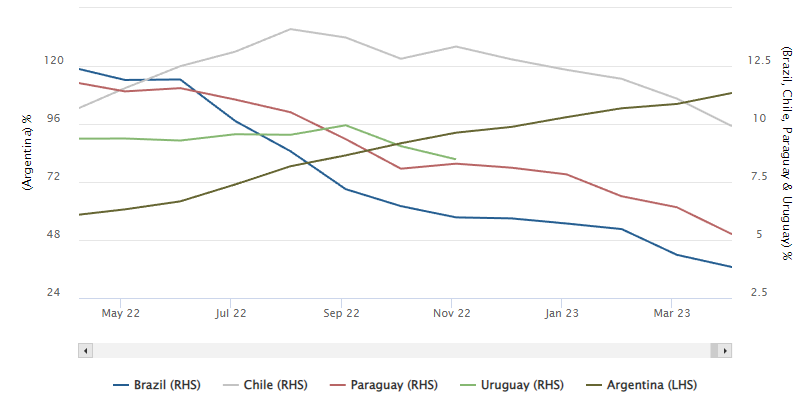
    Brazil & Southern Cone: inflation rate
    Percentage variation (year-on-year)

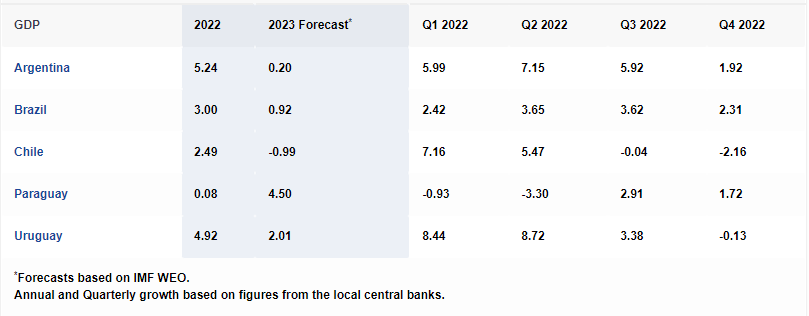
    Brazil & Southern Cone: GDP growth (%)
    Quarterly figures are year-on-year growth

  • The final recalibration

    LatinNews 05 January 2012 Hits: 527

    On 14 December President Felipe Calderón reshuffled his cabinet, probably for the final time.

    The changes were the result of two ministers and the president’s private secretary, Roberto Gil, wishing to run for election to the senate in 2012, on the ruling Partido Acción Nacional (PAN) ticket. Both of the outgoing ministers, Javier Lozano, the labour minister, and Salvador Vega, the anti-corruption minister, were replaced by their senior deputies. The new labour minister, Rosalinda Vélez, is the first woman to hold the position.

    Under Mexico’s constitution, ministers must stand down six months before seeking election: this provision means that no other cabinet members can now seek an elected position in 2012.

    Calderón’s new private secretary is José Guadalupe Rodríguez, who was previously in charge of the traditional pork-barrel agency, Caminos y Puentes Federales.

  • CHILE: Gearing up for round two

    LatinNews 28 November 2013 Hits: 629

    It was always going to be an uphill struggle for Evelyn Matthei, the presidential candidate for President Sebastián Piñera’s ruling centre-right Coalición por el Cambio, who is due to contest the second round run off against former president Michelle Bachelet (2006-2010) of the opposition leftist Nueva Mayoría on 15 December. However just days into the second round campaign, her prospects look ever bleaker. Amid fresh cracks in the ruling alliance, key figures from the campaign teams of the third and fourth-placed 17 November first round candidates, Marco Enríquez-Ominami and Franco Parisi (who both insist that they will not vote) have come out in favour of Bachelet.

    In recognition of the electorate’s rejection of the conservative Right, Matthei acted swiftly to overhaul her campaign team, ditching Joaquín Lavín of the Coalición’s conservative senior party, Unión Demócrata Independiente (UDI), and replacing him with fresh faces [WR-13-46]. Matthei’s second round campaign, which is based on capturing the centrist vote and encouraging those who abstained in the first round to turn out for the run-off, has been overshadowed by a fresh controversy engulfing the ruling alliance after Antonio Horvath, a prominent senator for the coalition’s junior partner, Renovación Nacional (RN), met Bachelet four days after the first round and reportedly also pledged his support for her. The national daily El Mercurio suggested that the incident had “ruined” Matthei’s campaign re-launch.

    One of eight RN senators in the 38-member upper house, Horvath had already caused ructions within the ruling alliance over his decision to work on Parisi’s campaign team. He has yet to publicly declare whether he intends to vote for Bachelet but said that, after examining both candidates’ manifestos, there was “more convergence” with Bachelet – a stance apparently based on environmental issues (see sidebar). With speculation mounting as to Horvath’s possible expulsion from the RN, his show of support for Bachelet is further embarrassment for the ruling alliance, which performed badly in the 17 November legislative vote, losing 10 seats in the 120-seat lower chamber to end up with 48 (it retained its 16 senate seats).

    As well as those ripples, the more serious concern for Matthei ahead of the run-off is the fact that the combined 21% of the electorate that voted for Enríquez-Ominami (himself a former member of Bachelet’s Partido Socialista) and Parisi is looking increasingly elusive.

    Both the third and fourth-placed candidates themselves maintain they will not vote in the second round, in opposition to the “duopoly” – the bi-party system comprising the quadripartite Concertación and the Coalición. However, both of their campaign teams have signaled an inclination towards Bachelet.

    It was less of a surprise on 21 November when 17 prominent members of Enríquez-Ominami’s leftwing Partido Progresista (PRO), led by the former governor of Santiago, Marcelo Trivelli (2001-2005), and the current Mayor of Arica, Salvador Urrutiam came out in support for Bachelet. The same day several members of Parisi’s campaign team – including Dino Villegas, Parisi’s spokesperson and chief advisor, also followed suit. As a centre-right economist Parisi is more ideologically aligned with Matthei. However the race for second place in the first round, which degenerated into a bitter personal feud between the two, continues to have an impact. Parisi description of Matthei as a “bad woman” and other remarks to that effect linger in the air.

    • Horvath

    A well-known ecologist representing the Aysén region, Senator Antonio Horvath’s turn towards former President Michelle Bachelet (2006-2010) owes in part to her reservations about the controversial HydroAysén hydroelectric project, which envisages the construction of several new dams in a pristine forested area of the region. Bachelet’s line is that the project is not viable in its current form.


  • TRACKING TRENDS

    LatinNews 15 December 2016 Hits: 689

    PERU | Job formalisation. The proportion of informal workers in Peru has fallen from 79.9% in 2007 to 73.1% in 2015, according to new data released by Peru’s national statistics institute (Inei) on 12 December.

    The small reduction in the informal workers and creation of formal employment over this eight-year period, which saw Peru’s domestic economy grow at an average annual rate of 5.3%, highlights the difficulties in creating formal jobs in the country. This will be a matter of concern for the new government led by President Pedro Pablo Kuczynski, who has made promoting the formalisation of Peru’s large informal economy one of his economic policy objectives.

    The Inei data shows that the number of informal sector workers in the country last year was 11.6m. Meanwhile, there were 4.2m workers in the formal economy, or 26.8% of the economically active population. The proportion of formal workers increased by 6.7 percentage points over the period, translating into an annual growth rate in formal employment of 5.2%. But during this period of solid economic expansion, the number of informal workers also increased at a rate of 0.3%.

    According to the Inei data, the economic sectors with the largest number of formal workers were the agricultural and fishing sector (3.9m), retail (2m), other services (1.7m), and transport & communications (1.5m). As for regions with the highest proportions of informal workers, the Inei report found that these are Cajamarca (96.9%), Amazonas (95.8%), Puno (95.7%), and Huancavelica (95.6%) – all four of which happen to be regions with poverty rates of 90% or higher.

    COLOMBIA | New central bank president. The board of directors of Colombia’s central bank (Banrep) elected Juan José Echavarría as its new president on 12 December. Echavarría will replace José Dario Uribe Escobar, who is stepping down after first being elected Banrep president in 2005 for a four-year term and securing two further re-elections.

    Uribe’s deft management of Colombia’s monetary policy for the last 12 years led to him being named as central banker of the year by Emerging Markets magazine in 2007 and 2012, meaning that Echavarría, who holds a mining engineering degree from the Escuela de Minas de Medellín, an MA in economics from Boston University, and an economics PhD from the University of Oxford, has some large shoes to fill.

    Chief among Echavarría’s challenges as Banrep president will be to bring Colombia’s inflation rate back to within Banrep’s target range of 2%-4%, after the accumulated inflation rate reached 5.3% in November.

  • TRACKING TRENDS

    LatinNews 04 March 2021 Hits: 4004

    CHILE | Codelco profits. Chile’s state-owned mining firm reported on 26 February that it posted profits of US$2.07bn in 2020, a 55% year-on-year increase. A statement by the company said that the increase in profits was the result of higher copper prices in international markets and a rise in production. Codelco noted that even though the coronavirus (Covid-19) pandemic negatively impacted global economic activity, and even forced it to reduce operations, it managed to increase production by 1.9% compared with 2019 to 1.6m tonnes and at the same time cut costs by 8.6%.

    “In an incredibly challenging year for Chile and the world, afflicted by the Covid-19 pandemic…which for our firm meant operating at half capacity, or closing down or delaying projects, we manged to surpass last year’s production,” Codelco CEO Octavio Araneda said.

    Although international copper prices slumped to around US$2 per pound (lb) in the first half of 2020 due to the fall in demand as global economic activity became paralysed due to restrictions imposed around the world to try to contain the pandemic, they began rising quickly towards the end of the year and the trend has continued into 2021. The price of copper increased by 20% in February and it exceeded US$4.3/lb on the London Metal Exchange in the last week of February, close to the historic high of US$4.6/lb reached in February 2011.

    The high price, which resulted in the state receiving US$2.8bn in revenue from copper production last year (US$1.3bn from Codelco), owes to a return to strong demand from China; a weak US dollar, which makes copper more valuable given its status as a globally traded commodity; and the prospect that global demand for electric goods using copper wiring, including electric vehicles, will grow strongly in coming years.

  • REGION: Argentina and Brazil in pipeline talks

    Patrick de Courcy 15 September 2021 Hits: 2081

    In August, officials from Argentina and Brazil were reported to be involved in talks on building a pipeline to pump gas from Argentina’s shale gas deposits in Patagonia back to Brazil.

    Brazil’s President Jair Bolsonaro said on 19 August that the two countries were looking at the feasibility of a pipeline from Vaca Muerta as one of the options considered by Brazil to reduce domestic gas prices. The Brazilian government has been concerned by the impact high gas prices and the current drought is having on electricity tariffs and on the rising rate of inflation. Vaca Muerta is one of the world’s largest shale deposits and could offer Brazil long term security of supply. It is owned by YPF, Argentina’s state oil company, although many private oil companies operate there on a concession basis.  

    • High prices in Brazil

    Some estimates suggest gas prices in the Brazilian manufacturing centres in the cities of São Paulo and Porto Alegre can be up to three times higher than in Argentina. Bolsonaro said he had asked his economy minister Paulo Guedes to look at the possibility of reducing the PIS/Cofins sales tax on diesel to zero as one way of easing inflation.   

    Earlier, the Argentine ambassador to Brazil, Daniel Scioli, had presented the outlines of a plan to build a 1,430km gas pipeline from Vaca Muerta in Neuquén province to the southern Brazilian border city of Uruguaiana, with a further 600km extension within Brazil to reach the city of Porto Alegre, where it would connect to Brazil’s national gas pipeline network. Total costs have been initially estimated at US$3.7bn for the longer Argentine section and US$1.2bn for the Brazilian section. Bolsonaro did not give any details of how the project might be funded or the likely time scale. Scioli did suggest however that construction could take three years.

  • TRACKING TRENDS

    Anna Grace 29 June 2023 Hits: 2379

    BRAZIL | Softer tone on interest rates. Brazil’s central bank (BCB) has released the meeting minutes of its monetary policy committee (Copom), which decided to maintain the benchmark interest rate, the Selic, at 13.75% on 21 June. The minutes, which were released on 27 June, revealed that there was a “divergence” within the committee about how to communicate the bank’s next steps on interest rates.

    Even though Copom voted to maintain the interest rate this time, the “prevailing assessment” was that the ongoing deflationary process may lead to “a parsimonious process of inflection at the next meeting”. The meeting minutes also indicated that the first stage of the expected deflationary process has already been completed, but that the current stage would involve a slower speed of deflation.

    Even if it was just a hint of a potential “parsimonious” change (the word is traditionally used by Copom to denote a 25-basis-point-shift in the Selic), government officials have welcomed the softer tone of the meeting minutes as a signal that interest rates might be lowered in August, after Copom’s next meeting. Finance Minister Fernando Haddad said he believed that the “harmonisation of fiscal and monetary policy” would happen “soon”. 


    BRAZIL | Government launches agriculture funding plans. Brazil’s President Luiz Inácio Lula da Silva launched the ‘Plano Safra’ 2023/24 programme on 27 June and the ‘Plano Safra da Agricultura Familiar’ on 28 June; the former boosting investment for medium-sized and large agricultural producers, while the latter is aimed at supporting smaller-scale family-run farms.

    The main ‘Plano Safra’ (launched by the agriculture ministry) will allocate R$364.2bn (US$75bn) in loans and subsidies for agribusiness, while the other programme for family farms (launched by the ministry of agrarian development) would provide R$77.7bn in funding, with both programmes offering lower interest rates for producers who adopt sustainable farming practices. The 2023/24 funding programmes (R$441.9bn in total) mark record-high levels of government investment in agricultural production, surpassing the R$334bn of funding allocated for the 2022/23 harvest cycle.

  • TRACKING TRENDS

    LatinNews 08 November 2012 Hits: 1102

    GUATEMALA | New congress president. Guatemala’s congress recently elected Pedro Muadi, a businessman and deputy for the ruling right-wing Partido Patriota (PP), as its new president for the 2013-14 session, replacing his PP colleague Gudy Rivera. The election of Muadi, president of PSE SA, a company that distributes plastic resin and former president of the chamber of industry, suggests that the powerful private sector is further strengthening its hold on congress. His lack of legislative experience was also flagged up as cause for concern by local commentators: Muadi won his first legislative seat in last September's election, prior to which he had never served in the legislature or held public office. His lack of political experience has also been cited as a weakness at a time when divisions within the PP have become apparent [WR-12-38].

    DOMINICAN REPUBLIC| Crucial fiscal reform plan close to approval. On 6 November the Dominican Republic (DR)’s chamber of deputies approved (in general) the fiscal reform proposal presented by President Danilo Medina, with which he intends to raise an additional RD$46bn (US$1.12bn) in government revenues a year to tackle the country’s mounting fiscal deficit which, according to the latest calculations, now stands at RD$187bn(US$4.6bn). Fiscal reform was one of Medina’s main promises upon taking office in August and is key to sealing a new stand-by agreement with the International Monetary Fund (IMF). This was mutually terminated in February by the previous government, which refused to enact some of the IMF recommendations including, among others, an increase in the overall tax burden.

    Approval of the reform is also crucial for the Medina administration because it has delayed the submission of its 2013 budget plan to congress until the initiative is approved. However, the proposal, which calls for increases on the industrialised value-added tax (ITBIS) on goods and services has proved unpopular, sparking the first protests against the new government. Although the ruling Partido de la Liberación Dominicana (PLD) has a comfortable majority in congress and the reform was rushed through the senate, its overall approval is still in doubt.

  • PANAMA: Restoring ties with Venezuela

    LatinNews 29 July 2014 Hits: 1990

    One of Panama’s President Juan Carlos Varela’s first acts upon taking office on 1 July was to restore ties with the Venezuelan government led by President Nicolás Maduro. These were severed by Maduro in March in protest at Panama’s efforts to have the Organization of American States (OAS) discuss the internal political situation in Venezuela [RC-14-03]. Varela and the new Partido Panameñista (PPA) government have a clear interest in restoring ties given trade concerns and the continued dispute over the failure of Venezuelan companies to pay debts to suppliers in Panama’s Colón Free Trade Zone (FTZ).

    At the start of the year, the local Panamanian press cited official figures which suggested that trade in the FTZ reached US$28.9bn in 2013, down 9.4% on 2012. According to a report by Panama’s economy & finance ministry (MEF), re-exports to Venezuela via the FTZ were down 43.3% in 2013 compared with the same period in 2012, from US$3bn to US$1.7bn. The MEF report noted that on average, between 2009-2012 re-exports to Venezuela accounted for 17% of the total sales via the FTZ, second only to Puerto Rico (19%). However, many Venezuelan buyers have yet to pay for these re-exports and have racked up large debts with their Panamanian suppliers. These debts, which in March the Colón FTZ’s general manager Leopoldo Benedetti said amounted to some US$2bn, were attributed by the previous Cambio Democrático government led by former president Ricardo Martinelli (2009-2014), to Venezuela’s official foreign currency controls that restrict the supply of US dollars available to Venezuelan companies for trading purposes. On 19 March Panama’s then trade & industry minister, Ricardo Quijano said that Panama had presented “various protest notes” before the World Trade Organisation (WTO) in relation to this issue.

    With Luis Germán Gómez, the president of the Colón FTZ’s users’ association (AU), telling reporters this month that partly as result of these problems, AU members were seeking other markets in Europe, Asia and Africa, there is also no end in sight to the dispute with another key market for Panamanian FTZ re-exports – Colombia. The dispute with Colombia stems from a March 2013 decree issued by Colombia’s President Juan Manuel Santos that introduced a temporary (12-month) ad valorem duty of 10% and a specific duty of US$5 per gross kilogramme on all imports of apparel and footwear from countries with which Colombia does not have a Free Trade Agreement (FTA). These duties affect Panamanian exports as although both countries signed an FTA in September 2013, the agreement must still be ratified by their respective legislatures. Despite Panama’s filing of formal complaints against Colombia before the WTO in June 2013 over the decree, on 19 January 2014 Santos announced that he will be extending the measure for a further two years.

    Santos in Panama

    There was no mention of the trade dispute during President Santos’s visit to Panama City on 25 July – his first since President Varela took office. The two men instead pledged to revive an electricity transmission line project between the two countries that will also supply power to the rest of Central America. The project, which would stretch some 590km in total, of which 280km would run through Panamanian territory, had stalled under the Martinelli government, which cited a lack of resources. Varela however told reporters that the transmission line could be completed by 2018.

    There were also no developments as regards the other key issue for bilateral relations - the extradition of the former director of Colombia’s defunct national intelligence agency (DAS), María del Pilar Hurtado, who in November 2010 was granted asylum by the Martinelli government, a decision that had riled Santos, upsetting bilateral relations (see sidebar).

    On 29 May Panama’s supreme court ruled that the asylum was unconstitutional as Hurtado was not a victim of political persecution but rather was being investigated for “common crimes”. During their 25 July meeting, Santos reiterated his call for Hurtado to be extradited but Varela said that his government did not know her whereabouts.

    • Hurtado

    María del Pilar Hurtado has been charged in Colombia with crimes including aggravated conspiracy, illicit violation of communications and abuse of public function, among other things, for her role in the so-called ‘Chuzadas’ illegal intelligence gathering operation by the DAS. This targeted prominent members of the political opposition, the press and the judiciary. It is believed that Hurtado could provide key information regarding the participation of other high-ranking members of the Alvaro Uribe administration (2002-2010) in the ‘Chuzadas’ scandal. The decision to grant Hurtado asylum back in 2010 was widely seen as a personal favour from former president Ricardo Martinelli (2009-2014) to Uribe, with whom Martinelli had close personal ties.

  • PERU: Humala dealt humbling defeat by congress

    LatinNews 29 January 2015 Hits: 1630

    President Ollanta Humala experienced the bitter taste of defeat this week after congress annulled his government’s youth employment law. In an extraordinary session, congress voted overwhelmingly to strike down a law that it had approved scarcely six weeks earlier. Four large protest marches were enough to persuade much of the political opposition, with one eye on next year’s general elections, to jettison the law out of populist motives rather than conviction. The vote also exposed the rupture in the disparate ruling coalition, Gana Perú, which augurs badly for Humala in the remaining 17 months of his mandate.

    The youth employment law aimed to create jobs by cutting costs for employers that take on youths between 18 and 24, and to reduce the size of the informal sector. It ensured a minimum wage and some social security benefits but holiday entitlement was cut in half, from 30 to 15 days, and employers were not required to foot the two annual bonuses (in June and December) or severance pay.

    The Humala administration stressed that the law was designed to improve training and employment opportunities for the young but the main objective was to reactivate the economy, and to reduce costs for businesses, borne out by the fact that the umbrella business federation, Confiep, was strongly supportive of the law. Students and other young people, bolstered by trade unionists, reacted furiously to the law, which took effect on 11 December, arguing that it was exploitative. They ratcheted up the pressure on the government with four protest marches in as many weeks in Lima and other cities in Peru.

    Not only has the Humala administration succeeded in awakening the country’s youth, which is now demanding a reform to the labour code, but it also roused the increasingly alienated leftist rump of the ruling Gana Perú. Already disillusioned with the government’s cozying up to Confiep; allegations that the government has been spying on deputies it suspects of being dissidents; and recent decisions such as stripping away environmental safeguards to attract more investment, the youth employment law’s perceived erosion of basic labour rights, and the protests this engendered, was the last straw. An influential deputy, Sergio Tejada, a member of the left-wing Partido Nacionalista Peruano (PNP), the mainstay in Gana Perú, quit the coalition at the weekend. He went on to vote to annul the law along with six Gana Perú deputies, including, notably, Vice-President Marisol Espinoza, the most prominent alleged victim of the illegal spying scandal [WR-15-03].

    The internal split in Gana Perú has compounded Humala’s political isolation. His ‘ally’ Perú Posible (PP), the party of former president Alejandro Toledo (2001-2006), also voted to annul the law. “We will continue supporting governability, but the country is very polarised, very divided, let’s reduce the temperature so that investors come to invest and generate employment to distribute the benefits of growth,” Toledo said. Despite the PP’s abandonment of the government, Toledo urged the opposition not to “undermine” it further.

    In total 91 deputies voted to annul the law and just 18 to keep it; on 11 December, it had been approved by 68 votes to 12 against. The switch, exemplified by the Fujimorista Fuerza Popular (FP) which had previously been fully supportive of the bill, was pure populism. Sensing the popular mood, the political opposition used the law to begin flexing their muscles ahead of next year. There are still 17 months until presidential and congressional elections in Peru but this vote suggests that Humala could well be a lame duck president for the remainder of his mandate as political parties jockey for public support by making life difficult for an unpopular president.

    • Tough times ahead

    One year on from Peru’s victory in its maritime border dispute with Chile, the zenith of President Humala’s tenure, the heavy defeat in congress is possibly the nadir. Humala, who conceded defeat but accused congress of failing to come up with a viable alternative, insisted that “there is political noise” but “I’m not for turning”. Brave words but his actions already suggest differently. Such was the heated nature of the debate in congress over the youth employment law that Humala withdrew a request to congress for permission to travel to the Community of Latin American and Caribbean States (Celac) summit on 28 and 29 January in Costa Rica, ostensibly to focus on domestic matters but really because he knew he would face the ignominy of a refusal.

  • TRACKING TRENDS

    LatinNews 18 August 2016 Hits: 497

    PARAGUAY | Consolidating economic recovery. The latest instalment of the monthly economic activity indicator (Imaep) compiled by Paraguay’s central bank (BCP) and released on 11 August, shows that domestic economic activity in June increased by 6.7%. With the June figure the accumulated Imaep results (a GDP proxy measure that does not include the agricultural sector) for the first half of the year has reached 3.8% as the growth in economic activity appears to have consolidated in the sixth month of the year.

    A BCP report said that the increase in the Imaep in June was driven by an increase in activity in the construction, industrial and energy generation sectors. In particular, the report points out that the construction sector has proved to be one of the most dynamic this year, thanks to the increase in the execution of public works projects as well as in private sector projects. Indeed, the BCP is now forecasting that the construction sector will close the year with 8% growth. Meanwhile the increase in activity in the industrial sector was driven by the meat producing, metallic and non-metallic mining, and the leather and shoe production sub-sectors. Noting that domestic economic activity has consistently increased in virtually all sectors, the BCP said that the June Imaep result denoted a 5.5% year-on-year increase, suggesting a solid economic recovery.

    Paraguay posted a modest 1.4% growth rate in the first quarter of the year on the back of subdued growth across all sectors. However, since then activity has consistently increased. Based on the June Imaep figure, the BCP revised up its year-end growth forecast from 3% to 3.6%, while noting that the actual figure could end up being higher as it is expected that the key agricultural sector will also post solid growth this year; and that the economies of Brazil and Argentina (Paraguay’s main regional trading partners) are now also on their way to a recovery. However, the BCP’s outlook is not entirely shared by private economists. The consensus 2016 growth forecast in the BCP’s monthly poll of local economists (EVE) is of 3%, with this increasing to 3.5% only in 2017. According to the poll, private economists believe that despite the Imaep figures, activity in the retail and services sectors will remain subdued until next year.

    • Steady pre-salt output growth

    On 17 August, Petrobras reported that pre-salt oil and gas output hit a new monthly record of 1.32m barrels of oil equivalent per day, up 6% from June. Taking oil output alone, the result was 1.06m b/d day, surpassing the 1m monthly milestone for the first time. The rise in output was thanks to the start of the so-called ‘Central Lula Production System’ as well as higher output from new wells in the massive Lula field in the Santos basin, which upon its discovery by Petrobras in 2006 was the largest find in the Americas in 30 years. The fortunes of the embattled former president Lula da Silva (2003-2011), after whom the field was named, look a lot less promising these days, as he counters allegations that he was deeply involved in the vast, parasitic network of corruption that fed on Petrobras for a decade or more.

  • VENEZUELA: Disaster renews focus on illegal mining

    Abbi Dicker 05 April 2024 Hits: 3128

    At least 30 people were reportedly killed in a mine collapse in Venezuela’s central state of Bolívar on 20 February, casting a spotlight once again on the issue of illegal mining in the country.

    There were reportedly over 100 people working in the informal Bulla Loca open pit gold mine, in Bolívar’s Angostura municipality, at the time of the collapse. Reports on the death toll are muddled, with President Nicolás Maduro saying that 16 people were killed. In contrast, local mayor Yorgi Arciniega said the day after the disaster that 30 bodies had so far been recovered, and that other workers were still missing. Accounts also vary on the cause of the collapse. Some local residents cited by the Venezuelan and international media blamed the indigenous authorities that controlled the mine, arguing that they had allowed excessive use of pressure hoses, causing one of the mine’s walls to collapse. Others said that low water levels had put other nearby mines out of action, leading a dangerous number of workers to congregate at Bulla Loca.

    Regardless of the cause, the disaster once again highlighted the perils of Venezuela’s illegal gold mines, which are often run by organised crime groups known as ‘sindicatos’, but also by indigenous communities and Colombian guerrilla groups. It came after another collapse killed at least 10 people at a mine in Bolívar’s Gran Sabana municipality in December. The Venezuelan security forces have been waging a crackdown on illegal mining since August 2022, dubbed ‘Operation Roraima’, which has seen the military deployed to Bolívar and Amazonas states to destroy illegal mining equipment [SSR-23-10].

    The authorities made a belated move against the Bulla Loca mine, with the strategic operational commander of the armed forces, General Domingo Hernández Lárez, announcing on 3 March that 1,271 illegal miners had been removed from the site. Among those removed, he said, were 82 children and 49 adolescents. Hernández Lárez said that anti-mining operations would continue in the La Paragua forest reserve, in which Bulla Loca is located, saying that the crackdown is being carried out in the name of environmental protection.

    Such claims have drawn scepticism given the Maduro administration’s hitherto lack of interest in environmentalism, and its widely reported skimming of profits from the illegal mining sector [SSR-23-01]. One possible explanation could be that Maduro is hoping to tackle lawlessness in Venezuela’s gold belt with the aim of attracting international investors. The crackdown on illegal mining began at a time when the US and Venezuela were initiating a rapprochement that led to a lifting of sanctions in October last year. However, US sanctions on Venezuela’s state-owned gold mining company Compañía General de Minería de Venezuela (Minerven) were reimposed in January in response to the disqualification of the opposition’s chosen presidential candidate, María Corina Machado (for the latest on sanctions and the July election, see our sister publications LatinNews Daily and the Latin American Weekly Report).

    Regardless of the sanctions situation, the Maduro administration can be expected to capitalise on Venezuela’s improved economic situation to try and wrest back control over the lucrative mining sector from criminal groups. The government’s recent engagements with China, which Maduro visited in September last year, and Russia, both produced agreements pledging closer cooperation on mining. This could potentially spur investment in the Orinoco Mining Arc – a 112,000km2 ‘strategic development zone’ which was created in 2016, but which has yet to see any meaningful international investment in mining.

    Worsening repression

    Marta Valiñas, the chair of the United Nations (UN) Independent International Fact-Finding Mission on Venezuela, told the UN Human Rights Council on 20 March that “we are witnessing a reactivation of the most violent form of repression by the authorities”. Valiñas highlighted “patterns of human rights violations against real or perceived opponents of the government, including human rights defenders who dare to criticise, denounce, or protest against government decisions or policies”.

  • Risk pointers

    LatinNews 22 August 2012 Hits: 483

    *** Saudi Arabia and Bahrain in Iran’s sights as well as Israel.  On al-Quds (Jerusalem) Day in Tehran, it was not just Israel that was the target of aggressive sloganeering.  According to the Fars news agency, “a group of youths participating in Quds Day rallies was carrying a Bahraini flag and chanting slogans against the Al-Khalifa dynasty in Bahrain.”  The same group chanted anti-Saudi Arabia slogans.  Iran supports the Shia opposition in Bahrain against the minority-Sunni ruling family, and it supports the Shia minority in Saudi Arabia.

    A spokesman for the group was quoted as saying: “Americans want to divert the Islamic Awakening and save the Al-Khalifa dynasty in Bahrain by creating conflicts and unrest in Syria.  But the Iranian people as defenders and supporters of the resistance will not let the dictatorship system divert the Islamic Awakening movement...”

    *** A warning on China’s rural wealth gap.  On 21 August the official Chinese news agency Xinhua quoted a report warning about inequalities of wealth in rural areas.  The report from the Central China Normal University’s Centre for China Rural Studies said the Gini coefficient in rural areas last year was 0.3949.  The index has a range of 0 to 1, and 0.4 is considered to be the level at which social disturbances could happen.  If urban areas are included, China’s Gini coefficient is well above 0.4.  The government hasn’t released this figure since 2000, but in that year it was 0.412.

    *** India’s Kashmir government intimidated by China.  According to sources in India’s Jammu and Kashmir state, the state government has suspended work on an irrigation project in the Leh district of Ladakh following warnings from the Chinese army.  An official from Leh says the project has only been temporarily suspended, but it is reportedly the third time in three years that a major development project in Leh has been stopped under Chinese pressure.  In 2010, the state government suspended construction of passenger shelters near the border at Demchok, and a road project was stopped following Chinese objections.

    *** Drought affects North Korean harvest.  As a result of the drought in the spring, it is thought that North Korea’s annual harvest may be down by 700,000 tons.  The summer harvest of wheat, barley, and spring potatoes was down by 200,000, according to Seoul’s Korea Rural Economic Institute.  The autumn harvest of corn, rice, and beans could be down by another 400,000, with non-grain produce dropping another 100,000 tons.

    According to a researcher at the institute, as a result of the poor harvest, the total food shortfall could reach 1m tons this year.  The North has secured 600,000 tons of grain through imports and aid, but it still needs to find 400,000 tons to feed the population.

  • RASTREANDO TENDENCIAS

    LatinNews 04 February 2013 Hits: 869

    BOLIVIA | YPFB anuncia grandes planes de inversión conjunta. La firma de hidrocarburos del estado de Bolivia, Yacimientos Petrolíferos Fiscales Bolivianos (YPFB), reveló esta semana que junto con sus socios internacionales planea aplicar un plan de inversión de US$2,24mm este año, un incremento del 40% sobre los US$1,6mm invertidos en el sector en el 2012. El anuncio fue hecho por el presidente de YPFB, Carlos Villegas, en una conferencia de prensa donde él dijo que la inversión se usará principalmente para llevar adelante esfuerzos de exploración y explotación de gas natural.

    Mientras YPFB hace mucho alarde del hecho de que a pesar de los recientes episodios de nacionalizaciones en Bolivia que han afectado a firmas extranjeras que operan en el sector de la electricidad del país, el nivel de la inversión extranjera en el sector de hidrocarburos del país parece no haber sido afectado, un cercano escrutinio de las cifras pinta un cuadro diferente. Como explicó Villegas, la mayoría de las inversiones, US$1,4mm o el 63,5%, provendrá de YPFB, con los remanentes US$818,2m (o el 36,5%) dividido entre Repsol de España; Petrobrás de Brasil; Total de Francia; Pluspetrol de Argentina; y Vintage Petroleum, con base en EU. Además, Villegas también reveló que la mayor parte de la inversión privada (US$720m) sería usada para incrementar la producción de gas y petróleo en las instalaciones existentes, mientras que la mayor parte de los esfuerzos de exploración serían realizados por la misma YPFB. Esto sugiere que mientras las firmas extranjeras continúan invirtiendo en Bolivia, sus inversiones parecen más orientadas al mantenimiento de la infraestructura existente en vez de inversiones dirigidas a expandir sus operaciones en el país.

    Reveladoramente, a pesar del gran tamaño de las principales cifras de inversión, Villegas dijo que un gran total de sólo 26 nuevos pozos exploratorios serían perforados en el país este año. De estos, siete serán perforados por Repsol; dos por Total; y dos por Vintage. El resto serán todos perforados por la misma YPFB. Villegas dijo que YPFB espera que las inversiones permitirán a la firma producir un promedio de 57,83m de metros cúbicos de gas por día este año, aunque esto podría elevarse a 62,9m de metros cúbicos por día si es necesario, a fin de cubrir la demanda interna y la de Brasil y Argentina, a los cuales Bolivia exporta su gas.

    Él también anunció que los precios de las exportaciones de gas a Argentina habían sido fijados en US$10,27 por British Thermal Unit (BTU), mientras que el precio para Brasil había sido fijado en US$8,85/BTU, ambos más bajos que las tasas del año pasado de US$10,91/BTU y US$9,2/BTU respectivamente.

    • Pdvsa se apoya en Rusia

    El 29 de enero, la firma petrolera del estado venezolano, Pdvsa, anunció que había firmado un número de acuerdos con Rosneft, controlada por el estado de Rusia, para desarrollar depósitos de gas natural offshore. El presidente de Pdvsa y ministro de petróleo y energía, Rafael Ramírez, dijo después de la firma de los acuerdos que su contraparte de Rosneft, Igor Sechin, que los nuevos acuerdos permitirán a las dos firmas explotar conjuntamente los proyectos de gas natural de Río Caribe y Mejillones en el este de Venezuela. Según Ramírez, las empresas conjuntas de Pdvsa y las firmas petroleras de Rusia tales como Rosneft, Gazprom, Surguntneftegaz y Lukoil, ya producen 230.000 barriles de petróleo por día en Venezuela, convirtiendo a Rusia en uno de los socios petroleros más importantes del país.

  • RASTREANDO TENDENCIAS

    LatinNews 17 January 2014 Hits: 1137

    COLOMBIA | Paran las exportaciones de carbón. El 8 de enero el gobierno colombiano ordenó a la compañía minera Drummond de EU que pare todas las operaciones en el área de carga de carbón en su puerto en Ciénaga, localizado en la Bahía de Santa Marta, en el departamento caribeño de Magdalena, después de que los funcionarios corroboraron que la firma no estaba cumpliendo las nuevas provisiones medioambientales que afectan a los embarques de carbón y que entraron en plena vigencia a comienzos de este año.

    Drummond es el segundo mayor productor de carbón en Colombia, extrayendo entre 80.000 y 90.000 toneladas (t) de carbón por día y, por lo tanto, la decisión del gobierno del Presidente Juan Manuel Santos efectivamente cierra el mercado de exportación de carbón del país. De hecho, la noticia de la suspensión de los embarques de Drummond han provocado un aumento inmediato del 3,2% en los precios del carbón en el mercado Europeo dado que Colombia es el segundo mayor proveedor de carbón a la Unión Europea (UE). La decisión tendrá consecuencias negativas para la economía colombiana. Las operaciones de Drummond se traducen en ingresos fiscales de Col$2,47bn (US$1,27m) por día para el Estado; pero el gobierno ha dicho que se ha visto obligado a tomar acción debido a que su compromiso de preservar el medioambiente nacional es sólido.

    Las preocupaciones acerca de la manera en que se manejan los cargamentos de carbón en Colombia se convirtieron en una cuestión nacional en el 2011 después de que fuera denunciado que el uso de barcazas a cielo abierto para transportar el carbón de las minas localizadas tierra adentro por el Río Magdalena hasta los puertos del Caribe estaban produciendo un daño irreparable a los ecosistemas del Río y del Mar Caribe, pues las barcazas permiten que una gran cantidad del polvo de carbón se escape al medioambiente. En respuesta, el gobierno introdujo nueva legislación prohibiendo el uso de barcazas a cielo abierto y establecieron el 1 de enero del 2014 como fecha límite para que todas las firmas carboníferas adopten otras alternativas y ‘mecanismos de carga directa’ más respetuosas del medioambiente.

    Aunque Drummond se quejó de que necesitaba más tiempo para cumplir con las regulaciones y solicitó al gobierno de Santos para que extienda la fecha límite, luego del incidente ocurrido en enero del 2013, en el cual tres barcazas de Drummond conteniendo 500t de carbón se hundieron cerca del puerto de Ciénaga –uno de los accidentes medioambientales más grandes en Colombia en los últimos años, por el cual Drummond fue multado US$3,6m por el ministerio del medioambiente– el gobierno decidió adoptar una posición dura advirtiendo a Drummond que esperaba cumplimiento pleno con la nueva regulación para la fecha establecida. Consecuentemente, después de realizar una inspección in situ en el puerto de Ciénaga, la ministra del medioambiente, Luz Helena Sarmiento, anunció la prohibición total de embarques de carbón desde el puerto, afirmando que: “Sabemos que esta es una decisión muy costosa para el país, pero lo que está en juego acá, aparte de las cuestiones del medio ambiente y sociales, es la credibilidad institucional de las autoridades colombianas. La ley es para todos, y nuestra obligación como gobierno es aplicarla”.

    Aún no está claro cuánto tiempo le tomará a Drummond adaptar sus operaciones de transporte de carbón; la firma previamente pidió que la fecha límite sea extendida hasta febrero o marzo de este año. Mientras tanto, las pérdidas se acumularán para Drummond y para Colombia, el cuarto mayor exportador de carbón del mundo, que el año pasado embarcó 85m de toneladas del mineral por un valor de US$6mm.

    PERÚ-ECUADOR | Adex advierte sobre restricciones ecuatorianas. La Asociación de Exportadores del Perú (Adex) advirtió el 12 de enero que recientes medidas adoptadas por el gobierno ecuatoriano estaban afectando las exportaciones agrícolas, manufactureras y de pescado, peruanas destinadas a su vecino norteño. Según Adex, como resultado de la decisión del 2 de diciembre del 2013 del Instituto Nacional de Normalización de Ecuador (Inein), que exige certificados de exportación para una lista de 120 productos, incluyendo alimentos, productos agroindustriales, carnes, textiles y equipamientos eléctricos, un número de embarques de exportaciones peruanas han sido enviados de vuelta al llegar a la frontera.

    Al anunciar su decisión de exigir certificados de exportación, el Inein dijo que responde a los esfuerzos del gobierno del Presidente Rafael Correa “de gradualmente sustituir las importaciones y promover la industria nacional”. Sin embargo, el presidente de Adex, Eduardo Amorrortu, dijo que los mismos empresarios ecuatorianos también han expresado sus preocupaciones de que la medida los afecta negativamente, con muchos encontrándose en dificultades para proveerse de materias primas y equipos del exterior. “Con estos cambios, los exportadores peruanos encuentran difícil exportar a Ecuador, mientras que las empresas ecuatorianas están teniendo problemas para abastecerse de lo necesario para la producción, creando problemas y costos inesperados en ambos lados de la frontera”, dijo Amorrortu. También reveló que Adex ya había alertado al ministerio de comercio exterior & turismo (Mincetur), como así también a la cancillería acerca de la situación, con la esperanza de que el gobierno aborde la cuestión con su contraparte ecuatoriana.

    El comercio entre los miembros de la Comunidad Andina (CAN), Perú y Ecuador, ha sido libre desde el 2005, y desde entonces se ha incrementado constantemente para llegar a US$3,1mm en el 2012, el último año para el cual se tienen disponibles cifras totales.

    • Caen las exportaciones de Pan Dulce peruano

    Las exportaciones del Pan Dulce (el Panettone, el pan dulce italiano consumido tradicionalmente durante Navidad), alcanzaron los US$3,71m durante el periodo enero-noviembre del 2013, un 22% menos que en el periodo comparable del 2012, reveló el Instituto Nacional de Estadísticas (Inei) de Perú el 9 de enero. Con las cifras de exportación para diciembre del 2013, que aún por estar disponibles, Inei dijo que es improbable que las cifras totales para todo el año pudieran igualar los niveles de exportación del 2012 de US$4,9m. Pese a esto, Inei destaca que las exportaciones totales de Pan Dulce peruano han estado creciendo desde el 2007, cuando se exportaron 696 toneladas del producto, comparado con las 1.294 toneladas exportadas en el 2012, un considerable incremento del 78,7%. Según el Inei, los principales mercados exportación del Pan Dulce peruano son EU, Bolivia, Chile, Venezuela, y Japón.

  • CHILE: Security forces pose problems for Piñera

    LatinNews 29 November 2018 Hits: 619

    Still wrestling with the fallout from the killing of a Mapuche youth by the Carabineros militarised police, Chile’s President Sebastián Piñera is now being forced to confront a serious corruption scandal within the army.

    On 25 November Mapuche leaders announced a month of protest actions over the killing of Camilo Catrillanca in a botched operation in the southern region of La Araucanía [WR-18-46]. They also conditioned an eventual dialogue process with President Piñera on the withdrawal of the 80-strong Comando Jungla unit from the region, and the resignations of the interior minister, Andrés Chadwick, and the Carabineros director, General Hermes Soto.

    Piñera will not cede to this pressure but he was dealt a blow by congress on 28 November when the senate gave final approval to his government’s US$73.47bn budget for 2019 (up 3.2% on 2018) but withheld the Cl$500m (US$740,000) and US$90,000 in special expenses for the Carabineros, granting them a symbolic one peso and one dollar instead. The senate president, Carlos Montes of the opposition Partido Socialista (PS), said this was designed to send “a very clear message” that the Carabineros required profound reform.

    On the same day the commander-in-chief of the army, Ricardo Martínez, was hauled before the defence commission of the lower chamber to clarify his comments on 20 November to some 900 members of the army at the military academy in Santiago (leaked to the online publication The Clinic) that rogue officials within the institution have been registering legally procured weapons as lost while selling them illegally to drug-trafficking organisations and other criminal groups. Martínez seemed most concerned about the leaked audio recording, saying “tomorrow it could be a secret document, plan, or action that could seriously damage the state”.

  • TRACKING TRENDS

    LatinNews 11 June 2020 Hits: 3790

    BRAZIL | The end of Bolsa Família? “We learnt during this crisis that there are 38m invisible Brazilians who also deserve to be included in the labour market,” Brazil’s Economy Minister Paulo Guedes said on 9 June, after announcing post-pandemic plans to stimulate employment and unify existing social programmes under a new banner named ‘Renda Brasil’. Guedes was referring to the Brazilians who work in the informal sector, and who are currently eligible to receive a monthly emergency basic income of R$600 (US$122) from the government.

    Guedes had reportedly discussed Renda Brasil in a meeting with lawmakers the previous day. According to national daily Folha de São Paulo, Guedes told federal deputies on 8 June about plans to change the Bolsa Família conditional cash transfer programme once the pandemic has passed, notably by expanding the programme to reach workers in the informal sector.

    Although Guedes has remained economical on details, the understanding is that Renda Brasil will replace Bolsa Família and some other social benefits, as well as the temporary R$600 emergency handout, which has been extended until August amid pressure for it to be made permanent.

    Some economists have voiced scepticism over the Renda Brasil plan, seeing it as an attempt by the government to sidetrack discussions on a universal basic income, and rooted in a political desire to get rid of Bolsa Família, a social welfare programme which is widely credited with lifting millions of Brazilians out of extreme poverty but is indissociable from former left-wing president Lula da Silva (2003-2011), under whom it was launched.

    The current government had been facing criticisms prior to the pandemic over backlogs in the distribution of social benefits and cuts to the number of beneficiaries, notably in the case of Bolsa Família. Last week saw another Bolsa Família controversy, after authorities from the Northeast region (home to the majority of the programme’s beneficiaries) protested the reallocation of R$83.9m (US$17.3m) from Bolsa Família to the budget of the presidential communications secretariat (Secom). These funds represented savings due to the fact that Bolsa Família beneficiaries who are also eligible for the R$600 emergency handout receive only the latter (which is higher). On 9 June the government backtracked and maintained these R$83.9m in the budget for Bolsa Família.

  • URUGUAY: Another security shock

    LatinNews 02 July 2020 Hits: 3699

    The cold-blooded murder of three marines on 31 May shocked Uruguay. Although a suspect was rapidly arrested and charged with the triple homicide, the episode adds to a growing number of violent incidents against law enforcement officials and security forces in Uruguay, strengthening the resolve of the government led by President Luis Alberto Lacalle Pou to adopt a tougher stance on crime.

    The bodies of Juan Manuel Escobar, Alex Guillenea and Alan Rodríguez, who were carrying out the night watch in the Fortaleza del Cerro naval base in Montevideo, were found with bullet wounds to the head on the morning of 31 May by colleagues who had come to relieve them. Their Glock pistols were missing, as were the pistol magazines, and a portable radio.

    Described by the local press as “unprecedented” in its brutality since Uruguay’s return to democracy, the crime prompted immediate shock and uproar in the country, especially amongst political leaders. President Lacalle Pou delivered a statement on 31 May, flanked by Defence Minister Javier García, Interior Minister Jorge Larrañaga, the commander-in-chief of the navy Jorge Wilson, and the head of police Diego Fernández. The president declared two days of official mourning and swore to bring the perpetrators to justice. García condemned the crime as an “atrocious execution”. The opposition Frente Amplio (FA) called for a thorough investigation.

    Three arrests were made as rapidly as 1 June, after police raided nearby houses and found one of the stolen Glock pistols. One suspect, a 26-year old former marine who lost his position in March, was charged with the three murders; a man and a woman are suspected of having kept knowledge of the crime quiet. All are under preventative arrest until November. The assumption is that the murdered marines did not react with suspicion to their former colleague, with the motive for the murders being the theft of their weapons with the objective of selling them. The involvement of the former marine as the suspected material author of the crime would seem to invalidate hypotheses that the murders are linked to the activities of a drug trafficking organisation.

    • A narco job?

    Rising violence and crime in Uruguay is largely understood to be linked to the increased presence, activity, and boldness of criminal gangs, notably drug traffickers. The murders of the marines were initially suspected of being linked to drug traffickers who work in western Montevideo, although the prosecutor in charge of the investigation, Mirta Morales, had assured that other lines of investigation were open. After the arrests, Morales said that investigators are working with the sale of the weapons as a motive and seeking to track down the two missing pistols.

    Fallout

    “We are not prepared to allow society to become inured to violence,” Lacalle Pou said in the immediate aftermath of the murders. Coming on the back of a suspicious explosion outside a government building in May, and a growing number of attacks against law enforcement officers this year, the murder of the marines does appear to fit into a pattern of increasing, almost commonplace, violent incidents in Uruguay, long considered South America’s most peaceful country. A further illustration of this trend came on the night of 16 June, when two individuals on a motorbike shot at the police headquarters in the city of Las Piedras, Canelones – the first ever such attack on the police in this department.   

    “Maybe these kinds of incidents, which we lament, show nothing more than that we are carrying out strong and relentless work against drug trafficking,” Interior Minister Larrañaga said after the Las Piedras shooting. Addressing such rising insecurity is indeed a key objective of the Lacalle Pou administration. Part of a sweeping reform bill - the ‘ley de urgente consideración’ (LUC), that the government presented to congress in April - proposes measures to be tougher on crime and increase the powers of the police [SSR-20-06]. Less than a week after the murder of the marines, Uruguay’s senate voted in favour of the LUC’s chapter on security, despite reservations from members of the opposition, notably on articles relating to the increasing of sentences for minors.