All Categories

Subcategories

  • TRACKING TRENDS

    LatinNews 21 July 2016 Hits: 593

    ECUADOR| Negative growth. On 17 July Ecuador’s President Rafael Correa admitted that the country’s economy has tipped into recession. Economic growth in the first quarter of the year was -3.0% year-on-year on central bank (BCE) figures. This represents a sharp decrease compared to the 3.2% growth registered in the first quarter of 2015 and shows just how much Ecuador’s economy has suffered as a result of persistently low international oil prices. Since then, the country posted -1% growth in the third quarter of 2015 and -1.2% growth in the fourth quarter of 2015. Remarking on these disappointing results during an event in Tena, a town in Napo province, Correa said: “Ecuador has had three consecutive quarters of negative growth, which definitely means an economic recession”. Correa went on to say that he expected the negative trend to continue in the second quarter, as Ecuador continues to recover from the devastating earthquake that hit the country in April, producing an estimated US$3bn in damages. The economic slowdown has affected various sectors but not all. According to the BCE figures, there was a contraction in the hotel & food services (-13.2%); communications (-7.8%); shrimping (-6.7%); and construction (-4.4%). On other hand there was positive growth in oil refining (61.6%); fishing (5.5%); and electricity & water (4.5%) which all showed more activity than in 2015. This led the BCE to conclude that the economy had reached “a turning point” and would start showing signs of a recovery in coming months. Thus the BCE maintained its forecast of year-end growth of 0.3%. However, this recovery will still depend on whether there is a rebound in oil prices. The BCE figures show that Ecuador exported almost more oil in the first quarter of 2016 than in the whole of 2015 but received less income. In 2015 the country exported 416,000 barrels of oil per day (bpd), valued at US$6.35bn (when the average price of oil was US$41.88 per barrel). Meanwhile from January to May 2016, Ecuador exported 382,000bpd which was valued at US$1.67bn (at an average price of US$28.73 per barrel). On the other hand, the strengthening of the US dollar has made Ecuador’s exports increasingly expensive.

    PERU| Positive growth streak continues. On 17 July Peru’s national statistics institute (Inei) reported that the domestic economy grew by 4.88% in May, completing 82 consecutive months of positive economic growth. The May result also brought the accumulated growth rate for the year to 4.10% and to 4.02% in the rolling 12-month period to May. Inei director, Aníbal Sánchez, said that growth in the first quarter was primarily driven by the mining & hydrocarbon sector, which registered a 33.24% increase in activity, the sector’s highest result for the past 14 and a half years. Sánchez said that this was driven by a 31.18% increase in exports of copper, zinc, tin, oil and natural gas. Sánchez also reported an increase in activity in the telecommunications sector (9.15%), as well as in construction (5.55%). In contrast the sectors that registered a significant fall in activity were fishing (-66.98%) and manufacturing (-7.52%). Still, the overall growth suggests that Peru’s domestic economy is continuing to recover from the slowdown it has been experiencing since mid-2014.

    VENEZUELA | Plummeting auto production. Private automobile production in Venezuela fell by 85.8% in the first six months of 2016, compared with the same period in 2015, Venezuela’s automobile producers’ association (Cavenez) reported on 18 July. According to Cavenez’s monthly report, from January to June 1,550 vehicles were assembled in Venezuela, far short of the 10,922 assembled in the comparable period last year. US auto-maker Ford heads the list of major vehicle producers, followed by Mack, Iveco, General Motors, and Toyota (whose production was totally paralysed during the period). According to industry representatives, Venezuela’s automobile sector has a production capacity of 250,000 vehicles per year. However, the sector has suffered from a lack of US dollars; a lack of local credit facilities, which has led local manufacturers to amass large debts; and a lack of supply of locally produced auto-parts. 

    • Correa looks for the bright side

    In revealing Ecuador’s latest economic growth figures, President Rafael Correa was frank about how negative the results were but nonetheless sought to look on the positive side. He admitted that the 2016 first quarter results were the worst of the decade and this was the first “decreasing growth” figure registered since the Ecuador dollarized its economy in 2001. However, he added that “although almost everything has happened to us, with a little luck we will still have positive growth in 2016”. 
  • ECUADOR: Lasso lashes out at indigenous leader

    Patrick de Courcy 06 January 2022 Hits: 4924

    Ecuador’s President Guillermo Lasso launched an unreserved attack on the leader of the umbrella indigenous organisation Confederación de Nacionalidades Indígenas del Ecuador (Conaie), Leonidas Iza, on 4 January. Lasso branded Iza an “enemy of democracy” and accused him of seeking to “topple the government”. He also urged him to “grow up politically”. Lasso’s censure followed Iza’s renewed call for an indefinite mobilisation this month over fuel prices and the Lasso administration’s economic policies. It also comes after the Conaie leadership called for legislative deputies representing Pachakutik (PK), the indigenous group’s political arm, to face indigenous justice for cooperating with the Lasso administration.

    President Lasso did not mince his words. Speaking during a press conference in the Carondelet presidential palace, he accused Iza of being “a violent man” and “agreeing with absolutely nothing”. Lasso also said it was pointless to hold any further talks with the indigenous movement after the unsuccessful dialogue process in October and November last year. Lasso maintained that accords are reached only to be renounced directly afterwards “because all he knows is how to throw stones, burn public buildings, and promote violence”. He also claimed that Iza was fixated on the presidency in 2025.

    Lasso’s comments are likely to inflame tensions as Iza and Conaie accused him in late December of “a discourse of violence and hatred, stigmatisation and systematic threats”. Lasso’s frustration is not just over the failed dialogue process with Conaie but also Iza’s move to end any cooperation between PK and his government in the national assembly.

    Internal divisions

    On 20 December Conaie issued a statement announcing a forthcoming “act of healing and internal purification”, in which several PK deputies accused of “acting in an unethical, incoherent, and disloyal manner with the political and ideological project of the indigenous movement” would be called upon to justify their actions in a show of “community democracy”. Nine of PK’s 24 deputies most closely aligned with Conaie recently refused to recognise the head of the legislative bench, Rafael Lucero, or the president of the assembly, Guadalupe Llori, who they accused of working with Lasso’s government.

    New foreign minister

    President Guillermo Lasso appointed Juan Carlos Holguín as his new foreign minister on 3 January. Holguín replaces Mauricio Montalvo, who becomes Ecuador’s permanent representative to the Organization of American States (OAS).

    President Lasso praised the “young and dynamic” Holguín, 35, for his role as a roving ambassador over the last seven months, holding talks with the US, China, Spain, Mexico, and Canada, among others, which he said had been a key reason for Ecuador’s successful acquisition of more than 29m coronavirus (Covid-19) vaccines and the fulfilment of his government’s ambitious vaccine rollout.

    Holguín, who led Lasso’s transition team, said his main focus would be boosting foreign trade through the promotion of exports and creation of more quality jobs, regularising migrants entering the country, and reinforcing “the integrity of our maritime waters and marine reserves through cooperation and dialogue with countries that send large fishing fleets”.

  • BOLIVIA: Constitutional court under scrutiny

    LatinNews 21 February 2013 Hits: 1479

    Bolivia’s plurinational constitutional court (TCP) has attracted public attention of late for various reasons. The seven-member court recently issued a ruling against four articles in the 2010 autonomy law which has allowed certain government opponents, suspended from their posts for alleged corruption, to resume their responsibilities. Hailed as a further sign of the TCP’s independence, the move comes as the court is due to consider the legality of President Evo Morales’ candidacy, ahead of 2014.

    On 6 February the court, which was elected in an unprecedented public vote in October 2011, found against four articles in the 2010 law which stipulate that elected authorities facing corruption investigations be suspended from their post. This also follows other signs of independence - not least the November 2012 ruling against the crime of “disrespect” (desacato, encompassing defamation and slander) against top public officials as well as the retroactive application of the controversial 2010 anti-corruption law, ‘Ley Marcelo Quiroga Santa Cruz’ [WR-12-44].

    Critics of the 2010 law, which has been invoked to remove opponents such as the governors of Tarija and Beni, Mario Cossío and Ernesto Súarez, as well as popular former Potosí mayor, René Joaquino, of the local left-wing Alianza Social (AS), accused Morales of judicialising politics in order to target his opponents. Silvia Salame, a former constitutional court magistrate and the current president of the council of lawyers was cited in the local press as saying that more than 100 officials have been removed from their post as a result.

    Joaquino was one of the first suspended officials to be reinstated and while Súarez resigned, triggering elections in Beni last month (won by the opposition) [WR-13-03], Cossío, who is now in exile in Paraguay, refused to step down. There is now speculation that he may return. The return of these officials led government representatives such as Vice-President Alvaro García Linera to call on the TCP to clarify whether application of the law can be retroactive.

    In a further sign of independence, TCP president Ruddy Flores is again refusing to toe the government line. On 15 February he responded that while the new 2009 constitution establishes that no law can be applied retroactively, Art. 123 stipulates that certain cases relating to anti-corruption efforts are among the exceptions. He said that the ultimate decision in these cases lies with local authorities.

    BOX: Morales re-election test

    The constitutional court is likely to come under scrutiny in relation to another issue; on 15 February Bolivia’s senate sent a bill to rule on whether President Evo Morales and Vice-President Alvaro García Linera can run for office in 2014. Submitted by Eugenio Rojas, senate bench leader of the ruling Movimiento al Socialismo (MAS), the bill is designed to dispel uncertainty about the legality of Morales’ declared candidacy given that the constitution only allows for two consecutive presidential terms.

    Morales, who took office in 2006 and 2010 argues that as he is serving for the first time under the new constitution, he is eligible to stand again. Back in March last year, the ruling party held a national summit in which Morales was declared its candidate.

    Opposition legislators such as Deputy Fabián Yaksic, of the dissident left-wing Movimiento Sin Miedo (MSM), continue to insist that the only way in which President Morales can participate in the 2014 elections is by amending the constitution.

    SIDEBAR: First indigenous ambassador

    Earlier this month, President Evo Morales named Rusena Maribel Santamaria Mamani, as Bolivia’s envoy to Ecuador, the first Aymara woman to receive the post of ambassador. An agronomist and former leader of the Federación Departamental Única de Mujeres Campesinas Indígenas Originarias Bartolina Sisa de La Paz, Mamani was sworn in by Bolivia’s foreign minister, David Choquehuanca, also an Aymara, on 8 February

  • Risk pointers

    LatinNews 21 August 2013 Hits: 402

    *** Israelis remain sceptical about peace process.  Given that Israel’s Prime Minister Binyamin Netanyahu is a reluctant peace maker, the fact that the Israeli public appears lukewarm at best adds to the feeling that the renewed peace process will not go anywhere fast. 

    A poll published in Maariv on 16 August showed that 57% of Israelis believe they were harmed by the Oslo Accords, and most significantly 53% say that they object to withdrawing from any part of the West Bank in return for recognition of Israel by the Palestinians and a waiving of the right of return for refugees.

    *** China sees lessons in Egypt.  Many Chinese commentators have been drawing predictable lessons for China from the turmoil in Egypt, but the PRC-owned Hong Kong daily Ta Kung Pao has even seen lessons for Hong Kong in the unrest.  A commentary published on 19 August said that the chaos in Egypt proved that Hong Kong should not “indiscriminately copy the Western democratic model” as it could “bring economic development to a standstill and put society into chaos”. 

    The commentary added: “The democratic tragedy in Egypt has shown that large-scale street protests easily give rise to confrontations and bloodshed.  Hong Kong should draw on the tragic experience of Egypt so as to prevent society from running into chaos.”

    *** Japan will still avoid the overseas deployment of troops.  On 17 August, Japan’s Defence Minister Itsunori Onodera said that the lifting of the ban on participating in collective self-defence would not entail the overseas deployment of troops.

    The minister said: “We will never go to other countries for military actions.”  He added that Japan “will also determine by itself if it should exercise the right to collective self-defence”.

    However, Onodera did stress the importance of lifting the ban on collective self-defence, saying: “It would be extremely difficult under the current interpretation to address a case in which a US warship deployed to protect Japan were to come under attack on the high seas.”

    Onodera’s remarks appeared to be aimed at the ruling Liberal Democratic Party’s coalition partner, New Komeito.  New Komeito has joined the Social Democratic party and the Japanese Communist Party in opposing the plan specifically on the grounds that it could lead to the use of force overseas by Japan.

  • Venezuela-Region: Resurgent diseases in Venezuela pose health risk for region

    LatinNews 14 February 2019 Hits: 2534

    Venezuela’s political, economic and humanitarian crisis has led to a re-emergence of previously eradicated or controlled infectious diseases. As the number of Venezuelans fleeing their country rises – the International Organization for Migration (IOM) put the number of Venezuelan migrants at over 3m in November 2018 – so too does the risk of these infectious diseases spreading through the destination countries. This adds to the challenges of governments across Latin America and the Caribbean, who have together received at least 2.4m Venezuelans, as they struggle to provide adequate healthcare and vaccination to the constant flow of migrants.

    Venezuela previously had an exemplary record in combatting and containing infectious diseases. In 1961, it became the first World Health Organization (WHO) certified country to be declared free from malaria in densely populated areas. Polio was eliminated in 1989, five years before the Americas region as a whole was declared polio-free. More recently, the Americas was the first region in the world to be declared free of measles in September 2016 by the Pan-American Health Organization (PAHO). All these diseases, and more, have since resurfaced in Venezuela, and in other countries in the region also.

    An article published April 2018 in The Lancet medical journal noted that lack of reliable data on basic health indicators in Venezuela makes it difficult to assess the true impact of the crisis. However, there is no doubt that shortages of medicine and medical equipment, the departure of more than 22,000 doctors, and the deterioration of healthcare infrastructure with, for example, lack of running water in hospitals, have led to a breakdown of Venezuela’s public health system, making the environment ripe for the proliferation of infectious diseases. The situation has been exacerbated by widespread malnutrition, leading to weaker immune systems, sporadic epidemiological monitoring, and patchy immunisation.

    Potentially deadly infectious diseases that have reappeared or surged in Venezuela include tuberculosis, measles, diphtheria, malaria, and HIV. A case of polio was even reported in April last year, although this does not appear to pose an ongoing risk at present. According to findings published in the Journal of Travel Medicine, diphtheria, measles, malaria, and HIV have all been exported out of Venezuela.

    • Polio

    The Americas were declared free of the poliomyelitis viral disease (polio) by the World Health Organization (WHO) in 1994. In April 2018, a child in an indigenous community in Venezuela’s Delta Amacuro state was diagnosed with acute flaccid paralysis, a symptom of polio. A November 2018 epidemiological update from the PAHO/WHO classified the case as a vaccine-associated paralytic poliomyelitis, which does not entail risks of outbreak or secondary transmission, and no further cases of polio have been reported since.

    Venezuela is suffering from an ongoing outbreak of diphtheria which began in July 2016, with a total of 2,512 suspected cases reported up to the end of January 2019, according to the PAHO; 270 confirmed cases proved fatal during this time, and 46 suspected cases were reported in the first two weeks of 2019 alone. Diphtheria has spread to Colombia, with Venezuelan nationals amongst the 56 suspected cases in 2018. Out of the eight confirmed cases in Colombia last year, three proved fatal. In Brazil, the newly inaugurated health minister, Luiz Henrique Mandetta, has recently expressed concern at outbreaks of diphtheria near the Venezuelan-Brazilian border.

    Measles outbreak

    While no cases of diphtheria were confirmed there last year, Brazil is the country that has most suffered from the resurgence of measles in the region, following a 2017 outbreak in Venezuela. According to the PAHO’s January 2019 epidemiological update on measles, 12 countries in the Americas reported confirmed cases of measles last year, including Peru, Colombia, and Ecuador. Only Brazil and Venezuela reported resultant deaths.

    In Venezuela, there were 5,668 confirmed cases of measles in 2018, including 74 deaths, according to the PAHO. Meanwhile, Brazil’s health ministry recorded 10,274 confirmed cases of measles in the country, of which 12 were fatal. Brazil’s northern border states of Amazonas and Roraima have been the hardest hit (9,778 and 355 confirmed cases respectively), but the disease has spread with related cases confirmed in a further nine states, including the most populous south-eastern states of Rio de Janeiro (19 cases) and São Paulo (3 cases). Brazil’s health ministry notes that last year’s measles cases are of the same D8 genotype as the ongoing outbreak in Venezuela.

    In an August 2018 article, The Lancet noted that rampant unregulated gold mining in Venezuela, notably in the states of Bolívar and Amazonas, has contributed to the spread of measles through the unsanitary conditions in which miners, who come from a number of different countries including Guyana and Colombia, work. The risk of contracting measles is particularly high for indigenous peoples in the Venezuelan and Brazilian states that share the name of Amazonas, and of Venezuela’s 74 recorded deaths last year, at least 53 were amongst the semi-nomadic Yanomami communities in the Venezuelan Amazonas. Vaccination efforts to remote communities, where immunisation rates are lower than average, were only implemented in Venezuela five months after the first outbreak of measles was recorded. In Brazil, the departure in late 2018 of thousands of Cuban doctors who had been employed through a programme known as Mais Médicos (‘More Doctors’) has left close to 90 indigenous communities without primary medical care, posing further health risks.

    To contain outbreaks of measles, and particularly prevent contamination through imported cases, the WHO recommends maintaining vaccination coverage at 95% and increasing epidemiological surveillance, especially on border areas, as well as identifying migratory flows to facilitate access to the measles, mumps & rubella (MMR) vaccine where it is most needed.

    Although the 95% vaccine coverage needed to maintain herd immunity and prevent ongoing transmission was met in both Colombia and Brazil in 2018, this has not always been the case, with a decline in vaccine coverage over recent years. While vaccine shortages can explain this in Venezuela (where reliable data is in any case unavailable), this is not the case with other countries in the region. One possible explanation is ‘vaccine hesitancy’ (the refusal or reluctance to vaccinate despite its availability), which has been cited by the WHO as one the ten principal threats to global health in 2019. Interestingly, the Brazilian health ministry launched a video campaign against vaccination ‘fake news’ last September, after it had to extend its polio and measles vaccination campaign by several weeks to meet targets. This highlights that public health campaigns in Latin America aimed at containing re-emerging infectious diseases imported from Venezuela must target the national population as much as it must monitor and treat Venezuelan migrants.

  • Cocaine production still rising in Peru

    LatinNews 20 November 2019 Hits: 799

    Peruvian authorities have warned that despite their successful efforts to stem the spread of illegal coca plantations, the amount of cocaine being produced in Peru and the other Andean coca producing countries (Colombia and Bolivia) continues to rise. This suggests drug traffickers are able to produce more cocaine even though the amount of illegal coca plantations is no longer on the rise, signalling a problem for the global fight against cocaine trafficking. It makes it more difficult to accurately calculate the amount of potential cocaine production based on the area under coca cultivation and underlines the need for coordinated cross-national measures to be adopted to increase the eradication of illegal coca plantations in Peru and other Andean coca producing countries.

    The warning was issued during the 29th meeting of the Heads of National Drug Law Enforcement Agencies (Honlea) in Latin America and the Caribbean, which took place in Lima, Peru from 7-11 October. At the meeting, the head of Peru’s national anti-drugs agency (Devida), Rubén Vargas, said that while Peru and the other Andean coca producing countries have succeeded in stopping the trend of rising levels of illicit coca crops observed since 2015, the amount of cocaine being produced in the area continues to increase. Vargas said the illegal coca eradication programmes implemented by the Peruvian government – which involve manual eradication, crop substitution schemes, and keeping a tight control on the legal coca market – has helped contain the growth of illegal coca plantations in Peru.

    As result of this, the illegal coca planation area in Peru has remained at less than 50,000 hectares (ha) since 2017, after it had steadily increased from 2015. Containing the increase in illegal coca plantation areas means Peru’s potential cocaine production has also not increased, remaining at an estimated 400 tonnes a year. However, Vargas said that cocaine seizure data suggests that despite this, there has not been a noticeable reduction in cocaine production in Peru and the other Andean coca producing countries. This was attributed to the increase in illegal coca plantations in border areas but also to drug traffickers being able to produce more cocaine per tonne of coca leaf. In any event, Vargas said the area of illegal coca plantation could no longer be used as a reliable way to calculate potential cocaine production capacity.

    Nevertheless, Vargas insisted that eradicating illegal coca crops is the best way to reduce cocaine production capacity and called for these efforts to be stepped up. In particular, he urged the continued expansion of the eradication model adopted by Peru to all of its national territory [SSR-19-10] and its implementation in other countries. However, Vargas also noted that increased demand for cocaine in the leading consuming countries (the UK, the US, Spain, and Australia) is another issue that must be addressed by the international community to successfully combat cocaine trafficking.

    More illegal plantations in border areas

    Vargas also highlighted that there has been a noticeable increase in illegal coca plantations in Peru’s border areas with Colombia and Bolivia. Vargas reported that the presence of dissident members of the Fuerzas Armadas Revolucionarias de Colombia (Farc) demobilised guerrillas along the Putumayo River that separates Peru and Colombia has led to more illegal coca plantations being discovered there (although he did not provide any figures). Vargas also said some 3,340ha of illegal coca plantations have been discovered in the Bahuaja Sonene national park located in Puno Region on the border with Bolivia. In total, the Peruvian authorities have detected some 6,000ha of illegal coca plantations in protected natural areas around the country, more than 3,000ha of which are in indigenous reserves.

    Indigenous support

    In a clear sign that the coca eradication programmes adopted by the Peruvian government have the support of local indigenous communities, on 24 October a group of Ashánika indigenous leaders from the valley of the Apurímac, Ene, and Mantaro rivers (Vraem), arrived in Lima to express their support for these initiatives. However, Ashánika leaders said that these efforts should first target settlers who have arrived in indigenous territories to plant coca and not the local indigenous communities that grow coca on a small scale to produce coca derivative products. Indigenous leaders say the sale of these products helps indigenous communities supplement their income as the prices they get for some of their other crops, such as coffee, are now too low.

  • CHILE: Rival rallies face off ahead of plebiscite

    LatinNews 20 February 2020 Hits: 4356

    Several thousand people took part in rival demonstrations in different parts of Santiago on 15 February. One group of protesters in the capital city’s most affluent neighbourhood of Las Condes demonstrated in favour of retaining Chile’s current constitution ahead of a plebiscite on the issue on 26 April this year. Another group of protesters gathered several kilometres further west in Plaza Italia to make a series of social demands to combat social inequality in Chile, among which is the drafting of a new constitution to replace the current version which dates back to 1980 during the military dictatorship led by General Augusto Pinochet (1973-1990).

    There were none of the violent incidents which have characterised many of the other protests that have taken place since social unrest began in Chile last October. Protesters in Las Condes argued that the current constitution underpinned solid principles of democracy and freedom in Chile and cautioned against overhauling it, expressing their concern that Chile’s ‘communists’ were intent on installing a constituent assembly and a new constitution to make the country “like Cuba or Venezuela”. This in spite of the fact that the far left Partido Comunista de Chile (PCCh) was actually the sole party represented in Chile’s congress that neglected to vote on 15 November last year in favour of holding a plebiscite on a new constitution.

    The protesters in Las Condes argued that reforming a few articles of the constitution would suffice and that it did not need rewriting. This line is shared by the main parties within the ruling right-wing Chile Vamos coalition. It is worth noting that Joaquín Lavín, the mayor of Las Condes, who represents the right-wing Unión Demócrata Independiente (UDI), the senior partner in Chile Vamos, is presently the only politician in the country to enjoy a positive approval rating (of 63%) in the latest survey by the local pollster Cadem. This is 20 percentage points more than his closest challengers in the popularity stakes, Mario Desbordes, the congressional deputy and president of the UDI’s coalition partner Renovación Nacional (RN), and Heraldo Muñoz, the former foreign minister and president of the opposition Partido por la Democracia (PPD) (both 43%).

    The Cadem survey found that 56% of respondents favour the continuation of protests, still a majority but down three percentage points on a poll conducted the previous week and by 16 points on one carried out when the social unrest began.

  • ARGENTINA: Micropolitics offers a glimpse of the future

    Patrick de Courcy 01 June 2022 Hits: 2465

    One of the big ‘macro’ questions of Argentine politics is whether the ruling centre-left coalition, the Frente de Todos (FdT), will fall apart in the next 12 months. A look at ‘micro’ politics in La Matanza, a working-class suburb in Buenos Aires province, gives a glimpse of some possible answers.

    A simplified view of FdT politics is that the coalition is split between supporters of President Alberto Fernández - albertistas - and supports of the Vice President Cristina Fernández - cristinistas. The former are political moderates, the latter are more radical populists. The cristinistas are believed to control most rank-and-file support. The prediction is that the two factions will fight each other in next year's primaries and presidential elections and then, or even earlier, may break the coalition entirely.

    A look at politics in La Matanza offers greater nuance. Fernando Espinoza, the mayor, a long-standing cristinista, is facing a big challenge from a rising star, Patricia Cubría, a provincial deputy with a history of campaigning among the poor and unemployed, and who leads a growing group called Frente Vecinal (Neighbourhood Front). Cubría’s partner, Emilio Pérsico, is general secretary of Movimiento Evita, a campaigning group which is currently aligned with the albertistas.

    In an interview with newspaper La Nación, Cubría made little of the cristinistas’ alleged grassroots strength, saying “they've never been here. We just don't see them.” She says that because of “verticalism” (top-down politics) and manoeuvres by the supporters of the vice president, there were no local primaries in La Matanza last year. But now she says “verticalism is dead” and that the cristinistas (also known as kirchneristas) will no longer dictate terms. Cubría says the Frente Vecinal will fight for open primaries next year. For her the key issue is to unseat Espinoza, and she aims to build as wide as possible a coalition to achieve that end (saying she would even welcome kirchneristas prepared to turn against the mayor). In short, local politics are more important that national politics.

    Backing that up she says she considered herself to be neither an albertista nor a kirchnerista. She says she is open-minded over whether to support a re-election campaign by President Fernández or someone else. She added that she does not know, or care too much, over who will be the FdT's presidential nominee, but that the priority is for the FdT to continue as a coalition.

  • BRAZIL: The first convictions of the 8 January trials

    Patrick de Courcy 21 September 2023 Hits: 1410

    Over eight months after thousands of right-wing rioters stormed the seats of government in Brazil’s capital, the supreme court (STF) held its first trial sessions on 13-14 September to sentence the participants indicted for their actions on 8 January. Three rioters were convicted for serious crimes such as staging a coup d’état. In spite of some disagreement among the STF justices about the sentences, the court passed its judgments much more swiftly on the second day, having already hashed out legal debates in the first session.

    The three convicted rioters were Aécio Lúcio Costa Pereira (sentenced to 17 years in prison), Thiago de Assis Mathar (14 years), and Matheus Lima de Carvalho Lázaro (17). All three were identified on video footage storming the congress building or the presidential palace. Costa Pereira even shared videos of himself in the senate hall on social media, wearing a shirt with a message written on it which called for “federal military intervention” to overturn the election victory of President Luiz Inácio Lula da Silva. The evidence against Lázaro included voice notes on his phone, in which he said it was necessary to “break everything”, “wage war”, “take power”, and “wait for the army to step in”. Mathar did not have such clear evidence of insurrectionist intent against him but was caught on camera storming Lula’s office.

    Most of the 11 STF justices followed the suggested sentences proposed by the rapporteur leading the case, Alexandre de Moraes. For Costa Pereira’s trial, all the justices, except for Roberto Barroso, Cristiano Zanin, André Mendonça, and Kássio Nunes Marques, agreed to the 17-year sentence. Zanin and Barroso were slightly more lenient, the former proposing 15 years and the latter proposing 11 years and 6 months. Nunes Marques pronounced Costa Pereira guilty of damaging public property, but not on the other charges of trying to abolish the democratic state or armed criminal association; therefore, only proposing a sentence of two years and six months. Even in the trials of the other two defendants, Nunes Marques proposed absolving them of the more serious charges.

    The justices who voted for the tougher sentences, such as Luiz Edson Fachin and José Antonio Dias Toffoli, considered the defendants’ actions as a collective crime (‘execução multitudinária’), arguing that the anti-democratic intentions and actions of the rioters as a collective should be applied to the individual participant. With 232 rioters charged with staging a coup, the STF justices are likely to apply the same legal arguments from these initial trials to the later defendants. The next cases are expected to be heard virtually, with rulings likely to be pronounced much faster without the need for in-person debates.

    Congressional inquiry criticises STF

    Even though the judiciary has made progress in its efforts to punish right-wing insurrectionists, the joint committee of inquiry (CPMI) in Brazil’s congress investigating anti-democratic acts has been frustrated in its attempts to question allies of the right-wing former president Jair Bolsonaro (2019-2023). On 19 September a former Bolsonaro aide, Osmar Crivelatti, was due to testify before congress.

    Crivelatti has worked closely with Mauro Cid, Bolsonaro’s aide-de-camp and regarded as the former president’s right-hand man, and he has also been investigated for working with Cid in a money-laundering scheme to sell expensive jewellery gifted to Bolsonaro by the government of Saudi Arabia.

    However, the STF justice André Mendonça signed a writ allowing Crivellati to avoid the CPMI’s summons. Federal Deputy Arthur Maia, the CPMI’s president, and Senator Eliziane Gama, the CPMI’s rapporteur, have both expressed frustration at the STF allowing individuals to avoid testifying or to remain silent during their depositions – as Cid did when the CPMI summoned him on 11 July.

    Bolsonaro allies released from custody 

    Mauro Cid, the former aide of Jair Bolsonaro, who is being investigated for alleged anti-democratic acts, was arrested in May for alleged involvement in a criminal scheme to falsify vaccine records. He was released from preventative detention on 9 September, and 10 days later four other suspects in the vaccine record scheme, who were arrested with Cid, were also granted provisional release: Ailton Barros, Luis Marcos dos Reis, Sérgio Rocha Cordeiro, and João Carlos de Sousa Brecha. The former three are also former aides or allies of Bolsonaro and have worked closely with Cid.

  • ECONOMIC HIGHLIGHTS

    Patrick de Courcy 13 October 2023 Hits: 1522

    COLOMBIA/VENEZUELA | A year since the border reopened. Colombia’s minister of trade, industry & tourism, Germán Umaña, said on 26 September that bilateral trade between Colombia and Venezuela at the three main border crossings between the countries totalled US$196.8m in the year since the border was reopened to vehicle traffic. Reopening the Simón Bolívar, Francisco de Paula Santander, and Atanasio Girardot international bridges between Colombia’s Norte de Santander department and Venezuela’s Táchira state was one of the first major diplomatic and economic acts of Colombia’s President Gustavo Petro, reversing the deep hostility which characterised bilateral relations under his predecessor, Iván Duque (2018-2022). Umaña said that Colombian exports to Venezuela dominated the cross-border trade flow over the past year, with Colombia exporting US$177m of goods and importing US$19.8m. He said that, beyond these figures, the restoration of cross-border traffic had restored the role of institutions and brought social benefits. This was an allusion to the soaring power of smuggling gangs in the border region while the frontier was closed to vehicle traffic from 2015-2022.

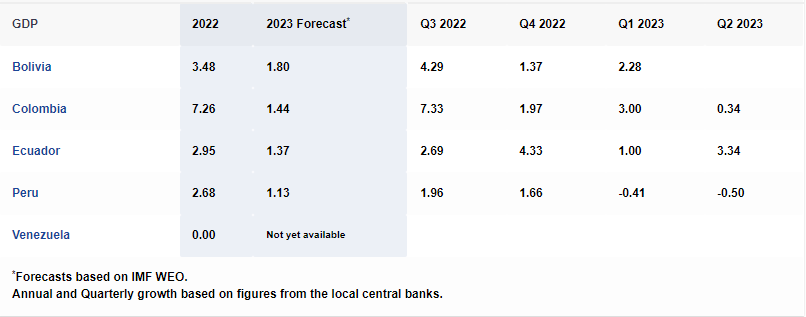
    ECUADOR | GDP growth. Ecuador’s central bank (BCE) announced on 29 September that the country’s economy grew by 3.3% in the second quarter of 2023, compared with the same quarter of last year. The BCE attributed this growth to a 6.4% increase in government spending, a 4.3% rise in household consumption, and a 3.8% rise in gross fixed capital formation. In quarterly terms, the economy grew by 2.5% compared with Q1 2023, due to a 7.6% increase in gross fixed capital formation, a 3.5% increase in government spending, a 3.3% increase in exports, and a 2.5% increase in household consumption.

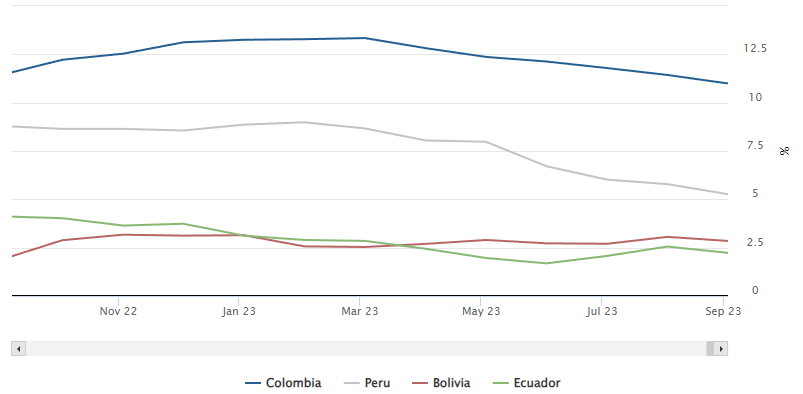
    Andean countries: inflation rate
    Percentage variation (year-on-year)

    Andean countries: GDP growth (%)
    Quarterly figures are year-on-year growth

  • PARAGUAY-ARGENTINA: Deal reached on binational dam

    Abbi Dicker 22 May 2025 Hits: 4121

    The Yacyretá binational hydroelectric complex on the Paraná waterway has long been a source of tension between Paraguay and Argentina. On 19 May Argentina’s government led by President Javier Milei and Paraguay’s government led by President Santiago Peña reached an agreement in relation to the complex seeking to ease such tensions. Under the agreement, new conditions for the use and prices of energy generated by the complex will be established. The governments have hailed the deal as paving the way to a fairer and more orderly way of utilising the shared complex.

    As with the Itaipú binational dam it shares with Brazil, Paraguay only uses a small fraction of its quota of energy from Yacyretá and sells the surplus back to Argentina. However, given its precarious financial situation, Argentina had fallen behind on its payments for this energy in recent years, generating a longstanding point of bilateral tension. In May 2024 President Peña threatened to stop supplying energy from the dam to Argentina altogether unless it paid its debt.

    President Milei, with whom Peña has enjoyed a largely amiable relationship, signalled he was prepared to resolve the issue, paying off most of the debt in June last year. On 7 May he signed a decree authorising a new operating agreement for the binational complex. The new agreement was signed between Paraguay’s state energy company Administración Nacional de Energía de Paraguay (Ande), Argentina’s energy and mining coordination secretariat, and the Yacyretá binational dam company (EBY), on 19 May.

    Under the agreement, both countries agreed to pay the same price of US$28 per megawatt-hour (MWh). Previously Paraguay had paid US$22 per MWh and Argentina had paid US$50 per MWh. The agreement also stipulates that Paraguay will use 425 MWh of the total 3,100 MWh of installed energy generation, giving Argentina access to up to 85% of the available energy, unless Paraguay needs it. The agreement aims to guarantee the flow of funds so that the EBY can sustain its operating expenses and resume investments with its own resources, without depending on the Argentine State.

    Itaipú

    In May last year President Peña secured an agreement with Brazil to increase the tariff for electricity generated by the binational Itaipú hydroelectric complex. However, a planned revision of Annex C of the Itaipú Treaty, which determines the financial arrangements of the binational dam and the price at which Paraguay may sell its surplus energy back to Brazil, was put on hold in April this year after it came to light that Brazil’s intelligence agency (Abin) had spied on Paraguayan officials between 2022 and 2023.

  • Risk pointers

    LatinNews 20 October 2011 Hits: 201

    *** Pakistan curbs religious activity in army.  A non-violent proselytising Islamic organization called Dawat-e-Islami has been causing concern in Pakistan because of its reported successes within the military.  The security guard implicated in the assassination in January of former Punjab governor Salman Taseer was a follower of Dawat-e-Islami.  This was the first time that the organization had been linked to a violent act and it changed views on the group and in particular on its growing influence within the armed forces.  The group was founded in 1980 and is said to have hundreds of thousands of supporters.  The military authorities are now said to have decided to curtail the group’s activities on the basis of the latest intelligence estimates.

    *** Pakistan denies Iran transit link to India.  On 8 September, Iran and Pakistan signed three Memorandum of Understanding (MoUs) following a two-day Joint Economic Commission meeting in Islamabad, but Pakistan disappointed Iran over a transit route to India.  The two countries signed a Road Transportation agreement in 2008, but under the terms of the agreement a transit facility may not be granted unless both countries have an agreement with the third country in question, and Pakistan does not have an agreement in place with India.  However, both sides agreed to increase bilateral trade from $1.5bn to $4.5bn over the next three years.

    A gas pipeline project linking the South Pars field to Pakistan is expected to reach the Pakistan border within a year to eighteen months.  There is some doubt, however, as to when or whether it will continue on to India as originally planned.  A continuation of the pipeline to China is said to be under consideration.  The initial capacity of the pipeline will be 22bn cubic metres of natural gas per annum rising to 55bn cubic metres.

    *** Israel’s ‘nightmare scenario’.  Earlier this week, Defence Minister Ehud Barak reportedly urged Prime Minister Benjamin Netanyahu to take a more strategic approach to Israel’s growing diplomatic isolation.  He pointed to the following linked problems: the deteriorating situation with Turkey, Egypt, and the Palestinians; the loss of “intimacy” with the United States; and Israel’s “precarious position” with the Middle East Quartet and the European Union ahead of the vote on Palestinian statehood.

    Sources say that senior figures believe that Netanyahu is spending too much time putting out fires and not enough addressing the larger strategic position.  The greatest fear now is that Jordan might turn its back on its peace treaty with Israel, either in an attempt by King Abdullah to placate the Muslim Brotherhood or as a consequence of Abdullah being overthrown in a new Arab revolt.  Losing its peaceful eastern border in addition to the difficulties being experienced along the Egyptian border, the instability in Syria, and the long-term threat from Hezbollah in Lebanon is Israel’s nightmare scenario.

  • NAFTA BRIEFS

    LatinNews 03 November 2011 Hits: 375

    California: The Democrat governor of California, Jerry Brown, ratified a law, AB131, which will allow undocumented migrants to apply for state grants and scholarships to attend university. This proposal is the second part of the California Dream Act to become law. In July undocumented migrants with places at university were allowed to apply for private student loans to continue their studies.

    Governor Brown has also outlawed the E-Verify programme which would have compelled municipalities to check the immigration status of all the people they hired. Governor Brown had also made it more difficult for the authorities to impound vehicles driven by undocumented migrants who do not have a driver’s licence.

    South Carolina : On 31 October the federal government challenged a South Carolina state law (69) which allows the police to jail undocumented migrants while their immigration status is investigated. The federal government argues that immigration is, under the constitution, a federal prerogative. The federal government has also challenged similar laws passed by the state congresses in Arizona and Alabama.

    South Carolina’s law was passed on 27 June and is due to become law on 1 January 2012.

    The challenge to the law is being led by the Department of Justice (DoJ). The DoJ is also assessing anti-immigrant laws passed in Utah, Indiana and Georgia to see whether they too need to be overturned by the courts.

  • HONDURAS: Lobo – unloved

    LatinNews 08 February 2012 Hits: 1940

    Though handily elected in November 2009, President Porfirio Lobo was always going to be a divisive transitional figure after the coup d’etat in June 2009. While in the aftermath of the coup, the traditional two-party political scene in Honduras seemed to splinter, with the emergence of new left-wing and populist outfits, Lobo’s ruling Partido Nacional  (PN) as yet faces no serious competition ahead of the next general election in November 2013, according to the latest national poll.

    Just under half (49%) of Hondurans disapprove of how Lobo is running the country, according to a poll by CID-Gallup, published on 7 February. The poll interviewed 262,000 adults between 20-25 January in 16 departments. The complainants cited insecurity and unemployment as their main concerns. Honduras suffers the ignominy of one of the highest murder rates in the world (82 per 100,000 in 2011). At the same time, 46% of respondents approved of Lobo. However, CID-Gallup noted that this support was relatively concentrated among his “co-religious”. The same respondents also said that their family economic situation had improved over the previous year.

    Although Lobo is not particularly liked, the ruling PN will take heart from the fact that it remains the most popular party in the country, with 37% of respondent preferences, compared to just 25% for the other main traditional Partido Liberal (PL). The PN and the PL, both fairly conservative and US-facing, have alternated in power for decades. However the PL’s fortunes have evaporated since the coup against the former president Manuel Zelaya (2006-2009), of the PL, in June 2009. The PL was badly riven by the coup and its aftermath and has yet to recover. Lobo and the PN were elected by a landslide six months after the coup in November 2009, largely for want of any other alternative.

    Zelaya has since gone on to help found a new radical left-wing party, Libertad y Refundación (Libre), taking some PL members with him, and in early February he officially resigned from the PL. The party is trying to reinvent itself ahead of the next scheduled general election in November 2013, under the stewardship of its current president Elvin Santos. To date four candidates have announced a bid for the PL’s presidential nomination: Mauricio Villeda, Wenceslao Lara, Yani Rosenthal and Luis Alfonso Santos.

    Santos, formally Zelaya’s vice president and fierce party rival, will also take comfort in the fact that just 6% of respondents expressed support for Libre in the latest poll. That bodes badly for Zelaya, who aims to field his wife Xiomara Castro as Libre’s presidential candidate in 2013. There is a chance that the support for Zelaya/Libre is understated, but it’s also well worth remembering that Zelaya was an unpopular president at the time of his removal and many still blame him for fomenting the still-bitter political divisions in the country.

    • Nasralla, a dark horse?

    Curiously, a TV personality and beauty contest host-turned politician, Salvador Nasralla, was identified as the most popular figure in the country. Nasralla founded his own outfit, Partido Anticorrupción, last year and it was registered by the electoral court in October 2011. Nasralla touts himself as “neither of the Left nor the Right” and runs a populist, anti-institutional message. He has none of the party machinery of the PN (which runs 17 of the country’s 18 departments and a majority of municipalities), but that is not a reason to discount him yet.

    Close on his heels is the PN mayor of Tegucigalpa, Ricardo Alvarez, who is vying with the powerful PN head of congress and Lobo’s main sidekick, Juan Orlando Hernández, to become the PN’s presidential candidate in 2013. Xiomara Castro is also a popular figure in her own right; her husband may be her greatest electoral handicap.  

    • Narco mayors

    Mauricio Villeda, a presidential aspirant for a conservative wing of the opposition Partido Liberal, has caused a major row after declaring that “we already have narco-mayors and narco-deputies in Honduras”. The ruling Partido Nacional, which dominates at the municipal level, has taken great offence at the comments, with the popular mayor of Tegucigalpa, Ricardo Alvarez, also a presidential aspirant for 2013, demanding that Villeda produce evidence. However in the wake of Villeda’s comments, the national electoral court and the national council against drug trafficking on 7 February announced plans for new measures to “armour” (blindar) the 2013 election campaign from the influence of organised crime and narco cash.

  • TRACKING TRENDS

    LatinNews 21 June 2012 Hits: 1431

    BRAZIL | Pactual merger. On 14 June Brazil’s and Latin America’s largest investment bank, BTG Pactual, issued a joint statement with Colombian securities firm Bolsa y Renta that they had reached a merger agreement by which the Brazilian firm will pay a reported US$52m in cash and stocks to the Colombian firm.

        The statement, which was issued in São Paulo and Medellín, said that the operation was “an important step in the international expansion of the bank by allowing it to take advantage of Bolsa y Renta’s position in the growing Colombian market along with the business platforms it already has in Brazil, Chile, Peru and Colombia”.

        Bolsa y Renta, Colombia’s leading securities firm currently has a US$2.57bn wealth management portfolio and a US$873m asset management portfolio. Meanwhile BTG Pactual has a US$71.5bn asset management portfolio as well as a US$23.1bn wealth management portfolio.

        Commenting on the deal, BTG Pactual billionaire owner, André Esteves, said that the “incorporation of Bolsa y Renta will give even more credibility to our operations in Colombia which currently stand out for strong domestic demand and the large number of companies that are seeking capital in order to expand”. Moreover, Esteves said that BTG Pactual is continuing with its plans to become “the first point of reference for investors and companies interested in Latin America”.

    Since the company was formed in 2009, BTG Pactual has adopted an aggressive expansion strategy that has turned into Latin America’s largest investment bank. It was voted the best investment bank in the region by Global Finance magazine last year. This year it embarked on yet another spending spree after raising US$1.99bn from its initial public offering.

    The Bolsa y Renta deal will be the third deal conducted by BTG Pactual this year, including the acquisition of Chilean financial firm, Celfin Capital. All these in an attempt to achieve Esteves’ ambitious goal of making the bank the largest investment bank in emerging markets by the end of the decade. 

    ARGENTINA | Looking to raise cash for Anses. Argentina’s treasury announced on 18 June that it is to issue one-year bonds for the value of US$113.7m in order to raise money for a fund that is to be managed by the national social security administration (Anses). According to a statement, the economy ministry has authorised the issue of bonds to capitalise the Fondo de Garantía de Sustentabilidad del Sistema Integrado Previsional Argentino with bonds with a one-year maturity and a nominal annual yield of 5%. The local press has speculated that the money will be used to finance President Cristina Fernández’s recently announced housing loans scheme.

    In announcing the scheme that is expected to facilitate the construction of some 100,000 homes according to the government, Fernández said that it would be financed by the treasury, contributions from construction companies and by the Anses. The use of Anses funds to finance some of the government’s plans is very controversial in Argentina as there is not a lot of transparency as to how pensioners’ savings are spent: the government nationalised private pension funds in 2008.

    CHILE | Holding steady. On 18 June Chile’s central bank announced that it was keeping its GDP growth rate forecast for the year at 4.0% to 5.0% but that it was cutting its inflation forecast by 0.7 percentage points to 2.7%. The bank attributed the fall in inflation to lower international fuel, food and raw materials prices but warned that this was only a short-term effect and that there were still some latent medium and long-term risks the bank was monitoring.

        According to central bank president, Rodrigo Vergara, although Chile’s economic outlook remains positive, the situation of the international economy is “worrying”. He warned that its deterioration could have important negative effects on the Chilean economy. As a result although the current scenario in Chile of stronger-than-expected growth and weaker-than-expected inflation is conducive to adopting a looser monetary policy, the bank had decided to maintain the benchmark interest rate at 5% given the risk of possible external shocks caused by the European financial crisis.

    • Paraguay moving towards investment grade

    At a business forum held in Asunción on 20 June, Paraguay’s central bank president, Jorge Corvalán, stated that the country is “solidly progressing” towards obtaining an investment grade rating from international ratings agencies. Corvalán pointed out that Paraguay’s sovereign debt rating has been consistently improving in the last 10 years. According to Corvalán, in 2002 the country’s rating was B-; five years later it was upgraded to B; then in 2010 it improved further to B+; and last year it reached BB-. In Corvalán’s opinion this positive progression, which has allowed Paraguay to move within three steps of reaching investment grade (BBB-), is set to continue and he expects the country to achieve investment grade in the next three years.

  • RASTREANDO TENDENCIAS

    LatinNews 10 September 2012 Hits: 530

    COLOMBIA | Brasil ayudará a construir el mayor proyecto hidroeléctrico de Colombia. El 28 de agosto un comité de la firma estatal de Colombia, Empresas Públicas de Medellín (EPM), otorgó la construcción del proyecto hidroeléctrico Ituango al consorcio Colombo-Brasileño, CCC. El proyecto Ituango será el mayor proyecto hidroeléctrico de Colombia del que se espera que produzca 2.400 Megawatts de electricidad para el 2018.

    EPM es la mayor empresa de servicios públicos de Colombia y abrió un proceso de licitación el pasado octubre para todas las partes interesadas en la construcción de las represas, las turbinas hidroeléctricas y otras obras asociadas con el megaproyecto de US$5,5mm localizado en el Río Cauca, a 171kms al oeste de Medellín, la capital del departamento de Antioquia. De acuerdo con una declaración de EPM, se recibieron ofertas de compañías de España, Italia, Brasil, y Colombia, pero al final se decidieron por la oferta conjunta presentada por la firma de construcción brasilera, Camargo Correa, y las colombianas Conconcreto y Coninsa Ramón  H.S.A. Las tres compañías formaron el consorcio CCC en el cual Camargo Correa tiene el 55% de participación, Conconcreto 35%, y Coninsa Ramón H.S.A. 10%.

    Según EPM, CCC no sólo estará a cargo de la construcción sino también de proveer el equipamiento necesario y la financiación para construir el desafiante proyecto, que prevé la construcción de una represa de 220 metros de altura que creará un embalse de 16 millones de pies cúbicos. El proyecto Ituango se ha estado desarrollando desde los ’70, pero EPM se ha visto en dificultades para hallar socios capaces de ejecutar el proyecto así como de asegurar su financiación hasta que esté terminado.

    PERÚ | Presentan presupuesto 2013. El 4 de septiembre el primer ministro de Perú, Juan Jiménez Mayor, presentó formalmente al congreso la propuesta del gobierno del presupuesto 2013. Jiménez Mayor dijo que el presupuesto total de PEN108,42mm (US$41,38mm), es  un 13% mayor que el del año anterior, pues la administración del Presidente Ollanta Humala busca incrementar el gasto social un 39%. Según Jiménez Mayor, la mayor parte de este incremento –US$1,02mm– será destinado a los programas del gobierno para el alivio de la pobreza, como Pensión 65, un esquema de pensión no-contributiva para peruanos pobres de más de 65 años; y Cuna Más, que busca asistir a niños pobres y a sus madres.

    El segundo incremento más importante es en el gasto de capital, que verá un incremento del 16% comparado con el año pasado. Jiménez Mayor indicó que bajo esta categoría se destinarían US$11,4mm a los gobiernos regionales y locales, para que estos invirtieran en sus proyectos de transporte, tratamiento de agua, salud y educación preferidos.

    La administración Humala ha sido criticada por poner mucho de su enfoque en promover el desarrollo económico del país y no concentrarse lo suficiente en promover el necesario desarrollo social. Algunos presidentes regionales también se han quejado de que el gobierno nacional ha estado más preocupado en la promoción de programas de inversión que benefician a ciertas áreas, descuidando la inversión en las regiones más pobres. El presupuesto del gobierno ahora será analizado por el congreso antes de su publicación en la gaceta oficial.

    ECUADOR | Invirtiendo en ciudades. La ministra del patrimonio de Ecuador, María Fernanda Espinosa, lanzó el proyecto ‘Ciudades con identidad’, que apunta a invertir más de US$900m durante los próximos cuatro años para mejorar la imagen de 73 ciudades ecuatorianas. Espinosa explicó que el desarrollo urbano en Ecuador ha sido descuidado desde hace tiempo y como resultado “debemos reconocer que nuestras ciudades se han vuelto crecientemente feas y poco amistosas”.

    Espinosa dijo que el gobierno del Presidente Rafael Correa ha decidido lanzar el programa que apunta a mejorar la estética urbana, el transporte y la seguridad. En particular, Espinosa dijo que el proyecto busca suscitar un proceso de reconversión urbana recobrando el patrimonio arquitectónico de las ciudades ecuatorianas. Ella señaló que la pérdida de este patrimonio ha conducido a un acelerado proceso de “pérdida de identidad en nuestras ciudades”. Según Espinosa, el programa no es una manera por la cual el gobierno intenta ocultar la miseria, sino de mejorar sustancialmente las condiciones de vida de la población local ayudándoles a redescubrir su patrimonio.

    • Chávez sobre la inflación

    El 5 de septiembre, el Presidente de Venezuela Hugo Chávez, exigió al diario local, Últimas Noticias, que rectifique la información que había publicado sobre las cifras de la inflación en agosto. El diario informó que el incremento en la inflación en agosto confirmaba que el costo de vida en Venezuela continua creciendo. De acuerdo con el banco central de Venezuela, la inflación en agosto se incrementó un 1,1%, pero esto fue menor que el 2,2% registrado en el mismo mes del año pasado. Como resultado, Chávez dijo que el diario “burgués” tenía que emitir una corrección. “En agosto del 2011 la inflación fue de 2,2%; en agosto del 2012 fue 1,1%, exactamente 50% menor [...] esperamos que Últimas Noticias mañana diga ‘cometimos un error’ [...] todo lo que pido es la verdad,” dijo Chávez.

  • Bahamas: Two wildcards – one negative, one positive

    LatinNews 28 August 2015 Hits: 1803

    The latest (June 2015) monthly economic and financial report from the Central Bank of the Bahamas (CBB) indicates that overall economic growth is likely to remain sluggish. In subsequent weeks, two wildcards have emerged. One – negative (if temporary) – is the filing for Chapter 11 bankruptcy in Delaware by the developer of the US$3.5bn Baha Mar resort, and associated litigation. The other – positive – is the slump in the price of oil to a little over US$40/barrel.

    The latest CBB review took a cautiously optimistic tone, anticipating continued “relatively modest economic growth over the remaining months of 2015, supported by steady improvements in the high value-added stopover segment, and ongoing foreign investment projects.” In the projections that accompanied its latest (July 2015) Article IV consultation with the government of the Bahamas, the International Monetary Fund (IMF) said that it was looking for real GDP, which stagnated in 2013 and expanded by 1.0% in 2014, to rise by 1.8% this year and by 2.8% in 2016.

    In the five months to the end of May, the total number of visitor arrivals was 2.8m, or 0.2% fewer than in the previous corresponding period. This was mainly due to the fall in the number of cruise visitors by 1.9% to 2.2m: the number of air passenger arrivals increased by 5.8%. Other metrics point to growth in the tourism sector, as the US economic recovery has continued. Total revenues in the local hotel sector increased by 4.0% in the first six months of 2015. The average daily room rate (ADR) rose by 7.0% to US$271.05, and the average occupancy rate grew by 4.7 percentage points to 74.7%.

    Persistent challenges

    This scenario is in the context of an economy facing a number of challenges. One is a dependence on imported energy. However, as the CBB notes, the impact on inflation of the introduction at the start of the year of a 7.5% Value Added Tax (VAT) has been mitigated by the fall in the global price of oil. The Bahamas Electricity Corporation’s fuel charge at the end of June was 16.95 cents per kilowatt hour (kWh), or 29.9% lower than at the end of June 2014. In the same period, the average price of diesel fell by 19.0% to US$4.10 per gallon, while gasoline was down by 5.8% to US$4.73 per gallon.

    According to the IMF, persistently high unemployment rates in the Bahamas (with 12.0% out of work at the time of the Department of Statistics’ latest labour force survey in May this year) points to wage rigidities and to a lack of skilled labour. Although the country has some clear strengths in international financial services, growth in that area is unlikely to have much of an impact on the labour market. Official data shows that, as of May 2015, 12,355 people, out of a total workforce of 183,915, worked in financial/business services (including real estate and insurance).

    The IMF also highlights impediments to the growth of small- and medium-sized enterprises (SMEs) and a mediocre overall business environment. For instance, the World Bank’s latest Doing Business Report ranks the Bahamas 97th for the overall ease of doing business, out of 189 countries surveyed. The country is lowly rated for registering property, protecting investors and getting credit. According to the CBB, private sector credit fell from US$6,468m at the end of June 2014 to US$6,290m at the end of June 2015. This outcome reflects deleveraging by households: however, the CBB and the IMF both note that the financial sector is well capitalised and liquid, while ongoing improvements are being made to the supervisory framework.

    Like a number of other governments of Caribbean countries, public finances have been issue. The overall budget deficit peaked at 5.4% of GDP in 2013, before falling to 3.3% of GDP in 2014. Thanks to the introduction of VAT, the IMF is looking for the overall budget deficit to shrink to 3.0% of GDP this year and to 2.1% of GDP in 2016. The Fund expects overall government debt to amount to 63.0% of GDP at the end of 2015. This will include external public debt of 22.7% of GDP.

    In addition, the Bahamas has to attract sufficiently large numbers of tourists to fill the new Baha Mar mega-resort and two other projects, which will increase the country’s total inventory of hotel rooms by 20%. Baha Mar is the largest overseas commercial real estate project to be backed by Chinese interests (China Construction America Inc., a wholly owned subsidiary of China State Construction Engineering Corp. Limited) and includes five upscale hotels, a casino, an 18-hole golf course, luxury condominiums and a nightclub designed by singer Lenny Kravitz. Costing US$3.5bn, Baha Mar is massive in relation to the entire economy: the IMF estimates that the country’s GDP in 2015 will be just over US$8.9bn. Imports of construction materials for Baha Mar have been a major contributor to the current account deficit, which is expected by the IMF to peak at 21.9% of GDP in 2014, before falling to 12.5% of GDP in 2015 and 8.3% in 2016.

    Wildcards

    As of late August 2015, it is not clear when Baha Mar will open its doors to paying guests, or when it might start to contribute to employment and – provided that it does not cannibalise the business of other, older resorts – export revenues and economic growth. The resort originally had been due to open at the end of March. However, following a number of disputes between China Construction and the Baha Mar developer, the latter filed for Chapter 11 bankruptcy protection in the US Bankruptcy Court in Delaware at the end of June. Protection under Chapter 11 would enable Baha Mar’s CEO, Sarkis Izmirlian, and his management team to remain in control of the resort as debtors in possession, while they look for new sources of funding and a possible restructuring of the project’s finances.

    The situation is a complex and fluid one. As of August 22, the government of the Bahamas had attempted to intervene by appointing a provisional liquidator: the Supreme Court of the Bahamas is expected to decide on the matter on September 4. Meanwhile, Rosewood Hotels and Resorts, the backer of one of the mega-resort’s hotels, has initiated an action in the US Bankruptcy Court in Delaware to terminate its licensing agreement with Baha Mar. Sarkis Izmirlian notes that Rosewood’s decision is based mainly on what it sees as its vulnerabilities as a result of actions of the Supreme Court of the Bahamas: Baha Mar will “vigorously oppose” Rosewood’s move to end its licensing agreement.

    If the financial problems of Baha Mar represent a negative – if temporary – wildcard, the latest slump in the price of oil represents a positive factor. In recent years, oil imports have amounted to around US$500m annually, equivalent to 5%-6% of GDP. The IMF noted in its Article IV consultation that the fall in the price of oil since late 2014 should cut the import bill by 2.5% of GDP. Oil prices have fallen further since then.

    Provided that the oil price remains below US$50/barrel for some time, and the legal and financial problems of Baha Mar can be resolved so that the mega-resort can actually commence operations in the coming months, the prospects for the Bahamas will be favourable. Actual and expected growth should accelerate. This will further help with the reduction in the current account and budget deficits, which are already moving in the right direction. If the government makes progress with the National Development Plan, which looks to promote diversification of the economy, takes steps to reduce rigidities in the labour market and reforms state-owned enterprises such as Bahamasair and the Water & Sewerage Corporation (WSC) of the Bahamas, the country could sustain a significantly higher growth trajectory than that of the last decade or so.

  • Chile: Seeking to address the chief public concern

    LatinNews 19 October 2016 Hits: 443

    President Michelle Bachelet and her unpopular leftist Nueva Mayoría coalition government continue to struggle to reassure over its efforts at combatting insecurity, which according to a poll released in August 2016 by a local think-tank, Centro de Estudios Públicos (CEP), remains the overriding public concern. That President Bachelet is seeking to address this was indicated in her unveiling of the government’s 2017 state budget proposal last month in which she declared security, along with education and health, one of the top three priorities.

    The CEP poll, which put Bachelet’s approval at just 15% – the lowest point for any president since the country’s return to democracy in 1990 – showed that 44% of the 1,416 respondents cited criminality as their chief concern, ahead of economic development (32%), and healthcare (30%). The poll findings come despite the fact that the Nueva Mayoría government has trumpeted progress in this area. In August deputy interior minister Mahmud Aleuy and deputy secretary for crime prevention Antonio Frey presented their balance sheet for the first half of 2016. The report showed a 5.1% fall (equivalent to 14,213 fewer victims) in serious crimes compared with the same period in 2015. Aleuy also cited figures from the national investigations police (PDI) which showed that homicides were down 19.2%, (from 402 to 325) while femicides had declined 40.9% (from 22 to 13).

    In her address to the nation on 29 September in which she presented the 2017 state budget proposal, which calls for an increase of just 2.7% in overall spending compared with the previous year’s budget – the smallest rise since 2003, President Bachelet said that over 80% of spending had been assigned to the priority areas of education, health, and security. The budget initiative, which is based on GDP growth projections of 1.75% for 2016 and 2.25% in 2017, calls for C$3,185bn (US$4.8bn) to go on interior & public security (up 1.5%), alongside C$9,489bn (US$14.3bn) in education spending (up 6.2%), and C$7,179bn in health spending (up 4.8%). In her presentation Bachelet said that among other things the budget initiative would allocate funds: for 1,500 new uniformed police officers to protect neighbourhoods and fight crime; for modernising information systems; and to improve the 44 police operation centres and provide for 250 new fully equipped police vehicles.

    More Mapuche unrest

    Alongside more general concerns regarding public insecurity, unrest stemming from the indigenous Mapuche community’s longstanding claims to ancestral lands in the southern Araucanía, Los Ríos, and Bío Bío regions continues to rumble on, with various arson attacks reported last month. On 5 September two lorries were set alight in Araucanía’s Lumaco commune, Malleco province. Then on 26 September four pieces of forestry machinery were set alight on the road connecting Curacautín and Victoria communes, also in Malleco province, producing some Cl$200m (US$302,000) in damage. Pamphlets alluding to the Mapuche cause were found on both sites.

    The Bachelet government has since sought to provide reassurances that it is attempting to address the issue. On 27 September, at a private-sector event, Interior Minister Mario Fernández pointed to the establishment of a 21-member dialogue table in July (see sidebar) and said that the Araucanía Region would be prioritised in the 2017 state budget; the government’s proposal earmarks Cl$3bn (US$4.49m) for projects to be implemented in the region.

    Yet a report on attacks with an “an indigenous connotation” by the local private-sector lobby Multigremial de La Araucanía, released in late July 2016, showed that overall 120 complaints had been registered in the first half of 2016 in the Araucanía, Los Ríos, and Bío Bío regions, down from 199 on the same period in 2015.

    • Dialogue table

    Headed up by the bishop of Temuco, Héctor Vargas, the dialogue table set up in July by the government to address the Mapuche conflict is due to meet every 15 days over a four-month period. It includes government representatives including the regional intendente (governor) of Araucanía Region, Andrés Jouannet Valderrama, along with members of the Mapuche community such as Richard Caifal, spokesperson for the group of Mapuche professionals of the Araucanía among others. However, the dialogue table does not include the Coordinadora Arauco Malleco (CAM), one of the most radical Mapuche organisations, prompting doubts as to the likelihood of its success.

  • CHILE: Crisis in Christian Democrats

    LatinNews 03 August 2017 Hits: 628

    A crisis has developed in Chile’s Christian Democrat party Democracia Cristiana (DC) with its presidential candidate, Carolina Goic, threatening to step down. Goic’s announcement followed a fierce disagreement with the party’s national executive committee. The upshot could be beneficial for the governing left-wing Nueva Mayoría coalition.

    This year, although remaining members of the Nueva Mayoría, the DC, the most centrist party in the ruling coalition, decided not to take part in primary elections along with other constituent parties, choosing instead to field its own presidential candidate. The DC nominated Senator Goic. But it now looks as if the experiment might backfire. On 29 July, after disagreeing with a majority vote taken within the 800-strong DC national executive committee, Goic said she would take a few days to reflect and decide whether or not she would continue in the presidential race, or resign.

    The issue threatening to provoke Goic’s departure is that 58% of the delegates voted to endorse a list of congressional candidates that includes Ricardo Rincón as a DC candidate for the senate. Rincón, currently a member of the lower chamber of deputies, has in the past been charged with domestic violence. Goic argues that endorsing him as a candidate is unacceptable, since the party needs to uphold high ethical standards. She also notes that a previous resolution passed by the national executive committee two months earlier stated that no-one accused of domestic violence could stand as a candidate for the party.

    Rincón and his supporters counter that he had been charged but never actually convicted. Goic, in turn, insists that the resolution excludes anyone either charged or convicted of the crime. She recognises that the vote endorsing Rincón was legitimately won, but says she finds it “a hard blow to the party, and a hard blow to me personally. I say that as someone who has spent much of her professional life defending women who have been victims of violence inside the family”.

    President Michelle Bachelet has called for politicians and the media to allow the DC to resolve its internal issues. “They are in a period of reflection, we need to respect that,” she said. Bachelet also insisted that the Nueva Mayoría coalition continued to include the DC, even though it is fielding its own presidential candidate (the remaining parties in Nueva Mayoría are supporting television news presenter Alejandro Guillier as their presidential candidate).

    How long it may take for the crisis to be resolved was not immediately clear. On 1 August Sergio Espejo, one of the DC’s vice-presidents who is aligned with the Goic camp, announced that he was resigning in protest. In an emotional statement he said “A party which betrays itself will also betray Chile”, and went on to accuse members of the DC of lowering standards and ultimately betraying their own presidential candidate.

    Piñera still ahead

    A new opinion poll published by Adimark on 2 August shows that former president Sebastían Piñera (2010-2014) of the right-wing Chile Vamos coalition continues to lead the race for November’s presidential elections, with 32% support in July, up by one percentage point on June.

    Adimark also shows Beatriz Sánchez of the left-wing Frente Amplio (FA) coalition retaining second place, ahead of Nueva Mayoría’s Guillier. Support for Sánchez increased by four percentage points to 17%, overtaking Guillier who was backed by 16% of the respondents. Goic had just 1% support in the poll, offering a further possible motivation for the DC candidate to withdraw from the race.

    • Piñera well-positioned

    All of the percentages in the Adimark opinion survey refer to respondents’ personal voting intentions, but the polling firm also asked a separate set of questions about who they thought the electorate as a whole would choose. A much larger group – 67% of respondents – said they expected Sebastián Piñera to be victorious (up by eight percentage points on June), while 14% said Alejandro Guillier would win (down three points) and 6% opted for Beatriz Sánchez (up by two points). President Bachelet’s approval rating, according to the same poll, rose by two points on June to reach 32% in July.

  • TRACKING TRENDS

    LatinNews 30 August 2018 Hits: 449

    CHILE | Growth expanding. Chile registered GDP growth of 4.8% in the first half of the year, the central bank revealed last week. The 5.3% growth posted in the second quarter was the highest since the third quarter of 2012.

    The finance minister, Felipe Larraín, said that the economy was growing “vigorously and robustly”, singling out the 7.1% growth in investment. “We are leaving behind us four straight years of decline in investment,” Larraín said in a pointed criticism of the previous government led by Michelle Bachelet (2014-2018).

    Manufacturing expanded by 7.3% year-on-year in the second quarter and retail by 8.1%, with the mining sector up by 4.8%. Exports grew by 7.5% but were outstripped by imports which grew by 10%.