All Categories

Subcategories

  • BRAZIL: Homicides decline while other crimes rise

    Abbi Dicker 30 July 2026 Hits: 401

    The think tank Fórum Brasileiro de Segurança Pública (FBSP) has released its annual crime report for 2025, which showed another yearly drop in homicides, with the country’s rate of violent deaths dropping to 19.1 killings per 100,000 people, the lowest figure since 2012. However, various other problems that security experts have long raised concern over are still on the rise, such as violence against women and police lethality.

    According to the report released on 23 July, intentional violent killings in Brazil totalled 40,775 last year, down from 44,220 in 2024, while the national murder rate dropped from 20.8 killings to 19.1 killings per 100,000. Last year’s murder rate is the lowest figure registered by the FBSP since records began under the current methodology in 2012. It is also the first time that FBSP’s records registered an annual murder rate below 20 killings per 100,000 people.

    Despite the overall decrease in violent killings, the FBSP expressed regret that the reduction “does not equally benefit all social groups or change the institutional and political choices regarding standards for the use of force”. The report went on to highlight that, although the number of women murdered has decreased, the number of femicides continued to rise in 2025. Brazilian law recognises the distinction between women who are victims of murder, such as the victim of a deadly armed robbery, and ‘femicide’, which pertains to women who are murdered due to their gender, often a killing in the context of domestic abuse or misogyny. While the number of women registered as victims of murder totalled 3,539 in 2025, down from 3,728 the previous year, the number of femicides has risen for the fourth consecutive year, with a total of 1,571 killings. This is up from 1,347 in 2021, 1,455 in 2022, 1,475 in 2023, and 1,504 in 2024.

    Regarding police violence, the FBSP report showed deaths resulting from police interventions totalled 6,602, up from 6,237 in 2024. According to the think tank, 2025 was the worst year on record for police lethality in Brazil. The report also highlighted the notorious police operation in October last year in Rio de Janeiro, which saw over 120 fatalities, making it the deadliest police operation in Brazilian history.

    In the introduction to the report, the FBSP highlighted that politicians have been ramping up their tough-on-crime rhetoric ahead of the general elections in October. However, the think tank called for this rhetoric to translate into concrete action and criticised the lack of progress of major security reforms, such as the so-called ‘PEC da Segurança’, the main security-related proposal backed by the government of President Luiz Inácio Lula da Silva, which seeks to improve the integration and coordination between different law enforcement institutions.

    Digital crimes

    The FBSP public security think tank highlighted in its latest annual report that, although robberies have decreased in Brazil, online scams and other crimes in the digital sphere continue to rise. In 2025, authorities registered a total of 2.26m online scams. This marks a 2.7% increase compared to 2024 and a rise of around 430% compared to 2018. Meanwhile, vehicle robberies were down 20.6% in annual terms, robberies of residences were down 19.9%, robberies of shops and commercial properties were down 18.3%, and robberies committed against pedestrians on the road were down 23.4%.
  • TRACKING TRENDS

    LatinNews 03 November 2011 Hits: 954

    ECUADOR | Compulsory redundancy. The government has laid off 2,700 civil servants, with compensation packages, in the health, interior, housing, transport and agriculture ministries, as well as state institutions such as prison rehabilitation. The minister for labour relations, Richard Espinoza, said the government was undertaking a major restructuring of the State: there are 470,000 public sector workers in Ecuador, which has a population of just 14.3m. He said a further 2,000 civil servants would reach retirement age by the end of the year and their positions would not be replaced. He said the streamlining of the State aimed to “optimise human talent”, cutting back on needless bureaucracy and improving efficiency. He made no mention of redeploying those losing their jobs. Trade unions are promising marches to the Carondelet presidential palace in the coming weeks.

    VENEZUELA | Bigger than Bolívar. “We are achieving what Bolívar could not achieve: true independence,” President Hugo Chávez told assembled members of the Bolivarian national armed forces (FANB) during a televised appearance last week to announce a massive 50% salary increase for the military (see sidebar).

    In addition to the salary increase, which will be applied retroactively from September, Chávez also announced special benefits, such as low interest rates on the purchase of homes and cars, and the provision of apartments to some 800 members of the armed forces in a military housing complex.

    The salary increase is well above inflation, which is on course to reach almost 30% this year, and underscores the need to keep the military Chávez has worked hard to politicise firmly on side ahead of next October’s elections. Chávez insisted the opposition “hated” the armed forces, accusing them of “terrorism and corruption”.

    • Military salary increase

    The scale of the salary increase for the military announced by Venezuela’s President Hugo Chávez fuelled some resentment in other sectors, with teachers’ unions, notably, calling for similar increases. Manuel Galíndez, the president of the teachers’ union Federación Nacional de Colegios y Sindicatos de Trabajadores Profesionales de la Educación de Venezuela, said that while he approved of the salary increase for the military, other sectors that had struggled for months for a similar increase should also be rewarded.

  • BRAZIL: Party funding massively increased in 2014 budget

    LatinNews 19 December 2013 Hits: 537

    With the help of a small “bonus” worth R$2m (US$860,000) in amendments to members of the congressional budgetary commission, the legislature passed the government’s 2014 R$2.48 trillion (US$1.06tr) budget in the early hours of 18 December. Showing remarkable indifference to the Brazilian electorate’s diminishing tolerance for political parties’ slush funds, legislators added R$100m (US$42m) to the R$264m earmarked for political parties’ electoral campaigns, an increase of 37.9%. Four major public works projects were also green-lit by the congressional approval, but the Programa de Aceleração do Crescimento (PAC), the pet project of the ruling Partido dos Trabalhadores (PT), saw its funding cut slightly. The minimum wage was also raised marginally.

    The budget was based on GDP growth of 3.8% in 2014, an optimistic assessment according to most economists (who predict growth will be around 2%), but down from the government’s original projection of 4.5%. It also assumes inflation of 5.8% at the end of the year, and an average of 2.3 reais to the dollar throughout 2014. The budget also sets a public sector surplus target of 3.17% of GDP, requiring savings of R$167.3bn (US$71bn). This year the surplus looks set to be around 1.6%, well short of the 2013 target of 2.3%.

    The minimum wage will rise to R$724 (US$311) up from its current level of R$678. The PAC, first introduced by former president Lula da Silva, had its budget trimmed by R$1.2bn (US$500m): it will have a budget of R$61.8bn in 2014. The PAC brings together investments by the federal government, state enterprises and the private sector in construction, sanitation, energy, transport and logistics. “We opted for a leaner budget in order to be within the bounds of the economic reality of the country,” Miguel Corrêa, a PT deputy on the budget commission, said. “We did not want to discredit the budget numbers as contingencies emerge.”

    The commission suspended funding to two major infrastructure projects in which serious irregularities are suspected. Instead, it opted to free up funds to build the East-West integration railway in Bahia; the BR-448 highway in Rio Grande do Sul; and the construction of a major sports facility in Parnaíba, Piauí. The final project involves the construction of a R$77m bridge in the northern state of Pará.

    Opposition legislators had also tried to implement a law forcing the president to approve any amendment added to the budget by congress. In the end, the government held out; in future the president will retain the right to veto.

    • Ministerial changes due in early 2014

    In an interview with local media on 18 January, President Dilma Rousseff said she will begin a ministerial reshuffle at the end of January. She was, however, tight-lipped about who might be replaced. In particular, she responded with some apparent frustration to a question about the future of Guido Mantega, the finance minister. “For the 20th or 30th time, I reiterate that the minister is doing perfectly well in his current position,” she said.

    Around 12 of Rousseff’s 39 cabinet ministers are up for election in 2014 and so will have to leave their posts. Among them, the cabinet chief, Gleisi Hoffmann, who will run for office in her home state of Paraná; and Alexandre Padilha, the health minister, due to run for the governorship of São Paulo.

    Rousseff was also reluctant to be drawn into conversation about her rivals for the presidency next year. “The elections are not yet on my agenda,” she told reporters.

    • “Two crippled legs”

    In comments to the press on 16 December, Finance Minister Guido Mantega described the Brazilian economy as walking on “two crippled legs”. He put the blame for Brazil’s underwhelming performance on slow growth in developed countries and the lack of credit to support consumer spending, but he also said that Brazil was on a path to recovery that would continue in 2014.


  • RASTREANDO TENDENCIAS

    LatinNews 28 August 2015 Hits: 313

    BOLIVIA | Se inaugura planta de GLP en el Gran Chaco. El 24 de agosto el Presidente de Bolivia, Evo Morales, fue anfitrión del Presidente de Paraguay, Horacio Cartes, durante la inauguración de la planta procesadora de hidrocarburos ‘Carlos Villegas’ [IL-15-27]. La planta, localizada en Yacuiba, departamento de Tarija, está en la región geográfica del Gran Chaco, que se extiende a través del sur de Bolivia, el oeste de Paraguay y el norte de Argentina. Fue construida por la firma estatal boliviana, Yacimientos Petrolíferos Fiscales Bolivianos (YPFB), para ayudar a estimular la capacidad de exportación del gas natural de Bolivia, especialmente el gas licuado de petróleo (GLP) al vecino Paraguay, Perú y al más lejano Uruguay. La planta de US$600m está considerada como una de las más grandes de su clase en Sudamérica; capaz de procesar 32,2m metros cúbicos de gas natural por día, y producir 3,14 toneladas (t) métricas de etano por día, 2,24 t de GLP por día, y 1.650 barriles de combustible por día.

    El Presidente Morales ha dicho que todo esto le permitirá a Bolivia convertirse en el principal polo de energía de Sudamérica y proveer otros derivados de hidrocarburos a la subregión en las próximas décadas. Morales invitó a Cartes a la apertura de la planta debido a que él ha dicho que uno de los objetivos inmediatos de la planta es proveer el 100% de la demanda de GLP de Paraguay. De hecho, durante el evento Morales y Cartes firmaron un nuevo acuerdo bajo el cual Bolivia venderá GLP procesado en la planta ‘Carlos Villegas’ a Paraguay a un precio de descuento de US$12 por cilindro de 10 litros, menor que los US$17 por cilindro que actualmente paga Paraguay. Este acuerdo aun debe ser ratificado por el congreso de Paraguay, pero Rómulo Campos Krauer, el presidente de la firma petrolera estatal de Paraguay, Petropar, quien acompañó a Cartes, ha dicho que una vez que el acuerdo sea ratificado, Petropar podría comenzar a comprar GLP boliviano inmediatamente. Por otra parte, el ministro de energía & hidrocarburos de Bolivia, Luis Alberto Sánchez, dijo que una vez que la planta ‘Carlos Villegas’ esté totalmente operacional generaría aproximadamente US$500m de ingresos por la exportación de GLP al año. Además, Sánchez dijo que se está planeando construir una nueva planta petroquímica de US$1,8mm en Yacuiba que permitirá la producción de propano y derivados plásticos de etano, que ayudará a industrializar a Bolivia y proveer al país con más ingresos y empleos que aquellos generados por “solo vender gas natural”.

  • ECONOMIC OVERVIEW: PANAMA

    LatinNews 05 November 2015 Hits: 2461

    Inequality down: On 14 October Panama’s economy and finance minister, Dulcidio de la Guardia, gave a press conference in which he told reporters that for the first time in 23 years, the Gini coefficient that measures income inequality (where 0 is perfect equality and 1 perfect inequality) was below 0.50 last year for Panama for the first time in 23 years, registering 0.49. Pointing to an overall decline in poverty – from 25% (of the population of some 3.99m) in 2014 to 22% in 2015 – De la Guardia said that this downward trend looks to have been maintained this year, registering 0.48 in March 2015.

    De la Guardia attributed the improvement to government social programmes like ‘120 a los 65 (120 at 65)’ which was launched by the previous Cambio Democrático government led by former President Ricardo Martinelli (2009-2014) as ‘100 a los 70 (100 at 70)’ which provides a monthly US$100 stipend (since raised to US$120) to pensioners over 70 years of age (since lowered to 65) who are not covered by a pension plan. Other government social programmes include a conditional cash transfer programme ‘Red de Oportunidades’ which benefits some 72,563 people across the country in the form of a US$50 monthly stipend paid out to impoverished families so that their children can go to school and receive basic health and nutrition services. De la Guardia also flagged up the “Beca Universal” (Universal Scholarship) program, which benefits some 500,000 school children across the country in the form of annual scholarships of US$270 for primary education; US$360 for lower secondary school (eduación premedia) and US$450 for secondary education.

    At the press conference, De la Guardia cited IMF figures which suggest that Panama is expected to lead Latin America in terms of economic growth in 2015 with projected GDP growth of 6%. According to the latest (October 2015) figures from the United Nations (UN) Economic Commission for Latin America & the Caribbean (Eclac), Panama is expected to grow 5.8% in 2015 (the highest in the region) rising to 6.0% in 2016. This is above the 4.1% and 4.2% average for Central America for 2015 and 2016 respectively. Panama’s GDP grew 6.2% in 2014 on Eclac figures.

  • Chile: Moderate market-friendly reform under Piñera?

    LatinNews 12 January 2018 Hits: 1340

    Chile’s political pendulum has swung back to the right again. Sebastían Piñera won the second round of the country’s presidential election on 17 December, defeating centre-left candidate Alejandro Guiller by 54.57% to 45.43%, a better margin than had been expected. The way is now clear for Piñera, who takes office on 11 March, to push for the market friendly reforms he has promise to deliver economic recovery (Piñera says his aim is to double the annual GDP growth rate from 2% to 4% during his term in office). But as he lacks a congressional majority, his approach is likely to be quite cautious.

    For over a decade two alternating presidents have set Chile’s economic policies. Michele Bachelet, on the centre-left, was in office from 2006-2010; Piñera, on the centre-right, succeeded her from 2010-2014; Bachelet then returned for a second presidential term from 2014-2018; and now Piñera has also won a second term, which will run through 2018-2022. Inevitably, the two have been almost constantly judging how much of their predecessor’s work to accept, criticise, unwind or amend: in short, to decide how vigorously to swing the policy pendulum back towards their own ideological home. Now it is Piñera’s turn to make that judgement. Although he won with a convincing nine-point margin, it is likely that he will move with a degree of caution and moderation.

    This is because his Chile Vamos coalition will lack an overall majority in either house of congress. It will be the largest group in both the lower chamber (with 73 of 155 seats) and in the senate (with 19 of 43 seats). To achieve a simple majority Piñera will therefore need to attract another five votes in the chamber of deputies and another three in the senate: this points to detailed issue-by-issue negotiations, and to give-and-take compromises.

    Piñera’s advisers say his ministerial team is likely to be finalised by the end of January. The incoming president has at least three important priorities. One is to boost mining investment and production: he has promised to reduce red tape, relax complex environmental permits, and cut corporate tax rates. Bachelet had increased corporate tax rates from 20% to 25% in 2013; Piñera says he wants to get them back down to the OECD average of 22%. Another priority is to reverse a multi-year fall in private investment. The third priority is to reverse the trend of widening fiscal deficits (in five years, from a balanced budget in 2012, Chile has seen the fiscal deficit widen to around 3.0% of GDP in 2017). This last priority is the one where some kind of cross-party deal will look most likely, given that various parties in Guiller’s defeated coalition had acknowledged the need for fiscal consolidation. Piñera is likely to use his election pledge of a US$14bn government-spending plan across the four years of his term in office as the basis for negotiations with other parties.

    It looks as if Piñera will not seek to reverse one of Bachelet’s big reforms, the introduction of free university-level education: between the first and second rounds of the presidential ballot, to win over centre and moderate left wing voters, he made a pledge to keep universal free education. He can however be expected to tinker with the labour reforms introduced by Bachelet and to seek changes to the existing public-private pension system. Chile was a pioneer in introducing private pension funds back in 1981 (known as Administradoras de Fondos de Pensiones or AFPs) but they have been criticised for high management costs, and for providing relatively low benefit levels. The new government is expected to support the AFP industry, but to look at ways of raising pension benefits and, given the problems posed by an ageing population, seeking to incentivise later retirement.

  • ECONOMIC HIGHLIGHTS

    Patrick de Courcy 15 September 2021 Hits: 1629

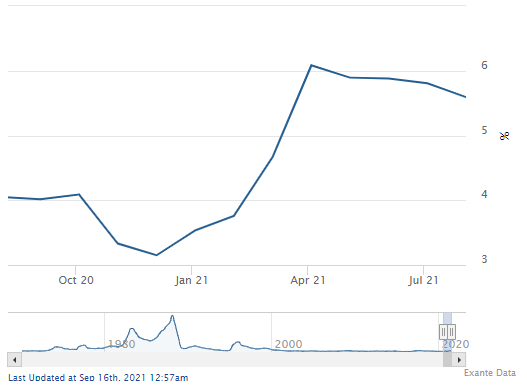
    MEXICO | States under financial pressure, Moody’s warns. On 23 August, the international credit ratings agency Moody’s Investors Service issued a note warning of increased “budgetary pressures” on Mexican states due to public health spending related to the coronavirus (Covid-19) pandemic. The governments of Mexican states which have a ‘Baa1’ rating (moderate credit risk) with a ‘negative’ outlook were already facing “declining or stagnant revenues” when the additional pressures from Covid-19 emerged. The increase in “unallocated public health spending” varied across Mexico, with larger increases in some states “reflecting pressure to respond to the pandemic at the regional level”. Moody’s notes that states’ public health expenses, combined with the extension of subsidies and tax benefits to stimulate regional economies, became a key driver in the widening federal fiscal deficit of 2020. Despite plans to cut health-related expenditures in 2021, Moody’s notes that the emergence of Covid-19 variants of concern and unequal vaccination rate in different states may force some to increase health spending again. In a subsequent report published on 1 September, the ratings agency further warns that “Mexican states will face a prolonged and uneven economic recovery”.

    MEXICO | Trade balance tips into negative. Mexico’s national statistics institute (Inegi) released the latest foreign trade figures on 27 August, which show that the country recorded a US$4.06bn trade deficit in July. This compares with a US$5.66bn surplus in July 2020. Overall, Mexico’s trade flows expanded: exports grew 15.2% year-on-year in July to US$40.89bn, while the country’s imports jumped 50.6% to US$44.95bn. Oil-related trade in particular has boomed, with oil-related exports growing 104.6% year-on-year to US$2.88bn, while oil-related imports jumped 119.7% to US$4.99bn. The overall trade figures for July have led to Mexico’s trade balance for the year tipping into the negative, with the country recording a US$2.97bn deficit in January-July.  

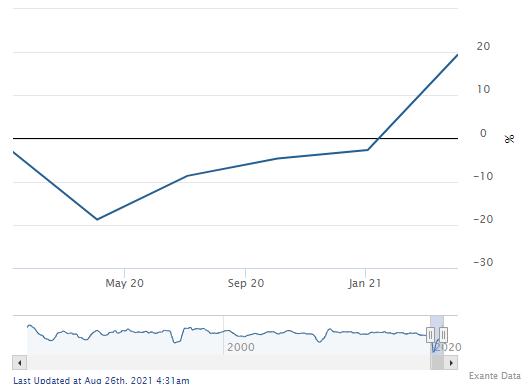
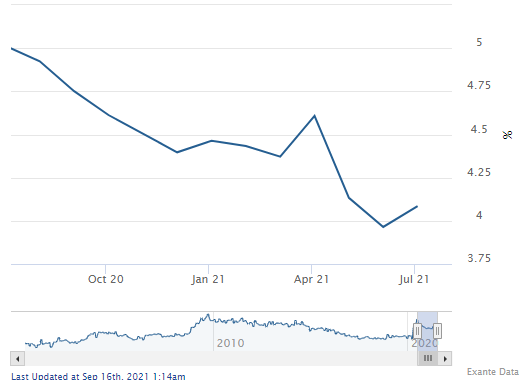
     Mexico: GDP growth

    Percentage variation (year-on-year)

     Mexico: Unemployment Rate

    Economically active population

     Mexico: Inflation Rate

    Percentage variation (year-on-year)


  • TRACKING TRENDS

    Abbi Dicker 04 September 2025 Hits: 1071

    ECUADOR | Trade agreement with South Korea. Ecuador and South Korea signed a strategic economic cooperation agreement (Seca) on 2 September, marking a high-water mark for bilateral relations which began drawing closer over a decade ago.

    Since 2023, the diplomatic focus has been on delivering this trade agreement which will eventually see 98.8% of Ecuadorean exports enter South Korea tariff-free. According to Ecuador’s foreign trade and production ministry, the Seca is expected to increase exports to South Korea by 27%.

    Ecuador’s minister of production and foreign trade, Luis Alberto Jaramillo, travelled to Seoul for the signing of the Seca, which the Ecuadorean government described as “an instrument that marks a before and after in the trade relationship between both countries, opening the doors of the world’s 12th largest economy to Ecuadorean exports”.

    According to central bank figures, Ecuador currently runs a trade deficit with South Korea for non-oil goods, with exports totalling US$77m in the first half of 2025 and imports totalling US$160m. The trade balance is shifting however, with Ecuadorean exports up by 19% compared with the same period in 2024.

    Key Ecuadorean exports will benefit from a phase-out of South Korean tariffs, including bananas, chocolate, and coffee, while 10,000 tonnes of shrimp will be allowed to enter the country tariff-free each year. In return, Ecuador has lowered some of its own trade barriers, notably regarding South Korean cars which will benefit from a gradual elimination of tariffs over the next 15 years, with a faster tariff phaseout for hybrid vehicles. The agreement also contains provisions to protect sensitive Ecuadorean manufacturing sectors such as textiles, machinery, and white goods.

    The Seca will need to be approved by Ecuador’s national assembly and constitutional court before it can be ratified, and it must also clear procedural hurdles in Seoul.

  • Risk pointers

    LatinNews 06 September 2011 Hits: 326

    *** Gaddafi in search for solution.  Libyan sources say that Colonel Gaddafi is “strenuously” urging his few remaining international allies to broker a peace deal.

    The line Gaddafi is taking is that there will be no military solution either way and negotiations are required.  The alternative is a partition of Libya.  A Libyan minister, speaking anonymously, says that “all issues are negotiable”, which is taken to mean even the replacement of Gaddafi.  However, it would have to be the Libyans themselves who decide, albeit under international supervision.

    On a less positive note, the same minister said that if Nato manages to kill Gaddafi that will have no effect as his regime will continue to fight on without Gaddafi.

    *** Online jihadists.  Industry experts say that, inspired by the use of social media during the ‘Arab Spring’, jihadist supporters have established a “significant foothold” on both Facebook and Twitter.  However, for the moment, the majority of activity seems to be that of individual jihadist sympathizers rather than organizations.  Also, much of the material is recycled from jihadist websites.  Nevertheless, there is evidence that online jihadist sympathizers are beginning to investigate the possibilities of using Facebook and Twitter as recruitment tools by taking advantage of their inbuilt networking capabilities.

    For the moment industry experts say that the jihadist presence on Facebook and Twitter remains “disorganized, fragmented, and experimental”.  But more systematic attempts to turn Facebook and Twitter into effective recruiting tools are expected to develop rapidly.

    *** Mexican army could be drawn into politics.  Our sister organization, the LatinNews Intelligence Service, reported this week that the assassination of a key Mexican general, Jorge Juárez Loera, on 21 May, coupled with increasing signs of civil unrest in southern Mexico, is forcing the Mexican military further into politics.

    Mexico has never had a military coup and traditionally, governments have scrupulously avoided interfering in military affairs. However, the 2006 decision by President Felipe Calderón Hinojosa to deploy the army to fight drug trafficking gangs upset this balance. So far, the military have been deployed mostly in the north of the country, but a strike by militant teachers in Oaxaca and increasing signs of social tension in other parts of southern Mexico suggest that the government may soon need the already heavily-stretched army to maintain order in the south as well as to fight the drug traffickers in the north. These further deployments could draw the military deeper into politics.

  • RASTREANDO TENDENCIAS

    LatinNews 17 January 2014 Hits: 1142

    GUATEMALA | Las remesas alcanzan nuevo récord. Las remesas que los expatriados guatemaltecos envían a su país alcanzaron un nuevo récord de US$5,11mm en el 2013, de acuerdo con el banco central, elevándose un 6,7% sobre el año anterior. Un total del 90% de las remesas provino de EU, donde viven 1,5m de expatriados guatemaltecos, el 60% de ellos ilegalmente. La cifra récord se alcanzó a pesar de la deportación de EU de un número récord de 50.200 guatemaltecos indocumentados el año pasado.

    Mientras tanto, el ministro del trabajo, Carlos Contreras, confirmó un 5% de incremento en el salario mínimo: a Q2.096 (US$267) por mes para los trabajadores de las plantas manufactureras de las maquilas y en el sector exportador; y Q2.380 (US$304) para los trabajadores en la agricultura y otros sectores. El Presidente Otto Pérez Molina anunció los aumentos después de que los empleadores y los empleados no lograron alcanzar un acuerdo, con los primeros ofreciendo un 3,3% de aumento y los últimos exigiendo aumentos del 30%. Esto, efectivamente no es más que un incremento inflacionario: la inflación para los primeros 11 meses del 2013 fue del 4,63%. El salario también permanece por debajo del costo de la canasta básica de alimentos (CBA) en Guatemala que, para una familia promedio de cinco miembros, se calcula  que es de Q2.897 (US$369).

  • ARGENTINA: Fue lanzado el primer satélite latinoamericano

    LatinNews 24 October 2014 Hits: 443

    Argentina se ha convertido en el primer país latinoamericano en construir y lanzar su propio satélite geoestacionario. El Arsat 1, construido por la firma estatal, Investigaciones Aplicadas (Invap), fue lanzado desde el centro espacial de Kourou en la Guayana Francesa el 19 de octubre. El despegue fue transmitido en vivo por la televisión y la radio a través de la Argentina, con la Presidenta Cristina Fernández aparentemente supervisando el lanzamiento desde la Casa Rosada. El satélite costó alrededor de US$270m, pero debería eventualmente ahorrarle a la Argentina US$25m al año en tarifas de alquiler a Estados extranjeros por los servicios de telecomunicaciones. Como el manejo de la escena de Fernández durante el evento ha demostrado, en términos de capital político, el retorno fue inmediato.

    Habiendo tardo siete años en ser completado, el Arsat 1 fue diseñado y construido por Invap en la ciudad sureña de Bariloche. Según Héctor Otheguy, el gerente general  de Invap, el lanzamiento salió mejor de lo esperado, y el satélite debería empezar a funcionar en pocos días. Cuando esté en operación, el satélite fortalecerá la cobertura de Internet, de telefonía móvil, y las redes terrestres de televisión de la Argentina, así como también  mejorar la distribución del contenido audiovisual desde la Argentina al resto de América Latina y EU. Debería tener una vida útil de alrededor de 15 años. Arsat 2 y Arsat 3 ya están en proceso de desarrollo, con Arsat 2 “completo en un 70%”, de acuerdo con Fernández.

    Argentina invierte alrededor del 0,57% de su PIB en su infraestructura de telecomunicaciones, cayendo de más del 1% invertido en los años ’90, pero esto es aún más que Brasil, Colombia, y México. Sin embargo, la inversión de Argentina en investigación y desarrollo,  de un 0,65% del PIB, es el segundo nivel más alto en América Latina.

    Fernández habló del “gran orgullo” en que Argentina se una al selecto club de naciones con su propio satélite. “Fue hecho enteramente con tecnología argentina, por profesionales argentinos”, dijo ella (el presidente de Arsat admitió después ante la prensa que al menos la mitad de los componentes del satélite fueron importados). Fernández dijo que la inversión en el satélite era una cuestión de soberanía nacional. “El Reino Unido estaba detrás de una de las dos posiciones orbitales que Argentina podía retener para sus satélites”, ella advirtió.

    Capital político

    El proyecto del satélite fue inicialmente aprobado por el fallecido predecesor y esposo de Fernández, Néstor Kirchner (2003-2007), y ella usó la ocasión del lanzamiento para golpear a sus oponentes. “Ellos dijeron que el programa espacial era un desperdicio de dinero y que el lanzamiento programado para el 2014 era una ilusión”, ella dijo. “Ahora ellos pueden ver que no lo era”.

    A comienzos de la semana, dos candidatos opositores quienes probablemente desafiaran al elegido para suceder a Fernández en la presidencia en las elecciones presidenciales del próximo año, Mauricio Macri, y Sergio Massa, indicaron que ellos revocarían un número de leyes de la era Kirchnerista si alguno de ellos gana. Después del lanzamiento, Fernández dijo con toda intención a los argentinos: “Tengo la seguridad que los satélites no pueden ser revocados”.

    Firmeza ante el delito

    El gobierno ha anunciado un número de cambios de último momento a su propuesta de ley de un nuevo código penal. Hablando el 21 de octubre, la Presidente Cristina Fernández criticó con dureza a los jueces por liberar prisioneros. “No queremos que delincuentes que son arrestados, luego sean liberados. Queremos que ellos permanezcan bajo custodia y queremos que la justicia tenga en cuenta el impacto que causan a la sociedad sus delitos”, ella dijo.

    Bajo la nueva propuesta de ley, las cortes tendrán permitido mantenerlos bajo custodia preventiva si existe riesgo de “conmoción social”. Otra movida que ocupa titulares es la deportación por vía rápida de extranjeros condenados de un delito penal.

    Con las últimas alteraciones del gobierno, parece que la más liberal revisión del código penal realizada a inicios de año por el recientemente fallecido juez de la corte suprema, Enrique Petracchi, ahora ha sido dejado de lado, a favor de un enfoque más populista y duro contra el delito.

    La oposición afirma que una de las nuevas propuestas, que pone límites de tiempo sobre las investigaciones por corrupción, está diseñada para proteger a los funcionarios públicos acusados de delitos menores.

    • Medidas enérgicas sobre el ‘dólar blue’

    El 21 de octubre la policía allanó 12 oficinas de cambio de divisas para verificar su cumplimiento con las actuales regulaciones sobre canje de monedas. La redada tuvo un efecto inmediato sobre la tasa del ‘dólar blue’ (el precio del mercado negro para los dólares de EU), la cual cayó  25 centavos. La tasa de cambio oficial es de Ar$8,5/US$1, mientras que la tasa del mercado negro está en Ar$14,70/US$1.

  • CARIBBEAN POINTERS

    LatinNews 19 April 2017 Hits: 862

    *** JAMAICA’S PEOPLE’S NATIONAL PARTY (PNP) CHANGES LEADER. Former prime minister Portia Simpson Miller has stepped down as leader of Jamaica’s main opposition PNP. She is replaced by Peter Phillips.

    Phillips was appointed by the party membership “by acclamation” on 26 March, and his first act as new leader was to attack the government’s plans to give more power to the security forces in the fight against crime. Just hours after his promotion, he said: “The solution to crime is not to be rooted in having the state unleash more violence on the people or in passing laws that take away people’s rights.”

    Phillips said the solution lay in community-based projects and determination. He said: “Look at August Town. A few years ago August Town was being overrun by violence until the community decided to organise to stop it.”

    The target of Phillips’s criticism was the introduction of three security-related bills on 21 March by Prime Minister Andrew Holness, leader of the ruling Jamaica Labour Party (JLP). Amongst other things, the measures enable the prime minister, on the advice of the National Security Council, to declare any high-crime area a zone for special security operations for up to two months. This will enable the Jamaica Defence Force (JDF), acting with the Jamaica Constabulary Force (JCF), to establish a security cordon around the zone for a period of 24 hours. The joint force will also be able to impose a 72-hour curfew.

    Members of the joint JDF-JCF force are empowered to search any place, vehicle, or person without a warrant if they have suspicions that a crime has been or is about to be committed. They are also able to seize property and documents when deemed necessary to protect public order.

    *** GUYANA BUILDING OIL INFRASTRUCTURE. Following major offshore oil finds, which should begin to come on stream in 2020, Guyana has announced that it is to build a US$500m onshore facility on Crab Island in the Berbice River. It will serve as a logistics and supply base. The facility is expected to create 600 jobs.

    *** MASS DEMONSTRATIONS IN SURINAME. On 6-7 April, thousands of protesters took to the streets of Suriname’s capital Paramaribo to demonstrate against increases in the prices of fuel, water, and electricity. There have been further demonstrations since, and on 18 April riot police arrested several protesters including a union leader during the fourth protest in the capital.

    The move by the government led by President Desi Bouterse to increase prices has come as a result of the sharp fall in revenue from gold and oil since 2015. However, union leader Roddy Berenstein summed up the protesters’ anger by saying: “What has been done since the Bouterse-led administration came into power in 2010 and again in 2015 has resulted in extreme hardship for the people.” He said that the protests would continue until the price rises were reversed.

    The government appears to be sticking to its guns, and the Ministry of Education has warned teachers that any participating in the demonstrations during the working week will suffer deductions from their salaries. Wilgo Valies, president of the Association of Teachers, responded by warning the government: “We will fight to the bitter end for a better life, better wages, and better positions.” He said teachers would not be intimidated. Valies was one of those arrested on 18 April.

  • ECONOMIC HIGHLIGHTS

    Patrick de Courcy 15 September 2021 Hits: 1620

    ANDEAN COMMUNITY | Cooperation agreement with EEU. The secretary general of the Andean Community (CAN), Jorge Hernando Pedraza, and Arman Shakkaliyev, a member of the board of economic competition and anti-monopoly regulation at the Eurasian Economic Commission (EEC), signed a new cooperation agreement on economic competition policies on 25 August. The EEC is the executive body of the Eurasian Economic Union (EEU), which groups states in Eastern Europe and Western and Central Asia. According to a CAN press release, the new agreement “will promote joint actions through the implementation of a permanent working group, the exchange of information and experiences between the two blocs, and other coordinated activities”. The approval of the agreement, according to Pedraza, is a significant success for the CAN as it enhances “the efficiency of the subregional market” and “the proper application of competition legislation”. He also emphasised that this agreement is part of efforts to establish closer relations with the EEU that go beyond trade by ensuring that free and fair competition is protected and promoted.

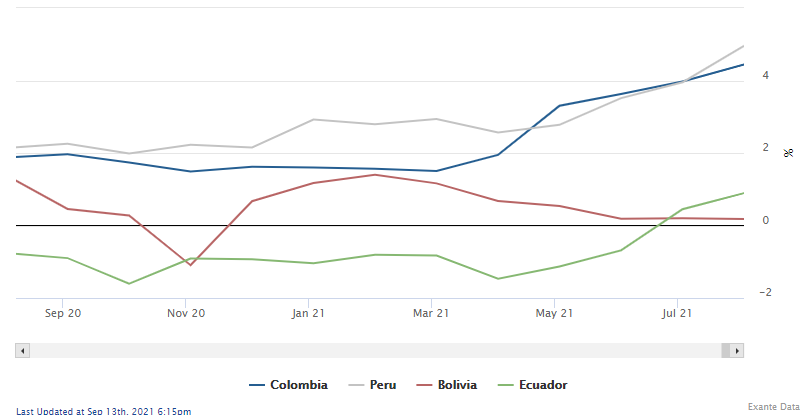
    ECUADOR | Tax-take surges in 2021. Ecuador’s tax authority (SRI) announced on 12 August that it collected US$1.1bn in taxes during the month of July, a figure which represents a 25% increase on the July 2020 tax take. According to the SRI’s director, Marisol Andrade, the tax-take between January and July this year totalled US$8.1bn, 12% more than during the same period in 2020. Value-added tax (VAT) accounted for US$3.6bn of the total tax-take in January-July, up 18% on last year; in July, income from VAT accounted for US$536m, a 39% year-on-year increase. Meanwhile, income tax accounted for US$2.75bn of the total tax-take this year so far. Andrade noted that this year’s increased tax revenue is due to both taxpayers correctly meeting their tax obligations and to the government’s efforts to control tax payments and ensure they are compliant with regulations.   

    Andean Countries: Inflation Rate

    Percentage variation (year-on-year)


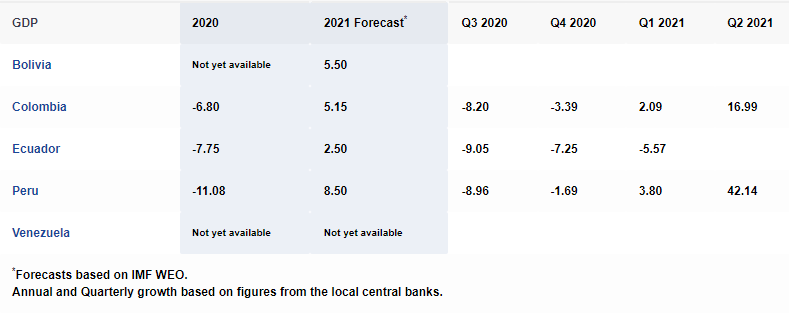
    Andean Countries: GDP Growth (%)

    Quarterly figures are year-on-year growth

  • DOMINICA: The cost of citizenship?

    Patrick de Courcy 11 August 2023 Hits: 3023

    In June, the International Monetary Fund (IMF) concluded an Article IV mission to Dominica highlighting a strong economic recovery but cautioning over the need for tighter fiscal management.

    With a population of around 80,000 people, and an economy largely based on agriculture and tourism, the IMF says Dominica has been recovering strongly after the coronavirus (Covid-19) pandemic with GDP growth of 6.9% in 2021 and 5.7% in 2022. Further growth is expected based on construction of climate-resilient infrastructure, a pickup in tourism, and a rise in agricultural output. However, the mission says that “scarring effects” from the pandemic remain visible. High global commodity prices have pushed up inflation to 7.5% last year, while the current account deficit has ballooned to 26% of GDP. The primary fiscal deficit rose to 6.2% of GDP in the 2021-22 fiscal year. Public debt stands at 106% of GDP.

    There was also some concern of potential overreliance on the Citizenship-by-Investment programme (CBI), which brought in government revenue equivalent to nearly 30% of GDP last year. This was highlighted later in July when the UK government announced it was suspending visa-free access for nationals of various countries including Dominica, amid concerns over CBI. Prime Minister Roosevelt Skerrit described the decision as “unfortunate” saying several changes had been made to the functioning of CBI to “strengthen the programme”.

    Positives

    The IMF mission to Dominica highlighted the positive contribution of various investment programmes, including the transition to geo-thermal energy, and the construction of a new airport which would sustain economic activity and reduce dependence of fossil fuels. The IMF Executive Board called for a “redoubling” of fiscal consolidation, targeting a primary budget surplus of 2% of GDP by 2026.

  • GUATEMALA: Addressing indigenous demands

    Abbi Dicker 05 April 2024 Hits: 3005

    In March Guatemala’s new President Bernardo Arévalo inked a development agreement with authorities from three indigenous Ixil Mayan municipalities in Quiché department. The communities were a key target of genocide perpetuated by state forces during the 1960-1996 civil war, in which some 250,000 civilians were killed or disappeared, some 80% of which were indigenous. Arévalo hailed the new accord as “historic” and a sign of his government’s commitment to the long marginalised indigenous sector which, at some 44% of the population, is the biggest in Central America. Having no doubt identified a prospective government led by anti-corruption outsider Arévalo as its best prospect for addressing the rampant inequality which it faces, the indigenous sector played a key role in the huge protests against efforts by the corrupt establishment aimed at reversing his electoral victory [SSR-24-01]. The new government, which took office in January, is now under pressure to address the sector’s demands.

    The agreement was signed on 13 March by President Arévalo and representatives from the Mayan-Ixil communities of San Juan Cotzal, Santa Maria Nebaj, and San Gaspar Chajul. It commits the government to recognising and promoting the legitimacy of local ancestral authorities, as well as collaborating to address short and long-term issues afflicting indigenous communities in the department which, comprising 21 municipalities and some 1.62m inhabitants, is one of the most neglected in the country. Priority will be given to governance, education, public health, migration, nutrition, climate change, employment, and poverty.

    The agreement regarding the so-called Ixil Triangle follows government efforts to address demands of the wider indigenous sector which includes other Mayan groups as well as the Garifuna, Xinka and Creole or Afro-descendant peoples. On 25 February, the national day of dignity for victims of the civil war, the government announced a national plan for the dignification of war victims. Vice President Karin Herrera outlined as its main purposes, reclaiming the memory of the victims, and strengthening the work to recover the archives of the extinct Programa Nacional de Resarcimiento (National Reparations Programme), closed down under the previous government led by former president Alejandro Giammattei (2020-2024). Indeed, a December 2021 report by US-based rights lobby group Washington Office on Latin America (Wola) described as “unprecedented” the dismantling of peace institutions under the first two years of Giammattei’s administration [SSR-22-02]. Also under Giammattei, efforts to redress past impunity regarding civil war crimes suffered a major setback with high-profile independent judges such as Miguel Ángel Gálvez, known for their efforts in this sphere, forced into exile [SSR-23-01].

    Areas of improvement

    While these gestures by the government to the indigenous sector have been well received, President Arévalo has faced complaints over the lack of inclusion in his new 14-member ministerial cabinet which includes just one indigenous member, Miriam Roquel (labour). He himself recognised in response to this that “we have not reached the pluriculturalism we would have wanted”.

    OHCHR report

    A report published on 26 February by the Office of the United Nations High Commissioner for Human Rights (OHCHR) in Guatemala highlights the parlous human rights situation for indigenous peoples in Guatemala. The report cites official statistics which show that the percentage of households experiencing deprivation in relation to housing, education, and employment is 82.3% for the Maya people and 86.1% for the Xinka people, while the country-wide average is only 63.2%. It also highlights the prevalence of agrarian conflicts, a major issue facing indigenous groups whose rights to ancestral land have long been violated, with 75 recorded incidences in 2023. Five forced evictions were documented, affecting 503 mainly indigenous families and representing a 101% increase compared with 2022. These forced evictions take place outside the standard of international human rights law according to the OHCHR. 

  • CHILE: Storm in a teacup over Boric’s economic legacy

    Abbi Dicker 17 October 2025 Hits: 1065

    It was no more than one sentence in a central bank report on monetary policy, which normally would have found little interest outside of the investment community, that provoked a public debate over President Gabriel Boric’s legacy. In the report published on 10 September, Chile’s central bank argued that weak job growth was in part to blame on Boric’s economic policies, particularly successive increases in the minimum wage and the shortening of the working week. Those measures increased labour costs and led companies to hire fewer workers the argument went. Boric, who normally would not be spending much time brooding over central bank studies, did not like that explanation and said so publicly.

    “I disagree with the vision presented in the monetary policy report,” Boric told UChile TV and went on to enumerate how the increase of the minimum wage, from Ch$350,000 (US$368) per month to over Ch$510,000 currently, improved living standards for many Chileans. Subsequently, Labour Minister Giorgio Boccardo said officials from the government’s economic team would reach out to central bank economists to discuss some of the issues they had with the report.

    The president’s comments triggered a wave of responses by media commentators and opposition politicians, who criticised Boric for trying to meddle in central bank affairs and for calling into question its independence. “When people don’t like the results, they tend to disqualify them,” said José de Gregorio, a former head of the central bank (2007-2011) and current dean of the faculty of economics at the University of Chile, one of several leading economists who argued that the central bank’s study was serious and well-founded.

    Much of the business community agreed with Gregorio. George Lever, research head at the Santiago Chamber of Commerce, was cited in the press in September as attributing labour market contractions to policies such as raising the minimum wage.

    Government officials sought to downplay the whole episode. “This is an artificial controversy, it was triggered neither by the government nor the central bank,” presidential spokesperson Camila Vallejo said on 15 September. But the genie was out of the bottle and the debate raged on.

    It is not only that Boric wants to defend his economic track record as a modern leftist, and in particular the benefits of the symbolic minimum wage increase. More importantly, the subject has become a focal point in the presidential campaign. Jeannette Jara (Partido Comunista de Chile, PCCh), the candidate backed by the left-of-centre governing coalition, has held up the minimum wage gains as one of the biggest achievements of the outgoing Boric administration.

    “The president is radicalising in order to ensure that the 30% that supports him goes out and votes for left-wing congressional candidates,” Patricio Navia, professor of politics at New York University and at the Universidad Diego Portales in Chile, told media outlet El Libero.

    On the contrary, the leading opposition candidate, the far-right José Antonio Kast (Partido Republicano, PR), has declared that Chile is submerged in an “economic emergency” due to slow growth, uncontrolled immigration, and rising crime. Until economic growth accelerates, minimum wage increases should be in line only with inflation, he argues.

    Economists’ concerns

    Within the camp of left-leaning economists, there were those who admitted that increasing the minimum wage by more than what an economy can ‘afford’ contains its risks. “The central bank showed that the policy that supposedly most exalted the government turned out to be wrong,” said Oscar Guillermo Garetón, who was undersecretary of economics for toppled leftist president Salvador Allende (1970-1973). Even Finance Minister Nicolás Grau admitted that Chile’s jobless rate was nothing to boast about. “In 2022, Chile was the country that reduced its fiscal spending the most in the world, and we did so without causing social harm. It is in employment that we still have a long way to go,” Grau said.

  • PERU: Bus drivers protest over extortion

    Abbi Dicker 06 November 2025 Hits: 809

    At the beginning of this week passenger bus drivers in Lima and Callao went on partial strike in protest over the violent extortion demands they are facing.

    A week before the protest, a driver for the Liventur private bus company was shot dead in Ventanilla district, reportedly because he failed to pay ‘protection money’ to gang members. Everything indicates that extortion is one of Peru’s most rapidly expanding crimes. So far this year nearly 70 bus drivers have been killed for refusing to make protection payments, according to police. There were 20,705 reported cases of extortion in the first nine months of this year, six times the comparable level back in 2018. However, security experts say most cases go unreported.

    Bus drivers and transport company owners say demands for protection money are sent by WhatsApp to drivers, who are also physically threatened. According to Julio César Raurau of the Transporte Unido association, a typical bus company will be asked to pay an initial PEN50,000 (US$14,800) followed by a monthly fee of PEN20,000 (US$5,900) for “protection”. Sometimes individual bus drivers will be required to pay PEN10 (US$3) a day.

    Even though Lima and Callao are currently under a state of emergency designed to combat crime, the extortion business appears able to continue regardless. This week the national police force (PNP) announced it was creating a new dedicated unit to fight extortion to be known as División de Investigación de Extorsiones. Officers said extortion this year has increased by 18% across the country, but by 33% in Lima and Callao.

    Fighting crime

    Peru’s President José Jerí says that one of the main objectives of his interim government is to fight crime. Congress has approved some new anti-extortion measures, including powers to “freeze” and investigate company bank accounts making suspected extortion payments.

  • BRAZIL: Government seeks security cooperation with US

    Abbi Dicker 16 April 2026 Hits: 1456

    Brazil’s finance minister, Dario Durigan, announced on 10 April that the federal tax authority (RFB) has made an agreement with US Customs and Border Protection (CBP) to cooperate on investigations into criminal networks of drug and arms trafficking groups. The US and Brazilian governments have been in talks for months to discuss several areas of bilateral interest, including trade and critical minerals [WR-26-11], but negotiations on security cooperation appear to be making more progress.

    The government of President Luiz Inácio Lula da Silva had already highlighted during the latter months of 2025 the importance of working with US authorities to crack down on illicit activities such as arms trafficking and money laundering. In August last year Brazilian police launched an investigation into the possible infiltration of organised crime in the financial sector, a probe which suggested that US-based firms are also involved in the wide network of Brazilian criminal groups. Given this long-running concern, it could be considered a boost for the Lula administration that CBP has agreed to share information and cooperate with the RFB on investigations involving transnational crime. 

    On 13 April, Brazil’s federal police (PF) sought to display more signals of security cooperation with the US following the arrest that day of former federal deputy Alexandre Ramagem (2023-2025), an ally of Brazil’s far-right former president Jair Bolsonaro (2019-2023). Along with his former boss, Ramagem was convicted last year for participating in a coup plot after Bolsonaro lost the 2022 election [WR-25-37]. In September last year, Ramagem fled to the US after his conviction, reportedly in the hope that the US government of President Donald Trump would grant him political asylum. Ramagem entered the US on a diplomatic passport which has since been cancelled. Due to his irregular migration status, US Immigration and Customs Enforcement (ICE) detained him on 13 April. Brazil’s PF stated that Ramagem’s detention was the result of international police cooperation, but US authorities have not made similar comments confirming that this was an international operation to apprehend a fugitive wanted in Brazil.

    However, on 15 April media reports emerged that Ramagem has been released from custody. At the time of writing the reasons for his release have not been confirmed to the media. The legal status of Ramagem remains uncertain and it could raise questions for the state of US-Brazil relations. In December last year, Brazilian authorities filed an extradition request for Ramagem, so approving the pending request could be a gesture by the US to shore up ties with Brazil. But if the Trump administration were to grant asylum to the Bolsonaro ally instead, it would send a hostile signal towards the Lula government.

    Extradition or asylum?

    President Lula said on 14 April that Alexandre Ramagem, a convicted coup plotter who fled to the US in September last year, should be brought back to Brazil to serve his 16-year prison sentence. Meanwhile, the party of Jair Bolsonaro, the right-wing Partido Liberal (PL), has reiterated its defence of Ramagem. On 13 April the leader of the opposition in the lower chamber of congress, PL member Gilberto Gomes da Silva, said that the opposition will continue its efforts to convince the US embassy in Brazil to help with Ramagem’s asylum request.

  • DEBT: IDB calm about Mexico’s state debts

    LatinNews 04 October 2011 Hits: 2405

    DEBT: IDB calm about Mexico’s state debts

    The furore triggered by the revelation the state government of Coahuila had been concealing its borrowings from the state congress should start to die down. The InterAmerican Development Bank (IDB), recently published a study that concluded that although state debts in Mexico have increased in the past decade, they do not represent a systemic risk.

    Coahuila has been punished by having its credit rating chopped down to a just investment-grade BBB-, from A+.

    The IDB study found that state and municipal debt in Mexico was equivalent to just 2.4% of GDP compared with 13% in Brazil and 19% in the US. The IDB did note that states like Coahuila, which had resorted to short-term borrowing, needed to reinforce their finances. Coahuila increased its net debt almost 3,000% between 2006 and 2010. The neighbouring state of Tamaulipas (like Coahuila, controlled by the Partido Revolucionario Institucional which expects to regain the presidency in 2012) increased its debt by 2,000% in the same period. The other big borrowers are Chiapas, a poor southern state, Quintana Roo (whose only real asset is the resort of Cancún); Nuevo León, a major industrial state in the north, and Veracruz, the country’s third most populous state.

    In the 2012 budget, the federal government has inserted a requirement that sate governments report on their rate of borrowing and debt to the state congress every quarter. The federal government is also unhappy about state governments using pledges of federal money as security for borrowings.  It wants to limit the use of federal money to debts taken out with local lenders and to exclude credit from international lenders.

    Mexican states’ borrowings

    % increase between 2006 and 2010

    Coahuila          1,868

    Tamaulipas      1,186

    Chiapas           834

    Nayarit            465

    Quintana Roo 434

    Source : Reforma

  • COLOMBIA: Las Farc secundan a Santos

    LatinNews 11 April 2014 Hits: 1026

    Las condiciones para un acuerdo de paz estable y duradero nunca han sido tan favorables, expresó el ‘canciller’ de las Fuerzas Armadas Revolucionarias de Colombia (Farc) y parte del equipo negociador en Cuba, ‘Rodrigo Granda’ (Ricardo Téllez), el fin de semana. Los comentarios de Granda se produjeron en momentos en que Óscar Iván Zuluaga, el candidato presidencial por el Centro Democrático (CD), el partido del ex presidente Álvaro Uribe (2002-2010), está intensificando sus ataques sobre el gobierno del Presidente Juan Manuel Santos antes de las elecciones presidenciales del 25 de mayo. Zuluaga acusa a Santos de ofrecer impunidad a los líderes de las Farc. Esto ha provocado una extraña respuesta de parte de ‘Andrés París’ (Jesús Emilio Carvajalino), otro miembro del equipo negociador de las Farc en La Habana.

    ‘Granda’ dijo al diario El Telégrafo de Ecuador, el 6 de abril, que el alcance de la agenda que se está negociando en las actuales conversaciones de paz, y el firme apoyo de la comunidad internacional, significan que las condiciones eran mejores que nunca para un resultado exitoso a diferencia de los fallidos procesos de paz en 1982, 1992, y 1998. Esto a pesar del hecho de que en más de 16 meses de conversaciones, solamente dos de los seis puntos en discusión han sido concluidos –y estos con acuerdos parciales.

    A medida que se acercan las elecciones presidenciales, Zuluaga está tratando de arrebatarle el segundo lugar al ex alcalde de Bogotá, Enrique Peñalosa (1998-2001), candidato por la Alianza Verde. Las encuestas sugieren que hay un tira y afloje entre Zuluaga y Peñalosa por el segundo lugar y un puesto en una probable segunda vuelta contra el Presidente Santos. Zuluaga está tratando de explotar las preocupaciones de los votantes acerca de que los altos líderes de las Farc no solamente eviten cualquier clase de castigo por sus delitos, sino que también potencialmente se les permita participar en la actividad política.

    “Los colombianos desean la paz, pero no con impunidad, no a cualquier costo, y los líderes de las Farc quienes han cometido delitos atroces […] deben pagar por sus errores en la prisión”, dijo Zuluaga. Y agregó que está de acuerdo en que debería haber sentencias reducidas “en algunos casos” pero que “deberá haber prisión para aquellos quienes han causado tanto daño a la sociedad colombiana”.

    El compañero de fórmula de Santos, Germán Vargas Lleras, insistió esta semana en Bucaramanga, la capital del norteño departamento de Santander, que “no habría impunidad” en La Habana. Por su lado, ‘París’, respondiendo a Zuluaga desde La Habana, acusó al candidato presidencial de CD de estar “tan abajo en las encuestas” que el estaba buscando “marketing político” tratando de “sabotear el proceso [de paz]”. ‘París’ dijo que “nunca antes un proceso de paz terminó con prisión para los protagonistas, los constructores de la paz”.

    El derrame ‘del Golfo’ en Colombia

    El indirecto apoyo de las Farc al Presidente Juan Manuel Santos antes de las elecciones de mayo, no ha estado acompañado de una disminución en la actividad de la guerrilla. En semanas recientes hubo un incremento en los ataques de las Farc sobre la policía y el ejército (tres policías y dos soldados resultaron muertos solamente en la última semana) y sobre la infraestructura petrolera, especialmente en los departamentos del sudoeste de Cauca y Nariño y en el departamento oriental de Arauca.

    Aparte de los obvios beneficios a nivel humano que traería el fin del conflicto armado, los beneficios económicos también serían inmensos. El 8 de abril, el ministro de energía & minas, Amylkar Acosta, dijo que los ataques a la infraestructura petrolera de Colombia realizados el año pasado por las guerrillas, habían frenado la exportación de unos 35.000 barriles de petróleo crudo por día, que Acosta calculó como una pérdida de unos US$3,54mm. Acosta también citó cifras oficiales afirmando que los ataques recurrentes a la infraestructura petrolera en Colombia durante los últimos 27 años, han resultado en el derrame de unos 4,3m de barriles de petróleo, no muy lejos de los 4,9m de barriles derramados en el 2010 en el desastre del Golfo de México –el mayor derrame de petróleo en la historia.

    • Infraestructura petrolera

    De acuerdo con la Asociación Colombiana del Petróleo (ACP) el año pasado se produjeron 228 ataques a la infraestructura petrolera en el país, el número de ataques más alto desde el 2008. Sin embargo, Camilo Marulanda, presidente de Cenit, la subsidiaria de transporte de hidrocarburos y logística de la compañía estatal Ecopetrol, dijo que se había producido una caída del 40% año en año en los ataques a la infraestructura de la compañía en el primer trimestre del 2014; 27 ataques en total.