All Categories

Subcategories

  • TRACKING TRENDS

    LatinNews 12 March 2020 Hits: 1202

    BRAZIL | Guedes pushes fiscal reforms to help shield economy. Brazil’s Economy Minister Paulo Guedes has appealed to lawmakers to approve a number of reforms currently proceeding through congress, to shield the country’s economy from a coronavirus-triggered global downturn.

    As fears linked to Covid-19 caused global markets and oil prices to crash on 9 March, Brazil’s São Paulo stock exchange (Bovespa) fell in excess of 12% (erasing all gains accumulated since the current government came to power), the real dropped to R$4.72/US$1, and shares in the state-owned oil company Petrobras lost around 30% of their value as the price of crude fell below US$35 per barrel.

    The following day saw a slight recovery in all these indicators, but the situation remains extremely volatile – trading was suspended again on 11 March after the declaration of a coronavirus pandemic by the World Health Organization (WHO) prompted another plunge in the markets.

    While Argentina’s President Alberto Fernández predicted that his country’s economy would “very likely” contract this year, and bemoaned the fact that the world seemed to be “conspiring” against Argentina’s chances of escaping its financial and economic crisis, Guedes gave an upbeat assessment of Brazil’s economic prospects.

    The Brazilian government line is that it has no room for fiscal manoeuvre, and that the country will weather the global economic headwinds if the federal congress approves its proposed reforms, most of which pursue fiscal belt-tightening rather than increased public investment in order to mitigate the pandemic’s blows to businesses and the economy, as has been recommended by international institutions. 

    CHILE | Inflation continues to climb, exceeding expectations. The consumer price index (CPI) registered a 0.4% monthly increase in February, according to a 6 March statement by Chile’s national statistics institute (INE). The result brings the accumulated inflation rate for the first two months of the year to 1%, while the year-on-year rate stands at 3.9%, the highest since 2016.

    The February inflation rate increase came amid the context of Chile’s summer holiday and the civil unrest that has affected the country since last October. The biggest price increases were in transport (1.7%) and foodstuffs (0.7%), with falls in inflation registered in tourism (-7.9%) and books (-2.9%).

    Chile’s central bank (BCCh) forecasts that the domestic economy grew by 0.6% in 2019, noting that growth in the final quarter stalled due to the social upheaval.

    A resurgence of the protests in March and the fall in demand in China, Chile’s main trading partner, due to the coronavirus (Covid-19) pandemic, will likely complicate matters for Chile’s economy, as inflation is likely to continue increasing, while economic activity will continue to fall.

    Brazil’s GDP growth

    On 11 March, the Brazilian government scaled back its projections for 2020 GDP growth, but only to 2.1%, from 2.4%, noting that it expects the impact of Covid-19 to shave somewhere between 0.1 and 0.5 percentage points off growth this year.

  • ECONOMIC HIGHLIGHTS

    LatinNews 22 January 2021 Hits: 1633

    BOLIVIA | Natural gas windfall. On 24 December 2020, Bolivia’s President Luis Arce announced the discovery of an estimated 1trn cubic feet (TCF) of natural gas at the Boicobo Sur well in Chuquisaca department. This would increase Bolivia’s proven natural gas reserves (previously estimated at 10.7 TCF), a key source of export revenue for the country, by almost 10%. Exploratory drilling at Boicobo Sur – which is run by Spanish oil company Repsol, along with Bolivia’s state-owned Yacimientos Petrolíferos Fiscales Bolivianos (YPFB) – began in October 2019 and was completed in December 2020. Arce noted that further preparations are still underway, but voiced optimism that natural gas production will begin at Boicobo Sur in December 2021. He described the discovery as a “gift” to the Bolivian people after a difficult year and heralded it as “a positive sign that things will soon change for the better”.

    VENEZUELA | Foreign currency accounts. On 4 January, the de facto Venezuelan government led by Nicolás Maduro authorised banks in the country to open foreign currency accounts, to help residents pay for goods and services in the context of high inflation and the devaluation of the national currency, the Bolívar soberano. Many in Venezuela have highlighted the recent acceleration of ‘de facto dollarisation’ of the country, both as a result of government efforts to loosen currency regulations, and the population’s growing reliance on US dollars for completing even basic transactions. Maduro claimed that the move will support Venezuela’s transition to a “digital economy” in 2021, responding to “the war against our physical currency” (referring to international economic sanctions imposed on his administration) by moving beyond the use of paper currency, instead tying transactions to foreign currency accounts. However, Maduro insisted that formal dollarisation remains out of the question, and that prices will continue to be set in Bolívares – “Venezuela has its currency, and we are going to defend it”, he said.

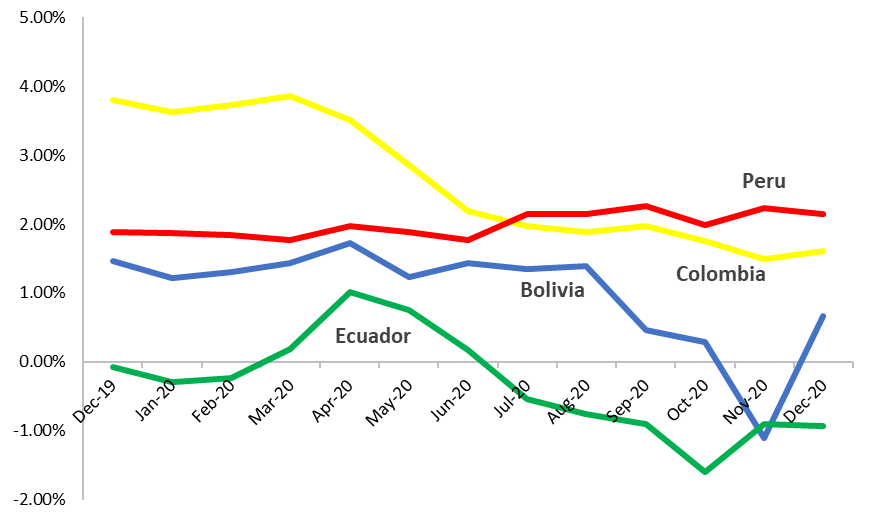
    Andean Countries: Inflation
    Monthly year-on-year figures

     Andean Countries: GDP growth (%)
    Quarterly figures are year-on-year growth
    GDP  2020 forecast* 2021 forecast* Q1 2020 Q2 2020 Q3 2020
    Bolivia -8.0 5.1 0.6 -21.7 Not yet available
    Colombia -7.0 5.0 1.2 -15.8 -9
    Ecuador -9.0 1.0 -2.4 -12.4 -8.8
    Peru -12.9 9.0 -3.4 -30.2 -9.4
    Venezuela -30.0 -7.0 No data No data No data
    *Figures from the United Nations Economic Commission for Latin America & Caribbean Dec 2020
    Quarterly growth based on figures from the local central banks


  • THE BAHAMAS: Economics of a crypto blowout

    Sarah Sheldon 23 February 2023 Hits: 1404

    If you are a small Caribbean Island jurisdiction which is heavily reliant on tourism, the arrival of a multi-billion dollar crypto exchange, bringing in new revenues and firing up the local tech start-up community sounds like it has to be a good thing. But if that exchange is called FTX and it goes bankrupt in spectacular fashion, the calculation of costs and benefits begins to look rather different.

    FTX moved its global headquarters to The Bahamas in 2021. After an initial and extended honeymoon period, during which the company invested heavily in local start-ups, things went suddenly sour. In 72 hours of panic in November, some US$6bn of investor funds were withdrawn. A rescue package by Binance, a rival crypto exchange, failed. Bahamas and US-based FTX companies and subsidiaries, including Alameda Research, filed for bankruptcy. Company founder Sam Bankman-Fried was arrested in The Bahamas in December, accused of orchestrating an “epic” fraud and is now facing criminal charges in the US. The company’s overall finances remain opaque, but the latest estimates are that after being valued at US$32bn in 2021, a total of around US$8bn of customer funds remain “missing”. For comparison, the entire GDP of The Bahamas, which has a population of 410,000 people, is around US$11bn.

    One immediate problem posed by the collapse is whether local companies and suppliers – everyone from hoteliers and real estate agents through to luxury car salespeople - have been left with massive unpaid bills. Resolving this has not been helped by mutual mistrust and animosity between US-based and Bahamian liquidators. At one stage the Bahamian authorities claimed seized assets on the islands totalled US$3.5bn, while US lawyers and liquidators said they were as little as US$170m. It also matters whether assets were held in trust (which means they must be returned to their rightful owners) or were beneficially owned by FTX (meaning they can be sold to help pay off creditors). Initial research by Bahamian journalists suggests the number of suppliers left out of pocket is in reality manageable, but there could still be unpleasant surprises.

    For the Bahamian government there are at least three levels of reputational risk to consider. One is whether crypto exchanges like FTX are simply beyond the pale and should never have been welcomed into the country in the first place.  One exponent of that view is economist Nouriel Roubini, a professor of economics at Stern School of Business, New York University, in the US, whose searing opinion is: “Literally 99% of crypto is a scam. A criminal activity. A total real-bubble Ponzi scheme that is going bust”. If that is true, the Bahamian government made a major misjudgement. At a second level, however, FTX can be seen as “one bad apple” in a “new frontiers” industry which is going through growing pains but can still offer real world benefits. Indeed, in the current global “crypto winter” the sector may retrench around stablecoins and other less volatile assets. If that’s true, Bahamians can still claim to have positioned themselves to benefit from a high-growth, hi-tech sector. At a third level Bahamian regulators could be deemed essentially untainted by the crash – after all, a certain proportion of companies always fall into bankruptcy even in the best managed and regulated jurisdictions.

    Not surprisingly perhaps, the authorities in Nassau believe their regulatory approach has been adequate.  Since 2020 the industry has been regulated by the Digital Assets and Registered Exchanges (DARE) Act which sets the rules for dealing in crypto, including AML/CFT (Anti-Money Laundering/Combating the Financing of Terrorism) measures. It has also experimented with a CBDC (Central Bank Digital Currency) known as the Sand Dollar. Prime Minister Philip Davis said in November that DARE remained valid and that current rules empower regulators to take “immediate steps in order to protect the interests of clients, creditors, and other stakeholders globally.” He added he was confident Bahamas would emerge from the FTX affair “with an enhanced reputation as a solid digital assets jurisdiction”.

    Opposition sceptical

    Leader of the opposition Michael Pintard has nevertheless questioned whether sufficient due diligence was conducted on FTX, and whether the company developed an unhealthy relationship with local politicians.

  • HONDURAS: New WB report warns of climate change impact

    Patrick de Courcy 20 July 2023 Hits: 679

    In May the World Bank (WB) released a new country climate change and development report (CCDR), warning of the impact of climate change on Honduras which, historically highly exposed to extreme natural hazards, remains one of the poorest and most unequal countries in the Western Hemisphere.

    Released on 16 May, the CCDR highlights that Honduras consistently ranks among the countries most vulnerable to natural hazards. It points out that in 2019, the Global Climate Risk Index, produced by Germany-based NGO Germanwatch, classified Honduras as the second country globally to be most severely affected by extreme weather events in the 1998–2017 period, with annual average losses equivalent to 1.8% of GDP, affecting critical sectors such as transportation, telecommunications, health, education, water, and sanitation.

    The CCDR singled out in particular the devastating economic and human impacts of hurricanes and their corresponding floods, noting that Hurricane Mitch, which struck in 1998, the worst disaster in Honduras’s recent history, generated economic damage estimated at between 59.6% and 70% of annual GDP. More recently, in 2020, losses and damage from hurricanes Eta and Iota totaled US$1.8bn (approximately 7.5% of 2019 GDP).

    The report highlights agriculture as the sector most affected, pointing out that this accounts for 73% of Honduras’s total exports and 30% of employed Hondurans, with most of those employed in this sector being small-scale, rural-based subsistence farmers. It warns that four of the five crops with the greatest harvested area in Honduras – maize, coffee, beans, and sugarcane – will reduce their yields. Underlining that this will adversely impact subsistence farmers’ food security, given maize and beans are their main crops, as well as exports, the CCDR cites projections of a reduction of 37% in yields of rainfed sugarcane, 30% of irrigated sugarcane, and 21%-26% of coffee by 2050. It points out that these are also Honduras’s highest value agricultural commodities with coffee alone accounting for 54% of total agricultural exports in 2021 and providing income for over 1m Hondurans.

    Other sectors which are particularly vulnerable include water resource management, with the WB noting that 71.6% of exports, one-third of electricity generation and 47.9% of jobs are water-dependent; forests and marine and costal ecosystems; and transport (with over 60% of the transport network exposed to natural hazards).

    With stark warnings regarding climate change and its expected impact on Honduras’s vulnerability, the CDDR has a sobering assessment of the impact on the economy and debt. It warns that “based on historical growth and natural hazard risk patterns, in the absence of any further climate or policy changes, the combined impact of productive capital destroyed through excess rain (flooding), tropical cyclones (strong winds), and earthquakes is expected to result in a cumulative loss of around 5.4% of annual GDP by 2050 (relative to the hypothetical scenario without impacts caused by natural hazards)”.

    The WB points out that this would limit income opportunities, and therefore reduce the consumption of the population by 6.8%, adding that “lower growth, foregone revenue, and the diversion of productive resources toward reconstruction and relief efforts also limit the private sector’s profitability and stress the government’s fiscal capacity”. The WB cites projections that, by 2050, public debt levels will rise by around 6.2 percentage points of GDP, compared to a hypothetical scenario with no impacts from natural hazards.

    Forestry initiatives

    The CDDR underlines the crucial role played by forests in efforts to tackle climate change, noting that in Honduras, forests cover over 56% of national territory and “are essential for mitigation efforts through the absorption of carbon, resilience to natural hazards, and the income‑generating opportunities they provide to rural populations”. However, it highlights that the rate of tree cover loss is “high” by regional and global levels, with 12% lost between 2010 and 2021, driven mainly by the expansion of small-scale farming and commercial agriculture.

    The leftist Partido Libertad y Refundación (Libre) government led by President Xiomara Castro has recently sought to address this, launching a national reforestation campaign at the end of May in the framework of the ‘Padre Andrés Tamayo’ environmental scheme, named after a Honduran Catholic priest and environmentalist. Announcing the reforestation scheme in Santa Cruz de Yojoa municipality, Cortés department, Castro said that since taking office in January 2022, the government had launched “important programmes to address climate change and global warming”. At the same event, Honduras’s natural resources & environment minister, Lucky Medina, hailed the successful planting of over 15m trees and effective combating of over 1,800 forest fires in summer, of which over 91% were brought under control through inter-institutional cooperation.

    The Padre Andrés Tamayo scheme, which has involved over 6,000 people, was unveiled in January at which point the government said that it would apply to 150 municipalities. The scheme set up an environmental institutional task force comprising the armed forces, the national institute of forest management (ICF), environmental prosecutor’s office, and attorney general’s office. It includes a campaign against forest fires, protection, forest recovery, and financial support for communities for solid waste management which contaminates water sources.

    The ICF has identified over 105 micro-watersheds with degraded or deforested areas for intervention, which it says would benefit around 618,256 people directly. In 2022, 61 brigades were contracted as part of efforts to carry out prevention efforts against forest fires, directly creating 500 new jobs in 15 departments. For 2023, the goal is to restore 24,000 hectares in zones of groundwater recharge, 8,000 hectares with reforestation techniques, 15,000 hectares of management and protection for natural regeneration, and 1,000 hectares with established agro-forestal systems.

    WB recommendations

    Policy recommendations include: (1) enhancing capacity and building a robust institutional framework to implement and monitor climate action; (2) enacting a proactive macro-fiscal policy that prioritises disaster risk management and adaptation investment; (3) protecting the poorest and most vulnerable; (4) improving productivity and resilience of the agriculture sector; (5) promoting low-carbon and climate-resilient transport systems; and (6) promoting sustainability of the electricity sector.

    More warnings on food insecurity

    On 7 June the United Nations (UN) Food and Agriculture Organization (FAO) published a report citing Integrated Food Security Phase Classification (IPC) analysis, which said that the population in Honduras facing acute food insecurity is estimated at 2.34m people during the March‑May 2023 period (out of total 10.3m pop.), marginally down from the 2.36m people in the same period in 2022. The projection points to 2.42m people experiencing high levels of acute food insecurity during the lean season from June to August 2023, slightly lower than the 2.64m people a year before. It attributes the year‑on‑year improvement to a slow recovery for economic activities in the tourism, textile and agricultural sectors. An FAO and UN World Food Programme (WFP) report released on 29 May included Honduras as one of 18 hunger “hotspots” comprising a total of 22 countries, which also included El Salvador, Guatemala and Nicaragua in Central America. It highlights the impact on agricultural production of the El Niño phenomenon, a naturally occurring climatic phenomenon that has a warming effect on ocean surface temperatures in the central and east Pacific. It warns this is likely to compound inflation and drive up acute food insecurity in Central America.

    Food insecurity

    According to the 7 June FAO report, the persistent high levels of food insecurity in Honduras are mainly due to the elevated prices of food and agricultural inputs, constraining the access to food and the extent of sowings. It also highlights that excessive rains in localised areas in the northern region in the second half of 2022 affected livelihoods of palm and banana producers, especially in Gracias a Dios department.

  • BOLIVIA: EU y Bolivia rumbo a la restauración de relaciones diplomáticas

    LatinNews 21 November 2011 Hits: 254

    El final de los tres años de impasse en las relaciones entre EU y Bolivia, finalmente está a la vista. La semana pasada, ambos gobiernos firmaron un acuerdo marco que provee para la completa restauración de los lazos diplomáticos, que fueron cortados en 2008 luego de la crisis provocada por alegatos de espionaje que involucraban al entonces embajador de EU en La Paz, Philip Goldberg. La incertidumbre rodea a la forma que adoptará esta nueva relación –que aún debe ser sellada con la designación de nuevos embajadores– particularmente en relación con la cuestión de la cooperación antidrogas, considerando que la plataforma del Presidente Evo Morales de ‘coca sí, cocaína no’, ha sido desde hace tiempo un escollo con Washington.

    Los objetivos del acuerdo delineados en la declaración conjunta firmada por la Subsecretaria para Asuntos Globales, María Otero, y el vicecanciller de Bolivia, Juan Carlos Alurralde, el 7 de setiembre, incluye “el apoyo cooperativo y la acción efectiva contra la producción y el tráfico de narcóticos” y “el fortalecimiento de las relaciones comerciales” entre los dos países. Una notable provisión del acuerdo es la continuación de la asistencia de la Agencia de EU para el Desarrollo Internacional (USAID): Morales desde hace ya mucho tiempo ha culpado a la USAID por los disturbios anti-gobierno –más recientemente por las protestas sobre la carretera planeada a través del territorio indígena y parque nacional Isiboro Sécure (Tipnis) [IL-11-35]. Mientras que la USAID aún permanece en el país (luego de la crisis diplomática de 2008, Morales cerró todos los programas de “naturaleza política”, permitiendo que continúen solamente los proyectos productivos), él ha desechado el retorno de la Drug Enforcement Administration (DEA). Con Bolivia continuando la cooperación con la Sección de Asuntos sobre Narcóticos de la embajada de EU, una pista acerca de la nueva forma que adoptará este esfuerzo antidrogas conjunto, llegó con el anuncio que siguió a la restauración de lazos, que Bolivia, EU y Brasil firmarán un acuerdo tripartito para un proyecto piloto de un sistema de control para reducir el exceso de cultivo de la coca en Bolivia.

    Atada a la expulsión de la DEA en 2008, fue la suspensión de las preferencias comerciales de Bolivia bajo el Acta de Promoción del Comercio Andino y de Erradicación de la Droga (Atpdea), que otorga tarifas comerciales especiales a cambio de contribuir con las operaciones antinarcóticos. Alurralde ya ha dicho que el Atpdea no será restaurado. En cambio, el nuevo acuerdo prevé el establecimiento de un consejo de comercio bilateral que también podrá concentrarse en otras áreas como las posibilidades de inversión a mediano y largo plazo. Se podría decir que eso es un buen presagio para la nueva relación, sugiriendo una ruptura del condicionamiento que caracterizaba previamente la cooperación de EU. En todo caso, incluso con la suspensión del Atpdea, las exportaciones de Bolivia a EU (su segundo mayor mercado después de Brasil) continúan creciendo. De acuerdo con las cifras del ministerio boliviano de desarrollo productivo, en el tercer trimestre de 2011, las exportaciones de Bolivia a EU llegaron a US$661m, comparado con US$279m en el mismo periodo en 2005.

    • Otro escollo

    También es probable que sea una prueba para la nueva relación Bolivia-EU, el requerimiento de extradición del ex presidente Gonzalo Sánchez de Lozada (2002-2003), quien está acusado de genocidio en relación a la represión del ejército en el 2003 conocido como el “Octubre Negro”, en el que más de 60 personas fueron muertas. Agregando peso al caso del gobierno boliviano está el reciente dictamen que marca un hito, contra siete altos funcionarios del gobierno de Sánchez de Lozada [IL-11-35].

    Tratado antidrogas con Brasil

    Brasil está llenando el vacío dejado por la DEA en 2008 [IL-11-08]. El pasado mes, el ministro de defensa de Brasil, Rubén Saavedra, y su contraparte brasileño, Celso Amorim, firmaron un memorándum de entendimiento, sobre el tráfico de drogas y el crimen organizado a lo largo de sus fronteras conjuntas, que incluye la previa oferta de Brasil de drones* para Bolivia a fin de patrullar la frontera. Los dos ministros también anunciaron una reunión bilateral inaugural entre las fuerzas armadas de ambos países, en la primera mitad de 2012, dirigida a concretar planes operacionales y coordinar ejercicios militares para patrullar la frontera más eficientemente.

    Por otra parte, el más reciente informe de la Oficina de las Naciones Unidas sobre Drogas y Delitos (UNODC), difundido en setiembre de 2011, muestra variados resultados en los esfuerzos antidrogas de Bolivia. El informe revela que el cultivo de coca en Bolivia permanece estable (en 31.000 hectáreas en 2010, subiendo levemente de 30.900 en 2009) y muestra progreso en la erradicación de la coca (con 8.200 hectáreas de plantaciones de coca erradicadas en 2010, un 29% más que en 2009) y las incautaciones de cocaína base (subiendo 17% a 25,7 toneladas). Aún así, también muestra que las incautaciones de cocaína cayeron en 31% a 3,4toneladas (el segundo año consecutivo de declinación desde el pico de 7,2 toneladas registradas en 2008).

    *Dron: Aeronave no tripulada usada en misiones de control y vigilancia.

  • TRACKING TRENDS

    LatinNews 05 January 2012 Hits: 2809

    PERU | Conga strain. No sooner was Peru’s new prime minister, Óscar Valdés, toasting his cabinet’s success at securing peace over Conga than everything began to unravel. Valdés managed to strike a deal with mayors from the north-western department of Cajamarca during a meeting in Lima on 27 December to let a team of international experts draw up a new environmental impact assessment (EIA) into the controversial Conga copper and gold mine proposal. Undeterred, the regional president of Cajamarca, Gregorio Santos, promptly published a law in the official daily El Peruano declaring Conga to be unviable because of the technical inconsistencies of the existing EIA. A furious Valdés reacted by promising to denounce the regional government before the constitutional tribunal for exceeding its authority. He accused Santos and protesters, who took to the streets again (peacefully) on 2 and 3 January, of assuming “radical positions”.
    Conga is taking its toll on President Ollanta Humala. Compelled to conduct an extensive cabinet reshuffle in the first half of December [WR-11-50], Humala sank beneath 50% support for the first time in national opinion surveys by local pollsters Datum and Ipsos Apoyo released later that month – from this point the trajectories of his two predecessors, Alan García and Alejandro Toledo, were sharply downwards.
    Humala fell nine percentage points in both polls, to 48% and 47% respectively, on the previous surveys in November, although support for the Conga project, with some modifications, was not too bad in the Datum survey at 42%. This poll was fascinating because it showed that Humala’s post-electoral support is the mirror image of his pre-electoral support. His approval rating was highest, at 51%, among members of the highest social-economic stratum ‘A’, which reflects equally the pleasant surprise of the rich and the mounting disenchantment of the poor, although 48% of the very poorest Peruvians, stratum ‘E’, still support him.

  • RASTREANDO TENDENCIAS

    LatinNews 03 April 2012 Hits: 784

    HAITI-REPUBLICA DOMINICANA | Reafirmando lazos. El Presidente de Haití, Michel Martelly, viajó recientemente a Santo Domingo, donde se reunió con el Presidente Leonel Fernández, esta es su primera visita oficial a la República Dominicana desde que asumió el poder en mayo del 2011. Los dos líderes participaron en una reunión de la comisión bilateral conjunta que fue establecida en 1996 como el único foro oficial para promover las relaciones a través de varios subcomités  que cubren salud, el medioambiente, seguridad, turismo, y agricultura entre otras áreas. El acuerdo firmado durante la visita de Martelly, que atrajo la mayor atención fue el establecimiento del llamado “Fondo Bolivariano de Solidaridad con Haití”, que será financiado indirectamente por Venezuela, a través del esquema de petróleo subsidiado Petrocaribe. De acuerdo con informes de prensa, el fondo, que será financiado por los intereses generados de la deuda de la República Dominicana con Venezuela a través de Petrocaribe (establecidos en 1%), serán usados para promover el uso del gas natural en Haití a través de la provisión de unos dos millones de tanques de gas y cocinas para la población.

    Además de apuntar a fortalecer los lazos con la República Dominicana, el fondo propuesto, que será establecido en una cuenta en el Banco Central Dominicano, es la última demostración de cooperación de Venezuela, que permanece como el mayor donante individual para Haití: Venezuela prometió US$2,4mm en reconstrucción y ayuda para las víctimas del terremoto (de un total de US$9,3mm) de acuerdo con cifras de fin de diciembre del 2011 de la Oficina del Enviado Especial de la ONU para Haití.

  • PANAMA: Ngäbe Buglé win ban on mining

    LatinNews 21 June 2012 Hits: 782

    After the frequently violent protest campaigns of 2010 and 2011, which left a toll of two dead and succeeded in getting the newly amended mining law repealed, the Ngäbe Buglé people came out again in February this year to press for prompt passage of a special law banning all mining and hydroelectric projects in their semi-autonomous territory, the Comarca Ngäbe Buglé, carved out of the old provinces of Bocas del Toro, Chiriquí and Veraguas in 1997 and covering about a third of Panama’s total territory. They believed that Bill 415, agreed upon with the government in 2011, was being held up deliberately in the national assembly and that the government was trying to excise key provisions from it.

    In the middle of the Comarca lies the Cerro Colorado copper deposit, estimated to hold reserves of up to 11.2m tonnes (t), making it one of the world’s biggest. Exploratory work in the 1970s left large swathes of the mountain stripped and nearby communities reported significant contamination; exploitation would lay bare an open pit of about 630km2 and compromise the headwaters of the San Félix River.

    In fact, they were seeking to expand the scope of the 2011 agreement so that the ban should apply not only to the Comarca but to adjacent territories and settlements of Ngäbe Buglé elsewhere, as well as making the provisions of the law retroactive. The government insisted that the deal only included a ban on mining for metals within the Comarca. As it previous protest actions, the Ngäbe Buglé established roadblocks on several points along the Pan-American highway, which runs through Panama and connects it with Central America.

    As on previous occasions, protesters clashed with police; two died in confrontations between 5 and 7 February, 46 people were injured (six of them police officers) and about 100 were arrested. This led to negotiations that resulted in a lifting of the roadblocks, the release of those detained and a commitment to speed up passage of Bill 415. President Ricardo Martinelli said that the protests had been politically motivated, and the vice-president of the national assembly, Marcos González, accused the opposition Partido Popular (PP) and Partido Revolucionario Democrático (PRD) of using them as part of a plot to overthrow Martinelli.

    Two laws

    Over the ensuing month, punctuated by minor protest actions, an agreement was hammered out on a final text for Law 415, which was approved on 22 March and then was speedily promulgated by President Martinelli. This provided for a ban on mining in the Comarca and adjacent territories and settlements (fewer than the protesters had wanted) and rescinded all concessions previously granted, but in the case of hydroelectric projects just established prior consultation and approval by referendum instead of a ban. It reserved a share in the revenues from future hydro projects to the Ngäbe Buglé, stipulated that people displaced by hydro projects should receive prior compensation, and made the provisions of the law retroactive.

    On 28 March the assembly approved a new mining code (Law 394), applicable to the country as a whole, which broadly reinstates the provisions of the one repealed in 2011; however, it specifically bans the granting of concessions to “foreign governments or states, or any foreign official or semi-official entity”. This was intended to counter the criticism aimed by nationalists at the previous law, which was interpreted as allowing foreign states in, under the cover of foreign firms.

  • RASTREANDO TENDENCIAS

    LatinNews 17 December 2012 Hits: 373

    PERÚ-COLOMBIA | TLC con la UE ahora a la vista. El 11 de diciembre, el Parlamento Europeo (PE) ratificó el tratado de libre comercio (TLC) con Perú y Colombia, uno de los pasos finales antes que el tratado pueda entrar en vigencia.

    La negociación del TLC entre la Unión Europea (UE) y los dos países andinos, que exige la eliminación inmediata de todos los aranceles sobre productos no-agrícolas, la eliminación gradual de los aranceles sobre productos agrícolas y la liberalización de los mercados de servicios y de los procesos de licitaciones públicas, fueron concluida en el 2010. Sin embargo, el tratado necesita ser ratificado por el congreso de Colombia así como también el Parlamento Europeo (PE) y el Consejo Europeo (CE) antes que pueda tener efecto.

    La ratificación en el PE parecía ser el obstáculo más difícil que enfrentaba el tratado, pues varios políticos europeos habían expresado reservas acerca del impacto negativo que el acuerdo podría tener sobre los granjeros europeos, y cuestionaban la situación medioambiental, del trabajo, y de los derechos humanos en los países andinos. En particular, a pesar del hecho de que el tratado incluye una cláusula que establece que el tratado podrá ser suspendido parcial o totalmente en el caso de graves violaciones de los derechos humanos en cualquiera de los países, la actual situación de los derechos humanos en Colombia era visto como un gran escollo.

    Sin embargo, los proponentes del acuerdo que incluían al comisionado comercial de la UE, Karel de Gucht, y el presidente del PE, Martín Schulz, defendieron el TLC señalando que cualquier acuerdo comercial concluido por la UE ayudará a la recuperación económica en Europa, asegurando el acceso a mercados extranjeros en términos favorables.

    Al final, el acuerdo recibió un abrumador apoyo y fue fácilmente ratificado. Ahora deberá ser analizado por el CE que deberá proveer la aprobación final. Después de la ratificación, Schulz declaró que “Por demasiado tiempo la UE ha subestimado una asociación con América Latina. Estos acuerdos son pasos decisivos hacia una alianza con importantes países que están creciendo muy rápidamente”.

    La ratificación del acuerdo es aguardado ansiosamente en Perú y Colombia pues ambos países están interesados en aprovechar totalmente de un incrementado acceso al mercado europeo. La ratificación por parte del PE fue saludada por el Presidente de Colombia, Juan Manuel Santos, quien dijo que “traería prosperidad y crearía más empleos para los colombianos”. Por su lado, el ministro de comercio exterior y turismo de Perú, Luis Silva, dijo que la aprobación del TLC por el PE provee la “certidumbre” de que Perú profundizará sus relaciones con su principal socio económico.

    De acuerdo con estimaciones de la CE, el TLC ayudaría a Perú a elevar su PIB un 0,7%, mientras que el de Colombia se podría incrementar un 1,3%. Alentado por la ratificación del PE, el congreso de Perú decidió adelantar su voto de ratificación (programado inicialmente para el 15 de diciembre) al 12 de diciembre, cuando fue rápidamente ratificado en una votación unánime.

    COLOMBIA | Estímulo del FMI. El 10 de diciembre, la directora general del Fondo Monetario Internacional (FMI), Christine Lagarde, dijo que Colombia tiene óptimas condiciones económicas para “prestar y ofrecer servicios” al FMI. Lagarde hizo estos comentarios después de mantener una reunión con el Presidente Juan Manuel Santos en Bogotá, como parte de su primera visita oficial a Colombia.

    Según Lagarde, la actual situación económica de Colombia es “magnífica” gracias al hecho que ha adoptado políticas macroeconómicas sólidas que han producido estabilidad en el país. Lagarde agregó que actualmente Colombia tiene “un pequeño déficit y una deuda muy equilibrada, dando al país un panorama muy prometedor”.

    Como resultado, Lagarde dijo que ella veía a Colombia como un socio del FMI con el potencial de jugar un crecientemente importante rol en la multilateral. Esta propuesta recibió la bienvenida de Santos quien dijo que Colombia estaría lista “con lo que sea necesario para hacer el trabajo del FMI más eficiente [...] porque si todo funciona en el centro de esa organización, la economía mundial prospera”.

    No obstante, Santos también comentó que el principal desafío de Colombia por el momento sigue siendo el mantenimiento de un escenario económico positivo dadas las dificultades de la economía global. Actualmente, Colombia tiene una línea flexible de crédito de US$6mm con el FMI. El gobierno ha dicho que no contempla recurrir a esta línea de crédito.

    • Impuesto medioambiental

    El 12 de diciembre, el ministro de recursos naturales no-renovables de Ecuador, Wilson Pástor, reveló que el gobierno ha planteado la idea de introducir un impuesto medioambiental sobre las exportaciones de petróleo, que ayudaría a los países a mitigar algunos de los efectos de quemar combustibles fósiles, en la actual reunión de la Organización de Países Exportadores de Petróleo (Opep) en Viena. Según Pástor, la innovadora propuesta, que “ha tomado a muchos por sorpresa”, es una nueva idea que ha sido recientemente desarrollada por el Presidente Rafael Correa. Pástor agregó que Ecuador aún no ha sometido una propuesta formal a la Opep porque aunque la idea tiene “un claro razonamiento, el mecanismo de cómo implementarlo aún debe ser desarrollado”. Él dijo que esto podría suceder en la próxima reunión de la Opep en mayo del 2013.

  • BRAZIL: Made to measure

    LatinNews 21 March 2014 Hits: 6302

    The cut in the official primary surplus target to 1.9% of GDP for 2014, from 2.3% previously, was welcomed by private economists as an overdue ‘reality check’.

    Announcing the move at a press conference on 20 February, Finance Minister Guido Mantega said the government would freeze R$44bn (US$18.44bn) in public spending to meet the primary surplus target, up from R$38bn last year. “Our projections are attainable and realistic and conservative, so we should deliver this result in December," he stated. The revised projection is based on real GDP growth of 2.5% year-on-year in 2014 (down from a previous forecast of 3.8%), with inflation of 5.3% (down from 5.8% previously).

    Markets welcomed the move and the Real rose 1% in response to close the day at R$2.37/US$, its strongest level since 21 January. Yet fiscal analysts remain slightly sceptical as to whether the government will be able to deliver on its promise ahead of President Rousseff’s bid for re-election in October. Steadily shrinking primary surpluses mean that the overall budget deficit hit a three-year high of 3.2% of GDP in 2013, up from 2.48% in 2012.

    • Energy subsidies

    Following shock blackouts affecting 6m people across 11 southern and eastern states on 11 February (which the government insisted had nothing to do with the increase in demand caused by the heatwave being experienced in much of the country), the Rousseff government on 13 March announced new measures in support of electricity distributors struggling with high power costs on the back of the recent drought, and also in an effort to contain inflationary utility prices rises this election year. Under the package, the government will provide an additional R$4.0bn (US$1.7bn) of financial support (i.e. subsidies) for power distributors, who have been forced to pay more for thermal power to cover a drop in hydroelectricity supplies, while the country's electricity clearing house will also be permitted to see up to R$8.0bn in private financing to support the distributors. The government will also auction off any excess electricity in April Gradual electricity prices rises will be allowed as of 2015 only, when Rousseff hopes to be safely back in the Planalto for a second four-year term.

    Treasury secretary Arno Augustin said the R$4.9bn in subsidies would be covered by an extension of a corporate tax settlement program and possible tax increases this year, with specifying. Critics said the measure was a short-term fix to repress inflation in an election year and expressed scepticism as to the government’s insistence that the measures will be fiscally neutral.

    • Govt denies electricity rationing on the cards

    The federal government puts the prospect of energy rationing in the country at just 2%-3%, below the 5% that the main grid operator, Operador Nacional do Sistema Elétrico (ONS), works with on a permanent basis, according to Paulo Pedrosa, executive president of Associação Brasileira de Grandes Consumidores Industriais de Energia e de Consumidores Livres (Abrace), who made the announcement on 18 March after a meeting between the government and electricity sector representatives. Operators told Energy Minister Edison Lobão  that the main hydro plants in the country were in a ‘delicate’ situation, with reservoirs, particularly in the populous and industrialised south and south east of the country, at their lowest levels since 2001. Hydro plants provide about 70% percent of Brazil’s power. The last major blackouts were in 2001, following a previous drought. Pedrosa said the Rousseff government had painted a ‘much more positive scenario’ than feared, although some of the government’s optimism seemed to be founded on long-range weather forecasts projecting rain soon.

    • Water shortages are already forcing supply restrictions

    Brazil’s main water utility, Companhia de Saneamento Básico do Estado de São Paulo (SABESP), in mid March began limiting the amount of water it supplies to the state of São Paulo, after the federal and state water agencies ordered the company to conserve its primary source by reducing the water drained from the Cantareira reservoir by 15.5%. The Cantareira is the biggest of six reservoirs supplying metropolitan São Paulo, home to 20m people and one of the host cities in the upcoming Fifa World Cup in June and July. On 12 March, Mauricio Tolmasquim, president of the state energy research agency Empresa de Pesquisa Energética (which sits under the energy ministry), said the drought affecting the country since early this year may be worst in 80 years.

    • Credit

    According to latest data from the local consultancy Tendências Consultoria Integrada (TCI), household credit for 2014 is projected to post its lowest rate of expansion since 2003. Faced with rising interest rates, Brazilian consumers are tightening their belts. The reluctance to spend will not help to accelerate Brazil’s sluggish economy, and suggests that, in an election year, voters are increasingly conscious of the slow-down. Though President Rousseff is still riding high in the opinion polls, Brazil’s unimpressive economic performance provides her opponents with some ammunition.

    When adjusted for inflation, the rate of credit growth in 2014 is projected to be 7.8%. In 2013, it was 9.8%, and in 2012 and 2011 it was well over 10%. Between 2004-2011, credit growth averaged 18.7% a year. “After a consumer credit party, this will be a year of moderate growth”, Mariana Oliveira, an economist from the TCI, said. Oliveira attributed the slow-down primarily to banks’ attempts to limit mortgage lending. In 2010, mortgage lending grew by 47%; this year, it is predicted to be 18%. Following the rise in the Selic, real estate loans rose on average 0.6% in 2013, reaching 36%. According to Oliveira, that figure is set to rise to 39.6% in 2014.

    The banks themselves, however, have a different explanation for the tightening in consumer credit. José Ramos Rocha Neto, the head of loans and financing at Bradesco, says the rise in the Selic has a marginal impact on consumers. Instead, he argues that Brazilians are merely becoming cannier. “That behaviour of six years ago, when the consumer was happy to rack up credit, has diminished. He is more aware”, he said. Rocha said banks were responding by trying to reduce their consumers’ personal indebtedness by switching them to cheaper lines of credit.

    Nicola Tingas, the chief economist of the Associação Nacional das Instituições de Crédito, Financiamento e Investimento (Acrefi), said the Brazilian credit market is maturing. Requests for payment by instalment are also slowing, indicating either reluctance by shopkeepers to extend credit or unwillingness on the part of consumers to commit to expensive purchases.

    • Still no real sign of traction

    The central bank’s IBC-Br grew a better-than-expected 1.26% month-on-month in January as strong retail sales of items like air conditioners in the hot weather offset most of the sharp downturn in December (-1.4%), the central bank noted on 14 March. It rose just 0.93% year-on-year, however.

    The latest (14 March) consensus forecast of local private economists compiled by the central bank for its weekly ‘Focus’ report was unchanged, with a forecast for real annual GDP growth of just 1.7% in 2014, down from 1.8% a month previously. The industrial production forecast was 1.4%, down from 1.9% a month previously. Inflation forecasts were lifted to 6.11%, on higher February results, when the IPCA index was 5.68% year-on-year at the start of the school year.

    • Industrial production recovers from low base

    Industrial production rose 2.9% month-on-month (m-o-m) in January, recovering from  December’s steep 3.7% m-o-m contraction, the worst monthly fall since December 2008. It fell 2.4% year-on-year however, according to the Ibge’s IP index. The Ibge revised down December’s annual result to 2.5%, from an earlier 2.3%. Capital goods output rose 10% m-o-m in January, bouncing back on a low base from a sharp 11.65% m-o-m contraction in December. Within this, automotive sector output rose for the first time in four months (8.7% m-o-m), as collective vacations ended. Consumer goods rose 2. 3% m-o-m and intermediate goods 1.2%. Of the 27 industrial sectors surveyed, 17 expanded in January from December.

    • Trade deficit worsens

    The industry and trade ministry (Mdic) in mid March reported an accumulated year to date trade deficit of US$5.78bn, on exports of US$39.6bn and imports of US$45.3bn. The trade account tends to be in deficit in the first quarter, ahead of the agri harvest, however the size of the deficit this year has alarmed some private economists. Brazil is facing a combination of global lower commodity prices and problems in Argentina, its main market for manufactured exports. Exports of raw materials fell 8.5% year-on-year in February to US$7.17bn, with semi-manufactured exports down 8.7% and manufactured exports down 9.2%. Meanwhile a weaker Real makes imports more expensive. Fuel imports rose 7.9% year-on-year in February. The Real was trading at R$2.33/US$ on 19 March, from R$2.38/US$ on  2 January. A year ago it was at R$1.98.

  • ARGENTINA: Los sindicatos se preparan para una huelga general

    LatinNews 05 December 2014 Hits: 536

    Los sindicatos siempre enfrentados con la Presidenta Cristina Fernández, se preparan para una huelga debido a la negativa del gobierno de elevar el umbral mínimo no imponible sobre los salarios. El 3 de diciembre, Hugo Moyano, Pablo Miceli, y Luis Barrionuevo, se reunieron para determinar la fecha exacta para la huelga, que está fijada para la semana próxima. Mientras los llamados a la huelga por estos líderes sindicales son ya cansadamente familiares para el gobierno, el hecho que sus aliados tradicionales en el movimiento sindical están considerando participar, será un motivo de preocupación.

    El umbral del impuesto a los ingresos

    Tal como está redactada la ley, aquellos que ganan más de Arg$15.000 por mes (US$1.750 a la tasa del cambio oficial; US$1.150 a la tasa del mercado negro) está obligado a pagar el impuesto a los ingresos. Esa cifra fue establecida en noviembre del 2013. En su conferencia de prensa diaria, el jefe de gabinete, Jorge Capitanich, dijo “no había protestas entonces”.

    Mientras que eso puede ser verdad, la inflación, por la mayoría de las estimaciones del sector privado, está en 40% por año, lo que significa que muchos más trabajadores han sido empujados a la red del impuesto a las ganancias. Se estima que 10% más de argentinos están pagando impuesto a los ingresos ahora que en noviembre del 2013. Otros comentarios de funcionarios del gobierno también han irritado a los sindicatos. En una entrevista por radio a comienzos de esta semana, el ministro de economía, Axel Kicillof, dijo: “No sé de donde ellos han sacado esta idea que la inflación está en 40%.”

    Hasta ahora, el gobierno no ha mostrado voluntad de ceder terreno, ya sea en el umbral o en otra propuesta, abogada por los partidarios del gobierno dentro del movimiento sindical, que el tradicional bono salarial de diciembre, está exento de impuestos. Según informes, el ala pro-gobierno del movimiento sindical, la Confederación General del Trabajo (CGT), está crecientemente desilusionada por su fracaso de ser recibida en una audiencia con la Presidenta Fernández durante días recientes. Antonio Caló, usualmente leal al gobierno, se reunió con Omar Vivani, líder del sindicato de choferes de taxis, para discutir qué rol ellos podrían jugar en la huelga de la semana próxima.

    Los arquitectos de la acción, Moyano, Barrionuevo, y Micheli, se reunieron el 3 de diciembre para decidir si convocan a la huelga para el 10 o el 11 de diciembre. El 10 de diciembre es el Día Internacional de los Derechos Humanos, que algunos en los sindicatos creen que podrían destacar algunos de los logros del gobierno en esa área. De acuerdo con fuentes sindicales, se espera que la huelga atraiga la participación de empleados bancarios, choferes de camiones, operadores de cabinas de peaje, panaderos, y algunos maestros. Capitanich describió la huelga planeada como “motivada políticamente”.

    Kicillof defiende el modelo económico

    En un acalorado discurso en la conferencia anual de la Unión Industrial Argentina (UIA), la principal federación de industriales, el ministro de economía, Axel Kicillof, defendió las políticas económicas heterodoxas del gobierno. “No existe un país en desarrollo que haya tenido un proceso espontáneo de industrialización sin la intervención del Estado,” dijo.

    Kicillof también alegó que la inclusión social tiene que producirse antes del crecimiento. “Es una mentira que nosotros debemos crecer a fin de distribuir las ganancias del crecimiento; tenemos que distribuir primero a fin de ser capaces de crecer,” dijo. El ministro siguió para alegar que la UIA juega un rol clave en eso como un sector que podría crear empleos decentes, un elemento esencial de la inclusión social.  Mirando hacia delante, a las elecciones generales del año próximo, Kicillof dijo que Argentina deberá elegir entre dos modelos claramente diferentes de desarrollo: uno que prioriza la inclusión social, y un o que valora solamente la rectitud fiscal.

    La Presidenta Fernández cerró la conferencia de dos días de la UIA con un discurso el 3 de diciembre, en defensa de sus políticas industriales. Las tensiones entre el gobierno y los líderes empresariales han estado creciendo durante sobre la ley de abastecimiento, y el acta anti-acaparamiento que permite la intervención del Estado en la producción, importaciones y  exportaciones y en los precios. Los principales líderes empresariales de Argentina, el llamado G6, han puesto en marcha un juicio para impugnar la constitucionalidad del acta.

    • Bonadío escapa al juicio político

    Claudio Bonadío, el juez federal quien recientemente incurrió en la cólera del gobierno debido a su investigación de una cadena de hoteles de propiedad de la familia de la Presidenta Cristina Fernández, evitó el juicio político en una reunión del consejo de magistrados el 3 de diciembre. Los jueces kirchneristas no lograron reunir los votos necesarios para llevar a juicio político al juez, aunque le fue aplicada una pena financiera de 30% del valor de su salario debido a su supuesto fracaso en proseguir las investigaciones sobre funcionarios acusados de corrupción en el gobierno de Carlos Menem (1989-1999).

  • Peru: Tía María still facing opposition

    LatinNews 30 March 2015 Hits: 2212

    The future of Southern Copper’s long delayed US$1.4bn Tía María copper and silver mining project in Peru was again in some doubt amid local protests developing in March. Meanwhile, Occidental Petroleum settled an environmental dispute with indigenous communities in the Peruvian Amazon.

    Extractive industries are often seen as a mixed blessing in Peru. Mineral and precious metals mining, together with oil and gas exploration and production, lie right at the heart of the country’s economic growth over the last decade, and have helped achieve significant poverty reduction. Yet at the same time big projects can cause environmental damage and disrupt local communities. It has fallen to the government to try and strike a balance between the two.

    Doing so has proven particularly difficult in the case of the Tía María project, centred on one of the world’s largest copper deposits, in the province of Islay, Arequipa region. If developed, the mine eventually would be able to produce 120,000 tonnes a year of copper cathodes, starting from 2017-2018. The project was suspended in 2011, following a series of deadly environmental protests. Since then, Southern Copper, a subsidiary of Grupo México, has been seeking to get all the necessary permits to proceed. In August 2014, the company said it had secured approval of a new environmental impact study. In January 2015, it said it had all the necessary permissions to go ahead; Southern Copper now plans to use desalinated water from the Pacific Ocean for the project, for example. However in the same month, the ministry of energy and mines (MEM) said that a construction licence was still pending.

    What seems to have brought the issue back centre stage was the announcement of a new round of protests by local opponents of the project. According to Arequipa’s regional president, Yamila Osorio, local mayors are supporting farmers, who are worried over dust emissions, wind direction and seepage. Local mayors were also said to be demanding construction of a hospital, drinking water projects and a dam. The central government led by President Ollanta Humala responded by calling roundtable discussions in Arequipa designed to defuse tensions and seek to broker a deal. Cabinet Chief Ana Jara was thought likely to take part, along with the ministers of energy and mines, environment and education.

    Meanwhile, the US oil major Occidental Petroleum said that it had reached an out-of-court settlement to compensate indigenous communities from Peru’s northern Amazon for contamination. The amount was not disclosed, but will be used to fund community development projects.

    The case has a long history. It began when five Achuar communities, supported by Amazon Watch, an environmental group, sued Occidental in US courts in 2007, claiming that the company had spilled oil and dumped toxic by-products in their territory over a period of three decades ending in 2001, causing a range of health problems including premature deaths and birth defects. The area concerned covers some 400,000 hectares around the Corrientes river basin near Ecuador.

    In 2001, Occidental handed the area over to Argentina’s Pluspetrol, which subsequently was fined a total of US$17m for pollution. Pluspetrol has also faced protests by local communities. Pluspetrol’s oil licence in Block 1–AB, which produces between 15,000 and 17,000 bpd, expires in August next, and Perupetro, the state hydrocarbons agency, is expected to invite bidding for it in April. While opposing the oil companies, Achuar leaders have also accused the central Lima government of failing to clear up contamination in the area.

    It remains to be seen how strongly local communities will oppose extractive projects this year. According to the ombudsman’s office, which tracks protests and conflicts in the country on a monthly basis, the number of protests fell to 107 in February, down from 158 in January. The protests included Tía María, along with Ayacucho villagers demanding a halt to exploration work by Minera Laconia, and demonstrations against Newmont Mining’s Minas Congas project. There were also demands for profit sharing and more jobs at China Minmetals’ Las Bambas copper mine, and at Buenaventura’s La Zanja gold mine. The total number of conflicts remained fairly constant at 211, up from 210 in January. Of the 142 ‘socio-environmental’ conflicts, 95 (or 67%) related to mining, and about one-quarter were concentrated in the highland regions of Ancash, Apurimac and Puno.

    The newly-appointed interior minister, José Luis Guadalupe, has said that officers from the new elite police unit, Dirección de Intervención Rápida de la Policía Nacional (DIRINRAP), first unveiled by President Humala in May 2014 (with 5,000 officers), will be deployed to play a crucial role preventing a flare-up of social conflicts ahead of the 2016 general election. He noted that in the last general election year – 2011 – there was a sharp increase in conflicts, with a danger of this happening again next year. “We’ve created the rapid intervention force, which is available immediately, within a few hours, to reach any part of the country”, the minister said. “Our job is to maintain order, and when order and the rule of law are affected, we are going to act with rational force”.

    Segura cuts 2015 GDP forecast again, but optimistic about recovery

    Finance Minister Alonso Segura in mid-March cut the official GDP forecast for 2015 to 4.2%, from 4.8% in January (and an originally-forecast 5%+). Last year’s real annual GDP growth of 2.4% was the slowest since 2009. Segura said that a November stimulus package, including cuts in corporate and personal income taxes and an increase in capital spending, will be strongly supportive of growth this year. The fiscal stimulus in 2015 will be the equivalent of 1.8% of GDP, the highest in 15 years and more than double the level of 2014, the minister said.

    On 19 March the finance ministry sent a bill to congress to allow it to exceed the structural budget deficit limit for the next three years, as part of the plans to stimulate growth. The government now plans to post a structural deficit of 2.5% of GDP in 2015, falling to 2% in 2016, 1.5% in 2017 and 1% in 2018. Under Peru’s fiscal framework, the structural deficit is not meant to exceed 1% of GDP.

    In comments published by Bloomberg, Segura said that US$33bn in public-private infrastructure projects, along with increased copper production from new mines, will bolster growth from 2016 onwards. According to the minister, copper output is projected to rise by 9% in 2015 and by 27% in 2016. Zinc and iron output will also rise, offsetting declines in gold output, the minister noted. As such, Segura forecast real GDP growth of 5.5% in 2016, with an upward bias. GDP grew by 1.68% in January according to latest figures by the national statistics institute (Inei), which said that the result was driven by a 5.6% increase in activity in the mining sector.

    • On 17 March Prime Minister Ana Jara travelled to the town of Andahuyalas, Apurímac region, to sign an eight-point document outlining a series of agreements reached between government representatives and local protesters demonstrating against a local electricity firm, Electro Sur Este (Else). Local civil society groups in Apurímac had called an indefinite general strike in protest at Else's poor service and recent bill increases. Clashes on the fifth day of the strike left 36 people (13 civilians and 23 police officers) injured, on police reports.
  • TRACKING TRENDS

    LatinNews 30 August 2018 Hits: 430

    VENEZUELA | International bank transfers restricted. On 28 August Venezuela’s banking superintendence (Sudeban) announced that the online use of Venezuelan bank accounts from foreign IP addresses will be restricted. Sudeban said that individuals with bank accounts in Venezuela will not be able to access them from abroad unless they tell their bank where they are going and how long they will be staying there.

    According to Sudeban, the move is designed to encourage Venezuelans who receive remittances from abroad to convert their money at official bureau de change houses and not on the black market. More than 2.3m Venezuelans have left the country since 2014, and many send money home to help relatives. In Venezuela one US dollar is worth considerably more on the black market than at the official rate of BS60.89/US$1 (the black market exchange rate stands at around BS106.25/US$1).

    The Venezuelan government has said that it wants to clamp down on illegal financial transactions and exert greater control over the foreign exchange market. According to Sudeban chief Antonio Morales, the move should help to reduce the influence of foreign exchange “mafias” that are intent on damaging the Venezuelan economy. Morales also claims it should help to replenish foreign currency reserves that have been depleted by falling oil prices and production at the state-owned oil company Pdvsa.

    The move is part of a raft of economic measures announced by President Nicolás Maduro aimed at stabilising the domestic economy. The Maduro government has introduced a new currency – chopping five zeroes from the previous legal tender – and pegged the new Bolívar Soberano to the country’s cryptocurrency, the petro, worth one barrel of oil. Other measures include the introduction of price controls for basic goods, which opposition politicians claim put businesses at risk of closure.

    COLOMBIA | Growth projections revised upwards. The Economic Commission for Latin America and the Caribbean (Eclac) released its latest economic growth forecast for the region last week, in which it projected that Colombia’s economy will grow by 2.7% this year, up from the 2.6% previously forecast in April. This compares favourably with the average of 1.5% for the Latin America and Caribbean region as a whole.

    Analysts cited increasing domestic consumption, economic activity, and internal and external demand as factors that led to the upwards revision. Growth projections for Colombia are also favourable for 2019, although the region as a whole is expected to be affected by external uncertainties, such as commercial tensions set off by US President Donald Trump and the trade war that he has embarked the US upon with China.

  • PARAGUAY: Calls for action against insecurity in Ciudad del Este

    Abbi Dicker 05 April 2024 Hits: 2811

    Representatives from business associations were among those to take to the streets on 4 March in Ciudad del Este (CDE), the capital of Alto Paraná department and Paraguay’s main commercial hub along the triple border with Brazil and Argentina, calling on national law enforcement and judicial authorities to address robberies, assaults, and violence. The city’s mayor, Miguel Prieto, was among those calling for these demonstrations following high-profile crimes, such as the robbery of a vault owned by the city’s money changers’ association the previous month. Paraguay’s central government has recognised the security concerns in CDE, the country’s second largest city, and announced in late February that officers from the national police (PN) would be deployed to support local law enforcement.

    “We are fed up with the violence,” Prieto said to the crowds in a speech in which he lamented the killing of a jewellery shop owner who was shot dead the previous week. The murder was captured in video footage which circulated on social media and in local press reports, adding to popular frustration with the city’s security situation. The mayor also stressed that crime is tarnishing CDE’s international reputation, saying that around 4m tourists from Brazil visit the city every year but Brazilian tourism authorities have now been warning people that it was dangerous to travel there.

    On 20 February, Cámara de Empresarios de Ciudad del Este y Alto Paraná, a local business chamber representing over 350 companies, released a statement calling on President Santiago Peña, Interior Minister Enrique Riera, and national PN chief Carlos Benítez to address the “recent series of armed robberies and other criminal acts [which] have generated an atmosphere of terror and mistrust that is negatively impacting security, stability, the economy, and tourism in Alto Paraná”. With the authorities yet to provide a full tally of these criminal incidents, on 29 February the governor of Alto Paraná, César Landy Torres, decreed a departmental emergency, in response to the “several criminal acts” in   CDE since the start of this year which have had “disastrous consequences for the property and physical integrity of fellow citizens”, according to the text of the decree. The same day that the decree was issued, Riera announced that he would send 200 PN officers to bolster security along the triple border.

    One example of such criminal acts was a heist that rattled the city’s business community on 5 February, when around US$15m was reportedly stolen from CDE’s money changers’ association, according to national daily Última Hora. This theft has been compared to the infamous heist in 2017 when armed robbers broke into vaults in CDE owned by Spanish security services firm Prosegur, one of the most notorious robberies in Paraguay’s history.

    Talks to unite small parties  

    CDE’s mayor, Miguel Prieto, is the leader of the minor opposition party officially known as Conciencia Democrática Nacional (CDN), also known as the ‘Yo Creo’ (I believe) movement, which has two seats in the 80-member lower house of congress and one seat in the 45-member senate. To be more competitive in future elections, national daily ABC Color reported on 5 March that Prieto is in talks to potentially form an alliance with other smaller parties, including the Partido Cruzada Nacional (PCN) led by Paraguayo Cubas, the far-right populist outsider candidate who finished third in the 2023 presidential election.

    Homicides down nationwide

    Despite the concerns over violence in CDE, Paraguay has registered lower murder rates than most other South American countries, according to specialist website Insight Crime. The annual homicide report for 2023 released by Insight Crime in February showed a homicide rate of 6.2 murders per 100,000 people, down from 7.6 per 100,000 the previous year – much lower than the murder rate of Brazil in 2023 (18.1 per 100,000). With a reputation as a bustling commercial centre for second-hand goods as well as contraband, CDE is known as a major hub for drug and arms trafficking networks and other illegal trades, but it is not regarded as Paraguay’s most dangerous city. Insight Crime has pointed to the north-eastern border city of Pedro Juan Caballero, where Paraguayan and Brazilian drug trafficking organisations (DTOs) have been vying for control over cannabis production, as the main hotspot for violence.

  • TRACKING TRENDS

    Abbi Dicker 09 July 2026 Hits: 664

    ARGENTINA | Financing plan. Argentina’s economy minister Luis Caputo announced this week that the country had secured refinancing for its debts for the remainder of 2026 and 2027. Principal and interest payments for the next 18 months are very high. In the remaining six months of 2026, Argentina must find US$19.2bn to cover principal and interest payments, with a further US$24.9bn falling due in 2027. Caputo claimed that the remaining sum for 2026 had been “over-fulfilled by around US$3.7bn”, which would go towards next year’s total, singling out US$6.7bn of dollar repurchasing, US$6bn through local debt issuance under local legislation, and US$5bn of funds from the International Monetary Fund (IMF) and other multilaterals.

    “We have managed to overcome external and internal shocks that at any other time would have caused the country to collapse. The dollar, inflation, and country risk would have skyrocketed,” Caputo contended. Argentina’s country risk stood at 412 points on 6 July, the lowest figure since 2017. However, this could all change in 2027, an electoral year, when there would be significant volatility if there were any suggestion that a candidate representing the opposition Partido Justicialista (PJ, Peronists) could defeat President Javier Milei in October’s contest.

    BRAZIL | Industrial production declines in monthly terms. The national statistics institute (Ibge) released new figures on 3 July showing that the country’s industrial production decreased by 0.2% from April to May. This decline comes after four consecutive months of monthly increases, with a 2.2% rise in January, 1.1% increase in February, 0.3% rise in March, and 0.7% increase in April.

    Meanwhile, Brazil’s industrial production in May was up 0.2% compared with the same month last year, and the accumulated production level in the 12 months through May 2026 was up 0.3% on the preceding 12-month period. Of the 25 product categories measured by the Ibge, eight posted monthly decreases in production.

    BRAZIL | Embraer completes more deliveries. Aircraft manufacturer Embraer reported on 2 July that it delivered 65 units in the second quarter of this year. This marks a 7% increase compared with the first quarter and a 48% increase compared with the second quarter last year. In the first half of 2026, Embraer delivered 109 aircraft, up 20% compared with the first half of 2025. In the second quarter of this year, 20 passenger planes were delivered, up from 10 aircraft in the previous quarter and from 19 units in the same quarter last year. Meanwhile, deliveries for executive jets totalled 45 units, up from 29 in the first quarter and 38 in the second quarter of 2025.

    BRAZIL | Market experts lower inflation forecast. On 6 July Brazil’s central bank (BCB) published the latest edition of its Focus bulletin, a weekly survey containing the economic forecasts of private sector analysts, which showed an annual inflation forecast of 5.30%, down from 5.33% the previous week. This weekly decrease comes after 16 consecutive weeks of the projection being maintained or increased. In the bulletin from four weeks earlier, the annual inflation forecast stood at 5.11%.

  • VEHICLES: The contrast between Brazil and Mexico

    LatinNews 31 August 2011 Hits: 424

    Brazil’s car market is booming thanks to strong domestic demand and, more surprisingly given the strength of the Real, rising exports. Mexico’s car market still depends on exports to the US, where the economy is starting to toil and there are signs that the current recovery may be petering out.

    Sales of new cars are a good proxy for the state of consumer demand. In Brazil the 8.6% increase in the sale of new vehicles (cars, pick-ups and trucks) in the first seven months of 2011 (compared with the same period of 2010) shows that Brazilians are still pretty confident about their future. What makes the stats from Brazil’s motor industry so illuminating is that they also show that the industry has increased exports by almost 25% this year, despite the strength of the Real.

    In the first seven months domestic sales of new vehicles came to 2.04m units, slightly ahead of domestic production of 2.02m units (figures from the Associação Nacional dos Fabricantes de Veículos Automotores, Anfavea).  Sales of new passenger cars were actually down by 10,000 units in the first seven months of the year, compared with the same period of 2010, but this fall was made up by increased sale of pick-ups (up 15%) and mid-sized trucks (up 27%). This suggests that businesses are more confident than households.

    In Mexico, the year-on-year figures look good. In the first seven months of 2011, sales of cars and light vans came to 481,859 which were 11.3% up on the first seven months of 2010. The figure is, however, 20% below domestic sales level for the first seven months of the pre-Crisis year of 2008. In Brazil, however domestic sales are well ahead of 2008, as are numbers of licensed vehicles. In 2008, 2.4m new vehicles were licensed; in the 12 months from August 2010 to July 2011, 3.68m vehicles were licensed.

    Mexico’s vehicle industry depends on exports to the US. Production in the first seven months came to 1.438m vehicles which was 14% up on the same period of 2010, and 20% up on the same period of 2008. Exports are currently running at 83% of production. In the first seven months of 2011, 1.197m vehicles were shipped out, 16% more than for the same period of 2010 and 25% more than for the same period of 2008.

    What is fascinating is that the value of Brazil’s exports of vehicles and agricultural machinery in the first seven months of 2011 was up by 24% at US$8.5bn. This suggests that the Brazilian motor industry is beginning to overcome the challenge of an overvalued currency. The big increases in exports by volume have been in pick-ups (where exports are up by 19% in the first seven months of 2011 at 63,344) and heavy goods vehicles (HGVs) where exports are up by 46% at 5,694.

    To be fair, imports of passenger cars in the first seven months of 2011 were also up, by 46% at 308,881. This increase was only slightly more than the increase in the imports of trucks which was up by 39%. As a proportion of total new cars sold, imports now account for almost 23%, up from 15% in 2009.

    At the beginning of August BMW, a German manufacturer of luxury cars, said that it was considering building Brazilian plant to service South American demand. Currently BMW has only one factory in the Americas, in South Carolina, in the US. Such is the worldwide demand for BMWs that the company is currently building 2% more cars than its factories were designed to produce

    What is interesting about the Mexican figures is that Mexican-built vehicles are taking a bigger slice of a shrinking US pie. The overall US market for vehicle sales in the first seven months of 2011 stood at 7.36m units, 11% up on the same period of 2010 but 14% below the comparable figure for the same period in 2008.  Exports of Mexican-built vehicles to Canada were up by 14%. More strikingly, exports to Latin America were up by two-thirds, year-on-year and now account for 15% of total exports, up from 10% in the first seven months of 2010. The US is still by far the industry’s biggest market but its weight is diminishing. In the first seven months of 2010, 69% of vehicle exports went to the US. For the first seven months of 2011, 65% did.

    Exports to Europe, the industry’s third biggest market, were up by 12% but still stand at just over 9% of total exports (just ahead of Canada, which buys 8% of Mexico’s vehicle exports), much the same as they were in the first seven months of 2010. Exports to the less important markets of Africa and Asia were up by 27% and 32% respectively.

    Research & Development: On 3 August the US Food and Drug Administration (FDA) approved the first specific treatment for scorpion stings. The treatment, Anascorp, is the first drug that has been developed in Mexico to be authorised by the FDA. Anascorp treats stings from Centruroides scorpions, which can be lethal for young children. Around 250,000 people a year are stung by scorpions in the US and Mexico. Anascorp is made from the plasma of horses immunized with scorpion venom. Anascorp’s effectiveness was based on results from a randomised, double-blind, placebo-controlled trial of 15 children with neurological symptoms of scorpion stings. These symptoms were resolved within four hours of treatment in the eight subjects who received Anascorp, but in only one of the seven participants who received the placebo. Anascop was developed by the Instituto Bioclon de Tlapan.

  • CHILE: A double headache for Piñera

    LatinNews 25 April 2013 Hits: 3707

    This month two threats facing the Coaliciόn por el Cambio (CC) government of President Sebastián Piñera vis-à-vis education materialised; the main confederation of university students (Confech) staged its first national demonstration of the year on 11 April in opposition to Chile’s fee-paying education system and Education Minister Harald Beyer was dismissed after the legislature impeached him for dereliction of duty. Both developments spell problems for Piñera and suggest that the issue of education is likely to take centre stage ahead of the 17 November general election.

    The march, organized by Confech, which was behind the mass protests in 2011 and 2012, saw 250,000 people take to the streets across the country, with a turnout of 150,000 in Santiago, making it one of the largest demonstrations in the capital since Chile’s return to democracy in 1990. Clashes between the protesters and Carabineros resulted in 12 people injured - including eight Carabineros - and 129 arrests. The head of the Santiago regional government, Antonio Peribonio, a member of Piñera’s Renovación Nacional (RN), has since warned that permits for future marches might not be granted. This, together with the threat of two legal cases against protesters, one for disorder and the other for an attack on a Carabinero, could further fuel tensions with the students, who have already set 8 May as the date for the next national march.

    Less than a week later, on 17 April, the 38-member senate, which is controlled by the opposition quadripartite Concertación coalition, voted by 20-18 to impeach Beyer for dereliction of duty. The motion, which was approved by the 120-member lower chamber on 4 April, was triggered by Beyer’s handling of the proposed closure of Universidad del Mar, which was implicated in a corruption scandal at the national higher education accreditation commission (CNA) late last year [RBS-13-03]. More generally, it related to his failure to clamp down on alleged illegal profiteering in the country’s private universities. Piñera came out strongly in favour of Beyer, his third education minister, who was named to the post in late December 2011, insisting that the censure motion was electoral, ahead of the November vote. This was echoed by the presidential pre-candidates for the ruling coalition, Andrés Allamand (RN) and Laurence Golborne, of the conservative Unión Demócrata Independiente (UDI), while Beyer himself said of his ouster that "the worst face of politics has taken precedence." Piñera has since named Beyer’s replacement as Carolina Schmidt, the minister for women’s affairs, his most popular cabinet member and a close member of his inner circle (see sidebar).

    Beyer’s ejection was well received by the student movement with leaders such as Diego Vela, the president of the Federación de Estudiantes de la Universidad Católica (FEUC), hailing it a “symbolic” victory. However the appointment of Schmidt was met with scepticism by the Confech, which identifies the young conservative deputy education minister, Fernando Rojas (38), as the real source of power in the ministry. Local media outlets such as current affairs weekly, Que Pasa, report that Rojas, who has been in his post since Piñera took office, has a “direct line” to the President and has been the main obstacle in talks with the student movement. Confech has directly accused him of putting “brakes” on previous ministers in their efforts to bring about change.

    The Confech has yet to throw its weight behind any of the other parties ahead of November, warning that it will not permit its demands to be used for “purely electoral purposes”, only to be discarded after the election. The current presidential favourite, Piñera’s left-wing predecessor Michelle Bachelet (2006-2010), who has finally declared her intention to stand (see box), has failed to attract the support of the students. Camila Vallejo, the charismatic former student leader who is close to securing a deal with the Concertación to run for a deputy seat for the Partido Comunista (PC), has come out against Bachelet, criticising the lack of education specialists on her campaign team. Students also remain sceptical about Bachelet’s record in office, given the failure by her previous government to address education reform. In her first media interview after announcing her intention to run, published in a local weekly, The Clinic, Bachelet blamed the opposition for blocking her attempts in 2007.

    Bachelet announces her candidacy

    At a 27 March event held at a civic and cultural centre in her home municipality of El Bosque, in Santiago province, Bachelet formally announced her presidential pre-candidacy ahead of the 30 June primaries. In a clear attempt to emphasise her strong personal links with the public, the presidents of Bachelet’s Partido Socialista (PS) and the Partido por la Democracia (PPD) – the other Concertaciόn party backing her in the primaries – were not present at the event.

    While failing to provide any manifesto specifics, Bachelet said she would promote policies to reduce inequality – a key complaint levelled against Piñera. She cited the still-low minimum wage despite strong economic growth (averaging about 5.9% annually under the Piñera government – see sidebar) and education. Yet Bachelet has sent out mixed messages on education. She has said that if elected she would send a bill to congress to end ‘for-profit’ education, while subsequently also insisting that higher education will not be free “for those who can pay”.

    Bachelet also revealed plans to implement a major tax reform in order to address economic inequality and generate funds for education, dismissing the tax reform introduced by Piñera in September 2012 [RBS-12-09] as a mere “adjustment”, equivalent to just “0.3% of GDP”. Bachelet said that she had convened a group of experts to draw up a package of tax measures by the end of May.

    • Schmidt

    Carolina Schmidt is one of the original members of President Piñera’s so-called “cabinet of business managers”, known for their business, technical and independent profiles. At the time of her appointment as women’s affairs minister in February 2010, she was general manager of Foods Compañía de Alimentos CCU, which is part of Quiñenco: one of Chile’s biggest business corporations. The most recent poll by Adimark, published on 5 April (prior to Schmidt’s appointment as education minister on 22 April), gave her a 71% approval rating– the highest in the cabinet (along with the arts & culture minister Luciano Cruz-Coke Carvallo, also on 71%).

    • Minimum wage proposal

    On 19 March Economy Minister Felipe Larraín unveiled the government’s proposal for a 6.2% annual increase in the monthly minimum wage from C$193,000 (US$408) to C$205,000 (US$435). The proposal has so far been rejected by both the senate and the lower chamber of congress, with talks ongoing.

  • CHILE: Advertencia desde el sur para Bachelet

    LatinNews 17 January 2014 Hits: 1192

    La mayor parte de la atención de los medios de comunicación en Chile está concentrada en los tejes y manejes políticos que rodean al futuro gabinete de la Presidenta electa, Michelle Bachelet, y las innumerables reuniones para forjar firmes vínculos entre su equipo político y los diputados y senadores de la Nueva Mayoría para impulsar su planeada agenda de reformas en el congreso. Mientras tanto una cuestión que ha recibido comparativamente poca cobertura de los medios, e incluso menos atención en las discusiones de políticas del gobierno entrante de Bachelet, es el creciente malestar en la Araucanía, la tierra ancestral de los Mapuche en el sur de Chile. Esto es sorprendente porque en el 2008 la anterior administración de Bachelet (2006-2010) fue sacudida por las protestas de Mapuches que asumieron las características de una Intifada, con marchas, huelgas de hambre, incendios, y bloqueos de rutas ocurriendo diariamente.

    El 9 de enero una corte en Angol, la ciudad capital de la provincia Malleco en Araucanía, absolvió al líder Mapuche (‘werkén’), Daniel Melinao, de la acusación de asesinato del sargento de carabineros, Hugo Albornoz, en abril del 2012. El ministro del interior, Andrés Chadwick, criticó la decisión absolviendo a Melinao (la acusación pretendía una sentencia de 30 años) y dijo que el gobierno apelaría la decisión. Chadwick dijo que decisiones similares en años recientes en la Araucanía estaban creando “una sensación de impunidad pues no se obtenían condenas para penalizar a las personas quienes eventualmente han participado en acciones extremistas”. Melinao negó que él haya ejecutado los disparos que provocaron la muerte de Albornoz y sostiene que las acusaciones en su contra son parte de un sistemático intento de implicar falsamente a la comunidad Mapuche.

    Chadwick provocó aún más controversia el 4 de enero cuando visitó a los hijos de un prominente productor agrícola, Werner Luchsinger, y su esposa en Cautín, Araucanía, en el primer aniversario de sus muertes durante un ataque incendiario, pero se abstuvo de reunirse con la familia de Matías Catrileo, quien fue muerto por disparos durante una protesta el 3 de enero del 2008 por un carabinero de primera clase, Walter Ramírez. Chadwick alegó que la diferencia radicaba en que la familia de Catrileo había obtenido justicia. Ramírez recibió una sentencia suspendida de dos años; y fue expulsado de la fuerza el año pasado.

    Chadwick también se reunió con el director general de los Carabineros en Araucanía, Gustavo González, quien está supervisando las investigaciones sobre una serie de incidentes en la región. El 31 de diciembre, militantes Mapuche asaltaron el edificio de una compañía forestal, Mininco, en la provincia de Malleco, lanzando cócteles Molotov a dos helicópteros de lucha contra incendios, destruyendo uno y provocando daños al otro. Días antes, un artefacto explosivo fue puesto afuera de un tribunal policial en Temuco, la capital regional, y una propiedad rural en la comuna de Vilcún, también fue atacada. El viceministro del interior, Rodrigo Ubilla, mostró algunos de los panfletos encontrados por la policía, que fueron dejados en la propiedad y que llevaban títulos tales como: “Si acá no hay tierra, habrá guerra”. El gobierno del Presidente Sebastián Piñera citó esto como justificación para invocar la controversial ley anti-terrorista de la era de la dictadura del General Augusto Pinochet (1973-1990) para castigar a aquellos hallados responsables. Esto no ha disuadido a los atacantes. El 6 de enero hubo un ataque incendiario en una propiedad de 200 hectáreas en Pidima, perteneciente a Juan de Dios Fuentes, cuyo hijo recibió disparos mientras trataba de apagar el incendio.

    La Presidenta electa Bachelet, quien asume el poder el 11 de marzo, no incluyó la cuestión Mapuche en su lista de prioridades a la luz de los recientes disturbios en la Araucanía. Si los ataques continúan, y ella y su gobierno deciden aplicar la ley anti-terrorista de la era Pinochet en respuesta, ella quedará sometida de inmediato a la presión de los grupos de derechos humanos como ocurrió durante su primer mandato, para que desarrolle métodos innovadores para abordar el conflicto Mapuche, ya de larga data.

    • Fiscal especial

    El 2 de enero el ministro del interior, Andrés Chadwick, anunció la designación de un fiscal especial para la Araucanía en la estela de 12 incidentes violentos a fines de diciembre. Alberto Chifelle, el fiscal de Temuco, fue designado para el rol por la oficina del fiscal general de la nación.

  • CHILE: Condena de activista Mapuche plantea interrogantes para Bachelet

    LatinNews 28 February 2014 Hits: 809

    La semana pasada una corte local halló culpable a un activista indígena Mapuche del asesinato de una pareja de jubilados en enero del 2013, en la región de la Araucanía, en el sur de Chile, donde los Mapuche reclaman tierras ancestrales. El ataque había provocado violento malestar [IL-13-01]. Aunque la corte no considero el ataque como un acto terrorista –como había sido requerido por el gobierno del Presidente Sebastián Piñera– la resolución de la corte ha concentrado de nuevo la atención en la cuestión Mapuche, y ha renovado los pedidos de los grupos de la sociedad civil, como el Centro de Investigación  y Defensa Sur, para que la Presidenta electa, Michelle Bachelet, quien asumirá el 11 de marzo, revoque totalmente la legislación anti-terrorista.

    El 20 de febrero, la corte de Temuco, la capital de Araucanía, halló a Celestino Córdova culpable de los asesinatos de Werner Luchsinger, un terrateniente y rico empresario forestal, y su esposa, Vivianne McKay. Con Córdova a ser sentenciado el 28 de febrero, la decisión de la corte de no hallarlo culpable de terrorismo, lo cual, según la ley que rige desde la era de la dictadura militar liderada por el General Augusto Pinochet (1973-1990), hubiera significado penas más severas, sin embargo fue un revés para el gobierno de Piñera.

    El gobierno chileno fue objeto de críticas de la ONU el año pasado, en relación a la cuestión Mapuche, así como también a la ley anti-terrorismo (ver más abajo). El último caso ha concentrado de nuevo la atención sobre las promesas de Bachelet con relación a ambas cuestiones, ninguna de las cuales ha recibido mucha atención en su manifiesto electoral. Con relación a la ley anti-terrorismo, Bachelet ha prometido abstenerse de aplicarla a los grupos indígenas que presionan por “demandas sociales”, así como modificarla para ponerla en línea con los “estándares internacionales”. Su elección para la cartera del interior de Rodrigo Peñailillo, ya ha indicado la intención del futuro gobierno de adherirse a esta línea –una posición que ha sido recibida con críticas por parte del Presidente Piñera. El 24 de febrero después de su primera reunión con el actual ministro del interior, Andrés Chadwick, como parte de la transición del poder, Peñailillo dijo a los periodistas que “nosotros creemos que la ley anti-terrorista no está para resolver los conflictos sociales del país”, agregando que “la ley como se está aplicando en Chile tiene la fuerza necesaria para resolver, investigar, y sancionar” en relación con el conflicto indígena.

    Bachelet ha prometido establecer una comisión de representantes de la “sociedad chilena y del sector indígena” con la tarea de investigar las quejas sobre violencia y abusos de la policía contra las comunidades indígenas, particularmente aquellas afectadas por la tensión en Araucanía. Su manifiesto declara que dentro de los seis meses de haberse establecido, la comisión presentará recomendaciones al gobierno para poder abordar las quejas.

    Nuevo altercado con Perú

    La primera reunión de delegaciones técnicas de Perú y Chile tuvo lugar el 17 de febrero en la ciudad chilena de Valparaíso, para implementar los acuerdos concretados por ambos países 11 días antes para establecer las coordenadas exactas de los nuevos límites marítimos establecidos por la Corte Internacional de Justicia (CIJ) de La Haya [IL-14-04]. Encabezadas por el embajador de Chile en Perú, Patricio Pozo Ruiz, y el director de fronteras de Perú, Manuel de Cossío Kluver, ambas partes acordaron sobre puntos clave necesarios para el proceso de determinar los nuevos límites: detalles técnicos; logística; metodología; y vuelos para realizar reconocimientos aéreos. Los presentes también programaron tres reuniones más de seguimiento –una en Arica, Chile, el 12 de marzo; una en Ilo, Perú, el 19 de marzo; y una última programada a tener lugar en Lima el 24 de marzo.

    Sin embargo, estos signos de cooperación, llegaron en medio de un altercado diplomático después de que el gobierno peruano publicó un mapa mostrando un pequeño triángulo de tierra de 3,7 hectáreas, sobre el cual está ubicado un marcador de frontera, como territorio peruano, lo que provocó que el canciller de Chile, Alfredo Moreno, anunciara el 12 de febrero que su gobierno despacharía una nota oficial de protesta.

    • Crítica de la ONU

    El año pasado el Relator Especial sobre Derechos Humanos y Contraterrorismo de la ONU, Ben Emmerson, hizo una visita de 14 días a Chile, donde él criticó al Estado por su manejo de la cuestión Mapuche. Él señaló especialmente el uso de la legislación anti-terrorismo que, él dijo, había “sido utilizada de una manera que discrimina contra los Mapuche […] y ha sido aplicada de manera confusa y arbitraria, lo que ha resultado en una injusticia real, ha socavado el derecho a un juicio justo, y ha sido percibida  como estigmatizando y deslegitimando los reclamos de tierra y las protestas Mapuche”. Emmerson también atribuyó la “extremadamente volátil” situación en las regiones de Biobío y Araucanía, que él visitó, “al mal uso de la legislación contraterrorista” en el contexto de lo que él describió como “un inexcusablemente lento proceso de repatriación de las tierras ancestrales”.

  • NICARAGUA: New police law approved

    LatinNews 09 July 2014 Hits: 975

    Last month Nicaragua’s national assembly, which is controlled by President Daniel Ortega’s ruling Frente Sandinista de Liberación Nacional (FSLN), approved a new police law which crucially makes the head of the police force directly answerable to the president. The new legislation, which replaces the 1998 police law, follows a military reform approved in January 2014 which strengthened Ortega’s control over the military [RC-14-02]. Dissident Sandinista legislator, Víctor Hugo Tinoco, was quick to point out that this was the first time the military and the police had been placed under the direct orders of the president since the Somoza dictatorship was overthrown in 1979.

    The new law was ratified on 11 June by 63 votes (of a possible 92 in the unicameral legislature), mainly from the FSLN, while it was rejected by 26 votes from the main opposition Partido Liberal Independiente (PLI) and the dissident Sandinista outfit, Movimiento Renovador Sandinista (MRS). It is worth noting that President Ortega has effectively controlled the police since his contentious September 2011 decree extending the term of the popular police chief, Aminta Granera, for an unspecified period [RC-11-10]. Yet the approval of the new law has stoked fresh complaints from the opposition and civil society groups about the erosion of the separation of powers in the country.

    Besides making the police chief directly answerable to the president, civil society organisations have also flagged up concerns regarding a provision that establishes that volunteers seeking to join the so-called 'community police' need to have “community backing”. The opposition understands this to mean approval by the so-called 'family cabinets' or councils of citizen power. These councils, first introduced under Ortega’s previous administration (2007-2012) as part of efforts to boost citizen participation, became an extension of the executive by presidential decree in November 2007. The law also contains a provision for banning private investigations — though the leader of the FSLN bloc in the national assembly, Edwin Castro, said this was only applicable to those investigations that violate individuals’ constitutional rights.

    Pending vacancies filled

    Ortega’s increased control over the police came weeks after the national legislature finally picked officials to fill a total of 54 vacant government posts, which left the judiciary firmly in the hands of the ruling party. These posts had been staffed by officials whose terms have technically expired, but who had remained in place as a result of a controversial decree issued by Ortega in 2010 [RC-10-01].

    The election of the officials, which took place in April, saw twelve of the supreme court (CSJ) magistrates retain their positions - including the CSJ president, Rafael Solís (FSLN) - while four were new appointments. Ten of the new magistrates are FSLN-aligned; three are aligned with the opposition Partido Liberal Constitucionalista (PLC) of disgraced former president, Arnoldo Alemán (1997-2002), and include Alemán’s brother, Antonio; two were proposed by the PLI; and one, Carlos Aguerri Hurtado, is aligned with the influential private sector lobby, Cosep. Aguirre is an advisor to his nephew and Cosep president, Jose Adán Aguerri.

    As well as the CSJ magistrates, the other appointment which attracted attention was that of the presidency of the ten-member supreme electoral court (CSE), which Roberto Rivas has held since 2000. As expected, Rivas, who has overseen three elections which produced a clear victory for the FSLN (notwithstanding widespread allegations of fraud) retained his post. One of Nicaragua’s least publicly trusted officials, Rivas’s re-election prompted a statement of concern from Cosep as well as the US-based Carter Center. The CSE itself is among Nicaragua’s most discredited institutions, second only to the country’s political parties according to the most recent (2012) poll by the Latin American Opinion Project (Lapop), compiled by Vanderbilt University.

    • Security gains

    The approval of the new police law comes amid continued signs of progress vis-à-vis security. On 26 May an advisor to the United Nations Development Programme (UNDP), Juan Pablo Gordillo, presented the UNDP’s regional human development report in Nicaragua, which noted that Nicaragua has the fourth lowest homicide rate in Latin America – registering 8.7 homicides per 100,000 inhabitants in 2013, behind only Uruguay (6.1); Argentina (5.8) and Chile (2). This is down from 11.3 in 2012 and 12.5 in 2011.