All Categories

Subcategories

  • CUBA: Small businesses resist digital money

    Patrick de Courcy 13 October 2023 Hits: 1796

    A new government rule, introduced at the beginning of August, requires all transactions worth CUP 5,000 (US$21) or more to be conducted digitally, part of an effort to develop the banking system and give the Partido Comunista de Cuba (PCC) government greater control of monetary policy. However, it has not been well received, with many individuals and small businesses expressing a strong preference for cash.

    According to state mouthpiece Granma, in August Prime Minister Manuel Marrero accused business owners of “refusing to allow customers to pay electronically”. His views were echoed by the president of central bank, Banco Central de Cuba (BCC), Joaquín Alonso Vázquez, who said that further public awareness and support was needed to digitise Cuba’s economy. 

    The August rule change appears to have had major unintended consequences. Amid a population which for years has put its trust in US dollars first, followed by cash pesos in second place, ‘virtual’ pesos are seen as coming a distant third, being less desirable and therefore having lower value. Many fear ‘virtual’ pesos will remain locked up in hard-to-access bank accounts.

    What has emerged, therefore, is another de-facto parallel currency market. According to independent digital media outlet 14ymedio, social media platforms are now being used to trade in dollars with different values offered for cash and virtual pesos. “I sell 5,000 CUP in cash for a digital transfer. Best offer,” 14ymedio cites one Cuban as saying. Another states “I sell 150 dollars for 200 CUP. Payment in cash”.

    According to the independent foreign currency website El Toque, at the end of August one cash peso was worth 1.13 virtual pesos. The website was immediately attacked by Granma, which accused it of manipulating prices and being “the voice of everything which serves the counterrevolution”. BCC Vice President Alberto Quiñones denounced “illegal behaviours” including those caused by people “who offer cash for a greater amount by transfer”. These transactions, he said, were a violation of the BCC’s Resolution 111 which establishes that “all channels must be on an equal footing at the time of making the payment.”

    The move to a digital peso creates difficulties for Cuba’s privately owned small and medium sized businesses. A café owner on Calle San Lázaro in central Havana told 14ymedio that she is rejecting the virtual peso because “we still have to buy many of the inputs and raw materials in cash”. She noted that agricultural markets selling vegetables, fruits, and grains that she needs for her business still operate in cash pesos. To avoid taking payment in virtual pesos many business owners have been claiming that their card reading devices (which process virtual peso payments via the Transfermóvil debit card) are out of order or temporarily offline. 

    Another businesswoman, Yulieta Hernández of Grupo de Construcciones Pilares, a building company that employs a staff of 60, told Reuters news agency she understands there is a shortage of physical cash pesos and a need to adopt banking and virtual pesos but adds “this is our money”: the company often needs quick access to cash to pay for emergencies on job sites. Hernández says that by denying companies quick access to cash the new rules have introduced a kind of “paralysis”. She says people are waiting to see “if a solution is found for the problems the rules have created”.  

    Rise in tourism

    On 22 September, Cuba’s national statistics institute (ONEI) released new figures which show that the country received 1.67m international tourists in the first eight months of 2023, up 171.6% on the same period in 2022. However, this is still far short of the levels received prior to the coronavirus (Covid-19) pandemic when Cuba was receiving between 4m and 5m tourists per year, making tourism one of the mainstays of the economy. A total of 1.614m tourists visited Cuba in 2022. In May Cuba’s tourism minister, Juan Carlos García, said that the government had the target of 3.5m foreign tourists visiting in 2023; the latest figures suggest that the country is not on course to meet this target.

    Oil find positive for troubled energy sector

    An onshore oil find has boosted optimism in the energy sector, hit by diesel and petrol shortages and intermittent power cuts. Australian independent Melbana Energy, in partnership with Angolan state oil company Sonangol said it had discovered oil in the Alameda-1 and Alameda-2 wells in Block 9, which tested at rates of 1,903 barrels per day, and which was a “tremendous success,” suggesting long term production development could be in prospect.

    Officials at Cuban state oil company Cupet recently said the country has 41 onshore and shallow-water blocks, of which eight are under contract, five are being evaluated, and two are under negotiation.

    Companies involved include Canada’s Sherritt International and Petro Australis Energy of Australia.  However, analysts remained cautious about projecting any rapid increase in upstream production. Volumes are small, while development will take a number of years and require successful negotiation of production contracts; many companies fear the Partido Comunista de Cuba (PCC) government may unilaterally seek changes to contract terms.
  • TRACKING TRENDS

    Patrick de Courcy 21 November 2024 Hits: 887

    BRAZIL | Grain harvest expected to rise next year. The national statistics institute (Ibge) released new figures on 14 November which showed its first forecast for Brazil’s grain harvest in 2025. The total harvest of grains, cereals, legumes, and oilseeds is expected to reach 311m tonnes (t). This would mark a 5.8% increase compared with the projected total harvest of 2024. However, the projected harvest for 2025 would still be lower than the bumper crop of 2023, when the grain harvest totalled 315.4m t.

    In a press release, the Ibge highlighted that climate-related problems had hindered the 2024 harvest, such as the severe floods which devastated Brazil’s southernmost state of Rio Grande do Sul in April and May. The floods are estimated to have wiped out 5m t of the southern state’s grain harvest. Aside from floods, the Ibge also noted severe droughts in other parts of the country, such as in the south-western state of Mato Grosso do Sul.

    The Ibge’s first forecast for 2025 suggests that soybean production next year will reach 160.2m t, up 10.9% compared with 2024. The maize harvest is expected to total 115.9m t, which would be up 0.3% from this year.

  • ECONOMIC HIGHLIGHTS

    Abbi Dicker 19 June 2026 Hits: 720

    PANAMA | Toughening tax transparency. On 27 May Panama’s 71-member unicameral legislature approved new legislation which requires multinational entities domiciled in the country to demonstrate that they have physical operations in Panama, for example illustrating that there are “qualified personnel, appropriate premises, strategic decision making, and actual operating expenses within national territory”, or else face a 15% tax on passive foreign income. It also grants special treatment for income derived from intangible assets developed in Panama, such as patents, trademarks, and copyrights, to encourage innovation, while the merchant marine sector as well as financial entities supervised by the banking, securities, and insurance superintendencies are excluded from the regime. The regulations will take effect from the 2027 fiscal period and will grant a 90-day period for the executive branch to issue implementing regulations. The new initiative is in line with government efforts to remove Panama from the European Union (EU)’s list of non-cooperative jurisdictions for tax purposes – a major priority for the administration led by President José Raúl Mulino.

    HAITI/DOMINICAN REPUBLIC | Flights resume. On 30 May commercial and cargo flights between Haiti and the Dominican Republic resumed after a suspension of more than two years. Flights between the two countries were suspended by the Dominican government in March 2024 due to the wave of gang-related violence in Haiti. The security crisis has by no means been resolved yet, but Haiti’s foreign ministry said flights would resume to the international airport in Haiti’s second largest city, Cap-Haïtien, in the north of the country, rather than the Toussaint Louverture international airport in Port-au-Prince, as the gangs retain a strong presence in the Haitian capital.

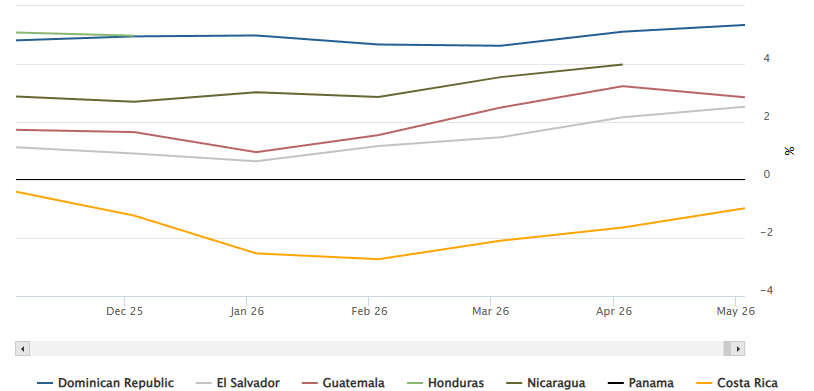
    Central America & Caribbean: inflation rate
    Percentage variation (year-on-year)

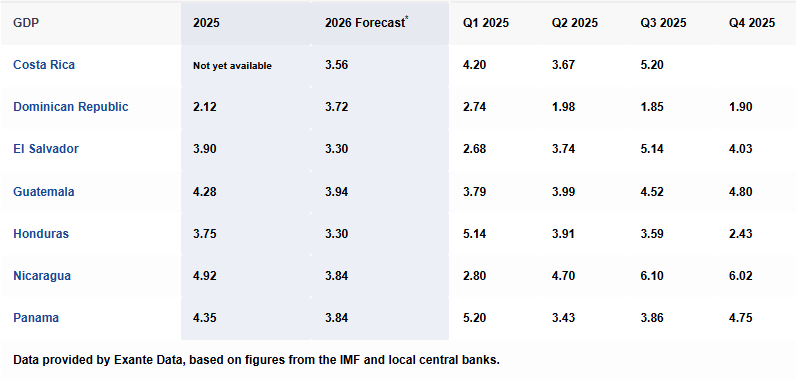
    Central America & Caribbean: GDP growth (%)
    Quarterly figures are year-on-year growth

  • Risk pointers

    LatinNews 06 September 2011 Hits: 332

    *** Russian accusations against Georgia.  Russia’s state-controlled Channel One television aired a documentary on 30 May alleging that the Georgian government supports Islamist terrorism in the Russian North Caucasus.

    *** Turkish aid for Gaza.  Turkey’s Foreign Minister Ahmet Davutoglu said on 26 May that the Turkish government was working “on all possible scenarios” for a new aid flotilla to travel to the Gaza Strip to deliver humanitarian assistance.  On 31 May 2010, nine Turkish nationals were killed when Israeli troops raided the Mavi Marmara aid ship.  Davutoglu said: “We think that Israel is well experienced not to repeat the Mavi Marmara attack.”

    However, on the same day Israel’s Lt-General Benny Ganz said that Israel was preparing to stop any new aid flotilla.  He said: “We are preparing for the flotilla in accordance with the orders of the Israeli government.  We are preparing to stop it.”  Pro-Palestinian activists are preparing a flotilla of 15 ships carrying 1,500 people from 100 countries.

    Turkey’s foreign minister insists that the solution is in Israel’s hands.  He said that if Israel does not want to see new convoys it needs to recognize the Palestinian administration and end the blockade.

    *** Israel reiterates military option against Iran.  In an interview on 30 May with the Russian news agency Interfax, Israel’s Deputy Prime Minister Moshe Yaalon reiterated the possibility of a military strike against Iran’s nuclear facilities.

    Yaalon said: “We very much hope that the whole civilized world will realize what threat the [Iranian] regime poses and take joint measures to prevent the nuclear threat from Iran, even if a pre-emptive strike will have to be launched.”

    Yaalon also suggested that a peace agreement with the Palestinians would not be worth the paper it is written on.  He said: “It seems to me that the idea of a peace treaty generally accepted in the West, as a paper document signed by the parties, is not applicable to the Palestinian-Israeli conflict.  In the absense of common interests and a constructive dialogue, a paper agreement of this kind will not have any force.”

    With regard to the Obama administration’s call for a settlement based on a modified version of the pre-1967 border, Yaalon said that “all attempts to resolve the problems with a territorial division based on 1967 borders are simply unacceptable to us”.  Quite apart from Israel’s need for defendable borders, Yaalon pointed out that no one on the Palestinian side is prepared to say that a territorial compromise of the type proposed “will put an end to the whole conflict”.

  • Risk pointers

    LatinNews 08 February 2012 Hits: 209

    *** Bedding in Kim Jong-un.  We reported last week on the amount of visits made by North Korea’s new leader Kim Jong-un to military units during January and how this was being seen as a sign of his uncertainty about the level of support for his leadership within the military.  There is as yet no sign that his succession is under threat, but sources continue to note the abnormally high degree of control over illegal cell phone usage and the use of foreign currency, and the imposition of extreme punishments for attempted defection.  Also worth noting has been the plethora of articles churned out by Pyongyang’s propaganda machine praising Kim Jong-un’s youth.  Kim is believed to be in his late 20s, and the concentration on the positive aspects of this by the North’s propaganda outlets suggests some opposition to having such an inexperienced leader.  An early test for Kim Jong-un will be the Nuclear Security Summit to be hosted by South Korea in March.  There will also be the general and presidential elections in April and December.  Intelligence agencies in South Korea believe that Kim Jong-un will have no choice but to follow the hawkish stance of his father, and they are expecting some form of military provocation during these sensitive events.

    *** Taleban splits.  As the US tries to get into serious discussions with the Taleban ahead of its planned 2014 withdrawal from Afghanistan, there are splits arising within the Taleban that are complicating these efforts.  The following is a short guide to the main factions:

                    - The Quetta Shura, the main faction led by Mullah Omar, seems to have been weakened in the last two years.  It is increasingly having difficulty imposing its will on the other factions.  Its slowness in rejecting the 29 January BBC report of impending talks in Saudi Arabia with the Afghan government is seen as evidence of this.  Also, when former Taleban minister Arsala Rahmani (see pro-Karzai faction below) mooted the idea of handing over a number of southern provinces to the Taleban as the first stage in a reconciliation process, this was rejected by the Quetta leadership.  Earlier evidence of inter-Taleban tensions came with the Quetta faction’s strong condemnation of the 6 December attacks on Shia Muslims in three Afghan cities.

                    - The Haqqani network.  This grouping led by the Haqqani family is dominated by the Zadran tribe from the eastern border with Pakistan.  It has close links to al-Qaeda, the Pakistani Taleban, and Pakistan’s intelligence agencies.  It is linked with, but independent from, the Quetta Shura.

                    - Pro-Karzai faction.  This grouping consists of former Taleban officials now living in Kabul, such as former Taleban foreign minister Wakil Ahmad Motawakkil, former minister Arsala Rahmani, and former envoy to the UN Abdol Hakim Mojahed.  This grouping is pushing for direct talks with the Afghan government, but its leaders are no longer thought to have close ties with the Quetta leadership.

  • PERÚ: Choque judicial por escuadrón de la muerte

    LatinNews 01 October 2012 Hits: 591

    ¿Un triunfo para los derechos humanos? o ¿un revés para la soberanía nacional de Perú? Estas fueron las dos reacciones más polarizadas a una resolución emitida por la Corte Interamericana de Derechos Humanos (CorteIDH) esta semana ordenando la anulación de un fallo de la cámara penal de la corte suprema del Perú que reducía las condenas para miembros del escuadrón de la muerte Colina que estuvieron involucrados en masacres en los ’90, durante el gobierno autoritario de Alberto Fujimori (1990-2000).

    La CorteIDH ordenó a Perú en el 2001 que investigue las masacres perpetradas por Colina, en  base a que estas constituían crímenes de lesa humanidad cometidos por el Estado. La corte penal de cinco miembros, presidida por Javier Villa Stein, dictaminó en el pasado julio que las condenas resultantes contra los miembros de Colina y, por ejemplo, Vladimiro Montesinos, el jefe de inteligencia de Fujimori que creó Colina, sean reducidas de 25 a 20 años, porque las muertes no constituyeron crímenes contra la humanidad sino que fueron simples asesinatos. Este dictamen, que significaba que algunos miembros de Colina podrían pronto tener derecho a salir bajo libertad condicional, fue ferozmente criticado por el primer ministro de Perú, Juan Jiménez Mayor, como “vergonzoso” y un “nuevo episodio oscuro en la justicia peruana” [IL-12-29].

    La decisión de esta semana de la CorteIDH de invalidar la resolución de la corte penal (ver más abajo) provocó críticas de varios jueces, no menos Villa Stein. Acusaron a la CorteIDH de pisotear la soberanía judicial de Perú. El Presidente Ollanta Humala, quien fue crítico de la resolución de la corte penal en julio, dio una respuesta mesurada. Dijo que él podía entender las preocupaciones de aquellos que condenan estridentemente la pérdida de soberanía del país, pero que Perú era un firmante ante la CorteIDH y debe cumplir con sus dictámenes. La alternativa, dijo él, era abandonarla.

    • Resolución

    La resolución de la CorteIDH establece que la decisión de la cámara penal de la corte suprema era “incompatible” con la ratificación por Perú de la Convención Interamericana sobre Derechos Humanos. En su resolución, la CorteIDH declara que “Si las causas que podrían conducir a la impunidad no son remediadas a través de los mecanismos internos disponibles [...], sería un incumplimiento de las órdenes de esta Corte.” Otorgó a Perú tiempo hasta el 20 de enero del 2013 pata anular la decisión de la corte penal, o enfrentar una resolución de la CorteIDH revocándola.

  • ECONOMIC OVERVIEW: PANAMA

    LatinNews 28 November 2012 Hits: 2100

    More ruffles with the private sector. Economy Minister Frank De Lima recently called on the Panamanian association of business executives (Apede) to “set aside political posturing”. De Lima’s angry remarks follow a statement issued by the Apede in November, raising concern about the fiscal deficit projected in the record-breaking 2013 state budget for US$16.3bn which, promulgated on 18 October, is up nearly 13% on the current one. Apede’s statement – which attracted attention given the pro-business bent of President Ricardo Martinelli’s government - adds to existing concerns about excessive government spending.  Panama’s public debt reached US$13.8m in the first half of 2012, up from US$12.5bn in 2011, US$11bn in 2010 and US$10.8bn in 2009, the year Martinelli took office. These concerns, which were also echoed by the Panamanian chamber of commerce, emerged after Martinelli’s failed attempts at both selling off state lands in the Colón Free Trade Zone (FTZ) last month [RC-12-11] and selling shares in the energy and telecoms sectors in June last [EB-12-6/7], both of which he was forced to backtrack on.

    “The need to keep fiscal deficits below the revised Social and Fiscal Responsibility Law (SFRL) ceilings” and “a more neutral fiscal stance” also featured among the recommendations made by the IMF following a recent visit to the country to conduct its annual Article IV consultation. Yet with Panama’s GDP averaging around 9% over the last five years – the highest in Latin America - the IMF remained positive, noting “Panama’s growth performance continues to exceed expectations, buoyed by the Panama Canal expansion and large public infrastructure projects”. The IMF described the near-term outlook as “favourable” with real GDP growth possibly exceeding 9.5% in 2012 and average inflation at about 5.5%-6% in 2012-2013.

  • TRACKING TRENDS

    LatinNews 25 June 2015 Hits: 1894

    BOLIVIA | First oil find for quarter-century

    The government led by President Evo Morales announced on 18 June the discovery by the state-owned oil company, Yacimientos Petrolíferos Fiscales Bolivianos (YPFB), of new oil reserves. This is the first such find for 23 years and at a stroke nearly triples Bolivia’s current oil reserves from 16m barrels to 44m barrels.
    YPFB expects that exploitation of the oil reserves in the Boquerón Norte field in the municipality of Yapacaní in the eastern department of Santa Cruz will begin in 2017. The minister of hydrocarbons and energy, Luis Alberto Sánchez, said the discovery would permit Bolivia to reduce its diesel imports by around 20%, as some 6,500 barrels of oil per day would come on-stream from this well from 2019 onwards. The State subsidises fuel, and the biggest cost behind this subsidy is diesel imports.
    Separately President Morales said on 20 June at an event in Cochabamba that Bolivia hoped to be exporting some 8,000MW of electricity by 2025, when the country will celebrate its bicentenary of independence. Morales said that much of this would be generated by a bi-national hydroelectric dam being planned with Brazil on the shared Madeira river for launch by 2022. This would generate 3,000MW, with Bolivia exporting the surplus electricity back to Brazil and using the proceeds to cover its portion of the financing cost, much as Paraguay currently does to Brazil with the Itaipú hydroelectric dam, albeit Bolivia would be looking for more generous terms as this has been a festering sore between Asunción and Brasília.

    Bolivia’s current production is 1,500MW, which satisfies the average domestic demand of 1,300 MW.

    COLOMBIA | Anti-contraband law

    “Enormous satisfaction”. This is how the finance minister, Mauricio Cárdenas, reacted to the approval last week of an anti-contraband law, which had been mired in congress for over a year. “Contraband is the main problem which our productive apparatus faces,” Cárdenas said. “We must declare total war on contraband. Contraband destroys jobs, destroys businesses,” he added. According to the commerce, industry and tourism ministry, contraband generates the equivalent of 2% of Colombia’s GDP and 10% of imports.

    Under the new law prison sentences will range from four to eight years for contraband dealers and fines will amount to up to 300% of the customs value of the contraband products imported, sold and transported. Those involved in transporting or selling contraband goods will be subject to the law from now on too.

    Cárdenas also said that public officials would be punished much more severely for complicity in contraband. “Before they could get away with a fine but now they will go to prison,” he said. For those facilitating large-scale contraband operations, involving merchandise of over Col$120bn (US$47,000) prison sentences will be up to 16 years.

    PERU | Quieten political noise

    Martín Pérez, the president of the powerful private sector business lobby, Confederación de Instituciones Empresariales Privadas (Confiep), has called on the government led by President Ollanta Humala to reduce the “political noise” to improve the investment climate to enable Peru to post economic growth in excess of 4% this year.

    Pérez was referring to the Humala administration’s open skirmishes with the opposition, particularly over corruption issues, as political parties and candidates jockey for position ahead of presidential and congressional elections in April 2016. It is difficult, however, to see anything other than more decibels of political noise emitted over the next nine months. There is also the recurrent concern of social unrest in the regions, with Humala compelled to extend military intervention in the three southern regions of Arequipa, Puno and Madre de Dios last week to maintain order [WR-15-24].

    Congress voted by 86 to 21 last week to grant the legislative powers sought by the prime minister, Pedro Cateriano, to enable the Humala administration to legislate on economic, financial and administrative matters over a period of 90 days (he had sought 120) with the objective of dynamising economic growth. This will be restricted to the regulation of electricity generation; private investment promotion; access to housing; public-private partnerships; and easing trade restrictions.

    • Colombian contraband

    “Contraband is the other side of the story of narco-trafficking,” Colombia’s finance minister, Mauricio Cárdenas, said. “Drugs leave the country and these drugs return converted into cheap merchandise, merchandise that doesn’t pay tax,” he added. Contraband denies the State some Col$2.9 trillion (US$1.14bn) a year in taxes, according to Colombia’s customs and excise agency (Dian).

  • Economic Highlights

    LatinNews 20 February 2020 Hits: 2369

    PERU | Odebrecht lawsuit. On 4 February, a subsidiary of Brazilian engineering firm, Odebrecht, filed a US$1.2bn lawsuit against the Peruvian government, before the World Bank’s International Centre for the Settlement of Investment Disputes (Icsid). An Odebrecht-led consortium won a US$7bn contract in 2014 to build the 1,150km Gasoducto Sur Peruano (GSP) gas pipeline, but the massive ‘Lava Jato’ corruption scandal left the company unable to complete the project, and the contract was cancelled in January 2017. Odebrecht now contends that it is owed compensation for this cancellation. Peru’s President Martín Vizcarra insisted on 7 February that the failure to complete the project amounted to a cancellation of the contract, and voiced confidence that the Icsid would rule in favour of the Peruvian government. Vizcarra also referred to ongoing investigations into Odebrecht corruption in Peru, including allegations of bribery surrounding the GSP bidding process in 2014, in which the only other competitor was disqualified at the last minute.

    COLOMBIA | Pension reform. On 2 February, Colombia’s President Iván Duque confirmed that pension reform will again be a legislative priority for his government once congress reconvenes in March. This issue has been a thorn in the Duque government’s side since he took office in 2018, and its last attempt to introduce a pension reform programme led to the November 2019 workers’ strike which escalated into widespread popular protests. The government is clearly keen to avoid repeating this fiasco. While the details of the reform have not yet been finalised, Duque has insisted that neither retirement age nor contributions will be increased, and that the goal will be to rectify the uneven subsidy system that results in overly generous ‘mega-pensions’ for some, and a total lack of coverage for others – it is estimated that only 24% of pensions in Colombia exceed the minimum wage. However, Duque has also promised not to touch the specialised pension schemes - reserved for the judiciary, police, and armed forces, amongst others - that make up the bulk of the country’s pensions expenditure. Tackling pensions inequality without amending these schemes will be extremely difficult.

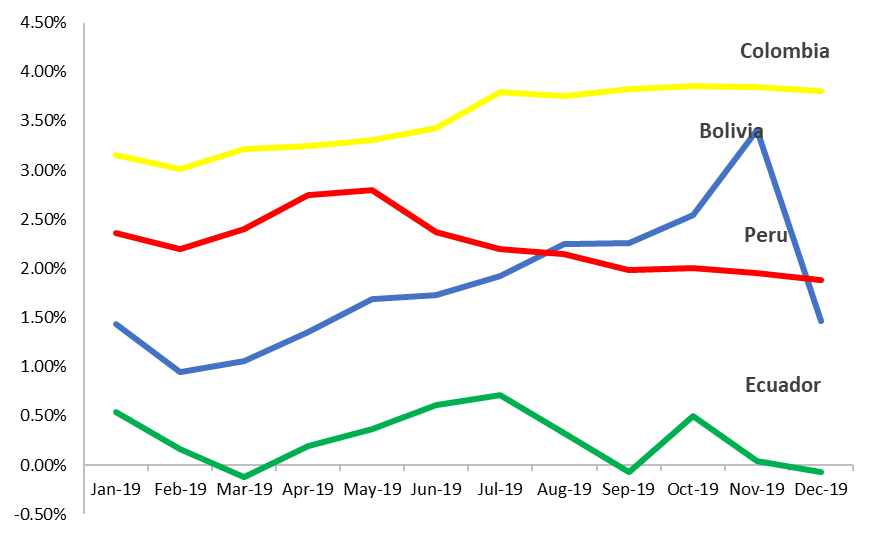
    Andean Countries: Inflation
    Monthly year-on-year figures

    Andean Countries: GDP growth (%)
    Quarterly figures are year-on-year growth
    GDP  end 2019* 2020 forecast* Q4 2018 Q1 2019 Q2 2019 Q3 2019
    Bolivia 3.0 3.0 4.2 3.9 3.4 2.3
    Colombia 3.2 3.5 2.8 2.8 3.0 3.3
    Ecuador -0.2 0.1 0.6 0.6 0.3 -0.1
    Peru 2.3 3.2 4.8 2.3 1.2 3.0
    Venezuela -25.5 -14.0 No data No data No data No data
    *Figures from the United Nations Economic Commission for Latin America & Caribbean Dec 2019
    Quarterly growth based on figures from the local central banks
  • BRAZIL: Who is in charge?

    LatinNews 21 May 2020 Hits: 1114

    As coronavirus (Covid-19) infections and deaths continue on a rising curve, there is confusion over Brazil’s economic policy direction. Notionally, economy ‘super minister’ Paulo Guedes is still running the show, but in practice he faces significant opposition both from within the government and the federal congress. Guedes himself has done little to reassure the markets, saying on 7 May that the country could experience food shortages and an economic collapse within 30 days.

    One of the first signals of growing economic disagreement within President Jair Bolsonaro’s government s came on 29 April, when the government announced ‘pro-Brasil’, a major new plan for investment in infrastructure, mining and regional development. Guedes was not present at the launch, which was led instead by Walter Braga Netto, the presidential chief of staff and a retired army general. Brazilian media say military officers in Bolsonaro’s cabinet favour a more decisive, nationalist, and public-sector led response to the crisis. Guedes, in contrast, remains committed to shrinking the size of the state and trying to control the fiscal deficit.

    Whatever the reasons, the pro-Brasil plan has had a somewhat will-o’-the-wisp existence since its announcement, with different officials giving different details of its size and importance. It was originally billed as a R$300bn (US$52.3bn) package, but there have been conflicting reports over the mix of public and private funding sources (and therefore, critically, of its impact on the fiscal balance). Political consultant, Creomar de Souza, described the way the plan was announced as “terrible” for Guedes, adding “it looks like Bolsonaro and the military are now deciding economic policy and that Guedes is no longer the most important voice on these issues”. Bolsonaro subsequently reaffirmed his confidence in Guedes, but coming after the forced departures of the health and justice ministers, this did little to reassure the business sector.

    Like the president, Guedes appears to have been sucked into the wider and bitterly partisan dispute that is consuming Brazil, between those who favour tough quarantine measures to fight the public health emergency and those, like Bolsonaro, who minimise the threat from the coronavirus and want an immediate relaxation to try and get the economy growing again. Guedes accompanied Bolsonaro on a provocative “courtesy visit” to the supreme court (STF) on 7 May, widely seen as an attempt to intimidate the judiciary. The aim was to convince Chief Justice José Antonio Dias Toffoli of the need to lift quarantine measures imposed by local governments (the court had earlier ruled that the power to impose or remove quarantine measures lies not with the federal executive but with state and municipal governments). It was in that context that Guedes spoke of a possible economic collapse within 30 days if the quarantine measures were not ended – a statement designed to dramatise the need to reopen the economy, but one also likely to spread alarm.

    Congress meanwhile is also asserting its influence over fiscal policy. It has approved a constitutional amendment to allow extra spending and emergency measures (in effect bypassing the existing spending cap). The central bank, which on 6 April cut the benchmark Selic interest rate by 75 basis points down to a record low of 3%, has also been given extra powers to buy private and public sector assets. Congress also approved a bill providing R$60bn (US$10.19bn) in financial support for states and municipalities during the pandemic. More budget battles are likely to lie ahead, among them a decision on whether to extend an existing three-month programme to pay informal workers R$600 a month. Amid rumours that the handout might be made permanent, the economy ministry has stressed that it is a temporary emergency measure. The latest forecasts for the economy remain extremely gloomy pointing to a GDP contraction of up to 7% this year, with the primary government deficit (excluding interest payments) rising to 8% of GDP.

    Embraer-Boeing deal collapses

    The US$4.2bn deal whereby US firm Boeing was set to take over 80% of the commercial aerospace business of Brazil’s Embraer collapsed in late April, with the US company terminating negotiations, and Embraer threatening legal action in response. The aim had been for a US-Brazilian joint venture to develop Embraer’s E2 passenger jets so as to compete with a rival C-series of aircraft built by a Bombardier-Airbus alliance in the same market segment. However, with the aviation industry deeply shaken by the coronavirus pandemic, Boeing decided to walk away. Some nationalist military ministers who had been concerned about what they saw as a loss of market share in a high-tech industry for a leading Brazilian company reacted with relief. Vice President Hamilton Mourão described the end of merger talks as “a blessing in disguise” and suggested Embraer might be able to secure a better deal to work with a Chinese partner instead.

    Embraer chief executive, Francisco Gomes Neto, said the company had enough cash to survive the next two years even if it received no new orders. But analysts say Embraer, which has temporarily laid off 30% of its 18,000 staff, now faces big challenges. Brazil’s state-owned development bank (BNDES) is reportedly ready to invest US$1bn in the company to help it weather the storm. The Chinese aerospace group seen as a potential global alliance partner, Comac,  has signalled it is not currently seeking large-scale mergers and acquisitions. Embraer could renew its focus on small jets, on the hypothesis that regional air travel will recover more rapidly than long-haul routes. Local analysts suggest that domestic Brazilian flights will return to pre-pandemic levels by 2022, but that international flights will not fully recover until 2025.

  • BRAZIL: Bolsonaro sanctions 2022 budget

    Patrick de Courcy 27 January 2022 Hits: 4526

    Brazil’s President Jair Bolsonaro sanctioned the 2022 budget on 21 January, the deadline for doing so, with an eye to his expected re-election bid this October. The decision to veto spending in areas such as scientific research, while maintaining some questioned aspects of the budget which benefit Bolsonaro’s political allies, such as opaque discretionary spending for lawmakers, betrays the position of a “cornered president”, in the view of Brazilian business daily Valor Econômico.

    President Bolsonaro had until the end of last week to sanction this year’s budget, which was approved in congress on 21 December 2021 and plans for R$4.7trn (US$856bn) in spending. As well as prompting warnings from the economy ministry that the version approved by lawmakers underestimated some compulsory personnel expenditures, the budget had notably caused discontent amongst public sector workers who felt they were owed a pay rise [WR-22-03].

    Bolsonaro’s vetoes, which were revealed in the 24 January official gazette, did little to address these issues. The cuts, to the tune of R$3.18bn (about a third of the figure recommended by the economy ministry), hit ministries’ discretionary spending and a segment of the budget awarded to parliamentary commissions.

    Bolsonaro did not, as had been speculated, veto the R$1.7bn which have been earmarked for salary adjustments, although it is not clear if this will only benefit federal police officers as initially promised by the president (part of the reason other categories of public sector workers have been protesting). He also maintained two highly controversial aspects of the budget: the R$4.9bn electoral fund – which will be distributed to political parties to fund their electoral campaigns this year – and the R$16.5bn reserved for the so-called ‘emendas do relator’, discretionary spending for lawmakers which was dubbed the ‘secret budget’ last year due to the lack of transparency surrounding how the funds are allocated [WR-21-45].

    The latter in particular is an important factor in the Bolsonaro government’s alliance with the ‘centrão’, a bloc of self-serving parties which has been propping up the government in congress and which will seemingly be backing Bolsonaro’s re-election bid, after the president joined the Partido Liberal (PL), a key centrão member, last year [WR-21-48]. In a move which also seemed destined to benefit the centrão, Bolsonaro signed a decree on 13 January giving the chief-of-staff’s office (Casa Civil) more power regarding certain areas of the budget’s execution, thus trimming back the responsibilities of the economy ministry – the chief-of-staff, Ciro Nogueira, is a member of the centrão party Progressistas (PP).

    Criticisms

    “The vetoes to the national budget show where Bolsonaro’s interests lie. He didn’t touch the [electoral fund] nor the secret budget. But he made significant cuts to primary education and to the areas which helped us fight the pandemic: health and science. Is anything worth it to get re-elected?” Deputy Tabata Amaral of the opposition Partido Socialista Brasileiro (PSB) questioned on Twitter.

    Areas which will have been affected by the R$1.8bn vetoed across different ministries’ discretionary spending include, inter alia, efforts to fight forest fires and initiatives focused on indigenous peoples. “Bolsonaro is hostage to the centrão,” Deputy Bohn Gass, from the leftist Partido dos Trabalhadores (PT), told news site UOL. “His only concern is to remain in power. And to do so, he needs the centrão,” Gass added.

    Bolsonaro’s ‘guru’ dies

    Olavo de Carvalho, a foul-mouthed philosopher whose controversial ideas informed much of ‘bolsonarismo’ thinking, died on 24 January at the age of 74 in the US state of Virginia, where he lived. Often referred to as Bolsonaro’s “guru”, he had reportedly tested positive for Covid-19 – the existence of which he did not believe in – on 16 January. Bolsonaro declared a day of official mourning, an honour he has failed to bestow on the many Brazilian icons who have passed away during his presidency, most recently Elza Soares, considered one of the greatest Brazilian singers of all time, who died last week aged 91.     

  • DOMINICAN REPUBLIC: Ahead of the pack

    Patrick de Courcy 19 May 2023 Hits: 4027

    The United Nations Economic Commission for Latin America and the Caribbean (Eclac) said on 20 April that the Dominican Republic will be the fourth-fastest growing economy in the region this year.

    According to Eclac’s forecasts, the Dominican Republic’s GDP will grow 4.6% this year, placing it in joint fourth place with Panama. For the region as a whole, growth will average only 1.2% due to “growing external uncertainties and internal restrictions” including higher interest rates and nervousness over the bank failures in the US and Europe in March.

    Broadly in line with Eclac, the economy ministry is predicting 4.0%-4.5% growth this year. It acknowledges however that there has been something of a slowdown in the first quarter with growth of only 1.1% in January and February, attributed to lower construction activity and a dip in public sector investment. Despite this, the ministry expects the pace to pick up as public investment recovers, tourism continues to grow, and lower inflation leads to an easing of interest rates. The economy ministry notes that in March, year-on-year inflation was 5.90%, the lowest rate of the last 27 months. Also reflecting positive fundamentals, the peso remains strong and foreign currency reserves stand at US$16bn or 13.3% of GDP.

  • Bilateral pressure results in Farc capture

    LatinNews 05 August 2011 Hits: 628

    Development: On 4 August General Oscar Naranjo, the commander of Colombia’s national police, announced that ‘El Médico’ (Angel Ariñez Troche), a key member of the Fuerzas Armadas Revolucionarias de Colombia (Farc)’s international structure, had been captured in Cúcuta, capital of the Norte de Santander department.

    Significance: Ariñez Troche’s capture serves as corroborating evidence for the position taken by the administration of President Juan Manuel Santos that Farc presence in Venezuela doesn’t have the support of Hugo Chávez’s government; this is the first example of a capture in Colombia facilitated by pressure against the Farc inside Venezuela. “This individual exited Venezuela due to the bi-national pressure exerted in the search for him inside Venezuela...what we are verifying is that the Colombia-Venezuela bi-national pressure is producing these results, given the instability, the uncertainty and the mistakes these terrorists are making”, concluded Naranjo.

    Key points:

    • Since Santos took power almost a year ago (11 August 2010), Venezuelan security forces have captured two senior members of the Farc international commission in Venezuela: ‘Alberto Martínez’ in April and ‘Julián Conrado’ in May. According to Naranjo, Colombian intelligence knew that Ariñez Troche had been with ‘Conrado’ in Venezuela shortly before the latter’s capture; thus increased pressure in the neighbouring country may have forced his return to Colombia without taking the necessary preventative security measures.

    • It is believed Ariñez Troche - who serves as the main physician to the secretariat, the Farc’s seven-member leadership group, second only to the commander in chief, ‘Alfonso Cano’ (Guillermo León Sáenz) - was also in a rush to obtain surgical equipment and transport it to the department of Antioquia to operate on ‘Isaías Trujillo’ (Luis Carlos Usuga Restrepo). ‘Trujillo’ is the commander of the so-called Iván Ríos bloc (formerly the north-western bloc)

  • EL SALVADOR: Problems

    LatinNews 04 October 2011 Hits: 795

    The economy is still only bumping along. In 2010 official GDP growth figures showed that the economy was barely recovering after the steep (3.1%) contraction in 2009. In 2010 GDP growth was just 1.6%.

    Growth for the first half of 2011 was an apparently impressive 3.6%, year-on-year, but this figure was flattered by double digit growth in construction (up 20%) and mining and quarrying (up 15%).

    Manufacturing was up by a much more modest 2.1% and demand for utilities such as gas, water and electricity fell by 1.0% in the first half of 2011, compared with the same period of 2010. So the overall growth figure hides a misfiring economy.

    What makes the first half growth figure worse is that interest rates have been lower than annual inflation. In the year to August 2011, consumer prices have risen by 6.82%, but lending rates were 5.75%.

    To be fair, there has been only one bad month of inflation in 2011, in April, when the index jumped 3%. Otherwise monthly inflation has been between 0.7% and 0.1% a month.

    The sluggishness of the US economy is also holding back remittances. So far this year they are up by 4.8%, compared with the same period of 2010, at US$2.422bn. More comfortingly, the inflow of remittances in June was up 7% on the same month in 2010.

  • PARAGUAY: EPP resurfaces before dumbfounded authorities

    LatinNews 15 March 2012 Hits: 623

    Amid heightened tensions between peasant farmers and large landowners in Eastern Paraguay, the self-proclaimed Ejército del Pueblo Paraguayo (EPP), a criminal organisation with leftist tendencies, has seized the opportunity to spring back onto the scene, trying to re-brand itself as the defender of poor peasant farmers and the environment.

    Following months of inactivity (and no reported sightings), the EPP suddenly claimed responsibility for an attack on the outpost of a cattle ranch near Kurusu de Hierro, in the northern department of Concepción, on 26 February.

    According to press reports, four to six masked and armed men entered the ‘Ypotî’ ranch, where they burned a shack and shot cattle on the property’s fringes. Reportedly, upon arrival the attackers woke up the workers inside the shack and questioned them about their identities and activities. They allowed the Paraguayan workers to collect their belongings from the shack before they set fire to it. They did not extend the same courtesy to the Brazilian workers. The attackers left a letter in which they demanded that the ranch owners provide foodstuffs and livestock to a nearby indigenous community or suffer further consequences.

    Given the heightened tensions between self-declared Paraguayan landless farmers and large landowners of Brazilian origin (Brasiguayos) in Alto Paraná, the EPP’s discrimination against the Brazilian workers could be seen as an attempt to capitalise on the situation to gain more support from the peasant population. While Concepcion is far from Alto Parana, both departments border Brazil and have significant Brazilian and Brasiguayo populations.

    Problematically, the Ypotî ranch borders the ‘Santa Adelia’ ranch, where four people were murdered by the EPP in 2010. At the time authorities found what they presumed to be an EPP camp and consequently identified the surrounding areas as the EPP’s main sphere of influence. This led the government to declare a state of emergency in Concepción in April 2010 and to establish a military outpost in the Kurusu de Hierro-Tacuatí area, which is the operational base for a joint Special Forces mission tasked with tracking down and arresting the EPP members. Despite the heavy security force presence in the area, there has been little progress in finding the EPP.

    The 27 February attack marked the beginning of a series attacks on ranches in the surrounding area. On 8 March there was an attack at the ‘Agüerito’ ranch, also in Hugua Ñandu. Following this attack, the press reported that the EPP left a letter in which it appears to spell out a new tactic of targeting affluent agricultural producers which it claims are oppressing the poor (see sidebar). The organisation vows to “retaliate” against the agricultural producers warning that anyone “caught cutting down or fumigating near peasant communities will pay the maximum penalty, as stipulated by the revolutionary laws”.

    The authorities claim that they are closely monitoring the EPP, constantly carrying out intelligence work in the area. Nonetheless Concepción’s police chief, Ricardo Caballero, has pointed out that the police have come up against a “lack of collaboration” from the local community, leading police to believe that there “are a lot of people that sympathise with the group”. Incidentally, on 8 March during a visit to Concepción department, President Fernando Lugo was questioned about the authorities’ inability to capture the EPP. Lugo’s whimsical answer was “I would ask that question of the people of Concepción. We have always said that the [national] institutions are not able to deal with all demands”. However he pointed out that his government was “more determined than ever” in its fight against the EPP.

    • Sidebar: EPP letter

    “The greed of a few is destroying our environment. The contamination of the soils and water is mainly due to the use of poisonous substances in agriculture...the phosphate fertilizers, insecticides, herbicides, and fungicides in reality are the rich landowners’ chemical weapons against the poor... The war has been declared. The hostilities have begun”.

  • URUGUAY: Mujica moves on marihuana and money-laundering

    LatinNews 12 July 2012 Hits: 1537

    The government of President José Mujica is moving to legalise marijuana. This is the most headline-grabbing of 16 proposals to combat insecurity, the main public concern in Uruguay since Mujica came to power in 2010. Attracting far less attention, but almost as significant, is a big move to combat money-laundering.

    The consumption and possession of marijuana, it is important to point out, is not currently a criminal offence under Uruguayan law. Selling marijuana, on the other hand, is a crime. Under a draft proposal drawn up by the Mujica administration and announced on 20 June, but not yet presented to congress, the production and sale of marijuana would be legalised and controlled by the state, according to press reports, which are providing the only detailed source of information so far.

    The press reports claim that consumers would be entitled to purchase up to 40 ‘porros’, marijuana cigarettes, a month from a state agency that would be established to control the growth, distribution and sale of marijuana. They would have to register their national identity card in order to obtain marijuana, however, and would be subject to government monitoring of their habit.

    The government justified its proposal on the grounds that it would use the taxes raised from its ‘marijuana business’ to fund rehabilitation treatments and drug prevention strategies as well as to establish a centre of product quality control. It also argued that it would help prevent consumers from being drawn to “harder” drugs, such as cocaine base paste, typically purchased from the same dealers on the black market.

    The president of the International Narcotics Control Board (INCB), Raymond Yans, contended that the black market would still exist as younger Uruguayans would be unable to acquire marijuana because of their age. Yans expressed his disconcertion that the proposed legalisation had only been reported in the press and that the authorities had not notified the UN about something “so important”. He said that even the Uruguayan embassy in Vienna (the INCB is based in the Austrian capital) had no official information to pass on.

    Yans said he would travel to Montevideo shortly to hold “a frank and open” discussion about the Mujica administration’s proposal, which he said totally contravened Article 4 of the 1961 Convention. This stipulates that:

    “The parties shall take such legislative and administrative measures as may be necessary:

    a) To give effect to and carry out the provisions of this Convention within their own territories;

    b) To co-operate with other States in the execution of the provisions of this Convention; and

    c) Subject to the provisions of this Convention, to limit exclusively to medical and scientific purposes the production, manufacture, export, import, distribution of, trade in, use and possession of drugs.”

    Yans insisted that his intention was “to talk and not to threaten” but he added that there would be “serious repercussions” for Uruguay, including “difficulties with other countries”. Most nations in the region have kept their own counsel so far, but Colombia’s President Juan Manuel Santos was critical of the “unilateral decision” by Uruguay, which he said would create “distortions” in the region. He said that a common focus would be much better.

    “Someone had to be the first,” President Mujica told the Brazilian daily O Globo. “Someone had to start in South America because we are losing the battle against drugs and crime in the continent.” The proposal should pass in congress as the ruling Frente Amplio (FA) has a majority in both chambers; there are also a number of representatives from the opposition Partido Nacional (Blancos) and Partido Colorado (Colorados) who support the bill.

    In a long editorial in Peru’s national daily La República, Mario Vargas Llosa, the country’s famous and politically influential novelist, praised President Mujica for his “brave decision” to change tactics, arguing that the “purely repressive response (to drugs) is counterproductive”. Vargas Llosa said Uruguay had set “an example for the other Latin American countries to follow”. He said that legalisation would require an information campaign about the associated health risks of smoking marijuana, but that the same had been employed for cigarettes across the world.

    Vargas Llosa formed part of the Latin American Commission on Drugs and Democracy (LACDD), forged in 2007 by three regional political grandees – the former presidents Ernesto Zedillo of Mexico (1994-2000), Fernando Henrique Cardoso of Brazil (1995-2002), and César Gaviria of Colombia (1990-1994), which favoured a paradigm shift in strategy on the grounds that the war on drugs had failed and criminalisation of consumption had not yielded the expected results. Indeed quite the contrary. The report, which has grown in influence, contended that the war on drugs had engendered adverse repercussions: a rise in organised crime; a growth in drug-related violence; and “the criminalisation of politics and the politicisation of crime”, such as the corruption of democratic institutions.

    The Uruguayan government’s approach leans heavily on this report, which advocates an alternative vision of treating drug users as a matter of public health; reducing consumption through public education campaigns; and focusing repression exclusively on organised crime and not drug users. To achieve these goals it proposes a state policy to end the stigmatisation of addicts and to welcome them into health care systems and rehabilitation programmes. It argued that, combined with education campaigns to which addicts could help contribute, this would reduce the demand for illegal drugs, undermining the illegal drug business. The report blamed prohibitionist policies for the damage associated with marijuana use, which it claimed was no more harmful than tobacco and alcohol. Uruguay’s defence minister, Eleuterio Fernández Huidobro, said the prohibition of certain drugs was “causing more problems than the drug itself”.

    Money-laundering

    The draft proposal on marijuana is one of several measures the government is taking to try and combat citizen insecurity. Another measure, which attracted far less attention but is also highly significant, is a new anti-money laundering plan drawn up with the support of the International Monetary Fund (IMF). This was announced a day earlier, 19 June, to far less fanfare. The two-year action plan aims to improve and update the fight against money-laundering, implementing several reforms designed to make it easier to investigate and prosecute money-laundering crimes. The pro-secretary of the presidency, Diego Cánepa, said it constituted “a qualitative leap and a sign that Uruguay is a serious country”.

    The head of the Financial Integrity Group at the IMF, Matthew Byrne, explained that the strategy that Uruguay is promoting is “the result of six years of joint work”. The IMF provided technical assistance, with experts assisting in evaluating risks, defining strategies and eventually suggesting legal reforms. They found weaknesses in subsectors of the financial system and recommended widening controls to combat money-laundering. The government says there are “strong controls” in the banking sector but that things could be improved in “the property market and anonymous societies” (see sidebar).

    • Clinton mark 2

    Uruguay’s secretary of the presidency, Alberto Breccia, had a Bill Clinton moment and confessed to having smoked marijuana, experiencing “peace, calmness and happiness”, although he said he had not decided to repeat the experience. Former US president Bill Clinton famously said during his 1992 presidential campaign that he had smoked marijuana but “I didn’t inhale, and never tried it again.”

    • Anti-money laundering

    The director of the Uruguayan central bank’s financial information and analysis unit (UIAF), Daniel Espinosa, said the bank receives between 200 and 220 reports of “suspicious” deposits every year which are investigated. The new anti-money-laundering plan also strengthens oversight of non-governmental organizations (NGOs).

  • TRACKING TRENDS

    LatinNews 02 August 2012 Hits: 874

    ECUADOR | Strengthening energy and mining sector ties with Chile. On 25 July a delegation of Ecuadorean officials led by Foreign Minister Ricardo Patiño, Non-renewable Natural Resources Minister Wilson Pástor, and national planning secretary, Pavel Muñoz, arrived in Santiago to hold an inter-ministerial bi-national meeting, which aims to increase cooperation between the two countries in areas such as energy, mining and security.

    Issues discussed during the two-day meeting included the sale of energy between the two countries and the possibility of increased collaboration in investment projects in the oil and mining sectors in Ecuador made by Chilean state-owned companies. This could prove to be very beneficial for Ecuador given that energy-hungry Chile could become an important market for Ecuador’s energy; and Chile’s state-owned oil company, Enap, which mainly relies on its international operations for its crude oil supplies, could prove to be an increasingly important investor in Ecuador’s oil sector.

    Likewise Codelco, Chile’s state-owned copper mining company, Chile’s largest company and the world’s largest copper producer, has launched a US$4.3bn investment plan which aims to expand its national and international operations.

    ECUADOR | Plummeting banana exports. According to Ecuador’s banana exporters’ association (Aebe) Ecuador’s banana exports stood at US$1.05bn in the first six months of the year, 10% less than in the same period in 2011. According to Aebe president, Eduardo Ledesma, the decrease in exports was the result of lower demand in the two main markets for Ecuadorean bananas, the US and Europe, which he pointed out, are still suffering from the effects of the global economic crisis.

    However, Ledesma also recognised that the decrease in exports could be attributed to the lower yield experienced by producers during the current winter period. Ledesma explained that the rains have decreased Ecuador’s production as it has spread the black sigatoka fungus which affects banana plants. As a result Ledesma said that currently the supply of Ecuadorean bananas is lower than normal as “5,000 hectares of banana plantations have been lost”.

    In the first half of 2012 Ecuador’s banana exports were 145.3m boxes compared with the 161.8m boxes exported in the same period last year.

    VENEZUELA | Pdvsa-YPF agreement signed. On 31 July Venezuela’s President Hugo Chávez and his Argentine counterpart, Cristina Fernández, signed a “strategic alliance” agreement between Venezuela’s state-owned oil company, Pdvsa, and Argentina’s state-controlled oil company, YPF.

    The agreement, which was signed on the margins of a Southern Common Market (Mercosur) presidential summit in Brasília, states that the two companies will look to “identify strategic participation schemes to jointly develop complete hydrocarbons value chains in both Venezuela and Argentina”. It adds that YPF will be incorporated into oil production at the Orinoco Belt, while Pdvsa is to be incorporated into oil and gas exploration and exploitation projects in Argentina.

    Furthermore, both companies will seek to secure financing for these projects. Chávez said that the agreement was made possible “thanks to the fact that Argentina recovered its oil sovereignty” alluding to the recent re-nationalisation of YPF. Chávez candidly added that “when we found out about the [YPF’s] recovery we applauded it in Caracas”. Chávez also revealed that in the past he had suggested Argentina’s former president Néstor Kirchner (2003-2007) “recover the oil industry” to which Kirchner answered that he would do so “in due time”.

    PERU | New emerging regional bank. Peru’s financial holding company, Creditcorp, announced on 31 July that it had completed the purchase of a 60.6% stake in Chilean investment firm, IM Trust, thus completing the first phase of its project to establish a new regional bank that is to operate in Peru, Chile and Colombia. The US$185m deal comes after Creditcorp acquired a 51% stake in Colombia’s leading stock broker firm, Correval, last December. Creditcorp representative, Christian Laub, said the successful IM Trust deal was “the final step in the process that will give rise to a regional investment bank” that will have operations in all three countries. Laub pointed out that since the three companies are leading investment brokers in their respective markets, the new bank will offer “a full range of quality products for its private and institutional customers” and will create an important platform for business opportunities.

    • Bolivian gas

    On 30 July Brazil’s state-owned oil company, Petrobras, announced that its average natural gas production in foreign and domestic fields fell to 16.3m cubic metres per day in June, a 4.9% decline compared to May. The company explained that the decrease was due to “the reduced demand for Petrobras gas produced in Bolivia”. Brazil is the main market for Bolivian gas, at one point consuming over half of Bolivia’s production. However, in recent years Brazil has increased its domestic production levels and developed infrastructure that allows it to import liquefied natural gas from overseas more cheaply. This has sparked concerns in Bolivia that Brazil may not renew the bilateral gas provision contract which is set to expire in 2019 despite assurances by the Brazilian government that it will do so.

  • TRACKING TRENDS

    LatinNews 25 February 2016 Hits: 2584

    COLOMBIA | Another budget cut. On 22 February Colombia’s President Juan Manuel Santos announced that his government had agreed to cut the 2016 national budget by Col$6trn (US$1.81m) in response to the persistently low level of international oil prices. “We have taken the decision at the council of ministers to cut spending in 2016 by Col$6trn, almost 3% of the budget,” Santos announced after chairing a ministerial cabinet meeting.

    Santos said that the cuts would, among other things, help the government achieve its target of ending the year with a fiscal deficit of 3.6% of GDP. He also said that they would maintain investor confidence in Colombia amid the current scenario of low international prices for oil, coal, and some of Colombia’s others main mineral commodity exports. The original Col$215.9trn (US$65.3bn) 2016 budget was based on an oil-price forecast of US$50 per barrel (/b). However, the current price fetched by Colombian crude in international markets remains below the US$30/b mark.

    This is the second time that the Santos administration has sought to cut its original budget in as many years as a result of the oil-price shock. Like last year, Santos said that fiscal adjustment would be implemented under a policy of “intelligent austerity”, under which the aim is to reduce government spending but protect poverty alleviation programmes as well as job-generating investments. “We need to adjust to the new circumstances,” Santos said but he was adamant that pessimism should not take hold of Colombia. “We are not in an economic crisis,” Santos said, pointing out that the consensus forecast is that Colombia will post real GDP growth of 3% in 2016, one of the highest projected rates in the region.

    Yet the rating agency Standard & Poor’s (S&P) recently adjusted its outlook for Colombian sovereign debt from BBB with a stable outlook to BBB with a negative one, warning that as a result of the oil-price shock “The country is counting on a level of revenue it currently does not have”, and that a rating downgrade could be on the cards if the international economic scenario does not improve or the government makes further fiscal adjustments next year. It is no surprise then that Santos is once again mooting promoting a tax reform in the second half of this year.

    • Fitch ratifies CAF’s rating

    On 23 February international ratings agency Fitch ratified its long-term credit rating of the Venezuela-based Latin American Development Bank-CAF as ‘AA-’ with a stable outlook. A Fitch statement said that the ratification of CAF’s rating “endorses CAF’s management and recognises the constant strengthening of its financial structure, thanks to the continued support of its shareholder countries through capital contributions, and the timely payment of all their commitments”. Fitch’s decision follows the CAF’s recent approval of a US$4.5bn capitalisation plan, which would allow the multilateral institution to offer up to US$100bn in credit to its 19 shareholder countries in 2016-2022.

  • POINTERS

    LatinNews 19 October 2016 Hits: 491

    NORTHERN TRIANGLE | First arrests by new sub-regional task force.

    On 12 October Guatemala’s interior minister, Francisco Rivas, announced that six Salvadoreans wanted in El Salvador on suspicion of being leaders of the Mara Salvatrucha (MS-13) street gang, had been arrested in Guatemala. The six men were reportedly among the 100 most wanted criminals in El Salvador. Their arrests have been trumpeted by local security officials as the first fruits of the recently established trinational task force set up by the leaders of the so-called ‘Northern Triangle’ (El Salvador; Guatemala and Honduras) to address crime. The establishment of the new task force in August was also hailed by the White House in a press release issued following a meeting which took place on 23 September between US Vice-president Joe Biden and the presidents of El Salvador (Salvador Sanchéz Cerén), Honduras (Juan Orlando Hernández) and Guatemala (Jimmy Morales). The meeting was held to discuss progress over the Plan of the Alliance for Prosperity (PAP) which was launched in 2014 by the US government in coordination with the Northern Triangle countries to tackle the root causes of the unaccompanied child migrant crisis of Central American children trying to reach the US. Improving citizen security is one of the four key planks of the PAP (along with strengthening the local judiciary systems, boosting other state institutions, and promoting economic development). As well as the creation of the new task force, the White House press release also noted as other actions undertaken at a regional level, the trade and customs integration process, and the integration of investigations and information systems related to gangs, with efforts coordinated by public prosecutors.

    GUYANA-VENEZUELA | Complaints about overflights. Guyana’s foreign affairs minister, Carl Greenidge, has said that Guyana is “extremely concerned” about reported unauthorised flights by Venezuelan planes over Guyanese territory. According to Venezuelan reports, the purpose of the flights is to digitally map the disputed Essequibo region in order to complete a new atlas in which – it is assumed – Venezuela will include the two-thirds of Guyana’s territory that it claims.

    The long-standing territorial dispute between Venezuela and Guyana has taken on additional significance since the recent large oil discoveries by ExxonMobil in Guyanese waters that Venezuela says belong to it as they are adjacent to the disputed Essequibo. ExxonMobil said recently that it expects to be producing 100,000 barrels per day from the discoveries from 2020.

    On 5 October, Greenidge said: “We have as recently as last week left with the [United Nations] secretary-general a document which sets out our concerns of the escalating behaviour of Venezuela towards us, escalating claims, and about the consequences of some of the steps they are taking.” He called the reported overflights, which he admitted Guyana did not have the capacity to monitor, “illegal in international law” and “irresponsible and dangerous”.

    On 3 October, the 117th anniversary of the 1899 Arbitral Award that ostensibly settled the dispute in Guyana’s favour, Venezuela’s Ministry of Foreign Affairs issued a communique in which it said the Essequibo was part of Venezuela and that Guyana’s government was motivated by “dark transnational interests and imperial favour for corporate centres”. It accused Guyana of “arbitrary, illegal and unilateral action by attempting...to wriggle out of the [UN’s] Good Offices Process”. Guyana’s position on the Good Offices Process is that it has not proven successful and the only way forward is to submit the dispute to the International Court of Justice (ICJ).

    GUYANA | No threat to China relations. In recent weeks, the Guyana Revenue Authority (GRA) has moved to repossess logging concessions held by Baishanlin International Forest Development Inc (BIFDI), a Chinese company. BIFID is accused of various misdemeanours, including the failure to clear a debt of GY$80m (US$3.84m). Another Chinese logging company, Demerara Timbers Ltd (DTL), has also been accused of violating labour laws.

    Guyana’s Minister of Foreign Affairs Carl Greenidge has been keen to stress that the government is not targeting Chinese companies. Speaking on 11 October he said: “We don’t have a problem with any nationality – the concern that we have is that they have concessions on certain terms and those terms were not honoured and that is a serious matter. If you get fiscal concessions with both a depleting and depletable resource…they deplete the resource, they haven’t played by the rules and therefore the government had to take action.”

    BELIZE | Coastguard threatened by pirates. On 11 October, the commandant of the Belize Coast Guard, Admiral Johnny Borland, said that a group of pirates who operate in the seas off southern Belize had threatened to shoot to kill in any confrontation with the coastguard. The pirates specialise in attacking and robbing fishermen.

    In a recent incident, in early October, three fishermen were attacked, and one of them drowned after they had been tortured and forced to jump overboard, according to the two survivors. Admiral Borland said that the coastguard had formed a special task force to capture the pirates and bring them to justice.

  • Artificial intelligence and robots

    LatinNews 17 May 2019 Hits: 418

    Consultants trumpet the potential of technology to drive economic growth in the region, but what could the advent of automation and artificial intelligence (AI) mean for the labour market?

    Changing technology presents challenges for workers who risk being left behind if they cannot adapt. Throughout human history advances in production have led to wide-ranging changes, but some say that the ‘fourth industrial revolution’ has made the pace of change even faster because there are several technological revolutions going on at the same time.

    According to professional services company Accenture, artificial intelligence could create a whole new workforce. “It can replicate labour activities at much greater scale and speed, and even perform some tasks beyond the capability of humans,” writes the company in its analysis of how AI could boost economic growth in South America. For some, that means that artificial intelligence could take over routine tasks from human workers. This would affect sectors such as manufacturing, where robots can be used on assembly lines.

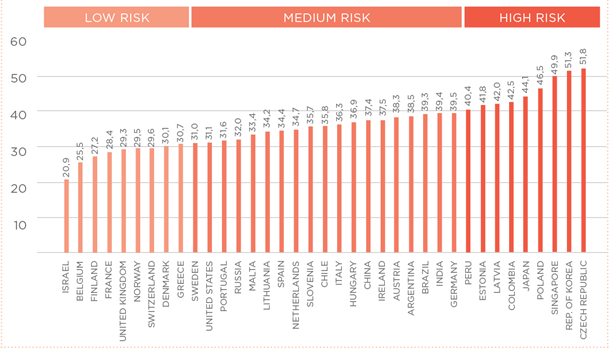
    Risk from automation for 37 selected countries (%)

    Automation risk

    Source: IDB

    Research by the IDB found that 36%-43% of jobs in Latin America could be lost as AI spreads across the continent, factoring in education levels, productive structures and the ratio of robots per industrial worker. According to the report, countries with greater inequality and lower GDP per capita are most at risk. As the graph shows, 42.5% of jobs in Colombia are at risk of automation, and the country is joined by Peru (40.4%) in the high-risk bracket. In the formal economy, Accenture has found that 27% of jobs require mainly routine tasks, and 40% require a moderate amount of routine work. On a national level, a 2017 report from consultancy firm McKinsey found that 52% of jobs in Mexico are vulnerable to automation, and the technology could encourage firms to re-shore manufacturing to the US as its decreasing costs negate the country’s low wage advantage. This means that a huge number of formal jobs are at risk, and these workers could be pushed into the informal economy if they do not ‘reskill’ using education and training programmes.

    As mentioned previously this will require wide-ranging reforms and increased spending, and some experts worry that governments will not be able to respond quickly enough. Researchers at the MIT Center for Digital Business claim that technology has the potential to destroy millions of jobs and worsen inequality if labour markets cannot find ways to work with AI rather than fighting against it. However, other experts such as Jacqueline Mazza warn against getting too carried away about the threat of automation. “There is a difference between automation affecting the job and automation completely replacing the worker,” she said, pointing out that the two sometimes get confused. “Robotics completely replacing the worker is in relatively narrow segments at this point, and even narrower in a place like Latin America.”

    Mazza agrees that certain jobs will change, and digital skills will be necessary for a larger range of jobs, but she suggests that Latin America will be able to deal with these developments. “It can adapt to most of the changes in automation and its impact on the market by the same human capital investments that are needed for growth,” said Mazza, which means retraining people to make the most of new technologies or emphasising skills which machines do not yet have, such as social and behavioural skills.

    Experts at the World Economic Forum have said that 65% of current primary school students will do jobs that do not yet exist. It is up to LAC governments to ensure that they get the education and training they need to take advantage of the digital dividend and prevent the labour market from being polarised as low-skilled workers are stuck with old technology and the highly-skilled monopolise the rewards. If not the existing skills gap, which Cisco estimates at almost 500,000 technological professionals in 2019, will expand, further impeding the adoption of digital technology in LAC countries. By 2025, that shortfall could reach 1.2m just for programmers, according to the company.

    The most important takeaway here is that the impact of new technologies will depend largely on the policies that govern them, according to the World Bank. Instead of restricting the spread of technology, governments should encourage the development of skills that will allow workers to benefit as equitably as possible from digital transformation. Whether they can do so relies on education and training systems that appreciate the new realities of the labour market.