All Categories

Subcategories

  • PARAGUAY: Tensions within ruling party start to boil over

    LatinNews 15 November 2018 Hits: 3897

    “Not much of a man.” This is how Paraguay’s President Mario Abdo Benítez described his predecessor, Horacio Cartes (2013-August 2018), after Cartes made some disparaging remarks about one of the female members in the entourage that accompanied Abdo Benítez to his official visit to the Vatican. Abdo Benítez’s reaction underlines just how tense relations between the leaders of the two main factions within the ruling Asociación Nacional Republicana-Partido Colorado (ANR-PC) have become. While Cartes may no longer hold a government post he retains considerable influence over some ANR-PC members and the confrontation could produce serious governability problems for the Abdo Benítez administration.

    President Abdo Benítez felt compelled to come out in defence of Marly Figueredo, the wife of ANR-PC Senator Rodolfo Friedmann, after Cartes joined a chorus of criticism that publicly complained about the inclusion of Figueredo, a former glamour model, in the official entourage that accompanied Abdo Benítez during his meeting with the Pope. Cartes said that Figueredo was not worthy of meeting the Pope and questioned why she was allowed to do so; he also agreed with other critics that far too much money was spent to pay for the travel and accommodation of Abdo Benítez’s needlessly large entourage.

    Upon his return to Paraguay on 8 November, Abdo Benítez touched on the criticisms while speaking to reporters. “I don’t know what Cartes has against women…[but] he shows that he is not much of man…by attacking a Paraguayan woman, the wife of a senator,” he said. But behind Abdo Benítez’s defence of Figueredo lie political undertones. Senator Friedmann is a long-time Cartes critic who had clashed with him while he was still in power (see sidebar). Abdo Benítez was probably more interested in backing his political ally Friedmann and taking a swipe at Cartes than standing up for Paraguayan women. This became clearer when, in his next breath, Abdo Benítez expressed his support for a request for the national government to intervene in the Ciudad del Este (CDE) municipal government.

    The CDE municipal government is run by the ANR-PC’s Sandra McLeod, the wife of ANR-PC Senator Javier Zacarías Irún, a Cartes ally. McLeod has long been accused of corruption and gross mismanagement of the municipal government, which has led the CDE legislative assembly to formally request an intervention, which must be approved by the national congress. But McLeod and Zacarías Irún, who also faces separate corruption accusations, have said that the move against McLeod is an attempted putsch by their political enemies, including ANR-PC factions aligned with Abdo Benítez that now control the CDE legislative assembly, and they have called on congress to reject the intervention request. This is now due to be debated on 27 November.

    • Friedmann

    Senator Friedmann became a sworn enemy of Horacio Cartes after he accused the then-president of being behind the attempts to oust him from his post of elected governor of Guairá department. The attempted ouster came in March 2017 when a group of critical ANR-PC Guairá legislators said that they had received Friedmann’s resignation letter and proclaimed a new governor, while Friedmann was on his honeymoon. Friedmann denied having resigned, saying that it was all a ruse promoted by Cartes in an effort to undermine him as he had become an increasingly vocal critic of his administration.
  • PERU: Mining conflicts take centre stage

    Patrick de Courcy 04 November 2021 Hits: 3977

    The last week has seen the intensification of three separate mining conflicts in Peru, with local communities stepping up their campaigns against the mining companies on their doorsteps. Anti-mining protests have gained momentum since community activists succeeded on 28 October in forcing the owners of the Las Bambas copper mine in the Apurímac region to begin paying royalties to the local community. Further protests at the Apumayo gold mine (Ayacucho), where equipment was set alight, and the Antamina copper and zinc mine (Ancash), where roadblocks forced the suspension of operations, have triggered alarm from the industry. President Pedro Castillo will now face pressure to come down in support of either demonstrators or the mining companies.

    The Las Bambas conflict, which has raged on and off since before operations began at the mine in 2015, epitomises the tensions in Peru between international mining companies and often impoverished local communities. Residents complain that the mine’s operator, the Chinese Minerals and Metals Group Ltd (MMG), has failed to fulfil its legal responsibilities to those resettled to make way for the mine. With MMG long insisting that it is only due to begin paying royalties after it has recovered its initial US$10bn investment in the mine, the lack of royalty payments to the local Cotabambas province has only intensified the discontent.

    Protests at Las Bambas again flared up in August but were temporarily abated following an intervention by then prime minister Guido Bellido, who established a timeline for negotiations between MMG and the local community. Those negotiations have since broken down, however, causing protesters to block access roads to the mine from 18-28 October. The disruption forced MMG back to the dialogue table and, following talks brokered by Prime Minister Mirtha Vásquez, the company agreed on 28 October to begin paying royalties to Cotabambas province from January 2022. The government, meanwhile, will oversee the improvements to healthcare and drinking water facilities that were also demanded by the demonstrators.

    That notable victory for the protesters at Las Bambas appears to have inspired an escalation of protests against two other major mining projects. The Apumayo gold mine, which local activists say is contaminating water sources, saw the more dramatic unrest. Some 500 activists invaded the mining complex on 30 October, setting fire to offices and 20 vehicles. Local media reported that 10 people were injured in the ensuing clashes with police.

    The next day, protesters succeeded in putting the operators of the Antamina copper and zinc mine on the back foot, with the mine’s operators being forced to suspend operations due to residents’ blockading of access roads for the previous six days. The Antamina company, which is part-owned by the Australia-headquartered Glencore and BHP, has long been accused by local residents of illegally occupying their territory and failing to comply with its social obligations. Residents of the nearby village of Aquia allege that the Antamina company has illegally built a road through their land and is using the village to dump waste material.  

    The roadblock succeeded in forcing Antamina to the negotiating table. Following a visit by a government delegation, Peru’s energy and mining ministry announced on 2 November that the blockade had been lifted in exchange for an ongoing dialogue process between activists, the government, and the mine’s operators. Those talks will begin on 5 November.

    The escalation of these mining conflicts has alarmed Peru’s main extractive industry lobby, the Sociedad Nacional de Minería, Petróleo y Energía (SNMPE), which on 31 October issued a statement warning of a “spiral of violence” faced by mining companies. Urging the government to intervene against protesters and clear roadblocks, the SNMPE warned that by impeding the work of mining companies protesters were jeopardising Peru’s economic recovery from the coronavirus (Covid-19) pandemic.

    However, it is far from certain that the Castillo administration will heed the SNMPE’s call and launch a crackdown against protesters, as former president Ollanta Humala (2011-2016) did with lethal consequences at Las Bambas in 2015 [WR-15-39]. In his 28 July inauguration speech Castillo stated that the extractive sector should be built around “social profitability” and that “every project must contribute to dynamising the local, regional and national economy” [WR-21-30]. With mining conflicts once again in the spotlight, he will face pressure from his base to deliver on his promise and support local communities that feel their livelihoods have been worsened, rather than improved, by the mining sector.

    Responding to the SNMPE’s complaints, Vásquez warned the lobby group “not to depict [protesters] as violent or misled” and said that “we need to understand the frustrations of those who have felt the lack of protection offered by the state, and the brushing aside of their demands by mining companies”.

    Interior minister resigns

    Interior Minister Luis Barranzuela resigned on 2 November after being accused of breaking coronavirus (Covid-19) regulations promoted by his own ministry. Local media released footage of a group of people arriving at his house for a party on 31 October, despite the interior ministry having last week warned that Halloween parties were forbidden due to the ongoing pandemic. Barranzuela claims that the group had in fact gathered for security discussions relating to “conflicts in Peru’s interior”. Perú Libre deputy Guillermo Bermejo, who was among those attending, claimed that loud music was in fact coming from the house next door. These explanations did not convince Prime Minister Mirtha Vásquez, who appears to have pushed for Barranzuela’s resignation. No replacement for him has yet been named.

  • NICARAGUA: Ortega sets off alarm bells

    LatinNews 02 May 2012 Hits: 2555

    Nicaragua’s legislature has finally begun the process of electing top officials who, despite the expiry of their mandates, have remained in their posts due to a decree issued by President Daniel Ortega in January 2010 [RC-10-01].  Long a demand of civil society groups and the opposition, the move represents a step towards restoring credibility to the country’s institutions. It did, however, coincide with two new initiatives unveiled by Ortega, which are likely to take effect ahead of the 4 November 2012 municipal vote – one introducing new electoral rules and the other changing the structure of local government. The latter in particular has triggered fresh concerns that Ortega is seeking to strengthen his grip at the local level.

    Congress’s leader and deputy for the ruling Frente Sandinista de Liberación Nacional (FSLN), René Núñez, announced that on 17 April the legislature officially called the election for 23 top public officials whose terms had run out. The January 2010 decree enabling the officials to remain in their positions was widely seen as an attempt by Ortega at circumventing the 92-seat unicameral legislature, which is constitutionally mandated to make the appointments. At the time he lacked a majority – and the necessary support to approve his choices - although this situation has now changed as a result of the November 2011 general election, which saw the FSLN win 62 seats. Up for election are: four supreme justice court (CSJ) magistrates and 16 associate CSJ judges; the banking superintendent; and the attorney general and assistant attorney general. Under the constitution (Art. 138), once the election has been called, the President and deputies have 15 days to submit their choices of candidates to a special seven-member legislative committee, which will interview them. The list then goes to congress, where a minimum of 56 votes is necessary for approval.

    While the move was hailed as a step forward, it is worth noting that some officials continue in their posts beyond their legal mandates - notably the head of the supreme electoral court (CSE), Roberto Rivas. A close Ortega ally, Rivas’s behaviour during last November’s elections attracted considerable criticism from the European Union (EU)’s and the Organization of American States (OAS)’s electoral observer delegations. His continuance in the post is likely to generate concerns given the upcoming municipal vote.

    Just over a week after the legislature announced the start of the appointment process to pick the new officials, Ortega revealed he had sent initiatives to congress – where his majority should ensure a smooth passage – that will likely take effect ahead of the municipal vote. One proposal, an electoral reform bill, is being spun by the government as an attempt to address the concerns raised by the international community and local civil society groups in relation to the last election. Among the few details revealed, it includes provisions for improving the system for issuing cédulas (national identity cards) and ensuring the representation in voting centres of electoral officials from all parties – both issues attracted major complaints during the last electoral process. The other – a proposal to triple the number of local councillors - has attracted particular concern. Citing the need to boost “direct democracy”, the first lady and official government spokesperson, Rosario Murillo, explained that the initiative increases the number of councillors from the current 2,178 to 6,534 across the country’s 153 municipalities. The allusion to “direct democracy”, however, set off alarm bells among civil society groups: it was the justification for the establishment of the citizen power councils (CPCs), the flagship project of Ortega’s previous administration (2007-2012). With the CPCs having become an extension of the executive in November 2007 by presidential decree, civil society groups have long complained that they serve as little more than a continuation of the FSLN party structure. With local experts questioning the technical basis for increasing the size of local government and warning that it could lead to confusion ahead of the next vote, on a practical level, local councillors have raised concerns over the lack of additional funds assigned to account for the changes, warning that this would mean cuts in other areas, such as social spending.

    Ortega remains popular

    A survey last month by Nicaraguan pollster M&R Consultores (M&R), published in the national daily El Nuevo Diario, shows that, despite the doubts over the legitimacy of Ortega’s new government, given the illegal nature of his candidacy and allegations of electoral fraud, his popularity continues to rise. This has been attributed to the continued improvement of the economy (which grew 4.7% in 2011, second only to Panama in the region); the continued fragmentation of the opposition; and the government’s relative ability to keep a lid on insecurity (see backpage).

    According to the poll, which interviewed 1,600 people nationwide, 67% of respondents believe that the country is heading in the right direction; 63.4% perceive Ortega to be “democratic” and upholding the rule of law; while 68.6% believe Nicaragua is better off today than in 2007, when his FSLN took office.

    The M&R survey also showed the continued lack of confidence in the opposition, which ultimately was neither able to challenge Ortega’s candidacy nor further its complaints of electoral fraud. According to the poll, 64.7% of respondents do not consider the political opposition as an “option or hope for democracy in Nicaragua”. Just 9.1% aligned themselves with the opposition, of which 4.8% named the Partido Liberal Independiente (PLI), which took 31% of the vote in the November general election, and 3.9% the Partido Liberal Constitucionalista (PLC) of former President Arnoldo Alemán (1997-2002), which won 5.9% of the vote. Meanwhile, 49.7% of respondents cited a preference for the FSLN. While this is less than the 62% that saw Ortega re-elected, it is more than the third of the population that traditionally forms the core Sandinista vote.

    • 50-50 law

    In March, Nicaragua’s legislature passed ‘Ley 40’ – the so-called 50-50 law - which establishes that lists of local government candidates must include an equal number of men and women. That such rules are necessary is suggested by the fact that just 7% of Nicaragua’s mayors are female (below the 10% average for Latin America). This rises to 24% in the case of councillors, higher than the 22% regional average. Yet the move was questioned by local NGOs working on democracy and women’s groups. The former warned that the rules remain vague and could cause confusion ahead of the November municipal vote. The latter remain deeply suspicious of Ortega’s gestures toward gender equity given his refusal to repeal the 2006 blanket ban on abortion – which he was instrumental in getting approved.

  • RASTREANDO TENDENCIAS

    LatinNews 22 July 2013 Hits: 896

    ARGENTINA | Buscando inversionistas en energía. En un mayor giro de política, el 15 de julio, Argentina anunció un número de incentivos para alentar a las compañías extranjeras de energía a invertir en el país. Las compañías deseosas de invertir US$1mm durante un periodo de cinco años, podrían vender el 20% de su producción en los mercados internacionales sin pagar impuestos a la exportación, y podrán mantener los ingresos de exportación del 20% de la producción fuera de Argentina.

         Las compañías petroleras que se beneficien de las nuevas regulaciones podrán renovar sus concesiones por un periodo de 25 años. Argentina ha estado en dificultades para atraer inversiones en energía desde que nacionalizó el 51% de participación en YPF de Repsol S.A. de España –sin pagar compensación– en abril del 2012.

    ARGENTINA-BRASIL | Seguridades sobre renovación de pacto automotor. Marco Aurélio García, asesor presidencial especial de Brasil sobre asuntos extranjeros, dijo el 16 de julio a los medios de Argentina, que el recientemente expirado pacto bilateral [IL-13-26] cubriendo el comercio del sector automotriz entre las dos más grandes economías de Sudamérica sería extendido, dado que es “clave para ambos países”. De acuerdo con García, que ha sido el más alto asesor en asuntos exteriores del gobierno brasileño desde que el izquierdista Partido dos Trabalhadores (PT) llegó por primera vez al poder en el 2003 bajo el ex presidente Lula da Silva (2003-2010), las dos partes no lograron producir un acuerdo sobre el pacto antes de expirar a finales del mes pasado, pero que el gobierno brasileño liderado por la Presidenta Dilma Rousseff estaba preparada para continuar negociando la cuestión.

         Los comentarios de García contradicen lo que se ha venido informando en los medios de ambos países –que las negociaciones entre los socios del Mercado Común del Sur (Mercosur) habían fracasado debido a que los negociadores brasileños perdieron la paciencia con las incrementadas exigencias hechas por sus contrapartes argentinos, lo que los llevó a decidir dejar que el pacto expire y así liberalizar efectivamente el comercio en el sector.

         Comentando acerca de las negociaciones, García reconoció que existe una cuestión que había que resolver y que no concierne al comercio de vehículos en sí mismos, sino en las partes de automotores. En general, Brasil tiene una balanza comercial positiva en el comercio del sector automotor con Argentina, y mientras Argentina reconoce que ya no puede competir cuando se trata de la producción de vehículos con su socio más industrializado, sin embargo, desea compensar esto incrementando el nivel de autopartes que exporta a Brasil. De acuerdo con García, el problema en el subsector de autopartes es el hecho que la mayoría del mercado está “en las manos de las multinacionales” y que eso necesita ser abordado a fin de estimular la producción en el subsector ya sea en Argentina o en Brasil.

         García continuó diciendo que los dos países necesitan continuar trabajando juntos a fin de desarrollar una integración mayor en el sector, para hacerlo más competitivo. Sin embargo, los periodistas preguntaron a García si se podría lograr una mayor integración económica con un país como Argentina, que impone arbitrariamente barreras al comercio para proteger su balanza de pagos. García respondió: “Si la economía decae, usted puede entender la reacción de Argentina […] lo que ha pasado es que ambos países están produciendo menos. Ambos países están creciendo poco. La solución es reanudar el crecimiento [económico]”.

    URUGUAY | El ministerio de turismo en un gran esfuerzo de marketing. La ministra de turismo, Liliam Kechichián, está aprovechando la ventaja de la reanudación de los vuelos directos entre Montevideo y París por Air France en abril pasado, después de una ausencia de 12 años, para lanzar una gran campaña de marketing en la revista de a bordo de la compañía durante julio y agosto. La portada de la revista reproduce una playa en el lujoso sitio turístico en la ciudad de Punta del Este, con un largo artículo dentro, describiendo otras grandes atracciones turísticas nacionales.

    Kechichián dijo que alrededor de 500.000 ejemplares de la revista serán puestos a bordo de los 1.600 vuelos diarios de Air France siendo uno de los principales objetivos de la campaña de marketing llegar a China: la aerolínea tiene numerosos vuelos a Shangai y Beijing  para proveer “la conectividad” de la que carece Uruguay, dijo Kechichián, especialmente después de la quiebra de la aerolínea nacional, Pluna.

         Air France también tendrá copias de la recientemente publicada Guía de los festivales nacionales de Uruguay y las celebraciones tradicionales diseñada para destacar la diversidad del país (ver abajo). La Guía, producida por los ministerios de turismo, educación, y cultura, estarán disponibles en las oficinas nacionales de turismo y pronto en las librerías.

         El turismo en Uruguay genera unos US$2mm por año, o 7% del PIB.

    • Festividades uruguayas

    La recientemente publicada Guía de los festivales nacionales de Uruguay incluye tradiciones de origen suizo celebradas en el área sudeste de Nueva Helvecia; de origen italiano, un peregrinaje y celebraciones en Florida, al norte de la capital, en honor del Santo italiano San Cono cada 3 de junio; y de origen español, la danza de San Juan en Montevideo. Sin embargo, el festival más popular, es comparativamente moderno: la Noche de la Nostalgia, el 24 de agosto, cuando cientos de miles de uruguayos celebran música de los años 60, 70, y 80 en bares y discotecas. La Guía contiene 104 festivales y tradiciones de los 19 departamentos del país.

  • ARGENTINA: Putin and Pope to host Fernández on final trips

    LatinNews 09 April 2015 Hits: 977

    Though this week’s Summit of the Americas in Panama may give President Cristina Fernández the opportunity to build some bridges with her partners in both South and North America, her final trips as head of state demonstrate to a degree the isolated situation in which Argentina now finds itself after 12 years of Kirchnerismo. In late April, Fernández is to visit Russia for a bilateral meeting with President Vladimir Putin. At present, her final trip abroad as president will be to the Vatican to meet Pope Francis, in June. It will be her fifth visit to see the Argentine pontiff.

    President Putin visited Argentina last July; partly it seems to thank President Fernández for her supportive comments over Russia’s actions in the Crimea. In March, Fernández accused the United Kingdom and others of hypocrisy for endorsing the results of the referendum in the Falkland Islands/Malvinas (which showed that 99.8% voted to support their status as a British Overseas Territory); while rejecting out of hand a vote which showed a similarly overwhelming majority, some 96.7% of voters in the Crimea, supporting union with Russia.


    According to the Argentine foreign ministry, the purpose of Fernández’s visit is to take part in a Russo-Argentine business forum and promote bilateral trade. According to Clarín, the presidential visit hopes to sign infrastructure agreements worth over US$10bn which will go towards the construction of a nuclear power plant and a dam. Over recent years, Fernández’s government has preferred to deal with the non-Western governments of China and Russia as relations with Argentina’s more traditional allies have deteriorated.

    The last visit by a senior US official was in 2010, when Hillary Clinton travelled to Buenos Aires as Secretary of State. Since then, President Barack Obama has not been inclined to offer Fernández a return invitation. Relations with the US are at a low ebb at the moment due to the Argentine government’s handling of its dispute with holdout bondholders, many of whom are based in the US. US District Judge Thomas Griesa, who is presiding over the case, is also something of a bête noire for the administration.

    Despite Argentina’s strong European ancestry, no Italian president or head of government has visited in the last 12 years; similarly, the last senior Spanish representative was then-Prince, now-King Felipe VI’s attendance at Fernández’s second inauguration in 2011.

    Now it is China that will invest in two nuclear power plants in the country, and Russia a third. China is making massive investments in Argentina at present, helping to stabilise the peso with a currency swap to help the South American country shore up its dwindling foreign reserves. It is also helping to build up Argentina’s railway infrastructure. When Fernández visited Beijing in February, she signed 15 agreements with Chinese President Xi Jinping covering travel visas, information technology, media, energy and space technology.

    A recent essay by the columnist Joaquin Morales Solá argues that Argentina’s foreign policy appears to be motivated by a “nostalgia for the seventies when China and Russia were the strongholds of the international left”. Solá also argues that Argentina’s “exceptionalism” often leaves it isolated and untrusted even among its immediate Latin American neighbours. “Only domestic policy needs and her personal destiny can help explain Cristina Fernández’s foreign policy. With [Venezuela’s Hugo] Chávez dead and Fidel Castro at the end of his life, perhaps the Argentine president can imagine she will become the next reference point for Latin America’s left. The size of her ambitions have always been proportional to her failures,” he concluded.

    • Re-election?

    Speaking seemingly in jest on 8 April, President Fernández said that she hoped she would not feel obliged to seek the presidency again in 2019. “After me [I hope] someone will come who will continue doing more and better things and therefore you won’t need me in 2019. That’s the country I want,” she said.

  • COSTA RICA: Solís's visit to Guatemala brightens Sica’s outlook

    LatinNews 09 March 2016 Hits: 734

    Costa Rica’s President Luis Guillermo Solís arrived in Guatemala on 18 February for a three-day state visit with his Guatemalan peer, Jimmy Morales. Solís is the first head of state to visit Morales since he assumed the presidency on 14 January (see back page). His decision to visit Guatemala was significant as, on 18 December, he suspended Costa Rica’s participation in political consultations of the Central American integration system (Sica) after Belize, Guatemala, and Nicaragua refused to allow Cuban migrants stranded in Costa Rica to transit through their respective countries en route to the US. Solís also blamed a lack of reforms on issues such as financial transparency for his country’s suspended participation.

    In a speech at the Universidad de San Carlos in Guatemala City, President Solís said Sica’s member countries have a “unique opportunity” to “change direction” in the process of regional integration, but noted that the sub-region is in a “regressive phase” and is “no closer to integration than it was 15 years ago”. Solís argued that the sub-region should focus more resources on the most “urgent” problems including climate change and environmental disasters, pandemics, organised crime, and terrorism. He said that Sica must regain an “effective spirit” which “responds to the needs of our people and their aspirations for unity”. In more concrete terms, Solís said that Sica members should provide the secretary general with a “double commitment” - special political authority and reinforcement of special funding - in order to realise systemic reform, and argued that Guatemala and Costa Rica should serve as “motors” for this regional development. For his part, President Morales underlined the countries’ mutual interest in continuing dialogue regarding Sica integration and proclaimed that the Guatemalan people “want, respect, and admire” regional cooperation.

    In addition to political discussions on Sica, Solís’ visit was also significant for bilateral economic integration. Solís visited Guatemala along with a trade delegation headed by representatives of Costa Rica’s foreign trade promotion office (Procomer) and the international trade minister, Alexander Mora, who met employees of Guatemala’s coordinating committee of agriculture, trade, industry, and finance (Cacif). The trade mission had more than 60 meetings with Guatemalan importers in which it discussed trade logistics, as well as import opportunities for a wide variety of Costa Rican products, from biodegradable cleaning products to broadband internet services. Bilateral trade approached US$1bn in 2015, almost half of Central America’s total trade volume. Of this, Costa Rican exports to Guatemala amounted to US$540m, while Guatemala sent US$366m of exports back the other way. In the services sector, the two countries generate more than 70% of Central America’s export value.

    In terms of transport, Solís indicated possibilities for improving links between Costa Rica and Guatemala. Costa Rica and El Salvador are soon to open a ferry to reduce export and import costs, which Solís noted could serve as a model for better transport links with Guatemala. According to the Costa Rican government, the ferry to El Salvador will have the capacity to transport up to 100 trucks per day, three times per week, which will reduce the cost per truck from US$1500 to US$700.

    Migrant programme updates
    During Solís’ visit, the touchy subject of migration remained conspicuously off the bilateral agenda. On 12 January, Mexico, Costa Rica, and other Sica representatives launched a migrant relocation programme for Cubans stranded in Costa Rica, which coordinated flights to El Salvador, followed by a bus transfer to Mexico. On 22 February, the Costa Rican president’s office released an update on the programme which stated that a total of 11 flights carrying 1659 migrants had been completed and noted that the government expected approximately 770 more people to be transported between 26 and 30 February, to reach a total of 2500 migrants. These most recent flights have landed in El Salvador and in Nuevo Laredo, Mexico, which is located 10km from the US border.

    • Boost for Morales

    President Morales, a candidate distant from Guatemala’s discredited political establishment and elected on an anti-corruption pledge, has much to gain from the positive endorsements of regional counterparts. During his visit, President Solís called Guatemala “the older sister of Central America” and a “landmark” of democracy and anti-corruption in the sub-region, lauding the United Nations (UN)-backed International Commission against Impunity in Guatemala (Cicig). These statements come as rookie president Morales seeks to prove his anti-corruption credentials to the Guatemalan public.

  • PARAGUAY: Opposition spoils re-election hopes for Cartes

    LatinNews 01 September 2016 Hits: 634

    The political opponents of Paraguay’s President Horacio Cartes have orchestrated a masterstroke in the national congress designed to scupper any hopes he and his supporters held of amending the constitution to allow him to seek re-election in 2018. In an unexpected move opposition legislators decided to present and swiftly defeat a constitutional amendment proposal to introduce presidential re-election in the senate. Under congressional rules, no new such proposal can be put to the legislature for the next 12 months. Opponents of Cartes believe that the move makes it virtually impossible for any such constitutional change to be approved and put into effect before the 2018 general elections.

    Paraguay’s 1992 constitution sets a five-year presidential term and prohibits presidential re-election under all circumstances. This provision was included in the constitution drafted following the 1989 ouster of the dictator General Alfredo Stroessner (1954-1989) as a way of preventing presidents from perpetuating themselves in power as Stroessner was able to do for so many years through rigged elections. At the time Paraguay’s entire political class, including the traditional Asociación Nacional Republicana-Partido Colorado (ANR-PC), which Stroessner had adopted, agreed that this provision was a necessary safeguard for democracy in the country.

    This position remained largely unchanged for decades until the idea of presidential re-election was floated by former president Fernando Lugo (2008-2012), who now leads the Frente Guasú (FG) leftist opposition coalition. Both the ANR-PC and the country’s other traditional party, the Partido Liberal Radical Auténtico (PLRA), were staunchly opposed to the idea and refused to contemplate discussing it in congress during Lugo’s term. However, things appeared to change for a faction of the ANR-PC after Cartes returned the party to power in 2013. By 2014 supporters of Cartes within the ANR-PC began floating the idea of allowing presidential re-election so that he could seek to remain in power in 2018.

    Opposing re-election

    But introducing presidential re-election continues to be resisted not just by most in the PLRA but also by the many detractors of Cartes within the ANR-PC. They all agree that while a debate on the issue is valid, this is not a priority and that, in any event, Cartes should not be able to benefit from re-election. With supporters of Cartes, including government officials, continuing to demand a re-election debate and elections looming closer, the opposition moved decisively on this front on 25 August.

    During the senate’s ordinary session, a group of opposition and dissident ANR-PC senators requested that the new senate president, the PLRA’s Robert Acevedo, extend the session to discuss a proposal to introduce presidential re-election via a constitutional amendment (a separate but similar proposal has also been presented by supporters of Cartes in the lower chamber).

    Acevedo duly obliged and the proposal was immediately defeated by 23 votes in the 45-seat chamber. The PLRA, FG, and dissident ANR-PC benches voted as a block against their own proposal, which was backed by the main ANR-PC bench. The result was celebrated by the opposition and ANR-PC dissidents, who quickly pointed out that it rules out the possibility of amending the constitution via this pathway until August 2017. The implication of this is that the chance of introducing presidential re-election before the 2018 general elections is now minimal.

    Untempting final option

    The only ostensible option open to supporters of Cartes now is to introduce this change by convening a constituent assembly to draft a new constitution. Yet this is a drastic measure that also requires the support of the opposition in congress. In addition, the prospect of convening a constituent assembly is risky as it opens the door for all kinds of changes to be introduced, providing the opposition (and in particular the Left, which has long-called for the drafting of a new constitution) with an opportunity to push its own demands, of which the ANR-PC would be very wary.

    • Mexico visit

    President Cartes embarked on a five-day official visit to Mexico on 25 August. Paraguay’s foreign ministry said that the visit, the first by a Paraguayan head of state to Mexico in eight years, would serve to boost bilateral trade relations. During the visit Cartes and President Enrique Peña Nieto oversaw the signing of 12 bilateral cooperation agreements in the areas of labour and social security rights, tourism, diplomacy, natural disaster management, and bilateral trade promotion. Improving trade relations with Mexico is part of the Cartes government’s efforts for Paraguay, a member of the Southern Common Market (Mercosur) trade bloc, to forge closer links with the Pacific Alliance trade bloc, of which Mexico is a member, and to sign a free trade agreement with Mexico. 

  • Guyana: ICJ looking at question of jurisdiction

    LatinNews 25 July 2018 Hits: 593

    On 30 January this year, UN Secretary-General Antonio Guterres referred the territorial dispute between Guyana and Venezuela to the International Court of Justice (ICJ). On 30 March, the Venezuelan foreign ministry issued a statement saying that resorting to a judicial settlement was “unacceptable”. Then, on 18 June, Venezuela announced that it would not participate in the ICJ hearings because the court “manifestly lacks jurisdiction”. Now, on 2 July, the ICJ has accepted that it first needs to resolve the question of jurisdiction before proceeding with the substance of the matter. It has given Guyana until 19 November to submit its case on this point, and Venezuela until 18 April 2019 to respond.

    The territorial dispute was meant to have been resolved by the Arbitral Award of 1899, with a final map agreed by both sides in 1905. However, Venezuela resuscitated its claim to all the land west of the Essequibo River (two-thirds of Guyana’s territory) in 1962 in the lead-up to Guyana’s independence. The claim has now taken on added significance because of the discovery of large amounts of oil in waters adjacent to the disputed territory.

    There appears to be a certain amount of nervousness in Guyana as a result of the latest development. This is partly because of the understanding that these disputes are – as one border expert put it to us – “never settled without a fuss”. But there also appears to be some concern about the jurisdiction question. The optimists are saying that this is just a question of the ICJ ‘dotting the i’s and crossing the t’s”. Others, however, are not so sure. One source close to the foreign ministry has said, for instance, that it is thought that the 1996 Geneva Agreement was never registered with the ICJ and that this might impact on the question of jurisdiction.

    Clearly Guyana’s overwhelming interest is in a definitive ruling in its favour. The downsides of not achieving such an outcome should, however, be limited. There are at least three reasons for this assessment.

    The first relates to Venezuela itself. Well-placed observers in Caracas point out that Venezuela’s primary interest is not – as might be supposed – regaining ‘lost’ territory but in avoiding a definitive decision going against it. It is happy to keep the issue unresolved. The second important point is that the dispute does not seem to be impeding in any way Guyana’s development of its newly found offshore oil resources. And the third is that Guyana has strong support from the two key regional powers: the United States and Brazil.

    One of the motives for giving so many exploration blocks to ExxonMobil was for the very purpose of ensuring US support against any Venezuelan adventurism. This was made clear by Minister for Natural Resources Raphael Trotman on 3 April when he said: “We sought to give Exxon an area of land that touched the two boundary lines of the nation, and that was strategic.”

    Support for Guyana from Brazil is seen to be equally as important, and this was reinforced in mid-July by a visit to Guyana by Brazil’s Minister of Foreign Affairs Aloysio Nunes Ferreira. Speaking straight after welcoming his visitor to State House, President David Granger put great emphasis on this point, saying: “Brazil is the largest state on the continent of South America, and from the start of the controversy Brazil has made it clear that it had no interest in redrawing the borders with any state. Brazil has borders with every state on the continent except two, so once people start tinkering with borders it will be an enormous headache for Brazil.”

    Granger went on to say: “Brazil put its foot down from the start, and I think that was an important factor in convincing our neighbours that there will be no land grabbing on this continent. So, we are very grateful to Brazil…[for] taking a principled position [which] has never varied. They have been a guarantor of Guyana’s territorial integrity.”

    Of course, it is not just the principle of the inviolability of existing borders that is motivating Brazil to be friendly towards Guyana. There are commercial motives as well, and Brazil’s foreign minister was accompanied on his July visit to Guyana by investors hoping to cash in on Guyana’s forthcoming oil bonanza.

    Guyana’s Minister of State Joseph Harmon welcomed the Brazilian delegation effusively, saying: “It is a very important time in our development and in our history and so we really welcome the investments and opportunities between Guyana and Brazil. These opportunities are now increasing on a daily basis…. Our physical infrastructure is key because we cannot develop our country unless our physical infrastructure is organised. That means our ports have to be modernised [and] our road network that links the coast to the hinterland will have to be modernised.”

  • GUYANA: Government makes most of oil boom to ease cost of living

    Sarah Sheldon 17 October 2022 Hits: 542

    Guyana’s GDP is forecast by the International Monetary Fund (IMF) to grow by 57.8% in 2022, and the government is making the most of this enviable oil-boom driven performance to ease the cost-of-living crisis without incurring any serious fiscal damage. On 1 October, the government announced that it was moving to reduce the price of petrol by 20% and the price of diesel by 15%. Announcing the move, the finance ministry was not shy in making a political point out of its economic good fortune, saying: “Since resuming office in August 2020, the PPP/C [People’s Progressive Party/Civic] government has implemented a suite of measures to ease the cost-of-living pressures and to improve disposable incomes, in an ongoing effort to address these head-on and to mitigate the effects of rising prices globally on all Guyanese citizens.”

    The extent of Guyana’s good fortune was emphasised in the latest IMF Article IV Consultation, the preliminary results of which were released on 27 September. The IMF reports that oil GDP is expected to grow by over 100% in 2022 and then by an average annual rate of around 30% for the years 2023-26. Overall GDP, following its 57.8% advance this year, is then expected to grow by an average of 25% per annum for 2023-26. And the all-important GDP per capita, following an advance of 57.3% this year, will grow by an average of only just under 25% over the same period. All the while public-sector debt will continue to reduce from a high of 42.9% in 2021 to just 13.7% in 2026.

    Guyana: Selected Economic Indicators

      Prel. Proj.          
      2021 2022 2023 2024 2025 2026 2027
    Production and Prices (Annual percent change)
    Real GDP 23.9 57.8 25.2 21.2 28.2 25.5 3.3
    Real Non-Oil GDP 4.6 7.2 5 5.1 5.2 5.2 5.2
    Real Oil GDP 56.9 116.1 36.8 28.3 36.5 31.1 2.9
    Real GDP per capita 23.4 57.3 24.8 20.9 27.9 25.1 3
    Consumer prices (average) 3.3 7.6 7.6 5 3.8 3.5 3.5
    Consumer prices (end of period) 5.7 9.4 6 4.1 3.5 3.5 3.5
    Terms of trade 13 20.9 -5.5 0.7 -0.3 0.3 1.3

    Sources: Guyanese authorities; UNDP Human Development Report; World Bank; and IMF.

    In its preliminary report on the Article IV Consultation, the IMF notes that Guyana’s commercially recoverable oil reserves are expected to reach over 11bn barrels, “one of the highest levels per capita in the world” (Guyana has a population of 789,000). For the IMF, the imperative now is to “address development needs and build substantial buffers to absorb shocks”. The lender urges “prudent policies and structural reforms” in order to avoid any build-up of “macroeconomic vulnerabilities” and in order to ensure “inclusive growth and intergenerational equity”.

    This question of “inclusive growth” is something that is continuing to exercise the opposition A Partnership for National Unity-Alliance for Change (Apnu-AFC). Opposition leader Aubrey Norton made his point publicly and forcibly when refusing to shake President Irfaan Ali’s hand during the 1 August Emancipation Day celebrations. He said: “I do not shake hands with my oppressors”. Norton went on to accuse the government of starving opposition-supporting communities of resources and discriminating in the distribution of coronavirus (Covid-19) related cash grants, in the dispensation of justice, and by withdrawing financial support. Norton said of the PPP/C government: “Your hands are dirty. They have on them discrimination against us. Your hands have on them the protection of people who are killing people extrajudicially. For what reason must I touch hands? I will not.”A regularly heard complaint from the opposition is that the mostly East Indian supported PPP/C is shutting the opposition’s Afro-Guyanese supporters out of participation in the oil boom.

    Meanwhile, the government is holding its line against pressure to renegotiate the Production Sharing Agreement (PSA) with US oil giant ExxonMobil. On 18 September, the ministry of natural resources issued a statement saying: “The government reiterates that the contract will remain fiscally unchanged for the country and investors’ benefit.” However, it did take the opportunity to emphasise that the existing PSA will not be applied to other blocks for production or exploration. It said: “This includes the upcoming competitive bidding round that the government intends to host in the last quarter of this year and other commercially viable discoveries that will be made in other oil blocks. The 2016 model or any previous PSA will not be applied to any other oil block where a discovery has been made.”

  • HAITI: Plunging further into the constitutional abyss

    Patrick de Courcy 19 January 2023 Hits: 4737

    Following successive failed attempts at holding new elections, Haiti is now left with no democratically elected legislative officials after the terms of its last remaining 10 senators lapsed on 10 January. Prime Minister Ariel Henry, who took up the post unelected soon after the July 2021 assassination of former president Jovenel Moïse (2017-2021), has no democratic mandate. There is no functioning supreme court and the terms of local government officials have also expired. This plunges the country further into a constitutional void, which gangs continue to exploit. Insecurity is at a record high. The United Nations (UN) warned in October that hunger had reached “a catastrophic level”, with a record 4.7m people in Haiti (pop.11.7m) facing acute hunger. Cholera is also rampant.

    The expiry of the terms of the remaining 10 senators came two years after the mandates of the entire 119-member lower chamber and two-thirds of the senate lapsed. With resistance having already emerged to Henry’s recent pledge to establish a high transition council (HCT), tasked with ensuring that conditions are in place for elections and a return to the constitutional order [WR-23-01], the prospects for elections this year appear dim.

    The international community, which is considering the possibility of sending an international security deployment at Henry’s behest, continues to respond to the worsening crisis with more equipment for Haiti’s police (PNd’H) and with sanctions, in line with an October 2022 UN Security Council resolution targeting gangs and their backers [WR-22-41].

    • Lambert escapes assassination attempt

    On 8 January, now former senate president Joseph Lambert, whose term lapsed on 10 January, was seriously injured after heavily armed individuals opened fire on the vehicle in which he was travelling in the capital, Port-au-Prince. Lambert was sanctioned by the US in November 2022 for alleged involvement in drug trafficking, corruption, and human rights violations.

    In the latest example of this, on 13 January Canada announced new sanctions targeting two members of the political and economic elite: Charles Saint-Rémy, a businessman and associate of former president Michel Martelly (2011-2016), already sanctioned by Canada and the US, and former member of parliament Arnel Bélizaire (2011-2015). The sanctions, which bring to 15 the total number of Haitians sanctioned by Canada since November including former prime ministers Laurent Lamothe (2012-2014) and Jean-Henry Céant (2018-2019), impose a dealings prohibition, effectively freezing any assets they may hold in Canada and barring them from entering the country.

    Police assistance

    On 11 January Canada’s foreign ministry announced that a Canadian military aircraft arrived in Port-au-Prince airlifting Haitian-purchased armoured vehicles to Haiti to support the efforts of the national police (PNd’H).

    This is the second time that Canada has airlifted Haitian-purchased vehicles to Haiti; in October, in partnership with the US armed forces, Canada airlifted a commercial delivery of armoured vehicles to Haiti.

  • BRAZIL: Keeping on top of it

    LatinNews 22 July 2011 Hits: 1721

    For all the dramatic talk of a simmering crisis in store for Brazil’s economic miracle, there is not much evidence of it to be found in official statistics.

    As expected, the central bank (BCB)’s monetary policy committee (Copom) this week voted unanimously to raise the benchmark Selic interest rate by 25 basis points to 12.5%, with a neutral bias, its fifth straight increase. The brief Copom statement suggests that the BCB may take a wait-and-see attitude from August, with one eye on domestic demand and the other on the evolving debt crises in the Euro zone and the US.

    Consumer price inflation is slowing, coming in below expectations at 0.10% in mid-July, the slowest pace in 11 months, amid lower food and fuel prices. The annualised rate was still above the 6.5% target ceiling at 6.75%, but the BCB president, Alexandre Tombini, insists that inflation will fall from August. In the BCB’s latest (15 July) ‘Focus Report’ of local economists, inflation expectations for 2011 were stable at 6.31%. The consensus for 2012 rose to 5.2%.

    The strong Real has helped counteract inflation but wage pressures remain to the fore in a very tight labour market. The official unemployment rate in the six main metropolitan areas was just 6.2% in June, down from 6.4% in May, according to the national statistics institute (Ibge), and the lowest rate for the month since 2001. End-year unemployment could be back at December 2010 levels (5.3%). In the 12 months to June 2011, 172,000 work seekers found jobs. More importantly, given the number of new entrants onto the labour market, 512,000 new jobs were created in the same period. Given that the economy is slowing, its continuing capacity to generate jobs is impressive. This is in stark comparison to the US, where since March 2011 (non-farm) unemployment has risen by 545,000, according to the US Bureau of Labor Statistics. Brazilian wages are still rising. Average salaries reached R$1,578 (US$1,000) a month in June.

    The authorities are trying to engineer a soft landing, but it’s not easy. Total outstanding credit grew 20% year-on-year in May to R$1.8trn (US$1.15trn), led by a 50% increase in mortgage lending.  In June, the BCB raised its forecast for credit growth to 15% in 2011, up from 13% previously. It recently tightened rules on credit card consumer loans backed by wages and pensions. Payroll-deductible loans have grown rapidly. On some estimates, households are now spending a record 24% of their disposable income on non-mortgage debt-servicing. Including mortgages, it may be as high as 40%. The average loan default rate remained unchanged at 5.1% in May (from April). Total credit will reach about 48% of GDP this year, on BCB forecasts.

    The Real, which hit its strongest level against the US dollar since 1999 earlier this month, was trading  slightly weaker at R$1.57/US$ on 20 July. So far this year the Real has appreciated by 6.2% against the dollar. The prospect of more quantitative easing in the US will complicate life further for Brazilian policymakers. Tombini has appeared to warn local companies to be prepared for a change in policy. His comments seem to point towards efforts to deter foreign companies from pushing the exchange rate up further. Tombini recalled that when the global financial crisis caused the Real to temporarily depreciate in late 2008 and 2009, many Brazilian firms experienced cash flow problems, as having previously taken advantage of the strong Real to borrow heavily in dollars.

    The BCB is intervening heavily and has spent over US$330bn in spot and futures market purchases to try to put a floor under the dollar against the Real, to little effect. In July it again raised selected reserve requirements (on banks’ short dollar positions). The finance ministry has hinted at an extension of the tax on financial transactions to foreigners’ purchases of local currency futures contracts. However, the problem is very difficult correct because the dollar is weak everywhere and real (inflation-adjusted) interest rates are low outside Brazil.

    • Exports holding up well

    Despite the strong Real, exports rose 31% year-on-year to US$94.6bn in the first five months. Imports rose 29% to reach US$86.1bn. More impressive are the current account figures: in the first five months of 2011 financial account investments in Brazil totalled US$62.7bn, up from US$36.9bn in the same period of 2010. Little foreign money is going into local financial assets: the stock market has been a dismal performer this year. Oddly, Brazilian companies, which spent US$26bn on foreign acquisitions in the first five months of 2010, have cut back this year, investing US$6.6bn abroad to May.


  • DOMINICAN REPUBLIC: Decent growth

    LatinNews 26 October 2011 Hits: 499

    The country’s GDP grew by 4.2% in the first nine months of the year compared with the same period of 2010. The figures come from the governor of the central bank, Héctor Valdez Albizu. He claimed that the performance was “satisfactory” given the unsettled international outlook. 

    In the first nine months of 2011, the inflation rate was 7.5%. Albizu attributed this to an 81% surge in the prices of the goods linked to oil. Transport, fuel, electricity and food and drink prices have all increased substantially.

    At the end of 2010, the government had forecast that the economy would grow by 5% in 2011 and inflation would be between 8% and 8.5%.

    Albizu said that almost three quarters (72%) of the country’s economic sectors increased output in the first nine months of this year. Mining was the clear star, increasing output by 74%. Free zone activity was up by 14% (reflecting a stronger US economy). Agriculture grew nicely (up 6.9%); manufacturing increased by 5.7% while the health and education sectors were both up by over 5%. The laggards were financial services (3.9%); commerce (3.7%) and, somewhat surprisingly, tourism (3.7%).

    Albizu said that although that the country had entertained 111,469 more foreign visitors in the first nine months of 2011 than it did in the same period of 2010, bringing the total up to 3.3m, there had been no significant increase in the average spend.

    Exports were up by 24%, compared with the same period of 2010, thanks to a strong performance from mining and free zones. Imports were up by 16.7%, well down on the 27% rate of increase recorded at this point in 2010. This is extraordinary given the increase in oil prices which means that a third of the country’s import bill (or US$3.44bn in the first nine months of 2011) goes on oil. In the first nine months of 2011, the country’s oil bill was up 34% on the same period of 2010.

    Remittance revenues grew by 7.2% in the first nine months, but foreign direct investment (FDI) was strong, at US$1.835bn over the same period, putting the country on course for a total of at least US$2bn in 2011. This will be the third consecutive year in which FDI will have been above US$2bn.

    WTO: On 20 October the World Trade Organization (WTO) gave a preliminary ruling against the Dominican Republic in its dispute with Central America over its decision to impose 38% duties on Central American exports of plastic bags mostly used to pack food and agricultural products.  The ruling came from a special group set up by the WTO to resolve the dispute which involved Costa Rica, Guatemala, Honduras and El Salvador. The Dominican Republic imposed the tariff as an anti-dumping measure.  The Central Americans argued that their exports of the packaging materials had not reached a level at which Dominican producers were threatened with bankruptcy.  Third parties such as China, Colombia, the European Union (EU), Nicaragua, Panama, Turkey and the US all filed an interest in the case on the side of the Central Americans. Some of these countries (notably Colombia, Mexico and Panama) also saw an increase in DR tariffs on their exports of packaging but the increase was lower than that imposed on the Central Americans.

    The decision will now go for ratification by the disputes settlement organisation of the WTO. It is expected to rule at the end of this year. By April 2012 all the packaging items originating from Central America will be free of tariffs anyway under the Cafta-DR free trade agreement.

    • Solvency

    Albizu said that the financial system was well capitalised with an average solvency ratio of 17%, well above the 10% stipulated by law.

  • Risk pointers

    LatinNews 29 August 2012 Hits: 464

    *** Next round of Russian protests.  On 31 August, Russia’s opposition will file an application for another mass protest in Moscow on 15 September.  Organizer Sergey Davidis says: “We expect that many people will take part  We expect a rise in public discontent, in people’s readiness to come out onto the streets after a break and in connection with the adoption of a suite of repressive laws.”  However, it is possible that the “adoption of repressive laws” may not be having quite the galvanizing effect that the opposition would like to see.  According to an opinion poll published by the Levada Centre on 28 August, 56% of those asked do not think that the recent crackdown on the opposition and tougher legislation is the start of new political repressions.  Only 27% believe that it is.

    *** Indonesia ups defence spending, placates China.  Although Indonesia is to increase its defence budget by 6.6% to 77.7 trillion rupiah ($8.1bn), it is being careful not to upset China.  On the contrary, Indonesia’s defence spending plans include joint production with China of C-705 anti-ship missiles.  The final agreement for the 135km-range naval missiles is expected to be negotiated by the year-end with signatures to be appended next March.

    Amidst increasing tensions between China and its neighbours in the South China Sea, Indonesia has better relations with Beijing than most in Southeast Asia.  Last month, Indonesian special forces held a joint exercise with their Chinese counterparts in Shandong.

    Dr Bantarto Bandoro of the Indonesian Defence University says: “There is wide recognition that it is time for Indonesia to seek alternative resources for its defence needs, and China is an important partner.”  He adds that China is more willing to share and transfer technology and it “does not impose conditions”.

    The US has responded to closer Indonesia-China ties by offering more than the 24 F-16 fighters that are to be supplied on a grant agreed in late 2011.

    *** Chavez’s growing debt to China.  According to Venezuela’s President Hugo Chavez, the China-Venezuela bilateral cooperation fund has received a fresh injection of $6.0bn for works and projects in Venezuela.  Of the total, $4.0bn will be provided by China’s development bank, with the remaining $2.0bn transferred from Venezuela’s National Development Fund (Fonden), an off-budget oil revenue windfall account.  According to a 28 August statement from the foreign ministry in Caracas, the fresh injection was agreed on 10 August.  Venezuela is now in hoc to China for some $40bn and climbing.  According to Energy Minister Rafael Ramírez, the state oil company Petróleos de Venezuela (Pdvsa) sends 640,000 barrels of oil/day to China, of which 264,000b/d is in payment for the loans.

  • GUATEMALA: Historic verdict overturned

    LatinNews 12 June 2013 Hits: 2461

    Hopes generated by the historic conviction of former dictator, Efraín Ríos Montt (1982-1983), for genocide and crimes against humanity perpetrated during Guatemala’s 1960-1996 civil war [RC-13-05] have proven premature. Ten days after the 10 May ruling, the constitutional court (CC) overturned the verdict, citing the fact that the various legal challenges presented by the defence awaited resolution. International human rights organisations like the US-based Washington Office on Latin America (Wola) slammed the CC’s decision as the result not of legitimate legal procedure, but rather the latest instance of the time honoured practice of ‘litigio malicioso’ (malicious litigation-unethical legal tactics), arguing that through tactics like the excessive use of ‘amparos’ (constitutional challenges), the defence had used “the legal system to defeat justice”.

    The CC ruled by three to two to overturn Ríos Montt’s conviction, ordering the trial to revert back to where it was on 19 April (when it was suspended on procedural grounds). The CC’s verdict, which prompted protests not only in Guatemala but also Argentina, Mexico, El Salvador, Nicaragua, Peru and Honduras, was based on an amparo presented by the defence team at the very end of the trial which claimed that the trial court had failed to remedy a due process violation from the start of the trial on 19 March – when Ríos Montt’s attorney, Francisco García Gudiel was expelled from the trial. García Gudiel (who was reinstated days later) was ejected after seeking to have two of the three trial court judges recused, citing “enmity” between himself and presiding judge, Jasmín Barrios, and “amity” between Judge Pablo Xitumul and Ríos Montt’s former head of intelligence, (ret.) General José Mauricio Rodríguez, who faced the same charges but was acquitted as part of the 10 May ruling. Under Guatemalan law, lawyers and judges are barred from taking on a case if a conflict of interests exists between the two. The defence team, which also claimed there are 12 interim legal challenges awaiting resolution, with several others filed since 10 May, argued that Ríos Montt’s right to defence and to due process had been violated by García Gurdel’s temporary removal.

    With considerable uncertainty surrounding the future of the trial, which a spokesperson for the trial court said could resume in April 2014, local legal experts and the likes of Wola have been quick to question both the CC’s decision and the legal strategy of the defence team. Although the CC’s decision technically sends the trial back to previous stage, a new trial is likely to be necessary in practice given that the trial court judges have since been forced to recuse themselves given that they had already issued a ruling on the case and so can no longer be considered to be impartial.

    As regards the CC’s decision, it is worth pointing to reservations raised by the two dissenting CC judges, Mauricio Chacón and Gloria Porras who argued that the verdict should have been appealed via normal legal channels rather than put before the CC. This was echoed by other legal experts like Jorge Mario García Laguardia, a former human rights ombudsman (1993-1997) and former CC president, who suggested that the court had overstepped its jurisdiction as it only has the authority to resolve constitutional issues. Chacón also claimed that the CC’s verdict was disproportionate to the violation of legal procedure asserted by the defence. Meanwhile Wola pointed out that the practice of litigio malicioso is hardly unprecedented in Guatemala, recalling criticisms made by the Inter-American Court of Human Rights in relation to another landmark trial – efforts to bring to justice those responsible for the murder of Myrna Mack, a Guatemalan anthropologist who was killed by the military in 1990 for her exposure of civil war atrocities (see sidebar).

    • Portillo extradited

    The surprise extradition on 24 May of Guatemala’s former president, Alfonso Portillo (2000-2004), to the US, where he faces money laundering charges to the tune of US$70m, has also been met with scepticism. The decision raised further questions about the politicisation of Guatemala’s justice system and suggestions that the move may be linked to the overturning of Ríos Montt’s conviction.

      The first former Guatemalan president to be tried in another country, Portillo, had been fighting extradition to the US for two years. In a clear attempt to assuage concerns that the move may be linked to the Ríos Montt ruling, President Otto Pérez Molina highlighted that Portillo’s extradition had been authorised by his predecessor, Alvaro Colom (2008-2012), in November 2011. This in turn came seven months after Guatemala’s supreme court acquitted Portillo and two of his ministers of corruption [RC-11-06].

     While the US embassy in Guatemala hailed Portillo’s extradition as “an important affirmation of the rule of law and due process”, its timing raised eyebrows. Portillo told reporters that he was being “kidnapped”, that his extradition was “illegal” and there were still appeals pending. With local human rights activists like Claudia Samayoa, of the civil society group Unidad de Protección a Defensoras y Defensores de Derechos Humanos Guatemala, dismissing the move as a strategy aimed at deflecting attention from the outrage over the CC’s decision, it also fuelled suspicion regarding the power of the influential private sector lobby, Cacif, over the courts. Cacif had vehemently come out against Ríos Montt’s conviction [RC-13-05] and Portillo was the one former Guatemalan president in recent years not to have had Cacif’s backing.

    • Myrna Mack

    In April 2004, following a judgment issued by the Inter-American Court of Human Rights (IAHCR), the government of President Oscar Berger (2004-2008) publicly recognized that the State was responsible for the killing of Myrna Mack for which (ret.) army Colonel Juan Valencia Osorio was convicted. Yet in a further sign of the notorious impunity afflicting the justice system, Osorio remains at large. In a November 2003 ruling, the IACHR noted the “abusive use of amparo remedies as well as other remedies…are part of this pattern that protects impunity and impedes strengthening of the system of justice”.

    • Cicig head to step down

    The United Nations (UN)-based International Commission against Impunity in Guatemala (Cicig) has announced that Cicig’s Costa Rican head, Francisco Dall'Anese, will leave the post by 4 September 2013, the end of his term. The 29 May announcement came amid rumours that Dall'Anese, who assumed the post in August 2010 and was expected to be re-appointed to see out Cicig’s mandate until September 2015, stepped down because of complaints to the UN by the government led by President Otto Pérez Molina over declarations made by Dall'Anese regarding the Ríos Montt trial.

  • ECONOMIC HIGHLIGHTS

    LatinNews 16 September 2020 Hits: 800

    PERU | Historic GDP crash in Q2. On 20 August, Peru’s national statistics institute (Inei) reported that the country’s GDP had contracted by 30.2% year-on-year in the second quarter of 2020. This is Peru’s worst quarterly GDP decline on record, and brings the country’s economy officially into recession, following a 3.4% year-on-year contraction in the first quarter of the year. According to Inei, the scale of the contraction in the second quarter can be attributed to a 40.3% year-on-year decline in exports, and a 27.7% drop in domestic consumption. The coronavirus (Covid-19) pandemic has driven economic decline in countries across the globe, but Peru is forecast to be among the worst-affected [EB-20-07], as even early quarantine restrictions and extensive emergency spending failed to contain an outbreak that had caused 28,944 deaths in the country by the end of August, at the second-highest per capita death rate in the world.

    BOLIVIA | Growing fiscal deficit. On 8 September, Bolivia’s economy minister, Óscar Ortiz, reported that between January and June, the country ran a fiscal deficit of B$20bn (US$2.9bn), equal to the total deficit initially forecast for the whole of 2020. Ortiz explained that “due to the Covid-19 pandemic we have had a drop in income that was not foreseen”. The interim government has financed the deficit with B$7bn in internal credit from the country’s central bank (BCB), but has been largely unable to secure international financing, as the legislature – controlled by the opposition Movimiento al Socialismo (MAS) party – has denied requests to approve loans such as the US$327m offered by the International Monetary Fund (IMF), citing the government’s refusal to share the details of repayment terms. Senate president, Eva Copa, criticised the government for making a US$1.6m interest payment on this IMF loan, despite its rejection in the legislature.

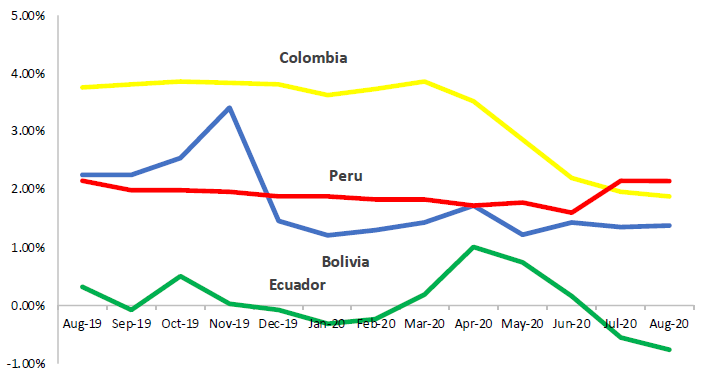
    Andean Countries: Inflation
    Monthly year-on-year figures

    Andean Countries: GDP growth (%)
    Quarterly figures are year-on-year growth
    GDP  End 2019 2020 forecast* Q3 2019 Q4 2019 Q1 2020 Q2 2020
    Bolivia 2.2 -5.2 2.2 1.1 0.6 Not yet available
    Colombia 3.3 -5.6 3.5 3.4 1.4 -15.7
    Ecuador 0.1 -9.0 -0.3 -1.0 -2.4 Not yet available
    Peru 2.2 -13.0 3.2 1.8 -3.4 -30.2
    Venezuela -25.5 -26.0 No data No data No data No data
    *Figures from the United Nations Economic Commission for Latin America & Caribbean Jul 2020
    End 2019 and quarterly growth based on figures from the local central banks


  • ECONOMIC HIGHLIGHTS

    Patrick de Courcy 15 October 2021 Hits: 2150

    BRAZIL | Unemployment falls but labour market still fragile. Brazil’s national statistics institute (Ibge) released new figures on unemployment on 30 September, which show that the unemployment rate in the rolling quarter ending in July fell to 13.7%. This is one percentage point down from the record 14.7% unemployment the country recorded in the rolling quarter ending in April and fractionally below than the 13.8% unemployment rate recorded over the same period a year earlier. The number of unemployed remains high, however, with 14.1m people searching for work compared with 13.1m in July 2020. The employment rate in the May-July rolling quarter rose to 50.2% (equivalent to 89m people), the first time since April 2020 that it has crossed the 50% threshold. But this increase in the employment rate is largely sustained by jobs in the precarious informal sector, with the informality rate standing at 40.8% in July, up from 39.8% in the February-April rolling quarter and 37.4% a year earlier. Meanwhile, workers’ average real income has fallen by 8.8% compared with last year.  

    URUGUAY | Central bank responds to inflationary pressures. On 5 October, the monetary policy committee (Copom) in Uruguay’s central bank (BCU) decided to raise the benchmark interest rate by 25 basis points (bps) to 5.25%. This is the second consecutive rate hike, after the Copom decided on a 50 bps increase in August. In its latest decision, the committee cited a slowdown in the global economic recovery from the coronavirus (Covid-19) pandemic, inflationary pressures appearing to last in the medium term, and signs from other central banks that they are moving away from expansionary policies. This decision came on the same day that the national statistics institute (INE) released September data on the consumer price index (IPC), which showed inflation slowing. Uruguay registered 0.46% inflation in September, bringing annual inflation to 7.41%, down from 7.59% in August. However, this remains well outside of the BCU’s 3%-6% target range.   

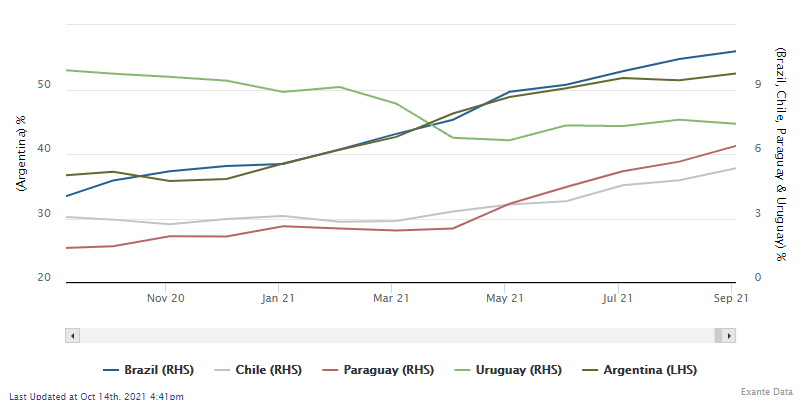
    Brazil & Southern Cone: Inflation Rate
    Percentage variation (year-on-year)

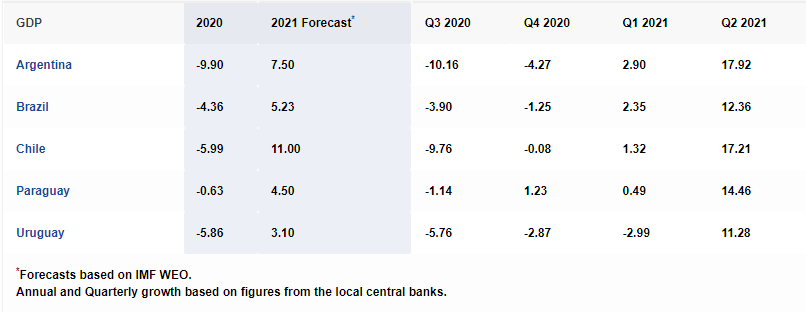
    Brazil & Southern Cone: GDP Growth (%)
    Quarterly figures are year-on-year growth

  • BOLIVIA: Rodríguez struggles to build momentum

    Abbi Dicker 29 May 2025 Hits: 4899

    The spokesperson for Bolivia’s supreme electoral court (TSE), Tahuichi Tahuichi Quispe, has emphatically ruled out the prospect of former president Evo Morales (2006-2019) competing in the 17 August general elections. Tahuichi’s comments on 26 May came amid protests by Morales’ supporters to demand that he be allowed to register as a candidate despite presidential term limits. Morales’ insistence on competing will pose serious problems for Eduardo del Castillo, the candidate for the ruling left-wing Movimiento al Socialismo (MAS). Del Castillo is facing further competition on the left from senate president Andrónico Rodríguez, whose efforts to win the support of Morales’ voters have been met with vitriol by allies of the former president.

    President Luis Arce’s 13 May decision to drop out of the running has, if anything, only amplified the power struggle on the left, which is now torn not just between his ‘Arcista’ faction of the MAS and the ‘Evista’ faction that backs Morales, but is also contending with the rise of a new ‘Androniquista’ faction that supports Rodríguez. Whilst his status as the MAS candidate would in previous election cycles have guaranteed Del Castillo’s status as the only viable left-wing contender, his path to the presidency is looking rocky. Rodríguez, who is running for president with the Alianza Popular (AP) alliance despite holding his senate seat with the MAS, is well placed to capitalise on widespread discontent with the Arce administration, although his candidacy is in doubt pending the outcome of a legal challenge [WR-25-20].

    Rodríguez’s chances of success in the election are dependent on him winning the backing of Morales’ supporters, however, and on that front things are not going well. Despite having spent the last three years siding with Morales in the former president’s escalating feud with Arce, Rodríguez’s decision to launch a presidential run has elicited cries of betrayal from the Evista camp. On 25 May Maicol Rojas, a leading figure in Morales’ coca union Seis Federaciones del Trópico de Cochabamba (SFTC), called on Rodríguez to meet with Morales in his stronghold of Chapare, Cochabamba department, and “explain his childish stupidities”.                                        

    Allies of Morales have also accused Rodríguez of working on behalf of the US government – claims which have previously been levelled against the Arce administration and the conservative opposition. In response, Rodríguez said on 25 May that he would terminate his presidential candidacy immediately if anyone could produce evidence of this claim. “Brother Evo, let’s let go of our arrogance and pride and opt for humility… we need to march towards one common objective, so let’s end the attacks,” Rodríguez said.

    Morales, however, seems to be in no mood for reconciliation. On 27 May hundreds of his supporters demonstrated outside the TSE’s offices in La Paz for a second consecutive day to demand that he be registered as a presidential candidate. However, the TSE’s spokesperson Tahuichi insisted that this would not be possible. “Electoral law states that no stage of the electoral process can be revised or undone,” he said, referring to Morales’ inability to register as a candidate before the deadline at midnight on 19 May. Whilst Morales’ absence from the election owes above all to presidential term limits which were tightened in December 2023, barring him from competing, he has also been unable to leave Chapare since October 2024 due to fear of arrest on human trafficking charges, and has instead remained holed up under the protection of the SFTC [WR-25-02.

    Morales’ supporters clash with police

    Supporters of Morales clashed with police on the streets of La Paz on 28 May during the third consecutive day of protests to demand that the former president be allowed to compete in the elections. The scuffles occurred after police prevented a crowd of dozens of Morales supporters from entering the Plaza Murillo, which is home to the presidential palace and congressional buildings.

    Call for restraint

    The office of Bolivia’s human rights ombudsman called for a calming of the political tensions on 28 May, expressing its “rejection of any demonstration or discourse that fuels violent actions or attacks democratic institutions, in particular the supreme electoral court (TSE)”.

  • VENEZUELA: The multiplier effect

    LatinNews 12 June 2012 Hits: 881

    Venezuela rarely fails to boom at election time. In the last presidential election year (2006), real annual GDP growth was 9.8%. The government led by President Hugo Chávez has taken full advantage of the international oil price boom since 2004 to aggressively pump prime domestic demand as and when it suits. Bar 2009 and 2010, when the heavily Dutch Diseased economy crashed on the back of the global financial crisis, real growth has averaged 9.5% a year. Putting Revolutionary politics aside, on that economic performance alone, electoral success has been a cinch for President Hugo Chávez and his radical left-wing ruling Partido Unido Socialista de Venezuela (PSUV).

    A 30% annual increase in construction sector activity, along with a 28% acceleration in the petro dollar-flush financial services sector, drove real GDP growth to 5.6% year-on-year in the first quarter, the best result in almost four years (15 quarters). Rafael Ramírez, the oil minister and president of the state oil firm Petróleos de Venezuela (Pdvsa), claimed on 17 May that the government had built 200,000 new homes in the last 18 months, under the (petrodollar-funded) Gran Misión Vivienda Venezuela. “The housing deficit [estimated at 3.0m homes] is resolved through Socialism”, Ramírez declared. What he should have said was that the housing deficit – much like all the other social deficits in Venezuela – are resolved through Pdvsa, the Chávez government’s cash cow

    “The oil industry remains the engine of the economy, but construction is the second engine", Finance Minster Jorge Giordani said of the first quarter results, adding that construction sector growth is an “official policy”, aimed at fomenting national infrastructure and creating a strong multiplier effect. He added that the sector had contributed 1.6% of the 5.6% overall first quarter GDP result. The opposition hotly contests the official homebuilding figures, suggesting that they are being massaged for electoral purposes. Giordani also declared that the economy was entering “a new phase of growth”, with low inflation. We're ahead of the target we set for ourselves, with a downward inflationary trend”, he boasted. The national index of consumer prices (INPC) rose just 0.8% month-on-month in April, the lowest monthly inflation in the current series (2007), bringing accumulated inflation for the first four months to 4.3%. The annualised rate was 23.8%. However, inflation rose again in May (by 1.6% m-o-m), fuelled by the official efforts to propel the domestic economy. Giordani now expects full-year GDP growth of at least 5% in 2012, rising to 6.0% in 2013. That would put Venezuela among the fastest-growing countries in South America, after lagging behind all its neighbours in the last few years.

    The oil sector – accounting for 12% of GDP on central bank figures – rose 2.2% annually in the first quarter (though that was on the back of a decline of 1.8% in the first quarter of 2011). The non-oil sector (77% of GDP) rose 5.6% in annual terms. While services and other non-tradeables were predictably strong (on the back of the official monetary stimulus), the manufacturing sector managed growth of just 0.7%, almost entirely on the back of state-run industries like cement. Notably, domestic food, drink & tobacco production fell 6.9%.

    Opposition economists argue that the latest GDP results are as unsustainable as they are lopsided; and they also suggest that domestic inflation is only being tempered by a massive increase in imports (dominated by public sector purchases) to meet the repressed internal demand, as well as the new law of just prices, which sets wholesale and retail price ceilings for key consumer goods. Import demand rose 24.4% year-on-year in the first quarter, according to the breakdown of GDP by demand. In cash terms, imports were valued at US$13.2bn in the same period, up a whopping 48.5% year-on-year (from US$8.8bn in Q1 2011), according to latest BOP figures. Oil exports (making up 96% of total exports) were worth US$24.4bn in the first quarter, up 25% year-on-year. Venezuelan oil has averaged US$112.4/b to date in 2012 (11 May). In 2011 it averaged US$117/b.

    • Spreading Socialist happiness via conventional means

    Finance Minister Giordani, an avowed Marxist, attributed Venezuela’s renewed growth to Bolivarian social polices which “today allow us to have a solid base of growth that translates into human happiness”. Often in Venezuela, the numbers paint a much better picture than the official rhetoric. Giordani claimed on 17 May that the government had invested US$500bn in social programs since 1999. The minimum wage will rise by an inflation-busting 33% this election year. The central bank also reports that the general index of salaries rose 3.7% annually in the first quarter, led by the bloated public sector (5.4%), with private sector wages up a below-trend 2.9%. Some 2.5m workers are on the public sector books now, double the number when Chávez took power in 1999.

  • BRAZIL: Municipal ructions

    LatinNews 19 July 2012 Hits: 2066

    Sérgio Cabral, the ambitious government-allied state governor of Rio de Janeiro, shocked the ruling Partido dos Trabalhadores (PT) this week with the announcement that he intends to step down early, in late 2013, in favour of his deputy and fellow Partido do Movimento Democrático Brasileiro (PMDB) colleague Luiz Fernando Pezão, in order to allow Pezão to “gain muscle” ahead of the 2014 general election. That was news to the PT, which had been working on the basis of assumed PMDB support for a 2014 gubernatorial bid by its local senator, Lindbergh Farias.

    Cabral is on his second term as governor and cannot run again in 2014. Despite several brushes with corruption, which to date he has just about survived, he still has national ambitions, potentially as President Dilma Rousseff’s number two in 2014. A former mayor of the city of Piraí, Pezão has been his deputy since 2007. Like Cabral, Pezão seems to have the support of Rousseff, who in a recent public appearance in Rio seemed to indicate her support for him in 2014. The federal government needs to keep the PMDB alliance intact, but at the local level the PT and the PMDB only reluctantly follow the federal script. The PT in Rio is disinclined towards Cabral’s plan, which would see Pezão effectively in office from December 2013, re-elected in 2014 and then replaced by the popular current PMDB mayor of Rio, Eduardo Paes, in 2018. Paes could then run again in 2022, leaving the PT out in the cold in Rio until 2026.

    The local PT is worried that Cabral will condition the PMDB’s continued support of the Rousseff-led federal executive in 2014 on this plan, at the cost of a secondary PT presence in Rio for at least a decade. The PT leadership, steered by none other than former president Lula da Silva, is putting all its energy into winning control of São Paulo, leaving Rio to the PMDB.

    Anthony Garontinho, a former Rio governor and an intense political rival of Cabral, chipped in this week, suggesting that Cabral and Rousseff had agreed on his early departure date so as to reduce the heat linked to corruption scandals which threatens to damage both Cabral and the federal government ahead of 2014, which is not only a general election year but is also the year that Rio will host the World Cup football tournament.

    The PMDB is particularly strong at the municipal level with 1,200 town halls under its belt. It aims to increase this to 1,400 this year, giving it increased bargaining power with the PT government come 2014. The PMDB has sat back and watched the various recent spats between the PT and its other main coalition allies over municipal slates in key cities like Recife and Belo Horizonte, which have caused major tensions with the Partido Socialista Brasileiro (PSB) in particular. That suits the PMDB just fine as the PSB, led by another ambitious state governor, Eduardo Campos of Pernambuco, is its main rival in the coalition; Campos is vying with Cabral for Rousseff’s attention ahead of 2014.

    Dirceu betrays his nerves

    Former president Lula da Silva’s disgraced former minister of the presidency José Dirceu is preparing for a major battle to save his political reputation (or what is left of it) as the supreme federal court of justice readies for the scheduled mensalão trial next month. Dirceu is alleged by the prosecution to be the architect of the mensalão, a massive cash-for-votes congressional bribery scheme that almost toppled Lula’s first government (2004-2006). Dirceu this week complained that he was a mere scapegoat and was being a political example of. Dirceu cited (not for the first time) personal affidavits from Lula and Rousseff testifying to his good character. Dirceu is barred from political office until 2014 but remains active behind the scenes in the ruling PT.

    Truth Commission begins public audiences

    Brazil’s national truth commission has begun public audiences around the country in support of new state-level commissions that have been set up by local legislatures in the wake of the formal launch in May of the official federal body. To date, six legislative assemblies in six states, including São Paulo, Rio de Janeiro and Pernambuco have set up their own commissions. Others, including Rio Grande do Sul and Goais, are following suit. These states are governed by the ruling coalition and opposition parties, indicating a broad political interest in this effort to revisit Brazil’s recent past, which took several years of lobbying before it was finally approved by the federal congress late last year.

        “These state commissions will feed us…they will give us dossiers with concrete data and tasks that need to be done”, noted Claudio Fonteles, one of the seven members of the national commission. Fonteles and his colleagues were in Goias (12 July), where they were due to meet local groups and families of disappeared people.

        Earlier this week (17 July), Governor Tarso Genro of the federally ruling Partido dos Trabalhadores (PT) signed into law Rio Grande do Sul’s new state commission in the presence of the crusading Spanish judge Baltazar Garzón, best known for his efforts to bring Chile’s former military leader Augusto Pinochet (1974-1990) to trial in international courts. END BOX

    •  Subdued economic activity

    The central bank’s index of economic activity, IBC-Br, a proxy for GDP, contracted lightly in May, falling 0.02% month-on-month over April. That was a little better than private sector expectations but nonetheless indicative of the sluggish economy. It rose just 0.18% over May 2011. With the first half effectively written off, the Rousseff government will hope that its array of fiscal and monetary stimulus measures kick in during the second half. The external environment is also gloomier – China reported its slowest real GDP growth in three years (7.6% year-on-year in the second quarter). 


    • PF agent linked to Cachoeira investigation shot dead

    Justice Minister Eduardo Cardozo said it was “precipitate” to link the death of a federal police agent to the ongoing police (and congressional) investigations into the imprisoned gaming mafia boss, Carlinhos Cachoeira. The body of the agent, Wilton Tapajós, was discovered in a cemetery in Brasília on 17 July. He had been shot twice. According to local press reports, Tapajós had received threats and had reported being followed to his superiors. The head of the congressional committee of enquiry (CPI) into Cachoeira’s extensive political links, Senator Vital do Rêgo, denied this week that the CPI is going nowhere. Of the 24 people summoned before the CPI to date, 13 have refused to say a single word.

  • Risk pointers

    LatinNews 19 September 2012 Hits: 483

    *** Questioning Camp David.  On 13 September, Mohammed Esmat Seif Al-Dawla, an aide to Egyptian President Mohammed Mursi, said that the Camp David treaty with Israel must be amended so that Egypt can achieve complete control over the Sinai Peninsula.  He said: “The peace agreement with Israel does not allow protection of the Sinai.”

    *** China targeting Nicaragua.  On 13 September the heads of Nicaragua’s telecommunications institute (Telcor) and the state investment promotion agency (ProNicaragua) announced that a deal was being negotiated with China’s Great Wall Industry Corporation to build a satellite, Nicasat-1.  If constructed, Nicaragua would be the first country in Central America to have its own satellite.

    The announcement follows a recent visit by a Chinese trade delegation, which also yielded the promise of Chinese cooperation for the construction of an inter-oceanic canal, a project approved by Nicaragua’s congress in July.  Both promises serve as the latest sign that, despite the fact that Nicaragua has, along with its Central American neighbours (bar Costa Rica), yet to switch its diplomatic ties from Taiwan to China, trade and investment cooperation with Beijing continues to strengthen.

    *** China purports to see “evil trend” in Japan.  Amidst the escalating crisis between China and Japan over the disputed Senkaku/Diaoyu Islands, China believes it can discern the influence of growing right-wing forces in Japan.

    Speaking on 14 September, China’s Assistant Foreign Minister Le Yucheng said of the Japanese government’s nationalization of the islands: “The so-called purchase of the Diaoyu Islands is not happenstance but the result of changes in Japan’s domestic political climate.  There is an evil trend in Japan that is leading the country and China-Japan relations toward an extremely dangerous situation.”

    Le says that the change has been exacerbated by Japan’s economic slowdown and the instability caused by last year’s earthquake.  According to the Xinhua news agency he said that “neighbouring countries and around the world” have to be warned that Japan “is moving toward the far right”.

    Le said: “The evil trend has had a strong showing in bilateral relations.  There are people who are unwilling to accept China’s development.  They seek ways to make trouble for China and cause disturbances in bilateral relations.  The Diaoyu Islands issue has become and excuse for them to damage bilateral relations.”