Latin America suffers from a significant skills gap which experts say is only getting worse as regional economies undergo digital transformation. Education and training systems are absolutely essential in matching workers with jobs, but studies show that the current approach is not working.
The significance of education and training in labour market and macroeconomic performance should not be underestimated. Data show that the number of years spent in education is responsible for 28% of the GDP per capita gap between LAC countries and OECD countries. If we consider the quality of human capital available, education is responsible for 60% of this difference. As productive sectors evolve as part of the fourth industrial revolution, the labour market needs capable workers with up to date skills to ensure that LAC countries can move towards a knowledge- and innovation-based economy.
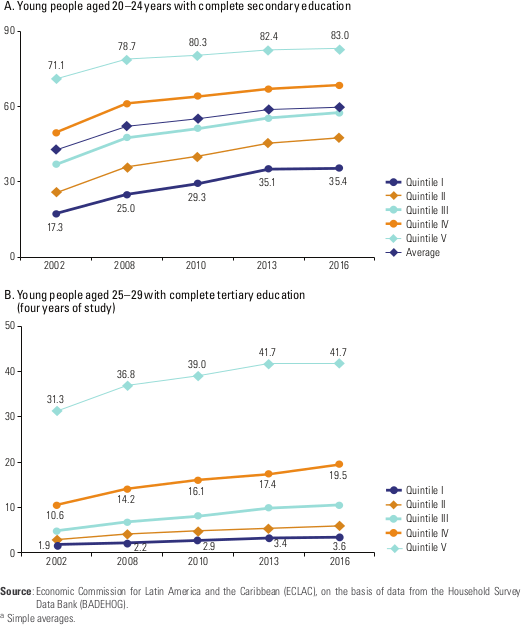
Latin America (18 countries): young people aged 20–24 years with complete secondary education, and young people aged 25–29 with complete tertiary education (four years of study), by income quintile, 2002–2016a (Percentages)
At first glance, certain education statistics are improving. LAC countries’ investment in education systems grew from an average of 3.6% of GDP in 1995 to 5.3% in 2013; student-teacher ratios for the region decreased from 24.4 to 17.3 from 2000-2014, suggesting that class sizes are decreasing; and the Programme for International Student Assessment (Pisa) education study reveals that there were 20 times more computers available to students in 2015 compared with 2000, implying improvements in school infrastructure. However, experts say that the efficiency and equity of expenditures is low compared with other regions, and more spending is necessary.
The 2015 results from the tri-yearly OECD Programme for International Student Assessment (Pisa) show that educational coverage and attainment improved for the 10 LAC countries involved in the study. The percentage of adolescents aged 15-19 who finished primary school increased from 86.9% to 92.4% from 2000-2015. Attainment for maths, reading, and science also increased almost 10%, 6%, and 5% respectively, with Brazil, Chile, Colombia, Mexico, and Peru receiving special mention for improvements. However, LAC countries scored poorly for social and problem-solving skills.
In addition, the results show that LAC countries spend far more on teachers and human resources than other regions, which suggests that stronger labour unions funnel resources to teaching staff. Experts suggest that this could leave less money for pedagogical inputs and ancillary services. Attempts to reform the education systems in Peru and Mexico have fallen foul of teaching unions, whose members oppose the introduction of teacher assessments designed to improve the quality of teaching.
However, education reform needs to address the allocation of funding as well as professionalising teaching. Many public universities do not charge fees, which Jacqueline Mazza believes is a key reform area in Latin America. Mazza uses Chile as an example of a country that has achieved economic growth with a strong social policy, including pensions and a sound attempt to elevate the lower- and middle-income sections of society. One area that has proved a stumbling block is education, where proposals to charge university fees have led to huge protests.
“Subsidies in education in Latin America are highly skewed to the top, that is university education being free and leaving less subsidy for primary and secondary,” said Mazza. And graduates are not meeting the demands of the labour market either, despite drawing government funding away from primary and secondary education, from which more people would benefit. “Latin America produces, for the money it invests in higher education, few engineers and IT professionals,” said Mazza. “The innovation sector is not fed by the university system.” Access to courses related to science, engineering, and robotics must increase to drive innovation, say experts, with further investment. For example, Colombia’s former finance minister Mauricio Cárdenas said that the country spends 10% of oil royalties on science and technology.
As things stand, 38%-40% of employers say they can’t find talent to fill job vacancies, according to ILO human resources specialist Fernando Vargas. Firms need people with language, technological, and social skills, which are in high-demand as the fourth industrial revolution continues, but they struggle to find them. “Our education has not changed,” said Vargas during an ILO regional meeting in October 2018. “We have education systems from the 19th and 20th century [which do] not teach people to solve problems.”
If education systems struggle to meet the demands of the labour market, perhaps training schemes can be used to reduce skills gaps. According to a 2017 ILO report called ‘The Future of Professional Training in Latin America and the Caribbean’, LAC countries have long boasted specialised public training institutes, and there are increasing numbers of private alternatives as well as in-firm training schemes. However, Mazza says that the quality of training is poor and does not respond to the demands of the labour market. “They are training systems based, if we are lucky, in the 1950s,” she said. “Beauticians, carpenters, I mean it’s a really odd disconnect between what the economy needs and what the training systems and technical institutes train.”
These skills gaps show a serious mis-adjustment of supply and demand in the labour market given high levels of un- and under-employment among young people, suggesting that training systems need to be more dynamic in order to adjust to the changing conditions of the digital transformation. One solution could be the introduction of workforce development programmes, which combine education and training throughout a worker’s career. “Right now in Latin America if you drop out of school it’s hard to go back,” said Mazza. “What needs to change is the availability of training over the course of a lifetime.” Such schemes would also help the one in five 14-25-year-olds who are looking for work but failing to find it, with little change in those numbers in recent years.
The increased use of public-private partnerships could be one way of boosting dynamism in education and training, as well as targeting young people who are neither studying nor working (known as Ninis in the Spanish acronym). Mexico’s aforementioned ‘Jóvenes Construyendo el Futuro’ programme is one example, which will provide grants to companies to pay apprentices. This kind of dual learning model has been used effectively in other countries, encouraging unemployed people back to school or providing training opportunities that boost their chances of finding formal employment. Costa Rica, which has the highest rate of youth unemployment in Central America (27%) according to the Central American Observatory of Social Development, is also discussing a law that would enable dual learning programmes, while at the end of January 2019, Guatemala passed the ‘Law for Strengthening Entrepreneurship’, which will introduce business classes in primary and secondary education as well as creating a new legal entity for entrepreneurs.
Moving forward, LAC countries require serious reforms to improve education coverage, quality, and equity. The region lags behind developing regions such as South East Asia and Eastern Europe in terms of quality, said Alejandro Werner, Americas director at the International Monetary Fund (IMF), and the labour force must be better trained and more agile to deal with digital transformation.
And it’s not just enough to encourage people to spend more years at school in order to increase the earnings of lower income sectors. Research published by the World Bank shows that a significant increase in total years of education from 2004-2014 resulted in unequal income gains between the top 60% of earners and the bottom 40%. Those who were already earning higher wages saw greater income gains, providing further proof of the complexity of labour market policy. Latin America needs to join the global conversation on technological adoption, updating labour regulations in a changing world of work, and how to better connect education and business if it is to be competitive in global markets.
Case study: teachers protest reforms
Attempts at education reform in Peru have pitted reformers against teachers and their unions, as well as resulting in the politicisation of an issue of national interest.
The drive to reform was started by Jaime Saavedra, who first served as education minister under President Ollanta Humala (2011-2016). Saavedra’s main aim was to make Peruvian education more meritocratic, planning to introduce performance-based pay for teachers, improve education quality, modernise management systems, and close the educational infrastructure deficit.
By 2015, Peru was improving in the OECD’s educational rankings based on assessments for 15-year-olds, and was the fourth-best improver in the Pisa tests from 2012-2015. Saavedra succeeded in convincing government, business, and the media that education reform should be a priority, and at first his plans were well-received. However, moves to regulate private universities in 2014 provoked opposition from political rivals, some of whom profited from the business of education. The highly-regarded Saavedra had been kept on as education minister by President Pedro Pablo Kuczynski (2016-2018), who declared education a national priority, but amid political wrangling he was ousted in 2016.
Saavedra’s successor, Marilu Martens, took over in December that year and continued with plans to boost the monthly minimum wage for teachers by around 30%, the first meaningful pay increase for a decade. The pay hike was part of a larger package of measures that would see education spending jump from 3.7% of GDP in 2017 to 6% by the end of 2021, but trouble was brewing over performance evaluations for teachers. Those who failed could lose their jobs, which provoked opposition from the teachers’ union Sindicato Único de Trabajadores de la Educación del Perú (Sutep) and ultimately resulted in a 15 June 2017 strike that lasted for three months.
The dispute was eventually resolved after the teachers’ pay rise was brought forward and the government promised to provide teacher training. Martens struggled to negotiate a deal due to the splintering of Sutep into regional factions, and by September 2017 she was ousted after education was once again used as a political football. The weakness of both the education ministry and the central Sutep union has raised fears of further strikes.
While Peru has made some progress in improving results, huge problems remain. Average scores may be going up, but there are huge inequalities between urban and rural education, according to Ricardo Cuenca from Peruvian think-tank Instituto de Estudios Peruanos (IEP). Another issue is public perception of teaching, said Cuenca, who believes that the profession is associated with low salaries and low prestige.
Fixing these issues requires bold initiatives like those introduced by Saavedra, but a weakened education ministry doesn’t have the political capital to force through controversial regulations. The main Sutep union remains weak, and more radical factions called a strike on 3 July 2018. However it was called off after two weeks as the vast majority of teachers ignored calls to walk out of classrooms, illustrating continued divisions in the union movement that will make it hard to negotiate future deals.
Education reform showed early promise before politics derailed its good intentions. Political instability in recent years has not helped to create favourable conditions for reform, but some argue that Saavedra attempted to change too much, too quickly by going after private universities. In doing so he managed to politicise the issue and the ousting of Saavedra and Martens left the education ministry weakened.
Peru is not the only country to struggle with professionalising teaching. The introduction of performance assessments was also met with strident opposition in Mexico, where they form part of the 2012-2013 education reform introduced by former President Enrique Peña Nieto. Convincing entrenched vested interests to allow change has never been easy, and both episodes underline the difficulties of pushing through sweeping reforms in the Latin American context.