All Categories

Subcategories

  • ARGENTINA-MEXICO: YPF, Pemex and Repsol dance the three-step

    LatinNews 19 December 2013 Hits: 6267

    In late November an outline deal was reached to resolve one of Latin America’s biggest and bitterest commercial disputes: the battle over compensation after the Argentine government expropriated a 51% shareholding in the country’s main oil company Yacimientos Petrolíferos Fiscales (YPF), previously controlled by the Spanish oil major Repsol. A key broker in the deal was Mexico’s state-owned Petróleos Mexicanos (Pemex), itself an important shareholder in Repsol. So what are these three companies now trying to achieve?

    A lot can happen in both politics and the oil industry in 19 months, and in this case, a lot has. Nineteen months ago, in April 2012, the Argentine government led by President Cristina Fernández, worried at a growing energy deficit and angry at what it believed was Repsol’s repeated failure to invest and boost production in the local oil and gas sector, announced it was ‘renationalising’ YPF. The move was seen as a defiant affirmation of energy nationalism: the rhetoric was that a state-owned YPF would invest in new oil fields and achieve exactly the type of turn-around that the foreign and privately-owned Repsol had failed to deliver. Repsol, too, was angry and defiant over its treatment. Backed by the Madrid government, which described the expropriation as “arbitrary, hostile, and discriminatory” it began various legal actions and lodged a formal complaint with the World Bank’s International Centre for Settlement of Investment Disputes (Icsid). Repsol demanded at least US$10.5bn in compensation.

    Nineteen months on, it is evident that both positions have changed. Argentina has seen its energy deficit get progressively worse, to the point that it is now the main cause of a foreign exchange scarcity that is threatening the country’s growth. On the plus side, Buenos Aires has realised that its Vaca Muerta shale oil and gas deposits located in Patagonia, and discovered just before the ‘renationalisation’ of YPF, are one of the largest of their kind in the world. But YPF on its own has neither the investment cash nor the expertise to develop them without external help. So the US major Chevron has stepped into the gap, but its involvement has in turn been threatened by two related lawsuits filed by Repsol in Spain and the US. As subsequently recognised by Argentine economy minister Axel Kicillof, with the Icsid arbitration process underway, the Buenos Aires government knew it would not be able to get away without paying some kind of compensation, at some point.

    Despite reaching agreement in principle in Buenos Aires in late November, it is clear that the exact value of the compensation deal has yet to be settled. Nothing has been officially revealed, but YPF sources spoke of a US$5bn compensation payment in 10-year Argentine government bonds. Brufau has mentioned the figure of US$8bn. Repsol has also said it wants rock-solid guarantees, and has appointed Deutsche Bank as its adviser on the payment terms. The parties suggested that a full settlement might be reached before the end of 2013, but detailed negotiations could take longer.

    What about Pemex?

    Interestingly, the Mexican state company is struggling with some of the same challenges faced by YPF in Argentina. It too has seen falling oil production over the last ten years; it too has discovered significant new shale, conventional, and offshore deposits, but does not have the investment cash to develop them on its own. Pemex is now affected by a landmark energy reform, approved by the Mexican congress in December, which is designed to attract the international oil majors back into Mexico through a variety of production-sharing, profit-sharing, and licensing mechanisms. Strategically, it is clear that Pemex is preparing itself to compete more pro-actively, not only at home but internationally as well. Pemex has made it clear that it too would like to be involved in association with YPF in developing the Vaca Muerta fields. To do that, the Mexicans needed to act as peace brokers and help resolve the YPF-Repsol dispute. It is also possible that Pemex will be seeking to attract Repsol to invest in future joint projects in Mexico.

    • Repsol pressures

    There were also pressures on Repsol’s side. The company has been performing well, but two of its key shareholders are keen to see it maximise its cash position to take advantage of new investment opportunities. While chief executive Antonio Brufau wanted to get as much compensation from Argentina as possible, Pemex’s CEO Emilio Loyoza (with a 9.3% stake in Repsol) and Isidro Fainé, the head of the Barcelona-based CaixaBank (with a 12.0% stake in Repsol) both put a greater value on getting cash in hand.

  • PARAGUAY: Prison guards’ strike exposes unresolved problems

    LatinNews 23 January 2014 Hits: 1254

    A short strike by Paraguay’s main prison guards union, Sindicato de Trabajadores de Seguridad Penitenciaria del Paraguay (Sintrasepp), exposed some of the serious problems affecting the national penitentiary system. During the 18-hour long stoppage, there were riotous scenes in some of the country’s biggest prisons, resulting in the deaths of two inmates.

    Sintrasepp members went on strike on 10 January, after the private companies contracted to provide prison security failed to show up to the tripartite salary negotiations scheduled for that day. The government representatives did show. Juan Velázquez, Sintrasepp’s secretary general, said the union had hoped to use the meeting to voice grievances including the non-payment of last year’s 13th salary (aguinaldo) , payment of which is obligatory by employers, and a 50% reduction in the G$1m (US$211.17) additional bonus paid to prison workers by way of ‘danger money’. In November 2013, the justice & labour ministry, which sets the amount of the ‘dangerous profession bonus’ (but which is also the financial responsibility of employers), took a decision to halve it.

    After being stood up by the prison service companies, Velásquez said the union would immediately go on indefinite national strike. The walkout was observed by all 800 members of Sintrasepp, taking the authorities by surprise. Disturbances soon were reported in the country’s largest prison, Tacumbú, which houses 46% of Paraguay’s prison population, some 4,000 inmates. Hundreds of prisoners attempted to break out of their zones (or pavilions) and into others, looking to steal other inmates’ belongings. Marcos Rojas, a Tacumbú inmate who works for Remar, a local religious NGO, told the press via telephone: “Since the early hours of the morning there have been no guards, and inmates have been looting… twenty of them tried to break into the Remar pavilion but we fought back. There is no law in Tacumbú. The situation is difficult. They are trying break down the metal fencing to make weapons… the inmates have been left to their fate”.

    Soon afterwards, a labour & justice ministry spokesman reported disturbances in four of the country’s 16 prisons. In Tacumbú, there were reports of two deaths, with eight prisoners seriously injured. The Tacumbú prison director, Artemio Vera, said that there had been a generalised riot but that with the help of police, the (non-striking) prison staff had managed to restore order. Vera confirmed that one inmate had been electrocuted to death after he got onto the roof and tried to scale the electric fencing, while another died in the infirmary, where he was due to receive hepatitis treatment.

    In response, Labour & Justice Minister Sheila Abed organised an emergency tripartite meeting with the unions and the prison security companies. Afterwards, she announced that the ministry had agreed to pay the pending aguinaldos, in return for which Sintrasepp had agreed to lift the strike. Pressed as to the chaos in Tacumbú, Abed insisted that the authorities had managed to keep the situation under control. She rejected accusations that the two Tacumbú fatalities were the result of the police attempts to regain control of the prison. Insisting that the deaths were “accidental”, Abed tried to argue that they were not even linked to the strike.

    Despite Abed’s efforts, the incident has spotlighted the problem of overpopulation in the country’s prisons. Local press unearthed a 2012 report by the labour & justice ministry’s own national torture prevention commission calling for reform. The report noted that the “historic” deficiencies in the system often translate into “cruel, inhumane and degrading” treatment of inmates. It also emphasised the need to build more prisons, noting that Tacumbú was originally intended to house 1,500 inmates. Equally notably, the report also expressed concern that the 40 prison guards assigned to the Tacumbú were vastly outnumbered by inmates.

    • PJC penitentiary intervened

    On 7 January, just days before the prison guards went on strike, Labour & Justice Minister Abed ordered the intervention of a penitentiary near the town of Pedro Juan Caballero (PJC), on the border with Brazil, following the murder of a detained Brazilian national. Emilio Rojas was killed on 4 January, when two armed men entered his cell and shot him. Rojas was arrested in 2010, suspected of taking part in an assassination attempt on Paraguay’s Senator Robert Acevedo. Abed said that in order to carry out an exhaustive investigation she had removed the prison director, Romualdo Rojas Amarilla, replacing him with an interim director who will take charge of the investigation.

  • POINTERS

    LatinNews 05 March 2014 Hits: 2548

    PARAGUAY | Rising protests met with police violence. On 28 January interior minister Francisco de Vargas was summoned to testify by a special senatorial committee on reported abusive actions by police against rural protesters, particularly the purported abduction and torture of eight peasants who were taking part in a land invasion in Tapiracuái Loma, San Pedro, and an incident in General Resquín, in the same department, where a peasant lost his eye when police opened fire with rubber bullets against a crowd protesting the fumigation of soya plantations.

    Peasants have been complaining that fumigation is harming their subsistence crops and forcing them to relocate. On 1 February President Horacio Cartes

    admitted that the government did not have adequate control over the use of agrochemicals in fumigation, and that the cabinet would take a hard look at the needs of Senave, the national agency in charge of overseeing the use of agrochemicals.

    That same day 16 peasants were injured when police used rubber bullets and tear gas to disperse a group of about 200 who were trying to halt the clearing of a 40-hectare plot of land in Luz Bella, also in San Pedro, in order to plant soya. Though the authorities say the police deliberately used only non-lethal means against the protesters, and when these were themselves engaging in violence, in the last two incidents the protesters said the police had begun to fire without any preamble. On 2 February a local leader of the anti-fumigation campaign was shot dead in San Pedro.

    PARAGUAY | EPP camp raided in Concepción. On 2 February a unit of the joint police-military force located and raided a camp of the Ejército del Pueblo Paraguayo (EPP) in Arroyito, Concepción. The occupants, estimated to have been at least six, put up a brief resistance, then fled. After several hours of fruitless search, the hunt was called off. In the camp the authorities seized uniforms, supplies, documents (including the identity card of a known EPP member, Albino Jara Larrea) and firearms, including some heavy-calibre rifles.

    Despite not having been able to capture the guerrillas, public prosecutor Federico Delfino estimated that the seizure of the stores in the camp had dealt a significant blow to the EPP’s logistics.

    CHILE | Truck drivers set up preventive network. Sixty trucks plying their trade in Chile’s south will be fitted with communications equipment connected by special frequency to the Carabineros, as part of a plan worked out with local and national authorities to prevent the recurrence of attacks that have become frequent in the Araucanía region. Since 2006 there have been more than 90 attacks on trucks in the area. The pilot plan covering 115 kilometres of the Collipulli-Gorbea highway began to operate on 15 February.

    Police are trying to determine the authorship of a bombing attack on 4 February that wrecked a branch of the Banco del Estado and a pharmacy in Padre Las Casas, a municipality that is part of the Greater Temuco, capital of Araucanía. The device consisted of two gas cylinders used for camping. The attack has not been immediately attributed to radical Mapuche activists because the fact that the device was found next to the bank’s automated teller suggests that the motive might have been robbery.

    URUGUAY | Cannabis scheme ‘not in breach of conventions’. Deputy foreign affairs minister Luis Porto has been arguing before the International Narcotics Control Board (INCB) that the new régime for controlled production and distribution of cannabis does not breach international conventions inasmuch as it does not ‘substantively alter’ the consumption régime in place since 1974.

    • “[Uruguay’s] deputy foreign affairs minister Luis Porto has been arguing before the International Narcotics Control Board (INCB) that the new régime for controlled production and distribution of cannabis does not breach international conventions inasmuch as it does not ‘substantively alter’ the consumption régime in place since 1974.”
  • RASTREANDO TENDENCIAS

    LatinNews 05 June 2015 Hits: 525

    ARGENTINA-BRASIL | El comercio bilateral cae abruptamente. Mayo fue el peor mes para el comercio bilateral entre Argentina y Brasil desde el 2009. El comercio entre los dos países cayó un 23,7%, comparado con el mismo mes del 2014, reduciéndose a poco menos de US$2mm. El déficit comercial de Argentina con Brasil llegó a los US$246m en mayo, comparado con US$70m en abril. Argentina es el cuarto mayor socio comercial de Brasil después de China, EU, y Alemania. Con la economía brasilera ahora en recesión, y el congreso brasilero aprobando un incremento fiscal sobre las importaciones extranjeras, es probable que la tendencia continúe.

    BRASIL | El Copom eleva las tasas de interés al 13,75%. El 3 de junio el comité de política  monetaria (Copom) del banco central de Brasil elevó su tasa de interés de referencia, el Selic, al 13,75%. El incremento de 50 puntos básicos fue una decisión unánime del comité. En la nota que acompañaba el anuncio, Copom indicaba que podrían ser necesarios más aumentos en los meses por delante. En un testimonio ante el congreso federal, Alexandre Tombini, el presidente del banco central, dijo que el objetivo del banco central todavía era llevar la inflación en línea con su meta del 4,5% con una tolerancia de más o menos 2%. La inflación está actualmente en alrededor del 8%.

  • NICARAGUA: Unorthodox approach to coronavirus can’t save economy

    LatinNews 21 October 2020 Hits: 625

    Nicaragua is an outlier in terms of its response to the coronavirus (Covid-19) pandemic, with President Daniel Ortega opting not to shut down the national market in an unsuccessful bid to stave off further damage to the domestic economy. The local economy had already suffered due to the crackdown that the Frente Sandinista de Liberación Nacional (FSLN) government launched in April 2018 against its opponents, which it accuses of seeking to carry out a coup.

    While most countries around the world have implemented some kind of lockdown in the face of the pandemic, Ortega government has so far refused, warning that the country would “die if people stopped working”. In a white paper published 25 May the government said its position is based on Nicaragua’s “reality and conditions”, arguing that high rates of informality mean too many people would not receive an income if a lockdown were imposed (according to the white paper, some 80% of workers in urban areas are employed in the informal economy). The government said it was following the so-called ‘Swedish model’: providing information and guidelines but letting the public make their own decisions. The white paper highlighted the mobilisation of public health workers who carry out home visits, as well as a fumigation programme of public spaces such as schools and markets.

    Ortega resisted calls to shut non-essential economic activities from both the main private sector lobby, Consejo Superior de la Empresa Privada (Cosep), and medical associations. His government also continued to organise public events, which was criticised by Ciro Ugarte, head of the Health Emergencies Department at the Pan-American Health Organization (PAHO), on 9 June. Overall, PAHO says that the Ortega government’s measures have not been strict enough, and there hasn’t been enough strengthening of the country’s medical capacity.

    The virus began spreading throughout Nicaragua since March, but case numbers and deaths have been trending down since mid-June. In its most recent report on the current economic situation, released on 14 August, local think-tank Fundación Nicaragüense para el Desarrollo Económico y Social (Funides), attributed this fall to preventive measures taken by the population, such as reducing travelling; measures adopted by the private sector, such as allowing working from home; measures taken by civil society, including a handful of communities which introduced self-imposed lockdowns; the changing attitude of government, which stopped encouraging public gatherings; and school holidays, which ran from 26 June to 20 July. 

    The Ortega government has come in for widespread criticism for its lack of transparency over Covid-19 case numbers and deaths (see sidebar). While the true number of cases and deaths may never be known, the effects of the pandemic on the economy are clear. Despite the fact that the government refused to shut down the economy, it is now set to register the deepest contraction (-8.3%) in Central America according to the latest forecast from the United Nations Economic Commission for Latin America & the Caribbean (Eclac). This is above the -6.2% average forecast for the sub-region. While the extent of the fall depends on external factors, including the coronavirus situation in major trade partners the US and El Salvador, it is also linked to how far the virus can be controlled so the economy can get back to work.

    In its report, Funides predicts that the economy will contract by 6.5%-13.7% this year, significantly more than the 1.1% contraction it predicted pre-pandemic. As the organisation explains, there is a lot of uncertainty in its predictions due to a lack of good official information. This will see poverty rates increase to 32.2%-36.9% this year, up from 28.2% in 2019, according to the report, equivalent to 2.1m-2.4m people. Unemployment will increase from 6.6% in 2019 to 7.3%-9.2% in 2020, and GDP per capita will fall 6.9%-13.7% year-on-year. While it does forecast modest growth of 1.2% in 2021, Funides predicts that Nicaragua will struggle to bounce back to growth next year.

    International ratings agency Fitch Ratings agrees with these gloomy predictions, revising Nicaragua’s outlook to ‘negative’ from ‘stable’ in mid-June. Fitch cites “increased financing risks amid a revenue shock caused by the coronavirus pandemic, rising [government] spending pressures, and constraints posed by a small local market and international [economic] sanctions”. The credit ratings agency predicts that Nicaragua’s economy will contract by 4.5% this year, citing reduced remittances, maquila exports, and tourism revenues.

    The Ortega government has yet to implement policies that will mitigate the economic effects of the pandemic beyond minor moves to reduce minimum credit card payments and cutting electricity bills. Funides recommends loosening the budgetary purse strings to allow more support for small businesses, a moratorium on payments for basic services for the most vulnerable households, cash or goods transfers to these households, and a reduction in tax charges. It also recommends measures to ensure liquidity and availability of loans to encourage consumption and investment in the medium term. In addition, Funides would like to see more actions to control the spread of the virus, such as suspending non-essential activities, providing masks to the most vulnerable, guaranteeing access to drinking water, suspending school classes, and cancelling public events.

    There have been no fiscal measures to support the economy during the pandemic. As a result, Fitch forecasts that the general government deficit will be contained to 2.8% of GDP in 2020 although expects a widening of the deficit to 3.6% of GDP in 2021 owing to spending ahead of November 2021 general election and the continued widening of the social security deficit (see sidebar). 

    • Access to finance?

    In its June 2020 assessment Fitch Ratings notes that financing conditions for the Nicaraguan government are showing signs of stress. Since March it has been unable to issue bonds in local currency and it has only placed bonds payable in US dollars, an instrument introduced in October 2019. According to Fitch as of June, the government had placed 0.3% of GDP in local bonds, 72% of this amount has been in US dollars with a weighted average interest of 10.6%. Fitch does not expect that annual net external financing in 2020 and 2021 will be meaningfully higher than that of 2019 (1.4% of GDP) but it notes that availability of international financing is constrained by sanctions imposed by the international community on key allies of Ortega as part of efforts to pressure the government to end the crackdown on its opponents. Fitch expects sanctions to remain in place in 2020 and 2021. Yet Nicaragua does continue to receive international financing. On 7 September the Central American bank for economic integration (BCIE) and Nicaragua’s central bank (BCN) signed the 11th renewal of a US$200m credit line aimed at strengthening the country's financial management, acting as a contingency if required and reinforcing Nicaragua’s liquidity position. This follows the approval on 21 August of a US$50m BCIE loan for Nicaragua, to help small and medium-sized enterprises (SMEs) affected by the impact of the coronavirus pandemic. Meanwhile on 1 August the Inter-American Development Bank (IDB) agreed a US$43m loan to strengthen the health system.

    • Divergence in figures

    Observatorio Ciudadano, a collaborative civil society group set up to monitor the local epidemic, has collated its Covid-19 own data that contrasts with official figures. As of 23 September, Observatorio Ciudadano had tallied 10,396 suspected Covid-19 cases compared with 5,073 as registered by the health ministry. The discrepancy is even larger when it comes to deaths, with 149 confirmed by the authorities but 2,735 suspected Covid-19 deaths reported by the Observatorio.

    • Fiscal consolidation?

    Fitch notes that the government implemented significant fiscal consolidation measures after the social unrest in 2018 including pay freezes for public sector employees, tax increases, and social security reforms. It notes that “implementing additional revenue raising measures or continued spending restraint may be challenging in the context of elections and latent social tensions; ad hoc and potentially unsustainable measures to contain the deficit are possible”.

  • ECUADOR: Fuel price controls provide bone of contention

    LatinNews 24 June 2021 Hits: 4141

    Fuel prices are a highly sensitive issue in Ecuador. So, when the indigenous political movement Pachakutik (PK) urged the government led by President Guillermo Lasso on 22 June to take action to halt constant fuel price increases it immediately gained widespread media attention. The deadly indigenous protests over fuel subsidies in October 2019 are still seared into the public memory.

    PK’s national coordinator, Marlon Santi, said fuel price increases were “seriously affecting the economic situation of indigenous people” and called on the Lasso administration to freeze prices. This time last year Lasso’s predecessor, Lenín Moreno (2017-2021), imposed a system of price bands, which could rise or fall by 5% each month in accordance with the future price of West Texas Intermediate (WTI) crude.

    Back then the gasoline price was fixed at US$1.87 per gallon but it currently costs US$2.09, while diesel prices have increased from US$1.04 per gallon to US$1.54 over the same period. Moreno was briefly forced to flee from Quito to the coastal city of Guayaquil amid large-scale indigenous protests in October 2019 against his executive decree to end fuel subsidies, which he was compelled to rescind.

    This would be reason enough for Lasso to be loath to alienate PK, but the party’s support in the national assembly is also important for his government given the paucity of deputies representing the ruling centre-right Movimiento Creo, which holds just 12 of the 137 seats in the legislature. However, differing priorities mean that the relationship is likely to be combustible. PK is also calling for “an exhaustive audit” of all mining concessions in Ecuador, as well as criticising “the return” of the World Bank’s International Centre for Settlement of Investment Disputes (Icsid) to the country.

    Lasso, who is convalescing after flying to the US for spinal cord surgery this week, will convene a meeting with PK and other indigenous political organisations to address issues of “high national interest”, such as fuel prices, environmental protection, foreign affairs, and vaccination against the coronavirus (Covid-19), the presidential spokesperson said on 22 June.

    Peru employment

    Employment in metropolitan Lima grew by 73% in April, or 1.86m people, compared with April 2020. Employment in the capital was still down, however, by 9.4% on April 2019.

  • NICARAGUA: Strengthening ties with Moscow and Beijing

    Sarah Sheldon 22 May 2023 Hits: 960

    Nicaragua has been bolstering relations with Russia and China as the US has imposed multiple rounds of sanctions, citing ongoing human rights abuses taking place under the government led by President Daniel Ortega. However, it remains unclear whether these deepening alliances would be able to compensate for a complete cessation in relations with Washington, which remains Nicaragua’s largest trading partner.

    Nicaragua has become increasingly isolated from the US and its allies since President Ortega deepened the country’s authoritarian shift by brutally repressing mass protests in 2018 – a situation which has intensified following the November 2021 general elections, which produced a re-election victory for Ortega in a contest widely slammed as fraudulent. His government has sought closer ties with Russia and China since.

    In recent months, there have been a number of developments that have indicated this tendency, including a visit from Russia’s foreign minister, Sergei Lavrov, in April. At the time, Lavrov hailed the establishment of “important agreements in areas such as education, transport, agriculture and health,” as well as the development of cooperation regarding “supplies of Russian cars, fertilisers, and food” and “the implementation of transport infrastructure projects”. This followed a visit by Nicaragua’s foreign minister, Denis Moncada, to Moscow in March, during which the two countries signed an agreement to develop the use of atomic energy for peaceful purposes.

    At the same time, Nicaragua has been moving closer to China. The two countries established diplomatic relations in December 2021 after Nicaragua cut ties with Taiwan, and one of the first concrete agreements with Beijing to have emerged since the switch in allegiance is for more than US$60m in funding for the housing sector. In April, the first stage of the ‘Nuevas Victorias’ housing project was launched, with 920 homes in Managua. As a whole, the project envisages more than 12,000 houses in dozens of municipalities around the country.

    Other developments include plans to rehabilitate a power plant, as well as negotiations over a free trade agreement, which Nicaraguan officials hope could be finalised by the end of 2024. The country is also seeing increasing involvement of Chinese telecommunications technology from firms such as Huawei which opened a Huawei Academy in collaboration with Universidad Nacional Autónoma de Nicaragua (UNAN-Managua) in October 2021.

    Nicaragua has also signed memoranda of understanding with Chinese firms related to infrastructure projects, and leaked US intelligence documents released in April revealed negotiations over a deep-water port in Bluefields, the capital of the South Atlantic autonomous region (RAAS), in the southeast of the country. According to these leaked documents, Nicaragua “still views Russia — also interested in Bluefields — as its primary security partner,” but it has also expanded ties with China since Russia invaded Ukraine in February 2022.

    These moves come as ties with the US and its allies have deteriorated in recent years. For example, in November 2021, Nicaragua announced its withdrawal from the Organization of American States, a Washington-based regional bloc, and it refused to accept a new US ambassador to the country. It also declared the European Union’s ambassador persona non grata in September 2022, and rejected a proposed replacement in April. Managua has also cut diplomatic ties with the Netherlands and shut down hundreds of foreign (and national) NGOs.

    During this time Washington has imposed multiple rounds of sanctions on Ortega, First Lady and Vice President Rosario Murillo, and high-ranking officials, as well as most recently on the country’s police force. In October 2022, the White House explicitly cited “increasing security cooperation with Russia” in a statement announcing “targeted pressure” on the Nicaraguan government, including new powers to impose future restrictions on trade, as well as investment in certain sectors of the Nicaraguan economy. This included Nicaragua’s lucrative gold sector [EB-22-11]. There have also been increasing bipartisan efforts from US lawmakers to pressure the Central American development bank (BCIE) to stop lending to Managua.

    • BCIE

    In March US Representative Michael McCaul (R-TX) and Senator Bob Menendez (D-NJ) sent bipartisan letters to the presidents of Costa Rica, El Salvador, Guatemala, and Honduras urging them to leverage their position in BCIE to stop its development funding from “propping up the Nicaraguan regime”. BCIE has approved nearly US$3.5bn in funding for initiatives to be implemented under the Ortega government, according to the letter which notes that in recent years the US has taken steps to “increase the scrutiny of and curtail funding from multilateral institutions that would directly benefit” the Ortega government. It highlights the Renacer Act (approved by the US legislature in November 2021) under which the US government has taken steps to ensure that any such multilateral funding only passes through entities with “full technical, administrative, and financial independence” from the Ortega government.

    Interestingly though, the US remains Nicaragua’s largest trading partner, the source of just over a quarter of Nicaragua’s imports and the destination of nearly half of the country’s exports according to central bank (BCN) figures. In addition, Nicaraguan imports from the US increased from US$1.76bn in 2021 to US$2.19bn in 2022, and Nicaraguan exports to the US increased from US$1.75bn to US$1.8bn for the same period, according to the BCN.

    As a result, the US wields huge influence over the fate of the Nicaraguan economy, and commercial relations with both Russia and China pale in comparison. For example, Nicaraguan exports to Russia and China totalled just US$4.2m and US$12m in 2022 respectively. As for imports, Nicaragua received US$84m worth of goods from Russia and US$1.07bn from China.

    As things stand, the outlook for Nicaragua is mixed. In late April, the United Nations Economic Commission for Latin America & the Caribbean (Eclac) projected that Nicaragua’s GDP will grow 2.3% in 2023, below the 3.1% average for Central America. This follows 3.8% growth in 2022, according to the BCN, following on from 10.3% growth in 2021. This suggests that the country has weathered the economic storm of the 2018 political crisis, as well as hurricanes Eta and Iota and the coronavirus (Covid-19) pandemic in 2020, which saw significant contractions of -3.4% of GDP in 2018, -2.9% in 2019, and -1.8% in 2020.

    However, remittances are playing an increasingly important role in sustaining the economy, totalling US$330.6m in February, a 63.5% increase compared to the same period last year, with a record number of Nicaraguans seeking to enter the US last year. Herein may lie one explanation why Washington hasn’t taken firmer action to strangle the Nicaraguan economy: doing so would likely encourage far more people to make the journey north, adding to a complicated domestic political situation for President Joe Biden. 

    As for Nicaragua’s willingness to risk trade relations with the US, Ortega appears to be betting on the development of a multipolar world in which he can hold on to power with the support of Washington’s geopolitical rivals. At the end of April his son, Laureano, a presidential advisor on investment, spoke about the end of the “dictatorship of the dollar” and the start of a new world order. While Ortega may hope that those who have pointed to the dollar’s declining share of global currency reserves as evidence of its dwindling influence are proved correct, it appears that for the moment Washington retains the power to plunge the country’s economy into crisis if it sees fit.

  • MEXICO: US requests dispute settlement panels amid trade tensions

    Abbi Dicker 17 January 2025 Hits: 4606

    On 18 December the Office of the US Trade Representative (USTR) requested the establishment of three dispute settlement panels under the US-Mexico-Canada agreement (USMCA) after failing to reach agreements with Mexico on alleged labour rights violations. 

    All three panels relate to labour disputes in which the US had asked Mexico to review whether workers were being denied the right to freedom of association and collective bargaining, with a resolution failing to be reached in each. The disputes affect a facility owned by tyre manufacturer Pirelli Neumáticos in Silao de la Victoria municipality, Guanajuato state; a facility run by auto parts supplier Bader de Mexico in León, also in Guanajuato; and a facility operated by small arms ammunition manufacturer Industrias Tecnos in Cuernavaca, Morelos state. 

    These mark the fourth, fifth, and sixth times that the US has requested a dispute settlement panel under the USMCA’s rapid response labour mechanism (RRM). The USTR describes the RRM as “an innovative trade agreement tool that is empowering workers in Mexico” by addressing concerns over freedom of association laws and rights. Under the terms of the USMCA, cases in which a denial of rights is found to have occurred can result in penalties including a ban on exports to the US. The idea is to prevent companies from exploiting Mexican workers, which affects US workers by putting them “at an unfair disadvantage when negotiating terms for their employment,” it adds.

    As of September 2024, the USTR had used the RRM 27 times since 2021, benefiting more than 36,000 workers in industries such as automotive, garments, mining, and food manufacturing. The two countries have been able to cooperate successfully to address labour rights violations in at least 22 other cases, with resolutions including backpay, worker reinstatements, the formation of independent unions, and negotiations for higher wages, said the USTR. 

    However, the mechanism has also been a source of tension. One factor is the short timeframes involved in dealing with allegations, with Mexican officials facing a ten-day deadline to decide whether to conduct a review of a facility as part of the process. There has also reportedly been a lack of transparency in some cases, with the USTR refusing to release details of complaints to Mexico or the affected companies. Some firms have also suffered reputational damage or a hit to their stock price after an RRM complaint, even if no action is ultimately taken.

    Other tensions include the lack of capacity of under-resourced Mexican labour authorities to deal with the growing number of RRM complaints, and the government has complained that the mechanism has been used to undermine its sovereignty by overruling domestic labour laws. The RRM is also asymmetrical, with Mexico only able to use the mechanism at US and Canadian facilities that are under investigation by domestic law enforcement agencies. Mexican officials aim to renegotiate this point when the USMCA is up for review in 2026.

    Although Mexican officials have so far characterised the 2026 review as an update rather than a renegotiation, incoming US President Donald Trump is thought to be preparing to force the renegotiation of certain commitments as part of a wider shakeup of trade policy which could have a significant impact on Mexican exports. Although the RRM has strong bipartisan support in the US, and its basic aims chime with Trump’s America First agenda, it is possible that the mechanism will be updated during negotiations.

    Sovereignty concerns

    Mexican concerns over national sovereignty echo similar worries over investor-state dispute settlement (ISDS) mechanisms, which have allowed international firms to claim substantial damages from the Mexican state as part of an opaque legal process handled by the World Bank’s International Centre for Settlement of Investment Disputes (Icsid) [EB-24-10]. ISDS mechanisms are much less powerful under USMCA than they were under its predecessor, the North American Free Trade Agreement (Nafta), and may be excluded entirely from an updated deal.

  • PANAMA: GUPC makes good its threat

    LatinNews 12 February 2014 Hits: 3087

    Work on the US$5.3bn Panama Canal expansion project has come to a halt. The Panama Canal authority (ACP) made the announcement on 5 February, the day after the second deadline set by the international consortium Grupo Unidos por el Canal (GUPC) for a solution to the dispute over who should pay for the US$1.6bn cost over-run of the project [RC-14-01]. The suspension of the works has raised major doubts as to whether the June 2015 project completion deadline will be met.

    According to an ACP statement “after two weeks of negotiations, which saw activity levels drop to 25%, almost all activity has ceased”. This followed a mid-January statement by ACP administrator, Jorge Quijano, who pointed to a 70% slowdown in activity on the expansion project since November 2013. While the ACP’s 5 February statement adds that the “ACP continues to keep the door open for a reasonable resolution within the contract”, in a press conference the same day, Quijano accused the GUPC of intransigence and was clear that “we will not yield to blackmail”. Quijano said that the project, which is 70.7% complete, would be finished “by 2015 with or without the GUPC”.

    With complete hermeticism surrounding the ACP’s plan B, however, the GUPC is sending out mixed messages. On the one hand, it maintains that it is trying to find a solution, warning that failure to do so could see the project delayed by “three to five years”. At the same time it has remained on the offensive, accusing the ACP of being inflexible and, most recently, of failing to pay out some US$50m owed to workers and subcontractors. With some 10,000 jobs in the air, Panama’s construction workers’ union, Suntracs, has declared itself on the alert, adding to the existing pressure on both the ACP and GUPC.

  • PANAMA: (Almost) no clouds on the economic horizon

    LatinNews 29 May 2014 Hits: 2202

    Panama's rather complex current political situation stands in sharp contrast to its economic situation. Both the economy and the banking system are in good shape. Risks are identifiable, but the economy and the financial sector are well placed to cope.

    As our sister publication Latin American Weekly Report said in its 15 May edition, the unexpected victory in the 4 May presidential election of Juan Carlos Varela will produce wheeling, dealing and some uncertainty in the weeks leading up to his investiture on 1 July. The El Pueblo Primero (EPP) alliance, of which the president-elect's Partido Panameñista (PPA) is part, controls only 13 seats in the new 71-member unicameral legislature. Outgoing president Ricardo Martinelli's Unidos Por Más Cambios (UPMC) alliance controls 33 seats. Given the poor state of relations between Varela and Martinelli, the logical solution is some kind of deal between the EPP and the Partido Revolucionario Democrático (PRD). The PRD controls 24 seats in the legislature, is the traditional rival of the PPA and is led by defeated presidential candidate Juan Carlos Navarro. For his part, Navarro has indicated that he is prepared to discuss a joint legislative agenda with Varela.

    Fortunately, all this flux is happening at a time that the economy is still in pretty good shape. Real annual GDP growth slowed from above 10% in 2012 to 8.0% in 2013, according to the International Monetary Fund (IMF). According to the IMF, the deceleration reflected ‘mainly a decline in Colón Free Zone activity and in Canal traffic’. The IMF anticipates that the rate of growth will continue to slow over the coming years [chart 1]. Nevertheless, the economy should still be expanding by almost 6% per annum in real terms in 2018. This is in the context of annual inflation of around 3% over the next five years and unemployment of below 5% of the labour force.

    Chart 1: Panama's economy, as the IMF sees it
    2012 2013e 2014e 2015e 2016e 2017e 2018e

    Gross domestic product,
    constant prices (% change)

    10.80 8.00 7.20 6.90 6.41 6.20 5.91
    Gross domestic product,
    current prices (US$bn)
    35.94 40.33 44.79 49.46 54.21 59.12 64.12
    Gross domestic product per capita,
    constant prices (US$bn)
    7,055.33 7,485.33 7,882.47 8,277.56 8,651.97 9,026.04 9,389.98
    Total
    investment (% GDP)
    28.63 30.00 29.80 29.30 29.10 28.90 28.00
    Gross
    national savings (% GDP)
    18.01 18.09 18.30 18.10 19.59 19.96 20.30
    Inflation, average consumer
    prices (Index)
    164.43 171.06 177.56 183.95 190.20 196.29 201.20
    Volume of imports
    of goods
    and services (%)
    5.69 8.20 5.45 5.05 6.64 5.18 4.45
    Volume of
    exports of
    goods and services (%)
    4.96 5.25 6.59 6.23 11.11 7.88 7.33
    Unemployment
    rate (%) total
    labour force
    4.18 4.50 4.50 4.50 4.50 4.50 4.50
    Population (mn) 3.66 3.72 3.79 3.86 3.93 4.00 4.07
    General
    government
    revenue (% GDP)
    25.13 24.57 24.56 24.56 25.08 25.19 25.10
    General
    government
    total expenditure (% GDP)
    26.61 27.59 27.57 26.55 26.58 26.19 25.60
    General
    government
    primary net
    lending/borrowing
    (% GDP)
    0.07 -1.01 -1.18 -0.04 0.47 0.95 1.42
    General
    government
    net debt (% GDP)
    39.14 38.18 38.66 38.74 36.63 34.63 32.44
    General
    government
    gross debt (% GDP)
    42.62 41.28 41.45 41.27 38.93 36.74 34.39
    Current account
    balance (US$bn)
    -3.82 -4.81 -5.15 -5.54 -5.16 -5.28 -4.94
    Current account
    balance (% GDP)
    -10.62 -11.91 -11.50 -11.20 -9.51 -8.94 -7.70
    Source: IMF World Economic Outlook forecasts, as of 27 May 2014

    Other metrics are also encouraging. Government revenues and spending are more or less in balance. In 2013, the fiscal deficit was 3% of GDP, which was below the ceiling allowed under the Social and Fiscal Responsibility Law (SFRL): this was in spite of what the IMF described as 'strong public investment.' At around 42% and 39% of GDP respectively, gross and net debt are fairly low by most standards and are set to fall. The current account deficit is running at about 12% of GDP, but should also diminish over time. At around US$5bn, the current account deficit is of an absolute size that is easily manageable, and can be covered by inwards foreign direct investment (FDI) or portfolio investment.

    The latest data pertaining to Panama's banking sector, published by the Superintendencia de Bancos de Panamá (SBP) provides additional reassurance [chart 2]. Domestic credits, which are well balanced between commercial loans, mortgage loans, personal consumption loans and construction loans, rose by a little under 10% (or by less than nominal GDP) over the year to the end of January 2014. Domestic loans are only slightly less than domestic private deposits of US$33bn, which have been rising slightly more rapidly than the credits. Panama's banks are liquid and profitable. Private sector deposits from outside Panama have stagnated at around US$20bn. Although the total assets of the banking system (US$98bn) and total deposits (US$70bn) are large in relation to nominal GDP (US$40bn), there is no evidence of excesses.

    Chart 2: Panama's International Banking Center
    Selected metrics as at 31 January 2014. Comparison refers to 31 January 2013
    Total assets of banking system: US$98.14bn, ( up 8.1%).
    Total deposits of US$70.28bn
    Total domestic private deposits: US$32.48bn, (up 10.7%)
    Total foreign private deposits of US19.91bn, (down 1.0%)
    Average liquidity level of 60.7%, versus minimum of 30%
    Total domestic credit of US$35.29bn, (up 9.7%)
    Main sectors of domestic credit portfolio: commercial (28.9%); mortgages (28.8%); personal consumption (20.3%); construction (10.5%)
    Return on assets of 1.61% (down 0.01pp)
    Return on equity of 15.73% (up 1.01pp)
    Source: Superintendencia de Bancos de Panamá, Banking Activity Report, January 2014

    Unsurprisingly, the IMF press release on 9 May 2014 following the conclusion of its latest Article IV consultation with the government of Panama was upbeat. "The economy continues to enhance its regional and global logistics role for the movement of goods, capital and people." Among other recommendations, the IMF suggested that the "authorities to step up their efforts to strengthen the anti-money laundering and combating the financing of terrorism (AML/CFT) regime, including implementation of the AML/CFT assessment report."

    The comprehensive AML/CFT assessment report was published by the IMF in January 2014. Among other things, the report noted that Panama's AML/CFT framework was not "fully in line" with the recommendations of the Financial Action Task Force (FATF). Among other things, the AML/CFT law does not extend fully to Panama's insurance sector, to casinos, to real estate brokers, lawyers, accountants and other providers of corporate services, or dealers in precious stones. "Resident agents providing corporate services are covered under a specific law that provides a limited range of customer identification requirements and are subject to strict secrecy provisions that severely limit or prohibit access to information by the supervisors and the Financial Intelligence Unit" (FIU - which the IMF regards as being under-resourced). The IMF noted that 'at the time of the mission, the authorities had no concrete plans to address these shortcomings.'

    It remains to be seen what steps the new Varela administration takes to implement the recommendations of the IMF in relation to the AML/CFT law. However, the work undertaken by the World Economic Forum (WEF) for its Global Competitiveness Report 2013-14 suggests that Panama could benefit from further structural reform. The WEF assessed Panama as being the 40th most competitive country overall, of the 148 evaluated. In Latin America, only Puerto Rico (in 30th place) and Chile (34th) were rated more favourably. However, Panama rated less well (in 66th or 68th place) in terms of institutions, health/primary education and higher education/training. Businesses surveyed identified the inadequate training of the workforce, the inefficiency of the government bureaucracy and corruption as being the most problematic factors for doing business. They were seen as being a lot more challenging than other issues such as restrictive labour regulations or crime/theft (chart 3).

    Chart 3: The most problematic factors for doing business in Panama

    Source: World Economic Forum - NB Survey respondents were asked to identify the five most problematic factors for doing business. The responses were weighted according to their rankings.

    For most businesses and investors looking at opportunities in Panama, a more crucial question is: how will the (currently robust) economy and financial system cope in the event of the most likely external shocks over the next year or so? In March 2014, the Inter-American Development Bank (IDB) published a report, 'Global Recovery and Monetary Normalisation - Escaping a Chronicle Foretold', which considered the impact of three developments, or shocks.

    The first was stronger than expected economic growth in the US, which the IDB defined as a GDP acceleration from 2.8% in 2014 to 4% in 2015. This outcome would serve to reduce the funding that would be available generally for emerging markets. In view of the nervousness on global financial markets during 2013 about the impact of a tapering of asset purchases by the US Federal Reserve, this outcome would likely give rise to a new round of volatility, including a fall in US equity prices. Accordingly, the second shock envisaged by the IDB was a drop in US equity returns to 3%-4% in 2014-16. Thirdly, the IDB considered the implication of a slowing in economic growth in China (perhaps as a result of a crisis in the shadow finance system) from above 7% presently to around 5.5% in 2016.

    The IDB's analysis found that, for Latin America as a whole, the three shocks would have a limited impact. The IDB's base case is that the region would achieve real growth of 3.3% annually in 2014-16. In the event that all three shocks occurred, the corresponding figure would be marginally lower, at 3.2%. In essence, the benefits of lower prices for commodities (especially oil) and/or proximity to the US for some countries almost offset the impact of lower prices for commodities (and reduced volumes of sales to China) for other countries in South America.

    Panama was not among the countries for which the IDB published specific forecasts. However, given that the country is an importer of energy, and - thanks to the Canal and the Canal Zone, a beneficiary of trade between the US and the rest of the world, it is possible that the economy would receive a boost in the event that all three shocks occur. The IDB's base case scenario is that nearby Costa Rica, for instance will achieve real growth of 4.1% annually through 2014-16: if the three shocks occur, the equivalent figure is 4.5%.

    The bottom line is that Panama's currently unsettled political situation is at odds with its healthy headline macroeconomic situation. Although there are areas in which the new Varela administration could usefully pursue reforms, the economy will remain one of Latin America's (and the world's) outperformers - virtually regardless of what happens in coming months in the US and China.

  • CHILE: Crime – perception and reality

    LatinNews 10 December 2015 Hits: 10

    A local think tank, Fundación Paz Ciudadana, and pollster, Adimark, last month presented the results of the ‘Índice Paz Ciudadana’ (Citizen Peace Index, IPC), which measures the percentage of those who claim to have been victims of crime in Chile. The report contained some interesting findings – despite a decline in the number of self-declared victims of robbery or attempted robbery, the percentage of respondents who said that they lived in “serious fear” was up. This exposes a problem for the Nueva Mayoría coalition government led by President Michelle Bachelet given that her perceived failure to combat crime is one of the factors (along with public corruption and a slowing economy) responsible for her low approval ratings.

    Released on 16 November, the survey interviewed 7,684 people between 12 July and 3 October in 52 communes (out of Chile’s total 346). It cited 38.9% of respondents as saying that a family member had been the victim of a robbery or attempted robbery (rising to 41.6% in the metropolitan area, Gran Santiago and 34.4% in the regions). This compares with 43.5% in 2014 (46% in Gran Santiago and 40% elsewhere). However, the same poll showed that 21.1% of respondents claimed to have a “high” fear of being a victim of a crime, up from 13.8% in 2014. In Santiago, this figure was 23%, up from 14% while for the rest of the country it was 18%, up from 13.3%. The IPC also shows a drop in the percentage of respondents claiming to have registered crime-related complaints – to 53.4% in 2015 down from 57.8% in 2014. The same poll also showed a drop in approval for the different security related institutions: on a scale of 1 to 7 (where 7 is best), the average score for Carabineros dropped to 4.6 from 4.8; the investigative police – to 4.4 from 4.8; state prosecutors to 2.9 from 3.3 and judges – 2.6 from 2.9.

    The survey concludes that levels of victimisation registered signified a return to levels similar to those recorded in 2010.

    This might be welcome news for the Bachelet government – Deputy Interior Minister Mahmud Aleuy was among the government officials to hail the IPC’s findings although acknowledging the problem that high levels of fear persist regardless. However, the report also comes as the Nueva Mayoría administration continues to struggle with another security-related problem – the threat of violence in the southern Araucanía Region (where the indigenous Mapuche lay claim to ancestral lands) which already saw a resurgence of violence in late August [RBS-15-09].

    Despite recent efforts by the government to address the situation – like the creation in October of a new zone in the region under the control of a senior police chief to crack down on violent crime - arson attacks have continued. On 16 October, the head of the Carabineros, Bruno Villalobos, announced the establishment of a new police command, with jurisdiction over three regions - Araucanía, Biobío and Los Ríos – all tasked with combatting arson attacks, as well as attacks on lorries and machinery and the theft of wood. The current chief of operations in the ninth police zone (Araucanía), Máximo Lira Oetiker, a Carabineros colonel recently promoted to general, will be placed in overall charge of the new unit, taking up the post on 1 January.

    That violence is on the rise in the region was indicated by regional prosecutor for the Araucanía, Cristian Paredes, who testified on 9 November before the national lower chamber of deputies’ security commission. Paredes said that between January and September 2015, 243 cases of rural violence had been registered in Araucanía, 20 more than in the same period the previous year and ten more than between January and September 2013. He said that between 2008 and 2015 a total of 1,807 cases associated with rural violence had been registered in Araucanía. Paredes also sought to provide reassurances that action was being taken; in his testimony he said that 27 prison sentences had been handed down for acts of rural violence (compared with 12 in 2014) while 45 convictions were made in 2015 compared with 24 in 2014. He also said that there had been a 76% increase in the number of “protective measures” taken by the authorities in 2015 (without providing specifics) – to 195 up from 111 in 2014.

    Bachelet’s approval

    Adimark’s latest monthly survey for November gave President Bachelet an approval rating of 26%, down from 29% in October while her disapproval rating was 68% up from 67% the previous month.

    The poll showed that her government ranked worst on efforts to fight delinquency – which received just 7% approval - followed by efforts to combat official corruption (13%); the Mapuche issue (18%). The highest ranked area of governance was foreign relations (51%), although this was still down from 58% in October and its lowest ever ranking since President Bachelet took office for a second term in March 2014.

    The slide has been attributed to the recent disputes with Peru and Bolivia [RBS-15-11] as well as the resignation of Felipes Bulnes as Chile’s representative before the International Court of Justice (ICJ) at The Hague in the dispute with Bolivia over the latter’s historic claim of access to the Pacific Ocean, lost to Chile in the War of the Pacific (1879-1883) (see next page).

    The survey interviewed 1,055 people and had a 3.0% margin of error.

    • Growth

    A report released on 7 December by Chile’s central bank (BCCh), showed that the monthly economic activity index (Imacec), which incorporates around 91% of the goods and services included in the country’s GDP measure, rose by 1.5% year-on-year in October, with a rolling 12-month growth rate of 2.1%. Chile posted real annual GDP growth of 1.9% in 2014, on figures from the United Nations Economic Commission for Latin America & the Caribbean (Eclac). Eclac projects growth of 2.1% this year, improving marginally to 2.5% in 2016.

  • Nicaragua: Economic tailwinds for Ortega

    LatinNews 27 July 2016 Hits: 2641

    On 6 November Nicaragua’s President Daniel Ortega is expected to be re-elected for a third consecutive term in office. Critics say the elections will not be free and fair; they describe Ortega as an authoritarian leftist who persecutes a weak and divided opposition. Whatever the politics, however, it the economy has been performing comparatively well.

    Although there may be some clouds on the horizon, the Nicaraguan economy has performed strongly in recent years. Subsequent to the global economic crash in 2009, real GDP has grown at an average annual rate of 4.8%, boosted by high commodity export prices, remittances sent home by expatriate Nicaraguan workers and preferential financing terms for oil imports from Venezuela (under the Petrocaribe programme). Some of these positives are now weaker (the commodity boom lost steam after 2012, and the future of Petrocaribe is in doubt due to Venezuela’s economic crisis). But the economy is still holding its own.

    According to the Banco Central de Nicaragua (BCN), first quarter growth was 4.9% year-on-year, down only marginally on the 5.1% result registered in the same year-earlier period. Fishing, hotels & restaurants, finance, and retail, in that order, led growth. Construction slowed after a high year-earlier baseline, which had been lifted by building work at the Ciudad Belén social housing project and the Ciudad Esmeralda airport. In GDP terms, exports rose by 2.4% year-on-year in the first quarter, lagging behind import growth of 7.4%. Key exports include coffee, beef, gold and sugar. The US is Nicaragua’s main export market, followed by Central American neighbours such as El Salvador and Costa Rica. Real GDP growth was 4.9% in calendar 2015, with inflation well contained at 3.05%, according to the BCN. This year, the government is forecasting growth in a 4.5%-5.0% range, with inflation expected to rise moderately to between 5% and 6%.

    Nicaragua: selected economic indicators 2012-2016
      2012 2013 2014 2015e 2016f
    GDP growth (%) 5.1 4.5 4.7 4 4.2
    GDP Nominal US$mn 10,460 10,851 11,806 12,102 12,754
    Consumer prices (%) eop 6.6 5.7 6.5 3.5 6.1
    Fiscal sector overall balance (% of GDP) -0.8 -1.3 -2 -2.7 -2.5
    Current account balance (% of GDP) -10.6 -11.1 -7.1 -8 -8.2
    Public sector debt (% of GDP) 41.9 43 40.8 42.6 41.9
    Source: IMF. e=estimate, f=forecast.

    Part of Ortega’s success (in economic terms) is that despite his left-wing credentials as a leader of the Frente Sandinista de Liberación (FSLN), which led the 1979 revolution against the right-wing Somoza dynasty, he has remained pragmatic on economic policy, done deals with the private sector, and maintained low rates of corporate taxation. Indeed, some critics say he has not been above developing his own brand of crony capitalism. What matters, however, is that the macroeconomic numbers are broadly strong. Foreign direct investment (FDI) has grown steadily to US$1.5bn last year. Poverty rates remain significant (around one third of the 6.1m-strong population lives below the poverty line, down from 42.5% in 2009) but the unemployment rate is low, and the debt-to-GDP ratio is also low. According to Geoff Thale of the Washington Office on Latin America (WOLA), a think tank, “Ortega has pursued fairly centrist policies. If Washington is unhappy about violations of freedom of speech and anti-US rhetoric, they’re happy with his openness to investment and trade.”

    In fact, the recently published US State department ‘Investment Climate Statements for 2016’ is almost enthusiastic, highlighting the relatively low-cost and young labour force and the low crime rate, relative to its Central American neighbours. “To attract investors,” the report says, “Nicaragua offers significant tax incentives in many industries, including mining and tourism. These include exemptions from import duties, property tax incentives, and income tax relief. The country has a well-established free trade zone regime with major foreign investments in textiles, auto harnessing, medical equipment, call centres, and back office services. The construction sector has also attracted significant investment, buoyed by major infrastructure and housing projects. The country’s investment promotion agency, ProNicaragua, is a well-regarded and effective facilitator for foreign investors.”

    However, the report does go on to highlight negatives including weak institutions, deficiencies in the rule of law, and discrimination in favour of those who can demonstrate “positive relations with the ruling party”.

    Could anything go wrong on the economic front? The answer (for almost any country) must be yes, but it is hard to see a sharp deterioration in the short term before the elections. The trade deficit has begun to widen, but the country’s low debt gearing gives it considerable room for manoeuvre. Tourism could be hit after the government expelled a number of visiting US citizens and the State Department issued a travel advisory. Tourism revenues rose by 19% last year to US$528m; one in every four tourists comes from the US. Nicaragua’s main private sector body, the Consejo Superior de la Empresa Privada (Cosep), has pointed out, rather nervously, that over 30% of Nicaraguan economic activity depends one way or another on the bilateral relationship with the US.

    A potentially more serious longer-term risk is the government’s commitment to building a new inter-oceanic canal, formalised in 2013 when it signed a 100-year concession with the China-based Hong Kong Nicaragua Development Group (HKND). With a cost of over US$50bn (about four times Nicaragua’s annual GDP) the project would potentially deliver a massive macroeconomic boost to the country. On the other hand it was awarded without competition, the financial terms are less than transparent, and there are a host of associated political financial, technical, and environmental risks.

  • URUGUAY: Tight electoral contest in prospect

    LatinNews 13 June 2019 Hits: 1082

    Uruguay’s primary elections on 30 June are shaping up as the most intriguing in the country’s history. There are more parties and more presidential pre-candidates than ever. While it looks like, for the fourth time in a row, October’s presidential elections will be a tussle between the victor in the primary contests held within the ruling left-wing Frente Amplio (FA) and the main centre-right opposition Partido Nacional (PN, Blancos), the emergence of a genuine outsider cannot be ruled out. It is noteworthy that the former army commander Guido Manini Ríos, who is running for the right-wing Cabildo Abierto, is already vying for third with the traditional Partido Colorado (PC, Colorados) in one early opinion poll.

    The primary elections within the PN and PC have been hotly contested, possibly reflecting the fact that the FA looks more vulnerable than at any stage since assuming power in 2005. Perennial presidential pre-candidates Luis Lacalle Pou and Jorge Larrañaga are not fighting a straight duel this time around, however, as Juan Sartori, a 37-year-old multi-millionaire businessman who runs Union Group, an energy, agriculture and infrastructure conglomerate, has entered the race.

    Sartori, a political neophyte who announced his presidential pre-candidacy for the PN last December, has surged clear of Larrañaga, according to a survey by the local pollster Fáctum published on 10 June. Fáctum put Lacalle Pou on 50%, with Sartori on 28%, Larrañaga trailing in third place on 18%, and Enrique Antia on 4%. Both Lacalle Pou and Larrañaga have expressed concern about Sartori’s campaign spending.

    The battle within the PC is also between renewal and tradition. The economist Ernesto Talvi, who defines himself as “progressive and liberal”, lies in second place on 32% behind the conservative octogenarian former president Julio María Sanguinetti (1985-1990; 1995-2000) on 58%, according to Fáctum, with rival party stalwart José Gerardo Amorín Batlle out of the running on 10%. Fáctum, and other pollsters, suggest, however, that Sartori and Talvi are the pre-candidates making the biggest moves in recent weeks.

    By comparison with the confrontational primaries within the PN and PC, the FA primary campaign has been a cordial affair. Daniel Martínez, who has taken leave of absence from his position as intendant of Montevideo to seek the presidency, is the firm favourite, with several pollsters putting him in first place on around 50% in the four-horse race.

    • FA primary candidates

    Completing the line-up in the ruling FA is the leader of the construction union, Sindicato Único de la Construcción (Sunca), Óscar Andrade, backed by the more radical wing of the FA, Partido Comunista de Uruguay (PCU), and former central bank president Mario Bergara, who are polling around 10% each.

    Around 20 percentage points adrift in second is former industry minister Carolina Cosse, who in a last-ditch effort to haul in Martínez, raised her concern this week that the FA is drifting to the Right, arguing that “when we stop talking about ideology and discuss management, how do we differ in the end?” Cosse accused Martínez of being too hung up on the FA’s faults and shortcomings in government. “We are not going to recover by imitating the Right,” she said.

    Outsiders

    Beyond the three main parties, Pablo Mieres, the leader of the centre-left Partido Independiente (PI), will run for the presidency again. When Mieres launched the La Alternativa alliance last November with dissident factions from the FA and PC it looked as though it might become a force to be reckoned with, winning sufficient seats in congress to play a potentially crucial role in providing the eventual victor in the presidential contest with a working majority. But the alliance foundered after an internal spat. Likewise, the Partido de la Gente of Edgardo Novick, whose anti-political and anti-party discourse had seen him touted by some commentators as an outsider in the mould of Brazil’s President Jair Bolsonaro, has fallen away in the polls.

    An outsider is steadily emerging, however, with Guido Manini Ríos, certain to secure the candidacy of Cabildo Abierto, polling 7% in an early presidential survey by the consultancy Opción, just two percentage points behind the PC on 9%. Cabildo Abierto was up by five percentage points and the PC down by five on the previous poll. This suggests the PC is losing significant ground to the former army commander among nationalist and morally conservative voters. Manini Ríos is not presenting himself as an anti-system candidate as such but his fierce criticism of the judiciary and FA administration chimes with a public disillusioned with the political system, state institutions, and, in some cases, democracy itself. Even if Manini Ríos fails in his presidential bid, his party is highly likely to win seats in congress.

    The poll showed the PN inch ahead of the FA by 30%-27%. This is alarming for the FA as the PC and Cabildo Abierto vote will for the most part go to the PN in the event of a likely second round of presidential elections. That said the PN share of the vote is not increasing. It won 32% of the vote in the first round of presidential elections in 2014. Support for the FA has fallen considerably from 49% in 2014, but these voters are not backing the PN. Instead, they are swelling the ranks of the undecided.

    Growth halts

    The FA’s trump card in recent elections has been its successful stewardship of the economy, which has grown for 16 consecutive years under FA administrations. But the economy & finance minister, Danilo Astori, conceded this week that GDP growth had suffered “a clear deceleration”.

    Astori said that “even in 2018 when growth was 1.6% it could not conceal the fact that the Uruguayan economy had not grown for months and this is the reality that we cannot escape”. Astori’s frank acknowledgement that he did not expect growth to recover in the near future, given the “worsening” global economic panorama, is not what the ruling coalition will have wanted to hear in the run-up to the electoral campaign.

    Gavazzo case could damage FA

    The last thing the FA needs at this juncture, as it tries to persuade voters of its accomplishments over the last 15 years, is a damaging distraction. But that is exactly what could be about to happen now as President Tabaré Vázquez testified on 6 June to a prosecutor investigating the confessions of retired lieutenant colonel José Gavazzo. Gavazzo admitted to a military tribunal in 2017 to dumping the body of a Tupamaro guerrilla, Roberto Gomensoro, into the Río Negro, in 1973, six days after his arrest, torture, and murder, at the outset of the military dictatorship (1973-1985).

    It took a report by the national daily El Observador on 30 March to bring Gavazzo’s confessions to light whereupon Vázquez promptly dismissed General José González as the commander of the army and five other generals who had been on the military tribunal, as well as firing his defence minister, Jorge Menéndez. But what is still not clear is why the confessions were not passed on to civil courts to investigate. Prosecutor Rodrigo Morosoli is investigating whether the delay constituted a crime.

    The military tribunal passed documentation from the hearing on to the defence ministry but Manini Ríos, who will shortly testify in the case, did not highlight the confessions or suggest that they should be passed on to the civil justice system. Instead, he wrote an eight-side diatribe questioning the judiciary in nine cases involving members of the military. Menéndez, in turn, passed the documents on to Vázquez, who signed off on them. Menéndez’s version of events will not be available to the prosecution. Gravely ill, he died on 11 April, just 10 days after leaving his post.

    • Fiscal deficit

    The economy & finance minister, Danilo Astori, said this week that “austerity will be necessary” whoever wins October’s elections because of the size of the fiscal deficit. Astori said that while all the focus in public debates was on the need to cut spending, increasing income would be another way to reduce the deficit. He ruled out any new taxes, however, and with economic activity slowing down, it is difficult to see government income increasing.

  • Trinidad still at odds with the US

    LatinNews 09 October 2019 Hits: 579

    In the May issue Security & Strategic Review we looked at the split within the Caribbean Community (Caricom) over policy towards Venezuela, with some (namely Jamaica, The Bahamas, Dominican Republic, Haiti, and St Lucia) recognising Venezuelan opposition leader Juan Guaidó and the country’s legitimate president. Trinidad & Tobago, however, maintained its support for the principle of non-interference, which it interpreted as urging dialogue but not trying to overturn the elected president, Nicolás Maduro. At the UN General Assembly in late September, Trinidad’s Prime Minister Keith Rowley maintained this line in the face of US hostility.

    Back in January, the US ambassador to Trinidad & Tobago described the government’s support for Maduro as “deeply concerning”. This prompted Rowley to denounce the ambassador in parliament, saying: “I take umbrage at the US ambassador…making a public statement, criticising he actions of the government…we take action in protection of the interests of the people of Trinidad & Tobago.”

    In his speech to the UN General Assembly, given on 27 September, Rowley showed that he was not prepared to bow to US pressure, and indeed not only did he stick to his line on Venezuela, he also roundly criticised US policy on Cuba.

    On Venezuela, Rowley said that Trinidad supported any initiatives or mechanisms that “seek to bring about a peaceful resolution through meaningful and constructive dialogue”. Then he added pointedly: “We therefore urge external forces not to further engage in unilateral intrusions, which could potentially undermine the negotiations and ultimately cause further hardship for the Venezuelan people.”

    On Cuba, he was perhaps even more forthright, urging the end of the embargo. He said: “History has taught us that the maintenance of international peace and security cannot be separated from sustainable development.” And, for Rowley, the economic embargo against Cuba “undermines the country’s potential to achieve sustainable development and economic growth.”

    Not surprisingly, Rowley also expressed his opposition to the US’s full application from 2 May this year of Title III of the Helms-Burton Act, which provides for the liability of persons who traffic in property confiscated by the Cuban government from US nationals after the Cuban Revolution and authorises US nationals who hold claims to the property to file suit in the United States.

    Of course, Trinidad is far from alone in opposing the full application of Helms-Burton. The UK, for instance, decries “the extraterritorial application of Title III sanctions”, which it says it considers to be illegal under international law by exposing UK companies “doing legitimate business in Cuba” to liability in US courts. Nevertheless, Rowley did not pull his punches, saying aid that “the imposition of unilateral coercive measures against Cuba under the Helms-Burton Act is inconsistent with international law and the charter of the United Nations.”

    The other area that Rowley highlighted in his UN speech was the blacklisting of some Caricom members, including Trinidad, as non-cooperative tax jurisdictions. His objection was that such a move against a small-island developing state could be devastating, inflicting “irreparable damage”, and so major economies should be much more considerate in their approach, adopting “a more collaborative, just, and fair approach in addressing this issue”.

  • ECONOMIC HIGHLIGHTS

    Abbi Dicker 23 January 2026 Hits: 1185

    MEXICO | Industrial production continues to drop in annual terms. On 9 January Mexico’s national statistics institute (Inegi) released its latest index of industrial activity (Imai), reporting a monthly 0.6% increase in industrial activity in November as compared to October 2025. This is down from a monthly increase of 0.9% in October. The monthly rise in the Imai was driven by a 1.6% increase in construction and a 0.5% rise in manufacturing, while mining and utilities (electricity generation and transmission, provision of water and gas) registered no change from the previous month. However, the Imai dropped by 0.1% in yearly terms. Year-on-year, manufacturing was down 0.8% and mining decreased by 1.0%, while construction and utilities both rose, by 3.0% and 1.1% respectively.

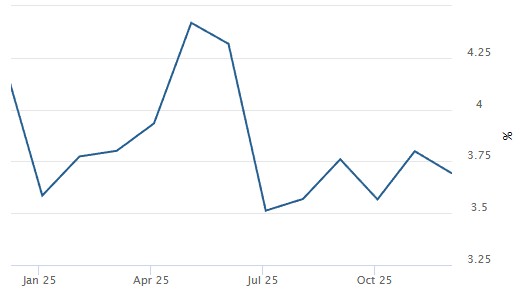
    MEXICO | Inflation slows in December. On 8 January Mexico’s national statistics institute (Inegi) released the consumer price index (INPC) for December, which showed monthly inflation of 0.28% and an annual rate of 3.69%. This is down from monthly inflation of 0.66% and an annual rate of 3.80% in November. Core inflation, which excludes volatile items like food and fuel, stood at 0.41% in monthly terms and 4.33% in annual terms, up from a monthly core rate of 0.19% in November but down from an annual rate of 4.43% the previous month. Inflation remains within the central bank (Banxico)’s target of 3% with a tolerance range of +/- 1%.

    MEXICO | Remittances continue downwards trend. On 2 January Mexico’s central bank (Banxico) announced that remittances sent to the country in November totalled US$5.13bn, representing a 5.7% drop year-on-year. This marks the eighth consecutive month of year-on-year declines. Accumulated remittances received between January and November 2025 totalled US$56.47bn, down 5.1% on the US$59.52bn received in the same period of 2024.

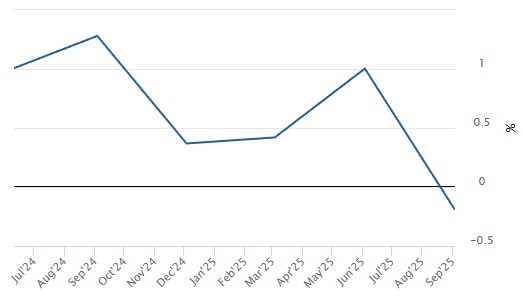
    Mexico: GDP growth
    Percentage variation (year-on-year)

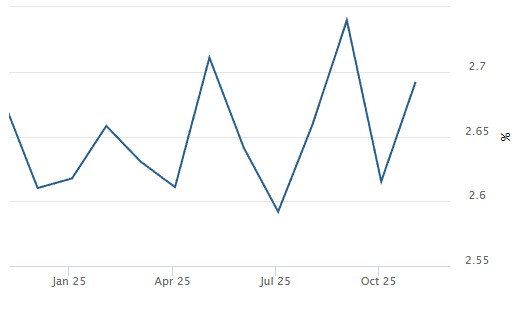
    Mexico: unemployment rate
    Economically active population

    Mexico: inflation rate
    Percentage variation (year-on-year)

    Source (all graphs): National Statistics Institute (Inegi)

  • Risk pointers

    LatinNews 21 October 2011 Hits: 782

    *** Hezbollah threatens to destroy Tel Aviv.  The leader of Hezbollah, Hasan Nasrallah, has said that Hezbollah “will destroy Tel Aviv” if Israel attacks Iran.  According to Ayatollah Jafar Shojouni, a member of Iran’s Combatant Clergy Association, Nasrallah made this pledge in a meeting with Shojouni in Lebanon about three months ago.  According to Shojouni, Nasrallah said: “If Israelis come near Tehran, we will destroy Tel Aviv.”

    Interestingly, in an interview with Lebanon’s Daily Star published on 27 September, Shojouni admitted that support for Iran’s President Mahmoud Ahmadinejad was waning, but he also said that he would serve out his term.  He blamed Ahmadinejad’s problems on his chief of staff, Esfandiar Rahim-Mashaei, who “only seeks controversy and tensions”.

    *** Islamists step up struggle for fruits of revolution.  The Islamists are stepping up their efforts to inherit the fruits of the Arab Spring, and, increasingly, pro-Islamist commentators and media outlets are talking about a conspiracy to steal the Arab revolutions from the Islamists, whom they claim were the main instruments in the successful revolutions.

    The Islamists admit that the Islamist element was modest in the Tunisian revolution, but they claim a decisive influence in Egypt and Libya and in the uncompleted revolutions in Syria and Yemen.  In Libya, in particular, it is pointed out that the Islamists “paid in a torrent of blood” (to quote a recent commentary in Jordan’s ad-Dustour).  Indeed, there are also rumours doing the rounds that Nato jets intentionally targeted Islamist fighters in Libya only later to claim this ‘friendly fire’ was a mistake.  The myth-making is in full swing.

    In the meantime, the differences between the Islamist and liberal wings of the Libyan revolution are continuing to prevent the formation of a government, which was originally due to have been concluded by 18 September.  The problem in Libya is that the Islamists did undoubtedly bear the brunt of the fighting, and now they want to have the premiership and a majority of cabinet ministers.  The liberals, on the other hand, say that their role in gaining the diplomatic and military support of the West was fundamental to the success of the revolution and should be awarded accordingly.  The position is further complicated by the claims of the various Libyan regions and tribes.

    A key figure is Ali al-Salabi, the spiritual leader of Libya’s Islamists.  He has told France that it must respect the desires of the Libyan people, by which he meant that France should refrain from pushing the claims of Mahmud Jibril, the former chairman of the executive board of the Transitional National Council (TNC).  Al-Salabi wants Dr Abd-al-Rahman al-Suwayhili as prime minister.

  • RASTREANDO TENDENCIAS

    LatinNews 22 August 2014 Hits: 645

    BOLIVIA | YPFB firma acuerdos con Petrobrás. La firma petrolera del Estado de Bolivia, Yacimientos Petrolíferos Fiscales Bolivianos (YPFB), y su contraparte de Brasil, Petrobrás, han firmado una serie de acuerdos poniendo fin a sus disputas sobre los pagos pendientes del gas natural y allanando el camino para su continuada asociación comercial. Petrobrás acordó pagar parte de su deuda pendiente por la entrega de gas a YPFB, compensando a la firma con US$457.7m. Por su lado, YPFB acordó pagar multas que le fueron impuestas por Petrobras por las interrupciones en el suministro de gas que tuvieron lugar entre el 2001 y el 2012.

    Los otros acuerdos firmados incluyen una serie de addendums al existente contrato de provisión de gas entre las dos firmas, bajo el cuales YPFB está contratada a entregar 30m de metros cúbicos (m3) de gas por día a Brasil hasta el 2019. En febrero, YPFB anunció que había firmado un contrato temporal con una planta termoeléctrica localizada en la occidental ciudad brasilera de Cuiabá, para exportar 2,24m m3 de gas por día, para cubrir la demanda extra generada por la construcción de proyectos antes de la Copa Mundial de la Fifa del 2014 y los Juegos Olímpicos del 2016. Bajo la nueva addenda, YPFB continuará con este acuerdo (que debía vencer este mes) hasta diciembre del 2016.

    Las exportaciones de gas de Bolivia a Brasil llegaron a US$3,87mm en el 2013, subiendo de US$800m en el 2005, el año antes de que el gobierno del Presidente Evo Morales asumiera el poder.

  • ARGENTINA: El gobierno de nuevo se enfrenta a la corte suprema

    LatinNews 15 May 2015 Hits: 592

    Con el fin del Kirchnerismo ahora ya a la vista, el gobierno Argentino está haciendo renovados esfuerzos para asegurar la influencia del movimiento continúe, particularmente dentro del poder judicial, más allá del 2015, independientemente de quién gane las elecciones generales de octubre. En la última escaramuza, la comisión de juicio político de la cámara de diputados de Argentina, que está dominada por políticos pro-gobierno, votó a favor de abrir un proceso de investigación sobre la capacidad para ocupar su cargo de Carlos Fayt, un juez de la corte suprema de 97 años.

    Descontento ante la reelección del presidente de la corte suprema, Ricardo Lorenzetti, de mentalidad independiente, para el periodo 2016-2019, y de su adjunta, Elena Highton de Nolasco, el gobierno ahora está cuestionando si se siguió el procedimiento correcto en la elección. La semana pasada, el abogado de Fayt confirmó los informes que decían que, en realidad, Fayt no estuvo presente en el salón de la corte cuando Lorenzetti fue reelecto por la corte el 21 de abril. Horacio Verbitsky, un periodista del diario pro-gobierno, Página/12, quien fue el primero en divulgar la historia, alegó que la salud de Fayt estaba tan mal que él ya no podía ni reconocer a sus secretarios.

    Esto provocó una movida de la diputada Anabel Fernández Sagasti, de la facción gobernante del Partido Justicialista (PJ, Peronistas), el Frente para la Victoria (FPV, Kirchneristas), para cuestionar si Fayt estaba capacitado para continuar en funciones en la corte suprema. En su argumento ante la comisión de juicio político, Fernández Sagasti dijo que ella no estaba cuestionando el récord de Fayt, pero que era necesaria una investigación para “corroborar sus aptitudes”. La comisión quiere escuchar el testimonio de un número de empleados de la corte quienes trabajan con Fayt, desde su chofer, y de periodistas quienes lo entrevistaron la semana pasada. En esa entrevista Fayt había dicho que había estado sufriendo de una gripe y de dolor de garganta, pero que “estoy bien y, como siempre, trabajando”.

    A fin de disipar las dudas acerca de la legitimidad de la reelección de Lorenzetti, la corte se reunió el 12 de mayo para confirmar su decisión. Pero esto sólo ha generado más controversia cuando Fayt, cuya presencia había sido esperada, no asistió a la reunión. Entonces, la corte se reunió de nuevo el 13 de mayo, esta vez Fayt estuvo presente, y emitió una resolución en la cual confirmaba la resolución original nombrando a Lorenzetti como presidente, con una línea señalando que: “Es indiferente para la validez de la resolución el lugar en la ciudad de Buenos Aires el que fue en definitiva firmada por los ministros, porque es práctica inveterada de la corte que las decisiones sean firmadas dentro o fuera del Salón de Acuerdos”. Aún así, la aparente contradicción entre las palabras de la corte suprema y sus acciones no pasaron desapercibidas para los simpatizantes del gobierno.

    La oposición alega que el caso contra Fayt es políticamente motivado. El Diputado Pablo Tonelli de la centro-derechista Propuesta Republicana (PRO) dijo, “este es un ataque político para socavar la resolución del Dr. Fayt, y es un ataque sobre la independencia de la corte suprema”. Otros miembros de la oposición alegaron que la comisión de juicio político sólo puede, como implica su nombre, decidir si abrir o no procedimientos de juicio político, y no llevar adelante “investigaciones” del tipo que propone. El FPV carece de la mayoría de dos tercios en la comisión necesaria para recomendar el juicio político.

    Candidato del FPV por la provincia de Buenos Aires se retira

    Con la provincia de Buenos Aires posiblemente siendo el área más Peronista de Argentina, quien quiera que gane las primarias del el FPV, la gobernante facción del PJ, tiene una fuerte chance de reemplazar al actual gobernador y aspirante a la presidencia de la nación, Daniel Scioli. Sin embargo, con 10 candidatos en la carrera, la Presidenta Cristina Fernández ha pedido al partido que reduzca el número de contendientes para evitar que se debiliten sus chances. El 13 de mayo, uno de esos candidatos, Carlos Castagneto, el viceministro para el desarrollo social, prestó atención al pedido. “Creo profundamente que el verdadero candidato es  nuestro proyecto político, por lo tanto, retiro mi candidatura para la gobernación de la provincia, y me mantendré apoyando las políticas que traen alegría a nuestro pueblo, con compromiso, amor y trabajo”, escribió Castagneto en sus cuentas de medios sociales.

    • Randazzo aún está en carrera

    Florencio Randazzo, el ministro del interior & transporte, ha confirmado su intención de presentarse contra Daniel Scioli en las primarias para determinar quién será el candidato del Frente para la Victoria (FPV) para la presidencia en las elecciones de generales de octubre. Hasta ahora, Scioli ha dominado el campo de candidatos del FPV, y ocupa un buen lugar en las encuestas, en comparación con los candidatos de la oposición, Sergio Massa y Mauricio Macri. Sin embargo, el apoyo a la candidatura de Scioli permanece tibio dentro del partido, lo que significa que Randazzo aún tiene una chance.

  • TRACKING TRENDS

    LatinNews 31 March 2016 Hits: 2115

    COLOMBIA | Bond issue. Colombia’s finance ministry has released a statement showing that it had issued sovereign bonds worth €1.350bn (US$1.52bn) to be repaid within 10 years with an interest rate of 3.875% in international markets.

    The statement said that the issue of the euro-denominated bonds would help to finance several government projects. The operation included the participation of 215 European institutional investors from the United Kingdom (UK), France, Belgium, Denmark, Germany, Ireland, Italy, Luxembourg, and Norway, among other countries. US investors also acquired some of the bonds.

    President Juan Manuel Santos said that that with the funds raised, his government aims to finance investment programmes such as the ‘Plan Pazcífico’, a major infrastructure development programme for the country’s Pacific coastal regions. “This operation ends this year’s finance necessities,” President Santos said. “It is very positive to have accomplished this when the global economy is experiencing important problems, and it represents a vote of confidence for Colombians”.

    According to the finance ministry, the last time Colombia issued bonds in euros was in 2001.

    VENEZUELA | Energy savings plan objectives not reached. Venezuela’s electric energy minister, Luis Motta Domínguez, said that the objectives of the country’s national energy savings plan launched in January have not been reached. The plan aims to decrease the country’s electric energy consumption to cope with the current low level of water in Venezuelan dams, the principal source of electric energy in the country, due to the drought caused by the ‘El Niño’ climatic phenomenon.

    Among other measures, in February the government implemented the reduction of electric consumption in shopping malls that do not have an electric power auto-generation system and reduced working days by two-and-a-half hours in the public administration sector (from 7.30am to 1:00pm). However, the level of household electricity consumption, which accounts for 70% of total consumption in Venezuela has remained largely unchanged.

    “In the residential sector, the consumption has not reached our goals yet, unfortunately, and it is necessary that…we all make an effort…to minimise the negative effects of the climatic phenomenon ‘El Niño’ on hydroelectric dams”, said Motta Domínguez, once again urging citizens to “make efficient use of electric energy”. In contrast, Motta Domínguez indicated that the industrial and commercial sectors had decreased their electric energy consumption by 4% since the implementation of the new saving plan. His comments came a day after the electric energy ministry (MPPEE) released a statement saying that the government had “reactivated controls concerning rational and efficient use of energy in public bodies”.

    COLOMBIA | Developing bilateral economic agenda with UK. The United Kingdom’s Minister of State with responsibility for the Foreign and Commonwealth Office, Baroness Joyce Anelay, visited Colombia’s northern Caribbean port city of Barranquilla on 14 and 15 March in support of a delegation of UK companies promoting their expertise in the development of ‘SMART’ cities, a term referring to the use of technology to improve the efficiency of public services. Anelay also aimed to reinforce the UK’s relationship with the city in the areas of offshore oil and gas development and culture.

    A UK government statement released on 18 March noted that Anelay also held a number of meetings with Colombian government officials including Foreign Minister María Ángela Holguín, Post-Conflict Minister Rafael Pardo, and Interior Minister Juan Fernando Cristo during her visit, to discuss the bilateral agenda, including the promotion of human rights (see sidebar). Anelay reiterated the UK’s political and financial support for the ongoing peace negotiations between the Colombian government and the Fuerzas Armadas Revolucionarias de Colombia (Farc) guerrillas, announcing a UK contribution of US$5.97m to the United Nations trust fund set up to help finance peace programmes in Colombia and US$1.68m to the similar trust fund set up by the European Union.

    Following her stopover in Colombia, Anelay visited Panama on 16 and 17 March.

    • Human-Rights agenda

    At the end of her visit to Colombia, Minister Anelay hosted a human-rights reception which “celebrated the work of human-rights defenders in Colombia from civil society, communities and the government”. Anelay said that “Colombia has long been an important partner for us on human rights and I was pleased to meet with a number of organisations and individuals who work to promote this agenda”. Anelay added that the UK would continue to fund human-rights projects in Colombia, such as helping female survivors of sexual violence.

  • Central bank holds rates

    LatinNews 23 August 2012 Hits: 466

    The economy is still growing faster than expected, with monthly growth rates of over 6% to date in 2012.

    The BCR held its key interest rate steady at 4.25% for the 15th consecutive month on 9 August. The BCR president, Julio Velarde, said that despite some “mixed signals” important sectors such as construction and imports indicate that that domestic demand in Peru remains strong. Velarde added that the current rate of growth, which in June was 6.47%, is close to what the bank considers the country’s long-term sustainable potential growth rate of 6.4%. Consumer prices fell 0.9% in July, bringing the cumulative rate for the year to 3.28% lower than the 4% registered to July last year. This was attributed to the “easing of some supply sector factors” that were temporarily pushing up prices. Velarde noted that the current rate of inflation is now closer to the bank’s target rate of 1%-3%.

    Despite the global spike in grains prices, the BCR expects inflation to converge towards its target range in the second half.

    • Praise

    The stellar performance of economy in the midst of global economic uncertainty is earning Peru international plaudits. A report by a Spain-based economics consulting group, FocusEconomics, predicts that Peru will post the highest growth rate in Latin America this year. According to the LatinFocus Consensus Forecast report, the country’s real annual GDP growth this year will be 5.8%. The report notes that growth in Peru has remained stable in recent years, in contrast to other Latin America countries, and is substantially higher than the average regional growth rate (3.2%); the Southern Common Market (2.4%) and the Andean Community (4.8%), of which Peru is a member.