All Categories

Subcategories

  • BRAZIL: Government submits 2024 budget proposal

    Patrick de Courcy 07 September 2023 Hits: 2819

    The federal government unveiled its legislative proposal for the 2024 budget on 31 August and submitted it to congress. Despite the proposed budget totalling R$5.54tn (US$1.12tn) for next year, with huge funding for social programmes, the minister for planning & budget, Simone Tebet, insisted that the government will aim for zero deficit in 2024. The finance minister, Fernando Haddad, also present at the press conference in which Tebet announced the budget proposal, highlighted that the government-backed fiscal discipline framework has now been approved and should ensure the guard rails against potential overspending.

    The latest proposal marks an increase from the 2023 budget legislation approved by congress in January this year, which totalled R$5.35bn. In the 2024 budget proposal, the government has proposed R$2.69tn in primary expenditure, R$2.70tn in financial expenditure, and R$151.3bn in investment for state-owned companies. The estimate for the budget was also influenced by other government projections, such as an annual GDP growth forecast of 2.26%, annual inflation of 3.30% for 2024, and an average benchmark interest rate of 9.80%. Tebet’s declared zero deficit objective would also depend on the government raising enough revenue. The budget proposal projects primary revenue of R$2.71tn (23.7% of GDP).

    In the press conference, Tebet and Haddad adopted an optimistic tone about 2024 but acknowledged the potential difficulties with keeping spending in check. The federal government projects that it will end 2023 with a primary deficit equivalent to 2.2% of GDP. On the same day as the budget proposal’s submission to congress, Brazil’s central bank (BCB) released the public sector’s latest fiscal statistics, which showed a total primary deficit of R$35.8bn in July, while the central government’s primary deficit came to R$32.5bn. In the first seven months of 2023, January and April were the only months in which the government achieved a surplus.

    Haddad expressed confidence that key pieces of legislation from this year would boost tax revenue in 2024, such as a new law which changed the rules of the tax appeals tribunal (Carf), fully approved by congress on 30 August, and a bill to streamline consumption taxes, approved in the lower chamber in July and currently being reviewed in the senate. The finance ministry believes that the new Carf rules would be more favourable for the government and allow additional revenue of at least R$54bn. It has also planned to raise more revenue by introducing a raft of new taxes, the legislation for which still needs to be reviewed by congress. For example, the government estimates that a new tax on closed-end investment funds would raise at least R$13.3bn and a tax on offshore funds would raise at least R$7bn.       

    Experts raise 2023 growth forecast

    The government’s plans to raise revenue will depend on strong economic growth. Private sector analysts and economists consulted by the central bank (BCB), whose findings were published in the BCB’s weekly bulletin on 4 September, raised their GDP growth forecast to 2.56%, up from the 2.31% projection from the previous week and from the 2.26% forecast a month earlier. However, the experts slightly decreased their 2024 GDP growth forecast to 1.32%, down from 1.33% predicted the previous week. 

  • Bolivia's Morales offers a concession

    LatinNews 30 April 2012 Hits: 1316

    Development: On 28 April the government of President Evo Morales announced it was suspending a provision of the 24 January Supreme Decree 1126 (DS-1126), which increased the working day for doctors and public health care workers from six to eight hours without additional pay.

    Significance: The concession to the health workers, who resumed strikes over DS-1126 earlier this month, has yet to placate the sector, which is calling for the complete repeal of the decree. The concession comes as Morales continues to face various other threats of social unrest – most notably from the country’s main trade union confederation, the Central Obrera Boliviana (COB), over the minimum wage and indigenous protesters opposed to the government’s proposal to construct a the road through a local indigenous territory and national park, Isiboro Sécure (Tipnis).

    Key points:

    • The COB has rejected the government’s latest offer, announced on 26 April, of a 20% increase in the minimum wage (to B$978.48/US$143 a month) and 8% for the public sector (health and education). This is up from the government’s initial offer of 15% and 7% respectively. The COB announced it would officially present its position on 3 May.

    • The right-wing opposition Convergencia Nacional (CN) is seeking to capitalise on the current discontent with the government over the wage issue. A CN deputy, Luis Felipe Dorado, told reporters that his party would request a meeting with the COB leadership on 2 May, during which it would present a proposal regarding the minimum wage.

    • Further upping the pressure on the government, on 27 April, some 500 indigenous protesters set off from Trinidad, the capital of the eastern region of Beni, to begin a march of more than 500km to the capital, La Paz, in protest of the Tipnis road. The marchers are retracing the steps of a similar march last year, which had forced the government to back down over the project.

  • URUGUAY: Vázquez eyes intriguing electoral alliance

    LatinNews 14 November 2013 Hits: 2165

    The president of the state petroleum company Administración Nacional de Combustibles, Alcoholes y Portland (Ancap), Raúl Sendic, announced his resignation on 15 October in order to pursue his political ambitions. The resignation of Sendic has intrigued Uruguayan political commentators, who are debating whether he could be lining up for possible involvement in the ruling left-wing Frente Amplio’s (FA) electoral team for next year’s presidential elections, possibly even as the running mate of former president Tabaré Vázquez (2005-2010).

    Sendic

    Raúl Fernando Sendic Rodríguez, to use his full name, is the son of Raúl Sendic Antonaccio, one of the founding members of the Movimiento de Liberación Nacional-Tupamaros (MLN-T) guerrilla group, of which President José Mujica was also a prominent founding member. Sendic Rodríguez is also a former deputy for the FA, and briefly served as Industry Minister between 2009 and 2010.

    Sendic, who had headed Ancap since his appointment by Vázquez to the position back in 2008, tendered his resignation one year in advance of next year’s electoral contest, in compliance with constitutional norms on political involvement. Vázquez, who is the firm favourite to secure the FA’s presidential candidacy, and indeed to succeed Mujica, has suggested in the past that he sees Sendic as a “very good” potential companion in an election campaign, fuelling speculation over the possibility that Sendic could accompany Vázquez on a joint slate.

    Sendic had until recently maintained his silence over these rumours on the grounds that constitutional law prohibited those holding high-level jobs in the public sector from getting involved in party politics. Given that Vázquez hails from the more moderate wing of the FA, the choice of a running mate who is a scion of the radical root of the left-wing coalition would make sense.

    It is worth noting that Vázquez attended the launch of a new movement within the umbrella FA coalition on 14 September, where he was the main speaker. Frente Unido, as this movement is known, is allied to Sendic’s Compromiso Frenteamplista. It is composed of the Vertiente Artiguista, La Lista 5005 and Más Frenteamplista. Sendic made it clear that he would lead the Frente Unido senate list or run for vice-president if asked.

    Frente Unido will compete for influence, and congressional seats and future cabinet positions, with the Movimiento de Participación Popular (MPP), the core part of which is the MLN-T; Frente Líber Seregni; and Partido Socialista (PS), which Vázquez left on principle in 2008 because of its criticism of his decision to veto a congressional bill on abortion.

    Constanza Moreira

    Vázquez has mended fences with the PS since then and has won the backing of the vast majority of the coalition for his nomination in party primary elections on 1 June 2014. The only challenger he currently faces is Constanza Moreira, a sociologist and independent politologist, who was elected as a senator in 2009 for Espacio 609, part of the MPP. Vázquez and Moreira were officially named as the presidential pre-candidates by the FA party plenary on 3 November.

    Moreira has no chance of emerging victorious against Vázquez, who would also be a firm favourite against whoever is selected to run for the right-wing opposition Partido Colorado (PC, Colorados) or the Partido Nacional (PN, Blancos). Vázquez already has the support of the principal internal movements within the FA.

    A sign of Moreira’s paucity of support is that even Espacio 609 has distanced itself from her and backed Vázquez, under pressure from the combative senate president First Lady Lucía Topolansky. As such she is running in the primaries for the small Partido por la Victoria del Pueblo (PVP) and a new group, Ir, which was established in 2010 by younger members of the FA who maintained that the left-wing coalition was in urgent need of an injection of youth to freshen things up.

    This is not something Vázquez, at 73, can provide; Moreira, herself 53, is hardly a spring chicken herself although by Uruguayan standards she is very much a young politician. Vázquez conceded that reaching out to the younger generation was one of the FA’s biggest challenges, although he was only able to offer his “experience” as part of “a generation which is on the way out”. As such he welcomed what he said would be a “complementary” not a “competitive” primary.

    Moreira was happy to play along with Vázquez’s characterisation of the primary contest. She stressed that “the important thing is not the primary but October’s elections”. She added that the main challenge was for the FA to win in the first round of the presidential contest and to secure a majority in both chambers of congress.

    Moreira said that after four years in congress she could not imagine “how we would be able to govern through accords with the Blancos and Colorados. Congressional majorities ensure that our programme has a real weight. Without congressional majorities our programme will not get anywhere,” she said. The FA currently has a wafer-thin majority in both chambers of congress and has suffered a couple of painful reverses when FA dissidents have voted alongside a disciplined opposition.

    Moreira stressed that her campaign would not be “against Tabaré but with him”, implying that between them they could raise more issues and stir up more support for the FA. It was all very amicable and sealed with a hug between Vázquez and Moreira. This stood in stark contrast to the previous FA party primaries in 2005, which were a decidedly acrimonious affair, pitting Mujica against Danilo Astori (although the latter did go on to be vice-president in the interest of coalition unity). Both Vázquez and Moreira are keen to avoid a repeat of this bitterness which, some believe, almost cost the FA a congressional majority. Mónica Xavier, the president of the FA, pointedly said that the primaries were “not a confrontation” but that both candidates would place a different “emphasis” on certain issues.

    How this plays out in practice is not entirely clear, as electoral contests, by definition, pit candidates against one another. If not, there is a risk of it all being a bit insipid and failing to capture the public’s imagination, although the lack of a competitive primary did nothing to damage the chances of Chile’s former president Michelle Bachelet (2005-2010), who looks set to win re-election at a canter on 17 November. The gulf in support for Vázquez and Moreira is comparable to that between Bachelet and her primary ‘rivals’.

    The bonhomie should be easy enough for Vázquez to preserve as the overwhelming favourite, just as it was for Bachelet, although her hapless rivals put up more of a fight than Moreira is promising. Moreira may feel that if she can impress Vázquez during the campaign, she has an outside chance of being his running mate, or at least securing a ministry in his future cabinet.

    • Seismic shift

    From 1830 until the 1980s Uruguay’s political battles were between the Colorados and the Blancos but shortly, for the first time, the two will become formal allies. The emergence of the Frente Amplio (FA) initially did nothing to challenge the political duopoly in Uruguay but since Tabaré Vázquez won a historic victory in 2005, the FA has dominated Uruguayan politics. Even together the Blancos and Colorados would be hard-pressed to win – but they would push the FA close. As such the two parties have decided to present a joint slate in the local elections in Montevideo in May 2015. If successful (and assuming the FA wins the presidential elections in 2014), the two parties might consider a similar alliance for the presidential elections in future.

    • Mujica on Argentine elections

    Uruguay’s President José Mujica reacted in inimitable style to Argentina’s congressional election results on 27 October. “They are all Peronists. Do the math, some of them took 40% and a bit; others 30% and a bit, add them up and you have 85% and a bit, they are all Peronists,” he said. This was reminiscent of Mujica’s comment last February when he said that “In Argentina, everybody is a Peronist, even those who are not Peronists.” Mujica conceded that bilateral relations with Argentina had reached an “impasse” but he is hoping that the controversy over his decision to allow the UPM pulp mill to increase production, for which the Argentine government threatened to take Uruguay to The Hague once again, can be resolved now that the elections are out of the way.

  • TRACKING TRENDS

    LatinNews 16 April 2014 Hits: 1724

    CHILE | Economic activity starts to pick up. Chile’s central bank reported last week that economic activity in the country as measured by its monthly economic activity index (Imacec), which accounts for 91% of all goods and services included in the measurement of GDP, increased by 2.9% year-on-year in February.
    The Imacec February figure was much higher than the 1.4% figure observed in January and even surpassed local market expectations. Local analysts had projected that the February Imacec figure would be 2.4%, as the economy continues to gather pace following a weak end to last year, when the Chilean economy grew by just 4.1% after years posting average growth rates of around 5%. In fact, the Imacec February result is the strongest monthly result since September 2013. The accompanying central bank report even pointed out that the seasonally adjusted February Imacec figure was 0.2% higher than in the previous month and 2.5% higher than in February 2013.
    According to the central bank, the positive February result was primarily driven by increased dynamism in the mining and commercial retail sectors. Should the Imacec continue to exhibit similar positive results, this might lead the central bank to revise its decision, announced last month during its first monetary policy report of the year, to cut its official 2014 growth forecast from 3.75%-4.75% to 3%-4%.
    In what should be a further boost for the local economy, the national state-owned copper mining company (Codelco) revealed, also on 7 April, that thanks to its ‘brownfield’ exploration efforts in the last four years the firm has identified new copper deposits believed to hold over 1.8bn tonnes of copper.

    URUGUAY | Early success for economy ministry. The economy & finance minister, Mario Bergara, maintains that the urgent measures he adopted last month to contain inflation have been “successful” after encouraging figures for March. Inflation reached 0.58% in March, a significant fall from the 1.66% recorded in February and 2.44% in January. It brings 12-month inflation to 9.73%, dropping back from 9.82% and the brink of 10%, a psychological threshold which, if breached, would also oblige the government of President José Mujica to re-negotiate mid- and long-term salary accords with trade unions.
    Bergara announced reductions in value-added tax (VAT) for fruit and vegetables; compelled communications and power public utilities to reduce electricity tariffs and telephone bills; fuel prices were frozen and big stores also agreed to freeze, or even reduce, the price of products in the basic basket of goods.
    There was further good news. The employment rate in March reached its highest level since records began nearly 30 years ago, according to the national statistics institute (INE), climbing from 60.5% of the economically active population to 61.1%, or some 1.66m people. National unemployment also rose slightly, from 6.7% to 7%, but the biggest concern for government policymakers is not the number of Uruguayans in jobs but the number of Uruguayans per se.
    Raúl Sendic, widely tipped to be chosen by former president Tabaré Vázquez (2005-2010) as his running mate after June’s primary elections in the ruling left-wing Frente Amplio (FA), called for the creation of policies to create “greater procreation among the middle class”. Sendic, the son of Raúl Sendic Antonaccio, one of the founding members of the Movimiento de Liberación Nacional-Tupamaros (MLN-T) guerrilla group, said that the low birth rate was one of the most serious challenges facing Uruguay. Sendic was president of the state petroleum company, Administración Nacional de Combustibles, Alcoholes y Portland (Ancap), for five years until last October when he resigned to run as a senate candidate for his Compromiso Frenteamplista faction of the FA.

  • RASTREANDO TENDENCIAS

    LatinNews 24 April 2015 Hits: 754

    REGION | Esfuerzos conjuntos ante el cambo climático y las pestes agrícolas. El 21 de abril los ministros de agricultura de Argentina, Bolivia, Brasil, Chile, Paraguay, y Uruguay, acordaron impulsar la cooperación en el área de la agricultura a fin de enfrentar mejor los problemas derivados del cambio climático y las pestes agrícolas. El acuerdo fue firmado durante la reunión de dos días del Consejo Agrícola del Sur (CAS) celebrada en Santiago, la capital de Chile.

    El ministro de agricultura de Chile, Carlos Furche, dijo que el acuerdo responde al hecho de que los desafíos planteados por el cambio climático global y la propagación de las pestes de plantas y enfermedades de animales exigen  una acción conjunta y coordinada entre los vecinos regionales. “Necesitamos coordinar una acción conjunta para controlar o erradicar las diversas enfermedades animales o las pestes de las plantas”, dijo Furche. Y agregó: “La presión que ejerce el flujo de bienes y personas transportadas a través de la región significa que es necesaria la ayuda de todos los países. Si queremos eliminar la mosca de la fruta, por ejemplo, no es suficiente erradicarla de Chile, también necesitamos hacer lo mismo en los países vecinos”.

    Mientras tanto, abordando la cuestión del cambio climático, Furche dijo que “en nuestro caso, sabemos que el cambio climático produce un impacto muy serio, de hecho tenemos actualmente 194 comunas bajo estado de emergencia agrícola debido a la sequía, y por lo tanto, esta es una cuestión altamente relevante”.

    Esto fue secundado por titular del ministerio de ganadería, agricultura, y pesca (MGAP) de Uruguay, Tabaré Aguerre, quien dijo que el cambio climático era algo ante lo cual toda la región debe adaptarse. “Necesitamos adaptarnos a esto y ser más eficientes en el uso del agua y el mejor manejo de la tierra, porque esto nos permitirá tener sistemas de producción más sustentables y resistentes”, dijo Aguerre.

    Los ministros agregaron que durante la reunión, los miembros del CAS también acordaron elaborar una posición común sobre el cambio climático a fin de presentarla en la próxima Conferencia de las naciones Unidas sobre el Cambio Climático (COP21) que se celebrará en París en noviembre-diciembre. Al final de la reunión del CAS, Chile transfirió la presidencia pro-témpore del consejo a Uruguay, que estará a cargo de organizar la próxima reunión del CAS.

    URUGUAY | Desestimando de las preocupaciones económicas. El 21 de abril el ministro de economía & finanzas de Uruguay, Danilo Astori, y el presidente del banco central (BCU), Mario Bergara, desestimaron las existentes preocupaciones de que la rápida apreciación del dólar de EU, que está acumulando presiones inflacionarias en Uruguay, podría conducir al país en una crisis económica.

    La tasa de la inflación en Uruguay actualmente está por encima del tope del rango de meta del BCU del 7% (la inflación acumulada fue de 7,55% en el periodo de 12 meses hasta marzo) debido principalmente a un número de factores externos incluyendo la apreciación del dólar y las bajas importaciones de bienes de Brasil y Argentina, como un resultado de la contracción en los niveles de producción en esos dos países.

    Todo esto ha provocado preocupaciones de que la economía uruguaya podría tener un año difícil con una tasa de inflación más elevada que el 8,26% con la cual cerró el 2014, junto con un menor crecimiento como un resultado de la más baja demanda global y términos comerciales menos favorables. Sin embargo, en un foro con economistas locales organizado por el BCU, Astori dijo que “Las cifras muestran que sobre la cuestión del crecimiento, Uruguay ha logrado mantener una evolución razonable de su economía en circunstancias incluso más duras de las que actualmente afronta globalmente y en nuestra región”.

    Bergara dijo que las autoridades económicas uruguayas habían hecho frente a una rápida apreciación del dólar en el pasado y que ellas han construido una plataforma para asegurar que la depreciación de la moneda nacional no tenga mayores consecuencias. “La vulnerabilidad ante los riesgos en la tasa de cambio ha sido mitigada”, dijo Bergara. Y agregó que “EU continuará fortaleciendo su moneda pero estamos tranquilos y serenos en que [aunque] Argentina y Brasil están actualmente estancados, nosotros continuaremos creciendo, incluso si es a una tasa menor”.

    El PIB de Uruguay se incrementó un 3,5% el año pasado y el gobierno está apostando a un resultado similar este año. En cuanto a la tasa de la inflación, Bergara dijo que las autoridades estaban trabajando para hacerla caer, pero insistió en que “no estaba fuera de control”. “Estamos trabajando con un rango de meta del 5% con una tolerancia de dos puntos porcentuales […] difícilmente es dramático que la inflación esté actualmente en un 7,5%,” dijo Bergara.

    • El FMI elogia como “creíble” el plan de Brasil

    El 16 de abril la directora general del Fondo Monetario Internacional (FMI), Christine Lagarde, dijo que un “creíble” plan fiscal estaba siendo implementado en Brasil.  Mientras que el FMI ha recortado su pronóstico de crecimiento económico para Brasil este año, prediciendo una contracción del 1%, este espera que el país retorne al crecimiento en el 2016, y pronostica una expansión del 2,2% para el 2017. En una conferencia de prensa en Washington D.C., donde el ministro de finanzas de Brasil, Joaquim Levy, se reunió con Lagarde, la directora general del FMI elogió las medidas que el nuevo ministro ha tomado en apoyo de la economía interna de Brasil.

  • ARGENTINA: Chasm deepens following controversial court decision

    LatinNews 10 September 2020 Hits: 3715

    The decision by a federal court to grant house arrest to a well-known businessman under prosecution over corruption charges has stoked Argentina’s political divisions. The deepening of ‘la grieta’ (‘the chasm’) that divides the country’s leftist ruling Partido Justicialista (PJ, Peronists) and its opponents, which has resurfaced over the controversial judicial reform proposed by President Alberto Fernández [WR-20-32], is a source of concern as it threatens to produce governability problems. This threat extends beyond the obstruction of the government’s legislative agenda in congress to include disruptive public demonstrations.

    Lázaro Báez was arrested in 2016 over charges of money laundering and dubious dealings with the previous PJ governments led by Néstor Kirchner (2003-2007) and his widow and successor Cristina Fernández (2007-2015). A close friend of the Kirchners, Báez is thought to be one of the key pieces in the suspected corruption network operating under the successive Kirchnerista administrations (known as the ‘Ruta del dinero K’), which allegedly included Cristina, the incumbent vice president. He has been imprisoned for the past four years pending the conclusion of a judicial process that started in 2018. Báez’s lawyers have repeatedly requested that he be granted house arrest due to his poor health.

    These requests have been consistently denied by judges who deem him to be a high flight risk. However, on 7 September a federal court of appeal ruled in Báez’s favour, granting him house arrest with immediate effect. Báez was due to be transferred from the Ezeiza prison to his designated residence in a gated community in Pilar, Buenos Aires province, that evening. But the release of one of the most high-profile individuals jailed in relation to corruption associated with the Kirchnerista administrations was incendiary.

    A group of people believed to be residents staged a demonstration outside the gated community denouncing Báez’s release as a sign of impunity and a government-promoted attempt to whitewash past corruption and shield Cristina, who is a suspect in various ongoing trials. When the van from the national prison service carrying Báez and its police escort arrived at the gated community they found their entry blocked by protesters. Violent clashes ensued, with eggs and stones thrown at the police and the van. Ultimately, Báez was returned to Ezeiza prison until a solution can be found.

    The show of discontent was not limited to the Pilar blockade. Pots-and-pans protests took place in neighbourhoods in the city of Buenos Aires, while prominent opposition figures criticised the decision and the “anti-impunity message it sends to the courts and the government”. The episode is likely to entrench opposition to the proposed judicial reform sent by President Fernández to congress. The opposition considers this reform to be a covert attempt to co-opt the national judiciary and ensure that his vice president’s name is cleared and is refusing to debate it, holding up the government’s whole legislative agenda.

    Resident complaint

    In clear sign that the Pilar residents are determined to keep Lázaro Báez away, the gated community’s board filed a legal complaint with a federal court asking for him to be ordered to serve his house arrest at an alternative address. The board argues that Báez’s presence in the community would “break the harmony that characterises the neighbourhood, producing a situation of danger for him and neighbours that no one could manage”. It urges the courts to find an alternative address for Báez to “solve the evident conflict that has been created”. The courts have yet to issue a resolution on this complaint or Báez’s fate.

  • TRACKING TRENDS

    LatinNews 18 February 2021 Hits: 4072

    CHILE | Solar power plant. Spanish solar energy company, Cox Energy América, announced on 12 February that it will start building a new 308MW photovoltaic solar power plant in Chile’s northern Atacama Desert in the second half of the year.

    According to a Cox Energy América press release, the ‘Sol de Vallenar’ project represents an investment of €140m (US$170m) and the company is “currently in negotiations with various international entities, aiming to finalise the financing structure of the project, which will be one of the largest photovoltaic plants in Latin America”, and create over 1,000 jobs. The new plant, slated to come on-stream in 2023, will connect to Chile’s national electricity system, where it will produce enough electricity to supply 275,000 households and eliminate 300,000 tonnes of carbon dioxide emissions in the process.

    The company also noted that the project is the result of its winning a 20-year purchase power agreement to supply at least 140GWh of electricity a year, in the last public tender process carried out by the Chilean government in 2017. Notably, in August last year the Chilean government identified Sol de Vallenar as one of the 69 priority energy projects that it is hoping to expedite to try to reactivate the national economy following the economic recession produced by the coronavirus (Covid-19) pandemic.

  • ECONOMIC HIGHLIGHTS

    Patrick de Courcy 10 August 2022 Hits: 1497

    EL SALVADOR | Remittances up. On 18 July, El Salvador’s central bank (BCR) released new figures which show that remittances sent to El Salvador totalled US$3.78bn in the first six months of 2022, up 3.5% on the same period in 2021. Of the total 93.9% were sent from the US, followed by Canada (0.9%); Spain (0.4%); Italy (0.3%); and the UK (0.1%). As regards how they were sent, 34.4% were sent via banking institutions; while other institutions used for the payment of remittances represented 62.1% of the total. Digital transactions through cryptocurrency accounted for 1.7% of the total while transactions through mobile telephones accounted for 0.3%. 

    HONDURAS | Trade deficit surges. On 17 July, Honduras’s central bank (BCH) released new figures showing that Honduras’s trade deficit totalled US$3.3bn in the first five months of 2022, up 20.2% on the same period in 2021. Total exports in the first five months of 2022 were US$2.79bn, up from US$2.18bn registered in the same period in 2021 while total imports were US$6.09bn, up from US$4.92bn. The BCH attributes the surge in imports, which were driven mainly by fuel, processed industrial supplies, and food & drink, with the dynamism of national economic recovery following the coronavirus (Covid-19) pandemic as well as the rise in international prices of primary materials and finished goods and higher logistical costs. Honduras’s main exports are coffee (US$905.3m) and bananas (US$240m), while its main export markets are North America (US$1.06bn), which accounted for 38.0% of exports, followed by Europe (US$775.9m) and Central America (US$639.8m). Honduras’s main sources of imports were also North America (US$2.5bn) which accounted for US$41.1% of imports, followed by Central America (US$1.29bn) and Asia (US$1.2bn).

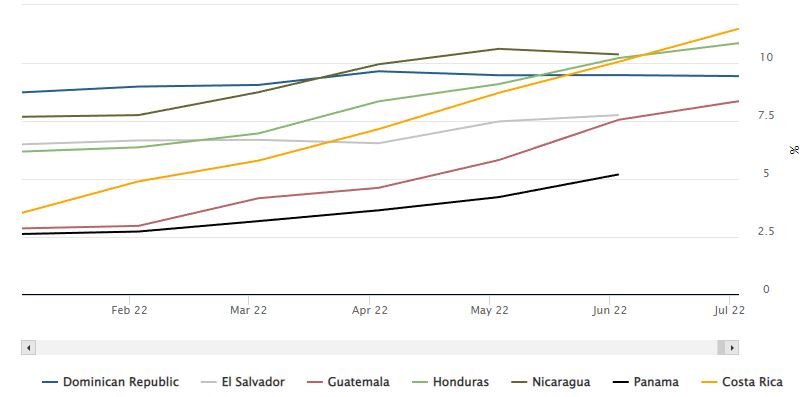
    Central America & Caribbean: inflation rate
    Percentage variation (year-on-year)

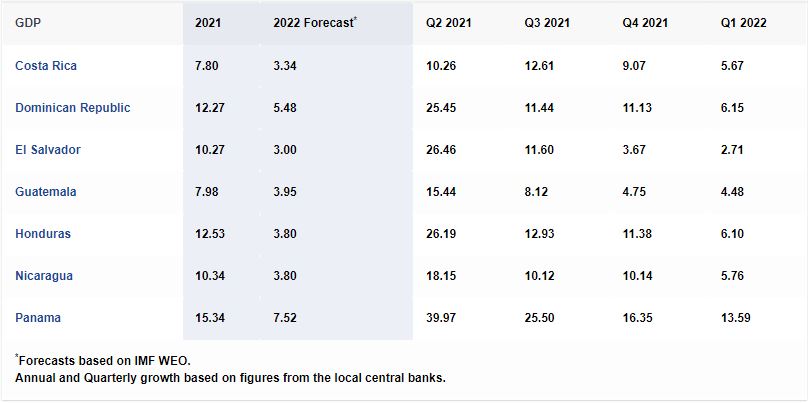
    Central America & Caribbean: GDP growth (%)
    Quarterly figures are year-on-year growth

  • BRAZIL: Lula tours big cities to back mayoral endorsements

    Abbi Dicker 04 July 2024 Hits: 2087

    From 6 July until the first round of municipal elections on 6 October, restrictions will be placed on mayoral hopefuls holding public office from using their current roles to unfairly benefit their campaigns. In this final week before the electoral rules come into force, President Luiz Inácio Lula da Silva kicked off a regional tour on 27 June, travelling to some of Brazil’s biggest cities with the official purpose of launching public works, but with the underlying political goal of raising the profile of allies who are running for mayorships by appearing on stage with them at launch events.

    President Lula began his trip in the south-east, visiting Brazil’s three most populous states – São Paulo, Minas Gerais, and Rio de Janeiro – from 27-30 June, before travelling to the two most populous states of the northeast – Bahia and Pernambuco – from 1-2 July. Except for the mayoral race of Belo Horizonte, capital of Minas Gerais, Lula’s left-wing Partido dos Trabalhadores (PT) is not planning to field a candidate to run for mayor in the capitals of these states.

    Lula is backing the bid of another left-wing ally for the mayorship of São Paulo city, Guilherme Boulos (Partido Socialismo e Liberdade, PSOL). In the cities of Rio de Janeiro, Salvador (capital of Bahia), and Recife (Pernambuco), Lula will lend his support to allies of a more centrist profile. He has endorsed the re-election bids of the incumbent mayors of Rio, Eduardo Paes (Partido Social Democrático, PSD), and Recife, João Campos (Partido Socialista Brasileiro, PSB), and the campaign of Bahia’s deputy governor, Geraldo Alves Ferreira Júnior (Movimento Democrático Brasileiro, MDB), who is running for mayor of Salvador.

    Before this recent trip to Belo Horizonte, Lula had kept his cards close to his chest regarding his mayoral endorsement. He ultimately opted to back federal deputy Rogério Correia (PT) on 28 June, although there had previously been media speculation that he would support the re-election of incumbent Fuad Noman (PSD). During the 2022 presidential race, Noman endorsed Lula in the second-round run-off against far-right former president Jair Bolsonaro (2019-2023) and is considered a reliable centrist ally of the Lula administration. However, even though Lula won a narrow majority against Bolsonaro in the state of Minas Gerais as a whole, Bolsonaro won more votes in the state capital (54.25%) than Lula (45.75%). 

    The PSD had also been pressuring the PT to support Noman because in the 2026 general elections, the president of the federal senate, Rodrigo Pacheco (PSD), is expected to run for governor of Minas Gerais, while Lula might seek a fourth presidential term. Lula and Pacheco have reportedly agreed to endorse each other’s prospective campaigns, and the 2024 mayoral election of Belo Horizonte could have been a chance to lay the groundwork for a PT-PSD alliance in Minas.

    According to local daily Estado de Minas, the PT has adopted a new political strategy for the Belo Horizonte election. The mantle of Belo Horizonte’s main left-wing torchbearer is being claimed by three contenders: Correia and two other federal deputies, Bella Gonçalves (PSOL) and Duda Salabert (Partido Democrático Trabalhista, PDT). Estado de Minas reports that, rather than tacking to the centre by backing the PSD’s Noman, the PT is hoping to snag votes from Salabert and Gonçalves or possibly form a larger left-wing alliance with the PDT and/or PSOL. 

    On 29 June Lula visited São Paulo, where the left appears more united behind the PSOL-PT alliance of Boulos and his running mate Marta Suplicy (PT), whose main challenge until October will be to gain ground in the fragmented centrist space. On 27 June national pollster Genial/Quaest released figures showing that Boulos and the centre-right incumbent Ricardo Nunes (MDB), who has the backing of Bolsonaro, are the two frontrunners, polling 21% and 22% respectively. Polling in third was José Luiz Datena, of the centre-right Partido da Social Democracia Brasileira (PSDB), followed by the far-right Pablo Marçal (Partido Renovador Trabalhista Brasileiro, PRTB) and the centre-left Tabata Amaral (PSB).

    The segment of centrist voters who would be reluctant to back a candidate endorsed by Lula or Bolsonaro is torn between Datena and Amaral. The PSB had previously hoped to form an alliance with the PSDB, with Datena running on Amaral’s ticket, but last week news website UOL reported that the PSDB is now pressuring the PSB to abandon Amaral’s campaign and have her run as Datena’s deputy. UOL cited Amaral’s campaign team as dismissing the speculation that she might give up on her mayoral ambitions.

    In Rio de Janeiro, the PSD’s Paes is the current favourite to win the mayoral race. Lula and Paes exchanged compliments in their speeches at an event on 30 June to launch social housing projects in Rio’s favelas. The PT reportedly wants one of its own members to be Paes’ running mate, but the prospects for a PSD-PT alliance in Rio are looking uncertain. On the one hand, Paes’ possible run for the governorship of Rio de Janeiro state in 2026 could benefit from the support of Lula and the PT, a partnership which could be cemented in this 2024 local election. On the other hand, Paes is not facing a notable left-wing challenger, so it would perhaps be more strategic for him to focus on winning over conservative voters who might be inclined to support Alexandre Ramagem (Partido Liberal, PL), who has Bolsonaro’s endorsement for the Rio mayorship.

    On 13 June Paes reportedly held a meeting with federal deputy Otoni de Paula (MDB), a conservative politician from Rio who has close ties with the Assembleia de Deus evangelical church group. In exchange for the evangelical church’s support for Paes’ re-election campaign, De Paula reportedly requested the mayor to reject the PT’s demands to appoint a running mate from the left-wing party’s ranks.

    While the south-east is a challenging electoral battleground for Lula and his allies, the north-east has traditionally been seen as a political stronghold for the PT. Bahia state is governed by the PT’s Jerônimo Rodrigues, who appeared on stage next to Lula and his deputy governor on 1 July, as Lula announced federal funding for highway expansion projects and other initiatives for the state. The PT-MDB partnership at the gubernatorial level will extend to the Salvador mayoral campaign, as Alves Ferreira has chosen a PT member as his running mate, Fabya Reis, who had led different secretariats in Bahia’s state government under Rodrigues and his predecessor Rui Costa (PT, 2015-2023), Lula’s current chief of staff.

    On 2 July Lula travelled to Recife, where he showered praise on its PSB-affiliated mayor and reminisced about Campos’ father, Eduardo Campos (PSB), a former Lula ally. He served as science and technology minister (2004-2005) during Lula’s first presidential term (2003-2007) and went on to serve as governor of Pernambuco (2007-2014). Before he died in a plane crash in 2014, Eduardo Campos was going to run for president, as the middle-way candidate between the PT on the left and PSDB on the right. Lula suggested that João Campos could live up to, if not surpass his father’s legacy. Local daily Folha de Pernambuco has reported that the Recife mayor could be one of the leading candidates in 2026 to challenge the incumbent Raquel Lyra (PSDB) for the governorship if she runs for re-election. Campos is another potential governor with whom Lula is seeking to shore up ties on this trip, although Campos has not yet confirmed whether he will accept a PT running mate.

    Lula and Lyra

    When President Lula visited Recife on 2 July, he inaugurated social housing projects alongside the city’s mayor, João Campos (PSB), as well as the governor of Pernambuco state, Raquel Lyra (PSDB). Although Lyra’s centre-right PSDB is a traditional rival of Lula’s PT, the governor has been seen as a more moderate figure in the party and is known to be more cooperative with the left-of-centre federal government. If Lyra and Campos emerge as rival candidates in the 2026 gubernatorial race, local media reports suggest that Lula would be more likely to endorse Campos, but a Lyra victory would not be a disastrous result either.

    Value of Brazilian real

    On 2 July the value of the Brazilian real fell to its weakest point in recent years, with an exchange rate of R$5.70/US$1. National press reports suggest that President Lula’s war of words with the central bank president, Roberto Campos Neto, and his previous rhetoric downplaying the need to cut expenditure were factors affecting market confidence and demand for the real. However, the value of the real recovered the following day after the finance minister, Fernando Haddad, announced plans for spending cuts.

  • RASTREANDO TENDENCIAS

    LatinNews 09 January 2012 Hits: 742

    PERU | Tensión sobre Conga. Tan pronto el nuevo primer ministro de Perú, Oscar Valdés, brindaba por el éxito de su gabinete en asegurar la paz sobre Conga que todo comenzó a desintegrarse. Valdés logró concretar un acuerdo con alcaldes del departamento noroeste de Cajamarca durante una reunión en Lima el 27 de diciembre, para que un equipo de expertos internacionales elaboren una evaluación del impacto ambiental (EIA) sobre la propuesta de la mina de cobre y oro de Conga. Sin inmutarse, el presidente regional de Cajamarca, Gregorio Santos, publicó rápidamente una ley en el diario oficial El Peruano, declarando que Conga era inviable debido a las inconsistencias técnicas de la EIA existente. Un furioso Valdés reaccionó prometiendo denunciar al gobierno regional ante el tribunal constitucional por5 excederse en su autoridad. Él acusó a Santos y a los manifestantes, que tomaron de nuevo las calles (pacíficamente) el 2 y 3 de enero, de asumir “posiciones radicales”.

    Conga está cobrando su precio al Presidente Ollanta Humala. Compelido a realizar una amplia reorganización de su gabinete en la primera mitad de diciembre [IL-11-50], Humala se hundió debajo del 50% de apoyo por primera vez en los sondeos nacionales de opinión de las encuestadoras locales Datum e Ipsos Apoyo, difundidos a fines del mes pasado –desde este punto, las trayectorias de sus dos predecesores, Alan García y Alejandro Toledo, fueron agudamente hacia abajo.

    Humala descendió con relación al sondeo previo de noviembre, nueve puntos porcentuales en ambas encuestas, a 48% y 47% respectivamente, aunque el apoyo para el proyecto Conga, con algunas modificaciones, no resultó muy mal en el sondeo de Datum en 42%. Esta encuesta es fascinante porque muestra que el apoyo post-electoral de Humala es el espejo de su apoyo pre-electoral. Su rating de aprobación fue más alto, en 51%, entre miembros del estrato social-económico ‘A’ más alto, que refleja igualmente la agradable sorpresa de los ricos y el creciente desencanto de los pobres, aunque 48% de los más pobres peruanos, el estrato ‘E’, aún lo apoya.

  • BRAZIL: PMDB takes senate and lower chamber

    LatinNews 07 February 2013 Hits: 1426

    In a survey conducted by Transparency International last year, Brazilians put political parties and the legislature at the top of the list of the most corrupt institutions in the country. The election of Renan Calheiros, of the government-allied Partido do Movimento Democrático Brasileiro (PMDB), as the president of the Brazilian senate, the country’s third-highest political office, is a good indication of why.

    Calheiros resigned from the same position in 2007 in order to avoid impeachment after he was accused of using money from a lobby group to pay maintenance to a former girlfriend and of using false documents while lying about the scandal. He currently faces fresh charges, with the country’s top prosecutor accusing him of bribery and using false documents to justify illegal payments he was receiving.

    The senate chose to ignore those accusations and elected him by a margin of 56 votes to 18. Five days after his election, the newspaper O Estado de São Paulo reported that Calheiros’ son, Renan Filho, a congressional deputy, had used parliamentary expenses to pay his and his father’s legal fees relating to private lawsuits.

    Calheiros will sit for two years, replacing José Sarney, another veteran PMDB politician and former president (1985-1990). Sarney had a good relationship with former president Lula da Silva, and so far in President Dilma Rousseff’s time in office the PMDB has been a reliable partner. Given that Henrique Alves, also from the PMDB, was elected as president of the chamber of deputies, the executive is banking on continued cooperation from its ally. It is clear, however, that the governing Partido dos Trabalhadores (PT) still distrusts its PMDB allies: the PMDB leadership estimated that 70 of the PT’s 87 federal congressmen voted for Alves’ rival, Júlio Delgado, from the Partido Socialista Brasiliero (PSB).

    Alves’ election was part of an agreement with the PT, in which it would hold the speaker’s chair for the first two years of Rousseff’s term, and the PMDB for the second two years. In his campaign speech before the lower chamber on 4 February, Alves promised to focus on the 2013 budget, oil royalties and tax reform legislation, as well as votes on ratification of more than 3,000 backlogged presidential vetoes, which the opposition argues should take precedence over new legislation.

    On 5 February a vote on the 2013 budget was postponed by Calherios and Alves until after Carnival. Given that most congressmen and senators had left Brasília after the election of Alves, the government and its allies were concerned that a vote on the budget would not be quorate. A vote on the budget is now scheduled for 19 February.

    • January inflation up

    Inflation in January, at 0.86%, was the highest monthly level since 2003. The Consumer Price Index (Ipca) in January was up 0.07% compared to December (0.79%), according to data released on 7 February by the Brazilian Institute of Geography and Statistics (Ibge).

    Food and drink price increases were blamed for the jump, with the severe rains in January driving up the price of vegetables. The Ipca would have been even higher but for cuts in energy costs and the postponement of public transport fare increases, both mandated by the federal government.

    Inflation has become a major concern in Brazil as record-low unemployment and rising salaries boost demand for services. The central bank, which has kept interest rates at a record low of 7.25%, is facing increased criticism for promising stable borrowing costs while consumer prices accelerate rapidly.

    • Santa Catarina violence

    The southern state of Santa Catarina has experienced a wave of violent attacks on police and property in the past week. Authorities say the attacks appear to be a response to police operations against drug-trafficking bands and to more stringent treatment of inmates in the state’s prisons. Last November, a similar wave of violence occurred in the same region, lasting about a week and following a series of fires, shootings and murders in São Paulo.

  • RASTREANDO TENDENCIAS

    LatinNews 17 September 2013 Hits: 475

    PARAGUAY | Aprueban impuesto agrícola. El 10 de septiembre la cámara de diputados de Paraguay aprobó un proyecto de ley introduciendo un nuevo impuesto a las ganancias agrícolas (Iragro) y la extensión del Impuesto al Valor Agregado (IVA) a los productos agrícolas. Siguiendo a la anterior aprobación por el senado, el proyecto de ley ahora está listo para convertirse en ley.

    El sector agrícola es la fuerza conductora de la economía interna de Paraguay, y aplicar impuestos más elevados sobre el sector ha sido debatido desde hace mucho tiempo. Mientras algunos alegan que es esencial para ayudar a impulsar el bajo nivel de los ingresos fiscales, y proveer al Estado con más recursos para promover el desarrollo del país; otros advierten que podría terminar sofocando al sector.

    Sin embargo, el nuevo gobierno liderado por el Presidente Horacio Cartes, logró obtener suficiente apoyo en el congreso y de los lobbies empresariales locales para sus planes de incrementar la carga fiscal sobre el sector a través de una combinación de elevar las tasas de impuestos sobre las ganancias y a las ventas agrícolas, en contraste con una propuesta alternativa presentada por los legisladores del opositor Partido Liberal Radical Auténtico (PLRA) de aplicar impuestos a las exportaciones agrícolas. De hecho, el proyecto de ley recibió tratamiento de urgencia en el congreso después de que los legisladores del PLRA sometieran su propia propuesta.

    La ley llama al reemplazo del impuesto general del 2,5% que se aplica las actividades agro-comerciales (Imagro), con la nueva tasa del 10% del Iragro y la extensión de, IVA del 5% (que el gobierno tiene a su discreción elevarlo a 10% si lo considera necesario) para cubrir todos los productos agrícolas, incluidos los no-procesados.

    La motivación para los cambios propuestos por el gobierno de Cartes proviene del hecho de que a pesar de que la agricultura es la principal actividad económica de Paraguay, los ingresos del Imagro solamente representan el 0,45% de los ingresos totales de impuestos recibidos por el Estado paraguayo. De hecho, el ministerio de finanzas ha calculado que con los cambios, el Estado recibirá unos US$250m adicionales del Iragro, y unos US$70m del IVA ya que la base actual del sector de 150.000 productores, se espera que se duplique. Al proveer su apoyo por el proyecto de ley, el lobby del sector agrícola pudo haber evitado el impuesto a las exportaciones, pero el diputado del PLRA, Amado Florentín, advirtió que si los nuevos impuestos no logran reunir suficientes fondos, el PLRA buscaría que se apruebe su propia propuesta.

    URUGUAY | Preocupaciones por la inflación. El Índice de Precios al Consumidor (IPC) se incrementó un 1,04% en agosto, más elevado de lo esperado, llevando la tasa acumulada para el año a 6,74%, informó la semana pasada el Instituto Nacional de Estadísticas (INE) de Uruguay. La tasa actual de inflación ya es más alta que el tope del rango de la meta del banco central de 4% - 6%.

    Quizá más problemáticamente para las autoridades uruguayas, las cifras del INE también muestran que la inflación creciente es parte de una tendencia más amplia, dado que la tasa de inflación para los últimos 12 meses hasta agosto ahora es del 8,86%. De acuerdo con el informe del INE, el incremento en el IPC en agosto fue conducido por los altos precios internos de los alimentos y las bebidas, que aumentaron un 1,86% en el mes, contribuyendo con 0,49 puntos porcentual al incremento en la tasa del IPC.

    La inesperada alta tasa de inflación ha tomado por sorpresa a muchos analistas locales (el sondeo del banco central de economistas privados había pronosticado que la inflación de agosto estaría del 0,85%) y ellos ahora están tratando de hallar una explicación por el alza en los precios; y más importantemente tratar de determinar si la inflación debería ser considerada como motivo de preocupación o no.

    Mientras que existe un consenso general de que la fuerte apreciación del dólar en semanas recientes [IL-13-34] ha contribuido en parte al inesperado incremento en los precios, al “importar” inflación desde fuera de la economía interna; hay menos acuerdo sobre si las autoridades uruguayas deberían ahora tratar de adoptar crecientes medidas para abordar la cuestión.

    Algunos, tales como Gabriela Mordecki, del instituto económico de la universidad nacional, creen que, aunque inesperada, la alta tasa de inflación aún es “manejable”. Según Mordecki no hay un riesgo real de que la tasa anual de la inflación pueda llegar a los dos dígitos este año, y por tal motivo, el gobierno no tendría la necesidad de adoptar ninguna nueva medida. Sin embargo otros, como Marcelo Sibille, de la firma consultora KPMG, señalan que la tasa de inflación de agosto de este año es la más alta para el periodo desde el 2008.

    Sibille agregó que lo realmente preocupante es el hecho de que la tasa de inflación de Uruguay ahora es “sobrepasada solamente por la de Argentina y Venezuela en la región”, ambos con tasas de inflación bastante por arriba de los dos dígitos. Sibille dijo que existe el riesgo de que la tasa de inflación llegue a dos dígitos este año, y que el gobierno “tendrá que hacer todo lo que esté a su alcance para tratar de evitarlo”.

    • Se amplía la deuda externa pública de Paraguay

    La deuda externa pública de Paraguay se ubicó en US$2.612mm en julio, el banco central (BCP) reveló en su último informe sumario estadístico la semana pasada. Mientras que la cifra es un 0,4% menor que en el mes anterior, fue un 19,7% más alta que en julio del 2012. De acuerdo con el BCP, esto fue el resultado de transferencias netas negativas de US$17m en el mes con US$24, 9m en pagos salientes y US$7, 9m en pagos recibidos. El resultado de julio lleva las cifras de la deuda externa acumulada para el año a US$542m en pagos salientes y US$151,7m en pagos entrantes, lo que resulta en una transferencia neta negativa de US$390,3m.

  • BRAZIL: Truth commission advocates amnesty overhaul

    LatinNews 11 December 2014 Hits: 654

    Brazil's national truth commission (CNV) handed its investigation into human rights abuses during country's last military dictatorship to President Dilma Rousseff on 10 December. In a ceremony in Brasília, Rousseff, who was herself held prisoner and tortured during the period of military rule, said that Brazilians “deserved to know the truth” about what happened during that time. While Rousseff was warmly applauded for her emotional speech, what comes next will be even more difficult. The government will now have to decide whether to follow the commission’s recommendation to prosecute the 190 or so torturers who are still alive. Their average age is 82.

    The 1,300 page report carried out over the past two years by the six-member CNV details the abuses that took place following the overthrow of President João Goulart in 1964 up until 1985. It identifies 434 people who were killed by agents of the State during that period, of whom 210 are still missing, and includes graphic testimony of the sadistic violence used on left-wing activists. “Knowing history is fundamental to understanding it better. The truth does not mean revenge. The truth frees us from all that was left unsaid. It reveals everything that was hidden,” Rousseff said.

    Three hundred and seventy-seven names are listed in the report as being directly responsible for torture or murder. Of those, around 190 are still alive. In its conclusion, the commission argues that those people should be held responsible for their crimes, and should not be granted immunity under the 1979 amnesty law, which shields military officials accused of torture and left-wing guerrillas accused of violence from prosecution. The commission argued that the amnesty law is “manifestly incompatible” with the American Convention on Human Rights and should not be an obstacle to the investigation of serious abuses.

    Few senior figures from the armed forces testified to the CNV, as it did not have the power to subpoena witnesses. One former colonel, Paulo Malhaes, did tell the CNV in unapologetic detail how he tortured and killed many victims, but few of his former colleagues cooperated. On the day the report was released, the military club in Rio de Janeiro released a list of the names of those military personnel killed in the fight against left-wing guerrillas. One of those named in the report, Nilton Cerqueira, said he had only one question about the CNV's findings. “Is it me, who followed the law, who violated human rights? And what about the terrorists? What happened to them? What about the terrorist who is president of this country?”

    Any attempt to alter the amnesty law is likely to be met with a fierce reaction in certain sectors of Brazilian society that still look nostalgically to the period of military rule. Demonstrations of an insignificant, but vocal, portion of the electorate regularly call for the return of military rule in response to the “dictatorship of the Partido dos Trabalhadores”. The new congress, due to take over next year, is far more conservative than the current parliament, with a significant grouping of ex-security officials, the so-called ‘bancada da bala’ or bullet band. Already one supreme court justice has said the amnesty law should stand.

    • Bolsonaro under pressure

    Jair Bolsonaro, a right-wing congressman and military reservist, could face an ethics investigation following comments he made about Maria do Rosario, a PT deputy and former human rights’ minister. Following Do Rosario’s comments on the military’s systematic use of rape as a method of torture, Bolsonaro told the assembly “she did not deserve to be raped”. This is the second time he has made such a comment to the congresswoman; the first was in 2003. Bolsonaro received more votes than any other federal deputy in October’s elections.

  • Temixco’s mayor’s murder sparks major political controversy

    LatinNews 08 January 2016 Hits: 5

    Gisela Mota Ocampo, the newly elected mayor of the Temixco in Mexico’s central Morelos state, was coldly murdered by presumed criminals on 2 January, just a day after she formally assumed office. Mota’s murder has been directly linked to the state government’s efforts to introduce a single police command structure in Morelos, as advocated by the federal government led by President Enrique Peña Nieto. Morelos Governor Graco Ramírez reacted to Mota’s murder by unilaterally ordering the immediate implementation of the single command structure in all of Morelos’ municipalities. But Ramírez’s bold move has proved to be highly controversial and has sparked an institutional clash, with Cuauhtémoc Blanco, the mayor of Cuernavaca, Morelos’ state capital, who denounced it as an affront against the constitutionally-sanctioned autonomy of municipal governments.

    The idea of introducing single police command structures at the state level to replace the various disparate municipal police forces that currently exist in many states has been promoted by the Peña Nieto government as a way to improve national security, and combat police corruption and the infiltration of local police forces by organised crime. But the initiative is resisted by some mayors across Mexico who argue that it would result in them losing the ability to control effectively and command local police forces which would ultimately answer to governors, to the detriment of municipal autonomy.

    Based on this argument, many mayors have rejected the implementation of the single police command in their municipalities and refused to collaborate with the state government intent on doing this. This has resulted in the patchy implementation of the initiative in some states where there are now some municipalities working under the scheme and policed by a unified state force while others still boast a patchwork of often ill-equipped and poorly funded municipal police forces that have too often been shown to be prone to being infiltrated by organised crime.

    This was the situation in Morelos, where Governor Ramírez of the left-wing Partido de la Revolución Democrática (PRD) had called for the implementation of the single command model in all of the state’s 33 municipalities. However, Ramírez’s call was resisted by 15 of the newly elected municipal government leaders, among whom was Blanco of the small and also leftist Partido Socialdemócrata de Morelos (PSD). Blanco, a former professional football player who only made a transition to politics last year in order to stand for election in the 7 June 2015 federal legislative, state and municipal midterm elections, was among those mayors that argued that placing the local municipal police forces under the direct control of governors and not mayors would only serve to undermine the authority and autonomy of the municipal governments in contravention of the constitution. Blanco was clear that he would not allow the implementation of the scheme in Cuernavaca as long as he was mayor.

    Disconcerting murder

    Mota, a PRD member who had become the first woman to be elected mayor of Temixco, one of the most violent districts in Morelos and indeed Mexico (see sidebar), was killed on the morning of 2 January 2016, when a group of some nine masked, armed individuals broke into her home, dragged her and two members of her family outside and shot them at point blank range. The murder was immediately attributed to organised crime, with the local press suggesting that it could have been the work of the Los Rojos which is known to operate in the area. The Temixco municipal police has arrested three people in connection with the case who have admitted to being contract assassins.

    The local press also suggested that it might have had something to do with Mota’s vow, made a day earlier during her inauguration speech, that she would seek to implement the single police command model in Temixco, which forms part of the Greater Cuernavaca metropolitan area, despite Blanco’s refusal to do so in the state capital. Criminal organisations such as Los Rojos have a history of successfully infiltrating municipal police forces and then using these to do their bidding. The press therefore hypothesised that those responsible for Mota’s murder were unhappy with her decision. This view is shared by Governor Ramírez who, after attending Mota’s public wake on 3 January, gave a press conference in which he condemned the murder and said that it was linked to organised crime efforts to intimidate mayors into refusing to accept the implementation of the single command structure.

    Ramírez said that “this devious crime was a clear threat for all the new mayors not to accept the single command structure”. Ramírez stated that, after meeting with federal government and state security delegates including Mayor Blanco on 2 January, he had decided to order the state police to take control of the 15 municipalities that had yet to adopt the single command structure until these had fully adopted the new model. Ramírez said that this would help to prevent a sudden upsurge in violence and reinforce security during the transition period. Ramírez was also adamant that his actions fell strictly within his constitutionally-sanctioned powers as governor.

    Mota’s murder was immediately condemned by the three main national political parties – the PRD, the ruling Partido Revolucionario Institucional (PRI), and the right-wing opposition Partido Acción Nacional (PAN). They all called for a review of the public security policies in Morelos and across the country. The PRD also called for dialogue between the state and municipal governments in Morelos, particularly Blanco’s PSD administration in Cuernavaca, to tackle security issues. This was after the national association of local governments (AALMAC) said that Mota’s death should serve as a “wake-up call” for the federal, state and municipal governments to work together more effectively to combat organised crime (see sidebar).

    Clash

    However, rather than quietly accepting Ramírez’s orders, Blanco defiantly challenged them. In an official statement, Blanco said that while the Cuernavaca municipal government was open to dialogue with the state and federal governments when it came to coordinating public security matters, the intervention ordered by Ramírez “undermines municipalities’ constitutionally-sanctioned autonomy”. Defiantly, Blanco added that “I remain firm in my decision not to accept the single command model”. After the Morelos state police enacted Ramírez’s orders and seized control of Cuernavaca with the help of the army and the federal police (PF), Blanco gave a press conference on 4 January in which he denounced the move as an effort by Ramírez to advance a “coup d’ état” in the state.

    Blanco said that the state police had not only taken over Cuernavaca’s municipal government buildings but that they had notified municipal police officers that they had been sacked. Blanco questioned the legality of all this, pointing out that only the mayor is entitled to fire municipal officials and not the governor. Blanco said that all of this was part of an attempt by Ramírez to undermine his administration. More worryingly, Blanco accused Ramírez of using the state police to intimidate him and his other political opponents, warning that he would hold Ramírez personally responsible for whatever happened to him and his aides.

    Ramírez has responded by saying that the full implementation of the single command structure in all of Morelos is now “not up for discussion” and it will go ahead regardless of Blanco’s protests. Ramírez also went on to link Blanco to a known local member of the Guerreros Unidos gang and he called on Blanco to explain this link, stating that “we cannot allow criminals to return to power in Cuernavaca”. In a sign that this controversy could quickly spread to other states in the wake of Mota’s murder, Héctor Astudillo, the new PRI governor of the also troubled state of Guerrero which borders Morelos, has said that he is now prepared to follow Ramírez’s lead and impose the single police command structure there “even if there is resistance in some states”.

    • Temixco

    According to a 2014 report on the levels of violence in Mexico’s municipalities by the local NGO, Consejo Ciudadano para la Seguridad Pública y Justicia Penal, Temxico was the 78th most violent municipality in Mexico among the 233 large municipalities (with over 100,000 inhabitants) evaluated by the NGO. The report noted that it had the 31st highest level of murder (homicidios dolosos) and the 6th highest rate of kidnapping. Meanwhile, in August 2015 Mexico’s federal interior ministry placed Temixco on its list of municipalities with a high incidence of gender violence due to the high level of femicides registered in the district in recent years.

    • Wake-up call

    Lamenting Mota’s murder, AALMAC said that it augmented the already long list of 100 mayors and 1,000 municipal government officials that have been murdered across the country in the last 10 years. Calling for the authorities to bring to justice all those responsible, an AALMAC statement said that “these acts are primarily the work of organised crime and it is urgent that the government takes action to stop this wave of violence”. Describing Mota’s murder as another “important wake-up call”, AALMAC said that it “obliges the various governments to work together and review security strategies so as to guarantee governability in the country”.

  • Trinidad & Tobago: ‘Garrison’ behaviour on the increase

    LatinNews 27 March 2018 Hits: 715

    A new Anti-Gang Bill, already passed by the House of Representatives, reached the Senate in the third week of march. Speaking in the Senate on 20 March, Attorney General Faris Al-Rawi warned about increasing ‘garrison-style’ gang behaviour.

    The template for garrison-style behaviour in the Caribbean was the rioting in Kingston, Jamaica, in 2010 when the police tried to arrest gang leader Christopher ‘Dudus’ Coke for extradition to the United States. A state of emergency had to be imposed in Tivoli Gardens, the area controlled by Coke’s Shower Posse gang.

    Al-Rawi pointed to events in Beetham Gardens in October as an example of garrison-style behaviour coming to Trinidad. On that occasion residents openly defied the police as they tried to arrest to local people.

    Speaking in the Senate, Al-Rawi said: “The fact is statistically Trinidad & Tobago is wrestling with a gang culture. We’re watching garrison-type behaviour across Trinidad & Tobago – people emboldened to go into the streets and resist the police.”

    For Al-Rawi, the really worrying part is that this type of behaviour is now including children. He told the Senate: “It’s gone further, we’re watching school children behave a particular way resembling a form of criminality.”

    In 2014, the biggest problem with gang behaviour was in Port of Spain and the northern divisions; since 2016, the largest increase in gang activity has been in the south. According to Al-Rawi, in 2014 there were 92 active gangs, with 1,500 members. Now there are 211 gangs with 2,459 members, according to surveillance data provided by the new Organised Crime, Narcotic/Anti-Gang Unit.

    Gang membership by division is said to be as follows: North Eastern, 15 gangs, 256 members; Port of Spain, 41/574; Central, 10/106; Southern, 19/202; Eastern, 9/121; Northern, 25/365; South Western, 21/178; Western, 49/525; Tobago, 24/190.

    One of the purposes of the new anti-gang bill is to introduce stronger penalties for people who try to recruit children into gangs.

    Another growing concern for the Trinidad & Tobago authorities is the prevalence of Islamic State radicals. At a US Senate Armed Services Committee hearing in February, the commander of US Southern Command, Admiral Kurt W Tidd, warned that there were now more than 100 members of Islamic State operating in Trinidad & Tobago.

    Speaking to reporters, Tidd said: “There are individuals who have been radicalised, where this pernicious message has taken root. That’s a concern for the government of Trinidad & Tobago.” He added that while in the past the Trinidadian authorities might have been unwilling to acknowledge that they had a problem with radicalisation, “now it is a matter of routine conversation that we have…. They have focused on it.”

  • TRACKING TRENDS

    Patrick de Courcy 09 June 2022 Hits: 3146

    JAMAICA | Burgeoning growth but for how long? The Jamaican economy expanded by 6% in the first quarter of 2022, according to the Planning Institute of Jamaica (PIOJ). GDP growth was driven by services, which increased by 8.9% year-on-year, and reflected a recovery in the tourism sector after the removal of restrictions imposed to contain the spread of coronavirus (Covid-19).

    Rapid growth is only to be expected due to the low base of comparison. The big question is how long it can be sustained. Jamaica’s business sector is particularly unhappy about the decision by the Bank of Jamaica (BOJ) to increase interest rates in a bid to contain inflation (in the 12 months to April inflation totalled 11.8%, well above the BOJ target rate of 4%-6%), fearing that it will merely hobble the economy and lumber Jamaica with stagflation.

    On 19 May the BOJ announced another half-a-percentage-point increase in its benchmark interest rate, taking it from 4.5% to 5.0%. The BOJ’s monetary tightening stance has been described as “aggressive”, with critics warning it could provoke a recession.

    One of the biggest complaints has come from the Jamaica Manufacturers and Exporters’ Association (JMEA). It noted that since October last year the BOJ has hiked rates six times by a total of 450 basis points when the economy is still showing multiple signs of weakness due to the lingering effects of the Covid-19 pandemic, supply chain and logistics crises, and the unpredictable ramifications of the war in Ukraine.

    In a statement the JMEA said “continued interest rate hikes do not facilitate business but will kill operations. Our people are suffering from underemployment and increased cost of food, energy, and transportation, and we cannot afford to derail the small improvements in the economy currently taking place”.

    However, in an interview with the Financial Gleaner, BOJ Governor Richard Byles said he didn’t “buy into” the view that higher interest rates would immediately trigger a recession. He said the economy continued with significant capacity to grow, banks had managed to keep a lid on bad debts during the pandemic, and that capacity utilisation in the tourism business stood at 70% meaning “we have some way to go in that external sector of the economy”.         

    Byles added that the BOJ was also factoring in a resumption of operations at the Jamalco alumina plant in June, which would give the economy some additional positive impetus. Byles concluded, “we feel pretty confident that we are not yet putting the economy at risk to the extent of putting it into a recession”. 

  • JAMAICA: Texas company moves into power sector

    Sarah Sheldon 28 May 2025 Hits: 1795

    Excelerate Energy of Texas, a liquid natural gas (LNG) producer, announced in April that it had agreed to pay US$1.05bn to acquire the Jamaican assets of New Fortress Energy.

    The transaction means that Excelerate is acquiring the Montego Bay LNG Terminal, the Old Harbour LNG terminal, and a 150MW combined heat and power co-generation plant (CHP) located in Clarendon. Excelerate said the acquisition complemented its existing operations in Jamaica and offered “future growth opportunities as natural gas becomes an increasingly essential part of Jamaica’s energy mix”. The Texas company said its intention is to expand the Clarendon CHP plant, increase bunkering services, and gain new LNG customers within Jamaica’s existing industrial base.  

  • TRACKING TRENDS

    LatinNews 06 October 2011 Hits: 4323

    ECUADOR | Growth soars. The economy grew by 8.9% year-in-year in the second quarter, according to the director of the central bank, Diego Borja. Unemployment fell back from 7% in the first quarter to 6.4% in the second quarter, the pre-crisis level. Borja said that the impressive GDP growth figure meant that the 8.6% growth posted in the first quarter was not an isolated event. Perhaps. The main reason for the GDP growth, however, is a 17.2% surge in investment, “mainly credits from China”, to quote Borja. This helped spur the construction sector, which expanded by 25.9%, through increased spending on public works and housing, as well as providing liquidity in the financial system for more credit: domestic consumption increased by 6.9%. It also explains how non-oil GDP growth reached 9.8%. President Rafael Correa, speaking on his weekly broadcast Diálogo con el Presidente, said this was the most important figure released by the central bank as it vindicated the government’s public policies. 
    The opposition accuses Correa of presiding over debt-driven growth, mortgaging the country up to the hilt with China, which has provided multi-billion dollar loans to Ecuador in exchange for future crude sales. Prices for Ecuador’s Oriente crude have risen 14.6% in 2011. As things stand, the government is in a strong position because crude prices averaged as much as US$103.40 per barrel in the second quarter, US$30 more than forecast in the 2011 budget, according to the central bank. Coupled with competitive exports, due to the weaker US dollar, this should help maintain high growth throughout the second half of the year. Correa said Ecuador would require 5% plus GDP growth for the next 30 to 40 years to eradicate poverty completely.

  • Risk pointers

    LatinNews 21 October 2011 Hits: 200

      Turkey shrugs off Europe.  The reaction in Turkey to the latest European Union (EU) report on Turkey’s progress towards membership, published on 12 October, has been as we suggested it would be: indifference.  The general feeling was well summed up by the centrist Vatan newspaper, which wrote: “Putting the efforts of the EU ministry aside, the government’s domestic and foreign policy preferences tell us that the EU has no real relevance and importance for Turkey and the region.” 

    The centre-right Sabah also noted that the US is no longer concerned about Turkey joining the EU.  It wrote: “Just as in Turkey, this issue no longer elicits any more excitement in the US government compared with before.  For Washington...the role and importance of Turkey within the framework of Nato and the Middle East now has greater weight than the EU issue.”

    The EU report encouraged Turkey to continue with accession talks, but it admitted that no progress had been made in the last year.  It also expressed concerns about tension between Turkey and Cyprus (which is a EU member), and in a reference to tensions over oil-drilling rights in the Eastern Mediterranean, it said that Ankara should avoid threats that might damage ties any further.

      China and Europe.  The week-end saw reports of secret negotiations between the European Union and China over saving the euro.  That China is seeking to increase its influence over Europe by exploiting current financial difficulties is certain.  But China’s importance to Europe is also increasing organically. 
    The latest trade statistics from Eurostat, for July, show that China has overtaken the US as the EU’s largest trade partner.  Trade between China and the EU totalled 35.6bn euros in July, surpassing trade between the US and the EU by 800m euros and accounting for 13.4% of Europe’s total trade.  EU exports to China totalled 11.7bn euros while its imports came to 23.9bn euros to give a trade deficit of 12.2bn euros.

      Jordan and the Muslim Brotherhood.  Jordan has a new prime miniser, Dr Aoun al-Khasawna, and there are signs that his appointment will lead to a concerted effort to seek a rapprochement with the Muslim Brotherhood.  On 19 October, just one day after his appointment, the Islamic Action Front (IAF), which is the political wing of the MB in Jordan, said it was willing to hold a dialogue.  Zaki Ben Rsheid, head of the IAF politburo, said: “We rejected dialogue with former premier Maruf al-Bakhit, but with al-Khasawna things look different, depending on his agenda and determination to achieve real reform.”

  • PARAGUAY: Budget spat places economic stability at risk

    LatinNews 24 November 2011 Hits: 3184

    President Fernando Lugo is threatening to veto the budget for 2012 as a result of a major amendment made by deputies in the lower chamber of congress. Lugo said the huge salary increases for public sector workers included by deputies had made the budget “impractical”. He won the support of a visiting mission from the IMF, which warned of a significant deterioration in the public finances as a result of the proposed budget increase.

    The original budget proposal sent by the Lugo administration to the lower chamber entailed a 7.5% increase on the 2011 budget, a deficit of US$256m, or 1% of GDP. Deputies, however, made a huge increase of G$5.1bn (US$1.19bn) to the original G$46bn (US$10.37bn) budget sent by the government. Deputies approved salary increases of at least 20% for public sector workers, and more for teachers, health workers, the police and the military. The finance ministry claimed that the tax take would have to increase by 13.5% to 18.1% of GDP to cover the extra spending approved by the lower chamber, which it said was “impossible to achieve in just one year”.

    An IMF team on a week-long observation mission to Paraguay expressed concern at the high level of proposed spending, claiming that if the reforms were maintained, it would boost public spending by the equivalent of 2% of GDP, causing a significant deficit for the first time since 2003. It also argued that it would result in a jump in inflation, slashing the purchasing power of the poor.

    Significantly, the IMF also questioned the refusal of deputies to expand resources for infrastructure projects and social services, especially their rejection of a special fund Lugo had requested to use some of the additional US$360m a year Paraguay will receive from Brazil for energy supplied by the binational hydroelectric dam Itaipú to assign more resources to a conditional cash transfer scheme for poor families.

    Opposition deputies are deeply suspicious of any proposal that smacks of left-wing populism that might strengthen support for Lugo. Exacerbating the problem for Lugo in congress is that he has fallen out badly with the conservative wing of his largest coalition partner, the Partido Liberal Radical Auténtico (PLRA).

    Deputies also rejected a government proposal to bring forward the introduction of a personal income tax. Congress approved a personal income tax in November 2010, but the main opposition Partido Colorado and Unión Nacional de Ciudadanos Eticos (Unace) postponed the introduction of the tax until 2013 when Lugo leaves office.

    The opposition is determined to restrict Lugo’s spending power and prevent him from using the tax to win support for his chosen successor. The government, meanwhile, accused opposition deputies of electoral motivations and of jeopardising economic stability by approving the huge salary increases for public sectors workers in order to curry favour with voters ahead of party primary elections in just one year’s time.

    The budget, which still has to pass through the senate, must be approved by 20 December.

    • Poverty and inequality

    President Lugo claimed this week that the reduction of poverty and inequality were the biggest debt that the Paraguayan State had with its citizens. He said that it was his government’s greatest challenge to make progress in this area to push Paraguay closer to fulfilment of the UN Millennium Development Goals (MDGs). One of the principal MDGs is eradicating extreme poverty, or indigence, altogether. Poverty in Paraguay afflicts 35% of the population but half of this number lives in indigence.