All Categories

Subcategories

  • BOLIVIA: Attorney general replaced as judicial tumult continues

    Abbi Dicker 08 October 2026 Hits: 388

    A week on from the 30 September arrest of Bolivia’s attorney general Roger Mariaca (2024-2026) for alleged narco-corruption, aftershocks continue to ripple through the judicial and political establishment. Police are still hunting for former interior minister Eduardo del Castillo (2020-2025), who along with Mariaca was named in a leaked police interview with suspected Uruguayan drug lord Sebastián Marset. Meanwhile, President Rodrigo Paz, who supported the installation of a new attorney general on 3 October, has faced accusations from some quarters that his administration is meddling in the justice system at the behest of the US Department of State, which first accused Mariaca of criminality [WR-26-39].

    Mariaca was sentenced on 2 October to 180 days’ preventive detention for his alleged involvement in drug trafficking and criminal organisation, and the following day received another 180-day preventive detention order while investigations are carried out into alleged illicit enrichment. Mariaca’s imprisonment made his removal from the top prosecutor role inevitable, although separating him from his office required some legislative manoeuvring.

    From 2 October into the early hours of the following day, lawmakers first passed a new law to enable the “definitive suspension” of the attorney general if charged with an imprisonable offence. The legislation was immediately signed into law by President Paz, who said that the next attorney general would have “a single mission: to dismantle the criminal structures linked to the case”.

    The legislative assembly then voted by 113-11, with three abstentions, to remove Mariaca under the new law. They went on to elect José Armando Urioste, a judge on the national agrarian court, as interim attorney general. Responding to the appointment, Paz wrote on social media that his administration had “inherited an economic crisis and also a crisis of trust in the justice system, and that has to change.” He added that “some were announcing a ‘Black October’; October has to be a month of hope for all Bolivians”.

    However, the government and congress are facing criticism from some quarters over the manner of Mariaca’s removal. This could result in the judicial turmoil being politicised as competing narratives swirl. Vice President Edman Lara, who fell out with Paz before they took office in November 2025 and is more of an opposition figure than a member of government, initially threatened not to swear Urioste into office, which was his responsibility as head of the legislative assembly.

    Although the swearing-in did take place on 5 October, Lara had previously raised doubts about the legality of Mariaca’s removal and on 2 October he released a statement criticising a “trampling of the rule of law”. In the same statement, Lara also claimed that he had been informed by allies within the police that “false evidence is being prepared to implicate me in illegal acts that I never committed”. Without providing any evidence to support this accusation, he claimed to be the target of a “politically motivated set-up”.

    These allegations by Lara, who first gained national prominence as a viral anti-corruption campaigner, underscore how the government’s critics may use the crisis to accuse Paz of pushing a politicised intervention in the judiciary – particularly if further allegations are made against the left-wing Movimiento al Socialismo (MAS) of former presidents Luis Arce (2020-2025) and Evo Morales (2006-2019). Morales continues to allege that the US is seeking to derail Mariaca’s investigation into Fernando Cerimedo, an Argentine political consultant and ally of US President Donald Trump who was arrested in Bolivia in August and accused of attempted femicide.

    US praise

    On 1 October US Secretary of State Marco Rubio said that the Bolivian government was taking “bold and decisive actions to combat narco-trafficking, systemic corruption, and transnational organized crime”, describing this as “the kind of leadership needed to make our hemisphere safer, stronger and more prosperous”.

  • TRACKING TRENDS

    LatinNews 17 May 2012 Hits: 2735

    BRAZIL | Record coffee harvest projected. Brazil’s Companhia Nacional de Abastecimiento (Conab), a state company forming part of the agriculture ministry, announced on 10 May that it expects Brazil to harvest a record coffee crop of 50.45m 60-kilo sacks this year. Brazil is the world’s main coffee exporter and producer but in recent years it has seen its production dwindle. Conab’s projection represents a 16% increase on last year’s harvest, but more importantly a 4% increase on 48.48m sacks harvested in the 2002-2003 harvest, the country’s largest ever. Conab attributed the strong increase in production to the high level of investments carried out over the last year which allowed producers to increase the total plantation area from 2.2m hectares (ha) to 2.4m, a 3% increase.

     CHILE | Solar energy investment. On 15 May Spanish firm, Eosol Energy, announced its intention to build a US$615.9m photovoltaic energy producing plant in Tocopilla, northern Chile. According to the firm, the plant, which is expected to produce 196.6 megawatts of electricity, would be connected to the Norte Grande grid which provides electricity to the vast Atacama area, one of the country’s main mining areas. The announcement comes just a day after a US energy expert, Patrick McCully, declared in an energy conference in Santiago that northern Chile has full access to the world’s largest source of energy, the sun, which nonetheless has not been exploited by the government. McCully said that, given that the cost of producing solar energy had decreased all over the world, and that the north of Chile was a prime location to establish solar energy plants, the current level of installed solar energy capacity in the country was “ridiculous”. Moreover, McCully also pointed out that hydroelectric plants tend to produce more environmental costs than benefits when compared to solar energy and as a result they have been found to be less economically profitable in the long run. In this context, McCully argued that the Chilean government should not have allowed the continuation of the controversial Hidroaysén hydroelectric project in Chile’s Patagonia before looking for other alternatives. “Chile needs political will to solve its energy problems because there is a handful of [energy] companies that control the sector and the government does nothing to direct it,” McCully concluded.

    ARGENTINA | Tightening controls on the dollar. The Argentine government announced this week that it was tightening the controls it has imposed on the sale of US dollars inside the country. According to the national tax authority (Afip), the decision to tighten the controls on the sale of dollars in the local market was made after it found “inconsistencies” in the sworn declarations presented by 12,000 applicants that were looking to purchase the US currency in the official market. Afip says that it has found that many applicants reported lower amounts of dollar purchases compared to the previous year in an attempt to avoid going over the limit. As a result Afip said that it would more closely monitor “those people that buy foreign money in the official market and then sell it in the parallel market”. Since last October, the Argentine government has imposed strict limits on the amount of dollars that individuals can purchase in an attempt to stop large levels of capital flight. Any prospective buyer is required to submit a formal sworn application which is then scrutinised by the Afip, which determines if the individual has enough assets to justify the purchase. Nevertheless, the outflow of dollars appears to continue and the imposition of tighter controls has sparked concerns in Argentina that the government may now be considering establishing differential dollar exchange rates. This prompted President Cristina Fernández to state on 15 May that her government would maintain the current policies and that “nothing strange, no shock” to the system was forthcoming  “Today I read some headlines that said that the deputy economy minister [Axel Kicillof] is thinking of [imposing] four, five different exchange rates. Please… don’t believe any of it. This President is completely responsible and predictable,” Fernández said.

    • Lugo announces ‘stomach tour’

    On 16 April Paraguay’s President Fernando Lugo announced that the following day he would be embarking on a tour of Asia that will include visits to Taiwan, India, Thailand, South Korea and Japan. The tour was dubbed by the local press as the ‘stomach tour’ after industry and trade minister, Francisco Rivas, stated that its main objective was to promote Paraguayan food exports. “These countries need more and more food but they have very little space to grow it. We must use this to our advantage,” Rivas explained. The foreign minister, Jorge Lara Castro, added that it also answers to a Latin American necessity to continue building a strategic relationship with Asia, increasingly seen as fundamental for driving global economic growth.

  • RASTREANDO TENDENCIAS

    LatinNews 07 October 2013 Hits: 371

    CHILE | Piñera presenta su presupuesto final. El 29 de septiembre el Presidente de Chile, Sebastián Piñera, presentó el proyecto de presupuesto 2014 de su gobierno, que fue enviado al congreso el día siguiente. Este es el último presupuesto del actual mandato de cuatro años de Piñera, que finaliza en marzo del 2014.

    El relativamente austero presupuesto plantea un incremento real en los gastos del gobierno central del 3,9% relativo al gasto total estimado para este año, o un incremento del 2,1% sobre el presupuesto actual de US$65mm. Este es el segundo más bajo incremento del presupuesto desde el 2003, comparable con el incremento presupuestario del 4,8% observado en el 2013, que fue elaborado después de que la economía chilena tuvo un crecimiento del 5,6% en el 2012. El proyecto de presupuesto prevé un crecimiento del PIB de entre el 4% y el 4,5% para fines del 2013.

    En la presentación del proyecto de presupuesto Piñera dijo el modesto incremento del presupuesto propuesto “nos permitirá cumplir nuestra promesa de reducir el déficit fiscal estructural que hemos heredado, del 3,1% al 1% del Producto Nacional Bruto y aumentar nuestros ahorros externos de US$14,5mm en el 2010, a más de US$22mm en el 2013. Esto significa que Chile estará mejor preparado para enfrentar cualquier dificultad que puedan surgir en el futuro”.

    El presidente también reveló que unos US$600m estarían disponibles como “fondos no-adjudicados” para el próximo gobierno, que tendrá que esperar hasta el 2015 para presentar su primer presupuesto, para dirigir hacia lo que sea que considere que son sus prioridades. Estos fondos son un 33% más que los heredados por el gobierno Piñera cuando asumió el poder en el 2010.

    Los detalles completos del presupuesto aún no han sido difundidos, pero el contenido del discurso de Piñera sugiere que es un presupuesto diseñado para apelar a la creciente clase media del país y a las clases consumidoras, así como también a los sectores más vulnerables de la sociedad. Hay significativos incrementos en las adjudicaciones para salud (7% más que en el presupuesto del 2013, y 50% más desde el 2009, de acuerdo con el discurso de Piñera), así como también para educación (subiendo un 20% desde el 2012).

    El discurso también proveyó a Piñera con la oportunidad para criticar a la administración previa de la ex presidenta Michelle Bachelet (2006-2010), la favorita para ganar las próximas elecciones del 17 de noviembre. Piñera afirmó que su gobierno “heredó una economía que había crecido poco y creado pocos empleos, junto con un alto déficit fiscal”, agregando que ahora “nuestra economía ha recuperado su liderazgo y dinamismo, y nosotros hemos doblado nuestra capacidad para el crecimiento y crear empleos”.

    Piñera también enfatizó el rol de su gobierno en encabezar la reconstrucción de varias partes del país después del devastador terremoto y tsunami de febrero del 2010, sólo dos semanas antes de que asumiera Piñera, afirmando que más del 98% de las 222.000 viviendas destruidas o dañadas durante el desastre ahora han sido reconstruidas o están siendo reconstruidas.

    Finalmente, como otra señal a la actual campaña electoral, el presidente pidió a todos los chilenos que “mantengan el curso y el ritmo que nos ha llevado más cerca del desarrollo y lejos de la pobreza”, mientras también advirtió contra “los cantos de sirena de la conformidad, apatía, populismo y demagogia, que nosotros bien sabemos que no nos llevan a ninguna parte”.

    PARAGUAY | El crecimiento del PIB excede las expectativas. Nuevas cifras difundidas el 27 de septiembre muestran que la economía de Paraguay se expandió un 13,3% durante el segundo trimestre del 2013, sobrepasando el pronóstico del banco central (BCP) de un crecimiento del 13% para todo el año 2013.

    Las cifras reflejan una fuerte recuperación impulsada por un floreciente sector agrícola, gracias principalmente a la producción de soja, la principal exportación del país, después de la prolongada sequía que afectó severamente la producción en el 2011 y condujo a una contracción del 0,9% del PIB en el 2012.

    Las exportaciones de carne, junto con la construcción en el sector privado y público, también jugaron un importante rol en las impresionantes cifras de crecimiento, de acuerdo con el BCP, que también destaca el crecimiento del 11% en el sector de servicios y un crecimiento del 8,2% en el sector de minería e industria.

    • Cartes hace crucial visita a Brasil

    El 30 de septiembre el Presidente de Paraguay, Horacio Cartes, realizó su primera visita de Estado a Brasil. El viaje fue el más importante de Cartes desde que asumió el poder el 15 de agosto. Paraguay fue temporalmente suspendido políticamente del Mercado Común del Sur (Mercosur) después del juicio político del ex presidente, Fernando Lugo (2008-2012), en junio del año pasado. La asunción de Cartes resultó en que la suspensión sea formalmente levantada. Sin embargo, Cartes ha dicho que Paraguay sólo se reincorporaría al bloque si puede obtener aseguraciones de que se harán cambios necesarios en el Mercosur. En una conferencia de prensa conjunta, la Presidenta de Brasil, Dilma Rousseff, dijo que su gobierno estaba “completamente interesado” en el retorno de Paraguay al Mercosur, mientras que Cartes dijo que él estaba “predispuesto” a la total restauración de las relaciones con el Mercosur.

  • TRACKING TRENDS

    LatinNews 01 April 2015 Hits: 1175

    REGION | Icefi condemns policy power of Central American elite

    The Central American Institute for Fiscal Studies (Icefi), based in Guatemala City, released a new volume on 24 March entitled “Fiscal policy; expression of power of the Central American elites’.

    Based on studies drawn from a large two-year joint project on the composition and role of Central American elites, led by the Icefi and the Centre for Latin American and Latino Studies at the American University in Washington DC, and with the input of other leading regional research institutions, the book “analyses how elites influence fiscal policymaking” in Guatemala, El Salvador, Honduras, Nicaragua and Costa Rica, shedding light on “the complex relations between the state, economy and society in these countries”.

    The book is critical of the ‘veto power’ held by a traditional business elite over taxation policies in particular, which has worked to their benefit but has held back growth in the region. Hugo Noé Pino, a Honduran economist and former central bank president, notes that as a result of this, local policymakers see tax exemptions - typically for ‘special zones’ or the low cost assembly sector (maquilas) - as the only mechanism to generate employment and stimulate investment in the region. However, these opaque ‘corporatist pacts’ render fiscal policy inequitable and unconducive to inclusive economic development.

    COSTA RICA | ‘Puente al Desarrollo’

    The leftist government has launched a new four-year plan to combat extreme poverty. The ‘Bridge to Development’ scheme, which will draw on existing funds, aims to assist 54,000 of the 94,810 families indentified as indigent in 2014, amounting to an extreme poverty rate of 6.7%, according to the national statistics institute (Inec).

    Key to the plan is a ‘social co-manager’, who will act as a ‘bridge’ between families and relevant social welfare institutions and draw up specific plans for each family. Each social worker will liaise with 170 families. Another initiative will seek to simplify the welfare system for families and social workers alike under the ‘Sistema Único de Beneficiarios’. The minister for human development and social inclusion, Carlos Alvarado, said the government was making “a real change in several fields to reduce poverty, which has stagnated in the last 20 years”. The Inec put the general poverty rate at 22.4% in 2014, or 318,810 households, up by over 32,000 on 2013.

    • Elite influence spreads wide

    Honduran economist Hugo Noé Pino adds that the influence of Central America’s economic elite extends from political campaign financing to the nomination of public officials and the use of the media to exert pressure in favour of their interests.

  • REGION: Costa Rica tops table for foreign direct investment

    Sarah Sheldon 16 August 2023 Hits: 709

    Costa Rica received the highest amount of foreign direct investment (FDI) of any country in Central America, with Panama in second place, according to a recently published annual report from the United Nations Economic Commission for Latin America and the Caribbean (Eclac).

    The report, published 10 July, reveals that Costa Rica received US$3.673bn in FDI inflows in 2022, followed by Panama (US$2.513bn), Guatemala (US$1.352bn), Nicaragua (US$1.294bn), Honduras (US$1.082bn), and El Salvador, which recorded a negative balance of (-US$101m). Overall, the sub-region received US$9.813bn in FDI in 2022, down from US$11.144bn in 2021, and still lower than the pre-coronavirus (Covid-19) pandemic level of US$10.232bn in 2019. As a whole Latin America and the Caribbean received a record US$224.579bn in FDI in 2022, a 55.2% increase year-on-year.

    Costa Rica’s inflows were predominantly recorded in manufacturing, which represented 68% of the total, and the US was responsible for 73% of inflows. Investment from Switzerland represented 9% of the total, followed by Colombia (3%), Mexico (2%), Spain (1%), and Germany (1%). The country has developed a strong track record in attracting investment from technology and professional services sectors, as well as life sciences.

    As for Panama, inflows grew 43% compared to 2021 but remain below pre-pandemic levels. One significant project is a planned container port from Switzerland-based Mediterranean Shipping Company (MSC) worth US$1.4bn, and another is a biorefinery for the production of lower-carbon aviation fuel, announced in May 2022 by energy companies including SGP BioEnergy.

    Guatemala saw a 61% decrease in FDI year-on-year, but 2021 saw a spike due to a large telecoms acquisition, and the 2022 figure of US$1.352bn is higher than inflows for 2015-2020. Most investments (77%) were made in the services sector, despite the fact that they decreased 67% year-on-year, followed by manufactures, which represented 12% of the total despite seeing a 45% fall year-on-year. Natural resources saw a 354% increase from 2021-2022, representing 7% of the total.

    Nicaragua received 6% more FDI than in 2021, although the government does not release information on the origin or destination of investments. Honduras saw a 35% year-on-year increase, with 91% of investment in services. Inflows were dominated by Panama (29%), the US (23%), and Colombia (19%).

    El Salvador is an interesting case, recording a 133% decrease in inflows compared to 2021. This is because US$294m was divested from the manufacturing sector, and investment in services also fell 35% year-on-year.

    “The challenge of attracting and retaining Foreign Direct Investment that contributes effectively to the region’s sustainable and inclusive productive development is more relevant than ever,” said Eclac Executive Secretary José Manuel Salazar-Xirinachs. “There are new opportunities in an era of reconfiguration of global value chains and geographic relocation of production in the face of a changing globalization.”

    For Central America, there may be opportunities in the nearshoring trend as companies selling to the US market relocate production facilities from Asia. This trend will largely benefit Mexico due to its geographical proximity to the US, but neighbouring Guatemala has also seen investments in new plants, such as a US$10m in an auto parts factory by Japanese firm Yazaki. Governments throughout the region are working to attract investment in order to drive growth, but political developments can affect the business climate. For example, Salvadoran President Nayib Bukele’s increasingly authoritarian governing style and refusal to release economic data has affected investor confidence, as shown by the negative FDI balance in 2022. As the US Department of Commerce wrote in an investment climate statement published December 2022, “the macroeconomic context and declining rule of law present some challenges”. 

    There is a lesson here for other governments in the region, such as Guatemala, where a rolling political crisis around the ongoing electoral process threatens the country’s reputation as a safe place to invest. Nicaragua’s slide into authoritarian rule under President Daniel Ortega is also placing downward pressure on inflows, with concerns over US and European Union sanctions limiting growth, and Honduran President Xiomara Castro has also spooked investors with her plans to enact deep reforms in the energy sector. On the other hand, the stable investment climate in Panama and Costa Rica is a major reason for their longstanding status as investment hubs.

  • SURINAME: Gov’t reaches new staff-level agreement with IMF

    Sarah Sheldon 19 October 2023 Hits: 433

    On 30 August, Suriname’s government and the International Monetary Fund (IMF) reached a new staff-level agreement, with both sides saying measures to improve fiscal discipline “are starting to bear fruit”.

    The original 36-month extended fund facility (EFF) had been signed in December 2021, and involved an economic stabilisation programme and loan support package worth approximately US$688m. Amid high inflation and a heavy foreign debt burden, implementation has been controversial – austerity measures and reduced petrol subsidies were a factor in major public protests in February this year [SSR-23-03]. However, the authorities now say the situation is improving. If endorsed by the IMF board the staff agreement reached on the EFF’s third review will unlock US$53m in disbursements, bringing the total released so far under the IMF programme to US$212m.

    In a press release published on 30 August, IMF team leader Anastasia Guscina said the economy is stabilising, pressures on the exchange rate have eased, and inflation, while still high, is “on a downward path” (in recent years inflation has been in a 50%-60% range). Fiscal and monetary measures are now expected to bring inflation down to around 40% by the end of this year. The government is “on track” to achieve a primary fiscal surplus equivalent to 1.7% of GDP this year. Overall the economy contracted sharply in the years of the coronavirus (Covid-19) pandemic (2020 and 2021) beginning a recovery in 2022. The IMF now says the economy will expand by 2.1% this year and will “converge to 3% over the medium term”.

    There are a number of risks to this scenario of modest improvement. The IMF itself recognises a “challenging socio-political environment” and calls for action to shelter poor and vulnerable groups from fiscal austerity and the high cost of living. It also calls for governance and anti-corruption reforms. It recognises the possibility of unfavourable shifts in the terms of trade (key exports include gold, rough wood, rice, and petroleum).

    Meanwhile the country is struggling to reschedule foreign debt owed to various creditors, including China. Over a year ago the government of President Chandrikapersad Santokhi sought to reschedule US$545m owed to China, one of the largest creditors, but progress has been slow. In September President Santokhi said he hoped a rescheduling of China-held debt might be completed in November.

    Regional context- low growth

    Suriname’s economy will be influenced by low growth across the Latin American region. In its latest update published on 5 September the United Nations Economic Commission for Latin America and the Caribbean (Eclac) says the regional growth rate for Latin America and the Caribbean will drop from 1.7% this year to 1.5% in 2024, marked by high financing costs, limited fiscal space, reduced dynamism in job creation, and growing social demands. Growth in the Caribbean (including Suriname but excluding Guyana) is projected to drop from an average of 4.2% this year to 2.8% in 2024. Eclac also notes that the regional is vulnerable to growth-reducing climate change. 

  • GUYANA: Blistering rate of growth in the first half

    Abbi Dicker 18 October 2024 Hits: 1922

    Guyana’s oil-and-gas fuelled economic boom is still in full swing, with first half GDP growth reaching a massive 49.7% compared to the same period last year. This makes it the fastest-growing economy in the Western Hemisphere.

    President Irfaan Ali welcomed the news; the government said that in the light of the latest data, it is now raising its full-year GDP forecast by ten percentage points to 42.3%. International bodies are a little more cautious, with the International Monetary Fund (IMF) saying GDP will rise this year by 33.9%, while the United Nations Economic Commission for Latin America and the Caribbean (Eclac) projects 29.2% growth.

    The oil and gas sector is clearly the engine of Guyana’s economic boom. During the course of this year crude oil production is expected to surge by 60% to 228m barrels. In November last year Guyana took delivery of ‘Prospera’, its third floating production storage and offloading vessel (FPSO) which has allowed an increase in output to 624,000 barrels per day (bpd). The price of Brent crude averaged US$84 a barrel in the first half, up by 5.2% on the same period last year. The increase in output means Guyana is on track to overtake Venezuela as South America’s second-largest oil producer, after Brazil.

    One measure of success is whether oil and gas growth can spill-over and lift the non-oil economy in a sustainable manner. President Ali was optimistic, noting that in the first half non-oil GDP grew by 12.6%. Since 2022 the finance ministry has been following a plan to use oil revenues to invest in agriculture, transport infrastructure, schools, hospitals, and labour force training. The government has high hopes of benefiting from business process outsourcing (BPO) and has built two campuses for BPO call centres. Sugar cane and gold output dropped because of a drought, but there were double digit percentage increases in sectors such as fisheries, mining, manufacturing, and construction.

    The opposition People's National Congress Reform (PNCR)/A Partnership for National Unity (APNU) responded to the latest growth data with a warning that all may not be as positive as it sounds. Economic adviser to the opposition, Elson Low, said that despite high growth and rising oil output most Guyanese cannot see their own economic situation improving. He was cited by the local media as accusing the government of offering teachers an insufficient and “anaemic” salary increase. Low questioned whether the desired improvement in the non-oil economy is really happening. As he put it, “one must ask whether the non-oil economy should not be performing far better in terms of greater production, high productivity, more value-added and wider diversification”.

    Criticisms

    Economic adviser to the opposition, Elson Low, was also cited by the local media as saying that among additional measures, he wants to see easier access to credit, infrastructure investment targeted on improving productivity, and “simplified and depoliticised” access to land.             

  • TRINIDAD & TOBAGO: Shell and NGC fail to agree on Aphrodite project

    Patrick de Courcy 17 September 2026 Hits: 41

    UK-based oil major Shell and Trinidad’s state-owned National Gas Company (NGC) have failed to reach agreement on the development of the Aphrodite offshore gas concession.

    Shell had taken a positive final investment decision (FID) on Aphrodite last year, but according to a 24 August report by Reuters, the two parties were unable to agree a price for the project’s expected output of 100m cubic feet per day.

    NGC acts as the country’s gas aggregator, buying upstream natural gas to supply downstream users such as the giant Atlantic LNG (liquefied natural gas) plant or various petrochemical operators. In this case Shell would be both an upstream producer and a downstream user (it holds a 45% stake in Atlantic LNG). But sources in the company told Reuters it had released a jack-up rig that would have been required to drill the first Aphrodite wells. “Shell is in ongoing negotiations and confirms the initial rig slot for Aphrodite has been released,” the company said in a statement to Reuters.

    Trinidad is the largest LNG exporter in Latin America, but it has been struggling to respond to falling gas production from its mature fields. Current strategy is to boost domestic output and pursue joint development with Venezuela. The most important current development is Shell’s Manatee field, the Trinidadian portion of the cross-border Loran-Manatee gas accumulation that extends into Venezuela. On the Trinidadian side alone, it has reserves of 2.7 trillion cubic feet (tcf) and first gas is expected to flow next year. Other fields would also allow Venezuelan gas to be pumped by pipeline to Trinidad for processing there. Shell also intends to develop the Dragon field in Venezuela with estimated reserves of 4.5tcf and in June signed a deal to develop phase 1 of the offshore Loran gas field in Venezuela, reportedly containing around 1.7tcf. In August a consortium led by BP was awarded a licence to develop phase 2 of the Loran field. Phase 2 reportedly contains up to 4.0tcf. Also last month in Trinidad, NGC bought a 20% stake in the Manakin portion of the cross-border Manakin-Cocuina field. This field is estimated to hold 1tcf and its output will be divided, with 70% going to Atlantic LNG as feedstock and 30% to petrochemical producers.

    Trinidad’s strategy includes bringing in more cross-border Venezuelan gas; preserving Atlantic LNG as a centre for the gas economy; and giving NGC a bigger upstream role. Perhaps most importantly, this involves moving away from a purely export-focused LNG operation towards developing Trinidad as a gas and petrochemicals hub serving the domestic economy. Some analysts argue that the failure to agree a commercial gas price for Aphrodite raises questions over pricing throughout Trinidad’s gas chain. Upstream producers will want higher prices, while downstream producers will seek to keep them low. The presence of companies operating in both upstream and downstream segments will complicate negotiations.

    Shared natural gas fields

    Venezuela and Trinidad and Tobago share three cross-border natural gas fields – Loran/Manatee, Dragon/Hibiscus, and Manakin/Cocuina.

    The Venezuela factor

    Two developments are creating a window of opportunity for Trinidad and Tobago. In January US-orchestrated regime change in Venezuela removed former president Nicolás Maduro (2013-2026), bringing in Delcy Rodríguez, who is committed to more market-friendly policies to attract new oil and gas investment. Then, in August, the US administration led by President Donald Trump announced a controversial deal giving his government control of some 65bn barrels of proven reserves across 17 fields (see our sister publication, the Latin American Weekly Report for more details on this).

  • RASTREANDO TENDENCIAS

    LatinNews 29 April 2013 Hits: 714

    BELICE-GUATEMALA | Queda suspendido el referéndum sobre disputa territorial. El gobierno del Presidente Otto Pérez Molina, ha suspendido el referéndum que estaba fijado para el 6 de octubre del 2013, para decidir si la Corte Internacional de Justicia en La haya (CIJ) debe resolver la antigua disputa territorial de Guatemala con Belice,

    Aunque los dos países acordaron el 27 de abril del 2012 montar referendos nacionales simultáneos, Pérez Molina ahora afirma que las “condiciones” no son las correctas para que la votación tenga lugar en Guatemala, citando tres problemas “fundamentales”. Estos son la ausencia de “suficiente información ofrecida al público”; el hecho de que la legislación de Belice requiere un nivel de participación del 60% para que el referéndum sea considerado legítimo; y el alto costo (Q$270m/US$35m) de celebrar el referéndum en Guatemala.

    Guatemala ha mantenido un reclamo sobre 12.772 km2, más de la mitad del territorio de Belice, que se extiende desde el sur de Sibun hasta el Río Sarstoon, e incluye muchos de sus cayos costeros. Aunque los dos países se embarcaron en un proceso de diálogo en 1995, impulsado por la Organización de Estados Americanos (OEA), las negociaciones, hasta ahora, no han producido mucho progreso.

  • ECONOMY: Fiscal policy under “speculative attack”

    LatinNews 14 November 2013 Hits: 2213

    On 4 November Brazil’s national treasury secretary Arno Augustin complained that fiscal policy was under “speculative attack” by the markets following the release of very weak September accounts.

    Brazil’s primary budget deficit grew to R$9.0bn (US$4.15bn) in September, the highest for five years. The August primary deficit of R$432m (US$195m) was the first for the month in a decade. The primary deficit figure, which represents the public sector’s excess revenue over expenditures before debt payments, is a closely watched measure of the country’s ability to service debt. The deficit could further raise the prospects of a credit downgrade and has fuelled speculation that the central bank could raise interest rates above 10%. Indeed external bulls-turned-bears on Brazil, such as the likes of the UK’s Financial Times, are now openly speculating that Brazil will be the first of the Brics group of leading emerging economies (Brazil, Russia, India, China and South Africa) to lose its investment grade rating. In the region, Peru, along with Colombia the new investor darling, is now more strongly rated than Brazil (see sidebar).

    Augustin’s complaint came on the heels of new warning from the International Monetary Fund (IMF), which in its latest Brazil country report, released on 23 October, noted that “excessive fine tuning of fiscal policy (including through public banks) has weakened the credibility of Brazil’s long-standing fiscal framework, while broader policy uncertainty has weighed on Investment”. The IMF also revised down its potential growth estimate for Brazil to 3.5% from 4.25% and warned that “a substantial scaling up of investment will be necessary to boost potential growth”.

    That very same day, the federal chamber of deputies in Brasília voted 344-9 in favour of a draft bill that effectively will allow a renegotiation of state and municipal debts. The bill, expected also to get swift senate approval, will provide relief to states and municipalities struggling with high debt and give mayors and state governors more spending room ahead of the 2014 general election, which is set to be dominated by voter demands for improved public services. Opposition legislators immediately expressed concern that the bill would allow the government led by President Dilma Rousseff to favour states and municipalities administered by the ruling Partido dos Trabalhadores (PT) and its coalition allies – one of the strongest proponents of the bill was the PT mayor of São Paulo, Fernando Haddad (the São Paulo city government could shave some 44% or R$20bn [US$9.12bn] off its debt).

    • States and municipalities get room for manoeuvre

    The new legislation, agreed by the federal finance ministry on 8 October, changes the benchmark index used to calculate the interest that state and municipal authorities pay on their liabilities with the federal government, swapping the IGP-DI wholesale and consumer price index for the benchmark consumer price IPCA index. In effect, the interest charges on the debt, now linked to the IGP-DI index plus 6%-9% annually, instead would be linked to the IPCA index plus 4%, or the benchmark Selic interest rate, whichever is lower. The bill also would make this change retroactive to 1997.

    According to the central bank, outstanding state and municipal debt as of 31 August 2013 stood at R$545bn (US$249bn). If this debt could be refinanced, it would alleviate debt-servicing costs for local governments. However, under the fiscal responsibility law of 2000 (Lei de Responsabilidade Fiscal [LRF]), states and municipalities are legally prohibited from selling debt. Dyogo Oliveira, the finance ministry's acting deputy executive secretary, asserted on 9 October that the latest change would unlikely have an impact on the federal government’s bottom line. “The fiscal situation of states and municipalities is rather tight and the solution that is being proposed is a matter of fiscal justice”, Oliveira stated.

    According to the local business daily Valor, São Paulo’s city government could reduce its debt to some R$30bn (US$14bn) from around R$50bn (US$23bn) currently, giving the Haddad administration more room to finance some R$5.0bn in planned investment. End box

    Although federal tax revenues remain on target (just about) and the finance ministry claims its balance sheet will be unaffected by the above proposed changes for states and municipalities, there is growing concern about the twists and turns of the Rousseff government’s fiscal policy.

    On central bank data, Brazil’s net public sector debt, as defined by the local authorities, was R$1.57trn (US$0.72bn), or 33.8% of GDP, as of 31 August. The finance ministry expects total tax revenues of about R$1.trn in 2013; it reported an accumulated intake of R$806.4bn to September, basically static (0.9%) on the year-earlier period. In comparison to the central bank however, the IMF puts total non-financial sector public debt (on its broader definition) at 68.2% of GDP, one of the highest among emerging markets.

    Finance Minister Guido Mantega downplayed the import of the latest fiscal figures, insisting that a lower primary surplus will still suffice to meet scheduled debt obligations in 2013. The official primary surplus target is 3.1% of GDP, but unofficially the ministry has been working towards a surplus target of about the same as last year’s 2.3% of GDP. Mantega was critical of the latest IMF assessment (prepared after meetings with the finance ministry back in June), saying that it was “incoherent”, “mistaken” and done by “technical staff” with no real understanding of the Fund’s position on the country. He sniffed that the Fund’s chief economist, Olivier Blanchard, was “was much more in tune with our…programs”.

    Nonetheless, on 31 October Mantega said the government was examining spending cuts in order to meet the primary target. Noting that the proposed cuts may come from salary benefits, including things like unemployment cover, the minister said he was going to “talk to the unions to study the problem together”. Current expenditure (mainly salaries and other benefits) swallows up 80% of the federal budget. President Dilma Rousseff is aiming to boost capital investment in infrastructure, but with the purse strings increasingly tight, she is turning to the private sector for assistance. Private economists long have been calling for fiscal reform to tackle the country’s high labour costs and onerous tax burden, arguing that it would unleash faster private sector growth and reduce the need for sustained State intervention in the economy.

    Mantega went on to announce a 20% cut in new loans by the national development bank (Bndes) to R$150bn (US$67bn) in 2014, from R$190bn this year. Bndes lending to states and municipalities will be frozen, while “we will reduce stimulus” to state banks, Mantega stated. *In the September 2013 edition of our sister publication, Latin American Economy & Business, we looked in some depth at the role of Bndes in the Brazilian economy.

    Some private economists have called on Mantega to simply reduce the official surplus target from 3.1% (to something like 2.3%-2.4%; after all still a very decent result), rather than have it look like the finance ministry is trying to ‘fudge’ the figures. Critics say the ministry’s ‘creative accounting’ in order to meet, on paper at least, the full year target has eroded confidence in the government’s commitment to the primary surplus target, which along with inflation targeting and a free-floating exchange rate form the three pillars of Brazil’s macroeconomic policy.

    Augustin forecast a strong fiscal surplus in the final three months of year (partly cushioned by a cash windfall from the latest Libra oil field auction) and insisted that the government could meet the 2.3% of GDP surplus target. The markets are sceptical – the primary surplus in the rolling 12 months to September was just 1.6% of GDP.

    • Peru – stealing Brazil’s thunder

    In late October Fitch raised Peru's long-term foreign issuer default ratings to BBB-plus from BBB, noting that the “pragmatic” government led by President Ollanta Humala was on track to record its third consecutive fiscal surplus (albeit a small 0.4% GDP) in 2013. Standard & Poor's raised its Peru rating to BBB-plus in August. Peru now ranks better than both Brazil and Mexico. Chile remains the best ranked sovereign in the region.

    • No tax Christmas this year

    The government also is withdrawing tax and other stimuli in an effort to recover its fiscal position – for instance a temporary reduction in the tax on industrial products (IPI) will come to an end on 31 December, including for the key auto sector, which makes up a fifth of the industrial base. There is concern that this will hinder the industrial sectors’ still very tentative recovery. Overall, industrial production is still volatile and failing to gain traction – it rose just 1.6% year-on-year in the nine months to September.

  • RASTREANDO TENDENCIAS

    LatinNews 06 November 2015 Hits: 241

    COLOMBIA-PERÚ | Elevando las tasas de interés. El 30 de octubre el banco central de Colombia (Banrep) anunció que estaba elevando su tasa de interés referencial por 50 puntos básicos, al 5,25%. Este fue el segundo incremento de la tasa de interés referencial en la misma cantidad de meses siguiendo al incremento de 25 puntos básicos anunciado en octubre. La decisión sorprendió a los analistas locales, dado que la visión de consenso era que el Banrep buscaría mantener la tasa de interés estable u optar por un incremento de otros 25 puntos básicos. Sin embargo, en una decisión dividida, los siete miembros de la junta directiva de Banrep votaron a favor del incremento más elevado de lo esperado, en un intento por frenar la inflación.

    La decisión del Banrep es vista como el comienzo de una más amplia tendencia regional para contrarrestar el impacto de factores externos, incluyendo la apreciación del dólar de EU y la expectativa de que la Reserva Federal de EU pronto elevará su propia tasa de interés referencial, están teniendo. La apreciación del dólar está atizando la inflación en América Latina, pues los bienes y los servicios extranjeros se han vuelto relativamente más costosos. Por otro lado hay preocupación de que el inminente incremento en las tasas de interés en EU podría conducir a una fuga generalizada de capital de la región y de vuelta hacia EU, socavando las perspectivas de crecimiento económico de las economías latinoamericanas. Esto provocó que varios economistas sugieran que los bancos centrales de América Latina deberían anticiparse a esto incrementando sus propias tasas de interés antes de que lo haga EU. De hecho, los bancos centrales en algunos países, como Perú, ya se han adelantado e incrementado sus propias tasas en respuesta a estos factores.

    El 10 de septiembre el banco central de Perú (BCRP) decidió incrementar su tasa de interés referencial por 25 puntos básicos, al 3,5% –el primer incremento en la tasa de interés desde mayo del 2011– citando que en un 3,4%, la acumulación de la inflación ya había trepado por encima de su rango meta del 1% - 3%. Pero ahora se espera que Perú y varios otros países (tales como Chile y México) seguirán el ejemplo del Banrep y elevarán aún más sus tasas en los últimos dos meses del año.

    El valor del peso colombiano ha caído un 42,9% en los últimos 12 meses, alimentando la inflación que actualmente es de alrededor del 5%, la tasa más alta desde el 2009 y que está por encima del rango meta del Banrep del 2% - 4%. Ahora que los analistas locales pronostican que la inflación para finales de año llegará al 5,75%, Banrep decidió tomar acción después de una reunión de 12 horas de su junta directiva –la reunión más larga de su tipo en la última década. Poco después el presidente del Banrep, José Darío Uribe, explicó que “en resumen, las expectativas de la inflación han crecido y el riesgo de una desaceleración en la demanda interna, además de la ya registrada caída en el ingreso nacional, se han vuelto más moderadas”.

    De hecho, Uribe anunció que la actividad de la economía interna ha permanecido dinámica en meses recientes (el crecimiento en el segundo trimestre fue del 3%, virtualmente sin cambio del 2,9% registrado en el primer trimestre) lo que hizo que el Banrep revise su pronóstico de crecimiento económico para finales de año del 1,8% - 3,4% al 2,4% - 3,4%, con un 3% visto como el resultado más probable.

    Uribe también anunció que el Banrep lanzará un nuevo programa de subasta de dólares mediante el cual el banco ofrecerá hasta US$500m en el mercado cambiario local, cada vez que el tipo de cambio peso/dólar suba siete puntos porcentuales por encima de su promedio móvil de 20 días.


    PERÚ | Venta de bonos en el mercado europeo. El 27 de octubre el Ministerio de Economía & Finanzas (MEF) de Perú anunció que había ubicado exitosamente €1,1mm (US$1,21mm) en bonos en los mercados europeos. Una declaración del MEF expresa que la emisión marca el retorno de Perú a los mercados europeos por primera vez en 11 años; y que los bonos, que fueron sobre suscritos por cuatro veces su valor, ofrecían un rendimiento del 2,75%, el más bajo en la historia del país.

    De hecho, el MEF señaló que aunque inicialmente los bonos tenían un diferencial de 220 puntos básicos (pb) comparado con los bonos de referencia del área Euro, esta diferencia fue reducida a 190pb como resultado de la oleada en la demanda.

    La emisión fue celebrada por el titular del MEF, Alonso Segura, quien dijo que esto demostraba que la gira en busca de inversionistas en la que él y otros funcionarios del MEF se embarcaron para atraer el interés había sido un éxito. Segura dijo que la gira, que abarcó al Reino Unido, Francia, Italia, Suiza, y Alemania, había permitir al país “capitalizar la imagen positiva proyectada por Perú durante las reuniones anuales del Fondo Monetario Internacional (FMI) y el Banco Mundial (BM), que fueron celebradas en Lima el 9-11 de octubre [IL-15-41].

    • Los bonos de Perú

    El ministerio de economía y finanzas (MEF) dijo que los fondos obtenidos por la emisión de bonos en el mercado europeo serían utilizados para pre-financiar la deuda del sector público del próximo año. Ya en marzo, Perú colocó US$2mm en los mercados internacionales, mientras que en agosto ubicó otros US$1,25mm. En ambas instancias, el MEF dijo que los fondos obtenidos serían utilizados para financiar el presupuesto nacional del 2016.

  • GUATEMALA: Morales back under pressure

    LatinNews 11 October 2017 Hits: 246

    President Jimmy Morales may well have breathed a sigh of relief after the national legislature voted not to strip him of immunity from prosecution last month with regard to allegations of illegal campaign financing [RC-17-09]. However, this relief is proving short-lived. The attorney general’s office (AG) has since called for him again to face investigation over another case – his receipt of a bonus from the defence ministry (which he has since returned). The latest revelations are fanning public anger with President Morales and follow the biggest anti-government protests to take place since the Frente de Convergencia Nacional (FCN-Nación) administration took office in January 2016.

    In line with a complaint filed by the prominent human rights NGO Grupo de Apoyo Mutuo (GAM), AG Thelma Aldana presented her latest request to the supreme justice court (CSJ) for President Morales to be stripped of his immunity from prosecution on 27 September. The case involves a monthly Q50,000 (US$6,859) ‘bonus for extraordinary responsibility’ which the armed forces had been paying to President Morales since December 2016. The bonus first came to light on 12 September, when the comptroller general revealed that it had requested information about it. Defence Minister Williams Mansilla, who has since gone into retirement in line with procedure (see sidebar), told reporters that the bonus was in recognition of the “risks” that President Morales faced in his post.

    While telling reporters that it was too early to speak of any specific crime, Aldana was clear that investigations were necessary. Morales’s three predecessors, Otto Pérez Molina (2012-2015), himself forced to step down in 2015 over corruption, Alvaro Colom (2008-2012), and Oscar Berger (2004-2008), have all claimed not to have received such a bonus. The same day that Aldana presented her request to the CSJ, the comptroller general’s office said it had filed a complaint before the AG against Mansilla for having authorised the bonus in the first place, citing abuse of authority and negligence of duties.

    Eight days after the comptroller general first announced it had requested further information about the bonus, over 200,000 people took to the streets in Guatemala City and other departments in the country, including Quetzaltenango, Alta Verapaz, and Chiquimula, as part of a national day of protest. Organised by civil-society groups like #JusticiaYa, and backed by various sectors, including the influential private sector lobby, Cacif, respected think-tanks like the institute for fiscal studies (Icefi), and the Coordinación de ONG y Cooperativas (CONGCOOP) indigenous organisation, the protests – the biggest show of unrest under the current government – were calling for the resignation of President Morales and members of the national 158-member unicameral legislature. Such unrest has had a pivotal impact in the past. In his balance sheet presented in mid-November 2015, Iván Velásquez, the director of the United Nations (UN)-backed anti-impunity commission in Guatemala (Cicig), whose ejection President Morales also sought in late August, had acknowledged as “unprecedented” the unrest which ultimately forced Pérez Molina to step down.

    Congress faces fresh criticism

    As well as its decision not to strip President Morales of his immunity from prosecution, the legislature – some members of which are also facing the prospect of investigation over illegal electoral financing – has also been widely slammed over changes to the criminal code, approved on 13 September. Among other things, the amendments would have transferred responsibility for any irregularities in campaign financing from the general secretaries of political parties to the parties’ accountants, reduced the penalty for illegal election financing from a maximum of 12 years to 10, and permitted a fine to be paid to avoid jail time. Such was the outrage sparked by the announcement of the legislative changes that congress repealed them the following day, although in any case the constitutional court (CC) had already suspended them on the grounds that they would have caused “irreparable damage to the justice system”.

    Arzú faces threat of legal action

    As well as calls for President Morales to be investigated, Cicig and the AG have since further ruffled political feathers: on 5 October Aldana and Velásquez called for Guatemala City mayor Álvaro Arzú, a former president (Partido de Avanzada Nacional, 1996-2000), to be investigated for corruption.

    The announcement came as the two officials presented the findings of an investigation (known as Pandora) which questions Arzú’s links to the country’s most famous prisoner (Ret) General Byron Lima Oliva, killed in a prison riot in 2016. Lima, who had served as a security guard for Arzú during his presidency, had been convicted in 2001 of one of the most notorious crimes committed during the 1960-1996 civil war – the 1998 murder of Bishop Juan Gerardi.

    According to Cicig and the AG, Arzú, who was elected for a fourth consecutive four-year term in 2015 for his Partido Unionista (PU) with an alliance of other parties, is suspected of using public funds for his most recent re-election bid. Between 2013-2015 he reportedly contracted a local company, Torre Fuerte (directed by Lima from behind bars), to manufacture uniforms and electoral propaganda for the PU and the alliance of political parties (comprising Compromiso, Renovación y Orden [Creo], Todos, Victoria, and Gran Alianza Nacional [Gana]), paid for with public funds. So far, the amount in question has yet to be determined. The investigation also found that fake posts had been created by the municipal government for Lima’s relatives including his partner Alejandra Reyes and her mother.

    • Cabinet ministers leave

    As well as General Williams Mansilla, three cabinet ministers – Francisco Rivas (security), Julio Héctor Estrada (finance), and Leticia Teleguario (labour) –resigned last month, the latest fall-out of the political crisis caused by the calls for President Morales to be investigated for corruption. In a joint statement, the three ministers were clear that their decisions stemmed from the “political crisis…[which] made us reflect on continuing in the posts”. Deputy ministers, such as Carmen Abril (finance) and Ricardo Guzmán, Vilma Xicará, and Óscar Dávila (all from the interior ministry), also stepped down. Other officials to have left their posts since the crisis erupted include Carlos Raúl Morales (foreign affairs), sacked by President Morales reportedly for failing to heed his order to expel the Cicig director and health minister, Lucrecia Hernández Mack, who quit in protest. 

    • Impact on economic confidence

    A report released on 2 October by Guatemala’s central bank (Banguat) suggests that the political crisis is having an impact on the economy. The report, which consulted experts, showed that business confidence in the economy had dropped to 25% down from 44.45% in August. Other private sector representatives such as Rafael Briz Méndez, the president of Spain’s official chamber of commerce in Guatemala, have also expressed similar concerns.

  • TRACKING TRENDS

    LatinNews 19 April 2018 Hits: 1262

    BRAZIL | Indigence increasing. Extreme poverty increased by 11.2% from 2016 to 2017 to 14.8m, according to a report published by Brazil’s national statistics institute (Ibge) on 11 April. During that 12-month period, over 1.5m people slipped into extreme poverty. The Ibge defines extreme poverty as those living under the threshold of R$136 (US$39) per month or R$1.9 per day (US$0.55).

    Brazil technically returned to growth in the last quarter of 2017 following a two-year recession. But the increased poverty rates show the economic recovery has not been felt equally by all sectors of society. Job losses could exacerbate the problem. Last year, unemployment reached 12.7%, leaving over 13.2m out of work in the worst result recorded since 2012.

    Huge disparities in income have also worsened inequality. In Brazil, the top 1% have a salary which is 36 times greater than the average received by the bottom half of the population, according to Ibge.

    To put that figure into context, on a global scale, the richest 1% have 20 times the income of the bottom half of the population, according to a study by French economist Thomas Piketty published in 2017 on behalf of the World Inequality Lab.

    • Inequality

    The Gini coefficient stood at 0.524 in 2017, down from 0.525 in 2016. Monthly household income per capita remained unchanged during this period at 0.549. A Gini coefficient of 0 expresses perfect equality, where all would have the same income; a Gini coefficient of 1 expresses maximal inequality.

    URUGUAY | Tourism up. On 16 April, Uruguay’s tourism ministry released a new report which showed that tourism contributed US$1bn to the national economy in the first quarter of 2018, a 1.1% increase from the same period in 2017. According to the same report, 1.5m tourists visited Uruguay in the first three months of this year, up 10.2% on the same quarter of last year (1.3m). 

    According to the same report there were 1.16m tourists from Argentina, up 10.9% on the same period in 2017, followed by 23,411 Chilean tourists, down 18% on the same period in 2017. There were 10,779 Paraguayan tourists, down 31% on the same period in 2017, and 137,137 Brazilian nationals, a similar amount to 2017.

    As regards tourist destinations, the most visited site was the resort city of Punta del Este (attracting 385,329 tourists) followed by the capital, Montevideo (249,482), and the tourist destinations on the thermal corridor Litoral Termal (161,237).

    ARGENTINA | Malbec week. Argentina’s agriculture minister Luis Miguel Etchevehere revealed this week that Argentina’s Malbec red wine accounts for 62% of the country’s total wine exports. In 2017, the biggest importers of Argentine Malbec (calculated as a percentage of the total amount spent in US$) were the US (33.7%), the UK (12.7%), Canada (8.7%), and Brazil (6.7%).

    The figures were celebrated during the ‘Malbec Week’ inauguration in Buenos Aires on 16 April, a week-long event that promotes Malbec wine. A press release by the agriculture ministry highlights an initiative in place in Mendoza city, Cuyo region (the heart of Argentine wine country and Malbec production), which aims to change the current grape variety to Malbec, with 220 soft loans worth approximately Ar$300,000 (US$14,885) for vineyard conversion efforts. According to the agriculture ministry, 40,401 hectares (ha) are currently dedicated to Malbec production in Argentina.

  • COLOMBIA: Trujillo stirs the pot on social media

    LatinNews 01 October 2020 Hits: 3844

    Facing growing pressure, Colombia’s defence minister Carlos Holmes Trujillo unleashed a late-night Twitter tirade on 27 September, in which he defended the “legitimate authority” of state security forces “to confront vandals, violent terrorists, instigators, and accomplices”, and repeatedly called for the “slanderers” who criticised him to be “thrown in prison”. With a congressional motion of censure scheduled to be debated on 13 October, and public anger over violence by state security forces showing no signs of dissipating [WR-20-37], it is difficult to see how Trujillo can stay in his post.

    The principal target of Trujillo’s rage was opposition senator Jorge Robledo, who sponsored the motion of censure. Robledo said that “a person with such serious legal and ethical weaknesses cannot be a minister in Colombia, let alone a defence minister”, and he accused Trujillo of “hurting the country’s institutions”, most recently by rejecting last week’s supreme court (CSJ) ruling calling for the government to take action in defence of the right to protest [WR-20-38]. In response, Trujillo condemned as “slanderous” not just this critique, but also those condemning other elements of the government’s security policy, such as its increasingly militarised approach to coca eradication.

    • Vote of censure

    Jorge Robledo’s request was originally filed over Carlos Holmes Trujillo’s failure to consult congress before inviting a US Security Force Assistance Brigade (SFAB) to help tackle drug trafficking in Colombia [WR-20-23], but its outcome will undoubtedly be shaped by everything that has happened since. Called on by the CSJ to apologise for violence against protesters, Trujillo claimed that his earlier criticisms of those responsible for such “excesses” fulfilled the terms of this judicial order.

    Trujillo took to Twitter once again two nights later, this time setting his sights on Bogotá’s mayor Claudia López, after she called into question his claim that the protests had been orchestrated by guerrilla groups such as the Ejército de Liberación Nacional (ELN) and dissident remobilised factions of the Fuerzas Armadas Revolucionarias de Colombia (Farc). This came after the ‘Segunda Marquetalia’ - the most prominent remobilised Farc group, run by some of its former leadership, currently in hiding in Venezuela - issued a statement condemning the government for “setting the country on fire”, and calling on President Iván Duque to resign.

    Trujillo claimed that this intervention makes it “more necessary and urgent” that state security forces are entrusted to use “legitimate force…to combat the ELN, the Farc, and other narco-terrorists in the country”. However, the Farc statement staked no claim to having orchestrated the protests, simply voicing its support for their objectives; similarly, ELN commander Ómar Gómez (‘Uriel’) last week confirmed that members of the guerrilla group had taken part in demonstrations in Bogotá, but had not played any role in organising them.

  • CHILE: Piñera attempts to return to normality

    LatinNews 12 November 2020 Hits: 1708790

    After weeks of dealing with the public health emergency produced by the coronavirus (Covid-19) pandemic, the campaigning leading up to the historic constitutional referendum, and the ongoing social protests against inequality, Chile’s President Sebastián Piñera attempted to return to normal activities this week. Piñera embarked on a tour of southern Chile to oversee various matters and try to advance his domestic political agenda. But with Piñera entering the final year of his term the prospects of making any significant progress on his agenda look dim.

    President Piñera’s tour of the southern regions of La Araucanía and Bío Bío is the first he has embarked upon in months. It also marks the first tour that he has taken with his new interior minister, Rodrigo Delgado, who replaced Víctor Pérez after he was forced to resign amid pressure from the political opposition [WR-20-44]. The aim of the two-day tour, which started on 10 November, was to oversee the security situation in the troubled southern regions, where there has been an escalation of violent incidents linked to the Mapuche conflict in recent months, and to address demands for the designation of a special presidential delegate for the area as a way to help improve public security in the volatile area.

    The demand for the appointment of a presidential delegate was proposed by national legislators representing La Araucanía from Evolución Política (Evópoli), one of the smaller parties that make up the ruling centre-right Chile Vamos coalition. This came after a Carabineros military police officer was shot dead in La Araucanía by a suspected Mapuche activist on 30 October. The three Evópoli legislators from La Araucanía - including the party’s main leader Senator Felipe Kast and current party president Andrés Molina - announced that they would “freeze” all relations with the Piñera government until the appointment of a delegate. The Evópoli leaders said that they had “lost faith” in the government and that it was time for it to “accept the failure” of the strategy it has pursued in the area to try to improve security and resolve the Mapuche conflict.

    A threat to rupture relations with the government by a party that has a minimal representation in congress (six deputies and one senator) would not normally be unduly concerning. But the Piñera government is weakened and struggling to retain the support of other Chile Vamos members. So, Evópoli’s threat has been taken seriously by Piñera and Delgado, who must prove that he can be more effective than his predecessor. Notably, after attending a meeting with Piñera and La Araucanía intendant Víctor Manolli on 10 November, Delgado said that the government would soon designate a presidential delegate as demanded. But Delgado refused to advance any names or provide further details.

    In a bid to promote peace in the area, Piñera and his ministers also visited Mapuche communities during their tour. In these meetings, Piñera called for an end of the violence and for all social sectors in the area to work together toward this. “We need to move forward and that is why I want to promote dialogue, peace, goodwill…collaboration is essential and that means combating violence with the full strength of the law and rigour,” Piñera said. In a sign of goodwill, he also unveiled legislative initiatives that propose declaring 24 June as national indigenous people’s day; that indigenous cultural practices be recognised by government institutions; and for indigenous language and culture classes to be included in the national curriculum. The problem for Piñera is that with his term ending this time next year, and with Chile now set to get a new constitution, he is quickly entering lame-duck territory, while any initiatives promoted by his government could very soon become obsolete. 

    Duque visit

    In another sign of a return to normal activities, President Piñera hosted his Colombian counterpart Iván Duque for a working visit on 8 November. During the visit, the two leaders discussed regional efforts to address the coronavirus (Covid-19) pandemic through the Foro para el Progreso de América del Sur (Prosur) pan-regional forum launched by the two last year. These efforts include working on a regional health protocol that will allow the return of travel within the region, as well as joint efforts to secure and distribute Covid-19 vaccines once these become available.

  • PARAGUAY: Back on a growth path

    LatinNews 16 July 2021 Hits: 2284

    Paraguay’s economy showed resilience to the coronavirus (Covid-19) pandemic during 2020, with GDP dropping by only 0.6%. It also appears to be among the first to recover this year.

    First quarter GDP was up by 0.6% year-on-year, according to a report from Paraguay’s central bank (BCP), slower than the 4.3% growth registered in Q1 2020, but still positive. The improvement came despite a 10.1% fall in agricultural output, the country’s most important sector. The BCP said agriculture had a weak six months in the period running up to March, marked by falling volumes of soya, maize, rice and sugar cane production. Electricity and water output also lagged behind, with Paraguay’s two giant hydroelectric generators, Itaipú (operated in partnership with Brazil) and Yacyretá (in partnership with Argentina), suffering falls in their reservoir levels because of a drought.

    These falls were offset by strong growth in construction which was up by 14.2% year-on-year, helped by the government’s public works development programme. The livestock, fishing, forestry & mining sector grew by 9.8% year-on-year in the first quarter, reflecting increased slaughter rates of cattle, pigs, and poultry. After three quarters of contraction, services grew by 0.9%, still below the 2.3% level achieved in Q1 2020. The services sector continues to be affected by the pandemic with hotels and restaurants, travel agencies, and government services all showing continued signs of weakness. In contrast there was growth in the financial sector and in telecommunications.

    The BCP is forecasting 3.5% GDP growth this year, marginally less optimistic than the International Monetary Fund (IMF), which is projecting a 4% output gain. In his annual government report delivered on 1 July, President Mario Abdo Benítez attributed growth to the Ñapu’a Paraguay (‘Up Paraguay’ in the indigenous Guaraní language) recovery programme. It consists of a combination of pandemic-related social assistance measures, along with investment in public works and housing, designed to boost employment levels. Abdo Benítez was particularly enthusiastic about new jobs in projects such as cellulose and cement plants, and the Omega Green biofuels plant [EB-21-05].  

    • Government support

    President Abdo Benítez, from the conservative Associación Nacional Republicana-Partido Colorado (ANR-PC), said that during the worst of the coronavirus (Covid-19) crisis last year his government had supported more than 180,000 laid-off formal workers and 1.5m informal workers. Special measures had also been taken to support micro, small and medium-sized enterprises (Mipymes). Emergency measures also included subsidies for electricity and water bills and reductions in value-added tax (VAT) for hotels and restaurants. 

  • ECONOMIC HIGHLIGHTS

    Patrick de Courcy 09 November 2023 Hits: 2001

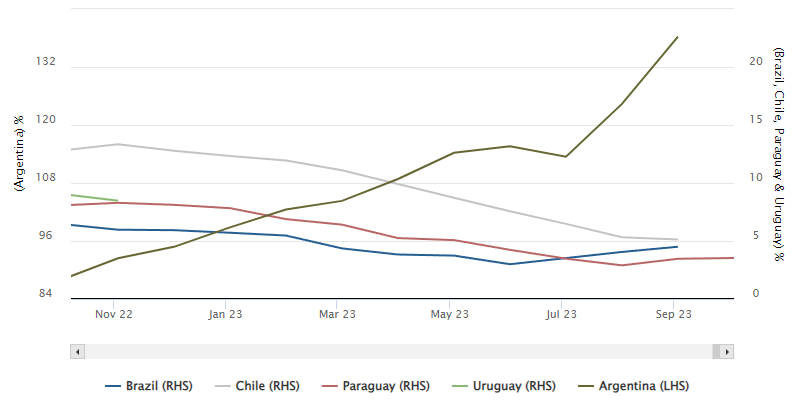
    URUGUAY | Inflation ticks up. After falling below 4% for the first time in over 20 years in September, Uruguay’s 12-month inflation rate ticked up again in October, according to figures released by the national statistics institute (INE) on 3 November. Inflation grew 0.63% in October, bringing the 12-month rate to 4.30%. This is within the 3%-6% target range set by the government. A 2.73% increase in transport costs and 0.43% increase in costs in the housing and utilities segment drove October inflation. Year-to-date inflation for the month stands at 3.86%.

    BRAZIL | Industrial sector revenue decreases. The Confederação Nacional da Indústria (CNI) business lobby on 31 October released its latest industrial indicators report, which showed that the industrial sector’s revenue saw a monthly decrease of 0.5% in September and a yearly decrease of 1.4%. The CNI pointed the finger at the country’s high interest rates that continue to “play a restrictive role on the economy” as a reason for these negative results – despite the fact that the central bank has been cutting interest rates in recent months. On 1 November the bank agreed on a third consecutive cut, bringing the benchmark interest rate to 12.25%.  

    CHILE | Signing agreements with China. Chile’s President Gabriel Boric on 16 October announced Chinese investment of US$233m to boost Chilean lithium production. The investment in a new lithium plant by Yongqing Technology Co Ltd, a subsidiary of Chinese mining company Tsingshan, was revealed by Boric during a trip to the Asian country. Located in Chile’s northern region of Antofagasta, the lithium plant will see work begin in 2025. The project is set to create an estimated 668 jobs once it is producing at maximum capacity (120,000 tonnes). Both parties have agreed that 90% of the workers will be Chilean, and after its second year of production, Yongqing will sponsor ten Chilean professionals every year to study in China for four to six months.

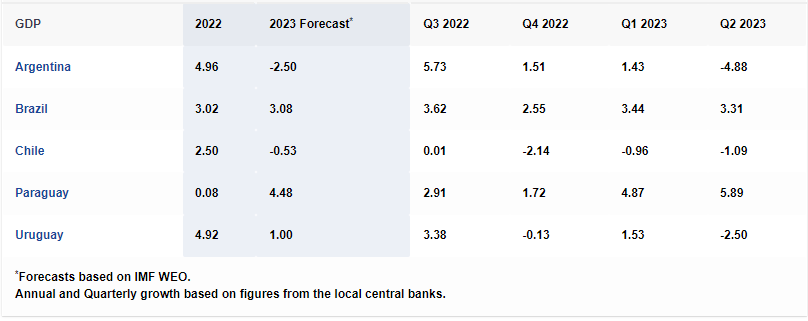
    Brazil & Southern Cone: inflation rate
    Percentage variation (year-on-year)

    Brazil & Southern Cone: GDP growth (%)
    Quarterly figures are year-on-year growth

  • COLOMBIA: Tempers flare with health reform bill on life support

    Patrick de Courcy 21 March 2024 Hits: 3066

    Once again, Colombians are witnessing an ill-tempered institutional standoff between President Gustavo Petro and congress, this time triggered by the fading chances of the government’s health reform bill making it through the senate. In response to this latest setback, Petro drew the fury of congress by declaring that Colombia is in need of a constituent assembly with the power to modify the country’s 1991 constitution.

    The health reform bill, which seeks to blunt the role of private health insurers (EPS) and bring more healthcare services under direct state control, has been on life support for months. Its passage through congress has seemed doubtful since President Petro’s broad legislative coalition began to crumble last June in response to an ongoing scandal over the financing of his 2022 election campaign. However, the bill cleared the lower chamber of congress in December, setting the stage for a final showdown in the senate, where resistance was stronger [WR-23-49].

    As things stand, the bill may not even be debated by senators. On 12 March, eight of the 14 members of the senate’s 7th Commission, which analyses legislation on healthcare, announced that they would vote to archive the bill. A ninth member of the commission joined their ranks three days later. In response, Petro threw down the gauntlet to congress with his declaration on 15 March that a constituent assembly should be formed with the power to modify the constitution.

    “The institutions that we have today in Colombia are not capable of being in charge of the social reforms that the people decreed, demanded, and ordered with their votes,” Petro declared during a speech in Cali, the capital of the south-western department of Valle del Cauca. The solution, he said, is “to convene a constituent assembly” which “must transform institutions so that they obey the people’s mandate of peace and justice”. Colombians, he insisted, “do not have to kneel” before the members of the political establishment blocking his reform agenda. These comments incensed centrist and conservative politicians. Senate president Iván Name, of the centrist Alianza Verde (AV), said that legislators “will not accept threats” and will vote on legislation “in a democratic manner, free of pressure”. Federico Gutiérrez, the mayor of Medellín who represented the right-wing Equipo por Colombia in the 2022 election, accused Petro of opening “a dangerous door for Colombian democracy”.

    These debates took place as Petro was in danger of suffering another major setback to his reform agenda – this time, his flagship ‘total peace’ initiative. On 15 March Defence Minister Iván Velásquez partially suspended a bilateral ceasefire with the Estado Mayor Central (EMC) – the largest grouping of dissident units of the demobilised Fuerzas Armadas Revolucionarias de Colombia (Farc) guerrilla group. Velásquez ordered a resumption of military actions against the group in the south-western departments of Cauca, Nariño, and Valle del Cauca, in response to a series of clashes between the EMC and members of the Guardia Indígena self-defence patrols in Cauca.

    However, a boost for Petro’s peace plan came on 19 March after the country’s largest drug trafficking organisation (DTO), the Clan del Golfo, said it would accept an offer from Petro to begin “legal negotiations”. Petro had said the previous day that his government is willing to enter talks with the Clan del Golfo if it renounces its criminal activities. A previous ceasefire with the DTO collapsed in March last year after the government accused it of orchestrating violent protests in Antioquia department [WR-23-11].

    Re-election

    President Petro said in an 18 March interview with national daily El Tiempo that he is not planning to seek a modification of the constitution to allow his re-election in 2026. Former president Álvaro Uribe (2002-2010) oversaw the introduction of such a constitutional amendment, which was then overturned in the second term of his successor Juan Manuel Santos (2010-2018).

  • RASTREANDO TENDENCIAS

    LatinNews 12 November 2012 Hits: 364

    GUATEMALA | Nuevo presidente del congreso. Recientemente, el congreso de Guatemala eligió a Pedro Muadi, un empresario y diputado por el derechista partido gobernante, el Partido Patriota (PP), como su nuevo presidente para las sesión del 2013-14, en reemplazo de  su colega del PP, Gudy Rivera. La elección de Muadi, presidente de PSE SA, una compañía que distribuye resina plástica y ex presidente de la cámara de la industria, sugiere que el poderoso sector privado está fortaleciendo aún más su control en el congreso. Su falta de experiencia legislativa también fue expuesta como motivo de preocupación por los comentaristas: Muadi ganó su primera banca legislativa en la elección del pasado septiembre, antes de lo cual él nunca había servido en la legislatura o asumido un cargo público. Su falta de experiencia política también fue citada como una debilidad en momentos en que las divisiones dentro del PP se han vuelto evidentes [IL-12-38].

    REPÚBLICA DOMINICANA | El crucial plan de reforma fiscal cerca ser aprobado. El 6 de noviembre, la cámara de diputados de la República Dominicana (DR) aprobó (en general) la propuesta de reforma fiscal presentada por el Presidente Danilo Medina, con la que él intenta recaudar unos RD$46mm (US$1,12mm) adicionales en los ingresos del gobierno por año para frenar el creciente déficit fiscal del país que, de acuerdo con los último cálculos, ahora está en RD$187mm (US$4,6mm).

    La reforma fiscal fue una de las promesas centrales hechas por Medina al asumir el poder en agosto y es clave para concretar un nuevo acuerdo stand-by con el Fondo Monetario Internacional (FMI). Este fue terminado mutuamente en febrero por el gobierno anterior, que rehusó poner en vigencia algunas de las recomendaciones del FMI que incluían, entre otras recomendaciones, un incremento en la carga impositiva general.

    La aprobación de la reforma también es crucial para la administración Medina debido a que ha retrasado el sometimiento al congreso de de su plan de presupuesto para el 2013 hasta que la iniciativa sea aprobada. Sin embargo, la propuesta, que propone incrementos al Impuesto sobre Transferencias de Bienes Industrializados y Servicios (ITBIS) ha resultado impopular, provocando las primeras protestas contra el nuevo gobierno. Aunque el gobernante Partido de la Liberación Dominicana (PLD) tiene una confortable mayoría en el congreso y la reforma pasó rápidamente por el senado, su aprobación completa aún está en duda.

  • RASTREANDO TENDENCIAS

    LatinNews 11 July 2014 Hits: 796

    ECUADOR-COLOMBIA | Línea de crédito para la importación. El ministro de comercio de Colombia, Santiago Rojas, anunció el 7 de julio que su gobierno abrirá una nueva línea de crédito para exportadores ecuatorianos que buscan proveer de productos a Colombia. La decisión llega en medio de las quejas de parte de Ecuador de que su balanza comercial con sus socios en la Comunidad Andina de Naciones (CAN) está siendo negativamente afectada por el hecho de que en meses recientes las monedas de sus vecinos han perdido valor frente a la moneda oficial de Ecuador –el dólar de EU. Esta situación ya ha provocado que el gobierno ecuatoriano introduzca ciertas restricciones comerciales que hicieron que el secretariado de la CAN considere tomar acciones contra Ecuador por violar las reglas del bloque [IL-14-25].

    El anuncio de Rojas luce como un intento de Colombia para tratar de abordar algunas de las quejas de Ecuador. El anuncio fue hecho durante la visita de Rojas a Quito, donde se reunió con su par ecuatoriano, Francisco Rivadeneira, para discutir la agenda comercial bilateral. Después de la reunión Rivadeneira dijo que esta había sido “extremadamente positiva y constructiva”, destacando que los dos habían acordado continuar promocionando la cooperación y la colaboración en áreas tales como la inversión bilateral, el comercio, y el combate al contrabando en la frontera.

    Mientras tanto, después de afirmar que las relaciones bilaterales estaban pasando por un gran momento, Rojas dijo que el gobierno colombiano estaba interesado en aprovechar la oportunidad para construir una cadena de suministro más cercana con Ecuador a fin de incrementar la productividad. A este efecto, Rojas dijo que Colombia pronto abriría una nueva línea de crédito para la importación, accesible a los exportadores ecuatorianos, aunque no proveyó más detalles. Los dos ministros también anunciaron que en la próxima reunión del gabinete binacional se celebrara en la portuaria ciudad ecuatoriana de Esmeraldas en la segunda mitad del año cuando se discutirá una agenda cubriendo el comercio bilateral, las finanzas, el turismo, la logística, y el transporte.

    Unos pocos días antes, el 2 de julio, el Ministerio de Transporte y Obras Públicas de Ecuador (MTOP), reveló que los gobiernos de Ecuador y Colombia habían acordado invertir US$2mm en la construcción de cuatro nuevos Centros Binacionales de Atención de Fronteras (Cebafs) para albergar nuevas oficinas de aduanas y de control migratorio. Una declaración del MTOP expresó que los dos países habían acordad proveer cada uno la mitad de la financiación para los Cebafs, la construcción de los cuales está fijada para comenzar en el 2015 después de la firma de un acuerdo formal que debería tener lugar en la próxima reunión del gabinete binacional.