All Categories

Subcategories

  • BRASIL: El gobierno en dificultades para contener las protestas indígenas

    LatinNews 11 June 2013 Hits: 898

    Una semana después de la muerte de un Indígena Terana durante un choque con fuerzas de seguridad en Mato Grosso do Sul, el ministro de justicia, José Eduardo Cardozo, anunció el despliegue de 110 soldados en la región. Las protestas irrumpieron a través del país después del choque. En Río Grande do Sul, unos 2.000 indígenas Kaingang y Guaraní bloquearon carreteras para protestar contra la decisión del gobierno de retrasar la entrega de tierras ancestrales a las comunidades indígenas. En Curitiba, la capital de Paraná, 30 indígenas Kaingang invadieron las oficinas del gobernante Partido dos Trabalhadores (PT) el 3 de junio, y solamente acordaron retirarse 10 horas más tarde cuando se les prometió una reunión con Gleisi Hoffmann, la jefa de gabinete de la Presidenta Dilma Rousseff.

    De acuerdo con la Policía federal, alrededor de 100 agentes recibieron disparos al llegar a la granja Buriti, en Sidrolândia, Mato Grosso do Sul para implementar una decisión judicial que otorgaba la tierra a los granjeros. El área ha sido disputada por los granjeros y los Terena durante los últimos 13 años. Un miembro del grupo de indígenas dijo al diario O Globo, que los Terena "lucharían hasta la muerte" en respuesta a la muerte del indígena.

    El 31 de mayo, los Terena reocuparon la propiedad, quemaron los campos que la rodean y bloquearon los caminos de acceso  al área. En respuesta, Cardozo ha decidido enviar tropas federales, pero enfatizó que la decisión estaba diseñada para resolver pacíficamente el impasse, y no para exacerbar la confrontación.

    La Presidenta Rousseff respondió convocando una reunión de emergencia para discutir la creciente disputa sobre tierra indígenas y la ocupación del sitio de construcción de una gran planta hidroeléctrica. La semana pasada, indígenas paralizaron las obras en uno de los tres sitios en construcción en Belo Monte, que tiene programado convertirse en la tercera mayor represa del mundo, capaz de producir 11.233 megawatts de electricidad –equivalente a alrededor del 10% de la actual capacidad total de generación de electricidad de Brasil.

    El controversial proyecto sobre el Río Xingu se ha convertido en un imán para los indígenas de otras cuencas fluviales no tocadas en el Brasil, tal como los Munduruku del Río Tapajos, el único gran río en la cuenca del Amazonas que no tiene represas. Después de la reunión de emergencia, Rousseff despachó a su secretario general, Gilberto Carvalho, para reunirse con un grupo de indígenas Munduruku, quienes habían llegado a Brasília en aviones de la fuerza aérea.

    Hasta ahora, el grupo parece implacable en su oposición al proyecto. "Fuimos a ver por nosotros mismos qué es la represa hidroeléctrica y vimos que no tiene nada bueno que deparar para nosotros", un líder Munduruku  le dijo a Carvalho, agregando que el desarrollo prometido no ha beneficiado a los indígenas del Xingu. "Hemos visto que los indígenas están siendo humillados y nosotros no queremos eso para nuestra región."

    • El gobierno descarta la oscilación comercial de abril

    Brasil registró su peor déficit comercial en los primeros cinco meses del 2013. El déficit fue de US$5,9mm, con exportaciones de US$93,3mm e importaciones de US$98,7mm. El resultado fue impactado por una medida contable para sumar importaciones petroleras, por un valor estimado en US$2,14mm, desde el año pasado al año 2013. La secretaria de comercio exterior, Tatiana Prazeres, señaló que la cuenta comercial aún tiene superávit sobre la base de 12 meses, con un resultado positivo de US$7,8mm hasta mayo. Sin embargo, el gigante petrolero estatal, Petrobrás, continúa arrastrando un gran déficit comercial petrolero; de 454.000 barriles por día (bpd) en el primer trimestre del 2013, nueve meses más alto que en el primer trimestre del 2012 (50.000 bpd). El banco central proyecta un superávit comercial de US$19,4mm en el 2012. El déficit de la cuenta corriente fue del 3,0% del PIB en los 12 meses hasta abril.

  • Venezuela: Selling the family silver

    LatinNews 28 August 2014 Hits: 2907

    Several developments since mid-July point to intensifying cash flow problems at the state oil company Petróleos de Venezuela (Pdvsa) and, by extension, in the central government.

    In last month’s edition, we noted that Pdvsa’s annual accounts for 2013 indicated that both the company (and the government) were short of ready cash. Pdvsa made a profit of US$9.5bn from the sale of a 40% stake in a company called Entidad Nacional Aurífera (ENA) to the government: this was shortly after the government had essentially given ENA, with a notional value of US$30bn, to Pdvsa. Pdvsa had earlier made a one-off profit of US$7.8bn because of the impact of the February 2013 devaluation on its monetary liabilities in local currency Bolívares. Without these two items, the company’s pre-tax profits would have been just US$6.3bn. In spite of this, Pdvsa paid the government a dividend of US$10bn.

    Significantly, very little cash actually changed hands as a result of these transactions. When Pdvsa sold 40% of ENA to the government for US$12bn, it simply made a corresponding reduction to its accounts payable. When it paid the dividend, the reduction was made to accounts payable. The US$2bn difference between the payment for the stake in ENA and the (slightly smaller) dividend is immaterial for a company whose sales of oil and products last year amounted to US$114bn. All these transactions are in the context of a difficult operating environment. Stagnant production volumes and falling prices have caused revenues from oil and products to slip in each of 2011 and 2012. Capital expenditure of around US$65bn over the three years to the end of 2013 has not had a positive impact on production volumes. Meanwhile, rising operating costs have been eating into Pdvsa’s cashflow. Pdvsa has cut back its contributions to the (off-budget) National Development Fund (Fonden) and other official social programs. Pdvsa also has been squeezing its suppliers and joint venture partners by delaying payments.

    For a long time, Pdvsa had sufficient financial strength and cashflow to protect the government (via payments of royalties, taxes, contributions to social programs and dividends) from the generally downwards move in energy prices. Latest data suggests that this is no longer the case; and the positions of both the company and the government now look a lot more fragile than one or two years ago.

    We are not alone in this view. In mid-August 2014, Dagong Global Credit, a major Chinese ratings agency, lowered its sovereign rating for Venezuela from BB+ to BB-. Among much else, Dagong commented on the likely weakness in the Venezuelan economy in the coming year. Dagong is looking for real annual GDP to contract by 2.3% in calendar 2014, before growing slowly over the medium term. Dagong also pointed out that Venezuela’s international reserves fell to 5.7% of GDP at the end of 2013 and covered only about one fifth of the country’s (growing) external debt.

    Two other recent developments suggest that the cashflow crisis is becoming acute. In late July, Venezuela’s President Nicolás Maduro and his Chinese counterpart, Xi Jinping, signed 38 accords, including US$14bn in Chinese financing for development projects across a broad range of Venezuelan economic sectors, and not just in the extractive industries that have generally been the focus of Chinese foreign direct investment (FDI) into Latin America. The accords also included a US$4.0bn direct loan to the Venezuelan government.

    In early August, Rafael Ramírez Carreño, who is Pdvsa president, oil minister and vice-president of economic affairs in the Maduro government, announced that Pdvsa is looking to sell its North American refinery business, Citgo Petroleum. Pdvsa bought a 50% stake in Citgo in 1986 from Southland Corporation, owner of the 7-Eleven retail chain. Pdvsa purchased the remaining 50% from Southland in early 1990. Citgo’s three refineries – in Lemont, Illinois, Lake Charles, Louisiana and Corpus Christi, Texas – have a total refining capacity of 750,000 barrels per day (bpd). Exxon Mobil is a 50% shareholder in the Chalmette refinery in Lake Charles. The Lemont refinery is the only one of the three geared towards handling the light crudes produced in North America, as opposed to the heavy crudes extracted by Pdvsa in Venezuela. Citgo also owns a network of pipelines and 48 terminals. Press reports indicate that any sale of Citgo would not include some 5,600 independently owned, but Citgo-branded, retail outlets.

    Citgo had raised US$650m through the sale of 6.25% bonds in July. The bond prospectus said that Citgo had sales of around US$43bn in 2013 and earnings before interest, taxes, depreciation and amortisation (EBITDA) of US$1.8bn.

    Comments in the mainstream financial press have, quite reasonably, focused on price. Ramírez has been quoted as saying that Citgo is worth more than the US$10-US$15bn widely cited. However, the discussion has missed several key issues.

    The first is that Citgo has a strategic value to Pdvsa that it would not necessarily have to another owner: Citgo’s total capacity is equivalent to about one quarter of Pdvsa’s total production. Even allowing for the fact that a significant portion of Pdvsa’s output is committed to servicing loans and the government’s obligations to partners in the Petrocaribe regional oil alliance – and for the fact that not all of Citgo’s capacity is suited to heavy Venezuelan crudes – the refining company represents a reliable client that is geographically close to Venezuela. In essence, the proposed disposal of Citgo looks like a ‘sale of the family silver’ transaction that is yet another indication of the plight that the Pdvsa/the Caracas government finds itself in.

    The second is that the Chinese government sees support of, or at least stability in, Venezuela as a significant geopolitical objective – even though one of China’s leading ratings agencies has publicly drawn attention to Venezuela’s growing risk profile.

    Most important, though, is that a sale of Citgo for even US$20bn would buy only a brief respite for Pdvsa/the Caracas government. The oil company is suffering from falling energy prices, rising operating costs and a demanding shareholder. For its part, the government has not made any significant changes that would address the massive, and widely documented, distortions in Venezuela’s economy. To put it in context, US$20bn is less than Pdvsa’s annual capital expenditure, less than the amount that it pays each year to the government in taxes and royalties and less than the growth in accounts receivable last year. The cash flow crisis is set to continue.

  • PANAMA: Mixed response to efforts to strengthen electoral legislation

    LatinNews 17 May 2017 Hits: 687

    Panama’s legislature last month approved changes to the national electoral code (last updated in 2013) as part of efforts to crack down on corruption in the political system. Addressing the loopholes in the electoral code was widely considered a priority for President Juan Carlos Varela, who won the May 2014 presidential election in part due to his pledge to tackle institutional corruption. The electoral court (TE), which played a key role in drafting the legislative initiative (known as 292), hailed the proposed reform package in its original form as the most important of the last 25 years. However, the final version, approved in the third debate on 18 April by the 71-member unicameral legislature, has provoked criticism both from the TE as well as the civil society platform Foro Ciudadano Pro Reformas Electorales (‘Foro Ciudadano’) which was also involved in drafting the proposal.

    In a report on the 2014 general elections, the Organization of American States (OAS)’ electoral observation mission (EOM) highlighted the need to “regulate political campaign financing, including the use of public and private funds as well as interference by the executive branch”. It also flagged up the fact that “current rules set no limits or controls on private donations and/or election spending. This lack of regulation has led to expensive campaigns with little transparency in terms of the source of funds. Money in politics needs to be regulated as a matter of urgency, in order to furnish the democratic system with more fairness and integrity.” Indicative of this corruption, irregularities involving electoral campaign financing had resulted in 11 legislative election results from the 2014 elections being annulled with new contests staged.

    Back in January 2015, a national electoral reform commission was duly set up, tasked with coming up with proposals to improve the electoral code. Comprising representatives from the TE, the country’s political parties, and Foro Ciudadano, the commission drafted the package of reforms which then served as the basis for discussions between the TE and national legislature.

    According to the TE, the national deputies eventually received a proposal with 27 recommendations and four new articles of which 19 were accepted in the final version of the initiative. Among other things, the changes include: a new formula for distributing state financing and the introduction of caps for private financing for electoral campaigns. These include: US$10,000 for mayoral candidates; US$300,000 for candidates for the national legislature; and US$10m for presidential candidates. Along with new requirements and sanctions (ranging from US$25,000 and US$50,000) for pollsters who manipulate information and tighter rules for electoral propaganda, the reforms also seek to level the playing field by prohibiting state propaganda three months before general elections and setting two months as the limit for campaigning ahead of general elections. It also sets out new gender parity rules, calling for 50% of candidates to be women. According to the OAS EOM report on the 2014 elections, in that contest on average women accounted for about 21.6% of the total number of candidates, while the legislature elected in 2014 comprised just 18% women (although this was up from 8% in the 2009 elections).

    Response

    In a report issued on 26 April, the TE officially gave its backing to Ley 292. However, it was also very critical of changes made during the approval process in the legislature, calling for a further law to be drawn up in order to address resultant loopholes. The Foro Ciudadano went a step further and called on President Varela to partially veto the new law, on the grounds that it falls far short of the initial proposal. In its report, the TE complained that the caps on private donations were too high while it also criticized as insufficient another provision aimed at making the electoral process fairer. This was the decision to exempt public officials from a provision which prohibited candidates from participating in the inauguration of state-financed public works or activities once an election has been called.

    Steps back

    While the changes to the electoral code have been hailed as a step forward of sorts, recent decisions by the supreme justice court (CSJ) which effectively shelve three criminal complaints filed against the president of congress, Rubén De León (of the opposition Partido Revolucionario Democrático party), and other national legislators, are serving as the latest source of outrage among local civil-society groups.

    The complaints against De León, for alleged crimes against public administration, embezzlement, and illicit association, were filed by two local lawyers, Ernesto Cedeño and Alexis Sinclair, on 15 March and 22 March respectively. On 29 March a local anti-corruption advocacy group, Juntos Decidimos, presented another complaint which also included 13 other deputies.

    The complaints, which the CSJ has thrown out, relate to alleged irregularities involving the management of donations and contracts for public services which the national assembly authorised between 1 July 2014 – when President Varela took office – and December 2016. According to the local press, the donations were worth some US$14m while the contracts totalled some US$68m. As a result of the allegations, Comptroller General Federico Humbert ordered an audit of the donations and contracts in question on 8 March, which a seven-member team from Humbert’s office began analysing five days later. A three-member legislative commission has also been set up to look into the claims.

    These CSJ rulings prompted outrage from Juntos Decidimos, along with other civil society groups such as the Fundación para el Desarrollo de la Libertad Ciudadana, (the local branch of international anti-corruption NGO Transparency International) and another anti-corruption group, Movimiento Independiente. While Movimiento Independiente slammed the rulings as a “monumental mistake”, the director of Fundación para el Desarrollo de la Libertad Ciudadana, Ramón Ricardo Arias, described them as a clear sign that the CSJ magistrates are not carrying out their duties.

    More figures implicated in Odebrecht corruption

    Another source of public anger regarding public corruption has been the revelations that emerged at the end of last year that Brazilian engineering firm Odebrecht had paid over US$59m in bribes to Panamanian government officials in 2010-2014 during the Ricardo Martinelli administration (2009-2014), a case which has also implicated President Varela [RC-17-02].

    This prompted the latter to announce an audit while, in mid-March, a special investigating legislative committee was set up to look at the circumstances surrounding the awarding of public works infrastructure contracts under the Varela and Martinelli governments along with that of Martín Torrijos (PRD, 2004-2009). The legislative committee is due to present its findings within 90 days, a deadline which can be extended for a further 90 days.

    With a string of public figures already implicated, earlier this month Vice President Isabel de Saint Malo de Alvarado became the latest to face embarrassment amid reports that her brother, Raúl Alberto de Saint Malo, had been linked to a US$1.9m cheque used to purchase a helicopter for one of Martinelli’s sons, Luis Enrique Martinelli, who is also under investigation in relation to the case (see sidebar).

    • Popularity

    The most recent monthly opinion poll by local pollster, Dichter & Neira, released on 24 April 2017, showed President Varela’s approval rating stands at 47% – the highest rating of the last 12 months and up from 41% in March. However, the same poll showed that just 15% of respondents thought the government was operating in a transparent manner (slightly up from 14% the previous month). The poll, which interviewed 1,200 people across the country bar the comarcas (indigenous administrative regions) and Darién jungle region, also showed that 72% of respondents disapproved of the supreme justice court (CSJ) decision not to move forward with the investigation into the deputies over the alleged irregularities involving the donations.

    • Raúl Alberto de Saint Malo

    The leading national daily, La Prensa, is reporting that Raúl Alberto de Saint Malo, a businessman, is linked to Petro Trading Services Corp which, according to investigations, authorised the payment of the US$1.9m cheque used to pay for the aircraft in 2014. According to La Prensa, Petro Trading Services Corp was created in the British Virgin Islands (BVI) in 2011 and dissolved in July 2016. The local press is also reporting that De Saint Malo is married to Mariana Virzi, the niece of Felipe ‘Pipo’ Virzi, a former second vice-president in the Ernesto Pérez Balladares government (1994-1999), who is reportedly a member of Martinelli’s inner circle and has been accused of corruption.

  • TRACKING TRENDS

    LatinNews 07 June 2018 Hits: 759

    ARGENTINA | Stagnating growth. Argentina’s official economic growth figures for the first quarter of 2018 have yet to be released but the expectation is that GDP growth will remain subdued this year as a result of the myriad economic problems faced by the country.

    According to the May economists’ survey by the central bank (BCRA), the consensus growth projection for the year has been cut from 2.5% to 1.3% on the back of projected subdued growth in the first quarter and expectations that growth will be negative in the second and third quarters.

    This view is shared by the World Bank (WB). In its latest growth forecasts, released on 6 June, the WB cut its forecast for Argentina for the year from 3% to 1.7%.

    • Public spending

    The Argentine government has announced a plan to reduce public spending on administrative costs by Ar$20bn (US$800m) a year. It also announced that there will be a hire freeze on public sector employees for two years. The treasury minister, Nicolás Dujovne, added that spending on overtime, travel expenses, and foreign trips would be cut by 30%.

    ARGENTINA | Gas production surges. Argentina registered the largest increase in natural gas production in the month of April since 2009, the government announced on 4 June. The energy ministry reported that natural gas production had increased by 4.8% year-on-year, while production of unconventional gas had jumped by 29.6% year-on-year.

    The energy ministry said that the increase in gas production would mean that imports of liquefied natural gas (LNG) could be reduced, which should help in the government’s efforts to limit the strain on consumers in its systematic increase in energy tariffs.

    BRAZIL | Eletropaulo takeover confirmed. Italian company Enel has obtained 73% of the shares of Eletropaulo for R$5.55bn (US$1.48bn), winning a bidding war with Neoenergía, controlled by Spain’s Iberdrola. The deal was finalised on 4 June after Enel paid R$45.22 (US$12.07) per share, beating Neoenergía’s offer of R$39.53 (US$10.55).

    By securing the majority share, Enel becomes Brazil’s leading energy provider, knocking CPFL Energia (owned by China’s state grid) off the top spot. Enel has added another 7m customers to its client list, bringing its total number of clients in Brazil to 17m.

    BRAZIL | Exports drop in May following industrial action. Economists are still trying to gauge the full economic impact of the recent lorry drivers’ strikes. The industry & foreign trade ministry (MDIC) found exports fell by 36% in May as a result of the strike. They fell from US$1.06bn in the first three weeks of May to US$698m in the last two weeks when the strikes took place.

    But Brazil still registered a trade surplus of US$5.9bn during the month of May. Overall the effect of the lorry drivers’ strike should be a temporary blip, and the country expects to post a US$50bn surplus this year, according to the MDIC.

    Manufacturers were some of the worst hit by the recent unrest. In May, there was a reduction of 46% of manufactured goods in the last two weeks when the strikes took place, compared to the previous three weeks. A representative from MDIC said this happened because manufacturers are heavily dependent on Brazil’s road network, whereas others turn to alternative methods of transport as a fallback. For example, sellers of soy and meat products are more dependent on shipping and have emergency stocks ready and waiting at the ports.

  • Insecurity mounts in Mexico’s maritime areas

    LatinNews 27 November 2019 Hits: 1108

    Since assuming office in December 2018, Mexico’s President Andrés Manuel López Obrador has repeatedly emphasised his government’s aims to address and improve the pressing issue of insecurity in the country. Despite its efforts to pacify Mexico, the government continues to fight criticism over security concerns, one being the wave of criminal activity targeting the nation’s oil and gas industry. Whilst López Obrador initially vowed last year to make oil theft a national security priority in reaction to the theft of oil through illegal taps on pipelines from the state-owned oil company, Pemex, the focus has shifted lately to the attacks being carried out by pirates on maritime vessels and oil platforms in the Gulf of Mexico.

    Mexico’s navy ministry (Semar) issued a press release on 12 November detailing a piracy incident which took place off the coast of Ciudad del Carmen, Campeche state. According to a Semar report, the previous day a group of approximately eight armed individuals arrived in two small boats and proceeded to board Italian-flagged oil supply vessel ‘Remas’, owned by international leading contractor in the offshore oil and gas industry, Micoperi. This led to a confrontation with the crew in which two members of the 35-strong crew were wounded as the crew repelled the attack. A Semar vessel was sent to assist the Remas and it took the two wounded crew members to an onshore medical centre in Ciudad del Carmen to receive treatment for a concussion and a bullet wound sustained during the attack.

    Criminal activity at sea including attacks on vessels and the dismantling of Pemex platforms are becoming a more common occurrence, particularly in the southern rim of the Gulf of Mexico off the costs of Campeche and Tabasco states. There have been increased reports of attacks led by modern-day pirates as oil platforms, vessels, and infrastructure are targeted with the objective of pillaging hydrocarbons and equipment with the apparent aim of selling these on in the black market. These incidents point towards failings in the government’s national security policy, placing increased pressure on President López Obrador to implement more effective measures to protect individuals and safeguard the nation’s offshore oil platforms and infrastructure.

    In recent years, Pemex, which operates more than 100 oil platforms across five maritime regions in Mexico, has fallen victim to increased piracy, theft, and attacks on its offshore oil platforms. Official Pemex documents obtained by national Mexican daily Milenio through a freedom of information request reveal that in 2018 there were 197 registered pirate attacks compared with the 48 recorded in 2016, representing a 310% increase over two years. In terms of the financial losses, a statement from federal deputy Olga Sosa Ruíz, which featured in August 2019 in La Gaceta, the Mexican senate’s official information body, estimates that since 2017 there have been approximately 300 cases of theft at sea and that between 2016 and 2018 Pemex lost at least US$11.5m in relation to pirate attacks.

    Faced with deepening security concerns and increased reports of criminal activity in Mexico’s maritime areas, President López Obrador addressed the topic in his morning press conference on 14 November, just two days after the attack on the Remas. When questioned over his government’s strategies to combat the increase of piracy in the Gulf of Mexico, the president said that improved protection, security, and patrols would be achievable via the building of a new naval base in the gulf port of Dos Bocas, Tabasco, where the government is already building a new oil refinery López Obrador said that the proposed new naval base would serve the entire gulf and Mexican Caribbean area and help prevent and eradicate maritime criminal activity.

    Dos Bocas refinery project update

    Despite growing concerns over the viability of the Dos Bocas refinery project given the heavy flooding observed in the area in October, Mexico’s energy minister Rocío Nahle confirmed via Twitter that the refinery suffered no damage. Construction continues ahead of the project’s envisaged completion by 2020. The Mexican government announced in May that the Dos Bocas refinery would be built by Pemex. It will serve as the country’s seventh oil refinery, spanning 704 hectares and producing up to 340 barrels of refined oil per day. The project has the objectives of driving economic and social development through generating 135,000 direct and indirect jobs, and achieving energy independence for Mexico.

  • ECONOMIC HIGHLIGHTS

    Patrick de Courcy 17 March 2022 Hits: 2334

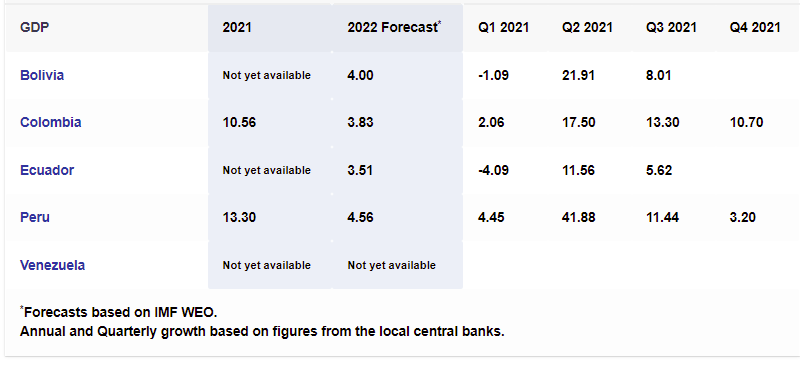
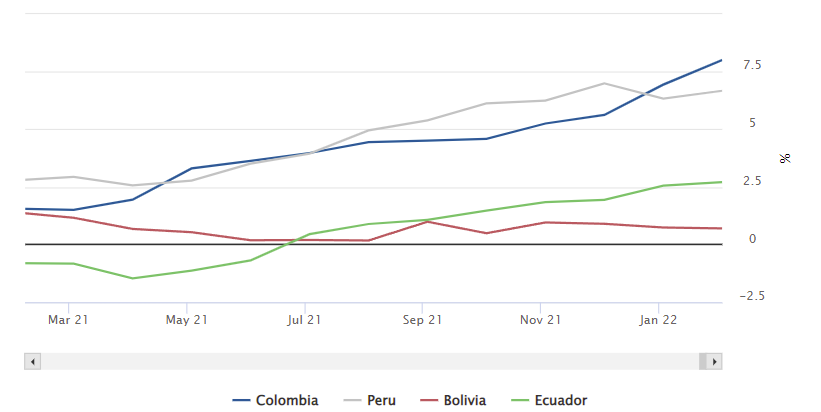
    COLOMBIA | Tariffs suspended in response to inflation. Colombia’s trade ministry announced on 3 March that it has temporarily lifted tariffs on 165 products as part of efforts to ease mounting inflation. A trade ministry statement said that tariffs had been “reduced to 0% for six months” on products which had previously been subjected to tariffs of “5%, 10%, and in some cases 15%”. Colombia’s minister of trade, industry and tourism, María Ximena Lombana Villalba, said that the tariff reduction “will mitigate upwards pressures” on prices, which she said had been caused by supply change disruptions. Annual inflation hit 8.01 % in February, according to the national statistics department (Dane), while monthly inflation stood at 1.63%. The suspension of tariffs will apply to a wide range of products, including food and drink, grains, agricultural seeds, malt extract, and certain tools.

    PERU | GDP growth continues. Peru’s national statistics institute (Inei) announced on 23 February that GDP increased by 3.2% in Q4 2021, compared to the same quarter in 2020. The latest figures bring Peru’s GDP growth last year to 13.3%, following year-on-year increases of 11.4% in Q3, 41.9% in Q2, and 3.8% in Q1. Inei attributed the Q4 growth to increased household consumption (+4.0% year-on-year) and exports of goods and services (+9.5%).

    VENEZUELA | Rising industrial output. Venezuela’s main industrial lobby, Confederación Venezolana de Industriales (Conindustria), said on 2 March that the country’s industrial sector was operating at 27% of its capacity in Q4 2021, which according to local media is its highest level since 2018 and up from 23% in Q3 2021. According to Conindustria, pharmaceutical and chemical producers had the highest productivity in Q4, operating at 36% of capacity, followed by the food and drink sector (31%), and rubber and plastics manufacturers (30%). The least productive sectors were machinery and electrical/computer equipment (operating at 16% of capacity) and textile and shoe manufacturers (17%).

    Andean countries: inflation rate
    Percentage variation (year-on-year)

    Andean countries: GDP growth (%)
    Quarterly figures are year-on-year growth

  • BRAZIL: Bolsonarismo movement faces setbacks and opportunities

    Abbi Dicker 13 November 2025 Hits: 669

    The far-right populist ‘Bolsonarismo’ movement has faced some recent setbacks, with continued legal woes for its torchbearer, former president Jair Bolsonaro (2019-2023), and the start of a trial for other defendants in the coup plot to help him stay in power after losing the 2022 election. However, Brazil’s far right can perhaps take some comfort from recent polling data which has shown that President Luiz Inácio Lula da Silva’s approval ratings could be plateauing. Pollsters have also shown that the Brazilian public is showing increasing support for tough-on-crime approaches and forceful responses against organised crime, which are policy positions often backed by right-wing Bolsonaristas.

    Bolsonaro was convicted by a panel of supreme court (STF) justices as a mastermind in the coup plot in September [WR-25-37] and his lawyers filed an appeal against the ruling before the same panel of judges that ruled against him then – the STF’s ‘Primeira Turma’ (First Chamber). This was rejected on 7 November.

    The presiding judge in the coup plot case, Alexandre de Moraes, upheld the initial ruling, and the three other judges on the panel followed suit. In September the Primeria Turma had five members, only one of whom, STF justice Luis Fux, voted to absolve Bolsonaro of the coup charges. But Fux is not involved in the review of the appeal because he has since moved to the STF’s ‘Segunda Turma’ (Second Chamber), leaving a vacant seat on the Primeira Turma.

    Meanwhile, the Primeira Turma is also starting to review charges against other alleged participants in the Bolsonarista coup plot. On 11 November the chamber began the trial for ten defendants: Colonel Bernardo Romão Corrêa Netto, General Estevam Cals Theophilo Gaspar de Oliveira, Colonel Fabrício Moreira de Bastos, Lieutenant Colonel Hélio Ferreira Lima, Colonel Márcio Resende Júnior, Lieutenant Colonel Rafael Oliveira, Lieutenant Colonel Rodrigo Bezerra de Azevedo, Lieutenant Colonel Ronald Ferreira de Araújo Júnior, Lieutenant Colonel Sérgio Cavaliere, and federal police officer Wladimir Matos Soares. The defendants, mostly active or retired army personnel, were allegedly involved in the planning of the possible military coup, including a plan to capture or eliminate Bolsonaro’s political opponents, including Lula.

    Lula government popularity

    While Bolsonaro and his allies continue to face legal pressure, Lula is also facing potential challenges that could benefit right-wing opposition figures. On 12 November national pollster Genial/Quaest released new polling figures which showed 47% public approval for the Lula administration, down from 48% in October. This is within the margin of error, although reports in the media suggested that the recent debates about security and crime-fighting measures could have impacted the public mood and contributed to the slight fall.

    The state police of Rio de Janeiro carried out major raids in gang-controlled territory on 28 October which resulted in over 120 deaths, making it the deadliest police operation in Brazil’s history [WR-25-44]. Bolsonarista politicians, such as Rio’s right-wing governor Cláudio Castro, have defended the need for tough police responses against organised crime, while Lula and members of his left-wing Partido dos Trabalhadores (PT) have criticised the Rio police actions and raised concerns over possible police brutality.

    However, Genial/Quaest’s November poll showed that 67% of survey respondents approved of the Rio police raid, while only 25% disapproved. This suggests that calls for tough policing or punitive measures against gangs could be a rallying cry benefitting the Brazilian right ahead of next year’s general elections.

    Appetite for harsher penalties

    According to a survey by pollster Genial/Quaest, 46% of respondents believe that the best way to improve security and reduce violence is to implement stricter laws and impose harsher sentences, while 27% of survey respondents expressed support for more education and social programmes as a way to reduce poverty and crime. Only 9% of respondents said that “tough actions against gangs” was the best strategy.

  • The big picture; US national security strategy (NSS)

    Patrick de Courcy 18 February 2026 Hits: 625

    In November 2025 the US State Department and intelligence agencies completed work on a new document summing up the country’s National Security Strategy (NSS). The NSS is updated around every four years, reflecting the thinking of successive administrations. The 2025 version was released in early December, almost exactly a month before the launch of Operation Absolute Resolve. It is unlikely that that publication of the NSS triggered the subsequent military operation against Venezuela only 30 days later, but the NSS did set out some fundamental shifts in US attitudes to national security and those changes influenced and informed the planning and execution of Absolute Resolve.

    The 2025 NSS attracted widespread comment and controversy. Secretary of State Marco Rubio said he had written much of the text. Analysts noted that US great power rivalry with China and Russia – a dominant theme in earlier reports – is now played down with passing references to “managing European relations with Russia” and the need to “rebalance America’s economic relationship with China”. In contrast to the reduced emphasis on superpower rivalry and virtual silence on the Russian-Ukrainian war, there was a much higher than usual emphasis on the Western Hemisphere and other issues closer to home (such as trade, migration, and crime). The document also stands out for its unusually stark attacks on Europe, saying that the continent faces economic decline and “civilizational erasure”.

    Unlike earlier editions, the tone of the 2025 NSS is often aggressive and adversarial. It accuses the country’s elites of badly miscalculating the domestic populations’ willingness “to shoulder forever global burdens” saying that “they placed hugely misguided and destructive bets on globalism and so-called ‘free trade’ that hollowed out the very middle class and industrial base on which American and economic and military pre-eminence depend”. The new strategy, the document says, should answer three questions: what does the US want, what are the means to getting it, and how can ends and means be connected?

    In terms of the ultimate objectives these are characterised as “the continued survival and safety of the United States as an independent, sovereign republic whose government secures the God-given natural rights of its citizens and prioritises their well-being and interests”. Much of the details that follow is familiar from Trump’s many speeches and comments: protection from invasion, full control of borders, reduction of inward migration, a resilient infrastructure, modernised nuclear capabilities including a Golden Dome missile defence system, and aspirational statements such as “We want the world’s strongest, most dynamic, most innovative and most advanced economy”. There is also a commitment to further develop soft power and to the “restoration and reinvigoration” of American spiritual and cultural health.

    An NSS paragraph on US security strategy in the Western Hemisphere states:

    “We want to ensure that the Western Hemisphere remains reasonably stable and well-governed enough to prevent and discourage mass migration to the United States; we want a Hemisphere whose governments cooperate with us against narco-terrorists, cartels, and other transnational criminal organizations; we want a Hemisphere that remains free of hostile foreign incursion or ownership of key assets, and that supports critical supply chains; and we want to ensure our continued access to key strategic locations. In other words, we will assert and enforce a ‘Trump Corollary’ to the Monroe Doctrine.”

    Elsewhere and in relation to the Western Hemisphere the document states “we will deny non-hemispheric competitors the ability to position forces or other threatening capabilities, or to own or control strategically vital assets in our hemisphere,” a comment seen as referring to China (which is not mentioned by name throughout the document).

    The NSS calls for four steps relating to military dispositions in the Western Hemisphere. These are, first, an increased presence relative to other lower priority theatres of operation; second, a more “suitable” Navy and Coast Guard presence to fight drug and people trafficking; third, targeted border deployments to fight criminal cartels “including where necessary the use of lethal force to replace the failed law enforcement-only strategy of the last several decades”; and, fourth, establishing or expanding access to strategically important locations.

    In terms of the means necessary to achieve strategic objectives the document highlights the country’s “most enviable position with world leading assets and advantages” in areas such as military strength, the economy, energy, technology, and soft power. In the section on bringing means and ends together there is extended praise for President Trump (listing multiple claims that are also familiar from his own speeches and press conferences). In flattering mode, the NSS states “President Trump uses unconventional diplomacy, America’s military might, and economic leverage to surgically extinguish embers of division between nuclear-capable nations and violent wars caused by centuries-long hatred”.

    The document acknowledges the principle of non-interventionism but provides its own escape clause, should it be needed, stating flatly that “for a country whose interests are as numerous and diverse as ours, rigid adherence to non-interventionism is not possible”. It also plays down the importance of promoting democratic values. In its words the US will “reward and encourage the regions’ governments, political parties, and movements broadly aligned with our principles and strategy…But we must not overlook governments with different outlooks with whom we nevertheless share interests and who want to work with us.”

    In late January the US government published the National Defence Strategy (NDS), a sister document to the NSS compiled by the Pentagon. This stated that the US will offer “more limited” support to its traditional allies than in the past, and that its main priorities lie in the Western Hemisphere rather than in competing in Asia against China. The document says that relations with China are to be approached “through strength, not confrontation”. Russia, which invaded Ukraine in 2022, is described as a “persistent but manageable threat to Nato’s eastern members”. Within the Western Hemisphere the NDS takes up one of Trump’s recurring themes, the demand to annex or at least control strategic territories. The text states the Pentagon “will guarantee US military and commercial access to key terrain”, especially the Panama Canal, Gulf of America, and Greenland. However, there is no mention in this instance of Canada, which Trump also says say should become part of the US.

  • TRACKING TRENDS

    LatinNews 29 August 2013 Hits: 2130

    BOLIVIA | Bond issue. The Bolivian government has successfully allocated US$500m in 10-year bonds in international markets. This is the second such bond issue conducted by the country since it first tapped into international markets in October last year, the first time it had done so for 100 years. According to a statement by the economy & finance ministry, the bonds fetched a yield of 5.95% and were acquired by investors in the US, Europe, Latin America and Asia.

    Even though the yield of the latest bond was higher than that obtained last year, when the bonds fetched a yield of 4.75%, the ministry added that the terms of the latest issue had been “favourable for the national economy taking into consideration the high volatility in international financial markets in the last couple of months”. It also stated that the issue allows Bolivia to consolidate itself as a “solid and successful economy that can attract foreign capital”, and that ratifies its “policies of looking for new financial sources to fund its State investment projects”.

    Recently, the president of the Inter-American Development Bank (IDB), Luis Alberto Moreno, praised the fact that in recent years Bolivia has managed to increase the size of its domestic economy fourfold, taking its GDP from US$8bn to US$32bn.

    COLOMBIA | Massive transport boost. The government has approved the biggest investment in transport infrastructure in Colombia’s history. The finance minister, Mauricio Cárdenas, announced 47 ‘fourth generation’ road concessions worth Col$47 trillion (US$24.5bn) in 23 different departments. Cárdenas said the construction projects would generate 450,000 jobs over the course of the next eight years. He claimed that simply constructing the roads would boost GDP growth by 1.5% for every year the construction projects lasted, and that, upon completion, the economy should grow by an additional 1% every year.

    The transport minister, Cecilia Alvarez, said bidding for nine infrastructure projects would take place in September and another 11 by the end of the year. The first four projects are a 152km highway linking the Caribbean coastal cities of Barranquilla and Cartagena, at US$444m; the 30km Mulaló-Lobo Guerrero highway, at US$556m, linking the industrial zone of Yumbo, just north of Cali in the western department of Valle del Cauca, to the Pacific port of Buenaventura (including a long tunnel); a 169km highway linking the municipalities of Cáqueza and La Calera in the central department of Cundinamarca, at US$361m; and a US$556m highway linking the Cundinamarca municipalities of Girardot and Puerto Salgar, an extension of a road which connects the centre of the country with Ecuador.

    The president of the national infrastructure agency (ANI), Luis Fernando Andrade Moreno, has been quite candid that Colombia has consistently failed to invest enough in infrastructure. Andrade said that the government had committed to increase investment in infrastructure from 1% to 3% of GDP, or from US$3bn to US$10bn, a year. It aims to get its return on investment mainly from tolls.

    Even this huge investment is not enough, according to a study presented in Bogotá last week by the Andean development corporation (CAF) on infrastructure and equity. It claimed that Colombia would need to invest at least 7.4% of its GDP in infrastructure annually to reduce poverty to similar levels to that in South-east Asian countries, and as much as 14.9% of GDP a year in order to go further and provide universal basic services and meet the United Nations millennium development goals.

    VENEZUELA | No stagflation. The president of Venezuela’s central bank (BCV), Eudomar Tovar, denied this week that Venezuela was afflicted with stagflation, accusing the opposition of trying to “create negative expectations” for political ends. “We are already seeing a deceleration of the consumer price index, because it was 6.1% in May, 4.7% in June and 3.2% in July. It is nothing to celebrate but the tendency is towards stability”, Tovar said.

    Venezuela accumulated inflation of 29% in the first seven months of the year, doubling the hugely ambitious forecast of between 14% and 16% for the year. Meanwhile the economy grew by just 1.6% in the first half, although Tovar again argued that the tendency was positive. The economy grew by a paltry 0.5% in the first quarter but rebounded with 2.6% growth in the second quarter. Manufacturing expanded 5.7% in the second quarter after contracting by 4.9% in the first quarter, although construction shrank by 6% year-on-year in the second quarter after contracting 0.8% in the first quarter, the BCV reported.


  • URUGUAY: FA picks up but deadlock beckons in congress

    LatinNews 19 September 2019 Hits: 3469

    The electoral fortunes of Daniel Martínez, the presidential candidate of Uruguay’s ruling left-wing Frente Amplio (FA) coalition, appear to be reviving in line with the rapidly fading prospects of Argentina’s President Mauricio Macri, who will contest elections on the same day. Martínez has drawn a direct parallel between his “inexperienced” and “over-confident” rivals and Macri, implying that Uruguay could get a taste of Argentina’s economic and financial debacle if voters opt for an untested leader. The message seems to have struck a chord with some voters as Martínez has pulled clear in the polls, but he remains well short of the 50% plus one target needed to triumph in the first round on 27 October, and the FA looks set to lose its majority in both chambers of congress.

    Martínez received 40.2% in a nationwide survey of 2,500 respondents conducted between 11 and 16 September by the local pollster Radar. This was up by three percentage points on the previous month, with the second placed Luis Lacalle Pou of the centre-right opposition Partido Nacional (PN, Blancos) a long way adrift on 22.4%. Martínez appears to have profited at the expense of Ernesto Talvi, of the conservative Partido Colorado (PC), who fell by more than three points from 20.4% to 17.1% on the previous survey.

    Talvi had been galloping up the polls, galvanising the younger generation disenchanted with the FA with his “progressive and liberal” stance. Indeed, Talvi’s support is overwhelmingly drawn from younger voters (29% of respondents aged 18-29 would vote for him, more than twice his support in other age categories), but some of these have drifted back to Martínez, according to the Radar poll, who now leads him in support within this age category on 33%.

    Support for Martínez was highest among elderly Uruguayans, with 44% of the 60+ age category backing him. Older voters remember only too well the economic and financial crisis in Uruguay in 2002, with crippling inflation and unemployment, in the wake of Argentina’s last meltdown, which prompted the beleaguered late (PC) president Jorge Batlle (2000-2005) to call Argentines “a bunch of thieves” in an ‘off the record’ conversation (when word got out Batlle had to travel to Buenos Aires in tearful contrition).

    Martínez evoked memories of those days when he stepped up his recent attacks on his rivals on 14 September, during a campaign rally in Colonia del Sacramento, a city which faces Buenos Aires across the Río de la Plata estuary. “[President Macri] thought that everything was very easy. He said that controlling inflation would be a breeze…Here there seems to be some people who think the same way,” Martínez said. “I am absolutely clear in my mind that anyone who says that the state can be run like a private company is certain to fail,” he added.

    A poll carried out by another local pollster, Factum, a week earlier produced similar findings. But it also showed that as things stand, the FA would return only 39-41 deputies to the 99-seat lower chamber of congress, well short of the majority of 50 it obtained in 2014. The PN and PC would return 26-27 and 18-19 deputies respectively, with at least eight going to the right-wing Cabildo Abierto (CA), whose presidential candidate Guido Manini Ríos enjoys around 10% support in the polls.

    • Public security

    “From now until 1 March [when the new president will be sworn-in], some 200 Uruguayans will be murdered,” Guido Manini Ríos, the former commander of the armed forces and presidential candidate of the right-wing Cabildo Abierto (CA), said at the weekend, while presenting five CA candidates for deputy representing Montevideo. Manini Ríos was scathing of the FA government’s “totally ineffective” public security policy, especially in relation to drug trafficking. “We have to overhaul it because behind drugs lie the majority of crimes committed in the country,” he said.

    At present a further five parties could win representation in the lower chamber with six to seven seats between them, which would give them significant influence during the next government. Ahead of a likely second round of presidential elections, the supporters of several of these parties – Partido Independiente (PI), Unidad Popular (UP), Partido Ecologista Radical Intransigente (Peri), and Partido Verde Animalista (PVA) – would be more inclined to back the FA. PN, PC, and CA voters, for the most part, are likely to rally behind whichever candidate makes the second round against Martínez. Lacalle Pou has already started sounding out opposition parties about a second-round alliance, while Manini Ríos has stressed that his support would hinge upon the adoption of “anti-corruption measures” by such an alliance.

  • ARGENTINA/REGION: Tackling the rise in cybercrime

    Patrick de Courcy 29 September 2023 Hits: 1615

    Law enforcement and judicial authorities from Argentina, Uruguay and Peru met in Uruguay’s capital, Montevideo, from 14-18 August to attend a regional conference on measures to tackle cybercrime. Concerns over criminal hacking organisations have been especially acute in Argentina, where the public health insurance agency (PAMI) was the victim of a cyberattack on 2 August.

    At the conference in Montevideo, organised by the US Department of Justice’s International Computer Hacking and Intellectual Property (ICHIP) programme and the Department of Homeland Security, over 30 judges, prosecutors and police officers attended training events where they discussed anti-cybercrime practices such as investigating data and digital evidence in simulated crime scenes of cyberattacks and the procedures for presenting cybercrime cases in court. “Criminals are now able to act with extraordinary speed and stealth,” said Heide Fulton, the US ambassador to Uruguay, at the conference. “The same technologies that allow the development of new products and ideas at an unprecedented speed also allow criminals to steal data and content at an unprecedented speed.”

    According to research from Brazilian investment firm Altántico released at the end of August, Latin American countries, with their relatively young work forces and populations which register the highest average rates of social media usage, have seen notable rises in digital connectivity from 2012 to 2022. The whole region went from a 43% internet penetration rate in 2012 to 78% a decade later. This regional figure saw a greater rise than other developing countries, such as China (from 42% in 2012 to 74% in 2022). The Latin American countries with the highest internet penetration in 2022 were Chile (90%) and Argentina (87%).

    With an increasing number of citizens and businesses using and providing services online, governments have recognised the need to educate citizens and public officials on the importance of keeping data safe from hackers. The Argentine government’s cabinet office, for example, announced a new national cybersecurity strategy on 5 September, a set of initiatives in collaboration with civil society and private sector experts aimed at promoting a “proactive and conscious culture” of data protection for digital public services.

    • Argentina’s cybersecurity goals

    The Argentine government’s cybersecurity strategy announced on 5 September contains various initiatives to combat cybercrime, including 42 proposed actions, such as setting up cybersecurity emergency response centres, training public officials on digital literacy and competence, and applying international cybersecurity norms and protocols to Argentina’s public sector organisations. The government had previously received a US$30m loan from the Inter-American Development Bank (IDB), announced on 16 January, to boost its technological infrastructure and to train more cybersecurity professionals.

    Argentina’s government records contain citizens’ private data, such as the health ministry’s catalogue of patients’ medical history and other personal information. On 2 August an international cyber-criminal group known as Rhysida is believed to have perpetrated a ransomware attack on PAMI, a subordinate agency of the health ministry. A virus was inserted into PAMI’s database which made patients’ files inaccessible until a ransom, paid in cryptocurrency, was transferred to the hacker group. PAMI released a statement insisting that the attack had been “mitigated” but has not disclosed the full scale of the attack. The Argentine national daily Clarín reported on 19 August that Rhysida had published 831 gigabytes of Argentine citizens’ clinical records and other personal data on the dark web as proof that the ransom was serious. 

    The US-Israeli cybersecurity software company Check Point published a report on 8 August about the Rhysida organisation. Based on technical analyses of the evidence left behind from Rhysida’s attacks, Check Point believes that the group’s methods, tools and targets resembled those of another criminal group known as Vice Society, which carried out a ransomware attack on the Argentine senate in January 2022. While Rhysida’s origins and membership are still being investigated by law enforcement officials and cybersecurity providers, Check Point suspects that Rhysida might be a collaborator or even a re-branded successor of Vice Society. 

  • BRAZIL: Upstart fintech takes on big name banks

    Abbi Dicker 18 August 2024 Hits: 2001

    When David Vélez founded neobank Nubank in Brazil just over a decade ago, he was ridiculed for trying to break into a banking sector dominated by a handful of juggernauts, the oldest of which has been around for over 200 years. He repeatedly heard singer Tom Jobim’s emblematic phrase “Brazil is not for beginners” – particularly true for a foreigner trying to navigate the country’s labyrinth of bureaucracy and taxes. Yet today Nubank has surpassed all its competitors to become Brazil’s largest bank by market worth, propelling Colombian-born Vélez to join the top 10 wealthiest people in Latin America.

    Even on a global scale the São Paulo-based fintech boasts superlatives. With 100m clients (including those in Colombia and Mexico, where it began operating in 2020), it is the biggest digital-only bank in the world. It went public in 2021 with an IPO valuation of US$41.5bn, and not for the first time in May overtook regional giant Itaú Unibanco as the most valuable financial institution in Latin America as strong Q1 earnings fuelled a rally, pushing its market value to US$58.2bn, just ahead of Itaú’s US$56bn.

    Key to success

    When Vélez disembarked on Avenida Faria Lima, São Paulo’s banking district, the Stanford-trained entrepreneur was struck by the high cost, red tape, and poor service banks offered as he opened an account for himself. So, he decided to circumvent much of that by betting on an all-digital bank that offered fee-free services, a revolutionary concept at the time.

    At the start he offered only credit cards because of the constitutional hurdle that bans foreigners from opening a bank in Brazil. The prospect of a free card with all relevant services, from payments to claims, available on a phone caught on quickly. By contrast the big banks often would charge not only annual fees but hidden extras that added up. According to one estimate, fees accounted for up to 40% of bank revenues as late as 2019.

    Big names have dominated Brazil’s banking sector for decades: the two colossal state-owned banks, Banco do Brasil and Caixa Econômica Federal, alongside three private sector banks – Itaú Unibanco, Bradesco, and Santander.

    Nubank still trails its rivals in terms of assets and profitability, but judging by its rising share price investors think it is well on its way to challenge them on that front too. Some of its top investors include the likes of Warren Buffett, JP Morgan, and Blackrock.

    Already brick-and-mortar financials are responding to pressure from digital banks like Nubank by pushing for more efficiency and lower costs. Itaú, the country’s largest bank by assets, has been overhauling its operations but “we need to further adjust to remain competitive, mainly in relation to digital banks, which are gaining market share in Brazil,” Alfredo Setubal, the bank’s CEO, told reporters earlier this year.

    One of Vélez’s next big objectives is to help tackle the region’s gross socio-economic inequalities. In 2023 he sold shares worth nearly US$200m to finance education and leadership initiatives and has pledged to donate the majority of his wealth in life to charity. 

  • PANAMA: Gov’t rails against tax haven lists

    Patrick de Courcy 29 November 2024 Hits: 859

    At the end of October Panama’s President José Raúl Mulino energetically rejected the Netherlands’ continued inclusion of Panama on its blacklist of tax havens. Mulino’s ire follows recent efforts by his government to lobby for the European Union (EU) to remove Panama from what it dubs “discriminatory financial lists” – a key priority for the Mulino administration which took office in July. Efforts to improve Panama’s image have assumed increased importance following the loss of investment grade earlier this year due to the 2023 closure of the massive Cobre Panamá cooper mine in response to major unrest over the approval of a new contract, since struck down by the supreme court (CSJ) [EB-24-08].

    President Mulino made his comments regarding the Netherlands’ continued inclusion of Panama on its list on 30 October, when he also announced that Dutch companies would be excluded from participating in public tenders or “public acts”. Indicative of efforts to remove Panama from such lists, Mulino paid a trip to France earlier that month. There, he met his French counterpart Emmanuel Macron on 21 October whom he lobbied to pledge support for Panama’s removal from the blacklist drawn up by the European Union (EU) of “jurisdictions which are deemed non-cooperative” in terms of compliance with international standards of tax transparency and fair taxation.

    On 8 October this year the EU opted to leave Panama on its list of non-compliant countries regarding the treatment of tax havens. This, despite the fact that in October 2023 – in what was hailed by the previous Laurentino Cortizo administration (2019-2024) as a major achievement – the Paris-based Financial Action Task Force (FATF) of the Organisation for Economic Co-operation and Development (OECD) removed Panama from its ‘grey’ list of countries with strategic deficiencies in their anti-money laundering (AML) and counter-terrorist financing (CFT) frameworks.

    In a statement released in response to the FATF’s decision in October 2023, the Cortizo administration boasted that the FATF had determined that Panama had “strengthened its anti-money laundering and counter-terrorist financing prevention system and implemented substantial regulations and actions that have allowed the country to take an important step forward in international transparency.” The US State Department’s most recent (July 2024) investment climate statement also highlights various steps taken by Panama to address concerns regarding tax transparency. These include the fact that in 2015 Panama strengthened its legal framework, amended its criminal code, harmonised legislation with international standards, and passed a law on AML/CFT, among other things.

    Other legislation

    The US State Department’s investment climate statement notes that Panama approved Law 18 (2015), which severely restricts the use of bearer shares; companies still using them must appoint a custodian and maintain strict controls over their use. It highlights that in 2019 Panama passed a law criminalising tax evasion, defining it as a money laundering predicate offense as well as noting that in 2021 Panama passed Law 254, which modifies six distinct laws in order to give the non-financial regulator more authority and strengthen know-your-customer (KYC) requirements.

    Firming up ties with China

    Amid concerns regarding Panama’s image as an investment and trading partner (foreign direct investment to the country was down 22% in 2023 compared to 2022, according to an August report by the United Nations Economic Commission for Latin America & the Caribbean [Eclac] [EB-24-09]), Mulino recently met with China’s ambassador, Xu Xueyuan, to discuss interest by Chinese companies within the isthmus and promote Panamanian exports.

    There are currently around 40 Chinese firms operating in Panama in sectors such as finance, telecoms and logistics, many in the Colón free zone (ZLC). A presidential press release dated 8 November highlights that China’s investment interests centre on logistics and infrastructure, renewable energy & green technology, tourism, property development, telecommunications, and agriculture. It cites Chinese companies’ interest in expanding in ports and logistical zones of the Caribbean and Pacific.

  • ST LUCIA: Strong growth but debt burden still heavy

    Abbi Dicker 16 April 2025 Hits: 2255

    The St Lucia economy had a strong year in 2024 but the pace is now set to slow as the government struggles with heavy debt levels.

    The latest Article IV Consultation report by the International Monetary Fund (IMF) on the St Lucia economy, published on 13 March is a mixture of light and shade. On the plus side the report says that the economy grew by 3.7% last year on the back of strong tourism, construction, and manufacturing. Unemployment trended down (but remained high for the region at 14%); the government introduced a minimum wage while reducing VAT. Inflation, which had peaked at 6.4% in 2022 dropped to under 1% in the middle of the year. However, the fiscal deficit widened to 2.6% of GDP and total debt rose to 74.5% of GDP (a level many analysts consider unsustainable on the medium to longer term).

    IMF economists also note that as the current cycle of tourism infrastructure and hotel investment is set to be completed, growth will slow to a 1.5% annual trend over the medium term. Inflation will rise to an annual 2% in coming years. The fiscal deficit excluding natural disasters will narrow to 1.3% in FY 2024 but then widen to 2.2%-2.9% of GDP as capital expenditure begins to push up again.  Bank lending will be anaemic because of relatively high NPLs (non-performing loans). The IMF says risks to the economy are “tilted to the downside” and include a global economic slowdown and extreme climate events.

    Commenting on these predictions the IMF executive directors called for prudent policies and reforms designed to reduce debt, increase productivity, and boost potential growth. They also recommended “comprehensive tax policy reform”, with improved targeting of current expenditure including the wage bill. The directors welcomed the government’s commitment to a regional debt target but suggested it could also introduce a “sound fiscal rule”.

    They also called for action to reduce bank NPLs and legislation on foreclosures to support credit growth. The IMF also issued a call to boost natural disaster-resilient investment.

  • ARGENTINA: Argentina’s industrial paradise

    LatinNews 19 September 2011 Hits: 2148

    As vehemently as he had denounced the economic and industrial policies of Cristina Fernández’s administration, José Ignacio de Mendiguren, the president of the influential Unión Industrial Argentina (UIA), the most important industrial lobbying group in the country, is now lauding the government. De Mendiguren’s rapid change of heart in light of what appears to be Fernández’s secure road to re-election has been so drastic and surprising for some sectors that the media has even coined a new term to describe the process whereby policies that used to be rejected are now applauded: the Mendigurización of a position.

    Just as Eduardo Lorenzo Borocotó’s decision to form a one-man ‘independent’ bloc in the lower chamber of congress to align himself with Kirchnerismo after having been elected on a Propuesta Republicana (PRO) ticket in 2005 has resulted in the pejorative terms “borocotear”, “borocotero” and “borocoteando”, Mendigurización promises to become the latest term to describe those who, as Argentines would put it, ‘jump on the bus lest it leaves them behind’. The change has been so dramatic that following de Mendiguren’s speech at the annual dinner of the UIA on 1 September, President Fernández said that “This is the first time I will not have to rebut any of the things that were said [by the UIA]”.

    Fernández went on to say that she was happy with de Mendiguren’s message - in which he forecast that “if it consolidates the course [i.e. economic model], Argentina will double its product per capita”- because it “wasn’t corporative but of a national and collective conception, and that makes me feel very well”. But Mendiguren had gone even further, he adopted the controversial terminology used by the administration, not once mentioning inflation and instead talking about “tensions of growth” in the market.

    The rapprochement is beneficial for both sides: the government needs to refute the claim that Argentina’s growth has been made possible by the so-called ‘tail wind’ of a soya-dependent model and re-direct the description of “the model” to one that defines it as being industrially-led by domestic capital investment, with strong intervention from the state; the UIA needs to move away from positions that the government can describe as ‘anti-nationalist’ or aimed at removing the government from power. If successful, by being on good terms with the administration, the UIA could also reap several benefits such as having Fernández on their side when calling for a cap on minimum wage increases during negotiations in 2012.

    Some local analysts believe that in reality nothing has changed: in their view, neither has de Mendiguren become a convert of “sustainable populism” as advocated by some young Kirchnerista economists, nor has the government become a staunch defender of a free-market economic model. However, the public shift may indicate that de Mendiguren will become the principal broker between the government and the private sector to ensure that the changes the industrialists want actually take place, but without forcing the government to change its rhetoric in public.

    The strongest proof for this theory is the sudden interest that several industrial leaders have shown in the economic policy proposals advocated by members of ‘La Makro’, a grouping of young Kirchnerista economists led by Minister (and likely future vice-president) Amado Boudou. According to Francisco Olivera, an opinion columnist for the local daily La Nación, one industrial lobbyist said to him that he attends all talks by Iván Heyn because “it is easier and cheaper to drink a coffee with him now than to find him in a couple of months when he is minister”. Apparently, that is exactly the position taken by de Mendiguren who is quoted by Joaquín Morales Solá in the same newspaper as saying that his role “is not to criticise but to influence”. Whether this honeymoon between the government and the UIA will last until 2015 is a moot point.

    Betting big on social schemes
    This week, Fernández awarded a 22.7% rise in the conditional cash transfer scheme for school-age children, Asignación Universal por Hijo (AUH, a type of child allowance). The increase in the AUH is in line with private inflation estimates of 23%-25% per year. Officially, consumer prices rose 0.8% month-on-month in July, bringing the annual inflation rate to 9.7%, as reported by the Instituto Nacional de Estadística y Censos (Indec). Despite the government’s denial of high inflation, its actions are an implicit acceptance of what ordinary Argentines see in supermarkets.
    The AUH, which benefits 3.59m children, will rise to AR$270 (US$64.2) per child per month in October; up from the current AR$220/mth (US$52.3). The increase represents an added annual cost of AR$2.18bn (US$520.75m), bringing the total cost of the scheme to AR$11.82bn (US$2.81bn) per year.
    Fernández also increased the level of the threshold under which workers can claim the Asignación Familiar (AF) to a maximum monthly salary of AR$5,200 (US$1,237). This scheme is intended to benefit workers who enter the formal employment sector. It has three payment tiers: 1) workers earning up to AR$2,800 (US$666.10) per month (previously AR$2,400) can claim AR$270 per child; 2) workers earning up to AR$4,000 (US$951.57 –previously AR$2,400) can claim AR$204 per child; and workers earning up to AR$5,200 (previously AR$4,800) can claim AR$136. The AF scheme will now cost a total of AR$12.63bn (US$3bn).

    • Goals for 2020

    “The objectives of the Plan 2020 are to double the industrial GDP, create 4.5m jobs, further reduce unemployment [and] substitute imports for the equivalent of 45% of the current imports”, said Fernández, whose economic plan clearly extends beyond the next presidential mandate, which expires in 2015.

    • Another first for LGBT community

    The Argentine armed forces newspaper, Tiempo Militar, announced this week that the army had authorised the same sex marriage of two males, a lieutenant colonel and a captain. This will be the first same sex marriage to take place within the Argentine armed forces since the country extended marriage rights to all citizens regardless of sexual orientation in July 2010. Since then Argentina has witnessed the first gay and lesbian marriages in the region as well as the first gay divorce earlier this year. The marriage of two army officers, however, is a pivotal landmark for the lesbian, gay, bisexual and transgender (LGBT) community due to the conservatism that has traditionally dominated the institution.

  • RASTREANDO TENDENCIAS

    LatinNews 28 November 2011 Hits: 168

    HAITÍ | Reinstauración del ejército. El Presidente Michel Martelly se está moviendo cautelosamente con los planes para reinstalar al desbandado ejército de Haití. El 19 de noviembre, anunció el nombramiento de una comisión civil que entre ahora y el 1 de enero se reunirá con legisladores, empresarios y líderes religiosos, antes de producir un informe sobre el rol que debería jugar un futuro ejército, cuando la fuerza de estabilización de l ONU (Minustah) se retire. Martelly, que estaba hablando en el aniversario de una victoria militar de los rebeldes haitianos bajo el mando de Jean-Jacques Dessalines contra los franceses en 1803 en Vertières, no logró proveer una explicación convincente sobre porqué se necesitaba un ejército, en vez de canalizar los recursos para mejorar la policía nacional. El afirmó que el ejército combatiría al contrabando y el terrorismo, aunque estas no son preocupaciones que presionen en Haití y que generalmente debería caer bajo el ámbito de la policía.

  • Ecuador - deputies fail to overturn Correa’s veto

    LatinNews 11 January 2012 Hits: 1123

    Development: On 10 January six dissident congressional members of President Rafael Correa’s ruling Alianza País (AP) united with the opposition but failed to overturn a presidential veto on key electoral reforms (grouped under the so-called Democratic Code).

    Significance: A series of votes over 11 hours underlined the government’s weakening position in congress. In late November 2011, Correa was forced to resort to almost-Trotskyite procedural manoeuvring to prevent congress voting down a tax reform. This time round, congress failed to muster the necessary 83 votes (a two-thirds majority) to override the president’s veto on the most important elements of his electoral reform proposal. It is worth noting that congress did accept Correa’s veto on five minor electoral changes. The big question now is whether the AP will split over a controversial media law, which has yet to be approved by congress. Fernando Cordero, the president of the assembly, is not rushing the approval: yesterday he cancelled congressional sessions for the rest of this week. Those elements of the electoral reform pertaining to the media have to be incorporated into the new media law.

    Key points:

    • Congress accepted the presidential veto on five elements in the Democratic Code, including the way seats would be awarded; however, it failed to muster enough votes to overturn Correa’s veto regarding media coverage of elections. His veto on allowing the media to “promote directly or indirectly a particular candidate” stands, and so does his banning of a catch-all “political harassment” by the media. These restrictions will become law on 4 February, when published in the Official Registry. The opposition argued that the rules are so broad that the electoral regulator (the CNE, which is under Correa’s control) will be as involved in elections as candidates themselves.

    • The new rules, however, will not be in place for the presidential and congressional elections scheduled for January 2013 since, under the current electoral law, all reforms need to come into force 12 months before an election.

    • Provincial assembly members will be elected (proportionally) under the D’Hondt method, which favours bigger parties; national assembly members will be elected under the Webster (or Sainte Laguë method), which favours smaller parties. The opposition accused the AP of cynicism, because it largely abstained in the vote, despite having argued against the changes during the debate. The opposition mustered 64 votes against the presidential veto.

  • URUGUAY: Mujica bookends May with key meetings

    LatinNews 22 May 2013 Hits: 1117

    President José Mujica began the month of May by receiving Venezuela’s President Nicolás Maduro in Montevideo; he will finish it with a four-day tour of China. The two visits showcase the diversification of Uruguayan trade relations in recent years. In the list of Uruguay’s most important trade partners both Venezuela and China have displaced Argentina, with which Uruguay’s relations have grown increasingly strained, as Mujica acknowledged in two characteristically candid interviews granted to the Spanish news agency, Efe, and Britain’s Financial Times at his humble farmland abode on the outskirts of the capital city in mid-May.

    For President Mujica, the visit of his Venezuelan peer served the purpose of strengthening increasingly significant bilateral relations. Venezuela is now Uruguay’s second largest export market, absorbing 7.1% of the country’s total exports behind Brazil (22%) but ahead of China (6.2%) and Argentina (6%), the president of the union of Uruguayan exporters (UEU) Teresa Aishemberg claimed. The UEU has also revealed that the sale of 1,550 cars to Venezuela in February was responsible for a 78% year-on-year increase in the figures for this sector. In this context, it is little wonder that Mujica was so keen to bring Venezuela into the Southern Common Market (Mercosur).

    Strengthening Venezuela’s relations within Mercosur was the ostensible reason for Maduro’s trip to Uruguay (and then on to Argentina and Brazil), although in the wake of serious post-electoral concerns in Venezuela, the trip also served the purpose of boosting Maduro’s legitimacy. He took the opportunity to announce “a resurgence of the worst kind of fascism” in Venezuela, warning the whole continent to be careful that “the Right doesn’t contract this virus”.

    During a joint press conference with Maduro in Montevideo, Mujica said that Venezuela’s inclusion in Mercosur was of “great importance”. He added that given the “asymmetries within Mercosur”, Venezuela would help provide “much more stable (not an adjective frequently applied to the country) and more symmetrical relations” in the bloc.

    Maduro like his mentor and predecessor, Hugo Chávez (1999-2013), opted for a more grandly idealistic evaluation of Venezuela’s admittance into Mercosur: “the 19th century was the century of division when we won the first part of our independence; the 20th century was the century of imperial domination, of dictatorships, and the plundering of our countries; the 21st century is the century of liberation and union. For this reason we are here”. Marduro portrayed Mercosur as Chávez’s “Bolivarian vision” of integration.

    During the press conference, Maduro also announced the signing of a strategic alliance in the field of energy between Venezuela’s state oil company, Petróleos de Venezuela (Pdvsa), and Uruguay’s Administración Nacional de Combustibles, Alcohol y Portland (Ancap) to ensure “the permanent supply of oil and derivatives to Uruguay”. He provided no further details. Such an alliance had already been declared by Chávez several years ago.

    Maduro also hailed “commercial, agricultural, energy, cultural and human union” between the two countries. In practical terms this translated into food accords pertaining to Uruguayan exports of milk and meat to Venezuela signed by the two presidents, as well as other accords on technological development, fishing and space cooperation.

    Maduro visited the electrical transformer company, Urutransfor, which will provide supplies and services to modernise the Caracas metro. Urutransfor will also, according to Maduro, provide the know-how to enable Venezuelan firms to do the same in future. Maduro concluded his visit by driving a bus to the headquarters of the radical umbrella trade union Plenario Intersindical de Trabajadores-Convención Nacional de Trabajadores (Pit-Cnt) where he delivered a speech.

    Despite the growing importance of trade ties with Venezuela, Mujica has been frank in calling for Maduro to pursue the path of “compromise” in Venezuela and to seize the opportunity provided by the rarefied post-electoral climate to show “his true stature as a leader”. He also went as far as to tell the FT on 16 May that “If he (Maduro) wants to be Chávez it’ll flop”. Sage advice no doubt, but decidedly risky especially given Maduro’s aping of Chávez. Indeed, it is difficult to imagine any other Latin American leader escaping rebuke for such comments. Maduro reacted furiously to the suggestion by Peru’s former foreign minister, Rafael Roncagliolo (who resigned on 14 May), shortly beforehand that his government should seek “a climate of dialogue, tolerance and mutual respect” in Venezuela. Maduro said that Roncagliolo had made the “mistake of his life” for daring to interfere in Venezuela’s internal affairs.

    China trip

    Mujica will arrive in Beijing on 25 May to begin a four-day tour of China at the head of a large delegation, including Foreign Minister Luis Almagro, Transport & Public Works Minister Enrique Pintado, and Industry, Energy & mining Minister Roberto Kreimerman; as well as the presidents of the association of State railways, Jorge Setelich, the national port administration, Alberto Díaz, and national meat institute, Alfredo Fratti. Mujica will meet Chinese President Xi Jinping, Prime Minister Li Keqiang, and the president of the popular assembly, Zhang Dejiang.

    The main purpose of Mujica’s visit is to strengthen bilateral relations and to attract Chinese investment to Uruguay in the naval, forestry, railway and telecommunications industries in particular. Uruguayan exports to China in 2012 totalled US$1.84bn, leaving it with a narrow bilateral trade surplus of US$176m. Mujica’s predecessor, Tabaré Vázquez (2005-2010), became the first Uruguayan president to visit China in March 2009, since then trade has increased dramatically with exports jumping 102% in the first half of 2010 and surging onwards thereafter.

    Argentina’s autarchism

    Trade ties with China and Venezuela are increasingly important for Uruguay given the uncertainty across the River Plate. In his interview with the Spanish news agency Efe, Mujica said that Argentina had a “very autarchic, very protectionist project” which was “complicating relations and multiplying difficulties” but it is “a consequence of the model they have chosen for economic relations”. And this fresh from his coarse comments about Argentina’s President Cristina Fernández picked up by a microphone he had thought was switched off [RBS-13-04]. Still, the FT recorded him as saying Fernández was a “great friend”, although “It doesn’t mean we agree...We’re on different paths… we think that for our country, stability and the rules of the game, investor security, are a strategic capital that is non-negotiable”.

    • Glow-in-the-Dark Sheep

    Uruguayan scientists have announced the creation of Latin America’s first genetically modified sheep. This could pave the way for further discoveries in biomedicine and infectious diseases. The scientists used a gene from jellyfish in order to breed the sheep, imbuing them with the ability to glow when under a UV light.

    • Foreign tour

    After his visit to China, President Mujica will visit Spain on 29 May, where he will be entertained by King Juan Carlos I and Prime Minister Mariano Rajoy. He will then travel on to Vatican City on 1 June for a private meeting with Pope Francis before returning to Spain. He will culminate his foreign tour in Italy on 5 June, where he will meet President Giorgio Napolitano.

  • POINTERS

    LatinNews 03 July 2015 Hits: 1602

    MEXICO | Disparate crime indicators. The national public security system reports that in the first five months of the year there were 6,698 cases of intentional homicide, or 2.7% fewer than in the same period of last year. There were far greater falls in other high-impact crimes: extortions were down by 24%, to 2,181, kidnappings by 54%, to 688.

    In two of three major crime hotspots the homicide indicators showed declines. In Michoacán the number of cases fell by 40% to 261, in Jalisco by 7% to 369, while in Guerrero they were up by 18% to 802.

    As for kidnappings, Michoacán recorded a 78% fall, Jalisco one of 25% and Guerrero one of 24%. Extortions fell by 87% in Michoacán and 16% in Jalisco, but remained at almost the same level in Guerrero. It is worth keeping in mind that both kidnappings and extortion are widely considered under-reported.

    MEXICO | Gendarmería withdrawn from Tamaulipas. The governor of Tamaulipas announced on 11 June that the contingent of Gendarmería Nacional agents deployed in the south of the state would be withdrawn and sent to another state. This contingent, 359 strong, had been posted last year to that cattle-ranching south of Tamaulipas. The move, which has been formally described as a ‘strategic rearrangement’ of federal forces, reflects the success enjoyed over the past year by the Grupo de Coordinación Tamaulipas (GCT), which coordinates federal and state law-enforcement resources, and the new Fuerza Tamaulipas (FT), in curbing violent crime.

    Most recently the GCT reported the disruption of a 21-strong criminal gang active in Río Bravo, the FT located and dismantled a second network of 39 surveillance cameras which was being installed in Reynosa to monitor the movements of the law enforcement agencies, and army troops intercepted a convoy of armed gunmen in Matamoros and killed six of them in the ensuing exchange of gunfire.

    MEXICO-US | Inquiry clears Border Patrol agents. The internal affairs office of the US Customs and Border Protection completed in May a year-long investigation into 67 use-of-force incidents in which Border Patrol agents were involved in shootings that took place between January 2010 and October 2012, leaving 19 people dead. None of the 67 were found to have committed a crime, but two of them earned oral reprimands and one may yet face disciplinary action.

    Three of the cases have been separately under investigation since 2012 by prosecutors of the Justice Department’s civil rights division. All three cases involve the fatal shootings of Mexican men from across the border.

    Even if these cases end up in court there is no certainty that they will end in convictions. Last April a federal appeals court ruled that an Mexican boy shot dead across the border through the fence in Nogales was not entitled to Fifth Amendment rights on the grounds that he was ‘an alien who had no significant voluntary connection to, and was not in, the US when the incident occurred.’

    MEXICO | Constitutional reform to legislate on forcible disappearances. On 17 June the permanent commission of the federal congress announced the approval of a bill reforming the constitution to allow congress to legislate on the penal treatment of forcible disappearance as a distinct criminal offence, as well as on ‘cruel treatment or inhumane and degrading penalties, people trafficking and kidnapping’. The approval followed the endorsement of the bill by 19 of Mexico’s 32 states, three more than the majority required to give it constitutional status.

  • URUGUAY: Surge in homicides and crime trigger concern in Uruguay

    LatinNews 05 February 2016 Hits: 3184

    A report published on 26 January by local think-tank, Observatorio Fundación Propuestas (Fundapro), shows that there were record levels of violent crime in Uruguay in 2015. The report found that 2015 set a ‘‘historic record’’ in the number of homicides since the government began systematically recording such data in 1980. Fundapro, which has ties to centre-right opposition Partido Colorado (PC) party, used information published in the press to count and catalogue homicides, and it argues that while this leaves room for error, the risk of under-reporting is greater than the risk of over-reporting of crime. Either way the release of the report has sparked concern about rising insecurity in Uruguay and the authorities’ apparent inability to stem the tide.

    The Fundapro report found that there were 293 homicides in Uruguay in 2015 (286 classified as ‘criminal’ and six as ‘justified’- as when it is in self-defence). This equates to rate of 8.9 homicides per 100,000 inhabitants, which the report points out, is higher than the global average of 6.2 per 100,000. Indeed Uruguay’s rate last year was higher than that reported in New York City (4) and close to that of Chicago (9), two of the most violent cities in the US generally considered to be ‘less safe’ than Uruguay. In fact, the report points out that the comparisons become even more alarming when comparing the homicide statistics registered in Uruguay’s capital Montevideo with some of other cities.

    Of all the homicides counted by Fundapro in 2015, the vast majority (186) took place in Montevideo. This translates into a rate of 14.3 murders per 100,000 people in the capital, again much higher than New York and even Chicago. Perhaps even more strikingly, the report found that the number of homicides in Uruguay in 2014 (the last year with full official statistics) was higher than those registered across the River Plate in Buenos Aires. Argentina’s capital (pop 2.9m) has roughly the same population size as Uruguay (3.3m), and while Uruguay is traditionally considered to be safer, two years ago there were 198 homicides in Buenos Aires, 64 less than in Uruguay. Meanwhile the report also notes that rates of armed robbery in Uruguay increased from 7,000 cases in 2004 to 20,000 cases in 2014.

    Fundapro’s findings are largely corroborated by official data. While Uruguay’s interior ministry has yet to release homicide data for 2015, on 14 January interior ministry sources told local daily El Obersevador that 167 of the 286 murder cases committed in 2015 had been prosecuted. The 286 figure corresponding to Fundapro’s ‘criminal homicide’ estimate. While there may be discrepancies between official and Fundapro data, both data sets also record a sharp increase in homicides between 2011 and 2012 (199 to 267 according to the government and 199 to 289 according to Fundapro). Both sources also found a moderate fall in homicides in 2013 and 2014 – the government reporting 260 homicides in 2013 and 262 in 2014; while Fundapro counted 285 homicides in 2013 and 275 in 2014.

    With insecurity now a major public concern, the government led by President Tabaré Vázquez is under pressure to act. It has responded by announcing increases in security spending in its new five-year national budget that came into effect on 1 January. Under the new budget the interior ministry will receive Ur$567m (US$18.26m) in 2016 and Ur$777m (US$25m) in 2017 for crime fighting projects, including the drafting of 1,000 specialised police officers. It also approved a ‘new police organisation act’, which seeks to further professionalise the police by introducing more incentives for officers and improving training. The government hopes that this will help to improve the police’s capacity to combat crime. In the meantime, that the government will face mounting pressure is suggested by the fact that Interior Minister Eduardo Bonomi, in the post since 2010, was summoned to appear before congress on 4 February to answer questions about the rising violent crime rates.

    • IDB warns of costs

    Even the Inter-American Development Bank (IDB) has weighed in on Uruguay’s insecurity issues, according to a report obtained by local daily El País. On 16 December 2015 the IDB approved Uruguay’s Country Strategy which will provide an estimated US$1.8bn in financing between 2016 and 2020. But El País noted that for the IDB, the economic cost of violence in the country is producing losses of 3.4% of GDP or US$1.87bn. The IDB also noted that the increases in homicides and armed robberies are imposing high costs on the country’s social fabric and represent a challenge that the government must address.

    • Opposition criticism

    In an editorial published in local daily El País on 24 January, Pedro Bordaberry, a Partido Colorado senator, called for the adoption of a comprehensive security strategy to avoid the spread of drug trafficking. Interior Minister Eduardo Bonomi responded that same day by publishing a rebuttal of Bordaberry’s criticisms on the official interior ministry website. Bonomi said that Uruguay is a “regional example in the area of security” and an “island in the middle of the most dangerous region in the world”.