
All Categories

Subcategories

  • URUGUAY: Campaña electoral toma nuevo giro

    LatinNews 19 September 2014 Hits: 630

    En momentos en que las encuestas de opinión sugieren que Luis Alberto Lacalle Pou, el candidato presidencial del centro-derechista opositor Partido Nacional (PN, Blancos), podría negarle a la gobernante coalición izquierda, Frente Amplio (FA) un tercer periodo consecutivo en el poder, un extraño incidente está amenazando con dañar sus posibilidades. A fines de la semana pasada, Lacalle Pou estaba en el centro de una riña nada edificante con Pedro Bordaberry, el líder del segundo principal partido de oposición, el Partido Colorado (PC), cuyo aval él requeriría para triunfar en una inevitable segunda ronda electoral, en noviembre.

    El semanario de interés general de Uruguay, Búsqueda, informó de un confuso incidente el 11 de septiembre que llevó a Bordaberry a acusar a Lacalle Pou de tratar de “sobornar” a su compañero de fórmula, Germán Coutinho, el intendente (gobernador) del norteño departamento de Salto. Coutinho aparentemente informó a Bordaberry que él había recibido una llamada telefónica de Lacalle Pou, en la cual le apeló a él para que baje el tono de los ataques del PC sobre el PN a cambio de los votos del PN para establecer un fondo de fideicomiso para Salto que la intendencia está proponiendo para financiar la deuda con el Estado. Bordaberry tuiteó extensamente acerca del episodio. Lacalle afirmó que él había sido tergiversado y que aunque él esperaba una esgrima retórica durante la campaña, el alegato de soborno era algo “muy serio”.

    En los días que condujeron a este episodio, Bordaberry había mostrado que él no se ha resignado simplemente a finalizar en tercer lugar, y decidió concentrar parte de su poder de fuego  sobre Lacalle Pou. Bordaberry criticó al PN por abandonar su apoyo al plebiscito que su partido está organizando para pedir la reducción de la edad de responsabilidad criminal de 18 a 16 años para delitos como la violación y el homicidio, que coincidirá con las elecciones generales del 26 de octubre. Él también criticó la propuesta de Lacalle Pou de una nueva ‘ley de prisión’ para garantizar la separación de reclusos de acuerdo con la severidad de los delitos que habían perpetrado.

    Este ‘fuego amigo’ no cayó nada bien con el PN, no menos porque ha sido mejor dirigido que algunas de las críticas sin ton ni son al PN por parte del FA. El círculo íntimo de Lacalle Pou hizo saber de su disgusto, señalando que él y Bordaberry necesitaran sentarse a hablar después de la primera ronda de las elecciones para forjar alguna tipo de acuerdo antes de la segunda ronda de la elección en noviembre. Fue en este punto que emergió el artículo de Búsqueda, que un furioso Bordaberry corroboró.

    Lacalle Pou insiste en que todo el episodio es un malentendido y que él había llamado a Coutinho solamente para conocer más detalles acerca de la propuesta del fondo de fideicomiso de Salto, antes de comprometer los votos del PN. Consciente de que un sórdido cuento de soborno político sería en detrimento de su candidatura, y de que él tendría que cortejar para obtener los votos del PC en una segunda ronda contra candidato del FA, el expresidente Tabaré Vázquez (2005-2010), Lacalle Pou buscó cortar de raíz el tema visitando a Bordaberry en su casa. En qué medida esta visita ha reducido la tensión no está claro. Bordaberry confirmó que ambos políticos se miraron a los ojos –pero no dijo qué había visto él ahí. Lo que sí queda claro es que el turbio incidente será aprovechado por el FA, que ha estado haciendo frente a un número de casos de corrupción.


    Finalmente, Lacalle Pou presenta sus propuestas de campaña

    Por otro lado, Lacalle Pou ha estado tratando de retomar la iniciativa presentando el plan de gobierno del PN esta semana. Él es el último candidato en presentar las propuestas de campaña de su partido, un retraso que el FA ha utilizado para describirlo como un político de peso liviano, que no tiene políticas o ideales nada claros y, como tal, una peligrosa amenaza si es puesto al timón del Estado

    Lacalle Pou elaboró unas vagas ‘directrices estratégicas’ presentadas al PN después de la convención del partido el 26 de julio. Él presentó un resumen de las 10 principales propuestas contenidas en el programa de 187 páginas:


    • Crear una guardia nacional;
    • Eliminar el Impuesto a las ganancias para la Asistencia de Seguridad Social (IASS) que, él dijo, reduciría la toma fiscal por alrededor del 2%;
    • Dedicar US$200m por año durante 10 años para eliminar los asentamientos de ocupantes ilegales;
    • Incrementar el apoyo familiar para los pobres a través del ‘Plan Estamos Contigo’;
    • Mejorar el entrenamiento de maestros;
    • Crear instituciones de control de presupuestos autónomos;
    • Proveer incentivos y bonos para los trabajadores más productivos del sector público;
    • Despolitizar el servicio diplomático;
    • y recortar el desperdicio del gasto del sector público, que el PN calcula que podría derivar en ahorros de hasta US$500m por año.

    Lacalle Pou se ha concentrado en la seguridad pública (ver abajo) y la educación. Él dijo que estaba preparado para dar crédito donde debía darse crédito y que que la administración del FA de Vázquez en el 2005 había ayudado a abordar una “emergencia social” luego de la crisis bancaria del 2002, pero insistió en que ahora había una “emergencia de educación” y una “emergencia de seguridad pública”. Recibió fuertes aplausos cuando dijo que el ministro del interior debería ser “el primer policía”.

    • La Guardia Nacional

    La guardia nacional propuesta por Luis Alberto Lacalle Pou, sería dependiente del ministerio del interior, con jurisdicción sobre todo el país; una “fuerza altamente entrenada y bien equipada” para enfrentar los sitios ‘calientes’ del delito. La propuesta de creación de esta fuerza, es una clara respuesta a la desilusión del público con el fracaso del gobierno de ejercer un fuerte control sobre la creciente inseguridad en Uruguay. La dimensión de la guardia nacional y la escala de tiempo para su creación aún no están claras.
  • CHILE: Courting the FA

    LatinNews 30 November 2017 Hits: 948

    One of the big surprises of the 19 November general election was the strong performance by the presidential candidate of the leftist Frente Amplio (FA), Beatriz Sánchez [WR-17-46]. With the dust barely settled on the presidential first round, the two run-off candidates, former president Sebastián Piñera (2010-2014) of the right-wing opposition Chile Vamos and Senator Alejandro Guillier, the candidate backed by the ruling centre-left Nueva Mayoría (NM) coalition, are now clearly focusing their efforts on seeking to win over the FA opposition coalition of small leftist parties and movements ahead of the second round on 17 December.

    In a major U-turn, on 23 November, Piñera – who took 36.7% of the vote in the first round, far below the 45% forecast by opinion surveys prior to the election – said that he now agreed with the idea of free universal education. His remarks raised eyebrows given that he has long criticised the free higher education initiative promoted by the government led by President Michelle Bachelet.

    In a move designed to appeal to the FA, which includes members of the student protest movement among its ranks, Piñera told a campaign rally that “we would all like education to be free for all”, adding that “if Chile’s economy returns to strong growth, and if the fiscal situation allows it, we will deliver this”. Slammed by Bachelet who accused him of electioneering, Piñera’s volte face has also been linked to the addition of Senator Manuel José Ossandón to his campaign team, ahead of the run-off. Ossandón, who ran against Piñera in the July Chile Vamos primaries, had previously said that he would only endorse Piñera if free higher education was incorporated into his government plan.

    Meanwhile Guillier, who managed 22.6% of the vote in the first round to 20.3% for Sánchez, has also been courting the FA. On 27 November he launched his new campaign ‘Together for a more just Chile’ which included a clear gesture to Sánchez’s support base. Guillier said that he would put an end to the state-guaranteed university student loan scheme (CAE) and would immediately pardon the debt of the 40% poorest indebted under the scheme, a move which would cost “some US$350m or 0.14% of GDP”.

    Pardoning debts owed under the CAE has been a key demand of the FA and student protesters although the education ministry (Mineduc) has long said that it was impossible. According to Mineduc figures cited in the local press earlier this year, the total CAE debt is equivalent to 3.26% of GDP, around some US$8.2bn.

    Since the first round, Guillier has received the official endorsement of the centre-left Democracia Cristiana (DC), following its unprecedented decision to break with the ruling coalition and field its own candidate, Carolina Goic, in the first round. Goic took just 5.88% while Marco Enríquez-Ominami, the leader of the left-leaning Partido Progresista (PRO) took 5.71%.

    The FA leadership demurred, reluctant to compromise the coalition’s credibility. But on 29 November members of its largest constituent party, Revolución Democrática (RD), voted decisively to endorse Guillier in order to prevent the Right from returning to power in Chile. In return for its backing, the RD called on Guillier to adopt some of the FA’s campaign promises. Five other members of the FA – the small parties Poder Ciudadano, Humanista, Ecologista Verde, Igualdad, and Liberal – have said that they will not endorse either of the run-off candidates, leaving their supporters free to make their own choice.

    First post-electoral survey

    The first electoral survey released by local pollster Cadem showed Piñera and Guillier in a technical tie – with Piñera on 39.8% of vote preferences to 37.3% for Guillier, while 22.9% of respondents said they did not know for whom they would vote. Released on 27 November, the survey, which interviewed 1,442 people across the country and had a 2.6% error margin, also showed that 67% of respondents had definitely decided to vote and 14% would ‘probably vote’. In the first round, participation was just 46.7% of the 14.34m registered voters.

    • Congress

    Courting Frente Amplio (FA) is not just about the second round of presidential elections on 17 December but governance for the eventual victor. Politically, the balance of power in Chile changed significantly after the congressional elections held concurrently with the first round. Neither of the country’s two main coalitions, Senator Alejandro Guillier’s Nueva Mayoría and Sebastián Piñera’s Chile Vamos, obtained a majority in the enlarged lower chamber of congress or the senate. Frente Amplio increased its presence significantly from three deputies to 20 in the lower chamber, and it holds the balance of power.

    • Frente Amplio divided over Guillier

    In a press release explaining its decision not to back either of the run-off candidates, Poder Ciudadano (PC) said that the Frente Amplio is a political project distinct to Chile Vamos and Nueva Mayoría and “was seeking to change the current neoliberal model that maintains inequalities intact”.

  • Argentina: Making love or war with the IMF?

    LatinNews 08 June 2018 Hits: 635

    After a major run on the Argentine peso the government announced on 8 May that it was seeking a financial support agreement with the International Monetary Fund (IMF). According to unofficial reports the total package could be worth around US$30bn. There are at least two scenarios for what happens next: love (a successful stabilisation and resumption of growth for the economy) or war (a return to the long and acrimonious history of failed austerity programmes). Here we look at the prospects.

    The government’s view is that the IMF deal is necessary to counter adverse short-term market conditions and strengthen its fundamentally sound ‘gradualist’ economic adjustment programme. President Mauricio Macri has said that IMF support is necessary to extend the positive growth already experienced over the last seven consecutive quarters. On 31 May an IMF spokesman said the talks were progressing well. Treasury minister Nicolás Dujovne (whose powers have now been elevated to that of a ‘super-minister’) has been in Washington working on the outlines of the package.

    Supporters of the government stress that the IMF deal is ‘preventive’ and will protect Argentina against future exchange rate turbulence. Some calculate that a package worth around US$30bn would mean Argentina would not need to tap international money markets for the next 18 months. In other words, it could buy the government a breathing space, lock in borrowing at a favourable rate, and reduce the country’s exposure to the effects of an expected tightening in lending rates to global emerging markets. The timing is important because elections are due in October 2019, with a new government set to take office in December of that year. How the economy performs over the next 16 months could therefore be decisive in determining whether Macri or another member of his centre-right coalition will be able to win a new four-year term at the end of next year.

    In parallel with the IMF talks the economic team is seeking to reassure lenders that it has the necessary discipline to reduce the fiscal deficit. The target for the deficit this year has been narrowed from 3.2% of GDP down to 2.7%. Dujovne has announced additional public spending cuts worth 20bn pesos (US$800m) a year, including a two-year freeze on public sector employment and controls on overtime and expenses. He says that the deficit target for next year will be reduced to under the current guideline of 2.2% of GDP – although the precise number has not yet been determined.

    There are two reasons, one technical and one political, for why things may not work out as the government would hope. The technical reason is simply that it is very hard to combine public sector austerity with continuing economic growth. The spending cuts announced so far this year represent around 1.8% of GDP; benchmark interest rates, increased to emergency levels (40%) during the run on the peso, are unlikely to come down quickly, thereby reducing domestic demand. A number of small and medium-sized retail businesses have been forced to close because still-high inflation has eroded purchasing power. The current account deficit, at 5% of GDP, remains dauntingly large. All this points to a recession in 2018. According to the IMF’s latest World Economic Outlook (published in April) the Argentine economy grew by 2.9% in 2017 and was set to expand by a further 1.9% in 2018. Now, some analysts are predicting that GDP will actually contract by 0.5% this year. In the medium term the adjustment policy may still be sound, but a recession in the short term appears unavoidable.

    It is on the political side that complications are already emerging. Argentina’s track record of IMF-supported programmes has been long and unhappy. By one estimate Argentina has applied around 20 IMF adjustment programmes in the last 60 years, many with disastrous results for the governments of the day. Writing in Forbes, Kenneth Rapoza commented, “If history is any guide, the government that opens the door to the IMF, even for a peek inside to look at the kitchen countertops, is usually kicked out the door with the IMF, never to be seen again.” He added, “Argentina needs the best IMF deal ever, or it is curtains for Macri in 2019.” While IMF officials are keen to emphasise that the organisation now is more sensitive to issues of social protection and poverty reduction, the reality is that Argentina’s political opposition has much to gain by portraying the government as ruthlessly pursuing ‘neo-liberal’ anti-poor, and unpopular IMF-supported policies.

    The initial political skirmishes have already begun. There have been demonstrations against the (as yet unfinished) IMF deal, and threats of a general strike. It does not help that the government lacks a majority in congress. On 30 May the Argentine senate passed a bill, already approved by the lower house, which would roll back electricity, gas, and water utility rates to November 2017 levels, and place a ceiling on future increases. Administration officials say rates were kept artificially low for years under previous governments and must gradually be brought up to unsubsidised levels. President Macri therefore vetoed the bill, which officials said would have cost the government 115bn pesos (US$4.61bn). The president said that holding tariffs at uneconomic levels would make Argentina go the way of Venezuela “where the population doesn’t even have reliable water supplies”. The opposition in congress may re-submit the bill setting up a confrontation with the executive.

  • Fresh investment in Mexican fintech firms

    LatinNews 19 September 2019 Hits: 528

    In the past month, there have been several announcements of fresh foreign investment in new tech start-ups in Mexico, auguring well for the future of the emerging fintech sector. Over time, assuming this sector grows, there will be positive spill-over effects on retail, telecommunications, and financial services, through growing e-commerce, smartphone take-up, and electronic transactions.

    In early September, US-based banking group Goldman Sachs announced that they were extending US$100m to Mexico’s Konfio, a firm that focuses on extending loans to small and medium-sized companies who otherwise struggle to secure credit from traditional banking lenders. Konfio’s CEO has stated that the funding from Goldman Sachs will help increase the amount of credit they can extend, as well as expand the use of collateral in their lending relationships, which in turn will facilitate an increase in the average amount that Konfio lends (currently US$20,000). 

    SMEs look set to benefit from easier access to credit

    This followed news at the end of August that Goldman Sachs, alongside a US-based venture capital firm Point72 Ventures, are investing US$42m in Mexican fintech firm Credijusto. Credijusto stated that the funding would help diversify the range of products available, as well as help them grow the business.

    Point72 Ventures emphasised the opportunities available in this sector, stating that the market for extending credit to small and medium-sized firms is extremely underserved (traditional bricks-and-mortar banks do not lend extensively to commercial borrowers and even when they do, they tend to lend only to large corporates). Efforts to secure credit by smaller firms are often drawn-out and prohibitively expensive, while loan applications are also frequently rejected.

    The logic is that by better using data available to assess risk, fintech firms are in a solid position to extend credit in a market that is essentially shut out of traditional bank finance. 

    Mexico is one of the largest fintech markets in the region and was quick to draft legislation regulating the sector (the government has already passed a regulatory bill that establishes procedures and rules for fintech firms, with the legislation coming into effect in March 2018). The most recent investment announcements underline the potential of the sector.

    Although President Andrés Manuel López Obrador is also focusing on lifting credit growth by traditional banks, the focus is likely to be on consumer credit, in an effort to lift living standards. Given that credit and risk models used by banks are unlikely to change dramatically in the near term, investors are unlikely to view this is a challenge to prospects for emerging fintech. 

  • MEXICO: Unemployment data continues to deteriorate

    LatinNews 19 June 2020 Hits: 1455

    Mexico’s social security institute (IMSS) reported on 12 May that 555,247 formal jobs were lost in April due to the impact that the coronavirus (Covid-19) pandemic is having on Mexico’s economy. This is the largest loss of formal jobs since 1997. Most of them (365,814) were permanent positions, while the rest were temporary jobs, and they followed the 130,593 jobs lost in March, when the federal government started adopting social isolation measures to limit the spread of Covid-19.

    The most severely affected sectors in April were construction, where job losses were equivalent to 15% of the total; followed by the extractive sector, where job losses amounted to 5.5%; and the services sector, where the fall was equivalent to 4.2%. The states that recorded the most significant losses were Quintana Roo, which houses key tourism centres such as Cancún, where the decline in jobs amounted to 18.1% year-on-year; followed by Baja California Sur (BCS), with a yearly fall of 10.8%; and Guerrero with 6.3%. Both BCS and Guerrero also house important tourist destinations.

    Crucially, the IMSS figures do not include informal jobs, which account for around 56% of employment in the country according to the national statistics institute (Inegi). While most people employed in the informal sector have continued to work throughout the public health emergency (the social isolation measures are not mandatory and individuals are allowed to go to work if necessary), a significant proportion of them saw their income contract as a result of the fall in consumption of non-essential products and services.

    In its most recently quarterly report, released on 27 May, the central bank (Banxico) highlights that the uncertainty over the performance of the economy in the coming months is reflected in unemployment projections. Thus, total job losses in 2020 could vary between 800,000 and 1.4m, while 2021 could see additional losses of around 200,000 jobs. In the best-case scenario, some 400,000 jobs could be recovered in 2021, according to Banxico. However, these would not offset the losses likely to accumulate this year. During the presentation of the report, Gerardo Esquivel, one of Banxico’s governors, said that given the inability to make accurate projections regarding economic growth and unemployment levels this year, it is difficult to estimate the impact that the pandemic will have on poverty and inequality.

    However, according to an analysis released on 11 May by the national commission for the evaluation of social development policy (Coneval), an official body, income poverty could increase by between 7.2 and 7.9 percentage points due to the public health emergency. This would translate into an increase in the number of people living in extreme poverty by between 6.1m and 10.7m by the end of 2020. This would undermine the improvements in poverty reduction that have taken place in Mexico over the last 20 years.

    Moreover, Coneval points out that the government’s priority social programmes will be unable to support some of the sectors of the population that will suffer the most as a result of the Covd-19 emergency (these programmes mostly support the rural poor, young people, the disabled, and elderly population). Despite the extension of the ‘Credito a la Palabra’ government loan programme that provides credit for the self-employed and micro-businesses, this will not help middle-income salaried employees who lost their jobs, nor small and medium-sized firms that account for a significant proportion of employment in the country.

    In turn, this situation may lead to problems with household debt and savings. Banxico has reported that during the first four months of 2020, there has been an increase in withdrawals from pension savings equivalent to 4.4% of all contributions made to pension funds during that period, which means that the effects of Covid-19 may still be felt in the long term.

  • ECONOMIC HIGHLIGHTS

    Patrick de Courcy 15 October 2021 Hits: 2078

    COLOMBIA | Revised tax reform promulgated. Colombia’s President Iván Duque promulgated a revised tax reform on 14 September, after the government’s previous reform bill was withdrawn in May in the face of massive protests. The new law seeks to increase government finances by Col$15.2trn (US$3.97bn) per year. From 2022, corporation tax will be raised to 35% (from the current rate of 31%), with banks and financial entities paying an additional 3% surcharge. The government will also introduce a 10-year austerity plan intended to save Col$1.9trn per year by reducing government spending on goods and services and on travel allowances for government employees. The promulgation was praised by the international credit ratings agency Moody’s Investors Service, which on 6 October raised its outlook for Colombia from ‘negative’ to ‘stable’, noting its “expectation that the fiscal measures approved by the government…will support debt stabilisation.”

    PERU | Prime minister threatens nationalisation. Peru’s former prime minister Guido Bellido, who was replaced by Mirtha Vásquez on 6 October, caused serious unease in Peru’s financial markets on 26 September when he threatened to nationalise the Camisea gas fields in the Cusco region. Bellido said he would “renegotiate the state’s share of profits” from the consortium operating Camisea, warning that if an agreement is not reached “we will opt for the recovery or nationalisation of our [gas] fields”. That caused Peru’s nuevo sol to tumble in value against the US dollar, only stabilising when Bellido was fired. Whilst Vásquez is significantly more moderate than the hard-left Bellido, she has signalled her intention to continue with the Camisea renegotiation plans. On 7 October she formed a new commission to work on the contract negotiations, including Economy & Finance Minister Pedro Francke, Energy & Mining Minister Eduardo González, and Foreign Minister Óscar Maúrtua.

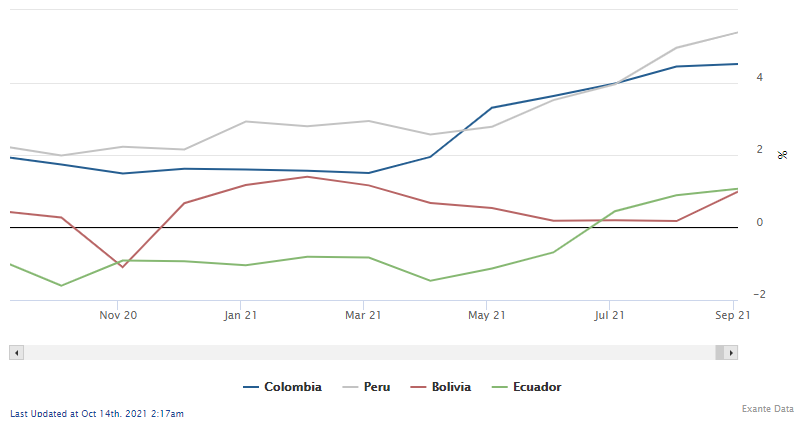
    Andean Countries: Inflation Rate
    Percentage variation (year-on-year)

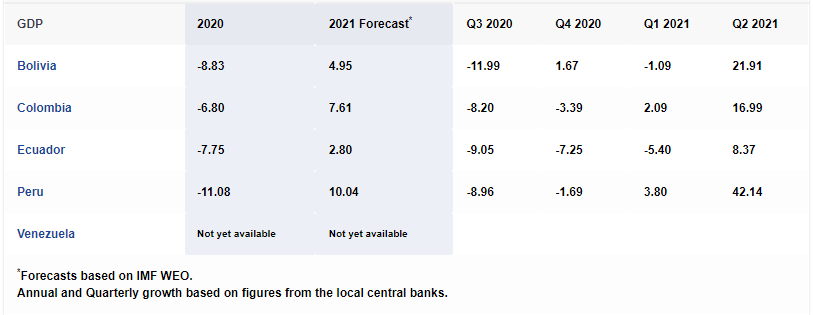
    Andean Countries: GDP Growth (%)
    Quarterly figures are year-on-year growth

  • EL SALVADOR: Gov’t under renewed pressure over disappearances

    Sarah Sheldon 15 December 2021 Hits: 408

    In November a councillor at San Salvador’s municipal office, Héctor Silva, proposed an emergency plan to deal with disappearances in the metropolitan area. His proposal – which has so far fallen on deaf ears – comes as the government led by President Nayib Bukele, which continues to claim progress in security issues, particularly in relation to reducing homicides, is facing mounting pressure from institutions such as the Inter-American Commission on Human Rights (IACHR) to address the rise in disappearances.

    Silva, a councillor for the small opposition party Nuestro Tiempo, called on 10 November for measures including the deployment of at least another 1,000 municipal police (CAM) agents and an increase in video surveillance. He also requested that the CAM director be ordered to draw up a plan within 15 days which would include “identifying high risk zones, an increase in the frequency of patrols in these areas and mechanisms for preventing abductions”. His call comes as figures from the attorney general’s office (FGR) cited by the local media put the number of people registered as disappeared in the first nine months of 2021 at 936, up 150% on the same period in 2020. Figures provided to Spanish news agency EFE by the FGR earlier this year via the law of access to public information, showed the number of disappearances reported in the first four months of 2021 more than doubled compared with the same period in 2020, from 196 to 415.

    Also piling pressure on the Bukele government to tackle the phenomenon, on 2 November the IACHR presented a new report on the human rights situation in El Salvador which said that it had received “alarming information on the lack of response by the state officials to the high number of complaints of disappearances in the last few years”. The IACHR urged the government to “make every effort to search for missing people” and recommends that “a regulatory framework for the national search policy be developed and implemented”.

    • Mixed findings

    The IACHR report underlined mixed findings regarding previous efforts to tackle the issue. As regards progress, it reported that, since 2017, the FGR had led a project entitled “Institutional strengthening for cases of disappeared persons associated with organised crime to reduce impunity in El Salvador” for the period 2017-2019. It notes that an urgent action protocol and search strategy for disappeared persons was drawn up and launched in December 2018, and the State announced the creation of a specialised unit for cases of disappeared persons in July 2019, which is dependent on the FGR. The IACHR report also highlighted the donation of an information system for the disappeared and corpses network (SIRDEC) and a forensic dental and clinical information system (Siclico), which will help standardise technical and scientific processes, coupled with the effective search and identification of disappeared persons.

       However, the IACHR also observes “significant challenges”. It underlines that “in the absence of a legal definition or status to intervene in these cases, the authorities reportedly have to resort to different criminal categories such as that of “deprivation of liberty.” It warns that this creates major difficulties with regard to the registration and systematisation of official statistics on the number of disappeared persons and cases in which there could be evidence of enforced disappearance, loss, or other types of absence. The IAHCR adds that the absence of a single registry, as well as current rules that clearly determine the powers and attributes of the authorities, allegedly prompt differences in the data collected by each institution such as between the police (PNC) and FGR. END BOX

    • Homicides down

    The reports of increased disappearances cast a cloud over President Bukele’s claims of progress with regard to homicides. On 1 November, the day before the IACHR released its report, the Bukele government cited PNC statistics which showed that in the first ten months of 2021, homicides totalled 926, 17.75% less than in the same period in 2020. The government attributes this progress to its security initiative, Plan Control Territorial (TCP) which includes a mixture of preventative and repressive components.


  • URUGUAY: Gearing up for key referendum

    Patrick de Courcy 03 February 2022 Hits: 6456

    Uruguay’s ruling ‘multi-colour’ coalition slipped into electoral mode this week ahead of a crucial referendum on 27 March. At stake is a significant portion of President Luis Alberto Lacalle Pou’s flagship Ley de Urgente Consideración (LUC), an omnibus package of laws. Although the ruling coalition was at pains to depoliticise the vote, insisting it was about specific issues, there is little question that it will be seen as a plebiscite on the Lacalle Pou administration.

    Pablo Iturralde, the president of the right-of-centre Partido Nacional (PN, Blancos), President Lacalle Pou’s party, launched the ‘no’ campaign to “defend this law in every corner of the country” on 31 January, alongside senior leaders of the other four parties in the ruling coalition: the conservative Partido Colorado (PC, Colorados); the right-wing Cabildo Abierto (CA); the centre-left Partido Independiente (PI); and the populist Partido de la Gente (PG).

    Iturralde said the ruling coalition had been given an opportunity to explain to the public why the LUC was drafted, but he also accused the FA coalition and the umbrella trade union Plenario Intersindical de Trabajadores-Convención Nacional de Trabajadores (PIT-CNT) of “questioning the Lacalle Pou administration’s right to govern”. Senator Guido Manini Ríos, the leader of CA, echoed his words, insisting that the LUC guaranteed rights and freedoms and had had “no negative effect in the 18 months since it took effect”.

    The FA wants to repeal 135 of the 476 articles in the LUC, which it claims are likely to cause “more inequality, poverty, exclusion, falling income for workers and pensioners, and increasing concentration of power and wealth”. Along with the PIT-CNT, it also opposes the tighter regulations on the right to strike and the banning of pickets that “affect the free movement of peoples, goods, or services”.

    Referendum

    Uruguay’s electoral court (CE) approved the staging of the referendum last December after the FA gathered in excess of the required 25% of signatures of registered voters. Voting is obligatory. The Lacalle administration remains popular so there is a good chance the ruling coalition will emerge triumphant but it is likely to be tight as the country was almost evenly split in the last elections.

  • PANAMA: Continued drought brings further canal restrictions

    Sarah Sheldon 25 March 2024 Hits: 1061

    In mid-February the Panama Canal Authority (ACP) announced more restrictions on the number of ships that can pass through the Panama Canal each day, adding to concerns over its long-term viability as climate change intensifies.

    It announced that the number of crossings would be limited to 24 per day, down from 36-38 per day under normal conditions, with officials blaming a prolonged drought which has led to falling water levels in the Gatún and Alajuela artificial lakes which feed the canal. While on 11 March the ACP announced that this would be lifted to 27 per day, these restrictions will last until there is a period of rainfall, according to ACP administrator Ricaurte Vásquez, which is unlikely before the end of the year. Once this happens the ACP will slowly increase the number of transits per day until normal levels are regained. In an interview with the Associated Press published on 24 February Vásquez said that he believes this will not be possible until around February 2025.

    This is a problem for Panama, because the canal is a major contributor to the public purse, but also for global trade more widely as it acts as a hub for maritime routes linking 1,920 ports in 170 countries. The ACP estimates that around 3% of world trade transits through the canal. The issue is that each ship transit uses 51-55m gallons of water provided by a network of reservoirs, rivers and artificial lakes, which also supply water to residents of Panama City.

    In response to increased competition for water resources, the ACP has enacted a series of water-saving measures including reducing hydroelectric generation at its dams. It has also proposed a number of long-term solutions, such as extending the Panama Canal basin or removing restrictions on the construction of new dams.

    According to Vásquez, the best solution would be to build a new reservoir on the Rio Indio river. However this would require action by the government, which Vásquez says has been lacking. With the current administration led by President Laurentino Cortizo set to leave office on 30 June, officials have told Vásquez that no action will be taken until the new government is in place. With this in mind, canal officials have been meeting with presidential candidates to discuss the long-term future of the waterway. Vásquez has also met with investment banks to explore financing for infrastructure projects. One plan is to build grain storage silos on the Pacific side of the canal in order to boost shipments of the grain, which have been badly affected by traffic restrictions. In response to these issues Danish-headquartered multinational shipping giant Maersk has announced that it would start to move some cargo across Panama by rail, but Vásquez says that the railroad is complementary to the canal rather than competition.

    However, the effects on canal operations are serious, with Vásquez predicting a US$200m hit to toll revenue from October 2024-October 2025, making a total of US$4.7bn. In turn this will affect the canal’s contribution to the public purse, which was a massive US$2.5bn in the 2022 fiscal year.

    On 16 February international credit ratings agency Fitch Ratings said that traffic restrictions at the canal would mean a shortfall in the government budget of around 0.4% of GDP. This is because the budget predicted that contributions from the canal would increase rather than decrease.

    Problems at the canal add to an already complicated economic picture in Panama, which also closed the massive Cobre Panamá copper mine late last year [EB-23-12]. Fitch cited this closure as a reason for revising its outlook on Panama’s sovereign rating to negative from stable in September 2023. In its latest statement, Fitch said that “the Negative Outlook relates to interrelated fiscal and governance challenges. Public finances remain structurally weak, amid surging interest costs, spending pressures and sluggish tax revenues.” The agency also increased its deficit forecast for 2024 to 4.7% of GDP, up from 4.3% of GDP. 

    As a result the next government will face some difficult choices. One concern raised by Fitch is the defined-benefit pension system, which the agency predicts will deplete its reserves, as well as outstanding payments for a raft of capital investment projects carried out in recent years. As things stand none of the presidential candidates have published concrete proposals for tax reforms to rectify the situation, according to Fitch, which also highlights waves of serious social unrest in 2022 and 2023 as cause for concern for the next government.

    The situation is not expected to ease in the long-term either. Jan Hoffmann, chief of trade logistics at the United Nations (UN) Conference on Trade and Development (Unctad), is one of a number of experts that have blamed this on climate change impacts, which are expected to worsen. “Low water levels have caused a decrease of 36% in ship transits compared to a year ago and are almost 62% down on two years ago,” said Hoffmann.

    Fixing water issues at the canal in order to secure its future will require massive infrastructure investment at a time when public budgets are increasingly stretched in Panama. For this reason Vásquez’ exploration of external sources of funding is logical, but depending on the terms of potential contracts this could reduce the canal’s contribution to the public purse. Even if financing can be secured, future governments will have to make potentially controversial legislative changes on natural resources, which are a hot button issue in Panamanian society after the closure of the Cobre Panamá mine.

    Impact of Panama mine closure

    On 4 March the International Monetary Fund (IMF) released a new report on Panama following the conclusion of an Article IV visit to the country. The report estimates that due to the closure of Panama’s massive Cobre Panamá mine, the country’s GDP growth is projected to decline to 2.5% in 2024, down from 7.5% in 2023, before gradually improving over the medium term.

  • ARGENTINA: Election suspension a boon for Milei

    Abbi Dicker 13 February 2025 Hits: 4386

    Argentina’s President Javier Milei received a fillip on 6 February when the lower chamber of congress voted in favour of a bill that suspends primary elections (Paso) this year. The vote exposed deep divisions within the Peronist opposition Unión por la Patria (UP). If the senate follows suit, it will mean that there would be no Paso before the mid-term legislative elections in October. The net result of this would most likely be a divided opposition, as the Paso encourages cohesive alliances, with Milei’s ruling far-right La Libertad Avanza (LLA) presenting a unity list.

    President Milei favoured abolishing the Paso altogether, claiming that the elections are a waste of money, costing some US$150m to stage, but this proved too contentious. Instead, the LLA pushed for the suspension of the Paso for this year, ostensibly on the grounds of austerity, calculating that this would most likely sound the death knell for them anyway, especially if the party succeeds in significantly expanding its presence in congress in October’s mid-terms.

    The initiative passed by 162-55 with 28 abstentions in a resounding victory for the Milei administration. The UP was riven. No fewer than 25 UP deputies voted in favour of suspending the Paso, while 24 abstained and six failed to turn up. This left just 43 UP deputies opposing it. These legislators are most closely allied to former president Cristina Fernández (2007-2015) under whose government the Paso was introduced in 2011 as part of a political reform with the stated aim of improving transparency and boosting democratic participation. Even before Milei’s election the Paso had come in for criticism over cost and Milei was determined it would not survive his ‘chainsaw’ – LLA Deputy Nicolás Mayoraz dismissed the Paso as “an expensive survey” – especially given the electoral benefit for his party.

    Congress has not fractured like this since Milei came to power in December 2023. It was a big setback for Fernández, who saw the Paso as a tool to try and contain the challenge posed by the governor of Buenos Aires, Axel Kicillof, an estranged ally, without splitting the Peronist movement. But the outcome of the vote laid bare that internal division as Peronist governors of northern provinces, who have cultivated an amicable relationship with Milei, instructed deputies to vote to suspend the Paso.

    The initiative must still be approved by the senate, but the senate constitutional affairs committee voted in favour of the Paso’s suspension on 12 February and a repeat of anything close to the UP’s level of internal division in the lower chamber would see it prosper. The upshot of the Paso’s suspension would be significantly reduced incentives for wider alliances, leading to a more fragmented opposition with more electoral lists in October, while Milei would benefit from LLA unity. It would also be a blow to the right-of-centre Propuesta Republicana (PRO), which, without the Paso, would have to accept the conditions imposed by the LLA for an electoral alliance, or go it alone.

    In theory, Fernández should, as president of the Partido Justicialista (PJ), the mainstay of the UP coalition, have much more control over the list of candidates to compete in the mid-terms without the Paso. But the fractured vote in congress demonstrates that she has nothing like the authority over her party that Milei enjoys over the LLA, and the wider Peronist movement would most likely present separate lists.

    Meanwhile, Fernández is in a battle to be able to stand on the PJ list herself in the mid-terms. On 12 February the lower chamber voted by 144-98 to approve the ‘Ficha Limpia’ bill, which would bar anybody convicted of corruption by two separate courts “up to 180 days before election day” from running for election. Fernández was convicted last November for a second time, in the ‘Vialidad’ corruption case [WR-24-45]. Fernández can still appeal to the supreme court but the ‘Ficha Limpia’ bill, if it is also passed by the senate, would end her hopes of gaining immunity as an elected member of congress.

    The UP, which condemned the bill as unconstitutional and tabled with the sole purpose of preventing Fernández from running, has a stronger presence in the senate. It is a win-win scenario, however, for Milei. If the bill is approved, he will have struck a blow against his main adversary and will be able to claim that his government is combating corruption successfully. If it is rejected and Fernández stands, he will be able to polarise his electoral campaign, accusing the political ‘caste’ of defending corrupt politicians.

    Ficha Limpia

    The PRO initially presented the ‘Ficha Limpia’ bill last November but LLA deputies did not show up for the scheduled debate and it failed to meet quorum twice, leading to mutual recriminations and conspiracy theories that the government had secretly sealed a pact with the UP. The government subsequently tweaked the bill, enabling it to claim full credit should it win approval.

  • CHILE: Tohá throws hat into the ring

    Abbi Dicker 06 March 2025 Hits: 4074

    Carolina Tohá resigned her position as Chile’s interior minister on 4 March in order to launch a presidential bid. While the parties in the main right-of-centre opposition coalition Chile Vamos have settled on Evelyn Matthei, the current frontrunner, as their presidential candidate, and far-right candidates, José Antonio Kast and Johannes Kaiser, are intent on running, nobody had stepped forward to carry the standard for the left – until now.

    “We are seeing a wave of right-wing ideas in the world that cast doubt on many advances of civilization that have been obtained through great effort,” Tohá said, while launching her candidacy. “Chile,” she added, “can be a land of hope…we don’t have to fall into that trap”. Tohá said that while she would represent the progressive left it was “not any progressivism” but one with “certain values”, which she defined as “democratic, modern and new”, being in touch with the common people, “capable of listening”, and not hung up on “ideological obsessions”.

    President Gabriel Boric stopped short of endorsing Tohá, who belongs to the centre-left Partido por la Democracia (PPD), one of the four traditional parties that formed part of the now-defunct Concertación coalition that dominated Chilean politics for two decades after the return to democracy in 1990, but he was full of praise for her. Boric said it was important to stage competitive primary elections (which are not obligatory) on 29 June to select a presidential candidate. Boric’s own more radical left-wing Frente Amplio (FA) grouping is preparing to make an announcement after a meeting of its central committee on 15 March over its own presidential ambitions.

    Senior leaders within the Partido Socialista (PS), which was also part of the Concertación with the PPD, urged twice former president Michelle Bachelet (2006-2010; 2014-2018), to stand. They pointed to early polls suggesting that she would be best-placed to defeat Matthei; a mid-February poll by the local pollster Cadem had Matthei defeating Bachelet in a hypothetical second round by just eight percentage points but thumping Tohá by 26 points. Their powers of persuasion were seemingly to no avail. Bachelet released a video this week declining to take part in the presidential contest.

    Deputy Alberto Undurraga, the president of Democracia Cristiana (DC), at one stage the pre-eminent force within the Concertación but now a pale shadow of its former self, said his party would be prepared to participate in primary elections against Tohá but not if the Partido Comunista de Chile (PCCh), part of Boric’s ruling coalition, participates. The DC will hold a meeting on 15 March to define its own plans vis-à-vis the presidential elections.

    This potential disunity on the left could damage Tohá’s prospects but it is even more marked on the right of the political spectrum. Matthei took the opportunity to urge Kast and Kaiser once again to participate in primary elections against her so that the right could subsequently present a united front behind the victor in the presidential elections on 16 November, warning them not to underestimate the strength of the left, which she said “knows how to contest elections”. But this outcome is unlikely. Kast, in particular, has no intention of competing directly against Matthei given currently adverse electoral surveys (the Cadem poll showed she would beat him by 14 points). He also sees Tohá as providing the perfect foil. “Today, Chile is more violent and insecure than it was four years’ ago and the symbol of that failure [as the outgoing interior minister] is Carolina Tohá,” he said.

    Reshuffle

    President Boric sought to emphasis his government’s focus on reducing violence and insecurity through a significant increase in investment in resources for the country’s police forces and the impending creation of a separate public security ministry in April. He also appointed a safe pair of hands to replace Tohá at the interior ministry. Álvaro Elizalde, the PS party president, has significant political experience. He had been serving as president of the senate before being appointed as minister of the presidency (Segpres), the main go-between with congress, by Boric in April 2023. He now picks up the most senior position in the cabinet.

    Elizalde’s immediate priority will be demonstrating some tangible progress in reducing violent crime and insecurity in Chile. Whichever progressive left candidate emerges triumphant from June’s primary elections will be hard-pressed to win presidential elections in November otherwise.

    Interior ministry

    Carolina Tohá is the daughter of José Tohá, who served as interior minister under former president Salvador Allende (1970-1973) and who was arrested and tortured during the military dictatorship; suffering poor health he was transferred to hospital and was found hanged inside his hospital room toilet in 1974. She said the decision to step aside from the position her father had held had “not been easy” but she had decided to take on “an even greater challenge”. She called for “a broad and diverse coalition” while announcing her candidacy.

  • JAMAICA: PNP faces the challenges of success

    LatinNews 11 April 2012 Hits: 2641

    Jamaica’s People’s National Party (PNP) must be feeling pleased with itself. It returned to power in the 29 December general election after a four-year absence, winning 42 of the 63 seats on offer. It has now followed this up with a decisive victory in the 26 March local elections, winning 12 of the country’s 13 parish councils while achieving a 4-4 tie with the opposition Jamaica Labour Party (JLP) in the 13th. Of the 228 parish council seats contested, the PNP won 150 against the JLP’s 75. All this political success has come amid a return to growth: in the last quarter of 2011, the economy grew by 1.7% year-on-year, to give overall growth for 2011 of 1.5%, the first annual advance since 2007. Remittances in 2011 were at their highest level for a decade at more than US$2bn. But despite all this, the latest International Monetary Fund (IMF) report points to strong headwinds to come for the PNP.

    The IMF was in Jamaica from 8-21 March for the Article IV Consultation, and discussions with Jamaica will continue in Washington from 20-22 April. The March mission recorded that the 2011 growth figure of 1.5% resulted primarily from increases in agriculture and bauxite/alumina production. Another positive was the reduction of inflation to 6.6% year-on-year by the end of January.

    However, the IMF also warned about persistently high unemployment (12.8%) and a deteriorating fiscal situation. The budget for the 2011/12 fiscal year targeted a primary fiscal surplus of 5.2% of GDP, but this eventual outcome is projected to be 3%. The public-sector deficit is expected to be 7.3%, with the country’s debt-to-GDP ratio remaining high at 140%.

    The PNP is a left-leaning party, and there is little doubt that its success in December was based in part on the manifesto’s focus on the need to foster economic growth, with the emphasis on job creation. The PNP also made much of the JLP’s poor record on growth. As the PNP emphasized during the December election, GDP growth when the PNP was last in power, in 2006/7, was 3.2%; the debt-to-GDP ratio was 108%; and unemployment was 9.6%. The JLP, by contrast, presided over a contraction of 1.3% in 2010; a debt-to-GDP ratio that is now pushing 140%; while unemployment is estimated to have been 12.6% in 2011, slightly up from 12.4% in 2010.

    While the PNP did not overtly campaign on an anti-IMF platform, it did clearly suggest that the new agreement with the IMF should be more growth-oriented. And it was supported in this by an April 2011 report from the Washington-based Centre for Economic and Policy Research (CEPR) which was strongly critical of the IMF’s Jamaica programme on the grounds that it was too “pro-cyclical”.

    But nothing emerging from the IMF’s March visit to Jamaica suggests much room for manoeuvre. In addition to the edging up debt ratio, the IMF is projecting an increase in the external current account deficit to over 10% of GDP and it has highlighted a decline in net international reserves at end-February to U$1.8bn. Also, in the banking system, the non-performing loan ratio rose to 9%.

    The IMF does pay lip service to the need for boosting growth and maintaining social cohesion. It notes “significant challenges” in attaining “higher and sustainable rates of economic growth, while reducing macro-economic risks, including high public debt and high unemployment”. And it points to the need for action on three fronts, namely creating a growth-oriented environment with improved productivity; strong macroeconomic policies through “significantly higher” primary fiscal surpluses, fiscal, and financial reforms”; and creating a framework to ensure social cohesion.

    Yet, there is little to indicate that the IMF has any innovative ideas up its sleeve, certainly none that are likely to answer the CEPR’s criticisms or help Prime Minister Portia Simpson Miller deliver on the promises held out by her dual election victory. On the contrary, the IMF warns about the difficulties immediately ahead, saying: “The recovery is fragile and there are strong downside risks. Growth in FY2012/13 is projected to remain low at about 1% and, on present trends, the public sector and external current account deficits are projected to widen and the public debt to rise. On the external side, risks to external stability and growth can arise from volatile commodity import prices (including oil) and a slowdown in global growth, in particular in the United States.”

    The problem for the PNP is that the electorate has put considerable trust in it and will be looking for results not excuses. As one PNP politician boasted after the local election results were known: “We run things now: central government, local government…”

    • IDB report

    This warning of unhelpful external factors was echoed by the Inter-American Development Bank (IDB) in its 2012 Macroeconomic Report. However, rather than pointing to the US, it expressed concerns about a faster-than-expected deceleration of China’s economy and deepening economic problems in Europe.


  • TRACKING TRENDS

    LatinNews 07 August 2014 Hits: 1375

    PARAGUAY | Issuing more debt. Paraguay’s President Horacio Cartes announced on 4 August that his government had successfully issued US$1bn worth of sovereign bonds in international financial markets.

    This is Paraguay’s second-ever bond issue after the country successfully placed US$500m in 10-year bonds in January last year. The latest issue comes after the national congress approved a request on 17 July made by the Cartes government to increase the level of sovereign bond debt contemplated in this year’s national budget by US$667m for a total of US$750m.

    The government’s request to increase the level of sovereign debt sparked some controversy as the political opposition and the local media complained that there was hardly any justification for further indebting the country at this time given that the Cartes administration has yet to fully utilise all the funds raised during the January 2013 bond issue.

    In particular the local press has pointed out that with the approval of the new bond issue Paraguay’s debt under Cartes will total US$1.6bn, representing over half of the country’s total foreign debt of US$2.6bn.

    However, Finance Minister Germán Rojas defended the move arguing that Paraguay’s current level of debt is still comparatively low at 12.8% of GDP and the country has room to increase its level of debt to up to 22% of GDP. Rojas also said that the funds raised by the proposed bond issue would help guarantee the continuity of various long-term economic and social development projects (see sidebar).

    In addition, Carlos Fernández Valdovinos, the president of Paraguay’s central bank (BCP) also defended the decision to tap the international financial markets once again arguing that conditions were still favourable for doing so. Fernández explained that as global interest rates remain relatively low, as a result of the low yields offered by US bonds, “indebtedness in these circumstances is not a bad thing”.

    Since Paraguay’s last bond issue, the country’s risk profile has improved as in June the ratings agency, Standard & Poor’s, upgraded its rating of Paraguay’s long-term sovereign debt from BB- to BB with a stable outlook. This followed Moody’s February decision to increase its rating of Paraguay’s sovereign debt to Ba2 from Ba3.

    In fact in announcing the success of the latest bond issue Cartes said that it was almost five times oversubscribed which allowed for the allocation of the 30-year bonds with a yield of 6.1%, lower than the 6.37% rate initially offered. The high level of demand also led the government to increase its initial offer by US$250m (without securing prior congressional approval).

    However, Cartes was adamant that the additional funds would help his government fulfil its plans to “combat poverty, create jobs and improve the country’s road infrastructure”.

    • Destination of funds

    According to Finance Minister Germán Rojas the funds raised from the bond issue will finance various existing and planned investment projects by the public works & communications ministry, the agriculture ministry, the national housing secretariat (Senavitat), the state-owned electricity company (Ande) and the state-owned cement company (INC); and to shore up the Crédito Agrícola de Habilitación (CAH), a government rural micro-financing scheme.

  • VENEZUELA: “Extraños sucesos” en Caracas

    LatinNews 10 October 2014 Hits: 958

    Mientras el gobierno liderado por el Presidente Nicolás Maduro ha buscado acusar a elementos paramilitares colombianos (e incluso al ex presidente de Colombia, Álvaro Uribe [2002-2010]) de estar involucrado en el asesinato de Robert Serra, un joven diputado del gobernante Partido Socialista Unido de Venezuela (PSUV), en su casa en Caracas la semana pasada, algunos analistas políticos sospechan que el incidente de hecho está relacionado con las –crecientemente públicas– tensiones dentro de la Revolución Bolivariana. Tales sospechas fueron más estimuladas por un violento choque justo dos días más tarde entre la policía y miembros armados de un colectivo pro-gobierno, en el cual otras cinco personas murieron. Cualquiera sea la verdad (y es improbable que salga a la luz pronto), la violencia política en Venezuela parece volverse un creciente riesgo, agregándose a la percepción que Maduro no está en ‘total comando operacional’, utilizando un lenguaje militar.

    Un comunicado con fecha 8 de octubre dice que el Presidente Maduro había ordenado una “profunda y exhaustiva investigación” en lo que la declaración expresa como “los extraños eventos” en Caracas central un día antes. Los detalles reales son nebulosos, pero los hechos básicos son que a temprana hora del 7 de octubre, oficiales del Cuerpo de Investigaciones Científicas, Penales y Criminalísticas (CICPC) hicieron un allanamiento en las oficinas centrales del colectivo ‘Escudo de la Patria’, en el vecindario Quinta Crespo de Caracas. Varios oficiales fueron tomados como rehenes y luego de ocho horas en un punto muerto,  antes de una segunda operación del CICPC que rescató a los rehenes. Dos miembros del colectivo murieron en el primer ataque, y otros tres en la operación de rescate de rehenes.

    Entre las cinco víctimas estaba José Odreman, líder del colectivo ‘Frente 5 de marzo’ y también vocero del grupo Escudo de la Patria, quien, si algo tiene que ver la serie de fotos publicadas por los medios locales, parece estar muy bien conectado con altos funcionarios en el gobierno, en todos los escalones hasta en el ejecutivo. Coincidentemente, Odreman también aparece en algunas fotos con Robert Serra. Horas antes de su muerte, y durante el punto muerto con el CICPC, Odreman envió un video online declarando al ministro del interior y justicia, el General del Ejército Miguel Rodríguez Torres, “responsable” de cualquier cosa que podría pasarle a él y acusando al CICPC de matar a alguien que había trabajado con él. Los medios locales inmediatamente asumieron que se refería a Serra. “Las Matemáticas nunca fallan”, declaró Odreman en el video, no dejando a nadie que supiera lo que quería significar.

    José Sierralta, el director del CICPC, ha negado de plano que la operación del CICPC tuviera algo que ver con el caso Serra, reiterando que la fuerza estaba apuntando a una banda criminal “peligrosa”. Él afirma que Odreman, un ex oficial de la policía metropolitana de Caracas, lideraba una banda conocida como ‘El Odreman’, sospechosa de varios asesinatos. Hubo alguna especulación en el sentido que el incidente es parte del esfuerzo del ahora fuertemente controlado militarmente gobierno venezolano para controlar a elementos renegados.

    • Cabello

    El presidente de la asamblea nacional, Diosdado Cabello, dijo el 7 de octubre que los autores materiales del asesinato de Serra habían sido identificados y que las autoridades ahora estaban detrás de los autores intelectuales. Él agregó que los asesinatos habían sido planeados durante dos meses. El diario El Universal informó que seis personas conectadas con Serra estaban en custodia  en las oficinas centrales de Caracas del servicio Bolivariano de inteligencia (Sebin). Y sugiere que dos Policaracas oficiales de policía y otras cuatro personas que habían trabajado directamente con Serra, podrían estar vinculados con el asesinato. Por su lado, Maduro dijo que con la ayuda de terceros países las autoridades habían impedido “ataques terroristas” en Venezuela, diseñados para desestabilizar el país, con el gobierno y líderes del PSUV como blancos.

  • TRACKING TRENDS

    LatinNews 15 November 2012 Hits: 709

    ARGENTINA | New shale oil and gas discovery. On 12 November Petrobras Argentina, the local subsidiary of Brazil’s state-run oil firm, Petrobras, announced that it had discovered a new commercially-viable shale oil and gas deposit at its Puesto Peter exploration bloc in the Southern province of Santa Cruz. In an official statement, the company said the deposit was found after it drilled a 3.2km-deep well in the Springhill rock formation, in the northern part of the Puesto Peter bloc, located 140kms from the provincial capital of Río Gallegos. The well, ‘Estancia Campos x-1’ may hold some 11m barrels of oil equivalent. It is sited close to Petrobras Argentina’s existing well in the Puesto Peter bloc, which is currently producing 78 barrels of shale oil and 240,000 cubic metres of shale gas a day. This is the second such discovery by Petrobras Argentina this year in Santa Cruz. In June the firm announced a shale hydrocarbons deposit at the La Cancha x-1 well in the Agua Fresca bloc, also located in Santa Cruz province.

    BRAZIL| Indonesia purchases defence equipment. On 13 November Brazil’s Avibrás Indústria Aerospacial (Avibrás), a defence industry company specialised in the manufacture of aircraft defence systems, artillery, rockets and missiles, announced a US$360m deal with the Indonesian government for the supply of 36 MRLS Astros II multiple (surface-to-air) missile launch pads. An Avibrás statement said that the deal had been agreed at the Indo Defence international military fair held in Yakarta, Indonesia on 7-10 November. The statement explained that following a visit by specialists from the Indonesian armed forces to Brazil in October, which included a demonstration of how the MRLS Astros II units work, the Indonesian state-owned military industry manufacturers, PT Pinad and PT Dirgantara, expressed an interest in signing a memorandum of understanding on technology cooperation and exchange with Avribrás and Brazil’s national aeronautic and space institute, a prerequisite for supply contracts with the Indonesian armed forces. After the memorandum was completed, the Indonesian defence ministry formally approached Avibrás, looking to acquire MRLS Astros II units. The final deal includes the provision of the same number of missile launcher transport vehicles, firing control mechanisms, equipment maintenance, and the provision of training.

    CHILE | Chuquicamata to miss this year’s production target. On 12 November Gerardo Jofré, the head of Chile’s state-owned cooper mining firm, Codelco, announced that Chuquicamata, the world’s largest open-pit copper mine, will fail to meet its projected production target for 2012. According to Jofré, Chuquicamata will not meet its target of 390,000 tonnes (t) of copper due in part to “technical problems” in the process of converting the mine into a completely underground operation. Jofré refused to put a figure on Chuquicamata’s final production levels but experts forecast a final figure of about 322,000t. Last year, production at Chuquicamata, which has been on the decline for couple of years, was 440,000t. Codelco has in fact moved the operation underground in an attempt to boost production levels. However, this entails a US$3.8bn investment plan, which Codelco has delayed in favour of investment in some of its newer mines. Commenting on the situation, Jofré said, “We knew that production at Chuquicamata this year was going to be lower than expected. This is unavoidable… we also have problems in that the structural projects and the investments Codelco needs to make have been delayed and now they are mixed in with others”. Jofré said that Codelco nonetheless expects that the shortfall in production at Chuquicamata to be compensated for by an increase in output in some of Codelco’s other mines such as Gaby, Andina and Teniente, which in recent years have received more investment.

    • Rio nabs the region’s first Apple store

    On 14 November the US multinational computer giant, Apple Inc., announced that it would open the first Apple store in Latin America in Rio de Janeiro, Brazil, although it did not specify a precise date. In a statement to its official distributors, the company said, “We are eagerly awaiting the opening of our first Apple Store in Brazil, where we have we have already had customers for some time and where we expect to gain many others in the future. We can’t wait to offer our unique retail experience to the people of Rio de Janeiro and all our clients across the region”, the statement reads.  The (deceased) former head of Apple, Steve Jobs, had refused to open an Apple store in Brazil, citing its onerous taxes and red tape.

  • ARGENTINA: Fernández tunes up for her swan song

    LatinNews 26 February 2015 Hits: 2792

    On 1 March President Cristina Fernández will give her last state-of-the-nation address to the Argentine congress. It is expected to be a longer speech than in previous years as she reflects not only on her own record in office, but also that of her late husband, Néstor Kirchner (2003-2007), for the term prior to hers. But with just months remaining in power, her recent pronouncements on the massive 18 February (‘18F’) march to commemorate the death of the federal prosecutor, Alberto Nisman, show the President, and her government, still relish confrontation.

    Though President Fernández did not address at the time the hundreds of thousands of demonstrators who took to the streets last week, she did refer to the protests in a ‘reflection’ published over the weekend. Despite the organisers’ attempts to make the silent march politically neutral (politicians were prohibited from giving speeches), Fernández described the event as the public debut of the ‘Party of the Judiciary’. It was, she wrote, “an opposition march, convened by prosecutors, and supported by judges and the whole spectrum of the political opposition”.

    Individual members of government are currently facing an impressive array of charges. Fernández herself faces accusations of money-laundering over her family’s hotel interests, while the federal planning minister, Julio de Vido; the justice and human rights minister, Julio Alak; and Vice-President Amado Boudou all face charges of illicit enrichment. Meanwhile, the federal prosecutor who has taken over from Nisman, Gerardo Pollicita, has decided to reinstate Nisman’s charges of aggravated concealment over the bombing of the Jewish mutual centre (Amia) in Buenos Aires against Fernández and the foreign minister, Héctor Timerman.

    Relations between the executive and the judiciary are thus at rock bottom. While the opposition fears that the long-term strategy of the Kirchneristas is to ensure a grip on power post-Fernández by steadily taking over the judiciary, there are still plenty of independent-minded judges willing to take on cases against the government. As a result, the government repeatedly accuses the judiciary of being controlled by the opposition, interested only in challenging the administration and not Argentina’s major corporations.

    In its response to Fernández’s comments, the Asociación de Magistrados y Funcionarios de la Justicia Nacional stated that the only party it belonged to was the “party of the constitution”. It added: “The judiciary is not a party but a power of the State”.

    Opinion polls
    The as-yet-unexplained death of Nisman has had a small, but significant effect on the President’s opinion poll ratings. Management & Fit put Fernández’s approval rating at 30%, down from 33% in January. Though hardly a collapse, all polling firms had Fernández’s approval rating rising in December. The incident has also had a small, but perceptible impact on the approval ratings of Daniel Scioli, at present the leading Kirchnerista candidate for October’s presidential elections.

    Management & Fit put Mauricio Macri, the mayor of Buenos Aires for the centre-right opposition Propuesta Republicana (PRO), on 28%, with Scioli on 24% and Sergio Massa, an ex-Kirchnerista now running as presidential candidate for the dissident Peronist Frente Renovador (FR), on 19%.

    A poll by González y Valladares came up with a rather different set of numbers: Massa on 31%; Scioli on 25%; and Macri on 23%. Over the weekend, however, Macri received a significant boost when Carlos Reutemann, the influential former governor of Santa Fe (1991-1995) and at present a federal senator representing the province, switched his support from Massa to Macri. Reutemann explained his decision by saying that he thought Massa was best placed to beat the Kirchnerista candidate in the legislative elections in Buenos Aires in 2013, but that now it was time to put “heart and head” in order.

    What is clear is that many voters have yet to turn their thoughts to October’s general elections. But for the government, it must decide whether to fully endorse Scioli, who it tends to alternately embrace and cold-shoulder, or opt for another candidate, such as Florencio Randazzo, the interior and transport minister.

    • Stiuso accused of smuggling

    Antonio “Jaime” Stiuso, the former director of intelligence believed to have supplied Alberto Nisman with much of the information that led to his accusations against the government, was accused of smuggling by the security chief on 25 February. Oscar Parrilli, the new head of Side, the intelligence secretariat, said that Stiuso effectively operated a parallel institution inside the agency. Stiuso was ousted from office in a government-mandated shake-up in December. His lawyer says he has left the country after threats against his life.

  • Region: Labour Market - Holding up well, despite the economic slowdown

    LatinNews 03 July 2015 Hits: 3091

    A recent report highlights how the near stagnation of the regional economy has not had a serious impact on labour markets...so far.

    Across Latin America and the Caribbean, real per capita incomes were broadly stagnant in 2014, when the regional real annual GDP growth rate slowed to just 1.2%. In spite of this, unemployment across the region actually fell from 6.2% to 6.0%. As a recent report from the United Nations’ Economic Commission for Latin America and the Caribbean (ECLAC) and the International Labour Organization (ILO)1 notes, this outcome was not the result of job creation. The fall in the urban employment rate – from 56.8% to 56.5% – was actually larger than might have been expected given the trends of recent years Rather, the drop in unemployment was due to a fall in the participation rate, from 60.6% to 60.1%.

    ECLAC and the ILO highlight the large drops in the participation rates in Argentina and Brazil (by around 1.1 percentage points through 2014), as well as in Mexico (0.8 percentage points). The agencies note that falling participation rates at times of economic slowdown are the norm in developed countries and the wealthier countries in Latin America and the Caribbean. The same is true for individual households. In essence, the wealthier usually have the income and/or financial reserves to weather economic slowdowns. Conversely, people in poorer countries and households tend to respond to slowdowns by increasing participation in the labour market – in order to preserve incomes at (near-) subsistence levels. Sometimes this involves sending children out to work.

    ECLAC and the ILO note that higher levels of employment and real wage rises in the three countries over the last decade may have given many households the financial reserves to cope with the slowdown. Further, and in contrast to past episodes of weak growth in the region, real wages held up in 2014. Finally, the agencies observe that many of the governments in the region have introduced schemes that look to retain young people for longer in education systems: in each of Argentina, Brazil and Mexico, the falls in participation rates were greater than for the entire populations. The report concludes that ‘the pressure on households is not yet heavy enough to force young people into the labour market and seek labour income in any sort of conditions from the … workforce’.

    The fact that, across the region as a whole, households (and, in particular, women), responded to the slowdown by lowering the supply of labour is also reflected in trends for underemployment. [1] Underemployment is the percentage of employed people who work fewer than the standard number of hours each week and who are willing and able to work longer hours. The rate of underemployment rose slightly in 2014 in Argentina (from 9.2% to 9.6%), Costa Rica (from 12.5% to 12.8%) and Ecuador (from 8.9% to 9.3%). The underemployment rate fell in other countries in the region.

    Because of methodological differences, the underemployment rates for each of the countries are not directly comparable. Nevertheless, the generally strong performance of economies across the region through the years prior to 2014 are reflected in a consistent fall in underemployment. Particularly noteworthy are the drops in the underemployment rate in Colombia (from 12.0% in 2010 to 10.6% in 2014), Ecuador (from 12.1% to 9.3%), Paraguay (from 7.3% to 4.9%), Peru (from 14.5% to 11.3%) and Uruguay (from 8.9% to 6.9%).

    Of course, labour market conditions are defined by the quality of jobs, as well as the number of people who are unemployed or under-employed. According to ECLAC/ILO, just under two thirds of the number of people who were employed across the region in 2012-13 (excluding domestic workers) were in jobs that paid wages. [2] Of the workers receiving wages, 81% were employed formally and nearly as many were protected to some extent by their country’s social security system. The numbers of workers receiving wages at that time ranged from below 50% in Colombia and Honduras to above 70% in each of Chile, Costa Rica and Panama. The numbers of wage earners employed formally ranged from around 75% to over 90%. At 49%, the number of wage earners with social security coverage (among the countries for which data is available) was lowest in Paraguay: at over 90%, it was highest in Uruguay.

    Crucially, the metrics have been improving in most countries in Latin America. Relative to a decade or so earlier, the proportion of salaried workers was 5 percentage points higher across the region as a whole. The number of wage earners employed formally was just over 3 percentage points higher. The largest gain was made in the number of salaried employees with social security coverage, which almost rose by 10 percentage points. The number of workers earnings wages, and workers employed formally, actually dropped in Mexico and Honduras. However, there were very strong gains in the number of workers with social security coverage in Brazil, Peru, Uruguay and – in particular – Ecuador. ECLAC notes that, as of 2013, most countries in the region have in place programs to broaden the coverage of social security systems2.

    In short, relative to previous episodes when economic growth has slowed to a crawl in Latin America, household incomes across the region have been in good shape. Workers are more likely to be earning wages and in the formal economy. They are significantly more likely to have some protection from official social security systems – if only in old age. This is in the context of social security protection expanding rather than contracting. Young people, meanwhile, are more likely to be studying than previously.

    Looking forward however, the ECLAC and the ILO are not particularly optimistic. The regional economic slowdown, which began in 2011, appears unlikely to end in 2015. The agencies believe that this likely will result in stagnation in urban employment and, perhaps, a decline in the number of people working formally. Most importantly, they do not envisage that the participation rate can continue to fall like it did in 2014. The official unemployment rate is likely to rise over the coming months. Given the weakness in the regional economy – which is being compounded by the effect on household incomes of stubbornly high inflation – we think that this is particularly true of Brazil.


    [1] ECLAC/ILO, Employment Situation in Latin America and the Caribbean, May 2015, No. 12.

    [2] ECLAC, based on R. Rofman et al., Más allá de las pensiones contributivas, World Bank, 2014, cited in ECLAC/ILO, Employment Situation in Latin America and the Caribbean, May 2015, No. 12.

  • ECONOMY: Impediments to export led recovery

    LatinNews 11 November 2015 Hits: 234

    Export volume sales are recovering, but weak commodity prices limit the recovery.

    Thanks to the strong depreciation of the Real against the US dollar, Brazilian sales abroad are one of the few bright spots in the economy. However, still-weak global commodity prices remain a hindrance (raw materials make up 50% of Brazil’s exports).

    According to the ministry of trade, development and trade (MDIC), the trade balance registered a surplus of just under US$2bn in October, the best result for the month since 2011. The surplus came on the back of a 25% increase in volume sales of iron ore, soybeans and maize, resulting in a total export value of US$160.5bn in October, compared with imports of US$148.3bn [figures do not reflect a US$2bn surplus]. There was also a 43% increase in car sales in the month, mostly bound for neighbouring Argentina; overall sales to Argentina rose by 0.7% month on month in October, breaking a two year cycle of decline.

    Also notably, exports to China rose by 32% in the month of October, the second consecutive positive result in sales to the Asian giant. This rested on higher volumes shipped, as well as some recent stabilising of commodity prices.

    On the import side, the scale of Brazil’s domestic recession was reflected in continuing steep year-on-year declines in purchases across all categories. The decline in October was led by capital goods (-28.7%), consumer goods (-25.5%), raw materials and intermediary goods (-20.2%) and fuels and lubricants (-5.8%).

    With an accumulated trade surplus of US$12.24bn in the first ten months, the MDIC now expects a full-year result of a US$15bn surplus, similar to the local private sector consensus. Brazil’s current account, however, is still in the red, with a full year projected deficit of US$65bn. The expectation is for a continued export recovery to a surplus of about US$29bn next year, allowing the current account deficit to come down to US$43bn in 2016.

    A substantive export-led recovery does not appear to be around the corner, however. According to a report published in October by the United Nations Economic Commission for Latin America and the Caribbean (Eclac), overall regional exports will fall by 14% in 2015, the third consecutive year of contraction. Eclac notes that lower prices and weakening demand for commodities have taken a toll: export values were down by 3.0% in 2013, followed by a further 0.4% fall in 2014, before this year’s expected double-digit percentage drop.

    And exports may fall again in 2016, simply because prospects for a global recovery in prices and demand do not look good at the moment. To underline the significance of this situation, Eclac notes that regional export performance in the 2013-2015 triennium is expected to be the worst recorded in eight decades, with oil and commodity exporters this year set to experience the sharpest drops in export earnings.

    Two factors make the current situation particularly difficult, the report argues. First, trends in the global economy are unfavourable to a recovery in trade. These trends include China’s economic slowdown, a reversal of capital flows out of emerging economies, expectations of monetary tightening, and a persistent fall in aggregate demand.

    Second, during the last boom many Latin American countries did not complete ‘pending tasks’ such as investing in new technologies, in infrastructure, and in the improvement of production processes. Presenting the report, Eclac’s executive secretary Alicia Bárcena said, “The region is [at a] crossroads: either it continues along the current path restricted by the global context, or it commits to a more active international insertion that favours industrial policy, diversification, trade facilitation and intraregional integration.”

  • CHILE-BOLIVIA: Morales revives an old complaint

    LatinNews 07 April 2016 Hits: 2785

    Bolivia’s President Evo Morales has begun a new offensive against the Chilean government led by President Michelle Bachelet. On 23 March, the national Day of the Sea when Bolivia commemorates the 1879-1883 War of the Pacific in which it lost its oceanic outlet, Morales announced plans to take a new case against Chile before the International Court of Justice (ICJ) at the Hague. Bolivia filed a case in 2013 over Chile’s obligation to negotiate access to the Pacific, and the latest case, which the Morales government has yet to formally present, is over the Silala River which has its source in Bolivia’s Potosí department but flows across the border into Chile. Cynics have been quick to accuse Morales of seeking to distract from domestic woes – most notably the ongoing scandal involving his one-time lover Gabriela Zapata who is currently in prison for alleged corruption [WR-16-09].

    While Chile argues that the Silala is a transboundary river governed by international water law, Bolivia maintains that it is an entirely Bolivian watercourse, fed by a number of springs, that was diverted into Chile as a result of a canal constructed by the Antofagasta (Chile) & Bolivia Railway Company, later Ferrocarril de Antofagasta a Bolivia (FCAB), under a 1908 concession.

    Long a bone of contention, the Silala issue formed part of the 13-point bilateral agenda agreed in 2006 under the first Bachelet government (2006-2010), aimed at repairing diplomatic ties. In 2009 the two countries reached a partial agreement which established that Bolivia owns at least 50% of the river, with the remainder to be subject to a four-year study. However the agenda fell by the wayside as bilateral relations deteriorated, culminating in Bolivia’s decision to go before the ICJ in 2013.

    With Bachelet’s popularity also low (see sidebar), the Nueva Mayoría government has responded swiftly to the latest challenge from Bolivia. In a 23 March statement Chile’s foreign minister Heraldo Muñoz was emphatic that “Chile does not accept threats or dialogue with conditions” and stated that Chile “can also take legal actions against Bolivia in international courts”. On 28 March Muñoz, together with Chile’s Director of Borders and Limits, Ximena Fuentes, met President Bachelet to discuss a possible claim by Bolivia. It is worth recalling that the Morales government remains optimistic about its chances regarding the case it has already filed following an ICJ ruling issued in September 2015. In that ruling, the ICJ rejected an appeal by Chile and found that it had jurisdiction to hear Bolivia’s case [WR-15-39].

    • Debts

    On 29 March Bolivia’s senate president, José Alberto Gonzales, said that a study by Bolivia’s national meteorological service (Senamhi) showed that Chile’s debt for its use of Silala waters amounts to US$1bn.

  • BOLIVIA: Preparations under way for key vote

    LatinNews 27 April 2017 Hits: 538

    Bolivia’s national lower chamber last week approved modifications to various pieces of legislation including the law of the constitutional court; the law of the judiciary and the electoral law. The changes are part of preparations ahead of the October 2017 judicial elections for the supreme court (TSJ), constitutional court (TCP), council of magistrates, and the environmental court (TA).

    The election, the second popular vote of its kind, continues to attract scrutiny: the Movimiento al Socialismo (MAS) government led by President Evo Morales itself has widely acknowledged the need to address the state of the justice system – long denounced by the opposition as politicised – and the fact that the previous 2011 vote was a failure.

    Among other things, the changes, which were approved on 21 April, increase the number of TCP magistrates to nine, up from the current seven, reduce the number of judges assigned to the TA and council of magistrates to five and three respectively (down from seven in both cases), while the TSJ will continue to have nine justices.

    The changes also establish that – as is the case for the TCJ – each of Bolivia’s nine departments (La Paz, Santa Cruz, Potosí, Beni, Pando, Cochabamba, Chuquisaca, Tarija and Oruro) will now elect a TCP judge and alternate from a list of four candidates preselected by the national assembly, in a process which will guarantee gender equity and include at least one indigenous person.

    In the 2011 vote, the TCP candidates were selected from national lists. As in 2011, the TA and council of magistrates will continue to be chosen from a national list for which the national legislature will present a shortlist of 14 and 10 candidates, respectively. In both cases, at least 50% of candidates must be women and the lists must include indigenous candidates.

    As part of steps taken to improve the election process, the Morales government has also pledged to strengthen the criteria for selecting candidates. Along with a lack of public interest and information – with nearly 60% of voters’ ballots spoilt or left blank despite the fact that voting was made compulsory – the poor quality of the candidates was widely cited as a reason for considering the elections a failure.

    Back in January, Vice-president Alvaro García Linera acknowledged that the criteria influencing the previous pre-selection of judicial candidates included “friendships and pressures or quotas from one or another...social organisation”. García Linera has now stressed that this practice has “ended”.

    Accordingly, on 18 April the senate president, José Alberto Gonzales (MAS), announced that representatives from the Universidad Boliviana’s executive committee (CEUB) would accompany the legislature in drawing up the rules and evaluation process for the judicial candidates’ selection process, telling reporters that “we are proposing that the role of the university will be fundamental in the pre-selection process.

    Nonetheless, while the government has enlisted international help for the overall judicial reform process (see sidebar), the senate president rejected demands by the opposition for foreign observers to oversee the election process itself.

    Costas

    On 28 March, Bolivia’s attorney general’s office presented a formal accusation against Rubén Costas, the opposition governor of Santa Cruz department, for the alleged crimes of dereliction of duty, anti-economic conduct, and resolutions in breach of the constitution.

    The state news agency, Abi, reports that Costas, who is leader of the Movimiento Demócrata Social (MDS, comprising the rump of the former regional opposition governors’ bloc, Consejo Nacional Democrático, Conalde), is among 11 accused in relation to departmental decrees he issued between 2008 and 2010.

    Abi claims that the decrees issued by Costas lacked “formal recognition within legal parameters governing the national territory” and so were in breach of the constitution. The accusations follow other recent legal actions against MDS members like Ernesto Suárez, the former governor of Beni department (2006-2012), and Suárez’s successor Carmelo Lens (2013-2015).

    • International assistance

    On 10 April Justice & Transparency Minister Héctor Zaconeta announced that a team of international jurists would accompany the process of judicial reform. A justice ministry press release notes that this high-level team includes Spanish judge Baltasar Garzón Real, Argentina’s Eugenio Raul Zafaroni and Carlos Alberto Binder, and Spanish constitutional expert Roberto Viciano Pastor. Arce made the announcement after meeting Binder in Argentina’s capital, Buenos Aires.