All Categories

Subcategories

  • RASTREANDO TENDENCIAS

    LatinNews 22 May 2015 Hits: 539

    BRASIL | FHC teme que Brasil estaría perdiendo lo ganado. En el evento de la gala anual celebrada en la Ciudad de Nueva York para fortalecer las relaciones EU-Brasil, el ex presidente de Brasil, Fernando Henrique Cardoso (1995-2003), advirtió que Brasil podría perder las ganancias socio-económicas que había obtenido en las últimas décadas. El evento reunió a 450 empresarios de ambos países, así como también a Cardoso y el ex presidente de EU, Bill Clinton (1993-2001).

    Aunque Cardoso, miembro del opositor Partido da Social Democracia Brasileira (PSDB), no se pronunció acerca del escándalo de corrupción en Petrobras, la compañía petrolera estatal de Brasil, y se rehusó a mencionar a la Presidenta Dilma Rousseff por nombre, él fue claramente crítico de la dirección de su gobierno.

    “Gradualmente, hemos estado retornando a la desenfrenada expansión del sector estatal”, dijo Cardoso. “Con el descuido de las cuentas públicas, y los proyectos megalómanos que caracterizaron el fracaso de los gobiernos anteriores”. La crítica de Cardoso no se limitó sólo a la economía; él fue mordaz ante la aparente inacción del gobierno actual sobre “la violación de las prácticas democráticas” en Venezuela, y desdeñoso del llamado de Rousseff para un “diálogo” como una posible solución para los problemas generados por la emergencia de Estado Islámico.

    BRASIL | Sin cambio en las reglas petroleras. El 14 de mayo la Presidenta de Brasil, Dilma Rousseff, dijo que la política de requerir la participación brasilera en la producción de los yacimientos petrolíferos off-shore llamados ‘pre-salinos’ no cambiaría bajo su gobierno.

    Las reglas sobre el contenido nacional, que requieren que las compañías extranjeras que trabajen con la firma petrolera conducida por el estado, Petrobrás, en los yacimientos pre-salinos de aguas profundas en el Atlántico sur, han sido culpadas por algunos del costo excesivo y los retrasos del proyecto.

    Muchos analistas alegan que Petrobrás no tiene el capital o la experiencia administrativa para ser el único operador en los masivos hallazgos de petróleo y gas localizados en las afueras de las costas del estado de Rio de Janeiro, particularmente teniendo en cuenta el actual escándalo de corrupción que enturbia a la firma.

    CHILE | El crecimiento del primer trimestre supera las expectativas. El PIB de Chile creció un 2,4% año en año en el primer trimestre del 2015, de acuerdo con cifras oficiales difundidas el 18 de mayo por el Banco Central de Chile (BCC). Este nivel de crecimiento económico estuvo por encima de las expectativas del mercado, con los economistas locales pronosticando que la cifra trimestral del PIB estaría entre el 2% y 2,2%. Por lo tanto, el resultado es una gran ayuda para el gobierno liderado por la Presidenta Michelle Bachelet pues marca un moderado aumento en la actividad económica interna, después de que Chile informará de un crecimiento real del PIB del 1,9% el año pasado luego de un poco satisfactorio crecimiento del 1% y del 1,8% en el tercer y cuarto trimestre del 2014 respectivamente.

    Las cifras del BCC muestran que el más alto de lo esperado crecimiento fue conducido por la incrementada actividad en todos los sectores económicos, excepto la pesca (que cayó un 13,5%) y las manufacturas (que cayeron un 0,6%). En contraste, los sectores que exhibieron el más dinámico crecimiento en el primer trimestre fueron las telecomunicaciones (9,4%) y la agricultura (8,5%). Mientras tanto, otros sectores clave han tenido un moderado pero aun positivo crecimiento, con los servicios creciendo un 3,8%; el sector minero creciendo un 3,3%; y la construcción creciendo un 2%. De acuerdo con el informe del BCC que acompaña a las cifras, el incremento en la actividad fue generalmente conducido por los altos niveles de la demanda interna, que se incrementó un 1,3% como resultado de un incremento del 2,2% año en año en el consumo de hogares, acompañado de una caída del 1,7% año en año en la inversión, debido a los bajos niveles de formación del capital bruto fijo (FCBF), es decir, la inversión en bienes de capital.

    El gasto del gobierno se incrementó un 5,6% de acuerdo con el plan del presupuesto y en línea con el incremento del 5,5% registrado en el trimestre anterior. En términos del sector externo, las exportaciones se incrementaron un 1,4%, mientras que las importaciones cayeron un 2,0%. El BCC señala que el incremento en las exportaciones se debió primariamente a un incremento en las ventas agrícolas, particularmente de frutas, pero también de productos industriales, todo lo cual ha ayudado a frenar el efecto de la caída en la producción de cobre, el principal producto de exportación de Chile. Si la economía interna de Chile puede mantener este nivel de actividad, el crecimiento del PIB podría exceder el pronóstico de consenso de un crecimiento del 2,7% este año, incluido en el sondeo mensual de economistas locales de abril del BCC.

    • Emisión de bonos

    El 19 de mayo el ministro de finanzas de Chile, Rodrigo Valdés, anunció que el gobierno había emitido un total de €1,39mm (US$1,55mm) en bonos soberanos en los mercados internacionales. De acuerdo con Valdés, la transacción consistió de dos emisiones de bonos, una por un valor de €440m y otra por un valor de €950m, que serán utilizados para financiar el déficit fiscal y renovar vencimientos de la deuda. Valdés explicó que los fondos reunidos por la emisión “no era dinero nuevo para nuevas iniciativas, sino parte del programa normal cuando uno tiene un déficit financiero y tiene que financiarlo”. Valdés agregó que la emisión estuvo denominada en Euros y no en Dólares de EU como parte de la política del gobierno chileno de diversificar las monedas en las que emite deuda a fin de tener un mejor equilibrio de riesgos.
  • Region: ECLAC highlights femicide issue

    LatinNews 16 December 2015 Hits: 2322

    The Economic Commission for Latin America and the Caribbean (ECLAC) has highlighted the issue of ‘femicide’ – the murder of women purely because of their gender – by pointing out that there were at least 1,678 such deaths in 2014.

    Femicide is clearly a major social and political issue in the region, but also an economic one. According to ECLAC, there were 1,678 such deaths across 14 Latin American and three Caribbean countries last year. The real number is almost certainly higher because some countries were not covered and because many deaths are not reported nor specifically classified as cases of gender violence. ECLAC executive secretary Alicia Bárcena said 20 countries in the region currently have laws defining femicide as a crime, but only eight of them allocate specific public funding to combat it.

    Speaking on the international day for the elimination of violence against women (25 November), Bárcena called on countries in the region to improve data collection on femicides and to launch adequately funded prevention and reparation programmes. She said gender violence "must be faced comprehensively by States, taking into account the factors of economic, social, and cultural inequality that play out in society and in the power relations between men and women".

    The lack of data means it is difficult to assess the true extent of the problem. However, according to a 2012 report by an independent Geneva-based research project called the Small Arms Survey, more than half of the 25 countries with the world’s highest femicide rates were in Latin America. The report estimated that 66,000 women had been victims of femicide in 2004-2009. A separate report by the Latin American Social Sciences Institute (FLACSO) said that murder rates of women (due to all causes, not just femicide) were in 2013 highest in Brazil, and that black women there suffered a higher murder rate than lighter-skinned women. That report said that after Brazil the female homicide rate was highest in El Salvador (8.9 murders for every 100,000 women), Colombia (6.3), and Guatemala (6.2).

    It is clear that gender violence has an economic cost, whether it be in the extreme cases of murder or across a range of other behaviours including non-lethal violence or sexual harassment on the street. ECLAC describes harassment on the streets or on public transport as “one of the most minimised and naturalised forms of violence against women”. It notes that Peru approved a law against street harassment in March, while Chile, Argentina, and Uruguay are also considering legislation. A small number of countries have launched specific laws against gender violence. Bolivia did so in 2012. In Colombia a law against gender violence came into force in July, which also made femicide a crime carrying jail sentences of 20 to 41 years.

    In Argentina there were major demonstrations last June following the murder of a pregnant 14-year old girl, part of a campaign known as #NiUnaMenos (‘not one less’). At the other end of Latin America, in July the governor of Estado de Mexico declared 11 municipalities there to be on “gender alert”, an administrative move that allows issues of gender-based violence to be given higher priority. Eruviel Ávila, the governor, said “the alert will allow us to strengthen public policy in favour of women and obtain additional resources”. Mexican government statistics suggest that the female murder rate rose sharply between 2007 and 2013, reaching 4.4 per hundred thousand women – double the global average.

  • JAMAICA: Portia presses the button

    LatinNews 10 February 2016 Hits: 1193

    Jamaica’s Prime Minister Portia Simpson Miller has named 25 February as the day when her People’s National Party (PNP) will meet the Jamaica Labour Party (JLP) at the polls. The JLP, led by Andrew Holness, goes into this election with a 42-21 seat deficit to overturn.

    Election day will be just over a year ahead of constitutional necessity, but the prime minister had toyed with the idea of going even earlier until she suffered a fit of pre-Christmas jitters. It seems likely that she was wise to wait. The motive for a pre-Christmas election had been a 12 percentage point surge in support for the PNP indicated by a September opinion poll. But while the surge was impressive, it still left the PNP and the JLP in a statistical dead heat, on 27% and 26% respectively. More recent opinion polls show that the momentum remains with the PNP, and that its lead has stretched to four percentage points. Pollsters say that if this level of support is maintained, the PNP could hold perhaps 40 of the 42 seats that it won in 2011.

    The opposition JLP faces two main problems in its attempt to persuade the electorate to switch allegiance. The first is that it would have conducted very much the same International Monetary Fund (IMF)-guided economic policies as the PNP over the last parliament. The second problem is that the benefits of following the IMF’s diktat are now beginning to be felt by the country at large, and there appears to be no good reason why the challenger should be rewarded for this rather than the incumbent.

    In its first full fiscal year in power (April-March 2012/13), the PNP government presided over a 0.7% contraction in GDP. There was marginal growth of 0.9% in 2013/14, but this slowed to an even more marginal 0.2% in 2014/15. Now, however, things are looking up, with the Inter-American Development Bank (IDB) forecasting growth of 1.4% for the current fiscal year and with the IMF saying that 2015/16 could see an expansion of 2.5%.

    Low oil prices have helped with inflation, which was down to 2% year-on-year at the end of October 2015, compared with an average of 8.9% between 2010 and 2014. The unemployment situation has also improved, albeit slowly. At its peak in April 2013, unemployment was 16.3%; it was down to 13.1% in July 2015. And having reduced Jamaica’s level of public-sector debt from 143.7% in 2011/12 to 124.8% in 2014/15, the government has now been told by the IMF that it can ease the primary surplus target from 7.5% of GDP to 7.25% in FY2015/16 and to 7% in FY2016/17.

    One potential problem for such an indebted nation is the prospect of rising interest rates. However, the IDB points out that there is a “high payoff” for continued prudent macroeconomic policies in that the still-high risk premium on Jamaican debt “should continue to fall in line with the stabilization of the economy, which would partially compensate for higher global interest rates”.

    The JLP seems to be pinning its hopes on a few populist measures, including the eventual abolition of income tax, which is currently 25%. Speaking on 22 January, the day after Antigua’s Prime Minister Gaston Browne had announced his plan to abolish income tax, Shadow Finance Minister Audley Shaw said: “That’s something I am prepared to look at. I’m in favour of reviewing it as to reducing the rate. It would have to be phased out over a period of time in line with the reduction of the debt. It’s something that has to be fine-tuned.”

    Opposition leader Andrew Holness elaborated a few days later on the JLP’s tax plans, saying: “We are committed in principle and practice to real reform of the tax system. This means leaving you with more of your income to save or invest. This means lower taxes and a business friendly tax system. We will again reduce transfer taxes, stamp duties, estate taxes, and as our economy grows, to help our economy grow and help you take care of your families, we will get rid of personal income tax for everyone who earns a gross salary of JA$1.5m (US$12,380) or less. So nurses, policemen and women, teachers, public sector workers, and young people starting out, the JLP will give you a break, because we know you need one.”

    The tax plan was a central component of a 10-point programme that Holness announced on 2 February. Other elements in the plan included the establishment of a Ministry of Economic Growth and Job Creation; a boost for the Junior Stock Market “to grow equity financing for the expansion of small to medium sized businesses”; the listing of several state-owned enterprises on the Jamaica Stock Exchange; capital investment in Jamaica’s water infrastructure; the creation of “a special intergenerational 50 to 60 year mortgage” to make home ownership more affordable; the creation of “a special council of investment ambassadors” to help increase foreign direct investment; investment in training for young unemployed; the digitisation of all government records and business processes; and a regeneration of town centres, including Kingston’s waterfront and market district.

    The JLP has also said that it would move within its first 100 days in power to establish a fixed term for parliament, and it has promised, also within 100 days, to begin impeachment proceedings in order “to ensure that only people with integrity” sit in parliament.

    The prime minister’s response to the JLP’s proposed tax cuts has been to pour scorn on the idea. She said: “When people do not have credibility you cannot trust them…The Jamaican people have rejected the principle of spending what we do not have. Stop trying to fool the Jamaican people. The Jamaican people are brighter than what you are trying to suppose.”

    More defensively, the government has been trying to dispel fears that there will be further major redundancies in the public sector. Speaking in parliament in early February, Minister of Finance and Planning Peter Phillips said: “Let me take this opportunity to put to rest, I think, notions that have developed in some sections of the public that there is some plan for wide-scale redundancies in the public sector. There is no such plan.”

    Phillips sought to assure the public that although the civil service will be reduced further, this will be through retirement and voluntary agreement not forced redundancies. He said: “We are allowing attrition to lower the size of the civil service where necessary, and we have also signed with the trade unions agreements which provide for the development of voluntary redundancy retirement arrangements.”

    The consensus is that the PNP will return to power on 25 February provided it does not commit any major blunders during the remainder of the campaign. But, either way, the markets do not seem to be concerned about the outcome. On 25 January, Standard & Poor’s told the Jamaica Observer that it does not expect “any significant shift in Jamaica’s current economic programme, even if the pending elections result in a change of government”.

    • “The opposition JLP faces two main problems in its attempt to persuade the electorate to switch allegiance. The first is that it would have conducted very much the same International Monetary Fund (IMF)-guided economic policies as the PNP over the last parliament. The second problem is that the benefits of following the IMF’s diktat are now beginning to be felt by the country at large, and there appears to be no good reason why the challenger should be rewarded for this rather than the incumbent”.
    • “The consensus is that the PNP will return to power on 25 February provided it does not commit any major blunders during the remainder of the campaign. But, either way, the markets do not seem to be concerned about the outcome. On 25 January, Standard & Poor’s told the Jamaica Observer that it does not expect ‘any significant shift in Jamaica’s current economic programme, even if the pending elections result in a change of government’”.
  • TRACKING TRENDS

    LatinNews 01 July 2021 Hits: 3821

    CHILE | Economy gathering speed. Chile’s economy grew by 2.6% in May compared with the previous month, the central bank reported on 1 July. The monthly economic activity indicator (Imacec) also showed that GDP expanded by as much as 18.1% on the same month a year earlier. This is the biggest such increase since the central bank introduced the Imacec in 1996. The largest sectoral growth was recorded by the manufacturing sector which expanded by 15.3% on May 2020.

    The record 18.1% expansion was due principally to the low base of comparison given the restrictions in place to combat the coronavirus (Covid-19) pandemic a year earlier but also to “the adaptation of households and businesses to the health emergency associated with Covid-19”, the central bank said. This was particularly true of the retail sector, which drove growth in May, the central bank said.

    The May growth marks the third consecutive positive figure in 2021, after month-on-month growth of 1.4% in April and 6.4% in March.


    PARAGUAY | Slight growth. Paraguay’s economy grew by 0.6% year-on-year in the first quarter of 2021, according to figures released by the central bank (BCP) on 25 June, bouncing back from a 3.8% contraction in the final quarter of 2020.

    Agriculture, one of the main motors of the economy, contracted heavily by 10.9% in the first quarter after expanding by 18.1% in the same period a year earlier. The electricity and water sector also declined by 6% in the first quarter. But these losses were made up for by a 14.2% surge in construction. Livestock, fishing, forestry, and mining also expanded by 9.8% in the first quarter of the year compared with the same period in 2020. The service sector, meanwhile, grew by 0.9%.

    The BCP is projecting GDP growth of 3.5% in 2021, slightly lower than the forecast of 4% made by the International Monetary Fund (IMF). The economy contracted by just 0.6% in 2020, one of the best performances in the region given the impact of the coronavirus (Covid-19) pandemic.

  • ECONOMIC HIGHLIGHTS

    Patrick de Courcy 09 November 2022 Hits: 786

    PARAGUAY| | Staff-level agreement with IMF. On 13 October Paraguay’s finance ministry announced that it had reached a staff-level agreement with the International Monetary Fund (IMF) on a set of macroeconomic policies and structural reforms, which will form the basis for a two-year agreement under the IMF’s non-financial Policy Coordination Instrument (PCI). If confirmed by the IMF’s executive board, the PCI will be based around three main pillars: ensuring macroeconomic stability and resilience; enhancing productivity and growth; and improving social protection and inclusiveness. The IMF team led by Mauricio Villafuerte outlined in a press statement that Paraguay was continuing to recover from the coronavirus (Covid-19) pandemic and was “facing simultaneous external shocks, including a severe drought that contracted agricultural production this year and a spike in global inflation exacerbated by the impact of the war in Ukraine”. The statement notes that “the fiscal, monetary, and financial sector measures implemented in response to those shocks were appropriate to support the economy, though they have led to reduced fiscal buffers as reflected in higher public debt.”

    BRAZIL | Oil & gas production at record high in September. On 20 October, Brazil’s Agência Nacional do Petróleo, Gás Natural, e Biocombustíveis (ANP), the federal oil and gas regulator, announced that the country’s production of oil and natural gas had increased to 4.048m barrels per day (bpd) in September, a record figure. Up to now, Brazil’s production record was 4.041m bpd, registered in January 2020. Oil and gas production in September 2022 increased 2% compared to August and 5.4% compared to the same month of 2021. The production of oil averaged at 3.148m bpd, up 2.85% compared to the previous month and 4.9% in year-on-year terms. Natural gas production in September averaged at 143.07m cubic metres per day, up 2.17% on August and 7.5% year-on-year.

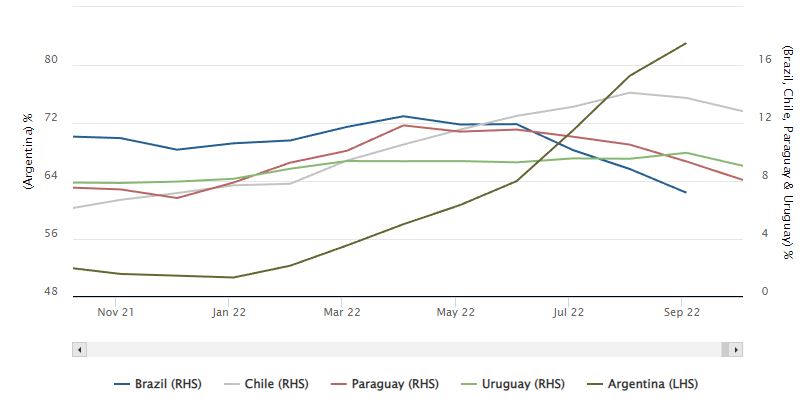
    Brazil & Southern Cone: inflation rate
    Percentage variation (year-on-year)

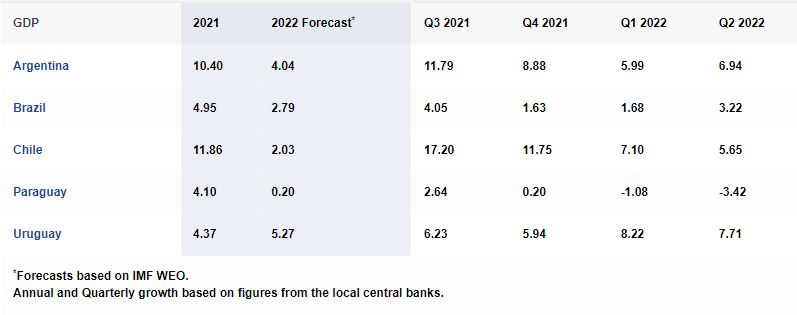
    Brazil & Southern Cone: GDP growth (%)
    Quarterly figures are year-on-year growth

  • ECONOMIC HIGHLIGHTS

    Patrick de Courcy 13 September 2023 Hits: 1673

    GUATEMALA | Joining the South Korea-Central America FTA. On 5 September, Guatemala’s government announced that the country had joined the free trade agreement (FTA) that South Korea signed with five other Central American countries (Costa Rica, El Salvador, Honduras, Nicaragua, and Panama) in 2018. According to a press release from Guatemala’s economy ministry, Economy Minister Luz Pérez met with South Korea’s minister of commerce, industry and energy, Dukgeun Ahn, to sign the agreement. Guatemala is already South Korea’s top trading partner in Central America. In 2022, Guatemalan exports to South Korea totalled US$163m, while South Korean imports to Guatemala totalled US$390m. Guatemala’s main exports to South Korea are ferronickel (accounting for 43% of the export total) and coffee (39%), whereas the main imports from Korea to Guatemala are freight vehicles (13%) and diesel (9%). Pérez stated “these figures are a clear testament to the trade opportunities before us”, with the FTA seeking to remove tariffs on approximately 95% of goods traded by both countries.

    DOMINICAN REPUBLIC | Central bank hails rise in remittances. On 14 August, the Dominican Republic’s central bank (BCRD) released new figures which show that remittances sent to the country in the first seven months of 2023 totalled US$5.9bn, up 4.2% on the same period in 2022. The BCRD says that this increase is in line with forecasts that remittances will exceed US$10bn by the end of 2023. The BCRD also released figures which showed that remittances totalled US$889.4m in July, up 5.1% on June 2023 and 10.0% compared with July 2022. In July, the US was the source country for 82.6% of remittances sent, while Spain accounted for 6.8%.

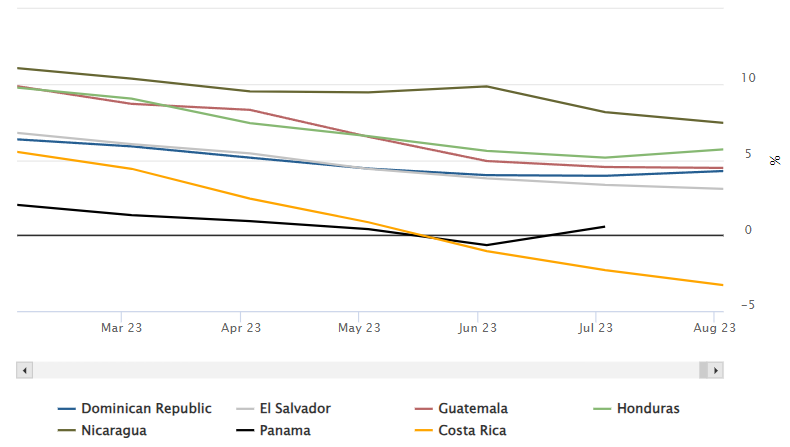
    Central America & Caribbean: inflation rate
    Percentage variation (year-on-year)

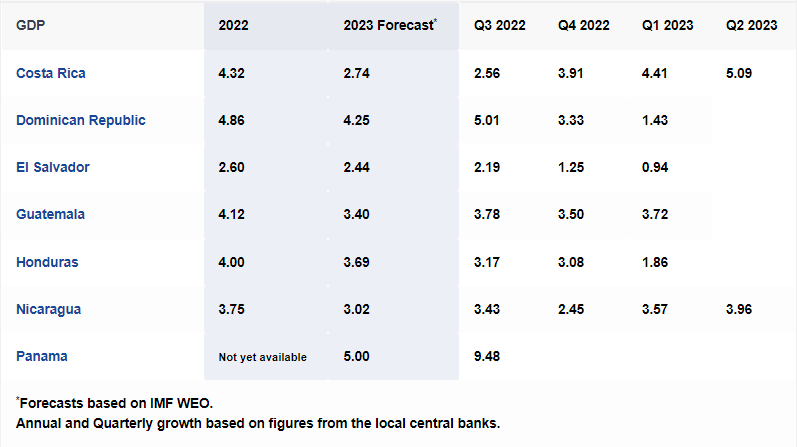
    Central America & Caribbean: GDP growth (%)
    Quarterly figures are year-on-year growth

  • BRAZIL: Lula tells cabinet 2026 elections have begun

    Abbi Dicker 23 January 2025 Hits: 4607

    Even though the next presidential election is not until October next year, President Luiz Inácio Lula da Silva urged his ministers during a cabinet meeting on 20 January to step up their performance and delivery on policy objectives, saying that “2026 has already begun”. The latest cabinet meeting also saw a rise in prominence of Lula’s new communications secretary, Sidônio Palmeira, who will take on more authority over the public relations of cabinet ministers, in what appears to be an effort to prepare the government for campaign mode.

    Palmeira was the publicist who coordinated the campaign for Lula’s election victory in 2022 and officially assumed the role as the new presidential communication secretary on 14 January. He attended his first cabinet meeting at the Granja do Torto presidential country residence on 20 January and told ministers they need to dominate the narrative, not give space to fake news, and look to the future, while also reminding the public of the failings of the previous administration of far-right former president Jair Bolsonaro (2019-2023). Given the meeting’s clear emphasis on public relations, Lula also demanded “more road and less palace”, urging ministers to hold more events around the country to provide more opportunities to meet voters face-to-face.

    Improved communications will only be part of the solution to raise the government’s popularity and Lula’s potential electoral chances if he decides to run for re-election next year. One of the key priorities Lula stressed during the cabinet meeting was to bring down food prices, in order to ease the cost-of-living concerns that could drive public frustration and result in another anti-incumbent electoral swing in 2026. On 22 January Lula’s chief of staff, Rui Costa, was cited in the press as saying that officials from the ministries of agriculture and agrarian development will hold meetings to formulate measures to address the issue but denied that the government would directly intervene to enforce price controls.

    The two federal ministries that oversee Brazil’s farming sector handle different policy areas and are also led by ministers from different parties. The agriculture ministry works with agribusiness giants and seeks to maximise the production and exports of these industry leaders, while the agrarian development ministry works with small, family-run, farms and is responsible for issues such as rural land reform. The minister in charge of the agriculture portfolio is Carlos Fávaro, who is affiliated with the Partido Social Democrático (PSD), a big tent party which has generally tacked to the centre-right, while agrarian development is in the hands of Paulo Teixeira, a member of Lula’s left-wing Partido dos Trabalhadores (PT).

    Both ministries will be crucial for reforming Brazil’s food systems amid rising climate risks, but it is uncertain whether policy solutions will result in political gains for the PT or the PSD – parties that are currently allies of convenience. The PSD endorsed Lula’s 2022 campaign against Bolsonaro, but the national party president of the PSD is Gilberto Kassab, who currently serves as the institutional relations secretary in the state government of São Paulo, which is led by Bolsonaro ally Tarcísio de Freitas.

    The São Paulo governor has not announced intentions to run for president next year, but De Freitas’ proximity to Kassab highlights the fragility of the PSD’s support of the PT. If De Freitas decides to launch a presidential bid, there is a risk that the PSD might abandon its alliance with the PT at the federal level and align with a larger coalition of conservative parties.

    Food price measures

    Edegar Pretto, president of the Companhia Nacional de Abastecimento (Conab), the logistics arm of the agrarian development ministry, said that the government was planning to create a food distribution network involving local retailers and other businesses in lower-income areas. In an interview with news outlet Brasil de Fato published on 22 January, Pretto compared the proposed policy idea with the Farmácia Popular programme, which was first implemented in 2004, and working with private pharmacies to provide cheaper or free medication for lower-income citizens. Pretto suggested that this proposed programme would mainly involve redistribution and logistical changes, rather than large government subsidies for local businesses, which might strain public coffers.

  • TRACKING TRENDS

    LatinNews 12 January 2012 Hits: 2066

    BRAZIL | Black gold. Brazil’s vast deepwater oil reserves are its biggest bet for the future. The state oil company Petrobras intends to invest over US$1.0trn to reach a targeted oil production level of 6.0m barrels/day by 2020. According to the national petroleum agency (ANP), Brazil’s total hydrocarbons output hit a record 2.615m b/d of oil equivalent in November 2011. Oil output on its own was 2.188m b/d. Venezuela’s oil output is put at about 2.9m b/d and it aims to produce 4.0m b/d by 2016.
    CHILE | Exports surge to record level. Chile’s exports closed at a record level in 2011 of US$ 80.59bn, up 13.5% on the previous year. Imports, however, climbed faster still to reach US$ 69.97bn, up 26.8% on the previous year, driven by domestic demand and investment. As a result Chile’s trade surplus fell from US$ 15.86bn in 2010 to US$ 10.62bn last year. The central bank is predicting that the trade surplus will shrink to just US$ 4.8bn in 2012 with export values down as copper prices fall on the poor global economic outlook. The trade surplus in December, for instance, was just US$ 393m as exports fell by 17.3% to US$ 6.31bn and imports grew by 14.3% to US$ 5.92bn.

    Inflation in 2011 stood at 4.4%, higher than predicted, although the finance minister, Felipe Larraín, maintained that it would slow significantly in the coming months. The central bank’s target for the next 24 months is between 2% and 4%. Larraín said the falling copper price owed to the fact that “the majority of European countries are in recession”.

    URUGUAY | Still slippery. Inflation reached 8.6% in 2011, Uruguay’s national statistics institute, Ine, reported. This exceeded the target of 6% set by the government and was up on 6.9% inflation in 2010. President José Mujica, who described inflation last year as “a slippery eel”, said the figure was “not disastrous” but bringing it down was a priority of his government. On the plus side, unemployment was just 5.5% in November, down from 5.7% a month earlier and close to the December 2010 mark of 5.4%, the lowest in decades. Fewer than 100,000 Uruguayans of working age, primarily women and young people, are unemployed.

  • URUGUAY: Mujica fights his corner over marijuana scheme

    LatinNews 24 January 2013 Hits: 2630

    Mujica fights his corner over marijuana scheme

    President José Mujica has come out in robust defence of his government’s proposal to legalise marijuana. Mujica recently called for the proposal, which was submitted to congress last August, to be held up because of a lack of public support. But, far from giving up, Mujica clearly hopes to sway the population to his way of thinking.

    President Mujica said the initiative was designed primarily to combat drug-trafficking, “the worst scourge of Latin America”. He said the emphasis of state policy needed to be switched away from repression and onto the treatment of addicts. He maintained that one in every three prisoners in Uruguay was in jail for “drug-related crimes”: there are 9,500 inmates in Uruguay, from a population of 3.3m.

    “(Narco-trafficking) is a market economy, which feeds itself, and which repression, for 50 years, has been unable to dismantle,” Mujica said in defence of his government’s proposal, under which the production, sale and distribution of marijuana would be legalised and controlled by the state. A national cannabis institute (Inca) would be created under the proposed legislation.

    Mujica tried to disabuse the public of any suggestion that his government was “trying to defend a benign drug”. He said: “the objective is to dominate and influence drug-addiction from the word go… as it is a dangerous illness”; rather than expending resources on a war against drugs which cannot be won and driving the trade underground, exposing addicts to criminal drug dealers, the state would be able to control the trade, he argued.

    Nonetheless, Mujica called for the bill before congress to be halted because he did not want the ruling Frente Amplio (FA) to use its narrow majority in the chamber of deputies and the senate to approve it. He said the government would set about persuading the public of the virtues of the proposal and gain “broad” support.

    A recent survey by the pollster Cifra revealed that 64% of Uruguayans are against the proposal, including 53% of self-declared FA voters and more than 80% of supporters of the opposition Partido Nacional (PN, Blancos) and Partido Colorado (PC, Colorados). The strongest opposition was expressed by the older generation, but even a small majority of young people, aged between 16 and 29, rejected the proposal (53%). Only 26% of respondents said they supported the initiative

    • Argentina

    The opposition also criticised the decision by Defence Minister Eleuterio Fernández Huidobro to attend a ceremony to mark the return of the ‘La Libertad’ frigate, organised in Mar del Plata by the Argentine government, on 9 January. The frigate had spent 78 days impounded in a Ghanaian port as a judge in the West African country had ordered its detention until Argentina fulfilled previous court rulings in favour of a group of bondholders that refused to accept the terms of Argentina’s 2002 debt write-down. Deputy Jaime Trobo (PN) said the return of the frigate had “nothing whatsoever to do with Uruguay”, but that the Mujica administration kept kowtowing to Argentina and getting nothing but “unfriendly stances” in return.

  • Border protection: Controversy over the wall

    LatinNews 05 September 2017 Hits: 158

    Donald Trump’s plan to build an extended border wall between the US and Mexico is perhaps the most controversial and deeply resented aspect of his policies on bilateral relations. The idea of a border wall figured prominently during the election campaign. It was frequently referred to as a device to keep out Mexican migrants, drugs, and criminality. A range of claims were made (notoriously, Trump made inconsistent statements about the proposed height of the wall), but few concrete details were forthcoming. It was not entirely clear whether what was being proposed was something symbolic and metaphorical – principally a device of electoral politics – or a real physical structure.

    Once in office, it became clear that the new president really did intend to build a structure, despite the high costs and complexities of the project. There are already fences or other barriers along segments of the border. In an initial stage the plan is to request up to US$600m of work on ‘little walls’ or small prototypes to be erected in parts of the roughly 1,200 miles of border where there currently are no physical barriers, before the eventual award of much larger contracts. Companies were requested to come up with proposals by a March 2017 deadline.

    According to tender documents issued by the Department of Homeland Security and the US Customs and Border Protection Agency the prototypes should be “physically imposing in height” – roughly between 18 and 30 feet tall. They should be able to withstand attack from “sledgehammer, car jack, pick axe, chisel, battery operated impact tools, battery operated cutting tools, Oxy/acetylene torch” for anywhere between one and four hours. The preferred building material is concrete, but other materials that would allow visibility between the two sides are allowed. On the north or US side the wall should be “aesthetically pleasing” with the colour and texture blending into the environment (no similar request is made for the southern side). There should be “wall fittings and fixtures…to shield from external attack”. Other features should discourage would-be immigrants from scaling the wall with grappling hooks. The design should make it impossible to tunnel under the wall at depths of up to six feet below the surface. Officials who wrote the spec may be anticipating protest actions during the construction phase. Potential contractors are asked to give details of their experience “executing high profile, high visibility and politically contentious projects”.

    By September 2017 there was still significant US domestic political uncertainty over the fate of the project. Trump was threatening not to approve a new spending bill if it did not contain money for the wall, saying he was prepared to shut down the government if that was what it took. The administration had requested US$1.5bn for the project in 2017 and a further US$2.6bn for 2018, but these amounts were subject to the wider budget negotiations with Congress. Both Democrats and some Republicans were resisting the project. The ultimate cost remains unknown, with estimates ranging from a low of US$8bn to a high of around US$25bn. The president continues to claim Mexico will eventually pay for the wall, in spite of Mexico’s clear rejection of the idea. Various mechanisms to raise the money at Mexico’s expense (such as border or remittance taxes) remain uncertain. There could be a range of legal challenges, not least because the federal government will need to invoke eminent domain to acquire privately held land from US citizens to allow the structure to be built.

    The Mexican authorities have called on locally based contractors to boycott the project. Foreign minister Luis Videgaray said “we’re not talking about economics here, but a profoundly unfriendly act between two nations”. Mexican cement giant Cemex – which is also active on the US side of the border – was heavily criticised after chief executive Rogelio Zambrano said he would be happy to provide an estimate. The company, which could bid for other infrastructure work in the US, later partially backtracked, saying it had not expressed a formal interest in bidding. French civil engineering company Vinci has said it will not bid, because it did not want to expose itself to a clash of cultures and values with its staff. The tender documents in any case outline a “Buy American” preference for local companies and suppliers.

    A new report by the US Government Accountability Office (GAO) was cited by critics of President Trump as evidence that his proposed border wall would do little to stop the flow of illicit drugs into the United States. The study, published at the beginning of May 2017, focuses on the use of three main ‘alternative’ drug smuggling techniques: underground tunnels, the use of ultra light aircraft, and maritime routes using open hulled ‘panga’ boats or recreational vessels. The use of all three of these techniques appears to be declining. For example, the number of cross-border tunnels discovered by the Department of Homeland Security fell from 18 in 2011 to nine in 2016. Ultra light aircraft incursions into the US fell from nearly 200 in 2011 to under 30 in 2016. Although the use of maritime vessels rose from 50 in 2011 to more than 80 in 2013, they had fallen back to about 30 in 2016. Overall, ‘alternative’ smuggling methods represented a tiny percentage of total seizures – around 0.3% in 2015. According to the report, the vast majority of illicit drug smuggling into the US continues to take place through official points of entry – for example by concealing drugs in passenger vehicles or hiding them amidst legitimate cargo on trucks and vans. All other factors remaining equal, a bigger or longer wall will therefore not have a significant impact on smuggling levels.

  • PARAGUAY: ANR-PC set for major showdown in primaries

    LatinNews 09 November 2017 Hits: 431

    Everything is now set for Paraguay’s ruling Asociación Nacional Republicana-Partido Colorado (ANR-PC) to hold its primary elections ahead of the April 2018 general election. The ANR-PC’s electoral tribunal (TEP) has approved the candidacies of the party members eligible to take part in the primaries, including that of Santiago Peña, the presidential pre-candidate backed by President Horacio Cartes and his supporters. But Peña will now have to convince the dissident ANR-PC party factions that do not support Cartes and that tried to stop his candidacy, that he represents the party’s best chance of retaining the presidency.

    The TEP announced last week that it had approved 8,254 candidacies for the 782 nominations up for grabs in the 17 December primaries and disqualified 560. Among the candidacies approved was that of Peña, the former finance minister (2015-June 2017), who has been identified by President Cartes as his preferred successor and is the presidential pre-candidate of the Cartista Honor Colorado faction of the ANR-PC. Peña’s candidacy was approved by the TEP despite the fact that a formal challenge against it was filed with the body by the Fuerza Trabajadora Teete anti-Cartista party faction.

    The challenge was based on the allegations that Peña does not meet the party criteria for being a candidate. The ANR-PC statutes stipulate that a party member must be affiliated for one year in order to be eligible to seek the party’s presidential nomination. Peña, who had previously been a member of the main opposition Partido Liberal Radical Auténtico (PLRA), formally joined the ANR-PC last year but there are questions over the exact timing of this. The Fuerza Trabajadora Teete complaint notes that while Peña’s affiliation to the ANR-PC was submitted in October 2016, it was not approved until November, meaning that he had not technically completed a year as a member of the ANR-PC before the mid-October deadline for presenting pre-candidacies ahead of the primaries.

    The complaint against Peña’s candidacy also argued that his affiliation to the ANR-PC may have been irregular. The ANR-PC statutes prohibit the affiliation of an individual who is an active member of another political party. And Fuerza Trabajadora Teete noted that there is no record of Peña formally quitting the PLRA. However, the complaint filed by the anti-Cartista faction was dismissed by the TEP, which said that it found no impediments to Peña’s registration as a candidate. Peña is thus set to face off in the primaries against his main anti-Cartista rival, Senator Mario Abdo Benítez of the Colorado Añetete faction, whose candidacy was also approved.

    Campaigning kicks off

    Following the approval of the candidacies for the primaries, the unofficial campaigning ahead of the contest has picked up a gear. Peña, who has been touring the country canvassing support since he stepped down from his ministerial post, has been holding almost weekly campaign rallies around the country in which he has been accompanied by prominent Cartistas. In one of these rallies held on 30 October in the city of Luque, Central department, Senator Oscar González Daher told attending employees of the national civil aeronautical directorate (Dinac) that any of them who do not vote for Peña and Honor Colorado candidates would be “left outside” of the institution.

    Anti-Cartista and opposition leaders criticised González Daher’s remarks as proselytising of public officials. Abdo Benítez, who has also been holding campaign rallies around the country, accused the Cartes government of persecuting anti-Cartista civil servants and of pressuring, intimidating, and even bribing others into supporting Cartista candidates. Noting that he has received 550 complaints about this, Abdo Benítez said that he would present a formal complaint but that “unfortunately Paraguay’s institutions are useless, today institutionality is suffocated by the ruling power”. Still Abdo Benítez insisted that “money and persecution will not defeat us”.

    • Cabinet changes

    As usual, the looming general election has prompted the resignation of cabinet members seeking to stand for election ahead of the 31 October deadline for them to do so. The agriculture & livestock minister, Juan Carlos Baruja, who will run for the governorship of Paraguarí department, resigned on 20 October, while prosecutor general, Roberto Moreno, who will seek a senate seat, followed suit on 30 October. President Horacio Cartes replaced Baruja with the deputy livestock minister, Marcos Alberto Medina, while Moreno was replaced by Francisco Barriocanal Arias. Cartes appointed Marcelo Andrés González Ferreira as the new deputy livestock minister on 2 November.

  • THE BAHAMAS: Central bank points to slow recovery

    Patrick de Courcy 12 August 2021 Hits: 2268

    At the beginning of August, John Rolle, the governor of The Bahamas’ central bank said that The Bahamas began a slow recovery in the first half of 2021. Rolle said: “The rebuilding in tourism has been most marked in respect of the second quarter of 2021, although on a year-to-date basis, the half-year outcome is still lower than in 2020.”

    The central bank is now projecting that the economy will grow by 2% in 2021, but Rolle pointed out that this is hardly world-shattering given that the comparison is with the dire year of 2020. He said: “The main determinant of how we do in regards to the GDP target is how much business the hotel sector is able to recover. Recall that for the hotel sector, anything that happens between now and the end of the year is compared to a period in 2020 when there was virtually no activity. So from that point of view 2% growth is not a high or an optimistic projection”.

    Rolle added that 2023 “is likely when we see a full restitution”. The issue is that there has been a 16% reduction in economic activity compared with 2019, and “the base of 2019 signals when you have recovered all of those drawbacks”.

    In the meantime, the government has revealed that it is to borrow US$892.4m from local markets and US$959.2m in foreign currency (the Bahamian dollar has a 1-to-1 peg with the US dollar). The details were published in the first Annual Borrowing Plan (ABP). The US$1.85bn in additional borrowing this fiscal year will be used to refinance maturing loans and securities and to cover the US$950m shortfall between revenue and expenditure in 2021/2022.

    On the publication of the ABP, Minister of State for Finance Kwasi Thompson said: “The publication of our medium-term debt management strategy every November and our annual borrowing plan every July will clearly articulate how we intend to eventually attain sustainability in our debt position”.

    Corruption vulnerabilities

    The latest US Investment Climate Report published by the US Department of State on 21 July argues that The Bahamas continues to face problems with corruption. Although anti-corruption laws are in place, the report says that there is only a “limited enforcement of conflicts of interest related to government contracts”.

    The report warns: “The political system is plagued by reports of corruption, including allegations of widespread patronage, the routine directing of contracts to political supporters, and favourable treatment of wealthy or politically connected individuals”.

    The Free National Movement (FNM) government, which came to power in 2017, ran on a strong anti-corruption platform, and early in its term a number of former public officials were charged with corruption crimes, including extortion, bribery, theft through their employment, and defrauding the government.

    However, says the investment climate report, “the government reported no new cases of corruption in the executive, legislative, and judicial branches during 2020” despite the fact that three cabinet ministers had been forced to resign in the first three years of the administration under allegations of corruption.

    The report argued that campaign finance needed better regulation, and that the procurement process “remains susceptible to corruption as it contains no requirement to engage in open public tenders”.

  • REGION: Some progress on food security

    Sarah Sheldon 14 November 2023 Hits: 345

    Caribbean countries have been called on to “accelerate and consolidate” their efforts to improve food security and reduce import dependence.

    The call came in the context of Caribbean Agriculture Week, held in the Bahamas in October, and hosted by the Costa Rica-based Inter-American Institute for Cooperation on Agriculture (IICA). IICA experts say that Caribbean countries should strengthen their domestic agricultural sectors, which are particularly vulnerable to extreme weather caused by climate change. There has already been some significant progress on this front. The region is now roughly halfway towards meeting its “25 by 25” goal, first set in 2018. This calls for a 25% reduction in food imports, to be achieved by 2025.

    The Bahamas’ Prime Minister Philip Davis said this represented an “enormous step forward”. He added that his government was making “unprecedented investments” in food security, improving research and infrastructure, and focusing on boosting output of local eggs and poultry. Caricom (Caribbean Community) secretary-general Carla Barnett also called for the empowerment of women and youth in agriculture. Guyana’s President Irfaan Ali said his government was investing in a food distribution hub to be located in Brazil’s northern state of Roraima.

    Making sustained progress will be challenging, however. Caricom research suggests 52% of the English-speaking Caribbean currently faces food-security issues. Rising temperatures remain a substantial threat. Didacus Jules, the director general of the Organisation of Eastern Caribbean States (OECS), has warned that “Global warming is creating hell on earth for small island states – a rapid onslaught apocalypse”. There were record temperatures in the region in May-August 2023, with the heat wave expected to extend into 2024, causing aridity and increased pests and diseases. In Barbados and Jamaica 88% of all crops depend on rainwater. Dry weather may again push up Caribbean food-price inflation rates.

    Inflation

    In April this year annual food-price inflation stood at 66.7% in Suriname, 17.0% in Trinidad & Tobago, 10.3% in Jamaica, and 6.9% in Guyana.

  • GUATEMALA: Arévalo confronted with fresh challenges

    Abbi Dicker 20 June 2024 Hits: 2281

    Severe flooding has claimed eight lives and affected thousands of people in Guatemala, as well as sweeping away part of the highway linking Guatemala City to the Pacific, complicating the transport of imports and exports. This comes at a challenging time for the government led by President Bernardo Arévalo as a long-running legal case over Puerto Quetzal, the country’s main Pacific port, has come to a head.

    In addition to the casualties, heavy rains have destroyed many buildings, leaving some 2,000 people homeless, and requiring some 6,000 people to be evacuated, according to the Coordinadora Nacional para la Reducción de Desastres de Guatemala (Conred). Part of the Palín-Esquintla highway, the principal highway connecting the capital to the south of the country and the Pacific port, Puerto Quetzal, was swept away. The highway will be out of action for at least three weeks, President Arévalo announced on 18 June, while repair work is completed.

    At this difficult juncture, Arévalo is having to deal with a legal case over Puerto Quetzal. The case dates back to 2017 and focuses on whether an operating concession covering 60% of container traffic currently held by APM Terminals, a Netherlands-based subsidiary of Danish shipping company Maersk, was improperly awarded. A court has ordered that the concession be revoked. The government will have to decide whether to renegotiate terms with APM or to stage a new licensing round.

    Labour rights leader murdered

    The Guatemalan labour rights activist Anastacio Tzib Caal was shot dead in Villa Canales, in Guatemala department, on 15 June. The labour ministry demanded an “exhaustive, transparent and fast” investigation to find the authors of the crime. Tzib Caal was secretary general of the Texpia II workers’ union at the maquiladora garment factory based in the capital city. The US Department of State spokesperson, Matthew Miller, condemned the murder, and expressed support for “all efforts by the Guatemalan authorities to investigate [it] as soon as possible…and hold the perpetrators accountable”.

  • ECUADOR: Approval of indefinite re-election imminent

    LatinNews 05 June 2014 Hits: 1055

    The constitutional bar on President Rafael Correa seeking re-election indefinitely will shortly be lifted. During his state-of-the-nation address on 24 May Correa said that after “profound reflection” he had decided to seek approval from the national assembly for legislation to abolish term limits for all elected officials. Five days later the leadership of the ruling Alianza País (AP), unsurprisingly, resolved to back the proposal. As the AP has a comprehensive majority in the national assembly its passage is assured.

    Correa told supporters gathered outside the national assembly on 24 May clamouring for his re-election (the next presidential elections are not due until 2017) that the only thing that mattered to him was preventing “the conservative restoration” in Ecuador, the threat of which he said had increased significantly after the AP’s setback in February’s municipal elections. Correa said that the Ecuadorean people knew he had always been opposed to re-election in principle but he had decided that voters “should be able to choose whether their leaders should be changed”. Crucially, he said that he believed in the stability of Ecuador’s institutions enough now to support the initiative, although they will arguably be weakened by indefinite re-election which erodes checks and balances.

    Subsequently, Doris Soliz, the executive secretary of the AP, called for a great “united national front for the continuity and deepening of the citizens’ revolution” with the AP’s political allies and social organisations. At present mayors are allowed to run for indefinite re-election as Jaime Nebot, of the opposition Partido Social Cristiano-Madera de Guerrero (PSC-MG), has successfully done in the coastal city of Guayaquil since 2000.

    Correa ruled out a referendum on the matter saying that “an election about another election [was] unviable”, although this is precisely what happened in Venezuela in February 2009 when then-president Hugo Chávez (1999-2013) pointedly used the referendum on indefinite re-election as a plebiscite on his popularity after a setback in a referendum on constitutional reform in 2007. Correa could have employed the same tactic after the setback for the AP in February’s municipal elections but chose not to even though his popularity ought to have assured him of victory, unlike the exploitation of oil in the Yasuní national reserve, where he also avoided a referendum (see sidebar).

    • Mahuad convicted for embezzlement

    Former president Jamil Mahuad (1998-2000) was sentenced to 12 years in prison for embezzlement on 29 May by Ecuador’s top court, the national court of justice (CNJ). There were absolutely no mitigating circumstances, the CNJ concluded, given the “enormous social alarm caused by the crime, whose consequences Ecuadorean society is still suffering from today”.

    Mahuad was accused of maladministration of state funds by declaring a ‘banking holiday’ (freezing bank accounts) in March 1999 which precipitated a financial meltdown, pushing 20 financial institutions into bankruptcy. The case against Mahuad has run for 13 years during which time the judicial system has undergone significant changes. He was provisionally absolved by what was then the country’s top court, the supreme court (TSJ), in June 2006 on the grounds that there was a lack of evidence against him.

    Interpol has issued a red alert for Mahuad, who responded to the ruling in a letter accusing the government of President Rafael Correa of “political persecution”. Correa dismissed the claim, maintaining that it was purely a judicial matter. His only concession to Mahuad was that he (Mahuad) might have allowed himself to be “manipulated by bad advisers and financial capital”.
    Mahuad said he had been “courageous enough to make unpopular decisions during the worst economic crisis in Ecuador in the 20th century”. He said he had been “compelled by the circumstances” to freeze banking deposits.

    • Yasuní referendum

    The verification process carried out by the national electoral council (CNE) of signatures calling for a referendum on drilling for oil in Yasuní presented by the advocacy group YASunidos was flawed, according to a group of professors from the Escuela Politécnica Nacional (EPN) and the Universidad Andina Simón Bolívar (UASB). The professors carried out a statistical analysis of the signatures presented by YASunidos, concluding that 673,862 of the total of 757,623 were valid, which would have been enough to trigger a referendum. They analysed a sample of 2,508 forms containing 20,064 signatures, using a computer programme to compare the names with identity numbers. They concluded that while some of the signatures were imperfect (‘failing to fulfil all of the formalities’) they were technically valid.

  • TRACKING TRENDS

    LatinNews 26 June 2014 Hits: 19651

    PERU | Tourism is a bright spot. On 19 June Peru’s foreign trade & tourism ministry (Mincetur) revealed that 1.04m foreign tourists visited the country in the first quarter of the year, 3.4% more than in the same period last year. The tourism sector’s positive performance should provide some encouragement to the Peruvian government at a time when the domestic economy is experiencing a marked slowdown, especially mining and construction sectors.

    A Mincetur statement, said that the increase in the number of visitors was primarily driven by a greater number of Bolivian tourists entering the country. According to Mincetur data 19,000 more Bolivian nationals entered Peru in the first quarter of 2014 compared to the same period last year, a 65.2% year-on-year increase. However, the data also shows that there were year-on-year increases in the number of visitors coming from Spain (13%), Ecuador (7.2%), the US (6.4%) and Colombia (4.6%). Yet the figures still show that the majority of foreign tourists entering Peru came from Chile (29.5%) followed by the US (14.8%) and Ecuador (6.7%). The tourism minister, Magali Silva, said she expected that the inflow of tourists would increase further in the second half of the year due to the various promotion campaigns launched by Mincetur. According to Silva, this year the campaigns have been focused on countries such as Germany, France, Brazil, Argentina, Mexico and Colombia.

    COLOMBIA | Strong first quarter growth. Colombia’s domestic economy grew by 6.4% during the first quarter of 2014 compared to the same period in 2013, the highest recorded growth rate for the period since 2007, the national statistics agency (Dane) reported on 19 June. The first quarter results were much higher than predicted both by local economists and the central bank, which had predicted the figure to come in at around 4.3%.

    According to the Dane report, while all areas of economic activity exhibited growth during the first quarter, the overall increase was mainly driven by the dynamism of the construction sector (17.2%), partly thanks to the ambitious infrastructure investment plan that is being implemented by the government [WR-14-21]. Other sectors experiencing significant growth included social and personal services (6.3%); agriculture and livestock (6.1%); financial services and real estate activities (6.0%); mining (5.6%), and retail, restaurants and hotels (5.6%). The report also highlighted that civil engineering (24.8%), public administration services (8.3%), coffee production (14.9%), and oil and coal extraction (0.5% and 33.3% respectively) are the leading activities in each sector.

    The Dane report also showed that even activity in the manufacturing sector increased by a respectable 3.3%; a similar result had not been achieved since the last quarter of 2011. The finance minister, Mauricio Cárdenas, highlighted the solid growth in the agricultural and construction sectors, which he said are the two “pillars” of the economy, and the recovery in the manufacturing sector after a six-month-long decline. Cárdenas also said that Colombia’s first quarter growth figures make the country the second fastest-growing of the world’s largest economies behind China, which posted a growth rate of 7.4% during the period.

    ECUADOR | Celebrating return to international debt market. On 24 June Ecuador’s finance minister, Fausto Herrera, announced in a press conference that Ecuador had successfully concluded the sale of US$2bn of 10-year sovereign debt bonds with a 7.95% coupon, the first time that Ecuador has issued debt in international financial markets since its ‘selective’ default on sovereign debt in 2008. Herrera said that the funds raised by the bond sale will mostly be used to finance public spending and to service debt. Herrera also explained that the operation was performed to achieve three fundamental objectives: the diversification of funding sources, the financing of the yearly investment programme and the reduction of the country’s risk rating, which in turn will allow the private sector to obtain better access to capital.

    Ecuador’s long-term strategy, according to Herrera, is to diversify its funding sources enough to build the hydroelectric, petrochemical and steel plants needed to renew its energy and productive infrastructure. In support of this strategy, Ecuador’s central bank (BCE) has conducted a US$580m gold swap deal with Goldman Sachs, which could bring between US$16m and US$20m in profits to the country. In a separate operation, Goldman Sachs loaned US$400m to Ecuador, with an interest rate of 4.3%.

    Patricio Rivera, the economic policy minister, remarked during the press conference that the success of the recent financial operations is a sign of the “confidence” that international financial operators have in the country.

    • CAN halts resolution against Ecuador

    On 24 June the Andean Community (CAN) temporarily suspended a resolution issued against Ecuador after the country introduced import regulations deemed to be a “restriction to trade” by the CAN [WR-14-24]. Francisco Rivadeneira, Ecuador’s foreign trade minister, said that the CAN had accepted his request to suspend the resolution requiring Ecuador to lift ‘resolution 116’, which requires certain products to obtain “certificates of recognition” to be imported into Ecuador. Rivadeneira pointed out that Ecuador will keep regulating imports and will now have the opportunity to file a formal appeal with the CAN for the review of its trade policy. The enforcement of ‘resolution 116’ spurred Peru to moot restricting the import of Ecuadorean products; according to Rivadeneira, talks are now being advanced to resolve this issue.

  • ECONOMIC HIGHLIGHTS

    LatinNews 16 March 2021 Hits: 1669

    BOLIVIA | New solar power plant begins operations. In February Bolivia’s President Luis Arce announced the start of operations at the Ancotanga solar power plant in Oruro department, the largest such plant in Bolivia with a capacity of 100 megawatts, reportedly equivalent to 7% of Bolivia’s electricity demand. At almost 4,000m above sea level this is said to be the highest solar power plant in the world and contains more than 300,000 solar panels spread over 214 hectares. The plant will be run by state-owned electricity company Empresa Nacional de Electricidad de Bolivia (Ende) and was funded by US$54.7m in investment from Bolivia’s central bank (BCB), France’s development agency (AFD), and the European Union (EU). At its inauguration, Arce discussed the “double challenge” facing the country of “generating economic development” while also “protecting and respecting the environment”. He highlighted the completion of this project as an important step towards “the production of clean energy” in Bolivia, emphasising the country’s current dependence on thermoelectric plants that use natural gas to generate electricity.

    COLOMBIA | Ecopetrol profits slump. In February Colombia’s state-owned oil firm, Ecopetrol, reported Col$1.7trn (US$473m) in net profits in 2020, 87.3% less than in 2019. The sharp fall in profits has been attributed to the lower global economic activity registered last year as result of the coronavirus (Covid-19) pandemic. Ecopetrol CEO, Felipe Bayón said that Ecopetrol plans to invest US$12bn-US$15bn between this year and 2023 to increase its production levels, particularly natural gas production.

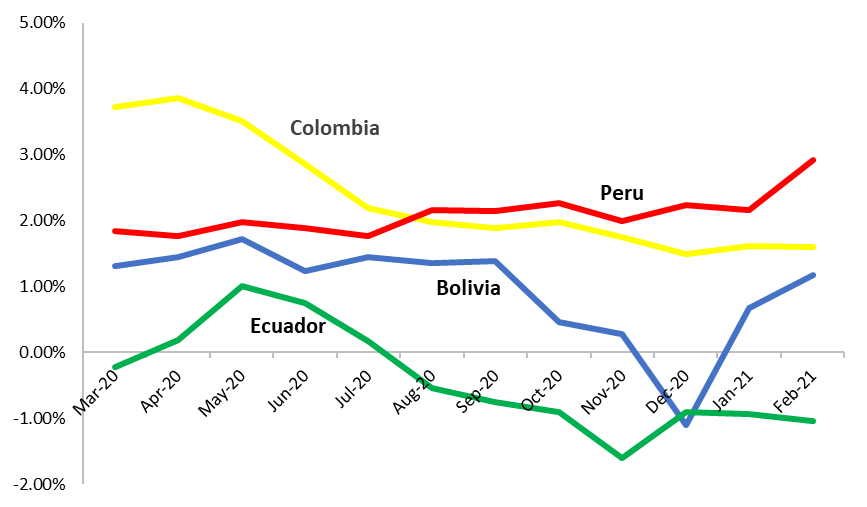
    Andean Countries: Inflation
    Monthly year-on-year figures

    Andean Countries: GDP growth (%)
    Quarterly figures are year-on-year growth
    GDP  2020 forecast* 2021 forecast* Q1 2020 Q2 2020 Q3 2020
    Bolivia -8.0 5.1 0.6 -21.7 Not yet available
    Colombia -7.0 5.0 1.2 -15.8 -9
    Ecuador -9.0 1.0 -2.4 -12.4 -8.8
    Peru -12.9 9.0 -3.4 -30.2 -9.4
    Venezuela -30.0 -7.0 No data No data No data
    *Figures from the United Nations Economic Commission for Latin America & Caribbean Dec 2020
    Quarterly growth based on figures from the local central banks


  • Who is ready for the transition?

    LatinNews 11 June 2021 Hits: 1785

    Over the last decade significant progress has been made to develop renewable energy at a global level. As recently as 2011, with crude oil prices at around US$100 a barrel, solar and wind energy were still uncompetitive compared to fossil-fuel electricity generation. Wind and solar generating capacity was relatively small. But in 2011-2019 global solar capacity grew seven-fold while wind capacity tripled. There were major technological changes in the design and operation of wind turbines and solar panels. Both energy sources are now materially more price-competitive than fossil-fuel electricity, even in a context where the oil price has come down to US$40 a barrel. The levelised cost of energy (LCOE – which accounts for fluctuations and intermittency) fell by 81% to US$0.07kWh for solar and by 38.3% to US$0.053/kWh for onshore wind in 2010-2019. This means that on a level playing field, renewables can now compete without the need for subsidised feed-in-tariffs. Global investment in the energy transition has surged from under US$300bn per annum in 2011 to over US$500bn in 2020. Eight out of ten of the world’s largest economies have committed to achieving net-zero emissions by the middle of the century. Cumulative electric vehicle (EV) sales surged from 0.5m in 2010 to around 10m in 2020.

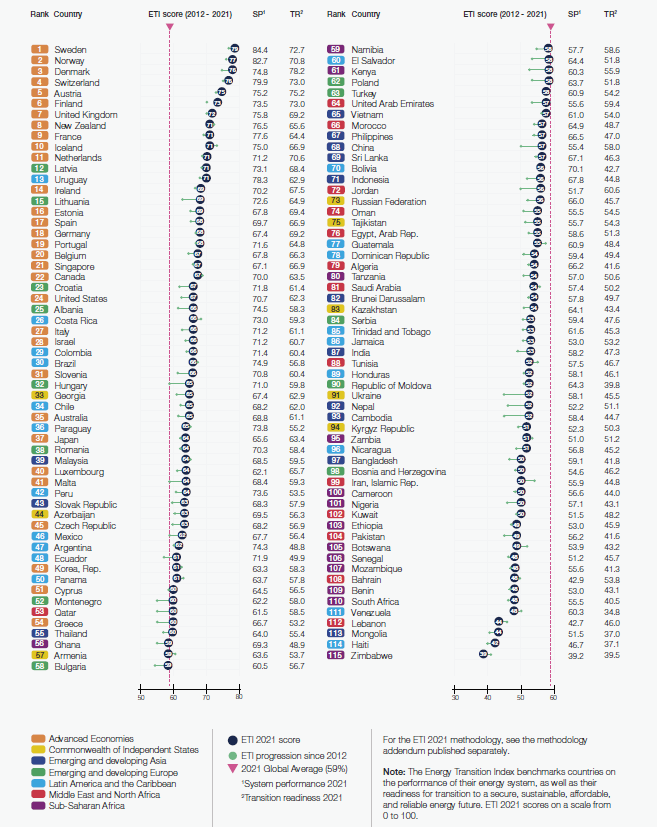
    Over the last decade the World Economic Forum (WEF) has developed an Energy Transition Index (ETI) which seeks to measure countries’ readiness to move to renewable energy. The ETI is composed of two equally weighted sub-indices. One assesses energy system performance across what it calls the “energy triangle” - the ability, first, to support economic development, secondly to provide access to secure and reliable energy supply, and thirdly to achieve environmental sustainability across the energy value chain. The other sub-index assesses the enabling environment, which includes factors like political commitment, regulatory structures, incentives for investment and innovation, consumer awareness, and new technology adoption. Countries are scored on a total of 39 indicators on a scale of 0 to 100.

    In the 2021 report the WEF notes that more than 70% of tracked countries have made progress on energy access and security, but only 13 out of 115 countries have managed to achieve consistent improvements over the past ten years, thereby underlining the need for greater resilience. “With the energy transition moving beyond the low hanging fruit, sustained incremental progress will be more challenging due to the evolving landscape of risks to the energy transition”, says Roberto Bocca, Head of Energy and Materials for the WEF. There had been little measurable progress in the economic development and growth dimension of the “energy triangle”. This was attributed to fiscal difficulties, labour market dislocations, and affordability challenges. Yet, during the Covid-19 pandemic renewables have shown significant resilience. Despite an initial pandemic-related fall, global emissions have since rebounded, highlighting the need to accelerate progress in the shift away from fossil fuels.

    Globally, the top ETI scoring countries are Sweden, Norway, and Denmark. The top-scoring LAC country is Uruguay, placed 13th world-wide, followed by Costa Rica (26th), Colombia (29th), and Brazil (30th). Other strong LAC performers include Chile (34th), Paraguay (36th), Peru (42nd), and Mexico (46th). The least energy transition-ready include Honduras (ranked 89th worldwide), Nicaragua (96th), Venezuela (111th), and Haiti (114th). The LAC region scores well for environmental sustainability, partly because of its significant hydroelectric generating capacity. But relative to the rest of the world an obstacle to the energy transition is that electricity prices (measured on a purchasing power parity basis) remain high. The WEF also notes that although LAC has achieved near-universal access to electricity, the quality of supply in many countries remains poor. The report calls for further diversification of the LAC energy mix to improve energy security. ­­­­

    ETI 2021 results table

    Source: World Economic Forum

  • REGION: Despite risks, Caribbean tourism is bouncing back

    Sarah Sheldon 16 August 2022 Hits: 693

    The Caribbean summer Carnival season, with events running across June, July, and August, is now underway after an enforced two-year break caused by the coronavirus (Covid-19) pandemic in 2020 and 2021. The return of festivities comes amid positive signs for the crucial tourism sector.

    Already this year Trinidad and Tobago was able to hold its carnival on the traditional dates in February, with other countries delaying until the summer. In Barbados, that meant later street parades for the Crop Over festival. Jamaica's carnival, usually held in spring, was delayed to July this year, and has just concluded. In Grenada, Spicemas 2022 is due to be held in early August. In Bahamas this year’s festivities, including the Junkanoo parade, were held in April. Vincy Mas has meanwhile returned to St Vincent and the Grenadines.

    The return of carnival has been closely watched by those trying to assess the strength of the recovery in tourism, one of the Caribbean's main industries, a prime source of foreign currency, and a generator of employment. “Carnival...is the largest economic impact event in Jamaica. It’s number 1 in terms of what we have for the economy” says Kamal Bankay of the Jamaica Carnival National Stakeholders’ Committee. The Barbados Association of Masqueraders says Carnival there attracts US$150m a year in spending, and that there is no other event “that pulls in that kind of money in such a short space of time”. In Grenada Kelvin Jacob, head of the Spicemas Corporation, says: “Carnival is very important to our tourism. It is one of the biggest sellers and brings the largest set of people onto the island.” 

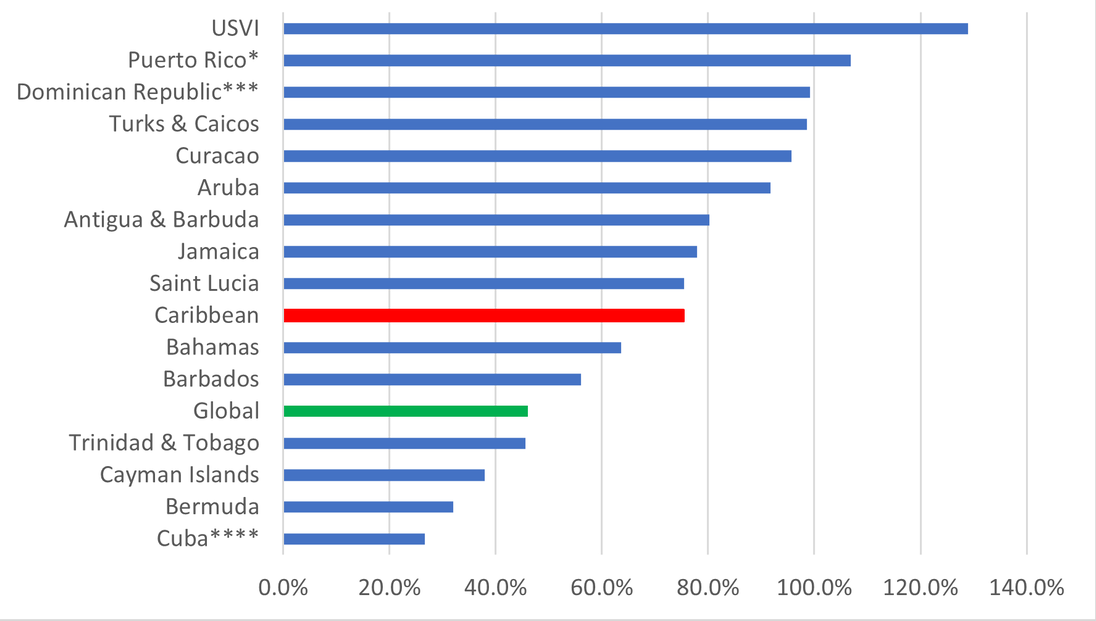
    The wider tourism picture is indeed beginning to look more positive this year. Speaking in late June, Nicola Madden-Greig, president of the Caribbean Hotel and Tourism Association (CHTA), said: “We are very excited to see that Caribbean tourism is recovering much faster than had been anticipated originally, and we are seeing that we are the second fastest recovering globally.” She added that the region was still behind its pre-pandemic 2019 peak by 36.1% but that in terms of its contribution to GDP for 2021 the sector was up by 36.6% over 2020 and had recovered some 311,000 jobs.

    Madden-Greig was using data from the UK-based World Travel and Tourism Council (WTTC). This showed that, at a global level, tourism’s contribution to GDP nearly halved from 10.3% in 2019 to only 5.3% in 2020, but it rose again to 6.1% last year. For the Caribbean region, that V-shaped pattern of recession and recovery was more pronounced, with the comparable figures being 13.9% in 2019, 7.1% in 2020, and 9.1% in 2021. Last year Caribbean tourism GDP was US$39.3bn, and the sector employed 2.35m people (still beneath the pre-pandemic total of 2.75m). Visitor spending, at US$18.2bn last year, is still taking time to recover from the pre-pandemic total of US$36.4bn. Most tourists still come from the US (61% of the total last year), followed by France (4%), Canada (3%), and the UK (2%).

    More recent statistics suggest that the Caribbean recovery is gaining pace. Madden-Greig said arrivals in January and February this year were weak because of continuing worries over the Omicron Covid variant, but that the March-June period in contrast saw “really strong demand”.

    According to a June 2022 report by Spain-based travel data and analytics company Forward Keys, international tourist arrivals on the books in the Americas, Q3 2022 vs 2019, showed that in the Americas different sub-regions are recovering at different rates. Leading the way are the countries bathed by the Caribbean Sea: Mexico, Central America, and the Caribbean (+5%). Top-performing destinations in the sub-region include Costa Rica (+24%), the Dominican Republic (+13%), and Jamaica (+17%), which have surpassed their performance in summer 2019 and 2021. Quickly catching up are destinations such as Panama (- 29%), Barbados (-18%), and Guatemala (-12%). While these have not achieved their 2019 levels, they have significantly improved on their 2021 performance. Meanwhile, arrivals in the Turks and Caicos (+47%), El Salvador (+24%), and Belize (+23%) have levelled out.

    For the region, simply “revving up” the tourism sector is not sufficient. Governments have to face some big short-and-long term challenges. One key issue is that the sequence of external shocks that have hit the industry is not necessarily over. Covid-19 is still present, and vaccination rates in many Caribbean islands are low. In Jamaica and St Vincent half of the population remains unvaccinated, meaning a damaging new spike in contagion cannot be ruled out (and indeed, might even spread as a result of Carnival-themed mass public events). The region also must battle with climate change and the damage inflicted by hurricane seasons. A sobering report on The Bahamas by the Inter-American Development Bank (IDB) says a combination of Dorian, the Category Five storm that hit the island in August/September 2019, causing US$3.5bn worth of losses, and the later outbreak of Covid 19 (another US$9.15bn in losses) was devastating. The report states the Bahamian economy will only return to pre-pandemic levels by 2024.

    YTD 2022 as % of YTD 2019

    Note: this refers to total tourism arrivals per country. Those registering over 100% (only two) are back up to pre-pandemic levels.

    Source: Tourism Analytics

    For the Caribbean region as a whole the pandemic shock was rapidly followed by further global disruption caused by the war in Ukraine, with associated increases in international energy prices and negative impacts on the domestic cost of living. The World Bank has predicted a slowdown in global economic growth, although it still expects Caribbean GDP to rise 6.9% this year and by 6.5% in 2023 largely because of the tourism revival.

    That said, there are measures governments can take to try and sustain and strengthen the current recovery. One is to improve airlift. While the major destinations are reasonably well-served by commercial airlines, the pandemic-related collapse of regional airline LIAT has left a gap in air services. Edmund Bartlett, Jamaica's tourism minister (who also chairs the Organisation of American States Inter-American Committee on Tourism - OAS-CITUR) has called for policies to allow regional carriers to develop. He has also suggested a move to a jointly managed airspace and a common Caribbean visa regime.

    Demands from tourism executives

    Tourism executives have called for increased training, upgrades in infrastructure, better support and financing for job creation by small and medium-sized enterprises (SMEs) in the tourism sector, more effective marketing, and investment in the growing use of IT and digital business processes. Jamaica’s tourism minister, Edmund Bartlett, has also sought to build links with Middle East: in July he participated in the first “Caribbean Saudi Arabia Summit” held in the Dominican Republic, where he spoke of developing new markets in Asia, Africa, and the Middle East.      

    Cuba

    Cuba reported 682,297 arrivals in the first half of this year, over five times the comparable period last year. Still, the country is one of the four slowest to recover. The Cuban government says it is aiming to host over a million visitors in July-October and is trying to upgrade its stock of available hotel beds. For 2022 as a whole it wants to attract 2.5m tourists. That is still very significantly below the pre-pandemic total of 4.27m visitors.

  • TRACKING TRENDS

    Patrick de Courcy 23 March 2023 Hits: 4146

    HONDURAS | Tax reform. The Honduran-American Chamber of Commerce (AmCham) issued a statement on 17 March echoing the concerns of the private sector and the main opposition Partido Nacional (PN) over the government’s planned tax reforms [WR-23-06]. It said the plans were “confusing, ambiguous, and discriminatory”, and decried the failure to take any steps to reduce the informal economy or remove or lower taxes introduced by previous governments.

    The government says it is focused on abolishing longstanding tax breaks, lifting banking secrecy laws, and ending the practice of writing off unpaid corporate tax debts. It is also proposing to introduce the concept of universal income – the principle that Honduran citizens should be taxed on their entire income, whether originating in Honduras or from overseas. Jorge Yllescas, a former tax official, has warned that assessing universal income effectively will require tax officials to have much greater information and expertise than at present.

    The right-wing PN has claimed that the changes mean that the government wants tax remittances, the money sent home by expatriate Honduran workers, mainly from the US. Remittances are critically important for many low-income Honduran families. However, the tax agency Servicio Administrativo de Rentas (SAR) has said that the claim is “totally false” and there will be no new remittances tax. 

    The government position has not been helped by a public disagreement between senior officials. Pedro Barquero, the minister for economic development, has defended tax breaks and opposed the reforms saying they will “asphyxiate the economy”. Marlon Ochoa, the head of SAR, rejected Barquero’s comment and accused him of betraying the government.