All Categories

Subcategories

  • ARGENTINA: New justice minister seeks to appoint 200 judges

    Abbi Dicker 12 March 2026 Hits: 1678

    Days after his appointment last week as Argentina’s new justice minister, Juan Bautista Mahiques has announced plans to appoint 200 new judges. Mahiques replaces Mariano Cúneo Libarona who served for two years. No specific public reason was given for the change, but it is known that the incumbent had wanted to step down for some time, and his departure was on friendly terms with President Javier Milei, who thanked him for “over two years of tireless work”.

    The new man in the ministry is a former attorney general for the city of Buenos Aires and close associate of former president Mauricio Macri (2015-2019). He is also linked to a former president of Boca Juniors football team. On taking over the justice minister slot, Mahiques pledged to seek a “judicial system with clear and stable rules, which can rebuild public confidence and deliver real security and a predictable framework for those who obey the law”. As the Buenos Aires attorney general, Mahiques himself came under investigation in late 2022 for suspected “breach of duty as a public official and acceptance of gifts”.

    • Lago Escondido case

    The case in which Juan Bautista Mahiques came under investigation related to his acceptance of an invitation to the Lago Escondido mansion of Joe Lewis, a British tycoon [WR-22-49], in the Patagonian province of Río Negro, along with other officials including his father, Carlos Mahiques, a judge on the Cámara de Casación; federal judge Julián Ercolini, who indicted former president Cristina Fernández (2007-2015) for fraud and illicit association; and the then-justice and security minister of the government of the city of Buenos Aires, Marcelo D’Alessandro. The case was closed in December 2023 by a judge who ruled that the visit had been an entirely private matter.

    The new minister lost no time in announcing appointments of new staff across the justice system. A total of 200 judges, 72 defence lawyers, and 65 public prosecutors will be recruited to fill existing vacancies. Candidates will be vetted to keep out any with a criminal record or with tax irregularities. The Council of Magistrates will then submit short lists for the president to select, with his choices subject to two-thirds majority endorsement in the senate. Mahiques says the main aim of the new appointments is to speed up the notoriously slow workings of the justice system.

    Mahiques is also prioritising the government’s legal defence in a New York-based court case relating to state oil and gas company YPF and filed by investors Burford Capital (UK) and Eton Park Capital (US). The case is about alleged irregularities in the treatment of minority shareholders in the 2012 nationalisation of the company. In 2023 the court found Argentina liable, with damages later set at a near record US$16bn, a decision Argentina is appealing.

    On Mahiques’ advice, President Milei has appointed Sebastián Amerio as the new treasury prosecutor (Procuración del Tesoro de la Nación – PTN) who will be a key figure presenting Argentina’s case. Under his guidance Argentina is seeking a postponement of the discovery process.

    Labour reform signed into law

    On 6 March President Milei signed the new labour reforms into law, after the approval of various drafts by the two chambers of congress. The last vote was in the senate, where the bill was approved in a 42-28 vote with two abstentions [WR-26-09].

    The reforms seek to give employers greater flexibility to hire and fire, while reducing trade union powers. They replace the more than 50-year-old Labour Contracts Law of 1974. The government says they are vital to increase labour productivity and reduce informality (around 40% of the workforce is informal).

    In the first two months of the year strikes and demonstrations were called to oppose the changes. However, the Confederación General del Trabajo (CGT) -the country’s main labour group - appears to have paused the protests temporarily, as it concentrates instead on a legal challenge.

    CGT lawyers say the reform violates Article 14 of the constitution, which protects workers from arbitrary dismissal and guarantees minimum terms of employment. The unions also claim that the reforms may violate international agreements with the International Labour Organisation (ILO) to which Argentina is a party.

  • Risk pointers

    LatinNews 06 September 2011 Hits: 372

    *** Russia again warns Nato about Libyan action. Dmitriy Rogozin, Russia’s permanent representative to Nato, has once again warned against Nato’s intervention in Libya. Speaking on 2 May, he warned: “I think what the Western coalition is doing in Libya [is] launching strikes that go well beyond the mandate they was given by the UN Security Council – I think that this will create much more evil for them than Bin Laden represented.”

    The previous week, on 25 April, Russia’s Foreign Minister Sergey Lavrov had warned that by supporting the rebels Nato was encouraging further rebellions elsewhere. He said: “Unfortunately it is probably contagious and is developing in other countries in the region in the hope that, if the situation escalates, the international community will come to help. It is in fact an invitation to a whole series of civil wars.”

    On 29 April, Prime Minister Vladimir Putin added his strong condemnation, saying that he was “dumfounded” by how easily decisions to use force were being taken. He said that there was an imbalance between the human-rights justifications being given for action and the consequences of the action taken. He said: “Everything must be done to remove this imbalance.”

    *** More Russian fears. Adding to Russia’s concerns about Nato actions in Libya (see above), the general secretary of the Russian-dominated Collective Security Treaty Organization (CSTO) has warned that future conflicts might not always remain purely local or regional. Speaking at a round-table conference in Moscow on 27 April, Nikolay Bordyuzha said: “As regards the challenges and threats to CSTO member states, it is very difficult to presume that future conflicts will be only regional and local given the existing alignment of forces.” Bordyuzha pointed to Nato’s expansion, tensions in the Caucasus, and instability caused by extremism and terrorism in Central Asia.

    These comments reflect fears that are frequently being heard from Russian policymakers and commentators. In March, for instance, General Makhmud Gareyev, president of the Military Sciences Academy, warned that Russia’s geopolitical position is as bad as it has ever been in its history. He noted that US military forces “are present in any strategic direction – west, south, east, and north”.

    A few weeks later, in early April, President Medvedev revealed his own similar anxieties, saying in an address to senior army officers: “We cannot leave our country without the sufficient development of the armed forces and law-enforcement bodies. We shall simply be torn to pieces.”

    *** Georgian obstacle to Russia’s WTO accession. Grigol Vashadze, the foreign miniser of Georgia, which is in dispute with Russia over the breakaway regions of Abkhazia and South Ossetia, said on 28 April that Russia will not be able to join the World Trade Organization without Georgian consent.

  • DEBT: Bond issuance falls to lowest level since 1998

    LatinNews 15 December 2011 Hits: 341

    Internationally 2011 has been one of the worst years for international bankers since 1998. They arranged new international loans (credit and bonds) worth only US$142bn in the third quarter, which was the second lowest figure for 13 years. Only the final quarter of 2005 was worse.

    According to the Bank for International Settlements (BIS) gross borrowing (ie including debt issued on domestic markets) was down 16% at US$1.66 trillion.

    The seizing up of the international credit markets for better-rated credits in the European Union and the US has meant that the share of borrowing from emerging market borrowers has risen. The BIS reported that the share of the total debt (bonds and bank loans) issued by emerging market debtors  has risen now for the past nine consecutive quarters and now accounts for 4.7% of all outstanding bonds (US$145bn). The main emerging market borrowers are from China and Latin America. 

    Loans to Latin America recorded by the BIS increased by 6% (or US$33bn) in the third quarter. Over half of the borrowing was down to Brazil. Loans to Mexico rose by US$6.7bn but lending to Chile rose by only 4% (or US$2bn).

    Lima: The government of the capital of Peru is planning to make its debut on the international bond markets with an US$500m issue denominated in Nuevo Soles. The money will be used to help finance US$1.8bn worth of projects commissioned by the leftwing mayor, Susana Villarán. The two big projects are work to enhance the coast and a new highway connecting commercial districts to residential ones.

    Lima is hoping to sell bonds with a maturity of between 10 and 20 years. It is being advised by four international banks: JP Morgan Chase, UBS AG, Deutsche Bank AG and Morgan Stanley.

    Argentina: The government plans to increase the amount of dollar bonds issued in the domestic market by US$800m in 2012, but the big question is whether the government will attempt to return to the international capital markets. In the past two years, the government has used money from the central bank to meet foreign debt payments, but as reserves are now down to US$46bn, a raid of US$6bn or so to meet maturing debt could restrict the government’s room for manoeuvre. Before the government can issue internationally it will probably have to buy off holders of about US$4.5bn in bonds who refused to accept the government’s two previous swaps. Arguably, these investors have been bulls of Argentina (betting that eventually the government would have the resources to buy them off). 

  • Risk pointers

    LatinNews 01 February 2012 Hits: 167

    *** Russia and Turkey: an uneasy relationship.  Turkey’s Foreign Minister Ahmet Davutoglu has been in Moscow, and speaking to journalists on his return he was upbeat about the relationship, saying: “Ten years ago, for the Turkish and Russian foreign ministers to take up the entire geography from the Balkans to the Black Sea and from the Middle East to Central Asia would have been inconceivable.” He talked to Russia’s Foreign Minister Sergey Lavrov about collaboration throughout all these regions, and in discussions about Russia’s promotion of a Eurasian Union, Davutoglu told Lavrov: “Our perspective is that on one side there is the European Union, and on the other side the Chinese economy.  In the middle there is cooperation between Russia and Turkey.”

    But this is not at all how Russia sees things.  The idea that Turkey should muscle in on Russia’s Eurasian Union will not have been at all pleasing to Russian ears.  Increasingly, Moscow sees Turkey as a challenge, and this is one (admittedly amongst many) of the reasons it is determined to continue its support for President Bashar al-Assad of Syria.  Russia is not in favour Syria falling to the Turkish-backed Muslim Brotherhood ascendancy that is sweeping the Middle East, because of the dangers that poses for increased Islamist militancy in the Caucasus.  The Kremlin is also, of course, keen to stop the domino effect of the Arab Spring at a time when its influence is beginning to affect Russia itself.

    *** Russia says no deal with Japan.  Russia’s presidential envoy to the Far East Federal District, Viktor Ishayev, has rejected any idea of a vote on whether the disputed Kuril Islands should return to Japanese sovereignty.  On 31 January, he said: “No one is going to put the question of sovereignty over the Kurils to a vote.  The Kurils are Russian lands.”  He also rejected the idea that solving the Kurile dispute with Japan would lead to much greater Japanese investment in the Russian Far East.  He said: “When Japanese businesses want to work in the Russian Far East, to take part in oil, gas, coal projects, they forget about the territorial dispute around the Kuril Islands.”

    *** Japan protests to China over gas field.  Japan believes China has been drilling for natural gas in a disputed field in the East China Sea, known as Kashi in Japanese and Tianwaitian in Chinese.  The field is just to the west of what Japan says is the median line between the two countries’ exclusive economic zones.  They had agreed not to develop the field unilaterally. 

    Japan’s chief cabinet secretary Osamu Fujimura said on 1 February that the move violates their agreement to jointly develop gas resources in the disputed area.  China appears to have carried on developing Kashi despite the stalling of talks on joint development in 2010.

  • RASTREANDO TENDENCIAS

    LatinNews 03 July 2012 Hits: 637

    VENEZUELA | Signos positivos en cifras del desempleo. El 20 de junio, el instituto nacional de estadísticas (INE) de Venezuela informó que la tasa de desempleo entre la población económicamente activa descendió de 8,6% a 7,9% entre abril y mayo. El presidente del INE, Elías Eljuri, señaló que mientras las estadísticas significan que unos 1,2m de venezolanos están sin trabajo, las cifras reflejan la “sostenida recuperación de la economía nacional”. De acuerdo con los datos del INE, la progresión de la tasa de desempleo en Venezuela desde comienzos del año ha sido: 10,3% en enero; 9,2% en febrero; y 8,6% en marzo. Eljuri también destacó el hecho de que el porcentaje de la población económicamente activa que ahora está desempeñando un empleo formal llega al 59,1%.

    Quizá muy consciente del hecho de que la campaña electoral en Venezuela está por comenzar oficialmente, Eljuri comentó que en mayo de 1999, pocos meses después de llegar al poder el Presidente Hugo Chávez, el “empleo formal estaba alrededor de 46,3%, por tanto se ha incrementado en 12,8 puntos porcentuales” desde entonces. Además, Eljuri también dijo que el empleo informal en mayo de 1999 estaba aproximadamente en 53,7% mientras que ahora está en 40,9% de la población económicamente activa. De acuerdo con Eljuri, esto significa que unas 3,7m de personas “se han unido a la fuerza laboral”.

    Mientras que mirado bajo esta luz el récord de la administración Chávez en la creación de empleo y la reducción del empleo informal parece positivo, la realidad es que algunos de sus vecinos han tenido un desempeño mucho mejor durante el mismo periodo. De hecho, el promedio regional de la tasa de desempleo el año pasado fue de 6,8% y la tasa de Venezuela aún permanece por encima de ese promedio.

    PERU | Reactivación del sector rural. De acuerdo con un reciente estudio conducido por el Instituto Perú, y presentado el 27 de junio, en los últimos cinco años las áreas rurales de Perú han visto tasas de crecimiento económico de más de 5%, bastante por encima de la tasa promedio de sólo 1,5% que habían registrado en el pasado. El director del Instituto Perú, el economista Richard Webb, explicó que después de conducir entrevistas cara a cara con moradores locales en las 215 provincias más pobres del país, halló que hubo o un importante salto en el salario rural promedio de PEN8,00 (US$2,95) en el 2001, a PEN21,00 (US$7,76) en el 2011.

    Webb explicó que este incremento en los salarios podría explicarse por el incremento en el gasto público en infraestructura de parte de los gobiernos regional y municipal que permitieron mejor enlaces de transporte con áreas rurales, lo que ha vuelto más rentable la actividad agrícola. El informe apunta que en la última década, se construyeron 50.000kms de caminos rurales, a grandes rasgos, lo mismo que se ha construyó en los 50 años anteriores al 2001.

    “Si antes a un morador rural le llevaba 13 horas llegar hasta la ciudad más cercana, hoy eso le toma sólo cinco horas,” explicó Webb. Esto ha permitido a los productores agrícolas volverse más productivos hasta el punto que ahora tres de cada cuatro peruanos ya no están involucrados en la producción agrícola. Significativamente, el estudio ha encontrado que dada esta situación, el valor de la producción agrícola se ha incrementado un 121,1% en la última década y eso es lo que ha conducido al crecimiento en las áreas rurales. El ministro de agricultura, Luis Ginocchio, quien estuvo presente en la presentación del informe, dijo que el objetivo del gobierno era contribuir con este proceso proveyendo más préstamos a pequeños productores.

    ECUADOR | Cortejando a un nuevo socio asiático. El 23 de junio, el Presidente Rafael Correa se reunió con su contraparte de Indonesia, Susilo Bambang Yudhoyono, en Quito, donde firmaron un número de acuerdos de cooperación dirigidos a fortalecer los lazos comerciales entre ambos países. Después de la reunión, Correa dijo que el mercado indonesio de 250m de personas ofrecen a Ecuador la oportunidad de diversificar sus mercados exportadores. Él señaló que el comercio bilateral está en US$40m, y se ha incrementado un 40% entre el 2010 y el 2011 (la vasta mayoría del comercio, US$36m, corresponde a exportaciones desde Indonesia al Ecuador).

    Además, Correa indicó que Indonesia tiene la capacidad de invertir en “sectores estratégicos”. Correa dijo que había propuesto al gobierno de Indonesia inviertir en proyectos como el de la planta hidroeléctrica Coca Codo Sinclair, en la refinería petrolera Esmeraldas y otros proyectos mineros. Previamente, Ecuador había buscado y obtenido fondos para todos estos proyectos de parte de China. El Presidente Bambang Yudhoyono no expresó ningún interés concreto en invertir en ninguno de esos proyectos, pero dijo que Indonesia estaba entusiasmada en contribuir con la iniciativa medioambiental Yasuní-ITT de Ecuador.

    • Conga

    El 21 de junio, el Presidente de Perú, Ollanta Humala, dijo que la firma minera de EU, Newmont, responsable del controversial proyecto minero Conga de oro y cobre con una inversión de US$4.8mm, había aceptado la nueva serie de condiciones impuestas por su gobierno sobre el proyecto. “Hicimos un número de propuestas a Newmont acerca del proyecto y nosotros damos la bienvenida que ellos finalmente acordaron a nuestras propuestas,” dijo Humala. Los comentarios de Humala llegaron un día después de que Roque Benavides, el presidente de la minera Buenaventura, socia local de Newmont, reveló que la compañía de EU ha acordado hacer un “esfuerzo adicional para proveer más agua” a las áreas vecinas de la región de Cajamarca, donde la mina estará localizada. De acuerdo con Benavides, la compañía ahora “primero construirá todas las lagunas artificiales, los embalses que permitirán mucha más agua en las cuencas, y después construirá la mina misma”.

  • ECONOMIC OVERVIEW: COSTA RICA

    LatinNews 13 February 2013 Hits: 1108

    On 21 January the Chinchilla government unveiled a bill to grant the central bank the power to increase the current 8% tax on foreign investments by a further 30 percentage points. The plan, designed to keep the colón in check since a spike in its value at the end of 2012, could see taxes on the income received by non-residents increase to 38%. Investment funds, currently taxed at 5%, could face a levy of up to 35%. The colón, which had gained the most of all Latin American currencies since the start of 2013, fell on the announcement. The legislation is designed to be temporary.

    Inflation: According to Costa Rica’s national statistics institute (INEC), inflation for the month of January 2013 was 1.13%, up 0.17% on the same month the previous year. Inter-annual inflation was 5.75%, the highest in the last four years. The inflation rate for 2012 was 4.55%.


  • The problem of informality

    LatinNews 22 December 2017 Hits: 299

    The issue of informal employment is probably more acute and problematic in Latin America than anywhere else. The ‘informal’ are defined as those who work outside the official tax and benefits system. Typically, they have no written contracts of employment, do not benefit from protected hours and conditions of work, and receive limited or non-existent social benefits. Being informal means that the employee is in a fragile position: he or she has little protection against sliding back into poverty.

    Data from the IDB shows that informality is highest among the nearly 30% of the Latin American population classified as poor, and although lower, informality remains very pronounced by international standards, among the vulnerable population (38% of the total) and among the middle class (another 30% of the population). Among the poor, informality averages 70%, meaning seven out of ten workers make no contribution to public social security systems. For ‘middle sector workers’ (those between the third and eighth decile of per capita income) informality is roughly 50%, meaning that only five out of ten contribute to the social insurance system. What this means is that being middle class in Latin America is less secure than being middle class in other regions of the world. The chances of slipping back or ‘submerging’ are greater, and there is less of a protective social security net if things go wrong.

    Informal work in Latin America is typically seen as prevalent among the very poor, including occupations such as street selling, domestic service, subsistence farming, and working on construction sites or other manual roles. This is an important part of the current reality, but there is also widespread informality among what could be seen as more middle class or quasi-middle class roles, ranging from taxi drivers through to electricians and plumbers. Quite affluent, professional people may also find themselves in informal sectors, including architects and accountants.

    Broadly speaking, Latin America can be broken down into three groups according to levels of labour informality. The highest level of informality is present in countries like Bolivia, El Salvador, and Guatemala where more than 80% of households do not have any member contributing to social security schemes. A second group has informality rates raging between 60% and 70% and includes countries like Peru, Colombia and Mexico. The lowest levels of informality can be found in countries like Uruguay, Costa Rica, and Brazil, and range between 40% and 50%.

    Informality

    The case for reducing informality is strong, but progress in doing so has been very slow. The countries in Latin America that have lower rates of informality also tend to have more stable and established middle classes. Greater formality is beneficial in many connected ways. If a greater proportion of the working population pays taxes, government’s fiscal position and ability to invest and provide social services will improve. Crucially, greater formality almost always implies there is potential to increase productivity. It is the larger, more formal companies that are able to capture economies of scale. They are also more likely to offer on-the-job training. Research has shown that many of those working informally do so in very small, low-capital enterprises, with very low levels of productivity.

    The transition to formality remains difficult, however. Part of this difficulty relates to the high costs of formality and associated red tape: the sudden transition to paying high sales and payroll taxes can make many small businesses simply not viable. There is also a very important cultural factor. Many of those in informal roles simply do not trust governments, or find themselves working in such a day-to-day struggle to survive that they cannot see the longer-term benefits of paying into health or unemployment insurance schemes. Some in any case earn a living on the border of legality (such as street sellers or unregistered miners). For some, the quality of the public schemes they are being offered is so poor that the decision to remain ‘outside the system’ is understandable. Out of necessity and because of shifting opportunities, many Latin American workers move backwards and forwards between formal and informal employment. The amount transitioning from one status to the other can be as much as 15%-20% of the total labour force. Yet official social programmes often fail to adapt accordingly. For example, the Peruvian state pension scheme only pays benefits to those with 20 years or more of regular, documented an uninterrupted contributions made in formal employment.

    Santiago Levy, writing for the Brookings Institution, points out some of the perverse effects of the rule about contributions in countries with high formal-informal transits. “Consider this: Peruvian workers, if employed formally, are forced to save 13% of their salary in an account they cannot pledge as collateral for any other loan, nor use in the case of an emergency; and, when they reach 65 years of age, are more likely than not to have their savings returned to them in one lump-sum payment (with interest net of commissions). From this point of view, it is not surprising that workers will perceive that a part of their contribution, rather than being a future benefit for them, is really a tax associated with their formal status.”

    While those working informally or in self employment may be seen as entrepreneurs who can potentially create successful new companies, the reality is that only the very few make this transition. According to a study by the Development Bank of Latin America (CAF), 28% of Latin America’s work force is self-employed, compared with just over 6% in the US.[1] But 90% of Latin America’s small businesses are very small with fewer than four employees. Pablo Sanguinetti of CAF has commented that many of the self employed “are there, not because they are able to run a dynamic business, but basically because they have no other employment opportunities”. Given poor initial skills, low productivity and zero or limited access to training, most of these companies are unable to improve their capacity and skills base, and are poorly placed to manage a transition to the formal, wage-paying sector. This is described as an “informality/low productivity trap”. Of the total number of small businesses in the region CAF estimates that only one in four have the capacity to break out and achieve dynamic growth.


    [1] Emprendimientos en América Latina: desde la subsistencia hacia la transformación productive.

  • URUGUAY: Opposition slams sweeping reform bill

    LatinNews 07 May 2020 Hits: 4412

    A political truce between Uruguay’s government and opposition is over. The cause? A far-reaching reform bill, including economic, education, and public security issues, sent to congress by President Luis Alberto Lacalle Pou for urgent consideration. The left-wing opposition coalition Frente Amplio (FA) maintains that there is no precedent for a so-called ley de urgente consideración (LUC) containing so many articles. The FA argues that giving legislators just 90 days to debate it would be unacceptable at the best of times but is irresponsible in the midst of the coronavirus (Covid-19) pandemic, when it cannot be deemed a priority.

    “We have delivered!” President Lacalle Pou said on social media upon sending the LUC to congress at the tail end of April. He argued that it was a campaign promise that should not be postponed because of the pandemic. The LUC contains 502 articles covering a vast array of issues.

    On the public security front, the LUC seeks to toughen the penal code to combat rising crime and drug-trafficking, including longer prison sentences, especially for minors; confer more powers on the police; and create a register of rapists. It would downsize the state, imposing restrictions on public spending, and austerity in public administration costs; shake up both the public education and pension systems; and reshape labour relations, for instance, restricting certain rights to protest, much to the indignation of the umbrella trade union movement Plenario Intersindical de Trabajadores–Convención Nacional de Trabajadores (PIT-CNT), not least because, during the lockdown, it has limited options to voice its opposition.

    The FA protested that the Lacalle Pou administration is misusing the LUC, which requires congress to debate, amend, and approve the articles therein within the space of just 90 days (45 days for the senate; 30 for the lower chamber of congress; and 15 to resolve any differences between the two bodies). If congress fails to achieve this, the LUC will take effect in its original form.

    The FA contends that many of the measures contained within the LUC are not urgent so, by definition, should not be included within it, and are even less of a priority during a public health emergency. It also questions the wisdom of compelling congress to meet for intensive extended sessions at such a time: the average age of senators is 60 meaning many of them fall within the most vulnerable demographic to the coronavirus (Covid-19).

    FA senator Lucía Topolansky said the LUC set “a very dangerous precedent” by requiring legislators to approve so much within so little time. Topolansky argued that it would encourage the next party coming into government with a majority to “send a LUC with 3,000 articles…which would spell the end for congress”. Incensed that in one fell swoop the LUC would annul 60 laws approved during 15 years of FA administrations, various sectors of the FA are pushing for a signature-gathering campaign to stage a public referendum to revoke the LUC once it is approved.

    Lacalle Pou dismissed the criticism. Speaking in a press conference on 30 April, he said the LUC was “good” and “just” and that he had been elected to make these changes. He also maintained that nearly half of the articles pertained to the principal public concerns in Uruguay: education and public security. Lacalle Pou’s comments did not mollify senior FA politicians who criticised him for making undue use of a press conference meant to inform Uruguayans about Covid-19.

    No firm consensus

    While it may be of little comfort to the FA, President Lacalle Pou might not get everything he wants. His ruling coalition has a congressional majority but its five disparate constituent parties did not reach an internal accord on the LUC before it was sent to congress. While there is broad agreement between them, the Partido Colorado (PC) alone has already proposed 50 amendments to the LUC.

  • In Brief - Argentina

    LatinNews 06 March 2012 Hits: 1355

    Argentina | TBA investigation includes officials. On 5 March Judge Claudio Bonadío, who is overseeing an investigation into the fatal 22 February rail crash in Buenos Aires, forbade several functionaries and members of the operating company, Trenes de Buenos Aires (TBA), from travelling outside the county. Included on the list is the federal transport secretary, Juan Pablo Schiavi, the rail transport secretary, Antonio Luna, and the caretaker national commissioner for transport regulation, Eduardo Sícaro. Claudio Cirigliano, one of the owners of TBA, is also on the list. Separately, Gregorio Dalbón, the attorney representing those wounded and maimed in the crash, appealed a 2 March decision by Bonadío to approve the state’s request to be included as a plaintiff in the case. Dalbón accused Bonadío of a “flagrant violation of the penal code” and requested that he be dismissed from the case. The federal chamber of appeals will rule on the matter.

  • ECONOMIC OVERVIEW: NICARAGUA

    LatinNews 31 October 2012 Hits: 2639

    Government boasts energy achievements. At a recent energy forum, Energy Minister Emilio Rappaccioli drew attention to what remains a priority for the government of President Daniel Ortega: transforming Nicaragua’s energy matrix. According to Rappaccioli, just 40% of Nicaragua’s energy is currently generated by renewable sources, a figure Ortega hopes to increase to 80% by 2017. This means Nicaragua is set to go from being the most oil-dependent nation in Central America to challenging the green credentials of Costa Rica, which currently produces more than 90% of energy from renewable sources.

    Back in April the Ortega government announced that at least five key projects are due to begin operating this year/early next year, which are expected to contribute some 142MW to the country’s total installed capacity of 1108.29MW. These are: the second phase of the geothermal plant San Jacinto Tizate, expected to contribute 36 MW by end 2012; the wind projects Blue Power (39.6MW) and Eolo (37.5MW), slated to begin operating by the end of this year; and hydroelectric projects Larreynaga (17.2MW) and Hidropantasma (12MW), due to begin operations in August and March 2013, respectively.

    These efforts to boost green energy have already attracted plaudits. A report by the Inter-American Development Bank (IDB) on green energy production in Latin America & the Caribbean, released earlier in the year, ranked Nicaragua second only to Brazil out of 26 countries. The IDB study, ‘Climate Scope 2012 Preview’, which measured factors such as enabling framework, clean energy investments and low carbon financing, low-carbon business and clean energy value chains, highlighted that cumulative clean energy investment in Nicaragua between 2006 and 2011 reached US$1.1bn, while last year alone around US$211m went to the country’s wind and geothermal sectors. Rappaccioli also hailed the government’s achievements in electrifying the country, pointing out that since 2007, the year Ortega took office, electricity coverage has increased from 52% to 72% of the country, with plans to further increase this to 85% or 90% by 2017.

  • POLITICS: Energy scare shakes complacent Dilma

    LatinNews 24 January 2013 Hits: 2296

    Rain in late January has allayed immediate fears that the depleted reservoirs of Brazil’s hydroelectric plants would not generate enough power to satisfy the country’s energy needs. Though the rains may have come just in time this year, the alarm caused by the severe drought in the north-east made President Dilma Rousseff’s earlier dismissal in December of the possibility of any energy shortage look seriously complacent.

    Dams in the north-east ended December at just 32% of capacity, and dipped briefly below 30% in early January, according to the Operador Nacional do Sistema Eléctrico (ONS). That put them below the 34% the operator considers sufficient to guarantee electricity supplies. Nationally, Brazil generates around 80% of its electricity from hydroelectric power, according to the government’s own figures.

    The government, however, dismissed any concerns about energy supply. In late December, Rousseff described talk of rationing as “ridiculous”; a statement that was slightly undermined by an emergency meeting with senior energy officials in early January. In response to the threat of shortages, Petrobras started importing record amounts of Liquified Natural Gas (LNG) to power its thermoelectric plants. Gas prices rocketed, undermining the president’s ambitions to reduce electricity prices by 20% this year, and contributing to fears over inflation.

    More gas, less green

    Fears of energy shortages trigger inevitable reminders in the Brazilian press about the 2001 energy crisis, when factories and homes had to cut back on consumption amid widespread blackouts. Energy use jumped 40% under former president Lula da Silva’s eight years of government (2003-2010). President Rousseff served as the energy minister in Lula’s first government and was responsible for bringing on stream a network of thermoelectric plants.

    Although intended as an emergency supply, thermoelectric production has increased dramatically in recent years, climbing from 6% of total electricity in 2001 to 15% in 2011. Though Brazil is committed to reducing the amount of power it produces through gas to 12%, this looks unlikely. During January’s crisis, Brazil’s power regulator, Aneel, approved the start up of three thermoelectric plants, two of which were new.

    World Cup fears

    Once the panic over this year’s energy supply waned, Brazilians were quick to ask whether shortages could affect next year’s World Cup football tournament. On 22 January, the director general of Aneel, Nelson Hubner, said there was no way any of the cities hosting World Cup games would be affected. He was responding to questions about a report published by Aneel in December which suggested that 96% of projects to improve electricity generation in Porto Alegre (a host city) were behind schedule. The report also said that the cities of Manaus, Brasília, Rio de Janeiro and Belo Horizonte all merited “special attention”.

    Hubner said that there had been a huge improvement in those projects singled out and stressed that the document’s own conclusion stated: “most of these delays offer no imminent risk to energy supplies for the 2014 World Cup”.

    • Energy consumption

    Brazil’s energy consumption, a useful barometer for the health of the economy, rose 4.2% annually in 2012, according to the latest report by the Operador Nacional do Sistema Eléctrico (ONS). The trend was led by the north east and the main consuming areas of the south-east/centre-west, where it rose 7.4%; in the south it rose 5.1%. The ONS noted that Brazil’s new middle class consumers are buying more appliances like air conditioning and fridges/freezers, encouraged by rising wages, lower interest rates and official tax incentives designed to boost consumption. Although the industrial sector is in a slump, installed capacity use was 84.1% in December, above the historic average of the past five years (83.6%), according to the Getulio Vargas Foundation.

  • POINTERS

    LatinNews 01 April 2014 Hits: 4140

    NORTHERN TRIANGLE | US security agenda ‘stagnant’. In a working paper published by the Inter-American Dialogue*, journalist and former Salvadorean diplomat Héctor Silva says, ‘By 2014, the common security agenda between Washington and the Northern Tier is stagnant to say the least.’ He exemplifies this by noting that while cocaine flows through Central America’s Northern Triangle (he calls it Northern Tier) have increased and the subregion has sprouted a budding methamphetamine industry, drug seizures ‘have remained steady’ [see page 4 for up-to-date figures].

    Silva says that in Washington two explanations are offered for this: (1) ‘the lack of progress [...] is related to the decrease of consumption in the United States partially compensated by a small increase in drug use in Europe and Mexico’, and (2) [it] ‘rests on the inef­fectiveness of the local partner, as in El Salvador where the latest US State Department report on drugs points to local authorities to explain the historic low level of seizures.’

    Silva picks up the widespread view that ‘Washington has failed to address consistently and strategically the risk of brewing instability, caused mainly by lack of security and fueled by low economic growth.’

    He disagrees: ‘Events and facts support the view that lack of attention to the Northern Tier by Washington was indeed a failure and not simply neglect. Under the noses of Washington officials, chronic corruption permeated the Honduran mili­tary and law enforcement bodies. Since 2005, alerts had been sounding about Guatemala’s risk of becoming a failed state and the direct participation of at least two Salvadoran elected officials in conspiracies to introduce between 36 and 45 tons of cocaine into the United States from 2004 to 2008.’

    He attributes this failure at least partly to the willingness of Washington policy-makers— or at least US law enforcement agencies on the ground— to overlook corruption and weaknesses in local police or military partners in order to protect friendly assets or to preserve well-funded programs that have proven effective but are, again, limited by narrow focus: these are programs, not policy.’

    *The United States and Central America’s Northern Tier: The Ongoing Disconnect. Available from: www.thedialogue.org

    EL SALVADOR | Gang truce ‘technically over’. Rigoberto Pleités, director of the national police (PNC), said on 3 March, ‘We consider that the pact between the gangs technically no longer exists, given the increase in homicides in the past few months.’ In the first two months of this year the PNC reported 484 cases of homicide countrywide, or 29% more than those recorded in the same period of 2013. Pleités attributed 70% of this year’s homicides to the street gangs.

    GUATEMALA | Murder rate down. The Grupo de Apoyo Mutuo (GAM), an NGO which monitors public security issues, reports that there were 906 cases of homicide in the first two months of the year, down from 1,018 in the same period of 2013 (-11%).

  • Brazil: Vale and BHP accused over Samarco disaster

    LatinNews 16 December 2015 Hits: 15

    Brazil suffered a major environmental disaster on 5 November when the Fundao tailings dam collapsed at the Samarco Mineração iron ore mine, releasing about 60m cubic metres of water and slurry that destroyed the local town of Bento Rodrigues and pushed its way down the Rio Doce river towards the Atlantic coast some 500km downstream. At least 15 people died, with some still listed as missing.

    The dam break covered the Rio Doce flood plain in mud for 80kms and polluted the river. Drinking water supplies for around 250,000 people had to be cut off. Large quantities of fish died in the river. Government officials have been describing what happened as Brazil’s worst environmental disaster, and in a first response they suspended the company’s mining licence. The accident happened just before COP21, the global climate change summit conference in Paris in December. Speaking at the summit Brazil’s President Dilma Rousseff said the disaster had been caused by “the irresponsible actions of one company” and that there would be “severe punishment”.

    Samarco is a 50-50 joint venture between Brazil’s Vale – the country’s largest mining company – and Australia-based global mining group BHP Billiton. The disaster triggered a steep fall in both companies’ shares. In the month after the incident, Vale ADRs slumped 32.5% on the NYSE, while BHP securities fell by over 25% on the Australian exchange. Both companies face a range of legal actions and investigations. Environmental agency Ibama fined Samarco an initial BRL250m (US$90.3m). Environment minister Izabella Teixera said that federal and state governments would sue Samarco for a total of BRL20bn (US$5.3bn). A class action lawsuit on behalf of investors has been filed by lawyers in the US against Vale, accusing it of making false statements and failing to disclose “material adverse facts” about the Samarco project. A Brazilian tax lawyer has also filed a BRL10bn (US$3.6bn) class action suit in Minas Gerais state against Samarco.

    Both BHP and Vale have said they are creating a US$200m fund to help clean up the Rio Doce and its tributaries. In December, US credit ratings agency Moody’s Investor Services said it had downgraded Samarco Mineração from Ba1 to Caa1 reflecting “continued uncertainties” about its ability to resume operations, and the impact of fines, penalties, and claims from the accident. Standard & Poor’s had also downgraded the company in November, from BB+ to BB- citing cash-flow difficulties and uncertainty over when it might resume operations. Vale’s chief financial officer Luciano Siani Pires has said “the best way to settle all the claims would be to have Samarco back into operations”. A research paper by Citigroup said BHP might have to cut its dividends to shareholders to meet the cost of claims.

    One of the issues in what looks like being a prolonged legal fight concerns whether the mud was – or became – toxic, how and when that happened, and the precise responsibilities involved. Based on riverbed analysis, the United Nations has claimed that the mud contained high levels of toxic metals including arsenic and cadmium. BHP argues that the water and mud was not toxic when it left the dam. It has argued that the material that washed down the river course "will behave in the environment like normal soils" and is chemically stable. Léo Helier, UN special rapporteur on the human right to safe drinking water and sanitation, has called on the government to monitor raw and treated water quality in the area. According to him, “there is growing discontent due to the poor management of this water crisis, which has already generated some violent incidents and could lead to further unrest”.

    Samarco Mineração is also under pressure over its lack of adequate emergency plans to deal with further accidents, with a local judge threatening to fine the company BRL1m (US$262,000 a day) until it produces them. There is concern over the nearby Germano and Santarém tailings dams, which were partly damaged when Fundão collapsed. According to some sources, as the reservoirs behind the dams built up, the company built up higher dikes on top of tailings – a method that is low-cost but also more prone to failure. The disaster has triggered a wider debate about the handling of mine tailings – waste materials held in slurry form behind dams. According to the United Nations there are around 3,500 such impoundments in different mines around the world. Given growing concerns over safety risks, some argue in favour of an alternative, although more expensive, method of residue storage know as “dry-stacking” where a filtering process is used to extract water from the slurry, creating dry waste material which can be controlled more easily.

    The disaster is also having a series of political repercussions. There have been calls for a much tighter mining code, particularly since the revelation that mining companies made campaign contributions to many of the federal deputies who were involved in drafting the current code. According to newspaper O Estado de S Paulo, 28 out of 36 federal deputies who sat on three separate Congressional committees to discuss mining legislation received campaign contributions from the mining companies.

  • Venezuela: The cost of corruption – a big unknown

    LatinNews 08 February 2017 Hits: 4891

    Of the many countries in Latin America plagued by corruption, Brazil clearly has stood out in the past 18 months. Transparency International and others believe that the situation in Venezuela, however, is also very serious; albeit in the absence of data it is almost impossible to know the true extent of the problem.

    Despite the US Department of Justice estimating that Brazil’s Odebrecht paid US$98 in bribes in Venezuela (the highest amount in any single country outside of Brazil), the Venezuelan authorities have been mute on the matter. Following Odebrecht’s record plea bargain deal in the US in December, Venezuela’s opposition-controlled national assembly called for official investigations, but received no response from either the government or the attorney general. The local chapter of Transparency International, Transparencia Venezuela, separately called on the government led by President Nicolás Maduro and its ministries to account for all public-sector contracts signed with Brazilian companies in the past 12 years. Again, no response from the executive or ministries. It has since lodged a request with the supreme court, which is unlikely to be sympathetic.

    According to reports compiled by deputies from the opposition coalition, Mesa de la Unidad Democrática (MUD), starting from 2000 Brazilian companies including Odebrecht, Camargo Corrêa, Andrade Gutierrez and Queiroz Galvão secured 42 projects worth over US$50m in Venezuela. Odebrecht alone won 32 of those 42 projects, worth an estimated US$41m. The MUD-controlled national assembly’s audit commission is investigating potential irregularities estimated at US$16.6m relating to six of the Odebrecht contracts, including the Caracas metro expansion. Suspected irregularities include overcharging, commissions, bribes, embezzlement and a lack of due planning for works.

    In a statement coinciding the release of the 2016 CPI, Mercedes de Freitas, the executive director of Transparencia Venezuela, stated: “Impunity and corruption form a perverse relationship that is growing. In Venezuela, an increasing number of laws create opacity. The comptroller general increasingly fails to sanction breaches of transparency norms. It is inexplicable that the chief prosecutor [Luisa Ortega Díaz] doesn’t say anything about cases of such importance like Odebrecht, whose own directors have admitted before a court that they paid US$98m in bribes in Venezuela. This all indicates the little interest that there is in the fight against corruption.”

    Finally, on 26 January, Ortega Díaz revealed in a radio interview that Venezuelan authorities had requested an arrest warrant for an individual suspected of taking bribes from Odebrecht. The prosecutor added that the warrant would be passed also to Interpol, “in case the individual is outside of Venezuela”. She added that her office had asked Swiss banking authorities to provide a list of Venezuelans who have received deposits from Odebrecht and was also planning to send an investigator to Brazil. In comparison to the response to the Odebrecht scandal by other regional countries, however, the Venezuelan effort to date seems rather dilatory.

    Meanwhile, President Maduro – who in his annual state of the nation address on 15 January declared that “heads need to be cut”- has made sweeping changes at the helm of the state oil company Petróleos de Venezuela (Pdvsa), which almost exclusively generates the country’s entire foreign currency income. “We have to clean out the corruption that has incubated…I call on the oil workers to forcefully defeat corruption,” Maduro demanded in the 29 January edition of his weekly TV show, ‘Sundays with Maduro’.

    Pdvsa has been in spotlight for corruption for the past couple of years. Last year, the opposition-controlled national assembly accused the former Pdvsa president and energy minister, Rafael Ramírez, of overseeing the loss of US$11bn to corruption in his decade-long tenure of the company (2004-2015), a charge he vehemently denied as lies. Ramírez was removed from his powerful dual role as energy minister and Pdvsa president in September 2015. In what was widely considered a demotion, he was made Venezuela’s ambassador to the United Nations­ in New York, and has since been much more low profile.

  • Region: After China, here comes ‘Latindia’

    LatinNews 09 March 2018 Hits: 1312

    A lot of comment in recent years has focused on the emergence of China as a major trade and investment player in Latin America, perhaps rivalling the traditional role played by the United States and Europe. But there is another big player on the horizon: India. A new report[1] by the Inter-American Development Bank (IDB) talks about the growing impact of what it calls ‘Latindia’.

    According to the report, trade between India and Latin America grew to almost US$30bn in 2016. For comparison, trade with China in the same year was around US$200bn. In fact, trade between Latin America and the Caribbean (LAC) and India is now roughly at the level LAC-China trade was at ten years ago. There does seem to be potential for significant growth. There are estimated to be some 50,000 Latin Americans employed by around 200 Indian companies currently operating in LAC. There are however only two trade agreements in place: one between Chile and India (reached in 2006), and another between the Mercosur countries (Argentina, Brazil, Paraguay, and Uruguay) and India (signed in 2004). An agreement with Peru is under negotiation.

    Latin American exports to India are not particularly diversified. Overall, only four products account for 85% of the region’s exports to India. The top Latin American exports have been crude oil, copper ores and concentrates, soya, and gold and precious stones. The main LAC imports from India are other petroleum oils, motor vehicles, motorcycles, and medicines. The LAC countries as a whole have had a surplus in trade with India. Indian companies, on the other hand have invested in key sectors in the region, including hydrocarbons, pharmaceuticals, automobiles, agro-processing, engineering, textiles, chemicals, and electronics. The book value of Indian investment in Latin America is estimated at around US$20bn. But here too there are signs of concentration – nearly half of this investment is in only two sectors: telecommunications services and pharmaceuticals.

    The report points out that, according to a Latinobarómetro survey, around 40% of Latin Americans have a good, or very good opinion of India. In countries where trade has been more intense, such as Mexico and Chile, that positive opinion increases to as much as 75%. The IDB sees LAC and India as sharing a positive view of international integration; each have dynamic middle classes, which means the two countries could benefit strongly from south-south cooperation. India, with a population of 1.3bn, offers Latin America an important opportunity to diversify its exports. India has 350m online users who are potential customers for Latin American goods and services. The Indian economy is expected to grow by an annual average of 7.8% over the next five years, overtaking China as the world’s fastest-growing major economy. However, it is also true that India still has relatively high import tariffs, above the average for Asian economies. Tariffs on many agricultural products are five times higher than in China: reductions are expected.

    Around 70% of Indian consumers are from low- and middle-income sectors, and 88% of the population suffers protein deficiencies – a statistic which suggests an important long-term opportunity for LAC food exporters, particularly as Indian living standards begin to rise. The challenge for Latin America will be to avoid becoming ‘locked in’ to Indian growth purely as a supplier of unprocessed raw materials and foods. Instead, there is a major opportunity to increase value added and processed products.


    [1] Latindia: The Future of Cooperation between India and Latin America

  • URUGUAY: Slight hitch on the road to recovery?

    LatinNews 16 March 2021 Hits: 2103

    Uruguay is one of the only countries in Latin America that has managed to come through the coronavirus (Covid-19) pandemic without imposing obligatory lockdowns. But the pandemic still hit the economy hard and the recovery may take a little longer than hoped.

    According to Economy Minister Azucena Arbeleche, GDP contracted by around 4.5% in 2020 (a final figure is expected before the end of March). For this year she is expecting a comparatively modest recovery, with growth of 3.5%. Under President Luis Lacalle Pou, who marked his first full year in office on 1 March, the policy of “responsible freedom” introduced border controls, tracking and tracing protocols, and relied on the population to follow voluntary social isolation rules.

    Aided by a good public health system and a comparatively small and well-dispersed population, infection and mortality figures have been very low (respectively, 64,000 and 658 as of 10 March). However, the number of cases rose sharply in January and March, suggesting that further measures could be required, potentially delaying economic green shoots. The government has begun a vaccination programme and has secured contracts for 3.8m doses from US company Pfizer and from China’s Sinovac, with a further 1.5m due from UK-based AstraZeneca though the World Health Organization’s Covax platform.

    How the virus plays out will be very important for the economy this year. Health Minister Daniel Salinas hopes that by Southern Hemisphere spring (September), a combination of immunisation and natural immunity will have allowed a degree of normality. Controlling the pandemic would also allow the government to promote Uruguay internationally as a safe tourist destination, just ahead of the next summer holiday season (starting in December).

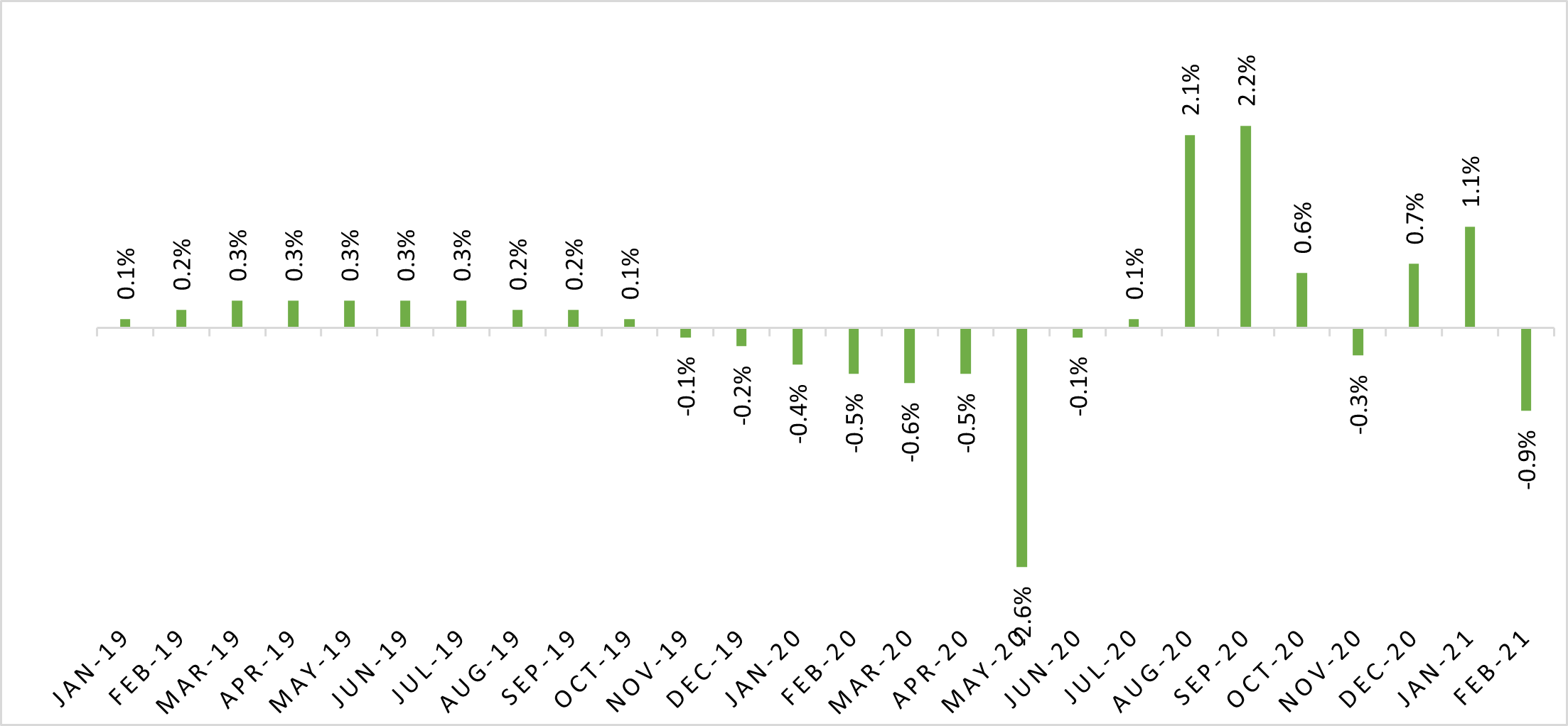
    The latest reading of a leading economic activity index known as the ILC, compiled by local economic think-tank Ceres, shows the index contracting by 0.9% month-on-month in February. This is attributed to short term volatility including a weak performance by tourism and the negative effects of border restrictions. Ceres says this does not necessarily imply a return to recession, and notes that the agricultural sector is poised to boost activity levels going into the second quarter. There was a clear recession from November 2019 to June 2020, a recovery in July-October, and then a more erratic performance in November 2020-February 2021.

    ICL Index (monthly variation)

    Source: El Observador, Ceres

    The progress of the pandemic will of course not be the only factor influencing the Uruguayan economy this year. Investor sentiment will be influenced by the future of the Ley de Urgente Consideración (LUC), a 400-item omnibus reform containing the government’s main economic, security, and environmental proposals. Although approved in the legislature last year, the left-wing opposition Frente Amplio coalition is gathering signatures to try and trigger a referendum on whether the LUC should be rejected.

  • ECONOMIC HIGHLIGHTS

    Patrick de Courcy 12 August 2021 Hits: 1749

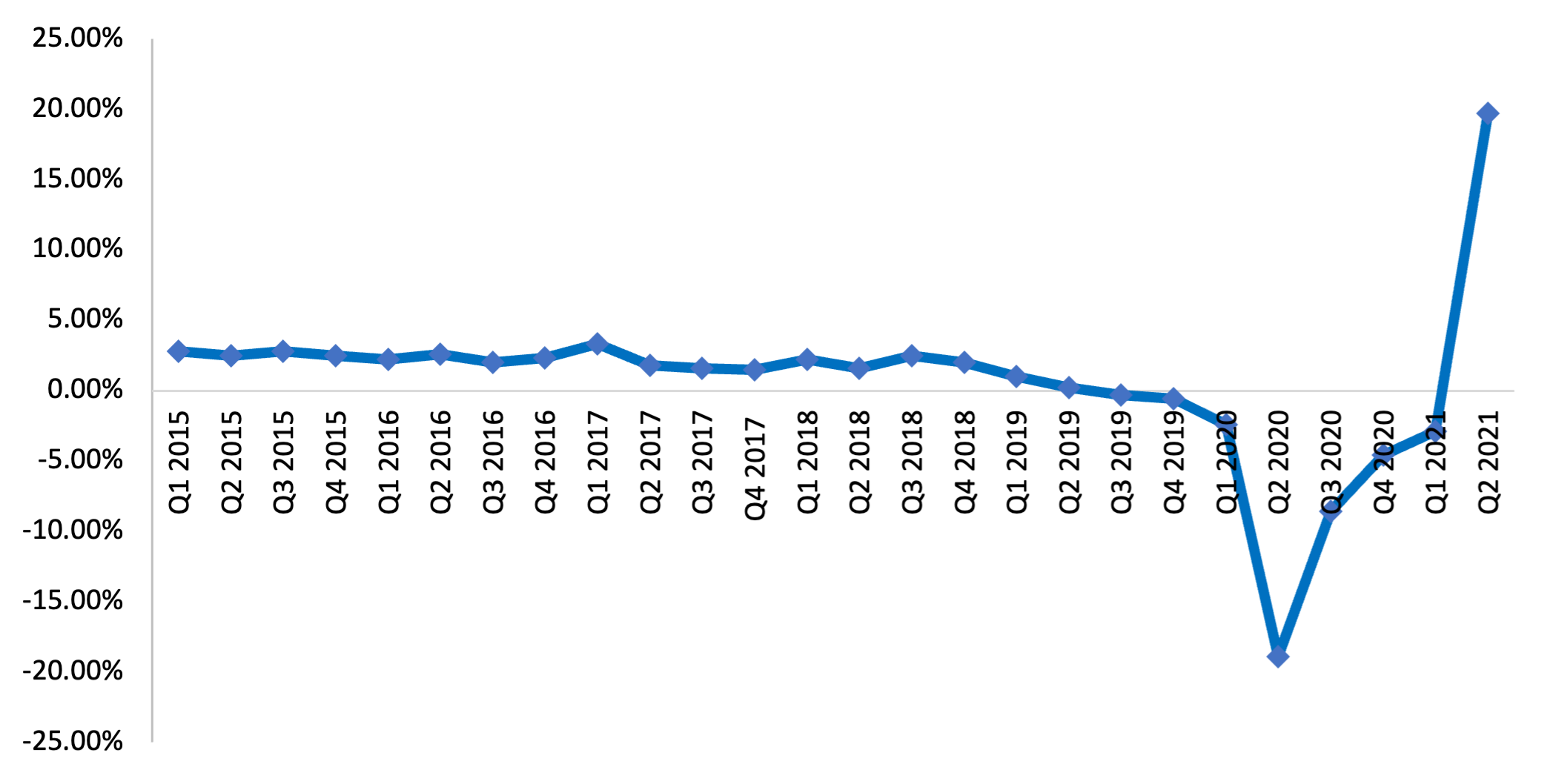
    MEXICO| GDP growth. On 2 August Mexico’s national statistics institute (Inegi) released its latest figures on GDP growth in the country, which show that in real year-on-year terms, Mexico’s economy expanded by 7% in the first six months of 2021, and by 19.7% in the second quarter. Year-on-year GDP growth in Q2 is due to a general surge in all sectors, with the primary (agriculture) and tertiary (services) sectors growing by 6.7% and 17.1% respectively, while the secondary sector (industry) expanded 28.2%. According to Inegi, Mexico’s GDP grew 1.5% in seasonally adjusted terms during the April-June 2021 quarter compared with Q1. This performance confirms a trajectory of economic recovery after the 8.2% GDP contraction recorded last year as a result of the coronavirus (Covid-19) pandemic. The better-than-expected GDP data from the first half of the year prompted economists to revise up their economic growth forecasts for the year. In survey of local economists carried out monthly by the central bank (Banxico) the following day, private sector economists increased their GDP growth forecasts from 5.8% to 6.06%. This was the second time in as many months that the 37 economists polled by Banxico have revised up their GDP growth forecast for the year.  

    MEXICO| Still attracting FDI. On 21 June Mexico’s deputy minister for foreign trade, Luz María de la Mora, underlined Mexico’s improved ranking as a recipient of foreign direct investment (FDI) in the latest World Investment Report 2021 by the United Nations Conference on Trade and Development (UNCTAD). De la Mora highlighted that Mexico rose five places to ninth in the world last year, up from 14 in 2019, receiving the most FDI of any country in Latin America. According to the report, Mexico attracted US$29bn of FDI in 2020, a 14.6% decline on 2019. However, this compares with an average 45% slump in FDI across Latin America (the hardest hit region amongst developing areas). 

    Mexico: GDP Growth
    Percentage variation (year-on-year)

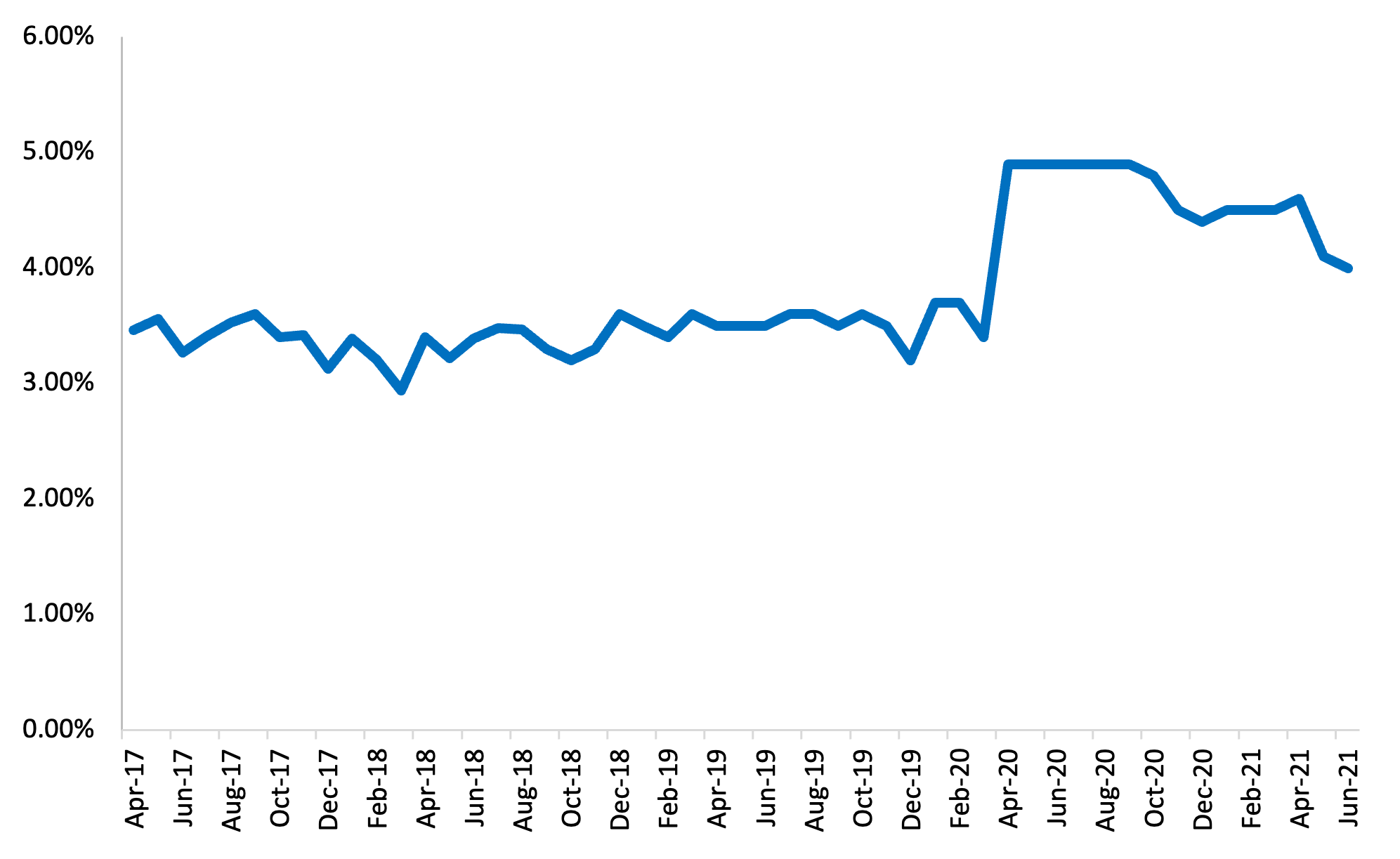
    Mexico: Unemployment Rate
    Economically active population

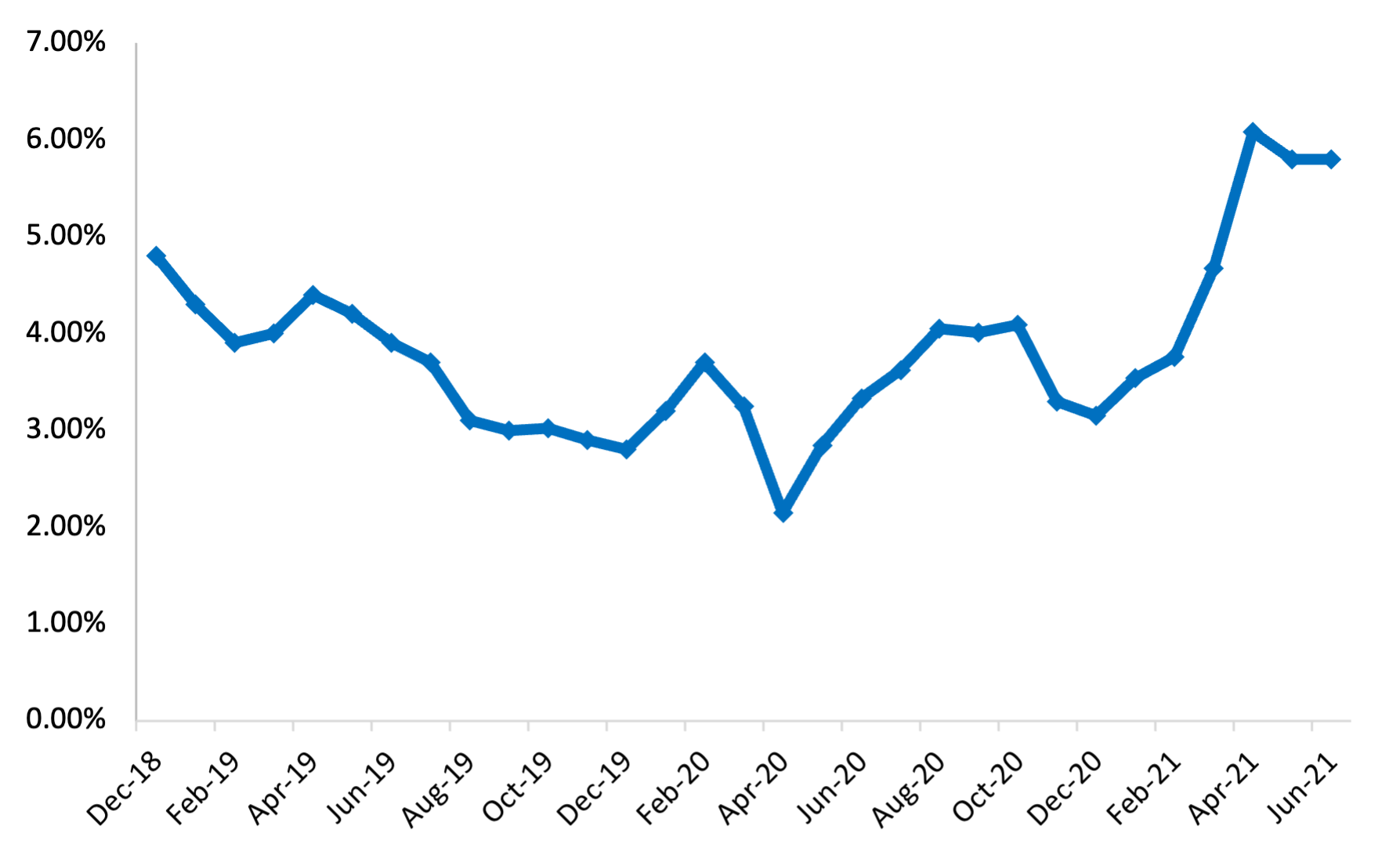
    Mexico: Inflation Rate
    Percentage variation (year-on-year)

  • COSTA RICA: Spearheading efforts to phase out oil and gas production

    Sarah Sheldon 15 October 2021 Hits: 1436

    On 16 September Costa Rica’s environment minister Andrea Meza and her Danish counterpart, Dan Jorgensen, announced the formation of the Beyond Oil and Gas Alliance (BOGA), a diplomatic initiative bringing together countries and jurisdictions that have ended licensing for new oil and gas exploration and production and are setting an end date for their production. The announcement follows a legislative bill unveiled in July by Costa Rica’s President Carlos Alvarado which would eliminate the use of fossil fuels in Costa Rica and declares its national territory free of exploration and exploitation of oil and gas. Both developments once again underline the Costa Rican government’s commitment to its decarbonisation plan which aims to make the country completely carbon-free by 2050.

    BOGA is the first diplomatic initiative acknowledging the need for governments to manage the phase-out of fossil fuel production as a key tool to address the climate crisis. On 25 August Meza retweeted an interview she gave to newswire Reuters which said it had seen the draft agreement which reports that it may be launched at the United Nations climate summit, COP26, in Glasgow this November. According to the Reuters article, countries must promise to end new licensing rounds for oil and gas production to be part of the alliance and phase out existing production. It may be possible to become a second-tier member for countries which have taken some steps to limit fossil fuel production, like ending public financing of it abroad or reforming fossil fuel subsidies.

    The announcement of the BOGA followed President Alvarado’s unveiling of the bill to eliminate fossil fuels on 28 July which was welcomed by local environmental groups like Movimiento Costa Rica Libre de Perforación, which includes some 150 organisations. Former president Abel Pacheco (2002-2006) first issued an executive decree in 2002 establishing a moratorium on exploration and exploitation of hydrocarbons in Costa Rica, which has been extended under successive governments – most recently in 2019 by President Alvarado, until 2050. However, environmentalists welcome the stronger guarantees provided by the new legislative bill, given that executive decrees can be revoked. The latest initiative would make the moratorium permanent. It is in line with the government’s decarbonisation plan unveiled in February 2019, which includes an ambitious switch to electric-powered vehicles, energy saving measures, sustainable construction, integral waste management, and changes to agriculture and land use.

    • Electric train

    Costa Rica’s environmental preservation efforts have produced international financial support [SSR-21-01], including from the Green Climate Fund (GCF) – a fund established within the UN Framework Convention on Climate Change (UNFCCC). On 1 July the Central American development bank (BCIE), a direct access accredited entity since 2016 before the GCF, announced that the GCF had approved its proposal to finance the electric passenger train project for Costa Rica’s greater metropolitan area (GAM), for US$271.3m.

    Describing it as a “flagship” project, BCIE executive president Dante Mossi said it represented a “paradigm shift” as it will be “the reference in the region towards a low-emission sustainable transportation transition and will become the backbone that will integrate all types of public transportation.” BCIE estimates that the project, which includes 85km of double tracking passing through 15 cantons, will benefit over 2.7m inhabitants, generating close to 1,200 direct jobs during its construction phase and 1,470 during its operation phase and will reduce CO2 emissions by 7.6m tonnes throughout its useful life (see sidebar).

    • Electric train project

    The total cost of the electric train project is US$1.55bn, of which BCIE approved US$550m in financing and the GFT; through this approval the BCIE will provide US$250m as a loan to the Costa Rican government and US$21.3m as a donation. The remaining amount will be mobilised by the private sector through a concessionaire awarded the project through a bidding process.

  • TRACKING TRENDS

    Abbi Dicker 21 August 2025 Hits: 1217

    BRAZIL | Economic activity down in monthly terms. The central bank (BCB) released new figures on 18 August for its economic activity index (IBC-Br), which showed a 0.1% monthly drop in activity in June. This marks the second consecutive month to register a monthly slowdown. The IBC-Br for agriculture and industry showed monthly decreases of 2.3% and 0.1% respectively, while the index for the services sector showed a 0.1% monthly rise in activity. In year-on-year terms, however, the overall economic activity in June was up 1.4% compared to the same month in 2024.

    BRAZIL | Beef exports to Indonesia approved. The agriculture ministry announced on 19 August that the Brazilian government has gained approval to export beef to Indonesia. The ministry hailed the approval of beef shipments to Indonesia as a move to deepen trade relations with Indonesia, which imported a total of US$4.2bn of agricultural goods from Brazil in 2024, mainly products such as soybeans, sugar and ethanol products, and textiles.

  • BRASIL: Alboroto municipal

    LatinNews 23 July 2012 Hits: 635

    Sérgio Cabral, el ambicioso gobernador de Río de Janeiro, aliado al gobierno federal, sorprendió al gobernante Partido dos Trabalhadores (PT) esta semana con el anuncio que él intenta renunciar antes, a fines del 2013, en favor de su vicegobernador y colega del Partido do Movimento Democrático Brasileiro (PMDB) Luiz Fernando Pezão, a fin de permitir que Pezão “gane fuerza” ante las elecciones generales del 2014. Eso fue algo nuevo para el PT, que había estado trabajando sobre la base asumida de contar con el apoyo del PMDB para el intento en el 2014 para la gobernación de su senador local, Lindbergh Farías.

    Cabral está en su segundo término como gobernador, y no puede competir de nuevo en el 2014. A pesar de varios problemas con la corrupción, que hasta la fecha él ha sobrevivido, aún tiene ambiciones nacionales, potencialmente como número dos de la Presidenta Dilma Rousseff en el 2014. Un ex alcalde de la ciudad de Piraí, Pezão ha sido su segundo desde 2007. Como Cabral, Pezão parece tener el apoyo de Rousseff, quien en una reciente aparición pública en Río pareció indicar su apoyo por él en el 2014. El gobierno federal necesita mantener la alianza con el PMDB intacta, pero a nivel local el PT y el PMDB siguen el guión federal sólo con reluctancia. El PT en Río no simpatiza con el plan de Cabral, que podría ver a Pezão efectivamente en el poder desde diciembre del 2013, reelecto en el 2014 y luego reemplazado por el actual popular alcalde del PMDB de Río, Eduardo Paes, en el 2018. Paes podría entonces competir de nuevo en el 2022, dejando al PT fuera en el frío en Río hasta el 2026.

    El PT local está preocupado en que Cabral condicionará el continuado apoyo del PMDB al ejecutivo federal liderado por Rousseff en el 2014, a este plan, al costo de una presencia secundaria del PT en Río, por al menos una década. La dirección del PT, conducido por nadie más que el ex presidente Lula da Silva, está poniendo toda su energía en ganar el control de São Paulo, dejando Río al PMDB.

    Anthony Garotinho, un ex gobernador de Río y un intenso rival político de Cabral, intervino esta semana, sugiriendo que Cabral y Rousseff habían acordado su partida temprana para reducir el riesgo vinculado con los escándalos de corrupción que amenazan dañar a Cabral y al gobierno federal ante el 2014, que no solamente es un año de elecciones generales sino que también el año en que Río será anfitrión de la Copa Mundial de fútbol.

    El PMDB es particularmente fuerte a nivel municipal, con 1.200 municipalidades bajo su control. Y apunta a incrementar eso a 1.400 este año, dándole un incrementado poder de negociación con el gobierno del PT para el 2014. El PMDB se ha echado atrás y observado las varias riñas recientes entre el PT y sus otros principales aliados en la coalición en relación a listas municipales en ciudades clave como Recife y Belo Horizonte, que han causado serias tensiones con el Partido Socialista Brasileiro (PSB) en particular. Eso le viene bien al PMDB, pues el PSB, liderado por otro ambicioso gobernador de estado, Eduardo Campos, de Pernambuco, es su principal rival en la coalición; Campos compite con Cabral por la atención de Rousseff ante el 2014.

    ¿Un chivo expiatorio?

    El ex ministro de la presidencia del ex presidente Lula da Silva, caído en desgracia, José Dirceu, se está preparando para una gran batalla para salvar su reputación política (o lo que queda de ella) pues la corte suprema federal de justicia está lista para iniciar el juicio programado del mensalão el próximo mes. La parte acusadora alega que Dirceu es el arquitecto del mensalão, un esquema de soborno masivo en el congreso de dinero a cambio de votos, que casi derribó al primer gobierno de Lula (2004-2006). Esta semana, Dirceu se quejó que él era un mero chivo expiatorio y estaba siendo un ejemplo de eso. Dirceu citó (no por primera vez) declaraciones juradas personales de Lula y Rousseff testificando sobre su buena reputación. Dirceu tiene prohibido ocupar ningún cargo público hasta el 2014, pero permanece activo detrás de escena en el gobernante PT.

    Comisión de la Verdad comienza las audiencias públicas

    La comisión nacional de la verdad de Brasil ha comenzado las audiencias públicas alrededor del país, en apoyo de las nuevas comisiones a nivel estatal que han sido establecidas por las legislaturas locales, luego del lanzamiento formal en mayo del cuerpo federal oficial. Hasta la fecha, seis asambleas legislativas en seis estados, incluidos São Paulo, Río de Janeiro, y Pernambuco han establecido sus propias comisiones. Otros, incluidos Río Grande do Sul y Goias, están siguiendo el ejemplo. Estos estados están gobernados por la coalición gobernante y partidos opositores, indicando un amplio interés político en este esfuerzo por revisitar el reciente pasado de Brasil, que llevó varios años de presiones y esfuerzos antes que fuera finalmente aprobado por el congreso federal a fines del año pasado.

    “Estas comisiones estatales nos alimentarán [...] ellas nos darán dossiers  con datos concretos y tareas que son necesarias que sean hechas”, señaló Claudio Fonteles, uno de los siete miembros de la comisión nacional. Fonteles y sus colegas estuvieron en Goias (12 de julio), donde ellos debían reunirse con grupos locales y familiares de personas desaparecidas.

    A comienzos de esta semana (17 de julio), el gobernador Tarso Genro del gobernante federal Partido dos Trabalhadores (PT) convirtió en ley la nueva comisión estatal de Río Grande do Sul en presencia del cruzado español, el juez Baltazar Garzón, conocido por sus esfuerzos por llevar a juicio ante las cortes internacionales al ex líder militar de Chile Augusto Pinochet (1974-1990).

    • Actividad económica poco animada

    El índice de actividad económica del banco central, IBC-Br, que anticipa el PIB, se contrajo levemente en mayo, cayendo 0,02% mes en mes durante abril. Esto fue un poco mejor que las expectativas del sector privado, pero de todos modos indicativo de la floja economía. Creció solamente 0,18% durante mayo de 2012. Con la primera mitad efectivamente pasada, el gobierno Rousseff esperará que su serie de medidas de estímulos fiscales y monetarios tengan efecto durante la segunda mitad. El ambiente externo es también más oscuro –China informó de su más lento crecimiento real del PIB en tres años (7,6% año en año en el segundo trimestre).

    • Agente de la PF vinculado a la investigación de Cachoeira muerto a tiros

    El ministro de justicia Eduardo Cardozo dijo que era “precipitado” vincular la muerte de un agente de la policía federal con las investigaciones en curso de la policía (y el congreso) sobre el encarcelado jefe de la mafia del juego, Carlinos Cachoeira. El cuerpo del agente, Wilton Tapajós, fue descubierto en un cementerio en Brasília el 17 de julio. Había recibido dos disparos. De acuerdo con informes de la prensa local, Tapajós había recibido amenazas y había informado a sus superiores que estaba siendo seguido. El presidente del comité de investigaciones del congreso (CPI) sobre los extendidos lazos políticos de Cachoeira, el senador Vital do Rêgo, negó esta semana que la CPI no estaba obteniendo resultados. De las 24 personas convocadas ante la CPI hasta la fecha, 13 han rehusado decir una sola palabra.