All Categories

Subcategories

  • ECONOMIC HIGHLIGHTS

    Abbi Dicker 21 June 2024 Hits: 2491

    CHILE | Codelco and SQM sign lithium deal. On 31 May Chile’s state-owned copper mining company Codelco and the private Chilean company Sociedad Química y Minera de Chile SA (SQM), the world’s second largest lithium producer, signed the partnership agreement announced back in December 2023 to develop lithium in the Atacama salt flats in the north of the country from 2025 to 2060. The agreement provides for a joint venture, comprising Codelco through its subsidiary Minera Tarar, and SQM through SQM Salar, with the Chilean state holding the majority stake (50% plus one share). The partnership will have two periods of operation. The first runs from the date it becomes effective until 31 December 2030, during which SQM will oversee general management. The second runs from 1 January 2031 to 31 December 2060, during which Codelco will oversee general management. According to the statement announcing the signature, the aim is to “achieve a total additional production of 300,000 tonnes (t) of lithium carbonate equivalent (LCE) in 2025-2030, while a production of 280,000-300,000t of LCE annually has been defined for 2031-2060”.

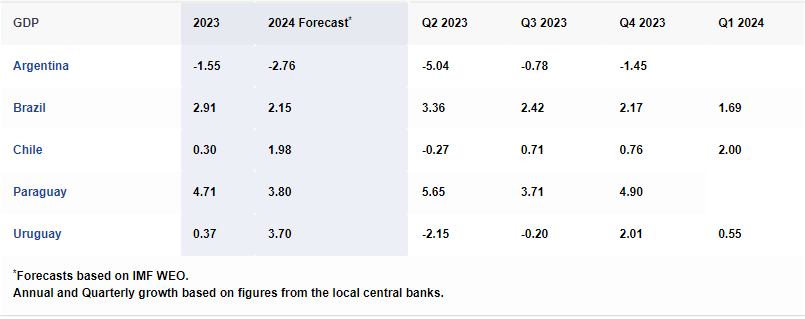
    BRAZIL | Services and agriculture drive economy in Q1. On 4 June Brazil’s national statistics institute (Ibge) released GDP figures for the first quarter of 2024, posting 0.8% growth from the previous quarter and 2.5% growth year-on-year. The services and agricultural sectors registered quarterly growth of 1.4% and 11.3% respectively, while the industrial sector posted a slight quarterly contraction of 0.1%. Ibge attributed the growth in the services sector to increased consumption by families, which has led to rises in retail sales and demand for other personal services as well as increased internet usage and demand for digital services. The Ibge suggested several factors have contributed to more consumer spending, including the decrease in unemployment, the lowering of interest rates in Q1 by the central bank (BCB), and the continuation of government programmes to provide financial assistance for lower income households. The government currently expects GDP to grow 2.5% this year.

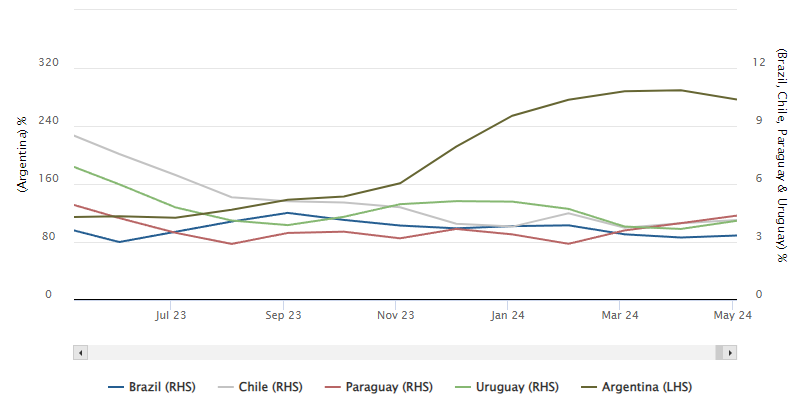
    Brazil & Southern Cone: inflation rate
    Percentage variation (year-on-year)

    Brazil & Southern Cone: GDP growth (%)
    Quarterly figures are year-on-year growth

  • BOLIVIA: Good news and bad

    Patrick de Courcy 20 February 2026 Hits: 1156

    The international credit ratings agency Fitch upgraded Bolivia’s credit rating from CCC- to CCC on 16 January, stating that this “reflects easing risks of default or restructuring due to reduced political constraints on external financing, financing commitments from multilaterals, and the elimination of fuel subsidies, which should support fiscal deficit reduction and reserve accumulation”. However, on 20 January, the president of the central bank (BCB), David Espinoza, revealed that the bank had major gold debts due to forward sales contracts agreed under former president Luis Arce (2020-2025).

    Espinoza – who was appointed by President Rodrigo Paz – stated that the BCB had been selling gold to cover debt repayments and fuel imports under the Arce administration, and it had received advance payment for these sales. In four transactions between April and October 2025, the BCB received US$1.26bn in exchange for the agreed sale of 9.6 tonnes of gold. Of that, 3 tonnes have been delivered thus far. As a result, he said that the BCB needs to purchase 6.6 tonnes of gold, valued at US$921m, before October 2026, in order to fulfil its obligations.

    Since 2023 the BCB has been involved in a controversial process whereby the bank purchases gold from local miners in bolivianos, refines it, and uses futures contracts on the international market to obtain immediate liquidity in US dollars. This was an attempt to address rapidly dwindling hard currency reserves. Although the process did lead to an increase in foreign reserves, enabling the Arce government to meet its external debt obligations and continue to import fuel, this has simply pushed the problem further down the road, and the Paz administration will now be faced with the issue of honouring these sales.

    There have been legal and constitutional concerns raised about the sale of gold through these futures contracts, as the BCB is legally obligated to maintain a minimum of 22 tonnes of gold in reserves. Critics have argued that the commitment to future deliveries undermines this provision, even if the threshold is formally observed. The 2025 presidential candidate Jorge Quiroga, who lost to Paz in the second round, called for the prosecution of BCB officials if they failed to maintain the mandated level of gold reserves. However, the Arce administration argued that a clause in the 2025 budget allowed for the country’s gold reserves to be used in this way.

  • ECONOMIC HIGHLIGHTS

    Abbi Dicker 16 October 2026 Hits: 230

    HAITI | New IMF report warns of fragile economy. On 28 September the International Monetary Fund (IMF) released a new report which painted a stark picture of Haiti’s economy. The report was released following the conclusion of a virtual mission on the Fourth Review of the Staff-Monitored Programme (SMP), an informal agreement between country authorities and the Fund which is not accompanied by IMF financial assistance.

    The IMF report highlighted that Haiti’s economy remains fragile, with real GDP declining for the eighth consecutive year. GDP is forecast to contract by 1.7% in 2026, after declining 2.7% in 2025, 4.2% in 2024, and 1.9% in 2023. The IMF noted however that inflation has “eased significantly” and is projected at about 16% year-on-year in FY2026, down from its peak of over 32% in October 2025, while international reserve buffers, which it estimated at US$1.9bn by end-June 2026, “remain adequate”.

    As regards risks, the IMF warned that “higher oil prices are weighing on the fiscal and external positions and have contributed to higher living costs”. It also signalled concerns that the recent end of Temporary Protected Status (TPS) for Haitians in the US, a benefit blocking the deportation of people from countries experiencing “ongoing armed conflict, environmental disaster, or extraordinary and temporary conditions” that “prevent its nationals from returning safely”, could “reduce remittance inflows and aggravate economic and humanitarian vulnerabilities.” TPS for Haitians was stopped by the US administration of President Donald Trump in July 2026.

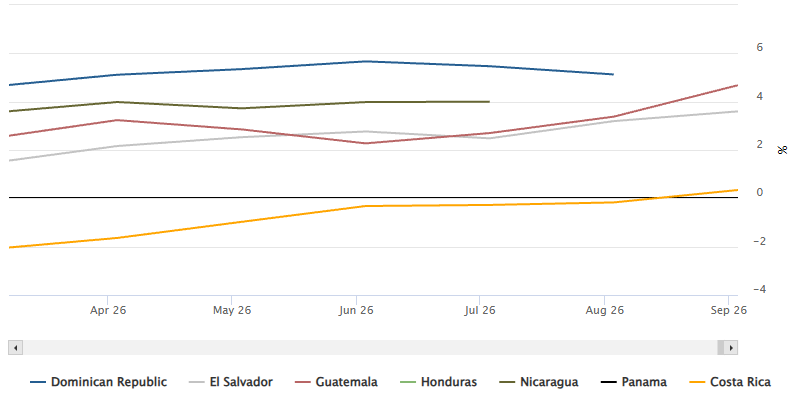
    Central America & Caribbean: inflation rate
    Percentage variation (year-on-year)

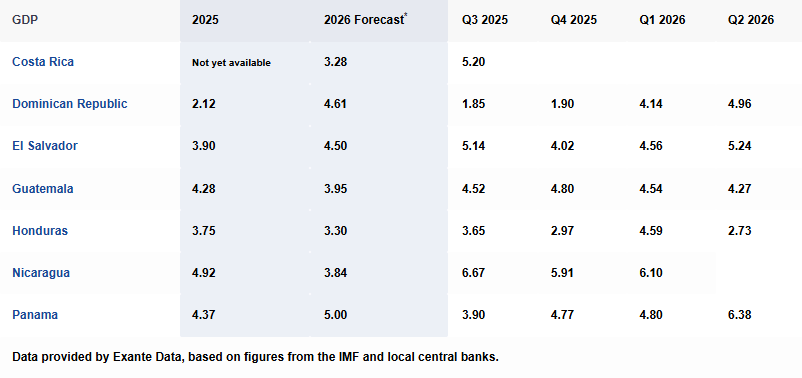
    Central America & Caribbean: GDP growth (%)
    Quarterly figures are year-on-year growth

  • ECONOMIC OVERVIEW: BOLIVIA

    LatinNews 19 September 2011 Hits: 975

    Positive outlook: Last month the international credit rating agency Standard & Poor’s announced that it had revised its outlook on Bolivia’s foreign- and local-currency ratings to positive and affirmed its 'B+' long-term and 'B' short-term foreign and local currency sovereign credit ratings on Bolivia. The credit agency said that it had revised the outlook to “reflect the possibility of an upgrade if planned new investment in the mining and gas sectors leads to better economic growth prospects and further improvements in the country's already strong external indicators". The agency cited “a number of large infrastructure and investment projects […] announced over the last three months that could raise Bolivia's growth prospects and exports over the next three to five years”. As well as new exploration agreements for the gas and lithium sectors, a key agreement cited was that announced in June between India’s Jindal Iron & Steel and the government, whereby the former would invest US$2.1bn in the El Mutún iron ore mine over the next eight years. The project is by far the biggest investment by any Indian company in South America.

  • CHILE: Piñera se recupera

    LatinNews 13 August 2012 Hits: 607

    El Presidente Sebastián Piñera está haciendo un constante y seguro retorno en las encuestas nacionales de opinión. Piñera disfruta de un rating de aprobación del 36% en la última encuesta conducida por Adimark, subiendo 10 puntos porcentuales en tres meses, al mismo tiempo que una serie de datos positivos han sido difundidos, incluidas las impresionantes cifras del PIB, el descenso de la pobreza, bajo desempleo e inflación, y la exitosa aprobación de la ley anti-discriminación estancada por largo tiempo en el congreso.

    Piñera lucía perplejo durante la mayor parte de los últimos 18 meses, mientras el éxito económico de su gobierno, paradójicamente había visto caer a plomo su popularidad. Sin embargo, gran parte de eso fue el descontento con todo el sistema político, y no específicamente con el gobierno. Las pequeñas mejoras en el débil manejo político de su administración también han significado que altas cifras de crecimiento del PIB (6% el año pasado, y 4% - 5% predichos para este año), bajo desempleo e inflación, del 6,6% y el 2,7% respectivamente, y el éxito en exceder las metas de creación de empleo, le ha otorgado a Piñera algo de tolerancia de parte del público.

    Es demasiado simplista deducir que la constante recuperación en la popularidad de Piñera beneficiará a los partidos de la gobernante Coalición por el Cambio en las elecciones municipales de octubre; estas son, después de todo, peleadas sobre asuntos locales, pero ciertamente ellas no están enteramente disociadas, y un gobierno que ha recuperado el ritmo en sus pasos en vez de cojear de una crisis a otra claramente será más una ayuda que un estorbo para la Coalición. La encuesta de Adimark muestra que la aprobación de la Coalición permanece en sólo 25% con 61% de desaprobación, pero la opositora de izquierda, la Concertación tuvo un resultado peor con un 19% de aprobación y un 69% de desaprobación.

    • Golborne en la cresta de la ola

    El miembro más popular del gabinete en la encuesta de Adimark, es el ministro de obras públicas, Laurence Golborne, con el 75%, lo cual es significativo antes de las elecciones presidenciales en el 2013. Golborne ha preservado su popularidad desde el rescate de los 33 mineros atrapados bajo la tierra después del colapso de la mina de cobre San José debajo del desierto de Atacama en agosto del 2010. El Presidente Piñera marcó el segundo aniversario del rescate esta semana reuniéndose con los mineros en la norteña ciudad de Copiapó.

  • PARAGUAY: Cartes imitates Peña Nieto with broad pact

    LatinNews 04 July 2013 Hits: 3157

    President-elect Horacio Cartes has taken a leaf out of Mexico’s President Enrique Peña Nieto’s book by signing a broad accord with four opposition parties to win congressional approval for a series of reforms. Cartes, who will take office on 15 August, praised the pact as “a clear sign of the maturity that Paraguay’s political class now offers”. Unlike Peña Nieto’s ‘Pact for Mexico’, however, Cartes’ reform agenda is not itemised in meticulous detail. Instead, it includes vague promises to combat poverty and corruption, the stated aims of most Paraguayan presidents, fuelling speculation that it was hastily cobbled together with other objectives in mind.

    The broad pact struck by Cartes includes his party, the Asociación Nacional Republicana-Partido Colorado (ANR-PC), the outgoing Partido Liberal Radical Auténtico (PLRA), the Unión Nacional de Ciudadanos Eticos (Unace), and the left-wing parties Avanza País and Partido Encuentro Nacional (PEN). The only party not to enter the pact was the Frente Guasú (FG) coalition of former president, Fernando Lugo (2008-2012), who took up his senate seat for the start of the new legislative session on 1 July. Cartes said he would continue discussions with Lugo to try and add the FG to the pact. He found common ground with Lugo during a meeting in May, especially in relation to his proposal to combat poverty and to bring Paraguay back into the Southern Common Market (Mercosur) [WR-13-20] (see box below).

    “The country always comes first and, in this regard, the war on poverty will be the priority,” Cartes said. “We must overcome disagreements that have only generated instability and delay and begin a new stage of concord and understanding”. He promised “a transparent, honourable and efficient” government. Lugo promised the same, of course, in 2008, and his victory looked like the start of a new era after ending the long hegemony of the ANR-PC. It did not prove to be the case. Early in his mandate his credibility was damaged by persistent paternity scandals (there are different skeletons in Cartes’ closet). The big difference, however, is that even before this pact was agreed, Cartes would have enjoyed a far stronger presence in both chambers of congress through the ANR-PC than Lugo had through FG and a tense alliance with the PLRA, seeing many of his reform attempts stymied by congress.

    • Cartes leaves Mercosur with stark choice

    President-elect Cartes has changed his tune slightly on Mercosur. He is now calling for the pro tempore presidency of the bloc to be awarded to Paraguay “as a goodwill gesture” at  the group’s next meeting in Montevideo, Uruguay on 12 July rather than to Venezuela, whose entry to Mercosur Paraguay’s congress has consistently opposed.

        Cartes’s announcement is clearly calculated to court domestic political support, especially within his own ANR-PC. If Mercosur member States accept his demand, honour will have been satisfied and he will be in a stronger position to persuade congress to approve Paraguay’s return to Mercosur; if they refuse, Cartes will have won political capital for taking a firm stance and should enjoy cross-party political support for his domestic reforms, as well as giving Paraguay the chance to apply to become a full member of the Pacific Alliance without being encumbered with Mercosur’s internal constraints. He could then seek to rejoin Mercosur after Venezuela’s six-month rotating presidency ends when he should have strengthened his political position.

        President Federico Franco delivered a 25-minute state-of-the-nation address to congress this week during which he devoted several minutes to his government’s resistance to “implacable persecution… from governments of neighbouring countries” motivated more by their determination to “defend their ideological club rather than from a genuine democratic conviction”.

    • Newlook congress

    Opposition parties won congressional leadership positions under the broad pact. Juan Bartolomé ‘Ancho’ Ramírez (PLRA) was elected president of the lower chamber, while Karina Rodríguez (Avanza País) picked up a vice-presidency along with Mario Soto Estigarribia of the ruling ANR-PC. In the senate the ANR-PC’s Julio César Velázquez was elected president, and the party also took one of the vice-presidencies along with the PLRA. It is not clear whether President-elect Cartes has offered any cabinet positions to opposition parties to sweeten the deal further.

  • POLITICS: Figueiredo in Havana for talks over doctor desertions

    LatinNews 20 February 2014 Hits: 1100

    Brazil’s foreign minister, Luiz Alberto Figueiredo, was in Havana, Cuba, on 13 February for talks with his Cuban counterpart Bruno Parrilla over the recent desertions of Cuban doctors working in Brazil under the ‘Mais Médicos’ scheme.

    Brazil does not want the issue to become a diplomatic incident between the two allies. According to foreign ministry sources, Figueiredo hopes for an agreement with Parrilla to perhaps slightly improve the remuneration slightly the doctors. However cash-strapped Cuba, which has long depended for crucial foreign exchange on its exports of medical services, may be reluctant to contemplate that. Brazil’s President Dilma Rousseff also aims to use the Mais Médicos programme as a key plank of her campaign for re-election in October. The scheme, under which just over 5,700 Cuban doctors have been imported to work in remote regions of Brazil where there is an acute shortage of local medical personnel, appears very popular in the areas in which it operates.

    On some accounts, between four and 10 doctors have now abandoned the scheme, complaining that they are being given only a slither of their monthly salaries by the Cuban health ministry, with most of it withheld in Cuba. Cuba stands to bank almost US$300m a year from the scheme, according to estimates by Brazilian economists.

    The Cuban doctors are paid US$1,000 a month (or roughly R$2,400), of which US$400 is paid into a bank account in Brazil and the rest into an account in Cuba. Brazilian doctors earn about R$10,000 on average a month (US$4,174), according to the national medical association (Associação Médica Brasileira [AMB]). The monthly minimum wage in Brazil for 2014 is R$724 (US$302).

    The AMB, which was fiercely critical of the Mais Médicos scheme from the outset and is now happy to use it as a political stick against the Rousseff government, claims that the Cuban doctors are working in Brazil under conditions of “virtual slavery”.

    Florentino Cardoso, the AMB president, says that in the wake of the first high-profile desertion of Ramona Rodrigues — who has now been offered an administrative post by the AMB paying some R$3,000 a month (about US$1,200) while she converts her credentials — a further nine Cuban doctors have approached the association for help. The AMB has set up a hotline and an email address for Cubans wanting assistance.

    • On 5 February one of the Cuban doctors in the Mais Médicos program, Ramona Matos Rodríguez, 51, left the city of Pacajá in Pará for Brasília, where she sought asylum in the federal chamber of deputies, thereby becoming the first defector from the scheme.
  • RASTREANDO TENDENCIAS

    LatinNews 08 August 2014 Hits: 885

    PANAMÁ | La expansión del Canal vuelve a encaminarse. La Autoridad del Canal de Panama (ACP) y el consorcio multinacional que lleva adelante las obras de expansión del Canal de Panamá, el Grupo Unidos por el Canal (GUPC), llegaron a un acuerdo el 1 de agosto diseñado para poner fin a la incertidumbre acerca de la concreción de las obras de construcción.

    El acuerdo formaliza el pacto firmado el 13 de marzo, bajo el cual el GUPC pagó US$100m y la ACP adelantó US$100m para que continúen las obras. El GUCP se compromete a completar el proyecto de expansión de US$5,25mm que incluye un tercer juego de esclusas, para diciembre del 2015. Pero el acuerdo no resuelve la causa de fondo de la disputa que llevó a la suspensión de las tareas el pasado febrero –un gasto en exceso de US$1,6mm que el GUCP dice que incurrirá. Estos reclamos deberán resolverse de acuerdo con los mecanismos legales contenidos dentro del contrato.

  • BRAZIL: Clash between police and tech as Facebook VP arrested

    LatinNews 10 March 2016 Hits: 3235

    When Brazil launched its ‘marco civil’, described as a magna carta for digital rights, tech activists across the globe lauded the initiative. In particular, the bill was praised for the way it was developed, via extensive public consultation, and for the fact that it enshrined in law the concept of ‘net neutrality’, effectively barring telecoms providers from privileging particular internet companies. But over the past year repeated clashes between Brazil’s law enforcement agencies and social media companies have called into question the country’s commitment to digital rights.

    On 1 March, Diego Dzodan, Facebook’s most senior executive in Latin America, was arrested outside his home in São Paulo. His arrest had been ordered by a judge in the north-eastern state of Sergipe, who had been irritated by the company’s apparent unwillingness to hand over user information from the popular WhatsApp messaging service, bought by Facebook in 2014.

    According to the authorities in Sergipe, the information was needed for an investigation into organised crime and drug trafficking. A police spokesperson said that the initial request had been made over four months ago, and that Facebook had failed to even respond, despite increasingly heavy fines for its non-compliance.

    In a press release, Facebook stressed that the company operated independently of WhatsApp, and claimed to have cooperated as fully as possible “within the architecture of our service”. Put more straightforwardly, it claimed it simply did not have the information that the law enforcement agencies desired. On 2 March, a higher court judge ordered Dzodan to be released.

    In some ways, the question at stake is reminiscent of the current battle between the US Department of Justice and Apple, over the US government’s request that the technology company circumvent security measures to unlock an iphone that belonged to one of the terrorists who killed 14 people in San Bernardino, California in December last year. Jan Koum, co-founder and chief executive of WhatsApp, has said he admires Apple’s efforts to resist government pressure. “We must not allow this dangerous precedent to be set,” Koum said in a Facebook post, shortly after the conflict was made public.

    Brazilian issues

    However, there is a particular Brazilian context to the Facebook executive’s arrest. It is not the first clash between the social media company and the Brazilian authorities. In December last year, another north-eastern judge issued a court order obliging Brazil’s telecoms companies to suspend access to the messaging app for 48 hours. In the end, a higher court judge overruled his decision, but not before the application’s 100m Brazilian users were blocked from using the service for around 12 hours. At the time, Facebook’s chief executive, Mark Zuckerberg, said that he was “stunned” by the “extreme” decision.

    Telecommunications are expensive in Brazil. Texting, for example, is around 55 times more expensive than it is in the US, according to advisory firm Activate. Phone calls, particularly between states, are also extremely costly. As such WhatsApp, which provides free voice and text-messaging, has proved massively popular, with around half the country’s population using the service. As a result, many of Brazil’s telecoms providers are extremely unhappy about the app, and many were only too eager to comply with the judge’s order to block access to the service.

    At present, congress is discussing a draft bill which would require Brazilians to register personal details like their home address, telephone number and other private information when accessing websites (see sidebar). It would also expose users to possible charges of libel made on social media sites.

    • Cunha and draft bill

    A key architect of the draft bill which would require Brazilians to register personal details like their home address is the speaker of the federal lower chamber of congress, Eduardo Cunha, a former president of a major telecoms firm, who teamed up with the evangelical wing of congress in a failed attempt to defeat the marco civil.

  • TRACKING TRENDS

    LatinNews 03 November 2016 Hits: 725

    BOLIVIA | Poverty rates. Poverty rates fell in rural areas of Bolivia between 2014 and 2015 but increased in urban areas, according to a report by Bolivia’s national statistics institute (INE). The poverty rate in rural areas fell from 57.5% in 2014 to 55% last year, INE reported, but marginally increased in urban areas from 30.5% in 2014 to 31% last year. The extreme poverty rate in rural areas fell from 36.1% in 2014 to 33.3% in 2015 but increased in urban areas from 8.3% in 2014 to 9.3% in 2015.

    The INE report noted that overall poverty rate has fallen from 59.6% in 2005 before the government led by President Evo Morales came to power to 38.6% last year; and that the extreme poverty rate has fallen from 36.7% to 16.8% over the same period. Hailing the overall fall in the poverty rate, Morales reiterated his government’s commitment to reducing poverty through its various social programmes.

    COLOMBIA | Falling trade deficit. Colombia’s national statistics department (Dane) reported that the country posted a trade deficit of US$1.03bn in August, 28% less than in the same month of last year. A Dane report said that the fall in the trade deficit was primarily explained by a decline in the value of imports in the month, which fell by 4.5% year-on-year to US$4.03bn. Meanwhile exports increased in the month by 7% year-on-year to US$3.0bn.

    The August trade figures resulted in an accumulated trade deficit for the year of US$8.27bn, 16% less than in the comparable period of 2015. The accumulated value of exports for the year so far, comes to a total of US$19.52bn, 22.2% less than last year. However, largely offsetting this, the total value of imports so far this year reached US$27.8bn, 20.5% less than last year (see sidebar).

    • Colombian trade deficit

    While the reduction in the trade deficit is generally positive for the Colombian economy, the fact that the fall in imports this year has been driven by fewer imports of machinery and other intermediate goods is a cause for concern. The Dane figures show that the main driver behind the fall in imports this year was a 23% year-on-year fall in the value of manufactured imports, which was primarily explained by a 29.9% fall in transport machinery exports. This suggests that Colombia’s industrial sector and in particular the industrial transport sector is experiencing a slump.

  • Despite tariffs, will BMW prosper in Mexico?

    LatinNews 21 June 2019 Hits: 951

    There is a time lag on any investment decision. German car maker BMW took the decision to build its first plant in Mexico in July 2014. Now, almost five years later, the US$1bn-plus plant has just opened in San Luis Potosí. With the rise of US protectionism the business climate facing BMW is undoubtedly more difficult. But BMW executives remain optimistic.

    A lot has changed since 2014. The US government has become more hostile to imports of Mexican automobiles and auto parts. The advantages of operating in an integrated fashion across the three Nafta countries (Canada, Mexico, and the US) have been reduced. If ratified USMCA, Nafta’s successor agreement, will tighten local content rules in favour of the US and limit Mexico’s ability to compete by paying lower wages. The local content requirement is set to rise to 75% from 62.5% for key components. In addition, the Trump administration has threatened to introduce tariffs on Mexican auto imports ranging between 5% and 25%. Meanwhile, the rise of electric vehicles (EVs) is shaking up the industry on a global scale. At the very least then, the outlook is uncertain.

    The new San Luis Potosí plant was originally envisaged as a sister to BMW’s Spartanburg facility in the US, designed above all to meet rising US demand for high-end Series 3 models made by the German manufacturer. That is still the plan, but BMW executives are stressing diversification and flexibility. They say all cars will initially be exported to the US, but as of next year they will be diversifying to serve 40 markets spread out across Europe, North America, and South America. Oliver Zipse, a BMW board member, says sales growth will therefore not depend on the US alone. Hermann Bohrer, the plant manager, insists that BMW took a long-term strategic decision to invest in Mexico. The company will be well placed to meet local content rules. As much as 90% of the chassis of the Series 3 will be provided by three locally-based auto-part suppliers. Meanwhile, Minghua of China, a manufacturer of plastic moulds for windows and doors, has set up a local satellite facility.

    The new BMW production facility is one of the world’s most advanced auto assembly plants. There is a high degree of automation. The plant initially employs 1,200 workers and uses 519 robots. It has a zero-carbon energy policy, relying on solar panels and bought-in renewable energy electricity. Eighty percent of the water used in production is recycled. Production will ramp up to 175,000 units a year. The workforce has been trained in Germany, the US, and China. Executives say the plant can be easily reconfigured to produce other BMW models, including the Mini and potentially BMW EVs. In Mexico itself, BMW seems set to have a good year. Although car sales across the country fell by 3.9% in the first four months of 2019, BMW sales rose by 1.6% in the same period, to reach 6,312 units.

  • MEXICO: Pemex’s 2020 results point to worsening situation

    LatinNews 16 March 2021 Hits: 2075

    At the end of February Mexico’s state-owned oil company Petróleos Mexicanos (Pemex) released production data and financial results for the whole of 2020. The firm recognised that last year it suffered the worst crisis in its history as a result of the coronavirus (Covid-19) pandemic, which had a significantly detrimental impact on its finances with a loss of M$480.97bn (US$23m). This amounted to an increase of 38% relative to the loss it reported during 2019 which was around M$347.9bn.

    The health emergency during the first six months of 2020 produced a significant contraction in the oil price, as well as a major reduction in demand for fuels, which were identified as the key factors that affected the company’s finances. The Mexican mix recorded a fall in its price of 36% relative to 2019, while sales contracted by 32% during the same period.

    The restrictions imposed on economic activities in an effort to control the spread of Covid-19 led to a fall in sales that amounted to M$448.24bn less than the total recorded in 2019.

    These results will compound Pemex’s prior problems, which were already weakening the company enormously, particularly its level of debt and its labour costs. The company’s lack of resources will continue to undermine its ability to invest in new fields.

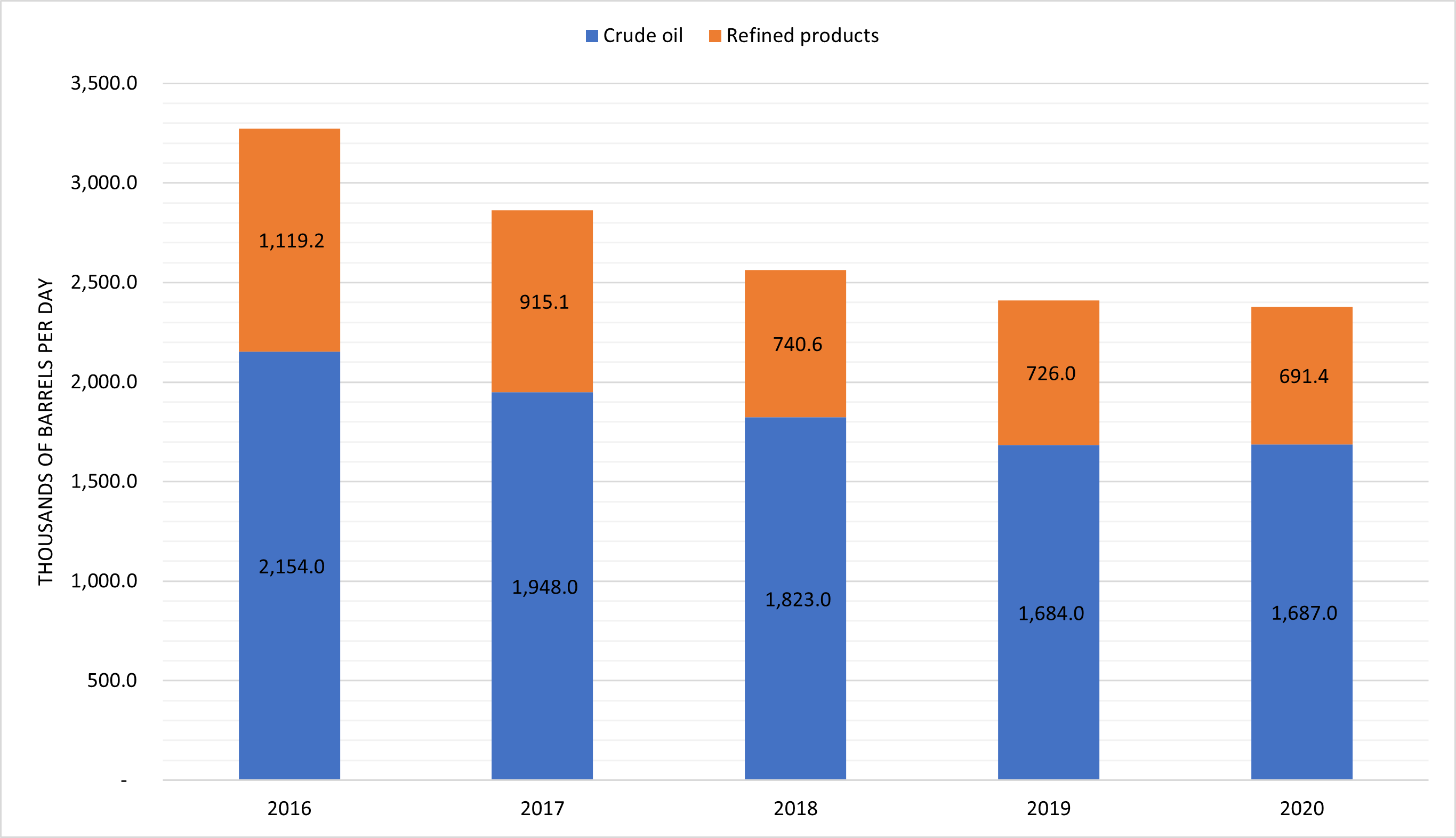
    Crucially, despite the government’s emphasis on boosting production, Pemex’s output continues to follow a downward trend. The graph below shows the decline in Pemex’s production during the last five years, both in terms of crude oil and refined products.

    Pemex production from 2016 to 2020 - Crude oil and refined products

    Source: Data taken from Pemex

    Importantly, the graph shows that crude oil production had a modest increase in 2020, from 1.684m barrels per day (bpd) to 1.687m bpd. However, this was the result of an increase in the amount of condensates from natural gas, which doubled from 23,000 bpd in 2019 to 46,000 bpd in 2020.

    Output of crude oil by Pemex on its own (not taking into account production by its partners) followed its declining trend from 1.661m bpd produced in 2019 to 1.640m bpd in 2020.

  • REGION: Vital coffee industry facing serious challenges, says new report

    Sarah Sheldon 23 January 2023 Hits: 1411

    Coffee farming continues to play a “dominant role in the economy and social fabric” of El Salvador, Guatemala, and Honduras, but the industry is facing serious challenges, according to a new report from the Inter-American Development Bank (IADB).

    Providing up to 5% of GDP and involving around 250,000 families, the coffee industry is massively important in the Northern Triangle, says the report, which was published 13 December. Most coffee farmers are small producers who rely on the crop to make a living, but they are facing serious challenges in the shape of low productivity, lack of available workers, low profitability, and a lack of inclusion for women and young people. Both the coronavirus (Covid-19) pandemic and climate change are making these challenges harder to overcome, according to the report.

    As part of their research, which was produced in partnership with the Fundación Hanns R Neumann Stiftung (HRNS), a Germany-based NGO that works with coffee farmers, the authors spoke to 1,044 coffee growing families and interviewed representatives from national and subnational coffee organisations. 

    The findings show that two-thirds of Honduran coffee-growing families rely on the crop as their main form of income, compared to 40% in Guatemala and one-third in El Salvador. Other income is generated by selling labour, remittances, and small businesses, according to the report. It is also striking how many of these families are small producers, particularly in Guatemala (80%) and El Salvador (82%), compared to 64% in Honduras. The productive area of these small farms is largest in Honduras with 2.6 manzanas (a common unit of measurement in Central America (with one manzana = 1.68 acres) followed by 2.2 manzanas in El Salvador and 1.6 manzanas in Guatemala.

    Low productivity is a consistent problem, with El Salvador recording just six quintales (100lb bags) of dry parchment coffee, or fruit that has been dried but not shelled, per manzana during the 2020-2021 harvest, compared to 9.7 quintales in Guatemala and 1,800 quintales in Honduras. Prices also varied between countries, with survey respondents reporting an average of US$109 per quintal of dry parchment coffee in Guatemala, compared to US$86 in Honduras and US$77 in El Salvador. For the 2020-2021 harvest, this meant average net annual income for small farmers of US$450 in Guatemala, US$1,027 in El Salvador, and US$1,653 in Honduras, due to wide variations in different variables in each country.

    These conditions mean that many coffee farmers have emigrated in search of better economy opportunities. In Honduras, 20% of coffee growing families have seen at least one member emigrate, compared to 12% in Guatemala and 6% in El Salvador. Increasing food insecurity due to climate change and the Covid-19 pandemic have intensified the issues faced by small producers, who were also badly affected by storms Eta and Iota in November 2020.

    In order to better deal with the issues facing the industry, the report underlines that access to credit is crucial. Unfortunately, small farmers do not enjoy the same access as larger producers. Just 11% of small farmers can borrow money in El Salvador, compared to 15% in Guatemala and 28% in Honduras, whereas 42% of large producers can in Guatemala, 67% in Honduras, and 100% in El Salvador. The main sources of financing are banks, followed by organisations of coffee producers.

    Pressing issues

    Many of the issues faced by coffee farmers look set to worsen in coming years, with the impact of climate change set to increase. Changing weather patterns mean more frequent and intense droughts, which cause coffee plants to produce less fruit and suffer from flower bud abortion and more pests. Periods of excess rainfall also affect production, knocking fruit from the plant and eroding the soil on farms, as well as increasing the prevalence of illness, according to the report.

  • BRAZIL: Scandal topples human rights minister

    Abbi Dicker 12 September 2024 Hits: 1729

    Since taking office in January 2023, President Luiz Inácio Lula da Silva has made six changes to his cabinet. The changes last year were made to appease congressional allies, but the latest change was brought about by a sexual harassment scandal. On 6 September Lula dismissed the minister for human rights and citizenship, Silvio Almeida, who faces allegations of harassing several women, including the racial equality minister, Anielle Franco. Almeida was replaced by state deputy Macaé Evaristo.

    Excluding the resignation in April last year of Marco Edson Gonçalves Dias, the presidential security chief, which is a cabinet-level post, five ministers have left or been removed from cabinet. The resignation of former tourism minister Daniela Carneiro (January-July 2023) and the dismissal of former sports minister Ana Moser (January-September 2023) were political calculations made last year to maintain good relations with conservative parties in congress. The mini-reshuffle last September involved replacing Moser with a conservative legislator, André Fufuca, and moving Márcio França from the ports and airports ministry to the newly created ministry for entrepreneurship and small businesses, in order to make room for another right-of-centre lawmaker, Silvio Costa Filho. Former justice minister Flávio Dino (2023-2024) left the government to assume a seat on the supreme court (STF) in February, and the presidential communications secretary, Paulo Pimenta (2023-2024), was appointed to a new cabinet-level post in May, the secretary for the reconstruction of the flood-stricken state of Rio Grande do Sul.  

    The resignation of Gonçalves Dias and this latest dismissal of Almeida are the two changes which sparked significant criticism of the Lula administration. The former security chief’s resignation contributed to the launch last year of a congressional inquiry (CPMI) into the government’s response to far-right riots in Brasília on 8 January 2023, although the inquiry ultimately ended up piling more pressure on far-right former president Jair Bolsonaro (2019-2023) instead of on the government.

    Almeida’s dismissal was seized upon by right-wing opposition figures as a chance to mock the left-of-centre government, which purports to support feminist policies, and accuse the left of hypocrisy. Major Brazilian media outlets, such as daily newspaper Folha de São Paulo, reported that Lula had known about the allegations against Almeida for at least a week before the dismissal, and news website UOL reported that the federal police (PF) had been aware of the allegations since at least the beginning of this year.  

    But it was on 5 September that the allegations were made public, as news website Metrópoles first broke the story on 5 September that the NGO Me Too Brasil, an organisation dedicated to addressing sexual violence, had received allegations against Almeida from several women, although it did not reveal how many women had come forward. Metrópoles only named Franco, reporting that Almeida allegedly made inappropriate physical contact, sexual comments, and other acts of harassment on several occasions last year.

    Following Almeida’s dismissal, government officials took to social media to express solidarity with Franco. National press reports suggested that Almeida’s replacement had to be a black woman who could live up to Almeida’s reputation as a notable Afro-Brazilian intellectual, as he has published research on human rights and racial equality. But his replacement must also have strong feminist credentials. Evaristo was chosen as the ideal successor given her previous work in education policy to implement diversity quotas in universities and her record of pushing for state legislation in Minas Gerais that championed women’s rights.  

    Women’s representation

    The Lula administration has reportedly appointed a woman to lead the human rights ministry, partially as a move to address feminist concerns over gender equality in government. The government faced criticism after the departure of Daniela Carneiro and Ana Moser from the cabinet last year and Lula replaced them with men, further reducing the female representation in government. With the introduction of Macaé Evaristo, 10 of the 39 cabinet-level roles are held by women. Lula also faced criticism last year for not nominating a woman for the supreme court (STF) seat vacated after Rosa Weber’s retirement. Currently there is only woman on the STF, Cármen Lúcia Antunes Rocha.

    Plane crash initial findings

    On 6 September the aeronautical accidents investigation centre (Cenipa), which is tied to the Brazilian air force, reported the preliminary findings from its investigation into the plane crash in São Paulo state on 9 August, one of the worst disasters in the aviation sector in recent decades. After analysing the recordings of conversations between the pilots, Cenipa investigators believe that the pilots were expressing concern over the plane’s de-icing mechanisms. Ice build-up on the plane is among the leading theories, but Cenipa said it needs more time to confirm the causes of the crash.

  • CHILE: Bachelet’s electoral triumph was the easy part

    LatinNews 09 January 2014 Hits: 3140

    Keeping a lid on the simmering acrimony within the right-wing coalition Alianza por Chile in the wake of the electoral triumph of former president Michelle Bachelet (2006-2010) on 15 December is proving increasingly difficult. But, what is really interesting is monitoring the palpable difficulties experienced by Bachelet’s Nueva Mayoría, a loose electoral alliance of seven parties from across the left of the political spectrum, in defining its future role once she takes office on 11 March. Bachelet herself made a call for unity within the Nueva Mayoría, something which was conspicuous by its absence during her last term in office when she headed the more ideologically attuned, and less unwieldy, quadripartite Concertación.

    On 21 December in an interview with the national daily La Tercera, Andrés Allamand, a senator-elect for Renovaciόn Nacional (RN), the junior partner in the Alianza, was unequivocal in pinning the blame for the electoral defeat on President Sebastián Piñera. “It is clear,” Allamand said, “that the main responsibility for the electoral failure lies with Piñera and his government […] the government thought that stuffing Chileans with figures of good economic performance would maintain their confidence and did not see the depth of ideological debate which emerged in society and then did not react adequately to it”.

    Allamand implied that Piñera had been far more focused on improving his own image ahead of a re-election bid in 2017. Another RN senator-elect, Manuel José Ossandón, said “this government is better than Bachelet’s in management and administration but politically it is dreadful”.

    By comparison Patricio Melero, the president of the RN’s coalition partner, Unión Demócrata Independiente (UDI), has been a model of equanimity. Melero called for unity within the Alianza and promised that it would not provide “a destructive opposition” to Bachelet, making the complex task of governing all the more difficult “as the Concertación has for President Piñera”.

    One of the big questions in the months ahead is how constructively Bachelet’s Nueva Mayoría will work together and whether it will complicate her task of governing. On 21 December the president of the Partido Comunista de Chile (PCCh), Guillermo Teillier, revealed that the party had informed Bachelet of its “historic” decision to participate in her government. Teillier said that having taken part in the electoral campaign and played a role in the victory the party felt justified in belonging to the government. He said the decision among the 100 gathered party delegates was “unanimous”. The PCCh won six seats in the lower chamber and, while Teillier denied it, is angling for a ministry.

    Ignacio Walker, the president of Democracia Cristiana (DC), the most centrist of the parties in the Nueva Mayoría which has acute historical and ideological differences with the PCCh and is deeply suspicious of its intentions, said that members of the Nueva Mayoría would need to “assume the costs and benefits [of governing] during good times and bad times”. He added: “I can safely say that the DC will be loyal to the government but I wonder if all the parties in the Nueva Mayoría can say the same.” The obvious implication was that the PCCh could try and pressurise the government, with marches for instance, if it failed to get its way.

    “I don’t know what’s eating him,” Teillier responded in an interview with La Tercera on 22 December, adding that the PCCh would be steadfastly loyal to Bachelet’s programme. He also responded to a question related to serious differences between the DC and the PCCh over Cuba by stressing that “our commitment is with Chile; we will comply with what the programme says with relation to foreign policy, a State policy which opposes destabilising other governments or interfering in their domestic affairs, and [advocates] integration and good neighbourliness.”

    This tense exchange formed the backdrop to a meeting between the presidents of the Nueva Mayoría on 6 January, their first since Bachelet’s victory, to decide on the grouping’s identity: governing coalition or political pact? After the meeting, Walker said that an agreement had been reached to define the Nueva Mayoría as ‘a programmatic political accord’ which would expire in March 2018, in other words a marriage of convenience not a close-knit coalition like the Concertación. Teillier described the Nueva Mayoría as “a governability pact to uphold President Bachelet’s programme for four years”. The party presidents agreed that spokesmen for the group would be rotated on a monthly basis.

    Bachelet, meanwhile, held an evening dinner with Nueva Mayoría senators and senators-elect to underscore the importance of unity, stressing that she was intent on hitting the ground running: her main priorities in the first year - education, tax and constitutional reform - were already being drafted, she said.

    • RN travails

    In a further sign of the strain within the ruling Alianza por Chile after its heavy defeat in December’s elections, three deputies from Renovaciόn Nacional (RN) announced they were quitting the party on 7 January in order to form a new political party. The new political outfit, Amplitud (‘Breadth’), as its name denotes, is designed to reach out beyond the traditional confines of the Right to more independent voters.

    • Congressional leadership

    Intriguingly, the Nueva Mayoría agreed that the presidency of the lower chamber of congress would go to Democracia Cristiana (DC) and the vice-presidency to the Partido Comunista. The DC will also pick up the presidencies of nine commissions, including the three most emblematic for Michelle Bachelet’s programme of governance: finance, education, and constitution.

  • Ecuador: Ecuador piles in with fresh debt issue ahead of general election

    LatinNews 12 January 2017 Hits: 791

    On 10 January Ecuador returned to market with its second bond issue in a month (and its fourth in less than a year), raising US$1bn through a fresh tap of its 2026 bond. Like Brazil – whose state-controlled oil giant Petrobras successfully issued US$4bn the previous day – the cash-strapped Andean country took advantage of an upturn in capital markets ahead of the inauguration of the business-friendly administration led by US president-elect, Donald Trump.

    This latest issue, which came barely a month after a US$750m ten-year issue on 8 December, means that the left-wing government led by President Rafael Correa has now raised US$3.75bn via dollar bond sales in the last six months alone.

    As in December, the latest issue was oversubscribed at US$2.2bn, allowing the sovereign to offer a slightly lower yield of 9.125%, in from an initial price of 9.25% (+/- 1.8%). Despite Ecuador’s high risk profile (based on its record as a serial defaulter), the strong investor appetite likely reflects the rise in oil prices on the back of the new global output agreement between the Organisation of Oil Exporting Countries (OPEC) and other leading producers including Russia; and possibly also some expectations of a shift toward a more investor-friendly policy stance after the mid-February general election, even if the ruling Alianza Pais (AP) retains power for another four years.

    The AP’s candidate to replace Correa, his former vice president Lenín Moreno (2007-2013), is considered a little more pragmatic than Correa, who has taken a very antagonistic stance towards the private sector. The right-wing opposition is also expected to make legislative gains, which could push the AP towards the centre (albeit a fractured legislature also risks paralysis).

    Nonetheless, the case remains that no matter who wins the election, the new government due to take office in May will inherit a sizeable fiscal deficit (stuck at over 5% of GDP for the past three years) and a deteriorating debt profile.

    Technically, the Correa government is correct when it insists that Ecuador’s debt stock is not high. In September last year, the treasury put it at just under the constitutional cap of 40% of GDP (albeit this does not include mounting accumulated arrears to suppliers, or off-balance sheet oil-backed financing deals with China). In October, President Correa moved to decree a change in the public debt methodology to exclude from the headline calculation the government debt burden owing to state entities, thereby reducing the overall public debt ratio to 26% of GDP. While this has clearly allowed for additional borrowing ahead of the 2017 election, the move was criticised by opposition economists.

    Debt obligations are set to increase sharply from 2017, at a time when the budget position remains weak. With recent new issues carrying average maturities of 5-6 years, the next government may therefore have to do some deft renegotiation/reprofiling once it takes office, in order to reduce and spread these near-term commitments.

    All of last year’s debt issues were put towards the 2016 budget, including a sizeable reconstruction bill for a severe earthquake in April (estimated at US$3bn). At the outset of 2016, the-then finance minister, Fausto Herrero, put budget financing needs at US$6.6bn. Over the course of the year, that doubled to some US$13bn.

    Ahead of the February election, the treasury has been coy about 2017 financing needs. There will not be a 2017 budget until the newly-elected government takes office (ahead of a general election, the previous year’s budget is rolled over), but in late October, the-then minister for economic policy, Patricio Rivera (who subsequently took over Herrero’s role in a cabinet reshuffle), put financing needs for public spending and debt payments in 2017 at US$5.3bn, about 5.5% of GDP. On paper, this would be down by over 50% on previous years. In part, this owes to the fact that a lengthy period of public investment (including in cost-saving hydro-electricity plants built with Chinese support) is complete. It is also the case that the government expects oil earnings to rise in 2017, as the new reserves come on-stream and global oil prices recover. The 2016 budget was based on an oil price forecast of US$35/barrel (/b). West Texas Intermediate (WTI) oil was trading at about US$51/barrel in mid-January. (Ecuador’s Napo and Oriente crude trades a discount of about US$5-7 to the WTI barrel).

    Despite the oil price recovery, the government’s fiscal position remains uncomfortable and with that in mind private economists still put this year’s gross financing needs at around US$10bn – and suggest that up to half of that would have to be raised externally, adding to the growing debt pile.

    Talking up the economy

    Announcing the latest debt issue, Finance Minister Rivera also talked up the real economy, stating that investors, perceiving the “palpable signs of economic recovery in the country” had “ratified their support for our economy”.

    President Correa and the new economic policy minister Diego Martínez (formerly the central bank president) have likewise been loudly touting “a strong recovery” in late 2016. While admitting to a contraction in 2016, Correa in early January insisted that the full-year 2016 result would be no more than -1.7%. He called out the IMF, which having previously amended its initial 2016 forecast from a stark -4.5% to -2.5%, was still way off, he noted. The central bank now projects real annual GDP growth of 1.4% in 2017. Private economists are more cautious, expecting only a mild recovery, amid continued fiscal constraints, doubts about the oil price recovery and investor uncertainty around the direction of economic policy under a new administration.

    • GDP

    There was a small rise of 0.5% in quarterly growth in June-September, following a rise of 0.7% in the preceding three months. The government is confident that the economy has hit bottom and is now on the upturn. On the 12-month comparison however, real GDP contracted by 1.6% year on year in the third quarter, with continued sharp falls in investment (-6.9%), government consumption (-4.4%) and imports (-3.2%).

  • TRACKING TRENDS

    LatinNews 19 November 2020 Hits: 884

    COLOMBIA | Economy reeling. Colombia’s economy contracted by 9% in the third quarter of the year and dipped into a technical recession for the first time in more than two decades, according to the national statistics institute (Dane). The GDP slump was only to be expected given the serious economic impact of restrictions imposed to try and contain the spread of the coronavirus (Covid-19) pandemic, and it is a problem shared by countries across the region and beyond.

    The scale of the decline is not exceptional compared with other Latin American nations, and there was some evidence that the seeds of recovery have been sown: the economy grew by 8.7% in the third quarter compared with the second quarter, when GDP contracted by an unprecedented 15.7% year-on-year amid a lockdown.

    The reactivation of certain sectors of the economy in July, notably construction and manufacturing, helped drive the quarter-on-quarter recovery. The manufacturing industry, for instance, grew by 23.4% over this period.

    The biggest decline compared with the same period in 2019 was in the wholesale and retail sector, transport and distribution, and accommodation and food services, which fell by 20.1%. Construction, while it is back up and running, was still down by 26.2% on the third quarter in 2019, and mining and quarrying by 19.1%.

    The International Monetary Fund (IMF) is predicting that the Colombian economy will contract by 8.2% in 2020 but bounce back to post 4% growth in 2021. The government is more bullish. It is predicting a less severe contraction of 6.8% in 2020, and a swifter recovery in 2021, when it estimates that the economy will grow by 6.6%.

  • NICARAGUA: Deepening ties with Russia amid increasing international isolation

    Sarah Sheldon 21 March 2022 Hits: 1213

    On 10 February, Nicaragua’s government led by President Daniel Ortega announced plans for closer cooperation with Russia’s state atomic energy corporation Rosatom on energy, medical, and nuclear projects. This comes amid other signs of Nicaragua’s burgeoning cooperation with Moscow as the US and its partners continue to isolate Managua following the November 2021 general election which produced a victory for Ortega but was widely condemned as a sham.

    Nicaragua’s First Lady and Vice President Rosario Murillo said the Rosatom projects are part of a joint commission for economic exchange and could involve investments in renewable energy, the use of nuclear technology in cancer treatment, and nuclear isotopes to combat agricultural pests. It also includes training projects and support for Nicaragua’s national atomic energy commission. Rosatom officials visited Nicaragua to plan the projects, meeting with counterparts from the ministries of energy & mines, finance and health, as well as the social security institute and the Nicaraguan agricultural technology institute. The announcement was also followed by the visit of Russia’s deputy prime minister, Yury Borisov, on 17 February, with the aim of improving trade and economic cooperation, his office said.

    These are the latest signs of deepening ties between Managua and Moscow. Russia was one of only a few countries to recognise Ortega’s re-election, and in January Russia’s Foreign Minister Sergei Lavrov said the country would reinforce “strategic cooperation” with Nicaragua, as well as Venezuela and Cuba. The relationship has strengthened both times Ortega has been in power, from 1979-1990 and 2007-present, and in the last 15 years Russia has sold or donated military equipment, vaccines, buses, wheat, flour, and vehicles to Nicaragua.

    Trade between the two nations grew in 2021, with Nicaraguan exports up 208% compared to 2020. However, they started from a low base of US$6.2m, increasing to US$13.0m. This represents an increase from 0.21% of Nicaragua’s total exports in 2020 to 0.36% of total exports in 2021, which were worth a total US$3.5bn. The most significant exports to Russia were peanuts (US$8.6m) and coffee (US$4.2m). Guillermo Jacoby, president of the Nicaraguan association of producers and exporters (Apen), told local investigative media Confidencial in an article published 28 February that it won’t be easy to increase the value of exports to the Russian market, citing a lack of experience in the market and a steep learning curve.

    These numbers are fairly insignificant for the Nicaraguan economy, but Ortega is increasingly reliant on a small group of political allies as many countries reject his re-election and his crackdown on opponents. Nicaragua also stands to be affected by sanctions imposed on Russia by the US and its allies following Moscow’s invasion of Ukraine on 24 February, according to Juan González, senior director for the Western Hemisphere at the US National Security Council. In a 25 February interview with US state-owned radio broadcaster Voice of America, he said “Nicaragua will feel that pressure”, adding that the sanctions have been designed to affect those countries with economic relations with Russia.

    Mounting pressure from the US comes at a bad time for the Nicaraguan economy, with public debt approaching unsustainable levels, according to a report published on 17 February by Guatemala-based thinktank Central American institute of fiscal studies (Icefi). Total public debt sits at 47.8% of GDP taking into account the central government and state companies according to Icefi, above the 40% sustainability threshold cited by the think tank. However, including central bank debt pushes that figure to 62%, said Icefi. The think tank adds that, if its projections come to pass, debt levels will reach 65% in 2022. This is a cause for concern at a time when poverty levels have been on the rise (see sidebar).

    In its report, Icefi called on Nicaraguan authorities to improve transparency around public finances, and it urged the government to work towards political stability and resolve tensions with the opposition. This would send “positive messages” to investors and facilitate increased productivity in the short term, it added.

    Nicaragua’s growing isolation due to the deterioration in the human rights and democracy situation has left the country more reliant than ever on relationships with powers outside of the US and its allies. With Russia suffering intense sanctions due to its invasion of Ukraine, its ability to support the Ortega government will likely be limited, or at least a much lower priority. With that in mind, Nicaragua may come to rely more heavily on China. While trade with Beijing remains small in real terms, Ortega may stand to benefit more from Chinese investment.

    • Boosting ties with China

    Nicaragua has also made moves to deepen ties with China, after re-establishing relations in December 2021 with Beijing [EB-22-01]. Last year, Nicaraguan exports to China grew 11.9% compared to 2020, reaching US$11.5m. This represents just 0.32% of total exports for the year. While China is a massive market, there is a lack of knowledge among Nicaraguan firms about what Chinese customers want, Jacoby told Confidencial in an article published on 28 February. However, a series of agreements signed between the two national governments in January could lead to phytosanitary agreements that boost exports of coffee and fruit, as well as Chinese investment in infrastructure.

    • Poverty

    In 2020, 52.7% of the Nicaraguan population lived below the poverty line, and 22.8% lived in extreme poverty, said Icefi. In addition, around half of all households reported less income in 2021 than prior to the coronavirus (Covid-19) pandemic, added the think tank.

  • PANAMA: New restrictions on ships passing Canal as drought sees water levels plunge

    Sarah Sheldon 22 June 2023 Hits: 784

    The Panama Canal Authority (ACP) has imposed limits on the draught of ships allowed to pass through the Canal after drought caused water levels to fall, raising concerns about the future viability of the strategically important shipping route as the impacts of climate change continue.

    The ACP has announced a series of restrictions on the largest ships, the latest of which came into force on 30 May with important knock-on effects on the price of shipping. Drought has led to falling water levels in the Alhajuela and Gatún artificial lakes, the main sources of water for the Panama Canal. The international media has cited the ACP as saying as from 21 March to 21 April water levels in Alhajuela fell by 7m – more than 10% -, with water levels in both lakes are expected to keep falling.

    This means that the largest ships have to carry less weight in order to reduce their draft and be able to pass the Canal, as well as paying higher fees to do so. Increasing costs mean that shippers will be encouraged to explore other routes. This is a serious worry for the Panamanian government, which received US$2.5bn in direct contributions to the national treasury from Canal operations in fiscal year 2022.

    Unfortunately for Panamanian authorities, there is no sign of relief on the horizon. “The pattern continues to feature below-normal rainfall across Panama in the foreseeable future,” Jon Davis, chief meteorologist at Spain-based consultancy firm Everstream Analytics, told Bloomberg in an article published 19 May. “As a result, we expect the lake levels to decrease and the impact on shipping over the Canal to get worse.” And Luz de Calzadilla, general manager at Panama's meteorology and hydrology institute, told AFP in an article published 25 April that the El Niño climate phenomenon is forecast to bring reduced rainfall in the second half of the year.

    • Environmental emergency

    On 30 May Panama’s government declared a nationwide environmental emergency due to a prolonged drought as a result of climate change. According to the environment ministry, high temperatures and lack of rain are a preamble to the arrival of a possible El Niño weather phenomenon which could reduce the availability of water for human consumption and agricultural activity across the country. The resolution authorises the agricultural development and environment ministries, the water and sewage utility (Idaan), the national public services’ regulator (Asep), and the institute of meteorology and hydrology (IMHPA), to award special contracts necessary to address the state of emergency.

    This is just the latest sign that weather conditions could threaten the continued viability of the Canal. Draught limits were also imposed during droughts in 2019 and 2016, and there is a growing realisation that a new solution must be found. “Without a new reservoir that brings new volumes of water, this situation will remove the Canal's capacity to grow”, former Canal administrator Jorge Quijano (2012-2019) was cited as saying by the same 25 April AFP article, adding “It is vital to find new water sources, especially faced with the climate change we are seeing, not just in our country but all over the world.”

    In the short term, the ACP is working to maximise operational efficiency. For example, part of the maintenance work which was undertaken in early May at the Pedro Miguel lock complex was to check for leaky valves. “Now that we have some issues with the drought it’s very important that we keep the valves in good condition to look after the water,” Wilfredo Yau, who is head of maintenance at the local complex, told AFP in an article published 15 May. “It’s like when you have a tap at home, if the tap is dripping you adjust it so water stops coming out,” he said. “Something similar but on a larger scale” is being performed at the Canal, added Yau.

    Panama has to find ways to maintain operations at the Canal or risk losing treasury revenues, and there are increasing tensions over water supplies. The Canal basin supplies water to more than 50% of Panama’s 4.3m residents, and shortages have affected several parts of the country, leading to protests at the beginning of April in which residents of La Chorrera city, Panamá Oeste province, closed a highway.

  • ARGENTINA: Milei hosts fellow strongman

    Abbi Dicker 03 October 2024 Hits: 1845

    El Salvador’s President Nayib Bukele carried out a state visit to Argentina this week. Other governments in the region have been reticent about rolling out the red carpet for a president who marched into congress behind troops to deliver an ultimatum to legislators and stacked the judiciary in order to secure a favourable ruling to run for re-election this year in contravention of the constitution. Not so Argentina’s President Javier Milei, who has established a rapport with Bukele. Unlike Bukele, who controls all branches of government and state institutions, Milei’s power is more tightly circumscribed, but he shares Bukele’s authoritarian populist style and use of social media to disparage ‘dissenters’. While other governments look on enviously at Bukele’s success at improving public security but balk at the manner in which he achieved it, Milei is keen to learn from it.

    Presidents Milei and Bukele met in the Casa Rosada presidential palace on 30 September. Bukele, who was making the first state visit to Argentina by a Salvadorean head of state, also addressed Argentina’s congress and visited the supreme court. Responding to questions from senators, Bukele said El Salvador had been the least secure country in the world, with 3m people having fled abroad, but with “full public support” his government had combated mara gang members and “removed [them] from the equation”. He said it had required “various surgeries, radiotherapy, and chemotherapy to combat this metastatic but curable cancer”.

    Bukele said young people could weigh up whether “to become a gang member and end up in jail or work and earn money that nobody will take away”. He was dismissive of reinserting into society “a criminal who has raped and murdered and cut off three heads”. He added that “some say that we have imprisoned thousands of people, but we have freed millions. Good people are living freely, without fear, with their freedom and human rights totally respected”.

    A survey published by Gallup on 24 September found that for the first time El Salvador was one of the safest countries in the world. In its annual Global Safety Report, based on public perception, 88% of respondents said they felt safe walking alone at night. By contrast, just 41% of Argentine respondents felt the same, above only two countries in the region: Chile on 36%; and Ecuador, bottom of the pile globally with a historic low of 27%, amid a surge in gang-related crime and violence. The report devoted a page to El Salvador, acknowledging that it “currently boasts one of the lowest homicide rates in the Western Hemisphere” but pointing out that while “the country [is] safer, for now” it has “drifted toward becoming a police state” with the government having “incarcerated approximately 2% of the country’s population” in its crackdown on gangs.

    On 26 September the Tutela Legal ‘María Julia Hernández’, the human rights office of the Roman Catholic Archdiocese of San Salvador, and Movimiento Víctimas del Régimen (Movir), which describes itself as a social organisation of relatives of people unjustly arrested under the state of emergency, presented to the Inter American Commission on Human Rights (IACHR) evidence of 530 cases of “serious violations” since constitutional guarantees were suspended in March 2022. This was when the Bukele administration introduced the state of emergency, which has been extended every month since then. The groups denounced forced disappearances, torture, and murder of inmates. They said they had needed to look abroad for support as “the country’s entire institutional system has been captured by the ruling party”. On 4 September the IACHR released a report into the state of emergency and human rights in El Salvador, reminding the state of its obligation to “investigate human rights violations, seek the truth, and prosecute and punish those responsible” [WR-24-36].

    None of this has deterred the Milei government. Argentina’s security minister Patricia Bullrich signed a joint declaration with her counterpart Gustavo Villatoro to deepen security cooperation between the two countries. Bullrich, who travelled to El Salvador to meet Bukele in June to discuss security matters, celebrated the “historic accord” that “reflects a change of paradigm in the fight against narco-terrorism”, with this “new revolutionary doctrine” based on “various fundamental principles”, such as always being on the side of victims and combating criminals with “the full force of the law”. 

    Other shared principles included that the state should not renounce absolute control over its territory in the face of the threat from organised crime; reform of the penal code with tougher sentences for members of criminal groups; more powers for the police and security forces; strict state control over prisons; an end to “bureaucracy in favour of crime”; and a call for more impartial (or less critical) international organisations that do not attack “the strategies of institutional crime prevention, thus strengthening criminal organisations”. 

    “The situation in Argentina is not even close to what we had to deal with,” Bukele said. “It is one of the safest countries in Latin America. But everything is relative,” he went on. “Every country is different, with different legislation, different structures and different problems”. The Milei administration wants the same results, however, and the presidential spokesman, Manuel Adorni, insisted that “Bukele’s management of security in his country is a model to follow”. He maintained that bilateral security cooperation had already helped Argentina to reduce the homicide rate in the violence-wracked city of Rosario, for instance, by 60%.

    Bilateral trade

    According to Argentina’s foreign ministry, Argentina’s exports to El Salvador in the first eight months of 2024 totalled US$75.3m, while imports were US$3m. Argentina’s exports to El Salvador totalled US$71m in 2023, up 3.8% on 2022, while imports totalled US$5.8m. Argentina’s main exports to El Salvador in 2023 were vehicles, which accounted for 80% of total exports.

    Health minister resigns

    On 26 September Argentina’s health minister, Mario Russo, tendered his resignation. Russo ostensibly departed the cabinet for “strictly personal reasons”, although there is inevitably speculation about conflict at the heart of government. Russo was replaced by Mario Lugone, a cardiologist by profession, like his predecessor.