All Categories

Subcategories

  • AGRIBUSINESS: Ecuador's deforestation accelerates

    LatinNews 27 October 2011 Hits: 1439

    Ecuador’s rate of deforestation is one of the highest in Latin America. It is currently losing between 60,000 and 200,000 hectares of forest every year.

    The main reasons for the deforestation are: illegal logging; pressure to expand arable land; and the activities of mining and energy companies.

    The country has 9.6m hectares of primary forest, the government states, and the forests contain the widest range of tree species in the region, largely because of the forests are not only tropical but also alpine and temperate.

    The top-end estimate for the lost of forests in Ecuador comes from the UN’s Food & Agriculture Organization (FAO). It draws on satellite data from Centro de Levantamientos Integrados de Recursos Naturales por Sensores Remotos (CLIRSEN) which was gathered in 2000. The FAO reckons that Ecuador is losing forests at the rate of 1.8% a year. This is more than four times the average for Latin America of 0.4% a year. The world average for deforestation is 0.1% annually.

    The government dismisses the FAO figures and says that the actual rate of deforestation is running at 62,000 hectares (h) a year. Max Lascano the manager of the forestry programme at the environment ministry, admitted that data was incomplete but doubted that the actual figure for deforestation was much over 70,000h a year and was certainly much less than the rate of 10 years ago, which the FAO seems to be extrapolating.

    Renzo Paladines, from an NGO, Naturaleza y Cultura Internacional, argues that the big change is in land use. He said that when highlanders move into the Amazonian lowlands, where most of the forests lie, they clear five to 10 hectares for subsistence farming and then practice selective clearing after that. This sort of deforestation is manageable: what is not, he implies, is the contamination of water and soil caused by mining and energy companies.

    Paladines also argues that rising international grain prices are pushing up deforestation rates in agricultural areas such as Manabí, on the coast. He said that the tripling of maize prices has prompted farmers around Manabí to increase their cultivable acreage, even though the topsoil may become more vulnerable without wind and water breaks provided by woodland.

    The NGOs also agree that a major contributing factor to illegal logging is the lack of clear ownership of forested land. Paladines said that the system of logging permits was little more than a joke because everyone knew that the arrangements were abused. Illegal loggers simply brought timber into the legal concession holder who was happy to let his own timber stand (and grow) and process the illegal timber.

    Juan Carlos Palacios, the executive director of the Corporación de Manejo Forestal Sustentable (Comafors), another NGO, said that a big problem for controlling illegal lumbering was the small scale of the industry. He reckoned that there were 50,000 small carpentry workshops capable of supplying 100 tables and chairs to businesses such as hotels or restaurants. He said that it was simply impossible to ensure that all these workshops used legal timber.

    The wood industry is significant in the country, with sales of about US$800m a year.
  • In Brief – Colombia

    LatinNews 07 March 2012 Hits: 1581

    Colombia | Government backtracks on jail inspections. On 6 March Justice Minister Juan Carlos Esguerra said that former senator Piedad Córdoba would not be allowed to visit members of illegal armed groups serving time in Colombian prisons. The minister had authorised said visits last week; however, after Córdoba publicly referred to the inmates as “political, war & conscience prisoners” and the visits as “the initial instalment” in a peace process between the government and guerrilla groups, Esguerra said he did not have the authority to allow the visits. Esguerra informed Córdoba of his new decision in a letter also addressed to President Juan Manuel Santos, whom he said was the only authority who could give the green light to peace negotiations.

    Colombia | Yidispolítica case moves forward. On 6 March a prosecutor delegate before the supreme court of justice announced that the former minister of interior & justice, Sabas Pretelt de la Vega, the former minister of social protection, Diego Palacio Betancourt, and the former directors of the presidential administrative office, Alberto Velásquez, would be tried in relation to the alleged payment of bribes. The kickbacks were paid to two members of congress, Yidis Medina (currently serving time at El Buen Pastor) and Teodolindo Avendaño (currently being tried), in exchange for their votes in favour of the constitutional reform that allowed then-president Alvaro Uribe (2002-2010) to seek re-election in 2006. 

  • In Brief – Colombia

    LatinNews 13 August 2013 Hits: 3178

    SECURITY | Military and police command shakeup. On 12 August Colombia’s President Juan Manuel Santos replaced the country’s entire military and police command, the second major shake-up since September 2011. Under the latest changes, which take place as the administration enters its fourth and final year, President Santos appointed Major General Leonardo Barrero as new commander-in-chief of the armed forces, replacing General Alejandro Navas. Major General Hugo Acosta is the new head of the joint general staff of the armed forces; Major General Juan Pablo Rodríguez is the new commander of army; Rear Admiral Hernando Wills is the new commander of the navy; and Major General Guillermo León is the now commander of the air force. Santos also named Major General Rodolfo Palomino as the new national police chief – the third national police chief since Santos took office in 2010 – replacing José Roberto León Riaño, who took up the post after General Oscar Naranjo quit in June 2012. According to the local investigative weekly Semana, the changes were triggered in part by a bid to replace General Sergio Mantilla as army commander. Mantilla, who in a recent interview said that regardless of the peace talks the  Fuerzas Armadas Revolucionarias de Colombia (Farc) guerrillas would soon be defeated, was reportedly considered an obstacle to the peace talks currently underway in Havana, Cuba, between the government and the Farc, Colombia’s main leftist guerrilla group.

  • CHILE-BOLIVIA: Muñoz rebukes Morales over Pacific case

    LatinNews 24 April 2014 Hits: 1582

    The prospect of diplomatic relations between Chile and Bolivia improving with the advent of a new government in Santiago was dealt a blow last week. Chile’s new foreign minister, Heraldo Muñoz, described the decision by Bolivia’s President Evo Morales to set a precedent on 16 April by travelling in person to the International Court of Justice (ICJ) at The Hague to submit legal documents pertaining to Bolivia’s claim to regain access to the sea lost to Chile in the 1879-1893 War of the Pacific, as a political stunt. Muñoz accused the Morales administration of covering up the “lack of legal substance to its case” with political-media spin.

    President Morales’ trip to The Hague comes just under a year after his government filed its lawsuit before the ICJ, which could take several years to deliver its ruling. In an interview with the Chilean daily, La Tercera, on 19 April, Muñoz accused Morales of politicking, especially given the proximity of his bid for re-election in October’s general elections.

    Muñoz did say that the new government of President Michelle Bachelet was prepared to resume the 13-point bilateral agenda which it pursued with Bolivia during Bachelet’s first administration (2006-2010), after which relations took a turn for the worse under Sebastián Piñera (2010-2014). However Bachelet’s retention of Piñera’s choice of Felipe Bulnes, his former education minister, as Chile’s representative in the ICJ case has been widely interpreted as a sign that the Chilean government’s strategy is unlikely to change.

    • Expatriates given the vote

    Chile’s congress has approved a law allowing expatriates to vote in national elections, concluding a debate which has dragged on for more than 20 years in congress since the fall of the dictatorship of Augusto Pinochet (1973-1990). The chamber of deputies voted by 84 votes to 25 to approve the law, and the senate followed suit by 28 votes to five to amend the constitution. Chileans living abroad must inform a consulate of their desire to vote in order to obtain a permanent right to vote in future in presidential elections, national primary elections and national plebiscites. They will not be permitted to vote in mayoral or legislative elections, as these are not national electoral contests.

    • Venezuelan ambassador

    President Michelle Bachelet has appointed Pedro Ramírez Ceballo, a former minister in the government of Salvador Allende (1970-1973), as Chile’s new ambassador to Venezuela. Ceballo went into exile in Venezuela during the subsequent military dictatorship of Augusto Pinochet (1973-1990) where he was a professor and investigator at the Centro de Estudios del Desarrollo (Cendes) of the Universidad Central. Ceballo was a co-founder of the Partido por la Democracia (PPD), a key party within Bachelet’s Nueva Mayoría coalition.

  • VENEZUELA: Bogged down in Apure?

    LatinNews 08 April 2021 Hits: 4098

    Fighting between the Venezuelan military and a dissident Colombian rebel group, believed to be the 10th Front of Fuerzas Armadas Revolucionarias de Colombia (Farc), has entered its third week. The danger for the Caracas government is that it could get bogged down.

    The Venezuelan government continues to impose a de-facto news blackout on what is going on in Apure state on the Colombian border, exemplified by the arrest of two journalists from Colombian network NTN24 (they were released after 24 hours but had their equipment confiscated). However, a series of announcements and developments suggests that whatever has been going on between the army and the Farc’s 10th Front [WR-21-12] is still going on, and may even have escalated.

    On 2 April, the military said it was sending a field hospital into Apure. On 5 April Defence Minister Vladimir Padrino López acknowledged that eight soldiers had died, double the number previously reported. He said that nine “terrorists” had also been killed (official sources had previously used the ambiguous word “neutralised”). The government has said nothing about civilian deaths, although human rights organisations say they have evidence of extra-judicial killings by the notorious Faes elite police unit.

    Padrino López also announced what sounded very much like a military escalation. He said a special integral operational defence zone (a Zodi in Venezuelan military parlance) had been created and placed under the command of General Alejandro Benítez Marcano. In addition, a special combat brigade, known as Negro Primero, under General Wilfredo Medrano, was being sent in and would be given the necessary material and equipment. Emergency regulations would also be introduced in various municipalities in an attempt to stabilise the situation.

    These announcements came as news trickled out that the 10th Front had responded aggressively to the first engagements, rather than melting back into the jungle as Farc rebels often do. There are reports that the Venezuelan military commander in the area has been sacked. Local sources say the Colombian rebels attacked a local tax office, interrupted power supplies, assaulted army checkpoints, and destroyed a Russian-made armoured personnel carrier, possibly with a rocket-propelled grenade (RPG).

    The war of words over the border situation between Colombia and Venezuela continues. So far Venezuela has refused to admit it is actually fighting a dissident group of the leftist Farc. Its main public narrative is that it is being attacked by irregular forces who are posing as guerrillas but, in reality, form part of a right-wing anti-Venezuela conspiracy by the US and the Colombian government. The phrase used by Nicolás Maduro was that the irregular forces “dress as guerrillas to serve drug-trafficking routes”.

    The Caracas government has called on the UN to “investigate Colombian violence” and to help it remove landmines which it says the Colombian irregulars planted in the border area. Colombia’s response has been cutting, with Defence Minister Diego Molano saying that the Venezuelan government “doesn’t seem to be defending its sovereignty but protecting its drug-trafficking business”.

    The initial cause of the clashes is still believed to be either a political disagreement between some of the Farc dissidents and the Caracas government or a local argument over the sharing-out of drug-trafficking revenues between the 10th front and Venezuelan military commanders. The InSight Crime think tank believes that for whatever reason the 10th Front refused to accept the local “pax mafioso”, the informal agreement on sharing revenues from illicit activities; they may also have offended the faction of the Farc dissidents led by ‘Iván Márquez’ (Luciano Marín Arango) or elements of the Venezuelan regime, “by extorting the wrong person”.

    Whether military escalation will continue remains unclear. It is possible that local negotiations will restore earlier agreements and ensure a return to the status quo. But there is also scope for the dispute to widen, drawing in other Farc dissident factions, or even the Colombian Ejército de Liberación Nacional (ELN) which operates on both sides of the border.   

    Unprecedented firepower

    The New York Times, citing security experts, described the fighting as “Venezuela’s largest use of firepower in decades”. Nicolás Maduro said this was indicative of his government’s policy of “zero tolerance toward irregular Colombian armed groups”. But, for years, officials in Maduro’s government either turned a blind eye to, or even cooperated with, the armed groups smuggling drugs into the country from Colombia.

    Ecuador’s GDP

    Ecuador’s finance minister, Mauricio Pozo, argued that the 7.8% GDP contraction in 2020 was a relatively positive result, considering the 11% contraction predicted by the central bank. He highlighted more severe GDP slumps in Peru (-11.1%), Argentina (-9.9%), and Mexico (-8.2%).

  • DOMINICAN REPUBLIC: IMF impressed by economic resilience

    Patrick de Courcy 17 June 2022 Hits: 1981

    The Dominican Republic’s economy grew by 6.4% in March according to the monthly index of economic activity (IMAE) compiled by the central bank (BCRD) and published in early May. This brought first-quarter GDP growth to 6.1%, one of the fastest rates of expansion in Latin America. An International Monetary Fund (IMF) mission has praised the country’s economic management.

    The March numbers were broadly consistent with the IMF's prediction that, after surging by 12.3% last year, the economy will grow by 5.5% in 2022. The consensus seems to be close to 5% for this year – earlier in May, international credit ratings agency Moody’s said it was projecting 5% growth for the country this year, with a Ba3 credit rating and a “stable” outlook.  According to the IMAE breakdown, first quarter growth was led by hotels, bars & restaurants (+39.3%), other services (+11.0%), transport (+8.8%), communications (+8.2%) and commerce (+8.2%). The exceptional growth for hotels bars and restaurants reflected the strong recovery in tourism. Tourism arrivals more than doubled to 1.714m in the first quarter, relative to the same year-earlier period, and hotel occupancy rates surged in March to over 70%. First indications are that the recovery in tourism continued through April.

    An IMF mission visited Santo Domingo between 29 April and 13 May for a regular Article IV consultation. According to a preliminary press release it concluded that the country has demonstrated “remarkable resilience” with the economy experiencing a “strong recovery from the pandemic, supported by well-sequenced policies, an agile re-opening, and global growth”. By the end of last year, the economy was five percentage points above pre-pandemic levels. The external position was described as robust with the current account deficit covered by investment inflows and an accumulation of foreign currency reserves. However, the mission did point out that annual inflation of around 9% has been above the target range and will take some time to “converge”. Reforms in progress, including a planned fiscal responsibility law, reorganisation of the electric power sector, and reductions in red tape were seen as creating a positive business environment that will further attract foreign investment. The IMF noted however that there will be significant risks to growth because of global uncertainty related to the war in Ukraine.

    Abinader hails tourism strategy

    Speaking at the World Economic Forum (WEF) at Davos, Switzerland, on 24 May, the Dominican Republic’s President Luis Abinader said that a coordinated, multi-sector policy to relaunch the tourism industry (which represents 20% of GDP) had “saved” the wider economy from the crushing impact of the Covid-19 pandemic. The government had created a “tourism cabinet” with daily meetings of representatives of all related ministries (including health and defence) so as to have a consistent overall approach.

  • TRACKING TRENDS

    Patrick de Courcy 29 September 2022 Hits: 2764

    BRAZIL | Election helping to boost consumer confidence. The prospects for the 2 October election, combined with an improvement in employment levels and a decline in inflation are boosting consumer confidence in Brazil, according to the Fundação Getúlio Vargas (FGV) research institute.

    On 26 September, FGV released its consumer confidence index (ICC), which increased 5.4 points in September, reaching 89 points. This is the highest level since January 2020, before the outbreak of the coronavirus (Covid-19) pandemic, when ICC reached 90.4 points. September is also the fourth consecutive month in which the ICC has shown an improvement. “The proximity with the election has helped to boost [consumers’] expectations [for the economy],” Viviane Bittencourt, FGV’s research coordinator, said.

  • TRACKING TRENDS

    Abbi Dicker 09 May 2024 Hits: 2532

    BRAZIL | Rate cut cycle slows down. The central bank’s monetary policy committee (Copom) decided on 8 May to lower the country’s benchmark interest rate (Selic) from 10.75% to 10.50%. There were divisions on the committee over the scale of the rate cut, with four of the nine members voting to lower it by 0.5 percentage points, as it had done in every meeting since August 2023. But the remaining five members voted for a slowdown in the rate cut cycle.

    Private sector analysts consulted by the central bank, whose economic forecasts are published in the bank’s weekly Focus bulletin, have predicted that the Selic would be lowered to 9.63% by the end of the year. This latest prediction published on 6 May marks an increase from the 9.50% Selic projection from the previous week’s edition of the bulletin. In a statement, Copom said it was monitoring “recent developments in fiscal policy” and called for a “credible fiscal policy” to reduce inflationary pressures. Copom projects inflation to close the year at 3.8%, up from its 3.5% forecast in March.


    BRAZIL | Boost for Sabesp privatisation. The mayor of São Paulo, Ricardo Nunes, of the centre-right Movimento Democrático Brasileiro (MDB), promulgated a law on 2 May, which was approved by the city council on the same day, to authorise the city to grant contracts to a privatised Sabesp, the largest water and sewage treatment company in Brazil. Sabesp is the city’s main water and sanitation services provider and is owned by the state of São Paulo, but last December the state legislative assembly approved a bill backed by the administration of right-wing governor Tarcísio de Freitas which allowed the state to sell its stake in Sabesp.

    The decision by city hall to continue using Sabesp marked a boost to the state government’s privatisation push. On 3 May a state court suspended the approval on the grounds that the city council’s legislative process to authorise the contract did not carry out the required public consultations, but on 7 May the top court of São Paulo state (TJ-SP) overturned the ruling. The lower court’s decision resulted from a petition by left-wing parties, such as the Partido dos Trabalhadores (PT) and Partido Socialismo e Liberdade (PSOL), which have long criticised the efforts of conservative parties to privatise public services.  

  • Risk pointers

    LatinNews 06 September 2011 Hits: 351

    *** Egypt accused of supporting attacks on Ethiopia.  There has been a major escalation in rhetoric between Ethiopia and Eritrea.  Ethiopia is accusing Eritrea of planning terrorist attacks on public places in Ethiopia, and Prime Minister Meles Zenawi has linked Eritrea’s belligerence to Egypt.  Speaking in parliament on 5 April, he accused Eritrea of being “a militia force” for Egypt in the latter’s efforts to hinder Ethiopia’s development projects on the Nile.

    When new Egyptian Prime Minister Issam Sharaf chose Khartoum as the first Arab capital to visit this was widely seen as a reflection of Egypt’s need for an ally against the African Nile Basin countries’ attempt to amend treaties on the sharing of the Nile’s waters.  They are seeking to reduce Egypt’s share of 54bn cubic metres.  Sudan takes the second largest share with 18bn cubic metres.  Now Ethiopia has linked Egyptian opposition to any change in the Nile waters’ regime to support for Eritrean-organized terrorism in Ethiopia.

    Hinting at war, Zenawi warned: “We will not only focus on picking up the mercenaries [sent by Eritrea to carry out terrorist attacks], but also take appropriate actions against the one who sent the mercenaries...If [the Eritrean government] declares an all out war on our country, then we will take an all out counter-offensive.”

    *** Kashmir training camps “full”. The atmosphere at the 28-29 March home secretary-level talks between India and Pakistan was good, as it was when Prime Ministers Manmohan Singh and Yusuf Raza Gillani met on the sidelines of the cricket world cup.  However, controversial issues were avoided at the home secretary-level talks, and the Indian army remains concerned about the threat to Kashmir.

    According to India’s Lt-General SA Hasnain, the threat to Kashmir from Pakistani-based Kashmiri guerrillas could increase at any time because the training camps in Pakistani-administered Kashmir (PoK) are full.  Speaking on 3 April he said: “The training camps in PoK are full and the militants trained there are waiting to infiltrate into Kashmir.”

    *** Kyrgyzstan anniversary watch.  Kyrgyzstan has increased security measures ahead of the 7 April anniversary of the overthrow of President Kurmanbek Bakiyev following a popular uprising.  All security agencies and people’s militia units have been mobilized.

    A recent International Crisis Group (ICG) report warned that the five former Soviet republics of Central Asia faced systemic collapse, largely because of crumbling physical and human infrastructure.  Of the five, the report pointed to Kyrgyzstan and Tajikistan as being the two most vulnerable.

  • URUGUAY: New restrictions target junk food

    LatinNews 06 December 2012 Hits: 607

    First cigarettes and high-powered cars, now junk food. Uruguay’s congress is not only putting in place legislation to restrict the advertising of junk food in schools but it is also mooting increasing taxes on junk food in order to promote a healthier lifestyle and combat growing obesity in the country.

    The senate health committee began analysing a bill on 29 November sponsored by Deputy Javier García from Alianza Nacional, a faction of the opposition Partido Nacional (PN, Blancos), promoting healthy eating in public and private schools. The bill, which was approved by the lower chamber last September, prohibits the promotion and advertising on school premises of products which are not included on the list of healthy foods produced by the public health ministry.

    García, a doctor, claims that “70% of deaths in Uruguay are the result of chronic non-communicable diseases… basically cardiovascular and cerebrovascular diseases and cancer,” in which unhealthy eating habits are a factor. One quarter of children in Uruguay are believed to be overweight or obese.

    García said that he had gone down the educational route because a more generic bill would result in a much longer debate. However, Senator Ernesto Agazzi, from the Movimiento de Participación Popular (MPP) faction of the ruling Frente Amplio (FA), said that while the proposed controls in schools would be a good thing this did not go far enough.

    “Perhaps we need to put a tax in place on these kinds of products to create a fund in order to help with the healthy eating of young people,” Agazzi said. He added that he recognised that it was “a delicate issue” because “to some extent it affects supply and demand, but regrettably a lot of the time low-income earners resort to eating this junk because it is cheap”. Medical evidence shows that poor people consume less healthy food and have a higher incidence of most diet-related diseases, notably cardiovascular disease.

    Any generic tax on junk food will trigger a serious debate, not least over which food products should actually be defined as junk food. A starting point could be the list drawn up by the public health ministry for schools, including food products with high fat, sugar and salt contents, it deems to be unhealthy, such as crisps and other highly calorific snacks.

    In order to be successful, so-called “fat taxes”, which have been implemented in several developed countries and are being mooted in more, would probably also need to be accompanied by subsidies on healthy foods such as fruit and vegetables in order to help encourage a significant shift in dietary habits.

    In recent years Uruguay has introduced a number of taxes aimed at curbing the demand for products with detrimental effects on health, most notably cigarettes but also cars with larger engines, which produce more pollution.

    Former president Tabaré Vázquez (2005-2010), a qualified oncologist, waged a crusade against smoking during his term in office, when Uruguay became the first country in Latin America to ban smoking in enclosed public places. His government put in place legislation that required large health warnings on cigarette packets and banned the sale of those branded as “light” or “ultra light” leading to a bitter legal struggle with the tobacco giant Philip Morris International (PMI), which claimed that the restrictions imposed by the Uruguayan government harmed its business and violated Uruguay’s trade deal with Switzerland, where PMI is based.

    • Mujica no show

    President Mujica pulled out at the eleventh-hour from travelling to Cádiz, Spain, to attend the XXII Ibero-American Summit on 16 and 17 November for medical reasons. He said he had a blood clot in his right leg. The presidential doctors recommended that he remain in bed for three days while taking anticoagulant medication, fearing that the clot could cause a thrombosis. The president had a similar health issue in 2004 and recovered successfully after receiving treatment.

  • Risk pointers

    LatinNews 13 February 2013 Hits: 414

    *** Turkey worried by demographics. On 29 January, Turkey’s Statistical Institute revealed that Turkey’s population had reached 75,627,384 at the end of 2012, indicating a 1.2% growth rate.  This is down from the 1.35% growth rate recorded in 2011 and almost half the growth rate of 30 years ago.  The average age is also increasing, to 30.1 years from 29.7 in 2011.

    Professor Burak Arzova of Marmara University commented: “If the same trend continues, it [the growth rate] will go into the negative.  In other words, Turkey may experience a decrease in population as is the case in Europe.  Therefore the prime minister’s ‘three children’ exhortation is very important.”

    The prime minister, Recep Tayyip Erdogan, has a bee in his bonnet about population, and the day after the figures were revealed he instructed ministers to prepare an action plan.  Development Minister Cevdet Yilmaz then announced that the government was preparing to introduce child benefit for working mothers.

    *** Some improvement in Mexico.  A surge in violence affecting the Michoacan-Jalisco border area of Mexico, that began in December and continued into January, belies an overall improving position on violence in Mexico.  By some reports, but not all, deaths due to the actions of organized crime (OCL) were reportedly down 21.2% in 2012.  However, another set of figures shows them as more or less the same as in 2011.  Deaths from all homicides, according to partial data from the Sistema Nacional de Seguridad Pública (SNSP), fell by 8.6% in 2012.  In January, OCL deaths were down just over 3% from December at 1,104.  These figures strengthen the view that the intensity of the violence in Mexico has reached a plateau and may even be declining.

    *** Russia’s foreign minister bullish about influence in Mideast.  Russia’s Foreign Minister Sergey Lavrov told Rossiya 2 TV on 10 February: “We contacted…members of the [Syrian] opposition…Every member of the opposition said he did not think of the future of their country and the whole region without Russia’s active involvement.”

    On Libya, Lavrov said: “Libyan authorities are sending us direct signals that they are interested in restoring work on projects which we started under Gaddafi.”

    And on Iraq, he said: “In 2003 we were totally against what the Americans were doing there…Now the Iraqi prime minister is coming to us, the Iraqi president is talking with us.  They want to develop economic cooperation and are creating conditions for our oil, energy, and other companies to work there.  Baghdad is interested in buying Russian military equipment…”

  • ECONOMIC OVERVIEW: EL SALVADOR

    LatinNews 17 April 2013 Hits: 3446

    The IMF is warning El Salvador that it needs to start a national dialogue process before elections in 2014 so that macroeconomic stability is not put at risk. The IMF conducted an Article IV consultation in March when it concluded that real GDP would grow at just 1.5% in 2013-14, the fiscal deficit will remain unchanged in 2013 and beyond, and the debt-to-GDP ratio will increase further. The IMF highlighted that “the authorities noted that the strengthening of macroeconomic policies will become challenging with the approach of a prolonged period of presidential and congressional elections and in an environment of low growth.”

      “The national dialogue should also help build consensus on the fiscal, investment, and banking reforms over the medium term,” the IMF said. It called for the public debt ratio to be reduced to “pre-crisis levels by the end of the decade” with “reforms to lower current expenditure relative to GDP and make it more flexible, and raise the tax effort closer to that of countries of similar income, while allowing room for needed social investment.”

      Marking the twelfth anniversary since El Salvador opted to replace the colón with the US dollar last January, the president of the central bank, Carlos Acevedo, bemoaned the fact that after 12 years of dollarisation and “a sack of unfulfilled promises” GDP has fallen; the trade deficit has widened; inflation has risen; and El Salvador remains as susceptible to external shocks as ever [RC-13-02].

  • ARGENTINA-BRASIL-REGION: Lanzando disparos al azar contra los EE.UU.

    LatinNews 18 July 2014 Hits: 551

    El Presidente de Rusia, Vladimir Putin, finalizó la cuarta parada de su gira Latinoamericana en Argentina y Brasil. Rusia será anfitrión de la Copa Mundial de la Fifa en el 2018, y Putin acompañó a la Presidente de Brasil, Dilma Rousseff, a la final del torneo de este año. Al día siguiente, ambos líderes firmaron un número de acuerdos bilaterales antes de dirigirse a la ciudad de Fortaleza en el nordeste, para participar en la cumbre de los jefes de estado de Brasil, Rusia, India, China, y Sudáfrica (Brics).

    Hablando en Cuba en la primera parada de su gira, el Presidente Putin dijo que la cooperación con una “fuerte” y “políticamente independiente” América Latina era “fundamental” para la política exterior de Rusia, particularmente considerando el aislamiento ruso por la crisis en Ucrania.

    En una entrevista otorgada a Prensa Latina de Cuba antes de su visita, Putin expresó el deseo de incrementar las relaciones económicas y comerciales con la región. Actualmente, el comercio es limitado. La parte del león del comercio de Rusia con la región es con Brasil (US$5,5mm), mientras que con Argentina llega a US$1,5mm. Pero mientras que el interés de China en la región es casi exclusivamente económico, Putin fue claro en que el ve a América Latina como parte “de un mundo en desarrollo multipolar”.

    Teniendo en cuenta la disposición de Rusia de no prestar atención a la opinión internacional, Argentina, con su desdén por la resolución de la Corte Suprema de EU con relación a sus deudas, aparece como un socio natural. En Buenos Aires, Putin elogió “las opiniones soberanas [de Argentina], algo muy raro en el mundo de hoy”. La Presidenta Cristina Fernández a su vez agradeció a Rusia por su respaldo en la disputa sobre las Malvinas/Falklands y señaló que ambos países estaban en contra de los “dobles estándares” en la diplomacia internacional. Los negocios entre los dos países podrían beneficiar a ambos sustancialmente. La pericia de Rusia en el sector energético significa que está naturalmente interesada en los depósitos bituminosos de petróleo y gas de Vaca Muerta.

    Sin embargo, hay un límite en sus intereses mutuos. Mientras que Argentina se muestra entusiasta en unirse a los Brics, Putin dejó en claro antes de su visita que expandir la membresía del club estaba, por ahora, “fuera de cuestión”. Aunque la actual disputa sobre la deuda de la Argentina la puede convertir en un outsider en el escenario internacional al igual que Rusia, Putin también querrá tener la seguridad de que cualquier acuerdo al que él pueda llegar con el país sudamericano será cumplido.

    Después de finalizar la Copa Mundial de la Fifa, los Putin y la Presidenta de Brasil, Dilma Rousseff,  firmaron un número de acuerdos bilaterales relacionados con la defensa, tecnología, energía, y la producción de vacunas, con el objetivo de impulsar el negocio en las dos vías a alrededor de US$10mm por año.

    “Desde la primera visita del Presidente Putin a Brasil, en el 2004, el comercio bilateral casi se ha duplicado”, dijo Rousseff. En una señal de la continuada ira sentida por Brasil por las revelaciones acerca del espionaje electrónico llevado acabo por la agencia nacional de seguridad de EU (NSA, siglas en inglés), Rousseff agregó: “Nuestros países son algunos de los más grandes del mundo. En el siglo 21 uno no puede depender de un socio en particular. Los eventos recientes nos han mostrado cuán esencial es buscar y obtener la autonomía científica y tecnológica”.

    Claramente, la breve visita del Vicepresidente de EU, Joe Biden, antes del partido por la Copa Mundial entre los equipos de EU y Ghana en Brasil, no ha restaurado completamente las relaciones EU-Brasil. Mientras omitía cualquier mención sobre Ucrania, Rousseff también habló cálidamente sobre el manejo de su contraparte ruso de la situación en Siria.

    El Banco de Brics tiene luz verde

    El 15 de julio, los líderes de Brasil, Rusia, India, China y Sudáfrica (Brics) se reunieron en Fortaleza para acordar la creación de un nuevo banco de desarrollo (NDB, siglas en inglés). Con un capital inicial de US$50mm, que se espera que se eleve al doble en los próximos cinco años, el NDB será financiado en partes iguales por cada uno de los miembros de los Brics. Uno de los propósitos centrales del fondo es ayudar con proyectos de infraestructura en las naciones en desarrollo.

    Junto con el banco, los Brics acordaron establecer un fondo de reserva de emergencia de US$100mm para ayudar a los miembros a manejar sus presiones de liquidez en el corto plazo. Un comunicado de prensa describe las iniciativas como parte de los esfuerzos de Brics para “mejorar la gobernabilidad económica global”, criticando el hecho de que la propuesta de los Brics del 2010 para reformar los derechos de votos de los miembros del Fondo Monetario Internacional (FMI), a fin de incrementar la representación de las economías emergentes, aún no ha sido implementada.

    • Acuerdo Glonass

    Uno de los acuerdos firmados entre los Presidentes Vladimir Putin y Dilma Rousseff se relaciona con la instalación en Brasil de una estación de rastreo de Glonass, el sistema ruso de navegación satelital que hace de rival al Global Positioning System (GPS) de EU. La nueva estación rastreadora, la segunda en América Latina, estará basada en las universidades del estado sureño de Santa Catarina, y en el estado de Pernambuco en el nordeste. EU se ha rehusado a permitir estaciones Glonass en su territorio; Rusia ha prohibido el uso del GPS con propósitos militares.

  • ECUADOR: Courts give the opposition the run around

    LatinNews 27 November 2014 Hits: 673

    On 26 November Ecuador’s national electoral council (CNE) rejected a request by the opposition Partido Sociedad Patriótica (PSP) to initiate a procedure to hold a referendum on the package of constitutional amendments currently before the unicameral national assembly.

    Included among 16 proposed amendments proposed by the ruling Alianza País (AP) is one allowing for the indefinite re-election of all popularly elected posts, which the opposition says is an attempt by President Rafael Correa to perpetuate himself in power.

    The CNE said that its decision was based on the PSP’s failure to follow procedure.  The PSP, led by former president Lucio Gutiérrez (2003-2005), on 29 October submitted its request to the CNE for forms for use to gather signatures in support of a referendum on the proposed constitutional changes

    The party then launched a nation-wide campaign in support of its request.

    The CNE argued that the PSP’s failure to follow procedure owed to the fact that any petition on constitutional matters (whether emanating from the president, the national assembly or the public) must go first to the constitutional court (CC) for consideration as to the appropriateness of the request. It added that any campaign to collect signatures could only follow afterwards (upon CC approval)

    Yet the CNE has already ruled, in response to a request by national assembly, that the reforms proposed are not ‘structural’ in nature and so can be processed by the legislature, without need for a referendum.

    The CNE’s argument looks entirely circular and designed to give the opposition the run around. Undeterred, the PSP’s Gilmar Gutiérrez (brother of Lucio), told reporters that the party would go ahead and submit a new referendum request to the CC.

    The CNE, which earlier this year turned down a request for a referendum on President Correa’s controversial decision to exploit the 1.0bn-barrel oil reserve located in the vicinity of the Yasuní national park and indigenous territory, has yet to rule on a second referendum request on the proposed constitutional changes submitted earlier this month by Guillermo Lasso, the 2013 presidential candidate and leader of the also opposition Creando Oportunidades (Creo). Almost certainly, the CNE will reject it on the same grounds. In fact, Lasso’s referendum request has already been challenged on precisely this point in a court in Guayaquil.

    Meanwhile the first debate in the legislature on the reform package is scheduled for 1 December. Given the AP’s dominance in the chamber (it has 100 of the 137 seats), it likely will be approved (in spite of polls showing that a strong majority of Ecuadoreans wants a referendum). A second debate can only be held one year and one day after the first, so on 2 December 2015 at the earliest. The reform on indefinite re-election needs to be in place by February 2016, one year ahead of the next scheduled general election in February 2017.

    • CREO response

    Spokesperson for Creando Oportunidades (Creo), César Monge, rejected the ruling by the national electoral council (CNE). “We don’t know if Mr. Pino Carlier obeyed orders from some political camp, but we can see on his Facebook profile that he works, or worked, as head of operations for Alianza PAIS”.

  • Trinidad & Tobago: Focus shifts to white collar crime

    LatinNews 19 November 2018 Hits: 468

    Trinidad & Tobago has made some progress on fighting corruption. In 2016, it was ranked a lowly 101 on Transparency International’s Corruption Perception Index. By the time of the 2017 report, it had jumped 24 places, to 77th with a score of 41. The lowest score is Somalia with nine, the highest New Zealand with 89. The government has made it clear that it wants to improve further, not least because at least seven Caribbean countries score more favourably than Trinidad, namely Barbados, The Bahamas, St Vincent & the Grenadines, Dominica, St Lucia, Cuba, and Jamaica, variously ranked between 25th and 68th in the index.

    On 31 October, Prime Minister Keith Rowley announced a proclamation targeting white-collar crime, to go into effect on 1 December. Speaking after the cabinet meeting to approve the proclamation, Rowley admitted that he had been in ignorance about the amount of white-collar crime in Trinidad before he took office in 2015. He said: “The information that comes to me on a regular basis in the conduct of public affairs tells me that the people of T&T need to be aware of the extent of the insidious corruption that permeates this country and its business…in the private and public sectors.”

    Rowley called white-collar crime “a national cancer” which his government intended to tackle. He lamented: “In our society, a large proportion of our citizens believe that the law is only applicable to the downtrodden and oppressed in certain communities and therefore white-collar crime is above the law.”

    But, added Rowley, this government is now “making it clear to all citizens that nobody is above the law”.

    Following this up, on 7 November, Commissioner of Police (CoP) Gary Griffith announced the formation of a new unit to fight white-collar crime which would combine elements from the Financial Intelligence Unit (FID), the Financial Intelligence Bureau, the Fraud Squad, the Professional Standards Bureau, and elements from the Organised Crime Intelligence Unit and the Cyber Crime Unit.

    Interestingly, however, three days later, on 10 November, Griffith gave an interview in which he felt it necessary to say that the promises of catching “big fish” did not imply a witch hunt. He said the new elite white-collar crime unit was “not a witch-hunt unit”.

    However, he also went on to say that he intended to source further local and international expertise “to improve the capability of this division”. In particular there would be “a massive injection” into the legal department “to ensure that they TTPS [Trinidad & Tobago Police Service] tightens up to prevent any loopholes that can be used by persons if charged”.

    Griffith’s other focus is corruption within the TTPS, and on 11 November he confirmed that 15 police officers in the Southwestern peninsula had been transferred because of their refusal to take a polygraph test. The issue was related to a campaign against the illegal smuggling of weapons, drugs, and humans in the southwest.

    Griffith said that because of the sensitivity of specific police units and their locations, officers serving in them had to take polygraph tests. He added: “What I find alarming is that many of the police officers are willing to be polygraphed…to get into office, but when you get into service they suddenly have rights and don’t want to be polygraphed.”

  • ECUADOR: Moreno castigates Conaie over protests

    LatinNews 23 January 2020 Hits: 4086

    Ecuador’s President Lenín Moreno has delivered a stinging rebuke to the umbrella indigenous movement Confederación de Nacionalidades Indígenas del Ecuador (Conaie) over its intention to seek redress in international forums for what it considers “excessive use of force” by his government in last October’s protests. Moreno insisted that the security forces acted with marked restraint while thwarting an attempt to oust him. His criticism comes just as the Inter-American Commission on Human Rights (IACHR) concluded in a report into the protests that Conaie had grounds for complaint.

    In a televised message on 20 January, President Moreno argued that “there are few things that discompose me emotionally” but that he had reacted with “indignation” to the announcement by Conaie. “I am going to refresh the memory of those that seem to forget things. They tried to topple the government, with extreme violence and an organised terrorist attack [while] the police responded by exercising dissuasive means; they did not fire a single bullet”. Moreno said that 435 police officers and 80 soldiers had been injured, one police officer losing an eye, while 200 members of the police had been kidnapped by indigenous protesters and faced death threats. “It is more than clear from what side the violence issued,” he claimed. He even accused protesters, in a fit of hyperbole, of taking action “unprecedented in the history of humanity” by blocking blood supplies from reaching hospitals, and destroying and preventing 57 ambulances from attending the wounded, which “never occurred on the planet before, even in the cruellest wars”.

    Moreno conceded that his government could improve communication with the public (failure to engage in any consultation ahead of abolishing fuel subsidies, in place since the 1970s, was the catalyst for the fierce protests last October), before claiming that the protests were supported by “fugitives from justice and friends in Europe…with big electoral interests”. This a transparent reference to his predecessor and bitter rival Rafael Correa (2007-2017).

    Despite Moreno’s contentions, however, the IACHR report released this week maintained that there was indeed “excessive use of force” and called for this to be investigated. Jaime Vargas, the president of Conaie, said the IACHR report vindicated his movement’s claims. The foreign minister, José Valencia, dismissed the report’s conclusions as “subjective” and argued that it had not examined the context of the protests. Valencia said his ministry was preparing a rebuttal to send to the IACHR.

    The interior minister, María Paula Romo, also dismissed the report’s findings. She said it reflected the viewpoint of actors who participated in the protests but not the members of the security forces, journalists, and owners of businesses who suffered at the hands of the protesters.

    Romo’s position is under threat. Legislators from the Correista Revolución Ciudadana (RC) were joined by deputies representing traditional right-of-centre parties in presenting a motion of censure against her last week for failure to carry out her duties during October’s protests. RC’s Amapola Naranjo and Roberto Gómez, of the right-of-centre opposition Movimiento Creo, collected 49 signatures of support for the motion of censure. Although it must be approved at committee level before reaching the full congress, it serves as an indication that opposition parties that are far from natural bedfellows are prepared to cooperate as they jockey for position ahead of presidential and congressional elections in February 2021.

    Moreno is likely to struggle to achieve much in the next year leading up to the elections. He lacks a majority in the national assembly after driving a wedge into his own party Alianza País (AP) by moving to expunge Correa’s legacy. And it will be difficult to persuade Ecuador’s traditional political parties to support any unpopular initiatives with elections on the horizon. 

    Persecution

    The former president of Ecuador’s national assembly, Gabriela Rivadeneira, who left Mexico’s embassy in Quito last week after being granted asylum in Mexico, accused the Moreno government of implementing “a new type of dictatorship”. She said there was nothing in the constitution allowing for government expulsion of legislators to be a cause for dismissal. She argued that many members of Revolución Ciudadana had been driven into exile facing political persecution, with the clear aim of weakening the political movement’s chances in the general election in February 2021. Rivadeneira’s father was briefly arrested after she left Ecuador, accused of ties to a criminal organisation dedicated to illicit association, illegal enrichment, and tax fraud.

  • URUGUAY: Good start for Lacalle Pou

    LatinNews 15 July 2020 Hits: 2051

    The Uruguayan economy is one of those least badly affected by the economic crisis derived from the coronavirus (Covid-19) pandemic. But centre-right President Luis Alberto Lacalle Pou, who took office on 1 March just as the pandemic began to sweep through Latin America, faces some big fiscal challenges. There are two ways to assess Uruguay’s economic performance in the first four months of his presidency. One is by comparing it to the rest of the region; the other by holding it up against the country’s immediately prior performance.

    In a terrible year for Latin America as a whole, Uruguay is poised to perform reasonably well. The big headline is that the Covid-19 pandemic has been well contained. By the end of June there had been only 27 deaths due to the virus. Lacalle Pou is credited with quickly forming a council of medical experts, moving to close borders and schools, and appealing for voluntary observance of sanitary protocols (a policy known as ‘libertad responsable’ or ‘responsible freedom’). Uruguay has been helped by having a strong public health system and a low poverty rate (8% of the population). Polls show 77% of respondents approve of the new president’s handling of the health emergency.

    The economy is now being reopened in a phased fashion. The International Monetary Fund (IMF) is forecasting that Uruguay’s GDP will contract by 3% this year – bad news of course, but much more manageable than the 9.4% drop expected for the region as a whole. Lacalle Pou has been able to take advantage of this relative strength. The government has launched a campaign to attract wealthy individuals and tech companies to relocate to Uruguay, with more than 100 Argentines, Brazilians, and Europeans expressing interest because of the country’s stability and high quality of life. With relatively compressed country risk spreads, in June the government hired banks Citigroup, HSBC, and Itaú Unibanco to advise it on a potential new sovereign bond issue.

    While the message to the world is that the economy is doing well at a difficult time, the government’s domestic narrative is rather different. It says that after 15 years of government by the left-wing Frente Amplio (FA) coalition, the economy is in a bit of a mess. In the annual accountability bill (‘rendición de cuentas’), the new government has published a harsh review of the economy in 2019. It says the fiscal deficit was 4.7% of GDP, the “worst result in three decades” (in the first five months of 2020 the deficit widened to 5.1% of GDP). In February unemployment reached 10.5%, the highest level in 13 years. At nearly 8%, inflation had exceeded the 3%-7% official target range (it has since risen further). The economy went into recession in the last quarter of 2019, and GDP was down by 1.6% in the first quarter of 2020.

    As with all new governments, Lacalle Pou is set to enjoy a honeymoon period. But his electoral promise to reduce the fiscal deficit while not raising any new taxes will be difficult to deliver. On 8 July, congress approved an omnibus reform bill, the LUC, whose 476 articles aim to reduce government spending and public sector employment, strengthen the police, and reform education and labour laws. But reducing a fiscal deficit in the middle of a recession is always difficult. The path ahead may be tougher than expected.

  • BELIZE: IMF highlights need to entrench debt sustainability

    Abbi Dicker 21 June 2024 Hits: 2221

    On 15 May the International Monetary Fund (IMF) published one of its regular Article IV assessments of the Belize economy. Forecasting that in coming years the country will achieve modest economic growth with low inflation, the IMF notes progress made in reducing the public sector debt burden, and the need to continue further with this government policy priority.

    An earlier IMF report released in February 2024 highlighted a significant fall in Belize’s public debt-to-GDP ratio from 103% of GDP in 2020 down to 66% in 2023. The background context for this improvement has been a series of debt rescheduling agreements achieved by the government of Prime Minister Johnny Briceño. One of these came in 2022 when there was agreement on a major discount on outstanding oil debts owed to Venezuela under the Petrocaribe programme, which represented a saving equivalent to 4.3% of GDP. The year before, in 2021, there had been an even larger saving (about 9% of GDP) resulting from a ‘blue loan’. Under that arrangement the government bought back all its sovereign US dollar bonds from investors, using funds supplied by environmental lobby group The Nature Conservancy (TNC), and in exchange for commitments to deliver a ‘blue’ or ‘ocean economy’ plan, to improve the productivity, sustainability, and resilience of the ocean eco-system by 2030.

    In its report released mid-May, the IMF says GDP growth has been moderating, from 8.7% in 2022 (reflecting recovery following the Covid-19 pandemic) to 4.7% last year and to an expected 3.4% this year. Tourism (which accounts for around 40% of the economy), construction, retail and wholesale trade, transport, and business process outsourcing have been the leading sectors. Inflation fell from 6.3% in 2022 to 4.4% last year as a result of lower prices for transport and utilities, partly offset by higher food prices.  In 2024 the IMF expects inflation to dip to 3.1%. Looking at the medium term running to 2029, growth is likely to stabilise at 2.5%, with inflation coming down to 1.3%.

    The IMF suggests that the big question facing the country is how to use the improved debt and fiscal position to make the economy more resilient, and to prepare for future natural disasters and climate change risks (Belize is seen as being particularly vulnerable on that front). The IMF executive board endorses the government’s aim to further reduce the debt-to-GDP ratio to 50% which will require aiming for a primary budget surplus equivalent to 2% of GDP from 2025 onwards (last year it was 1.2% of GDP).

    The extra fiscal consolidation of 0.8% of GDP can be more than covered, it says by “Broadening the GST base [sales tax], raising excise taxes, rebalancing manufacturing taxes, and strengthening revenue administration.” It says extra revenues generated by these measures could also fund additional spending on enhancing roads, water, and sewer systems; expanding renewable energy generation and storage; subsidising childcare; and expanding women’s participation in the labour force. Spending can also be funded to reduce food insecurity and invest in climate-resilient infrastructure. The Fund also calls on the government to draft a disaster resilience strategy (DRS) which it sees as being key for increased medium-term growth.  

    How far the Briceño administration goes down the IMF-suggested road of fiscal tightening remains to be seen. The government is wary about expanding the scope of the GST tax particularly if that boosts food prices. With the next elections expected in 2025 it may also be unwilling to impose too much fiscal austerity.

    Action on corruption

    As is the case affecting a number of Caribbean economies, the IMF calls for further action against corruption and money laundering in Belize. It says a strengthening of the AML/CFT (Anti-Money Laundering/Combating the Financing of Terrorism) framework is required, and that the central bank “must remain vigilant to financial stability risks, keeping vulnerable institutions under enhanced supervision and requesting recapitalisation when needed”.

  • ECONOMIC HIGHLIGHTS

    Abbi Dicker 15 November 2024 Hits: 1929

    ECUADOR | New energy law approved by congress. On 27 October Ecuador’s national assembly unanimously approved a bill submitted by President Daniel Noboa that aims to incentivise private investment in the energy sector. The reform creates more room for the private sector to operate in Ecuador’s state-controlled electricity sector, which continues to be hit by blackouts of up to 14 hours per day due to electricity shortages caused by low water levels at hydroelectric power stations. Among other things, the law streamlines the process for private companies to invest in renewable energy plants capable of producing up to 100MW on local media reports. Ana Corbacho, the deputy director of the Western Hemisphere Department at the International Monetary Fund (IMF), said on 25 October that, given the severe drought and electricity crisis that Ecuador is facing, “we would expect that it would have an impact both on economic conditions and fiscal needs”. Corbacho said that the IMF may need to revise its Ecuador growth outlook for 2024, which is currently 0.3%.

    PERU | Mining drives growth. Peru’s economic activity expanded by 3.53% year-on-year in August, according to figures released by the national statistics institute (Inei) on 15 October. This was driven primarily by an 8.87% increase in the mining and hydrocarbons sector – copper production increased by 11.7%, silver by 30%, and molybdenum by 42.4% – while the accommodation and restaurant sector also grew by 7.53%. Economic activity in the first eight months of the year increased by 2.88%, although the annualised increase from September 2023 was just 1.69%. Agricultural production was down 2.29% year-on-year in August, while fishing tumbled 27.78%. However, it did grow by 2.6% year-on-year in the first eight months of 2024. The ministry of agriculture singled out a big increase in the production of quinoa (82.4%), blueberries (21.7%), onions (21.7%), soft maize (19.5%), and potatoes (18.7%).

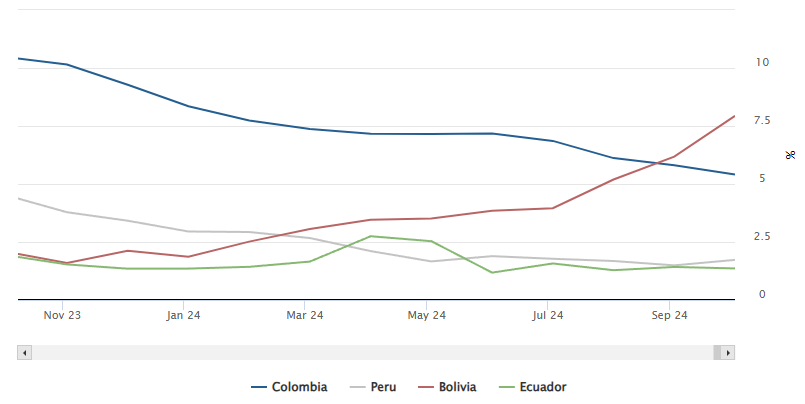
    Andean countries: inflation rate
    Percentage variation (year-on-year)

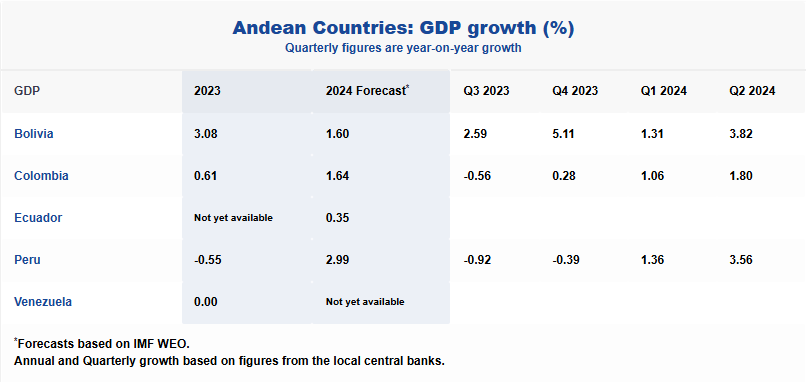
    Andean countries: GDP growth (%)
    Quarterly figures are year-on-year growth

  • ECONOMIC HIGHLIGHTS

    Abbi Dicker 16 October 2026 Hits: 474

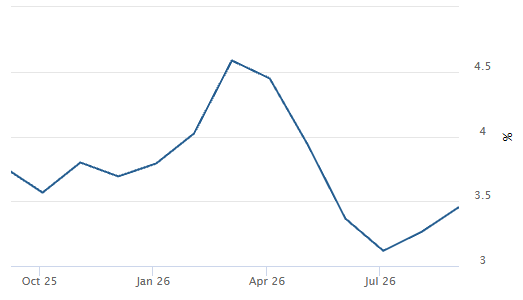
    MEXICO | Inflation edges up. On 8 October Mexico’s national statistics institute (Inegi) released new figures for its consumer price index, showing a monthly inflation rate of 0.42% in September, while annual inflation stood at 3.45%. This was up from monthly inflation of 0.20% in August and 0.03% in July. Annual inflation is also up from 3.26% in August and 3.12% in July. Core inflation, which excludes volatile items such as food and energy, stood at 0.20% in monthly terms, up from 0.16% in August, and 3.75% in annual terms, which is down from 3.88% the previous month. The latest figures came as the central bank (Banxico) held its benchmark interest rate at 6.50% for the third consecutive occasion in September.

    MEXICO | GFCF rises. On 5 October Mexico’s national statistics institute (Inegi) announced that gross fixed capital formation (GFCF) increased by 6% in year-on-year terms in July and by 1.4% in monthly terms. This followed a 1.3% monthly increase in June and 0.4% contraction in May. The annual increase followed those of 5.8% in June and 2.4% in May. The annual rise in July was the result of a 6.9% increase in construction investment, while investment in equipment and machinery was up by 4.9%. The monthly increase was driven by a 4.5% rise in investment in machinery and equipment, which was somewhat offset by a 1.5% drop in construction investment.

    MEXICO | Remittances down in August. On 1 October Mexico’s central bank (Banxico) announced that the country received US$5.45bn in remittances in August, down 3.6% year-on-year. The August remittance amount was also down on US$5.57bn received in July. However, in the first eight months of the year, remittances totalled US$41.8bn, up 2.2% year-on-year from the US$40.9bn received in the same period of 2025. This comes despite the US tax on remittance cash transfers.

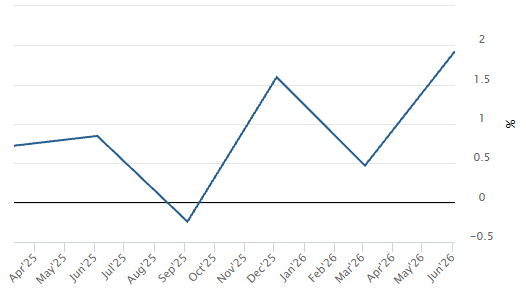
    Mexico: GDP growth
    Percentage variation (year-on-year)

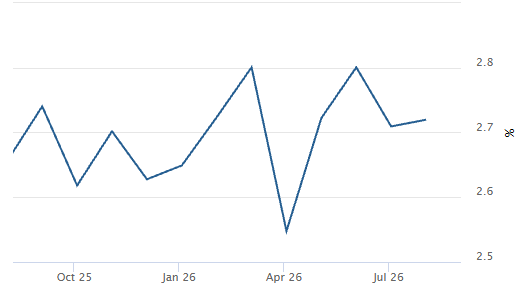
    Mexico: unemployment rate
    Economically active population

    Mexico: inflation rate
    Percentage variation (year-on-year)