
All Categories

Subcategories

  • BRAZIL: Government takes aim at online betting

    Abbi Dicker 15 November 2024 Hits: 1252

    The administration of President Luiz Inácio Lula da Silva in Brazil has launched a regulatory crackdown on online betting sites, including some that sponsor the country’s most famous football clubs.

    In mid-October, Brazil’s telecoms regulator (Anatel) began blocking over 2,000 betting websites in compliance with a directive from the finance ministry. The gambling platforms were found to be falling short of new regulations that require them, among other things, to pay a R$30m (US$5.3m) licence and actively combat potential illegal activities.

    Authorities have linked some betting sites to illegal financial activities, alleged money laundering, and suspected sports fraud, and they argue that predatory advertising and ‘easy credit’ help foment dependency. “We want to protect the bettor’s mental, financial, and physical health, preventing the activities of companies that use sports betting and online gaming as a means of committing fraud and money laundering,” said Regis Dudena, under-secretary of lotteries and betting at the finance ministry.

    Among the companies that were initially blacklisted was Esportes Gaming Brasil, which controls Esportes da Sorte betting site, the sponsor of São Paulo’s Corinthians, Athletico Paranaense from Curitiba, Gremio of Porto Alegre, and Salvador-based Bahia football teams.

    Esportes Gaming later won a court order to be exempt from the ban, citing a legal loophole for betting agencies that have previously been authorised by the Rio de Janeiro lottery, Loterj. That and three other exemptions increased the number of companies permitted to continue operating from 96 to 100. The group was deemed to have complied with all the new rules established by the finance ministry.

    Historic ban

    Brazil has had a tumultuous past with betting, both formal and informal. Traditional gambling in casinos and gaming parlours was prohibited in 1946, with the last game of roulette reportedly having taken place in the Copacabana Palace in April of that year. While the general prohibition continued, underground gambling flourished. The most popular game became Jogo do Bicho, a simple lottery-style game. Its operators, or ‘bicheiros’, over the years have built up considerable power and wealth. They have financed samba schools and football clubs, and branched out to run slot machines, bingo, and poker in clandestine betting parlours.

    Over the years a few exceptions to the ban were introduced. Non-commercial bingo was legalised in 1971, horse racing and associated betting in 1984, and state-run lotteries in 1996. More recently Brazilians started turning to foreign-owned online betting services and in 2018 congress passed legislation authorising fixed-odds sports betting. The problem was that the government never regulated the law, essentially allowing the nascent industry to mushroom out of control into what Finance Minister Fernando Haddad has called a “national pandemic”.

    President Lula likened the spread of gambling to a dependency that was detrimental to consumers’ financial health. “There are a lot of people getting into debt, spending what they don’t have,” Lula said at the presidential palace days before the enforcement of the new regulations was announced. “We think this has to be treated like an addiction, that is, people are dependent, they are addicted.”

    Beyond the government’s concern for its citizens, it has an eye on the potential tax revenue from an industry worth tens of billions of reais. Authorities and business leaders are also concerned that the boom of online betting could be undermining the country’s economic activity itself.

    The argument is that money spent on betting goes to a few operators of online portals that become wealthy, and no longer goes to buy goods and services that are produced locally and involve an entire supply and distribution chain. According to the Confederação Nacional de Comércio (CNC), the national retailers lobby, retailers had annual damages of R$117bn due to consumer spending on online bets.

    So, in December 2023 government-sponsored regulations were finally passed by congress, establishing a 12% tax on profit in addition to regular corporate income taxes. Users must pay a 15% tax on their winning income. Betting sites, which are now required to be incorporated in Brazil, must inform customers about the financial risks of losing bets and about pathological gambling. They must provide customer service channels free of charge, screen their customers, and use payment services authorised by the central bank.

    A series of events then prompted the government to accelerate its regulatory crackdown. In early September a high-profile police raid in five states made nationwide headlines when public figures such as influencer Deolane Bezerra and Darwin Henrique da Silva Filho, chief executive of Esportes da Sorte, were arrested. In all there were 19 arrest warrants. Police were investigating alleged money laundering through shell companies, and they confiscated planes, helicopters, luxury goods, and jewels. Bezerra and da Silva denied any wrongdoing.

    Another turning point that pushed the Lula administration to take more decisive action was a central bank study later in September that suggested billions of reais of government aid paid to low-income families under the Bolsa Família welfare programme was being used for online betting. In August alone, 5m Bolsa Familia recipients spent R$3bn, or 20% of what the programme spends each month, according to the report requested by Senator Omar Aziz. The actual number could be much higher, as the study was based only on transfers made from mobile phones and didn’t include credit cards or bank transfers.

    “These results are in line with other surveys that point to low-income families as those most affected by sports betting activity,” the central bank study said. “It is reasonable to assume that the commercial appeal of getting rich through gambling is more attractive to those in a situation of financial vulnerability.”

    Congressional probes

    The government hasn’t been alone in its efforts to shed light on the darker side of the betting industry. In October, the senate voted in favour of a parliamentary inquiry (CPI) that is to probe “the growing influence of virtual online betting games on the budget of Brazilian families”.

    Average citizens usually don’t know who is behind these betting sites, how their algorithms work, and what their relationship is to VIPs promoting their service, said Senator Soraya Thronicke of Mato Grosso do Sul, one of the proponents of the CPI. “The people need to know about the risks and the threats,” she added.

    A second congressional inquiry in the lower house of congress has been looking into allegations that bribes have been paid in an attempt to rig or influence the outcome of games for betting purposes. For months the CPI has been seeking the testimony of Bezerra as well as West Ham midfielder Lucas Paquetá, who has been accused by the English Football Association of committing intentional fouls to try to influence the betting market.

    Privatisation

    In another tectonic shift for Brazil’s betting industry, the São Paulo state lottery service was sold for R$600m on 1 November to a consortium called Aposta Vencedora (or winning wager). The bid was 14% above that of the runner up and 130% over the minimum price. São Paulo state governor Tarcísio de Freitas, considered by some to be the political heir to former President Jair Bolsonaro (2019-2023), has been on a privatisation drive that could help him boost government spending ahead of a potential presidential bid in 2026. Following the sale of the state’s water company, Sabesp, the Freitas administration in October carried out a series of public tenders, including motorways to be managed by the private sector. The concession for the maintenance of school buildings was halted by a court injunction requested by the São Paulo union of teachers.
  • VENEZUELA: Ratcheting up the pressure on Machado

    Patrick de Courcy 05 December 2024 Hits: 1825

    Venezuela’s opposition figurehead María Corina Machado has accused the authorities of carrying out a campaign of harassment against her mother. This, the latest apparent effort by President Nicolás Maduro’s government to intimidate Machado into silence, comes as there is growing concern over the fate of six dissidents being sheltered in the Argentine embassy in Caracas.

    Machado said on 1 December that her 84-year-old mother is being repeatedly targeted with harassment by “agents of the regime”, who she said have appeared at her mother’s house multiple times per day, arriving “armed, hooded, and with sirens blaring”. Machado has resisted pressure from the Maduro government to go into exile, following the lead of Edmundo González, the opposition candidate widely believed to have won the 28 July presidential election.

    The government has so far appeared to view arresting Machado as too provocative a move. Unlike González, she has not been targeted with an arrest warrant despite being investigated for a long list of alleged crimes.

    At the same time as the authorities are stepping up their intimidation campaign against Machado, they are also making increasingly threatening moves against the opposition fugitives holed up inside the Argentine embassy in Caracas. This has been under Brazilian custody since Argentina’s diplomatic staff were expelled in July.

    On 4 December Machado denounced the growing presence of soldiers and police outside the embassy, which she said could indicate an “eventual incursion”. The dissidents inside the embassy say that the water and electricity supply have been cut off in an effort to force them out, and that streets around the compound have been closed off to prevent water deliveries.

    Maduro offers to help Trump on security

    President Maduro is bracing for a potentially combative relationship with US President-elect Donald Trump, given how US-Venezuela relations plumbed new depths during Trump’s first term (2017-2021). However, on 2 December Maduro offered to lend his “experience” in security matters to the Trump administration.  “With the experience that we have, in which we have achieved a great space for peace and coexistence, freed Venezuela from these criminal gangs, we can work with the government of the United States and American society in a climate of cooperation for peace and internal security”, he said. Maduro said that the current US administration of President Joe Biden “did not want to work seriously” with Venezuela on this issue.

  • CHILE: Kast popularity crunch

    Abbi Dicker 02 April 2026 Hits: 1279

    In his first two weeks in office, Chile’s far-right President José Antonio Kast has seen his opinion poll ratings plunge abruptly. Much of the decline in popularity can be attributed to his government’s response to the war in Iran – dramatically pushing up domestic petrol and diesel prices. In a reminder of previous strife to afflict the country, students and others came out on the streets to protest.

    Two early opinion polls make worrisome reading for the new government. Pulso Ciudadano found that, in his first 18 days in office, President Kast’s approval rating had nosedived by nearly 13 percentage points to 34.7% while his disapproval rating had risen by 22 percentage points to 48.7%. Cadem, another local pollster, said that Kast’s approval rating had fallen by 14 percentage points in the first two weeks of his term to 43%, while his disapproval rating had risen 15 points to 51%.

    Parallels can be drawn with Kast’s immediate predecessor on the opposite side of the political spectrum, Gabriel Boric (2022-2026), whose approval rating also got hammered in his first few weeks in office. Both are seen as leading relatively inexperienced administrations lacking a congressional majority and prone to policy inconsistencies.

    An early example of this is that, in spite of high-profile campaign claims that Chile is experiencing a “national emergency” and must spend more on security and on fighting crime, it transpired that the new government was actually seeking to cut annual security ministry spending, much of it by the police force, by US$77.6m as part of an early austerity drive. The public security minister, Trinidad Steinert, had to abruptly change direction and promise an injection of “fresh resources”.

    But the real popularity-killing issue appears to be Kast’s decision on energy prices [WR-26-12]. Kast insisted that eliminating subsidies is the right thing to do. “Speaking the truth gives us peace of mind,” he said. “The alternative was to push the nation deeper into debt and that ends up costing more,” he added. However, opinion polling shows the public at large is unconvinced. According to Pulso Ciudadano a clear majority of 57.2% disagreed with the elimination of subsidies, with many favouring a more gradual approach. A similar majority (57.6%) disagrees with government rhetoric that Chile is “bankrupt”. On the other hand, Kast’s Border Shield programme designed to stop undocumented migrants is backed by a majority of 56.6%.  

    • Fuel prices

    Chile’s finance minister, Jorge Quiroz, announced that because of the conflict in the Middle East, the government would activate an escape clause in the fuel price stabilisation mechanism (Mepco), to bring domestic prices in line with those on international markets. To close down a subsidy of around US$140m a week, the government immediately increased the price of petrol by 32%, with diesel going up by 62%.

    The fuel price increases triggered the first street protests of the Kast presidency. There were long queues for petrol and diesel ahead of the price readjustment. On 26 March student-led demonstrations against the increase took place in central Santiago, with police responding with water cannon and pepper spray. The government announced some palliative measures to limit the impact on fuel for cooking and heating, and to subsidise bus, taxi, and school transport fares.

  • RASTREANDO TENDENCIAS

    LatinNews 18 July 2014 Hits: 580

    COLOMBIA | Presupuesto elaborado. La propuesta de presupuesto nacional 2015, elaborado por el gobierno del Presidente Juan Manuel Santos, fue aprobada el 10 de julio por el Consejo de Política Económica y Social (Conpes), un cuerpo asesor del Estado Colombiano. El borrador de la propuesta de presupuesto ahora pasara el recientemente electo congreso nacional, que abrirá sus sesiones el 20 de julio.

    Una declaración del ministerio de finanzas explica que el borrador de presupuesto de Col$167bi (US$89,82mm) está basado en una estimación de la toma fiscal de Col$126,2bi (US$67,55mm) para el próximo año, subiendo un 12% sobre la proyección para este año; y que ha sido diseñado para garantizar la sustentable tasa de crecimiento económico de Colombia de los últimos años, que le ha permitido al país convertirse en “la tercera economía más grande en América Latina”.

    El ministro de finanzas, Mauricio Cárdenas, quien recientemente ha sido ratificado en su puesto por el Presidente Santos después de que éste ganara la reelección por un segundo periodo el mes pasado, dijo que el presupuesto “refleja el compromiso del gobierno de poner el énfasis en el desarrollo socioeconómico, donde la creación de empleos es una prioridad junto con la seguridad y la igualdad”.

    El borrador del presupuesto prevé una inversión pública cercana al nivel record logrado el año pasado de Col$46bi (US$27,74mm). Cárdenas también reveló que el presupuesto asigna Col$28bi (US$15mm) para el sector de la defensa nacional, en general el mismo nivel asignado al sector este año, y Col$28,4bi (US$15,26mm) al sector de la educación, subiendo un 5,3% por sobre el de este año.

    Por otro lado la agencia de promoción de las ciencias, tecnología, e innovación del país (Colciencias) vio un incremento del 0,2% en su asignación en el presupuesto a Col$379mm (US$202m) en el 2015. Esto fue interesante, debido a que la directora de Colciencias, Paula Marcia Arias, fue destituida la semana pasada después de que públicamente expresara sus temores acerca de un inminente recorte en el presupuesto para la agencia. Tanto Cárdenas como Santos se sintieron compelidos a negar públicamente el recorte en el presupuesto ante las extendidas críticas.

  • CHILE: Students threaten fresh unrest

    LatinNews 05 April 2018 Hits: 2022

    With President Sebastián Piñera yet to complete a month in office, a ruling by Chile’s constitutional court (TC) last week, striking down part of the higher education reform passed by his predecessor Michelle Bachelet (2006-2010; 2014-2018), is threatening fresh unrest from students. It comes amid other concerns regarding efforts by Piñera’s right-of-centre Chile Vamos coalition government to row back on initiatives promoted under the previous Nueva Mayoría (NM) coalition government.

    While the TC ruling, which was announced on 27 March, is due to be published in its entirety on 26 April, the local media is reporting that it has struck down a provision that would have banned universities and higher education institutions from operating for profit. Along with constitutional reform and fiscal reform, free higher education was one of Bachelet’s three chief electoral promises – a response to the repeated student unrest which took place during Piñera’s previous term in office (2010-2014). The TC’s ruling deals a blow to this pledge.

    With Bachelet herself tweeting that the TC ruling “distorts the democratic decision to eliminate profit from higher education”, it has prompted outrage from NM, with presidents of both chambers of congress, Senator Carlos Montes and Deputy Maya Fernández (both from Bachelet’s Partido Socialista), complaining that it was in breach of the “sovereign will expressed in congress” and is “damaging to democracy”.

    Students and academics alike have similarly responded with anger. Sandra Beltrami, a spokesperson for the university student organisation Confederación de Estudiantes de Chile (Confech), said it would cause “enormous damage” to Chilean education – a view which has been shared publicly by university deans such as Juan Manuel Zolezzi, of the Universidad de Santiago (Usach). Along with the secondary school organisation Coordinadora Nacionales de Estudiantes Secundarios (Cones), Confech has already called demonstrations for 19 April to protest against the TC’s ruling.

    Abortion law

    Having already revealed plans to shelve Michelle Bachelet’s proposed draft constitution, which she sent down in the final stages of her mandate [WR-18-11], President Piñera has also faced criticism over changes to abortion legislation passed by his predecessor in 2017 which decriminalised abortion when the pregnancy is a result of rape or incest, when the life of the pregnant woman is at risk, and in cases of fatal foetal impairment. Prior to the changes passed by Bachelet (which it is worth pointing out had public support), Chile had been one of the few countries in the world with a total ban on abortion after legislation introduced during the military dictatorship led by General Augusto Pinochet (1973-1990) made it punishable by up to five years in prison.

    • Support for abortion

    A survey published last year by Chilean pollster Cadem revealed that 70% of respondents were in agreement with the decision by the constitutional court (TC) to dismiss challenges filed against the proposed legislation decriminalising abortion in three cases, which paved the way for it to be signed into law.

    Having publicly taken a pro-life stance, however, on 23 March Piñera announced changes to the conscientious objection protocol, which gives institutions the right to refuse to perform the procedure.

    Assurances by Health Minister Emilio Santelices that “nothing will affect the law nor its regulation, nor women’s right of access to an abortion” have failed to convince the opposition or women’s rights groups. A string of former ministers from the previous administration – Paula Narváez (government spokesperson), Claudia Pascual (women’s minister), Carmen Castillo (health), and Gabriel de la Fuente (secretary general for the presidency) – all condemned the changes which Karol Cariola, a national deputy for the Partido Comunista de Chile (PCCh), described as an “ideological and antidemocratic boycott by the current government”.

  • PARAGUAY: CDE by-election produces unexpected result

    LatinNews 09 May 2019 Hits: 1173

    Miguel Prieto was declared the virtual winner of the 5 May mayoral by-election held in Ciudad del Este (CDE), Paraguay’s second city. Prieto an independent candidate running for the Movimiento Conciencia Democrática del Este local political movement is poised to become the first mayor of the city not to be belong to the traditionally and nationally ruling Asociación Nacional Republicana-Partido Colorado (ANR-PC). The electoral result has been hailed as a major victory in the fight against government corruption and sparked hope that it would send a clear message to the ANR-PC and the country’s other traditional political parties that they should clean up their act or lose their electoral support.

    A by-election was held in CDE after the previous elected mayor, the ANR-PC’s Sandra McLeod, was dismissed by the national chamber of deputies in February [WR-19-06]. Congress’ unprecedented decision came after the long-serving McLeod was accused of gross corruption and mismanagement of the municipal administration that had forced the national government led by President Mario Abdo Benítez to intervene and appoint a caretaker mayor to restore order in CDE. The political relevance of the CDE seat meant that the main national political parties selected candidates to compete in the by-election and campaigned intensely.

    This included the ANR-PC, which had held sway in the CDE since the city was founded in 1957, and which remains bitterly divided between the factions that answer to Abdo Benítez (Abdistas) and those that answer to his predecessor (2013-2018), Horacio Cartes (Cartistas). In fact, these internal divisions played a major role in the political crisis that led to Cartista McLeod’s dismissal as the Abdista national deputies voted along with the opposition to dismiss her. Yet despite the deep divisions within the ANR-PC it was widely expected that the ruling party would retain the seat after it managed to coalesce around a single candidate, Abdista Wilberto Cabañas.

    But in the event Prieto, a young independent CDE councillor who founded the Movimiento Conciencia Democrática del Este to contest the election and campaigned on an anti-corruption platform, secured a surprising but convincing victory in the polls. Prieto was declared the virtual winner by the electoral authorities after he obtained 44.6% of the preliminary vote count to 39.2% for Cabañas. With Cabañas having already admitted defeat Prieto is poised to take office to conclude McLeod’s term ending in 2020. Prieto’s unlikely electoral victory has been widely celebrated in CDE and in Paraguay as a sign of positive change that will help to reinforce the idea that government corruption will no longer be tolerated by voters.

    In a sign that this message has struck a chord with national political leaders, on 6 May Abdo Benítez congratulated Prieto himself and acknowledged that he had been able to interpret the CDE’s electorate demand for a positive change in the municipal government. In addition, while Abdista and Cartista leaders were quick to blame each other for the party’s historic defeat in CDE, Abdo Benítez said that the party, and himself included, should reflect on the result and understand that voters now demand more from political parties and politicians. “People are less committed to parties and more committed to [political] projects that can generate positive change”, Abdo Benítez said. He added that the ANR-PC’s challenge now is to offer this to the electorate and recover its unity without losing its identity. Next year’s municipal and departmental elections will provide an opportunity for the ANR-PC and other political parties in general to show that they can change and that they can once again recover the electorate’s trust.

    • PLRA also punished

    The ANR-PC was not the only traditional party to be snubbed by the electorate in the CDE by-election. The main opposition Partido Liberal Radical Auténtico (PLRA) also had a poor showing in the poll with its candidate, Teodoro ‘Teddy’ Mercado, coming in a distant third with 13.4% of the vote. Commenting on the poor result in an election in which the PLRA was in a good position to capitalise on the discontent with the ANR-PC administration, the PLRA’s main leader, Efraín Alegre, said that in his view the PLRA had failed to present itself as “a clear anti-corruption alternative” and that voters had punished the party for having a working relationship with the ANR-PC executive.

  • Governance

    LatinNews 12 November 2019 Hits: 322

    On various measures of good governance, Guyana ranks poorly alongside its Caribbean contemporaries.

    For instance, in the World Bank’s ‘Ease of doing business’ index, it ranks 134 out of 190, with only St Kitts & Nevis (140) and Grenada (147) ranking lower. On the World Justice Project’s Rule of Law index, only Belize (86) ranks lower than Guyana (75). And on Transparency International’s Corruption Perceptions Index for 2018, Guyana ranked 93 out of 180 with a score of 37 out of 100. The next worse in the Caribbean region is Trinidad & Tobago, which ranks 78 with a score of 41. However, Belize, Antigua & Barbuda, and St Kitts & Nevis are not included in this index.

      Ease of doing business Rule of Law Corruption perceptions index 2018
      2018 Ranking/190 Ranking/126 Ranking/180 & Score/100
    Antigua & Barbuda 112 33 n/a
    The Bahamas 118 39 29/65
    Barbados 129 29 25/68
    Belize 125 86 n/a
    Dominica 103 45 45/57
    Grenada 147 43 53/52
    Guyana 134 75 93/37
    Jamaica 75 50 70/44
    St Kitts & Nevis 140 30 n/a
    St Lucia 93 38 50/55
    St Vincent & the Grenadines 130 35 41/58
    Trinidad & Tobago 105 55 78/41

    Guyana scores much better when it comes to crime, or at least to murder. Of the 12 independent countries of the English-speaking Caribbean, Guyana ranks ninth with a murder rate of 17.0 per 100,000. Only Grenada (13.3), Antigua & Barbuda (11.2), and Barbados (7.4) are better.

    Those with worse murder rates than Guyana are Belize (44.7), Jamaica (39.3), St Kitts & Nevis (33.6), The Bahamas (29.8), Trinidad & Tobago (28.3), St Vincent & the Grenadines (25.6), St Lucia (21.6), and Dominica (21.1).

  • ECONOMIC HIGHLIGHTS

    LatinNews 15 July 2020 Hits: 1991

    GUATEMALA | Operations suspended at ‘Fénix’ nickel mine. On 19 June Guatemala’s constitutional court (CC) upheld an earlier ruling ordering the suspension of the ‘Fénix’ nickel mine in El Estor municipality, Izabal department, on the grounds that it violates the right to consultation with local communities. Run by the Compañía Guatemalteca de Níquel (CGN), a subsidiary of Swiss-based Solway Investment Group, the Fénix mining project was announced in 2014 with US$1.5bn investment and predicted to create over 5,000 local jobs with the exploitation license granted by Guatemala’s energy & mines ministry (MEM) in April 2016. The CC had already suspended CGN’s licence for the Fénix site in July 2019, pending its final decision. However, CGN was not ordered to stop operations by the government and had continued to extract ore until the court issued its final ruling on 19 June. In its latest ruling the CC also ordered the government to reduce the size of the CGN concession from 248km2 to 6.27km2, as this is the only area covered by the company’s incomplete environmental study. Mining in this restricted area is also prohibited until the consultation with the local community has been carried out. The CC’s decision follows similar rulings against the Canadian-owned Escobal silver mine in 2017 and the US-owned ‘El Tambor’ gold mine in 2016, also for failing to consult with local indigenous populations. In 1996 Guatemala ratified Convention 169 of the International Labour Organization (ILO), which entitles indigenous communities to free, prior and informed consent before the commencement of development projects that will directly impact them. 

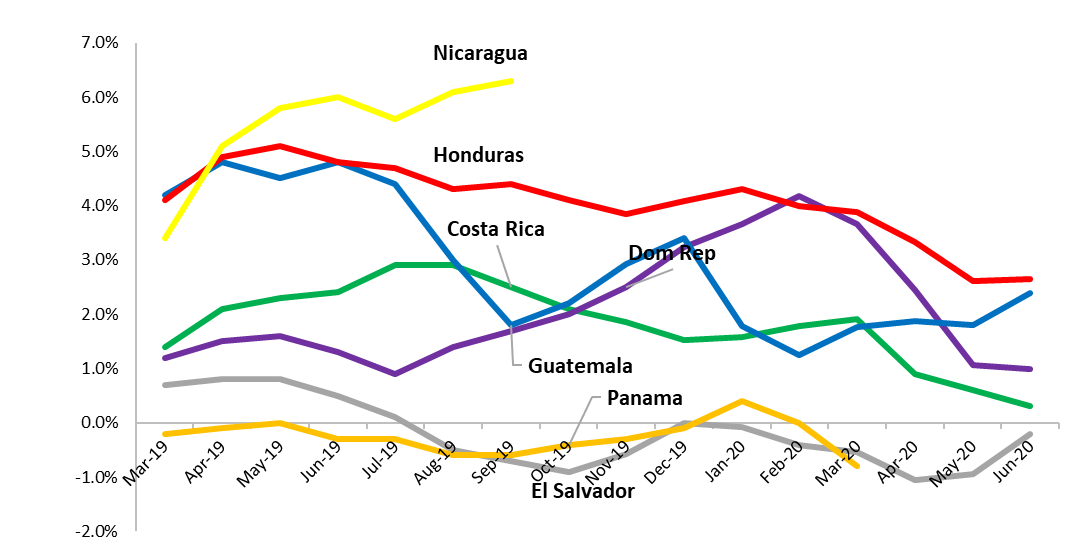
    Central America & Caribbean:​ Inflation
    Monthly year-on-year figures

    Central America & Caribbean, selected countries: GDP growth (%)
    Quarterly figures are year-on-year growth
    GDP  end 2019* 2020 forecast** Q2 2019 Q3 2019 Q4 2019 Q1 2020
    Costa Rica 2.1 -3.6 1.4 1.9 2.9 0.8
    Dominican Republic 5.1 0.0 3.7 4.8 5.8 0.0
    El Salvador 2.4 -3.0 2.0 2.7 3.0 0.8
    Guatemala 3.5 -1.3 3.5 4.0 3.9 not yet available
    Honduras 2.7 -2.8 1.9 2.4 2.5 -1.5
    Nicaragua -3.9 -5.9 -3.1 -2.9 -0.2 1.8
    Panama 3 -2 2.9 2.7 3.3 0.4
    *Figures from local central banks **Figures from the United Nations Economic Commission for Latin America & Caribbean April 2019
    Quarterly growth based on figures from the local central banks


  • Drugs and crime

    LatinNews 09 October 2020 Hits: 998

    For over 40 years successive US administrations have sought to counter drug production and trafficking in Latin America and Caribbean, and the smuggling of illicit drugs into the United States. The results have been mixed, for reasons linked to conditions in both the drug-producing and drug-consuming countries. In the producing countries high levels of poverty, inequality, unemployment, and social hardship have made it hard to resist the very high profits to be made by drug production and sale. In the consuming countries – mainly in this case in the United States – addiction has been deep rooted, leading to highly price-inelastic demand for drugs. As a result, while the power of different drug cartels has waxed and waned, and governments have experimented with differing antinarcotics policies (from hard-line policing through to a greater concern to tackle underlying causes and offering a public health approach to addiction) the business itself has proven to be extremely resilient.

    At present LAC is a key source and transit zone for cocaine, marijuana, methamphetamines, opiates, and opioids such as heroin and fentanyl. Heroin/fentanyl related deaths in the US have reached epidemic levels. Rising demand has prompted rising drug production in Mexico and Colombia. Over 90% of US heroin consumption is smuggled in through Mexico, and 80% of cocaine on the US market originates in Colombia. In April 2019 China began to impose tighter controls on local production of fentanyl, prompting increased illicit manufacture of the drug in Mexico.

    While most key regional governments have collaborated with US anti-narcotics efforts, some like Venezuela have not. Mexico has seen power shifts between rival cartels, with the Sinaloa cartel losing influence to the Jalisco-based CJNG (Cartel Jalisco Nueva Generación). In the Central American republics, the dominant criminal gangs, Mara Salvatrucha (MS-13) and Calle 18, originally emerged among immigrant communities in southern California in the 1980s. They remain powerful.

    Drug seizures by US Customs and Border Protection (measured in lbs)

      FY 14 FY 15 FY 16 FY 17 FY 18 FY 19
    Cocaine 45,323 38,346 52,838 62,415 51,592 89,207
    Heroin 4,356 6,023 4,224 3,398 5,205 5,427
    Marijuana 438,146 602,821 516,122 366,627 299.419 289,529
    Methamphetamine 19,613 25,495 33,086 46,247 57,440 68,585
    Fentanyl  n/a 70 596 1,875 1,895 2,545

    Source: U.S. Customs and Border Protection

    Throughout the region the high incidence drugs and crime poses an intractable problem, fuelling violence in producer countries and rising drug-related deaths in US cities. The drugs debate has traditionally led to recriminations, with the US accusing Latin America of not doing enough to stop production, and Latin America countering that the real problem is the US failure to restrict demand.

    During his presidency Donald Trump has aligned himself with those who favour a hard-line attack on drug trafficking and criminal gangs. However, much of this positioning has been more rhetorical than effective. While existing security cooperation programmes such as the Mérida Initiative in Mexico or the Caribbean Basin Security Initiative (CBSI) continue, a Congressional Research Service (CRS) report has noted that the Trump Administration “has sought to reduce funding for each US security assistance programme and has reprogrammed, withheld, or not yet obligated significant portions of assistance to Central America due to concerns that those governments have not adequately curbed unauthorised migration”.

    Much of the president’s rhetoric has also been based on the symbolic building of a border wall on the frontier with Mexico, which is physically incomplete and which would likely not reduce smuggling as most drugs that are smuggled into the US come in through existing ports of entry. In Colombia the Trump administration has expressed support for a resumption of aerial spraying of coca crops, a practice suspended since 2016 because of concern over the impact of glyphosates on the health of rural communities.

    It is highly improbable that a Biden presidency would be able to rapidly fix the deeply embedded hemispheric problems of drugs and crime, which have resisted the attentions of multiple Latin American governments as well as successive Democratic and Republican party administrations in the US. Biden has promised a less transactional more integrated approach and has shown particular interest in tackling the link between drugs, crime, and emigration in the Northern Triangle countries of Central America (El Salvador, Guatemala, and Honduras). He has argued that reducing crime and providing local employment is a better way to reduce illicit migration to the US. Biden proposes an integrated US$4bn regional strategy for the Northern Triangle – a significant increase on current US spending in the region.

  • ECUADOR: Lasso threatens to dissolve legislature

    Patrick de Courcy 20 April 2023 Hits: 4188

    Sabre-rattling between Ecuador’s President Guillermo Lasso and the national assembly has reached new heights after Lasso told the UK’s Financial Times that he would dissolve the legislature if it convenes an impeachment trial against him.

    In the Financial Times interview, which was published on 18 April, President Lasso said that he was “not ruling out” winning the support of enough legislators to survive an impeachment motion which is currently being processed by the national assembly’s auditing commission [WR-23-13]. However, he acknowledged that this was not “the most probable scenario”. Asked whether he was considering invoking the constitution’s ‘muerte cruzada’ clause, which authorises the president to dissolve the national assembly and convene snap general elections, Lasso said: “correct – that is what I declare”.

    Lasso’s chances of winning such an election are remote, with his approval rating hovering in the low 20s, although he would face better odds with the public than in an impeachment trial, given the extent to which deputies have turned on him in recent months [WR-23-10]. Previous suggestions from the government that he could invoke the muerte cruzada have largely been interpreted as an attempt to pressure legislators who fear that they could also lose their seats in a snap vote. Nevertheless, Lasso said that he would fight to hold onto the presidency, saying that “I have a duty to voters; I will be a candidate”.

    The threat to dissolve the legislature was condemned by the president of the national assembly, Virgilio Saquicela, who accused Lasso of “abusing the law and the constitution”. Saquicela noted that the constitution permits the dissolution of the legislature in the event of “severe political crisis or domestic unrest”, and asked “why not do it today, why wait until the last minute to see if he has the votes or not?”

    Speculation over possible snap elections is mounting as the auditing commission prepares to issue a report outlining whether the impeachment motion should advance to a political trial. The commission began hearing arguments on 18 April, kicking off with testimonies from Lasso’s former anti-corruption secretary, Luis Verdesoto, and former legal secretary general, Fabián Pozo. Verdesoto’s statement did not do Lasso any favours; he said that he had resigned in January after raising concerns with Lasso over allegedly widespread corruption in state companies [WR-23-03]. Pozo, on the other hand, argued that there is no legal precedent for Lasso to be impeached given that the president has not himself been accused of corruption, and is instead accused of embezzlement ‘by omission’ in relation to his alleged tolerance of corruption in his government, and indeed in his own family. The testimonies are expected to continue until 28 April, after which the auditing commission will present a report outlining whether or not it believes there are grounds for an impeachment trial.

    Lasso’s brother-in-law detained

    The attorney general’s office announced on 18 April that President Lasso’s brother-in-law, Danilo Carrera Drouet, had been temporarily detained at Guayaquil airport while attempting to leave the country. Carrera is under investigation for his alleged involvement in a corruption racket in several state companies [WR-23-03]. He later released a statement saying that he had been held for eight hours and required to testify to prosecutors before his release. Describing his detention as an “outrage”, Carrera said that he had been travelling to Brazil in his capacity as president of the Ecuadorean tennis federation.

    Prison massacre

    In the latest in a string of massacres in Ecuador’s prison system, 12 inmates were killed at the Penitenciaría del Litoral in Guayaquil on 15 April. The prison has been the site of repeated bloodshed amid a vicious gang war for control of drug trafficking routes to Guayaquil’s port. The minister for government, Henry Cucalón, said on 18 April that Ecuador is being subjected to “an unprecedented wave of terrorism”, and argued for a constitutional reform to allow the armed forces’ permanent involvement in the battle against organised crime, which is currently only authorised under states of exception.

  • MEXICO: Vulcan Materials dispute rumbles on

    Abbi Dicker 21 June 2024 Hits: 2287

    On 28 May US construction firm Vulcan Materials released a statement condemning the Mexican government for its continued shutdown of its deepwater port and limestone quarry in Quintana Roo state.

    The site was shut down in May 2022 amid allegations of environmental damage, a move which Vulcan claims is an attempt to force it to sell its assets in Mexico. Negotiations with the government are ongoing, with the government reportedly offering the company US$360m, but the war of words has escalated in the absence of a deal and Vulcan has accused López Obrador of “illegal expropriation”. 

    “The truth is that at no time have we received a ‘generous offer’ to buy our property,” the company said in the statement. “We were given an informal appraisal, without signatures and without details, that substantially undervalues our assets, including the limestone reserves that we own under Mexican law, as well as the only deep draft port in the region.” Vulcan is reportedly seeking compensation worth US$1.5bn for its assets.

    Vulcan’s statement followed comments from López Obrador a week prior in which he denied that he would expropriate the company’s assets but promised that the quarry would remain closed as long as he is president citing violations of Mexican law. In March, Bloomberg reported that anonymous sources had said that the Mexican government was planning to declare the land a natural protected area, which would prevent any further limestone extraction. However, it is not clear whether this is just a negotiating tactic.

    Vulcan has asked for protection from US President Joe Biden, and the company has considerable sway in Washington due to the size of its operations. López Obrador’s latest comments came after US Secretary of State Antony Blinken told the US Senate Foreign Relations Committee on 21 May that while he could not comment on this particular case, “such instances very much negatively impact Mexico’s efforts to attract investment from the US and elsewhere”. 

    This is the latest stage in a dispute that has been rumbling on since 2018, when Vulcan initiated proceedings before the World Bank’s International Centre for Settlement of Investment Disputes (ICSID). While both sides have indicated a willingness to reach a deal, their valuations remain miles apart. Looking ahead, it appears that there may be some movement in August, when López Obrador has said that ICSID is expected to hand down a ruling.

    US response

    The Vulcan materials case has also become politicised and drawn the attention of US lawmakers, a group of whom wrote a letter to Mexico’s Foreign Minister Alicia Bárcena on 9 May asking her to intervene in the dispute. It also threatened that “should Vulcan’s land and port be seized, we will use all the powers at our disposal, including legislative remedies, to ensure no entity or individual will benefit from the theft of Vulcan’s property”. 

    The cost of insecurity

    A May report from the Institute for Economic & Peace (IEP), a think tank headquartered in Australia with a local office in Mexico City, has calculated that violence had an economic impact equivalent to over 18% of GDP in Mexico last year. This equates to M$37,430 (US$2,009) per capita, more than double the average monthly salary for a Mexican worker. According to the IEP’s Mexico Peace Index, the economic impact of violence fell by 1% last year, and it has fallen in each of the last four years. The IEP underlines that spending on domestic security and the criminal justice system is equivalent to just 0.65% of GDP, less than half the average for Latin America. Mexico currently has just 4.4 judges and magistrates per 100,000 people, a quarter of the global average. The IEP recommends boosting investment in the judicial system to address crime and reduce impunity. 

  • TRACKING TRENDS

    Abbi Dicker 29 January 2026 Hits: 1034

    BRAZIL | Central bank holds interest rates again. The monetary policy committee (Copom) of Brazil’s central bank (BCB) decided on 28 January to hold the country’s benchmark interest rate (Selic) at 15.0%. This interest rate decision marks the fifth consecutive meeting in which the Selic has been maintained.

    The latest Copom statement reiterated the hawkish tone of previous statements, highlighting various inflationary risks and calling for caution, but it also suggested the possibility of rate cuts on the horizon. The committee expects to “begin the loosening of monetary policy in its next meeting”, which is due to take place from 17-18 March.

    URUGUAY | Orsi to visit China. Uruguay’s President Yamandú Orsi will depart for a week-long state visit to China on 1 February at the head of a large trade delegation. It will be Orsi’s first visit to the country since he took office in March 2025.

    Orsi received the vice premier, Ding Xuexiang, in Montevideo last November to discuss deepening economic cooperation and bilateral trade and to pave the way for the state visit to China during which he will hold talks with President Xi Jinping.

    China has been Uruguay’s principal trading partner for over a decade now, and the main destination for key exports, such as cellulose, beef, and soya. Almost a quarter of Uruguay’s total exports went to China in 2024, which explains why for some time Uruguay has been pushing for a relaxation of the internal regulations of the Mercosur trade bloc that prevent member states from negotiating a bilateral free trade agreement (FTA) with third parties. Across the River Plate, Uruguay’s large Mercosur neighbour Argentina is also seeking an FTA but with the US. Either one of these deals could fracture the bloc.

  • BELIZE: Border tension with Guatemala “at an all-time high”

    LatinNews 13 April 2016 Hits: 1368

    Recently there had been signs that Belize and Guatemala could be heading towards a resolution of their territorial dispute via the International Court of Justice (ICJ) at The Hague. But the two have yet to agree a referral to the ICJ (which would be dependent on first successfully holding enabling referendums in each country), and now the dispute about where the boundary runs along the Sarstoon River in the south of Belize has flared up again.

    Guatemala, which gained independence from Spain in 1821, recognised Belize in a treaty signed with Great Britain in 1859. But, in 1946, Guatemala declared that the treaty was void because Britain had not fulfilled various obligations to provide economic assistance.

    The current Belizean prime minister, Dean Barrow, declared in June 2008 that his highest political priority was to solve the dispute with Guatemala, and he proposed that both countries should hold referendums enabling them to refer the issue to the ICJ for adjudication.

    An agreement between the two countries was duly signed, committing both to holding simultaneous referendums in October 2013, but the agreement was suspended before the polls were held. Guatemala then indicated that it would go ahead with its referendum at the same time as the second round of voting in the 2015 presidential election, but again it did not happen.

    The latest flare-up came on 12 March when there was a confrontation along the Sarstoon River between the Guatemalan Armed Forces (GAF) and the Belize Defence Force (BDF). The BDF has been building a Forward Operating Base (FOB) in the area in order to combat illicit cross-border activities by Guatemalans, and on 12 March a GAF vessel apparently approached the FOB “in an extremely hostile and threatening manner”, according to a Belize government statement.

    The statement said that the GAF troops “insisted that our troops should not be at the Sarstoon”. However, the Belize forces stood their ground, and after a message was sent by Prime Minister Barrow to Guatemala’s President Jimmy Morales the Guatemalan forces withdrew.

    The seriousness of the incident was underlined by the Belize government’s statement on 13 March, which warned: “Despite the ultimately peaceful end to the standoff, it is clear that tension with Guatemala over the Sarstoon and Belize’s insistence on its sovereignty rights in accordance with the 1859 Treaty demarcation of the river is at an all-time high.”

    That there has been an increase in tensions along the border may be related to the election in October 2015 of Morales as the new president of Guatemala. Morales is known for his conservative views, and in a radio interview in the lead-up to the election he was asked what he considered to be the “most deplorable” event in Guatemala’s history. His reply was that it was happening now because “we are about to lose Belize”.

    The situation along the Sarstoon River is complicated by the activities of the Belize Territorial Volunteers (BTV) who have attempted to clear border markers and have made expeditions to Sarstoon Island. The Belize government has tried to limit the activities of the BTV, seeing them as unnecessarily provocative.

    Shortly after the latest incident, for instance, the prime minister told a press conference: “There is no doubt in my mind that the stepping up in Guatemalan rhetoric, the ratcheting up of their position, is directly related to all that has taken place with respect to the Sarstoon and the visits and expeditions and excursions [by the civilian BTV]…designed to assist the military which needs no assistance in terms of Belize’s position.”

    But the BTV and others fear the government is too ready to appease Guatemala and Amandala, Belize’s largest circulation newspaper, reflected this view in an editorial on 19 March. It noted that universal adult suffrage had been introduced into British Honduras, as pre-independence Belize was known, in 1954 while in the same year Guatemala drove out reformist politician Jacobo Arbenz (who took office in 1951) to establish “the rule of brutal military dictatorship”.

    The paper went on to argue that “Guatemala’s socio-political system has been defined by racist, oligarchical injustice for centuries”; that the country is dominated by “a small, neo-European upper class”; and that it “has sought to bend Belize to Guatemala’s racist, neoliberal will”. And it added: “The reason that you can hear some Belizean voices expressing appeasement in the face of Guatemalan aggression is because those voices belong to Belizeans who espouse the neoliberal economic philosophy and desire a pro-Washington future for Belizeans.”

    For Amandala, “the Belizean people are a confused and divided people” because they are being misled by the United Democratic Party (UDP) government which maintains that “those Belizeans who insist on demanding Belizean sovereign rights at the Sarstoon River are seeking to promote war and bloodshed”. This, the paper adds, “is a ridiculous line”.

    But it is not just the anti-government press that is concerned. Late last year a BDF memorandum was leaked which documented increased Guatemalan military activity along the river. It noted that there had been encounters of varying degrees of seriousness between 2003 and 2005 but that the aggressive nature of the GAF’s behavior towards the BDF reached new levels in 2006.

    In May 2007, the GAF blocked the BDF from using the channel to the south of Sarstoon Island, and this led to political efforts to defuse the situation and a “gentleman’s agreement” that there would be no more blocking of the river by the GAF. However, the memo noted, while there were no incidents in 2008, in 2009 Guatemala’s “aggressive behavior towards members of the BDF resumed”. By 2010, the GAF was again insisting that the BDF should not use the southern channel. The memo, written in October 2015, concludes: “Of concern to Belize’s security forces is the aggressive approach that they have taken arguably with the intent to lure our forces into conflict.”

    Since the 12 March incident, Belize has received strong support from the Caribbean Community (Caricom), which issued a statement on 18 March criticizing the GAF for entering “Belizean internal waters”. It said that although Guatemala claimed that the river belonged to it, the “settled and agreed” border between Guatemala and Belize was the mid-channel of the river.

    Guatemala’s response to this was to issue its own statement on 21 March saying that “the Sarstoon River is Guatemalan territory” and that it intended to continue exercising sovereignty over the whole river until the issue was settled by the ICJ.

  • BRAZIL: Government falls foul of controversy again

    LatinNews 23 January 2020 Hits: 4105

    Brazil has been shaken by another ideology-driven scandal. The culture secretary, Roberto Alvim, unleashed a storm of criticism after he seemingly referenced Nazi propaganda in a video published on social media last week. He was fired the following day. The question now being asked is to what extent such controversies, regular features of President Jair Bolsonaro’s government which are often dismissed as mere noise, are damaging the country.

    A video posted online by the culture secretariat on the evening of 16 January shows Alvim announcing a new national arts competition which will provide R$20m (US$4.78m) to a variety of artistic productions in the country. Alvim appeared to echo a speech made by Nazi propaganda chief Joseph Goebbels, particularly with the words “the Brazilian art of the next decade will be heroic and will be nationalistic”.

    The aesthetic of the video was also reminiscent of Nazi propaganda. It included the soundtrack of an opera by Richard Wagner said to be Adolf Hitler’s personal favourite, and national-conservative symbols, such as the Brazilian flag and the cross of the Jesuit order (the Brazilian state is supposed to be secular).

    Alvim brushed away the Goebbels paraphrase as “rhetorical coincidence”, but the backlash was such that President Bolsonaro announced his dismissal on the afternoon of 17 January. Bolsonaro cited Alvim’s “unfortunate statement”, expressing his rejection of “totalitarian and genocidal ideologies, like Nazism and Communism”, as well as his “full and unrestricted support” for the Jewish community.

    Germany’s embassy in Brazil and the Confederação Israelita do Brasil (Conib) were just two of the many institutions which expressed their shock at and condemnation of Alvim’s comments. “Emulating Goebbels’ vision is a scary sign of his cultural vision, which must be combated and contained,” Conib said in a statement. “Such a person cannot command the culture of our country,” it added.

    Bolsonaro’s prompt dismissal of Alvim has been taken as a sign that even the controversy-loving president recognises when certain lines have been crossed. However, Bolsonaro’s detractors note his failure to condemn Alvim emphatically, and the fact that, on the very day the video was released, he had praised his now former culture secretary in a Facebook Live address. A popular and openly right-wing actress, Regina Duarte, has been offered the now-vacant post. 

    Many in the Brazilian and international business sector have dismissed the episode as just one more in the growing collection of Bolsonaro government scandals, which range from the president’s scatological comments to his apology for dictatorships and his sons’ suspected criminal associations. Seeming to reinforce this point, the São Paulo stock exchange (Bovespa) rose 1.5% on 17 January, the day of the ‘Nazi scandal’.

    Yet there are now signs that stakeholders are beginning to pay increasing attention to issues previously considered to have minimal impact on the economy and business climate. An illustration of this is that at this year’s World Economic Forum (WEF), currently underway in Davos, Switzerland, Brazil’s Economy Minister Paulo Guedes has touched upon the question of the environment in his talks with delegates and investors.  

    Justice for Brumadinho?

    Almost a year to the day after a tailings dam burst in Brumadinho, Minas Gerais state, killing at least 270 people [WR-19-04], justice might be served. On 21 January, the Minas Gerais public prosecutor’s office (MPMG) brought charges against the dam’s owner, Brazilian mining giant Vale SA, German auditor Tüv Süd, and 16 individuals, executives or employees of either company, for homicide and environmental crimes. The MPMG’s investigation has concluded that there was inside knowledge of the dam’s unsafe condition and collusion to conceal this information.

    Indigenous resistance

    Indigenous leaders from 45 different tribes gathered in the Capoto Jarina indigenous territory in the western state of Mato Grosso last week under the leadership of Raoni Metuktire, a Kayapó chief and renowned indigenous activist. The unprecedented gathering of around 600 indigenous representatives resulted in the signing, on 17 January, of the Manifesto do Piaraçu, in which they denounce the government’s attacks against them, demand that their rights be respected, and call for support in the fight to defend their ancestral land. “The current president of the republic is threatening our rights, our health, our land,” the manifesto reads, promising that “2020 will be a year of much resistance”.

  • PARAGUAY: Dealing with insecurity

    LatinNews 02 July 2021 Hits: 2182

    Despite being on the international drug trafficking route and suffering from persistent and high corruption levels, Paraguay is a relatively safe country, particularly if measured by its homicide rate. Nevertheless, a generalised sense of insecurity has been growing in the landlocked South American country, as recently acknowledged by members of President Mario Abdo Benítez’s government.

    In 2020, Paraguay had a homicide rate of 6.6 deaths per 100,000 inhabitants. This made it the fourth least deadly country in Latin America, ahead of just Argentina, Nicaragua (where reliable data is hard to come by), and Chile, according to specialist website InsightCrime’s annual homicides round-up. In absolute figures, Paraguay’s authorities had counted 481 homicides in 2020, down from 554 in 2019 and the lowest figure in the 12 years of available records.

    And yet, on 8 June this year, President Abdo Benítez recognised the lack of security that many Paraguayans face daily, and said he had instructed the new police chief, Luis Ignacio Arias Navarro, to strengthen the police presence on the streets. The interior minister, Arnaldo Giuzzio, similarly recognised the “undeniable” insecurity. A few days earlier, a police deputy commander had prompted controversy when he spoke of a “sense of insecurity” generated by sensationalist reports in the media; he later apologised and acknowledged that insecurity is real and violent incidents have been on the rise.

    The source of this insecurity is not so much homicides – figures for this year are not yet available, but there are no suggestions that they have been rising sharply – but rather incidents of petty, violent crime. Local media recount muggings, armed robberies in small businesses, and shootings between small-scale drug traffickers. The situation is such that around 100 people took the streets on 5 June to protest the lack of public security in the municipality of San Pedro del Paraná, in Itapúa department in the south of the country; the mugging of a 64-year-old woman prompted this public show of discontent.

    Arias Navarro, who formally took over the command of the national police on 8 June, has said that the police will work tirelessly to address the rising insecurity. Giuzzio has defended a broad approach to tackling the problem, with the involvement of local authorities and civil society through councils on citizen security, citing a model already being trialled in Concepción department.

    • Citizen councils in Concepción

    Paraguay’s deputy minister for internal security, Pablo René Ríos, oversaw the formal launch of citizen councils in several localities in Concepción department during the week of 7-11 June. These councils, formally named Consejos de Seguridad Ciudadana y Distrital, are part of a decentralised and participative initiative launched by the interior ministry that seeks to address growing criminality and insecurity through social prevention measures. They are made up of representatives from local, regional, and institutional authorities – including the mayor of the local municipality, members of the national police, representatives from the municipal children’s rights council as well as various national ministries (such as social development and education) –, members of neighbourhood councils, and representatives from local business associations and civil society.  

    The Covid effect

    The rising insecurity and incidents of petty crime in Paraguay can be linked back to the coronavirus (Covid-19) pandemic in various ways. First of all, times of economic hardship tend to coincide with an uptick in crime as people turn to any means possible to survive and provide for their family. Giuzzio has noted that both small-scale drug trafficking and drug consumption have increased during the pandemic.

    In parallel to this, the national police force has suffered the knock-on effects of the public health emergency, as members of the force have fallen ill and even died. Arias Navarro said that 60 police officers died from Covid-19 in recent months, and that 95% of these had been infected while working. The police chief also noted that “we have various police officers who are out of combat [due to the disease]”. Paraguay has been hard hit by a second wave of Covid-19 this year, exacerbated by the presence of variants of concern: the country had under 108,000 cumulative cases at the end of 2020, but almost 390,000 by early June, while deaths have almost quintupled over this period from around 2,200 to close to 10,000.  

  • VENEZUELA: The gradual return of tourists

    Patrick de Courcy 14 February 2023 Hits: 4597

    Following a loosening of economic sanctions and a partial diplomatic rapprochement between Venezuela and its neighbours in recent months, there have been further signs the one-time pariah state is gradually returning into the folds of the international community.

    For the first time in 15 years a foreign cruise ship has landed on Venezuelan shores, marking what could be the start of the recovery of the country’s long-dormant tourism industry. The MS Amadea, a German-operated vessel sailing under Bahamian flag and carrying nearly 500 European tourists, docked at Puerto Internacional El Guamache on Isla Margarita on 3 January.

    “We have broken through the cellophane. They had us sanctioned and Venezuela was off the tourism radar...especially cruise tourism, and we have achieved this thanks to a series of articulations,” Tourism Minister Alí Padrón Paredes told state television channel VTV. With the little industrial and manufacturing capacity that Venezuela has in tatters, tourism has more potential than other sectors to earn the country hard currency. Cruise ships don’t bring that much money and this one barely stayed 24 hours on its world tour. But they also don’t require that much infrastructure on land. Given that much of Isla Margarita, and indeed much of the mainland, suffers from regular power outages and supply shortages, attracting cruise ships is a logical place to start.

    Authorities prepared five itineraries for those on board of the Amadea, including restaurant, nature, and beach tours. Several sea ports throughout the country are to be brushed up to receive a growing number of cruise ships this year, said Padrón.

    This isn’t the only development in Venezuela’s attempt to kick-start what was once a thriving business. In January, the government signed an agreement with Poland to have charter flights bring tourists to Isla Margarita directly from Warsaw. Throughout 2022, authorities had been negotiating with tourist operators in an effort to boost inbound tourism.

    The number of international flights arriving in Venezuela has increased over the past year and visitors on package tours have arrived from Cuba and Russia. Airlines such as Colombia’s Avianca, Portugal’s TAP, and Spain’s Iberia have returned after years of absence and others are looking to do the same.

    Tourism also figures prominently in the government’s five special economic zones (SEZs), which are to enjoy income tax benefits, import tariff reductions, and financial incentives to develop businesses mostly with the help of foreign capital [EB-22-09]. Two of the five SEZs are islands and aim to attract foreign visitors: Isla Margarita and La Tortuga, both of which are part of the Leeward Antilles. The plans for La Tortuga are ambitious and include a new international airport and 10 hotel complexes with a focus on sustainability in harmony with the unique ecosystem that is home to the maritime turtles that give the island its name.

    Among other milestones in rebuilding its tourism industry and an international image tarnished by years of political and economic upheaval, is the country’s rapprochement with the World Tourism Organization (UNWTO). On the sidelines of the international tourism fair in Madrid in January, Padrón said that accords had been signed that would pave the way for the country to resume its full membership in the UNWTO.

  • PERU: Government under fire for meeting extremist group

    Patrick de Courcy 13 July 2023 Hits: 2100

    Peru’s President Dina Boluarte suffered a blow to her credibility on 11 July after the culture ministry staged a meeting with the far-right group La Resistencia. The prime minister, Alberto Otárola, frantically backpedalled after news of the meeting caused a furore, dismissing the deputy culture minister, Juan Reátegui Silva, who had met leaders of La Resistencia, which has harassed and threatened journalists, human rights activists, and left-leaning politicians, and was vocal in calling for the ouster of Pedro Castillo (2021-2022) during his truncated presidency. The optics are not good for Boluarte, who is nominally left-wing but is being buttressed by right-wing parties in congress, especially just days before protesters are due to converge on Lima to demonstrate against her government.

    Reátegui’s meeting with members of La Resistencia, including its leader, Juan Muñico Gonzales (‘Maelo’), took place in Pucallpa, the capital of the eastern Amazon region of Ucayali. The culture ministry announced on Twitter beforehand that the government had an “open doors policy” and would meet any group. During a press conference after the meeting, the culture minister, Leslie Urteaga, doubled down on her ministry’s decision, saying that she firmly believed in “dialogue”, and stressing that in order “to change attitudes it is necessary to listen”.

    Urteaga maintained that the culture ministry “always rejects violence from wherever it comes, physical violence and on social media”, but added, in defence of the meeting, that “the culture ministry is for all Peruvians”. Former president Francisco Sagasti (2020-2021) tweeted in response that “intolerance cannot be tolerated” and that the meeting constituted “a shot in the back of culture”. The journalist Rosa María Palacios, who also recently faced harassment from the group outside her home, said the message from the culture ministry was “incredible”, expressing deep concern that “hate speech is being welcomed by the government”.

    Urteaga was left high and dry by Prime Minister Otárola, however, who went into damage limitation mode in the face of fierce criticism of the meeting with La Resistencia, which defines itself as a civil association (and was described as such in the culture ministry’s original statement about the meeting). La Resistencia is being investigated by the attorney general’s office for harassing the investigative journalist Gustavo Gorriti, of IDL-Reporteros, at his house and office in February. Otárola apologised to anyone who had been “offended”, insisting that “this does not represent the government’s position” and revealing that Reátegui had been fired to assume “clear political responsibility” for the meeting.

    In an interview with local media on 12 July, Urteaga said the meeting had been “a mistake”. She condemned the “verbal and physical violence…of this ultraconservative group…which I totally reject”. Palacios was not alone in expressing doubt about the sincerity of her sudden change of heart.

    The timing could scarcely be worse for the Boluarte administration. It could well inflame protests in Lima being planned by civil society groups from southern Peru for 19 July, the third so-called ‘Toma de Lima’, a mobilisation in the regions for marches to ‘take over’ the capital. Protesters are unlikely to look kindly on the government’s meeting with a far-right group that virulently opposed Castillo, and they are likely to question police inaction in confronting it, especially given the lethal and disproportionate use of force in repressing anti-government protests earlier this year.

    Motion of censure

    Isabel Córtez, a deputy for the left-wing Cambio Democrático-Juntos por el Perú, presented a motion of censure in congress against Leslie Urteaga on 12 July, arguing that La Resistencia was the embodiment of negation of democratic pluralism and should not be given any houseroom by the government. Córtez could struggle to win the necessary votes to censure the culture minister. Congress is controlled by right-leaning deputies propping up President Boluarte for their own purposes.

  • TRACKING TRENDS

    Abbi Dicker 01 August 2024 Hits: 1997

    BRAZIL | Mid-month inflation decelerates. On 25 July the national statistics institute (Ibge) released the mid-month consumer price index (IPCA-15) for July, showing an inflation rate of 0.30%, down from the mid-month inflation of 0.39% in June. The latest figure contrasts with the mid-month deflation of 0.7% registered in July last year. The accumulated IPCA-15 inflation rate for the 12 months until July 2024 came to 4.45%. 

    Of the nine categories of products and services measured for the IPCA-15, seven saw a monthly rise in prices. The greatest increases in mid-month inflation were registered in transport (1.12%) and housing (0.49%). The rise in household bills was mainly driven by electricity (1.20%). In the transport category, prices for air travel saw a significant monthly increase of 19.21%, while fuels and gasoline also saw monthly price increases, registering 1.39% and 1.43% inflation respectively. The two categories which registered a monthly drop in prices in mid-July were food and drink (-0.44%) and clothing (-0.08%).


    BRAZIL | Rise in Vale’s Q2 profit. Brazilian mining company Vale released its second quarter financial results on 25 July, showing a net income attributable to shareholders of R$14.6bn (US$2.6bn). This marks a 65% increase from the first quarter and a 210% increase from the same quarter last year.

    The company released a statement which included comments from its CEO, Eduardo Bartolomeo, who praised the mining giant’s “strong operational performance” in the second quarter and the consistently high iron ore production figures registered by the S11D mine, Pará state. The financial report highlighted that two other mines in Pará, the Onça Puma nickel mine and the Sossego copper mine, resumed activities in June. Going forward, the company expects to boost production with planned expansion works in late 2024 and mid-2025 in its Vargem Grande and Capanema mining complexes in Minas Gerais state.

  • EL SALVADOR: Freedom for Santa Marta five

    Abbi Dicker 24 October 2024 Hits: 1622

    In a rare decision a court in Sensuntepeque has “definitively dismissed” a case against five anti-mining environmental activists from the isolated community of Santa Marta in Victoria district, who were facing accusations of murder and illicit association.

    The five, who have been in prison for the last 21 months, were involved in a long campaign against mining and water contamination which led to a landmark 2017 decision to prohibit metallic mining in El Salvador. The prosecutors said that during the 1980-1992 civil war the five were members of the Frente Farabundo Martí para la Liberación Nacional (FMLN) left-wing guerrilla group, which later took part in peace negotiations and became a political party.

    Environmental campaigners said the charges against them, filed in January 2023, appeared to be politically motivated, coming just after they had warned that efforts were underway to reverse the mining ban. The five were accused of murdering a woman, María Inés Alvarenga, in August 1989, but all details of the case were kept secret. Mary Lawlor, the United Nations Special Rapporteur on the situation of human rights defenders had called for their release. The Santa Marta Five lawyer, Carolina Herrador, welcomed the court’s decision, saying “it is a definitive dismissal of the charges on both counts, for murder and for illicit association”. A total of eight people were involved in the case with judgements still pending for three.

    Saúl Rivas, one of the five activists, said the action against them was “unjust”. The Asociación de Desarrollo Económico y Social de Santa Marta (Ades), a community organisation, said in a statement that the case was an example of the judiciary being used “to persecute environmental activism”. The state prosecutors may still appeal against the court’s decision to dismiss the case. But Ades says they should instead investigate unpunished “war crimes” and massacres committed during the time of the civil war.

  • TRACKING TRENDS

    Abbi Dicker 03 September 2026 Hits: 211

    BRAZIL | Current-account deficit widens. The central bank (BCB) released the balance of payments figures on 27 August which showed a current-account deficit of US$8.1bn in July. This is up from the deficit of US$6.9bn in July 2025. For the 12 months through July 2026, the accumulated annual deficit stood at US$62.9bn (2.49% of GDP), up from US$61.7bn the month before but down from US$75.9bn in July last year.

    Brazil’s trade balance showed a surplus of US$6.2bn in July, which marks a decrease compared with the surplus of US$6.4bn registered in July 2025. Exports totalled US$34.2bn, up 5.7%, while imports totalled US$28.1bn, up 8.1% year-on-year.

    Foreign direct investment (FDI) totalled US$7.5bn in July 2026, down from US$8.4bn in the same month last year. Accumulated FDI in the 12 months through July totalled US$88.4bn, down from US$89.3bn in June but up from US$68.3bn in July 2025.

    BRAZIL | Job creation slows. The labour ministry released new figures on 28 August showing that net job creation in July totalled 58,568 jobs. This marks a decrease compared with the net 137,044 jobs created in June and the net 133,932 new jobs in July 2025.

    New hires in Brazil totalled 2.26m in July this year, up from 2.24m in June but down from 2.27m in July last year. Meanwhile, dismissals totalled 2.20m, which is up from 2.10m dismissals in the previous month and from 2.14m in July 2025.

    BRAZIL | Stalled legislation. Brazil’s senate approved a bill on 2 September to create a national critical mineral strategy. President Luiz Inácio Lula da Silva had listed this bill among his legislative priorities when he met leaders of congress last week. However, the government’s flagship reforms, such as a proposal to boost integration between security institutions and to reduce the working week, remain stalled in congress.

    Media reports suggest that right-wing opposition lawmakers do not want Lula to score these wins in congress in the coming weeks and could try to delay plenary votes on the legislation until after the October election.

    URUGUAY | Inflation low. Uruguay’s inflation in August was just 0.24%, according to the central bank (BCU), bringing 12-month inflation to 4.55%. Inflation has now remained within the BCU’s tolerance target range of 3%-6% for 27 consecutive months, a far cry from the days when it routinely reached double digits and was famously described as “a slippery eel” by former president José Mujica (2010-2015).

    The president of the BCU, Guillermo Tolosa, said Uruguay’s inflation was on target and that there was no need to intervene in the exchange rate market as before or use international reserves, which had made this fall in inflation “sustainable”.

    • Inflation tamed

    The president of Uruguay’s central bank, Guillermo Tolosa, went as far as to assert that “today, after 80 years, we can finally say that inflation is low in Uruguay and it is here to stay”. Tolosa said that the recent “modernisation of the monetary system” will allow the BCU to move towards an inflation target of 4.5% in the next 12 months.