All Categories

Subcategories

  • Employment the key to survival

    LatinNews 15 December 2011 Hits: 465

    The Brazilian economy will continue to create new jobs into 2012. Notably, the stagnant 2011 third quarter did not lead to an increase in unemployment.

    Indeed, Brazil now attracts thousands of foreign professionals. According to the labour ministry, in the first half of 2011 the number of foreigners legally working in Brazil increased 20% year-on-year. The ministry granted 26,545 work permits in the first half, meaning that 55,952 foreigners are now legally working in Brazil. Most foreigners working in Brazil either have a graduate degree or a degree plus a professional qualification.

    The unemployment rate in Brazil dipped in October to 5.8% from 6% in September, on official figures from the Ibge. This was the lowest October rate since 2002. Average wages (discounted for inflation) were flat at R$1,612 (US$870) for the month. Usually, full employment would start to push up wages rapidly but so far this has not happened in Brazil. The main reason for this is probably the knowledge that real minimum wages will rise by about 7.5% (inflation adjusted) in 2012. This is the result of the strong GDP growth in 2010 and the comparatively high inflation of 2011. This knowledge is tempered by clear signs that jobs are becoming harder to find in the industrial sector. Even so, according to the Ibge, the number of Brazilians with jobs in the six major metropolitan areas edged up 0.14% to 22.68m. This was up 1.5% on October 2010.

    Industrial employment is beginning to fall, in line with a weakening industrial sector. In October the number of people working in industry fell by 0.4% over September. Year-on-year, there was also a fall (of 0.3%), the first year-on-year fall since January 2010. Even so, the number of people employed in the industrial sector has increased by 1.3% since January 2011.

    Significantly, the annual rate of growth in industrial employment dropped to 1.6% in October, from 3.9% in February. It is also worth noting that São Paulo, the country’s industrial heartland, has borne the brunt of the slowdown. The worst hit industries in São Paulo are rubber and plastics in which employment is 12% lower than it was in October 2010. Printing (down 8%) and metal-bashing (down 6%) have also been hard-hit. The leather industry across the country is also in trouble, but this seems to be more a result of fewer cattle being slaughtered than anything else.

    São Paulo has also seen a drop in the number of hours worked in the industrial sector. In October the figure was down by 0.9% overall, but metal bashing workers saw their average hours drop by 10%. It is also worth noting that on the Ibge data, the job situation in Paraná (where the number of people employed in industry is up 5.5%), Minas Gerais (up 3.1%) and the centre-northwest (3.2%) is better than in São Paulo. Besides São Paulo, the industrial sector has laid-off people in Ceará and Espírito Santo.

    As we have noted before, productivity is probably improving because despite the overvaluation of the Real, Brazil’s exports increased by a third in 2010. Some, but by no means all, of this was due to higher commodity prices (especially soya and iron ore); but a lot of the increase is due to Brazil’s integration with global supply chains, particularly in the automotive sector


  • BRASIL: Rousseff recurre a Twitter contra la ‘ciberguerra’

    LatinNews 14 October 2013 Hits: 368

    En su nuevo medio favorito, Twitter, la Presidenta Dilma Rousseff propuso que Brasil sea anfitrión de una cumbre internacional en el 2014 acerca del uso y la regulación de Internet. Su propuesta vino días después de que el embajador de Canadá en Brasília fue convocado para explicar los últimos alegatos de espionaje contra el gobierno de Brasil. La próxima semana se pedirá al congreso de Brasil que apruebe urgentemente la ‘constitución de Internet’, que Rousseff tiene la esperanza de que sea usada como una plataforma en la ONU para impulsar su propuesta de marco civil multilateral para la gobernanza y el uso de Internet.

    Después del hermético silencio inicial frente a los últimos alegatos de que la Communications Security Establishment Canada (CSEC), con base en Canadá, había espiado al ministerio de minas & energía de Brasil, el primer Ministro de Canadá, Stephen Harper, finalmente respondió dos días más tarde, diciendo que él estaba “muy preocupado acerca de esta historia y de algunos de los informes a su alrededor, muy preocupado”. Hablando en el cierre de una conferencia de prensa en Bali, Indonesia, después de la cumbre de la cooperación económica Asia-Pacífico (Apec), Harper enfatizó que su gobierno buscaría determinar si la CSEC había actuado dentro de la ley o no, señalando que el comisionado de la CSEC haría “el apropiado seguimiento”. Él afirmó que los funcionarios canadienses estaban “proactivamente en contacto” con sus contrapartes en Brasil.

    Una declaración de la cancillería de Brasil (Itamaraty) afirmó el 8 de octubre que el canciller, Luiz Alberto Figueiredo Machado, había expresado al embajador de Canadá, Jamal Khokhar, “el repudio del gobierno de esta seria e inaceptable violación de la soberanía nacional y los derechos de las personas y compañías”. El día anterior, Rousseff había tuiteado acusando a Canadá, uno de los principales inversionistas en el sector minero de Brasil (con 55 compañías en el terreno ahí), de haber incurrido en espionaje económico e industrial, y dijo que tales prácticas eran “inaceptables entre países que afirman ser socios […] Nosotros rechazamos la ciber-guerra”, ella escribió.

    Rousseff propuso que Brasil sea anfitrión de una cumbre global sobre la gobernanza de Internet después de reunirse en el palacio presidencial de Planalto con Fadi Chehadé, el presidente y director de la Internet Corporation for Assigned Names and Numbers (Icann) con sede en EU. Chehadé dijo que apreciaba el “liderazgo” de Rousseff sobre la cuestión y elogió su reciente discurso ante la Asamblea General de la ONU, a través del cual ella convocó a un debate. Y su propuesta de un marco civil multilateral para la gobernanza y el uso de Internet y las redes sociales, aseguraría entre otras cosas la libertad de expresión y la privacidad individual; la gobernanza abierta, multilateral y democrática; y la neutralidad de la red.

    Una declaración de derechos de Internet (‘Marco Civil da Internet’) ha estado en el congreso desde el 2009. El proyecto de ley cuenta con el respaldo de firmas de la talla de la empresa de software, Mozilla, que en un seminario sobre el proyecto de ley en Brasília, en abril del 2013, lo describió como “pionero en su intención”. De acuerdo con Mozilla: “Esto asegura importantes derechos a los usuarios de Internet a través de un marco civil en vez de un código penal. Estos derechos incluyen el derecho a la privacidad, la libertad de expresión, y el acceso a la información. Defiende las comunicaciones a través de Internet, protege la santidad de la propia conexión a Internet, requiere exhaustiva información en contratos de servicios (en particular respecto a la protección de datos personales), y limita el acceso de terceros a los registros de conexión y las aplicaciones de Internet”.

    Los últimos alegatos de espionaje alentarán a Brasil en sus esfuerzos por presionar por una respuesta regulatoria internacional en la ONU. La cuestión también beneficia al gobierno de Rousseff a nivel interno ante la elección general del 2014, con un amplio respaldo público por la severa reacción de la presidenta y su dura posición hacia los supuestos perpetradores, liderados por EU, pero que también se dice que incluye a sus aliados Canadá, el Reino Unido, Nueva Zelanda, y Australia.

    Rousseff ha dado instrucciones al ministro de minería & energía, Edison Lobão, para que refuerce los sistemas de protección de datos internos del ministerio. La aparente facilidad con la que las agencias extranjeras de inteligencia pueden acceder a las redes del gobierno ha provocado que la administración Rousseff revise como se almacenan y protegen los datos en Brasil –el ejecutivo enviará esta semana al congreso el borrador de una legislación marco con este fin.

    Un vocero del Primer Ministro Harper no confirmó ni negó los alegatos después de un reporte transmitido en el programa de temas de interés general, Fantástico, transmitido el domingo a la noche por TV Globo. Según Fantástico, los datos que ingresan o salen a través de la telefonía y de email del ministerio fueron blancos del CSEC. El informe estaba basado en documentos filtrados por Edward J. Snowden, el ex contratista de la National Security Agency (NSA) de EU, que se convirtió en informante, y con quien el periodista de EU, Glen Greenwald, con base en Rio, está trabajando. Greenwald, quien trabaja para el diario del Reino Unido, The Guardian, también ha colaborado con O Globo en su cobertura de las actividades de la NSA en Brasil.

    De acuerdo con un detallado informe del 7 de octubre en The Canadian Press basado en las últimas revelaciones: “Snowden proveyó diapositivas clasificadas desde junio, describiendo una operación de nombre Olympia, que al parecer involucraba las capacidades de la CSEC conocidas como ‘Advanced Network Tradecraft.’ Las diapositivas elaboran el mapa de las comunicaciones entre Brasil, Perú, Ecuador, Venezuela, Gran Bretaña, Polonia, y Singapur. También sugieren que la CSEC estaba trabajando con la exclusiva división de la NSA de ‘Operaciones de acceso adaptadas’ para establecer una operación de un ‘hombre de apoyo’, una especie de interfaz digital falso que permitiría a los servicios de espionaje acceder a detalles valiosos”.

    Greenwald dijo esta semana a CBC Radio que había “mucho más” sobre las actividades de espionaje de Canadá en Brasil y en otros lugares. “Hay una gran cantidad de otros documentos acerca de canadienses que espiaban a los ciudadanos comunes, a gobiernos aliados, a el mundo, y sobre su cooperación con el gobierno de los Estados Unidos y sobre la naturaleza de esta cooperación que yo pienso que la mayoría de los ciudadanos canadienses encontrará bastante sorprendentes, si no chocantes, debido a que todo esto se hace en secreto y los canadienses no son conscientes de ello”. Preguntado si Canadá –o compañías canadienses– se benefician del supuesto espionaje, Greenwald  declinó comentarlo directamente, aunque dijo que “obviamente Canadá no va a invertir enormes cantidades de dinero para crear un sistema de espionaje que no produzca valiosos secretos. Y […] incluso en este documento, ellos expresan satisfacción con los resultados de sus esfuerzos y, por lo tanto, yo pienso que es justo inferir de este documento que ellos cosechan beneficios de esto [el espionaje]”, agregó.

    Información acerca de las políticas económicas mineras de Brasil

    La minería representa alrededor del 4% del PIB de Brasil y casi el 25% de sus exportaciones. El gobierno de Rousseff está actualmente en un proceso de revisión del anticuado (de 1966) código minero del país. El principal pilar del nuevo marco minero propuesto por el ejecutivo, enviado al congreso en junio con la expectativa de que sea aprobado para finales de año, incrementaría la toma de los beneficios de la industria minera de parte de los gobiernos locales, estableciendo un nuevo techo del 4% y la ampliación del conjunto de los ingresos imponibles.

    El objetivo es elevar los ingresos fiscales del sector sin desalentar la inversión privada; sin embargo, esto llega en momentos en que los precios globales de los minerales están cayendo, provocando una nerviosa reacción en la industria minera local. La tasa actual de royalties se establecería por separado para cada mineral. Pero la tasa para el mineral de hierro, la más grande exportación de Brasil, subiría hasta un máximo de 4%, del 25% actualmente. Los ingresos anuales del gobierno de Brasil por los royalties mineros son pequeños, en alrededor de R$1,7mm (US$770m), pero bajo el nuevo marco legal se incrementaría a unos estimados R$4,2mm (US$1,9mm), lo que aún es un monto relativamente bajo en comparación con los anticipados royalties del nuevo sector petrolero, por ejemplo.

    • Fantástico

    Previamente, Fantástico había informado que la NSA había escuchado en secreto las comunicaciones de la misma Presidenta Rousseff y que había apuntado también al gigante petrolero del estado brasilero, Petrobrás. Las repercusiones sobre el (supuesto) espionaje de la NSA hicieron que Rousseff cancelara una visita de estado a EU, programada para octubre. En la Asamblea General de la ONU, en septiembre, Rousseff pidió regulaciones internacionales para gobernar la privacidad de Internet y limitar las actividades de vigilancia de los estados.

    • El marco minero

    La legislación minera también cambiaría en el futuro la manera en que son otorgadas las concesiones, con el gobierno celebrando subastas para vender derechos sobre los minerales a los más altos oferentes. El proyecto de ley establece un límite máximo de 40 años para la operación de las concesiones, renovables por periodos de 20 años. Las compañías también tendrán que comprometerse a niveles mínimos de inversiones. Entre las compañías mineras canadienses en el terreno en Brasil están Eldorado Gold, Kinross Gold, Luna Gold, y Yamana Gold. La firma Vale do Rio Doce, pagó US$13,3mm en el 2006 para adquirir la compañía canadiense de níquel Inco Ltd., el segundo mayor productor de níquel del mundo.

  • TRACKING TRENDS

    LatinNews 18 December 2014 Hits: 1942

    ECUADOR | Ifad lends a hand. On 15 December the United Nations International Fund for Agricultural Development (Ifad) announced that it would contribute €25.73m (US$32m) to the promotion and development of competitive and sustainable agricultural enterprises in Ecuador.

    A statement by the Rome-based organisation said that it had set aside the funds to be allocated between 2015 and 2018 to help Ecuador diversify its agricultural economy and overcome its agricultural raw material exploitation-centred model.

    The statement explains that the objective of the national strategy for Ecuador approved by its board of directors is to provide the necessary financial, technical and training resources to enable domestic production and exports to go beyond raw materials and have added value.

    Jesús Quintana, the director of Ifad’s Ecuador programme, said that besides helping develop a new agricultural economic model, the setting up of the new companies will also promote “the social inclusion of groups that have been traditionally marginalised, such as women, young people, indigenous and Afro-Ecuadorean communities.

    All of this is in line with the national poverty eradication strategy announced by the government led by President Rafael Correa on 27 November. In unveiling the plan, Ana María Larrea, the technical secretary for the eradication of poverty, said that one of the main goals was to increase local agricultural production by increasing access to land, irrigation, credit, technology and markets for small-scale producers. According to Larrea, this would help to reduce national underemployment levels.

    Ifad, which has been working in Ecuador since 1978, has provided €177.7m (US$221m) in funds to the Andean country. The organisation is currently funding three projects, valued at €86.83m (US$108m), which benefit some 25,000 families.


    PERU | End of the slowdown? On 15 December Peru’s national statistics institute (Inei) released its latest economic growth figures showing that GDP grew by 2.37% in October year-on-year on the back of positive growth in the majority of economic sectors, including the key mining & hydrocarbons sector. The result is encouraging given the marked economic slowdown since the middle of last year, and a contraction in the third quarter of this year, and will be heralded by the government led by President Ollanta Humala as reward for its adoption of a series of economic stimulus measures.

    According to the Inei report, the majority of economic sectors registered growth in October with the exception of the manufacturing (-3.07%), construction (-3.18%) and fishing (-9.7%) sectors. While this may have hindered overall growth in the month, which was slightly lower than the 2.68% registered in September, the 3.75% increase in activity in the mining & hydrocarbon sector after six consecutive months of negative results is a very positive sign.

    The mining & hydrocarbons sector has traditionally been the driving force of Peru’s domestic economy and if the country is to return to post growth rates of over 5% in the medium to long term, activity in this sector has to move in the right direction. The sector’s return to growth was driven by increased production in the mining of commodity metals such as gold (8.90%), lead (5.52%), iron (4.58%) and zinc (0.67%).

    The October results bring the accumulated growth rate for the first 10 months of the year to 2.75% on Inei figures. This is slightly higher than the lower end of the central bank (BCRP)’s latest growth forecast for the year of 2.6% to 3%. But whether the renewed dynamism in the mining & hydrocarbons sector will continue in the short term is a moot point, and waning global commodity prices are also problematic.

    Recently, the BCRP’s general manager, Renzo Rossini, revealed that the bank had cut its growth forecast for next year from the 5.5% predicted in October to 5.2%-5.5%. Rossini attributed this decision to the “still tentative” growth in some sectors. 

    VENEZUELA | Risk rating. “Risk rating companies have put the country’s risk at practically the highest in the world, more than countries at war, or suffering the ravages of Ebola,” President Nicolás Maduro railed on 8 December. Venezuelan bond yields are indeed the highest among emerging markets, with spreads over comparable US Treasuries at 2,072 basis points. With the fiscal deficit estimated at 17% of GDP, the word ‘default’ is being bandied about anew. According to a 7 December Bloomberg report, trading in credit-default swaps and CMA data suggests a 73% chance that Venezuela will default on its bond obligations in the next two years.

  • CENTRAL AMERICA: Region must make concerted effort to reduce vulnerability to climate change

    LatinNews 13 September 2018 Hits: 375

    Earlier this year the Central American Integration System (Sica) announced that it was relaunching the process of re-evaluating its regional strategy on climate change (ERCC). The aim is to bring the framework in line with the objectives laid out in the United Nations (UN) Sustainable Development Goals (SDGs) and the 2015 Paris Agreement, of which all Sica countries are now signatories, after Nicaragua finally signed the agreement late last year. The announcement once again highlighted the challenges posed by climate change which face the sub-region which, due to its geography, has always been threatened by natural hazards.

    In 2015, ahead of the 21st conference of the parties (COP21), an initiative from Central American civil society pushed for the region to be recognised as especially vulnerable to climate change, a status reserved for the most at-risk areas, namely small, developing, island states and the least developed countries. The Central American isthmus is indeed frequently subjected to extreme weather events, including floods and droughts, which are exacerbated by the regular El Niño Southern Oscillation climate phenomenon. The region is also home to the arid ‘Corredor Seco’, a tropical dry forest region which runs from Mexico through to Panama and has seen an increase in periods of drought and torrential rains, affecting Guatemala, El Salvador, Honduras, and Nicaragua in particular. In recent El Niño years, rainfall there has dropped by 30%-40%, with devastating effects on agriculture and food security – half of Central America’s 1.9 million smallholder farmers can be found in the Corredor Seco. However, the Central American states’ proposal never made it into the final text of the COP21, better known as the Paris Agreement.

    Yet many countries in the region are amongst the most vulnerable in the world, according to the 2018 Global Climate Risk Index (CRI) developed by NGO Germanwatch. The CRI measures countries’ vulnerability to extreme weather events by taking into account human fatalities and economic loss. Honduras was the most vulnerable country in the world to extreme weather events over the period 1997-2016. Nicaragua is listed as the fourth-most vulnerable, Guatemala as 11th, and El Salvador as 16th for the same time period. Costa Rica and Panama fared better, listed as 101st and 95th respectively, although both their rankings drop when only taking into account data from 2016, going down to 25th for Costa Rica and 70th for Panama.

    The Fifth Assessment Report of the Intergovernmental Panel on Climate Change (IPCC) notes that the frequency and intensity of extreme weather events has increased in recent years. This increase is linked with high certainty to anthropogenic climate change – that is to say, climate change due to human activity. This means that Central America must not only work towards adapting to face the risks posed by climate change, but must also mitigate its impact on the environment, despite the fact that the region accounts for less than 1% of carbon emissions globally.

    The consequences of climate change are far-reaching, impacting multiple sectors of the economy and society, from agricultural production to food and water security, migration patterns to public health. Mitigation and adaptation responses must therefore fit into a wider strategy of sustainable development.

    A regional approach

    International bodies such as the UN Economic Commission for Latin America and the Caribbean (Eclac) emphasise the importance of a regional climate change strategy integrated within development agendas, to complement national policies. On 11 May 2018, Sica (which comprises the six Central American states as well as the Dominican Republic and Belize), announced the launch of a process of re-evaluation of the ERCC. Once updated, the new ERCC will be implemented transversally within Sica’s environmental, social, and economic agendas. Sica Secretary General Vinicio Cerezo recalled that climate change “is a profoundly human problem”, noting the impact that it has on internal security, migration patterns, and socio-economic issues.

    The importance of an integrated cross-sector approach in the region has also been expressed by Julie Lennox, Chief of the Agricultural Development Unit and Focal Point for Climate Change at Eclac. Speaking in Guatemala City last October at a seminar on ‘Climate change and globalisation: challenges for Central America’, co-organised by the Central American Economic Integration System (SIECA) and a number of other independent regional entities, Lennox emphasised the urgency of the situation and the need for rapid action. While recognising that national policies have begun to include adaptation and mitigation plans, she noted that the biggest challenge was now the implementation of these policies to truly effect change.

    Areas of adaptation: green infrastructure and technology

    From agriculture to education, work must be done in all areas for Central America to adapt to climate change and reduce its vulnerability. One of Lennox’s recommendations related to infrastructure. Infrastructure projects in the region must be approached according to new criteria and with long-term planning in mind, she said. This means shifting towards combining traditional ‘grey’ infrastructure with innovative ‘green’ infrastructure. The World Economic Forum defines green infrastructure as “standalone and strategically networked environmental features designed for environmental, social and economic benefits”. Green infrastructure therefore fits into a wider sustainability agenda.

    Examples of green infrastructure already exist in Central America, particularly relating to water management. The Latin American Water Funds Partnership, a public-private alliance, has backed the creation of water funds in Costa Rica and Guatemala, managing reservoirs in a sustainable manner and leveraging investment into green infrastructure projects. El Salvador is about to get its first green residential building, according to the local press: the Torre Limón in San Salvador, a nine-storey building with 80 square metres of solar panels, water cisterns to capture rainwater, and green areas, is due to be built by the end of 2019.

    Technology is another area which nations can work on to facilitate adaptation and mitigation, and which can be integrated into green infrastructure projects such as the Torre Limón. In October 2017, UN Climate Change and the Central American Development Bank (BCIE) held a workshop on technological solutions to climate change in Panama City, attended by representatives from all Central American states. The aim was for Sica members to identify appropriate technologies for mitigation and adaptation.

    Costa Rica provides the latest example of innovative use of technology in this context, with the announcement on 23 April of the launch of the Sistema Nacional de Métrica del Cambio Climático (Sinamecc – National System of Climate Change Metric). The Sinamecc software will collect information on all initiatives aiming to reduce greenhouse gas (GHG) emissions – be they national, local, individual, public and private – and measure their impact. It will also provide information on compensation mechanisms and make all these data available for the local and national level, as well as different sectors. The platform fits into Costa Rica’s aim of becoming carbon neutral by 2021, as well as its commitment to the Paris Agreement.

    • Global climate finance

    According to a report by the Central American Institute for Fiscal Studies (Icefi) and the Humanist Institute for Development Cooperation (Hivos) released in June 2017, only 0.7% of global climate finance (US$211.5m) was allocated to Central America between 2003 and 2016, 6.4% of the amount allocated the whole of Latin America. The majority (63.5%) of these funds was destined to mitigation projects.

  • TRACKING TRENDS

    Patrick de Courcy 30 May 2024 Hits: 1319

    CHILE | Positive signs. There are indications that Chile’s economy is picking up. Chile’s GDP expanded by 2.3% year-on-year in the first quarter of 2024, the central bank reported last week, the fastest pace of growth since the 4.4% registered in the second quarter of 2022, directly after President Gabriel Boric came to power. The finance minister, Mario Marcel, said the figures vindicated the decision by the government to lift the annual GDP forecast for 2024 from 2.5% to 2.7% earlier this month. The economy posted 0.2% growth in 2023.

    Consumer demand, which has been dented by high inflation, increased by 2% in the first quarter. Meanwhile, the annual inflation rate rose from 3.7% in March to 4% in April, slightly higher than market expectations. It closed 2023 at 3.9%. The slight increase in inflation did not stop the central bank (BCCh) from cutting the benchmark interest rate by 50 basis points to 6% on 23 May, which followed a 75-basis-point cut in April. This is the lowest interest rate for two years.

    The data revealing more positive prospects for the economy was released shortly after José Antonio Kast, the leader of Chile’s far-right Partido Republicano (PR), gave a speech at an event organised by the far-right Spanish opposition party Vox in Madrid on 19 May [WR-24-20]. Kast pointedly blasted President Boric for campaigning on a promise to “bury neoliberalism” only to “lecture us on economic growth and investment” upon taking office, calling him a “political travesty”.

    Kast’s pejorative comments about Boric prompted the presidential spokesperson, Camila Vallejo, to brand him “unpatriotic”. Kast voiced similar remarks at the Conservative Political Action Conference (CPAC) 2024, hosted by Hungary in late April, when he described Boric as a “woke president…coming to work late on a bike and leaving early”, arguing that the left was “destroying our societies, condemning them to poverty, marginalisation, and insecurity”.

  • ECONOMIC HIGHLIGHTS

    Patrick de Courcy 20 February 2026 Hits: 688

    ARGENTINA | Slashing of public sector jobs continues. The national statistics institute (Indec) released new figures on 30 January which showed a 7.2% decrease in public sector jobs in 2025, amounting to 21,742 jobs being cut. According to Indec’s figures, some 280,120 people were employed in the public sector in December 2025, compared to 301,862 in December 2024. The most affected sectors were presidential and ministerial staff, where jobs were reduced by 10.5%, and public companies, which lost 7.4% of their workforce. The decrease marks the continuation of President Javier Milei’s ‘chainsaw’ approach, which has seen him slash public sector jobs since he took office in December 2023. Milei’s minister for deregulation and state transformation, Federico Sturzenegger, praised the decrease in public sector jobs on social media, saying this “chainsaw” is what had allowed Milei and Economy Minister Luis Caputo “to lower national taxes”. On the other side, Rodolfo Aguiar, secretary general of the association of state workers (ATE), lamented the cuts, telling Spanish news agency EFE they had caused a “phenomenal loss of rights for all the people”.

    BRAZIL | Record oil and gas production in 2025. The federal oil and gas regulator (ANP) reported on 2 February that national oil and natural gas production totalled 4.9m barrels of oil equivalent per day (boepd) in 2025, up 13.3% compared to 2024. The ANP highlighted this annual result as a record figure, surpassing the previous annual record of 4.34m boepd registered in 2023. Annual oil production in 2025 stood at 3.77m barrels per day (bpd), up 12.3% on the previous year, while natural gas production averaged 179m cubic metres per day (m3/d), up 17% compared to 2024. The ANP also released the monthly production figures for December 2025, showing oil and gas output averaging 5.24m boepd. Monthly oil production was 4.02m bpd, up 6.4% on the previous month and up 17.4% on the same month in 2024. Natural gas production in December 2025 stood at 194.33m m3/d, up 6.4% in monthly terms and 20.6% year-on-year.

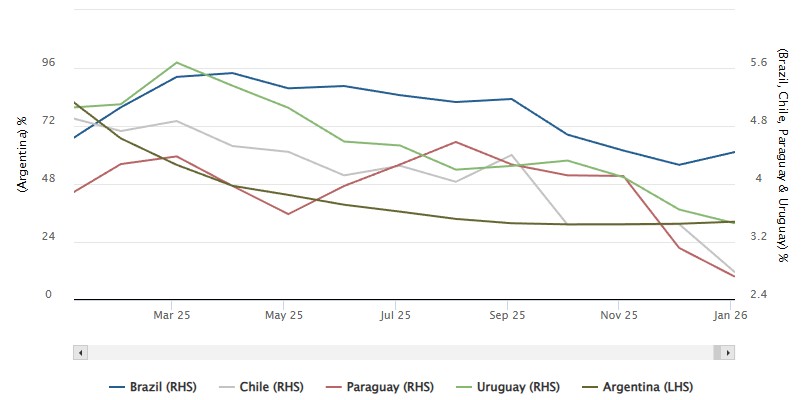
    Brazil & Southern Cone: inflation rate
    Percentage variation (year-on-year)

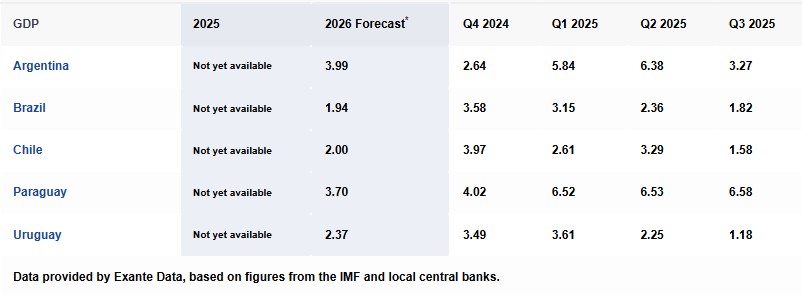
    Brazil & Southern Cone: GDP growth (%)
    Quarterly figures are year-on-year growth

  • CHILE: ICJ delivers ruling

    LatinNews 20 February 2014 Hits: 1248

    The International Court of Justice (ICJ) at The Hague has finally issued its long awaited ruling on Chile’s maritime dispute with Peru. The 27 January ruling granted Peru, which brought the case against Chile in 2008, some 50,000km2 of additional territorial waters previously considered Chilean but allowed Chile to retain rich fishing grounds in the disputed area. Both President Sebastián Piñera and his Peruvian counterpart, Ollanta Humala, vowed to implement the ruling, expressing their interest in closing the chapter and strengthening trade and investment ties. However there are still difficulties over a small triangle of land, and following on comments by President Piñera there are also concerns in Peru about Chile’s commitment to the 1948 Pact of Bogotá, which recognises ICJ jurisdiction.

    In its case to the ICJ, Peru claimed that a maritime boundary between the two countries had never been agreed. Chile contended that fishing agreements and treaties signed in 1947, 1952 and 1954 established the boundary as being along the parallel passing through the starting-point of the Peru-Chile land boundary and extending to a minimum of 200 nautical miles. Peru countered that these treaties only defined national fishing rights areas, but not sovereignty, and “that the delimitation line advocated by Chile is totally inequitable as it awards Chile a full 200-nautical-mile maritime extension, whereas Peru, in contrast, suffers a severe cut-off effect”

    In its 27 January ruling, the ICJ sought to provide a compromise. It found that while the treaties had not explicitly established the maritime boundary, the 1954 special maritime frontier zone agreement had “cemented” a “tacit agreement” that the maritime border ran 80 nautical miles from the point of the first land border marker separating the Chilean and Peruvian coasts (the location of which Peru questions). It added that “certain elements of the 1947 Proclamations and the 1952 Santiago Declaration suggested an evolving understanding between the Parties concerning their maritime boundary”. As a result, the court ruled that the "maritime boundary between the Parties extends to a distance of 80 nautical miles along the parallel". However, it drew a new, equidistant boundary running southwest, as Peru wanted. The ICJ also established that the precise geographical co-ordinates should be determined by the parties, in accordance with the judgment.

    Both sides initially showed every intention of heeding the ruling. While describing it as “lamentable” and expressing “deep discrepancies” with it, both President Piñera and his elected successor, Michelle Bachelet (due to take office in March), pledged to honour it. Following his first meeting with Humala after the ICJ ruling, on the sidelines of a Community of Latin American & Caribbean States (Celac) summit in Havana on 29 January, President Piñera issued a statement “reaffirm[ing] Chile’s commitment to comply with the ruling…and focus the efforts of both countries on the agenda for the future”. On 6 February, the first so-called “2+2” meeting took place in Santiago, between the respective defence and foreign ministers. The meeting yielded a 9-point agreement and set a timetable to establish the exact coordinates of the new boundary. The final declaration did not specify exact dates, but Chilean and Peruvian officials subsequently told reporters that technical delegations from both countries would meet on 17 and 18 February to work out the details, with the aim of concluding the process in the next 2+2 meeting, scheduled for 24-25 March.

    Subsequently, things took a turn backwards. On 12 February, Chile’s foreign minister Alfredo Moreno announced that his government would send an official protest note following Peru’s publication of an official map showing a small 3.7 hectare triangle of land, upon which a border marker sits, as Peruvian territory. The Chilean government maintained that the ICJ ruling effectively recognized the border marker as affirming Chilean ownership of the parcel. The Humala government denied this was the case and justified Peru’s claim to the parcel on the basis of a 1929 treaty with Chile. Further exacerbating these tensions, one of Peru’s representatives before the ICJ, former foreign minister José Antonio García Belaúnde (2006-2011), then accused Piñera of throwing a tantrum over the triangle in order to leave La Moneda “pretending he is a great defender of the nationalist cause”.

    Meanwhile on 10 February, President Piñera told Chile’s national TV station, TVN, that Chile might reconsider its membership of the 1948 Pact of Bogotá altogether, adding that he had already discussed the issue with Bachelet. This suggests that Chile could follow in the footsteps of Colombia, which withdrew from the Pact of Bogotá following an unfavourable ruling by the ICJ in November 2012 in a bilateral maritime dispute with Nicaragua.

    This announcement has aroused particular concern in the Bolivian government led by President Evo Morales, which in April 2013 filed a case against Chile as part of its efforts to reclaim access to the Pacific Ocean, lost in the 1879-1884 War of the Pacific. Piñera continues to maintain that the Bolivian case ‘”lacks any grounds”.

    Dialogue with Bolivia

    Bolivia’s decision to take the case against Chile before the ICJ in April 2013 came despite signs of rapprochement between the Morales government and the Chilean administration led by Michelle Bachelet (2006-2010). This saw the two governments ink a 13-point accord in 2006 aimed at restoring bilateral relations, which were severed in 1978.

    Bachelet’s return to La Moneda has revived hopes of better cooperation, given that both leaders had a good personal rapport. Morales has been invited to Bachelet’s 11 March inauguration.

    • Campaign spending

    According to Chile’s electoral authority (Servel), Bachelet spent C$1.53bn (US$2.79m) on her campaign for the 15 December 2013 second round run-off against Evelyn Matthei (Coalición por el Cambio), who spent C$1.14bn (US$2.09m). According to Servel, in the first round, Bachelet spent C$5.38bn (US$9.83m), while Matthei spent C$3.48bn (US$6.35m). The official spending limit set by Servel for both campaigns was C$9.23bn (US$16.8m).

    • Trade

    According to the latest full year figures from the central bank, Chilean exports to Peru reached US$1.8bn in 2012, some 2.4% of Chile’s total exports (of US$76bn). Meanwhile Chile imported US$2.0bn from Peru in 2012, some 2.6% of its total imports (of US$79.5bn).

  • CENTRAL AMERICA: Wrangling threatens much needed energy investment

    LatinNews 26 March 2020 Hits: 629

    A massive blackout last year brought regional electricity supply to the fore at a pivotal time for the sector.

    Periodic power cuts are a fact of life in many parts of the world. However, a range of factors combine in Central America to make the region particularly vulnerable to widespread outages. This was illustrated perfectly on 20 September 2019, when an electrical fault in Honduras plunged the entire country into darkness and also affected Nicaragua, El Salvador, and Guatemala. Experts blamed the catastrophic failure on the weakness of national and regional electricity distribution systems and pointed out the urgent need for hundreds of millions of US dollars in investment to improve them. 

    Regional system in dire need of investment

    In addition to the obvious question of where that kind of money would come from, energy distribution in Central America is complicated by the 1996 Central American electricity market framework treaty. This deal integrated distribution systems in Guatemala, El Salvador, Honduras, Nicaragua, Costa Rica and Panama using a 1,800km power line that runs from Guatemala to Panama. Known as the Central American electrical interconnection system (Siepac), it cost US$500m to build and came online in 2014.

    However, transmission systems in the region aren’t strong enough to deal with a fault in the line, which as a result cause overloads and collapse, according to René González Castellón, executive director of the Siepac regional operating agency (EOR). This can be explained as a kind of domino effect in which a fault knocks out one part of the line, flooding other areas with huge amounts of energy that the systems cannot handle all at once.

    Faults which lead to regional power outages are rare, averaging one or two per year, but they can be incredibly damaging. For example, a blackout that started with a fault in Panama left almost the whole of Central America without electricity for a few hours in July 2017, and another in January 2019 affected the whole of Panama as well as parts of Nicaragua, Costa Rica, and Guatemala.

    These power cuts are devastating for key infrastructure such as the Panama City Metro, which had to suspend services and evacuate passengers in 2017, as well as the Panama Canal and Tocumen International Airport, which had to use generators to maintain service. Outages also affect hospitals and cause economic losses as every electrical system without a backup generator goes down.

    Institutional problems abound

    While there is a consensus that Central America needs to invest heavily in electricity distribution infrastructure, the situation is complicated. Since the 1970s the region has been gradually interconnecting electricity distribution systems, a process that was accelerated in the 1980s due to damaging power shortages and high electricity production prices due to the cost of oil and coal. This inspired the creation of Siepac, which aimed to improve power infrastructure and make buying and selling electricity easier while reducing generating costs. The idea was to make Central America more efficient and competitive, according to the Italian institute for international political studies (ISPI) think-tank but the system leaves countries at risk of blackouts if faults occur elsewhere in the network.

    As things stand, the EOR is responsible for planning the regional transmission network, directing and coordinating technical operations at the regional electricity system (SER) and the commercial management of the regional electricity market (MER). The latter is designed to join national markets together, bound by common rules and authorities, and the agreement allows the six member states to buy and sell energy from each other. González says the system has brought US$500m in benefits in the last four years alone, but others say the MER isn’t working as planned.

    Regional coordination is lacking, and member states are pursuing independent strategies, according to María Andrea Higueros Trujillo, a Latin American energy market consultant at ISPI. This means they have been boosting national generating capacity and disregarding the MER, which has led to installed capacity outgrowing demand for electricity. In Guatemala, for example, installed capacity has grown around 85% since 2011, but demand has only increased around 3% per year in that time. González denies that the region has too much capacity, pointing out that not all of it is available all the time. He uses the example of hydroelectric dams, which aren’t always able to produce electricity, and wind farms, which do not always provide power when it is most needed.

    Analysts call for serious reforms

    González says that the integrated system needs investment, particularly in transmission systems, and a January 2020 EOR study came up with a figure of US$208m. On top of that each country needs to invest in its own national system, which will require even more money. The EOR chief is understandably optimistic about the future of the integrated system, but Higueros is less enthusiastic. She points out that the MER was conceived when energy prices were high, but now things are different. There is now an oversupply of electricity, oil prices have been falling, and the EOR hasn’t proved that it can get regional governments to coordinate. It has also been criticised for changing regulations and prices, damaging confidence in the market and disincentivising a regional approach among national governments. 

    Guatemala provides a good example of what is going wrong. The country imports electricity from Mexico, but authorities haven’t been able to agree on a safe limit that won’t cause problems for the regional system. Whenever Guatemala imports more electricity than the MER believes is safe, it disconnects the country from the rest of the network. This in turn affects Guatemalan electricity sales to El Salvador, cutting clients off and denting confidence in the MER. Following a legal dispute, the Central American court of justice (CCJ) ruled that MER authorities should stop disconnecting Guatemala from the system, but Guatemalan companies complain that they are still being prevented from exporting electricity to the rest of the region.

    One proposed solution is to change the agreement to allow MER to regulate the Guatemala-Mexico connection, as well as the Panama-Colombia connection in the south. However, in early January Guatemalan electricity companies protested as they want to retain control themselves.

    Back to the drawing board

    To achieve the original aims of the MER project, deeper integration is needed. BNamericas, a regional business intelligence platform, argues that Central American nations know they are too small to realise economies of scale, and in many of them public funds are limited so public works on the electricity system tend to focus on maintenance and small projects.

    Another problem is the lack of an overarching regulatory framework, with different electricity market structures in use. While El Salvador, Guatemala, Nicaragua, and Panama liberalised their markets and opened generation, transmission, and distribution to private companies, in Honduras and Costa Rica state-owned utilities are still vertically integrated and act as a single buyer.

    Ramón Fiestas, Latin America director at the Global Wind Energy Council (GWEC), has told BNamericas that a true single market needs to be formed instead of six member nations functioning individually. Both Fiestas and ISPI analyst Higueros would like to see better integration between Siepac and Mexico in the north, and Colombia in the south, but Fiestas does not envisage Colombia investing in such a project in the near term.

    Higueros recommends assuring longer terms of transmission rights to encourage long-term investments, and also points out that political wrangling between regional governments is also hurting progress. Fiestas agrees on this point, using problems caused by ongoing social unrest in Nicaragua as an example of how national politics can have a negative impact on regional integration. 

    Flashpoint in Guatemala

    This was recently illustrated in Guatemala, where the September 2019 decision by former President Jimmy Morales (2016-2020) to fire the directors of the national electricity commission (CNEE) caused uncertainty in the sector.

    Following a legal battle, Guatemala’s constitutional court ruled that the trio should be reinstated in their posts, but the damage was done.

    Another factor is the inauguration of President Alejandro Giammattei, who came to power on 14 January. In the run up to a 10 January meeting of the regional electricity market directors council (CDMER), which was set to discuss the aforementioned reforms to the MER, Giammattei’s designated energy & mines minister, Alberto Pimentel, implored his outgoing counterpart, Luis Chang, not to agree to any changes. Chang did not sign off on any reforms, and Pimentel will get to have his say on the matter. Pimentel revealed that he plans to give utility companies a chance to communicate their opinion on the changes, and he has said that the CDMER decision making processes should be changed. 

    The intervention will push back any reforms, and illustrates the difficulties facing the MER. On the one hand, Central American nations have committed to implementing a regional electricity market, but the current situation is unsustainable. A standardised regulatory framework needs to be introduced, and better regional coordination needs to be developed if the MER is to work as planned. Only once these political aspects are ironed out can Central America really start to deal with the serious infrastructure shortfall that causes outages such as the one in September 2019 in a coordinated way.

    Diversifying the energy matrix

    In the meantime, individual nations are pressing ahead with a number of projects. One example is a liquid natural gas (LNG)-to-power project in the Salvadorean port of Acajutla, for which Salvadorean company Energía del Pacífico (EDP) secured US$1bn in foreign direct investment (FDI) in early January. The 378MW power plant will connect to the Siepac system and is scheduled to come onstream in 2021, bringing environmental benefits by cutting the amount of diesel and heavy fuel oil El Salvador uses to generate electricity. The country will follow in the footsteps of Panama, which brought its first LNG-to-power plant online in September 2018 in order to diversify away from its heavy reliance on hydroelectric dams, which have been suffering poor generating performance due to a lack of rain. Panama has also seen an increase in the amount of geothermal energy generated, which increased 3% in January-November 2019 compared to the same period in 2018.
    Giammattei and Pimentel have also released a 2020-2034 power generation and transport extension plan, which aims to diversify Guatemala’s energy matrix and cut greenhouse gas emissions. The plan also earmarks US$275m for investment in transmission capacity, which will focus on reinforcing the Petén region in the short term.

    • Guatemala infrastructure projects

    Other planned infrastructure projects for 2025-2029 include strengthening the 230kV grid and Guatemala’s interconnection with Mexico, and the plan categorises liquified natural gas (LNG) as an “interesting option for the country”. While new generating capacity may be necessary to ensure energy supplies, a bigger regional power plant would be more efficient than a number of smaller projects. However, planning and financing such a project may be beyond the current capacity of regional authorities unless structural organisational issues can be resolved

  • COLOMBIA: Petro advancing with ‘total peace’

    Patrick de Courcy 20 October 2022 Hits: 2963

    Riding a wave of optimism and a sustained honeymoon period with high favourability ratings Gustavo Petro, Colombia’s first leftist president, plans to solve 70-odd years of conflict in his four-year term. At least, this is his high-risk, high-reward plan of ‘total peace’. Petro, an economist and former M19 guerrilla, has his sights set on multiple peace agreements with as many of the 26 criminal groups active in Colombia as possible – as set out in a project presented to the lower chamber of congress in August – to achieve what many consider to be unthinkable: a lasting, inclusive, and sustainable peace in Colombia. This week a statement from the Segunda Marquetalia, one of the two big dissident groups to emerge from the Fuerzas Armadas Revolucionarias de Colombia (Farc), confirmed its determination to participate in the talks.

    The priority of total peace for President Petro is one that dissects many of Colombia’s problems from illegal armed groups, drug trafficking, coca cultivations, illegal mining, land ownership, and environmental protection which all converge here. In order to achieve it, Petro’s government will seek to negotiate with all armed actors, including the Ejército de Liberación Nacional (ELN), dissident Farc guerrillas, post-paramilitary groups, such as the Clan del Golfo, and simple narco-trafficking groups. It intends to undertake reforms to the police and the armed forces for them to win over public confidence and pursue the concept of ‘Seguridad Humana’ (‘Human Security’), in particular after as many as 44 people were killed by security forces in the 2021 protests, as reported by the NGO Temblores. It will also seek to fulfil the points of the 2016 Farc peace accords in full, such as agrarian reform, which lies at the heart of the country’s long-running armed conflict, as seen with the recent commitment to purchase 3m hectares (ha) of arable land from the influential national cattle ranchers’ federation (Fedegán) for small farmers [WR-22-41].

    The ELN – the oldest and largest of the original guerrilla groups remaining after much of the Farc demobilised – has announced the commencement of peace talks with the government’s negotiating team in Cuba as early as in the first week in November. A statement released by the Segunda Marquetalia led by ‘Iván Márquez’ (Luciano Marín Arango) this week said that senior commanders were prepared to “pull out all the stops in the pursuit of total peace with social justice”. Iván Mordisco (Néstor Gregorio Vera Fernández), a rival Farc dissident leader – supposedly killed last July, but who reappeared on a Colombian news show on 14 October – expressed an interest as well saying “if there is a serious agreement, if the socio-economic problems of the marginalised and impoverished classes are solved, there will be no need for weapons”.

    Detractors of the plan doubt the motives of the guerrilla groups and the illegal armed groups and are quick to pounce on the debate surrounding the possibility of impunity for criminals. The ELN has negotiated with as many as seven different presidents; those that are now Farc dissidents had their chance to demobilise before becoming dissidents and not signing up to the 2016 peace agreement; and gangs such as the Clan del Golfo are known for their drive to consolidate control of key territories and increase coca crop cultivation.

    This all makes it a complicated and multifaceted gamble from the president. But it is picking up support from key international actors and just this week Carlos Ruiz Massieu, Special Representative of the Secretary-General and Head of the United Nations Verification Mission in Colombia, threw his weight behind the plan.

    New plan for military

    Nothing can move forwards without the armed forces, which will need to embrace a new identity under President Petro’s mantra of Seguridad Humana. The armed forces remain bogged down in the metrics of the past in which captures, kills, and hectares of coca plantations eradicated were seen as successes. Under Petro’s plan the military will be expected to keep people safer from exploitation and harm, reduce murders, and protect and support the families that signed up to coca crop substitution. 

  • BOLIVIA: Hay probabilidad de acuerdo con los oficiales militares

    LatinNews 16 May 2014 Hits: 1341

    Al parecer, el Presidente Evo Morales ha evitado una amenaza clave antes de las elecciones generales de octubre del 2014, en las cuales Morales es considerado como el favorito para ganar. La semana pasada, la Asociación de Sargentos y Suboficiales de las Fuerzas Armadas (ASCINLASS), que recientemente protagonizó protestas sin precedentes pidiendo la reforma de las fuerzas armadas (FFAA), lo que desembocó en la destitución de más de 700 oficiales [IL-14-16], anunció que ponía fin a las protestas después de que el alto mando de las FFAA acordara dialogar.

    El jefe de estado mayor de las FFAA, el General Fernando Aramayo, dijo a los periodistas que “casi el 100%” de los oficiales destituidos habían sido restituidos, Su anuncio se produjo justo una semana después de que el comandante en jefe de las FFAA, el Almirante Víctor Valdivieso, le dijera a los periodistas que el alto mando militar había acordado dialogar con ASCINLASS y que se había establecido una mesa de diálogo para discutir una agenda de 18 puntos.

    Esto representa un ablandamiento de la posición de la cúpula militar que, previamente, había sostenido que las demandas de ASCINLASS –que se habían centrado en la necesidad de abordar “la discriminación dentro de las FFAA” contra los principalmente indígenas suboficiales– no eran negociables. Entre otras cosas, estas demandas pedían que se permita a los suboficiales las mismas oportunidades de recibir educación que las que tienen sus superiores; que los grados de suboficial y sargento sean reemplazados con la posición de “oficial técnico”; y beneficios de salud y otros.

    Con acuerdos parciales ya alcanzados en 16 de los 18 puntos (incluyendo los pedidos para que los oficiales destituidos recuperen sus puestos), Baldivieso dijo que los dos puntos pendientes se relacionan con los pagos, que él señaló que está en manos del ministerio de defensa, y la propuesta de reforma de la ‘ley orgánica de las fuerzas armadas’ –la principal demanda de las protestas. Mientras que se puede decir que hay poco riesgo en que la revuelta se extienda  a través de las filas del ejército, considerando que el alto mando en el pasado se ha revelado que está firmemente alineado con el gobierno del Movimiento al Socialismo (MAS) (ver más abajo), el fructífero proceso de diálogo será un alivio para el Presidente Morales teniendo en cuenta el riesgo de que el descontento pudiera extenderse a otros sectores.

    Reexaminando la dictadura militar

    Un potencial punto de tensión con los militares podría surgir del anuncio hecho por la administración Morales a comienzos de este año acerca de sus planes de reparar las injusticias del pasado cometidas durante las varias dictaduras militares (1964-1982).

    El 14 de febrero, el Consejo Interinstitucional para el Esclarecimiento de Desapariciones Forzadas (Ciedef, que está presidido por el ministerio de justicia), junto con la oficina del fiscal general y la Universidad Mayor de San Andrés (UMSA), con base en La Paz, firmaron un acuerdo para coordinar acciones conjuntas para investigar las desapariciones forzadas durante el periodo de 18 años.

    En esa ocasión, la viceministra de justicia, Ericka Chávez, dijo a los periodistas que el objetivo del acuerdo es identificar a las víctimas de desapariciones forzadas durante la dictadura y promover la desclasificación de los archivos militares.

    De acuerdo con cifras de la asociación de familiares de los detenidos y desaparecidos durante la dictadura (ASOFAMD), hay unos 156 casos de personas registradas como ‘desaparecidas’ en los ’60, ’70, y ’80.

    Mientras que los grupos de derechos humanos desde hace tiempo están pidiendo al gobierno de Morales que pase una legislación que permitiría desclasificar los archivos militares que abarcan la era de la dictadura, los militares han demostrado estar menos que dispuestos, sosteniendo que no poseen ningún documento relevante que podría ayudar a esclarecer las desapariciones.

    • Militares alineados con Morales

    Mientras que el actual comandante en jefe de las fuerzas armadas de Bolivia, el Almirante Víctor Baldivieso, ha sido menos explícito, todos sus antecesores han causado sorpresa después de hacer comentarios que parecieran alinear a los militares con el proyecto político del Presidente Evo Morales, planteando preguntas acerca de su independencia como institución. El predecesor inmediato de Baldivieso, el General Edwin de la Fuente, describió a las FFAA como “socialistas”, “anti-capitalistas”, y “anti-imperialistas”, haciéndose eco de los comentarios hechos en noviembre del 2010 por el entonces comandante de las FFAA, General Antonio Cueto, y que fueron repetidos por su sucesor, el General Tito Gandarillas, al asumir sus funciones en enero del 2012. Esta cooptación  de los militares por parte del gobierno es típica en el bloque de Izquierda de integración regional, la Alianza Bolivariana para los Pueblos de Nuestra América (Alba), establecida por el fallecido presidente venezolano, Hugo Chávez (1999-2013).

  • Peru: Modest reduction in poverty in 2014

    LatinNews 01 May 2015 Hits: 907

    According to Peru’s national statistics institute (Instituto Nacional de Estadística, [INE]), the proportion of the population living in poverty fell by 1.2 percentage points in 2014, to 22.7%, down from 23.9% in 2013.

    The INE says that 6.99m people, of a total population of nearly 31m in 2014, were living below the poverty line. Nationally, this means that roughly one in five people are poor. The reduction in poverty achieved last year was less than in earlier years, a slowdown attributed to the ending of the commodity price boom, which in turn has caused a relative cooling of Peru’s previously very strong GDP growth rate. Real annual GDP growth was 2.4% in 2014, its lowest rate in five years. The government expects the pace of growth to pick up in 2015 to 4.2%, but a number of analysts think that optimistic. The UN’s Economic Commission for Latin America and the Caribbean (ECLAC) is also forecasting GDP growth of 4.2% this year, but the IMF projects a lower 3.8%.

    Despite last year’s slower growth, the head of the INE, Alejandro Vilches, noted that “over a quarter of a million people – 298,000 – emerged from poverty last year”. According to INE’s figures, the proportion of the population living in poverty is highest in the Andean region, where it stands at 33.8%. Ironically perhaps, this region, with its rich mineral resources, has been driving the country’s export-led growth. In the coastal region, poverty is much lower – at 14.3% – while in the Amazon region it goes up again to 30.4%.

    The general reduction in poverty in recent years is attributed to a combination of strong economic growth and a variety of social programmes introduced by the government of President Ollanta Humala. In a report last year, BBVA Research economist Hugo Perea argued that as a result of 5%-plus annual growth, Peru had gone through a sustained process of poverty reduction and an expansion of the middle class. While specific poverty reduction programmes had been successful, he argued, these were less important in the longer term than a high growth rate.

    A slightly different point was made in a World Bank report published in March, which focused on “chronic poverty”. According to one of its authors, Renos Vakis, Latin America has pockets of “chronic poverty” where “economic growth on its own is perhaps not sufficient” to improve peoples’ income levels. In his view other factors, such as the geographic remoteness of communities from the labour market, or the absence of key skills needed for employment, need to be tackled directly.

    In another recent report, the World Bank has argued that persistent poverty is not jut a function of a lack of education or health services, but may also reflect psychological factors. It notes a case in Peru where a government-funded tuberculosis prevention programme in a Lima shantytown was rather unsuccessful – until the government also introduced depression-counselling services, at which point attendance rates improved. That report noted that “poverty can have complicated mental effects, which can make it more difficult to emerge from poverty – it can be a self-perpetuating vicious circle”. It also suggested that conditional cash transfer programmes, where poor households receive cash subsidies on condition that they do certain things such as ensure school attendance by their children, may not be effective in all cases. One such programme, Brazil’s Bolsa Familia, has been widely hailed as a highly successful approach to poverty reduction. Yet the World Bank warned such programmes do not reach everyone. The issue remains significant, says the Bank, because after a decade of sustained growth (which is now slowing down) one in five Latin Americans is still living on less than US$4 a day.

  • ECONOMIC HIGHLIGHTS

    LatinNews 11 December 2020 Hits: 850

    DOMINICAN REPUBLIC | Port expansion. Last month Emirati multinational logistics company, DP World, inaugurated its dock expansion at the Punta Caucedo multimodal port, located near the Dominican Republic’s capital, Santo Domingo. According to a DP World press release, the US$114m project is part of the company’s plan for growth in the Dominican Republic (DR), “with the objective of directly contributing to the transformation of the country into the principal logistics hub of the Americas”. The expansion adds 450 metres of berth and more than doubles the port capacity from 1.2m 20-foot equivalent units (TEUs) per year to 2.5m TEUs per year. According to DP World, which has already invested over US$600m in Punta Caucedo, three super post-Panamax container and five rubber tyred gantry (RTG) cranes have already been installed, with a further super post-Panamax container crane and five additional RTG cranes due to be added this month. In the next phase of the expansion DP World plans to build a 3m m2 economic zone for manufacturing at Caucedo to attract investment by foreign companies.

    GUATEMALA | Record remittances. Last month Guatemala’s central bank (Banguat) released new figures which show that remittance inflows for the month of October totaled US$1.13bn - the highest monthly figure on record. This brings the total value of remittances received this year to US$9.19bn, up from the US$8.75bn registered over the same period in 2019. In October Banguat forecast that remittances (which totaled US$10.5bn in 2019) will rise by 3.5% in 2020.

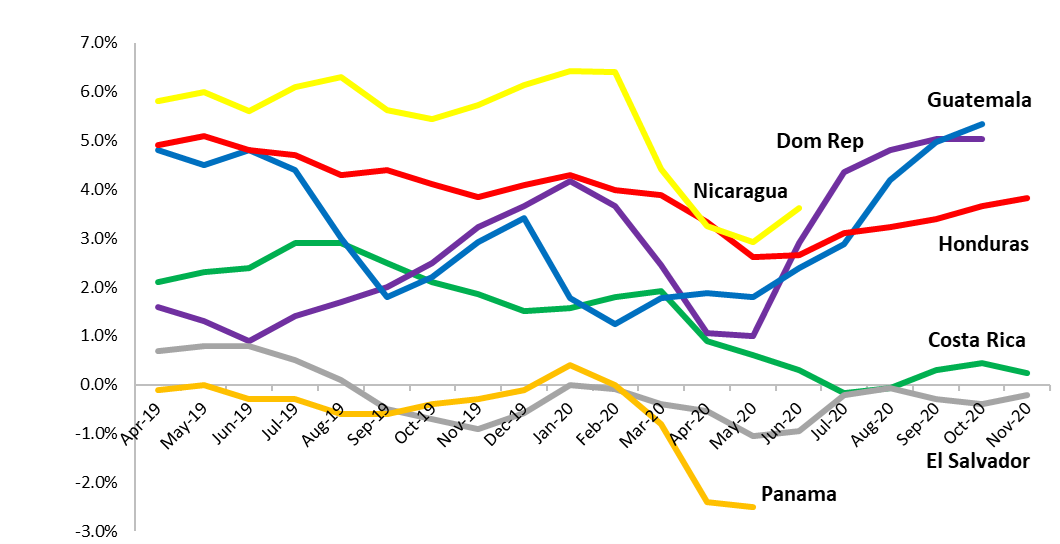
    Central America & Caribbean:​ Inflation
    Monthly year-on-year figures

    Central America & Caribbean, selected countries: GDP growth (%)
    Quarterly figures are year-on-year growth
    GDP  end 2019* 2020 forecast** Q4 2019 Q1 2020 Q2 2020
    Costa Rica 2.1 -5.5 2.9 0.8 -8.6
    Dominican Republic 5.1 -5.3 5.8 0.0 -16.9
    El Salvador 2.4 -8.6 3.0 0.8 -19.2
    Guatemala 3.5 -4.1 3.9 0.7 -9.6
    Honduras 2.7 -6.1 2.5 -1.5 -18.5
    Nicaragua -3.9 -8.3 -0.2 1.8 -7.9
    Panama 3 -6.5 3.3 0.4 -38.4
    *Figures from local central banks **Figures from the United Nations Economic Commission for Latin America & Caribbean July 2020
    Quarterly growth based on figures from the local central banks


  • ECUADOR: Lasso forges social front within cabinet

    LatinNews 29 April 2021 Hits: 2084

    Ecuador’s president elect, Guillermo Lasso, has named eight cabinet ministers, five of them women, to form the “social front” of his incoming government. The key role of health minister, the sixth since the outbreak of the coronavirus (Covid-19) pandemic in Ecuador in February 2020, will be filled by Ximena Garzón. Amid a severe second wave, Garzón will lead the vaccination programme for which Lasso has set ambitious targets, promising to immunise 9m Ecuadoreans within 100 days of taking office on 24 May.

    Lasso confirmed on 26 April that Garzón, who has a doctorate in public health, would pick up the health portfolio, with vaccination against Covid-19 her main priority. In common with the rest of the region, Ecuador has seen a surge in cases in recent weeks. So far only 533,000 members of the public have received a first dose of a vaccine (a figure which could, at best, reach 2m by the time Lasso takes office), and 200,000 a second.

    The social front will also include the education minister, María Brown, among whose priorities will be boosting intercultural bilingual education, a campaign promise to appeal to indigenous voters, and reopening thousands of rural schools closed by previous governments. Mae Montaño, a deputy for Lasso’s centre-right Movimiento Creo since 2013, was named minister of economic and social inclusion (Mies). She has been challenged with eradicating chronic child malnutrition, which stands at 25%.

    The other five members of the social front will be the culture minister, María Elena Machuca, a plastics artist and former museum director; the human rights minister, Bernanda Ordóñez, tasked with stamping out gender violence and femicides; the urban development and housing minister, Darío Herrera, set the goal of overseeing the construction of 200,000 social homes for rural families; the sports minister, Sebastián Palacios, who competed for Ecuador in cyclo-cross; and (once again elevated to a full ministry) the minister of higher education, science, technology, and innovation (Senescyt), Alejandro Ribadeneira, who will seek to improve access to universities and vocational centres.

    The targets set by this ministerial social front will not come cheap. Together with Lasso’s pro-business policies, specifically tax cuts, such as phasing out currency export tax and cutting sales tax for small businesses, and no suggestion of ending fuel subsidies, Lasso is not planning on implementing a painful fiscal adjustment and economic austerity package as his leftist Correísta rival in the second round, Andrés Arauz, maintained.

    Lasso enjoys the goodwill of the International Monetary Fund (IMF), which had feared a victory for Arauz, who had made it clear that he would not accept any constraints on his spending priorities and would not comply with the US$6.5bn credit agreement struck with the IMF last October but rather proceed with his own economic plan. In spite of this goodwill, Lasso’s owns plans might have sounded some alarm bells in IMF headquarters. With his party only securing a dozen seats in the 137-seat national assembly, however, Lasso would not be able to push an austere economic package through the legislature even if he wanted to.

    Lasso is still likely to have to make further concessions on social spending to win the support of the indigenous movement Pachakutik, which will be keen to make its increased presence felt in the national assembly, and the moderate left-wing Izquierda Democrática (ID), whose presidential candidate Xavier Hervas finished a strong fourth behind Pachakutik’s Yaku Pérez in the first round of elections. Lasso is banking on his promised tax cuts paying for themselves with increased foreign investment, job creation, and economic growth, but it is unlikely this will be enough to cover higher social spending while retaining fuel subsidies and reducing the fiscal deficit.

    The IMF will be heartened, however, that, on 22 April, the outgoing national assembly approved an urgent bill sent by President Lenín Moreno for ‘the defence of dollarisation’ by 86-41. Its approval was one of the conditions of the IMF accord, of which US$2.5bn is yet to be disbursed. The bill proposed strengthening the financial autonomy of the central bank, as a guarantee of its independence, and creating two policy and regulatory boards.

    The economy minister, Mauricio Pozo, thanked legislators, adding that the new legislation would benefit Ecuador “in the present and the future”. It would not have made it through the new assembly that sits on 14 May, when left-leaning parties will be in the ascendancy. Designed to underpin dollarisation, attract more investment, and generate greater liquidity, the bill had twice been rejected by legislators. The opposition argued that it was unconstitutional and tantamount to the privatisation of the central bank. It argued that this could lead to capital flight, which could be an even bigger threat to dollarisation.

    Pensions

    Another thorny issue facing president-elect Lasso is the pension system. The outgoing government presented the conclusions this week from a study conducted by the social security institute (IESS), under the auspices of the World Bank, which calls for urgent reform of the pension system in the short-term. The study argued that fewer people are paying into the Invalidez, Vejez y Muerte (IVM) pension system and more people taking out for longer, meaning that it will become “financially unviable and fiscally unsustainable” within two to three years.

  • GUYANA: Race continues to dominate Guyana politics

    Sarah Sheldon 23 January 2023 Hits: 1411

    The issue of race continues to dominate the politics of Guyana, with the ruling People’s Progressive Party/Civic (PPP/C) particularly concerned about the attempts by the opposition A Partnership for National Unity + Alliance for Change (Apnu+AFC) to draw the US into the debate.

    The main split in Guyana is between descendants of slaves who originated in Africa (about 30% of the population) and the descendants of the indentured labourers from India who came to Guyana as slavery ended (about 40% of the population – the rest is mixed race or Amerindian). Guyana politics has often been a struggle between the two main communities for resources. Under the previous Apnu+AFC government, many state-owned sugar farms, predominantly employing Indo-Guyanese, were closed or downsized due to poor performance, which infuriated the Indo-Guyanese community. Now the shoe is on the other foot, with many Afro-Guyanese complaining that sugar-growing communities are getting major investments while Afro-Guyanese neighbourhoods are neglected. And the country’s newfound oil wealth has greatly heightened awareness of any perceived unfairness.

    The latest escalation came with the writing of a letter dated 17 November to US Vice-President Kamala Harris signed by over 80 influential Guyanese, including legislators, lawyers, community leaders, and trade unionists. The letter urged the US administration to intervene to help stop the country’s “escalating social, racial, economic, and political injustices” inflicted on the Afro-Guyanese community.

    The letter also accused the Indian-supported PPP/C government of depriving the Afro-Guyanese community of its share of the fruits of Guyana’s oil wealth. It said: “Sadly, the vile acts of discrimination adopted by the government have shut out a large portion of the citizens from enjoying the benefits of the nation’s oil wealth and national patrimony.” The letter accused the government of “economic genocide”, saying that “those unwilling to ‘toe the line’ in adherence of the regime’s autocratic governance are ostracised, marginalised, and victimised”. As an example, it said that private businesses are penalised for advertising with media outlets that are unsympathetic to the government, and that “organisations that rely on State subventions and contracts are punished and defunded if perceived to be non-compliant with the ruling PPP and its political objectives”.

    Most alarmingly, the letter claimed that Guyana was “on the brink of civil unrest”. It warned that “the government is deliberately setting the stage for civil unrest, an occurrence that may only serve to compromise our fledgling democracy and create chaos and loss of innocent lives”.

    The letter included a statement dated on 9 November and signed, among others, by opposition leader Aubrey Norton, declaring: “We, the undersigned, hereby call on the United States Government, the US Congress and Congressional Black Caucus, Caricom Heads of Government… the United Nations, Commonwealth, Organization of American States, African Union and all African Heads of Governments [to address] the untenable crisis of racism and corruption in Guyana. We propose an urgent Washington DC conference on Guyana’s future to ventilate and resolve the matters laid out herein”.

    Guyana’s prime minister, Mark Phillips, responded to the letter by warning that the Apnu+AFC was “on a treacherous road that they hope will create civil unrest and allow the breakdown of democracy in Guyana which happened under the PNC in the 70s and 80s”. The People’s National Congress Reform (PNCR) is the descendant of the PNC and the main component of the Apnu coalition.

  • BARBADOS/REGION: Mottley steps up debt relief campaign

    Sarah Sheldon 22 June 2023 Hits: 724

    Barbados’ Prime Minister Mia Mottley stepped up her campaign for increased debt relief for countries suffering the impact of climate change at the end of April, with France and Zambia agreeing to support her Bridgetown Initiative.

    The Bridgetown Initiative was first launched in July 2022 and has gone through various versions. The essential proposal covers five points, including a pause in debt repayments for poor countries when they suffer natural disasters such as hurricanes or other forms of extreme weather; increased global funding for climate resilience; the creation of a global climate mitigation trust; wider eligibility to allow poor countries to access below-market interest rates; and, finally, a new global loss and damage fund, able to pay out when disasters hit. Various financial targets have been proposed, including the idea that the World Bank and the International Monetary Fund (IMF), through an issue of special drawing rights (SDRs), should mobilise up to US$1trn in extra resources to help developing countries strengthen climate resilience.

    Mottley’s initiative faces a number of challenges. One is the lack of political will among the more developed countries – they have for example fallen well short of promises, originally made in 2009, to provide US$100bn in resilience and energy transition funding (one estimate is that to date only US$16bn has been paid out). Another is the painful aftermath of the coronavirus (Covid-19) pandemic, which has depleted financial buffers world-wide and led to further growth in developing country debt.

    Nevertheless, Mottley has been building a new coalition, led among others by France, Spain, and Sierra Leone to try and move forward. In late April she said “The world is running out of time to fix its international financial system that is broken, outdated, infested with short termism and downright unfair. Too many countries are being prevented from fighting the climate crisis and from creating decent opportunities for billions of people – their citizens. If countries cannot access the finance they need at rates they can afford, the world will lose the battle, not simply the countries. What is good for the North is good for the South, East and West! This is the best development strategy for the people of the developing world. This is the best development strategy for the planet.”

    Meeting on global financial pact

    Mottley and France’s President Emmanuel Macron are co-hosting a 22-23 June meeting on a global financial pact, which will discuss reforming multilateral development banks, the debt crisis, and the potential for new international taxes and financial instruments (it has been suggested for example that a global 2% tax on fossil fuel exports could fund the proposed climate change “loss and damage” aid scheme). Economist Avinash Persaud, who has advised Mottley on the Bridgetown Initiative, describes the Caribbean as one of the world’s most indebted regions, with debt levels averaging 90.1% of GDP since the start of the coronavirus (Covid-19) pandemic. “We found that 50% of the increase in our regional debt could be traced back to some natural disaster that we had to pay for ourselves” he says.

  • Risk pointers

    LatinNews 06 September 2011 Hits: 314

    *** Iraqi Shias boycott Saudi Arabia.  The director of media for the Basra Governate Council in southern Iraq announced on 29 March that the council “has unanimously endorsed a decision to boycott Saudi goods in an attempt to show the city of Basra’s rejection of all kinds of violence that is being exercised against the Bahraini people by the Bahraini or Saudi authorities”.

    *** South Korea fears an attack “beyond our imagination”. South Korea’s Defence Minister Kim Kwan-jin warned on 25 March that North Korea will attack the South again.  His warning came the day before the first anniversary of the sinking of the Cheonan in which 46 South Korean sailors were killed.  There was a further attack last November, when North Korea shelled the border island of Yeonpyeong.  Kim said: “North Korea is plotting a second, third provocation beyond our imagination like the attack on the Cheonan.”

    *** Azerbaijan’s president snubs Iran over Armenia.  Azerbaijan’s President Ilham Aliyev declined an Iranian invitation to attend Nowruz celebrations in Tehran on 27 March on the grounds, it is assumed, that Tehran had also invited Armenia’s President Serzh Sargsyan.

    Although of no major significance in itself, this development could be a sign of the times.  Our sources in the region say that the flimsy truce that ended the 1992-94 war between Armenia and Azerbaijan is now threatening to break down into a new armed conflict.  There has been a significant deterioration over the past year, with regular military skirmishes threatening to spiral out of control at almost any time.  Azerbaijan has been rapidly increasing its military capabilities, and its already substantial defence budget is set to increase by a further 45% this year to $3.1bn.  This represents nearly 20% of state expenditure.  Some intelligence sources in the region have been warning that, faced by this ratcheting up of Azerbaijan’s military capabilities, Armenia is contemplating a pre-emptive strike.

    Armenia is being armed by Russia and could be supported by Moscow (albeit reluctantly) in a renewed war with Azerbaijan.  Azerbaijan, on the other hand, is receiving help from Turkey and (it seems) Israel.  Interestingly, although Azerbaijan is Muslim and Armenia is Christian, Iran has tended to favour Armenia because of the difficulties that Tehran has with its own Azeri minority.

    *** China recalls Nepal envoy for ‘weak diplomacy’ over Tibetans.  China has recalled its ambassador to Nepal, Qiu Guohong.  Sources in Beijing say the reason is Qiu’s failure to counter sufficiently robustly the activities of the Free Tibet Movement in Nepal.

  • TRACKING TRENDS

    LatinNews 24 May 2012 Hits: 3257

    COLOMBIA| New poverty figures released. On 17 May Colombia’s national statistics department (Dane) released a new report which found that Colombia’s poverty rate last year stood at 34.1% compared with 37.4% in 2010. According to Dane, while progress is still being made in reducing poverty in the country, the latest figures mean that 19.98m people (over a third of the country’s population of some 46m) are considered to be poor and indigent. Of these, 46.1% live in rural areas and 30.3% in urban areas. Dane director, Jorge Bustamante, explained that the department’s latest report was developed with a new methodology which uses a multidimensional poverty index which that has five dimensions using 15 different indicators, as developed by the UK’s University of Oxford. This was then adapted to Colombia by the national planning department (DNP). Using this new methodology, the DNP found that over the 2002-2010 period the number of people living below the poverty line dropped from 56% to 37.2%. Dane’s latest report found that last year 1.21m people were lifted out of poverty in 2011; but perhaps unsurprisingly 857,000 of them were in urban areas.  Focusing on income per capita figures, Dane also found that there is a stark difference between what is earned by people in urban areas and in rural areas. Colombia’s overall income per capita was put at US$266.85. However, per capita income in urban areas was US$315.67 compared with US$109.65 in rural areas. The inequality in the distribution of poverty in the country is probably one of the main factors that led the World Bank to identify Colombia as the second most unequal country in the region behind Haiti back in March.

    PERU| Top rated business environment. According to the latest (April) business climate index (ICE) report, developed by Brazil’s Fundaçao Getúlio Vargas and the economic investigations institute at Germany’s Munich University, Peru has now overtaken Colombia as the country with the best business environment in the region. The ICE gave Peru a score of 7.2, up from the 6.4 it received the previous quarter, thus allowing it to overtake Colombia, whose score remained stable at 6.7. The top two ranked countries were followed by Ecuador which increased its score from 6.0 to 6.7 and Uruguay which marginally increased its score from 6.3 to 6.4. However the highest climber was Chile which saw its score go from 4.9 to 6.2. Interestingly, the ICE report found that while Peru like its neighbour Chile is being held back by the lack of a qualified labour force, Colombia’s weakness is its lack of competitiveness compared with other countries in the region.

    ECUADOR| Funding secured for Quito metro. Quito’s mayor’s office announced on 23 May that, with the help of multilateral organisations, it was close to securing funding to build the proposed US$1.4bn metro system. According to the mayor’s office, the European Investment Bank (EIB), the Development Bank of Latin American (CAF) and the Inter-American Development Bank (IDB) have agreed to provide some US$700m in funds for the project, while the rest will be provided by the municipality, the Ecuadorean social security banks (Biess) and service providers. The municipality explained that the Biess has agreed to contribute US$250m to the project; and that it plans on using US$120m which it has available as well as raising a further US$150m in the bonds market. To cover the remaining US$200m, the municipality expects to obtain a number of loans directly from suppliers of materials. As a result the tender process for the first part of the project is expected to take place by June so that construction on the 22km transport system may begin as early as November with a view to completing it by 2014.

    • Morales recommends Bolivia’s economic model

    On 17 May Bolivia’s President Evo Morales recommended to “the whole world and especially Africa” his government’s strategy of nationalising foreign companies to ensure that the state recovers control of the country’s natural resources. Speaking at the opening of a gas and oil conference in Santa Cruz, Morales said that since 2006 when Bolivia nationalised the hydrocarbons sector, it had experienced a “profound period of change” allowing the state-owned oil company YPFB to increase its earnings from US$300m in 2005 to an estimated US$3bn this year. According to Morales “transnational companies take over everything and poverty increases” as governments are left “without any economic resources to invest in social programmes”.

  • RASTREANDO TENDENCIAS

    LatinNews 13 August 2012 Hits: 708

    HAITÍ | Reorganización del gabinete. Menos de tres meses después de asumir a mediados de mayo, el Primer Ministro Laurent Lamothe ha llevado a cabo una reorganización del gabinete. Los cambios –en los que ha reemplazado a tres de sus ministros, incluyendo a el ministro del interior, Thierry Mayard Paul– parecen haber tomado por sorpresa a los medios y fueron justificados como necesarios para una “mayor eficiencia”, sin ofrecer más explicaciones. Mayard Paul un estrecho aliado del Presidente Michel Martelly y su ex jefe de campaña, ha sido reemplazado por Roinsard Saint Cyr, el ex ministro de asuntos sociales y trabajo. Lamothe canjeará la cartera adicional que retiene –relaciones exteriores– por el ministerio de planeamiento en reemplazo de Josefa Gauthier quien, a su vez, asumirá la cartera dejada por Saint Cyr. El nuevo ministro de relaciones exteriores es Pierre Richard Casimir, quien estaba sirviendo como secretario de estado para esta cartera. Aparte de Mayard Paul, los otros dos ministros a ser reemplazados son Joseph Ronald Toussaint (medioambiente) y Réginald Paul (Educación). Un ex miembro del principal partido de oposición, Inité, del predecesor de Martelly, René Préval (2006-2011), que desde entonces se ha fracturado [IL-12-25], Toussaint ha sido reemplazado por el ambientalista Jean Vilmont Hilaire; Paul ha sido reemplazado por Vanneur Pierre, que fue director general del ministerio.

  • In Brief- Peru

    LatinNews 07 May 2013 Hits: 1365

    POLITICS| Leftist political leader Díez Canseco dies. On 4 May members of Peru’s Partido Socialista (PS) announced the death of their emblematic political leader, congressman Javier Díez Canseco, after months of battling pancreatic cancer. A prominent figure in Peruvian politics, Díez Canseco was one of the first members of Peru’s traditional Left to back the formation of the Gana Perú coalition that helped current President Ollanta Humala to come to power in 2011. However Díez Canseco, who was considered to be one of congress' leading figures in the fight against official corruption, decided to leave Gana Perú last year over mounting disagreements with the Humala government’s handling of various social and economic issues.

  • EL SALVADOR: Gov’t under renewed pressure over disappearances

    Patrick de Courcy 25 November 2021 Hits: 3664

    In November a councillor at San Salvador’s municipal office, Héctor Silva, proposed an emergency plan to deal with disappearances in the metropolitan area. His proposal – which has so far fallen on deaf ears – comes as the government led by President Nayib Bukele, which continues to claim progress in security issues, particularly in relation to reducing homicides, is facing mounting pressure from institutions such as the Inter-American Commission on Human Rights (IACHR) to address the rise in disappearances.

    Silva, a councillor for the small opposition party Nuestro Tiempo, called on 10 November for measures including the deployment of at least another 1,000 municipal police (CAM) agents and an increase in video surveillance. He also requested that the CAM director be ordered to draw up a plan within 15 days which would include “identifying high risk zones, an increase in the frequency of patrols in these areas and mechanisms for preventing abductions”. His call comes as figures from the attorney general’s office (FGR) cited by the local media put the number of people registered as disappeared in the first nine months of 2021 at 936, up 150% on the same period in 2020. Figures provided to Spanish news agency EFE by the FGR earlier this year via the law of access to public information, showed the number of disappearances reported in the first four months of 2021 more than doubled compared with the same period in 2020, from 196 to 415.

    Also piling pressure on the Bukele government to tackle the phenomenon, on 2 November the IACHR presented a new report on the human rights situation in El Salvador which said that it had received “alarming information on the lack of response by the state officials to the high number of complaints of disappearances in the last few years”. The IACHR urged the government to “make every effort to search for missing people” and recommends that “a regulatory framework for the national search policy be developed and implemented”.

    Homicides down

    The reports of increased disappearances cast a cloud over President Bukele’s claims of progress with regard to homicides. On 1 November, the day before the IACHR released its report, the Bukele government cited PNC statistics which showed that in the first ten months of 2021, homicides totalled 926, 17.75% less than in the same period in 2020. The government attributes this progress to its security initiative, Plan Control Territorial (TCP) which includes a mixture of preventative and repressive components.

    Mixed findings

    The IACHR report underlined mixed findings regarding previous efforts to tackle the issue. As regards progress, it reported that, since 2017, the FGR had led a project entitled “Institutional strengthening for cases of disappeared persons associated with organised crime to reduce impunity in El Salvador” for the period 2017-2019. It notes that an urgent action protocol and search strategy for disappeared persons was drawn up and launched in December 2018, and the State announced the creation of a specialised unit for cases of disappeared persons in July 2019, which is dependent on the FGR. The IACHR report also highlighted the donation of an information system for the disappeared and corpses network (SIRDEC) and a forensic dental and clinical information system (Siclico), which will help standardise technical and scientific processes, coupled with the effective search and identification of disappeared persons.

    However, the IACHR also observes “significant challenges”. It underlines that “in the absence of a legal definition or status to intervene in these cases, the authorities reportedly have to resort to different criminal categories such as that of “deprivation of liberty.” It warns that this creates major difficulties with regard to the registration and systematisation of official statistics on the number of disappeared persons and cases in which there could be evidence of enforced disappearance, loss, or other types of absence. The IAHCR adds that the absence of a single registry, as well as current rules that clearly determine the powers and attributes of the authorities, allegedly prompt differences in the data collected by each institution such as between the police (PNC) and FGR.