All Categories

Subcategories

  • URUGUAY: Success brings its own problems

    LatinNews 15 February 2012 Hits: 918

    While much of the developed world is suffering from slow, or non-existent, economic growth, rising unemployment and negligible job creation, Uruguay faces the opposite problem: rapid growth, falling unemployment and too many jobs. This would appear to be the dream scenario, but economic policymakers are growing increasingly concerned that sustaining the high level of growth will simply not be possible unless Uruguay can enlarge its workforce – and they are preparing to introduce radical immigration reform, inter alia, to rectify the problem.

    With projected GDP growth of 4% in 2012, Uruguay’s economy will create some 25,000 jobs in 2012, according to the labour minister, Eduardo Brenta. Filling these new positions, he said, would be exceptionally challenging. The country currently has its lowest unemployment in history. In December unemployment fell to just 5.3%, down from 5.5% in November, according to the national statistics institute (Ine). Unemployment in Montevideo, by far the most populous area in the country stood at 5.8%; it was just 4.8% in the rest of the country. This is a far cry from a decade ago: in 2002 unemployment soared to 20.4% as Uruguay grappled with one of its most painful economic crises as the banking sector reeled in the face of the Argentine financial meltdown, prompting the-then president Jorge Batlle to call Argentines “a bunch of thieves” in an ‘off the record’ conversation with a journalist from Bloomberg. (When word got out, Batlle travelled to Buenos Aires in tearful contrition).

    Uruguay’s most pressing problem now is insufficient human capital. Brenta said that Uruguay had only 95,000 unemployed and, struggling to put this tactfully, not many of them would be able to fill the 25,000 jobs likely to be created this year as they lack the skill set. The national workforce is 1.5m: the 95,000 unemployed are mainly women and youths who, Brenta said, lack the requisite training. Brenta added that the government would invest in better training facilities, and that a youth employment law and gender law were in the pipeline. But, this alone, he argued, would be insufficient and other measures needed to be taken, in both the short and long term.

    One such step is for Uruguay to make its immigration policies more flexible in order to try and attract Uruguayan expatriates and skilled foreign labourers to come to the country. The government will start actively seeking to persuade Uruguayan expatriates to return home. The ministry is poised to launch a new Internet page advertising vacancies for Uruguayans living abroad. Shortly afterwards this will be extended to foreigners to fill positions for which there is a dearth of skilled labour in Uruguay. It will try and sell Uruguay as an attractive option to come and work, being politically stable, the safest country in Latin America, and just a stone’s throw from both Argentina and Brazil.

    Brenta also boasted that Uruguay registered the highest real salary growth in the region in 2011. He said that the government’s concerted effort to lift the minimum wage and progressive social policies had increased the purchasing power of poorer Uruguayans and lifted living standards commensurately.

    Brenta made reference to Panorama Laboral, the annual employment review of the region by the International Labour Organization (ILO). He said that Uruguay came second only to Peru in the region for the highest rate of employment, but that the informal sector in Uruguay is much smaller than Peru (22% compared to 39%). He added that while 80% of rural workers lack social security benefits in most countries in the region, in Uruguay two-thirds of rural workers enjoy them.

    Attracting skilled workers from abroad will become an ever-more pressing concern, however, as Uruguay faces an increasingly complex demographic scenario in the future. The results of a recent national census showed that the population stands at 3.251,526, an increase of just 0.3% on the population in 2004, according to Ine. This confirms the suspicion that Uruguay’s population growth is virtually static (the birth rate is very low) and explains to some extent how it is comparatively easy for Uruguay to keep unemployment figures low. Mujica has actively tried to attract qualified Latin American immigrants, but the net will now be cast wider.

    • World Cup

    Uruguay will bid to host the football World Cup a century after it hosted, and won, the very first competition in 1930. Uruguay, twice winners, will present a joint bid on 25 May with Argentina, also twice winners, for the 2030 World Cup. The president of the Uruguayan football association (AUF), Sebastián Bauzá, won the support of President José Mujica for the proposal. Bauzá said that no other nation had yet presented an interest in hosting the 2030 World Cup and he clearly hopes that, in the centenary year, Uruguay will have a strong case. As the tournament is much bigger now than it was then (when all the matches were played in Montevideo), Uruguay will have to team up with Argentina for the proposal to be viable. Argentina hosted the tournament in 1978.
  • RASTREANDO TENDENCIAS

    LatinNews 21 November 2014 Hits: 464

    URUGUAY | Buscando desarrollar el mercado de exportación de energía. El 11 de noviembre el ministro de industria, energía & minería (Miem) de Uruguay, Roberto Kreimerman, dijo que su gobierno está activamente buscando el apoyo de firmas productoras de energía privada para desarrollar sus planes para exportar electricidad a Brasil y Argentina, los dos más grandes mercados en el bloque comercial del Mercado Común del Sur (Mercosur), en un futuro cercano.

    La red de electricidad de Uruguay está totalmente conectada con las de Argentina y Brasil. De hecho, los tres países regularmente venden electricidad el uno al otro en un mercado al contado en cualquier momento en que alguno de ellos experimenta una caída en la producción de energía o una aguda oleada en el consumo.

    En los últimos años, Uruguay ha sido uno de los que ha experimentado un déficit en su producción de electricidad como resultado de las sequías que han afectado su capacidad de producción hidroeléctrica.

    Pero este año las cosas han cambiado con una sequía afectando el sur de Brasil, y Argentina en dificultades para cumplir con su demanda interna de producción de electricidad en medio de una ola de calor. Esto ha resultado en que Uruguay le haya vendido parte de su producción de energía eléctrica a sus vecinos (en su mayor parte a Argentina) por un valor de alrededor de US$35m hasta agosto de este año, de acuerdo con las últimas cifras oficiales.

    Kreimerman dijo que el plan del gobierno ahora es promover la generación de electricidad en Uruguay para poder proveer mejor al mercado regional. En este contexto, Kreimerman y Gonzalo Casaravilla, el presidente de la firma de energía del Estado Uruguayo (UTE), dijo que Uruguay está “apostando fuertemente” en impulsar su producción nacional de energía renovable ya sea hidráulica, termal, o por otros medios; y que el gobierno está buscando trabajar con firmas privadas para lograr esto.

    Los comentarios de Kreimerman se dieron cuando él abrió el Congreso Ibero-Americano de Energía 2014 (IntegraCIER) desarrollado en el complejo turístico de Punta del Este, Uruguay, el 10-12 de noviembre.

    Al evento asistieron más de 250 firmas de energía de América latina y de la península Ibérica, así como también representantes de gobiernos de toda la región, todos los cuales discutieron cuestiones tales como las maneras de promover la integración del mercado regional de energía.

    El congreso IntegraCIER se produjo después de que el Presidente de Uruguay, José Mujica, realizará una visita a su contraparte de Brasil, Dilma Rousseff, el 7 de noviembre, para discutir cuestiones bilaterales, incluyendo los planes conjuntos  para actualizar y modernizar el sistema de interconexión eléctrica.

    Después de la reunión, Mujica dijo que Rousseff había acordado con él que todos los países del Mercosur deberían “avanzar hacia una mayor integración de nuestras cadenas de producción”.

    PARAGUAY-CHILE | Reviven la cámara binacional de comercio. El 13 de noviembre el embajador de Chile en Paraguay, Alejandro Bahamondes, anunció la reactivación de la Cámara Paraguaya-Chilena de Comercio luego de 30 años de inactividad.

    En una conferencia de prensa, Bahamondes dijo que como un resultado del creciente interés en incrementar comercio bilateral en ambos países, empresarios de las dos naciones habían decidido ponerse de acuerdo para reactivar el cuerpo de promoción del comercio. Destacando el interés de parte de los productores paraguayos por incrementar sus exportaciones a Chile y de los inversionistas chilenos por invertir en Paraguay, Bahamondes, quien fue electo como el nuevo presidente honorario de la cámara, dijo que “todas las condiciones están dadas para elevar el nivel del comercio entre los dos países, así como también los flujos de inversiones”.

    De hecho, Bahamondes reveló que una delegación de empresarios paraguayos (incluido Gustavo Olmedo, electo como presidente de la cámara) encabezada por el ministro de industria & comercio, Gustavo Leite, tiene fijado viajar a Chile en la última semana de noviembre para establecer contactos con empresarios chilenos y estimular las oportunidades de comercio en sectores de interés especial como el minorista, alimentos, farmacéuticos, salud, educación, forestal, industria naviera y finanzas.

    • Crecen las exportaciones de carne argentina a China

    El 18 de noviembre la prensa de Argentina reportó que las exportaciones de carne congelada argentina a China se incrementaron un 89% entre enero y septiembre de este año, representando unos US$50m, haciendo de China el tercer mayor mercado para la exportación de carne argentina en términos de valor, detrás de Rusia y Chile. Argentina obtuvo el acceso al mercado chino en julio del 2012, después de negociaciones que involucraron a funcionarios del gobierno y del sector privado, representados por el Instituto Argentino para la Promoción de la Carne, y que resultara en la firma de un acuerdo. El incremento en las exportaciones a China ha ayudado a estimular a todo el sector. Se estima que sólo en octubre del 2014 se han exportado 22.000 toneladas (t) de carne argentina a todos los mercados, comparado con el promedio de 17.100t durante del periodo anterior de ocho meses.


  • ECONOMIC HIGHLIGHTS

    Patrick de Courcy 17 March 2022 Hits: 2308

    BRAZIL | Tax cut to spur ‘reindustrialisation’. On 25 February, Brazil’s President Jair Bolsonaro issued a decree reducing the tax on manufactured products (imposto sobre produtos industrializados, IPI) by 25%. The tax cut will not apply to products which contain tobacco and will be limited to 18.5% for certain products, such as cars. It is estimated that the tax cut will shave R$19.6bn (US$3.9bn) off the Brazilian state’s tax revenue (a loss which will be spread between federal, state, and municipal governments). But the federal government argues that the tax rebate will help increase productivity; Economy Minister Paulo Guedes says it will benefit 300,000 businesses and ultimately help create jobs, increase the wage bill, and lower inflation. “This is going to bring about the beginning of Brazilian reindustrialisation”, Guedes assured. The reduction to the IPI has been welcomed by parts of the industrial sector, such as the association of car manufacturers (Anfavea), but severely criticised by state and municipal governments, who accuse federal authorities of “being generous” by cutting local governments’ resources.

    ARGENTINA | Industry and construction down. On 9 March, Argentina’s national statistics institute (Indec) released its latest figures on industrial manufacturing and construction, which showed that both sectors declined in January 2022 in both monthly and year-on-year terms. The industrial manufacturing index was down 0.3% in January 2022 compared with January 2021, the first year-on-year decline of the last 12 months, and down 5.5% on the previous month. A local think-tank Fundación de Investigaciones Económicas Latinoamericanas (FIEL) said in February that the performance of the industrial sector had been affected by absenteeism due to a wave of coronavirus (Covid-19) cases stemming from the omicron variant. Meanwhile the construction index was down 5.0% in January 2022 compared with January 2021 and down 3.9% on the previous month – the first monthly decline of the last 12 months.

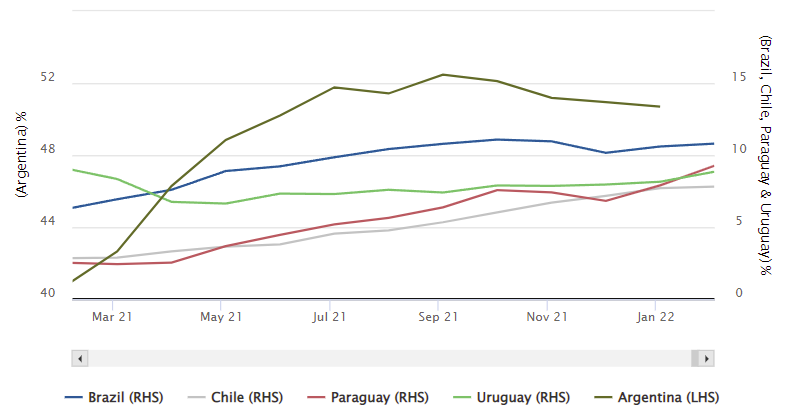
    Brazil & Southern Cone: inflation rate
    Percentage variation (year-on-year)

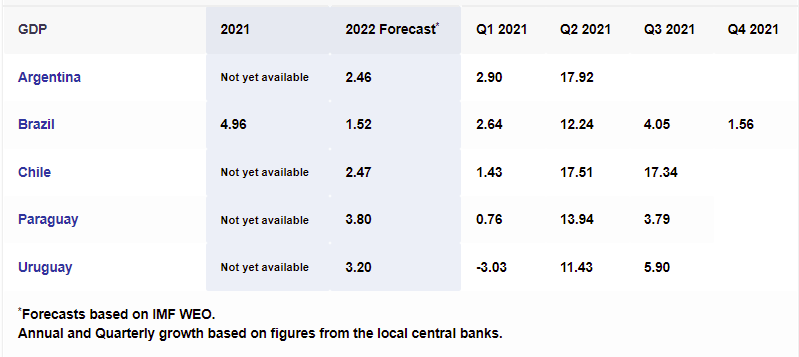
    Brazil & Southern Cone: GDP growth (%)
    Quarterly figures are year-on-year growth

  • EL SALVADOR: Economic outlook improving as Bukele poised for re-election

    Sarah Sheldon 22 January 2024 Hits: 1488

    Nayib Bukele is expected to easily win a controversial second presidential term in El Salvador’s February election and the country’s economic prospects have improved slightly, although his policies could spell trouble in the future.

    Bukele came to power in June 2019, the year before the coronavirus (Covid-19) pandemic struck. His government’s response cost around 16.5% of GDP, according to the World Bank (WB), and general government gross debt rose from 71.3% of GDP in 2019 to 88.1% in 2020, according to International Monetary Fund (IMF) figures. Then, in September 2021, legislation was passed to make the cryptocurrency bitcoin legal tender in El Salvador, the first country in the world to do so. This marked a significant departure from existing economic orthodoxy and saw the value of the country’s sovereign bonds fall sharply. It also soured relations with the IMF, which had been expected to shore up the country’s economy with a financing deal.

    Concerns over the impacts of the decision to make bitcoin legal tender only increased as the price of the cryptocurrency crashed from its historic peak in November 2021, and surveys showed that few Salvadoreans were making use of bitcoin in their daily lives. Despite this, Bukele forged ahead with plans to mine the cryptocurrency in the country, and by December 2023 he had announced that the government’s bitcoin investments had turned a profit. However, the US$3.6m in profits claimed by Bukele would have a negligible effect on the country’s finances. Nonetheless his commitment to the project appears undimmed, with the December 2023 announcement of a residency programme for 1,000 large scale investors through a ‘Freedom Visa’ programme which has the backing of Hong Kong-based cryptocurrency firm Tether.

    These moves suggest an attempt to implement deep reforms of the country’s economic system to end its reliance on multilateral institutions such as the IMF, but it appears that Bukele may be forced to return back to the fold. After El Salvador’s complicated relationship with the lender took a new twist in April 2023, when the government blocked a regular IMF report on the country’s finances, sparking concerns over a lack of transparency and speculation that Bukele was attempting to bury worrying data, relations with the IMF have improved of late, with renewed interest in negotiating a new financing programme.

    Rodrigo Valdés, director of the IMF's Western Hemisphere Department, told Reuters in an article published on 13 October that engagement with El Salvador has been “very productive,” but an agreement is “not there yet.” Valdés underlined that the IMF would require some structural measures in order to agree a deal, although he stopped short of naming the bitcoin experiment specifically, but also emphasised that Bukele’s popularity presents an opportunity for him to take decisive actions. This is also enabled by his likely continued control of the legislative assembly, where the dominance of his Nuevas Ideas (NI) party, which controls 56 out of 84 seats, means Bukele’s policies can pass without significant political opposition.

    The government also received a boost on 7 November, when international credit ratings agency Standard & Poor’s improved the country’s credit rating to B-, citing a reprofiling of local debt which mitigates the risk of default. In effect the government is repaying short-term debts owed to local banks and then issuing new debt obligations for longer periods, which reduces the risk of a financing crunch, according to S&P. However, while the agency does highlight the immediate fiscal relief brought about by these actions, it also says that El Salvador “remains vulnerable because of its high debt and interest burdens and its limited monetary flexibility”. This illustrates the fact that Bukele is still facing something of an economic bind moving forward.

    Despite the fact that a second term is unconstitutional, Bukele’s bid for re-election was rubber-stamped by allies in the supreme court. On 1 December he took leave of absence for six months, replaced by his private secretary, to enable him to stand in the elections, in line with a creative interpretation of the constitution made by pliant magistrates. He also enjoys sky-high approval ratings thanks to a crackdown on gangs, which has improved the security situation for ordinary Salvadoreans while attracting criticism over its impact on human rights. As a result, Bukele looks set to return for a second term as president, with persistent economic challenges high on the agenda. While bonds have rallied and concerns over a default have eased, debt remains higher than pre-pandemic levels and the fiscal position “remains fragile,” according to the WB, which adds that narrowing financing alternatives are contributing to liquidity pressures. In addition, S&P is forecasting a drop in the country’s GDP growth, from 2.6% in 2022 to 2.5% in 2023, and then to 2.2% in 2024.

    Foreign direct investment has also slumped, recording a negative balance of -US$101m in FDI inflows in 2022 [EB-23-08]. This 133% decrease compared to 2021 is because US$294m was divested from the manufacturing sector, and investment in services also fell 35% year-on-year. This suggests how Bukele’s increasingly authoritarian governing style and refusal to release economic data has affected investor confidence, and the US Department of Commerce said that El Salvador’s “macroeconomic context and declining rule of law present some challenges” in an investment climate statement published in December 2022.

    The WB recommends prioritising investments in human capital and enhancing public and private investment, as well as promoting access to high-quality jobs, and Daniel Serrano, a researcher at the Universidad Centroamericana (UCA) in San Salvador, has also said that El Salvador requires a new model of redistributive investments to boost economic growth. In a presentation reported by the media at the end of November, Serrano called for a significant rise in investment to US$1.852bn, saying that in 2019 (which he described as a normal year), the state invested just US$1.002bn.

    Given the fiscal pressures on the government, Bukele will need to do more to attract foreign firms who may have been spooked by controversy around transparency, the bitcoin experiment, and his security crackdown. “The lack of investment is a serious constraint,” former central bank president Carlos Acevedo told the Financial Times in an article published 1 December. However, there is little to suggest that Bukele is preparing to relax his creeping authoritarianism, with local media outlet El Faro publishing a roundup of what it called “The road to dictatorship” on 2 December, citing the accumulation of power, corruption, the construction of a police state, and attacks on citizens’ rights as key areas of concern.

    While many Salvadoreans have been willing to overlook these factors due to Bukele’s security achievements, this goodwill will soon run out if the economy hits the buffers, said Acevedo. “The second term will be much harder if he doesn’t manage to respond to people’s economic expectations,” he added. This realization also appears to have forced Bukele to reconsider his attitude towards the IMF, and the government is actively seeking a new debt deal.

    IMF deal?

    In October Finance Minister Jerson Posada said that the “objective is to be able to reach an agreement” with the IMF, and later that month Bukele himself said he expected a deal to be reached after the February 2024 elections. IMF officials have so far refused to comment on whether the lender would make a deal subject to changes to the country’s policy on bitcoin, but it appears that Bukele may have to make some concessions to orthodoxy if he is to keep the economy from flagging.

  • TRACKING TRENDS

    LatinNews 01 April 2021 Hits: 4014

    PERU | Congress votes to permit further early pension withdrawals. Peru’s congress voted on 30 March to allow individuals affiliated with the privately managed pension fund system (AFP) to make another withdrawal from their pension pots, in order to alleviate the economic hardship caused by the coronavirus (Covid-19) pandemic. All Peruvians who hold a privately managed pension will be able to withdraw up to PEN$17,600 (US$4,665), and those over the age of 40 who have not made any pension contributions in the last five years will be permitted to withdraw 100% of their pension savings.

    This is the third time that Peruvians have been permitted to make withdrawals from their pension pots since the pandemic began, and it follows votes in April and November last year that allowed people to withdraw up to 25% of their private pension savings. The latest pension withdrawal bill received cross-party support in the 130-seat congress, with 84 votes in favour, six against, and 13 abstentions.

    The AFP president, Giovanna Prialé, voiced concern at the enormous quantities of money that she expects to be withdrawn. Prialé predicted that around PEN$45bn would be taken from the AFP, which she said equated to “one third of the funds we have accumulated”. Prialé cautioned that around 4m of the 7m AFP-affiliated Peruvians could be left with nothing in their pension pots, given that a large number will be eligible to withdraw all of their pension savings.

    • Peru’s pension withdrawals

    The AFP president, Giovanna Prialé, also warned that the pension withdrawals could create macroeconomic problems, as the AFP will lose out by liquidating investment funds, affecting local markets and the perception of international investors.

    VENEZUELA | Dollars and digital money on the way. The government continues to move towards authorising US dollar accounts in the banking system, as a response to hyperinflation and shortages of bolívar notes. The central bank says inflation last year was 2,655% and has just started printing new 1m Bolívar notes (worth around 50 US cents). Economist Ángel Alvarado says the decision reflects a new pragmatism within the government, which, as he put it, shows that Nicolás Maduro and the ruling Partido Socialista Unido de Venezuela (PSUV) are prepared to “give up economic power to retain political power”.

    The intention also appears to be to let the bolívar linger on, without formally switching currencies. The government is in addition seeking to digitalise payment systems, to overcome practical problems with making cash payments, for example in the public transport system, where three-quarters of all bolívares are spent. Venezuela may follow Argentina, another high-inflation country, which recently introduced a fare card system as an alternative to cash to pay for public transport.

  • Towards an India-China naval challenge - 23 June 2007

    LatinNews 08 September 2011 Hits: 4

    SPECIAL BULLETIN

    TO: All Strategic Intelligence Forum members

    FROM: JKC de Courcy, Chairman, Strategic Intelligence Forum

    DATE: 23 June 2007

    SUBJECT: Towards an India-China naval challenge

    We watch closely the proceedings of the US-China Economic and Security Review Commission, mostly because of the insights they provide into evolving US attitudes and reactions to China's rise.  The hearings on 14-15 June concerned the implications for the US of China's growing energy consumption.

    Of exceptional interest was the 14 June testimony of Professor James Holmes of the US Naval War College who highlighted the probability of an intensifying contest for maritime supremacy in the Indian Ocean between China and India.

    In his summary, Professor Holmes argues: "In all likelihood, an increasingly sea-power minded China will neither shelter passively in coastal waters nor throw itself into competition with the United States in the Pacific Ocean.  Rather, Beijing will direct its energies toward South and Southeast Asia, where supplies of oil, natural gas, and other commodities critical to China's economic development must pass."

    A number of Chinese analysts and strategists are quoted to support this proposition, with a 17 August 2005 editorial in Ming Pao providing a succinct summary of this element in Chinese strategic thinking.  The editorial argued that "whichever country controls the Indian Ocean controls East Asia".

    There are two major concerns.  First, as Holmes argues, China must first "secure the East, Yellow, and South China seas to its satisfaction", which must entail resolving the Taiwan issue in its favour as a prerequisite.  This point needs little elaboration.

    Secondly, Chinese naval ambitions in the Indian Ocean must come up against rival Indian ambitions, with India having the advantage of operating closer to home.  Holmes argues that while China-India relations have seen steady improvement since the late 1990s, any Chinese attempt to control events in the vicinity of India "would doubtless meet with Indian countermeasures".

    Holmes points out: "Like China, India discerns real, compelling interests in the Indian Ocean."  He adds, correctly and alarmingly: "Strategists in New Delhi phrase their arguments in intensely geopolitical terms - jarringly so for Westerners accustomed to the notion that economic globalisation has rendered armed conflict passé."

    The problem is compounded by an element within Chinese strategic thinking that fears the implications of India's "Look East Policy".  The Chinese scholar Hou Songlin argues that while India is for the time being content to focus on economic cooperation, it will in due course expand its eastern-oriented strategy into political and security spheres.  He says that Indian-Asean cooperation is aimed ultimately at enabling India to fulfil its "grand strategy to control the Indian Ocean, particularly the Malacca Strait".

    Although still a long way from securing its eastern maritime front, China is already (in the words of Holmes) "gradually laying the foundations of a strategic maritime infrastructure that would enhance both its economic prospects and its military access to the Indian Ocean".  It is doing this, amongst other means, by developing close ties and basing rights with Myanmar and Pakistan.

    As Holmes says: "Beijing could leverage its informal strategic alliances with Myanmar and Pakistan...to counterbalance US power, check India's rise, and monitor maritime activities carried on by these maritime competitors."

    We agree in almost all respects with this analysis.  It is clear that neither China nor India are content with the United States retaining its monopoly over the supply of "the international public good of free navigation" (as other testimony to the hearings described it), which the US has enjoyed for six decades.

    Holmes recognizes this and clearly harbours long-term fears for what this might mean for Sino-Indian relations.  His answer?  The establishment of the habit of cooperation now, while China is still vulnerable, particularly in areas such as disaster relief, maritime domain awareness, counter-terrorism, and counter-proliferation, which, he believes, "could lay the groundwork for a more durable partnership in maritime Asia, alleviating the concerns about sea-lane security that could prod China in a more ominous direction".  As Holmes concludes: "Considering the stakes, it would be worth the effort US and Indian leaders would expand in negotiating such a partnership."

    END

    The proceedings of the 14-15 June hearings on "China’s Energy Consumption and Opportunities for US-China Cooperation to Address the Effects of China’s Energy Use" can be accessed at the following link:

    http://www.uscc.gov/hearings/2007hearings/hr07_06_14_15.php

  • TRACKING TRENDS

    LatinNews 14 July 2011 Hits: 602

    URUGUAY | Fine fettle. The economy grew strongly in the first half of 2011, expanding by 6.8% compared with the same period last year. The economy minister, Fernando Lorenzo, raised the GDP growth forecast for this year to 6% from a previous forecast of 4.5% thanks to strong domestic demand. Inflation, Lorenzo said, is the main macroeconomic challenge facing Uruguay, although he predicted that increasing prices should slow in the coming months. Memorably described recently by President José Mujcia as “a soapy eel”, inflation continues to creep upwards, reaching 4.71% for the first six months of the year. Lorenzo lifted the inflation forecast for 2011 from 6% to 7.8%.

  • COSTA RICA: Higher levels of homicide anticipated for 2015

    LatinNews 30 September 2015 Hits: 2068

    Last year’s record levels of homicide look set to be beaten in 2015, according to the Judicial Investigations Agency (OIJ), a branch of the supreme court. A recent report by the newspaper Diario Extra revealed that the OIJ believes Costa Rica is on track to register 533 homicides this year, up from 471 in 2014 and 407 in 2012 and 2013. While the increased number still pales in comparison to many of Costa Rica’s Central American neighbours it is still sufficient to pass the “pandemic” violence threshold as determined by the World Health Organization.

    An estimated 45% of the murders that have taken place so far this year are believed to be related to violence between drug gangs. The Mara Salvatrucha-13 and Barrio 18 gangs have an increasingly significant presence in the country, as Costa Rica becomes an important transit route for cocaine. Local officials have also warned that Mexican drug cartels have begun arming local drug gangs with powerful weapons. Last year, the Costa Rican authorities registered its single largest seizure of the drug, following a 30% rise in cocaine seizures in 2013.

    However, even with the recent uptick in violence, Costa Rica’s murder rate remains well below that of its northern neighbours. The government has also taken a number of steps to tackle the issue, including the establishment of a special court for organized crime and drug trafficking in an attempt to avoid the corruption of the judiciary. Costa Rica has also become more aggressive in clamping down on illicit financial flows, enacting 19 of the US State Department’s 21 International Narcotics Strategy Report regulations.

  • Region: Corporate Radar

    LatinNews 13 February 2018 Hits: 801

    SQM settles in Chile: SQM, Chile’s leading lithium and fertiliser producer, said at the end of January that it had reached an out-of-court settlement with state prosecutors investigating its involvement in making alleged illicit campaign contributions in 2008-2015. The investigation lasted three years. SQM has not admitted guilt, but did agree to pay CLP900m (US$150m) to the authorities and to make CLP1,650 (US$275m) worth of donations to various charities.

    Embraer shares on the up: Shares in Embraer, the Brazilian aviation and defence company, jumped by over 4% on the Bovespa on 2 February following a report by newspaper O Globo that it would create a joint venture with Boeing of the United States. Boeing has expressed interest in acquiring Embraer, but the government, which holds a ‘golden share’ giving it the right of veto, has opposed a direct sale on national security grounds. The creation of a joint venture might be a way to resolve the impasse. The O Globo report said the new company would focus on commercial aircraft production, leaving the defence side of the business unaffected by the takeover. However, Embraer issued a press statement saying no deal had been reached and that negotiations with the US company were continuing.

    Chinese on their bikes: Two China-based bicycle-sharing companies are planning to launch their service in Mexico City and other urban centres, according to press reports. Beijing-based Ofo is looking at Mexico City, Guadalajara, and Monterrey, while its rival Mobike is planning to launch a service in February in Miguel Hidalgo, a wealthy suburb of Mexico City. In the capital both companies would compete with the state-run Ecobici service, which currently offers around 6,000 bicycles available from 450 stations.

  • RASTREANDO TENDENCIAS

    LatinNews 28 March 2014 Hits: 877

    BRASIL | Reducción de grado de S&P. El 24 de marzo la agencia de ratings de crédito, Standard & Poor’s (S&P), anunció que estaba bajando de grado el rating de la deuda soberana de Brasil de BBB a BBB-. Aunque anticipada, el momento de la decisión sorprendió a algunos observadores del mercado y a funcionarios del gobierno, quienes esperaban que la noticia llegase después de las elecciones de octubre. El hecho que la reducción de grado haya llegado ahora muestra la extensión del pesimismo que se extiende entre los analistas de mercado sobre las perspectivas del futuro crecimiento económico de Brasil.

    Brasil vio su rating de deuda a largo plazo reducido a BBB-, el grado de inversión más bajo de la agencia. Ahora se ubica por debajo de Chile, Colombia, México, Panamá, y Perú, en la región. De acuerdo con la nota de la agencia publicada junto con el nuevo rating, “la reducción de grado refleja la combinación del deslizamiento fiscal, la perspectiva de que la ejecución fiscal permanecerá débil en medio de un crecimiento sometido en los próximos años, una capacidad constreñida para ajustar la política antes de las elecciones presidenciales, y alguna debilidad en las cuentas externas de Brasil”. La credibilidad fiscal ha sido “sistemáticamente debilitada” después de los recortes en la meta principal del presupuesto del gobierno, dijo la agencia, y los préstamos ofrecidos por los bancos estatales han “socavado la credibilidad política y la transparencia”.

    Eduardo Campos, el candidato presidencial por el opositor Partido Socialista Brasileiro (PSB), dijo a los periodistas el 25 de marzo que los fundamentos macroeconómicos de Brasil permanecen en gran medida sólidos, pero que la confianza en el gobierno actual era baja. “Brasil tiene fundamentos mucho mejores que varios países, está en la senda”, Campos dijo. “Creo que lo que estamos confrontando es, por encima de todo, una crisis de expectativas, y nosotros buscaremos la solución cuando el pueblo hable en las elecciones de octubre”.

    URUGUAY | Resintiendo las inversiones brasileras. El 20 de marzo el presidente del Instituto Nacional de Carnes (Inac) de Uruguay, Luis Alfredo Fratti, dijo que él estaba preocupado con la creciente presencia de firmas brasileras en la industria local de procesamiento de carnes. Los comentarios de Fratti vinieron después del anuncio de Minerva Foods de Brasil de que había acordado la compra del frigorífico Carrasco por US$37m. La compra convierte a Minerva, que ya posee un matadero en Uruguay, en el segundo mayor procesador y exportador de carnes del país, con una participación del 18% en el mercado, detrás de Marfrig (también brasilera), que tiene el 21,8% de participación en el mercado.

    El acuerdo también permite a Minerva ingresar en el mercado local de procesamiento de carne ovina por primera vez. Fratti dijo que la adquisición de Carrasco por parte de Minerva resultará en una concentración mayor de la industria local de la carne en manos de capital brasilero, señalando que las firmas brasileras (además de Minerva y Marfrig, el gigante brasilero procesador de alimentos JBS también posee mataderos en Uruguay) ahora controlarán el 41% de las operaciones de este sector.

    Fratti dijo que esto era razón suficiente de preocupación para el gobierno pues “si pudiéramos elegir, sería preferible tener firmas multinacionales de diferentes nacionalidades [en el sector], pero nosotros no podemos hacer esa elección”. En particular, Fratti explicó que como muchos productores locales, Inac también está preocupado ante la perspectiva de que las firmas brasileras podrían empezar a dictar las políticas del mercado local, tales como establecer los niveles de precios o adoptar ciertos límites de producción diseñados para servir a los brasileros, en vez de a los intereses económicos locales.

    Tan pronto como Minerva anunció sus planes para adquirir Carrasco a comienzos de este mes, la influyente Federación Rural (FR) de Uruguay emitió una declaración pública expresando su preocupación de que la concentración de mataderos del país en manos extranjeras era “severamente desalentador” para los criadores locales de ganado para la producción de carne. De acuerdo con la FR, en meses recientes sus miembros han encontrado dificultades para vender su ganado a los mataderos locales pues las firmas de propiedad brasilera en particular aparentemente obtienen su ganado a través de la frontera. La declaración de la FR advierte que los “efectos negativos” de esta situación podrían “no solamente perjudicar a los productores sino también a los trabajadores vinculados con la industria de la carne”.

    En un esfuerzo para no atizar las tensiones aún más, Fratti dijo que el hecho de que las firmas brasileras estén invirtiendo en la industria de la carne de Uruguay, sugiere que estas la ven como una buena oportunidad de inversión y que en el largo plazo tales inversiones serían beneficiosas para el país. De hecho, Fratti recordó que hace unos algunos años el mismo gobierno uruguayo “pedía a Brasil que considere invertir más en Uruguay”. Y agregó, “pero quizá nosotros somos tan pequeños que ahora tendremos que decirles ‘sí, inviertan, ¡pero no tanto!”.

    • Banco do Brasil

    El 22 de marzo Banco do Brasil, el cual es controlado por el estado brasilero, anunció que había recaudado US$1mm de un préstamo sindicado con un grupo de otros 22 bancos. Esta es la primera vez que el Banco do Brasil, el banco más grande de América Latina, ha recurrido a tal tipo de operación en un esfuerzo por reunir capital. En años recientes los préstamos sindicados se han convertido en una alternativa popular para los bancos y otras firmas para reunir fondos rápidamente, pues estas operaciones toman considerablemente menos tiempo que una emisión de bonos. De acuerdo con la declaración del Banco do Brasil, el banco obtuvo el préstamo en dos tramos –un préstamo de US$700m a tres años, con una tasa de interés de 1,35 puntos porcentuales por encima que la tasa de seis meses de la London Interbank Offered Rate (Libor) y un préstamo de US$300m a cuatro años a una tasa de interés de 1,5 puntos porcentuales por encima de la tasa Libor.

  • TRACKING TRENDS

    LatinNews 15 November 2018 Hits: 3519

    CHILE | Union protests. More than 100,000 members of the Central Unitaria de Trabajadores (CUT) – Chile’s main trade union – marched through the capital city, Santiago, on 8 November. Protesters carried signs criticising the “anti-union” policies of the right-of-centre Chile Vamos government led by President Sebastián Piñera, a new law on youth employment, and government plans for the labour market.

    Other demands also include improved pensions. The strike was observed by workers in 26 locations throughout Chile. The president of the CUT, Bárbara Figueroa, claimed that the government was finally showing its true colours with a raft of conservative policies.

    CHILE | New budget set for congressional vote. Cross-party talks in Chile’s mixed parliamentary commission on 12 November resulted in an agreement on the 2019 draft national budget, which will now be subject to a vote in the chamber of deputies and the senate. Politicians from the centre-right Chile Vamos coalition and the opposition hailed a spirit of cooperation which saw the first budget of the current administration pass to the next stage in the approval process.

    PARAGUAY | Seeking access to US beef market. On 14 November José Carlos Martin Camperchioli, the head of Paraguay’s Servicio Nacional de Calidad y Salud Animal (Senacsa), gave an update on the government’s efforts to secure access to the US market for Paraguayan beef exports.

    Martin revealed that technicians from the US have been working in the country for the past two weeks to verify refrigeration systems, as well as carrying out training sessions with officials from Senacsa and refrigeration specialists.

    The awarding of an export license will depend on certification from US health regulators, who must carry out an audit of Paraguayan beef storage facilities. According to Martin, securing access to the US market would also allow Paraguay to export to other important markets around the world, including Mexico and Canada.

  • Sign of the times: “zero mileage” second hand cars

    Abbi Dicker 11 July 2025 Hits: 1783

    A key issue facing the emerging vehicle transition is how to price new EVs coming onto the market. Within China itself competition is intense due to a proliferation of car manufactures – well over 100 at present – and generalised manufacturing over-capacity. Companies have ruthlessly pushed manufacturing costs down as low as possible, while at the same time benefitting from a number of regional incentives and subsidies. This has led to an apparent oxymoron: the growing sales of ‘second hand, zero mileage’ vehicles. Under this system an exporter will buy a new Chinese car as it comes off the assembly line, register it with a Chinese number plate, and then immediately mark it as second hand for overseas sale at a lower-than-listed price.  

    This practice has come about because manufacturers in China are carrying large stocks of new, unsold vehicles. Those declared ‘second hand’ can be sent for sale at lower prices overseas, typically to markets in Russia, Central Asia, and the Middle East, although also to markets in Latin America. Tu Le, a US-based automobile industry consultant told Reuters news agency that “this is the outcome of an almost-four-year price war that has made companies desperate to book any sales possible”. The practice was something of a trade secret until the chief executive of Great Wall Motor criticised it in the Chinese media. In June this year, the Peoples’ Daily newspaper, seen as close to central government thinking, said the proliferation of “fake used cars” was driving down prices too far and called for “tough regulatory action” to restore order.

    Despite this, the reality is that Chinese regional governments, eager to stimulate local manufacturing and jobs, frequently encourage and offer subsidies to local assembly plants, sometimes ignoring central government regulations. A recent Reuters report found that at least 20 regional governments including Guangdong and Sichuan have supported zero-mileage used cars in public statements. In fact, these governments use various tactics to aid local manufacturers. They include issuing zero-mileage used car export licences, accelerating tax rebates, offering free warehouses, and investing in export and port infrastructure to accelerate the flow of shipments. Under China’s at least partly centrally controlled economy, meeting ambitious production and sales targets is seen as unlocking political and business rewards.

    Wang Meng, a consultant for China Automobile Dealers Association says that of 436,000 ‘used’ passenger and commercial vehicles exported last year, 90% were described as ‘zero mileage’.

  • GUATEMALA: Pérez Molina’s business cabinet

    LatinNews 11 January 2012 Hits: 1109

    A declared priority of Guatemala’s right-wing president-elect, Otto Pérez Molina, who takes office on 14 January, is the approval of a desperately needed fiscal reform which, he claims, would boost tax take to 14% of GDP [RC-11-12], up from the 11.2% registered in 2011. The inability of the outgoing president, Alvaro Colom, to achieve any progress in this area due to the obstruction of his efforts by Pérez Molina (for whom the measure is now key to the success of his new Partido Patriota (PP) government) and the private sector lobby Cacif, was arguably the biggest failing of his four-year mandate. The renewed influence of the business elite in Pérez Molina’s incoming cabinet, invoking comparisons with the previous administration of Oscar Berger (2004-2008), whose former vice-president, Eduardo Stein headed up the recent transition process, suggest the new president stands a greater chance than his predecessor at the negotiating table.

    Members of the incoming cabinet closely identified with the business elite include Pérez Molina’s choice of Sergio de la Torre Gimeno, a textiles businessman, as his economy minister. A former president of the chamber of commerce and of Cacif (2006-2007) and the private sector representative before the central bank’s monetary board at the time of his appointment, De la Torres is the managing director of Textiles Accessorios, known as Actex Labels, and heads various companies such as Reto and Promocionarte which promote exports. He has cited as priorities the need to create jobs through boosting Guatemala’s competitiveness and attracting foreign direct investment (FDI). FDI reached US$742m in 2011 on preliminary figures from the UN Economic Commission for Latin America and the Caribbean (Eclac) – just 8% of the total received by Central America and the Dominican Republic.

    Also likely to ease Pérez Molina’s task ahead is the appointment of a PP heavyweight and defeated Guatemala City mayoral candidate, Alejandro Sinibaldi, to head up the communications portfolio. Sinibaldi’s family, Castillo Sinibaldi – an important financier of the party – is a branch of the Castillo Córdova family, which is behind the Corporación Castillo Hermanos, one of Guatemala’s most influential economic groups. The choice of Harold Caballeros, the defeated first-round presidential candidate for Visión con Valores as foreign minister will also be well received by Cacif; a former evangelical pastor who founded the El Shaddai church, which has more than 12,000 members in Guatemala, Caballeros was reportedly Cacif’s first choice of presidential candidate. According to the local media, prominent business leaders close to the former pastor, whose new post is no doubt a reward for his decision to back the PP in the second round given his dearth of diplomatic experience, include Diego Pulido, the general manager and corporate director of Corporación Banco Industrial, the country’s biggest bank, and Jaime Arimany, an industrialist and former president of Cacif.  

    • New finance minister

    Unlike other cabinet appointments, the new finance minister, Pavel Centeno, is less closely aligned with the traditional elite. A conservative technocrat now, he was previously identified with the regional research organisation Flacso; his father, the economist Carlos Centeno, was murdered by the military during the 1960-1996 civil war.


  • PARAGUAY: Manufacturers look beyond Mercosur

    LatinNews 12 June 2012 Hits: 649

    Paraguay has taken a sharp knock from the import barriers erected since last year by its main trading partner in the Southern Common Market (Mercosur), Argentina. Local manufacturers have complained about the arbitrary restrictions and have pressured the Paraguayan government to come out in defence of the country’s economic interests. The government, which has been in arduous negotiations with the Argentine authorities for months, has got nowhere. Frustrated, local businessmen are taking matters into their own hands, seeking out new export markets and actively trying to reduce their dependence on Argentina.

    The Paraguayan government led by President Fernando Lugo began negotiating the removal of the import restrictions imposed by Argentina in March. Months of to-ing and fro-ing have as yet failed to produce any discernible results. Meanwhile, local exporters are losing money. Paraguay’s industrial union (IUP), an influential private sector lobby, has been outspoken in its criticism of the Lugo government for not doing enough to help. In mid-May the UIP urged the government to adopt a tougher stance by threatening to impose retaliatory measures on Argentina (and possibly also Brazil, which has adopted similar policies to restrict imports). But the Lugo government rejected this, opting to stick to the negotiations in hand.

    The UIP says that Argentina’s imposition of non-automatic licenses and the introduction of advanced sworn for hundreds of imports particularly affect Paraguay’s textile and plastic producers. According to the UIP, these sectors have registered losses of some US$15m to date in 2012. The UIP informed the labour ministry on 30 May that three textile companies were considering suspending all activity unless there was some sign of progress in the talks with the Argentine authorities. The UIP warned that this would be the prelude to outright factory closures and mass job losses.

    The warnings seemed to work and a week later, on 6 June, Paraguay’s foreign ministry announced that Argentina had agreed to lift some of the trade restrictions by eliminating 131 non-automatic import licenses affecting Paraguayan exports. However the UIP’s president, Eduardo Felippo, was lukewarm, saying that the move “helps to reduce the fever, but not the illness”. He branded the Argentine gesture “insufficient”, noting the requirement for advanced sworn statements remained in place. Felippo slammed that regulation as “in contravention of Mercosur and the [World Trade Organization] WTO” and called for its immediate removal.

    Felippo complained that this is not the first time that Argentina has imposed these kinds of restrictions and said that local entrepreneurs are now reticent to do any business with Argentina, given the operating uncertainty.

    He said that the UIP would promote a new policy to be known as, ‘No to Argentina’ (NoAr)’, which consists of replacing Argentine materials with alternatives from other countries and looking for new export markets to replace Argentina.

    Felippo’s comments came just days after President Lugo returned from an 18-day tour of Asia, expressly aimed at finding new markets for Paraguay’s agricultural produce. The trade & industry minister, Francisco Rivas, who accompanied Lugo to Asia, said that the tour was the “most important one for the country to date”. He said that Paraguayan products should gain more access to Asian markets, which could prove “very helpful” in the future. He suggested that Japanese entrepreneurs had expressed interest in building a shipyard in Paraguay.

    • Pulp enters the US

    On 7 June the soft-drinks manufacturer, Bebidas del Paraguay, opened a new US$1m processing and bottling plant in Leesburg, Florida, to produce its ‘Pulp’ soft-drink range for the US market. Bebidas del Paraguay is owned by Grupo Cartes, a company owned by a Paraguayan business tycoon and upcoming politician Horacio Cartes, who registered the company in the US in 2010 under the name Bebidas USA. Cartes, who also owns the ‘Palermo’ cigarette brand, which entered the US market in 2007 and is now present in 20 states, said that the plan is to target Florida, North and South Carolina before expanding to other states.

  • CARIBBEAN POINTERS

    LatinNews 14 May 2014 Hits: 3195

    ***GUYANA-SURINAME DISPUTE STILL AN IMPEDIMENT. The disputed area known in Guyana (which controls it) as the New River Triangle and in Suriname (where it forms the southwest border with Guyana) as Tigri is still capable of causing tensions between the two countries. Last month Guyana turned down an invitation to attend the International Mining, Energy & Petroleum Conference and Exhibition (SURIMEP 2014) in Paramaribo in June because the Suriname map that was being circulated included the area as Suriname territory.

    The disputed area has been controlled by Guyana since 1969. On 12 May, Suriname’s Foreign Affairs Minister Winston Lackin told the National Assembly that Guyana has been “making moves on the Tigri area for 40 years now”. Lackin added that Suriname could have gone to war over the disputed territory but that “wars cost money [and] we rather use those for public health and education”.

    A joint committee has been established by Suriname and Guyana that has held four meetings in the past three years, but clearly the issue still has the capability to cause disruption in bilateral relations. Lackin said that he is convinced that “a constructive solution is the best outcome”, but he added that the issue remained a priority for President Desi Bouterse.

    ***IMF COMPLETES BELIZE REVIEW. On 9 May, the International Monetary Fund (IMF) completed its latest Article IV discussions with Belize. At the conclusion of the talks, the IMF issued a statement saying: “Over the medium-term, real GDP growth is expected to hover around 2.5% a year as declining oil production would be offset by higher output of other commodity exports, tourism, and construction.”

    For the IMF, risks to Belize’s economy “continue to be tilted to the downside” because of the threat of external vulnerabilities that “could arise from a protracted period of weak growth in advanced economies or complications with Petrocaribe financing”.

    The IMF recommends “a more ambitious rascal stance to crate credible policy buffers that would help address downside risks”. This could be achieved “by a combination of revenue, expenditure, public financial management, and debt management measures”.

    ***BAHAMAS MISSES GROWTH TARGET FOR 2013. Preliminary figures released by the Department of Statistics at the beginning of May indicate that The Bahamas grew by just 0.7% in 2013, well below the 1.9% projected by the IMF as recently as last October. The growth figure for 2012 has also been revised downwards, from 1.83% to 1.03%.

    The Central Bank of The Bahamas says that the economic recovery “is still very fragile” and that “this below-trend growth is expected to persist over the near-term as the domestic environment continues to face significant headwinds due to the modest recovery in the global economy”.

    The bank said that in 2013 tourism expenditure decreased by an estimated 3% as a result of a reduction in the number of stopover arrivals. Residential construction was down by 8.6% and “other construction” was down by 10% “as a result of the winding down of major construction projects such as the Airport Development Project and the New Providence Road Project”.

  • HONDURAS: Underemployment is driving migration to US

    LatinNews 17 November 2020 Hits: 620

    Honduras has seen a significant rise in underemployment in the past decade and the phenomenon is a push factor for migration, according to a new study.

    In 2009 the proportion of the economically active population in Honduras reporting no employment-related problems stood at 59.8%, but by 2019 this had dropped to 39.4%, according to a report released on 7 October by investigators  from the Universidad Nacional Autónoma de Honduras (Unah). In the public sector, 88.8% of workers reported no employment-related problems in 2009, falling to 57.7% in 2019, compared to the private sector (47.0% and 28.1% respectively) and self-employed people (59.4% and 35.2%).

    The investigators, who are from the university's demographic observatory (ODU) and masters programme in demography, say underemployment is characterised by occasional or seasonal work with insufficient hours or shift work with low salaries and poor conditions. The International Labour Organization defines underemployment as “underutilisation of the productive capacity of the employed population, including those which arise from a deficient national or local economic system”. 

    The ODU report’s findings show that the functioning of the Honduran labour market has worsened, with the study pointing the finger at some counterproductive job creation measures. The introduction of hourly and temporary contracts has helped to create jobs but have contributed to underemployment. It adds that “In general terms the labour market in Honduras lost capacity to generate formal jobs, which forces people to take short-term positions in other economic sectors such as the informal economy, or work in businesses in the formal sector but for fewer hours”. 

    Unemployment rates have fallen from 6.7% in 2016 to 5.2% in 2020, according to the World Bank, but the ODU researchers say this does not tell the full story. Official policy has focused on palliative measures such as  the ‘With work you live better’, ‘Work by the hour’ and the ‘10k grant’ programmes, which do not address structural issues in the labour market, the ODU says. People may technically have a job, but they are not necessarily earning enough to pay for basic necessities. This is one reason why Hondurans migrate to the US, according to researcher Alejandro Melgar, who was involved in producing the report, as the domestic labour market does not generate opportunities to pay for basic necessities.

    To improve the situation the Honduran government and private sector should work to diversify economic activities, moving away from the primary sector towards industry and technology, according to the paper. These industries would then be able to make more use of trained workers, reducing underemployment. One way to do this would be to encourage partnerships between businesses and educational institutions, so companies know they can employ people with the right skills. 

    As for the government, back in January then labour minister, Carlos Madero, acknowledged the issue of underemployment, calling it the “most dramatic problem facing Honduras,” and blaming employers for not paying agreed salaries. On 22 October Madero’s successor, Olvin Villalobos Velásquez, told reporters that underemployment figures are set to worsen due to the effects of the coronavirus (Covid-19) pandemic. Villalobos pointed to cash transfer programme ‘Bono Único’, paid to self-employed workers affected by the crisis (see sidebar), as one way in which the government is trying to help. However, as the ODU said, these kinds of payments do nothing to deal with structural issues.

    • Bono Único

    On 14 October the Honduran government, with support of the United Nations Development Programme (UNDP), launched ‘Bono Único’ (‘single bonus’), a social protection programme aimed at supporting the most vulnerable population affected by Covid-19 in Honduras. The Bono Único is a one-time subsidy of HL2,000 (US$82) delivered through an electronic voucher that can be exchanged for food, medicine and /or medical supplies. The government says that up to 260,000 people in the country will receive the bonus in the next three months. 

  • Death of the Tren?

    Abbi Dicker 11 September 2025 Hits: 1186

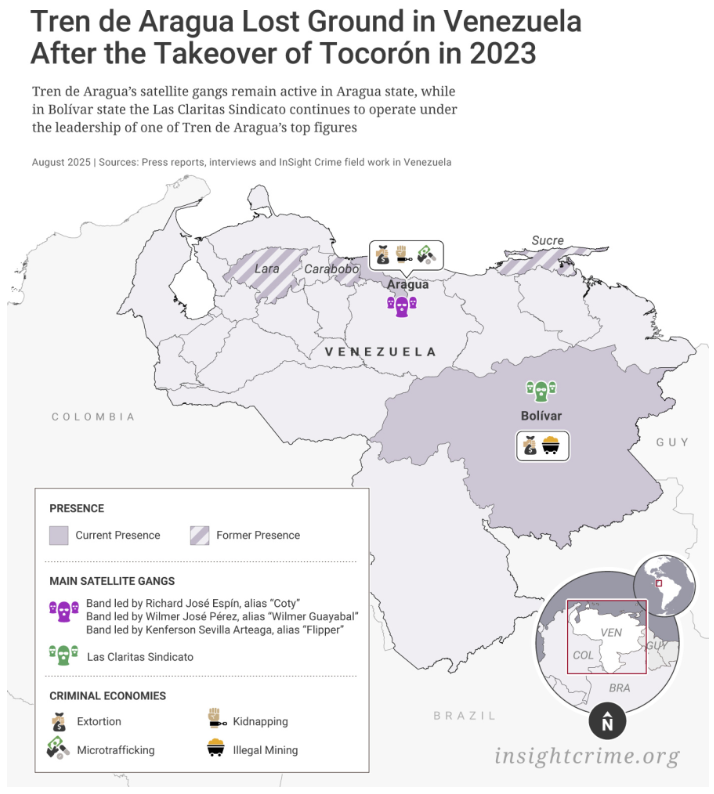
    Tocorón prison’s central role in running the Tren’s criminal empire may – or may not – have come to an end on 23 September 2023. On that day up to 11,000 troops under the command of CICPC (the Scientific, Penal, and Criminalistic Corps) raided the prison, blowing up the bars of locked cells. Unlike a prison seizure in 2011, on this occasion there was no resistance from the inmates. None of the three principals or pranes were in their cells when the raids took place. Specialist website InSight Crime quoted sources who said that the Niño Guerrero had imposed a curfew for three days before the raid, taking out weapons, money, and people through a tunnel. A local prisoners’ rights lobby group, Una Ventana para la Libertad (A Window for Liberty), said the operation to take over the prison had been discussed beforehand with the authorities, allowing the TdA leadership to make its getaway.

    Those in the Venezuelan government who claim that the Tren de Aragua does not exist cite the September 2023 takeover as their main evidence, but their accounts are short on detail and sometimes contradictory. The day after the raid the interior and justice minister, Remigio Ceballos, visited the prison where he claimed “All those structures that called themselves the pranato have been totally dismantled. They even existed with a name, the Tren de Aragua, but they do not exist. The Tren de Aragua does not exist.”

    Senior officials in the Caracas government have at times claimed that the Tren and other criminal megabandas have been created by the opposition political parties. Government supporters have also claimed that El Niño Guerrero is a US spy charged with destabilising the Venezuelan government. Foreign minister Yvan Gil has described the Tren as “a fiction invented by the international media”.

    The takeover was undoubtedly a blow for the Tren, but it is likely that it fell short of the full “extinction” that the government has claimed. It seems that the organisation, which can now count on an extensive international criminal network, may have been forced to renegotiate the terms of its activity in Venezuela. Javier Mayorca, a security consultant, told InSight Crime that the clampdown was in part because Venezuela had come under pressure from left-leaning Colombian President Gustavo Petro to clean up its act. The Caracas government may have also wanted to show itself 'tough on crime' ahead of the July 2024 presidential elections (which Maduro claimed to have won despite opposition and international reports of massive fraud). Or it may have been that Tocorón had simply become too powerful.

    Certainly, there are signs that Tocorón’s local influence has waned and indications of fragmentation among various satellite gangs. According to InsightCrime, remnants of the Tren are still present in its former hub in the San Vicente neighbourhood. An attempt to establish a new stronghold in Táchira state on the border with Colombia was reportedly blocked by Colombia’s Ejército de Liberación Nacional (ELN) guerrillas who are dominant in that area. The Tren has also been held back in Lara and Carabobo states. The arrest of gang leader alias El Pilo, (Carlos López) has been a setback in Sucre.

    It also appears that low-level members of the security services have been punished for their collusion, with several prison guards being sacked for giving El Niño Guerrero advance notice of the raid, and some 50 members of the National Guard under investigation. Some political heavyweights associated with the TdA have in any case seen their careers begin to decline. Prison minister Iris Varela (2013-2017) who helped put in place the system of pranes, became a deputy in the National Assembly, where she subsequently lost power and influence. More spectacularly, Tareck el Aissami, who was governor of Aragua (2012-2016) and was considered an ally and even a sponsor of the TdA, rose to become vice president but was accused of corruption, dismissed in 2023, and was arrested in 2024.   

    InSight Crime’s conclusion is that the 2023 raid was a “definitive switch” for Tren de Aragua “from a state-sponsored criminal group to an enemy of the state”. To the question of where El Niño Guerrero, the money, and the weapons ended up, InSight suggests that “The Tocorón pran decided to link up with his old friend and fellow Tren de Aragua founder, Yohan José Romero, alias Johan Petrica. It is likely he left Tocorón, with his close circle, weapons and money, and headed down to Bolívar state, to the town of Las Claritas, to find sanctuary and regroup.”

  • NICARAGUA: Veterans challenge Ortega

    LatinNews 11 April 2012 Hits: 2281

    The recent confiscation of property by the government of President Daniel Ortega in order to gift it to a former Sandinista guerrilla, Edén Pastora [RC-12-03], served as a catalyst, triggering protests by thousands of former soldiers of the (now-defunct) Sandinista army, the Ejército Popular Sandinista (EPS). As well as highlighting the plight of the veterans, who have long complained that they have been neglected by the State, the show of unrest from former Sandinistas in March also attracted media attention as indicative of tensions within the ruling Frente Sandinista de Liberación Nacional (FSLN). 

    Despite legislation such as the 1991 law of attention to war victims and Ortega’s creation of the truth, justice, reconciliation and peace commission in 2007, headed up by Cardinal Miguel Obando y Bravo [RC-07-05], former soldiers complain that their longstanding social and economic demands continue to be ignored by the State. At its height in 1986, the EPS was made up of some 134,000 officials, although this was reduced in 1990 to 87,000. Following the 1995 reform, which depoliticised the army and transformed it into a national institution, the military has been cut to some 12,000 members.

    Prompted by the government’s handover of land to Pastora, who, former combatants complained, had not just served with the FSLN but also fought for the Contras, veterans from the northern provinces of Jinotega, Matagalpa and Estelí blocked roads providing access to Managua. The protest action lasted nearly two weeks (until 15 March), when a deal was struck with the government. Following negotiations between Carlos Ramírez, the president of the Consejo Nacional de Defensores de la Patria (CNDP), which represents some 12,000 veterans, and a government delegation which featured Edwin Castro, the head of the FSLN bench in congress, Yara Pérez, the property superintendent, and Roberto López, the head of the social security system (INSS), the agreements reached include: 1) the purchase of land by the government to be redistributed among the veterans (who are calling for between five and 15 manzanas [between 8.4 and 25.2 acres] each); 2) specialised medical attention in line with the 1991 law of attention to war victims; and 3) a pensions law for retired officials, among other benefits. The latter is significant as the Nicaraguan army did not begin a formal pension plan for its officers until 1994, with the ratification of the Military Code and establishment of the Military’s Social Welfare Institute (IPSM). However, since it is not retroactive those who retired before 1994 were not covered. The CNDP has given the government until 17 April to begin making good on its commitments.

    Internal tensions

    While the FSLN remains one of the most disciplined political parties in the region, former Sandinista leader Moisés Hassan Morales, who split with the FSLN in the late 1980s, was quick to discern further significance in the protests. He said they revealed tensions between factions within the party, mainly triggered by opposition to Rosario Murillo, the powerful First Lady and official government spokesperson. Hassan Morales suggested to a leading daily, La Prensa, that former colonel Lenín Cerna, the head of the state security apparatus (DGSE) under the first Ortega government (1979-1990), could have had a hand in the recent unrest. A representative of the historic old guard and cellmate of Ortega’s for years under the dictatorship of Anastasio Somoza (1974-1979), Cerna had served as FSLN organisational secretary - one of the most important party posts - until May last year when he was sacked. His ouster was widely attributed to a clash with Murillo, whom many believe to have been behind the ejection of other leading Sandinistas from Ortega’s inner circle, such as a popular former mayor of Managua, Dionisio Marenco (2005-2009). Murillo has been able to accumulate such power through heading up the controversial citizen power councils (CPCs) which, initially billed as strengthening citizen participation, became an extension of the executive by presidential decree in November 2007 [RC-07-12]. They have since spawned other state/party organisations such as the citizens’ power cabinets (GPC) and Sandinista Leadership Committees (CLS) — as well as other new structures that exist in conjunction with the old and weakened FSLN ones.

    • More signs of dissent

    The veterans’ demonstrations came just weeks after protests by FSLN supporters in late January against the presidential couple’s imposition of candidates for the 4 November 2012 municipal vote, which culminated in the submission of a letter to the party headquarters, signed by some 7,000 people on 7 February. The unrest had been triggered by visits by Nelson Artola, the executive president of the government’s emergency social investment fund (Fise) and a close Ortega ally, to municipalities to ‘anoint’ candidates. According to local press reports, members of the FSLN (which controls 105 of the country’s 153 municipalities) staged demos in some 20 municipalities in seven provinces. Ortega failed to comment on the unrest.

    • Ambassadors confirmed

    On 29 March the US Senate confirmed the appointments of Phyllis Powers and Jonathan Farrar as ambassadors to Nicaragua and Panama respectively. US President Barack Obama had initially tapped Farrar for the Managua post, a position which has been vacant since July 2011, when Robert Callahan ended his three-year stint. However, his ratification was held up in the US Senate amid complaints from two Cuban-American senators, Bob Menendez and Marco Rubio, that Farrar, a former head of the US Interests Section (USINT) in Cuba, was too soft on the Cuban government and that a stronger character was needed in Nicaragua. Powers, a career diplomat, was ambassador to Panama at the time of her appointment.


  • TRACKING TRENDS

    LatinNews 19 September 2011 Hits: 1037

    Chile | Virtual Shopping on smart phones. On 7 September, the Chilean retail giant Cencosud officially launched its new virtual shopping service – Jumbo Mobile. Looking to take advantage of the increasing levels of domestic consumption and the high level of smart phone penetration in the country, Cencosud is the first company in South America to exploit a smart phone virtual e-shopping system. Cencosud’s digital business manager, Mauricio Soto explained that the system, by which users are able to electronically purchase groceries via their smart phones, using virtual aisles set up in Santiago’s metro stations, with the orders then home delivered, is similar to the one successfully implemented by the British retailer,  Tesco, in South Korea. Importantly, Soto stated that he expects the system to expand to other areas covered by Jumbo supermarkets, including to neighbouring countries.

    Brazil | Drones. Brazil’s Embraer, the world’s fourth largest aeroplane manufacturer, announced on 8 September that it had reached an agreement with Israel’s Elbit Systems to develop and produce unmanned drones (VANTs) in Brazil. According to an Embraer statement, the companies agreed to create a new venture called Harpia Sistemas S.A. to be headquartered in Brasília. Importantly, as per the agreement, Elbit, which has already produced VANTs for the Brazilian air force, is to transfer the technology used in the VANTs’ development to the new company. Embraer’s defence and security subsidiary president, Luiz Carlos Aguiar stated that “the creation of the Harpia is perfectly aligned with Brazil’s [National Defence Strategy] and it will become an important instrument to meet the security industry and the armed forces requirements”.

    Argentina |Debt rating.On 12 September ratings agency Standard & Poor’s (S&P) confirmed Argentina’s sovereign debt rating as B, with a stable outlook. According to S&P, this rating reflects the limited access the Argentine government has to financing sources, the uncertainty regarding the country’s economic policy, a double-digit inflation rate and rigidity in public spending. The rating was left unchanged because of a current account surplus, solid international reserves, access to skilled labour, and the relative diversification of the economy. Looking ahead, the agency takes it for granted that President Cristina Fernández will secure re-election in October. As a result, the outlook forecasts may evolve more positively if “government policies aimed at improving transparency in the implementation of a sustainable economic policy are observed”. Conversely, S & P contends that “a more radical approach to economic policy that could cause changes in the pace of economic activity or a significant worsening of the fiscal position could lead it to be demoted”.

    Uruguay | Military. Presidential secretary Alberto Breccia revealed on 12 September that following the mandatory retirement of general Jorge Rosales at the end of the month, he is to be replaced as the commander-in-chief of Uruguay’s army by General Pedro Aguerre. Rosales, appointed as head of the army during the first Frente Amplio government, led by President Tabaré Vázquez (2005-2010) in 2007, has now completed his four year term in the post and must retire. Interestingly, Aguerre was previously sanctioned by the Vázquez government in 2006 for attending a meeting with former president Julio Maria Sanguinetti (1985-1990; 1995-2000) from the opposition Partido Colorado. The-then commander-in-chief, Carlos Díaz, also present at the meeting, was summarily discharged and replaced by Rosales. Nonetheless, the authorities view Aguerre as the ideal candidate to restore unity in the armed forces, which has deteriorated under Rosales. Separately, Breccia also announced that next February when air force general José Bonilla retires, he is to be replaced by army general Daniel Castellá as the chief of staff of the armed forces.

  • Garcia launches "Pacific Arc" blos as counterweight to Alba - LWR 20 September 2007

    LatinNews 06 September 2011 Hits: 4

    Peru's President Alan García is championing a new political and economic bloc, known as the "Pacific Arc", comprised of Peru, Chile, Mexico, Canada and Panama. The idea took root at the Apec summit in Sydney earlier this month during bilateral talks between García and his Chilean peer, Michelle Bachelet. Last week García elaborated on the details of the new integration plan, which he described as a "modern social model" using free trade and investment to redress social inequalities. In this sense it is diametrically opposed to Venezuelan President Hugo Chávez's Alternativa Bolivariana para las Américas (Alba), a model of regional integration on principles contrary to neoliberalism which nonetheless seeks the same outcome.

    Bachelet defined the aims of the "Pacific Arc" as a trade and investment promotion initiative "allowing countries to develop economic and social policies in a coordinated way." Peru, which is clearly frustrated with the slow progress of trade negotiations between the Andean Community (CAN) and other blocs such as the European Union (EU), is president pro tempore of Apec for the next year and intends to use its position to cultivate better ties between the "Pacific Arc" and Asian members of Apec. García said he would spend the first half of next year seeking continuity to the free trade agreements between the "Pacific Arc" member countries so that they could project themselves in a unified way to Asia, which he described as "the future in terms of trade and investment".

    García was at pains to deny that the new integration initiative was a response to Alba, saying that was just the way journalists chose to dress it up, but he made several transparent allusions to the Venezuelan-sponsored project. "International messianism is not part of Peruvian policy," he said in an interview with the national daily El Comercio last week. "We do not aspire to leadership or the exporting of ideas but simply sharing common criteria with Latin American countries that belong to Apec; countries that have, or are in the process of sealing, free trade agreements with the US and countries that believe investment and trade are essential instruments to defeat poverty." García said these criteria were filled by Mexico, Chile, Peru and Colombia, which is neither a member of Apec nor as certain of getting an FTA with the US as Peru in the coming weeks. García said, somewhat optimistically, that it would satisfy both criteria soon.

    García also seemed to throw down the gauntlet to Chávez by promising that the "Pacific Arc" model of integration would deliver better development and alleviate poverty more successfully than "alternative models" driven by ideology. He said he was convinced that Apec would enable Peru to make "an enormous jump in terms of development and economic growth, and therefore the social welfare of all Peruvians."

    The launch of the "Pacific Arc" comes at a time when relations between Peru and Chile had looked precarious, with nationalist sentiment stoked on both sides of the border over the longstanding maritime jurisdiction dispute, and when relations between Peru and Venezuela appeared to be improving. The Peruvian foreign ministry recently accepted a Venezuelan explanation dissociating itself from the opening of an Alba office in the southern region of Puno despite initial shrill cries of protest against alleged interference in the country's internal affairs [WR-07-34]. Venezuela reciprocated by making no comment on Peru's decision to grant asylum to Carlos Ortega, a former leader of the country's largest trade union, Confederación de Trabajadores de Venezuela (CTV). It also mooted a return to CAN.

    Relations with US
    García's early moves when he assumed the presidency last year showed his propensity for shaping regional realignments. He was instrumental in bringing Chile back into CAN and by aligning Peru more with the US, acting as a counterweight to Chávez's relentless anti-US discourse. He got his due reward this week when the US published its annual blacklist of "major drug transit or major illicit drug producing countries". Peru got barely a mention, despite being the second biggest producer of coca. In his detailed presentation of the report, Christy McCampbell, the Assistant Secretary of State for Counter-narcotics, described Peru as "a very cooperating country" adding that "they are a key partner in our counternarcotics efforts and cooperation".

    Venezuela, on the other hand, and for the third year running, was singled out in the report from the other 13 countries in Latin America and the Caribbean on the 20-strong list for having "failed demonstrably during the previous 12 months to adhere to their obligations under international counternarcotics agreements". In a rhetorical gaffe, McCampbell underscored the politicised nature of the report by stressing that Venezuela had "failed demonstrably to cooperate with the United States." This is the key point. Several other countries on the list, which get no special mention, such as Haiti, Panama and Guatemala, have arguably had less success against drug-trafficking than Venezuela but they are seen to be fully cooperating with the US.

    The report adds that Venezuela be given a waiver to possible sanctions under US law to enable the US to support (unspecified) "democratic institutions" in the country. McCampbell supplied slightly more detail, adding that this support would include providing assistance to "small community development programmes for the benefit of the Venezuelan people." He also elaborated on the reasoning behind the criticism of Venezuela. He said Venezuela had taken "insufficient action against drug trafficking", and cast doubt on its claims to have developed new programmes to fight increased drug trafficking. He insisted, without providing empirical evidence, that Venezuela is "a growing transshipment point for drugs bound for the US […] a situation that has (been) exploited by corrupt officials and created a weak judicial system and allows for organised crime." The report received a predictable response from Venezuela.

    The foreign minister, Nicolás Maduro, dismissed it as "interventionist" and "abusive" and questioned why the US feels it has the right "to control and oversee the whole world".

    Bolivia gets a longer, much more specific, mention in the report but less criticism. Its counternarcotics cooperation is adjudged to have been "uneven". The report claims that the government has "cooperated closely on interdiction, and operations and seizures have reached record levels". It also says that coca eradication should reach 5,600 hectares this year, surpassing its goal by 12%. It questioned the "zero cocaine, but not zero coca" policy implemented by the Morales administration, however, arguing that it focused on interdiction while neglecting to tackle the expansion of coca cultivation, which it said had "outstripped" eradication.

    • Ecuador in drug report
      Aside from Venezuela and Bolivia, the US report on major drug transit countries also expressed concern about one other country in Latin America: Ecuador. It said that while the government had made "considerable progress in combating narcotics trafficking destined for the United States", there had nonetheless been "a dramatic increase in the quantity of cocaine transported toward the United States using Ecuadorean-flagged ships". It said this was a "serious concern" but that the effective cooperation between the US Coast Guard and Ecuadorean Navy had resulted in an increase in the amount of cocaine interdicted.