All Categories

Subcategories

  • HONDURAS: Splinters in the PL deepen

    LatinNews 03 October 2018 Hits: 479

    The Partido Liberal (PL), one of Honduras’s two traditional parties, has now spent nine years trying and failing to rediscover its moral and political compass after the June 2009 coup ejecting President Manuel Zelaya (PL, 2006-2009). A full dissolution of the party is not beyond the realms of possibility.

    On 26 September, the PL withdrew from the United Nations (UN)-brokered dialogue aimed at addressing the post-electoral crisis in the country. The dialogue, which was restarted in late August (having previously stalled in April), aims to find a solution to the political crisis that erupted in the aftermath of the November 2017 general election. President Juan Orlando Hernández was controversially re-elected, along with the ruling Partido Nacional (PN), amid allegations of widespread electoral fraud by the opposition runner-up, Salvador Nasralla.

    The PL’s decision to quit the dialogue is linked to a deepening internal crisis inside the party, after the party’s central executive council (CCEPL) expelled 17 of the PL’s 26 national deputies. The 17 were expelled for failing to toe the party line on a vote to intervene in the Honduran national registry office (RNP). Overhaul of the discredited RNP (so as to improve electoral transparency) is one of the topics being discussed by the working tables set up under the UN-brokered dialogue to address the post-electoral crisis.

    The PL’s 2017 candidate and now party president, Luis Zelaya, has ruffled feathers inside the traditional party since he took the presidential nomination as an outsider (in November 2016) and has sought to shake up and rebuild the party which fell apart after the June 2009 coup against Manuel Zelaya.

    Much weakened, the PL’s congressional bench in recent years has been something of a bloc-for-hire. While nominally an opposition force, some factions (more conservative) have given ad-hoc support to the PN in support of the Hernández’s government’s legislative agenda, thereby neutralising the radical left-wing opposition now led by Manuel Zelaya with his new party, Libertad y Refundación (Libre). At other times, the PL bench has opposed the PN, along with Libre and the rest of the opposition. Much of its behaviour has been opportunistic and lacking in political or policy coherence.

    Luis Zelaya, formerly an academic, won the PL’s presidential nomination in November 2016 with a pledge to tackle corruption, renew the party and return it to office. However, his message failed to translate and he came a distant third in the presidential race, with barely 15% of the vote. Since then, his position at the party helm has been questioned from within. PL congressional deputies remain opportunistically inclined to position themselves with the PN when it suits their own political interests, in defiance of Luis Zelaya’s efforts to enforce stronger discipline on the party from the top down.

    Meanwhile, on 28 August, the day after the new UN-backed dialogue got underway, the attorney general’s office (AG) ordered the seizure of PN and PL assets, including both parties’ headquarters. The AG’s move is part of the investigation into the ‘Pandora Case’, unveiled in June by the AG and the Organization of American States (OAS)-sponsored Mission to Support the Fight against Corruption and Impunity in Honduras (Maccih), which has implicated the ruling elite, including President Hernández, in suspected corruption.

    Made public in June, investigators allege that some HL282m (US$11.7m) in public funds meant for various agricultural and industrial projects was used instead to finance the political campaigns of both the PN and PL ahead of the 2013 general election (won by Hernández). According to an AG press release, the seized assets included 46 properties and nine businesses. Thus far, 38 people have been charged on suspicion of crimes including the abuse of authority, fraud, embezzlement and money laundering. Those charged include national deputies Rodolfo Irías Navas (former congress president, 1990-1994) and José Celín Discua, both from the PN, as well as the former vice president (2006-2009) and former presidential candidate Elvin Santos, a leading figure in the PL and its congressional bench leader.

    This latest incident is another example of these simmering tensions between Luis Zelaya and the party base. Zelaya said the 17 deputies had failed to comply with a party instruction as to which candidate to support as the PL’s representative on the board being set up to intervene in the RNP. Notably included among the 17 is Santos.

    Instead of supporting his choices (which included his brother, Roberto Zelaya Medrano), the 17 voted instead for Norman Roy Hernández, a PL-aligned former manager of the national telecommunications commission (Conatel). The other members of the commission, which has three years to sort out the RNP ahead of the next (2021) general election include: Rolando Kattán, an engineer aligned with the ruling PN; and Óscar Rivera, who served as secretary of electoral affairs for Libre. Also appointed as alternates were: Roberto Montenegro, a lawyer aligned with the Partido Alianza Patriótica; and Gonzalo Fuentes, a lawyer and former legislative candidate for the Partido Democracia Cristiana (PDC).

    A few days later, on the margins of the UN General Assembly in New York, the UN’s resident coordinator for Honduras, Igor Garafulic, expressed hope that the PL’s withdrawal would be temporary only. Highlighting that the UN had worked hard in the previous seven months to bring together the political parties participating in the dialogue, he stressed that dialogue is the only way through the crisis. The talks are centred on four working tables set up to focus on: the controversial 2017 electoral process and its contested results; the pre- and post- electoral violence (in which almost two dozen lost their lives in clashes with the security forces); electoral and constitutional reforms to address the deficiencies in the system alleged by the opposition and external experts and the Honduran State’s continuing poor record on human rights.

    Garafulic said he hoped that the PL would return to the table before its scheduled conclusion in October. “We launched a dialogue in August, it’s not eternal, there are two months to work, two months to show results, this is not a dialogue to lose time or gain time,” he stressed, in what might be interpreted as an aside at the PL. “One month from the start, over 40 issues have been analysed, there has been much progress, and there is room now to find consensus,” he underlined. As regards the intervention in the national registry, Garafulic stressed the need “to be optimistic” with the committee appointed by the Honduran congress.

    However, Garafulic’s optimism may be misplaced. The crisis in the PL looks set to intensify; the 17 expelled deputies immediately lodged a complaint against the CCEPL’s decision with the electoral court (TSE). On 28 September, the CCEPL itself appeared to backtrack, saying that while it had received a verbal complaint by party president Luis Zelaya, the 17 had not been expelled and the party’s disciplinary committee would be the ultimate arbiter. That announcement was made by the CCEPL’s vice president, Mariel Espinoza. Given that Zelaya himself is president of the CCEPL, this announcement by Espinoza amounts to an open gesture of defiance and suggests that PL party support for him is rapidly faltering, from top to bottom. Against this backdrop, it is very unclear whether the PL will be in any position to re-join the UN-backed dialogue.

    Hydroelectric projects

    Two years after the murder of leading environmental and indigenous activist Berta Cáceres, hydroelectric investment continues. Ongoing investment in hydroelectric projects in Honduras will total US$155m this year, Salomón Ordóñez, president of the national Association of Energy Producers and energy advisor to the influential Honduran Private Investment Council (Cohep), told the daily La Tribuna on 29 September.

    Located mostly in the north of the country, most of the projects are mixed ventures between national and foreign investors. In total, these projects will put around 100MW of clean energy into production in coming years, Ordóñez noted.

    Most of this capital is going into two flagship projects. One is the US$400m 200MW Tornillito project on the Ulúa river. This scheme is sited in Villanueva municipality, Cortés department, with work due to get underway in the second half of this year. In a separate interview with La Tribuna earlier in the year Ordóñez said the Tornillito project – which is being part-financed by regional development banks – would create work for between 2,000 and 3,000 people, with the scheme due to be operative by 2021.

    The other is the 60MW El Yaguala-Arenal I-II hydroelectric scheme, under construction in the Bajo Aguán (the lower valley of the Aguán river), between the municipalities of Arenal and Olanchito in Yoro department. The project consists of a 93m-high dam. The project is due for completion in or around 2020.

    According to the 29 September report in La Tribuna, hydro companies claim that social conflicts relating to various projects have resulted in the delay or paralysis of US$450m in investment in recent years, something the business-friendly and pro-investment Hernández government is keen to resolve.

    The timing of Ordóñez’s comments risk being interpreted as very insensitive, coming as they did just days after the long-awaited Cáceres murder trial was thrown into disarray after the trial judges were formally accused of abuse of authority and a cover-up.

    The trial of eight men accused of Cáceres’s murder in March 2016 was postponed after the legal team representing Cáceres’s family requested that the three judges be recused and replaced. Cáceres, a recipient in 2015 of the prestigious Goldman Prize for her environmental conservation efforts, had spearheaded a long running protest against the Agua Zarca hydro project in Río Blanco, straddling the departments of Intibucá and Santa Bárbara in western Honduras.

    The 22MW Agua Zarca on the Gualcarque river was being built by a Honduran corporation, DESA. On 2 May 2016, DESA’s manager for social and environmental affairs was arrested as part of the investigation into the Cáceres murder and is among the eight on trial. Two of the principal international financiers, the Dutch development bank FMO and the Finnish Fund for Industrial Cooperation (Finnfund), subsequently quit the project. Two German manufacturers, Voith and Siemens, also withdrew as component suppliers in 2017. In May this year, the Cáceres family and the organisation founded by Cáceres, the Civic Council of Popular and Indigenous Organisations of Honduras (Copinh), announced joint legal action against FMO for its support of the Agua Zarca project.

    Notwithstanding the major international disrepute heaped upon country over the Cáceres case, it is questionable whether much has changed on the ground. The government’s apparent continued lack of engagement with local communities remains the subject of intense criticism, not only by the communities themselves but also by local and international NGOs and human rights groups. And the protracted legal difficulties with the Cáceres trial do little to assuage concerns about the rampant impunity in the country for even the most appalling of violent crimes. Against this backdrop, and despite the infrastructure opportunities being touted by the government, foreign investors will need to approach Honduran concessions with particular care.

    • RNP director resigns

    In response to the congressional vote to intervene, the RNP director, José Miguel Villeda Villela, resigned, effective as of 1 October, on the grounds that the intervention was unconstitutional. He asserted that the national congress had no legal mandate for such a measure. Villeda had been appointed to the post in May 2014 and was due to finish his term in May 2019.
  • ECONOMIC OVERVIEW: COSTA RICA

    LatinNews 30 November 2011 Hits: 1643

    The opposition-controlled unicameral national assembly delivered another blow to President Laura Chinchilla in late November when it approved its own version of the 2012 budget, which included a CR$25bn (US$50m) cut to the government’s CR$5,872bn (US$11.8bn) original proposal. The opposition’s budget was approved on 27 November by 23 votes to 20 in the 57-seat legislature, which has hitherto failed to reach an agreement over the government’s proposed fiscal reform. Furthermore, negotiations over the budget have laid bare political frictions, both within the opposition alliance and between the executive and members of the ruling Partido Liberación Nacional (PLN).

    In the case of the former, the Movimiento Libertario (ML), the largest party in the alliance, voted against the reduction (and the position adopted by the other alliance members); in the case of the PLN, several members of the legislature have stated publicly that they do not agree with the government’s negotiation strategy. The government did in fact agree with some of the cuts proposed by the opposition Partido Acción Ciudadana (PAC) in an attempt to retain the latter’s support for the proposed fiscal reform, manoeuvring which some PLN deputies have described as “shameful”.

    The executive, however, may introduce a new bill to congress asking for the funds that were cut to be redistributed through a special discretionary spending fund, whose use would be decided by the executive directly; the approval of such a bill remains highly unlikely and could further discredit the ruling PLN in the assembly. During the week prior to the budget’s approval, the PLN broke the assembly’s quorum repeatedly to avoid being defeated, but could no longer resort to this technique on 27 November since the budget would have been approved automatically as per existing congressional rules.

    • Bridge goes ahead despite row

    The US$20m project to construct a bridge over the San Juan River joining Costa Rica and Nicaragua is due to go ahead despite the ongoing diplomatic dispute over Nicaragua’s alleged violation of Costa Rican sovereignty in Calero Island. The construction of the bridge was agreed by the two countries in 1995 and is expected to be completed by 2014, providing an alternative route to the traditional border crossing of Peñas Blancas. Nicaragua has already began building customs, police, migration and phytosanitary control stations in front of the river San Juan at the  Las Tablillas crossing - the river, a regular source of bilateral tensions, doesn’t constitute the common border at this geographic point.

  • TRACKING TRENDS

    Patrick de Courcy 17 April 2025 Hits: 1529

    BRAZIL | Vale’s iron production decreases. The Brazilian mining company Vale released its first quarter production figure on 15 April, showing that a total of 67.7m tonnes (t) of iron ore and 7.2m t of iron pellets were produced. This marks a decrease from the 85.3m t of iron ore and 9.2m t of pellets produced in the final quarter of 2024 and from the 70.8m t of iron ore and 8.5m t of iron pellets in the first quarter of 2024. In its quarterly production report, the mining giant highlighted that its iron mining complexes in the north of the country, currently Vale’s main region for iron ore in Brazil, were impacted by higher rainfall and licencing restrictions, among other factors contributing to the slump in production.

    Regarding other mining products, Vale’s latest figures show that copper production totalled 90,900 t, down from 101,800 t in Q4 but up from 81,900 t in Q1 last year. Nickel production in the first quarter of this year stood at 43,900 t, marking a slight decrease from the 45,500 t produced in Q4 but an increase from 39,500 t in Q1 2024.

    Vale’s latest production report also included the quarterly sales figures. A total of 66.1m t of iron ore were sold in the first quarter this year, up from 63.8m in the same quarter last year but down from 81.2m t the previous quarter. Copper and nickel also registered year-on-year rises in sales but quarterly drops. Copper sales stood at 81,900 t in the first quarter, up from 76,800 t on the first quarter of 2024 and down from 99,000 t in the final quarter of last year. Nickel sales totalled 38,900 t, up from 33,100 t in the same quarter of last year but down from the 47,100 t sold in the previous quarter.

  • CHILE-ARGENTINA: A coronavirus competition

    LatinNews 16 April 2020 Hits: 4033

    Chile’s President Sebastián Piñera appears to be sensitive to claims that Argentina’s left-of-centre government is handling the coronavirus (Covid-19) pandemic better than his right-of-centre government. In a speech announcing the extension of quarantine measures on 10 April, Argentina’s President Alberto Fernández showed a series of graphs representing infection and mortality rates, implying that his government’s efforts to contain the outbreak of the virus had met with more success than that of governments in neighbouring countries.

    President Fernández said his country had 1,975 confirmed cases, compared with 6,501 in Chile and 19,638 in Brazil. As for Covid-19 deaths, he said, Argentina had 82, Chile 65, and Brazil 1,057. Fernández noted, however, that Chile’s population is about one third of Argentina’s, meaning that, proportionately speaking, Argentina’s mortality rate was in fact significantly lower.

    Fernández seemed mostly concerned with using the numbers to convince his domestic audience that Argentina’s quarantine regime – tougher than the partial quarantines imposed in Chile and Brazil – was working. But the comparison seems to have irked Piñera enough to convince him to commission a comparative report on data from both countries, written by Pablo Eguiguren, a former top official in the economy ministry.

    Eguiguren’s report cites data from The London School of Hygiene & Tropical Medicine that suggests Chile is reporting 50% of symptomatic cases compared with only 13% in Argentina. It also quotes another report, published by the Economist Intelligence Unit (EIU) in late March, which says Chile outperforms Argentina across various pandemic-readiness criteria such as having better disease containment measures, less informal workers, lower foreign debt, and having implemented a larger fiscal stimulus package. Chile is also credited with having performed more virus tests.

    Of course, much still remains unknown about the spread of the coronavirus and there may be no simple comparisons between countries. But it is clear that the two countries have adopted different approaches to quarantine, with Argentina enforcing blanket lockdowns in the cities, and Chile instead imposing what it calls “strategic quarantines”, varying in intensity from municipality to municipality and depending on a formula linked to the contagion rate per square kilometre.

    Defusing tensions

    It was noteworthy that Argentina’s foreign and health ministers, Felipe Solá and Ginés González, held a video conference with their respective Chilean counterparts, Teodoro Ribera and Jaime Mañalich, on 16 April in what appeared to be an attempt to defuse political tensions caused by President Fernández’s overt comparisons between Argentina’s response to the coronavirus pandemic and Chile’s. Solá, pointedly, commented after the virtual meeting that it was crucial to “get away from the idea of competition [and focus instead on] cooperation”.

  • ECONOMIC HIGHLIGHTS

    Patrick de Courcy 12 August 2021 Hits: 1713

    BRAZIL | Foreign investment. The Conselho Empresarial Brasil China, an independent bilateral institution, published a report on 5 August looking at Chinese investment in Brazil over the last 14 years. The report found that China invested US$66.1bn in 176 different projects in Brazil between 2007 and 2020 – almost half of this in the electricity sector. A further US$44.5bn were pledged to 64 projects which are yet to be executed. Over that period, Brazil was the recipient of 47% of China’s confirmed investments in South America. However, the coronavirus (Covid-19) pandemic has affected these investment flows. While Chinese investments in Brazil surged 117% in 2019 compared with 2018, to US$7.3bn (going against a global trend of falling Chinese investment abroad), they then fell 74% to US$1.9bn in 2020. This was the lowest figure since 2014, while the number of projects which received investment from China fell to eight, down 68% on 2019. This drop in investment reflects a global trend. A report by the United Nations Economic Commission for Latin America and the Caribbean (Eclac), also released on 5 August, found that foreign direct investment (FDI) flows to Brazil fell 35.4% in 2020 compared with 2019. On Brazil’s investment relationship with China, Eclac notes that no acquisitions by big Chinese firms in basic services took place last year, unlike in 2019, but that this “does not imply that [China’s] interest in Brazil has diminished”.

    CHILE | Central bank takes monetary tightening path. On 14 July, Chile’s central bank (BCCh) unanimously agreed to raise the country’s benchmark interest rate by 25 basis points to 0.75%, the first interest rate increase in over two years. Citing the recovery of economic activity to pre-coronavirus (Covid-19) pandemic levels and rising inflation – with annual headline inflation of 3.8% in June – largely due to fuel prices, the BCCh sees “the conditions for the gradual withdrawal of the monetary impulse”, also citing the fact that central banks in commodity-exporting countries are already pursuing “a process of monetary policy normalisation”.

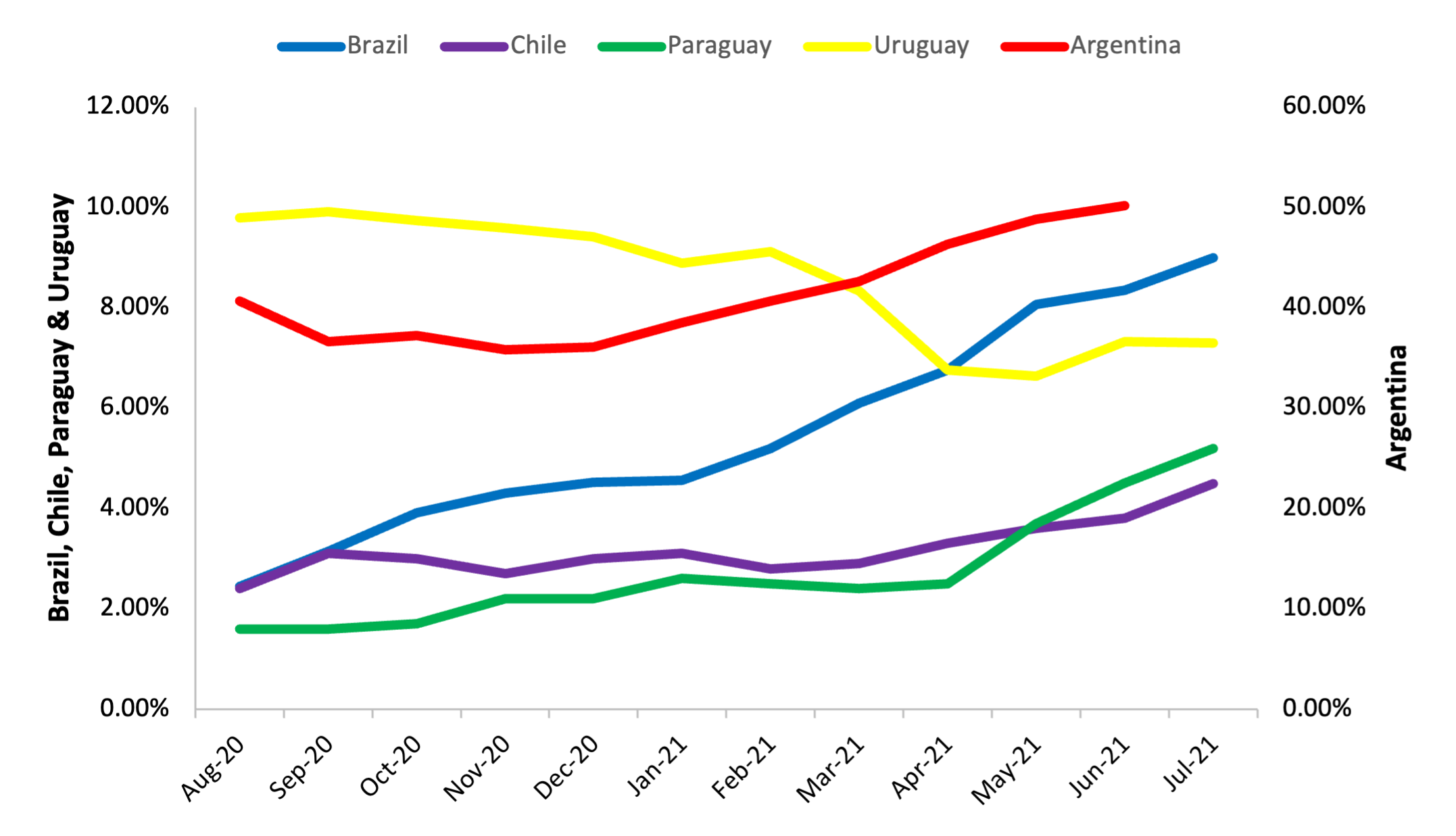
    Brazil & Southern Cone: Inflation
    Monthly year-on-year figures

    Brazil & Southern Cone: GDP growth (%)
    Quarterly figures are year-on-year growth
    Country 2020 2021 forecast *  Q2 2020 Q3 2020 Q4 2020 Q1 2021
    Argentina -9.9 6.3 -19.1 -10.2 -4.3 2.5
    Brazil -4.1 4.5 -11.4 -3.9 -1.1 1.0
    Chile -5.8 8.0 -14.1 -9.1 0.0 0.3
    Paraguay -0.6 3.8 -6.5 -1.2 1 6
    Uruguay -5.9 4.1 -10.6 -5.9 -2.9 -2.8
    *Figures from the United Nations Economic Commission for Latin America & Caribbean Jul 2021
    Quarterly growth and 2020 growth based on figures from the local central banks


  • Brazil

    Patrick de Courcy 21 December 2022 Hits: 224

    Brazil, often called the sleeping giant for its huge untapped potential, has been a relative latecomer to green hydrogen and renewable energies. Solar and wind energy made up only 1% and 8.6% of the country’s total energy matrix as late as 2019.

    That has changed dramatically in recent years. In 2022 the installed capacity of solar energy in Brazil is estimated to have grown 70%, according to the Monthly Energy Bulletin from the ministry of energy and mines. Together with wind, the two now account for nearly 16% of the country’s installed electricity generating capacity, and more projects are underway. If you add hydro energy, 85% of Brazil’s electricity demand is generated from renewables.

    The federal government only formalised a national hydrogen plan in June 2022 and never approved a hydrogen strategy per se. Several states, however, have launched their own hydrogen initiatives, creating large-scale hubs that have secured considerable investment pledges. There are three major hubs along the Atlantic coast that intend to produce, store, and transport green hydrogen. All three are at ports and are close to sources of renewable energy, industry clients, and shipping lanes. They are Porto de Suape in Pernambuco state, Complexo Industrial Portuário de Pecém (CIPP) in Ceará state, and Porto do Açu in Rio de Janeiro state. Alone at the CIPP in Ceara more than a dozen companies have lined up to invest several billion dollars to build massive wind and solar farms and hydrogen plants.

    The biggest project is that of Australia’s Enegix, which intends to produce 600,000 tonnes of hydrogen per year from 2025. The project dubbed Base One would be one of the largest green hydrogen plants in Latin America. Investments are to amount to US$5.4bn, and Kansas-based engineering and construction consulting firm Black & Veatch was hired to do the feasibility, design, and procurement. Brazil’s Enerwind is to provide 3.4 gigawatts of combined wind and solar power.

    Australia’s Fortescue, which also has big plans in Chile, is looking to invest $6bn into a hydrogen plant at CIPP. The company is reportedly negotiating a power purchase agreement from Omega Energia, which is building a 4.6 gigawatt solar park, potentially the biggest in the world to date with some 8m installed panels.

    Then there is AES Brasil, a unit of the Arlington Virginia-based power utility, which in September 2022 signed a preliminary contract with CIPP to build a 2 gigawatt sustainable power plant that will produce 800,000 tonnes of ammonia. Estimated costs are around US$2bn.

    Separately, Spain’s Ingenostrum will invest US$1.3bn to build close to 2 GW of solar projects in the state, while French independent power producer Total Eren signed a memorandum of understanding to explore possibilities.

    The hydrogen hub in the CIPP was launched only in 2021 as a partnership between the Universidade Federal do Ceará (UFC), the federal university in the state, and its industry lobby, the Federação das Indústrias do Ceará (Fiec). Much of the hydrogen to be produced in the CIPP will be exported to Europe. One of the partners in the CIPP is the Port of Rotterdam, which holds a 30% stake in the port of Pecém. The Dutch harbour expects to be handling 20m tonnes of hydrogen by 2050, only a fraction of what the EU is projected to need by then.

    Many of the big players intending to invest at CIPP are also looking at all the major hydrogen hubs arising up and down the Brazilian cost. Spain’s Iberdrola, through its Brazilian unit Neonergia, is working on feasibility studies for hydrogen projects in Rio de Janeiro, Rio Grande do Norte, Pernambuco, and Ceara. Several of them include off-shore wind parks, such as Porto do Açu just north of Rio de Janeiro city and the windpark Aguas Claras off the coast of Porto Rio Grande in Brazil’s southernmost state, Rio Grande do Sul.

    Brazil’s offshore wind potential is 700 GW in areas with depths of up to 50m according to the state-run Empresa de Pesquisa Energética, and up to 1.2 TW, according to a World Bank report.

    Groundbreaking in Bahia

    The country’s first industrial-scale green hydrogen project got under way in northeastern Bahia state in July. At its site in Camaçari, just north of Salvador, Brazilian chemical company Unigel is investing US$120m for a plant that is to pump out 10,000 tonnes of hydrogen and 40,000 tonnes of ammonia, which can be used to make fertilisers and acrylics and to store hydrogen. In a second stage, some time before 2025 output is to be quadrupled. 

    Unigel started producing ammonia last year, which it uses as a raw material for its two fertiliser plants that gave rise to Unigel Agro, a branch that caters to the agriculture sector. The company operates one of only two ammonia terminals in Brazil, located in the port of Aratu, in the state of Bahia. Unigel will feed the three 20 MW electrolyzers from Thyssenkrupp Nucera from the wind farm Babilônia Sul some 430km northwest of Camaçari, which is operated by Casa dos Ventos, one of the country’s biggest developers of renewable energy.

    The project also shows the fast-rising interest of Brazil’s chemical and petrochemical industry to decarbonise. In fact, many of the hydrogen hubs that are emerging are centred near industrial hubs with that in mind. 

    White hydrogen

    Brazil may also be one of the few countries on earth with sizable pure hydrogen deposits. “Preliminary exploratory campaigns carried out in several states of the federation showed significant potentials in hydrogen”, according to the government’s latest 10-year Energy Plan. Engie Brasil, a subsidiary of the French energy utility, has conducted studies for Brazil’s potential for white hydrogen. In partnership with consulting firm Georisk, the study of deep wells in the São Francisco basin showed “high concentrations of hydrogen”.

    Whether such deposits are commercially viable is not clear, but the Energy plan cites further studies that showed initial output estimates of 51,000 tonnes of hydrogen per year at three of the wells in the São Francisco basin. Beyond Minas Gerais in central Brazil, three other states are thought to have some potential for natural hydrogen deposits. Ceará, Roraima, and Tocantins.

    One of the few known places to exploit white hydrogen today is Mali, where it is used to run a generator that provides electricity for local residents in the village of Bourakébougou.

    Policy outlook

    Looking forward, industry players are hoping President-elect Luiz Inacio Lula da Silva’s administration, which takes office on 1 January 2023, will push for a set of nation-wide policies that would: 

    • harmonise the various hydrogen initiatives and policies adopted by states such as Ceará, Rio Grande do Norte, Bahia, Rio Grande do Sul, and Minas Gerais.
    • provide incentives for the development of the entire hydrogen supply chain, including production of electrolysers.
    • establish clear rules for offshore wind farms and take a strategic decision on the use of natural gas and CCUS technology to produce blue hydrogen. 
    • establish incentives for the decarbonisation of industries and transportation and develop international accords on the commercialisation of hydrogen.
    • provide a clear road map for the country on carbon pricing. Over the years there have been modest steps towards an emissions-trading system, most recently with a decree by outgoing President Jair Bolsonaro in May 2022 to create the Sistema Nacional de Redução de Emissões (Sinare), the national system to reduce greenhouse gas emissions.
  • REGION: Digital tools increasingly important for MSMEs battered by pandemic

    Sarah Sheldon 16 August 2022 Hits: 727

    Micro, small, and medium-sized enterprises (MSMEs) represent a vital part of the regional economy that was badly affected by the coronavirus (Covid-19) pandemic, but increasing digitalisation has boosted resilience.

    The United Nations (UN) International Trade Centre (ITC) uses its annual MSME Day on 27 June to highlight the role of these businesses as “the backbone of societies everywhere they contribute to local and national economies and to sustaining livelihoods, in particular among the working poor, women, youth, and groups in vulnerable situations”. 

    In Central America, 99% of businesses are MSMEs, according to Cenpromype, a regional organisation promoting MSMEs based in San Salvador. Of this figure, 83% are micro enterprises, comprising one to three employees, with small enterprises representing the remaining 16%.

    In addition, MSMEs generated 3m direct jobs in 2020, according to the Central American Integration System, as well as contributing 34% of GDP. However, data from the United Nations (UN) Economic Commission for Latin America and the Caribbean (Eclac) reveals that 20.7% of micro enterprises in Latin America may have been forced to close in 2020, as were 7.1% of small and 2.8% of medium-sized enterprises. 

    The vast majority of those that survived said that the pandemic had accelerated their digital transformation, according to a study on the impact of Covid-19 on the culture and operations of MSMEs commissioned by Microsoft and published 19 April, which looked at MSMEs in Costa Rica, Panamá, Guatemala, and El Salvador.

    Key technologies cited by respondents include laptops; software for video calls and remote collaboration; and cloud storage and computing. Almost 90% of respondents say that technology will be very important in deciding how they run their business in the future. In addition, 42% say they were more productive despite the disruptions caused by Covid-19, and 33% say they maintained previous levels of productivity.

    As the digital transformation continues, cybersecurity is an increasing concern for MSMEs, with cyber attacks in Panama and Guatemala increasing 60% and 43% respectively in the first eight months of 2021 compared to the same period in 2020, according to a study by cybersecurity firm Kaspersky published on 31 August 2021. While 78% of respondents in the Microsoft survey said that cybersecurity is a priority, only 60% of businesses have relevant policies in place, leaving many with more work to be done.

    MSMEs continue to face headwinds as regional economies attempting to recover from the effects of the pandemic are affected by the climate crisis and the fallout from Russia’s invasion of Ukraine. “They are the hardest hit by these multiple shocks, and at the same time play a critical role in building back stronger,” said the ITC, which called for further stimulus packages. “Policymakers must move beyond recovery and consider ways in which to lower and eliminate barriers faced by MSMEs, improve the business environment and access to finance, markets and technology in these fragile times,” it said. “It is critical that countries and their development partners continue to support and empower MSMEs and unlock their full potential through inspiring innovation, creativity and decent work for all.”

    •  BCIE support

    On MSME Day the Central American development bank (BCIE) said that over the last two years it had protected 76,542 jobs at 5,328 MSMEs through loans channelled through partnerships with financial institutions in the region, for example funding to implement biosecurity measures during the pandemic. It said that it had paid out more than US$501m through partners in the region as part of a wider programme to protect the economy during the pandemic.

  • HONDURAS: Back in with Venezuela

    LatinNews 15 December 2011 Hits: 366

    On 13 December the trade & industry minister, Francisco Zelaya, said that his ministry now had a team in Venezuela discussing how to reincoporate the country into Petrocaribe, the subsidised oil importation scheme run by Venezuela’s President Hugo Chávez.

    Zelaya claimed that President Porfirio Lobo was the driving force behind the Petrocaribe initiative. Zelaya said that he was keen on rejoining Petrocaribe but the decision lay with Lobo.

    Remittances:  According to central bank figures, in the first 11 months of 2011 the inflow of remittances was up 8.9% year-on-year at US$2.53bn. The central bank now expects the inflow to total between US$2.65 and US$2.75bn for 2011. In 2010 the inflow came to US$2.52bn. The US accounts for 92% of the inflow; the only other significant source is Spain which accounts for 5%.

    Inflation: The lagging 12 month rate to the end of November 2011 was 5.4%.

    Trade: Official report figures for the first half of 2011 show a major pick up in exports. In the first half of 2010, exports came to US$1.48bn. In the first half of 2011 they came to US$2.25bn. Coffee exports alone were worth over US$1.1bn in the first six months of 2011 compared with US$535m in the first half of 2010.

  • HONDURAS: Energy reform draws international support but domestic criticism

    Sarah Sheldon 20 July 2026 Hits: 152

    Honduras’ President Nasry Asfura is pushing to pass a bill that would reform the country’s troubled electricity sector, and the plans have received significant backing internationally despite opposition at home. 

    The proposal was submitted to lawmakers in May, and it passed the second of three necessary debates on 18 June. At the time of writing on 6 July, the proposed initiative had yet to pass the final debate. It comprises 18 articles that will reform the general law of the electricity industry (Decreto 404-2013), that was promulgated in 2014. Key changes including splitting up the state power company Empresa Nacional de Energía Eléctrica (ENEE), which has produced, carried, and sold electricity in the country since the 1950s, into three entities to handle generation, transmission and distribution separately.

    It will also create an independent systems operator named Operador del Sistema y Mercado (OSM) to replace the state-controlled national dispatch centre (CND) and provides for the transfer of ENEE assets from national administrative law to mercantile law, among other things.

    This is a response to continued massive financial losses at ENEE, which the US Department of State’s most recent (October 2025) investment climate statement on Honduras put at about US$50m a month, while a 2025 report by Sociedad Más Justa (ASJ), the local chapter of anti-corruption NGO Transparency International, put estimated energy losses at 35.83% in June 2025. It is also a reversal of the 2022 energy reform enacted by former President Xiomara Castro (2022-2026), which failed to deal with either of the longstanding issues that have plagued the country’s electricity system for decades [EB-22-10]. For example, the International Monetary Fund (IMF) has highlighted “a history of uncompetitive contracting of generation capacity and inefficiencies” as well as “outdated infrastructure and incidence of fraud,” adding that “ENEE’s lack of payment discipline has stifled investment in generation."

    There is therefore widespread consensus that reform is necessary, but the structure of that reform is contested. Asfura’s government has said that splitting ENEE into three separate entities will facilitate much-needed private investment that the state cannot hope to match. Other officials have framed the reform as a rescue mission, highlighting that the bill protects jobs at ENEE as well as declaring ENEE assets to be public property, and pointed to the long-term effects that ensuring a reliable power supply could have on foreign investment in Honduras.

    NGOs have also supported the reform, including ASJ which said that it could help to shield ENEE from the political interference that it has long suffered. The Asociación Hondureña de Energía Renovable (AHER) renewable energy business association has given its conditional support too, with its president, Eduardo Bennaton, welcoming change but calling for a truly independent CREE and incentives for renewable generation.

    The reform has also received widespread international support, including from the World Bank, the Inter-American Development Bank, the Central American Bank for Economic Integration (Cabei), and the Development Bank of Latin America (CAF). The US Department of State has said its successful passage could unlock investment, and officials from the European Union met with Honduran counterparts at a high-level meeting in April “to discuss pathways for reform, investment, and regional integration.”

    In addition, the IMF has linked the reform to its lending programme. “Decisive progress on governance and energy sector reform will be essential to preserve macroeconomic stability and support inclusive growth,” it said in its latest review of the arrangement published on 29 June. However, it struck a more balanced tone about the bill’s prospects. “Reinvigorating reform momentum in the energy sector is critical to limit fiscal risks and support medium-term economic growth,” said the IMF. “Renewed efforts are needed to reduce electricity losses and address arrears to strengthen the state-owned electricity company’s financial position.” 

    On the other hand, the bill’s content has sparked considerable concerns within Honduras. The left-wing opposition Partido Libertad y Refundación (Libre) party has said that it constitutes “privatisation in disguise,” and the centrist Partido Liberal, whose support Asfura’s government will need to pass the reform, has said that it will need to see firm guarantees that ENEE will not be privatised before it can vote in favour. 

    Local economic thinktank Foro Social de Deuda Externa y Desarrollo de Honduras (Fosdeh) has published an analysis of the bill, concluding that while there is no formal privatisation of state assets, it opens the door to a functional privatisation. This means that while the state would retain nominal ownership, it allows private entities greater control over strategic functions.

    Fosdeh has four main criticisms of the bill. The first is that it lacks protection for low-income customers against tariff increases; it weakens asset protection under mercantile law; privatises the potential benefits of sectoral reform while socialising risks; and lastly that public consultation has been insufficient. “Fosdeh believes that no reform can be said to be sustainable when it protects private profits but makes public finances more vulnerable; when it guarantees operator income but transfers costs to users; or when it reduces public control without establishing equivalent mechanisms of supervision and accountability,” it said.

    Other criticisms include the fact there is no plan to address energy losses and the accumulated debt, according to the Colegio de Ingenieros Mecánicos, Electricistas y Químicos de Honduras (Cimeqh), a local NGO that promotes technology adoption in Honduras. And Erick Tejada, former energy minister (2022-2026) under Castro, echoes these concerns, arguing that the reform “does not address the main problems of ENEE: financial debt, high generation costs and loss reduction”. He has also raised concerns that the bill opens the door to regulatory capture that would undercut the state’s ability to oversee the sector.

    IMF boost for Asfura government

    On 29 June the International Monetary Fund (IMF) announced the completion of the fourth and fifth reviews under the Extended Fund Facility and Extended Credit Facility arrangements for Honduras.

    This enables the authorities to release US$242m, bringing total disbursements under the programmes so far to about US$725m. Honduras’ 36-month arrangements totalling about US$847m were approved in September 2023 under Castro. However, the programme stalled late last year after the Castro government failed to fully meet its target for the fourth review. Reviving the programme was a priority for the new Asfura government.   

    In a statement released on 29 June, the IMF said the Honduran economy has “remained resilient”, expanding 3.8% in 2025, supported by “record-high coffee prices and surging remittances”. The statement adds that “the continued implementation of prudent fiscal policies, an appropriate monetary and exchange policy mix, and the recent acceleration of structural reform implementation demonstrate the authorities’ strong commitment to the Fund-supported program” – no doubt a reference to the new public spending bill approved in late February which hands the executive more power to cut government spending [EB-26-04]. 

     Asfura’s insistence on non-privatisation

    “The ENEE is not being privatised; it is being strengthened,” said President Nasry Asfura in June.

    IMF growth forecast

    In its 29 June statement, the International Monetary Fund (IMF) forecasts that Honduras’ economic growth will slow to 3.3% in 2026 due to higher global oil prices and headline inflation will close 2026 at 5.7%, up from 4.0% in 2025, also due to higher energy prices.

  • POINTERS

    LatinNews 30 November 2011 Hits: 1490

     *** OPPOSITION WINS IN ST LUCIA.  In the 28 November general election, the St Lucia Labour Party (SLP), under Dr Kenny Anthony, comfortably ousted the ruling United Workers Party (UWP) of outgoing prime minister Stephenson King.  King had predicted the UWP would win comfortably, taking 14 of the 17 seats in parliament.  However, at the time of going to press it is not certain how many seats the SLP will hold in the new parliament due to recounts although it is thought likely that it has won 11 seats.

    The election result returns Dr Anthony to a post he held from1997-2006.  His success has been attributed to public dissatisfaction with increases in crime and unemployment and the difficulties the island has experienced in recovering from the effects of Hurricane Tomas which hit the island on 30 October 2010.  Unemployment is over 20%. 

    The change of government in St Lucia has potentially important international ramifications.  In 2007, St Lucia restored diplomatic ties with Taiwan after a 10-year hiatus.  At the time of the swap, Dr Anthony, then leader of the opposition, said: "It is clear that the strategy of the UWP government is to embarrass and insult the government of the People's Republic of China, to provoke them into unilaterally terminating diplomatic ties with Saint Lucia...A country that conducts its external affairs with such duplicity can never earn the respect and trust of the regional and international community."

    However, immediately following the confirmation of the SLP’s return to power, Taiwan’s Ministry of Foreign Affairs said that it had received assurances from Anthony that he would not withdraw St Lucia’s diplomatic recognition of the Taiwan.  The statement added: “Taiwan has offered various forms of assistance to St Lucia that have benefited the people of that country and we believe that the newly elected government of St Lucia will proceed with cooperative projects.”

    *** BARBADOS RATING LOWERED.  On 22 November, the Standard & Poor’s ratings agency downgraded its outlook for Barbados from stable to negative.  Its local and foreign-currency ratings are BBB-/A-3.  The positives for Barbados, according to Standard & Poor’s, are a “predictable and mature political system” and a consensus on major economic and social issues.  However, the agency added, “the government’s large fiscal deficits and a rising debt burden, which are not sustainable in the long-term...constrain the ratings”.

    S&P believes that net general government debt will remain at 52% of GDP in 2011-13 and that the cost of servicing debt will account for 13% of general government revenues.

    Speaking on 25 November, Minister of Finance and Economic Affairs, Chris Sinckler, recognized the need to “consolidate our fiscal accounts”, but he still forecast a medium-term deficit of 5.6%.  He said: “We cannot overcompensate by raising more taxes, thereby cutting demand to an extent where it cannot contribute to the growth in the economy.”  He warned against following “pro-cyclical” policies as draconian as those imposed upon Greece.  He said: “If we do that in a small, open economy like Barbados, trust me, it is going to be for the worse.”

    *** IMF SEES DOWNSIDE RISKS FOR BAHAMAS.  On 2 November, the IMF concluded its Article IV consultation with The Bahamas calling for “steadfast implementation of reforms to place public debt on a sustainable path, build fiscal buffers, and enhance medium-term growth prospects”.  According to the IMF, the government’s fiscal deficit rose to 4.7% of GDP in 2010/11 (June-July).  The ratio of government debt to GDP has also continued rising, reaching 48% by mid-2011.  Downside risks have increased because of the slower than expected US recovery.

  • TRACKING TRENDS

    LatinNews 04 August 2016 Hits: 1691

    BRAZIL-ARGENTINA | Surge in job losses. On 27 July Brazil’s ministry of work & social security (MTP), released the latest unemployment rate figures compiled by the national statistics institute (Ibge) in the third quarter of 2016. These showed that 11.3% or 11.6m economically active people in Brazil were unemployed during the third quarter, a 38.7% increase on the same period last year and up 4.5% on the first quarter of 2016. The second-quarter unemployment rate is also the highest ever since Brazil adopted a new unemployment methodology in 2012. The MTP also reported that 531,765 formal jobs were lost in the first half of 2016, the highest number in a first half since 2002. This brings the cumulative number of jobs lost from July 2015 to June 2016 to 1.77m.

    The unemployment and job loss figures expose the serious impact Brazil’s economic recession is having on the domestic labour market, which has posted net job losses for the past 15 months. Worryingly, the unemployment rate is expected to increase further this year, as local economists forecast that Brazil will post a GDP contraction of 3.20%, which if confirmed would mean that the country’s economy would have contracted for two straight years for the first time since the 1930s.

    But Brazil is not the only major South American economy that has to contend with rising unemployment and job losses as a result of an economic downturn. Argentina has also been struggling with low GDP growth in the past few years and this has been taking its toll on the labour market. The latest employment figures released by Argentina’s labour ministry, also on 27 July, showed that the number of unemployed people increased by 106,944 between May 2015 and May 2016. This does not take into account jobs in the informal sector, in which 42% of Argentine workers are thought to be employed.

    As in Brazil, the job losses come on the back of a general fall in economic activity. While Argentina’s official economic figures remain unreliable, it is estimated that the domestic economy will contract by over 2% this year.

  • Trinidad & Tobago: Slightly brighter prospects ahead for 2017

    LatinNews 08 February 2017 Hits: 3006

    From being the Caribbean’s star performer for much of the commodity boom years, with GDP growth on occasion hitting double-digits, Trinidad & Tobago has struggled in recent years from the energy price slump. Yet after a dismal 2016, the authorities are showing some indications that they expect a partial recovery in 2017. In late January, the central bank stated that it was keeping benchmark interest rates on hold, but that domestic economic output was expected to increase, on the back of rising gas production.

    After a poor performance in 2015-2016, the authorities are showing somewhat more optimism about economic prospects for 2017. In the central bank’s 27 January monetary policy announcement, in which it kept the benchmark repo interest rate on hold at 4.75%, the Bank admitted that conditions had been difficult, with energy production declining markedly. However, it stated that prospects for 2017 appear brighter, with officials projecting a recovery in oil and gas production as new fields come on stream and maintenance work subsides. That said, despite the note of optimism, the press release accompanying the announcement struck a fairly negative tone, with officials flagging up the risk of weakening international trade flows from the US and acknowledging the weak state of domestic retail and construction.

    Data from 2016 paints a gloomy picture

    The available quarterly data relating to 2016 certainly reinforce this gloom. Real GDP data is available for the first half of the year and shows a 5.4% year-on-year contraction in the first quarter and an 8% fall in the second quarter. Although this was led by the energy sector (which shrank by 9.1% and 12.6% respectively), the non-energy sector also contracted, albeit less sharply. The Central Statistical Office (CSO) in October said that it expected real GDP growth to shrink by 2.3% in full calendar year 2016, but given the depth of the downturn in the first half, this appears optimistic.

    The brighter outlook for energy production in 2017 reflects the expectation that several recently-completed projects will see gas production increase in the coming months. Other projects are due for completion soon and will also help boost gas production. Collectively, these include BHP’s Angostura Phase III, BP’s Juniper field, EOG’s Sercan and BP’s Trinidad Onshore Compression (TROC) project. In addition, extensive shutdowns for maintenance work that occurred during 2016, hampering energy-sector output, are not expected to be repeated in 2017. These combined factors are likely to reverse some of the slide in gas production, which has fallen from 4.2bn cubic feet/day in 2013 to 3.3bn cf/d in 2016. Although structural problems remain, which will cloud the longer-term outlook – including a low replacement ratio, owing to disappointing exploration results in recent years – these concerns are unlikely to hamper the near-term recovery in gas production, particularly if gas prices retain the gains of late 2016.

    A return to growth?

    The government hopes that a recovery in energy output will have spill-over effects in the non-energy sector, helping reverse the fiscal deterioration of recent years and providing some support for a recovery in domestic demand. These considerations explain the government’s GDP growth forecast of 1.6% for 2017: modest given the extent of the contraction in recent years, but if achieved would represent the best result since 2013.

    The central bank gave no indication in its most recent monetary policy announcement of the likelihood of shifting to a more accommodative stance, but it is possible that interest rates might be cut later in 2017 if economic growth does not recover as expected. With the benchmark rate at 4.75%, inflation low (standing at 2.9% in November) and credit growth weak, the monetary authorities might be tempted to cut interest rates in an attempt to shore up domestic demand.

  • CARIBBEAN POINTERS

    LatinNews 10 February 2016 Hits: 991

    *** US SAYS BAHAMAS’ CRIME STATISTICS “FRIGHTENING”. On 14 January, the chargé d’affaires at the US embassy in Nassau, Lisa Johnson, told a media briefing that crime in The Bahamas is “a difficult problem” and that “the statistics are frightening”. There were 149 murders in the country in 2015.

    The previous week, the US embassy had warned US citizens not to use jet ski operators on New Providence because of several sexual assaults on American tourists in The Bahamas, and the fact that the jet ski industry was only “loosely” regulated. The US embassy says that five US citizens were sexually assaulted by jet ski operators in the last 18 months, although the most recent rape case did not involve someone from the industry.

    The day after Lisa Johnson’s intervention, Minister of Foreign Affairs Fred Mitchell complained on a radio talk show about a “sometimes aggressive and intrusive” approach by the US towards The Bahamas. Mitchell’s complaint appears to have been about the public advice to US citizens not to patronise jet ski operatives. Mitchell said: “We have advised them in the past that it is better, if there are issues that need to be resolved, to work in partnership and behind the scenes because it all does cause unnecessary responses in public, which are to no one’s good.”

    A gun was used in the majority of the 149 murders committed in 2015, and The Bahamas has raised the issue of the importation of illegal weapons from the US. Lisa Johnson, however, said “you’re not going to find the answer to your gun problem in US legislation or change in policy”.

    *** ANTIGUA TO ABOLISH INCOME TAX. As from April 2016, Antigua is to abolish income tax in line with the ruling Antigua & Barbuda Labour Party’s 2014 election pledge. Personal income tax (PIT) was introduced by the United Progressive Party administration in 2005 and brings in EC$37m (US$13.7m) annually. Prime Minister Gaston Browne, who is also finance minister, told parliament: “The loss of $37 million from the elimination of the PIT will be partially substituted by an increase in the Revenue Recovery Charge from 10% to 13%, which is expected to yield an additional $20m in revenue.”

    *** SURINAME TURNS TO THE IMF. The International Monetary Fund (IMF) announced in late January that it had been approached by the Suriname government about the possibility of receiving financial support for its economic reform programme. The reason given was the sharp fall in global commodity prices. In a statement issued on 22 January, the IMF said: “Together with our sister organisations – the Caribbean Development Bank, the Inter-American Development Bank, and the World Bank – we stand ready to help Suriname meet the economic challenges it is currently facing.”

    In its most recent (January 2016) Quarterly Bulletin, the Inter-American Development Bank (IDB) noted: “In 2015, oil, bauxite, and gold prices were on average US$50 per barrel, US$1,676 per metric ton, and US$1,168 per troy ounce, representing a decline in price of 50%, 10%, and 30% respectively, relative to average prices in the previous year.” The bauxite industry has declined significantly. Between 1994 and 2007, bauxite contributed 70% of total exports, 14% of government revenue, and 12% of GDP. It now contributes just 13% of total exports, 5% of government revenue, and 5% of GDP. In November 2015, Alcoa closed its local bauxite company, Suralco.

    Suriname’s economic growth, which the IMF estimates to have averaged 4.4% in the last 15 years, was down to an estimated 1.5% in 2015. At the end of November 2015, the debt-to-GDP ratio had increased from 13% a year earlier to 40%.

    • “As from April 2016, Antigua is to abolish income tax in line with the ruling Antigua & Barbuda Labour Party’s 2014 election pledge. Personal income tax (PIT) was introduced by the United Progressive Party administration in 2005 and brings in EC$37m (US$13.7m) annually. Prime Minister Gaston Browne, who is also finance minister, told parliament: ‘The loss of $37 million from the elimination of the PIT will be partially substituted by an increase in the Revenue Recovery Charge from 10% to 13%, which is expected to yield an additional $20m in revenue.’”
  • Uruguay – ready to go?

    LatinNews 11 June 2021 Hits: 1542

    Uruguay’s good ETI score reflects over a decade of government policies focused on developing renewables. In October last year, for example, Uruguay produced 36% of its electricity from wind and solar energy, ranking it fourth in the world (behind Denmark, Lithuania, and Luxembourg). If hydropower is included, renewable energy jumps up to account for 97% of total electricity demand. This is a sharp contrast to the situation 20 years earlier when the country primarily used fossil fuels and had a heavy oil import bill (about 30% of total imports by value), as well as having to import electricity from neighbouring Argentina.

    Energy diversification began during the left-wing presidency of José Mujica (2010-2015) with wind turbines and solar farms seen as a way of cutting power generation costs. Development was encouraged through competitive auctions, investment guarantees, transparent rules and regulations, and strong public-private partnerships (PPPs). To date, investment in renewables is estimated at around US$7bn (equivalent to 15% of GDP). Greenhouse gas (GHG) emissions were cut by 88% in 2017, relative to the 2009-2013 average.

    The current centre-right government of President Luis Lacalle Pou has continued enabling the energy transition but is now looking to take it to another stage, focusing on decarbonising the transport sector. In terms of primary energy, 37% still comes from fossil fuels, and roughly two-thirds of that is consumed in the transport sector. The government has said it seeks to develop battery-powered electric vehicles (EVs) for short distances, to be followed at a later stage by green hydrogen powered freight and long-distance transport. Among various policy initiatives under consideration are tax incentives to favour EV take-up and plans to develop a country-wide charging infrastructure. Energy minister Omar Paganini said the government is interested in forming a private sector partnership to develop a green hydrogen pilot project, with a hydrolysis plant and a fleet of H2-powered vehicles. Uruguay has announced its intention to become carbon neutral by 2050, although the authorities say they may also propose new “nationally determined contributions” (NDCs) under the terms of the Paris climate agreements

  • EL SALVADOR: Extreme poverty increases despite Bukele’s pledge on economy

    Sarah Sheldon 17 November 2025 Hits: 334

    The number of Salvadoreans living in extreme poverty increased from 588,917 to 610,272 year-on-year from 2023-2024, equivalent to a 3.63% increase, according to statistics from the national bank (BCR).

    This means that 9.08% of Salvadorean households were living in extreme poverty in 2024, meaning that they couldn’t afford a basic basket of goods. On the other hand, the number of people living in poverty fell from 1.33m in 2023 to 1.20m in 2024. As a result, a further 18.9% of Salvadorean households were living in poverty in 2024, meaning that they couldn’t afford a wider basket of goods. This mixed picture will be a concern for President Nayib Bukele, who promised to boost the economy during his second term in office, which started in June 2024, but his government has struggled to get a handle on inflation and a rising cost of living, which have made it more difficult for people to afford basic necessities as salaries have lagged behind. 

    However, there are some signs that Bukele is taking action, with the 2026 budget proposal presented to congress in early October worth US$10.56bn, up 9.2% on this year. The education budget was up 6.9% to US$1.54bn, while the health budget was boosted by 12.3% to US$1.33bn, with extra funds for infrastructure and medication. There are also some measures designed to deal with the rising cost of living, including efforts to boost basic grain production via an agriculture bonus (for which US$46.6m has been assigned), while US$238.7m has been allocated to finance various subsidies including liquid petroleum gas (US$114.6m), public transport (US$60.0m), and electricity (US$64.1m).

    It is not clear, however, whether the sums involved will enable the kind of far-reaching efforts needed to better support the poorest Salvadoreans. And these households are also under increasing pressure from a new 1% tax on remittances imposed by the US government in July, which will likely result in a reduction in the total value of remittances per year. In addition, US President Donald Trump has shut down the US Agency for International Development (Usaid), which supported various programmes designed to help the most vulnerable Salvadoreans. As a result, it is likely that more households will fall into extreme poverty as external sources of support are diminished and government spending struggles to make up for the shortfall.

  • URUGUAY: Vázquez throws hat into the ring

    LatinNews 07 March 2013 Hits: 2844

    Former president Tabaré Vázquez (2005-2010) will run for the presidency again in 2014 for the ruling Frente Amplio (FA) coalition, according to Uruguay’s weekly publication, Búsqueda. Vázquez conditioned his standing on the support of both incumbent President José Mujica and Vice-President Danilo Astori, his former economy minister: in other words, given that they these two are the figureheads of the radical and moderate wings of the coalition, on internal unity. The timing of his announcement looks designed to address a serious internal rift in the FA over adverse judicial rulings by the supreme court (SCJ), which the opposition is seeking to exploit.

    Vázquez withdrew from public life in October 2011 after he made the diplomatically incendiary comment that Uruguay considered war scenarios against Argentina at the height of tension over the construction of a pulp mill on the Uruguayan banks of its fluvial frontier with Argentina in 2007. His reappearance comes as the FA radical parties are up in arms against two rulings by the five-member SCJ. The SCJ first declared unconstitutional President Mujica’s flagship policy, the “tax on the concentration of rural land” (ICIR, in the Spanish acronym), which was approved by congress in December 2011 and taxed landowners commensurate with the size of their holdings. The SCJ said the constitution was clear that land duties are collected by local governments.

    For radical parties within the FA, the ICIR was one of the few policies of the Mujica administration it could celebrate as placing a greater emphasis on social and redistributive initiatives to battle inequality. Mujica had pushed it through against fierce resistance from Astori, who argued that it would deter investors and would only generate a measly US$60m anyway.

    The SCJ followed its 18 February ruling against the ICIR four days later by striking down a law approved by the FA congressional majority in October 2011 invalidating the amnesty law (Ley de Caducidad), shielding those accused of human rights abuses committed during the military dictatorship (1973-1985) from prosecution. A week earlier the SCJ had transferred Judge Mariana Mota, who had been in charge of investigating 55 cases of dictatorship-era rights abuses, from her criminal jurisdiction to a new post as a judge on a civil tribunal. The Movimiento de Participación Popular (MPP), Mujica’s party, accused the SCJ of being “dinosaur lovers of impunity” seeking “to deny justice” to relatives of victims. On 25 February several thousand protesters responded to a call by the MPP to gather outside the SCJ building to demonstrate against the ruling. It also called on SCJ judges to appear before congress to explain Mota’s transfer.

    The FA vice-president, Juan Castillo, insisted that “a request for information should not be confused with a violation of the separation of powers”. Senator Lucía Topolansky, Mujica’s wife, said the legislature was perfectly within its rights to seek an explanation from the judiciary and vice versa. The main opposition Partido Nacional (PN, Blancos) and Partido Colorado (PC, Colorados) were having none of it. They leapt on the MPP’s move which they denounced as tantamount to an “institutional coup”. The PC leadership committee said the threat to summon the magistrates constituted political pressure on the judiciary in clear contravention of the law.

    The Blancos and Colorados are trying to seize the opportunity to recover some political relevance having been anaemic forces operating on the periphery of political life for some eight years in the face of FA congressional majorities. Opinion polls do not suggest this is likely to change in 2014 but if the FA’s internal rift deepened they might. This is where Vázquez comes in. There is nobody who has the ability to bridge the divisions between the coalition’s disparate parties like Vázquez.

    • Mujica’s reaction

    President Mujica himself has kept his own counsel over the supreme court ruling on the amnesty law but he reacted to the court’s adverse ruling on his ICIR land tax by mooting a constitutional reform. Blanco Senator Sergio Abreu was particularly caustic in his response: “Do the president and the Frente (Amplio) not know that instead of reforming the constitution they have to abide by it?” he asked rhetorically before accusing the FA of trying to restrict liberties and manipulate the judiciary.

  • Peru: Kuczynski get his decree powers

    LatinNews 05 October 2016 Hits: 374

    On 29 September Peru’s opposition-controlled congress agreed to give temporary legislative powers to President Pedro Pablo Kuczynski for a reduced period of 90 days (he had requested 120 days). The successful vote was received with obvious relief by the centrist new government, after some fears that it would be rejected.

    All Peruvian governments since the return to democracy in 1990 have been granted temporary decree powers at the outset of their terms in order to kick-start their government plans into action. The unicameral assembly, controlled with 72 of 130 seats by the right-wing Fuerza Popular (FP, the party associated with the disgraced former authoritarian leader Alberto Fujimori [1990-2000] and now led by his daughter and narrowly defeated 2016 presidential candidate Keiko Fujimori) voted roundly to grant the legislative powers after a six-hour debate.

    Given President Kuczynski’s strong public approval ratings (his support hit 63% in September, up two points on August and well above the 50.1% of the vote he won in the 5 June’ presidential run-off) and his favourable image among international investors, most notably in the US, the FP, which Keiko Fujimori has pledged will provide a “responsible opposition”, likely knew that it would do itself no political favours by breaking with tradition to deny Kuczynski his request. Having used its congressional majority to permanently obstruct the last, nominally leftist government led by Ollanta Humala (2011-2015), between now and the next 2020 election the FP needs to prove, finally, that is mature, democratic and responsible enough to govern, rather than merely acting as a stubborn foil to the executive.

    The FP-dominated congress voted to approve the powers just a day after the congressional commission partially approved the request, and a week after the budget commission had rejected it. Given that both commissions are FP-controlled (as is the also-powerful audit commission), it seems fair to assume that the FP and Kuczynski’s novice prime minister, Fernando Zavala, did some serious dealing in-between. The 2017 budget, currently also before congress, likely was the subject of some of those negotiations.

    Aside from the move to cut the decree power period from 120 to 90 days, which was criticised by Zavala, most of other changes were indeed economy-related, after the budget commission had rejected the Kuczynski request on the grounds that that the proposed economic and fiscal reforms in his proposal would conflict with the constitutional limits on the power of the executive and also undermine the constitutional duties of the legislature. In particular, the head of the budget commission, the high-profile Fujimorista Cecilia Chacón, noted that the executive’s request to be allowed to establish a new “macroeconomic fiscal framework”, clashed with the legislature’s duty to approve and audit the budget. The audit commission, headed up by the FP’s Héctor Becerril, partially approved the request, agreeing to 11 of the 21 points, notably including the proposal for an independent attorney general’s office. But notably, Kuczynski’s request to beef up the financial intelligence unit (Unidad de Inteligencia Financiera, UIF), in order to bring Peru into line with international anti-money laundering regulatory practices, as recommended by the Financial Action Task Force (FATF) and the Organisation for Economic Co-operation and Development (OECD), which Peru is seeking to join, was not well received by the Fujimoristas. This may add to the longstanding whiff of suspicion over the financial dealings of the party and its various allies (the FP’s chairman, Joaquin Ramírez, was forced to step aside ahead of the June run-off ballot, after it emerged that he himself was under investigation for money laundering).

    Kuczynski’s request included 21 measures targeting economic reactivation and citizen security grouped under the five priority axes that form the core of his government plan. The first is reactivation of the domestic economy and consolidation of a simpler tax system aimed at supporting formalisation. In a bid to make taxation fairer, the government intends a gradual three percentage point reduction in the rate of value-added tax (VAT) from the current 18% from January 2017; an amnesty on the repatriation of undeclared earnings overseas; and changes to fiscal transparency rules. Corporate tax cuts introduced by the Humala administration would be rolled back in order to pay for the VAT cut, which is opposed by the Fujimoristas on the grounds that it will eat into funds for essential fiscal spending needs. Other measures would restructure PEN25bn (US$7.4bn) of debt held by the country’s regional governments. Elsewhere, reforms would make it easier for foreign banks to enter the local financial system, so as to increase competition.

    The executive also wants to set up a new infrastructure fund in support of its plan to lift real annual GDP growth to 5% from 2018, which Kuczynski and senior ministers touted to US investors when in New York in September for the UN General Assembly. In support of this, the national investment agency, Proinversión, is to be overhauled. The government also wants to legislate for improvements to the security system, the judiciary and domestic policing. In support of this, the president requested powers to introduce new anti-corruption policies, including protection mechanisms and incentives to prevent government corruption. Related to this, it envisages a new autonomous attorney general’s office (Procuraduría General del Estado).

    Elsewhere, the president wants to legislate to expand the provision of water and sanitation to vulnerable and rural sectors, one of his flagship pledges. Finally, the long-troubled state oil company, Petroperú, would also be re-structured.

    Kuczynski’s finance minister, Alfredo Thorne, was confident that 90 days would be sufficient to implement the plans, telling local media, “I think that [90 days] will be enough. On the economic side, we have almost everything prepared already, although we need to refine some details. But I think we will get it done in 90 days.”

    Zavala, meanwhile, said that the president would use the first 30 days of his decree powers to focus on crime, the top voter concern in this year’s elections, along with the economy. Pollster Ipsos in September reported strong public support for Kuczynski’s request to legislate in areas including corruption (backed by 87% of Peruvians) and public security (97%). Echoing Thorne, the PM noted that “economic matters, and above all security issues, are well advanced. Some security measures will be ready in 30 days”.

    The 2017 budget

    Finance Minister Thorne’s 2017 budget proposal is costed at PEN142.5bn (US$42.2bn), a nominal increase of 4.7% over the 2016 plan and 20% of GDP. It projects real annual GDP of 4% this year and 4.8% in 2017.            

    Having inherited a higher-than-expected fiscal deficit of 3.3% of GDP to end July, well above the 2.5% that the outgoing Humala government had pledged, Thorne, a former senior World Bank economist, was obliged to adjust his fiscal targets. He still aims to trim the deficit to 1% of GDP by 2021, but more gradually, so as not to choke off the domestic recovery or force excessive austerity on the new administration. Thus, after an expected deficit of about 3% this year, the 2017 target will be 2.5% of GDP (from 1.8% previously), falling to 2% in 2018, 1.8% in 2019, 1.5% in 2020 and 1% in 2021. This additional leeway (amounting to about US$1.5bn in 2017) should cushion the revenue impact of the government’s planned tax reforms and it will also allow more room for Kuczynski’s spending and investment plans, which aim to lift real GDP growth to 5% from 2018 onwards.

  • ECONOMIC HIGHLIGHTS

    Patrick de Courcy 13 September 2023 Hits: 1738

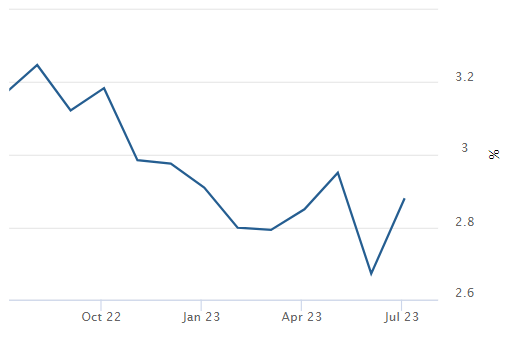
    MEXICO | Inflation continues to slow year-on-year. On 7 September, Mexico’s national statistics institute (Inegi) released the consumer price index (INPC) for August, which showed that monthly inflation was 0.55%, and that annual inflation stood at 4.64%. This compares with monthly inflation of 0.48% in July when annual inflation was 4.79%.

    MEXICO | Gov’t hails increased tax take. On 6 September, Mexico’s national tax authority (SAT) issued a report with preliminary figures on tax take between January and August 2023. According to the report, tax take equalled M$2.99trn (US$171bn) in the first eight months of the year, an increase of M$369.1bn compared to the same period in 2022, equating to an increase of 7.5% in real terms. According to the SAT, net tax take has increased by 12.2% in real terms since 2018, when President Andrés Manuel López Obrador took office.

    MEXICO | Gross fixed investment surges. On 4 September, Mexico’s national statistics institute (Inegi) released new figures which showed that gross fixed capital formation (GFCF) in June increased by 3.1% in real terms as compared to the previous month, and by 28.6% in real terms as compared to June 2022. The report also shows that GFCF grew by 18.8% year-on-year in the first six months of the year.

    MEXICO | Private sector raises growth forecast. On 1 September, economic analysts surveyed by Mexico’s central bank (Banxico) raised their 2023 GDP growth forecast for Mexico from 2.59% in a previous (July) survey to 3.04%. The analysts also raised their GDP forecast for 2024, from 1.49% to 1.66%. The same survey also showed a slight increase in inflation forecasts for this year, with analysts predicting that inflation would end the year at 4.66% (up from 4.63%).

    Mexico: GDP growth
    Percentage variation (year-on-year)

    Mexico: unemployment rate
    Economically active population

    Mexico: inflation rate
    Percentage variation (year-on-year)

  • The international dimension

    LatinNews 22 December 2017 Hits: 334

    The growth of the Latin American middle class is without a doubt an important trend in itself: it is also useful, however, to put that growth in an international context. Research by Homi Kharas for the Brookings Institute in the US[1] published in mid-2017 used updated purchasing power parity prices to calculate the size of the global middle class. He found that around 3.2bn people could be described as members of the global middle class at the end of 2016, around 500m more than had originally been estimated (perhaps because of this his estimates of the size of the middle class in Latin America are significantly higher than those produced by the World Bank and IDB). Kharas suggested that in as little as two to three years there might be a tipping point, where a majority of the world’s population might, for the first time ever, be from middle class or rich households. Significantly, most of the new entrants to the middle class are likely to come from Asia. Middle class spending is now estimated to account for one-third of the global economy. The geography of the middle class is also changing. China and India are accounting for a bigger share of the global middle class, while the previously dominant European and North American middle class is stagnating.

    The global expansion of the middle class raises some of the same issues and dilemmas, as does its expansion in Latin America. Kharas suggests a larger global middle class may imply a happier population, at least for new entrants, but adds, “there is little evidence to suggest that this will create pressure for more democratic governance or for better delivery of public services, both of which are required for sustained growth”. Governments may struggle to meet demands for universal health care, public education, pensions, and affordable housing. A critical issue will be “getting the right balance between taxes on the middle class and services to support them”.

    If Kharas’ global projections are correct, there are some key implications for Latin America. First, the region’s middle class is growing numerically, but at a slower rate than in other parts of the world. As a result he projects Latin America’s share of the global middle class to fall from 9% in 2015 to 6% by 2030. Second – and potentially of critical importance – the composition of the global middle class is changing. In more ways than one, by 2030 Latin America will be living in a different world. At present, the bulk of Latin America’s international trade is conducted with Europe and North America, which between them represent (using data from 2015) 35% of the global middle class. But by 2030 their share of the global middle class will have shrunk by 14 percentage points to only 21%. The increasing size and importance of the Asia-Pacific middle class stands out as a major factor in Latin America’s future. Asia-Pacific’s share of the global middle class is set to increase from 46% in 2015 to 65% in 2030 – up by 19 percentage points.

    The change is also evident when countries are ranked by the size of total middle class spending. In 2015 the largest middle class market in the world was the United States with 13% of the global middle class spend, followed by China (12%), Japan (6%) and India (5%). By 2030 however, China will be the largest middle class market in the world with 22% of the global spend, followed by India (17%) the US (7%) and Indonesia (4%).

    Number (in millions) and share of the global middle class by region
      2015 2020 2025 2030
      Number % Share Number % Share Number % Share Number % Share
    North America 335 11 344 9 350 8 354 7
    Europe 724 24 736 20 738 16 733 14
    Central and South America 285 9 303 8 321 7 335 6
    Asia Pacific 1380 46 2023 54 2784 60 3492 65
    Sub-Saharan Africa 114 4 132 4 166 4 212 4
    Middle East & North Africa 192 6 228 6 258 6 285 5
    World 23030 100 3766 100 4617 100 5412 100
    Source: Brookings Institute

    These numbers suggest that Latin America’s already evident ‘pivot’ towards the Pacific is likely to continue and intensify. They also suggest that while Latin America’s dependence on agricultural and mining commodity exports may continue, there will at least be an opportunity to diversify and increase value added exports to Asia. The massive growth of the middle class in China and India suggests those economies will become more diverse, transitioning to greater reliance on consumer goods and services. This may create a wider range of export opportunities for Latin American countries. Conversely, large Asia-based consumer-oriented companies are likely to play a bigger role in Latin America. Some of the pioneers – such as Huawei in telecoms and Great Wall, Chery and JAC Motors in the auto sector – are likely to be joined by many more.

    The shopping mall: alive and well in Latin America

    Those who have highlighted the growth of the middle class in Latin America sometimes assume that the associated changes in attitudes, aspirations, and consumer behaviour must follow a similar pathway to that experienced during the much earlier growth of the middle classes in Europe or the United States. While this may be right in some important respects, there is also much to suggest that there are also important differences in the two experiences. One example is the shopping mall. Nolan Gray, director of policy at the US-based Centre for Market Urbanism, has pointed out that the shopping mall appears to be dying in the United States, but in contrast, is in rude good health in Latin America.

    Shopping malls have indeed peaked in the US. Only one new mall has been built in the country in over a decade. Of the roughly 1,100 shopping malls still operating in the US, it is estimated that around 25% are due to close by 2022. Meanwhile, there has been a boom in the construction of new malls in Latin America – about 100 were built in 2016. The largest mall in the western hemisphere used to be the Mall of America in Bloomington, Minnesota. Now it is the Albrook Mall in Panama City.

    Gray attributes the boom in Latin American malls to several factors. One important driver is the numerical growth of the middle class. According to his numbers the middle class grew up by 50% from 2003-2009 and now accounts for around 30% of the total population of the region. He says that the growth of the middle class in the US from 1945-2005 led to increased car ownership, suburbanisation, and shopping malls. There has been a similar script in Latin America, with some variations. One is that Latin American cities generally have much higher levels of crime and poorer-quality urban environments than in the US. That means that the mall, as a safe place, often with its own private security guards, is seen as more attractive. Parents can feel more relaxed about letting their children meet and shop in the malls. In contrast US cities have generally lower crime levels, and as a result, over the last 25 years there has been a boom in what Gray calls “walkable urban neighbourhoods” with a proliferation of restaurants, bars, salons, and “experiential retail” outlets. In short, the US has rediscovered and renovated the “Main Street” urban and retail environment that malls had once threatened.

    Another major difference is that online shopping has not advanced as much in Latin America as it has in the US. In the US goods can be ordered online and delivered rapidly and efficiently to almost any address in the entire country. Latin America’s online distribution networks in contrast are much less developed: poor transport and limited delivery systems means there are large parts of each country where online shopping is just not feasible. The net result is that visiting a mall remains an attractive option, not only in the mega-cities, but also in the second tier of regional and medium-sized cities.

    Finally, perhaps learning from the difficulties that malls have faced in the US, developers in Latin America have been able to innovate and try out new and more diverse approaches. In the US the centrepieces of malls tended to be large department stores (such as Sears, JC Penney, and Macy’s): these retailers have however entered a period of relative decline, to some extent bringing the malls down with them. In Latin America, in contrast, malls are being built to include units as diverse as hospitals, call centres, office spaces, and residential apartments.

    One example of how these trends can play out is the development of malls and mixed-use areas in the Santa Fé business district west of Mexico City, near the highway to Toluca. Here too there is a background of middle class growth: in the ten years to 2010 the Mexican middle class grew to 44m, up from 37m, according to Inegi, the national statistics institute. Initially a large landfill rubbish site, after the destruction caused by the 1985 Mexico City earthquake, Santa Fé was redeveloped as a new business district, modelled on La Defence in Paris. Development was led by the construction of a new 20-hectare campus for the privately owned Universidad Iberoamericana, which was inaugurated in 1988. Over a 20-year period a large number of corporate headquarters and office blocks were built, followed by up-market residential apartments, shops, and commercial centres.

    It is now estimated that over 200,000 people work in Santa Fé every day. The district is also home to Centro Santa Fé, a shopping mall of over 100,000 square metres and car parking for 5,000 vehicles that opened in 1993 and is among the largest of its kind in Latin America. The development includes major department stores like Palacio de Hierro and Liverpool. Property developers say higher land prices and difficulties in finding the necessary space mean there are unlikely to be many more very large shopping malls on the scale of Centro Santa Fé. Current development is more focused on neighbourhood shopping centres, with floor space roughly between 15,000-20,000 and 50,000 square metres. To be viable such a centre usually needs to house a medium- to small-sized supermarket, a film theatre, a gymnasium, and a range of restaurants and shops. Most developers build and operate, leasing out the retail spaces to a number of outlets. It is seen as a long-term business. Many shopping malls are built as part of a combined project with residential apartment blocks. The advantage of this approach is that the developer can structure a mixed financial return consisting of capital from the sale of residential units and revenue from rental income in the commercial centre. The commercial centre usually requires refurbishment and updating every 3-5 years. In the long term developers also have the option of partially or fully divesting the shopping centre to release capital for new projects.


    [1] Homi Kharas, The Unprecedented Expansion of the Global Middle Class

  • COSTA RICA: Chinchilla hails security success

    LatinNews 31 October 2012 Hits: 2581

    While Costa Rica has never approached the high insecurity levels of its regional neighbours, particularly the countries of the Northern Triangle where Honduras registered 92 homicides per 100,000 inhabitants; El Salvador, 69 and Guatemala, 39 – the decline in security has long been the primary weak point of the Laura Chinchilla administration. Chinchilla has, however, finally made good on one of her initial pledges upon taking office in May 2010 – to bring down the homicide rate which closed at 11.5 per 100,000 inhabitants that year: official data compiled by the judicial investigation agency (OIJ) released in September last revealed a decline in homicides in 2011 – the first decline in six years.

    According to the OIJ, Costa Rica registered a total of 474 homicides in 2011, down from 527 the previous year, which represents a 10% year-on-year drop and puts the homicide rate for the year at 10.3 per 100,000. At the same time, the rate of multiple homicides (defined in Costa Rica as the killing of two or more individuals in one event) almost doubled, increasing from 11 in 2010, to 21 a year later. Furthermore, the homicide rate was also significantly higher for men than women – equivalent to 17.5 per 100,000 inhabitants for men and 2.7 for women.

    The predominance of male victims answers both to more traditional reasons, such a greater propensity of men to be involved in fights and robberies, as well as the emergence of a new threat, the increasing use of the Costa Rica as transit zone by Drug Trafficking Organisations (DTOs). In fact, according to the OIJ report on 2011 homicides, “crimes associated with narco trafficking [and] ‘problems of drugs’ characterised in their vast majority by rivalries between groups over territories for the sale of narcotics, debts in illicit transactions and personal problems between people involved in narco-related issues, have increased over the past years, so that for the year in question [2011] these are ranked, for the first time, along with fights as the third most prominent reason for homicides in Costa Rica, with a total of 51 murders, displacing other motives that previous to the 1990s and the first half of the first decade of the 2000s prevailed in incidence over this problem.”

    This is also reflected in the type of victims: almost a third of all homicide victims in 2011 were either drug users or people otherwise involved with drug-related crimes in 2009 (167), 2010 (168) and 2011 (154). In the case of 2011, almost a third (42 of the 154) of these individuals were killed in a confrontation with the judicial police (2), the administrative police (12) or a civilian acting in legitimate self defence (27).

    According to the OIJ, in the first six months of this year, murders have also been highly concentrated in specific areas. Of the total 169 homicides recorded to June, 62 took place in San José, 47 in Limón and 19 in Alajuela and Puntarenas, respectively. This translates into a much higher homicide rate in these specific areas: the provinces of Limón and San José top the list with 22 murders per 100,000 inhabitants each. They are followed by Alajuela (11), Matina and Goicoechea (9 each) and Pococí (8). Nonetheless, this still represents a further improvement on the first semester of 2011, when a total of 242 murders took place.

    One of the main problems facing the authorities is that as the country’s role as a transit bridge increases, so do the potential harms to its population. Many DTOs pay local fishermen in kind for their refuelling services; seeing as they can’t sell cocaine at international market prices at home, according to the US Southern Command’s Forum of the Americas military magazine, this gets further refined into crack, which “has resulted in an increase in property damage, theft, robbery and homicide”. President Chinchilla may still have a long road to travel, but she is heading in the right direction.

    • Massive marijuana seizure in Uvita Island

    In early October in a joint operation, the Costa Rican coast guard and judicial investigation agency (OIJ) seized 905kg of marijuana hidden in Uvita Island, presumed to be en route from Jamaica to the port of Limón. Authorities arrested two Costa Ricans and one Nicaraguan national; one of the Costa Ricans detained was in fact an employee of the municipality of Limón, who had been in charge of administering and controlling activities on Uvita Island since 2008.